TechieNest Pvt. Ltd
Embedded Systems
 An embedded system is a combination of
computer hardware and software, either
fixed in capability or programmable, that is
specifically designed for a particular
function.
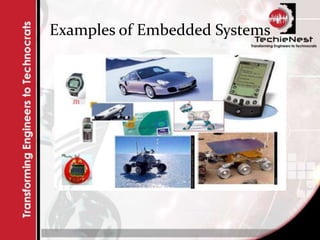
 Industrial machines, automobiles, medical
equipment, cameras, household appliances,
airplanes, vending machines and toys (as
well as the more obvious cellular phone and
PDA) are among the myriad possible hosts
of an embedded system.
Continue….
 Physically, embedded systems range from
portable devices such as digital watches and
MP3 players, to large stationary installations
like traffic lights, factory controllers, or the
systems controlling nuclear power plants.
 Embedded systems that are programmable
are provided with programming interfaces
and embedded programming is a specialized
occupation.
 It is embedded as part of a complete device
often including hardware and mechanical
parts.
Continue….
 The key characteristic is being dedicated to
handle a particular task.
 The embedded system is dedicated to
specific tasks, design engineers can optimize
it to reduce the size and cost of the product
and increase the reliability and
performance. Some embedded systems are
mass-produced, benefiting from economies
of scale.
 Complexity varies from low, with a single
microcontroller chip, to very high with
multiple units, peripherals and networks
mounted inside a large chassis or enclosure.
Examples of Embedded Systems
Characteristics of Embedded Systems
An Embedded systems must have the following
characteristics:
User Interfaces
Simple Systems which Stem from Limited
Functionality
CPU Platforms with Microprocessors or
Microcontrollers
User Interfaces
 Originally, an embedded system had no user
interface.
 There was no need for human interaction or
intervention except to install the device and test it.
 Many modern embedded systems however, have full-
scale user interfaces although these are only inputs
for data but are not supposed to provide additional
functionality for the system, e.g. QWERTY keyboards
for PDAs used to enter names, addresses, phone
numbers and notes and even full sized documents.
 The moment PDAs achieve full desktop computer
functionalities, however, they may no longer be
considered embedded systems.
Simple Systems which Stem from
Limited Functionality
 This refers to basic systems such as switches,
small character- or digit-only displays and LEDs
intended to show the ‘health’ of the embedded
system, but this has also achieved some level of
complexity.
 A cash register or an ATM with touch screen
technology is considered an embedded system
since it has limited uses, even if the user
interface (the touch screen) is a complex system.
CPU Platform
 Limited functionality is the key in
defining these as embedded systems.
 In a sense, the BIOS chip is considered
an embedded system since it has
limited functions, and works
automatically (when the computer is
booted up).
 Peripherals like the USB can also be
considered as embedded systems.
Parts of Embedded Systems
 An embedded system consists of
three parts:
Input
Processing Unit
Output
 The input device are responsible for
providing input to the embedded
system which is then processed by
the processing unit to produce an
desired output.
Input Devices-sensors
 These devices provide input to the
microcontroller.
 In general, we use sensors as input devices while
dealing with microcontrollers.
 A sensor is a device that measures a physical
quantity and converts it into a signal which can
be read by an observer or by an instrument.
 The output of a sensor is an analog signal. This
signal is utilized in analog sensors.
 Digital sensors use this signal after passing them
from comparator IC 741 or IC LM 393. Thus,
Digital sensors are basically a combination of
analog sensors and comparator ICs.
Types of sensors
 Temperature,
 Pressure,
 Level
 Humidity
 Speed
 Motion
 Distance,
 Light
Uses of sensors
 Sensors are used in everyday objects
such as touch-sensitive elevator buttons
(tactile sensor) and lamps which dim or
brighten by touching the base.
 There are also innumerable applications
for sensors of which most people are
never aware.
 Applications include cars, machines,
aerospace, medicine, manufacturing
and robotics
Processing Unit
 These devices process the input
provided by the input devices and
produces the output.
 All the decisions are taken by this
devices depending upon the algorithm
provided by the user.
 The user transfers the algorithm in the
form of program.
 Microprocessor or microcontrollers are
used as the basic processing devices.
Microprocessor
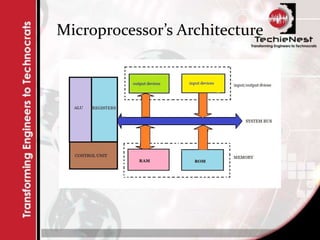
 A microprocessor incorporates the functions
of computer's central processing unit (CPU)
on a single integrated circuit (IC or
microchip).
 It is a multipurpose, programmable, clock-
driven, register-based electronic device that
accepts digital data as input, processes it
according to instructions stored in its
memory, and provides results as output.
 It is an example of sequential digital logic, as
it has internal memory, i.e. its registers.
Microprocessor’s Architecture
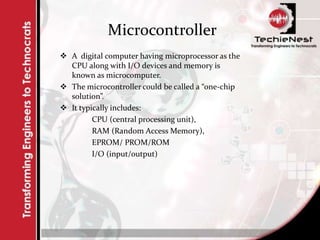
Microcontroller
 A digital computer having microprocessor as the
CPU along with I/O devices and memory is
known as microcomputer.
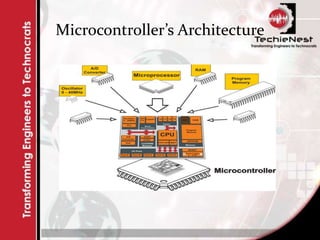
 The microcontroller could be called a “one-chip
solution”.
 It typically includes:
CPU (central processing unit),
RAM (Random Access Memory),
EPROM/ PROM/ROM
I/O (input/output)
Continue….
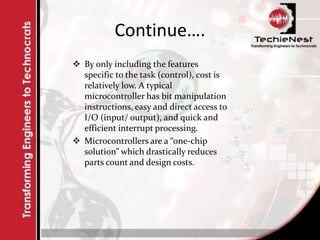
 By only including the features
specific to the task (control), cost is
relatively low. A typical
microcontroller has bit manipulation
instructions, easy and direct access to
I/O (input/ output), and quick and
efficient interrupt processing.
 Microcontrollers are a “one-chip
solution” which drastically reduces
parts count and design costs.
Microcontroller’s Architecture
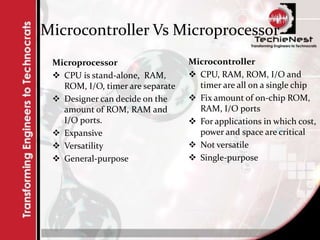
Microcontroller Vs Microprocessor
Microprocessor
 CPU is stand-alone, RAM,
ROM, I/O, timer are separate
 Designer can decide on the
amount of ROM, RAM and
I/O ports.
 Expansive
 Versatility
 General-purpose
Microcontroller
 CPU, RAM, ROM, I/O and
timer are all on a single chip
 Fix amount of on-chip ROM,
RAM, I/O ports
 For applications in which cost,
power and space are critical
 Not versatile
 Single-purpose
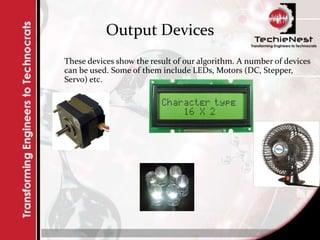
Output Devices
These devices show the result of our algorithm. A number of devices
can be used. Some of them include LEDs, Motors (DC, Stepper,
Servo) etc.

1.TechieNest embedded systems

  • 1.
  • 2.
    Embedded Systems  Anembedded system is a combination of computer hardware and software, either fixed in capability or programmable, that is specifically designed for a particular function.  Industrial machines, automobiles, medical equipment, cameras, household appliances, airplanes, vending machines and toys (as well as the more obvious cellular phone and PDA) are among the myriad possible hosts of an embedded system.
  • 3.
    Continue….  Physically, embeddedsystems range from portable devices such as digital watches and MP3 players, to large stationary installations like traffic lights, factory controllers, or the systems controlling nuclear power plants.  Embedded systems that are programmable are provided with programming interfaces and embedded programming is a specialized occupation.  It is embedded as part of a complete device often including hardware and mechanical parts.
  • 4.
    Continue….  The keycharacteristic is being dedicated to handle a particular task.  The embedded system is dedicated to specific tasks, design engineers can optimize it to reduce the size and cost of the product and increase the reliability and performance. Some embedded systems are mass-produced, benefiting from economies of scale.  Complexity varies from low, with a single microcontroller chip, to very high with multiple units, peripherals and networks mounted inside a large chassis or enclosure.
  • 5.
  • 6.
    Characteristics of EmbeddedSystems An Embedded systems must have the following characteristics: User Interfaces Simple Systems which Stem from Limited Functionality CPU Platforms with Microprocessors or Microcontrollers
  • 7.
    User Interfaces  Originally,an embedded system had no user interface.  There was no need for human interaction or intervention except to install the device and test it.  Many modern embedded systems however, have full- scale user interfaces although these are only inputs for data but are not supposed to provide additional functionality for the system, e.g. QWERTY keyboards for PDAs used to enter names, addresses, phone numbers and notes and even full sized documents.  The moment PDAs achieve full desktop computer functionalities, however, they may no longer be considered embedded systems.
  • 8.
    Simple Systems whichStem from Limited Functionality  This refers to basic systems such as switches, small character- or digit-only displays and LEDs intended to show the ‘health’ of the embedded system, but this has also achieved some level of complexity.  A cash register or an ATM with touch screen technology is considered an embedded system since it has limited uses, even if the user interface (the touch screen) is a complex system.
  • 9.
    CPU Platform  Limitedfunctionality is the key in defining these as embedded systems.  In a sense, the BIOS chip is considered an embedded system since it has limited functions, and works automatically (when the computer is booted up).  Peripherals like the USB can also be considered as embedded systems.
  • 10.
    Parts of EmbeddedSystems  An embedded system consists of three parts: Input Processing Unit Output  The input device are responsible for providing input to the embedded system which is then processed by the processing unit to produce an desired output.
  • 11.
    Input Devices-sensors  Thesedevices provide input to the microcontroller.  In general, we use sensors as input devices while dealing with microcontrollers.  A sensor is a device that measures a physical quantity and converts it into a signal which can be read by an observer or by an instrument.  The output of a sensor is an analog signal. This signal is utilized in analog sensors.  Digital sensors use this signal after passing them from comparator IC 741 or IC LM 393. Thus, Digital sensors are basically a combination of analog sensors and comparator ICs.
  • 12.
    Types of sensors Temperature,  Pressure,  Level  Humidity  Speed  Motion  Distance,  Light
  • 13.
    Uses of sensors Sensors are used in everyday objects such as touch-sensitive elevator buttons (tactile sensor) and lamps which dim or brighten by touching the base.  There are also innumerable applications for sensors of which most people are never aware.  Applications include cars, machines, aerospace, medicine, manufacturing and robotics
  • 14.
    Processing Unit  Thesedevices process the input provided by the input devices and produces the output.  All the decisions are taken by this devices depending upon the algorithm provided by the user.  The user transfers the algorithm in the form of program.  Microprocessor or microcontrollers are used as the basic processing devices.
  • 15.
    Microprocessor  A microprocessorincorporates the functions of computer's central processing unit (CPU) on a single integrated circuit (IC or microchip).  It is a multipurpose, programmable, clock- driven, register-based electronic device that accepts digital data as input, processes it according to instructions stored in its memory, and provides results as output.  It is an example of sequential digital logic, as it has internal memory, i.e. its registers.
  • 16.
  • 17.
    Microcontroller  A digitalcomputer having microprocessor as the CPU along with I/O devices and memory is known as microcomputer.  The microcontroller could be called a “one-chip solution”.  It typically includes: CPU (central processing unit), RAM (Random Access Memory), EPROM/ PROM/ROM I/O (input/output)
  • 18.
    Continue….  By onlyincluding the features specific to the task (control), cost is relatively low. A typical microcontroller has bit manipulation instructions, easy and direct access to I/O (input/ output), and quick and efficient interrupt processing.  Microcontrollers are a “one-chip solution” which drastically reduces parts count and design costs.
  • 19.
  • 20.
    Microcontroller Vs Microprocessor Microprocessor CPU is stand-alone, RAM, ROM, I/O, timer are separate  Designer can decide on the amount of ROM, RAM and I/O ports.  Expansive  Versatility  General-purpose Microcontroller  CPU, RAM, ROM, I/O and timer are all on a single chip  Fix amount of on-chip ROM, RAM, I/O ports  For applications in which cost, power and space are critical  Not versatile  Single-purpose
  • 21.
    Output Devices These devicesshow the result of our algorithm. A number of devices can be used. Some of them include LEDs, Motors (DC, Stepper, Servo) etc.