Web and EmailSecurity: Fortifying
Your Digital Defences
In today's interconnected world, safeguarding our digital assets is paramount. This
presentation will explore crucial strategies and best practices for enhancing web and
email security, empowering you to navigate the complex cyber threat landscape with
confidence and resilience.
by Muhammad Jameel
MJ
2.
Introduction: The Ever-EvolvingCyber Threat Landscape
The digital realm is constantly evolving, and with it, the sophistication of cyber
threats. From intricate phishing campaigns to advanced web application exploits,
organisations face a relentless barrage of attacks designed to compromise data,
disrupt operations, and erode trust.
Understanding the dynamic nature of these threats is the first step towards
building robust defences. This section will set the stage, highlighting the critical
importance of proactive and adaptive security measures in an environment where
new vulnerabilities emerge daily.
3.
Understanding Web ApplicationSecurity:
Beyond the Firewall
Beyond the Perimeter
Traditional firewalls are no longer sufficient. Web applications expose unique vulnerabilities that
require specialised protection.
Code-Level Risks
Flaws within the application's code can lead to severe breaches, even with strong network security in
place.
Data Protection
Web applications often handle sensitive user data, making them prime targets for attackers seeking to
exfiltrate information.
Continuous Vulnerability
New vulnerabilities are discovered regularly, necessitating continuous monitoring and patching.
4.
OWASP Top 10(Part 1): Injection and Broken Authentication
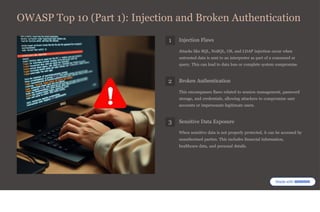
1 Injection Flaws
Attacks like SQL, NoSQL, OS, and LDAP injection occur when
untrusted data is sent to an interpreter as part of a command or
query. This can lead to data loss or complete system compromise.
2 Broken Authentication
This encompasses flaws related to session management, password
storage, and credentials, allowing attackers to compromise user
accounts or impersonate legitimate users.
3 Sensitive Data Exposure
When sensitive data is not properly protected, it can be accessed by
unauthorised parties. This includes financial information,
healthcare data, and personal details.
5.
OWASP Top 10(Part 2): Cross-Site
Scripting, Security
Misconfigurations & More
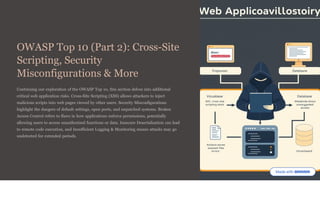
Continuing our exploration of the OWASP Top 10, this section delves into additional
critical web application risks. Cross-Site Scripting (XSS) allows attackers to inject
malicious scripts into web pages viewed by other users. Security Misconfigurations
highlight the dangers of default settings, open ports, and unpatched systems. Broken
Access Control refers to flaws in how applications enforce permissions, potentially
allowing users to access unauthorised functions or data. Insecure Deserialisation can lead
to remote code execution, and Insufficient Logging & Monitoring means attacks may go
undetected for extended periods.
6.
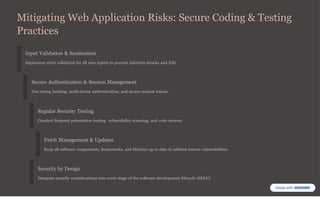
Mitigating Web ApplicationRisks: Secure Coding & Testing
Practices
Input Validation & Sanitisation
Implement strict validation for all user inputs to prevent injection attacks and XSS.
Secure Authentication & Session Management
Use strong hashing, multi-factor authentication, and secure session tokens.
Regular Security Testing
Conduct frequent penetration testing, vulnerability scanning, and code reviews.
Patch Management & Updates
Keep all software components, frameworks, and libraries up to date to address known vulnerabilities.
Security by Design
Integrate security considerations into every stage of the software development lifecycle (SDLC).
7.
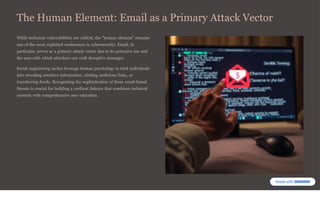
The Human Element:Email as a Primary Attack Vector
While technical vulnerabilities are critical, the "human element" remains
one of the most exploited weaknesses in cybersecurity. Email, in
particular, serves as a primary attack vector due to its pervasive use and
the ease with which attackers can craft deceptive messages.
Social engineering tactics leverage human psychology to trick individuals
into revealing sensitive information, clicking malicious links, or
transferring funds. Recognising the sophistication of these email-based
threats is crucial for building a resilient defence that combines technical
controls with comprehensive user education.
8.
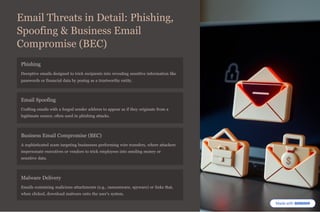
Email Threats inDetail: Phishing,
Spoofing & Business Email
Compromise (BEC)
Phishing
Deceptive emails designed to trick recipients into revealing sensitive information like
passwords or financial data by posing as a trustworthy entity.
Email Spoofing
Crafting emails with a forged sender address to appear as if they originate from a
legitimate source, often used in phishing attacks.
Business Email Compromise (BEC)
A sophisticated scam targeting businesses performing wire transfers, where attackers
impersonate executives or vendors to trick employees into sending money or
sensitive data.
Malware Delivery
Emails containing malicious attachments (e.g., ransomware, spyware) or links that,
when clicked, download malware onto the user's system.
9.
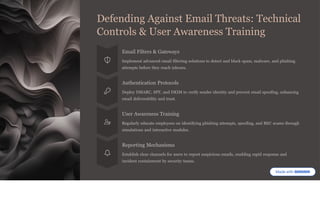
Defending Against EmailThreats: Technical
Controls & User Awareness Training
Email Filters & Gateways
Implement advanced email filtering solutions to detect and block spam, malware, and phishing
attempts before they reach inboxes.
Authentication Protocols
Deploy DMARC, SPF, and DKIM to verify sender identity and prevent email spoofing, enhancing
email deliverability and trust.
User Awareness Training
Regularly educate employees on identifying phishing attempts, spoofing, and BEC scams through
simulations and interactive modules.
Reporting Mechanisms
Establish clear channels for users to report suspicious emails, enabling rapid response and
incident containment by security teams.
10.
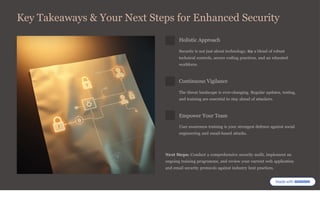
Key Takeaways &Your Next Steps for Enhanced Security
Holistic Approach
Security is not just about technology; it9s a blend of robust
technical controls, secure coding practices, and an educated
workforce.
Continuous Vigilance
The threat landscape is ever-changing. Regular updates, testing,
and training are essential to stay ahead of attackers.
Empower Your Team
User awareness training is your strongest defence against social
engineering and email-based attacks.
Next Steps: Conduct a comprehensive security audit, implement an
ongoing training programme, and review your current web application
and email security protocols against industry best practices.