What is Essential of Email Etiquette
• Email etiquette refers to the principles of behavior that one should use
when writing or answering email messages. It is also known as the code
of conduct for email communication.
• Email etiquette is basically regular etiquette which kept in mind while
writting a traditional letter with a modern twist, applied to digital
communications. It’s what’s considered appropriate, adult behavior
when emailing folks.
• Email is consider “Professional” in business industries and
often use by companies to interect with clients/customer or
to communicate within themselves.
Following Email Etiquette also shows
Why Should We Follow
Email Etiquette?
• We must follow email etiquette in our professional
communication because it reflects the personality of the
individual who is sending the mail or responding to the mail.
• Following Email Etiquette also shows
• Professionalism - Use of proper words and language
• Efficiency - Email that get to the point
• Protection from liabilities - Employee awareness of
email risks will protect your company from costly law
suits.
DO's & DON'Ts
Some Unavoidable
DO's & DONT's
DO's & DON'Ts
Do we have
a clear
subject line.
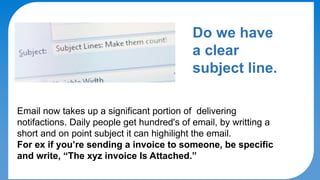
Email now takes up a significant portion of delivering
notifactions. Daily people get hundred's of email, by writting a
short and on point subject it can highilight the email.
For ex if you’re sending a invoice to someone, be specific
and write, “The xyz invoice Is Attached.”
DO's & DON'Ts
Do we use a
professional
salutation and
greeting.
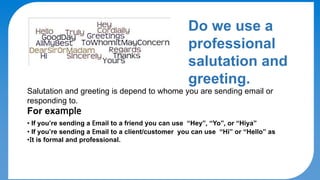
Salutation and greeting is depend to whome you are sending email or
responding to.
For example
• If you’re sending a Email to a friend you can use “Hey”, “Yo”, or “Hiya”
• If you’re sending a Email to a client/customer you can use “Hi” or “Hello” as
•It is formal and professional.
DO's & DON'Ts
Do proofread
your message.
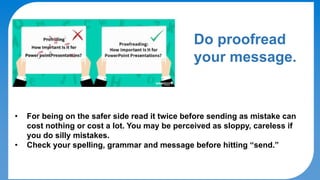
• For being on the safer side read it twice before sending as mistake can
cost nothing or cost a lot. You may be perceived as sloppy, careless if
you do silly mistakes.
• Check your spelling, grammar and message before hitting “send.”
DO's & DON'Ts
Do reply to
all Emails.
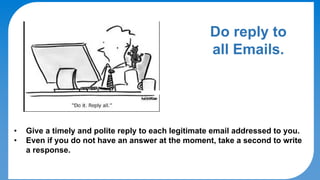
• Give a timely and polite reply to each legitimate email addressed to you.
• Even if you do not have an answer at the moment, take a second to write
a response.
DO's & DON'Ts
Don't use
humor.
• Humor is a big no in professionalism. It does not translate well via email.
• There is a good chance of being misinterpreted by the other party, or
taken as sarcasm, without the accompanying vocal tone and facial
expressions.
DO's & DON'Ts
Don't assume
the recipient
knows what was
going on
• Write your email explaining each and every aspect from
the start to the end considering that the recepient don't
know any thing on the topic.
DO's & DON'Ts
Don't write
while angry.
• Don't wite anything in temper or give a quick, flip response that you regret later on.
• Always write thoughtfully and then send.
DO's & DON'Ts
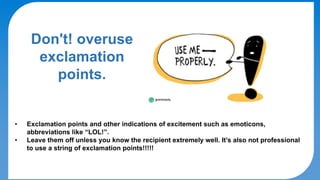
Don't! overuse
exclamation
points.
• Exclamation points and other indications of excitement such as emoticons,
abbreviations like “LOL!”.
• Leave them off unless you know the recipient extremely well. It’s also not professional
to use a string of exclamation points!!!!!
DO's & DON'Ts
Thank you

Email etiquette ppt

  • 2.
    What is Essentialof Email Etiquette • Email etiquette refers to the principles of behavior that one should use when writing or answering email messages. It is also known as the code of conduct for email communication. • Email etiquette is basically regular etiquette which kept in mind while writting a traditional letter with a modern twist, applied to digital communications. It’s what’s considered appropriate, adult behavior when emailing folks. • Email is consider “Professional” in business industries and often use by companies to interect with clients/customer or to communicate within themselves.
  • 3.
    Following Email Etiquettealso shows Why Should We Follow Email Etiquette? • We must follow email etiquette in our professional communication because it reflects the personality of the individual who is sending the mail or responding to the mail. • Following Email Etiquette also shows • Professionalism - Use of proper words and language • Efficiency - Email that get to the point • Protection from liabilities - Employee awareness of email risks will protect your company from costly law suits.
  • 4.
    DO's & DON'Ts SomeUnavoidable DO's & DONT's
  • 5.
    DO's & DON'Ts Dowe have a clear subject line. Email now takes up a significant portion of delivering notifactions. Daily people get hundred's of email, by writting a short and on point subject it can highilight the email. For ex if you’re sending a invoice to someone, be specific and write, “The xyz invoice Is Attached.”
  • 6.
    DO's & DON'Ts Dowe use a professional salutation and greeting. Salutation and greeting is depend to whome you are sending email or responding to. For example • If you’re sending a Email to a friend you can use “Hey”, “Yo”, or “Hiya” • If you’re sending a Email to a client/customer you can use “Hi” or “Hello” as •It is formal and professional.
  • 7.
    DO's & DON'Ts Doproofread your message. • For being on the safer side read it twice before sending as mistake can cost nothing or cost a lot. You may be perceived as sloppy, careless if you do silly mistakes. • Check your spelling, grammar and message before hitting “send.”
  • 8.
    DO's & DON'Ts Doreply to all Emails. • Give a timely and polite reply to each legitimate email addressed to you. • Even if you do not have an answer at the moment, take a second to write a response.
  • 9.
    DO's & DON'Ts Don'tuse humor. • Humor is a big no in professionalism. It does not translate well via email. • There is a good chance of being misinterpreted by the other party, or taken as sarcasm, without the accompanying vocal tone and facial expressions.
  • 10.
    DO's & DON'Ts Don'tassume the recipient knows what was going on • Write your email explaining each and every aspect from the start to the end considering that the recepient don't know any thing on the topic.
  • 11.
    DO's & DON'Ts Don'twrite while angry. • Don't wite anything in temper or give a quick, flip response that you regret later on. • Always write thoughtfully and then send.
  • 12.
    DO's & DON'Ts Don't!overuse exclamation points. • Exclamation points and other indications of excitement such as emoticons, abbreviations like “LOL!”. • Leave them off unless you know the recipient extremely well. It’s also not professional to use a string of exclamation points!!!!!
  • 13.