BUSINESS ETIQUETTE
OPEYEMI
AKINSANYA
What is Etiquette?
 Etiquette can be defined as the customs or rules governing
behaviour regarded as correct or acceptable in social or official
life
 It can also refer to a conventional but unwritten code of practice
followed by members of any of certain professions or groups
Business etiquette is a code that governs the expectations of social
behaviour in a workplace.
• It tells an individual how to behave when dealing with situations in a
work environment however trivial the situation is.
Why Business Etiquette?
We need business etiquette to exhibit professionalism ; develop a
polished image and instil a perception of trustworthiness.
Certain important business etiquettes are:
• Email etiquette.
• Office etiquette.
• Dining etiquette.
• Telephone etiquette.
• Meeting etiquette.
• Business card etiquette.
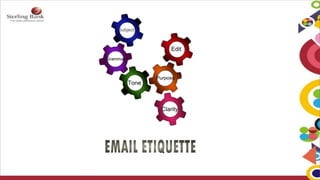
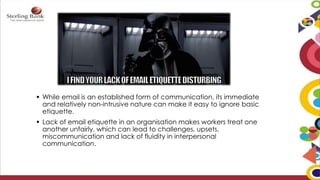
 While email is an established form of communication, its immediate
and relatively non-intrusive nature can make it easy to ignore basic
etiquette.
 Lack of email etiquette in an organisation makes workers treat one
another unfairly, which can lead to challenges, upsets,
miscommunication and lack of fluidity in interpersonal
communication.
Need for Email Etiquette
A company needs to implement email rules for the following reasons:
 Professionalism: By using proper e-mail language your company will
convey a professional image.
 Efficiency: E-mails that get to the point are much more effective than
poorly worded mails.
 Protection from liability: Staff awareness of e-mail risks will protect your
company from costly law suits.
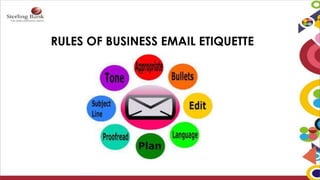
RULES OF BUSINESS EMAIL ETIQUETTE
How to send mails
• Begin with a greeting and end with a salutation.
• Use proper spelling, grammar and punctuation.
• Use proper structure and layout.
• Keep it personal.
• Use CC and BCC sparingly.
• Do not send e-mails without a subject.
• Avoid using URGENT and IMPORTANT.
• Try to keep the e-mail brief and to the point.
• The subject heading must be as specific as possible.
• Use a meaningful subject.
• To emphasize important points, number your directions or bullet your main
points.
• Use templates for frequently used responses.
• Do not attach unnecessary files.
• Keep attachments to a minimum and mention your attachment in the
content.
• Do not copy a message or attachment without permission.
• Take care with abbreviations and emoticons.
• Do not leave out the message thread.
• Do not overuse ‘Reply to all’.
• Proofread your messages before you send them.
• Do not use email to discuss confidential information. Always assume
that the email is public.
• Keep signatures simple.
• Add the email address last.
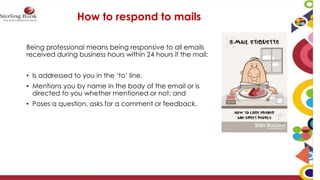
Being professional means being responsive to all emails
received during business hours within 24 hours if the mail:
• Is addressed to you in the ‘to’ line.
• Mentions you by name in the body of the email or is
directed to you whether mentioned or not; and
• Poses a question, asks for a comment or feedback.
How to respond to mails
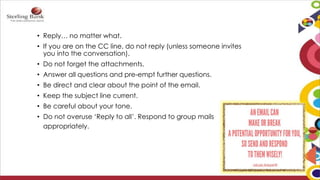
• Reply… no matter what.
• If you are on the CC line, do not reply (unless someone invites
you into the conversation).
• Do not forget the attachments.
• Answer all questions and pre-empt further questions.
• Be direct and clear about the point of the email.
• Keep the subject line current.
• Be careful about your tone.
• Do not overuse ‘Reply to all’. Respond to group mails
appropriately.
REMEMBER:
•A key measure of professional success is communication.
•E-mail is the primary mode that professionals today use to
communicate.
•The rules of email etiquette are fairly simple, but sometimes they
are easy to forget.
• Always respect the recipient and stay professional!
OFFICE ETIQUETTE
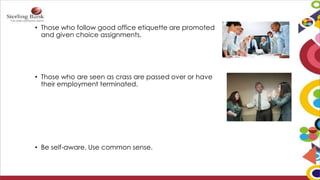
• Those who follow good office etiquette are promoted
and given choice assignments.
• Those who are seen as crass are passed over or have
their employment terminated.
• Be self-aware. Use common sense.
• Mind your business.
• Never go over your supervisor’s head.
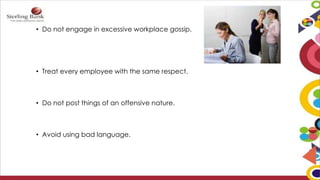
• Obey your company’s business dress code.
• Do not engage in excessive workplace gossip.
• Treat every employee with the same respect.
• Do not post things of an offensive nature.
• Avoid using bad language.
• Do not leave your office without telling anyone.
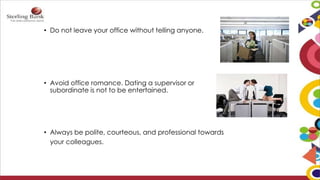
• Avoid office romance. Dating a supervisor or
subordinate is not to be entertained.
• Always be polite, courteous, and professional towards
your colleagues.
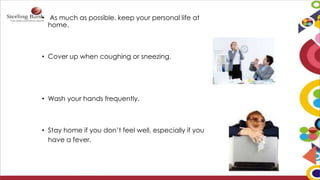
• As much as possible, keep your personal life at
home.
• Cover up when coughing or sneezing.
• Wash your hands frequently.
• Stay home if you don’t feel well, especially if you
have a fever.
THANK YOU

Business Etiquette

  • 1.
  • 2.
    What is Etiquette? Etiquette can be defined as the customs or rules governing behaviour regarded as correct or acceptable in social or official life  It can also refer to a conventional but unwritten code of practice followed by members of any of certain professions or groups Business etiquette is a code that governs the expectations of social behaviour in a workplace. • It tells an individual how to behave when dealing with situations in a work environment however trivial the situation is.
  • 3.
    Why Business Etiquette? Weneed business etiquette to exhibit professionalism ; develop a polished image and instil a perception of trustworthiness. Certain important business etiquettes are: • Email etiquette. • Office etiquette. • Dining etiquette. • Telephone etiquette. • Meeting etiquette. • Business card etiquette.
  • 5.
     While emailis an established form of communication, its immediate and relatively non-intrusive nature can make it easy to ignore basic etiquette.  Lack of email etiquette in an organisation makes workers treat one another unfairly, which can lead to challenges, upsets, miscommunication and lack of fluidity in interpersonal communication.
  • 6.
    Need for EmailEtiquette A company needs to implement email rules for the following reasons:  Professionalism: By using proper e-mail language your company will convey a professional image.  Efficiency: E-mails that get to the point are much more effective than poorly worded mails.  Protection from liability: Staff awareness of e-mail risks will protect your company from costly law suits.
  • 7.
    RULES OF BUSINESSEMAIL ETIQUETTE
  • 8.
    How to sendmails • Begin with a greeting and end with a salutation. • Use proper spelling, grammar and punctuation. • Use proper structure and layout. • Keep it personal. • Use CC and BCC sparingly. • Do not send e-mails without a subject. • Avoid using URGENT and IMPORTANT. • Try to keep the e-mail brief and to the point. • The subject heading must be as specific as possible. • Use a meaningful subject. • To emphasize important points, number your directions or bullet your main points.
  • 9.
    • Use templatesfor frequently used responses. • Do not attach unnecessary files. • Keep attachments to a minimum and mention your attachment in the content. • Do not copy a message or attachment without permission. • Take care with abbreviations and emoticons. • Do not leave out the message thread. • Do not overuse ‘Reply to all’. • Proofread your messages before you send them. • Do not use email to discuss confidential information. Always assume that the email is public. • Keep signatures simple. • Add the email address last.
  • 10.
    Being professional meansbeing responsive to all emails received during business hours within 24 hours if the mail: • Is addressed to you in the ‘to’ line. • Mentions you by name in the body of the email or is directed to you whether mentioned or not; and • Poses a question, asks for a comment or feedback. How to respond to mails
  • 11.
    • Reply… nomatter what. • If you are on the CC line, do not reply (unless someone invites you into the conversation). • Do not forget the attachments. • Answer all questions and pre-empt further questions. • Be direct and clear about the point of the email. • Keep the subject line current. • Be careful about your tone. • Do not overuse ‘Reply to all’. Respond to group mails appropriately.
  • 12.
    REMEMBER: •A key measureof professional success is communication. •E-mail is the primary mode that professionals today use to communicate. •The rules of email etiquette are fairly simple, but sometimes they are easy to forget. • Always respect the recipient and stay professional!
  • 13.
  • 14.
    • Those whofollow good office etiquette are promoted and given choice assignments. • Those who are seen as crass are passed over or have their employment terminated. • Be self-aware. Use common sense.
  • 15.
    • Mind yourbusiness. • Never go over your supervisor’s head. • Obey your company’s business dress code.
  • 16.
    • Do notengage in excessive workplace gossip. • Treat every employee with the same respect. • Do not post things of an offensive nature. • Avoid using bad language.
  • 17.
    • Do notleave your office without telling anyone. • Avoid office romance. Dating a supervisor or subordinate is not to be entertained. • Always be polite, courteous, and professional towards your colleagues.
  • 18.
    • As muchas possible, keep your personal life at home. • Cover up when coughing or sneezing. • Wash your hands frequently. • Stay home if you don’t feel well, especially if you have a fever.
  • 19.