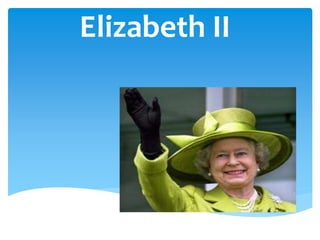
Elizabeth II
Queen of the United Kingdom and the other
Commonwealth realms List[show]
Reign
6 February 1952 – present
Coronation
2 June 1953
Predecessor
George VI
Heir apparent
Charles, Prince of Wales
Prime Ministers
See list

Spouse

Prince Philip, Duke of
Edinburgh (m. 1947)

Detail
Issue
•Charles, Prince of Wales
•Anne, Princess Royal
•Prince Andrew, Duke of York
•Prince Edward, Earl of Wessex
Full name
Elizabeth Alexandra Mary
House
House of Windsor
Father
George VI
Mother
Elizabeth Bowes-Lyon
21 April 1926 (age 86)
Born
Mayfair, London, England,
United Kingdom
•Church of England
Religion
•Church of Scotland
 Elizabeth II (Elizabeth Alexandra Mary; born 21 April 1926)] is
the constitutional monarch of 16 sovereign states (known as
the Commonwealth realms) and their territories and
dependencies, as well as head of the 54-member
Commonwealth of Nations. She is Supreme Governor of the
Church of England and, in some of her realms, carries the
title of Defender of the Faith as part of her full title.
 On her accession on 6 February 1952, Queen Elizabeth became
Head of the Commonwealth and queen regnant of seven
independent Commonwealth countries: the United Kingdom,
Canada, Australia, New Zealand, South Africa, Pakistan and
Ceylon. From 1956 to 1992, the number of her realms varied as
territories gained independence and some realms became
republics. At present, in addition to the first four
aforementioned countries, Elizabeth is Queen of Jamaica,
Barbados, the Bahamas, Grenada, Papua New Guinea, the
Solomon Islands, Tuvalu, Saint Lucia, Saint Vincent and the
Grenadines, Belize, Antigua and Barbuda and Saint Kitts and
Nevis. Her reign of 60 years is currently the second longest for
a British monarch; only Queen Victoria has reigned longer at 63
years
Elizabeth was born in London and educated privately at home. Her
father acceded to the throne as George VI in 1936 on the abdication of
his brother Edward VIII, from which time she was the heir
presumptive. She began to undertake public duties during the Second
World War, in which she served in the Auxiliary Territorial Service. In
1947, she married Prince Philip, Duke of Edinburgh, with whom she has
four children: Charles, Anne, Andrew, and Edward. Her coronation
service took place in 1953 and was the first to be televised.
 The Queen's many historic visits and meetings include a state visit to
the Republic of Ireland and reciprocal visits to and from the Pope.
The Queen has seen major constitutional changes in her realms,
such as devolution in the United Kingdom and the patriation of the
Canadian constitution. Times of personal significance have included
the births and marriages of her children, the births of her
grandchildren, the investiture of the Prince of Wales, and the
celebration of milestones such as her Silver, Golden, and Diamond
Jubilees in 1977, 2002, and 2012, respectively.
 Major events in the Queen's reign have included the Troubles in
Northern Ireland, the Falklands War, wars with Iraq and the War in
Afghanistan. There have been times of personal sorrow for her
which include the death of her father at 56, the assassination of
Prince Philip's uncle, Lord Mountbatten, the breakdown of her
children's marriages in 1992 (a year deemed her annus horribilis),
the death in 1997 of her daughter-in-law, Diana, Princess of Wales,
and the deaths of her mother and sister in 2002. The Queen has
occasionally faced severe press criticism of the royal family and
republican sentiments, but support for the monarchy and her
personal popularity remain high.
 Early life
 Princess Elizabeth aged 3, 1929
 Elizabeth was the first child of Prince Albert, Duke of York (later
King George VI), and his wife, Elizabeth. Her father was the second
son of King George V and Queen Mary. Her mother was the
youngest daughter of Scottish aristocrat Claude Bowes-Lyon, 14th
Earl of Strathmore and Kinghorne. She was born by Caesarean
section at 2.40 am (GMT) on 21 April 1926 at her maternal
grandfather's London house: 17 Bruton Street, Mayfair.[1] She was
baptised by the Anglican Archbishop of York, Cosmo Gordon Lang,
in the private chapel of Buckingham Palace on 29 May, and named
Elizabeth after her mother, Alexandra after George V's mother,
who had died six months earlier, and Mary after her paternal
grandmother.Her close family called her "Lilibet".] George V
cherished his granddaughter, and during his serious illness in 1929
her regular visits were credited in the popular press and by later
biographers with raising his spirits and aiding his recovery.
 Elizabeth's only sibling, Princess Margaret, was four years
younger. The two princesses were educated at home under
the supervision of their mother and their governess, Marion
Crawford, who was casually known as "Crawfie".Lessons
concentrated on history, language, literature and music.[7]
To the dismay of the royal family, in 1950 Crawford
published a biography of Elizabeth and Margaret's
childhood years entitled The Little Princesses. The book
describes Elizabeth's love of horses and dogs, her
orderliness and her attitude of responsibility.Others echoed
such observations: Winston Churchill described Elizabeth
when she was two as "a character. She has an air of
authority and reflectiveness astonishing in an infant." Her
cousin Margaret Rhodes described her as "a jolly little girl,
but fundamentally sensible and well-behaved".
 http://en.wikipedia.org/wiki/Elizabeth_II#Early_life

ELIZABETH 2

  • 1.
  • 2.
    Queen of theUnited Kingdom and the other Commonwealth realms List[show] Reign 6 February 1952 – present Coronation 2 June 1953 Predecessor George VI Heir apparent Charles, Prince of Wales Prime Ministers See list Spouse Prince Philip, Duke of Edinburgh (m. 1947) Detail Issue •Charles, Prince of Wales •Anne, Princess Royal •Prince Andrew, Duke of York •Prince Edward, Earl of Wessex Full name Elizabeth Alexandra Mary House House of Windsor Father George VI Mother Elizabeth Bowes-Lyon 21 April 1926 (age 86) Born Mayfair, London, England, United Kingdom •Church of England Religion •Church of Scotland
  • 3.
     Elizabeth II(Elizabeth Alexandra Mary; born 21 April 1926)] is the constitutional monarch of 16 sovereign states (known as the Commonwealth realms) and their territories and dependencies, as well as head of the 54-member Commonwealth of Nations. She is Supreme Governor of the Church of England and, in some of her realms, carries the title of Defender of the Faith as part of her full title.
  • 4.
     On heraccession on 6 February 1952, Queen Elizabeth became Head of the Commonwealth and queen regnant of seven independent Commonwealth countries: the United Kingdom, Canada, Australia, New Zealand, South Africa, Pakistan and Ceylon. From 1956 to 1992, the number of her realms varied as territories gained independence and some realms became republics. At present, in addition to the first four aforementioned countries, Elizabeth is Queen of Jamaica, Barbados, the Bahamas, Grenada, Papua New Guinea, the Solomon Islands, Tuvalu, Saint Lucia, Saint Vincent and the Grenadines, Belize, Antigua and Barbuda and Saint Kitts and Nevis. Her reign of 60 years is currently the second longest for a British monarch; only Queen Victoria has reigned longer at 63 years
  • 5.
    Elizabeth was bornin London and educated privately at home. Her father acceded to the throne as George VI in 1936 on the abdication of his brother Edward VIII, from which time she was the heir presumptive. She began to undertake public duties during the Second World War, in which she served in the Auxiliary Territorial Service. In 1947, she married Prince Philip, Duke of Edinburgh, with whom she has four children: Charles, Anne, Andrew, and Edward. Her coronation service took place in 1953 and was the first to be televised.
  • 6.
     The Queen'smany historic visits and meetings include a state visit to the Republic of Ireland and reciprocal visits to and from the Pope. The Queen has seen major constitutional changes in her realms, such as devolution in the United Kingdom and the patriation of the Canadian constitution. Times of personal significance have included the births and marriages of her children, the births of her grandchildren, the investiture of the Prince of Wales, and the celebration of milestones such as her Silver, Golden, and Diamond Jubilees in 1977, 2002, and 2012, respectively.
  • 7.
     Major eventsin the Queen's reign have included the Troubles in Northern Ireland, the Falklands War, wars with Iraq and the War in Afghanistan. There have been times of personal sorrow for her which include the death of her father at 56, the assassination of Prince Philip's uncle, Lord Mountbatten, the breakdown of her children's marriages in 1992 (a year deemed her annus horribilis), the death in 1997 of her daughter-in-law, Diana, Princess of Wales, and the deaths of her mother and sister in 2002. The Queen has occasionally faced severe press criticism of the royal family and republican sentiments, but support for the monarchy and her personal popularity remain high.
  • 8.
     Early life Princess Elizabeth aged 3, 1929  Elizabeth was the first child of Prince Albert, Duke of York (later King George VI), and his wife, Elizabeth. Her father was the second son of King George V and Queen Mary. Her mother was the youngest daughter of Scottish aristocrat Claude Bowes-Lyon, 14th Earl of Strathmore and Kinghorne. She was born by Caesarean section at 2.40 am (GMT) on 21 April 1926 at her maternal grandfather's London house: 17 Bruton Street, Mayfair.[1] She was baptised by the Anglican Archbishop of York, Cosmo Gordon Lang, in the private chapel of Buckingham Palace on 29 May, and named Elizabeth after her mother, Alexandra after George V's mother, who had died six months earlier, and Mary after her paternal grandmother.Her close family called her "Lilibet".] George V cherished his granddaughter, and during his serious illness in 1929 her regular visits were credited in the popular press and by later biographers with raising his spirits and aiding his recovery.
  • 9.
     Elizabeth's onlysibling, Princess Margaret, was four years younger. The two princesses were educated at home under the supervision of their mother and their governess, Marion Crawford, who was casually known as "Crawfie".Lessons concentrated on history, language, literature and music.[7] To the dismay of the royal family, in 1950 Crawford published a biography of Elizabeth and Margaret's childhood years entitled The Little Princesses. The book describes Elizabeth's love of horses and dogs, her orderliness and her attitude of responsibility.Others echoed such observations: Winston Churchill described Elizabeth when she was two as "a character. She has an air of authority and reflectiveness astonishing in an infant." Her cousin Margaret Rhodes described her as "a jolly little girl, but fundamentally sensible and well-behaved".
  • 10.