TUDORS
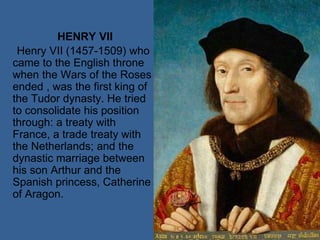
HENRY VII
Henry VII (1457-1509) who
came to the English throne
when the Wars of the Roses
ended , was the first king of
the Tudor dynasty. He tried
to consolidate his position
through: a treaty with
France, a trade treaty with
the Netherlands; and the
dynastic marriage between
his son Arthur and the
Spanish princess, Catherine
of Aragon.
During his reign he turned
England into a modern
state which he administered
like a businessman. He also
laid the foundations of
English naval power.
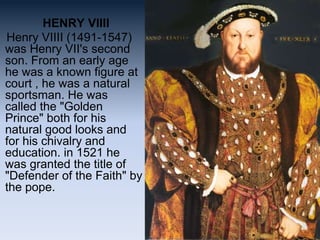
HENRY VIIII
Henry VIIII (1491-1547)
was Henry VII's second
son. From an early age
he was a known figure at
court , he was a natural
sportsman. He was
called the "Golden
Prince" both for his
natural good looks and
for his chivalry and
education. in 1521 he
was granted the title of
"Defender of the Faith" by
the pope.
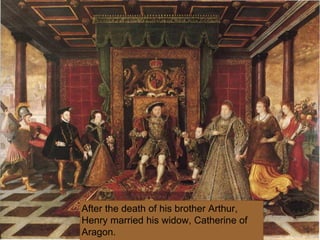
After the death of his brother Arthur,
Henry married his widow, Catherine of
Aragon.
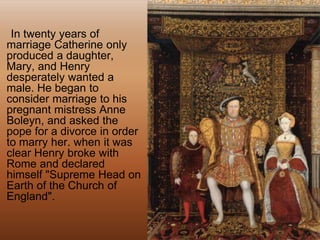
In twenty years of
marriage Catherine only
produced a daughter,
Mary, and Henry
desperately wanted a
male. He began to
consider marriage to his
pregnant mistress Anne
Boleyn, and asked the
pope for a divorce in order
to marry her. when it was
clear Henry broke with
Rome and declared
himself "Supreme Head on
Earth of the Church of
England".
This meant that he had the
right to appoint bishops, decide
on articles of faith and impose
his will on the monasteries. The
king soon dissolved the
monasteries, taking their wealth
and social charities -such as
schools and hospitals for
the poor.
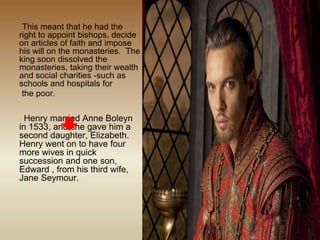
Henry married Anne Boleyn
in 1533, and she gave him a
second daughter, Elizabeth.
Henry went on to have four
more wives in quick
succession and one son,
Edward , from his third wife,
Jane Seymour.
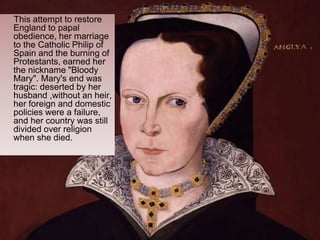
MARY I
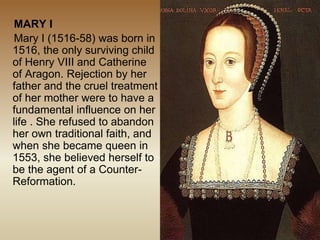
Mary I (1516-58) was born in
1516, the only surviving child
of Henry VIII and Catherine
of Aragon. Rejection by her
father and the cruel treatment
of her mother were to have a
fundamental influence on her
life . She refused to abandon
her own traditional faith, and
when she became queen in
1553, she believed herself to
be the agent of a Counter-
Reformation.
This attempt to restore
England to papal
obedience, her marriage
to the Catholic Philip of
Spain and the burning of
Protestants, earned her
the nickname "Bloody
Mary". Mary's end was
tragic: deserted by her
husband ,without an heir,
her foreign and domestic
policies were a failure,
and her country was still
divided over religion
when she died.
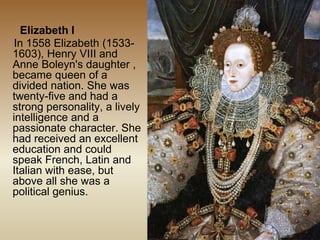
Elizabeth I
In 1558 Elizabeth (1533-
1603), Henry VIII and
Anne Boleyn's daughter ,
became queen of a
divided nation. She was
twenty-five and had a
strong personality, a lively
intelligence and a
passionate character. She
had received an excellent
education and could
speak French, Latin and
Italian with ease, but
above all she was a
political genius.
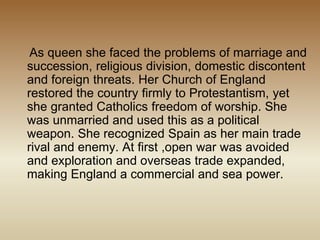
As queen she faced the problems of marriage and
succession, religious division, domestic discontent
and foreign threats. Her Church of England
restored the country firmly to Protestantism, yet
she granted Catholics freedom of worship. She
was unmarried and used this as a political
weapon. She recognized Spain as her main trade
rival and enemy. At first ,open war was avoided
and exploration and overseas trade expanded,
making England a commercial and sea power.
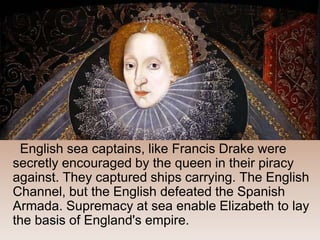
English sea captains, like Francis Drake were
secretly encouraged by the queen in their piracy
against. They captured ships carrying. The English
Channel, but the English defeated the Spanish
Armada. Supremacy at sea enable Elizabeth to lay
the basis of England's empire.
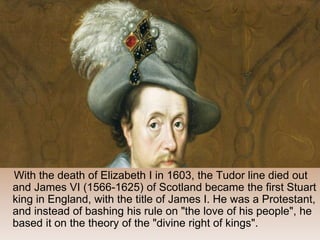
With the death of Elizabeth I in 1603, the Tudor line died out
and James VI (1566-1625) of Scotland became the first Stuart
king in England, with the title of James I. He was a Protestant,
and instead of bashing his rule on "the love of his people", he
based it on the theory of the "divine right of kings".
He believed that, as a monarch, he was the
representative of God on earth. He summoned
Parliament only to ask for money. He was
interested in witchcraft and the supernatural. As
in the early days of Elizabeth I, religion was the
most urgent problem of the new reign.
Catholics were barred from public life and were
fined if they refused to attend the Church of
England, extreme Protestants, called Puritans,
disapproved of both the rites and the bishops of
the Church of England.
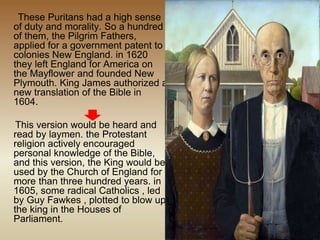
These Puritans had a high sense
of duty and morality. So a hundred
of them, the Pilgrim Fathers,
applied for a government patent to
colonies New England. in 1620
they left England for America on
the Mayflower and founded New
Plymouth. King James authorized a
new translation of the Bible in
1604.
This version would be heard and
read by laymen. the Protestant
religion actively encouraged
personal knowledge of the Bible,
and this version, the King would be
used by the Church of England for
more than three hundred years. in
1605, some radical Catholics , led
by Guy Fawkes , plotted to blow up
the king in the Houses of
Parliament.
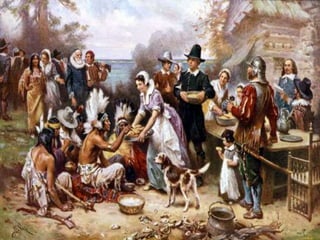
The origin of Thanksgiving Day
The first Thanksgiving was celebrated by
the Pilgrim Fathers (early settlers of
America) in 1621 to thank God for their first
good harvest. They celebrated it with the
local Wampanoag Indians. Who had
helped them survive and taught them how
to plant their crops. That first feast lasted
three days and included a wide variety of
animals as well as fruits and vegetables
from the autumn harvest. Americans did
not all celebrate Thanksgiving at the same
time until 1863, when President Abraham
Lincoln declared the last Thursday in
November a day of thanksgiving.
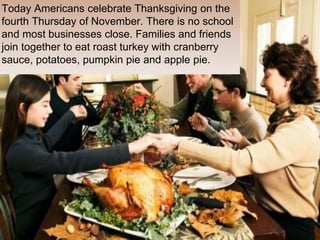
Today Americans celebrate Thanksgiving on the
fourth Thursday of November. There is no school
and most businesses close. Families and friends
join together to eat roast turkey with cranberry
sauce, potatoes, pumpkin pie and apple pie.

Tudors

  • 1.
  • 2.
    HENRY VII Henry VII(1457-1509) who came to the English throne when the Wars of the Roses ended , was the first king of the Tudor dynasty. He tried to consolidate his position through: a treaty with France, a trade treaty with the Netherlands; and the dynastic marriage between his son Arthur and the Spanish princess, Catherine of Aragon.
  • 3.
    During his reignhe turned England into a modern state which he administered like a businessman. He also laid the foundations of English naval power.
  • 4.
    HENRY VIIII Henry VIIII(1491-1547) was Henry VII's second son. From an early age he was a known figure at court , he was a natural sportsman. He was called the "Golden Prince" both for his natural good looks and for his chivalry and education. in 1521 he was granted the title of "Defender of the Faith" by the pope.
  • 5.
    After the deathof his brother Arthur, Henry married his widow, Catherine of Aragon.
  • 6.
    In twenty yearsof marriage Catherine only produced a daughter, Mary, and Henry desperately wanted a male. He began to consider marriage to his pregnant mistress Anne Boleyn, and asked the pope for a divorce in order to marry her. when it was clear Henry broke with Rome and declared himself "Supreme Head on Earth of the Church of England".
  • 7.
    This meant thathe had the right to appoint bishops, decide on articles of faith and impose his will on the monasteries. The king soon dissolved the monasteries, taking their wealth and social charities -such as schools and hospitals for the poor. Henry married Anne Boleyn in 1533, and she gave him a second daughter, Elizabeth. Henry went on to have four more wives in quick succession and one son, Edward , from his third wife, Jane Seymour.
  • 8.
    MARY I Mary I(1516-58) was born in 1516, the only surviving child of Henry VIII and Catherine of Aragon. Rejection by her father and the cruel treatment of her mother were to have a fundamental influence on her life . She refused to abandon her own traditional faith, and when she became queen in 1553, she believed herself to be the agent of a Counter- Reformation.
  • 9.
    This attempt torestore England to papal obedience, her marriage to the Catholic Philip of Spain and the burning of Protestants, earned her the nickname "Bloody Mary". Mary's end was tragic: deserted by her husband ,without an heir, her foreign and domestic policies were a failure, and her country was still divided over religion when she died.
  • 10.
    Elizabeth I In 1558Elizabeth (1533- 1603), Henry VIII and Anne Boleyn's daughter , became queen of a divided nation. She was twenty-five and had a strong personality, a lively intelligence and a passionate character. She had received an excellent education and could speak French, Latin and Italian with ease, but above all she was a political genius.
  • 11.
    As queen shefaced the problems of marriage and succession, religious division, domestic discontent and foreign threats. Her Church of England restored the country firmly to Protestantism, yet she granted Catholics freedom of worship. She was unmarried and used this as a political weapon. She recognized Spain as her main trade rival and enemy. At first ,open war was avoided and exploration and overseas trade expanded, making England a commercial and sea power.
  • 12.
    English sea captains,like Francis Drake were secretly encouraged by the queen in their piracy against. They captured ships carrying. The English Channel, but the English defeated the Spanish Armada. Supremacy at sea enable Elizabeth to lay the basis of England's empire.
  • 13.
    With the deathof Elizabeth I in 1603, the Tudor line died out and James VI (1566-1625) of Scotland became the first Stuart king in England, with the title of James I. He was a Protestant, and instead of bashing his rule on "the love of his people", he based it on the theory of the "divine right of kings".
  • 14.
    He believed that,as a monarch, he was the representative of God on earth. He summoned Parliament only to ask for money. He was interested in witchcraft and the supernatural. As in the early days of Elizabeth I, religion was the most urgent problem of the new reign. Catholics were barred from public life and were fined if they refused to attend the Church of England, extreme Protestants, called Puritans, disapproved of both the rites and the bishops of the Church of England.
  • 15.
    These Puritans hada high sense of duty and morality. So a hundred of them, the Pilgrim Fathers, applied for a government patent to colonies New England. in 1620 they left England for America on the Mayflower and founded New Plymouth. King James authorized a new translation of the Bible in 1604. This version would be heard and read by laymen. the Protestant religion actively encouraged personal knowledge of the Bible, and this version, the King would be used by the Church of England for more than three hundred years. in 1605, some radical Catholics , led by Guy Fawkes , plotted to blow up the king in the Houses of Parliament.
  • 16.
    The origin ofThanksgiving Day The first Thanksgiving was celebrated by the Pilgrim Fathers (early settlers of America) in 1621 to thank God for their first good harvest. They celebrated it with the local Wampanoag Indians. Who had helped them survive and taught them how to plant their crops. That first feast lasted three days and included a wide variety of animals as well as fruits and vegetables from the autumn harvest. Americans did not all celebrate Thanksgiving at the same time until 1863, when President Abraham Lincoln declared the last Thursday in November a day of thanksgiving.
  • 18.
    Today Americans celebrateThanksgiving on the fourth Thursday of November. There is no school and most businesses close. Families and friends join together to eat roast turkey with cranberry sauce, potatoes, pumpkin pie and apple pie.