{
ELIT 48C Class #17
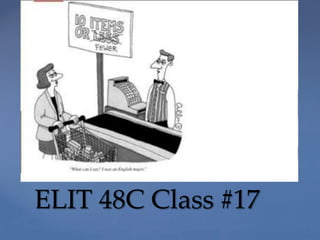
Less versus Fewer
 Use fewer if you’re referring to people or things in the
plural (e.g.
houses, newspapers, dogs, students, children). For
example:
 People these days are buying fewer newspapers.
 Fewer students are opting to study science-
related subjects.
 Fewer than thirty children each year develop the
disease.
 Use less when you’re referring to something that
can’t be counted or doesn’t have a plural (e.g.
money, air, time, music, rain). For example:
 It’s a better job but they pay me less money.
 People want to spend less time in traffic jams.
 When I’m on vacation, I listen to less music
Agenda
 Culture Clash
 By juxtaposing characters from the West and East in America in The Great
Gatsby, Fitzgerald makes some moral observations.
 Appearances and Reality
 Gatsby himself is a put-on, with his “Oggsford” accent, fine clothes, and “old
boy” routine; behind this facade is a rags to riches story.
 Moral Corruption
 The wealthy class is morally corrupt in The Great Gatsby. There are no
spiritual values in a place where money reigns: the traditional ideas of God
and Religion are dead here.
 In a similar manner, T. S. Eliot's renowned poem The Waste Land describes the
decline of Western civilization and its lack of spirituality through the
objective correlative (a term coined by poet and critic T. S. Eliot that refers
to an object that takes on greater significance and comes to symbolize the
mood and world of a literary work) of the wasteland.
Themes
 Gatsby represents the American dream of self-made wealth
and happiness, the spirit of youth and resourcefulness, and the
ability to make something of one's self despite one's origins.
He achieved more than his parents had and felt he was
pursuing a perfect dream, Daisy, who for him embodied the
elements of success.
 Inherent in this dream, however, is the possibility of giving in to
temptation and to corrupt get-rich-quick schemes like
bootlegging and gambling. Fitzgerald's book mirrors the
headiness, ambition, despair, and disillusionment of America in
the 1920s: its ideals lost behind the trappings of class and
material success.
American Dream
How is the story an ironic twist of
the American Dream?
Do they achieve the dream?
 Daisy
 Gatsby
 Tom
 Myrtle
 George Wilson
 Nick
 Jordan.
 Examples of the American Dream gone awry are plentiful
in The Great Gatsby:
 Meyer Wolfsheim’s enterprising ways to make money are criminal.
 Jordan Baker's attempts at sporting fame lead her to cheating.
 The Buchanans' thirst for the good life victimizes others to the point
of murder.
 George Wilson fails at his business even though he works hard.
 On the flip side of the American Dream is inexperience,
gullibility, and a susceptibility to evil and poor-intentioned
people.
 Demand for the many new products that emerged in the 1920s was
pumped up by a new industry, advertising, which developed new
methods of enticing buyers to desire new products through new
media like the radio.
 The minstrel-show radio sitcom, Amos n' Andy, became a smash
nationwide hit, sponsored by Pepsodent toothpaste. Through such
sponsorships, the advertising industry grew in perfect harmony with
the emerging industries of mass culture—especially network radio
and Hollywood cinema. The emergence of broadcast networks and
proliferation of studio-linked movie theaters made possible the
development of a robust nationwide mass culture.
 For the first time, a Detroit factory worker, a San Francisco
longshoreman, and a Birmingham domestic could be expected to
enjoy the same radio programs and watch the same films... and to
smoke the same cigarettes and use the same toothpaste promoted on
screen and on the radio.
Mass Production, Mass
Consumption, Mass Culture
 Some of the characters in the novel symbolize a
production ethic; others symbolize a consumption
ethic. Classify the characters accordingly, and
draw a conclusion about the American Dream, as
you understand it, from Fitzgerald.
 Read Marxist Criticism
 Post #17: Brain Buster
 Discuss Feminist, New Critical or Marxist
theories in terms of The Great Gatsby. Choose a
specific passage on which to focus your
interpretation.
Homework

Elit 48 c class 17

  • 1.
  • 2.
    Less versus Fewer Use fewer if you’re referring to people or things in the plural (e.g. houses, newspapers, dogs, students, children). For example:  People these days are buying fewer newspapers.  Fewer students are opting to study science- related subjects.  Fewer than thirty children each year develop the disease.  Use less when you’re referring to something that can’t be counted or doesn’t have a plural (e.g. money, air, time, music, rain). For example:  It’s a better job but they pay me less money.  People want to spend less time in traffic jams.  When I’m on vacation, I listen to less music
  • 3.
  • 4.
     Culture Clash By juxtaposing characters from the West and East in America in The Great Gatsby, Fitzgerald makes some moral observations.  Appearances and Reality  Gatsby himself is a put-on, with his “Oggsford” accent, fine clothes, and “old boy” routine; behind this facade is a rags to riches story.  Moral Corruption  The wealthy class is morally corrupt in The Great Gatsby. There are no spiritual values in a place where money reigns: the traditional ideas of God and Religion are dead here.  In a similar manner, T. S. Eliot's renowned poem The Waste Land describes the decline of Western civilization and its lack of spirituality through the objective correlative (a term coined by poet and critic T. S. Eliot that refers to an object that takes on greater significance and comes to symbolize the mood and world of a literary work) of the wasteland. Themes
  • 5.
     Gatsby representsthe American dream of self-made wealth and happiness, the spirit of youth and resourcefulness, and the ability to make something of one's self despite one's origins. He achieved more than his parents had and felt he was pursuing a perfect dream, Daisy, who for him embodied the elements of success.  Inherent in this dream, however, is the possibility of giving in to temptation and to corrupt get-rich-quick schemes like bootlegging and gambling. Fitzgerald's book mirrors the headiness, ambition, despair, and disillusionment of America in the 1920s: its ideals lost behind the trappings of class and material success. American Dream
  • 6.
    How is thestory an ironic twist of the American Dream?
  • 7.
    Do they achievethe dream?  Daisy  Gatsby  Tom  Myrtle  George Wilson  Nick  Jordan.
  • 8.
     Examples ofthe American Dream gone awry are plentiful in The Great Gatsby:  Meyer Wolfsheim’s enterprising ways to make money are criminal.  Jordan Baker's attempts at sporting fame lead her to cheating.  The Buchanans' thirst for the good life victimizes others to the point of murder.  George Wilson fails at his business even though he works hard.  On the flip side of the American Dream is inexperience, gullibility, and a susceptibility to evil and poor-intentioned people.
  • 9.
     Demand forthe many new products that emerged in the 1920s was pumped up by a new industry, advertising, which developed new methods of enticing buyers to desire new products through new media like the radio.  The minstrel-show radio sitcom, Amos n' Andy, became a smash nationwide hit, sponsored by Pepsodent toothpaste. Through such sponsorships, the advertising industry grew in perfect harmony with the emerging industries of mass culture—especially network radio and Hollywood cinema. The emergence of broadcast networks and proliferation of studio-linked movie theaters made possible the development of a robust nationwide mass culture.  For the first time, a Detroit factory worker, a San Francisco longshoreman, and a Birmingham domestic could be expected to enjoy the same radio programs and watch the same films... and to smoke the same cigarettes and use the same toothpaste promoted on screen and on the radio. Mass Production, Mass Consumption, Mass Culture
  • 10.
     Some ofthe characters in the novel symbolize a production ethic; others symbolize a consumption ethic. Classify the characters accordingly, and draw a conclusion about the American Dream, as you understand it, from Fitzgerald.
  • 11.
     Read MarxistCriticism  Post #17: Brain Buster  Discuss Feminist, New Critical or Marxist theories in terms of The Great Gatsby. Choose a specific passage on which to focus your interpretation. Homework