EWRT 1BCLASS 7
QHQ Discussion: Hughes: "Who's Passing
for Who?"
Juda Bennett‟s Reading
Presentation: Essay 2: The Argument:
Brainstorming with FREECASH
In-Class Writing: Essay 2 Brainstorming
Author Lecture: Toni Morrison
AGENDA
Take five minutes to discuss
Hughes‟s "Who's Passing for
Who?"
GROUP MEETING
QHQ: “WHO‟S PASSING FOR WHO?”
BY LANGSTON HUGHES
• Why did the black artists choose to ignore the color line?
Where they really blind when it came to race?
• Why did Caleb have white folks as visitors in Harlem
anyway?
• What was the couple‟s and red-headed man‟s real purpose
of visiting Harlem?
• Why does Caleb often take the side of the white man in
social confrontations?
• Is Caleb going to invite people into Harlem again?
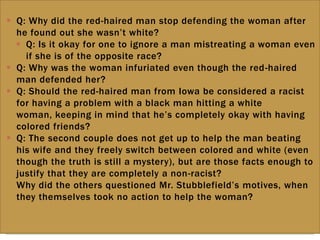
 Q: Why did the red-haired man stop defending the woman after
he found out she wasn‟t white?
 Q: Is it okay for one to ignore a man mistreating a woman even
if she is of the opposite race?
 Q: Why was the woman infuriated even though the red-haired
man defended her?
 Q: Should the red-haired man from Iowa be considered a racist
for having a problem with a black man hitting a white
woman, keeping in mind that he‟s completely okay with having
colored friends?
 Q: The second couple does not get up to help the man beating
his wife and they freely switch between colored and white (even
though the truth is still a mystery), but are those facts enough to
justify that they are completely a non-racist?
 Why did the others questioned Mr. Stubblefield‟s motives, when
they themselves took no action to help the woman?
• Q. Why did the Iowan couple wish to pass for black?
• Q: How could the white couple pass as [racially]
black?
• Q: What‟s really different between races?
• Q: How did things change for them when they told
the people of color that they were colored as well?
• Q: Did the white couple tell Caleb and his friends
that they were “colored” as a way to deceive and
make fun of them or to make everyone feel more
comfortable?
• Q. Would everyone have had as good of a time if
the white couple had not mentioned that they
were passing?
• Why did knowing/thinking that the visitors from
Iowa were blacks passing for whites change the
mood of the night from that point on?
• If the couple didn‟t tell them that they were [black]
passing as white, would they still have had a great
time?
• Does being around your own race really change the
way you behave in public?
• Why did everyone start laughing once they realized
that the husband and wife were passing as white
people?
• How does race affect the social gathering between the
whites and blacks while drinking with each other at
the bar?
Were the man and woman [from Iowa] actually white, or
were they black?
• If the couple was white why would they lie and
pretend to be black?
• If they were black, why would they end the night by
saying they were white?
• Why does the white couple decide to tell the truth to
the narrator and his friends finally?
• Was passing for colored a best way to approach the
colored writers?
• Would the story change its meaning if the couple were
actually black or white?
Q: Did the black people take offense to the fact the white
people passed for being “colored” for the night?
Q: How did the people of color react and what did they
discuss when they found out the white couple was passing?
Did they become more accepting?
Q: If the white couple didn‟t say they were colored, would
they have been forced out of the get together by racial
tensions?
Q: At the end, were the friends really dumbfounded on who
the couple really were?
What did “they had had too much fun at our expense–even
if they did pay for the drinks.” mean?
Will the narrator and his friends regret what they have
done? Will they change their manner when meeting
white friends after this experience?
WHO ELSE IS PASSING?
If
so, where
do you see
hints of it?
DO YOU READ QUEER
PASSING IN THE STORY?
Here is his
argument
BENNETT, JUDA. “MULTIPLE PASSINGS
AND THE DOUBLE DEATH OF
LANGSTON HUGHES.”
HONOLULU: FALL 2000.
VOL. 23, ISS. 4; PG. 670, 25 PGS
BENNETT‟S THESIS:
“With a sense of the interplay between
voyeur and object, homophobe and
homosexual, inside and
outside, "who's passing for who?"
Interweaves the explicit theme of
racial passing” with the buried theme
of the closet.
 Bennett writes,
[Assertion] The voice of the narrator is the key to
discovering this buried, or closety, theme. Although
critics have been surprisingly silent about the narrator's
various and potential passings, there are several reasons
for reading his character as false or at least layered.
[Evidence] He admits, for example, to at least one
performance when he states that "we dropped our
professionally self-conscious 'Negro' manners... and
kidded freely like colored folks do when there are no white
folks around" (173). [Explanation] Although Langston
Hughes is working within an African American tradition
that has often explored the nature of performance as it
relates to racial difference and insider/outsider
communities, [Analysis] this story further layers that
dynamic with other marks of difference.
[Evidence] Before the action begins, the prolix and witty
narrator introduces his friends and himself as "too broad-
minded to be bothered with questions of color." [Explanation]
This statement sets up the dramatic irony that positions the
narrator for his ultimate blunder: being fooled by the white
Iowans. [Analysis] Although the narrator's bohemian world is
meant to stand in contrast to the boring white folks from
Iowa, Hughes eventually reverses the roles. The Iowans prove
to be the tricksters, and the narrator must confront his own
naiveté. That the narrator could not see through the
Iowans' dissimulation is funny, ironic, interesting-but in
the end, not entirely believable.
What happens, though, if we read the narrator's bohemian
world as a homosocial world? [Assertion] When we divide the
entire cast of characters into single men and heterosexual
couples, we discover that racial passing only occurs within
the heterosexual realm. Not only does the Iowan couple pass,
but so too does the only other woman, half of the only other
heterosexual couple in the story. [Analysis] We might then see
these racial passings as deflecting attention from the narrator
and his friends, who become boring and unremarkable despite
the initial flair with which they are introduced. [Logical
Conclusion] Racial passing becomes a decoy, distracting our
attention from the performances of the bohemian bachelors.
[Assertion] Before Hughes initiates the drama of racial passing, he
comes dangerously close to revealing the "perverse" nature of
the narrator and his bachelor friends:
[Evidence] “You see, Caleb and his white friends, too, were all
bores. Or so we, who lived in Harlem's literary bohemia during the
"Negro Renaissance," thought. We literary ones considered
ourselves too broad-minded to be bothered with questions of color.
We liked people of any race who smoked incessantly, drank
liberally, wore complexion and morality as loose garments, and
made fun of anyone who didn't do likewise. We snubbed and high-
hatted any Negro or white luckless enough not to understand
Gertrude Stein ....” (Hughes 170)
[Concession]Although the narrator assumes this affected
tone, his dandified attitude and the passing reference to
Gertrude Stein hardly mark him fully and definitively as a
homosexual. [Assertion] Nevertheless, the title, with its bad
grammar calling attention to itself, encourages speculation.
Who is passing for whom? [Explanation/Analysis] Surely the author
would have planted more and trickier trickster figures than the
Iowans to fully justify his title. Furthermore, the narrative has
already schooled us in the surprising fluidity of identity, and so
readers are encouraged to suspect more revelations and exposures.
[Concession] To those who would argue that the subject of passing lends
itself to this kind of wild and speculative reading-after all, everything is
performance, and everybody passes-I heartily agree. [Final Assertion] I
am finally arguing that in his autobiographies, poetry, fiction, and
drama, Hughes returned to the subject of passing throughout his
career because he was fascinated with identity as something unstable
and "queer." With their emphasis on compensation rather than
loss, questions rather than answers, the unknown rather than the
known, and curiosity rather than punishment, Hughes's writings on
sexual identity invite comparison to his exploration of racial passing.
BRAINSTORMING ESSAY
#2
BRAINSTORMING WITH FREECASH
F= Freedom, Fairness, Legality, Human Rights, Social Justice
R = Religion, Morality, Ethics
E = Economics, Monetary Issues, Finances, Expenses
E = Environment (types of environments = natural, rural, urban, workplace, home, school)
C = Convenience, Comfort
A = Appearance, Aesthetics
S = Safety, Security
H = Health, Well Being (types of health = individual, societal, mental, physical, emotional,
spiritual)
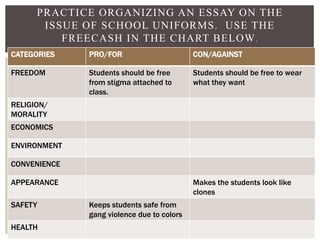
CATEGORIES PRO/FOR CON/AGAINST
FREEDOM Students should be free
from stigma attached to
class.
Students should be free to wear
what they want
RELIGION/
MORALITY
ECONOMICS
ENVIRONMENT
CONVENIENCE
APPEARANCE Makes the students look like
clones
SAFETY Keeps students safe from
gang violence due to colors
HEALTH
PRACTICE ORGANIZING AN ESSAY ON THE
ISSUE OF SCHOOL UNIFORMS. USE THE
FREECASH IN THE CHART BELOW.
 If passing for white will get a fellow better accommodations
on the train, better seats in the theatre, immunity from
insults in public places, and may even save his life from a
mob,” only idiots would fail to seize the advantages of
passing, at least occasionally if not permanently.”
 Write an essay of four to six pages arguing for or against
William Pickens’s statement. Use support from the texts you
have read so far, our discussions, and your own insights.
THE PROMPT
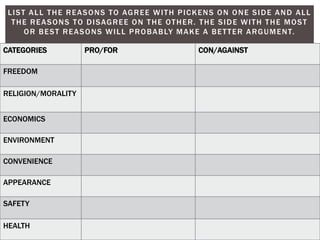
CATEGORIES PRO/FOR CON/AGAINST
FREEDOM
RELIGION/MORALITY
ECONOMICS
ENVIRONMENT
CONVENIENCE
APPEARANCE
SAFETY
HEALTH
LIST ALL THE REASONS TO AGREE WITH PICKENS ON ONE SIDE AND ALL
THE REASONS TO DISAGREE ON THE OTHER. THE SIDE WITH THE MOST
OR BEST REASONS WILL PROBABLY MAKE A BETTER ARGUMENT.
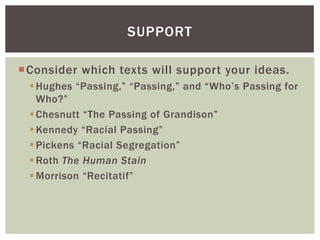
Consider which texts will support your ideas.
Hughes “Passing,” “Passing,” and “Who‟s Passing for
Who?”
Chesnutt “The Passing of Grandison”
Kennedy “Racial Passing”
Pickens “Racial Segregation”
Roth The Human Stain
Morrison “Recitatif”
SUPPORT
WRITING THE THESIS Essay #2
YOUR THESIS
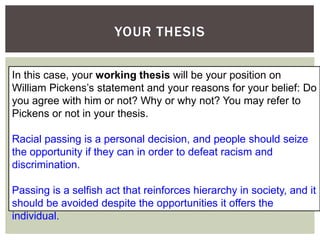
In this case, your working thesis will be your position on
William Pickens’s statement and your reasons for your belief: Do
you agree with him or not? Why or why not? You may refer to
Pickens or not in your thesis.
Racial passing is a personal decision, and people should seize
the opportunity if they can in order to defeat racism and
discrimination.
Passing is a selfish act that reinforces hierarchy in society, and it
should be avoided despite the opportunities it offers the
individual.
You may qualify your thesis, for example, by adding a phrase that
acknowledges there are exceptions to your assertion.
For example, if you disagree with Pickens in general but want to
acknowledge that there are specific circumstances in which passing is
acceptable, you might say something like, “While racial passing for personal
safety is a necessary and acceptable behavior, passing in general violates
community norms and reinforces the social construct of racism.”
If you agree with Pickens but want to acknowledge there are specific
circumstances in which passing is unacceptable, you might say something
like, “While full time passing violates familial and community connections
and should be avoided, the wise person will pass part time to take
advantage of the benefits it can reap, including the opportunities to escape
racism and oppression.”
Notice that these theses still assert clear stances. Don’t be vague or
ambiguous with your position.
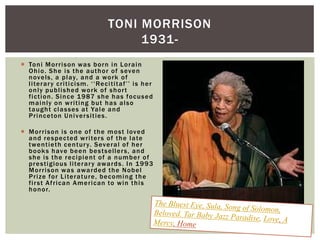
 Toni Morrison was born in Lorain
Ohio. She is the author of seven
novels, a play, and a work of
literary criticism. „„Recititaf‟‟ is her
only published work of short
fiction. Since 1987 she has focused
mainly on writing but has also
taught classes at Yale and
Princeton Universities.
 Morrison is one of the most loved
and respected writers of the late
twentieth century. Several of her
books have been bestsellers, and
she is the recipient of a number of
prestigious literary awards. In 1993
Morrison was awarded the Nobel
Prize for Literature, becoming the
first African American to win this
honor.
TONI MORRISON
1931-
 Reading Morrison: “Recitatif.”
 Post #10: Write a paragraph defending passing.
Try to come up with at least three reasons. Write
another paragraph condemning passing using
another three reasons. Use evidence from our
readings to support your reasons.
 Post #11: QHQ: "Recitatif"
HOMEWORK

1 b class 7

  • 1.
  • 2.
    QHQ Discussion: Hughes:"Who's Passing for Who?" Juda Bennett‟s Reading Presentation: Essay 2: The Argument: Brainstorming with FREECASH In-Class Writing: Essay 2 Brainstorming Author Lecture: Toni Morrison AGENDA
  • 3.
    Take five minutesto discuss Hughes‟s "Who's Passing for Who?" GROUP MEETING
  • 4.
    QHQ: “WHO‟S PASSINGFOR WHO?” BY LANGSTON HUGHES • Why did the black artists choose to ignore the color line? Where they really blind when it came to race? • Why did Caleb have white folks as visitors in Harlem anyway? • What was the couple‟s and red-headed man‟s real purpose of visiting Harlem? • Why does Caleb often take the side of the white man in social confrontations? • Is Caleb going to invite people into Harlem again?
  • 5.
     Q: Whydid the red-haired man stop defending the woman after he found out she wasn‟t white?  Q: Is it okay for one to ignore a man mistreating a woman even if she is of the opposite race?  Q: Why was the woman infuriated even though the red-haired man defended her?  Q: Should the red-haired man from Iowa be considered a racist for having a problem with a black man hitting a white woman, keeping in mind that he‟s completely okay with having colored friends?  Q: The second couple does not get up to help the man beating his wife and they freely switch between colored and white (even though the truth is still a mystery), but are those facts enough to justify that they are completely a non-racist?  Why did the others questioned Mr. Stubblefield‟s motives, when they themselves took no action to help the woman?
  • 6.
    • Q. Whydid the Iowan couple wish to pass for black? • Q: How could the white couple pass as [racially] black? • Q: What‟s really different between races? • Q: How did things change for them when they told the people of color that they were colored as well? • Q: Did the white couple tell Caleb and his friends that they were “colored” as a way to deceive and make fun of them or to make everyone feel more comfortable? • Q. Would everyone have had as good of a time if the white couple had not mentioned that they were passing?
  • 7.
    • Why didknowing/thinking that the visitors from Iowa were blacks passing for whites change the mood of the night from that point on? • If the couple didn‟t tell them that they were [black] passing as white, would they still have had a great time? • Does being around your own race really change the way you behave in public? • Why did everyone start laughing once they realized that the husband and wife were passing as white people? • How does race affect the social gathering between the whites and blacks while drinking with each other at the bar?
  • 8.
    Were the manand woman [from Iowa] actually white, or were they black? • If the couple was white why would they lie and pretend to be black? • If they were black, why would they end the night by saying they were white? • Why does the white couple decide to tell the truth to the narrator and his friends finally? • Was passing for colored a best way to approach the colored writers? • Would the story change its meaning if the couple were actually black or white?
  • 9.
    Q: Did theblack people take offense to the fact the white people passed for being “colored” for the night? Q: How did the people of color react and what did they discuss when they found out the white couple was passing? Did they become more accepting? Q: If the white couple didn‟t say they were colored, would they have been forced out of the get together by racial tensions? Q: At the end, were the friends really dumbfounded on who the couple really were? What did “they had had too much fun at our expense–even if they did pay for the drinks.” mean? Will the narrator and his friends regret what they have done? Will they change their manner when meeting white friends after this experience?
  • 10.
    WHO ELSE ISPASSING?
  • 11.
    If so, where do yousee hints of it? DO YOU READ QUEER PASSING IN THE STORY?
  • 12.
    Here is his argument BENNETT,JUDA. “MULTIPLE PASSINGS AND THE DOUBLE DEATH OF LANGSTON HUGHES.” HONOLULU: FALL 2000. VOL. 23, ISS. 4; PG. 670, 25 PGS
  • 13.
    BENNETT‟S THESIS: “With asense of the interplay between voyeur and object, homophobe and homosexual, inside and outside, "who's passing for who?" Interweaves the explicit theme of racial passing” with the buried theme of the closet.
  • 14.
     Bennett writes, [Assertion]The voice of the narrator is the key to discovering this buried, or closety, theme. Although critics have been surprisingly silent about the narrator's various and potential passings, there are several reasons for reading his character as false or at least layered. [Evidence] He admits, for example, to at least one performance when he states that "we dropped our professionally self-conscious 'Negro' manners... and kidded freely like colored folks do when there are no white folks around" (173). [Explanation] Although Langston Hughes is working within an African American tradition that has often explored the nature of performance as it relates to racial difference and insider/outsider communities, [Analysis] this story further layers that dynamic with other marks of difference.
  • 15.
    [Evidence] Before theaction begins, the prolix and witty narrator introduces his friends and himself as "too broad- minded to be bothered with questions of color." [Explanation] This statement sets up the dramatic irony that positions the narrator for his ultimate blunder: being fooled by the white Iowans. [Analysis] Although the narrator's bohemian world is meant to stand in contrast to the boring white folks from Iowa, Hughes eventually reverses the roles. The Iowans prove to be the tricksters, and the narrator must confront his own naiveté. That the narrator could not see through the Iowans' dissimulation is funny, ironic, interesting-but in the end, not entirely believable.
  • 16.
    What happens, though,if we read the narrator's bohemian world as a homosocial world? [Assertion] When we divide the entire cast of characters into single men and heterosexual couples, we discover that racial passing only occurs within the heterosexual realm. Not only does the Iowan couple pass, but so too does the only other woman, half of the only other heterosexual couple in the story. [Analysis] We might then see these racial passings as deflecting attention from the narrator and his friends, who become boring and unremarkable despite the initial flair with which they are introduced. [Logical Conclusion] Racial passing becomes a decoy, distracting our attention from the performances of the bohemian bachelors.
  • 17.
    [Assertion] Before Hughesinitiates the drama of racial passing, he comes dangerously close to revealing the "perverse" nature of the narrator and his bachelor friends: [Evidence] “You see, Caleb and his white friends, too, were all bores. Or so we, who lived in Harlem's literary bohemia during the "Negro Renaissance," thought. We literary ones considered ourselves too broad-minded to be bothered with questions of color. We liked people of any race who smoked incessantly, drank liberally, wore complexion and morality as loose garments, and made fun of anyone who didn't do likewise. We snubbed and high- hatted any Negro or white luckless enough not to understand Gertrude Stein ....” (Hughes 170)
  • 18.
    [Concession]Although the narratorassumes this affected tone, his dandified attitude and the passing reference to Gertrude Stein hardly mark him fully and definitively as a homosexual. [Assertion] Nevertheless, the title, with its bad grammar calling attention to itself, encourages speculation. Who is passing for whom? [Explanation/Analysis] Surely the author would have planted more and trickier trickster figures than the Iowans to fully justify his title. Furthermore, the narrative has already schooled us in the surprising fluidity of identity, and so readers are encouraged to suspect more revelations and exposures.
  • 19.
    [Concession] To thosewho would argue that the subject of passing lends itself to this kind of wild and speculative reading-after all, everything is performance, and everybody passes-I heartily agree. [Final Assertion] I am finally arguing that in his autobiographies, poetry, fiction, and drama, Hughes returned to the subject of passing throughout his career because he was fascinated with identity as something unstable and "queer." With their emphasis on compensation rather than loss, questions rather than answers, the unknown rather than the known, and curiosity rather than punishment, Hughes's writings on sexual identity invite comparison to his exploration of racial passing.
  • 20.
  • 21.
    BRAINSTORMING WITH FREECASH F=Freedom, Fairness, Legality, Human Rights, Social Justice R = Religion, Morality, Ethics E = Economics, Monetary Issues, Finances, Expenses E = Environment (types of environments = natural, rural, urban, workplace, home, school) C = Convenience, Comfort A = Appearance, Aesthetics S = Safety, Security H = Health, Well Being (types of health = individual, societal, mental, physical, emotional, spiritual)
  • 22.
    CATEGORIES PRO/FOR CON/AGAINST FREEDOMStudents should be free from stigma attached to class. Students should be free to wear what they want RELIGION/ MORALITY ECONOMICS ENVIRONMENT CONVENIENCE APPEARANCE Makes the students look like clones SAFETY Keeps students safe from gang violence due to colors HEALTH PRACTICE ORGANIZING AN ESSAY ON THE ISSUE OF SCHOOL UNIFORMS. USE THE FREECASH IN THE CHART BELOW.
  • 23.
     If passingfor white will get a fellow better accommodations on the train, better seats in the theatre, immunity from insults in public places, and may even save his life from a mob,” only idiots would fail to seize the advantages of passing, at least occasionally if not permanently.”  Write an essay of four to six pages arguing for or against William Pickens’s statement. Use support from the texts you have read so far, our discussions, and your own insights. THE PROMPT
  • 24.
    CATEGORIES PRO/FOR CON/AGAINST FREEDOM RELIGION/MORALITY ECONOMICS ENVIRONMENT CONVENIENCE APPEARANCE SAFETY HEALTH LISTALL THE REASONS TO AGREE WITH PICKENS ON ONE SIDE AND ALL THE REASONS TO DISAGREE ON THE OTHER. THE SIDE WITH THE MOST OR BEST REASONS WILL PROBABLY MAKE A BETTER ARGUMENT.
  • 25.
    Consider which textswill support your ideas. Hughes “Passing,” “Passing,” and “Who‟s Passing for Who?” Chesnutt “The Passing of Grandison” Kennedy “Racial Passing” Pickens “Racial Segregation” Roth The Human Stain Morrison “Recitatif” SUPPORT
  • 26.
  • 27.
    YOUR THESIS In thiscase, your working thesis will be your position on William Pickens’s statement and your reasons for your belief: Do you agree with him or not? Why or why not? You may refer to Pickens or not in your thesis. Racial passing is a personal decision, and people should seize the opportunity if they can in order to defeat racism and discrimination. Passing is a selfish act that reinforces hierarchy in society, and it should be avoided despite the opportunities it offers the individual.
  • 28.
    You may qualifyyour thesis, for example, by adding a phrase that acknowledges there are exceptions to your assertion. For example, if you disagree with Pickens in general but want to acknowledge that there are specific circumstances in which passing is acceptable, you might say something like, “While racial passing for personal safety is a necessary and acceptable behavior, passing in general violates community norms and reinforces the social construct of racism.” If you agree with Pickens but want to acknowledge there are specific circumstances in which passing is unacceptable, you might say something like, “While full time passing violates familial and community connections and should be avoided, the wise person will pass part time to take advantage of the benefits it can reap, including the opportunities to escape racism and oppression.” Notice that these theses still assert clear stances. Don’t be vague or ambiguous with your position.
  • 29.
     Toni Morrisonwas born in Lorain Ohio. She is the author of seven novels, a play, and a work of literary criticism. „„Recititaf‟‟ is her only published work of short fiction. Since 1987 she has focused mainly on writing but has also taught classes at Yale and Princeton Universities.  Morrison is one of the most loved and respected writers of the late twentieth century. Several of her books have been bestsellers, and she is the recipient of a number of prestigious literary awards. In 1993 Morrison was awarded the Nobel Prize for Literature, becoming the first African American to win this honor. TONI MORRISON 1931-
  • 30.
     Reading Morrison:“Recitatif.”  Post #10: Write a paragraph defending passing. Try to come up with at least three reasons. Write another paragraph condemning passing using another three reasons. Use evidence from our readings to support your reasons.  Post #11: QHQ: "Recitatif" HOMEWORK