ELIT 46C: Class 3
Alfred Lord Tennyson
“The Charge of the Light Brigade”
https://www.youtube.com/watch?v=S93lvQ4Ukg8
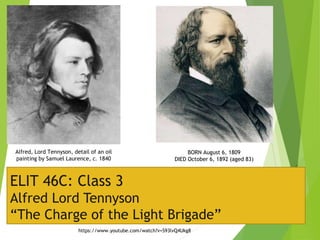
Alfred, Lord Tennyson, detail of an oil
painting by Samuel Laurence, c. 1840
BORN August 6, 1809
DIED October 6, 1892 (aged 83)
Agenda
 The Chair Poet
 Lecture: Social Commentary,
Charles Dickens, A Christmas
Carol, and The Chimes
 Discussion
• A Summary Activity
• Discussion Questions
• QHQS
 Author Presentation:
• Christina Rossetti
• Robert Browning
Chair Poet of the Day?
 The first time I taught a literature class, a student
spontaneously recited “The Red Wheelbarrow” while
standing on a chair. From that came the idea of a
chair poet. A chair poet earns one extra participation
point for each two lines of poetry she or he recites
(up to 10 points), for each member of his or her
group.
In our text, you can find many appropriate poems to memorize. Likewise, on
the website, you will find links to short English poems. You can use any one of
those. Simply commit the poem to memory; it would be great if you could
also provide a very brief summary of the poet’s life (who she is, where he is
from, and some context for the poem. You don’t need to memorize that part.
Each day from now until the end of the quarter I will ask if we have a chair
poet. All you have to do is raise your hand. I will take one or two a day. If
there are multiple volunteers, we will schedule them for the next sessions. (If
you feel unsafe standing on a chair, you can come to the front of the room).
Charles Dickens and
Social Commentary
Dickens was not only the first great urban novelist in England, but also one of the most
important social commentators who used fiction to criticize economic, social, and moral
concerns during his life. He used his work to launch discussion about moral and social
reform.
Dickens’s deep social commitment and awareness of social abuses likely come from
traumatic childhood experiences, in particular when his father was put in Debtors’ Prison,
and he, at the age of twelve, worked in a shoe-blacking factory.
Through his literature, Dickens contributed significantly to the emergence of public
opinion. Indirectly, he contributed to a series of legal reforms, including the abolition of
debtors prison, purification of the courts, a better management of criminal prisons, and the
restriction of the capital punishment.
The Five Christmas Books and
stories published in periodicals
 17 December 1843: A Christmas Carol (Chapman and
Hall)
 16 December 1844: The Chimes (Bradbury and Evans)
 20 December 1845: The Cricket on the Hearth
 19 December 1846: The Battle of Life
 19 December 1848: The Haunted Man (series
concluded).
Dickens’s A Christmas Carol
The first edition of A Christmas Carol, released on December
19, 1843, sold out almost immediately; its publisher returned
to press no fewer than eight times within the first six months.
Scholar-bibliographer Ruth Glancy has traced how this tale, “a
truly popular work which is undeniably a masterpiece as well,”
has both charmed and confounded readers and scholars ever
since.
Dickens intended A Christmas Carol as a vehicle to stimulate
the social consciousness of the complacent upper and middle
classes with respect to the desperate need for social reforms in
the Hungry Forties (1840s).
A Christmas Carol led a nineteenth-century Boston factory
owner to give his workers a day off from work as well as free
turkeys. The tale inspired the creation of a welfare campaign
to provide “Tiny Tim” cots to children in need. It’s the story
that President Franklin Delano Roosevelt read to his family
each winter.
https://www.youtube.com/watch?v=fyqDtP3iN9g
Reading his second ”Christmas Story” is another way of recapturing
something of the spirit in which Dickens wrote. Since we have done
that, let’s take 10 minutes to create a one minute outline of The
Chimes, a bittersweet sequel to A Christmas Carol.
 Much of the point of Dickens's social critique and
political satire is lost on us because for its effectiveness,
satire relies upon an intimate knowledge of the people
and conditions satirized; although we may recall that
1847 was the height of the Irish Potato Famine, which
drove so many Irish to North America, most of us are
unacquainted with the dire distress of the working poor
in The Hungry Forties
 The book brought Dickens precisely what he had hoped: initial
sales of 20,000 copies, a substantial profit, and a widespread
public debate about the issues that The Chimes had raised.
No book was more hotly disputed in the press at the time
since in it "Dickens is clearly placing the blame for the
frequency of behavior such as prostitution, infanticide, and
suicide by the poor on society's failure to help those who
desperately need help" (Thomas 43).
Trotty Veck and
his daughter
entertains
guests. — 'The
Chimes' (53),
drawn by London
commercial artist
Fred Pegram
(1870-1937),
appeared as part
of a tea
advertisement as
one in a series of
"tea parties in
Dickens."
The second is one of a
series of reproductions
of Punch illustrator
Frank Reynolds (1876-
1953). The whiskey
manufacturers between
1925 and 1930 released
a promotional portfolio
of thirteen well-
beloved characters plus
a likeness of Dickens
himself and companion
pictures of the Old
Black Swan distillery
itself in the eighteenth
century (1790) and the
early twentieth century
(1913):
Advertising in Dickens." The
Dickensian (1929): 53-54.
Scene from The Chimes, at the Adelphi Theatre. Drawn by Kenny Meadows. The Illustrated
London News Saturday, 11 January 1845, p. 29.
Groups
Back into your Groups! Take a few minutes
to review the discussion questions and your
QHQS
Discussion Questions
1. Many of Dickens’ protagonists and antagonists are outcasts of some
sort. How does not fitting in shape character? How does the need to
belong influence Toby/Trotty? What makes the feeling of belonging in
society such a powerful draw?
2. Identify the crimes and injustices that take place in Chimes, A Goblin
Story. What are some of the evidences of poverty in the story? What
does Dickens mean for the reader to take away from this story?
3. Compare and/or contrast this story with A Christmas Carol. Push past
the obvious. Make sure to include textual evidence to support your
claims. What Victorian influences can you identify in this story? Make
sure to include textual evidence to support your claims
4. Trotty is seemingly the hero of this story, yet it is he who is
summoned to the tower. What is Trotty’s crime? Why have the the
spirits' goblin helpers and then the spirits of the bells themselves
beckoned him? What is his lesson?
QHQs
1. Q: Is the super natural activity in Chimes, A Goblin Story, Dicken’s
method of hearkening back to older times and ancient tradition?
2. Q: If, then, the cause of Trotty's loss of faith in humanity has
stemmed from his suppression and delusion via the wealthy in this
society, why have the spirits chosen to punish him? Are the wealthy
characters (such as Mr. Filer, Sir Joseph, and Alderman Cute)
unchangeable in the eyes of the spirits? Why do they not seem to be
held accountable?
3. Q: In what ways does the main character, Toby Veck, symbolize the
Bells/Chimes he is so fond of?
4. What role does the wind play in the narrative?
5. Q: Why is it so difficult to find the patience to invest myself in non-
contemporary literature?
Author Presentations
Robert Browning
Robert Browning was a prolific Victorian-era
poet and playwright. He is widely recognized
as a master of dramatic monologue and
psychological portraiture. Browning is
perhaps best-known for a poem he didn’t
value highly, The Pied Piper of Hamelin, a
children's poem that is quite different from
his other work. He is also known for his long
form blank poem The Ring and the Book, the
story of a Roman murder trial in 12 books.
Browning was married to the poet Elizabeth
Barrett Browning.
1812-1889
Author Presentations
Coventry Patmore
Coventry Patmore is one of those Victorian
authors those whose lives intrigued
contemporary and modern readers just as
much as their work. Raised in a literary
household, known from his youth to nearly
all of the great poets and essayists of his
time, this poetic advocate of religion and
marriage was in fact married three times
and became a follower of more than one
faith. He published a vast novel in verse,
telling the story of two marriages, beginning
in the 1850s with The Angel in the
House, consisting of The Betrothal (1854)
and The Espousals (1856), and continuing
with The Victories of Love (1863), consisting
of Faithful for Ever (1860) and The Victories
of Love (1863).
1823-1896
Author Presentations
Christina Rossetti
1830-1894
Christina Rossetti is one of the most important of
English women poets both in range and quality. She
excelled in works of fantasy, in poems for children,
and in religious poetry.
Christina was the sister of the painter-poet Dante
Gabriel Rossetti. In 1847 her grandfather printed on his
private press a volume of her Verses, in which signs of
poetic talent are already visible.
In 1871 Christina was stricken by Graves’ disease, a
thyroid disorder that marred her appearance and left
her life in danger. She accepted her affliction with
courage and resignation, sustained by religious faith,
and she continued to publish. Rossetti was considered
a possible successor to Alfred, Lord Tennyson, as poet
laureate, but she developed a fatal cancer in 1891.
Homework
Assigned Reading:
 Robert Browning, “My Last Duchess”
1282
 Christina Rossetti, “Goblin Market”
1496
 Coventry Patmore, from “The Angel
in the House” 1613
Suggested Reading
 Christina Rossetti, “In an Artist’s
Studio”1493
 Mill, “The Subjection of Women”
1104
HW: Discussion Question #3

Elit 46 c class 3

  • 1.
    ELIT 46C: Class3 Alfred Lord Tennyson “The Charge of the Light Brigade” https://www.youtube.com/watch?v=S93lvQ4Ukg8 Alfred, Lord Tennyson, detail of an oil painting by Samuel Laurence, c. 1840 BORN August 6, 1809 DIED October 6, 1892 (aged 83)
  • 2.
    Agenda  The ChairPoet  Lecture: Social Commentary, Charles Dickens, A Christmas Carol, and The Chimes  Discussion • A Summary Activity • Discussion Questions • QHQS  Author Presentation: • Christina Rossetti • Robert Browning
  • 3.
    Chair Poet ofthe Day?  The first time I taught a literature class, a student spontaneously recited “The Red Wheelbarrow” while standing on a chair. From that came the idea of a chair poet. A chair poet earns one extra participation point for each two lines of poetry she or he recites (up to 10 points), for each member of his or her group. In our text, you can find many appropriate poems to memorize. Likewise, on the website, you will find links to short English poems. You can use any one of those. Simply commit the poem to memory; it would be great if you could also provide a very brief summary of the poet’s life (who she is, where he is from, and some context for the poem. You don’t need to memorize that part. Each day from now until the end of the quarter I will ask if we have a chair poet. All you have to do is raise your hand. I will take one or two a day. If there are multiple volunteers, we will schedule them for the next sessions. (If you feel unsafe standing on a chair, you can come to the front of the room).
  • 4.
    Charles Dickens and SocialCommentary Dickens was not only the first great urban novelist in England, but also one of the most important social commentators who used fiction to criticize economic, social, and moral concerns during his life. He used his work to launch discussion about moral and social reform. Dickens’s deep social commitment and awareness of social abuses likely come from traumatic childhood experiences, in particular when his father was put in Debtors’ Prison, and he, at the age of twelve, worked in a shoe-blacking factory. Through his literature, Dickens contributed significantly to the emergence of public opinion. Indirectly, he contributed to a series of legal reforms, including the abolition of debtors prison, purification of the courts, a better management of criminal prisons, and the restriction of the capital punishment.
  • 5.
    The Five ChristmasBooks and stories published in periodicals  17 December 1843: A Christmas Carol (Chapman and Hall)  16 December 1844: The Chimes (Bradbury and Evans)  20 December 1845: The Cricket on the Hearth  19 December 1846: The Battle of Life  19 December 1848: The Haunted Man (series concluded).
  • 6.
    Dickens’s A ChristmasCarol The first edition of A Christmas Carol, released on December 19, 1843, sold out almost immediately; its publisher returned to press no fewer than eight times within the first six months. Scholar-bibliographer Ruth Glancy has traced how this tale, “a truly popular work which is undeniably a masterpiece as well,” has both charmed and confounded readers and scholars ever since. Dickens intended A Christmas Carol as a vehicle to stimulate the social consciousness of the complacent upper and middle classes with respect to the desperate need for social reforms in the Hungry Forties (1840s). A Christmas Carol led a nineteenth-century Boston factory owner to give his workers a day off from work as well as free turkeys. The tale inspired the creation of a welfare campaign to provide “Tiny Tim” cots to children in need. It’s the story that President Franklin Delano Roosevelt read to his family each winter. https://www.youtube.com/watch?v=fyqDtP3iN9g
  • 7.
    Reading his second”Christmas Story” is another way of recapturing something of the spirit in which Dickens wrote. Since we have done that, let’s take 10 minutes to create a one minute outline of The Chimes, a bittersweet sequel to A Christmas Carol.
  • 8.
     Much ofthe point of Dickens's social critique and political satire is lost on us because for its effectiveness, satire relies upon an intimate knowledge of the people and conditions satirized; although we may recall that 1847 was the height of the Irish Potato Famine, which drove so many Irish to North America, most of us are unacquainted with the dire distress of the working poor in The Hungry Forties  The book brought Dickens precisely what he had hoped: initial sales of 20,000 copies, a substantial profit, and a widespread public debate about the issues that The Chimes had raised. No book was more hotly disputed in the press at the time since in it "Dickens is clearly placing the blame for the frequency of behavior such as prostitution, infanticide, and suicide by the poor on society's failure to help those who desperately need help" (Thomas 43).
  • 9.
    Trotty Veck and hisdaughter entertains guests. — 'The Chimes' (53), drawn by London commercial artist Fred Pegram (1870-1937), appeared as part of a tea advertisement as one in a series of "tea parties in Dickens."
  • 10.
    The second isone of a series of reproductions of Punch illustrator Frank Reynolds (1876- 1953). The whiskey manufacturers between 1925 and 1930 released a promotional portfolio of thirteen well- beloved characters plus a likeness of Dickens himself and companion pictures of the Old Black Swan distillery itself in the eighteenth century (1790) and the early twentieth century (1913): Advertising in Dickens." The Dickensian (1929): 53-54.
  • 11.
    Scene from TheChimes, at the Adelphi Theatre. Drawn by Kenny Meadows. The Illustrated London News Saturday, 11 January 1845, p. 29.
  • 12.
    Groups Back into yourGroups! Take a few minutes to review the discussion questions and your QHQS
  • 13.
    Discussion Questions 1. Manyof Dickens’ protagonists and antagonists are outcasts of some sort. How does not fitting in shape character? How does the need to belong influence Toby/Trotty? What makes the feeling of belonging in society such a powerful draw? 2. Identify the crimes and injustices that take place in Chimes, A Goblin Story. What are some of the evidences of poverty in the story? What does Dickens mean for the reader to take away from this story? 3. Compare and/or contrast this story with A Christmas Carol. Push past the obvious. Make sure to include textual evidence to support your claims. What Victorian influences can you identify in this story? Make sure to include textual evidence to support your claims 4. Trotty is seemingly the hero of this story, yet it is he who is summoned to the tower. What is Trotty’s crime? Why have the the spirits' goblin helpers and then the spirits of the bells themselves beckoned him? What is his lesson?
  • 14.
    QHQs 1. Q: Isthe super natural activity in Chimes, A Goblin Story, Dicken’s method of hearkening back to older times and ancient tradition? 2. Q: If, then, the cause of Trotty's loss of faith in humanity has stemmed from his suppression and delusion via the wealthy in this society, why have the spirits chosen to punish him? Are the wealthy characters (such as Mr. Filer, Sir Joseph, and Alderman Cute) unchangeable in the eyes of the spirits? Why do they not seem to be held accountable? 3. Q: In what ways does the main character, Toby Veck, symbolize the Bells/Chimes he is so fond of? 4. What role does the wind play in the narrative? 5. Q: Why is it so difficult to find the patience to invest myself in non- contemporary literature?
  • 15.
    Author Presentations Robert Browning RobertBrowning was a prolific Victorian-era poet and playwright. He is widely recognized as a master of dramatic monologue and psychological portraiture. Browning is perhaps best-known for a poem he didn’t value highly, The Pied Piper of Hamelin, a children's poem that is quite different from his other work. He is also known for his long form blank poem The Ring and the Book, the story of a Roman murder trial in 12 books. Browning was married to the poet Elizabeth Barrett Browning. 1812-1889
  • 16.
    Author Presentations Coventry Patmore CoventryPatmore is one of those Victorian authors those whose lives intrigued contemporary and modern readers just as much as their work. Raised in a literary household, known from his youth to nearly all of the great poets and essayists of his time, this poetic advocate of religion and marriage was in fact married three times and became a follower of more than one faith. He published a vast novel in verse, telling the story of two marriages, beginning in the 1850s with The Angel in the House, consisting of The Betrothal (1854) and The Espousals (1856), and continuing with The Victories of Love (1863), consisting of Faithful for Ever (1860) and The Victories of Love (1863). 1823-1896
  • 17.
    Author Presentations Christina Rossetti 1830-1894 ChristinaRossetti is one of the most important of English women poets both in range and quality. She excelled in works of fantasy, in poems for children, and in religious poetry. Christina was the sister of the painter-poet Dante Gabriel Rossetti. In 1847 her grandfather printed on his private press a volume of her Verses, in which signs of poetic talent are already visible. In 1871 Christina was stricken by Graves’ disease, a thyroid disorder that marred her appearance and left her life in danger. She accepted her affliction with courage and resignation, sustained by religious faith, and she continued to publish. Rossetti was considered a possible successor to Alfred, Lord Tennyson, as poet laureate, but she developed a fatal cancer in 1891.
  • 18.
    Homework Assigned Reading:  RobertBrowning, “My Last Duchess” 1282  Christina Rossetti, “Goblin Market” 1496  Coventry Patmore, from “The Angel in the House” 1613 Suggested Reading  Christina Rossetti, “In an Artist’s Studio”1493  Mill, “The Subjection of Women” 1104 HW: Discussion Question #3

Editor's Notes

  • #2 This poem was written to memorialize a suicidal charge by light cavalry over open terrain by British forces in the Battle of Balaclava (Ukraine) in the Crimean War (1854-56). 247 men of the 637 in the charge were killed or wounded. Britain entered the war, which was fought by Russia against Turkey, Britain and France, because Russia sought to control the Dardanelles. Russian control of the Dardanelles threatened British sea routes. Many in the west best know of this war today because of Florence Nightingale, who trained and led nurses aiding the wounded during the war in a manner innovative for those times. The War was also noteworthy as an early example of the work of modern war correspondents. a narrow, natural strait and internationally-significant waterway in northwestern Turkey that forms part of the continental boundary between Europe and Asia, and separates Asian Turkey from European Turkey. One of the world's narrowest straits used for international navigation, the Dardanelles connects the Sea of Marmara with the Aegean and Mediterranean Seas, while also allowing passage to the Black Sea by extension via the Bosphorus. The Dardanelles is 61 kilometres (38 mi) long, and 1.2 to 6 kilometres (0.75 to 3.73 mi) wide, averaging 55 metres (180 ft) deep with a maximum depth of 103 metres (338 ft) at its narrowest point abreast the city of Çanakkale.
  • #5 Dickens was not only the first great urban novelist in England, but also one of the most important social commentators who used fiction effectively to criticize economic, social, and moral abuses in the Victorian era. Dickens showed compassion and empathy towards the vulnerable and disadvantaged segments of English society, and contributed to several important social reforms. Dickens’s deep social commitment and awareness of social ills are derived from his traumatic childhood experiences when his father was imprisoned in the Marshalsea Debtors’ Prison under the Insolvent Debtors Act of 1813, and he at the age of twelve worked in a shoe-blacking factory. In his adult life Dickens developed a strong social conscience, an ability to empathise with the victims of social and economic injustices. In a letter to his friend Wilkie Collins dated September 6, 1858, Dickens writes of the importance of social commitment: “Everything that happens […] shows beyond mistake that you can’t shut out the world; that you are in it, to be of it; that you get yourself into a false position the moment you try to sever yourself from it; that you must mingle with it, and make the best of it, and make the best of yourself into the bargain” (Marlow, 132). Dickens believed in the ethical and political potential of literature, and the novel in particular, and he treated his fiction as a springboard for debates about moral and social reform. In his novels of social analysis Dickens became an outspoken critic of unjust economic and social conditions. His deeply-felt social commentaries helped raise the collective awareness of the reading public. Dickens contributed significantly to the emergence of public opinion which was gaining an increasing influence on the decisions of the authorities. Indirectly, he contributed to a series of legal reforms, including the abolition of the inhumane imprisonment for debts, purification of the Magistrates’ courts, a better management of criminal prisons, and the restriction of the capital punishment.
  • #6 While most of us know our way around A  Christmas Carol by now, perhaps less familiar are the dozens of Christmas stories that Charles Dickens penned in the twenty-five years that followed its publication. After A Christmas Carol came four more Christmas books:
  • #7 Here, at last, one sees what Dickens was driving at in A Christmas Carol: he sought to work a change of heart in his contemporaries and improve the lot of the working poor when the number of unfortunates was increasing rapidly and meager harvests, government inaction, and mass unemployment were starving them to death. The change of heart that occurs in the story, ironically, is experienced by a member of the working class rather than by an affluent bourgeois, as in the first Christmas Book.
  • #9 Much of the point of Dickens's social critique and political; satire is probably lost on the modern reader because for its effectiveness satire relies upon an intimate knowledge of the people and conditions satirized; although he or she may recall that 1847 was the height of the Irish Potato Famine, which drove so many Irish to North America in search of a better life, the modern reader is likely unacquainted with the dire distress of the working poor in The Hungry Forties, the revolutionary movement called Chartism, the riots by laborers in the industrial towns such as Manchester, the rick-burnings by agricultural labourers in such rural counties as Dorset, the rampant prostitution of the metropolis, and the nostalgic mediaevalism of Benjamin Disraeli's Young England Movement. Alderman Cute's cant about "Putting Down" working-class suicide and infanticide, Mr. Filer's quibbling about the wanton expense of tripe (a dish few if any North Americans today have tasted) and his advising Richard on economic grounds not to marry young today all fall wide of Dickens's mark. Filer is a direct allusion to the Utilitarian Movement and the political economy of the Reverend Thomas Malthus, whose perspective in Essay on the Principle of Population (1798) Filer espouses and whose statistical methodology and Social Darwinism he has adopted. Cute's reiterating his determination to "Put Down" working class-suicide, street-walking, and other social ills reflects similar utterances by Middlesex magistrate Sir Peter Laurie. Nevertheless, these authorities, as Kurata points out, are neither melodramatic villains nor "deliberate evildoers. All of them are unimaginative and stupid, but each firmly believes that his actions are dictated by the best of intentions" (22): their unkindness or lack of humanity is simply the result of their lack of sympathy and their egocentricity, failings, implies Dickens, of their class.
  • #14  “In this mood, [Trotty] came to an account (and it was not the first he had ever read) of a woman who had laid her desperate hands not only on her own life but on that of her young child. A crime so terrible, and so revolting to his soul, dilated with the love of Meg, that he let the journal drop, and fell back in his chair, appalled! “Unnatural and cruel!” Toby cried. “Unnatural and cruel! None but people who were bad at heart, born bad, who had no business on the earth, could do such deeds. It’s too true, all I’ve heard to-day; too just, too full of proof. We’re Bad!” (46 “The Second Quarter”) Trotty's "crime,” he is told, is in not taking personal responsibility, in not having any inner convictions, and in losing confidence, faith in a higher power, and hope and determination that life would improve. He is reprimanded for his condemnation of people less fortunate than himself, offering them neither help nor pity. On his walk to Sir Joseph Bowley's house he had condemned a "cutpurse" (thief), and ignored the plight of a prostitute in the power of her pimp. He had read the account in a newspaper of a woman, driven from her home by poverty and misfortune, who had killed her child and herself. Trotty had seen this as final proof of the badness of the working class, and had cursed the woman as "unnatural and cruel” (46). .The goblins and spirits tell him that he has begun to emulate the behavior of those such as Alderman Cute,