Topic:-Charles lamb
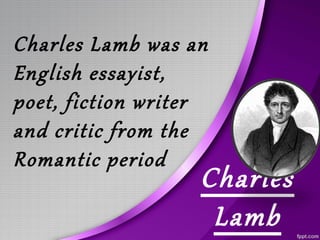
Charles
Lamb
Charles Lamb was an
English essayist,
poet, fiction writer
and critic from the
Romantic period
Childhood & Early Life
• He was born on February 10, 1775, in London to John Lamb
and Elizabeth Field as their youngest child among three living
children.
• His father worked as a clerk for a lawyer.
• His brother John and sister Mary were many years older to
him.
• He was quite close to his paternal aunt Hetty and maternal
grandmother Mrs. Field.
• Mary taught him to read and thereafter he came under the
guidance of Mrs. Reynolds with whom he maintained lifelong
contact.
• He joined ‘Christ’s Hospital’ at seven. It was in this free
boarding school where he met Samuel Taylor Coleridge and
developed a friendship that remained for life. He attended
the school till 1789.
Career
• He suffered from stutter problem all his life, which disqualified him from
a clerical career.
• After a short stint in the office of a London merchant Joseph Paice, he
joined the Examiner's Office of the South Sea House where he served in a
small post till February 8, 1792.
• On April 5, 1792, he joined the ‘East India House’ which was the
headquarters of ‘East India Company’, as a clerk in its Account’s Office.
He served the company for over three decades till his retirement in 1825.
• Charles became heavily addicted to alcohol. Once in 1795, he had to stay
in an asylum for six weeks.
• On September 22, 1796, his elder sister Mary in a fit of rage stabbed and
killed their mother Elizabeth. A subsequent investigation revealed Mary to
be suffering from temporary mental illness. Mary’s custody was given to
Charles Lamb.
Continue…
• Lamb and his sister led an active social life with some of the notable literary and
theatrical personalities around. Coleridge was a close childhood friend and later
Lamb befriended William Wordsworth, both of them remained his friends for life.
• He became acquainted with many young writers in London like Leigh Hunt,
William Hazlitt, and Percy Bysshe Shelley who advocated political reform.
• On April 16, 1796, his first literary work came out in the first volume of ‘Poems
on Various Subjects’ published by Coleridge that contained four poems of Lamb.
• In 1798 his romantic prose ‘A Tale of Rosamund’ was published. In the same year
his works were published along with that of Charles Lloyd in the book ‘Black
Verse’.
• After his father’s demise in 1799, Mary shifted with Charles for good. However her
insanity proved to be recurrent in nature and she had to visit the asylum many a
times.
• To earn a decent living for him and his sister Mary, he started writing short articles
for London newspapers from around 1801.
Continue…
• His next publication was the poetic tragedy ‘John Woodvil’ in 1802, which failed to
gain success. ‘Mr. H’, his two-act farce was booed at the ‘Drury Lane Theatre’ when
it was performed in 1807.
• One of his notable works ‘Tales from Shakespeare’, which he produced along with
his sister Mary Lamb, was published in 1807. It is an adaptation of plays of
Shakespeare for children where he worked on the tragedies while Mary worked on
the comedies.
• He retold the works of Shakespeare while sprinkling his own critical views
regarding the plays.
Many of his critical reviews on Shakespeare as also on William Hogarth were
published on ‘Reflector’, a quarterly magazine by Hunt.
• In 1808 Charles Lamb came out with ‘The Adventures of Ulysses’, an adaptation of
‘Odyssey’ for children. The same year his ‘Specimens of English Dramatic Poets
Who Lived About the Time of Shakespeare’ that consisted of selective scenes of
Elizabethan dramas was published. Thereafter Charles and Mary published ‘Mrs.
Leicester’s School’ in 1809.
Continue…
• A collection of essays, ‘Essays of Elia’, which contain autobiographical account of
experiences of Elia, an imaginary figure created by Lamb, was published in 1823. The
essays were earlier issued serially in the ‘London Magazine’, the oldest literary journal of
UK.
• However Robert Southey made a critical review of ‘Essays of Elia’ in the January 1823
issue of the ‘Quarterly review’ and also painted Lamb as irreligious. Lamb retaliated by
writing a letter to Southey and published it on October 1823 in the ‘London Magazine’,
expressing that his being a dissenter of the Church does not mean that he is an
irreligious man.
• ‘The Young Catechist’, ‘On The Lord's Prayer’, ‘Composed at Midnight’ and ‘A Vision
Of Repentance’ are some of his several poems that reflect his faith while he expressed
his dissent for atheism in ‘Living Without God In The World’.
• Some of his other notable works are ‘On the Tragedies of Shakespeare’ (1811), ‘Witches
and Other Night Fears’ (1821), ‘The Pawnbroker's Daughter’ (1825) and ‘The Last
Essays of Elia’ (1833).
Major Works
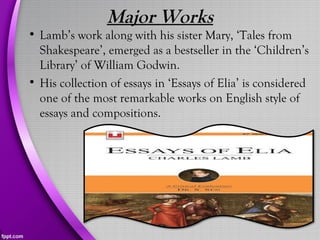
• Lamb’s work along with his sister Mary, ‘Tales from
Shakespeare’, emerged as a bestseller in the ‘Children’s
Library’ of William Godwin.
• His collection of essays in ‘Essays of Elia’ is considered
one of the most remarkable works on English style of
essays and compositions.
Significance Essays of
Elia• The prose essays, under the signature of Elia form the most delightful
section amongst Lamb’s works, is Essays of Elia. Traverse a peculiar
field of observation, sequestered from general interest, and they are
composed in a spirit too delicate and unobtrusive to catch the ear of the
noisy crowd, clamoring for strong sensations. This retiring delicacy
itself, the pensiveness cheered by gleams of the fanciful, and the humor
that is touched with cross-lights of pathos, together with the
picturesque quaintness of the objects casually described, whether men,
or things, or usages; and in the rear of all this the constant recurrence to
ancient recollections and to decaying forms of household life, as things
retiring before the tumult of new and revolutionary generations – these
traits in combination communicate to the papers a grace and strength
of originality which nothing in any literature approaches, whether for
degree or kind of excellence, except the most felicitous papers of
Addison, such as those on Sir Roger de Coverley and some other sin the
same vein of composition.
Continue…
• Although Dream Children begins on a merry note, the dark side of life soon forces itself
upon Lamb’s attention and the comic attitude gives way to melancholy at the end of the
essay. Throughout the essay Lamb presents his children in such a way that we never
guess that they are merely fragments of his imagination – their movements, their
reactions, and their expressions are all realistic. It is only at the end of the essay that we
realize that the entire episode with his children is a merely a daydream. We are awakened
by a painful realization of the facts.
• Lambs essays are highly evocative, and the reader feels empathy towards the characters.
This is a characteristic quality of the Romantic Essayists. In Dream Children, the
narrator comments on how similar the daughters face is to the mother and he can’t tell
which of the two is in front of him, but only in the end do we realize that the entire story
was just a fragment of his imagination.
• His essays have a reflective quality; he talks about his schooling days in Christ’s Hospital
in the essay, Christ’s Hospital Five and Thirty Years Ago wherein he speaks of himself in
the third person as “L”.
• “Rosemund Gray” is another essay in which he reflects upon his feelings for Ann
Simmons as the titular character and how their relationship doesn’t go too far due to
Miss Gray passing away.
Continue…
• In the essay "New Year's Eve," which first appeared in the January 1821 issue of The
London Magazine, Lamb reflects wistfully on the passage of time.
• To conclude we can see that Lambs essays are very personal. They possess humor and
pathos like most romantic works of literature. Lamb is also praised for his allusive
quality which is noted by many literary critics. And above all he is highly evocative, a
quality possessed by all Romantic writers.
• In fact, Lamb’s essays are popular for various reasons, such as genial humor, touching
pathos, humanitarian outlook, practical commonsense, nobility and gentility of nature
and above all the revelation of their creator’s self. These factors, individually as well as
collectively, have won for Lamb a unique place in the history of English essay.
• Lamb’s essays are as various as the very human nature. Lamb’s ‘thinking heart’ finds a
tale in everything that he saw or experienced. In fact, since Bacon, essay had been used
as a vehicle to give expression to the writer’s thoughts and ideas on matters of general
interest. But Lamb did not find pleasure in expressing his thought systematically. His
themes are suggested by sudden flashes of imagination. As a matter of fact, his essays
are his own revelations. It is his likes and dislikes—prejudices and opinions that find
place in the essays. In treatment almost every essay moves through a series of moods,
wild and sweet, grave and subdued, clear and practical, sumptuous and sonorous—the
essays are differenced many blossomed and handsome.”
Themes
• Charles began writing both for pleasure and as a means of
increasing his income which was now supporting both himself
and Mary. He found that writing allowed him to escape his life of
anxiety and come back to it refreshed and strengthened. Charles
wrote in many genres including drama, fiction, and poetry. He
also wrote literary criticism which was penetrating, interpretive,
and imaginative. It was his unique personality and his lack of
concern for conventional order that made Charles well suited for
the personal essay, the genre for which he is best remembered.
Charles was more interested in portraying a character and
expressing his or her emotions than in following character
development and conflict in a story; and through the personal
essay, he was able to write numerous character sketches based
solely on one character. It is also through the personal essay genre
that Charles could express artistic themes that were most
important to him: the past, theater, and fantasy.
•  
Poems
• Cleanliness
• A Farewell to Tobacco
• The Old Familiar Faces
• On an Infant Dying as Soon as
Born
• Parental Recollections
• Thoughtless Cruelty
Sources
• https://en.wikipedia.org/wiki/Charles_Lamb
• https://www.gradesaver.com/charles-lamb-ess
• https://www.thefamouspeople.com/profiles/cha

Charles lamb presentation

  • 1.
  • 2.
    Charles Lamb Charles Lamb wasan English essayist, poet, fiction writer and critic from the Romantic period
  • 3.
    Childhood & EarlyLife • He was born on February 10, 1775, in London to John Lamb and Elizabeth Field as their youngest child among three living children. • His father worked as a clerk for a lawyer. • His brother John and sister Mary were many years older to him. • He was quite close to his paternal aunt Hetty and maternal grandmother Mrs. Field. • Mary taught him to read and thereafter he came under the guidance of Mrs. Reynolds with whom he maintained lifelong contact. • He joined ‘Christ’s Hospital’ at seven. It was in this free boarding school where he met Samuel Taylor Coleridge and developed a friendship that remained for life. He attended the school till 1789.
  • 4.
    Career • He sufferedfrom stutter problem all his life, which disqualified him from a clerical career. • After a short stint in the office of a London merchant Joseph Paice, he joined the Examiner's Office of the South Sea House where he served in a small post till February 8, 1792. • On April 5, 1792, he joined the ‘East India House’ which was the headquarters of ‘East India Company’, as a clerk in its Account’s Office. He served the company for over three decades till his retirement in 1825. • Charles became heavily addicted to alcohol. Once in 1795, he had to stay in an asylum for six weeks. • On September 22, 1796, his elder sister Mary in a fit of rage stabbed and killed their mother Elizabeth. A subsequent investigation revealed Mary to be suffering from temporary mental illness. Mary’s custody was given to Charles Lamb.
  • 5.
    Continue… • Lamb andhis sister led an active social life with some of the notable literary and theatrical personalities around. Coleridge was a close childhood friend and later Lamb befriended William Wordsworth, both of them remained his friends for life. • He became acquainted with many young writers in London like Leigh Hunt, William Hazlitt, and Percy Bysshe Shelley who advocated political reform. • On April 16, 1796, his first literary work came out in the first volume of ‘Poems on Various Subjects’ published by Coleridge that contained four poems of Lamb. • In 1798 his romantic prose ‘A Tale of Rosamund’ was published. In the same year his works were published along with that of Charles Lloyd in the book ‘Black Verse’. • After his father’s demise in 1799, Mary shifted with Charles for good. However her insanity proved to be recurrent in nature and she had to visit the asylum many a times. • To earn a decent living for him and his sister Mary, he started writing short articles for London newspapers from around 1801.
  • 6.
    Continue… • His nextpublication was the poetic tragedy ‘John Woodvil’ in 1802, which failed to gain success. ‘Mr. H’, his two-act farce was booed at the ‘Drury Lane Theatre’ when it was performed in 1807. • One of his notable works ‘Tales from Shakespeare’, which he produced along with his sister Mary Lamb, was published in 1807. It is an adaptation of plays of Shakespeare for children where he worked on the tragedies while Mary worked on the comedies. • He retold the works of Shakespeare while sprinkling his own critical views regarding the plays. Many of his critical reviews on Shakespeare as also on William Hogarth were published on ‘Reflector’, a quarterly magazine by Hunt. • In 1808 Charles Lamb came out with ‘The Adventures of Ulysses’, an adaptation of ‘Odyssey’ for children. The same year his ‘Specimens of English Dramatic Poets Who Lived About the Time of Shakespeare’ that consisted of selective scenes of Elizabethan dramas was published. Thereafter Charles and Mary published ‘Mrs. Leicester’s School’ in 1809.
  • 7.
    Continue… • A collectionof essays, ‘Essays of Elia’, which contain autobiographical account of experiences of Elia, an imaginary figure created by Lamb, was published in 1823. The essays were earlier issued serially in the ‘London Magazine’, the oldest literary journal of UK. • However Robert Southey made a critical review of ‘Essays of Elia’ in the January 1823 issue of the ‘Quarterly review’ and also painted Lamb as irreligious. Lamb retaliated by writing a letter to Southey and published it on October 1823 in the ‘London Magazine’, expressing that his being a dissenter of the Church does not mean that he is an irreligious man. • ‘The Young Catechist’, ‘On The Lord's Prayer’, ‘Composed at Midnight’ and ‘A Vision Of Repentance’ are some of his several poems that reflect his faith while he expressed his dissent for atheism in ‘Living Without God In The World’. • Some of his other notable works are ‘On the Tragedies of Shakespeare’ (1811), ‘Witches and Other Night Fears’ (1821), ‘The Pawnbroker's Daughter’ (1825) and ‘The Last Essays of Elia’ (1833).
  • 8.
    Major Works • Lamb’swork along with his sister Mary, ‘Tales from Shakespeare’, emerged as a bestseller in the ‘Children’s Library’ of William Godwin. • His collection of essays in ‘Essays of Elia’ is considered one of the most remarkable works on English style of essays and compositions.
  • 9.
    Significance Essays of Elia•The prose essays, under the signature of Elia form the most delightful section amongst Lamb’s works, is Essays of Elia. Traverse a peculiar field of observation, sequestered from general interest, and they are composed in a spirit too delicate and unobtrusive to catch the ear of the noisy crowd, clamoring for strong sensations. This retiring delicacy itself, the pensiveness cheered by gleams of the fanciful, and the humor that is touched with cross-lights of pathos, together with the picturesque quaintness of the objects casually described, whether men, or things, or usages; and in the rear of all this the constant recurrence to ancient recollections and to decaying forms of household life, as things retiring before the tumult of new and revolutionary generations – these traits in combination communicate to the papers a grace and strength of originality which nothing in any literature approaches, whether for degree or kind of excellence, except the most felicitous papers of Addison, such as those on Sir Roger de Coverley and some other sin the same vein of composition.
  • 10.
    Continue… • Although DreamChildren begins on a merry note, the dark side of life soon forces itself upon Lamb’s attention and the comic attitude gives way to melancholy at the end of the essay. Throughout the essay Lamb presents his children in such a way that we never guess that they are merely fragments of his imagination – their movements, their reactions, and their expressions are all realistic. It is only at the end of the essay that we realize that the entire episode with his children is a merely a daydream. We are awakened by a painful realization of the facts. • Lambs essays are highly evocative, and the reader feels empathy towards the characters. This is a characteristic quality of the Romantic Essayists. In Dream Children, the narrator comments on how similar the daughters face is to the mother and he can’t tell which of the two is in front of him, but only in the end do we realize that the entire story was just a fragment of his imagination. • His essays have a reflective quality; he talks about his schooling days in Christ’s Hospital in the essay, Christ’s Hospital Five and Thirty Years Ago wherein he speaks of himself in the third person as “L”. • “Rosemund Gray” is another essay in which he reflects upon his feelings for Ann Simmons as the titular character and how their relationship doesn’t go too far due to Miss Gray passing away.
  • 11.
    Continue… • In theessay "New Year's Eve," which first appeared in the January 1821 issue of The London Magazine, Lamb reflects wistfully on the passage of time. • To conclude we can see that Lambs essays are very personal. They possess humor and pathos like most romantic works of literature. Lamb is also praised for his allusive quality which is noted by many literary critics. And above all he is highly evocative, a quality possessed by all Romantic writers. • In fact, Lamb’s essays are popular for various reasons, such as genial humor, touching pathos, humanitarian outlook, practical commonsense, nobility and gentility of nature and above all the revelation of their creator’s self. These factors, individually as well as collectively, have won for Lamb a unique place in the history of English essay. • Lamb’s essays are as various as the very human nature. Lamb’s ‘thinking heart’ finds a tale in everything that he saw or experienced. In fact, since Bacon, essay had been used as a vehicle to give expression to the writer’s thoughts and ideas on matters of general interest. But Lamb did not find pleasure in expressing his thought systematically. His themes are suggested by sudden flashes of imagination. As a matter of fact, his essays are his own revelations. It is his likes and dislikes—prejudices and opinions that find place in the essays. In treatment almost every essay moves through a series of moods, wild and sweet, grave and subdued, clear and practical, sumptuous and sonorous—the essays are differenced many blossomed and handsome.”
  • 12.
    Themes • Charles beganwriting both for pleasure and as a means of increasing his income which was now supporting both himself and Mary. He found that writing allowed him to escape his life of anxiety and come back to it refreshed and strengthened. Charles wrote in many genres including drama, fiction, and poetry. He also wrote literary criticism which was penetrating, interpretive, and imaginative. It was his unique personality and his lack of concern for conventional order that made Charles well suited for the personal essay, the genre for which he is best remembered. Charles was more interested in portraying a character and expressing his or her emotions than in following character development and conflict in a story; and through the personal essay, he was able to write numerous character sketches based solely on one character. It is also through the personal essay genre that Charles could express artistic themes that were most important to him: the past, theater, and fantasy. •  
  • 13.
    Poems • Cleanliness • AFarewell to Tobacco • The Old Familiar Faces • On an Infant Dying as Soon as Born • Parental Recollections • Thoughtless Cruelty
  • 15.