EWRT 1A CLASS 10
AGENDA
• Discussion: The Problems with Education
– Genre: “The Proposal” (Essays #3 + #4)
• Essay #3 Assignment
• Choosing and Narrowing a Topic
• In-class writing
• Prepare for Library visit during our next class
– Watch the videos on Library Resources and Internet Credibility
FIVE PROBLEMS WITH EDUCATION
• For your HW, you read two lists of
key problems or issues with
American K-12 education.
• Now make your own individual list
of at least THREE key
problems/issues with education
(you did this for HW).
– NOT limited to American
education.
– NOT limited to K-12. (Can talk
about college—especially
community college.)
• Which of these key problems on
your list have you had significant
personal experience with?
Next, in your Houses:
 Share your lists with each other.
Everyone should share all of their
problems.
 Each person should
describe/explain in some detail his
or her own personal experience
with one key problem.
 Be prepared to share your stories
with the class.
W H Y A R E W E
B R A I N S T O R M I N G
P R O B L E M S W I T H
E D U C AT I O N ?
(HINT: IT HAS TO DO WITH ESSAY #5)
I am glad you
asked!
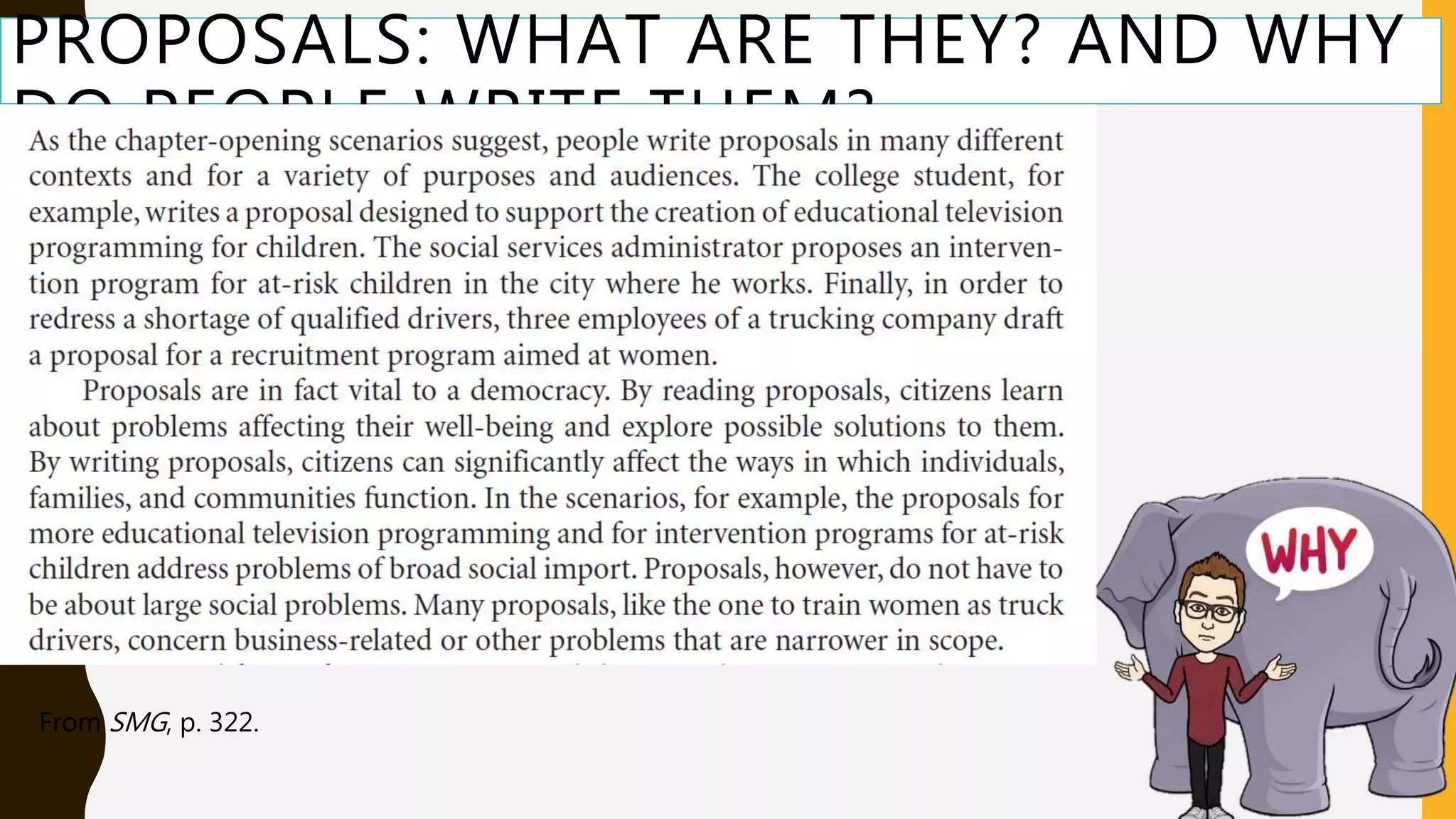
PROPOSALS: WHAT ARE THEY? AND WHY
DO PEOPLE WRITE THEM?
From SMG, p. 322.
WRITING A PROPOSAL IN TWO
ASSIGNMENTS
• In a proposal, an author presents a
problem and then offers a solution.
• In Essay #3, you will complete the
first step of a proposal: presenting a
problem.
• In Essay #4, you will revise your
presentation of that problem and
then propose a solution.
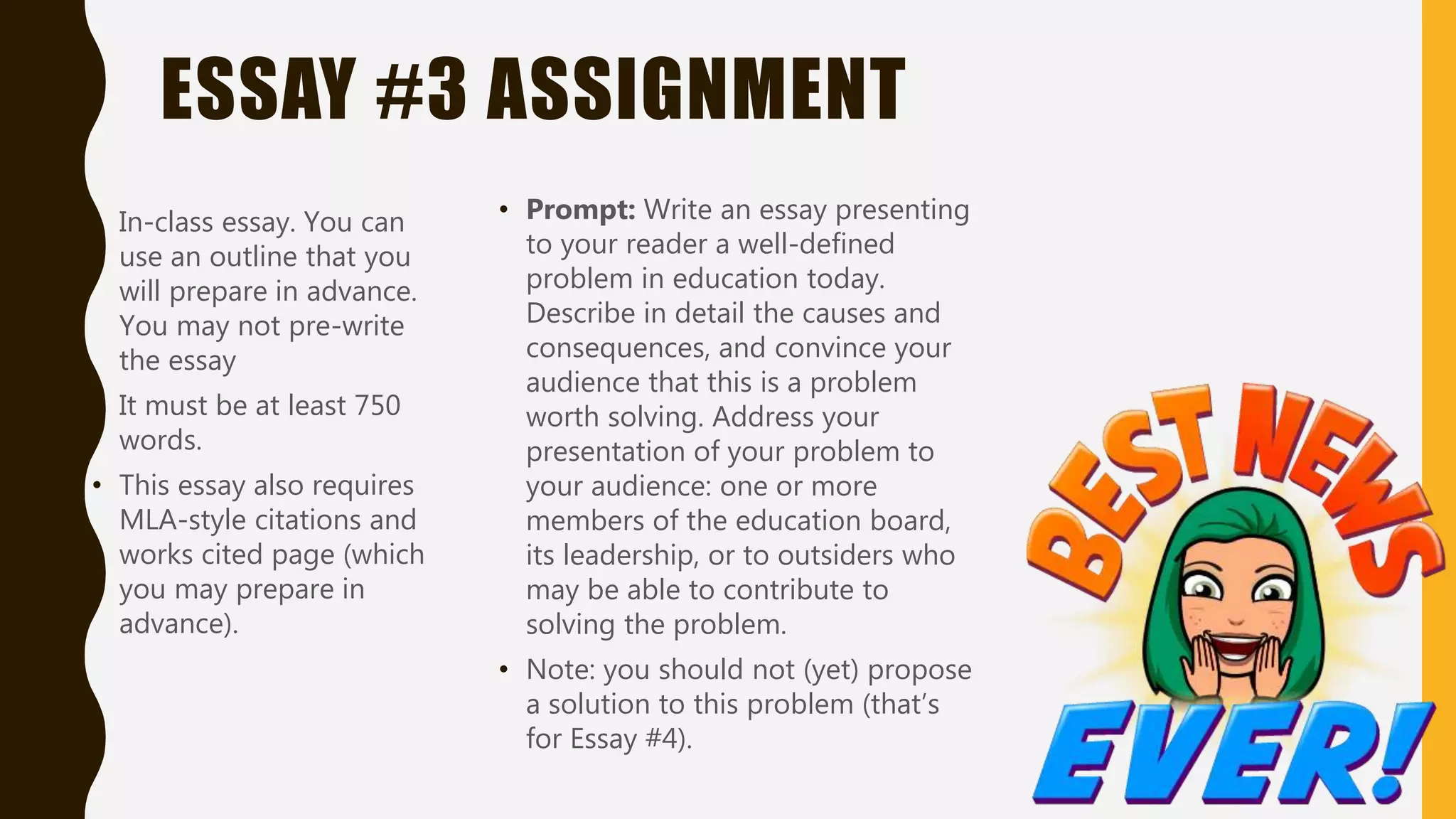
ESSAY #3 ASSIGNMENT
• In-class essay. You can
use an outline that you
will prepare in advance.
You may not pre-write
the essay
• It must be at least 750
words.
• This essay also requires
MLA-style citations and
works cited page (which
you may prepare in
advance).
• Prompt: Write an essay presenting
to your reader a well-defined
problem in education today.
Describe in detail the causes and
consequences, and convince your
audience that this is a problem
worth solving. Address your
presentation of your problem to
your audience: one or more
members of the education board,
its leadership, or to outsiders who
may be able to contribute to
solving the problem.
• Note: you should not (yet) propose
a solution to this problem (that’s
for Essay #4).
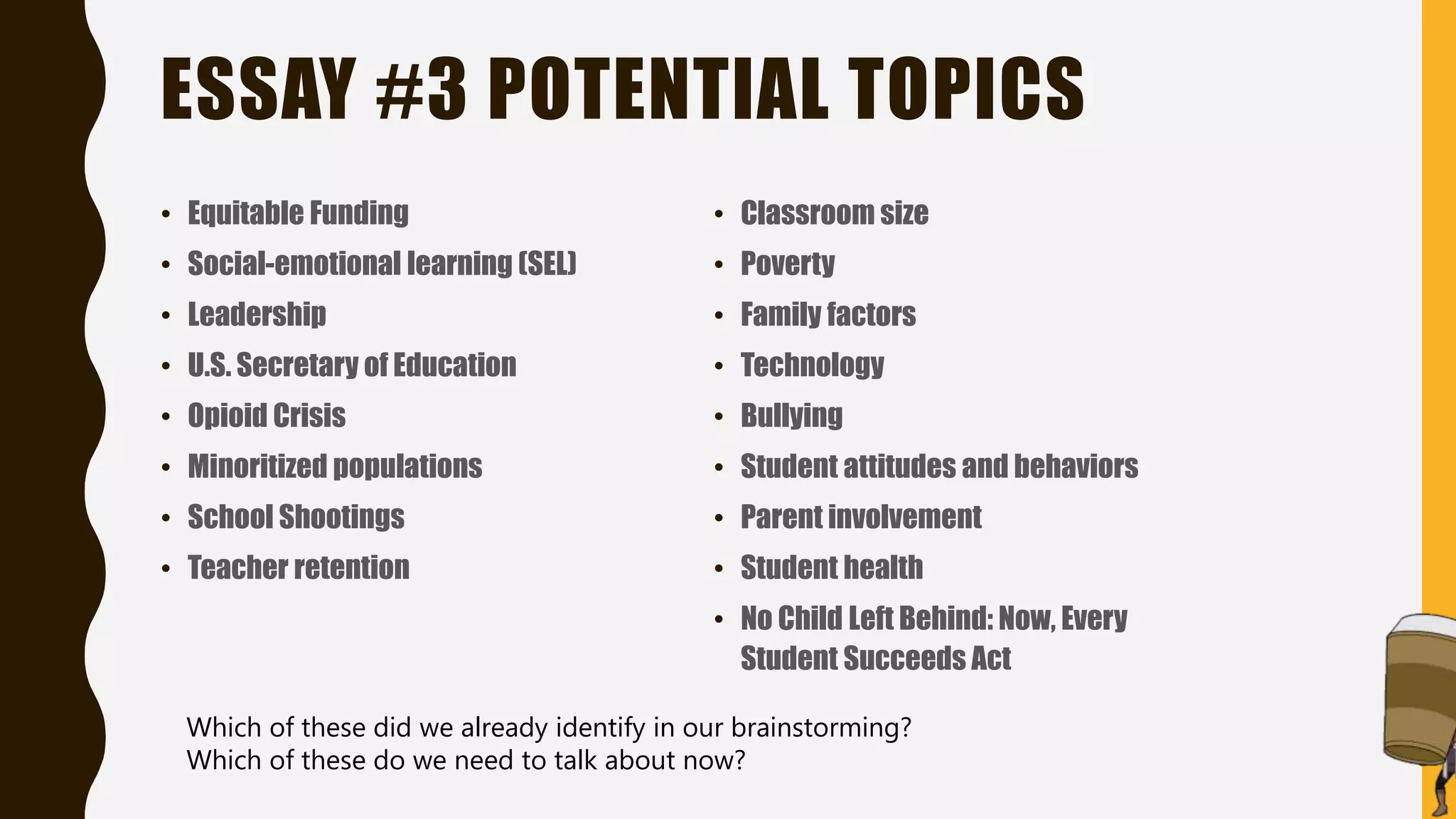
ESSAY #3 POTENTIAL TOPICS
• Equitable Funding
• Social-emotional learning (SEL)
• Leadership
• U.S. Secretary of Education
• Opioid Crisis
• Minoritized populations
• School Shootings
• Teacher retention
• Classroom size
• Poverty
• Family factors
• Technology
• Bullying
• Student attitudes and behaviors
• Parent involvement
• Student health
• No Child Left Behind: Now, Every
Student Succeeds Act
Which of these did we already identify in our brainstorming?
Which of these do we need to talk about now?
ESSAY #3: RESEARCH REQUIREMENT
• While you can discuss your own personal experience, limit this to a
single example, and be careful not to turn this into a narrative essay
about your personal challenges in school. Rather than relying heavily on
personal experience, you should use facts, statistics, or data relevant to
the larger population affected by this problem.
• To this end, quote (and cite) at least two outside sources.
• Harry Potter does not fulfill this requirement.
• Your sources should be from books or articles from a popular magazine
or newspaper.
• You should locate this article using the library databases.
• You should include your quote(s) and citation info from these articles on
your outline.
CHOOSING YOUR PROBLEM:
BRAINSTORMING
• Based on your earlier list of three
problems (and our subsequent
class discussion/brainstorming),
choose TWO potential problems.
• Brainstorm at least one paragraph
about each of these potential
problems; include everything you
know about the issue or problem.
• Be sure you pay specific attention
to the CAUSES of the problem and
the CONSEQUENCES of the
problem.
• Causes
– What is the cause of this problem?
Are there multiple causes?
– How did this problem come into
being or how was it created?
– Ex.: A cause of school traffic
congestion might be the lack of
public transportation options near
that school.
• Consequences
– What effects does this problem
have--on students, educators,
and/or society at large?
– Ex.: School traffic may cause
students to be late to class, which
may cause them to do less well in
school.
NARROWING YOUR PROBLEM
• It’s likely that one of the topics you
wrote about seemed to overwhelm
you—especially when you started
to consider the causes and
consequences.
• For example: inequity.
– How many types of inequity are
there in education?
– What are the causes of inequity?
– What are the consequences?
• These lists are long! Could you
write about all of them? (No.)
• So now you need to narrow your
problem.
• Consider specific situations:
– Inequity of funding by school
districts in the state of California.
Do some school districts get more
money and why is this a problem?
– Inequity of funding for student
tracks. Why do “AP” or “gifted”
tracks receive more resources and
what effects does this have?
– Inequity of funding for academic
vs. non-academic programs. Why
is college sports funding a
problem?
– Inequity of funding between
programs. Why are athletics
funded more than art and music
and why is this a problem?
– Inequity of teacher salaries..
NARROWING DISCUSSION
• Choose one of the potential problems
that you wrote about in your
brainstorming paragraphs, one that
seems too broad or overwhelming.
• Now, share that problem with your
House and discuss ways that you could
narrow and focus your topic.
• Each House should be prepared to
share examples of narrowing with the
class.
• Examples of narrowing:
– Bullying -> Anti-gay bullying
– Poverty -> Lack of resources for school
supplies or books.
– Technology -> inequitable access to
technology resources.
– Student behaviors -> ADHD
CHOOSING A PROBLEM:
PUTTING IT ALL TOGETHER
• Choose one of your potential
problems that seems most
interesting/promising to you.
• Make sure it is narrowed enough that
it doesn’t feel overwhelming.
• Write the following:
– A few sentences that state what the
problem is.
– A few sentences that explain why the
problem is serious.
– A few sentences that outline the
causes of the problem.
– A few sentences that describe the
consequences of failing to solve this
problem.
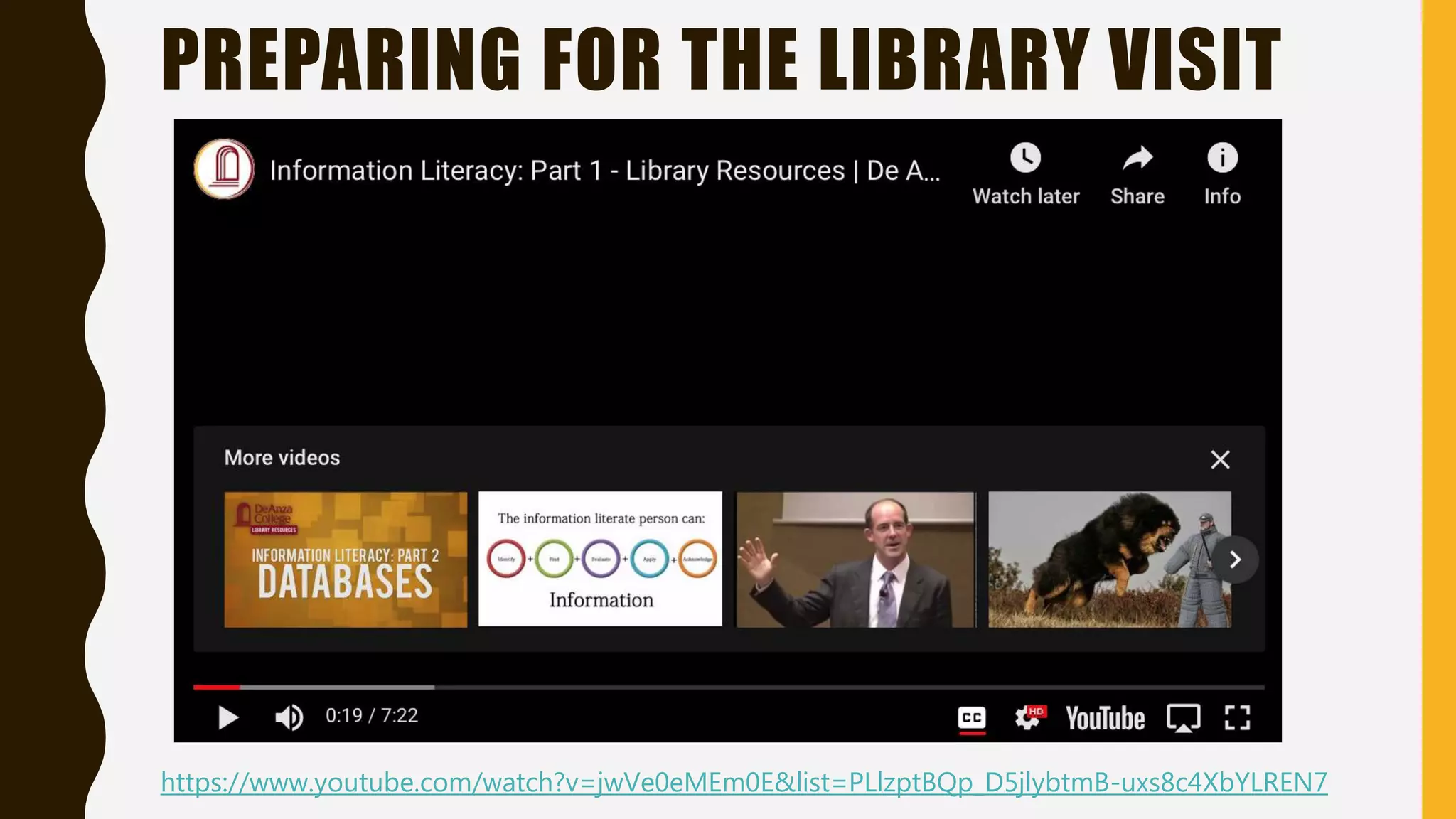
PREPARING FOR THE LIBRARY VISIT
https://www.youtube.com/watch?v=jwVe0eMEm0E&list=PLlzptBQp_D5jlybtmB-uxs8c4XbYLREN7
https://www.youtube.com/watch?v=9VulykYkSDg&t=10s
Read HP POA Chapter 15
Review these articles
· “8 Critical Issues Facing Education in 2018”
· “10 Major Challenges Facing Public Schools”
HW Discussion #14: Finish and post the paragraph you
started in class today that describes one problem you are
interested in investigating
Finish this at home:
Watch the videos on Library Resources and Internet
Credibility
Quiz: Library resources and internet credibility
Homework
Monday, we meet in the library lobby. The
librarian will give you an overview of how to
use the sources, and then you will have time to
find some sources for your essay #3.

Ewrt 1 at class 10

  • 1.
  • 2.
    AGENDA • Discussion: TheProblems with Education – Genre: “The Proposal” (Essays #3 + #4) • Essay #3 Assignment • Choosing and Narrowing a Topic • In-class writing • Prepare for Library visit during our next class – Watch the videos on Library Resources and Internet Credibility
  • 3.
    FIVE PROBLEMS WITHEDUCATION • For your HW, you read two lists of key problems or issues with American K-12 education. • Now make your own individual list of at least THREE key problems/issues with education (you did this for HW). – NOT limited to American education. – NOT limited to K-12. (Can talk about college—especially community college.) • Which of these key problems on your list have you had significant personal experience with?
  • 4.
    Next, in yourHouses:  Share your lists with each other. Everyone should share all of their problems.  Each person should describe/explain in some detail his or her own personal experience with one key problem.  Be prepared to share your stories with the class.
  • 5.
    W H YA R E W E B R A I N S T O R M I N G P R O B L E M S W I T H E D U C AT I O N ? (HINT: IT HAS TO DO WITH ESSAY #5) I am glad you asked!
  • 6.
    PROPOSALS: WHAT ARETHEY? AND WHY DO PEOPLE WRITE THEM? From SMG, p. 322.
  • 7.
    WRITING A PROPOSALIN TWO ASSIGNMENTS • In a proposal, an author presents a problem and then offers a solution. • In Essay #3, you will complete the first step of a proposal: presenting a problem. • In Essay #4, you will revise your presentation of that problem and then propose a solution.
  • 8.
    ESSAY #3 ASSIGNMENT •In-class essay. You can use an outline that you will prepare in advance. You may not pre-write the essay • It must be at least 750 words. • This essay also requires MLA-style citations and works cited page (which you may prepare in advance). • Prompt: Write an essay presenting to your reader a well-defined problem in education today. Describe in detail the causes and consequences, and convince your audience that this is a problem worth solving. Address your presentation of your problem to your audience: one or more members of the education board, its leadership, or to outsiders who may be able to contribute to solving the problem. • Note: you should not (yet) propose a solution to this problem (that’s for Essay #4).
  • 9.
    ESSAY #3 POTENTIALTOPICS • Equitable Funding • Social-emotional learning (SEL) • Leadership • U.S. Secretary of Education • Opioid Crisis • Minoritized populations • School Shootings • Teacher retention • Classroom size • Poverty • Family factors • Technology • Bullying • Student attitudes and behaviors • Parent involvement • Student health • No Child Left Behind: Now, Every Student Succeeds Act Which of these did we already identify in our brainstorming? Which of these do we need to talk about now?
  • 10.
    ESSAY #3: RESEARCHREQUIREMENT • While you can discuss your own personal experience, limit this to a single example, and be careful not to turn this into a narrative essay about your personal challenges in school. Rather than relying heavily on personal experience, you should use facts, statistics, or data relevant to the larger population affected by this problem. • To this end, quote (and cite) at least two outside sources. • Harry Potter does not fulfill this requirement. • Your sources should be from books or articles from a popular magazine or newspaper. • You should locate this article using the library databases. • You should include your quote(s) and citation info from these articles on your outline.
  • 11.
    CHOOSING YOUR PROBLEM: BRAINSTORMING •Based on your earlier list of three problems (and our subsequent class discussion/brainstorming), choose TWO potential problems. • Brainstorm at least one paragraph about each of these potential problems; include everything you know about the issue or problem. • Be sure you pay specific attention to the CAUSES of the problem and the CONSEQUENCES of the problem. • Causes – What is the cause of this problem? Are there multiple causes? – How did this problem come into being or how was it created? – Ex.: A cause of school traffic congestion might be the lack of public transportation options near that school. • Consequences – What effects does this problem have--on students, educators, and/or society at large? – Ex.: School traffic may cause students to be late to class, which may cause them to do less well in school.
  • 12.
    NARROWING YOUR PROBLEM •It’s likely that one of the topics you wrote about seemed to overwhelm you—especially when you started to consider the causes and consequences. • For example: inequity. – How many types of inequity are there in education? – What are the causes of inequity? – What are the consequences? • These lists are long! Could you write about all of them? (No.) • So now you need to narrow your problem. • Consider specific situations: – Inequity of funding by school districts in the state of California. Do some school districts get more money and why is this a problem? – Inequity of funding for student tracks. Why do “AP” or “gifted” tracks receive more resources and what effects does this have? – Inequity of funding for academic vs. non-academic programs. Why is college sports funding a problem? – Inequity of funding between programs. Why are athletics funded more than art and music and why is this a problem? – Inequity of teacher salaries..
  • 13.
    NARROWING DISCUSSION • Chooseone of the potential problems that you wrote about in your brainstorming paragraphs, one that seems too broad or overwhelming. • Now, share that problem with your House and discuss ways that you could narrow and focus your topic. • Each House should be prepared to share examples of narrowing with the class. • Examples of narrowing: – Bullying -> Anti-gay bullying – Poverty -> Lack of resources for school supplies or books. – Technology -> inequitable access to technology resources. – Student behaviors -> ADHD
  • 14.
    CHOOSING A PROBLEM: PUTTINGIT ALL TOGETHER • Choose one of your potential problems that seems most interesting/promising to you. • Make sure it is narrowed enough that it doesn’t feel overwhelming. • Write the following: – A few sentences that state what the problem is. – A few sentences that explain why the problem is serious. – A few sentences that outline the causes of the problem. – A few sentences that describe the consequences of failing to solve this problem.
  • 15.
    PREPARING FOR THELIBRARY VISIT https://www.youtube.com/watch?v=jwVe0eMEm0E&list=PLlzptBQp_D5jlybtmB-uxs8c4XbYLREN7
  • 16.
  • 17.
    Read HP POAChapter 15 Review these articles · “8 Critical Issues Facing Education in 2018” · “10 Major Challenges Facing Public Schools” HW Discussion #14: Finish and post the paragraph you started in class today that describes one problem you are interested in investigating Finish this at home: Watch the videos on Library Resources and Internet Credibility Quiz: Library resources and internet credibility Homework Monday, we meet in the library lobby. The librarian will give you an overview of how to use the sources, and then you will have time to find some sources for your essay #3.