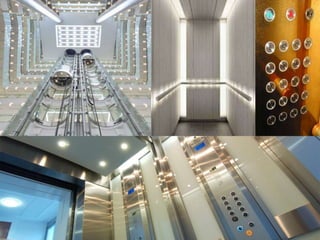
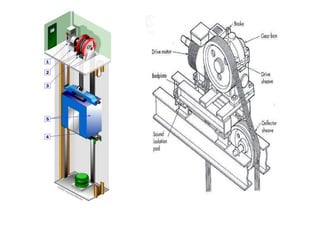
• An elevator (or lift) is a vertical transport vehicle
that efficiently moves people or goods between
floors of a building.
• They are generally powered by electric motors that
either drive traction cables and counterweight
systems, or pump hydraulic fluid to raise a
cylindrical piston.
ELEVATORS
• Roped Elevator
• Hydraulic Elevator
TYPES of ELEVATORS
MAIN COMPONENTS of ROPED
ELEVATOR
1. Car
2. Rope
3. Electric Motor
4. Shaft
5. Sheave
6. Counterweight
7. Guide Rails
8. Governor
9. Doors
USES OF ELEVATORS
• Passenger Elevators. A passenger elevator is designed to
move people between a building's floors.
• Freight Elevators. A freight elevator, or goods lift, is an
elevator designed to carry goods, rather than passengers.
Freight elevators are generally required to display a written
notice in the car that the use by passengers is prohibited
(though not necessarily illegal), though certain freight
elevators allow dual use. Freight elevators are typically
larger and capable of carrying heavier loads than a
passenger elevator.
• Vehicle Elevators. Vehicular elevators are used within
buildings with limited space (in lieu of ramps) to move cars
into the parking garage.
• Aircraft Elevators. On aircraft carriers, elevators carry
aircraft between the flight deck and the hangar deck for
operations or repairs. These elevators are designed for
much greater capacity than other elevators.
• Dumbwaiter. Dumbwaiters are small freight elevators that
are intended to carry food rather than passengers. They often
link kitchens with rooms on other floors.
• Material Handling Belts and Belt Elevators. A different
kind of elevator is used to transport material. It generally
consists of an inclined plane on which a conveyor belt runs.
The conveyor often includes partitions to prevent the material
from sliding backwards. These elevators are often used in
industrial and agricultural applications.
USES OF ELEVATORS
1. An Elevator Telephone. It can be used (in addition to the
alarm) by a trapped passenger to call for help.
2. Hold Button. This button delays the door closing timer,
useful for loading freight and hospital beds.
3. Call Cancellation. A destination floor may be deselected
by double clicking.
4. Access Restriction. By key switches, RFID reader, code
keypad, hotel room card, etc.
5. One or more Additional Sets of Doors. It can serve
different floor plans. For example, in an elevated crosswalk
setup, the front doors may open on the street level, and the
rear doors open on the crosswalk level.
6. Security Camera.
7. Plain Walls or Mirrored Walls. To give the illusion of
larger area.
8. Glass Windowpane. Providing a view of the building
interior or onto the streets.
Additional Facilities
The Elevator Algorithm
The elevator algorithm, a simple algorithm by which
a single elevator can decide where to stop, is
summarized as follows:
- Continue traveling in the same direction while
there are remaining requests in that same
direction.
- If there are no further requests in that direction,
then stop and become idle, or change direction if
there are requests in the opposite direction.
- The elevator algorithm has found an application
in computer operating systems as an algorithm
for scheduling hard disk requests. Modern
elevators use more complex heuristic algorithms

Elevators : Type & Working Principle

  • 2.
    • An elevator(or lift) is a vertical transport vehicle that efficiently moves people or goods between floors of a building. • They are generally powered by electric motors that either drive traction cables and counterweight systems, or pump hydraulic fluid to raise a cylindrical piston. ELEVATORS
  • 3.
    • Roped Elevator •Hydraulic Elevator TYPES of ELEVATORS
  • 4.
    MAIN COMPONENTS ofROPED ELEVATOR 1. Car 2. Rope 3. Electric Motor 4. Shaft 5. Sheave 6. Counterweight 7. Guide Rails 8. Governor 9. Doors
  • 6.
    USES OF ELEVATORS •Passenger Elevators. A passenger elevator is designed to move people between a building's floors. • Freight Elevators. A freight elevator, or goods lift, is an elevator designed to carry goods, rather than passengers. Freight elevators are generally required to display a written notice in the car that the use by passengers is prohibited (though not necessarily illegal), though certain freight elevators allow dual use. Freight elevators are typically larger and capable of carrying heavier loads than a passenger elevator. • Vehicle Elevators. Vehicular elevators are used within buildings with limited space (in lieu of ramps) to move cars into the parking garage. • Aircraft Elevators. On aircraft carriers, elevators carry aircraft between the flight deck and the hangar deck for operations or repairs. These elevators are designed for much greater capacity than other elevators.
  • 7.
    • Dumbwaiter. Dumbwaitersare small freight elevators that are intended to carry food rather than passengers. They often link kitchens with rooms on other floors. • Material Handling Belts and Belt Elevators. A different kind of elevator is used to transport material. It generally consists of an inclined plane on which a conveyor belt runs. The conveyor often includes partitions to prevent the material from sliding backwards. These elevators are often used in industrial and agricultural applications. USES OF ELEVATORS
  • 8.
    1. An ElevatorTelephone. It can be used (in addition to the alarm) by a trapped passenger to call for help. 2. Hold Button. This button delays the door closing timer, useful for loading freight and hospital beds. 3. Call Cancellation. A destination floor may be deselected by double clicking. 4. Access Restriction. By key switches, RFID reader, code keypad, hotel room card, etc. 5. One or more Additional Sets of Doors. It can serve different floor plans. For example, in an elevated crosswalk setup, the front doors may open on the street level, and the rear doors open on the crosswalk level. 6. Security Camera. 7. Plain Walls or Mirrored Walls. To give the illusion of larger area. 8. Glass Windowpane. Providing a view of the building interior or onto the streets. Additional Facilities
  • 9.
    The Elevator Algorithm Theelevator algorithm, a simple algorithm by which a single elevator can decide where to stop, is summarized as follows: - Continue traveling in the same direction while there are remaining requests in that same direction. - If there are no further requests in that direction, then stop and become idle, or change direction if there are requests in the opposite direction. - The elevator algorithm has found an application in computer operating systems as an algorithm for scheduling hard disk requests. Modern elevators use more complex heuristic algorithms