BUILDING MATERIALS AND
CONSTRUCTION V
MODULE 02-ELEVATORS | 25 | 11 | 2021
MODULE 02 | 25 | 11 | 2021
ELEVATORS …
• The Need - Elevators
• Historical Development
• Major Components
• Types of Elevators
• Electric
• Hydraulic
• Design Standards
• Mechanism
• Electrical controls / Safety controls
• Detailings for Physically Challenged
THE NEED …
• Imagine a city without having skyscrapers / high rise
buildings ?
• Imagine yourself climbing stairs or lifting household items
to your apartment of 60th floor each time ?
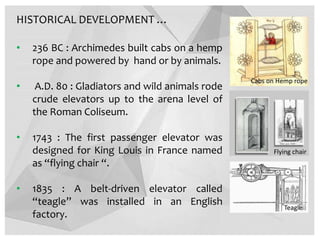
HISTORICAL DEVELOPMENT …
• 236 BC : Archimedes built cabs on a hemp
rope and powered by hand or by animals.
• A.D. 80 : Gladiators and wild animals rode
crude elevators up to the arena level of
the Roman Coliseum.
• 1743 : The first passenger elevator was
designed for King Louis in France named
as “flying chair “.
• 1835 : A belt-driven elevator called
“teagle” was installed in an English
factory.
Flying chair
Teagle
Cabs on Hemp rope
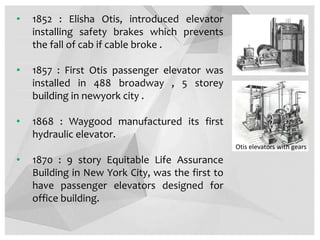
• 1852 : Elisha Otis, introduced elevator
installing safety brakes which prevents
the fall of cab if cable broke .
• 1857 : First Otis passenger elevator was
installed in 488 broadway , 5 storey
building in newyork city .
• 1868 : Waygood manufactured its first
hydraulic elevator.
• 1870 : 9 story Equitable Life Assurance
Building in New York City, was the first to
have passenger elevators designed for
office building.
Otis elevators with gears
• 1872 : First geared hydraulic elevator installed in New York
City.
• 1875 : Schindler - to become the world's second-largest
elevator manufacturer was founded near Lucerne.
• 1878 : First electric elevator was built by Siemens in
Germany.
• 1890 : Haughton Elevator Company was founded in Toledo,
Ohio specializing hydraulic elevators.
• 1902 : The first direct plunger elevators were installed by
Otis for high-rise passenger service.
• 1909 : The 41-story Singer Building was the first to operate
with telephones connected to "elevator supervisors" who
controlled and confirmed departures.
• 1918 : New York City adopted its first "elevator rules" which
restricted speeds to 700 fpm.
• 1922 : Westinghouse introduced fastest gearless elevators
in Chicago which boasted speed of 420 meters/minute.
• 1926 : Haughton developed the automatic car door and
gate closer.
• 1931 : New York City elevator code was revised to allow
1,000 fpm elevators in the Empire State Building.
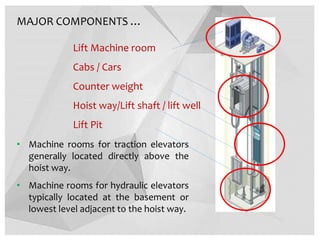
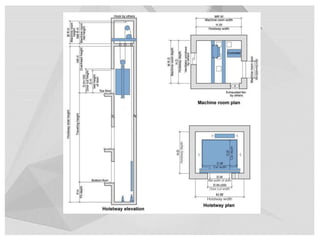
MAJOR COMPONENTS …
• Machine rooms for traction elevators
generally located directly above the
hoist way.
• Machine rooms for hydraulic elevators
typically located at the basement or
lowest level adjacent to the hoist way.
Lift Machine room
Cabs / Cars
Counter weight
Hoist way/Lift shaft / lift well
Lift Pit
TYPES OF ELEVATORS ( DESIGN AND USE ) …
The systems are mainly distinguished primarily by their usage , car
size , design etc.
• Passenger
• Hospital
• Capsule / Panoramic
• Freight
• Automobile
• Dumb waiters
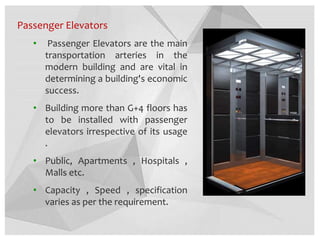
Passenger Elevators
• Passenger Elevators are the main
transportation arteries in the
modern building and are vital in
determining a building's economic
success.
• Building more than G+4 floors has
to be installed with passenger
elevators irrespective of its usage
.
• Public, Apartments , Hospitals ,
Malls etc.
• Capacity , Speed , specification
varies as per the requirement.
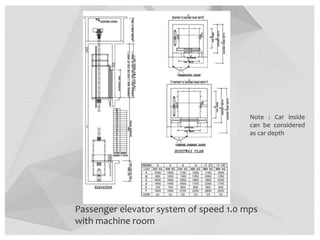
Passenger elevator system of speed 1.0 mps
with machine room
Note : Car inside
can be considered
as car depth
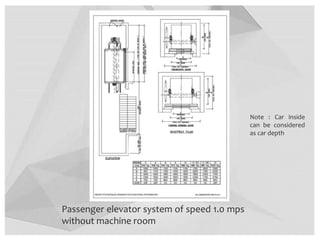
Passenger elevator system of speed 1.0 mps
without machine room
Note : Car inside
can be considered
as car depth
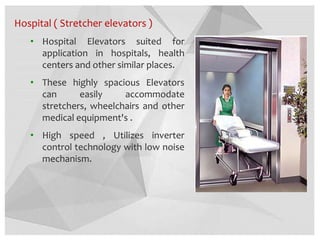
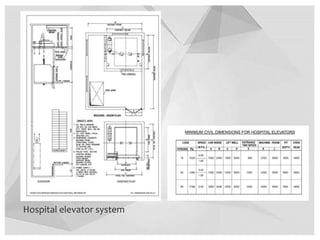
Hospital ( Stretcher elevators )
• Hospital Elevators suited for
application in hospitals, health
centers and other similar places.
• These highly spacious Elevators
can easily accommodate
stretchers, wheelchairs and other
medical equipment's .
• High speed , Utilizes inverter
control technology with low noise
mechanism.
Hospital elevator system
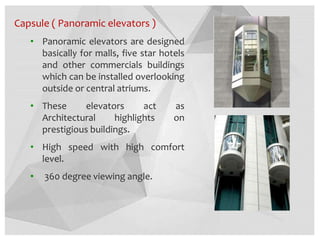
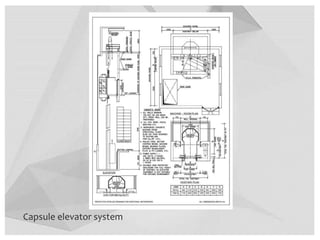
Capsule ( Panoramic elevators )
• Panoramic elevators are designed
basically for malls, five star hotels
and other commercials buildings
which can be installed overlooking
outside or central atriums.
• These elevators act as
Architectural highlights on
prestigious buildings.
• High speed with high comfort
level.
• 360 degree viewing angle.
Capsule elevator system
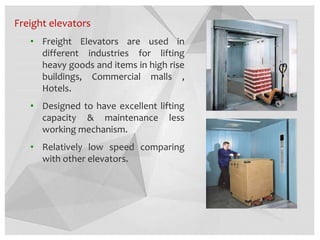
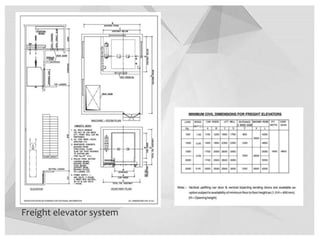
Freight elevators
• Freight Elevators are used in
different industries for lifting
heavy goods and items in high rise
buildings, Commercial malls ,
Hotels.
• Designed to have excellent lifting
capacity & maintenance less
working mechanism.
• Relatively low speed comparing
with other elevators.
Freight elevator system
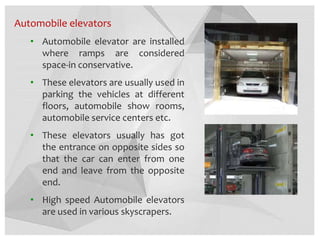
Automobile elevators
• Automobile elevator are installed
where ramps are considered
space-in conservative.
• These elevators are usually used in
parking the vehicles at different
floors, automobile show rooms,
automobile service centers etc.
• These elevators usually has got
the entrance on opposite sides so
that the car can enter from one
end and leave from the opposite
end.
• High speed Automobile elevators
are used in various skyscrapers.
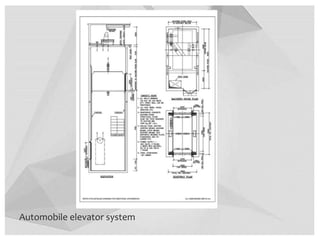
Automobile elevator system
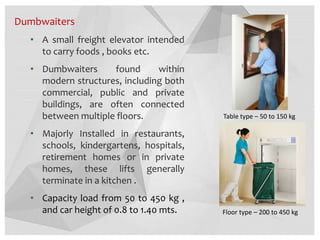
Dumbwaiters
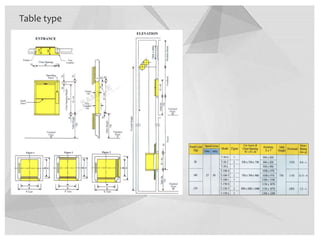
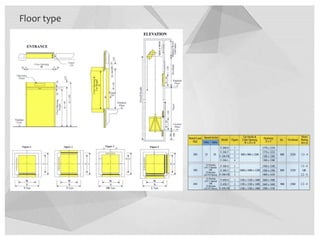
• A small freight elevator intended
to carry foods , books etc.
• Dumbwaiters found within
modern structures, including both
commercial, public and private
buildings, are often connected
between multiple floors.
• Majorly Installed in restaurants,
schools, kindergartens, hospitals,
retirement homes or in private
homes, these lifts generally
terminate in a kitchen .
• Capacity load from 50 to 450 kg ,
and car height of 0.8 to 1.40 mts.
Table type – 50 to 150 kg
Floor type – 200 to 450 kg
Table type
Floor type
DESIGN STANDARDS …
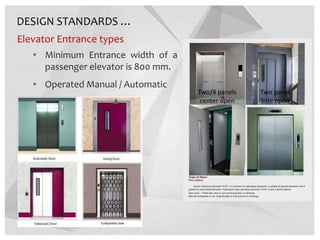
Elevator Entrance types
• Minimum Entrance width of a
passenger elevator is 800 mm.
• Operated Manual / Automatic
Two/4 panels
center open
Two panel
Side open
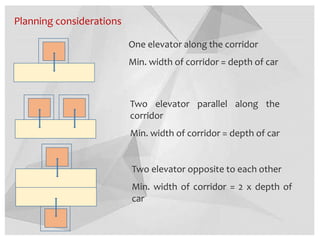
Planning considerations
One elevator along the corridor
Min. width of corridor = depth of car
Two elevator parallel along the
corridor
Min. width of corridor = depth of car
Two elevator opposite to each other
Min. width of corridor = 2 x depth of
car
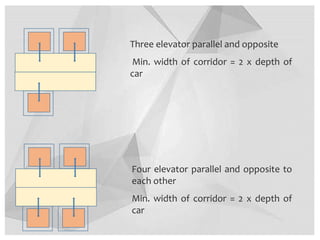
Four elevator parallel and opposite to
each other
Min. width of corridor = 2 x depth of
car
Three elevator parallel and opposite
Min. width of corridor = 2 x depth of
car
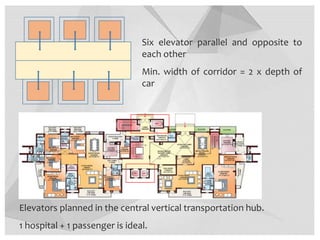
Six elevator parallel and opposite to
each other
Min. width of corridor = 2 x depth of
car
Elevators planned in the central vertical transportation hub.
1 hospital + 1 passenger is ideal.
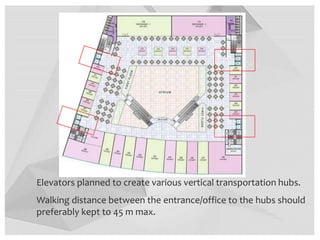
Elevators planned to create various vertical transportation hubs.
Walking distance between the entrance/office to the hubs should
preferably kept to 45 m max.
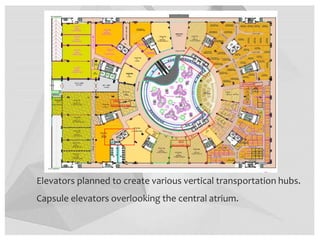
Elevators planned to create various vertical transportation hubs.
Capsule elevators overlooking the central atrium.
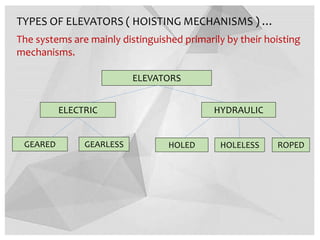
TYPES OF ELEVATORS ( HOISTING MECHANISMS ) …
GEARED
ELEVATORS
ELECTRIC HYDRAULIC
GEARLESS HOLED HOLELESS ROPED
The systems are mainly distinguished primarily by their hoisting
mechanisms.
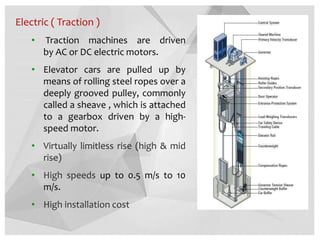
Electric ( Traction )
• Traction machines are driven
by AC or DC electric motors.
• Elevator cars are pulled up by
means of rolling steel ropes over a
deeply grooved pulley, commonly
called a sheave , which is attached
to a gearbox driven by a high-
speed motor.
• Virtually limitless rise (high & mid
rise)
• High speeds up to 0.5 m/s to 10
m/s.
• High installation cost
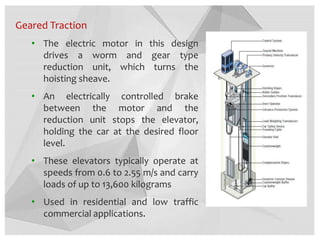
Geared Traction
• The electric motor in this design
drives a worm and gear type
reduction unit, which turns the
hoisting sheave.
• An electrically controlled brake
between the motor and the
reduction unit stops the elevator,
holding the car at the desired floor
level.
• These elevators typically operate at
speeds from 0.6 to 2.55 m/s and carry
loads of up to 13,600 kilograms
• Used in residential and low traffic
commercial applications.
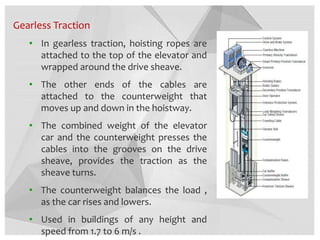
Gearless Traction
• In gearless traction, hoisting ropes are
attached to the top of the elevator and
wrapped around the drive sheave.
• The other ends of the cables are
attached to the counterweight that
moves up and down in the hoistway.
• The combined weight of the elevator
car and the counterweight presses the
cables into the grooves on the drive
sheave, provides the traction as the
sheave turns.
• The counterweight balances the load ,
as the car rises and lowers.
• Used in buildings of any height and
speed from 1.7 to 6 m/s .
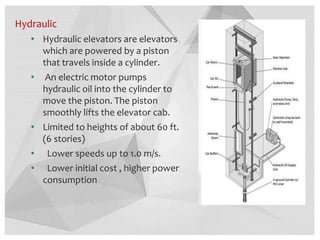
Hydraulic
• Hydraulic elevators are elevators
which are powered by a piston
that travels inside a cylinder.
• An electric motor pumps
hydraulic oil into the cylinder to
move the piston. The piston
smoothly lifts the elevator cab.
• Limited to heights of about 60 ft.
(6 stories)
• Lower speeds up to 1.0 m/s.
• Lower initial cost , higher power
consumption
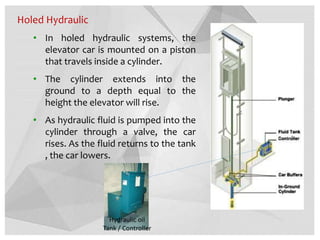
Holed Hydraulic
• In holed hydraulic systems, the
elevator car is mounted on a piston
that travels inside a cylinder.
• The cylinder extends into the
ground to a depth equal to the
height the elevator will rise.
• As hydraulic fluid is pumped into the
cylinder through a valve, the car
rises. As the fluid returns to the tank
, the car lowers.
Hydraulic oil
Tank / Controller
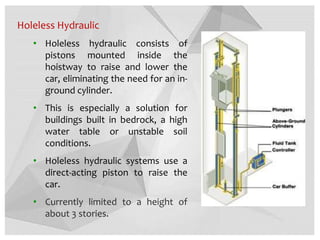
Holeless Hydraulic
• Holeless hydraulic consists of
pistons mounted inside the
hoistway to raise and lower the
car, eliminating the need for an in-
ground cylinder.
• This is especially a solution for
buildings built in bedrock, a high
water table or unstable soil
conditions.
• Holeless hydraulic systems use a
direct-acting piston to raise the
car.
• Currently limited to a height of
about 3 stories.
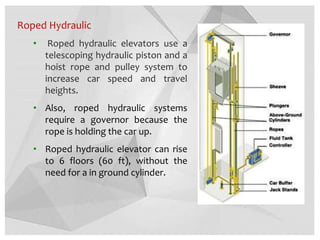
Roped Hydraulic
• Roped hydraulic elevators use a
telescoping hydraulic piston and a
hoist rope and pulley system to
increase car speed and travel
heights.
• Also, roped hydraulic systems
require a governor because the
rope is holding the car up.
• Roped hydraulic elevator can rise
to 6 floors (60 ft), without the
need for a in ground cylinder.
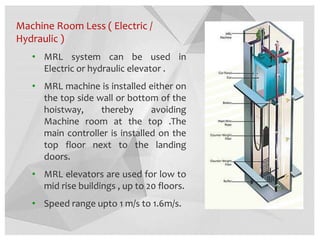
Machine Room Less ( Electric /
Hydraulic )
• MRL system can be used in
Electric or hydraulic elevator .
• MRL machine is installed either on
the top side wall or bottom of the
hoistway, thereby avoiding
Machine room at the top .The
main controller is installed on the
top floor next to the landing
doors.
• MRL elevators are used for low to
mid rise buildings , up to 20 floors.
• Speed range upto 1 m/s to 1.6m/s.
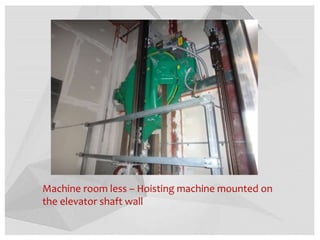
Machine room less – Hoisting machine mounted on
the elevator shaft wall
MECHANISM …
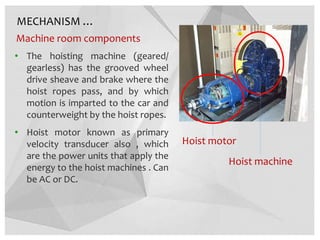
Machine room components
• The hoisting machine (geared/
gearless) has the grooved wheel
drive sheave and brake where the
hoist ropes pass, and by which
motion is imparted to the car and
counterweight by the hoist ropes.
• Hoist motor known as primary
velocity transducer also , which
are the power units that apply the
energy to the hoist machines . Can
be AC or DC.
Hoist motor
Hoist machine
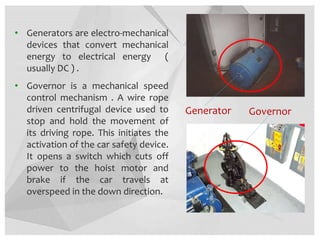
Generator
• Generators are electro-mechanical
devices that convert mechanical
energy to electrical energy (
usually DC ) .
• Governor is a mechanical speed
control mechanism . A wire rope
driven centrifugal device used to
stop and hold the movement of
its driving rope. This initiates the
activation of the car safety device.
It opens a switch which cuts off
power to the hoist motor and
brake if the car travels at
overspeed in the down direction.
Governor
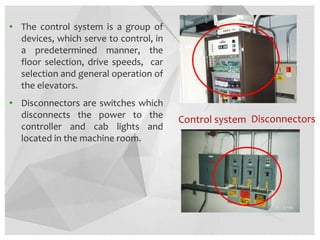
• The control system is a group of
devices, which serve to control, in
a predetermined manner, the
floor selection, drive speeds, car
selection and general operation of
the elevators.
• Disconnectors are switches which
disconnects the power to the
controller and cab lights and
located in the machine room.
Disconnectors
Control system
Hoistway / Pit components
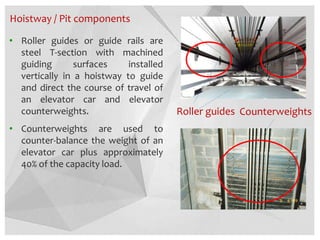
• Roller guides or guide rails are
steel T-section with machined
guiding surfaces installed
vertically in a hoistway to guide
and direct the course of travel of
an elevator car and elevator
counterweights.
• Counterweights are used to
counter-balance the weight of an
elevator car plus approximately
40% of the capacity load.
Roller guides Counterweights
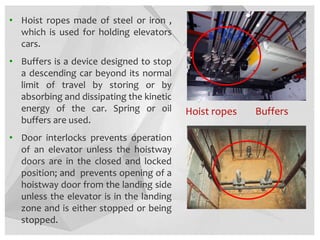
• Hoist ropes made of steel or iron ,
which is used for holding elevators
cars.
• Buffers is a device designed to stop
a descending car beyond its normal
limit of travel by storing or by
absorbing and dissipating the kinetic
energy of the car. Spring or oil
buffers are used.
• Door interlocks prevents operation
of an elevator unless the hoistway
doors are in the closed and locked
position; and prevents opening of a
hoistway door from the landing side
unless the elevator is in the landing
zone and is either stopped or being
stopped.
Hoist ropes Buffers
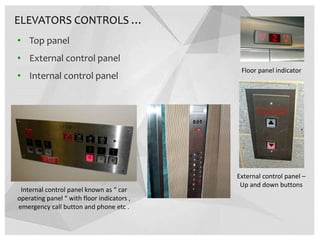
External control panel –
Up and down buttons
Floor panel indicator
Internal control panel known as “ car
operating panel “ with floor indicators ,
emergency call button and phone etc .
• Top panel
• External control panel
• Internal control panel
ELEVATORS CONTROLS …
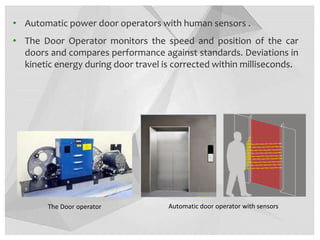
• Automatic power door operators with human sensors .
• The Door Operator monitors the speed and position of the car
doors and compares performance against standards. Deviations in
kinetic energy during door travel is corrected within milliseconds.
The Door operator Automatic door operator with sensors
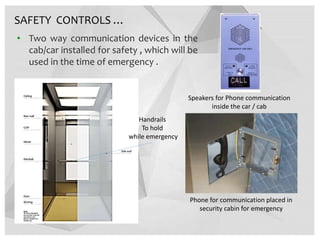
• Two way communication devices in the
cab/car installed for safety , which will be
used in the time of emergency .
Phone for communication placed in
security cabin for emergency
Speakers for Phone communication
inside the car / cab
SAFETY CONTROLS …
Handrails
To hold
while emergency
DETAILINGS FOR PHYSICALLY CHALLENGED …
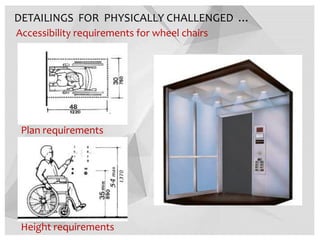
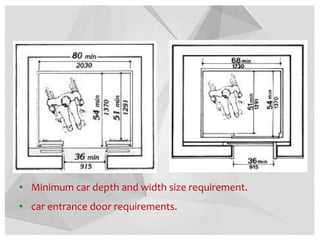
Accessibility requirements for wheel chairs
Plan requirements
Height requirements
• Minimum car depth and width size requirement.
• car entrance door requirements.
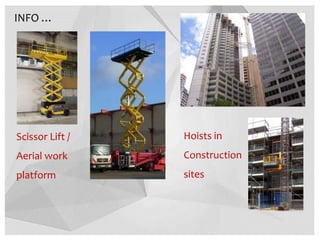
INFO …
Scissor Lift /
Aerial work
platform
Hoists in
Construction
sites
THANK YOU
|

BMC V - MODULE 02 - ELEVATORS (1).pptx

  • 1.
    BUILDING MATERIALS AND CONSTRUCTIONV MODULE 02-ELEVATORS | 25 | 11 | 2021
  • 2.
    MODULE 02 |25 | 11 | 2021
  • 3.
    MODULE 02 |25 | 11 | 2021 ELEVATORS … • The Need - Elevators • Historical Development • Major Components • Types of Elevators • Electric • Hydraulic • Design Standards • Mechanism • Electrical controls / Safety controls • Detailings for Physically Challenged
  • 4.
    THE NEED … •Imagine a city without having skyscrapers / high rise buildings ? • Imagine yourself climbing stairs or lifting household items to your apartment of 60th floor each time ?
  • 5.
    HISTORICAL DEVELOPMENT … •236 BC : Archimedes built cabs on a hemp rope and powered by hand or by animals. • A.D. 80 : Gladiators and wild animals rode crude elevators up to the arena level of the Roman Coliseum. • 1743 : The first passenger elevator was designed for King Louis in France named as “flying chair “. • 1835 : A belt-driven elevator called “teagle” was installed in an English factory. Flying chair Teagle Cabs on Hemp rope
  • 6.
    • 1852 :Elisha Otis, introduced elevator installing safety brakes which prevents the fall of cab if cable broke . • 1857 : First Otis passenger elevator was installed in 488 broadway , 5 storey building in newyork city . • 1868 : Waygood manufactured its first hydraulic elevator. • 1870 : 9 story Equitable Life Assurance Building in New York City, was the first to have passenger elevators designed for office building. Otis elevators with gears
  • 7.
    • 1872 :First geared hydraulic elevator installed in New York City. • 1875 : Schindler - to become the world's second-largest elevator manufacturer was founded near Lucerne. • 1878 : First electric elevator was built by Siemens in Germany. • 1890 : Haughton Elevator Company was founded in Toledo, Ohio specializing hydraulic elevators. • 1902 : The first direct plunger elevators were installed by Otis for high-rise passenger service.
  • 8.
    • 1909 :The 41-story Singer Building was the first to operate with telephones connected to "elevator supervisors" who controlled and confirmed departures. • 1918 : New York City adopted its first "elevator rules" which restricted speeds to 700 fpm. • 1922 : Westinghouse introduced fastest gearless elevators in Chicago which boasted speed of 420 meters/minute. • 1926 : Haughton developed the automatic car door and gate closer. • 1931 : New York City elevator code was revised to allow 1,000 fpm elevators in the Empire State Building.
  • 9.
    MAJOR COMPONENTS … •Machine rooms for traction elevators generally located directly above the hoist way. • Machine rooms for hydraulic elevators typically located at the basement or lowest level adjacent to the hoist way. Lift Machine room Cabs / Cars Counter weight Hoist way/Lift shaft / lift well Lift Pit
  • 11.
    TYPES OF ELEVATORS( DESIGN AND USE ) … The systems are mainly distinguished primarily by their usage , car size , design etc. • Passenger • Hospital • Capsule / Panoramic • Freight • Automobile • Dumb waiters
  • 12.
    Passenger Elevators • PassengerElevators are the main transportation arteries in the modern building and are vital in determining a building's economic success. • Building more than G+4 floors has to be installed with passenger elevators irrespective of its usage . • Public, Apartments , Hospitals , Malls etc. • Capacity , Speed , specification varies as per the requirement.
  • 13.
    Passenger elevator systemof speed 1.0 mps with machine room Note : Car inside can be considered as car depth
  • 14.
    Passenger elevator systemof speed 1.0 mps without machine room Note : Car inside can be considered as car depth
  • 15.
    Hospital ( Stretcherelevators ) • Hospital Elevators suited for application in hospitals, health centers and other similar places. • These highly spacious Elevators can easily accommodate stretchers, wheelchairs and other medical equipment's . • High speed , Utilizes inverter control technology with low noise mechanism.
  • 16.
  • 17.
    Capsule ( Panoramicelevators ) • Panoramic elevators are designed basically for malls, five star hotels and other commercials buildings which can be installed overlooking outside or central atriums. • These elevators act as Architectural highlights on prestigious buildings. • High speed with high comfort level. • 360 degree viewing angle.
  • 18.
  • 19.
    Freight elevators • FreightElevators are used in different industries for lifting heavy goods and items in high rise buildings, Commercial malls , Hotels. • Designed to have excellent lifting capacity & maintenance less working mechanism. • Relatively low speed comparing with other elevators.
  • 20.
  • 21.
    Automobile elevators • Automobileelevator are installed where ramps are considered space-in conservative. • These elevators are usually used in parking the vehicles at different floors, automobile show rooms, automobile service centers etc. • These elevators usually has got the entrance on opposite sides so that the car can enter from one end and leave from the opposite end. • High speed Automobile elevators are used in various skyscrapers.
  • 22.
  • 23.
    Dumbwaiters • A smallfreight elevator intended to carry foods , books etc. • Dumbwaiters found within modern structures, including both commercial, public and private buildings, are often connected between multiple floors. • Majorly Installed in restaurants, schools, kindergartens, hospitals, retirement homes or in private homes, these lifts generally terminate in a kitchen . • Capacity load from 50 to 450 kg , and car height of 0.8 to 1.40 mts. Table type – 50 to 150 kg Floor type – 200 to 450 kg
  • 24.
  • 25.
  • 26.
    DESIGN STANDARDS … ElevatorEntrance types • Minimum Entrance width of a passenger elevator is 800 mm. • Operated Manual / Automatic Two/4 panels center open Two panel Side open
  • 27.
    Planning considerations One elevatoralong the corridor Min. width of corridor = depth of car Two elevator parallel along the corridor Min. width of corridor = depth of car Two elevator opposite to each other Min. width of corridor = 2 x depth of car
  • 28.
    Four elevator paralleland opposite to each other Min. width of corridor = 2 x depth of car Three elevator parallel and opposite Min. width of corridor = 2 x depth of car
  • 29.
    Six elevator paralleland opposite to each other Min. width of corridor = 2 x depth of car Elevators planned in the central vertical transportation hub. 1 hospital + 1 passenger is ideal.
  • 30.
    Elevators planned tocreate various vertical transportation hubs. Walking distance between the entrance/office to the hubs should preferably kept to 45 m max.
  • 31.
    Elevators planned tocreate various vertical transportation hubs. Capsule elevators overlooking the central atrium.
  • 32.
    TYPES OF ELEVATORS( HOISTING MECHANISMS ) … GEARED ELEVATORS ELECTRIC HYDRAULIC GEARLESS HOLED HOLELESS ROPED The systems are mainly distinguished primarily by their hoisting mechanisms.
  • 33.
    Electric ( Traction) • Traction machines are driven by AC or DC electric motors. • Elevator cars are pulled up by means of rolling steel ropes over a deeply grooved pulley, commonly called a sheave , which is attached to a gearbox driven by a high- speed motor. • Virtually limitless rise (high & mid rise) • High speeds up to 0.5 m/s to 10 m/s. • High installation cost
  • 34.
    Geared Traction • Theelectric motor in this design drives a worm and gear type reduction unit, which turns the hoisting sheave. • An electrically controlled brake between the motor and the reduction unit stops the elevator, holding the car at the desired floor level. • These elevators typically operate at speeds from 0.6 to 2.55 m/s and carry loads of up to 13,600 kilograms • Used in residential and low traffic commercial applications.
  • 35.
    Gearless Traction • Ingearless traction, hoisting ropes are attached to the top of the elevator and wrapped around the drive sheave. • The other ends of the cables are attached to the counterweight that moves up and down in the hoistway. • The combined weight of the elevator car and the counterweight presses the cables into the grooves on the drive sheave, provides the traction as the sheave turns. • The counterweight balances the load , as the car rises and lowers. • Used in buildings of any height and speed from 1.7 to 6 m/s .
  • 36.
    Hydraulic • Hydraulic elevatorsare elevators which are powered by a piston that travels inside a cylinder. • An electric motor pumps hydraulic oil into the cylinder to move the piston. The piston smoothly lifts the elevator cab. • Limited to heights of about 60 ft. (6 stories) • Lower speeds up to 1.0 m/s. • Lower initial cost , higher power consumption
  • 37.
    Holed Hydraulic • Inholed hydraulic systems, the elevator car is mounted on a piston that travels inside a cylinder. • The cylinder extends into the ground to a depth equal to the height the elevator will rise. • As hydraulic fluid is pumped into the cylinder through a valve, the car rises. As the fluid returns to the tank , the car lowers. Hydraulic oil Tank / Controller
  • 38.
    Holeless Hydraulic • Holelesshydraulic consists of pistons mounted inside the hoistway to raise and lower the car, eliminating the need for an in- ground cylinder. • This is especially a solution for buildings built in bedrock, a high water table or unstable soil conditions. • Holeless hydraulic systems use a direct-acting piston to raise the car. • Currently limited to a height of about 3 stories.
  • 39.
    Roped Hydraulic • Ropedhydraulic elevators use a telescoping hydraulic piston and a hoist rope and pulley system to increase car speed and travel heights. • Also, roped hydraulic systems require a governor because the rope is holding the car up. • Roped hydraulic elevator can rise to 6 floors (60 ft), without the need for a in ground cylinder.
  • 40.
    Machine Room Less( Electric / Hydraulic ) • MRL system can be used in Electric or hydraulic elevator . • MRL machine is installed either on the top side wall or bottom of the hoistway, thereby avoiding Machine room at the top .The main controller is installed on the top floor next to the landing doors. • MRL elevators are used for low to mid rise buildings , up to 20 floors. • Speed range upto 1 m/s to 1.6m/s.
  • 41.
    Machine room less– Hoisting machine mounted on the elevator shaft wall
  • 42.
    MECHANISM … Machine roomcomponents • The hoisting machine (geared/ gearless) has the grooved wheel drive sheave and brake where the hoist ropes pass, and by which motion is imparted to the car and counterweight by the hoist ropes. • Hoist motor known as primary velocity transducer also , which are the power units that apply the energy to the hoist machines . Can be AC or DC. Hoist motor Hoist machine
  • 43.
    Generator • Generators areelectro-mechanical devices that convert mechanical energy to electrical energy ( usually DC ) . • Governor is a mechanical speed control mechanism . A wire rope driven centrifugal device used to stop and hold the movement of its driving rope. This initiates the activation of the car safety device. It opens a switch which cuts off power to the hoist motor and brake if the car travels at overspeed in the down direction. Governor
  • 44.
    • The controlsystem is a group of devices, which serve to control, in a predetermined manner, the floor selection, drive speeds, car selection and general operation of the elevators. • Disconnectors are switches which disconnects the power to the controller and cab lights and located in the machine room. Disconnectors Control system
  • 45.
    Hoistway / Pitcomponents • Roller guides or guide rails are steel T-section with machined guiding surfaces installed vertically in a hoistway to guide and direct the course of travel of an elevator car and elevator counterweights. • Counterweights are used to counter-balance the weight of an elevator car plus approximately 40% of the capacity load. Roller guides Counterweights
  • 46.
    • Hoist ropesmade of steel or iron , which is used for holding elevators cars. • Buffers is a device designed to stop a descending car beyond its normal limit of travel by storing or by absorbing and dissipating the kinetic energy of the car. Spring or oil buffers are used. • Door interlocks prevents operation of an elevator unless the hoistway doors are in the closed and locked position; and prevents opening of a hoistway door from the landing side unless the elevator is in the landing zone and is either stopped or being stopped. Hoist ropes Buffers
  • 47.
    External control panel– Up and down buttons Floor panel indicator Internal control panel known as “ car operating panel “ with floor indicators , emergency call button and phone etc . • Top panel • External control panel • Internal control panel ELEVATORS CONTROLS …
  • 48.
    • Automatic powerdoor operators with human sensors . • The Door Operator monitors the speed and position of the car doors and compares performance against standards. Deviations in kinetic energy during door travel is corrected within milliseconds. The Door operator Automatic door operator with sensors
  • 49.
    • Two waycommunication devices in the cab/car installed for safety , which will be used in the time of emergency . Phone for communication placed in security cabin for emergency Speakers for Phone communication inside the car / cab SAFETY CONTROLS … Handrails To hold while emergency
  • 50.
    DETAILINGS FOR PHYSICALLYCHALLENGED … Accessibility requirements for wheel chairs Plan requirements Height requirements
  • 51.
    • Minimum cardepth and width size requirement. • car entrance door requirements.
  • 52.
    INFO … Scissor Lift/ Aerial work platform Hoists in Construction sites
  • 53.