ASSIGNMENT OF
ARCHITECTURAL SERVICES
G.L. BAJAJ GROUP OF INSTITUTIONS
MATHURA
SUBMITTED BY:-
YASH AGRAWAL
B.Arch 3rd Year
1905110810005
SUBMITTED TO:-
Ar. ANU MENDIRATTA
LIFT
HISTORY
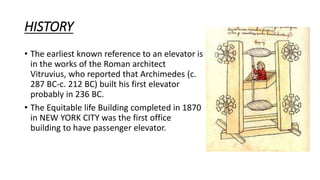
• The earliest known reference to an elevator is
in the works of the Roman architect
Vitruvius, who reported that Archimedes (c.
287 BC-c. 212 BC) built his first elevator
probably in 236 BC.
• The Equitable life Building completed in 1870
in NEW YORK CITY was the first office
building to have passenger elevator.
INTRODUCTION
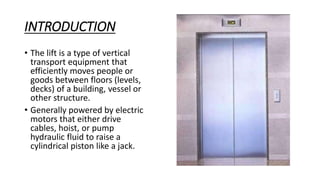
• The lift is a type of vertical
transport equipment that
efficiently moves people or
goods between floors (levels,
decks) of a building, vessel or
other structure.
• Generally powered by electric
motors that either drive
cables, hoist, or pump
hydraulic fluid to raise a
cylindrical piston like a jack.
TYPES OF LIFT
• According to Hoist Machine
• According to Building Hight
• According to Building Type
• According to Elevator Location
• According to Special Use
ACCORDING TO HOIST MACHINE
• Hydraulic Elevator
• Traction Elevator
HYDRAULIC LIFT
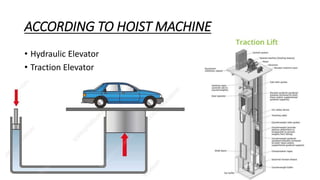
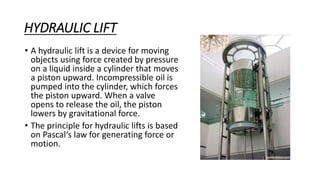
• A hydraulic lift is a device for moving
objects using force created by pressure
on a liquid inside a cylinder that moves
a piston upward. Incompressible oil is
pumped into the cylinder, which forces
the piston upward. When a valve
opens to release the oil, the piston
lowers by gravitational force.
• The principle for hydraulic lifts is based
on Pascal‘s law for generating force or
motion.
• Use for low hight building (2-8 floors).
• Speed is low i.e. 200 feets per minute.
TRACTION LIFT ( PULL LIFT)
• Traction elevators are lifted by ropes, which pass over a wheel
attached to an electric motor above the elevator shaft.
• They are used for mid and high-rise applications and have much
higher travel speeds than hydraulic elevators.
• Traction elevators have main types as follows:
• A) Geared Traction Elevators
• B) Gear-less Traction Elevators
• C) Machine-Room-Less Elevators
• A- Geared Traction Elevators:
They have a gearbox that is attached to the motor, which drives the
wheel that moves the ropes. These are capable of travel speeds up to
500 feet per minute.
B- Gear-less Traction Elevators:
They have the wheel attached directly to the motor. These are capable
of speeds up to 2000 feet per minute.
C- Machine-Room-Less Elevators:
They are typically traction elevators that do not have a dedicated
machine room above the elevator shaft. The machine sits in the
override space and the controls sit above the ceiling adjacent to the
elevator shaft.
ACCORDING TO BUILDING HIGHT
• For Low Rise Building ( 1-3 Floors)
• For Middle Rise Building (4-11 Floors)
• For High Building (12- 12+ Floors)
ACCORDING TO BUILDING TYPE
• There are mainly five types of Lift available
1. Hospital Elevator
2. Domestic Elevator
3. Industrial Elevator
4. Commercial Elevator
5. Parking Elevator
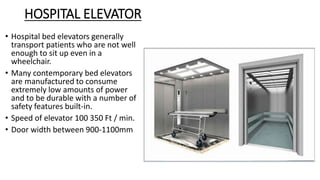
HOSPITAL ELEVATOR
• Hospital bed elevators generally
transport patients who are not well
enough to sit up even in a
wheelchair.
• Many contemporary bed elevators
are manufactured to consume
extremely low amounts of power
and to be durable with a number of
safety features built-in.
• Speed of elevator 100 350 Ft / min.
• Door width between 900-1100mm
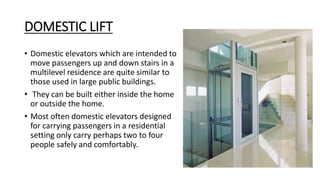
DOMESTIC LIFT
• Domestic elevators which are intended to
move passengers up and down stairs in a
multilevel residence are quite similar to
those used in large public buildings.
• They can be built either inside the home
or outside the home.
• Most often domestic elevators designed
for carrying passengers in a residential
setting only carry perhaps two to four
people safely and comfortably.
INDUSTRIAL LIFT
• These lift are use in construction, loading or unloading the goods
• These lift are of two types
• A) HOIST LIFT
• B) INCLINED LIFT
HOIST LIFT
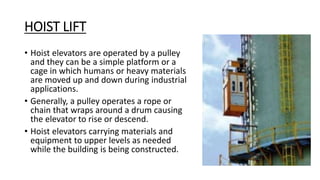
• Hoist elevators are operated by a pulley
and they can be a simple platform or a
cage in which humans or heavy materials
are moved up and down during industrial
applications.
• Generally, a pulley operates a rope or
chain that wraps around a drum causing
the elevator to rise or descend.
• Hoist elevators carrying materials and
equipment to upper levels as needed
while the building is being constructed.
INCLINED LIFT
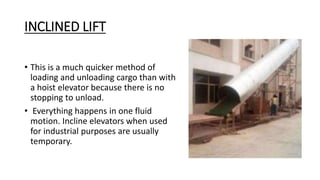
• This is a much quicker method of
loading and unloading cargo than with
a hoist elevator because there is no
stopping to unload.
• Everything happens in one fluid
motion. Incline elevators when used
for industrial purposes are usually
temporary.
COMMERCIAL LIFT
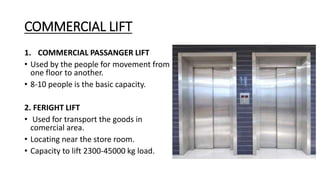
1. COMMERCIAL PASSANGER LIFT
• Used by the people for movement from
one floor to another.
• 8-10 people is the basic capacity.
2. FERIGHT LIFT
• Used for transport the goods in
comercial area.
• Locating near the store room.
• Capacity to lift 2300-45000 kg load.
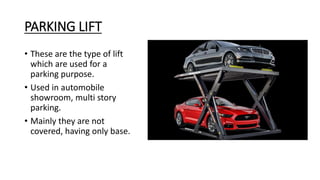
PARKING LIFT
• These are the type of lift
which are used for a
parking purpose.
• Used in automobile
showroom, multi story
parking.
• Mainly they are not
covered, having only base.
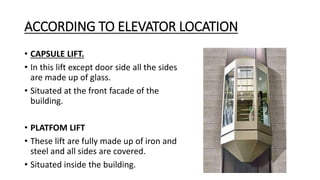
ACCORDING TO ELEVATOR LOCATION
• CAPSULE LIFT.
• In this lift except door side all the sides
are made up of glass.
• Situated at the front facade of the
building.
• PLATFOM LIFT
• These lift are fully made up of iron and
steel and all sides are covered.
• Situated inside the building.

LIFT

  • 1.
    ASSIGNMENT OF ARCHITECTURAL SERVICES G.L.BAJAJ GROUP OF INSTITUTIONS MATHURA SUBMITTED BY:- YASH AGRAWAL B.Arch 3rd Year 1905110810005 SUBMITTED TO:- Ar. ANU MENDIRATTA
  • 2.
  • 3.
    HISTORY • The earliestknown reference to an elevator is in the works of the Roman architect Vitruvius, who reported that Archimedes (c. 287 BC-c. 212 BC) built his first elevator probably in 236 BC. • The Equitable life Building completed in 1870 in NEW YORK CITY was the first office building to have passenger elevator.
  • 4.
    INTRODUCTION • The liftis a type of vertical transport equipment that efficiently moves people or goods between floors (levels, decks) of a building, vessel or other structure. • Generally powered by electric motors that either drive cables, hoist, or pump hydraulic fluid to raise a cylindrical piston like a jack.
  • 5.
    TYPES OF LIFT •According to Hoist Machine • According to Building Hight • According to Building Type • According to Elevator Location • According to Special Use
  • 6.
    ACCORDING TO HOISTMACHINE • Hydraulic Elevator • Traction Elevator
  • 7.
    HYDRAULIC LIFT • Ahydraulic lift is a device for moving objects using force created by pressure on a liquid inside a cylinder that moves a piston upward. Incompressible oil is pumped into the cylinder, which forces the piston upward. When a valve opens to release the oil, the piston lowers by gravitational force. • The principle for hydraulic lifts is based on Pascal‘s law for generating force or motion.
  • 8.
    • Use forlow hight building (2-8 floors). • Speed is low i.e. 200 feets per minute.
  • 9.
    TRACTION LIFT (PULL LIFT) • Traction elevators are lifted by ropes, which pass over a wheel attached to an electric motor above the elevator shaft. • They are used for mid and high-rise applications and have much higher travel speeds than hydraulic elevators. • Traction elevators have main types as follows: • A) Geared Traction Elevators • B) Gear-less Traction Elevators • C) Machine-Room-Less Elevators
  • 10.
    • A- GearedTraction Elevators: They have a gearbox that is attached to the motor, which drives the wheel that moves the ropes. These are capable of travel speeds up to 500 feet per minute. B- Gear-less Traction Elevators: They have the wheel attached directly to the motor. These are capable of speeds up to 2000 feet per minute. C- Machine-Room-Less Elevators: They are typically traction elevators that do not have a dedicated machine room above the elevator shaft. The machine sits in the override space and the controls sit above the ceiling adjacent to the elevator shaft.
  • 11.
    ACCORDING TO BUILDINGHIGHT • For Low Rise Building ( 1-3 Floors) • For Middle Rise Building (4-11 Floors) • For High Building (12- 12+ Floors)
  • 12.
    ACCORDING TO BUILDINGTYPE • There are mainly five types of Lift available 1. Hospital Elevator 2. Domestic Elevator 3. Industrial Elevator 4. Commercial Elevator 5. Parking Elevator
  • 13.
    HOSPITAL ELEVATOR • Hospitalbed elevators generally transport patients who are not well enough to sit up even in a wheelchair. • Many contemporary bed elevators are manufactured to consume extremely low amounts of power and to be durable with a number of safety features built-in. • Speed of elevator 100 350 Ft / min. • Door width between 900-1100mm
  • 14.
    DOMESTIC LIFT • Domesticelevators which are intended to move passengers up and down stairs in a multilevel residence are quite similar to those used in large public buildings. • They can be built either inside the home or outside the home. • Most often domestic elevators designed for carrying passengers in a residential setting only carry perhaps two to four people safely and comfortably.
  • 15.
    INDUSTRIAL LIFT • Theselift are use in construction, loading or unloading the goods • These lift are of two types • A) HOIST LIFT • B) INCLINED LIFT
  • 16.
    HOIST LIFT • Hoistelevators are operated by a pulley and they can be a simple platform or a cage in which humans or heavy materials are moved up and down during industrial applications. • Generally, a pulley operates a rope or chain that wraps around a drum causing the elevator to rise or descend. • Hoist elevators carrying materials and equipment to upper levels as needed while the building is being constructed.
  • 17.
    INCLINED LIFT • Thisis a much quicker method of loading and unloading cargo than with a hoist elevator because there is no stopping to unload. • Everything happens in one fluid motion. Incline elevators when used for industrial purposes are usually temporary.
  • 18.
    COMMERCIAL LIFT 1. COMMERCIALPASSANGER LIFT • Used by the people for movement from one floor to another. • 8-10 people is the basic capacity. 2. FERIGHT LIFT • Used for transport the goods in comercial area. • Locating near the store room. • Capacity to lift 2300-45000 kg load.
  • 19.
    PARKING LIFT • Theseare the type of lift which are used for a parking purpose. • Used in automobile showroom, multi story parking. • Mainly they are not covered, having only base.
  • 20.
    ACCORDING TO ELEVATORLOCATION • CAPSULE LIFT. • In this lift except door side all the sides are made up of glass. • Situated at the front facade of the building. • PLATFOM LIFT • These lift are fully made up of iron and steel and all sides are covered. • Situated inside the building.