The Basics of Understanding Literature
The  Very  Basics Fiction Any writing or story that is made up Opposite of…nonfiction Short Story Brief fiction work. Only one or two main ideas usually. Novel Longer fiction work with more complex events More people, actions, and main ideas
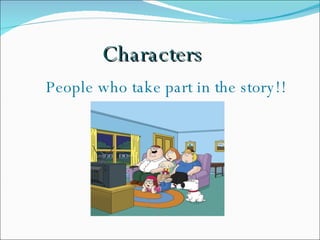
Characters People who take part in the story!!
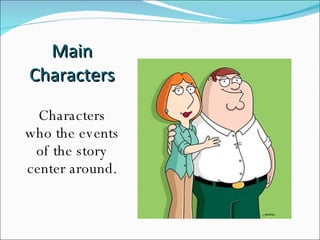
Main Characters Characters who the events of the story center around.
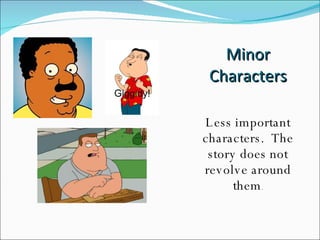
Minor Characters Less important characters.  The story does not revolve around them .
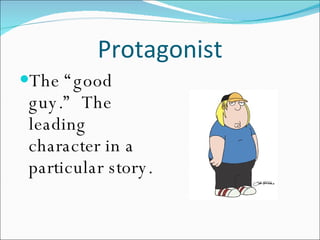
Protagonist The “good guy.”  The leading character in a particular story.
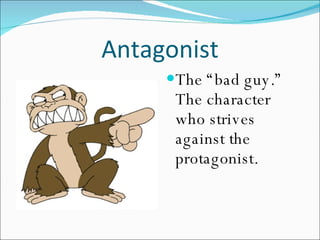
Antagonist The “bad guy.”  The character who strives against the protagonist.
Setting Time and place events occur in story.
Point of View The view point of the story. 1 st  person – words like “I,” “you,” and “me.” 3 rd  person – words like “he,” “she,” and “they.” All-knowing (omniscient) narrator – the narrator can see into the thoughts of more than one character.  They “know all.”
Plot Chain of related event that make up the story. Plot centers on at least one major problem or conflict.
Conflict The major problem in a story. Internal person vs. self External person vs. person person vs. society person vs. nature
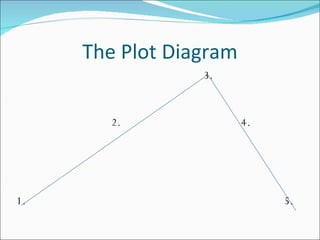
The Plot Diagram 3. 2.  4. 1.  5.
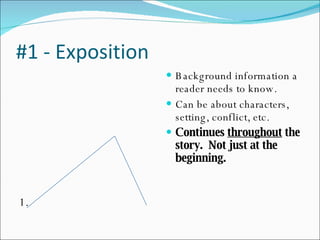
#1 - Exposition 1. Background information a reader needs to know. Can be about characters, setting, conflict, etc. Continues  throughout  the story.  Not just at the beginning.
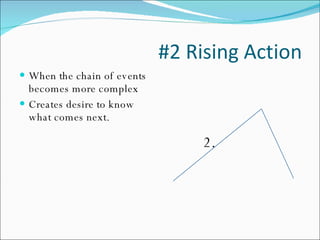
#2 Rising Action When the chain of events becomes more complex Creates desire to know what comes next. 2.
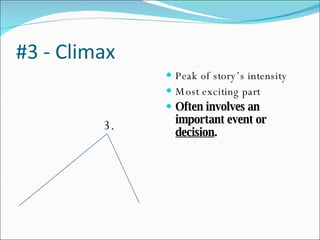
#3 - Climax   3. Peak of story’s intensity Most exciting part Often involves an important event or  decision .
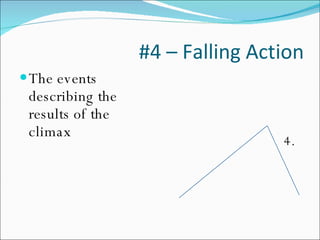
#4 – Falling Action The events describing the results of the climax 4.
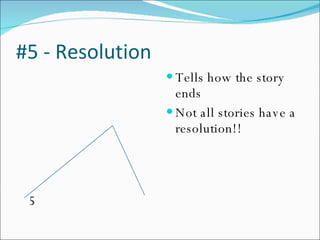
#5 - Resolution 5 Tells how the story ends Not all stories have a resolution!!
Theme Main idea or message an author wishes to share The “moral” of the story Novels often have more than one theme Rarely stated directly.  The reader has to interpret.
Tone The mood of the story Set by word choice Examples: The dark, gloomy house loomed over our heads in dreary silence. Each fabulous moment is thrilling and exciting!
Style How a writer expresses himself or herself. Their writing personality
Irony Situational irony – where an event occurs which is unexpected because it is the exact opposite of what we thought would happen. Example:  I love chocolate.  I love it so much.  Any time I get a chance to eat chocolate I will.  I have posters of chocolate everywhere in my room.  My freezer is full of chocolate ice cream.  I eat about 5 pounds of chocolate a day. I went to a party, and the host asked me if I wanted chocolate or vanilla ice cream. I chose vanilla.
Imagery Words or phrases that appeal to the senses Make a picture in your mind Examples: Sight – “big, blue eyes like the ocean” Sound – “a thundering boom filled the room” Touch – “The puppy’s fur was soft and fluffy.” Taste – “The hot, spicy sauce burned my tongue.” Smell – “The putrid odor of the rancid meat made me gag.”

Elements Of Fiction

  • 1.
    The Basics ofUnderstanding Literature
  • 2.
    The Very Basics Fiction Any writing or story that is made up Opposite of…nonfiction Short Story Brief fiction work. Only one or two main ideas usually. Novel Longer fiction work with more complex events More people, actions, and main ideas
  • 3.
    Characters People whotake part in the story!!
  • 4.
    Main Characters Characterswho the events of the story center around.
  • 5.
    Minor Characters Lessimportant characters. The story does not revolve around them .
  • 6.
    Protagonist The “goodguy.” The leading character in a particular story.
  • 7.
    Antagonist The “badguy.” The character who strives against the protagonist.
  • 8.
    Setting Time andplace events occur in story.
  • 9.
    Point of ViewThe view point of the story. 1 st person – words like “I,” “you,” and “me.” 3 rd person – words like “he,” “she,” and “they.” All-knowing (omniscient) narrator – the narrator can see into the thoughts of more than one character. They “know all.”
  • 10.
    Plot Chain ofrelated event that make up the story. Plot centers on at least one major problem or conflict.
  • 11.
    Conflict The majorproblem in a story. Internal person vs. self External person vs. person person vs. society person vs. nature
  • 12.
    The Plot Diagram3. 2. 4. 1. 5.
  • 13.
    #1 - Exposition1. Background information a reader needs to know. Can be about characters, setting, conflict, etc. Continues throughout the story. Not just at the beginning.
  • 14.
    #2 Rising ActionWhen the chain of events becomes more complex Creates desire to know what comes next. 2.
  • 15.
    #3 - Climax 3. Peak of story’s intensity Most exciting part Often involves an important event or decision .
  • 16.
    #4 – FallingAction The events describing the results of the climax 4.
  • 17.
    #5 - Resolution5 Tells how the story ends Not all stories have a resolution!!
  • 18.
    Theme Main ideaor message an author wishes to share The “moral” of the story Novels often have more than one theme Rarely stated directly. The reader has to interpret.
  • 19.
    Tone The moodof the story Set by word choice Examples: The dark, gloomy house loomed over our heads in dreary silence. Each fabulous moment is thrilling and exciting!
  • 20.
    Style How awriter expresses himself or herself. Their writing personality
  • 21.
    Irony Situational irony– where an event occurs which is unexpected because it is the exact opposite of what we thought would happen. Example: I love chocolate. I love it so much. Any time I get a chance to eat chocolate I will. I have posters of chocolate everywhere in my room. My freezer is full of chocolate ice cream. I eat about 5 pounds of chocolate a day. I went to a party, and the host asked me if I wanted chocolate or vanilla ice cream. I chose vanilla.
  • 22.
    Imagery Words orphrases that appeal to the senses Make a picture in your mind Examples: Sight – “big, blue eyes like the ocean” Sound – “a thundering boom filled the room” Touch – “The puppy’s fur was soft and fluffy.” Taste – “The hot, spicy sauce burned my tongue.” Smell – “The putrid odor of the rancid meat made me gag.”