Characterization in Literature


Humorous                   Angry           Compassionate
             Energetic
                                   Lazy

  Vengeful                                    Happy
                           Sad
How do characters become real ?
Atticus Finch
The 8 Methods of
 Characterization

8 different ways of looking at a
       character in a story
1. Physical Description
• The most common way of describing a
  character.
• Identifies anything physical about the
  character.
• Includes height, skin, hair and eye
  color, short/tall, skinny/fat, wear
  glasses?, how he/she
  walks/stands, anything physical about the
  character.
Example of physical description:
The soldier work his dress blues for the
 event; shined black leather shoes that
 shone in the light, perfectly pressed pants
 and a jacket displaying his rank. He was a
 tall man that stood out in a room. Almost
 six foot seven inches, he towered over
 most of his peers.
2. Name Analysis
• Analyzing a character’s name is looking
  more closely to it’s meaning (if there is
  one) and describing it.
• Not all characters have a name with
  significance to the story.
• A lot of times though, author’s carefully
  choose a character’s name to represent
  something about the character and/or the
  story.
Example of name analysis:
In the novel, That was Then, This is Now by
  S.E. Hinton you can analyze the name of
  the character M&M. M&M gets his
  nickname because of the fact that he is
  always seen eating the popular candy by
  the same name. The other characters of
  the story have called him this name so
  often that is commented that no one
  remembers his real name.
Example of name analysis con’t:

If you were to write a name analysis for the
   character M&M in S.E. Hinton’s novel you
   would explain in your description how the
   name has significance to the character.
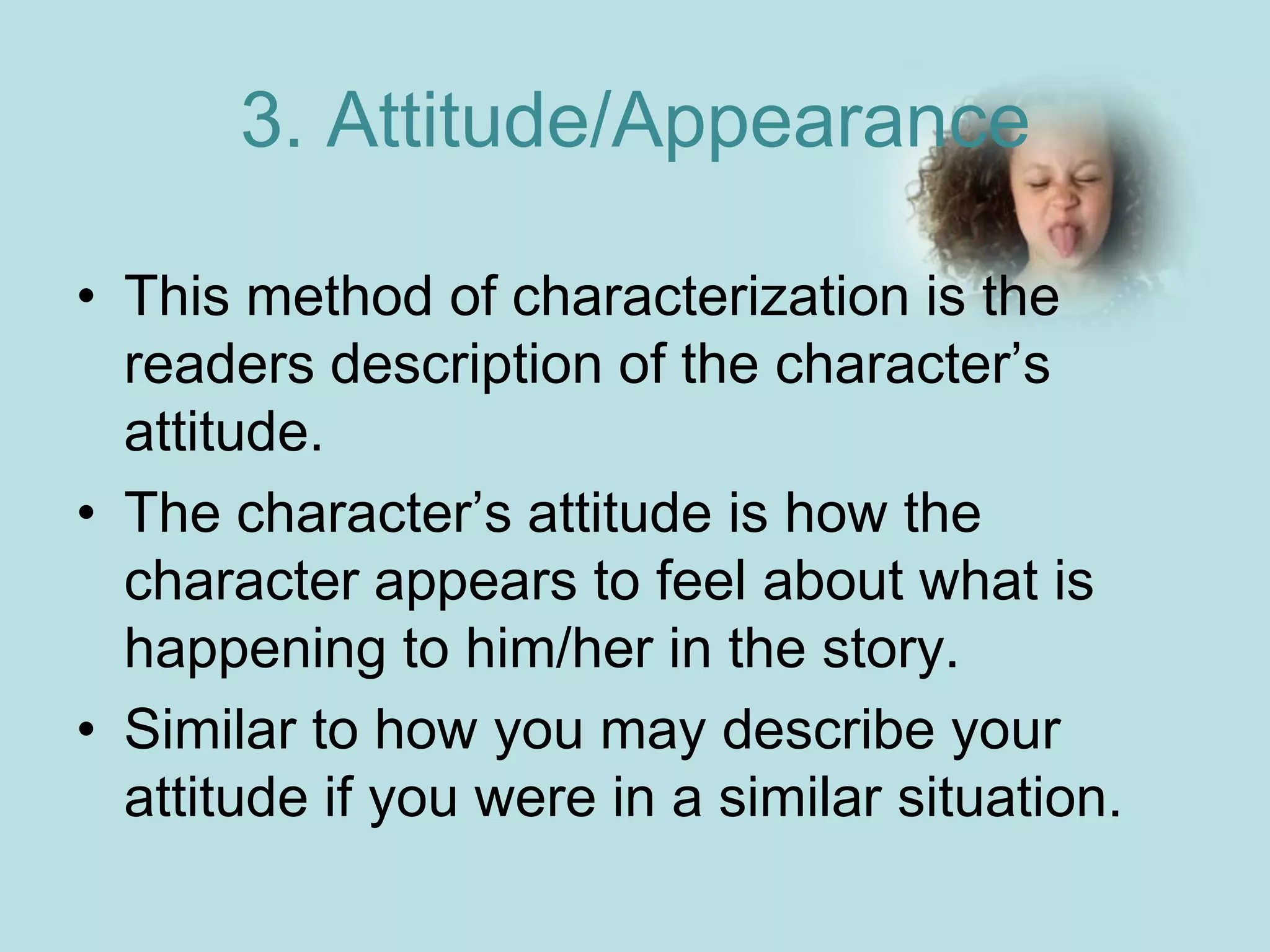
3. Attitude/Appearance

• This method of characterization is the
  readers description of the character’s
  attitude.
• The character’s attitude is how the
  character appears to feel about what is
  happening to him/her in the story.
• Similar to how you may describe your
  attitude if you were in a similar situation.
Example of attitude/appearance:
“She suffered constantly, feeling that all the
  attributes of a gracious life, every
  luxury, should rightly have been hers.” –
  “The Necklace” by Guy de Maupassant.
In this quote from the popular short story we
  learn that the main character’s attitude is
  one of resentment, feeling that she
  deserves a better life.
4. Dialogue
• Dialogue is the way in which a character
  talks.
• Dialogue includes the characters choice of
  words and syntax.
• It also includes the tone and diction of the
  character when he/she speaks.
• Is the character serious? Sarcastic? Shy?
  Obnoxious? Ignorant? Etc…all these qualities
  can be conveyed through the characters
  dialogue.
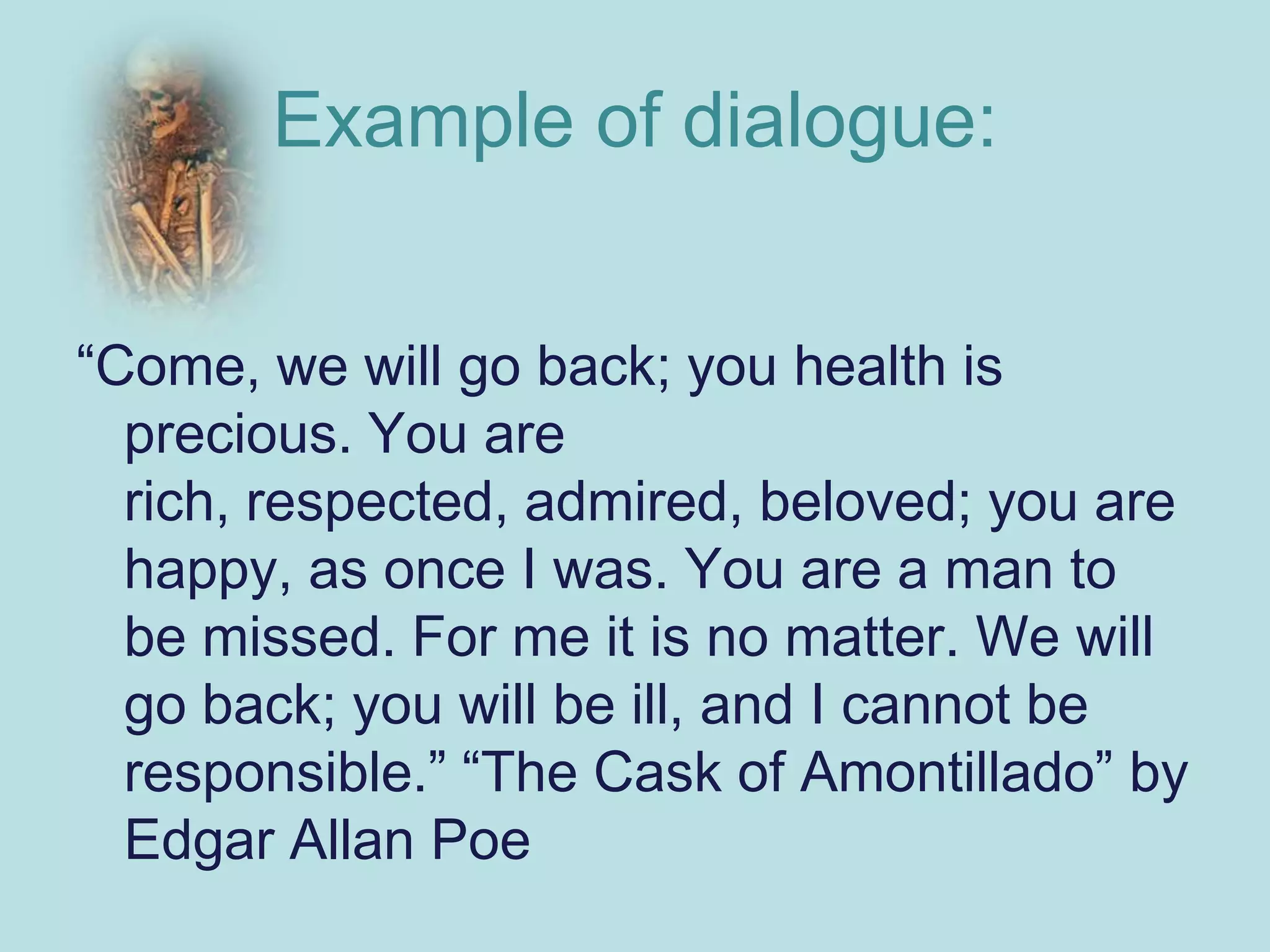
Example of dialogue:


“Come, we will go back; you health is
  precious. You are
  rich, respected, admired, beloved; you are
  happy, as once I was. You are a man to
  be missed. For me it is no matter. We will
  go back; you will be ill, and I cannot be
  responsible.” “The Cask of Amontillado” by
  Edgar Allan Poe
Example of dialogue con’t:
In this quote from the popular story by Edgar
  Allan Poe the narrator shows concern for
  Fortunato, the story’s antagonist.
We know that the narrator wants revenge on
  Fortunato. When analyzing the dialogue
  here we can infer that the narrator is being
  sarcastic.
5. Thoughts
• The thoughts of a character can only be
  analyzed if we are inside the head of the
  character.
• This means that you can only include an
  analysis of a character’s thoughts if you
  are told what the character is thinking.
Example of thoughts:
• In the story, “The Yellow Wallpaper” the
  reader is very much a part of the
  protagonist’s thoughts.
• Through the first person point of view in the
  story the reader experiences the thoughts of
  the character.
• On the other hand, the reader cannot
  comment or analyze on the thoughts of Miss
  Emily in “A Rose for Miss Emily” since we are
  never “inside her head.”
6. Reactions of Others
• When analyzing the reactions of others you
  are looking closely at how other characters in
  the story react to or treat the character that
  you are characterizing.
• Reactions include verbal responses and
  physical or emotional treatment.
• Character reactions can tell you if the
  character you are analyzing is liked or
  disliked, popular, honest, trust-worthy etc…
Example of Reactions of others:
In a story the way other characters interact
  with each other can reveal a lot about the
  characters. In the story “The Secret Life of
  Walter Mitty” by James Thurber, Walter’s
  wife treats him with an almost boss-like
  motherly attitude rather than a loving wife.
  This reveals to the reader that his wife
  finds him to be incompetent or unable to
  accomplish things on his own.
7. Action or Incident
• A character can be analyzed by looking at an
  action or incident and how it affected them or
  how they reacted to it.
• What action did the character take when
  confronted with a certain situation.
• Is there and incident in the characters past
  that has shaped them as a character and
  affected the way they look at their life.
• The action or incident determines the way the
  character develops as the story goes on.
Example of Action or Incident:
In the novel, The Outsiders by S.E. Hinton
  we learn that the narrator lost his parents
  in a car accident when he was young. This
  accident happened before the story began
  and is affecting the development of the
  main character. In a character description
  you could explain how this incident affects
  the characters development and give
  examples of its effect.
8. Physical/Emotional Setting:
• The setting of a story affects the
  characters’ development as well as the
  plot.
• The physical setting of a story is where the
  story is actually taking place and can
  effect the way a character develops.
• The emotional setting of a story is the
  series of emotions that the character deals
  with throughout the story.
Using the 8 methods to describe a
            character
• Use the these 8 methods of
  characterization when writing a description
  of a character in the stories you read. By
  looking at all 8 methods you can give an
  in-depth description of the character
  instead of a flat description that includes
  only basic information.
Direct Characterization


• The author or narrator gives the reader information about
  the character
Indirect Characterization


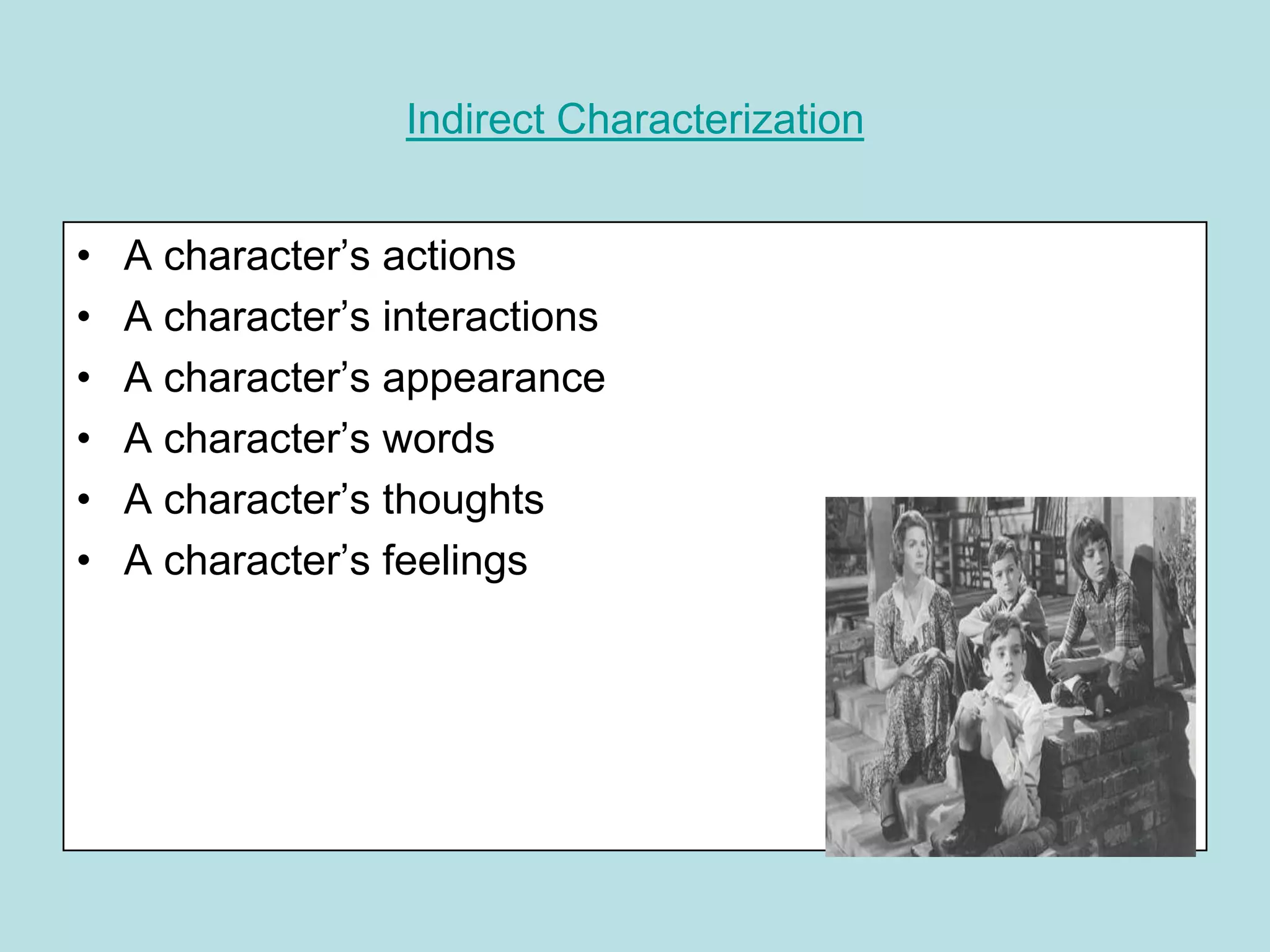
•   A character’s actions
•   A character’s interactions
•   A character’s appearance
•   A character’s words
•   A character’s thoughts
•   A character’s feelings
Indirect Characterization

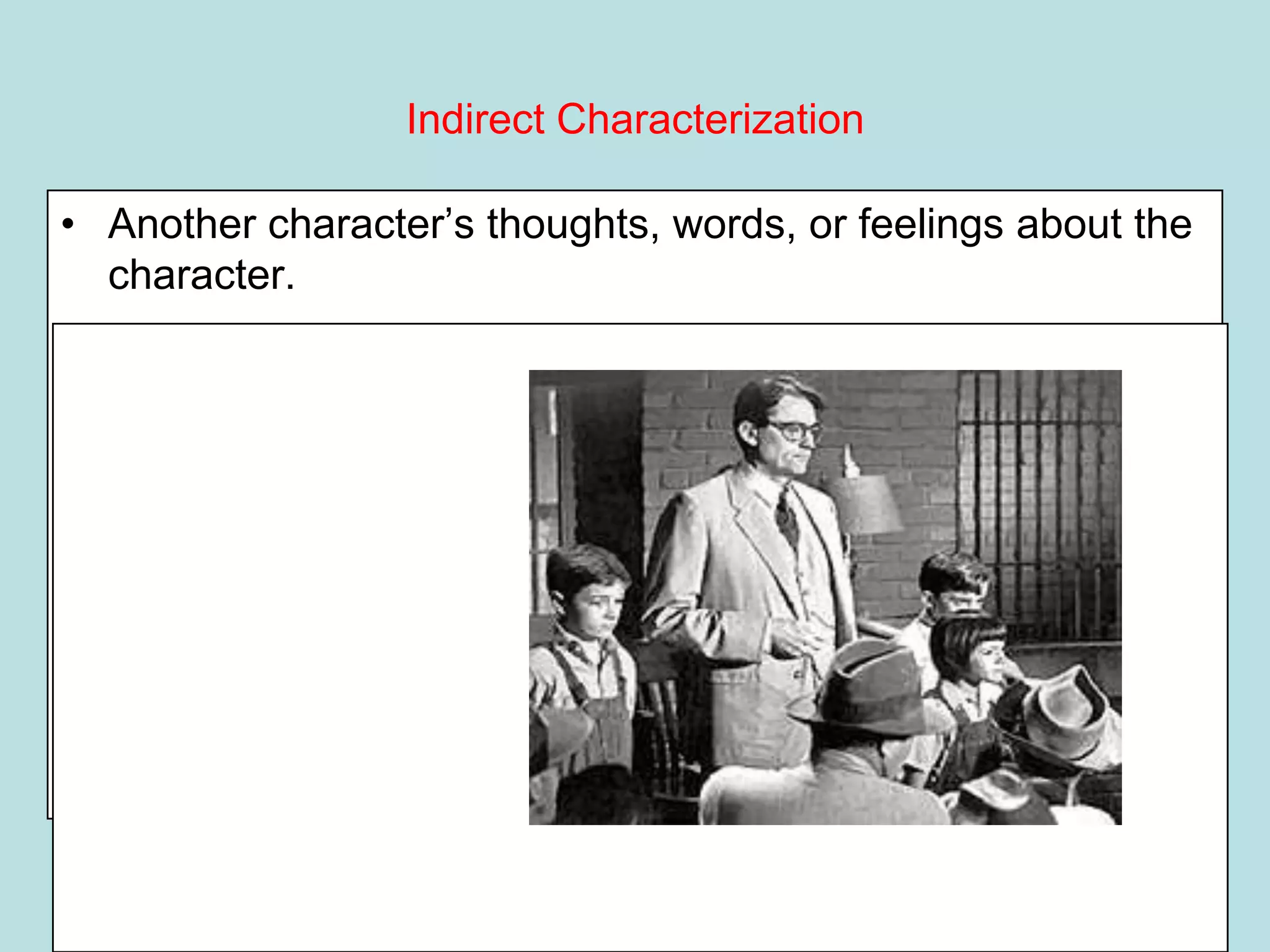
• Another character’s thoughts, words, or feelings about the
  character.
Indirect Characterization


• The reader does the
  work!


• The reader must examine
  the actions, words, and
  thoughts of the character.
Characters


• Protagonist – the main character – the focus of the
  reader’s attention

• Antagonist – a person or force in conflict with the
  protagonist
Characters


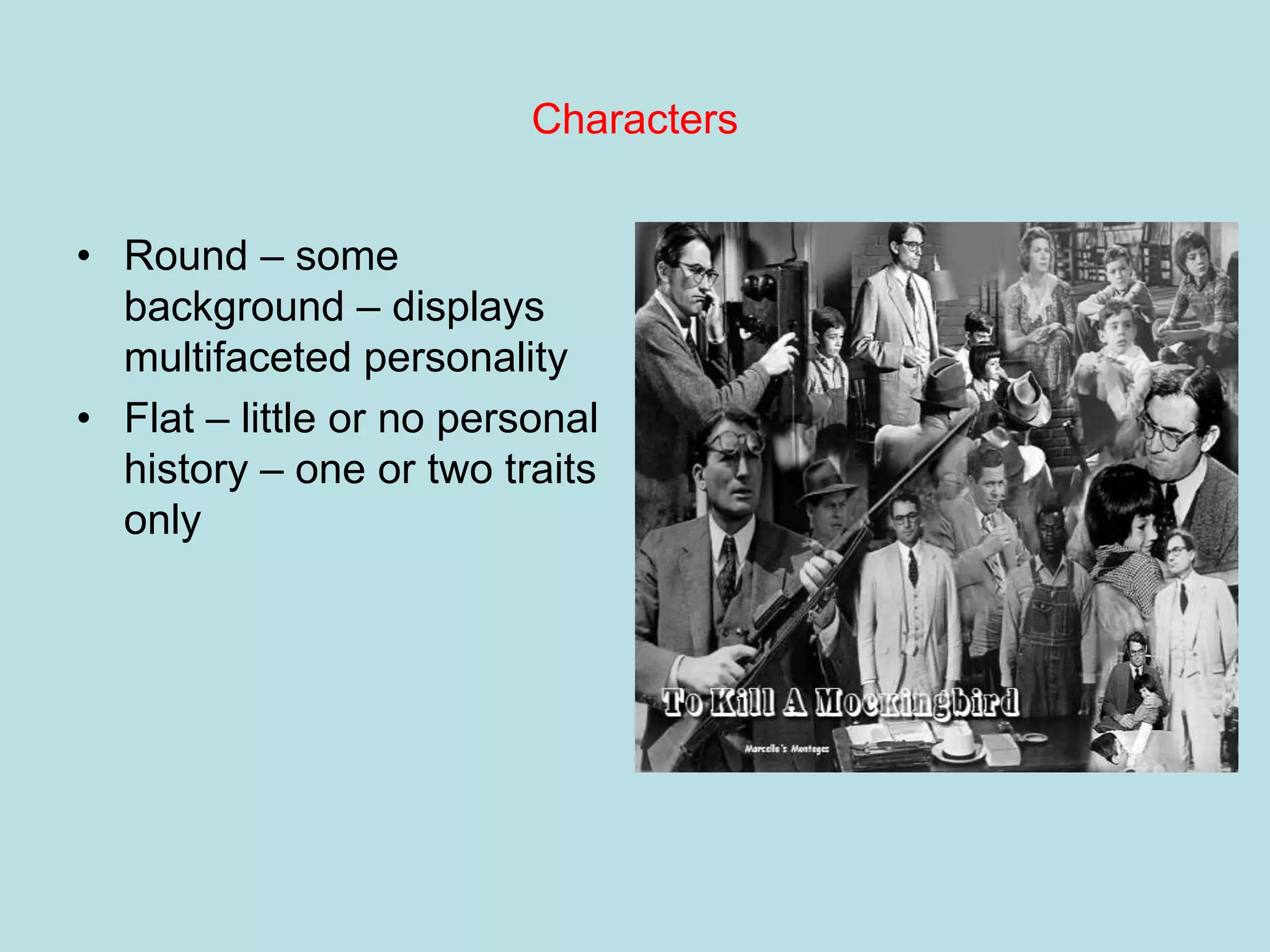
• Round – some
  background – displays
  multifaceted personality
• Flat – little or no personal
  history – one or two traits
  only
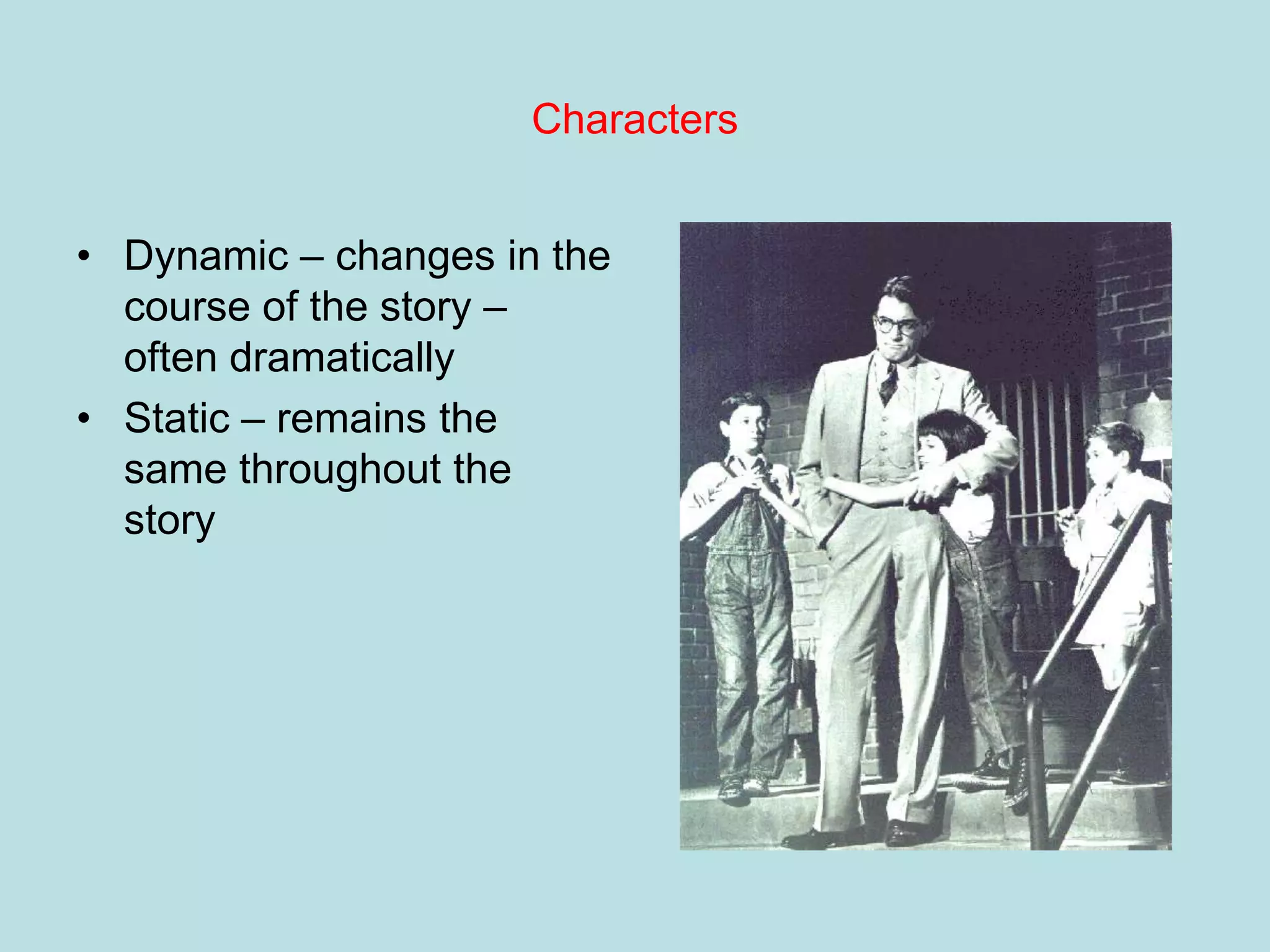
Characters


• Dynamic – changes in the
  course of the story –
  often dramatically
• Static – remains the
  same throughout the
  story
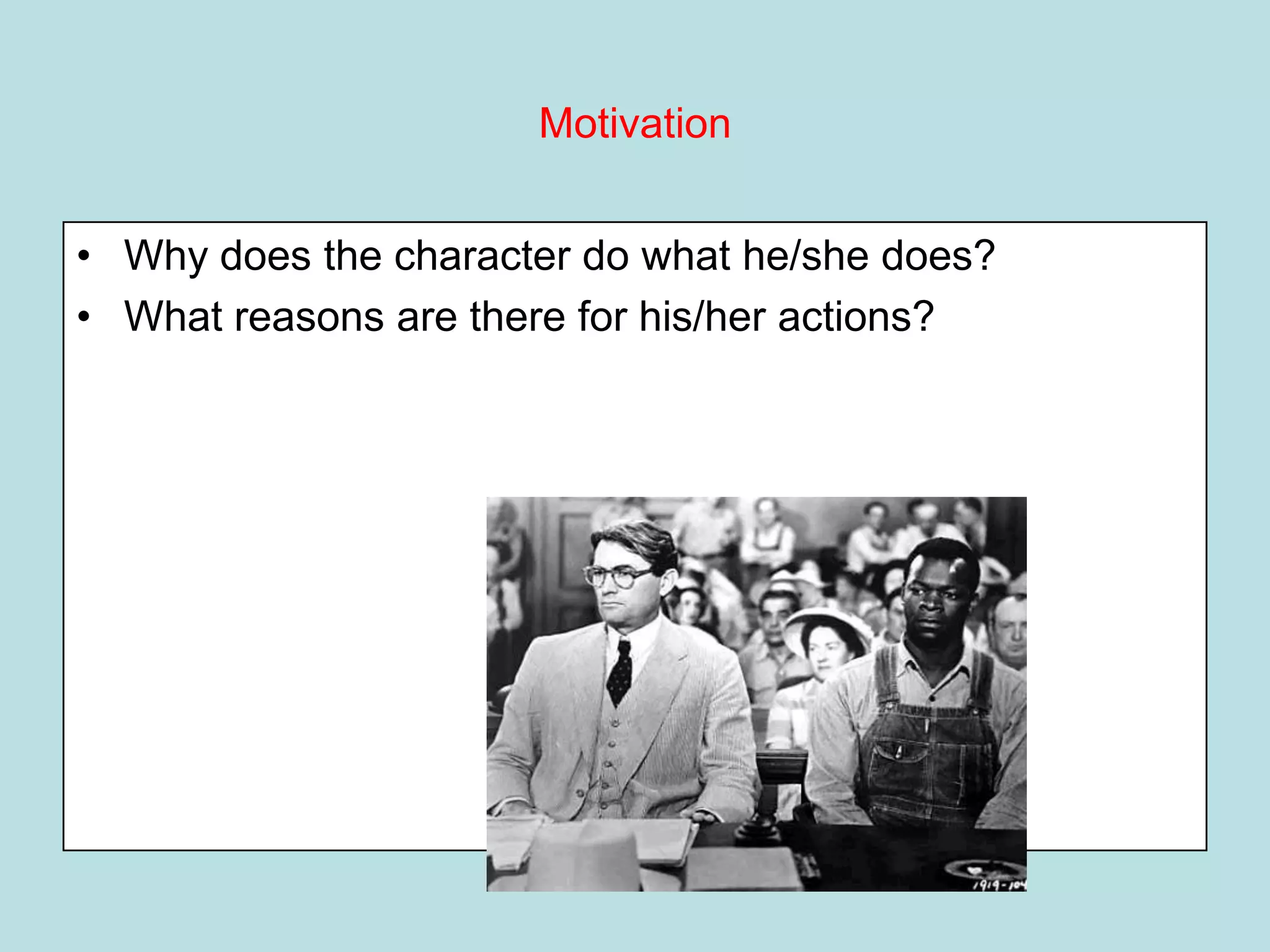
Motivation


• Why does the character do what he/she does?
• What reasons are there for his/her actions?

Characterization in literature

  • 1.
    Characterization in Literature Humorous Angry Compassionate Energetic Lazy Vengeful Happy Sad
  • 2.
    How do charactersbecome real ?
  • 3.
  • 4.
    The 8 Methodsof Characterization 8 different ways of looking at a character in a story
  • 5.
    1. Physical Description •The most common way of describing a character. • Identifies anything physical about the character. • Includes height, skin, hair and eye color, short/tall, skinny/fat, wear glasses?, how he/she walks/stands, anything physical about the character.
  • 6.
    Example of physicaldescription: The soldier work his dress blues for the event; shined black leather shoes that shone in the light, perfectly pressed pants and a jacket displaying his rank. He was a tall man that stood out in a room. Almost six foot seven inches, he towered over most of his peers.
  • 7.
    2. Name Analysis •Analyzing a character’s name is looking more closely to it’s meaning (if there is one) and describing it. • Not all characters have a name with significance to the story. • A lot of times though, author’s carefully choose a character’s name to represent something about the character and/or the story.
  • 8.
    Example of nameanalysis: In the novel, That was Then, This is Now by S.E. Hinton you can analyze the name of the character M&M. M&M gets his nickname because of the fact that he is always seen eating the popular candy by the same name. The other characters of the story have called him this name so often that is commented that no one remembers his real name.
  • 9.
    Example of nameanalysis con’t: If you were to write a name analysis for the character M&M in S.E. Hinton’s novel you would explain in your description how the name has significance to the character.
  • 10.
    3. Attitude/Appearance • Thismethod of characterization is the readers description of the character’s attitude. • The character’s attitude is how the character appears to feel about what is happening to him/her in the story. • Similar to how you may describe your attitude if you were in a similar situation.
  • 11.
    Example of attitude/appearance: “Shesuffered constantly, feeling that all the attributes of a gracious life, every luxury, should rightly have been hers.” – “The Necklace” by Guy de Maupassant. In this quote from the popular short story we learn that the main character’s attitude is one of resentment, feeling that she deserves a better life.
  • 12.
    4. Dialogue • Dialogueis the way in which a character talks. • Dialogue includes the characters choice of words and syntax. • It also includes the tone and diction of the character when he/she speaks. • Is the character serious? Sarcastic? Shy? Obnoxious? Ignorant? Etc…all these qualities can be conveyed through the characters dialogue.
  • 13.
    Example of dialogue: “Come,we will go back; you health is precious. You are rich, respected, admired, beloved; you are happy, as once I was. You are a man to be missed. For me it is no matter. We will go back; you will be ill, and I cannot be responsible.” “The Cask of Amontillado” by Edgar Allan Poe
  • 14.
    Example of dialoguecon’t: In this quote from the popular story by Edgar Allan Poe the narrator shows concern for Fortunato, the story’s antagonist. We know that the narrator wants revenge on Fortunato. When analyzing the dialogue here we can infer that the narrator is being sarcastic.
  • 15.
    5. Thoughts • Thethoughts of a character can only be analyzed if we are inside the head of the character. • This means that you can only include an analysis of a character’s thoughts if you are told what the character is thinking.
  • 16.
    Example of thoughts: •In the story, “The Yellow Wallpaper” the reader is very much a part of the protagonist’s thoughts. • Through the first person point of view in the story the reader experiences the thoughts of the character. • On the other hand, the reader cannot comment or analyze on the thoughts of Miss Emily in “A Rose for Miss Emily” since we are never “inside her head.”
  • 17.
    6. Reactions ofOthers • When analyzing the reactions of others you are looking closely at how other characters in the story react to or treat the character that you are characterizing. • Reactions include verbal responses and physical or emotional treatment. • Character reactions can tell you if the character you are analyzing is liked or disliked, popular, honest, trust-worthy etc…
  • 18.
    Example of Reactionsof others: In a story the way other characters interact with each other can reveal a lot about the characters. In the story “The Secret Life of Walter Mitty” by James Thurber, Walter’s wife treats him with an almost boss-like motherly attitude rather than a loving wife. This reveals to the reader that his wife finds him to be incompetent or unable to accomplish things on his own.
  • 19.
    7. Action orIncident • A character can be analyzed by looking at an action or incident and how it affected them or how they reacted to it. • What action did the character take when confronted with a certain situation. • Is there and incident in the characters past that has shaped them as a character and affected the way they look at their life. • The action or incident determines the way the character develops as the story goes on.
  • 20.
    Example of Actionor Incident: In the novel, The Outsiders by S.E. Hinton we learn that the narrator lost his parents in a car accident when he was young. This accident happened before the story began and is affecting the development of the main character. In a character description you could explain how this incident affects the characters development and give examples of its effect.
  • 21.
    8. Physical/Emotional Setting: •The setting of a story affects the characters’ development as well as the plot. • The physical setting of a story is where the story is actually taking place and can effect the way a character develops. • The emotional setting of a story is the series of emotions that the character deals with throughout the story.
  • 22.
    Using the 8methods to describe a character • Use the these 8 methods of characterization when writing a description of a character in the stories you read. By looking at all 8 methods you can give an in-depth description of the character instead of a flat description that includes only basic information.
  • 23.
    Direct Characterization • Theauthor or narrator gives the reader information about the character
  • 24.
    Indirect Characterization • A character’s actions • A character’s interactions • A character’s appearance • A character’s words • A character’s thoughts • A character’s feelings
  • 25.
    Indirect Characterization • Anothercharacter’s thoughts, words, or feelings about the character.
  • 26.
    Indirect Characterization • Thereader does the work! • The reader must examine the actions, words, and thoughts of the character.
  • 27.
    Characters • Protagonist –the main character – the focus of the reader’s attention • Antagonist – a person or force in conflict with the protagonist
  • 28.
    Characters • Round –some background – displays multifaceted personality • Flat – little or no personal history – one or two traits only
  • 29.
    Characters • Dynamic –changes in the course of the story – often dramatically • Static – remains the same throughout the story
  • 30.
    Motivation • Why doesthe character do what he/she does? • What reasons are there for his/her actions?