CHARACTERS
The actors in a story’s plot
People, animals, robots, or whatever the writer
chooses
May be more than one main character, particularly in
a book.
Protagonist – main character(s) who has the conflict
Antagonist – person(s) or force(s) in conflict with
the main character
Doesn’t have to be the bad guy
Doesn’t have to be a person
Types of Characters
1. Flat character – little history is given; has
only one or two personality traits
* Stock Characters- A type of flat character. The
type of character that appears so often in fiction the
reader recognizes them right away.
2.Round character – fully developed with many
different character traits
3.Dynamic character – changes during the
course of the story (learns something)
4.Static character – does not change (doesn’t
learn anything)
Direct Characterization
Direct characterization is when the author TELLS the
audience what the personality of the character is.
Example: “The patient boy and quiet girl were both at
the game.”
The author is telling us that the boy is patient and the
girl is kind.
Indirect Characterization
Indirect characterization is when the author SHOWS
things that reveal the personality of the character.
There are FIVE different methods of indirect
characterization: speech, thoughts, effect on other
characters, actions, and looks. (STEAL)
Speech
Speech- What does the character say? How does the
character speak?
Example: “Hey, we can have lots of fun at camp this
summer! I love being outside!”
This shows us the character is upbeat and happy.
Thoughts
Thoughts- What is revealed through the character’s
thoughts and feelings?
Example: I wish it would stop raining. I am tired of
sitting inside!
This shows us the character is not happy about the
situation.
Effect on Others
Effect on Others- What is revealed through the character’s
effect on other people? How do other characters feel or
behave in reaction to the character?
Example: The boy glared at his sister as she ate his dessert.
This shows us that the character is upset about his sister’s
behavior and inability to think of others.
Actions
Actions- What does the character do? How does the
character behave?
Example: The girl rode the lawn mower through the
house and into the garage.
This shows us the girl is not concerned with rules or
safety.
Looks
Looks- What does the character look like? How does
the character dress?
Example: The little girl left the game with slumped
shoulders and a frown on her face.
This shows us the little girl is not enjoying herself and is
upset.
SETTING
Time and place in which a story happens
Physical surroundings
Weather
Ideas
Customs, Values, and Beliefs that are associated with
the broad setting
Historical/Cultural
Integral- settings are key to a story, it affects the plot
Background- settings are simply a backdrop for the action
PLOT
Sequence of events in a story – action that moves the
story along
 Exposition – introduces the story’s characters, setting,
and conflict
Rising action – develops the conflict with
complications and suspense
Climax – the emotional high point of the story
Falling action – shows what happens to the characters
after the climax
Resolution – shows how the conflict is resolved or how
the problem is solved
Little Red Riding Hood – What is the sequence of events
in Little Red Riding Hood’s story?
CONFLICT
The element of the story which shows the concerns of
the central characters.
Conflict is a struggle between opposing forces
External conflict: struggle between a character and
an outside force (another character, society, technology,
nature, supernatural, or fate – sometimes supernatural
and fate are considered the same/one)
Internal conflict: struggle within a character against
opposing feelings or indecision
Character vs. Nature
The
protagonist in
the story
experiences
conflict with
the elements
of nature.
Character Vs. Character
The
protagonist in
the story
experiences
conflict with
others,
especially the
antagonist.
Character vs. Society
The protagonist in the
story experiences conflict
with society as a whole.
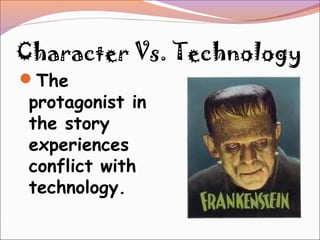
Character Vs. Technology
The
protagonist in
the story
experiences
conflict with
technology.
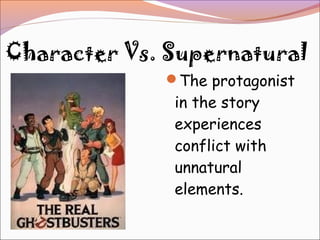
Character Vs. Supernatural
The protagonist
in the story
experiences
conflict with
unnatural
elements.
Character Vs. Fate
When the protagonist
tries to break free
of a predetermined
path chosen before
him prior to his
knowledge. It can
also be referred to
as an issue between
destiny and freewill.
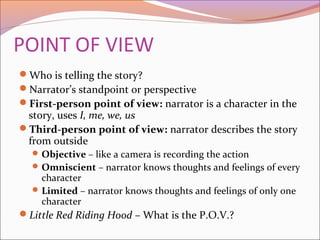
POINT OF VIEW
Who is telling the story?
Narrator’s standpoint or perspective
First-person point of view: narrator is a character in the
story, uses I, me, we, us
Third-person point of view: narrator describes the story
from outside
Objective – like a camera is recording the action
Omniscient – narrator knows thoughts and feelings of every
character
Limited – narrator knows thoughts and feelings of only one
character
Little Red Riding Hood – What is the P.O.V.?
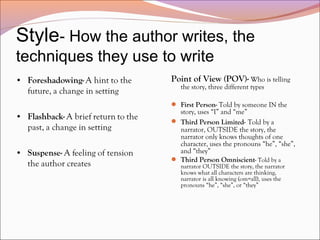
Style- How the author writes, the
techniques they use to write
Point of View (POV)- Who is telling
the story, three different types
 First Person- Told by someone IN the
story, uses “I” and “me”
 Third Person Limited- Told by a
narrator, OUTSIDE the story, the
narrator only knows thoughts of one
character, uses the pronouns “he”, “she”,
and “they”
 Third Person Omniscient- Told by a
narrator OUTSIDE the story, the narrator
knows what all characters are thinking,
narrator is all knowing (om=all), uses the
pronouns “he”, “she”, or “they”
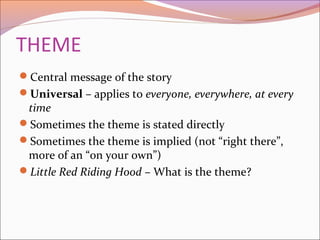
THEME
Central message of the story
Universal – applies to everyone, everywhere, at every
time
Sometimes the theme is stated directly
Sometimes the theme is implied (not “right there”,
more of an “on your own”)
Little Red Riding Hood – What is the theme?

Elements of Fiction

  • 2.
    CHARACTERS The actors ina story’s plot People, animals, robots, or whatever the writer chooses May be more than one main character, particularly in a book. Protagonist – main character(s) who has the conflict Antagonist – person(s) or force(s) in conflict with the main character Doesn’t have to be the bad guy Doesn’t have to be a person
  • 3.
    Types of Characters 1.Flat character – little history is given; has only one or two personality traits * Stock Characters- A type of flat character. The type of character that appears so often in fiction the reader recognizes them right away. 2.Round character – fully developed with many different character traits 3.Dynamic character – changes during the course of the story (learns something) 4.Static character – does not change (doesn’t learn anything)
  • 4.
    Direct Characterization Direct characterizationis when the author TELLS the audience what the personality of the character is. Example: “The patient boy and quiet girl were both at the game.” The author is telling us that the boy is patient and the girl is kind.
  • 5.
    Indirect Characterization Indirect characterizationis when the author SHOWS things that reveal the personality of the character. There are FIVE different methods of indirect characterization: speech, thoughts, effect on other characters, actions, and looks. (STEAL)
  • 6.
    Speech Speech- What doesthe character say? How does the character speak? Example: “Hey, we can have lots of fun at camp this summer! I love being outside!” This shows us the character is upbeat and happy.
  • 7.
    Thoughts Thoughts- What isrevealed through the character’s thoughts and feelings? Example: I wish it would stop raining. I am tired of sitting inside! This shows us the character is not happy about the situation.
  • 8.
    Effect on Others Effecton Others- What is revealed through the character’s effect on other people? How do other characters feel or behave in reaction to the character? Example: The boy glared at his sister as she ate his dessert. This shows us that the character is upset about his sister’s behavior and inability to think of others.
  • 9.
    Actions Actions- What doesthe character do? How does the character behave? Example: The girl rode the lawn mower through the house and into the garage. This shows us the girl is not concerned with rules or safety.
  • 10.
    Looks Looks- What doesthe character look like? How does the character dress? Example: The little girl left the game with slumped shoulders and a frown on her face. This shows us the little girl is not enjoying herself and is upset.
  • 11.
    SETTING Time and placein which a story happens Physical surroundings Weather Ideas Customs, Values, and Beliefs that are associated with the broad setting Historical/Cultural Integral- settings are key to a story, it affects the plot Background- settings are simply a backdrop for the action
  • 12.
    PLOT Sequence of eventsin a story – action that moves the story along  Exposition – introduces the story’s characters, setting, and conflict Rising action – develops the conflict with complications and suspense Climax – the emotional high point of the story Falling action – shows what happens to the characters after the climax Resolution – shows how the conflict is resolved or how the problem is solved Little Red Riding Hood – What is the sequence of events in Little Red Riding Hood’s story?
  • 13.
    CONFLICT The element ofthe story which shows the concerns of the central characters. Conflict is a struggle between opposing forces External conflict: struggle between a character and an outside force (another character, society, technology, nature, supernatural, or fate – sometimes supernatural and fate are considered the same/one) Internal conflict: struggle within a character against opposing feelings or indecision
  • 14.
    Character vs. Nature The protagonistin the story experiences conflict with the elements of nature.
  • 15.
    Character Vs. Character The protagonistin the story experiences conflict with others, especially the antagonist.
  • 16.
    Character vs. Society Theprotagonist in the story experiences conflict with society as a whole.
  • 17.
    Character Vs. Technology The protagonistin the story experiences conflict with technology.
  • 18.
    Character Vs. Supernatural Theprotagonist in the story experiences conflict with unnatural elements.
  • 19.
    Character Vs. Fate Whenthe protagonist tries to break free of a predetermined path chosen before him prior to his knowledge. It can also be referred to as an issue between destiny and freewill.
  • 20.
    POINT OF VIEW Whois telling the story? Narrator’s standpoint or perspective First-person point of view: narrator is a character in the story, uses I, me, we, us Third-person point of view: narrator describes the story from outside Objective – like a camera is recording the action Omniscient – narrator knows thoughts and feelings of every character Limited – narrator knows thoughts and feelings of only one character Little Red Riding Hood – What is the P.O.V.?
  • 21.
    Style- How theauthor writes, the techniques they use to write Point of View (POV)- Who is telling the story, three different types  First Person- Told by someone IN the story, uses “I” and “me”  Third Person Limited- Told by a narrator, OUTSIDE the story, the narrator only knows thoughts of one character, uses the pronouns “he”, “she”, and “they”  Third Person Omniscient- Told by a narrator OUTSIDE the story, the narrator knows what all characters are thinking, narrator is all knowing (om=all), uses the pronouns “he”, “she”, or “they”
  • 22.
    THEME Central message ofthe story Universal – applies to everyone, everywhere, at every time Sometimes the theme is stated directly Sometimes the theme is implied (not “right there”, more of an “on your own”) Little Red Riding Hood – What is the theme?