Elements of a Story English 9
The four main elements Point of View Every story needs a person to tell it. Characters If you’re telling a story, you need someone to be in it! Plot If there’s a character, something needs to happen. Setting It must take place  some where!
But aren’t they more specific? Point of view First person Third-person omniscient Third-person limited Setting A time and place
 
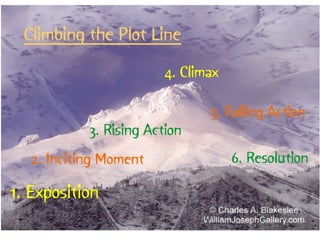
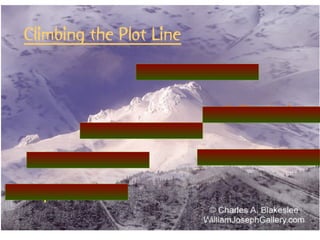
6 Points on a plot curve Exposition The introduction, where we’re EXPOSed to the characters and essential details Inciting moment aka – narrative hook Where the action kicks into gear The conflict is introduced here Where it starts getting interesting
6 Points on a plot curve Rising action Where the story gets complicated and more intense Takes up the bulk of the story Climax The emotional peak of the story Where the conflict reaches its ultimate intensity/complication
6 Points on a plot curve Falling Action “ Tying up loose strings” – sorting out the details that are left after the climax Resolution (aka denouement) Conflict is resolved, and the story has finished
 
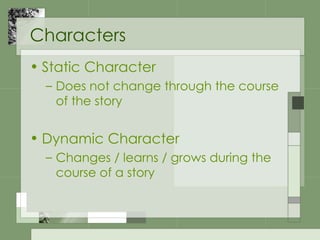
Characters Static Character Does not change through the course of the story Dynamic Character Changes / learns / grows during the course of a story
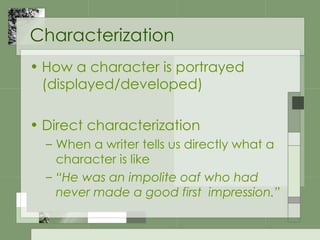
Characterization How a character is portrayed (displayed/developed) Direct characterization When a writer tells us directly what a character is like “ He was an impolite oaf who had never made a good first  impression.”
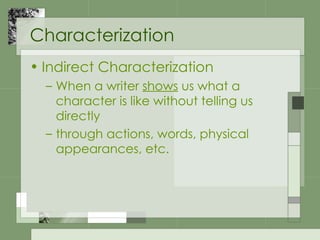
Characterization Indirect Characterization When a writer  shows  us what a character is like without telling us directly through actions, words, physical appearances, etc.

Elements of a Story

  • 1.
    Elements of aStory English 9
  • 2.
    The four mainelements Point of View Every story needs a person to tell it. Characters If you’re telling a story, you need someone to be in it! Plot If there’s a character, something needs to happen. Setting It must take place some where!
  • 3.
    But aren’t theymore specific? Point of view First person Third-person omniscient Third-person limited Setting A time and place
  • 4.
  • 5.
    6 Points ona plot curve Exposition The introduction, where we’re EXPOSed to the characters and essential details Inciting moment aka – narrative hook Where the action kicks into gear The conflict is introduced here Where it starts getting interesting
  • 6.
    6 Points ona plot curve Rising action Where the story gets complicated and more intense Takes up the bulk of the story Climax The emotional peak of the story Where the conflict reaches its ultimate intensity/complication
  • 7.
    6 Points ona plot curve Falling Action “ Tying up loose strings” – sorting out the details that are left after the climax Resolution (aka denouement) Conflict is resolved, and the story has finished
  • 8.
  • 9.
    Characters Static CharacterDoes not change through the course of the story Dynamic Character Changes / learns / grows during the course of a story
  • 10.
    Characterization How acharacter is portrayed (displayed/developed) Direct characterization When a writer tells us directly what a character is like “ He was an impolite oaf who had never made a good first impression.”
  • 11.
    Characterization Indirect CharacterizationWhen a writer shows us what a character is like without telling us directly through actions, words, physical appearances, etc.