Mixtures, Elements
and Compounds
Introduction
 Scientists like to classify things.
 One way that scientists classify matter is by its composition –
what it is made up of.
 Ultimately, all matter, something that takes up space and
has mass, can be classified as mixtures, elements and
compounds.
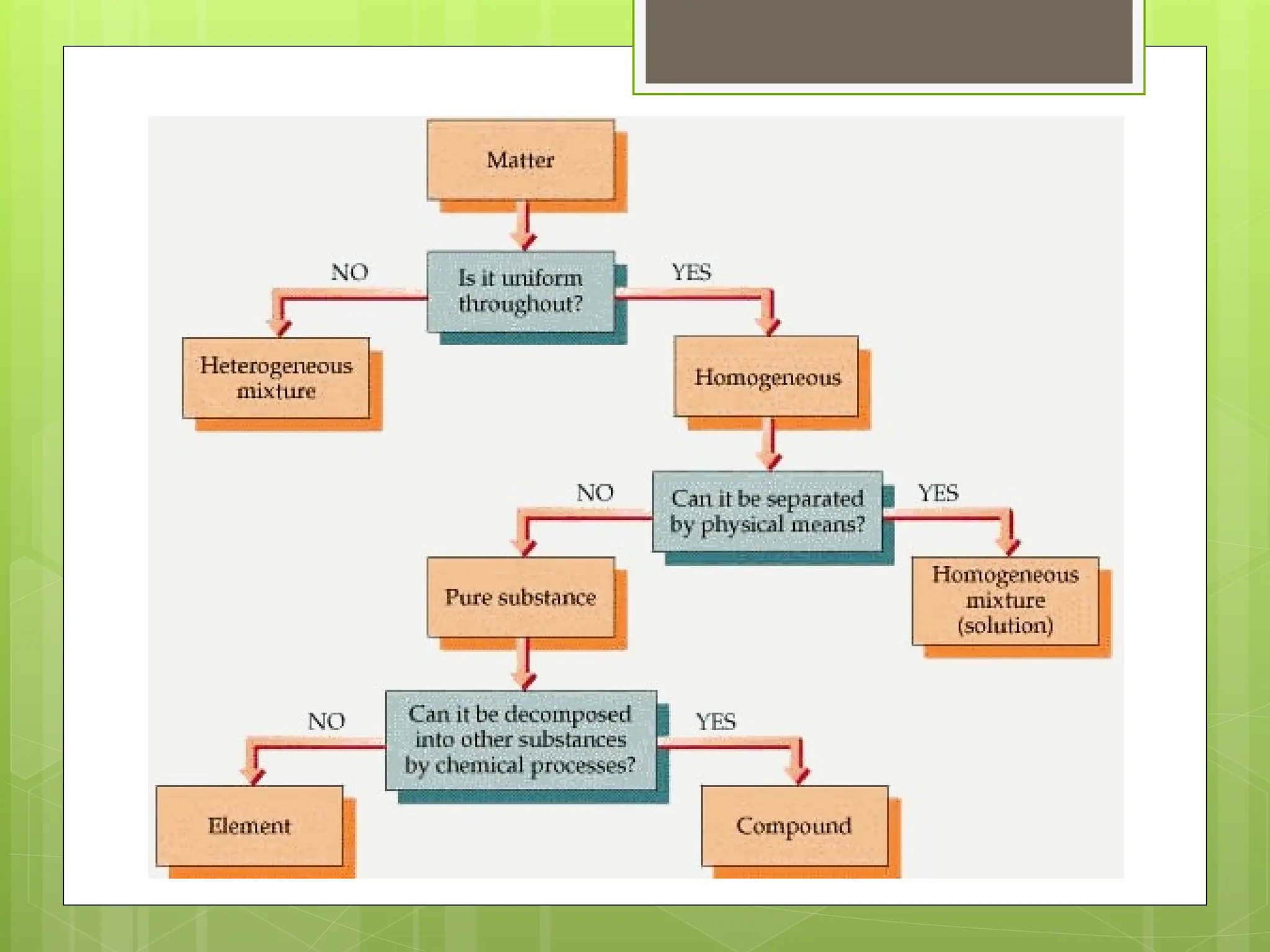
 Scientists ask themselves these questions:
 Is the matter uniform throughout?
 Can it be separated by physical means?
 Can it be separated by chemical means?
By asking these questions scientists can classify matter into:
 Mixtures – Two or more substances that are not chemically
combined with each other and can be separated by physical
means. The substances in a mixture retain their individual
properties.
 Solutions – A special kind of mixture where one substance
dissolves in another.
 Elements – Simplest form of pure substance. They cannot be
broken into anything else by physical or chemical means.
 Compounds – Pure substances that are the unions of two or
more elements. They can be broken into simpler substances by
chemical means.
How To Classify Matter
 Is it uniform throughout?
 If the answer is no, the matter is a heterogeneous mixture.
 Considered the “least mixed.”
 Does not appear to be the same throughout.
 Particles are large enough to be seen and to be separated from
the mixture.
 Examples are sand and granite.
How To Classify Matter
 Is it uniform throughout?
 If the answer is yes, the matter is homogeneous – it looks
the same throughout.
 Can it be separated by physical means?
 If yes, it is a homogeneous mixture or solution.
 A mixture that appears to be the same throughout.
 It is “well mixed.”
 The particles that make up the mixture are very small and
not easily recognizable.
 Examples include milk and toothpaste.
Solutions
 A solution is a type of homogeneous mixture formed when one
substance dissolves in another.
 It is the best mixed of all mixtures.
 A solution always has a substance that is dissolved and a
substance that does the dissolving.
 The substance that is dissolved is the solute and the substance
that does the dissolving is the solvent.
 Water is the universal solvent.
 Air is also a solution of oxygen and other gases dissolved in
nitrogen.
 An example of a solution would
be ocean water.
 Is it uniform throughout?
 If the answer is no, the matter is a pure substance.
 It will be an element or a compound.
How To Classify Matter
Elements
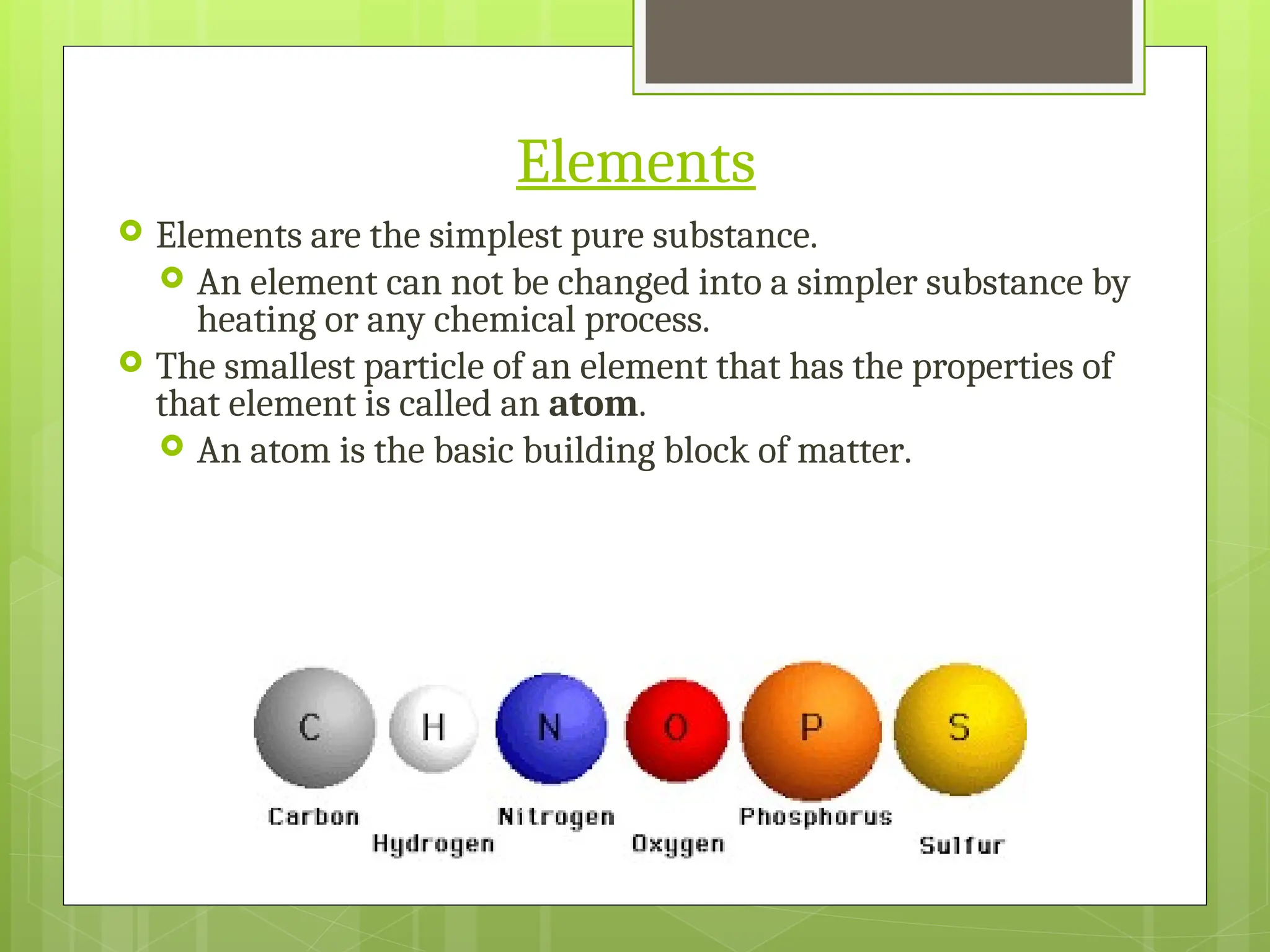
 Elements are the simplest pure substance.
 An element can not be changed into a simpler substance by
heating or any chemical process.
 The smallest particle of an element that has the properties of
that element is called an atom.
 An atom is the basic building block of matter.
Compounds
 Compounds are also pure substances, but compounds are made
from more than one element.
 Water is a compound.
 Water can be broken down into simpler substances – hydrogen
and oxygen.
MIXTURE COMPOUNDS AND ELEMENTS88888888.ppt

MIXTURE COMPOUNDS AND ELEMENTS88888888.ppt

  • 1.
  • 2.
    Introduction  Scientists liketo classify things.  One way that scientists classify matter is by its composition – what it is made up of.  Ultimately, all matter, something that takes up space and has mass, can be classified as mixtures, elements and compounds.  Scientists ask themselves these questions:  Is the matter uniform throughout?  Can it be separated by physical means?  Can it be separated by chemical means?
  • 3.
    By asking thesequestions scientists can classify matter into:  Mixtures – Two or more substances that are not chemically combined with each other and can be separated by physical means. The substances in a mixture retain their individual properties.  Solutions – A special kind of mixture where one substance dissolves in another.  Elements – Simplest form of pure substance. They cannot be broken into anything else by physical or chemical means.  Compounds – Pure substances that are the unions of two or more elements. They can be broken into simpler substances by chemical means.
  • 4.
    How To ClassifyMatter  Is it uniform throughout?  If the answer is no, the matter is a heterogeneous mixture.  Considered the “least mixed.”  Does not appear to be the same throughout.  Particles are large enough to be seen and to be separated from the mixture.  Examples are sand and granite.
  • 5.
    How To ClassifyMatter  Is it uniform throughout?  If the answer is yes, the matter is homogeneous – it looks the same throughout.  Can it be separated by physical means?  If yes, it is a homogeneous mixture or solution.  A mixture that appears to be the same throughout.  It is “well mixed.”  The particles that make up the mixture are very small and not easily recognizable.  Examples include milk and toothpaste.
  • 6.
    Solutions  A solutionis a type of homogeneous mixture formed when one substance dissolves in another.  It is the best mixed of all mixtures.  A solution always has a substance that is dissolved and a substance that does the dissolving.  The substance that is dissolved is the solute and the substance that does the dissolving is the solvent.  Water is the universal solvent.  Air is also a solution of oxygen and other gases dissolved in nitrogen.  An example of a solution would be ocean water.
  • 7.
     Is ituniform throughout?  If the answer is no, the matter is a pure substance.  It will be an element or a compound. How To Classify Matter
  • 8.
    Elements  Elements arethe simplest pure substance.  An element can not be changed into a simpler substance by heating or any chemical process.  The smallest particle of an element that has the properties of that element is called an atom.  An atom is the basic building block of matter.
  • 9.
    Compounds  Compounds arealso pure substances, but compounds are made from more than one element.  Water is a compound.  Water can be broken down into simpler substances – hydrogen and oxygen.