
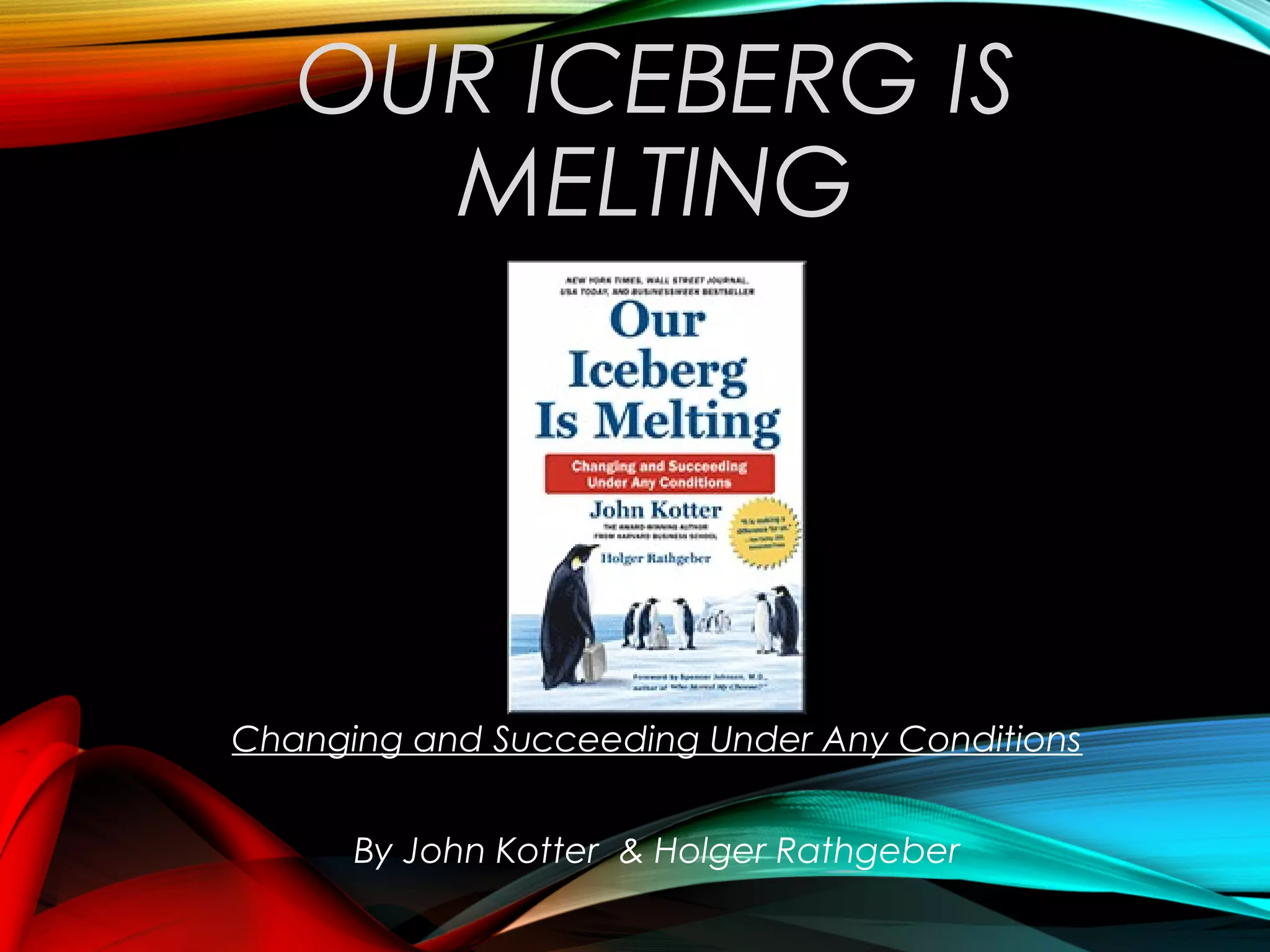

OUR ICEBERG IS
MELTING
Changing and Succeeding Under Any Conditions
By John Kotter & Holger Rathgeber
“ONCE UPON A TIME…”
• ….there were some Emperor penguins in Antarctica.
• 268, to be exact.
• They had lived on their iceberg for years.
• It was heaven. It was home.
FRED
• One of these penguins was Fred.
• Fred was a great husband, father, and employee.
• And observer.
• He noticed…..
• ….that the iceberg was melting.
• Fred wanted to warn his fellow penguins….
... but he remembered the last time someone—Harold--
tried to warn the penguins about the melting iceberg.
• Harold was now ostracized from the colony.
LEADERSHIP COUNCIL
• Fred decided to meet with Alice, one of the ten
penguin bosses.
• At first, Alice wondered if Fred was having some sort of
personal crisis.
• BUT…she listened. And asked Fred to take her to the
most problematic place on the iceberg.
PROOF
Fred and Alice swam around the iceberg.
Fred pointed out the fissures, canals, and caves that
weren’t there before.
The caves were filled with water.
Water is fine for the summer.
But when winter comes…
The water freezes, expands, and breaks apart the
surrounding iceberg.
(Not good for anyone living on the iceberg.)
• Alice agreed to tell the other penguins of the
Leadership Council.
• Most of them wondered if she were having a personal
crisis.
• But, really, they were just busy dealing with the
complaints of their other penguin constituents.
• Finally, they agreed to meet with and listen to Fred.
• Fred decided to make a model of the iceberg in order to
illustrate the problem.
• As Fred explained the imminent disaster to the council
members, all but one approached the model and
examined it more closely.
• They were scared silent.
• Except for the penguin boss, NoNo, who insisted that the
melting was nothing new and nothing to be worried
about.
NoNo continued to discredit Fred and his theory.
UNTIL ….
Alice pointedly said,
“Imagine parents who lost their children.
Imagine them coming to us and asking,
‘How could this have happened?
What were you doing?
Why didn’t you foresee this crisis? …’”
THIS got the group’s attention.
One of the council members suggested that they
FORM A COMMITTEE.
Another member agreed, but added,
WE NEED TO KEEP THIS A SECRET.
Alice agreed that those were all fine-and-dandy
procedures for normal problems. But this was NOT a
normal problem.
Alice wanted to call a general assembly of the entire
penguin colony.
Panic ensued amongst the council members.
Fred started to feel worried.
But then he thought of another way to convince
the penguins of the impending doom.
He found a glass bottle.
They filled it with water and let it sit overnight.
The next morning, it had
EXPLODED.
Finally, the council decided to hold an assembly for
the entire penguin colony.
Everyone got to see the ice model and the broken
bottle.
They also got to hear the first-hand reports of the
warning signs and ask questions.
They were thoroughly concerned.
Fred had accomplished the Step One of successful
change:
1.Reduce complacency and increase urgency.
Louis, the head penguin, decided to form a TEAM to
solve the problem. It consisted of:
1.Mike: Head Penguin; wise; experienced; patient;
conservative; respected; smart (but not an
intellectual heavyweight)
2.Alice: Practical; aggressive; a do-er; smart ; doesn’t
care about status; treats everyone the same;
impossible to intimidate
3.Buddy: Boyishly handsome; not ambitious; well
trusted; well liked; definitely NOT an intellectual
heavyweight
4.Fred: Younger; curious; creative; level-headed
5.“Me”: Logical; well read; curious; not very social
• The team went out to lunch (hunting for squid) and
chatted about life, love, hopes, and dreams.
• They had succeeded in Step Two of Successful
Change:
2. Pull together a team to guide the needed change.
• The team brainstormed possible solutions.
• The most scary—but the most realistic– was to
change their current way of life.
• They studied other successful models.
• They liked the life of the seagull: a nomad.
• They had reached Step Three of Successful Change:
3. Create a vision of a new future.
Louis, the head penguin, called another general
assembly of all penguins the next day.
They spoke to the crowd about the life of the
seagulls and the freedom they experienced.
Although it was a powerful speech, the crowd was
not sold.
Some were still skeptical; others confused; others
were downright against this absurdity.
Alice decided they needed to constantly remind
their fellow penguins of their impending doom and
their hope for a new future.
And so they did.
This is Step Four of Successful Change:
4.Communicate the new vision.
This communication campaign worked—enthusiasm
for the new future grew.
Many penguins volunteered to be scouts—to look
for a new iceberg to call home.
BUT….
They also became discouraged by all the nay-sayers
and other obstacles.
And by the fact that the scout penguins would
need much more fish than normal to survive their
venture.
(Penguins DO NOT SHARE FISH.)
The penguin leaders got creative.
They met with the school teachers and instilled in
them the need for a new home.
And the need for HEROES to find the new home.
The teachers realized this need and imparted this
enthusiasm to their students.
The students created the idea of a “Tribute to Our
Heroes Day”.
Now nearly everyone felt involved.
This is Step Five of Successful Change:
5.Make everyone feel empowered.
The penguin scouts left for their mission.
Meanwhile, back home on the iceberg, penguins
were planning the “Tribute to Our Heroes Day”.
There would be a raffle, performances, music, and a
market.
Admission would be two fish per adult.
The parents were skeptical, but caved in to the
enthusiasm and pressure of their youngsters.
Heroes Day was scheduled for the same day that
the scouts were to return from their adventure.
All the scouts returned. Everyone celebrated.
(Except NoNo.)
This is Step Six of Successful Change:
6. Create a short-term win.
Enthusiasm and hope soared.
More penguins volunteered to support the cause.
Soon, a new iceberg to call home was found.
And then “The Move” began.
Sure, there were problems along the way and over
the first few months of “The New Life”. But nothing
horrible.
The following year, the penguins found an even
better iceberg to move to. And so they did.
This is Step Seven in Successful Change:
7. Don’t let up.
 Today, the penguin colony continues to move around like nomads.
 Louis, the head penguin, now a grandfather, can frequently be found
instructing the penguin chicks in the specific steps the colony took in
the past:
1. Create a sense of urgency.
2. Pull together the guiding team.
3. Develop the change vision and strategy.
4. Communicate for understanding and buy-in.
5. Empower others to act.
6. Produce short-term wins.
7. Don’t let up.
 And this is the final step of successful change:
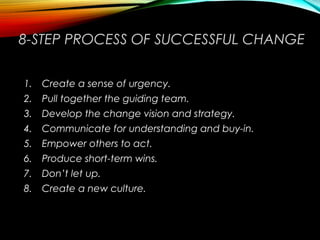
8-STEP PROCESS OF SUCCESSFUL CHANGE
1. Create a sense of urgency.
2. Pull together the guiding team.
3. Develop the change vision and strategy.
4. Communicate for understanding and buy-in.
5. Empower others to act.
6. Produce short-term wins.
7. Don’t let up.
8. Create a new culture.
THE END
• What penguin did you relate to the most?
• Did certain penguins remind you of certain people in
your district? Or of other people in your life?

Our Iceberg Is Melting

  • 1.
    OUR ICEBERG IS MELTING Changingand Succeeding Under Any Conditions By John Kotter & Holger Rathgeber
  • 2.
    “ONCE UPON ATIME…” • ….there were some Emperor penguins in Antarctica. • 268, to be exact. • They had lived on their iceberg for years. • It was heaven. It was home.
  • 3.
    FRED • One ofthese penguins was Fred. • Fred was a great husband, father, and employee. • And observer. • He noticed….. • ….that the iceberg was melting.
  • 4.
    • Fred wantedto warn his fellow penguins…. ... but he remembered the last time someone—Harold-- tried to warn the penguins about the melting iceberg. • Harold was now ostracized from the colony.
  • 5.
    LEADERSHIP COUNCIL • Freddecided to meet with Alice, one of the ten penguin bosses. • At first, Alice wondered if Fred was having some sort of personal crisis. • BUT…she listened. And asked Fred to take her to the most problematic place on the iceberg.
  • 6.
    PROOF Fred and Aliceswam around the iceberg. Fred pointed out the fissures, canals, and caves that weren’t there before. The caves were filled with water. Water is fine for the summer. But when winter comes… The water freezes, expands, and breaks apart the surrounding iceberg. (Not good for anyone living on the iceberg.)
  • 7.
    • Alice agreedto tell the other penguins of the Leadership Council. • Most of them wondered if she were having a personal crisis. • But, really, they were just busy dealing with the complaints of their other penguin constituents. • Finally, they agreed to meet with and listen to Fred.
  • 8.
    • Fred decidedto make a model of the iceberg in order to illustrate the problem. • As Fred explained the imminent disaster to the council members, all but one approached the model and examined it more closely. • They were scared silent. • Except for the penguin boss, NoNo, who insisted that the melting was nothing new and nothing to be worried about.
  • 9.
    NoNo continued todiscredit Fred and his theory. UNTIL …. Alice pointedly said, “Imagine parents who lost their children. Imagine them coming to us and asking, ‘How could this have happened? What were you doing? Why didn’t you foresee this crisis? …’” THIS got the group’s attention.
  • 10.
    One of thecouncil members suggested that they FORM A COMMITTEE. Another member agreed, but added, WE NEED TO KEEP THIS A SECRET. Alice agreed that those were all fine-and-dandy procedures for normal problems. But this was NOT a normal problem. Alice wanted to call a general assembly of the entire penguin colony. Panic ensued amongst the council members.
  • 11.
    Fred started tofeel worried. But then he thought of another way to convince the penguins of the impending doom. He found a glass bottle. They filled it with water and let it sit overnight. The next morning, it had EXPLODED. Finally, the council decided to hold an assembly for the entire penguin colony.
  • 12.
    Everyone got tosee the ice model and the broken bottle. They also got to hear the first-hand reports of the warning signs and ask questions. They were thoroughly concerned. Fred had accomplished the Step One of successful change: 1.Reduce complacency and increase urgency.
  • 13.
    Louis, the headpenguin, decided to form a TEAM to solve the problem. It consisted of: 1.Mike: Head Penguin; wise; experienced; patient; conservative; respected; smart (but not an intellectual heavyweight) 2.Alice: Practical; aggressive; a do-er; smart ; doesn’t care about status; treats everyone the same; impossible to intimidate 3.Buddy: Boyishly handsome; not ambitious; well trusted; well liked; definitely NOT an intellectual heavyweight 4.Fred: Younger; curious; creative; level-headed 5.“Me”: Logical; well read; curious; not very social
  • 14.
    • The teamwent out to lunch (hunting for squid) and chatted about life, love, hopes, and dreams. • They had succeeded in Step Two of Successful Change: 2. Pull together a team to guide the needed change.
  • 15.
    • The teambrainstormed possible solutions. • The most scary—but the most realistic– was to change their current way of life. • They studied other successful models. • They liked the life of the seagull: a nomad. • They had reached Step Three of Successful Change: 3. Create a vision of a new future.
  • 16.
    Louis, the headpenguin, called another general assembly of all penguins the next day. They spoke to the crowd about the life of the seagulls and the freedom they experienced. Although it was a powerful speech, the crowd was not sold. Some were still skeptical; others confused; others were downright against this absurdity. Alice decided they needed to constantly remind their fellow penguins of their impending doom and their hope for a new future. And so they did. This is Step Four of Successful Change: 4.Communicate the new vision.
  • 17.
    This communication campaignworked—enthusiasm for the new future grew. Many penguins volunteered to be scouts—to look for a new iceberg to call home. BUT…. They also became discouraged by all the nay-sayers and other obstacles. And by the fact that the scout penguins would need much more fish than normal to survive their venture. (Penguins DO NOT SHARE FISH.)
  • 18.
    The penguin leadersgot creative. They met with the school teachers and instilled in them the need for a new home. And the need for HEROES to find the new home. The teachers realized this need and imparted this enthusiasm to their students. The students created the idea of a “Tribute to Our Heroes Day”. Now nearly everyone felt involved. This is Step Five of Successful Change: 5.Make everyone feel empowered.
  • 19.
    The penguin scoutsleft for their mission. Meanwhile, back home on the iceberg, penguins were planning the “Tribute to Our Heroes Day”. There would be a raffle, performances, music, and a market. Admission would be two fish per adult. The parents were skeptical, but caved in to the enthusiasm and pressure of their youngsters. Heroes Day was scheduled for the same day that the scouts were to return from their adventure. All the scouts returned. Everyone celebrated. (Except NoNo.) This is Step Six of Successful Change: 6. Create a short-term win.
  • 20.
    Enthusiasm and hopesoared. More penguins volunteered to support the cause. Soon, a new iceberg to call home was found. And then “The Move” began. Sure, there were problems along the way and over the first few months of “The New Life”. But nothing horrible. The following year, the penguins found an even better iceberg to move to. And so they did. This is Step Seven in Successful Change: 7. Don’t let up.
  • 21.
     Today, thepenguin colony continues to move around like nomads.  Louis, the head penguin, now a grandfather, can frequently be found instructing the penguin chicks in the specific steps the colony took in the past: 1. Create a sense of urgency. 2. Pull together the guiding team. 3. Develop the change vision and strategy. 4. Communicate for understanding and buy-in. 5. Empower others to act. 6. Produce short-term wins. 7. Don’t let up.  And this is the final step of successful change:
  • 22.
    8-STEP PROCESS OFSUCCESSFUL CHANGE 1. Create a sense of urgency. 2. Pull together the guiding team. 3. Develop the change vision and strategy. 4. Communicate for understanding and buy-in. 5. Empower others to act. 6. Produce short-term wins. 7. Don’t let up. 8. Create a new culture.
  • 23.
    THE END • Whatpenguin did you relate to the most? • Did certain penguins remind you of certain people in your district? Or of other people in your life?