Line
Path made by a moving point
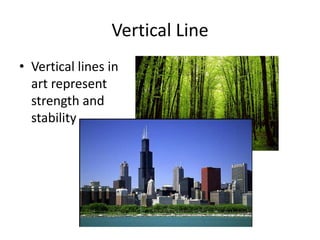
Vertical Line
• Vertical lines in
art represent
strength and
stability
Horizontal Line
• Horizontal lines
represent calm
in an artwork.
Diagonal Lines
• In artwork
diagonal lines
represent energy
or movement.
Shape
The area enclosed by a line 2-D
Organic Shapes
• Shapes found in
nature or have a
natural flow.
Geometric Shapes
• Man made
shapes found in
mathematics
Form
Area enclosed by shapes (3D)
Like shapes there are organic and
geometric forms
• Organic

• Geometric
Value
Relationship between lights and
darks.
Value
• In a 2 dimensional
work (painting,
drawing,
photograph, etc.)
Value is used to
show form and
depth. Also called
shading.
Texture
• Surface quality of an
object, how it feels.
Space
Area in or around an object
Positive Space
• The space
that is the
subject of an
image.
Negative Space
• The area
between or
around an object
Color
• How light reflects
off of an object.
Has intensity,
hue, and value
Primary Colors
• Can not be made
by mixing other
colors.
– Primary = 1st
Secondary Colors
• Colors made by
mixing 2 primary
colors
– Secondary = 2nd
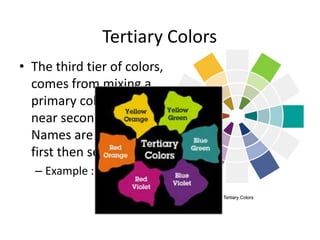
Tertiary Colors
• The third tier of colors,
comes from mixing a
primary color with a
near secondary color.
Names are primary
first then secondary.
– Example : Red-violet
Red
– Facts about red

• Red is the universal
sign for stop.
• Red is a color of
extremes, extreme
love and extreme
anger.
• Red is a very
powerful color and
should be used
sparingly in artwork.
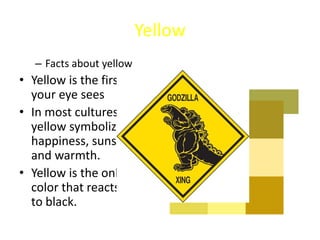
Yellow
– Facts about yellow

• Yellow is the first color
your eye sees
• In most cultures
yellow symbolizes
happiness, sunshine,
and warmth.
• Yellow is the only
color that reacts badly
to black.
Blue
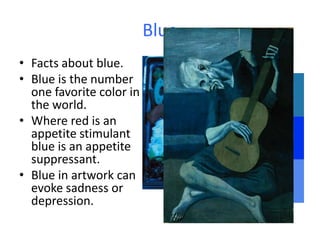
• Facts about blue.
• Blue is the number
one favorite color in
the world.
• Where red is an
appetite stimulant
blue is an appetite
suppressant.
• Blue in artwork can
evoke sadness or
depression.
Principles of Design
• How you use the
elements in a
composition
• Composition- layout
• If the elements are
of an artwork.
the tools, principles
are the rules for using
them.
Balance
• Symmetrical – In
symmetrical balance
both sides of the
image are the same.

• Asymmetrical – In
symmetrical balance
both sides of the
image are different,
but have equal
visual weight.
Leonardo Da Vinci, The Last Supper, 1495-1498
• Salvador Dali, Persistence of Memory, 1931
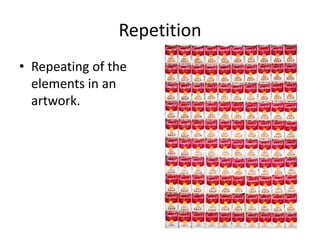
Repetition
• Repeating of the
elements in an
artwork.
Variation
• The changing of
elements in an
artwork.

Piet Mondrian, Diagonal Composition, 1921
Scale
• Size relationships
of objects in an
artwork.
Emphasis
• Focusing the
viewer to one or
some areas of an
artwork.

Leonardo Da Vinci, The Last Supper, 1495-1498
Pattern
• Structured
repetition of
elements in an
artwork.
Unity
• Feeling of togetherness or completeness in an
artwork.
Elements and principle

Elements and principle