EC2610:Fundamentals of Signals and Systems
By
Sadananda Behera
Assistant Professor
Department of Electronics and Communication Engineering
NIT, Rourkela
1
CHAPTER-1 : SIGNALS AND SYSTEMS-Part 2
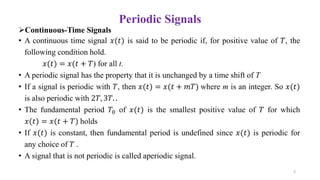
Periodic Signals
Continuous-Time Signals
• A continuous time signal 𝑥(𝑡) is said to be periodic if, for positive value of 𝑇, the
following condition hold.
𝑥(𝑡) = 𝑥(𝑡 + 𝑇) for all t.
• A periodic signal has the property that it is unchanged by a time shift of T
• If a signal is periodic with 𝑇, then 𝑥(𝑡) = 𝑥(𝑡 + 𝑚𝑇) where m is an integer. So 𝑥(𝑡)
is also periodic with 2𝑇, 3𝑇. .
• The fundamental period 𝑇0 of 𝑥(𝑡) is the smallest positive value of 𝑇 for which
𝑥(𝑡) = 𝑥(𝑡 + 𝑇) holds
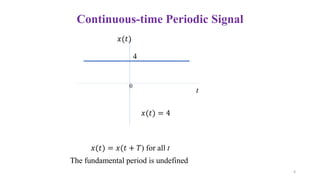
• If 𝑥(𝑡) is constant, then fundamental period is undefined since 𝑥(𝑡) is periodic for
any choice of 𝑇 .
• A signal that is not periodic is called aperiodic signal.
2
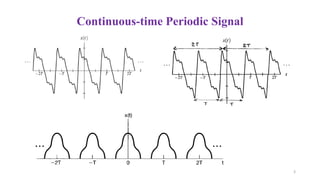
Continuous-time Periodic Signal
3
t
𝑥(𝑡)
𝑥(𝑡) = 4
0
4
Continuous-time Periodic Signal
4
𝑥(𝑡) = 𝑥(𝑡 + 𝑇) for all t
The fundamental period is undefined
Discrete-Time Signals
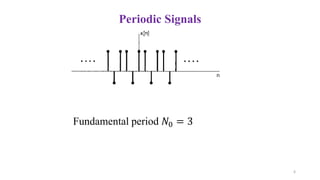
• A discrete-time signal (sequence) 𝑥[𝑛] is said to be periodic with period 𝑁, where
𝑁 is a positive integer, if the following condition hold .
𝑥[𝑛] = 𝑥[𝑛 + 𝑁] for all 𝑛
• 𝑥[𝑛] is also periodic with 2𝑁, 3𝑁. .
• The fundamental period 𝑁0 is the smallest positive value of 𝑁 for which
𝑥[𝑛] = 𝑥[𝑛 + 𝑁] holds
Periodic Signals
5
Fundamental period 𝑁0 = 3
Periodic Signals
6
Even and Odd Signals
A signal 𝑥(𝑡) or 𝑥[𝑛] is refer to as even signal if it is identical to its time-reversed
counterpart, i.e.,
• 𝑥(−𝑡) = 𝑥(𝑡) [Continuous-time]
• 𝑥[−𝑛] = 𝑥[𝑛] [Discrete-time]
A signal is referred to as odd if
• 𝑥 −𝑡 = −𝑥(𝑡) [Continuous-time]
• 𝑥 −𝑛 = −𝑥[𝑛] [Discrete-time]
An odd signal must necessarily be 0 at 𝑡 = 0 or 𝑛 = 0
• 𝑥(0) = −𝑥(0) ⇒ 𝑥 0 = 0
• 𝑥[0] = −𝑥[0] ⇒ 𝑥[0] = 0
7
Even and Odd Signals
8
Even Odd
𝑥[𝑛] 𝑥[𝑛]
• Every Signal can be broken into a sum of two signals one of which is even and the
other is odd.
𝑥(𝑡)=
1
2
[𝑥 𝑡 + 𝑥 −𝑡 + 𝑥 𝑡 − 𝑥(−𝑡)]=
1
2
[𝑥 𝑡 + 𝑥(−𝑡)] +
1
2
[𝑥 𝑡 − 𝑥(−𝑡)]
Even
Odd
Even and Odd Signals
9
• Continuous-Time
• Ev[𝑥(𝑡)]=
1
2
[𝑥 𝑡 + 𝑥(−𝑡)] [Even Function]
• Od[𝑥(𝑡)]=
1
2
[𝑥 𝑡 − 𝑥(−𝑡)] [Odd Function]
• Discrete-Time
• Ev[𝑥[𝑛]]=
1
2
[𝑥[𝑛] + 𝑥[−𝑛]]
• Od[𝑥[𝑛]]=
1
2
[𝑥[𝑛] − 𝑥[−𝑛]]
Even and Odd Signals
10
Exponential and Sinusoidal Signals
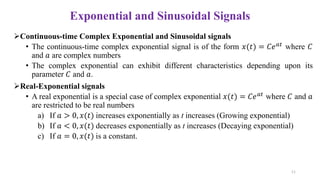
Continuous-time Complex Exponential and Sinusoidal signals
• The continuous-time complex exponential signal is of the form 𝑥(𝑡) = 𝐶𝑒𝑎𝑡
where 𝐶
and 𝑎 are complex numbers
• The complex exponential can exhibit different characteristics depending upon its
parameter 𝐶 and 𝑎.
Real-Exponential signals
• A real exponential is a special case of complex exponential 𝑥(𝑡) = 𝐶𝑒𝑎𝑡 where 𝐶 and 𝑎
are restricted to be real numbers
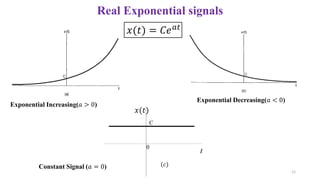
a) If 𝑎 > 0, 𝑥(𝑡) increases exponentially as t increases (Growing exponential)
b) If 𝑎 < 0, 𝑥(𝑡) decreases exponentially as t increases (Decaying exponential)
c) If 𝑎 = 0, 𝑥(𝑡) is a constant.
11
Real Exponential signals
Exponential Increasing(𝑎 > 0)
Exponential Decreasing(𝑎 < 0)
t
𝑥(𝑡)
0
C
Constant Signal (𝑎 = 0)
12
(𝑐)
𝑥(𝑡) = 𝐶𝑒𝑎𝑡
Periodic Complex Exponential and Sinusoidal Signals
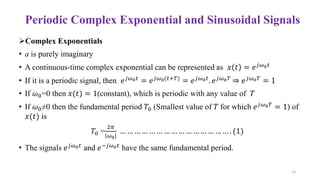
Complex Exponentials
• a is purely imaginary
• A continuous-time complex exponential can be represented as 𝑥 𝑡 = 𝑒𝑗𝜔0𝑡
• If it is a periodic signal, then 𝑒𝑗𝜔0𝑡 = 𝑒𝑗𝜔0(𝑡+𝑇) = 𝑒𝑗𝜔0𝑡. 𝑒𝑗𝜔0𝑇 ⇒ 𝑒𝑗𝜔0𝑇 = 1
• If 𝜔0=0 then 𝑥(𝑡) = 1(constant), which is periodic with any value of 𝑇
• If 𝜔0≠0 then the fundamental period 𝑇0 (Smallest value of 𝑇 for which 𝑒𝑗𝜔0𝑇 = 1) of
𝑥(𝑡) is
𝑇0 =
2𝜋
𝜔0
… … … … … … … … … … … … … … … . (1)
• The signals 𝑒𝑗𝜔0𝑡
and 𝑒−𝑗𝜔0𝑡
have the same fundamental period.
13
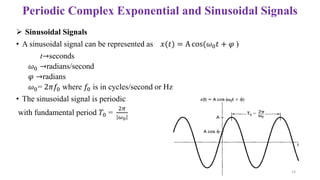
 Sinusoidal Signals
• A sinusoidal signal can be represented as 𝑥(𝑡) = A cos(𝜔0𝑡 + 𝜑 )
t→seconds
𝜔0 →radians/second
𝜑 →radians
𝜔0= 2𝜋𝑓0 where 𝑓0 is in cycles/second or Hz
• The sinusoidal signal is periodic
with fundamental period 𝑇0 =
2𝜋
𝜔0
Periodic Complex Exponential and Sinusoidal Signals
14
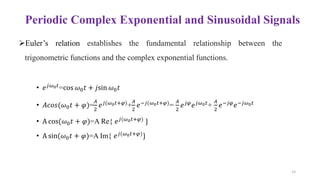
• 𝑒𝑗𝜔0𝑡=cos 𝜔0𝑡 + 𝑗sin 𝜔0𝑡
• 𝐴𝑐𝑜𝑠(𝜔0𝑡 + 𝜑)=
𝐴
2
𝑒𝑗(𝜔0𝑡+𝜑)+
𝐴
2
𝑒−𝑗(𝜔0𝑡+𝜑)=
𝐴
2
𝑒𝑗𝜑𝑒𝑗𝜔0𝑡+
𝐴
2
𝑒−𝑗𝜑𝑒−𝑗𝜔0𝑡
• A cos(𝜔0𝑡 + 𝜑)=A Re{ 𝑒𝑗(𝜔0𝑡+𝜑) }
• A sin(𝜔0𝑡 + 𝜑)=A Im{ 𝑒𝑗(𝜔0𝑡+𝜑)}
Periodic Complex Exponential and Sinusoidal Signals
15
Euler’s relation establishes the fundamental relationship between the
trigonometric functions and the complex exponential functions.
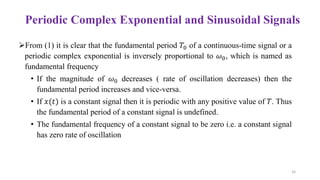
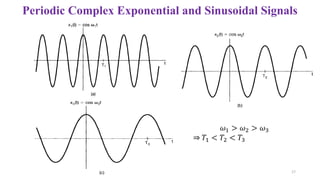
From (1) it is clear that the fundamental period 𝑇0 of a continuous-time signal or a
periodic complex exponential is inversely proportional to 𝜔0, which is named as
fundamental frequency
• If the magnitude of 𝜔0 decreases ( rate of oscillation decreases) then the
fundamental period increases and vice-versa.
• If 𝑥(𝑡) is a constant signal then it is periodic with any positive value of 𝑇. Thus
the fundamental period of a constant signal is undefined.
• The fundamental frequency of a constant signal to be zero i.e. a constant signal
has zero rate of oscillation
Periodic Complex Exponential and Sinusoidal Signals
16
𝜔1 > 𝜔2 > 𝜔3
⇒ 𝑇1 < 𝑇2 < 𝑇3
Periodic Complex Exponential and Sinusoidal Signals
17
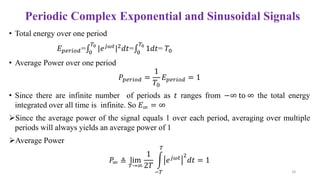
• Total energy over one period
𝐸𝑝𝑒𝑟𝑖𝑜𝑑= |𝑒𝑗𝜔𝑡|2𝑑𝑡
𝑇0
0
= 1𝑑𝑡
𝑇0
0
= 𝑇0
• Average Power over one period
𝑃𝑝𝑒𝑟𝑖𝑜𝑑 =
1
𝑇0
𝐸𝑝𝑒𝑟𝑖𝑜𝑑 = 1
• Since there are infinite number of periods as 𝑡 ranges from −∞ to ∞ the total energy
integrated over all time is infinite. So 𝐸∞ = ∞
Since the average power of the signal equals 1 over each period, averaging over multiple
periods will always yields an average power of 1
Average Power
𝑃∞ ≜ lim
𝑇→∞
1
2𝑇
𝑒𝑗𝜔𝑡 2
𝑑𝑡
𝑇
−𝑇
= 1
Periodic Complex Exponential and Sinusoidal Signals
18
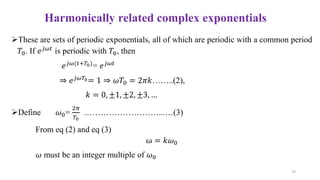
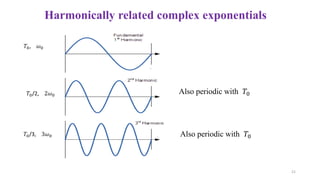
These are sets of periodic exponentials, all of which are periodic with a common period
𝑇0. If 𝑒𝑗𝜔𝑡
is periodic with 𝑇0, then
𝑒𝑗𝜔(𝑡+𝑇0)= 𝑒𝑗𝜔𝑡
⇒ 𝑒𝑗𝜔𝑇0= 1 ⇒ 𝜔𝑇0 = 2𝜋𝑘……..(2),
𝑘 = 0, ±1, ±2, ±3, …
Define 𝜔0=
2𝜋
𝑇0
………………………...…(3)
From eq (2) and eq (3)
ω = 𝑘𝜔0
𝜔 must be an integer multiple of 𝜔0
Harmonically related complex exponentials
19
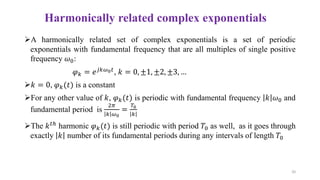
A harmonically related set of complex exponentials is a set of periodic
exponentials with fundamental frequency that are all multiples of single positive
frequency 𝜔0:
𝜑𝑘 = 𝑒𝑗𝑘𝜔0𝑡, 𝑘 = 0, ±1, ±2, ±3, …
𝑘 = 0, 𝜑𝑘(𝑡) is a constant
For any other value of 𝑘, 𝜑𝑘(𝑡) is periodic with fundamental frequency 𝑘 𝜔0 and
fundamental period is
2𝜋
𝑘 𝜔0
=
𝑇0
𝑘
The 𝑘𝑡ℎ harmonic 𝜑𝑘(𝑡) is still periodic with period 𝑇0 as well, as it goes through
exactly 𝑘 number of its fundamental periods during any intervals of length 𝑇0
Harmonically related complex exponentials
20
𝑇0, 𝜔0
𝑇0/2, 2𝜔0
Also periodic with 𝑇0
𝑇0/3, 3𝜔0 Also periodic with 𝑇0
Harmonically related complex exponentials
21
General Complex Exponentials
𝑥(𝑡) = 𝐶𝑒𝑎𝑡, 𝐶 and 𝑎 both are complex
• 𝐶 = |𝐶|𝑒𝑗𝜃 [Polar form]
• 𝑎 = 𝑟 + 𝑗𝜔0 [Rectangular form]
𝐶𝑒𝑎𝑡 = |𝐶|𝑒𝑗𝜃 𝑒(𝑟+𝑗𝜔0)𝑡 = |𝐶|𝑒𝑟𝑡𝑒𝑗(𝜔0𝑡+𝜃) ……...(4)
𝑥(𝑡) = 𝐶𝑒𝑎𝑡
= |𝐶|𝑒𝑟𝑡
cos(𝜔0𝑡 + 𝜃) + 𝑗 |𝐶|𝑒𝑟𝑡
sin(𝜔0𝑡 + 𝜃)
𝑅𝑒 𝑥 𝑡 𝐼𝑚{𝑥(𝑡)}
22
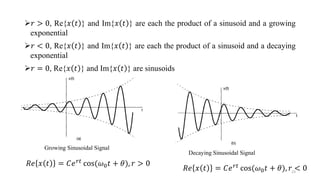
𝑟 > 0, Re{𝑥 𝑡 } and Im{𝑥 𝑡 } are each the product of a sinusoid and a growing
exponential
𝑟 < 0, Re{𝑥 𝑡 } and Im{𝑥 𝑡 } are each the product of a sinusoid and a decaying
exponential
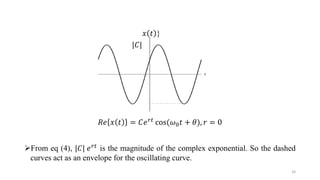
𝑟 = 0, Re{𝑥 𝑡 } and Im{𝑥 𝑡 } are sinusoids
Growing Sinusoidal Signal
Decaying Sinusoidal Signal
𝑅𝑒 𝑥 𝑡 = 𝐶𝑒𝑟𝑡 cos(𝜔0𝑡 + 𝜃), 𝑟 > 0
𝑅𝑒 𝑥 𝑡 = 𝐶𝑒𝑟𝑡 cos(𝜔0𝑡 + 𝜃), 𝑟 < 0
23
|𝐶|
From eq (4), |𝐶| 𝑒𝑟𝑡 is the magnitude of the complex exponential. So the dashed
curves act as an envelope for the oscillating curve.
𝑅𝑒 𝑥 𝑡 = 𝐶𝑒𝑟𝑡
cos(𝜔0𝑡 + 𝜃), 𝑟 = 0
|𝐶|
𝑥 𝑡 }
24
THANK YOU
25

Lecture 2 Signals & Systems.pdf

  • 1.
    EC2610:Fundamentals of Signalsand Systems By Sadananda Behera Assistant Professor Department of Electronics and Communication Engineering NIT, Rourkela 1 CHAPTER-1 : SIGNALS AND SYSTEMS-Part 2
  • 2.
    Periodic Signals Continuous-Time Signals •A continuous time signal 𝑥(𝑡) is said to be periodic if, for positive value of 𝑇, the following condition hold. 𝑥(𝑡) = 𝑥(𝑡 + 𝑇) for all t. • A periodic signal has the property that it is unchanged by a time shift of T • If a signal is periodic with 𝑇, then 𝑥(𝑡) = 𝑥(𝑡 + 𝑚𝑇) where m is an integer. So 𝑥(𝑡) is also periodic with 2𝑇, 3𝑇. . • The fundamental period 𝑇0 of 𝑥(𝑡) is the smallest positive value of 𝑇 for which 𝑥(𝑡) = 𝑥(𝑡 + 𝑇) holds • If 𝑥(𝑡) is constant, then fundamental period is undefined since 𝑥(𝑡) is periodic for any choice of 𝑇 . • A signal that is not periodic is called aperiodic signal. 2
  • 3.
  • 4.
    t 𝑥(𝑡) 𝑥(𝑡) = 4 0 4 Continuous-timePeriodic Signal 4 𝑥(𝑡) = 𝑥(𝑡 + 𝑇) for all t The fundamental period is undefined
  • 5.
    Discrete-Time Signals • Adiscrete-time signal (sequence) 𝑥[𝑛] is said to be periodic with period 𝑁, where 𝑁 is a positive integer, if the following condition hold . 𝑥[𝑛] = 𝑥[𝑛 + 𝑁] for all 𝑛 • 𝑥[𝑛] is also periodic with 2𝑁, 3𝑁. . • The fundamental period 𝑁0 is the smallest positive value of 𝑁 for which 𝑥[𝑛] = 𝑥[𝑛 + 𝑁] holds Periodic Signals 5
  • 6.
    Fundamental period 𝑁0= 3 Periodic Signals 6
  • 7.
    Even and OddSignals A signal 𝑥(𝑡) or 𝑥[𝑛] is refer to as even signal if it is identical to its time-reversed counterpart, i.e., • 𝑥(−𝑡) = 𝑥(𝑡) [Continuous-time] • 𝑥[−𝑛] = 𝑥[𝑛] [Discrete-time] A signal is referred to as odd if • 𝑥 −𝑡 = −𝑥(𝑡) [Continuous-time] • 𝑥 −𝑛 = −𝑥[𝑛] [Discrete-time] An odd signal must necessarily be 0 at 𝑡 = 0 or 𝑛 = 0 • 𝑥(0) = −𝑥(0) ⇒ 𝑥 0 = 0 • 𝑥[0] = −𝑥[0] ⇒ 𝑥[0] = 0 7
  • 8.
    Even and OddSignals 8 Even Odd 𝑥[𝑛] 𝑥[𝑛]
  • 9.
    • Every Signalcan be broken into a sum of two signals one of which is even and the other is odd. 𝑥(𝑡)= 1 2 [𝑥 𝑡 + 𝑥 −𝑡 + 𝑥 𝑡 − 𝑥(−𝑡)]= 1 2 [𝑥 𝑡 + 𝑥(−𝑡)] + 1 2 [𝑥 𝑡 − 𝑥(−𝑡)] Even Odd Even and Odd Signals 9
  • 10.
    • Continuous-Time • Ev[𝑥(𝑡)]= 1 2 [𝑥𝑡 + 𝑥(−𝑡)] [Even Function] • Od[𝑥(𝑡)]= 1 2 [𝑥 𝑡 − 𝑥(−𝑡)] [Odd Function] • Discrete-Time • Ev[𝑥[𝑛]]= 1 2 [𝑥[𝑛] + 𝑥[−𝑛]] • Od[𝑥[𝑛]]= 1 2 [𝑥[𝑛] − 𝑥[−𝑛]] Even and Odd Signals 10
  • 11.
    Exponential and SinusoidalSignals Continuous-time Complex Exponential and Sinusoidal signals • The continuous-time complex exponential signal is of the form 𝑥(𝑡) = 𝐶𝑒𝑎𝑡 where 𝐶 and 𝑎 are complex numbers • The complex exponential can exhibit different characteristics depending upon its parameter 𝐶 and 𝑎. Real-Exponential signals • A real exponential is a special case of complex exponential 𝑥(𝑡) = 𝐶𝑒𝑎𝑡 where 𝐶 and 𝑎 are restricted to be real numbers a) If 𝑎 > 0, 𝑥(𝑡) increases exponentially as t increases (Growing exponential) b) If 𝑎 < 0, 𝑥(𝑡) decreases exponentially as t increases (Decaying exponential) c) If 𝑎 = 0, 𝑥(𝑡) is a constant. 11
  • 12.
    Real Exponential signals ExponentialIncreasing(𝑎 > 0) Exponential Decreasing(𝑎 < 0) t 𝑥(𝑡) 0 C Constant Signal (𝑎 = 0) 12 (𝑐) 𝑥(𝑡) = 𝐶𝑒𝑎𝑡
  • 13.
    Periodic Complex Exponentialand Sinusoidal Signals Complex Exponentials • a is purely imaginary • A continuous-time complex exponential can be represented as 𝑥 𝑡 = 𝑒𝑗𝜔0𝑡 • If it is a periodic signal, then 𝑒𝑗𝜔0𝑡 = 𝑒𝑗𝜔0(𝑡+𝑇) = 𝑒𝑗𝜔0𝑡. 𝑒𝑗𝜔0𝑇 ⇒ 𝑒𝑗𝜔0𝑇 = 1 • If 𝜔0=0 then 𝑥(𝑡) = 1(constant), which is periodic with any value of 𝑇 • If 𝜔0≠0 then the fundamental period 𝑇0 (Smallest value of 𝑇 for which 𝑒𝑗𝜔0𝑇 = 1) of 𝑥(𝑡) is 𝑇0 = 2𝜋 𝜔0 … … … … … … … … … … … … … … … . (1) • The signals 𝑒𝑗𝜔0𝑡 and 𝑒−𝑗𝜔0𝑡 have the same fundamental period. 13
  • 14.
     Sinusoidal Signals •A sinusoidal signal can be represented as 𝑥(𝑡) = A cos(𝜔0𝑡 + 𝜑 ) t→seconds 𝜔0 →radians/second 𝜑 →radians 𝜔0= 2𝜋𝑓0 where 𝑓0 is in cycles/second or Hz • The sinusoidal signal is periodic with fundamental period 𝑇0 = 2𝜋 𝜔0 Periodic Complex Exponential and Sinusoidal Signals 14
  • 15.
    • 𝑒𝑗𝜔0𝑡=cos 𝜔0𝑡+ 𝑗sin 𝜔0𝑡 • 𝐴𝑐𝑜𝑠(𝜔0𝑡 + 𝜑)= 𝐴 2 𝑒𝑗(𝜔0𝑡+𝜑)+ 𝐴 2 𝑒−𝑗(𝜔0𝑡+𝜑)= 𝐴 2 𝑒𝑗𝜑𝑒𝑗𝜔0𝑡+ 𝐴 2 𝑒−𝑗𝜑𝑒−𝑗𝜔0𝑡 • A cos(𝜔0𝑡 + 𝜑)=A Re{ 𝑒𝑗(𝜔0𝑡+𝜑) } • A sin(𝜔0𝑡 + 𝜑)=A Im{ 𝑒𝑗(𝜔0𝑡+𝜑)} Periodic Complex Exponential and Sinusoidal Signals 15 Euler’s relation establishes the fundamental relationship between the trigonometric functions and the complex exponential functions.
  • 16.
    From (1) itis clear that the fundamental period 𝑇0 of a continuous-time signal or a periodic complex exponential is inversely proportional to 𝜔0, which is named as fundamental frequency • If the magnitude of 𝜔0 decreases ( rate of oscillation decreases) then the fundamental period increases and vice-versa. • If 𝑥(𝑡) is a constant signal then it is periodic with any positive value of 𝑇. Thus the fundamental period of a constant signal is undefined. • The fundamental frequency of a constant signal to be zero i.e. a constant signal has zero rate of oscillation Periodic Complex Exponential and Sinusoidal Signals 16
  • 17.
    𝜔1 > 𝜔2> 𝜔3 ⇒ 𝑇1 < 𝑇2 < 𝑇3 Periodic Complex Exponential and Sinusoidal Signals 17
  • 18.
    • Total energyover one period 𝐸𝑝𝑒𝑟𝑖𝑜𝑑= |𝑒𝑗𝜔𝑡|2𝑑𝑡 𝑇0 0 = 1𝑑𝑡 𝑇0 0 = 𝑇0 • Average Power over one period 𝑃𝑝𝑒𝑟𝑖𝑜𝑑 = 1 𝑇0 𝐸𝑝𝑒𝑟𝑖𝑜𝑑 = 1 • Since there are infinite number of periods as 𝑡 ranges from −∞ to ∞ the total energy integrated over all time is infinite. So 𝐸∞ = ∞ Since the average power of the signal equals 1 over each period, averaging over multiple periods will always yields an average power of 1 Average Power 𝑃∞ ≜ lim 𝑇→∞ 1 2𝑇 𝑒𝑗𝜔𝑡 2 𝑑𝑡 𝑇 −𝑇 = 1 Periodic Complex Exponential and Sinusoidal Signals 18
  • 19.
    These are setsof periodic exponentials, all of which are periodic with a common period 𝑇0. If 𝑒𝑗𝜔𝑡 is periodic with 𝑇0, then 𝑒𝑗𝜔(𝑡+𝑇0)= 𝑒𝑗𝜔𝑡 ⇒ 𝑒𝑗𝜔𝑇0= 1 ⇒ 𝜔𝑇0 = 2𝜋𝑘……..(2), 𝑘 = 0, ±1, ±2, ±3, … Define 𝜔0= 2𝜋 𝑇0 ………………………...…(3) From eq (2) and eq (3) ω = 𝑘𝜔0 𝜔 must be an integer multiple of 𝜔0 Harmonically related complex exponentials 19
  • 20.
    A harmonically relatedset of complex exponentials is a set of periodic exponentials with fundamental frequency that are all multiples of single positive frequency 𝜔0: 𝜑𝑘 = 𝑒𝑗𝑘𝜔0𝑡, 𝑘 = 0, ±1, ±2, ±3, … 𝑘 = 0, 𝜑𝑘(𝑡) is a constant For any other value of 𝑘, 𝜑𝑘(𝑡) is periodic with fundamental frequency 𝑘 𝜔0 and fundamental period is 2𝜋 𝑘 𝜔0 = 𝑇0 𝑘 The 𝑘𝑡ℎ harmonic 𝜑𝑘(𝑡) is still periodic with period 𝑇0 as well, as it goes through exactly 𝑘 number of its fundamental periods during any intervals of length 𝑇0 Harmonically related complex exponentials 20
  • 21.
    𝑇0, 𝜔0 𝑇0/2, 2𝜔0 Alsoperiodic with 𝑇0 𝑇0/3, 3𝜔0 Also periodic with 𝑇0 Harmonically related complex exponentials 21
  • 22.
    General Complex Exponentials 𝑥(𝑡)= 𝐶𝑒𝑎𝑡, 𝐶 and 𝑎 both are complex • 𝐶 = |𝐶|𝑒𝑗𝜃 [Polar form] • 𝑎 = 𝑟 + 𝑗𝜔0 [Rectangular form] 𝐶𝑒𝑎𝑡 = |𝐶|𝑒𝑗𝜃 𝑒(𝑟+𝑗𝜔0)𝑡 = |𝐶|𝑒𝑟𝑡𝑒𝑗(𝜔0𝑡+𝜃) ……...(4) 𝑥(𝑡) = 𝐶𝑒𝑎𝑡 = |𝐶|𝑒𝑟𝑡 cos(𝜔0𝑡 + 𝜃) + 𝑗 |𝐶|𝑒𝑟𝑡 sin(𝜔0𝑡 + 𝜃) 𝑅𝑒 𝑥 𝑡 𝐼𝑚{𝑥(𝑡)} 22
  • 23.
    𝑟 > 0,Re{𝑥 𝑡 } and Im{𝑥 𝑡 } are each the product of a sinusoid and a growing exponential 𝑟 < 0, Re{𝑥 𝑡 } and Im{𝑥 𝑡 } are each the product of a sinusoid and a decaying exponential 𝑟 = 0, Re{𝑥 𝑡 } and Im{𝑥 𝑡 } are sinusoids Growing Sinusoidal Signal Decaying Sinusoidal Signal 𝑅𝑒 𝑥 𝑡 = 𝐶𝑒𝑟𝑡 cos(𝜔0𝑡 + 𝜃), 𝑟 > 0 𝑅𝑒 𝑥 𝑡 = 𝐶𝑒𝑟𝑡 cos(𝜔0𝑡 + 𝜃), 𝑟 < 0 23
  • 24.
    |𝐶| From eq (4),|𝐶| 𝑒𝑟𝑡 is the magnitude of the complex exponential. So the dashed curves act as an envelope for the oscillating curve. 𝑅𝑒 𝑥 𝑡 = 𝐶𝑒𝑟𝑡 cos(𝜔0𝑡 + 𝜃), 𝑟 = 0 |𝐶| 𝑥 𝑡 } 24
  • 25.