Electrostatic Force,
Electric Field, & Electric
flux
Electrostatic Force
Electrostatic Force
Keywords:
Electrostatic Charge/Charge - A fundamental property of matter.
Particles that make up matter;
• Positive, negative, and neutral.
• Positive and negative interact with it each other.
Electrostatic Force
- The electrostatic force is an attractive and repulsive force between
particles are caused due to their electric charges.
- The electric force between stationary charged bodies is
conventionally known as the electrostatic force.
- It is also referred to as Coulomb’s force.
Electrostatic Force
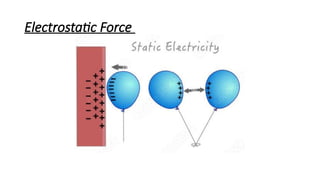
Repulsion and Attraction
Repulsion – Occurs between particles with the same electric charge.
(Both positive and negative).
Attraction – Pulls things closer together. (Opposing electric charges).
- Example of Repulsion and attraction is a balloon with the same charge
and an object with a negative charge.
Electrostatic Force
Electrostatic Force
Coulomb’s Law:
- At the center of the nucleus, there consists a subatomic particle also
known as the protons and the neutrons.
- Wheras electrons orbit the nucleus.
Electrostatic Force
Coulomb’s Law:
- Frenchman Charles Coulomb was the first to publish the
mathematical equation that describes the electrostatic force between
two objects.
- Coulomb’s law gives the magnitude of the force between point
charges.
- It is F=k|q1q2|/ r2, where q1 and q2 are two point charges separated
by a distance r, and k≈9×10^9 N m²/C².
⋅
- The formula may seem familiar from Newton’s Law of Gravitation.
Electrostatic Force
Coulomb’s Law:
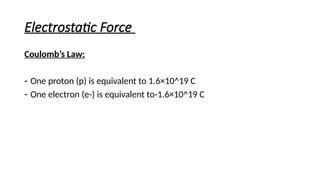
- One proton (p) is equivalent to 1.6×10^19 C
- One electron (e-) is equivalent to-1.6×10^19 C
Electrostatic Force
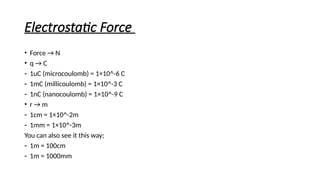
• Force → N
• q → C
- 1uC (microcoulomb) = 1×10^-6 C
- 1mC (millicoulomb) = 1×10^-3 C
- 1nC (nanocoulomb) = 1×10^-9 C
• r → m
- 1cm = 1×10^-2m
- 1mm = 1×10^-3m
You can also see it this way;
- 1m = 100cm
- 1m = 1000mm
Electrostatic Force
Coulomb’s Law:
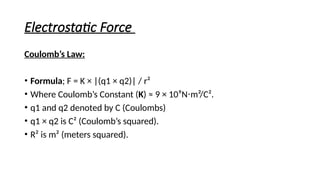
• Formula; F = K × |(q1 × q2)| / r²
• Where Coulomb’s Constant (K) ≈ 9 × 10⁹N m²/C².
⋅
• q1 and q2 denoted by C (Coulombs)
• q1 × q2 is C² (Coulomb’s squared).
• R² is m² (meters squared).
Electrostatic Force
Formula:
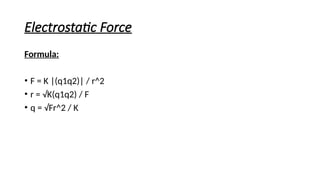
• F = K |(q1q2)| / r^2
• r = √K(q1q2) / F
• q = √Fr^2 / K
Electrostatic Force
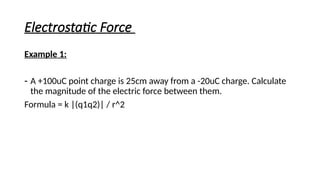
Example 1:
- A +100uC point charge is 25cm away from a -20uC charge. Calculate
the magnitude of the electric force between them.
Formula = k |(q1q2)| / r^2
Electrostatic Force
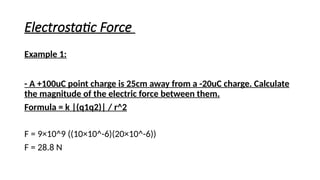
Example 1:
- A +100uC point charge is 25cm away from a -20uC charge. Calculate
the magnitude of the electric force between them.
Formula = k |(q1q2)| / r^2
F = 9×10^9 ((10×10^-6)(20×10^-6))
F = 28.8 N
Electrostatic Force
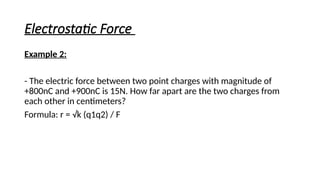
Example 2:
- The electric force between two point charges with magnitude of
+800nC and +900nC is 15N. How far apart are the two charges from
each other in centimeters?
Formula: r = √k (q1q2) / F
Electrostatic Force
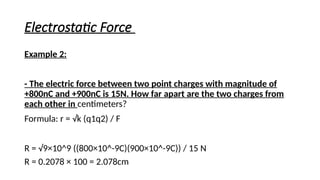
Example 2:
- The electric force between two point charges with magnitude of
+800nC and +900nC is 15N. How far apart are the two charges from
each other in centimeters?
Formula: r = √k (q1q2) / F
R = √9×10^9 ((800×10^-9C)(900×10^-9C)) / 15 N
R = 0.2078 × 100 = 2.078cm
Electrostatic Force
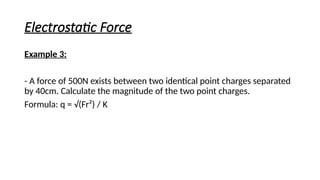
Example 3:
- A force of 500N exists between two identical point charges separated
by 40cm. Calculate the magnitude of the two point charges.
Formula: q = √(Fr²) / K
Electrostatic Force
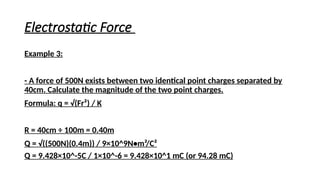
Example 3:
- A force of 500N exists between two identical point charges separated by
40cm. Calculate the magnitude of the two point charges.
Formula: q = √(Fr²) / K
R = 40cm ÷ 100m = 0.40m
Q = √((500N)(0.4m)) / 9×10^9N•m²/C²
Q = 9.428×10^-5C / 1×10^-6 = 9.428×10^1 mC (or 94.28 mC)
Electrostatic Force
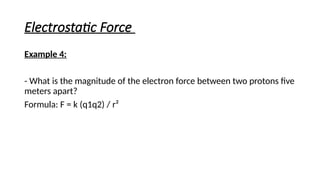
Example 4:
- What is the magnitude of the electron force between two protons five
meters apart?
Formula: F = k (q1q2) / r²
Electrostatic Force
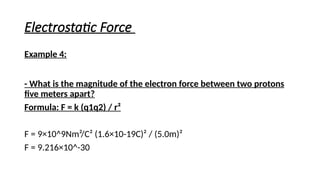
Example 4:
- What is the magnitude of the electron force between two protons
five meters apart?
Formula: F = k (q1q2) / r²
F = 9×10^9Nm²/C² (1.6×10⁻¹⁹C)² / (5.0m)²
F = 9.216×10^-30
Electrostatic Force
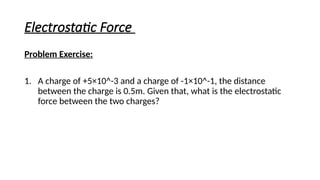
Problem Exercise:
1. A charge of +5×10^-3 and a charge of -1×10^-1, the distance
between the charge is 0.5m. Given that, what is the electrostatic
force between the two charges?
Electrostatic Force
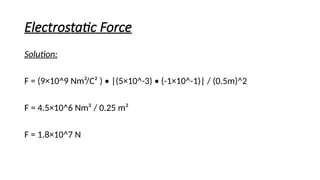
Solution:
F = (9×10^9 Nm²/C² ) • |(5×10^-3) • (-1×10^-1)| / (0.5m)^2
F = 4.5×10^6 Nm² / 0.25 m²
F = 1.8×10^7 N
For more information about this topic, you can watch this on YouTube;
https://youtu.be/kCp5yYjo9zE
https://youtu.be/VFbyDCG_j18
Electro Field
Electric Field
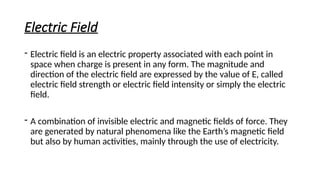
- Electric field is an electric property associated with each point in
space when charge is present in any form. The magnitude and
direction of the electric field are expressed by the value of E, called
electric field strength or electric field intensity or simply the electric
field.
- A combination of invisible electric and magnetic fields of force. They
are generated by natural phenomena like the Earth’s magnetic field
but also by human activities, mainly through the use of electricity.
Electric Field
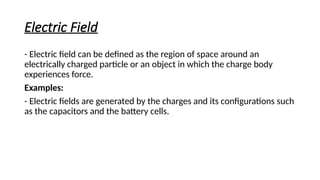
- Electric field can be defined as the region of space around an
electrically charged particle or an object in which the charge body
experiences force.
Examples:
- Electric fields are generated by the charges and its configurations such
as the capacitors and the battery cells.
Electric Field
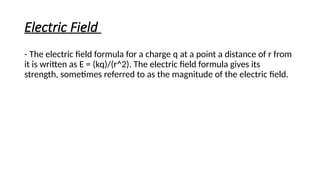
- The electric field formula for a charge q at a point a distance of r from
it is written as E = (kq)/(r^2). The electric field formula gives its
strength, sometimes referred to as the magnitude of the electric field.
Electric Field
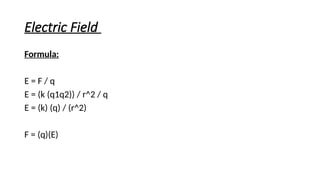
Formula:
E = F / q
E = (k (q1q2)) / r^2 / q
E = (k) (q) / (r^2)
F = (q)(E)
Electric Field
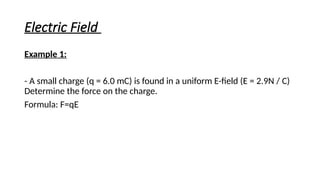
Example 1:
- A small charge (q = 6.0 mC) is found in a uniform E-field (E = 2.9N / C)
Determine the force on the charge.
Formula: F=qE
Electric Field
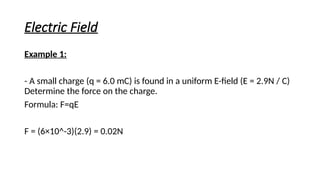
Example 1:
- A small charge (q = 6.0 mC) is found in a uniform E-field (E = 2.9N / C)
Determine the force on the charge.
Formula: F=qE
F = (6×10^-3)(2.9) = 0.02N
Electric Field
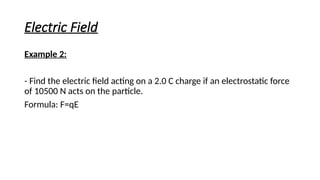
Example 2:
- Find the electric field acting on a 2.0 C charge if an electrostatic force
of 10500 N acts on the particle.
Formula: F=qE
Electric Field
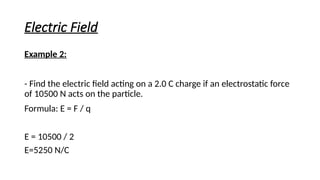
Example 2:
- Find the electric field acting on a 2.0 C charge if an electrostatic force
of 10500 N acts on the particle.
Formula: E = F / q
E = 10500 / 2
E=5250 N/C

Electrostatic Force, Electric Field.pptx

  • 1.
  • 2.
  • 3.
    Electrostatic Force Keywords: Electrostatic Charge/Charge- A fundamental property of matter. Particles that make up matter; • Positive, negative, and neutral. • Positive and negative interact with it each other.
  • 4.
    Electrostatic Force - Theelectrostatic force is an attractive and repulsive force between particles are caused due to their electric charges. - The electric force between stationary charged bodies is conventionally known as the electrostatic force. - It is also referred to as Coulomb’s force.
  • 5.
    Electrostatic Force Repulsion andAttraction Repulsion – Occurs between particles with the same electric charge. (Both positive and negative). Attraction – Pulls things closer together. (Opposing electric charges). - Example of Repulsion and attraction is a balloon with the same charge and an object with a negative charge.
  • 6.
  • 7.
    Electrostatic Force Coulomb’s Law: -At the center of the nucleus, there consists a subatomic particle also known as the protons and the neutrons. - Wheras electrons orbit the nucleus.
  • 8.
    Electrostatic Force Coulomb’s Law: -Frenchman Charles Coulomb was the first to publish the mathematical equation that describes the electrostatic force between two objects. - Coulomb’s law gives the magnitude of the force between point charges. - It is F=k|q1q2|/ r2, where q1 and q2 are two point charges separated by a distance r, and k≈9×10^9 N m²/C². ⋅ - The formula may seem familiar from Newton’s Law of Gravitation.
  • 9.
    Electrostatic Force Coulomb’s Law: -One proton (p) is equivalent to 1.6×10^19 C - One electron (e-) is equivalent to-1.6×10^19 C
  • 10.
    Electrostatic Force • Force→ N • q → C - 1uC (microcoulomb) = 1×10^-6 C - 1mC (millicoulomb) = 1×10^-3 C - 1nC (nanocoulomb) = 1×10^-9 C • r → m - 1cm = 1×10^-2m - 1mm = 1×10^-3m You can also see it this way; - 1m = 100cm - 1m = 1000mm
  • 11.
    Electrostatic Force Coulomb’s Law: •Formula; F = K × |(q1 × q2)| / r² • Where Coulomb’s Constant (K) ≈ 9 × 10⁹N m²/C². ⋅ • q1 and q2 denoted by C (Coulombs) • q1 × q2 is C² (Coulomb’s squared). • R² is m² (meters squared).
  • 12.
    Electrostatic Force Formula: • F= K |(q1q2)| / r^2 • r = √K(q1q2) / F • q = √Fr^2 / K
  • 13.
    Electrostatic Force Example 1: -A +100uC point charge is 25cm away from a -20uC charge. Calculate the magnitude of the electric force between them. Formula = k |(q1q2)| / r^2
  • 14.
    Electrostatic Force Example 1: -A +100uC point charge is 25cm away from a -20uC charge. Calculate the magnitude of the electric force between them. Formula = k |(q1q2)| / r^2 F = 9×10^9 ((10×10^-6)(20×10^-6)) F = 28.8 N
  • 15.
    Electrostatic Force Example 2: -The electric force between two point charges with magnitude of +800nC and +900nC is 15N. How far apart are the two charges from each other in centimeters? Formula: r = √k (q1q2) / F
  • 16.
    Electrostatic Force Example 2: -The electric force between two point charges with magnitude of +800nC and +900nC is 15N. How far apart are the two charges from each other in centimeters? Formula: r = √k (q1q2) / F R = √9×10^9 ((800×10^-9C)(900×10^-9C)) / 15 N R = 0.2078 × 100 = 2.078cm
  • 17.
    Electrostatic Force Example 3: -A force of 500N exists between two identical point charges separated by 40cm. Calculate the magnitude of the two point charges. Formula: q = √(Fr²) / K
  • 18.
    Electrostatic Force Example 3: -A force of 500N exists between two identical point charges separated by 40cm. Calculate the magnitude of the two point charges. Formula: q = √(Fr²) / K R = 40cm ÷ 100m = 0.40m Q = √((500N)(0.4m)) / 9×10^9N•m²/C² Q = 9.428×10^-5C / 1×10^-6 = 9.428×10^1 mC (or 94.28 mC)
  • 19.
    Electrostatic Force Example 4: -What is the magnitude of the electron force between two protons five meters apart? Formula: F = k (q1q2) / r²
  • 20.
    Electrostatic Force Example 4: -What is the magnitude of the electron force between two protons five meters apart? Formula: F = k (q1q2) / r² F = 9×10^9Nm²/C² (1.6×10⁻¹⁹C)² / (5.0m)² F = 9.216×10^-30
  • 21.
    Electrostatic Force Problem Exercise: 1.A charge of +5×10^-3 and a charge of -1×10^-1, the distance between the charge is 0.5m. Given that, what is the electrostatic force between the two charges?
  • 22.
    Electrostatic Force Solution: F =(9×10^9 Nm²/C² ) • |(5×10^-3) • (-1×10^-1)| / (0.5m)^2 F = 4.5×10^6 Nm² / 0.25 m² F = 1.8×10^7 N
  • 23.
    For more informationabout this topic, you can watch this on YouTube; https://youtu.be/kCp5yYjo9zE https://youtu.be/VFbyDCG_j18
  • 24.
  • 25.
    Electric Field - Electricfield is an electric property associated with each point in space when charge is present in any form. The magnitude and direction of the electric field are expressed by the value of E, called electric field strength or electric field intensity or simply the electric field. - A combination of invisible electric and magnetic fields of force. They are generated by natural phenomena like the Earth’s magnetic field but also by human activities, mainly through the use of electricity.
  • 26.
    Electric Field - Electricfield can be defined as the region of space around an electrically charged particle or an object in which the charge body experiences force. Examples: - Electric fields are generated by the charges and its configurations such as the capacitors and the battery cells.
  • 27.
    Electric Field - Theelectric field formula for a charge q at a point a distance of r from it is written as E = (kq)/(r^2). The electric field formula gives its strength, sometimes referred to as the magnitude of the electric field.
  • 28.
    Electric Field Formula: E =F / q E = (k (q1q2)) / r^2 / q E = (k) (q) / (r^2) F = (q)(E)
  • 29.
    Electric Field Example 1: -A small charge (q = 6.0 mC) is found in a uniform E-field (E = 2.9N / C) Determine the force on the charge. Formula: F=qE
  • 30.
    Electric Field Example 1: -A small charge (q = 6.0 mC) is found in a uniform E-field (E = 2.9N / C) Determine the force on the charge. Formula: F=qE F = (6×10^-3)(2.9) = 0.02N
  • 31.
    Electric Field Example 2: -Find the electric field acting on a 2.0 C charge if an electrostatic force of 10500 N acts on the particle. Formula: F=qE
  • 32.
    Electric Field Example 2: -Find the electric field acting on a 2.0 C charge if an electrostatic force of 10500 N acts on the particle. Formula: E = F / q E = 10500 / 2 E=5250 N/C