Transmission lines
Author: Irfan Sultan
Instructor (Telecom.)
Govt. College of Technology
Contents
 Introduction to Transmission Lines
 Transmission Line Parameters
 Transmission Line Equations
Transmission Lines
 A transmission line is a medium or structure which is used to carry an information
or data signal from one place to another.
 An information signal can be propagated in the following three forms:
 Electrical
 Optical (Light)
 Electromagnetic (EM) Wave
 Hence there are three main types of transmission lines:
 Wires
 Optical Fibers
 Waveguides
Transmission Lines
Wires Optical Fibers Waveguides
Transmission Line Parameters
 The quantities which are used to study or show the behavior of a transmission line
are called Primary Line Constants. These are normally called Transmission Line
Parameters.
 There are four Primary Line Constants.
 Resistance (R)
 Inductance (L)
 Capacitance (C)
 Conductance (G)
Transmission Line Parameters
 Transmission lines are modeled by means of the parameters resistance, inductance, capacitance
and conductance.
 Resistance and inductance together is called transmission line impedance.
 Capacitance and conductance in parallel is called admittance.
 Resistance: It is also called Loop Resistance per Unit Length. It is equal to the sum of the resistances of both
the conductors of a line. Its unit is Ω/m.
 Inductance: It is also called Loop Inductance per Unit Length. It is equal to the sum of the inductances of both
the conductors of a line. Its unit is H/m.
 Capacitance: It is denoted by C. it is equal to the shunt capacitance per unit length b/w two conductors. Its
unit is farad/m.
 Conductance: It is denoted by G. It is equal to the shunt conductance per unit length b/w two conductors. It is
reciprocal of resistance and is measured in Siemens/m or mho/m.
 Note: R, L, G and C are also called Primary Line Constants of Transmission Line. These values, normally,
vary with frequency but in transmission line theory they are assumed constant.
Transmission Line Equations
 The quantities which are used to study or show the effects on a signal which
propagates through a transmission line are known as Secondary Line Constants,
and the equations which are used for these secondary line constants are called
Transmission Line Equations.
 There are the following basic three secondary line constants:
 Attenuation Coefficient
 Phase Shift Coefficient
 Propagation Coefficient
 There are other secondary line constants too (Phase velocity, Velocity Factor and
Wavelength) but they are out of the scope of this chapter.
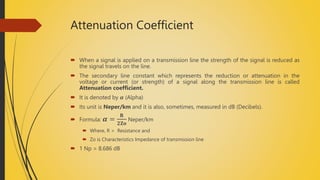
Attenuation Coefficient
 When a signal is applied on a transmission line the strength of the signal is reduced as
the signal travels on the line.
 The secondary line constant which represents the reduction or attenuation in the
voltage or current (or strength) of a signal along the transmission line is called
Attenuation coefficient.
 It is denoted by 𝜶 (Alpha)
 Its unit is Neper/km and it is also, sometimes, measured in dB (Decibels).
 Formula: 𝜶 =
𝐑
𝟐𝐙𝐨
Neper/km
 Where, R = Resistance and
 Zo is Characteristics Impedance of transmission line
 1 Np = 8.686 dB

Transmission lines

  • 1.
    Transmission lines Author: IrfanSultan Instructor (Telecom.) Govt. College of Technology
  • 2.
    Contents  Introduction toTransmission Lines  Transmission Line Parameters  Transmission Line Equations
  • 3.
    Transmission Lines  Atransmission line is a medium or structure which is used to carry an information or data signal from one place to another.  An information signal can be propagated in the following three forms:  Electrical  Optical (Light)  Electromagnetic (EM) Wave  Hence there are three main types of transmission lines:  Wires  Optical Fibers  Waveguides
  • 4.
  • 5.
    Transmission Line Parameters The quantities which are used to study or show the behavior of a transmission line are called Primary Line Constants. These are normally called Transmission Line Parameters.  There are four Primary Line Constants.  Resistance (R)  Inductance (L)  Capacitance (C)  Conductance (G)
  • 6.
    Transmission Line Parameters Transmission lines are modeled by means of the parameters resistance, inductance, capacitance and conductance.  Resistance and inductance together is called transmission line impedance.  Capacitance and conductance in parallel is called admittance.  Resistance: It is also called Loop Resistance per Unit Length. It is equal to the sum of the resistances of both the conductors of a line. Its unit is Ω/m.  Inductance: It is also called Loop Inductance per Unit Length. It is equal to the sum of the inductances of both the conductors of a line. Its unit is H/m.  Capacitance: It is denoted by C. it is equal to the shunt capacitance per unit length b/w two conductors. Its unit is farad/m.  Conductance: It is denoted by G. It is equal to the shunt conductance per unit length b/w two conductors. It is reciprocal of resistance and is measured in Siemens/m or mho/m.  Note: R, L, G and C are also called Primary Line Constants of Transmission Line. These values, normally, vary with frequency but in transmission line theory they are assumed constant.
  • 7.
    Transmission Line Equations The quantities which are used to study or show the effects on a signal which propagates through a transmission line are known as Secondary Line Constants, and the equations which are used for these secondary line constants are called Transmission Line Equations.  There are the following basic three secondary line constants:  Attenuation Coefficient  Phase Shift Coefficient  Propagation Coefficient  There are other secondary line constants too (Phase velocity, Velocity Factor and Wavelength) but they are out of the scope of this chapter.
  • 8.
    Attenuation Coefficient  Whena signal is applied on a transmission line the strength of the signal is reduced as the signal travels on the line.  The secondary line constant which represents the reduction or attenuation in the voltage or current (or strength) of a signal along the transmission line is called Attenuation coefficient.  It is denoted by 𝜶 (Alpha)  Its unit is Neper/km and it is also, sometimes, measured in dB (Decibels).  Formula: 𝜶 = 𝐑 𝟐𝐙𝐨 Neper/km  Where, R = Resistance and  Zo is Characteristics Impedance of transmission line  1 Np = 8.686 dB