CTD & eCTD
10/18/2019CTD & eCTD1
PRESENTED BY
Mr.Shubham Jalindar Gore
F.Y.MPHARM (PHARMACEUTICS)
GUIDED BY
Dr. Vishal V. Pande
HOD of Pharmaceutics Dept.
SANJIVANI COLLEGE OF PHARMACEUTICAL EDUCATION AND
RESEARCH, KOPARGAON
CONTENTS
10/18/2019CTD & eCTD2
 Introduction
 Objective
 CTD
 CTD structure
 eCTD
 eCTD submission
 eCTD Implementation
 Conclusion
 Reference
INTRODUCTION
10/18/2019CTD & eCTD3
 There is a joint initiative involving both regulators and
research‐based industry representatives of the European
Union, Japan and the USA in scientific and technical
discussions of the testing procedures required to assess and
ensure the safety, quality and efficacy of medicines.
CTD
10/18/2019CTD & eCTD4
 The CTD was agreed upon in November 2000, at 5th ICH
Conference in San Diego, USA.
 The purpose of this Common Technical Document (CTD)
is to provide a harmonized structure and format for new
product applications (marketing authorization).
 The use of the CTD format is mandatory as from 1 July
2003 in the European Union.
 Should not exceed 40 pages (USFDA)
OBJECTIVE
10/18/2019CTD & eCTD5
 The objective is to increase international
harmonization of technical requirements to ensure
that safe, effective, and high quality medicines are
developed and registered in the most efficient and
cost‐effective manner.
 Activities have been undertaken to promote public
health, prevent unnecessary duplication.
CTD Structure:
10/18/2019CTD & eCTD6
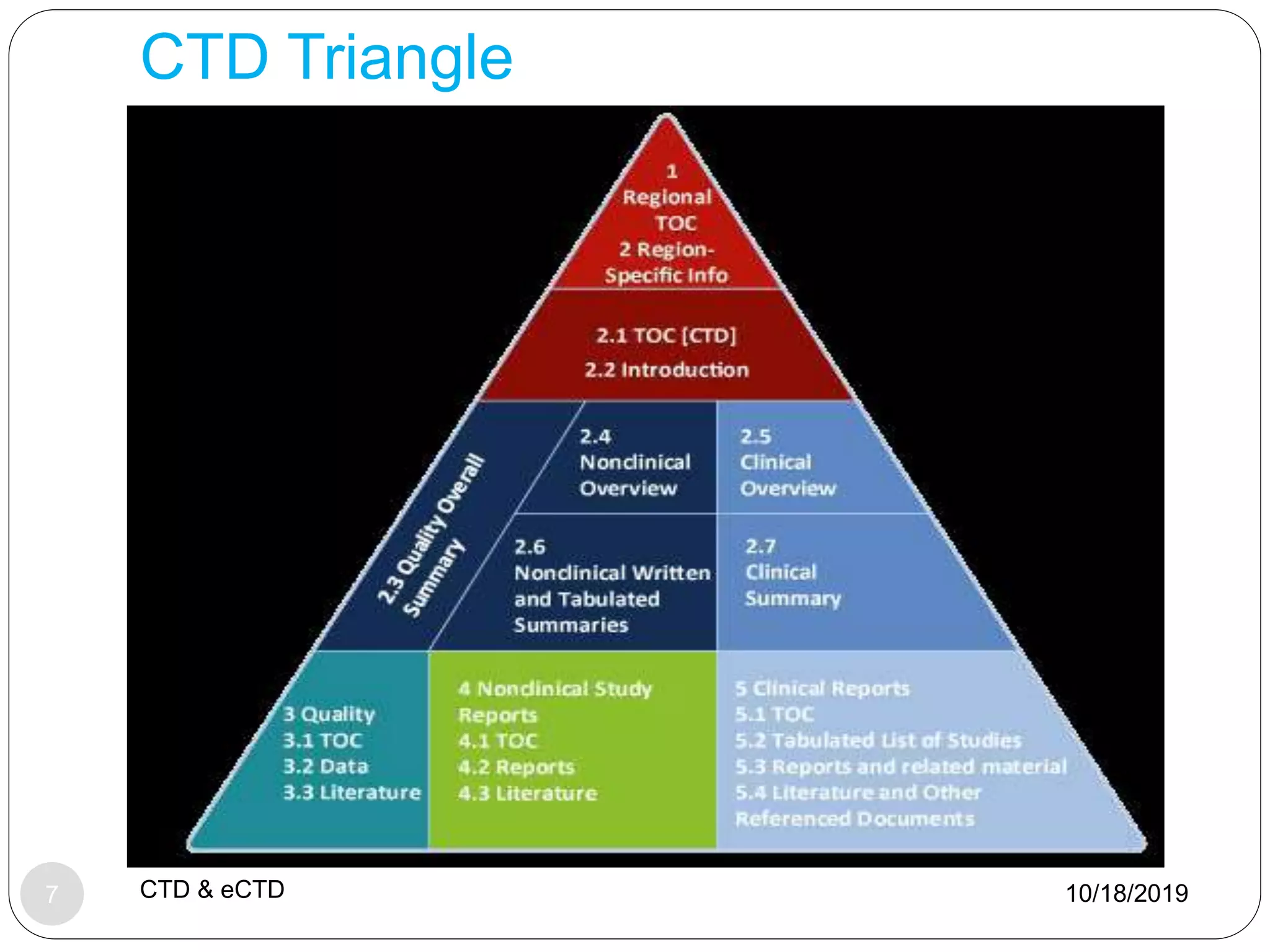
 The CTD has five modules in two categories.
There are 1. Regional module which includes only Module
1 - Administrative information and prescribing information -
not harmonized - different for each region; i.e., country,
defined by each of the ICH regions(USA, Europe and
Japan).
2. Common modules: which includes module 2 – 5
(Harmonized - common to all the regions)
Module 2 - Common technical document summaries
Module 3 - Quality
Module 4 - Nonclinical study reports
Module 5 - Clinical study reports
CTD Triangle
10/18/2019CTD & eCTD7
Module 1-Administrative information and prescribing information
10/18/2019CTD & eCTD8
 This module contains administrative information that is unique
for each region.
 Regional guidance will provide the specific instructions on
how to provide the administrative formats and detailed
prescribing information
-Cover Letter
- Comprehensive Table of Content
-Application Form
-Product Information
Module 2- Overall Summaries
10/18/2019CTD & eCTD9
 This module contains overall summaries of quality, non-clinical and
clinical.
 Table of Content (Comprehensive)
 Introduction (general introduction to the pharmaceutical, including its
pharmacology class, mode of action, and proposed clinical use)
 Quality Overall Summary
 Non-clinical Overview
 Clinical Overview
 Non-clinical Written and Tabulated Summaries
 Clinical Summary Biopharmaceutics and Associated Analytical
Methods & Clinical Pharmacology .
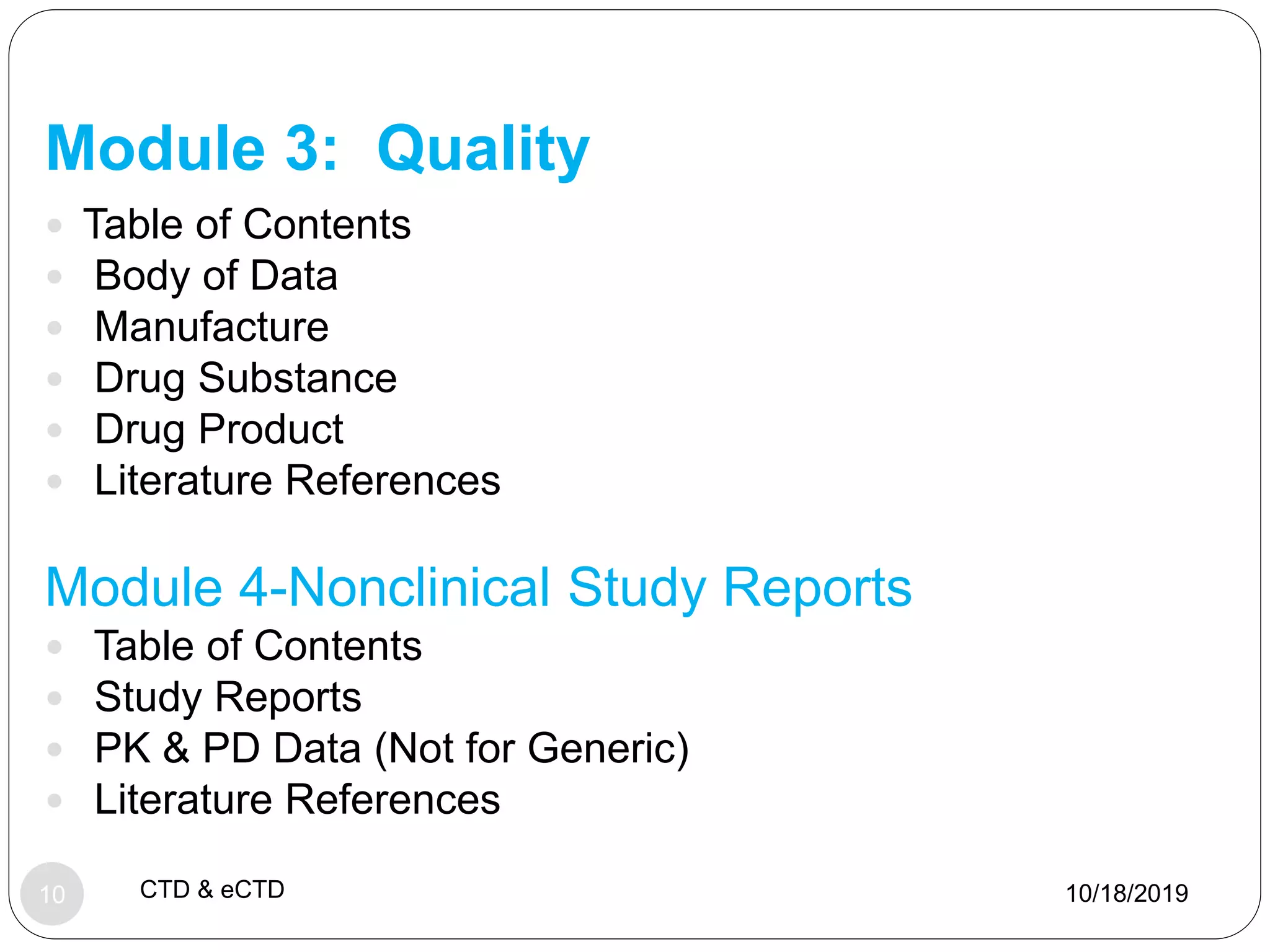
Module 3: Quality
10/18/2019CTD & eCTD10
 Table of Contents
 Body of Data
 Manufacture
 Drug Substance
 Drug Product
 Literature References
Module 4-Nonclinical Study Reports
 Table of Contents
 Study Reports
 PK & PD Data (Not for Generic)
 Literature References
Module 5: Clinical Study Reports
10/18/2019CTD & eCTD11
 Module 5 Table of Contents
 Tabular Listing of All Clinical Studies
 Clinical Study Reports
 Literature References
eCTD
10/18/2019CTD & eCTD12
 The eCTD is the electronic equivalent to the CTD.
 eCTD is a superior technology Establish a single
application format for all applications Avoids expensive
internal processes and systems for receiving and archiving
applications.
 Jan 1, 2008, eCTD became CDER’s standard for electronic
submission.
 FDA has made it mandatory for all ELECTRONIC
submissions to be in eCTD format since 2007-08.
However, paper copies are still accepted. Suitable waivers
will have to be taken before hand.
 Should not exceed 400 MB (FDA)
eCTD
10/18/2019CTD & eCTD13
 Why electronic ?
 Electronic submission give more accountability and ease
decision making process Handling paper an uphill task and quite
subjective
 –Improve the submission and review process
 –Increase accuracy of the submission
 –Decrease total costs
 This specification has been developed by the ICH M2 Expert
Working group and maintained by the eCTD Implementation
Working group in accordance with the ICH Process.
eCTD submission
10/18/2019CTD & eCTD14
The eCTD submission is composed of the following:
 Directory structure
 XML eCTD instance
 Content files
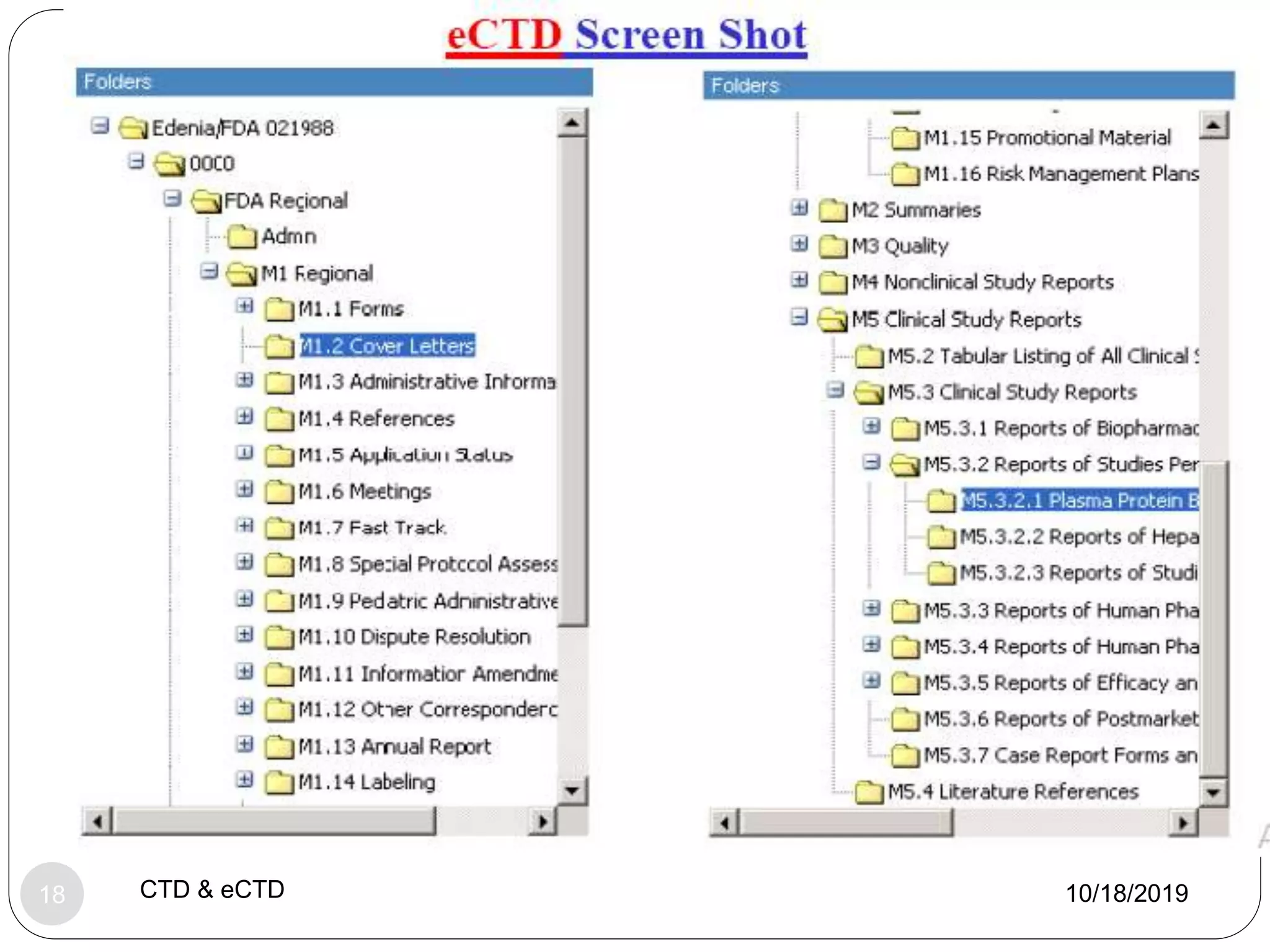
Directory Structure
10/18/2019CTD & eCTD15
 The directory structure is a structure of directories and files.
 There should be a reasonable maximum number of entries
(directories and files) per directory.
 The directory structure should follow the rules below The name
of the files and directories are identifiers.
 Any directory names and file names that are added to the eCTD
submission by the applicant should be descriptive, logical and
brief.
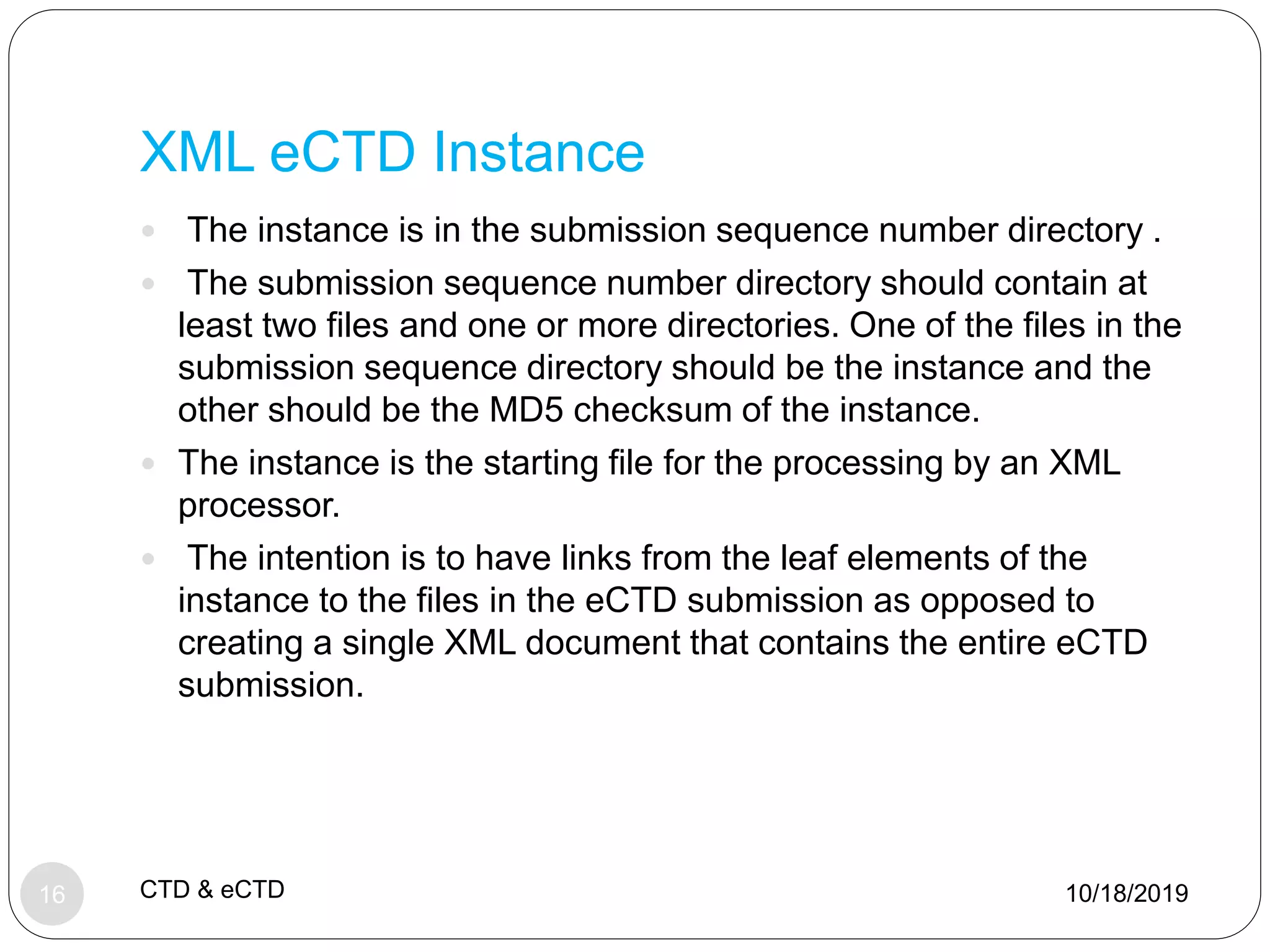
XML eCTD Instance
10/18/2019CTD & eCTD16
 The instance is in the submission sequence number directory .
 The submission sequence number directory should contain at
least two files and one or more directories. One of the files in the
submission sequence directory should be the instance and the
other should be the MD5 checksum of the instance.
 The instance is the starting file for the processing by an XML
processor.
 The intention is to have links from the leaf elements of the
instance to the files in the eCTD submission as opposed to
creating a single XML document that contains the entire eCTD
submission.
Content files
10/18/2019CTD & eCTD17
 The common formats that can be included in an eCTD
submission are:
 Narrative: Portable Document Format (PDF)
 Structured: Extensible Markup Language (XML)
 Graphic: Whenever possible, use PDF.
 When appropriate or when PDF is not possible, use
 Joint Photographic Experts Group (JPEG),
 Portable Network Graphics (PNG)
 Scalable Vector Graphics (SVG)
 Graphics Interchange Format (GIF).
10/18/2019CTD & eCTD18
10/18/2019CTD & eCTD19
10/18/2019CTD & eCTD20
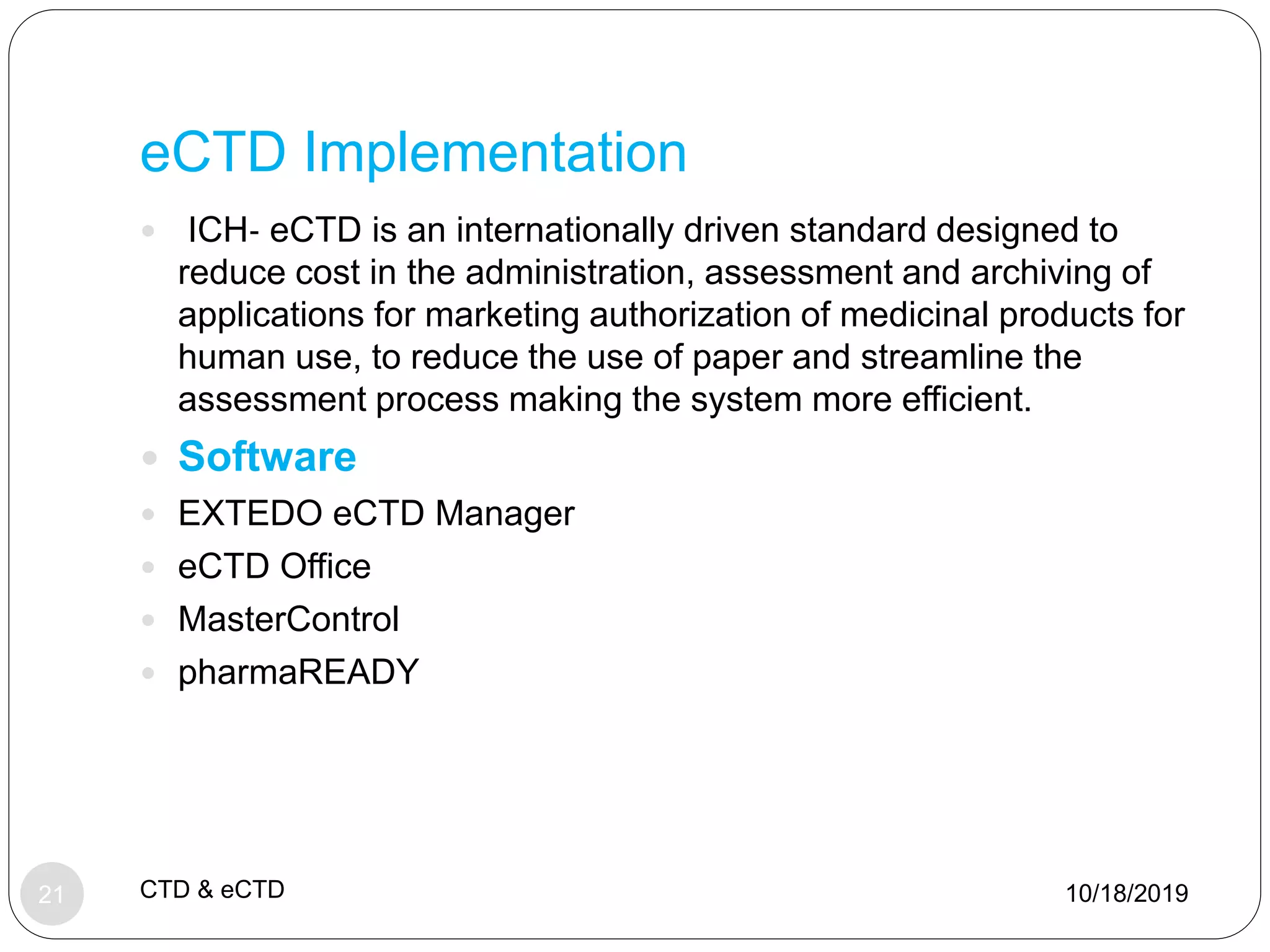
eCTD Implementation
10/18/2019CTD & eCTD21
 ICH‐ eCTD is an internationally driven standard designed to
reduce cost in the administration, assessment and archiving of
applications for marketing authorization of medicinal products for
human use, to reduce the use of paper and streamline the
assessment process making the system more efficient.
 Software
 EXTEDO eCTD Manager
 eCTD Office
 MasterControl
 pharmaREADY
Conclusion
10/18/2019CTD & eCTD22
 CTD Summaries are key tools for agency review Summaries can
be the basis for internal planning, review, and tracking
Summaries should assess risk and provide scientific rationales
CTD-ready documents enhance efficiency throughout
development
 This promotes clear communication, transparency, and
teamwork Submission-ready documents written with CTD/ eCTD
templates from IND to NDA enhance efficiency CTD document
management facilitates traceability in quality systems
REFERENCE
10/18/2019CTD & eCTD23
 www.ich.org.
 http:/www.fda.gov.
10/18/2019CTD & eCTD24

Ctd & ectd

  • 1.
    CTD & eCTD 10/18/2019CTD& eCTD1 PRESENTED BY Mr.Shubham Jalindar Gore F.Y.MPHARM (PHARMACEUTICS) GUIDED BY Dr. Vishal V. Pande HOD of Pharmaceutics Dept. SANJIVANI COLLEGE OF PHARMACEUTICAL EDUCATION AND RESEARCH, KOPARGAON
  • 2.
    CONTENTS 10/18/2019CTD & eCTD2 Introduction  Objective  CTD  CTD structure  eCTD  eCTD submission  eCTD Implementation  Conclusion  Reference
  • 3.
    INTRODUCTION 10/18/2019CTD & eCTD3 There is a joint initiative involving both regulators and research‐based industry representatives of the European Union, Japan and the USA in scientific and technical discussions of the testing procedures required to assess and ensure the safety, quality and efficacy of medicines.
  • 4.
    CTD 10/18/2019CTD & eCTD4 The CTD was agreed upon in November 2000, at 5th ICH Conference in San Diego, USA.  The purpose of this Common Technical Document (CTD) is to provide a harmonized structure and format for new product applications (marketing authorization).  The use of the CTD format is mandatory as from 1 July 2003 in the European Union.  Should not exceed 40 pages (USFDA)
  • 5.
    OBJECTIVE 10/18/2019CTD & eCTD5 The objective is to increase international harmonization of technical requirements to ensure that safe, effective, and high quality medicines are developed and registered in the most efficient and cost‐effective manner.  Activities have been undertaken to promote public health, prevent unnecessary duplication.
  • 6.
    CTD Structure: 10/18/2019CTD &eCTD6  The CTD has five modules in two categories. There are 1. Regional module which includes only Module 1 - Administrative information and prescribing information - not harmonized - different for each region; i.e., country, defined by each of the ICH regions(USA, Europe and Japan). 2. Common modules: which includes module 2 – 5 (Harmonized - common to all the regions) Module 2 - Common technical document summaries Module 3 - Quality Module 4 - Nonclinical study reports Module 5 - Clinical study reports
  • 7.
  • 8.
    Module 1-Administrative informationand prescribing information 10/18/2019CTD & eCTD8  This module contains administrative information that is unique for each region.  Regional guidance will provide the specific instructions on how to provide the administrative formats and detailed prescribing information -Cover Letter - Comprehensive Table of Content -Application Form -Product Information
  • 9.
    Module 2- OverallSummaries 10/18/2019CTD & eCTD9  This module contains overall summaries of quality, non-clinical and clinical.  Table of Content (Comprehensive)  Introduction (general introduction to the pharmaceutical, including its pharmacology class, mode of action, and proposed clinical use)  Quality Overall Summary  Non-clinical Overview  Clinical Overview  Non-clinical Written and Tabulated Summaries  Clinical Summary Biopharmaceutics and Associated Analytical Methods & Clinical Pharmacology .
  • 10.
    Module 3: Quality 10/18/2019CTD& eCTD10  Table of Contents  Body of Data  Manufacture  Drug Substance  Drug Product  Literature References Module 4-Nonclinical Study Reports  Table of Contents  Study Reports  PK & PD Data (Not for Generic)  Literature References
  • 11.
    Module 5: ClinicalStudy Reports 10/18/2019CTD & eCTD11  Module 5 Table of Contents  Tabular Listing of All Clinical Studies  Clinical Study Reports  Literature References
  • 12.
    eCTD 10/18/2019CTD & eCTD12 The eCTD is the electronic equivalent to the CTD.  eCTD is a superior technology Establish a single application format for all applications Avoids expensive internal processes and systems for receiving and archiving applications.  Jan 1, 2008, eCTD became CDER’s standard for electronic submission.  FDA has made it mandatory for all ELECTRONIC submissions to be in eCTD format since 2007-08. However, paper copies are still accepted. Suitable waivers will have to be taken before hand.  Should not exceed 400 MB (FDA)
  • 13.
    eCTD 10/18/2019CTD & eCTD13 Why electronic ?  Electronic submission give more accountability and ease decision making process Handling paper an uphill task and quite subjective  –Improve the submission and review process  –Increase accuracy of the submission  –Decrease total costs  This specification has been developed by the ICH M2 Expert Working group and maintained by the eCTD Implementation Working group in accordance with the ICH Process.
  • 14.
    eCTD submission 10/18/2019CTD &eCTD14 The eCTD submission is composed of the following:  Directory structure  XML eCTD instance  Content files
  • 15.
    Directory Structure 10/18/2019CTD &eCTD15  The directory structure is a structure of directories and files.  There should be a reasonable maximum number of entries (directories and files) per directory.  The directory structure should follow the rules below The name of the files and directories are identifiers.  Any directory names and file names that are added to the eCTD submission by the applicant should be descriptive, logical and brief.
  • 16.
    XML eCTD Instance 10/18/2019CTD& eCTD16  The instance is in the submission sequence number directory .  The submission sequence number directory should contain at least two files and one or more directories. One of the files in the submission sequence directory should be the instance and the other should be the MD5 checksum of the instance.  The instance is the starting file for the processing by an XML processor.  The intention is to have links from the leaf elements of the instance to the files in the eCTD submission as opposed to creating a single XML document that contains the entire eCTD submission.
  • 17.
    Content files 10/18/2019CTD &eCTD17  The common formats that can be included in an eCTD submission are:  Narrative: Portable Document Format (PDF)  Structured: Extensible Markup Language (XML)  Graphic: Whenever possible, use PDF.  When appropriate or when PDF is not possible, use  Joint Photographic Experts Group (JPEG),  Portable Network Graphics (PNG)  Scalable Vector Graphics (SVG)  Graphics Interchange Format (GIF).
  • 18.
  • 19.
  • 20.
  • 21.
    eCTD Implementation 10/18/2019CTD &eCTD21  ICH‐ eCTD is an internationally driven standard designed to reduce cost in the administration, assessment and archiving of applications for marketing authorization of medicinal products for human use, to reduce the use of paper and streamline the assessment process making the system more efficient.  Software  EXTEDO eCTD Manager  eCTD Office  MasterControl  pharmaREADY
  • 22.
    Conclusion 10/18/2019CTD & eCTD22 CTD Summaries are key tools for agency review Summaries can be the basis for internal planning, review, and tracking Summaries should assess risk and provide scientific rationales CTD-ready documents enhance efficiency throughout development  This promotes clear communication, transparency, and teamwork Submission-ready documents written with CTD/ eCTD templates from IND to NDA enhance efficiency CTD document management facilitates traceability in quality systems
  • 23.
    REFERENCE 10/18/2019CTD & eCTD23 www.ich.org.  http:/www.fda.gov.
  • 24.