A seminar on
CTD and eCTD
By
Salunkhe nikhil jayvant
Under the guidance of
Mrs. A. K. Salunkhe
NEED OF CTD…
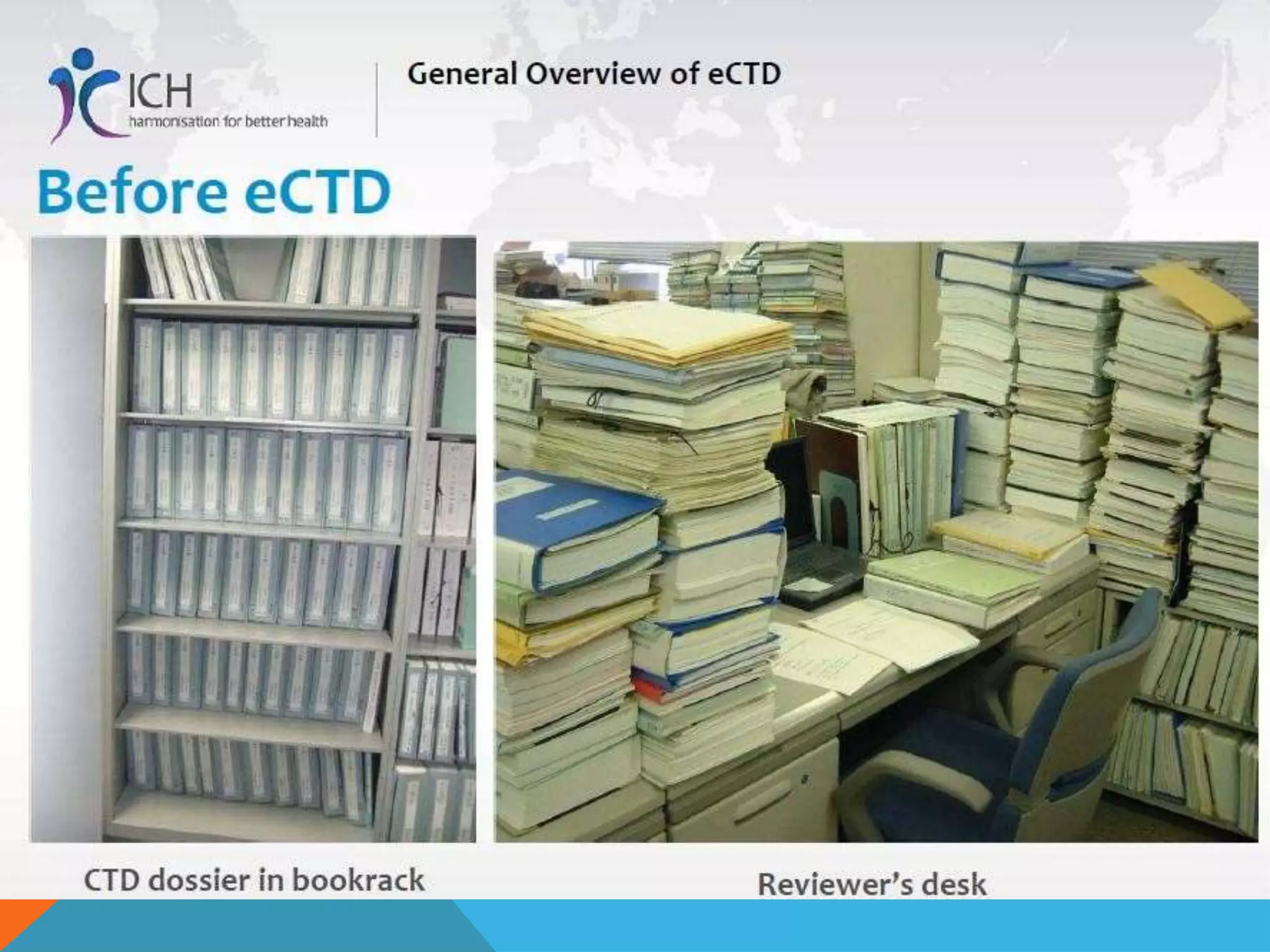
Initially to obtain permission for export/import it was mandatory to
submit different documents and large amount of data
For organising information each applicants were try to use different
approaches
It leads to …
Approval process more complex
Reviewing process more difficult
Omission of critical data or analyses
Result in unnecessary delays in approvals.
Thus, there was need of a common format of submission which will help in
overcoming these hurdles
HISTORY
1996: Industry proposed CTD but ICH regulators were hesitant to
the review process
Regulators asked industry to do a feasibility study.
May 1996: Study was conducted to evaluate the time took to convert
an FDA new drug application into an European Medicines Agency
(EMA) submission and the reverse.
Regulators quickly saw the potential value of harmonizing
submission formats
Nov 2000: CTD was officially signed at San Diego, USA.
a new
1 July 2003: The use of the CTD format is mandatory.
Nov 2005: The ICH Steering Committee adopted
codification system
2009: India adopt CTD format for Technical requirements for
registration of biological products
WHAT IS CTD?
dossierThe CTD is a set of specifications of a
(Record/Documents) for the registration of medicines.
CTD is an internationally agreed “well structured common
format” for the organization of the technical requirements that
is to be submitted to the regulatory authority as an application
for the registration of pharmaceuticals for human use in all
three ICH regions
The purpose of this Common Technical Document
(CTD) is to provide a harmonised structure and
format for new product applications.
The CTD guidance indicates where and how, available
information is to be presented.
The CTD is not intended to indicate what studies are
actually required.
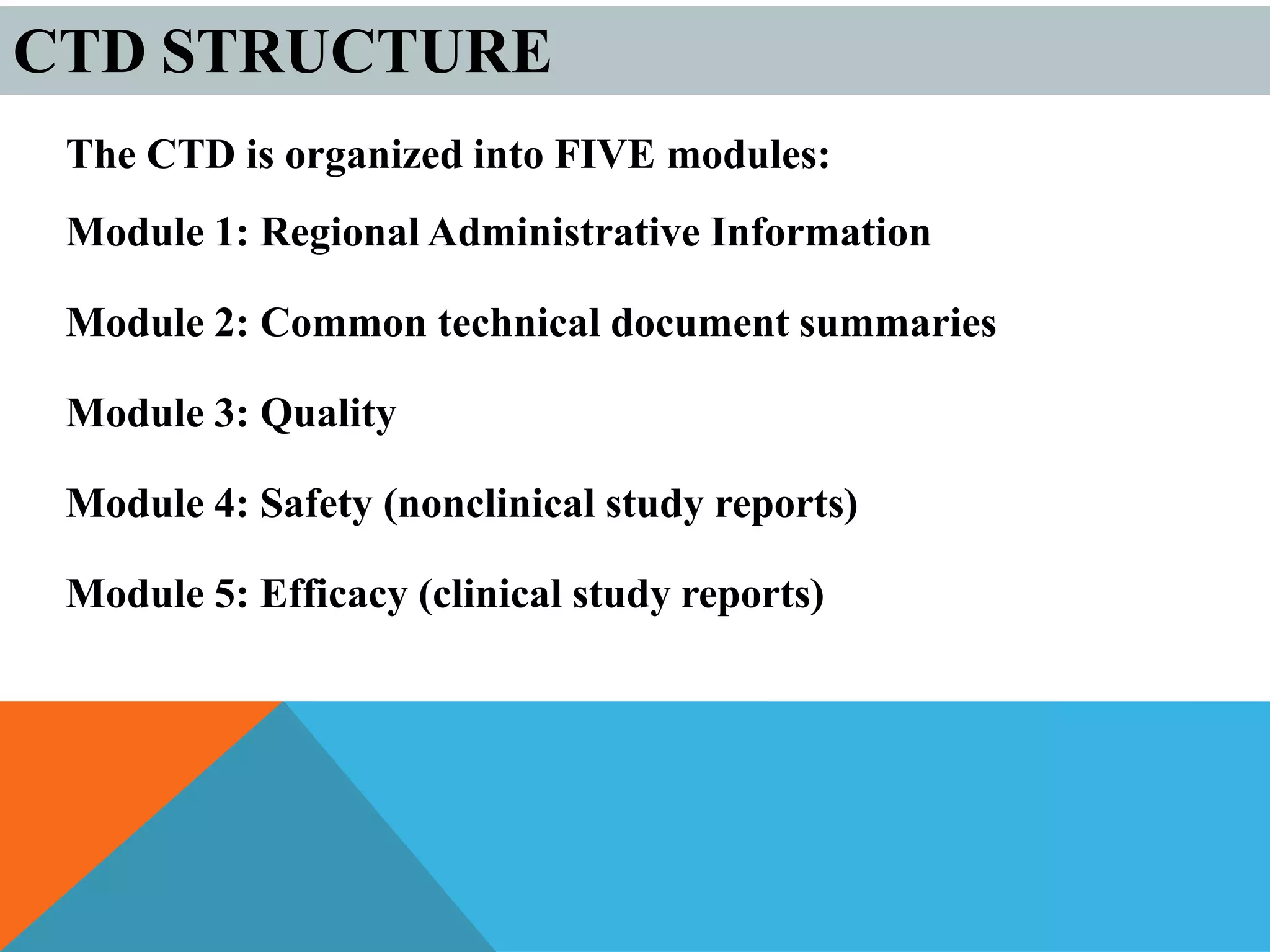
CTD STRUCTURE
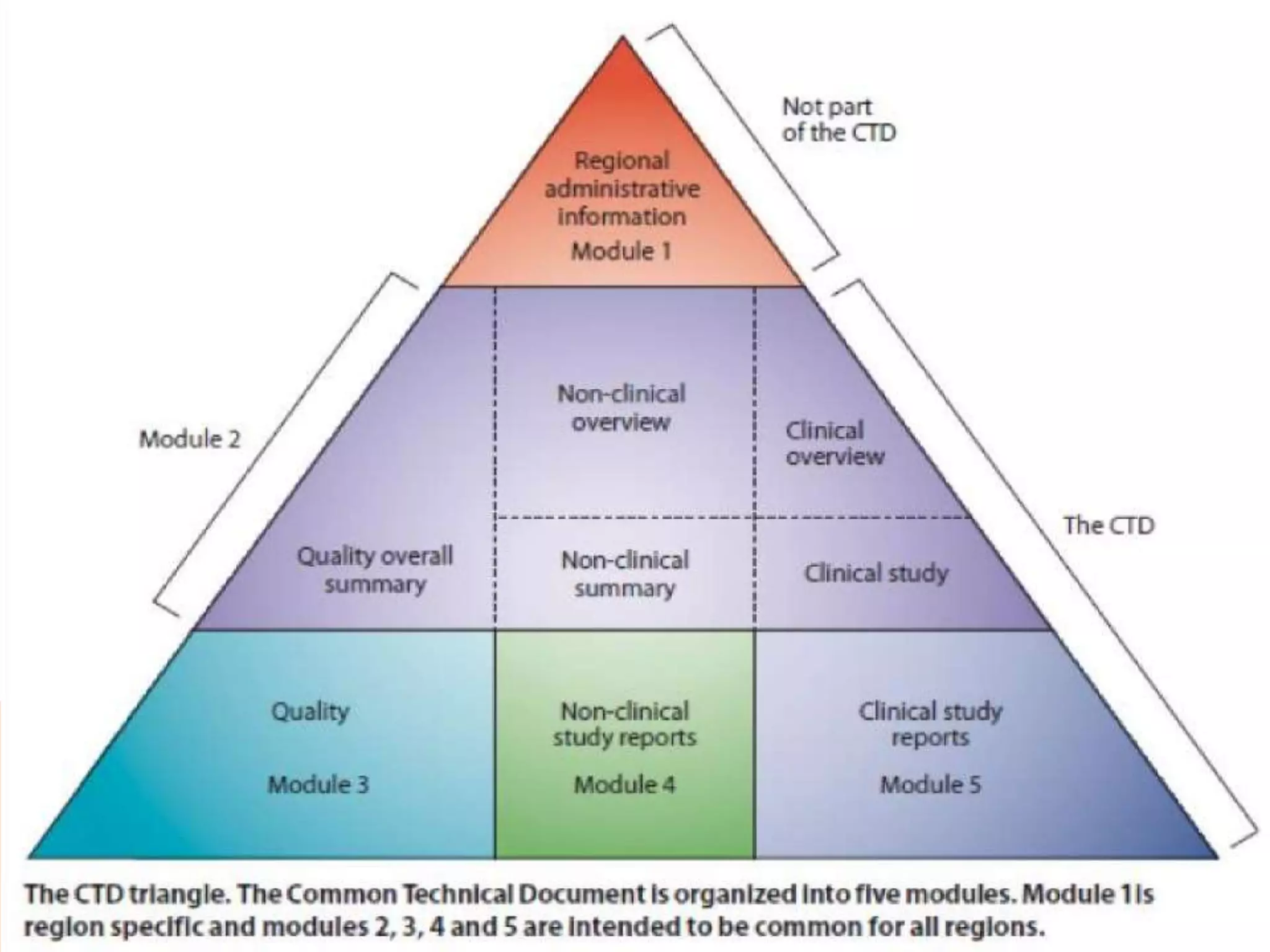
The CTD is organized into FIVE modules:
Module 1: Regional Administrative Information
Module 2: Common technical document summaries
Module 3: Quality
Module 4: Safety (nonclinical study reports)
Module 5: Efficacy (clinical study reports)
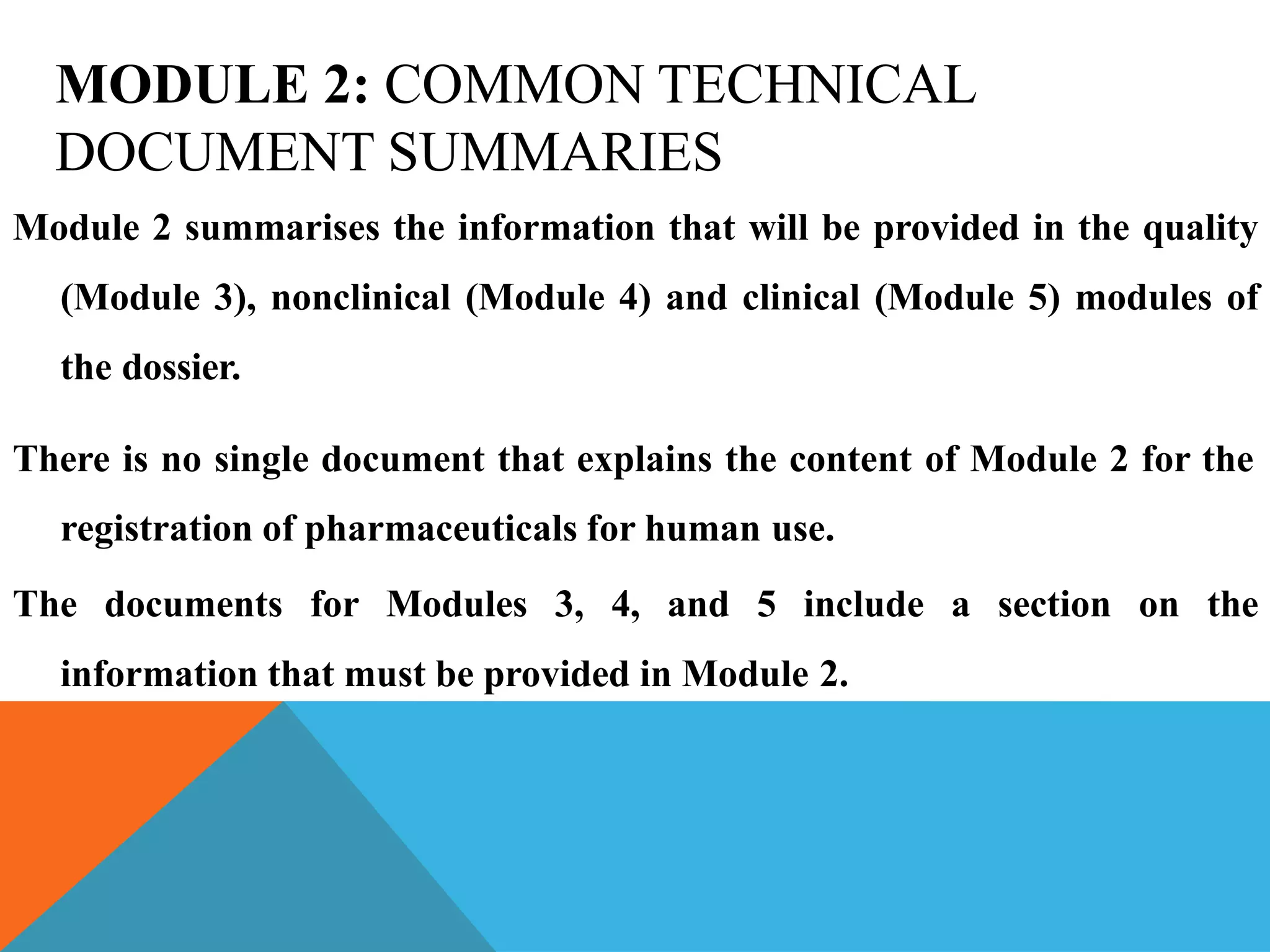
MODULE 2: COMMON TECHNICAL
DOCUMENT SUMMARIES
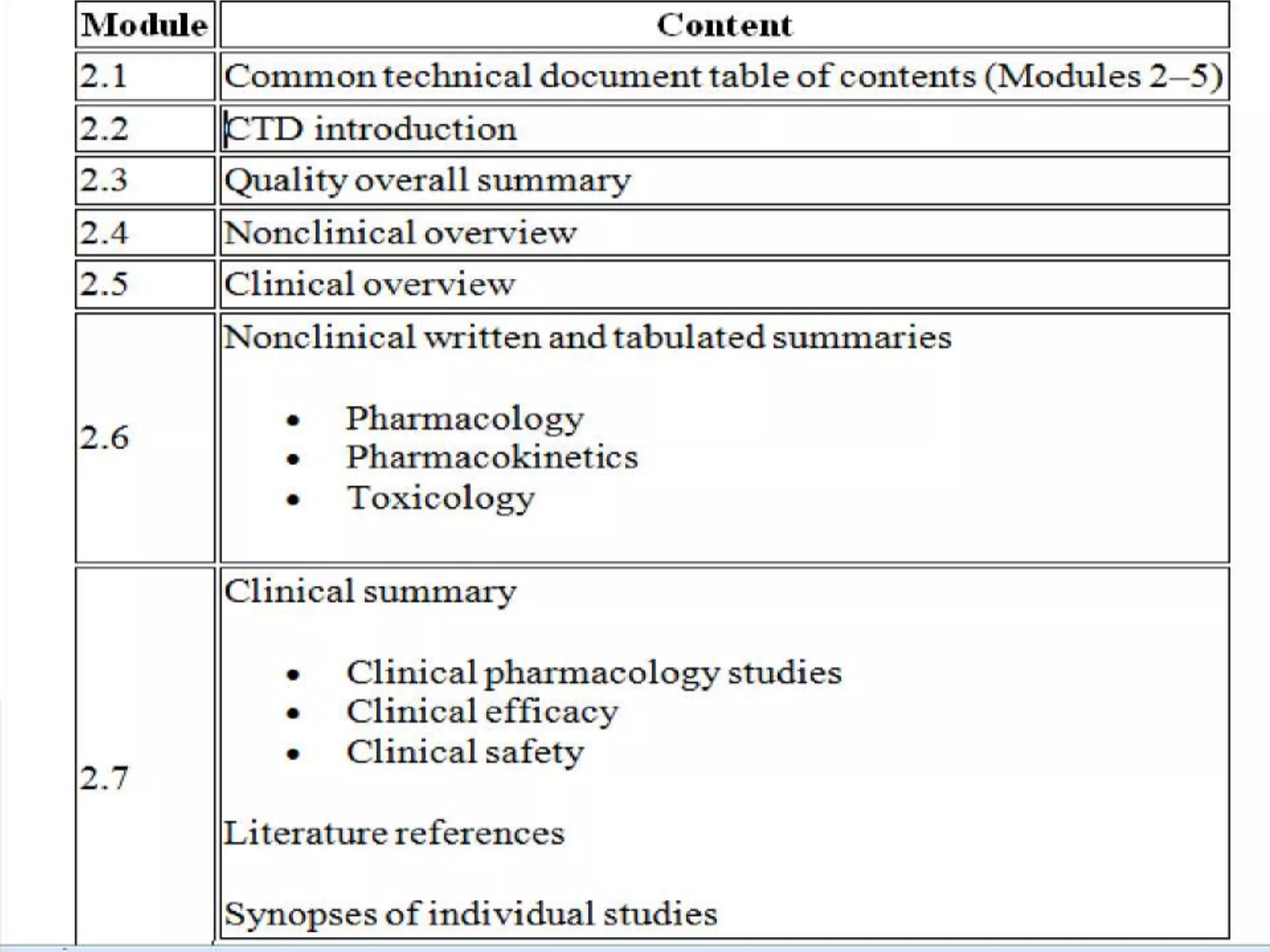
Module 2 summarises the information that will be provided in the quality
(Module 3), nonclinical (Module 4) and clinical (Module 5) modules of
the dossier.
There is no single document that explains the content of Module 2 for the
registration of pharmaceuticals for human use.
The documents for Modules 3, 4, and 5 include a section on the
information that must be provided in Module 2.
MODULE 3: QUALITY
Module 3 describes the format and organisation of
the chemical, pharmaceutical and biological data
relevant to the application.
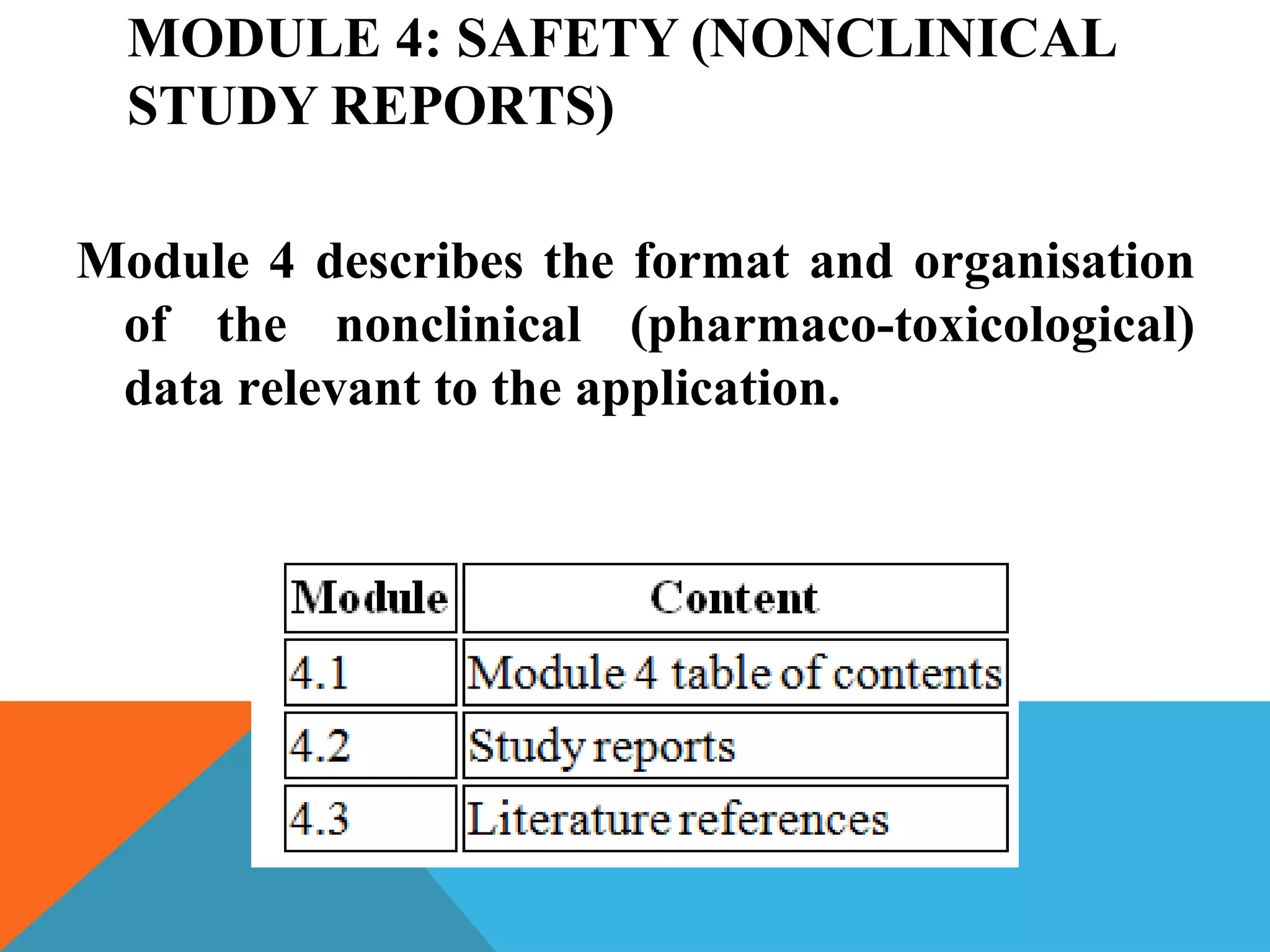
MODULE 4: SAFETY (NONCLINICAL
STUDY REPORTS)
Module 4 describes the format and organisation
of the nonclinical (pharmaco-toxicological)
data relevant to the application.
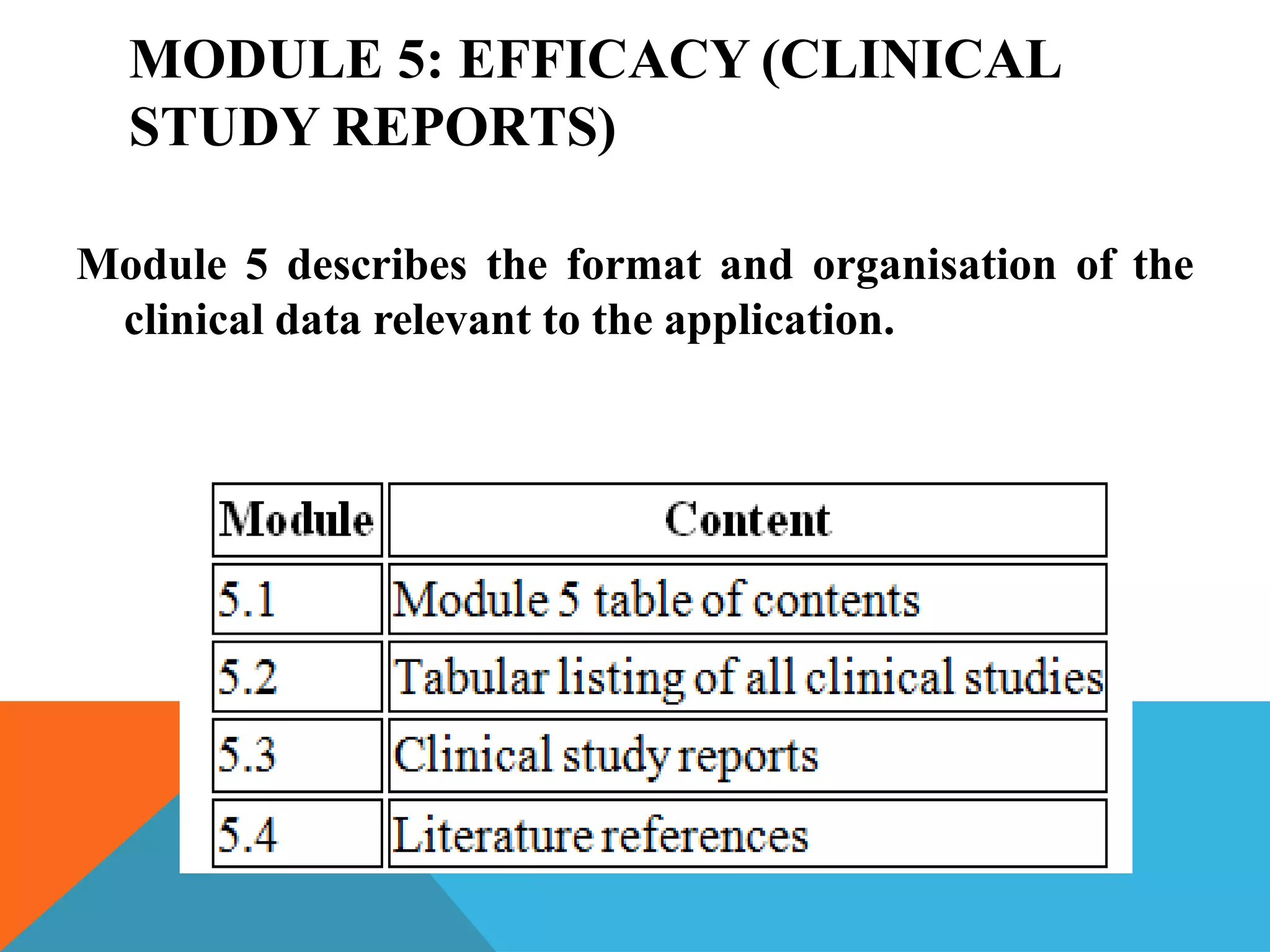
MODULE 5: EFFICACY (CLINICAL
STUDY REPORTS)
Module 5 describes the format and organisation of the
clinical data relevant to the application.
After 6 months of CTD acceptance, in May 2001 eCTD was agreed
by Multidisciplinary 2, Expert Working Group (ICH M2 EWG).
It is maintained by eCTD Implementation Working group (IWG)
in accordance with the ICH Process.
The eCTD is defined as „an interface for industry to agency transfer
of regulatory information while at the same time taking into
consideration the facilitation of the creation, review, lifecycle
management and archival of the electronic submission’.
The eCTD specification lists the criteria that will make an
electronic submission technically valid.
The focus of the specification is to provide the ability to
transfer the registration application electronically from
industry to a regulatory authority.
Industry to industry and agency to agency transfer is not
addressed.
Why electronic?
 Improve the submission and review process
 Increase accuracy of the submission
 Decrease total costs
CHARACTERISTICS OF eCTD
1. Files Referenced in the XMLBackbone
REASONS:
a. It manages the large data for the entire submission and for
each document within the submission.
b. This XML backbone allows the eCTD submission to be
viewed via a web browser and can be loaded on a Web
server
2.The file formats that can be included in the eCTD are
Portable Document Format (PDF) and XML.
3. Other formats can be used for graphs and images. JPEG
may be used for higher resolution.
4. All eCTD Submissions Include Module 1 which contains
a. Company Name
b. Drug Name
c. Submission Type
d. Submission Date
e. Application Number
f. Sequence Number
 Make the reviewing of each application more easy
 Avoid omission of critical data or analyses
 Save time
 Better information management
 Support of Life Cycle Management
Benefits of eCTD
 Immediate access to complete and up‐to‐date
information
 Reduced workload
 Better use of resources
 Simplified business process
 Better communication with industry
CHALLENGES
• Advantages sometimes perceived as disadvantages
PDFs
Hyperlinks
Requires tools and trained technical experts
Different implementation approach
Regional rules vary
Last minute changes not easy
Benefits
•Broader scope and standardization
Challenges
•Need to understand HL7 process / methodology
•Will require new tools
•Regional requirements
Ctd and ectd  m pharmacy notes scop satara

Ctd and ectd m pharmacy notes scop satara

  • 1.
    A seminar on CTDand eCTD By Salunkhe nikhil jayvant Under the guidance of Mrs. A. K. Salunkhe
  • 2.
    NEED OF CTD… Initiallyto obtain permission for export/import it was mandatory to submit different documents and large amount of data For organising information each applicants were try to use different approaches It leads to … Approval process more complex Reviewing process more difficult Omission of critical data or analyses Result in unnecessary delays in approvals. Thus, there was need of a common format of submission which will help in overcoming these hurdles
  • 3.
    HISTORY 1996: Industry proposedCTD but ICH regulators were hesitant to the review process Regulators asked industry to do a feasibility study. May 1996: Study was conducted to evaluate the time took to convert an FDA new drug application into an European Medicines Agency (EMA) submission and the reverse. Regulators quickly saw the potential value of harmonizing submission formats
  • 4.
    Nov 2000: CTDwas officially signed at San Diego, USA. a new 1 July 2003: The use of the CTD format is mandatory. Nov 2005: The ICH Steering Committee adopted codification system 2009: India adopt CTD format for Technical requirements for registration of biological products
  • 5.
    WHAT IS CTD? dossierTheCTD is a set of specifications of a (Record/Documents) for the registration of medicines. CTD is an internationally agreed “well structured common format” for the organization of the technical requirements that is to be submitted to the regulatory authority as an application for the registration of pharmaceuticals for human use in all three ICH regions
  • 6.
    The purpose ofthis Common Technical Document (CTD) is to provide a harmonised structure and format for new product applications. The CTD guidance indicates where and how, available information is to be presented. The CTD is not intended to indicate what studies are actually required.
  • 7.
    CTD STRUCTURE The CTDis organized into FIVE modules: Module 1: Regional Administrative Information Module 2: Common technical document summaries Module 3: Quality Module 4: Safety (nonclinical study reports) Module 5: Efficacy (clinical study reports)
  • 9.
    MODULE 2: COMMONTECHNICAL DOCUMENT SUMMARIES Module 2 summarises the information that will be provided in the quality (Module 3), nonclinical (Module 4) and clinical (Module 5) modules of the dossier. There is no single document that explains the content of Module 2 for the registration of pharmaceuticals for human use. The documents for Modules 3, 4, and 5 include a section on the information that must be provided in Module 2.
  • 11.
    MODULE 3: QUALITY Module3 describes the format and organisation of the chemical, pharmaceutical and biological data relevant to the application.
  • 12.
    MODULE 4: SAFETY(NONCLINICAL STUDY REPORTS) Module 4 describes the format and organisation of the nonclinical (pharmaco-toxicological) data relevant to the application.
  • 13.
    MODULE 5: EFFICACY(CLINICAL STUDY REPORTS) Module 5 describes the format and organisation of the clinical data relevant to the application.
  • 15.
    After 6 monthsof CTD acceptance, in May 2001 eCTD was agreed by Multidisciplinary 2, Expert Working Group (ICH M2 EWG). It is maintained by eCTD Implementation Working group (IWG) in accordance with the ICH Process. The eCTD is defined as „an interface for industry to agency transfer of regulatory information while at the same time taking into consideration the facilitation of the creation, review, lifecycle management and archival of the electronic submission’.
  • 16.
    The eCTD specificationlists the criteria that will make an electronic submission technically valid. The focus of the specification is to provide the ability to transfer the registration application electronically from industry to a regulatory authority. Industry to industry and agency to agency transfer is not addressed.
  • 17.
    Why electronic?  Improvethe submission and review process  Increase accuracy of the submission  Decrease total costs
  • 18.
    CHARACTERISTICS OF eCTD 1.Files Referenced in the XMLBackbone REASONS: a. It manages the large data for the entire submission and for each document within the submission. b. This XML backbone allows the eCTD submission to be viewed via a web browser and can be loaded on a Web server
  • 19.
    2.The file formatsthat can be included in the eCTD are Portable Document Format (PDF) and XML. 3. Other formats can be used for graphs and images. JPEG may be used for higher resolution. 4. All eCTD Submissions Include Module 1 which contains a. Company Name b. Drug Name c. Submission Type d. Submission Date e. Application Number f. Sequence Number
  • 20.
     Make thereviewing of each application more easy  Avoid omission of critical data or analyses  Save time  Better information management  Support of Life Cycle Management Benefits of eCTD
  • 21.
     Immediate accessto complete and up‐to‐date information  Reduced workload  Better use of resources  Simplified business process  Better communication with industry
  • 24.
    CHALLENGES • Advantages sometimesperceived as disadvantages PDFs Hyperlinks Requires tools and trained technical experts Different implementation approach Regional rules vary Last minute changes not easy
  • 25.
    Benefits •Broader scope andstandardization Challenges •Need to understand HL7 process / methodology •Will require new tools •Regional requirements