ELECTROMAGNETIC INDUCTION
Presented by-
ACHUYT BHARALEE
Roll No- PHP22108
Dept of Physics
Tezpur University
EMF, Terminal Voltage & Internal Resistance:
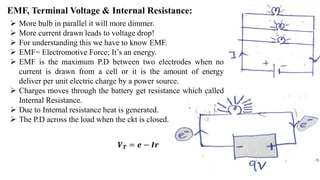
 More bulb in parallel it will more dimmer.
 More current drawn leads to voltage drop!
 For understanding this we have to know EMF.
 EMF= Electromotive Force; It’s an energy.
 EMF is the maximum P.D between two electrodes when no
current is drawn from a cell or it is the amount of energy
deliver per unit electric charge by a power source.
 Charges moves through the battery get resistance which called
Internal Resistance.
 Due to Internal resistance heat is generated.
 The P.D across the load when the ckt is closed.
𝑽𝑻 = 𝒆 − 𝑰𝒓
Faraday’s Law:
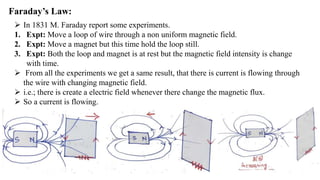
 In 1831 M. Faraday report some experiments.
1. Expt: Move a loop of wire through a non uniform magnetic field.
2. Expt: Move a magnet but this time hold the loop still.
3. Expt: Both the loop and magnet is at rest but the magnetic field intensity is change
with time.
 From all the experiments we get a same result, that there is current is flowing through
the wire with changing magnetic field.
 i.e.; there is create a electric field whenever there change the magnetic flux.
 So a current is flowing.
 Due to the electric field there create a accumulation of charges.
 So at this point we actually get a EMF; called Motional EMF.
 Hence current is flowing.
Direction of the current!
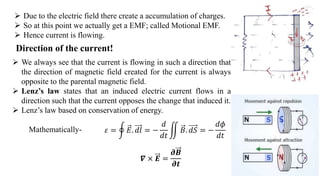
 We always see that the current is flowing in such a direction that
the direction of magnetic field created for the current is always
opposite to the parental magnetic field.
 Lenz’s law states that an induced electric current flows in a
direction such that the current opposes the change that induced it.
 Lenz’s law based on conservation of energy.
Mathematically- 𝜀 = 𝐸. 𝑑𝑙 = −
𝑑
𝑑𝑡
𝐵. 𝑑𝑆 = −
𝑑𝜙
𝑑𝑡
𝜵 × 𝑬 =
𝝏𝑩
𝝏𝒕
Self Induction:
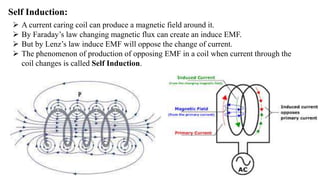
 A current caring coil can produce a magnetic field around it.
 By Faraday’s law changing magnetic flux can create an induce EMF.
 But by Lenz’s law induce EMF will oppose the change of current.
 The phenomenon of production of opposing EMF in a coil when current through the
coil changes is called Self Induction.
𝜙 ∝ 𝐼
𝑁𝜙 = 𝐿𝐼
Where L is the coefficient of self induction.
If changing current through the coil of N
turns produced self induce emf then it will be
𝜀 = −𝑁
𝑑𝜙
𝑑𝑡
𝜖 = −𝐿
𝑑𝐼
𝑑𝑡
Mutual Inductance:
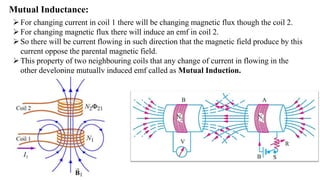
For changing current in coil 1 there will be changing magnetic flux though the coil 2.
For changing magnetic flux there will induce an emf in coil 2.
So there will be current flowing in such direction that the magnetic field produce by this
current oppose the parental magnetic field.
This property of two neighbouring coils that any change of current in flowing in the
other developing mutually induced emf called as Mutual Induction.
𝜀𝑀 = −𝑁2
𝑑𝜙2
𝑑𝑡
𝜀𝑀 = −𝑀
𝑑𝐼1
𝑑𝑡
𝑁2𝜙2 ∝ 𝐼1
𝑁2𝜙2 = 𝑀𝐼1
M is called coefficient of mutual inductance.
 If a changing current in coil A produces mutually induced emf in coil B then -
THANK YOU

Electromagnetic Induction .pptx

  • 1.
    ELECTROMAGNETIC INDUCTION Presented by- ACHUYTBHARALEE Roll No- PHP22108 Dept of Physics Tezpur University
  • 2.
    EMF, Terminal Voltage& Internal Resistance:  More bulb in parallel it will more dimmer.  More current drawn leads to voltage drop!  For understanding this we have to know EMF.  EMF= Electromotive Force; It’s an energy.  EMF is the maximum P.D between two electrodes when no current is drawn from a cell or it is the amount of energy deliver per unit electric charge by a power source.  Charges moves through the battery get resistance which called Internal Resistance.  Due to Internal resistance heat is generated.  The P.D across the load when the ckt is closed. 𝑽𝑻 = 𝒆 − 𝑰𝒓
  • 3.
    Faraday’s Law:  In1831 M. Faraday report some experiments. 1. Expt: Move a loop of wire through a non uniform magnetic field. 2. Expt: Move a magnet but this time hold the loop still. 3. Expt: Both the loop and magnet is at rest but the magnetic field intensity is change with time.  From all the experiments we get a same result, that there is current is flowing through the wire with changing magnetic field.  i.e.; there is create a electric field whenever there change the magnetic flux.  So a current is flowing.
  • 4.
     Due tothe electric field there create a accumulation of charges.  So at this point we actually get a EMF; called Motional EMF.  Hence current is flowing. Direction of the current!  We always see that the current is flowing in such a direction that the direction of magnetic field created for the current is always opposite to the parental magnetic field.  Lenz’s law states that an induced electric current flows in a direction such that the current opposes the change that induced it.  Lenz’s law based on conservation of energy. Mathematically- 𝜀 = 𝐸. 𝑑𝑙 = − 𝑑 𝑑𝑡 𝐵. 𝑑𝑆 = − 𝑑𝜙 𝑑𝑡 𝜵 × 𝑬 = 𝝏𝑩 𝝏𝒕
  • 5.
    Self Induction:  Acurrent caring coil can produce a magnetic field around it.  By Faraday’s law changing magnetic flux can create an induce EMF.  But by Lenz’s law induce EMF will oppose the change of current.  The phenomenon of production of opposing EMF in a coil when current through the coil changes is called Self Induction.
  • 6.
    𝜙 ∝ 𝐼 𝑁𝜙= 𝐿𝐼 Where L is the coefficient of self induction. If changing current through the coil of N turns produced self induce emf then it will be 𝜀 = −𝑁 𝑑𝜙 𝑑𝑡 𝜖 = −𝐿 𝑑𝐼 𝑑𝑡
  • 7.
    Mutual Inductance: For changingcurrent in coil 1 there will be changing magnetic flux though the coil 2. For changing magnetic flux there will induce an emf in coil 2. So there will be current flowing in such direction that the magnetic field produce by this current oppose the parental magnetic field. This property of two neighbouring coils that any change of current in flowing in the other developing mutually induced emf called as Mutual Induction.
  • 8.
    𝜀𝑀 = −𝑁2 𝑑𝜙2 𝑑𝑡 𝜀𝑀= −𝑀 𝑑𝐼1 𝑑𝑡 𝑁2𝜙2 ∝ 𝐼1 𝑁2𝜙2 = 𝑀𝐼1 M is called coefficient of mutual inductance.  If a changing current in coil A produces mutually induced emf in coil B then -
  • 9.