ELECTROMAGNETIC INDUCTION
BY
KARTHIK PREMANAND
XII ROSE
ROLL NO:17
INDEX:
Aim
Certificate
Acknowledgement
Apparatus
Introduction
Theory
Conclusion
Bibliography
AIM:
To determine the faraday’s
law of electromagnetic
induction using a copper wire
wound over an iron rod and
a strong magnet
CERTIFICAT
E
This is to certify that the PHYSICS project titled
‘ELECTROMAGNETIC INDUCTION’ has been
successfully completed by KARTHIK PREMANAND of
Class XII ROSE in partial fulfillment of curriculum of
CENTRAL BOARD OF SECONDARY EDUCATION
(CBSE) leading to the award of annual examination of the
year 2012-2013.
INTERNAL EXAMINER TEACHER IN-CHARGE
SCHOOL SEAL PRINCIPAL
ACKNOWLEDGEMENT
First and foremost I thank my teacher Mrs.
VEMURI who has assigned me this term paper to bring
out my creative capabilities.
I express my gratitude to my parents for being a continuous
source of encouragement for all their financial aid.
I would like to acknowledge the assistance provided to me by
the library staff of BAL BHARATI PUBLIC SCHOOL.
My heartfelt gratitude to my classmates and for helping me to
complete my work in time.
Karthik Premanand
APPARATUS
1. Insulated copper
wire
2. A iron rod
3. A strong magnet
and
4. A light emitting
diode (LED)
INTRODUCTION:
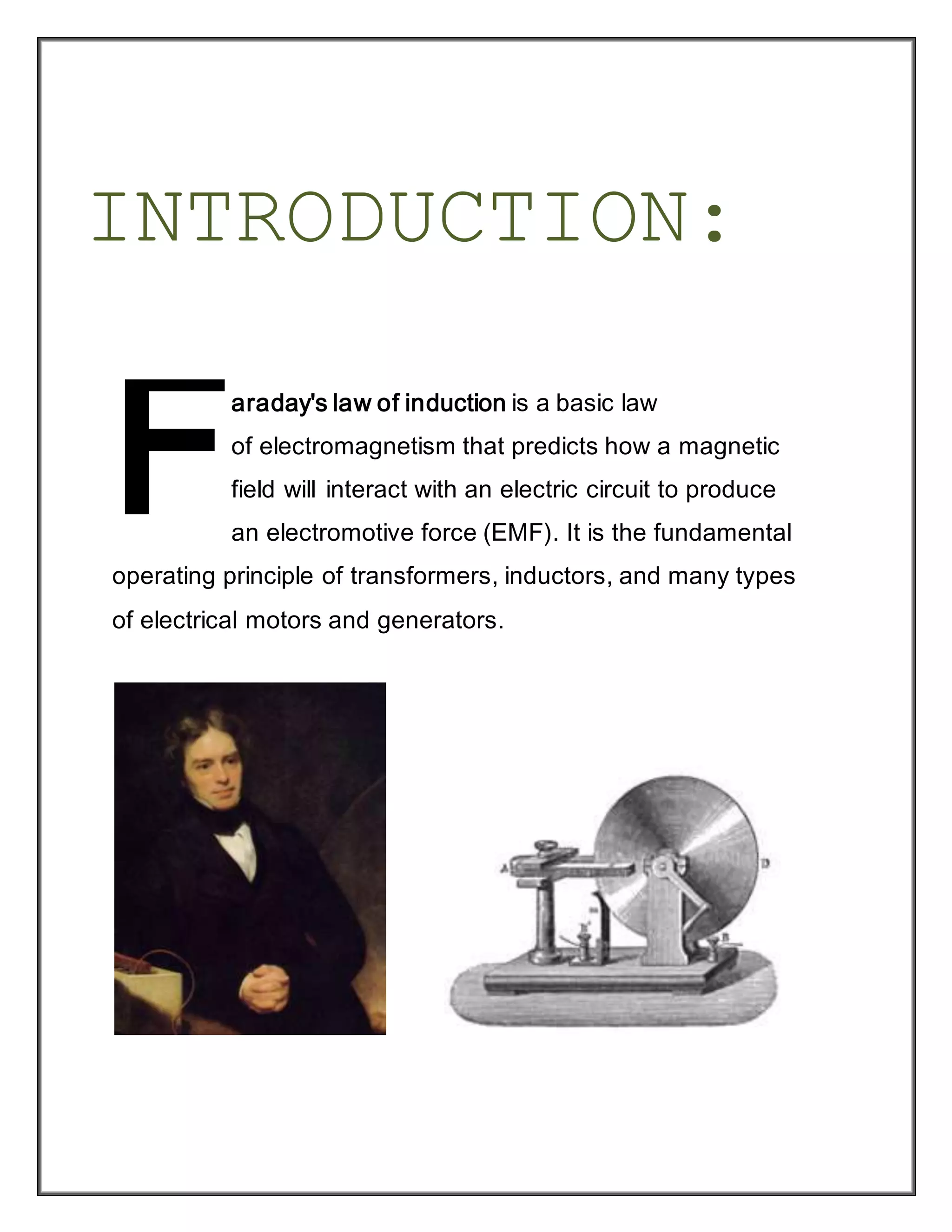
araday's law of induction is a basic law
of electromagnetism that predicts how a magnetic
field will interact with an electric circuit to produce
an electromotive force (EMF). It is the fundamental
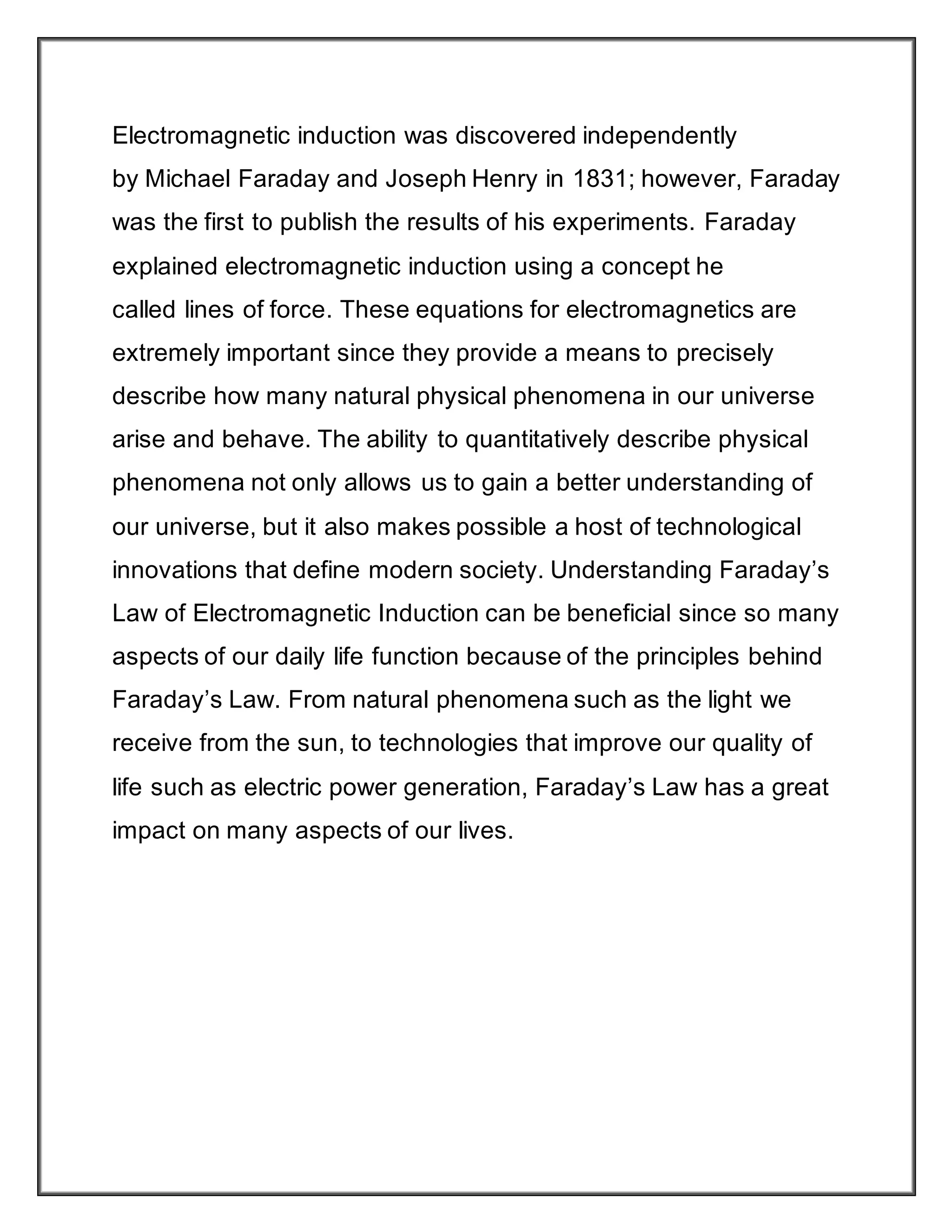
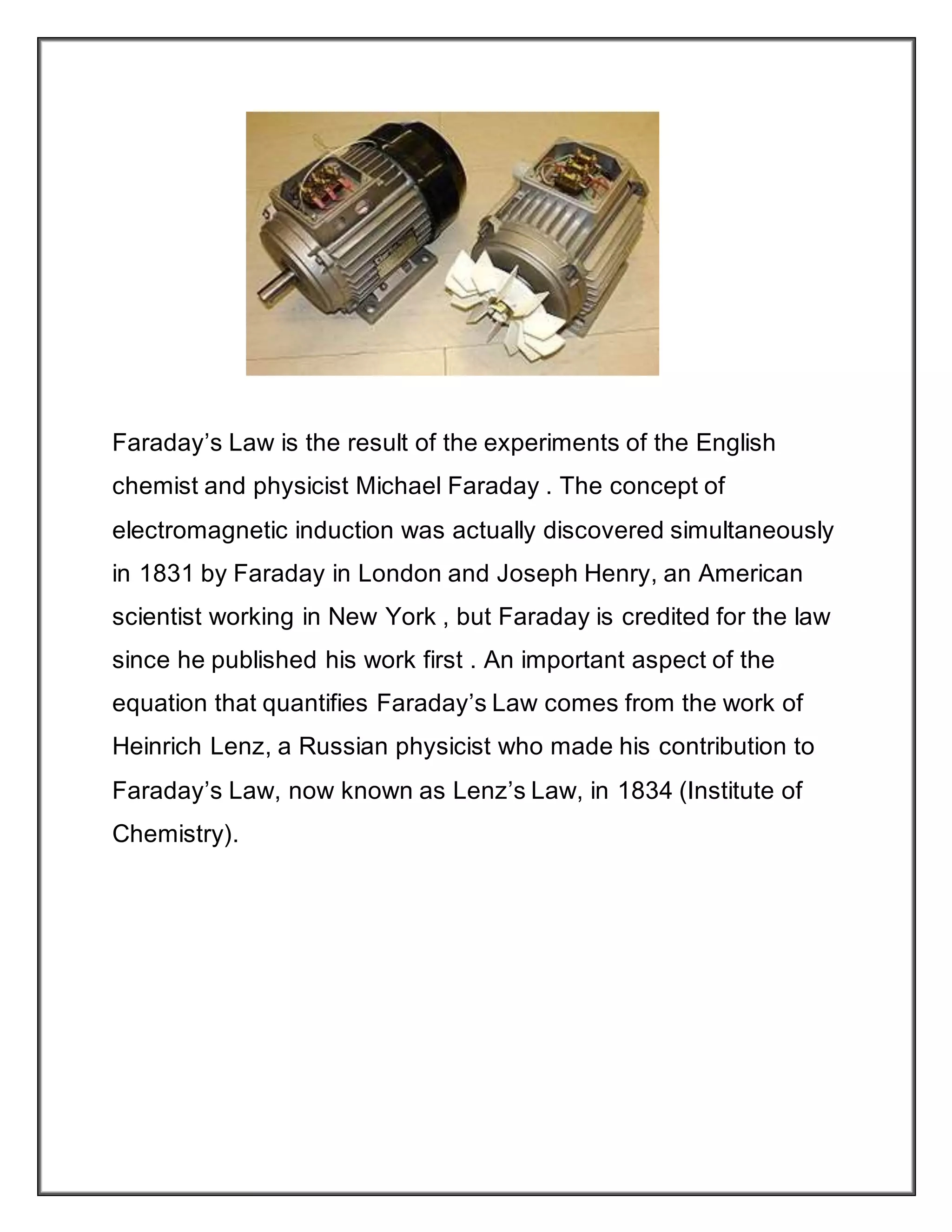
operating principle of transformers, inductors, and many types
of electrical motors and generators.
F
Electromagnetic induction was discovered independently
by Michael Faraday and Joseph Henry in 1831; however, Faraday
was the first to publish the results of his experiments. Faraday
explained electromagnetic induction using a concept he
called lines of force. These equations for electromagnetics are
extremely important since they provide a means to precisely
describe how many natural physical phenomena in our universe
arise and behave. The ability to quantitatively describe physical
phenomena not only allows us to gain a better understanding of
our universe, but it also makes possible a host of technological
innovations that define modern society. Understanding Faraday’s
Law of Electromagnetic Induction can be beneficial since so many
aspects of our daily life function because of the principles behind
Faraday’s Law. From natural phenomena such as the light we
receive from the sun, to technologies that improve our quality of
life such as electric power generation, Faraday’s Law has a great
impact on many aspects of our lives.
Faraday’s Law is the result of the experiments of the English
chemist and physicist Michael Faraday . The concept of
electromagnetic induction was actually discovered simultaneously
in 1831 by Faraday in London and Joseph Henry, an American
scientist working in New York , but Faraday is credited for the law
since he published his work first . An important aspect of the
equation that quantifies Faraday’s Law comes from the work of
Heinrich Lenz, a Russian physicist who made his contribution to
Faraday’s Law, now known as Lenz’s Law, in 1834 (Institute of
Chemistry).
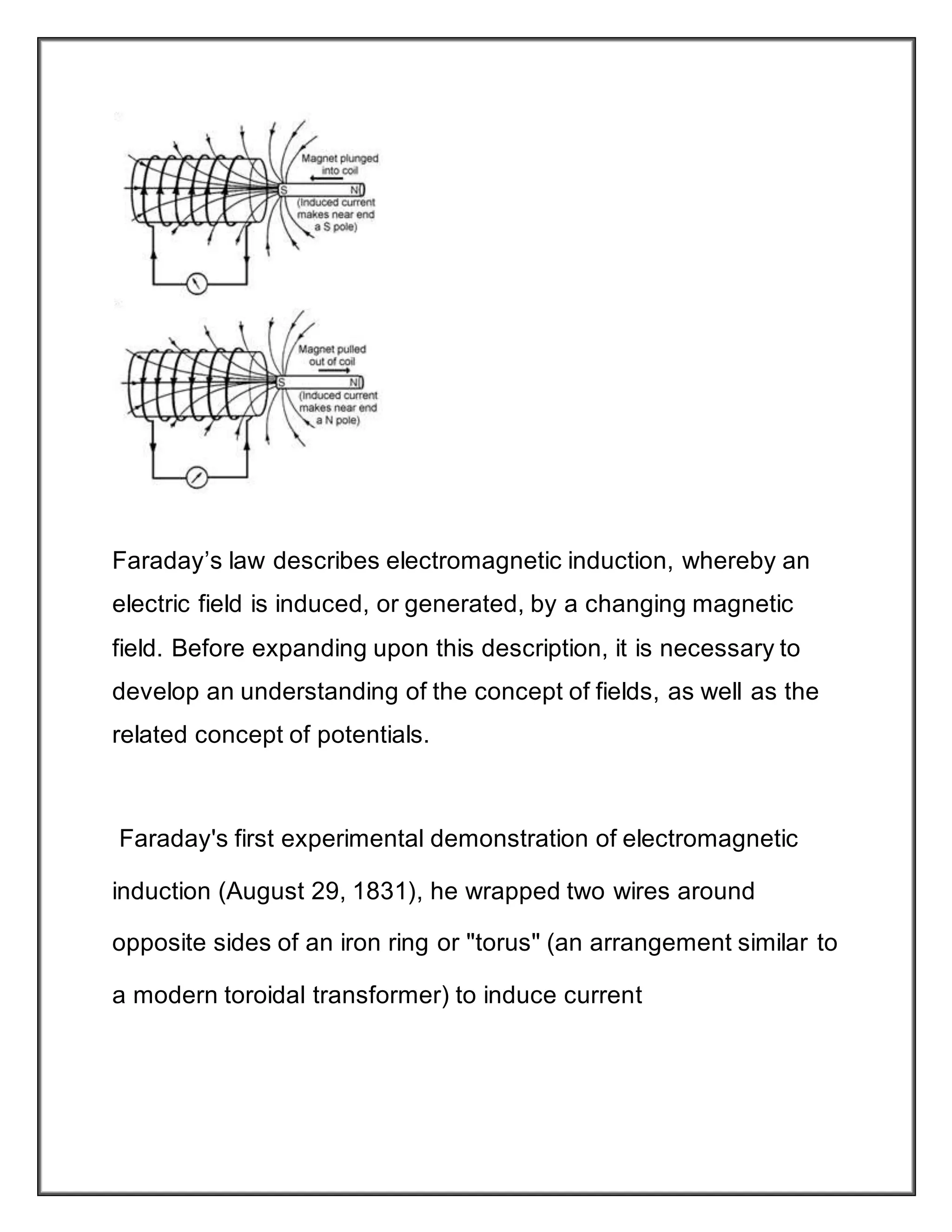
Faraday’s law describes electromagnetic induction, whereby an
electric field is induced, or generated, by a changing magnetic
field. Before expanding upon this description, it is necessary to
develop an understanding of the concept of fields, as well as the
related concept of potentials.
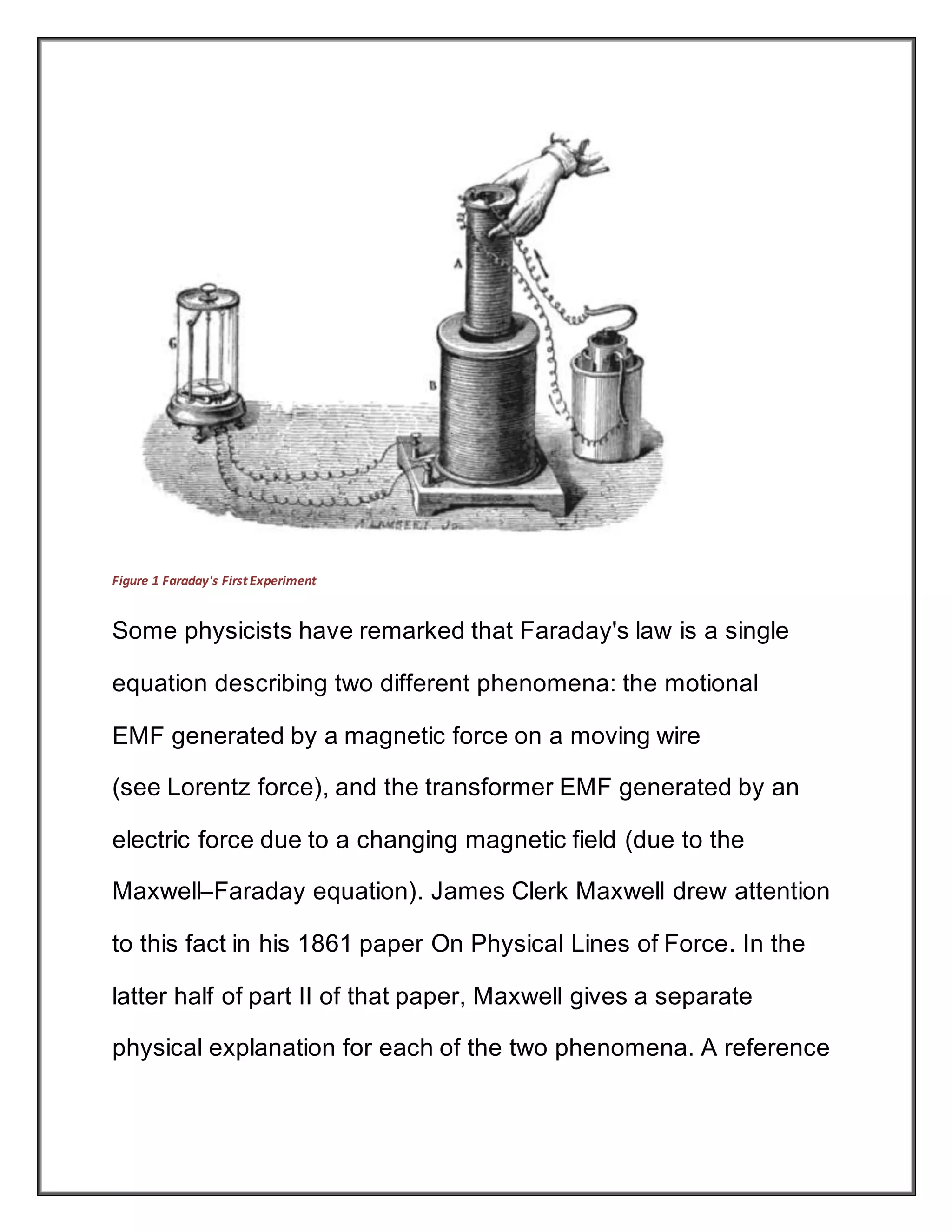
Faraday's first experimental demonstration of electromagnetic
induction (August 29, 1831), he wrapped two wires around
opposite sides of an iron ring or "torus" (an arrangement similar to
a modern toroidal transformer) to induce current
Figure 1 Faraday's First Experiment
Some physicists have remarked that Faraday's law is a single
equation describing two different phenomena: the motional
EMF generated by a magnetic force on a moving wire
(see Lorentz force), and the transformer EMF generated by an
electric force due to a changing magnetic field (due to the
Maxwell–Faraday equation). James Clerk Maxwell drew attention
to this fact in his 1861 paper On Physical Lines of Force. In the
latter half of part II of that paper, Maxwell gives a separate
physical explanation for each of the two phenomena. A reference
to these two aspects of electromagnetic induction is made in
some modern textbooks.
THEORY:
Magnetic flux:
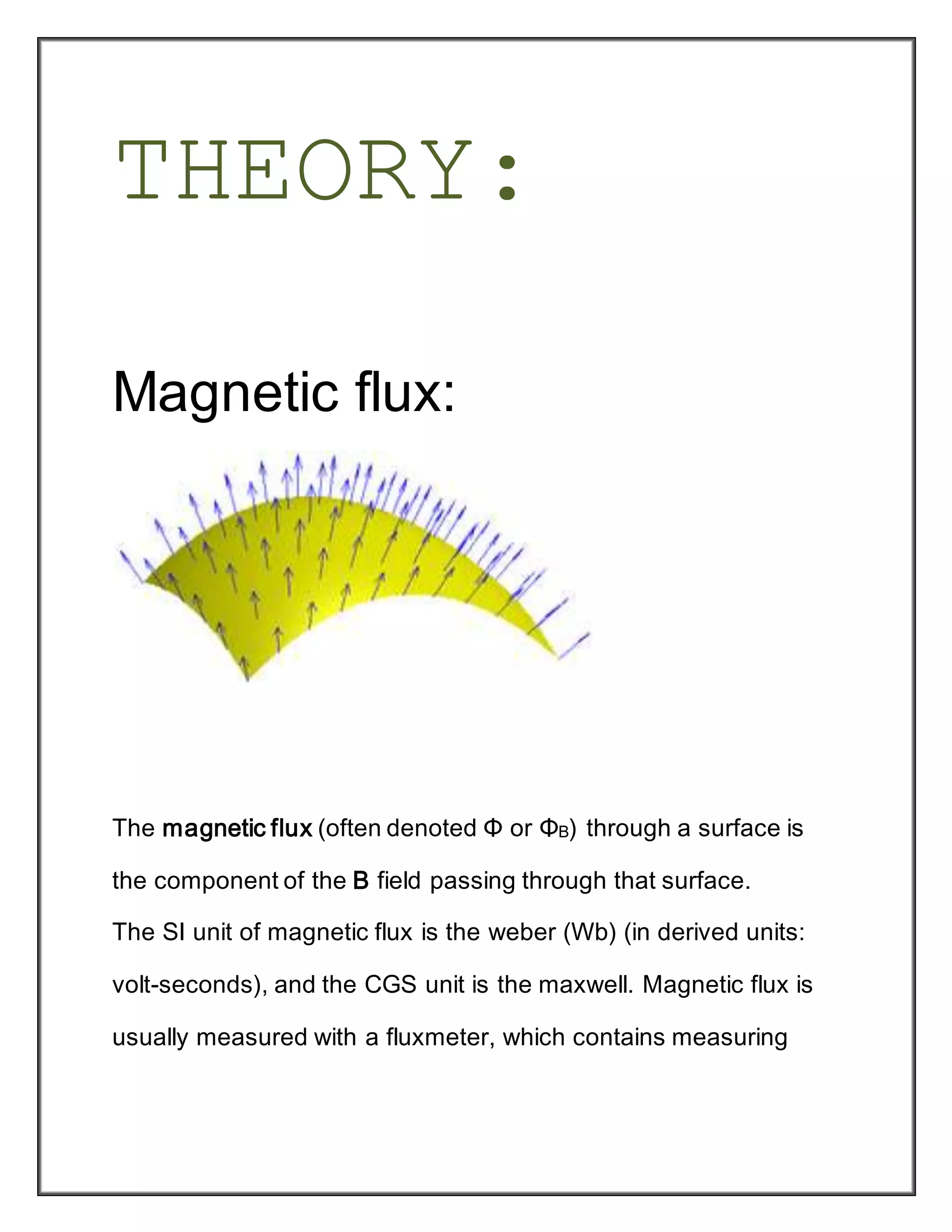
The magnetic flux (often denoted Φ or ΦB) through a surface is
the component of the B field passing through that surface.
The SI unit of magnetic flux is the weber (Wb) (in derived units:
volt-seconds), and the CGS unit is the maxwell. Magnetic flux is
usually measured with a fluxmeter, which contains measuring
coils and electronics that evaluates the change of voltage in the
measuring coils to calculate the magnetic flux.
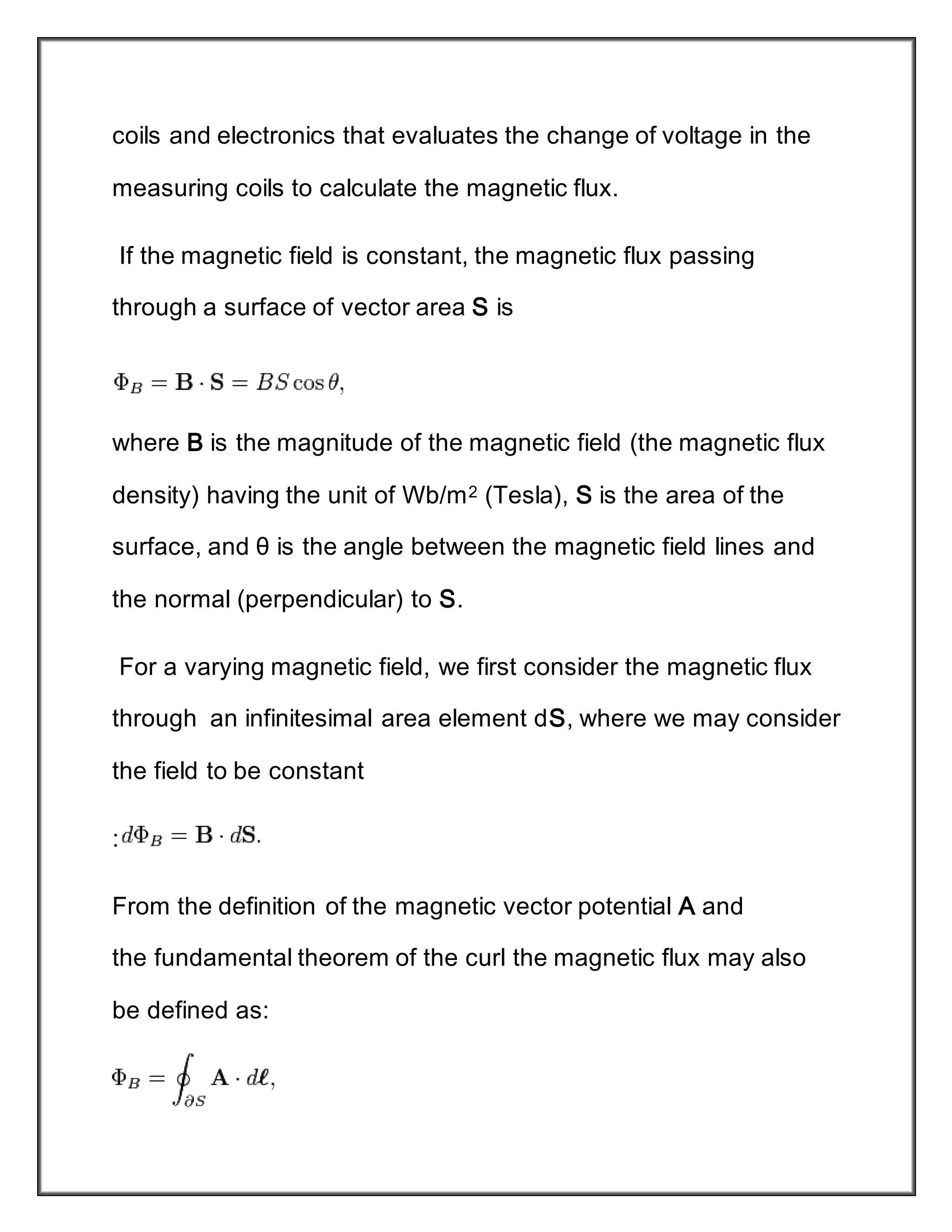
If the magnetic field is constant, the magnetic flux passing
through a surface of vector area S is
where B is the magnitude of the magnetic field (the magnetic flux
density) having the unit of Wb/m2 (Tesla), S is the area of the
surface, and θ is the angle between the magnetic field lines and
the normal (perpendicular) to S.
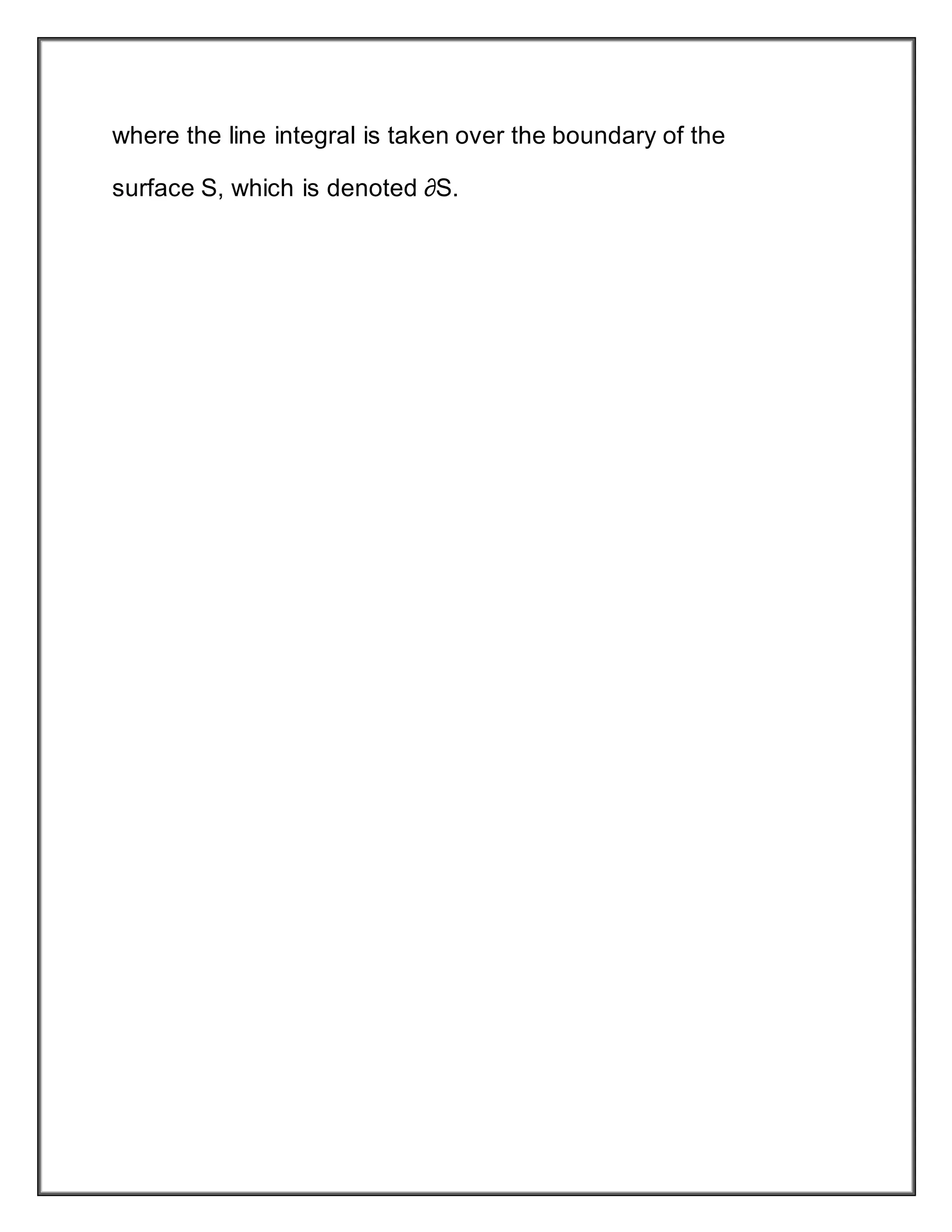
For a varying magnetic field, we first consider the magnetic flux
through an infinitesimal area element dS, where we may consider
the field to be constant
:
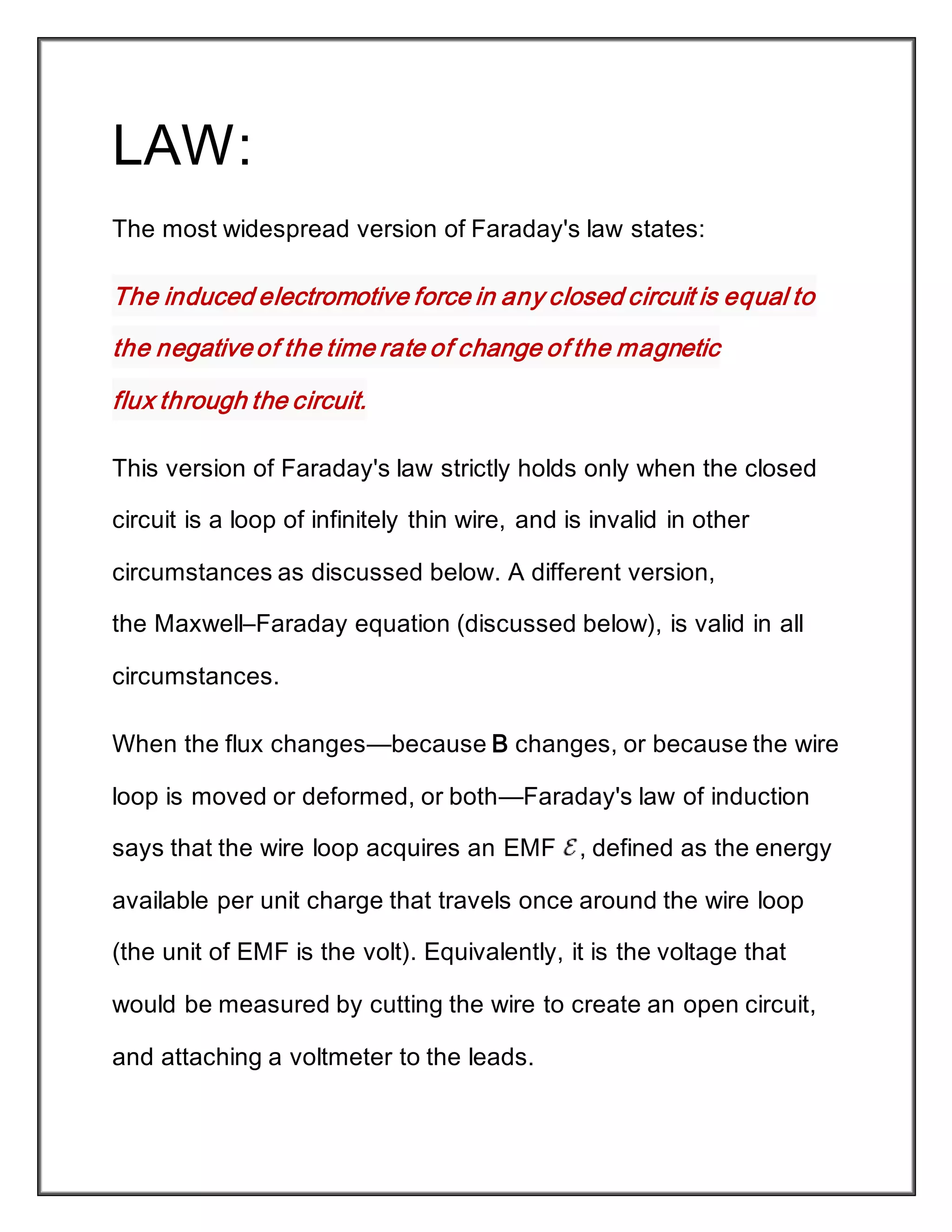
From the definition of the magnetic vector potential A and
the fundamental theorem of the curl the magnetic flux may also
be defined as:
where the line integral is taken over the boundary of the
surface S, which is denoted ∂S.
LAW:
The most widespread version of Faraday's law states:
The induced electromotive force in any closed circuit is equal to
the negativeof the time rate of change of the magnetic
flux through the circuit.
This version of Faraday's law strictly holds only when the closed
circuit is a loop of infinitely thin wire, and is invalid in other
circumstances as discussed below. A different version,
the Maxwell–Faraday equation (discussed below), is valid in all
circumstances.
When the flux changes—because B changes, or because the wire
loop is moved or deformed, or both—Faraday's law of induction
says that the wire loop acquires an EMF , defined as the energy
available per unit charge that travels once around the wire loop
(the unit of EMF is the volt). Equivalently, it is the voltage that
would be measured by cutting the wire to create an open circuit,
and attaching a voltmeter to the leads.
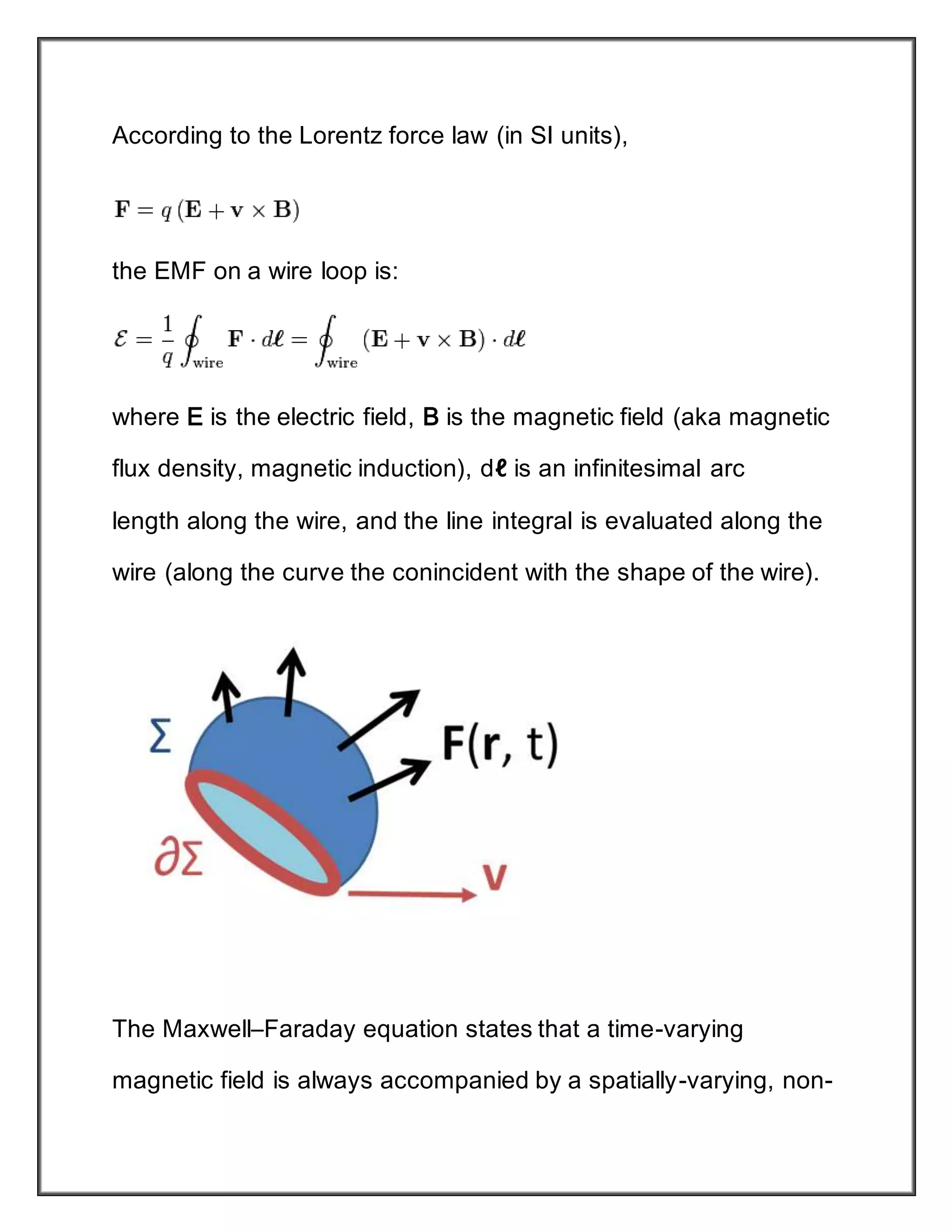
According to the Lorentz force law (in SI units),
the EMF on a wire loop is:
where E is the electric field, B is the magnetic field (aka magnetic
flux density, magnetic induction), dℓ is an infinitesimal arc
length along the wire, and the line integral is evaluated along the
wire (along the curve the conincident with the shape of the wire).
The Maxwell–Faraday equation states that a time-varying
magnetic field is always accompanied by a spatially-varying, non-
conservative electric field, and vice-versa. The Maxwell–Faraday
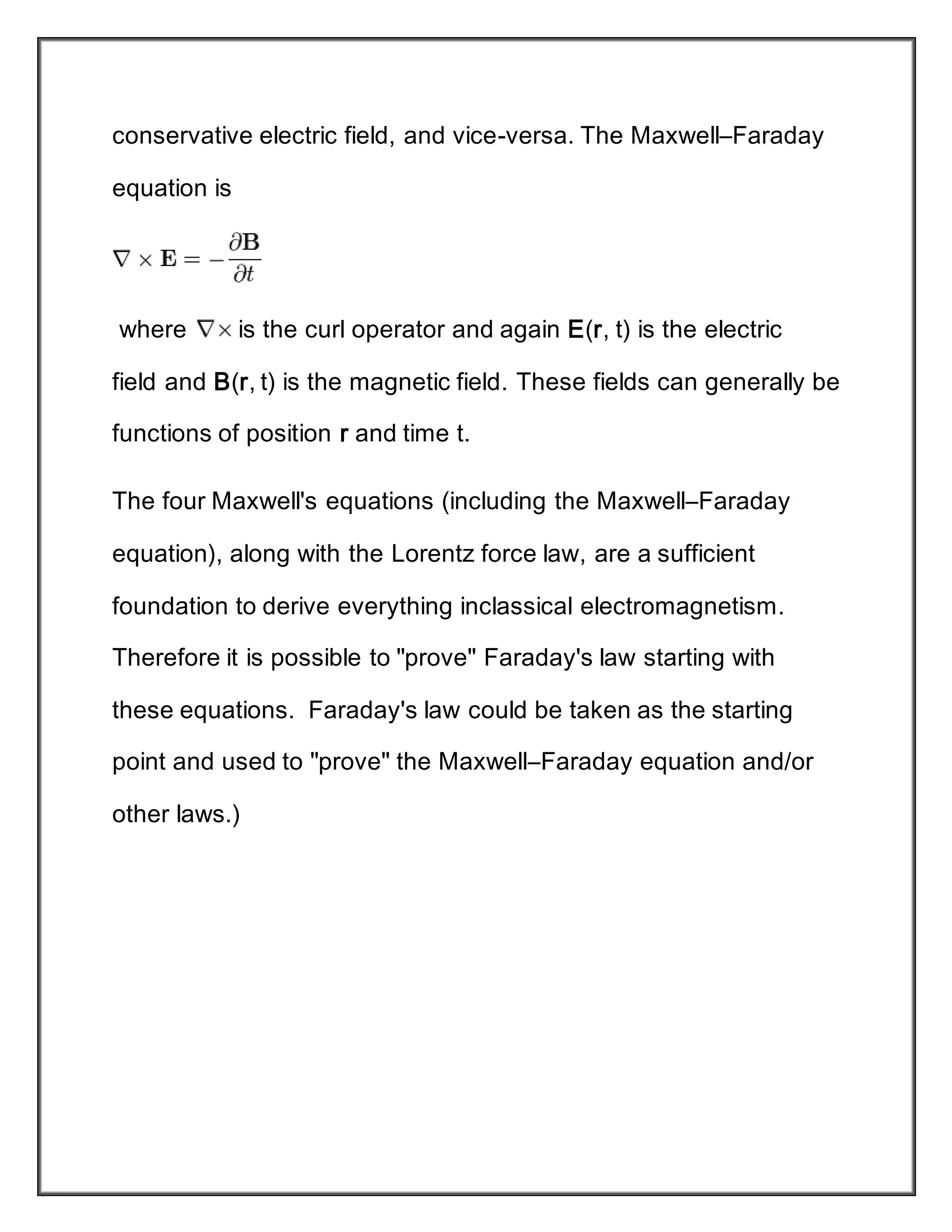
equation is
where is the curl operator and again E(r, t) is the electric
field and B(r, t) is the magnetic field. These fields can generally be
functions of position r and time t.
The four Maxwell's equations (including the Maxwell–Faraday
equation), along with the Lorentz force law, are a sufficient
foundation to derive everything inclassical electromagnetism.
Therefore it is possible to "prove" Faraday's law starting with
these equations. Faraday's law could be taken as the starting
point and used to "prove" the Maxwell–Faraday equation and/or
other laws.)
CONCLUSION
Faraday’s Law of Electromagnetic Induction, first
observed and published by Michael Faraday in the
mid-nineteenth century, describes a very important
electro-magnetic concept. Although its
mathematical representations are cryptic, the
essence of Faraday’s is not hard to grasp: it relates
an induced electric potential or voltage to a dynamic
magnetic field. This concept has many far-reaching
ramifications that touch our lives in many ways:
from the shining of the sun, to the convenience of
mobile communications, to electricity to power our
homes. We can all appreciate the profound impact
Faraday’s Law has on us.
BIBLIOGRAPHY
 WIKIPEDIA
 HOW STUFF WORKS
 SCIENCE FOR ALL
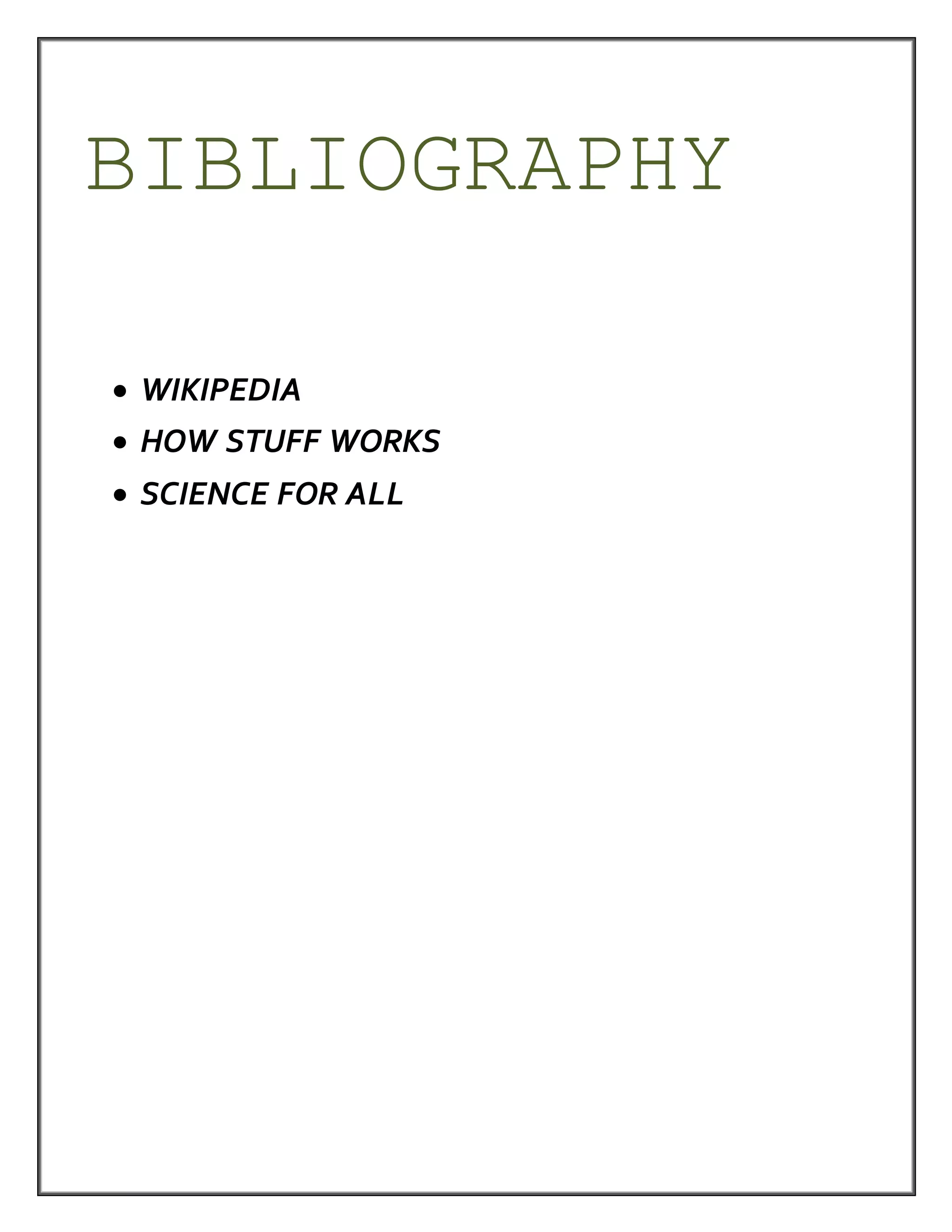
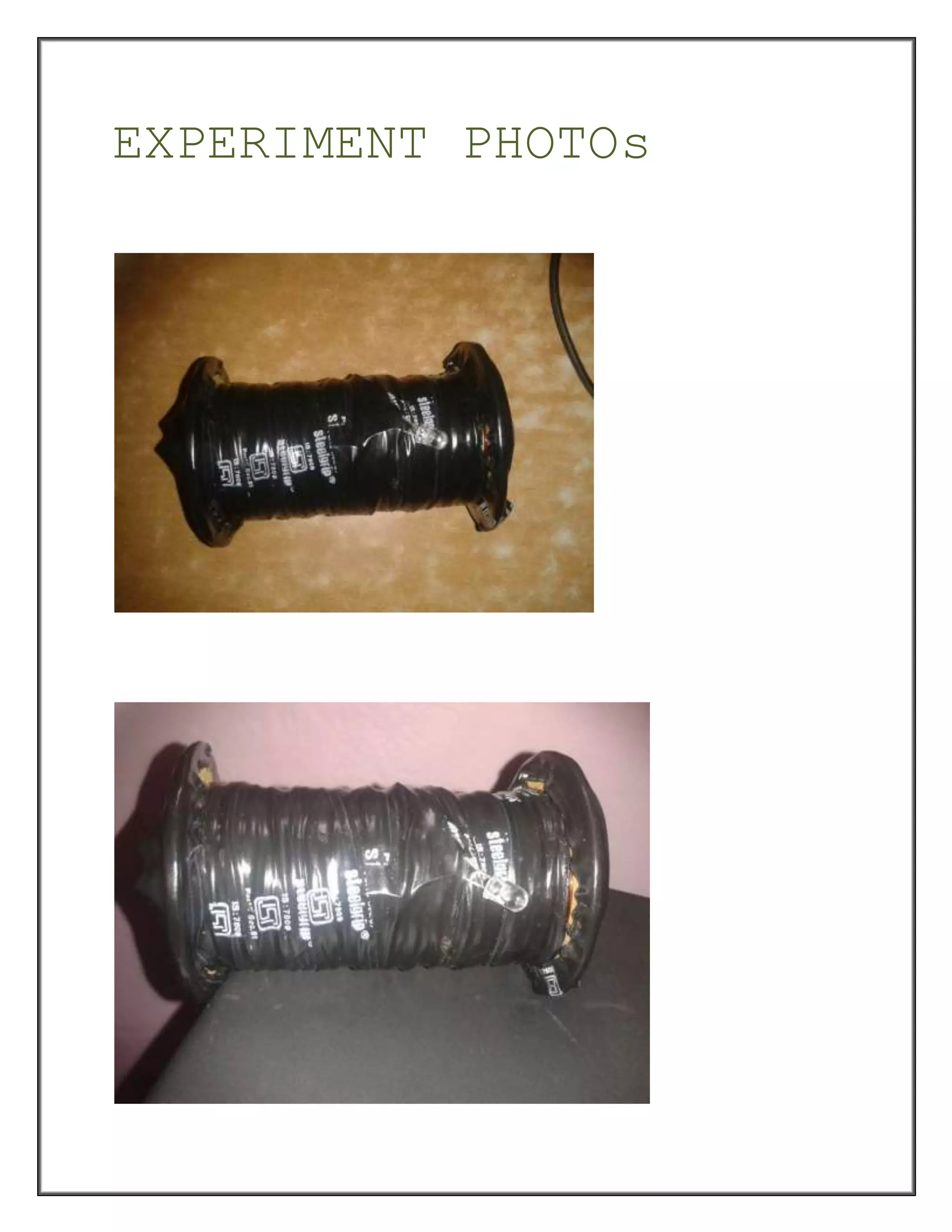
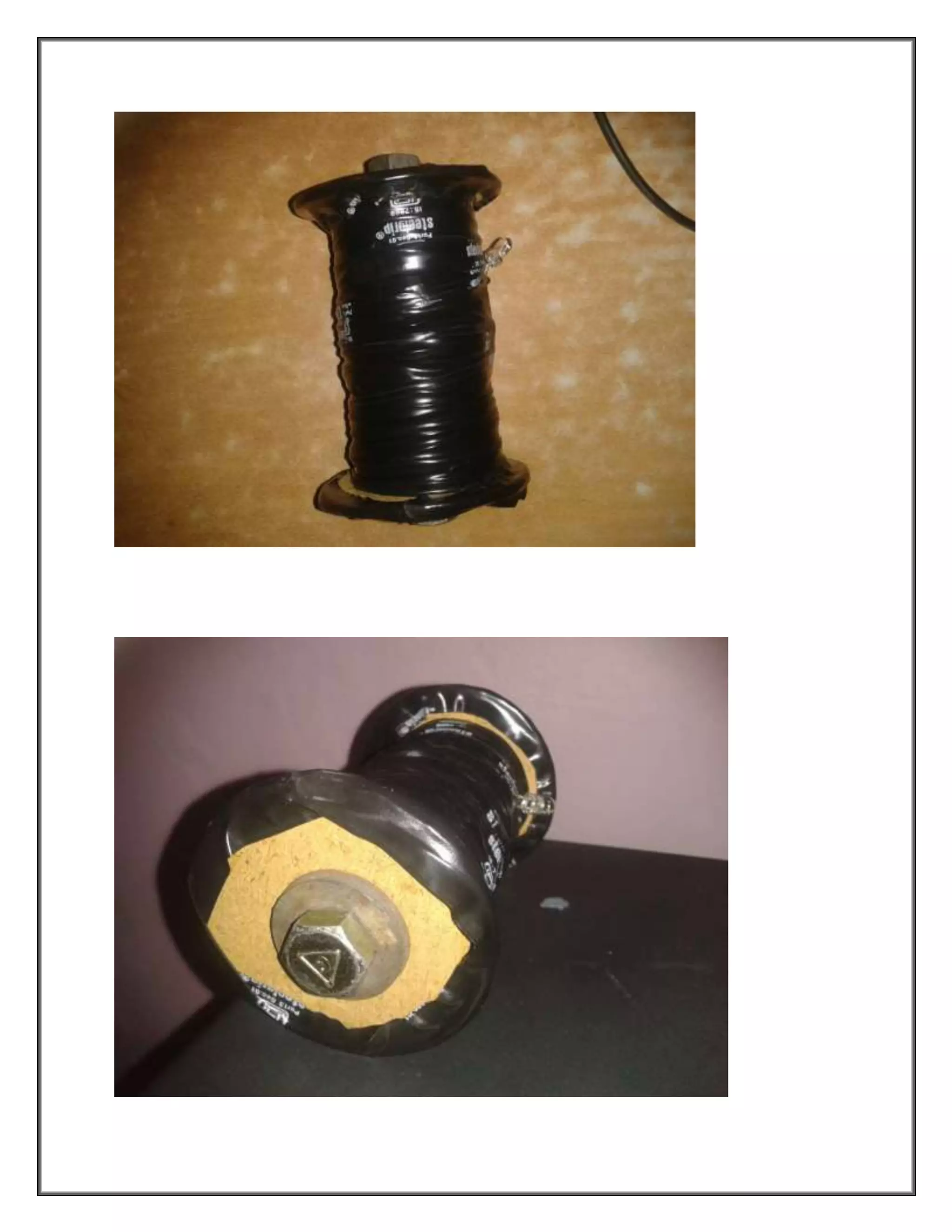
EXPERIMENT PHOTOs
Physics Investigatory Project Class XII

Physics Investigatory Project Class XII

  • 1.
  • 2.
  • 3.
    AIM: To determine thefaraday’s law of electromagnetic induction using a copper wire wound over an iron rod and a strong magnet
  • 4.
    CERTIFICAT E This is tocertify that the PHYSICS project titled ‘ELECTROMAGNETIC INDUCTION’ has been successfully completed by KARTHIK PREMANAND of Class XII ROSE in partial fulfillment of curriculum of CENTRAL BOARD OF SECONDARY EDUCATION (CBSE) leading to the award of annual examination of the year 2012-2013. INTERNAL EXAMINER TEACHER IN-CHARGE
  • 5.
    SCHOOL SEAL PRINCIPAL ACKNOWLEDGEMENT Firstand foremost I thank my teacher Mrs. VEMURI who has assigned me this term paper to bring out my creative capabilities. I express my gratitude to my parents for being a continuous source of encouragement for all their financial aid. I would like to acknowledge the assistance provided to me by the library staff of BAL BHARATI PUBLIC SCHOOL. My heartfelt gratitude to my classmates and for helping me to complete my work in time. Karthik Premanand
  • 6.
    APPARATUS 1. Insulated copper wire 2.A iron rod 3. A strong magnet and 4. A light emitting diode (LED)
  • 7.
    INTRODUCTION: araday's law ofinduction is a basic law of electromagnetism that predicts how a magnetic field will interact with an electric circuit to produce an electromotive force (EMF). It is the fundamental operating principle of transformers, inductors, and many types of electrical motors and generators. F
  • 8.
    Electromagnetic induction wasdiscovered independently by Michael Faraday and Joseph Henry in 1831; however, Faraday was the first to publish the results of his experiments. Faraday explained electromagnetic induction using a concept he called lines of force. These equations for electromagnetics are extremely important since they provide a means to precisely describe how many natural physical phenomena in our universe arise and behave. The ability to quantitatively describe physical phenomena not only allows us to gain a better understanding of our universe, but it also makes possible a host of technological innovations that define modern society. Understanding Faraday’s Law of Electromagnetic Induction can be beneficial since so many aspects of our daily life function because of the principles behind Faraday’s Law. From natural phenomena such as the light we receive from the sun, to technologies that improve our quality of life such as electric power generation, Faraday’s Law has a great impact on many aspects of our lives.
  • 9.
    Faraday’s Law isthe result of the experiments of the English chemist and physicist Michael Faraday . The concept of electromagnetic induction was actually discovered simultaneously in 1831 by Faraday in London and Joseph Henry, an American scientist working in New York , but Faraday is credited for the law since he published his work first . An important aspect of the equation that quantifies Faraday’s Law comes from the work of Heinrich Lenz, a Russian physicist who made his contribution to Faraday’s Law, now known as Lenz’s Law, in 1834 (Institute of Chemistry).
  • 10.
    Faraday’s law describeselectromagnetic induction, whereby an electric field is induced, or generated, by a changing magnetic field. Before expanding upon this description, it is necessary to develop an understanding of the concept of fields, as well as the related concept of potentials. Faraday's first experimental demonstration of electromagnetic induction (August 29, 1831), he wrapped two wires around opposite sides of an iron ring or "torus" (an arrangement similar to a modern toroidal transformer) to induce current
  • 11.
    Figure 1 Faraday'sFirst Experiment Some physicists have remarked that Faraday's law is a single equation describing two different phenomena: the motional EMF generated by a magnetic force on a moving wire (see Lorentz force), and the transformer EMF generated by an electric force due to a changing magnetic field (due to the Maxwell–Faraday equation). James Clerk Maxwell drew attention to this fact in his 1861 paper On Physical Lines of Force. In the latter half of part II of that paper, Maxwell gives a separate physical explanation for each of the two phenomena. A reference
  • 12.
    to these twoaspects of electromagnetic induction is made in some modern textbooks.
  • 13.
    THEORY: Magnetic flux: The magneticflux (often denoted Φ or ΦB) through a surface is the component of the B field passing through that surface. The SI unit of magnetic flux is the weber (Wb) (in derived units: volt-seconds), and the CGS unit is the maxwell. Magnetic flux is usually measured with a fluxmeter, which contains measuring
  • 14.
    coils and electronicsthat evaluates the change of voltage in the measuring coils to calculate the magnetic flux. If the magnetic field is constant, the magnetic flux passing through a surface of vector area S is where B is the magnitude of the magnetic field (the magnetic flux density) having the unit of Wb/m2 (Tesla), S is the area of the surface, and θ is the angle between the magnetic field lines and the normal (perpendicular) to S. For a varying magnetic field, we first consider the magnetic flux through an infinitesimal area element dS, where we may consider the field to be constant : From the definition of the magnetic vector potential A and the fundamental theorem of the curl the magnetic flux may also be defined as:
  • 15.
    where the lineintegral is taken over the boundary of the surface S, which is denoted ∂S.
  • 16.
    LAW: The most widespreadversion of Faraday's law states: The induced electromotive force in any closed circuit is equal to the negativeof the time rate of change of the magnetic flux through the circuit. This version of Faraday's law strictly holds only when the closed circuit is a loop of infinitely thin wire, and is invalid in other circumstances as discussed below. A different version, the Maxwell–Faraday equation (discussed below), is valid in all circumstances. When the flux changes—because B changes, or because the wire loop is moved or deformed, or both—Faraday's law of induction says that the wire loop acquires an EMF , defined as the energy available per unit charge that travels once around the wire loop (the unit of EMF is the volt). Equivalently, it is the voltage that would be measured by cutting the wire to create an open circuit, and attaching a voltmeter to the leads.
  • 17.
    According to theLorentz force law (in SI units), the EMF on a wire loop is: where E is the electric field, B is the magnetic field (aka magnetic flux density, magnetic induction), dℓ is an infinitesimal arc length along the wire, and the line integral is evaluated along the wire (along the curve the conincident with the shape of the wire). The Maxwell–Faraday equation states that a time-varying magnetic field is always accompanied by a spatially-varying, non-
  • 18.
    conservative electric field,and vice-versa. The Maxwell–Faraday equation is where is the curl operator and again E(r, t) is the electric field and B(r, t) is the magnetic field. These fields can generally be functions of position r and time t. The four Maxwell's equations (including the Maxwell–Faraday equation), along with the Lorentz force law, are a sufficient foundation to derive everything inclassical electromagnetism. Therefore it is possible to "prove" Faraday's law starting with these equations. Faraday's law could be taken as the starting point and used to "prove" the Maxwell–Faraday equation and/or other laws.)
  • 20.
    CONCLUSION Faraday’s Law ofElectromagnetic Induction, first observed and published by Michael Faraday in the mid-nineteenth century, describes a very important electro-magnetic concept. Although its mathematical representations are cryptic, the essence of Faraday’s is not hard to grasp: it relates an induced electric potential or voltage to a dynamic magnetic field. This concept has many far-reaching ramifications that touch our lives in many ways: from the shining of the sun, to the convenience of mobile communications, to electricity to power our homes. We can all appreciate the profound impact Faraday’s Law has on us.
  • 21.
    BIBLIOGRAPHY  WIKIPEDIA  HOWSTUFF WORKS  SCIENCE FOR ALL
  • 22.