DICTIONARY OF AUTOMOTIVE TERMS 
(A - E) 
A: 
Abbreviation or symbol for absolute temperature, absorption coefficient, 
acceleration, adenine, ampere, amplitude, angular acceleration, area, 
attenuation coefficient, fine-structure constant, helium nucleus, Helmhotz 
free energy, magnetic vector potential, relative atomic mass, a 
stereoisomer of a sugar, substitution on a carbon atom next to one common 
to two condensed aromatic nuclei, substitution on the carbon atom next to 
the hetero-atom in ahetero-cyclic compound, and substitution on the 
carbon atom of a chain next to the functional group. 
A-2 tire: 
A term used for tire sizes 16.00 and larger in nominal cross section. Also 
called earthmover or off-the-road tire. 
AA: 
Abbreviation for "Automobile Association" a term used in Great Britain. 
aa: 
A term of Hawaiian origin for lava flows with a rough, jagged surface. 
AAA: 
Acronym for "American Automobile Association" or "Alberta Automobile 
Association." 
AABM: 
Acronym for "Association of American Battery Manufacturers, Inc." 
AAE: 
Acronym for "Association of Automotive Employers" (Poland).
AAIA: 
Acronym for "Automotive Aftermarket Industry Association". 
AALA: 
Acronym for "American Automobile Labelling Act." 
aalenian: 
The oldest stage of the Middle-Jurassic. 
AAM: 
Acronym for "Alliance of Automobile Manufacturers". 
AAP: 
Acronym for "auxiliary acceleration pump". 
A arm: 
See A-arm 
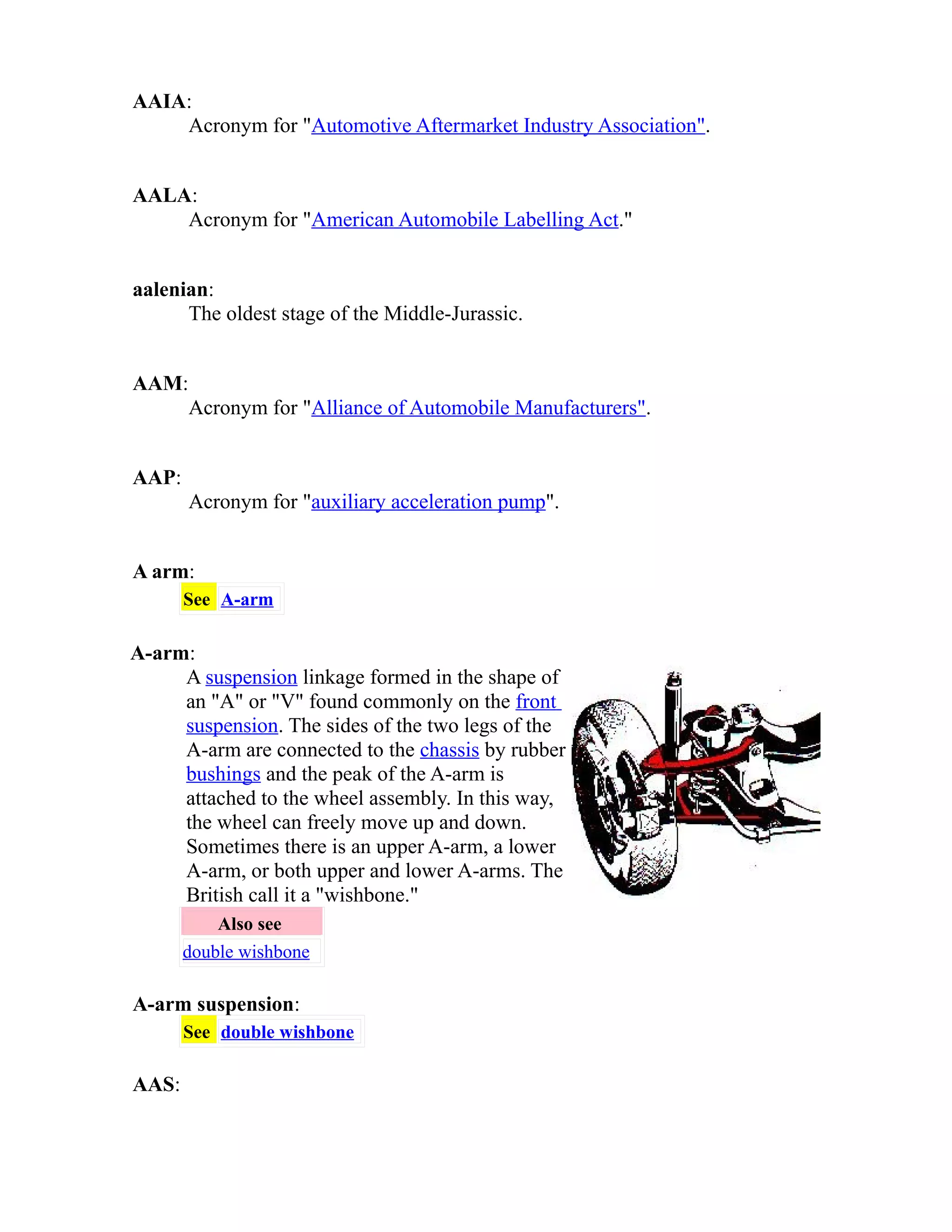
A-arm: 
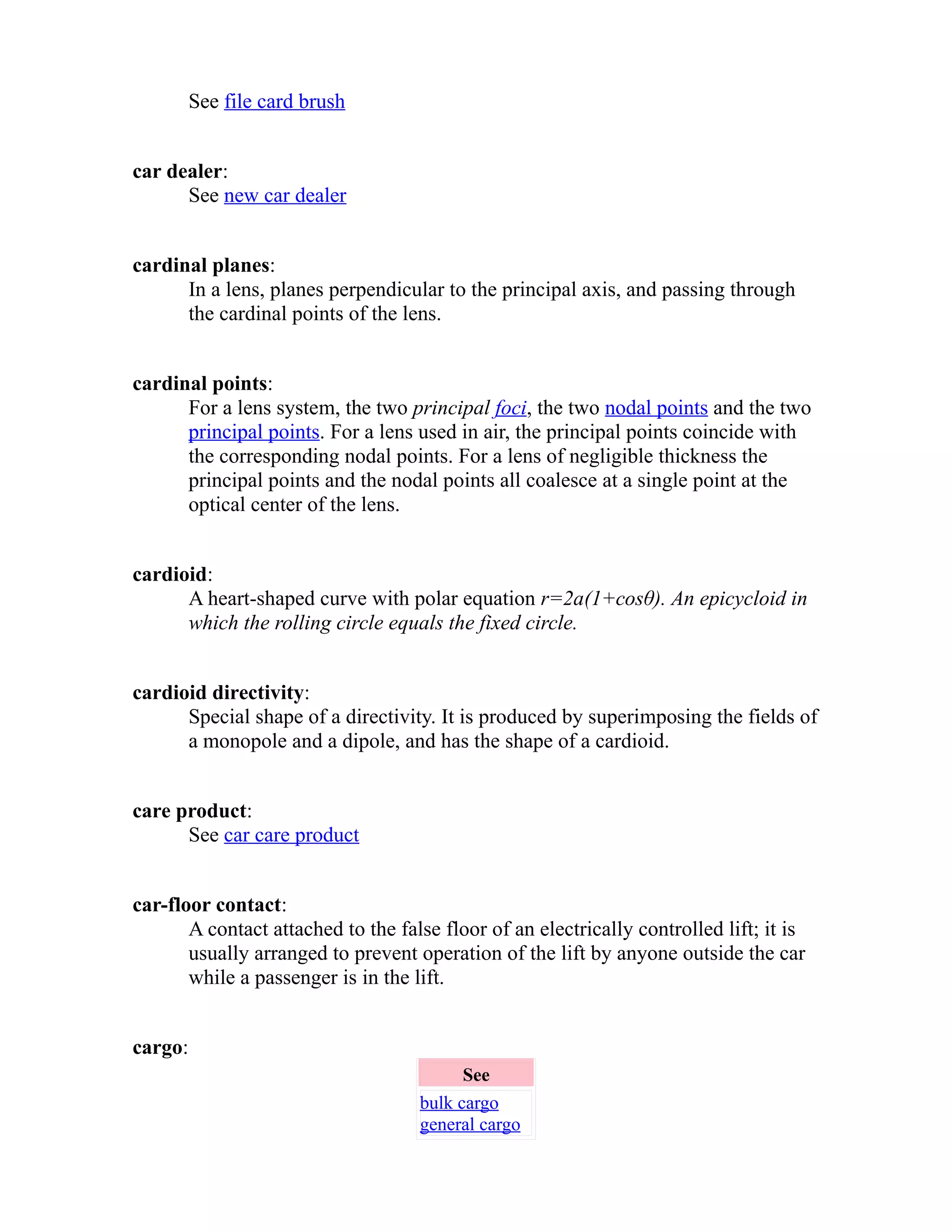
A suspension linkage formed in the shape of 
an "A" or "V" found commonly on the front 
suspension. The sides of the two legs of the 
A-arm are connected to the chassis by rubber 
bushings and the peak of the A-arm is 
attached to the wheel assembly. In this way, 
the wheel can freely move up and down. 
Sometimes there is an upper A-arm, a lower 
A-arm, or both upper and lower A-arms. The 
British call it a "wishbone." 
Also see 
double wishbone 
A-arm suspension: 
See double wishbone 
AAS:
Acronym for "air aspirator system". 
abacus: 
[1] The uppermost part of a column capital or 
pilaster, on which the architrave rests. 
[2] A bead frame. Used as an arithmetic 
calculating aid. 
abampere: 
A unit of electric current in the CGS electromagnetic system of units. One 
abampere equals 10A. 
abamurus: 
A supporting wall or buttress, built to add strength to another wall. 
abandonment: 
A voluntary surrender of legal rights or title to a mining claim. 
abatjour: 
An opening to admit light and generally to deflect it downwards; a 
skylight. 
abaxial: 
Rays of light which do not coincide with the optical axis of a lens system. 
ABC: 
[1] Acronym for "aerial bunched conductors" 
[2] Acronym for "automatic beam control". 
ABDC: 
Acronym for after bottom dead center. A term used in timing the relation 
of the spark and the crankshaft. 
Abel flashpoint apparatus:
A petroleum-testing apparatus for determining the flash-point. 
Abelian group: 
A group in which the group operation is commutative. It is important in 
the study of rings and vector spaces. 
aberration: 
[1] An apparent change of position of a heavenly body, due to the speed of 
light having a finite ratio to the relative velocity of the source and the 
observer. 
[2] In an image-forming system, e.g., an optical or electronic lens, failure 
to produce a true image, e.g., a point object as a point image. Geometrical 
aberrations include spherical aberration, coma, astigmatism, curvature of 
the field, and distortion. 
See chromatic aberration 
abhesive: 
A substance which prevents two materials sticking together, e.g., Teflon® 
on frying pans. 
ability: 
See 
climbing ability 
cold cranking ability 
ABL: 
Acronym for "atmospheric boundary layer" panel. 
ablation: 
[1] Any one of the processes by which snow and ice are lost from a glacier, 
mainly by melting and evaporation (sublimation). 
[2] Removal of surface layers of a meteorite and tektites during flight. 
ablative polymer: 
A material which degrades controllably in an aggressive environment, 
especially on re-entry space-craft. Extreme temperatures are reached on 
heat shield, so it is protected with ablation shield made of e.g., silicone 
polymer. The same principle is used in intumescent paints for fire
resistance. 
Abney law: 
A rule stating that if a spectral color is desaturated by the addition of white 
light, and if its wave length is less than 570 nm, its hue then moves 
towards the red end of the spectrum, while if the wavelength is more than 
570 nm its hue moves towards the blue. 
Abney level: 
Hand-held instrument in which angles of steep sights are measured while 
simultaneously viewing a spirit-level bubble. 
Abney mounting: 
A form of mounting for a concave diffraction grating, in which the eye-piece 
(or photographic plate holder) is fixed at the center of curvature of 
the grating and the slit can move around the circumference of the Rowland 
circle, to bring different orders of spectrum into view. 
abnormal glow discharge: 
A discharge carrying current in excess of that which is required to cover 
the cathode completely with visible radiation. 
abnormal reflection: 
Reflection from the ionosphere of a radio wave whose frequency is greater 
than the critical frequency. 
aboard: 
See lighter aboard ship 
aboard ship: 
See lighter aboard ship 
A-bomb: 
See atomic bomb 
A bone:
Nickname for a Ford Model "A". 
abort: 
To terminate a vehicle's flight either by failure or deliberate action to 
prevent dangerous consequences; if manned, a predetermined sequence of 
events is followed to ensure the safety of the crew. 
ABPV: 
Acronym for "air bypass valve". 
abradant: 
A substance, usually in powdered form, used for grinding. 
Also see 
abrasive 
abrade: 
To scratch or tear away two surfaces in contact by relative motion. 
Abram's law: 
A rule that the ratio of water to cement for chemical action to impart 
strength to concrete is 0.85:1. 
abrasion: 
[1] Wearing or rubbing away some surface because of friction. 
[2] Mechanical wearing away of rocks by rubbing during movement. 
abrasion hardness: 
Resistance to abrasive wear, under specified conditions, of metal or 
mineral. 
abrasive: 
A hard grit used for sanding or grinding. It is usually in powdered form, 
used for the removal of material by scratching and grinding, e.g., silicon 
carbide powder (carborundum). 
Also see 
bonded abrasive
coated abrasive 
non-woven abrasive 
abrasive blast cleaning: 
A method for preparing steel for painting whereby abrasive particles, e.g., 
copper slag, are projected under pressure through a nozzle. Very effective 
in removing rust and mill scale, leaving an anchor pattern (a pattern of 
minute projections) on the substrate affording good paint adhesion. 
abrasive cleaner: 
A cleanser with some hard grit used to remove the grime and oils from a 
surface. 
abrasive disc: 
A circular plate (often made of plastic with hard grit 
embedded into it) used for grinding or sanding. 
abrasive paper: 
Sandpaper (a paper upon which sand or hard grit has been glued) used for 
sanding or grinding. 
abrasive wear: 
A mechanism of wear due to the presence in one or both surfaces of hard 
particles (e.g., carbide in steels), or to hard particles trapped between them. 
A/B roll editing: 
Video editing using two source players (A and B) enabling dubbing from 
both. Necessary if scenes are to be superimposed. 
A/B roll printing: 
A method of film printing with alternate scenes assembled in two rolls, 
each having black spacing equivalent in length to the omitted scene; 
double printing from the two allows the inclusion of fade and dissolve 
effects and avoids visible splice marks between scenes in 16 mm printing.
ABS: 
[1] Acronym for "anti-lock brakes. The acronym ABS comes from the 
German anti blockier system. 
[2] Acronym for "acylonitrile-butadiene-styrene." 
Also see 
copolymer 
abscissa: 
For rectilineal axes of coordinates, the distance of a point from the axis of 
ordinates measured in a direction parallel to the axis of abscissae, which is 
usually horizontal. The sign convention is that measurements to the right 
from the axis of ordinates are positive, measurements to the left negative. 
absolute: 
A conic (a quadric in three dimensions) formed by the assemblage of the 
points at infinity on a line (in general two points). Its form determines the 
metrical properties of the geometrical system being operated. Thus in 
Euclidean geometry, the absolute is the degenerate conic comprising the 
line at infinity taken twice, while in non-Euclidean geometry, the absolute 
is either a real conic (hyperbolic geometry) or an imaginary conic (elliptic 
geometry). 
Also see 
manifold absolute pressure sensor 
POA suction throttling valve 
absolute address: 
A computer code designation of a specific memory location as determined 
by the hardware. 
absolute age: 
The geological age of a fossil, mineral, rock or event, generally given in 
years. 
absolute ampere: 
The standard MKS unit of electric current; replaced the international 
ampere in 1948.
absolute ceiling: 
The height at which the rate of climb of an aircraft, in standard 
atmosphere, would be zero; the maximum height attainable under standard 
conditions. 
absolute electrometer: 
A high-grade attracted-disk electrometer in which an absolute 
measurement of potential can be made by weighing the attraction between 
two charged disks against gravity. 
absolute filter: 
A filter which removes most particulate matter from gases. 
absolute humidity: 
The mass (actual amount) of water vapor present in a unit of volume of 
moist air. 
absolute instrument: 
An instrument which measures a quantity directly in absolute units, 
without the necessity for previous calibration. 
absolute permeability: 
See permeability 
absolute pressure: 
Pressure measured from a starting point of zero in perfect vacuum. When 
measured by the absolute pressure scale, atmospheric pressure is 14.7 psi 
or 29.92 inches of mercury (in-Hg). 
Also see 
manifold absolute pressure sensor 
absolute pressure sensor: 
See manifold absolute pressure sensor 
barometric absolute pressure sensor 
absolute reaction rate: 
The reaction rate determined from statistical thermodynamics; uses the 
assumption of the theory of absolute reaction rates that the rate of a
chemical reaction is governed by the rate of crossing an energy barrier or 
of forming an activated complex. 
absolute temperature: 
Temperature measured with respect to absolute zero, i.e., the zero of the 
kelvin thermodynamic scale of temperature, a scale which cannot take 
negative values. 
absolute temperature scale: 
Also called the absolute scale temperature as measured on a scale in 
which the hypothetical lowest limit of physical temperature is assigned the 
value zero. The Kelvin scale is an example of the absolute temperature 
scale. 
absolute units: 
Units derived directly from the fundamental units of a system and not 
based on arbitrary numerical definitions. The differences between absolute 
and international units were small; both are now superseded by the 
definitions of SI units. 
absolute wavemeter: 
A wavemeter in which the frequency of the injected radio-frequency signal 
is by calculation of physical properties (circuit elements or dimensions) of 
a resonant circuit line or cavity. 
absolute weight: 
The weight (or mass) of a body in a vacuum. 
absolute zero: 
The point at which there is a total absence of heat, minus 459.67°F 
(-273.15°C). 
absorbance: 
[1] The logarithm of the ratio of the intensity of light incident on a sample 
to that transmitted by it. It is usually directly proportional to the 
concentration of the absorbing substance in a solution.
[2] The capacity of materials such as textile fibers and paper to absorb 
liquids. 
absorbed dose: 
Quantity of energy imparted by ionizing radiation to a unit mass of 
biological tissue. Unit is the gray. 
absorbent: 
Substance with the ability to take up or absorb another substance. 
absorber: 
Any material which converts energy of radiation or particles into another 
form, generally heat. Energy transmitted is not absorbed. Scattered energy 
is often classed with absorbed energy. 
Also see 
air shock absorber 
arc absorber 
adjustable shock 
absorbers 
damper 
direct-acting shock 
absorber 
double-tube shock 
absorber 
friction shock 
absorber 
gas shock absorber 
impact absorber 
lever-type shock 
absorber 
monotube shock 
absorber 
self-levelling shock 
absorber 
shock absorber 
single-tube shock 
absorber. 
telescopic shock 
absorber 
UV absorber 
absorber rod: 
See control rod 
absorber tower: 
See shock absorber tower 
absorbing: 
See energy absorbing steering column 
energy absorbing bumper 
absorbing bumper: 
See energy absorbing bumper 
absorbing material: 
Any medium used for absorbing energy from radiation of any type.
absorbing steering: 
See energy absorbing steering column 
absorbing steering column: 
See energy absorbing steering column 
absorptance: 
A measure of the ability of a body to absorb radiation; the ratio of the 
radiant flux absorbed by the body to that incident on the body. 
absorption: 
The use of reagents to remove unwanted antibodies or antigens from a 
mixture. 
Also see 
acoustic absorption 
air absorption 
atmospheric absorption 
sound absorption 
absorption band: 
A dark gap in the continuous spectrum of white light transmitted by a 
substance which exhibits selective absorption. 
absorption capacitor: 
A capacitor connected across a spark gap to damp the discharge. 
absorption coefficient: 
[1] The volume of gas, measured at stp, dissolved by unit volume of a 
liquid under normal pressure (i.e., one atmosphere). 
[2] The fraction of the energy which is absorbed. 
[3] The reduction of amplitude, for a beam of radiation or other wave 
system incident on a discontinuity in the medium through which it is 
propagated, or in the path along which it is transmitted. 
[4] In a medium, the natural logarithm of the ratio of incident and 
emergent energy or amplitude for a beam of radiation passing through unit 
thickness of a medium. 
Also see 
acoustic absorption coefficient
absorption discontinuity: 
See absorption edge 
absorption dynamometer: 
A dynamometer which absorbs and dissipates the power which it 
measures, e.g., the ordinary rope brake and the Froude hydraulic brake. 
absorption edge: 
The wavelength at which there is an abrupt discontinuity in the intensity of 
an absorption spectrum for electromagnetic waves, giving the appearance 
of a sharp edge in its photograph. The transition is due to one particular 
energy-dissipating process. 
absorption factor: 
See acoustic absorption factor 
absorption hygrometer: 
An instrument by which the quantity of water vapor in air may be 
measured. 
absorption inductor: 
See interphase transformer 
absorption lines: 
Dark lines in a continuous spectrum caused by absorption by a gaseous 
element. The positions (i.e., wavelengths) of the dark absorption lines are 
identical to those of the bright lines given by the same element in 
emission. 
absorption nebula: 
See dark nebula 
absorption plant: 
Plant where oils are removed from natural gas by absorption in suitable 
oil. 
absorption refrigerator:
[1] A plant in which ammonia is continuously evaporated from an aqueous 
solution under pressure, condensed, allowed to evaporate, and then 
reabsorbed. 
[2] A refrigerator which creates low temperatures by using the cooling 
effect formed when a refrigerant is absorbed by chemical substance. 
absorption spectrum: 
The system of absorption bands or lines seen when a selectively absorbing 
substance is placed between a source of white light and a spectroscope. 
absorption wavemeter: 
A wavemeter which depends on a resonance absorption in a tuned circuit, 
constructed with very stable inductance and capacitance. 
absorptive power: 
See absorptance 
absorptivity: 
See absorptance 
ABS override button: 
A button or switch which disengages the automatic anti-lock braking 
system so that the driver can operate the brakes himself. 
ABS relay valve: 
An electrically controlled valve which modulates the air pressure in the 
ABS. 
abundance: 
See relative abundance 
frequency 
abundance ratio: 
For a naturally occurring element, the proportion or percentage of one 
isotope to the total. 
abundant number:
A natural number for which the sum of the proper factors is greater than 
the number itself, e.g., 18 is abundant since 1+2+3+6+9>18. Compare 
deficient number and perfect number. 
abut: 
The action of two gear teeth making contact. 
abutment: 
[1] A part which stops the motion of another part from proceeding any 
farther. 
[2] A cement raised shoulder secured to the side of the road to prevent a 
vehicle from going over the edge. 
[3] The contact made between opposing teeth of two gears. 
abutment load: 
In stopping or other deep-level excavation, weight transferred to the 
adjacent solid rock by unsupported roof. 
abutting edge: 
The side or edge of a panel which joins another panel. 
abutting joint: 
a timber joint whose plane is at right angles to the fibers, the fibers of both 
joining pieces being in the same straight line. 
ABV: 
Acronym for "air bypass valve". 
abyssal: 
term describing the ocean floor environment between ca4000 and 6000 m. 
abyssal deposits: 
Pelagic marine sediments, accumulating in depths of more than 2000 m 
including, with increasing depth, calcareous oozes, siliceous oozes and red 
clay (500 m).
abyssal plain: 
a flat region of the deep ocean floor with a slope of less than 1:1000. 
abyssopelagic: 
relating to the open waters of the abyssal zone. 
A/C: 
[1] An abbreviation for air conditioning or air conditioner. 
[2] An abbreviation for "across corners" which indicates the distance on a 
nut (for instance) from one corner to the opposite corner rather than the 
distance from one flat surface (A/F) to the opposite (which would be the 
size of wrench needed to install or remove the nut). The purpose of the 
A/C dimension is to know how large a hole might be needed to insert a 
recessed nut. 
AC: 
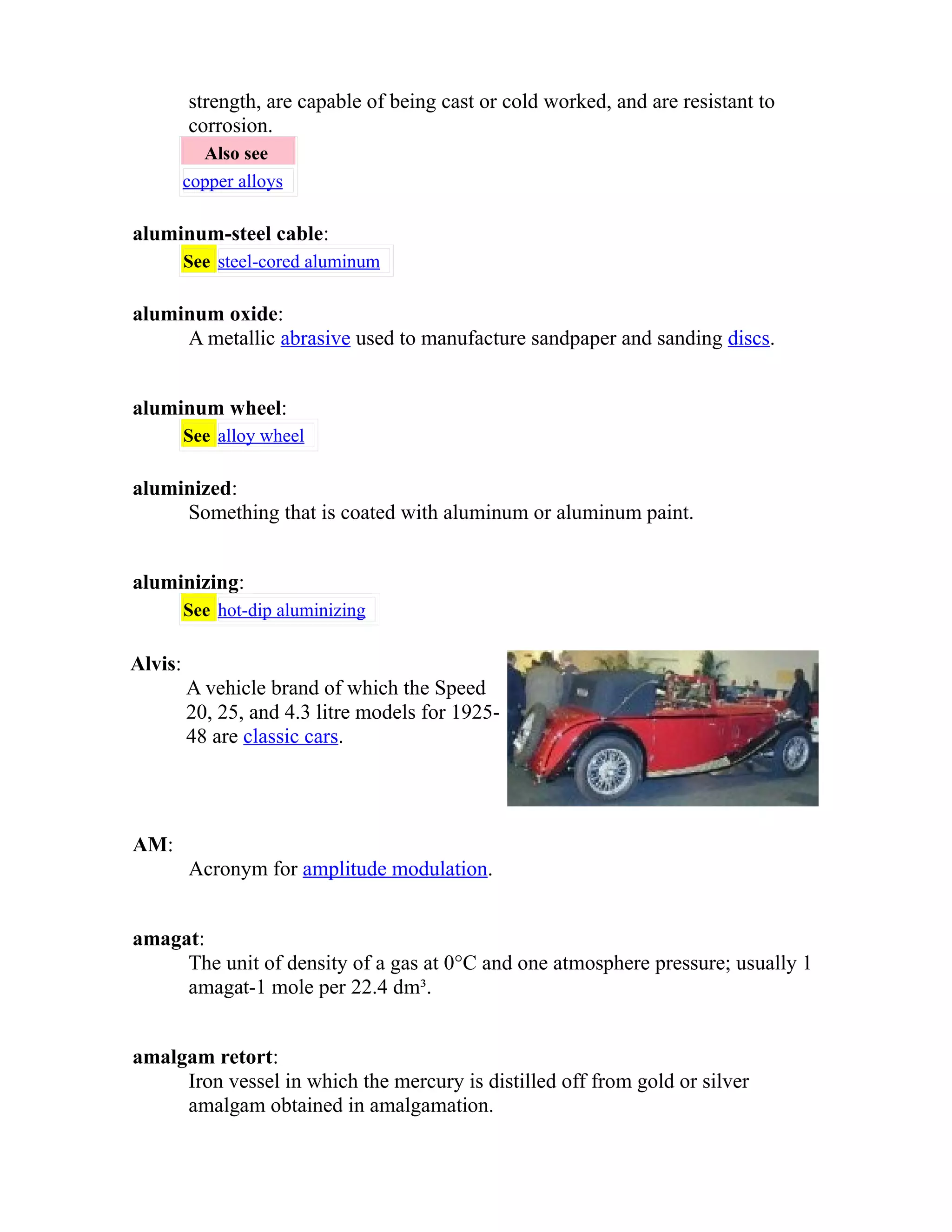
[1] A vehicle brand of which the 1925-48 models are classic cars. 
[2] Acronym for "alternating current." 
[3] Acronym for "air conditioning" or "air conditioner." 
[4] Symbol for actinium 
[5] The transformation temperature on heating of the phase changes of iron 
or steel, subscripts indicating the designated change, e.g., Ac1 is the 
eutectoid (723°C) and Ac3 the ferrite/austenite phase boundary. 
AC-3: 
Trade name for the digital audio coding used in 35 mm motion picture film 
to provide six-channel surround sound. It uses data blocks recorded 
optically between the perforations, leaving room for a conventional 
soundtrack. It is also suitable for multi-channel TV audio, as well as video 
software and home cinema. 
AC Ace: 
A vehicle brand of which the 1954-61 Ace models are 
milestone cars.
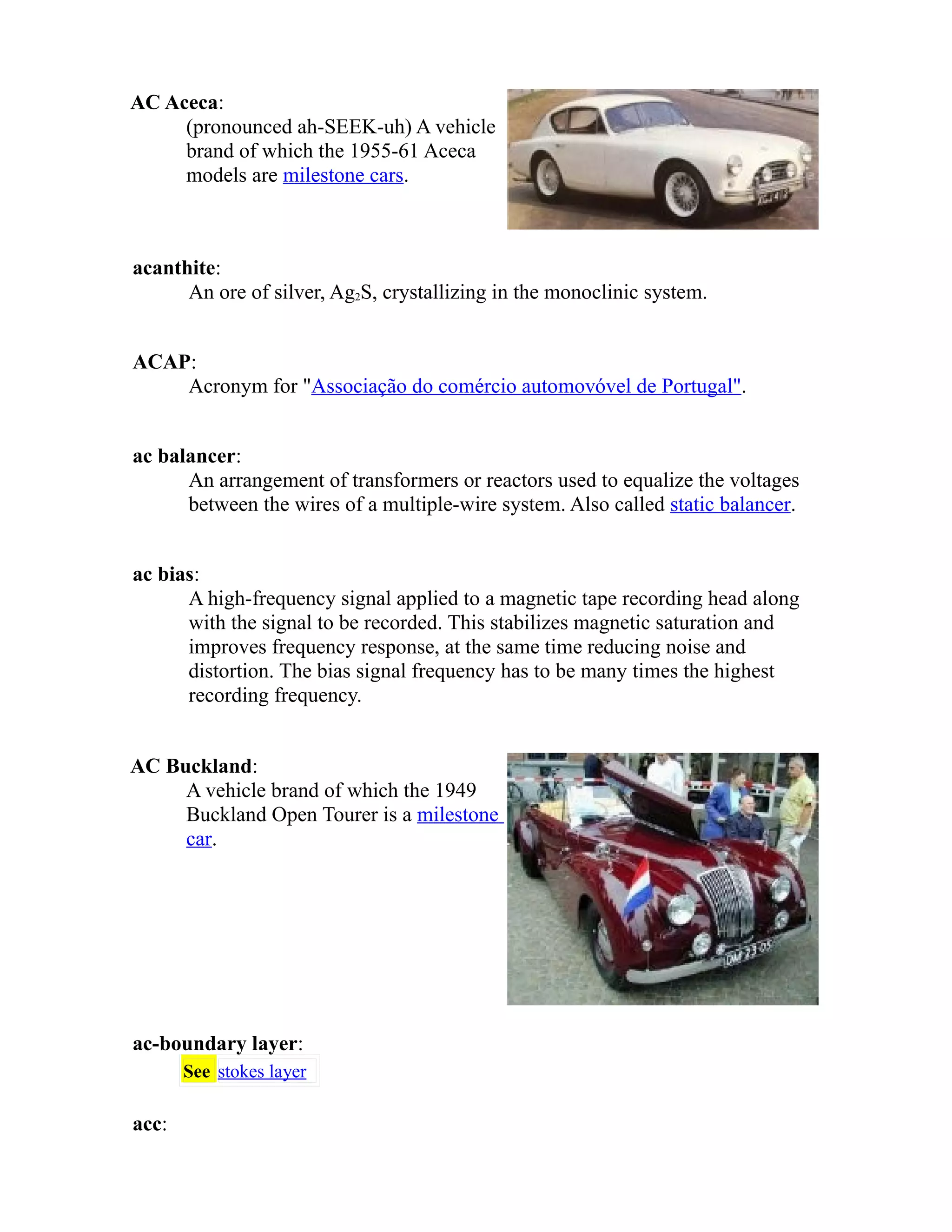
AC Aceca: 
(pronounced ah-SEEK-uh) A vehicle 
brand of which the 1955-61 Aceca 
models are milestone cars. 
acanthite: 
An ore of silver, Ag2S, crystallizing in the monoclinic system. 
ACAP: 
Acronym for "Associação do comércio automovóvel de Portugal". 
ac balancer: 
An arrangement of transformers or reactors used to equalize the voltages 
between the wires of a multiple-wire system. Also called static balancer. 
ac bias: 
A high-frequency signal applied to a magnetic tape recording head along 
with the signal to be recorded. This stabilizes magnetic saturation and 
improves frequency response, at the same time reducing noise and 
distortion. The bias signal frequency has to be many times the highest 
recording frequency. 
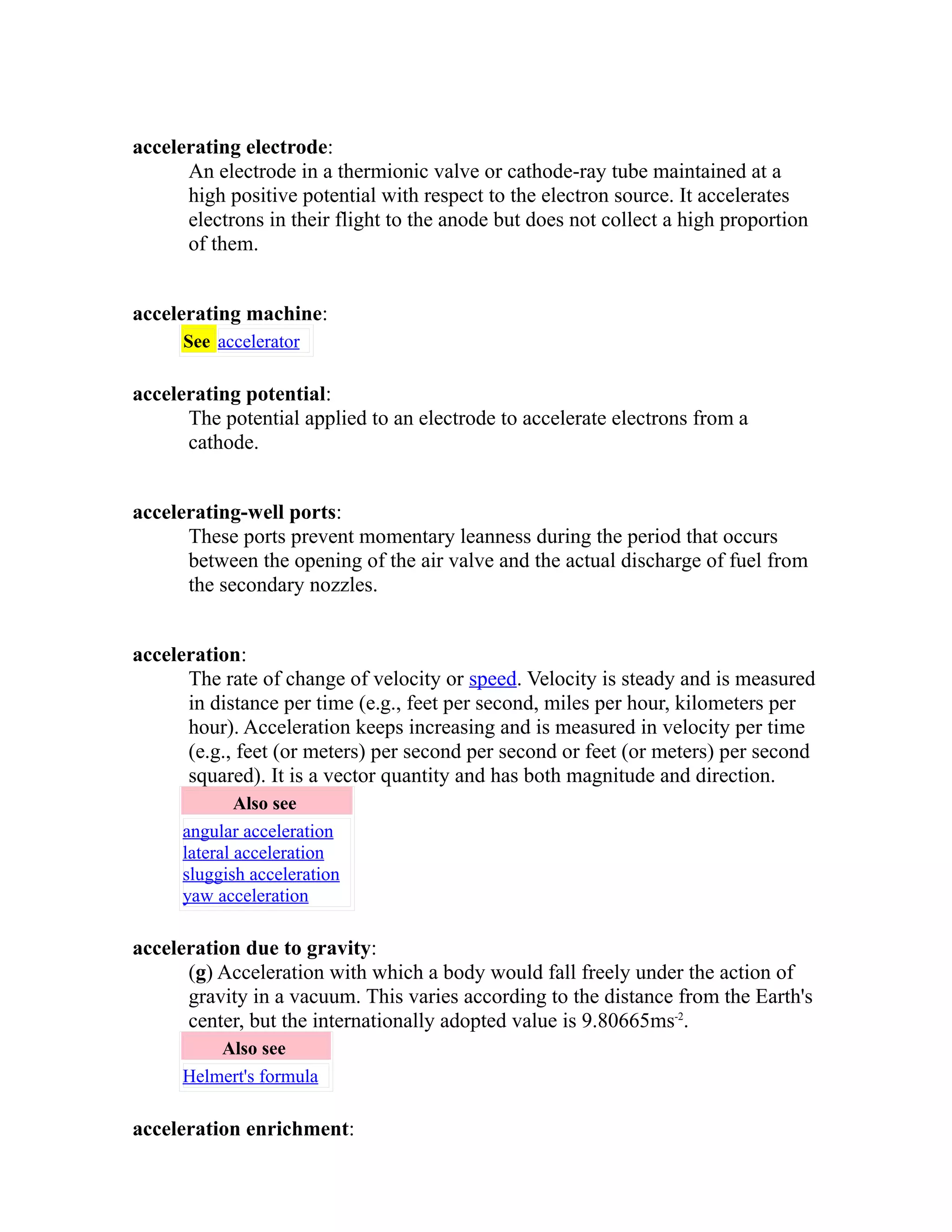
AC Buckland: 
A vehicle brand of which the 1949 
Buckland Open Tourer is a milestone 
car. 
ac-boundary layer: 
See stokes layer 
acc:
Abbreviation for "accessories." 
ACC: 
[1] Acronym for "Automatic Cruise Control." 
[2] A term found on a cruise control switch which indicates the direction 
the switch needs to be moved to increase the speed (accelerate) of the 
vehicle. 
ACCC: 
Acronym for "air conditioner clutch compressor" signal. 
accelerate: 
[1] To increase the speed of a vehicle. Opposite of decelerate. 
[2] To accelerate an adhesive is to speed up a chemical reaction or a curing 
process. For example, you can speed up the drying time of an adhesive or 
sealer by increasing the temperature. Also, by adding a chemical curing 
agent, or accelerator, to a base compound. 
accelerated aging test: 
A stability test for cables using twice normal working voltage. It is 
claimed this give quick results that correlate with service records. 
accelerated fatigue test: 
Test which applies a cyclic loading schedule, which can be of varying 
frequency and/or amplitude, to a machine or component simulating its 
loading in service, but at a higher rate, to determine its safe fatigue life 
before it is reached in service. 
accelerate-stop distance: 
The total distance, under specified conditions, in which an aircraft can be 
brought to rest after accelerating to critical speed for an engine failure at 
take-off. 
accelerating chain: 
The section of an electron beam tube or system, e.g., cathode-ray tube or 
electron microscope, in which electrons are accelerated by voltages on 
accelerating electrodes. Also used in particle accelerators.
accelerating electrode: 
An electrode in a thermionic valve or cathode-ray tube maintained at a 
high positive potential with respect to the electron source. It accelerates 
electrons in their flight to the anode but does not collect a high proportion 
of them. 
accelerating machine: 
See accelerator 
accelerating potential: 
The potential applied to an electrode to accelerate electrons from a 
cathode. 
accelerating-well ports: 
These ports prevent momentary leanness during the period that occurs 
between the opening of the air valve and the actual discharge of fuel from 
the secondary nozzles. 
acceleration: 
The rate of change of velocity or speed. Velocity is steady and is measured 
in distance per time (e.g., feet per second, miles per hour, kilometers per 
hour). Acceleration keeps increasing and is measured in velocity per time 
(e.g., feet (or meters) per second per second or feet (or meters) per second 
squared). It is a vector quantity and has both magnitude and direction. 
Also see 
angular acceleration 
lateral acceleration 
sluggish acceleration 
yaw acceleration 
acceleration due to gravity: 
(g) Acceleration with which a body would fall freely under the action of 
gravity in a vacuum. This varies according to the distance from the Earth's 
center, but the internationally adopted value is 9.80665ms-2. 
Also see 
Helmert's formula 
acceleration enrichment:
The action of increasing the fuel/air mixture during acceleration in order to 
improve the vehicle's speed and its smooth response. 
acceleration error: 
The error in an airborne magnetic compass due to maneuvering; caused by 
the vertical component of the Earth's magnetic field when the center of 
gravity of the magnetic element is displaced from normal. 
acceleration pump: 
See auxiliary acceleration pump 
acceleration slip regulation: 
(ASR) The Bosch term for traction control. 
acceleration stress: 
The influence of acceleration (or deceleration) on certain physiological 
parameters of the human body. Man can withstand transverse accelerations 
better than longitudinal ones, which have a profound effect on the 
cardiovascular system. The degree of tolerance also depends on the 
magnitude and duration of the acceleration. 
acceleration tolerance: 
The maximum acceleration force that a person can withstand before 
"blacking out" or otherwise losing control. 
accelerator: 
[1] In automobiles, this is the 
"gas pedal" which is attached 
by linkage to the throttle in 
the carburetor or to the fuel 
injection system. It regulates 
the amount of fuel which is 
sent to the engine. In 
motorcycles, the accelerator is 
located on the right-hand twist 
grip or an actuating lever. 
[2] A device, similar to a 
catapult, but generally
mounted below deck level, for 
assisting the acceleration of 
aircraft flying off aircraft 
carriers. Land versions have 
been tried experimentally. 
[3] A chemical which is added 
to something to make a 
process happen more quickly. 
For example, a chemical may 
be added to paint to cause it to 
dry faster. The opposite is 
"retarder." A material added to 
an adhesive to speed up its 
cure or to chemically convert 
the whole mass to a solid. 
Accelerators differ from 
catalysts in that they are a part 
of the chemical reaction and 
lose their chemical identity as 
a result. 
[4] A substance which 
increases the efficient action 
of an enzyme 
[5] Any substance increasing 
the speed of the vulcanization 
process of rubber. The 
principal types are aldehyde 
derivatives of Schiff's bases: 
butyraladehyde-butylidene-aniline, 
di-orthotolyl-guanidine, 
diphenyl-guanidine, 
benzthiazyl 
disulphide, tetramethyl-thiuran 
disulphide and zinc 
dimethyl-dithiocarbamate. 
[6] A special circuit board 
which is placed within a 
computer to speed up some 
aspect of its operation. 
[7] Machine used to 
accelerate charged particles to 
very high energies such as 
betatron, cyclotron, linear
accelerator, synchrocyclotron, 
and synchrotron. 
[8] A chemical used to 
increase the rate of 
development, e.g., sodium 
carbonate or borax 
[9] Any muscle or nerve 
which increases rate of action. 
Also see 
depress the accelerator 
ease up on the accelerator 
step on the accelerator 
take foot off the accelerator 
accelerator board: 
A circuit board plugged into a computer motherboard to increase the 
operating speed of a computer. 
accelerator interlock: 
A connection between the gas pedal and the automatic transmission. 
accelerator pedal: 
The accelerator, gas pedal, or throttle pedal. 
accelerator pump: 
A small cylinder and piston usually located inside the carburetor that 
sprays an extra amount of fuel into the engine during acceleration. It 
improves acceleration by giving more boost and reducing a momentary lag 
in power. It is actuated by depressing the pedal. 
accelerometer: 
[1] A transducer used to provide a signal proportional to the rate of 
acceleration of a vibrating or other body, usually employing the 
piezoelectric principle. 
[2] An instrument which measures the amount of acceleration in a specific 
direction. 
Also see 
impact accelerometer 
vertical-gust recorder
acceptable quality level: 
(AQL) A manufactured good that may not be perfect but does reach a 
level of shape, size, and performance, etc. that will make it work and last 
as long as the manufacturer expects. 
acceptance angle: 
The solid angle within which all incident light reaches the photocathode of 
a phototube. 
acceptance test: 
An examination of a part or its assembly to determine if it meets a 
prescribed standard. 
acceptor: 
[1] The reactant in an induced reaction whose rate of reaction with a third 
substance is increased by the presence of the inductor. 
[2] The atom which accepts electrons in a co-ordinate bond. 
[3] Impurity atoms introduced in small quantities into a crystaline 
semiconductor and having a lower valency than the semiconductor, from 
which they attract electrons. In this way holes are produced, which 
effectively become positive charge carriers; the phenomenon is known as 
p-type conductivity. 
Also see 
donor 
impurity 
acceptor level: 
See energy levels 
access: 
A way of reaching something that is usually hidden or covered. 
Also see 
access panel 
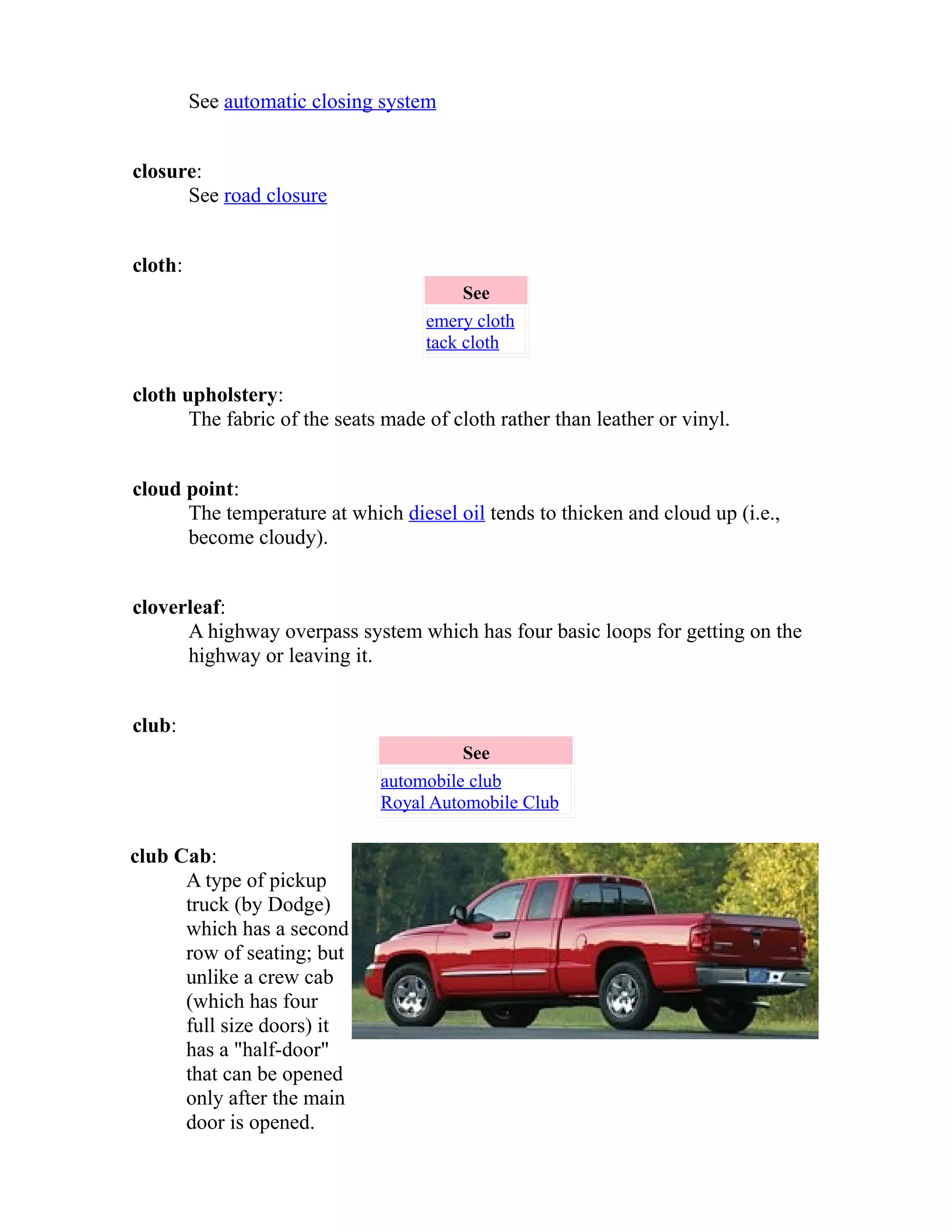
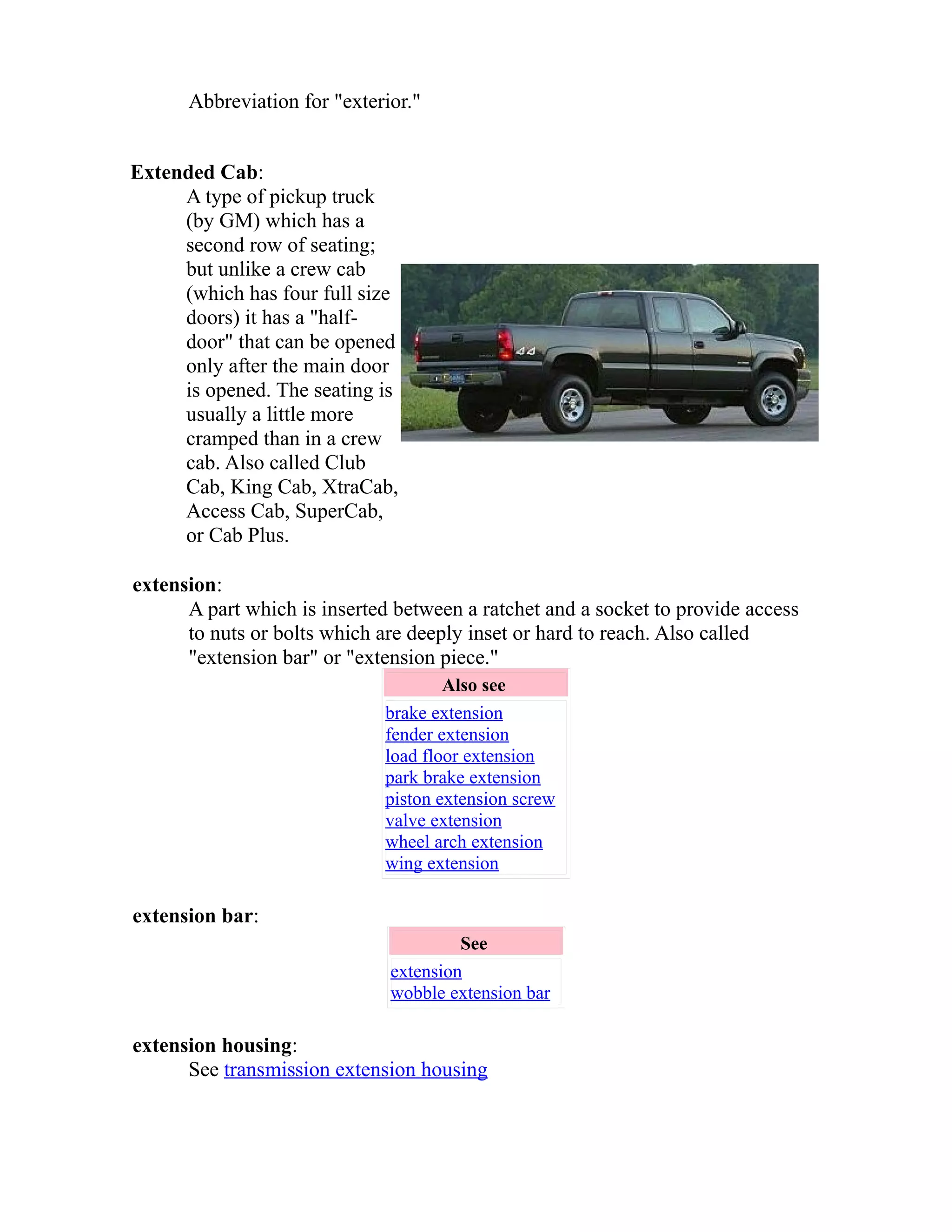
Access Cab: 
A type of pickup truck (by Toyota) which as a second row of seating; but 
unlike a crew cab (which has four full size doors) it has a "half-door" that 
can be opened only after the main door is opened. The seating is usually a
little more cramped than in a crew cab. Also called club Cab, extended 
Cab, king Cab, xtracab, supercab, or cab Plus 
access charge: 
A financial charge for access to a computer or telecommunications 
network. 
access eye: 
A screwed plug provided in soil, waste and drain pipes at bends and 
junctions, to clear a stoppage. 
access hole: 
An opening through which you can reach something. It is usually covered 
with a panel. 
accessible hermetic: 
Assembly of motor and compressor inside a single bolted housing unit. 
accessories: 
Items and packages of equipment which are beyond the standard 
equipment supplied in a new vehicle. 
accessory: 
See accessories 
accessory gearbox: 
A gearbox, driven remotely from an aero-engine, on which aircraft 
accessories, e.g., hydraulic pump and electrical generator, are mounted. 
accessory minerals: 
Minerals which occur in small, often minute, amounts in igneous rocks; 
their presence or absence makes no difference to classification and 
nomenclature. 
accessory package:
A set of features or appointments which may be ordered at extra cost on a 
new vehicle. 
accessory plates: 
Quartz-wedge, gypsum plate and mica plate. Used with petrological 
microscope to help determine the optical character of a mineral as an aid in 
its examination. 
accessory shoe: 
A mounting bracket on the body of a camera to which separate units such 
as a flash or range-finder may be fitted. 
access panel: 
The cover which conceals the engine on a mid-engine vehicle. Also called 
engine cover. 
Also see 
hood 
access time: 
The time interval between the instant at which data are called from 
memory and the instant at which the data can be used. It can vary from 
microseconds with fast store to minutes with magnetic tape. 
access to store: 
Entry or extraction of data from a memory location. The method and speed 
of access depends on the type of memory. 
Also see 
backing store 
fast store 
random access memory 
serial access memory 
accident: 
See car accident 
accident damage: 
The destruction caused to a vehicle's bodywork when it is involved in an 
accident.
ac circuit: 
A circuit which passes alternating current as opposed to direct current, 
e.g., it may have a capacitor in series, which blocks direct current. 
ac commutator motor: 
An ac motor which embodies a commutator as an essential part of its 
construction. 
Also see 
ac series motor 
compensated induction motor 
repulsion motor 
Schrage motor 
Accord: 
A model of automobile manufactured by 
Honda 
. 
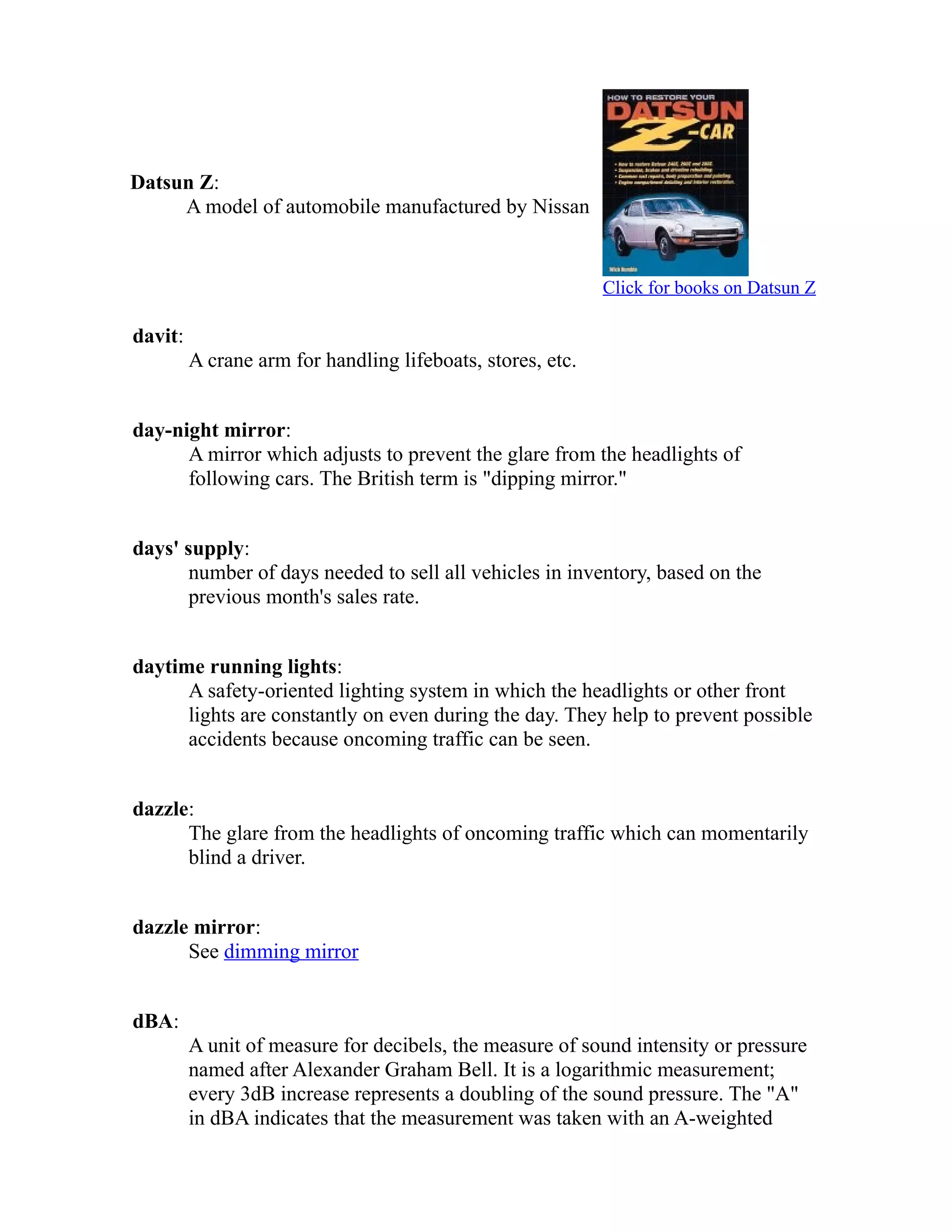
Click for books on Honda 
Accord 
accordion: 
The method of folding a leaflet or insert so that it opens out and closes in a 
zig-zag fashion. The British term is concertina fold. 
accretion: 
[1] The process in which a celestial body, particularly an evolved star in a 
binary system, is enlarged by the accumulation of extraneous matter 
falling in under gravity 
[2] The process of enlargement of a continent by the tectonic coalescences 
of exotic crustal fragments. 
accretion disc: 
The disc of material at the edge of a black hole, which has been attracted 
from a neighboring star and which emits X-rays as its inner edge 
disappears into the gravitational field of the hole.
accumulation point: 
A mathematical term which says that of a set of points, one such that every 
neighborhood of it includes at least one point of the set. 
accumulator: 
[1] A storage battery for an electric car. 
[2] A pressurized container for an automatic leveling suspension system. 
[3] A part of the hydraulic system which is charged by the fluid pump, 
absorbs fluctuating fluid delivery, stores fluid at pressure, and can provide 
a rapid flow of fluid under pressure. 
[4] A vessel that stores hydraulic fluid under pressure. 
[5] A storage tank which receives liquid refrigerant from evaporator and 
prevents it from flowing into the suction line before vaporizing. 
[6] A refrigerant storage device used on General Motors and Ford systems 
that receives vapor and liquid refrigerant from the evaporator. The 
accumulator, which contains "desiccant," performs a function similar to 
that of a receiver-drier: it separates liquid from the vapor, retains the liquid 
and releases the vapor to the compressor. Always located on the low side 
of the system. 
[7] A special storage register associated with the arithmetic logic unit, used 
for holding the results of a computation or data transfer 
Also see 
accumulator piston 
fuel accumulator 
hydraulic accumulator 
pressure accumulator 
accumulator battery: 
A storage battery (i.e., the main battery in your vehicle). 
accumulator box: 
A vessel usually made of plastic which contains the plates and electrolyte 
of an accumulator. 
accumulator drier: 
A device which is part of the air conditioning system. It is made up of a 
tank, filter, drying agent, and a vapor return tube. It is usually found on the
evaporator outlet. It stores the excess refrigerant and removes the moisture 
from the refrigerant (thus the name "drier"). 
Also see 
receiver drier 
accumulator grid: 
The lead grid which forms one of the plates of a lead-acid accumulator 
having pasted plates. 
accumulator piston: 
A unit found in the automatic transmission to assist the servo to apply the 
brake band quickly and smoothly. 
accumulator system: 
In an automatic transmission, it includes a hydraulic accumulator piston 
which is controlled by a valve. 
accumulator traction: 
See battery traction 
accumulator valve: 
A device which operates the hydraulic accumulator piston in an automatic 
transmission. 
accumulator vehicle: 
See battery traction 
AC current sine wave: 
Wave form of single frequency alternating current; wave whose 
displacement is sine of angle proportional to time or distance. 
Ace: 
An American trucker's colloquial term for someone with a class "A" 
licence. 
Also see 
AC Ace
ACEA: 
Acronym for "Association des Constructeurs européens dAutomobiles" 
(i.e., European Automakers Association). 
Aceca: 
See AC Aceca 
acet-: 
Prefix from the Latin acetum meaning vinegar. 
acetate film: 
Film with its photographic emulsion coated on a base of cellulose 
triacetate, of low flammability. 
aceto-: 
Prefix from the Latin acetum meaning vinegar. 
acetylene: 
[1] Ethyne HC≡CH. A colorless, poisonous gas, owing its disagreeable 
odor to impurities; soluble in ethanol, in acetone (25 times its volume at 
standard temperature and pressure) and in water. Boiling point -84°C, 
relative density 0.91. Prepared by the action of water on calcium carbide 
and catalytically from naphtha. 
[2] A gas composed of two parts of carbon and two parts of hydrogen. 
When burned in an atmosphere of oxygen, it produces one of the highest 
flame temperatures obtainable for welding. 
[3] Also used for illuminating, acetic acid synthesis and for manufacturing 
derivatives 
Also see 
oxygen acetylene cutting 
acetylene bottle: 
See acetylene cylinder 
acetylene cutting: 
See oxygen acetylene cutting
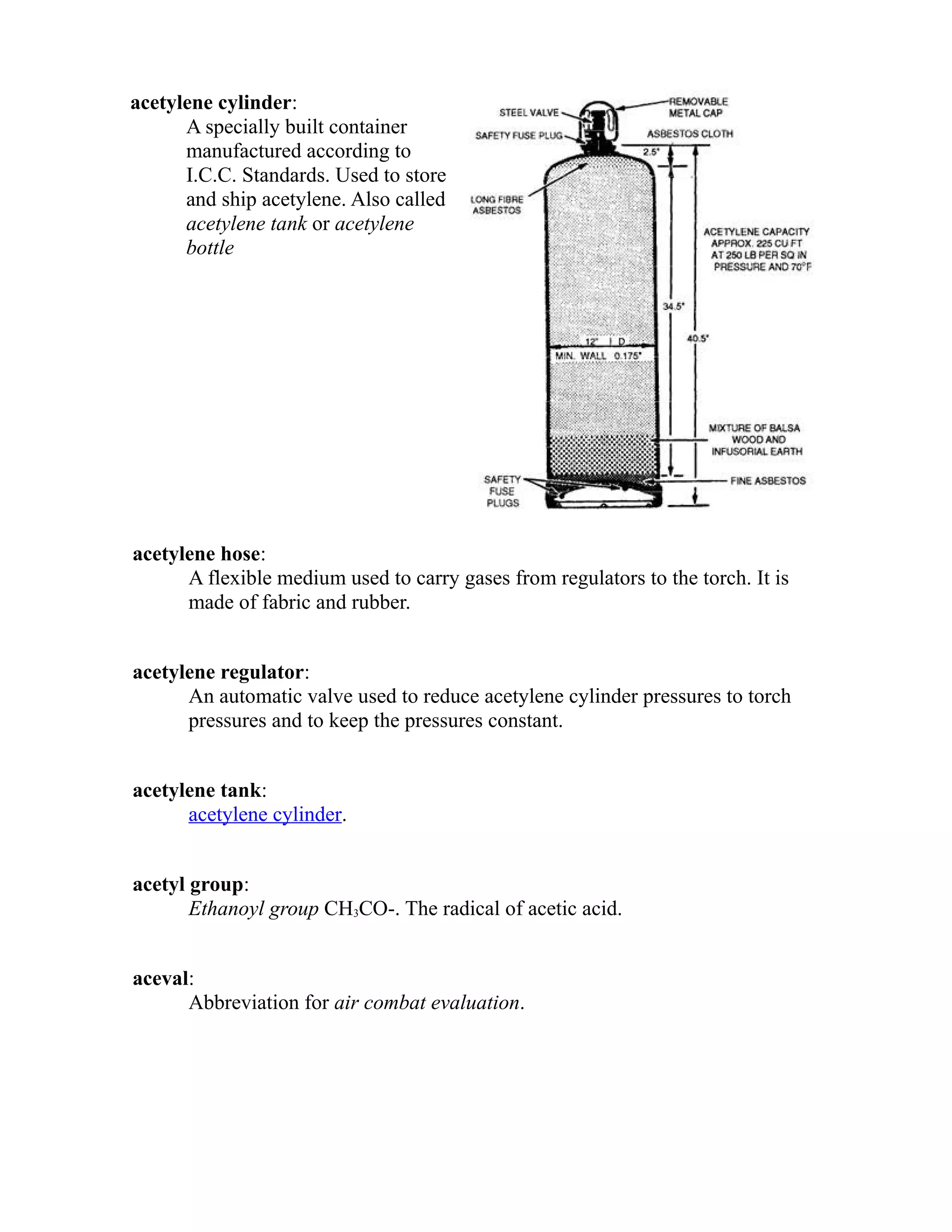
acetylene cylinder: 
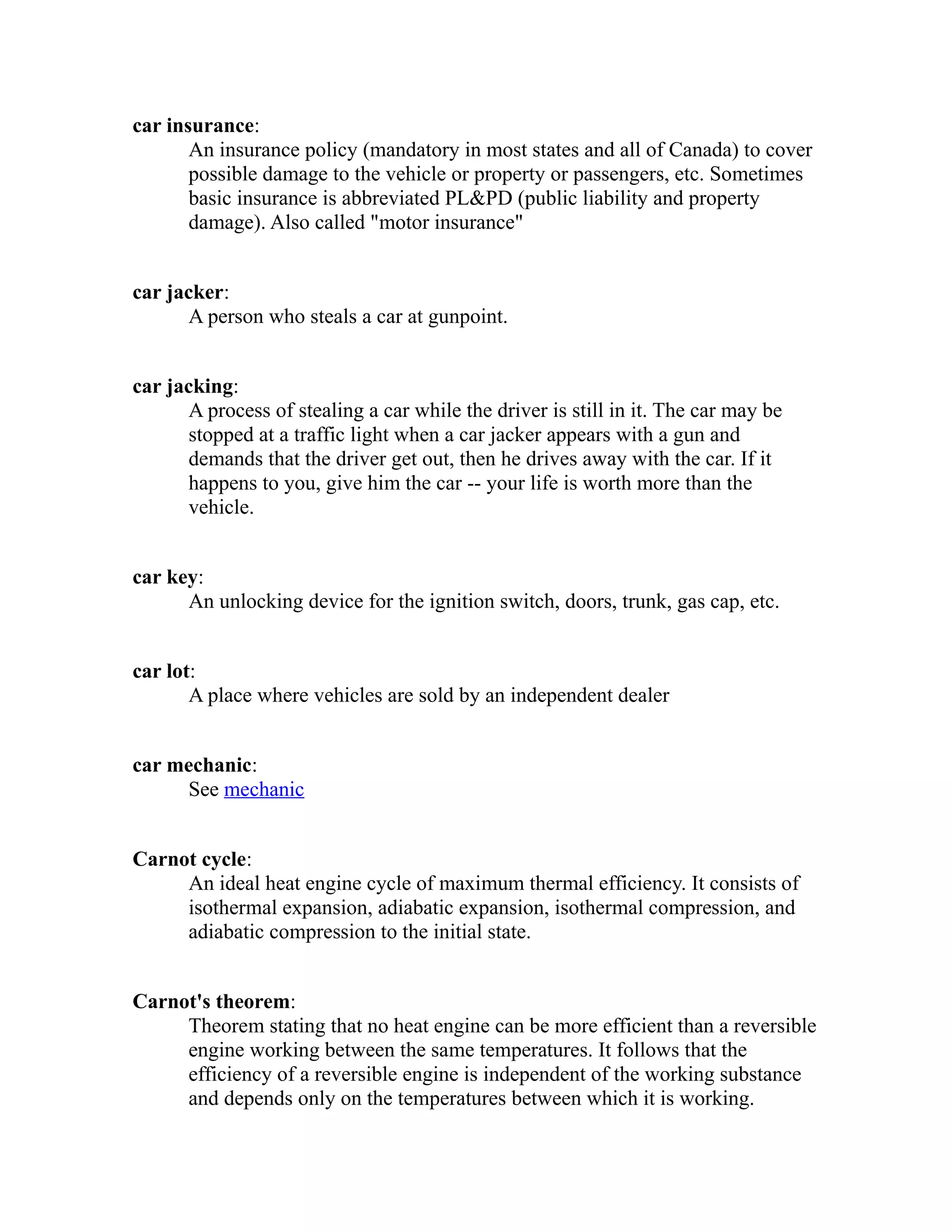
A specially built container 
manufactured according to 
I.C.C. Standards. Used to store 
and ship acetylene. Also called 
acetylene tank or acetylene 
bottle 
acetylene hose: 
A flexible medium used to carry gases from regulators to the torch. It is 
made of fabric and rubber. 
acetylene regulator: 
An automatic valve used to reduce acetylene cylinder pressures to torch 
pressures and to keep the pressures constant. 
acetylene tank: 
acetylene cylinder. 
acetyl group: 
Ethanoyl group CH3CO-. The radical of acetic acid. 
aceval: 
Abbreviation for air combat evaluation.
AC generator: 
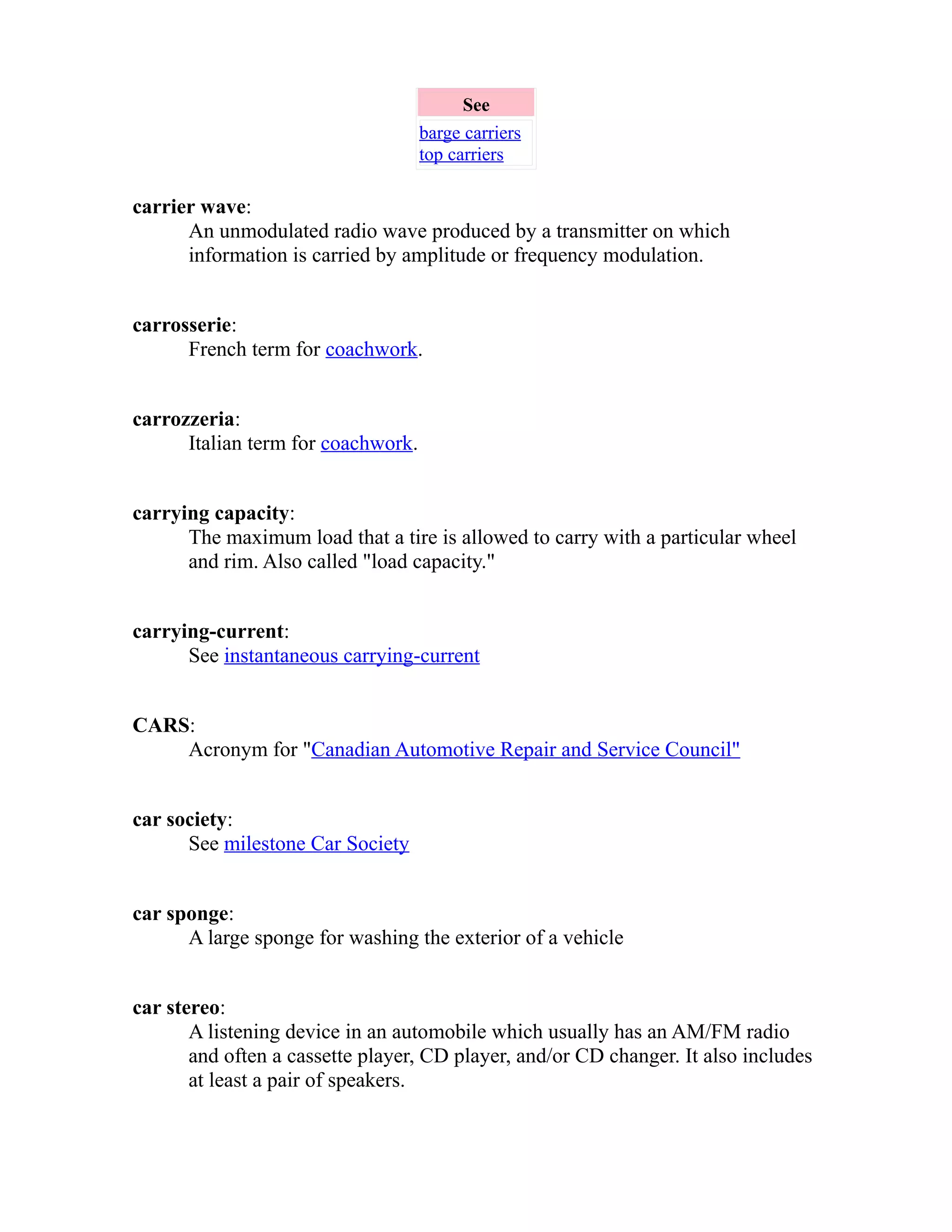
[1] An electromagnetic generator for 
producing alternating emf and delivering ac to 
an outside circuit. 
[2] A generator produces direct current (DC) 
while an alternator produces alternating 
current (AC). Because alternators were 
introduced to automobile electrical systems 
after generators had been in use for some time, 
some people referred to the new alternator as 
"AC generator." 
ache: 
See head ache rack 
ache rack: 
See head ache rack 
achromatic lens: 
A lens designed to minimize chromatic aberration. The simplest form 
consists of two component lenses, one convergent, the other divergent, 
made of glasses having different dispersive powers, the ratio of their focal 
lengths being equal to the ratio of the dispersive powers. 
achromatic prism: 
An optical prism with a minimum of dispersion but a maximum of 
deviation. 
achromatic sensation: 
A visual perception of grey. Represented by the equal energy point on a 
chromaticity diagram. 
achromatic stimulus: 
Stimulus which produces an achromatic sensation. 
acid: 
Also see 
battery acid 
chromic acid
oxalic acid 
acid brittleness: 
The brittleness developed in steel in pickling bath, through evolution of 
hydrogen. 
acid condition in system: 
Condition in which refrigerant or oil in system is mixed with fluids that 
are acid in nature. 
acid cure: 
In extraction of uranium from its ores, lowering of gangue carbonates by 
puddling with sulphuric acid before leach treatment. 
acid deposition: 
Acid compounds emitted into the atmosphere which then return to the 
surface either in the form in which they were discharged or as new 
compounds formed by reaction in the atmosphere. Includes dry deposition, 
usually of sulphur and nitrogen oxides near the source, and wet deposition 
which follows when acids are washed from the atmosphere by 
precipitation (i.e., acid rain and occult deposition. 
acid drift: 
The process by which ores, pulps, and products become acidic through 
pick-up of atmospheric oxygen through standing. 
acid dyes: 
Dyes which have their color associated with the negative ion or radical. 
acid egg: 
A pump for sulphuric acid, of simple and durable construction, with few 
moving parts. The acid is run into a pressure vessel, usually egg-shaped, 
from which it can be forcibly expelled by compressed air. 
acid fixer: 
Fixing solution (hypo) with the addition of an acid (sodium bisulphite or 
potassium metabisulphite) to prevent staining.
acidizing: 
Improving the flow of oil from a limestone formation by pumping acid 
into it. 
acid mine water: 
Water containing sulphuric acid as a result of the breakdown of the 
sulphide minerals in rocks. Acid mine water causes corrosion of mining 
equipment, and may contaminate water supplies into which it drains. 
acid process: 
[1] A steel-making process in which the furnace is lined with a siliceous 
refractory, and for which iron low in phosphorous is required, as this 
element is not removed. 
[2] Any pulp digestion process utilizing an acid regent, e.g., a bisulphite 
liquor with some free sulphur dioxide. 
acid rain: 
[1] When the smoke created by factories and vehicle exhausts is taken by 
the wind and joined with rain clouds, the mixture is often acidic. As a 
result the rain that falls to the ground (and even on your car) may damage 
whatever it strikes. 
[2] A form of wet deposition in which acid molecules or particles in the 
atmosphere are returned to the surface having been washed out by rain or 
snow as it falls. The unnatural acidity (pH 3-5.5) is caused mainly by the 
oxides of sulphur and nitrogen from the burning of coal and oil. 
acid refractory: 
See silica 
acid resist foils: 
Blocking foils for use in etching metal. The foil is stamped on to paper and 
the excess foil blocked on to the metal rule or other object which is then 
exposed to an acidic etching fluid such as ferric chloride. 
acid rock:
An igneous rock with more than 63% quartz. 
acid slag: 
Furnace slag in which silica and alumina exceed lime and magnesia. 
acid smut: 
See acid soot 
acid soot: 
A pollutant, consisting of particles of carbon bound together by water 
containing sulphuric acid, formed as a by-product of the incomplete 
combustion of carbon-based fuel. Also called acid smut. 
acid steel: 
Steel made by an acid process. 
acid stop: 
Weak acid photography processing solution used immediately after the 
developer to halt its chemical activity and neutralize it before fixing. 
AC Ignition System: 
See continuous AC Ignition System 
Ackermann: 
See Ackermann steering
Ackermann steering: 
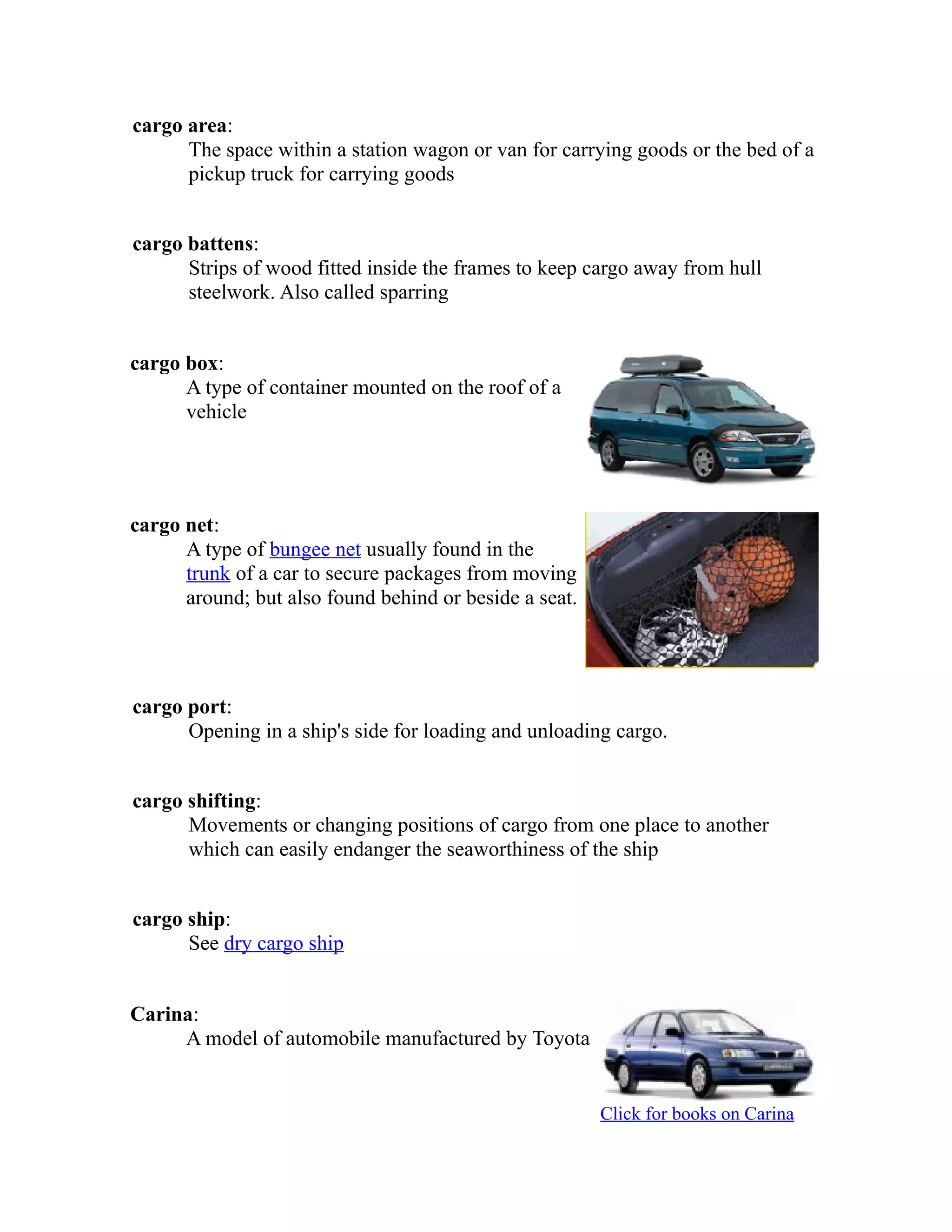
[1] A double-pivoting steering system where 
the outer ends of the steering arms are bent 
slightly inward so that when the vehicle is 
making a turn, the inside wheel will turn more 
sharply than the outer wheel. This is done to 
compensate for the greater distance the outside 
wheel must travel. Notice 20 degrees on left 
wheel and 30 degrees on right wheel 
[2] Arrangement whereby a line extended from 
the track-arms, when the wheels are set 
straight ahead, should meet on the chassis 
centerline at 2/3 of the wheelbase from the 
front, allowing the inner stub-axle to move 
through a greater angle than the outer. 
Ackermann angle: 
The toe-out or toe-in of a vehicle with Ackermann steering when the 
wheels are positioned straight ahead. 
Ackermann axle: 
In a vehicle with Ackermann steering (at the front of the vehicle), it is a 
non-rotating axle that is steerable and has two pivot points (one on each 
end of the axle) with vertical kingpins. 
acknowledgement signal: 
A signal transmitted along a circuit from B to A when triggered by a signal 
from A to B. 
A-class insulation: 
Insulating material which will withstand temperatures up to 105°C. 
ACL BI-MET: 
Acronym for "air cleaner bi-metal sensor". 
ACL DV: 
Acronym for "air cleaner duct and valve vacuum" motor.
ACM: 
Abbreviation for Association for Computing Machinery, a US professional 
association. 
ac magnet: 
Electromagnet excited by alternating current having normally a laminated 
magnetic circuit. 
Also see 
shaded pole 
acme screw-thread: 
A thread having a profile angle of 29° and a flat crest and root, used for 
example for lathe lead screw for easy engagement by a split nut. 
acmite: 
A variety of aegirine; also used for the NaFe+3Si2 O6 end-member. 
ac motor: 
An electric motor which operates from a single or polyphase alternating 
current supply. 
Also see 
capacitor motor 
induction motor 
synchronous motor 
acnode: 
See double point 
acoustic absorption: 
Transfer of energy into thermal energy when sound is incident at an 
interface. 
acoustic absorption coefficient: 
The ratio of the acoustic energy absorbed by a surface to that which is 
incident on the surface. For an open window this can be 1.00, for painted 
plaster 0.02. The value varies with the frequency of the incident sounds, 
e.g., for 2 cm glass fiber it is 0.04 at 125 Hz, 0.80 at 4000 Hz. Also called 
acoustic absorption factor.
acoustic absorption factor: 
The ratio of the acoustic energy absorbed by a surface to that which is 
incident on the surface. For an open window this can be 1.00, for painted 
plaster 0.02. The value varies with the frequency of the incident sounds, 
e.g., for 2 cm glass fiber it is 0.04 at 125 Hz, 0.80 at 4000 Hz. Also called 
acoustic absorption coefficient. 
acoustical inertia: 
The quantity M, where ωM is the part of the acoustical reactance which 
corresponds to the inductance of an electrical reactance: ω is the pulstance, 
given by 2πf is the frequency in hertz. Also called acoustical mass. 
acoustical mass: 
The quantity M, where ωM is the part of the acoustical reactance which 
corresponds to the inductance of an electrical reactance: ω is the pulstance, 
given by 2πf is the frequency in hertz. Also called acoustical inertia. 
acoustical stiffness: 
For an enclosure of volume V, the quantity given by S-pc³/V, where c is 
velocity of propagation of sound and p is density. It is assumed that the 
dimensions of the enclosure are small compared with the sound 
wavelength and that the walls around the volume do not deflect. 
acoustic amplifier: 
An amplifier of mechanical vibrations. 
acoustic branch: 
A branch of the dispersion curve (frequency ω against wavenumber q) for 
crystal lattice vibrations for which ω is proportional to q for small q. For a 
crystal containing n atoms per unit cell, the dispersion curve has 3n 
branches of which three are acoustic branches. The branches are 
characterized by different patterns of movement of the atoms. 
Also see 
optic branch 
acoustic center:
The effective source point of the spherically divergent wave system 
observed at distinct points in the radiation field of an acoustic transducer. 
acoustic compliance: 
The reciprocal of the acoustic stiffness. 
acoustic construction: 
Building construction which aims at the control of transmission of sound, 
or of mechanical vibration giving rise to sound, particularly unwanted 
noises. The parts of the structure are separated by air-spaces or acoustic 
absorbing material and can be decoupled by the interposing of springs. 
acoustic coupler: 
A device which enables a digital signal to be transmitted over the 
telephone network using an ordinary telephone handset. 
acoustic delay line: 
A device, magnetostrictive or piezoelectric, e.g., a quartz bar or plate of 
suitable geometry, which reflects an injected sound pulse many times 
within the body. 
acoustic distortion: 
Distortion in sound-reproducing systems. 
acoustic emission: 
Non-destructive testing method of investigating deformation and failure 
processes in materials by the signals generated when the elastic waves 
released by them are detected at the materials' surfaces. 
acoustic feedback: 
Instability or oscillation in a second reproduction system caused by the 
microphone or pick-up receiving vibrations from the loudspeaker. 
acoustic filter: 
Filter which uses tubes and resonating boxes in shunt and series as 
reactance elements, providing frequency cut-offs in acoustic wave
transmission, as in an electric wave filter. 
acoustic grating: 
A diffraction grating for production of directive sound. Spacings are much 
larger than in optical gratings due to the longer wavelength of sound 
waves. Both transmission and reflection grating are used. 
acoustic impedance: 
the complex ratio of sound pressure on surface to sound flux through 
surface, having imaginary (reactance) and real (resistance) components, 
respectively. Unit is the acoustic ohm. 
acoustic interferometer: 
Instrument in which measurements are made by study of interference 
pattern set up by two sound or ultrasonic waves generated at the same 
source. 
acoustic lens: 
A system of slats or disks to spread or converge sound waves. 
acoustic microscope: 
Microscope based on acoustic waves (longitudinal compressions and 
rarefactions of density) at microwave frequencies the interaction of an 
acoustic wave with a material is sensitive to its elastic properties. Images 
can be created by modulating a display with the intensity received by a 
detector/specimen system scanned synchronously (ultrasonic imaging). 
Coupling between electrical signals and acoustic vibrations exploits the 
piezoelectric effect. 
acoustic model: 
A scale model of a room (e.g., concert hall) or structure which is used to 
measure qualities important for architectural acoustics and noise control 
(e.g., sound distribution). The scale is typically between 1:10 and 1:20. In 
order to adjust the wavelength, the frequency has to be increased by a 
factor of 10-20. 
acoustic ohm:
Unit of acoustic resistance, reactance, and impedance, equal to 105Pasm-3. 
acoustic perspective: 
The quality of depth and localization inherent in a pair of ears, which is 
destroyed in a single channel for sound reproduction. It is transferable with 
two microphones and two telephone ear-receivers with matched channels, 
and more adequately realized with three microphones and three radiating 
receivers with three matched channels. 
acoustic plaster: 
Rough or flocculent plaster which has good acoustic absorbing properties 
and which can be used for covering walls. Added to the mix is fine 
aluminum, which evolves gas on contact with water and so aerates the 
mass. These tiny holes lower the acoustic impedance and so reduce the 
reflection of incidence sound waves. 
acoustic pressure: 
See sound pressure 
acoustic radiator: 
Device to generate and radiate sound. The more common radiators are (1) 
vibrating elastic systems (membrane, string, vocal cord) which cause a 
fluctuating pressure in the surrounding medium; (2) electrically driven 
membranes and plates (loudspeaker, sonar transducer); (3) vortices in 
turbulent fluid flow. 
acoustic ratio: 
The ratio between the directly radiated sound intensity from a source, at 
the ear of a listener (or a microphone), and the intensity of the reverberant 
sound in the enclosure. The ratio depends on the distance from the source, 
the polar distribution of the radiated sound power, and the period of 
reverberation of the enclosure. 
acoustic reactance: 
See acoustic impedance 
acoustic resistance: 
See acoustic impedance
acoustic resonance: 
Enhancement of response to an acoustic pressure of a frequency equal or 
close to the eigenfrequency of the responding system. When a system is at 
resonance, the imaginary part of its impedance is zero. Prominent in 
Helmholtz resonators, organ, and other pipes and vibrating strings. 
acoustics: 
[1] The science of sound waves including production and propagation 
properties. 
[2] The characteristics of a room which determine the quality of sound 
transmission inside. 
Also see 
architectural acoustics 
atmospheric acoustics 
acoustic saturation: 
The aural effectiveness of a source of sound amid other sounds; it is low 
for a violin, but high for a triangle. The relative saturation of instruments 
indicates the number required in an auditorium of given acoustic 
properties. 
acoustic scattering: 
Irregular and multi-directional reflection and diffraction of sound waves 
produced by multiple reflecting surfaces the dimensions of which are 
small compared to the wavelength; or by certain discontinuities in the 
medium through which the wave is propagated. 
acoustic spectrometer: 
An instrument designed to analyze a complex sound signal into its 
wavelength components and measure their frequencies and relative 
intensities. 
Also see 
real-time analyzer 
acoustic spectrum: 
Graph showing frequency distribution of sound energy emitted by source. 
acoustic streaming:
Generation of constant flows by a strong sound wave. Acoustic streaming 
is a non-linear effect. It is responsible for the motion of the light particles 
(lycopodium spores) in a Kundt's tube. 
Also see 
quartz wind 
acoustic survey: 
Determination of the porosity of a rock by measuring the time required for 
a sonic impulse to travel through a given distance. 
acoustic suspension: 
Sealed-cabinet system of loudspeakers in which the main restoring force 
of the diaphragm is provided by the acoustic stiffness of the enclosed air. 
acoustic telescope: 
An array of microphones. The signals of the microphones are added with 
certain phase-delays so as to generate desired directions. 
Also see 
directional microphone 
acoustic tile: 
A tile made of soft, sound-absorbing substance. 
acousto-optic modulator: 
A telecommunication device in which acoustic waves in an optical 
medium from a grating used to diffract an optical signal and thus 
effectively turn it on or off. 
acquisition fee: 
A charge for processing a lease and is probably not negotiable. On a 
shorter term lease, the acquisition fee can have a large impact on the cost 
of the lease. 
ACR: 
Abbreviation for approach control radar. 
acro-:
Prefix from Greek akros (ακρος), topmost, farthest, terminal. 
Acrobat: 
Trade name for a computer application which converts text, line drawings, 
and half-tones into a stream of alphanumeric text while retaining the 
format of the original. Such a page description file (PDF) is an extension 
of the Adobe PostScript language and can be read by any type of 
computer. 
acronical rising: 
The rising of a star at nightfall. 
acronical setting: 
The setting of a star at nightfall. 
acronychal: 
British term for "acronical". 
across corners: 
(A/C) The distance on a nut (for instance) from one corner to the opposite 
corner rather than the distance from one flat surface (A/F) to the opposite 
(which would be the size of wrench needed to install or remove the nut). 
The purpose of the A/C dimension is to know how large a hole might be 
needed to insert a recessed nut. 
across flats: 
(A/F) The distance on a nut (for instance) from one flat surface to the 
opposite flat surface, i.e., this is the size of the wrench needed to install or 
remove the nut. 
Also see 
across corners. 
acroterium: 
A base or mounting on the apex and/or extremities of a pediment, for the 
support of an ornamental figure or statuary.
ACR tubing: 
Tubing used in air conditioners and refrigerators. The ends are sealed to 
keep tubing clean and dry. 
acrux: 
A bright white supergiant star in the constellation Crux. A visual binary 
consisting of two spectroscopic binary components. Distance 80 pc. Also 
called Alpha Crucis. 
acrylate: 
A polymer used to strengthen rubber (e.g., ethyl acrylate). 
acrylic: 
A term relating to a type of paint made by polymerizing acrylonitrile. 
acrylic fibers: 
Continuous filaments or, more fibers from linear polymers which are 
synthesized from several monomers containing at least 85% by weight of 
acrylonitrile. 
acrylic finish: 
A final coating of paint which uses acrylic paint, often where the pigment 
and an acrylic paint are mixed together. 
Also see 
two-pack paint. 
acrylic paint: 
A type of paint made by polymerizing acrylonitrile. 
acrylic resin: 
A thermoplastic synthetic polymer made by polymerizing an acrylic 
derivative such as acrylonitrile, acrylic acid, ethyl acrylate, and 
methacrylate. It is used for adhesives, protective coatings, and paint 
finishes. 
ACS:
[1] Abbreviation for active control system 
[2] Abbreviation for attitude control system 
[3] Abbreviation for air conditioning system . 
ac series motor: 
A series motor which operates from an ac supply with laminated field 
construction and usually a compensating winding. 
AC Shelby Cobra: 
A vehicle brand of which the 1962-67 Shelby Cobra models 
are milestone cars. 
ACT: 
[1] Acronym for "air charge temperature." 
[2] Acronym for active control technology. 
Also see 
active control system 
act: 
See Motor Vehicle Safety Act 
acting: 
See double-acting 
dual-acting 
single-acting 
actinic radiation: 
Ultraviolet waves, which have enhanced biological effect by inducing 
chemical change; basis of the science of photochemistry. 
actinic rays: 
Electromagnetic waves of wavelength that can cause a latent image, 
potentially able to be developed, in a photographic emulsion. They include 
an extension at each end of the visible spectrum and X-rays. 
actino-:
Prefix from Greek aktis (ακτις). 
actinolite: 
A monoclinic calcium magnesium iron member of the amphibole group, 
green in color and usually showing an elongated or needle-like habit; 
occurs in metamorphic and altered basic igneous rocks. 
action: 
[1] The performance of a scene to be recorded on camera 
[2] The film record of this performance as picture only, separate from the 
sound record 
[3] The time integral of kinetic energy (E) of a conservative dynamic 
system undergoing a change, given by this formula: 
Also see 
capillary action 
caster action 
mist action 
oscillating action 
parallel action locking pliers 
reciprocating action 
action brakes: 
See servo action brakes 
action locking: 
See parallel action locking pliers 
action locking pliers: 
See parallel action locking pliers 
activate: 
To change an adhesive film from a dry or inactive state to a useful, sticky 
state. 
activated: 
See cable activated 
activated alumina:
Chemical which is a form of aluminum oxide. it is used as a drier or 
desiccant. 
activated carbon: 
[1] A highly porous carbon which is able to absorb gases and fluids. It is 
usually found in small pellets so that the surface area is greater than a large 
chunk of it. Also it has a number of pores on each pellet to increase the 
surface area more. Thus the greater surface area means greater ability to 
absorb. Used to clean air. Also called activated charcoal. 
[2] Carbon obtained from vegetable matter by carbonization in the absence 
of air, preferably in a vacuum. Activated carbon has the property of 
absorbing large quantities of gasses. Important for gas masks, adsorption 
of solvent vapors, clarifying of liquids, and in medicine. 
activated carbon canister: 
An automotive filter in which activated carbon has been placed so that gas 
tank fuel vapors, which have accumulated when the vehicle is not running, 
are trapped in the filter. When the engine is running, hot air is forced into 
the filter and push out the vapors into the engine. In this way, pollution is 
reduced and conservation of the fuel is maintained. Also called activated 
charcoal trap or charcoal canister. 
activated cathode: 
Emitter in thermionic devices comprising a filament of basic tungsten 
metal, alloyed with thorium, which is brought to the surface by process of 
activation, such as heating without electric field. 
activated charcoal: 
Charcoal treated with acid to increase its adsorptive power 
Also see 
activated carbon 
charcoal 
activated charcoal trap: 
See activated carbon canister 
activated sintering: 
Sintering of a compact in the presence of a gaseous reactant. Also called 
reaction sintering.
activating agent: 
See activator 
activation: 
[1] Alteration of the surface of a metal to a chemically active state. 
Compare passivation 
[2] Induction of radioactivity in otherwise non-radioactive atoms, e.g., in a 
cyclotron or reactor. 
activation cross-section: 
The effective cross-sectional area of a target nucleus undergoing 
bombardment by e.g., neutrons for radioactivation analysis. Measured in 
barns. 
Also see 
cross-section 
activator: 
[1] A substance which is used to speed up the process of curing a tire. 
[2] Surface-active chemical used in a flotation process to increase the 
attraction to a specific mineral in an aqueous pulp of collector ions from 
the ambient liquid and increase in aerophilic quality. Also called activating 
agent. 
active array: 
An antenna array in which the individual elements are separately excited 
by integrated circuit or transistor amplifiers. 
active braking time: 
The length of time (excluding the driver's reaction time) a vehicle takes to 
come to a complete stop after the brakes are applied. 
active component: 
The component of the vector representing an alternating quantity which is 
in phase with some reference vector; e.g., the active component of the 
current, commonly called the active current. 
Also see
active current 
active voltage 
active volt-amperes 
active control: 
Modern technique of noise or vibration control using one or more sources 
that generate signals with the aim of making the resulting total signal 
smaller. Used for example for the control of low-frequency airborne noise 
and vibration of machinery. 
Also see 
antisound 
active control system: 
(ACS) An advanced automatic flight control system designed to provide 
several special features, for example activation of flight control surfaces to 
minimize gust loads and bending stresses in the wing by detection and 
response to normal accelerations, provision of stability to a naturally 
unstable aircraft and implementation of pilot maneuver demands. All these 
characteristics improve aircraft behavior and performance, but the active 
control system demands extensive integration between aerodynamics, 
structure, and electronic system design to achieve these advantages with 
reliability and safety. 
active current: 
The component of a vector representing the ac in a circuit which is in 
phase with the voltage of the circuit. The product of this and the voltage 
gives power. 
active device: 
A component capable of controlling voltages or currents, to produce gain 
or switching action in a circuit, valves, diodes, and transistors, and 
integrated circuits are all classed as active devices or components. 
active electrode: 
The electrode of an electrical precipitator which is kept at a high potential. 
Also called discharge electrode.. 
active filter:
A filter which combines amplification with conventional passive filter 
components (capacitance, inductance, resistance) to enhance fixed or 
tunable passband or rejection characteristics. 
active galaxy: 
A galaxy which emits unusually large amounts of radiation from a 
compact central source, such as Seyfert galaxy, N galaxy, quasar, or BL 
Lac object. 
active homing: 
A guidance system where the missile contains the transmitter for 
illuminating the target and the receiver for the reflected energy. 
active lattice: 
The regular pattern of arrangement of fissionable and non-fissionable 
materials in the core of a lattice reactor. 
active lines: 
Lines which are effective in establishing a picture. 
active material: 
In a storage battery, peroxide of lead (brown) in positive plates and 
metallic lead (gray) in negative plates upon which sulphuric acid acts. 
active materials: 
[1] General term for essential materials required for the functioning of a 
device, e.g., iron or copper in a relay or machine, electrode materials in a 
primary or secondary cell, emitting surface material in a valve, or 
photocell, phosphorescent and fluorescent material forming a 
phosphorescent and fluorescent material forming a phosphor in a cathode-ray 
tube, or that on the signal plate of a TV camera. 
[2] Term applied to all types of radioactive isotopes. 
active noise control system: 
See anti-noise system 
active power:
The time average over one cycle of the instantaneous input powers at the 
points of entry of a polyphase circuit. 
Also see 
active volt-amperes 
active safety: 
The opposite of passive safety. Passive safety involves seat belts, airbags, 
bumpers, etc. so that in the event of an accident the passengers are 
protected. Active safety involves factors which will assist the driver in 
avoiding an accident. They include brakes, steering, handling response, 
acceleration, etc. 
active satellite: 
A satellite equipped for sending out probing signals and receiving returned 
information. A passive satellite receives information only on the state of 
the target. 
active sun: 
The Sun during periods of intense sunspot activity. 
active suspension: 
While conventional suspension uses springs and shock absorbers to isolate 
the vehicle from the bouncing movement of the wheels when it contacts 
rough roads, active suspension uses power actuators which are controlled 
by a computer. These actuators place the wheels of the vehicle in the best 
position to accommodate rough roads as well as compensate for different 
load levels. 
active transducer: 
Any transducer in which the applied power controls or modulates locally 
supplied power, which becomes the transmitted signal, as in a modulator, a 
radio transmitter or a carbon microphone. 
active voltage: 
The component of a vector representing the voltage which is in phase with 
the current in a circuit.
active volt-amperes: 
The product of the active voltage and the amperes in a circuit, or of the 
active current (amperes) and the voltage of the circuit; equal to the power 
in watts. Also called active power. 
activities: 
See Kaizen Activities 
activity: 
[1] The magnitude of the oscillations of a piezoelectric crystal relative to 
the exciting voltage 
[2] The rate at which transformations occur in a radionuclide. Unit is the 
becquerel 
Also see 
catalytic activity 
low temperature activity 
specific activity 
activity factor: 
See blade activity factor 
ac transformer: 
an electromagnetic device which alters the voltage and current of an ac 
supply in inverse ratio to one another. It has no moving parts and is very 
efficient. 
ACTS: 
Acronym for "air charge temperature sensor". 
actual cash value: 
(ACV) The amount of money a dealer has invested in the purchase of a 
used vehicle and any additional costs to repair the unit in order to get it 
ready for resale. 
actual throat: 
A welding term which describes the distance from the face of a weld to the 
root of the weld.
actuate: 
The action of bringing a part or assembly into operation. 
actuating lever: 
A triggering device used to bring a part or assembly into operation. 
actuating switch: 
A triggering device used to bring a part or assembly into operation. 
actuation: 
See variable valve actuation 
actuator: 
[1] A Device which controls or operates another device. 
[2] The portion of a regulating valve which converts mechanical fluid, 
thermal energy, or electrical energy into mechanical motion to open or 
close the valve seats 
Also see 
hydraulic actuators 
actuator arm: 
An arm connecting the diaphragm to the contact breaker platform in an 
advance mechanism. Also called diaphragm link.. 
Acura: 
A vehicle brand from the Honda manufacturers 
. 
Click for books on Acura 
acutance: 
Objective formulation of the sharpness of a photographic image, expressed 
as where . 
"N" is the number of increments between "A" and "B", DB-DA is the 
average gradient of density curve, and ΔD/Δx is the maximum gradient 
curve.
ACV: 
[1] Acronym for "actual cash value." 
[2] Acronym for "air control valve" 
[3] Acronym for air cushion vehicle (i.e., hovercraft). 
ad: 
See classified ad 
A-D: 
Analogue-to-digital, referring to the conversion of signals. 
adamantine: 
See lustre 
adaptation layer: 
See ATM adaptation layer 
adapter: 
[1] A device used to connect two different types or sizes of electrical 
terminals 
[2] An arrangement for using types of photographic material in a camera 
different from that for which it was designed; e.g., filmpack in a plate 
camera, or a smaller plate than normal 
[3] A device for the interchange of lenses between different types of 
camera 
[4] A connector which links two items usually of dissimilar structure or 
size. (Also spelled "adaptor") 
Also see 
bit adapter 
bit adapter 
caliper mounting bracket 
carburetor adapter 
engine adapter 
increasing adapter 
ratchet adapter 
reducing adapter 
transmission adapter 
wheel adapter.
adaptive array: 
A radar antenna (either a phased array or an active array) whose gain, 
directivity and side lobes can be adjusted automatically to optimize the 
radar's performance under specific operating conditions. 
adaptive control: 
The ability of a control unit to adapt its closed-loop operation to changing 
operating conditions -- such as engine wear, fuel quality or altitude -- to 
maintain proper air-fuel mixture control, ignition timing or idle rpm. Also 
referred to as self-learning. 
adaptive differential pulse code modulation: 
A form of differential pulse code modulation in which the basic step size is 
varied continually to suit the rate of change of the signal. A further 
refinement is to transmit only differences from a continually adjusted 
prediction of the signal. These measures greatly reduce the required 
bandwidth. 
adaptive radiation: 
Evolutionary diversification of species from a common ancestral stock, 
filling available ecological niches. Also called divergent adaptation. 
adaptor carburetor: 
A device attached to a gasoline carburetor which permits an internal 
combustion engine to run either on gas or liquefied petroleum gas (LP 
gas). 
adapter plate: 
A plate which is placed between two different parts in order to link them. 
(Also spelled "adaptor plate") 
Also see 
transfer plate 
Adcock antenna: 
A directional antenna consisting of pairs of vertical wires, spaced by one 
half wavelength or less, and fed in phase opposition; a figure-of-eight 
radiation pattern results, and arrays of Adcock antennas can be used for 
direction-finding.
ADD: 
Acronym for "airstream direction detector" which is used for aircraft stall 
protection. 
add-drop multiplexer: 
Equipment used to add data originating from a particular source or group 
of sources to a synchronous digital hierarchy data stream, or conversely to 
extract data destined for a particular source or group of sources. 
addendum: 
[1] The radial distance between the major and pitch cylinders of an 
external thread. 
[2] The radial distance between the minor and pitch cylinders of an 
internal thread the height from the pitch circle to the tip of the tooth on a 
gearwheel. 
addition agent: 
A substance added to the electrolyte in an electro deposition process in 
order to improve the character of the deposit formed. The agent does not 
take part in the main electrochemical reaction. 
additive: 
A substance (liquid or powder) which is added to gasoline or oil and is 
intended to improve the characteristics of the original product. 
Also see 
anti-knock additive 
fuel additive 
oil additive 
additive constant: 
A survey term used in the computation of distance by tacheometric 
methods. It is that length (usually constant and small) which must be 
added to the product of staff intercept and multiplying constant to give the 
true distance of the object. 
Also see 
anallatic lens
additive printer: 
Photographic or motion picture printer or enlarger in which the intensity 
and color of the exposing light is controlled by the separate variation of its 
red, green, and blue components. 
additive process: 
Color reproduction in which the picture is presented by the combination 
(addition) of red, green, and blue light representing these three 
components in the original subject; it is effectively obsolete for general 
photography and cinematography but is the basis for color TV display. 
ADEFA: 
Acronym for "Asociacion de Fabricas de Automotores" (Argentina). 
adenine: 
(A) One of the five bases in nucleic acids. It pairs with thymine in DNA 
and uracil in RNA. 
ADF: 
Abbreviation for automatic direction finding. 
adhara: 
Avery bright blue-white giant star in the constellation Canis Major, which 
is a visual binary. Distance 200 pc. Also called Epsilon Canis Majoris. 
adhere: 
To stick or be glued to something. 
adherend: 
[1] Each surface that is to adhere to another 
[2] A material which is bonded by an adhesive. 
adhesion: 
[1] The force which causes two surfaces to adhere, the sticking together of 
surfaces in contact with each other
[2] The bonding of materials with adhesives (glues, cements, binders, etc), 
in which the intermolecular forces between adhesive and adherend provide 
the bonds. 
[3] The intimate sticking together of metallic surfaces under compressive 
stresses by bonds which form as a function of stress, time, and 
temperature. The speed of formation is related to dislocation, and may 
occur virtually instantaneously under high shear stresses. 
Also see 
cold welding 
[4] The ability of paint, primer, or glue to stick to the surface to which it is 
applied. 
[5] The ability of a tire to grip the surface of the road. 
[6] Mutual forces between two magnetic bodies linked by magnetic flux, 
or between two charged non-conducting bodies which keeps them in 
contact 
[7] Intermolecular forces which hold matter together, particularly closely 
contiguous surfaces of neighboring media, e.g., liquid in contact with a 
solid. 
Also see 
intercoat adhesion failure 
limits of adhesion 
adhesion failure: 
See intercoat adhesion failure 
adhesive: 
[1] A substance (like glue) that is used to join two substances. An adhesive 
must bond both mating surfaces through specific adhesion (molecular 
attraction), through mechanical anchoring (by flowing into holes in porous 
surfaces), or through fusion (partial solution of both surfaces in the 
adhesive or its solvent vehicle). Various descriptive adjectives are used 
with the term adhesive to indicate types, such as: 
a. physical form 
liquid adhesive, film adhesive, etc. 
b. composition 
resin adhesive, rubber adhesive, silicone based, mastic, etc. 
c. end use 
metal-to-metal adhesive, plastic adhesive, rubber adhesive 
d. application 
sprayable adhesive, hot melt adhesive, etc.
[2] Agent for joining materials by adhesion, usually polymeric material. 
May be based on thermoplastic resin (e.g., polystyrene cement) or 
thermoset (e.g., epoxy resin). Viscosity is important for gap filling (high, 
as in epoxies) or surface penetration (low, as in cyano-acrylates). Also 
called binder, cement, or glue 
Also see 
automotive adhesive 
air drying adhesives 
impact adhesive 
separate-application adhesive 
adhesive binding: 
Unsewn binding in which the back of the sections are trimmed and 
roughened before adhesive is applied to bind the leaves and the cover. 
adhesive film: 
A thin layer of dried adhesive. Also describes a class of adhesives 
provided in dry film form with or without reinforcing fabric and which are 
cured by means of heat and pressure. 
adhesive tape: 
A tape with a sticky substance on one side. It usually comes in a roll of 
various widths. Sometimes used to insulate electrical wires (e.g., electrical 
tape) or to wrap a larger object (e.g., duct tape). Often the non-sticky side 
is shiny (but not always). 
adhesive wear: 
Mechanism of wear due to the welding together and subsequent shearing 
off of the contact areas between two surfaces sliding over one another. 
adhesive weight: 
Lead wheel weights which have a sticky backing. It comes in strips and is 
applied to a wheel rim. Also called tape weight.. 
adiabatic: 
A property of being able to maintain heat evenly. It does not gain any heat 
or lose it. 
Also see
thermal efficiency 
adiabatic change: 
A change in the volume and pressure of the contents of an enclosure 
without exchange of heat between the enclosure and its surroundings. 
adiabatic compression: 
Compressing refrigerant gas without removing or adding heat. 
adiabatic curve: 
The curve obtained by plotting pressure against volume in the adiabatic 
equation. 
adiabatic demagnetization: 
A method of obtaining very low temperatures. A paramagnetic salt is 
cooled to 1K by liquid helium. The salt is magnetized under isothermal 
conditions and then magnetized under adiabatic conditions. As a result the 
temperature falls. Temperatures below 10-2K can be obtained this way. 
adiabatic efficiency: 
[1] Of a steam engine or turbine, the ratio of the work done per unit mass 
of steam to the available energy represented by adiabatic heat drop. 
[2] Of a compressor, the ratio of that work required to compress a gas 
adiabatically to the work actually done by the compressor piston or 
impeller. 
adiabatic engine: 
An engine which is very efficient in transferring combustion heat to those 
parts of the engine which are being cooled by the flow of anti-freeze 
coolant -- thus maintaining an even temperature of the engine. In this way 
the engine is warm enough for efficient running and it does not overheat. 
adiabatic equation: 
The equation PVγ = constant, expressing the law of variation of pressure 
(P) with the volume (V) of a gas during an adiabatic change, γ being the 
ratio of the specific heat of the gas at constant pressure to that at constant 
volume. The value of γ is approximately 1.4 for air at standard temperature
and pressure. 
adiabatic expansion: 
An adiabatic change in which a substance expands. 
adiabatic heating: 
Self-heating effect which occurs in extruder or injection molding barrel 
from action of rotating screw on polymer melt. Attributed to dissipation of 
mechanical shear forces as heat. Important in injection molding of rubbers. 
Also called shear heating. 
Also see 
damping 
adiabatic lapse rate: 
The rate of decrease of temperature which occurs when a parcel of air rises 
adiabatically through the atmosphere. 
adiabatic process: 
A process which occurs without interchange of heat with surroundings. 
adiactinic: 
Said of a substance which does not transmit photochemically active 
radiation, e.g., safelights for darkroom lamps. 
adinole: 
An argillaceous rock that has undergone albitization during contact-metamorphism. 
adipo-: 
Prefix from Latin adeps "fat". 
A-display: 
Co-ordinate display on a cathode-ray tube in which a level time base 
represents distance and vertical deflections of beam indicate echoes. 
adit:
A horizontal passage or tunnel into a mine. 
adjacent channel: 
A channel whose frequency is immediately above or below that of the 
required signal. 
adjust: 
The action of putting something into its proper alignment or position. It 
may involve one component (e.g., He adjusted the gasket to fit properly.) 
or a series of components (e.g., He adjusted the poor idle -- might mean he 
set the ignition timing, adjusted the carburetor screws, changed the choke 
setting, cleaned or replaced the spark plugs, etc.) 
Also see 
tweak 
adjustable: 
A characteristic of something that can be changed, removed, or give 
different properties. 
Also see 
height adjustable steering column 
adjustable bottom bracket: 
[1] A component of a bicycle through which the crank fits. It has two 
bearing cups on either side. One cup is fixed in place while the other is 
removable or adjustable. 
[2] This is the older type of bottom bracket before sealed cartridge bottom 
brackets became prevalent. The adjustable bottom bracket requires fixed 
and adjustable cup tools to properly tension the bearings. The bearings are 
not sealed, but they're easily accessible for cleaning and lubrication. 
Also see 
bottom bracket 
adjustable cup: 
The left-hand cup in a bottom bracket of a bicycle, used in adjusting the 
bottom bracket bearings and removed during bottom bracket overhaul. The 
other cup is the fixed cup. 
adjustable off-idle air bleed:
Some emissions-era Rochester carburetors have a separate air passage to 
bleed air past an adjustment screw into the idle system. this screw is preset 
by the factory to produce precise off-idle air/fuel mixture ratios to meet 
emission-control requirements. 
adjustable part throttle: 
(APT) a supplementary circuit on some carburetors that can be adjusted to 
control part-throttle mixtures more accurately than a fixed orifice. The 
APT detours around the main jet, going directly from the float bowl to the 
discharge nozzle feed well. 
adjustable-pitch propeller: 
See propeller 
adjustable-port proportioning valve: 
Air and fuel valves for oil or gas burners, motor operated in unison by 
automatic temperature-control equipment. 
adjustable rocker arm: 
A type of rocker arm with an adjusting nut that can be tightened or 
loosened to adjust valve lash. 
adjustable shock: 
See adjustable shocks 
adjustable shock absorbers: 
Shocks with adjustable jounce and rebound characteristics can be stiffened 
to compensate for wear or to fine tune a suspension for a particular 
application such as rough roads, heavy loads, or racing. 
adjustable shocks: 
Shock absorbers which can compensate for varying needs of stiffness or 
softness. Manual types (especially on motorcycles) require that you 
physically make the adjustment from one level to another. Automatic types 
are controlled by a computer as it senses particular changes in road
condition. 
adjustable spanner: 
British term for adjustable wrench. 
adjustable steering: 
See height adjustable steering column 
adjustable steering column: 
See height adjustable steering column 
adjustable variable exhaust port: 
A device used on two-stroke engines which automatically alters or varies 
the exhaust port size. 
adjustable wrench: 
A crescent wrench or pipe wrench. A tool which has a fixed jaw and a 
movable jaw which is controlled by a spiral gear. It is used to install or 
remove bolts and nuts of various sizes. The wrench itself comes in a 
variety of lengths and jaw sizes. A crescent wrench has smooth jaws while 
a pipe wrench has serrated jaws. British term is "adjustable spanner." 
adjusted: 
See factory adjusted 
adjuster: 
A device for moving something into the correct position or into a different 
position such as a seat adjuster. 
Also see 
automatic adjuster
automatic wear adjuster 
brake adjuster 
horizontal adjuster 
jet adjuster 
ride-height adjuster 
adjuster cam: 
A device for moving the shoes on drum brakes closer to the drum itself so 
that there is less travel when the brakes are applied. 
adjusting: 
Also see 
electrode adjusting tool 
headlight adjusting screw 
self-adjusting 
adjusting gage: 
See adjusting gauge 
adjusting gauge: 
A tool used to determine the small distance between two parts so that they 
can be brought within specifications. 
adjusting screw: 
A small screw usually found on carburetors, brakes, or headlights which 
change the way something operates, such as increasing or decreasing the 
amount of fuel entering the engine; or changing the idle speed; or 
tightening up the brakes; or changing the setting on rocker arms; or the 
level of the headlights. 
Also see 
headlight adjusting screw 
tappet adjusting screw 
valve adjusting screw 
adjusting shim: 
A thin washer or plate which reduces or increases the clearance between 
two components (depending upon where they are placed). While some 
valves are adjusted by screws on the rocker arm, others are set by inserting 
a shim to make the same adjustment.
adjusting sleeve: 
A small threaded cylinder on the end of the tie rod which shortens or 
lengthens the rod to make changes in the toe-in and toe-out. 
adjusting spanner: 
See brake adjusting spanner 
adjusting tool: 
Also see 
brake adjusting tool 
electrode adjusting tool 
adjusting wrench: 
See brake adjusting wrench 
adjustment: 
[1] Changing or modifying the position or alignment of two components. 
[2] The distance of travel that a component has. 
Also see 
fore and aft adjustment 
idle mixture adjustment screw 
idle speed adjustment 
adjustment screw: 
See idle mixture adjustment screw 
Adler: 
The brand name of a vehicle. With required application the 1925-48 
models are classic cars. 
admiralty brass: 
See Tobin bronze 
admission: 
The point in the working cycles of a steam or internal-combustion engine 
at which the intake valve allows entry of the working fluid into the 
cylinder. 
admittance:
Property which permits the flow of current under the action of a potential 
difference. The reciprocal of impedance. 
a-dos: 
See dos-a-dos 
Adrastea: 
A tiny natural satellite of Jupiter, discovered in 1979 by the Voyager 2 
mission. Distance from the planet 129,000 km; diameter 24 km. 
A-drier: 
See a-dryer 
ADS: 
Abbreviation for air data system. 
A-dryer: 
A paint dryer which has the heating elements below the paint drying line. 
ADS: 
Acronym for "Association of Diesel Specialists". 
adsorbent: 
Substance with the property to hold molecules of fluids without causing a 
chemical or physical change. 
adsorption: 
The bonding that takes place when a gas or vapor comes into contact with 
a solid. The opposite is desorption. 
adsorption canister: 
See activated carbon canister 
adularescence:
A milky or bluish sheen shown by moonstone. 
advance: 
[1] The act of changing the ignition timing so that the spark occurs earlier 
in the cycle. The opposite is retard. 
[2] It may refer to the device which makes this adjustment. 
[3] The length of railway track beyond a signal which is covered by that 
signal 
Also see 
angle of advance 
automatic advance 
centrifugal advance 
electronic spark advance 
ignition advance 
mechanical advance 
ported vacuum advance 
spark advance 
speed control vacuum advance 
vacuum advance 
advance capsule: 
See vacuum advance 
advance curve: 
As the speed of the engine increases the ignition advance also increases. 
On paper, a pattern is drawn as a curve to represent this relationship. 
advanced: 
[1] A condition in which something occurs early. 
[2] A product which is on the cutting edge of technology and shows the 
latest in new ideas and concepts. 
advanced gas-cooled reactor: 
(AGR) Carbon-dioxide-cooled, graphite-moderated reactor using slightly 
enriched uranium oxide fuel clad in stainless steel, in use in the UK. 
advanced intelligent network: 
A form of intelligent network, developed in the US from 1987 onward, in 
which signalling, software, and accounting procedures are designed to 
allow service providers to compete freely for network users' business.
advanced mobile phone system: 
(AMPS) The American forerunner of the UK total access communications 
system. Developed by Bell in 1978, AMPS like TACS, is an analog 
cellular system using frequency modulation. 
advanced rim taper: 
A rim where both bead seats are tapered 5°. 
advance mechanism: 
See vacuum advance mechanism 
advance metal: 
Copper-base alloy with 45% nickel. 
advance spring: 
A small spring which pulls the advance weight back. 
See picture in advance weight 
advance unit: 
See vacuum advance unit 
advance weight: 
One of two small weights located in a 
centrifugal advance assembly. 
advance workings:
In flat seams, mining in which the whole face is carried forward, no 
support pillars being left. 
advantage ratio: 
Ratio between the radiation dosage received at any point in a nuclear 
reactor and that of a reference position. 
advection: 
The transference of any quantity by horizontal motion of the air. 
advection fog: 
Fog produced by the advection of warm moist air across cold ground. 
advection layer: 
The region immediately adjacent to the event horizon where matter is 
being continuously pulled into the black hole. 
advertising: 
A colloquial term for a police car with its emergency lights flashing. 
Ae: 
The transformation temperature at equilibrium of the phase changes in iron 
and steel, subscripts indicating the designated change. Also called A. 
AE: 
Abbreviation for automatic exposure. 
AEA: 
Acronym for "Automotive Electric Association" or "Automotive 
Electronic Association". 
aeolian tone: 
A musical note set up by vortex action on a stretched string when it is 
placed in a stream of air. 
Also see
Strouhal number 
aeolotropic: 
Having physical properties which vary with direction or position. 
Also see 
anisotropic 
AERA: 
Acronym for "Automotive Engine Rebuilders Association." 
aeration: 
A foaming of a liquid because air has been introduced into the fluid. When 
it occurs in certain liquids, it decreases the efficiency of the liquid. 
aeration test burner: 
(ATB) Burner for measuring the combustion characteristics of commercial 
gases. 
aerial: 
British term for antenna. 
Also see 
retractable aerial 
whip aerial 
aerial bunched conductors: 
(ABC) Method of power transmission where the three conductors are 
twisted into a thicker insulated cable. More expensive but better at 
surviving blizzard conditions than normal separate conductors. 
aerial fog: 
Fog caused by exposure of portions of the film to air in the processing 
machine. 
aerial radiometric surveying: 
Use of low-flying aircraft to measure gamma-ray intensity due to natural 
radioactive emissions or radioactive contamination over large areas. 
Scintillators are used with photomultipliers whose signals are fed to 
multichannel analyzers to distinguish the energies of the gamma rays
received from a wide area; typically 90% of the gamma rays can be 
recorded from an area with linear dimensions about five times the aircraft's 
height above the ground. Also called airborne radiometric surveying. 
aerial ropeway: 
An apparatus for the overhead transport of materials in carriers running 
along an overhead cable or cables supported on towers. 
aerial surveying: 
A process of surveying by photographs taken from the air, the photographs 
being of two types: 
1. those giving a vertical or plan view; 
2. those giving an oblique or bird's-eye view. 
Also see 
vertical aerial photograph 
oblique aerial photograph 
AERO: 
Abbreviation for "Air Education and Recreation Organization" in the UK. 
aero-: 
Prefix from Greek aer (αερ) indicating "air". 
aero-acoustics: 
Branch of acoustics that treats sound generation and transmission by fluid 
flow. 
aerobar: 
An extension to bicycle handlebars which 
project forward to give the rider an alternate 
riding position and a lower, more aerodynamic 
position. His elbows rest in the pads while he 
grabs the upright ends of the bars. Aerobars 
were popularized by triathletes and Greg 
LeMond.
aerobars: 
Sometimes referred to as Tri bars. Aerobars popularized by triathletes and 
Greg LeMond, are attached to handlebars in order to provide a rider with a 
lower, more aerodynamic position. 
aerobic sealer: 
A substance (such as room temperature vulcanizing (RTV), a common 
silicone rubber sealing compound) that requires the presence of oxygen to 
hold parts together. 
Also see 
anaerobic sealer 
aerodynamic: 
The efficient flow of air around an object. 
aerodynamic balance: 
[1] A balance, usually but not necessarily in a wind tunnel, designed for 
measuring aerodynamic forces or moments. 
[2] Means for balancing air loads on flying control surfaces, so that the 
pilot need not exert excessive force, particularly as speed increases. The 
principle is to use aerodynamic forces, either directly on a portion of the 
control surface ahead of the hinge line or indirectly through a small 
auxiliary surface with a powerful moment arm, to counterbalance the main 
airloads. An example of the first is the horn balance, and of the second the 
balance tab. 
aerodynamic braking: 
Use of a planet's atmosphere to reduce the speed of space vehicles. 
aerodynamic center: 
The point about which the pitching moment coefficient is constant for a 
range of airfoil incidence. 
aerodynamic coefficient: 
A non-dimensional measure of aerodynamic force, pressure, or moment 
that expresses the characteristics of a particular shape at a given incidence 
to the airflow. Typically the lift coefficient is given by CL=L/½ρV²S, where 
L is the lift, ρ is the air density, V is the air speed, and S is a typical area of
the body (e.g., wing area). Similarly for drag coefficient. 
aerodynamic damping: 
The suppression of oscillations by the inherent stability of a aircraft or of 
its control surfaces. 
aerodynamic drag: 
The resistance of the air to forward movement, sometimes called "air 
resistance." This is a factor of the shape of the vehicle (drag coefficient 
and frontal area), the objects which stick out (i.e., mirrors, mufflers, 
bumpers), the amount of turbulence at the rear of the vehicle, the nature of 
the vehicle's skin surface, and the amount of air going through the vehicle 
for cooling and ventilation. The faster you go, the greater the air friction 
(air friction = velocity x velocity). The faster you go, the greater the 
amount of power needed to overcome this drag (power = velocity x 
velocity x velocity). 
aerodynamic heating: 
The heating of a vehicle passing through the atmosphere, caused by 
friction and compression of air (or other gas). 
aerodynamics: 
The study of the flow of air as it passes over and around a moving object 
as well as the forces which the air makes on the object. An airplane, for 
instance, needs positive lift to get it airborne and negative lift to help it 
land. Thus the shape of a land vehicle (car, bicycle, etc.) either promotes 
positive or negative lift. Race cars may use spoilers and wings (air foils) to 
control lift. In vehicle design, the airflow is monitored in a wind tunnel. As 
well, aerodynamics also studies the most efficient shapes for increased 
speed and fuel economy. 
aerodynamic sound: 
See flow noise 
aerodynamic stance: 
In order to create less drag, the vehicle is lowered closer to the ground. 
This improves the flow of air over the vehicle. A better aerodynamic 
stance helps the vehicle to go faster when it is going in a straight line as
well as give better fuel economy. Also, when a vehicle sits lower to the 
ground, it has a low center of gravity which makes it more stable when 
going through turns and enables the driver to maintain a higher speed. 
aerodyne: 
Any form of aircraft deriving lift in flight principally from aerodynamic 
forces. Includes aircraft glider, kite, and helicopter. Commonly called 
"heavier-than-air aircraft". 
aero-elastic divergence: 
Aero-elastic instability which occurs when aerodynamic forces, or 
moments, increase more quickly than the elastic restoring forces or 
couples in the structure. Generally applied to wing weakness where the 
incidence at the tips increases under load, so tending to twist the wings off. 
aero-elasticity: 
The interaction of aerodynamic forces and the elastic reactions of the 
structure of an aircraft. Phenomena are most prevalent when maneuvering 
at very high speed. 
aero-embolism: 
Release of nitrogen bubbles into the blood stream resulting from too rapid 
a reduction in ambient air pressure; the bends, encountered by undersea 
divers. 
Also see 
caisson disease 
aero-engine: 
The power unit of an aircraft. Originally a lightweight reciprocating 
internal-combustion engine, usually Otto cycle, as a general rule either air-cooled 
radial, in-line, vee, or liquid-cooled vee; gas turbines gradually 
superseded reciprocating engines from 1945 for large civil and military 
aircraft but reciprocating engines are still widely used in small aircraft. 
Also see 
ducted fan 
gas turbine 
ramjet 
turbojet 
turboprop
turboramjet 
turborocket 
variable cycle engine 
aerofoil: 
British spelling for airfoil: a body shaped like a wing so as to produce an 
aerodynamic reaction (lift) normal to its direction of motion, for a small 
resistance (drag), in that plane; e.g., a wing, plane, aileron, tailplane, 
rudder, or elevator. 
Also see 
air foil 
aerogel: 
A silicon-based solid with a porous structure with 99% of its volume as 
open space, used as an insulator between sheets of things like glass. 
aero-isoclinic wing: 
A sweptback wing which has its torsional and flexural stiffness so adjusted 
that the angle of attack remains constant as the wing bends under flight 
loads, instead of decreasing with deflection toward the tip, which is the 
normal geometric effect. 
aerological diagram: 
A thermodynamic diagram used for plotting the results of upper-air 
soundings usually containing, as reference lines, isobars, isotherms, dry 
adiabatics, saturated adiabatics, and lines of constant saturation humidity 
mixing ratio. 
aerology: 
The study of the free atmosphere. 
aeronautical engineering: 
The branch of engineering concerned with the design, production, and 
maintenance of aircraft structures, systems, and power units. 
aeronautical fixed services: 
(AFS) A telecommunication service between fixed stations for the 
transmission of aeronautical information, particularly navigational safety
and flight planning messages. 
aeronautics: 
All activities concerned with aerial locomotion. 
aerophone: 
Group of musical instruments in which the air in a tube-shaped resonator 
is excited to vibrate. 
aeroplane: 
British spelling for airplane. 
Also see 
aircraft 
airplane 
aerospaceplane: 
Aircraft-like vehicle which can take off from and land on runways, 
maneuver in the atmosphere, operate in space, and re-enter the 
atmosphere. 
aerostat: 
Any form of aircraft deriving support in the air principally from its 
buoyancy, e.g., a balloon or airship. 
aero system: 
A roof rack designed for cars without external rain gutters. The rack is 
held on by clips that extend down into the door. 
aerothermochemistry: 
The chemical reactions which occur with airflow heating, e.g., a candle 
flame in air or the combustion of kerosine in a jet engine. 
aerothermodynamics: 
The branch of thermodynamics relating to the heating effects associated 
with the dynamics of a gas; in particular the physical effects produced in 
the air flowing over a vehicle during launch and re-entry.
aerothermo-elasticity: 
Aero-elasticity complicated by heating effects. 
aether: 
See ether 
AEV: 
Acronym for automatic expansion valve. 
A/F: 
[1] Abbreviation for "across flats" which is the distance on a nut (for 
instance) from one flat surface to the opposite flat surface, i.e., this is the 
size of the wrench needed to install or remove the nut. 
Also see 
across corners 
[2] Abbreviation for "air/fuel." 
See air-fuel ratio 
[3] Abbreviation for "automatic focusing" 
[4] Abbreviation for "audio-frequency". 
AFB: 
Acronym for "Aluminum four-barrel," as in Carter AFB carburetor. 
AFC: 
[1] Acronym for "air flow controlled" 
[2] Abbreviation for "automatic frequency control". 
AFCS: 
Abbreviation for automatic flight control system. 
affected zone: 
See heat-affected zone 
affine:
Said of characteristic curves of apparatus when these curves differ only in 
the scales of one or both coordinates. 
AFM: 
Abbreviation for audio-frequency modulation. 
A-frame 
A chassis frame which is shaped like the letter "A" where the crossbar is 
often the axle. It is usually found as the frame of a trailer. 
Also see 
shear-legs 
A-frame barricade: 
A traffic marker indicating that the 
road is not usable. 
A/F ratio: 
See air-fuel ratio 
AFS: 
Abbreviation for aeronautical fixed services. 
aft: 
The back of a vessel. 
Also see 
fore and aft adjustment 
aft adjustment: 
See fore and aft adjustment 
aft cg limit: 
See cg limits
afterbody: 
Rear portion of a flying-boat hull, aft of the main step. 
after bottom dead center: 
(ABDC) The position of the piston as it starts its way up. 
afterburner: 
A device for burning excess carbon wastes produced by the engine so that 
air pollution is reduced. 
Also see 
reheat 
afterburning: 
In an internal-combustion engine, persistence of the combustion process 
beyond the period proper to the working cycle, i.e., into the expansion 
period. 
afterburst: 
Delayed further collapse of underground workings after a rockburst. 
aftercooler: 
[1] A device in a diesel engine which removes the relatively warm air 
which enters the engine. 
[2] Chamber in which heat generated during compression of air is 
removed, allowing cool air to be piped underground. 
afterdamp: 
The non-flammable heavy gas, carbon dioxide, left after an explosion in a 
coal mine. The chief gaseous product produced by the combustion of coal-gas. 
Also see 
black damp 
choke damp 
fire damp 
white damp 
afterglow:
[1] The period during which the glow plugs of a diesel engine continue to 
operate after the engine is started. 
[2] The glow of a gaseous medium immediately after the cessation of 
electric current or downstream of an electric discharge. 
Also see 
persistence 
afterheat: 
The heat which comes from fission products in a reactor after it has been 
shut down. 
after-image: 
Formation of image on retina of eye after removal of visual stimulus, in 
color complementary to this stimulus. 
Also see 
complementary after-image 
aftermarket: 
All products and services used in the repair and maintenance of vehicles 
after the vehicle has been sold. 
aftermarket equipment: 
Accessories and replacement parts added to a vehicle after it has been 
sold. 
aftermarket overdrive: 
An overdrive device which is not original equipment, but has been added 
after it has been sold. 
aftermarket part: 
Goods not for use as original equipment in the production of light-duty 
vehicles or heavy-duty vehicles, i.e., products and services used in the 
repair and maintenance of these vehicles. 
aftermarket rustproofing: 
Although most vehicles come from the manufacturer with some 
rustproofing, there is no guarantee that every part of the exposed chassis 
and frame will be protected from the elements and the possibility of rust.
Therefore rustproofing is applied by the owner of the vehicle to reduce the 
possibility of rust. If this rustproofing is not done when the vehicle is new, 
it might seal in the rust and create a greater problem. 
afterpeak: 
Space abaft the aftermost bulkhead. Lower part frequently used as fresh-water 
tank; upper part may be used as storeroom. 
afterpeak bulkhead: 
First main transverse bulkhead forward of the sternpost. 
after perpendiculars: 
A vertical line at the intersection of the summer load line and the after side 
of the rudder post or sternpost, or the centerline of the rudder stock if there 
is no rudder post or sternpost. 
after-start enrichment: 
When an engine is first started, it needs a little richer fuel-air mixture (i.e., 
more fuel, less air). In a carbureted engine, this is accomplished by the 
choke (which restricts the amount of air). In a fuel injected engine, the 
after-start enrichment device increases the amount of fuel. As the engine 
warms up, the device gradually reduces the amount of enrichment. Some 
devices just reduce the amount gradually over time without sensing the 
temperature of the engine. 
after top dead center: 
(ATDC) A term used in timing the relation of the spark and the crankshaft. 
The position of the piston as it starts its way down. 
Ag: 
Symbol for silver (argentum). 
AG: 
Acronym for "air-guard". 
AGC:
Abbreviation for automatic gain control. 
aged catalyst: 
A catalyst which has already been in service. Opposite to a fresh catalyst. 
age equation: 
See age theory 
age-hardening: 
[1] Aluminum and some metal alloys will become hard and even brittle 
with age which is an unwanted characteristic. On the other hand when 
paint or cement harden over time, this process may be a desirable 
characteristic. 
[2] The production of structural change spontaneously after some time; 
normally it is useful in improving mechanical properties in some respect, 
particularly hardness. 
Also see 
precipitation hardening 
ageing: 
See aging 
agency: 
See driver and Vehicle Licensing Agency 
energy Protection Agency 
agent: 
An intermediary with legal authority to operate on behalf of the 
manufacturer. 
Also see 
activating agent 
addition agent 
aggressive agent 
air-entraining agent 
anti-knock agent 
bonding agent 
degreasing agent 
oxidizing agent 
reducing agent 
release agent 
rustproofing agent
softening agent 
agent fee: 
Although you can register your vehicle and obtain your licence from a 
government office, some states and provinces permit an agent to perform 
that same service and allow the agent to collect an extra fee for the service. 
In this way the lineup at the government office is reduced. 
age theory: 
In nuclear reactor theory, the slowing down of neutrons by elastic 
collisions. The age equation relates the spatial distribution of neutrons to 
their energy. The equation is given by. 
. 
where q is the slowing-down density and τ is the Fermi age. It was first 
formulated by Fermi who assumed that the slowing-down process is 
continuous and so is least applicable to media containing light elements. 
agglomerate: 
Assemblage of particles rigidly joined together, as by partial fusion 
(sintering) or by growing together. 
agglomerating value: 
Index of the binding (sintering) qualities of coal which has been subjected 
to a prescribed heat treatment. 
aggregate: 
[1] Assemblage of powder particles which are loosely coherent 
[2] Mixture of sand and gravel or crushed rock used in making concrete. 
Graded aggregate has a graded size distribution so that the particles fit 
better together, requiring less cement in the mix. 
Also see 
coarse aggregate 
fine aggregate 
[3] A mass consisting of rock or mineral fragments. 
aggressive:
A French expression to indicate the reinforced front, rear, and side safety 
structures of a vehicle. If the strengthened structure causes more than 
normal damage to another vehicle, a pedestrian, or the occupants of the 
vehicle, then that structure is aggressive. 
aggressive agent: 
A corrosive material or chemical which attacks metal to pit them. Also 
called aggressive medium.. 
aggressive medium: 
A corrosive material or chemical which attacks metal to pit them. 
aggressivity: 
See aggressive 
aging: 
[1] The cracking, checking, or general deterioration produced by exposure 
of an adhesive, coating or sealer to the weather or some other given set of 
conditions for a length of time 
[2] The deterioration of rubber properties by oxidation over a period of 
time. 
[3] A change in the properties of some metals after heat treatment or cold 
working (i.e., hammering or bending when metal is cold). 
[4] The final stage of precipitation hardening, producing an increase in 
strength and hardness in metal alloys, due to precipitation of second phase 
particles from supersaturated solid solution over a period of days at room 
temperature, or several hours at an elevated temperature (called artificial 
aging) 
[5] Loss of strength in the cladding or the pressure vessel in a nuclear 
reactor due to irradiation. Artificial aging would be the simulation of such 
processes by increasing the rate of irradiation to obtain information more 
rapidly 
[6] Change in the properties of a substance with time. A change in the 
magnetic properties of iron, e.g., increase of hysteresis loss of sheet-steel 
laminations; also the process whereby the subpermanent magnetism can be 
removed in the manufacture of permanent magnets 
[7] The exposure of freshly printed fabrics to steam to produce fully 
developed colors. 
Also see 
artificial aging
tire aging 
aging test: 
See accelerated aging test 
agitation: 
Vigorous movement of film and solutions during processing to ensure that 
fresh chemicals are brought in contact with the emulsion. 
agitation cup: 
A type of spray gun paint container which has an agitator. 
agitator: 
[1] A device used to cause motion in confined fluid 
[2] A device for mixing paint by shaking the container. 
[3] A tank, usually cylindrical, which has a mixing device such as a 
propeller or airlift pump near the bottom. Finely ground mineral slurries 
(the aqueous component perhaps being a leaching solution) are exposed to 
appropriate chemicals for purpose of extraction of gold, uranium, or other 
valuable constituents. Types include pachuca tank or Brown agitator. 
A-glass: 
Designation for a glass fiber of composition (percentage by weight). 
SiO2 = 72%. 
Na2O = 14%. 
CaO = 10%. 
MgO = 2.5%. 
Al2O3 = 0.6%. 
which is similar to that of the soda-lime-silica glass used for windows and 
bottles. Its resistance to water, mineral acids, and alkalis is much less than 
that of C-glass and E-glass fibers. 
AGO: 
Abbreviation for automotive gas oil. 
AGR:
Abbreviation for advanced gas-cooled reactor. 
agreement: 
See Free Trade Agreement of the Americas 
General Agreement on Tariffs and Trade 
North American Free Trade Agreement 
Agreement of the Americas: 
See Free Trade Agreement of the Americas 
Agreement on Tariffs: 
See General Agreement on Tariffs and Trade 
Agreement on Tariffs and Trade: 
See General Agreement on Tariffs and Trade 
aground: 
See hard aground 
AGS: 
Abbreviation for aircraft general standard. 
AGVS: 
Acronym for "Automated Guided Vehicle System." 
a.h.: 
Abbreviation for ampere-hour. 
AHAI: 
Acronym for "Association of the Hungarian Automotive Industry". 
AHAP: 
Acronym for "As High As Possible." 
AHARA:
Acronym for "As High As Reasonably Achievable". 
ahm: 
Abbreviation for ampere-hour meter. 
ahoogah: 
The sound of a particular kind of horn. 
AHRA: 
Acronym for "American Hot Rod Association." 
AH Rim: 
A wheel rim which is able to run even when the tire is flat and provides 
safety in case of a puncture. 
AIAA: 
Abbreviation for American Institute of Aeronautics and Astronautics. 
AIADA: 
Acronym for "American International Automobile Dealers Association". 
AIAM: 
Acronym for "Association of International Automobile Manufacturers". 
AIA-SAP: 
Acronym for "Automotive Industry Association" (Czech Republic). 
AIA-ZAP: 
Acronym for "Automotive Industry Association" (Slovakia). 
aided: 
See computer-aided 
aids:
See suspension aids 
aileron droop: 
The rigging of ailerons so that under static conditions their trailing edges 
are below the wing trailing-edge line, pressure and suction causing them to 
rise in flight to the aerodynamically correct position. 
ailerons: 
Surfaces at the trailing edge of the wing, controlled by the pilot, which 
move differentially to give a rolling motion to the aircraft about its 
longitudinal axis. 
AIMA: 
Acronym for "Associação dos Industriais de Montagem de Automóveis" 
(Portugal). 
aimer: 
A tool for aiming headlights. 
aiming: 
Adjusting the direction of the headlight beams to shine without blinding 
oncoming traffic and yet providing the maximum illumination whether in 
low beam or high beam. 
air: 
[1] Abbreviation for "air conditioner." 
[2] A bicycling or motorcycling term describing the space or gap between 
the tires and the ground when the bike takes a jump. Both tires must be off 
the ground before it can be called "air" as in the expression, "I really 
caught air on that last jump." 
[3] A gas containing approximately 80% nitrogen, 20% oxygen, and a 
small portion of other gases. One of the essential factors in a combustion 
engine (fuel, air, proper proportion of mixture, compression, timing, and 
spark). 
Also see 
ambient air 
bath air 
external mix air 
cap 
L-jetronic air flow 
meter 
proper proportion of air 
and fuel
charge air 
cold air 
driver air bag 
electric air control 
valve 
electric air switching 
valve 
fuel air mixture 
fuel air ratio 
heater air pipe 
idle air bleed 
screw 
idle air jet 
internal mix air 
cap 
lateral air passage 
low-profile air 
cleaner 
modular air strut 
oil bath air cleaner 
paper air cleaner 
passenger-side air 
bag 
pulse air principle 
pulse air system 
ram air 
secondary air 
AIR: 
An acronym for "Air Injection Reactor" system of reducing objectionable 
exhaust emissions. 
Also see 
air injection 
air absorption: 
Absorption of sound waves propagating in air, caused by molecular 
relaxation processes and viscosity. 
air and fuel: 
See proper proportion of air and fuel 
air aspirator system: 
(AAS) A passive air injection system that uses a one-way valve instead of 
an air pump to introduce extra air into the exhaust stream. 
air bag: 
A device which is part of the passive safety system. In the event of an 
accident, sensors will cause the airbag to be deployed so that your head 
will be pillowed by the bag instead of hitting the dash. 
Also see 
driver air bag 
passenger-side air bag 
side impact air bag 
airbag: 
A device which is part of the passive safety system. In the event of an 
accident, sensors will cause the airbag to be deployed so that your head 
will be pillowed by the bag instead of hitting the dash. 
Also see
driver air bag 
passenger-side air bag 
side impact air bag 
airbag module: 
All the components that make up the airbag system: Airbag, inflator, 
cover, and sensor. Also called airbag unit.. 
airbag restraint system: 
A system which uses an airbag to restrain occupants in the event of a 
collision. They may be placed on the dash or doors or even in the shoulder 
strap. Also called passive restraint system.. 
air-bag system: 
See supple mental restraint inflatable air-bag system 
airbag unit: 
All the components that make up the airbag system: Airbag, inflator, 
cover, and sensor. Also called airbag module.. 
air bellows: 
A rubber bladder or sleeve filled with compressed gas or air. Found on 
some suspension systems to provide cushioning. 
Also see 
air suspension 
air bells: 
Minute bubbles which have adhered to the emulsion during processing of 
film, leaving small circular spots where it has been protected from 
chemical action. 
air-blast circuit breaker: 
A form of circuit-breaker or switch in which an arc is deliberately drawn 
between two contacts. The arc is cooled by a blast of high pressure air 
which removes ions, thereby extinguishing the arc and breaking the 
circuit. Also called air-blast switch. 
air-blast switch:
A form of circuit-breaker or switch in which an arc is deliberately drawn 
between two contacts. The arc is cooled by a blast of high pressure air 
which removes ions, thereby extinguishing the arc and breaking the 
circuit. Also called air-blast circuit breaker. 
air bleed: 
See adjustable off-idle air bleed 
auxiliary air bleeds 
compensating jet 
idle air bleed screw 
air bleed screw: 
See idle air bleed screw 
airborne missile control system: 
(AMCS) A method of controlling missile attacks from a secure command 
position. 
airborne radiometric surveying: 
See aerial radiometric surveying 
airbox: 
The container which holds the air filter. 
air brake: 
[1] A system of braking which is usually found on large truck in which 
compressed air pushes against a brake piston or diaphragm in order to 
apply the brakes to stop or slow the vehicle. 
[2] An extendable device, most commonly a hinged flap on wing or 
fuselage, controlled by the pilot, to increase the drag of an aircraft. 
Originally a means of slowing bombers to enable them to dive more 
steeply, it is an essential flight control on clean jet aircraft and sailplanes 
[3] A mechanical brake operated by air-pressure acting on a piston 
[4] An absorption dynamometer in which the power is dissipated through 
the rotation of a fan or propeller. 
air break: 
[1] An inverted opening placed in the chimney of a gas furnace to prevent 
back pressure from outside wind from reaching the furnace flame or pilot.
[2] Term describing a switch or circuit breaker with contacts in air. 
airbrush: 
[1] A paint spray gun used for precise detailing work and custom painting. 
[2] The act of using an airbrush. 
air bypass valve: 
(ABPV or ABV) a backfire-suppressor valve used in air injection systems. 
During high engine vacuum conditions such as deceleration, it vents 
pressurized air from the air pump to the atmosphere in order to prevent 
backfiring. At other times, it sends air to the exhaust manifold. On vehicles 
with a three-way catalyst, it sends air to the oxidation catalyst only when 
the engine warms up. Also called an anti-backfire valve, diverter valve, or 
gulp valve. 
air cap: 
See external mix air cap 
internal mix air cap 
air capacitor: 
A capacitor in which the dielectric is nearly all air, for tuning electrical 
circuits with minimum dielectric loss. 
air capacity: 
See breathing capacity 
air cell: 
A small auxiliary combustion chamber used in certain types of 
compression-ignition engines, for promoting turbulence and improving 
combustion. 
air charge temperature: 
(ACT) The temperature of the air being forced into the carburetor or fuel 
injection system. An ACT sensor measures this temperature. 
air charge temperature sensor:
(ACTS) a thermistor sensor that inputs the temperature of the incoming air 
stream in the air filter or intake manifold to the computer. It can be located 
in the intake manifold (EFI systems) or the air cleaner. On carbureted 
vehicles, if the air is cold, it signals the choke to let off slowly. It then 
alters engine speed after the choke is off and below a certain temperature, 
dumps air from the air injection system to the atmosphere for catalyst 
protection. 
air classifier: 
Appliance in which vertical, horizontal, or cyclonic currents of air sort 
falling ground particles into equal-settling fractions or separate relatively 
coarse falling material from finer dust which is carried out. Also called air 
elutriator. 
air cleaner: 
A device which filters the air entering 
the engine to remove airborne 
impurities, dust, dirt, and 
bumblebees. Also called air filter. 
Also see 
bath air cleaner 
bath air cleaner 
low-profile air cleaner 
oil bath air cleaner 
paper air cleaner 
thermostatic air cleaner 
air cleaner bi-metal sensor: 
(ACL BI-MET) a component of a thermostatic air cleaner system. It 
senses the temperature of incoming fresh air and bleeds off vacuum when 
the air is warm. When the air is cold, the sensor directs vacuum to the air 
cleaner vacuum motor. 
air cleaner duct and valve vacuum motor: 
(ACL DV) a component of thermostatic air cleaner systems. It opens and 
closes the air duct valve to provide heated or unheated air to the engine in 
accordance with the temperature of the incoming air.
air cleaner element: 
The replaceable filter which prevents 
impurities from the air which enters 
the combustion chamber. Also called 
air filter element. 
air cleaner horn: 
Many air cleaner canisters have a spout or horn extending from the edge of 
the canister into which the air is taken in. 
Also see 
heated intake 
air coil: 
Coil on some types of heat pumps used either as an evaporator or a 
condenser. 
air compressor: 
A device which compresses air and stores the air into a tank so that the 
compressed air can be used in a shop to fill tires, run tools, spray paint, 
etc. In a vehicle, it can be used in brake systems, leveling systems, 
automatic tire inflation systems, and air supply systems. 
air-conditioned: 
The state of exchanging warm air for cold so that a vehicle or home is 
cooler than the outside temperature. 
air conditioner: 
(A/C) or (Air) 
[1] A device used to control temperature, humidity, cleanliness, and 
movement and sometimes the air purity, in an enclosed space 
[2] A system of devices which causes a reduction or control of the 
temperature and humidity within the cab of a vehicle. It was first offered 
on the 1941 Packard. Two types are used in vehicles: Receiver-dryer type 
and accumulator type. 
Also see 
compressor
condenser 
air conditioner clutch compressor signal: 
(ACCC signal) the input to the computer regarding the status of the air 
conditioner clutch (engaged or disengaged). 
air-conditioning: 
A system or process for controlling the temperature, humidity, air 
movement, and sometimes the purity of the air in an enclosed space. 
Also see 
automatic air-conditioning 
air conduction: 
The passing of noise energy along an air path, as contrasted with structure-borne 
conduction of vibrational energy. 
air control: 
See electric air control valve 
air control valve: 
(ACV) a vacuum-controlled diverter valve (or a combination 
bypass/diverter valve) in an air injection system that diverts air pump air to 
either the upstream (exhaust manifold) or downstream (oxidation catalyst) 
air injection points as necessary. 
Also see 
electric air control valve 
air-cooled apparatus: 
An electric apparatus in the heat caused by the losses is removed solely by 
natural or fan-assisted air flow. 
air cooled: 
See air cooled engine 
air-cooled condenser: 
A heat exchanger which transfers the heat of compression from 
condensing coils to surrounding air. This may be done either by 
convection or by a fan or blower.
air cooled engine: 
An engine which generally has large fins or ribs and is 
often exposed to the outside air. The heat of the engine 
is dissipated through the fins of the engine. In contrast, 
the heat in a liquid-cooled engine is reduced by 
channels throughout the inside of the engine through 
which liquid (antifreeze) passes. Most older 
Volkswagens and motorcycles use air cooled engines. 
air-cooled engine: 
See air cooled engine 
air-cooled machine: 
A machine in which the heat caused by the losses is removed solely by 
natural or fan-assisted air flow. 
air-cooled transformer: 
A transformer in the heat caused by the losses is removed solely by natural 
or fan-assisted air flow. 
air cooler: 
[1] Mechanism designed to lower temperature of air passing through it 
[2] The cold "accumulator" used in the Lindé process of air liquefaction 
for the preliminary cooling of the air. 
air cooling: 
The cooling of hot bodies by a stream of cold air, instead of liquid (water) 
cooling. 
Also see 
charge air cooling 
air core: 
Coil of wire not having a metal core. 
air core solenoid:
Solenoid which has a hollow core instead of a solid core. 
air correction jet: 
A small orifice which permits air to enter the emulsion tube of a 
carburetor. 
aircraft: 
Any mechanically driven heavier-than-air flying machine with wings of 
fixed or variable sweep angle. Subdivision: landplane, seaplane (float 
seaplane and flying boat), amphibian. 
aircraft design: 
The specification of an aircraft, following compromises between 
requirements of performance, economy, and safety. It includes external 
aerodynamic shape, and the spatial arrangement of flying surfaces, 
engines, control surfaces and internal systems. Gross weight, take-off 
weight, landing weight, and load are all legal values in specification and 
contract, and verification is proof of the design by ground and flight tests. 
New concepts include an inherently unstable aircraft controlled 
continuously by on-board computers. 
aircraft engine: 
See aero-engine 
aircraft flutter: 
Term used for the rapid fluctuations in very-high-frequency reception, 
affecting sound and vision; due to a secondary transmission path, or 
rapidly shifting phase, set up by reflection from an aircraft. 
aircraft General Standard: 
(AGS) Term referring to small parts or items such as bolts, nuts, rivets, 
fork joints, etc. which are common to all types of aircraft. 
aircraft noise: 
noise from propeller, engine, exhaust, and that generated aerodynamically 
over the surfaces; characterized by unstable low frequencies. 
Also see
jet noise 
air cushion: 
See airbag 
air dam: 
An attachment called a "spoiler" which is usually located below the front 
bumper. Its design shape and placement helps to reduce the flow of air 
under the vehicle. It may help to increase the flow of air to the radiator and 
engine compartment, affect aerodynamic drag, or affect positive and 
negative lift. 
air data system: 
(ADS) A centralized unit into which are fed the essential physical 
measurements for flight, e.g., airspeed, Mach number, Pitot and static 
pressure, barometric altitude, stagnation air temperature. From this central 
source, data are transmitted to the cockpit dials, to flight and navigational 
instruments, and to computers. 
air deflector: 
A panel which is positioned at an angle on the roof of a truck or on the 
front of the hood to cause the air to flow over the vehicle. The hood air 
deflector (often made of transparent plastic) is designed to prevent bugs 
from hitting the windshield. British term is "air shield." 
air diffuser: 
Air distribution outlet or grille designed to direct airflow into desired 
patterns. 
air door: 
In a mine ventilating system, a door which admits air or varies its 
direction. 
air dose: 
The radiation dose in röntgens delivered at a point in free air. 
airdox:
US system for breaking coal in fiery mine by use of injected high-pressure 
air. 
air drag: 
Resistance to the motion of a body passing through the Earth's atmosphere, 
most serious in the lower regions, producing changes in the geometry of 
the orbit, even causing the body to re-enter. More generally the term 
atmospheric drag is used in reference to other planets. 
air drilling: 
Drilling method which uses air instead of mud as the cooling and debris 
removal medium. Faster and easier than mud drilling, it cannot prevent 
water ingress and emergency mud equipment will then be necessary. Also 
called gas drilling.. 
air dry: 
[1] Allowing paint to dry at ambient (surrounding) temperatures, without 
the aid of an external heat source. 
[2] Said of minerals, pulp and paper in which moisture content is in 
equilibrium with that of atmosphere. The basis of sale for wood pulp; pulp 
with a conventionally accepted theoretical moisture content is usually 
100% on total mass. 
air-dry: 
Allowing paint to dry at ambient (surrounding) temperatures, without the 
aid of an external heat source. 
air drying adhesives: 
Adhesives that can be dried at room temperature without the use of heat. 
This type of adhesive consists of solid particles dissolved or dispersed in a 
liquid. When the liquid evaporates, it leaves the dry adhesive film. Most 
elastomer based adhesives are of this type. 
air duct: 
A tube or channel which permits heated and ventilated air to enter the 
passenger compartment, building, or machinery to provide heating, 
cooling, or ventilation.
aired up: 
Said of an oil plunger pump which no longer sucks because gas or air has 
filled the suction chamber. 
air ejector: 
A type of air pump used for maintaining a partial vacuum in a vessel 
through the agency of a high-velocity steam jet which entrains the air and 
exhausts it against atmospheric pressure. 
air elutriator: 
See air classifier 
air engine: 
[1] An engine in which air is used as the working substance. Rapid heating 
from an external source expands the air in the cylinder with consequent 
motion being imparted to a piston. After transfer to a compression 
cylinder, for rapid cooling, the air is returned to the working cylinder for 
the next cycle. Also called hot-air engine. 
[2] A small reciprocating engine driven by compressed air. 
Also see 
Stirling engine 
air-entraining agent: 
Resin added to either cement or concrete in order to trap small air bubbles. 
air equivalent: 
The thickness of an air column at 15°C and 1 atmosphere pressure which 
has the same absorption of a beam of radiation as a given thickness of a 
particular substance. 
air escape: 
Device for releasing excess air from a water pipe. A valve is opened by a 
float when sufficient air has accumulated and closed in time to prevent 
loss of water. 
air exhauster:
[1] A suction fan. 
[2] A vacuum pump. 
airfield: 
See alternate airfield 
air filter: 
A device for removing impurities from the air which enters the combustion 
chamber. 
Also see 
air cleaner 
canister air filter 
centrifugal force air filter 
air filter element: 
The replaceable filter which prevents 
impurities from the air which enters 
the combustion chamber. Also called 
air cleaner element. 
air filtration: 
See air filtration system 
air filtration system: 
A system that cleans smog, pollen, exhaust smoke, and odors out of the air. 
Cleans both interior circulated air and that coming from the outside. 
air-float table: 
Shaking table in which concentration of heavy fraction in sand-sized feed 
is promoted by air blown up through the porous deck. Used in desert work. 
Also called air table.. 
airflow:
The passage of air which moves around an object (esp. a vehicle) or 
through an air duct (e.g., ventilation system or exhaust system). 
Also see 
L-jetronic air flow meter 
hot-wire airflow meter 
mass airflow meter 
air flow controlled: 
(AFC) a Bosch term for its early pulse fuel injection systems; usually 
refers particularly to the system which uses an L-Jetronic air mass sensor. 
air flow meter: 
[1] A meter which measures the rate at which air enters the engine. In 
Bosch systems, any device that measures the amount of air being used by 
the engine. The control unit uses this information to determine the load on 
the engine. The two most common examples of airflow meters are the air-flow 
sensor used in the Bosch L-Jetronic and the air mass sensor used in 
the Bosch LH-Jetronic systems. 
[2] An instrument, mainly experimental, for measuring the airflow in ducts 
Also see 
L-jetronic air flow meter 
hot-wire airflow meter 
mass airflow meter 
airflow meter: 
See air flow meter 
airflow sensor: 
A device in an electronically controlled fuel injection system which detects 
the amount of air entering the combustion chambers. Continuous injection 
systems use an airflow sensor plate to measure airflow volume; electronic 
systems use a vane or flap-type airflow sensor. 
air flue: 
A flue which is built into a chimney stack so as to withdraw vitiated air 
from a room.
air foil: 
An 
aerodyna 
mic 
device 
used to 
improve 
traction by 
increasing 
the 
downward 
force on 
either end 
of the car. 
It can be 
compared 
to an 
airplane 
wing with 
this 
primary 
difference: 
A wing is 
designed 
to provide 
lift so it 
can fly; 
the air foil 
pushes the 
vehicle 
closer to 
the 
ground. 
Although 
they may 
be called 
"wings," 
they are 
properly 
air foils. 
They 
increase 
the
cornering 
ability, 
improve 
stability, 
but add 
aerodyna 
mic drag. 
airfoil section: 
The cross-sectional shape or profile of an airfoil. 
airframe: 
The complete aircraft structure without power plant, systems, equipment, 
furnishing, and other readily removable items. 
air frost: 
A screen temperature below 0°C. 
Also see 
wind frost 
air fuel: 
See air-fuel ratio 
air-fuel: 
See air-fuel ratio 
air/fuel: 
See air-fuel ratio 
air-fuel mixture: 
See rich air-fuel mixture 
lean air-fuel mixture 
air fuel ratio: 
See air-fuel ratio 
air-fuel ratio: 
(A/F ratio) The mass of air supplied to the engine divided by the mass of 
fuel supplied in the same period of time. The stoichiometric, or chemically
correct, air-fuel ratio is the exact ratio necessary to burn all the carbon and 
hydrogen in the fuel to carbon dioxide and water with no oxygen 
remaining. The fuel-air ratio is the reciprocal of the air-fuel ratio. 
Also see 
lean air-fuel mixture 
rich air-fuel mixture 
air gap: 
[1] The space bet magnetic poles or between rotating and stationary 
assemblies in a motor or generator 
[2] Usually found on regulators, it is the distance between the contact 
armature and the iron core that when magnetized, draws the armature 
down. 
[3] It is also the distance between the two electrodes of a spark plug. 
Also see 
spark air gap 
[4] Gap with points or knobs, adjusted to breakdown at a specified voltage 
and hence limit voltages to this value. 
[5] Section of air, usually short, in a magnetic circuit, esp. in a motor or 
generator, a relay, or a choke. The main flux passes through the gap, with 
leakage outside depending on dimensions and permeability. 
air-gap torsion meter: 
A device for measuring the twist in a shaft by causing the relative rotation 
of two sections to alter the air-gap between a pair of electro-magnets, the 
resulting change in the current flowing being indicated by an ammeter. 
air gate: 
Passage from interior of a mold to allow the escape of air and other gases 
as the metal or plastic enters. 
Also see 
riser 
airglow: 
The faint permanent glow of the night sky, due to light-emission from 
atoms and molecules of sodium, oxygen, and nitrogen, activated by 
sunlight during the day.
air-guard: 
(AG) An American Motors air injection system that uses an air pump to 
supply air into the exhaust manifold to reduce HC and CO emissions. 
air gulp system: 
A system in vehicles with secondary air injection or induction, which 
prevents an very rich mixture of air-fuel from entering the inlet manifold 
during deceleration. If it did enter, unburned fuel would be forced over the 
hot exhaust system causing backfiring (i.e., uncontrolled detonation). The 
air gulp system prevents this condition by allowing a quantity of air to 
combine with the rich mixture in the inlet manifold. 
air gulp valve: 
A diverter valve which adds an amount of air to the rich air-fuel mixture 
entering the intake manifold during deceleration. 
air hammer: 
A hammer that is powered by compressed air 
air handler: 
Fan-blower, heat transfer coil, filter, and housing parts of a system. 
air-hardening steel: 
Steel with sufficient carbon and other alloying elements to allow sections 
over 500 mm (20 in) to harden fully when cooled in air or other gas from 
above its transformation temperature. Also called self-hardening steel.. 
airheads: 
A term for older, air-cooled BMW Boxer Twin motorcycles. 
air heater: 
[1] Direct-fired heater, in which the products of combustion are combined 
with the air. 
[2] Indirect-fired heater, in which the combustion products are excluded 
from the air flow. Both can be operated in a recirculation system, by which 
a proportion of the heated air is returned to and passed through the heating 
chamber.
Also see 
air preheater 
air hoist: 
Air winch or other mechanical hoist actuated by compressed air. 
air hold fitting: 
A tool which uses air pressure to keep the valves closed when working on 
an OHV engine. The device is screwed into the spark plug holes and air 
pressure keeps the valves from dropping down. In this way the valve seal 
or valve spring can be replaced without removing the cylinder head. 
air horn: 
[1] The upper part of a carburetor into which 
the air is drawn. The choke butterfly is located 
in this air horn. 
[2] It is also a term used for a warning horn 
which is operated by forcing compressed air 
through a reed. 
air horn baffle: 
Used on some Rochester Quadrajet carburetors to prevent incoming air 
from forcing fuel into the secondary wells through the bleed tubes. 
Prevents secondary-nozzle lag during heavy acceleration. 
air induction: 
See air injection 
cold air induction 
air infiltration: 
Leakage of air into rooms through cracks, windows, doors, and other 
openings. 
airing: 
Removal of sulphur from molten copper in a wirebar furnace, together 
with slag-forming impurities.
air injection: 
A system that injects fresh air into the exhaust ports or a thermal reactor, 
for additional conversion of carbon monoxide to carbon dioxide and 
combustion of unburned hydrocarbons (unburned fuel vapors) found in the 
exhaust gases as it comes in contact with the high heat in the exhaust 
manifold. Also called air induction.. 
air injection manifold: 
The duct inside the cylinder head or the tube outside the cylinder head 
feeding secondary air into the exhaust ports. 
air injection reaction: 
See air Injection Reaction system 
air injection reaction system: 
(AIR system) The AIR system helps to reduce hydrocarbons and carbon 
monoxide levels in the exhaust by injecting air into the exhaust ports of 
each cylinder during cold engine operation, or directly into the catalytic 
converter during normal operation. It also helps the catalytic converter to 
reach proper operating temperature quickly during warm-up. If a GM cars 
has an air pump, the system is an AIR otherwise it is a PULSAIR system. 
air injection system: 
(AIS) any system that injects air into the exhaust stream to promote more 
complete oxidation of unburned exhaust gases. 
air inlet valve: 
An adjustable door, often vacuum operated, in the plenum blower 
assembly that permits election of outside or inside air for automotive 
heating and cooling systems. 
air insulation: 
Insulation for part of an electrical circuit provided by atmospheric air, e.g., 
a high-voltage transmission line, which is suspended between transmission 
towers (pylons), is insulated for the section between the towers by 
atmospheric air.
air intake: 
[1] Any opening introducing air into an aircraft; the opening for the main 
engine air is usually implied if unqualified. 
[2] The opening through which air enters a component such as the 
carburetor, fuel injection system, radiator, heating system, or ventilation 
system. 
[3] Vent in a carburetor through which air is sucked to mix with the 
gasoline vapor from the jet. 
Also see 
auxiliary air intake 
cold air intake 
air-intake guide vanes: 
radial, toroidal or volute vanes which guide the air into the compressor of 
a gas turbine, or the supercharger of a reciprocating engine. 
air interface: 
The physical specification and operating protocols governing the radio 
links to and from a mobile telephone. 
air jet: 
See idle air jet 
air jet spinning: 
Method of converting staple fibers into yarn: they are spun together by jets 
of air which strike the fibers tangentially, making them rotate. 
air jet texturing: 
See textured yarn 
air jig: 
Use of pulses of air to stratify crushed ore into heavy and light layers. 
Used in waterless countries. 
airlance: 
Length of piping used to work compressed air into settled sand or to free 
choked sections of process plant, restoring aqueous flow.
air laying: 
Method for forming a web by collecting fibers from an air stream on a 
mesh ready for manufacturing a non-woven fabric. 
air leg: 
Telescopic cylindrical prop expanded by compressed air, used to support a 
rock drill. 
airless spraying: 
A paint spraying process where the coating material (i.e., paint) is not 
atomized by a stream of air. Instead, it is subjected to high pressure and 
forced through a narrow jet or nozzle which causes it to be atomized. 
airless spray gun: 
A paint spraying tool used in airless 
spraying. 
airlift: 
A jet of air or neutral gas used to move solid or liquid material during 
processing to avoid necessity for pumps, particularly in "maintenance-free" 
radioactive environments. 
airlift pump: 
An air-operated displacement pump for elevating or circulating pulp in 
cyanide plants.
air line: 
[1] A pipe, hose, or duct in a vehicle which permits the flow of air or 
vacuum. 
[2] The supply line coming from an air compression tank to drive air tools 
or inflate tires. 
[3] Straight line drawn on the magnetization curve of a motor, or other 
electrical apparatus, expressing the magnetizing force necessary to 
maintain the magnetic flux across an air-gap in the magnetic circuit. 
air liquefier: 
A type of gas refrigerating machine based on the "Sterling" or hot-air 
engine cycle. 
air lock: 
[1] A bubble of air trapped in a fluid circuit which interferes with normal 
circulation of the fluid. 
[2] Device by which access is obtained to the working chamber (filled 
with compressed air to prevent entry of water) at the base of a hollow 
caisson. The worker at surface enters and is shut in an air-tight chamber 
filled with air at atmospheric pressure. Pressure within this air-lock is 
gradually raised to that used in the working chamber, so that the worker 
can pass out through another door and communicate with the working 
chamber. 
air log: 
An instrument for registering the distance travelled by an aircraft relative 
to the air, not to the ground. 
air management system: 
(AMS) used to control the injected air to the exhaust manifold and 
catalytic converter. This improves the pollutant conversion efficiency in 
the converter. 
air manometer: 
A pressure gauge in which the changes in volume of a small quantity of air 
enclosed by mercury in a glass tube indicate changes in the pressure to 
which it is subjected.
airmanship: 
Skill in piloting an aircraft. 
air mass: 
A part of the atmosphere where the horizontal temperature gradient at all 
levels within it is very small, perhaps of the order of 1°C per 100 km. 
Also see 
frontal zone 
air mass flow: 
In a gas turbine power plant, the quantity of air which is ingested by the 
compressor, normally expressed in pounds or kilograms per second. 
air mass sensor: 
An airflow meter that uses the changing resistance of a heated wire in the 
intake airstream to measure the mass of the air being drawn into the 
engine. Also referred to as a hot-wire sensor. 
air meter: 
An apparatus used to measure the rate of flow of air or gas. 
air micrometer: 
A control in a paint spray gun which adjusts the amount of air. 
air-mileage unit: 
An automatic instrument which derives the air distance flown and feeds it 
into other automatic navigational instruments. 
air miles per gallon: 
The number of miles flown through the air for each gallon of fuel burnt by 
the propulsion units. 
air mixture: 
See fuel air mixture 
air monitor:
Radiation (e.g., γ-ray) measuring instrument used for monitoring 
contamination or dose rate in air. 
air outlet: 
The vent or opening where the passage of air exits -- especially in systems 
for air conditioning, ventilation, and defrosting as air enters the passenger 
compartment or flows out of the compartment. 
air outlet valve: 
A vacuum operated door which directs air flow into the heater core or 
ducts, usually located in or near the plenum blower assembly. A vacuum 
operated door which directs air flow into the heater core or ducts, usually 
located in or near the plenum blower assembly. 
air passage: 
See lateral air passage 
air pipe: 
See heater air pipe 
air pocket: 
Colloquial term for a localized region of rising or descending air current. 
Causes an abrupt vertical acceleration as an aircraft passes through it, 
severity increasing with speed and also with low wing loading. Also called 
bump. 
Also see 
vertical gust 
air pollution: 
Contamination of the earth's atmosphere by various natural and man-made 
pollutants such as smoke, gases, dust, etc. 
airport markers: 
Particolored boards defining areas on an airfield, e.g., boundary makers 
which indicate the limits of the landing area, taxi-channel markers for taxi 
tracks, obstruction markers for ground hazards, and runway visual 
markers, situated at equal distances, by which visibility is gauged in bad 
weather.
airport meteorological minima: 
The minimum cloud base (vertical) and horizontal visibility (expressed as 
runway visual range, RVR) in which landing or takeoff is permitted at a 
particular aerodrome. ICAO standards: 
CATEGORY HEIGHT RVR 
1 200 ft (60 m) 2600 ft (800 m) 
2 100 ft (30 m) 1300 ft (400 m) 
3a zero 700 ft (210 m) 
3b 150 ft (45 m) zero 
air position: 
The geographical position which an aircraft would reach in a given time if 
flying in still air. 
air-position indicator: 
An automatic instrument which continually indicates air position, 
incorporating alterations of course and speed. 
air preheater: 
System of tubes or passages, heated by flue gas, through which 
combustion air is passed for preheating before admission to the 
combustion chamber, thus appreciably raising flame temperatures and 
returning to the combustion chamber some heat otherwise lost. 
Also see 
recuperative air heater 
regenerative air heater 
air pressure: 
[1] The atmospheric pressure. 
[2] Tire pressure. 
[3] The force of air coming from a compressor used to power air tools or 
apply air brakes. 
air principle: 
See pulse air principle
air pump: 
[1] The device that supplies 
the fresh air needed by the air 
injection system. 
[2] A reciprocating or 
centrifugal pump used to 
remove air, and sometimes the 
condensate, from the 
condenser of a steam plant. 
Also see 
air ejector 
[3] Any device used for 
transferring air from one place 
to another. A compressor 
increases the pressure, a 
vacuum pump reduces the 
pressure and a blower causes 
a rapidly moving air blast 
. 
air quality: 
The extent to which air is free from contaminants, conventionally taken to 
be the respiratory irritants nitrogen dioxide and sulphur dioxide. 
air ratio: 
The ratio of actual intake air volume to the air volume theoretically needed 
for complete combustion of a particular amount of the fuel. This ratio is 
represented by the Greek letter lambda (which looks like the letter "y" 
upside-down). 
Also see 
fuel air ratio 
air receiver: 
An air tank which holds the compressed air created by a compressor. 
air-recirculation system: 
See automatic air-recirculation system
Air Registration Board: 
(ARB) The airworthiness authority of the UK until its functions were 
taken over in 1972 by the Civil Aviation Authority. 
air resistance: 
The resistance of the air to forward movement, sometimes called 
"aerodynamic drag." This is a factor of the shape of the vehicle, the objects 
which stick out (i.e., mirrors, mufflers, bumpers), the amount of turbulence 
at the rear of the vehicle, the nature of the vehicle's skin surface, and the 
amount of air going through the vehicle for cooling and ventilation. The 
faster you go, the greater the air friction (air friction = velocity x velocity). 
The faster you go, the greater the amount of power needed to overcome 
this drag (power = velocity x velocity x velocity). 
air route: 
In organized flying, a defined route between two aerodromes; usually 
provided with direction-finding facilities, lighting, and emergency-landing 
grounds. 
Also see 
airway 
air scoop: 
A forward 
facing 
aerodyna 
mic 
device or 
opening 
used to 
duct cool 
outside air 
to some 
part of the 
vehicle 
such as 
the 
carburetor 
intake, the 
brakes, the 
radiator,
or an oil 
cooler. 
airscoop: 
See air scoop 
air screw: 
Any type of screw designed to rotate in air; defined in 1951. Term now 
obsolete and replaced by propeller, a device for propelling aircraft, and 
fan, a rotating bladed device for moving air in ducts or wind tunnels. 
Also see 
bypass air screw 
rotor. 
air seal: 
Curtain of air maintained in front of kiln or furnace door to aid retention of 
heat or in front of a workstation to reduce dust entry. 
air select valve: 
A valve in a two-stage catalytic converter with secondary air injection. It is 
operated by a solenoid and is triggered by the electronic control module. It 
directs air to the exhaust valve ports or to the midbed catalytic converter, 
depending on operating conditions. 
air-sensing thermostat: 
The unit in which sensing element is located in refrigerated space. 
air sensor: 
A device which checks for the presence of air pollutants entering the 
passenger compartment. If the pollutant concentration is too high, it 
operates flaps to cut off the external air to the air conditioning system. 
air shaft: 
An air passage, usually vertical or nearly vertical, which provides for the 
ventilation of a tunnel or mine. 
air shield:
British term for air deflector. 
airship: 
Any power-driven aerostat. In a non-rigid airship, the envelope is so 
designed that the internal pressure maintains its correct form without the 
aid of a built-in structure; small, and used for naval patrol work. A rigid 
airship has a rigid structure to maintain the designed shape of the hull, and 
to carry the loads; usually a number of ballonets or gas bags inside the 
frame; large, used for military purposes in World War I, and having limited 
commercial use until 1938. A semi-rigid airship has a partial structure, 
usually a keel only, to distribute the load, and maintain the designed shape 
of the envelope or ballonets; intermediate size. 
air shock absorber: 
A shock absorber or damper which has a rubber bladder filled with 
compressed air. As the air pressure increases the vehicle is raised. The 
system is used in automatic leveling suspensions. 
air shooting: 
[1]Charging of shot-hole so as to leave pockets of air, thus reducing the 
shatter-effect of a blast. 
[2] In seismic prospecting, producing an explosion in air, above the rock 
formation under examination, to propagate a seismic wave. 
air shower: 
See cascade shower 
air silencer: 
A device which is placed in the air cleaner assembly to reduce the sucking 
noise that air makes as it enters. 
air solenoid: 
See bypass air solenoid 
air space: 
The part of the atmosphere which lies above a nation and which is 
therefore under the jurisdiction of that nation.
air-spaced coil: 
Inductance coil in which the adjacent turns are spaced (instead of being 
wound close together) to reduce self-capacitance and dielectric loss. 
airspeed: 
Speed measured relative to the air in which the aircraft or missile is 
moving, as distinct from groundspeed. 
Also see 
equivalent airspeed 
indicated air-speed 
true airspeed 
air spring: 
A high pressure air-filled spring used in the suspension fork of some 
bicycles." 
Also see 
air bellows 
air suspension 
air springing: 
See air suspension 
air, standard: 
See standard air 
air standard cycle: 
A standard cycle of reference by which the performance of different 
internal-combustion engines may be compared, and their relative 
efficiencies calculated. 
air standard efficiency: 
The thermal efficiency of an internal-combustion engine working on the 
appropriate air standard cycle. 
air stop:
A registered trademark for Michelin tubes. 
airstrip: 
Unidirectional landing area, usually of grass or of a makeshift nature. 
air strut: 
See modular air strut 
air superiority fighter: 
Combat aircraft intended to remove hostile aircraft from a volume of 
airspace and so establish control of the air. 
air surveying: 
See aerial surveying 
air-suspended power booster: 
A type of power booster that contains atmospheric pressure in both 
chambers of the booster when the brake pedal is at res. When the pedal is 
applied, the front chamber is opened to manifold vacuum, causing the 
diaphragm of the booster to move toward the master cylinder which assist 
the driver in the application of the brakes. 
air suspension: 
A suspension system using air 
rather than metal springs to 
support the vehicle and 
control ride motions. Air 
springing results in a 
smoother ride, because the 
natural frequency of vibration 
of an air spring does not vary 
with loading as it does with 
metal springs. Air springs can 
be made very soft for the 
lightly loaded condition and 
the pressure automatically 
increased to match any 
increase in load, thus 
maintaining a constant sprint
vibration period any load. 
air suspension power booster: 
A type of power booster that contains atmospheric pressure in both 
chambers of the booster when the brake pedal is at rest. When the pedal is 
applied, the front chamber is opened to manifold vacuum causing the 
diaphragm of the booster to move toward the master cylinder which assists 
the driver in the application of the brakes. 
air-swept mill: 
in dry grinding of rock in a ball mill, use of a modulated current of air to 
remove sufficiently pulverized material from the charge in the mill. 
air switching: 
See electric air switching valve 
air switching valve: 
(ASV) a valve in an air injection system that senses intake manifold 
vacuum and during heavy loads, dumps part of the air pump output to the 
air cleaner to reduce air injections system pressure. 
Also see 
electric air switching valve 
AIR system: 
See air injection reaction system 
air system: 
See pulse air system 
air table: 
See air-float table 
air tank: 
An air container which holds the compressed air created by a compressor. 
air temperature: 
See ambient air temperature
air-to-air intercooler: 
A heat exchanger used on a turbocharged engine, which uses liquid 
coolant from the rad to cool the air coming from the turbo into the intake 
manifold. 
air tool: 
A tool such as an impact driver or drill which is powered not by electricity, 
but by air pressure coming from an air compressor. 
air traffic control: 
(ATC) The organized control, by visual and radio means, of the traffic on 
air routes, and into and out of aerodromes. ATC is divided into the 
following categories: 
a. general area control, including defined airways. 
b. control zones of specified area and altitude around busy aerodromes. 
c. approach control for regulating aircraft landing and departing. 
d. aerodrome control for directing aircraft movement on the ground and 
giving permission for take-off. 
Air traffic control operates under two systems: 
a. visual flight rules. 
b. more severely, instrument flight rules. 
Since World War II great advances in radar technology have enabled air-traffic 
controllers to be given very complete "pictures" of the position of 
aircraft, not only in flight, but also when maneuvering on the ground. 
air-traffic control center: 
An organization providing air-traffic control in a control area; and flight 
information in a region. 
air-traffic controller: 
Someone who is licensed to give instructions to aircraft in a control zone. 
air transformer: 
A device which is placed between the compressor and a paint spray gun to 
provide clean spraying air and to regulate the oil pressure. 
Air Transport Association:
(ATA) A US organization noted particularly for its specification which sets 
a standard to which manufacturers of aircraft and associated equipment are 
required to produce technical manuals for the aircraft operator's use. The 
specification is accepted by International Air Transport Association as the 
basis for international standardization. 
air trap: 
A trap which, by a water-seal, prevents foul air from rising from a sink, 
wash basin, drain, or sewer. Also called drain trap, stench trap, and U-bend. 
air valve: 
A valve in a spray gun which controls the flow of air by the operation of 
the trigger. 
Also see 
auxiliary air valve 
air valve carburetor: 
See air-valve carburetor 
air-valve carburetor: 
A type in which a spring-closed or weight-closed air valve opens in 
response to engine demand. This valve, through suitable linkage, varies the 
fuel-orifice opening to secure the desired mixture ratio throughout the 
range of operation. SU and Stromberg CD carburetors operate on this 
principle, referred to also as constant-vacuum, constant-depression, or 
variable- venturi. 
Also see 
constant-vacuum carburetor 
air vent: 
Valve, either manual or automatic, used to remove air from the highest 
point of a coil or piping assembly. 
air volume: 
The amount of air. 
air volume spraying:
A method of spray application which involves higher volume and lower 
pressure of air than high-pressure air spraying. 
air wall: 
Wall of an ionization chamber designed to give same ionization intensity 
inside the chamber as in open space. This means the wall is made of 
elements with atomic numbers similar to those for air constituents. 
air washer: 
Device used to clean air while increasing or lowering its humidity. 
airway: 
[1] A specified three-dimensional corridor (the lower as well as the upper 
boundary being defined) between control zones which may be entered 
only by aircraft in radio contact with air-traffic control 
[2] Underground passage used mainly for ventilation. 
airworthy: 
[1] Fit for flight aircraft, aero-engine, instrument or equipment. 
[2] Complying with the regulations laid down for ensuring the fitness of an 
aircraft for flight. 
[3] Possessing a certificate of Airworthiness. 
Airy disk: 
Circular image of a point source of light formed by a lens. Named after Sir 
George Airy. 
Airy points: 
The optimum points for supporting a beam horizontally to minimize the 
bending deflection. The distance apart of the points is equal to l/(n²-1) 
where l is the length of the beam and n the number of supports. 
Airy's integral: 
The factor 1.22, by which the dimensions of the diffraction pattern 
produced by a slit must be multiplied to obtain the dimensions of the 
pattern due to a circular aperture.
Airy spirals: 
The spiral interference patterns produced when quartz, cut perpendicularly 
to the axis, is examined in convergent light circularly polarized. 
AIS: 
Acronym for " air injection system". 
AIV: 
Acronym for "atmospheric/automatic inlet valve," a system used on early 
motorcycle engines in which the intake valve is held shut by a weak spring 
and opens by atmospheric pressure when the falling piston creates a 
vacuum in the cylinder. 
Akermanite: 
The calcium-magnesium end-member, Ca2MgSi2O7, of the melilite group 
of minerals. 
Akulon: 
Trade Name for Dutch nylon-6 polymer used for moldings and fibers. 
Al: 
Abbreviation for "aluminum." 
alabaster: 
A massive form of gypsum, often pleasingly blotched and stained. 
CaSO4.2H2O. Because of its softness it is easily carved and polished, and 
is widely used for ornamental purposes. Oriental alabaster (also called 
Algerian onyx and onyx marble) is a beautifully banded form of 
stalagmitic calcite. 
Alain: 
See Prost, Alain 
ALAP:
Acronym for "As Low As Possible." 
ALARA: 
Acronym for "As Low As Reasonably Achievable." Used of radiation 
levels or decontamination. 
alarm: 
A warning sound made by a security or safety device to warn off thieves, 
alert the driver to take some preventative measures (e.g., secure the seat 
belts), or warn those around the vehicle (e.g., backup warning alarm). 
Also see 
back-up alarm 
car alarm 
alarm flag: 
See flag indicator 
alarm system: 
A theft protection system which may do one or more of the following: 
Sound the horn or an auxiliary siren, flash the lights, lock the hood and 
trunk, make the ignition inoperative, put the engine in a "limp home" 
mode (i.e., greatly reduce speed), notify the police, and alert the vehicle 
owner. 
alarmed: 
Protected by an alarm system. 
alaskite: 
Leucocratic variety of alkali feldspar granite. 
Albada viewfinder: 
Viewfinder with a lightly silvered plano-concave objective which reflects 
frame marks placed on the eyepiece and at the focus of the mirror. Also 
called bright-line viewfinder. 
albedo:
[1] A measure of the reflecting power of a non-luminous body, such as the 
surface of a planet, expressed as the ratio of energy reflected in all 
directions to total incident energy. 
[2] Ratio of the neutron flow density out of a medium free from sources, to 
the neutron flow density into it, i.e., reflection factor of a surface for 
neutrons. 
albert: 
A former standard size of note-paper, 192x102 mm (6 x 4 in). 
albertite: 
A pitch-black solid bitumen of the asphaltite group. 
albite: 
The end-member of the plagioclase group of minerals. Ideally a silicate of 
sodium and aluminum, but commonly contains small quantities of 
potassium and calcium in addition, and crystallizes in the triclinic system. 
albumen process: 
Process in which dichromated albumen (egg white) is used as a light-sensitive 
coating when preparing surface plates for lithography and line 
blocks for relief printing. 
ALCL: 
Acronym for " assembly line communications link". 
Alclad: 
Composite sheets consisting of an alloy of the Dural type (to give strength) 
coated with pure aluminum (to give corrosion resistance). 
alcohol: 
[1] A general term for compounds formed from hydroxyl groups attached 
to carbon atoms in place of hydrogen atoms; in particular, ethanol. 
[2] A substance used as fuel. 
See methanol
[3] A beverage which impairs a driver's skill in operating a vehicle safely. 
Although the law has set down limits of the amount of alcohol allowable 
in the bloodstream before a person is considered drunk, the effects of the 
slightest amount of alcohol can impair one's driving skill. 
Also see 
grain alcohol 
methyl alcohol 
wood alcohol 
alcohol brine: 
Water and alcohol solution which remains a liquid below 32°F (0°C). 
alcohol content: 
See blood alcohol content 
alcohol fuel: 
Volatile liquid fuel consisting wholly or partly of alcohol, able to 
withstand high-compression ratios without detonation. 
alcohol level: 
See blood alcohol level 
Alcomax: 
UK equivalent of Alnico permanent magnet alloy. 
aldehyde resins: 
Highly polymerized resinous condensation products of aldehydes obtained 
by treatment of aldehydes with strong caustic soda. 
aldehydes: 
A group of compounds containing the CO-- radical attached to both a 
hydrogen atom and a hydrocarbon radical. 
ALDL: 
[1] Acronym for "assembly line diagnostic link" a diagnostic connector. 
[2] Acronym for " assembly line data link".
alert: 
See deer alert 
voice alert system 
alert system: 
See voice alert system 
alexandrite: 
A variety of chrysoberyl, the color varying, with the conditions of lighting, 
between emerald green and red. 
Alfa-Romeo: 
A vehicle brand of which all 1925-48 models are 
classic cars. The following models are milestone cars: 
· All 1956-64 Giuletta Spider models 
· All 1959-61 Giuletta/Giulia Sprint Speciale 
models 
· All 1949 6C 2500 Super Sport models 
. 
Click for books on 
Alfa 
Alfa Romeo: 
See Alfa-Romeo 
Alfin: 
A trade name to describe the bonding of a steel piece with a light alloy that 
has fins. The fins help to dissipate the heat. For instance a steel brake drum 
produces a lot of heat in the braking process (and thus reduces the 
effective braking ability) so an alloy heat sink is bonded to the drum to 
bleed off the heat. 
Also see 
Alfin process. 
Alfin process: 
A procedure developed by the Fairchild Engine and Airplane Corporation 
to secure light alloy to steel. 
Alford antenna: 
Antenna comprising a vertical cylindrical tube with longitudinal slots, 
often used to transmit very high or ultrahigh frequency.
al fresco driving: 
Driving in a convertible with the top down. 
algae: 
Low form of plant life, found floating free in water. 
algal corrosion: 
Impairment of structure and systems by algae and other micro-organisms. 
Algerian onyx: 
See alabaster 
aliasing: 
[1] Error in making real-time spectra of short signals or of directivity in 
sound fields. Caused by insufficient number of data points. 
[2] Image imperfections resulting from limited detail in a raster display, 
e.g., resulting in diagonal lines appearing stepped. 
A-licence: 
Basic private pilot's licence in the UK. 
alien tones: 
Frequencies, harmonic and sum-and-difference products, introduced on 
sound reproduction because of non-linearity in some part of the 
transmission path. 
align: 
[1] Process of bringing two or more items into mating conjunction so that 
all the bolt holes and locating pins fit properly. 
[2] Process of adjusting the wheels and other devices so that they are in a 
straight line. 
align bore:
A machining operation which corrects an engine's out-of-round and/or 
warped main bearing housings. It may be done with either stationary or 
portable equipment. 
Also see 
align hone 
aligner: 
See wheel aligner 
align hone: 
A machining operation which corrects an engine's out-of-round and 
warped main bearing housings with a special honing mandrel. It must be 
done with stationary equipment. 
aligning punch: 
A tool shaped like a thin rod used to make sure holes line up when 
assembling two or more components. Especially used on items which may 
move to one side before the other side can be aligned or another 
component installed or when the gasket is likely to slip out of place. 
aligning set: 
See clutch aligning set 
aligning tool: 
See clutch aligning tool 
alignment: 
[1] When referring to wheel alignment, it is the proper adjustment of a 
vehicle's front or rear suspension for camber, toe-in, toe-out, kingpin 
inclination or steering axis inclination, and turning radius or toe-out on 
turns, caster, and ride height. Four-wheel alignment is necessary for front-wheel 
drive vehicles. 
[2] The adjustment of two objects to bring them into the proper relation to 
each other. 
[3] The setting in line (usually straight) of successive lengths of a railway 
which is to be constructed 
[4] The plan of a road or earthwork 
[5] The setting in a true line of a number of points, e.g., the centers of the 
bearings supporting an engine crankshaft
[6] Process of orientation of e.g., electric or magnetic dipoles when acted 
on by an external field. During magnetization, the alignment of domains is 
changed by the magnetizing field 
[7] Adjustment of preset tuned circuits to give optimum performance 
Also see 
door alignment 
four-wheel alignment 
four wheel alignment 
front-end alignment 
front end alignment 
wheel alignment 
alignment gap: 
The distance between two adjacent auto body panels. When an alignment 
gap varies too much, it is a sign of poor assembly quality. 
alignment gauge: 
See wheel alignment gauge 
alignment pin: 
A pin or stud used to align one part with another, such as the pins used to 
align a cylinder head on an engine block. 
alignment stud: 
A pin or stud used to align one part with another, such as the pins used to 
align a cylinder head on an engine block. 
align ream: 
Machining or hand process which enlarges the inside diameter of bushings 
to the correct size. 
aliquot: 
A small sample of material assayed to determine the properties of the 
whole, e.g., in process control, the representative fraction whose 
quantitative analysis gives information on the assay grade. Term often 
applied to radioactive material. 
Also see 
aliquot part
aliquot part: 
In sampling for process control, a representative fraction whose 
quantitative analysis gives information on the assay grade. 
aliquot scaling: 
In a piano, the provision of extra wires above the normal wires. These are 
not struck, but are tuned very slightly above the octave of the struck 
strings below, so that by sympathetic vibration the musical quality of the 
note is enhanced. 
aliquot tuning: 
See aliquot scaling 
alive: 
See keep alive memory 
alive memory: 
See keep alive memory 
alkaline battery: 
A storage battery which uses an alkaline electrolyte (dilute potassium 
hydroxide). 
alkaline degreasing: 
A process of removing an oily or greasy substance with the use of an 
alkaline solution. Often used in preparing a surface for painting. 
all-alloy engine: 
An engine which uses a light alloy for the block, crankcase, sump, and 
cylinder head. 
all-aluminum body: 
A body shell which is mostly made of aluminum. 
Allan valve: 
Once popular slide-valve design with an internal passage designed to 
reduce valve travel and wear.
Allard: 
A vehicle brand of which the 1946-56 Series J2, K2, K3 models are 
milestone cars. 
all-burnt: 
The moment at which the fuel of a missile or spacecraft is completely 
consumed. 
all-electric signalling: 
A railway system in which the signals and points are controlled and 
operated electrically. 
Also see 
electropneumatic signalling 
all electronic ignition: 
See breakerless 
all-electronic ignition: 
See breakerless 
Allen key: 
See Allen wrench 
Allen screw: 
A fastening device (either a wood screw type or bolt threads) with a 
recessed hexagon hole in the head. Also called a hex hole screw.. 
Allen's loop test: 
A modification of the Varley loop test for localizing a fault in an electric 
cable; it is particularly suitable for high-resistance faults in short lengths of 
cable. 
all-enveloping body: 
A modern passenger car body style in which the fenders, headlamps, and 
radiator grille are one smooth body line. It contrasts with the style before 
World War II where the fenders and headlights were separate from the
main body. 
Allen wrench: 
An rod with six sides and often L-shaped. Used to remove certain screws 
and fastenings, especially set screws. Sometimes called "hex wrenches" or 
"Allen key." 
alligator: 
A colloquial term for a large piece of a tire on the road. 
alligator clip: 
A small spring clip which is "X-shaped." As you squeeze the two 
"legs" of the clip, the other two jaws (usually serrated) open. 
Used to make temporary electrical connections. Larger ones are 
used at the ends of jumper cables. The British call it a "crocodile 
clip." 
all-insulated switch: 
See shockproof switch 
allithium: 
Aluminum-lithium alloys. 
all-moving tail: 
A one-piece tailplane, also controlled by the pilot as is the elevator. Also 
called flying tail and "stabilator." 
Also see 
T-tail 
allobar: 
A mixture of isotopes of an element differing in proportion from that 
naturally occurring. 
allochromatic: 
Having photoelectric properties which arise from micro-impurities, or 
from previous specific irradiation.
allochromy: 
Fluorescent reradiation of light of different wavelength from that incident 
on a surface. 
Also see 
Stokes' law 
alloter: 
A uniselector used to improve the efficiency of distribution of line-finders, 
by automatically pre-selecting and pre-connecting the first available line-finder 
in the group to which it has access. 
all-out braking: 
A situation where the driver uses the maximum braking effort possible. 
Although this seems to be the best way to stop a vehicle, in fact it may not 
because there may be the tendency to swerve or the brakes may overheat 
and lose effectiveness. It is better to pump the brakes (if ABS is not 
available) to control steering and get maximum braking. 
allowable deficiencies: 
Aircraft systems or certain items of their equipment, tabulated in the flight 
or operating manual, which even if unserviceable will not prevent an 
aircraft from being flown or create a hazard in flight. 
allowance: 
See mileage allowance 
allowances: 
Fuel reserves, usually specified as time factors under certain conditions, as 
distance plus descent, or as a percentage (by weight or volume) of the 
cruising fuel for a given stage. 
allowed band: 
Range of energy levels permitted to electrons in a molecule or crystal. 
These may or may not be occupied. 
allowed transition: 
Electric transition between energy levels which is not prohibited by any 
quantum selection rule.
alloy: 
A mixture of two or more elements, especially where one is aluminum. 
Also see 
aluminum alloy 
antimony alloys 
eutectic alloy 
minilite alloy wheel 
polymer alloy 
zinc alloy 
alloy cast-iron: 
Cast-iron containing alloying elements in addition to carbon and the 
normal low levels of manganese and silicon, usually some combination of 
nickel, chromium, copper, and molybdenum. These elements may be 
added to increase the strength of ordinary irons, to facilitate heat 
treatment, or to obtain martensitic, austenitic, or ferritic irons. 
alloy engine: 
See all-alloy engine 
alloying: 
[1] The process of making an alloy 
[2] The addition of one or more elements to a pure metal to alter the pure 
metal's properties such as strength, elongation, weight reduction, etc. 
alloy junction: 
A junction formed by alloying one or more impurity metals with a 
semiconductor. Small buttons of impurity metal are placed at desired 
locations on a semiconductor wafer; heating to melting point and rapidly 
cooling again produces regions of p-type conduction or n-type conduction, 
according to choice of impurity. Also called fused junction. 
alloy layer: 
See zinc-iron alloy layer 
alloy piston:
A piston made primarily of aluminum. 
alloy reaction limit: 
Concentration in alloy of a specific component, below which corrosion 
occurs in a given environment. 
alloys: 
Colloquial term for alloy wheels. 
alloy steel: 
[1] A steel to which elements not present in carbon steel have been added, 
or in which the content of manganese or silicon is increased above that in 
carbon steel. 
[2] Molybdenum alloy steel of 150M psi and above after heat treating. 
Used for clevis pins and (4037, 4137) some screws. Aircraft quality alloy 
steel (4130,4340,8740) is used extensively in the Aerospace Industry for 
bolts, screws and clevis pins. Tensile strength minimum of 120M psi. 
Also see 
high-speed steel 
nickel steel 
stainless steel 
alloy wheel: 
A generic term used to describe any non-steel road wheel. The usual alloys 
are either aluminum or magnesium; the latter material led to the common 
usage of the term " mag wheel," often referring to any non-steel wheel. 
Also see 
minilite alloy wheel 
three-piece alloy wheel 
two-piece alloy wheel 
two-piece forged alloy wheel 
all-pass network: 
A network which introduces a specified phase-shift response without 
appreciable attenuation for any frequency. 
all-steel body: 
A vehicle body shell which is made entirely of steel rather than one with a 
wooden frame with steel panels or steel frame with aluminum panels.
Allström relay: 
See relay 
all terrain: 
For use on any kind of ground surface (not on lakes or ocean, though). 
all terrain bike: 
(ATB) A bicycle with straight 
handlebars, sturdy fat tires, and wide-range 
gearing designed for off-road 
use. Also called mountain bike. 
all-terrain bike: 
(ATB) A bicycle with straight handlebars, sturdy fat tires, and wide-range 
gearing designed for off-road use. Also called mountain bike. 
all terrain tire: 
A tire which has a number of lugs or knobs used to propel the vehicle over 
rough surfaces. 
all terrain vehicle: 
A vehicle used in rough surface conditions. Also called off-road vehicle.. 
allure libre: 
A self-paced long-distance bicycle ride as promoted by the Audax Club 
Parisien, the Randonneurs Mondiaux, and the Randonneurs USA. You can 
ride at your own pace so long as you finish within the time limit. This is 
not a race where riders are recognized for finishing ahead of other riders. 
The important thing is to finish the ride. 
all-weather tire: 
A tire that can be used on roads that are bare or covered with rain, snow, or 
ice.
all wheel drive: 
See all-wheel drive 
all-wheel drive: 
(AWD) A variation of four-wheel drive (4WD) designed to improve on-road 
traction in unfavorable road conditions or for ultra high performance 
driving. All-Wheel Drive (AWD) reduces wheel slippage and provides 
greater driver control over the vehicle. AWD usually does not require the 
driver to actively engage the system and does not have a low range. AWD 
automatically splits engine torque between the front and rear wheels as 
needed. All-Wheel Drive is generally an on-road system and is not 
designed for off-road use. 
all-wheel steering: 
See four-wheel steering 
Alnico: 
US trade mark for a high-energy permanent magnet material, an alloy of 
aluminum, nickel, cobalt, iron, and copper. 
Alnico magnet: 
A magnet using (Al) aluminum, (Ni) nickel, and (Co) cobalt in its 
construction. 
Aloxite: 
Trade name designating a proprietary fused alumina and associated 
abrasive products. 
alpaca: 
The fine, strong hair of the alpaca of South America, the fabric made from 
such hair. This animal belongs to the camel family and is a close relative 
of the llama and the vicuña. 
Alpert Gauge: 
See Bayard and Alpert Gauge
alpha-beta brass: 
Copper-zinc alloy containing38-46% (usually 40%) zinc. It consists of a 
mixture of the α-constituent (see alpha brass) and the β-constituent (see 
beta brass). 
alpha brass: 
A copper-zinc alloy containing up to 38% zinc. Consists constitutionally of 
a solid solution of zinc in copper. Commercial alpha brasses of several 
compositions are made. All are used mainly for cold-working. 
Also see 
copper alloys 
alpha bronze: 
A copper-tin alloy consisting of the alpha solid solution of tin in copper. 
Commercial forms contain 4 or 5% of tin. This alloy, which differs from 
gun metal and phosphor bronze in that it can be worked, is used for 
example for coinage, springs, and turbine blades. 
Also see 
copper alloys 
alpha chamber: 
Ionization chamber for measurements of alpha radiation intensity. Also 
called alpha counter tube.. 
alpha counter: 
Tube for counting alpha particles, with pulse selector to reject those arising 
from beta and gamma rays. 
alpha counter tube: 
See alpha chamber 
alpha cut-off: 
Frequency at which the current amplification of a transistor has fallen by 
more than 3 dB (0.7) of its low-frequency value. 
alpha decay: 
Radioactive disintegration resulting in emission of alpha particle. Also 
called alpha disintegration..
alpha decay energy: 
The sum of the kinetic energies of the alpha particle emitted and the recoil 
of the product atom in a radioactive decay. Also called disintegration 
energy.. 
alpha disintegration: 
See alpha decay 
alpha emitter: 
Natural or artificial radioactive isotope which disintegrates through 
emission of alpha rays. 
alpha iron: 
One of the polymorphic forms of iron, stable below 1179K. Has a body-centered 
cubic lattice, and is magnetic up to 1041K. 
alpha particle: 
Nucleus of helium atom of mass number four, consisting of two neutrons 
and two protons and so doubly positively charged. Emitted from natural or 
radioactive isotopes. Often written α-particle. 
alpha pulp: 
Wood pulp processed so that only a very small percentage of 
hemicellulose remains. Also called dissolving pulp.. 
alpha radiation: 
Alpha particles emitted from radioactive isotopes. 
alpha ray: 
Stream of alpha particles. 
alpha-ray spectrometer: 
Instrument for measuring the energy distribution of α-particles emitted by 
a radioactive source.
alpine gearing: 
A gearing system in which a shift between chainwheels on a bicycle is 
equivalent to one-and-a-half shifts on the freewheel. 
alteration: 
See load alteration effect 
alteration effect: 
See load alteration effect 
alternate airfield: 
An airfield designated in a flight plan at which a pilot will land if 
prevented from landing at the intended destination. 
alternating current: 
(AC) An electric current that first flows one way in the circuit and then the 
other. This is the type used in homes. It contrasts with direct current. 
alternating-gradient focusing: 
The net focusing effect achieved using a series of alternate converging and 
diverging lenses because, under suitable conditions, the rays will strike the 
diverging lenses nearer to the axis. Using magnetic or electrostatic lenses, 
the idea has been used for the design of electron synchrotrons and ion 
linear accelerators. 
alternating gradient synchrotron: 
A synchrotron modified by having magnetic-field gradiens around the 
orbit alternating toward and away from the center of the orbit. This 
produces a focusing effect which reduces beam divergence caused by the 
mutual repulsion of the particles in the beam. Proton energies of up to 500 
GeV and electron energies of about 10 GeV can be achieved. 
alternating light: 
A navigation mark identified during darkness by a light showing 
alternating colors. 
Also see
flashing light 
occulting light 
alternating stress: 
The stress induced in a material by a force which acts alternately in 
opposite directions. 
alternative routing: 
The manual or automatic diversion, to a prearranged secondary route, of 
traffic which originates at an instant when the primary route is not 
available. 
alternator: 
(ALT) A device which produces 
alternating current (AC) by 
converting the engine's turning 
(mechanical) energy into alternating 
electrical current at all engine speeds. 
The AC must be rectified (converted 
from AC to DC) before reaching the 
vehicle's electrical system. The 
alternator is driven by a belt at the 
front of the engine. Alternators 
replaced the direct-current (DC) 
generators used up to the 1960's 
because they were less efficient 
especially at idle. The electrically 
demanding options like air 
conditioning forced the use of 
alternators over generators. 
Altima: 
A model of automobile manufactured by Nissan in 
Japan 
. 
Click for books on 
Altima
altimeter: 
[1] An instrument to reveal the height (or barometric pressure) above sea 
level. 
[2] An aneroid barometer used for measuring altitude by the decrease in 
atmospheric pressure with height. The dial of the instrument is graduated 
to read the altitude directly in feet or meters, the zero being set to ground 
or aerodrome level. 
Also see 
encoding altimeter 
radio altimeter 
recording altimeter 
altitude: 
[1] The height in feet or meters above sea level. For precision in 
determining the performance of an aircraft, this must be corrected for the 
deviation of the meteorological conditions from that of the International 
Standard Atmosphere. 
[2] The angular distance of a heavenly body measured on that great circle 
which passes, perpendicular to the plane of the horizon, through the body 
and through the zenith. It is measured positively from the horizon to the 
zenith, from 0° to 90°. 
[3] The line through the vertex of a geometrical figure or solid 
perpendicular to its base. 
[4] The length of the line of definition #3. 
Also see 
cabin altitude 
pressure altitude 
altitude compensation system: 
A barometric switch and solenoid used to provide better drivability over 
4000 feet (1200 meters) above sea level. 
altitude compensator: 
See aneroid altitude compensator 
altitude level: 
Sensitive spirit level which ensures that theodolite is truly horizontal with 
respect to the telescope when vertical angles are measured. 
altitude switch:
A switching device generally comprising electrical contacts, actuated by 
an aneroid capsule which in turn is deflected by change in atmospheric 
pressure. The contacts are adjusted to make or break a warning circuit at 
the pressure corresponding to a predetermined altitude. 
altitude valve: 
A manually or automatically operated valve fitted to the carburetor of an 
aero-engine for correcting the mixture strength as air density falls with 
altitude. 
alum.: 
Abbreviation for " aluminum." 
Alumel: 
Trade name for an alloy of nickel with up to 5% aluminum, manganese, 
and silicon, used with chromel in thermocouples. 
alumina: 
A form of aluminum oxide, Al2O3 used as a substrate for ceramic catalysts 
and as an abrasive. 
Also see 
activated alumina 
corundum 
alumina beads: 
Tiny beads of alumina used in some catalytic converters. 
alumina trihydrate: 
Al2O33H 2O. Used as a fire-retarding additive in plastics. 
aluminium: 
British spelling for aluminum. 
aluminous cement: 
See high-alumina cement
aluminum: 
(Al or Alum) A silver-white metal which is used in cars because of its 
lightness. In pure form, it does not have the strength of the same size of 
iron. Thus vehicle manufacturers use aluminum in an alloy form to 
produce body panels, wheels, engine blocks, transmission housings, 
differential housings, and even frames. British spelling adds an "i" near the 
end of the word: "aluminium" and pronounces it al-you-MIN-ee-um 
instead of ah-LOO-min-um. 
Also see 
cast aluminum 
aluminum alloy: 
A metal which is formed from aluminum and another metal. 
aluminum anode cell: 
A cell with an aluminum anode immersed in an electrolyte which does not 
attack aluminum. The cathode may also be of aluminum or some other 
metal, e.g., lead. Such cells can be used as rectifiers or as high-capacitance 
capacitors. 
Also see 
electrolytic capacitor 
aluminum antimonide: 
A semiconducting material used for transistors up to a temperature of 
500°C. 
aluminum body: 
See all-aluminum body 
aluminum-brass: 
Brass to which aluminum has been added to increase its resistance to 
corrosion. Used for condenser tubes. Contains 1-6% Al, 24-43% Zn, 55- 
71% Cu. 
Also see 
copper alloys 
aluminum bronze: 
Copper-aluminum alloys which contain 4-11% aluminum, and may also 
contain up to 5% each of iron and nickel. These alloys have high tensile
strength, are capable of being cast or cold worked, and are resistant to 
corrosion. 
Also see 
copper alloys 
aluminum-steel cable: 
See steel-cored aluminum 
aluminum oxide: 
A metallic abrasive used to manufacture sandpaper and sanding discs. 
aluminum wheel: 
See alloy wheel 
aluminized: 
Something that is coated with aluminum or aluminum paint. 
aluminizing: 
See hot-dip aluminizing 
Alvis: 
A vehicle brand of which the Speed 
20, 25, and 4.3 litre models for 1925- 
48 are classic cars. 
AM: 
Acronym for amplitude modulation. 
amagat: 
The unit of density of a gas at 0°C and one atmosphere pressure; usually 1 
amagat-1 mole per 22.4 dm³. 
amalgam retort: 
Iron vessel in which the mercury is distilled off from gold or silver 
amalgam obtained in amalgamation.
Also see 
amalgamation pan 
ambient: 
Surrounding on all sides. 
ambient air: 
Air outside and surrounding the vehicle. 
ambient air temperature: 
The temperature of the surrounding air. 
ambient illumination: 
Background uncontrollable light level at a location. 
ambient noise: 
[1] Random uncontrolled and irreducible noise at a location, or in a valve 
or circuit. 
[2] The noise existing in a room or any other environment, e.g., the ocean. 
ambient sensor: 
A device which samples and detects changes in the temperature of the 
ambient air. 
ambient switch: 
An outside air temperature sensing switch which prevents operation of the 
compressor and the recirculating air mode below an outside temperature of 
40°F. 
ambient temperature: 
The surrounding air temperature. The temperature of fluid (usually air) 
which surrounds object on all sides. 
ambient temperature switch: 
A control device in an air conditioning system which delays the 
compressor action when the outside temperature is low.
ambiophony: 
Technique of sound reproduction which creates an illusion to the listener 
of being in a very large room. 
ambipolar: 
Said of any condition or property which applies equally to positive and 
negative charge carriers (e.g., positive or negative ions, holes, electrons) in 
a plasma or semiconductor. 
ambulance: 
A vehicle designed for carrying sick 
or injured people. 
AMC: 
Acronym for "American Motors Corp" an 
organization which merged with Chrysler 
Corporation. 
. 
Click for books on AMC 
AMCS: 
Acronym for airborne missile control system. 
American Automobile Labelling Act: 
(AALA) regulations requiring vehicle manufacturers to include content 
information on vehicle labels for cars and trucks for sale in the U.S. after 
October 1, 1994. 
American Free Trade: 
See North American Free Trade Agreement 
American Free Trade Agreement:
See North American Free Trade Agreement 
American Industrial Classification: 
See North American Industrial Classification System 
American Industrial Classification System: 
See North American Industrial Classification System 
American Motors: 
A vehicle brand of which the 1968-70 AMX models are milestone cars. 
American produced: 
See North American produced 
American Society for Testing Materials: 
(ASTM) Society for developing and publishing agreed standards. 
American standard pipe thread: 
Type of screw thread commonly used on pipe and fittings to assure a tight 
seal. 
American Standard Wire Gauge: 
See Brown and Sharpe Wire Gauge 
American water turbine: 
See mixed-flow water turbine 
AM/FM: 
A radio capable of receiving amplitude modulation (AM) and frequency 
modulation (FM) signals. 
AMIA: 
Acronym for " Asocicion Mexicana de la Industria Automotriz". 
amidship:
The middle portion of a ship or car. 
Amilcar: 
A vehicle brand of which the 1925-1948 Supercharged Sports models with 
required application are classic cars. 
aminoaldehydic resins: 
See urea resins 
aminoplastic resin: 
One derived from the reaction of urea, thiourea, melamine, or allied 
compounds (e.g., cyanamide polymers and diaminotriazines) with 
aldehydes, particularly formaldehyde (methanal). 
ammeter: 
An electric instrument used to measure the rate of electrical current flow in 
amperes. 
ammonia: 
Chemical combination of nitrogen and hydrogen (NH3). Ammonia 
refrigerant is identified as R-117. 
ammonia clock: 
An accurate clock controlled by the periodic inversion of the ammonia 
molecule with a frequency of 2.3786 x 10¹⁰Hz. 
Also see 
atomic clock 
amorphous: 
Term describing a material without the periodic, ordered structure of 
crystalline solids. 
amorphous head: 
A head composed of laminated amorphous alloy layers which improves 
signal-to-noise ratio and reduces friction by comparison with ferrite-type 
heads.
amorphous metal: 
A material with good conductivity, electrical and thermal, and with other 
metallic properties but with atomic arrangements that are not periodically 
ordered as in crystalline metal solids. 
Also see 
metallic glass 
amorphous semiconductor: 
Semiconductor prepared in the amorphous state. It tends to have a much 
lower electrical conductivity than its crystalline counterparts, and is 
typically made from hydrogenated amorphous silicon or chalcogenide 
glass. 
amp: 
Uncommon abbreviation for " ampere." It is preferred to use A. 
amperage: 
The strength of an electric current in amperes. Electron or current flow of 
one coulomb per second past a given point in circuit. 
amperage rating: 
The strength of an electric current in amperes. 
ampere: 
[1] (A) A unit of measurement used in expressing the rate of electrical 
current flow in a circuit. It is determined by dividing the voltage by the 
resistance. 
[2] A unit of electric current equivalent to flow of one coulomb per second 
[3] That current which, if maintained in two parallel conductors of infinite 
length, of negligible cross-section, and placed one meter apart in vacuum, 
would produce between the conductors a force equal to 2x10⁻⁷Nm-1. 
Also see 
absolute ampere 
ampere-hour:
[1] Measurement of the ability of a battery to deliver a stated amount of 
current for a stated period of time. The higher the amp/hr. rating, the more 
powerful the battery. 
[2] Unit of charge equal to 3600 coulombs or 1 ampere flowing for one 
hour. 
ampere hour capacity: 
A measurement of storage battery ability to deliver a specified current over 
a specified length of time. 
ampere-hour efficiency: 
In an accumulator, the ratio of the ampere-hour output during discharge to 
the ampere-hour input during charge. 
ampere-hour meter: 
(ahm) A meter designed to record the product of current and time 
(ampere-hours) for a given circuit or passing at a given point. If the 
voltage is constant, the meter can be calibrated as an energy (kilowatt-hour) 
meter. 
Ampère's law: 
The relation between the magnetizing field H around a conductor, length l, 
carrying a current i, given by the formula: 
ampere-turns: 
See back ampere-turns 
Ampère's rule: 
Rule giving the direction of 
the magnetic field associated 
with a current. If the 
conductor is grasped with the 
right hand, the thumb pointing 
in the direction of the current, 
the fingers will curl around 
the conductor in the direction
of the field. Also called right-hand 
rule. 
Ampère's theory of magnetization: 
A theory based on the assumption that the magnetic property of a magnet 
is due to currents circulating in the molecules of the magnet. 
ampere-turn: 
(At) SI unit of magneto-motive force, which drives flux through magnetic 
circuits, arising from one ampere flowing around one turn of a conductor. 
ampere-turn amplification, gain: 
Ratio of the load ampere-turns to the control ampere-turns in a magnetic 
amplifier.. 
ampere turns: 
Term used to measure magnetic force. Represents product of amperes 
times number of turns in coil of electromagnet. 
ampere-turns per meter: 
SI unit of magnetizing force, magnetic field intensity. 
amphibian: 
Aircraft capable of taking off and landing on land or water, e.g., seaplane 
or flying boat with retractable landing gear, or land plane with hydroskis. 
amphoric: 
Like the sound made by blowing across a narrow-necked vase. 
amp/hr. rating: 
Measurement of the ability of a battery to deliver a stated amount of 
current for a stated period of time. The higher the amp/hr. rating, the more 
powerful the battery.
amplidyne: 
A rotating magnetic amplifier, widely used as a power amplification 
device, in which a small increase in power input to the field coils produces 
a large boost in power output. 
amplified spontaneous emission: 
Unwanted noise in an erbium-doped fiber amplifier arising from 
amplification of spontaneous as opposed to stimulated emission. Its optical 
power in bandwidth B centered on frequency v is (G-1)μhvB for each 
polarization state of the fiber, where G is the power gain and μ the 
inversion factor of the amplifier (unity when ideal). 
amplifier: 
A device used to increase the electron flow in an electric or vacuum 
circuit. It produce a greater electrical signal such as the radio signal. Most 
automobile radios have a built-in amplifier; but a few have a separate 
amplifier which is sometimes located in the trunk. 
Also see 
acoustic amplifier 
audio-frequency amplifier 
balanced amplifier 
booster amplifier 
ignition amplifier 
amplitude: 
[1] A confusing term occasionally used for the argument of a complex 
number. It would more naturally be taken to mean the modulus, and is best 
avoided. 
[2] The maximum value of a periodically varying quantity during a cycle, 
e.g., the maximum displacement of a vibrating particle from its mid-position, 
the maximum value of an alternating current or the maximum 
displacement of a sine wave. 
amplitude discriminator: 
See pulse-height discriminator 
amplitude distortion: 
Distortion of waveform arising from the non-linear static or dynamic 
response of a part of a communication system, the output amplitude of the 
signal at any instant not having a constant proportionality with the
corresponding input signal. 
amplitude limiter: 
One which separates synchronizing signals in a TV signal from the video 
(picture) signal. Also called limiter. 
amplitude modulation: 
(AM) A type of radio wave in which the amplitude changes rather than the 
frequency. 
Also see 
frequency modulation 
amplitude peak: 
Maximum positive or negative excursion from zero of any periodic 
disturbance. 
amplitude shift keying: 
A form of amplitude modulation in which the amplitude of the carrier 
assumes only certain discrete values, allowing transmission of digitally 
coded information. 
AMPS: 
Abbreviation for advanced mobile phone system. 
amps: 
See cold cranking amps 
amputee spinner: 
A device which is attached to a 
steering wheel to allow disabled 
people to steer a vehicle. 
AMS:
Acronym for " air management system". 
AMSL: 
Abbreviation for above mean sea level. 
AMVIR: 
Acronym for " Association of Motor Vehicle Importers Representatives" 
(Greece). 
anaerobic sealer: 
A substance used to prevent bolts and screws from loosening up and 
backing out. Anaerobic sealers do not require oxygen for activation. The 
Loctite® brand is the most widely used anaerobic sealer. 
anaglyph: 
Pair of stereoscopic images reproduced in two colors, generally red and 
blue-green, for viewing with corresponding color filters, one for each eye, 
to give a three-dimensional sensation. 
anallatic lens: 
Special lens which, when correctly placed between the object glass and the 
eyepiece lens of a tacheometric telescope, optically reduces the additive 
constant for the tacheometer to zero. 
anallatic telescope: 
Telescope which, when used in tacheometry, has a zero additive constant. 
anallatism: 
See center of anallatism 
analog: 
A display which uses a dial rather than a read-out of numbers (digital). 
British spelling is analogue. 
analog clock:
The traditional clock with rotating hands. Contrast with digital clock. 
analog cluster: 
An instrument panel display using dials. Opposite to electronic cluster. 
analog filter: 
Filter suitable for use with analog signals, i.e., those which are continuous 
with time. Contrast with digital filter. 
analog speedometer: 
A speedometer which shows the speed by a 
needle on the dial of a gauge. It contrasts with 
a digital speedometer 
analogue: 
British spelling of analog. 
analogue cluster: 
See analog cluster 
analogy: 
Correspondence of pattern or form between mechanical and electrical 
quantities, or vice versa; e.g., a network of resistance, capacitance and 
inductance can be made to represent a complex mechanical system, or a 
stretched rubber membrane for the potential distributions between 
electrodes in electronic tubes. 
analysis: 
See Fe analysis 
finite-element analysis 
analysis meter:
A registering meter used to determine the loading of groups of circuits 
with calls, particularly for determining the correctness or otherwise of 
grading. 
analyzer: 
A device for evaluating something. 
Also see 
engine analyzer 
exhaust-gas analyzer 
exhaust gas analyzer 
Ndir analyzer 
non-dispersive infrared analyzer 
anamorphic: 
A widescreen image that has been laterally compressed or squeezed, either 
optically by an anamorphic lens or electronically. 
anamorphic lens: 
Lens with cylindrical elements giving different magnification in horizontal 
and vertical directions. In wide-screen cinematography the image is 
compressed laterally in the camera and expanded to compensate in 
projection. The equivalent term anamorphotic is rare. 
anastigmat lens: 
A photographic objective designed to be free from astigmatism or at least 
one extra-axial zone of the image plane. 
anatomic saddle: 
A bicycle seat that is designed with cut out 
sections or bumps to accommodate your 
ischial tuberosities (i.e., sit-down bones). 
ANC: 
Acronym for "at no extra cost". 
anchor:
[1] A mounting point on the vehicle frame or unibody for a non-structural 
but stressed component, such as a seat or seat belt. 
[2] The stationary portion of a leading/trailing drum brake on which the 
heels of the brake shoes ride. 
Also see 
belt anchor 
belt anchor 
brake anchor 
anchorage: 
The point where something is attached -- such as where the seat-belt is 
attached to the frame. 
Also see 
belt anchorage 
seat belt anchorage 
anchor bolt: 
[1] A bolt used to secure frameworks, stanchion bases, etc. to piers or 
foundations, and having usually a large plate washer built into the latter as 
anchorage 
[2] The bolt which goes through a bracket to secure something. British 
term is "through bolt." 
anchor clamp: 
A fitting attached to the overhead contact wire of a tramway or railway to 
support the wire, and also to take the longitudinal tension and prevent 
movement of the wire in a direction parallel to the track. 
anchor gate: 
A heavy gate, such as a canal lock gate, which is supported at its upper 
bearing by an anchorage in the masonry such as an anchor bolt. 
anchor end: 
The end of a brake shoe that's attached to or positioned against a fixed 
point on the backing plate. 
anchor pin: 
The stationary portion of a duo-servo drum brake on which the tops of the 
brake shoes rest. The secondary shoe bears against the anchor pin when
the brakes are applied and the vehicle is moving forward. Conversely, 
when the vehicle is backing up and the brakes are applied, the primary 
shoe bears against it. 
anchor plate: 
The stationary portion of a leading/trailing drum brake on which the heels 
of the brake shoes ride. 
Also see 
caliper mounting bracket 
anchor ring: 
See toroid 
torus 
ancien: 
A male veteran bicycle rider who has completed a 1200 kilometer 
randonnée. 
ancienne: 
A female veteran bicycle rider who has completed a 1200 kilometer 
randonnée. 
ancillaries: 
The various components attached to the main part of the engine and driven 
by the engine itself -- such as the alternator, generator, power steering 
pump, supercharger, fuel pump, and water pump. 
anechoic room: 
A room in which internal sound reflections are reduced to an ineffective 
value by extremely high sound absorption, e.g., by using glass-fiber 
wedges. Also called dead room. 
anelasticity: 
[1] Any recoverable deformation which deviates from linear elastic 
behavior. 
[2] Any structural inhomogeneity or discontinuity which would dampen or 
attenuate an elastic wave propagating in a body.
anelectric: 
Term once used for a body which does not become electrified by friction. 
anemometer: 
Instrument for measuring the rate of airflow or motion. 
aneroid altitude compensator: 
A bellows device, installed integrally with the APT system on some post- 
1975 Rochester Quadrajet carburetors, that automatically compensates for 
changes in altitude by raising or lowering the primary metering rods, thus 
richening or leaning out the air/fuel mixture in accordance with changes in 
air pressure. 
aneroid-type thermostat: 
An older style thermostat located in the engine coolant system. It has a 
metal expandable bulb partially filled with acetone, alcohol, or another 
volatile liquid. As the coolant reaches operating temperature, the liquid in 
the bulb will boil and expand the bulb, closing the valve to allow coolant 
to the radiator. 
ANFAC: 
Acronym for " Asociacion Espanola de Fabricantes de Automoviles y 
Camiones" (Spain). 
ANFAVEA: 
Acronym for " Associação Nacional de Veículos Automotores" (Brazil). 
ANFIA: 
Acronym for " Associazione Nazionale Fra Industrie Automobilistiche" 
(Italy). 
angels: 
Radar echoes from an invisible and sometimes undefined origin. High-flying 
birds, insect swarms, and certain atmospheric conditions can be 
responsible.
angle: 
See ackermann 
angle 
approach angle 
attack angle 
azimuth angle 
blade angle 
bragg angle 
bunching angle 
brewster angle 
cam angle 
caster angle 
departure 
angle 
dwell 
dwell angle 
front triangle 
heading angle 
ignition angle 
included 
angle 
lock angle 
offset angle 
opening angle 
rake 
ramp-over 
angle 
rear triangle 
roll angle 
shallow angle 
slip angle 
spark angle 
spark ignition 
angle 
steep angle 
steering angle 
steering knuckle 
angle 
swivel angle 
thread angle 
tire deviation 
angle 
tire slip angle 
toe-in angle 
triangle-split 
system 
valve angle 
yaw angle 
angle bar: 
See angle iron 
angle bars: 
On rotary presses, bars at an angle to transfer one or more webs of paper 
over each other, or the web to the other side of the press, or at right angles 
to its previous direction. Also called turner bars. 
angle bead: 
A small rounded molding placed at an angle formed by plastered surfaces 
to protect from damage. 
angle bearing: 
A shaft-bearing in which the joint between base and cap is not 
perpendicular to the direction of the load, but is set at an angle. 
angle block: 
A cylinder block that doesn't have a deck at 90 degrees to the cylinders 
A small wooden block used in woodwork to make joints, esp. right-angle 
joints, more rigid. 
angle bracket: 
[1] A bracket projecting from the corner of a building beneath the eaves, 
and not at right-angles to the face of the wall. 
[2] A bracket consisting of two sides set at right angles, often stiffened by 
a gusset. Also called gallows bracket.
angle cutter: 
A machine to which the cross cut knife is not at a right angle to the edge of 
the reel, for cutting sheets of paper from the reel. 
angled deck: 
British term for canted deck. 
angledozer: 
A bulldozer with a blade able to be set in such a way to push material to 
the side of the road. Usually called a grader or motor grader. 
angle elevation: 
The vertical angle measured above the horizontal, from the surveyor's 
instrument to the point observed. 
angle grinder: 
A power tool (driven by electricity or 
compressed air) which has abrasive 
discs. The tool helps to remove old 
paint or rough metal surface 
angle iron: 
Mild steel bar rolled to an L-shaped cross-section, used in structural work. 
Legs may be equal or unequal and leg lengths up to 800 mm are available. 
Also called angle, angle bar, angle steel, and L-iron. 
angle modulation: 
Any system in which the transmitted signal varies the phase-angle of an 
otherwise steady carrier frequency, i.e., phase and frequency modulation.
angle-nose pliers: 
A pair of pliers with long jaws that are bent at right angles to aid 
in gripping something which cannot be reached with regular 
pliers. 
angle of advance: 
[1] The angle in excess of 90° by which the eccentric throw of a steam-engine 
valve gear is in advance of the crank. 
[2] The angle between the position of ignition and outer dead center in a 
spark-ignition engine, optimizes combustion of the fuel. 
angle of approach light: 
A light indicating an approach path in a vertical plane to a definite position 
in the landing area. 
angle of arrival: 
Angle of elevation of a descending wave. 
angle of attack: 
The angle between the chord line of an airfoil and the relative airflow, 
normally the immediate flight path of the aircraft. Also called (in error) 
angle of incidence. 
angle-of-attack indicator: 
An instrument which senses the true angle of incidence to the relative 
airflow, and presents it to the pilot on a graduated dial or by means of an 
indicating light. 
angle of bank:
See angle of roll 
angle of bite: 
Maximum angle obtainable between the roll radius where it first contacts 
the metal and the line joining the centers of the two opposing rolls, when 
rolling metal. Also called angle of nip PICTURE. 
angle of contact: 
[1] The angle subtended at the center of a pulley by that part of the rim in 
contact with the driving belt. 
[2] The angle made by the surface separating two fluids (one of them 
generally air) with the wall of the containing vessel, or with any other 
solid surface cutting the fluid surface. For liquid-air surfaces, the angle of 
contact is measured in the liquid. 
angle of cut-off: 
The largest angle below the horizontal at which a reflector allows the 
light- source to be visible when viewed from a point outside the reflector. 
angle of deflection: 
The angle of the electron beam in a cathode-ray tube relative to the axis. 
angle of departure: 
Angle of elevation of maximum emission of electromagnetic energy from 
an antenna. 
angle of depression: 
The vertical angle measured below the horizontal, from the surveyor's 
instrument to the point observed. Also called plunge angle. 
angle of flow: 
Angle, or fraction of alternating cycle, during which current flows, e.g., in 
a thyristor. Also called conduction angle. 
angle of friction: 
The angle between the normal to the contact surfaces of two bodies, and 
the direction of the resultant reaction between them, when a force is just
tending to cause relative sliding. 
angle of heel: 
The angle through which a floating vessel (boat or ship) or pontoon tilts 
owing to eccentric placing of loads, etc.; the angle of inclination of a ship 
due to "rolling" or to a "list." It is the angle formed between the transverse 
center line of the ship when on "even keel" and when inclined. 
angle of incidence: 
Angular setting of any airfoil to a reference axis. 
Also see 
angle of attack 
PICTURE @ PROPELLER. 
angle of lag: 
In ac circuit theory the phase angle by which the current lags behind the 
voltage. 
Also see 
phase angle 
angle of lead: 
In ac circuit theory the phase angle by which the current leads ahead of the 
voltage. 
Also see 
phase angle 
angle of lock: 
The angle between the line through the center of the wheel seen from 
above when turning a corner and the same line when going straight. 
angle of minimum deviation: 
The minimum value of the angle of deviation for a ray of light passing 
through a prism. By measuring this angle (θ) and also the angle of the 
prism (α), the refractive index of the prism may be calculated by means of 
the formula: PICTURE.
angle of nip: 
The maximum included angle between two approaching faces in a 
crushing appliance such as a set of rolls, at which a piece of rock can be 
seized and entrained. 
angle of obliquity: 
The deviation of the direction of the force between two gear teeth in 
contact, from that of their common tangent. 
angle of pressure: 
The angle between a gear tooth profile and a radial line at its pitch point 
PICTURE @ gear wheel. 
angle of reflection: 
The angle which a ray, reflected from a surface, makes with the normal to 
the surface. The angle of reflection is equal to the angle of incidence. 
angle of refraction: 
The angle which is made by a ray refracted at a surface separating two 
media with the normal to the surface. 
Also see 
refractive index 
Snell's law 
angle of repose: 
The greatest angle to the horizontal which the inclined surface of a heap of 
loose material (e.g., a powder, earth, or gravel, or an embankment) can 
assume and remain stationary. 
angle of roll: 
The angle through which an aircraft must be turned about its longitudinal 
axis to bring the lateral axis horizontal. Also called horizontal angle of 
bank. 
angle of slide: 
Slope at which heaped rock commences to break away.
angle of stall: 
The angle of attack which corresponds with the maximum lift coefficient. 
angle of twist: 
The angle through which one section of a shaft is twisted relative to 
another section when a torque is applied. 
angle of view: 
The angle subtended at the center of the lens by the limits of the image 
recorded; in still photography this is taken as the diagonal of the negative 
area; but in motion picture and TV work, it is the width of the frame. 
angle parking: 
A system of parking on the side of the street where the 
car is about 45 degrees from parallel with the edge of 
the street. The British term is "echelon parking" 
angle plate: 
Cast-iron plate with the faces machined truly square and having slots on 
each face for clamping bolts. Used to hold work when marking off on a 
surface plate or when machining on a lathe face plate or machine tool 
table. 
angle ply laminate: 
Laminated material of wood or fiber-reinforced composites in which the 
angles between the orientation directions of the laminae are not 90°; 
commonly used angles are 30°, 45°, and 60°. 
angle screwdriver: 
A tool that is shaped like the letter "L" and has a blade at either end. 
angle steel:
See angle iron 
angle stone: 
See quoin 
angle valve: 
Type of globe valve design, having pipe openings at right angles to each 
other. Usually, one opening is on. 
angora: 
The hair of the angora rabbit or the soft yarn and fabric made from it. 
ångström: 
Unit of wavelength for electromagnetic radiation covering visible light and 
X-rays. Equal to 10-10m. The unit is also used for interatomic spacings. 
Symbol Å Superseded by nanometer (=10-9m) but still used widely in 
crystallography. Named after the Swedish physicist A. J. Ångström (1814- 
74). 
angular acceleration: 
The rate of change of angular velocity; usually expressed in rad s-2. 
angular contact bearing: 
A ball bearing for radial and thrust loads in which a high shoulder on one 
side of the outer race takes the thrust. 
angular displacement: 
The angle turned through by a body about a given axis, or the angle turned 
through by a line joining a moving point to a given fixed point. 
angular distribution: 
The distribution relative to the incident beam of scattered particles or the 
products of nuclear reactions. 
angular frequency:
Frequency of a steady recurring phenomenon, expressed in rad s-1, i.e., 
frequency in hertz multiplied by 2π. Symbol ω or p. Also called 
pulsatance, radian frequency. 
angular magnification: 
The ratio of the angle subtended at the eye by an image formed by an 
optical instrument to the angle subtended by the object at the unaided eye. 
angular momentum: 
The moment of the linear momentum of a particle about an axis. Any 
rotating body has an angular momentum about its center of mass, its spin 
angular momentum. The angular momentum of the center of mass of a 
body relative to an external axis is its orbital angular momentum. In 
atomic physics, the orbital angular momentum of an electron is quantized 
and can only have values which are exact multiples of Dirac's constant. In 
particle physics, the angular momentum of particles which appear to have 
spin energy is quantized to values that are multiples of half of Dirac's 
constant. 
Also see 
momentum 
angular motion: 
See rotation 
angular thread: 
See vee thread 
angular velocity: 
The rate of change of angular displacement, usually expressed in rad s- 1. 
angular vibration: 
Side to side movement or shimmy of a tire. 
Also see 
dynamic balance 
anharmonic: 
Said of any oscillation system in which the restoring force is non-linear 
with displacement, so that the motion is not simple harmonic.
anhedral: 
See dihedral angle 
anhydrous calcium sulphate: 
Dry chemical made of calcium, sulphur, and oxygen (CaSO4) 
aniline foils: 
Blocking foils which contain dyestuff; used chiefly for leather. 
anion: 
Negative ion, i.e., atom or molecule which has gained one or more 
electrons in an electrolyte, and is therefore attracted to an anode, the 
positive electrode. Anions include all non- metallic ions, acid radicals and 
the hydroxyl ion. In a primary cell, the deposition of anions on an 
electrode makes it the negative pole. Anions also exist in gaseous 
discharge. Compare cation. 
anisodesmic structure: 
A structure giving a crystal marked difference between its bond strengths 
in the intersecting axial planes. 
anisotropic: 
Term describing any material whose physical properties depend upon 
direction relative to some defined axes (e.g., crystalline axes, fiber 
orientation, draw direction) in the material. These properties normally 
include elasticity, thermal and electrical conductivity, permittivity, 
permeability, refractive index, strength etc. Also said of such processes as 
etching when certain directions are preferred. 
anisotropic conductivity: 
Property of a body which has a different conductivity for different 
directions of current flow (electrical or thermal). 
anisotropic dielectric: 
Dielectric in which electric effects depend on the direction of the applied 
field, as in many crystals.
anisotropic etching: 
Describes an etching process which proceeds preferentially in one 
direction. In semiconductor processing when dry etching is accomplished 
with energetic ion bombardment, the lateral etch rate may be substantially 
less than the vertical rate so that under- cutting is avoided, allowing 
narrow, steep-sided features to be defined. Compare isotropic etching. 
anisotropy: 
[1] Something that has different mechanical properties when measured in 
different directions 
[2] Term describing a property of a substance when that property depends 
on direction as revealed by measurement, e.g., crystals and liquid crystals 
in which the refractive index is different in different directions, or when 
magnetic dipoles align with certain crystal axes in magnetic materials. 
Also see 
anisotropic 
anneal: 
To remove hardness from metal by heating, usually to a red color, then 
allowing it to cool slowly. Unlike steel, copper is annealed by heating, and 
then plunging it into cold water. It is the reverse of hardening. 
annealing: 
Process of heat treating metal to get desired properties of softness and 
ductility (easily formed in to a new shape). For example: heating and slow 
cooling of a piece of iron. 
Also see 
back annealing 
box annealing 
bright annealing 
annealing furnace: 
An oven or furnace with controllable atmosphere in which metal is 
annealed. 
annealing point:
One of the reference temperatures in glass production. 
annihilation: 
Spontaneous conversion of a particle and its antiparticle into radiation, 
e.g., positron and electron yielding two gamma-ray photons each of energy 
0.511 MeV. 
annihilation radiation: 
The radiation produced by the annihilation of an elementary particle with 
its corresponding antiparticle. 
annual load factor: 
The load factor of a generating station, supply-undertaking or consumer, 
taken over a whole year. 
annular: 
Something in the form of a ring. 
annular ball bearing: 
A ball bearing with a non-adjustable inner and outer race or races. 
annular combustion chamber: 
A gas turbine combustion chamber in which the perforated flame tube 
forms a continuous annulus within a cylindrical outer casing. 
annular gap: 
Something in a circular gap. 
annular gear: 
A ring in the shape of an annulus with gear teeth cut on the periphery for 
engagement with a pinion. Usually shrunk fit on to a mating diameter, e.g., 
starter ring on automobile flywheel. 
annulus: 
A hollow gear which is in the form of a ring with internal teeth.
Also see 
epicyclic gearbox 
annunciator: 
[1] Any device for indicating audibly the passage of a train past a point. 
[2] Arrangement of indicators which display details on operational 
condition and functioning of complex plant. Also called indicator. 
anode: 
[1] In an electrical circuit it is the positive pole. It is that part of an 
electrical circuit to which electrons are flowing. 
[2] British term describing the electrode, in a valve or tube, held at a 
positive potential with respect to a cathode, and through which positive 
current generally enters the vacuum or plasma, through collection of 
electrons. The US term is plate 
Also see 
sacrificial anode 
soluble anode 
anode breakdown voltage: 
The voltage required to trigger a discharge in a cold-cathode glow tube 
when the starter gap (if any) is not conducting. It is measured with any 
grids or other electrodes grounded to cathode. 
anode brightening: 
See electrolytic polishing 
anode cell: 
See aluminum anode cell 
anode characteristic: 
Graph relating anode current and anode voltage for an electron tube. 
anode dark space: 
Dark zone near the anode in a glow-discharge tube. 
anode dissipation:
Generally, the energy produced at the anode of a thermionic tube and 
wasted as heat owing to the bombardment by electrons, specifically, the 
maximum permissible power which may be dissipated at the anode. 
anode drop: 
The voltage between the positive column and the anode of a gas discharge 
tube. It may be positive, zero, or negative, depending on the gas pressure, 
but not the discharge current. Also called anode fall. 
anode efficiency: 
Ratio of ac power in the load circuit to the dc power supplied to the anode 
of a valve amplifier or oscillator. 
anode fall: 
See anode drop 
anode feed: 
Supply of direct current to anode of a tube, generally decoupled, so that 
the supply circuit does not affect the condition of operation of the tube. 
anode modulation: 
Insertion of the modulating signal into the anode circuit of a valve, which 
is oscillating or is rectifying the carrier. Also called plate modulation. 
anode mud: 
See anode slime 
anode polishing: 
See electrolytic polishing 
anode saturation: 
Limitation of current through the anode of a valve, arising from current, 
voltage, temperature, or space charge. 
anode slime: 
Residual slime left when anode has been electrolytically dissolved. It may 
contain valuable by-product metals. Also called anode mud.
anode strap: 
Connecting strip between alternate anode segments of a multi-cavity 
magnetron Used for mode selection and control. 
anode tap: 
Tapping point on the inductance coil of a tuned-anode circuit, to which the 
anode is connected. The position of the tap is adjusted so that the tube 
operates into the optimum impedance. 
anodic: 
See hard anodic coating 
anodic coating: 
A protective, decorative, or functional coating which is formed in the 
anodizing process. Also called anodic film or anodic oxide layer. 
Also see 
hard anodic coating 
anodic etching: 
A method of preparing metals for electrodeposition by making them the 
anode in a suitable electrolyte and at a suitable current density. 
anodic film: 
See anodic coating 
anodic oxide layer: 
See anodic coating 
anodic protection: 
System for passivating steel by making it the anode in a protective circuit 
Compare cathodic protection. 
anodic treatment: 
See anodizing 
anodize:
By electrolytic action, this is the process of coating or plating a metal 
(usually aluminum) with a thin protective film or material such as chrome. 
It is sometimes applied with colored dye. 
anodized: 
An electroplating process commonly performed on aluminum parts, which 
forms a thin protective film on the surface of the metal. Anodizing is 
sometimes accompanied by the use of a colored dye, which gives a 
lustrous colored finish to the aluminum parts. 
anodizing: 
The process by which a hard, non-corroding oxide layer is deposited on 
aluminum. 
Also see 
color anodizing 
hard anodizing 
integral color anodizing 
anodizing bath: 
A tub in which the anodizing process is performed. 
anodizing tank: 
A tub in which the anodizing process is performed. 
anomaloscope: 
An instrument for detection and classification of defective color vision. 
Two colors are mixed, and the result matched with a third. 
anomalous dispersion: 
The type of dispersion given by a medium having a strong absorption 
band, the value of the refractive index being abnormally high on the longer 
wave side of the band, and abnormally low on the other side. In the 
spectrum produced by a prism made of such a substance the colors are, 
therefore, not in their normal order. 
anomalous magnetization: 
Irregular distribution of magnetization, e.g., when consequent poles exist 
as well as main poles on a magnetic circuit.
anomalous scattering: 
See scattering 
anomalous viscosity: 
A term used to describe liquids which show a decrease in viscosity as their 
rate of flow (i.e., velocity gradient or shear strain rate) increases. Also 
called non-Newtonian fluids or pseudo-plastic fluids. Advantage is taken 
of this behavior when injection molding polymer melts. 
anorthic system: 
See triclinic system 
ANS: 
Acronym for "anti-noise system". 
ANSI: 
Acronym for "American National Standards Institute". 
answer print: 
First print from the edited negative of the film shown to the producer for 
approval before release. 
ant: 
See p. ant 
antagonizing screws: 
See clip screws 
antapex: 
See solar antapex 
antechamber: 
A small auxiliary combustion-chamber, used in some compression-ignition 
engines, in which partial combustion of the fuel is used to force the 
burning mixture into the cylinder, so promoting more perfect combustion.
antenna: 
A device which pulls in radio reception. A power antenna automatically 
rises when the radio is turned on and lowers when it is shut off. Some cars 
had the antenna wires imbedded in the windshield. Also called aerial. 
Also see 
adcock antenna 
alford antenna 
antifading antenna 
aperiodic antenna 
artificial antenna 
balancing antenna 
beam antenna 
beavertail antenna 
beverage antenna 
power antenna 
whip antenna 
antenna changeover switch: 
Switch used for transferring an antenna from the transmitting to the 
receiving equipment, and vice versa, protecting the receiver. 
antenna downlead: 
Wire running from the elevated part or conductor of an antenna down to 
the transmitting or receiving equipment. 
antenna effect: 
[1] Errors arising when a directional antenna, used in an electronic 
navigation system, picks up radiation from a non-intended direction, as a 
result of imperfections in the radiation pattern. 
[2] Spurious effects in radio-direction finding systems caused by stray 
capacitance between a loop antenna and ground. 
antenna efficiency: 
See radiation efficiency 
antenna feeder: 
The transmission line or cable by which energy is fed from the transmitter 
to the antenna.
antenna field: 
Map showing electromagnetic field strength produced by an antenna in the 
form of contour lines joining points of equal field intensity; it may be in 
azimuth or any plane of elevation. Also called radiation pattern. 
PICTURE. 
antenna gain: 
Ratio of maximum energy flux from an antenna, to that which would have 
been received from a non-directional aerial radiating the same power. 
Also see 
directional gain 
antenna impedance: 
Complex ratio of voltage to current at the point where the feeder is 
connected. 
antenna load: 
See dummy load 
antenna noise temperature: 
The temperature of a black body which, when placed around an antenna 
similar to the real one, but loss-free and perfectly matched to the receiver, 
produces the same noise power, within a specified frequency band, as the 
real antenna in its operating environment. 
antenna resistance: 
Total power supplied to an antenna system divided by the square of a 
specified current, e.g., in the feeder, or at the ground connection of an open 
wire antenna. 
antenna-shortening capacitor: 
A capacitor connected in series with an antenna to allow operation at a 
frequency other than its natural resonant one. 
Also see 
loaded antenna
anthropogenic: 
Man-made, the opposite of natural, used particularly of radiation and 
nuclear particles. 
anti-aliasing: 
Treatment of video picture signal elements to reduce the effects of 
aliasing. 
antibackfire valve: 
See anti-backfire valve 
anti-backfire valve: 
(anti-BFV) Valve used in air injection reaction ( exhaust emission control) 
system to prevent backfiring during the period immediately following 
sudden deceleration by diverting the air coming from the air pump away 
from the exhaust ports. Otherwise the exhaust gases which contain 
unburned gasoline could mix with fresh air and cause unwanted 
backfiring. 
Also see 
air bypass valve 
antibaryon: 
Antiparticle of a baryon, i.e., a hadron with a baryon number of -1. The 
term baryon is often used generically to include both. 
anti-BFV: 
Acronym for " anti-backfire valve". 
antibonding orbital: 
Orbital electron of two atoms, which increases in energy when the atoms 
are brought together, and so acts against the closer bonding of a molecule. 
anti-capacitance switch: 
A switch designed to have very little capacitance between the terminals 
when in the open condition. 
anti-cathode:
The anode target of an X-ray tube on which the cathode rays are focused, 
and from which the X-rays are emitted. 
anti-chip coating: 
A resilient coat of "paint" between the primer and the top coat to protect 
the body shell from chipping damage caused by gravel or stones. 
anticlutter: 
Term describing a circuit or part of a radar system designed to eliminate 
unwanted echoes (clutter) and permit the display of signals which might 
otherwise abe obscured. Often takes the form of a gain control which 
automatically reduces gain immediately after the transmitted pulse and 
gradually restores it during the interval leading up to the anticipated return 
echo. 
anticoincidence counter: 
System of counters and circuits which record only if an ionizing particle 
passes through particular counters but not through the others. 
anticollision beacon: 
A flashing red or blue light which is mounted above and below an aircraft 
to make it conspicuous when flying in control zones or other busy areas. 
anti-corrosion: 
A substance used to protect against rust. 
Also see 
Nordic Anti-Corrosion Code 
Anti-Corrosion Code: 
See Nordic Anti-Corrosion Code 
anti-corrosion warranty: 
Manufacturers usually state that all body sheet metal components are 
warranted against rust-through corrosion for 6 years or 160,000 kilometers 
(100,000 miles), whichever comes first. 
anti-corrosive:
That which prevents or limits corrosion. 
anticyclotron tube: 
A type of travelling wave tube. 
anti-dazzle mirror: 
A mirror that can be set to reduce the glare of the lights from a vehicle 
following your vehicle. 
Also see 
dimming mirror 
anti-dieseling solenoid: 
See idle-stop solenoid 
antidive: 
See anti-dive system 
anti-dive: 
See anti-dive system 
anti-dive system: 
A dive is the action of the front of the vehicle to point downward during 
braking. The suspension in cars is designed to remove this tendency. 
anti-drum compound: 
A sticky material which is applied to the inside of panels to reduce the 
noise caused by vibration or "drumming". 
anti-extrusion ring: 
Nylon or cetal ring fitted to heavy duty rubber seal to prevent extrusion 
through sealed gap. 
antifading antenna: 
An antenna which confines radiation mainly to small angles of elevation, 
to minimize radiation of sky waves which are prone to fading. For 
medium-wave transmitters, the antenna is usually a vertical mast about 
60% of a wavelength high. adaptive arrays are also used to combat fading
in higher-frequency applications. 
antiferromagnetism: 
Phenomenon in some magnetically ordered materials in which there is an 
antiparallel alignment of spins in two interpenetrating structures so that 
there is no overall bulk spontaneous magnetization. Antiferromagnetics 
have a positive susceptibility. The antiparallel alignment is disturbed as the 
temperature increases until at the Néel temperature the material becomes 
paramagnetic. 
antifouling composition: 
A substance applied in paint form to ships' bottoms and structures subject 
to the action of sea water, to discourage marine growths. 
antifreeze: 
A chemical (usually ethylene glycol) added to the cooling system to 
prevent the coolant from freezing in cold weather. It also inhibits the 
formation of rust and other deposits which may clog the radiator and other 
cooling passageways. Its resistance to freezing is better with a mix of 
50:50 with water than 100% antifreeze. 
anti-friction bearing: 
See antifriction bearing 
antifriction bearing: 
A bearing containing rollers, needles, or balls 
plus an inner and outer race. The bearing is 
designed to roll instead of slide thus 
minimizing friction between two moving parts. 
To avoid disintegration, the bearing must use 
lubrication (i.e., wet friction) 
anti-friction metal:
See white metal 
anti-g: 
Resistant to the effects of high acceleration, esp. of an astronaut's 
equipment. 
anti-g suit: 
A close-fitting garment covering the legs and abdomen, which is inflated, 
either automatically or at will by the wearer, so that counter-pressure is 
applied when blood is displaced away from the head and heart during 
high-speed maneuvers. Colloquially, g-suit. 
anti-g valve: 
[1] A spring-loaded mass type of air valve which automatically regulates 
the inflation of an anti-g suit according to the acceleration (g) loads being 
imposed. 
[2] A valve incorporated in some aircraft fuel systems to prevent engines 
being starved of fuel under specific g loads. 
antihalation: 
The use of backing to reduce halation in plates or films. 
anti-icing: 
Protection of aircraft against icing by preventing ice formation on 
windshield panels, leading edges of wings, tail units, and turbine engine 
intakes. The most common methods are to apply continuous heating by hot 
air tapped from an engine, by electrical heating elements, or periodically 
inflating rubber bags. Compare de-icing. 
anti-incrustator: 
A substance used to prevent the formation of scale on the internal surfaces 
of steam boilers. 
anti-induction network: 
A network connected between circuits to minimize crosstalk. 
anti-knock additive:
See anti-knock agent 
antiknock agent: 
See anti-knock agent 
anti-knock agent: 
A substance like tetraethyl lead which is added to gasoline to raise the 
octane number and reduce the gasoline's tendency to detonate, knock, or 
ping. In unleaded gasoline, tetraethyl lead is not used because of its 
environmental danger. 
anti-knock agents: 
See anti-knock agent 
anti-knock index: 
The measure of the anti-knock properties of a brand and type of gasoline. 
It is defined as half the sum of the research octane number (RON) and 
motor octane number (MON). 
antiknock substances: 
Substances like lead (IV) ethyl added to fuel to lessen its tendency to 
detonate or "knock" in an engine. 
antiknock value: 
The relative immunity of a volatile liquid fuel from detonation in a 
gasoline engine as compared with some standard fuel. 
Also see 
knock rating 
octane number 
antilepton: 
An antiparticle of a lepton. Positron, positive muon, antineutrinos, and the 
tau- plus particle are antileptons. 
antilift: 
See anti-lift 
anti-lift:
Lift is the action of the rear end of the vehicle to rise during braking. The 
suspension in cars is designed to remove this tendency. 
antilock brake: 
(ABS) 
See anti-lock brake system 
anti-lock brake: 
(ABS) 
See anti-lock brake system 
anti-lock brake controller: 
CAB Chrysler Corporation's term for the electronic control unit. 
anti-lock brake system: 
(ABS) Sometimes called "anti-skid brakes." A device which senses that 
one or more of the wheels are locking up during braking. It monitors the 
rotational speeds of the wheels and reduces hydraulic pressure to any 
wheel it senses locking up.It is controlled by both mechanical and 
electronic components. When you apply the brakes, the ABS will regulate 
the flow of brake fluid being delivered to the brake calipers. It must be 
remembered that a wheel cannot be steered unless it is rolling; so if the 
wheel is locked up, there is no steering control. By the use of electronic 
computers, the brakes rapidly alternate (at a rate of 30 times per second) 
from full pressure to full release. This process will also alternate from the 
left-front wheel and the right-rear wheel and switch to the right-front 
wheel and left-rear wheel. In this way both maximum braking and 
maximum steering control is allowed during braking. Before the advent of 
ABS, drivers were advised to pump the brakes to maintain the same effect. 
However, the human foot cannot pump the brakes faster than the computer 
control. Also, steady application of the brakes without ABS may cause 
brake failure ( brake fade) because of the excess heat. Never pump the 
brakes if you have ABS. When you firmly apply the brakes with ABS, you 
may feel a pulsing sensation and hear a banging noise. The abbreviation 
ABS comes from the German anti blockier system. 
anti-lock braking system: 
See anti-lock brake system 
antimatter:
See antiparticle 
antimonide: 
See aluminum antimonide 
antimony alloys: 
Alloys containing antimony, which is an essential constituent in type 
metals, bearing metals (which contain 3-20%), in lead for shrapnel (10%), 
storage battery plates (4- 12%), roofing, gutters, and tank linings (6-12%). 
antimony black: 
Finely powdered antimony, which gives plaster casts a metallic look. 
antimuon: 
Antiparticle of a muon. 
antineutrino: 
Antiparticle to the neutrino. As for the neutrino there are three types of 
antineutrino, associated with the electron, muon, and tau lepton. 
antineutron: 
Antiparticle with spin and magnetic moment oppositely oriented to those 
of neutron. 
antinode: 
At certain positions in a standing wave system of acoustic or electric 
waves or vibrations, the location of maxima of some wave characteristics, 
e.g., amplitude, displacement, velocity, current, pressure, voltage. At the 
notes these would have minimum values. 
anti-noise: 
See anti-noise system 
anti-noise system: 
(ANS) A noise counteraction system. This is a sophisticated system which 
has a number of small microphones placed around the vehicle to detect 
driving noises. A computer microprocessor analyzes these noises and
generates matching counter-frequencies which are sent to small speakers 
located in the passenger compartment. In this way the road noises are 
cancelled or erased. 
anti-ozone compound: 
See ozone compound 
antiparallax mirror: 
Mirror positioned on an arc adjacent to the scale of an indicating 
instrument, so that the parallax error in reading the indication of the 
pointer is avoided by aligning the eye with the pointer and its image. 
antiparticle: 
A particle that has the same mass as another particle but has opposite 
values for its other properties such as charge, baryon number, or 
strangeness. The antiparticle to a fundamental particle is also fundamental, 
e.g., the electron and positron are particle and antiparticle. Interaction 
between such a pair means simultaneous annihilation, with the production 
of energy in the form of radiation. 
antipercolation valve: 
See anti-percolation valve 
anti-percolation valve: 
A device for venting vapors from the main discharge tube, or the well, of a 
carburetor. The vented vapors are not released into the atmosphere, but 
rerouted into an evaporative emission canister where they are stored until 
the next time the vehicle is started. Thus it provides a richer mixture 
needed for starting. 
Also see 
percolation 
antipolarizing winding: 
Winding on a transformer or choke which carries a direct current to 
neutralize the magnetizing effect of another direct current. 
antiproton:
Short-lived particle, half-life 0.05μs, identical to the proton, but with 
negative charge; annihilating with normal proton, it yields mesons. Also 
called negative proton. 
antiquark: 
The antipaticle of a quark. 
anti-rattle spring: 
A component in disc brakes shaped like the letter "X" and made of spring 
steel. It applies radial pressure to the brake pads to prevent rattling. Also 
called spreader spring. 
antiresonance frequency: 
Frequency at which the parallel impedance of a tuned circuit rises to a 
maximum. 
antiroll bar: 
See anti-roll bar 
anti-roll bar: 
Sometimes called the "anti-sway bar," 
"stabilizer bar," or even (incorrectly) "roll-bar." 
It is usually a round bar which connects 
the left wheel suspension assembly with the 
right side. It may be found at the front and/or 
rear. Its main function is to keep both wheels 
rolling at the same rate when meeting bumps; 
but it also affects handling. A front anti-roll 
bar increases understeer and a rear bar 
increases oversteer. 
antiroll device: 
See brake anti-roll device 
anti-roll device: 
See brake anti-roll device 
anti-rust treatment:
See rustproofing 
antisag bar: 
A vertical rod connecting the main tie of a roof truss to the ridge to support 
it against sagging under its own weight. 
antiscuffing: 
The ability of a precision insert bearing to resist scuffing or scratching the 
shaft journal in the event that the oil surface skin is destroyed. 
anti-set-off spray: 
Spray used to apply a layer of fine particles to the surface of each freshly 
printed sheet to prevent contact with the succeeding sheet so that set-off 
does not occur. 
anti-set-off tympan cover: 
A top cover for the second cylinder of any perfecting press, flat-bed, or 
rotary, consisting of a material coated with very small glass beads. 
anti-siphon bleeds: 
Small holes drilled into the cluster to prevent main-system fuel from 
continuing to flow when the throttle is closed, stopping airflow through the 
carburetor. 
antiskid: 
See anti-skid 
anti-skid: 
(ASBS) A computer controlled automotive device which senses when one 
or more of the wheels are locking up during braking. It eases up on the 
amount of hydraulic pressure to that wheel. It must be remembered that a 
wheel cannot be steered unless it is rolling; so if the wheel is locked up, 
there is no steering control. By the use of electronic computers, the brakes 
rapidly alternate from full power to none so that both maximum braking 
and maximum steering control is allowed. If you jam on the brakes, you 
will feel a pulsing sensation. Sometimes called " anti-lock brakes."
antismog device: 
A special part or system designed to reduce or eliminate emission of 
noxious gases from exhaust of engine. 
antisolar glass: 
Glass which absorbs heat from sunshine and reduces glare, but transmits 
most of the light. 
antisound: 
Sound signal with same amplitude but opposite phase of some unwanted 
sound signal so that both signals cancel each other when superimposed. 
Used in active control. 
anti-spin parachute: 
A small parachute, normally in a canister, which may be fixed to the tail 
(occasionally to the wing tips) of an aircraft or glider for release in 
emergency to lower the nose into a dive and so assist recovery from a spin. 
It is jettisoned after use. Colloquially spin chute. 
anti-spin regulation: 
(ASR) The control or prevention of wheelspin under power, normally by 
means of electronic sensing and in conjunction with anti-lock brakes. 
anti-spin regulation traction control system: 
(ASC) The system which prevents wheelspin. 
Also see 
anti-spin regulation 
antispray film: 
An oil film placed on the surface of accumulator cells to prevent the 
formation of acid spray due to the bursting of gas bubbles during the 
charging process. 
anti-spray flap: 
See mudflap 
antisquat:
See anti-squat system 
anti-squat: 
See anti-squat system 
anti-squat system: 
Squat is the action of the rear end of the vehicle to point downward during 
hard acceleration. The suspension in cars is designed to remove this 
tendency. Contrasts with anti-dive system. 
anti-squeal shim: 
A shim (metal plate) placed behind the brake piston or the brake pad to 
reduce noise when the brakes are applied. 
anti-stall dashpot: 
A diaphragm unit mounted on the carburetor that allows air to escape 
slowly from its vacuum chamber to prevent throttle plate(s) in the 
carburetor from closing too suddenly--and stalling the engine--during 
deceleration. 
anti-stokes lines: 
Those in scattered or fluorescent light with frequencies greater than that in 
the incident radiation, because of departure of atoms or molecules from 
their normal states. 
antisurge valve: 
A valve for bleeding off surplus compressor air to suppress the unstable 
airflow due to surge in a gas turbine engine. 
anti-sway bar: 
See anti-roll bar 
antisymmetric: 
Pattern or waveform in which symmetry is complete except for one 
particular feature, e.g., sign of electric charge, direction of current, or of 
components in waveform. A system containing several electrons must be 
described quantum mechanically by an antisymmetric eigenfunction.
anti-theft system: 
Any device (mechanical or electrical) which tends to reduce the theft of a 
vehicle. It may involve an alarm system, ignition lockouts, steering locks, 
steering wheel locks, transmission locks, and/or wheel locks. 
anti-tipper: 
An arm, usually with a small wheel attached at the outer end, which is 
secured to the back of a wheelchair to prevent the chair from falling on its 
back and thereby injuring the patient. 
antitippers: 
See anti-tipper 
anti-transmit receive tube: 
(ATR tube) Gas discharge tube which isolates a pulsed radar transmitter 
from the antenna so that echoes can be received. Compare transmit receive 
tube. 
anti-vibration mounting: 
[1] Because the engine, transmission, differential, and other components 
tend to vibrate when in motion, noise increases and there is possible wear 
at the points of contact with the frame members. Rubber blocks are used to 
cushion the vibration at the mounting points. 
[2] Rubber springs designed to absorb vibrations from engines, etc. Care 
needed in design and materials selection to match vibration frequency with 
main damping peak of elastomer. 
antung: 
Slub-free, plain-weave fabric made from wild silk. 
A-number: 
The telephone number from which a call originates in an intelligent 
network Compare B-number and C-number. 
anvil:
[1] A heavy iron block (often steel faced) on which something is placed for 
forging or hammering. 
[2] The lower wheel of a wheeling machine which shapes metals. 
anvil chisel: 
See anvil cutter 
anvil cutter: 
A chisel with a square shank for insertion in the hardy hole of a smith's 
anvil, the cutting edge being uppermost. 
A-panel: 
The side panel used to fill the gap between the rear edge of the front 
fender and the front edge of the doors. 
α-particle: 
See alpha particle 
APEC: 
See " Asia Pacific Economic Cooperation. 
ape hangers: 
A term coined at the height of the custom-bike movement to describe tall 
handlebars that forced the rider to reach skyward to grasp the controls, 
making the rider adopt an ape-like posture. 
aperiodic: 
[1] Said of any potentially vibrating system, electrical, mechanical, or 
acoustic, which, because of sufficient damping, does not vibrate when 
impulsed. Used particularly of the pointers of indicating instruments, 
which having no natural period of oscillation, do not oscillate before 
coming to rest in the final position, and so give their ultimate reading as 
fast as possible. 
[2] Said of any device or circuit (e.g., antenna, amplifier) which does not 
exhibit any variation in characteristics with varying frequency of applied 
signals. 
aperiodic antenna:
An antenna with useful efficiency over a range of radio frequencies, 
terminated to minimize resonance by reflection, e.g., rhombic antenna, 
wave antenna. Also called non-resonant antenna. 
aperture: 
[1] The opening, usually circular, through which light enters an optical 
system, such as a camera lens; its area may be varied by an iris diaphragm 
to control the amount of light passing. 
Also see 
f-number 
numerical aperture 
stop 
[2] The rectangular opening at which motion picture film is exposed in a 
camera or projector. 
[3] The effective area over which an aerial extracts power from an incident 
plane wave. The aperture (A) and gain (G) are related by the equation: 
G=4πA/λ², where λ is the wavelength. 
Also see 
door aperture 
lamp aperture 
valve aperture 
windshield aperture 
aperture correction: 
One form of enhancement of signal differences at image boundaries to 
increase apparent sharpness. 
aperture distortion: 
Distortion arising from the scanning spot having finite, instead of 
infinitely small, dimensions. 
aperture efficiency: 
The ratio of an antenna's actual directivity to the theoretical figure which 
would be obtained with ideal aperture illumination, i.e., with uniform 
electromagnetic field strength over its aperture. 
aperture grille: 
The Trinitron picture tube equivalent of a shadowmask, with vertical slits 
instead of holes through which the electron beams pass.
aperture number: 
See f-number 
aperture panel: 
A large side panel of a vehicle making up the rear fender, door frame, and 
side window frame. 
Also see 
side aperture panel 
sunroof aperture panel 
aperture plate: 
Plate carrying the opening at which film is exposed or projected. 
apex: 
The top of a triangle. In racing, it is the point or area closest to the inner 
corner. 
apex seal: 
A wedge shaped 
device found on the 
tips of the 
triangular rotor in 
rotary (Wankel) 
engines. Its purpose 
is to prevent the 
escape of 
compressed gas or 
combustion gases. 
It may also release 
engine heat. 
API: 
Acronym for "American Petroleum Institute," the organization that 
classifies oil. 
APIA: 
Acronym for "Association of Automotive Manufacturers and Importers" 
(Romania).
API scale: 
Abbreviation for American Petroleum Institute scale. Scale of relative 
density, similar to Baumé scale. Degrees API=(141.5/s)-131s, where s is 
the relative density of the oil against water at 15°C. 
A pillar: 
See A-post 
A-pillar: 
When you look at the side of a car, the pillar 
that is attached to the windshield and supports 
the roof is called the "A-post" or "A-pillar." 
There are two to each car. Generally the 
middle post is the B-post and the back post is 
the C-post. 
Apjohn's formula: 
A formula which may be used for determining the pressure of water vapor 
in the air from readings of the wet and dry bulb hygrometer. The formula 
is: 
pt=pw-0.00075H(t-t w)[1-0.008(t- tw)], where pw is the saturated vapor 
pressure at the temperature (tw) of the wet bulb, H is the barometric height, 
and t is the temperature of the dry bulb. 
aplanatic: 
Said of an optical system which produces an image free from spherical 
aberration. 
aplanatic refraction: 
Refraction at a surface under conditions in which there is no spherical 
aberration and in which the sine condition is satisfied. 
apochromatic lens:
A lens so designed that it is corrected for chromatic aberration for three 
wavelengths thus reducing the secondary spectrum. 
apochromatic objective: 
Microscope objective in which spherical and chromatic aberrations have 
been corrected as completely as possible. 
A-point: 
Temperature above which steel can be hardened. The equilibrium point of 
the transformation temperature. Also called Ae point. 
Apollo: 
A vehicle brand of which the 1963-66 models are milestone cars. 
apomecometer: 
Instrument based on optical square, for measuring heights and distances. 
A post: 
See A-post 
A-post: 
When you look at the side of a car, the post 
that is attached to the windshield and supports 
the roof is called the "A-post" or "A-pillar." 
There are two to each car. Generally the 
middle post is the B-post and the back post is 
the C-post. 
apostilb: 
A unit of surface luminance used in the case of diffusing surfaces, 
numerically equal to 1/100000 lambert (1/πc dm-2). 
apparatus:
See air-cooled apparatus 
Beckmann apparatus 
apparent cohesion: 
Cohesion of silts and sands due to surface tension in the enclosed films of 
water; these films tend to pull the silt grains together. 
apparent expansion: 
See coefficient of apparent expansion 
apparent horizon: 
See visible horizon 
apparent particle density: 
The mass of a particle of powder divided by the volume of the particle 
excluding open pores but including closed pores. 
apparent powder density: 
The mass of the powder divided by the volume occupied by it under 
specified conditions of packing. 
apparent power: 
The volt-amperes, i.e., the product of volts and amperes in an ac circuit or 
system. 
apparent resistance: 
See impedance 
apparent viscosity: 
Term applied to the viscosity of many non-Newtonian fluids (e.g., 
polymers). Specifically to viscosity calculated using Poiseuille's formula. 
appearing: 
Term referring to the depth of the actual printed matter on a page, 
exclusive of traditional white line at foot. Also called inclusive page depth. 
appendages:
Structures extending beyond the main hull. They include items like 
shafting, rudder, bossing, struts, and bilge keels. 
Applegate diagram: 
Presentation of the bunching and debunching of an electron beam in a 
velocity-modulation tube, e.g., a klystron. 
apple paint: 
See candy apple paint 
appleton layer: 
See f-layer 
appliance: 
A British term for a fire engine. 
application: 
[1] The use to which something is put. 
[2] The process of putting something on something else. 
[3] The act of applying adhesives. For adhesives and coatings, the 
principal methods of application are: brushing, spraying, dipping, 
stencilling, flowing, stamp-padding, roll coating, knife coating, 
squeegeeing, or trowelling with spatula or notched trowel. For sealers: 
spatula, caulking gun, flow gun, pressure extrusion units and spray gun. 
Also see 
wet-on-wet application 
applicator: 
[1] A tool for putting something on something else, e.g., a spreader or 
brush. 
[2] Electrodes used in industrial high-frequency heating or medical 
diathermy; often specially shaped to fit the sample or body. 
Also see 
heating inductor 
applied potential tomography: 
A system of medical imaging based on the measurement of the electrical 
impedance, at about 50 kHz frequency, between many electrodes placed 
around the body.
applied power: 
For an electrical transducer, the power which would be received if the load 
matched the source in impedance. That applied is not equal to the actual 
power received, because of the reflection arising from non-equality of 
impedance matching. 
applied stress: 
The stress induced in a member under load. 
appliqué: 
appliqué Ornament, frequently of fabric or plastic, attached to the surface 
of a fabric to give a three-dimensional effect. 
apply: 
To put something on something else. 
approach: 
See arc of approach 
approach angle: 
The most sharply angled incline the vehicle can make without its front 
scraping the ground. Measured in degrees, it's the angle formed on one 
side by the horizontal axis, and on the other by a straight line connecting 
the forward edge of the front tire and the most prominent front-end feature 
extending beyond that line -- the bumper, fog lamps, tow hook, etc. 
approach control radar: 
(ACR) A surveillance radar which shows on a cathode-ray tube display the 
positions of aircraft in an aerodrome's traffic control area. 
approach lights: 
Lights indicating the desired approach to a runway, usually of sodium or 
high- intensity type and laid in a precise pattern of a lead-in line with 
crossbars at set distances from the runway threshold. 
Also see
angle of approach light 
approach speed: 
The indicated air speed at which an aircraft approaches for landing. 
approval certificate: 
See type approval certificate 
approximation: 
See born-oppenheimer approximation 
Aprilia: 
A well-regarded Italian motorcycle manufacturer, known for 250 GP race 
bikes that are tiny and lightweight. 
apron: 
[1] The paved area directly below the racing surface that separates the 
track from the infield. 
[2] The panel under the vehicle's doors or the panel acting as an air dam at 
the front of a vehicle. 
[3] A kick panel. 
[4] A firm surface of concrete or "tarmac" laid down adjacent to 
aerodrome buildings to facilitate the movement, loading and unloading of 
aircraft. 
[5] In a lathe, that part of the saddle enclosing the gear operated by the 
lead screw. 
[6] Flexible strip used as film support in some types of processing tank. 
[7] A strip of rubber, metal, or other material at the outlet from the flow 
box to seal the gap between it and the machine wire. 
Also see 
fender splash apron 
front apron 
rear apron 
apron conveyor: 
A conveyor for transporting packages or bulk materials, consisting of a 
series of metal or wood slats (also rubber, cotton, felt, wire, etc.) attached 
to an endless chain. Also called slat conveyer.
APT: 
Acronym for "adjustable part throttle" 
APU: 
Acronym for auxiliary power unit 
AQL: 
Acronym for " acceptable quality level". 
Aquadag: 
Trade mark for a colloidal suspension of graphite in water. 
aquaplaning: 
Also called hydroplaning. A dangerous tendency for a tire to ride on a thin 
film of water, thus creating a loss of driver control until tire contact with 
the road surface returns. 
aquatread: 
A tread pattern of a tire designed to dissipate water lying on the road and 
provide good traction in the rain. 
aqueduct: 
An artificial conduit, generally elevated on columns, used to convey a 
water supply 
aqueous solution: 
A water-based solution. 
Ar: 
The transformation temperature on cooling of the phase changes in iron 
and steel, subscripts indicating the appropriate change. 
AR: 
Acronym for analytical reagent 
Arago Point:
The bright spot found along the axis in the shadow of a disk illuminated 
normally 
Arago's rotation: 
Experiments (conducted by Arago before the discovery of electromagnetic 
induction by Faraday) in which a rotating copper disk was made to cause 
rotation of a pivoted magnet 
Araldite: 
A trade name for range of epoxy resins used for adhesives, encapsulation 
of electrical components, etc. 
ARB: 
Acronym for Air Registration Board 
arbitration bar: 
Test bar, cast with a given heat of metal, to determine whether the main 
casting is to specifications. 
arbor: 
[1] A rotating shaft in a lathe or drill. 
[2] Cylindrical or conical shaft on which a cutting tool or part to be 
machined is mounted. 
[3] The axis or shaft upon which a rotatable part is mounted: the shaft 
upon which a gear or wheel is mounted. 
Also see 
mandrel 
arc: 
[1] The discharge of electric current across a gap of two electrodes. The 
term given to the flow of electricity through a gaseous space or air gap. 
[2] A welding term referring to the flow of electricity through the air 
which produces high temperatures. 
Also see 
arc welding 
shielded arc 
short arc 
spray arc
track arc 
ARC: 
[1] Acronym for Aeronautical Research Council in the UK. 
[2] Acronym for Ames Research Center in the USA 
arc absorber: 
Same as a spark absorber , but referring to a discharge likely to be 
destructive if not extinguished. 
arc-back: 
Flow of electrons, opposite to that intended, in a mercury-arc rectifier. 
Caused by a heated spot on the anode acting as a cathode, leading to 
possible damage. 
arc baffle: 
Means of preventing liquid mercury contacting an anode in a mercury-arc 
rectifier. Also called splash baffle 
arc blow: 
A welding term referring to the tendency for an arc to wander or whip 
from its normal course during arc welding. It is caused by magnetic 
changes. 
arc crater: 
Depression formed in electrodes between which an electric arc has been 
maintained. In arc welding, the depression which occurs in the weld metal. 
arc cutting: 
A welding term referring to making a kerf in a metal using the energy of 
an electric arc. 
arc duration: 
Time during which an arc exists between the contacts of an opening switch 
or circuit breaker. In ac circuits usually measured in cycles, varying 
between half a cycle and perhaps 20 cycles.
arc furnace: 
An electric furnace in which the heat is produced by n electric arc between 
carbon electrodes, or between a carbon electrode and the furnace charge. 
arch: 
See 
fender arch 
flared wheel arch 
wheel arch 
arch bridge: 
A bridge that depends on the principle of the arch for its stability. 
Also see 
rigid arch 
three-hinged arch 
arch dam: 
Dam in which the abutments are solid in rock at sides of impounding area. 
arch extension: 
See wheel arch extension 
Archimedean drill: 
A drill in which to-and-fro axial movement of a nut on a helix causes an 
alternating rotary motion of the bit 
Archimedean screw: 
An ancient water-lifting contrivance: a hollow inclined screw (or a pipe 
wound in helix fashion around an inclined axis) which has its lower end in 
water so that, on rotation of the "screw," water rises to a high level. 
Archimedes' principle: 
The principle that when a body is wholly or partly immersed in a fluid it 
experiences an upthrust equal to the weight of fluid it displaces; the 
upthrust acts vertically through the center of gravity of the displaced fluid.
architectural acoustics: 
The study of propagation of sound waves in buildings, the results being 
applied to the design of studios and auditoriums for optimum audition and 
to the noise isolation of buildings. 
arch piece: 
See stern frame 
arch protector: 
See wheel arch protector 
arch stone: 
A wedge-shaped stone used as a constituent part of an arch. Also called 
voussoir 
arcing: 
[1] The action of electricity when it leaps the gap between two electrodes. 
Usually causes premature wear of breaker points. 
[2] A faulty paint spraying technique where the spray gun is not moved 
along the panel surface at a uniform distance. Instead it is moved toward 
the panel when starting and moved away toward the end of the panel. The 
result of this technique is an uneven application of paint. 
[3] A process where the brake shoes are ground to the proper curvature for 
the drums they are to be used with. Modern brake shoes are pre-arced. 
arcing contact: 
An auxiliary contact fitted to a switch or circuit breaker which opens after 
and closes before the main contact and receives most of the damage due to 
arcing. Designed for easy replacement. Also called arcing tips 
arcing, electrical: 
See electrical arcing 
arcing-ground suppressor: 
See arc suppressor 
arcing ring:
Circular or oval ring conductor, placed concentrically with a pin insulator 
or a string of insulators for deflecting an arc from the insulator surface 
which could be damaged. 
arcing shield: 
See grading shield 
arcing tips: 
See arcing contact 
arcing voltage: 
Voltage below which a current cannot be maintained between two 
electrodes. 
arc lamp: 
A form of electric lamp which makes use of an electric arc between two 
carbon electrodes as the source of light. It has an extremely high intrinsic 
brilliance, and is therefore used for searchlights and spotlights. 
Also see 
automatic arc lamp 
carbon arc lamp 
arc of approach: 
The arc on the pitch circle of a gearwheel over which two teeth are in 
contact while approaching the pitch point 
arc of contact: 
The arc on the pitch circle of a gearwheel over which two teeth are in 
contact. 
arc of recess: 
The arc on the pitch circle of a gearwheel over which two teeth are in 
contact while receding from the pitch point. 
arc process: 
See bredig's arc process
arc resistance: 
The ability of an insulator to withstand high-voltage sparking 
arc spectrum: 
A spectrum originating in the non-ionized atoms of an element; usually 
capable of being excited by the application of a comparatively low 
stimulus, such as the electric arc. 
Also see 
spark spectrum 
arc spraying: 
Method of fusing (and thence depositing) refractory ceramic and metal 
powders by blowing them through an electric arc or plasma. Used for 
applying a variety of thin and thick film coatings. Also called plasma 
spraying 
arc-stream voltage: 
Voltage drop along the arc stream of an electric arc, excluding the voltage 
drops at the anode and cathode. 
arc-suppression coil: 
See Petersen coil 
arc suppressor: 
A device for automatically grounding the neutral point of an insulated-neutral 
transmission or distribution line if an arc to ground occurs. Also 
called arcing-ground suppressor 
arc-through: 
Overflow of electron stream into an intended non-conducting period. 
arc voltage: 
[1] The electrical potential (pressure or voltage) across the arc. 
[2] The total voltage across an electric arc, i.e., the sum of the arc stream 
voltage, the voltage drop at the anode and the voltage drop at the cathode. 
The term is frequently used in connection with arc welding, and with the 
arc in a switch or circuit breaker.
arc welding: 
Welding by using an electric current to melt both the metal to be welded 
and the welding rod or electrode that is being added. 
Also see 
atomic arc welding 
automatic arc welding 
inert arc welding 
pulse arc welding 
are: 
A metric unit of area used for land measurement. 1 are=100m²=119.6 
yard². 
Also see 
hectare 
area: 
[1] The sunken space around the basement of a building, providing access 
and natural lighting and ventilation. 
[2] A measure of the extent of a surface. 
[3]In plane surveying, the superficial content of a ground surface of 
definite extent, as projected onto a horizontal plane. 
area-moment method: 
A method of structural analysis based on the slope and displacement of 
any part of the structure 
area rule: 
An aerodynamic method of reducing drag at transonic speeds by 
maintaining a smooth cross-sectional variation throughout the length of an 
aircraft. Because of the effect of the wing, this often results in a "wasp-waist" 
on the fuselage or the addition of bulges to the wing or fuselage. 
argand burner: 
A form of gas-burner or oil-burner in which air is admitted to the inside of 
a cylindrical wick, ensuring a large area of contact between the flame and 
the fuel.
argon laser: 
Laser using singly ionized argon. It gives strong emission at 488.0, 514.5, 
and 496.5 nm. 
ARINC: 
Acronym for Aeronautical Radio Incorporated, an American organization 
whose membership included airlines, aircraft constructors, and avionics 
component manufacturers. It publishes technical papers and agreed 
standards, and finances research. 
arm: 
A part attached to or projecting from something. 
Also see 
a-arm 
a arm 
actuator arm 
adjustable rocker 
arm 
ball joint rocker 
arm 
breaker arm 
branch 
check arm 
brush-holder arm 
contact arm 
control arm 
crankarm 
door check arm 
drop arm 
flex arm 
suspension 
forked rocker arm 
high lift rocker 
arm 
idler arm 
knuckle arm 
lateral arm 
leading arm 
long and short arm 
suspension 
pitman arm 
radius arm 
rocker arm 
rocker arm cover 
rocker arm shaft 
rotor arm 
semi-trailing arm 
stay 
steering arm 
steering gear arm 
steering knuckle 
arm 
throttle arm 
tie rod arm 
torque arm 
track control arm 
trailing arm 
transverse arm 
ARM: 
Acronym for anti-radiation missile 
armature: 
[1] In a relay, regulator, horn, etc., it is the movable part of the unit which 
indicates the presence of electric current as the agent of actuation. 
[2] Piece of low-reluctance ferromagnetic material (keeper) for 
temporarily bridging the poles of a permanent magnet, to reduce the 
leakage field and preserve magnetization. 
[3] In a starter or generator, it is the portion that revolves between the pole 
shoes, made up of wire windings of copper on an iron core or axle. When 
it revolves, an electric current is induced. 
Also see 
bar-wound armature
armature bars: 
Rectangular copper bars forming the conductors on the armature in large 
electric machines having only a few conductors per slot. 
armature brake: 
A mechanical or electrical component in a starter used to stop the armature 
movement after the starter motor has been switched off. 
armature coil: 
An assembly of conductors ready for placing in the slots of the armature of 
an electric machine. 
armature conductor: 
One of the wires or bars on the armature of an electric machine. 
armature end connections: 
The portion of the armature conductors which project beyond the end of 
the armature core, and which are used for making the connections among 
the various conductors. Also called overhang 
armature end plate: 
The end plate of a laminated armature core. It is of sufficient mechanical 
strength to enable the laminations to be clamped together tightly to prevent 
vibration. Also called armature head 
armature head: 
See armature end plate 
armature ratio: 
Ratio of distance moved by the spring buffer of an electromagnetic relay, 
to that moved by the armature. 
armature reactance: 
A reactance associated with the armature winding of a machine, caused by 
armature leakage flux, i.e., flux which does not follow the main magnetic 
circuit of the machine.
armature reaction: 
The magnetic field in an electrical machine produced by the armature 
current 
armature relay: 
A relay operated electromagnetically, thus causing the armature to be 
magnetically attracted. 
armature shaft: 
The primary shaft on which the armature is mounted in a starter or 
generator. 
armature winding: 
The complete assembly of conductors carried on the armature and 
connected to the commutator or to the terminals of the machine. 
Armco: 
Trade name for a soft iron with less than 1% impurities. Can be rolled or 
formed with deep corrugations as in circular culverts or traffic barriers. 
arm cover: 
See rocker arm cover 
armé: 
See béton armé 
arming press: 
A form of blocking press used for stamping designs on book covers 
armor-clad switchgear: 
See metal-clad switch gear 
armor clamp: 
A fitting designed to grip the armoring of a cable where it enters a box. 
Also called armor gland and armor grip
armor gland: 
See armor clamp 
armor grip: 
See armor clamp 
armor plate: 
Traditionally, specially heavy alloy steel plate hardened on the surface; 
used for the protection of fighting vehicles and ships. There is also a form 
of armor plate based on aluminum alloy particularly suitable for fast 
moving military vehicles. 
armor-plated: 
Panels and glass that are extra thick to be bullet-proof. 
armour: 
British spelling of "armor" 
armrest: 
A projection upon which the occupants can rest or support their arms. 
Usually located on the door panel and sometimes in the center of the front 
seats or the center of the rear seat. 
arms: 
See bracket arms 
control arms 
high lift rocker arms 
arm shaft: 
See rocker arm shaft 
armstrong: 
A colloquial term for manual steering. Without power assist, steering will 
need a strong arm, thus the name. 
Armstrong oscillator:
The original oscillator, in which tuned circuits in the anode and grid 
circuits of a valve are coupled. 
Armstrong-Siddeley: 
A vehicle brand of which the 1925-1948 models with required application 
are classic cars. 
arm suspension: 
See flex arm suspension 
long and short arm suspension 
semi-trailing arm suspension 
swing arm suspension 
Arnolt: 
See Arnolt Bristol 
Arnolt Bristol: 
A vehicle brand of which the 1952-62 models are milestone cars. 
array: 
An assembly of two or more individual radiating elements, appropriately 
spaced and energized to achieve desired directional properties. 
Also see 
active array 
adaptive array 
beam antenna 
binomial array 
arrested failure: 
The taking of a cable off voltage before failure is complete and its 
examination to determine the mechanism of breakdown. 
arrester: 
A device which prevents a certain action. For example, a spark arrester is a 
special pipe mounted in the end of the exhaust pipe which prevents any 
burning gasses from coming out with the possible danger of igniting any 
combustibles in the area (i.e., setting the forest on fire). 
Also see 
lightning arrester
arrester gear: 
[1] A device on aircraft carriers and some military aerodromes, usually 
consisting of a number of individual transverse cables held by hydraulic 
shock absorbers, which stop an aircraft when its arrester hook catches a 
cable. 
[2] A barrier net, usually of nylon or webbing, attached to heavy drag 
weights, which stops fast aircraft from over-running the end of the runway 
in an emergency. 
arrester hook: 
A hook extended from an aircraft to engage the cable of an arrester gear, 
mainly on aircraft carriers. 
arrest points: 
Discontinuities on heating and cooling curves, due to absorption of heat 
during heating or evolution of heat during cooling, and indicating 
structural (phase) changes occurring in a metal or alloy. 
Arrhenius's rate equation: 
Equation giving the rate R of a thermally activated, physical process: 
R=R0exp(Ea/kT) where R0 is a constant, Ea is the activation energy , k is 
Boltzmann's constant and T is the absolute temperature. 
arris edge: 
Small bevel, of width not exceeding 1/16 in (1.5 mm), at an angle of 
approximately 45° to the surface of the glass. 
arrival: 
See angle of arrival 
arrive: 
The finish line of a brevet or randonnée. 
arrow: 
Light steel wire pin, bent into ring at one end and perhaps flagged with 
piece of bright cloth, used to mark measured lengths in chain traversing.
Also see 
Pierce-Arrow 
arsenical copper: 
Copper containing up to about 0.6% arsenic. This element slightly 
increases the hardness and strength and raises the recrystallization 
temperature. 
artesian well: 
A well sunk into a permeable stratum which has impervious strata above 
and below it, and which outcrops at places higher than the place where the 
well is sunk, so that the hydrostatic pressure of the water in the permeable 
stratum is alone sufficient to force the water up out of the well. Named 
from Artois (France). 
articulated: 
Jointed. An articulated rod is made of two sections with a moveable joint 
which permits its shape to go from perfectly straight to right angle. 
Also see 
articulated bus 
articulated truck 
articulated blade: 
A rotorcraft blade which is mounted on one or more hinges to permit 
flapping and movement about the drag axis 
articulated bus: 
A large bus with an accordion-like section in the middle of the 
body which allows the bus to turn sharply around corners as it 
articulates at that part of the bus. 
articulated mounting: 
A term used where parts are connected by links and links are anchored to 
provide a double hinging action. 
articulated truck: 
A large truck with two sections to allow it to turn sharply around corners.
articulation: 
[1] The means by which an architect gives definition to the individual 
elements of a building. 
[2] The connection of two parts in such a way (usually by a pin joint) as to 
permit relative movement. 
Also see 
axle articulation 
artificial aging: 
Method of accelerating the hardening of particularly aluminum alloys at 
slightly elevated temperatures. 
Also see 
precipitation hardening 
artificial antenna: 
Combination of resistances, capacitances, and inductances with the same 
characteristics as an antenna except that it does not radiate energy. It is 
used in place of the normal antenna for purposes such as repair and 
checking of a transmitter, or for re-tuning of the transmitter on to a 
different frequency. Also called dummy antenna, and phantom antenna. 
artificial daylight: 
Artificial light having approximately the same spectral distribution curve 
as daylight, i.e., having a color temperature of about 4000K 
artificial disintegration: 
The transmutation of non-radioactive substances brought about by the 
bombardment of the nuclei of their atoms by high-velocity particles, such 
as alpha particles, protons, or neutrons 
artificial ear: 
Device for testing earphones which presents an acoustic impedance similar 
to the human ear and includes facilities for measuring the sound pressure 
produced at the ear. 
artificial earth: 
See counterpoise
artificial feel: 
In an aircraft flying control system, esp. with automatic control of flying 
surfaces, in which the pilot's control actions are modified to provide forces 
moving the flying controls, a natural feel, opposing the pilot's actions, 
which is fed back from the controls. Since these forces vary mostly with 
dynamic air pressure as in q=½ev² artificial feel is sometimes known as q-feel 
artificial ground: 
See counterpoise 
artificial horizon: 
An apparatus, for example a shallow trough filled with mercury, used in 
order to observe altitudes of celestial bodies with a sextant on land, i.e., 
where there is no visible horizon. The reflection of the object in the 
artificial horizon is viewed directly and the object itself indirectly by 
reflection from the index glass of the sextant. 
Also see 
gyro horizon 
artificial line: 
Repeated network units which have collectively some or all of the 
transmission properties of a line. Also called simulated line 
artificial rubber: 
See synthetic rubber 
artificial stability: 
An automatic flight control system which provides positive stability to an 
otherwise unstable or neutrally stable aircraft. 
artificial traffic: 
Automatically generated calls which are deliberately mixed with 
subscriber- originated traffic to sample the overall service provided by the 
switching equipment of an automatic exchange, by recording or holding 
faults recognized by test equipment. 
artificial voice:
Loudspeaker and baffle for simulating speech in testing of microphones. 
ASA: 
Formerly, abbreviation for American Standards Association. Now known 
as American National Standards Institute. 
ASA speed: 
Abbreviation for American Standards Association photographic speed 
rating, expressed on a arithmetic scale. Now replaced by ISO speed 
asbestos: 
A heat resistant and non-burning fibrous mineral widely used for brake 
shoes, clutch linings, etc. Asbestos is a health hazard and the dust created 
by brake systems should never be inhaled or ingested. 
asbestos-free: 
Something that has no asbestos -- especially brake and clutch linings. 
asbestosis: 
An incurable lung disease caused by the inhalation of asbestos fibers. 
ASBS: 
See anti-skid braking system 
ASC: 
See anti-spin regulation 
ascending stroke: 
See up-stroke 
ASD: 
Acronym for automatic slip-control differential. 
asdic: 
Abbreviation for allied submarine detection investigation committee. 
Underwater acoustic detecting system which transmits a pulse and
receives a reflection from underwater objects, particularly submarines, at a 
distance. Also used by trawlers to detect shoals of fish. Equivalent to US 
<SONAR< I>, now the preferred term. 
ASE: 
National Institute for Automotive Service Excellence. 
ASEAN: 
Acronym for Association of South East Asian Nations. 
ash frame: 
A frame of a car made of wood from the ash tree and covered with 
aluminum panels. 
ashtray: 
A device for holding cigarette ashes. 
ASIA: 
Acronym for "Automotive Service Industry Association". 
Asia Pacific Economic Cooperation: 
(APEC) An organization established in 1989 to promote trade and 
investment in the Pacific Basin. APEC now comprises eighteen countries 
located in and around the Pacific Ocean: Australia, Brunei, Canada, Chile, 
China, Hong Kong, Indonesia, Japan, Malaysia, Mexico, New Zealand, 
Papua New Guinea, the Philippines, Singapore, South Korea, Taiwan, 
Thailand, and the United States. 
ASME: 
Acronym for "American Society of Mechanical Engineers." 
ASME boiler code: 
Standard specs issued by the American Society of Mechanical Engineers 
for the construction of boilers.
aspect: 
On railways the indication given by a colored light signal, as contrasted 
with that of a semaphore arm signal. A multiple-aspect signal (MAS) 
conveys more information. 
Also see 
attitude 
aspect ratio: 
[1] The ratio of length to width of rectangular air grille or duct. 
[2] The relationship in a tire or wheel between the distance from the rim to 
the tread and the tire's width (i.e., ratio of section height to section width). 
Thus, in a P185/80R13 tire, 80 is the aspect ratio, showing the height is 
80% of the width. A lower aspect ratio describes a shorter, wider tire. 
[3] In a wing, it is the relationship of its span (horizontal length) to its 
chord (height). Important for induced drag and range/speed characteristics. 
Defined as S²/A where S is the span and A is the area. Normal figure 
between 6 and 9, lesser values than 6 being low aspect ratio, greater than 9 
high aspect ratios. 
[4] Ratio of the length of a fiber or wire to its width or diameter. 
[5] (AR) Ratio of the width to the height of the reproduced picture or 
computer screen, e.g., 4x3, often expressed with the height as unity. 
1.33:1. Wide-screen systems have aspect ratios between 1.65:1 and 2.35:1. 
[6] In a Tokamak type of fusion machine, the ratio of the major to minor 
radii of the torus. 
Also see 
ULP 
aperity: 
Slightly raised parts of a surface which form the actual points of contact 
between two surfaces at a microscope level, elastically and plastically 
flattened to take the load (normal force). 
asphalt: 
[1] A bituminous substance found naturally in oil-bearing strata from 
which the volatiles have evaporated 
[2] a residue in petroleum distillation 
[3] a mixture of asphaltic bitumen and granite chippings, sand, or 
powdered limestone. Asphalt is used extensively for paving, road-making, 
damp-proof courses, in the manufacture of roofing felt and paints and as 
the raw material for certain moulded plastics. 
Also see
bitumen 
aspheric surface: 
A lens surface which departs to a greater or lesser degree from a sphere, 
e.g., one having a parabolic or elliptical section 
aspirated: 
See aspirated engine 
aspirated engine: 
See naturally aspirated engine 
normally aspirated engine 
aspirating psychrometer: 
Device which draws sample of air through it to measure humidity. 
aspiration: 
The process of sucking or inhaling the air-fuel mixture into a combustion 
engine. 
aspirator: 
The air intake of a sensor. 
aspirator system: 
See air aspirator system 
aspirator valve: 
A check valve in an air injection system. 
Aspire: 
A model of automobile manufactured by Ford 
. 
Click for books on Ford Aspire
ASR: 
[1] Acronym for anti-spin regulation. 
[2] Acronym for Acceleration Slip Regulation. 
assay ton: 
Used in assaying precious metals. It is equivalent to 29.160 g and 32.670 g 
for the short and long ton respectively. The number of milligrams of 
precious metal in an assay ton of ore indicates the assay value, since 1 mg 
of precious metal per assay ton equals 1 troy oz of precious metal per 
avoirdupois ton of ore. 
assay value: 
Troy ounces of precious metal per avoirdupois ton of ore. 
assemble: 
The action of putting something together from a number of component 
parts. 
assemble edit: 
Videotape editing in which a new scene is added to follow directly on 
existing material 
assembly: 
[1] The finished union of a number of parts to make a component. 
[2] Construction of product from several or many components. Methods 
used for attachment include welding, fastening, push-fit, snap-fit, lock-fit, 
adhesive bonding, ultrasonic welding, etc. Many products are now 
designed for robotic assembly. 
Also see 
body assembly 
bearing assembly 
assembly line: 
The production line where a vehicle is put together from its component 
parts. Often one team will work on just the engine of each vehicle while 
another team works on another part, etc.
assembly line communications link: 
(ALCL) An electrical connector used to check a vehicle engine 
management system while it is on the assembly line and later once it is in 
operation, to output its trouble codes. 
Also see 
ALDL 
assembly line data link: 
(ALDL) An electrical connector used on GM vehicles to check a vehicle 
engine management system while it is on the assembly line and later once 
it is in operation, to output its trouble codes. 
assembly Line Data Link connector: 
(ALDL) a diagnostic connector used in General Motors vehicles. 
assembly lube: 
A special lubricant used to coat parts that rub or rotate against each other 
during initial assembly. 
assigned frequency: 
The frequency assigned as center frequency of a class of transmission, 
with tolerance, by authority. 
assigning authority: 
A national body authorized to assign load lines to ships 
assist: 
See autofocus assist 
assisted take-off: 
Take-off in which the full power of the normal engines is supplemented by 
auxiliary means, which may or may not be jettisonable. Small turbojet or 
rocket motor units, powder, or liquid rockets may be used. 
Also see 
JATO 
RATOG
assist power steering: 
See variable assist power steering 
assist steering: 
See variable assist steering 
assisted: 
See hydraulic assisted brakes 
integral-type power assisted steering 
power assisted brakes 
servo-assisted 
assisted brakes: 
See hydraulic assisted brakes 
power assisted brakes 
vacuum assisted brakes 
assisted steering: 
See integral-type power assisted steering 
associated emission: 
Emission which brings about equilibrium between incident photons and 
secondary electrons in ionization. 
association: 
In rotary printing, the bring together of separate webs, after printing, to 
pass through the folder as a complete product. 
Association of South East Asian Nations: 
(ASEAN) An organization of states (including Brunei, Myanmar, Burma, 
Indonesia, Laos, Malaysia, the Philippines, Singapore, Thailand, and 
Vietnam) founded in 1967 to present an united front that addresses the 
political, economic, and strategic dynamics of the region. 
assy: 
Abbreviation for assembly. 
astable circuit:
An active circuit, having two quasi-stable states, which alternates 
automatically and continuously between them, e.g., certain multivibrators 
a-stage: 
Stage at which a synthetic resin of the phenol formaldehyde type is fusible 
and wholly soluble in alcohols and acetone. 
astatic galvanometer: 
Moving magnet galvanometer in which adjustable magnets form an astatic 
system 
astatic system: 
Ideally an arrangement of two or more magnetic needles on a single 
suspension so that in a uniform magnetic field, such as the Earth's field, 
there is no resultant torque on the suspension. 
astern: 
A backward movement of a vessel. 
ASTM: 
Acronym for " American Society for Testing Materials". 
ASTM standards: 
Standards issued by the American Society of Testing Materials. 
Aston dark space: 
The space in the immediate vicinity of a cathode, in which the emitted 
electrons have velocities insufficient to ionize the gas. 
Aston-Martin: 
A vehicle brand of which the 1927-1939 
models with application and all others from 
1925-48 are classic cars. . 
Click for books on Aston- 
Martin
Aston Martin: 
A vehicle brand of which the 1948-63 models are milestone cars. All the 
DB4, DB5, DB6 from 1964-67 are milestone cars. 
Aston whole-number rule: 
Empirical observation that relative atomic masses of isotopes are 
approximately whole numbers. 
Also see 
mass spectrograph 
astrafoil: 
A thin, dimensionally stable transparent plastic sheet used for mounting 
lithographic negatives or positives 
astrakhan: 
A curled-pile woven, warp-knitted, or weft-knitted fabric designed to 
resemble the fleece of a still-born or very young astrakhan lamb. 
astrocompass: 
A non-magnetic instrument that indicates true north relative to a celestial 
body. 
astrodome: 
A transparent dome, fitted to some aircraft usually on the top of the 
fuselage, with calibrated optical characteristics, for astronomical 
observations. 
ASV: 
Acronym for " air switching valve". 
asymmeter: 
An instrument having three movements so arranged that any lack of 
symmetry when these are connected to a three-phase system can be 
observed by a single reading. 
asymmetric:
A pattern in which one side does not correspond to the other side. 
asymmetrical: 
[1] A pattern in which one side does not correspond to the other side. 
[2] Said of circuits, networks, or transducers when the impedance (image 
impedance, or iterative impedance) differs in the two directions. Also 
called <DISSYMMETRICAL< I>or non-symmetrical. 
asymmetrical beam: 
A headlight system in which one beam is of greater intensity than the 
other. 
asymmetrical conductivity: 
Phenomenon whereby a substance, or a combination of substances as in a 
rectifier, conducts electric current differently in opposite directions. 
asymmetrical power distribution: 
A system in a four-wheel vehicle in which more power is transmitted to 
the front wheels than the rear wheels or more to the rear wheels than the 
front wheels. 
asymmetrical tread: 
The tread of a tire which has different 
shapes/patterns and sizes of grooves 
in the same tire. Often they are 
divided into three distinct patterns: 
The outside shoulder, the center zone, 
and the inside shoulder. The outside 
shoulder tread will have larger 
shoulder elements with very few 
sipes to provide increased cornering 
stability. The center tread zone 
enhances steering control. The inside 
shoulder tread zone provides 
additional traction because the shape 
of the tread elements, sipes and larger 
shoulder slots help disperse water and 
slush. Obviously these tires must be 
mounted only one way so that the
outside pattern is actually on the 
outside of the wheel 
asymmetric conductor: 
Conductor which has a different conductivity for current flowing in 
different directions through it, e.g., a diode. 
asymmetric flight: 
The condition of flying with asymmetrically balanced thrust, weight, drag, 
or lift forces, as could occur, e.g., with one external weapon mounted 
under one wing, or in a twin- engine aircraft with one engine inoperative. 
asymmetric reflector: 
A reflector in which the beam of light produced is not symmetrical about a 
central axis. 
asymmetric refractor: 
A refractor in which the light is redirected, unsymmetrically, about a 
central axis. 
asymmetric rim: 
A wheel rim where the well is located outside the centerline of the wheel. 
Opposite of symmetric rim. 
asymmetry potential: 
The potential difference between the inside and outside surface of a hollow 
electrode. 
asymptotic freedom: 
The property that at small distances quarks behave asympototically as free 
particles. In quantum chromodynamics, strong interaction between quarks 
becomes stronger with distance. 
asynchronous motor: 
See non-synchronous motor 
at:
Acronym for ampere-turn 
ATA: 
[1] Acronym for "American Trucking Association." 
[2] Acronym for Air Transport Association 
ATB: 
[1] Acronym for all-terrain bike. 
Sometimes called MTB (mountain 
bike), but ATB is the preferred 
acronym. 
[2] Acronym for aeration test burner 
ATC: 
[1] Acronym for " automatic temperature control." 
[2] Acronym for air-traffic control 
ATCRBS: 
Acronym for air-traffic control radar beacon system. A direct 
development of the World War II IFF system. Operating at about 1GHz, it 
gives air-traffic controllers three- dimensional positional information and 
full identification of aircraft. 
ATDC: 
See after top dead center 
ATE: 
Acronym for " automatic test equipment". 
ATF: 
See automatic Transmission Fluid 
transmission fluid. 
athermal transformation: 
A solid-state reaction e.g., the martensitic transformation of steel, in which 
thermal activation is not required. The transformation is driven by
increasing thermodynamic instability of a metastable phase, which 
eventually transforms by physical shear of the crystal lattice. 
A thread: 
See class A thread 
athwartship: 
Across the ship, at right angles to the fore-and-aft centerline. 
ATM: 
Abbreviation for standard atmosphere. 
Also see 
atmospheric pressure 
ATM adaptation layer: 
In an asynchronous transfer mode network, the equipment and procedures 
that interface between its standardized cells and the many data types to be 
carried. Telephony, for example, requires a constant data rate over a fixed 
channel, while switched multimegabit data service will tolerate a variable 
data rate over a changeable connection path. 
ATM cell: 
the basic data packet handled by an asynchronous transfer mode network, 
consisting of a five octet header followed by 48 octets of user information. 
The header is used to route the cell between switches, and receives new 
labels at each switching point. The user information is carried unchanged 
across the ATM network for delivery at the far terminal. 
atmospheric absorption: 
Diminution of intensity of a sound wave in passing through the air, apart 
from normal inverse square relation, and arising from transfer of sound 
energy into heat. 
atmospheric acoustics: 
Study of the propagation of sound in the atmosphere, of importance in 
sound ranging and aircraft noise.
atmospheric boundary layer: 
(ABL) The region of the Earth's atmosphere that interacts directly with the 
Earth's surface. 
atmospheric corrosion: 
A gradual oxidation of metal as a result of acid rain and other corrosive 
substances in our polluted air. 
atmospheric dust spot efficiency: 
Measurement of a device's ability to remove atmospheric air from test air. 
atmospheric engine: 
Earliest form of practical steam engine, in which a partial vacuum created 
by stem condensation allowed atmospheric pressure to drive down the 
piston. 
atmospheric gas-burner system: 
A natural-draft burner injector, in which the momentum of the gas passing 
into the injector throat inspirates part of the air required for combustion. 
atmospheric line: 
A datum line drawn on an indicator diagram by allowing atmospheric 
pressure to act on the indicator piston or diaphragm 
atmospheric pressure: 
Pressure or weight exerted by the gasses in the air exert upon the earth and 
on all things exposed to it. It is measured in pounds per square inch or 
kilopascals. At sea level it is about 1 kg. per square centimeter or 14.72 
pounds per square inch (psi). (The standard value is 1.01325x10⁵Nm-2, 
1.01325 bar, or 14.7 lbfin-2). Variations in the atmospheric pressure are 
measured by means of the barometer. 
Also see 
barometric pressure 
standard atmosphere 
atmospheric radio wave:
Any radio wave which reaches its destination after reflection from the 
upper ionized layers of the atmosphere. Commonly called skip 
atom: 
See Bohr atom 
Bohr-Sommerfeld atom 
atomospherics: 
British term for interfering or disturbing signals of natural origin. Also 
called <SPHERICS< I>. The US term is strays. 
Also see 
static 
atmospheric waveguide duct: 
Atmospheric layer which acts as a waveguide for high-frequency (>20 
MHz) radio waves under certain conditions of temperature and humidity, 
giving reception far outside the normal service area. 
atom: 
A tiny particle of matter made up of electrons, protons, and neutrons. 
Atoms or combinations of atoms make up molecules. The electrons orbit 
around the center or nucleus made up of the protons and neutrons. 
atomic absorption coefficient: 
For an element, the fractional decrease in intensity of radiation per number 
of atoms per unit area. Symbol μa. Related to the linear absorption 
coefficient μ by where the material contains ni atoms of 
element i in a volume V. 
atomic arc welding: 
Welding using heat created by hydrogen atoms, created by an electric arc 
recombining to form hydrogen molecules. The heat is used to weld 
delicate joints, and the hydrogen forms a shield over the weld. 
atomic bomb: 
A bomb in which the explosive power, measured in terms of equivalent 
TNT, is provided by nuclear fissionable material such as uranium-235 or
plutonium-239. 
atomic clock: 
A clock whose frequency of operation is controlled by the frequency of an 
atomic or molecular process. The inversion of the ammonia molecule with 
a frequency of 2.3786 x 10¹⁰Hz provides the basic oscillations of the 
ammonia clock. The difference in energy between two states of a caesium 
atom in a magnetic field giving a frequency of 9,192,631,770 Hz is the 
basis of the caesium clock which has an accuracy of better than one in 
1013. 
atomic disintegration: 
Natural decay of radioactive atoms, as a result of radiation, into 
chemically different atomic products. 
atomic displacement cross-section: 
The probability of a neutron displacing an atom from its place in a 
crystalline solid. Measured in barns as for other cross-sections. Important 
in determining the lifetime of graphite moderator and structural parts of 
reactors. 
atomic frequency: 
A natural vibration frequency in an atom used in the atomic clock 
atomic plane: 
A solid is crystalline because its atoms are ordered in intersecting planes 
(i.e., atomic planes) corresponding to the planes of the crystal. 
Also see 
X-ray crystallography 
atomic scattering: 
The scattering of radiation, usually electrons or X-rays, by the individual 
atoms in the medium through which it passes. The scattering is by the 
electronic structure of the atom in contrast to nuclear scattering which is 
by the nucleus. 
atomic scattering factor:
The ratio of the amplitude of coherent scattered X-radiation from an atom 
to that of a single electron placed at the atomic center. The atomic 
scattering factor depends on the electron-density distribution in the atom 
and is a function of the scattering angle. 
atomic spectrum: 
Characteristic pattern of light frequencies emitted or absorbed by a given 
element due to electronic transitions between the discrete energy states of 
the atoms accompanied by the emission or absorption of photons. 
Also see 
absorption lines 
atomic structure: 
The arrangement of the parts of an atom. 
atomic transmutation: 
The change of one type of atom to another as a result of a nuclear reaction 
The transmutation can be produced by high-energy radiation or particles 
and is most easily produced by neutron irradiation. The change in atomic 
number means the chemical nature of the atom has been changed. Also 
called transformation 
atomization: 
See lateral atomization orifice 
rotational atomization unit 
atomization orifice: 
See lateral atomization orifice 
atomization unit: 
See rotational atomization unit 
atomize: 
The process of changing liquid to minute particles or a fine spray. The 
extent to which a spray gun breaks up paint into a fine mist, fog, or spray. 
atomized powder:
A powder produced by the dispersion of molten metal or other material by 
spraying under conditions such that the material breaks down into powder. 
atomizer: 
A device for producing a fine spray such as used on a paint spray gun. 
atomizing pressure: 
The pressure needed to atomize a liquid like paint. 
ATR: 
Acronym for attenuated total reflection 
atramentizing: 
A corrosion protection process in which steel is coated with phosphate 
using a zinc phosphate solution at 90° C (194° F). 
ATR tube: 
Abbreviation for anti-transmit-receive tube 
attachment: 
A fitting or accessory to be used in conjunction with a tool, such as a 
grinding disc for use with an electric drill. 
Also see 
bearing attachment 
inner attachment face 
attachment face: 
See inner attachment face 
attack: 
[1] Chemical corrosion of metal. 
[2] To damage something by corrosion. 
Also see 
angle of attack 
base metal attack 
pickling attack
attack angle: 
The angle of the rear spoiler where it is most effective against lift. 
attendant parking: 
Parking which is left to a valet and supervised by an attendant. 
attenuated total reflection: 
Spectroscopic method of analyzing thin films on reflective substrates, esp. 
using infrared radiation. 
attenuation: 
[1] A reduction of noise or emission. 
[2] General term for reduction in magnitude, amplitude, or intensity of a 
physical quantity, arising from absorption, scattering, or geometrical 
dispersion. The latter, arising from diminution by the inverse square law, is 
not generally considered as attenuation proper. 
attenuation coefficient: 
The coefficient which expresses energy losses of electromagnetic radiation 
due to both absorption and scattering in a medium. Relevant to narrow 
beam conditions. Also called total absorption coefficient 
attenuation compensation: 
The use of networks to correct for frequency-dependent attenuation, e.g., 
in transmission lines. 
Also see 
pre-emphasis 
attenuation constant: 
The real part of α in the relationship ρ=ρe- αx, where ρ is a physical 
quantity, such as the amplitude of a wave propagating along a transmission 
path, and x is the distance along the path. The imaginary part of α is 
known as the phase constant. More simply, but less commonly defined by 
μ = αλ where μ is the attenuation and λ is wavelength, i.e., α is the 
attenuation per wavelength distance of propagation. 
Also see 
decibel 
neper
propagation constant 
attenuation distortion: 
Distortion of a complex waveform resulting from the differing attenuation 
of each separate frequency component in the signal. This form of 
distortion is difficult to avoid, e.g., in transmission lines. 
attenuation of X-rays: 
Absorption and scattering of X-rays as they pass through an object. 
attenuator: 
An arrangement of fixed or variable resistive elements designed to reduce 
the strength of any signal (audio- or radio-frequency) without reducing 
appreciable distortion. Attenuators also incorporate impedance matching to 
the transmission lines or circuits to which they are connected, regardless of 
the attenuation they introduce. For lower frequency applications they may 
be simply variable or fixed resistances, for high frequencies they may be 
pieces of resistive material, introduced into transmission lines, stripline, or 
waveguide. Fixed attenuators are sometimes referred to as pad. 
attitude: 
Of an aircraft in flight, the angle made by its axes with the relative airflow; 
the aspect is the angle made by its axes with the ground when the aircraft 
is on the ground. 
attitude indicator: 
A gyro horizon which indicates the true attitude of the aircraft in pitch and 
roll throughout 360° about these axes. 
Also see 
heading indicator 
attracted-disk electrometer: 
Fundamental instrument in which potential is measured by the attraction 
between two oppositely charged disks. 
attrition:
A process of wearing out an object by friction. 
attrition test: 
A test for the determination of the wear-resisting properties of stone, 
particularly stone for road-making. Pieces of the stone are placed in a 
closed cylinder, which is then rotated for a given time, after which the loss 
of weight due to wear is found. 
Attwood's formula: 
A formula for determining the moment of static stability at large angles of 
heel of a ship. Taking angle of heel θ, and the weight of the ship W, the 
moment where v is the volume of emerged 
wedge, hh1 is the distance between the cg's of emerged and immersed 
wedges, V is the volume of displacement, B is the center of transverse 
buoyancy, and G is the center of gravity. 
ATV: 
Acronym for "All Terrain Vehicle." 
at your back door: 
Trucker slang for "behind your truck" as in "You got a Smokey at your 
back door!". 
Auburn: 
A vehicle brand of which all 8 and 12-cylinder 
models from 1925-1948 are classic cars. 
. 
Click for books on 
Auburn 
audax: 
A style of group bicycle touring found in Europe (esp. France) where a 
road captain sets a steady pace for a group of riders. All riders are to finish 
together, but (unlike regular randonneuring) a sag wagon is permitted. 
Audax Club Parisien:
A cycle-touring club in Paris, France which begun in 1904 to promote the 
audax style of randonneuring. 
Audi: 
A German automobile manufacturer which 
began in 1899 has four interlocking rings as its 
emblem. These rings represent the 1932 union of 
four automakers (Audi, DKW, Horch, and 
Wanderer). Later NSU joined in 1969. Audi was 
owned by Daimler-Benz from 1958 to 1965, and 
then by Volkswagen. . 
Click for books on Audi 
audibility: 
Ability to be heard; said of faint sounds in the presence of noise. The 
extreme range of audibility is 20-20,000 Hz in frequency, depending on 
the applied intensity; and from 2 x 10⁻⁵Nm-2(ms) at 1000 Hz (the zero of 
the phon scale, selected as the average for good ears) to 120 dB. 
audible ringing tone: 
An audible tone fed back to a caller as an indication that ringing current 
has been remotely extended to the called subscriber's telephone. On 
circuits in UK it is heard as a double beat recurring at 2 second intervals. 
Also called audible signal 
audible signal: 
See audible ringing tone 
audio codec: 
A codec for use in a multimedia system, designed to handle a range of 
sound signals in addition to speech 
au diode: 
See backward diode
audio dub: 
Replacing the existing audio with new 
audio-frequency: 
Frequency which, in an acoustic wave, makes it audible. In general, any 
wave motion including frequencies in the range of 20 Hz to 20 kHz. 
audio-frequency amplifier: 
Amplifier for frequencies within the audible range. 
audio-frequency choke: 
Inductor with appreciable reactance at audio-frequencies. 
audio-frequency modulation: 
Method of facsimile transmission in which tone values from black to white 
are represented by a graded system of audio-frequencies 
audio-frequency transformer: 
Transformer for use in a communication channel or amplifier, designed 
with a specified, normally uniform, response for frequencies used in sound 
reproduction. 
audiogram: 
Standard graph or chart which indicates the hearing loss (in bels) of an 
individual ear in terms of frequency. 
Also see 
objective noise meter 
sound-level meter 
audiometer: 
Instrument for measurement of acuity of hearing. Specifically to measure 
the minimum intensities of sounds perceivable by an ear for specified 
frequencies. 
Also see 
noise audiometer 
auditory perspective:
See stereophony 
auger effect: 
For an atom which has been ionized by the ejection of an inner electron, 
the loss of energy by the ejection of an outer electron. Energies of the 
Auger electrons emitted are characteristic of the atomic energy levels, 
provided a method of determining surface composition and character. 
auger yield: 
For a given excited state of an atom of a given element, the probability of 
de- excitation by Auger process instead of by X-ray emission. 
augmentor: 
[1] Means of increasing forces by afterburning in a gas turbine. 
[2] Means of increasing forces by induced airflow in a rocket. 
[3] Means of increasing forces in a wing of STOL aircraft by ducting 
compressed air flow from a gas turbine into circulation-increasing slots 
and flaps to create high lift coefficients, thereby giving slow landing 
speeds. 
aural masking: 
See masking 
aureole: 
Liminous glow from the outer portion of electric arc which has a spectrum 
different from that of the highly-ionized core. 
auroral zone: 
Zone where radio transmission is affected by aurora 
ausforming: 
Working an alloy steel in the metastable austenite condition. The material 
is first heated to a temperature where the austenite is stable, i.e., above the 
Ac3 temperature, and is then cooled rapidly to the region of 550°C and 
worked to shape before any transformation to pearlite or bainite takes 
place. It transforms to martensite on cooling at ambient temperature and is 
then tempered. Strength and toughness are enhanced compared with the
same material worked conventionally in the austenite region and quenched 
and tempered as separate operations. 
Also see 
isothermal transformation diagram 
austempering: 
Heating a steel to transform it to austenite followed by cooling rapidly to a 
temperature above the martensitic change point, but below the critical 
range, so that the austenite isothermally transforms to bainite, which has 
properties resembling a quenched and tempered steel of the same 
composition. 
Also see 
isothermal transformation diagram 
austenite: 
The higher density, high-temperature, face-centered cubic, γ form of iron 
and of solid solutions based on it. In pure iron it is stable between 1183K 
and 1663K. 
austenite bay: 
The shape of the region around 550°C in an isothermal transformation 
diagram which defines the zone where austenite is metastable and remains 
in that condition pending transformation to pearlite or bainite 
austenitic steel: 
Steel containing sufficient amounts of nickel, nickel and chromium, or 
manganese to retain austenite at atmospheric temperature, e.g., austenitic 
stainless steel and Hadfield's manganese steel 
Austin Healey: 
A vehicle brand of which the 100-6 models from 
1956-59 are milestone cars. The 3000 models 
from 1959-67 are milestone cars. The 100/100M 
model from 1953-56 are milestone cars. 
. 
Click for books on Austin
Austro-Daimler: 
A vehicle brand of which the 1925-1948 models are classic cars. 
authentication center: 
A node within a personal communications network containing the database 
files needed to check that potential users have authority to use the system. 
authority: 
See Lean Authority Limit Switch 
Authority Limit: 
See lean Authority Limit Switch 
Authority Limit Switch: 
See lean Authority Limit Switch 
authorized dealer: 
A company which sells and services a particular brand of vehicle and is 
appointed or recommended by a manufacturer. 
auto: 
[1] Abbreviation for automatic transmission. 
[2] Abbreviation for automobile. 
auto-adhesion: 
Bonding together of identical surfaces, as with contact adhesives. 
auto-assemble: 
System of videotape editing in which selected scenes are transferred in 
their required sequence according to a pre-selected program of time-code 
information. 
auto bonnet: 
A British term for a car cover. 
autocapacitance coupling:
Coupling of two circuits by a capacitor included in series with a common 
branch 
autochoke: 
A term for automatic choke. 
autoclave: 
A sealable high-pressure container used for polymerization and in tire 
production. 
auto coarse pitch: 
The setting of the blades of a propeller to the minimum drag position if 
there is a loss of engine power during take-off 
autocollimator: 
[1] An instrument for accurately measuring small changes in the 
inclination of reflecting surfaces. Principally used for engineering 
metrology measurements. 
[2] A convex mirror used to produce a parallel beam of light from a 
reflecting telescope. It is placed at the focus of the main mirror. 
autocorrelation: 
Technique for detecting weak signals against a strong background level. 
Signal is subjected to controlled delay, the original delay signals then 
being fed to the autocorrelation unit which responds strongly only if delay 
is an exact multiple of signal period. 
autocross: 
A timed competition of low-to-medium speed driving, with one driver at a 
time navigating a small course defined by traffic cones. Drivers compete 
against one another for the fastest timed lap (sometimes multiple laps) 
through the course. 
autocue: 
A visual prompter which displays a script to persons in front of a TV 
camera. Normally mounted on the camera to give eye contact with the 
viewers.
autocycle: 
An obsolete moped which is a form of a light motorcycle with a small 
engine (usually below 100cc) that uses pedals to start the engine and 
provide some extra help getting up hills. 
auto dealer: 
A retail outlet that carries one (or in some cases in the U.S., a number of) 
manufacturer's product line and sells to general consumers and fleet 
operators. The outlet will also provide service and sell parts for the brand 
of vehicle that it carries. In some instances, a dealer may dual for another 
manufacturer's product line. 
autodealership: 
A retail outlet that carries one (or in some cases in the U.S., a number of) 
manufacturer's product line and sells to general consumers and fleet 
operators. The outlet will also provide service and sell parts for the brand 
of vehicle that it carries. In some instances, a dealer may dual for another 
manufacturer's product line. 
autodyne: 
Term describing an electrical circuit in which the same elements and 
valves are used both as oscillator and detector. Also called endodyne, or 
self-heterodyne. 
autodyne receiver: 
A receiver utilizing the principle of beat reception and including an 
autodyne oscillator. 
autoflare: 
An automatic landing system which operates on the flare-out part of the 
landing, using an accurate radio-altimeter. 
autofocus assist: 
Device which improves autofocus performance in low light by projecting a 
high contrast light pattern onto the subject. 
Also see
automatic focusing 
auto graveyard: 
An auto wrecker where a large number of older or disabled cars and trucks 
are located. 
autoignition: 
[1] The rapid burning of the air-fuel mixture as a result of a flame or hot 
surface, not from a spark plug. 
[2] The self-ignition or spontaneous combustion of a fuel when introduced 
into the heated air charge in the cylinder of a compression-ignition engine. 
Also called automatic ignition. 
Also see 
spontaneous ignition temperature 
auto-inductive coupling: 
Coupling of two circuits by an inductance included in series with a 
common branch. 
autojumble: 
A British term for a "swap meet" where parts for old cars are displayed for 
sale in various stalls. 
autoland: 
A landing in which the descent, forward speed, flare-out, alignment with 
the runway, and touchdown are all automatically controlled. 
Also see 
autoflare 
autothrottle 
automated guided vehicle system: 
(AGVS) Vehicles equipped with automatic guidance equipment which 
follow a prescribed path, stopping at each machining or assembly station 
for manual loading and unloading of parts. 
automatic: 
[1] Colloquial term for automatic transmission. 
[2] Anything that operates without the direct control of the driver.
Also see 
automatic choke 
automatic gearbox 
automatic level control 
automatic temperature control 
automatic transmission 
automatic transmission fluid 
automatic adjuster: 
Brake adjusters that are actuated by the application of the park brake or by 
normal brake operation to compensate for lining wear. At one time, in 
order to activate the brake adjuster, it was necessary to operate the vehicle 
in reverse and hit the brakes. 
automatic adjusters: 
Brake adjusters that are actuated by the application of the parking brake or 
by normal brake operation, to compensate for lining wear. 
automatic advance: 
A mechanism which adjusts the ignition advance by means of centrifugal 
weights or by a diaphragm controlled by intake manifold vacuum. 
automatic air-conditioning: 
An air-conditioning system which automatically maintains a preset 
temperature. 
Also see 
automatic temperature control 
automatic air-recirculation system: 
A heating and ventilation system which automatically switches to the 
recirculation mode when the pollutant levels of the air inside the vehicle 
exceed certain levels; but after a certain period of recirculation, opens the 
intake air doors again to let some fresh air in, even if its quality is still 
questionable. 
automatic arc lamp: 
An arc lamp in which the feeding of the carbons into the arc and the 
striking of the arc are done automatically, by electromagnetic or other 
means.
automatic arc welding: 
Arc welding carried out in a machine which automatically moves the arc 
along the joint to be welded, feeds the electrode into the arc, and controls 
the length of the arc. 
automatic beam control: 
(ABC) System in a TV camera which momentarily alters the beam current 
in the camera tube to reduce the tailing effects on moving highlights. Also 
called automatic beam optimizer 
automatic beam optimizer: 
See automatic beam control 
automatic brightness control: 
Circuit used in some television receivers to keep average brightness levels 
of screen constant 
automatic call distribution: 
An intelligent network service which takes account of factors such as time 
of day or caller location to route calls to the appropriate point within an 
organization. 
automatic camera: 
Camera in which the focus lens aperture and shutter speed are selected 
automatically, film advance by motor drive may also be included. Priority 
selection may be available, for example, exposure based on either general 
or spot areas and with aperture or shutter speed limitations. 
automatic car wash: 
See car wash
automatic choke: 
A device attached to the carburetor that 
automatically reduces the amount of air 
entering the carburetor by sensing changes 
in engine temperature. It is usually 
controlled by a coil spring which changes 
length as the engine is warmed or cooled. 
automatic circuit-breaker: 
A circuit breaker which automatically opens the circuit as soon as certain 
predetermined conditions (e.g., an overload) occur. 
automatic closing system: 
A system which automatically closes the doors, windows, sunroof, trunk, 
and hood. 
automatic contrast control: 
Form of automatic gain control used in video signal channel of a television 
receiver. 
automatic control: 
[1] Valve action reached through self-operated or self-actuated means, not 
requiring manual adjustment. 
[2] Switching system which operates control switches in correct sequence 
and at correct intervals automatically. 
[3] Control system incorporating servomechanism or similar device, so 
that feedback signal from output of system is used to adjust the controls 
and maintain optimum operating conditions. 
automatic cut-out: 
A term frequently applied to a small automatic circuit breaker suitable for 
dealing with currents of a few amperes. 
automatic defrost:
System of removing ice and frost from evaporators automatically. 
automatic direction finding: 
(ADF) Airborne navigational aid tuned to radio source of known position. 
Using rotatable loop aerial mounted above in aircraft to detect the 
direction of the radio source by rotating until the signal is zero. 
automatic expansion valve: 
(AEV) pressure-controlled valve which reduces high-pressure liquid 
refrigerant to low-pressure liquid refrigerant. 
Also see 
expansion valve 
automatic exposure: 
(AE) A control system using a photosensor in the camera to measure scene 
brightness and automatically set the lens aperture/shutter speed 
combination. Refinements include measuring particular areas of the scene 
and program exposure modes. A video camera uses the video signal to 
determine exposure. 
automatic flight control system: 
(AFCS) A category of automatic pilot for the control of an aircraft while 
en route. It can be monitored by speed and altitude data signals, signals 
from an instrument landing system and VOR, has automatic approach 
capability, and is disengaged before landing. Compare autoflare, autoland, 
autothrottle 
automatic focusing: 
(AF) Control system for automatically setting the lens focus to the subject 
distance; in a simple form, this may be by means of coupled range-finder 
but advanced types employ completely automatic examination of the 
image. In an enlarger or rostrum camera, lens focus is mechanically set by 
the distance from the base. 
automatic four-wheel drive: 
(A4WD) A driving system that automatically engages 4WD as needed, 
usually by monitoring differences in individual wheel speeds and thus 
sensing when a tire is slipping.
automatic frequency control: 
(AFC) FM stations tend to drift a little, so radios have incorporated the 
frequency control to maintain the desired frequency automatically. 
automatic frost control: 
Control which automatically cycles refrigerating system to remove frost 
formation on evaporator. 
automatic gain control: 
(AGC) System in amplifiers which compensates for a wide range of input 
signals to give a more uniform level of output and thus accommodate for a 
wide range of conditions including fading, masking of antenna, and 
ambient light. 
automatic gearbox: 
See automatic transmission 
automatic generating plant: 
A small generating station, e.g., a gasoline or diesel driven generator and 
battery which is automatically started when the battery voltage falls below 
a certain value and stopped when it is fully charged. The term is also 
applied to the plant in small unattended hydroelectric generating stations. 
automatic ice cube maker: 
Refrigerating mechanism designed to automatically produce ice cubes in 
quantity. 
automatic ignition: 
Rapid, out of control combustion of the air-fuel mixture in a spark ignition 
engine, but not caused by an external ignition source such as a spark, 
flame; instead, its caused by a hot spot such as a carbon deposit in the roof 
of the combustion chamber. Also called auto-ignition. 
automatic level control: 
A component of the suspension which raises or lowers either (or both) the 
front or rear of the vehicle when there is a change in the amount of load in
the vehicle. 
automatic mixture control: 
A device for adjusting the fuel delivery to a reciprocating engine in 
proportion to air density. 
automatic muting: 
An automobile radio which cancels noise output when you turn the station 
dial. 
automatic observer: 
An apparatus for recording, photographically or electronically, the 
indications of a large number of measuring instruments on experimental 
research aircraft. 
automatic parachute: 
A parachute for personnel which is extracted from its pack by a static line 
attached to the aircraft. 
automatic phase control: 
In reproducing color TV images, the circuit which interprets the phase of 
the chrominance signal as a signal to be sent to a matrix. 
automatic pilot: 
A device for guiding and controlling an aircraft on a given path. It may be 
set by the pilot or externally by radio control. Also called autopilot. 
Colloquially called George 
automatic quiet gain control: 
Joint use of automatic gain control and muting 
automatic reel change: 
On rotary machines, equipment to attach a new reel to an old web, without 
stopping the machine and severing the butt end of the old web. Also called 
autopaster or flying paster.
automatic ride control: 
Electronically operated soft or firm ride as required. 
automatic screw machine: 
Fully automatic single-spindle or multiple-spindle bar stock turret lathe. 
automatic seat belt: 
See inertia reel seat belt 
automatic shutter: 
In a film projector, a shutter which cuts off the light when the mechanism 
stops, to protect the film from heat. 
automatic signalling: 
A system of railway signalling, usually with electric control, in which the 
signals behind a train are automatically put to "danger" as soon as the train 
has passed, and held in that position until the train has attained the next 
section of line. 
automatic slip-control differential: 
(ASD) An electronically controlled, automatic locking differential 
developed by Mercedes-Benz. 
automatic speed control: 
See cruise control 
automatic stabilizer: 
A form of automatic pilot, operating about one or more axes, adjusted to 
counteract dynamic instability. Also called autostabilizer. 
Also see 
damper 
automatic starter: 
A starter for an electric motor which automatically performs the various 
starting operations (e.g., cutting out steps of starting resistance) in the 
correct sequence, after being given an initial impulse by means of a push-
button or other similar device. 
automatic steering effect: 
Built in tendency of an automobile to resume travel in a straight line when 
released from a turn. 
automatic stoker: 
See mechanical stoker 
automatic substation: 
A substation containing rotating machinery which, as occasion demands, is 
started and stopped automatically, e.g., by a voltage relay which operates 
when the voltage falls below or rises above a certain predetermined value. 
automatic synchronizer: 
A device which performs the process of synchronization in an ac circuit 
automatically 
automatic tap-changing equipment: 
A voltage-regulating device which automatically changes the tapping on 
the winding of a transformer to regulate the voltage in a desired manner. 
automatic temperature control: 
A system which regulates the heater and air conditioner so that the 
temperature inside the vehicle meets the preset temperature. 
automatic test equipment: 
(ATE) An electronic equipment for testing ignition, wiring, fuel injection 
systems, etc. 
automatic tracking: 
[1] Servo control of radar system operated by a received signal, to keep 
antenna aligned on target. 
[2] Maintenance of head-track alignment in a helical scan VTR over a 
range of playback speeds. This may be achieved by control signals 
recorded in the video tracks (instead of a control track) or by sensing 
variations in radio-frequency amplitude caused by azimuth recording, with
either being used to adjust the servo mechanism or the position of heads 
on piezoelectric mounts. 
Also see 
dynamic track following 
automatic train stop: 
A catch, used in conjunction with an automatic signalling system, which 
engages a trip-cock on the train passes a signal at danger. 
automatic transmission: 
A mechanism of the drivetrain 
which takes the power from 
the engine and transfers it to 
the driveshaft or wheels. 
Without using a clutch, it uses 
a torque converter and fluid 
coupler to change the gear 
ratio. It automatically effects 
gear changes to meet varying 
road and load conditions. 
Gear changing is done 
through a series of oil 
operated clutches and bands. 
automatic transmission fluid: 
(ATF) A very thin viscosity liquid designed for use in automatic 
transmissions to transfer the movement of the torque converter to the 
driveshaft. However it is also recommended for use in the forks of 
motorcycles. When poured into the throat of an automobile carburetor, it 
helps to remove a build-up of carbon on the cylinder head and the domes 
of pistons. 
automatic trolley reverser: 
An arrangement of the overhead contact line of a tramway, located at 
terminal points, which ensures that the trolley collector is reversed when 
the direction of motion of the car is reversed. 
automatic tuning:
[1] System of tuning in which any of a number of predetermined 
transmissions may be selected by means of push-buttons or similar 
devices. 
[2] Fine tuning of receiver circuits by electronic means, following rough 
tuning by hand. 
automatic voltage regulator: 
A voltage regulator which automatically holds the voltage of a distribution 
circuit or an alternator constant within certain limits, or causes it to vary in 
a predetermined manner. 
Also see 
automatic tap-changing equipment 
moving-coil regulator 
automatic volume compression: 
Reduction of signal voltage range from sounds which vary widely in 
volume, e.g., orchestral music. This is necessary before they can be 
recorded or broadcast but ideally requires corresponding expansion in the 
reproducing system to compensate. 
automatic volume control: 
(AVC)[1]Alteration of the contrast (dynamics) of sound during 
reproduction by any means. By compression (compounder) a higher level 
of average signal is obtained for modulation of a carrier, the expansion 
(expander) performing the reverse function at the receiver. In high-fidelity 
reproduction, arbitrary expansion can be disturbing because of variation in 
background noise, if present. 
[2] An automobile radio which automatically limits the maximum volume 
to a preset level. 
automatic volume expansion: 
Expansion of dynamic range, e.g., by keeping peak level constant and 
automatically reducing the lower levels. Used to counteract loss of 
dynamic range through studio or recording equipment, or during 
transmission. 
automatic wear adjuster:
A device that automatically compensates for the wear of brakes or clutch. 
automatic welding: 
Welding in which the work, the torch, and/or the arc is mechanically 
moved and controls are used to control the speed and/or the direction of 
travel. 
automatic white balance: 
(AWB) A self-adjusting balancing system which monitors the lighting and 
corrects for changes in color temperature 
automatic wire stripper: 
A tool which removes the outer insulation 
from a wire by automatically adjusting to the 
size of the wire thus avoiding damaging the 
wires. 
automixte system: 
A system of operation of gasoline-electric vehicles in which a battery, 
connected in parallel with the generator, supplies current during starting 
and heavy-load periods and is charged by the generator during light-load 
periods. Also called Pieper system 
automobile: 
Four-wheeled passenger motor vehicle having a seating capacity for not 
more than 10 people. It includes police cars and racing cars but not 
ambulances, hearses, or trucks. In Britain, the word "automobile" is not in 
frequent use and has been replaced by "motor car." 
automobile association: 
A motoring club which provides assistance to drivers including insurance, 
maps, travel arrangements, etc. 
Also see 
AA 
AAA 
Royal Automobile Club
Automobile Club: 
See 
AA 
AAA 
Royal Automobile Club 
automobile engineering: 
See automotive engineering 
automobile industry: 
The manufacturing industry for building automobiles. Also called motor 
industry. 
automobile insurance: 
A plan which a motorist can purchase for his vehicle which will offset the 
repair costs of a vehicle which has been involved in an accident. Some 
plans are offered by a government agency while others are run by 
independent agencies. All plans offer the basic coverage of property 
damage and public liability. Others offer extra benefits which cover glass 
damage, theft, vandalism, etc. 
Automobile Labelling Act: 
See American Automobile Labelling Act 
automobile manufacturer: 
An company which designs, builds, and distributes cars and trucks. Also 
called motor manufacturer. 
automobile mechanic: 
An individual who repairs and maintains cars and trucks. Also called 
(especially in Britain) motor mechanic. 
automobile polish: 
A wax or synthetic which is designed to give a glossy, protective finish to 
a painted surface. Also called car polish..
automotive: 
Relating to or occurring in automobiles. 
automotive adhesive: 
A glue used in the manufacturing of automobiles. 
automotive electrician: 
An individual who works with designing the electrical system for 
automobiles. 
automotive electronics: 
The use of electronic equipment in automobiles. 
automotive emissions: 
All the different types of fumes that are expelled into the atmosphere 
(exhaust gas, fuel fumes, crankcase fumes) as well as the noise it makes. 
automotive engineering: 
The design and construction of automobiles. 
Automotive Engineers: 
See society of Automotive Engineers 
automotive gas oil: 
(AGO) US term for gas oil used mainly as diesel fuel; same as the UK 
term DERV 
Automotive Repair and Service Council: 
See Canadian Automotive Repair and Service Council 
automotive tool: 
Any of the tools used in the construction, maintenance, or repair of 
automobiles.
autonomics: 
Study of self-regulating systems for process control, optimizing 
performance. 
autonomous vehicle: 
Generally unmanned aircraft operating without external assistance 
Auto Pact base year: 
With respect to the Auto Pact, the 12 month period beginning on August 1, 
1963, and ending on July 31, 1964. 
Auto Pact Canadian value added: 
The aggregate of the costs of parts, material, labour costs, and 
transportation costs that are reasonably attributed to the production of 
vehicles or parts by manufacturers producing vehicles in Canada. 
Autopar: 
Trade name of Chrysler Corp for its automobile parts (i.e., 
AUTOmobilePARts). Chrysler also uses the name Mopar to indicate its 
motor parts (i.e., MOtorPARts). 
auto parts store: 
Jobber and retail auto parts stores which primarily sell automotive 
products and conduct business at the retail level. 
autopaster: 
See automatic reel change 
autopilot: 
See automatic pilot 
autoplate: 
A machine which can deliver a curved stereoplate for rotary printing; built 
to suit the requirements of each particular rotary machine. 
autoradiograph:
Photographic record, usually of a biological specimen, produced by 
exposure to radiation from self-contained radioactive material which has 
been injected or absorbed. 
auto-reclose circuit breaker: 
A circuit breaker which, after tripping due to a fault, automatically 
recloses after a time interval which may be adjusted to have any value 
between a fraction of a second and 1 or 2 minutes 
auto reverse: 
A feature on a cassette player which will automatically play the next side 
of a cassette tape when one side is finished. 
autorotation: 
[1] The spin; continuous rotation of a symmetrical body in a uniform air-stream 
due entirely to aerodynamic moments. 
[2] Unpowered rotorcraft flight, in a helicopter with engine stopped, in 
which the symmetrical airfoil rotates at high incidence parallel with the 
airflow. 
autoset level: 
A form of dumpy level for rapid operation, in which the essential features 
are a quick-levelling head, and an optical device which neutralizes errors 
of levelling so that the bubbles need not be central while an observation is 
being made. 
autostabilizer: 
See automatic stabilizer 
autostick: 
A trademark name for a form of semi-automatic transmission. It combines 
an automatic transmission with the gear-shifting feature of a manual 
transmission without the use of a foot-operated clutch. In the normal 
automatic transmission drive mode, the transmission behaves like any 
other automatic. The manual-shifting feature allows more control over the 
full range of rpms an engine offers. Porsche and Audi offer a related 
transmission technology called "Tiptronic." The Lexus GS400 also has a 
similar transmission but instead of using a stick to change gears it employs
buttons on the steering wheel. Several other automakers offer similar 
technologies. 
autosynchronous motor: 
See synchronous induction motor 
autothermic piston: 
An aluminum piston in which steel or alloy inserts are cast to control 
expansion of the piston skirt. 
autothrottle: 
A device for controlling the power of an aero-engine to keep the approach 
path angle and speed constant during an automatic blind landing. 
autotransductor: 
Transductor in which the same winding is used for power transfer and 
control 
autotransformer: 
Transformer in which both primary and secondary coils have turns in 
common. Step-up or step-down of voltage is accomplished by taps on 
common winding. 
autotransformer starter: 
A starter for squirrel-cage induction motors, in which the voltage, applied 
to the motor at starting is reduced by means of an autotransformer. 
auto wrecker: 
A place where old and disabled cars and truck go. The parts are removed 
and sold. Also called an auto graveyard. 
AUX: 
Abbreviation for "auxiliary" usually indicating those terminals on the fuse 
panel for non-standard equipment. 
auxiliary:
Additionally, supplementary. 
auxiliary acceleration pump: 
(AAP) a pump that increases driveability during cold engine operation by 
providing an extra amount of fuel to the acceleration nozzle to supplement 
the main acceleration pump. 
auxiliary air bleeds: 
Used on some idle systems to add air to the idle system downstream from 
the regular idle air bleed; they act in parallel with idle air bleed. 
auxiliary air intake: 
[1] An air intake for accessories, cooling, cockpit air, etc. 
[2] Additional intake for turbojet engines when running at full power on 
the ground, usually spring loaded so that it will open only at a 
predetermined suction value. 
auxiliary air valve: 
A device which allows air to bypass a closed throttle during engine start 
and warm-up, in order to maintain a higher idle speed. The auxiliary air 
valve provides extra air into the intake manifold during cold engine 
starting for a higher idle speed during warm-up. 
auxiliary brake light: 
Additional brake lights mounted at eye level in the rear window or on the 
rear fenders. They are designed to give a following vehicle more notice of 
your presence and intention of stopping. 
auxiliary contact: 
See auxiliary switch 
auxiliary drive shaft: 
A secondary drive shaft which powers the fuel pump, water pump, or 
distributor. 
auxiliary driving lamp:
A light which supplements the headlights such as a fog light or spot light. 
auxiliary driving light: 
A light which supplements the headlamps such as a fog light or spot light. 
auxiliary gearbox: 
An extra gearbox used in conjunction with the main (manual) gearbox to 
provide an additional range of speeds. 
auxiliary gauge: 
The gauge which indicates compressor inlet pressure on older Chrysler 
Corporation vehicles with an Evaporator Pressure Regulator (EPR) valve; 
also used to measure evaporator pressure on some Ford vehicles with a 
Suction Throttling Valve (STV). 
auxiliary leaf: 
An extra leaf in a set of leaf springs. Also called helper leaf or helper 
spring. 
auxiliary lighting: 
Extra lighting such as fog lights, spot light, and driving lights which are 
intended to improve visibility under adverse conditions. 
auxiliary plant: 
A term used in generating-station practice to cover the condenser pumps, 
mechanical stokers, feed-water pumps, and other equipment used with the 
main boiler, turbine, and generator plant. 
auxiliary pole: 
See compole 
auxiliary power unit: 
(APU) An independent airborne engine to provide power for ancillary 
equipment, electrical services, starting, etc. May be a small reciprocating 
or turbine.
auxiliary rotor: 
A small rotor mounted at the tail of a helicopter, usually in a perpendicular 
plane, which counteracts the torque of the main rotor; used to give 
directional and rotary control to the aircraft. 
auxiliary shaft: 
In an overhead cam engine, a separate shaft that drives devices such as the 
fuel pump, the oil pump, and the distributor. 
auxiliary switch: 
A small switch operated mechanically from a main switch or circuit 
breaker; used for operating such auxiliary devices as alarm bells, 
indicators, etc. Also called auxiliary contact 
auxiliary tanks: 
See fuel tank 
auxiliary transmission: 
Additional gear box increasing the gear ratio combinations when used with 
main transmission or multi-speed axles. 
auxiliary venturi: 
See booster venturi 
auxiliary winding: 
A special winding on a machine or transformer, additional to the main 
winding. 
auxometer: 
An apparatus for measuring the magnifying power of an optical system 
available power efficiency: 
The ratio of electrical power available at the terminals of an 
electroacoustic transducer to the acoustical power output of the transducer. 
The latter should conform with the reciprocity principle so that the 
efficiency in sound reception is equal to that in transmission.
available power gain: 
The ratio of the available power output of an amplifier to the input power; 
equal to power gain only when the output of the device or circuit is 
correctly matched to the load. 
available power response: 
For an electroacoustic transducer, the ratio of mean square sound pressure 
at a distance of 1 meter, in a defined direction from the "acoustic center" of 
the transducer, to the available electrical power input. The response will be 
expressed in dB above the reference response of 1 μbar²W-1 of available 
electrical power. 
avalanche: 
Self-augmentation of ionization. 
Also see 
Townsend avalanche 
Zener effect 
avalanche diode: 
A semiconductor breakdown diode, usually silicon, in which avalanche 
breakdown occurs across the entire p-n junction, giving a voltage drop 
which is constant and independent of current. Avalanche diodes break 
down much more sharply than Zener diodes. Used in high-speed switching 
circuits and microwave oscillators. 
avalanche effect: 
Cumulative multiplication of carriers in a semiconductor because of 
avalanche breakdown. This occurs when the electric field across the 
barrier region is strong enough to allow production and cumulative 
multiplication of carriers by ionization. 
avalanche photodiode: 
A photosensitive avalanche diode used as the detector in optical fiber 
systems. Its avalanche multiplication factor improves the receiver signal-to- 
noise ratio by enhancing signal power without increasing thermal noise.
avalanche transistor: 
A transistor depending on avalanche breakdown to produce hole-electron 
pairs. It can give very high gain in the common-emitter mode or very rapid 
switching. 
Avalon: 
A model of automobile manufactured by 
Toyota 
. 
Click for books on Toyota 
Avalon 
avant: 
See traction avant 
AVC: 
Acronym for " automatic volume control". 
average: 
[1] A calculation in which the mean value or rate is determined. The 
average speed is determined by dividing the distance by the time (e.g., 273 
kilometers divided by 3 hours = 91 kph). Average fuel consumption is 
determined as a ratio of fuel and distance. In the metric system, this is 
determined by multiplying the number of liters by 100 and dividing the 
result by the number of kilometers (e.g., 31.38 liters times 100 divided by 
273 kilometers = 11.49 liters / 100 km). In the Imperial system divide the 
number of miles by the amount of fuel in gallons (e.g., 173 miles divided 
by 6.9 gallons = 25 mpg). 
[2] Loss or damage of marine property, less than total: compensation 
payment in proportion to amount insured. 
average current: 
The current obtained by adding together the products of currents flowing 
in a circuit and the times for which they flow and dividing by the total 
time considered. For direct current the average value is constant; for true 
alternating current, the average value is zero.
Average Fuel Economy: 
See Corporate Average Fuel Economy 
average haul distance: 
The distance between the center of gravity of a cutting and that of the 
embankment formed from material excavated from the cutting. 
average power output: 
In an amplitude-modulated transmission, the radio-frequency power 
delivered by a transmitter, averaged over one cycle or other specified 
interval of the modulating signal. 
average weekly earnings: 
Gross taxable payrolls divided by the number of employees. 
avgas: 
Abbreviation for aviation gasoline. 
Also see 
aviation spirit 
aviation bi-phase shift keying: 
A digital modulation scheme in which a "1" is represented by a +90° phase 
transition and a "0" by a -90° transition of the carrier 
aviation fuel: 
A high octane fuel used primarily in aircraft but also used in racing 
vehicles to improve performance. Generally liquid hydrocarbons, because 
of high heat of combustion per unit of fuel mass (specific energy) and 
volume (energy density), ease of combustion, moderate volatility and 
viscosity, and good thermal stability and capacity. Liquid hydrogen and 
pentaborane (B5H9) have also been used experimentally. 
Also see 
aviation gasoline 
aviation kerosine 
aviation gasoline:
(AVGAS) Blends of liquid hydrocarbons, almost all petroleum products 
boiling between 32° and 220°C, with anti-knock rating from 80 octane 
number to 145 performance number. Only small quantities are now used. 
Also see 
aviation fuel 
aviation kerosine 
aviation kerosine: 
For gas turbine engines, fuel which typically boils over the range 144°- 
252°C. Variants include Jet A-1 (AVTUR), the international jet fuel; Jet B 
(AVTAG), a blend of naphtha with kerosine now being phased out except 
for use in cold climates; AVCAT, a naval jet fuel with high flash-point for 
safety in enclosed spaces in ships; AVPIN, an aviation isopropyl nitrate; 
and AVGARD, trade name for an additive with anti-misting properties. 
Also see 
aviation gasoline 
aviation spirit: 
(avgas) A motor fuel with a low initial boiling point and complying with a 
certain specification, for use in aircraft. Ranges from 73 to 120/130 octane 
rating. 
Also see 
aviation kerosine 
wide-cut fuel 
aviatrix: 
Female aviator 
avionics: 
The collective word for a spacecraft or aircraft's subsystem elements 
which involve electronic principles. A contraction of "aviation 
electronics." 
a-vis: 
See vis-a-vis 
avoidance system: 
See collision avoidance system 
avpin:
Abbreviation for aviation isopropyl nitrate 
avpol: 
Abbreviation for aviation petrol, oil, and lubricant 
avtag: 
Abbreviation for aviation wide-cut turbine fuel. 
Also see 
wide-cut fuel 
avtur: 
Abbreviation for aviation turbine fuel. 
Also see 
aviation kerosine 
AWACS: 
Abbreviation for airborne warning and control system 
aware: 
See environmentally aware 
AWB: 
Acronym for automatic white balance 
AWD: 
Acronym for " all-wheel drive." 
awl: 
A pointed or flat tool used to probe nail holes and injuries as well as for 
installing a repair plug. 
awning: 
A canvas roof which is stretched out from a parked trailer or camper to 
give protection from the sun and rain. 
awning deck:
A superstructure deck, as the name implies. In its simplest form, it is the 
top deck of a two-deck ship, and places the ship in a certain category for 
scantling and freeboard. 
Axe: 
Trade name for a range of digital switches manufactured by the Swedish 
company I. M. Ericsson Telefonaktiebolaget. 
axes: 
Plural of axis 
axial compressor: 
[1] A compressor characterized by the unusual piston arrangement. The 
pistons are arranged horizontally around and parallel to the crankshaft axis 
or centerline. 
[2] A multistage, high-efficiency compressor comprising alternate rows of 
moving and fixed blades attached to a rotor and its casing respectively. 
axial engine: 
Turbine engine with an axial-flow compressor. 
axial-flow compressor: 
A compressor in which alternate rows of radially-mounted rotating and 
fixed airfoil blades pass the air through an annular passage of decreasing 
area in an axial direction. 
axial-flow turbine: 
Characteristic aero-engine turbine, usually of 1-3 rotating stages, in which 
the gas flow is substantially axial 
axial pitch: 
The distance from any point on one thread or helix to the corresponding 
point on the next thread or helix measured along the axis of the screw or 
helix. 
axial ratio:
Ratio of major to minor axis of polarization ellipse for e.g., a wave 
propagated in waveguide, polarized light. Also called ellipticity 
axial response: 
The response of a microphone or loudspeaker, measured with the sound-measuring 
device on the axis of the appearance being tested. 
axial runout: 
Variation from the plane normal to its axis of a rotating part. Its wobble, 
rather than its eccentricity. Compare radial runout 
axiotron: 
Valve in which the electron stream to the anode is controlled by the 
magnetic field of the heating current 
axis: 
[1] The centerline, whether real or imaginary, around which a thing 
rotates. 
[2] One of the three axes of an aircraft, which are the straight lines through 
the center of gravity about which change of attitude occurs: longitudinal or 
drag axis in the plane of symmetry (roll); normal or lift axis vertically in 
the plane of symmetry (yaw); and the lateral or pitch axis transversely 
(pitch). 
Also see 
wind axes 
[3] Of a lens, the line of symmetry of the optical system; the line along 
which there is no refraction. 
Also see 
cam-ground piston 
eccentric bolt 
hotchkiss drive 
kingpin axis 
kingpin inclination 
moment of inertia 
pivot axis 
roll axis 
self-aligning torque 
static balance 
steering-swivel axis 
steering axis inclination 
steering axis 
steering geometry 
steering knuckle angle. 
swivel axis 
torque 
trailing arm 
axis inclination: 
See steering axis inclination 
swivel axis inclination 
axis of a weld:
An imaginary line along the center of gravity of the weld metal and 
perpendicular to a cross section of the weld metal. 
axle: 
An axle is a shaft on which 
the wheels revolve. A full-floating 
axle is used to drive 
the rear wheels. It does not 
hold them on nor support 
them. A semi-floating or one-quarter 
floating axle is used to 
drive the wheels, hold them 
on, and support them. A three-quarter 
floating axle is used to 
drive the rear wheels as well 
as hold them on, but it does 
not support them. A live axle 
holds the wheels and 
transmits power to the wheels. 
A dead axle or beam axle 
merely holds the wheels, but 
does not transmit power to the 
wheels. 
Also see 
ackermann axle 
back axle 
banjo axle 
beam axle 
cambered axle 
dead axle 
de Dion axle 
driven axle 
driving axle 
drop-center 
axle 
dropped axle 
dual axles 
Elliot axle 
Elliot type axle 
front axle 
full-floating axle 
gross axle weight rating 
hypoid axle 
I-beam axle 
Jeantaud axle and 
steering 
live axle 
low pivot swing axle 
rear axle crossmember 
rear axle differential 
rear axle housing 
rear axle ratio 
reverse-Elliot type 
axle 
reversed Elliot axle 
rigid axle 
rigid axle connection 
semi-floating axle 
slewed axles 
spread axle 
steering axle 
stub axle 
swing axle . 
tandem axle 
three-quarter floating 
axle 
torque tube axle 
trailing axle 
twin axle 
twist-beam rear axle 
two-speed axle 
weissach axle 
z-axle. 
axle and steering: 
See jeantaud axle and steering 
axle articulation:
The degree to which an axle can move up and down. Off-road vehicles 
need a great deal of axle articulation to allow for extremely uneven terrain, 
such as rocks or gullies. 
axle-box: 
Box-shaped housing containing the axle bearings and lubricant. 
Constrained laterally on guides and supports the weight of vehicle through 
springs. 
axle casing: 
A British term indicating a tubular housing which encloses the differential 
and half-shafts along with their bearings. The US term is " axle housing". 
axle connection: 
See rigid axle connection 
axle crossmember: 
See rear axle crossmember 
axle differential: 
See rear axle differential 
axle drive: 
The ring gear and pinion inside a differential housing. 
Also see 
final drive 
axle end gear: 
See axle end gears 
axle end gears: 
The two gears, one per axle, that are splined to the inner ends of the drive 
axles. They mesh with and are driven by the spider gears. 
axle flange: 
Flange to which a road wheel attaches at the end of an axleshaft.
axle housing: 
An American term indicating a tubular housing which encloses the 
differential and half-shafts along with their bearings. The British term is " 
axle casing." 
Also see 
rear axle housing, banjo type 
rear axle housing 
rear axle housing, split type 
axle housing banjo: 
See rear axle housing, banjo type 
axle housing banjo type: 
See rear axle housing, banjo type 
axle housing split: 
See rear axle housing, split type 
axle housing split type: 
See rear axle housing, split type 
axle load: 
See axle weight 
axle parallelism: 
Axles are determined to be parallel, thus minimizing tire wear, if a 
measurement between two or more axles is equal at both ends of the axle. 
axle ratio: 
See back axle ratio 
rear axle ratio 
axles: 
See dual axles 
axle shaft: 
[1] The short shaft which connects the differential and the drive shaft on 
each side of an independent suspension configuration.
[2] The drive shaft or halfshaft of a rigid axle. 
axle stand: 
An adjustable height tripod used to support a vehicle when working 
underneath it. Although you can raise the car with the jack, use an axle 
stand for safety. 
axle track: 
Distance between centerlines of tire tread measured across axle. 
axle tramp: 
A form of wheel hop which is usually found in live rear axle cars. It occurs 
when sudden torque loads on the suspension cause the driven wheels to 
shake violently by slightly rotating the wheels and then springing back. 
axle tube: 
The part of the axle housing which covers the half-shaft or a tubular rigid 
axle. 
axle weight: 
The part of the weight of the vehicle which rests on the wheels of the axle. 
Also see 
gross axle weight rating 
axle weight rating: 
See gross axle weight rating 
axle wind up: 
The phenomenon in which the torque 
transmitted to the wheels by the axle 
which causes the live axle to turn in 
its own centerline.
axonometry: 
Measurement of the axes of crystals 
Ayrton: 
See Senna, Ayrton 
azeotrope: 
Having constant maximum and minimum boiling points. 
azeotropic mixture: 
Example of azeotropic mixture: refrigerant R-502 is mixture consisting of 
48.8 % refrigerant R-22 and 51.2% R-115. The refrigerants do not 
combine chemically, yet azeotropic mixture provides refrigeration 
characteristics desired 
azimuth: 
[1] The angle between the vertical plane containing a line or celestial body 
and the plane of the meridian, conventionally measured from north 
through east in astronomical computations, and from south through west in 
triangulation and precise traverse work. 
Also see 
azimuth angle 
[2] The angle, normally 90°, between the direction of motion of the film or 
tape and the slit or gap in the optical or magnetic head. 
Also see 
bearing 
azimuthal power instability: 
Abnormal neutron behavior which results in uneven nuclear conditions in 
the reactor 
azimuth angle: 
Horizontal angle of observed line with reference to true north. 
azimuth marker: 
Line on radar display made to pass through target so that the bearing may 
be determined.
azimuth recording: 
Employing heads with opposed azimuth angles to minimize crosstalk 
between adjacent tracks, each head attenuating the other recorded signal. 
Removes the need for guard bands. Also called slant-azimuth recording 
azimuth stabilized PPI: 
Form of plan position indicator display which is stabilized by a 
gyrocompass, so that the top of the screen always corresponds to north. 
azodicarbonamide: 
(ADC) Blowing agent used in structural foam molding to create foam 
core. Decomposes at about 190° C to give CO, CO2, and N2 gases. 
azusa: 
US radio-tracking system for missile guidance. 
BA: 
An abbreviation for "British Association" which is a term used to describe 
a series of fine, small diameter threads for electrical and precision 
equipment 
babbitt: 
An alloy of tin, copper, and antimony having good antifriction properties. 
Used as a facing for bearings. 
babbitt metal: 
See babbitt
baby seat: 
A specially designed seating device (which is not 
generally standard equipment) to hold safely very 
young children (usually under the weight of 10 
kilograms). 
BAC: 
Acronym for "Blood Alcohol Content" 
back: 
See 
blow back 
die-back 
die back 
kamm back 
popping back 
spine-back 
back axle: 
The rear axle 
back axle ratio: 
See final drive ratio 
backbone: 
See backbone frame. 
backbone chassis: 
See backbone frame
backbone frame: 
A frame, having the cross-section of a 
rectangular box, that runs along the center of 
the vehicle and occupies the space between 
the seats. This box generally divides at the 
front, running along each side of the gearbox 
and engine up to a crossmember to which the 
front suspension pieces are attached. At the 
rear a similar triangular frame encloses the 
final-drive housing and provides attaching 
points for the rear suspension. Lightness 
combined with high torsional rigidity are 
features of this frame design, made famous 
by Colin Chapman with the Lotus Elan. 
Also see 
tubular backbone frame 
backfire: 
[1] Passage of unburned fuel mixture into the exhaust system where it is 
ignited and causes an explosion (backfire) prematurely. 
[2] Sometimes ignition takes place in the intake manifold by a flame from 
a cylinder because the intake valve leaks. Burning of the fuel mixture in 
the intake manifold may be caused by faulty timing, crossed plug wires, 
leaky intake valve, etc. 
[3] A welding term referring to a short "pop" of the torch flame followed 
by extinguishing of the flame or continued burning of the gasses 
backfiring: 
Repeated backfires in the exhaust or the cylinders 
backflow scavenging: 
See loop scavenging 
backflushing: 
See flushing the cooling system. 
backhand welding: 
Welding in the direction opposite to the direction that the gas flame is 
pointing. Also called "backward welding."
backing: 
Some material placed on the root side of a weld to aid control of 
penetration. 
Also see 
steel backing 
backing pad: 
A rubber disc which is secured to a spindle which in turn is attached to a 
drill or other tool which rotates the spindle. An abrasive disc or polishing 
disc is secured to the backing pad. 
backing plate: 
The part of a drum brake to which the wheel cylinder(s) and the brake 
shoes are attached. See brake backing plate. 
backlash: 
The amount of "play" or clearance between two parts. In the case of gears, 
it refers to how much one gear can be moved back and forth without 
moving the gear into which it is meshed. 
backlight: 
The rear window of a vehicle. Most people call it a "rear window" and 
think of "backlight" as the taillight 
backlight heater: 
Heated rear window 
backlight defogging system: 
Heated rear window 
back panel: 
The panel of the body shell set underneath the trunk lid. It is sometimes 
referred to as the rear valance if the area below the trunk lid consists of 
only a single panel that extends down to the bottom of the body; in many 
designs, however, the rear valance is a separate horizontal panel that
extends from the rear bumper area downward. The British term is "rear 
panel" 
backplate: 
British term for brake backing plate 
back pressure: 
[1] The resistance to the flow of exhaust gases through the exhaust system. 
By rerouting the exhaust gases for noise suppression, a muffler causes 
back pressure, but a straight pipe alone causes only minimal back pressure. 
Some engines require back pressure, so that removing the exhaust system 
will cause internal damage. 
[2] Pressure in low side of refrigerating systems; also called suction 
pressure or low-side pressure 
Also see 
exhaust back pressure 
negative back pressure valve 
negative back pressure modulated valve 
back pressure modulated: 
See negative back pressure modulated valve 
back pressure modulated valve: 
See negative back pressure modulated valve 
back pressure valve: 
See negative back pressure valve 
backpressure variable transducer: 
(BVT) a system combining a ported EGR valve and a backpressure 
variable transducer to control emissions of NOx 
backrest: 
The back (upright) part of the seat against which your back reclines 
back-seat:
An air conditioning term which means to rotate a service valve 
counterclockwise all the way down until the valve is back-seated. When 
referring to a stem type service valve, the term has a more specific 
meaning-in the back-seated position, the valve outlet to the system is open 
and the service port in the valve is closed (its normal operating position) 
back seating: 
fluid opening/closing such as a gauge opening; to seat the joint where the 
valve stem goes through the valve body 
back-step welding: 
Welding small sections of a joint in a direction opposite the direction that 
the weld as a whole is progressing. 
back up: 
To go in reverse 
back up alarm: 
An annoying loud beeping which is repeatedly sounded when a vehicle 
(usually a large truck) is placed in reverse. It is designed to warn 
pedestrians behind the vehicle. The British term is "reversing warning 
signal" 
back up light: 
A white light which is located at the rear of the vehicle and is illuminated 
when the transmission is placed in reverse. The British term is "reversing 
light" 
back-voltage: 
Voltage which opposes the current when the current in an inductive circuit 
changes and the magnetic field cuts the conductors. 
Also see 
self-induction back-voltage 
backward welding:
See backhand welding 
BAC level: 
Blood Alcohol level 
badge: 
An emblem with a manufacturer's name and/or logo on a plate to identify a 
model or component. 
Also see 
hood badge 
badge engineering: 
When a manufacturer sells two identical vehicles but the model names are 
different, he is badge engineering. For example, General Motors may sell a 
vehicle as a Chevrolet or a Pontiac where the only difference is the model 
name, logo, and more or less chrome or other minor alterations. 
badging: 
The tendency of a manufacturer to engage in badge engineering 
baffle: 
An obstruction (e.g., plate or vane) used to 
slow down or divert the flow of gases, 
liquids, sound, etc. They are found in the 
fuel tank, crankcase, muffler, and radiator. 
baffle plate: 
A metal plate that acts as a baffle. 
bag: 
See 
air bag 
courier bag 
cruiser bag 
driver air bag 
passenger-side air bag 
shot bag
side impact air bag 
tank bag 
bagger: 
a motorcycle equipped with saddlebags and other touring amenities 
bake: 
A process of drying or curing paint by using heat 
Bakelite: 
The trademark for a synthetic thermosetting plastic resin used in electrical 
parts because it is a good insulator. The name comes from its inventor, L. 
H. Baekeland, 1863-1944. 
baking finish: 
Paint that requires baking in order to dry 
baking temperature: 
The temperature at which a varnish or paint must be baked to develop 
desired final properties of strength and hardness 
balance: 
[1] The state in which weight is evenly distributed. 
[2] The action of applying weights or drilling holes in something to 
establish even weight distribution so that vibration is reduced. 
Also see 
balance shaft 
counter balance 
crankshaft counter-balance 
dynamic balance 
harmonic balancer 
heat balance 
kinetic balance 
off-car balance 
on-car balance 
spool balance valve 
static balance 
steering wheel balance 
tire balance 
wheel balancer 
balance control: 
A switching device on a stereo radio which adjusts the amount of sound 
coming from the left and right speakers or from the front and rear speakers
balanced crankshaft: 
A crankshaft with extended reinforcements to form counterbalancing or 
act as a vibration damper 
balance disc: 
A disc-shaped device in a centrifugal pump which is attached to the pump 
shaft. The disc lifts when a force is applied to the underside of the disc 
allowing pressure to leak past until the axial forces are balanced 
balanced engine: 
An engine in which all the reciprocating parts such as pistons and 
connecting rods are adjusted to exactly the same weight 
balance patch: 
A factory installed patch used to bring a new tire within quality control 
balance tolerances before distribution and sale. It is placed inside the tire 
casing and looks much like a nail hole repair patch. 
balance pipe: 
A tube which joins two or more carburetors to even out the flow 
difference. 
balancer: 
See 
harmonic balancer 
wheel balancer 
balance shaft: 
An engine will normally vibrate because of the up-and-down motion of the 
pistons which turn a crankshaft in one direction. A balance shaft rotates 
(often in the opposite direction) so that its vibration cancels some of the 
vibration of the engine. Sometimes an engine will have two balance shafts 
turning in opposite directions located on either side of the crankshaft. 
balance valve:
See spool balance valve 
balance weight: 
A lead weight attached to the rim of a wheel. See wheel weight. 
balancing: 
[1] Dismantling engine and reassembling it to exact specifications and 
tolerances. This process may help to improve engine performance, 
smoothness, and reliability. Sometimes called "blueprinting." See balanced 
engine. 
[2] Keeping wheels in balance. 
Also see 
wheel balancing 
off-the-car balancing 
on-the-car balancing 
balancing machine: 
See wheel balancing machine 
balancing weight: 
See wheel weight 
bald tire: 
A tire on which the tread is all worn away. A slick also has no tread, but 
this is done deliberately for racing purposes 
balk ring: 
A friction-regulated pawl or plunger used to 
make the engagement of gears easier. British 
spelling is "baulk ring" 
ball:
A sphere usually made of metal when used in automotive applications. 
Also see 
ball and spring 
ball bearing 
ball joint 
ball joint rocker arm 
check ball 
detent ball and spring 
hitch ball 
impact swivel ball universal joint 
recirculating ball and nut steering 
recirculating ball steering 
recirculating ball worm and nut 
recirculating ball 
towing ball 
ball and nut: 
See recirculating ball and nut steering 
ball-and-nut steering: 
See recirculating ball steering 
ball and socket: 
See ball joint 
ball and socket joint: 
See ball joint 
ball and spring: 
See detent ball and spring. 
ballast: 
Any liquid or solid weight placed in a ship to change the trim, increase the 
draft, or to regulate the stability. 
Also see 
dry ballast 
lead ballast 
liquid ballast 
ballast ignition system: 
An ignition system which uses a ballast resistor connected in series with 
the coil primary winding and which is bypassed when the starter is 
engaged so that the spark is more efficient under cold weather starting
ballast tank: 
Tanks at the bottom or sides of a ship which are filled with seawater for 
ballasting purpose. 
ballasting: 
The addition of liquid or dry weight inside the tire to act as a 
counterbalance, to increase traction, reduce wheel spin, and dampen out 
bounce. 
ballast resistor: 
(BAL RES) A resistor constructed of a special type wire, the properties of 
which tend to increase or decrease the voltage in direct proportion to the 
heat of the wire. 
ball bearing: 
An antifriction bearing consisting of an inner and outer hardened steel race 
(or cage) separated by a series of hardened steel balls. 
ball bearing puller: 
A tool for removing a ball bearing from a shaft or from a housing 
ball cage: 
A circular frame which holds the balls in place in a ball bearing 
ball check valve: 
valve assembly which permits flow of fluid in one direction only 
ball end hexagon screwdriver: 
A tool that looks like an Allen wrench except it has a small ball at the very 
end. This arrangement allows it to work at various angles.
ball joint: 
A flexible 
joint using a 
ball and 
socket type of 
construction, 
used in 
steering 
linkage 
setups, 
steering 
knuckle pivot 
supports, etc. 
Their 
flexibility 
helps to 
compensate 
for the 
changes in 
the wheel and 
steering when 
turning or 
hitting a 
bump on the 
road. There 
are usually 
upper and 
lower ball 
joints 
attached to 
the upper and 
lower A-arms. 
ball joint rocker arm: 
A rocker arm that instead of being mounted on a shaft, is mounted upon a 
ball-shaped device on the end of a stud. 
ball joint separator: 
A tool for forcing out ball or tapered joints. One style is shaped like a two-prong 
fork with a wedge-shaped jaw which is struck with a hammer to 
separate the joint. Another style uses direct pressure from a screw or
screw-activated lever action to split the joint. 
ball joint steering knuckle: 
A steering knuckle that pivots on ball joints instead of on a kingpin. 
balloon tire: 
A type of low pressure tire which was first introduced in the 1920s. Its 
width and height were the same which gave it a rounded shape. This style 
was used on bicycles as well as automobiles. 
Ballot: 
A vehicle brand of which the 1925-1948 model automobiles with required 
application are classic cars. 
ball pien hammer: 
A hammer with two ends on the head. One is round and the 
other is flat. They are best used for hammering and shaping 
metal. Also spelled "ball peen" 
ball peen hammer: 
A hammer with two ends on the head. One is round and the other is flat. 
They are best used for hammering and shaping metal. Also spelled "ball 
pien" 
ball socket: 
A recessed spherical well for receiving the ball in a ball joint 
ball steering:
See recirculating ball steering 
ball universal: 
See impact swivel ball universal joint 
ball universal joint: 
See impact swivel ball universal joint 
ball valve: 
A check valve in which a ball in a tube is used to control the flow of 
liquid. 
ball worm: 
See recirculating ball worm and nut 
ball worm and nut: 
See recirculating ball worm and nut 
BAL RES: 
Abbreviation for ballast resistor 
Bambi: 
Trucker slang for a deer (dead or alive) as in "There's a Bambi on the side 
at the 43 yardstick." 
band: 
Bands are like a metal belt which is in the shape of a circle where the two 
ends are close, but do not meet. They wrap around parts inside the 
transmission called "drums." The drums house the gears and clutches and 
freewheel until a certain gear needs to be applied. When first gear needs to 
be applied, the drum for first gear is locked up by the application of the 
band. By locking up the drum, the gears now drive the wheels rather than 
freewheel inside the drum. 
Also see 
brake band 
power band
squish band 
band brake: 
See brake band 
band radio: 
See citizens band radio 
bands: 
See band. 
bandwidth: 
The range of audio frequencies that an audio component (radio) can 
handle 
B & S: 
bore and stroke. 
B & S gage: 
Abbreviation for "Brown and Sharpe." A standard measure of wire 
diameter. 
B & S gauge: 
Abbreviation for "Brown and Sharpe." A standard measure of wire 
diameter. 
banger: 
[1] A colloquial term used to express the cylinders in an engine. Often 
used with a number such as "six banger." 
Also see 
four banger 
[2] A British colloquial term for beater (an older, cheaper, well-worn car 
which is still usable). 
[3] One who fakes an accident. See car banger
banger racing: 
A competition of speed on small racing tracks where older cars are driven 
as fast as they can go and where bumping other racing cars is permitted 
(encouraged??) 
banging: 
See car banging 
banjo: 
[1] Besides being a musical instrument, this is a fitting which is shaped 
like a banjo. It has round end that is doughnut shaped with a tube coming 
out from one side. It is usually used to transfer fluid from the center hole 
of the round end and out the lateral tube. 
[2] A drum-shaped central part of an axle casing containing the 
differential. 
Also see 
rear axle housing, banjo type 
axle housing banjo 
banjo fitting: 
a type of hydraulic fitting, shaped like a banjo, through which a hollow 
bolt passes, allowing fluid transfer from a hydraulic line to a hydraulic 
component 
bank: 
See cylinder bank 
banking: 
The slope of a track from the wall to the apron, generally measured in the 
corners. 
bar: 
[1] A unit of pressure. One bar equals 100 kilopascals or 14.5 psi. 
[2] A rod. 
Also see 
anti-roll bar 
anti-sway bar 
antiroll bar 
header bar 
hi-way bar 
highway bar 
port bar 
push bar 
roo bar 
test bar 
tommy bar 
torsion bar
boring bar 
bull bar 
bumper bar 
busbar 
compensating bar 
compensator 
extension bar 
freeway bar 
gunwale bar 
hood bar 
ladder bars 
landau bar 
landau bars 
levering bar 
locking bar clamp 
main bar 
nerf bar 
nudge bar 
side impact bar 
sissy bar 
spring bar 
stabilizer bar 
stringer bar 
strut bar 
sway bar 
t-bar 
targa bar 
track bar 
traction bar 
tread bar 
wear bars 
wheelie bar 
wheelie bars 
wobble extension bar 
Barach: 
The author and compiler of this dictionary at Motorera.com 
barbershop: 
Trucker slang for a low overpass as in "I saw a driver take his trailer to the 
barbershop last week." 
bar clamp: 
A tool with a stationary head and a sliding foot for clamping 
purposes. Also see locking bar clamp 
bar ends: 
Short handlebar extensions which are attached 
to the ends of a mountain bike handlebar. 
bar end shifter: 
A bicycle gear shifter that is inserted 
into the each of the ends of a 
handlebar. 
bare shell:
The shell of a car body in which all parts have been removed including 
doors, hood, and trunk lid 
barge: 
A flat-bottomed boat for carrying cargo or bunker oil, usually pulled by 
tugs. 
Also see 
tank-barge 
barge carriers: 
Ships designed to carry barges. 
BARO: 
[1] Acronym for barometric pressure sensor. 
[2] Acronym for barometric absolute pressure sensor 
barometric absolute pressure sensor: 
(BARO or BP) sends a variable voltage signal to the computer which 
varies in accord with atmospheric pressure, allowing adjustment of the 
spark advance, EGR flow, and air/fuel ratio as a function of altitude. Also 
called a barometric pressure sensor 
barometric and manifold absolute pressure sensor: 
(BMAP) a housing containing both BP and MAP sensors 
barometric pressure sensor: 
(BARO or BP) A sensor found in the engine management system which 
detects the ambient barometric pressure so that precise fuel mixture can be 
maintained at different altitudes 
barrel: 
[1] The air horn in the carburetor. In particular, it is that part where the 
throttle valve is located. If a carburetor has four openings with a throttle 
valve in each, it is called a "four-barrel carburetor." 
Also see 
carburetor barrel 
four barrel carburetor
four barrel 
[2] Another name for the carburetor barrel cylinder , cylinder barrel, four 
barrel, polishing barrel, and single barrel. 
[3] To travel fast as in "We barrelled down the highway well above the 
speed limit." 
barrel carburetor: 
See 
four barrel carburetor 
single barrel carburetor 
twin barrel carburetor 
barrel tappet: 
A hollow rocker arm shaped like a barrel 
barrier: 
See crash barrier 
barrier cream: 
A special cream which is applied to your hands before working on a 
greasy engine. When the job is over, you can wash your hands and easily 
remove the grease stains. Also called "invisible glove" or "silicon glove" 
barrier effect: 
The effect produced by coating metal to shield it from corrosion 
barrier paint: 
A primer which is used on bare metal to prevent corrosion. 
bar roof: 
See T bar roof 
bars: 
See 
ladder bars 
landau bars
wear bars 
wheelie bars 
bar suspension: 
See torsion bar suspension 
base: 
[1] The lowest supporting part of an upright member. 
[2] The bottom layer or coating in a series of paint coats. 
[3] The major ingredient, other than pigments and filler, that make up the 
non-volatile portion of an adhesive, coating, or sealing compound 
Also see 
bead base 
edison base 
flat base rim taper 
flat base rim 
lithium base grease 
load base 
negative load base 
rim well base 
base and clear system: 
Paint finish which is made up of a colored base coat (usually a metallic 
finish) and clear lacquer coat 
base circle: 
As applied to the camshaft the lowest spot on the cam, the area of the cam 
directly opposite the lobe or nose. No lift is produced by the base circle. 
Also called cam heel 
base coat: 
The first coat in a paint system. It is either the undercoat or primer or a 
colored coat which is covered by clear lacquer 
base gasket: 
The gasket directly below the cylinder and between the cylinder and 
crankcase. Also called "cylinder gasket." 
base grease:
See lithium base grease 
base idle: 
The idle speed determined by the throttle lever setting on the carburetor or 
throttle body while the idle speed control (ISC) motor, or any other 
computer-controlled idle speed control device, is fully retracted and 
disconnected. 
base interest rate: 
The interest paid on the usage of the vehicle during a lease. It is the "cost" 
of a lease before factoring in discounts, fees, and penalties and is not 
directly comparable to the APR for a loan. Lowering the base interest rate 
is one of the methods manufacturers use to subsidize leases. The phrase 
"money factor" measures the same cost and can be converted into a base 
interest rate. For example, to convert a money factor of 0.00276 into an 
approximate base interest rate would multiply the money factor by 24. The 
result would be 0.0662 or 6.6%. 
baseline: 
A fore-and-aft reference line at the upper surface of the flat plate keel at 
the centerline for flush shell plated vessels. Vertical dimensions are 
measured from a horizontal plane through the baseline, often called the 
molded baseline. 
base material: 
Any material (metal or plastic) which needs to be coated 
base metal: 
[1] Metal that is under a coating or that needs to be coated. 
[2] Metal to be welded, cut, or brazed. 
base model: 
The least expensive vehicle with the least amount of features as standard 
equipment. It has the smallest engine and often manual transmission as 
well as few power equipment. Base models constitute only a small 
percentage of the cars sold. Sometimes called a "stripper" or "stripped 
down" unit.
baseplate: 
A strong metal plate which is the main support for something. See 
distributor baseplate 
base rim: 
See 
flat base rim 
flat base rim taper 
base rim taper: 
See flat base rim taper 
basic ignition setting: 
The ignition setting on a non-running engine according to the 
specifications. After the engine is running, the timing can be set more 
accurately 
basic ignition timing: 
The ignition timing on a non-running engine according to the 
specifications. After the engine is running, the timing can be set more 
accurately 
basic price: 
The price of a vehicle without including any optional accessories, taxes, 
delivery charges, etc. 
basic timing: 
The ignition timing on a non-running engine according to the 
specifications. After the engine is running, the timing can be set more 
accurately 
basin: 
See building basin 
basket case:
An old car which probably does not run. Often many engine and 
transmission parts have been removed and are either missing or stored in 
the trunk or a "basket" 
bastard: 
A file (a tool) which 
has a coarse cut 
bastard file: 
A file with a coarse cut 
bat: 
A lump or collection of something. 
Also see 
fibreglass 
batch: 
[1] A number of things which are produced as a group. 
[2] A mixture of natural and synthetic rubber with other material such as 
fillers, chemicals, and vulcanizing agents in the production of tires 
batch number: 
A number which may be added to a serial number to identify when the 
product was manufactured. In this way, when a problem occurs to some 
products of the same batch, action can be taken to correct or replace others 
from the same batch. 
bath: 
[1] A tub into which something is immersed. 
[2] A liquid solution used for cleaning, plating, or maintaining a specified 
temperature. 
Also see 
anodizing bath 
galvanizing bath 
oil bath air cleaner 
primer bath 
sealing bath
zinc bath 
bath air: 
See oil bath air cleaner 
bath air cleaner: 
See oil bath air cleaner 
bathtub: 
Bodywork resembling an upside-down bathtub used on the rear of some 
Triumph motorcycles. It was introduced in 1957 and dropped in the early 
1960s. It was also used on Nash cars of the 50's 
battens: 
See 
cargo battens 
hatch battens 
battery: 
An electrochemical device for producing 
electricity by converting chemical energy. 
The typical automotive lead-acid battery 
supplies the source of power for cranking 
the engine and also provides the 
necessary electrical energy for the 
ignition system. In addition, it can (for a 
limited time) furnish current when the 
electrical demands of the vehicle exceed 
the alternator or generator output. Also 
called the "storage battery." 
Also see 
accumulator battery 
alkaline battery 
booster battery 
charged battery 
check the battery 
dead battery 
discharged battery 
disconnect the battery 
dry battery 
dry charged battery 
flat battery 
gel cell battery 
high energy battery 
isolate the battery 
lead-acid battery 
low-maintenance battery 
low battery 
maintenance-free battery 
primary battery 
rechargeable battery 
secondary battery 
sodium-sulphur battery 
storage battery 
top up the battery
battery acid: 
Electrolyte (usually sulphuric acid) in each of the battery cells 
battery brush: 
A specially designed brush set which 
cleans the outside terminals of the 
battery post as well as the inside of 
the battery cable so that good contact 
is made. 
battery cap: 
Small caps which seal each battery cell 
battery capacity: 
The amp-hour capacity 
battery cell: 
Individual compartments in a battery which is filled with electrolyte. Six-volt 
batteries have three cells, 12-volt batteries have six cells 
battery case: 
The box made of polypropylene holding several chambers (cells) which 
have lead plates and filled with electrolyte. 
battery charge: 
The condition or state of the amount of electricity in a battery 
battery charge indicator:
An instrument which shows the state of charge in a battery 
battery charger: 
An electric device which is plugged into an electrical outlet (e.g., 
110 volt AC) and connected to the two terminals of the battery to 
restore the state of charge in the battery. One of leads coming 
from the charger is red and the other is black. The red lead is 
clamped on the positive post of the battery while the other is 
clamped on the frame of the vehicle. 
battery charging: 
The process of renewing the battery by passing an electric current through 
the battery in a reverse direction. 
battery charging station: 
With the advent of electric cars, there needs to be places where their 
batteries can be recharged periodically -- thus is born the battery charging 
station. Also called a "charging point." 
battery clamp: 
A hold down device which secures the battery from moving around 
battery compartment: 
A place in the vehicle where the battery is located. In cars and trucks it 
may be found under the hood (usually toward the front), under one of the 
seats, or in the trunk. In motorcycles it is found in the middle of the bike, 
under the seat 
battery condition: 
See battery charge 
battery connector: 
A plug on battery-powered vehicles to connect the batteries to the charging 
station 
Battery Council International:
A group which makes decisions related to battery composition and 
disposal. 
battery cover: 
The top of the battery case. It has several holes (covered with caps) for 
access to the battery cells. 
battery discharge controller: 
A device on a vehicle which is driven by an electrical motor. It triggers a 
warning indicator when the battery power drops below a certain level. 
battery discharge indicator: 
An instrument on a vehicle which is driven by an electrical motor which 
indicates the percentage of the maximum charge of the battery 
battery earth: 
British term for battery strap or ground strap 
battery filler: 
A device with a long hollow tube with a rubber bulb at one end. It is used 
for inserting into a container of battery acid and sucking up the acid, then 
inserting into the battery cell to fill it. However, motorcycle batteries 
arrive from the manufacturer with no electrolyte (battery acid). Battery 
acid comes in a large plastic container with a rubber hose to which a 
metering clamp is attached. The container is usually placed on a higher 
shelf so that it is fed into the battery by gravity and regulated by the 
metering clamp 
battery fill line: 
A horizontal line on the side of a translucent battery case which indicates 
the level to which you fill it with electrolyte. Usually there are two lines 
indicating a minimum level and maximum level. 
battery fluid: 
See battery acid
battery hold down clamp: 
See battery clamp 
battery ignition: 
Any system where the battery supplies the initial voltage to power the 
starter motor and fire the spark plugs 
battery ignition system: 
See battery ignition 
battery is dead: 
The battery does not have enough electrical power to start the car 
battery is flat: 
The battery does not have enough electrical power to start the car 
battery post: 
The terminal on a battery to which the cable is attached. Older automobile 
batteries used a round post which stood up from the top of the battery. To 
avoid confusion, the positive post has a larger diameter than the negative. 
On newer batteries the post may or may not be abandoned in favor of a 
terminal on the side of the battery. On motorcycle batteries, the posts are 
usually flat with a hole for bolting the cables to them. 
battery state indicator: 
See battery charge indicator 
battery strap: 
[1] A wire cable or braided wire strap to transfer electricity. It can be found 
between the engine block and the chassis because the engine is isolated 
from the chassis by rubber mounts. Also called ground strap. See ground 
wire. 
[2] A rubber strap with metal hooks at each end and is used to secure a 
battery in place, especially on motorcycles 
battery terminal:
[1] A battery post on the top of the battery or a lug with a hole on the side 
of the battery. 
[2] The clamp at the end of a battery cable 
battery tester: 
[1] A voltage meter or hydrometer for 
checking the state of charge of a 
battery. 
[2] An instrument for checking the 
condition of the battery cells 
battery tray: 
A metal or plastic on which the battery sits. 
baudelot cooler: 
heat exchanger in which water flows by gravity over the outside of the 
tubes or plates 
baulk ring: 
British spelling for balk ring 
bay: 
See engine bay 
bayonet bulb:
See bayonet cap 
bayonet cap: 
A cylindrical base of an electric bulb, usually with two pins 
projecting on either side, which engage in J-shaped slots to lock the 
bulb securely in its socket. 
bayonet fitting: 
See bayonet socket 
bayonet socket: 
A socket for receiving a bayonet cap. It has two slots on either side 
(usually J-shaped) to accommodate the bulb's pins. 
BBDC: 
Acronym for "before bottom dead center." 
bbl: 
Abbreviation for "barrel," as in 4-bbl carburetor. 
BCDD: 
Acronym for boost-controlled deceleration device 
BCI: 
Acronym for "Battery Council International." 
BCM: 
Acronym for body computer module 
BDC: 
Acronym for "bottom dead center." 
bead:
[1] The portion of a tire which fits onto the rim of the wheel. On a tubeless 
tire, the contact of the bead with the rim seals the air into the tire. Bead 
heel, bead sole, and bead toe form a foot-like shape. Also see tire bead. 
[2] A small ball-like particle used in bead blasting or in some catalytic 
converters. 
[3] In welding, it is the appearance of the finished weld. It describes the 
neatness of the ripples formed by the metal while it was in a semi liquid 
state. 
Also see 
dual bead tire 
rim bead seat taper 
rim bead seat 
rolled bead 
single bead 
bead base: 
The part of the tire bead which is in contact with the rim bead seat 
bead blaster: 
A cleaning device for removing paint and contaminants from an object. 
See bead blasting 
bead blasting: 
A cleaning process which uses glass beads which are forced by air 
pressure against the object to be cleaned. This system removes paint and 
contaminants from objects which are awkwardly shaped. 
bead breaker: 
A device used to remove a tire from its rim by releasing the tension the 
bead has upon the rim. 
bead core: 
The ring of steel wires in the tire's bead. Also called bead wires 
beaded edge: 
The edge of a body panel or upholstery panel wrapped around a wire or 
other stiffening item
beaded edge tire: 
An older form of high-pressure tire with projecting beads 
beader: 
A power tool for forming beads on the edges of body panels 
bead expander: 
A device used in the mounting of tubeless tires to prevent inflation air 
from escaping and bring the tire beads against the tapered bead seat area 
(rim). 
bead heel: 
The portion of the tire bead in contact with the rim flange 
beading: 
The action of forming a step in the middle of a panel (not at the edge) 
which creates a shallow indentation to reinforce the panel. 
Also see 
fender beading 
bead lock: 
See tire bead lock 
bead movement: 
Movement of the bead on the rim caused by improper inflation, excessive 
loading, improper design, improper seating, or improper rim or tire size. 
Also called "bead rocking." See bead unseating 
bead point: 
A feathered rubber extension of the bead toe used where a flap is not 
required; protects the tube from chafing between bead toes and rim base. 
beads: 
See lubricate beads 
bead seat:
The portion of the wheel rim below the rim flange providing radial support 
to the bead of the tire. 
See also 
rim bead seat taper 
rim bead seat 
safety bead seat 
bead seat mat: 
A seat cover made of a network of wood beads 
bead seats: 
See contre pente on both bead seats 
bead seat taper: 
See rim bead seat taper 
bead seat diameter: 
The measurement of tire diameter, at the bead heel, where it seats on the 
rim. It is marked on the tire sidewall following section width. 
bead separation: 
A situation where the bead comes off the wheel rim 
bead tire: 
See dual bead tire 
bead toe: 
The bottom portion of the tire bead in contact with the rim bead seat 
bead unseating: 
Shifting of the tire bead from its seat on the wheel rim which often leads to 
the removal of the tire. See bead movement 
bead wires: 
Steel wires wound around the circumference and placed in the beads. 
Their tension prevents the beads from lifting over the rim flanges. Also
called bead core 
beam: 
[1] A projection of light. 
Also see 
dipped beam 
headlight beam setting 
high beam 
high beam indicator 
low beam 
main beam 
main beam indicator 
sealed beam 
[2] A supporting bar. 
Also see 
asymmetrical beam 
cant beam 
deck beam 
door beam 
hatch beam 
I-beam 
knee, beam 
molded beam 
pulling beam 
side impact intrusion beam 
transom beam 
[3] The width of a ship. Also called breadth. 
beam axle: 
A rigid or dead axle which supports the non-driven wheels. See axle. 
beam indicator: 
A light on the instrument panel which comes on when the high beams are 
activated. Also called high beam indicator 
beam headlight: 
See sealed beam headlight 
beam indicator:
See 
high beam indicator 
main beam indicator 
beam knee: 
Bracket between a deck beam and frame 
beam setting: 
See headlight beam setting 
beam unit: 
See sealed beam unit 
bear: 
[1] To turn, as in the expression, When you get to the corner, bear right. 
[2] Trucker slang for a highway patrol police officer named for Smokey 
the Bear because they both wore similar hats. 
bear bait: 
Trucker slang for a leader in a group of trucks as in "Looks like Swift is 
the bear bait tonight" where "bear" refers to a police officer (i.e., Smokey 
the Bear). 
bear cave: 
Trucker slang for a police station on the highway (also called a zoo) as in 
"The bear cave is empty tonight so watch out." 
bearing: 
[1] The area of a unit in which the contacting surface of a revolving part 
rests in order to minimize wear and friction between two surfaces. 
[2] An antifriction reducing device that is usually found between two 
moving parts. The babbitt bearings found between the connecting rod and 
the crankshaft are lubricated and cushioned with oil, and the front wheel 
bearings must be repacked with grease at regular intervals. Bearings can 
be ball or roller type. 
Also see 
antifriction bearing con rod bearing quill-type bearing sleeve bearing
ball bearing 
big-end bearing 
camshaft bearing 
carrier bearings 
clutch pilot bearing 
clutch release bearing 
clutch throwout 
bearing 
clutch thrust bearing 
connecting rod 
bearing 
friction bearing 
insert bearing 
jet bearing 
main bearing 
support 
main bearing 
needle bearing 
pilot bearing 
plain bearing 
precision insert 
bearing 
quill bearing 
radial bearing 
re-metalling the 
bearings 
release bearing 
rod bearing 
roller bearing 
rolling bearing 
sealed bearing 
shell bearing 
small end bearing 
spigot bearing 
split bearing 
tapered roller 
bearing 
throw-out bearing 
throwout bearing 
thrust bearing 
timken bearing 
timken roller 
bearing 
wheel bearings 
bearing assembly: 
When more than one load needs to be supported, several bearings are used 
making up the bearing assembly. For instance, a crankshaft may have two 
bearings (one at each end) as well as a few more in the middle 
bearing attachment: 
See split bearing attachment 
bearing block: 
The two halves of metal which encase a bearing. 
bearing cage: 
See ball cage 
bearing cap: 
A rigid, semicircular part which encloses and holds the outer shell of a 
shell bearing 
bearing clearance: 
The amount of space left between a shaft and the bearing surface, this 
space is for lubricating oil to enter. 
bearing cone: 
[1] taper roller bearing.
[2] The inner race in an adjustable axial or radial ball bearing 
bearing crush: 
The additional height which is purposely manufactured into each bearing 
half to ensure complete contact of the bearing back with the housing bore 
when the engine is assembled 
bearing cup: 
[1] Retainers, held in place by bolts and nuts, that hold the bearings in 
place. Also called bearing shell. 
[2] The bearing race that curves around the outside of a ring of ball 
bearings and works in conjunction with a cone. 
bearing face: 
The bottom part of a nut or bolt head which clamps down on the surface of 
the part it is securing. 
bearing housing: 
The cavity into which the bearing fits 
bearing knock: 
The noise created by movement of a part in a loose or worn bearing 
bearing material: 
The metal layer which forms the surface of the wear part of the bearing 
bearing puller: 
A tool used to remove bearings from a shaft by 
pulling them off. It has two or more arms 
which circle around the back side of the 
bearing and a center post which butts up 
against the end of the shaft. As the center post 
is screwed down, the arms pull the bearing 
toward the end of the shaft. 
Also see 
ball bearing puller
bearing race: 
In ball or roller bearings, it is one of the two steel rings on either side of 
the ball or roller 
bearing scraper: 
A small, triangular tool that looks like a file without teeth. Used for 
deburring and chamfering the edges of camshaft bearings 
bearing separator: 
A tool used to separate double bearings or 
close-fitting gears when a conventional 
bearing puller cannot be used 
bearing shell: 
One of a pair of thin semicircular steel cups lined with an alloy such as 
coper-lead or lead-indium, which together enclose a shaft or other rotating 
member, and are held in a circular housing which can be divided into two 
halves. 
bearing spin: 
A type of bearing failure in which a lack of lubrication overheats the 
bearing until it seizes on the shaft, shears its locking lip, and rotates in the 
housing or block 
bearing spread: 
A purposely manufactured small extra distance across the parting faces of 
the bearing half, in excess of the actual diameter of the housing bore. Thus 
the diameter is slightly greater than the housing into which a shell bearing 
is being placed. Thus the bearing is forced into place to reduce its 
movement. See interference fit 
bearing support: 
See main bearing support
bearing surface: 
The area of the bearing that is in actual contact with the shaft or other 
supporting member 
bearing tang: 
A notch or lip on a bearing shell used to correctly locate the bearing during 
assembly 
bear in the air: 
Trucker slang for an overhead highway patrol as in "Slow down 
Roadrunner you got a bear in the air past the next rest area." 
bear meat: 
Trucker slang for a speeding truck without a radar detector as in "That 
gearjamming large car is bear meat." 
bear report: 
Trucker slang for asking for the location of the cops as in "Can I get a bear 
report there Covenant." 
beast: 
A vehicle which performs very well. 
beater: 
[1] An old or collectible vehicle that is in drivable condition, but looks 
terrible inside and out, and probably is missing many original parts. Often 
used to describe a vehicle that is past the easy restoration stage but still 
contains many good driving miles. It is also a term for "urban combat car" 
and is usually used in conjunction with the word winter, as in winter 
beater, which is a vehicle that is so far gone, it is sacrificed to the salt 
covered roads of winter. It is a disposable collectible that is driven until it 
disintegrates. In other words, it looks as if someone had been beating it for 
quite a while. British term is banger. 
[2] A device for hitting something. 
Also see 
panel beater
beating: 
See 
off-the-dolly panel beating 
on-the-dolly panel beating 
panel beating 
spring beating 
beating spoon: 
See spring beating spoon 
bed: 
Any flat surface used as a support. 
Also see 
catalyst bed 
low bed 
test-bed 
bedbuggers: 
Trucker slang for moving companies as in "Bedbuggers on the side of the 
road." 
bedding-in oil: 
British term for break-in oil 
bed in: 
British term for break-in 
beefed-up: 
[1] Colloquial term for making something stronger. 
[2] Colloquial term for modifying or improving something so it will work 
faster or more efficiently. Similar to souped up 
Beema: 
Colloquial term for BMW 
Beemer:
Colloquial term for BMW 
Beetle: 
Colloquial term for the original rear-engined volkswagen. 
Also see 
split-window Beetle 
before bottom dead center: 
(BBDC) As the crankshaft rotates, it brings the piston down to a place just 
before it reaches bottom dead center. 
before top dead center: 
(BTDC) As the crankshaft rotates, it pushes the piston up to a place just 
before the top of its movement. 
before upper dead center: 
(BUDC) As the crankshaft rotates, it pushes the piston up to a place just 
before the top of its movement. 
bell: 
[1] A device mounted on a bicycle and used to warn pedestrians and other 
bikes of your approach. 
[2] A component that is shaped like half a ball or egg. Also see spray bell 
bell housing: 
Sometimes called "clutch housing." The metal covering around the 
flywheel and clutch (of a manual transmission) or torque converter 
assembly (of an automatic transmission). 
bell mouth: 
Bell-shaped air intake attached to some carburetors 
bellows: 
A sealed, accordion-type chamber (gas filled or vacuum) which expands 
and contracts in accordance with temperature changes or provides a seal 
during movement of parts. Used as an air conditioning control device on
many systems. Also see air bellows 
bellows seal: 
method of sealing the valve stem. The ends of the sealing material are 
fastened to the bonnet and to the stem. Seal expands and contracts wit the 
stem level 
belt: 
[1] A reinforcing band, normally textile, fiberglass, or steel, which runs 
around the circumference of a tire and strengthens the tread area. 
Also see 
cog belt 
[2] A circular band which is used to transfer power from one component to 
another. For instance, a fan belt is used to transfer power from the engine 
to the alternator, water pump, and air conditioner compressor . 
Also see 
cam belt 
camshaft drive belt 
cog belt 
cogged belt 
diagonal belt 
drive belt 
fan belt 
ring belt 
serpentine belt 
stabilizer belt 
static belt 
steel thrust belt 
timing belt 
toothed belt 
v-belt 
vee-belt 
[3] An attaching strap. 
See 
automatic seat belt 
hip belt 
inertia reel seat belt 
integrated safety belts 
lap belt 
rear seat belt 
safety belt 
seat belt 
shoulder belt 
three-point seat belt 
Y-belt 
belt anchor: 
The point where the end of the seat belt is attached 
belt anchorage: 
The point where the end of the seat belt is attached. See seat belt 
anchorage 
belt drive: 
In order to transmit power from a source to a destination, some kind of 
connection is needed. A bicycle, for instance, uses a chain drive to transmit 
the power from pedalling action to the rear wheel. A belt drive uses a
leather or rubber belt to transfer power from one pulley to another thus 
increasing or decreasing the speed of rotation of the driven pulley through 
mechanical advantage. For instance the alternator is rotated by a belt 
(sometimes called the "fan belt") which is driven by a shaft which is 
directly attached to the crankshaft. Some motorcycle models (like Harley 
Davidson and Honda) have a belt drive to transmit power to the rear 
wheels. Since a belt drive requires no lubrication (in contrast with chain 
drive) it is one of the cleanest final drive systems. 
belt-drive system: 
A final-drive system that transmits the power to the rear wheel via a drive 
belt 
belted bias tire: 
A tire which uses both cross-ply and radial-ply patterns with added belts 
(such as used on radial-ply tires) on diagonal body plies (as in cross-ply 
tires). As a result the tire has stiffer sidewalls than tires with just straight 
radial plies. 
belted piston: 
A piston with a continuous steel band cast into the skirt below the rings for 
controlling skirt expansion. 
belted radial tire: 
See steel belted radial tire 
belted tire: 
A tire with a stabilizing belt of two or more plies of steel, fiberglass, etc., 
running circumferentially around the tire between the carcass and the tread 
rubber. The carcass can be either radial or bias ply. See bias belted tire. 
belt end: 
The part of the seat belt which has the bracket which is attached to the 
floor pan. Some cars attach this end to the car seat itself. 
belt line:
The horizontal line that runs around the body of the vehicle just below the 
bottom of the glass panels (greenhouse) . The British term is "waistline" 
belt mounting: 
See belt anchor 
belt pulley: 
See timing belt pulley 
belt retractor: 
A device which automatically pulls the seat belt back into its reel 
belts: 
See integrated safety belts 
belt sander: 
A power sanding tool with a rotating 
belt of sandpaper 
belt slack: 
The looseness of a belt (either the drive type belt or a seat belt) 
belt slip: 
When a drive belt is not as tight as it should be, it will slip on the pulley 
and thus will not transmit power. If a driven pulley is seized, the belt will 
also slip. 
belt system: 
See
seat-integrated belt system 
seat-integrated seat belt system 
belt tensioner: 
A device consisting of an idler pulley which is usually located between the 
drive and driven pulleys. It can be adjusted to increase the tension on the 
belt. 
See 
seat belt tensioner 
timing belt tensioner 
belt transmission: 
See 
belt drive 
variable belt transmission 
belt up: 
A British term for buckle up 
belt warning light: 
See seat belt warning light 
belt webbing: 
Strong fabric material used for seat belts 
bench: 
[1] A workbench. 
[2] A test bed for studying or repairing an engine. 
Also see 
bench test 
straightening bench
bench grinder: 
A power tool mounted on a 
workbench with one or two grinding 
wheels 
bench seat: 
A front seat which runs from the left door to the right door. The alternative 
is bucket seats. 
Also see 
split bench seat 
bench test: 
A determination of the power output of an engine when it is mounted on a 
test bed. Also it can be checked for oil leaks, fuel consumption, emission 
levels, etc. 
bench vise: 
A vise which is mounted on a workbench 
bend: 
See free bend test 
bender: 
See 
fender bender 
tube bender 
bending: 
See lower bending die 
bending die: 
See lower bending die
bending pliers: 
Pliers with flat, smooth jaws used to hold sheet metal in place 
bending spring: 
coil spring which is placed on inside or outside of tubing to keep it from 
collapsing while bending it 
bending strength: 
The ability of metal to resist bending 
Bendix: 
See 
Bendix type starter drive 
pre-engaged Bendix starter 
Bendix drive: 
See Bendix type starter drive. 
Bendix screw: 
A helical screw on the shaft of a starter motor 
Bendix starter: 
A starter motor with a Bendix drive. 
Also see 
pre-engaged Bendix starter 
Bendix type starter drive: 
A self-engaging starter drive gear, the gear moves into engagement when 
the starter starts spinning and automatically disengages when the starter 
stops. Also called inertia drive 
bend test: 
See free bend test 
benefits:
See employee benefits 
Bentley: 
A vehicle brand of which the 1925-1945 
models are classic cars. The 1946-67 models 
are milestone cars. 
Click here for books on 
Bentley 
Benz: 
A vehicle brand of which the 1925-1948 models with required application 
are classic cars. 
Also see 
Mercedes-Benz 
benzene: 
(C6H6) A constituent of gasoline 
benzol: 
A by-product of manufacture of coke. Sometimes it is used as an engine 
fuel 
berline: 
A term used during World War I which describes a closed luxury vehicle 
with small windows. The passengers were able to see out; but their privacy 
was maintained because it was difficult to see in. 
bernoulli's Theorem: 
in stream of liquid, the sum of elevation head, pressure head, and velocity 
remains constant along any line of flow provided no work is done by or 
upon liquid on course of its flow; decreases in proportion to energy lost in 
flow 
better half: 
Trucker slang for a husband or wife as in "I sure do miss my better half." 
between duals:
See kissing between duals 
between perpendiculars: 
See length between perpendiculars 
between wheel spacer: 
An obsolete circular metal plate having a bolt hole circle and center bore 
and fitting between the faces of disc wheels to provide additional dual 
clearance. 
bevel: 
The angle that one surface makes with another when they are not at right 
angles. 
Also see 
gutter bevel 
bevel differential: 
A differential which has bevel gears for its main elements. This allows the 
input and output shafts to be at right angles to one another. 
Also see 
spur differential 
bevel drive shaft: 
A shaft with a bevel gear at one end or both ends. It is used primarily for 
driving an overhead camshaft 
bevel gear: 
A gear shaped like the wide end (frustum) of a cone, used to transmit 
motion through an angle. They are found in differentials. 
Also see 
spiral bevel gear. 
bevel gear drive: 
A transmission which is used to drive one or more shafts which do not line 
up with the output shaft. Also called bevel gear transmission 
bevel gear transmission:
A transmission which is used to drive one or more shafts which do not line 
up with the output shaft. Also called bevel gear drive 
bevel joint: 
A piston ring gap in which the two ends of the ring are tapered. 
beverage holder: 
A circular clip located on the center console, door panel, or dashboard 
which is designed to hold a cup or bottle. Also called cup holder 
bezel: 
The crimped edge of metal that 
secures the glass face to an 
instrument. A bezel can be either 
decorative or functional. Some bezels 
are threaded and secure switches and 
control buttons to the dash, console, 
or steering column. 
B-flange: 
A type of passenger car wheel 
bhp: 
Abbreviation for brake horsepower. 
Also see 
SAE gross bhp 
BHS: 
Acronym for bimetal heat sensor 
bias: 
The acute angle at which the cords in the tire fabric intersect the 
circumferential centerline of the finished tire. 
Also see
brake bias. 
bias belted tire: 
A type of tire construction in which there are 
bias plies as well as a belt of steel or 
synthetic (rayon, nylon, or fiberglass) cords 
between the carcass and the tread. The belt 
overlaps the bias plies and wraps around the 
circumference. The cords and belt cross 
each other at bias angles. 
biased: 
See spring-biased 
bias ply tire: 
A tire having two or more carcass plies arranged in a criss-cross manner 
and diagonally to the beads and travels approximately 1/3 the distance 
around the circumference before attaching to the other bead. Each cord in 
the next ply is arranged in the same manner, but in the opposite direction. 
Also called a "conventional tire" or "cross-ply tire" 
bias tire: 
A type of tire construction in which the tire 
cords or plies run diagonally from bead to 
bead. Generally in passenger cars, there are 
two plies of fabric. In a P185/80D13 tire, the 
"D" indicates a bias-ply tire. Sometimes 
called a "conventional" tire. 
Also see 
belted bias tire 
bib: 
A leather or vinyl covering for the front of a vehicle. See tank bib
bicycle: 
A two-wheel non-motorized vehicle in which 
the two wheels are not side-by-side but in line. 
Also called "bike." 
Also see 
all terrain bike 
coaster 
girl's bike 
loaded tourer 
mixte frame 
mountain bike 
penny-farthing 
quadricycle 
randonneuring 
sports tourer 
tandem 
tourist 
tricycle 
unicycle 
velocipede. 
bicycle carrier: 
A device which is attached to the rear bumper 
or to the roof of a vehicle to carry a bicycle 
bicycle lock: 
A horseshoe-shaped metal locking device which will 
reach around a small pole (e.g., parking meter) and 
the frame of a bicycle. 
big-block: 
See big-block engine 
big-block engine: 
A large V-8 engine produced in the '60s and '70s. It typically has a cast-iron 
block and head and is fed by a carburetor. Contrasts with small-block 
engine. Although both engines were of the same displacement, the big-block 
engine was larger in overall size than the small-block engine. Thus, 
as vehicles grew smaller and more equipment was stuffed into the engine 
bay, the small-block engine was favored over its larger brother.
big end: 
The end of the connecting rod which fits around the crankpin 
big-end bearing: 
See big-end bearing 
big-end bearing: 
The bearing in the end of the connecting rod 
that attaches to the crankshaft. 
big-end bolt: 
One of the bolts attaching the big-end cap to the connecting rod 
big-end cap: 
The detachable end of the connecting rod which fits on the crankpin 
Big Jim: 
A colloquial term for a device for opening door locks. It is a flexible metal 
strip about an inch wide and very thin and has a J-shaped end. It is inserted 
between the door window and the door frame to trigger the latch 
big rig: 
A large truck -- usually a tractor-trailer unit 
big/tall rubber: 
Trucker slang for 24 inch tires as in "I just bought new big rubber for my 
rig." 
big three:
General Motors, Ford, and Chrysler. 
big Twins: 
The engines in the larger Harley-Davidson bikes 
bihexagon: 
A twelve-sided figure. Some nuts and bolt heads have twelve sides. 
bihexagonal: 
Having 12 sides 
bihexagon socket: 
A tool socket which fits 12-sided nuts and bolts 
bike: 
A two-wheel vehicle -- either a bicycle or a motorcycle. 
Also see 
all-terrain bike 
girl's bike 
mountain bike 
street bike 
touring bike 
bike crossing: 
A place on the highway (usually marked by a 
sign) indicating a relatively safe place for a 
bicycle to cross to the other side. Motorists are 
advised that slow moving bicycles may be on 
the road.
bike lock: 
A horseshoe-shaped metal locking device which will 
reach around a small pole (e.g., parking meter) and 
the frame of a bicycle. 
BIL: 
Acronym for "Bilimportorenes Landsforening" (Norway). Also Acronym 
for "Bilindustrief”reningen" (Sweden) 
bilge: 
A recess area fitted at the curved section between the bottom and the side 
into which water drains from holds or other spaces. 
bilge bracket: 
A vertical transverse flat plate welded to the tank top or margin plate and 
to the frame in the area of the bilge. 
bilge keel: 
A long longitudinal fin fitted on the curved of a ship at the turn of the bilge 
to reduce rolling 
bilge strake: 
Shell plates at the bilge area 
billet: 
[1] A section of a log split lengthwise as you would make firewood. 
[2] A small bar of iron or steel 
bill of lading: 
The cost or the paperwork describing the cost of a vehicle's load or freight.
bimetal: 
Two types of metal bonded into a strip and formed into a coil. Each type of 
metal has different thermal expansion characteristics, so the coil 
straightens when heated and coils up when cold. Bimetals are used mainly 
to open and close choke plates on carbureted vehicle 
bimetal heat sensor: 
(BHS) a strip (usually coiled) consisting of two metals with different 
expansion characteristics. Bimetal strips are used in thermostatically 
controlled devices because they move or bend toward the metal that 
expands least when heat is applied 
bimetallic corrosion: 
When two different metals are attached to each other, some electrons tend 
to move from one metal to the other. This action happens especially when 
there is a little moisture between the two pieces. 
Also see 
galvanic corrosion 
bimetallic sensor: 
Consists of thermocouple, an arm made of two dissimilar metals with 
different rates of thermal expansion, that flexes in accordance with 
temperature changes. Used as a temperature sensor. Also called bimetal 
sensor 
bimetal sensor: 
Consists of a thermocouple, an arm made of two dissimilar metals with 
different rates of thermal expansion, that flexes in accordance with 
temperature changes. Used as a temperature sensor. Also called bimetallic 
sensor 
Bimmer: 
Colloquial term for BMW 
binder:
The ingredient in a paint that holds or suspends the pigment particles 
together. 
Also see 
binders. 
binder bolt: 
On a bicycle, the bolt used to fasten a stem inside a steerer tube or a 
seatpost inside a seat tube. Some are quick-release type. 
binders: 
Vehicle brakes. 
binding: 
[1] The rubbing of brake shoes against the drum or of brake pads against 
the disc. 
[2] The strip material turned over along the edge of a carpet or mat. 
Also see 
edge binding 
bingo cards: 
Trucker slang for the paper cards that hold trucking permits from different 
states as in "Better get your bingo cards out, they're checkin' em at the 
chicken coop." 
binnacle: 
The cluster of instruments and switches mounted in a circular casing on or 
near the steering column 
biocide: 
A product which kills any fungus or microbes that may have contaminated 
diesel fuel. 
biodegradable: 
A product which is capable of being decomposed by bacteria into harmless 
elements without danger to the environment. 
biodiesel:
Diesel fuel made from animal or vegetable fats 
bit: 
[1] A tool for boring or cutting which fits into a drill. See drill bit. 
[2] The tip of a screwdriver. 
Also see 
hexagon bit 
hex bit 
screwdriver bit 
socket bit 
twisty bits 
bit adapter: 
A tool (like a screwdriver) with a hollow socket (instead of the blade) to 
accept a variety of bits 
bite: 
[1] A vehicle's ability to adhere to the road (especially to a racing track). 
[2] The ability of a tool to secure itself to a fastener as in I want my 
wrench to get a good bite on that bolt. 
bits: 
See twisty bits 
bitter end: 
The inboard end of a ship's anchor chain that is secured in the chain locker 
bituminous paint: 
Black or dark colored tarry paint which contains bitumen. Used for the 
protection of exposed metal parts. 
BL: 
Acronym for "British Leyland" 
black:
See carbon black 
black and white checkered flag: 
A flag which is waved at the finishing line in races to indicate the winner. 
black box: 
[1] A recording device which reveals conditions just prior to a crash. 
[2] A control unit 
black chromium plating: 
An electroplating deposit of a black chromium layer for decorative 
purposes 
blackening: 
See 
bulb blackening 
lamp blackening 
black flag: 
A flag which is colored black and is waved at a race. It indicates that the 
driver must return to his pit for consultation. It means that the driver has 
violated a serious racing rule such as spilling fluid on the track or was 
speeding on the pit road. 
black flag with orange circle: 
As with the black flag for infractions, the black flag 
with orange circle means the driver must bring the car 
to the pits on the next lap. This flag indicates there is 
a serious mechanical problem with the car that can 
endanger the driver or others. Ignoring this black flag 
can bring severe penalties as it represents a dangerous 
situation 
Blackhawk: 
A vehicle brand of which the 1925-1948 models are classic cars.
blacksmith hammer: 
A special hammer for hitting and shaping heated iron. 
black smoke: 
Incompletely burned fuel in the exhaust indicating the fuel mixture is too 
rich 
blackwall: 
Tires which do not have any white or red coloring. 
See 
whitewall 
red line 
black and white flag: 
The black and white flag is used in some series to 
indicate unsportsmanlike conduct. This is typically 
held motionless next to a pit board with the car 
number on it. The driver may be penalized when this 
flag is shown 
bladder: 
A hollow bag which can be inflated. In some instances, fuel tanks will 
become rusty inside. A possible cure is to install a bladder. This is done by 
flushing out the rust chips, applying an acid solution to remove any oil/gas 
residue, and coating the inside with a plastic compound. When done 
correctly, this plastic coating does not dissolve when it comes in contact 
with gasoline. 
blade: 
[1] A straight narrow flat part like the end of a screwdriver or knife.
[2] The part of a windshield wiper (blade rubber) which contacts the 
windshield. 
[3] One of the vanes of a rotor or impeller. 
Also see 
bumper blade 
bumping blade 
fan blade 
feeler blade 
fork blade 
blade connector: 
A plain metal tongue for forming electrical connections 
bladed impeller: 
A rotating part of a centrifugal pump that has blades or vanes 
blade rubber: 
The rubber strip that fits into the arm of a windshield wiper 
blades: 
See fork blades 
blank: 
See sheet metal blank 
blanking piece: 
A flat piece of metal which closes off a tube. Also called a "blanking plate" 
blanking plate: 
A flat piece of metal which closes off a tube. Also called a "blanking 
piece" 
blanking plug: 
A rubber stopper for filling in the holes of sheetmetal such as drain holes 
in the floorpan
blast: 
See 
ocean liner blast horn 
sand blast 
blast cleaning: 
The removal of corrosion, dirt, paint, etc. by a blast of abrasive particles. 
Also see 
bead blasting 
sand blasting 
blaster: 
See bead blaster 
blast freezer: 
low -temperature evaporator which uses a fan to force air rapidly over the 
evaporator surface 
blast horn: 
See ocean liner blast horn 
blasting: 
See 
bead blasting 
grit blasting 
shot blasting 
bleed: 
[1] To remove air bubbles from hydraulic lines and components of a 
system. 
Also see 
air bleed 
air bleed screw 
idle air bleed screw 
compensating jet 
. 
[2] To reduce the air pressure in tires that have been run, warmed up, and 
thus increased from their starting pressure -- an action which should be
avoided. 
bleed down: 
The collapse of a hydraulic lifter as oil drains out 
bleeder: 
The valve or screw used to vent the air out of a liquid-filled system. 
See 
brake bleeder 
pressure bleeder 
bleeder nipple: 
See bleeder screw 
bleeder screw: 
A hollow screw used to open a bleeder valve to allow fluid and air bubbles 
from a system like the brake system during a bleeding process. 
Also see 
idle air bleed screw 
bleeder valve: 
[1] A valve on a wheel cylinder, caliper, or other hydraulic component that 
is opened to purge the hydraulic system of air 
[2] The device which vents air from the brake system. 
bleeding: 
See brake bleeding 
bleed screw: 
A screw used to release the air from a system like the brake system. 
Also see 
idle air bleed screw 
bleed valve: 
[1] A valve with small opening inside which permits a minimum fluid flow 
when valve is closed.
[2]The device which vents air from the brake system. 
bleeding: 
[1] The action of venting air from a liquid-filled (hydraulic) system. 
[2] Reducing the air pressure in tires that have been run, warmed up, and 
thus increased from their starting pressure -- an action which should be 
avoided. 
[3] Slowly reducing the pressure of liquid or gas from a system or cylinder 
by slightly opening a valve 
[4] The separation of components of a dried adhesive, coating, or sealer 
film, resulting in an oil-like stain on the surfaces to be bonded, or on 
finishes 
[5] A lower (older or previous) color coming through a fresh coat of paint. 
bleeding a system: 
Remove air bubbles from a brake system, a fuel injection system, or a 
cooling system so that they won't impede the flow of liquid through that 
system. 
bleeding the brakes: 
This refers to the removal of air from the hydraulic system, bleeder screws 
are loosened at each wheel cylinder, (one at a time) and brake fluid is 
forced from the master cylinder through the lines until all air is expelled. 
blem: 
An abbreviation for blemish. 
blemish: 
A tire with a slight imperfection in appearance that will not affect tire life 
or safety. Also called a "blem." 
blind: 
See car blind 
blind quarter:
An unusually wide C-pillar enclosing the rear seat area 
blind rivet: 
A pop rivet 
blind spot: 
An area not visible from the driver's seat. It is usually the area behind the 
rear quarter and not visible in the mirrors. When approaching another 
vehicle in a lane beside you, avoid being in its blind spot. Also do a 
shoulder check before switching lanes to check for vehicles in the blind 
spot 
blinkie: 
A red taillight on a bicycle which has a switch which 
turns it to a steady light or a flashing (blinking) light 
blister: 
[1] A bubble on a paint surface. 
[2] A localized bubble on the surface of a tire, normally caused by a 
separation between plies or between surface rubber and a ply. 
blistering: 
The formation of bubbles on the paint surface. 
BLM: 
Acronym for the "Bureau of Land Management." 
BLMC: 
Acronym for "British Leyland Motor Corporation"
block: 
That part of the 
engine containing 
the cylinders. 
Also see 
bearing 
block 
big-block 
block 
heater 
brake 
block 
brake 
pad 
cylinder 
block 
die 
EN-block 
en block 
engine 
block 
heater 
engine 
block 
hollowing 
block 
hydraulic 
control 
block 
long block 
long block 
engine 
monoblock 
rubbing 
block 
sanding 
block 
short block 
tread block 
valve block 
keel blocks 
block coefficient: 
The ratio of the underwater volume of a ship to the volume of a 
rectangular block with the same effective lengths, draft and beam 
block deck: 
The cylinder head gasket surface 
block engine: 
See 
long block engine 
short block engine 
block heater: 
A devices which, during very cold weather, keeps the engine warm when 
the vehicle is not being used -- thus making cold starts easier. The free end
is plugged into 110 volt AC wall socket. It is especially important for 
starting diesel engines at very low temperatures. 
Also see 
cylinder block heater 
engine block heater 
blocking ring: 
See balk ring 
blocks: 
See keel blocks 
block sanding: 
The process of using a wooden block wrapped in sandpaper to sand the 
material. 
blood alcohol content: 
The amount of alcohol in the bloodstream as a result of drinking liquor 
blood alcohol level: 
The amount of alcohol in the bloodstream as a result of drinking liquor 
bloom: 
A surface film on rubber, caused by the migration to the surface of sulphur, 
wax, or other unreacted ingredients of the compound. It may be protective 
to the tire and detrimental only if appearance is a major factor. 
blooming: 
A formation of an undesired thin surface film or a milky white haze or 
mist on paintwork. It is caused when paint is applied during humid, cold 
conditions as moisture is trapped in the wet film 
blow: 
To become defective either by leaking or burning through. 
Also see 
arc blow
striking blow 
blow back: 
Because of a sticky valve or the intake valve closing late, some of the air-fuel 
mixture is blown back through the carburetor 
blowby: 
The mixture of fuel-air which is lost past the piston rings and causes fumes 
that form acid and sludge in the crankcase and smoking from the oil filer 
hole. Generally there is a loss of engine power. Most are removed through 
the PCV system. 
blow-by: 
The mixture of fuel-air which is lost past the piston rings and causes fumes 
that form acid and sludge in the crankcase and smoking from the oil filer 
hole. Generally there is a loss of engine power. Most are removed through 
the PCV system. 
blowdown: 
The escape of gases between the opening of the exhaust valve and the 
piston reaching bottom dead center, or in a two-stroke engine between 
exhaust port opening and transfer port opening. 
blowdown period: 
In a two-stroke engine, it is the time between the exhaust port opening and 
the transfer port opening which should be sufficiently long enough to 
allow time for the cylinder pressure to drop below the crankcase pressure, 
so that the exhaust gases can be expelled more easily 
blower: 
[1] Also called a "supercharger" or "turbocharger." This is a pump which 
forces air into the cylinders at higher than atmospheric pressure. The 
increased pressure forces more air into the cylinders than what would be 
drawn in normally. In this way the engine can burn more fuel and thus 
produce more power. There are two main types of blowers: the 
turbocharger, which uses some of the waste heat energy in the exhaust 
gases to drive a compressor and pump the air; and the belt-driven or shaft-driven 
supercharger which uses engine power to pump air.
[2] A fan for an interior heating and ventilating system or even for an air-cooled 
engine. 
Also see 
heater blower 
blower fan: 
An electric motor-driven fan which forces air through the evaporator and 
duct assembly, then forces the cooled air out of the duct work and 
circulates it through the vehicle passenger compartment 
blower motor resistor: 
A device which regulates fan speed 
blow gun: 
A paint spray gun with a wide nozzle which is fed by air pressure. 
It is used to blow out crevices in material that is otherwise hard to 
reach. 
blowlamp: 
A British term for blow torch 
blown: 
[1] An engine equipped with a turbocharger or supercharger. 
[2] An engine which is ruined. Usually the piston is seized. 
Also see 
blown head gasket. 
blown head gasket: 
A gasket that has a break between the opening for the cylinder and an 
opening for the coolant. The coolant will leak into the combustion 
chamber. This condition can be diagnosed by a loss in coolant and white 
smoke out the exhaust. 
blowoff valve: 
A one-way valve that opens to the atmosphere above a certain set 
pressure to relieve excessive internal pressure buildup; often used 
with a turbocharger installation to limit boost pressure to the 
engine. Also called pressure-relief valve.
Also see 
wastegate 
blow-off valve: 
See blowoff valve 
blow out: 
To clean a dirty or blocked pipe by blowing compressed air through it 
blowout: 
A sudden rupturing of tire body, causing complete loss of air pressure 
which flattens the tire. 
blow-out: 
A sudden rupturing of tire body, causing complete loss of air pressure 
which flattens the tire. 
blow-over: 
A respray of doubtful quality, often poorly prepared and carelessly 
masked. 
blowpipe: 
Another term applied to the oxyacetylene torch 
blow through: 
A turbocharger system in which the turbocharger blows air through the 
carburetor(s) or fuel injector(s), i.e., the air and fuel mixing occurs 
downstream from the turbocharger
blow torch: 
A tool which is attached to a bottle of 
flammable gas. The gas is ignited to 
give an intense flame for brazing and 
soldering. The British term is 
"blowlamp" 
bluebird: 
Trucker slang for a Martin Truck company's truck as in "Can I get a 
smokey report there Bluebird." 
blue book: 
A listing of the current prices for used cars, based on age, condition, and 
optional equipment. Available at banks, loan offices, libraries, and 
insurance companies. 
blue flag: 
The blue or passing flag has different meanings 
depending on how it is held and whether it is used 
during practice, qualifying or racing. Generally when 
it is held motionless it is an indication to a driver that 
there is a faster car following closely behind, but not 
yet close enough for a pass. A waving flag generally 
indicates that the driver is about to be overtaken and 
should take care to permit the following vehicle a safe 
pass. Some drivers resist moving over for an over-taking 
car when they feel they are racing for position. 
Controversy can follow the use of the passing flag. 
Some tracks use a blue flag with a diagonal yellow 
stripe.
blueing: 
The blue color that appears on chrome pipes when subject to intense heat. 
In some cases, it can be removed; but most often it is permanent. 
blueprinting: 
Dismantling engine and reassembling it to exact specifications and 
tolerances. This process may help to improve engine performance, 
smoothness, and reliability. Sometimes called "balancing." 
blue smoke: 
The color of the exhaust which indicates that oil is escaping into the 
combustion chamber and abeing burned. It is probably due to worn rings, 
valve seals, etc. 
blushing: 
The formation of a whitish or misty appearance on the finish color of the 
paint surface. 
BMAP: 
Acronym for barometric and manifold absolute pressure sensor 
BMC: 
Acronym for "British Motor Corporation" 
BMEP: 
Acronym for brake mean effective pressure 
BMW: 
Acronym for "Bayerische Motoren Werke." A 
vehicle brand of which the 1925-48 models 327, 
328, 327/328, and 335 are classic cars. The 507 
models for 1957-59 are milestone cars. 
Click here for books on 
BMW
BMW roundel: 
The little black, blue, and white BMW checkerboard logo. 
board: 
A printed circuit board. 
Also see 
circuit board 
dash board 
on board diagnostics 
printed circuit board 
running board 
shifting board 
board diagnostics: 
See on board diagnostics 
board test: 
A test of a printed circuit board 
boardwalk: 
Trucker slang for a bumpy road as in "I don't run 78 often cause it's a real 
boardwalk." 
boat chock: 
A cradle or support for a lifeboat. 
boat trailer: 
A trailer for carrying a boat 
BOB: 
Acronym for break-out box 
bobbers: 
the custom bikes American riders built after WWII where the owners cut 
off, or "bobbed," much of the bodywork.
bobtail: 
Trucker slang for traveling without a trailer as in "It sure can be hairy to 
bobtail in the rain." 
bodge: 
A British term to describe work that is done poorly or with defective 
materials 
bodily harm: 
Physical injury to a person caused by an accident 
bodily injury: 
Physical injury to a person caused by an accident 
body: 
[1] The main portion of an automobile. Often it refers just to the outside 
shell. 
[2] The main part of a housing. 
[3] The shank of a bolt. 
[4] In welding, it refers to the main structural part of a regulator. 
[5] A term used in describing the thickness or consistency (viscosity) of an 
adhesive, coating or sealer 
Also see 
all-aluminum 
body 
all-enveloping 
body 
all-steel body 
aluminum body 
coachbuilt body 
distributor body 
dump body 
fabric body 
fibreglass body 
fully galvanized 
body 
half-round body file 
headlight body 
integral body and frame 
construction 
parallel middle body 
spark plug body 
special body 
stressed body 
throttle body 
tire body 
torpedo body 
unit body 
valve body 
body and frame: 
See integral body and frame construction 
body and frame construction: 
See integral body and frame construction
body assembly: 
The building up of the automobile body from its various components 
body builder: 
A person who builds automobile bodies, i.e., coachbuilder. 
body-colored: 
Something that is painted the same color as the body. 
Also see 
color-coded 
body component: 
Any structural part that makes up the body of a vehicle. 
body computer module: 
(BCM) Key element of self-diagnostic system used to control vehicle 
functions based on monitored inputs 
body construction: 
The manufacturer of a vehicle body 
body file: 
When patching hole in a body panel and filling it with body putty, a body 
file, which is a hand tool, is used for smoothing the putty to conform to the 
contour of the body. 
Also see 
half-round body file 
body filler: 
A substance (often with the name Bondo) which is a paste used to fill 
minor imperfections in a body panel. It hardens and is shaped to fit. It can 
also be painted to match the rest of the vehicle. 
body flange: 
A point on the body where two panels overlap, forming a small step
body framing: 
An assembly of the body components 
body fuel injection: 
See throttle body fuel injection 
body glass: 
The windshield, backlight (rear window), and side windows of a vehicle 
body hammer: 
A hammer with a large flat pounding surface for removing dents 
body housing: 
See valve body housing 
body-in-white: 
In the process of building a vehicle, this is a body shell after everything is 
welded but before it is painted 
body injection: 
See throttle body injection 
body jack: 
A hydraulic tool for pushing or pulling body panels into shape 
body lead: 
An alloy of lead and tin which is used to fill dents and seems in a body 
panel to establish a smooth surface. When heated it flows easily to fill the 
imperfections 
body panel: 
The sheet metal that forms the outside body pieces. 
body plan:
A drawing showing the forms of the various cross sections, the curvature 
of the deck lines at the side, and the projections, as straight lines of the 
waterlines, the buttock lines, transverse elevations and the diagonal lines 
body putty: 
A malleable material designed to smooth on dented body areas, upon 
hardening, the putty is dressed down and the area painted. Also called 
"bondo." 
body rattle: 
A noise in the bodywork usually cased by loose parts, badly fitting doors, 
hood, or trunk lid 
body repair: 
After a vehicle has suffered an accident or has corroded panels, the body 
needs to be repaired to bring it back to like-new condition 
body roll: 
The rocking or tilting motion of a vehicle when it goes around the corner 
body sealer: 
A tar-like substance which is used to seal body joints 
body separator plate: 
See valve body separator plate 
body shell: 
The bare skeleton of a vehicle with all the wheels, doors, hood, trunk lid, 
etc. removed 
body shop: 
A service outlet specializing in vehicle body repair work. 
body side molding:
A protective stripe along each side of the vehicle running from the leading 
edge of the front fender, along the door panel(s) to the rear end of the back 
fender. It may be solid plastic or rubber attached directly to the panels 
while others are attached to a metal strip which in turn is attached to the 
panels. 
body spoon: 
A tool with a flat contoured working surface like a spoon. It is used to slap 
out dents and is sometimes used in place of a dolly when it is too difficult 
to reach behind the panel 
body stripe: 
A decorative stripe applied to a motorcycle fuel tank or the outside of a car 
to enhance the appearance. Sometimes model names are also part of the 
stripes. 
body styling kit: 
An additional set of bolt-on parts (like spoilers, air dams, fender skirts, 
laker pipes, wings) which are intended to improve the looks, performance, 
and efficiency 
body tub: 
The bare body shell (minus the doors, trunk lid, hood, fenders) which is 
lowered onto the chassis at the time of assembly 
bodywork: 
The complete body structure mounted on the chassis of a vehicle with a 
separate chassis, and the complete sheet metal panel for unibody vehicles. 
bog: 
A hesitation usually experienced when starting out. 
bogie: 
An assembly of four wheels on two axles with common suspension, 
usually on heavy commercial vehicles, trailers, and older Ski-Doos®
bogie wheel: 
One of the suspension wheels on an older Ski-Doo 
boil: 
The process of change from a liquid to a gas through the application of 
heat. 
boiler: 
closed container in which a liquid may be heated and vaporized 
boiler, high-pressure: 
see high-pressure boiler 
boiler horsepower: 
term now seldom used, meaning equivalent to a heating capacity of 33,475 
BTU/hr (9804 watts) 
boiler, hot water and low-pressure steam: 
a boiler furnishing hot water at pressures not more than 30 psi gauge (308 
kPa) or steam at pressures not more than 15 psi gauge (205 kPa) 
boiling point: 
The exact temperature at which a liquid begins to boil or changes to a gas 
(i.e., vaporizes). The boiling point of a liquid decreases with increasing 
altitude, and increases with pressurization. The coolant in a modern 
radiator/coolant system can be as high as 260°F (127°C). 
Also see 
dry boiling point 
wet boiling point 
boiling temperature: 
temperature at which a fluid changes from a liquid to a gas 
bold-up: 
The application of retread or repair rubber.
bolster: 
[1] A supporting brace. 
[2] The act of supporting. 
Also see 
hexagonal bolster 
bolt: 
A securing device upon which a nut is threaded. It usually has a nut-type 
head. It is usually measured not so much by the size of the wrench 
required to secure the bolt; but by the diameter of the threads, the thread 
pitch, the length of the bolt under the head, and the strength of the bolt. 
Also see 
anchor bolt 
big-end bolt 
binder bolt 
carriage bolt 
coach bolt 
countersunk bolt 
crankarm fixing bolt 
cylinder head bolt 
eccentric bolt 
fixing bolt 
flange bolt 
four bolt mains 
hexagon bolt 
hex bolt 
locking lug bolt 
lug bolt 
mounting bolt 
octagonal bolt 
octagonal head bolt 
pivot bolt 
round head bolt 
shear bolt 
stirrup bolt 
through bolt 
u-bolt 
wheel bolt 
wheel lug bolt 
bolt and nut: 
A pair of objects with matching screw threads. When either the bolt or the 
nut is turned, it moves with great force. Often used as fixing devices. The 
nut is the circular piece that looks like a ring with threads on the inside 
hole. The bolt is the shaft with threads. 
Also see 
pivot bolt. 
bolt hole: 
The hole in metal through which a bolt must be inserted or screwed in 
place. 
Also see 
wheel bolt hole. 
bolt hole circle: 
See wheel bolt hole circle. 
bolt mains:
See four bolt mains 
bolt-on: 
Accessories which are easily secured to an automobile with just a few 
bolts rather than having to be welded in place. Usually done by the owner. 
bolt-on fender: 
A fender which is secured with bolts rather than being welded in place. 
bolt-on goodies: 
Accessories which are easily secured to an automobile, but are often for 
show rather than function. 
bolt-on kit: 
A group of parts available in one package which the owner can attach 
himself. 
bolt-on wing: 
British term for bolt-on fender 
bomb: 
A vehicle which is in very poor shape, "The car is a bomb and not worth a 
nickel." In contrast, it can mean a vehicle which has great acceleration, 
"The car flew down the track like a bomb." 
bond: 
[1] A state of adhesion. 
[2] The act of connecting two components by means of a glue or adhesive 
or to cause them to adhere 
[3] The junction of the weld metal and the base metal 
[4] The grip exerted by one material on another. 
[5] The attachment between two surfaces that have been joined. 
bonded abrasive: 
A grinding part which is made of very hard particles which have been 
glued together to form a wheel, bar, rod, or cone used to wear down or
smooth metal. 
bonded brake lining: 
brake lining that is attached to the brake shoe by an adhesive rather than 
by rivets. 
bonded lining: 
Brake lining cemented to shoes or bands with high-temperature adhesive 
and cured under pressure and heat resulting in the elimination for the need 
for attaching rivets 
bonding: 
See 
adhesive bonding 
panel bonding 
bonding agent: 
A material which provides adhesion 
bonding method: 
A procedure of joining two components with adhesive 
bonding range: 
the time during which a satisfactory bond can be made. It is usually 
expressed in two numbers, the first number being the time in minutes one 
must wait after applying adhesive before trying to bond the surfaces, and 
the latter number being the longest drying period within which satisfactory 
bonds can be made, usually ten to 30 minutes after applying the adhesive 
bondo: 
See body putty. 
bond strength: 
the force or strength necessary to break a bond between 2 adhering 
surfaces or materials
bone: 
See 
A bone 
T-Bone 
backbone frame 
herringbone gears 
wishbone. 
boned: 
See T-boned 
bonk: 
A term used to describe a condition experienced when running out of 
energy while riding a bicycle or running. 
bonnet: 
British term for vehicle hood. 
Also see 
auto bonnet 
bonnet badge: 
British term for hood badge 
bonnet bump rubber: 
British term for hood bump rubber 
bonnet bumper: 
British term for "hood bumper" or hood bump rubber 
bonnet landing panel: 
British term for hood landing panel 
bonnet liner: 
British term for hood liner 
bonnet lock:
British term for hood lock 
Bonnet pin: 
British term for hood pin 
bonnet pin kit: 
British term for hood pin kit 
bonnet release: 
British term for hood release 
bonnet stay: 
British term for hood rod 
bonnet support: 
British term for hood rod 
bonnet tape: 
British term for hood tape 
bonus: 
See no-claims bonus 
boogie: 
Trucker slang for top gear as in "I've got 'er up in the boogie now" 
book: 
See 
blue book 
paint chip book 
booming: 
[1] A noise caused by interruptions to the flow of air such as an open 
windows. 
[2] Low pitched resonance, especially in the exhaust.
[3] Thumping sound coming from large stereo woofers 
boost: 
[1] The amount of positive pressure created in an intake system above 
normal atmospheric pressure by a turbocharger or supercharger. Normal 
atmospheric pressure is 14.7 psi. A blower providing 10 psi boost 
increases the pressure to 24.7 psi. Boost is sometimes measured in 
atmospheres where one atmosphere equals 14.7 psi. Thus 24.7 psi is about 
1.7 atmospheres. 
Also see 
on boost 
off-boost 
[2] The action of jump starting one battery from another. 
[3] To increase power, charge, or pressure, etc.; or to amplify volume, 
audio sound, etc. 
boost-activated ignition retard: 
On a turbocharged engine, a system which retards the ignition timing 
when the intake manifold is under pressure, in order to reduce the chance 
of detonation 
boost-controlled deceleration device: 
(BCDD) a valve that, during deceleration, is triggered into action by high 
intake manifold vacuum the BCDD valve allows an additional source of 
air and fuel to enter the intake manifold during deceleration to obtain a 
more burnable mixture 
boost control valve: 
See blowoff valve 
booster: 
[1] A radio device which amplifies the signal or the audio output to the 
speakers. Because of its size it is mounted in the glovebox, under the dash, 
in the center console, under the seat, or in the trunk. 
[2] A device incorporated in vehicle system (such as brakes and steering), 
to increase the pressure output or decrease amount of effort required to 
operate, or both.
[3] A common term applied to the case of a compressor when used as the 
first stage in the cascade refrigerating system 
Also see 
brake booster 
hydraulic brake booster 
power booster 
spring booster 
vacuum booster 
vacuum brake booster 
booster battery: 
A second battery used in commercial vehicles to give a little more power 
when starting. 
booster cable: 
See jumper cables 
booster coil: 
A secondary ignition coil which increases the intensity of the spark 
booster venturi: 
A small venturi located immediately above and concentric with the main 
venturi in a carburetor. Boosters are designed to amplify the weak venturi 
vacuum signal that occurs during low airflow conditions 
boost gauge: 
An instrument or meter which indicates boost pressure 
boosting: 
See start boosting 
boost pressure: 
Pressure in the intake system of a supercharged engine when the 
supercharger operates. See the first definition of boost. 
boost sensor:
A sensing device in a supercharger. It is located in the choke tube which 
sends a signal to the ignition control unit according to pressure conditions. 
In turn, the control unit adjusts the ignition timing for the best 
performance. 
boost valve: 
A valve in a hydraulic system which increases the pressure 
boot: 
[1] British term for a trunk. 
[2] The rubber or plastic cover located at either end of the spark plug cable 
to insulate the connections between the cable ends and the spark plug and 
distributor terminal. Always grasp the cable by the boot when removing it. 
See spark plug boot. 
[3] The protective cover of the ball joint that holds the grease. 
[4] The cover that protects the suspension forks on a bicycle or motorcyle 
from dirt and grime. 
Also see 
dust boot 
CV joint boot 
[4] The covering around the CV joint. 
[5] A simple protective device (sometimes a piece of tube, tire, etc., cut to 
size) placed between the casing and tube. It offers temporary protection for 
the tube against pinching by an injury in the casing. It is not a repair of the 
injury and is unsafe to use. 
[6] A denver boot, which is a device which clamps on the wheels of a 
parked car to immobilize it. Also called a heavy yellow boot. 
[7] A colloquial term for the action of going very fast as in, We were 
booting along as fast as the snowmobile would go. 
booted: 
A vehicle which has been disabled by a denver boot is said to be "booted." 
booted version: 
British term for trunk model 
booth: 
See
low-bake booth 
paint booth 
spray booth 
boot handle: 
British term for trunk handle 
bootlid: 
British term for trunk lid 
boot puller: 
See spark plug boot puller 
boots: 
See boot. 
boot spoiler: 
British term for trunk spoiler 
border shopping: 
See Canadian cross border shopping 
bore: 
[1] The cylinder hole itself. 
Also see 
piston bore. 
[2] The diameter or width of the cylinder. 
[3] As a verb, it means to cut a circular hole. 
[4] With the word "full" it means to go fast. 
Also see 
full bore 
center bore 
cylinder bore 
wheel center bore 
bored: 
To increase the diameter of the cylinder.
Also see 
stroked. 
bore diameter: 
The diameter of the cylinders. It is usually measured in either inches or 
millimetres. When a cylinder is bored out because of scored walls , it is 
increased by "ten thou" of an inch (0.01") or 0.25 mm. 
bore-stroke ratio: 
The relation between the diameter of the cylinder bore and the length of 
the stroke of the piston. If the stroke is longer than the cylinder bore 
diameter then the engine is called a long stroke engine. If the stroke is 
shorter than the cylinder bore diameter then the engine is called a short 
stroke engine. If the stroke is the same as the distance of the cylinder bore 
diameter then the engine is called a square engine 
Borgward: 
A German automobile manufacturer which began 
by Carl F. W. Borgward in 1921. 
Click for books on 
Borgward 
boring bar: 
A machine with a stiff bar that has multiple cutting bits used to cut engine 
cylinders to a specific size. As used in garages, to cut worn cylinders to a 
new diameter or bearing bores in proper alignment with each other. 
boring: 
Renewing the cylinders by cutting them out to a specified size, a boring 
bar is used to make the cut. 
boss: 
An extension or strengthened section that holds 
the end of a pin or shaft. For example, the holes 
in the piston through which the piston pin is 
placed would easily break the thin walls of the 
piston when under pressure. The area around the 
hole (on the inner side of the piston) are
strengthened to prevent breakage. This area is 
the piston boss. 
Also see 
gudgeon pin boss 
horn boss 
piston pin boss. 
bossing mallet: 
A hammer with a pear-shaped wooden head used for shaping and 
stretching metal over a sandbag or wooden block. 
botch: 
[1] A repair job which is very poorly done. 
[2] To do a repair job poorly 
botched-up job: 
A colloquial term for a poor repair which will not be permanent. 
bottle: 
See acetylene bottle 
bottle cage: 
A water bottle holding bracket which is 
mounted to the frame of bike either with a 
clamp or by screws into a pair of braze-on nuts 
bottled gas: 
(LPG) (liquefied petroleum gas or propane) gas compressed into strong 
metal portable tanks. The gas, when confined in the tank, under pressure, 
is in liquid form.
bottle jack: 
A hydraulic lifting device which is in the shape 
of a bottle 
bottleneck: 
A traffic situation where the road narrows to the point where traffic is 
excessively slowed 
bottom: 
[1] The lowest point. See door bottom. 
[2] To lower something. 
[3] To reach the end of its travel (i.e., bottom out). 
[4] To make contact with the road. 
Also see 
double bottom 
bottom bracket: 
Bicycle component that is inserted into the 
bottom bracket shell. The bottom bracket 
consists of the crank axle (bottom bracket 
spindle), ball bearings, and (in older style 
bottom brackets) a fixed cup and an adjustable 
cup. Crankarms are bolted to the bottom 
bracket. Also see adjustable bottom bracket. 
sealed bottom bracket, splined bottom bracket, 
and square tapered bottom bracket 
bottom bracket, adjustable: 
See adjustable bottom bracket
bottom bracket, sealed: 
see sealed bottom bracket 
bottom bracket shell: 
The barrel shaped portion of the frame into which the bottom bracket is 
inserted. The seat tube, down tube, and chain stays are connected to the 
bottom bracket shell. 
bottom bracket spindle: 
The axle to which both of the crankarms are attached. The spindle length 
is measured in millimeters from one end of the spindle to the other. 
bottom bracket, splined: 
See splined bottom bracket 
bottom bracket, square tapered: 
see square tapered bottom bracket 
bottom dead center: 
(BDC) The lowest point of the piston and connecting rod travel in a 
cylinder. In a horizontally opposed engine, it is sometimes called the outer 
dead center. Opposite to top dead center. 
Also see 
after bottom dead center 
before bottom dead center 
bottom dumps: 
Trailers that unload through bottom grates. 
bottom end: 
[1] All the moving parts in the crankcase and their bearings. 
[2] the bottom part of the engine, where the crankshaft and usually the 
transmission resides 
[3] The lower range of engine revolutions 
bottom end gasket kit:
All the gaskets below the base gasket (crankcase gaskets and inspection 
cover gaskets) and all the O-rings and replaceable spacers in the bottom 
end of an engine. 
Also see 
top end gasket kit. 
bottom gear: 
The lowest gear in a transmission. 
bottoming: 
[1] A situation where the suspension reaches the end of its travel. 
[2] A situation where the lowest part of the chassis touches the ground, 
especially on a bump 
bottom out: 
To reach the end of its travel. 
bottom tank: 
In a thermosyphon water-cooling system, this is the bottom radiator tank. 
Also see 
header tank 
radiator tank 
boulevard: 
Trucker slang for interstate highway as in "Once we hit the boulevard we 
can put some miles behind us." 
bounce: 
[1] When referring to valves, it indicates a condition where the valve is not 
held tightly closed in the seat even though the camshaft has not opened it. 
Also called "flutter" or valve bounce 
[2] When referring to a distributor, it indicates a condition where the 
points make erratic contact when they should remain closed. See contact 
bounce. 
[3] When referring to suspension, it indicates an up-and-down motion 
called "jounce" and "rebound." You can test it by pushing down and 
releasing a corner of a vehicle
bound electron: 
See bound electrons. 
bound electrons: 
Electrons in the inner orbits around the nucleus of the atom, they are 
difficult to move out of orbit. 
bourdon tube: 
A circular, hollow piece of thin metal tubing that is used in some 
instruments, pressure on the hollow section causes it to attempt to 
straighten, the free end then moves a needle on the gauge face. Used in 
pressure gauges 
bow: 
See 
header bow 
hinge bow 
hood bow 
main bow 
spring bow 
bowden cable: 
a cable or wire inside a metal or rubber housing used for remote control of 
a valve or other device 
bowed: 
A bent shape. 
bowden cable: 
A wire control cable within a metal or rubber sheath and used for 
activating a valve, clutch, choke, or accelerator 
bowl: 
See float bowl. 
bowl vent:
(BV) connects the float bowl to the carburetor's air inlet. Depressurizes the 
fuel being pumped into the float bowl by the fuel pump and acts as a vapor 
separator by allowing vapors in the float bowl to escape into the carburetor 
air inlet. Bowl vents are cut at a 45-deg angle and face incoming air so that 
reference pressure remains the same regardless of airflow 
bowl vent port: 
(BVP) the port in the carburetor which vents fumes and excess pressure 
from the float bowl to maintain atmospheric pressure 
bowser: 
A tanker used for refuelling military ground vehicles or airplanes 
bow thrusters: 
A propeller at the bow of the ship, used during maneuvering to provide 
transverse thrust 
bow wow: 
A vehicle in very bad shape. A dog. 
bow-wow: 
A vehicle in very bad shape. A dog. 
box: 
[1] Colloquial term for a transmission. 
Also see 
crash gearbox 
[2] A term for an electrical or electronic device. 
Also see 
E-box 
control box 
control unit 
crash recorder 
fuse box 
[3] A silencer. 
Also see 
black box 
cdi box 
crash box 
rocker box 
roof box 
steering box 
stuffing box 
tail light box 
trigger box
panhard rod mounting box slush box 
squirt box transfer box 
boxed rod: 
A connecting rod in which the I-beam section has been stiffened by 
welding plates on each side of the rod. 
boxer: 
a two-cylinder engine with the pistons opposing each other, resembling 
fists flying away from each other. 
boxer engine: 
A horizontally opposed engine. 
box member: 
A structural part made as a box section 
box section: 
A closed panel structure of square cross section which is used to 
strengthen a vehicle's underbody 
box spanner: 
A British term for a hollow tube with a socket at each end and two holes 
through which a bar can be inserted to turn the wrench. The bar is called a 
T-bar; but the British call it a tommy bar 
box van: 
A British term for a cube van with a large cargo box behind the driver's 
cab. 
box wrench: 
A tool designed to secure or remove a bolt or nut. Each end of the wrench 
fits around the bolt head or nut. British term for "ring spanner." In contrast, 
see open end wrench. 
boxy:
A derogatory description of a car that has square angles instead of smooth 
curved lines. 
boy: 
See low boy 
boyle's Law: 
law of physics: volume of a gas varies as pressure varies, if temperature 
remains the same. Example: if absolute pressure is doubled on quantity of 
gas, volume is reduced one half. If volume becomes doubled, gas has its 
pressure reduced by half 
boy racer: 
A low-cost car without much sophistication or performance; but it does 
have a very sleek and sporty appearance. 
boy scouts: 
Trucker slang for State police as in "There's a bunch of boyscouts waiting 
for you at the 157." 
BP: 
Acronym for barometric absolute pressure sensor or barometric pressure 
sensor 
BPA: 
Acronym for bypass air solenoid 
B-pillar: 
The center body pillar on sedans. It connect 
the sills and provides roof support. Sometimes 
referred to as simply post, as in 1957 Chevy 
two-door post. On a true hardtop design these 
pillars are missing, leaving uninterrupted glass 
area along the sides of the car. Also called "B-post." 
B pillar:
See B-post. 
B post: 
B-post. 
B-post: 
The center body post on sedans. It connect the 
sills and provides roof support. Sometimes 
referred to as simply post, as in 1957 Chevy 
two-door post. On a true hardtop design these 
pillars are missing, leaving uninterrupted glass 
area along the sides of the car. Also called "B-pillar." 
BPS: 
Acronym for exhaust back pressure transducer valve 
BPV: 
[1] Acronym for bypass valve. 
[2] Acronym for exhaust back pressure transducer valve 
bra: 
A protective cover, usually of leather or vinyl, 
which is mounted to the front of a vehicle to 
protect the finish from stones. 
Also see 
stealth Bra 
brace: 
A support beam to give reinforcement between two objects. 
Also see 
roof brace 
speed brace 
bracing: 
[1] To stiffen something by using a brace. 
[2] A brace. See cross bracing 
bracket: 
a support device which is often a right-angled shape.
Also see 
bilge bracket 
bottom bracket 
bumper bracket 
drive end bracket 
end bracket 
fender support bracket 
margin bracket 
slip-ring end bracket 
spring bracket 
towing bracket 
tripping bracket 
wing support bracket 
bracket set: 
See chassis bracket set 
braided hose: 
A rubber hose which is covered in a woven material or braided wire. Used 
for various hoses under the hood. 
brake: 
[1] To slow down a vehicle. 
[2] The mechanism that converts motion (kinetic energy) into heat energy 
through friction. The most common instance is found in the wheels of cars 
where the brake shoes or disc pads are designed to press against the brake 
drum or brake disc. 
Also see 
air brake 
anti-lock brakes 
anti-lock brake 
system 
armature brake 
assisted brakes 
band brake 
bleeding the 
brakes 
bonded brake 
lining 
cable brake 
caliper disc brake 
cantilever brakes 
clutch brake 
E-brake 
emergency brake 
engine brake 
fixed-caliper disc 
brake 
fixed-cam brake 
flexible brake pipe 
floating caliper disc 
brake 
flushing the brakes 
foot brake 
forward brake shoe 
four wheel disc 
brakes 
high-mounted brake 
jam on the brakes 
jam the brakes 
juice brake 
leading brake shoe 
low brake pedal 
master brake 
cylinder 
maximum brake 
power 
mechanical brakes 
non-servo brake 
park brake 
park brake 
extension 
parking brake 
primary forward brake 
shoe 
prony brake 
pumping the gas brakes 
pump the brakes 
reverse brake shoe 
rim brake 
riveted brake lining 
rollercam brake 
self-energizing brake 
shoe 
service brake 
servo action brake 
servo brake
coaster brake 
disc brake 
disc brake gauge 
disc brake rotor 
disc brakes 
double leading 
brake shoe 
drum brake 
dual brakes 
duo-servo brake 
light 
hinged-caliper disc 
brake 
hub brake 
hydraulically-activated 
brakes 
hydraulically-assisted 
brakes 
hydraulic assisted 
brakes 
hydraulic brake 
booster 
hydraulic brakes 
inboard brake 
jake brake 
console 
parking brake lever 
strut 
parking brake lever 
parking brake pedal 
parking brake 
pin slider caliper 
disc brake 
power assisted 
brakes 
power brake 
press brake 
primary brake shoe 
shooting brake 
single-anchor self-energizing 
brake 
sliding-caliper disc 
brake 
sprag brake 
spring brake 
U-brake 
uni-servo brake 
vacuum assisted brake 
ventilated brakes 
brake adjuster: 
A device which moves the brake drum shoes closer to or further apart from 
the drum. 
brake adjusting spanner: 
A British term for brake wrench 
brake adjusting wrench: 
A wrench which is used to adjust the brake shoes 
brake anchor: 
A steel stud or pin upon which one end of the brake shoes is either 
attached to or rests against. The anchor is firmly affixed to the backing 
plate. 
brake, anti-lock: 
See anti-lock brakes. 
brake antiroll device: 
See brake anti-roll device. 
brake anti-roll device:
A unit installed in the brake system to hold brake line pressure when the 
vehicle is stopped on an upgrade, when the vehicle is stopped on the 
upgrade and the brake pedal released, the anti-roll device will keep the 
brakes applied until either the clutch is released or as on some models, the 
accelerator is depressed. 
brake backing plate: 
A rigid metal (steel) plate, 
located inside the brake drum, 
on which the wheel cylinder, 
brake shoes, and other brake 
parts are mounted. The 
braking force applied to the 
shoes is absorbed by the 
backing plate. 
brake balance: 
the ratio of front-to-rear braking force 
brake band: 
A band, faced with brake lining, that encircles a brake drum, it is used on 
several parking brake installations. It differs from brake shoes in that brake 
shoes squeezes against the inside surface of a drum while a brake band 
squeezes against the outside surface of a drum. 
brake bias: 
The front/rear distribution of a vehicle's braking power. For the shortest 
stopping distance, brake bias should match the vehicle's traction at each 
end during hard braking brake modulation -- the process of varying pedal 
pressure to hold a vehicle's brakes on the verge of lockup. Ideally, the 
brakes will unlock with only a slight reduction in the pressure needed to 
lock them. Typically, however, a considerable pressure reduction is 
required. 
brake bleeder:
A valve attached to each wheel brake. This valve can be opened and closed 
to allow air to be removed or bled from the brake lines. 
brake bleeding: 
See bleeding the brakes. 
brake block: 
See brake pad. 
brake booster: 
[1] A mechanical device 
which attaches to the brake 
system to multiply the force 
the driver applies with his 
foot (or hand as in the case of 
a motorcycle). The device 
uses air, vacuum, or hydraulic 
fluid to accomplish this 
purpose. Sometimes called 
"power assisted brakes," 
"vacuum assisted brakes," 
"hydraulically assisted 
brakes," or just "power 
brakes." In most cars, the 
boost comes from engine 
intake vacuum. In 
motorcycles it comes from 
hydraulic fluid. 
[2] An arch (usually built 
from aluminum or carbon 
fiber) which attaches to the 
brake bosses of a bicycle in 
conjunction with the brake. 
The powerful braking force of 
V-Brakes or linear pull brakes 
can cause frames and forks to 
flex and waste energy which 
could have been applied to the 
rims. The booster acts as a 
brace to prevent frame flex
induced during braking. 
Also See 
hydraulic brake booster 
vacuum brake booster 
brake boss: 
The brazed-on pivots attached to frames and forks for cantilever and "V" 
style brakes. Shift lever bosses are brazed-on pivots for down-tube-mounted 
shift levers. Most newer "road" bicycles have the shifters 
mounted on the handlebars, so they use the old-style lever bosses as 
attachment points for housing stops 
brake cable: 
[1] A wire cable which activates the brakes. Used on motorcycles, trailers, 
and automobile parkbrakes. 
[2] A wound steel cable running from the brake levers of a bicycle to the 
brake calipers. 
brake cable housing: 
The outer, colored housing into which a brake cable is inserted. 
brake caliper: 
The component of a disc brake that converts hydraulic pressure into 
mechanical energy. See calipers. 
brake check: 
Trucker slang for jamming on your brakes in traffic as in "Watch out we're 
doing a break check up ahead." 
brake console: 
See 
parking brake console 
computer brake control 
brake cylinder: 
A cylinder containing a movable piston actuated by hydraulic pressure to 
push fluid through the lines and wheel cylinders and force the brake lining 
or pads against a drum or disc.
Also see 
wheel cylinder 
master brake cylinder 
brake disc: 
The component of a disc brake that rotates with the wheel and is squeezed 
by the brake caliper and pads, which creates friction and converts the 
energy of the moving vehicle into heat. A British term for brake rotor. 
brake disc type: 
A braking system that instead of using the conventional brake drum with 
internal brake shoes, uses a steel disc with caliper type lining application, 
when the brakes are applied, a section of lining on each side of the 
spinning disc is forced against the disc thus imparting a braking force. This 
type of brake is very resistant to brake fade. 
Also see 
disc brake. 
brake dive: 
The action of the front end of a vehicle as it dips down when the brakes 
are applied. Opposite to squat. 
Also see 
anti-dive system 
anti-lift 
anti-squat system 
brake drum: 
A cast iron or 
aluminum housing bolted to 
the wheel, that rotates around 
the brake shoes. When the 
shoes are expanded, they rub 
against the machined inner 
surface of the brake drum and 
exert a braking effect upon the 
wheel to slow or stop the 
vehicle. 
brake drum lathe:
A machine to refinish the inside of a brake drum. 
brake dust: 
The dust created as the brake linings wear down in normal use. Brake dust 
usually contains dangerous amounts of asbestos 
brake extension: 
See park brake extension 
brake fade: 
Reduction or loss in braking force due to loss of friction between brake 
shoes and drum (or brake pads and disc). Caused by heat buildup through 
repeated or prolonged brake application. 
brake failure: 
The total inability of the brakes to function. May be caused by worn out 
pads or shoes, broken hydraulic lines, broken cable or other linkage, non-functioning 
master cylinder, low or empty brake fluid reservoir, etc. 
brake feel: 
A discernible, to the driver, relationship between the amount of brake 
pedal pressure and the actual braking force being exerted. A special device 
is incorporated in power brake installations to give the driver this feel. 
brake fluid: 
A special fluid used in hydraulic brake systems to stop or slow the vehicle. 
Never use something else in place of regular fluid. There are four types of 
brake fluid on the market. DOT 3, DOT 4, DOT 5, and DOT 5.1. 
Also see 
silicone brake fluid 
brake fluid reservoir: 
In an automobile, it is a translucent tank located in front of the master 
cylinder. It usually has two chambers containing brake fluid. In a 
motorcycle, it may be found on the handlebar (for the front brake) or near 
the back of the bike (for the rear brake).
brake flushing: 
Cleaning the brake system by flushing with alcohol or brake fluid. This is 
done to remove water, dirt, or any other contaminant, flushing fluid is 
placed in the master cylinder and forced through the lines and wheel 
cylinders where it exits at the cylinder bleed screws . 
brake gauge: 
See disc brake gauge 
brake hood: 
A plastic, rubber, or leather covering mounted 
around the brake levers to keep out the dust 
and to provide a non-abrasive placement for 
the hands during cycling 
brake horsepower: 
(bhp) A measurement of the actual usable power (not calculated power) 
measured at the output shaft (usually the crankshaft) rather than at the 
driveshaft or the wheels. Thus none of the auxiliaries (gearbox, generator, 
alternator, differential, water pump, etc.) are attached. It is called the brake 
horsepower because the shaft power is usually measured by an absorption 
dynamometer or "brake." This is not the brake on the vehicle's wheels but 
a testing device applied to the shaft. This instrument is applied to stop or 
absorb the rotation of the output shaft and returns a value. Compare SAE 
gross horsepower and SAE net horsepower. 
Also see 
horsepower 
brake hose: 
A flexible high-pressure hose that is reinforced. It connects between the 
brake pipes and the brake assembly. It needs to be flexible because of the 
constant movement of the suspension 
brake lathe: 
The machine used to resurface the friction surfaces of brake discs or drums
brake lever: 
[1] A blade attached to the right side of a 
motorcycle handlebar which usually activates 
the front brake. 
[2] A device for activating the park brake. 
[3] A curved blade found on either side of a 
bicycle handlebar which activates the front or 
rear brakes 
Also see 
parking brake lever 
brake lever strut: 
See parking brake lever strut 
brake light: 
A red light at the rear of the vehicle which is activated when the brakes are 
applied. Also called "stop light." 
Also see 
high-mounted brake light 
auxilliary brake lights 
brake line: 
See brake lines. 
brake lines: 
A system of hoses and metal tubes through which the brake fluid flows 
from the master cylinder to the brake calipers at each wheel. Cracks or 
breaks in these lines will cause the fluid to leak out and result in loss of 
brakes. 
brake lining:
A heat-resistant friction material (usually asbestos) that is attached to the 
brake shoe (either riveted or bonded). When the shoe is pressed against the 
brake drum, the lining grabs the inside of the drum, which stops the 
vehicle and also prevents the drum and the shoe from wearing each other 
away. 
Also see 
bonded brake lining 
riveted brake lining 
brake lock: 
See steering wheel and brake lock 
brake master cylinder: 
The part of the hydraulic 
brake system which stores the 
brake fluid. As the brake 
pedal is applied pressure is 
forced against a small 
movable piston in the master 
cylinder to push hydraulic 
fluid through the lines to the 
wheel cylinders and force the 
brake linings against the drum 
(in the case of drum brakes) 
or force the brake pads 
against the disc (in the case of 
disc brakes). 
brake mean effective pressure: 
(BMEP) The average pressure in the cylinders of an engine divided by its 
mechanical efficiency, i.e., the ratio of the power actually delivered at an 
output shaft to the power developed in the cylinders. It is used as an 
indication of torque.
brake pad: 
[1] The friction material or lining which is 
secured to metal plates. They press against the 
brake disc or rotor to enable the wheel to stop. 
They are to be distinguished from brake shoes 
which press against the inside of a drum. 
[2] On a bicycle, brake pads are blocks of 
rubber-like material fastened to the end of the 
brake caliper; they press against the wheel rim 
when the brakes are applied. Also called 
"brake block." Sometimes the term "brake 
pad" refers to both the pad and the metal 
backing. 
Also see 
ceramic brake pad 
sintered metal brake pad 
brake pads: 
See brake pad. 
brake pad wear indicator: 
A device which detects the thickness of the brake pad by using an L-shaped 
strap which will scrape against the disc when the pad thickness is 
below tolerance. Others use an electrical circuit in which a worn pad 
closes an electrical circuit that illuminates a light on the dash panel. 
brake pedal: 
A foot operated device which engages the brakes to stop or slow the 
rotation of the wheels. 
Also see 
low brake pedal 
parking brake pedal 
spongy brake pedal 
brake pipe: 
A steel pipe used to transmit the brake fluid. See flexible brake pipe
brake piston: 
On a motorcycle, pressure from the brake lever (when squeezed) forces the 
brake fluid to flow from the master cylinder down through the brake line 
and into the caliper. The pressure of the brake fluid causes the piston to 
push the brake pad to rub against the disc, thus stopping movement of the 
motorcycle. 
brake, power: 
See 
power brakes 
maximum brake power 
brake pressure modulator valve: 
(BPMV) a combined assembly of the electronic control unit and hydraulic 
control unit, used in tome GM vehicles, Also called the Electro-Hydraulic 
Control Unit (EHCU) 
brake puck: 
See brake pads. 
brake pucks: 
See brake pads. 
brake pulling: 
A situation where the vehicle moves to one side when the brakes are 
applied. It is usually due to uneven application of the brakes from side to 
side. 
brake, parking: 
See 
parking brake 
emergency brake
brake proportioning valve: 
A valve that limits braking 
force to the front or rear 
wheels, usually as a function 
of pedal effort or line 
pressure, loading of the 
vehicle or front-rear weight 
transfer, to prevent wheel 
locking and provide the most 
effective braking. 
brake rod: 
A long rod which connects between the brake pedal and the brake 
actuating lever. 
brake rotor: 
The brake disc which is attached to the wheel and is surrounded by a brake 
caliper. 
Also see 
disc brake rotor 
brakes, antilock: 
See anti-lock brakes. 
brakes, anti-lock: 
See anti-lock brakes. 
brakes, cantilever: 
see cantilever brakes 
brake servo: 
A device which multiplies the driver's physical effort in applying the 
brakes by using manifold vacuum 
brake servo unit: 
See brake servo
brake shoe: 
That part of the brake system, 
located at the wheels, upon 
which the brake lining is 
attached. There are usually 
two shoes (curved or arc-shaped 
pieces) in each wheel. 
When the wheel cylinders are 
actuated by hydraulic pressure 
they force the brake shoes 
apart and bring the lining into 
contact with the brake drum. 
In this way the vehicle is 
slowed or stopped. On a 
bicycle, it is the metal part 
that holds a brake pad and is 
bolted to the end of a brake 
caliper. 
Also see 
double leading brake shoe 
forward brake shoe 
leading brake shoe 
primary brake shoe 
primary forward brake shoe 
reverse brake shoe 
secondary brake shoe 
self-energizing brake shoe 
single leading brake shoe 
trailing brake shoe. 
brake shoe grinder: 
A grinder used to grind brake shoe lining so that it will be square to and 
concentric with the brake drum. 
brake shoe heel: 
That end of the brake shoe closest to the anchor bolt or pin. 
brake shoe return spring: 
A spring which is attached to the two brake shoes. After the brake is 
applied, this spring pulls the shoes away from the drum
brake shoes: 
The components of a drum brake assembly that are surfaced with brake 
lining and forced against the brake drum to generate friction 
brake shoe toe: 
The free end of the shoe, it is not attached to or resting against an anchor 
pin. 
brake sidepull: 
See sidepull brake 
brakes linear pull: 
see linear pull brakes 
brakes, power: 
See power brakes. 
brakes V: 
see V brakes 
brake system: 
A system that uses hydraulic pressure to enable your vehicle to slow and 
stop safely. Consists of the master cylinder, brake lines, and disc or drum 
brakes at each wheel. 
Also see 
anti-lock brake system 
brake system cleaner: 
A type of solvent designed exclusively for cleaning brake system 
components. It will not destroy plastic, rubber, or synthetic rubber 
components and it dries quickly, without leaving a residue 
brake test: 
A testing procedure which determines the efficiency of a vehicle's brakes 
in order to pass safety tests
brake torquing: 
A procedure generally used in performance tests to improve the off-the-line 
acceleration of a vehicle equipped with an automatic transmission. It 
is executed by firmly depressing the brake with the left foot, applying the 
throttle with the vehicle in gear to increase engine rpm, then releasing the 
brakes. Brake torquing is particularly effective with turbocharged cars 
because it helps overcome turbo lag. 
brake warning light: 
An indicator light on the dash which indicates problems such as low fluid 
level in the brake fluid reservoir, a malfunction in any of the hydraulic 
brake circuits, or excessive wear of the brake pads or shoes. It also 
illuminates when the parkbrake is applied. When the ignition is first 
started, the light will illuminate momentarily to show that the light is 
working. 
brake wrench: 
A wrench which is used to adjust the brake shoes. The British call it a 
"brake adjusting spanner." 
braking: 
The action of operating the devices for slowing the motion of a vehicle. 
Also see 
active braking time 
all-out braking 
cadence braking 
diagonal split braking 
system 
dual-circuit braking 
system 
dual-line braking 
system 
dual braking system 
engine braking effect 
heavy braking 
hydraulic braking 
system 
late braking 
light braking 
regenerative 
braking 
stab braking 
trail braking 
braking distance: 
A measurement of the distance that a vehicle will travel from the time the 
brakes are first applied to the actual moment it stops. 
Also see 
stopping distance 
braking effect: 
See engine braking effect
braking efficiency: 
braking effort as a percentage of the weight of the vehicle 
braking effort: 
The amount of strength needed by the operator to bring a vehicle to a stop 
or the amount of resistance in the brake system 
braking force: 
The amount of strength needed by the operator to bring a vehicle to a stop 
or the amount of resistance in the brake system 
braking ratio: 
The distribution of braking effort between the front and rear wheels 
braking system: 
All the components that contribute to stopping the vehicle. 
Also see 
anti-lock braking system 
diagonal split braking system 
dual-circuit braking system 
dual-line braking system 
dual braking system 
hydraulic braking system 
secondary braking system 
single-circuit braking system 
single-line braking system 
braking time: 
See active braking time 
brand number: 
A series of identifying numbers and letters which some companies burn 
into the sidewall rubber of a truck tire to show their initials, mounting 
date, etc. 
brass hammer: 
A hammer with a brass head. Because the head is softer than steel it is 
used for hitting a steel object without damaging that object
brass punch: 
A drift or punch made of brass which is used to remove bushings and 
bearing races because brass does not score or mark steel. 
brass hammer: 
A hammer with a brass head which is used to pound steel 
pins etc. into place without damaging them. 
braze: 
To join two pieces of metal together by heating the edges to be joined and 
then melting drops of brass or bronze on the area. Unlike welding, this 
operation is similar to soldering, except a higher melting point material is 
used. 
braze on: 
See braze-ons. 
braze-on: 
See braze-ons. 
braze-ons: 
Parts for mounting shift levers, cable guides, pump pegs, chain hangers, 
front and rear eyelets, derailleurs, water bottle cages, and racks, which are 
fastened to a bicycle frame through a type of soldering process known as 
brazing.
braze welding: 
Making an adhesion groove, fillet, or plug connection with a brazing alloy 
brazing: 
Making an adhesion groove, fillet, or plug connection with a brazing alloy 
brazing flux: 
Substance applied to surfaces to be joined by brazing or soldering to keep 
oxides from forming and to produce joints. 
breadth: 
See beam 
break: 
[1] The action of an item when it no longer holds integrity -- usually 
resulting in unusable pieces. 
See 
impact break 
circumferential break 
[2] To dismantle a vehicle for parts. 
[3] To separate as when a switch breaks contact when it is shut off 
[4] Trucker slang for "I'd like to break-in" or "interrupt" as in "Can I get a 
break." 
break-10: 
Trucker slang for "I want to talk (on channel 10)" as in "Can I get a break 
one-oh." 
break away: 
See breakaway 
breakaway: 
The action of a wheel when it turns very rapidly and loses traction so that 
there is no contact with the ground. Bias-belted tires and radial tires resist 
the breakaway action better than a bias ply tire. Also see spark breakaway
breakaway barricade: 
A road obstruction which is designed to warn 
motorists that the road is unpassable or that 
there is construction in a particular lane. It is 
easily dismantled (thus "breakable"). 
breakbulk vessel: 
A general, multipurpose, cargo ship that carriers cargoes of nonuniform 
sizes 
break down: 
[1] To cease to operate as in our car broke down on the highway. 
[2] To lose its insulating effectiveness 
breakdown: 
[1] A failure of a mechanism or vehicle as in we had a breakdown on the 
highway. 
[2] A loss of insulating effectiveness 
breakdown recovery: 
Rescue of a vehicle that has suffered a breakdown by towing it to a service 
station, etc. 
breakdown service: 
A service provided by a tow-truck in providing repairs at the place where 
the breakdown occurred 
breakdown truck:
A tow-truck 
breaker: 
[1] A person who dismantles a vehicle for parts. Also called a dismantler. 
[2] A cushioning layer between the belt layers and the tread in radial tires. 
[3] A device for removing contact. 
[4] Trucker slang for a CB'er who asks to use a channel as in "Who's that 
breaker out there." 
Also see 
bead breaker 
chain breaker 
circuit breaker 
contact breaker 
dual breaker points 
glaze breaker 
breaker arm: 
The movable part of a pair of contact points in a distributor or magneto. 
breaker cam: 
The lobed cam rotating in the ignition system 
which interrupts the primary circuit to induce a 
high tension spark for ignition. 
breaker gap: 
See contact breaker gap 
breaker plate: 
The movable plate inside the distributor to which the points and the 
condenser are attached. 
Also see
contact breaker plate 
breaker point: 
See 
breaker points 
contact breaker point 
breaker points: 
A mechanical switch in the distributor with 
two metal contact points (usually made of 
silver, platinum, or tungsten) that open and 
close. When the points are closed, energy is 
stored in the primary windings of the coil. 
When the breaker points open, this energy is 
transferred to the secondary windings of the 
coil and stepped up, resulting in a high 
voltage to fire the plugs. The air gap 
between the breaker-point surfaces is 
critical. If the gap is too small, the timing is 
retarded, if too wide advanced. Also called 
"points," "contact points," and "ignition 
points." 
Also see 
dual breaker points 
contact breaker point. 
breakerless: 
A distributor or ignition system where the mechanical switching device 
(such as points or contacts) are replaced by an electronic switching device 
through the use of transistors. They are also called "contactless" or "all-electronic 
ignitions." 
breaker strip: 
Strip of wood or plastic used to cover joint between outside case and 
inside liner of refrigerator 
breaker's yard: 
A British term for a salvage yard
breaker-triggered transistorized ignition: 
A transistorized ignition system whose distributor is the same as that of a 
coil ignition system, but whose contact breaker switches only the control 
current of the transistor, not the primary current. Usually not fitted as 
original equipment. 
break in: 
See break-in. 
break-in: 
Period of operation between the installation of new or rebuilt parts and the 
time in which the parts are worn to the correct fit, driving at a reduced and 
varying speed for a specified mileage to permit parts to wear to the correct 
fit. British term is "run-in." 
break-in oil: 
Special formulated oil used in a new engine for a specified amount of time 
so that all bearing surfaces, etc. are properly seated. 
break one-oh: 
Trucker slang for "I want to talk (on channel 10)" as in "Can I get a break 
one-oh." 
break-out box: 
(BOB) a service tool that tees-in between the computer and the multi-pin 
harness connector. Once connected in series with the computer and the 
harness, this test device permits measurements of computer inputs and 
outputs 
breakover: 
The area of a dent in a panel where the sheet metal is actually buckled into 
the opposite direction of its normal shape 
break time: 
The length of time the contact breaker points remain open. Opposite to 
dwell
break up: 
British term for dismantling a vehicle and selling the parts. Similar to part 
out 
breakwater: 
Plates fitted on a forward weather deck to form a V-shaped shield against 
water that is shipped over the bow 
breasthook: 
A triangular plate bracket joining port and starboard side stringers at the 
stem. 
breathalyze: 
To administer a breathalyzer test 
breathalyzer: 
A device into which a driver blows to determine the amount of alcohol in 
his breath (and thus in his blood) 
breathalyzer test: 
A test given by the police to determine if a driver has exceeded the 
allowable alcohol content in his system. 
breather: 
A vent in the crankcase for relieving internal pressure or admitting air. 
Also see 
crankcase breather 
oil breather pipe 
oil breather 
breather pipe: 
A pipe opening into the interior of the engine. It is used to assist 
ventilation the pipe usually extends downward to a point just below the 
engine so that the passing air stream will form a partial vacuum thus 
assisting in venting the engine.
Also see 
oil breather pipe 
breather port: 
The small passage between the master cylinder fluid reservoir and the area 
behind the primary cups of the pistons. This port allows fluid from the 
reservoir to fill the area behind the cups when the brakes are applied, 
which prevents air bubbles from traveling around the lips of the primary 
cups as the brakes are released. See replenishing port 
breathing: 
The action of taking in air for combining with fuel for burning as energy 
and then exhausting it. See breathing capacity. 
breathing capacity: 
The volume of air that enters the cylinder during each intake stroke. 
Volumetric efficiency is determined by comparing the actual volume of air 
with the maximum possible amount. Also called "air capacity." 
breath test: 
See breathalyzer test 
breeching: 
Space in hot water or steam boilers between the end of the tubing and the 
jacket 
brevet: 
Literally, the word means "certificate," "patent," or "diploma" in French. 
In randonneuring, it means two things: certification of having successfully 
done a randonné, and the long-distance bicycle event itself of at least 200 
kilometers. Brevet and randonnée are often interchangeable terms, but a 
randonnée might be considered to be less structured or less formal than a 
brevet. 
Brewster: 
A vehicle brand of which the 1925-1948 models with required application 
are classic cars.
BRG: 
Acronym for British Racing Green 
bricklayer hammer: 
A special hammer for chipping cement blocks and bricks 
bridge: 
A metal support which is installed in the valve slot of a wheel rim and 
prevents the flap and tube from bulging through the slot under high 
pressure and high heat conditions. Also called "lemna." 
Also see 
flying bridge 
house bridge 
navigating bridge 
port bridge 
bridge bolts: 
High-strength bolts used to fasten together the halves of a split brake 
caliper 
bridged: 
See diode. 
bridge igniter: 
A device for detonating the air bag 
bridge washer: 
A protective thin metal washer installed at the valve stem between the flap 
and rim base to prevent the tube and flap from protruding through the 
valve slot as a result of high pressure and high temperature. 
bridging: 
A characteristic of undercoats that occurs when a scratch or other 
imperfection in the surface isn't completely filled. Usually due to under-reducing 
the primer or using a solvent that dries too fast.
Also see 
gap bridging 
bright: 
A lustrous, shiny finish. Opposite to matt 
brightening: 
See chemical brightening 
brine: 
Water saturated with a chemical such as salt 
Brinell hardness: 
A test of a metal's hardness by hydraulically pressing a hard ball into the 
metal 
Bristol: 
See Arnolt Bristol. 
British Association: 
(BA) A term used to describe a series of fine, small diameter threads for 
electrical and precision equipment 
British Leyland: 
(BL) A former manufacturer of British automobiles, now called the Rover 
Group 
British Motor Corporation: 
(BMC) A former manufacturer of British automobiles which changed its 
name to British Leyland and then to the Rover Group 
British Racing Green: 
(BRC) A dark green color which used to be the official racing color for 
British cars
British Standard Fine: 
(BSF) The fine screw thread used on most British vehicles before 
metrication. The coarse thread was British Standard Whitworth 
British Standards Institution: 
(BSI) An organization which prepares and issues British standard 
specifications 
British Standard Whitworth: 
A coarse screw thread used on British vehicles before metrication 
British thermal unit: 
(BTU) A measurement of the amount of heat required to raise the 
temperature of one pound of water, one degree Fahrenheit. 
brittle point: 
A low extreme temperature at which a substance (like rubber) fractures on 
sudden impact. 
broach: 
Bringing a metal surface to the desired shape by forcing (pushing or 
pulling) a multiple-edged cutting tool across the surface. 
broken-in: 
A condition in which a new engine has overcome any wear-in problems. 
broken storage: 
The spaces between and around cargo packages, including dunnage, and 
spaces not usable because of structural interference. 
broker: 
an intermediary with legal authority to operate on behalf of the 
manufacturer. 
bronze:
An alloy of copper and tin. 
See 
phosphor-bronze 
sintered bronze 
bronze welding: 
See braze welding 
Brough: 
A vehicle brand of which the 1925-1948 Superior with required 
application are classic cars. 
Brougham: 
See Cadillac Eldorado Brougham 
BROW: 
A small inclined ramp to allow passage of trucks over a hatch coaming or 
bulkhead door sills etc 
bruise: 
Any tire injury which weakens, breaks, or separates the carcass cords 
without damaging the visible rubber surface. 
brush: 
[1] A paintbrush. See airbrush. 
[2] The pieces of carbon, or copper, that rub against the commutator on the 
generator or starter motor or against the slip rings on an alternator. As they 
wear down, they need to be replaced. 
Also see 
carbon brush 
card brush 
cup-shaped wire brush 
file card brush 
spark plug brush 
third brush 
wire brush 
brushes:
See brush. 
brush holder: 
A device which keeps the carbon brushes in an electric motor in contact 
with the commutator or slip ring 
brush spring: 
A spring which pushes against the back end of a carbon brush in an 
electric motor to force it against the commutator or slip ring. 
Also see 
carbon brush spring 
BSF: 
Acronym for British Standard Fine 
BSI: 
Acronym for British Standards Institution 
BSW: 
Acronym for British Standard Whitworth 
BTDC: 
before top dead center. Spark occurs on the compression stroke, before the 
piston reaches top dead center. 
B thread: 
See 
internal thread 
class B thread 
BTU: 
Acronym for "British thermal unit." The amount of heat that must be 
added to one pound of water to raise its temperature one Fahrenheit 
degree. 
bubble:
A small blister in the finish of paint 
bubble car: 
A type of small car which was popular in the 1950s. It had a bulbous-shaped 
glass front to provide maximum interior room in spite of its small 
size. The door opened to the front of the driver. Examples are the BMW 
Isetta and Heinkel Trojan 
Bucciali: 
A vehicle brand of which the 1925-1948 models with required application 
are classic cars. 
bucket: 
See 
headlight bucket 
rust bucket 
shim under bucket 
bucket seat: 
An individual seat which is found in pairs in 
the front of a vehicle. Named because the 
curvature of the backrest and cushion 
resembles a cut-out bucket.
bucket tappet: 
valve lifters that are hollow, cylindrical, and 
closed at one end and used with some 
overhead camshafts. The flat, closed end of the 
tappet (bottom of the bucket) rests against the 
camshaft lobe with part of the valve spring and 
valve stem enclosed by the cylinder. Called 
"bucket tappets" because they are shaped like 
upside-down buckets. 
Buckland: 
See AC Buckland Open Tourer. 
buckle: 
[1] A locking clasp usually found on seat belts and tie-down straps. 
[2] To crumple up, especially when metal bends in a vehicle accident 
buckled plates: 
Battery plates that have been bent or warped out of a flat plane 
buckler: 
A portable cover secured over the deck opening of the hawsepipes and the 
chain pipes to restrict the flow of water through the openings 
buckle up: 
To put your seat belt on. British term is "belt up" 
BUDC:
before upper dead center. Same as BTDC. 
budd mounting: 
See double cap nut. 
buff: 
As a verb it means to polish. As a noun it indicates an expert in a field or a 
person greatly interested in the field as in Jim is a car buff. 
Also see 
nut 
buff contour: 
The specked shape of a buffed retread tire. 
buffer: 
A machine used to rasp the old tread from the tire. 
Also see 
jounce buffer 
buffered radius: 
A dimension that ensures the proper contour of the buffed surface 
according to tire size and type and matrix dimensions. 
buffeting: 
Severe, pulsating force of wind. When you drive in a convertible with the 
top down, you will often experience this buffeting action of the wind. It is 
also noticeable when a vehicle is driven quickly with the windows down. 
buffing: 
[1] Smoothing and polishing a surface by using a buffing wheel and 
polishing paste or liquid. 
[2] Grinding or rasping off remaining tread rubber to give the casing 
proper texture to accept new retread stock and proper dimensions to fit the 
matrix. 
buffing template:
A machined device of a specific shape used to obtain the required buffed 
contour. 
buffing wheel: 
A disc which is covered in soft cloth or lambswool. It is powered by a tool 
like a drill which spins the disc to give a high gloss shine to the surface of 
a vehicle. 
buff line: 
The dividing line in the cross section of a tire between the buffed surface 
of the original tire and the new retread rubber. 
bug and tar remover: 
A solution which will dissolve bugs and tar residue. After application, it 
needs to be washed off or it will also remove the paint. 
Bugatti: 
A vehicle brand of which the 1925-1948 models are 
classic cars. The 1951 Type 101 model is a milestone 
car. 
Click for books on 
Bugatti 
bug deflector: 
A length of clear plastic which is 
attached to the front of the hood to 
prevent bugs from hitting the 
windshield. Also called a bug shield 
bug out: 
Trucker slang for leaving a CB radio channel as in "I better bug out and 
get some shut eye." 
bug shield: 
see bug deflector
Buick: 
A vehicle brand of which the Riviera for 1949 and 1963- 
70 are milestone cars. The 1931-32 series 90 with 
required application are classic cars. The 1953-54 Skylark 
are milestone cars. 
Click for books on 
Buick 
Buick Century: 
A model of automobile manufactured by 
Buick 
Click for books on Buick 
Century 
Buick Electra: 
A model of automobile manufactured by 
Buick Click for books on Buick Electra 
Buick Grand National: 
A model of automobile manufactured by 
Buick 
Click for books on Buick Grand 
National 
Buick Park Avenue: 
A model of automobile manufactured by 
Buick 
Click for books on Buick Park 
Avenue
Buick Regal: 
A model of automobile manufactured by 
Buick 
Click for books on Buick Regal 
Buick Riviera: 
A model of automobile manufactured by 
Buick 
Click for books on Buick 
Riviera 
Buick Skylark: 
A model of automobile manufactured by 
Buick 
Click for books on Buick 
Skylark 
build: 
The thickness of the paint film deposited on the body during spraying 
(measured in mils). 
Also see 
heavy film build 
build date code: 
A code which tells you what day, month, and year the engine was made. 
Expressed alpha-numerically and stamped somewhere on the block 
builder: 
In retreading a tire, a machine used to apply tread rubber to a casing.
Also see 
body builder 
Builders and Repairers Association: 
See vehicle Builders and Repairers Association 
building basin: 
A structure in which one or more ships may be built and floated by 
flooding the basin. 
build quality: 
The quality of workmanship and material composition in the construction 
of a vehicle. 
build up: 
[1] To increase the surface level of metal by welding more material on it 
(and later grinding it to shape) or by adding filler to it. 
[2] To assemble or put something together. 
[3] To add material to something. 
See 
carbon build-up 
pressure buildup 
buildup: 
[1] The amount a weld face is extended above the surface of the metals 
being joined. 
[2] An excess of some material as in, "There was a buildup of carbon on 
the top of the piston." 
Also see 
carbon build-up 
built-up crankshaft: 
A crankshaft which is not cast or forged as one piece, but made of several 
different parts. 
bulb: 
An electronic device which gives off light by the heating of an element 
contained with a glass enclosure. The metal base which conducts the
electricity may be a barrel with locating pins, or it may have small 
filament wires protruding from the base. In some cases it is a tube with 
contacts at either end. When replacing bulbs, especially high intensity 
bulbs like halogen, be sure to avoid touching the glass. The oil from your 
fingers will cause the bulb to overheat and burn out quickly. If you do 
touch the glass, you need to clean it with air dry it. 
Also see 
alcohol 
bayonet bulb 
double filament bulb 
festoon bulb 
halogen bulb 
light bulb 
outer bulb 
quartz-halogen bulb 
quartz halogen bulb 
tungsten-halogen bulb 
bulb, sensitive: 
See sensitive bulb 
bulk cargo: 
Cargo such as oil, coal, ore, woodchips, etc. not shipped in bags or 
containers 
bulk carrier: 
Ship designed to carry cargo such as grain, woodchips, ore, coal, etc. in 
bulk 
bulk charging: 
Using large containers of refrigerant to charge the system. Commonly 
employed with charging stations to perform complete system charges 
bulkhead: 
[1] A structural partition that separates compartments. This is generally a 
metal wall that extends from one side of a vehicle to the other. In the 
engine compartment, you would find a radiator bulkhead near the front 
and a firewall near the back. Another bulkhead separates the passengers 
from the trunk. The dashpanel is also a bulkhead. 
Also see
rear bulkhead. 
[2] Vertical partition walls which separates the interior of a ship into 
compartments or rooms. 
Also see 
afterpeak bulkhead 
collision bulkhead 
forepeak bulkhead 
screen bulkhead 
swash bulkhead 
bulkhead connector: 
An OEM device used to connect wiring inside the vehicle body with 
wiring outside the body. Usually located at the bulkhead or firewall 
bulkhead deck: 
The uppermost deck to which the transverse watertight bulkheads are 
carried 
bulk refrigerant drum: 
A large (e.g., 10 lbs, 25 lbs, 30 lbs) container of refrigerant generally used 
in professional air conditioning service shops which employ charging 
stations to perform complete system charges 
bull bar: 
The upward extension of a bumper to protect lights and the grille. 
Also see 
nerf bar 
bulldog: 
Trucker slang for a Mack truck as in "Who we got in that eastbound 
bulldog." 
bullet-point pick hammer: 
See pick hammer 
bull horn:
A warning horn that sounds like the bellow of a bull or the moo of a cow 
bull low: 
The lowest gear in a transmission. Some older transmissions listed their 
gears as bull low (used for getting out of a stuck condition or climbing a 
very steep hill), low or first (used for starting out from a stop or for 
climbing a moderate hill), second (used for town driving or slight hills), 
third (used for highway cruising). 
bulwark: 
Fore-and-aft vertical plating immediately above the upper edge of the 
sheer strake 
bump: 
[1] A slight rising of the pavement possibly 
caused by a frost heave and if severe enough 
will be indicated by a sign 
[2] The upward movement of the wheels and 
suspension. Also called "jounce." 
Also see 
hood bump rubber 
bump and rebound: 
The two stages of suspension movement requiring damping. 
Also see 
bump 
rebound 
bumper: 
Originally a bumper was a separate metal bar or blade at each end of a 
vehicle to prevent damaging the main part of the vehicle from damage 
occurred by a slight bump into an obstruction or another vehicle. 
Also see 
bumper system
energy-absorbing bumper 
energy absorbing bumper 
front bumper 
hood bumper 
jounce bumper 
quarter bumper 
rear bumper skirt 
absorbing bumper 
bonnet bumper 
bumper to bumper 
wrapround bumper 
bumper bar: 
A tubular bar or series of bars which are designed to protect the front of a 
vehicle 
bumper blade: 
A flat bar which is designed to protect the front or rear of a vehicle. 
bumper bracket: 
A device to which the bumper is attached to the frame, body, or chassis 
bumper filler: 
A small panel usually made of plastic which fits between the bumper and 
the body of the vehicle. 
bumper horn: 
A short bumper extension which is mounted vertically (i.e., perpendicular 
to the main bumper), usually one on each side of the bumper. The British 
term is "overrider." 
bumper insert: 
A rubber or plastic strip fitted to the width of a bumper to prevent scoring 
of the bumper. 
bumper iron: 
A bumper bracket
bumper jack: 
A device for lifting one corner of a vehicle to change a tire. 
Older cars used a long bar which fitted into a base. A device 
on the long bar had a hook which was placed in a strategic 
place on the vehicle. A lug wrench was inserted into the 
other end of the device and used to move the device up the 
long bar thus lifting the vehicle. 
bumper panels: 
See side bumper panels 
bumpers: 
See jounce bumpers 
bumper skirt: 
See rear bumper skirt 
bumper sticker: 
[1] A piece of rectangular paper with a sticky back which can be attached 
to the back of a vehicle to promote something 
[2] Trucker slang for a car following too closely as in "Hey Charlie better 
watch out you got a bumper sticker on your backdoor." 
bumper system: 
An energy-absorbing system with some type of deformable material 
including hydraulic cylinders which enable the bumpers to protect the 
vehicle from damage in low-speed impacts. 
bumper to bumper: 
[1] A traffic condition in which a line of vehicles are stopped one after the 
other or are moving very slowly. 
[2] A way of expressing the entire vehicle from one bumper to the other.
bumping blade: 
An autobody tool used for slapping out slight dents (sometimes without a 
supporting dolly). It has slight serrations which hold the metal to avoid 
stretching. Also called a "bumping file." 
bumping file: 
An autobody tool used for slapping out slight dents (sometimes without a 
supporting dolly). It has slight serrations which hold the metal to avoid 
stretching. Also called a "bumping blade." 
bumping hammer: 
An autobody hammer used with a dolly for restoring a panel's shape. 
Also see 
fender bumping hammer 
bumping out: 
An autobody term in which a damaged panel is hit with a hammer until it 
is nearly the correct shape. 
bumping spoon: 
See spring beating spoon 
bump rubber: 
See hood bump rubber 
bump start: 
[1] A method of starting a manual transmission (not for automatics) 
vehicle by pushing it (especially down a hill) and letting in the clutch 
while in second gear and the ignition set to the "on" position. 
[2] To start a car using a bump start 
bump steer: 
When an uneven road surface causes a vehicle to steer or lose directional 
stability, this is called "bump steer." At the front, bump steer is associated 
with the tie-rod and linkage-arm relationship. It is caused by the method of 
locating the rear suspension, the type of rear suspension, and the geometry 
of the various linkages. In race cars, bump steer is designed out of the
suspension so that the handling is as precise as possible. In most cars it is 
present to some degree. In fact, it can be useful to allow engineers to 
design a small amount of understeer or oversteer into the chassis. 
bump stop: 
A cushioning 
device, 
usually 
rubber, that 
limits the 
upward 
movement of 
the wheels 
and 
suspension to 
prevent 
metal-to-metal 
contact 
that could 
lead to 
suspension 
damage or 
failure. Also 
called 
"jounce 
bumpers." 
bundled out: 
Trucker slang for Trailer is fully loaded as in "As bundled out as I am 
those hills will really slow me down." 
bungee cord: 
A rubber tie down strap of various lengths (usually 10 mm diameter) with 
a metal hook on each end. Most are covered with fabric. The hooks are 
often plastic coated to minimize scratching. Some have an extra hook 
attached in the middle. Others are linked with a second cord to produce an 
X-shape. They are used to secure objects to a luggage rack. See bungee 
net. 
bungee net:
A specialized bungee cord shaped in the pattern of 25 squares with plastic 
covered hooks on two opposite sides of the net. It is used to secure objects 
to a luggage rack. See bungee cord and cargo net. 
bunk: 
A built-in bed on a ship 
bunker: 
Space where ice or cooling element is placed in commercial installations 
bunkers: 
Fuel consumed by the engines of a ship 
buoyancy: 
See center of buoyancy 
Bureau of land management: 
(BLM) The United States government agency within the U.S. Department 
of the Interior which has divided trails into four classes: Type I is at least 7 
feet (213 cm) wide (enough for a family vehicle), paved, easy to traverse. 
Type II is also at least 7 feet (213 cm) wide, not paved, but is usually 
improved. However it may be rough or rutted and contain washboards. It 
is best travelled by high-clearance 4WD vehicles. Type III is a narrow 
unimproved dirt road, often with rocks, steep hills, and mud over which 
only 4WD should use. Type IV trails are for mountain bikes, dirt bikes, 
and ATVs. 2WD or 4WD vehicles are not allowed. 
burglar: 
See car burglar 
burned metal: 
A term occasionally applied to the metal which has been combined with 
oxygen to the end that some of the carbon has been changed into carbon 
dioxide and some of the iron into iron oxide. 
burned valves:
Valves that have become pitted so that they do not close properly 
burner: 
[1] A device which tends to consume a lot of material. 
[2] Device in which burning of fuel takes place. 
Also see 
fuel burner 
gas burner 
lead burning 
oil burner 
burning: 
[1] The violent combination of oxygen with any substance to produce heat. 
[2] The action of consuming something to produce heat, i.e., combustion. 
Also see 
lead burning. 
[3] The action of erosion or eating away. Electrical contacts are burning 
when they wear away; exhaust valves are burning when they pit and don't 
close properly. 
[4] flame cutting. 
Also see 
afterburning 
lead burning 
burnish: 
[1] To bring a surface to a high shine by rubbing with a hard, smooth 
object. 
[2] The process of "breaking-in" new brake pads or shoes so the linings 
conform to the disc or drum friction surfaces 
burn rate: 
See 
cbr process 
controlled burn rate 
burn rubber: 
The action of rapid acceleration where the wheels make rapid rotation, but 
there is only very little momentum. As a result, the driving wheels leave 
some rubber behind on the pavement. 
Also see
peel rubber. 
burnt valves: 
See burned valves 
burr: 
A roughness left on a cut or punched metal. A rough edge or ridge. 
burred wheel: 
A wheel which has metal slivers or roughness around the edge of the rim. 
burr walnut: 
A wood veneer used for dashboards and door trim on some cars. 
Also see 
zebrawood 
burst: 
To explode and suddenly lose all the air in a tire. 
bury the needle: 
Going beyond the displayed maximum speed. For example, a digital 
speedometer may show speeds from zero to 137 kph (85 mph) on its 
display. When the needle goes beyond the maximum displayed point, it 
may go beyond the line of sight and is considered buried. 
bus: 
[1] A large public or private passenger vehicle used for transporting many 
(at least 10) passengers. 
Also see 
articulated bus 
single-decker bus 
double-decker bus. 
[2] A busbar which is a heavy conductor used to carry or make a mutual 
connection between several circuits. 
busbar:
A heavy conductor used to carry or make a mutual connection between 
several circuits. Also called a "bus." 
bush: 
British term for bushing. 
bushing: 
[1] A protective liner or sleeve that cushions noise, friction, or movement. 
Suspension bushings are often made from two pipes (one inside the other) 
with a sleeve of rubber in the space between the two pipes. 
[2] Rubber bushings on the suspension system should be lubricated 
regularly. 
[3] A bearing for a shaft, spring shackle, piston pin, etc., of one piece 
construction which may be removed from the part. 
Also see 
valve bushing 
buster: 
See lock buster 
busy intersection: 
A road junction where there is a lot of traffic and may be controlled by 
signal lights or not. Usually a place where accidents are more likely to 
occur. 
butane: 
A petroleum gas that is a liquid, when under pressure. Often used as 
engine fuel in trucks. 
Also see 
LPG. 
butt: 
[1] The end joint between two plates or other members which meet end to 
end. 
[2] The square ends of a piston ring 
butt connector:
A solderless wire connector used to permanently join two wire ends 
together 
butted tubing: 
Tubing whose outside diameter remains constant but whose thickness is 
reduced in midsection where less strength is needed. 
buttermilk: 
Trucker slang for Any beer as in "When I get home I'm gonna get me some 
buttermilk." 
butterfly: 
See 
butterfly valve 
throttle butterfly 
butterfly valve: 
A nut with wings to be turned by thumb and finger. Sometimes called a 
"wing nut." 
butterfly valve: 
A small metal disc located in the carburetor that controls the flow of air 
into the carburetor. It is so named due to its resemblance to the insect of 
the same name. 
butt joint: 
[1] A piston ring gap in which the two ends of the ring are squared off. 
[2] A weld where the two panels are not overlapped but fit against each 
other end to end. 
button: 
A small disk or knob which activates something electrical when it is 
pressed such as a starter button. 
Also see 
abs override button 
eject button 
frequency scan button
horn button 
memory button 
override button 
preset station button 
push button 
release button 
reset button 
scan button 
button head: 
A bolt with a round head 
buttons: 
See button. 
buttress: 
A thick rubber reinforcement in the shoulder of a tire. It provides support 
at the edge of the tread, limits shoulder area flexing, and protects the 
shoulder of off-road tires. See fender strengthening buttress 
buttressed thread: 
A screw thread with one vertical and one inclined flank 
butt strap: 
A strap that overlaps the butt between two plates, serving as a connecting 
strength strap between the butted ends of the plating 
butyl: 
A non-porous synthetic rubber used in making inner tubes and tubeless tire 
liners. 
butyl rubber: 
A synthetic rubber used as a base for one type of adhesive. It has poor 
resistance to petroleum oils and gasoline but excellent resistance to 
vegetable and mineral oils; to such solvents as acetone, alcohol, phenol, 
and ethylene glycol; and excellent resistance to water and gas adsorption 
and sunlight
butyl tube: 
The typical material for tubes. Inexpensive, easy to repair. 
buy at end-of term interest rate: 
The effective net interest rate for the lease if, at the end of the lease, the 
car is purchased at the end-of-lease purchase price. 
buying decisions: 
the act of determining whether or not a product purchase or repair, will be 
made, and/or which product or service will be purchased. 
BV: 
Acronym for bowl vent 
BVP: 
Acronym for bowl vent port 
BVT: 
Acronym for backpressure variable transducer 
B/W: 
Black and white, usually referring to photographs. 
BW: 
Acronym for "blackwall," as in BW tires. 
bypass: 
[1] A road which avoids the congested area of a city traffic. 
[2] An alternate route for a flowing substance. 
[3] To go around something to avoid it. 
[4] A passage at one side of, or around, a regular passage 
Also see 
oil cooler bypass valve 
oil filter oil filter bypass valve
start bypass 
bypass air screw: 
A screw located on the airflow sensor of a fuel injection system. It adjusts 
the amount of air allowed into the air-fuel mixture. 
bypass air solenoid: 
(BPA) a device used to control the idle speed on some fuel-injected 
vehicles 
bypass filter: 
An oil filter that constantly filters a portion of the oil flowing through the 
engine. 
bypass valve: 
(BPV) A valve that can open and allow fluid or gas to pass through in 
other than its normal channel. 
Also see 
oil cooler bypass valve 
oil filter oil filter bypass valve
C: 
[1] Abbreviation for Celsius or centigrade. 
[2] Abbreviation for coulomb. 
[3] Abbreviation for comfort. 
[4] Symbol for the speed of light in a vacuum. 
[C]: 
One of the Fraunhofer lines in the red of the solar spectrum. Its 
wavelength is 656.3045 nm; it is due to hydrogen. 
χ: 
(chi) Symbol for magnetic susceptibility 
C-3: 
Acronym for a computer command control system 
C3I: 
Acronym for computer controlled coil ignition 
C-4 system: 
Acronym for computer-controlled catalytic converter 
CA: 
API classification for diesel engine oil widely used in the late '40s and 
'50s. 
CAA: 
Acronym for Civil Aviation Authority 
CAAM: 
Acronym for "China Association of Automobile Manufacturers." 
CAB:
Acronym for Civil Aeronautics Board 
cab: 
[1] A taxi or car for hire. 
[2] The closed part of a truck (or even a car) where the driver sits. 
Also see 
chassis cab 
cabbage: 
Trucker slang for a long steep incline in Eastern Oregon as in "I jammed 
the brakes pullin' off of Cabbage" 
cab chassis: 
A truck chassis which includes the driver compartment. 
cab-forward design: 
A car design in which the front end is short and the footwells extended to 
the front axle. This design gave more passenger space and pushed the 
windshield further from the passengers 
cabin: 
A passenger compartment. 
Also see 
rear cabin pillar 
cabin altitude: 
The normal pressure altitude maintained in the cabin of a pressurized 
aircraft. 
cabin blower: 
An engine-driven pump, usually of displacement type, for maintaining an 
aircraft cockpit or cabin above atmospheric pressure. Also called cabin 
supercharger. 
cabin differential pressure: 
The pressure in excess of that of the surrounding atmosphere which is 
needed to maintain comfortable conditions at high altitude. For an aircraft
flying at 9000 m this differential would be about 60 kNm-2. 
cabin forward: 
< d>See cab-forward design 
clear=all> 
cabin-forward design: 
< d>See cab-forward design 
clear=all> 
cabin pillar: 
< d>See rear cabin pillar 
cabin superharger: 
See cabin blower 
cable: 
A cord generally made of strands of thin wire. Electrical cables are 
covered with a protective non-conducting material. Control cables are 
housed within an outer sleeve. 
Also see 
booster cable 
bowden cable 
brake cable 
clutch cable 
control cable 
gearchange cables 
heavy cable 
ignition cable 
jumper cables 
light cable, 
shift cables, 
spark plug cable, 
speedo cable, 
speedometer cable, 
speedometer drive 
cable, 
starter switch control cable, 
stirrup cable, 
straddle cable, 
transverse cable 
cable activated: 
A device which is controlled by a cable. As a lever or pedal is engaged, the 
device is correspondingly moved. The longer the cable the less efficient is 
the system. Cables tend to stretch and fray with use. 
cable-angle indicator: 
An indicator showing the vertical angle between the longitudinal axis of a 
glider and its towing cable, also its yaw and roll attitude relative to the 
towing aircraft. 
cable brake:
A braking device which is activated by a cable 
cable buoy: 
A buoy attached to an anchor and serving to mark its position. 
cablecar: 
A tram pulled by a moving underground cable, in the same manner as the 
cable railway. 
cable clamp: 
[1] A device for securing a cable end to the point where it connects. 
[2] A device which secures the outer sheath of a cable 
cable cover strip: 
See spark plug cable cover strip 
cable cutter: 
A tool for severing a cable 
cable ducts: 
Earthenware, steel, plastic, or concrete pipes containing cables. 
cable form: 
The normal scheme of cabling between units of apparatus. The bulk of the 
cable is made up on a board, using nails at the appropriate corners, each 
wire of the specified color identification being stretched over its individual 
route with adequate skinner. When the cable is bound with twine and 
waxed, it is fitted to the apparatus on the racks and the skinners connected, 
by soldering, to the tag blocks. 
cable grip: 
A flexible cone of wire which is put on the end of a cable. When the cone 
is pulled, it tightens and bites into the sheath of the cable, and can be used 
to pull the cable into a duct.
cable guide: 
A tube which is secured in place to channel the cable which runs through it 
cable-laid rope: 
A rope formed of several strands laid together so that the twist of the rope 
is in the opposite direction to the twist of the strands. Compare lang lay 
cable lock: 
A thick cable with a lock at one end and which can be wrapped around a 
bicycle frame and a post to protect the bike from being stolen. 
cable loom: 
See spark plug cable loom 
cable marker: 
See spark plug cable marker 
cable operated: 
An item which is controlled by a cable 
cable railway: 
Means of transport whereby carriages are pulled up an incline by an 
endless overground or underground cable. 
cables: 
See cable. 
cable separator: 
See spark plug cable separator 
cable-stayed bridge: 
A bridge type for medium spans in which the decking is suspended by 
diagonal cables attached directly to the supporting tower. Can be of fan or
harp design. The decking is always in compression and is self-supporting 
during construction. See bridge 
cable-way: 
A construction consisting of cables slung over and between two or more 
towers, so that skips suspended from the cables may be moved often over 
long distances. It is used for transport of ore etc. Also called blondin. 
Cab Plus: 
A type of pickup truck (by Mazda) which has a second row of seating; but 
unlike a crew cab (which has four full size doors) it has a "half-door" that 
can be opened only after the main door is opened. The seating is usually a 
little more cramped than in a crew cab. Also called club Cab, extended 
Cab, king Cab, xtracab, access Cab, supercab 
cabriolet: 
Similar to the sport coupé, it has a provision for converting to an open-type 
body (i.e., convertible). A rumble seat is a common on older vehicles, 
but not mandatory feature. Mercedes-Benz distinguishes the cabriolet from 
the roadster in that the former has a soft-top which folds up while the 
roadster has a hard-top which is stored in the trunk. Also called a 
"drophead coupé." 
CACIS: 
Acronym for "Continuous AC Ignition System" 
CAD: 
Acronym for "computer aided design" 
cadastral survey: 
Land survey, boundary delineation. 
Caddy: 
An euphemistic name for Cadillac 
Also see 
plug caddy
cadence: 
The speed your bicycle pedals turn. Professional bicycle riders have 
cadence of over 100 rpm 
cadence braking: 
A braking method in which the driver rapidly depresses and releases the 
brake pedal to bring a vehicle to an emergency stop 
Cadillac: 
The following Cadillacs are classic cars: 
· All 1925-35 models 
· All 12-cylinder models 
· All 16 cylinder models 
· All 1938-41 60 Special models 
· All 1936-48 series #67, #70, #72, #75, #80, 
#85, #90 
For a history of Cadillac, see Cadillac History. 
Click for books on 
Cadillac 
Cadillac DeVille: 
A model of automobile manufactured by General 
Motors' Cadillac division 
Click for books on Cadillac 
DeVille 
Cadillac Eldorado: 
A vehicle brand of which the 1953-58, 67-70 
Eldorado models are milestone cars. Also see the 
history of Cadillac Eldorado. 
Click for books on 
Cadillac Eldorado
Cadillac Eldorado Brougham: 
A vehicle brand of which the 1957-58 models are milestone cars. Also see 
history of Cadillac Eldorado. 
Cadillac Seville: 
A model of automobile manufactured by General 
Motors' Cadillac division 
Click for books on Cadillac 
Seville 
Cadillac 60 Special: 
A vehicle brand of which the 1948-49 models are milestone cars. Also see 
history of Cadillac. 
Cadillac 61 Coupe Fastback: 
A vehicle brand of which the 1948-49 models are milestone cars. Also see 
history of Cadillac. 
Cadillac 62: 
A vehicle brand of which the Sedanet and Convertible DeVille for 1948-49 
are milestone cars. Also see history of Cadillac. 
Cadillac 75: 
A vehicle brand of which the Sedan/Limo for 1946-70 are milestone cars. 
Also see history of Cadillac. 
cadmium cell: 
A reference voltage standard, giving 1.0186 V at 20°C. Also called Weston 
standard cadmium cell. 
cadmium copper: 
A variety of copper containing 0.7 to 1.0% cadmium. Used for trolley, 
telephone, and telegraph wires because it gives high strength in cold-
drawn condition combined with good conductivity. 
cadmium photocell: 
A photoconductive cell using cadmium disulphide or admium selenide as 
the photosensitive semiconductor. Sensitive to longer wavelengths and 
infrared. It has a rapid response to changes in light intensity. 
cadmium-plated: 
Something that is covered with a coating of cadmium. It is usually used to 
protect aluminum and steel nuts and bolts 
cadmium red line: 
Spectrum line formerly chosen as a reproducible standard of length, 
wavelength 643.8496 nm. 
CAE: 
Acronym for Computer Aided Engineering 
caesium: 
British spelling for cesium 
CAFE: 
Acronym for "Corporate Average Fuel Economy." 
café chop: 
Converting a stock motorcycle into a café racer is known as doing a café 
chop on a bike 
café racer: 
[1] Motorcycle modified to resemble racing motorcycles from the 1950s 
and 60s. They are called "café racers" because their owners supposedly 
raced from café to café in London, where the bikes first appeared in the 
1960s 
[2] An early sportbike motorcycle which originated in Europe. They had a 
low windshield and the rider was bent forward to optimize the flow of air. 
Its name came from those who raced from one restaurant (café) to another.
cage: 
[1] Any enclosure. 
[2] On a front derailleur of a bicycle, it is a pair of parallel plates that push 
the chain from side to side; on a rear derailleur, it is a set of plates in 
which pulleys are mounted to hold and guide the chain from cog to cog. 
[3] Any device for holding or securing something, e.g., a bottle cage on a 
bicycle. 
[4] When referring to bearings, it is the part which holds the balls or rollers 
in place. Usually called ball cage. 
Also see 
bearing cage 
needle cage 
roller cage 
[5] When referring to a vehicle, it is the safety enclosure called a "roll 
cage." 
See 
differential cage 
integrated roll cage 
multi-reed cage 
[6] The platform on which goods are hoisted up or lowered down a vertical 
shaft or guides; in mines, the steel box used to raise and lower workers, 
materials, or tubs. May have two or three decks. 
cage pedal: 
A bicycle pedal that is surrounded by a cage. It 
is found on all terrain bikes. 
cage rotor: 
A form of rotor, used for induction motors, having on it a cage winding. 
Also called squirrel-cage rotor. 
cage winding:
A type of winding used for rotors of some types of induction motors, and 
for the starting or damping windings of synchronous machines. It consists 
of a number of bars of copper or other conducting materials, passing along 
slots in the core and welded to rings at each end. Also called squirrel-cage 
winding. 
Cailletet's process: 
A method for the liquefaction of gases based on the free expansion of a gas 
from a higher to a lower pressure. 
CAJAD: 
Acronym for "Canadian Association of Japanese Automobile Dealers" 
cake: 
The rectangular casting of copper or its alloys before rolling into sheet or 
strip. 
cal: 
Abbreviation for calorie 
CAL: 
Acronym for Computer Aided Lighting 
calandria: 
Closed vessel penetrated by pipes so that liquids in each do not mix. In 
evaporating plant the tubes carry the heating fluid and in certain types of 
nuclear reactor, e.g., CANDU reactors, the sealed vessel is called a 
calandria 
calcium chloride: 
A chemical (salt) which is added to water in a liquid ballast. 
calcium sulphate: 
Chemical compound (CaSO4), which is used as a drying agent or desiccant 
in liquid line driers
calcium tungstate screen: 
A fluorescent screen used in a cathode-ray tube; it gives a blue and 
ultraviolet luminescence. 
calculation: 
See load distribution calculation 
calendering: 
A thin layer of rubber inside the tire casing which covers the carcass cords 
to protect them from moisture and to protect the tube from chafing by the 
cord body. In tubeless tires, calendering consists of a layer of air proof 
butyl rubber. 
caliber: 
[1] The internal diameter or bore of a pipe, esp. the barrel of a fire-arm. 
[2] The arrangement of the various components of a watch or clock. Also 
spelled calibre. 
calibrate: 
As applied to test instruments it is the procedure of adjusting the dial 
needle to the correct zero or load setting to determine accurate 
measurements. 
calibrated airspeed: 
(CAS) Indicated airspeed corrected for position error and instrument error 
only. Not to be confused with equivalent airspeed or true airspeed. Also 
called rectified airspeed 
calibration: 
[1] Marking the measuring units on an instrument or checking their 
accuracy 
calibration oil: 
Oil which is used in a tester for checking injection nozzles, meeting SAE 
J967D specifications
calibre: 
See caliber 
California wheel: 
A name given to a spoked wheel produced by particular manufacturer. 
Although the wheel is popular in the East and Midwest of United States, it 
is not common in California or other Western states. 
caliper: 
[1] The apparatus on disc brakes which hold the disc 
pads and straddles the disc. When actuated the pads 
press against the disc to stop or slow the vehicle. 
Also see 
brake caliper floating caliper disc brake 
pin slider caliper disc brake swinging caliper 
[2] On bicycles, the brake arms that reach around the sides of a wheel to 
press brake pads against the wheel rim. 
[3] (British spelling is calliper). An 
adjustable measuring tool that is 
placed around (outside caliper) or 
within (inside caliper) an object and 
adjusted until it just contacts. It is 
then withdrawn and the distance 
measured between the contacting 
points. 
Also see 
dial caliper 
digital caliper 
inside spring caliper 
machinists' caliper 
outside spring caliper 
pocket caliper 
pocket slide caliper 
vernier caliper 
caliper disc: 
See
floating caliper disc brake 
pin slider caliper disc brake 
caliper disc brake: 
See 
floating caliper disc brake 
pin slider caliper disc brake 
caliper gauge: 
A caliper (definition #3) 
caliper mounting bracket: 
The component that connects a brake caliper to the steering knuckle, hub 
carrier, or rear axle 
calk: 
To fill seams in a wood deck with oakum or hammer the adjoining edges 
of metal together to stop leaks. Also spelled "caulk" 
calking: 
See caulking 
call: 
See close call 
calliper: 
Alternate spelling for caliper 
Cal-look: 
A style modification of small vehicles which first started in California. 
Most of the chrome is removed and the vehicle is painted a bright color 
like yellow, light blue, and red. 
calorescence: 
The absorption of radiation of a certain wavelength by a body, and its re-emission 
as radiation of shorter wavelength. The effect is familiar in the
emission of visible rays by a body which has been heated to redness by 
focusing infrared heat rays onto it. 
calorie: 
Two different calorie units are used by scientists. The calorie used by 
medical science is a small heat unit. It equals the heat required to raise the 
them of one gram of water one degree Celsius. The calorie used by 
engineering science is a large heat unit. It is equal to the amount of heat 
required to raise the temperature of one kilogram of water one degree C. In 
the SI system it is recommended that the Joule unit of energy be used in 
place of the calorie 
calorific value: 
A measure of heating value of fuel 
calorimeter: 
An instrument to measure amount of heat given off by a substance when 
burned 
CAM: 
Acronym for "Computer Aided Manufacturing" 
cam: 
[1] A designed bump on a shaft or disc which causes a rocking motion in 
an adjacent part. 
[2] A metal disc with irregularly shaped lobes used in the camshaft to 
activate the opening and closing of the valves and in the distributor, to 
force the points to open. 
[3] A colloquial name for the camshaft. 
[4] A name for the breaker cam. 
Also see 
adjuster cam 
closing cam 
distributor cam 
double overhead cam 
dual overhead cam engine 
exhaust cam 
fast idle cam 
floating cam 
inlet cam 
intake cam 
overhead cam 
single-overhead cam 
cam-and-lever steering: 
A steering system in which a conical peg mounted on a lever engages in a 
helically cut groove on a cylindrical drum. Also called "cam-and-peg
steering" 
cam-and-peg steering: 
See cam-and-lever steering 
cam-and-roller steering: 
A steering system in which a tapered disc or a set of discs or rollers engage 
with a helically cut, tapered groove on a cylindrical drum 
cam angle: 
See dwell. 
Camaro: 
A series of pony cars from the Chevrolet division of 
General Motors. It is often misspelled as "Camero" 
because of a mispronunciation. The 1967-69 SS/RS V-8 
and Z-28 models are milestone cars. Also see Chevrolet 
Camaro 
Click for books on 
Camaro 
cam belt: 
See timing belt 
camber: 
[1] A wheel alignment adjustment of the 
inward or outward tilt on the top of the 
wheel when viewed from the front of the 
vehicle. Tipping the top of the wheel center 
line outward produces positive camber. 
Tipping the wheel center line inward at the 
top produces negative camber. When the 
camber is positive, the tops of the tires are 
further apart than the bottom. Correct 
camber improves handling and cuts tire 
wear. Camber is measured in degrees. See 
wheel camber.
[2] The rise of a deck of a ship, athwartship 
cambered axle: 
An axle that has a slight arch which curves upward at the center so that the 
wheels can tilt outward at the top. In this way it is better than an axle 
which might sag under load. 
camber thrust: 
The side force generated when a tire rolls with camber. Camber thrust can 
add to or subtract from the side force a tire generates. 
cam chain: 
A timing chain which controls the overhead camshaft. 
cam design: 
See cam profile 
camel: 
A padded fender to keep a vessel away from a pier or quay to prevent 
damage to the hull or pier 
camelback: 
[1] Uncured retread rubber in crescent shape, available in various widths 
and depths according to size and type of tire being retreaded. 
[2] A container for supplying water for cyclists 
Also see 
die size
Camel Grand Touring Prototype: 
(GTP) An International Motorsports Association's (IMSA) premier racing 
category until 1993 when it was replaced by the controlled cars World 
Sports Car Championship. GTP cars were the most powerful and the 
fastest on most road racing circuits in North America at that time. Over the 
years, many automakers fielded factory teams in this series including Ford, 
Toyota, Jaguar, Nissan, and Porsche. 
cam engine: 
See 
dual overhead cam engine 
twin cam engine 
camera: 
Trucker slang for Police radar unit as in "There's a local yokal with a 
camera just ahead." 
camero: 
See Camaro 
cam face: 
The surface of a cam lobe
cam follower: 
The unit that 
contacts the 
end of the 
valve stem 
and the 
camshaft. 
The follower 
rides on the 
camshaft and 
when the 
cam lobes 
move it 
upward, it 
opens the 
valve. Also 
called "valve 
lifter" or 
"tappet." 
cam ground piston: 
See cam-ground piston. 
cam-ground piston: 
A piston with a skirt that is ground slightly egg-shaped or oval-shaped. 
The widest diameter of the skirt is at right angles to the piston-pin axis. 
When it is heated, it becomes round. The design allows for a closer fit in 
the cylinder so that there is a reduction of blowby gas, cylinder scuffing, 
and 
piston slap. 
cam heel: 
The lowest point of a cam opposite the lobe. Also called base circle 
cam lobe: 
See cam lobes. 
cam lobes:
The bumps on a cam that contact and activate such devices as the lifters, 
which operate the valves, and the rubbing block, which causes the points 
to open and close, as the cam spins with the distributor shaft. 
cam lubricator: 
A device, often in the form of a wick, for lubricating the contact breaker 
cam in the distributor 
campaigning: 
Racing a particular vehicle for an entire season. 
camper: 
A structure which fits into a truck bed 
for camping purposes. It usually has 
beds and possibly cooking and 
washing facilities. Also called a 
"truck camper" or slide-in camper. 
Also see 
van camper 
camping: 
See folding camping trailer 
camping trailer: 
A trailer containing camping equipment. 
Also see 
folding camping trailer 
soft-top trailer 
hard-top trailer 
trailer 
cam profile: 
The shape of each lobe on a camshaft. These shapes determine when the 
valves open or close. 
cam/rocker:
See opening cam/rocker 
cam/rocker: 
See opening cam/rocker 
cam roller: 
Rotating wheel acting as a cam follower 
Camry: 
A model of automobile manufactured by Toyota 
Click for books on Camry 
camshaft: 
A shaft with 
cam lobes 
(bumps) 
which is 
driven by 
gears, a belt, 
or a chain 
from the 
crankshaft. 
The lobes 
push on the 
valve lifters 
to cause the 
valves to 
open and 
close. The 
camshaft 
turns at half 
the speed of 
the 
crankshaft.
Also see 
double-overhead cam 
double overhead 
camshaft 
exhaust camshaft 
inlet camshaft 
intake 
camshaft 
overhead cam 
overhead camshaft 
race camshaft 
three-quarter race 
camshaft 
single-overhead 
camshaft 
twin camshaft 
twin overhead camshaft 
camshaft bearing: 
Usually a plain bearing which supports the camshaft 
camshaft drive: 
A connection between the crankshaft and camshaft by means of gears, 
chain, drive belt, shaft, or eccentric shaft to maintain the ratio of 1:2. 
camshaft drive belt: 
A timing belt 
camshaft drive sprocket: 
A sprocket attached to a crankshaft (either at one end or somewhere in the 
middle) which drives the camshaft with the use of a chain 
camshaft end play: 
The amount of lateral movement of the camshaft once it is installed 
camshaft engine: 
See twin camshaft engine 
camshaft gear: 
A gear that is used to drive the camshaft. 
camshaft housing: 
That part of the engine which encloses the camshaft and often other parts 
of the valve train. 
camshaft journal:
That part of the camshaft that runs in one of its bearings 
camshaft pulley: 
The pulley on the end of the camshaft for the camshaft drive belt 
camshaft sprocket: 
The sprocket on the camshaft which (through a chain) is driven by the 
camshaft drive sprocket 
can: 
[1] A tube in a canned motor pump which insulates the motor winding. 
[2] A muffler. 
[3] A container for liquid or other substances. 
Also see 
oil can 
Canada-U.S. Free Trade Agreement: 
(FTA) Implemented in January 1989 to eliminate all tariffs on U.S. and 
Canadian goods by January 1998 and to reduce or eliminate many non-tariff 
barriers. 
Canadian Automotive Repair and Service Council: 
(CARS) A not-for-profit organization established to serve the human 
resource and training needs of the Canadian car and truck repair and 
service industry. 
Canadian cross border shopping: 
cross border shopping describes the purchasing by Canadian consumers of 
products in the United States. Of particular interest is the decision by these 
buyers to obtain their products in the U.S., even though similar products 
are available in the Canadian market. 
Canadian Environmental Protection Act: 
(CEPA) act where the goal is pollution prevention and protection of 
Canadians from toxic substances.
cancellation: 
See noise cancellation 
candela: 
(cd) A basic unit of luminous intensity. If, in a given direction, a source 
emits monochromatic radiation of frequency 540 x 1012 Hz, and the radiant 
intensity in that direction is 1/683 watt per steradian, then the luminous 
intensity of the source is 1 candela. 
candle: 
See candle power. 
candle power: 
A measurement of the light producing ability of a light bulb. 
candy apple paint: 
A bright color (usually red) paint (often with metal flakes) with a 
transparent clear coat 
candy paint: 
A bright color (usually red) paint (often with metal flakes) with a 
transparent clear coat 
canister: 
A small metal box or can. 
Also see 
activated carbon canister 
adsorption canister 
charcoal canister 
vapor canister 
canister air filter: 
A centrifugal force air filter 
canister purge shut-off valve: 
(CPSOV) a vacuum-operated valve that shuts off canister purge when the 
air injection diverter valve dumps air downstream
canister purge solenoid: 
An electrical solenoid that opens the canister purge valve between the fuel 
vapor canister line and the intake manifold when energized 
canister purge valve: 
Valve used to regulate the flow of vapors from the evaporative canister to 
the engine 
canned motor pump: 
A glandless pump with a special type of submersible or "canned" motor, 
whose stator winding is insulated from the fluid pumped by a tube, the so-called 
can 
cannibalize: 
The action of removing good parts from one vehicle in order to put them 
into another vehicle. 
canning: 
The insertion of the catalyst element into the converter shell of a catalytic 
converter 
cannular combustion chamber: 
A gas turbine combustion system with individual flame tubes inside an 
annular casing. 
canonical assembly: 
Term used in statistical thermodynamics to designate a single assembly of 
a large number of systems which are such that the number of systems with 
energies lying between E and E+dE is proportional to e-Eθ, where θ is a 
parameter characteristic of the assembly 
canopy: 
[1] The transparent cover of a cockpit.
[2] The fabric (nylon, silk, or cotton) body of a parachute, which provides 
high air drag. Usually hemispherical, but may be lobed or rectangular in 
shape. 
Also see 
ribbon parachute 
cant: 
Slope of rail or road curve whereby outer radius is superelevated, to 
counteract centrifugal thrust of traffic. 
cant beam: 
Beams supporting the deck plating in the overhanging portion of the stern. 
canted deck: 
The flight deck of an aircraft carrier prolonged diagonally from one side of 
the ship, so that aircraft may fly off and land on without interference to or 
from aircraft parked at the bows. The British term is angled deck 
cant frame: 
A frame connected at the upper end to the cant beams 
cantilever: 
An arm that projects from a source and supports cables. 
Also see 
cantilever brake 
cantilever brake: 
[1] A bicycle rim brake with pivoting arms mounted on fork blades or 
seatstays at or below rim level. The two brake arms are connected by a 
straddle cable with the brake cable attached to the midpoint of the straddle 
cable. 
[2] A type of ATB brake characterized by having the two brake arms 
connected by a straddle cable with the brake cable attached to the midpoint 
of the straddle cable. This type of brake was used on ATB bicycles (as well 
as tandems, touring, and cyclocross bicycles) before the invention of the 
V-Brake 
cantilever brakes:
See cantilever brake. 
cantilever bridge: 
A bridge formed of self-supporting projecting arms built outward from the 
piers and meeting in the middle of the span, where they are connected 
together. 
Also see 
suspended span 
cantilever deck: 
A bridge where the deck slab is fixed above the main beams or trusses and 
is cantilevered beyond the outer beams or trusses. 
cantilever spring: 
[1] A leaf spring which is mounted upside down and attached to the 
vehicle at its mid-point. This system is no longer in use in modern 
vehicles. 
[2] A quarter-elliptic leaf spring 
cantrail: 
The roof rail 
canvas top: 
The convertible top. 
canyon: 
A nuclear energy term for a long narrow space often partly underground 
with heavy shielding for essential processing of wastes from reactors. 
cap: 
[1] A protective round cover which is secured to something. 
[2] A covering over the bed of a truck. 
[3] The base of a light bulb which fits into a socket. 
[4] Cleaner air package system of reducing the amount of unburned 
hydrocarbons in the automobile exhaust. 
Also see 
air cap dust cap inner cap nut radiatorcap
battery cap 
bayonet cap 
bearing cap 
big-end cap 
car cap 
cold cap 
distributor cap 
double cap nut 
end cap 
external mix air cap 
filler cap 
flip-top filler cap 
fuel cap 
full cap 
hot cap 
hubcap 
insulating cap 
internal mix air cap 
net cap cost 
oil filler cap 
outer cap nut 
plug cap 
pressure cap 
pressure radiator cap 
radiator pressure cap 
roto cap 
safety pressure cap 
spark plug cap 
spindle cap 
top cap 
valve cap 
valve spring cap 
capacitance: (c) 
[1] The property which opposes any change in voltage in an electrical 
circuit. The property of a nonconductor by which it stores electrical energy 
when separated surfaces of the nonconductor are maintained at a 
difference of potential. Capacitance is measured by the ratio of the charge 
induced to the potential difference and is proportional to the area of the 
conducting plates and the dielectric constant of the nonconducting 
material, and inversely proportional to the separation of the plates (mks 
unit: farad). 
[2] property of a nonconductor (condenser or capacitor) that permits 
storage of electrical energy in an electrostatic field. 
[3] Of an isolated conductor, the ratio of the total charge on it to its 
potential; C=Q/V. 
Also see 
farad 
stray capacitance 
capacitance bridge: 
An ac bridge network for the measurement of capacitance. 
Also see 
Schering bridge 
Wien bridge 
capacitance coefficients: 
Charges (q1, ..., qn) of a system of conductors can be expressed in terms of 
coefficients of electric induction (Cij) by the following equations: 
q1 = C1∞V1 + C12(V1-V2 ) + ... + C1n(V1 - Vn) 
q2 = C21(V2 - V1) + C2∞V2 + ... + C2n(V2 - Vn) 
qn = Cn1(Vn - V1) + Cn2(Vn - V2) + ... + Cn∞Vn 
where 
Ckm = Ckm(m ≠ k) 
and 
Cm∞ = Cm1 + Cm2 + ... + Cm(n-1) + Cmn
They are the fundamental relations for partial capacitances of a number of 
conductors, e.g., electrodes in valves, conductors in cables, variable air-capacitors. 
capacitance coupling: 
Interstage coupling through a series capacitance or by a capacitor in a 
common branch of a circuit. 
capacitance grading: 
Grading of the properties of a dielectric, so that the variation of stress from 
conductor to sheath is reduced. The inner dielectric has the higher 
permitivity. Ideally, the grading is continuous and the permittivity varies as 
the reciprocal of the distance from the center. See condenser bushing 
capacitance integrator: 
Resistance-capacitance circuit whose output voltage is approximately 
equal to the time integral of the input voltage. 
capacitative load: 
Terminating impedance which is markedly capacitative, taking an ac 
leading in phase on the source emf, e.g., electrostatic loudspeaker. 
capacitative reactance: 
Impedance associated with a capacitor. Has a magnitude in ohms equal to 
the reciprocal of the product of the capacitance (in farads) and the angular 
frequency of the supply (in rads s-1). Also introduces a 90° phase angle 
such that the current through the device leads the applied voltage. 
capacities: 
See fluid capacities 
capacitive discharge: 
(CD) A type of ignition system. It can be either all-electronic or breaker 
point controlled. The primary power is drawn from the engine's battery 
and put into the CD power supply, where it is changed from 12 volts direct 
current to about 300 volts of pulsating direct current that is stored in a 
capacitor (condenser). The release of this energy through the coil is
governed by a silicon-controlled rectifier (SCR). When the SCR switch is 
closed, the voltage stored in the capacitor is supplied to the coil, which 
acts as a voltage step-up transformer boosting firing voltage to around 
30,000 volts to fire the plugs. 
capacitive reactance: 
The opposition or resistance to an alternating current as a result of 
capacitance; expressed in ohms 
capacitor: 
[1] A device which gives capacitance, usually consisting of conducting 
plates or foil separated by layers of a dielectric. A potential difference 
applied across the plates induces a separation of charge centers in the 
dielectric, thus storing electrical energy. 
[2] Type of electrical storage device used in starting and/or running 
circuits on many electric motors 
Also see 
absorption capacitor 
condenser 
ignition capacitor 
capacitor bushing: 
See condenser bushing 
capacitor controlled electronic ignition: 
See 
electronic ignition system 
capacitive discharge 
capacitor discharge ignition: 
(CDI) See capacitive discharge 
capacitor loudspeaker: 
See electrostatic loudspeaker 
capacitor microphone:
See electrostatic microphone 
capacitor modulator: 
Capacitor microphone, or similar transducer, which, by variation in 
capacitance, modulates an oscillation either in amplitude or frequency 
capacitor motor: 
Single-phase induction motor with an auxiliary starting winding connected 
in series with a condenser (capacitor) for better starting characteristics. 
capacitor-resistance law: 
(C-R law) Law relating to exponential rise or decay of charge on capacitor 
in series with a resistor, and, by extension, to signal distortion on long 
submarine cables. 
capacitor start: 
Starting unit for electric motor using series capacitance to advance phase 
of current. 
capacitor-start motor: 
Motor which has a capacitor in the starting circuit 
capacitor terminal: 
See condenser bushing 
capacitron: 
See band ignitor tube 
capacity: 
[1] The ability to contain or hold something. 
[2] Maximum production attainable under normal conditions. With regard 
to normal conditions, the company's operating practices are to be followed 
with respect to the use of production facilities, overtime, workshifts, 
holidays, etc. 
[3] The output of an electric motor or other electrical equipment. 
[4] The volume of fluid which a pump can handle.
[5] A measure of the theoretical maximum amount of refrigeration-produced 
output, measured in tons or BTUs per hour 
[6] Refrigeration rating system. Usually measured in BTU per hour or 
watts. 
[7] Sometimes used to mean capacitance 
Also see 
air capacity 
ampere hour capacity 
battery capacity 
breathing capacity 
carrying capacity 
cubic capacity 
energy 
engine capacity 
fuse 
fuse capacity 
load capacity 
net capacity 
nominal capacity 
passenger capacity 
ply rating 
rated capacity 
reserve capacity 
seating capacity 
top off 
work capacity 
capacity plan: 
A plan outlining the spaces available for fuel, cargo, ballast, fresh water, 
etc, with guides on weight and volume for spaces at various drafts and 
displacements 
capacity rating: 
See rated capacity 
cap-and-pin type insulator: 
A special form of the suspension insulator 
cap cost: 
See 
capitalized cost 
net cap cost 
cap cost reduction: 
See capitalized cost reduction 
cape chisel: 
A metal cutting chisel shaped to cut or work in channels or grooves 
capillarity: 
A phenomenon associated with surface tension, which occurs in fine bore 
tubes or channels.
capillary: 
A tube with a very small bore used for temperature gauges 
capillary action: 
The property of a liquid to move into small spaces if it has the ability to 
"wet" these surfaces 
capillary tube: 
A tube usually gas-filled, with a precisely calibrated length and inside 
diameter, used to connect the remote bulb or coil to the expansion valve or 
thermostat. A tube with a very small bore used for temperature gauges. 
Also called pressure sensing line 
capitalized: 
See net capitalized cost 
capitalized cost: 
The total price of the vehicle, in effect, its purchase price. In theory, the 
cap cost should equal the amount you would pay for the vehicle if you 
were purchasing the vehicle. When a lease is made, the dealer sells that 
vehicle to the leasing company (for the cap cost), which then leases the the 
vehicle to you. 
Also see 
net capitalized cost 
capitalized cost reduction: 
A fancy name for a cash down payment, money you pay up front that is 
applied to the final purchase price of a lease. A large cap cost reduction 
will, of course reduce the monthly payments, but it will also negate one of 
the big advantages of leasing. However, if you own your present car, you 
may be able to use it, as a trade-in, to satisfy the cap cost reduction to start 
the lease. Remember, you must pay sales tax on any cap cost reduction 
you make. Another source of capital cost reduction may be dealer or 
manufacturer participation. Dealers and manufacturers will sometimes 
lower the cap cost or offer a rebate that reduces the cap cost. A dealer or 
manufacturer cap cost reduction does lower your total out-of-pocket 
dollars, unlike a cap cost reduction that you must pay.
capital expenditures: 
expenditures to acquire or add to capital assets that will yield benefits over 
several accounting periods. Included are cost of procuring, construction, 
installing new durable plants, machinery and equipment where for 
replacement, addition or for lease or rent to other companies including 
subsidies. 
cap nut: 
A nut that is closed at the threaded end often with a 
dome. Also called box nut or dome nut. 
Also see 
double cap nut 
inner cap nut 
outer cap nut 
capping: 
[1] Installing a new tread on a tire carcass. 
Also see 
retreading. 
[2] Door molding or capping 
cap screw: 
See socket head screw 
capstan: 
[1] A stump with a vertical axis used for handling mooring and other lines. 
[2] A vertical drum or spindle on which rope is wound, it is rotated by 
manpower or by hydraulic or electric motor. 
[3] Roller providing the constant speed drive in a magnetic tape recorder. 
capstan-head screw: 
A screw having a cylindrical head provided with radial holes in its 
circumference. It is tightened by a tommy bar inserted in these holes.
capstan lathe: 
A lathe in which the tools required for successive operations are mounted 
radially in a tool-holder resembling a capstan; by revolving this, each tool 
in turn may be brought into position in exact location. 
capstan nut: 
A nut which is tightened in the same way as a capstan-head screw 
capstan screw: 
A screw or bolt with a round head and one or more holes through it into 
which a bar may be inserted for securing or removing it 
capstat: 
A wax-type thermostat at the base of the jet of a SU carburetor, which 
expands and reduces fuel flow when the underhood temperature rises. 
Also see 
temperature compensator 
capsule: 
See 
advance capsule 
vacuum capsule 
captive: 
Something that is permanently located in the desired position 
captive balloon: 
A balloon anchored or towed by a line. Usually the term refers only to 
spherical balloons. Special shapes (e.g., for stability) are called kite 
balloons 
captive finance company: 
A leasing or finance company which is affiliated with an automobile 
manufacturer or distributor.
captive import: 
an imported motor vehicle or part manufactured by another automaker 
usually for sale under the brand name of the importer. 
captive nut: 
A nut which fits into a cage and is welded in place. This is done where the 
nut is not easily accessible. 
capture: 
Any process in which an atomic or nuclear system acquires an additional 
particle. In a nuclear radiative capture process there is an emission of 
electromagnetic radiation only, e.g., the emission of gamma rays 
subsequent to the capture of a neutron by a nucleus. 
car: 
[1] A wheeled vehicle such as an automobile, a section of a train, or a 
streetcar. The word is an abbreviation of "carriage" -- a device to carry 
people or goods. 
[2] In an airship, the part intended for the carrying of the load (crew, 
passengers, goods, engines, etc.). It may be suspended below, or may be 
inside the hull of envelope. 
Also see 
49-state car 
bubble car 
champ car 
city car 
classic car 
collector car 
compact car 
company car 
competition car 
concept car 
cult car 
cycle car 
donor car 
dream car 
edwardian car 
electric car 
estate car 
executive car 
family car 
fleet car 
forty-nine state 
car 
full-size car 
funny car 
hybrid car 
intermediate car 
kit car 
luxury car 
mass-produced car 
mid-size car 
milestone Car 
Society 
milestone cars 
motor car 
multi-storey car 
park 
new car dealer 
open car 
pace car 
parts car 
passenger car 
wheel 
passenger car 
pony car 
production car 
program cars 
recycling car 
shopping car 
solar car 
spares car 
sports car 
stock car 
street car 
sun car 
super car 
touring car 
town car 
veteran car 
vintage car 
volume car 
car accident: 
A collision between two or more vehicles (or between a vehicle and a 
stationary object), whether the vehicles are cars or trucks. Some are minor 
like a fender bender while others are totalled. 
Also see
written off 
caravan: 
[1] A group of vehicles (belonging to one organization) which follows 
after one another. 
[2] A British term for camping trailer or a mobile home. 
caravanning: 
A British term for travelling with a camping trailer 
carb: 
An abbreviation for "carburetor." 
car banger: 
A British term for a person or organization which fakes a car accident in 
order to defraud an insurance company 
car banging: 
The act of faking a car accident in order to defraud an insurance company 
carbide: 
A binary combound of metals with carbon. Carbides of group IV to VI 
metals (e.g., silicon, iron, tungsten) are exceptionally hard and refractory. 
In group I and II, calcium carbide (ethynide) is the most useful. See 
cemented carbides and cementite 
See silicon carbide 
carbide tools: 
Cutting and forming tools used for hard materials or at high temperatures. 
They are made of carbides of tungsten, tantalium, and other metals held in 
a matrix of cobalt, nickel, etc., and are very hard with good compressive 
strength. 
car blind: 
A curtain or pull-down covering for the backlight (i.e., rear window) to 
obscure the bright headlights of a following vehicle. Some are also used 
for side windows for privacy. It is generally illegal to use them on the
driver's side window or the windshield. 
carbon: 
[1] The hard or soft, black deposits found in the combustion chamber, on 
the plugs, under the rings, on and under the valve heads, etc. Although it is 
not a metal, it is a good conductor of electricity. 
[2] An element which forms various kinds of steel when combined with 
iron. In steel, it is the changing carbon content which changes the physical 
properties of the steel. 
[3] Carbon is used in a solid form as an electrode for arc welding, as a 
mold to hold weld metal, or for motor brushes. 
Also see 
activated carbon 
high carbon steel 
low carbon steel 
medium carbon 
carbon arc: 
An arc between carbon electrodes, usually limited to pure carbon rather 
than flame carbon electrodes 
carbon-arc lamp: 
Obsolete light source from the arc between carbon electrodes. 
carbon-arc welding: 
Arc welding carried out by means of an arc between a carbon electrode 
and the material to be welded. 
carbon black: 
A by-product of the petroleum industry used as a pigment and to give body 
in the manufacture of rubber products, both natural and synthetic. Carbon 
is the black residue from burning petroleum. 
carbon brush: 
A block of carbon to which a copper wire (or braided cable) is attached at 
one end and the other end rubs against a commutator, collector ring, or slip 
ring to transmit electricity
carbon brush spring: 
See brush spring 
carbon build-up: 
A deposit of burned oil which collects in the combustion chamber on the 
top of the piston and the head. Too much carbon build-up can lead to an 
inefficient engine and sticky valves. 
carbon button: 
See carbon microphone 
carbon canister: 
See activated carbon canister 
carbon contact: 
In a switch, an auxiliary contact designed to break contact after and to 
make contact before the main contact to prevent burning of the latter; it is 
of carbon and designed to be easily removable. 
carbon-core leads: 
High tension wire going from the distributor to the coil or the spark plugs. 
Each wire has a core of carbon or graphite rather than copper wire to 
conduct the electricity. Carbon-core wire is not recommended for most 
small engines such as motorcycle engines. 
carbon dating: 
Dating method which uses the fact that atmospheric carbon dioxide 
contains a constant proportion of radioactive 14C, formed by cosmic 
radiation. Living organisms absorb this isotope in the same proportion. 
After death it decays with a half-life 5.57x10³ years. The proportion of 12C 
to the residual 14C indicates the period elapsed since death. Also called 
radiocarbon dating 
carbon dioxide: 
(CO2) A colorless, odorless, non-toxic gas which is a product of breathing 
and the combustion process. Sometimes used as refrigerant: Refrigerant # 
is R-744
carbon dioxide laser: 
Laser in which the active gaseous medium is a mixture of carbon dioxide 
and other gases. It is excited by glow-discharge and operates at a 
wavelength of 10.6 μm. Carbon dioxide lasers are capable of pulsed output 
with peak power up to 100 MW or continuous output up to 60 kW. 
carbon-dioxide welding: 
Metal arc wel ding using CO2 as the shielding gas. 
carbon gland: 
A type of gland used to prevent leakage along a shaft. It consists of carbon 
rings cut into segments and pressed into contact with the shaft by an 
encircling helical spring or garter spring 
carboned up: 
covered with a thick deposit of carbon. In Britain it is called "coked up" 
carbon fiber: 
Threadlike strands of pure carbon that are strong and flexible. Carbon fiber 
can be bound in a plastic resin matrix to form a strong composite. It is 
light-weight and stronger than steel. Can also be spelled "carbon fibre." 
carbon fibre: 
A high-tech material favored in many motorcycle applications because it is 
extremely strong, light and expensive. The distinctive look of carbon fiber 
has become trendy. Also see carbon fiber. 
carbon filter: 
Air filter using activated carbon as a cleansing agent 
carbon fouling: 
The situation that occurs when the two electrical terminals of the spark 
plug are coated with carbon causing a reduction in efficiency leading to 
intermittent firing or complete failure.
carbonization: 
The steeping of wool in a dilute solution of sulphuric acid, or its treatment 
by hydrochloric acid gas (dry process). This converts any cellulosic 
impurities into carbon dust and thereby facilitates their removal. 
carbonize: 
Building up of carbon on objects such as spark plugs, pistons, heads, etc. 
carbonized filament: 
Thoriated tungsten filament coated with tungsten carbide to reduce loss of 
thorium from the surface. 
carbonizing: 
Another term for carburizing or reducing 
carbon knock: 
When there is a build-up of carbon in the combustion chamber, 
uncontrolled ignition will take place causing a knocking noise. 
carbon microphone: 
A microphone in which a normally dc energizing current is modulated by 
changes in the resistance of a cavity filled by granulated carbon which is 
compressed by the movement of the diaphragm. The diameter of the cavity 
is frequently very much less than that of the diaphragm, and it is then 
known as a carbon button. 
carbon monoxide: 
(CO) A deadly, colorless, odorless, and tasteless gas found in the engine 
exhaust. Toxic even in relatively small concentrations. Formed by 
incomplete burning of hydrocarbons. Thus at its greatest with a rich 
mixture. 
carbon pile voltage transformer: 
Variable electrical resistor made from disks or plates of carbon arranged to 
form a pile.
carbon pin: 
A thin cylinder of carbon located in the distributor cap to transfer high 
tension electricity from the coil to the rotor to the high tension leads going 
to the spark plugs. 
carbon resistor: 
Negative temperature coefficient, non-inductive resistor formed of 
powdered carbon with ceramic binding material. Used for low-temperature 
measurements because of the large increase in resistance as temperature 
decreases. 
carbon steel: 
A steel whose properties are determined principally by the amount of 
carbon present and contains no other deliberate alloying ingredient except 
those necessary to ensure deoxidation and physical quality. Also called 
plain carbon steel. See steel 
See 
high carbon steel 
low carbon steel 
carbon tetrachloride: 
A liquid often used in fire extinguishers. The fumes are toxic -- avoid 
inhaling. 
carbon tracking: 
A trace of carbon found inside the distributor cap which leads away some 
electricity, thus causing the engine to misfire. 
carbonyl powders: 
Metal powders produced by reacting carbon monoxide with the metal to 
form the gaseous carbonyl. This is then decomposed by heat to yield 
powder of high purity. 
carborundum: 
Trade name for silicon carbide abrasives.
carborundum wheel: 
See grinding wheel 
carboy: 
Large, narrow-necked container, usually of balloon shape, having a 
capacity of 201 or more. 
carbs: 
Abbreviation for carburetors. 
Also see 
dual carbs 
carburation: 
British term for carburetion 
carburetion: 
The mixture of vaporized fuel and air in the proper proportions for 
combustion in an engine 
carburetor: 
Optionally 
spelled 
"carburette 
r" or 
"carburetto 
r." A 
device that 
vaporizes 
fuel and 
mixes it 
with air in 
proper 
quantities 
and 
proportion 
s to suit 
the varying 
needs of 
the engine.
A filter 
screens the 
air which 
is drawn 
into the 
carburetor. 
Here the 
gasoline 
mixes with 
the air and 
this fuel 
vapor 
enters the 
combustio 
n chamber 
through 
the intake 
valve 
where it is 
compresse 
d and 
burned. 
Also see 
air-valve carburetor 
air valve carburetor 
barrel carburetor 
compound carburetor 
cross-draft carburetor 
double-barrel 
carburetor 
downdraft carburetor 
dual carbs 
dual carburetors 
feedback carburetor 
fixed-choke carburetor 
fixed-jet carburetor 
flood the carburetor 
four-barrel carburetor 
four barrel carburetor 
hif carburetor 
horizontal draft 
carburetor 
progressive carburetor 
sidedraft carburetor 
single-barrel 
carburetor 
slide carburetor 
starting carburetor 
stromberg carburetor 
su carburetor 
tamperproof 
carburetor 
twin-choke 
carburetor 
twin barrel 
carburetor 
twin carburetors 
two-stage carburetor 
updraft carburetor 
variable-choke 
carburetor 
variable-venturi 
carburetor 
vv carburetor 
carburetor adapter: 
An adapter that is used to fit or place one type of carburetor on an intake 
manifold that may not be originally designed for it. Also used to adapt 
four-barrel carburetors to two-barrel manifolds.
carburetor barrel: 
The tube-like part of the vehicle through which air flows and is mixed 
with vaporized fuel. The choke butterfly valve is located at the top of the 
carburetor barrel, and the throttle valve is located at the bottom. Midway 
through, the barrel narrows, and this part is called the "venturi." 
Carburetors can have one, two, or four barrels. 
carburetor circuit: 
A series of passageways and units designed to perform a specific function 
idle circuit, full power circuit, etc. 
carburetor circuits: 
See carburetor circuit. 
carburetor engine: 
A combustion engine which uses a carburetor instead of fuel injection. 
carburetor icing: 
The formation of ice on the throttle plate or valve during certain 
atmospheric conditions. As the fuel nozzles feed fuel into the air horn it 
turns to a vapor. This robs heat from the air and when weather conditions 
are just right (fairly cool and quite humid) ice may form. 
Also see 
icing 
carburetor throat: 
See venturi 
carburetor venturi: 
See venturi 
carburetter: 
British spelling for carburetor. 
carburettor:
See carburetor. 
car burglar: 
A person who steals object from a car, but does not steal the car itself. 
Also see 
car thief 
carburization: 
The process of creating carbon steel by increasing the carbon content of 
steel to reach the desired degree of hardness 
carburizing: 
[1] A carburizing flame in welding terms is an oxygen-fuel gas flame with 
a slight excess of the fuel gas. 
[2] A method of case-hardening low carbon steel in which the metal 
component is heated above its ferrite-austenite transition in a suitable 
carbonaceous atmosphere. Carbon diffuses into the surface and establishes 
a concentration gradient. The steel can subsequently be hardened by 
quenching either directly or after re-heating to refine the grain structure. It 
is usually lightly tempered afterwards, producing a hard case over a tough 
core. 
car cap: 
A waterproof cover which encloses just the greenhouse (i.e., the roof, 
windshield, side glass, and backlight) 
car care product: 
One of several items for taking care of the outward finish of the car (i.e., 
cleaners, polish, wax, preservers) as well as the interior pieces (e.g., dash 
cleaners, upholstery cleaners and sealers) 
carcass: 
The primary structure of a tire body with its cords, plies, rim wires, etc. 
apart from the tread itself. Structurally the carcass should hold air and 
provide strength to the tire, but would not wear well without the tread. 
Car Club of America:
See Classic Car Club of America 
car cover: 
A cover which encloses the entire vehicle to protect the finish from the 
elements. 
car crash: 
A car accident 
card: 
The graduated dial or face of a magnetic compass to which the card and 
needle are firmly connected. 
See file card brush 
cardan: 
See cardan joint. 
cardan joint: 
A type of universal joint named after the Italian Cardan who 
developed the concept in the 16th century. In the 17th century, 
Robert Hooke of England developed and patented the 
conventional universal joint. Sometimes it is called the "Cardan 
universal" or the "Hooke universal." It has two yokes at right 
angles to each other. 
Cardan mount: 
Type of gimbal mount used for compasses and gyroscopes. 
cardan shaft: 
A shaft with universal joints at each end 
cardan universal: 
See cardan joint. 
card brush:
See file card brush 
car dealer: 
See new car dealer 
cardinal planes: 
In a lens, planes perpendicular to the principal axis, and passing through 
the cardinal points of the lens. 
cardinal points: 
For a lens system, the two principal foci, the two nodal points and the two 
principal points. For a lens used in air, the principal points coincide with 
the corresponding nodal points. For a lens of negligible thickness the 
principal points and the nodal points all coalesce at a single point at the 
optical center of the lens. 
cardioid: 
A heart-shaped curve with polar equation r=2a(1+cosθ). An epicycloid in 
which the rolling circle equals the fixed circle. 
cardioid directivity: 
Special shape of a directivity. It is produced by superimposing the fields of 
a monopole and a dipole, and has the shape of a cardioid. 
care product: 
See car care product 
car-floor contact: 
A contact attached to the false floor of an electrically controlled lift; it is 
usually arranged to prevent operation of the lift by anyone outside the car 
while a passenger is in the lift. 
cargo: 
See 
bulk cargo 
general cargo
cargo area: 
The space within a station wagon or van for carrying goods or the bed of a 
pickup truck for carrying goods 
cargo battens: 
Strips of wood fitted inside the frames to keep cargo away from hull 
steelwork. Also called sparring 
cargo box: 
A type of container mounted on the roof of a 
vehicle 
cargo net: 
A type of bungee net usually found in the 
trunk of a car to secure packages from moving 
around; but also found behind or beside a seat. 
cargo port: 
Opening in a ship's side for loading and unloading cargo. 
cargo shifting: 
Movements or changing positions of cargo from one place to another 
which can easily endanger the seaworthiness of the ship 
cargo ship: 
See dry cargo ship 
Carina: 
A model of automobile manufactured by Toyota 
Click for books on Carina
car insurance: 
An insurance policy (mandatory in most states and all of Canada) to cover 
possible damage to the vehicle or property or passengers, etc. Sometimes 
basic insurance is abbreviated PL&PD (public liability and property 
damage). Also called "motor insurance" 
car jacker: 
A person who steals a car at gunpoint. 
car jacking: 
A process of stealing a car while the driver is still in it. The car may be 
stopped at a traffic light when a car jacker appears with a gun and 
demands that the driver get out, then he drives away with the car. If it 
happens to you, give him the car -- your life is worth more than the 
vehicle. 
car key: 
An unlocking device for the ignition switch, doors, trunk, gas cap, etc. 
car lot: 
A place where vehicles are sold by an independent dealer 
car mechanic: 
See mechanic 
Carnot cycle: 
An ideal heat engine cycle of maximum thermal efficiency. It consists of 
isothermal expansion, adiabatic expansion, isothermal compression, and 
adiabatic compression to the initial state. 
Carnot's theorem: 
Theorem stating that no heat engine can be more efficient than a reversible 
engine working between the same temperatures. It follows that the 
efficiency of a reversible engine is independent of the working substance 
and depends only on the temperatures between which it is working.
car park: 
A parking area usually located within a building. 
Also see 
multi-storey car park 
carpeting: 
The action of covering the passenger compartment floor (and sometimes 
the trunk floor) with a form-fitting rug or carpet. 
car phone: 
A telephone that is installed in a vehicle, but has recently been replaced by 
personal cell phones. 
Also see 
cellular phone 
car polish: 
A product which enhances the shine of the paintwork of a vehicle 
car radio: 
A radio receiver which is installed (usually in the dash) in a vehicle 
carrene: 
Refrigerant in Group One (R-11). Chemical combination of carbon, 
chlorine, and fluorine 
carriage: 
[1] A horse-drawn vehicle for people to ride in. 
[2] A railroad vehicle for passengers.
carriage bolt: 
A bolt that has a smooth dome head 
(like a mushroom) so that no 
screwdriver or wrench can remove it 
from the dome-side. 
carriage spring: 
See laminated spring 
carriage-type switchgear: 
See truck-type switchgear 
carriageway: 
See dual carriageway 
carrier: 
[1] A real or imaginary particle responsible for the transport of electric 
charge in a material. In oxide ceramics, electrons hopping between ions, 
diffusing oxygen ions and mobile cations can also transport charge. See 
carriers. 
[2] A device for conveying the drive of a face-plate of a lathe to a piece of 
work which is being turned between centers. It is clamped to the work and 
driven by a pin projecting from the face-plate. 
[3] A frame for holding a negative in an enlarger or slides in a projector. 
[4] Non-active material mixed with, and chemically identical to, a 
radioactive compound. Carrier is sometimes added to carrier-free material. 
[5] A vehicle for communicating in formation, when the chosen medium 
itself cannot convey the information but can convey a carrier, on to which 
the information is impressed by modulation. 
[6] In radio transmission, the output of the transmitter before it is 
modulated. See frequency modulation. 
[7] The frequencies chosen for sending many signals simultaneously along 
a single communication channel by frequency-division multiplex. 
[8] A thin substance that helps another substance to reach its goal. For 
example, a spray grease may have a carrier which transports the grease to 
its destination. Then the carrier dries up leaving the grease behind.
See 
barge carriers 
bicycle carrier 
bulk carrier 
carrier bearing 
contract carrier 
differential carrier 
hub carrier 
jet carrier 
lng carrier 
luggage carrier 
ore-bulk-oil carrier 
ore carrier 
pinion carrier 
planet carrier 
product carrier 
spare tire carrier 
carrier bearing: 
The bearings upon which the differential case is mounted. 
carrier bearings: 
See carrier bearing. 
carrier mobility: 
The mean drift velocity of the charge carriers in a material per unit electric 
field. 
carrier noise: 
Noise which has been introduced into the carrier of a transmitter before 
modulation. 
carrier, pinion: 
See pinion carrier. 
carrier, planet: 
See planet carrier. 
carrier power: 
Power radiated by a transmitter in absence of modulation. 
carriers: 
In a crystal of semiconductor material thermal agitation will cause a 
number of electrons to dissociate from their parent atoms; in moving about 
the crystal they act as carriers of negative charge. Other electrons will 
move from neighboring atoms to fill the space left behind, thus causing the 
holes where no electrons exist in the lattice to be transferred from one 
atom to another. As these holes move around they can be considered as 
carriers of positive charge. See impurity.
See 
barge carriers 
top carriers 
carrier wave: 
An unmodulated radio wave produced by a transmitter on which 
information is carried by amplitude or frequency modulation. 
carrosserie: 
French term for coachwork. 
carrozzeria: 
Italian term for coachwork. 
carrying capacity: 
The maximum load that a tire is allowed to carry with a particular wheel 
and rim. Also called "load capacity." 
carrying-current: 
See instantaneous carrying-current 
CARS: 
Acronym for "Canadian Automotive Repair and Service Council" 
car society: 
See milestone Car Society 
car sponge: 
A large sponge for washing the exterior of a vehicle 
car stereo: 
A listening device in an automobile which usually has an AM/FM radio 
and often a cassette player, CD player, and/or CD changer. It also includes 
at least a pair of speakers.
car tax: 
A government imposed tax which is added to the price of a new car. Some 
governments charge a road-use tax and call it a car tax. 
cartesian diver: 
See diver 
car test: 
A test of a vehicle's roadworthiness, reliability, and performance. 
car theft: 
Unauthorized removal (i.e., stealing) of a car or the items in or on a car. 
Also see 
car jacking 
car thief: 
A person who steals a car. If someone steals just the objects from a car, he 
is a car burglar. 
Also see 
car jacker 
car tire: 
An automotive tire which is used exclusively on a passenger car, not a 
light truck, etc. 
cartography: 
The preparation and drawing of maps which show, generally, a 
considerable extent of the Earth's surface. 
cartridge: 
See 
can filter cartridge 
oil filter cartridge 
cartridge bottom bracket: 
A bottom bracket with protective seals to keep water and grime from 
penetrating to the bearings. Also called "sealed bottom bracket"
cartridge brass: 
Copper-zinc alloy containing approximately 30% zinc. Possesses high 
ductility; capable of being heavily cold-worked. Widely used for cold 
pressings, cartridges, tubes, etc. See copper alloys. 
cartridge starter: 
A device for starting aero-engines in which a slow-burning cartridge is 
used to operate a piston or turbine unit which is geared to the engine shaft. 
cart spring: 
A leaf spring used in small trailers. 
carvac: 
A small, hand-held vacuum cleaner which is either battery-operated or 
which is plugged into the accessory outlet or cigarette lighter socket. 
car wash: 
[1] A place where you can get your car cleaned. Some are automatic (you 
drive through and large brushes clean the car) while others provide a bay 
with spray wands and brushes for you to do the labor. 
Also see 
automatic car wash 
[2] A product like soap which is added to water for the purpose of cleaning 
a vehicle. 
car wax: 
A polish which may be in a paste or a cream and used in protecting the 
finish of a car. 
car wheel: 
See passenger car wheel 
CAS:
Acronym for "cleaner air system" 
cascade: 
The arrangement of stages in an enrichment or reprocessing plant in which 
the products of one stage are fed either forward to the next closely similar 
or identical stage or backward to a previous stage, eventually resulting in 
two more or less pure products at each end of the cascade. The classic 
examples are gaseous or centrifugal enrichment plants. An ideal cascade is 
the arrangement of stages in series and in parallel which gives the highest 
yield for a given number of units (e.g., centrifuges) and a given separation 
factor. 
cascade generator: 
High-voltage generator using a series of voltage-multiplying stages, esp. 
when designed for X-ray tubes or low-energy accelerators. 
cascade particle: Particle formed by a cosmic ray in a cascade shower 
cascades: 
Fixed airfoil blades which turn the airflow around a bend in a duct, e.g., in 
wind tunnels or engine intakes. 
cascade shower: 
Manifestations of cosmic rays in which high-energy mesons, protons, and 
electrons create high-energy photons, which produce further electrons and 
positrons, thus increasing the number of particles until the energy is 
dissipated. Also called air shower. 
cascade systems: 
Arrangement in which two or more refrigerating systems are used in 
series; uses evaporator of one machine to cool condenser of other machine. 
Produces ultra-low temps 
cascading of insulators: 
Flashover of a string of suspension insulators; initiated by the voltage 
across one unit exceeding its safe value and flashing over, thereby 
imposing additional stress across the other units, and resulting in a 
complete flashover of the string.
case: 
That part near the surface of a ferrous alloy which as been so altered as to 
allow case-hardening. 
See 
basket case 
battery case 
chain case 
converter case 
differential case 
top case 
transfer case 
case harden: 
The action of hardening the surface of steel. 
casehardened: 
A piece of steel that has had the outer surface hardened while the inner 
portion remains relatively soft. 
casehardening: 
The action of adding carbon to the surface of a mild steel object and heat 
treating to produce a hard surface. 
cases: 
The two clam-shell-like halves in the bottom end of the engine surrounded 
by a metal shell 
cash register: 
Trucker slang for Toll booth as in "I'm comin' up on a cash register at 
highway 88" 
cash value: 
See actual cash value 
casing: 
[1] The outside shell of something such as the shell of an alternator or 
starter motor.
Also see 
axle casing 
differential casing 
spiral casing 
turbine casing 
volute casing 
[2] The tire casing. 
casing factor: 
That portion of the load supported by tire casing stiffness instead of air 
pressure. 
casing head gasoline: 
A term used to describe the lighter parts of petroleum products, which 
were obtained from natural gasoline by condensing natural gas from an oil 
well 
cask: 
See flask 
casket: 
See flask 
cassette: 
[1] A type of bicycle gear cluster that slides on a freehub rather than 
threads on it. The freehub body is attached to the rear hub. 
[2] A cartridge containing magnetic tape that can be inserted into a player 
for listening or viewing (e.g., an audio cassette or video cassette). 
cassette cogs: 
The individual cogs that make up a bicycle cassette. 
cassette compartment: 
A storage place for audio cassettes 
cassette hub:
More recent type of rear hub designed to accept the cassette type of gear 
cluster. The cassette hub has the rotating, ratcheting freehub body attached 
to the hub for the cassette to slide onto and be secured by a lockring. 
cassette player: 
A unit which plays (but does not record) audio cassettes and is often linked 
with a stereo unit in an automobile 
cassette size: 
The size of a bicycle cassette is described by the number of teeth on the 
smallest cog and the number of teeth on the largest cog. An example of a 
common size for road racing would be 12 x 21. 
cast: 
[1] To shape molten metal by pouring it into a mold. 
[2] A model or result made by pouring metal into a mold. 
See 
cast iron 
casting 
die cast 
castellate: 
Formed to resemble a castle battlement: e.g., a castellated nut 
castellated: 
See castellated nut. 
castellated nut: 
A nut with several lugs protruding 
from one end making it look like the 
turrets on the top of the wall of a 
castle. This nut is used on a shaft 
with a hole drilled in it. It is secured 
to the shaft by passing a cotter pin 
through an opening in the nut and 
through the shaft hole.
caster: 
A wheel alignment adjustment that positions 
the wheels like the casters on a chair or 
shopping cart, so the tires follow naturally in 
a forward straight line. In a truck or older car, 
the top of the kingpin is either forward 
(negative) or toward the rear of the vehicle 
(positive). On a turn, the wheels will tend to 
straighten out when the steering wheel is 
released. If the car has independent front 
suspension, the upper ball joint is set forward 
or rearward in relation to the lower ball joint. 
Caster is measured in degrees. 
Also see 
trail distance 
caster action: 
The self-centering action which causes a caster wheel to move into a 
straight-ahead position. 
caster angle: 
The inclination or angle that a wheel makes when measuring the distance 
between the vertical post and the offset of the wheel placement. 
caster offset: 
The distance on the ground between where the vertical post would touch 
the ground if it were extended and the point where the wheel touches the 
ground. Also called caster trail 
caster trail: 
The distance on the ground between where the vertical post would touch 
the ground if it were extended and the point where the wheel touches the 
ground. Also called caster offset 
caster wobble: 
A condition generally produced in the front wheels when they are attached 
to the ends of a beam axle. It is particularly noticeable on rough roads and 
the shimmy at the steering wheel makes it difficult to control the vehicle.
You have probably seen this condition in a shopping cart that has caster 
wheels that wiggle or fluctuate back and forth and will not roll in a straight 
line. 
cast holes: 
Holes made in cast objects by the use of cores, in order to reduce the time 
necessary for machining, and to avoid metal wastage. 
casting: 
[1] A process technology that delivers a liquid molten metal into a 
purpose-built mold. After cooling, the solid metal surface has the shape of 
the mold cavity. 
[2] Pouring metal into a mold to form an object. 
[3] A metallic article cast in the shape required, as distinct from one 
shaped by working. 
Also see 
die casting 
lost-foam casting process 
malleable castings 
monobloc casting 
sand casting 
thin-wall casting 
casting copper: 
Metal of lower purity than best selected copper. Generally contains about 
99.4% of copper. 
casting ladle: 
A steel ladle, lined with refractory material, in which molten metal is 
carried from the furnace to the mold in which the casting is to be made. 
casting number: 
The number cast into a block, head, or other component when the part is 
cast. Casting numbers can be helpful when identifying an engine or its 
parts, but they are not completely accurate, because castings are 
sometimes machined differently 
casting process:
See lost-foam casting process 
castings: 
Metallic forms which are produced by pouring molten metal into a shaped 
container or mold. 
Also see 
malleable castings 
casting wheel: 
Large wheel on which ingot molds are arranged peripherally and filled 
from stream of molten metal issuing from furnace or pouring ladle. 
cast-in-situ concrete piles: 
A type of pile formed by driving a steel pipe into the ground and filling it 
with concrete, using the pipe as a mold, or by a similar method. 
cast iron: 
[1] An alloy of iron and more than 2% carbon. It is used for engine blocks 
and transmission and differential cases because it is relatively cheap and 
easy to mold into complex shapes. 
[2] Any iron-carbon alloy in which the carbon content exceeds the 
solubility of carbon in austenite at the eutectic temperature. Widely used in 
engineering on account of their high fluidity and excellent casting 
characteristics. Carbon content usually in the range of 2-2.3%. Some kinds 
are brittle and others difficult to machine. See ductile cast-iron, grey iron, 
spherulitic graphite cast-iron. 
cast-iron: 
See cast iron 
castle: 
See castellated nut. 
castle nut: 
British term for castellated nut -- a six-sided nut in the top of which six 
radial slots are cut. Two of these line up with a hole drilled in the bolt or 
screw, a split pin can be inserted to prevent turning.
castle section: 
A panel with humps or ribs which strengthen the panel. They are called 
"castle" because from the end they look like the turrets of a castle 
castor: 
British spelling of caster. 
cast spoke assembly: 
That part of the vehicle consisting of the brake drum and wheel spider, 
having 3, 5 or 6 spokes. 
cast spoke type: 
A type of dual mounting wheels where two demountable rims are mounted 
directly on the spoke wheel and drum assembly held apart by a spacer 
band and locked in place by clamps and nuts which attach to studs in the 
spoke face. 
cast steel: 
Shapes that have been formed directly from liquid by casting into a mold. 
Formerly applied to wrought objects produced by working steel made by 
the crucible process to distinguish from that made by cementation of 
wrought-iron, but both of these methods are long obsolete. 
cast welded rail joint: 
A joint between the ends of two adjacent rails made in position using the 
thermite process. 
cat: 
An abbreviation for catalytic converter 
catadioptric: 
An optical system using a combination of refracting and reflecting 
surfaces designed to reduce aberrations in a telescope.
catalan process: 
Reduction of haematite to wrought-iron by smelting with charcoal. 
catalog: 
See parts catalog 
catalyst: 
[1] A substance that changes the rate of a chemical reaction without itself 
being used up. 
[2] A special agent which is added to a plastic body filler or resin or paint 
to speed up the hardening process. 
Also see 
aged catalyst 
fresh catalyst 
metal catalyst 
oxidizing catalyst 
particulate catalyst 
pellet catalyst 
reducing catalyst 
three-way catalyst 
two-way catalyst 
catalyst bed: 
A layer of catalyst-coated material such as pellets or ceramic in a catalytic 
converter through which the gases pass. 
catalyst charge: 
A catalyst-coated material such as pellets or ceramic in a catalytic 
converter. 
catalyst coating: 
A catalytic layer 
catalyst container: 
A housing of a catalytic converter. Also called a "converter shell" 
catalyst contamination:
A reduction of efficiency because of impurity deposits 
catalyst degradation: 
A reduction of efficiency because of impurities or overheating. Also called 
catalyst deterioration 
catalyst deterioration: 
A reduction of efficiency because of impurities or overheating. Also called 
catalyst degradation 
catalyst efficiency: 
See catalytic efficiency 
catalyst indicator: 
A light on the instrument panel which glows when a prescribed distance 
has passed in order to remind the driver to have the catalytic converter 
replaced. 
catalyst substrate: 
A base material which carries the catalytic layer or coating. Also called 
catalyst support 
catalyst support: 
A base material which carries the catalytic layer or coating. Also called 
catalyst substrate 
catalytic: 
See 
catalytic converter 
dual-bed catalytic converter 
mini catalytic converter 
open-loop catalytic converter 
pellet-type catalytic converter 
primary catalytic converter 
three-way catalytic converter 
catalytic activity:
The rate a catalytic converter purifies the exhaust system 
catalytic converter: 
A pollution-control device found on the exhaust system of all cars since its 
introduction in 1974 which acts like an afterburner to reburn unburned gas 
in the tail pipe. It looks like a small muffler and is usually made of 
stainless steel. It contains platinum, rhodium, or palladium which is a 
catalyst for the chemical reaction needed to burn off any unburned 
hydrocarbons and carbon monoxide by turning them into water vapor, 
carbon dioxide and other less toxic gases. 
Also see 
dual-bed catalytic converter 
lean burn engine 
mini catalytic converter 
open-loop catalytic converter 
pellet-type catalytic converter 
primary catalytic converter 
single-bed 3-way catalytic converter 
three-way catalytic converter 
two-way catalytic converter 
catalytic efficiency: 
The effectiveness of a catalyst in purifying exhaust gases 
catalytic layer: 
A thin layer of catalyst such as platinum and supported by a ceramic or 
metal carrier material 
catamaran: 
A double hulled vessel 
cataphoretic painting: 
A process of applying the first coat of paint to the body of a car by 
positively charging the paint particles and then dunking the metal into the 
paint. A current is turned on so that the positively charged paint is attracted 
to the negative metal panel. Also called cathodic electropainting 
catapult:
an accelerating device for launching an aircraft in a short distance. It may 
be fixed or rotatable to face the wind. It is usually used on ships which 
have no landing deck, having been superseded on aircraft carriers by the 
accelerator. During World War II, fighters were carried on (catapult armed 
merchant ships) for defence against long-range bombers. Land catapults 
hae been tried but have been superseded by RATOG and STOL aircraft. 
catback: 
A performance exhaust system upgrade which consists of new pipes from 
the catalytic converter to the tail pipe which increases horsepower. These 
new pipes are larger, thus, more exhaust can exit the system. The faster the 
exhaust can exit, the more horsepower you gain. 
catch: 
See safety catch 
catch basin: 
See catch pit 
catcher: 
The element in a velocity-modulated ultrahigh frequency or microwave 
beam tube which abstracts, or catches, the energy in a bunced electron 
stream as it passes through it. See buncher 
catcher foil: 
Aluminum sheet used for measuring power levels in nuclear reactor by 
absorption of fission fragments. 
catching diode: 
Diode used to clamp a voltage or current at a predetermined value. When 
it becomes forward-biased it prevents the applied potential from increasing 
any further. 
catchment area: 
The area from which water runs off to any given river valley or collecting 
reservoir. Also called catchment basin
catchment basin: 
The area from which water runs off to any given river valley or collecting 
reservoir. Also called catchment area 
catch net: 
See cradle 
catch pit: 
A small pit constructed at the entrance to a length of sewer or drain pipe to 
catch and retain matter which would not easily pass through the pipes. 
Also called catch basin. See sump 
catch plate: 
A disk on the spindle nose of a lathe, driving a carrier locked to the work. 
catch points: 
Trailing points placed on an up-gradient for the perpose of derailing 
rolling stock accidentally descending the gradient. See spring points 
catch-water drain: 
A drain to catch water on a hillside, with open joints or multiple 
perforations to take in water in as many places as possible. 
cat E: 
Category E damage to an aircraft; equivalent to a total loss or "write off." 
category: 
See speed category 
catenary construction: 
A method of construction used for overhead contact wires of traction 
systems. A wire is suspended, in the form of catenary, between two 
supports, and the contact wire is supported from this by droppers of 
different lengths, arranged so that the contact wire is horizontal. See
compound catenary construction 
cathead: 
[1] The sheave assembly on the top of crane jib. 
[2] A lathe accessory consisting of a turned sleeve having four or more 
radial screws at each end; used for clamping on to rough work of small 
diameter and running in the steady while centering. Also called spider 
cathetometer: 
An optical instrument for measuring vertical distances not exceeding a few 
decimeters. A small telescope, held horizontally can move up and down a 
vertical pillar. The difference in position of the telescope when the images 
of the two points whose separation is being measured are lined up with the 
cross-wires of the telescope, is obtained from the difference in vernier 
readings on a scale marked on the pillar. Also called reading microscope 
and reading telescope 
cathode: 
[1] In an electric circuit, the negative terminal. Electrons leave at this 
terminal. 
[2] In an electronic tube or valve, an electrode through which a primary 
stream of electrons enters the inter-electrode space. During conduction, the 
cathode is negative with respect to the anode. Such a cathode may be cold, 
electron emission being due to electric fields, photo-emission, or impact 
by other particles, or thermionic, where the cathode is heated by some 
means. 
[3] In a semiconductor diode, the electrode to which the forward current 
flows. 
[4] In a thyristor, the electrode by which current leaves the thyristor when 
it is in the ON state. 
[5] In a light-emitting diode, the electrode to which forward current flows 
within the devie. 
[6] In electrolytic applications, the electrode at which positive ions are 
discharged, or negative ions formed. 
cathode coating: 
A low-work function surface layer applied to a thermionic or photocathode 
in order to enhance electron emission or to control spectral characteristics. 
The cathode coating impedance is between the base metal and this layer.
cathode copper: 
The product of electrolytic refining, after which the cathodes are melted, 
oxidized, poled, and cast into wire-bars, cakes, billets, etc. 
cathode efficiency: 
Ratio of emission current to energy supplied to cathode. Also called 
emission efficiency 
cathode follower: 
A valve circuit in which the input is connected between the grid and 
ground, and the output is taken from between the cathode and ground, the 
anode being grounded to signal frequencies. It has a high input impedance, 
low output impedance, and unity voltage gain. See common-collector 
connection 
cahode glow: 
Glow near the surface of a cathode, its color depending on the gas or vapor 
is the tukbe. If an arc takes place in a partial vacuum, it may fill the greater 
part of the discharge tube. 
cathode luminous sensitivity: 
Ratio of cathode current of photoelectric cell to luminous intensity. 
cathode modulation: 
Modulation produced by signal applied to cathode of valve through which 
carrier wave passes. 
cathode poisoning: 
Reduction of thermionic emission from a cathode as a result of minute 
traces of adsorbed impurities. 
cathode ray: 
A stream of negatively charged particles (electrons) emitted normally from 
the surface of a cathode in a vacuum or low-pressure gas. The velocity of 
the electrons is proportional to the square root of the accelerating potential,
being 6x10⁵ms-1 for one volt. They can be deflected and formed into beams 
by the application of electric or magnetic fields, or a combination of both, 
and are widely used in oscilloscopes and TV (in cathode-ray tubes), 
electron microscopes and electron-beam welding, and electron-beam tubes 
for high frequency amplifiers and oscillators. 
cathode-ray oscillograph: 
An oscillograph in which a permanent (photographic or other) record of a 
transient or time-varying phenomenon is produced by means of an electron 
beam in a cathode-ray tube. Deprecated term for cathode-ray oscilloscope 
cathode oscilloscope: 
(CRT) Device for displaying electronic signals by modulating a beam of 
electrons before it impinges on a fluorescent screen 
cathode ray tube: 
A sealed tube on which graphs or pictures are displayed like a TV screen 
cathodic electropainting: 
A process of applying the first coat of paint to the body of a car by 
positively charging the paint particles and then dunking the metal into the 
paint. A current is turned on so that the positively charged paint is attracted 
to the negative metal panel. Also called cataphoretic painting 
cathode spot: 
Area on a cathode where electrons are emitted into an arc, the current 
density being much higher than with simple thermionic emision 
cathodic chalk: 
A coating of magnesium and calcium compounds formed on a steel 
surface during cathodic protection in sea water 
cathodic etching: 
Erosion of a cathode by a glow discharge through positive-ion 
bombardment, in order to show microstructure
cathodic protection: 
[1] The action of protecting metal from electrochemical corrosion by using 
it as the cathode of a cell with a sacrificial anode. 
[2] In ships and offshore structures, corrosion can be prevented by passing 
sufficient direct current through the sea water to make the metal hull a 
cathode. See sacrificial anode 
cathodoluminescence: 
The emission of light, with a possible afterglow, from a material when 
irradiated by an electron beam, such as occurs in the phosphor of a cathod-ray 
tube 
cathodophone: 
Microphone utilizing the silent discharge between a heated oxide-coated 
filament in air and another electrode. The discharge is modulated directly 
by the motion of the air particles in a passing sound wave. Also called 
ionophone 
catholyte: 
See catolyt 
cation: 
Ion in an electrolyte which carries a positive charge and which migrates 
toward the cathode under the influence of a potential gradient in 
electrolysis. It is the deposition of the cation in a primary cell which 
determines the positive terminal. Compare anion 
catolyte: 
That portion of the electrolyte of an electrolytic cell which is in the 
immediate neighborhood of the cathode. Also called catholyte 
cation: 
Ion in an electrolyte which carries a positive charge and which migrates 
toward the cathode under the influence of a potential gradient in 
electrolysis. It is the deposition of the cation in a primary cell which 
determines the positive terminal. Compare anion
catolyte: 
That portion of the electrolyte of an electrolytic cell which is in the 
immediate neighborhood of the cathode. Also called catholyte 
catoptric element: 
A component of an optical system that uses reflection, not refraction, in 
the formation of an image 
cauchy's dispersion formula: 
μ= A + (B/λ2) + (C/λ21) + ... 
An empirical expression for the relation between the refractive index μ of 
a medium and the wavelength λ of light; A, B, and C are the constants for 
a given medium. 
catwalk: 
[1] A raised walkway running fore 
and aft from the midship. 
[2] An obsolete term for the section 
between the fender and the hood. On 
modern cars, this section does not 
exist at all. But on older cars (like 
the 1937 Cadillac), the fender was 
spaced a little way apart from the 
hood. The headlights were mounted 
toward the front of the catwalk or 
above it. 
caulk: 
To fill seams in a wood deck with oakum or hammer the adjoining edges 
of metal together to stop leaks. Also spelled "calk" 
caulking: 
The process of closing the spaces between overlapping riveted plates or 
other joints by hammering the exposed edge of one plate into intimate 
contact with the other. A filler material is also used esp. for clsing (e.g., 
deck planking). Also called calking
caulking tool: 
A tool, similar in form to a cold chisel but having a blunt edge, for 
deforming the metal rather than cutting it. 
causality: 
[1] The principle that an event cannot precede its cause. 
[2] See determinism 
caustic curve: 
A curve to which rays of light are tangential after reflection or refraction at 
another curve 
caustic embrittlement: 
The intergranular corrosion of steel in hot alkaline solutions, e.g., in 
boilers 
caustic etching: 
The removal of metal by dipping aluminum parts in caustic soda 
caution: 
A period in racing in which track conditions are too hazardous for racing 
due to an accident or debris on the racing surface. The cars remain in their 
racing positions behind the pace car until it is determined that it is safe to 
resume the race. 
caved: 
Dented inward as in When the car hit me, it caved in the door. 
cavitation: 
A condition in which a partial vacuum forms around the blades or impeller 
wheels of a pump, reducing the pump's output because part of the pump 
blades lose contact with the liquid. It can be a problem in fuel and water 
pump, fluid couplings, torque converters. When severe, it can result in the 
erosion of the pump blades and other internal surfaces. 
cavity:
[1] An empty space in a body structure, either in a box section or a double-skinned 
area. 
[2] A holder and contact for fuses 
cavity sealant: 
A product made of oil, wax, and rust inhibitors which is painted or sprayed 
into a cavity to prevent rust and corrosion. 
CB: 
[1] diesel engine oil introduced in 1949. 
[2] An acronym for Contact Breaker. 
[3] An acronym for Citizens' Band. 
Also see 
CB radio 
CB radio: 
A two-way radio which is limited to specific frequencies. Initially used by 
truck drivers and later by both mobile vehicles and stationary sites; but 
more recently it has declined in use with the advent of cell phones. 
CBR process: 
Acronym for Controlled Burn Rate process. It is a method of improving 
fuel economy by increasing or decreasing the rate which the fuel burns 
CBU: 
Acronym for "Completely Built-Up." 
CC: 
[1] Cruise control. 
[2] A type of diesel engine oil introduced in 1961. 
[3] (cc) Cubic centimeter. 
CCC: 
Acronym for computer command control 
CCCA:
Acronym for "Classic Car Club of America." 
CCEC: 
Acronym for "constant current electronic circuit" 
CCEGR: 
Acronym for coolant controlled exhaust gas recirculation 
CCFA: 
Acronym for "Comité Des Constructeurs Français d'Automobiles" 
C-clamp: 
A tool which is in the shape of the letter "C". A screw at one end 
of the clamp forces the end of the screw against the object to be 
secured. 
Also see 
long-reach C-clamp 
CCOT: 
Acronym for "cycling clutch orifice tube system" or "Cycling clutch 
orifice tube air conditioning system" 
CCP: 
Acronym for controlled canister purge 
CCS: 
Acronym for "controlled combustion system" of reducing unburned 
hydrocarbon emission from the engine exhaust. 
CCT: 
Acronym for computer controlled timing 
Cd:
Abbreviation for "Drag Coefficient," a measurement of air resistance 
(drag). The lower the number, the less drag that a vehicle or shape has. 
CD: 
[1] Diesel engine oil introduced in 1955. 
[2] See capacitive discharge. 
[3] (Cd) A measurement of drag coefficient. 
CD changer: 
A device which is connected to a stereo system and allows several music 
CDs to be played. 
CDI: 
Acronym for "Capacitor discharge ignition"; 
Also see 
CDI box 
CDI box: 
Acronym for "capacitive discharge Ignition" device sometimes controlled 
by a computer. It is designed to help the spark plug fire at a rate consistent 
with the rpms of the engine. 
CD player: 
A device which plays music compact discs. Usually combined with a 
stereo radio receiver and sometimes with a CD changer. 
CDR: 
Acronym for crankcase depression regulator 
CDV: 
Acronym for "Car-Derived Van" (e.g., Renault Kangoo). 
Cd value: 
a number representing the coefficient of drag which is the amount of 
resistance that a moving vehicle makes in a wind tunnel
CEC: 
Acronym for "combination emission control" 
ceiling: 
See 
absolute ceiling 
hold ceiling 
joiner work ceiling 
Celebrity: 
A model of small car produced by Chevrolet 
Click for books on Celebrity 
Celica: 
A model of automobile manufactured by Toyota 
Click for books on Celica 
cell: 
[1] A compartment or chamber in a battery which contain positive and 
negative plates suspended in electrolyte. A six-volt battery has three cells, 
a twelve-volt battery six cells. 
[2] The combustion chamber in a rotary engine. 
Also see 
battery cell 
dry cell 
electrolytic cell 
fuel cell 
galvanic cell 
local cell 
microgalvanic cell 
passenger cell 
primary cell 
roller cell pump 
seam sealing cell 
secondary cell 
storage cell 
cell battery: 
See gel cell battery
cell connector: 
The lead bar or strap connecting battery cell groups. 
cell phone: 
See cellular phone 
cell pump: 
See roller cell pump 
cellular phone: 
A portable, wireless telephone which was first introduced in 1983 in the 
US. Currently it is used both as a car phone and a personal phone. 
Commonly called "cell phone." 
cellular telephone: 
A portable, wireless telephone which was first introduced in 1983 in the 
US. Currently it is used both as a car phone and a personal phone. 
Commonly called "cell phone." 
cellulose: 
A popular term for nitrocellulose -- a universal automotive finish, which is 
thin and therefore suitable for spraying, fast drying, and gives a hard and 
brilliant finish 
cellulose putty: 
A filler used to cover minor body imperfections. 
Celsius: 
Thermometer on which the boiling point of water is 100 deg and the 
freezing point is 0 deg. The term replaces the word "centigrade." To 
convert from Fahrenheit to Celsius, subtract 32 then multiply the result by 
5 and divide by 9. To convert from Celsius to Fahrenheit, multiply by 9, 
then divide by 5. Now add 32 to the result. 
CEMA:
Acronym for "Consumer Electronics Manufacturers Association." 
cement: 
An adhesive rubber compound dissolved in solvent used to provide 
building tack and cured adhesion for tires. May be brushed or sprayed on 
the buffed surface. Also called contact cement 
cementite: 
FE3C Iron carbide. A hard substance found in cast iron. 
census value added: 
residual representing the difference between the value of goods and 
industrial services produced and the direct material costs associated with 
the production of goods. 
center: 
To place something in a central place in relation to other items. 
Also see 
after bottom dead 
center 
after top dead center 
before bottom dead 
center 
before top dead 
center 
before upper dead 
center 
bottom dead center 
dead center 
diagnostic center 
Driver and Vehicle Licensing 
Center 
drop center rim taper 
drop center rim 
gravity, center 
high center rim 
inner dead 
center 
lower dead 
center 
message center 
outer dead 
center 
roll center 
top dead center 
upper dead 
center 
center bore: 
See wheel center bore. 
center console: 
A section of the dash which is mounted between the driver 
and passenger sections. It often houses the shifter, cup 
holders, storage space, and possibly the stereo. 
center differential: 
A differential which is used in a four-wheel-drive vehicle to distribute the 
power to both the front and rear differentials.
Also see 
variable limited-slip axle/center differential 
center drive: 
Most engines have the power take-off at the end of the crankshaft. A center 
drive has the power take-off between the cylinders. 
center drive plate: 
The disc between the driven plates in a twin plate clutch. 
centered: 
See high-centered 
center electrode: 
[1] Electrode which protrudes out of the insulator nose of a spark plug. 
[2] A center terminal. 
Also see 
compound center electrode 
center gear: 
The sun gear of a planetary gearset. 
center girder: 
A vertical plate on the ship's centerline between the flat keel and inner 
bottom extending the length of the ship. Also called center vertical keel. 
center-hung float: 
This type of carburetor float pivots on an axis that's parallel with the 
vehicle axles. It's a better float design than a side-hung float during high 
speed cornering because the float isn't affected by centrifugal force, so it 
won't pull the inlet valve open in the middle of a corner 
centering: 
See 
self-centering 
steering wheel centering
center keelson: 
See center girder 
centerline: 
[1] An imaginary line which passes from the front to the rear of a vehicle, 
half way between the distance between the left and right side of the 
vehicle. 
[2] The middle line of the ship, extending from stem to stern at any level. 
center locking disc: 
A hub cap which is secured in place with a bolt or other locking device. 
center lock nut: 
A spinner which secures the wheel to the hub. 
center median: 
On a divided highway, the area between the two directions of traffic. The 
British call it the "central reserve." 
center of buoyancy: 
The position in a floating object where the upthrust appears to act. 
center of gravity: 
(CG) That point in an object, if through which an imaginary pivot line 
were drawn, would leave the object in balance. In the vehicle, the closer 
the weight to the ground, the lower the center of gravity. Cornering, 
acceleration, and other forces act upon the vehicle's center of gravity, thus 
affecting body roll and other handling characteristics. 
center of pressure: 
An aerodynamically determined point at which wind force on the side of a 
vehicle is assumed to be concentrated for analytical purposes. It is a 
function of the shape and aerodynamic drag (resistance) of an automobile's 
body shell, determines the effect of side winds on a vehicle's direction of 
travel, and is a concept similar to the center of gravity.
center pillar: 
The supporting post which is located in the middle of the car and holds up 
the roof. It is also called the "B-post" or "B-pillar" 
center point steering: 
A steering geometry where the steering axis cuts the wheel axis in the 
wheel center plane, with no offset at the road surface. 
center punch: 
A metal tool that is shaped like a pencil where you can hit the blunt end 
with a hammer so that the sharp point makes an indentation in some metal. 
In this way the drill-bit can fit into the indentation when you want to make 
a hole. 
center rim: 
See 
drop center rim taper 
drop center rim 
high center rim 
semi-drop center rim 
center rim taper: 
See 
drop center rim taper 
semi-drop center rim taper 
center section damage: 
A description of a vehicle after it is involved in an accident when it has 
been hit on the side somewhere between the front and rear wheels. The 
frame and body are bashed in at the center, but the front and rear of the 
vehicle may not have sustained any damage. 
centerstand: 
A stand that supports the motorcycle in an upright position 
centerstand tang:
A small lever attached to the centerstand 
center steering linkage: 
A steering system using two tie rods connected to the steering arms and to 
a central idler arm, the idler arm is operated by a drag link that connects 
the idler arm to the pitman arm. 
center terminal: 
A high tension distributor has a rotor which spins around a center post and 
transfers electrical energy from the center post or terminal to each of the 
surrounding terminals located in the distributor cap. In this way the energy 
from the coil is transferred to the high tension leads going to each spark 
plug. 
center the clutch: 
To align the center holes in the clutch plates so that they fit easily on the 
splines of the crankshaft. 
center tunnel: 
The hump which runs from front to rear between the left and right 
passenger (i.e., driver and passenger). It often accommodates the 
transmission and/or drive shaft. In front wheel drive vehicles it covers the 
wiring leading to the rear of the vehicle. 
Also see 
transmission tunnel 
center vertical keel: 
See center girder 
centigrade: 
Thermometer on which the boiling point of water is 100° and the freezing 
point is 0°. The term is no longer in use and is replaced by the word 
Celsius. 
centimeter:
See cubic centimeter 
central fuel injection: 
(CFI) a computer-controlled fuel metering system which sprays atomized 
fuel into a throttle body mounted on the intake manifold 
central chassis lubrication: 
A configuration of the engine and chassis where an oil change and the 
greasing of grease (zerk) fittings can be made from one spot -- generally 
underneath the vehicle. 
central gearchange: 
The usual arrangement with the gear lever in the center of the floor. 
centralized computerized controller: 
Energy control device, centrally located, which makes control decisions 
based on operating data, programmed information, and stored data. Can be 
used to optimize energy consumption of many devices throughout a 
building. 
central locking: 
The locking or unlocking of all the doors by locking from one location. 
This may be done by turning a key in a door lock or using an electronic 
device. 
Also see 
central locking hub 
central locking hub: 
A wheel with splines in the center which match up with the splines on the 
outside of the hub. This system is usually found on wheels that are 
attached to the hub with a center attaching nut on older cars -- especially 
sports cars -- rather than the type that is attached with several studs or 
bolts in a circular pattern. 
central reservation: 
A British term for the median which divides the north and southbound 
lanes (or east and westbound lanes) of a divided highway.
central reserve: 
A British term for the median which divides the north and southbound 
lanes (or east and westbound lanes) of a divided highway. 
central station: 
Central location of condensing unit with either wet or air-cooled 
condenser. Evaporator located as needed and connected to the central 
condensing unit. 
central warm air furnace: 
Self-contained appliance designed to supply heated air through ducts to 
spaces remote from or adjacent to the appliance location. 
centre: 
See center. 
centrifugal advance: 
A device found on the distributor which, 
through the action of centrifugal force on two 
weights, advances or retards the ignition spark 
to correspond with changes in engine speed 
and load. 
Also see 
vacuum advance 
centrifugal clutch: 
A clutch that uses centrifugal force to expand a friction device on the 
driving shaft until it is locked to a drum on the driven shaft.
centrifugal compressor: 
Pump which compresses gaseous refrigerants by centrifugal force. 
centrifugal force: 
That force which tends to keep moving objects travelling in a straight line, 
when a moving vehicle is forced to make a turn, centrifugal force attempts 
to keep it moving in a straight line, if the vehicle is turning at too high a 
speed, centrifugal force will be greater than the frictional force between 
the tires and the road and the vehicle will slide off the road. 
centrifugal force air filter: 
A type of canister air filter used on the engines of semi-tractor-trailer units 
which removes the dust before it reaches the filter element. 
centrifugal governor: 
A device which controls the speed by using centrifugal force. As the speed 
of a shaft increases, weights are moved outward. When the weights reach a 
predetermined place, the shaft can no longer increase in speed. This 
governor may be found in automatic transmissions 
centrifugal oil filter: 
A filter in the lubrication system which pushes any impurities to the 
outside of the filter as it rapidly rotates. 
centrifugal pump: 
[1] A pump which forces liquid from one location to another by the 
rotation of an impeller. 
[2] A pump which produces fluid velocity and converts it to pressure head. 
centrifugal weight: 
The movable part in a centrifugal clutch or centrifugal advance. The 
weight (sometimes called a "finger") moves outward as a result of 
centrifugal force. Changing the mass of the weight will cause the weight to 
move outward sooner or later. The heavier the weight the later the 
movement.
centrifuge brake drums: 
To combine the strength of steel with the desirable friction characteristics 
of cast iron, a lining of cast iron is sprayed on the inside of a steel drum. 
Both metals are handled while hot to encourage the fusion of the two 
metals 
centripetal force: 
A force which acts towards a central point, such as Earth's gravity. In a 
sense it is the opposite of centrifugal force. 
century: 
A bicycle ride of 100 miles (160.9 km). 
Also see 
metric century 
Buick Century 
CEPA: 
Acronym for "Canadian Environmental Protection Act." 
ceramic: 
A non-organic and non-metallic product made from clay or glass. 
Currently some manufacturers are trying to develop ceramic cylinders 
because of its ability to retain its shape when heated in contrast with metal 
which expands when heated. 
Also see 
ceramic filter 
ceramic brake pad: 
A brake pad constructed with ceramics to reduce wear and heat. 
ceramic capacitor: 
Capacitor using a high-permittivity dielectric such as barium titanate to 
provide a high capacitance per unit volume. 
ceramic filter:
A filtering device using a porous ceramic as the filtering agent. 
ceramic fuel: 
Nuclear fuel with high resistance for temperature, e.g., uranium dioxide, 
uranium carbide. 
ceramic honeycomb: 
The interior of a monolithic converter which supports the catalyst. 
ceramic ignitor: 
Electric ignition system used in a water glycol solution, forced-air furnace. 
Electrically heated to create ignition of the gas-air mixture in the 
combustion chamber. 
ceramic insulator: 
An insulator made of ceramic material, e.g., porcelain; generally used for 
outdoor installations. 
ceramics: 
The art and science of non-organic non-metallic materials. See ceramic. 
ceramics processing: 
The methods of making ceramic products before final sintering. 
ceramic transducer: 
Transducer based on the electrical properties of ceramics such as 
piezoelectricity. 
Cerenkov counter: 
Radiation counter which operates through the detection of Cerenkov 
radiation. 
Cerenkov detector: 
Device which detects and measures the Cerenkov radiation produced as a 
result of the incidence of high-energy charged particles; from this the
speed and charge of the particles may be calculated. 
Cerenkov radiation: 
Radiation emitted when a charged particle travels through a medium at a 
speed greater than the speed of light in the medium. This occurs when the 
refractive index of the medium is high, i.e., much greater than unity, as for 
water. 
cermet: 
Ceramic articles bonded with metal. Composite materials combining the 
hardness and high temperature characteristics of ceramics with the 
mechanical properties of metal, e.g., cemented carbides and certain reactor 
fuels. 
CERN: 
Byname for Organisation européene pour la Recherche Nucléaire 
originally Conseil Europé pour la Recherche Nucléaire; the principal 
European center in theoretical and experimental research in particle 
physics, supported by most European countries; located in Geneva. Its 
facilities include high-energy and low-energy proton and antiproton 
accelerators, and an electron-positron collider. See Large Hadron Collider 
certificate: 
See 
international load line certificate 
international tonnage certificate 
mot certificate 
seaworthiness certificate 
type approval certificate 
certificate of registry: 
A document specifying the country the vessel is registered. 
Certification Label: 
See safety Compliance Certification Label 
cesium cell:
Celling having a cathode consisting of a thin layer of cesium deposited on 
minute globules of silver; particularly sensitive to infrared radiation, but 
generally approximating to that of the eye. British spelling caesium cell. 
cesium clock: 
Frequency-determining apparatus used on cesium-ion resonance of 
9,192,631,770 Hz. 
cesium-oxygen cell: 
Cell in which the vacuum is replaced by an atmosphere of oxygen at very 
low pressure. It is more sensitive to red light than the cesium cell. 
cetane number: 
A method of rating diesel oil or fuel by measuring the time lapse between 
fuel injection and ignition to determine how easy it is to ignite and how 
fast it will burn. The lower the cetane number, the higher the temperature 
required to burn the oil. 
cetane rating: 
A method of rating diesel oil or fuel by measuring the time lapse between 
fuel injection and ignition to determine how easy it is to ignite and how 
fast it will burn. The lower the cetane number, the higher the temperature 
required to burn the oil. 
ceton filter: 
A sock-type filter in the fuel tank capable of wicking diesel fuel, but not 
water; keeps water from the rest of the fuel system until the sock is 90% 
submerged in water 
CFC: 
Acronym for chlorofluorocarbon. 
CFC gases: 
Chlorofluorocarbon gases. 
CFI:
Acronym for central fuel injection. A Ford fuel injection system that uses 
an injector mounted throttle body assembly 
CFM: 
Acronym for "Cubic Feet per Minute." This is the rating of the volume of 
air moved. 
CG: 
Acronym for center of gravity. 
chafer: 
The area between the bead and sidewall of a tire. 
chafer strip: 
The area between the bead and sidewall of a tire. 
chafing plate: 
A bent plate for minimizing chafing of ropes 
chain: 
Linked, flexible metal "rope" that connects two sprockets 
(e.g., the chainwheel to the back wheel cogs, sized differently 
for different types of bikes.) The teeth of the sprockets fit 
inside the spaces between the links. Also called a roller chain. 
Also see 
cam chain 
derailleur chain, narrow 
width 
derailleur chains 
double roller chain 
drive chain 
duplex chain 
O-ring 
chains 
primary 
chain 
safety chains 
silent chain 
simplex chain 
single roller 
chain 
snow chains 
timing chain 
tire chains 
triplex chain
chain breaker: 
A tool for removing the pins in a roller chain 
so that the links can be removed. 
chaincase: 
An enclosed metal covering which encircles the drive and driven sprockets 
as well as the chain. 
chain case: 
See chaincase. 
chain drive: 
A system of transferring power from one shaft to another by means of 
sprockets and an endless chain. This is the system used on a bicycle; but it 
is also used on an engine to control the timing of valve opening (called 
"timing chain" or "cam chain"). 
chain filter wrench: 
A chain wrench which encircles the oil filter to assist in its removal. 
chain guard: 
A metal or plastic covering for the top run of a chain. It is most often 
found on bicycle chains where the guard keeps your clothing from being 
caught in the chain or even from getting greasy. 
chain hoist: 
A lifting device which uses a chain and block and tackle to lift large 
objects like engines. 
chain locker: 
A compartment for the stowage of anchor chain 
chain pipe:
A pipe for passage of chain from windlass to chain locker 
chain pipe wrench: 
A chain wrench which circles around a pipe and grips it 
so that the pipe can be tightened or removed. 
chainring: 
One of the sprockets attached to the right 
crankarm of a bicycle to drive the chain. Also 
called "chainwheel." 
chainring bolt: 
The 4 or 5 bolts that attach the chainrings to the crankarm of a bicycle 
chainring bolt circle diameter: 
The configuration of the bolt pattern on a chainring. Draw a circle through 
the center of all the bolt holes used to connect the chainring to the 
crankarm and measure the diameter of the circle (in millimeters). On a 
road crankset with two chainrings, they will both use the same bolt circle 
diameter. Typical bolt circle diameters are 130 or 135 mm on road bikes. 
chainring nut spanner:
A special bicycle tool used to loosen the slotted nuts that fasten a chainring 
to a crankarm. 
chainring teeth: 
The number and type of teeth (i.e., pointed projections which are forced 
between the rollers of a chain) in a chainring sprocket. A typical large road 
bike chainring has 53 teeth cut into its surface and it is referred to as a size 
53. 
chain run: 
The distance between the front and rear sprockets. 
chains: 
See chain 
chain scrubber: 
A device attached to a chain which rubs away the grime while the chain is 
moving. 
chainstay: 
One of the two tubes of a bicycle frame that run horizontally from the 
bottom bracket shell back to the rear dropouts. 
chainstays: 
The two tubes of a bicycle frame that run from the bottom bracket back to 
the rear dropouts. 
chain stopper: 
A device used to secure the chain cable when riding at anchor, thereby 
relieving the strain on the windlass 
chain switch: 
See snow chain switch 
chain tensioner:
A device which takes up the slack in a chain. Some use an idler wheel 
which can be adjusted (manually or automatically), others use a flat slide 
which pushes against the chain to keep it from bouncing around. Most 
modern units are spring loaded so that the tensioner automatically takes up 
the slack. Some require that you need to undo a locking nut to allow the 
spring to push against the chain. Afterward the lock nut needs to be 
secured again. 
chainwheel: 
One of the sprockets attached to the right 
crankarm of a bicycle to drive the chain. Also 
called "chainring." 
chain whip: 
A tool consisting of a metal bar and two sections of chain, used in 
changing cogs on a freewheel. Sometimes called "chain wrench." 
chain wrench: 
A locking pliers which employs a chain to wrap 
around an object such as a pipe to secure or remove 
it. 
Also see
chain whip 
chair: 
Motorcycle sidecar 
chalking: 
The appearance of a white powder on a paint surface as it weathers and 
ages. 
chamber: 
[1] A pressure chamber used to vulcanize pre-cured tread stock to the 
buffed casing. 
[2] A compartment which is basically empty or hollow. 
Also see 
climatic chamber 
combustion 
chamber 
exhaust chamber 
fireball 
combustion 
chamber 
float chamber 
gas chamber 
hemispherical 
combustion chamber 
humidity chamber 
main combustion 
chamber 
mixing chamber 
pent-roof combustion 
chamber 
plenum chamber 
pre-chamber 
pre-combustion 
chamber 
pre-compression 
chamber 
pumping chamber 
salt spray chamber 
spherical 
combustion 
chamber 
suction chamber 
swirl chamber 
twin swirl combustion 
chamber 
vacuum chamber 
wedge 
combustionchamber 
chamber recess: 
See combustion chamber recess 
chamber volume: 
See combustion chamber volume 
chamfer: 
To bevel or taper the edge of an object especially the sides of a hole or a 
sharp corner 
chamfered: 
a chamfered object is one that has a symmetrically bevelled edge.
chamois: 
Pronounced SHAM-mee. A soft piece of animal skin (from a deer, sheep, 
goat, etc.) used to absorb water after washing the surface of a vehicle. Also 
called a chamois leather or shammy leather. 
chamois leather: 
See chamois. 
champ car: 
When Championship Auto Racing Teams (CART) was co-sponsored by 
FedEx, the series became known as the FedEx Championship Series for 
the PPG Cup. The cars in this series, previously known as Indy Cars, are 
called Champ Cars. 
change: 
To remove something and replace it with something else. 
Also see 
climate change 
downward change 
floor change 
oil change 
range-change 
upward change 
change down: 
A British expression meaning to shift to a lower gear. 
change gear: 
The action of selecting a different gear. This expression is used more in 
Britain than in North America where the expression is "shift gear." 
change into: 
A British term for the action of shifting into another gear, such as "change 
into second" (shift into second gear) or "change into top" (shift into high 
gear) 
change of state:
[1] Rearrangement of the molecular structure of matter as it changes 
between any two of the three physical states: solid, liquid, or gas 
[2] Condition in which a substance changes from a solid to a liquid or a 
liquid to a gas due to addition of heat. Or, the reverse, in which a substance 
changes from a gas to a liquid, or a liquid to a solid, due to removal of 
heat. 
changeover: 
[1] The refitting of equipment to either neutralize the effects of the just 
completed production or to prepare equipment for production of the next 
scheduled item, or both. 
[2] The removing of new original equipment tires in exchange for a 
different make, size, or type. 
changer: 
See 
CD changer 
column changer 
column gear changer 
change-speed gearbox: 
A transmission which houses a set of gears which move into various 
configurations of engagement in order to produce different output ratios. 
change the oil: 
The act of draining out the old or dirty oil from an engine and replacing it 
with fresh oil. 
change up: 
A British term meaning to shift up to another gear 
change valve: 
A British term for a valve in an automatic transmission which raises the oil 
pressure as the vehicle speed increases. In North America it is called the 
shift valve. 
changing:
See 
charge changing 
wheel changing 
channel: 
[1] To lower the vehicle body around the frame. 
[2] A route or groove through which anything passes. 
[3] The hydraulic routing used by the anti-lock brake system to control the 
brake pressure at each wheel. A system may have one, three, or four 
channels 
Also see 
chassis channel 
distribution channel 
glass channel 
grip channel 
runabout run channel 
run channel 
window channel 
channelled: 
Vehicle body lowered down around the frame. 
channel section: 
A long metal U-shaped member used in the chassis. 
chap: 
See tank chap 
Chapman: 
Anthony Colin Bruce Chapman (1928-1982), the founder of Lotus. One of 
the most innovative engineer in automotive racing history.
Chapman strut: 
A type of rear suspension 
using a lower lateral link and 
a long spring-shock strut to 
determine wheel geometry. 
The basic principle is the 
same as that of the front 
MacPherson strut and it is so 
named because Colin 
Chapman first used it on the 
original Elite; it is also used 
on the Elan models, the new 
Elite, and the Datsun (Nissan) 
Z-car. 
characteristic map: 
A three-dimensional picture showing the relationship between various 
components of a vehicle. With the help of a computer, engineers can 
modify one component to see the effect it has on the whole operation of 
the vehicle. 
characteristics of materials: 
See performance characteristics of materials 
character line: 
The design line or bend in the side of the vehicle that separates the upper 
and lower sections of the fenders and doors 
charcoal: 
The amorphous form of carbon obtained by the destructive distillation of 
animal or vegetable matter in a limited supply of air. In automotive use, it 
is used to purify air or exhaust gases. 
Also see 
activated carbon 
activated charcoal 
charcoal canister: 
Another name for activated carbon canister
charcoal filter: 
A filtration system using activated carbon to remove impurities. 
charcoal trap: 
See activated charcoal trap 
charge: 
[1] The action of passing an electric current through a battery to restore it 
to the active (charged) state. Normally the vehicle's generator or alternator 
takes care of this. If the vehicle is not used much, an external charger is 
needed to charge the battery. 
[2] The definite quantity of electricity usually found in a storage battery. 
[3] Refers to the mass of air and fuel that enters a cylinder during the 
intake stroke. 
[4] A refund amount of money. See core charge. 
[5] Amount of refrigerant placed in a refrigerating unit. 
[6] A specific amount of refrigerant by volume or weight 
Also see 
air charge temperature 
battery charge 
catalyst charge 
core charge 
cylinder charge 
electric charge 
fuel charge 
intake charge 
state of charge 
stratified charge 
trickle charge 
charge air: 
The air/fuel mixture. 
charge air cooling: 
An intercooler 
charge-air recycling: 
A device on a turbocharger which maintains the speed of the compressor 
when there is no boost so that the boost is more instantly available on 
demand.
charge changing: 
In a two-stroke engine, the removal of exhaust gases through the exhaust 
port in order to introduce a new load of fuel-air into the transfer port. Also 
called "charge exchange process." 
chargecooler: 
A radiator that cools and therefore recondenses the intake air that has been 
compressed and heated by the turbocharger thus allowing a greater amount 
of air into the engine. With more air in the combustion chamber, the ECM 
can deliver more fuel and make more power. This radiator can be either 
cooled by air or by water. Also called intercooler 
charged: 
See dry charged battery 
charged battery: 
See dry charged battery 
charge engine: 
See stratified charge engine 
charge exchange process: 
Another name for charge changing 
charge indicator: 
See battery charge indicator 
charge losses: 
In a two-stroke engine, the exhaust gases are expelled out the exhaust port 
and the fresh charge is brought in through the transfer port. Sometimes 
some of the fresh charge is also forced out with the exhaust gases. There is 
therefore a loss of some of the fresh air-fuel charge. 
Also see 
scavenging losses
charger: 
Common name for a battery charger. 
Also see 
fast charger 
trickle charger 
turbo charger 
charges: 
See on-the-road charges 
charge temperature: 
See air charge temperature 
charging: 
See 
battery charging 
piston charging pump 
slow charging 
charging board: 
Specially designed panel or cabinet fitted with gauges, valves, and 
refrigerant cylinders used for charging refrigerant and oil into refrigerating 
mechanisms. 
charging characteristic: 
When a battery is being charged, the charger will reveal how much voltage 
and/or amperage is being required to bring the battery up to full charge. 
charging circuit: 
See charging system. 
charging current: 
The amount of electric current being supplied to the battery from the 
alternator or from a battery charger. 
charging efficiency:
[1] In a vehicle's electrical charging system, its efficiency is the ratio of 
energy output to energy input, i.e., how well does the alternator work to 
supply voltage to the electrical components and still charge the battery. 
[2] In a two-stroke engine, it is the ratio of the amount of the fresh charge 
that remains in the cylinder after the two ports are closed and the actual 
volume. 
charging hose: 
A small diameter hose constructed to withstand high pressures. It is 
connected between the air conditioning system and the manifold set 
charging piston: 
In a two-stroke engine, this is a secondary piston which precompresses the 
fresh charge and sends it into the cylinders 
charging point: 
A place where a battery can be charged -- especially for battery-powered 
electrical vehicles. Also called battery charging station 
charging pressure: 
See boost pressure. 
charging pump: 
See piston charging pump 
charging rate: 
The amount of electrical current which is delivered by the charging 
system. It is usually measured in amperes. 
charging station: 
A usually portable unit equipped with a manifold gauge set, charging 
cylinder, vacuum pump, refrigerant supply, auxiliary gauges, various 
valves and the plumbing necessary to hook everything together. Used for 
servicing air conditioning systems.Also see battery charging station 
charging stroke:
See induction stroke. 
charging system: 
A system that, using a fan belt driven by the engine, enables the alternator 
(or generator) to generate electrical current, which is stored in the battery 
and delivered to the electrically operated pars of the vehicle chassis: The 
parts of the vehicle which are left when the body and fenders are removed. 
charles's law: 
Volume of a given mass of gas at a constant pressure varies according to 
its temperature. 
Charpy test: 
An impact resistance test in which the specimen is supported as a 
horizontal beam and broken by a single swing of a pendulum with the 
impact line midway between the supports and directly opposite the notch 
for notched specimens. 
chart: 
See color chart 
chase: 
To repair damaged threads on a bolt or nut with a tap or die 
chassis: 
Generally, chassis refers to the frame, engine, front and rear axles, springs, 
steering system, fuel tank. In short, everything but the body or cab and 
fenders. Because most modern automobiles (apart from trucks) do not 
have a separate chassis, the body is sometimes called the chassis. 
Also see 
backbone chassis 
cab chassis 
cowl chassis 
ladder chassis 
mid-engine chassis configuration 
punt chassis 
separate chassis
chassis bracket set: 
when the sill panel does not have a jointing flange, a set of securing pieces 
are welded under the sill before straightening a bent or damaged sill. 
chassis cab: 
A truck with a cab but no bed. To this system various bodies (ambulance, 
moving van, flat beds, etc.) can be added by aftermarket suppliers. 
chassis channel: 
A channel section which makes up a member of the chassis. 
chassis configuration: 
See mid-engine chassis configuration 
chassis dynamometer: 
A test stand for a vehicle to determine its power output or emission levels, 
etc. when the vehicle is placed under a variety of driving conditions. 
Also see 
dynamometer 
chassis frame: 
A frame (found on large trucks) which is made up of two long side 
members which are joined by several crossmembers. The suspension and 
axles are attached to this frame. 
chassis leg: 
The short channel or box section which runs along the vehicle's main axle. 
It is an auxiliary member, not the main side member. 
chassis lubrication: 
See central chassis lubrication 
chassis number: 
The serial number of an older vehicle which was originally stamped on a 
chassis member. Later it became known as a vehicle identification number 
(VIN)
chassis section: 
One of the chassis channels or boxes, whether bolted or welded to the 
whole. 
chatter: 
[1] A noise which is caused by an irregular movement of rattling parts. 
[2] The jerky movement of two components which may have moved in a 
systematic way under low speed; but as the speed increases, the 
components make irregular contact. 
Also see 
contact bounce 
contact chatter 
check: 
[1] An inspection to determine if everything is functional. 
[2] A slight slash or marking which may appear in a tire or upholstery. 
Also see 
checking 
compression check 
door check arm 
door check strap 
optical check 
check arm: 
See door check arm 
check ball: 
A small ball (like a ball bearing) often made of metal or plastic, found in a 
check valve to halt the progress of fluid in a certain direction. 
check engine light: 
A light on the instrument panel that lets the driver know of any detectable 
engine management system malfunctions. Also used as an emission 
maintenance reminder light on some vehicles. Often when this light is on, 
a trouble code is stored in the computer 
check engine warning light:
An light on the dash which is illuminated when one of the engine sensors 
or components does not function properly. 
checkered flag: 
A flag with alternating black and white squares to signal the end of the 
race. 
checking: 
[1] Short, very fine crack lines that appear in the paint film. 
[2] Small cracks in the surface of rubber (e.g., tires) caused by aging and 
oxidation. 
Also see 
ozone checking 
check point: 
[1] A designated spot on a component where it is possible to determine if 
there is a malfunction. 
[2] A place on the road where vehicles are stopped during a rally. 
check routine: 
A series items in an inspection which traces a fault or problem or which 
determines if all the components of a new vehicle meets the required 
specifications. 
check stop: 
An action taken by the police to stop vehicles in order to determine if the 
drivers have been drinking, wearing seat belts, and conforming to the other 
requirements of operating a vehicle. 
check strap: 
See door check strap 
check the battery: 
Determine if the electrolyte is at the correct level and add distilled water to 
bring it up if necessary
check the oil: 
Using a dipstick, determine if there is sufficient oil in the crankcase 
checkup: 
The process of discovering the reliability of a vehicle or its components. 
"Give my engine a checkup." Sometimes it means "tune-up." 
check valve: 
A one-way, in-line valve that permits flow of liquids or gases in one 
direction only and closes to prevent passage in the opposite direction. 
Used to control flow of vacuum, refrigerant, coolant, etc. 
Also see 
residual check valve 
cheese head: 
A cylindrical head for a screw with a straight slot and straight sides. 
chemical brightening: 
The improvement of the smoothness of the surface of metal by immersing 
it into a solution designed to remove any roughness. Also called "chemical 
polishing." 
chemical cure: 
Vulcanization at room temperature or above, activated by chemical agents 
without the application of heat from an outside source. 
chemical curing: 
The setting or curing of an adhesive, coating or sealer, brought about by 
the addition of heat, a catalyst, or an accelerator 
chemical polishing: 
See chemical brightening. 
chemical refrigeration: 
System of cooling using a disposable refrigerant. Also called an 
expendable refrigerant system.
chemical staining: 
Spotty discoloration of the paint caused by air pollution in industrial areas 
chemical toilet: 
A portable toilet which is used in campers and motorhomes. They contain 
chemicals to deal with the feces and its smell until the contents are 
dumped. 
Chenard-Walcker: 
A vehicle brand of which the 1925-1948 models with required application 
are classic cars. 
cherry: 
A colloquial term for a vehicle that has been kept in, or restored to, perfect 
condition. Also called "mint" or "like new." 
cherry condition: 
A colloquial term for a vehicle that has been kept in, or restored to, perfect 
condition. Also called "mint condition." 
chest: 
See sea chest 
Chevelle: 
An intermediate model automobile produced by 
Chevrolet 
Click for books on 
Chevelle
Chevrolet: 
A vehicle brand of which the 1955-57 Bel Air V-8 
Hardtop and Convertible are milestone cars. 
Click for books on 
Chevrolet 
Chevrolet Camaro: 
A vehicle brand of which the 1967-69 SS/RS V-8 
and Z-28 models are milestone cars. 
Click for books on 
Chevrolet Camaro 
Chevrolet Celebrity: 
See Celebrity 
Chevrolet Chevelle: 
See Chevelle 
Chevrolet Corvair: 
A vehicle brand of which the 1960-64 Monza models are 
milestone cars. The 1962-64 Monza Spyder models are 
milestone cars. The 1965-69 Monza/Corsa models are 
milestone cars. 
Click for books on 
Corvair 
Chevrolet Corvette: 
A vehicle brand of which the 1953-70 models are 
milestone cars. See also a history of the Corvette
Click for books on 
Corvette 
Chevrolet Monte Carlo: 
See Monte Carlo 
Chevrolet Nomad: 
A vehicle brand of which the 1955-57 models are milestone cars. 
Chevrolet Nova: 
See Nova 
Chevrolet type: 
A dual mounting wheel type consists of one cone locking nut on each stud 
that holds both wheels in place against the hub. 
chicken coop: 
Trucker slang for Truck weigh station as in "Are the chicken coops open 
this morning?" 
chicken lights: 
Trucker slang for Extra lights on a truck as in "Look at all those chicken 
lights on that northbound bulldog." 
child bike seat: 
An accessory which mounts behind the saddle 
of a bicycle and is designed to hold a small 
child. 
childproof lock:
On the rear doors of a car, a specially designed locking device can be set to 
normal or to childproof. When set to childproof, the door cannot be 
opened from the inside. 
child restraint system: 
A term for a number of items which are designed to protect children from 
injury during an accident (such as child seats). 
child safety: 
See integrated child safety seat 
child safety seat: 
See integrated child safety seat 
child seat: 
A small safety seat which is mounted on a regular car seat and is held in 
place by the seat belt. 
Also see 
integrated child seat 
child step running board: 
An external step which allows a child to be 
able to enter or leave a vehicle with a high 
ground clearance (a van, SUV, truck, etc.) 
chilled iron: 
cast iron possessing a hardened outer skin. 
chiller: 
Air conditioning system which circulates chilled water to various cooling 
coils in an installation. 
chill factor:
Calculated number based on temperature and wind velocity. 
chimney: 
Vertical shaft enclosing one or more flues for carrying flue gases to the 
outside atmosphere. 
See 
coil tower 
coil chimney 
chimney connector: 
Conduit (pipe) connecting the heating appliance (furnace) with the vertical 
flue. 
chimney effect: 
Tendency of air or gas to rise when heated. 
chimney flue: 
Flue gas passageway in a chimney. 
chip: 
[1] Small pits in the glass (windshield or headlight) or in the paint caused 
by small flying stones. 
[2] To cut with a chisel. 
[3] A collection of sample paint. 
Also see 
paint chip book 
chip book: 
See paint chip book 
chip damage: 
See stone chip damage
chip hammer: 
A hammer used to remove slag, etc. from metal 
because it has a chisel-like end on one side 
chipping: 
The action of tearing away small bits or flakes of paint or of rubber from 
the tread of a tire. When larger pieces of rubber tear away, it is called 
chunking. 
chipping hammer: 
A hammer used to remove the slag from weld 
seams.
chisel: 
A thick pencil shaped tool with a sharp flat end like a blade 
screwdriver. When you hit the blunt end with a hammer, it 
forces the blade end into metal to mark it or even cut through it. 
Also see 
splitting chisel 
chloride: 
See 
calcium chloride 
polyvinyl chloride 
chlorofluorocarbons: 
(CFCs) A gas compound which was used as a propellant in aerosol cans 
and in refrigerants. 
chmsl: 
(pronounced CHIM-sel) An acronym for "center high mounted stop light" 
an additional brake light as required by federal law whose mounting 
position is determined by the manufacturer using federal guidelines 
chock: 
[1] A wedge used to prevent a wheel from rolling -- especially when 
replacing a tire/wheel. Also called a "wheel chock." 
[2] A heavy smooth-surfaced fitting usually located near the edge of the 
weather deck through which wire ropes or fiber hawsers may be led, 
usually to piers. 
Also see 
boat chock 
choke: 
A butterfly valve or plate located near the top of the carburetor that limits 
or restricts the amount of air allowed to enter the carburetor, thus
enriching the fuel-air mixture and enabling the vehicle to start and run 
more easily when cold. Automatic chokes have a thermostatic coil or 
thermostatic spring that activates a butterfly valve at the top of the 
carburetor barrel. Older cars have manually operated chokes. Some 
vehicles use an enrichner instead of a choke. 
Also see 
manual choke 
radio choke 
choke stove: 
A flapper near the top of the carburetor which regulates the amount of air 
entering the carburetor. 
Also see 
choke 
choke control: 
A device or system for operating a non-automatic choke. It is usually a 
cable attached at one end to the choke butterfly and a knob on the dash at 
the other end. 
choke index: 
Automatic chokes have index marks. The factory setting closes the choke 
when the bimetal is about 70° F. If you want less or more choke at this 
temperature, move the choke index one mark in the direction indicated by 
the arrows designating a leaner or richer mixture. You will seldom need to 
move the choke more than one mark 
choke kick: 
A preset position for the choke valve set by manifold vacuum that is 
routed through a carburetor body passage to the choke diaphragm 
choke knob: 
A knob on the dash fascia which is part of the choke control system. 
choke stove: 
A heating compartment in or on the exhaust manifold from which hot air is 
drawn to the automatic choke device.
choke thermal vacuum switch: 
(CTVS) a switch used on some GM vehicle to deny vacuum to either the 
front or the auxiliary choke vacuum breaks. Its purpose is to slow the 
opening of the choke and to provide better driveability when the engine is 
cold 
choke tube: 
[1] The part of the carburetor air horn where the choke butterfly is 
positioned. Also called a carburetor venturi. 
[2] Throttling device used to maintain correct pressure difference between 
high-side and low-side in refrigerating mechanism. Capillary tubes are 
sometimes called choke tubes. 
choke valve: 
In a carburetor, it is the choke butterfly. 
chop: 
Lowering the height of some area of the vehicle roof, hood, top, etc. 
chopped wheel: 
Lightened flywheel. 
chopper: 
[1] Once used to describe a custom motorcycle that had all superfluous 
parts "chopped" off in order to make the bike faster. A chopper today is a 
type of custom bike that usually has an extended fork, no rear suspension, 
high handlebars and a lowered seat. Often the original fuel tank is changed 
to a smaller size. 
[2] To travel by motorcycle. 
chop shop: 
[1] A garage which specializes in turning a two-door car into a convertible 
by removing the steel top. 
[2] An illegal garage which processes stolen cars by removing valued parts 
and selling them privately or by changing the serial numbers for illegal 
resale.
Christmas tree: 
A device, using a series of lights, to start cars on the timed 1/4 mile drag 
run. 
chromate: 
[1] A salt or ester of chromic acid which is often used as a paint pigment. 
[2] The action of treating metal with a solution of chromium compound to 
produce a protective metal chromate coating. Also called "chromatize." 
chromate coating: 
A conversion coating produced by chromating. 
chromate treatment: 
A solution of chromium compound is applied to metal to produce a 
protective coating of metal chromate. 
chromatic aberration: 
[1] An enlargement of the focal spot caused in a cathode tube, by the 
differences in the electron velocity distribution through the beam. 
[2] An enlargement of the focal spot caused in an optical lens system using 
white light, by the refractive index of the glass varying with the 
wavelength of the light, resulting in colored fringes surrounding the image. 
chromatize: 
The action of treating metal with a solution of chromium compound to 
produce a protective metal chromate coating. Also called "chromate." 
chrome: 
[1] A short form for chromium. 
[2] The chromium plating of metal on a vehicle. 
[3] To plate with chromium. 
Also see 
piston ring, chrome 
ring, chrome 
chrome-hardened:
Steel that has been made harder by adding chromium. 
chrome-plated: 
In order to prevent iron from rusting and showing bright and shiny, the 
iron is coated with a layer of chromium by process of electroplating (or 
electrodeposition). 
chrome ring: 
A piston ring with a chrome face. 
Also see 
piston ring, chrome 
chrome steel: 
in order to improve rust resistance and increase hardness, chrome is added 
to steel. Also called "chromium steel." 
chrome work: 
All the metal on a vehicle which has been plated with chrome. 
chromic acid: 
electrolyte which is used in anodizing processes for producing non-transparent, 
non-metallic oxide layers. 
chromium: 
A very hard grey metal used in electroplating and the production of very 
hard steel compounds that are also resistant to rust. 
Also see 
hard chromium plating 
chromium-plated: 
A coating of metal with chromium to protect the metal from rust. 
chromium plating: 
The process of coating metal with a layer of chromium to prevent rust. 
Also see 
black chromium plating 
hard chromium plating
chromium steel: 
In order to improve rust resistance and increase hardness, chrome is added 
to steel. Also called "chrome steel." 
Chrysler: 
A vehicle brand of which the 1926-30 Imperial 80, 
1931 Imperial 8 Series CG, 1932 CG and CH, 1933 
CL, 1934-6 CW with required application are 
classic cars. The 1970 300 Hurst is a milestone car. 
The 1955-65 300 Letter Series are milestone cars. 
The 1946-50 Town and Country models are 
milestone cars. Click for books on 
Chrysler 
chubby screwdriver: 
A British term for a screwdriver with a short handle and blade for reaching 
into confined spaces. In North America it is called a "stubby screwdriver." 
chug: 
[1] The short explosive sound of an engine going steadily and rather 
slowly. 
[2] To make the sound of chug. 
[3] To drive slowly and steadily. 
chunking: 
The action which occurs when large pieces of rubber from the tread of tire 
breaks away. When small pieces break away, it is called chipping. 
CI: 
[1] Acronym for "compression ignition." 
[2] Acronym for "coil ignition."
Ciera: 
A model of automobile manufactured by General 
Motors' Oldsmobile division 
Click for books on 
Ciera 
CIH: 
Acronym for "camshaft in head" 
CIH engine: 
A type of overhead valve engine (OHV) where the camshaft is enclosed 
within the cylinder head not placed on top of it. It is not the same as an 
overhead camshaft (OHC). 
CID: 
Acronym for "cubic inch displacement." 
cigar lighter: 
A device which heats up an element when engaged. In turn, the lighter can 
ignite something flammable like a cigarette. The socket can also be used to 
power other electrical components requiring 12 volts. 
cigar lighter: 
A device which heats up an element when engaged. In turn, the lighter can 
ignite something flammable like a cigarette. The socket can also be used to 
power other electrical components requiring 12 volts. 
CIM: 
Acronym for "computer-integrated manufacturing." 
circle: 
See 
base circle
bolt hole circle 
cam heel 
hole circle 
pitch circle diameter 
pitch circle 
traffic circle 
turning circle 
wheel bolt hole circle 
circle diameter: 
See pitch circle diameter 
circlip: 
A flat retaining ring in the shape of an incomplete circle where the ends at 
the gap may have small holes for inserting special pliers to spread the 
circlip apart. Also called a snap ring. 
Also see 
internal circlip pliers 
piston pin circlip 
wrist pin circlip 
circlip pliers: 
See internal circlip pliers 
circuit: 
[1] A source of electricity (battery), a resistance unit (headlight, etc.) and 
wires that form a path for the flow of electricity from the source through 
the unit and back to the source. The path of electrical current through an 
electrical system. See starting system. 
[2] The path of the fuel in the carburetor. See carburetor circuits. 
[3] The course over which vehicles are raced particularly if it is somewhat 
circular. 
[4] Tubing, piping, or electrical wire installation which permits flow to and 
from the energy source 
Also see 
carburetor circuit charging 
circuit 
cranking circuit 
high-tension circuit 
HT circuit 
idle circuit 
idling circuit 
ignition circuits 
low-speed 
circuit 
low speed 
circuit 
low voltage 
open circuit 
parallel circuit 
primary circuit 
printed circuit 
board 
printed circuit 
secondary circuit 
series-parallel 
circuit 
series circuit 
series parallel 
circuit 
short circuit
circuit 
LT circuit 
circuit board: 
See printed circuit board 
circuit breaker: 
A protective device that will make and break the flow of current when 
current draw becomes excessive or overloaded. Unlike the fuse, it does not 
blow out but vibrates on and off thus giving the driver some light to stop 
by. 
Also see 
cutout 
circuit diagram: 
A wiring diagram showing the path of the electrical connections and the 
various colors of the wires. 
circuiting: 
See short circuiting 
circuit, parallel: 
Arrangement of electrical devices in which the current divides and travels 
through two or more paths and then returns through a common path. 
circuit, pilot: 
Secondary circuit used to control a main circuit or a device in the main 
circuit. 
circuit protector: 
Electrical device which will open an electrical circuit if excessive 
electrical conditions occur. 
circuitry: 
See 
phase-locked loop circuitry 
pll circuitry 
circuit, series:
Electrical wiring; electrical path (circuit) in which electricity to operate 
second lamp or device must pass through first; current flow travels, in 
turn. through all devices connected together. 
circuit tester: 
A tool which looks like a screwdriver with a light at the end of the handle 
as well as a long wire with an allegator clip. The pointed end touches the 
hot wire while the allegator end touches or clips to the ground. If there is 
continuity and power, the light in the handle will glow. 
circular headlamp: 
The older type of headlight which may be the larger one (7 inch) with both 
high and low beam or the smaller one (5.75 inch) dedicated to either low 
or high beam. 
circular mil: 
Unit of area equal to the area of a circle one mil in diameter 
circulating pump: 
A centrifugal pump, like an automotive water pump, which moves the 
liquid in a closed system. 
circulation: 
See 
forced circulation 
oil circulation 
circumference: 
See rolling circumference 
circumferential break: 
An injury to the tread or sidewall of a tire which encircles the tire. 
circumferential crack: 
A crack in the grooves of the tread which may be evident around the whole 
tire.
CIS: 
Acronym for "continuous injection system." A Bosch fuel injection system 
which injects a steady stream of pressurized fuel into each intake port. CIS 
was once widely used throughout the industry 
CIS-E: 
A CIS system with electronic controls 
CIS-Lambda: 
A CIS system with an oxygen sensor 
CIS with Lambda: 
See K-Jetronic with Lambda 
Cisitalia: 
A vehicle brand of which the 1946-49 GT (Pininfarina) models are 
milestone cars. 
citizens band radio: 
A CB radio which is used to communicate over a specified frequency. It 
was particular the domain of truck drivers. 
Citroen: 
A vehicle brand of which the 1955-64 models D8 and 
ID 19 are milestone cars. 
Click for books on 
Citroen 
city car: 
A compact vehicle used for driving within a city rather than on the 
highway. It is usually only 10 to 12 feet (300 to 360 cm) long.
city cycle: 
An adult bicycle or tricycle used for riding within the city. Also called an 
urban cycle. 
city kitty: 
Trucker slang for Woman city police officer as in "You got a city kitty at 
the next corner up here." 
Civic: 
A model of automobile manufactured by 
Honda 
Click for books on Honda 
Civic 
CKD: 
Acronym for "Completely-Knocked Down." 
CL: 
Acronym for "Comfort Luxe" as a designation for a vehicle which is more 
luxurious than an "L" but not quite as luxurious as a "GL" 
cladding: 
[1] a process of covering one material with another and gluing them 
together under high pressure and temperature. 
[2] The outer body panels which are attached to the vehicle's frame. 
[3] Excessive decorative elements applied to a vehicle. 
Claire: 
See Wills Sainte Claire 
clamp:
A fastening device which secures something within its jaws without 
constant human pressure. 
Also see 
bar clamp 
battery clamp 
battery hold down 
clamp 
C-clamp 
cable clamp 
distributor clamp 
distributor hold-down 
clamp 
G-clamp 
hold-down clamp 
hose clamp 
hose clamp installer 
hose clamp pliers 
hose clamps 
locking bar clamp 
locking clamp 
long-reach C-clamp 
piston ring clamp 
sheet metal clamp 
triple clamp 
v-band clamp 
welding clamp 
wheel clamp 
clamping load: 
In a clutch, the amount of pressure on the plates. 
clamp installer: 
See hose clamp installer 
clamp pliers: 
See hose clamp pliers 
clamshell: 
A shape which has a bottom and top but is hinged at one end so that it can 
be opened to expose its interior. 
clapboard: 
A narrow board which is thicker at one edge than the other edge and used 
to protect from the weather. 
Clark: 
Clark, Jim -- Winner of 3 Formula One Championships, 25 Grand Prix 
races and of the 1965 Indianapolis 500 
class A thread: 
A British term for external thread. 
class B thread:
A British term for internal thread. 
classic car: 
A vehicle that is generally considered to be one of the finest models ever 
built. Unlike antique cars, classic cars do not have to be extremely old. 
Mustangs and VW bugs built in the late 1960s are considered to be 
classics by many people; however, they are really milestone cars. Classic 
cars are defined by the Classic Car Club of America and are considered to 
be certain models during the years 1925-1948. They include the following 
built during those years: 
· A.C . 
· Adler * 
· Alfa-Romeo 
· Alvis Speed 20, 25, and 4.3 litre 
· Amilcar* 
· Armstrong-Siddeley* 
· Aston-Martin* 
· Auburn 
· Austro-Daimler 
· Ballot* 
· Bentley 
· Benz* 
· Blackhawk 
· BMW (327, 328, 327/328, 335) 
· Brewster* 
· Brough Superior* 
· Bucciali* 
· Bugatti 
· Buick (1931-32 series 90)* 
· Cadillac (1925-35, all 12-cyl and 16-cyl, 1938-41 60 Special, 1936- 
48 all series 67, 70, 72, 75, 80, 85, 90) 
· Chenard-Walcker* 
· Chrysler (1926-30 Imperial 80, 1931 Imperial 8 Series CG, 1932 
CG and CH, 1933 CL, 1934-6 CW)* 
· Cord 
· Cunningham 
· Dagmar (25-70 model only) 
· Daimler* 
· Darracq (8-cyl. cars and 4-litre, 6-cyl. cars only) 
· Delage (Model D-8, not 4-cyl.)* 
· Delahaye (Series 135, 145, 165 not 4-cyl.)*
· Delaunay Belleville (6-cyl. cars only) 
· Doble 
· Dorris 
· Duesenberg 
· DuPont 
· Excelsior* 
· Farman* 
· Fiat* 
· FN* 
· Franklin (All models except 1933-34 Olympic Six) 
· Frazer Nash* 
· Graham-Paige (Custom body only)* 
· Hispano Suiza 
· Horch 
· Hotchkiss* 
· Hudson (1929 Series L) 
· Humber* 
· Invicta 
· Isotta-Fraschini 
· Itala 
· Jaguar (1946-48 2.5 Litre, 3.5 Litre Mark IV, not 4-cyl.) 
· Jensen* 
· Jordan (Speedway Series 'Z' only) 
· Julian* 
· Kissel (1925-26 all models, 1927 8-75, 1928 8-90 and 8-90 White 
Eagle, 1929 8-125 and 8-90 White Eagle, 1930 8-125) 
· Lagonda (all except Rapier) 
· Lanchester* 
· Lancia* 
· LaSalle (1927-1933) 
· Lincoln (All L, K, KA, and KB,1941 168H, 1942 268H) 
· Lincoln Continental 
· Locomobile (All models 48 and 90; 1927 8-80; 1928 8-80; 1929 8- 
80) 
· Marmon (All 16-cyl.; 1925 74; 1926 74; 1927 75; 1928 E75; 1930 
Big 8; 1931 88 and Big 8) 
· Maserati* 
· Maybach 
· McFarlan 
· Mercedes* 
· Mercedes-Benz (All 230 and up, and K, S, SS, SSK, SSKL, Grosser 
and Mannheim)* 
· Mercer
· MG (1935-39 SA, 1938-39 WA)* 
· Minerva (All except 4-cyl) 
· Moon (Custom bodies only)* 
· N.A.G.* 
· Nash (1930 Twin Ignition 8, 1931 Series 900, 1932 Series 990, 
Advanced 8, Ambassador 8)* 
· Packard (All sixes and eights 1925-34, all 12-cyl. models, 1935 
Models 1200-1208, 1936 Models 1400-1408, 1937 Models 1500- 
1508, 1938 Models 1603-1608, 1939 Models 1703-1708, 1940 
Models 1803-1808, 1941 Models 1903-1908, 1942 Models 2004- 
2008 plus 2023, 1946-47 Models 2106 and 2126, all Darrin-bodied)* 
· Peerless (1926-28 Series 69 
· 1930-31 Custom 8 
· 1932 Deluxe Custom 8) 
· Peugeot* 
· Pierce-Arrow 
· Railton* 
· Raymond-Mays* 
· Renault (45 HP)* 
· Reo (1931-33 Royale 8-31, Royale 8-35, Royale 8-52, and Royale 
Custom 8 and 1934 N1, N2, and 8-52) 
· ReVere 
· Riley* 
· Roamer (1925 8-88, 6-54e, 4-75; 1926 4-75e and 8-88; 1927; 1928; 
1929 8-88; 1929 8-125; 1930 8:125) 
· Rochet-Schneider* 
· Rohr 
· Rolls-Royce 
· Ruxton 
· Squire 
· SS and SS Jaguar (1932-1940 except 4-cyl.) 
· Stearns-Knight 
· Stevens Duryea 
· Steyr* 
· Studebaker (1929-33 President) 
· Stutz 
· Sunbeam (8-cyl. and 3-litre twin-cam only) 
· Talbot (all 105C and 110C) 
· Talbot Lago (all 150C) 
· Tatra* 
· Triumph (Dolomite 8 and Gloria 6 models only) 
· Vauxhall (25/70 and 30/98 only)
· Voisin 
· Wills Sainte Claire 
· Willys-Knight (Series 66)*. 
The items marked with an asterisk (*) indicate that these models require 
application to be a classic car. 
Classic Car Club of America: 
P.O. Box 443, Madison, NJ 07940. Organization which defines which cars 
are true classics. 
Classification: 
See American Industrial Classification 
classification society: 
Independent and reputable organizations which verifies and inspects 
vessels for seaworthiness. As technical experts, they serve to provide the 
necessary basis for adjusting insurance rates for the vessel. 
Classification System: 
See North American Industrial Classification System 
claw hammer: 
a hammer with a forked end on the head which is used for 
removing nails. 
Claxton horn:
A horn which makes a particular sound "Ah-oo-gah." 
Also see 
horn 
clay model: 
When the design department is creating a new model, it will be built in 
clay to full size to determine its looks etc. 
clean: 
See steam clean 
cleaner: 
A product to purify or remove unwanted substances. 
Also see 
abrasive cleaner 
air cleaner horn 
air cleaner 
air filter 
bath air cleaner 
low-profile air cleaner 
oil bath air cleaner 
paper air cleaner 
piston ring groove cleaner 
thermostatic air cleaner 
cleaner element: 
See air cleaner element 
cleaner horn: 
See air cleaner horn 
cleaning: 
See 
blast cleaning 
self-cleaning 
cleaning unit:
See spray gun nozzle cleaning unit 
clean oil: 
Fresh oil that has not been used in a vehicle before. 
clean oil lubrication: 
A lubrication system where fresh oil is supplied to the engine as needed -- 
such as in a two-stroke engine. 
clean shot: 
Trucker slang for "No highway patrol around" as in "Large Car you got a 
clean shot all the way to the state line." 
clearance: 
A given amount of space between two parts such as between piston and 
cylinder, bearing and journal , etc. 
Also see 
bearing clearance 
front wheel tire clearance 
ground clearance control 
ground clearance 
lateral clearance 
lateral tire clearance 
longitudinal tire clearance 
pedal clearance 
piston clearance 
piston ring side clearance 
radial clearance 
ring side clearance 
tire clearance 
valve clearance 
vertical tire clearance 
clearance control: 
See ground clearance control 
clearance depression: 
See valve clearance depression
clearance fit: 
Parts that are assembled so that there is clearance between them so that 
one part can slide in or on the other. Also called "sliding fit" 
clearance height: 
[1] The distance between the ground and the lowest portion of the bottom 
of a vehicle (not counting the wheels). Also called ground clearance. 
[2] The distance between the top of a vehicle and the bottom of a bridge or 
tunnel which determines whether the vehicle can pass under it. 
clearance lamp: 
A light which is mounted on the extreme edges of the roof of a truck to 
show the maximum height and width of a vehicle. Also called "marker 
lamp." 
clearance pocket compressor: 
Small space in a cylinder from which compressed gas is not completely 
expelled. This space is called the compressor clearance space or pocket. 
For effective operation, compressors are designed to have as small a 
clearance space as possible. 
clearance sensor: 
See ground clearance sensor 
clearance volume: 
The space above a piston when it is at the top dead center. 
clear coat: 
A clear paint covering used on modern vehicle bodies. It is the top coat. 
clear system: 
See base and clear system 
clearwater stern:
A stern with a "shoeless" stern frame 
cleat: 
[1] An attaching bracket 
[2] Clips at intervals on the horizontal stiffeners of hatch coamings to 
secure the hatch covers 
CLEPA: 
Acronym for "Comité de Liaison de la Construction d'Equipements et de 
Pièces d'Automobiles" (i.e., European Association of Automotive 
Suppliers). 
clevis: 
A U-shaped metal piece with holes in each end through which a pin or bolt 
is run, used for attaching the brake pedal to the power brake booster 
pushrod, the clutch pedal to the clutch cable or master cylinder pushrod 
and for various other connections on an automobile.Clevises are 
sometimes used in other parts of the brake system, like attaching the 
parking brake cable to the parking brake lever at the rear brakes 
click: 
[1] The action of inserting a bicycle shoe's bracket into the receiving part 
of a click-in pedal (formerly known as a clipless pedal). 
[2] A colloquial term for a kilometer 
click-in pedals: 
A term for road bike pedals that use a 
releasable mechanism like that of a ski binding 
to lock onto cleated shoes and do not use toe 
clips or straps. Replaces the term clipless 
pedals Some brands are: SPD, Look, Time, 
and Speedplay. 
click-type torque wrench: 
A torque wrench which gives out an audible click when the preset torque 
is reached. 
climate change:
the international concern that increasing concentrations of greenhouse 
gases (GHGs) in the atmosphere are changing the climate in ways 
detrimental to our social and economic well-being. 
climate control: 
[1] A lever or button which you can move to change the temperature in the 
passenger compartment of a vehicle. It controls the heater, vent, and/or air 
conditioner. 
[2] A space in which an ideal climate is maintained by some devices. 
climatic chamber: 
A test area into which an automobile can be placed to see if it will meet the 
extremes of temperature and humidity. 
climbing ability: 
While some vehicles may have a high top end speed on a road with no 
incline, the real test of a vehicle in mountainous terrain is its ability to go 
up a hill at an adequate speed (i.e., its climbing ability). 
clincher: 
A tire whose edges hook under the curved-in hooked edge of a special rim, 
not commonly found anymore on bicycles and often confused with the 
common wired-on tire. 
clincher rims: 
Type of wheel rim used with early beaded-edge tires 
clincher tire: 
A tire whose edges hook under the curved-in hooked edge of a special rim, 
not commonly found anymore on bicycles and often confused with the 
common wired-on tire. 
clinometer: 
An instrument which measures the steepness of a hill. 
clip:
See 
alligator clip 
crocodile clip 
hose clip 
hose clip installer 
hose clip pliers 
jubilee clip 
rebound clip 
spring clip 
clip installer: 
See hose clip installer 
clipless pedal: 
See clipless pedals. 
clipless pedals: 
An obsolete term for road bike pedals that use 
a releasable mechanism like that of a ski 
binding to lock onto cleated shoes and do not 
use toe clips or straps. Preferred term is click-in 
pedals Some brands are: SPD, Look, Time, 
and Speedplay. 
clip-on engine: 
An engine that is attached to a conventional bicycle frame 
clip-ons: 
[1] Low racing handlebars for a motorcycle that clamp directly onto the 
fork legs 
[2] Handlebars that attach directly to the fork tubes, rather than to the top 
yoke, that hold the fork tubes together 
clip-on weight: 
A wheel weight that is clipped on the rim between the rim and the tire. It is 
used to balance a wheel. 
clip pliers:
See hose clip pliers 
clock: 
[1] An instrument showing the time. 
[2] An odometer as in the statement I want to buy this car, but it has too 
many miles on the clock. 
[3] To record the speed or time that vehicle makes. 
[4]To turn the odometer back (an illegal practice) 
clocking: 
[1] The action of recording the speed of a vehicle. 
[2] In Britain, it is the action of turning the odometer back. 
C/locking: 
Abbreviation for "central locking." 
clockwise: 
Rotation to the right like the direction of clock hands. In most cases it is 
the direction to secure a nut to a bolt. It is the opposite to 
counterclockwise. 
clog: 
To obstruct a passageway or track so that the normal flow or operation of 
something is hindered. 
close call: 
In driving it is the near possibility of an accident. 
closed circuit: 
Electrical circuit in which electrons are flowing. 
close coils: 
The coils or loops of a spring which are tightly together. 
close coupled sedan:
See close-coupled sedan. 
close-coupled sedan: 
Similar to the sedan, this body style is shorter and thus usually 
accommodates only five passengers. The rear quarter windows were 
eliminated. 
closed container: 
Container sealed by means of a lid or other device so that neither liquid 
nor vapor will escape from it at ordinary temperatures. 
closed cooling system: 
See coolant recovery system. 
closed crankcase ventilation: 
A system in which crankcase vapors are discharged into the engine intake 
system (usually through the intake manifold) and pass through the engine 
cylinders rather than being discharged into the atmosphere. 
closed-end connector: 
Solderless connector shaped like a hat. Used to join two, three, or more 
wires together. Similar to wire connectors used in home wiring, but 
installed by crimping instead of twisting 
closed end lease: 
Most leases offered today are close-end leases, meaning that the residual 
value is fixed and stated in the lease contract. The lessee's financial 
obligations are unaffected by what the vehicle is actually worth when the 
lease ends. In other words, the lessee assumes no risk for the depreciation 
of the vehicle. 
closed loop: 
An operating condition or mode which enables modification of 
programmed instructions based on a feedback system 
closed loop system:
A self-adjusting system which keeps conditions stable and is controlled by 
negative feedback from a sensor. 
closed system: 
An anti-lock brake system with some means, generally a pump, to restore 
hydraulic pressure that's bled off during an ABS stop 
close-ratio gearbox: 
A transmission in which there is very little difference between one gear 
ratio and the next. This kind of transmission makes it easy for fast shifting. 
closes: 
See 
exhaust valve closes 
intake valve closes 
closing: 
See power closing 
closing cam: 
A cam or rocker which closes a valve in a mechanically operated valve 
system. Other types close the valve through the operation of the valve 
spring. Also called "closing rocker." 
closing force: 
The force needed for the spring to close a valve. 
closing panel: 
A panel which covers a hole in the body, interior panels, or frame. 
closing rocker: 
A cam or rocker which closes a valve in a mechanically operated valve 
system. Other types close the valve through the operation of the valve 
spring. Also called "closing cam." 
closing system:
See automatic closing system 
closure: 
See road closure 
cloth: 
See 
emery cloth 
tack cloth 
cloth upholstery: 
The fabric of the seats made of cloth rather than leather or vinyl. 
cloud point: 
The temperature at which diesel oil tends to thicken and cloud up (i.e., 
become cloudy). 
cloverleaf: 
A highway overpass system which has four basic loops for getting on the 
highway or leaving it. 
club: 
See 
automobile club 
Royal Automobile Club 
club Cab: 
A type of pickup 
truck (by Dodge) 
which has a second 
row of seating; but 
unlike a crew cab 
(which has four 
full size doors) it 
has a "half-door" 
that can be opened 
only after the main 
door is opened.
The seating is 
usually a little 
more cramped than 
in a crew cab. Also 
called Extended 
Cab, King Cab, 
XtraCab, Access 
Cab, SuperCab, or 
Cab Plus. 
club coupe: 
The club coupe designation seems to come from club car, 
describing the lounge (or parlor car) in a railroad train. The early 
postwar club coupe combined a shorter-than-sedan body structure 
with the convenience of a full back seat, unlike the single-seat 
business coupe. That name has been used less frequently in the 
1976-86 period, as most notchback two-door models (with trunk 
rather than hatch) have been referred to as just "coupes." 
Moreover, the distinction between two-door coupes and two-door 
sedans has grown fuzzy. 
Also see 
two-door club coupe 
club hammer: 
A hammer with a short handle but a large, heavy head. It is used to hit the 
back end of a chisel or drift. 
clunker: 
A vehicle which might run but is rusty and in need of a lot of repair work. 
cluster: 
See 
analog cluster 
analogue cluster 
electronic cluster 
footpedal cluster 
instrument cluster 
lamp cluster 
rear lamp cluster 
seat cluster
cluster gear: 
The cluster of gears that are all cut on one long gear blank. The cluster 
gears ride in the bottom of the transmission. The cluster provides a 
connection between the transmission input shaft and the output shaft. Also 
called "counter gear." 
cluster panel: 
The reverse side of the instrument panel or dash where all the wiring or 
circuit board is located. 
clutch: 
[1] An electrically operated 
coupling device that connects 
or disconnects the compressor 
pulley and compressor shaft 
[2] A device that disconnects 
the engine from the 
transmission, to allow the 
vehicle to change gears, and 
then allows the engine and 
transmission to resume 
contact and turn together at a 
new speed. 
Also see 
center the clutch 
centrifugal clutch 
clutch diaphragm spring 
clutch disc 
clutch explosion 
clutch housing 
clutch lever 
clutch pedal free travel 
clutch pedal 
clutch pilot bearing 
clutch pressure plate 
clutch release bearing 
clutch semi-centrifugal 
release fingers 
clutch shaft 
clutch solenoid 
clutch throwout fork 
coil spring clutch 
cone clutch 
diaphragm spring 
clutch 
diaphragm clutch 
disengage the clutch 
dog clutch 
double clutch 
double clutching 
dry clutch 
electromagnetic clutch 
fan clutch 
fluid clutch 
freewheeling 
friction clutch 
heavy clutch 
hydraulically-activated 
hydraulically-assisted 
clutch 
hydrodynamic clutch 
light clutch 
lock-up clutch 
magnetic clutch 
multi-plate clutch 
multiple-plate clutch 
multiple disc clutch 
oil-immersed clutch 
one-way clutch 
one way clutch 
overrunning clutch 
starter drive 
overrunning clutch 
starter 
overrunning clutch 
push-type clutch 
reactor one-way 
clutch 
reverse clutch 
riding the clutch 
roller clutch 
self-operating clutch 
single-plate clutch 
slip the clutch 
sprag clutch 
stator roller clutch 
sticky clutch 
torque converter 
lock-up clutch 
twin-plate clutch 
wet clutch
clutch positive clutch 
pull-type clutch 
clutch aligning set: 
A group of tools used to align the clutch plates with the flywheel. Usually 
there is a shaft, pilot bearing adapters, and tapered universal sleeves 
clutch aligning tool: 
A tool which looks like a bar or a disc which can be used to line up the 
clutch plates with the flywheel. 
clutch brake: 
A device for slowing down the clutch discs (and thus the gears themselves) 
so that shifting is smoother and quieter. 
clutch cable: 
A cable (usually a cluster of thin strands within a plastic sheath) which 
operates the movement of the clutch plates. At the other end is a pedal (in 
automobiles) or a handlebar lever (left side). 
clutch cover: 
A metal cover which encases the clutch plates. 
clutch cycling switch: 
A device that turns the compressor on and off in response to changes in 
pressure or evaporator temp 
clutch diaphragm spring: 
A round dish-shaped piece of flat spring steel. It is used to force the 
pressure plate against the clutch disc in some clutches. 
clutch disc: 
A spinning plate located at the end of the driveshaft facing the engine 
flywheel and covered with a friction material such as asbestos. When the 
clutch is engaged, the disc is squeezed between the flywheel and the clutch 
pressure plate, causing the engine and the transmission to turn at the same 
speed. British term is called "clutch plate."
clutch drag: 
When the clutch discs do not disengage completely after the clutch pedal 
is depressed or the clutch lever is pulled in, there is excessive friction so 
that it is difficult to shift gears because both the driven discs and the input 
shaft are both rotating. 
clutch explosion: 
clutches have literally flown apart (exploded) when subjected to high rpm, 
a scatter shield is used on competition cars to protect the driver and 
spectators from flying parts in the event the clutch explodes. 
clutch facing: 
The asbestos-type lining on a clutch plate. 
clutch field: 
A clutch part on an air condition compressor, consisting of hundreds of 
windings of wire, that creates a magnetic field when current is applied, 
pulling in the armature to engage the clutch 
clutch fork: 
When the clutch pedal (or lever) is depressed, it pulls on a cable which 
moves the clutch fork which in turn pushes on the release bearing and 
disengages the clutch discs. 
clutch housing: 
A cast iron or aluminum housing that surrounds the flywheel and clutch 
mechanism. Also called "bell housing." 
clutching: 
See double clutching 
clutch interlock switch: 
A switch that prevents the vehicle from starting unless the clutch 
pedal/lever is pressed.
clutch judder: 
A British term for "clutch shudder." 
clutch lever: 
A hand-operated blade located on the left side of the handlebar of a 
motorcycle. When the clutch lever is pulled in, it disengages the clutch so 
the engine and the crankshaft can turn independently of the transmission 
and the rider can change gears. 
Also see 
clutch release finger 
clutch lining: 
The friction material on the face of the clutch discs. 
clutch, magnetic: 
Clutch built into automobile compressor flywheel. operated magnetically. 
which allows pulley to revolve without driving compressor when 
refrigerating effect is not required. 
clutch pedal: 
A foot-operated pedal located on the floor of the vehicle to the left of the 
brake pedal on cars with manual transmission. When the clutch pedal is 
depressed, it disengages the clutch so the engine and the crankshaft can 
turn independently of the transmission and the driver can change gears. 
clutch pedal free travel: 
The specified distance that the clutch pedal may be depressed before the 
throwout bearing actually contacts the clutch release fingers. 
clutch pilot bearing: 
A small bronze bushing , or in some cases a ball bearing, placed in the end 
of the crankshaft or in the center of the flywheel depending on the vehicle, 
that is used to support the outboard end of the transmission input shaft . 
clutch plate:
The clutch discs. 
clutch pressure plate: 
That part of a clutch assembly 
that through spring pressure, 
squeezes the clutch disc 
against the flywheel thereby 
transmitting a driving force 
through the assembly. To 
disengage the clutch, the 
pressure plate is drawn away 
from the flywheel via linkage. 
clutch pulley: 
The clutch part turned by the drivebelt. The pulley or rotor "free-wheels" 
until the clutch is engaged. On rotors which contain the field, the electrical 
connection is made through brushes similar to alternator and starter motor 
brushes 
clutch release bearing: 
See throwout bearing. 
clutch release finger: 
A flat piece of metal shaped like a curved finger. Through the movement 
of the throwout fork, the throwout bearing pushes against the clutch 
release fingers or levers to release pressure against the pressure plate. Also 
called "clutch release lever." 
clutch release lever: 
See clutch release finger. 
clutch rotor: 
The clutch part turned by the drivebelt. The pulley or rotor "free-wheels" 
until the clutch is engaged. On rotors which contain the field, the electrical 
connection is made through brushes similar to alternator and starter motor 
brushes 
clutch semi-centrifugal release finger:
See clutch semi-centrifugal release fingers. 
clutch semi-centrifugal release fingers: 
Clutch release fingers that have a weight attached to them so that at high 
rpm the release fingers place additional pressure on the clutch pressure 
plate. 
clutch shaft: 
The shaft that takes power from the clutch into the gearbox. Also called 
the "drive pinion." 
clutch shudder: 
When the clutch tries to engage (when the pedal or lever is released), but 
the discs do not mate securely, the discs engage intermittently and slip past 
each other making a noise like a shudder. In Britain, it is called "clutch 
judder." 
clutch slip: 
Clutch slip occurs when the clutch tries to engage (when the pedal or lever 
is released), but the discs do not mate securely. 
clutch solenoid: 
In some automotive air conditioners, a solenoid that operates a clutch on 
the compressor drive pulley. When the clutch is engaged, the compressor 
is driven and cooling takes place. 
clutch spring: 
The clutch cover will have several posts over which the clutch spring 
(shaped like a cylinder) fits and pushes the pressure discs against the 
driven clutch discs to transmit power. 
clutch starter: 
See 
overrunning clutch starter 
overrunning clutch starter drive 
clutch starter drive:
See overrunning clutch starter drive 
clutch starter interlock: 
A device which disengages the starter once the engine has started. 
clutch stop: 
A clutch brake 
clutch throwout bearing: 
The clutch release bearing. 
clutch throwout fork: 
The device or fork that straddles the throwout bearing and that is used to 
force the throwout bearing against the clutch release fingers. 
clutch thrust bearing: 
The clutch release bearing. 
cluttered engine compartment: 
An engine compartment or bay in which all the available space around the 
engine is occupied by other objects (alternator, pumps, air intake system, 
battery, wiper motor, heater motor, windshield washer motor, starter, 
radiator, air conditioner, hoses, pipes, wiring, electronic boxes, etc.) 
C-matic transmission: 
Citroen's name for a semi-automatic transmission 
C motorhome: 
See type C motorhome 
CNG: 
Acronym for "Compressed Natural Gas" 
CO:
Acronym for "carbon monoxide." A deadly, colorless, odorless, and 
tasteless gas found in the engine exhaust. Toxic even in relatively small 
concentrations. Formed by incomplete burning of hydrocarbons. Thus at 
its greatest with a rich mixture. 
CO2 indicator: 
Instrument used to indicate the percentage of carbon dioxide in stack 
gases. 
coach: 
[1] An enclosed two-door type body with permanent back panels and top, 
it is similar to the coupe, but the seating is different. A full width cross seat 
in the rear accommodates three passengers. Two separate seats in the front 
fold out of the way to admit rear passengers. There is no trunk, but trunk 
racks are frequently provided. 
[2] A luxurious bus, a tour bus. 
coach bolt: 
A bolt with a mushroom head, but just below the head there is a square 
neck and then the threads. The square neck fits into a matching square hole 
to keep the bolt from moving. 
coachbuilder: 
A person or company which manufactures special bodies for automobiles. 
coachbuilt body: 
A separate body which is not integral with the chassis. 
coachbuilt construction: 
The process of building an automobile so that the body is separate from 
the chassis. Often the bodies are built to customer specifications and may 
differ from one another even though they are built upon the same chassis 
design. 
Also see 
skeleton construction 
unitary construction
coachlining: 
Pinstriping along the side of a vehicle or along the side of the fuel tank of 
a motorcycle. 
coach paint: 
A slow-drying, high-gloss paint used on cars in the early 1900s. It was 
painted on car bodies with a brush. 
coachwork: 
Although it is strictly the body of an automobile, it is particularly the 
comfort and luxury appointments as distinguished from the operational 
chassis thus it would include the interior, seats, upholstery, dashes, 
fenders, etc. -- everything but the mechanicals and the chassis. The French 
call it Carrosserie, the Germans call it Karosserie, and the Italians call it 
Carrozzeria. Also called "bodywork." 
coal bucket: 
Trucker slang for Dump Trailer as in "Goin' up Rte. 61 in PA, better watch 
for them coal buckets." 
coalescing action: 
The process of smaller water droplets merging together into larger droplets 
which takes place in a water separator 
coaming: 
See hatch coaming 
coarse: 
See national coarse thread 
coarse-cut file: 
A file with deep grooves for removing a lot of metal quickly. It leaves 
rough edges which will need to be cleaned up with a smooth-cut file 
coarse file:
A file with deep grooves for removing a lot of metal quickly. It leaves 
rough edges which will need to be cleaned up with a smooth-cut file 
coarsening: 
See grain coarsening 
coarse pitch: 
Gears or screw threads which have wide gaps between each tooth or 
thread. 
coarse thread: 
The threads of a screw are wider apart. Opposite to fine thread. 
Also see 
national coarse thread 
coast: 
[1] To proceed, usually downhill, on a bicycle without pedalling; or in a 
motor vehicle without the aid of the engine. 
Also see 
freewheel. 
[2] A designation on a cruise control switch which (when activated) will 
cause the vehicle to slow down to a lower cruise controlled speed. 
coastal: 
Domestic shipping routes along the coast. 
coaster: 
A vehicle, usually a bicycle, which has no means of propulsion (you can't 
pedal it and it is without any engine). 
coaster brake: 
A braking system on a bicycle in which the rider stops pedalling forward 
(thus coasting) and pedals backward to engage the brake within the hub of 
the rear wheel. 
coat:
[1] A covering of paint or similar substance. 
Also see 
anodize 
base coat 
clear coat 
color coat 
cross-hatch coat 
cross coat 
finish coat 
fog coat 
gel coat 
guide coat 
intermediate coat 
mist coat 
prime coat 
protective coat 
single coat 
tack coat 
top coat 
undercoat 
[2] To apply a covering of paint, etc. 
[3] Single coat means to apply one layer of material on a surface. Double 
coat -- to apply two coats of adhesive, coating, or sealer to a surface. In 
spaying, it means to spray first a single coat with vertical strokes and then 
a second coat across with horizontal strokes, or vice versa 
coat drier: 
See top coat drier 
coated abrasive: 
Sandpaper or grinding wheel where an abrasive material such as sand or 
diamond grit is glued to a backing material and used to reduce or smooth a 
surface. 
coated electrode: 
See covered electrode 
coating: 
A protective covering usually of paint. 
Also see 
anodic coating 
anti-chip 
coating 
catalytic layer 
chromate 
coating 
coil-coating 
conversion coating 
electrostatic powder 
coating 
galvanized coating 
hard anodic coating 
manganese phosphate 
coating 
phosphate coating 
polymer coating 
protective coating 
pvc underseal 
coating 
roll coating 
spray coating 
underbody coating 
undercoating 
zinc phosphate 
coating 
coat oven: 
See top coat oven 
cobble:
To put something together in a rough or clumsy manner. This is usually 
done as a temporary measure until more permanent repairs can be made. 
cobbled: 
The action of putting something together in a rough or clumsy manner. 
This is usually done as a temporary measure until more permanent repairs 
can be made. 
Cobra: 
See AC Shelby Cobra 
COC: 
Acronym for conventional oxidation catalyst 
cock: 
A tap or shut-off valve which controls the flow of liquid. 
Also see 
fuel cock 
radiator drain cock 
cockpit: 
The area, usually in racing cars, in which the driver sits and the 
instruments in front of him. 
code: 
A system of symbols (as letters, numbers, or words) used to represent 
meaning of information. 
Also see 
highway Code 
Nordic Anti-Corrosion Code 
coded: 
See color-coded 
code hopping: 
A technology which prevents thieves with scanners from either picking up 
your encoded remote-control signal or from randomly firing numerous
codes at your vehicle in order to stumble upon the one that will disarm 
your security system. 
code installation: 
Refrigeration or air conditioning installation which conforms to the local 
code and/or the national code for safe and efficient installations. 
coefficient: 
See 
absorption coefficient 
block coefficient 
drag coefficient 
coefficient of apparent expansion: 
The coefficient of expansion when the expansion of e.g., a dilatometer is 
neglected. See coefficient of expansion 
coefficient of conductivity: 
Measure of the relative rate at which different materials conduct heat. 
Copper is a good conductor of heat and, therefore, has a high coefficient of 
conductivity. 
coefficient of drag: 
See drag coefficient. 
coefficient of expansion: 
[1] Increase in unit length, area, or volume for one degree rise in 
temperature. 
[2] The fractional change in length, area or volume per unit change in tem 
of a solid, liquid, or gas at a given constant pressure. e.g., an aluminum bar 
stretches 12 millionths percent of its original length for each degree F rise 
in temperature. Also referred to as "expansivity" 
coefficient of friction: 
A measurement of the amount of friction developed between two objects 
or surfaces in physical contact when one of the objects is drawn across the 
other. If a book were placed on a table and a measuring scale used to pull 
the book, the amount of weight or pull registered on the scale would be the
coefficient of friction. This coefficient of friction is dependent upon both 
surfaces in contact. It is large if the surfaces are rough and small if they are 
smooth. 
coefficient of performance: 
(COP) Ratio of work performed or accomplished as compared to the 
energy used. 
cofferdam: 
Narrow void space between two bulkheads or floors 
cog: 
Any toothed gear. A sprocket attached directly to the rear wheel hub on a 
single-speed bike and mounted on a freewheel on a multi-speed bike. 
cog belt: 
A toothed belt normally of fibreglass-reinforced 
rubber for driving the camshaft 
from the crankshaft. In cars, cog belts are 
primarily used with overhead camshafts but 
are sometimes used to drive pumps. 
cogeneration: 
Primary source of energy that is also used to produce a secondary source 
of energy. Example: The use of waste heat from an electrical energy 
generation system to heat a building. 
cogged belt: 
See cog belt
coil: 
[1] Metal bands or strands of wire wrapped in 
a circular fashion. 
[2] A pulse-type transformer for increasing the 
voltage to fire the spark plugs. 
Also see 
booster coil 
close coils 
exciter coil 
field coil 
four-spark ignition 
coil 
glow coil 
high energy coil 
hold-in coil 
holding coil 
ignition coil 
resistor 
ignition coil 
induction coil 
multi-spark coil 
multi-spark ignition coil 
multiple-spark coil 
multiple-spark ignition 
coil 
open coil glow plug 
pick-up coil 
pickup coil 
pulser coil 
single-spark ignition 
coil 
thermostatic coil choke 
coil binding: 
Compressing a valve spring to the point at which each coil touches the 
adjacent coil 
coil chimney: 
The top of the ignition coil where the high tension leads are attached. 
coil choke: 
See thermostatic coil choke 
coil glow plug: 
See open coil glow plug 
coil ignition: 
The standard ignition system which uses an ignition coil which stores the 
power from the battery and steps it up. Then the high voltage is sent to the 
spark plugs. 
Also see 
transistorized coil ignition 
coil ignition with Hall sensor:
See transistorized coil ignition with Hall sensor 
coil lead: 
A British term for the high tension wire going from the coil to the 
distributor. In America, it is called the "coil wire." 
coil resistor: 
See ignition coil resistor 
coils: 
See close coils 
coil spring: 
[1] A section of spring steel 
rod wound in a spiral pattern 
or shape. Widely used in both 
front and rear suspension 
systems. Like large metal bed 
springs, these coils cushion 
and absorb the shocks and 
bumps as the vehicle is 
driven. They are usually 
found near the front wheels, 
but some cars have them in 
the rear as well. Often the 
shock absorbers run up the 
center of the coil springs. 
[2] A coiled metal spring used 
in a suspension fork. 
Generally considered to be 
plusher, but heavier, than air 
springs. 
coil spring clutch: 
A clutch which has a ring of coil springs which hold the pressure plate in 
position. 
coil spring compressor:
See spring compressor 
coil tester: 
See spark gap coil tester 
coil tower: 
The top of the ignition coil where the high tension leads are attached. 
coil wire: 
The high tension wire going from the coil to the distributor or spark plug. 
coin holder: 
A device which retains coins for easy access. 
coked up: 
A British term for "carboned up" to indicate something covered in carbon. 
cold: 
[1] The relative absence of heat 
[2] A temperature considerably below normal. 
cold air: 
Air that is below the prevailing ambient temperature. 
cold air induction: 
The induction system forces cold air into the combustion chamber. 
Because cold air is more dense than warm air, it contains more oxygen 
molecules. With more oxygen, fuel will burn more effectively and thus 
increase horsepower. 
cold air intake: 
The induction system forces cold air into the combustion chamber. 
Because cold air is more dense than warm air, it contains more oxygen 
molecules. With more oxygen, fuel will burn more effectively and thus 
increase horsepower.
cold cap: 
A process in retreading a tire where the tire is placed in a pressure chamber 
in a temperature range of 195°-212° until bonding of the pre-cured tread 
rubber is achieved. 
Also see 
hot cap 
cold-condensate corrosion: 
The corrosion of the inside of an exhaust system by direct chemical attack 
resulting from an acidic, aqueous solution that condenses from the exhaust 
gas at relatively low temperatures and collects at the cooler rear portions 
of the exhaust system. 
cold cranking ability: 
A measurement in amps of a battery's ability to start a vehicle under cold 
temperatures. A higher number is better than a lower one. Basic 
automobile batteries begin around 400 cold-cranking amps (which is only 
marginally acceptable in most vehicles). The best batteries are around 
1000 cold-cranking amps. 
cold cranking amps: 
See cold cranking ability 
cold-cranking rating: 
The minimum number of amperes a fully charged 12-volt battery can 
deliver for 30 seconds at 0° F without falling below 7.2 battery volts 
cold galvanizing: 
The application of zinc to prevent rusting. It can be applied by a paint with 
lots of zinc or by electroplating with zinc. 
cold junction: 
That part of a thermoelectric system which absorbs heat as the system 
operates.
cold lash: 
The valve lash clearance, measured between the rocker arm and valve tip, 
when the engine is cold. 
cold manifold: 
An intake manifold not heated by exhaust gas 
cold plug: 
A spark plug which has a short insulator nose which absorbs less heat and 
dissipates heat quickly. A colder plug is used in a hot engine while a hot 
plug is used in a cold engine. Thus if the plugs are fouling too much, try a 
hotter plug. If the plugs are coming out white, try a colder plug. The ideal 
color of the center insulator nose should be a light chocolate brown. 
cold solder joint: 
A poor soldering technique where the solder has not quite melted enough 
to produce a good electrical contact. 
cold spark plug: 
See cold plug 
cold spraying: 
A method of paint spraying where the paint is excessively diluted with 
solvent. This process makes spraying easy, but the coats are very light. 
cold start: 
Getting a vehicle started which has been sitting for some time and cooled 
down to ambient temperature. When temperatures reach -40°, a vehicle 
may require three or four times as much battery power as it would during 
the summer. As well, the carburetor or fuel injection system needs to be 
much richer (more gasoline than air). Because condensation has a 
tendency to build up in the gas tank during the winter, the liquid going to 
the carburetor or fuel injectors may be diluted with water -- thus making 
starting more difficult. The application of isopropyl alcohol (marketed as 
"gasline antifreeze") removes the water from the tank. 
cold starting:
See cold start 
cold start enrichment: 
A method of providing a higher ratio of fuel to air for starting a cold 
engine. In some cases, more fuel is fed into the engine with a cold start 
injector; in other cases, the amount of air is restricted through the use of a 
choke. 
cold start injector: 
A device in a fuel injection system which shoots an extra amount of fuel 
into the cylinder to increase the ratio of fuel to air. 
cold wall: 
Refrigerator construction which has the inner lining of refrigerator serving 
as the cooling surface. 
cold weather modulator: 
(CWM) a vacuum modulator located in the air cleaner on some models. 
The modulator prevents the air cleaner duct door from opening to non-heated 
intake air when outside air is below 55° F. Similar to a temperature 
vacuum switch 
collapse: 
See piston collapse 
collapsed piston: 
A piston whose skirt diameter has been reduced due to heat and the forces 
imposed upon it during service in the engine. 
Also see 
piston collapse 
collapsible spare tire: 
A space-saver spare wheel. 
collapsible steering column:
When a vehicle is involved in an accident, the driver's chest is forced into 
the steering wheel. In older cars, the immovable steering column meant 
that the driver could sustain chest damage. The collapsible steering column 
telescopes or folds (articulate) so that chest damage is reduced. 
collar: 
A sleeve that fits over a shaft. 
Also see 
hexagonal collar 
split collar 
underhead collar 
valve spring collar 
collector: 
Semiconductor section of transistor, connected to the same polarity as the 
base. See solar collector 
collector car: 
An older car which may not fit into the category of a classic car or a 
milestone car, but it has nostalgic appeal. 
collet: 
A removable ring or collar which fits into a groove to hold something in 
place. 
collier: 
Vessel used for transporting coal. 
collision: 
See head-on collision 
collision avoidance system: 
Electronic system used to prevent collisions in inland navigable 
waterways. 
collision bulkhead:
The foremost main transverse watertight bulkhead designed to keep water 
out of the forward hold in case of bow collision damage. Also called 
forepeak bulkhead 
collision insurance: 
Insurance coverage that pays to repair damages to your vehicle when it is 
involved in an accident. 
colloids: 
Miniature cells peculiar to meats, fish, and poultry which, If disrupted, 
cause food to become rancid. Low temperatures minimize this action. 
colonnade hardtop: 
In architecture, the term colonnade describes a series of columns, 
set at regular intervals, usually supporting an entablature, roof, or 
series of arches. To meet US federal rollover standards in 1974 
(standards that never emerged), General Motors introduced two-door 
and four-door pillared body types with arch-like quarter 
windows and sandwich type roof construction. They looked like a 
cross between true hardtops and miniature limousines. Both 
styles proved popular (especially the coupe with louvered coach 
windows and canopy top) and the term colonnade was applied. 
As their "true" hardtops disappeared, other manufacturers 
produced similar bodies with a variety of quarter-window shapes 
and sizes. These were known by such terms as hardtop coupe, 
pillared hardtop, or opera-window coupe. 
color: 
See 
four color 
identification color 
integral color anodizing 
off color 
paint color matching 
color anodizing: 
See integral color anodizing 
color chart:
A listing of paint samples of available exterior paint for a vehicle. 
color coat: 
A coat of paint with the final color. Sometimes a clear coat is applied over 
it. 
color-coded: 
[1] Something that is colored the same as the main part of the bodywork. 
Also called "color-keyed" or "color-matched." 
[2] A series of similar things in which each one is a different color to 
distinguish one from the other, such as the wiring (e.g., the red wire goes 
from the battery to the fuse box, the blue wire goes from ... to the ...). 
colored: 
See body-colored 
color-keyed: 
See color-coded. 
color-matched: 
See color-coded. 
color matching: 
See paint color matching 
color scheme: 
The combination of exterior colors which harmonize, e.g., A maroon body 
and a white roof. 
Columbus: 
Italian manufacturer of high quality bicycle frame tubes. 
column: 
See 
absorbing steering column
adjustable steering column 
collapsible steering column 
energy absorbing steering column 
height adjustable steering column 
safety steering column 
steering column 
telescopic steering column 
tilt column 
column changer: 
See column shifter 
column controls: 
See steering column controls 
column gearchange: 
See steering column gearchange 
column gear changer: 
See column shifter 
column shifter: 
A gear changer lever and mechanism which is located on the steering 
column below the steering wheel. In Britain it is called a "column 
changer" or "column gear changer." 
combi: 
Vessel designed for a combination of passengers, and different types of 
cargo. 
combination: 
A vehicle like a motorcycle and sidecar or a tractor and trailer. 
combination lamp: 
A light or group of lights which serves two or more purposes. For 
example, the rear combination lamp illumines the running lights (i.e., the 
ones that are turned on when the headlight is turned on) and brake light
and/or the signal light 
combination pliers: 
A British term for a Lineman's pliers or slip-joint pliers 
combination spanner: 
A British term for combination wrench 
combination valve: 
[1] A brake system hydraulic control device includes a pressure differential 
valve, metering valve, and proportioning valve 
[2] A hydraulic valve usually incorporating a pressure differential warning 
switch, a metering valve and a proportioning valve. Not all combination 
valves contain all of these control valves 
combination weight: 
See gross combination weight 
combination wrench: 
A flat wrench with a hex ring at one 
end and an open end at the other. 
combination valve: 
A pressure-regulating valve in braking systems incorporating a failure 
warning switch and comprising two or more of the following valves: 
pressure-differential valve, metering valve, and proportioning valve. 
combined weight rating: 
See gross Combined Weight Rating 
combiner: 
See holographic combiner 
combustible liquids: 
Liquid having a flash point at or above 1400F 1600C1; known as Class 3 
liquids.
combustion: 
The intense burning of the fuel-air mixture in the combustion chamber. 
Some used to think that the fuel-air mixture exploded; but further 
investigation has shown that it rapidly burns. 
Also see 
combustion chamber volume 
combustion chamber 
combustion space 
compression ignition 
controlled combustion system 
external combustion engine 
fireball combustion chamber 
hemispherical combustion chamber 
internal combustion engine 
main combustion chamber 
pent-roof combustion chamber 
pre-combustion chamber 
wedge combustion chamber 
combustion 
chamber: 
The volume 
of the space 
in the 
cylinder 
above the 
piston with 
the piston at 
top dead 
center (TDC) 
in the 
compression 
stroke. The 
head of the 
piston, the 
cylinder 
walls, and 
the head 
form the 
chamber. 
Combustion 
of the fuel-
air mixture 
begins here 
when ignited 
by a spark 
plug. The 
design and 
shape of the 
combustion 
chamber can 
affect power, 
fuel 
efficiency, 
and 
emissions of 
an engine. 
Also see 
fireball combustion chamber 
hemispherical combustion chamber 
main combustion chamber 
pent-roof combustion chamber 
spherical combustion chamber 
twin swirl combustion chamber 
wedge combustion chamber 
combustion chamber recess: 
The area where combustion occurs in a rotary piston engine 
combustion chamber volume: 
volume of combustion chamber (space above piston with piston on TDC) 
measured in cc (cubic centimetres). 
combustion engine: 
See 
external combustion engine 
internal combustion engine 
combustion pressure: 
The pressure created during the combustion of the air/fuel mixture in the 
cylinder, measured in pounds per square inch.
combustion residue: 
Carbon and other deposits resulting from combustion. 
combustion space: 
See combustion chamber. 
combustion system: 
See controlled combustion system 
comeback: 
[1] A repair job which has been returned to the dealer because of a repeat 
problem. Usually the dealer is responsible to repair it properly at no charge 
to the customer. 
[2] Trucker slang for Return call or repeat as in "Can I get a come back on 
that smokey report." 
comedian: 
Trucker slang for Median strip as in "You got a smokey in the comedian 
taking pictures." 
CO meter: 
A device for checking exhaust gases for carbon monoxide, a high level 
indicates an over-rich mixture as well as causing pollution. 
Comet head: 
A cylinder head with a swirl chamber for indirect injection diesel engines. 
Comfort: 
A designation of some automobiles as a basic or standard line usually 
abbreviated as "C" 
comfort chart: 
Chart used in air conditioning to show the dry bulb temperature, humidity, 
and air movement for human comfort conditions.
comfort cooler: 
System used to reduce the temperature in the living space in homes. These 
systems are not complete air conditioners as they do not provide complete 
control of heating, humidifying, dehumidification, and air circulation. 
Comfort Luxe: 
An automobile designation (abbreviated as CL) which has more luxury 
appointments than a "Comfort" but less than a Grand Luxe (GL). 
comfort zone: 
Area on psychrometric chart which shows conditions of temperature, 
humidity, and sometimes air movement in which most people are 
comfortable. 
comic book: 
Trucker slang for Truck driver's log book as in "The chicken coops 
checking comic books this morning." 
coming on the cam: 
The term used when a four stroke reaches its powerband 
coming on the pipe: 
The term used when a two stroke reaches its powerband 
commercial tire: 
A tire which is designed for truck and industrial use. 
commercial vehicle: 
A vehicle (like a truck or bus) used for carrying goods or large numbers of 
passengers for money. 
commutator: 
[1] A series or ring of copper bars that are connected to the armature 
windings. The bars are insulated from each other and from the armature.
The brushes (as in the generator or starter) rub against the whirling 
commutator. 
[2] Part of rotor in electric motor which conveys electric current to rotor 
windings. 
compact: 
See 
compact car 
sub-compact 
compact car: 
A designation no longer used because even "full-size cars" are now about 
the size of what was the compact car. In 1970, for instance, a Chevrolet 
Impala was a full-size car, a Chevelle was an intermediate, a Nova was a 
compact. When cars smaller than the Nova came out (i.e., Chevette), they 
were called sub-compacts. 
companionway: 
An access way in a deck, with a ladder leading below, for the use of the 
crew 
company logo: 
An emblem which represents all or part of a company's trademark. 
comparison and identification: 
See program comparison and identification 
compartment: 
See 
battery compartment 
cassette compartment 
cluttered engine compartment 
crowded engine compartment 
engine compartment 
glove compartment 
passenger compartment 
compartmentation:
The subdividing of the hull by transverse watertight bulkheads so that the 
ship may remain afloat under certain flooding conditions 
compass: 
An instrument with a magnetic needle which is mounted on the dash to 
give the driver an idea of where magnetic north might be. 
compass mirror: 
An inside rear view mirror which incorporates 
a compass in one corner 
compensating bar: 
See compensator 
compensating 
jet: 
A fuel tube 
or pipe in 
the 
carburetor, 
into which 
air is 
admitted 
through 
one or 
more holes 
to 
compensat 
e for a 
tendency 
of the main 
nozzle to 
deliver too 
rich a 
mixture as 
the air 
velocity
through 
the 
carburetor 
increases. 
Also called 
"air bleed." 
compensating port: 
A small hole in a brake master cylinder to permit fluid to return to the 
reservoir. 
compensator: 
A horizontal bar which is pulled forward when the parkbrake is applied at 
its central point, which is pivoted, while it is connected at each end to the 
parkbrake cable, enabling equal force to be exerted on each rear brake. 
Also see 
temperature compensator 
compensator valve: 
A valve in automatic transmissions designed to increase the pressure on 
the brake band during heavy acceleration. 
competition: 
See interchannel competition 
competition car: 
A vehicle which is designed to compete in races, hill climbs, and rallies. 
compliance: 
A slight resiliency, or "give," designed into suspension bushings to help 
absorb bumps. Good compliance allows the wheels to move toward the 
rear a little as they hit bumps but does not allow them to move laterally 
(sideways) during cornering. 
Compliance Certification Label: 
See safety Compliance Certification Label
component: 
[1] One of the parts that make up the whole system or device, as in The 
brake pad is a component of the brake system. 
[2] A raw material, ingredient, part or subassembly that goes into a higher 
level assembly, compound, or other item. 
Also see 
body component 
primary structure component 
shared component 
component anti-lock brake system: 
A type of anti-lock brake system in which the hydraulic control unit is not 
a part of the master cylinder/power booster assembly. 
component assembly: 
A combination of two or more parts or sub-components to form an 
assembly. 
component design: 
the activity for the design of specific components including responsibility 
for material, cost, weight, reliability, durability, function, appearance, and 
serviceability. 
components: 
The various parts that make up the whole system or device. 
component sharing: 
The use of the same basic parts used in different models -- even in models 
from different manufacturers. 
composite: 
Any material that consists of two or more substances where one or more of 
them are high strength fibers and another is an adhesive binder. The most 
common composite is fiberglass, which consists of thin glass fibers 
bonded together in a plastic matrix. The structural properties of composites 
can be altered by controlling the orientation and configuration of the high-strength 
components.
composite headlamps: 
Reflector and lens system designed for specific vehicle model 
composite headlight: 
A headlight system which is unlike the sealed beam headlight. When the 
bulb fails, you can replace just the bulb, not the whole unit. Because the 
lens is contoured to the shape of the vehicle, there are many different 
shapes. Thus each lens is low production and can be very costly to replace. 
composite propeller shaft: 
A single-piece propeller shaft made of fibre-reinforced epoxy in which the 
fibres are usually glass and/or carbon. 
compound: 
[1] Two or more ingredients mixed together. 
[2] An abrasive paste or liquid that smooths and polishes the painted 
surface. 
Also see 
anti-drum compound 
anti-ozone compound 
cutting compound 
intermetallic compound 
ozone compound 
rubbing compound 
sealing compound 
sheet molding compound 
underbody sealing compound 
valve grinding compound 
valve lapping compound 
compound carburetor: 
A carburetor with more than one choke. Usually there are two: one for the 
large throttle opening and one for the small throttle opening, but they fit to 
a single port 
compound center electrode: 
Also called compound electrode 
compound electrode:
A spark plug with a copper core and a jacket of a nickel-based alloy. 
compound gauge: 
[1] A gauge that can indicate both pressure and vacuum. 
[2] Another name for the low side gauge, because it can indicate both 
pressure and vacuum 
compound glass: 
See laminated glass 
compounding: 
See pre-compounding 
compound motor: 
A direct current electric motor with two separate field windings, one in 
parallel and the other in series with the armature circuit; used as a starter 
motor 
compound refrigerating systems: 
System which has several compressors or compressor cylinders in series. 
The system is used to pump low-pressure vapors to condensing pressures. 
comprehensive insurance: 
Insurance coverage that pays for damages to your car, its accessories, 
spare parts against loss or damage caused by an accidental collision, fire, 
theft, vandalism, typhoon, earthquake, and flooding. It will also pay 
expenses to have the disabled vehicle towed to the repair shop and 
expenses to return the vehicle back to you when the repairs are completed. 
It also covers for the death and bodily injury of the insured or driver; loss 
or damage to someone else's property as a result of the accident; legal 
liabilities to the death or bodily injury of the third party arising from the 
accident; legal liabilities to the damage to property of the third party 
arising from the accident; loss or damage to the property of the spouse(s) 
or the child(ren) of the insured or driver; and medical expenses of the 
insured or driver's injury caused by the accident. 
compress:
To place under pressure or to squeeze into a small space. 
Also see 
pre-compress 
compressed-air spray gun: 
A paint gun which makes a fine spray of paint for coating the surface. 
compressed natural gas: 
Abbreviated CNG. See natural gas 
compression: 
[1] Applying pressure to a spring, or any springy substance, thus causing it 
to reduce its length in the direction of the compressing force. 
[2] Applying pressure to a gas, thus causing a reduction in volume. 
[3] One of the essential factors in a internal combustion engine (fuel, air, 
proper proportion of mixture, compression, timing, spark). It is the 
squeezing of the fuel-air mixture in the cylinder of a spark-ignition engine 
or the squeezing of the air in a diesel engine. Compression makes the 
process of combustion more effective and increases engine efficiency. 
[4] Term used to denote increase of pressure on a fluid by using 
mechanical energy. 
[5] Reduction in volume and increase in pressure and temperature of a gas 
caused by squeezing it into a smaller space 
Also see 
crankcase compression 
grooved compression ring 
high compression head 
piston ring, compression 
primary compression ratio 
primary compression 
ring, compression 
secondary compression 
compression check: 
Testing the compression in all the cylinders at cranking speed . All plugs are 
removed, the compression gauge placed in one plug hole, the 
throttle cracked wide open and the engine cranked until the gauge no 
longer climbs. The compression check is a good way in which to 
determine the condition of the valves, rings, and cylinders.
compression damping: 
The control of the movement as the shock compresses as it hits a bump. 
Rebound damping refers to controlling the movement as the shock extends 
back to its relaxed position. 
compression gage: 
See compression gauge. 
compression gauge: 
[1] A gauge used to test the compression in the cylinders. A poor 
compression reading can indicate that there is leakage through the valves 
or the piston rings. In two stroke engines, it could indicate that there is 
poor primary compression because of a leak in the crankshaft seals. 
[2] Instrument used to measure positive pressures (pressures above 
atmospheric pressures) only. Gauge dial usually runs from 0 to 300 lb. per 
sq. in. gauge, (psig) (101.3-2 170 kPa). 
compression head: 
See high compression head 
compression ignition: 
combustion of a fuel-air mixture without spark. In the diesel engine, air is 
drawn into the cylinder and compressed to a temperature sufficiently high 
that fuel oil injected at the end of the compression stroke burns in the 
cylinder without a spark to initiate combustion. A prank played on new 
employees is to send them on a search for the spark plugs for a diesel 
engine -- they don't exist. 
compression leakage: 
In an engine, when some gases escape past the piston because the rings or 
cylinder walls are worn, the compression is reduced so that there is less 
efficiency. 
compression molding: 
The shaping of molding material by softening it under pressure and the 
action of heat, and forcing it through a hole into a hollow space which it 
completely fills.
Also see 
molding 
compression moulding: 
British term for compression molding 
compression ratio: 
[1] When the piston is at the bottom of its travel (BDC), the volume of 
cylinder is measured (suppose the volume is X). Then the piston is placed 
at the top of its travel (TDC) and the volume of the cylinder is measured 
(suppose this volume is Y). The compression ratio is a comparison of these 
two values expressed as X:Y. Then the values are mathematically changed 
so that the second number is always 1. Thus you hear of ratios like 10.5:1 
or 9.5:1 or 8:1. The higher the compression ratio, the more mechanical 
energy an engine can squeeze from its air-fuel mixture. Higher 
compression ratios, however, also make detonation more likely. 
[2] Ratio of the volume of the clearance space to the total volume of the 
cylinder. In refrigeration it is also used as the ratio of the absolute low-side 
pressure to the absolute high-side pressure. 
Also see 
primary compression ratio 
compression ring: 
A ring which surrounds the piston and fits in a grove in the piston. It is 
designed to seal the burning fuel charge above the piston. Generally there 
are two compression rings per piston and they are located in the two top 
ring grooves. They also help to transfer heat from the piston into the 
cylinder walls and subsequently to the water jacket surrounding the 
cylinder. 
Also see 
grooved compression ring 
stepped compression ring 
tapered compression ring 
compression spring: 
An open-coil, helical spring that offers resistance to a compressive form.
compression stroke: 
The second stroke of the four-stroke 
cycle, in which the piston moves 
upward from bottom dead center to 
top dead center, compressing the fuel-air 
mixture. 
compression tester: 
A device which is screwed or pushed into the spark plug hole so that when 
the engine is turned over, it measures the amount of compression in that 
cylinder. 
compressor: 
[1] A mechanism in a refrigerator or air conditioner that 
pumps vaporized refrigerant out of the evaporator, compresses it to a 
relatively high pressure and then delivers it to the condenser. 
[2] A tool for compressing a coil spring, such as a valve spring. 
[3] Pump of a refrigerating mechanism which draws a low pressure on 
cooling side of refrigerant cycle and squeezes or compresses the gas into 
the high-pressure or condensing side of the cycle. 
[4] An air conditioning component which pumps, circulates, and increases 
the pressure of refrigerant vapor
Also see 
air compressor 
coil spring compressor 
piston-type compressor 
piston compressor 
positive displacement compressor 
reciprocating compressor 
roots compressor 
spring compressor 
valve spring compressor 
[3] A device which produces 
pressurized air for filling tires 
and running air-powered tools 
compressor, centrifugal: 
Pump which compresses gaseous refrigerants by centrifugal force. 
compressor control: 
See motor control 
compressor cut-off switch: 
A device used by some manufacturers to prevent compressor operation. 
Such as the wide open throttle (WOT) cut-off switch, low pressure switch, 
and high pressure switch 
compressor discharge switch: 
A device that shuts off the compressor when refrigerant pressure is low. 
The switch is wired in series between the compressor clutch and the 
control panel switch 
compressor displacement: 
Volume, in cubic inches, represented by the area of the compressor piston 
head or heads multiplied by the length of the stroke.
compressor, external drive: 
See compressor, open type 
compressor, hermetic: 
Compressor in which the driving motor is sealed in the same dome or 
housing as the compressor. 
compressor impeller: 
An impeller of a turbocharger driven by the turbine at speeds up to 
160,000 rpm, which accelerates by centrifugal force the charge air which 
enter axially and leaves radially at a very high velocity. 
compressor muffler: 
Sound absorber chamber in refrigeration system. Used to reduce sound of 
gas pulsations. 
compressor, multiple stage: 
Compressor having two or more compressive steps. Discharge from each 
step is the intake pressure of the next in series. 
compressor, open type: 
Compressor in which the crankshaft extends through the crankcase and is 
driven by an outside motor. Commonly called external drive compressor. 
compressor pressure ratio: 
In a turbocharger system, the ratio between the absolute pressure at the 
compressor outlet and the compressor inlet 
compressor ratio: 
In a turbocharger system, the ratio between the volume in the cylinder 
when the piston is at the bottom of its stroke and the volume in the 
cylinder when the piston is at the top of its stroke 
compressor, reciprocating:
Compressor which uses a piston and cylinder mechanism to provide 
pumping action. 
compressor, rotary: 
Compressor which uses vanes, eccentric mechanisms, or other rotating 
devices to provide pumping action. 
compressor seal: 
Leakproof seal between crankshaft and compressor body in open type 
compressors. 
compressor shaft seal: 
A seal in an air conditioner compressor, surrounding the compressor shaft, 
that permits the shaft to turn without the loss of refrigerant or oil 
compressor, single-stage: 
Compressor having only one compressive step between low-side pressure 
and high-side pressure. 
Comprex supercharger: 
A supercharger using the pressure waves created by the expanding exhaust 
gases to compress the inlet charge. Also called "pressure wave 
supercharger." 
computer: 
[1] A device which calculates information and sends the results to a 
specific destination. In automobiles, computers are used to regulate fuel 
flow, control the air conditioner, display speed, time, ETA, etc. 
[2] Series of electrical components which accept inputs from an operator 
and controls outputs. 
Also see 
diagnostic computer 
fuel computer 
on-board computer 
spark control computer 
trip computer 
computer-aided:
Something which has been helped or designed by a computer. 
computer brake control: 
See anti-skid. 
computer command control: 
(CCC) an electronically-controlled fuel metering system used on GM 
vehicle. Uses an oxygen sensor, a throttle position sensor and other 
information sensors to provide a computer with the data it needs to alter 
the air/fuel ratio via mixture control solenoid in the carburetor 
computer command control system: 
(C-3) an earlier engine management system used on GM vehicles. (C-4) A 
later engine management system used on GM vehicles 
computer-controlled: 
Something which is monitored by a computer 
computer controlled coil ignition: 
(C3I) GM's computerized ignition coil system, used on many different 
engine applications 
computer controlled timing: 
(CCT) a system that feeds input from various engine sensors into a 
computer. The computer then matches spark timing exactly to engine 
requirements throughout its full range of operations 
computer languages: 
Specific wording or codes, such as BASIC, FORTRAN, and COBOL, 
which direct a computer to accept and store information and control 
outputs. 
con: 
See 
forked con rod 
master con rod
concave weld face: 
A weld having the center of its face below the weld edges 
concealed headlamps: 
Headlamp doors close to resent a flush fitting sheet metal to reduce air 
resistance in headlamp area 
concealed headlights: 
Headlight which (when not lit) is hidden 
behind a panel. When the headlight switch is 
turned on vacuum is applied to a controller 
which opens the panel exposing the light. Also 
called "hide-away headlights" or "pop-up 
headlights." 
concentration: 
See stress concentration 
concentric: 
Two or more circles so placed as to share a common center but different 
diameters. 
concept car: 
A vehicle that is not currently in production, but is still in the design stage. 
Some are merely paper drawings, but others are clay mock-ups. The ideas 
in the concept cars sometimes appears in production models. 
Also see 
prototype 
concept vehicle: 
a current production vehicle modified for installation of new design 
concepts for evaluation of environmental functional feasibility. 
concho: 
A chrome trim disk for saddlebags and leathers.
concours: 
Also called "concours d'elegance." This is the term used to describe a 
show where cars in superb condition are judged against a standard of 
excellence established by the sponsors, with awards given to winners. 
Show cars compete in a concours. 
concours d'elegance: 
See concours. 
cond: 
Abbreviation for "condition," as in excellent cond. 
condensate: 
A fluid formed when a gas is cooled to its liquid state. See cold-condensate 
corrosion 
condensate corrosion: 
See cold-condensate corrosion 
condensate pump: 
Device to remove water condensate that collects beneath an evaporator. 
condensation: 
[1] Moisture, from the air, deposited on a cool surface. The reverse of 
evaporation. 
[2] Liquid or droplets which form when a gas or vapor is cooled below its 
dew point. 
[3] The act or process of reducing a gas or vapor to a liquid or solid form 
condense: 
Turning a vapor back into a liquid. 
condenser: 
[1] A small metal cylinder which is usually located in the distributor. 
It is installed between the breaker points and coil to prevent arcing at 
the breaker points by absorbing or storing the excess current. A
condenser (also called a "capacitor") has the ability to absorb and 
retain surges of electricity. It is constructed of two metal plates 
separated by an insulator. 
[2] The unit in an air conditioning system that cools the hot compressed 
refrigerant and turns it from a vapor into a liquid. It is the opposite of an 
evaporator. 
[3] The part of refrigeration mechanism which receives hot, high-pressure 
refrigerant gas from compressor and cools gaseous refrigerant until it 
returns to its liquid state. 
Also see 
steam engine 
condenser, air-cooled: 
Heat exchanger which transfers heat to surrounding air. 
condenser comb: 
Comb-like device, metal or plastic, used to straighten the metal fins on 
condensers or evaporators. 
condenser fan: 
Forced air device used to move air through air-cooled condenser. 
condenser, water-cooled: 
Heat exchanger designed to transfer heat from hot gaseous refrigerant to 
water. 
condensing furnace: 
High efficiency, gas forced-air furnace that extracts the latent heat lost in 
conventional gas forced-air furnaces. 
condensing pressure: 
Pressure inside a condenser at which refrigerant vapor gives up its latent 
heat of vaporization and becomes a liquid. This varies with the 
temperature. 
condensing temperature:
Temperature inside a condenser at which refrigerant vapor gives up its 
latent heat of vaporization and becomes a liquid. This varies with the 
pressure. 
condensing unit: 
Part of a refrigerating mechanism which pumps vaporized refrigerant from 
the evaporator, compresses it, liquefies it in the condenser, and returns it to 
the refrigerant control. 
condensing unit service valves: 
Shutoff valves mounted on condensing unit to enable service technicians 
to install and/or service unit. 
condition: 
See 
air conditioner 
battery charge 
battery condition 
cherry condition 
conditioner 
mint condition 
original condition 
spark plug condition 
conditioned: 
See air-conditioned 
conditioner: 
See air conditioner. 
conditioning: 
See air-conditioning 
condition-latched soft code: 
A type of trouble code that disengages the ABS and turns on the amber 
light only as long as the condition, or problem, exists
conditions: 
See driving conditions 
conductance: 
A measure of the ease with which a conductor allows electron flow. In DC 
circuits, conductance is the reciprocal of resistance 
conduction: 
[1] The transfer of heat from one object to another by having the objects in 
physical contact. 
[2] The flow of heat between substances by molecular vibration. 
[3] The transfer of heat between the closely packed molecules of a 
substance or between two substances that are touching, caused by a 
temperature differential between the 2 molecules or substances 
Also see 
thermal conduction 
conductive: 
The ability of something to conduct electricity. 
conductivity: 
The ability of something to conduct electricity. Opposite of resistivity. 
Also see 
electrical conductivity 
heat conductivity 
conductor: 
[1] A material forming a path for the flow of current, such as silver, 
copper, and carbon. 
[2] Substance or body capable of transmitting electricity or heat. 
Also see 
semiconductor 
cone:
[1] A bearing race that curves to the inside of a circle of ball bearings and 
works in conjunction with a cup. 
[2] In welding, it is the inner visible flame shape of a neutral or near 
neutral flame. 
Also see 
bearing cone 
inner cone 
cone clutch: 
A clutch using a cone-shaped member that is forced into a cone-shaped 
depression in the flywheel, or other driving unit, thus locking the two 
together, although no longer used on cars, the cone clutch finds some 
applications in small riding tractors, heavy power mowers, etc. 
configuration: 
The particular arrangement of the parts in relation to each other. 
Also see 
chassis configuration 
delta configuration 
mid-engine chassis configuration 
Y-configuration 
conformation: 
The ability of a precision insert bearing to match the shape and contour of 
a shaft surface even after it has been in use for some time. 
conical: 
something in the shape of a cone. It is usually tapered. 
conical seat: 
A circular, tapered place that something rests. For instance, a spark plug 
may fit into a tapered hole.
connecting rod: 
The connecting link or arm between the 
piston and the crankshaft. It converts the up-and- 
down (reciprocating) motion of the 
piston into the circular (rotary) motion of the 
spinning crankshaft. Often called "con rod." 
Also see 
big-end bearing 
boxed rod 
forked con rod 
master con rod 
slave con rod 
throwing a rod 
connecting rod bearing: 
A precision insert bearing. Also called "big end bearing" 
connecting rod shank: 
A longitudinal part of the connecting rod 
connection: 
the joining of two or more parts which generally conduct electricity. 
Also see 
axle connection 
earth connection 
ground connection 
rigid axle connection 
negative connections 
positive connections 
connections: 
See 
negative connections 
positive connections 
connector:
A device which joins two items. 
Also see 
adapter 
battery connector 
blade connector 
cell connector 
engine diagnostic connector 
eyelet connector 
helmet connector 
multicon connector system 
T-connector 
Y-connector 
connector system: 
See multicon connector system 
con rod: 
See connecting rod. 
con rod bearing: 
See connecting rod bearing. 
conscious: 
See environment-conscious 
consistency: 
The stiffness, or fluid quality of an adhesive coating or sealer compound 
console: 
[1] A small storage space or fascia between the two front seats in a car 
with bucket seats. Often it houses the shifter, some instruments, coffee 
holders, coin holders, etc. 
[2] A total unit or system of controls located in one area and enclosed. A 
window air conditioner is a console air conditioner. 
Also see 
brake console 
center console 
parking brake console 
seat rail console
constantan: 
An alloy made of nickel and copper which is used in resistance wire and in 
thermocouplers. 
constant depression: 
See air-valve carburetor. 
constant-depression: 
See air-valve carburetor. 
constant idle system: 
An electronically-controlled air bypass around the throttle. Also called idle 
speed actuator or idle-speed stabilizer 
constant mesh gearbox: 
A type of transmission in which all or most of the gears are always in 
mesh with one another, as opposed to a sliding-gear transmission, in which 
engagement is obtained by sliding some of the gears along a shaft into 
mesh. In a constant-mesh manual gearbox, gear ratios are selected by 
small clutches that connect the various gearsets to their shafts so that 
power is transmitted through them. 
Also see 
sliding mesh gearbox 
constant mesh gear: 
One of the gears that is always in mesh with another -- whether it is 
driving or not (i.e., just idling). 
constant mesh gears: 
Gears that are always in mesh with each other -- whether it is driving or 
not (i.e., just idling). 
constant-radius turn: 
A turn with a steady, non-changing arc. In a decreasing-radius corner, the 
arc gets sharper as you progress through the curve, while in an increasing 
radius corner, the arc becomes less sharp
constant vacuum: 
See air-valve carburetor. 
constant-vacuum: 
See air-valve carburetor. 
constant-velocity: 
A type of carburetor. 
constant velocity joint: 
(CV joint) A type of universal joint so 
designed as to create a smooth transfer of 
torque from the driven shaft to the driving 
shaft without any fluctuations in the speed 
of the driven shaft. 
constant velocity universal joint: 
See constant velocity joint. 
constant voltage regulator: 
(CVR) a device used to maintain a constant voltage level in a circuit, 
despite fluctuations in system voltage. CVRs are wired into some gauge 
circuits so voltage fluctuations won't affect accuracy of the gauge readings 
constant volume sampling: 
See constant-volume sampling. 
constant-volume sampling: 
An exhaust-emissions measuring technique in which the exhaust gases 
produced by a vehicle's engine are collected as it is driven through a test 
sequence of accelerations, decelerations, and cruise modes on a chassis 
dynamometer. A quantity of air is added to the exhaust gases until a 
specific volume (the same for all cars) is obtained. Concentrations of
pollutants in the total sample are then analyzed for determination of their 
actual mass. 
constricted tube: 
Tubing reduced in diameter. 
constrictor: 
Tube or orifice used to restrict flow of a gas or a liquid. 
construction: 
See 
body and frame construction 
body construction 
coachbuilt construction 
frameless construction 
integral body and frame construction 
monobloc construction 
palletized construction 
sandwich construction 
skeleton construction 
unibody construction 
unitary construction 
unitized construction 
consumer factors: 
demographic characteristics of consumers including age, gender, income 
and geographic location, affordability. 
Consumer Products Safety Commission: 
(CPSC) the certification agency for bicycle helmets. 
consumption: 
The act of using up an amount of fuel. Actually the fuel is joined with air 
and merely changed into other substances (Carbon Dioxide, Carbon 
Monoxide, etc. and energy). 
Also see 
fuel consumption indicator 
fuel consumption 
oil consumption
specific fuel consumption 
consumption indicator: 
See fuel consumption indicator 
contact: 
[1] The touching of two or more parts. 
[2] The parts that actually touch each other when making electrical 
connection whether permanently or intermittently. 
Also see 
fixed contact 
ground contact area 
moving contact 
sliding contacts 
contact area: 
The part of the tire that actually touches the ground at any particular 
moment. 
Also see 
ground contact area 
tire contact area 
contact arm: 
The movable segment of the points which is moved by the lobe of the 
distributor. 
contact bounce: 
The rapid movement of the breaker arm as it opens and closes 
contact breaker: 
See breaker points. 
contact breaker gap: 
The distance between the contact points at their furthest opening. 
contact breaker plate: 
The plate on which the breaker points are mounted. When adjusting the 
points, the plate and the points are moved apart in relation to each other.
contact breaker point: 
The individual contact of the breaker points. 
contact cement: 
See cement. 
contact chatter: 
The rapid movement of the breaker arm as it opens and closes 
contact controlled electronic ignition: 
See electronic ignition system. 
contact gap: 
See point gap. 
contacting surfaces: 
Any two surfaces to be brought together and bonded 
contactless electronic ignition: 
See breakerless transistorized ignition 
contactless ignition: 
See breakerless. 
contact patch: 
The area of a tire's tread that touches the ground. 
contact pattern: 
The visible wear pattern created by two parts which touch each other 
contact point:
See contact points. 
contact points: 
Two movable points or areas that when pressed together, complete a 
circuit. These points are usually made of tungsten, platinum, or silver. 
Also see 
breaker points 
contact set: 
Replacement parts consisting of breaker points and possibly breaker plate 
and condenser. 
contact spring: 
A spring which pushes on a contact which holds something in place and 
maintains contact. 
contact zone: 
See tire contact zone 
container: 
A strong steel box of standard dimensions of 8 feet square and length of 20 
feet or 40 feet, in which cargo is preloaded. 
Also see 
catalyst container 
reefer container 
containerization: 
A shipping system where cargo is loaded into a large container at the 
factory and shipped from truck to train to ship, etc. without rehandling of 
contents within the container. 
container ship: 
A ship designed to carry containers as cargo. 
contaminant: 
[1] Some impurity in gasoline or oil or anything else.
[2] Substance such as dirt, moisture, or other matter foreign to refrigerant 
or refrigerant oil in system. 
contamination: 
See catalyst contamination 
content: 
See blood alcohol content 
Continental: 
A vehicle brand of Ford cars of which the 1956-57 
Mark II models are milestone cars. 
Click for books on 
Continental 
Also see 
Lincoln Continental 
continental tire: 
The bulge in the rear portion of the trunk which resembles a tire or a rear 
mounted tire 
Continental-type fuse: 
A ceramic fuse with conical end caps. They are color coded for different 
values. 
Continuous AC Ignition System: 
Abbreviated CACIS. An ignition system where a high-energy alternating 
current arc burns for the entire power stroke. In this system, the spark 
plugs don't erode as quickly and the air/fuel mixture is more completely 
burned. Thus there is no need for a catalytic converter. 
continuous cycle absorption system:
System which has a continuous flow of energy input. 
continuous injection system: 
(CIS) A mechanical fuel injection system designed and manufactured by 
Bosch, used on many German vehicles. In a CIS system, the fuel injectors 
are always open (i.e., they emit a continuous spray of fuel into the intake 
ports). The amount of fuel sprayed is determined by the fuel pressure in 
the system, which in turn is determined by the position of the throttle. 
Also see 
K-jetronic 
continuously variable transmission: 
Abbreviated CVT. See infinitely variable transmission. 
continuous weld: 
Completing a weld in one operation 
Conti tire system: 
Abbreviated CTS. A run flat tire and wheel combination which allows the 
tire to be run for up to 400 km (250 miles) at a speed of up to 80 kph (50 
mph) 
contour: 
See 
buff contour 
panel contour 
contract carrier: 
A shipping company which is transporting goods because of a contract 
with another shipping company. 
contracting-band brake: 
A brake in which a band is tightened around a rotating drum 
contraction:
A thermal action where the size (mass or dimension) of an object is 
reduced when cooled; the opposite of expansion. 
contre: 
See outboard contre pente 
contre pente: 
Abbreviated CP. A French designed wheel where the raised portion of one 
of the rim bead seat is designed to hold the tire bead of a nearly flat tire 
without breaking the bead (i.e., becoming unseated). 
Also see 
outboard contre pente 
contre pente on both bead seats: 
Abbreviated CP2. A safety rim contour with a contre pente on both rim 
bead seats 
control: 
[1] A device or mechanism for adjusting a component. See cruise control. 
[2] The ability of the driver to make a vehicle perform as required. 
[3] To regulate. 
[4] Automatic or manual device used to stop, start, and/or regulate flow of 
gas, liquid, and/or electricity. 
Also see 
air control 
automatic 
frequency control 
automatic level 
control 
automatic speed 
control 
automatic 
temperature control 
automatic volume 
control 
balance control 
choke control 
clearance control 
climate control 
computer brake 
control 
electronic control 
module 
electronic control unit 
electronic engine 
control 
electronic ride control 
electronic spark control 
electronic 
tractioncontrol 
electronic transmission 
control 
emission control 
engine control system 
evaporation control 
system 
evaporative emission 
control system 
heat control valve 
height hamper 
pitch control 
hydraulic control 
block 
ignition control 
unit 
illumination 
control 
inflation control 
seam 
infrared remote 
control 
intermittent wiper 
control 
IR remote control 
knock control 
manifold heat control 
valve 
mirrorcontrol 
mixture control knob 
mixture control screw 
mixture control unit 
multi-function 
control stalk 
oil control ring 
overrun control valve 
piston ring, oil 
control 
remote control 
running-on control 
valve 
speed control 
temperature control
corrosion control 
cruise control 
digital frequency 
control 
dimmer control 
dwell-angle control 
electric air control 
valve 
exhaust emission 
control 
feedback control 
finance and control 
flow control 
ground clearance 
control 
headlight leveling 
control 
level control 
limit cycle control 
low-speed traction 
control 
low speed traction 
control 
vacuum control 
vacuum ignition-timing 
control 
vacuum timing 
control 
control arm: 
A metal strut on the suspension which is located at the top and bottom of 
the wheel spindle. The upper and lower control arms allow the front 
wheels to change direction. Also called a "wishbone" or "A-arm." 
Also see 
suspension system 
track control arm 
control arms: 
See control arm. 
control block: 
See hydraulic control block 
control box: 
A container which houses electrical components which regulate the action 
of something. 
control cable: 
A wire cable which runs from a knob or lever to a device which operates 
or regulates. Also called a "control wire." 
Also see 
starter switch control cable 
control, compressor: 
See motor control 
control computer:
See spark control computer 
control, defrosting: 
Device to automatically defrost evaporator. It may operate by means of a 
clock, door cycling mechanism, or during "off" portion of refrigerating 
cycle. 
contrôle: 
A checkpoint where randonneur bicycle riders must stop to have their 
route cards signed and stamped to prove they have kept to the course 
within the time limits. 
control element: 
See temperature control element 
control head: 
The dashboard mounted assembly which houses the mode selector, the 
blower switch and the temperature control lever of the heating, air 
conditioner, and ventilation system 
Control Information: 
See Vehicle Emission Control Information 
control knob: 
See mixture control knob 
controlled burn rate: 
See CBR process 
controlled canister purge: 
(CCP) ECM-controlled solenoid valve that permits manifold vacuum to 
purge the evaporative emissions from the charcoal canister 
controlled combustion system:
An emission control term used by General Motors to include the 
following: 
· modified combustion chamber design 
· high-temperature coolant systems 
· thermostatically controlled air cleaners 
· very lean air/fuel mixtures 
· high idle speeds 
· severely retarded ignition timing 
· TCS (transmission controlled spark) and TVS (thermal vacuum 
switch) 
controlled electronic: 
See magnetically controlled electronic ignition 
controlled electronic ignition: 
See 
contact controlled electronic ignition 
magnetically controlled electronic ignition 
capacitor controlled electronic ignition 
controlled intersection: 
A road junction which is controlled by traffic lights (signal lights) 
controlled spark: 
See transmission controlled spark 
controlled vehicle: 
A vehicle with a reduced emission system consisting of a catalytic 
converter, EGR, air injection, fuel evaporative emission control, etc. Also 
called a "detoxed vehicle." 
controller: 
A group of controls and circuits used to accurately and automatically 
operate a device. 
See
battery discharge controller 
solid state controller 
controller, anti-lock brake: 
CAB Chrysler Corporation's term for the electronic control unit 
control link: 
See toe control link 
control, low-pressure: 
Cycling device connected to low-pressure side of system. 
control module: 
One of several names for a solid-state micro-computer which monitors 
engine conditions and controls certain engine functions, i.e., air/fuel ratio, 
injection and ignition timing, etc. 
See 
electronic control module 
transmission control module 
control, motor: 
Temperature or pressure-operated device used to control running of motor. 
control orifice valve: 
See oil control orifice valve 
control plunger: 
[1] A device in a fuel injection system which moves up and down to 
provide the correct amount of fuel to each cylinder. 
[2] One of several names for a solid state device which monitors engine 
conditions and controls certain engine functions, i.e., fuel injection, 
ignition timing, glow plug system in a diesels engine, etc 
control pressure: 
[1] The pressure in a fuel injection system. 
[2] the pressure coming from line pressure or throttle pressure in the 
automatic transmission which pushes on the command valves.
[3] In a Bosch CIS, the pressurized fuel used as a hydraulic control fluid to 
apply a counterforce to the control plunger in Bosch CIS. Control pressure 
alters the air-fuel ratio through the operation of the control-pressure 
regulator 
control, pressure motor: 
High- or low-pressure control connected into the electrical circuit and used 
to start and stop motor. It is activated by demand for refrigeration or for 
safety. 
control, refrigerant: 
Device used to regulate flow of liquid refrigerant into evaporator. Can be a 
capillary tube, expansion valves, or high-side and low-side float valves. 
control ring: 
See oil control ring. 
controls: 
See 
dual controls 
emission controls 
exhaust emission controls 
instruments and controls 
steering column controls 
control screw: 
See 
mixture control screw 
volume control screw 
control seam: 
See inflation control seam 
control stalk: 
A shaft which projects from the steering column just below the steering 
wheel. It may control lights, cruise control, wipers, windshield washer, 
signal lights, horn, etc. 
Also see
multi-function control stalk 
control switch: 
See vacuum control switch 
control system: 
All of the components required for the automatic control of a process 
variable. 
See 
active noise control system 
anti-spin regulation traction control system 
engine control system 
evaporation control system 
evaporative emission control system 
exhaust emission control system 
traction control system 
transmission control system 
control, temperature: 
Temperature-operated thermostatic device which automatically opens or 
closes a circuit. 
control unit: 
See 
electronic control unit 
ignition control unit 
mixture control unit 
vacuum control unit 
warm-up control unit 
control vacuum advance: 
See speed control vacuum advance 
control valve: 
[1] A valve which regulates or operates a system, especially a hydraulic or 
vacuum control system. 
[2] Valve which regulates the flow or pressure of a medium which affects a 
controlled process. Control valves are operated by remote signals from 
independent devices using any of a number of control media such as 
pneumatic, electric, or electrohydraulic.
Also see 
air control valve 
boost control valve 
electric air control valve 
heat control valve 
manifold heat control valve 
oil control orifice valve 
overrun control valve 
running-on control valve 
control valve assembly: 
A casting located in the sump of the automatic transmission. It contains 
most of the valves for the hydraulic control system. 
control wire: 
A wire cable which runs from a knob or lever to a device which operates 
or regulates. Also called a "control cable." 
controlled combustion system: 
(CCS) A system of reducing unburned hydrocarbon emission from the 
engine exhaust. 
conv: 
Abbreviation for "convertible." 
convection: 
[1] The transfer of heat from one object to another when the hotter object 
heats the surrounding air and the air in turn heats the other object. 
[2] The transfer of heat by the circulation or movement of the heated, or 
cooled, parts of a vapor or liquid 
Also see 
thermal convection 
convection, forced: 
Transfer of heat resulting from forced movement of liquid or gas by means 
of a fan or pump. 
convection, natural:
Circulation of a gas or liquid due to difference in density resulting from 
temperature differences. 
conventional oxidation catalyst: 
(COC) a catalyst which acts on the two major pollutants: HC and CO 
convenience: 
See flags of convenience 
conventional cross ply: 
A tire having two or more carcass plies arranged in a criss-cross manner 
and diagonally to the beads and travels approximately 1/3 the distance 
around the circumference before attaching to the other bead. Each cord in 
the next ply is arranged in the same manner, but in the opposite direction. 
conventional ignition: 
The transfer of heat from one object to another when the hotter object 
heats the surrounding air and the air in turn heats the other object. 
conventional ignition system: 
An ignition system consisting of the battery, ignition switch, ballast 
resistor, ignition coil, distributor, contact breaker points, condenser, 
centrifugal or vacuum advance unit, spark plugs, and high tension wires. 
conventional spare tire: 
A spare tire & rim which is the same size as the other four wheels. Most 
cars do not have them because they take up too much space in the trunk. 
conventional theory: 
The direction of current flow was arbitrarily chosen to be from the positive 
terminal of the voltage source, through the external circuit, then back to 
the negative terminal of the source 
conventional tire:
A bias ply tire. 
conversion: 
[1] The change from one state to another, e.g., harmful gases into harmless 
gases. 
[2] altered state of a particular system, or set of parts needed to achieve it. 
Also see 
manual choke conversion 
energy conversion 
tractive conversion 
conversion coating: 
A coating of some metal which uses the same kind of metal in the coating 
compound and improves paint adhesion and corrosion resistance 
conversion factors: 
Force and power may be expressed in more than one way. A horsepower is 
equivalent to 33,000 ft. lb. of work per minute, 746 watts, or 2546 Btu per 
hour. These values can be used for changing horsepower into foot pounds, 
British thermal units, or watts. 
conversion rate: 
The rate at which a given catalytic converter purifies the exhaust gas 
stream, governed by various parameters such as operating conditions and 
converter design 
converter: 
[1] When used with LPG (propane), it is a device which turns LPG 
(propane) from liquid to vapor for use in the engine. 
[2] Referring to a transmission it is the device that transfers engine torque 
to the transmission. 
Also see 
catalytic converter 
dual-bed catalytic 
converter 
hydrodynamic torque 
converter 
lock-up torque 
converter 
lockup torque 
mini catalytic 
converter 
monolithic 
converter 
open-loop catalytic 
converter 
oxidizing converter 
pellet-type catalytic 
primary catalytic 
converter 
rust converter 
single-bed 3-way 
catalytic converter 
single-bed oxidizing 
converter 
three-way catalytic 
three way catalytic 
converter 
torque converter 
two-way catalytic 
converter
converter converter converter 
converter case: 
An assembly in the automatic transmission encasing the impeller with the 
converter cover welded to it. It contains the converter fluid and vane 
wheels and connected to the crankshaft by means of the drive plate and 
revolving at engine speed. 
converter, catalytic: 
See 
catalytic converter 
three-way catalytic converter 
converter cover: 
A part in the automatic transmission that is welded to the pump and makes 
up the converter case 
converter drive plate: 
See torque converter drive plate 
converter housing: 
[1] A stationary outer part of the automatic transmission which encloses 
the converter case. 
Also see 
torque converter housing 
[2] The housing of a catalytic converter. Also called "converter shell." 
converter lock-up clutch: 
See torque converter lock-up clutch 
converter preheating: 
An emission control device which increases catalytic action in cold starts 
when HC and CO are their highest. Although not in use in current cars, it 
may become necessary in the future. Thus it may mean the following: 
Take longer to start a vehicle in the morning, require a larger battery, 
necessitate plugging a vehicle into household circuit, need for frequent 
replacement of the catalytic converter.
Also see 
preheating 
converter shell: 
See the second definition of converter housing 
convertible: 
Generally this is a two-door automobile without a fixed roof. 
Instead, the roof folds up or is removed in some way so that the 
passenger compartment is exposed to the open air. Some roofs are 
made of flexible fabric or plastic which folds up behind the 
passenger compartment. Other roofs are not flexible and retract 
into the trunk. Some retract automatically while others must be 
manually removed and placed in the trunk. The term was 
introduced in the 1930s. In the 1950s, a hardtop convertible was 
introduced to look like a convertible with its top up; but its fixed 
roof did not fold or retract. It was also called a "drophead coupé" 
or "open car." 
Also see 
hardtop convertible 
convertible sedan: 
This is similar to the sedan body type, but with provisions of lowering 
both the all-weather side windows and the fabric top to create a four-door 
convertible. 
convertible top: 
The soft foldable canvas or vinyl top of a convertible. It usually has a clear 
plastic rear window. 
convex weld: 
A weld with the face above the old edges 
coolant: 
Liquid in the cooling system. Usually a mixture of water and antifreeze 
(ethylene glycol). This mixture lowers the freezing point of the water in 
the cooling system, prevents rust and corrosion, lubricates the water pump,
and picks up heat from the engine and transfers it to the air passing 
through the radiator. 
Also see 
engine coolant 
coolant controlled exhaust gas recirculation: 
(CCEGR) a system that prevents exhaust gas recirculation until engine 
coolant temperature reaches a specific value 
coolant level warning light: 
A small light on the dash which is illuminated when the radiator is low on 
coolant 
coolant pump: 
See water pump 
coolant recovery system: 
A small bottle that acts as a reservoir for liquid expelled from the cooling 
system through the overflow pipe and returns the liquid to the system 
when it cools down. A special radiator pressure cap is also part of the kit. It 
is also called a "Closed Cooling System" when it is part of the original 
equipment. 
coolant temperature override switch: 
CTO A switch that prevents vacuum from reaching a component until 
coolant temperature reaches a certain value 
coolant temperature sensor: 
A sensor located at the bottom of the radiator which is connected to the 
temperature gauge. 
cooled: 
See 
air-cooled 
air cooled 
liquid-cooled 
water-cooled
cooled engine: 
See air cooled engine 
cooled valve: 
See sodium cooled valve 
cooler: 
[1] A device for cooling hot liquid or air by passing air through the vanes 
of a heat sink. 
[2] Heat exchanger which removes heat from a substance. 
Also see 
aftercooler 
oil cooler 
cooler bypass: 
See oil cooler bypass valve 
cooler bypass valve: 
See oil cooler bypass valve 
cooling: 
See 
charge air cooling 
fan cooling 
flushing the cooling system 
intercooling 
thermosyphon cooling 
cooling fan: 
[1] A large fan designed to suck relatively cool air and force it onto a warm 
object like an engine. 
[2] A large fan designed to pull away the radiant warm air surrounding a 
hot object. 
cooling fins: 
The greater the surface area that needs to be cooled, the better you will be 
able to cool off a hot object, like an engine. By putting a number of fins on
a surface, you increase the overall area. On air cooled engines, for 
instance, you will see a series of closely formed ridges or fins in parallel. 
As the air passes by them, the engine heat is dissipated. 
cooling jacket: 
See water jacket 
cooling system: 
The system that removes heat from the engine. In a water-cooled engine it 
includes radiator, pressure cap, fan, water pump, thermostat, water jackets; 
in an air-cooled engine it consists of a fan, cooling fins, and ducting. 
Also see 
closed cooling system 
flushing the cooling system 
water cooling system 
cooling tower: 
Device which cools by water evaporation in air. Water is cooled to wet 
bulb temperature of air. 
Coolmax: 
A garment constructed of four channel polyester, naturally hydrophobic 
fabric. Coolmax is designed to regulate body temperature during physical 
exertion by increasing air flow and transporting moisture through the 
fibers to the outside of the fabric where moisture evaporates. 
copolymer: 
A polymer produced from two different monomers. 
Also see 
graft copolymer 
copper core: 
The center electrode of a spark plug or the center wires of a high tension 
wire which is made of copper. 
copper-faced hammer: 
A hammer with a round head made of copper or brass. It is used to hit 
objects without damaging them where hitting them with a steel hammer
might. 
copper plating: 
[1] The application of a thin layer of copper by a process of electrolysis. 
Primarily it is done to electrical contacts and terminals to give excellent 
conduction of electricity. 
[2] Abnormal condition developing in some units in which copper is 
electrolytically deposited on some compressor surfaces. 
copy: 
Trucker slang for "understand" as in "Do you copy?" 
Cord: 
[1] A vehicle brand of which the 1925-1948 model cars are classic cars. 
[2] A strand of fabric or steel cable used in the ply of a tire. 
[3] A rope. 
Also see 
bungee cord 
cordura: 
The brand name for a heavy-duty, synthetic material made by DuPont that 
feels like canvas. It is often used in the manufacture of lightweight 
clothing, backpacks, and camping gear. 
core: 
[1] When referring to casting -- a sand unit placed inside of a mold so that 
when the metal is poured, the core will leave a hollow shape. 
[2] The magnetic center of a coil usually made of iron. 
[3] The primary part (engine block, alternator, starter, radiator, etc.) which 
has malfunctioned, but is still suitable for rebuilding or remanufacturing. 
You can exchange it for a new or rebuilt part. Thus, instead of paying full 
price for a new alternator, you can submit your old alternator as a core and 
pay a lower amount for the new alternator. "CORE" is an acronym for 
"cash on return." 
Also see 
bead core 
copper core 
laminated iron core 
timer core
valve core 
core, air: 
Coil of wire not having a metal core. 
core charge: 
The word "core" is short for "cash on return." When you purchase a part 
which is rebuildable, you can return your old part and receive a core 
charge. Generally a core charge is collected for engines, crankshafts, 
alternators, radiators, brake shoes. If the part is beyond repair, there may 
be no core charge. 
core hole plug: 
See 
core plug 
freeze plug 
core hole plugs: 
See core plug. 
core/insulator: 
See projected core/insulator nose 
core/insulator nose: 
See projected core/insulator nose 
core leads: 
See carbon-core leads 
core, magnetic: 
Magnetic center of a magnetic field. 
core plug: 
A metal plug located in the sides of the engine block which can pop out 
because of excessive pressure or freezing and prevent the engine block 
from cracking. These plugs are located in the water jacket and can
sometimes leak and should then be replaced. Block heaters are installed by 
removing a core plug and inserting a heating element. Core plugs are also 
called "freeze plugs" or "expansion plugs." 
core plugs: 
See core plug. 
core support: 
The framework that supports the radiator and air conditioner condenser 
assembly and also serves as the attaching point for the front fenders, grille 
assembly, hood latch, etc. 
corncob: 
A bicycle term used to describe a cluster of cogs on a racing freewheel 
because of the small variation in number of teeth on adjacent cogs. 
corner: 
See 
inside corner weld 
outside corner weld 
rear corner valance 
rear corner panel 
cornering: 
The negotiation of a curve, bend, or corner of a road. Good cornering 
ability allows the vehicle to go around a curve at a reasonable speed 
without body roll and breakaway. 
cornering force: 
The forces exerted on a tire by the slip angle when moving around a curve. 
Also see 
ultimate cornering force 
cornering limit: 
The maximum speed that a vehicle can travel around a particular curve. 
cornering speed:
The speed that a vehicle makes when turning. It is relative to the sharpness 
of the curve and the ability of the vehicle to stay on the road under control. 
corner joint: 
A junction formed by edges of two pieces of metal touching each other at 
an angle of about 90° 
corner panel: 
A panel used to fill a gap between larger panels or frame members meeting 
at an angle and to serve as a stiffener, such as those at the intersection of 
sidemembers and crossmembers and the rear corner panels of rear fenders. 
Also see 
rear corner panel 
windshield corner panel 
corners: 
See across corners 
corner steady: 
A British term for a jack stand used to support and level the corner of a 
parked travel trailer. 
corner valance: 
See rear corner valance 
corner weld: 
See 
inside corner weld 
outside corner weld 
corn flakes: 
Trucker slang for A Consolidated Freightway truck as in "Can I get a 
smokey report there corn flakes."
Corolla: 
A model of automobile manufactured by Toyota 
Click for books on Corolla 
Corona: 
A model of automobile manufactured by Toyota 
Click for books on Corona 
corporate Average Fuel Economy: 
(CAFE) Regulation enacted in 1975 which requires a motor vehicle 
manufacturer to classify its U.S. vehicle fleet sales as either domestic or 
import for the purpose of fuel economy averaging. 
corporation: 
Business association endowed by law with the rights and liabilities of an 
individual 
correction jet: 
See air correction jet 
corrector: 
See height corrector 
corrode: 
To eat away, gradually, the surface material from an object by chemical 
action, such as rust. 
corrosion: 
[1] The chemical process in which a metal is eaten away (i.e., rusting).
[2] Deterioration of materials from chemical action. 
[3] The eating or wearing away of a substance, such as metal, usually 
caused by chemical decomposition brought about by an acid. 
Also see 
anti-corrosion 
atmospheric corrosion 
bimetallic corrosion 
cold-condensate 
corrosion 
electrochemical 
corrosion 
electrolytic 
corrosion 
fretting corrosion 
galvanic corrosion 
general corrosion 
graphitic corrosion 
intercrystalline 
corrosion 
intergranular corrosion 
localized corrosion 
microbial corrosion 
oxygen corrosion 
pitting corrosion 
scab corrosion 
selective 
corrosion 
underfilm 
corrosion 
uniform corrosion 
corrosion control: 
The minimizing of corrosion by coating with a protective metal, an oxide, 
or similar substance, or with protective paint, or by making the metal 
passive. 
corrosion cracking: 
See stress corrosion cracking 
corrosion inhibitor: 
A substance which reduces or prevents corrosion in oils, anti-freeze, 
paints, etc. 
corrosion prevention: 
The minimizing of corrosion by coating with a protective metal, an oxide, 
or similar substance, or with protective paint, or by making the metal 
passive. 
corrosion product: 
A substance formed as a result of corrosion (i.e., the rust itself) 
corrosion protection: 
The minimizing of corrosion by coating with a protective metal, an oxide, 
or similar substance, or with protective paint, or by making the metal 
passive. 
corrosion resistance:
The ability of metal not to corrode. For example, nickel has a high 
corrosion resistance while iron does not. 
corrosion warranty: 
See anti-corrosion warranty 
corrosive: 
Causing corrosion, e.g., acid is corrosive because it eats away the 
substance on which it is applied. That's why acid rain is so harmful to the 
surface of automobiles. 
Also see 
anti-corrosive 
Ford Cortina: 
A model of automobile manufactured by Ford of 
England 
Click for books on Ford 
Cortina 
Corvair: 
A vehicle brand of which the 1960-64 Monza models are 
milestone cars. The 1962-64 Monza Spyder models are 
milestone cars. The 1965-69 Monza/Corsa models are 
milestone cars. 
Click for books on 
Corvair 
Corvette: 
A vehicle brand of which the 1953-70 models are 
milestone cars. See also a history of the Corvette 
Click for books on 
Corvette
cost: 
The price that a shop charges for a vehicle or one of its components. To the 
shop, it is the price they pay for the component (i.e., the net price) to 
which they add an amount or percentage to arrive at the selling price. 
Also see 
cap cost 
capitalized cost 
net cap cost 
net capitalized cost 
opportunity cost 
total Out-Of-Pocket Cost 
operating costs 
cost-effective: 
worthwhile. Usually a determination of whether repairing a vehicle is 
worth the expense in comparison with junking or selling it in favor of 
purchasing a newer vehicle. If you spend a 
1000 to repair a vehicle worth $20,000, that is cost effective. If you spend a 
$1000 to repair a vehicle worth $200, it probably is not. The exception would 
be a vehicle which has nostalgic or historic value. 
cost of production: 
actual cost to the manufacturer of producing a vehicle (does not include 
mark-up). 
cost option: 
An optional item for a new vehicle for which extra money must be paid to 
obtain it. 
cost per kilometer: 
A ratio which is obtained by dividing the total cost of the tire by the 
distance the tire has gone. The total cost involves adding up the initial 
price of the tire, price of retreading, repairs, rotation of tires, balancing 
tires, and other services. From this total any credits such as warranty, 
rebates, and trade-in value is subtracted. It must be remembered that when 
calculating the cost per kilometer of summer tires if winter tires were 
installed for a few months that only the number of kilometers that the
summer tires were actually in use should be determined for this ratio. 
When purchasing tires, it may be helpful to divide the retail cost by the 
number of expected kilometers in order to compare one brand or one series 
against another. 
cost per mile: 
A ratio which is obtained by dividing the total cost of the tire by the 
distance the tire has gone. The total cost involves adding up the initial 
price of the tire, price of retreading, repairs, rotation of tires, balancing 
tires, and other services. From this total any credits such as warranty, 
rebates, and trade-in value is subtracted. It must be remembered that when 
calculating the cost per mile of summer tires if winter tires were installed 
for a few months that only the number of miles that the summer tires were 
actually in use should be determined for this ratio. When purchasing tires, 
it may be helpful to divide the retail cost by the number of expected miles 
in order to compare one brand or one series against another. 
cost reduction: 
See 
cap cost reduction 
capitalized cost reduction 
cost reduction effort: 
See supplier cost reduction effort 
Cotal gearbox: 
A semi-automatic electrically controlled transmission made in France just 
after WWII 
cotter: 
A tapered pin or wedge which is inserted into holes in two parts to secure 
them. Older bicycles used a cotter to secure the crank arm to the crank 
spindle. 
Also see 
cottered crank 
cotter pin: 
A fastener shaped like a pin, but split up the center. After it is inserted, the 
legs are bent around the item containing the hole. A length of wire which
is folded almost in half and the bend forms an eye. Also called a "split 
pin." 
cottered crank: 
A bicycle crankset in which the crankarms are fastened to the axle by 
means of threaded cotter pins and nuts. 
cotterless crank: 
A bicycle crankset in which the crankarms are fastened to the axle by 
means of nuts or bolts instead of cotter pins. 
cotterless crankset: 
A bicycle crankset in which the crankarms are fastened to the axle by 
means of nuts or bolts instead of cotter pins. 
coulomb: 
Abbreviated: C. A unit of electric charge. It is the amount of electricity 
conveyed in one second by a current of one ampere. 
Council for Automotive Research: 
See United States Council for Automotive Research 
counter: 
See 
rev counter 
revolution counter 
trip mileage counter 
counter balance: 
A weight attached to some moving part so that the part will be in balance. 
Also see 
crankshaft counter-balance 
counterbalancer: 
A weight inside an engine that cancels out some of the engine's vibration
counterbore: 
Enlarging a hole to a certain depth. 
counterclockwise: 
Rotation to the left as if the hands of a clock were going backwards. In 
most cases it is the direction to remove a nut from a bolt. It is the opposite 
to clockwise. 
counter emf: 
Tendency for reverse electrical flow as magnetic field changes in an 
induction coil. 
counterflow: 
Flow in opposite direction. 
counterforce: 
In Bosch CIS, the force of the fuel-pressure applied to the top of the 
control plunger to balance the force of the airflow pushing against the 
sensor plate 
counter gear: 
See cluster gear. 
countershaft: 
The shaft in a manual gearbox that carries power by means of gears from 
the clutch shaft to the driveshaft, turning opposite to them. The British 
term is "layshaft" 
countersink: 
To make a counterbore so that the head of a screw may set flush, or below 
the surface. 
countersteering: 
The way you use the handlebar to lean the bike into a turn. If you want to 
turn right, you push the handlebar to the left, and vice versa
countersunk bolt: 
A bolt with a special head. The underside of the head is tapered to fit into a 
hole that has tapered sides (countersunk hole) so that when the bolt is 
screwed in all the way, the top of the bolt is flush with the surface 
countersunk hole: 
A hole with sloping sides where the top of the hole is larger than the 
bottom of the hole as in the shape of the letter "V" 
countersunk screw: 
A screw with a special head. The underside of the head is tapered to fit 
into a hole that has tapered sides (countersunk hole) so that when the 
screw is screwed in all the way, the top of the screw is flush with the 
surface 
counterweight: 
[1] Weight added to a rotating 
shaft or wheel to balance 
normal loads on the part and 
offset vibration. 
Counterweights are used on 
the crankshaft and are often 
found on the flywheel and 
driveshaft. 
[2] A balance weight 
county mounty: 
Trucker slang for Highway patrol as in "You got a county mounty 
advertising at the 34." 
coupe: 
An enclosed single-compartment body with two doors and varying 
passenger capacity depending on seat arrangements. The SAE standard 
J1100 defines it as having less than 33 cubic feet (934 liters) of interior 
volume. Larger coupes have rear quarter windows. Coupes have fixed
permanent back panels and top, as well as a luggage compartment in the 
rear deck. Originally it meant a vehicle which was "cut" (thus the French 
"coupé") by a glass partition behind the front seats so that the driver was 
exposed to the air while those in the back were enclosed. 
Also see 
club coupe 
drophead coupé 
hatchback coupe 
sport coupe 
three-door hatchback coupe 
two-door club coupe 
two-door coupe 
two-door hatchback coupe 
coupé: 
See coupe 
coupled sedan: 
See close coupled sedan 
coupler: 
A device which links two other components. 
coupling: 
A connecting device used between two objects so motion of one will be 
imparted to the other; it may be mechanical, 
hydraulic, or electrical. 
Also see 
doughnut coupling 
föttinger coupling 
flexible coupling 
fluid coupling 
foettinger coupling 
guibo coupling 
layrub coupling 
rotoflex coupling 
rubber coupling 
rubber doughnut coupling 
shaft-to-cage coupling 
shaft-to-shaft coupling 
viscous coupling
coupling differential: 
See viscous coupling differential 
coupling point: 
This refers to the point at which both the pump and the turbine in a torque 
converter are travelling at the same speed, the drive is almost direct at this 
point. 
couplings: 
Mechanical device joining refrigerant lines. 
coupling sleeve: 
A collar or sleeve which is moved along the main shaft of a transmission 
by a selector fork engaging in a groove on its center and having dog 
clutches at either end. 
courier bag: 
A flat rectangular-shaped bag with a long strap. They are slung over the 
head and one shoulder. Called a courier bag because they were originally 
made for motorcycle and bicycle couriers. 
course: 
See road course 
courtesy light: 
A light in the cab of a vehicle which is illuminated when the door is 
opened. 
cover: 
[1] A protective panel designed to protect or hide components. 
Also see 
arm cover 
battery cover 
car cover 
clutch cover 
converter cover 
dust cover 
end cover plate 
engine cover 
headlight cover 
nut cover 
rocker arm cover 
rocker cover gasket 
sill cover 
tonneau cover 
transfer port cover 
transmission cover 
valve cover 
wheel cover
end cover rocker cover 
[2] The tire itself as opposed to the inner tube. 
coverage: 
The surface area that a given quantity of paint will cover adequately 
coverage: 
The area over which a quantity of adhesive, coating, or sealer can be 
applied at a specific thickness, usually expressed in terms of square feet 
per gallon 
covered electrode: 
A metal rod used in arc welding which has a covering of materials to aid in 
the arc welding process 
covered wagon: 
Trucker slang for Gravel trailer covered with a tarp as in "There's a line of 
sand truck in this destruction up ahead." 
cover gasket: 
See 
rocker cover gasket 
valve cover gasket 
cover plate: 
See end cover plate 
cowboy: 
Trucker slang for Truck driver who constantly changes lanes at high 
speeds as in "We got a bunch of real cowboys out on the road tonight." 
cowl: 
[1] The part of the vehicle body between the engine firewall and the front 
of the dash panel . It usually houses the instruments and the plenum chamber 
for the heater-ventilation system. The British term is "scuttle."
[2] The part of the bodywork which protects and/or provides streamlining 
for a usually projecting component. 
cowl chassis: 
A truck chassis with front fenders and hood as well as the instrument 
panel. It is used for companies want their own custom body and cab. 
cowling: 
[1] The part of the bodywork which protects and/or provides streamlining 
for a usually projecting component. 
[2] A piece of bodywork that covers the engine area 
cowl panel: 
A British term for cowl 
cowl section: 
A subassembly of the body shell that includes the bulkhead, cowl, and 
windscreen pillars; it is preassembled in the factory and spot-welded with 
the other subassemblies to form the body shell 
cowl shake: 
This is a vibration or shake of a vehicle, usually a convertible type, in the 
cowl area due to lack of torsional rigidity of the frame and body. A certain 
amount is almost unavoidable in convertibles unless frame-strengthening 
weight penalties are of no concern. 
cowl side panel: 
A vertical panel at either end of the cowl 
CP: 
Acronym for contre pente 
CP2: 
Acronym for contre pente on both bead seats
cpe: 
Abbreviation for "coupe." 
CPI: 
Central Point Injection. A GM fuel injection system that uses a centralized 
fuel injector delivering fuel through lines to injector nozzles located at 
each cylinder 
C pillar: 
See C-post. 
C-pillar: 
The body post that supports the rear of the roof and to which the left and 
right sides of the back glass are attached. Also called "C-post." 
C post: 
See C-post. 
C-post: 
The body post that supports the rear of the roof and to which the left and 
right sides of the back glass are attached. Also called "C-pillar." 
CPSC: 
Acronym for "Consumer Products Safety Commission," the certification 
agency for bicycle helmets. 
CPSOV: 
Acronym for canister purge shut-off valve 
CR: 
Acronym for "compression ratio." 
crab: 
The action of a vehicle where the rear wheels are offset from the track of 
the front wheels.
crab-tracked: 
A situation where the front wheels are wider apart than the rear. 
crack: 
[1] To open something just a little. 
[2] A fracture in something which does not split it open. A hairline crack is 
a very narrow fracture which is often barely visible with the naked eye. 
Also see 
circumferential crack 
groove cracks 
incipient crack 
crackage: 
Joint in a structure which permits movement of a gas or vapor through it, 
even under a small pressure difference. 
cracker: 
A non-American colloquial term for something that is very enjoyable, e.g., 
"My car's a cracker." 
Also see 
nut cracker 
cracking: 
[1] The action of opening a valve slightly and then closing the valve 
immediately. 
[2] forming of cracks for instance in the sidewalls of a tire because of the 
hardening of the rubber or in paintwork because of weathering. 
Also see 
heat cracking 
radial cracking 
stress corrosion cracking 
stress cracking 
weather cracking 
cracking a valve: 
Opening a valve a small amount. 
cracking groove:
A split in the grooves of the tread caused by excessive strain. 
cracking tread: 
A split in the grooves of the tread caused by excessive strain. 
cradle frame: 
A motorcycle frame with two tubes passing under the engine. 
Also see 
open cradle frame 
crank: 
[1] An arm set at right angles to a shaft or axle, used for converting 
reciprocal (to-and-fro) motion into circular motion. 
Also see 
cottered crank 
cotterless crank 
flat crank 
hand crank 
[2] The action of trying to start a vehicle engine or an electrical motor by 
means of a crank handle or by an electrical starter. 
crankarm: 
[1] A part on a bicycle, where one end is attached to the bottom bracket 
axle and the other holds a pedal, whose forward rotation provides the 
leverage needed to power the bicycle. 
[2] An arm set at right angles to a shaft or axle, used for converting 
reciprocal (to-and-fro) motion into circular motion. 
crankarm fixing bolt: 
The bolt that holds a crankarm on the end of the axle in a cotterless 
crankset of a bicycle. 
crank bolt: 
A bolt that run through the end of the crankarm and into the bottom 
bracket spindle. 
crankcase:
The lower part of the engine that surrounds the crankshaft. It contains the 
crankshaft, piston cylinders , connecting rods and other moving parts of the 
engine. As well, in non-air-cooled engines, it has a number of internal 
passages for the coolant and oil transfer. In air-cooled engines, it has 
internal passages for oil transfer; but usually it has fins on the exterior to 
dissipate the heat. The crankcase is not to be confused with the pan which 
is a thin steel cover that is bolted to the bottom of the crankcase. 
Also see 
positive crankcase ventilation system 
positive crankcase ventilation 
crankcase breather: 
A vent which allows fumes and blow-by gases to escape. It reduces 
condensation. This breather is usually connected to the air intake of the 
carburetor so that the fumes can be burned in the combustion chamber 
crankcase compression: 
The primary compression in a two-stroke engine located below the pistons 
and enables a more fresh charge to be fed into the cylinder. Also called 
"crankcase pre-compression." 
crankcase depression regulator: 
(CDR) a device which aids in the control of crankcase gases by 
maintaining a specific amount of vacuum in the crankcase 
crankcase dilution: 
An accumulation of unburned gasoline in the crankcase, an excessively 
rich fuel mixture or poor combustion will allow a certain amount of 
gasoline to pass down between the pistons and cylinder walls and dilute 
the engine oil. 
crankcase emissions: 
Pollutants allowed to escape into the atmosphere from the crankcase 
crankcase half: 
One side of a crankcase usually split down the middle. Usually found in 
motorcycle engine.
crankcase pre-compression: 
See crankcase compression 
crankcase scavenging: 
A system in a two-stroke engine where the fresh charge is induced into the 
cylinder by way of the crankcase and the transfer ports 
crankcase ventilation: 
circulation of air through the crankcase of a running engine to remove 
water, blow-by, and other gases in order to prevent oil dilution and 
contamination, sludge formation, and pressure build-up. 
Also see 
closed crankcase ventilation 
positive crankcase ventilation 
positive crankcase ventilation system 
crankcase ventilation system: 
See positive crankcase ventilation system 
cranked: 
something which has an elbow or right-angle shape. 
cranking: 
The act of engaging the starter by turning the key in the ignition switch 
which makes the engine turn over. In the old days, a hand crank was used 
to do this, thus the term "cranking." 
Also see 
cold cranking ability 
cranking ability: 
See cold cranking ability 
cranking amps: 
See cold cranking amps
cranking circuit: 
See starting system. 
cranking motor: 
See starter. 
cranking on the throttle: 
The action of moving a twist grip so that more fuel enters the engine and 
thus increases the speed of the vehicle. 
cranking speed: 
The speed at which the starter turns the engine. 
crank kit: 
A reground or reconditioned crankshaft and new main and connecting rod 
bearings 
crankpin: 
The bearing surface on a crank of the crankshaft to which the connecting 
rod is attached. Also called the "journal" or "crank throw." 
Also see 
splayed crankpins 
crankset: 
A group of components on a bicycle that includes the bottom bracket 
removable parts, two crankarms, and one or more chainrings. 
Also see 
cotterless crankset 
crankshaft: 
A main rotating 
shaft running 
the length of 
the engine. The 
crankshaft is 
supported by 
main bearings. 
Portions of the
shaft are offset 
to form throws 
to which the 
connecting 
rods are 
attached. As 
the pistons 
move up and 
down, the 
connecting 
rods move the 
crankshaft 
around. The 
turning motion 
of the 
crankshaft is 
transmitted to 
the 
transmission 
and eventually 
to the driving 
wheels. 
Also see 
assembled crankshaft 
balanced crankshaft 
built-up crankshaft 
offset crankshaft 
stroked crankshaft 
crankshaft counter-balance: 
A series of weights attached to or forged integrally with the crankshaft so 
placed as to offset the reciprocating weight of each piston and rod 
assembly 
crankshaft counterbalance: 
Series of weights attached to or forged integrally with crankshaft & placed 
to offset reciprocating weight of each piston and rod assembly 
crankshaft gear:
A gear mounted on the front of the crankshaft. It is used to drive the 
camshaft gear. 
crankshaft journal: 
[1] The journals running in the main bearings as opposed to those for the 
big-end bearings. 
[2] Part of shaft which contacts the bearing on the large end of the piston 
rod. 
crankshaft position sensor: 
A sensor which sends information concerning the precise position of the 
crankshaft so that accurate ignition timing can be achieved. 
crankshaft pulley: 
A wheel attached to the front end of the crankshaft which is connected by 
fan belts to the fan, the alternator, and other devices so that the rotating 
crankshaft can drive these other parts as well. The crankshaft pulley 
usually has timing marks located on it, and these are necessary for 
checking and adjusting timing with a timing light. Also called a "harmonic 
balance wheel." 
crankshaft runout: 
A term used to describe how much a crankshaft is bent 
crankshaft seal: 
Leakproof joint between crankshaft and compressor body. 
crankshaft sprocket: 
A chain-sprocket mounted on the nose of the crankshaft which drives the 
camshaft by means of a timing chain 
crank throw: 
[1] The part of the crankshaft that the connecting rod fastens to. See 
crankpin. 
[2] The distance between the crankpin and the axis of rotation or centerline 
of the crankshaft, which is equal to half the stroke
crank web: 
One of the pair of arms which carry the big-end journal 
crash: 
A vehicle collision with another vehicle or a stationary object. 
Also see 
car crash 
frontal crash 
head-on crash 
oblique crash test 
crash barrier: 
A longitudinal railing usually found on the edge of the road especially 
around a curve to help prevent vehicles from leaving the road. 
crash box: 
An informal term for a non-synchromesh transmission. Short term for 
"crash gearbox." 
crash gearbox: 
An informal term for a non-synchromesh transmission. 
crash recorder: 
An electronic device which measures and records a number of 
characteristics of a vehicle for 60 seconds before a crash: the speed, 
direction, braking, etc. so that the cause of a crash can be determined. 
crash sensor: 
A sensor which deploys an air bag when a crash is determined -- usually 
because of excessive deceleration 
crash test: 
A controlled test of a vehicle in which it is propelled into a wall or another 
vehicle at a given speed in order to determine the effect on its structure 
and the effectiveness of its safety devices.
Also see 
oblique crash test 
crash test dummy: 
A specially designed manikin which records the effects in the event of a 
crash 
crate: 
[1] A framework of wooden boards for protecting something during 
transport. 
[2] A vehicle which appears to be unreliable and ready to fall apart. 
crater: 
A depression in the face of a weld, usually at the termination of an arc 
weld 
cratering: 
The formation of holes in the paint coat due to surface contaminants. 
crawler: 
A British term for a slow-moving vehicle 
crawler gear: 
A British term for a very low gear used especially in off-road application 
crawler lane: 
A British term for a truck lane for slow moving trucks, especially going up 
a hill. 
crazing: 
Many fine cracks in the paint surface, resembling crow's feet. It is similar 
to checking, but more sever, where fine lines or cracks appear in the paint 
cream: 
[1] To hit another vehicle. 
[2] A soft paste.
Also see 
barrier cream 
crease: 
A wrinkle or ridge in metal as a result of design or accident damage. 
creep: 
[1] The tendency of a vehicle with automatic transmission to edge forward 
when idling when the transmission is in Drive and the brake is not 
engaged. Also called "idling drag." 
[2] When a crankshaft has slightly excessive runout (is slightly bent), it 
can sometimes be corrected by laying the crank in its saddles, installing 
the center main bearing cap (with its bearing insert) and leaving it for a 
day or two. Sometimes the crank will creep or bend enough to put it within 
the specified runout range 
[3] The change of an adhesive or sealer under constant pressure or load, 
following its first slip from its original position (elastic deformation). 
Creep at room temperature is sometimes called cold flow 
creepage: 
The slow spreading of rust under the paint which usually first appears as a 
blister and then flaking 
creeper: 
A platform on four small caster 
wheels that allows you to move 
around easily while lying on your 
back under your vehicle. 
Also see 
mechanic's creeper 
crescent: 
The part between the inner and outer gears of an internal gear pump 
crescent wrench: 
An adjustable wrench with smooth jaws.
Cressida: 
A model of automobile manufactured by Toyota 
Click for books on Cressida 
crest: 
The highest point of a screw thread. The opposite is called a "root." 
Also see 
thread crest 
Crew Cab: 
A pickup truck with a large passenger 
compartment with four full-size doors 
which lead to two full rows of seating. The 
doors are mounted so that they swing open 
the same way as most four-door car doors 
do. Toyota calls it a Double Cab, Dodge 
calls it a Quad Cab, Ford calls it a 
SuperCrew 
crimper tool: 
See wire stripper/crimper tool 
crimping: 
The creation of corrugations in two thin metal parts as they are pressed 
tightly together in order to join them. This is often the method used to 
attach fittings to the end of an electrical wire -- thus avoiding the necessity 
of soldering 
crimping pliers: 
A tool which looks like pliers with 
serrated jaws which are used to attach 
fittings to the end of an electrical 
wire. 
crimping tool:
A tool which looks like pliers with serrated jaws which are used to attach 
fittings to the end of an electrical wire. 
crisper: 
Drawer or compartment in refrigerator designed to provide high humidity 
along with low temperature to keep vegetables-especially leafy vegetables-cold 
and crisp. 
critical pressure: 
Compressed condition of refrigerant which gives liquid and gas the same 
properties. 
critical speed: 
The top speed of an engine or shaft at which unwanted vibration begins. 
critical temperature: 
Temperature at which vapor and liquid have same properties. 
critical vibration: 
Vibration which is noticeable and harmful to structure. 
crocodile clip: 
British term for alligator clip 
Crosley: 
A vehicle brand of which the 1950-52 Hotshot/SS models are milestone 
cars. 
crossbar: 
[1] any transverse bar, especially a tie rod across the chassis. 
[2] The top tube of a bicycle or motorcycle frame. 
[3] A short bar used to assist a combination wrench in providing extra 
torque. The British term is "Tommy bar" 
cross-bolt:
A system of securing the main bearing caps with four bolts per cap by 
which two bolts support the bearing cap from below, in the conventional 
manner, and two other bolts enter the bearing from the side, passing 
through the sides of the engine block. The cross-bolts are visible from the 
outside of the engine. This system of securing the main bearing caps 
ensures good side-to-side, as well as up-and-down rigidity 
cross border shopping: 
See Canadian cross border shopping 
cross bracing: 
strengthening ribs or other members which connect two sides of a frame 
cross charged: 
Sealed container of two fluids which together create a desired pressure-temperature 
curve. 
cross coat: 
Paint spraying technique in which consecutive coats are sprayed at right 
angles to one another 
cross-country vehicle: 
An off road vehicle 
cross-draught carburetor: 
A sidedraft carburetor 
crossflow cylinder head: 
A cylinder head design (especially in an OHC engine) with the inlet 
manifold on one side and the exhaust manifold on the other side of the 
head, so that inlet and exhaust valves are arranged on opposite sides of the 
combustion chamber, giving a wider engine but better gas flow. 
crossflow head: 
A cylinder head with the intake valves) on one side of the combustion 
chamber and the exhaust valve(s) on the other. Also called T-head
crossflow radiator: 
A radiator in which the water flows sideways instead of vertically, and 
which is therefore wider than it is high, permitting a lower hood line 
cross hatch: 
See cross-hatch. 
cross-hatch: 
The desired checkerboard design of the inner surface of cylinder after it is 
honed. 
cross-hatch coat: 
Checkerboard application of paint to be sure of a continuous paint film. 
One medium coat is usually followed by a second medium coat in a 
perpendicular direction. 
cross-head screw: 
A screw with a slot which looks like an X or + into which the tip of the 
blade of a Phillips or Reed and Prince screwdriver can be inserted 
cross-head screwdriver: 
A Phillips or Reed and Prince screwdriver where the tip forms an X or + 
cross-jetting: 
Rejetting the carburetor jets from left-to-right to compensate for a left-to 
right variation in performance. These tests are usually conducted using an 
engine dynamometer 
cross member: 
A brace or strut which provides structural stability for the sides of a frame 
-- often in the shape of an "X". 
Also see 
axle crossmember 
rear axle crossmember 
rubber-isolated crossmember
crossover: 
See heat crossover. 
crossover gearing: 
A bicycle gearing system whose shift sequence involves moving from the 
lowest to the midrange of gears on the smaller chainring, then crossing 
over to the larger chainring for the remainder of the gears. 
cross ply: 
See conventional cross ply 
cross-ply tire: 
See bias ply tire 
cross-point screwdriver: 
A Phillips or Reed and Prince screwdriver where the tip forms an X or + 
cross scavenging: 
Scavenging in a two-stroke engine with flow across the cylinder assisted 
by a wedge-shaped piston crown 
cross section: 
A view of an object when cut transversely at right angles across its center. 
Also see 
section width 
cross-shaft: 
[1] Any transverse shaft. 
[2] The outgoing shaft of the steering gearbox, to which the pitman arm is 
connected. The British term is "rocker shaft" 
cross-shaft lug wrench: 
See lug wrench. 
cross-shaft lug wrench:
See lug wrench. 
cross shaft: 
The shaft in the steering gearbox that engages the steering shaft worm, the 
cross shaft is splined to the pitman arm. 
cross-spoke wheel: 
Modern design of alloy wheel which imitates the appearance of the 
classical wire wheel 
cross-threaded: 
The characteristic of a bolt or nut in which the bolt is inserted at an angle 
so that the original threads are damaged 
cross three: 
A spoking pattern in which a spoke passes over two and under a third 
spoke before being attached to the rim. 
crosswind: 
Wind blowing at the side of a vehicle 
crotch rocket: 
A term some people use to refer to sportbike. 
crowbar: 
A iron bar tool with a crook at one end with a forking device for removing 
nails, etc. The other end has a wedge shape. 
crowded engine compartment: 
An engine compartment or bay in which all the available space around the 
engine is occupied by other objects (alternator, pumps, air intake system, 
battery, wiper motor, heater motor, windshield washer motor, starter, 
radiator, air conditioner, hoses, pipes, wiring, electronic boxes, etc.)
crown: 
[1] The tread area of a tire. 
[2] The top part of the head of a piston. 
[3] The outward curvature of an apparently flat 
sheet metal panel. 
[4] The curve or convex surface of a properly 
finished weld. 
[5] A model of automobile manufactured by 
Toyota 
Click for books on Toyota 
Crown 
Also see 
fork crown 
high crown spoon 
low crown panel 
pent crown piston 
piston crown 
valve crown 
crown panel: 
See 
high crown panel 
low crown panel 
crown piston: 
See pent crown piston 
crown radius: 
The measurement of the curvature of a tire tread between the shoulders of 
the tire. Expressed as a percentage, it indicates the relative flatness of the 
tire tread area. 
crown spoon: 
See high crown spoon 
Crown Victoria: 
A model of automobile manufactured by 
Ford
Click for books on Ford Crown 
Victoria 
crown wheel: 
The larger of two gears in a bevel gear drive with teeth around its 
periphery facing sideways 
crown wheel and pinion: 
A pair of gears in the final drive of a vehicle, always found in the back 
axle of a rear-wheel drive layout where the pinion is on the end of the 
propeller shaft driving the crown wheel mounted on the differential at right 
angles to it, and also in front-wheel drives where the engine is not 
transversely mounted 
crown width: 
The distance of a tire tread shoulder to shoulder measured along the buffed 
contour. 
CRT: 
Acronym for cathode ray tube 
cruciform frame: 
A frame with an X-shaped bracing either as a chassis frame, or in a 
monocoque as strengthening for the floor 
crude oil: 
Unrefined petroleum as it comes out of the ground. It forms the basis of 
gasoline, engine oil, diesel oil, kerosene, etc. 
cruise: 
To drive at a constant speed, often at highway speed. 
cruise control: 
A feature that keeps your vehicle moving at a set speed. Old cruise 
controls were mere throttle control units which kept the engine speed the 
same. When the vehicle approached a hill, the vehicle slowed down 
noticeable going up and speeded up going down. Later models used
vacuum controls to push or pull on the accelerator rod. Newer models use 
electronic controls to accomplish this task. It can be turned off by hitting 
the off button or touching the brake pedal. The resume switch allows you 
to return to the pre-set speed after brake disengagement. The coast switch 
slows the speed down and the accelerate switch increases it. 
cruiser: 
[1] Any motorcycle designed to be ridden long distances. 
[2] Motorcycle riders who ride long distances. 
cruiser bag: 
A leather bag which is mounted on the top surface of the fuel tank or 
possibly other parts of a motorcycle. Although it can be filled with 
anything for a trip, usually it contains items that you want to access 
quickly (e.g., camera, road map). 
cruiser stern: 
A spoon-shaped stern used on most merchant ships designed to give 
maximum immersed length 
cruising circuit: 
The main carburetor metering system 
cruising speed: 
constant speed at which a vehicle can be driven on the highway 
crumple zone: 
An area of a vehicle that is designed to compress during an accident to 
absorb the energy from the impact. 
crush: 
A slight distortion of the bearing shell that holds it in place as the engine 
operates 
crusher:
A machine which crushes scrapped cars into small blocks. 
crush height: 
The precision insert bearing must fit the bottom end of the connecting rod 
in order to transfer friction heat to the connecting rod. The insert will 
protrude a small amount above the rod bore parting surface. This distance 
is called the crush height. When the rod halves are drawn together, the 
inserts touch before the halves, thus forcing the inserts tightly into place. 
crush washer: 
A disc with a hole in the center. It is placed around the threads of a bolt 
and secured with a nut or screwed into a hole. When the head of the bolt is 
forced against it, the washer is squashed. Crush washers are used on some 
spark plugs to provide a better seal when installed. 
CRX: 
A model of automobile manufactured by 
Honda 
Click for books on Honda 
CRX 
cryogenic fluid: 
Substance which exists as a liquid or gas at ultra-low temperatures (-250°F 
or lower). 
cryogenics: 
[1] The study of physical phenomena at a temperature below -50°F (46°C) 
[2] Refrigeration which deals with producing temperatures of 250°F below 
zero and lower. 
c spanner: 
See C-spanner. 
c-spanner:
A wrench whose end is shaped like a C, used to loosen the lockring on a 
bottom bracket of a bicycle. 
CSSA: 
Acronym for "Chambre Syndicale Suisse de L'Automobile et Branches 
Annexes" (Switzerland). 
CTC: 
Acronym for "Chrysler Technology Centre." 
CTO: 
Acronym for coolant temperature override switch 
CTS: 
Acronym for Conti Tire System 
CTVS: 
Acronym for choke thermal vacuum switch 
cubby hole: 
A glove compartment on older cars, often without a lid. 
cubes: 
A colloquial term for cubic inches, or cubic inch displacement of an 
engine. 
cube van: 
A truck with a large compartment behind the driver's cab and used for 
moving various products. 
cubic capacity: 
See displacement. 
cubic centimeter:
(cc) Metric measurement of engine displacement. 1000 cc = 1 liter (litre) 
which is about 61 cubic inches (61.02374409). Thus a 428 cubic inch 
engine is 7 liters (428/61) and a 2 liter engine is 122 cubic inches (2 x 61). 
cubic inch: 
a measurement of volume equal to 16.387 cc 
cubic inch displacement: 
See displacement. 
cubic inch engine: 
An engine which is measured in cubic inches rather than cubic 
centimeters. 
cub scouts: 
Trucker slang for Sheriff's deputies as in "Cub Scouts at the 97 so you 
better watch out." 
cu. ft.: 
Abbreviation for "cubic feet." 
cu. in.: 
Abbreviation for "cubic inch" (also C.I.). 
cult car: 
A car which has many enthusiastic owners, but may not necessarily be a 
classic or milestone car. 
Cunningham: 
A vehicle brand of which the 1925-1948 models are classic cars. The 
1951-55 models are milestone cars. 
cuno filter: 
A filter made up of a series of fine discs or plates pressed together in a 
manner that leaves a very minute space between the discs. Liquid is forced
through these openings to produce a straining action. 
cup: 
A type of lip seal used on hydraulic pistons. 
Also see 
adjustable cup 
agitation cup 
bearing cup 
bearing shell 
cup washer 
fixed cup 
vacuum suction cup 
viscosity cup 
cup dent puller: 
See suction cup dent puller 
cup holder: 
A device to hold a coffee cup or pop bottle. Also called beverage holder 
cup seal: 
Synthetic rubber seal with a single lip used for sealing hydraulic and 
pneumatic pistons 
cup-shaped wire brush: 
circular wire brush on an arbor for use with an electric drill 
cup washer: 
A washer that is dished. 
curb: 
A stone or cement ridge between the road and the sidewalk. In Britain it is 
called "kerb" 
curber: 
[1] A person who buys cars needing a lot of work and fixes them, then 
sells them privately from his own residence.
[2] A person who steals a car, falsifies the registration information, and 
sells it from a place not near his own home. You need to contact him on his 
cell phone where he informs you that you need to meet him at some 
parking lot or on the curb of a residential area. 
curb idle: 
Normal idle rpm. Computer controlled on many modern vehicle 
curb-idle port: 
See idle discharge hole 
curb-idle stop screw: 
A screw which provides an adjustable stop for the throttle lever 
curb weight: 
The weight of a vehicle without passengers or payload, but including all 
fluids (oil, gas, coolant, etc.) and other equipment specified as standard. 
cure: 
[1] A process of vulcanizing raw rubber through the application of heat, 
pressure, and time to permanently shape and set the rubber at the degree of 
hardness desired to protect it from the effects of normal operating 
temperatures and wear. 
[2] To change the properties of an adhesive by chemical action. Usually 
accomplished by the action of heat, pressure, and catalysts, alone or in 
combination 
Also see 
chemical cure 
cure time: 
The time required at a reference temperature for a compound to reach 
optimum physical properties. 
curing: 
[1] Process of heating or otherwise treating a rubber or plastic compound 
to convert it from a thermoplastic or fluid material into the solid, relatively
heat-sensitive state desired in the commercial product. When heating is 
employed, the process is called vulcanization. 
[2] The final drying stage where the paint reaches maximum strength. 
curing gum: 
A soft, tacky rubber compound used in retreading and repair to facilitate 
bonding between different rubber compounds and between plies, etc. 
Also see 
cushion gum 
curing rim: 
When retreading a tire, a special rim that supports the inflated tire during 
the curing process. 
curing time: 
The length of time required for paint or plastic to harden. 
curing tube: 
In retreading a tire, a heavy tube within the tire that provides pressure to 
force the casing against the matrix during the curing process. 
current: 
[1] The movement of free electrons through a conductor. 
Also see 
alternating current 
charging current 
direct current 
discharging current 
electric current 
spark current 
[2] The most recent model vehicle (i.e., made in the same year as the 
present calendar). 
current for low temperatures: 
See test current for low temperatures 
current regulator:
A device for controlling the current output of a generator (which increases 
with engine speed) by opening a switch when the current exceeds a certain 
value, thus protecting the generator from damage due to excess current. 
current relay: 
Device which opens or closes a circuit. It is made to act by a change of 
current flow in that circuit. 
curtain: 
See side curtain 
curve: 
[1] A gradual bend in the road. A sharp bend is a corner. 
Also see 
advance curve and torque curve 
cush drive: 
A motorcycle transmission shock absorber, usually a rubber cushion in the 
rear hub 
cushion: 
See 
air bag 
air cushion 
impact cushion 
seat cushion 
cushion gum: 
A soft, tacky rubber compound used in retreading and repair to facilitate 
bonding between different rubber compounds and between plies, etc. 
custom: 
[1] A restyled or modified vehicle. 
[2] A new body mounted on an existing chassis.
customer: 
A person who is at least potentially able to purchase something. Good 
customer service involves providing the customer with the best answers to 
his questions and the best choices to meet his needs or wants. 
customize: 
[1] To restyle or modify a vehicle. 
[2] To mount a new body on an existing chassis. 
customs duties: 
Customs duties levied on imported goods under the Customs Tariff. 
custom wheel: 
A special wheel with attractive styling, usually alloy, available as an 
aftermarket accessory, designed to make a car look more sporty 
cut: 
See T-cut 
cut-and-shut: 
A British term for a process of shortening a vehicle by cutting out a section 
of the chassis and/or bodywork. 
cutaway: 
A drawing which shows some of the exterior part and at the cutaway the 
interior parts and their workings are shown. 
cut gears: 
See straight cut gears 
cut-in: 
The temperature value or the pressure value at which the control circuit 
closes. 
cut in front:
The action of an overtaking (passing) vehicle which pulls back into the 
lane of the overtaken (passed) vehicle. Usually it is a derogatory 
expression of a vehicle's action which does not allow for much distance 
between the two vehicles. Also called, "cut off" as in "He cut me off so I 
had to jam on the brakes to avoid hitting him." Proper driving etiquette 
states that you should not pull in until you see the front of the overtaken 
vehicle in your rear-view mirror. 
cut-in speed: 
The speed at which the generator has to rotate to produce a voltage which 
is greater than that across the battery terminals 
cut off: 
See 
cut in front 
deceleration fuel cut-off 
fuel cut-off switch 
inertia fuel cut-off switch 
power cut-off switch 
power cut-off 
cut-off/shut-off: 
See overrun cut-off/shut-off 
cut-off switch: 
See 
fuel cut-off switch 
power cut-off switch 
inertia fuel cut-off switch 
power cut-off switch 
fuel cut-off switch 
inertia fuel cut-off switch 
cutout: 
[1] A form of bypass valve, located in the exhaust line, that can be used to 
divert the flow of exhaust from one pipe to another. Often used to bypass 
the muffler into a straight pipe. See exhaust cutout. 
[2] A device to connect or disconnect the generator from the battery 
circuit. When the generator is charging, cutout makes circuit, when 
generator stops, cutout breaks circuit. Also referred to as "cutout relay," 
and "circuit breaker."
[3] A portion of a panel which has been removed so that a cover can be 
inserted. 
[4] A circuit-breaker, especially one in the charging circuit of a generator 
output is less than the battery voltage, so that the battery does not drain 
into the generator. Also called a "cutout relay." 
[5] Temperature value or pressure value at which the control circuit opens. 
Also see 
exhaust cutout 
low-pressure cut-out 
valve cut-out 
wheel cutout 
cutout relay: 
A device to connect or disconnect the generator from the battery circuit. 
When the generator is charging, cutout makes circuit, when generator 
stops, cutout breaks circuit. Also referred to as "circuit breaker." 
Also see 
cutout 
cutter: 
A small pincer with sharp jaws for cuning and stripping wires, etc. The 
British term is "end cutters" or "end cutting pliers." 
Also see 
end cutters 
manual panel cutter 
metal cutter 
milling cutter 
mini tube cutter 
monodex-type cutter 
panel cutter 
sheet metal cutter 
side cutters 
taper cutter 
tube cutter 
valve seat cutter 
variable hole cutter 
cutters: 
See 
end cutters 
side cutters 
cut thread:
A thread produced by removing material from the surface with a form 
cutting tool. This method keeps the unthreaded portion of the shank equal 
to the major diameter of the thread. 
cutting: 
See 
acetylene cutting 
arc cutting 
end cutting pliers 
flame cutting 
heavy-duty diagonal cutting pliers 
heavy-duty end cutting pliers 
high leverage diagonal cutting pliers 
high leverage end cutting pliers 
hole cutting snips 
oxygen acetylene cutting 
cutting compound: 
An abrasive paste which is used to remove oxidation in the surface of 
paint in order to bring back the shine. 
cutting disc: 
An abrasive wheel of an angle grinder 
cutting flame: 
A process in welding where cutting takes place by a rapid oxidation at a 
high temperature produced by a gas flame accompanied by a jet action 
which blows the oxides away from the cut. 
cutting line: 
A line established by the factory along which welded-up assemblies must 
be cut when replacing a sheet metal part, in order to maintain structural 
strength in the finished repair 
cutting pliers: 
See 
end cutting pliers 
heavy-duty diagonal cutting pliers 
heavy-duty end cutting pliers
high leverage diagonal cutting pliers 
high leverage end cutting pliers 
cutting snips: 
See hole cutting snips 
cutting torch: 
An oxyacetylene torch for cutting through metal, used by welders. 
CV: 
Abbreviation for constant-velocity. 
CV joint: 
Abbreviation for "constant velocity joint." 
CV joint boot: 
A rubber cover over the CV joint. It usually has accordion folds. 
CVK: 
Acronym for center vertical keel. 
Also see 
center girder 
CVMA: 
Acronym for "Canadian Vehicle Manufacturer's Association" 
CVR: 
Acronym for constant voltage regulator 
CVT: 
Acronym for "Continuously Variable Transmission." See infinitely 
variable transmission. 
CWM:
Acronym for cold weather modulator 
cwt: 
Abbreviation for "hundredweight." 
cycle: 
[1] A vehicle with one or more wheels (usually spoked) where the 
rider/driver straddles the vehicle as a bicycle, motorcycle, tricycle, etc. It 
also includes other vehicles adapted from a traditional cycle where the 
rider/driver no longer straddles the vehicle (recumbent cycle, four-wheel 
side-by-side pedal powered vehicle). Obviously the distinction blurs with 
automobiles -- are they a cycle? 
[2] A sequence of changes of state after which the system is in its original 
state again. 
[3] Series of events or operations which have tendency to repeat in the 
same order. 
[4] A type of pressure modulation during an ABS stop. Cycles include 
pressure hold, pressure release (decay) and pressure build 
Also see 
city cycle 
diesel cycle 
ece test cycle 
four-stroke cycle engine 
four-stroke power cycle 
four cycle engine 
four stroke power cycle 
four stroke cycle engine 
ftp test cycle 
limit cycle control 
miller cycle 
otto cycle 
refrigeration cycle 
two-stroke cycle 
two stroke cycle 
urban test cycle 
working cycle 
cycle car: 
A term used to describe the very light production automobile made prior to 
1922. It was usually made from motorcycle parts and generally powered 
by single-cylinder or twin-cylinder engine. They disappeared when 
genuine light cars appeared. 
cycle control: 
See limit cycle control 
cycle engine: 
See 
four-stroke cycle engine 
four cycle engine
four stroke cycle engine 
two-stroke cycle engine 
two stroke cycle engine 
cycling clutch orifice tube system: 
(CCOT) the GM system that utilizes an accumulator (instead of a receiver-drier). 
The system uses a fixed orifice tube located at the evaporator outlet, 
instead of an expansion valve. A thermostatic switch or a pressure sensing 
switch cycles compressor operation off and on in accordance with system 
status. 
cycling clutch system: 
Any system that controls compressor clutch operation as a means of 
temperature control 
cyl: 
Abbreviation for "cylinder," as in 12-cyl. engine. 
cylinder: 
[1] The round 
chamber or hole in 
the cylinder block 
that houses the 
pistons and where 
combustion takes 
place. Also called 
"bore" or "barrel." 
[2] Any tube-like 
device. 
[3] A device which 
converts fluid 
power into linear 
mechanical force 
and motion. This 
usually consists of 
movable elements 
such as a piston and 
piston rod, plunger 
or ram, operating 
within a cylindrical
bore. 
[4] A closed 
container for fluids. 
Also see 
acetylene cylinder 
brake cylinder 
brake master cylinder 
cylinder bore 
cylinder head 
cylinder sequence 
cylinder sleeve 
dual-piston master cylinder 
inner cylinder 
lock cylinder 
master brake cylinder 
master cylinder 
oxygen cylinder 
slave cylinder 
split-system master cylinder 
tandem master cylinder 
wheel cylinder 
working cylinder 
cylinder bank: 
One half of a V-6, V-8, V-12, and V-16 engines along one side. 
cylinder barrel: 
An external casing of a cylinder forming a separate unit, especially of an 
air-cooled engine 
cylinder block: 
The basic 
framework of the 
engine to which 
other engine parts 
are attached. It is 
usually a casting 
and includes the 
engine cylinders 
and the upper part 
of the crankcase. 
Also see 
engine block 
cylinder block heater: 
An electric heater element in the water jacket connected at the other end to 
house current. The element warms the coolant so that in very cold weather 
the block will not crack and the car will start easier. Often just called
"block heater." 
cylinder bore: 
The cylinder holes. 
cylinder charge: 
A quantity of fresh mixture fed into the combustion chamber prior to 
combustion 
cylinder head: 
The detachable 
metal (aluminum or 
iron) plate or cap 
that is bolted to the 
top of the cylinder 
block. It is used to 
cover the tops of the 
cylinders, in many 
cases the cylinder 
head contains the 
valves, it also forms 
part of the 
combustion 
chamber. It has 
water and oil 
passages for cooling 
and lubrication. It 
also holds the spark 
plugs. On most 
engines a valve 
cover or rocker arm 
cover is located on 
top of the cylinder 
head. Some engines 
have just one 
cylinder head 
covering several 
cylinders, while 
others have separate 
heads for each
cylinder. In some 
motorcycle engines 
and small engines, 
the cylinder head is 
not detachable -- it 
is cast with the 
cylinder which 
forms a blind hole. 
Also see 
crossflow cylinder head 
x-flow cylinder head 
cylinder head bolt: 
One of several bolts which hold the cylinder head in place 
cylinder head gasket: 
See head gasket 
cylinder head nut: 
One of several nuts which hold the cylinder head in place. 
cylinder head tester: 
A device used to detect cylinder head leakages which cause combustion 
gases to appear in the cooling system 
cylinder hone: 
A tool that uses an abrasive to smooth out (hone) and bring to exact 
measurements such things as engine cylinders, wheel cylinders, bushings, 
etc. 
cylinder liner: 
[1] A cylinder sleeve. 
[2] A hard metal block forming the cylinder wall and in which the piston 
runs 
cylinder, refrigerant:
Cylinder in which refrigerant is stored and dispensed. Color code painted 
on cylinder indicates kind of refrigerant. 
cylinder sequence: 
The order in which the cylinders are located on a vehicle. It is important to 
locate the number one cylinder to check and adjust timing. In some cars it 
may be at the front of an engine on U.S. built cars and at the rear of some 
foreign cars. 
Also see 
firing order 
cylinder sleeve: 
A replaceable cylinder liner or tube, it is made of a pipe-like section that is 
either pressed or pushed into the block. If the cylinder cannot be re-bored 
to an oversize or if the liner has been damaged beyond repair, the cylinder 
may be re-sleeved. 
cylinder surfacing hone: 
Puts a cross-hatch pattern on the cylinder walls, after they have been 
bored, to help seat the new rings properly 
cylinder wall: 
The inner surface of a cylinder. 
cylindrical commutator: 
Commutator with contact surfaces parallel to the rotor shaft.
D: 
[1] Abbreviation for "diesel." 
[2] Abbreviation for "drive." 
[3] A mark on the output (live) terminal on a generator (contrasts with "F") 
dab: 
A bicycle maneuver in which the rider puts a foot down in order to catch 
his balance on a difficult section of trail as in, "You will be disqualified if 
you dab on this course." 
DAB: 
Acronym for "Digital Audio Broadcast."
dagmar: 
[1] Large bullet-shaped protrusion on 
bumpers of cars in the 1950s. It was 
named after the nickname of a buxom 
television star, Virginia Ruth Egnor 
(1921-2001). 
[2] Dagmar is an automobile of 
which only the 25-70 models of 
1925-1948 are classic cars. 
Daimler: 
Also called Austro-Daimler. A vehicle brand of which the 1925-1948 
models with required application are classic cars. The 1949-53 DE-36 
Custom Built models are milestone cars. The 1949-53 2.5 Special Sport 
Convertible models are milestone cars. 
dalton's law: 
Vapor pressure created in a container by a mixture of gases is equal to sum 
of individual vapor pressures of the gases contained in mixture. 
dam: 
See 
air dam 
heat dam 
damage: 
See 
accident damage 
center section damage 
direct damage 
ecological damage 
engine damage 
frame damage 
impact damage 
indirect damage 
internal damage 
secondary damage 
stone chip damage
damp: 
[1] To reduce the oscillations of spring, carburetor piston, etc. 
[2] To reduce the vibration in a crankshaft 
damper: 
[1] A friction device sometimes called a 
"shock absorber." Used for controlling and 
damping spring oscillations. The springs 
actually absorb road shocks; the dampers 
convert the energy imparted to the springs 
into thermal energy (by friction), which is 
dissipated to the atmosphere or the vehicle's 
chassis. Dampers are distinguishable by the 
type of friction involved, mechanical or 
hydraulic but most modern cars used tubular-shaped 
hydraulic shock absorbers. Because 
they affect up and down wheel motions, 
dampers are an important link in tuning a 
vehicle's ride and handling. 
[2] A movable plate which permits or 
restricts the flow of liquids or gasses. 
Also see 
friction damper 
gas damper 
harmonic balancer 
mass damper 
monotube damper 
piston damper 
pulsation damper 
steering damper 
steering wheel damper 
torsional vibration damper 
torsion damper 
twin-tube damper 
vibration damper 
damper piston: 
A piston in a cylinder whose movement is restricted by a liquid or gas, 
which thus also restricts the movement of another member to which it is 
connected.
damper settings: 
See spring and damper settings 
damper springs: 
Springs in a clutch plate providing a cushion against sudden loads due to 
abrupt engagement 
damper strut: 
A suspension strut whose hub carrier is attached to the spring element 
rather than to the damper tube. Compare Macpherson strut 
damping: 
[1] Cushioning of force. 
[2] The action of suspension to control the speed of movement through its 
travel, usually by a piston running through oil and thus gives a smoother 
ride. It vastly improves that smoothness of ride offered. Also see 
compression damping 
damping force: 
The amount of cushioning applied by a shock absorber 
damping rate: 
The amount of cushioning applied by a shock absorber 
dark 30: 
Trucker slang for nighttime as in "I am shutting this rig down right at 
darktime." 
darktime: 
Trucker slang for nighttime as in "I am shutting this rig down right at 
darktime." 
Darracq:
A vehicle manufacturer in which only the 8-cyl. cars and 4-litre, 6-cyl. cars 
of 1925-1948 are classic cars. 
dash: 
See dashboard. 
dash board: 
See dashboard 
dashboard: 
That part of the body containing the driving instruments, switches, etc. 
Also called the "instrument panel" or "dash panel" or just "dash." 
dashboard gearchange: 
British term for dash shifter 
dashboard plaque: 
[1] A metal or plastic plate which is mounted to the dash to indicate the 
brand, model, or series of vehicle. 
[2] A metal plate which is mounted to the dash to indicate an award for 
attending or winning a rally or other automotive event. 
dash design: 
See wrapround dash design 
dash panel: 
[1] A structural panel with bracing across the width of the car on the inside 
of the bulkhead below the windshield that provides the mounting locations 
of the dashboard. 
[2] The bulkhead 
dash plaque: 
[1] A metal or plastic plate which is mounted to the dash to indicate the 
brand, model, or series of vehicle. 
[2] A metal plate which is mounted to the dash to indicate an award for 
attending or winning a rally or other automotive event.
dashpot: 
A unit using a cylinder and piston or a cylinder and diaphragm with a 
small vent hole, to retard or slow down the movement of some part. 
dash-pot: 
(DP) a diaphragm that controls the rate at which the throttle closes 
dash shifter: 
A shift lever and indicator which is located on the instrument panel either 
as a short lever or push buttons 
Data: 
See radio Data System 
Data System: 
See radio Data System 
Datsun: 
A model of automobile manufactured by Nissan 
Click for books on Datsun 
Datsun Truck: 
A model of truck manufactured by Nissan 
Click for books on Datsun Trucks
Datsun Z: 
A model of automobile manufactured by Nissan 
Click for books on Datsun Z 
davit: 
A crane arm for handling lifeboats, stores, etc. 
day-night mirror: 
A mirror which adjusts to prevent the glare from the headlights of 
following cars. The British term is "dipping mirror." 
days' supply: 
number of days needed to sell all vehicles in inventory, based on the 
previous month's sales rate. 
daytime running lights: 
A safety-oriented lighting system in which the headlights or other front 
lights are constantly on even during the day. They help to prevent possible 
accidents because oncoming traffic can be seen. 
dazzle: 
The glare from the headlights of oncoming traffic which can momentarily 
blind a driver. 
dazzle mirror: 
See dimming mirror 
dBA: 
A unit of measure for decibels, the measure of sound intensity or pressure 
named after Alexander Graham Bell. It is a logarithmic measurement; 
every 3dB increase represents a doubling of the sound pressure. The "A" 
in dBA indicates that the measurement was taken with an A-weighted
scale; sound pressure varies across the audible spectrum, and the A-weighted 
scale approximates the human ear's sensitivity to various 
frequencies. 
DBI: 
Acronym for "De Danske Bilimport rer" (Denmark) 
dbl: 
Abbreviation for "double," as in dbl.-wide rear wheels. 
DC: 
[1] As an electrical term, it is an acronym for "direct current." 
[2] As a piston position, DC is an acronym for "dead center" where the 
piston at the extreme top or bottom of its stroke. 
DC generator: 
See generator 
DC rim: 
Abbreviation for Drop-Center rim 
dead: 
See 
inner dead center 
lower dead center 
outer dead center
dead axle: 
An axle that 
does not rotate 
nor is driven 
but merely 
forms a base 
upon which to 
attach the 
wheels. Also 
see beam axle. 
It contrasts 
with a live 
axle. 
dead battery: 
A battery that registers almost no electrical charge. Sometimes it can be 
brought back to life with a charger. The British call it a "flat battery" 
dead center: 
The point at which the piston reaches its uppermost or lowermost position 
in the cylinder the rod crank journal would be at 11 o'clock UDC or 6 
o'clock LDC. 
Also see 
after bottom dead center 
after top dead center 
before bottom dead center 
before top dead center 
before upper dead center 
bottom dead center 
inner dead center 
lower dead center 
outer dead center 
top dead center 
upper dead center
dead end: 
A road which has no outlet 
dead freight factor: 
The amount of a ship's carrying capacity that is not utilized. 
dead-head pressure: 
A fuel pressure reading taken directly at the fuel pump outlet. Many 
systems use a fuel pressure regulator; dead-head pressure is an unregulated 
measurement 
dead pedal: 
A footrest located to the far left of the driver so that he can brace his left 
leg during hard cornering or to balance the position of the right foot on the 
throttle pedal during normal driving. 
dead rear axle: 
A rear axle that does not turn. E.g., rear axle of front wheel drive car 
dead rise: 
Athwartship vertical rise between the keel and the bilge 
dead space: 
The space below the piston availaable for pre-compression of the 
incoming fresh charge of the two-stroke engine. 
deadweight: 
The total weight in tons (2240 lb.) that a ship carries on a specified draft 
including fuel, water in tanks, cargo, stores, passengers, baggage, crew and 
their effects, but excluding the water in the boilers. It is the difference in 
weight between a vessel when it is fully loaded and when it is empty 
measured by the water it displaces. 
Also see 
tonnage deadweight
dealer: 
[1] a firm that buys and sells, adding some value for the consumer in the 
process. Dealer often means a firm which operates closer in the 
distribution channel to the consumer than a distributor or wholesaler and 
may add more value for consumers than either of the above-mentioned 
terms. Also called "dealership." 
[2] A person whose business is buying and selling cars and trucks or 
motorcycles. 
Also see 
authorized dealer 
auto dealer 
car dealer 
franchised dealer 
new car dealer 
scrap dealer 
used car dealer 
dealer invoice: 
The price the dealer pays for a vehicle. 
dealer participation: 
The amount contributed by the dealer to reduce the final purchase price in 
the lease contract. Dealer participation can take the form of a rebate or 
simply a discount. The dealer participation is reflected in the lease contract 
as a capitalized cost reduction. 
dealer principal: 
The individual or corporation that owns and controls one or a number of 
auto dealerships. 
dealership: 
A firm that buys and sells, adding some value for the consumer in the 
process. A dealership often means a firm which operates closer in the 
distribution channel to the consumer than a distributor or wholesaler and 
may add more value for consumers than either of the above-mentioned 
terms. 
deaeration:
Act of separating air from substances. 
death rattle: 
An informal term for a noise from an engine which indicates that it is 
likely to break down at any moment 
debugging: 
The process of locating and correcting faults in a system 
deburr: 
To remove burrs from a metal surface 
deburring: 
Removing burrs from a metal surface or bearing 
decal: 
A sticker or transfer which is applied to a smooth surface to identify a 
particular product. Pronounced dee-KALL in the United States, but 
DECK-ull in Canada. 
decarbon: 
The action of removing carbon buildup from the surface of the cylinder 
head and the dome of the piston. The accumulation of carbon indicates 
poor combustion and will result in loss of performance. 
decarbonize: 
See decarbon 
decay: 
A term for hydraulic pressure reduction that occurs during an ABS stop 
decelerate: 
The action of slowing down. The opposite of accelerate
deceleration: 
Negative acceleration; the rate of change in velocity as a vehicle slows 
down during braking. 
deceleration fuel cut-off: 
A device which stops the flow of fuel to the carburetor or injectors when 
the vehicle rapidly decelerates in the event of a crash thus preventing the 
possibility of a fire or explosion. 
deceleration switch: 
A device that signals the rate of vehicle deceleration to the ECU, allowing 
it to adjust ABS operation accordingly 
decelerometer: 
An instrument for measuring deceleration. 
decibel: 
(dB) Unit used for measuring relative loudness of sounds. One decibel is 
equal to approximate difference of loudness ordinarily detectable by 
human ear, the range of which is about 130 decibels on scale beginning 
with one for faintest audible sound. 
deck: 
[1] The bed of a half-ton truck. 
[2] The floor of a commercial vehicle like a bus. 
[3] The trunk lid of a car. Also called "rear deck." 
[4] In an engine, top face of the cylinder block on which the cylinder head 
mounts. 
[5] A platform in a ship corresponding to a floor in a building. 
Also see 
bulkhead deck 
freeboard deck 
main deck 
radio/cassette deck 
rear deck 
rear deck panel 
shelter deck 
strength deck 
tween deck
weather deck 
[6] Insulated horizontal partition between refrigerated space and 
evaporator space. Also called coil deck 
deck beam: 
An athwartship horizontal structural member supporting a flat or deck 
decker: 
See double-decker 
deck house: 
Small superstructure on the top deck which contains the steering wheel 
and other navigational instruments. 
decking: 
See shaving 
deck lid: 
The panel which covers the engine in a vehicle with the engine in the rear 
of the car. 
Also see 
hood 
deck panel: 
The sheet metal panel extending from the bottom of the rear window to the 
rear panel and enclosing the cutout for the trunk lid, extending sideways to 
the top of both rear fenders. In some cases, this panel covers only the area 
between the bottom of the rear window and the front edge of the trunk lid. 
Also see 
rear deck panel 
deck ship: 
See flush deck ship 
deck stringer: 
The strake of deck plating that runs along the outboard edge of a deck
declutch: 
The action of disengaging the clutch (i.e. releasing the clutch pedal or 
lever). 
Also see 
double-declutch 
decoke: 
To decarbon 
decompressor: 
A valve which is manually operated to release compression in a cylinder 
by allowing air to escape in order to facilitate manual starting of an old 
engine or a diesel engine. Some motorcycles also used a decompressor to 
assist in kick-starting. 
decreasing-radius corner: 
A turn where the arc gets sharper as you progress through the curve 
dedicated: 
Something that is designed for a specific use or for a specific vehicle. 
de Dion axle: 
A rear axle setup developed by Count de 
Dion in the 19th century in which the driving 
wheels are attached to curved dead axle that 
is attached to the frame by a central pivot, 
the differential unit is bolted to the frame and 
is connected to the driving wheels by drive 
axles using universal joints. The De Dion 
system keeps the wheels upright (the same as 
a live axle does), but unsprung weight is 
reduced because the differential is out of the 
axle. De Dion suspension also leaves room 
around the differential for inboard brakes, 
which can further reduce unsprung weight. 
deep cycling:
The process of discharging a battery almost completely before recharging 
deep tank: 
Tanks extending from the bottom or inner bottom up to or higher than the 
lowest deck of a ship 
deer alert: 
A device which is mounted on the outside of a vehicle and which makes a 
high-pitched sound to warn deer and other animals away. Whether it really 
works or not is debatable. 
defect: 
A fault in a system or a flaw in materials or a finish 
defective: 
A description of a component which is faulty or flawed. 
defensive driving: 
A driving technique in which the driver prepares for and watches for the 
mistakes of other drivers around him so that he can avoid an accident. 
deflated: 
An air chamber (like a tire or lumbar support chamber) which has lost all 
its air. 
deflation: 
The loss of air from a tire or other air chamber 
deflation warning system: 
(DWS) developed by Dunlop for on-line detection of tire pressure loss. 
When tire pressure is reduced, the tire circumference is also reduced 
resulting in increased wheel rpm. The system uses the wheel speed sensors 
of an existing ABS system to continuously monitor wheel speed and tire 
condition, and triggers a warning signal upon detecting a problem.
deflection: 
The movement of a suspension piece when subjected to a load. 
Also see 
effective deflection 
deflection rate: 
The distance that a spring squeezes together (deflects) in relation to the 
pressure applied. E.g., 5 inches per 1000 lb load. 
deflection under load: 
See temperature of deflection under load 
deflector: 
[1] A device which causes bugs, tar, and grime from hitting other 
components. 
[2] A special piston profile used to achieve cross scavenging in earlier two-stroke 
engines. 
Also see 
air deflector 
air shield 
bug deflector 
stone deflector 
wind deflector 
deflector piston: 
A piston design which had a crown designed to direct the incoming fresh 
mixture upwards to expel the burnt exhaust gas from the cylinder. This 
design is no longer used today. 
deflector shield: 
See sunroof deflector shield 
defog: 
The action of removing mist or condensation from the inside of a window 
or the outside of a mirror by means of blowing air or heated wires 
imbedded in the glass. The British term is "demist." See defogger. 
defogger:
An electric or hot air device to remove the fog or ice from both the inside 
and outside of the windshield, backlight (i.e., rear window) or even 
mirrors. Some are designed to remove fog from the side windows. 
defogging system: 
See backlight defogging system 
deformation: 
An alteration of shape or dimension which is caused by stress, expansion, 
or contraction because of temperature, humidity, or metallurgical changes. 
Also see 
plastic deformation 
deformation zone: 
A crumple zone 
defrost: 
The action of removing frost from the inside of a window or the outside of 
a mirror by means of blowing air or heated wires imbedded in the glass. 
defrost cycle: 
Refrigerating cycle in which evaporator frost and ice accumulation is 
melted. 
defroster: 
The apparatus (either a fan connected to the heating system or electrical 
wires imbedded in the glass) which removes frost or fog from a window. 
Also called a "demister." 
defrosting: 
Process of removing frost accumulation from evaporators. 
defrosting control: 
Device to automatically defrost evaporator. It may operate by means of a 
clock, door cycling mechanism, or during "off" portion of refrigerating 
cycle.
defrosting type evaporator: 
Evaporator operating at such temperatures that ice and frost on surface 
melts during off part of operating cycle. 
defrost timer: 
Device, connected into electrical circuit, which shuts unit off long enough 
to permit ice and frost accumulation on evaporator to melt. 
deglaze: 
The action of removing the smooth finish on cylinder walls so that a new 
set of rings will seat. 
deglazer: 
An abrasive tool used to remove the glaze from cylinder walls so that a 
new set of rings will seat. 
Also see 
glaze breaker 
degradable: 
See bio-degradable 
degradation: 
The deterioration in the condition of something. 
Also see 
catalyst degradation 
degrease: 
[1] To remove oil and grease from the surface of a parat. 
[2] Wiping the surface to be painted with a clean cloth saturated in a 
solvent. This is essential to good paint adhesion. 
degreaser: 
A substance which removes dirt and grease from a mechanic's hands. Also 
called "hand cleaner."
degreasing: 
[1] The removing of grease or oil from a surface. 
[2] Solution or solvent used to remove oil or grease from refrigerator parts. 
Also see 
alkaline degreasing and vapor degreasing 
degreasing agent: 
A solvent or alkaline solution which is used for removing oil and grease 
degree: 
1/360 part of a circle. 
degree-day: 
Unit that represents one degree of difference from inside temperature and 
the average outdoor temperature for one day; often used in estimating fuel 
requirements for a building. 
degree wheel: 
A wheel-like disc divided into 360 equal parts that is attached to the 
engine crankshaft it is used to time the valves to a high degree of accuracy. 
dehumidifier: 
A device which absorbs moisture from the atmosphere. It can be a unit 
dedicated for this purpose, or even an air conditioner. 
dehumidify: 
To remove water vapor from the air 
dehydrated oil: 
Lubricant which has had most of its water content removed (dry oil). 
dehydrator-receiver: 
Small tank which serves as liquid refrigerant reservoir and which also 
contains a desiccant to remove moisture. Used on most automobile air 
conditioning installations.
dehydrator: 
See drier 
de-ice: 
To remove the ice from the outside of the windshield. 
deice control: 
Device for operating a refrigerating system in such a way as to provide 
melting of the accumulated ice and frost. 
de-icer: 
A liquid or spray which is applied to the windshield to assist in removing 
ice. 
Also see 
door lock de-icer 
lock de-icer 
de-ionized water: 
Water from which impurities have been removed by a special process and 
used for topping up batteries. 
Delage: 
An old brand of automobile of which the 1925-1948 Model D-8 (but not 
the 4-cyl.) with required application is a classic car. The 1946-49 D-6 
Sedans are milestone cars. 
Delahaye: 
An old brand of automobile of which the 1925-1948 Series 135, 145, 165 
(but not the 4-cyl.) with required application are classic car. The Type 135, 
175, 180 (1946-51) are milestone cars. 
de-laminate: 
To split a layered or laminated material into its separate layers. Sometimes 
used to describe failure of an adhesive in bond strength testing 
Delaunay:
An old brand of automobile of which the 1925-1948 6-cyl Belleville are 
classic cars. 
delay: 
See 
headlight on/off delay system 
ignition delay 
delay relay: 
See time delay relay 
delay system: 
See headlight on/off delay system 
delay vacuum bypass system: 
(DVB) an optional system used by Ford that bypasses the spark delay 
valve during cold operation to improve driveability 
delay valve: 
A valve used in a vacuum or hydraulic system in which the valve's 
opening or closing is delayed. Also called vacuum delay valve 
delay wiper: 
A windshield scraper which can be set to activate at various times and 
pauses between each swipe. It is useful when there is a mist or light rain. 
Also called "intermittent wiper." 
d'elegance: 
See concours. 
d'elegance: 
See concours d'elegance
delineator post: 
A barracade marking device placed 
on a road to prevent travel in a 
particular direction 
deliver: 
[1] To pump or discharge a liquid. 
[2] To drive a new car from the factory to the distributor or dealer. Or to 
drive it to the customer. 
delivery: 
[1] The discharging of a liquid from a pump. 
[2] Driving a new car from the factory to the distributor or dealer 
delivery lines: 
Fuel lines used to carry fuel from the fuel injection pump to the injector 
nozzles 
delivery mileage only: 
The odometer reading reflects only the distance from the factory to the 
selling dealer. 
delivery valve: 
[1] The valve on the outlet side of a pump. 
[2] A fuel injection pump valve that rapidly decreases injection line 
pressure to achieve an abrupt fuel cutoff at the injector
Delorean: 
A model of automobile manufactured by John Z. 
DeLorean 
Click for books on Delorean 
Del Sol: 
A model of automobile manufactured by 
Honda 
Click for books on Honda Del 
Sol 
delta configuration: 
A triangular connection of the three stator windings of an alternator. 
Also see 
Y-configuration 
delta transformer: 
Three-phase electrical transformer which has ends of each of three 
windings electrically connected to form a triangle. 
deluxe: 
Abbreviated (DL). A term used to indicate a series of vehicle which is just 
above the basic version. 
delugger: 
A machine used to cut the lugs from tires prior to buffing. 
demagnetize: 
Removing residual magnetism from an object which had been previously 
magnetized 
demand meter:
Instrument which measures the kilowatt-hour usage of a circuit or group of 
circuits. 
demist: 
A British term to clear fog or frost from the windshield or rear window. In 
the US and Canada, the term is defog. 
demister: 
A British term for a defogger or defroster 
demonstrator: 
A vehicle used by a dealer for test drives and sold later at a reduced price. 
Also see 
ex-demonstrator 
demountable flange: 
A side ring or side and lock ring combination that retains the tire on the 
rim. It is removable to permit tire mounting or removal. 
demountable rim: 
A two piece rim found on trucks. The main part of the rim remains on the 
axle while a side piece and a locking ring is removable. In this way the 
whole rim is not removed from the vehicle like a passenger car's rim and 
wheel. Also called a "detachable rim" 
denatured alcohol: 
Ethyl alcohol to which a denaturant has been added 
Denovo tire: 
A special tire (fitted to a special rim) which used to be made by Dunlop, 
and which can be run flat for up to 160 km (100 miles) at up to 80 kph (50 
mph) 
density: 
[1] Compactness; relative mass of matter in a given volume.
[2] Closeness of texture or consistency of particles within a given 
substance. The weight per unit volume. 
[3] The weight or mass per unit volume of a gas, liquid, or solid 
dent: 
[1] A hollow or dip in a body panel caused by a sharp blow or impact. 
[2] To cause a dent in a body panel 
dent puller: 
A tool with a strong suction cup to pull out dents in body panels. 
Also see 
panel puller 
suction cup dent puller 
Denver boot: 
A locking device which wraps around the wheel of a vehicle to immobilize 
its movement 
deodorizer: 
Device which absorbs or adsorbs various odors, usually by principle of 
absorption. Activated charcoal is commonly used. 
départ: 
The starting line of a randonnée or brevet 
departure angle: 
The most sharply angled incline the vehicle can leave without its rear 
hitting the ground. As with approach angles, it's formed on one side by the 
horizontal axis, and on the other by a straight line connecting the rear edge 
of the rear tire and the most prominent point at the rear of the vehicle, 
usually the bumper or exhaust pipe. 
depolarize: 
Removal of residual magnetism thereby destroying or removing the 
magnetic. To remove polarity 
deposit:
A coating of unwanted mineral or layer of sediment at the bottom of a 
tank. 
[2] To apply a coating of something (often metal by electrolysis). 
Also see 
gum deposit 
lead deposit 
refundable deposit 
deposition: 
See 
electrolytic deposition 
vapor deposition 
zinc vapor deposition 
depreciation: 
The loss of value of a vehicle because of age or deterioration 
depression: 
[1] An indentation or dent in the surface of a sheet of metal whether 
through deliberate design or accident. 
[2] A restriction of airflow which causes low pressure and a partial 
vacuum. 
Also see 
constant-depression 
constant depression 
engine depression 
valve clearance depression 
depressor: 
See valve spring depressor 
depress the accelerator: 
The action of pressing down on the gas pedal (accelerator) to cause more 
fuel to enter the engine thus making the vehicle go faster. Opposite to 
"ease up on the accelerator." 
depress the gas pedal: 
The action of pressing down on the gas pedal (accelerator) to cause more 
fuel to enter the engine thus making the vehicle go faster. Opposite to 
"ease up on the gas pedal."
depress the throttle pedal: 
The action of pressing down on the throttle pedal (accelerator) to cause 
more fuel to enter the engine thus making the vehicle go faster. Opposite 
to "ease up on the throttle pedal." 
depth: 
See 
molded depth 
profile depth 
skid depth 
throat depth 
tread depth 
well depth 
depth gauge: 
A measuring tool for determining the depth of something. 
Also see 
tread depth gauge 
depth micrometer: 
A measuring device (micrometer) used for precise measurement of a hole 
depth, recesses, keyways, etc. 
depth of thread: 
The distance from the thread crest to root measured perpendicular to the 
axis of the thread 
derailleur: 
A lever-activated mechanism that pushes the chain off one sprocket of 
a bicycle and onto another, thus changing the gear ratio. See front 
derailleur and rear derailleur. 
derailleur cable: 
A wound steel cable running from the shift lever to the derailleur on a 
bicycle. 
derailleur cable housing:
The outer casing into which the inner wire is inserted. The inner wire of a 
brake cable and matching housing is thicker than those of a derailleur and 
thus are not compatible. 
derailleur chain, narrow width: 
A bicycle chain made especially for use on an "ultra" or narrow freewheel 
often recognized by bulging inner link plates and flush chain pins. 
derailleur chain, standard width: 
A bicycle chain designed to fit a freewheel of standard width, usually 
characterized by straight-edged plates and chain pins that protrude slightly 
beyond the outer link plates. 
derailleur hanger: 
the part of a rear dropout to which the rear derailleur attaches 
derailleur pulleys: 
One of two guide wheels of the rear derailleur which directs the path of the 
chain. 
derrick: 
A device for hoisting and lowering heavy weights, cargo, stores, etc 
derust: 
To remove rust from a metal part 
derv: 
Diesel oil when used as a fuel for road vehicles. Acronym for "diesel-engined 
road vehicle" 
descaling: 
The removal of scale or metallic oxide from metallic surfaces by pickling 
desiccant:
[1] A drying agent (silica gel or a similar substance) used in refrigeration 
or air conditioning systems to remove excess moisture from refrigerant 
vapour 
[2] Substance used to collect and hold moisture in refrigerating system. A 
drying agent. Common desiccants are activated alumina and silica gel. 
design: 
[1] The arrangement of parts or the form of construction. 
[2] To arrange parts or construction of a vehicle or major component. 
Also see 
cab-forward design 
cabin-forward design 
cam design 
cam profile 
component design 
open-deck design 
product design 
wrapround dash design 
designation: 
See 
model designation 
one-piece rim designation 
rim designation 
type designation 
design pressure: 
Highest or most severe pressure expected during operation. Sometimes 
used as the calculated operating pressure plus an allowance for safety. 
desmodromic: 
something (like valves) which is opened and closed by a mechanical 
device. In most 4-stroke engines the valves are opened by the cam, but 
closed by the action of the valve springs. In a desmodromic system, the 
valves are opened by a cam and closed by a cam or a cable. A 
desmodromic system is more costly and more difficult to manufacture, but 
the advantage is more precise control of the valves and less valve bounce 
which is seen in a normal engine at high speed. 
desorption:
The removal of material which has been adsorbed. It is the opposite of 
adsorption. 
DeSoto: 
A vehicle brand of which the 1956-58 Adventurer 
models are milestone cars. 
Click for books on 
DeSoto 
destruction: 
Trucker slang for Road construction as in "Seem's like all the roads in 
pennsylvania are always under destruction." 
detachable rim: 
A wheel rim which is bolted to the wheel center or spider and can be 
disassembled for replacing the rubber tire. It is found on trucks and some 
quads. It is also called a demountable rim 
detachment: 
See flow detachment 
detail: 
The action of correcting all appearance flaws in a vehicle. 
detailitis: 
A term coined by Art Treta to indicate a compulsive disorder which 
compels a vehicle owner to correct its every flaw to the extent that he 
searches for even the most hidden flaw. 
Also see 
restorationitis 
detector: 
See 
glass tampering detector
radar detector 
detector, leak: 
Device used to detect and locate refrigerant leaks. 
detent ball and spring: 
A spring loaded ball that snaps into a groove or notch to hold some sliding 
object in position. 
detergent: 
A soap-like chemical added to the engine oil (particularly MS oil) or 
gasoline to improve its characteristics and keep the engine clean by 
controlling the formation of sludge and gum as well as controlling 
foaming. 
detergent oil: 
An MS oil which keeps the engine clean by preventing the formation of 
sludge and gum. 
deterioration: 
See 
catalyst deterioration 
thermal deterioration 
DeTomasoPantera: 
A model of automobile manufactured in Italy Click for books on Pantera 
detonation: 
The action of the fuel charge firing or burning too violently, almost 
exploding. It sometimes results in a noise called "pinging." Detonation is 
caused by autoignition of the "end gas" i.e., that part of the charge not yet 
consumed in the normal flame-front reaction. Detonation occurs because 
piston motion and compression of the end gas raise its temperature and 
pressure to the point where the end gas autoignites. The pinging or 
knocking noise is the result of intense pressure waves in the charge which 
cause the cylinder walls to vibrate. Also called "fuel knock."
detonation-activated ignition retard: 
A system which retards the ignition timing when the detonation sensor 
picks up vibration at frequencies typical of denotation 
detonation sensor: 
A sensor, , usually piezoelectric, mounted near the cylinders which can 
detect engine knocking or frequencies of detonation so that it will send a 
message to retard the ignition timing to prevent damage to the engine. 
detour: 
An alternative route which traffic has to follow due to closure of a stretch 
of road for repairs, etc. A diversion. 
detoxed vehicle: 
A vehicle with a reduced emission system consisting of a catalytic 
converter, EGR, air injection, fuel evaporative emission control, etc. Also 
called a "controlled vehicle" 
detuned: 
The intentional adjustment of an engine to reduce its power in an attempt 
to reduce emissions, reduce top-end speed, increase fuel economy, or meet 
specific governmental standards. 
deuce: 
Hot rod built around a 1932 Ford coupe body. 
deutsche Industrie Normen: 
See DIN. 
development: 
See research & development 
deviation angle: 
See tire deviation angle
device: 
A piece of equipment or a mechanism designed for a specific purpose or 
function. 
See 
anti-roll device 
antiroll device 
economy device 
electronic sensing device 
enrichment device 
sensing device 
triggering device 
DeVille: 
A model of automobile manufactured by General 
Motors' Cadillac division 
Click for books on 
DeVille 
Devon: 
A vehicle brand of which the 1958-62 S/S models are milestone cars. 
dew: 
Condensed atmospheric moisture deposited in small drops on cool 
surfaces. 
dewax: 
To remove a coating of wax from the body of a vehicle usually in 
preparation for painting. 
dew point: 
Temperature at which vapor (at 100 percent humidity) begins to condense 
and deposit as liquid. 
DFC:
Acronym for digital frequency control 
dhc: 
Acronym for drophead coupe 
DG: 
Acronym for "Diesel General" oil for use under ordinary conditions in 
diesel engines. 
diac: 
A two-lead alternating current semiconductor that allows current to flow in 
both directions at a preset voltage. 
diagnosis: 
Refers to use of instruments to determine cause of improper function of 
parts or system of a vehicle 
See 
fault diagnosis 
self-diagnosis 
diagnostic: 
See 
engine diagnostic connector 
on-board diagnostic system 
diagnostic center: 
A garage or part of a garage where problems with a vehicle or part of a 
vehicle are determined. 
diagnostic code: 
[1] Code displayed on instrument panel which can be used to determine 
area in system where malfunction may be located. 
[2] Code numbers obtained by accessing the diagnostic mode of the engine 
management computer. This code can be used to determine the area in the 
system where a malfunction may be located 
diagnostic computer:
A computer terminal or engine analyzer which is hooked up to the car's 
electronic box and reveals the condition of the engine and various sensors. 
diagnostic connector: 
See engine diagnostic connector 
diagnostic link: 
The electric cord which connects the computer terminal to the socket on 
the vehicle. 
diagnostics: 
The process of identifying the cause or nature of a condition, situation, or 
problem to determine the appropriate corrective action to take in the repair 
of an automotive system. See on board diagnostics 
diagnostic socket: 
A socket on the vehicle (usually found in the engine compartment) which 
is part of the onboard electronic sensor system. 
diagnostic system: 
The various sensors and electronic devices which record the operation of a 
number of functions within the vehicle. 
Also see 
on-board diagnostic system 
diagnostic testing: 
The analysis of the various functions of the components of a vehicle to 
determine if they are operating properly or have recorded faults which 
need to be corrected. 
diagonal: 
See 
heavy-duty diagonal cutting pliers 
high leverage diagonal cutting pliers 
diagonal belt:
Another term for shoulder belt 
diagonal cutting: 
See 
heavy-duty diagonal cutting pliers 
high leverage diagonal cutting pliers 
diagonal cutting pliers: 
See 
high leverage diagonal cutting pliers 
heavy-duty diagonal cutting pliers 
high leverage diagonal cutting pliers 
heavy-duty diagonal cutting pliers 
diagonal split braking system: 
A dual-circuit braking system in which each circuit brakes one front wheel 
and the diagonally opposite rear wheel, so that in the case of failure of one 
circuit reasonably balanced braking can be achieved. See dual brakes -- 
especially the picture. 
diagonally split system: 
A dual-circuit braking system in which each circuit brakes one front wheel 
and the diagonally opposite rear wheel, so that in the case of failure of one 
circuit reasonably balanced braking can be achieved. See dual brakes -- 
especially the picture. 
diagram: 
See 
circuit diagram 
indicator diagram 
timing diagram 
wiring diagram 
dial: 
The face (usually circular) of an instrument like a speedometer, 
tachometer, vacuum gauge, etc.
dial caliper: 
A slide-type caliper which registers 
on a dial the distance between two 
points 
dialed in: 
[1] The action of fine tuning an engine or component to its peak capacity. 
[2] The ideal set up of a bicycle when everything works just right 
dial gage: 
See dial gauge. 
dial gauge: 
A precision micrometer type instrument that indicates the reading via a 
needle moving across a dial face. 
dial indicator: 
A precision measuring instrument that indicates movement to a thousandth 
of an inch with a needle sweeping around a dial face. See dial gauge. 
dial torque wrench: 
A wrench usually with a socket end 
and which measures the torque of a 
nut-bolt fastener. It registers the value 
on a dial. 
diameter: 
The distance between one edge of a circular object to the other edge and 
passing through the center. 
Also see 
bead seat diameter 
bore diameter 
circle diameter
external diameter 
inside diameter 
internal diameter 
major diameter 
minor diameter 
nominal diameter 
nominal rim diameter 
nominal thread diameter 
outer diameter 
outside diameter 
overall rim diameter 
pitch circle diameter 
pitch diameter 
rim diameter 
thread diameter 
valve diameter 
diamond frame: 
[1] The traditional men's bicycle frame the principal parts of which form a 
diamond shape. 
[2] Tubular-frame design for motorcycles common until WW II and 
derived from the bicycle layout. The engine cases often form part of the 
structure. In profile it resembles a diamond shape 
diamond star: 
The name of Chrysler Corporation which comes from the pattern of its 
emblem. 
diaphragm: 
[1] A flexible cloth-rubber sheet that is stretched across an area thereby 
separating two different compartments. A diaphragm is used in pumps to 
create a pressure differential that causes a fluid to be pushed or pulled 
from one point to another. Some carburetors have no float bowl (i.e., 
Tillotsen), but use a series of diaphragms to pump gasoline into the engine. 
[2] A flexible partition used to separate two chambers or elements. 
[3] In air-conditioning system, a rubber-like piston or bellows assembly 
which divides the inner and outer chambers of backpressure regulated air 
conditioning devices. 
[4] In fuel system, a thin dividing sheet or partition which separates a 
housing into two chambers, one of which is usually vented to vacuum 
while the other is not; used in vacuum-controlled secondaries, anti-stall 
dashpots, and other carburetor control devices. Also see piston diaphragm
[5] A rubber-like piston or bellows assembly which divides the inner and 
outer chambers of back-pressure regulated air conditioning devices 
diaphram clutch: 
Another term for a diaphragm spring clutch 
diaphram link: 
The arm which transmits the movement of the diaphram and the 
distributor baseplate in a vacuum advance mechanism. 
diaphragm pump: 
A device which has a flexible diaphragm which moves forward and 
backward by a solenoid or other mechanical device to transfer fluid. 
Also see 
twin diaphragm pump 
diaphragm spring: 
A type of spring shaped like a 
disc with tapering fingers 
pointed inward or like a wavy 
disc, used in some clutches. In 
an automotive clutch the 
diaphragm spring is part of 
the clutch pressure plate. 
When the clutch is engaged, 
this spring forces the pressure 
plate against the clutch disc; 
driver effort through the 
clutch linkage overcomes the 
spring pressure to disengage 
it. A type of spring, shaped 
like a disc with tapering 
fingers pointed inward or like 
a wavy disc, used in some 
clutches. In auto application, 
the diaphragm spring is part 
of the clutch pressure plate. 
When the clutch is engaged
this spring forces the pressure 
plate against the clutch disc. 
Also see 
clutch diaphragm spring 
diaphragm spring clutch: 
A common clutch used in most vehicles with manual transmission where a 
diaphragm spring keeps the pressure plate in contact with the friction plate 
dichlorodifluoromethane: 
The chemical substance (CCl2F2) used in automotive air conditioning 
systems to absorb, carry, and release heat. A member of the fluorocarbon 
family. Usually referred to as refrigerant or R-12 
dickey: 
British term for rumble seat. 
die: 
[1] One of a matched pair of hardened steel blocks that are used to form 
(by stamping, pressing, extruding, drawing or threading) metal into a 
desired shape. 
Also see 
bending die 
lower bending die 
[2] A tool for cutting threads. See tap and die set. 
die back: 
See die-back. 
die-back: 
In a lacquer finish the loss of gloss after compounding, caused by 
continued evaporation of thinner. 
die cast: 
Manufactured by forcing molten metal into a die. Especially used of 
aluminum or an alloy.
die casting: 
[1] Formation of an accurate and smooth object by forcing molten metal, 
plastic, etc., into a die under pressure. See cast. 
[2] Process of molding low-melting-temperature metals in accurately 
shaped metal molds. 
dielectric: 
A material which is an electrical insulator or in which an electric field can 
be sustained with a minimum loss of power. 
dielectric fluid: 
Fluid with high electrical resistance. 
dielectric grease: 
A special grease which is applied to the ends of electric terminals to inhibit 
corrosion between the terminals or to be sure that there is good electrical 
contact between the terminals. 
diesel: 
A type of engine or fuel or oil used for that engine. 
Also see 
diesel engine 
dieselFuel 
diesel oil 
turbo-diesel 
diesel cycle: 
A four-stroke cycle where the air is sucked into the cylinder and 
compressed at a ratio of up to 24:1. At the end of the compression stroke 
the fuel is injected. Because of the high compression and resulting increase 
in temperature, the fuel is ignited leading to the power stroke and followed 
by the exhaust stroke where the combustion products are removed. 
diesel engine: 
An internal combustion engine that uses diesel oil for fuel. The true diesel 
does not use a carburetor or an ignition system (i.e., spark plugs) but 
injects diesel oil into the cylinders when the piston has compressed the air 
so tightly that it is hot enough to ignite the diesel fuel without a spark. 
Because a cold engine cannot ignite the diesel fuel, glow plugs are used to
heat the mixture, but they do not provide a spark. Named after Rudolf 
Diesel (1858-1913), the inventor. 
Also see 
compression ignition 
diesel fuel: 
A light oil fuel which has a relatively low ignition temperature 
dieseling: 
A form of autoignition in which a gasoline engine continues to fire after 
the ignition has been shut off. In late-model emission-controlled engines, 
dieseling or run-on is caused by heat and the unusually high manifold 
pressure that result from retarding the spark at idle. 
diesel knock: 
The noise caused by the rapid rise in pressure in a diesel engine especially 
when the engine is cold or running at a low speed. Also called "diesel 
rattle." 
dieselling: 
See dieseling 
diesel oil: 
Fuel for cars with diesel engines. This is not a form of lubricating oil. See 
cetane rating. 
diesel particulate filter: 
A filter which removes small particles from a diesel exhaust. It looks like a 
honeycomb catalytic converter but acts as a mechanical separator. 
diesel rattle: 
Another term for diesel knock 
die set: 
See tap and die set
die stock: 
A tool used to hold and operate dies when cutting outside threads. 
die size: 
Retread rubber is designated by its crescent shaped dimensions in inches 
and eighths, and its thickness in 32nds of an inch; (e.g., 66-72-16; the 
crown would measure 6 and 6 eighths, the base 7 and 2 eighths wide; and 
the thickness 16/32 of an inch, or gauge of the stock rubber.) 
diff: 
A colloquial term for a differential 
differential: 
[1] 
The 
tempe 
rature 
or 
pressu 
re 
differ 
ence 
betwe 
en 
cut-in 
and 
cut-out 
tempe 
rature 
or 
pressu 
re of a 
contro 
l. 
[2] A 
unit 
that 
takes 
the
power 
of the 
rotati 
ng 
drives 
haft at 
right 
angles 
to the 
rear 
axle 
and 
passes 
it to 
the 
axle. 
It will 
not 
only 
drive 
both 
rear 
axles 
at the 
same 
time, 
but 
will 
also 
allow 
them 
to 
turn 
at 
differ 
ent 
speed 
s 
when 
negoti 
ating 
turns. 
In this
way 
the 
tires 
do not 
scuff 
or 
skid. 
Also see 
automatic slip-control differential 
axle differential 
bevel differential 
center differential 
front differential 
helical differential 
inter-axle differential 
limited-slip differential 
limited slip differential 
lockable differential 
locking differential 
lockup differential 
multiple-disc limited-slip differential 
no-spin differential 
open differential 
planetary gear differential 
pressure differential switch 
rear axle differential 
rear differential 
spur differential 
torque sensitive limited slip differential 
torsen differential 
traction differential 
variable limited-slip axle/center differential 
visco-differential 
differential cage: 
The rotating metal fram which encloses the differential side gears and 
pinion gears inside the axle casing. Also called the "differential carrier" 
differential carrier: 
See differential cage 
differential case:
The steel unit to which the ring gear is attached. The case drives the spider 
gears and forms an inner bearing surface for the axle and gears. 
differential casing: 
The differential housing 
differential gear: 
See differential gears. 
differential gears: 
The gears that transmit engine power to the driving axles and are arranged 
so as to permit the rear wheels to turn at different speeds as required when 
the vehicle is negotiating a turn. 
differential grease: 
See gear grease. 
differential housing: 
The enclosure which contains the differential gears. 
differential lock: 
A mechanism which eliminates the action of the differential so that both 
wheels can be driven for better adhesion on slippery surfaces. 
differentially: 
See galvanize differentially 
differential pinion: 
The bevel pinion in the differential. 
differential pressure: 
The pressure difference between two regions, such as between the intake 
manifold and the atmospheric pressures. In Bosch KE-Jetronic systems, 
the difference between actuator fuel pressure in the lower chambers of the
differential-pressure valves and the system pressure entering the pressure 
actuator. 
Also see 
pressure drop 
differential-pressure regulator: 
A pressure actuator 
differential-pressure valve: 
Inside the Bosch CIS fuel distributor, these valves (there is one for each 
cylinder) maintain a constant pressure drop at each of the control-plunger 
slits, regardless of changes in the quantity of fuel flow 
differential side gear: 
The bevel gear on either side of the differential into the center of which the 
axle shaft fits 
differential switch: 
See pressure differential switch 
diffusing lens: 
The lens in the headlight glass which helps to focus the beam 
diffusion: 
[1] The way in which innovations spread through market or non-market 
channels. 
[2] Mixing the molecules of two gases by thermal agitation 
digifant: 
VW collaborated with Bosch to develop this electronic injection system. 
Digifant is similar to a Motronic system, except that its timing control map 
is less complicated than the Motronic map. And it does not have a knock 
sensor 
digifant II:
A refined version of VW 's digifant. This system has some control 
improvements and uses a knock sensor for improved timing control 
digital caliper: 
A slide-type caliper which gives a digital readout. 
digital frequency control: 
(DFC) A system which automatically stabilizes or tunes the frequency of a 
selected radio station. 
digital fuel injection: 
(DFI) a GM system, similar to earlier electronic fuel injection system, but 
with digital microprocessors. Analog inputs from various engine sensors 
are converted to digital signals before processing. The system is self-monitoring 
and self-diagnosing. It also has the capabilities of 
compensating for failed components and remembering intermittent failures 
digital ratio adapter controller module: 
(DRAC) a device used on GM vehicles to convert the analog signal from 
the speed sensor into a digital signal that the EBCm can use 
digital speedometer: 
A speedometer which shows the speed in digital numbers rather than a 
needle on a dial gauge (which is called an analog speedometer). 
digital volt-ohm multimeter: 
(DVOM) a digital electronic meter that displays voltage and resistance 
dig out: 
To accelerate at top power. 
diluent: 
A fluid which thins or weakens another fluid. 
dilution:
See crankcase dilution. 
dimmer: 
A switch used to lower or dip the headlights from high beam to low beam 
and back again. 
Also see 
headlight dimmer switch 
dimmer control: 
A rotary control switch which will increase or decrease the intensity of the 
instrument lights. Also called interior dimmer light switch. 
dimmer switch: 
A device used to lower or increase the brightness and focus of the 
headlights (i.e., from high-beam to low-beam). The British term is 
"dipswitch." Also called headlight dimmer switch 
DIN: 
Acronym for "Deutsche Industrie Normen" (German industrial standards). 
DIN horsepower is similar to the SAE net horsepower. It is measured at 
the output shaft of an engine fully equipped with normal accessories. 
dinging: 
The action of straightening a damaged panel by using a hammer and dolly 
to bring it back into shape. 
DIN mounting: 
The standard hole in the dash through which a DIN radio can be installed 
Dino: 
A model of automobile manufactured by 
Ferrari 
Click for books on Ferrari Dino 
DIN radio:
An aftermarket radio which fits into a thinner hole than most American 
radios. When installing a repacement radio, special faceplates are 
necessary 
diode: 
[1] Two-element electron tube which will allow more electron flow in one 
direction in a circuit than in the other direction; tube which serves as a 
rectifier. 
[2] An electrical component having the ability to pass electric current 
readily in one direction but resisting current flow in the other. When four 
diodes are connected in a certain way (i.e., "bridged") they will convert 
AC to DC, thus becoming a rectifier. 
Also see 
rectifier diode 
zener diode 
Dion axle: 
See de Dion axle 
dioxide: 
See carbon dioxide 
dip: 
[1] A British term for dimming the headlights. 
[2] A low horizontal indentation of the pavement which may cause a 
speeding vehicle to lose control. 
[3] To immerse. 
See 
full dip treatment 
hot dip 
dipped beam: 
A British term for low beam 
dipper: 
A British term for the dimmer switch 
dipper switch:
A British term for the dimmer switch 
dipping mirror: 
A British term for day-night mirror 
dipstick: 
The metal rod that passes into the oil sump it is used to determine the 
quantity of oil in the engine. The oil level is marked on the rod and 
matches level indicators on the rod. Dipsticks are used to check engine oil 
and transmission fluid. In most instances, the dipstick is inserted as far as 
it will go and then removed to check the level. In motorcycle engines, the 
dipstick is placed on the top of the threads (i.e., not screwed down) to 
check the level. oil dipstick 
dipswitch: 
A British term for the dimmer switch 
dip treatment: 
See full dip treatment 
direct-acting shock absorber: 
A telescopic shock absorber. 
direct current: 
(DC) An electric current that flows steadily in one direction only. This is 
the type of current found in a battery and throughout the lighting and 
accessory system of a vehicle. Contrasts with alternating current (AC). 
direct damage: 
A vehicle damage caused directly by an impact with an object. In contrast 
with an indirect damage. 
direct digital control: 
(DDC) Use of digital computer to perform required automatic control 
operations in a total energy management system.
direct drive: 
When the gearing is such that the crankshaft and driveshaft revolve at the 
same speed, the vehicle is in direct drive. Usually this occurs in high gear 
(except for those with overdrive). It is represented as 1.00:1 ratio. 
direct drive powertrain: 
A system of propulsion where the speed of the engine, transmission, and 
propeller shaft rotate the same. 
direct expansion evaporator: 
Evaporator using either an automatic expansion valve (AEV) or a 
thermostatic expansion valve (TEV) refrigerant control. 
direct ignition system: 
(DIS) An ignition system which does not used a distributor but carries high 
voltage from the ignition coils directly to the spark plugs. 
Also see 
integrated Direct Ignition System 
direct injection: 
A fuel injection system which is generally used in diesel engines and 
forces fuel directly into the combustion chamber. It requires very high 
injection system pressure to overcome the pressure within the combustion 
chamber. 
Also see 
high speed direct injection 
directional baffle plate: 
Installed in a Quadrajet carburetor's secondary bores to help direct the 
airflow for improved distribution in the intake manifold 
directional stability: 
Ability of a vehicle to move forward in a straight line with a minimum of 
driver control. A vehicle with good directional stability will not be unduly 
affected by side wind, road irregularities, etc.
directional tire: 
Directional designs are recognized by the grooves in the tread that swipe 
away in a backward angle from the center of the tread face and rotate in 
only one direction. A direction of rotation arrow is located on both 
sidewalls of the tire. Directional tires enhance straight-line acceleration, 
provide maximum dry traction, better wet performance which helps to 
reduce rolling resistance as well as providing shorter stopping distances. 
See 
asymmetrical tread 
directional tread 
Symmetrical 
directional tread: 
An arrangement of bars, grooves, and ribs on a tire's tread in any manner 
that gives most effective traction when the tire revolves in only one 
direction. 
Also see 
directional tire 
direction indicator: 
The signal lights which blink on either side of the front of the vehicle and 
either side of the rear of the vehicle. Some early cars (like the Austin and 
Flying Standard) had small illuminated arms that flipped out from the B-post 
instead. The purpose of signal lights is to warn other drivers of a 
change in direction when turning a corner or changing lanes. 
direction indicator warning light: 
A light on the instrument panel which flashes when the signal lights are 
operating. Usually this light is in the shape of a green arrow. On some cars, 
like Cadillac, a secondary light is mounted in a pod on the upper edge of 
each front fender and in a pod inside the cab above the backlight (i.e., back 
window) 
direction of rotation: 
The direction in which a wheel or shaft turns or is supposed to turn. 
direction of travel: 
The direction in which an object (e.g., a vehicle) is moving.
direct polarity: 
Direct current flowing from anode (base metal) to cathode (electrode). The 
electrode is negative and the base metal is positive. 
dirtbike: 
Bikes intended for off-road use that are not legal to ride on public roads. 
Sometimes the term pure-dirt is used to distinguish a dirtbike from a dual-sport 
motorcycle 
dirty town: 
Trucker slang for New York City as in "I got a load of garbage going to 
dirty town." 
DIS: 
An acronym for direct ignition system or a distributorless ignition system 
similar to the C3I system, using two coils on four-cylinder engines 
disabled: 
[1] the condition of a vehicle which is not able to be driven because of a 
failure of some component (e.g., bad battery, flat tire, engine seized) or 
because of an accident. 
[2] A driver who lacks the use of a limb. 
disabler: 
See ignition disabler 
disassemble: 
To take a vehicle or major component (e.g., the engine) apart in order to 
repair or restore the vehicle or component or to sell or recycle them. Also 
called "dismantle." 
disc: 
May be spelled "disk." A flat dish-shaped item which may or may not have 
a center hole. 
Also see 
abrasive disc 
balance disc
brake disc 
brake disc type 
caliper disc 
center locking disc 
clutch disc 
cutting disc 
disc brake 
fixed-caliper disc brake 
floating caliper disc brake 
four wheel disc brakes 
friction disc 
grinding disc 
hardy disc 
hinged-caliper disc brake 
multi-disc 
multiple disc clutch 
multiple disc 
padding disc 
parking disc 
pin slider caliper disc brake 
plain disc wheel 
rotary disc valve 
tax disc 
ventilated discs 
wheel disc 
discard diameter: 
The diameter at which a worn brake drum should be replaced 
discard thickness: 
The thickness at which a brake disc should be replaced 
disc brake: 
A type of brake that has two basic components: a flat rotor (disc) that turns 
with the wheel and a caliper that is stationary. When the brake pedal is 
depressed, linkage (mechanical or hydraulic) causes the caliper to force its 
heat-resistant brake pads against both sides of the rotating disc thus 
slowing or stopping the wheel. Almost all new cars have disc brakes on the 
front wheels with drum brakes on the rear. More expensive cars have four 
wheel disc brakes. Because of the need for greater pressure to activate disc 
brakes, most cars so equipped also have a power booster. Wear takes place 
in the pads and the rotors. The pads are usually replaced while the rotors 
can sometimes be reground else they too must be replaced. If the rotors are
not tightened correctly when installed, they can warp and cause a jerking 
motion when stopping. 
Also see 
brake, disc type 
caliper disc brake 
fixed-caliper disc brake 
floating caliper disc brake 
four wheel disc brakes 
hinged-caliper disc brake 
pin slider caliper disc brake 
sliding-caliper disc brake 
disc brake gauge: 
A tool for measuring the thickness, wear, and score depth on brake discs 
disc brake rotor: 
See brake rotor 
disc brakes: 
See disc brake. 
disc clutch: 
See multiple disc clutch 
discharge: 
[1] The action of drawing electric current from the battery. The opposite 
action to charging. 
[2] to pour out liquid from a pump. 
[3] the product (e.g., the liquid) that is poured out of a pump. 
[4] To bleed some or all of the refrigerant from a system by opening a 
valve or connection to permit refrigerant to escape slowly 
Also see 
battery discharge controller 
capacitive discharge 
gas discharge headlight 
gas discharge lamp 
gas discharge light 
gaseous discharge headlight 
gaseous discharge lamp 
main mixture discharge nozzle
discharge air: 
Air conditioning air forced through the vents (ducts) into the passenger 
compartment 
discharge check ball: 
In a carburetor, a small check ball that lifts off its seat when the pump well 
is pressurized by the accelerator pump, which allows fuel to be discharged 
into the venturi through the shooter nozzle 
discharge controller: 
See battery discharge controller 
discharged battery: 
A battery that cannot produce sufficient power. 
discharge headlight: 
See 
gas discharge headlight 
gaseous discharge headlight 
discharge ignition: 
See capacitor discharge ignition system 
discharge indicator: 
See battery discharge indicator 
discharge lamp: 
See 
gas discharge lamp 
gaseous discharge lamp 
discharge light: 
See gas discharge light 
discharge line:
[1] In an air conditioning system, the line which connects the compressor 
outlet to the condenser inlet 
[2] The line which connects the compressor outlet to the condenser inlet 
discharge nozzle: 
In a carburetor, the end of the main delivery tube that discharges fuel into 
the venturi area. See main mixture discharge nozzle 
discharge pipe: 
The outlet pipe from a pump 
discharge plug: 
See surface discharge plug 
discharge pressure: 
[1] The pressure exerted in a liquid pumped, expressed in psi. 
[2] The (high side) pressure of the refrigerant being discharged from the 
air conditioner compressor 
discharge rate: 
Amount of current discharged from a battery, expressed in amps 
discharge side: 
[1] Outlet side. 
[2] The part of the air conditioner system under high pressure, extending 
from the compressor outlet to the thermostatic expansion valve/tube inlet 
discharge valve: 
[1] Valve on the outlet side of a reciprocating pump. The opposite is 
suction valve. 
[2] In an air conditioner system, a device used to check high side 
pressures, usually referred to as the high side service valve 
[3] A device used to check high side pressures. Usually referred to as the 
high side service valve 
discharge voltage:
See spark discharge voltage 
discharging current: 
Current supplied by a storage cell or battery, whose direction is opposite to 
that of the charging current 
discolor: 
To alter the color of (a finish, metal, etc.) to a color which is not wanted. 
This fading may be caused by sitting in the sun, drops of contaminants 
(tree sap, bird dropping, spilled gasoline), poor paintwork, etc. 
disconnect: 
To remove the terminal from a mechanical or electrical device or from the 
other side of the terminal. While some may be simply pulled apart, others 
have catches which must first be released. 
disconnect terminal: 
Solderless connectors in male and female forms, intended to be easily 
disconnected and connected. Typically, a blade or pin (male connector) fits 
into a matching receptacle or socket (female connector). Many 
components have built-in (blade) terminals that require a specialized 
female connector 
disconnect the battery: 
The action of removing the high tension electrical cables from the battery 
terminals. Also called "isolate the battery" 
discount: 
See 
residual discount 
manufacturer discounts 
disc sander: 
A round, rubber disc powered by an electric drill and covered with 
abrasive paper for rough sanding work. 
also see 
orbital sander
disc type: 
See brake disc type 
disc valve: 
A type of rotary valve that allows the passage of fluid through an arc-shaped 
slot. 
Also see 
rotary disc valve 
disc wheel: 
[1] A wheel constructed of stamped steel. 
[2] A rim and metal disc that have been welded together. The disc is 
usually offset from the centerline of the rim to allow for dual tire mounting 
and to provide sufficient clearance between the duals. Disc wheels are 
attached to the hub with either single nuts or double cap nuts. 
Also see 
plain disc wheel 
solid disc wheel 
disc wheel type: 
A type of dual mounting wheels where the discs are offset from the 
centerline of the rim to provide clearance between the tires. They are held 
in place by double cap nuts, inner cap nuts, and outer cap nuts. 
disengage: 
To move (a gear, dog clutch, etc.) so that it no longer meshes with another 
matching part 
disengage the clutch: 
During normal driving, the power of the engine is being transferred to the 
gears of a manual transmission because the clutch plates are pressed 
together. When you press down on the clutch pedal (or pull in the clutch 
lever on a motorcycle), you are releasing that contact (i.e., disengaging the 
clutch) so that there is no connection between the engine and the 
transmission. You engage the clutch when you release the pedal or lever. 
dish: 
[1] A depression in the top of a piston.
[2] Offsetting of the hub on a rear wheel on a derailleur bike to make room 
for the freewheel and still allow the wheel to be centered within the frame. 
Also see 
negative wheel dish 
offset dish 
dished: 
A plate, washer, or disc is dished when the center is recessed from the rim 
like a shallow bowl. 
dished brake disc: 
A disc that has worn thinner at the inner part of its friction surface. This is 
an abnormal form of wear 
dishing: 
See negative wheel dishing 
dish washer: 
A washer is a flat disc with a hole in the center. The disc in a dish washer 
is dished or bent in a concave fashion. 
disk: 
More commonly spelled "disc." 
dismantle: 
To take a vehicle or major component (e.g., the engine) apart in order to 
repair or restore the vehicle or component or to sell or recycle them. Also 
called "disassemble." 
dispersant: 
Dispersing or scattering in various directions; a state of matter in which 
finely divided particles of one substance (disperse phase) are suspended in 
another (dispersion medium) substance 
displacement:
The total volume of air displaced by all the pistons in travelling from BDC 
to TDC, i.e., the total volume of air and fuel the cylinder can hold before 
compression occurs. Also called "piston displacement." 
Also see 
cubic inch displacement 
engine displacement 
light displacement 
loaded displacement 
piston displacement 
positive displacement compressor 
displacement compressor: 
See positive displacement compressor 
displacement, piston: 
Volume obtained by multiplying area of cylinder bore by length of piston 
stroke. 
displacement taxes: 
A vehicle taxation system which determines the amount of taxes based on 
the engine displacement of the vehicle. 
displacement volume: 
That part of the cylinder capacity that is swept by the pistons on their up 
and down strokes (i.e., the volume through which a piston moves in one 
stroke) formed by the bore diameter and the piston stroke. Also called 
"swept volume." 
display: 
Any device that conveys information. In a vehicle, displays are either 
lights, gauges, or buzzers. Gauges may be analog or digita 
also l. 
See compass display 
graphic display unit 
heads up display 
display unit: 
See graphic display unit
disposition fee: 
A fee you pay at the end of the lease, to the lessor, that covers the lessor's 
cost of getting the vehicle ready for sale after you have returned the 
vehicle. It is often applied against any deposit you made at lease inception. 
dissipate: 
Scattered in various directions 
dissolve: 
Transition from one scene to another in which the whole image of the first 
gradually disappears as it is replaced by the second 
distance: 
See 
braking distance 
reaction distance 
stopping distance 
trail distance 
distance piece: 
A collar or spacer which is placed between two parts to keep them the 
correct distance apart. 
distance to the sun: 
See mean distance to the sun 
distilling apparatus: 
Fluid-reclaiming device used to reclaim used refrigerants. Reclaiming is 
usually done by vaporizing and then recondensing refrigerant. 
distillation: 
Heating a liquid and then catching and condensing the vapors given off by 
the heating process. 
distilled water: 
Pure water that through distillation has had all other chemicals (salts, 
suspended solids, and organisms) removed. It is recommended for topping
up batteries and radiators. 
distortion: 
A warpage, bendng, twisting, or change in form from the original shape. 
distribution: 
See 
asymmetic power distribution 
asymmetrical power distribution 
constant power distribution 
equal power distribution 
load-controlled power distribution 
load distribution calculation 
load distribution 
power distribution 
static high-voltage distribution 
distribution calculation: 
See load distribution calculation 
distribution channel: 
The path goods take as their title transfers from producer to consumer. The 
title transfer for consumer goods is usually accompanied by transfer of the 
physical goods, as well. 
distribution controls: 
Systems which help evenly and efficiently transfer the heating or cooling 
medium to the area where it is needed. 
distribution tube: 
See distribution tubes. 
distribution tubes: 
Tubes used in the engine cooling area to guide and direct the flow of 
coolant to vital areas.
distributor: 
[1] A unit in 
the ignition 
system 
designed to 
make and 
break the 
ignition 
primary circuit 
and to 
distribute the 
resultant high 
voltage to the 
proper cylinder 
at the correct 
time. The high 
voltage comes 
from the coil to 
the center 
terminal of the 
distributor cap 
and passes 
down the rotor. 
As the rotor 
turns, contact is 
made with each 
successive 
terminal on the 
circumference 
of the 
distributor cap. 
From there, the 
voltage goes 
into the spark 
plug wires and 
to the spark 
plug. Generally 
when your 
vehicle has its 
timing 
adjusted, it is 
the distributor 
that is adjusted.
Also called 
"ignition 
distributor." 
[2] A 
distributor 
performs many 
of the same 
functions as 
wholesalers 
such as selling, 
physical 
distribution, 
credit, etc.; but 
is between the 
dealer and the 
wholesaler. 
Some 
industries use 
the term 
distributor 
instead of 
wholesaler. 
Also see 
breakerless distributor 
fuel distributor 
high-tension distributor 
HT distributor 
ignition distributor 
shaft distributor 
short-type distributor 
distributor baseplate: 
The fixed plate in the body of the distributor on which the contact breaker 
or triggering device is mounted, and through the centre of which the 
distributor shaft passes 
distributor body: 
The bowl-like part containing the distributor shaft with the rotor arm at its 
top end, and, in the conventional version, the centrifugal advance 
mechanism and the contact breaker 
distributor cam:
The cam at the top of the distributor shaft with as many lobes as there are 
cylinders, acting on the heel of the contact breaker arm 
distributor cap: 
An insulated cover containing a central terminal or tower with a series 
(one per cylinder) of terminals or towers that are evenly spaced in a 
circular pattern around the central terminal or tower, the secondary voltage 
travels to the central terminal or tower where it is then channelled to one 
of the outer terminals or towers by the rotor. The cap also keeps dirt and 
moisture out of the distributor. 
distributor clamp: 
See distributor hold-down clamp 
distributor hold-down clamp: 
A metal bracket at the base of the distributor that has a nut or bolt which 
can be loosened to allow the distributor to be moved on its shaft to readjust 
ignition timing or to open the points for gapping. 
distributor injection pump: 
A fuel injection pump using pistons which pressurizes fuel for injection in 
the proper cylinder based on the relative port position of the rotating shaft 
in the hydraulic head 
distributorless ignition system: 
(DIS or DLS) An electronic ignition system that does not have a 
conventional rotating distributor. Instead, it uses multi-spark ignition coils 
or one ignition coil for each spark plug. 
distributor pipe: 
A pipe or tube through which the fuel travels from the fuel distributor to 
the injection nozzle 
distributor rotor: 
A rotating part of the distributor which transfers high voltage to each spark 
plug. In a distributors with points, it is oblong-shaped; but in a distributors 
without points, it is usually a disc. Also called a "rotor" or "rotor arm."
distributor shaft: 
The metal shaft inside the distributor that has 
a cam wheel which revolves with the shaft 
and forces the points to open. A spring causes 
the points to close. The distributor rotor is 
mounted on the top of this shaft. 
distributor tower: 
The terminals at the top of the distributor cap into which the spark plug 
wires fit. Also called "terminal tower" 
distributor weight: 
One of two flat pieces of metal found inside the distributor's centrifugal 
advance mechanism on the baseplate. They swing out as speed increases 
and consequently advances the timing of the spark. 
distributor wrench: 
A special tool used to tighten or loosen the distributor hold down clamp 
when installing or removing a distributor 
district heating and cooling: 
Use of a central utility system designed to provide heating and cooling to 
large residential and industrial areas. 
dive: 
The action of the front of the vehicle to point downward (or dip) during 
braking. The opposite is squat.
Also see 
anti-dive system 
anti-lift 
anti-squat system 
anti-dive 
brake dive 
nose dive 
diversification: 
In today's market, especially in smaller centers, a dealership cannot make a 
profit on just one brand of vehicle -- especially foreign imports. Thus the 
dealership will diversify by having several brands (e.g., Mercedes-Benz, 
BMW, and Mazda). A car manufacturer diversifies by making several 
different kinds of vehicles (trucks, vans, luxury cars, family-size cars, 
commuter cars, compacts, convertibles, sports cars, etc.) in an attempt to 
reach every segment of the population. Some dealers or manufacturers 
may diversify by offering lawnmowers, boat motors, and motorcycles as 
well as automobiles (e.g., Honda) or even musical instruments (e.g., 
Yamaha). 
diversion: 
An alternative route which traffic has to follow due to closure of a stretch 
of road for repairs, etc. A detour. 
divert: 
To cause (air, a liquid, traffic, etc.) to follow a different course. For 
example, air is diverted to the air cleaner; traffic has been diverted around 
the accident site. 
diverter valve: 
[1] A valve which adds an amount of air to the rich air-fuel mixture 
entering the intake manifold during deceleration. 
[2] Used in air injection system to channel airflow to either the exhaust 
manifold or oxidation catalyst under different operating conditions. 
See 
air gulp valve 
air bypass valve 
divided propeller shaft:
A propeller shaft, usually in long chassis rear-wheel drive vehicles, which 
is divided into two sections with a bearing and CV joint mounted on a 
chassis crossmember at the central point. Also called "divided propshaft" 
divided propshaft: 
A propeller shaft, usually in long chassis rear-wheel drive vehicles, which 
is divided into two sections with a bearing and CV joint mounted on a 
chassis crossmember at the central point. Also called "divided propeller 
shaft" 
divider: 
A measuring tool with two straight pointed arms used to mark off and 
transfer measurements, e.g., on sheet metal or other metal components. 
Also see 
spring divider 
divorced choke: 
Vacuum diaphragm is mounted on the carburetor, but the bimetal spring is 
mounted either on a pad on the intake manifold or in a heat well in the 
exhaust man. Choke lever is operated by a mechanical linkage rod from 
the bimetal spring. Also called a remote choke 
DIY: 
An acronym for "Do-it-yourself." 
Also see 
do-it-yourself market 
DIY mechanic: 
A person, whether qualified or not, who does his own repairs on his own 
vehicle. 
D-Jetronic: 
Term used by Bosch to describe a fuel injection system controlled by 
manifold pressure. The D is short for "druck," the German word for 
"pressure." Manifold pressure is measured to indicate engine load (how 
much air the engine is using.) This pressure is an input signal to the control 
unit (ECU) for calculation of the correct amount of fuel delivery
DKW: 
In 1904 Jörgen Skafte Rasmussen set up on his own as a manufacturer of 
boiler fittings. In 1906 he purchased a textile mill in Zschopau, Saxony. 
Production started there in 1907. During the First World War Rasmussen 
worked on a steam-driven vehicle (Dampfkraftwagen), from which the 
three letters DKW were derived. In 1922 the company Zschopauer 
Motorenwerke started manufacturing its own motorcycles. The sporting 
successes of the lightweight motorcycles with 2.25 hp two-stroke engine 
were remarkable. Victories in the Berlin Avus race in 1922 and the triple 
victory by the DKW team in the ADAC Reichsfahrt the same year made 
people sit up and take notice. The first DKW motorcycle was consequently 
called the Reichsfahrt. Over the next six years Zschopauer 
Motorenwerke/DKW established itself as the world's biggest motorcycle 
manufacturer. Rasmussen finally had access to a powerful engine for the 
DKW car (600 cc, 15 hp) in the form of the two-cylinder motorcycle unit 
(1927). The vehicle, which had a load-bearing body covered in imitation 
leather, had rear-wheel drive. It was produced in the Spandau district of 
Berlin from 1928. 
DL: 
An abbreviation for deluxe which is usually applied to a series of vehicles 
which is one step up from "custom" 
DLI: 
Acronym for "distributorless ignition" 
dlr: 
Abbreviation for "dealer" 
dnf: 
A racing term for "Did not finish" 
Doble: 
A vehicle brand of which the 1925-1948 models are classic cars. 
DOC:
Acronym for "double overhead camshafts" 
dock: 
See dry dock 
document: 
See 
registration document 
vehicle registration document 
Dodge: 
A vehicle brand of which the 1967-70 Coronet R/T 
models are milestone 
Click for books on 
Dodge 
dog: 
[1] Man's best friend. 
[2] A vehicle in very bad shape, which may not be man's best friend. 
[3] A lug or protrusion on an object. 
dog clutch: 
[1] A simple coupling with two halves called "dogs," with square 
projections in one that engage in square slots in the other to transmit drive, 
but can also be disengaged to break the drive. 
[2] Mating collars, flanges, or lugs which can be moved as desired to 
engage or disengage similar collars, flanges, or lugs in order to transmit 
rotary motion 
dog guard: 
A grid made of tubular bars or wire mesh to keep a dog in the back part of 
a vehicle 
dogleg pillar:
The C-post or C-pillar. 
dogleg section: 
An irregular shaped part of the leading edge of the rear quarter panel of a 
four-door sedan along the wheel cutout and up to the waistline 
DOHC: 
Acronym for 
"double-overhead 
camshaft." 
Refers to an 
engine with 
two overhead 
camshafts. 
Also see 
double overhead cam 
engine type 
do it to it: 
Trucker slang for Speed up as in "Now that we're on the boulevard lets do 
it to it."
do-it-yourself market: 
(DIY) The vehicle maintenance and repairs conducted by the vehicle 
owner or friend/relative who purchase auto parts from a retail outlet. 
do-it-yourself mechanic: 
A person, whether qualified or not, who does his own repairs on his own 
vehicle. 
dolly: 
[1] A metalworking tool, available in a variety of shapes and sizes, 
comprising a curved polished block of cast iron or forged steel, used to 
assist in forming three-dimensional shapes and in straightening dented 
panels, usually by holding the dolly behind the metal to be shaped and 
hammering the metal. See heel dolly. 
[2] A small two-wheeled trolley for moving heavy objects. 
[3] A trolley that supports the front wheels or back wheels of a disabled 
vehicle for towing it. 
Also see 
grid dolly 
heel dolly 
kidney dolly 
mushroom-shaped dolly 
shrinking dolly 
toe dolly 
wheel dolly 
domains: 
Groups of atoms that have same magnetic polarity 
dome: 
See 
pop-up 
piston dome 
dome-hat: 
Sealed metal container for the motor compressor of a refrigerating unit. 
dome lamp:
A dome-shaped interior light. Also called a "dome light." 
dome light: 
A dome-shaped interior light. Also called a "dome light." 
domestic: 
A vehicle produced in Canada, United States, or Mexico. The opposite is 
"foreign." 
donor car: 
A car from which parts are used to repair another one of the same type or 
to build a special or kit car 
do not enter: 
A sign indicating that travel is not permitted 
down a certain road or in that direction 
door: 
The hinged side panels of a vehicle which permit the occupants to enter or 
leave the passenger compartment. In most cases the doors open so that the 
hinge is toward the front of the vehicle. When the hinge is toward the back 
of the vehicle, they are called "suicide doors." 
Also see 
filler door 
five-door 
four-door 
gull-wing door 
pull-out door handle 
rear-hinged door 
sagging door 
suicide door 
three-door 
two-door
door alignment: 
Accuracy or fitting of the door in the door aperture 
door aperture: 
opening into which the door fits 
door beam: 
A longitudinal reinforcing bar which fits between the inner and outer shell 
of the door. It is designed to withstand side impacts. Also called a side 
impact bar. 
door bottom: 
The lower door area, both of the door skin and of the door frame, also the 
narrow horizontal lower panel of the door frame that has the drain holes 
door capping: 
the molding between the door trim panel and the window glass 
door check arm: 
A metal part near the hinge which has several notches which allows the 
door to remain partially or fully open 
door check strap: 
A leather strap near the hinge which prevents the door from opening too 
far. 
door face: 
The edges of a door which are not visible from the outside or inside when 
the door is shut. Also called "door shut." 
door frame: 
[1] the bare skeleton of the door to which the door skin and door trim are 
added.
[2] the door aperture. 
door gap: 
The distance around the door between the edge of the door and the 
aperture 
door glass: 
The glass pane filling the top half of a door, which can usually be lowered 
or raised 
door handle: 
The interior or exterior handle for opening a door. 
Also see 
pull-out door handle 
door hinge: 
The pivoting part which is attached to the door fram and the door pillar. It 
allows the door to swing open or shut. 
door hold-open spring: 
A spring attached to the door hinge to provide a spring load to keep the 
door in an open position 
door latch: 
That part of the door lock which contacts the striker plate as the door is 
closed, and springs back when the door is fully shut to hold it in the closed 
position 
door lock: 
A mechanism for allowing a door to be opened either by the operation of a 
key on the outside of the door or by releasing a mechanical switch on the 
inside of the door. 
door lock de-icer: 
A fluid which is inserted into the key-hole to melt the ice which has bound 
the tumblers in a door lock.
door mirror: 
An exterior, door mounted, rear-view mirror. On trucks and older vehicles 
the mirror is manually adjusted; but on many cars they are adjuste either 
by a cable inside the cab or by an electric motor with the switch inside the 
cab. The control device is located on the door, on the dash, or on the 
console between the driver and passenger. 
door pad: 
The door inner trim panel 
door panel: 
A panel covered in vinyl or other material and mounted to the inside of the 
door 
door pillar: 
One of the vertical members of the body shell ahead of and behind the 
doors, which also support the roof structure and reinforce the body as a 
whole 
door pillar switch: 
A small switch, typically in the lower portion of the A-pillar, whose main 
function is to turn on the courtesy lights when the door is opened and to 
indicate that the door is open especially if the key is left in the door. 
door pocket: 
A container or pouch located on the lower inside portion of the door. It can 
be used to store maps and other small items 
door post: 
One of the vertical members of the body shell ahead of and behind the 
doors, which also support the roof structure and reinforce the body as a 
whole 
door protector:
A strip of rubber, plastic, or chrome which fits over the edge of the door to 
protect it from damage when opened carelessly 
door pull: 
A handle on the inside of a vehicle door which allows the driver/passenger 
to pull his door shut 
door rates: 
The hourly rates charged by dealers on standardized units of service work. 
Hourly rates may or may not correspond to an actual hour of work. 
door seal: 
A weatherstrip surrounding the door to form a seal when the door is closed 
door shut: 
The edges of a door which are not visible from the outside or inside when 
the door is shut. Also called "door face." 
door sill: 
The bottom part of the door frame (i.e., the pat under the door when it is 
closed). 
door skin: 
The large sheet metal panel of the door visible from the outside. Available 
to body shops as a replacement panel for most cars 
door speaker: 
Radio/stereo speakers mounted in the door panel 
door stay: 
A device incorporated in door hinges that keeps the door in an open 
position and prevents it from closing under its own weight 
door step:
Top part of the outer sill, visible when the door is opened 
door surround: 
The faces of the door step, door pillars, and roof section which makes up 
the door aperture 
door trim: 
A panel covered in vinyl or other material and mounted to the inside of the 
door 
door well: 
A cavity enclosed by the door frame, door skin, and trim panel containing 
the window winding mechanism and into which the window glass is 
lowered 
doosy: 
See Duesy. 
dope: 
Highly combustible alcohol/methanol-based fuel mixture 
Dorris: 
A vehicle brand of which the 1925-1948 models are classic cars. 
dos-a-dos: 
Back to back seating on older cars where the driver and front passenger 
faced forward; but the two rear passengers faced rearward. 
DOT: 
Acronym for "Department of Transportation" -- an American federal 
agency or "Department of Transport" -- a British agency 
DOT 3: 
This brake fluid has a glycol base. It is clear or light amber in color. Its dry 
boiling point is 401° minimum and wet boiling point of 284° minimum. It
will absorb 1 to 2 percent of water per year depending on climate and 
operating conditions. It is used in most domestic cars and light trucks in 
normal driving. It does not require cleaning the system and it can be mixed 
with DOT 4 and DOT 5.1 without damage to the system. The problem 
with it is that it absorbs moisture out of the air and thereby reduces its 
boiling point. It can also damage the paint on a vehicle. 
DOT 4: 
This brake fluid has a borate ester base. It is clear or light amber in color. 
Its dry boiling point is 446° minimum and wet boiling point of 311° 
minimum. It is used in many European cars; also for vehicles in high-altitude, 
towing, or high-speed braking situations, or ABS systems. It does 
not require cleaning the system and it can be mixed with DOT 3 without 
damage to the system. The problem with it is that it absorbs moisture out 
of the air and thereby reduces its boiling point. It can also damage the 
paint on a vehicle. 
DOT 5: 
This brake fluid generally has a silicone base. It is violet in color. Its dry 
boiling point is 500° minimum and has no wet boiling point in federal 
DOT 5 specifications. It is used in heavy brake applications, and good for 
weekend, antique, or collector cars that sit for long periods and are never 
driven far. It does not mix with DOT 3, DOT 4, or DOT 5.1. It will not 
absorb water and will not damage the paint on a vehicle. It is also 
compatible with most rubber formulations. The problem with it is that it 
may easily get air bubbles into the system which are nearly impossible to 
remove, giving poor pedal feel. It is unsuitable for racing due to 
compressibility under high temperatures. If as little as one drop of water 
enters the fluid, severe localized corrosion, freezing, or gassing may occur. 
This can happen because water is heavier and not mixable with silicone 
fluids. It is unsuitable for ABS. 
DOT 5.1: 
This brake fluid has a borate ester base. It is clear or light amber in color. 
Its dry boiling point is 500° minimum and wet boiling point of 356° 
minimum. It is used in severe-duty vehicles such as fleets and delivery 
trucks; towing vehicles, and race cars. It can be mixed with DOT 3 or 
DOT 4 without damage to the system. It maintains higher boiling point 
than DOT 3 or DOT 4 fluids due to its higher borate ester content. It is 
excellent for severe duty applications. The problem with it is that it costs
more than other fluids and there is limited availability. It also absorbs 
moisture out of the air and thereby reduces its boiling point. It can also 
damage the paint on a vehicle. 
DOT number: 
The symbol DOT on a tire means it meets or exceeds Department of 
Transportation safety standards. Following DOT are a maximum of eleven 
numbers. E.g., "DOT FT TW A2NX 092." ("DOT" = meets or exceeds 
federal standards; "FT" = identifies manufacturing plant; "TW" = the code 
for tire size; "A2N" or "A2NX-3" or optional 4 digits = manufacturer's 
code to identify the characteristics of the tire; "092" = Week of mfg., in 
this case, 9th week of 1972. Prior to May 22, 1971 the manufacturer's 
plant was identified by only three numbers (Example DOT 129). 
Retreaded tires must also have a new serial number and can be determined 
by the letter "R" following DOT letters. 
double-acting: 
(of a shock absorber or pump) having a piston with fluid on both sides so 
that in a pump one piston end performs the suction stroke while the other 
discharges the liquid, and in a shock absorber both upward and downward 
movements are damped 
double anchor drum brake: 
See leading/trailing drum brake 
double-barrel carburetor: 
Two throttle openings or barrels from the carburetor to the intake 
manifold. Also called "twin-choke carburetor." 
Also see 
four-barrel carburetor 
single-barrel carburetor 
double bottom: 
Compartments at the bottom of a ship between inner bottom and the shell 
plating, used for fresh water, ballast water, fuel oil, etc 
double cap nut:
(Budd mounting) A type of securing device which consists of an inner cap 
nut (sleeve nut) and an outer cap nut. It is the most common method for 
mounting disc wheels in dual. 
double century: 
A bicycle ride of 200 miles. 
double clutch: 
See double clutching. 
double clutching: 
Vehicles with manual transmission and no synchromesh have difficulty 
shifting from one gear to another. With synchromesh, shifting is 
accomplished by depressing the clutch pedal and moving the gearshift 
selector from one gear to the next. Without synchromesh, shifting is not 
smooth unless you double clutch. Here you depress the clutch pedal shift 
to neutral lift up on the clutch pedal blip the throttle (accelerator), then 
depress the clutch pedal again and shift to the next gear. While this action 
seems complicated, you can get used to doing it to avoid the grinding 
noise heard in non-synchromesh transmissions. 
double coat: 
Two single coats of primer or paint applied with little or no flash time 
between them. 
Also see 
single coat 
double-cradle frame: 
A bike frame with two steel tubes circling the engine from the front and 
"cradling" it 
double-decker: 
A passenger bus with a set of seats on a floor above a lower set. 
double-decker bus:
A passenger bus with a set of seats on a floor above a lower set. 
double-declutch: 
A British term for double clutch 
double duty case: 
Commercial refrigerator in which a part of space is for refrigerated storage 
and part is equipped with glass windows for display purposes. 
double-ended spanner: 
British term for double-ended wrench 
double-ended wrench: 
A tool which has a hexagon ring at each end. 
double filament bulb: 
A light bulb with two filaments. For example a headlamp bulb with one for 
the high beam and another for the low beam; or a bulb with one filament 
for the stop light and another for the taillight. 
double flare: 
The end of the tubing, especially brake tubing, has a flare made so that the 
flare area uses two wall thicknesses. This makes a much stronger and safer 
joint in bicycle tubing. 
double harley: 
Trucker slang for Putting the CB on channel 11 as in "Anyone looking to 
buy a good C.B. take it to the double harley." 
double helical gear: 
A gear with two rows of inclined teeth, each forming an open "V" or 
chevron. Also called "herringbone gear" 
double hexagon socket:
A socket with 12 points rather than the normal 6 points. 
double leading brake shoe: 
A system of braking where two hydraulic plungers and separate pivots 
create better braking when the vehicle is going forward; however it is not 
very effective when the vehicle goes in reverse. 
Also see 
single leading brake shoe 
double nickel: 
Trucker slang for Traveling at 55 MPH as in "I sure got tired of running 
the double nickle." 
double overhead 
cam: 
(DOHC) An 
engine with 
two camshafts 
located above 
the cylinders. 
One drives the 
intake valves 
and the other 
operates the 
exhaust valve. 
In a single 
overhead cam 
engine 
(SOHC), one 
cam has 
enough lobes 
to drive both 
the intake and 
exhaust valves. 
The DOHC 
engine is 
considered to 
be a very 
sophisticated 
and more 
efficient
engine; but is 
sometimes 
more difficult 
to adjust the 
valves. Also 
called "twin 
overhead 
camshaft." See 
engine type. 
double overhead camshaft: 
See double overhead cam 
double-pivot steering: 
Steering in which the steered wheels are pivoted on kingpins, which is the 
usual arrangement on motor vehicles. 
Also see 
ackermann steering 
single-pivot steering 
double reduction axle: 
A drive axle construction in which two sets of reduction gears are used for 
extreme reduction of gear ratio 
double reduction gearing: 
Gearing in which the ratio is reduced in two stages, used especially in 
heavy trucks 
double roller chain: 
See duplex chain 
double thickness flare: 
Copper, aluminum, or steel tubing end which has been formed into two-wall 
thickness, 37 to 45 deg. bell mouth or flare. 
double-throw switch single-pole:
(SPDT) Electric switch with one blade and two contact points. 
double-tube shock absorber: 
An older design of hydraulic shock absorber using two concentric tubes, 
one serving as the working cylinder, the other as the reservoir. 
Also see 
single-tube shock absorber 
double wishbone: 
A form of independent suspension used on the front of a vehicle where 
both the upper and lower wishbones are of equal length. 
double wishbone suspension: 
See double wishbone 
doughnut: 
See rubber doughnut coupling 
doughnut coupling: 
A flexible joint made of rubber and shaped like a ring doughnut. It is used, 
for example, between the front of the propeller shaft and the gearbox. Also 
called "doughnut joint." 
Also see 
rubber doughnut coupling 
doughnut joint: 
A flexible coupling made of rubber and shaped like a ring doughnut. It is 
used, for example, between the front of the propeller shaft and the 
gearbox. Also called "doughnut coupling." 
dowel: 
A pin projecting from one of two mating surfaces which fits into a 
correspondng hole in the other thus lining up the two pieces accurately 
during assembly. 
Also see 
locating dowel
dowel pin: 
[1] A pin (steel or wood), passed through or partly through, two parts to 
provide proper alignment and to prevent movement between them. 
Sometimes called "locating pin." 
[2] Accurately dimensioned pin pressed into one assembly part and slipped 
into another assembly part to insure accurate alignment. 
downdraft carburetor: 
A carburetor in which the air passes downward through the carburetor into 
the intake manifold. Contrasts with sidedraft carburetor. 
downdraught carburetor: 
British spelling for downdraft carburetor 
downflow radiator: 
A traditional type of vertical radiator, with header tank and bottom tank 
and a system of small tubes and cooling fins in-between, the hot water 
entering at the top and exiting at the bottom. This type of radiator has been 
replaced by a crossflow radiator. 
downforce: 
A vertical force directed downward, produced by airflow around an object 
such as the body of a vehicle. 
downgearing: 
See downshifting. 
downhand welding: 
See flat position welding 
downpipe: 
The pipe that joins the entire exhaust system to the exhaust manifold. 
downshift: 
The act of selecting a lower gear. In Britain it is called "downward 
change."
Also see 
forced downshift 
downshifting: 
Manually shifting to a lower gear in order to use the engine compression 
to assist in reducing the vehicle's speed. Also called "downgearing." 
downstroke: 
[1] The downward movement of the piston, either the intake stroke or the 
power stroke in a four-cycle engine. 
[2] Trucker slang for A hill going down as in "You can put her in georgia 
overdrive on the downstroke." 
downtime: 
Downtime occurs when a vehicle is being repaired (esp. a commercial 
vehicle), it cannot fulfil its function. There is a loss in both potential 
proceeds from its use as well as the salary of its operators. 
down tube: 
The bicycle frame tube running from the headset to the bottom bracket one 
part of the main triangle on a bicycle frame . 
down tube shifter: 
One of the gear shift levers that are mounted to 
the down tube of a bicycle frame. 
downward change: 
A British expression of shifting the transmission to a lower gear. The 
North American term is downshift.
dozer: 
A portable frame straightening machine 
DP: 
Acronym for "dash-pot" 
D-pillar: 
The fourth vertical post in a van or station wagon. Also called D-post 
D-post: 
The fourth vertical pillar in a van or station wagon. Also called D-pillar 
dr: 
Abbreviation for "door," as in 2-dr. Sedan." 
draft: 
[1] An unpleasant current of air intruding into the interior of a car. 
[2] The depth of the ship below the waterline measured vertically to the 
lowest part of the hull. 
[3] To follow behind a faster vehicle to take advantage of its air currents. 
Also see 
horizontal draft carburetor 
draft gauge: 
Instrument used to measure air movement by measuring air pressure 
differences. 
draft indicator: 
Instrument used to indicate or measure chimney draft or combustion gas 
movement. Draft is measured in units of .1 in. of water column. 
drafting: 
The action of following closely behind a faster vehicle so as to take 
advantage of the aerodynamic effect which causes both the vehicles 
behind and the one in front to move faster. See slip stream.
draft marks: 
The numbers which are placed on each side of a ship at the bow and stern 
from the lower edge of the number to the bottom of the keel 
draft regulator: 
Device which maintains a desired draft in a combustion-heated appliance 
by automatically controlling the chimney draft to the desired value. 
drag: 
[1] To accelerate a vehicle from a standing start, over a course one-fourth 
mile in length. Also called "drag racing." 
[2] Used by some drivers when referring to challenging another driver to 
an acceleration race. 
[3] Air resistance. See aerodynamic drag. 
[4] The condition of a clutch when it fails to fully disengage. The plates 
still rub against each other and causes intermittent contact between the 
engine output and the transmission gears. Called "clutch drag." 
[5] The condition of brakes when the pads or shoes still rub the disc or 
drum. Called "brake drag." 
Also see 
aerodynamic drag 
clutch drag 
coefficient of drag 
idling drag 
wind drag 
drag coefficient: 
(Cd) A number used in calculating the aerodynamic drag acting on a 
vehicle. The drag coefficient is a function of factors like the shape of the 
vehicle, airflow through the vehicle for ventilation and cooling. The 
number is determined in a wind-tunnel or by coasting tests performed on 
the vehicle. The lower the drag coefficient the less drag on the vehicle and 
the more aerodynamic is the vehicle. A sleek vehicle has a drag 
coefficient, or "Cd," of about 0.30; a square, flat plate's is 1.98. Also 
signified by Cx. 
drag link: 
A steel rod connecting the pitman arm to one of the steering knuckles. On 
some installations the drag link connects the pitman arm to a center idler
arm. 
dragon fly: 
Trucker slang for A truck with no power as in "Drag 'er up one side of the 
hill, let 'er fly down the other" 
dragon wagon: 
Trucker slang for Tow truck as in "Looks like that bulldog is gonna need a 
dragon wagon." 
drag race: 
A competitive match between two vehicles in which they race over a 1/4 
mile course. 
dragster: 
A specially constructed car for drag racing, typically with a huge 
supercharged V-8 engine mounted well back in the chassis and extremely 
wide rear tires 
dragstrip: 
A quarter-mile stretch of track for drag racing 
drag wheel: 
Special steering wheel used on some dragsters. Often consists of a 
crossbar spoke and a portion of rim on each end. 
drain: 
[1] To empty a container usually from the bottom. 
[2] A tube or channel which allows water to run to another place. 
Also see 
magnetic drain plug 
oil drain plug 
oil drain valve 
radiator drain cock 
radiator drain plug 
draincock:
A petcock or drain tap. 
Also see 
radiator drain cock 
drain hole: 
A hole drilled in the bottom of a box section or a door, to allow water that 
has accumulated to escape so as to prevent or delay rusting 
draining tray: 
A container used to catch oil when draining the sump, transmission, etc. 
drain plug: 
Usually a threaded plug at the lowest point of the sump, gearbox, cooling 
system, etc., which is removed in order to drain the oil or coolant, and 
typically has a recessed hexagon head. 
Also see 
magnetic drain plug 
oil drain plug 
oil pan drain plug 
radiator drain plug 
sump drain plug 
drain plug key: 
A tool for removing and tightening drain plugs, e.g., on transmissions and 
engine sumps, either as a multi-purpose tool with a number of different 
drives in the form of hexagonal or square projections at either end for 
different drain plugs, or as a special tool for one specific size of drain plug. 
Also called a "drain plug wrench." 
drain plug spanner: 
A British term for a drain plug wrench 
drain tap: 
A device which controls the flow of fluid (oil or coolant) out of the bottom 
of the cylinder block or the bottom of the radiator. 
drain plug wrench:
A tool for removing and tightening drain plugs, e.g., on transmissions and 
engine sumps, either as a multi-purpose tool with a number of different 
drives in the form of hexagonal or square projections at either end for 
different drain plugs, or as a special tool for one specific size of drain plug. 
Also called a "drain plug key." 
drain valve: 
See oil drain valve 
draught: 
British spelling for "draft" 
draught excluder: 
A British term for "weatherstrip" 
draw: 
[1] To form wires by pulling the wire stock through a series of hardened 
dies. 
[2] The process of removing the hardness from a piece of metal. 
[3] The amount of electrical load or electrical requirement. 
drawback: 
See duty drawback 
drawbar: 
Two converging bars forming a V-frame or an A-frame at the front of a 
trailer or motorhome, which carry the coupling for attaching to the towing 
vehicle 
draw filing: 
A file is drawn across work at right angles. See draw-filing. 
draw-filing: 
Filing by passing the file, at right angles, up and down the length of the 
work.
draw-through: 
A tubocharger system in which the turbocharger sucks the air/fuel mixture 
through the carburetor or fuel in, i.e., the air and fuel mixing occurs 
upstream from the turbocharger 
dream car: 
A one-of-a-kind futuristic, experimental automobile usually appearing at 
auto shows to stimulate interest in the manufacturer's products. Much 
design benefit spurs from dream cars and many reach the production stage. 
dress: 
[1] to give (a rough surface, flanges, etc.) the right shape by grinding or a 
similar process. 
[2] To prepare ore for smelting by removing impurities. 
dresser: 
A motorcycle set up for long-distance touring 
dressing: 
See tire dressing 
dribble: 
Insufficiently atomized fuel issuing from the fuel injection nozzle at or 
immediately following the end of the main injection phase 
drier: 
[1] A dehumidifier. 
[2] A drying oven. 
[3] Substance or device used to remove moisture from a refrigeration 
system. 
[4] A device located in the liquid line, contains desiccant to absorb 
moisture from the system. Usually combined with the receiver 
Also see 
A-drier 
accumulator-drier 
accumulator drier
gelling drier 
infrared radiant drier 
receiver-drier 
top coat drier 
tunnel drier 
drift: 
[1] A short bar or punch used with a hammer to drive a component in or 
out of place for removal or installation. 
[2] To deviate from the normal direction. 
See 
four-wheel Drift 
tire deviation angle 
drift punch: 
A tapered tool which is hit with a hammer and used to remove or install 
pins, shafts, rivets, etc. or to align holes when inserting screws and bolts. 
drill: 
[1] A tool used to bore holes. 
[2] The action of using a drill to make a hole. 
Also see 
hammer drill 
hand drill 
letter drills 
number drills 
press, drill 
spot-weld drill 
twist drill 
drill bit: 
A piece of rod with spiral recesses cut in it and a hardened steel tip, made 
in different sizes for drilling different sized holes, and inserted in the 
chuck of a drill 
drilled: 
An expression used to describe a hole which has been cut into a crankshaft 
to allow oil to be fed to the main bearings on the connecting rod throws.
drill press: 
A nonportable machine used for drilling. 
d ring: 
See D-ring. 
d-ring: 
A D-shaped ring found on many models of bicycle shift levers, used to 
adjust the level of tension on the inner parts of the lever. 
drip molding: 
The curved metal molding around the edge of the roof that directs water 
away from the side windows. Also called "drip rail" 
drip moulding: 
British term for "drip rail" 
drip pan: 
Pan-shaped panel or trough used to collect condensate from evaporator. 
drip rail: 
A gutter running along either side of the roof to take water to the front or 
rear of the car, and prevent it from dripping into the car when the door is 
opened. The British term is "drip moulding" 
drivable:
The condition of a vehicle which may have many mechanical and 
appearance problems, but it has an engine which runs and wheels that turn, 
etc. so that it can be operated and driven. 
drivability: 
The general qualitative evaluation of a powertrain's operating qualities, 
including idle smoothness, cold and hot starting, throttle response, power 
delivery, and tolerance for altitude changes. 
drive: 
[1] to travel in a car as in the expression, "We drove to Chicago." 
[2] to operate a vehicle as in the expression, "Martha drove to New York 
by herself." 
[3] to cause a wheel, shaft, etc. to turn or rotate. 
[4] to propel a vehicle. 
[5] a journey in a car as in "The drive to Chicago was uneventful." 
[6] to go for a drive as in, "We went for a drive last Sunday." 
[7] A stretch of private road leading to a house (i.e., driveway). 
[8] A means of transmitting power or motion as in "The drive is controlled 
by a servo switch." 
[9] A tool which has a square end (1/4 inch, 3/8 inch, or 1/2 inch) which 
fits into a recess in a corresponding socket for the installation or removal 
of nuts and bolts. 
[10] a die position. 
[11] One of the forward gears marked on the gear selector of an automatic 
transmission. 
Also see 
all-wheel drive 
all wheel drive 
automatic four-wheel drive 
axle drive 
belt drive 
bendix drive 
bendix type starter drive 
bevel gear drive 
camshaft drive sprocket 
camshaft drive 
center drive 
chain drive 
clutch starter drive 
direct drive powertrain 
direct drive 
dual drive
eccentric drive 
Ferguson four-wheel drive 
final drive gear 
final drive ratio 
final drive 
fixed drive 
flexible drive handle 
flexible drive 
four-wheel drive 
friction drive 
front-wheel drive 
front wheel drive 
full-time four-wheel drive 
hotchkiss drive 
hydrostatic drive 
inertia drive 
intermediate drive plate 
left-hand drive 
meshing drive 
metallic drive screw 
overrunning clutch starter drive 
part-time four-wheel drive 
permanent four-wheel drive 
real-time four-wheel drive 
rear-wheel drive 
rear-wheel drive transaxle 
right-hand drive 
shaft drive 
starter drive 
strap drive 
tandem drive 
test-drive 
test drive 
torque tube drive 
torsen four-wheel drive 
tri-drive 
two-wheel drive 
v-belt drive 
drive belt: 
A flat belt which connects two or more pulleys so as to transmit motion 
from one pulley to the other. 
Also see 
camshaft drive belt 
drive cable:
See speedometer drive cable 
drive chain: 
An endless chain which encircles two or more sprockets so as to transmit 
motion from one sprocket to the other 
drive end: 
The end of an alternator, generator, etc., where the drive pulley or gear is 
located. 
drive end bracket: 
The cover which houses the drive end of an alternator or generator 
drive fit: 
A condition of fit (contact) between two parts that requires pressure to 
force the parts together. Usually the shaft is slightly larger than the hole so 
that they must be pounded or forced or driven together. Also called "force 
fit," "press fit," or "interference fit." 
drive gear: 
The gear which transmits the power to a driven gear. 
Also see 
final drive gear 
drive handle: 
A tool, typically in the form of a bar, for turning sockets to loosen and 
tighten nuts and bolts, with a male square drive to be inserted into the 
female square drive of sockets for the turning operation. They include 
ratchets, jointed handles, speed brace, T-handles, torque wrenches, 
speeeder handle, and breaker bar. 
Also see 
flexible drive handle 
drive layout: 
The arrangement of the order of the engine, transmission, and driven axles, 
e.g., Front-wheel drive, rear-wheel drive, mid-engine drive, four-wheel 
drive, two-wheel drive
drive line: 
See driveline 
driveline: 
All the individual components beyond the engine up to the wheels (e.g., 
clutch, drive shaft, differential, driven axles); but not the engine or 
transmission. Also called "drivetrain" or "powertrain" 
drive module: 
interchangeable unit providing motive power, either in the form of an 
electric motor and ancillaries, or an internal combustion engine with all 
necessary components, for alternative use in the same vehicle according to 
needs and conditions 
drive motor: 
electric motor providing motive power in an electric vehicle 
driven: 
Something made to rotate by the engine or some other source of motive 
power. 
Also see 
two-wheel driven 
driven axle: 
The axle to which power is transmitted to drive the vehicle 
driven gear: 
An engine needs to transmit power to the wheels by the use of sprockets 
and chain (as in a motorcycle) or by a drive gear which meshes with a 
driven gear to propel the vehicle. 
driven plate: 
The central clutch plate carrying clutch linings and held under pressure 
between the flywheel and the pressure plate when the clutch pedal is 
released, and transmitting power to the gearbox input shaft via splines
driven pulley: 
A pulley which is surrounded by a belt to receive power from the drive 
pulley 
driven sprocket: 
On a vehicle which uses a chain (like a bicycle and some motorcycles), 
there are two important sprockets: the drive sprocket is connected to the 
power source (the engine or your pedals) and the driven sprocket is usually 
connected to your rear wheel. 
driven wheel: 
The wheel (or wheels) to which power is transmitted to drive the vehicle 
drive pinion: 
The shaft that takes power from the clutch 
into the gearbox. 
Also see 
clutch shaft 
hypoid gear 
drive plate: 
A light plate bolted to the crankshaft to which the torque converter is 
attached in a vehicle with automatic transmission. 
Also see 
center drive plate 
intermediate drive plate 
torque converter drive plate 
drive powertrain: 
See direct drive powertrain
drive pulley: 
[1] A pulley which is surrounded by a belt to transmit power to the driven 
pulley 
[2] The pulley attached to the nose of the engine crankshaft. It drives the 
compressor clutch pulley, usually with a V-type drivebelt 
driver: 
[1] A collectible vehicle which is too good to treat as a beater and not quite 
good enough to show. It is a presentable old car or truck that is used for 
everyday purposes. It is maintained as though it were a late-model vehicle. 
With care, it could be easily restored to show car condition. 
[2] A person who operates the controls of a vehicle to regulate its speed 
and direction. 
[3] A tool used to insert something like a fastening device (e.g., 
screwdriver). 
[4] 
Also see 
drivers 
impact driver 
nut driver 
rim drivers 
socket driver 
tubular nut driver 
valve guide driver 
driver air bag: 
original type of air bag, designed to protect the driver from being hurled 
into the steering wheel and instrument panel 
Driver and Vehicle Licensing Agency: 
(DVLA) A section of the British Department of Transport which is 
responsible for keeping records of all registered vehicles and issuing 
registrations and licences for vehicles as well as licences for drivers. The 
center is located in Swansea. 
Driver and Vehicle Licensing Center: 
The location for the British Driver and Vehicle Licensing Agency located 
in Swansea. 
drive ratio:
See final drive ratio 
driver error: 
A mistake made by the operator of a vehicle particularly when there is an 
accident. An accident may be caused by a vehicle failure (e.g., a tire 
blowout), unsafe road conditions (e.g., snow, ice, fallen rock or tree), the 
inattention of a pedestrian, or the fault of a driver (e.g., drunkenness, 
inattention, intentional damage, disobedience to rules of the road). 
driver evaluation: 
A test of a driver's ability to handle a vehicle. May be used to grant a 
driver's licence for a particular type of vehicle (i.e., motorcycle, passenger 
car, truck, bus, taxi) 
drivers: 
Colloquial term for "drive axle tires." 
Also see 
rim drivers 
drive screw: 
See metallic drive screw 
driveshaft: 
The shaft 
connecting 
the 
transmission 
output shaft 
to the 
differential p 
inion shaft. 
It transmits 
power from 
the 
transmission 
to the 
differential. 
It is found 
primarily on
rear-drive 
vehicles. 
There is 
usually a 
universal 
joint on 
either end. 
Also called 
"propeller 
shaft." 
Also see 
auxilliar drive shaft 
bevel drive shaft 
drive shaft: 
See driveshaft 
driveshaft safety strap: 
A metal strap or straps, surrounding the driveshaft to prevent the shaft 
from falling to the ground in the event of a universal joint or shaft failure. 
drive sprocket: 
On a vehicle which uses a chain (like a bicycle and some motorcycles), 
there are two important sprockets: the drive sprocket is connected to the 
power source (the engine or your pedals) and the driven sprocket is usually 
connected to your rear wheel. 
Also see 
camshaft drive sprocket 
drive tool: 
Any accessory for use with a socket wrench, including the drive handle 
drive train: 
[1] This term refers to the entire moving part of the car: Engine, clutch, 
transmission, driveshaft, differential, axles, and sometimes the wheels. 
Also see 
strain in the drive train 
[2] The derailleurs, chain, freewheel, and crankset of a bicycle.
drivetrain: 
[1] This term refers to the entire moving part of the car: Engine, clutch, 
transmission, driveshaft, differential, axles, and sometimes the wheels. 
[2] The derailleurs, chain, freewheel, and crankset of a bicycle. 
drive transaxle: 
See rear-wheel drive transaxle 
driveway: 
A short drive, often leading to a garage 
driving: 
[1] providing motive power, making a gear, shaft, etc. rotate. 
[2] Controlling the movement and direction of a vehicle. 
Also see 
al fresco driving 
defensive driving 
metro driving 
urban driving 
driving axle: 
The axle which is driven by the engine through the drivetrain. Used to 
hold, align, and drive rear wheels and support weight of vehicle on rear 
wheel drive cars, or half shafts on front wheel drive cars that provide 
torque force to front wheels. Also called the "drive axle" or "driven axle" 
driving conditions: 
The situation created by the amount of traffic, the weather, and state of the 
roads 
driving gear: 
The gear which is driven by the engine. Also called the "driven gear" 
driving habits: 
The personal behaviour of the driver when controlling the vehicle, 
including the speeds he travels, how and when he shifts gears, how he uses 
the brakes, when and if he uses his signal lights, how he changes lanes, 
how he turns corners, etc.
driving lamp: 
A British term for "driving light" or "spot light." 
Also see 
auxilliar driving lamp 
driving licence: 
A British term for "driver's licence" or "operator's licence." A document 
which allows the holder to drive a certain type or types of vehicle, and is 
the only document required to be carried by the driver in Britain 
driving light: 
An auxiliary light used at night to illuminate the side of the road and 
increase the viewing distance. 
Also see 
auxiliary driving light 
driving mirror: 
A British term for either the interior rear-view mirror or the mirrors 
mounted on the outside of the front doors or the front fenders 
driving position: 
The position in which the driver grasps the steering wheel and adjusts the 
location of the seat in relation to the pedals. 
driving style: 
The manner in which the driver handles a vehicle. See sporty driving style 
driving wheel: 
The wheel(s) which is driven by the engine through the drivetrain. Also 
called the "driven wheel" 
drop: 
[1] A sudden reduction of pressure or voltage, etc. See voltage drop. 
[2] The vertical distance from the horizontal line connecting the two wheel 
axles and the bottom bracket, one way of determining the location of the 
bottom bracket in relation to the rest of the bicycle frame .
Also see 
drops 
drop arm: 
A British term for the pitman arm 
drop-center axle: 
A beam axle in which the main central portion of the beam is lower than 
the wheel centers, which was the usual layout for front axles until 
independent front suspension became almost universal 
drop-center rim: 
See drop center rim 
drop center rim: 
A one-piece rim with a deep center section which is lower than the two 
outer edges, this allows the bead of the tire to be pushed into the low area 
on one side while the other side is pulled over and off the flange. The 
British term is "well-base rim" 
drop center rim taper: 
A passenger rim where both bead seats are tapered 5° or a tubeless truck 
rim where both bead seats are tapered 15°. 
drop-centre rim: 
See drop center rim 
drop centre rim: 
See drop center rim 
drop forged: 
A part that has been formed by heating the steel blank red hot and 
pounding it into shape with a powerful drop hammer. 
drop forging:
A piece of steel shaped between dies while hot 
drophead: 
[1] A British term for a convertible. The word "head" refers to the roof. 
[2] Having a folding top which can be raised or lowered over the 
passenger compartment. 
See 
drophead coupé 
Jaguar Drophead 
Lagonda Drophead 
drophead coupe: 
(DHC) This is a two-door automobile which has the appearance of a 
convertible, but the roof is fixed in place. Abbreviated: dhc. In Europe, it 
is called a "cabriolet." 
drophead coupé: 
This is a two-door automobile which has the appearance of a convertible, 
but the roof is fixed in place. Abbreviated: dhc. In Europe, it is called a 
"cabriolet." 
dropout: 
One of two slots in the frame into which the rear wheel axle fits. 
Also see 
fork tips 
dropout hanger: 
A threaded metal piece that extends below the right rear dropout of a 
bicycle used as a mount for the rear derailleur. 
dropped axle: 
A front axle that has been altered so as to lower the frame of the vehicle, 
consists of bending the axle downward at the outer ends. 
dropped valve: 
A situation where the rising piston hits a valve which has become 
dislodged or open at the wrong time.
drops: 
The lower, straight portion of a turned-down-type handlebar set. 
droptop: 
A colloquial term for "convertible." 
Druid forks: 
Side-sprung girder forks on a motorcycle. Druid was the original maker 
drum: 
[1] A cylindrical container. 
[2] A housing for transmission gears where the bands are located. 
[3] To make a "whump, whump" sound. 
Also see 
brake drum 
brake drum lathe 
drum brake 
drum brake: 
A type of brake using a shallow drum-shaped metal cylinder that attaches 
to the inner surface of the wheel and rotates with it. When you press down 
on the brake pedal, curved brake shoes with friction linings press against 
the inner circumference of the drum to slow or stop the vehicle. 
Also see 
brake drum 
drum brakes: 
See drum brake. 
drum compound: 
See anti-drum compound 
drum lathe: 
See brake drum lathe
dry: 
[1] For paint, to lose its wetness often to the place where the surface is not 
even tacky. 
[2] For bearings, to lack grease or other lubricant. 
Also see 
air-dry 
air dry 
hard-dry 
surface dry 
touch-dry 
dry ballast: 
A form of ballasting where a fine powder of barium sulphate is inserted 
inside the tire. It is sometimes referred to incorrectly as "Lead" ballast 
because of one brand name, "Ledballast." 
dry battery: 
See dry cell. 
dry boiling point: 
The temperature at which fresh brake fluid from a new container will boil. 
See wet boiling point, and DOT 3. 
dry box: 
Trucker slang for Freight trailer as in "I pulled both skateboards and dry 
boxes." 
dry bulb: 
An instrument with a sensitive element to measure ambient air 
temperature. 
dry bulb temperature: 
Air temperature as indicated by an ordinary thermometer. 
dry capacitor condenser: 
Electrical device made of dry metal and dry insulation; used to store 
electrons.
dry cargo ship: 
Vessel which carries all dry cargo 
dry cell: 
A battery (like a flashlight battery) that uses no liquid electrolyte. 
dry cell battery: 
Electrical device used to provide dc electricity, having no liquid in the 
cells. 
dry charged battery: 
A battery with the plates charged but lacking electrolyte 
when ready to be placed in service, the electrolyte is added. 
dry clutch: 
A clutch with only one plate. 
dry dock: 
An enclosed basin used to place a ship on dry land so that all the 
submerged parts and fittings can be repaired. 
dryer: 
See a-dryer 
dry friction: 
Dry friction exists when the rubbing parts have no other substance 
between them and are clean of other materials (i.e., no grease or oil). 
Opposite to wet friction. 
dry galvanizing: 
A hot-dip galvanizing method in which the metal components are first 
immersed in a solution of flux and then dried, so that they become pre-coated 
with a thin film of flux, which melts in the zinc bath, to which 
certain metals, such as tin and aluminum, may be added to give fluidity,
and in the case of tin, brightness. The opposite is wet galvanizing 
dry ice: 
Refrigerating substance made of solid carbon dioxide which changes 
directly from a solid to a gas (sublimates). Its subliming temperature is - 
109 0F I - 79 0C1. 
drying agent: 
See desiccant 
drying oil: 
Any oil that hardens in the presence of air and sunlight 
drying oven: 
An enclosure where painted vehicle bodies are subjected to heat in order to 
dry and/or bake on the paint 
drying time: 
The time required for a solvent to evaporate after an adhesive film has 
been spread over the two surfaces to be bonded 
dry joint: 
A faulty electrical joint which does not give proper contact 
dry liner: 
When a cylinder sleeve is pressed into a bore and the cooling fluid does 
not contact the outside of the sleeve, the engine has a dry liner. 
Also see 
liner 
dry manifold: 
An intake manifold with no integral coolant passages cast into it 
dry setting: 
The adjustment of the float with a graduated rule or drill bit while the 
carburetor is disassembled on the bench. Usually consists of setting a
prescribed clearance between the top of the float and the air horn 
dry sleeve: 
A cylinder sleeve application in which the sleeve is supported in the block 
metal over its entire length, the coolant does not touch the sleeve itself. 
Also see 
wet sleeve 
dry spray: 
See dry-spray. 
dry-spray: 
A paint fault where the paint pigment is not being held properly by the 
binder, or where the binder evaporates before the paint reaches the surface. 
Atomized paint that does not dissolve into the material being sprayed. It is 
caused by holding the gun too far from the work, too much air pressure or 
a solvent that evaporates too fast. 
dry sump: 
A lubrication system in which the engine's supply of oil is not contained in 
the crankcase (sump) but is pumped to the engine from an external 
container. This system allows the crankcase to be reduced in size and the 
engine to be installed lower in the chassis, and eliminates the oil starvation 
most conventional oiling systems suffer when subjected to the 
accelerative, braking, and cornering forces generated by a racing car. 
dry sump lubrication: 
See dry sump 
dry system: 
Refrigeration system which has the evaporator liquid refrigerant mainly in 
the atomized or droplet condition. 
dry type evaporator: 
Evaporator in which the refrigerant is in the liquid droplet form.
dry weight: 
The weight of a vehicle without any fuel, oil, or coolant. 
Also see 
curb weight 
gross vehicle weight 
DS: 
Acronym for "Diesel Severe" oil for use in under adverse conditions in 
diesel engines. 
dual: 
[1] a combination of two nearly identical parts (e.g., a truck with dual tires 
has two tires at each end of the axle). 
[2] In Britain, dual is a verb meaning to twin a highway or railroad. 
dual-acting: 
See double-acting 
dual axles: 
See tandem axles. 
dual bead tire: 
Heavy service and large truck tires using two or more sets of bead wires in 
each bead rather than one. 
dual-bed catalytic converter: 
A catalytic converter which combines two converters (with different 
catalysts) in a single housing 
dual brake: 
See dual brakes.
dual brakes: 
A brake system that uses a tandem or dual 
master cylinder to provide separate brake 
system for both front and rear of vehicle. In 
the event of a loss of hydraulic fluid, one 
system may still work because it is 
independent of the other system. Often the 
front left brake is linked with the right rear 
brake. Likewise the right front brake is linked 
with the left rear brake. Some cars like the 
Rolls-Royce, link the two front brakes with 
the right rear brake, and the two front brakes 
with the left rear brake. Also called "dual-circuit 
braking system." 
dual braking system: 
See dual brakes. 
dual breaker points: 
A distributor, using two sets of breaker points, to increase the cam angle so 
that at high engine speeds, sufficient spark will be produced to fire the 
plugs. 
dual carbs: 
Two carburetors on the same engine. 
dual carburetors: 
Two carburetors on the same engine. 
dual carriageway: 
A British term for a divided highway (i.e., a road that has four lanes -- two 
in one direction and two in the other -- separated by a median). 
dual-circuit braking system: 
A brake hydraulic system composed of two separate hydraulic circuits. See 
dual brakes 
dual controls:
A second set of controls for use by a driving instructor when teaching 
someone to drive 
dual drive: 
[1] Tandem axles, both powered directly by the engine. 
[2] Colloquial term for twin screw. 
dual exhaust system: 
See twin exhausts 
dual fuel engine: 
An engine equipped to operate on two different fuels such as gasoline and 
LP-Gas 
Dual Ghia: 
A vehicle brand of which the 1956-58 models are milestone cars. 
dual ignition system: 
See twin ignition system 
dual-line braking system: 
A braking system in which a towing vehicle and trailer are connected by 
two or more brake lines 
dual mounting: 
Two tires mounted together on each side of an axle of several types: cast 
spoke type, disc wheel type (held on by double cap nuts or inner cap nuts 
and outer cap nuts), Chevrolet type, and motor wheel type 
dual overhead cam engine: 
See double overhead cam engine. 
dual-piston engine:
See twin-piston engine 
dual-piston master cylinder: 
See tandem master cylinder 
dual-purpose motorcycle: 
Street-legal motorcycles with varying degrees of off-road capabilities. 
Also called dual-sport 
dual purpose ship: 
Specially designed ship for carrying different types of cargoes such as ore 
and/or oil. 
dual-range gearbox: 
See dual-range transmission 
dual-range transmission: 
A transmission in a four-wheel drive vehicle and some motorcycles with 
two sets of ratios, usually a higher set for road use and a lower set for off-road 
use. 
dual reduction axle: 
A drive axle construction with two sets of pinions and gears, either of 
which can be used 
duals: 
[1] Two sets of exhaust pipes and mufflers -- one for each bank of 
cylinders. 
[2] Two tires on each end of an axle. 
Also see 
between duals 
kissing between duals 
dual spacing: 
A measurement in inches (or millimeters) from the center of the tread of 
one tire, to the center tread of the other tire in dual, which provides 
clearance between duals for air circulation.
dual sport: 
Street-legal motorcycles with varying degrees of off-road capabilities. 
Also called dual-purpose motorcycles 
dual-tone horn: 
See two-tone horn 
Dubonnet suspension: 
An independent front suspension and steering arrangement used in the 
1930s and '40s, in which the axle beam is rigidly attached to the vehicle 
frame, and the kingpins carry sprung steering and suspension arms, from 
which the wheels are mounted on stub axles 
duct: 
A tube or channel through which air, gas, or liquid is conducted, conveyed, 
or moved. 
Also see 
air duct 
NACA duct 
oil duct 
ductile: 
Metal which can be bent, hammered, or drawn out into wire or sheet 
without fracturing 
ductility: 
The ability of a material to undergo stretching or bending without 
fracturing 
Duesenberg: 
A vehicle brand of which the 1925-1948 models 
are classic cars. Click for books on 
Duesenberg 
duesy:
Expression to indicate quality, as "It's a duesy." The word is derived from 
the high quality Duesenberg automobiles. 
dull: 
[1] A finish that is not shiny. 
[2] A blade, saw, or drill bit that is not sharp. 
Also see 
go dull 
dumbirons: 
The front extensions of the side members of a chassis frarne in older 
designs, to which were fitted the front ends of the leaf springs carrying the 
front axle. 
dummy: 
A stuffed figure made to look like a human being, used, for instance, when 
crash testing cars. Also called a crash test dummy. 
Also see 
crash test dummy 
side impact dummy 
dummy lights: 
[1] Exterior lights which do not work, but may enhance the appearance of 
a vehicle. 
[2] The idiot lights that indicate a condition, but does not give details as a 
gauge would do, e.g., an oil light that indicates low pressure. By the time it 
comes on, you may have damaged your engine. 
dump: 
See end dump 
dump body: 
A large truck's metal body which is generally hinged at rear and dumped 
by hydraulic means. The size is generally given in cubic yard water level 
capacity. 
dumps:
See bottom dumps 
dump truck: 
[1] A large truck with a bed designed to be tilted at its front to unload its 
contents usually through a gate in the rear. 
[2] In Britain it is a small truck with a tipping container in front of the 
driver, used in construction, like a front-end loader 
dump valve: 
A valve for relieving pressure, such as that between the turbocharger and 
the carburetor in some systems 
dunnage: 
Cushioning material placed among cargo to prevent their motion 
duo-servo brake: 
A servo brake with one double-end wheel cylinder and two linked self-energizing 
brake shoes 
duo-servo drum brake: 
A type of self-energizing drum brake that has servo action in both forward 
and reverse 
duplex: 
Double, having two parts. Applies to motorcycle frames with two 
downtubes, and chains with double rows of rollers 
duplex chain: 
A chain with two rows of rollers, used especially for timing chains. 
Also see 
simplex chain 
triplex chain 
DuPont: 
A vehicle brand of which the 1925-1948 models are classic cars.
durability: 
[1] The ability of a component or entire vehicle to last a long time. 
[2] The expected lifespan of a paint film 
durable: 
The ability of something to be serviceable for a long time before being 
replaced 
Duraspark system: 
Ford electronic ignitions system 
duration: 
The length of time that an action is allowed to operate or that something is 
supposed to last. 
Also see 
spark duration 
valve duration 
durometer: 
A device to indicate the hardness of rubber. 
Duryea: 
See Stevens Duryea 
dust boot: 
[1] A covering (often shaped like an accordian) usually made of rubber or 
plastic to cover over a shaft, CV joint, etc. 
[2] A rubber diaphragm-like seal that fits over the end of a hydraulic 
component and around a pushrod or end of a piston, not used for sealing 
fluid in but keeping dust out 
dust cap: 
[1] A metal or plastic covering that fits into a hub shell to keep 
contaminants out of hub bearings. 
[2] A metal or plastic end cover for a spindle in a pedal or a cotterless 
crankset.
dust cover: 
A soft, flexible valve cap to protect the valve assembly from dust while in 
shipment and storage. It is not capable of sealing the air pressure and 
should not be used in service. 
dust-free paint: 
A condition of paint which has hardened beyond being tacky so that any 
air-borne dust particles will not be imbedded in the paint. 
dust sheet: 
A sheet for covering a car when in a garage and not in use. 
Also see 
car cover 
dust shield: 
Sheet metal disc or plate placed on the brake assembly to keep debris from 
brake assembly. Also called "splash shield." 
duties: 
See customs duties 
duty: 
See 
heavy-duty 
light-duty 
duty cycle: 
Many solenoid-operated metering devices cycle on and off. The duty cycle 
is a measurement of the amount of time a device is energized, or turned 
on, expressed as a percentage of the complete on-off cycle of that device, 
in other words, the duty cycle is the ratio of the pulse width to the 
complete cycle width 
duty-cycle solenoid: 
The duty-cycle solenoid is a computer-controlled device in a feedback 
carburetor that alters the mixture adjustment. Also called a mixture control 
solenoid
duty drawback: 
Import duties or taxes repaid by a government in whole or in part, when 
the imported goods are re-exported or used in the manufacture of exported 
goods. 
duty paid value: 
In respect to imported goods, is the aggregate value for duty on imported 
goods. 
duty waiver: 
forgiveness, in whole or in part, of import duties when certain conditions 
are met. 
DVB: 
Acronym for delay vacuum bypass system 
DVLA: 
Acronym for Driver and Vehicle Licensing Agency 
DVLC: 
Acronym for Driver and Vehicle Licensing Center 
DVOM: 
Acronym for digital volt-ohm multimeter 
dwell: 
[1] In a contact breaker ignition system, the number of degrees the breaker 
cam rotates from the time the breaker points close until they open again. 
Also called the "dwell angle" or "dwell period." 
[2] In a breakerless ignition system, the time during which the electronic 
control unit allows current to flow through the primary winding of the coil, 
which in ignition systems with a Hall generator is determined by the width 
of the vanes. 
Also see 
variable dwell
dwell angle: 
See dwell. 
dwell-angle control: 
A system which makes sure that the dwell is sufficient for all engine 
conditions 
dwell-angle map: 
The pattern described by the electronic dwell-angle control, dependent on 
engine speed and battery voltage 
dwell meter: 
An instrument which determines the number of degrees the breaker cam 
rotates while the breaker points are closed. Changing the point gap affects 
the dwell angle. When the breaker points are correctly gapped, the 
distributor can give the proper amount and duration of spark to the spark 
plugs. 
dwell period: 
The time during which the primary circuit is closed and primary current 
flows through the ignition coil, given in crankshaft or distributor shaft 
degrees and therefore also called dwell angle. See dwell. 
DWS: 
Acronym for deflation warning system 
dwt: 
Deadweight ton(s) 
Dykem-type metal bluing: 
A special blue dye used to check a valve job. When applied to the valve set 
to show up as a dark ring contrasted against the brightly finished top & 
bottom cuts, making the seat easier to see and measure
dykes ring: 
A compression piston ring which is L-shaped when 
viewed from the end. When installed in the piston 
the horizontal part fits more deeply in the piston 
groove while the vertical side rubs against the 
cylinder wall. This style of ring gives good sealing 
and prevents piston-ring flutter during acceleration 
and deceleration of the piston. 
dynamic balance: 
When the center line of the weight mass of a revolving object is in the 
same plane as the center line of the object, that object would be in 
dynamic balance. For example, the weight mass of the tire must be in the 
same plane as the center line of the wheel. Static balance is made off the 
vehicle and determined with the tire stationary. Dynamic balance is made 
with the tire in rotation. 
dynamic ignition timing: 
Before the introduction of a strobe light, ignition timing was done 
statically in that the distributor was moved a certain measured amount. 
With modern engines, a timing light or strobe light is used. It is connected, 
generally, with the spark plug of the number one cylinder. As power is 
provided to that cylinder from the coil, the timing light flashes. When the 
light is projected to the flywheel, the timing marks are illuminated. 
Moving the distributor will make the timing mark move closer to a fixed 
mark (retarded) or further away (advanced). Also called stroboscopic 
ignition timing. The opposite is static ignition timing 
dynamic imbalance: 
Lack of balance in a rotating part such as a wheel, which can cause 
vibration and shudder 
dynamic seal: 
oil seal between a moving and a stationary part. Opposite to static seal 
dynamic supercharging: 
The pressurizing of the air/fuel mixture using the natural dynamic 
behaviour of the aspirated air, and not some mechanical device to 
compress it
dynamic timing meter: 
A GM diesel tool used for measuring timing while the engine is running 
by using a quartz sensor in the combustion chamber that measures the 
point of combustion and converts this to timing in degrees of crankshaft 
flotation through the use of a magnetic crankshaft pickup and 
microprocessor 
dynamo: 
A British term for a generator producing direct current. 
Also see 
alternator 
dynamometer: 
[1] An electric or hydraulic machine used to measure the actual engine 
horsepower output and torque. An engine dynamometer measures 
horsepower at the crankshaft and a chassis dynamometer measures 
horsepower output at the wheels. 
[2] Device for measuring power output or power input of a mechanism. 
Also see 
roller dynamometer 
dynastart: 
A combined generator and starter used on some cars in the 1920s and '30s, 
and more recently on two-stroke motorcycles 
dynastarter: 
A combined generator and starter used on some cars in the 1920s and '30s, 
and more recently on two-stroke motorcycles
E: 
Abbreviation for Economy Gear 
EACV: 
Acronym for "electronic air control valve." A valve used in fuel-injection 
system, usually computer controlled, that controls the amount of air 
bypassing the throttle during idle. The more air that bypasses the throttle, 
the higher the idle speed 
EAC Valve: 
electric air control valve. This is the GM version of a diverter air gulp 
valve, providing three functions in a single valve: 
1. the normal diverter valve function, i.e., it diverts air on rapid 
increase in manifold vacuum; 
2. it relieves pressure by diverting air to the air cleaner when the air 
injection system pressure exceeds a certain set level; 
3. being solenoid-controlled, it allows air to be diverted under any 
desired operating mode 
Also see 
EAS valve 
EAMA: 
Acronym for "Egyptian Automobile Manufacturers Association." 
ear: 
A projection in the shape of an ear, usually as a lug or support for other 
components such as the brackets which are part of the fork cover and to 
which the headlight is mounted on a motorcycle. It is also a spoiler behind 
the rear windows to improve stability in side winds.
Also see 
fork ear 
Earles forks: 
Long leading-link motorcycle forks, i.e., front suspension has a pivoting 
fork controlled by twin shock absorbers. Designed by Ernie Earles, they 
were used by many manufactures of motorcycles in the 1950s 
early fuel evaporation system: 
(EFE) A system that heats the inlet manifold to provide a warm air/fuel 
mixture, reducing condensation and improving fuel evaporation, thus 
improving cold engine operation and reducing exhaust emissions. An EFE 
system operated by engine exhaust gas responds quicker to engine heat-up 
than systems heated by engine coolant; some EFE systems use an electric 
heater in the intake duct 
early termination: 
A vehicle's depreciation is highest in the first few months after it leaves the 
dealer's lot. Since a lessee pays for depreciation in equal monthly 
payments, lessees who end a lease early have almost always used up more 
of a car's value than they've paid for. Therefore, lease contracts generally 
include penalties for early termination. Be aware of these penalties before 
you sign the lease contract and consider your ability to fulfill the contract. 
earnings: 
See average weekly earnings 
ears on: 
Trucker slang for CB is turned on as in "Any smokeys out there with their 
ears on." 
earth: 
British term for ground 
earth connection:
British term for ground connection 
earth electrode: 
British term for ground electrode 
earthmover: 
See A-2 tire. 
earth return: 
British term for ground return 
earth strap: 
British term for ground strap 
earth wire: 
British term for ground wire. 
ease up on the accelerator: 
The action of releasing the accelerator partially or completely in order to 
reduce the amount of fuel entering the engine and thus slow down the 
speed of the vehicle. Opposite of depress the accelerator or step on the 
accelerator. 
ease up on the gas pedal: 
The action of releasing the gas pedal partially or completely in order to 
reduce the amount of fuel entering the engine and thus slow down the 
speed of the vehicle. Opposite of depress the gas pedal or step on the gas 
pedal.. 
ease up on the throttle: 
The action of releasing the twist-grip or throttle lever partially or 
completely in order to reduce the amount of fuel entering the engine and 
thus slow down the speed of the vehicle. Opposite of engaging the throttle 
or cranking on the throttle..
ease up on the throttle pedal: 
The action of releasing the throttle pedal partially or completely in order to 
reduce the amount of fuel entering the engine and thus slow down the 
speed of the vehicle. Opposite of depress the throttle pedal or step on the 
throttle pedal.. 
easing fluid: 
Penetrating oil 
Easton: 
American developer of high quality aluminum and carbon fiber bicycle 
products. 
east-west layout: 
transverse positioning of the engine across the car from left to right, found 
in many front-wheel drive designs. Also called transverse engine. The 
opposite is north-south layout 
EAS Valve: 
The valve in an emission control system governing the airflow from the air 
pump in connection with the EAC valve. When its solenoid is energized, 
air is directed into the exhaust ports to increase oxidation and accelerate 
catalytic converter heat-up to operating temperature, and when its solenoid 
is de-energized, it switches airflow between the converter beds to help the 
oxidizing catalyst to decrease the CO and HC levels
easy access cab: 
A regular cab 
pickup with an 
extra fold-out 
section behind the 
door to allow you 
to have access to 
the things behind 
the seat. Unlike an 
extended cab, there 
is no seating 
behind the seat. 
easy out: 
A brand name for a screw extractor. 
easy-out: 
A brand name for a screw extractor. 
eat: 
to corrode and remove the metal from the front fender has been eaten away 
by rust 
eat away: 
to corrode and remove the metal from the front fender has been eaten away 
by rust 
eat-em-up: 
Trucker slang for Truck stop Cafe as in "It's been so long since I stopped at 
the eat em up that my stomach thinks my throats been slashed." 
eater: 
See rust eater
ebonite: 
hard black rubber compound especially one containing no filler 
e box: 
Any electronic box including capacitive discharge ignition and computer 
controlled devices. 
e-box: 
Any electronic box including capacitive discharge ignition and computer 
controlled devices. 
E-brake : 
See emergency brake 
ECA: 
Acronym for electronic control assembly 
ECC: 
Acronym for electronic climate control 
eccentric: 
[1] Two circles, one within the other, neither sharing the same center, i.e., 
they are off-center. 
[2] A protrusion on a shaft that rubs against or is connected to another part, 
such as a cam on a camshaft. 
[3] A part transmitting an eccentric drive, such as a disc with a provision 
for a drive from its outer part, or an eccentric shaft 
eccentric bolt: 
A bolt with centers of head and body on different axis so that one is off-center 
in relation to the other. 
eccentric drive: 
A drive from a point not on the axis of the driving shaft, e.g., from the 
outer part of a disc, so that a reciprocating or up and down motion is 
transmitted; used in pumps or for a camshaft drive
eccentric journals: 
These are used to attach the connecting rods to the crankshaft (also called 
metal shafts) 
eccentric rotor pump: 
rotor-type pump 
eccentric shaft: 
A shaft transmitting eccentric motion 
ECE test cycle: 
A 13 minute, three-part test of automotive emissions for compliance with 
emission standards, adopted by most European countries, simulating urban 
driving conditions, i.e., involving relatively long idling periods and speeds 
below 35 mph, emission characteristics at cruising speeds not being 
considered 
echelon parking: 
A British term for angle parking 
ECI: 
Acronym for electronically controlled injection 
Eclat: 
A 2+2 Coupe produced by Lotus from 1975 to 1982. This vehicle was the 
basis for the current Lotus Excel. 
ECM: 
Acronym for "electronic Control Module" which is the master computer 
responsible for interpreting electrical signals sent by engine sensors and 
for activating automated engine components and processes accordingly in 
order to produce optimum performance. 
ecological damage:
damage to the environment, usually in the form of pollution, such as that 
caused by vehicle emissions 
ecologically harmful: 
damaging to the environment automotive exhaust gases are ecologically 
harmful 
ecology: 
Science of life balance on earth. 
economical: 
The determination of how much money or fuel is required to cover a 
particular distance. Good economy involves driving at a steady rate, 
avoiding rapid starts and stops, driving in the highest possible gear, 
avoiding using power- robbing components (e.g., air conditioning), proper 
tire inflation, etc. 
Economic Cooperation: 
See Asia Pacific Economic Cooperation 
economizer: 
A device for making a vehicle use less fuel, either by regulating the flow 
of fuel, or by admitting extra air to the air/fuel mixture -- especially when 
cruising 
economizer valve: 
A fuel flow control device within the carburetor. 
economy: 
The ratio between a product or service and its value. 
Also see 
corporate Average Fuel Economy 
epa fuel economy 
fuel economy 
tuned for economy 
economy device:
See economizer 
economy gear: 
High gear designed for economical cruising often better than 1:1 ratio like 
an overdrive. 
economy jet: 
An additional jet in a carburettor admitting extra air to the air/fuel mixture 
-- especially when cruising 
economy ratio: 
An overdrive gear ratio better then 1:1 for economical cruising 
ECS: 
[1] Acronym for electronically controlled suspension. 
[2] Acronym for evaporation control system 
ECT: 
Acronym for "engine coolant temperature sensor" 
ECU: 
Acronym for "electronic Control Unit" 
eddy currents: 
Induced currents flowing in a core. 
edge: 
See 
*absorption edge 
abutting edge 
beaded edge 
feather-edge 
feather edge 
leading edge 
trailing edge 
wiring an edge
edge binding: 
tape for securing the edges of carpets 
edge guard: 
rubber or plastic, U-section strip fitted to panel edges to protect them 
against chipping, etc. 
edge joint: 
A joint formed when two pieces of metal are lapped with at least one edge 
of each at an edge of the other. 
edge protection: 
protection of edges against corrosion, e.g.. by weatherstrips 
edge-ride: 
The tendency of crankshaft main bearings to ride up the radius (rather than 
seat on the journal) when the radius is too large 
edge tire: 
See beaded edge tire 
edge trim: 
rubber or plastic, U-section strip fitted to panel edges to protect them 
against chipping, etc. 
Edison base: 
A light bulb base that is threaded. 
Edison screw: 
A light bulb base that is threaded
Edsel: 
A model of automobile manufactured by Ford 
Click for books on Edsel 
Edwardian car: 
A car built in Great Britain between 1905 and 1918 
EEC: 
[1] Acronym for electronic engine control system. 
[2] Acronym for evaporative emission control system 
EECS: 
Acronym for "evaporative emissions control system" 
EER: 
Acronym for energy efficiency ratio 
EESS: 
Acronym for evaporative emission shed system 
EEVIR: 
Acronym for evaporator equalized valve in receiver 
EFE: 
Acronym for early fuel evaporation system 
EFE system: 
Acronym for Early Fuel Evaporation System 
effect: 
See 
alteration effect
barrier effect 
braking effect 
engine braking effect 
ground effect 
hall effect 
kadenacy effect 
liftoff effect 
load alteration effect 
roll steer effect 
self-centering effect 
synergetic effect 
synergistic effect 
effective: 
[1] actual rather than theoretical or potential. 
[2] producing an effect. 
Also see 
cost-effective 
indicated mean effective pressure 
mean effective pressure 
effective area: 
Actual flow area of an air inlet or outlet. Gross area minus area of vanes or 
grille bars. 
effective deflection: 
deflection of a suspension system under a particular load 
effective pressure: 
See 
brake mean effective pressure 
indicated mean effective pressure 
mean effective pressure 
effective stroke: 
working or power stroke in a two-stroke engine 
effective temperature: 
Overall effect on a human of air temperature, humidity, and air movement.
efficiency: 
[1] The accomplishment of something with the least amount of effort, 
energy, or fuel. 
[2] Output of a device, system, or activity, divided by the input necessary 
to create the output. In a compressor the efficiency would be the work 
output, as measured by pressure change, divided by the energy input 
(usually electrical). 
See 
braking efficiency 
catalyst efficiency 
catalytic efficiency 
charging efficiency 
fuel efficiency 
mechanical efficiency 
thermal efficiency 
trapping efficiency 
volumetric efficiency 
effort: 
The force which is doing work on an object. 
Also see 
braking effort 
EFI: 
(EFi) Acronym for electronic Fuel Injection 
EGC: 
Acronym for exhaust gas check valve 
egg-crate grille: 
A radiator grille with crisscrossing bars forming gaps which are more or 
less square. One of the distinctive characteristics of Cadillac cars 
EGI: 
Acronym for electronic gasoline injection 
EGO: 
Acronym for exhaust gas oxygen sensor
EGR: 
Acronym for "Exhaust-gas recirculation." 
Also see 
negative transducer EGR valve 
vacuum modulated EGR 
EGRC: 
Acronym for EGR control solenoid 
EGR control solenoid: 
(EGRC) energizes to allow manifold vacuum to the EGR gas temperature 
EGRV: 
Acronym for EGR vent solenoid 
EGR vacuum: 
A vacuum source above the closed throttle plate; used for control of ported 
EGR valves. Vacuum is zero at closed throttle 
EGR valve: 
[1] A part of an EGR system mounted on or near the inlet manifold and 
controlled by inlet manifold vacuum, which is usually closed at idle and 
low speeds, but opens during acceleration, admitting exhaust gas to the 
inlet manifold. Most EGR valves are of the single diaphragm type, some 
are dual diaphragm valves connected to two separate vacuum sources to 
more closely match EGR function to engine loads; for the same purpose, 
EGR valves are frequently governed by additional regulating devices. 
[2] A valve used to introduce exhaust gases into the intake air stream. 
There are several types. 
Also see 
integral backpressure transducer EGR valve 
ported EGR valve 
electronic EGR valve 
valve and Transducer assembly 
negative transducer EGR valve 
EGR valve position sensor: 
(EVP) A potentiometric sensor used in electronically controlled EGR 
system. Sensor wiper position is proportional to EGR valve pintle position,
which allows electronic control assembly to determine actual EGR flow at 
any point in time 
EGR vent solenoid: 
(EGRV) electrical solenoid that normally vents EGRC vacuum line. When 
EGRV is energized, EGRC can open the EGR valve 
EGR venturi vacuum amplifier: 
A device that uses a relatively weak venturi vacuum to control a manifold 
vacuum signal to operate the EGR valve. Contains a check valve and relief 
valve that open whenever the venturi vacuum signal is equal to or greater 
than manifold vacuum 
EIA: 
Acronym for "Electronics Industries Association." 
eight: 
eight-cylinder engine, or a vehicle fitted with one; the cylinders may be in-line 
(a straight eight) or in a V-layout (a V-8). 
Also see 
flat eight straight eight 
V-eight 
8 trk: 
Abbreviation for "eight-track" tape player found in many '60s and some 
'70s cars. 
8-trk: 
Abbreviation for "eight-track" tape player found in many '60s and some 
'70s cars. 
eighteen wheeler: 
Trucker slang for A truck with 18 wheels as in "If you got it an 18-wheeler 
brought it." 
eight track:
See eight-track. 
eight-track: 
An 8-track tape player found in many '60s and some '70s cars. 
EIN: 
Engine Identification Number 
eject: 
To push or throw out 
eject button: 
button on a cassette player or CD player for taking out the cassette or CD 
ejector: 
Device which uses high fluid velocity, such as a venturi, to create low 
pressure or vacuum at its throat to draw in fluid from another source. 
Elan: 
A two-seater roadster produced by Lotus from 1964 to 1974. 
elapsed time: 
(ET) The length of time it takes a dragster to complete the one-fourth mile 
run. 
elasticity: 
[1] The ability to recover the original size and shape after being deformed, 
especially stretched, forces are released. 
[2] The property of an adhesive or sealer which enables it to recover its 
original shape and size when deforming forces are removed. It is the 
ability to change size or shape repeatedly without breaking the molecular 
bonds that cause an object to hold its shape. 
elastomer:
[1] A term which includes natural rubber and the many synthetic materials 
that possess rubber-like properties. 
[2] An elastic macromolecular material that at room temperature returns 
rapidly to approximately its initial dimensions and shape after substantial 
deformation by a weak stress and release of the stress. 
[3] A classification of rubber-like substances used in the formulation of 
adhesives, coatings, and sealers without reference to their composition. 
Also classed as an elastic material that can be stretched repeatedly to at 
least twice its original length and, upon sudden release of stress, to return 
with equal force to its approximate original length thermoplastic 
elastomers 
[4] An elastic polymer, a springy plastic used commonly as a spring or 
shock absorber, particularly in suspension forks and similar mechanisms. 
elbow: 
A pipe or rod with a bend, usually at right angles. 
Also see 
mechanic's elbow 
ELC: 
Electronic level control 
Eldorado: 
A Cadillac vehicle brand of which the 1953-58, 67- 
70 Eldorado models are milestone cars. Also see 
the history of Cadillac Eldorado. 
Click for books on 
Cadillac Eldorado 
Eldorado Brougham: 
See Cadillac Eldorado Brougham 
Electra: 
A model of automobile manufactured by 
Buick Click for books on Buick Electra
electric: 
operated by or derived from electricity 
electric air control valve: 
The EAC valve 
electric air switching valve: 
EAS valve 
electrical: 
relating to electricity 
electrical arcing: 
Band of sparks formed when an electrical discharge from a conductor 
jumps to another conductor 
electrical balance: 
An atom or an object in which positive and negative charges are equal 
electrical conductivity: 
The ability of a material to conduct electricity. The opposite is resistivity 
or resistance. 
electrical potential: 
Electrical force which moves, or attempts to move, electrons along a 
conductor or resistance. 
electrical resistance: 
The difficulty electrons have moving through a conductor or substance. 
electrical screwdriver: 
A British term for an electric screwdriver 
electrical spanner:
A British term for an ignition wrench 
electrical system: 
The system that generates, stores, and distributes electrical current to crank 
the engine for starting and to keep it running by providing high voltage to 
the spark plugs; and to give power to the lights, the heater motor, radio, 
and other accessories. It is made up of the ignition system starter motor, 
battery alternator voltage regulator lights, electrical accessories and all the 
wiring, switches, and relays. 
electric car: 
A car whose only power source is an electric motor and a number of 
batteries. 
electric charge: 
A definite quantity of electricity, which-may be positive, as with protons, 
or negative, as with electrons. 
Also see 
coulomb 
electric current: 
The flow of electricity passing through a conductor 
electric defrosting: 
Use of electric resistance heating coils to melt ice and frost off evaporators 
during defrosting. 
electric fuel pump: 
electrically powered gasoline or diesel pump which draws fuel from the 
tank and delivers it to the carburetor or fuel injection system 
electric grid: 
The electrical system 
electric heating:
System in which heat from electrical resistance units is used to heat the 
building. 
electrician: 
See automotive electrician 
electric insulation: 
Substance which has almost no free electrons. 
electricity: 
See static electricity 
electric mirror: 
An external door mirror which is controlled by an electric motor and 
operated by a switch inside the car 
electric motor: 
A device which changes electrical energy into rotational motion. In 
addition to the starter and windshield wiper motors, which were the first 
electric motors to be added to the automotive electrical system, modern 
cars include a large number of small motors for driving such items as the 
electric windows, aerials, sunroofs, mirrors and seat adjustment, central 
locking and power hoods; electric-powered cars use large motors for their 
drive. 
electric rectifier: 
Electrical device for converting ac to dc. 
electric screwdriver: 
A tool which resembles a pistol which can accept screwdriver bits. It is 
similar to an electric drill. 
electric top: 
A power convertible roof. The British term is "power hood"
electric vehicle: 
Cars, buses, vans or trucks which use dedicated or hybrid electric systems 
as their power source. 
electric water valve: 
Solenoid type (electrically operated) valve used to turn water flow on and 
off. 
electric welding: 
Welding by using an electric current to melt both metal (work) and 
welding rod, or electrode 
electric windows: 
Side windows which are raised and lowered by an electric motor which is 
operated by a switch. 
electrochemical: 
Chemical (battery) production of electricity. 
electrochemical corrosion: 
corrosion involving at least one electrode reaction 
electrocoating: 
electrophoretic painting
electrode: 
[1] In a spark plug one electrode (the center 
electrode) is the center rod passing through 
the insulator. The side electrode is a rod 
welded to the shell of the spark plug. The 
distance between them is the spark gap. 
[2] In welding it is the metal rod that is used 
in arc welding. A substance which brings 
electricity up to the point where the arc is to 
be formed; in other words it is the material 
immediately adjacent to the arc proper and 
the one which carries the current to this point. 
In electric arc welding the electrode is usually 
melted and becomes a part of the weld. 
Also see 
center electrode 
coated electrode 
compound center electrode 
compound electrode 
covered electrode 
earth electrode 
ground electrode 
negative electrode 
outer electrode 
platinum electrode 
positive electrode 
side electrode 
spark plug electrode 
top electrode 
triangular ground electrode 
electrode adjusting tool: 
A British term for a spark plug gap gauge 
electrode gap: 
Spark plug gap 
electrodeposition: 
A generic term for electrolytic processes in which a metal is deposited at 
the cathode from a solution of its ions, such as electroplating, or in which 
paint is deposited in an immersion process by means of electric current 
electrodeposition process:
Process in which metallic particles are applied to another metal surface 
through the use of an electric current. 
electrode spark plug: 
See split electrode spark plug 
electrogalvanizing: 
An electroplating coating of zinc on metal that will rust (i.e., iron or steel). 
electro-hydraulic pressure actuator: 
See pressure actuator 
electro-hydraulic pump: 
An electrically powered hydraulic pump used to create pressure in certain 
portions of the brake system. Typically found in GM Powermaster brake 
boosters and in ABS hydraulic control units 
electrolysis: 
[1] A method by which chemical reactions are carried out by passage of 
electric current through a solution of an electrolyte or through a molten 
salt. 
[2] Movement of electricity through a substance which causes a chemical 
change in the substance or its container. 
electrolyte: 
In automotive batteries, it is a sulphuric acid and water solution. It can be 
any solution (usually an acid) that will conduct electric current. The acid 
reacts with the battery plates (usually made of lead) to produce direct 
current (DC) electricity. 
electrolytic: 
relating to electrolysis or an electrolyte 
electrolytic cell: 
A cell consisting of electrodes immersed in an electrolyte solution for 
carrying out electrolysis
electrolytic condenser-capacitor: 
Plate or surface capable of storing small electrical charges. 
electrolytic corrosion: 
electrochemical corrosion causing the electrolytic removal of metal 
electrolytic deposition: 
electroplating 
electrolytic galvanizing: 
electrogalvanizing 
electrolytic protection: 
cathodic protection 
electromagnet: 
A magnet produced by placing a coil of wire around a steel or iron bar. 
When current flows through the coil the bar becomes magnetized and will 
remain so as long as the current continues to flow. 
electromagnetic: 
Magnetic (generator) production of electricity. 
electromagnetic clutch: 
any clutch in which a magnetic force is used to hold the drive in 
engagement, such as that in the compressor drive of an air-conditioning 
system 
electromagnetic energy: 
Energy which has both electrical and magnetic characteristics. Solar 
energy is electromagnetic. 
electromagnetic induction:
Voltage is induced in a coil of wire by moving coil through a magnetic 
field or by keeping coil stationary and moving magnetic field. 
$electrometer: See *absolute electrometer 
electromotive force: 
(EMF) A source of electrical energy required to produce an electric 
current, produced by devices such as batteries or generators and measured 
in volts. See voltage. 
electromotive force voltage: 
(emf) Electrical force which causes current (free electrons) to flow or 
move in an electrical circuit. Unit of measurement is the volt. 
electron: 
A negatively charged particle that makes up part of the atom. 
Also see 
bound electrons 
free electrons 
electron flow: 
A current produced by the motion of free electrons towards a positive 
terminal, whose direction is the opposite to that of the current 
electronic: 
Featuring semiconductors (usually transistors) as an operating medium. 
Also see 
fully electronic ignition 
high energy ignition system with electronic spark timing 
magnetically controlled electronic ignition 
electronic air control valve: 
(EACV) A valve used in fuel-injection system, usually computer 
controlled, that controls the amount of air bypassing the throttle during 
idle. The more air that bypasses the throttle, the higher the idle speed 
electronically controlled: 
Most items can be controlled by a mechanical means (squeeze a lever to 
move something) or by hydraulics (a lever pushes fluid which applies 
movement to something) or electronically (move a switch and a servo
motor moves something) 
electronically controlled transmission: 
A transmission that relies on sensors, an electronic control unit (ECU), and 
solenoids to control torque convertor lockup and shift points 
electronically-controlled wastegate: 
A turbo-charger wastegate that is activated by an electric signal from a 
computer 
electronic brake control module: 
(EBCM) GM's term for the electronic control unit 
electronic climate control: 
(ECC) An air conditioning system control which determines and maintains 
the preset temperature in the passenger compartment. 
electronic cluster: 
A display showing various functions, including speedometer, tachometer, 
gauges, etc., using LEDs or LCD technology displaying symbols and bar 
graphs instead of numbers. The opposite is an analog cluster 
Electronic control Assembly: 
ECA: A Ford vehicle computer consisting of a calibration assembly 
containing the computer memory, its control program, and processor 
assembly (the computer hardware) 
electronic control diagnostics: 
Trouble codes which may be referenced on an automatic climate control 
system to diagnose problems. 
electronic control module: 
(ECM) 
[1] The master computer responsible for interpreting electrical signals sent 
by engine sensors and for activating automated engine components and 
processes accordingly in order to produce optimum performance.
[2] A GM term and also a generic term referring to the computer. The 
ECM is the brain of the engine control system receiving information from 
various sensors in the engine compartment. The ECM calculates what is 
required for proper engine operation and controls the different actuators to 
achieve it Also called "electronic control unit" 
electronic control unit: 
(ECU) 
[1] A microprocessor and memory with electronic maps, forming the 
central part of an engine management system or of subsystems such as a 
fuel injection or ignition system. 
[2] The "brain" of an ABS system. The ECU reads impulses from the 
wheel speed sensors to determine if anti-lock braking needs to take place. 
If so, the ECU controls the cycling of the solenoid valves in the hydraulic 
control unit. Also called "Electronic Control Module" 
electronic EGR valve: 
The EGR valve used in engine management system in which the EGR 
flow is controlled by the computer (usually by means of an EGR valve 
position sensor attached to the EGR valve). Operating vacuum is supplied 
by EGR solenoid valve(s) 
electronic engine control: 
(EEC) 
[1] The engine management system which controls the ignition system and 
various other systems, including the exhaust gas recirculation and air-injection 
systems. 
[2] Ford's computerized engine control system. There are four versions: 
EEC-I controls engine timing. EEC-II controls engine timing and fuel (on 
engines with an FBC system). EEC-III-FBC is a refined version of EEC-II. 
EEC-III-CFI controls engine timing and fuel (on engine with an EFI 
system). EEC-IV is a refined version of the EEC-III system 
electronic fuel injection: 
(EFI or EFi) A system that injects fuel into the engine and includes an 
electronic control unit to time and meter the flow. Fuel is delivered in 
intermittent pulses by the opening and closing of solenoid-controlled 
injectors. Also called pulsed injection
electronic gasoline injection: 
(EGI) Mazda's fuel injection system for the RX-7, RX-7 Turbo, 323, and 
626 
electronic ignition: 
See 
electronic ignition system 
all electronic ignition 
capacitor controlled electronic ignition 
contact controlled electronic ignition 
contactless electronic ignition 
fully electronic ignition 
magnetically controlled electronic ignition 
electronic ignition system: 
An ignition system using electronic switching devices to assist or 
eliminate the mechanical breaker points. There are three basic electronic 
ignitions: contact controlled (the breaker points are retained but merely 
serve to trigger a transistor which switches the heavy primary current), 
magnetically controlled (transistors are used as the switching device for 
the primary current and the points are eliminated -- also called 
"contactless" or "all-electronic"), and capacitor controlled (also called 
"capacitive-discharge system" and can be either all-electronic or breaker-point 
controlled). 
electronic leak detector: 
Electronic instrument which measures electronic flow across gas gap. 
Electronic flow changes indicate presence of refrigerant gas molecules. 
electronic navigator: 
A trip computer which gives estimated time of arrival (ETA), amount of 
fuel left, average fuel consumption, etc. 
electronic relay: 
Electronic switch, such as a triac, which controls a power consuming 
device. 
electronic ride control:
A suspension control system made up of a microprocessor-controlled, 
electronically adjustable air shock absorbers for automatic selection of the 
optimum damping characteristics depending on road surface and load 
conditions 
electronics: 
Field of science dealing with electron devices and their uses. Also see 
automotive electronics 
electronic sensing device: 
An electronic device for vehicles with fuel injection. It detects changes in 
speed and driving conditions and determines the amount of fuel to be 
injected into the combustion chamber thus eliminating the need for 
carburetors. 
electronic sight glass: 
Device that sends an audible signal when system is low in refrigerant. 
electronic spark: 
See high energy ignition system with electronic spark timing 
electronic spark advance: 
(ESA) the part of an ECU that controls ignition timing and dwell angle 
electronic spark control: 
(ESC) The timing of the ignition by means of an ignition map, either 
integrated into the mapped ignition systems or available as a separate 
module to enhance transistorized ignition systems. Also called "electronic 
spark timing." 
electronic spark timing: 
(EST) The timing of the ignition by means of an ignition map, either 
integrated into the mapped ignition systems or available as a separate 
module to enhance transistorized ignition systems. Also called "electronic 
spark control." 
Also see
high energy ignition system with electronic spark timing 
electronic spark timing system: 
(EST) An ECM-controlled timing of ignition spark. This replaces the 
vacuum or centrifugal mechanism in the distributor and uses the computer 
to advance or retard the spark timing 
electronic thermistor: 
Electrical device that senses temperature change to control an output 
source; see thermistor 
electronic thermostat: 
Thermostat that uses electronic components to accomplish various 
sensing, switching, timing, staging, and display functions. 
electronic traction control: 
(ETC) A system for reducing wheelspin, incorporating wheel sensors. 
Also see 
antispin regulation 
electronic transmission: 
A system of controlling the shifting of gears in the transmission by means 
of electrical pulses sent to solenoids and relays. In mechanical 
transmissions, the operator moves levers which makes the transmission 
shift gears. 
electronic transmission control: 
A system or module for controlling an automatic transmission 
electro vacuum relay: 
(EVR) a combination solenoid vacuum valve and electrical relay which 
locks out blower operation and closes the fresh air door in cold weather, 
and switches the system to the recirculating air mode during maximum 
system use 
electronic voltage regulator:
(EVR) a type of regulator that uses all solid state devices to perform the 
regulatory functions 
electrons: 
See bound electrons free electrons 
electropainting: 
Electrophoretic painting. 
Also see 
cathodic electropainting 
electropaint tank: 
A tank in which items are immersed for electrophoretic paint application 
electrophoretic painting: 
A process used to apply the first coat of paint (primer) to car bodies. The 
process involves using negatively charged paint particles (anodic 
electropainting) or positively charged paint particles (cathodic 
electropainting). The cleaned metal parts to be coated are immersed in a 
tank of electrodeposition paint, and the current is turned on, so that the 
paint particles are attracted by the positively charged paint particles 
electrophoretic primer: 
Paint used to prime car bodies by the electrophoretic process 
electro picker: 
A device which is electrically operated and is used to open locked car 
doors. It is available only to automotive locksmiths and the police. It 
consists basically of a vibrator with an attached steel blade. When the 
vibrating blade is inserted into a lock, it finds its way past the locating pins 
which would normally block anything but the original key 
electroplate: 
The process of depositing gold, silver, chrome, nickel, etc., upon an object 
by placing the object in a special solution and then passing an electric 
current through the solution. The object forms one terminal, a special 
electrode the other. Direct current is used.
electroplating: 
The process of electrodeposition of metal or alloys from suitable 
electrolyte solutions. The articles to be plated are connected to the cathode 
in an electrolyte solution, and direct current is introduced through the 
anode of the metal to be deposited. 
Also see 
zinc electroplating 
electrostatic filter: 
For cleaning air, a type of filter which gives dust particles an electric 
charge. This causes particles to be attracted to a plate so they can be 
removed from air. 
electrostatic painting: 
A painting method using the particle-attracting property of electrostatic 
charges, in which a direct current of approximately 100,000 volts is 
applied to a grid of wires through which the paint is sprayed to charge 
each particle, and the metal objects to be sprayed are connected to the 
opposite terminal of the high-voltage circuit, so as to attract the paint 
particles. Also called "Electrostatic Spraying" 
electrostatic powder coating: 
(EPC) A painting process in which the outer parts of the body shell are 
coated with a powder dispersion by means of cathodic immersion, and in 
which the cavities are coated with cathodic electropaint 
electrostatic spraying: 
A painting method using the particle-attracting property of electrostatic 
charges, in which a direct current of approximately 100,000 volts is 
applied to a grid of wires through which the paint is sprayed to charge 
each particle, and the metal objects to be sprayed are connected to the 
opposite terminal of the high-voltage circuit, so as to attract the paint 
particles. Also called "Electrostatic Painting" 
electro vacuum relay: 
(EVR)A combination solenoid vacuum valve and electrical relay which 
locks out blower operation and closes the fresh air door in cold weather,
and switches the system to the recirculating air mode during maximum 
system use 
electrovalve: 
A solenoid valve 
element: 
A group of plates in a battery. Three elements for a six volt and six 
elements for the twelve volt battery. The elements are connected in series. 
Also see 
air cleaner element 
air filter element 
filter element 
hall element 
hot-wire element 
open element glow plug 
temperature control element 
element glow: 
See open element glow plug 
element glow plug: 
See open element glow plug 
Elliot: 
See Elliot axle reversed Elliot axle 
Elliot axle: 
A solid bar front axle on which the ends span or straddle the steering 
knuckle. 
Also see 
reversed Elliot axle 
Elliott steering knuckle: 
Type of axle in which ends of axle beam straddle spindle 
Elliot type axle: 
See elliot axle
ellipsoidal headlight: 
A headlight with a reflector which is wider than it is high, and not circular; 
has replaced the parabolic reflector 
elongation: 
The percentage increase in the length of a specimen when stressed to its 
yield strength. 
ELV: 
Acronym for "End-of-Life Vehicles." 
emblem: 
See wheel trim emblem 
embrittlement: 
A reduced toughness in plastic or metal caused by age, heat or rough use. 
Also see 
hydrogen embrittlement 
emergency: 
A sudden, unexpected occurrence, such as a breakdown or the failure of 
some part, which may be dangerous and demands immediate action. 
emergency brake: 
A braking system which is independent of the main hydraulic system. It 
can be used to slow or stop the vehicle if the primary brakes fail, or to hold 
the vehicle stationary though the brake pedal is not depressed. It usually 
consists of a foot pedal or hand lever that actuates either front or rear 
brakes mechanically through a series of cables and linkages. It is also 
called the "parking brake" or E-brake. 
emergency inflator: 
An aerosol can which inflates a punctured tire and injects sealing 
compound to provide at least a temporary repair 
emergency transmitter:
A transmitter no larger than a car radio, fitted inside the vehicle which 
enables a driver to radio for help from the security of his own car 
emergency windshield: 
A sheet of clear plastic fitted in place of a broken windshield 
emery cloth: 
A cloth coated in emery crystals like fine sandpaper for use as an abrasive 
on metals 
EMF: 
Acronym for "electromotive force" See voltage. 
Emily: 
An affectionate name for the RollsRoyce radiator mascot, the "Spirit of 
Ecstasy" 
emission: 
The 
passing of 
gases and 
other toxic 
substances 
into the 
atmospher 
e. 
Also see 
automotive emissions 
crankcase emissions 
evaporative emission control system 
evaporative emissions 
exhaust emission controls
exhaust emissions 
low-emission 
low Emission Vehicle Standards 
particulate emission limit 
particulate emission 
emission control: 
A system for restricting the amount of noxious emissions. There are two 
standards for emission controls: level E for Europe and the more stringent 
level U for the United States. See exhaust emission control evaporative 
emission control system 
Emission Control Information: 
See Vehicle Emission Control Information 
emission controls: 
See exhaust emission control. 
emission control system: 
See 
evaporative emission control system 
exhaust emission control system 
emission levels: 
amounts of toxic substances passed into the atmosphere by motor vehicles 
emission limit: 
See particulate emission limit 
emissions: 
Gases and other pollutants coming from a vehicle with an internal 
combustion engine. See emission 
emission standards: 
specified maximum emission levels permitted from different classes of 
motor vehicle in different countries
Emission Vehicle: 
See Low Emission Vehicle Standards 
Emission Vehicle Standards: 
See 
Low Emission Vehicle Standards 
ultra Low Emission Vehicle Standards 
emitter: 
The lead of a transistor shown using an arrow with a head on it. 
employment: 
total employment in each manufacturing facility, including total 
manufacturing employees, total support staff, and total engineering/R&D 
staff. Average number of workers employed by an establishment during 
the year. Production workers relate to the average number actually 
engaged in the manufacturing process. Administrative and non-manufacturing 
includes employees at head offices and sales offices. 
employee benefits: 
the provision of direct (salary, bonuses, etc.) indirect (vacation leave, 
medical and dental plans, etc.) and deferred employee compensation 
(pensions, etc.). 
EMS: 
Acronym for Engine Management System 
emulsification: 
The process of making an emulsion 
emulsion: 
A mixture of two liquids which do not fully mix, such as oil and water, or 
specifically of gasoline and air in a carburetor before it is discharged and 
fully atomized 
emulsion tube:
part of a fixed jet carburetor, in which air is introduced into the mixture 
through holes to help atomize it and correct excessive richness at higher 
engine speeds. A perforated tube which extends from an air bleed in the 
top of the air horn down into the main well. Admits air from the air bleed 
into the main well to emulsify the fuel in the main well. Improves idle 
response and stability when the engine is hot and prevents fuel percolation 
and general hot-starting problems. Also improves response in the main 
metering circuit during part throttle conditions. Also called main-well tube 
enable: 
A microcomputer decision that results in an engine management system 
being activated and permitted to operate 
enamel: 
Type of paint that dries to a smooth, glossy finish. It is easier to apply than 
cellulose. If cellulose is applied over it, the cellulose will lift (i.e., peel 
off). 
Also see 
finishing enamel porcelain enamel 
vitreous enamel 
enamelling: 
See vitreous enamelling 
EN block: 
See EN-block. 
EN-block: 
One piece -- such as an engine cylinder block cast in one piece. 
enclosure: 
See speaker enclosure 
end: 
See 
belt end 
big end 
firing end 
front end 
male end 
nut end 
ring end gap 
small end
bitter end 
bottom end 
drive end 
drive end bracket 
female end 
front end alignment 
gudgeon pin end 
heavy-duty end cutting pliers 
high leverage end cutting pliers 
little end 
open end lease 
piston pin end 
piston ring end gap 
rear end 
rear end lift 
stud end 
tie rod end 
top end 
wedge end 
end alignment: 
See front end alignment 
end bearing: 
See small end bearing 
end bell: 
End structure of plate of electric motor which usually holds motor 
bearings. 
end bracket: 
The cover containing a bearing at each end of a generator or alternator. 
Also called "end cover" or "end cover plate." 
Also see 
drive end bracket 
slip-ring end bracket 
end cap: 
The cap covering the end of a piece of trim or of a barrel fuse 
end cover: 
The cover containing a bearing at each end of a generator or alternator. 
Also called "end bracket" or "end cover plate" 
end cover plate: 
The cover containing a bearing at each end of a generator or alternator. 
Also called "end cover" or "end bracket" 
end cutters: 
British term for a "side cutter"
end cutting: 
See 
heavy-duty end cutting pliers 
high leverage end cutting pliers 
end cutting pliers: 
British term for "side cutter" 
Also see 
heavy-duty end cutting pliers 
high leverage end cutting pliers 
end dump: 
A term used to describe various dump trucks or trailers that tilt to unload at 
the rear. 
end float: 
End play 
end form: 
Any type of connector at the end of a hose or pipe. 
end gap: 
See 
piston ring end gap 
ring end gap 
end gas: 
The last part of the fuel-air mixture that has been introduced into the 
cylinder but has not yet been consumed in the normal flame-front reaction. 
end gear: 
See axle end gears. 
end gears: 
See axle end gears. 
end hexagon screwdriver:
See ball end hexagon screwdriver 
end lease: 
See 
closed end lease 
open end lease 
end lift: 
See rear end lift 
endo: 
(Short form for "end-over-end"). The maneuver of flying unexpectedly 
over the handlebars, thus being forcibly ejected from the bike as in "If you 
hit that log you'll go endo." 
end-of-lease purchase price: 
If there is a purchase option in the lease contract or agreement, this will be 
the agreed upon price for the purchase of the vehicle at the end of the 
lease-the stated residual value. This price may also include additional fees. 
end-of term interest rate: 
See buy at end-of term interest rate 
endoscope: 
An instrument used to see into the interior of hollow cavities such as box 
sections 
endothermal: 
Chemical reaction in which heat is absorbed. 
end piece: 
See sill end piece 
end play: 
[1] The looseness in bearing clearance in an axial direction. 
[2] Slight movement of shaft along its center line.
Also see 
camshaft end play 
end speed: 
See top end speed 
endurance test: 
A test of a material or system over a long period to determine when it will 
fail 
enduro: 
Off-road competition against the clock and usually over long distances 
energize: 
To activate (a solenoid, relay, etc.) by providing sufficient energy 
energizing: 
See self-energizing 
energy: 
Capacity (actual or potential) for doing work. It is measured in joules or 
kilowatt-hours. 
See 
high energy battery 
high energy coil 
high energy ignition system with electronic spark timing 
high energy ignition system 
kinetic energy 
potential energy 
energy-absorbing: 
The ability to absorb impact forces 
energy absorbing bumper: 
See bumper system. 
energy-absorbing bumper:
See bumper system. 
energy absorbing steering column: 
A steering column which collapses when the vehicle is involved in an 
accident. 
energy audit: 
Process of accurately determining the current energy consumption for a 
given area. 
energy battery: 
See high energy battery 
energy coil: 
See high energy coil 
energy conservation: 
Process, upon reviewing the calculations for determining head loads, of 
instituting changes that will result in energy savings. 
energy conversion: 
The changing of one form of energy into another or into work, such as that 
in the combustion process, the heat of which is used to turn the engine and 
thus create motion 
energy efficiency ratio: 
(EER) The ratio of the rated cooling capacity in Btu per hour divided by 
the amount of electrical power used in watts. 
energy ignition: 
See 
high energy ignition system with electronic spark timing 
high energy ignition system 
energy ignition system:
See 
high energy ignition system 
high energy ignition system with electronic spark timing 
energy ignition system with electronic spark timing: 
See high energy ignition system with electronic spark timing 
energy management control system: 
Controllers used in a system which optimizes total energy usage in a 
building or residence. 
Energy Protection Agency: 
See EPA estimates. 
energy retarder: 
See engine brake. 
energy utilization index: 
(EUI) A number which is used to compare energy usages for different 
areas. It is calculated by dividing the energy consumption (in BTUs) by 
the square footage of the conditioned area. 
engage: 
[1] to come into contact and be locked together (with another part). 
[2] to bring (a part) into contact with another so that it is locked to it 
engagement: 
The result of bringing into locking contact (e.g. of the clutch), or selection 
of a gear 
engaging the throttle: 
The action of causing the throttle linkage to move so that more fuel enters 
the engine to increase the speed of the vehicle. 
engine:
A device for changing fuel energy to mechanical energy. The term applies 
to the primary source of power generation. In Britain there is a desire to 
make a clear distinction between "engine" and "motor" so that "motor" 
refers only to electric power units (i.e., starter motor) and "engine" for 
gasoline or diesel powered units. However, in the U.S.A. the term "motor" 
can apply to both types. Yet, even in Britain, combustion driven vehicles 
are called "motor cars" and "motorcycles." 
Also see 
adiabatic engine 
air cooled engine 
all-alloy engine 
alloy engine 
aspirated engine 
balanced engine 
big-block engine 
boxer engine 
cam engine 
carburetor engine 
cih engine 
combustion engine 
cubic inch engine 
diesel engine 
dual-piston engine 
dual overhead cam 
engine 
electronic engine 
control 
engine types 
exchange engine 
external combustion 
engine 
F-head engine 
federal engine 
F head engine 
fire engine 
flat engine 
flooded engine 
four-cycle engine 
four-cylinder engine 
four-stroke cycle 
engine 
four cycle engine 
four stroke cycle 
engine 
front engine 
fuel-injected engine 
fuel injection engine 
high-camshaft engine 
horizontally opposed 
engine 
hydrocarbon engine 
I-head engine 
IC engine 
I head engine 
in-line engine 
inclined engine 
indirect injection 
engine 
injected engine 
inlet over exhaust 
engine 
inline engine 
intake over exhaust 
engine 
internal combustion 
engine 
ioe engine 
L-head engine 
lean-burn engine 
L head engine 
long block engine 
longitudinal engine 
long stroke engine 
mid-engine 
naturally aspirated 
engine 
nominal engine speed 
normally aspirated 
engine 
OHV engine 
opposed engine 
over square engine 
pancake engine 
piston-valve engine 
piston engine 
plastic engine 
quad-cam engine 
radial engine 
rear engine 
rebuilt engine 
reciprocating 
engine 
reconditioned 
engine 
rotary engine 
short block engine 
short engine 
short stroke engine 
side-valve engine 
SI engine 
single-cylinder 
engine 
six-cylinder engine 
sixteen valve 
engine 
slant engine 
small-block engine 
spark ignition 
engine 
square-four engine 
square engine 
steam engine 
stirling engine 
straight engine 
stratified charge 
engine 
supercharged 
Engine 
SV engine 
T-head engine 
T head engine 
three-port engine 
three-valve engine 
traction engine 
transverse engine 
twelve-cylinder 
engine 
twelve-valve engine 
twin-piston engine 
twin cam engine 
twin camshaft 
engine 
two-cycle engine 
two-stroke cycle 
engine 
two-valve engine 
two stroke cycle 
engine 
U-cylinder engine 
under-square engine 
undersquare engine 
under square engine 
unit engine 
V-eight engine 
V-engine 
V-four engine 
V-six engine 
V-sixteen engine 
V-ten engine 
V-twelve engine 
V-type engine 
V-X engine 
valve-in-head 
engine 
vee engine 
V engine 
VR engine 
V type engine 
W-engine 
wankel engine 
winding the engine 
X-engine 
X-type engine 
x. Liter Engine
HC engine 
pre-combustion 
engine 
pushrod engine 
push rod engine 
turbine engine 
turbocharged 
engine 
X engine 
engine adapter: 
A unit that allows a different engine to be installed in a vehicle and still 
bolt up to the original transmission. 
engine analyzer: 
An electronic engine testing device which (because of its size) used to be 
placed in a cabinet or a movable stand. The modern units are often hand-held 
and are connected to the vehicle's diagnostic socket (as in the case of 
the diagnostic read-out box), which provides data on all aspects of the 
engine's state of tune 
engine bay: 
The engine compartment. 
engine block: 
The cylinder block. 
engine block heater: 
See block heater 
engine brake: 
(Energy Retarder or jake brake) A system that allows for slowing of a 
vehicle that is independent of the conventional braking systems. A driver 
would normally down-shift to slow his descent of a hill, using engine 
compression. The engine brake increases the effectiveness of this 
regarding force. 
engine braking effect: 
A retarding effect of an engine when the vehicle is in gear with the throttle 
closed. Also called a "jake brake" 
engine calibration unit:
An electronic component which can be specifically programmed to the 
design of each car model to control the M/C solenoid. Plugs into the 
Electronic Control Module (ECM). Also called a programmable read only 
memory (PROM) 
engine capacity: 
The swept volume of an engine 
engine compartment: 
The space where the engine is mounted. Also called the "engine bay." 
Also see 
cluttered engine compartment 
crowded engine compartment 
engine control: 
See electronic engine control engine control module 
engine control module: 
(ECM) An advanced electronic computer which monitors engine 
conditions and then controls engine settings to optimize the combustion of 
the air/fuel mixture. 
engine control system: 
See engine-control system. 
engine-control system: 
A computer that regulates the operation of the engine by monitoring 
certain engine characteristics (rpm, coolant temperature, intake airflow, 
etc.) through a network of sensors and then controlling key variables (fuel 
metering, spark timing EGR, etc.) according to pre-programmed 
schedules. 
engine coolant: 
Antifreeze liquid used in the engine's cooling system 
engine coolant temperature sensor:
(ECT) the thermistor sensor that provides coolant temperature information 
to the computer. Used to alter spark advance and EGR flow during warm-up 
or an overheating condition 
engine cover: 
The panel which conceals the engine in a mid-engine car. Also called 
"access panel." Also see hood (British "bonnet") which covers the engine 
only in a front-mounted engine. 
engine damage: 
Breakage, deformation, or scoring of the internal parts of an engine due to 
running at very high rpms for an extended period of time or with 
insufficient lubrication. A rod could break off and drive a hole into the 
cases; a valve could break off or imbed itself into the top of a piston; the 
piston could heat and expand and thus seize against the cylinder walls; or 
other types of damage could occur. 
engine depression: 
Low pressure on the engine side of the throttle caused by piston suction in 
the inlet manifold 
engine diagnostic connector: 
The electrical connector for plugging in the engine analyzer, forming an 
interface between the engine electronic controls and diagnostic unit, and 
used to read the engine data as well as any fault codes stored in the 
memory of the engine controller 
engine displacement: 
To determine, multiply the volume of the space through which the head of 
the piston moves in the full length of its stroke by the number of cylinders 
in the engine. The result is given in cubic inches. 
engineering: 
See 
automotive engineering 
badge engineering 
production engineering
engine flywheel: 
A spinning plate located at the end of the crankshaft. See flywheel. 
engine hoist: 
small crane for lifting an engine out of a motor vehicle, formerly 
incorporating a block and tackle, but now usually hydraulically operated. 
Also see 
gantry 
engine identification number: 
(EIN) A number stamped on the engine which may or may not match the 
number on the vehicle identification plate. Also called "engine number" 
engine knock: 
When the engine is operating, an audible noise may be heard when the fuel 
in the cylinders is ignited too early and/or spontaneously, resulting in 
colliding flame fronts and shock waves which cause high thermal and 
mechanical stress, and can severely damage the engine. 
engine layout: 
[1] The type of engine, with reference to the arrangement of its cylinders 
and their number (as in a flat four, V-twin, or straight eight). 
[2] The location of the engine in the vehicle (as in a front mount, mid-mount, 
or rear engine. 
[3] The placement of the engine in the engine compartment: e.g., a 
transverse or in-line engine 
engine management system: 
(EMS) An electronic engine control system which covers at least the 
functioning of the fuel injection and ignition, but may also include 
emission controls and self-diagnostics 
engine map: 
See characteristic map. As an engine speeds up, the timing needs to be 
advanced. On older vehicles, this is accomplished mechanically with a 
counterweight advance in the distributor. In modern vehicles, the timing 
can be advanced progressively by means of a computer chip which is 
programmed to provide the ideal timing. It also provides other factors in
some engines such as the opening and closing of valves, etc. 
engine misfire: 
See misfire 
engine modifications: 
Alterations to the specification of the engine to increase power output, 
improve economy, reduce emissions, etc. 
engine mounting: 
A flexible support for the engine in which an elastic medium, usually 
rubber, is interposed between the lugs on the engine and the frame of the 
vehicle 
engine noise: 
The amount of noise produced by the engine when it is running. Engine 
noise is more noticeable with a diesel at lower speeds 
engine number: 
(EIN) A number stamped on the engine which may or may not match the 
number on the vehicle identification plate. Also called "engine 
identification number" 
engine oil: 
Oil within the engine used to lubricate the moving components. At one 
time the oil was a single grade, but modern engines use a multigrade oil. 
Also see 
straight weight engine oil 
synthetic engine oil 
engine oil pan: 
See oil pan. 
engine oil level warning light: 
A light on the instrument panel which comes on when the oil in the sump 
falls below a certain level
engine overhaul: 
When an old engine burns too much oil and loses power, it is dismantled 
and restored to the manufacturer's original tolerances by replacement of 
worn parts, reboring the cylinders, regrinding the crankshaft, etc. 
engine parameters: 
A term used in the context of emission controls for those engine 
characteristics sensitive to engine performance, such as power/bhp, 
general engine performance, and fuel economy 
engine performance tester: 
An engine analyzer 
engine sequence test: 
The test which determines how well oil will prevent engine rusting, 
corrosion, scuffing, wear, and the formation of sludge and varnish. 
engine size: 
The engine displacement or capacity 
engine speed: 
The number of revolutions per minute (rpm) at which the engine 
crankshaft turns. The vehicle itself may be stationary or in motion. 
Also see 
nominal engine speed 
engine speed limiter: 
A device which acts as a governor which cuts the power when a certain 
number of rpm is reached 
engine speed sensor: 
In most cases, a magnetic pick-up that scans the flywheel teeth and 
produces one output signal per scanned tooth, or a hall generator in the 
distributor, whose signals are passed to the electronic control unit
engine subframe: 
A separate frame in which the engine is mounted 
engine temperature sensor: 
A sensor used to monitor the temperature of the engine 
engine timing: 
[1] The point of time when the spark ignites the air/fuel mixture (ignition 
timing) 
[2] The setting of the valves when they open or close (valve timing) 
engine type: 
Over the years of engine development, several types or configurations 
have been made. All of them relate to the position of the valves and the 
camshaft (s) that operates them. 
· air cooled engine -- An engine which is not cooled by antifreeze but 
by passing air beside external fins. 
· diesel engine -- An engine with high compression that pressurizes 
the diesel oil fuel and fires the charge through compression not by a 
spark plug. 
· DOHC -- double overhead camshafts 
· F-head -- Side exhaust valve and overhead intake valve. 
· flat engine 
· four-stroke cycle engine 
· hemi or hemi-head -- Engine using hemispherical-shaped (half of a 
globe or sphere) combustion chambers. 
· horizontally opposed engine 
· hydrocarbon engine 
· I-head -- Both valves located directly over the piston. Also called 
valve-in-head or overhead valve engine. 
· in-line engine 
· internal combustion engine 
· L-head -- Both valves on one side of the cylinder 
· oversquare engine 
· pancake engine 
· radial engine 
· rotary engine 
· slant engine 
· SOHC -- Single overhead camshaft. 
· square engine
· steam engine 
· stirling engine 
· stratified charge engine 
· straight engine 
· T-head -- exhaust valve on one side and intake valve on the other 
side of the cylinder and found on twin-camshaft engines. 
· traction engine 
· transverse engine 
· turbine engine 
· two-stoke cycle engine 
· undersquare engine 
· V-type -- Two sets of cylinders set apart in a V-formation like a V-8 
or V-6 
· valve-in-head engine 
· wankel engine 
· X-type 
engine warning light: 
See check engine warning light 
enrichment: 
making the air/fuel mixture richer, i.e., increasing the fuel content. 
Also see 
acceleration enrichment 
after-start enrichment 
cold start enrichment 
cranking enrichment 
full load enrichment 
full throttle enrichment 
hot start enrichment 
warm-up enrichment 
enrichment device: 
A circuit in a carburetor providing a richer mixture, operated by engine 
vacuum 
enrichment unit: 
A circuit in a carburetor providing a richer mixture, operated by engine 
vacuum
enrichner: 
A fuel plunger which is used in a carburetor in place of a choke. By 
activating the plunger more gas is permitted into the intake area to 
enrichen the fuel-air mixture for easier starting. 
Also see 
choke 
entertainment: 
See in-car entertainment 
enthalpy: 
Total amount of heat in one pound of a substance calculated from accepted 
temperature base. Temperature of 32 0F (0 0C1 is accepted base for water 
vapor calculation. For refrigerator calculations, accepted base is -400F 
(-400C). 
entrain: 
to add or suspend bubbles or particles in a moving fluid 
entrepreneur: 
One who undertakes ownership of a business or enterprise 
entrepreneurship: 
A person's ability to organize, manage, and assume risks of operating a 
business 
entropy: 
Mathematical factor used in engineering calculations. Energy in a system. 
entry: 
See 
illuminated entry system 
keyless entry system 
multi-entry 
remote keyless entry
entry-level version: 
basic model suitable as someone's first car 
entry model: 
basic model suitable as someone's first car 
entry system: 
See 
illuminated entry system 
keyless entry system 
envelope: 
[1] A thin rubber wrapper that surrounds the tread, sidewall and is tucked 
inside the curing rim during the pre-cured cold process retreading. It 
protects bonding materials from humidity within the chamber. 
[2] A cover enclosing something entirely, such as the glass of a lamp bulb. 
Also see 
outer envelope 
envelope separator: 
A porous plastic separator used in maintenance-free batteries to enclose 
the individual plates completely 
enveloping body: 
See all-enveloping body 
environment: 
The surrounding conditions. 
environmentally aware: 
An awareness of the dangers and threats to the environment caused by 
vehicle use and the taking of appropriate action to avoid them 
environmentally friendly: 
Something that is harmless to the environment, or causing as little harm as 
possible
Environmental Protection Act: 
See canadian Environmental Protection Act 
environment-conscious: 
An awareness of the dangers and threats to the environment caused by 
vehicle use and the taking of appropriate action to avoid them 
enzyme: 
Complex organic substance, originating from living cells, that speeds up 
chemical changes in foods. Enzyme action is slowed by cooling. 
EPA: 
[1] Acronym for "Energy Protection Agency." Also see EPA fuel economy. 
[2] Acronym for "Environmental Protection Agency" which is responsible 
fol recommending environmental legislation and in the automotive sphere 
produces test cycles and estimates fuel economy 
EPA estimate: 
An American organization (Energy Protection Agency) which determines 
the fuel consumption of various vehicles. It takes into account city and 
highway driving. These figures may be helpful in comparing one vehicle 
against another. Your vehicle can greatly exceed these estimates with 
sensible driving, the use of cruise control obeying the speed limits 
avoiding rapid starts, coasting long before a stop light or sign. 
Also see 
EPA fuel economy 
EPA estimates: 
An American organization (Energy Protection Agency) which determines 
the fuel consumption of various vehicles. It takes into account city and 
highway driving. These figures may be helpful in comparing one vehicle 
against another. Your vehicle can greatly exceed these estimates with 
sensible driving, the use of cruise control obeying the speed limits 
avoiding rapid starts, coasting long before a stop light or sign. 
Also see 
EPA fuel economy 
EPA fuel economy:
Laboratory fuel economy tests administered by the Environmental 
Protection Agency (EPA) using simulated weight and drag to re-create real 
driving conditions. The city fuel-economy test, also used to test emissions 
compliance is based on a drive through typical Los Angeles urban traffic 
of about twenty years ago. Such conditions in LA are no longer present. 
The highway test uses a higher, steadier speed averaging 79.5 kph (49.4 
mph). 
EPC: 
Acronym for Electrostatic Powder Coating 
EP gear oil: 
An extreme pressure gear oil preventing metal-to-metal contact, used 
mainly in gearboxes and final drive units. Also called "EP lubricant" 
epicyclic: 
See epicyclic gearbox. 
epicyclic gear: 
A gear that operates around the circumference of another 
epicyclic gearbox: 
A form of gear used by Benz in which small pinions revolve around a 
central or sun gear and mesh with an outer ring gear called the annulus. 
Type used in the Ford Model T. Also called planetary gearset "planetary 
transmission" and "sun-and-planet gears." 
epitrochoid: 
A geometric path followed by a specific point located in a generating 
circle which is rolled around the periphery of a base circle. 
epitrochoidal: 
A part of a circle which is not on the circumference of another circle 
around which it turns 
EP lubricant:
See extreme pressure lubricant. 
epoxy: 
Synthetic plastic adhesive. 
epoxy adhesive: 
Adhesives which offer a combination of high room temperature strength 
with good load bearing properties. These adhesives have exceptional 
adhesion to metal surfaces 
epoxy resin: 
A thermosetting resin based on ethylene oxide or similar materials or 
derivatives, used in adhesives, fillers, and primers and other finishes 
EPR: 
[1] Acronym for evaporator pressure regulator valve. 
[2] Acronym for exhaust pressure regulator 
EPR system: 
Acronym for evaporator pressure regulator 
EPS: 
Acronym for electronically controlled power steering. EPS is used in more 
expensive models, such as the BMW Servotronic system where the 
assistance provided alters according to the speed at which the car is 
travelling 
equalizer: 
A bracket or cable connector which balances tension equally on the cables 
to the parking brakes. 
See 
graphic equalizer 
compensator 
equalizer line: 
In air conditioner system, a line or connection used to operate certain 
control valves. Little or no refrigerant flows through the line
equal length header: 
An exhaust manifold where the runners from each cylinder are of equal 
length. Such a system allows exhaust pulses to meet at the collector or 
single pipe in a controlled sequence, thus enhancing cylinder evacuation 
and gas flow. 
equal power distribution: 
A system in four-wheel drive vehicles which ensures that an equal amount 
of power is passed to the front and rear wheels 
equal power split: 
A system in four-wheel drive vehicles which ensures that an equal amount 
of power is passed to the front and rear wheels 
equation: 
See nernst equation 
equilibrium: 
See thermal equilibrium 
equipment: 
devices and systems fitted to a vehicle which are either essential or 
optional, and either fitted by the manufacturer (original equipment) or 
subsequently by the owner (after market equipment). 
Also see 
aftermarket equipment 
integral equipment 
low-bake equipment 
optional equipment 
original equipment 
standard equipment 
equipment package: 
A combination of equipment provided by the manufacturer 
ergonomics:
[lit: The law of work] Technically, it means the biotechnology study of 
how human beings relate to their surroundings and how efficiently they 
perform in that environment. However, the meaning has also come to be 
used in a qualitative sense so that a vehicle has good or bad ergonomics 
meaning that the controls, switches, instruments, seats, pedals, and 
steering wheel suit the human driver. 
Ergopower shifter: 
Campagnolo's integrated brake levers/shifter levers which provides the 
ability to shift gears without taking your hands off of the handlebars. 
erode: 
to remove a surface layer (by chemical action or by rubbing) 
erosion: 
A reduction in size of an object because of a liquid or gas impact on the 
object. 
error: 
See driver error 
ESA: 
Acronym for Electronic Spark Advance 
ESC: 
Acronym for Electronic Spark Control 
escape trunk: 
A vertical trunk fitted with a ladder to permit personnel to escape if 
trapped
Escort: 
A model of automobile manufactured by Ford 
Click for books on Ford Escort 
escutcheon: 
A panel or part used to hide another part 
ESR: 
Acronym for electric sunroof 
EST: 
Acronym for electronic spark timing system 
establishment: 
smallest operating entity producing a homogenous set of goods and 
services and is capable of reporting full range of production account 
variables to calculate "value added." 
estate car: 
A British term for a station wagon 
estimate: 
See estimates. 
estimates: 
A guess on the part of a service department with respect to the nature of a 
vehicle's problem and cost of repairing it. Although most shops will stand 
by their estimate, there is also the situation where the problem is caused by 
something which will be more expensive to repair or may be less 
expensive. In the case where other components are also faulty (but the 
estimate did not include them), the shop may contact the customer with a 
revised estimate saying, "We can repair what we thought was the faulty 
part, but we found another defective part which also contributed to the
problem once we took things apart. Now the cost will be more. Do you 
want us to go ahead and repair that component too?" In the case where a 
lesser solution repaired the problem, good shops will give you a bill that is 
much less than the estimate with an explanation like, "We thought we had 
to replace the expensive control box, but we found that one of its plugs 
had come loose." 
Also see 
EPA estimates 
ESV: 
Acronym for Experimental Safety Vehicle 
ET: 
Acronym for "elapsed time." The length of time it takes a dragster to 
complete the one-fourth mile run. 
ETA: 
Acronym for "expected time of arrival." 
ETC: 
Acronym for Electronic Traction Control 
etching: 
[1] A roughening or disintegration of the paint surface, which can occur on 
small patches or over a wide area, through attack from bird droppings, 
soap deposits, industrial fallout, etc. Also called "lifting." 
[2] The removal of soil or the natural oxide film from an aluminium 
surface, giving a roughened surface which improves adhesion of the 
subsequent paint layer, or removal of the actual metal. 
[3] A system of marking car windows with the registration number so as to 
deter thieves. 
Also see 
caustic etching 
window etching 
etching primer: 
A primer for aluminum which has an etching effect to improve adhesion
etch primer: 
A primer for aluminum which has an etching effect to improve adhesion 
ethane: 
(R-170) Refrigerant sometimes added to other refrigerants to improve oil 
circulation. 
ethanol: 
ethyl alcohol which is added to gasoline, typically in a mixture of 10% 
ethanol and 90% unleaded gasoline 
ethyl acrylate: 
A polymer used in toughening rubber 
ethylene glycol: 
A chemical solution added to the cooling system to protect against 
freezing. See antifreeze. 
ethyl gasoline: 
Gasoline to which ethyl fluid (tetraethyl lead ethylene dibromide, ethylene 
dichloride, or another octane improver) has been added to improve the 
gasoline's resistance to knocking. It slows down the burning rate thereby 
creating a smooth pressure curve that will allow the gasoline to be used in 
high compression engines. It is a generic term describing premium or 
high-octane fuel. It was first sold in 1924. 
ETR: 
Acronym for evaporator temperature regulator 
ETRTO: 
Acronym for "European Tyre and Rim Technical Organisation." 
EUI: 
Acronym for energy utilization index
Euromix formula: 
The basis for a standard test cycle covering both town driving and driving 
on the open road. In North America a similar is called the "Town and 
Country Formula" 
eutectic: 
That certain mixture of two substances providing lowest melting 
temperature of all the various mixes of the two substances. 
eutectic alloy: 
A mixture of metals which has a melting point lower than that of any of 
the metals in the mixture, or of any other mixture of these metals. 
eutectic point: 
Freezing temperature for eutectic solutions. 
evacuate: 
[1] To remove by pushing out. 
[2] To create a vacuum in an air conditioning system to remove all traces 
of air and moisture. 
[3] To pump the air, moisture and foreign material out of the system with a 
vacuum pump. Also called pump down 
evacuation: 
Removal of air (gas) and moisture from a refrigeration or air conditioning 
system. 
evaluation: 
See driver evaluation 
EVAP: 
Acronym for evaporative emission control system 
evaporate:
to turn into a vapour 
evaporation: 
The process of changing from a liquid to a vapor, such as boiling water to 
produce steam; evaporation is the opposite of condensation. Heat is 
absorbed in this process of evaporation. Evaporation can occur at various 
temps, depending on the liquid and the pressure. Also refers to solvents in 
the paint escaping to the air. 
Also see 
early fuel evaporation system 
evaporative condenser: 
Device which uses open spray or spill water to cool a condenser. 
Evaporation of some of the water cools the condenser water and reduces 
water consumption. 
evaporation control system: 
(EVAP or ECS) A system for reducing evaporative emissions by means of 
a sealed fuel tank, a vapour-liquid separator, a three-way valve, an 
activated carbon filter, and a network of interconnecting hoses. A system 
used to prevent the escape of gasoline vapors to the atmosphere from the 
fuel tank and carburetor. Also called "evaporative Emission Control 
system" 
evaporation system: 
See early fuel evaporation system 
evaporative emission control system: 
(EVAP pr EEC) A system for reducing evaporative emissions by means of 
a sealed fuel tank, a vapour-liquid separator, a three-way valve, an 
activated carbon filter, and a network of interconnecting hoses. Also called 
"evaporation control system" 
evaporative emissions: 
Vapours or fumes not emitted by the exhaust system, but escaping from 
the fuel tank, carburetor and crankcase, and accounting for about 40% of 
hydrocarbon emissions released by a gasoline engine without emission 
controls
evaporative emission shed system: 
(EESS) a Ford evaporative emission control system introduced in 1978 
evaporative losses: 
Vapours or fumes not emitted by the exhaust system, but escaping from 
the fuel tank, carburetor and crankcase, and accounting for about 40% of 
hydrocarbon emissions released by a gasoline engine without emission 
controls 
evaporator: 
The unit in an air conditioning system used to transform refrigerant from a 
liquid to a gas. It is at this point that cooling takes place as heat is removed 
from the air. An air conditioning system component through which cool, 
liquid refrigerant is pumped at a reduced pressure. When heated by the 
warm passenger compartment air being forced through the evaporator, the 
refrigerant evaporates, drawing heat from the air as it passes over the 
cooling fins. Opposite to "condenser." 
evaporator, dry type: 
Evaporator in which the refrigerant is in the liquid droplet form. 
evaporator equalized valve in receiver: 
(EEVIR) A unit similar in design to a valve-in-receiver type, except that it 
has an equalizer port of the expansion valve that allows for faster reaction 
time 
evaporator fan: 
Fan which increases airflow over the heat exchange surface of 
evaporators. 
evaporator, flooded: 
Evaporator containing liquid refrigerant at all times. 
evaporator pressure regulator:
Automatic pressure regulating valve mounted in suction line between 
evaporator outlet and compressor inlet. Purpose is to maintain a 
predetermined pressure and temperature in the evaporator. 
evaporator pressure regulator valve: 
(EPR) An evaporator temperature control device regulated by back 
pressure. Used on an older Chrysler Corp. system. Located in the 
compressor inlet. A system using this device is referred to as an EPR 
system 
Evaporator temperature regulator valve: 
(ETR) A temperature-regulated evaporator temperature control device used 
on some early model Chrysler Corp. systems 
EVAP system: 
Acronym for Evaporative Emission Control System 
EVC: 
Acronym for Exhaust Valve Closes 
even keel: 
A ship at even keel is when the keel is horizontal 
evil kenivel: 
Trucker slang for Motorcycle cop as in "Ther's an Evil Kenivel taking 
pictures at the 38." 
EVO: 
Acronym for Exhaust Valve Opens 
evolution: 
[evo] When Harley-Davidson began using aluminum to build its cylinder 
jugs, it called this new engine the Evolution 
EVP:
Acronym for EGR valve position sensor 
EVR: 
Acronym for electronic voltage regulator 
EVRV: 
Electronic vacuum regulator valve 
EVT: 
Acronym for "Electromagnetic Valve Train." 
EW: 
acronym for "electric windows" 
examination: 
See metallographic examination 
exc: 
Abbreviation for "excellent," as in exc condition. 
Excalibur: 
A vehicle brand of which the 1965-69 model II Series I are milestone cars. 
exchange engine: 
A replacement engine which is provided in exchange for a worn engine 
while the original engine is being rebuilt 
exchange process: 
See charge exchange process 
exchanger: 
See heat exchanger.
Excelsior: 
The 1925-1948 models with required application are classic cars. 
excitation winding: 
Field winding 
excite: 
To pass an electric current through a unit such as the field coils in the 
generator. 
exciter coil: 
A primary coil which provides stepped up voltage to a second coil. 
exciter winding: 
Field winding 
excluder: 
See draught excluder 
ex-demonstrator: 
A vehicle which had been used as a demonstrator and is now available for 
sale 
exducer: 
The outermost section of a turbine wheel, used to purge the turbine of 
exhaust gases 
executive car: 
A large, powerful luxury car considered suitable for a business executive 
exfiltration: 
Slow flow of air from the building to the outdoors.
exhaust: 
[1] To expel spent fumes. 
[2] The spent fuel after combustion takes place 
in an internal combustion engine. Sometimes it 
refers to the exhaust system. 
Also see 
dual exhaust system 
intake over exhaust engine 
raw exhaust gas 
residual exhaust gases 
tuned exhaust 
tuning the exhaust 
exhaust back pressure: 
any pressure holding back the flow of the gases in an exhaust system. 
Pressure exerted in exhaust system in reverse direction. Also called back 
pressure 
exhaust back pressure transducer valve: 
(BPV or BPS) a device sued to sense exhaust pressure changes and control 
vacuum to the EGR valve in response to these changes 
exhaust cam: 
A separate camshaft controlling the opening and closing of the exhaust 
valves used in twin overhead camshaft engines 
exhaust camshaft: 
A separate camshaft controlling the opening and closing of the exhaust 
valves used in twin overhead camshaft engines 
exhaust chamber: 
part of the two-stroke exhaust system designed to maintain a specified 
back pressure 
exhaust cutout: 
A Y-shaped device that is placed in the exhaust pipe ahead of the muffler. 
The driver may channel the exhaust through the muffler or out the other
leg of the "Y" where the exhaust passes out without going through the 
muffler. 
Also see 
cutout 
exhaust donuts: 
The small rubber hangers used to suspend the exhaust system from the 
chassis pan 
exhaust emission: 
See exhaust emissions. 
exhaust emission control: 
See exhaust emission controls 
exhaust 
emission 
controls: 
Systems 
or 
adjustment 
s designed 
to limit 
noxious 
gases in an 
engine's 
exhaust. 
Such 
controls 
can be 
grouped 
into two 
broad 
categories: 
those 
designed 
to reduce 
or 
eliminate 
the
formation 
of harmful 
pollutants 
in the 
engine 
itself (e.g., 
retarded 
spark 
setting) 
and those 
designed 
to destroy 
or 
otherwise 
alter the 
pollutants 
after they 
have been 
formed 
(e.g., air 
injection, 
thermal 
reactors, 
and 
catalytic 
converters 
). 
Evaporativ 
e emission 
controls 
prevent 
gasoline 
vapors 
from 
escaping 
into the 
atmospher 
e from the 
fuel tank 
and 
carburetor 
and 
crankcase
controls 
recycle 
fumes 
from the 
crankcase 
through 
the engine. 
exhaust emission control system: 
A general term for any system that reduces the harmful exhaust emissions 
of a motor vehicle, including one or all of the following systems: catalytic 
converter (with or without oxygen sensor air/fuel control), exhaust gas 
recirculation, secondary air injection or induction, and positive crankcase 
ventilation 
exhaust emissions: 
The unburned hydrocarbons, carbon monoxide, oxides of nitrogen, and 
other noxious gases emitted when gasoline is burned in an engine. 
exhaust engine: 
See intake over exhaust engine 
exhaust gas: 
gas which is the product of the combustion process and which is passed 
out of the cylinder through the exhaust valve or port into the exhaust 
system. 
Also see 
raw exhaust gas 
residual exhaust gases 
exhaust gas analyzer: 
An instrument for determining efficiency with which an engine is burning 
fuel. See exhaust-gas analyzer. 
exhaust-gas analyzer: 
An instrument used to measure the exhaust gases (in parts per million, 
percent, grams per kilometer, or grams per mile) to determine both 
combustion efficiency and the amount of pollutants in the exhaust.
exhaust gas check valve: 
(EGC) a device that allows air injection system air to enter the exhaust 
manifold, but prevents a reverse flow in the event of improper operation of 
other components 
exhaust gas oxygen sensor: 
(EGO) a device that changes its output voltage as the exhaust gas oxygen 
content changes when compared to the oxygen content of the atmosphere. 
This constantly changing voltage signal is sent to the processor for 
analysis and adjustment to the air/fuel ratio 
exhaust gas purification system: 
An emission control system for diesel engines, which may consist of an 
exhaust scrubber, a diesel exhaust filter, and/or a catalytic converter 
exhaust gas recirculation: 
See exhaust-gas recirculation. 
exhaust-gas recirculation: 
(EGR) An emission control system where some of the exhaust gases are 
rerouted from the exhaust manifold into the combustion chamber to make 
sure that all fuel is burned before entering the atmosphere. The process 
lowers the combustion temperature and reduces the formation of oxides of 
nitrogen (NOx) in the exhaust. 
exhaust gas recirculation system: 
(EGR) a system used to control oxides of nitrogen (NOx) the exhaust 
gases are recirculated, lowering the engine combustion temperature, 
thereby reducing engine pollutants 
exhaust gas: 
See exhaust gases. 
exhaust gases:
The burned and unburned gases which are expelled out of the exhaust 
system after combustion takes place. 
Also see 
exhaust emissions 
exhaust header: 
Steel tubing connecting pipes between the exhaust ports and the exhaust 
pipe. Usually a header has been polished to allow for better flow of the 
exhaust. 
Also see 
exhaust manifold 
exhaust heat control valve: 
(HCV) a valve which routes hot exhaust gases to the intake manifold heat 
riser during cold engine operation. Valve can be thermostatically 
controlled, vacuum operated or computer controlled 
exhaust manifold: 
The connecting pipes between the exhaust ports of each cylinder and the 
exhaust pipe. It is usually made of cast iron. Sometimes called the 
"exhaust header " but it is usually made of steel tubing. 
exhaust note: 
The sound coming from the end of the exhaust pipe. It is usually described 
as pleasant, loud, throaty, or sporty. 
exhaust oxygen sensor: 
Device that detects the amount of oxygen in the exhaust stream and sends 
that information the ECM. Also called an oxygen sensor or an O2 sensor
exhaust pipe: 
Pipe 
connectin 
g exhaust 
manifold 
or header 
to the 
muffler. 
exhaust pollutants: 
Exhaust emissions 
exhaust port: 
[1] The 
passage in the 
cylinder head 
which connects 
the exhaust 
valve and the 
exhaust 
manifold. The 
exhaust gases 
pass through 
the port to the 
exhaust 
manifold or 
header. 
[2] On two-stroke 
engines 
the exhaust 
port is cut into 
the cylinder 
wall because it 
does not have 
valves. 
[3] That 
opening which 
carries the fluid 
to the
downstream 
pressure of a 
fluid system. 
Also see 
adjustable variable exhaust port 
variable exhaust port 
exhaust pressure regulator: 
(EPR) a device for increasing exhaust backpressure at specific times to 
increase exhaust flow to the EGR valve 
exhaust scrubber: 
A diesel exhaust gas purification system which cools the exhaust and 
separates nitrogen oxide and oil vapours from the gas stream 
exhaust side: 
The side of the engine where the exhaust valves and exhaust manifold are 
located 
exhaust stroke: 
The fourth stroke of a four-stroke cycle where 
the piston moves upward from bottom dead 
center to top dead center and pushes the 
burned exhaust gases out of the cylinder.
exhaust system: 
The pipes, resonators and mufflers that carry 
the exhaust gases from the exhaust manifold 
out into the atmosphere. 
Also see 
dual exhaust system 
stainless-steel exhaust system 
twin exhaust system 
exhaust timing: 
exhaust control system developed especially for two-stroke motorcycle 
engines in order to enhance low and mid-range power 
exhaust treatment: 
any measures taken to reduce the pollutant concentrations in the exhaust of 
an internal combustion engine released into the atmosphere 
exhaust tuning: 
Cutting the exhaust pipe to a length that provides maximum efficiency. 
exhaust turbocharging: 
See turbocharging
exhaust valve: 
[1] The valve 
through which 
the burned fuel 
charge passes 
on its way 
from the 
cylinder to the 
exhaust 
manifold. It is 
driven by the 
camshaft. 
When 
comparing an 
exhaust valve 
with an intake 
valve in the 
same engine, 
the part of the 
exhaust valve 
that seats into 
the head (i.e., 
not the stem) 
will have a 
smaller 
diameter than 
the intake 
valve. 
[2] A movable 
port which 
provides an 
outlet for the 
cylinder gases 
in a 
compressor or 
engine. 
Also see 
sodium-cooled exhaust valve 
exhaust valve closes: 
(EVC) A mark on a valve-timing diagram 
exhaust valve opens:
(EVO) A mark on a valve-timing diagram 
exothermal: 
Chemical reaction in which heat is released. 
expander: 
[1] A ring placed under a piston ring to increase ring pressure on the 
cylinder walls. For instance an oil control ring may have an expander ring 
to assist the oil-control ring to scrape oil off the cylinder wall and provide 
further sealing. See piston ring expander. 
[2] A device in a drum brake system (either hydraulic or mechanical) 
which forces the shoes apart into contact with the drum. 
Also see 
bead expander 
piston skirt expander 
ring expander 
skirt expander 
tailpipe expander 
wedge expander 
expander spacer: 
See expander ring 
expanding: 
See piston skirt expanding 
expansion: 
An increase in size, for example: when a metal rod is heated, it increases 
in length and perhaps also in diameter. Expansion is the opposite of 
contraction. 
Also see 
piston expansion 
shell expansion 
expansion joint: 
Device in piping designed to allow movement of the pipe caused by the 
pipe's expansion and contraction.
expansion plug: 
A steel plug, slightly dished or cup-shaped. When driven into place it 
flattens to fit tightly in its seat. In an engine block, expansion plugs (also 
called freeze plugs or core-hole plugs) are inserted into the holes in the 
casting through which core was removed when casting was formed. They 
open into cooling passages and thus provide pressure relief should the 
engine coolant freeze and expand. See core plugs. 
expansion stroke: 
See power stroke 
expansion tank: 
When the engine is heated, the coolant expands to fill any available space 
(usually in the radiator). Before the introduction of coolant expansion 
tanks, the excess coolant was forced out of a vent tube and on the ground. 
The expansion tank collects the coolant so that when the engine cools off, 
the resultant vacuum sucks the coolant from the tank back into the 
radiator. 
expansion tube: 
A device that converts high pressure liquid refrigerant into low pressure 
liquid refrigerant (thus lowering its boiling point) before it passes through 
the evaporator. The expansion valve replaces the thermostatic expansion 
valve. It is also referred to as a fixed orifice tube 
expansion valve: 
A part of an air-conditioning system, located between the condenser and 
the evaporator that regulates the flow of liquid refrigerant to the vaporator. 
If cooling needs are low, the valve is almost closed; as additional cooling 
is required, the valve opens wider so that more liquid refrigerant flows to 
the evaporator. It reduces the pressure from the high side to the low side 
and is operated by pressure. Also called an automatic expansion valve 
(AEV) or "thermostatic expansion valve." 
expansivity: 
See coefficent of expansion 
expected residual value:
This is the projected or expected value of the vehicle at the end of the 
lease. Residual value is a measure of the vehicle's expected depreciation. 
expendable refrigerant system: 
System which discards the refrigerant after it has evaporated. 
expenditures: 
See capital expenditures 
experiment: 
See windsor experiment 
Experimental Development Program: 
See scientific Research and Experimental Development Program 
Experimental Safety Vehicle: 
(ESV) A special vehicle built for research into and testing of safety 
features; (compare SID) 
exploded view: 
A drawing of a mechanism or structure which shows the parts separately 
but approximately in the position they occupy when assembled 
explosion: 
A rapid disintegration of an object. See clutch explosion. 
Export Restraint: 
See Voluntary Export Restraint 
expressway: 
A US multilane highway road with limited access to be used for rapid 
travel with few interchanges. 
ext:
Abbreviation for "exterior." 
Extended Cab: 
A type of pickup truck 
(by GM) which has a 
second row of seating; 
but unlike a crew cab 
(which has four full size 
doors) it has a "half-door" 
that can be opened 
only after the main door 
is opened. The seating is 
usually a little more 
cramped than in a crew 
cab. Also called Club 
Cab, King Cab, XtraCab, 
Access Cab, SuperCab, 
or Cab Plus. 
extension: 
A part which is inserted between a ratchet and a socket to provide access 
to nuts or bolts which are deeply inset or hard to reach. Also called 
"extension bar" or "extension piece." 
Also see 
brake extension 
fender extension 
load floor extension 
park brake extension 
piston extension screw 
valve extension 
wheel arch extension 
wing extension 
extension bar: 
See 
extension 
wobble extension bar 
extension housing: 
See transmission extension housing
extension piece: 
See extension 
extension screw: 
See piston extension screw 
extension spring: 
A closed-coiled helical spring that offers resistance to a pulling force. 
exterior mirror: 
The mirror that is usually mounted on the door. In Japan (and other 
countries) it was mounted on the front fenders. Also called "external 
mirror." 
external combustion engine: 
An engine that burns its fuel outside the engine. A steam engine is an 
external combustion engine. 
external diameter: 
The outside diameter of a cylinder, tube, or washer 
external drive: 
Term used to indicate a compressor driven directly from the shaft or by a 
belt using an external motor. Compressor and motor are serviceable 
separately. 
external drive compressor: 
See compressor, open type 
external equalizer: 
Tube connected to low-pressure side of a thermostatic expansion valve 
diaphragm and to exit end of evaporator. See equalizer line 
externally-balanced crankshaft:
A crankshaft that requires external balancing weight, usually on the 
vibration damper of the flywheel, for balance 
external micrometer: 
A micrometer for measuring external diameters 
external mirror: 
The mirror that is usually mounted on the door. In Japan (and other 
countries) it was mounted on the front fenders. Also called "exterior 
mirror." 
external mix air cap: 
A special type of air cap for spray guns. Air and fluid are mixed in the 
space outside the air cap, directly in front of the nozzle: the most common 
type of air cap. 
Also see 
internal mix air cap 
external thread: 
Thread consisting of projecting ridges on the outside of a part such as a 
bolt or screw (which fits into the corresponding internal thread of a nut). 
Also called male thread 
external vane pump: 
A pump with either an elliptic rotating piston or an eccentrically mounted 
circular rotor 
extinguisher: 
See fire extinguisher 
extractor: 
A device for removing some object (e.g., bearing, bushing, sleeve, bolt, 
stud, etc.). 
See 
oil and water extractor 
screw extractor 
stud extractor
extras: 
Optional items either supplied by the manufacturer at the buyer's request, 
or added later by the owner. Usually they are things like seat covers, floor 
mats, additional lights, sunroof, glass tinting, CD changers, etc. 
extreme-pressure lubricant: 
(EP lubricant) A lubricant designed and compounded to withstand very 
heavy loads imposed on gear teeth. 
extruder: 
A machine that shapes a rubber compound into a usable form. Uncured 
rubber is heated to soften and forced through dies having the desired shape 
and dimensions. 
eye: 
A circular opening or hole, such as that at the end of a leaf spring or that 
formed at the end of a cable. 
Also see 
fish eye 
impeller eye 
spring eye 
towing eye 
eyebolt: 
A bolt with an eye in place of a head, through which a cable can be passed, 
e.g. for lifting purposes 
eyelet: 
A frame attachment that allows you to mount racks or fenders to the 
bicycle. 
eyelet connector: 
A connector for electrical connections which is attached to a wire and has 
its ring-shaped end pushed onto a round post or threaded terminal 
eyelet pliers:
Pliers for punching small holes, with a round stud in one jaw and a hole in 
the other

DIRECTORY OF AUTOMOBILE WORDS

  • 1.
    DICTIONARY OF AUTOMOTIVETERMS (A - E) A: Abbreviation or symbol for absolute temperature, absorption coefficient, acceleration, adenine, ampere, amplitude, angular acceleration, area, attenuation coefficient, fine-structure constant, helium nucleus, Helmhotz free energy, magnetic vector potential, relative atomic mass, a stereoisomer of a sugar, substitution on a carbon atom next to one common to two condensed aromatic nuclei, substitution on the carbon atom next to the hetero-atom in ahetero-cyclic compound, and substitution on the carbon atom of a chain next to the functional group. A-2 tire: A term used for tire sizes 16.00 and larger in nominal cross section. Also called earthmover or off-the-road tire. AA: Abbreviation for "Automobile Association" a term used in Great Britain. aa: A term of Hawaiian origin for lava flows with a rough, jagged surface. AAA: Acronym for "American Automobile Association" or "Alberta Automobile Association." AABM: Acronym for "Association of American Battery Manufacturers, Inc." AAE: Acronym for "Association of Automotive Employers" (Poland).
  • 2.
    AAIA: Acronym for"Automotive Aftermarket Industry Association". AALA: Acronym for "American Automobile Labelling Act." aalenian: The oldest stage of the Middle-Jurassic. AAM: Acronym for "Alliance of Automobile Manufacturers". AAP: Acronym for "auxiliary acceleration pump". A arm: See A-arm A-arm: A suspension linkage formed in the shape of an "A" or "V" found commonly on the front suspension. The sides of the two legs of the A-arm are connected to the chassis by rubber bushings and the peak of the A-arm is attached to the wheel assembly. In this way, the wheel can freely move up and down. Sometimes there is an upper A-arm, a lower A-arm, or both upper and lower A-arms. The British call it a "wishbone." Also see double wishbone A-arm suspension: See double wishbone AAS:
  • 3.
    Acronym for "airaspirator system". abacus: [1] The uppermost part of a column capital or pilaster, on which the architrave rests. [2] A bead frame. Used as an arithmetic calculating aid. abampere: A unit of electric current in the CGS electromagnetic system of units. One abampere equals 10A. abamurus: A supporting wall or buttress, built to add strength to another wall. abandonment: A voluntary surrender of legal rights or title to a mining claim. abatjour: An opening to admit light and generally to deflect it downwards; a skylight. abaxial: Rays of light which do not coincide with the optical axis of a lens system. ABC: [1] Acronym for "aerial bunched conductors" [2] Acronym for "automatic beam control". ABDC: Acronym for after bottom dead center. A term used in timing the relation of the spark and the crankshaft. Abel flashpoint apparatus:
  • 4.
    A petroleum-testing apparatusfor determining the flash-point. Abelian group: A group in which the group operation is commutative. It is important in the study of rings and vector spaces. aberration: [1] An apparent change of position of a heavenly body, due to the speed of light having a finite ratio to the relative velocity of the source and the observer. [2] In an image-forming system, e.g., an optical or electronic lens, failure to produce a true image, e.g., a point object as a point image. Geometrical aberrations include spherical aberration, coma, astigmatism, curvature of the field, and distortion. See chromatic aberration abhesive: A substance which prevents two materials sticking together, e.g., Teflon® on frying pans. ability: See climbing ability cold cranking ability ABL: Acronym for "atmospheric boundary layer" panel. ablation: [1] Any one of the processes by which snow and ice are lost from a glacier, mainly by melting and evaporation (sublimation). [2] Removal of surface layers of a meteorite and tektites during flight. ablative polymer: A material which degrades controllably in an aggressive environment, especially on re-entry space-craft. Extreme temperatures are reached on heat shield, so it is protected with ablation shield made of e.g., silicone polymer. The same principle is used in intumescent paints for fire
  • 5.
    resistance. Abney law: A rule stating that if a spectral color is desaturated by the addition of white light, and if its wave length is less than 570 nm, its hue then moves towards the red end of the spectrum, while if the wavelength is more than 570 nm its hue moves towards the blue. Abney level: Hand-held instrument in which angles of steep sights are measured while simultaneously viewing a spirit-level bubble. Abney mounting: A form of mounting for a concave diffraction grating, in which the eye-piece (or photographic plate holder) is fixed at the center of curvature of the grating and the slit can move around the circumference of the Rowland circle, to bring different orders of spectrum into view. abnormal glow discharge: A discharge carrying current in excess of that which is required to cover the cathode completely with visible radiation. abnormal reflection: Reflection from the ionosphere of a radio wave whose frequency is greater than the critical frequency. aboard: See lighter aboard ship aboard ship: See lighter aboard ship A-bomb: See atomic bomb A bone:
  • 6.
    Nickname for aFord Model "A". abort: To terminate a vehicle's flight either by failure or deliberate action to prevent dangerous consequences; if manned, a predetermined sequence of events is followed to ensure the safety of the crew. ABPV: Acronym for "air bypass valve". abradant: A substance, usually in powdered form, used for grinding. Also see abrasive abrade: To scratch or tear away two surfaces in contact by relative motion. Abram's law: A rule that the ratio of water to cement for chemical action to impart strength to concrete is 0.85:1. abrasion: [1] Wearing or rubbing away some surface because of friction. [2] Mechanical wearing away of rocks by rubbing during movement. abrasion hardness: Resistance to abrasive wear, under specified conditions, of metal or mineral. abrasive: A hard grit used for sanding or grinding. It is usually in powdered form, used for the removal of material by scratching and grinding, e.g., silicon carbide powder (carborundum). Also see bonded abrasive
  • 7.
    coated abrasive non-wovenabrasive abrasive blast cleaning: A method for preparing steel for painting whereby abrasive particles, e.g., copper slag, are projected under pressure through a nozzle. Very effective in removing rust and mill scale, leaving an anchor pattern (a pattern of minute projections) on the substrate affording good paint adhesion. abrasive cleaner: A cleanser with some hard grit used to remove the grime and oils from a surface. abrasive disc: A circular plate (often made of plastic with hard grit embedded into it) used for grinding or sanding. abrasive paper: Sandpaper (a paper upon which sand or hard grit has been glued) used for sanding or grinding. abrasive wear: A mechanism of wear due to the presence in one or both surfaces of hard particles (e.g., carbide in steels), or to hard particles trapped between them. A/B roll editing: Video editing using two source players (A and B) enabling dubbing from both. Necessary if scenes are to be superimposed. A/B roll printing: A method of film printing with alternate scenes assembled in two rolls, each having black spacing equivalent in length to the omitted scene; double printing from the two allows the inclusion of fade and dissolve effects and avoids visible splice marks between scenes in 16 mm printing.
  • 8.
    ABS: [1] Acronymfor "anti-lock brakes. The acronym ABS comes from the German anti blockier system. [2] Acronym for "acylonitrile-butadiene-styrene." Also see copolymer abscissa: For rectilineal axes of coordinates, the distance of a point from the axis of ordinates measured in a direction parallel to the axis of abscissae, which is usually horizontal. The sign convention is that measurements to the right from the axis of ordinates are positive, measurements to the left negative. absolute: A conic (a quadric in three dimensions) formed by the assemblage of the points at infinity on a line (in general two points). Its form determines the metrical properties of the geometrical system being operated. Thus in Euclidean geometry, the absolute is the degenerate conic comprising the line at infinity taken twice, while in non-Euclidean geometry, the absolute is either a real conic (hyperbolic geometry) or an imaginary conic (elliptic geometry). Also see manifold absolute pressure sensor POA suction throttling valve absolute address: A computer code designation of a specific memory location as determined by the hardware. absolute age: The geological age of a fossil, mineral, rock or event, generally given in years. absolute ampere: The standard MKS unit of electric current; replaced the international ampere in 1948.
  • 9.
    absolute ceiling: Theheight at which the rate of climb of an aircraft, in standard atmosphere, would be zero; the maximum height attainable under standard conditions. absolute electrometer: A high-grade attracted-disk electrometer in which an absolute measurement of potential can be made by weighing the attraction between two charged disks against gravity. absolute filter: A filter which removes most particulate matter from gases. absolute humidity: The mass (actual amount) of water vapor present in a unit of volume of moist air. absolute instrument: An instrument which measures a quantity directly in absolute units, without the necessity for previous calibration. absolute permeability: See permeability absolute pressure: Pressure measured from a starting point of zero in perfect vacuum. When measured by the absolute pressure scale, atmospheric pressure is 14.7 psi or 29.92 inches of mercury (in-Hg). Also see manifold absolute pressure sensor absolute pressure sensor: See manifold absolute pressure sensor barometric absolute pressure sensor absolute reaction rate: The reaction rate determined from statistical thermodynamics; uses the assumption of the theory of absolute reaction rates that the rate of a
  • 10.
    chemical reaction isgoverned by the rate of crossing an energy barrier or of forming an activated complex. absolute temperature: Temperature measured with respect to absolute zero, i.e., the zero of the kelvin thermodynamic scale of temperature, a scale which cannot take negative values. absolute temperature scale: Also called the absolute scale temperature as measured on a scale in which the hypothetical lowest limit of physical temperature is assigned the value zero. The Kelvin scale is an example of the absolute temperature scale. absolute units: Units derived directly from the fundamental units of a system and not based on arbitrary numerical definitions. The differences between absolute and international units were small; both are now superseded by the definitions of SI units. absolute wavemeter: A wavemeter in which the frequency of the injected radio-frequency signal is by calculation of physical properties (circuit elements or dimensions) of a resonant circuit line or cavity. absolute weight: The weight (or mass) of a body in a vacuum. absolute zero: The point at which there is a total absence of heat, minus 459.67°F (-273.15°C). absorbance: [1] The logarithm of the ratio of the intensity of light incident on a sample to that transmitted by it. It is usually directly proportional to the concentration of the absorbing substance in a solution.
  • 11.
    [2] The capacityof materials such as textile fibers and paper to absorb liquids. absorbed dose: Quantity of energy imparted by ionizing radiation to a unit mass of biological tissue. Unit is the gray. absorbent: Substance with the ability to take up or absorb another substance. absorber: Any material which converts energy of radiation or particles into another form, generally heat. Energy transmitted is not absorbed. Scattered energy is often classed with absorbed energy. Also see air shock absorber arc absorber adjustable shock absorbers damper direct-acting shock absorber double-tube shock absorber friction shock absorber gas shock absorber impact absorber lever-type shock absorber monotube shock absorber self-levelling shock absorber shock absorber single-tube shock absorber. telescopic shock absorber UV absorber absorber rod: See control rod absorber tower: See shock absorber tower absorbing: See energy absorbing steering column energy absorbing bumper absorbing bumper: See energy absorbing bumper absorbing material: Any medium used for absorbing energy from radiation of any type.
  • 12.
    absorbing steering: Seeenergy absorbing steering column absorbing steering column: See energy absorbing steering column absorptance: A measure of the ability of a body to absorb radiation; the ratio of the radiant flux absorbed by the body to that incident on the body. absorption: The use of reagents to remove unwanted antibodies or antigens from a mixture. Also see acoustic absorption air absorption atmospheric absorption sound absorption absorption band: A dark gap in the continuous spectrum of white light transmitted by a substance which exhibits selective absorption. absorption capacitor: A capacitor connected across a spark gap to damp the discharge. absorption coefficient: [1] The volume of gas, measured at stp, dissolved by unit volume of a liquid under normal pressure (i.e., one atmosphere). [2] The fraction of the energy which is absorbed. [3] The reduction of amplitude, for a beam of radiation or other wave system incident on a discontinuity in the medium through which it is propagated, or in the path along which it is transmitted. [4] In a medium, the natural logarithm of the ratio of incident and emergent energy or amplitude for a beam of radiation passing through unit thickness of a medium. Also see acoustic absorption coefficient
  • 13.
    absorption discontinuity: Seeabsorption edge absorption dynamometer: A dynamometer which absorbs and dissipates the power which it measures, e.g., the ordinary rope brake and the Froude hydraulic brake. absorption edge: The wavelength at which there is an abrupt discontinuity in the intensity of an absorption spectrum for electromagnetic waves, giving the appearance of a sharp edge in its photograph. The transition is due to one particular energy-dissipating process. absorption factor: See acoustic absorption factor absorption hygrometer: An instrument by which the quantity of water vapor in air may be measured. absorption inductor: See interphase transformer absorption lines: Dark lines in a continuous spectrum caused by absorption by a gaseous element. The positions (i.e., wavelengths) of the dark absorption lines are identical to those of the bright lines given by the same element in emission. absorption nebula: See dark nebula absorption plant: Plant where oils are removed from natural gas by absorption in suitable oil. absorption refrigerator:
  • 14.
    [1] A plantin which ammonia is continuously evaporated from an aqueous solution under pressure, condensed, allowed to evaporate, and then reabsorbed. [2] A refrigerator which creates low temperatures by using the cooling effect formed when a refrigerant is absorbed by chemical substance. absorption spectrum: The system of absorption bands or lines seen when a selectively absorbing substance is placed between a source of white light and a spectroscope. absorption wavemeter: A wavemeter which depends on a resonance absorption in a tuned circuit, constructed with very stable inductance and capacitance. absorptive power: See absorptance absorptivity: See absorptance ABS override button: A button or switch which disengages the automatic anti-lock braking system so that the driver can operate the brakes himself. ABS relay valve: An electrically controlled valve which modulates the air pressure in the ABS. abundance: See relative abundance frequency abundance ratio: For a naturally occurring element, the proportion or percentage of one isotope to the total. abundant number:
  • 15.
    A natural numberfor which the sum of the proper factors is greater than the number itself, e.g., 18 is abundant since 1+2+3+6+9>18. Compare deficient number and perfect number. abut: The action of two gear teeth making contact. abutment: [1] A part which stops the motion of another part from proceeding any farther. [2] A cement raised shoulder secured to the side of the road to prevent a vehicle from going over the edge. [3] The contact made between opposing teeth of two gears. abutment load: In stopping or other deep-level excavation, weight transferred to the adjacent solid rock by unsupported roof. abutting edge: The side or edge of a panel which joins another panel. abutting joint: a timber joint whose plane is at right angles to the fibers, the fibers of both joining pieces being in the same straight line. ABV: Acronym for "air bypass valve". abyssal: term describing the ocean floor environment between ca4000 and 6000 m. abyssal deposits: Pelagic marine sediments, accumulating in depths of more than 2000 m including, with increasing depth, calcareous oozes, siliceous oozes and red clay (500 m).
  • 16.
    abyssal plain: aflat region of the deep ocean floor with a slope of less than 1:1000. abyssopelagic: relating to the open waters of the abyssal zone. A/C: [1] An abbreviation for air conditioning or air conditioner. [2] An abbreviation for "across corners" which indicates the distance on a nut (for instance) from one corner to the opposite corner rather than the distance from one flat surface (A/F) to the opposite (which would be the size of wrench needed to install or remove the nut). The purpose of the A/C dimension is to know how large a hole might be needed to insert a recessed nut. AC: [1] A vehicle brand of which the 1925-48 models are classic cars. [2] Acronym for "alternating current." [3] Acronym for "air conditioning" or "air conditioner." [4] Symbol for actinium [5] The transformation temperature on heating of the phase changes of iron or steel, subscripts indicating the designated change, e.g., Ac1 is the eutectoid (723°C) and Ac3 the ferrite/austenite phase boundary. AC-3: Trade name for the digital audio coding used in 35 mm motion picture film to provide six-channel surround sound. It uses data blocks recorded optically between the perforations, leaving room for a conventional soundtrack. It is also suitable for multi-channel TV audio, as well as video software and home cinema. AC Ace: A vehicle brand of which the 1954-61 Ace models are milestone cars.
  • 17.
    AC Aceca: (pronouncedah-SEEK-uh) A vehicle brand of which the 1955-61 Aceca models are milestone cars. acanthite: An ore of silver, Ag2S, crystallizing in the monoclinic system. ACAP: Acronym for "Associação do comércio automovóvel de Portugal". ac balancer: An arrangement of transformers or reactors used to equalize the voltages between the wires of a multiple-wire system. Also called static balancer. ac bias: A high-frequency signal applied to a magnetic tape recording head along with the signal to be recorded. This stabilizes magnetic saturation and improves frequency response, at the same time reducing noise and distortion. The bias signal frequency has to be many times the highest recording frequency. AC Buckland: A vehicle brand of which the 1949 Buckland Open Tourer is a milestone car. ac-boundary layer: See stokes layer acc:
  • 18.
    Abbreviation for "accessories." ACC: [1] Acronym for "Automatic Cruise Control." [2] A term found on a cruise control switch which indicates the direction the switch needs to be moved to increase the speed (accelerate) of the vehicle. ACCC: Acronym for "air conditioner clutch compressor" signal. accelerate: [1] To increase the speed of a vehicle. Opposite of decelerate. [2] To accelerate an adhesive is to speed up a chemical reaction or a curing process. For example, you can speed up the drying time of an adhesive or sealer by increasing the temperature. Also, by adding a chemical curing agent, or accelerator, to a base compound. accelerated aging test: A stability test for cables using twice normal working voltage. It is claimed this give quick results that correlate with service records. accelerated fatigue test: Test which applies a cyclic loading schedule, which can be of varying frequency and/or amplitude, to a machine or component simulating its loading in service, but at a higher rate, to determine its safe fatigue life before it is reached in service. accelerate-stop distance: The total distance, under specified conditions, in which an aircraft can be brought to rest after accelerating to critical speed for an engine failure at take-off. accelerating chain: The section of an electron beam tube or system, e.g., cathode-ray tube or electron microscope, in which electrons are accelerated by voltages on accelerating electrodes. Also used in particle accelerators.
  • 19.
    accelerating electrode: Anelectrode in a thermionic valve or cathode-ray tube maintained at a high positive potential with respect to the electron source. It accelerates electrons in their flight to the anode but does not collect a high proportion of them. accelerating machine: See accelerator accelerating potential: The potential applied to an electrode to accelerate electrons from a cathode. accelerating-well ports: These ports prevent momentary leanness during the period that occurs between the opening of the air valve and the actual discharge of fuel from the secondary nozzles. acceleration: The rate of change of velocity or speed. Velocity is steady and is measured in distance per time (e.g., feet per second, miles per hour, kilometers per hour). Acceleration keeps increasing and is measured in velocity per time (e.g., feet (or meters) per second per second or feet (or meters) per second squared). It is a vector quantity and has both magnitude and direction. Also see angular acceleration lateral acceleration sluggish acceleration yaw acceleration acceleration due to gravity: (g) Acceleration with which a body would fall freely under the action of gravity in a vacuum. This varies according to the distance from the Earth's center, but the internationally adopted value is 9.80665ms-2. Also see Helmert's formula acceleration enrichment:
  • 20.
    The action ofincreasing the fuel/air mixture during acceleration in order to improve the vehicle's speed and its smooth response. acceleration error: The error in an airborne magnetic compass due to maneuvering; caused by the vertical component of the Earth's magnetic field when the center of gravity of the magnetic element is displaced from normal. acceleration pump: See auxiliary acceleration pump acceleration slip regulation: (ASR) The Bosch term for traction control. acceleration stress: The influence of acceleration (or deceleration) on certain physiological parameters of the human body. Man can withstand transverse accelerations better than longitudinal ones, which have a profound effect on the cardiovascular system. The degree of tolerance also depends on the magnitude and duration of the acceleration. acceleration tolerance: The maximum acceleration force that a person can withstand before "blacking out" or otherwise losing control. accelerator: [1] In automobiles, this is the "gas pedal" which is attached by linkage to the throttle in the carburetor or to the fuel injection system. It regulates the amount of fuel which is sent to the engine. In motorcycles, the accelerator is located on the right-hand twist grip or an actuating lever. [2] A device, similar to a catapult, but generally
  • 21.
    mounted below decklevel, for assisting the acceleration of aircraft flying off aircraft carriers. Land versions have been tried experimentally. [3] A chemical which is added to something to make a process happen more quickly. For example, a chemical may be added to paint to cause it to dry faster. The opposite is "retarder." A material added to an adhesive to speed up its cure or to chemically convert the whole mass to a solid. Accelerators differ from catalysts in that they are a part of the chemical reaction and lose their chemical identity as a result. [4] A substance which increases the efficient action of an enzyme [5] Any substance increasing the speed of the vulcanization process of rubber. The principal types are aldehyde derivatives of Schiff's bases: butyraladehyde-butylidene-aniline, di-orthotolyl-guanidine, diphenyl-guanidine, benzthiazyl disulphide, tetramethyl-thiuran disulphide and zinc dimethyl-dithiocarbamate. [6] A special circuit board which is placed within a computer to speed up some aspect of its operation. [7] Machine used to accelerate charged particles to very high energies such as betatron, cyclotron, linear
  • 22.
    accelerator, synchrocyclotron, andsynchrotron. [8] A chemical used to increase the rate of development, e.g., sodium carbonate or borax [9] Any muscle or nerve which increases rate of action. Also see depress the accelerator ease up on the accelerator step on the accelerator take foot off the accelerator accelerator board: A circuit board plugged into a computer motherboard to increase the operating speed of a computer. accelerator interlock: A connection between the gas pedal and the automatic transmission. accelerator pedal: The accelerator, gas pedal, or throttle pedal. accelerator pump: A small cylinder and piston usually located inside the carburetor that sprays an extra amount of fuel into the engine during acceleration. It improves acceleration by giving more boost and reducing a momentary lag in power. It is actuated by depressing the pedal. accelerometer: [1] A transducer used to provide a signal proportional to the rate of acceleration of a vibrating or other body, usually employing the piezoelectric principle. [2] An instrument which measures the amount of acceleration in a specific direction. Also see impact accelerometer vertical-gust recorder
  • 23.
    acceptable quality level: (AQL) A manufactured good that may not be perfect but does reach a level of shape, size, and performance, etc. that will make it work and last as long as the manufacturer expects. acceptance angle: The solid angle within which all incident light reaches the photocathode of a phototube. acceptance test: An examination of a part or its assembly to determine if it meets a prescribed standard. acceptor: [1] The reactant in an induced reaction whose rate of reaction with a third substance is increased by the presence of the inductor. [2] The atom which accepts electrons in a co-ordinate bond. [3] Impurity atoms introduced in small quantities into a crystaline semiconductor and having a lower valency than the semiconductor, from which they attract electrons. In this way holes are produced, which effectively become positive charge carriers; the phenomenon is known as p-type conductivity. Also see donor impurity acceptor level: See energy levels access: A way of reaching something that is usually hidden or covered. Also see access panel Access Cab: A type of pickup truck (by Toyota) which as a second row of seating; but unlike a crew cab (which has four full size doors) it has a "half-door" that can be opened only after the main door is opened. The seating is usually a
  • 24.
    little more crampedthan in a crew cab. Also called club Cab, extended Cab, king Cab, xtracab, supercab, or cab Plus access charge: A financial charge for access to a computer or telecommunications network. access eye: A screwed plug provided in soil, waste and drain pipes at bends and junctions, to clear a stoppage. access hole: An opening through which you can reach something. It is usually covered with a panel. accessible hermetic: Assembly of motor and compressor inside a single bolted housing unit. accessories: Items and packages of equipment which are beyond the standard equipment supplied in a new vehicle. accessory: See accessories accessory gearbox: A gearbox, driven remotely from an aero-engine, on which aircraft accessories, e.g., hydraulic pump and electrical generator, are mounted. accessory minerals: Minerals which occur in small, often minute, amounts in igneous rocks; their presence or absence makes no difference to classification and nomenclature. accessory package:
  • 25.
    A set offeatures or appointments which may be ordered at extra cost on a new vehicle. accessory plates: Quartz-wedge, gypsum plate and mica plate. Used with petrological microscope to help determine the optical character of a mineral as an aid in its examination. accessory shoe: A mounting bracket on the body of a camera to which separate units such as a flash or range-finder may be fitted. access panel: The cover which conceals the engine on a mid-engine vehicle. Also called engine cover. Also see hood access time: The time interval between the instant at which data are called from memory and the instant at which the data can be used. It can vary from microseconds with fast store to minutes with magnetic tape. access to store: Entry or extraction of data from a memory location. The method and speed of access depends on the type of memory. Also see backing store fast store random access memory serial access memory accident: See car accident accident damage: The destruction caused to a vehicle's bodywork when it is involved in an accident.
  • 26.
    ac circuit: Acircuit which passes alternating current as opposed to direct current, e.g., it may have a capacitor in series, which blocks direct current. ac commutator motor: An ac motor which embodies a commutator as an essential part of its construction. Also see ac series motor compensated induction motor repulsion motor Schrage motor Accord: A model of automobile manufactured by Honda . Click for books on Honda Accord accordion: The method of folding a leaflet or insert so that it opens out and closes in a zig-zag fashion. The British term is concertina fold. accretion: [1] The process in which a celestial body, particularly an evolved star in a binary system, is enlarged by the accumulation of extraneous matter falling in under gravity [2] The process of enlargement of a continent by the tectonic coalescences of exotic crustal fragments. accretion disc: The disc of material at the edge of a black hole, which has been attracted from a neighboring star and which emits X-rays as its inner edge disappears into the gravitational field of the hole.
  • 27.
    accumulation point: Amathematical term which says that of a set of points, one such that every neighborhood of it includes at least one point of the set. accumulator: [1] A storage battery for an electric car. [2] A pressurized container for an automatic leveling suspension system. [3] A part of the hydraulic system which is charged by the fluid pump, absorbs fluctuating fluid delivery, stores fluid at pressure, and can provide a rapid flow of fluid under pressure. [4] A vessel that stores hydraulic fluid under pressure. [5] A storage tank which receives liquid refrigerant from evaporator and prevents it from flowing into the suction line before vaporizing. [6] A refrigerant storage device used on General Motors and Ford systems that receives vapor and liquid refrigerant from the evaporator. The accumulator, which contains "desiccant," performs a function similar to that of a receiver-drier: it separates liquid from the vapor, retains the liquid and releases the vapor to the compressor. Always located on the low side of the system. [7] A special storage register associated with the arithmetic logic unit, used for holding the results of a computation or data transfer Also see accumulator piston fuel accumulator hydraulic accumulator pressure accumulator accumulator battery: A storage battery (i.e., the main battery in your vehicle). accumulator box: A vessel usually made of plastic which contains the plates and electrolyte of an accumulator. accumulator drier: A device which is part of the air conditioning system. It is made up of a tank, filter, drying agent, and a vapor return tube. It is usually found on the
  • 28.
    evaporator outlet. Itstores the excess refrigerant and removes the moisture from the refrigerant (thus the name "drier"). Also see receiver drier accumulator grid: The lead grid which forms one of the plates of a lead-acid accumulator having pasted plates. accumulator piston: A unit found in the automatic transmission to assist the servo to apply the brake band quickly and smoothly. accumulator system: In an automatic transmission, it includes a hydraulic accumulator piston which is controlled by a valve. accumulator traction: See battery traction accumulator valve: A device which operates the hydraulic accumulator piston in an automatic transmission. accumulator vehicle: See battery traction AC current sine wave: Wave form of single frequency alternating current; wave whose displacement is sine of angle proportional to time or distance. Ace: An American trucker's colloquial term for someone with a class "A" licence. Also see AC Ace
  • 29.
    ACEA: Acronym for"Association des Constructeurs européens dAutomobiles" (i.e., European Automakers Association). Aceca: See AC Aceca acet-: Prefix from the Latin acetum meaning vinegar. acetate film: Film with its photographic emulsion coated on a base of cellulose triacetate, of low flammability. aceto-: Prefix from the Latin acetum meaning vinegar. acetylene: [1] Ethyne HC≡CH. A colorless, poisonous gas, owing its disagreeable odor to impurities; soluble in ethanol, in acetone (25 times its volume at standard temperature and pressure) and in water. Boiling point -84°C, relative density 0.91. Prepared by the action of water on calcium carbide and catalytically from naphtha. [2] A gas composed of two parts of carbon and two parts of hydrogen. When burned in an atmosphere of oxygen, it produces one of the highest flame temperatures obtainable for welding. [3] Also used for illuminating, acetic acid synthesis and for manufacturing derivatives Also see oxygen acetylene cutting acetylene bottle: See acetylene cylinder acetylene cutting: See oxygen acetylene cutting
  • 30.
    acetylene cylinder: Aspecially built container manufactured according to I.C.C. Standards. Used to store and ship acetylene. Also called acetylene tank or acetylene bottle acetylene hose: A flexible medium used to carry gases from regulators to the torch. It is made of fabric and rubber. acetylene regulator: An automatic valve used to reduce acetylene cylinder pressures to torch pressures and to keep the pressures constant. acetylene tank: acetylene cylinder. acetyl group: Ethanoyl group CH3CO-. The radical of acetic acid. aceval: Abbreviation for air combat evaluation.
  • 31.
    AC generator: [1]An electromagnetic generator for producing alternating emf and delivering ac to an outside circuit. [2] A generator produces direct current (DC) while an alternator produces alternating current (AC). Because alternators were introduced to automobile electrical systems after generators had been in use for some time, some people referred to the new alternator as "AC generator." ache: See head ache rack ache rack: See head ache rack achromatic lens: A lens designed to minimize chromatic aberration. The simplest form consists of two component lenses, one convergent, the other divergent, made of glasses having different dispersive powers, the ratio of their focal lengths being equal to the ratio of the dispersive powers. achromatic prism: An optical prism with a minimum of dispersion but a maximum of deviation. achromatic sensation: A visual perception of grey. Represented by the equal energy point on a chromaticity diagram. achromatic stimulus: Stimulus which produces an achromatic sensation. acid: Also see battery acid chromic acid
  • 32.
    oxalic acid acidbrittleness: The brittleness developed in steel in pickling bath, through evolution of hydrogen. acid condition in system: Condition in which refrigerant or oil in system is mixed with fluids that are acid in nature. acid cure: In extraction of uranium from its ores, lowering of gangue carbonates by puddling with sulphuric acid before leach treatment. acid deposition: Acid compounds emitted into the atmosphere which then return to the surface either in the form in which they were discharged or as new compounds formed by reaction in the atmosphere. Includes dry deposition, usually of sulphur and nitrogen oxides near the source, and wet deposition which follows when acids are washed from the atmosphere by precipitation (i.e., acid rain and occult deposition. acid drift: The process by which ores, pulps, and products become acidic through pick-up of atmospheric oxygen through standing. acid dyes: Dyes which have their color associated with the negative ion or radical. acid egg: A pump for sulphuric acid, of simple and durable construction, with few moving parts. The acid is run into a pressure vessel, usually egg-shaped, from which it can be forcibly expelled by compressed air. acid fixer: Fixing solution (hypo) with the addition of an acid (sodium bisulphite or potassium metabisulphite) to prevent staining.
  • 33.
    acidizing: Improving theflow of oil from a limestone formation by pumping acid into it. acid mine water: Water containing sulphuric acid as a result of the breakdown of the sulphide minerals in rocks. Acid mine water causes corrosion of mining equipment, and may contaminate water supplies into which it drains. acid process: [1] A steel-making process in which the furnace is lined with a siliceous refractory, and for which iron low in phosphorous is required, as this element is not removed. [2] Any pulp digestion process utilizing an acid regent, e.g., a bisulphite liquor with some free sulphur dioxide. acid rain: [1] When the smoke created by factories and vehicle exhausts is taken by the wind and joined with rain clouds, the mixture is often acidic. As a result the rain that falls to the ground (and even on your car) may damage whatever it strikes. [2] A form of wet deposition in which acid molecules or particles in the atmosphere are returned to the surface having been washed out by rain or snow as it falls. The unnatural acidity (pH 3-5.5) is caused mainly by the oxides of sulphur and nitrogen from the burning of coal and oil. acid refractory: See silica acid resist foils: Blocking foils for use in etching metal. The foil is stamped on to paper and the excess foil blocked on to the metal rule or other object which is then exposed to an acidic etching fluid such as ferric chloride. acid rock:
  • 34.
    An igneous rockwith more than 63% quartz. acid slag: Furnace slag in which silica and alumina exceed lime and magnesia. acid smut: See acid soot acid soot: A pollutant, consisting of particles of carbon bound together by water containing sulphuric acid, formed as a by-product of the incomplete combustion of carbon-based fuel. Also called acid smut. acid steel: Steel made by an acid process. acid stop: Weak acid photography processing solution used immediately after the developer to halt its chemical activity and neutralize it before fixing. AC Ignition System: See continuous AC Ignition System Ackermann: See Ackermann steering
  • 35.
    Ackermann steering: [1]A double-pivoting steering system where the outer ends of the steering arms are bent slightly inward so that when the vehicle is making a turn, the inside wheel will turn more sharply than the outer wheel. This is done to compensate for the greater distance the outside wheel must travel. Notice 20 degrees on left wheel and 30 degrees on right wheel [2] Arrangement whereby a line extended from the track-arms, when the wheels are set straight ahead, should meet on the chassis centerline at 2/3 of the wheelbase from the front, allowing the inner stub-axle to move through a greater angle than the outer. Ackermann angle: The toe-out or toe-in of a vehicle with Ackermann steering when the wheels are positioned straight ahead. Ackermann axle: In a vehicle with Ackermann steering (at the front of the vehicle), it is a non-rotating axle that is steerable and has two pivot points (one on each end of the axle) with vertical kingpins. acknowledgement signal: A signal transmitted along a circuit from B to A when triggered by a signal from A to B. A-class insulation: Insulating material which will withstand temperatures up to 105°C. ACL BI-MET: Acronym for "air cleaner bi-metal sensor". ACL DV: Acronym for "air cleaner duct and valve vacuum" motor.
  • 36.
    ACM: Abbreviation forAssociation for Computing Machinery, a US professional association. ac magnet: Electromagnet excited by alternating current having normally a laminated magnetic circuit. Also see shaded pole acme screw-thread: A thread having a profile angle of 29° and a flat crest and root, used for example for lathe lead screw for easy engagement by a split nut. acmite: A variety of aegirine; also used for the NaFe+3Si2 O6 end-member. ac motor: An electric motor which operates from a single or polyphase alternating current supply. Also see capacitor motor induction motor synchronous motor acnode: See double point acoustic absorption: Transfer of energy into thermal energy when sound is incident at an interface. acoustic absorption coefficient: The ratio of the acoustic energy absorbed by a surface to that which is incident on the surface. For an open window this can be 1.00, for painted plaster 0.02. The value varies with the frequency of the incident sounds, e.g., for 2 cm glass fiber it is 0.04 at 125 Hz, 0.80 at 4000 Hz. Also called acoustic absorption factor.
  • 37.
    acoustic absorption factor: The ratio of the acoustic energy absorbed by a surface to that which is incident on the surface. For an open window this can be 1.00, for painted plaster 0.02. The value varies with the frequency of the incident sounds, e.g., for 2 cm glass fiber it is 0.04 at 125 Hz, 0.80 at 4000 Hz. Also called acoustic absorption coefficient. acoustical inertia: The quantity M, where ωM is the part of the acoustical reactance which corresponds to the inductance of an electrical reactance: ω is the pulstance, given by 2πf is the frequency in hertz. Also called acoustical mass. acoustical mass: The quantity M, where ωM is the part of the acoustical reactance which corresponds to the inductance of an electrical reactance: ω is the pulstance, given by 2πf is the frequency in hertz. Also called acoustical inertia. acoustical stiffness: For an enclosure of volume V, the quantity given by S-pc³/V, where c is velocity of propagation of sound and p is density. It is assumed that the dimensions of the enclosure are small compared with the sound wavelength and that the walls around the volume do not deflect. acoustic amplifier: An amplifier of mechanical vibrations. acoustic branch: A branch of the dispersion curve (frequency ω against wavenumber q) for crystal lattice vibrations for which ω is proportional to q for small q. For a crystal containing n atoms per unit cell, the dispersion curve has 3n branches of which three are acoustic branches. The branches are characterized by different patterns of movement of the atoms. Also see optic branch acoustic center:
  • 38.
    The effective sourcepoint of the spherically divergent wave system observed at distinct points in the radiation field of an acoustic transducer. acoustic compliance: The reciprocal of the acoustic stiffness. acoustic construction: Building construction which aims at the control of transmission of sound, or of mechanical vibration giving rise to sound, particularly unwanted noises. The parts of the structure are separated by air-spaces or acoustic absorbing material and can be decoupled by the interposing of springs. acoustic coupler: A device which enables a digital signal to be transmitted over the telephone network using an ordinary telephone handset. acoustic delay line: A device, magnetostrictive or piezoelectric, e.g., a quartz bar or plate of suitable geometry, which reflects an injected sound pulse many times within the body. acoustic distortion: Distortion in sound-reproducing systems. acoustic emission: Non-destructive testing method of investigating deformation and failure processes in materials by the signals generated when the elastic waves released by them are detected at the materials' surfaces. acoustic feedback: Instability or oscillation in a second reproduction system caused by the microphone or pick-up receiving vibrations from the loudspeaker. acoustic filter: Filter which uses tubes and resonating boxes in shunt and series as reactance elements, providing frequency cut-offs in acoustic wave
  • 39.
    transmission, as inan electric wave filter. acoustic grating: A diffraction grating for production of directive sound. Spacings are much larger than in optical gratings due to the longer wavelength of sound waves. Both transmission and reflection grating are used. acoustic impedance: the complex ratio of sound pressure on surface to sound flux through surface, having imaginary (reactance) and real (resistance) components, respectively. Unit is the acoustic ohm. acoustic interferometer: Instrument in which measurements are made by study of interference pattern set up by two sound or ultrasonic waves generated at the same source. acoustic lens: A system of slats or disks to spread or converge sound waves. acoustic microscope: Microscope based on acoustic waves (longitudinal compressions and rarefactions of density) at microwave frequencies the interaction of an acoustic wave with a material is sensitive to its elastic properties. Images can be created by modulating a display with the intensity received by a detector/specimen system scanned synchronously (ultrasonic imaging). Coupling between electrical signals and acoustic vibrations exploits the piezoelectric effect. acoustic model: A scale model of a room (e.g., concert hall) or structure which is used to measure qualities important for architectural acoustics and noise control (e.g., sound distribution). The scale is typically between 1:10 and 1:20. In order to adjust the wavelength, the frequency has to be increased by a factor of 10-20. acoustic ohm:
  • 40.
    Unit of acousticresistance, reactance, and impedance, equal to 105Pasm-3. acoustic perspective: The quality of depth and localization inherent in a pair of ears, which is destroyed in a single channel for sound reproduction. It is transferable with two microphones and two telephone ear-receivers with matched channels, and more adequately realized with three microphones and three radiating receivers with three matched channels. acoustic plaster: Rough or flocculent plaster which has good acoustic absorbing properties and which can be used for covering walls. Added to the mix is fine aluminum, which evolves gas on contact with water and so aerates the mass. These tiny holes lower the acoustic impedance and so reduce the reflection of incidence sound waves. acoustic pressure: See sound pressure acoustic radiator: Device to generate and radiate sound. The more common radiators are (1) vibrating elastic systems (membrane, string, vocal cord) which cause a fluctuating pressure in the surrounding medium; (2) electrically driven membranes and plates (loudspeaker, sonar transducer); (3) vortices in turbulent fluid flow. acoustic ratio: The ratio between the directly radiated sound intensity from a source, at the ear of a listener (or a microphone), and the intensity of the reverberant sound in the enclosure. The ratio depends on the distance from the source, the polar distribution of the radiated sound power, and the period of reverberation of the enclosure. acoustic reactance: See acoustic impedance acoustic resistance: See acoustic impedance
  • 41.
    acoustic resonance: Enhancementof response to an acoustic pressure of a frequency equal or close to the eigenfrequency of the responding system. When a system is at resonance, the imaginary part of its impedance is zero. Prominent in Helmholtz resonators, organ, and other pipes and vibrating strings. acoustics: [1] The science of sound waves including production and propagation properties. [2] The characteristics of a room which determine the quality of sound transmission inside. Also see architectural acoustics atmospheric acoustics acoustic saturation: The aural effectiveness of a source of sound amid other sounds; it is low for a violin, but high for a triangle. The relative saturation of instruments indicates the number required in an auditorium of given acoustic properties. acoustic scattering: Irregular and multi-directional reflection and diffraction of sound waves produced by multiple reflecting surfaces the dimensions of which are small compared to the wavelength; or by certain discontinuities in the medium through which the wave is propagated. acoustic spectrometer: An instrument designed to analyze a complex sound signal into its wavelength components and measure their frequencies and relative intensities. Also see real-time analyzer acoustic spectrum: Graph showing frequency distribution of sound energy emitted by source. acoustic streaming:
  • 42.
    Generation of constantflows by a strong sound wave. Acoustic streaming is a non-linear effect. It is responsible for the motion of the light particles (lycopodium spores) in a Kundt's tube. Also see quartz wind acoustic survey: Determination of the porosity of a rock by measuring the time required for a sonic impulse to travel through a given distance. acoustic suspension: Sealed-cabinet system of loudspeakers in which the main restoring force of the diaphragm is provided by the acoustic stiffness of the enclosed air. acoustic telescope: An array of microphones. The signals of the microphones are added with certain phase-delays so as to generate desired directions. Also see directional microphone acoustic tile: A tile made of soft, sound-absorbing substance. acousto-optic modulator: A telecommunication device in which acoustic waves in an optical medium from a grating used to diffract an optical signal and thus effectively turn it on or off. acquisition fee: A charge for processing a lease and is probably not negotiable. On a shorter term lease, the acquisition fee can have a large impact on the cost of the lease. ACR: Abbreviation for approach control radar. acro-:
  • 43.
    Prefix from Greekakros (ακρος), topmost, farthest, terminal. Acrobat: Trade name for a computer application which converts text, line drawings, and half-tones into a stream of alphanumeric text while retaining the format of the original. Such a page description file (PDF) is an extension of the Adobe PostScript language and can be read by any type of computer. acronical rising: The rising of a star at nightfall. acronical setting: The setting of a star at nightfall. acronychal: British term for "acronical". across corners: (A/C) The distance on a nut (for instance) from one corner to the opposite corner rather than the distance from one flat surface (A/F) to the opposite (which would be the size of wrench needed to install or remove the nut). The purpose of the A/C dimension is to know how large a hole might be needed to insert a recessed nut. across flats: (A/F) The distance on a nut (for instance) from one flat surface to the opposite flat surface, i.e., this is the size of the wrench needed to install or remove the nut. Also see across corners. acroterium: A base or mounting on the apex and/or extremities of a pediment, for the support of an ornamental figure or statuary.
  • 44.
    ACR tubing: Tubingused in air conditioners and refrigerators. The ends are sealed to keep tubing clean and dry. acrux: A bright white supergiant star in the constellation Crux. A visual binary consisting of two spectroscopic binary components. Distance 80 pc. Also called Alpha Crucis. acrylate: A polymer used to strengthen rubber (e.g., ethyl acrylate). acrylic: A term relating to a type of paint made by polymerizing acrylonitrile. acrylic fibers: Continuous filaments or, more fibers from linear polymers which are synthesized from several monomers containing at least 85% by weight of acrylonitrile. acrylic finish: A final coating of paint which uses acrylic paint, often where the pigment and an acrylic paint are mixed together. Also see two-pack paint. acrylic paint: A type of paint made by polymerizing acrylonitrile. acrylic resin: A thermoplastic synthetic polymer made by polymerizing an acrylic derivative such as acrylonitrile, acrylic acid, ethyl acrylate, and methacrylate. It is used for adhesives, protective coatings, and paint finishes. ACS:
  • 45.
    [1] Abbreviation foractive control system [2] Abbreviation for attitude control system [3] Abbreviation for air conditioning system . ac series motor: A series motor which operates from an ac supply with laminated field construction and usually a compensating winding. AC Shelby Cobra: A vehicle brand of which the 1962-67 Shelby Cobra models are milestone cars. ACT: [1] Acronym for "air charge temperature." [2] Acronym for active control technology. Also see active control system act: See Motor Vehicle Safety Act acting: See double-acting dual-acting single-acting actinic radiation: Ultraviolet waves, which have enhanced biological effect by inducing chemical change; basis of the science of photochemistry. actinic rays: Electromagnetic waves of wavelength that can cause a latent image, potentially able to be developed, in a photographic emulsion. They include an extension at each end of the visible spectrum and X-rays. actino-:
  • 46.
    Prefix from Greekaktis (ακτις). actinolite: A monoclinic calcium magnesium iron member of the amphibole group, green in color and usually showing an elongated or needle-like habit; occurs in metamorphic and altered basic igneous rocks. action: [1] The performance of a scene to be recorded on camera [2] The film record of this performance as picture only, separate from the sound record [3] The time integral of kinetic energy (E) of a conservative dynamic system undergoing a change, given by this formula: Also see capillary action caster action mist action oscillating action parallel action locking pliers reciprocating action action brakes: See servo action brakes action locking: See parallel action locking pliers action locking pliers: See parallel action locking pliers activate: To change an adhesive film from a dry or inactive state to a useful, sticky state. activated: See cable activated activated alumina:
  • 47.
    Chemical which isa form of aluminum oxide. it is used as a drier or desiccant. activated carbon: [1] A highly porous carbon which is able to absorb gases and fluids. It is usually found in small pellets so that the surface area is greater than a large chunk of it. Also it has a number of pores on each pellet to increase the surface area more. Thus the greater surface area means greater ability to absorb. Used to clean air. Also called activated charcoal. [2] Carbon obtained from vegetable matter by carbonization in the absence of air, preferably in a vacuum. Activated carbon has the property of absorbing large quantities of gasses. Important for gas masks, adsorption of solvent vapors, clarifying of liquids, and in medicine. activated carbon canister: An automotive filter in which activated carbon has been placed so that gas tank fuel vapors, which have accumulated when the vehicle is not running, are trapped in the filter. When the engine is running, hot air is forced into the filter and push out the vapors into the engine. In this way, pollution is reduced and conservation of the fuel is maintained. Also called activated charcoal trap or charcoal canister. activated cathode: Emitter in thermionic devices comprising a filament of basic tungsten metal, alloyed with thorium, which is brought to the surface by process of activation, such as heating without electric field. activated charcoal: Charcoal treated with acid to increase its adsorptive power Also see activated carbon charcoal activated charcoal trap: See activated carbon canister activated sintering: Sintering of a compact in the presence of a gaseous reactant. Also called reaction sintering.
  • 48.
    activating agent: Seeactivator activation: [1] Alteration of the surface of a metal to a chemically active state. Compare passivation [2] Induction of radioactivity in otherwise non-radioactive atoms, e.g., in a cyclotron or reactor. activation cross-section: The effective cross-sectional area of a target nucleus undergoing bombardment by e.g., neutrons for radioactivation analysis. Measured in barns. Also see cross-section activator: [1] A substance which is used to speed up the process of curing a tire. [2] Surface-active chemical used in a flotation process to increase the attraction to a specific mineral in an aqueous pulp of collector ions from the ambient liquid and increase in aerophilic quality. Also called activating agent. active array: An antenna array in which the individual elements are separately excited by integrated circuit or transistor amplifiers. active braking time: The length of time (excluding the driver's reaction time) a vehicle takes to come to a complete stop after the brakes are applied. active component: The component of the vector representing an alternating quantity which is in phase with some reference vector; e.g., the active component of the current, commonly called the active current. Also see
  • 49.
    active current activevoltage active volt-amperes active control: Modern technique of noise or vibration control using one or more sources that generate signals with the aim of making the resulting total signal smaller. Used for example for the control of low-frequency airborne noise and vibration of machinery. Also see antisound active control system: (ACS) An advanced automatic flight control system designed to provide several special features, for example activation of flight control surfaces to minimize gust loads and bending stresses in the wing by detection and response to normal accelerations, provision of stability to a naturally unstable aircraft and implementation of pilot maneuver demands. All these characteristics improve aircraft behavior and performance, but the active control system demands extensive integration between aerodynamics, structure, and electronic system design to achieve these advantages with reliability and safety. active current: The component of a vector representing the ac in a circuit which is in phase with the voltage of the circuit. The product of this and the voltage gives power. active device: A component capable of controlling voltages or currents, to produce gain or switching action in a circuit, valves, diodes, and transistors, and integrated circuits are all classed as active devices or components. active electrode: The electrode of an electrical precipitator which is kept at a high potential. Also called discharge electrode.. active filter:
  • 50.
    A filter whichcombines amplification with conventional passive filter components (capacitance, inductance, resistance) to enhance fixed or tunable passband or rejection characteristics. active galaxy: A galaxy which emits unusually large amounts of radiation from a compact central source, such as Seyfert galaxy, N galaxy, quasar, or BL Lac object. active homing: A guidance system where the missile contains the transmitter for illuminating the target and the receiver for the reflected energy. active lattice: The regular pattern of arrangement of fissionable and non-fissionable materials in the core of a lattice reactor. active lines: Lines which are effective in establishing a picture. active material: In a storage battery, peroxide of lead (brown) in positive plates and metallic lead (gray) in negative plates upon which sulphuric acid acts. active materials: [1] General term for essential materials required for the functioning of a device, e.g., iron or copper in a relay or machine, electrode materials in a primary or secondary cell, emitting surface material in a valve, or photocell, phosphorescent and fluorescent material forming a phosphorescent and fluorescent material forming a phosphor in a cathode-ray tube, or that on the signal plate of a TV camera. [2] Term applied to all types of radioactive isotopes. active noise control system: See anti-noise system active power:
  • 51.
    The time averageover one cycle of the instantaneous input powers at the points of entry of a polyphase circuit. Also see active volt-amperes active safety: The opposite of passive safety. Passive safety involves seat belts, airbags, bumpers, etc. so that in the event of an accident the passengers are protected. Active safety involves factors which will assist the driver in avoiding an accident. They include brakes, steering, handling response, acceleration, etc. active satellite: A satellite equipped for sending out probing signals and receiving returned information. A passive satellite receives information only on the state of the target. active sun: The Sun during periods of intense sunspot activity. active suspension: While conventional suspension uses springs and shock absorbers to isolate the vehicle from the bouncing movement of the wheels when it contacts rough roads, active suspension uses power actuators which are controlled by a computer. These actuators place the wheels of the vehicle in the best position to accommodate rough roads as well as compensate for different load levels. active transducer: Any transducer in which the applied power controls or modulates locally supplied power, which becomes the transmitted signal, as in a modulator, a radio transmitter or a carbon microphone. active voltage: The component of a vector representing the voltage which is in phase with the current in a circuit.
  • 52.
    active volt-amperes: Theproduct of the active voltage and the amperes in a circuit, or of the active current (amperes) and the voltage of the circuit; equal to the power in watts. Also called active power. activities: See Kaizen Activities activity: [1] The magnitude of the oscillations of a piezoelectric crystal relative to the exciting voltage [2] The rate at which transformations occur in a radionuclide. Unit is the becquerel Also see catalytic activity low temperature activity specific activity activity factor: See blade activity factor ac transformer: an electromagnetic device which alters the voltage and current of an ac supply in inverse ratio to one another. It has no moving parts and is very efficient. ACTS: Acronym for "air charge temperature sensor". actual cash value: (ACV) The amount of money a dealer has invested in the purchase of a used vehicle and any additional costs to repair the unit in order to get it ready for resale. actual throat: A welding term which describes the distance from the face of a weld to the root of the weld.
  • 53.
    actuate: The actionof bringing a part or assembly into operation. actuating lever: A triggering device used to bring a part or assembly into operation. actuating switch: A triggering device used to bring a part or assembly into operation. actuation: See variable valve actuation actuator: [1] A Device which controls or operates another device. [2] The portion of a regulating valve which converts mechanical fluid, thermal energy, or electrical energy into mechanical motion to open or close the valve seats Also see hydraulic actuators actuator arm: An arm connecting the diaphragm to the contact breaker platform in an advance mechanism. Also called diaphragm link.. Acura: A vehicle brand from the Honda manufacturers . Click for books on Acura acutance: Objective formulation of the sharpness of a photographic image, expressed as where . "N" is the number of increments between "A" and "B", DB-DA is the average gradient of density curve, and ΔD/Δx is the maximum gradient curve.
  • 54.
    ACV: [1] Acronymfor "actual cash value." [2] Acronym for "air control valve" [3] Acronym for air cushion vehicle (i.e., hovercraft). ad: See classified ad A-D: Analogue-to-digital, referring to the conversion of signals. adamantine: See lustre adaptation layer: See ATM adaptation layer adapter: [1] A device used to connect two different types or sizes of electrical terminals [2] An arrangement for using types of photographic material in a camera different from that for which it was designed; e.g., filmpack in a plate camera, or a smaller plate than normal [3] A device for the interchange of lenses between different types of camera [4] A connector which links two items usually of dissimilar structure or size. (Also spelled "adaptor") Also see bit adapter bit adapter caliper mounting bracket carburetor adapter engine adapter increasing adapter ratchet adapter reducing adapter transmission adapter wheel adapter.
  • 55.
    adaptive array: Aradar antenna (either a phased array or an active array) whose gain, directivity and side lobes can be adjusted automatically to optimize the radar's performance under specific operating conditions. adaptive control: The ability of a control unit to adapt its closed-loop operation to changing operating conditions -- such as engine wear, fuel quality or altitude -- to maintain proper air-fuel mixture control, ignition timing or idle rpm. Also referred to as self-learning. adaptive differential pulse code modulation: A form of differential pulse code modulation in which the basic step size is varied continually to suit the rate of change of the signal. A further refinement is to transmit only differences from a continually adjusted prediction of the signal. These measures greatly reduce the required bandwidth. adaptive radiation: Evolutionary diversification of species from a common ancestral stock, filling available ecological niches. Also called divergent adaptation. adaptor carburetor: A device attached to a gasoline carburetor which permits an internal combustion engine to run either on gas or liquefied petroleum gas (LP gas). adapter plate: A plate which is placed between two different parts in order to link them. (Also spelled "adaptor plate") Also see transfer plate Adcock antenna: A directional antenna consisting of pairs of vertical wires, spaced by one half wavelength or less, and fed in phase opposition; a figure-of-eight radiation pattern results, and arrays of Adcock antennas can be used for direction-finding.
  • 56.
    ADD: Acronym for"airstream direction detector" which is used for aircraft stall protection. add-drop multiplexer: Equipment used to add data originating from a particular source or group of sources to a synchronous digital hierarchy data stream, or conversely to extract data destined for a particular source or group of sources. addendum: [1] The radial distance between the major and pitch cylinders of an external thread. [2] The radial distance between the minor and pitch cylinders of an internal thread the height from the pitch circle to the tip of the tooth on a gearwheel. addition agent: A substance added to the electrolyte in an electro deposition process in order to improve the character of the deposit formed. The agent does not take part in the main electrochemical reaction. additive: A substance (liquid or powder) which is added to gasoline or oil and is intended to improve the characteristics of the original product. Also see anti-knock additive fuel additive oil additive additive constant: A survey term used in the computation of distance by tacheometric methods. It is that length (usually constant and small) which must be added to the product of staff intercept and multiplying constant to give the true distance of the object. Also see anallatic lens
  • 57.
    additive printer: Photographicor motion picture printer or enlarger in which the intensity and color of the exposing light is controlled by the separate variation of its red, green, and blue components. additive process: Color reproduction in which the picture is presented by the combination (addition) of red, green, and blue light representing these three components in the original subject; it is effectively obsolete for general photography and cinematography but is the basis for color TV display. ADEFA: Acronym for "Asociacion de Fabricas de Automotores" (Argentina). adenine: (A) One of the five bases in nucleic acids. It pairs with thymine in DNA and uracil in RNA. ADF: Abbreviation for automatic direction finding. adhara: Avery bright blue-white giant star in the constellation Canis Major, which is a visual binary. Distance 200 pc. Also called Epsilon Canis Majoris. adhere: To stick or be glued to something. adherend: [1] Each surface that is to adhere to another [2] A material which is bonded by an adhesive. adhesion: [1] The force which causes two surfaces to adhere, the sticking together of surfaces in contact with each other
  • 58.
    [2] The bondingof materials with adhesives (glues, cements, binders, etc), in which the intermolecular forces between adhesive and adherend provide the bonds. [3] The intimate sticking together of metallic surfaces under compressive stresses by bonds which form as a function of stress, time, and temperature. The speed of formation is related to dislocation, and may occur virtually instantaneously under high shear stresses. Also see cold welding [4] The ability of paint, primer, or glue to stick to the surface to which it is applied. [5] The ability of a tire to grip the surface of the road. [6] Mutual forces between two magnetic bodies linked by magnetic flux, or between two charged non-conducting bodies which keeps them in contact [7] Intermolecular forces which hold matter together, particularly closely contiguous surfaces of neighboring media, e.g., liquid in contact with a solid. Also see intercoat adhesion failure limits of adhesion adhesion failure: See intercoat adhesion failure adhesive: [1] A substance (like glue) that is used to join two substances. An adhesive must bond both mating surfaces through specific adhesion (molecular attraction), through mechanical anchoring (by flowing into holes in porous surfaces), or through fusion (partial solution of both surfaces in the adhesive or its solvent vehicle). Various descriptive adjectives are used with the term adhesive to indicate types, such as: a. physical form liquid adhesive, film adhesive, etc. b. composition resin adhesive, rubber adhesive, silicone based, mastic, etc. c. end use metal-to-metal adhesive, plastic adhesive, rubber adhesive d. application sprayable adhesive, hot melt adhesive, etc.
  • 59.
    [2] Agent forjoining materials by adhesion, usually polymeric material. May be based on thermoplastic resin (e.g., polystyrene cement) or thermoset (e.g., epoxy resin). Viscosity is important for gap filling (high, as in epoxies) or surface penetration (low, as in cyano-acrylates). Also called binder, cement, or glue Also see automotive adhesive air drying adhesives impact adhesive separate-application adhesive adhesive binding: Unsewn binding in which the back of the sections are trimmed and roughened before adhesive is applied to bind the leaves and the cover. adhesive film: A thin layer of dried adhesive. Also describes a class of adhesives provided in dry film form with or without reinforcing fabric and which are cured by means of heat and pressure. adhesive tape: A tape with a sticky substance on one side. It usually comes in a roll of various widths. Sometimes used to insulate electrical wires (e.g., electrical tape) or to wrap a larger object (e.g., duct tape). Often the non-sticky side is shiny (but not always). adhesive wear: Mechanism of wear due to the welding together and subsequent shearing off of the contact areas between two surfaces sliding over one another. adhesive weight: Lead wheel weights which have a sticky backing. It comes in strips and is applied to a wheel rim. Also called tape weight.. adiabatic: A property of being able to maintain heat evenly. It does not gain any heat or lose it. Also see
  • 60.
    thermal efficiency adiabaticchange: A change in the volume and pressure of the contents of an enclosure without exchange of heat between the enclosure and its surroundings. adiabatic compression: Compressing refrigerant gas without removing or adding heat. adiabatic curve: The curve obtained by plotting pressure against volume in the adiabatic equation. adiabatic demagnetization: A method of obtaining very low temperatures. A paramagnetic salt is cooled to 1K by liquid helium. The salt is magnetized under isothermal conditions and then magnetized under adiabatic conditions. As a result the temperature falls. Temperatures below 10-2K can be obtained this way. adiabatic efficiency: [1] Of a steam engine or turbine, the ratio of the work done per unit mass of steam to the available energy represented by adiabatic heat drop. [2] Of a compressor, the ratio of that work required to compress a gas adiabatically to the work actually done by the compressor piston or impeller. adiabatic engine: An engine which is very efficient in transferring combustion heat to those parts of the engine which are being cooled by the flow of anti-freeze coolant -- thus maintaining an even temperature of the engine. In this way the engine is warm enough for efficient running and it does not overheat. adiabatic equation: The equation PVγ = constant, expressing the law of variation of pressure (P) with the volume (V) of a gas during an adiabatic change, γ being the ratio of the specific heat of the gas at constant pressure to that at constant volume. The value of γ is approximately 1.4 for air at standard temperature
  • 61.
    and pressure. adiabaticexpansion: An adiabatic change in which a substance expands. adiabatic heating: Self-heating effect which occurs in extruder or injection molding barrel from action of rotating screw on polymer melt. Attributed to dissipation of mechanical shear forces as heat. Important in injection molding of rubbers. Also called shear heating. Also see damping adiabatic lapse rate: The rate of decrease of temperature which occurs when a parcel of air rises adiabatically through the atmosphere. adiabatic process: A process which occurs without interchange of heat with surroundings. adiactinic: Said of a substance which does not transmit photochemically active radiation, e.g., safelights for darkroom lamps. adinole: An argillaceous rock that has undergone albitization during contact-metamorphism. adipo-: Prefix from Latin adeps "fat". A-display: Co-ordinate display on a cathode-ray tube in which a level time base represents distance and vertical deflections of beam indicate echoes. adit:
  • 62.
    A horizontal passageor tunnel into a mine. adjacent channel: A channel whose frequency is immediately above or below that of the required signal. adjust: The action of putting something into its proper alignment or position. It may involve one component (e.g., He adjusted the gasket to fit properly.) or a series of components (e.g., He adjusted the poor idle -- might mean he set the ignition timing, adjusted the carburetor screws, changed the choke setting, cleaned or replaced the spark plugs, etc.) Also see tweak adjustable: A characteristic of something that can be changed, removed, or give different properties. Also see height adjustable steering column adjustable bottom bracket: [1] A component of a bicycle through which the crank fits. It has two bearing cups on either side. One cup is fixed in place while the other is removable or adjustable. [2] This is the older type of bottom bracket before sealed cartridge bottom brackets became prevalent. The adjustable bottom bracket requires fixed and adjustable cup tools to properly tension the bearings. The bearings are not sealed, but they're easily accessible for cleaning and lubrication. Also see bottom bracket adjustable cup: The left-hand cup in a bottom bracket of a bicycle, used in adjusting the bottom bracket bearings and removed during bottom bracket overhaul. The other cup is the fixed cup. adjustable off-idle air bleed:
  • 63.
    Some emissions-era Rochestercarburetors have a separate air passage to bleed air past an adjustment screw into the idle system. this screw is preset by the factory to produce precise off-idle air/fuel mixture ratios to meet emission-control requirements. adjustable part throttle: (APT) a supplementary circuit on some carburetors that can be adjusted to control part-throttle mixtures more accurately than a fixed orifice. The APT detours around the main jet, going directly from the float bowl to the discharge nozzle feed well. adjustable-pitch propeller: See propeller adjustable-port proportioning valve: Air and fuel valves for oil or gas burners, motor operated in unison by automatic temperature-control equipment. adjustable rocker arm: A type of rocker arm with an adjusting nut that can be tightened or loosened to adjust valve lash. adjustable shock: See adjustable shocks adjustable shock absorbers: Shocks with adjustable jounce and rebound characteristics can be stiffened to compensate for wear or to fine tune a suspension for a particular application such as rough roads, heavy loads, or racing. adjustable shocks: Shock absorbers which can compensate for varying needs of stiffness or softness. Manual types (especially on motorcycles) require that you physically make the adjustment from one level to another. Automatic types are controlled by a computer as it senses particular changes in road
  • 64.
    condition. adjustable spanner: British term for adjustable wrench. adjustable steering: See height adjustable steering column adjustable steering column: See height adjustable steering column adjustable variable exhaust port: A device used on two-stroke engines which automatically alters or varies the exhaust port size. adjustable wrench: A crescent wrench or pipe wrench. A tool which has a fixed jaw and a movable jaw which is controlled by a spiral gear. It is used to install or remove bolts and nuts of various sizes. The wrench itself comes in a variety of lengths and jaw sizes. A crescent wrench has smooth jaws while a pipe wrench has serrated jaws. British term is "adjustable spanner." adjusted: See factory adjusted adjuster: A device for moving something into the correct position or into a different position such as a seat adjuster. Also see automatic adjuster
  • 65.
    automatic wear adjuster brake adjuster horizontal adjuster jet adjuster ride-height adjuster adjuster cam: A device for moving the shoes on drum brakes closer to the drum itself so that there is less travel when the brakes are applied. adjusting: Also see electrode adjusting tool headlight adjusting screw self-adjusting adjusting gage: See adjusting gauge adjusting gauge: A tool used to determine the small distance between two parts so that they can be brought within specifications. adjusting screw: A small screw usually found on carburetors, brakes, or headlights which change the way something operates, such as increasing or decreasing the amount of fuel entering the engine; or changing the idle speed; or tightening up the brakes; or changing the setting on rocker arms; or the level of the headlights. Also see headlight adjusting screw tappet adjusting screw valve adjusting screw adjusting shim: A thin washer or plate which reduces or increases the clearance between two components (depending upon where they are placed). While some valves are adjusted by screws on the rocker arm, others are set by inserting a shim to make the same adjustment.
  • 66.
    adjusting sleeve: Asmall threaded cylinder on the end of the tie rod which shortens or lengthens the rod to make changes in the toe-in and toe-out. adjusting spanner: See brake adjusting spanner adjusting tool: Also see brake adjusting tool electrode adjusting tool adjusting wrench: See brake adjusting wrench adjustment: [1] Changing or modifying the position or alignment of two components. [2] The distance of travel that a component has. Also see fore and aft adjustment idle mixture adjustment screw idle speed adjustment adjustment screw: See idle mixture adjustment screw Adler: The brand name of a vehicle. With required application the 1925-48 models are classic cars. admiralty brass: See Tobin bronze admission: The point in the working cycles of a steam or internal-combustion engine at which the intake valve allows entry of the working fluid into the cylinder. admittance:
  • 67.
    Property which permitsthe flow of current under the action of a potential difference. The reciprocal of impedance. a-dos: See dos-a-dos Adrastea: A tiny natural satellite of Jupiter, discovered in 1979 by the Voyager 2 mission. Distance from the planet 129,000 km; diameter 24 km. A-drier: See a-dryer ADS: Abbreviation for air data system. A-dryer: A paint dryer which has the heating elements below the paint drying line. ADS: Acronym for "Association of Diesel Specialists". adsorbent: Substance with the property to hold molecules of fluids without causing a chemical or physical change. adsorption: The bonding that takes place when a gas or vapor comes into contact with a solid. The opposite is desorption. adsorption canister: See activated carbon canister adularescence:
  • 68.
    A milky orbluish sheen shown by moonstone. advance: [1] The act of changing the ignition timing so that the spark occurs earlier in the cycle. The opposite is retard. [2] It may refer to the device which makes this adjustment. [3] The length of railway track beyond a signal which is covered by that signal Also see angle of advance automatic advance centrifugal advance electronic spark advance ignition advance mechanical advance ported vacuum advance spark advance speed control vacuum advance vacuum advance advance capsule: See vacuum advance advance curve: As the speed of the engine increases the ignition advance also increases. On paper, a pattern is drawn as a curve to represent this relationship. advanced: [1] A condition in which something occurs early. [2] A product which is on the cutting edge of technology and shows the latest in new ideas and concepts. advanced gas-cooled reactor: (AGR) Carbon-dioxide-cooled, graphite-moderated reactor using slightly enriched uranium oxide fuel clad in stainless steel, in use in the UK. advanced intelligent network: A form of intelligent network, developed in the US from 1987 onward, in which signalling, software, and accounting procedures are designed to allow service providers to compete freely for network users' business.
  • 69.
    advanced mobile phonesystem: (AMPS) The American forerunner of the UK total access communications system. Developed by Bell in 1978, AMPS like TACS, is an analog cellular system using frequency modulation. advanced rim taper: A rim where both bead seats are tapered 5°. advance mechanism: See vacuum advance mechanism advance metal: Copper-base alloy with 45% nickel. advance spring: A small spring which pulls the advance weight back. See picture in advance weight advance unit: See vacuum advance unit advance weight: One of two small weights located in a centrifugal advance assembly. advance workings:
  • 70.
    In flat seams,mining in which the whole face is carried forward, no support pillars being left. advantage ratio: Ratio between the radiation dosage received at any point in a nuclear reactor and that of a reference position. advection: The transference of any quantity by horizontal motion of the air. advection fog: Fog produced by the advection of warm moist air across cold ground. advection layer: The region immediately adjacent to the event horizon where matter is being continuously pulled into the black hole. advertising: A colloquial term for a police car with its emergency lights flashing. Ae: The transformation temperature at equilibrium of the phase changes in iron and steel, subscripts indicating the designated change. Also called A. AE: Abbreviation for automatic exposure. AEA: Acronym for "Automotive Electric Association" or "Automotive Electronic Association". aeolian tone: A musical note set up by vortex action on a stretched string when it is placed in a stream of air. Also see
  • 71.
    Strouhal number aeolotropic: Having physical properties which vary with direction or position. Also see anisotropic AERA: Acronym for "Automotive Engine Rebuilders Association." aeration: A foaming of a liquid because air has been introduced into the fluid. When it occurs in certain liquids, it decreases the efficiency of the liquid. aeration test burner: (ATB) Burner for measuring the combustion characteristics of commercial gases. aerial: British term for antenna. Also see retractable aerial whip aerial aerial bunched conductors: (ABC) Method of power transmission where the three conductors are twisted into a thicker insulated cable. More expensive but better at surviving blizzard conditions than normal separate conductors. aerial fog: Fog caused by exposure of portions of the film to air in the processing machine. aerial radiometric surveying: Use of low-flying aircraft to measure gamma-ray intensity due to natural radioactive emissions or radioactive contamination over large areas. Scintillators are used with photomultipliers whose signals are fed to multichannel analyzers to distinguish the energies of the gamma rays
  • 72.
    received from awide area; typically 90% of the gamma rays can be recorded from an area with linear dimensions about five times the aircraft's height above the ground. Also called airborne radiometric surveying. aerial ropeway: An apparatus for the overhead transport of materials in carriers running along an overhead cable or cables supported on towers. aerial surveying: A process of surveying by photographs taken from the air, the photographs being of two types: 1. those giving a vertical or plan view; 2. those giving an oblique or bird's-eye view. Also see vertical aerial photograph oblique aerial photograph AERO: Abbreviation for "Air Education and Recreation Organization" in the UK. aero-: Prefix from Greek aer (αερ) indicating "air". aero-acoustics: Branch of acoustics that treats sound generation and transmission by fluid flow. aerobar: An extension to bicycle handlebars which project forward to give the rider an alternate riding position and a lower, more aerodynamic position. His elbows rest in the pads while he grabs the upright ends of the bars. Aerobars were popularized by triathletes and Greg LeMond.
  • 73.
    aerobars: Sometimes referredto as Tri bars. Aerobars popularized by triathletes and Greg LeMond, are attached to handlebars in order to provide a rider with a lower, more aerodynamic position. aerobic sealer: A substance (such as room temperature vulcanizing (RTV), a common silicone rubber sealing compound) that requires the presence of oxygen to hold parts together. Also see anaerobic sealer aerodynamic: The efficient flow of air around an object. aerodynamic balance: [1] A balance, usually but not necessarily in a wind tunnel, designed for measuring aerodynamic forces or moments. [2] Means for balancing air loads on flying control surfaces, so that the pilot need not exert excessive force, particularly as speed increases. The principle is to use aerodynamic forces, either directly on a portion of the control surface ahead of the hinge line or indirectly through a small auxiliary surface with a powerful moment arm, to counterbalance the main airloads. An example of the first is the horn balance, and of the second the balance tab. aerodynamic braking: Use of a planet's atmosphere to reduce the speed of space vehicles. aerodynamic center: The point about which the pitching moment coefficient is constant for a range of airfoil incidence. aerodynamic coefficient: A non-dimensional measure of aerodynamic force, pressure, or moment that expresses the characteristics of a particular shape at a given incidence to the airflow. Typically the lift coefficient is given by CL=L/½ρV²S, where L is the lift, ρ is the air density, V is the air speed, and S is a typical area of
  • 74.
    the body (e.g.,wing area). Similarly for drag coefficient. aerodynamic damping: The suppression of oscillations by the inherent stability of a aircraft or of its control surfaces. aerodynamic drag: The resistance of the air to forward movement, sometimes called "air resistance." This is a factor of the shape of the vehicle (drag coefficient and frontal area), the objects which stick out (i.e., mirrors, mufflers, bumpers), the amount of turbulence at the rear of the vehicle, the nature of the vehicle's skin surface, and the amount of air going through the vehicle for cooling and ventilation. The faster you go, the greater the air friction (air friction = velocity x velocity). The faster you go, the greater the amount of power needed to overcome this drag (power = velocity x velocity x velocity). aerodynamic heating: The heating of a vehicle passing through the atmosphere, caused by friction and compression of air (or other gas). aerodynamics: The study of the flow of air as it passes over and around a moving object as well as the forces which the air makes on the object. An airplane, for instance, needs positive lift to get it airborne and negative lift to help it land. Thus the shape of a land vehicle (car, bicycle, etc.) either promotes positive or negative lift. Race cars may use spoilers and wings (air foils) to control lift. In vehicle design, the airflow is monitored in a wind tunnel. As well, aerodynamics also studies the most efficient shapes for increased speed and fuel economy. aerodynamic sound: See flow noise aerodynamic stance: In order to create less drag, the vehicle is lowered closer to the ground. This improves the flow of air over the vehicle. A better aerodynamic stance helps the vehicle to go faster when it is going in a straight line as
  • 75.
    well as givebetter fuel economy. Also, when a vehicle sits lower to the ground, it has a low center of gravity which makes it more stable when going through turns and enables the driver to maintain a higher speed. aerodyne: Any form of aircraft deriving lift in flight principally from aerodynamic forces. Includes aircraft glider, kite, and helicopter. Commonly called "heavier-than-air aircraft". aero-elastic divergence: Aero-elastic instability which occurs when aerodynamic forces, or moments, increase more quickly than the elastic restoring forces or couples in the structure. Generally applied to wing weakness where the incidence at the tips increases under load, so tending to twist the wings off. aero-elasticity: The interaction of aerodynamic forces and the elastic reactions of the structure of an aircraft. Phenomena are most prevalent when maneuvering at very high speed. aero-embolism: Release of nitrogen bubbles into the blood stream resulting from too rapid a reduction in ambient air pressure; the bends, encountered by undersea divers. Also see caisson disease aero-engine: The power unit of an aircraft. Originally a lightweight reciprocating internal-combustion engine, usually Otto cycle, as a general rule either air-cooled radial, in-line, vee, or liquid-cooled vee; gas turbines gradually superseded reciprocating engines from 1945 for large civil and military aircraft but reciprocating engines are still widely used in small aircraft. Also see ducted fan gas turbine ramjet turbojet turboprop
  • 76.
    turboramjet turborocket variablecycle engine aerofoil: British spelling for airfoil: a body shaped like a wing so as to produce an aerodynamic reaction (lift) normal to its direction of motion, for a small resistance (drag), in that plane; e.g., a wing, plane, aileron, tailplane, rudder, or elevator. Also see air foil aerogel: A silicon-based solid with a porous structure with 99% of its volume as open space, used as an insulator between sheets of things like glass. aero-isoclinic wing: A sweptback wing which has its torsional and flexural stiffness so adjusted that the angle of attack remains constant as the wing bends under flight loads, instead of decreasing with deflection toward the tip, which is the normal geometric effect. aerological diagram: A thermodynamic diagram used for plotting the results of upper-air soundings usually containing, as reference lines, isobars, isotherms, dry adiabatics, saturated adiabatics, and lines of constant saturation humidity mixing ratio. aerology: The study of the free atmosphere. aeronautical engineering: The branch of engineering concerned with the design, production, and maintenance of aircraft structures, systems, and power units. aeronautical fixed services: (AFS) A telecommunication service between fixed stations for the transmission of aeronautical information, particularly navigational safety
  • 77.
    and flight planningmessages. aeronautics: All activities concerned with aerial locomotion. aerophone: Group of musical instruments in which the air in a tube-shaped resonator is excited to vibrate. aeroplane: British spelling for airplane. Also see aircraft airplane aerospaceplane: Aircraft-like vehicle which can take off from and land on runways, maneuver in the atmosphere, operate in space, and re-enter the atmosphere. aerostat: Any form of aircraft deriving support in the air principally from its buoyancy, e.g., a balloon or airship. aero system: A roof rack designed for cars without external rain gutters. The rack is held on by clips that extend down into the door. aerothermochemistry: The chemical reactions which occur with airflow heating, e.g., a candle flame in air or the combustion of kerosine in a jet engine. aerothermodynamics: The branch of thermodynamics relating to the heating effects associated with the dynamics of a gas; in particular the physical effects produced in the air flowing over a vehicle during launch and re-entry.
  • 78.
    aerothermo-elasticity: Aero-elasticity complicatedby heating effects. aether: See ether AEV: Acronym for automatic expansion valve. A/F: [1] Abbreviation for "across flats" which is the distance on a nut (for instance) from one flat surface to the opposite flat surface, i.e., this is the size of the wrench needed to install or remove the nut. Also see across corners [2] Abbreviation for "air/fuel." See air-fuel ratio [3] Abbreviation for "automatic focusing" [4] Abbreviation for "audio-frequency". AFB: Acronym for "Aluminum four-barrel," as in Carter AFB carburetor. AFC: [1] Acronym for "air flow controlled" [2] Abbreviation for "automatic frequency control". AFCS: Abbreviation for automatic flight control system. affected zone: See heat-affected zone affine:
  • 79.
    Said of characteristiccurves of apparatus when these curves differ only in the scales of one or both coordinates. AFM: Abbreviation for audio-frequency modulation. A-frame A chassis frame which is shaped like the letter "A" where the crossbar is often the axle. It is usually found as the frame of a trailer. Also see shear-legs A-frame barricade: A traffic marker indicating that the road is not usable. A/F ratio: See air-fuel ratio AFS: Abbreviation for aeronautical fixed services. aft: The back of a vessel. Also see fore and aft adjustment aft adjustment: See fore and aft adjustment aft cg limit: See cg limits
  • 80.
    afterbody: Rear portionof a flying-boat hull, aft of the main step. after bottom dead center: (ABDC) The position of the piston as it starts its way up. afterburner: A device for burning excess carbon wastes produced by the engine so that air pollution is reduced. Also see reheat afterburning: In an internal-combustion engine, persistence of the combustion process beyond the period proper to the working cycle, i.e., into the expansion period. afterburst: Delayed further collapse of underground workings after a rockburst. aftercooler: [1] A device in a diesel engine which removes the relatively warm air which enters the engine. [2] Chamber in which heat generated during compression of air is removed, allowing cool air to be piped underground. afterdamp: The non-flammable heavy gas, carbon dioxide, left after an explosion in a coal mine. The chief gaseous product produced by the combustion of coal-gas. Also see black damp choke damp fire damp white damp afterglow:
  • 81.
    [1] The periodduring which the glow plugs of a diesel engine continue to operate after the engine is started. [2] The glow of a gaseous medium immediately after the cessation of electric current or downstream of an electric discharge. Also see persistence afterheat: The heat which comes from fission products in a reactor after it has been shut down. after-image: Formation of image on retina of eye after removal of visual stimulus, in color complementary to this stimulus. Also see complementary after-image aftermarket: All products and services used in the repair and maintenance of vehicles after the vehicle has been sold. aftermarket equipment: Accessories and replacement parts added to a vehicle after it has been sold. aftermarket overdrive: An overdrive device which is not original equipment, but has been added after it has been sold. aftermarket part: Goods not for use as original equipment in the production of light-duty vehicles or heavy-duty vehicles, i.e., products and services used in the repair and maintenance of these vehicles. aftermarket rustproofing: Although most vehicles come from the manufacturer with some rustproofing, there is no guarantee that every part of the exposed chassis and frame will be protected from the elements and the possibility of rust.
  • 82.
    Therefore rustproofing isapplied by the owner of the vehicle to reduce the possibility of rust. If this rustproofing is not done when the vehicle is new, it might seal in the rust and create a greater problem. afterpeak: Space abaft the aftermost bulkhead. Lower part frequently used as fresh-water tank; upper part may be used as storeroom. afterpeak bulkhead: First main transverse bulkhead forward of the sternpost. after perpendiculars: A vertical line at the intersection of the summer load line and the after side of the rudder post or sternpost, or the centerline of the rudder stock if there is no rudder post or sternpost. after-start enrichment: When an engine is first started, it needs a little richer fuel-air mixture (i.e., more fuel, less air). In a carbureted engine, this is accomplished by the choke (which restricts the amount of air). In a fuel injected engine, the after-start enrichment device increases the amount of fuel. As the engine warms up, the device gradually reduces the amount of enrichment. Some devices just reduce the amount gradually over time without sensing the temperature of the engine. after top dead center: (ATDC) A term used in timing the relation of the spark and the crankshaft. The position of the piston as it starts its way down. Ag: Symbol for silver (argentum). AG: Acronym for "air-guard". AGC:
  • 83.
    Abbreviation for automaticgain control. aged catalyst: A catalyst which has already been in service. Opposite to a fresh catalyst. age equation: See age theory age-hardening: [1] Aluminum and some metal alloys will become hard and even brittle with age which is an unwanted characteristic. On the other hand when paint or cement harden over time, this process may be a desirable characteristic. [2] The production of structural change spontaneously after some time; normally it is useful in improving mechanical properties in some respect, particularly hardness. Also see precipitation hardening ageing: See aging agency: See driver and Vehicle Licensing Agency energy Protection Agency agent: An intermediary with legal authority to operate on behalf of the manufacturer. Also see activating agent addition agent aggressive agent air-entraining agent anti-knock agent bonding agent degreasing agent oxidizing agent reducing agent release agent rustproofing agent
  • 84.
    softening agent agentfee: Although you can register your vehicle and obtain your licence from a government office, some states and provinces permit an agent to perform that same service and allow the agent to collect an extra fee for the service. In this way the lineup at the government office is reduced. age theory: In nuclear reactor theory, the slowing down of neutrons by elastic collisions. The age equation relates the spatial distribution of neutrons to their energy. The equation is given by. . where q is the slowing-down density and τ is the Fermi age. It was first formulated by Fermi who assumed that the slowing-down process is continuous and so is least applicable to media containing light elements. agglomerate: Assemblage of particles rigidly joined together, as by partial fusion (sintering) or by growing together. agglomerating value: Index of the binding (sintering) qualities of coal which has been subjected to a prescribed heat treatment. aggregate: [1] Assemblage of powder particles which are loosely coherent [2] Mixture of sand and gravel or crushed rock used in making concrete. Graded aggregate has a graded size distribution so that the particles fit better together, requiring less cement in the mix. Also see coarse aggregate fine aggregate [3] A mass consisting of rock or mineral fragments. aggressive:
  • 85.
    A French expressionto indicate the reinforced front, rear, and side safety structures of a vehicle. If the strengthened structure causes more than normal damage to another vehicle, a pedestrian, or the occupants of the vehicle, then that structure is aggressive. aggressive agent: A corrosive material or chemical which attacks metal to pit them. Also called aggressive medium.. aggressive medium: A corrosive material or chemical which attacks metal to pit them. aggressivity: See aggressive aging: [1] The cracking, checking, or general deterioration produced by exposure of an adhesive, coating or sealer to the weather or some other given set of conditions for a length of time [2] The deterioration of rubber properties by oxidation over a period of time. [3] A change in the properties of some metals after heat treatment or cold working (i.e., hammering or bending when metal is cold). [4] The final stage of precipitation hardening, producing an increase in strength and hardness in metal alloys, due to precipitation of second phase particles from supersaturated solid solution over a period of days at room temperature, or several hours at an elevated temperature (called artificial aging) [5] Loss of strength in the cladding or the pressure vessel in a nuclear reactor due to irradiation. Artificial aging would be the simulation of such processes by increasing the rate of irradiation to obtain information more rapidly [6] Change in the properties of a substance with time. A change in the magnetic properties of iron, e.g., increase of hysteresis loss of sheet-steel laminations; also the process whereby the subpermanent magnetism can be removed in the manufacture of permanent magnets [7] The exposure of freshly printed fabrics to steam to produce fully developed colors. Also see artificial aging
  • 86.
    tire aging agingtest: See accelerated aging test agitation: Vigorous movement of film and solutions during processing to ensure that fresh chemicals are brought in contact with the emulsion. agitation cup: A type of spray gun paint container which has an agitator. agitator: [1] A device used to cause motion in confined fluid [2] A device for mixing paint by shaking the container. [3] A tank, usually cylindrical, which has a mixing device such as a propeller or airlift pump near the bottom. Finely ground mineral slurries (the aqueous component perhaps being a leaching solution) are exposed to appropriate chemicals for purpose of extraction of gold, uranium, or other valuable constituents. Types include pachuca tank or Brown agitator. A-glass: Designation for a glass fiber of composition (percentage by weight). SiO2 = 72%. Na2O = 14%. CaO = 10%. MgO = 2.5%. Al2O3 = 0.6%. which is similar to that of the soda-lime-silica glass used for windows and bottles. Its resistance to water, mineral acids, and alkalis is much less than that of C-glass and E-glass fibers. AGO: Abbreviation for automotive gas oil. AGR:
  • 87.
    Abbreviation for advancedgas-cooled reactor. agreement: See Free Trade Agreement of the Americas General Agreement on Tariffs and Trade North American Free Trade Agreement Agreement of the Americas: See Free Trade Agreement of the Americas Agreement on Tariffs: See General Agreement on Tariffs and Trade Agreement on Tariffs and Trade: See General Agreement on Tariffs and Trade aground: See hard aground AGS: Abbreviation for aircraft general standard. AGVS: Acronym for "Automated Guided Vehicle System." a.h.: Abbreviation for ampere-hour. AHAI: Acronym for "Association of the Hungarian Automotive Industry". AHAP: Acronym for "As High As Possible." AHARA:
  • 88.
    Acronym for "AsHigh As Reasonably Achievable". ahm: Abbreviation for ampere-hour meter. ahoogah: The sound of a particular kind of horn. AHRA: Acronym for "American Hot Rod Association." AH Rim: A wheel rim which is able to run even when the tire is flat and provides safety in case of a puncture. AIAA: Abbreviation for American Institute of Aeronautics and Astronautics. AIADA: Acronym for "American International Automobile Dealers Association". AIAM: Acronym for "Association of International Automobile Manufacturers". AIA-SAP: Acronym for "Automotive Industry Association" (Czech Republic). AIA-ZAP: Acronym for "Automotive Industry Association" (Slovakia). aided: See computer-aided aids:
  • 89.
    See suspension aids aileron droop: The rigging of ailerons so that under static conditions their trailing edges are below the wing trailing-edge line, pressure and suction causing them to rise in flight to the aerodynamically correct position. ailerons: Surfaces at the trailing edge of the wing, controlled by the pilot, which move differentially to give a rolling motion to the aircraft about its longitudinal axis. AIMA: Acronym for "Associação dos Industriais de Montagem de Automóveis" (Portugal). aimer: A tool for aiming headlights. aiming: Adjusting the direction of the headlight beams to shine without blinding oncoming traffic and yet providing the maximum illumination whether in low beam or high beam. air: [1] Abbreviation for "air conditioner." [2] A bicycling or motorcycling term describing the space or gap between the tires and the ground when the bike takes a jump. Both tires must be off the ground before it can be called "air" as in the expression, "I really caught air on that last jump." [3] A gas containing approximately 80% nitrogen, 20% oxygen, and a small portion of other gases. One of the essential factors in a combustion engine (fuel, air, proper proportion of mixture, compression, timing, and spark). Also see ambient air bath air external mix air cap L-jetronic air flow meter proper proportion of air and fuel
  • 90.
    charge air coldair driver air bag electric air control valve electric air switching valve fuel air mixture fuel air ratio heater air pipe idle air bleed screw idle air jet internal mix air cap lateral air passage low-profile air cleaner modular air strut oil bath air cleaner paper air cleaner passenger-side air bag pulse air principle pulse air system ram air secondary air AIR: An acronym for "Air Injection Reactor" system of reducing objectionable exhaust emissions. Also see air injection air absorption: Absorption of sound waves propagating in air, caused by molecular relaxation processes and viscosity. air and fuel: See proper proportion of air and fuel air aspirator system: (AAS) A passive air injection system that uses a one-way valve instead of an air pump to introduce extra air into the exhaust stream. air bag: A device which is part of the passive safety system. In the event of an accident, sensors will cause the airbag to be deployed so that your head will be pillowed by the bag instead of hitting the dash. Also see driver air bag passenger-side air bag side impact air bag airbag: A device which is part of the passive safety system. In the event of an accident, sensors will cause the airbag to be deployed so that your head will be pillowed by the bag instead of hitting the dash. Also see
  • 91.
    driver air bag passenger-side air bag side impact air bag airbag module: All the components that make up the airbag system: Airbag, inflator, cover, and sensor. Also called airbag unit.. airbag restraint system: A system which uses an airbag to restrain occupants in the event of a collision. They may be placed on the dash or doors or even in the shoulder strap. Also called passive restraint system.. air-bag system: See supple mental restraint inflatable air-bag system airbag unit: All the components that make up the airbag system: Airbag, inflator, cover, and sensor. Also called airbag module.. air bellows: A rubber bladder or sleeve filled with compressed gas or air. Found on some suspension systems to provide cushioning. Also see air suspension air bells: Minute bubbles which have adhered to the emulsion during processing of film, leaving small circular spots where it has been protected from chemical action. air-blast circuit breaker: A form of circuit-breaker or switch in which an arc is deliberately drawn between two contacts. The arc is cooled by a blast of high pressure air which removes ions, thereby extinguishing the arc and breaking the circuit. Also called air-blast switch. air-blast switch:
  • 92.
    A form ofcircuit-breaker or switch in which an arc is deliberately drawn between two contacts. The arc is cooled by a blast of high pressure air which removes ions, thereby extinguishing the arc and breaking the circuit. Also called air-blast circuit breaker. air bleed: See adjustable off-idle air bleed auxiliary air bleeds compensating jet idle air bleed screw air bleed screw: See idle air bleed screw airborne missile control system: (AMCS) A method of controlling missile attacks from a secure command position. airborne radiometric surveying: See aerial radiometric surveying airbox: The container which holds the air filter. air brake: [1] A system of braking which is usually found on large truck in which compressed air pushes against a brake piston or diaphragm in order to apply the brakes to stop or slow the vehicle. [2] An extendable device, most commonly a hinged flap on wing or fuselage, controlled by the pilot, to increase the drag of an aircraft. Originally a means of slowing bombers to enable them to dive more steeply, it is an essential flight control on clean jet aircraft and sailplanes [3] A mechanical brake operated by air-pressure acting on a piston [4] An absorption dynamometer in which the power is dissipated through the rotation of a fan or propeller. air break: [1] An inverted opening placed in the chimney of a gas furnace to prevent back pressure from outside wind from reaching the furnace flame or pilot.
  • 93.
    [2] Term describinga switch or circuit breaker with contacts in air. airbrush: [1] A paint spray gun used for precise detailing work and custom painting. [2] The act of using an airbrush. air bypass valve: (ABPV or ABV) a backfire-suppressor valve used in air injection systems. During high engine vacuum conditions such as deceleration, it vents pressurized air from the air pump to the atmosphere in order to prevent backfiring. At other times, it sends air to the exhaust manifold. On vehicles with a three-way catalyst, it sends air to the oxidation catalyst only when the engine warms up. Also called an anti-backfire valve, diverter valve, or gulp valve. air cap: See external mix air cap internal mix air cap air capacitor: A capacitor in which the dielectric is nearly all air, for tuning electrical circuits with minimum dielectric loss. air capacity: See breathing capacity air cell: A small auxiliary combustion chamber used in certain types of compression-ignition engines, for promoting turbulence and improving combustion. air charge temperature: (ACT) The temperature of the air being forced into the carburetor or fuel injection system. An ACT sensor measures this temperature. air charge temperature sensor:
  • 94.
    (ACTS) a thermistorsensor that inputs the temperature of the incoming air stream in the air filter or intake manifold to the computer. It can be located in the intake manifold (EFI systems) or the air cleaner. On carbureted vehicles, if the air is cold, it signals the choke to let off slowly. It then alters engine speed after the choke is off and below a certain temperature, dumps air from the air injection system to the atmosphere for catalyst protection. air classifier: Appliance in which vertical, horizontal, or cyclonic currents of air sort falling ground particles into equal-settling fractions or separate relatively coarse falling material from finer dust which is carried out. Also called air elutriator. air cleaner: A device which filters the air entering the engine to remove airborne impurities, dust, dirt, and bumblebees. Also called air filter. Also see bath air cleaner bath air cleaner low-profile air cleaner oil bath air cleaner paper air cleaner thermostatic air cleaner air cleaner bi-metal sensor: (ACL BI-MET) a component of a thermostatic air cleaner system. It senses the temperature of incoming fresh air and bleeds off vacuum when the air is warm. When the air is cold, the sensor directs vacuum to the air cleaner vacuum motor. air cleaner duct and valve vacuum motor: (ACL DV) a component of thermostatic air cleaner systems. It opens and closes the air duct valve to provide heated or unheated air to the engine in accordance with the temperature of the incoming air.
  • 95.
    air cleaner element: The replaceable filter which prevents impurities from the air which enters the combustion chamber. Also called air filter element. air cleaner horn: Many air cleaner canisters have a spout or horn extending from the edge of the canister into which the air is taken in. Also see heated intake air coil: Coil on some types of heat pumps used either as an evaporator or a condenser. air compressor: A device which compresses air and stores the air into a tank so that the compressed air can be used in a shop to fill tires, run tools, spray paint, etc. In a vehicle, it can be used in brake systems, leveling systems, automatic tire inflation systems, and air supply systems. air-conditioned: The state of exchanging warm air for cold so that a vehicle or home is cooler than the outside temperature. air conditioner: (A/C) or (Air) [1] A device used to control temperature, humidity, cleanliness, and movement and sometimes the air purity, in an enclosed space [2] A system of devices which causes a reduction or control of the temperature and humidity within the cab of a vehicle. It was first offered on the 1941 Packard. Two types are used in vehicles: Receiver-dryer type and accumulator type. Also see compressor
  • 96.
    condenser air conditionerclutch compressor signal: (ACCC signal) the input to the computer regarding the status of the air conditioner clutch (engaged or disengaged). air-conditioning: A system or process for controlling the temperature, humidity, air movement, and sometimes the purity of the air in an enclosed space. Also see automatic air-conditioning air conduction: The passing of noise energy along an air path, as contrasted with structure-borne conduction of vibrational energy. air control: See electric air control valve air control valve: (ACV) a vacuum-controlled diverter valve (or a combination bypass/diverter valve) in an air injection system that diverts air pump air to either the upstream (exhaust manifold) or downstream (oxidation catalyst) air injection points as necessary. Also see electric air control valve air-cooled apparatus: An electric apparatus in the heat caused by the losses is removed solely by natural or fan-assisted air flow. air cooled: See air cooled engine air-cooled condenser: A heat exchanger which transfers the heat of compression from condensing coils to surrounding air. This may be done either by convection or by a fan or blower.
  • 97.
    air cooled engine: An engine which generally has large fins or ribs and is often exposed to the outside air. The heat of the engine is dissipated through the fins of the engine. In contrast, the heat in a liquid-cooled engine is reduced by channels throughout the inside of the engine through which liquid (antifreeze) passes. Most older Volkswagens and motorcycles use air cooled engines. air-cooled engine: See air cooled engine air-cooled machine: A machine in which the heat caused by the losses is removed solely by natural or fan-assisted air flow. air-cooled transformer: A transformer in the heat caused by the losses is removed solely by natural or fan-assisted air flow. air cooler: [1] Mechanism designed to lower temperature of air passing through it [2] The cold "accumulator" used in the Lindé process of air liquefaction for the preliminary cooling of the air. air cooling: The cooling of hot bodies by a stream of cold air, instead of liquid (water) cooling. Also see charge air cooling air core: Coil of wire not having a metal core. air core solenoid:
  • 98.
    Solenoid which hasa hollow core instead of a solid core. air correction jet: A small orifice which permits air to enter the emulsion tube of a carburetor. aircraft: Any mechanically driven heavier-than-air flying machine with wings of fixed or variable sweep angle. Subdivision: landplane, seaplane (float seaplane and flying boat), amphibian. aircraft design: The specification of an aircraft, following compromises between requirements of performance, economy, and safety. It includes external aerodynamic shape, and the spatial arrangement of flying surfaces, engines, control surfaces and internal systems. Gross weight, take-off weight, landing weight, and load are all legal values in specification and contract, and verification is proof of the design by ground and flight tests. New concepts include an inherently unstable aircraft controlled continuously by on-board computers. aircraft engine: See aero-engine aircraft flutter: Term used for the rapid fluctuations in very-high-frequency reception, affecting sound and vision; due to a secondary transmission path, or rapidly shifting phase, set up by reflection from an aircraft. aircraft General Standard: (AGS) Term referring to small parts or items such as bolts, nuts, rivets, fork joints, etc. which are common to all types of aircraft. aircraft noise: noise from propeller, engine, exhaust, and that generated aerodynamically over the surfaces; characterized by unstable low frequencies. Also see
  • 99.
    jet noise aircushion: See airbag air dam: An attachment called a "spoiler" which is usually located below the front bumper. Its design shape and placement helps to reduce the flow of air under the vehicle. It may help to increase the flow of air to the radiator and engine compartment, affect aerodynamic drag, or affect positive and negative lift. air data system: (ADS) A centralized unit into which are fed the essential physical measurements for flight, e.g., airspeed, Mach number, Pitot and static pressure, barometric altitude, stagnation air temperature. From this central source, data are transmitted to the cockpit dials, to flight and navigational instruments, and to computers. air deflector: A panel which is positioned at an angle on the roof of a truck or on the front of the hood to cause the air to flow over the vehicle. The hood air deflector (often made of transparent plastic) is designed to prevent bugs from hitting the windshield. British term is "air shield." air diffuser: Air distribution outlet or grille designed to direct airflow into desired patterns. air door: In a mine ventilating system, a door which admits air or varies its direction. air dose: The radiation dose in röntgens delivered at a point in free air. airdox:
  • 100.
    US system forbreaking coal in fiery mine by use of injected high-pressure air. air drag: Resistance to the motion of a body passing through the Earth's atmosphere, most serious in the lower regions, producing changes in the geometry of the orbit, even causing the body to re-enter. More generally the term atmospheric drag is used in reference to other planets. air drilling: Drilling method which uses air instead of mud as the cooling and debris removal medium. Faster and easier than mud drilling, it cannot prevent water ingress and emergency mud equipment will then be necessary. Also called gas drilling.. air dry: [1] Allowing paint to dry at ambient (surrounding) temperatures, without the aid of an external heat source. [2] Said of minerals, pulp and paper in which moisture content is in equilibrium with that of atmosphere. The basis of sale for wood pulp; pulp with a conventionally accepted theoretical moisture content is usually 100% on total mass. air-dry: Allowing paint to dry at ambient (surrounding) temperatures, without the aid of an external heat source. air drying adhesives: Adhesives that can be dried at room temperature without the use of heat. This type of adhesive consists of solid particles dissolved or dispersed in a liquid. When the liquid evaporates, it leaves the dry adhesive film. Most elastomer based adhesives are of this type. air duct: A tube or channel which permits heated and ventilated air to enter the passenger compartment, building, or machinery to provide heating, cooling, or ventilation.
  • 101.
    aired up: Saidof an oil plunger pump which no longer sucks because gas or air has filled the suction chamber. air ejector: A type of air pump used for maintaining a partial vacuum in a vessel through the agency of a high-velocity steam jet which entrains the air and exhausts it against atmospheric pressure. air elutriator: See air classifier air engine: [1] An engine in which air is used as the working substance. Rapid heating from an external source expands the air in the cylinder with consequent motion being imparted to a piston. After transfer to a compression cylinder, for rapid cooling, the air is returned to the working cylinder for the next cycle. Also called hot-air engine. [2] A small reciprocating engine driven by compressed air. Also see Stirling engine air-entraining agent: Resin added to either cement or concrete in order to trap small air bubbles. air equivalent: The thickness of an air column at 15°C and 1 atmosphere pressure which has the same absorption of a beam of radiation as a given thickness of a particular substance. air escape: Device for releasing excess air from a water pipe. A valve is opened by a float when sufficient air has accumulated and closed in time to prevent loss of water. air exhauster:
  • 102.
    [1] A suctionfan. [2] A vacuum pump. airfield: See alternate airfield air filter: A device for removing impurities from the air which enters the combustion chamber. Also see air cleaner canister air filter centrifugal force air filter air filter element: The replaceable filter which prevents impurities from the air which enters the combustion chamber. Also called air cleaner element. air filtration: See air filtration system air filtration system: A system that cleans smog, pollen, exhaust smoke, and odors out of the air. Cleans both interior circulated air and that coming from the outside. air-float table: Shaking table in which concentration of heavy fraction in sand-sized feed is promoted by air blown up through the porous deck. Used in desert work. Also called air table.. airflow:
  • 103.
    The passage ofair which moves around an object (esp. a vehicle) or through an air duct (e.g., ventilation system or exhaust system). Also see L-jetronic air flow meter hot-wire airflow meter mass airflow meter air flow controlled: (AFC) a Bosch term for its early pulse fuel injection systems; usually refers particularly to the system which uses an L-Jetronic air mass sensor. air flow meter: [1] A meter which measures the rate at which air enters the engine. In Bosch systems, any device that measures the amount of air being used by the engine. The control unit uses this information to determine the load on the engine. The two most common examples of airflow meters are the air-flow sensor used in the Bosch L-Jetronic and the air mass sensor used in the Bosch LH-Jetronic systems. [2] An instrument, mainly experimental, for measuring the airflow in ducts Also see L-jetronic air flow meter hot-wire airflow meter mass airflow meter airflow meter: See air flow meter airflow sensor: A device in an electronically controlled fuel injection system which detects the amount of air entering the combustion chambers. Continuous injection systems use an airflow sensor plate to measure airflow volume; electronic systems use a vane or flap-type airflow sensor. air flue: A flue which is built into a chimney stack so as to withdraw vitiated air from a room.
  • 104.
    air foil: An aerodyna mic device used to improve traction by increasing the downward force on either end of the car. It can be compared to an airplane wing with this primary difference: A wing is designed to provide lift so it can fly; the air foil pushes the vehicle closer to the ground. Although they may be called "wings," they are properly air foils. They increase the
  • 105.
    cornering ability, improve stability, but add aerodyna mic drag. airfoil section: The cross-sectional shape or profile of an airfoil. airframe: The complete aircraft structure without power plant, systems, equipment, furnishing, and other readily removable items. air frost: A screen temperature below 0°C. Also see wind frost air fuel: See air-fuel ratio air-fuel: See air-fuel ratio air/fuel: See air-fuel ratio air-fuel mixture: See rich air-fuel mixture lean air-fuel mixture air fuel ratio: See air-fuel ratio air-fuel ratio: (A/F ratio) The mass of air supplied to the engine divided by the mass of fuel supplied in the same period of time. The stoichiometric, or chemically
  • 106.
    correct, air-fuel ratiois the exact ratio necessary to burn all the carbon and hydrogen in the fuel to carbon dioxide and water with no oxygen remaining. The fuel-air ratio is the reciprocal of the air-fuel ratio. Also see lean air-fuel mixture rich air-fuel mixture air gap: [1] The space bet magnetic poles or between rotating and stationary assemblies in a motor or generator [2] Usually found on regulators, it is the distance between the contact armature and the iron core that when magnetized, draws the armature down. [3] It is also the distance between the two electrodes of a spark plug. Also see spark air gap [4] Gap with points or knobs, adjusted to breakdown at a specified voltage and hence limit voltages to this value. [5] Section of air, usually short, in a magnetic circuit, esp. in a motor or generator, a relay, or a choke. The main flux passes through the gap, with leakage outside depending on dimensions and permeability. air-gap torsion meter: A device for measuring the twist in a shaft by causing the relative rotation of two sections to alter the air-gap between a pair of electro-magnets, the resulting change in the current flowing being indicated by an ammeter. air gate: Passage from interior of a mold to allow the escape of air and other gases as the metal or plastic enters. Also see riser airglow: The faint permanent glow of the night sky, due to light-emission from atoms and molecules of sodium, oxygen, and nitrogen, activated by sunlight during the day.
  • 107.
    air-guard: (AG) AnAmerican Motors air injection system that uses an air pump to supply air into the exhaust manifold to reduce HC and CO emissions. air gulp system: A system in vehicles with secondary air injection or induction, which prevents an very rich mixture of air-fuel from entering the inlet manifold during deceleration. If it did enter, unburned fuel would be forced over the hot exhaust system causing backfiring (i.e., uncontrolled detonation). The air gulp system prevents this condition by allowing a quantity of air to combine with the rich mixture in the inlet manifold. air gulp valve: A diverter valve which adds an amount of air to the rich air-fuel mixture entering the intake manifold during deceleration. air hammer: A hammer that is powered by compressed air air handler: Fan-blower, heat transfer coil, filter, and housing parts of a system. air-hardening steel: Steel with sufficient carbon and other alloying elements to allow sections over 500 mm (20 in) to harden fully when cooled in air or other gas from above its transformation temperature. Also called self-hardening steel.. airheads: A term for older, air-cooled BMW Boxer Twin motorcycles. air heater: [1] Direct-fired heater, in which the products of combustion are combined with the air. [2] Indirect-fired heater, in which the combustion products are excluded from the air flow. Both can be operated in a recirculation system, by which a proportion of the heated air is returned to and passed through the heating chamber.
  • 108.
    Also see airpreheater air hoist: Air winch or other mechanical hoist actuated by compressed air. air hold fitting: A tool which uses air pressure to keep the valves closed when working on an OHV engine. The device is screwed into the spark plug holes and air pressure keeps the valves from dropping down. In this way the valve seal or valve spring can be replaced without removing the cylinder head. air horn: [1] The upper part of a carburetor into which the air is drawn. The choke butterfly is located in this air horn. [2] It is also a term used for a warning horn which is operated by forcing compressed air through a reed. air horn baffle: Used on some Rochester Quadrajet carburetors to prevent incoming air from forcing fuel into the secondary wells through the bleed tubes. Prevents secondary-nozzle lag during heavy acceleration. air induction: See air injection cold air induction air infiltration: Leakage of air into rooms through cracks, windows, doors, and other openings. airing: Removal of sulphur from molten copper in a wirebar furnace, together with slag-forming impurities.
  • 109.
    air injection: Asystem that injects fresh air into the exhaust ports or a thermal reactor, for additional conversion of carbon monoxide to carbon dioxide and combustion of unburned hydrocarbons (unburned fuel vapors) found in the exhaust gases as it comes in contact with the high heat in the exhaust manifold. Also called air induction.. air injection manifold: The duct inside the cylinder head or the tube outside the cylinder head feeding secondary air into the exhaust ports. air injection reaction: See air Injection Reaction system air injection reaction system: (AIR system) The AIR system helps to reduce hydrocarbons and carbon monoxide levels in the exhaust by injecting air into the exhaust ports of each cylinder during cold engine operation, or directly into the catalytic converter during normal operation. It also helps the catalytic converter to reach proper operating temperature quickly during warm-up. If a GM cars has an air pump, the system is an AIR otherwise it is a PULSAIR system. air injection system: (AIS) any system that injects air into the exhaust stream to promote more complete oxidation of unburned exhaust gases. air inlet valve: An adjustable door, often vacuum operated, in the plenum blower assembly that permits election of outside or inside air for automotive heating and cooling systems. air insulation: Insulation for part of an electrical circuit provided by atmospheric air, e.g., a high-voltage transmission line, which is suspended between transmission towers (pylons), is insulated for the section between the towers by atmospheric air.
  • 110.
    air intake: [1]Any opening introducing air into an aircraft; the opening for the main engine air is usually implied if unqualified. [2] The opening through which air enters a component such as the carburetor, fuel injection system, radiator, heating system, or ventilation system. [3] Vent in a carburetor through which air is sucked to mix with the gasoline vapor from the jet. Also see auxiliary air intake cold air intake air-intake guide vanes: radial, toroidal or volute vanes which guide the air into the compressor of a gas turbine, or the supercharger of a reciprocating engine. air interface: The physical specification and operating protocols governing the radio links to and from a mobile telephone. air jet: See idle air jet air jet spinning: Method of converting staple fibers into yarn: they are spun together by jets of air which strike the fibers tangentially, making them rotate. air jet texturing: See textured yarn air jig: Use of pulses of air to stratify crushed ore into heavy and light layers. Used in waterless countries. airlance: Length of piping used to work compressed air into settled sand or to free choked sections of process plant, restoring aqueous flow.
  • 111.
    air laying: Methodfor forming a web by collecting fibers from an air stream on a mesh ready for manufacturing a non-woven fabric. air leg: Telescopic cylindrical prop expanded by compressed air, used to support a rock drill. airless spraying: A paint spraying process where the coating material (i.e., paint) is not atomized by a stream of air. Instead, it is subjected to high pressure and forced through a narrow jet or nozzle which causes it to be atomized. airless spray gun: A paint spraying tool used in airless spraying. airlift: A jet of air or neutral gas used to move solid or liquid material during processing to avoid necessity for pumps, particularly in "maintenance-free" radioactive environments. airlift pump: An air-operated displacement pump for elevating or circulating pulp in cyanide plants.
  • 112.
    air line: [1]A pipe, hose, or duct in a vehicle which permits the flow of air or vacuum. [2] The supply line coming from an air compression tank to drive air tools or inflate tires. [3] Straight line drawn on the magnetization curve of a motor, or other electrical apparatus, expressing the magnetizing force necessary to maintain the magnetic flux across an air-gap in the magnetic circuit. air liquefier: A type of gas refrigerating machine based on the "Sterling" or hot-air engine cycle. air lock: [1] A bubble of air trapped in a fluid circuit which interferes with normal circulation of the fluid. [2] Device by which access is obtained to the working chamber (filled with compressed air to prevent entry of water) at the base of a hollow caisson. The worker at surface enters and is shut in an air-tight chamber filled with air at atmospheric pressure. Pressure within this air-lock is gradually raised to that used in the working chamber, so that the worker can pass out through another door and communicate with the working chamber. air log: An instrument for registering the distance travelled by an aircraft relative to the air, not to the ground. air management system: (AMS) used to control the injected air to the exhaust manifold and catalytic converter. This improves the pollutant conversion efficiency in the converter. air manometer: A pressure gauge in which the changes in volume of a small quantity of air enclosed by mercury in a glass tube indicate changes in the pressure to which it is subjected.
  • 113.
    airmanship: Skill inpiloting an aircraft. air mass: A part of the atmosphere where the horizontal temperature gradient at all levels within it is very small, perhaps of the order of 1°C per 100 km. Also see frontal zone air mass flow: In a gas turbine power plant, the quantity of air which is ingested by the compressor, normally expressed in pounds or kilograms per second. air mass sensor: An airflow meter that uses the changing resistance of a heated wire in the intake airstream to measure the mass of the air being drawn into the engine. Also referred to as a hot-wire sensor. air meter: An apparatus used to measure the rate of flow of air or gas. air micrometer: A control in a paint spray gun which adjusts the amount of air. air-mileage unit: An automatic instrument which derives the air distance flown and feeds it into other automatic navigational instruments. air miles per gallon: The number of miles flown through the air for each gallon of fuel burnt by the propulsion units. air mixture: See fuel air mixture air monitor:
  • 114.
    Radiation (e.g., γ-ray)measuring instrument used for monitoring contamination or dose rate in air. air outlet: The vent or opening where the passage of air exits -- especially in systems for air conditioning, ventilation, and defrosting as air enters the passenger compartment or flows out of the compartment. air outlet valve: A vacuum operated door which directs air flow into the heater core or ducts, usually located in or near the plenum blower assembly. A vacuum operated door which directs air flow into the heater core or ducts, usually located in or near the plenum blower assembly. air passage: See lateral air passage air pipe: See heater air pipe air pocket: Colloquial term for a localized region of rising or descending air current. Causes an abrupt vertical acceleration as an aircraft passes through it, severity increasing with speed and also with low wing loading. Also called bump. Also see vertical gust air pollution: Contamination of the earth's atmosphere by various natural and man-made pollutants such as smoke, gases, dust, etc. airport markers: Particolored boards defining areas on an airfield, e.g., boundary makers which indicate the limits of the landing area, taxi-channel markers for taxi tracks, obstruction markers for ground hazards, and runway visual markers, situated at equal distances, by which visibility is gauged in bad weather.
  • 115.
    airport meteorological minima: The minimum cloud base (vertical) and horizontal visibility (expressed as runway visual range, RVR) in which landing or takeoff is permitted at a particular aerodrome. ICAO standards: CATEGORY HEIGHT RVR 1 200 ft (60 m) 2600 ft (800 m) 2 100 ft (30 m) 1300 ft (400 m) 3a zero 700 ft (210 m) 3b 150 ft (45 m) zero air position: The geographical position which an aircraft would reach in a given time if flying in still air. air-position indicator: An automatic instrument which continually indicates air position, incorporating alterations of course and speed. air preheater: System of tubes or passages, heated by flue gas, through which combustion air is passed for preheating before admission to the combustion chamber, thus appreciably raising flame temperatures and returning to the combustion chamber some heat otherwise lost. Also see recuperative air heater regenerative air heater air pressure: [1] The atmospheric pressure. [2] Tire pressure. [3] The force of air coming from a compressor used to power air tools or apply air brakes. air principle: See pulse air principle
  • 116.
    air pump: [1]The device that supplies the fresh air needed by the air injection system. [2] A reciprocating or centrifugal pump used to remove air, and sometimes the condensate, from the condenser of a steam plant. Also see air ejector [3] Any device used for transferring air from one place to another. A compressor increases the pressure, a vacuum pump reduces the pressure and a blower causes a rapidly moving air blast . air quality: The extent to which air is free from contaminants, conventionally taken to be the respiratory irritants nitrogen dioxide and sulphur dioxide. air ratio: The ratio of actual intake air volume to the air volume theoretically needed for complete combustion of a particular amount of the fuel. This ratio is represented by the Greek letter lambda (which looks like the letter "y" upside-down). Also see fuel air ratio air receiver: An air tank which holds the compressed air created by a compressor. air-recirculation system: See automatic air-recirculation system
  • 117.
    Air Registration Board: (ARB) The airworthiness authority of the UK until its functions were taken over in 1972 by the Civil Aviation Authority. air resistance: The resistance of the air to forward movement, sometimes called "aerodynamic drag." This is a factor of the shape of the vehicle, the objects which stick out (i.e., mirrors, mufflers, bumpers), the amount of turbulence at the rear of the vehicle, the nature of the vehicle's skin surface, and the amount of air going through the vehicle for cooling and ventilation. The faster you go, the greater the air friction (air friction = velocity x velocity). The faster you go, the greater the amount of power needed to overcome this drag (power = velocity x velocity x velocity). air route: In organized flying, a defined route between two aerodromes; usually provided with direction-finding facilities, lighting, and emergency-landing grounds. Also see airway air scoop: A forward facing aerodyna mic device or opening used to duct cool outside air to some part of the vehicle such as the carburetor intake, the brakes, the radiator,
  • 118.
    or an oil cooler. airscoop: See air scoop air screw: Any type of screw designed to rotate in air; defined in 1951. Term now obsolete and replaced by propeller, a device for propelling aircraft, and fan, a rotating bladed device for moving air in ducts or wind tunnels. Also see bypass air screw rotor. air seal: Curtain of air maintained in front of kiln or furnace door to aid retention of heat or in front of a workstation to reduce dust entry. air select valve: A valve in a two-stage catalytic converter with secondary air injection. It is operated by a solenoid and is triggered by the electronic control module. It directs air to the exhaust valve ports or to the midbed catalytic converter, depending on operating conditions. air-sensing thermostat: The unit in which sensing element is located in refrigerated space. air sensor: A device which checks for the presence of air pollutants entering the passenger compartment. If the pollutant concentration is too high, it operates flaps to cut off the external air to the air conditioning system. air shaft: An air passage, usually vertical or nearly vertical, which provides for the ventilation of a tunnel or mine. air shield:
  • 119.
    British term forair deflector. airship: Any power-driven aerostat. In a non-rigid airship, the envelope is so designed that the internal pressure maintains its correct form without the aid of a built-in structure; small, and used for naval patrol work. A rigid airship has a rigid structure to maintain the designed shape of the hull, and to carry the loads; usually a number of ballonets or gas bags inside the frame; large, used for military purposes in World War I, and having limited commercial use until 1938. A semi-rigid airship has a partial structure, usually a keel only, to distribute the load, and maintain the designed shape of the envelope or ballonets; intermediate size. air shock absorber: A shock absorber or damper which has a rubber bladder filled with compressed air. As the air pressure increases the vehicle is raised. The system is used in automatic leveling suspensions. air shooting: [1]Charging of shot-hole so as to leave pockets of air, thus reducing the shatter-effect of a blast. [2] In seismic prospecting, producing an explosion in air, above the rock formation under examination, to propagate a seismic wave. air shower: See cascade shower air silencer: A device which is placed in the air cleaner assembly to reduce the sucking noise that air makes as it enters. air solenoid: See bypass air solenoid air space: The part of the atmosphere which lies above a nation and which is therefore under the jurisdiction of that nation.
  • 120.
    air-spaced coil: Inductancecoil in which the adjacent turns are spaced (instead of being wound close together) to reduce self-capacitance and dielectric loss. airspeed: Speed measured relative to the air in which the aircraft or missile is moving, as distinct from groundspeed. Also see equivalent airspeed indicated air-speed true airspeed air spring: A high pressure air-filled spring used in the suspension fork of some bicycles." Also see air bellows air suspension air springing: See air suspension air, standard: See standard air air standard cycle: A standard cycle of reference by which the performance of different internal-combustion engines may be compared, and their relative efficiencies calculated. air standard efficiency: The thermal efficiency of an internal-combustion engine working on the appropriate air standard cycle. air stop:
  • 121.
    A registered trademarkfor Michelin tubes. airstrip: Unidirectional landing area, usually of grass or of a makeshift nature. air strut: See modular air strut air superiority fighter: Combat aircraft intended to remove hostile aircraft from a volume of airspace and so establish control of the air. air surveying: See aerial surveying air-suspended power booster: A type of power booster that contains atmospheric pressure in both chambers of the booster when the brake pedal is at res. When the pedal is applied, the front chamber is opened to manifold vacuum, causing the diaphragm of the booster to move toward the master cylinder which assist the driver in the application of the brakes. air suspension: A suspension system using air rather than metal springs to support the vehicle and control ride motions. Air springing results in a smoother ride, because the natural frequency of vibration of an air spring does not vary with loading as it does with metal springs. Air springs can be made very soft for the lightly loaded condition and the pressure automatically increased to match any increase in load, thus maintaining a constant sprint
  • 122.
    vibration period anyload. air suspension power booster: A type of power booster that contains atmospheric pressure in both chambers of the booster when the brake pedal is at rest. When the pedal is applied, the front chamber is opened to manifold vacuum causing the diaphragm of the booster to move toward the master cylinder which assists the driver in the application of the brakes. air-swept mill: in dry grinding of rock in a ball mill, use of a modulated current of air to remove sufficiently pulverized material from the charge in the mill. air switching: See electric air switching valve air switching valve: (ASV) a valve in an air injection system that senses intake manifold vacuum and during heavy loads, dumps part of the air pump output to the air cleaner to reduce air injections system pressure. Also see electric air switching valve AIR system: See air injection reaction system air system: See pulse air system air table: See air-float table air tank: An air container which holds the compressed air created by a compressor. air temperature: See ambient air temperature
  • 123.
    air-to-air intercooler: Aheat exchanger used on a turbocharged engine, which uses liquid coolant from the rad to cool the air coming from the turbo into the intake manifold. air tool: A tool such as an impact driver or drill which is powered not by electricity, but by air pressure coming from an air compressor. air traffic control: (ATC) The organized control, by visual and radio means, of the traffic on air routes, and into and out of aerodromes. ATC is divided into the following categories: a. general area control, including defined airways. b. control zones of specified area and altitude around busy aerodromes. c. approach control for regulating aircraft landing and departing. d. aerodrome control for directing aircraft movement on the ground and giving permission for take-off. Air traffic control operates under two systems: a. visual flight rules. b. more severely, instrument flight rules. Since World War II great advances in radar technology have enabled air-traffic controllers to be given very complete "pictures" of the position of aircraft, not only in flight, but also when maneuvering on the ground. air-traffic control center: An organization providing air-traffic control in a control area; and flight information in a region. air-traffic controller: Someone who is licensed to give instructions to aircraft in a control zone. air transformer: A device which is placed between the compressor and a paint spray gun to provide clean spraying air and to regulate the oil pressure. Air Transport Association:
  • 124.
    (ATA) A USorganization noted particularly for its specification which sets a standard to which manufacturers of aircraft and associated equipment are required to produce technical manuals for the aircraft operator's use. The specification is accepted by International Air Transport Association as the basis for international standardization. air trap: A trap which, by a water-seal, prevents foul air from rising from a sink, wash basin, drain, or sewer. Also called drain trap, stench trap, and U-bend. air valve: A valve in a spray gun which controls the flow of air by the operation of the trigger. Also see auxiliary air valve air valve carburetor: See air-valve carburetor air-valve carburetor: A type in which a spring-closed or weight-closed air valve opens in response to engine demand. This valve, through suitable linkage, varies the fuel-orifice opening to secure the desired mixture ratio throughout the range of operation. SU and Stromberg CD carburetors operate on this principle, referred to also as constant-vacuum, constant-depression, or variable- venturi. Also see constant-vacuum carburetor air vent: Valve, either manual or automatic, used to remove air from the highest point of a coil or piping assembly. air volume: The amount of air. air volume spraying:
  • 125.
    A method ofspray application which involves higher volume and lower pressure of air than high-pressure air spraying. air wall: Wall of an ionization chamber designed to give same ionization intensity inside the chamber as in open space. This means the wall is made of elements with atomic numbers similar to those for air constituents. air washer: Device used to clean air while increasing or lowering its humidity. airway: [1] A specified three-dimensional corridor (the lower as well as the upper boundary being defined) between control zones which may be entered only by aircraft in radio contact with air-traffic control [2] Underground passage used mainly for ventilation. airworthy: [1] Fit for flight aircraft, aero-engine, instrument or equipment. [2] Complying with the regulations laid down for ensuring the fitness of an aircraft for flight. [3] Possessing a certificate of Airworthiness. Airy disk: Circular image of a point source of light formed by a lens. Named after Sir George Airy. Airy points: The optimum points for supporting a beam horizontally to minimize the bending deflection. The distance apart of the points is equal to l/(n²-1) where l is the length of the beam and n the number of supports. Airy's integral: The factor 1.22, by which the dimensions of the diffraction pattern produced by a slit must be multiplied to obtain the dimensions of the pattern due to a circular aperture.
  • 126.
    Airy spirals: Thespiral interference patterns produced when quartz, cut perpendicularly to the axis, is examined in convergent light circularly polarized. AIS: Acronym for " air injection system". AIV: Acronym for "atmospheric/automatic inlet valve," a system used on early motorcycle engines in which the intake valve is held shut by a weak spring and opens by atmospheric pressure when the falling piston creates a vacuum in the cylinder. Akermanite: The calcium-magnesium end-member, Ca2MgSi2O7, of the melilite group of minerals. Akulon: Trade Name for Dutch nylon-6 polymer used for moldings and fibers. Al: Abbreviation for "aluminum." alabaster: A massive form of gypsum, often pleasingly blotched and stained. CaSO4.2H2O. Because of its softness it is easily carved and polished, and is widely used for ornamental purposes. Oriental alabaster (also called Algerian onyx and onyx marble) is a beautifully banded form of stalagmitic calcite. Alain: See Prost, Alain ALAP:
  • 127.
    Acronym for "AsLow As Possible." ALARA: Acronym for "As Low As Reasonably Achievable." Used of radiation levels or decontamination. alarm: A warning sound made by a security or safety device to warn off thieves, alert the driver to take some preventative measures (e.g., secure the seat belts), or warn those around the vehicle (e.g., backup warning alarm). Also see back-up alarm car alarm alarm flag: See flag indicator alarm system: A theft protection system which may do one or more of the following: Sound the horn or an auxiliary siren, flash the lights, lock the hood and trunk, make the ignition inoperative, put the engine in a "limp home" mode (i.e., greatly reduce speed), notify the police, and alert the vehicle owner. alarmed: Protected by an alarm system. alaskite: Leucocratic variety of alkali feldspar granite. Albada viewfinder: Viewfinder with a lightly silvered plano-concave objective which reflects frame marks placed on the eyepiece and at the focus of the mirror. Also called bright-line viewfinder. albedo:
  • 128.
    [1] A measureof the reflecting power of a non-luminous body, such as the surface of a planet, expressed as the ratio of energy reflected in all directions to total incident energy. [2] Ratio of the neutron flow density out of a medium free from sources, to the neutron flow density into it, i.e., reflection factor of a surface for neutrons. albert: A former standard size of note-paper, 192x102 mm (6 x 4 in). albertite: A pitch-black solid bitumen of the asphaltite group. albite: The end-member of the plagioclase group of minerals. Ideally a silicate of sodium and aluminum, but commonly contains small quantities of potassium and calcium in addition, and crystallizes in the triclinic system. albumen process: Process in which dichromated albumen (egg white) is used as a light-sensitive coating when preparing surface plates for lithography and line blocks for relief printing. ALCL: Acronym for " assembly line communications link". Alclad: Composite sheets consisting of an alloy of the Dural type (to give strength) coated with pure aluminum (to give corrosion resistance). alcohol: [1] A general term for compounds formed from hydroxyl groups attached to carbon atoms in place of hydrogen atoms; in particular, ethanol. [2] A substance used as fuel. See methanol
  • 129.
    [3] A beveragewhich impairs a driver's skill in operating a vehicle safely. Although the law has set down limits of the amount of alcohol allowable in the bloodstream before a person is considered drunk, the effects of the slightest amount of alcohol can impair one's driving skill. Also see grain alcohol methyl alcohol wood alcohol alcohol brine: Water and alcohol solution which remains a liquid below 32°F (0°C). alcohol content: See blood alcohol content alcohol fuel: Volatile liquid fuel consisting wholly or partly of alcohol, able to withstand high-compression ratios without detonation. alcohol level: See blood alcohol level Alcomax: UK equivalent of Alnico permanent magnet alloy. aldehyde resins: Highly polymerized resinous condensation products of aldehydes obtained by treatment of aldehydes with strong caustic soda. aldehydes: A group of compounds containing the CO-- radical attached to both a hydrogen atom and a hydrocarbon radical. ALDL: [1] Acronym for "assembly line diagnostic link" a diagnostic connector. [2] Acronym for " assembly line data link".
  • 130.
    alert: See deeralert voice alert system alert system: See voice alert system alexandrite: A variety of chrysoberyl, the color varying, with the conditions of lighting, between emerald green and red. Alfa-Romeo: A vehicle brand of which all 1925-48 models are classic cars. The following models are milestone cars: · All 1956-64 Giuletta Spider models · All 1959-61 Giuletta/Giulia Sprint Speciale models · All 1949 6C 2500 Super Sport models . Click for books on Alfa Alfa Romeo: See Alfa-Romeo Alfin: A trade name to describe the bonding of a steel piece with a light alloy that has fins. The fins help to dissipate the heat. For instance a steel brake drum produces a lot of heat in the braking process (and thus reduces the effective braking ability) so an alloy heat sink is bonded to the drum to bleed off the heat. Also see Alfin process. Alfin process: A procedure developed by the Fairchild Engine and Airplane Corporation to secure light alloy to steel. Alford antenna: Antenna comprising a vertical cylindrical tube with longitudinal slots, often used to transmit very high or ultrahigh frequency.
  • 131.
    al fresco driving: Driving in a convertible with the top down. algae: Low form of plant life, found floating free in water. algal corrosion: Impairment of structure and systems by algae and other micro-organisms. Algerian onyx: See alabaster aliasing: [1] Error in making real-time spectra of short signals or of directivity in sound fields. Caused by insufficient number of data points. [2] Image imperfections resulting from limited detail in a raster display, e.g., resulting in diagonal lines appearing stepped. A-licence: Basic private pilot's licence in the UK. alien tones: Frequencies, harmonic and sum-and-difference products, introduced on sound reproduction because of non-linearity in some part of the transmission path. align: [1] Process of bringing two or more items into mating conjunction so that all the bolt holes and locating pins fit properly. [2] Process of adjusting the wheels and other devices so that they are in a straight line. align bore:
  • 132.
    A machining operationwhich corrects an engine's out-of-round and/or warped main bearing housings. It may be done with either stationary or portable equipment. Also see align hone aligner: See wheel aligner align hone: A machining operation which corrects an engine's out-of-round and warped main bearing housings with a special honing mandrel. It must be done with stationary equipment. aligning punch: A tool shaped like a thin rod used to make sure holes line up when assembling two or more components. Especially used on items which may move to one side before the other side can be aligned or another component installed or when the gasket is likely to slip out of place. aligning set: See clutch aligning set aligning tool: See clutch aligning tool alignment: [1] When referring to wheel alignment, it is the proper adjustment of a vehicle's front or rear suspension for camber, toe-in, toe-out, kingpin inclination or steering axis inclination, and turning radius or toe-out on turns, caster, and ride height. Four-wheel alignment is necessary for front-wheel drive vehicles. [2] The adjustment of two objects to bring them into the proper relation to each other. [3] The setting in line (usually straight) of successive lengths of a railway which is to be constructed [4] The plan of a road or earthwork [5] The setting in a true line of a number of points, e.g., the centers of the bearings supporting an engine crankshaft
  • 133.
    [6] Process oforientation of e.g., electric or magnetic dipoles when acted on by an external field. During magnetization, the alignment of domains is changed by the magnetizing field [7] Adjustment of preset tuned circuits to give optimum performance Also see door alignment four-wheel alignment four wheel alignment front-end alignment front end alignment wheel alignment alignment gap: The distance between two adjacent auto body panels. When an alignment gap varies too much, it is a sign of poor assembly quality. alignment gauge: See wheel alignment gauge alignment pin: A pin or stud used to align one part with another, such as the pins used to align a cylinder head on an engine block. alignment stud: A pin or stud used to align one part with another, such as the pins used to align a cylinder head on an engine block. align ream: Machining or hand process which enlarges the inside diameter of bushings to the correct size. aliquot: A small sample of material assayed to determine the properties of the whole, e.g., in process control, the representative fraction whose quantitative analysis gives information on the assay grade. Term often applied to radioactive material. Also see aliquot part
  • 134.
    aliquot part: Insampling for process control, a representative fraction whose quantitative analysis gives information on the assay grade. aliquot scaling: In a piano, the provision of extra wires above the normal wires. These are not struck, but are tuned very slightly above the octave of the struck strings below, so that by sympathetic vibration the musical quality of the note is enhanced. aliquot tuning: See aliquot scaling alive: See keep alive memory alive memory: See keep alive memory alkaline battery: A storage battery which uses an alkaline electrolyte (dilute potassium hydroxide). alkaline degreasing: A process of removing an oily or greasy substance with the use of an alkaline solution. Often used in preparing a surface for painting. all-alloy engine: An engine which uses a light alloy for the block, crankcase, sump, and cylinder head. all-aluminum body: A body shell which is mostly made of aluminum. Allan valve: Once popular slide-valve design with an internal passage designed to reduce valve travel and wear.
  • 135.
    Allard: A vehiclebrand of which the 1946-56 Series J2, K2, K3 models are milestone cars. all-burnt: The moment at which the fuel of a missile or spacecraft is completely consumed. all-electric signalling: A railway system in which the signals and points are controlled and operated electrically. Also see electropneumatic signalling all electronic ignition: See breakerless all-electronic ignition: See breakerless Allen key: See Allen wrench Allen screw: A fastening device (either a wood screw type or bolt threads) with a recessed hexagon hole in the head. Also called a hex hole screw.. Allen's loop test: A modification of the Varley loop test for localizing a fault in an electric cable; it is particularly suitable for high-resistance faults in short lengths of cable. all-enveloping body: A modern passenger car body style in which the fenders, headlamps, and radiator grille are one smooth body line. It contrasts with the style before World War II where the fenders and headlights were separate from the
  • 136.
    main body. Allenwrench: An rod with six sides and often L-shaped. Used to remove certain screws and fastenings, especially set screws. Sometimes called "hex wrenches" or "Allen key." alligator: A colloquial term for a large piece of a tire on the road. alligator clip: A small spring clip which is "X-shaped." As you squeeze the two "legs" of the clip, the other two jaws (usually serrated) open. Used to make temporary electrical connections. Larger ones are used at the ends of jumper cables. The British call it a "crocodile clip." all-insulated switch: See shockproof switch allithium: Aluminum-lithium alloys. all-moving tail: A one-piece tailplane, also controlled by the pilot as is the elevator. Also called flying tail and "stabilator." Also see T-tail allobar: A mixture of isotopes of an element differing in proportion from that naturally occurring. allochromatic: Having photoelectric properties which arise from micro-impurities, or from previous specific irradiation.
  • 137.
    allochromy: Fluorescent reradiationof light of different wavelength from that incident on a surface. Also see Stokes' law alloter: A uniselector used to improve the efficiency of distribution of line-finders, by automatically pre-selecting and pre-connecting the first available line-finder in the group to which it has access. all-out braking: A situation where the driver uses the maximum braking effort possible. Although this seems to be the best way to stop a vehicle, in fact it may not because there may be the tendency to swerve or the brakes may overheat and lose effectiveness. It is better to pump the brakes (if ABS is not available) to control steering and get maximum braking. allowable deficiencies: Aircraft systems or certain items of their equipment, tabulated in the flight or operating manual, which even if unserviceable will not prevent an aircraft from being flown or create a hazard in flight. allowance: See mileage allowance allowances: Fuel reserves, usually specified as time factors under certain conditions, as distance plus descent, or as a percentage (by weight or volume) of the cruising fuel for a given stage. allowed band: Range of energy levels permitted to electrons in a molecule or crystal. These may or may not be occupied. allowed transition: Electric transition between energy levels which is not prohibited by any quantum selection rule.
  • 138.
    alloy: A mixtureof two or more elements, especially where one is aluminum. Also see aluminum alloy antimony alloys eutectic alloy minilite alloy wheel polymer alloy zinc alloy alloy cast-iron: Cast-iron containing alloying elements in addition to carbon and the normal low levels of manganese and silicon, usually some combination of nickel, chromium, copper, and molybdenum. These elements may be added to increase the strength of ordinary irons, to facilitate heat treatment, or to obtain martensitic, austenitic, or ferritic irons. alloy engine: See all-alloy engine alloying: [1] The process of making an alloy [2] The addition of one or more elements to a pure metal to alter the pure metal's properties such as strength, elongation, weight reduction, etc. alloy junction: A junction formed by alloying one or more impurity metals with a semiconductor. Small buttons of impurity metal are placed at desired locations on a semiconductor wafer; heating to melting point and rapidly cooling again produces regions of p-type conduction or n-type conduction, according to choice of impurity. Also called fused junction. alloy layer: See zinc-iron alloy layer alloy piston:
  • 139.
    A piston madeprimarily of aluminum. alloy reaction limit: Concentration in alloy of a specific component, below which corrosion occurs in a given environment. alloys: Colloquial term for alloy wheels. alloy steel: [1] A steel to which elements not present in carbon steel have been added, or in which the content of manganese or silicon is increased above that in carbon steel. [2] Molybdenum alloy steel of 150M psi and above after heat treating. Used for clevis pins and (4037, 4137) some screws. Aircraft quality alloy steel (4130,4340,8740) is used extensively in the Aerospace Industry for bolts, screws and clevis pins. Tensile strength minimum of 120M psi. Also see high-speed steel nickel steel stainless steel alloy wheel: A generic term used to describe any non-steel road wheel. The usual alloys are either aluminum or magnesium; the latter material led to the common usage of the term " mag wheel," often referring to any non-steel wheel. Also see minilite alloy wheel three-piece alloy wheel two-piece alloy wheel two-piece forged alloy wheel all-pass network: A network which introduces a specified phase-shift response without appreciable attenuation for any frequency. all-steel body: A vehicle body shell which is made entirely of steel rather than one with a wooden frame with steel panels or steel frame with aluminum panels.
  • 140.
    Allström relay: Seerelay all terrain: For use on any kind of ground surface (not on lakes or ocean, though). all terrain bike: (ATB) A bicycle with straight handlebars, sturdy fat tires, and wide-range gearing designed for off-road use. Also called mountain bike. all-terrain bike: (ATB) A bicycle with straight handlebars, sturdy fat tires, and wide-range gearing designed for off-road use. Also called mountain bike. all terrain tire: A tire which has a number of lugs or knobs used to propel the vehicle over rough surfaces. all terrain vehicle: A vehicle used in rough surface conditions. Also called off-road vehicle.. allure libre: A self-paced long-distance bicycle ride as promoted by the Audax Club Parisien, the Randonneurs Mondiaux, and the Randonneurs USA. You can ride at your own pace so long as you finish within the time limit. This is not a race where riders are recognized for finishing ahead of other riders. The important thing is to finish the ride. all-weather tire: A tire that can be used on roads that are bare or covered with rain, snow, or ice.
  • 141.
    all wheel drive: See all-wheel drive all-wheel drive: (AWD) A variation of four-wheel drive (4WD) designed to improve on-road traction in unfavorable road conditions or for ultra high performance driving. All-Wheel Drive (AWD) reduces wheel slippage and provides greater driver control over the vehicle. AWD usually does not require the driver to actively engage the system and does not have a low range. AWD automatically splits engine torque between the front and rear wheels as needed. All-Wheel Drive is generally an on-road system and is not designed for off-road use. all-wheel steering: See four-wheel steering Alnico: US trade mark for a high-energy permanent magnet material, an alloy of aluminum, nickel, cobalt, iron, and copper. Alnico magnet: A magnet using (Al) aluminum, (Ni) nickel, and (Co) cobalt in its construction. Aloxite: Trade name designating a proprietary fused alumina and associated abrasive products. alpaca: The fine, strong hair of the alpaca of South America, the fabric made from such hair. This animal belongs to the camel family and is a close relative of the llama and the vicuña. Alpert Gauge: See Bayard and Alpert Gauge
  • 142.
    alpha-beta brass: Copper-zincalloy containing38-46% (usually 40%) zinc. It consists of a mixture of the α-constituent (see alpha brass) and the β-constituent (see beta brass). alpha brass: A copper-zinc alloy containing up to 38% zinc. Consists constitutionally of a solid solution of zinc in copper. Commercial alpha brasses of several compositions are made. All are used mainly for cold-working. Also see copper alloys alpha bronze: A copper-tin alloy consisting of the alpha solid solution of tin in copper. Commercial forms contain 4 or 5% of tin. This alloy, which differs from gun metal and phosphor bronze in that it can be worked, is used for example for coinage, springs, and turbine blades. Also see copper alloys alpha chamber: Ionization chamber for measurements of alpha radiation intensity. Also called alpha counter tube.. alpha counter: Tube for counting alpha particles, with pulse selector to reject those arising from beta and gamma rays. alpha counter tube: See alpha chamber alpha cut-off: Frequency at which the current amplification of a transistor has fallen by more than 3 dB (0.7) of its low-frequency value. alpha decay: Radioactive disintegration resulting in emission of alpha particle. Also called alpha disintegration..
  • 143.
    alpha decay energy: The sum of the kinetic energies of the alpha particle emitted and the recoil of the product atom in a radioactive decay. Also called disintegration energy.. alpha disintegration: See alpha decay alpha emitter: Natural or artificial radioactive isotope which disintegrates through emission of alpha rays. alpha iron: One of the polymorphic forms of iron, stable below 1179K. Has a body-centered cubic lattice, and is magnetic up to 1041K. alpha particle: Nucleus of helium atom of mass number four, consisting of two neutrons and two protons and so doubly positively charged. Emitted from natural or radioactive isotopes. Often written α-particle. alpha pulp: Wood pulp processed so that only a very small percentage of hemicellulose remains. Also called dissolving pulp.. alpha radiation: Alpha particles emitted from radioactive isotopes. alpha ray: Stream of alpha particles. alpha-ray spectrometer: Instrument for measuring the energy distribution of α-particles emitted by a radioactive source.
  • 144.
    alpine gearing: Agearing system in which a shift between chainwheels on a bicycle is equivalent to one-and-a-half shifts on the freewheel. alteration: See load alteration effect alteration effect: See load alteration effect alternate airfield: An airfield designated in a flight plan at which a pilot will land if prevented from landing at the intended destination. alternating current: (AC) An electric current that first flows one way in the circuit and then the other. This is the type used in homes. It contrasts with direct current. alternating-gradient focusing: The net focusing effect achieved using a series of alternate converging and diverging lenses because, under suitable conditions, the rays will strike the diverging lenses nearer to the axis. Using magnetic or electrostatic lenses, the idea has been used for the design of electron synchrotrons and ion linear accelerators. alternating gradient synchrotron: A synchrotron modified by having magnetic-field gradiens around the orbit alternating toward and away from the center of the orbit. This produces a focusing effect which reduces beam divergence caused by the mutual repulsion of the particles in the beam. Proton energies of up to 500 GeV and electron energies of about 10 GeV can be achieved. alternating light: A navigation mark identified during darkness by a light showing alternating colors. Also see
  • 145.
    flashing light occultinglight alternating stress: The stress induced in a material by a force which acts alternately in opposite directions. alternative routing: The manual or automatic diversion, to a prearranged secondary route, of traffic which originates at an instant when the primary route is not available. alternator: (ALT) A device which produces alternating current (AC) by converting the engine's turning (mechanical) energy into alternating electrical current at all engine speeds. The AC must be rectified (converted from AC to DC) before reaching the vehicle's electrical system. The alternator is driven by a belt at the front of the engine. Alternators replaced the direct-current (DC) generators used up to the 1960's because they were less efficient especially at idle. The electrically demanding options like air conditioning forced the use of alternators over generators. Altima: A model of automobile manufactured by Nissan in Japan . Click for books on Altima
  • 146.
    altimeter: [1] Aninstrument to reveal the height (or barometric pressure) above sea level. [2] An aneroid barometer used for measuring altitude by the decrease in atmospheric pressure with height. The dial of the instrument is graduated to read the altitude directly in feet or meters, the zero being set to ground or aerodrome level. Also see encoding altimeter radio altimeter recording altimeter altitude: [1] The height in feet or meters above sea level. For precision in determining the performance of an aircraft, this must be corrected for the deviation of the meteorological conditions from that of the International Standard Atmosphere. [2] The angular distance of a heavenly body measured on that great circle which passes, perpendicular to the plane of the horizon, through the body and through the zenith. It is measured positively from the horizon to the zenith, from 0° to 90°. [3] The line through the vertex of a geometrical figure or solid perpendicular to its base. [4] The length of the line of definition #3. Also see cabin altitude pressure altitude altitude compensation system: A barometric switch and solenoid used to provide better drivability over 4000 feet (1200 meters) above sea level. altitude compensator: See aneroid altitude compensator altitude level: Sensitive spirit level which ensures that theodolite is truly horizontal with respect to the telescope when vertical angles are measured. altitude switch:
  • 147.
    A switching devicegenerally comprising electrical contacts, actuated by an aneroid capsule which in turn is deflected by change in atmospheric pressure. The contacts are adjusted to make or break a warning circuit at the pressure corresponding to a predetermined altitude. altitude valve: A manually or automatically operated valve fitted to the carburetor of an aero-engine for correcting the mixture strength as air density falls with altitude. alum.: Abbreviation for " aluminum." Alumel: Trade name for an alloy of nickel with up to 5% aluminum, manganese, and silicon, used with chromel in thermocouples. alumina: A form of aluminum oxide, Al2O3 used as a substrate for ceramic catalysts and as an abrasive. Also see activated alumina corundum alumina beads: Tiny beads of alumina used in some catalytic converters. alumina trihydrate: Al2O33H 2O. Used as a fire-retarding additive in plastics. aluminium: British spelling for aluminum. aluminous cement: See high-alumina cement
  • 148.
    aluminum: (Al orAlum) A silver-white metal which is used in cars because of its lightness. In pure form, it does not have the strength of the same size of iron. Thus vehicle manufacturers use aluminum in an alloy form to produce body panels, wheels, engine blocks, transmission housings, differential housings, and even frames. British spelling adds an "i" near the end of the word: "aluminium" and pronounces it al-you-MIN-ee-um instead of ah-LOO-min-um. Also see cast aluminum aluminum alloy: A metal which is formed from aluminum and another metal. aluminum anode cell: A cell with an aluminum anode immersed in an electrolyte which does not attack aluminum. The cathode may also be of aluminum or some other metal, e.g., lead. Such cells can be used as rectifiers or as high-capacitance capacitors. Also see electrolytic capacitor aluminum antimonide: A semiconducting material used for transistors up to a temperature of 500°C. aluminum body: See all-aluminum body aluminum-brass: Brass to which aluminum has been added to increase its resistance to corrosion. Used for condenser tubes. Contains 1-6% Al, 24-43% Zn, 55- 71% Cu. Also see copper alloys aluminum bronze: Copper-aluminum alloys which contain 4-11% aluminum, and may also contain up to 5% each of iron and nickel. These alloys have high tensile
  • 149.
    strength, are capableof being cast or cold worked, and are resistant to corrosion. Also see copper alloys aluminum-steel cable: See steel-cored aluminum aluminum oxide: A metallic abrasive used to manufacture sandpaper and sanding discs. aluminum wheel: See alloy wheel aluminized: Something that is coated with aluminum or aluminum paint. aluminizing: See hot-dip aluminizing Alvis: A vehicle brand of which the Speed 20, 25, and 4.3 litre models for 1925- 48 are classic cars. AM: Acronym for amplitude modulation. amagat: The unit of density of a gas at 0°C and one atmosphere pressure; usually 1 amagat-1 mole per 22.4 dm³. amalgam retort: Iron vessel in which the mercury is distilled off from gold or silver amalgam obtained in amalgamation.
  • 150.
    Also see amalgamationpan ambient: Surrounding on all sides. ambient air: Air outside and surrounding the vehicle. ambient air temperature: The temperature of the surrounding air. ambient illumination: Background uncontrollable light level at a location. ambient noise: [1] Random uncontrolled and irreducible noise at a location, or in a valve or circuit. [2] The noise existing in a room or any other environment, e.g., the ocean. ambient sensor: A device which samples and detects changes in the temperature of the ambient air. ambient switch: An outside air temperature sensing switch which prevents operation of the compressor and the recirculating air mode below an outside temperature of 40°F. ambient temperature: The surrounding air temperature. The temperature of fluid (usually air) which surrounds object on all sides. ambient temperature switch: A control device in an air conditioning system which delays the compressor action when the outside temperature is low.
  • 151.
    ambiophony: Technique ofsound reproduction which creates an illusion to the listener of being in a very large room. ambipolar: Said of any condition or property which applies equally to positive and negative charge carriers (e.g., positive or negative ions, holes, electrons) in a plasma or semiconductor. ambulance: A vehicle designed for carrying sick or injured people. AMC: Acronym for "American Motors Corp" an organization which merged with Chrysler Corporation. . Click for books on AMC AMCS: Acronym for airborne missile control system. American Automobile Labelling Act: (AALA) regulations requiring vehicle manufacturers to include content information on vehicle labels for cars and trucks for sale in the U.S. after October 1, 1994. American Free Trade: See North American Free Trade Agreement American Free Trade Agreement:
  • 152.
    See North AmericanFree Trade Agreement American Industrial Classification: See North American Industrial Classification System American Industrial Classification System: See North American Industrial Classification System American Motors: A vehicle brand of which the 1968-70 AMX models are milestone cars. American produced: See North American produced American Society for Testing Materials: (ASTM) Society for developing and publishing agreed standards. American standard pipe thread: Type of screw thread commonly used on pipe and fittings to assure a tight seal. American Standard Wire Gauge: See Brown and Sharpe Wire Gauge American water turbine: See mixed-flow water turbine AM/FM: A radio capable of receiving amplitude modulation (AM) and frequency modulation (FM) signals. AMIA: Acronym for " Asocicion Mexicana de la Industria Automotriz". amidship:
  • 153.
    The middle portionof a ship or car. Amilcar: A vehicle brand of which the 1925-1948 Supercharged Sports models with required application are classic cars. aminoaldehydic resins: See urea resins aminoplastic resin: One derived from the reaction of urea, thiourea, melamine, or allied compounds (e.g., cyanamide polymers and diaminotriazines) with aldehydes, particularly formaldehyde (methanal). ammeter: An electric instrument used to measure the rate of electrical current flow in amperes. ammonia: Chemical combination of nitrogen and hydrogen (NH3). Ammonia refrigerant is identified as R-117. ammonia clock: An accurate clock controlled by the periodic inversion of the ammonia molecule with a frequency of 2.3786 x 10¹⁰Hz. Also see atomic clock amorphous: Term describing a material without the periodic, ordered structure of crystalline solids. amorphous head: A head composed of laminated amorphous alloy layers which improves signal-to-noise ratio and reduces friction by comparison with ferrite-type heads.
  • 154.
    amorphous metal: Amaterial with good conductivity, electrical and thermal, and with other metallic properties but with atomic arrangements that are not periodically ordered as in crystalline metal solids. Also see metallic glass amorphous semiconductor: Semiconductor prepared in the amorphous state. It tends to have a much lower electrical conductivity than its crystalline counterparts, and is typically made from hydrogenated amorphous silicon or chalcogenide glass. amp: Uncommon abbreviation for " ampere." It is preferred to use A. amperage: The strength of an electric current in amperes. Electron or current flow of one coulomb per second past a given point in circuit. amperage rating: The strength of an electric current in amperes. ampere: [1] (A) A unit of measurement used in expressing the rate of electrical current flow in a circuit. It is determined by dividing the voltage by the resistance. [2] A unit of electric current equivalent to flow of one coulomb per second [3] That current which, if maintained in two parallel conductors of infinite length, of negligible cross-section, and placed one meter apart in vacuum, would produce between the conductors a force equal to 2x10⁻⁷Nm-1. Also see absolute ampere ampere-hour:
  • 155.
    [1] Measurement ofthe ability of a battery to deliver a stated amount of current for a stated period of time. The higher the amp/hr. rating, the more powerful the battery. [2] Unit of charge equal to 3600 coulombs or 1 ampere flowing for one hour. ampere hour capacity: A measurement of storage battery ability to deliver a specified current over a specified length of time. ampere-hour efficiency: In an accumulator, the ratio of the ampere-hour output during discharge to the ampere-hour input during charge. ampere-hour meter: (ahm) A meter designed to record the product of current and time (ampere-hours) for a given circuit or passing at a given point. If the voltage is constant, the meter can be calibrated as an energy (kilowatt-hour) meter. Ampère's law: The relation between the magnetizing field H around a conductor, length l, carrying a current i, given by the formula: ampere-turns: See back ampere-turns Ampère's rule: Rule giving the direction of the magnetic field associated with a current. If the conductor is grasped with the right hand, the thumb pointing in the direction of the current, the fingers will curl around the conductor in the direction
  • 156.
    of the field.Also called right-hand rule. Ampère's theory of magnetization: A theory based on the assumption that the magnetic property of a magnet is due to currents circulating in the molecules of the magnet. ampere-turn: (At) SI unit of magneto-motive force, which drives flux through magnetic circuits, arising from one ampere flowing around one turn of a conductor. ampere-turn amplification, gain: Ratio of the load ampere-turns to the control ampere-turns in a magnetic amplifier.. ampere turns: Term used to measure magnetic force. Represents product of amperes times number of turns in coil of electromagnet. ampere-turns per meter: SI unit of magnetizing force, magnetic field intensity. amphibian: Aircraft capable of taking off and landing on land or water, e.g., seaplane or flying boat with retractable landing gear, or land plane with hydroskis. amphoric: Like the sound made by blowing across a narrow-necked vase. amp/hr. rating: Measurement of the ability of a battery to deliver a stated amount of current for a stated period of time. The higher the amp/hr. rating, the more powerful the battery.
  • 157.
    amplidyne: A rotatingmagnetic amplifier, widely used as a power amplification device, in which a small increase in power input to the field coils produces a large boost in power output. amplified spontaneous emission: Unwanted noise in an erbium-doped fiber amplifier arising from amplification of spontaneous as opposed to stimulated emission. Its optical power in bandwidth B centered on frequency v is (G-1)μhvB for each polarization state of the fiber, where G is the power gain and μ the inversion factor of the amplifier (unity when ideal). amplifier: A device used to increase the electron flow in an electric or vacuum circuit. It produce a greater electrical signal such as the radio signal. Most automobile radios have a built-in amplifier; but a few have a separate amplifier which is sometimes located in the trunk. Also see acoustic amplifier audio-frequency amplifier balanced amplifier booster amplifier ignition amplifier amplitude: [1] A confusing term occasionally used for the argument of a complex number. It would more naturally be taken to mean the modulus, and is best avoided. [2] The maximum value of a periodically varying quantity during a cycle, e.g., the maximum displacement of a vibrating particle from its mid-position, the maximum value of an alternating current or the maximum displacement of a sine wave. amplitude discriminator: See pulse-height discriminator amplitude distortion: Distortion of waveform arising from the non-linear static or dynamic response of a part of a communication system, the output amplitude of the signal at any instant not having a constant proportionality with the
  • 158.
    corresponding input signal. amplitude limiter: One which separates synchronizing signals in a TV signal from the video (picture) signal. Also called limiter. amplitude modulation: (AM) A type of radio wave in which the amplitude changes rather than the frequency. Also see frequency modulation amplitude peak: Maximum positive or negative excursion from zero of any periodic disturbance. amplitude shift keying: A form of amplitude modulation in which the amplitude of the carrier assumes only certain discrete values, allowing transmission of digitally coded information. AMPS: Abbreviation for advanced mobile phone system. amps: See cold cranking amps amputee spinner: A device which is attached to a steering wheel to allow disabled people to steer a vehicle. AMS:
  • 159.
    Acronym for "air management system". AMSL: Abbreviation for above mean sea level. AMVIR: Acronym for " Association of Motor Vehicle Importers Representatives" (Greece). anaerobic sealer: A substance used to prevent bolts and screws from loosening up and backing out. Anaerobic sealers do not require oxygen for activation. The Loctite® brand is the most widely used anaerobic sealer. anaglyph: Pair of stereoscopic images reproduced in two colors, generally red and blue-green, for viewing with corresponding color filters, one for each eye, to give a three-dimensional sensation. anallatic lens: Special lens which, when correctly placed between the object glass and the eyepiece lens of a tacheometric telescope, optically reduces the additive constant for the tacheometer to zero. anallatic telescope: Telescope which, when used in tacheometry, has a zero additive constant. anallatism: See center of anallatism analog: A display which uses a dial rather than a read-out of numbers (digital). British spelling is analogue. analog clock:
  • 160.
    The traditional clockwith rotating hands. Contrast with digital clock. analog cluster: An instrument panel display using dials. Opposite to electronic cluster. analog filter: Filter suitable for use with analog signals, i.e., those which are continuous with time. Contrast with digital filter. analog speedometer: A speedometer which shows the speed by a needle on the dial of a gauge. It contrasts with a digital speedometer analogue: British spelling of analog. analogue cluster: See analog cluster analogy: Correspondence of pattern or form between mechanical and electrical quantities, or vice versa; e.g., a network of resistance, capacitance and inductance can be made to represent a complex mechanical system, or a stretched rubber membrane for the potential distributions between electrodes in electronic tubes. analysis: See Fe analysis finite-element analysis analysis meter:
  • 161.
    A registering meterused to determine the loading of groups of circuits with calls, particularly for determining the correctness or otherwise of grading. analyzer: A device for evaluating something. Also see engine analyzer exhaust-gas analyzer exhaust gas analyzer Ndir analyzer non-dispersive infrared analyzer anamorphic: A widescreen image that has been laterally compressed or squeezed, either optically by an anamorphic lens or electronically. anamorphic lens: Lens with cylindrical elements giving different magnification in horizontal and vertical directions. In wide-screen cinematography the image is compressed laterally in the camera and expanded to compensate in projection. The equivalent term anamorphotic is rare. anastigmat lens: A photographic objective designed to be free from astigmatism or at least one extra-axial zone of the image plane. anatomic saddle: A bicycle seat that is designed with cut out sections or bumps to accommodate your ischial tuberosities (i.e., sit-down bones). ANC: Acronym for "at no extra cost". anchor:
  • 162.
    [1] A mountingpoint on the vehicle frame or unibody for a non-structural but stressed component, such as a seat or seat belt. [2] The stationary portion of a leading/trailing drum brake on which the heels of the brake shoes ride. Also see belt anchor belt anchor brake anchor anchorage: The point where something is attached -- such as where the seat-belt is attached to the frame. Also see belt anchorage seat belt anchorage anchor bolt: [1] A bolt used to secure frameworks, stanchion bases, etc. to piers or foundations, and having usually a large plate washer built into the latter as anchorage [2] The bolt which goes through a bracket to secure something. British term is "through bolt." anchor clamp: A fitting attached to the overhead contact wire of a tramway or railway to support the wire, and also to take the longitudinal tension and prevent movement of the wire in a direction parallel to the track. anchor gate: A heavy gate, such as a canal lock gate, which is supported at its upper bearing by an anchorage in the masonry such as an anchor bolt. anchor end: The end of a brake shoe that's attached to or positioned against a fixed point on the backing plate. anchor pin: The stationary portion of a duo-servo drum brake on which the tops of the brake shoes rest. The secondary shoe bears against the anchor pin when
  • 163.
    the brakes areapplied and the vehicle is moving forward. Conversely, when the vehicle is backing up and the brakes are applied, the primary shoe bears against it. anchor plate: The stationary portion of a leading/trailing drum brake on which the heels of the brake shoes ride. Also see caliper mounting bracket anchor ring: See toroid torus ancien: A male veteran bicycle rider who has completed a 1200 kilometer randonnée. ancienne: A female veteran bicycle rider who has completed a 1200 kilometer randonnée. ancillaries: The various components attached to the main part of the engine and driven by the engine itself -- such as the alternator, generator, power steering pump, supercharger, fuel pump, and water pump. anechoic room: A room in which internal sound reflections are reduced to an ineffective value by extremely high sound absorption, e.g., by using glass-fiber wedges. Also called dead room. anelasticity: [1] Any recoverable deformation which deviates from linear elastic behavior. [2] Any structural inhomogeneity or discontinuity which would dampen or attenuate an elastic wave propagating in a body.
  • 164.
    anelectric: Term onceused for a body which does not become electrified by friction. anemometer: Instrument for measuring the rate of airflow or motion. aneroid altitude compensator: A bellows device, installed integrally with the APT system on some post- 1975 Rochester Quadrajet carburetors, that automatically compensates for changes in altitude by raising or lowering the primary metering rods, thus richening or leaning out the air/fuel mixture in accordance with changes in air pressure. aneroid-type thermostat: An older style thermostat located in the engine coolant system. It has a metal expandable bulb partially filled with acetone, alcohol, or another volatile liquid. As the coolant reaches operating temperature, the liquid in the bulb will boil and expand the bulb, closing the valve to allow coolant to the radiator. ANFAC: Acronym for " Asociacion Espanola de Fabricantes de Automoviles y Camiones" (Spain). ANFAVEA: Acronym for " Associação Nacional de Veículos Automotores" (Brazil). ANFIA: Acronym for " Associazione Nazionale Fra Industrie Automobilistiche" (Italy). angels: Radar echoes from an invisible and sometimes undefined origin. High-flying birds, insect swarms, and certain atmospheric conditions can be responsible.
  • 165.
    angle: See ackermann angle approach angle attack angle azimuth angle blade angle bragg angle bunching angle brewster angle cam angle caster angle departure angle dwell dwell angle front triangle heading angle ignition angle included angle lock angle offset angle opening angle rake ramp-over angle rear triangle roll angle shallow angle slip angle spark angle spark ignition angle steep angle steering angle steering knuckle angle swivel angle thread angle tire deviation angle tire slip angle toe-in angle triangle-split system valve angle yaw angle angle bar: See angle iron angle bars: On rotary presses, bars at an angle to transfer one or more webs of paper over each other, or the web to the other side of the press, or at right angles to its previous direction. Also called turner bars. angle bead: A small rounded molding placed at an angle formed by plastered surfaces to protect from damage. angle bearing: A shaft-bearing in which the joint between base and cap is not perpendicular to the direction of the load, but is set at an angle. angle block: A cylinder block that doesn't have a deck at 90 degrees to the cylinders A small wooden block used in woodwork to make joints, esp. right-angle joints, more rigid. angle bracket: [1] A bracket projecting from the corner of a building beneath the eaves, and not at right-angles to the face of the wall. [2] A bracket consisting of two sides set at right angles, often stiffened by a gusset. Also called gallows bracket.
  • 166.
    angle cutter: Amachine to which the cross cut knife is not at a right angle to the edge of the reel, for cutting sheets of paper from the reel. angled deck: British term for canted deck. angledozer: A bulldozer with a blade able to be set in such a way to push material to the side of the road. Usually called a grader or motor grader. angle elevation: The vertical angle measured above the horizontal, from the surveyor's instrument to the point observed. angle grinder: A power tool (driven by electricity or compressed air) which has abrasive discs. The tool helps to remove old paint or rough metal surface angle iron: Mild steel bar rolled to an L-shaped cross-section, used in structural work. Legs may be equal or unequal and leg lengths up to 800 mm are available. Also called angle, angle bar, angle steel, and L-iron. angle modulation: Any system in which the transmitted signal varies the phase-angle of an otherwise steady carrier frequency, i.e., phase and frequency modulation.
  • 167.
    angle-nose pliers: Apair of pliers with long jaws that are bent at right angles to aid in gripping something which cannot be reached with regular pliers. angle of advance: [1] The angle in excess of 90° by which the eccentric throw of a steam-engine valve gear is in advance of the crank. [2] The angle between the position of ignition and outer dead center in a spark-ignition engine, optimizes combustion of the fuel. angle of approach light: A light indicating an approach path in a vertical plane to a definite position in the landing area. angle of arrival: Angle of elevation of a descending wave. angle of attack: The angle between the chord line of an airfoil and the relative airflow, normally the immediate flight path of the aircraft. Also called (in error) angle of incidence. angle-of-attack indicator: An instrument which senses the true angle of incidence to the relative airflow, and presents it to the pilot on a graduated dial or by means of an indicating light. angle of bank:
  • 168.
    See angle ofroll angle of bite: Maximum angle obtainable between the roll radius where it first contacts the metal and the line joining the centers of the two opposing rolls, when rolling metal. Also called angle of nip PICTURE. angle of contact: [1] The angle subtended at the center of a pulley by that part of the rim in contact with the driving belt. [2] The angle made by the surface separating two fluids (one of them generally air) with the wall of the containing vessel, or with any other solid surface cutting the fluid surface. For liquid-air surfaces, the angle of contact is measured in the liquid. angle of cut-off: The largest angle below the horizontal at which a reflector allows the light- source to be visible when viewed from a point outside the reflector. angle of deflection: The angle of the electron beam in a cathode-ray tube relative to the axis. angle of departure: Angle of elevation of maximum emission of electromagnetic energy from an antenna. angle of depression: The vertical angle measured below the horizontal, from the surveyor's instrument to the point observed. Also called plunge angle. angle of flow: Angle, or fraction of alternating cycle, during which current flows, e.g., in a thyristor. Also called conduction angle. angle of friction: The angle between the normal to the contact surfaces of two bodies, and the direction of the resultant reaction between them, when a force is just
  • 169.
    tending to causerelative sliding. angle of heel: The angle through which a floating vessel (boat or ship) or pontoon tilts owing to eccentric placing of loads, etc.; the angle of inclination of a ship due to "rolling" or to a "list." It is the angle formed between the transverse center line of the ship when on "even keel" and when inclined. angle of incidence: Angular setting of any airfoil to a reference axis. Also see angle of attack PICTURE @ PROPELLER. angle of lag: In ac circuit theory the phase angle by which the current lags behind the voltage. Also see phase angle angle of lead: In ac circuit theory the phase angle by which the current leads ahead of the voltage. Also see phase angle angle of lock: The angle between the line through the center of the wheel seen from above when turning a corner and the same line when going straight. angle of minimum deviation: The minimum value of the angle of deviation for a ray of light passing through a prism. By measuring this angle (θ) and also the angle of the prism (α), the refractive index of the prism may be calculated by means of the formula: PICTURE.
  • 170.
    angle of nip: The maximum included angle between two approaching faces in a crushing appliance such as a set of rolls, at which a piece of rock can be seized and entrained. angle of obliquity: The deviation of the direction of the force between two gear teeth in contact, from that of their common tangent. angle of pressure: The angle between a gear tooth profile and a radial line at its pitch point PICTURE @ gear wheel. angle of reflection: The angle which a ray, reflected from a surface, makes with the normal to the surface. The angle of reflection is equal to the angle of incidence. angle of refraction: The angle which is made by a ray refracted at a surface separating two media with the normal to the surface. Also see refractive index Snell's law angle of repose: The greatest angle to the horizontal which the inclined surface of a heap of loose material (e.g., a powder, earth, or gravel, or an embankment) can assume and remain stationary. angle of roll: The angle through which an aircraft must be turned about its longitudinal axis to bring the lateral axis horizontal. Also called horizontal angle of bank. angle of slide: Slope at which heaped rock commences to break away.
  • 171.
    angle of stall: The angle of attack which corresponds with the maximum lift coefficient. angle of twist: The angle through which one section of a shaft is twisted relative to another section when a torque is applied. angle of view: The angle subtended at the center of the lens by the limits of the image recorded; in still photography this is taken as the diagonal of the negative area; but in motion picture and TV work, it is the width of the frame. angle parking: A system of parking on the side of the street where the car is about 45 degrees from parallel with the edge of the street. The British term is "echelon parking" angle plate: Cast-iron plate with the faces machined truly square and having slots on each face for clamping bolts. Used to hold work when marking off on a surface plate or when machining on a lathe face plate or machine tool table. angle ply laminate: Laminated material of wood or fiber-reinforced composites in which the angles between the orientation directions of the laminae are not 90°; commonly used angles are 30°, 45°, and 60°. angle screwdriver: A tool that is shaped like the letter "L" and has a blade at either end. angle steel:
  • 172.
    See angle iron angle stone: See quoin angle valve: Type of globe valve design, having pipe openings at right angles to each other. Usually, one opening is on. angora: The hair of the angora rabbit or the soft yarn and fabric made from it. ångström: Unit of wavelength for electromagnetic radiation covering visible light and X-rays. Equal to 10-10m. The unit is also used for interatomic spacings. Symbol Å Superseded by nanometer (=10-9m) but still used widely in crystallography. Named after the Swedish physicist A. J. Ångström (1814- 74). angular acceleration: The rate of change of angular velocity; usually expressed in rad s-2. angular contact bearing: A ball bearing for radial and thrust loads in which a high shoulder on one side of the outer race takes the thrust. angular displacement: The angle turned through by a body about a given axis, or the angle turned through by a line joining a moving point to a given fixed point. angular distribution: The distribution relative to the incident beam of scattered particles or the products of nuclear reactions. angular frequency:
  • 173.
    Frequency of asteady recurring phenomenon, expressed in rad s-1, i.e., frequency in hertz multiplied by 2π. Symbol ω or p. Also called pulsatance, radian frequency. angular magnification: The ratio of the angle subtended at the eye by an image formed by an optical instrument to the angle subtended by the object at the unaided eye. angular momentum: The moment of the linear momentum of a particle about an axis. Any rotating body has an angular momentum about its center of mass, its spin angular momentum. The angular momentum of the center of mass of a body relative to an external axis is its orbital angular momentum. In atomic physics, the orbital angular momentum of an electron is quantized and can only have values which are exact multiples of Dirac's constant. In particle physics, the angular momentum of particles which appear to have spin energy is quantized to values that are multiples of half of Dirac's constant. Also see momentum angular motion: See rotation angular thread: See vee thread angular velocity: The rate of change of angular displacement, usually expressed in rad s- 1. angular vibration: Side to side movement or shimmy of a tire. Also see dynamic balance anharmonic: Said of any oscillation system in which the restoring force is non-linear with displacement, so that the motion is not simple harmonic.
  • 174.
    anhedral: See dihedralangle anhydrous calcium sulphate: Dry chemical made of calcium, sulphur, and oxygen (CaSO4) aniline foils: Blocking foils which contain dyestuff; used chiefly for leather. anion: Negative ion, i.e., atom or molecule which has gained one or more electrons in an electrolyte, and is therefore attracted to an anode, the positive electrode. Anions include all non- metallic ions, acid radicals and the hydroxyl ion. In a primary cell, the deposition of anions on an electrode makes it the negative pole. Anions also exist in gaseous discharge. Compare cation. anisodesmic structure: A structure giving a crystal marked difference between its bond strengths in the intersecting axial planes. anisotropic: Term describing any material whose physical properties depend upon direction relative to some defined axes (e.g., crystalline axes, fiber orientation, draw direction) in the material. These properties normally include elasticity, thermal and electrical conductivity, permittivity, permeability, refractive index, strength etc. Also said of such processes as etching when certain directions are preferred. anisotropic conductivity: Property of a body which has a different conductivity for different directions of current flow (electrical or thermal). anisotropic dielectric: Dielectric in which electric effects depend on the direction of the applied field, as in many crystals.
  • 175.
    anisotropic etching: Describesan etching process which proceeds preferentially in one direction. In semiconductor processing when dry etching is accomplished with energetic ion bombardment, the lateral etch rate may be substantially less than the vertical rate so that under- cutting is avoided, allowing narrow, steep-sided features to be defined. Compare isotropic etching. anisotropy: [1] Something that has different mechanical properties when measured in different directions [2] Term describing a property of a substance when that property depends on direction as revealed by measurement, e.g., crystals and liquid crystals in which the refractive index is different in different directions, or when magnetic dipoles align with certain crystal axes in magnetic materials. Also see anisotropic anneal: To remove hardness from metal by heating, usually to a red color, then allowing it to cool slowly. Unlike steel, copper is annealed by heating, and then plunging it into cold water. It is the reverse of hardening. annealing: Process of heat treating metal to get desired properties of softness and ductility (easily formed in to a new shape). For example: heating and slow cooling of a piece of iron. Also see back annealing box annealing bright annealing annealing furnace: An oven or furnace with controllable atmosphere in which metal is annealed. annealing point:
  • 176.
    One of thereference temperatures in glass production. annihilation: Spontaneous conversion of a particle and its antiparticle into radiation, e.g., positron and electron yielding two gamma-ray photons each of energy 0.511 MeV. annihilation radiation: The radiation produced by the annihilation of an elementary particle with its corresponding antiparticle. annual load factor: The load factor of a generating station, supply-undertaking or consumer, taken over a whole year. annular: Something in the form of a ring. annular ball bearing: A ball bearing with a non-adjustable inner and outer race or races. annular combustion chamber: A gas turbine combustion chamber in which the perforated flame tube forms a continuous annulus within a cylindrical outer casing. annular gap: Something in a circular gap. annular gear: A ring in the shape of an annulus with gear teeth cut on the periphery for engagement with a pinion. Usually shrunk fit on to a mating diameter, e.g., starter ring on automobile flywheel. annulus: A hollow gear which is in the form of a ring with internal teeth.
  • 177.
    Also see epicyclicgearbox annunciator: [1] Any device for indicating audibly the passage of a train past a point. [2] Arrangement of indicators which display details on operational condition and functioning of complex plant. Also called indicator. anode: [1] In an electrical circuit it is the positive pole. It is that part of an electrical circuit to which electrons are flowing. [2] British term describing the electrode, in a valve or tube, held at a positive potential with respect to a cathode, and through which positive current generally enters the vacuum or plasma, through collection of electrons. The US term is plate Also see sacrificial anode soluble anode anode breakdown voltage: The voltage required to trigger a discharge in a cold-cathode glow tube when the starter gap (if any) is not conducting. It is measured with any grids or other electrodes grounded to cathode. anode brightening: See electrolytic polishing anode cell: See aluminum anode cell anode characteristic: Graph relating anode current and anode voltage for an electron tube. anode dark space: Dark zone near the anode in a glow-discharge tube. anode dissipation:
  • 178.
    Generally, the energyproduced at the anode of a thermionic tube and wasted as heat owing to the bombardment by electrons, specifically, the maximum permissible power which may be dissipated at the anode. anode drop: The voltage between the positive column and the anode of a gas discharge tube. It may be positive, zero, or negative, depending on the gas pressure, but not the discharge current. Also called anode fall. anode efficiency: Ratio of ac power in the load circuit to the dc power supplied to the anode of a valve amplifier or oscillator. anode fall: See anode drop anode feed: Supply of direct current to anode of a tube, generally decoupled, so that the supply circuit does not affect the condition of operation of the tube. anode modulation: Insertion of the modulating signal into the anode circuit of a valve, which is oscillating or is rectifying the carrier. Also called plate modulation. anode mud: See anode slime anode polishing: See electrolytic polishing anode saturation: Limitation of current through the anode of a valve, arising from current, voltage, temperature, or space charge. anode slime: Residual slime left when anode has been electrolytically dissolved. It may contain valuable by-product metals. Also called anode mud.
  • 179.
    anode strap: Connectingstrip between alternate anode segments of a multi-cavity magnetron Used for mode selection and control. anode tap: Tapping point on the inductance coil of a tuned-anode circuit, to which the anode is connected. The position of the tap is adjusted so that the tube operates into the optimum impedance. anodic: See hard anodic coating anodic coating: A protective, decorative, or functional coating which is formed in the anodizing process. Also called anodic film or anodic oxide layer. Also see hard anodic coating anodic etching: A method of preparing metals for electrodeposition by making them the anode in a suitable electrolyte and at a suitable current density. anodic film: See anodic coating anodic oxide layer: See anodic coating anodic protection: System for passivating steel by making it the anode in a protective circuit Compare cathodic protection. anodic treatment: See anodizing anodize:
  • 180.
    By electrolytic action,this is the process of coating or plating a metal (usually aluminum) with a thin protective film or material such as chrome. It is sometimes applied with colored dye. anodized: An electroplating process commonly performed on aluminum parts, which forms a thin protective film on the surface of the metal. Anodizing is sometimes accompanied by the use of a colored dye, which gives a lustrous colored finish to the aluminum parts. anodizing: The process by which a hard, non-corroding oxide layer is deposited on aluminum. Also see color anodizing hard anodizing integral color anodizing anodizing bath: A tub in which the anodizing process is performed. anodizing tank: A tub in which the anodizing process is performed. anomaloscope: An instrument for detection and classification of defective color vision. Two colors are mixed, and the result matched with a third. anomalous dispersion: The type of dispersion given by a medium having a strong absorption band, the value of the refractive index being abnormally high on the longer wave side of the band, and abnormally low on the other side. In the spectrum produced by a prism made of such a substance the colors are, therefore, not in their normal order. anomalous magnetization: Irregular distribution of magnetization, e.g., when consequent poles exist as well as main poles on a magnetic circuit.
  • 181.
    anomalous scattering: Seescattering anomalous viscosity: A term used to describe liquids which show a decrease in viscosity as their rate of flow (i.e., velocity gradient or shear strain rate) increases. Also called non-Newtonian fluids or pseudo-plastic fluids. Advantage is taken of this behavior when injection molding polymer melts. anorthic system: See triclinic system ANS: Acronym for "anti-noise system". ANSI: Acronym for "American National Standards Institute". answer print: First print from the edited negative of the film shown to the producer for approval before release. ant: See p. ant antagonizing screws: See clip screws antapex: See solar antapex antechamber: A small auxiliary combustion-chamber, used in some compression-ignition engines, in which partial combustion of the fuel is used to force the burning mixture into the cylinder, so promoting more perfect combustion.
  • 182.
    antenna: A devicewhich pulls in radio reception. A power antenna automatically rises when the radio is turned on and lowers when it is shut off. Some cars had the antenna wires imbedded in the windshield. Also called aerial. Also see adcock antenna alford antenna antifading antenna aperiodic antenna artificial antenna balancing antenna beam antenna beavertail antenna beverage antenna power antenna whip antenna antenna changeover switch: Switch used for transferring an antenna from the transmitting to the receiving equipment, and vice versa, protecting the receiver. antenna downlead: Wire running from the elevated part or conductor of an antenna down to the transmitting or receiving equipment. antenna effect: [1] Errors arising when a directional antenna, used in an electronic navigation system, picks up radiation from a non-intended direction, as a result of imperfections in the radiation pattern. [2] Spurious effects in radio-direction finding systems caused by stray capacitance between a loop antenna and ground. antenna efficiency: See radiation efficiency antenna feeder: The transmission line or cable by which energy is fed from the transmitter to the antenna.
  • 183.
    antenna field: Mapshowing electromagnetic field strength produced by an antenna in the form of contour lines joining points of equal field intensity; it may be in azimuth or any plane of elevation. Also called radiation pattern. PICTURE. antenna gain: Ratio of maximum energy flux from an antenna, to that which would have been received from a non-directional aerial radiating the same power. Also see directional gain antenna impedance: Complex ratio of voltage to current at the point where the feeder is connected. antenna load: See dummy load antenna noise temperature: The temperature of a black body which, when placed around an antenna similar to the real one, but loss-free and perfectly matched to the receiver, produces the same noise power, within a specified frequency band, as the real antenna in its operating environment. antenna resistance: Total power supplied to an antenna system divided by the square of a specified current, e.g., in the feeder, or at the ground connection of an open wire antenna. antenna-shortening capacitor: A capacitor connected in series with an antenna to allow operation at a frequency other than its natural resonant one. Also see loaded antenna
  • 184.
    anthropogenic: Man-made, theopposite of natural, used particularly of radiation and nuclear particles. anti-aliasing: Treatment of video picture signal elements to reduce the effects of aliasing. antibackfire valve: See anti-backfire valve anti-backfire valve: (anti-BFV) Valve used in air injection reaction ( exhaust emission control) system to prevent backfiring during the period immediately following sudden deceleration by diverting the air coming from the air pump away from the exhaust ports. Otherwise the exhaust gases which contain unburned gasoline could mix with fresh air and cause unwanted backfiring. Also see air bypass valve antibaryon: Antiparticle of a baryon, i.e., a hadron with a baryon number of -1. The term baryon is often used generically to include both. anti-BFV: Acronym for " anti-backfire valve". antibonding orbital: Orbital electron of two atoms, which increases in energy when the atoms are brought together, and so acts against the closer bonding of a molecule. anti-capacitance switch: A switch designed to have very little capacitance between the terminals when in the open condition. anti-cathode:
  • 185.
    The anode targetof an X-ray tube on which the cathode rays are focused, and from which the X-rays are emitted. anti-chip coating: A resilient coat of "paint" between the primer and the top coat to protect the body shell from chipping damage caused by gravel or stones. anticlutter: Term describing a circuit or part of a radar system designed to eliminate unwanted echoes (clutter) and permit the display of signals which might otherwise abe obscured. Often takes the form of a gain control which automatically reduces gain immediately after the transmitted pulse and gradually restores it during the interval leading up to the anticipated return echo. anticoincidence counter: System of counters and circuits which record only if an ionizing particle passes through particular counters but not through the others. anticollision beacon: A flashing red or blue light which is mounted above and below an aircraft to make it conspicuous when flying in control zones or other busy areas. anti-corrosion: A substance used to protect against rust. Also see Nordic Anti-Corrosion Code Anti-Corrosion Code: See Nordic Anti-Corrosion Code anti-corrosion warranty: Manufacturers usually state that all body sheet metal components are warranted against rust-through corrosion for 6 years or 160,000 kilometers (100,000 miles), whichever comes first. anti-corrosive:
  • 186.
    That which preventsor limits corrosion. anticyclotron tube: A type of travelling wave tube. anti-dazzle mirror: A mirror that can be set to reduce the glare of the lights from a vehicle following your vehicle. Also see dimming mirror anti-dieseling solenoid: See idle-stop solenoid antidive: See anti-dive system anti-dive: See anti-dive system anti-dive system: A dive is the action of the front of the vehicle to point downward during braking. The suspension in cars is designed to remove this tendency. anti-drum compound: A sticky material which is applied to the inside of panels to reduce the noise caused by vibration or "drumming". anti-extrusion ring: Nylon or cetal ring fitted to heavy duty rubber seal to prevent extrusion through sealed gap. antifading antenna: An antenna which confines radiation mainly to small angles of elevation, to minimize radiation of sky waves which are prone to fading. For medium-wave transmitters, the antenna is usually a vertical mast about 60% of a wavelength high. adaptive arrays are also used to combat fading
  • 187.
    in higher-frequency applications. antiferromagnetism: Phenomenon in some magnetically ordered materials in which there is an antiparallel alignment of spins in two interpenetrating structures so that there is no overall bulk spontaneous magnetization. Antiferromagnetics have a positive susceptibility. The antiparallel alignment is disturbed as the temperature increases until at the Néel temperature the material becomes paramagnetic. antifouling composition: A substance applied in paint form to ships' bottoms and structures subject to the action of sea water, to discourage marine growths. antifreeze: A chemical (usually ethylene glycol) added to the cooling system to prevent the coolant from freezing in cold weather. It also inhibits the formation of rust and other deposits which may clog the radiator and other cooling passageways. Its resistance to freezing is better with a mix of 50:50 with water than 100% antifreeze. anti-friction bearing: See antifriction bearing antifriction bearing: A bearing containing rollers, needles, or balls plus an inner and outer race. The bearing is designed to roll instead of slide thus minimizing friction between two moving parts. To avoid disintegration, the bearing must use lubrication (i.e., wet friction) anti-friction metal:
  • 188.
    See white metal anti-g: Resistant to the effects of high acceleration, esp. of an astronaut's equipment. anti-g suit: A close-fitting garment covering the legs and abdomen, which is inflated, either automatically or at will by the wearer, so that counter-pressure is applied when blood is displaced away from the head and heart during high-speed maneuvers. Colloquially, g-suit. anti-g valve: [1] A spring-loaded mass type of air valve which automatically regulates the inflation of an anti-g suit according to the acceleration (g) loads being imposed. [2] A valve incorporated in some aircraft fuel systems to prevent engines being starved of fuel under specific g loads. antihalation: The use of backing to reduce halation in plates or films. anti-icing: Protection of aircraft against icing by preventing ice formation on windshield panels, leading edges of wings, tail units, and turbine engine intakes. The most common methods are to apply continuous heating by hot air tapped from an engine, by electrical heating elements, or periodically inflating rubber bags. Compare de-icing. anti-incrustator: A substance used to prevent the formation of scale on the internal surfaces of steam boilers. anti-induction network: A network connected between circuits to minimize crosstalk. anti-knock additive:
  • 189.
    See anti-knock agent antiknock agent: See anti-knock agent anti-knock agent: A substance like tetraethyl lead which is added to gasoline to raise the octane number and reduce the gasoline's tendency to detonate, knock, or ping. In unleaded gasoline, tetraethyl lead is not used because of its environmental danger. anti-knock agents: See anti-knock agent anti-knock index: The measure of the anti-knock properties of a brand and type of gasoline. It is defined as half the sum of the research octane number (RON) and motor octane number (MON). antiknock substances: Substances like lead (IV) ethyl added to fuel to lessen its tendency to detonate or "knock" in an engine. antiknock value: The relative immunity of a volatile liquid fuel from detonation in a gasoline engine as compared with some standard fuel. Also see knock rating octane number antilepton: An antiparticle of a lepton. Positron, positive muon, antineutrinos, and the tau- plus particle are antileptons. antilift: See anti-lift anti-lift:
  • 190.
    Lift is theaction of the rear end of the vehicle to rise during braking. The suspension in cars is designed to remove this tendency. antilock brake: (ABS) See anti-lock brake system anti-lock brake: (ABS) See anti-lock brake system anti-lock brake controller: CAB Chrysler Corporation's term for the electronic control unit. anti-lock brake system: (ABS) Sometimes called "anti-skid brakes." A device which senses that one or more of the wheels are locking up during braking. It monitors the rotational speeds of the wheels and reduces hydraulic pressure to any wheel it senses locking up.It is controlled by both mechanical and electronic components. When you apply the brakes, the ABS will regulate the flow of brake fluid being delivered to the brake calipers. It must be remembered that a wheel cannot be steered unless it is rolling; so if the wheel is locked up, there is no steering control. By the use of electronic computers, the brakes rapidly alternate (at a rate of 30 times per second) from full pressure to full release. This process will also alternate from the left-front wheel and the right-rear wheel and switch to the right-front wheel and left-rear wheel. In this way both maximum braking and maximum steering control is allowed during braking. Before the advent of ABS, drivers were advised to pump the brakes to maintain the same effect. However, the human foot cannot pump the brakes faster than the computer control. Also, steady application of the brakes without ABS may cause brake failure ( brake fade) because of the excess heat. Never pump the brakes if you have ABS. When you firmly apply the brakes with ABS, you may feel a pulsing sensation and hear a banging noise. The abbreviation ABS comes from the German anti blockier system. anti-lock braking system: See anti-lock brake system antimatter:
  • 191.
    See antiparticle antimonide: See aluminum antimonide antimony alloys: Alloys containing antimony, which is an essential constituent in type metals, bearing metals (which contain 3-20%), in lead for shrapnel (10%), storage battery plates (4- 12%), roofing, gutters, and tank linings (6-12%). antimony black: Finely powdered antimony, which gives plaster casts a metallic look. antimuon: Antiparticle of a muon. antineutrino: Antiparticle to the neutrino. As for the neutrino there are three types of antineutrino, associated with the electron, muon, and tau lepton. antineutron: Antiparticle with spin and magnetic moment oppositely oriented to those of neutron. antinode: At certain positions in a standing wave system of acoustic or electric waves or vibrations, the location of maxima of some wave characteristics, e.g., amplitude, displacement, velocity, current, pressure, voltage. At the notes these would have minimum values. anti-noise: See anti-noise system anti-noise system: (ANS) A noise counteraction system. This is a sophisticated system which has a number of small microphones placed around the vehicle to detect driving noises. A computer microprocessor analyzes these noises and
  • 192.
    generates matching counter-frequencieswhich are sent to small speakers located in the passenger compartment. In this way the road noises are cancelled or erased. anti-ozone compound: See ozone compound antiparallax mirror: Mirror positioned on an arc adjacent to the scale of an indicating instrument, so that the parallax error in reading the indication of the pointer is avoided by aligning the eye with the pointer and its image. antiparticle: A particle that has the same mass as another particle but has opposite values for its other properties such as charge, baryon number, or strangeness. The antiparticle to a fundamental particle is also fundamental, e.g., the electron and positron are particle and antiparticle. Interaction between such a pair means simultaneous annihilation, with the production of energy in the form of radiation. antipercolation valve: See anti-percolation valve anti-percolation valve: A device for venting vapors from the main discharge tube, or the well, of a carburetor. The vented vapors are not released into the atmosphere, but rerouted into an evaporative emission canister where they are stored until the next time the vehicle is started. Thus it provides a richer mixture needed for starting. Also see percolation antipolarizing winding: Winding on a transformer or choke which carries a direct current to neutralize the magnetizing effect of another direct current. antiproton:
  • 193.
    Short-lived particle, half-life0.05μs, identical to the proton, but with negative charge; annihilating with normal proton, it yields mesons. Also called negative proton. antiquark: The antipaticle of a quark. anti-rattle spring: A component in disc brakes shaped like the letter "X" and made of spring steel. It applies radial pressure to the brake pads to prevent rattling. Also called spreader spring. antiresonance frequency: Frequency at which the parallel impedance of a tuned circuit rises to a maximum. antiroll bar: See anti-roll bar anti-roll bar: Sometimes called the "anti-sway bar," "stabilizer bar," or even (incorrectly) "roll-bar." It is usually a round bar which connects the left wheel suspension assembly with the right side. It may be found at the front and/or rear. Its main function is to keep both wheels rolling at the same rate when meeting bumps; but it also affects handling. A front anti-roll bar increases understeer and a rear bar increases oversteer. antiroll device: See brake anti-roll device anti-roll device: See brake anti-roll device anti-rust treatment:
  • 194.
    See rustproofing antisagbar: A vertical rod connecting the main tie of a roof truss to the ridge to support it against sagging under its own weight. antiscuffing: The ability of a precision insert bearing to resist scuffing or scratching the shaft journal in the event that the oil surface skin is destroyed. anti-set-off spray: Spray used to apply a layer of fine particles to the surface of each freshly printed sheet to prevent contact with the succeeding sheet so that set-off does not occur. anti-set-off tympan cover: A top cover for the second cylinder of any perfecting press, flat-bed, or rotary, consisting of a material coated with very small glass beads. anti-siphon bleeds: Small holes drilled into the cluster to prevent main-system fuel from continuing to flow when the throttle is closed, stopping airflow through the carburetor. antiskid: See anti-skid anti-skid: (ASBS) A computer controlled automotive device which senses when one or more of the wheels are locking up during braking. It eases up on the amount of hydraulic pressure to that wheel. It must be remembered that a wheel cannot be steered unless it is rolling; so if the wheel is locked up, there is no steering control. By the use of electronic computers, the brakes rapidly alternate from full power to none so that both maximum braking and maximum steering control is allowed. If you jam on the brakes, you will feel a pulsing sensation. Sometimes called " anti-lock brakes."
  • 195.
    antismog device: Aspecial part or system designed to reduce or eliminate emission of noxious gases from exhaust of engine. antisolar glass: Glass which absorbs heat from sunshine and reduces glare, but transmits most of the light. antisound: Sound signal with same amplitude but opposite phase of some unwanted sound signal so that both signals cancel each other when superimposed. Used in active control. anti-spin parachute: A small parachute, normally in a canister, which may be fixed to the tail (occasionally to the wing tips) of an aircraft or glider for release in emergency to lower the nose into a dive and so assist recovery from a spin. It is jettisoned after use. Colloquially spin chute. anti-spin regulation: (ASR) The control or prevention of wheelspin under power, normally by means of electronic sensing and in conjunction with anti-lock brakes. anti-spin regulation traction control system: (ASC) The system which prevents wheelspin. Also see anti-spin regulation antispray film: An oil film placed on the surface of accumulator cells to prevent the formation of acid spray due to the bursting of gas bubbles during the charging process. anti-spray flap: See mudflap antisquat:
  • 196.
    See anti-squat system anti-squat: See anti-squat system anti-squat system: Squat is the action of the rear end of the vehicle to point downward during hard acceleration. The suspension in cars is designed to remove this tendency. Contrasts with anti-dive system. anti-squeal shim: A shim (metal plate) placed behind the brake piston or the brake pad to reduce noise when the brakes are applied. anti-stall dashpot: A diaphragm unit mounted on the carburetor that allows air to escape slowly from its vacuum chamber to prevent throttle plate(s) in the carburetor from closing too suddenly--and stalling the engine--during deceleration. anti-stokes lines: Those in scattered or fluorescent light with frequencies greater than that in the incident radiation, because of departure of atoms or molecules from their normal states. antisurge valve: A valve for bleeding off surplus compressor air to suppress the unstable airflow due to surge in a gas turbine engine. anti-sway bar: See anti-roll bar antisymmetric: Pattern or waveform in which symmetry is complete except for one particular feature, e.g., sign of electric charge, direction of current, or of components in waveform. A system containing several electrons must be described quantum mechanically by an antisymmetric eigenfunction.
  • 197.
    anti-theft system: Anydevice (mechanical or electrical) which tends to reduce the theft of a vehicle. It may involve an alarm system, ignition lockouts, steering locks, steering wheel locks, transmission locks, and/or wheel locks. anti-tipper: An arm, usually with a small wheel attached at the outer end, which is secured to the back of a wheelchair to prevent the chair from falling on its back and thereby injuring the patient. antitippers: See anti-tipper anti-transmit receive tube: (ATR tube) Gas discharge tube which isolates a pulsed radar transmitter from the antenna so that echoes can be received. Compare transmit receive tube. anti-vibration mounting: [1] Because the engine, transmission, differential, and other components tend to vibrate when in motion, noise increases and there is possible wear at the points of contact with the frame members. Rubber blocks are used to cushion the vibration at the mounting points. [2] Rubber springs designed to absorb vibrations from engines, etc. Care needed in design and materials selection to match vibration frequency with main damping peak of elastomer. antung: Slub-free, plain-weave fabric made from wild silk. A-number: The telephone number from which a call originates in an intelligent network Compare B-number and C-number. anvil:
  • 198.
    [1] A heavyiron block (often steel faced) on which something is placed for forging or hammering. [2] The lower wheel of a wheeling machine which shapes metals. anvil chisel: See anvil cutter anvil cutter: A chisel with a square shank for insertion in the hardy hole of a smith's anvil, the cutting edge being uppermost. A-panel: The side panel used to fill the gap between the rear edge of the front fender and the front edge of the doors. α-particle: See alpha particle APEC: See " Asia Pacific Economic Cooperation. ape hangers: A term coined at the height of the custom-bike movement to describe tall handlebars that forced the rider to reach skyward to grasp the controls, making the rider adopt an ape-like posture. aperiodic: [1] Said of any potentially vibrating system, electrical, mechanical, or acoustic, which, because of sufficient damping, does not vibrate when impulsed. Used particularly of the pointers of indicating instruments, which having no natural period of oscillation, do not oscillate before coming to rest in the final position, and so give their ultimate reading as fast as possible. [2] Said of any device or circuit (e.g., antenna, amplifier) which does not exhibit any variation in characteristics with varying frequency of applied signals. aperiodic antenna:
  • 199.
    An antenna withuseful efficiency over a range of radio frequencies, terminated to minimize resonance by reflection, e.g., rhombic antenna, wave antenna. Also called non-resonant antenna. aperture: [1] The opening, usually circular, through which light enters an optical system, such as a camera lens; its area may be varied by an iris diaphragm to control the amount of light passing. Also see f-number numerical aperture stop [2] The rectangular opening at which motion picture film is exposed in a camera or projector. [3] The effective area over which an aerial extracts power from an incident plane wave. The aperture (A) and gain (G) are related by the equation: G=4πA/λ², where λ is the wavelength. Also see door aperture lamp aperture valve aperture windshield aperture aperture correction: One form of enhancement of signal differences at image boundaries to increase apparent sharpness. aperture distortion: Distortion arising from the scanning spot having finite, instead of infinitely small, dimensions. aperture efficiency: The ratio of an antenna's actual directivity to the theoretical figure which would be obtained with ideal aperture illumination, i.e., with uniform electromagnetic field strength over its aperture. aperture grille: The Trinitron picture tube equivalent of a shadowmask, with vertical slits instead of holes through which the electron beams pass.
  • 200.
    aperture number: Seef-number aperture panel: A large side panel of a vehicle making up the rear fender, door frame, and side window frame. Also see side aperture panel sunroof aperture panel aperture plate: Plate carrying the opening at which film is exposed or projected. apex: The top of a triangle. In racing, it is the point or area closest to the inner corner. apex seal: A wedge shaped device found on the tips of the triangular rotor in rotary (Wankel) engines. Its purpose is to prevent the escape of compressed gas or combustion gases. It may also release engine heat. API: Acronym for "American Petroleum Institute," the organization that classifies oil. APIA: Acronym for "Association of Automotive Manufacturers and Importers" (Romania).
  • 201.
    API scale: Abbreviationfor American Petroleum Institute scale. Scale of relative density, similar to Baumé scale. Degrees API=(141.5/s)-131s, where s is the relative density of the oil against water at 15°C. A pillar: See A-post A-pillar: When you look at the side of a car, the pillar that is attached to the windshield and supports the roof is called the "A-post" or "A-pillar." There are two to each car. Generally the middle post is the B-post and the back post is the C-post. Apjohn's formula: A formula which may be used for determining the pressure of water vapor in the air from readings of the wet and dry bulb hygrometer. The formula is: pt=pw-0.00075H(t-t w)[1-0.008(t- tw)], where pw is the saturated vapor pressure at the temperature (tw) of the wet bulb, H is the barometric height, and t is the temperature of the dry bulb. aplanatic: Said of an optical system which produces an image free from spherical aberration. aplanatic refraction: Refraction at a surface under conditions in which there is no spherical aberration and in which the sine condition is satisfied. apochromatic lens:
  • 202.
    A lens sodesigned that it is corrected for chromatic aberration for three wavelengths thus reducing the secondary spectrum. apochromatic objective: Microscope objective in which spherical and chromatic aberrations have been corrected as completely as possible. A-point: Temperature above which steel can be hardened. The equilibrium point of the transformation temperature. Also called Ae point. Apollo: A vehicle brand of which the 1963-66 models are milestone cars. apomecometer: Instrument based on optical square, for measuring heights and distances. A post: See A-post A-post: When you look at the side of a car, the post that is attached to the windshield and supports the roof is called the "A-post" or "A-pillar." There are two to each car. Generally the middle post is the B-post and the back post is the C-post. apostilb: A unit of surface luminance used in the case of diffusing surfaces, numerically equal to 1/100000 lambert (1/πc dm-2). apparatus:
  • 203.
    See air-cooled apparatus Beckmann apparatus apparent cohesion: Cohesion of silts and sands due to surface tension in the enclosed films of water; these films tend to pull the silt grains together. apparent expansion: See coefficient of apparent expansion apparent horizon: See visible horizon apparent particle density: The mass of a particle of powder divided by the volume of the particle excluding open pores but including closed pores. apparent powder density: The mass of the powder divided by the volume occupied by it under specified conditions of packing. apparent power: The volt-amperes, i.e., the product of volts and amperes in an ac circuit or system. apparent resistance: See impedance apparent viscosity: Term applied to the viscosity of many non-Newtonian fluids (e.g., polymers). Specifically to viscosity calculated using Poiseuille's formula. appearing: Term referring to the depth of the actual printed matter on a page, exclusive of traditional white line at foot. Also called inclusive page depth. appendages:
  • 204.
    Structures extending beyondthe main hull. They include items like shafting, rudder, bossing, struts, and bilge keels. Applegate diagram: Presentation of the bunching and debunching of an electron beam in a velocity-modulation tube, e.g., a klystron. apple paint: See candy apple paint appleton layer: See f-layer appliance: A British term for a fire engine. application: [1] The use to which something is put. [2] The process of putting something on something else. [3] The act of applying adhesives. For adhesives and coatings, the principal methods of application are: brushing, spraying, dipping, stencilling, flowing, stamp-padding, roll coating, knife coating, squeegeeing, or trowelling with spatula or notched trowel. For sealers: spatula, caulking gun, flow gun, pressure extrusion units and spray gun. Also see wet-on-wet application applicator: [1] A tool for putting something on something else, e.g., a spreader or brush. [2] Electrodes used in industrial high-frequency heating or medical diathermy; often specially shaped to fit the sample or body. Also see heating inductor applied potential tomography: A system of medical imaging based on the measurement of the electrical impedance, at about 50 kHz frequency, between many electrodes placed around the body.
  • 205.
    applied power: Foran electrical transducer, the power which would be received if the load matched the source in impedance. That applied is not equal to the actual power received, because of the reflection arising from non-equality of impedance matching. applied stress: The stress induced in a member under load. appliqué: appliqué Ornament, frequently of fabric or plastic, attached to the surface of a fabric to give a three-dimensional effect. apply: To put something on something else. approach: See arc of approach approach angle: The most sharply angled incline the vehicle can make without its front scraping the ground. Measured in degrees, it's the angle formed on one side by the horizontal axis, and on the other by a straight line connecting the forward edge of the front tire and the most prominent front-end feature extending beyond that line -- the bumper, fog lamps, tow hook, etc. approach control radar: (ACR) A surveillance radar which shows on a cathode-ray tube display the positions of aircraft in an aerodrome's traffic control area. approach lights: Lights indicating the desired approach to a runway, usually of sodium or high- intensity type and laid in a precise pattern of a lead-in line with crossbars at set distances from the runway threshold. Also see
  • 206.
    angle of approachlight approach speed: The indicated air speed at which an aircraft approaches for landing. approval certificate: See type approval certificate approximation: See born-oppenheimer approximation Aprilia: A well-regarded Italian motorcycle manufacturer, known for 250 GP race bikes that are tiny and lightweight. apron: [1] The paved area directly below the racing surface that separates the track from the infield. [2] The panel under the vehicle's doors or the panel acting as an air dam at the front of a vehicle. [3] A kick panel. [4] A firm surface of concrete or "tarmac" laid down adjacent to aerodrome buildings to facilitate the movement, loading and unloading of aircraft. [5] In a lathe, that part of the saddle enclosing the gear operated by the lead screw. [6] Flexible strip used as film support in some types of processing tank. [7] A strip of rubber, metal, or other material at the outlet from the flow box to seal the gap between it and the machine wire. Also see fender splash apron front apron rear apron apron conveyor: A conveyor for transporting packages or bulk materials, consisting of a series of metal or wood slats (also rubber, cotton, felt, wire, etc.) attached to an endless chain. Also called slat conveyer.
  • 207.
    APT: Acronym for"adjustable part throttle" APU: Acronym for auxiliary power unit AQL: Acronym for " acceptable quality level". Aquadag: Trade mark for a colloidal suspension of graphite in water. aquaplaning: Also called hydroplaning. A dangerous tendency for a tire to ride on a thin film of water, thus creating a loss of driver control until tire contact with the road surface returns. aquatread: A tread pattern of a tire designed to dissipate water lying on the road and provide good traction in the rain. aqueduct: An artificial conduit, generally elevated on columns, used to convey a water supply aqueous solution: A water-based solution. Ar: The transformation temperature on cooling of the phase changes in iron and steel, subscripts indicating the appropriate change. AR: Acronym for analytical reagent Arago Point:
  • 208.
    The bright spotfound along the axis in the shadow of a disk illuminated normally Arago's rotation: Experiments (conducted by Arago before the discovery of electromagnetic induction by Faraday) in which a rotating copper disk was made to cause rotation of a pivoted magnet Araldite: A trade name for range of epoxy resins used for adhesives, encapsulation of electrical components, etc. ARB: Acronym for Air Registration Board arbitration bar: Test bar, cast with a given heat of metal, to determine whether the main casting is to specifications. arbor: [1] A rotating shaft in a lathe or drill. [2] Cylindrical or conical shaft on which a cutting tool or part to be machined is mounted. [3] The axis or shaft upon which a rotatable part is mounted: the shaft upon which a gear or wheel is mounted. Also see mandrel arc: [1] The discharge of electric current across a gap of two electrodes. The term given to the flow of electricity through a gaseous space or air gap. [2] A welding term referring to the flow of electricity through the air which produces high temperatures. Also see arc welding shielded arc short arc spray arc
  • 209.
    track arc ARC: [1] Acronym for Aeronautical Research Council in the UK. [2] Acronym for Ames Research Center in the USA arc absorber: Same as a spark absorber , but referring to a discharge likely to be destructive if not extinguished. arc-back: Flow of electrons, opposite to that intended, in a mercury-arc rectifier. Caused by a heated spot on the anode acting as a cathode, leading to possible damage. arc baffle: Means of preventing liquid mercury contacting an anode in a mercury-arc rectifier. Also called splash baffle arc blow: A welding term referring to the tendency for an arc to wander or whip from its normal course during arc welding. It is caused by magnetic changes. arc crater: Depression formed in electrodes between which an electric arc has been maintained. In arc welding, the depression which occurs in the weld metal. arc cutting: A welding term referring to making a kerf in a metal using the energy of an electric arc. arc duration: Time during which an arc exists between the contacts of an opening switch or circuit breaker. In ac circuits usually measured in cycles, varying between half a cycle and perhaps 20 cycles.
  • 210.
    arc furnace: Anelectric furnace in which the heat is produced by n electric arc between carbon electrodes, or between a carbon electrode and the furnace charge. arch: See fender arch flared wheel arch wheel arch arch bridge: A bridge that depends on the principle of the arch for its stability. Also see rigid arch three-hinged arch arch dam: Dam in which the abutments are solid in rock at sides of impounding area. arch extension: See wheel arch extension Archimedean drill: A drill in which to-and-fro axial movement of a nut on a helix causes an alternating rotary motion of the bit Archimedean screw: An ancient water-lifting contrivance: a hollow inclined screw (or a pipe wound in helix fashion around an inclined axis) which has its lower end in water so that, on rotation of the "screw," water rises to a high level. Archimedes' principle: The principle that when a body is wholly or partly immersed in a fluid it experiences an upthrust equal to the weight of fluid it displaces; the upthrust acts vertically through the center of gravity of the displaced fluid.
  • 211.
    architectural acoustics: Thestudy of propagation of sound waves in buildings, the results being applied to the design of studios and auditoriums for optimum audition and to the noise isolation of buildings. arch piece: See stern frame arch protector: See wheel arch protector arch stone: A wedge-shaped stone used as a constituent part of an arch. Also called voussoir arcing: [1] The action of electricity when it leaps the gap between two electrodes. Usually causes premature wear of breaker points. [2] A faulty paint spraying technique where the spray gun is not moved along the panel surface at a uniform distance. Instead it is moved toward the panel when starting and moved away toward the end of the panel. The result of this technique is an uneven application of paint. [3] A process where the brake shoes are ground to the proper curvature for the drums they are to be used with. Modern brake shoes are pre-arced. arcing contact: An auxiliary contact fitted to a switch or circuit breaker which opens after and closes before the main contact and receives most of the damage due to arcing. Designed for easy replacement. Also called arcing tips arcing, electrical: See electrical arcing arcing-ground suppressor: See arc suppressor arcing ring:
  • 212.
    Circular or ovalring conductor, placed concentrically with a pin insulator or a string of insulators for deflecting an arc from the insulator surface which could be damaged. arcing shield: See grading shield arcing tips: See arcing contact arcing voltage: Voltage below which a current cannot be maintained between two electrodes. arc lamp: A form of electric lamp which makes use of an electric arc between two carbon electrodes as the source of light. It has an extremely high intrinsic brilliance, and is therefore used for searchlights and spotlights. Also see automatic arc lamp carbon arc lamp arc of approach: The arc on the pitch circle of a gearwheel over which two teeth are in contact while approaching the pitch point arc of contact: The arc on the pitch circle of a gearwheel over which two teeth are in contact. arc of recess: The arc on the pitch circle of a gearwheel over which two teeth are in contact while receding from the pitch point. arc process: See bredig's arc process
  • 213.
    arc resistance: Theability of an insulator to withstand high-voltage sparking arc spectrum: A spectrum originating in the non-ionized atoms of an element; usually capable of being excited by the application of a comparatively low stimulus, such as the electric arc. Also see spark spectrum arc spraying: Method of fusing (and thence depositing) refractory ceramic and metal powders by blowing them through an electric arc or plasma. Used for applying a variety of thin and thick film coatings. Also called plasma spraying arc-stream voltage: Voltage drop along the arc stream of an electric arc, excluding the voltage drops at the anode and cathode. arc-suppression coil: See Petersen coil arc suppressor: A device for automatically grounding the neutral point of an insulated-neutral transmission or distribution line if an arc to ground occurs. Also called arcing-ground suppressor arc-through: Overflow of electron stream into an intended non-conducting period. arc voltage: [1] The electrical potential (pressure or voltage) across the arc. [2] The total voltage across an electric arc, i.e., the sum of the arc stream voltage, the voltage drop at the anode and the voltage drop at the cathode. The term is frequently used in connection with arc welding, and with the arc in a switch or circuit breaker.
  • 214.
    arc welding: Weldingby using an electric current to melt both the metal to be welded and the welding rod or electrode that is being added. Also see atomic arc welding automatic arc welding inert arc welding pulse arc welding are: A metric unit of area used for land measurement. 1 are=100m²=119.6 yard². Also see hectare area: [1] The sunken space around the basement of a building, providing access and natural lighting and ventilation. [2] A measure of the extent of a surface. [3]In plane surveying, the superficial content of a ground surface of definite extent, as projected onto a horizontal plane. area-moment method: A method of structural analysis based on the slope and displacement of any part of the structure area rule: An aerodynamic method of reducing drag at transonic speeds by maintaining a smooth cross-sectional variation throughout the length of an aircraft. Because of the effect of the wing, this often results in a "wasp-waist" on the fuselage or the addition of bulges to the wing or fuselage. argand burner: A form of gas-burner or oil-burner in which air is admitted to the inside of a cylindrical wick, ensuring a large area of contact between the flame and the fuel.
  • 215.
    argon laser: Laserusing singly ionized argon. It gives strong emission at 488.0, 514.5, and 496.5 nm. ARINC: Acronym for Aeronautical Radio Incorporated, an American organization whose membership included airlines, aircraft constructors, and avionics component manufacturers. It publishes technical papers and agreed standards, and finances research. arm: A part attached to or projecting from something. Also see a-arm a arm actuator arm adjustable rocker arm ball joint rocker arm breaker arm branch check arm brush-holder arm contact arm control arm crankarm door check arm drop arm flex arm suspension forked rocker arm high lift rocker arm idler arm knuckle arm lateral arm leading arm long and short arm suspension pitman arm radius arm rocker arm rocker arm cover rocker arm shaft rotor arm semi-trailing arm stay steering arm steering gear arm steering knuckle arm throttle arm tie rod arm torque arm track control arm trailing arm transverse arm ARM: Acronym for anti-radiation missile armature: [1] In a relay, regulator, horn, etc., it is the movable part of the unit which indicates the presence of electric current as the agent of actuation. [2] Piece of low-reluctance ferromagnetic material (keeper) for temporarily bridging the poles of a permanent magnet, to reduce the leakage field and preserve magnetization. [3] In a starter or generator, it is the portion that revolves between the pole shoes, made up of wire windings of copper on an iron core or axle. When it revolves, an electric current is induced. Also see bar-wound armature
  • 216.
    armature bars: Rectangularcopper bars forming the conductors on the armature in large electric machines having only a few conductors per slot. armature brake: A mechanical or electrical component in a starter used to stop the armature movement after the starter motor has been switched off. armature coil: An assembly of conductors ready for placing in the slots of the armature of an electric machine. armature conductor: One of the wires or bars on the armature of an electric machine. armature end connections: The portion of the armature conductors which project beyond the end of the armature core, and which are used for making the connections among the various conductors. Also called overhang armature end plate: The end plate of a laminated armature core. It is of sufficient mechanical strength to enable the laminations to be clamped together tightly to prevent vibration. Also called armature head armature head: See armature end plate armature ratio: Ratio of distance moved by the spring buffer of an electromagnetic relay, to that moved by the armature. armature reactance: A reactance associated with the armature winding of a machine, caused by armature leakage flux, i.e., flux which does not follow the main magnetic circuit of the machine.
  • 217.
    armature reaction: Themagnetic field in an electrical machine produced by the armature current armature relay: A relay operated electromagnetically, thus causing the armature to be magnetically attracted. armature shaft: The primary shaft on which the armature is mounted in a starter or generator. armature winding: The complete assembly of conductors carried on the armature and connected to the commutator or to the terminals of the machine. Armco: Trade name for a soft iron with less than 1% impurities. Can be rolled or formed with deep corrugations as in circular culverts or traffic barriers. arm cover: See rocker arm cover armé: See béton armé arming press: A form of blocking press used for stamping designs on book covers armor-clad switchgear: See metal-clad switch gear armor clamp: A fitting designed to grip the armoring of a cable where it enters a box. Also called armor gland and armor grip
  • 218.
    armor gland: Seearmor clamp armor grip: See armor clamp armor plate: Traditionally, specially heavy alloy steel plate hardened on the surface; used for the protection of fighting vehicles and ships. There is also a form of armor plate based on aluminum alloy particularly suitable for fast moving military vehicles. armor-plated: Panels and glass that are extra thick to be bullet-proof. armour: British spelling of "armor" armrest: A projection upon which the occupants can rest or support their arms. Usually located on the door panel and sometimes in the center of the front seats or the center of the rear seat. arms: See bracket arms control arms high lift rocker arms arm shaft: See rocker arm shaft armstrong: A colloquial term for manual steering. Without power assist, steering will need a strong arm, thus the name. Armstrong oscillator:
  • 219.
    The original oscillator,in which tuned circuits in the anode and grid circuits of a valve are coupled. Armstrong-Siddeley: A vehicle brand of which the 1925-1948 models with required application are classic cars. arm suspension: See flex arm suspension long and short arm suspension semi-trailing arm suspension swing arm suspension Arnolt: See Arnolt Bristol Arnolt Bristol: A vehicle brand of which the 1952-62 models are milestone cars. array: An assembly of two or more individual radiating elements, appropriately spaced and energized to achieve desired directional properties. Also see active array adaptive array beam antenna binomial array arrested failure: The taking of a cable off voltage before failure is complete and its examination to determine the mechanism of breakdown. arrester: A device which prevents a certain action. For example, a spark arrester is a special pipe mounted in the end of the exhaust pipe which prevents any burning gasses from coming out with the possible danger of igniting any combustibles in the area (i.e., setting the forest on fire). Also see lightning arrester
  • 220.
    arrester gear: [1]A device on aircraft carriers and some military aerodromes, usually consisting of a number of individual transverse cables held by hydraulic shock absorbers, which stop an aircraft when its arrester hook catches a cable. [2] A barrier net, usually of nylon or webbing, attached to heavy drag weights, which stops fast aircraft from over-running the end of the runway in an emergency. arrester hook: A hook extended from an aircraft to engage the cable of an arrester gear, mainly on aircraft carriers. arrest points: Discontinuities on heating and cooling curves, due to absorption of heat during heating or evolution of heat during cooling, and indicating structural (phase) changes occurring in a metal or alloy. Arrhenius's rate equation: Equation giving the rate R of a thermally activated, physical process: R=R0exp(Ea/kT) where R0 is a constant, Ea is the activation energy , k is Boltzmann's constant and T is the absolute temperature. arris edge: Small bevel, of width not exceeding 1/16 in (1.5 mm), at an angle of approximately 45° to the surface of the glass. arrival: See angle of arrival arrive: The finish line of a brevet or randonnée. arrow: Light steel wire pin, bent into ring at one end and perhaps flagged with piece of bright cloth, used to mark measured lengths in chain traversing.
  • 221.
    Also see Pierce-Arrow arsenical copper: Copper containing up to about 0.6% arsenic. This element slightly increases the hardness and strength and raises the recrystallization temperature. artesian well: A well sunk into a permeable stratum which has impervious strata above and below it, and which outcrops at places higher than the place where the well is sunk, so that the hydrostatic pressure of the water in the permeable stratum is alone sufficient to force the water up out of the well. Named from Artois (France). articulated: Jointed. An articulated rod is made of two sections with a moveable joint which permits its shape to go from perfectly straight to right angle. Also see articulated bus articulated truck articulated blade: A rotorcraft blade which is mounted on one or more hinges to permit flapping and movement about the drag axis articulated bus: A large bus with an accordion-like section in the middle of the body which allows the bus to turn sharply around corners as it articulates at that part of the bus. articulated mounting: A term used where parts are connected by links and links are anchored to provide a double hinging action. articulated truck: A large truck with two sections to allow it to turn sharply around corners.
  • 222.
    articulation: [1] Themeans by which an architect gives definition to the individual elements of a building. [2] The connection of two parts in such a way (usually by a pin joint) as to permit relative movement. Also see axle articulation artificial aging: Method of accelerating the hardening of particularly aluminum alloys at slightly elevated temperatures. Also see precipitation hardening artificial antenna: Combination of resistances, capacitances, and inductances with the same characteristics as an antenna except that it does not radiate energy. It is used in place of the normal antenna for purposes such as repair and checking of a transmitter, or for re-tuning of the transmitter on to a different frequency. Also called dummy antenna, and phantom antenna. artificial daylight: Artificial light having approximately the same spectral distribution curve as daylight, i.e., having a color temperature of about 4000K artificial disintegration: The transmutation of non-radioactive substances brought about by the bombardment of the nuclei of their atoms by high-velocity particles, such as alpha particles, protons, or neutrons artificial ear: Device for testing earphones which presents an acoustic impedance similar to the human ear and includes facilities for measuring the sound pressure produced at the ear. artificial earth: See counterpoise
  • 223.
    artificial feel: Inan aircraft flying control system, esp. with automatic control of flying surfaces, in which the pilot's control actions are modified to provide forces moving the flying controls, a natural feel, opposing the pilot's actions, which is fed back from the controls. Since these forces vary mostly with dynamic air pressure as in q=½ev² artificial feel is sometimes known as q-feel artificial ground: See counterpoise artificial horizon: An apparatus, for example a shallow trough filled with mercury, used in order to observe altitudes of celestial bodies with a sextant on land, i.e., where there is no visible horizon. The reflection of the object in the artificial horizon is viewed directly and the object itself indirectly by reflection from the index glass of the sextant. Also see gyro horizon artificial line: Repeated network units which have collectively some or all of the transmission properties of a line. Also called simulated line artificial rubber: See synthetic rubber artificial stability: An automatic flight control system which provides positive stability to an otherwise unstable or neutrally stable aircraft. artificial traffic: Automatically generated calls which are deliberately mixed with subscriber- originated traffic to sample the overall service provided by the switching equipment of an automatic exchange, by recording or holding faults recognized by test equipment. artificial voice:
  • 224.
    Loudspeaker and bafflefor simulating speech in testing of microphones. ASA: Formerly, abbreviation for American Standards Association. Now known as American National Standards Institute. ASA speed: Abbreviation for American Standards Association photographic speed rating, expressed on a arithmetic scale. Now replaced by ISO speed asbestos: A heat resistant and non-burning fibrous mineral widely used for brake shoes, clutch linings, etc. Asbestos is a health hazard and the dust created by brake systems should never be inhaled or ingested. asbestos-free: Something that has no asbestos -- especially brake and clutch linings. asbestosis: An incurable lung disease caused by the inhalation of asbestos fibers. ASBS: See anti-skid braking system ASC: See anti-spin regulation ascending stroke: See up-stroke ASD: Acronym for automatic slip-control differential. asdic: Abbreviation for allied submarine detection investigation committee. Underwater acoustic detecting system which transmits a pulse and
  • 225.
    receives a reflectionfrom underwater objects, particularly submarines, at a distance. Also used by trawlers to detect shoals of fish. Equivalent to US <SONAR< I>, now the preferred term. ASE: National Institute for Automotive Service Excellence. ASEAN: Acronym for Association of South East Asian Nations. ash frame: A frame of a car made of wood from the ash tree and covered with aluminum panels. ashtray: A device for holding cigarette ashes. ASIA: Acronym for "Automotive Service Industry Association". Asia Pacific Economic Cooperation: (APEC) An organization established in 1989 to promote trade and investment in the Pacific Basin. APEC now comprises eighteen countries located in and around the Pacific Ocean: Australia, Brunei, Canada, Chile, China, Hong Kong, Indonesia, Japan, Malaysia, Mexico, New Zealand, Papua New Guinea, the Philippines, Singapore, South Korea, Taiwan, Thailand, and the United States. ASME: Acronym for "American Society of Mechanical Engineers." ASME boiler code: Standard specs issued by the American Society of Mechanical Engineers for the construction of boilers.
  • 226.
    aspect: On railwaysthe indication given by a colored light signal, as contrasted with that of a semaphore arm signal. A multiple-aspect signal (MAS) conveys more information. Also see attitude aspect ratio: [1] The ratio of length to width of rectangular air grille or duct. [2] The relationship in a tire or wheel between the distance from the rim to the tread and the tire's width (i.e., ratio of section height to section width). Thus, in a P185/80R13 tire, 80 is the aspect ratio, showing the height is 80% of the width. A lower aspect ratio describes a shorter, wider tire. [3] In a wing, it is the relationship of its span (horizontal length) to its chord (height). Important for induced drag and range/speed characteristics. Defined as S²/A where S is the span and A is the area. Normal figure between 6 and 9, lesser values than 6 being low aspect ratio, greater than 9 high aspect ratios. [4] Ratio of the length of a fiber or wire to its width or diameter. [5] (AR) Ratio of the width to the height of the reproduced picture or computer screen, e.g., 4x3, often expressed with the height as unity. 1.33:1. Wide-screen systems have aspect ratios between 1.65:1 and 2.35:1. [6] In a Tokamak type of fusion machine, the ratio of the major to minor radii of the torus. Also see ULP aperity: Slightly raised parts of a surface which form the actual points of contact between two surfaces at a microscope level, elastically and plastically flattened to take the load (normal force). asphalt: [1] A bituminous substance found naturally in oil-bearing strata from which the volatiles have evaporated [2] a residue in petroleum distillation [3] a mixture of asphaltic bitumen and granite chippings, sand, or powdered limestone. Asphalt is used extensively for paving, road-making, damp-proof courses, in the manufacture of roofing felt and paints and as the raw material for certain moulded plastics. Also see
  • 227.
    bitumen aspheric surface: A lens surface which departs to a greater or lesser degree from a sphere, e.g., one having a parabolic or elliptical section aspirated: See aspirated engine aspirated engine: See naturally aspirated engine normally aspirated engine aspirating psychrometer: Device which draws sample of air through it to measure humidity. aspiration: The process of sucking or inhaling the air-fuel mixture into a combustion engine. aspirator: The air intake of a sensor. aspirator system: See air aspirator system aspirator valve: A check valve in an air injection system. Aspire: A model of automobile manufactured by Ford . Click for books on Ford Aspire
  • 228.
    ASR: [1] Acronymfor anti-spin regulation. [2] Acronym for Acceleration Slip Regulation. assay ton: Used in assaying precious metals. It is equivalent to 29.160 g and 32.670 g for the short and long ton respectively. The number of milligrams of precious metal in an assay ton of ore indicates the assay value, since 1 mg of precious metal per assay ton equals 1 troy oz of precious metal per avoirdupois ton of ore. assay value: Troy ounces of precious metal per avoirdupois ton of ore. assemble: The action of putting something together from a number of component parts. assemble edit: Videotape editing in which a new scene is added to follow directly on existing material assembly: [1] The finished union of a number of parts to make a component. [2] Construction of product from several or many components. Methods used for attachment include welding, fastening, push-fit, snap-fit, lock-fit, adhesive bonding, ultrasonic welding, etc. Many products are now designed for robotic assembly. Also see body assembly bearing assembly assembly line: The production line where a vehicle is put together from its component parts. Often one team will work on just the engine of each vehicle while another team works on another part, etc.
  • 229.
    assembly line communicationslink: (ALCL) An electrical connector used to check a vehicle engine management system while it is on the assembly line and later once it is in operation, to output its trouble codes. Also see ALDL assembly line data link: (ALDL) An electrical connector used on GM vehicles to check a vehicle engine management system while it is on the assembly line and later once it is in operation, to output its trouble codes. assembly Line Data Link connector: (ALDL) a diagnostic connector used in General Motors vehicles. assembly lube: A special lubricant used to coat parts that rub or rotate against each other during initial assembly. assigned frequency: The frequency assigned as center frequency of a class of transmission, with tolerance, by authority. assigning authority: A national body authorized to assign load lines to ships assist: See autofocus assist assisted take-off: Take-off in which the full power of the normal engines is supplemented by auxiliary means, which may or may not be jettisonable. Small turbojet or rocket motor units, powder, or liquid rockets may be used. Also see JATO RATOG
  • 230.
    assist power steering: See variable assist power steering assist steering: See variable assist steering assisted: See hydraulic assisted brakes integral-type power assisted steering power assisted brakes servo-assisted assisted brakes: See hydraulic assisted brakes power assisted brakes vacuum assisted brakes assisted steering: See integral-type power assisted steering associated emission: Emission which brings about equilibrium between incident photons and secondary electrons in ionization. association: In rotary printing, the bring together of separate webs, after printing, to pass through the folder as a complete product. Association of South East Asian Nations: (ASEAN) An organization of states (including Brunei, Myanmar, Burma, Indonesia, Laos, Malaysia, the Philippines, Singapore, Thailand, and Vietnam) founded in 1967 to present an united front that addresses the political, economic, and strategic dynamics of the region. assy: Abbreviation for assembly. astable circuit:
  • 231.
    An active circuit,having two quasi-stable states, which alternates automatically and continuously between them, e.g., certain multivibrators a-stage: Stage at which a synthetic resin of the phenol formaldehyde type is fusible and wholly soluble in alcohols and acetone. astatic galvanometer: Moving magnet galvanometer in which adjustable magnets form an astatic system astatic system: Ideally an arrangement of two or more magnetic needles on a single suspension so that in a uniform magnetic field, such as the Earth's field, there is no resultant torque on the suspension. astern: A backward movement of a vessel. ASTM: Acronym for " American Society for Testing Materials". ASTM standards: Standards issued by the American Society of Testing Materials. Aston dark space: The space in the immediate vicinity of a cathode, in which the emitted electrons have velocities insufficient to ionize the gas. Aston-Martin: A vehicle brand of which the 1927-1939 models with application and all others from 1925-48 are classic cars. . Click for books on Aston- Martin
  • 232.
    Aston Martin: Avehicle brand of which the 1948-63 models are milestone cars. All the DB4, DB5, DB6 from 1964-67 are milestone cars. Aston whole-number rule: Empirical observation that relative atomic masses of isotopes are approximately whole numbers. Also see mass spectrograph astrafoil: A thin, dimensionally stable transparent plastic sheet used for mounting lithographic negatives or positives astrakhan: A curled-pile woven, warp-knitted, or weft-knitted fabric designed to resemble the fleece of a still-born or very young astrakhan lamb. astrocompass: A non-magnetic instrument that indicates true north relative to a celestial body. astrodome: A transparent dome, fitted to some aircraft usually on the top of the fuselage, with calibrated optical characteristics, for astronomical observations. ASV: Acronym for " air switching valve". asymmeter: An instrument having three movements so arranged that any lack of symmetry when these are connected to a three-phase system can be observed by a single reading. asymmetric:
  • 233.
    A pattern inwhich one side does not correspond to the other side. asymmetrical: [1] A pattern in which one side does not correspond to the other side. [2] Said of circuits, networks, or transducers when the impedance (image impedance, or iterative impedance) differs in the two directions. Also called <DISSYMMETRICAL< I>or non-symmetrical. asymmetrical beam: A headlight system in which one beam is of greater intensity than the other. asymmetrical conductivity: Phenomenon whereby a substance, or a combination of substances as in a rectifier, conducts electric current differently in opposite directions. asymmetrical power distribution: A system in a four-wheel vehicle in which more power is transmitted to the front wheels than the rear wheels or more to the rear wheels than the front wheels. asymmetrical tread: The tread of a tire which has different shapes/patterns and sizes of grooves in the same tire. Often they are divided into three distinct patterns: The outside shoulder, the center zone, and the inside shoulder. The outside shoulder tread will have larger shoulder elements with very few sipes to provide increased cornering stability. The center tread zone enhances steering control. The inside shoulder tread zone provides additional traction because the shape of the tread elements, sipes and larger shoulder slots help disperse water and slush. Obviously these tires must be mounted only one way so that the
  • 234.
    outside pattern isactually on the outside of the wheel asymmetric conductor: Conductor which has a different conductivity for current flowing in different directions through it, e.g., a diode. asymmetric flight: The condition of flying with asymmetrically balanced thrust, weight, drag, or lift forces, as could occur, e.g., with one external weapon mounted under one wing, or in a twin- engine aircraft with one engine inoperative. asymmetric reflector: A reflector in which the beam of light produced is not symmetrical about a central axis. asymmetric refractor: A refractor in which the light is redirected, unsymmetrically, about a central axis. asymmetric rim: A wheel rim where the well is located outside the centerline of the wheel. Opposite of symmetric rim. asymmetry potential: The potential difference between the inside and outside surface of a hollow electrode. asymptotic freedom: The property that at small distances quarks behave asympototically as free particles. In quantum chromodynamics, strong interaction between quarks becomes stronger with distance. asynchronous motor: See non-synchronous motor at:
  • 235.
    Acronym for ampere-turn ATA: [1] Acronym for "American Trucking Association." [2] Acronym for Air Transport Association ATB: [1] Acronym for all-terrain bike. Sometimes called MTB (mountain bike), but ATB is the preferred acronym. [2] Acronym for aeration test burner ATC: [1] Acronym for " automatic temperature control." [2] Acronym for air-traffic control ATCRBS: Acronym for air-traffic control radar beacon system. A direct development of the World War II IFF system. Operating at about 1GHz, it gives air-traffic controllers three- dimensional positional information and full identification of aircraft. ATDC: See after top dead center ATE: Acronym for " automatic test equipment". ATF: See automatic Transmission Fluid transmission fluid. athermal transformation: A solid-state reaction e.g., the martensitic transformation of steel, in which thermal activation is not required. The transformation is driven by
  • 236.
    increasing thermodynamic instabilityof a metastable phase, which eventually transforms by physical shear of the crystal lattice. A thread: See class A thread athwartship: Across the ship, at right angles to the fore-and-aft centerline. ATM: Abbreviation for standard atmosphere. Also see atmospheric pressure ATM adaptation layer: In an asynchronous transfer mode network, the equipment and procedures that interface between its standardized cells and the many data types to be carried. Telephony, for example, requires a constant data rate over a fixed channel, while switched multimegabit data service will tolerate a variable data rate over a changeable connection path. ATM cell: the basic data packet handled by an asynchronous transfer mode network, consisting of a five octet header followed by 48 octets of user information. The header is used to route the cell between switches, and receives new labels at each switching point. The user information is carried unchanged across the ATM network for delivery at the far terminal. atmospheric absorption: Diminution of intensity of a sound wave in passing through the air, apart from normal inverse square relation, and arising from transfer of sound energy into heat. atmospheric acoustics: Study of the propagation of sound in the atmosphere, of importance in sound ranging and aircraft noise.
  • 237.
    atmospheric boundary layer: (ABL) The region of the Earth's atmosphere that interacts directly with the Earth's surface. atmospheric corrosion: A gradual oxidation of metal as a result of acid rain and other corrosive substances in our polluted air. atmospheric dust spot efficiency: Measurement of a device's ability to remove atmospheric air from test air. atmospheric engine: Earliest form of practical steam engine, in which a partial vacuum created by stem condensation allowed atmospheric pressure to drive down the piston. atmospheric gas-burner system: A natural-draft burner injector, in which the momentum of the gas passing into the injector throat inspirates part of the air required for combustion. atmospheric line: A datum line drawn on an indicator diagram by allowing atmospheric pressure to act on the indicator piston or diaphragm atmospheric pressure: Pressure or weight exerted by the gasses in the air exert upon the earth and on all things exposed to it. It is measured in pounds per square inch or kilopascals. At sea level it is about 1 kg. per square centimeter or 14.72 pounds per square inch (psi). (The standard value is 1.01325x10⁵Nm-2, 1.01325 bar, or 14.7 lbfin-2). Variations in the atmospheric pressure are measured by means of the barometer. Also see barometric pressure standard atmosphere atmospheric radio wave:
  • 238.
    Any radio wavewhich reaches its destination after reflection from the upper ionized layers of the atmosphere. Commonly called skip atom: See Bohr atom Bohr-Sommerfeld atom atomospherics: British term for interfering or disturbing signals of natural origin. Also called <SPHERICS< I>. The US term is strays. Also see static atmospheric waveguide duct: Atmospheric layer which acts as a waveguide for high-frequency (>20 MHz) radio waves under certain conditions of temperature and humidity, giving reception far outside the normal service area. atom: A tiny particle of matter made up of electrons, protons, and neutrons. Atoms or combinations of atoms make up molecules. The electrons orbit around the center or nucleus made up of the protons and neutrons. atomic absorption coefficient: For an element, the fractional decrease in intensity of radiation per number of atoms per unit area. Symbol μa. Related to the linear absorption coefficient μ by where the material contains ni atoms of element i in a volume V. atomic arc welding: Welding using heat created by hydrogen atoms, created by an electric arc recombining to form hydrogen molecules. The heat is used to weld delicate joints, and the hydrogen forms a shield over the weld. atomic bomb: A bomb in which the explosive power, measured in terms of equivalent TNT, is provided by nuclear fissionable material such as uranium-235 or
  • 239.
    plutonium-239. atomic clock: A clock whose frequency of operation is controlled by the frequency of an atomic or molecular process. The inversion of the ammonia molecule with a frequency of 2.3786 x 10¹⁰Hz provides the basic oscillations of the ammonia clock. The difference in energy between two states of a caesium atom in a magnetic field giving a frequency of 9,192,631,770 Hz is the basis of the caesium clock which has an accuracy of better than one in 1013. atomic disintegration: Natural decay of radioactive atoms, as a result of radiation, into chemically different atomic products. atomic displacement cross-section: The probability of a neutron displacing an atom from its place in a crystalline solid. Measured in barns as for other cross-sections. Important in determining the lifetime of graphite moderator and structural parts of reactors. atomic frequency: A natural vibration frequency in an atom used in the atomic clock atomic plane: A solid is crystalline because its atoms are ordered in intersecting planes (i.e., atomic planes) corresponding to the planes of the crystal. Also see X-ray crystallography atomic scattering: The scattering of radiation, usually electrons or X-rays, by the individual atoms in the medium through which it passes. The scattering is by the electronic structure of the atom in contrast to nuclear scattering which is by the nucleus. atomic scattering factor:
  • 240.
    The ratio ofthe amplitude of coherent scattered X-radiation from an atom to that of a single electron placed at the atomic center. The atomic scattering factor depends on the electron-density distribution in the atom and is a function of the scattering angle. atomic spectrum: Characteristic pattern of light frequencies emitted or absorbed by a given element due to electronic transitions between the discrete energy states of the atoms accompanied by the emission or absorption of photons. Also see absorption lines atomic structure: The arrangement of the parts of an atom. atomic transmutation: The change of one type of atom to another as a result of a nuclear reaction The transmutation can be produced by high-energy radiation or particles and is most easily produced by neutron irradiation. The change in atomic number means the chemical nature of the atom has been changed. Also called transformation atomization: See lateral atomization orifice rotational atomization unit atomization orifice: See lateral atomization orifice atomization unit: See rotational atomization unit atomize: The process of changing liquid to minute particles or a fine spray. The extent to which a spray gun breaks up paint into a fine mist, fog, or spray. atomized powder:
  • 241.
    A powder producedby the dispersion of molten metal or other material by spraying under conditions such that the material breaks down into powder. atomizer: A device for producing a fine spray such as used on a paint spray gun. atomizing pressure: The pressure needed to atomize a liquid like paint. ATR: Acronym for attenuated total reflection atramentizing: A corrosion protection process in which steel is coated with phosphate using a zinc phosphate solution at 90° C (194° F). ATR tube: Abbreviation for anti-transmit-receive tube attachment: A fitting or accessory to be used in conjunction with a tool, such as a grinding disc for use with an electric drill. Also see bearing attachment inner attachment face attachment face: See inner attachment face attack: [1] Chemical corrosion of metal. [2] To damage something by corrosion. Also see angle of attack base metal attack pickling attack
  • 242.
    attack angle: Theangle of the rear spoiler where it is most effective against lift. attendant parking: Parking which is left to a valet and supervised by an attendant. attenuated total reflection: Spectroscopic method of analyzing thin films on reflective substrates, esp. using infrared radiation. attenuation: [1] A reduction of noise or emission. [2] General term for reduction in magnitude, amplitude, or intensity of a physical quantity, arising from absorption, scattering, or geometrical dispersion. The latter, arising from diminution by the inverse square law, is not generally considered as attenuation proper. attenuation coefficient: The coefficient which expresses energy losses of electromagnetic radiation due to both absorption and scattering in a medium. Relevant to narrow beam conditions. Also called total absorption coefficient attenuation compensation: The use of networks to correct for frequency-dependent attenuation, e.g., in transmission lines. Also see pre-emphasis attenuation constant: The real part of α in the relationship ρ=ρe- αx, where ρ is a physical quantity, such as the amplitude of a wave propagating along a transmission path, and x is the distance along the path. The imaginary part of α is known as the phase constant. More simply, but less commonly defined by μ = αλ where μ is the attenuation and λ is wavelength, i.e., α is the attenuation per wavelength distance of propagation. Also see decibel neper
  • 243.
    propagation constant attenuationdistortion: Distortion of a complex waveform resulting from the differing attenuation of each separate frequency component in the signal. This form of distortion is difficult to avoid, e.g., in transmission lines. attenuation of X-rays: Absorption and scattering of X-rays as they pass through an object. attenuator: An arrangement of fixed or variable resistive elements designed to reduce the strength of any signal (audio- or radio-frequency) without reducing appreciable distortion. Attenuators also incorporate impedance matching to the transmission lines or circuits to which they are connected, regardless of the attenuation they introduce. For lower frequency applications they may be simply variable or fixed resistances, for high frequencies they may be pieces of resistive material, introduced into transmission lines, stripline, or waveguide. Fixed attenuators are sometimes referred to as pad. attitude: Of an aircraft in flight, the angle made by its axes with the relative airflow; the aspect is the angle made by its axes with the ground when the aircraft is on the ground. attitude indicator: A gyro horizon which indicates the true attitude of the aircraft in pitch and roll throughout 360° about these axes. Also see heading indicator attracted-disk electrometer: Fundamental instrument in which potential is measured by the attraction between two oppositely charged disks. attrition:
  • 244.
    A process ofwearing out an object by friction. attrition test: A test for the determination of the wear-resisting properties of stone, particularly stone for road-making. Pieces of the stone are placed in a closed cylinder, which is then rotated for a given time, after which the loss of weight due to wear is found. Attwood's formula: A formula for determining the moment of static stability at large angles of heel of a ship. Taking angle of heel θ, and the weight of the ship W, the moment where v is the volume of emerged wedge, hh1 is the distance between the cg's of emerged and immersed wedges, V is the volume of displacement, B is the center of transverse buoyancy, and G is the center of gravity. ATV: Acronym for "All Terrain Vehicle." at your back door: Trucker slang for "behind your truck" as in "You got a Smokey at your back door!". Auburn: A vehicle brand of which all 8 and 12-cylinder models from 1925-1948 are classic cars. . Click for books on Auburn audax: A style of group bicycle touring found in Europe (esp. France) where a road captain sets a steady pace for a group of riders. All riders are to finish together, but (unlike regular randonneuring) a sag wagon is permitted. Audax Club Parisien:
  • 245.
    A cycle-touring clubin Paris, France which begun in 1904 to promote the audax style of randonneuring. Audi: A German automobile manufacturer which began in 1899 has four interlocking rings as its emblem. These rings represent the 1932 union of four automakers (Audi, DKW, Horch, and Wanderer). Later NSU joined in 1969. Audi was owned by Daimler-Benz from 1958 to 1965, and then by Volkswagen. . Click for books on Audi audibility: Ability to be heard; said of faint sounds in the presence of noise. The extreme range of audibility is 20-20,000 Hz in frequency, depending on the applied intensity; and from 2 x 10⁻⁵Nm-2(ms) at 1000 Hz (the zero of the phon scale, selected as the average for good ears) to 120 dB. audible ringing tone: An audible tone fed back to a caller as an indication that ringing current has been remotely extended to the called subscriber's telephone. On circuits in UK it is heard as a double beat recurring at 2 second intervals. Also called audible signal audible signal: See audible ringing tone audio codec: A codec for use in a multimedia system, designed to handle a range of sound signals in addition to speech au diode: See backward diode
  • 246.
    audio dub: Replacingthe existing audio with new audio-frequency: Frequency which, in an acoustic wave, makes it audible. In general, any wave motion including frequencies in the range of 20 Hz to 20 kHz. audio-frequency amplifier: Amplifier for frequencies within the audible range. audio-frequency choke: Inductor with appreciable reactance at audio-frequencies. audio-frequency modulation: Method of facsimile transmission in which tone values from black to white are represented by a graded system of audio-frequencies audio-frequency transformer: Transformer for use in a communication channel or amplifier, designed with a specified, normally uniform, response for frequencies used in sound reproduction. audiogram: Standard graph or chart which indicates the hearing loss (in bels) of an individual ear in terms of frequency. Also see objective noise meter sound-level meter audiometer: Instrument for measurement of acuity of hearing. Specifically to measure the minimum intensities of sounds perceivable by an ear for specified frequencies. Also see noise audiometer auditory perspective:
  • 247.
    See stereophony augereffect: For an atom which has been ionized by the ejection of an inner electron, the loss of energy by the ejection of an outer electron. Energies of the Auger electrons emitted are characteristic of the atomic energy levels, provided a method of determining surface composition and character. auger yield: For a given excited state of an atom of a given element, the probability of de- excitation by Auger process instead of by X-ray emission. augmentor: [1] Means of increasing forces by afterburning in a gas turbine. [2] Means of increasing forces by induced airflow in a rocket. [3] Means of increasing forces in a wing of STOL aircraft by ducting compressed air flow from a gas turbine into circulation-increasing slots and flaps to create high lift coefficients, thereby giving slow landing speeds. aural masking: See masking aureole: Liminous glow from the outer portion of electric arc which has a spectrum different from that of the highly-ionized core. auroral zone: Zone where radio transmission is affected by aurora ausforming: Working an alloy steel in the metastable austenite condition. The material is first heated to a temperature where the austenite is stable, i.e., above the Ac3 temperature, and is then cooled rapidly to the region of 550°C and worked to shape before any transformation to pearlite or bainite takes place. It transforms to martensite on cooling at ambient temperature and is then tempered. Strength and toughness are enhanced compared with the
  • 248.
    same material workedconventionally in the austenite region and quenched and tempered as separate operations. Also see isothermal transformation diagram austempering: Heating a steel to transform it to austenite followed by cooling rapidly to a temperature above the martensitic change point, but below the critical range, so that the austenite isothermally transforms to bainite, which has properties resembling a quenched and tempered steel of the same composition. Also see isothermal transformation diagram austenite: The higher density, high-temperature, face-centered cubic, γ form of iron and of solid solutions based on it. In pure iron it is stable between 1183K and 1663K. austenite bay: The shape of the region around 550°C in an isothermal transformation diagram which defines the zone where austenite is metastable and remains in that condition pending transformation to pearlite or bainite austenitic steel: Steel containing sufficient amounts of nickel, nickel and chromium, or manganese to retain austenite at atmospheric temperature, e.g., austenitic stainless steel and Hadfield's manganese steel Austin Healey: A vehicle brand of which the 100-6 models from 1956-59 are milestone cars. The 3000 models from 1959-67 are milestone cars. The 100/100M model from 1953-56 are milestone cars. . Click for books on Austin
  • 249.
    Austro-Daimler: A vehiclebrand of which the 1925-1948 models are classic cars. authentication center: A node within a personal communications network containing the database files needed to check that potential users have authority to use the system. authority: See Lean Authority Limit Switch Authority Limit: See lean Authority Limit Switch Authority Limit Switch: See lean Authority Limit Switch authorized dealer: A company which sells and services a particular brand of vehicle and is appointed or recommended by a manufacturer. auto: [1] Abbreviation for automatic transmission. [2] Abbreviation for automobile. auto-adhesion: Bonding together of identical surfaces, as with contact adhesives. auto-assemble: System of videotape editing in which selected scenes are transferred in their required sequence according to a pre-selected program of time-code information. auto bonnet: A British term for a car cover. autocapacitance coupling:
  • 250.
    Coupling of twocircuits by a capacitor included in series with a common branch autochoke: A term for automatic choke. autoclave: A sealable high-pressure container used for polymerization and in tire production. auto coarse pitch: The setting of the blades of a propeller to the minimum drag position if there is a loss of engine power during take-off autocollimator: [1] An instrument for accurately measuring small changes in the inclination of reflecting surfaces. Principally used for engineering metrology measurements. [2] A convex mirror used to produce a parallel beam of light from a reflecting telescope. It is placed at the focus of the main mirror. autocorrelation: Technique for detecting weak signals against a strong background level. Signal is subjected to controlled delay, the original delay signals then being fed to the autocorrelation unit which responds strongly only if delay is an exact multiple of signal period. autocross: A timed competition of low-to-medium speed driving, with one driver at a time navigating a small course defined by traffic cones. Drivers compete against one another for the fastest timed lap (sometimes multiple laps) through the course. autocue: A visual prompter which displays a script to persons in front of a TV camera. Normally mounted on the camera to give eye contact with the viewers.
  • 251.
    autocycle: An obsoletemoped which is a form of a light motorcycle with a small engine (usually below 100cc) that uses pedals to start the engine and provide some extra help getting up hills. auto dealer: A retail outlet that carries one (or in some cases in the U.S., a number of) manufacturer's product line and sells to general consumers and fleet operators. The outlet will also provide service and sell parts for the brand of vehicle that it carries. In some instances, a dealer may dual for another manufacturer's product line. autodealership: A retail outlet that carries one (or in some cases in the U.S., a number of) manufacturer's product line and sells to general consumers and fleet operators. The outlet will also provide service and sell parts for the brand of vehicle that it carries. In some instances, a dealer may dual for another manufacturer's product line. autodyne: Term describing an electrical circuit in which the same elements and valves are used both as oscillator and detector. Also called endodyne, or self-heterodyne. autodyne receiver: A receiver utilizing the principle of beat reception and including an autodyne oscillator. autoflare: An automatic landing system which operates on the flare-out part of the landing, using an accurate radio-altimeter. autofocus assist: Device which improves autofocus performance in low light by projecting a high contrast light pattern onto the subject. Also see
  • 252.
    automatic focusing autograveyard: An auto wrecker where a large number of older or disabled cars and trucks are located. autoignition: [1] The rapid burning of the air-fuel mixture as a result of a flame or hot surface, not from a spark plug. [2] The self-ignition or spontaneous combustion of a fuel when introduced into the heated air charge in the cylinder of a compression-ignition engine. Also called automatic ignition. Also see spontaneous ignition temperature auto-inductive coupling: Coupling of two circuits by an inductance included in series with a common branch. autojumble: A British term for a "swap meet" where parts for old cars are displayed for sale in various stalls. autoland: A landing in which the descent, forward speed, flare-out, alignment with the runway, and touchdown are all automatically controlled. Also see autoflare autothrottle automated guided vehicle system: (AGVS) Vehicles equipped with automatic guidance equipment which follow a prescribed path, stopping at each machining or assembly station for manual loading and unloading of parts. automatic: [1] Colloquial term for automatic transmission. [2] Anything that operates without the direct control of the driver.
  • 253.
    Also see automaticchoke automatic gearbox automatic level control automatic temperature control automatic transmission automatic transmission fluid automatic adjuster: Brake adjusters that are actuated by the application of the park brake or by normal brake operation to compensate for lining wear. At one time, in order to activate the brake adjuster, it was necessary to operate the vehicle in reverse and hit the brakes. automatic adjusters: Brake adjusters that are actuated by the application of the parking brake or by normal brake operation, to compensate for lining wear. automatic advance: A mechanism which adjusts the ignition advance by means of centrifugal weights or by a diaphragm controlled by intake manifold vacuum. automatic air-conditioning: An air-conditioning system which automatically maintains a preset temperature. Also see automatic temperature control automatic air-recirculation system: A heating and ventilation system which automatically switches to the recirculation mode when the pollutant levels of the air inside the vehicle exceed certain levels; but after a certain period of recirculation, opens the intake air doors again to let some fresh air in, even if its quality is still questionable. automatic arc lamp: An arc lamp in which the feeding of the carbons into the arc and the striking of the arc are done automatically, by electromagnetic or other means.
  • 254.
    automatic arc welding: Arc welding carried out in a machine which automatically moves the arc along the joint to be welded, feeds the electrode into the arc, and controls the length of the arc. automatic beam control: (ABC) System in a TV camera which momentarily alters the beam current in the camera tube to reduce the tailing effects on moving highlights. Also called automatic beam optimizer automatic beam optimizer: See automatic beam control automatic brightness control: Circuit used in some television receivers to keep average brightness levels of screen constant automatic call distribution: An intelligent network service which takes account of factors such as time of day or caller location to route calls to the appropriate point within an organization. automatic camera: Camera in which the focus lens aperture and shutter speed are selected automatically, film advance by motor drive may also be included. Priority selection may be available, for example, exposure based on either general or spot areas and with aperture or shutter speed limitations. automatic car wash: See car wash
  • 255.
    automatic choke: Adevice attached to the carburetor that automatically reduces the amount of air entering the carburetor by sensing changes in engine temperature. It is usually controlled by a coil spring which changes length as the engine is warmed or cooled. automatic circuit-breaker: A circuit breaker which automatically opens the circuit as soon as certain predetermined conditions (e.g., an overload) occur. automatic closing system: A system which automatically closes the doors, windows, sunroof, trunk, and hood. automatic contrast control: Form of automatic gain control used in video signal channel of a television receiver. automatic control: [1] Valve action reached through self-operated or self-actuated means, not requiring manual adjustment. [2] Switching system which operates control switches in correct sequence and at correct intervals automatically. [3] Control system incorporating servomechanism or similar device, so that feedback signal from output of system is used to adjust the controls and maintain optimum operating conditions. automatic cut-out: A term frequently applied to a small automatic circuit breaker suitable for dealing with currents of a few amperes. automatic defrost:
  • 256.
    System of removingice and frost from evaporators automatically. automatic direction finding: (ADF) Airborne navigational aid tuned to radio source of known position. Using rotatable loop aerial mounted above in aircraft to detect the direction of the radio source by rotating until the signal is zero. automatic expansion valve: (AEV) pressure-controlled valve which reduces high-pressure liquid refrigerant to low-pressure liquid refrigerant. Also see expansion valve automatic exposure: (AE) A control system using a photosensor in the camera to measure scene brightness and automatically set the lens aperture/shutter speed combination. Refinements include measuring particular areas of the scene and program exposure modes. A video camera uses the video signal to determine exposure. automatic flight control system: (AFCS) A category of automatic pilot for the control of an aircraft while en route. It can be monitored by speed and altitude data signals, signals from an instrument landing system and VOR, has automatic approach capability, and is disengaged before landing. Compare autoflare, autoland, autothrottle automatic focusing: (AF) Control system for automatically setting the lens focus to the subject distance; in a simple form, this may be by means of coupled range-finder but advanced types employ completely automatic examination of the image. In an enlarger or rostrum camera, lens focus is mechanically set by the distance from the base. automatic four-wheel drive: (A4WD) A driving system that automatically engages 4WD as needed, usually by monitoring differences in individual wheel speeds and thus sensing when a tire is slipping.
  • 257.
    automatic frequency control: (AFC) FM stations tend to drift a little, so radios have incorporated the frequency control to maintain the desired frequency automatically. automatic frost control: Control which automatically cycles refrigerating system to remove frost formation on evaporator. automatic gain control: (AGC) System in amplifiers which compensates for a wide range of input signals to give a more uniform level of output and thus accommodate for a wide range of conditions including fading, masking of antenna, and ambient light. automatic gearbox: See automatic transmission automatic generating plant: A small generating station, e.g., a gasoline or diesel driven generator and battery which is automatically started when the battery voltage falls below a certain value and stopped when it is fully charged. The term is also applied to the plant in small unattended hydroelectric generating stations. automatic ice cube maker: Refrigerating mechanism designed to automatically produce ice cubes in quantity. automatic ignition: Rapid, out of control combustion of the air-fuel mixture in a spark ignition engine, but not caused by an external ignition source such as a spark, flame; instead, its caused by a hot spot such as a carbon deposit in the roof of the combustion chamber. Also called auto-ignition. automatic level control: A component of the suspension which raises or lowers either (or both) the front or rear of the vehicle when there is a change in the amount of load in
  • 258.
    the vehicle. automaticmixture control: A device for adjusting the fuel delivery to a reciprocating engine in proportion to air density. automatic muting: An automobile radio which cancels noise output when you turn the station dial. automatic observer: An apparatus for recording, photographically or electronically, the indications of a large number of measuring instruments on experimental research aircraft. automatic parachute: A parachute for personnel which is extracted from its pack by a static line attached to the aircraft. automatic phase control: In reproducing color TV images, the circuit which interprets the phase of the chrominance signal as a signal to be sent to a matrix. automatic pilot: A device for guiding and controlling an aircraft on a given path. It may be set by the pilot or externally by radio control. Also called autopilot. Colloquially called George automatic quiet gain control: Joint use of automatic gain control and muting automatic reel change: On rotary machines, equipment to attach a new reel to an old web, without stopping the machine and severing the butt end of the old web. Also called autopaster or flying paster.
  • 259.
    automatic ride control: Electronically operated soft or firm ride as required. automatic screw machine: Fully automatic single-spindle or multiple-spindle bar stock turret lathe. automatic seat belt: See inertia reel seat belt automatic shutter: In a film projector, a shutter which cuts off the light when the mechanism stops, to protect the film from heat. automatic signalling: A system of railway signalling, usually with electric control, in which the signals behind a train are automatically put to "danger" as soon as the train has passed, and held in that position until the train has attained the next section of line. automatic slip-control differential: (ASD) An electronically controlled, automatic locking differential developed by Mercedes-Benz. automatic speed control: See cruise control automatic stabilizer: A form of automatic pilot, operating about one or more axes, adjusted to counteract dynamic instability. Also called autostabilizer. Also see damper automatic starter: A starter for an electric motor which automatically performs the various starting operations (e.g., cutting out steps of starting resistance) in the correct sequence, after being given an initial impulse by means of a push-
  • 260.
    button or othersimilar device. automatic steering effect: Built in tendency of an automobile to resume travel in a straight line when released from a turn. automatic stoker: See mechanical stoker automatic substation: A substation containing rotating machinery which, as occasion demands, is started and stopped automatically, e.g., by a voltage relay which operates when the voltage falls below or rises above a certain predetermined value. automatic synchronizer: A device which performs the process of synchronization in an ac circuit automatically automatic tap-changing equipment: A voltage-regulating device which automatically changes the tapping on the winding of a transformer to regulate the voltage in a desired manner. automatic temperature control: A system which regulates the heater and air conditioner so that the temperature inside the vehicle meets the preset temperature. automatic test equipment: (ATE) An electronic equipment for testing ignition, wiring, fuel injection systems, etc. automatic tracking: [1] Servo control of radar system operated by a received signal, to keep antenna aligned on target. [2] Maintenance of head-track alignment in a helical scan VTR over a range of playback speeds. This may be achieved by control signals recorded in the video tracks (instead of a control track) or by sensing variations in radio-frequency amplitude caused by azimuth recording, with
  • 261.
    either being usedto adjust the servo mechanism or the position of heads on piezoelectric mounts. Also see dynamic track following automatic train stop: A catch, used in conjunction with an automatic signalling system, which engages a trip-cock on the train passes a signal at danger. automatic transmission: A mechanism of the drivetrain which takes the power from the engine and transfers it to the driveshaft or wheels. Without using a clutch, it uses a torque converter and fluid coupler to change the gear ratio. It automatically effects gear changes to meet varying road and load conditions. Gear changing is done through a series of oil operated clutches and bands. automatic transmission fluid: (ATF) A very thin viscosity liquid designed for use in automatic transmissions to transfer the movement of the torque converter to the driveshaft. However it is also recommended for use in the forks of motorcycles. When poured into the throat of an automobile carburetor, it helps to remove a build-up of carbon on the cylinder head and the domes of pistons. automatic trolley reverser: An arrangement of the overhead contact line of a tramway, located at terminal points, which ensures that the trolley collector is reversed when the direction of motion of the car is reversed. automatic tuning:
  • 262.
    [1] System oftuning in which any of a number of predetermined transmissions may be selected by means of push-buttons or similar devices. [2] Fine tuning of receiver circuits by electronic means, following rough tuning by hand. automatic voltage regulator: A voltage regulator which automatically holds the voltage of a distribution circuit or an alternator constant within certain limits, or causes it to vary in a predetermined manner. Also see automatic tap-changing equipment moving-coil regulator automatic volume compression: Reduction of signal voltage range from sounds which vary widely in volume, e.g., orchestral music. This is necessary before they can be recorded or broadcast but ideally requires corresponding expansion in the reproducing system to compensate. automatic volume control: (AVC)[1]Alteration of the contrast (dynamics) of sound during reproduction by any means. By compression (compounder) a higher level of average signal is obtained for modulation of a carrier, the expansion (expander) performing the reverse function at the receiver. In high-fidelity reproduction, arbitrary expansion can be disturbing because of variation in background noise, if present. [2] An automobile radio which automatically limits the maximum volume to a preset level. automatic volume expansion: Expansion of dynamic range, e.g., by keeping peak level constant and automatically reducing the lower levels. Used to counteract loss of dynamic range through studio or recording equipment, or during transmission. automatic wear adjuster:
  • 263.
    A device thatautomatically compensates for the wear of brakes or clutch. automatic welding: Welding in which the work, the torch, and/or the arc is mechanically moved and controls are used to control the speed and/or the direction of travel. automatic white balance: (AWB) A self-adjusting balancing system which monitors the lighting and corrects for changes in color temperature automatic wire stripper: A tool which removes the outer insulation from a wire by automatically adjusting to the size of the wire thus avoiding damaging the wires. automixte system: A system of operation of gasoline-electric vehicles in which a battery, connected in parallel with the generator, supplies current during starting and heavy-load periods and is charged by the generator during light-load periods. Also called Pieper system automobile: Four-wheeled passenger motor vehicle having a seating capacity for not more than 10 people. It includes police cars and racing cars but not ambulances, hearses, or trucks. In Britain, the word "automobile" is not in frequent use and has been replaced by "motor car." automobile association: A motoring club which provides assistance to drivers including insurance, maps, travel arrangements, etc. Also see AA AAA Royal Automobile Club
  • 264.
    Automobile Club: See AA AAA Royal Automobile Club automobile engineering: See automotive engineering automobile industry: The manufacturing industry for building automobiles. Also called motor industry. automobile insurance: A plan which a motorist can purchase for his vehicle which will offset the repair costs of a vehicle which has been involved in an accident. Some plans are offered by a government agency while others are run by independent agencies. All plans offer the basic coverage of property damage and public liability. Others offer extra benefits which cover glass damage, theft, vandalism, etc. Automobile Labelling Act: See American Automobile Labelling Act automobile manufacturer: An company which designs, builds, and distributes cars and trucks. Also called motor manufacturer. automobile mechanic: An individual who repairs and maintains cars and trucks. Also called (especially in Britain) motor mechanic. automobile polish: A wax or synthetic which is designed to give a glossy, protective finish to a painted surface. Also called car polish..
  • 265.
    automotive: Relating toor occurring in automobiles. automotive adhesive: A glue used in the manufacturing of automobiles. automotive electrician: An individual who works with designing the electrical system for automobiles. automotive electronics: The use of electronic equipment in automobiles. automotive emissions: All the different types of fumes that are expelled into the atmosphere (exhaust gas, fuel fumes, crankcase fumes) as well as the noise it makes. automotive engineering: The design and construction of automobiles. Automotive Engineers: See society of Automotive Engineers automotive gas oil: (AGO) US term for gas oil used mainly as diesel fuel; same as the UK term DERV Automotive Repair and Service Council: See Canadian Automotive Repair and Service Council automotive tool: Any of the tools used in the construction, maintenance, or repair of automobiles.
  • 266.
    autonomics: Study ofself-regulating systems for process control, optimizing performance. autonomous vehicle: Generally unmanned aircraft operating without external assistance Auto Pact base year: With respect to the Auto Pact, the 12 month period beginning on August 1, 1963, and ending on July 31, 1964. Auto Pact Canadian value added: The aggregate of the costs of parts, material, labour costs, and transportation costs that are reasonably attributed to the production of vehicles or parts by manufacturers producing vehicles in Canada. Autopar: Trade name of Chrysler Corp for its automobile parts (i.e., AUTOmobilePARts). Chrysler also uses the name Mopar to indicate its motor parts (i.e., MOtorPARts). auto parts store: Jobber and retail auto parts stores which primarily sell automotive products and conduct business at the retail level. autopaster: See automatic reel change autopilot: See automatic pilot autoplate: A machine which can deliver a curved stereoplate for rotary printing; built to suit the requirements of each particular rotary machine. autoradiograph:
  • 267.
    Photographic record, usuallyof a biological specimen, produced by exposure to radiation from self-contained radioactive material which has been injected or absorbed. auto-reclose circuit breaker: A circuit breaker which, after tripping due to a fault, automatically recloses after a time interval which may be adjusted to have any value between a fraction of a second and 1 or 2 minutes auto reverse: A feature on a cassette player which will automatically play the next side of a cassette tape when one side is finished. autorotation: [1] The spin; continuous rotation of a symmetrical body in a uniform air-stream due entirely to aerodynamic moments. [2] Unpowered rotorcraft flight, in a helicopter with engine stopped, in which the symmetrical airfoil rotates at high incidence parallel with the airflow. autoset level: A form of dumpy level for rapid operation, in which the essential features are a quick-levelling head, and an optical device which neutralizes errors of levelling so that the bubbles need not be central while an observation is being made. autostabilizer: See automatic stabilizer autostick: A trademark name for a form of semi-automatic transmission. It combines an automatic transmission with the gear-shifting feature of a manual transmission without the use of a foot-operated clutch. In the normal automatic transmission drive mode, the transmission behaves like any other automatic. The manual-shifting feature allows more control over the full range of rpms an engine offers. Porsche and Audi offer a related transmission technology called "Tiptronic." The Lexus GS400 also has a similar transmission but instead of using a stick to change gears it employs
  • 268.
    buttons on thesteering wheel. Several other automakers offer similar technologies. autosynchronous motor: See synchronous induction motor autothermic piston: An aluminum piston in which steel or alloy inserts are cast to control expansion of the piston skirt. autothrottle: A device for controlling the power of an aero-engine to keep the approach path angle and speed constant during an automatic blind landing. autotransductor: Transductor in which the same winding is used for power transfer and control autotransformer: Transformer in which both primary and secondary coils have turns in common. Step-up or step-down of voltage is accomplished by taps on common winding. autotransformer starter: A starter for squirrel-cage induction motors, in which the voltage, applied to the motor at starting is reduced by means of an autotransformer. auto wrecker: A place where old and disabled cars and truck go. The parts are removed and sold. Also called an auto graveyard. AUX: Abbreviation for "auxiliary" usually indicating those terminals on the fuse panel for non-standard equipment. auxiliary:
  • 269.
    Additionally, supplementary. auxiliaryacceleration pump: (AAP) a pump that increases driveability during cold engine operation by providing an extra amount of fuel to the acceleration nozzle to supplement the main acceleration pump. auxiliary air bleeds: Used on some idle systems to add air to the idle system downstream from the regular idle air bleed; they act in parallel with idle air bleed. auxiliary air intake: [1] An air intake for accessories, cooling, cockpit air, etc. [2] Additional intake for turbojet engines when running at full power on the ground, usually spring loaded so that it will open only at a predetermined suction value. auxiliary air valve: A device which allows air to bypass a closed throttle during engine start and warm-up, in order to maintain a higher idle speed. The auxiliary air valve provides extra air into the intake manifold during cold engine starting for a higher idle speed during warm-up. auxiliary brake light: Additional brake lights mounted at eye level in the rear window or on the rear fenders. They are designed to give a following vehicle more notice of your presence and intention of stopping. auxiliary contact: See auxiliary switch auxiliary drive shaft: A secondary drive shaft which powers the fuel pump, water pump, or distributor. auxiliary driving lamp:
  • 270.
    A light whichsupplements the headlights such as a fog light or spot light. auxiliary driving light: A light which supplements the headlamps such as a fog light or spot light. auxiliary gearbox: An extra gearbox used in conjunction with the main (manual) gearbox to provide an additional range of speeds. auxiliary gauge: The gauge which indicates compressor inlet pressure on older Chrysler Corporation vehicles with an Evaporator Pressure Regulator (EPR) valve; also used to measure evaporator pressure on some Ford vehicles with a Suction Throttling Valve (STV). auxiliary leaf: An extra leaf in a set of leaf springs. Also called helper leaf or helper spring. auxiliary lighting: Extra lighting such as fog lights, spot light, and driving lights which are intended to improve visibility under adverse conditions. auxiliary plant: A term used in generating-station practice to cover the condenser pumps, mechanical stokers, feed-water pumps, and other equipment used with the main boiler, turbine, and generator plant. auxiliary pole: See compole auxiliary power unit: (APU) An independent airborne engine to provide power for ancillary equipment, electrical services, starting, etc. May be a small reciprocating or turbine.
  • 271.
    auxiliary rotor: Asmall rotor mounted at the tail of a helicopter, usually in a perpendicular plane, which counteracts the torque of the main rotor; used to give directional and rotary control to the aircraft. auxiliary shaft: In an overhead cam engine, a separate shaft that drives devices such as the fuel pump, the oil pump, and the distributor. auxiliary switch: A small switch operated mechanically from a main switch or circuit breaker; used for operating such auxiliary devices as alarm bells, indicators, etc. Also called auxiliary contact auxiliary tanks: See fuel tank auxiliary transmission: Additional gear box increasing the gear ratio combinations when used with main transmission or multi-speed axles. auxiliary venturi: See booster venturi auxiliary winding: A special winding on a machine or transformer, additional to the main winding. auxometer: An apparatus for measuring the magnifying power of an optical system available power efficiency: The ratio of electrical power available at the terminals of an electroacoustic transducer to the acoustical power output of the transducer. The latter should conform with the reciprocity principle so that the efficiency in sound reception is equal to that in transmission.
  • 272.
    available power gain: The ratio of the available power output of an amplifier to the input power; equal to power gain only when the output of the device or circuit is correctly matched to the load. available power response: For an electroacoustic transducer, the ratio of mean square sound pressure at a distance of 1 meter, in a defined direction from the "acoustic center" of the transducer, to the available electrical power input. The response will be expressed in dB above the reference response of 1 μbar²W-1 of available electrical power. avalanche: Self-augmentation of ionization. Also see Townsend avalanche Zener effect avalanche diode: A semiconductor breakdown diode, usually silicon, in which avalanche breakdown occurs across the entire p-n junction, giving a voltage drop which is constant and independent of current. Avalanche diodes break down much more sharply than Zener diodes. Used in high-speed switching circuits and microwave oscillators. avalanche effect: Cumulative multiplication of carriers in a semiconductor because of avalanche breakdown. This occurs when the electric field across the barrier region is strong enough to allow production and cumulative multiplication of carriers by ionization. avalanche photodiode: A photosensitive avalanche diode used as the detector in optical fiber systems. Its avalanche multiplication factor improves the receiver signal-to- noise ratio by enhancing signal power without increasing thermal noise.
  • 273.
    avalanche transistor: Atransistor depending on avalanche breakdown to produce hole-electron pairs. It can give very high gain in the common-emitter mode or very rapid switching. Avalon: A model of automobile manufactured by Toyota . Click for books on Toyota Avalon avant: See traction avant AVC: Acronym for " automatic volume control". average: [1] A calculation in which the mean value or rate is determined. The average speed is determined by dividing the distance by the time (e.g., 273 kilometers divided by 3 hours = 91 kph). Average fuel consumption is determined as a ratio of fuel and distance. In the metric system, this is determined by multiplying the number of liters by 100 and dividing the result by the number of kilometers (e.g., 31.38 liters times 100 divided by 273 kilometers = 11.49 liters / 100 km). In the Imperial system divide the number of miles by the amount of fuel in gallons (e.g., 173 miles divided by 6.9 gallons = 25 mpg). [2] Loss or damage of marine property, less than total: compensation payment in proportion to amount insured. average current: The current obtained by adding together the products of currents flowing in a circuit and the times for which they flow and dividing by the total time considered. For direct current the average value is constant; for true alternating current, the average value is zero.
  • 274.
    Average Fuel Economy: See Corporate Average Fuel Economy average haul distance: The distance between the center of gravity of a cutting and that of the embankment formed from material excavated from the cutting. average power output: In an amplitude-modulated transmission, the radio-frequency power delivered by a transmitter, averaged over one cycle or other specified interval of the modulating signal. average weekly earnings: Gross taxable payrolls divided by the number of employees. avgas: Abbreviation for aviation gasoline. Also see aviation spirit aviation bi-phase shift keying: A digital modulation scheme in which a "1" is represented by a +90° phase transition and a "0" by a -90° transition of the carrier aviation fuel: A high octane fuel used primarily in aircraft but also used in racing vehicles to improve performance. Generally liquid hydrocarbons, because of high heat of combustion per unit of fuel mass (specific energy) and volume (energy density), ease of combustion, moderate volatility and viscosity, and good thermal stability and capacity. Liquid hydrogen and pentaborane (B5H9) have also been used experimentally. Also see aviation gasoline aviation kerosine aviation gasoline:
  • 275.
    (AVGAS) Blends ofliquid hydrocarbons, almost all petroleum products boiling between 32° and 220°C, with anti-knock rating from 80 octane number to 145 performance number. Only small quantities are now used. Also see aviation fuel aviation kerosine aviation kerosine: For gas turbine engines, fuel which typically boils over the range 144°- 252°C. Variants include Jet A-1 (AVTUR), the international jet fuel; Jet B (AVTAG), a blend of naphtha with kerosine now being phased out except for use in cold climates; AVCAT, a naval jet fuel with high flash-point for safety in enclosed spaces in ships; AVPIN, an aviation isopropyl nitrate; and AVGARD, trade name for an additive with anti-misting properties. Also see aviation gasoline aviation spirit: (avgas) A motor fuel with a low initial boiling point and complying with a certain specification, for use in aircraft. Ranges from 73 to 120/130 octane rating. Also see aviation kerosine wide-cut fuel aviatrix: Female aviator avionics: The collective word for a spacecraft or aircraft's subsystem elements which involve electronic principles. A contraction of "aviation electronics." a-vis: See vis-a-vis avoidance system: See collision avoidance system avpin:
  • 276.
    Abbreviation for aviationisopropyl nitrate avpol: Abbreviation for aviation petrol, oil, and lubricant avtag: Abbreviation for aviation wide-cut turbine fuel. Also see wide-cut fuel avtur: Abbreviation for aviation turbine fuel. Also see aviation kerosine AWACS: Abbreviation for airborne warning and control system aware: See environmentally aware AWB: Acronym for automatic white balance AWD: Acronym for " all-wheel drive." awl: A pointed or flat tool used to probe nail holes and injuries as well as for installing a repair plug. awning: A canvas roof which is stretched out from a parked trailer or camper to give protection from the sun and rain. awning deck:
  • 277.
    A superstructure deck,as the name implies. In its simplest form, it is the top deck of a two-deck ship, and places the ship in a certain category for scantling and freeboard. Axe: Trade name for a range of digital switches manufactured by the Swedish company I. M. Ericsson Telefonaktiebolaget. axes: Plural of axis axial compressor: [1] A compressor characterized by the unusual piston arrangement. The pistons are arranged horizontally around and parallel to the crankshaft axis or centerline. [2] A multistage, high-efficiency compressor comprising alternate rows of moving and fixed blades attached to a rotor and its casing respectively. axial engine: Turbine engine with an axial-flow compressor. axial-flow compressor: A compressor in which alternate rows of radially-mounted rotating and fixed airfoil blades pass the air through an annular passage of decreasing area in an axial direction. axial-flow turbine: Characteristic aero-engine turbine, usually of 1-3 rotating stages, in which the gas flow is substantially axial axial pitch: The distance from any point on one thread or helix to the corresponding point on the next thread or helix measured along the axis of the screw or helix. axial ratio:
  • 278.
    Ratio of majorto minor axis of polarization ellipse for e.g., a wave propagated in waveguide, polarized light. Also called ellipticity axial response: The response of a microphone or loudspeaker, measured with the sound-measuring device on the axis of the appearance being tested. axial runout: Variation from the plane normal to its axis of a rotating part. Its wobble, rather than its eccentricity. Compare radial runout axiotron: Valve in which the electron stream to the anode is controlled by the magnetic field of the heating current axis: [1] The centerline, whether real or imaginary, around which a thing rotates. [2] One of the three axes of an aircraft, which are the straight lines through the center of gravity about which change of attitude occurs: longitudinal or drag axis in the plane of symmetry (roll); normal or lift axis vertically in the plane of symmetry (yaw); and the lateral or pitch axis transversely (pitch). Also see wind axes [3] Of a lens, the line of symmetry of the optical system; the line along which there is no refraction. Also see cam-ground piston eccentric bolt hotchkiss drive kingpin axis kingpin inclination moment of inertia pivot axis roll axis self-aligning torque static balance steering-swivel axis steering axis inclination steering axis steering geometry steering knuckle angle. swivel axis torque trailing arm axis inclination: See steering axis inclination swivel axis inclination axis of a weld:
  • 279.
    An imaginary linealong the center of gravity of the weld metal and perpendicular to a cross section of the weld metal. axle: An axle is a shaft on which the wheels revolve. A full-floating axle is used to drive the rear wheels. It does not hold them on nor support them. A semi-floating or one-quarter floating axle is used to drive the wheels, hold them on, and support them. A three-quarter floating axle is used to drive the rear wheels as well as hold them on, but it does not support them. A live axle holds the wheels and transmits power to the wheels. A dead axle or beam axle merely holds the wheels, but does not transmit power to the wheels. Also see ackermann axle back axle banjo axle beam axle cambered axle dead axle de Dion axle driven axle driving axle drop-center axle dropped axle dual axles Elliot axle Elliot type axle front axle full-floating axle gross axle weight rating hypoid axle I-beam axle Jeantaud axle and steering live axle low pivot swing axle rear axle crossmember rear axle differential rear axle housing rear axle ratio reverse-Elliot type axle reversed Elliot axle rigid axle rigid axle connection semi-floating axle slewed axles spread axle steering axle stub axle swing axle . tandem axle three-quarter floating axle torque tube axle trailing axle twin axle twist-beam rear axle two-speed axle weissach axle z-axle. axle and steering: See jeantaud axle and steering axle articulation:
  • 280.
    The degree towhich an axle can move up and down. Off-road vehicles need a great deal of axle articulation to allow for extremely uneven terrain, such as rocks or gullies. axle-box: Box-shaped housing containing the axle bearings and lubricant. Constrained laterally on guides and supports the weight of vehicle through springs. axle casing: A British term indicating a tubular housing which encloses the differential and half-shafts along with their bearings. The US term is " axle housing". axle connection: See rigid axle connection axle crossmember: See rear axle crossmember axle differential: See rear axle differential axle drive: The ring gear and pinion inside a differential housing. Also see final drive axle end gear: See axle end gears axle end gears: The two gears, one per axle, that are splined to the inner ends of the drive axles. They mesh with and are driven by the spider gears. axle flange: Flange to which a road wheel attaches at the end of an axleshaft.
  • 281.
    axle housing: AnAmerican term indicating a tubular housing which encloses the differential and half-shafts along with their bearings. The British term is " axle casing." Also see rear axle housing, banjo type rear axle housing rear axle housing, split type axle housing banjo: See rear axle housing, banjo type axle housing banjo type: See rear axle housing, banjo type axle housing split: See rear axle housing, split type axle housing split type: See rear axle housing, split type axle load: See axle weight axle parallelism: Axles are determined to be parallel, thus minimizing tire wear, if a measurement between two or more axles is equal at both ends of the axle. axle ratio: See back axle ratio rear axle ratio axles: See dual axles axle shaft: [1] The short shaft which connects the differential and the drive shaft on each side of an independent suspension configuration.
  • 282.
    [2] The driveshaft or halfshaft of a rigid axle. axle stand: An adjustable height tripod used to support a vehicle when working underneath it. Although you can raise the car with the jack, use an axle stand for safety. axle track: Distance between centerlines of tire tread measured across axle. axle tramp: A form of wheel hop which is usually found in live rear axle cars. It occurs when sudden torque loads on the suspension cause the driven wheels to shake violently by slightly rotating the wheels and then springing back. axle tube: The part of the axle housing which covers the half-shaft or a tubular rigid axle. axle weight: The part of the weight of the vehicle which rests on the wheels of the axle. Also see gross axle weight rating axle weight rating: See gross axle weight rating axle wind up: The phenomenon in which the torque transmitted to the wheels by the axle which causes the live axle to turn in its own centerline.
  • 283.
    axonometry: Measurement ofthe axes of crystals Ayrton: See Senna, Ayrton azeotrope: Having constant maximum and minimum boiling points. azeotropic mixture: Example of azeotropic mixture: refrigerant R-502 is mixture consisting of 48.8 % refrigerant R-22 and 51.2% R-115. The refrigerants do not combine chemically, yet azeotropic mixture provides refrigeration characteristics desired azimuth: [1] The angle between the vertical plane containing a line or celestial body and the plane of the meridian, conventionally measured from north through east in astronomical computations, and from south through west in triangulation and precise traverse work. Also see azimuth angle [2] The angle, normally 90°, between the direction of motion of the film or tape and the slit or gap in the optical or magnetic head. Also see bearing azimuthal power instability: Abnormal neutron behavior which results in uneven nuclear conditions in the reactor azimuth angle: Horizontal angle of observed line with reference to true north. azimuth marker: Line on radar display made to pass through target so that the bearing may be determined.
  • 284.
    azimuth recording: Employingheads with opposed azimuth angles to minimize crosstalk between adjacent tracks, each head attenuating the other recorded signal. Removes the need for guard bands. Also called slant-azimuth recording azimuth stabilized PPI: Form of plan position indicator display which is stabilized by a gyrocompass, so that the top of the screen always corresponds to north. azodicarbonamide: (ADC) Blowing agent used in structural foam molding to create foam core. Decomposes at about 190° C to give CO, CO2, and N2 gases. azusa: US radio-tracking system for missile guidance. BA: An abbreviation for "British Association" which is a term used to describe a series of fine, small diameter threads for electrical and precision equipment babbitt: An alloy of tin, copper, and antimony having good antifriction properties. Used as a facing for bearings. babbitt metal: See babbitt
  • 285.
    baby seat: Aspecially designed seating device (which is not generally standard equipment) to hold safely very young children (usually under the weight of 10 kilograms). BAC: Acronym for "Blood Alcohol Content" back: See blow back die-back die back kamm back popping back spine-back back axle: The rear axle back axle ratio: See final drive ratio backbone: See backbone frame. backbone chassis: See backbone frame
  • 286.
    backbone frame: Aframe, having the cross-section of a rectangular box, that runs along the center of the vehicle and occupies the space between the seats. This box generally divides at the front, running along each side of the gearbox and engine up to a crossmember to which the front suspension pieces are attached. At the rear a similar triangular frame encloses the final-drive housing and provides attaching points for the rear suspension. Lightness combined with high torsional rigidity are features of this frame design, made famous by Colin Chapman with the Lotus Elan. Also see tubular backbone frame backfire: [1] Passage of unburned fuel mixture into the exhaust system where it is ignited and causes an explosion (backfire) prematurely. [2] Sometimes ignition takes place in the intake manifold by a flame from a cylinder because the intake valve leaks. Burning of the fuel mixture in the intake manifold may be caused by faulty timing, crossed plug wires, leaky intake valve, etc. [3] A welding term referring to a short "pop" of the torch flame followed by extinguishing of the flame or continued burning of the gasses backfiring: Repeated backfires in the exhaust or the cylinders backflow scavenging: See loop scavenging backflushing: See flushing the cooling system. backhand welding: Welding in the direction opposite to the direction that the gas flame is pointing. Also called "backward welding."
  • 287.
    backing: Some materialplaced on the root side of a weld to aid control of penetration. Also see steel backing backing pad: A rubber disc which is secured to a spindle which in turn is attached to a drill or other tool which rotates the spindle. An abrasive disc or polishing disc is secured to the backing pad. backing plate: The part of a drum brake to which the wheel cylinder(s) and the brake shoes are attached. See brake backing plate. backlash: The amount of "play" or clearance between two parts. In the case of gears, it refers to how much one gear can be moved back and forth without moving the gear into which it is meshed. backlight: The rear window of a vehicle. Most people call it a "rear window" and think of "backlight" as the taillight backlight heater: Heated rear window backlight defogging system: Heated rear window back panel: The panel of the body shell set underneath the trunk lid. It is sometimes referred to as the rear valance if the area below the trunk lid consists of only a single panel that extends down to the bottom of the body; in many designs, however, the rear valance is a separate horizontal panel that
  • 288.
    extends from therear bumper area downward. The British term is "rear panel" backplate: British term for brake backing plate back pressure: [1] The resistance to the flow of exhaust gases through the exhaust system. By rerouting the exhaust gases for noise suppression, a muffler causes back pressure, but a straight pipe alone causes only minimal back pressure. Some engines require back pressure, so that removing the exhaust system will cause internal damage. [2] Pressure in low side of refrigerating systems; also called suction pressure or low-side pressure Also see exhaust back pressure negative back pressure valve negative back pressure modulated valve back pressure modulated: See negative back pressure modulated valve back pressure modulated valve: See negative back pressure modulated valve back pressure valve: See negative back pressure valve backpressure variable transducer: (BVT) a system combining a ported EGR valve and a backpressure variable transducer to control emissions of NOx backrest: The back (upright) part of the seat against which your back reclines back-seat:
  • 289.
    An air conditioningterm which means to rotate a service valve counterclockwise all the way down until the valve is back-seated. When referring to a stem type service valve, the term has a more specific meaning-in the back-seated position, the valve outlet to the system is open and the service port in the valve is closed (its normal operating position) back seating: fluid opening/closing such as a gauge opening; to seat the joint where the valve stem goes through the valve body back-step welding: Welding small sections of a joint in a direction opposite the direction that the weld as a whole is progressing. back up: To go in reverse back up alarm: An annoying loud beeping which is repeatedly sounded when a vehicle (usually a large truck) is placed in reverse. It is designed to warn pedestrians behind the vehicle. The British term is "reversing warning signal" back up light: A white light which is located at the rear of the vehicle and is illuminated when the transmission is placed in reverse. The British term is "reversing light" back-voltage: Voltage which opposes the current when the current in an inductive circuit changes and the magnetic field cuts the conductors. Also see self-induction back-voltage backward welding:
  • 290.
    See backhand welding BAC level: Blood Alcohol level badge: An emblem with a manufacturer's name and/or logo on a plate to identify a model or component. Also see hood badge badge engineering: When a manufacturer sells two identical vehicles but the model names are different, he is badge engineering. For example, General Motors may sell a vehicle as a Chevrolet or a Pontiac where the only difference is the model name, logo, and more or less chrome or other minor alterations. badging: The tendency of a manufacturer to engage in badge engineering baffle: An obstruction (e.g., plate or vane) used to slow down or divert the flow of gases, liquids, sound, etc. They are found in the fuel tank, crankcase, muffler, and radiator. baffle plate: A metal plate that acts as a baffle. bag: See air bag courier bag cruiser bag driver air bag passenger-side air bag shot bag
  • 291.
    side impact airbag tank bag bagger: a motorcycle equipped with saddlebags and other touring amenities bake: A process of drying or curing paint by using heat Bakelite: The trademark for a synthetic thermosetting plastic resin used in electrical parts because it is a good insulator. The name comes from its inventor, L. H. Baekeland, 1863-1944. baking finish: Paint that requires baking in order to dry baking temperature: The temperature at which a varnish or paint must be baked to develop desired final properties of strength and hardness balance: [1] The state in which weight is evenly distributed. [2] The action of applying weights or drilling holes in something to establish even weight distribution so that vibration is reduced. Also see balance shaft counter balance crankshaft counter-balance dynamic balance harmonic balancer heat balance kinetic balance off-car balance on-car balance spool balance valve static balance steering wheel balance tire balance wheel balancer balance control: A switching device on a stereo radio which adjusts the amount of sound coming from the left and right speakers or from the front and rear speakers
  • 292.
    balanced crankshaft: Acrankshaft with extended reinforcements to form counterbalancing or act as a vibration damper balance disc: A disc-shaped device in a centrifugal pump which is attached to the pump shaft. The disc lifts when a force is applied to the underside of the disc allowing pressure to leak past until the axial forces are balanced balanced engine: An engine in which all the reciprocating parts such as pistons and connecting rods are adjusted to exactly the same weight balance patch: A factory installed patch used to bring a new tire within quality control balance tolerances before distribution and sale. It is placed inside the tire casing and looks much like a nail hole repair patch. balance pipe: A tube which joins two or more carburetors to even out the flow difference. balancer: See harmonic balancer wheel balancer balance shaft: An engine will normally vibrate because of the up-and-down motion of the pistons which turn a crankshaft in one direction. A balance shaft rotates (often in the opposite direction) so that its vibration cancels some of the vibration of the engine. Sometimes an engine will have two balance shafts turning in opposite directions located on either side of the crankshaft. balance valve:
  • 293.
    See spool balancevalve balance weight: A lead weight attached to the rim of a wheel. See wheel weight. balancing: [1] Dismantling engine and reassembling it to exact specifications and tolerances. This process may help to improve engine performance, smoothness, and reliability. Sometimes called "blueprinting." See balanced engine. [2] Keeping wheels in balance. Also see wheel balancing off-the-car balancing on-the-car balancing balancing machine: See wheel balancing machine balancing weight: See wheel weight bald tire: A tire on which the tread is all worn away. A slick also has no tread, but this is done deliberately for racing purposes balk ring: A friction-regulated pawl or plunger used to make the engagement of gears easier. British spelling is "baulk ring" ball:
  • 294.
    A sphere usuallymade of metal when used in automotive applications. Also see ball and spring ball bearing ball joint ball joint rocker arm check ball detent ball and spring hitch ball impact swivel ball universal joint recirculating ball and nut steering recirculating ball steering recirculating ball worm and nut recirculating ball towing ball ball and nut: See recirculating ball and nut steering ball-and-nut steering: See recirculating ball steering ball and socket: See ball joint ball and socket joint: See ball joint ball and spring: See detent ball and spring. ballast: Any liquid or solid weight placed in a ship to change the trim, increase the draft, or to regulate the stability. Also see dry ballast lead ballast liquid ballast ballast ignition system: An ignition system which uses a ballast resistor connected in series with the coil primary winding and which is bypassed when the starter is engaged so that the spark is more efficient under cold weather starting
  • 295.
    ballast tank: Tanksat the bottom or sides of a ship which are filled with seawater for ballasting purpose. ballasting: The addition of liquid or dry weight inside the tire to act as a counterbalance, to increase traction, reduce wheel spin, and dampen out bounce. ballast resistor: (BAL RES) A resistor constructed of a special type wire, the properties of which tend to increase or decrease the voltage in direct proportion to the heat of the wire. ball bearing: An antifriction bearing consisting of an inner and outer hardened steel race (or cage) separated by a series of hardened steel balls. ball bearing puller: A tool for removing a ball bearing from a shaft or from a housing ball cage: A circular frame which holds the balls in place in a ball bearing ball check valve: valve assembly which permits flow of fluid in one direction only ball end hexagon screwdriver: A tool that looks like an Allen wrench except it has a small ball at the very end. This arrangement allows it to work at various angles.
  • 296.
    ball joint: Aflexible joint using a ball and socket type of construction, used in steering linkage setups, steering knuckle pivot supports, etc. Their flexibility helps to compensate for the changes in the wheel and steering when turning or hitting a bump on the road. There are usually upper and lower ball joints attached to the upper and lower A-arms. ball joint rocker arm: A rocker arm that instead of being mounted on a shaft, is mounted upon a ball-shaped device on the end of a stud. ball joint separator: A tool for forcing out ball or tapered joints. One style is shaped like a two-prong fork with a wedge-shaped jaw which is struck with a hammer to separate the joint. Another style uses direct pressure from a screw or
  • 297.
    screw-activated lever actionto split the joint. ball joint steering knuckle: A steering knuckle that pivots on ball joints instead of on a kingpin. balloon tire: A type of low pressure tire which was first introduced in the 1920s. Its width and height were the same which gave it a rounded shape. This style was used on bicycles as well as automobiles. Ballot: A vehicle brand of which the 1925-1948 model automobiles with required application are classic cars. ball pien hammer: A hammer with two ends on the head. One is round and the other is flat. They are best used for hammering and shaping metal. Also spelled "ball peen" ball peen hammer: A hammer with two ends on the head. One is round and the other is flat. They are best used for hammering and shaping metal. Also spelled "ball pien" ball socket: A recessed spherical well for receiving the ball in a ball joint ball steering:
  • 298.
    See recirculating ballsteering ball universal: See impact swivel ball universal joint ball universal joint: See impact swivel ball universal joint ball valve: A check valve in which a ball in a tube is used to control the flow of liquid. ball worm: See recirculating ball worm and nut ball worm and nut: See recirculating ball worm and nut BAL RES: Abbreviation for ballast resistor Bambi: Trucker slang for a deer (dead or alive) as in "There's a Bambi on the side at the 43 yardstick." band: Bands are like a metal belt which is in the shape of a circle where the two ends are close, but do not meet. They wrap around parts inside the transmission called "drums." The drums house the gears and clutches and freewheel until a certain gear needs to be applied. When first gear needs to be applied, the drum for first gear is locked up by the application of the band. By locking up the drum, the gears now drive the wheels rather than freewheel inside the drum. Also see brake band power band
  • 299.
    squish band bandbrake: See brake band band radio: See citizens band radio bands: See band. bandwidth: The range of audio frequencies that an audio component (radio) can handle B & S: bore and stroke. B & S gage: Abbreviation for "Brown and Sharpe." A standard measure of wire diameter. B & S gauge: Abbreviation for "Brown and Sharpe." A standard measure of wire diameter. banger: [1] A colloquial term used to express the cylinders in an engine. Often used with a number such as "six banger." Also see four banger [2] A British colloquial term for beater (an older, cheaper, well-worn car which is still usable). [3] One who fakes an accident. See car banger
  • 300.
    banger racing: Acompetition of speed on small racing tracks where older cars are driven as fast as they can go and where bumping other racing cars is permitted (encouraged??) banging: See car banging banjo: [1] Besides being a musical instrument, this is a fitting which is shaped like a banjo. It has round end that is doughnut shaped with a tube coming out from one side. It is usually used to transfer fluid from the center hole of the round end and out the lateral tube. [2] A drum-shaped central part of an axle casing containing the differential. Also see rear axle housing, banjo type axle housing banjo banjo fitting: a type of hydraulic fitting, shaped like a banjo, through which a hollow bolt passes, allowing fluid transfer from a hydraulic line to a hydraulic component bank: See cylinder bank banking: The slope of a track from the wall to the apron, generally measured in the corners. bar: [1] A unit of pressure. One bar equals 100 kilopascals or 14.5 psi. [2] A rod. Also see anti-roll bar anti-sway bar antiroll bar header bar hi-way bar highway bar port bar push bar roo bar test bar tommy bar torsion bar
  • 301.
    boring bar bullbar bumper bar busbar compensating bar compensator extension bar freeway bar gunwale bar hood bar ladder bars landau bar landau bars levering bar locking bar clamp main bar nerf bar nudge bar side impact bar sissy bar spring bar stabilizer bar stringer bar strut bar sway bar t-bar targa bar track bar traction bar tread bar wear bars wheelie bar wheelie bars wobble extension bar Barach: The author and compiler of this dictionary at Motorera.com barbershop: Trucker slang for a low overpass as in "I saw a driver take his trailer to the barbershop last week." bar clamp: A tool with a stationary head and a sliding foot for clamping purposes. Also see locking bar clamp bar ends: Short handlebar extensions which are attached to the ends of a mountain bike handlebar. bar end shifter: A bicycle gear shifter that is inserted into the each of the ends of a handlebar. bare shell:
  • 302.
    The shell ofa car body in which all parts have been removed including doors, hood, and trunk lid barge: A flat-bottomed boat for carrying cargo or bunker oil, usually pulled by tugs. Also see tank-barge barge carriers: Ships designed to carry barges. BARO: [1] Acronym for barometric pressure sensor. [2] Acronym for barometric absolute pressure sensor barometric absolute pressure sensor: (BARO or BP) sends a variable voltage signal to the computer which varies in accord with atmospheric pressure, allowing adjustment of the spark advance, EGR flow, and air/fuel ratio as a function of altitude. Also called a barometric pressure sensor barometric and manifold absolute pressure sensor: (BMAP) a housing containing both BP and MAP sensors barometric pressure sensor: (BARO or BP) A sensor found in the engine management system which detects the ambient barometric pressure so that precise fuel mixture can be maintained at different altitudes barrel: [1] The air horn in the carburetor. In particular, it is that part where the throttle valve is located. If a carburetor has four openings with a throttle valve in each, it is called a "four-barrel carburetor." Also see carburetor barrel four barrel carburetor
  • 303.
    four barrel [2]Another name for the carburetor barrel cylinder , cylinder barrel, four barrel, polishing barrel, and single barrel. [3] To travel fast as in "We barrelled down the highway well above the speed limit." barrel carburetor: See four barrel carburetor single barrel carburetor twin barrel carburetor barrel tappet: A hollow rocker arm shaped like a barrel barrier: See crash barrier barrier cream: A special cream which is applied to your hands before working on a greasy engine. When the job is over, you can wash your hands and easily remove the grease stains. Also called "invisible glove" or "silicon glove" barrier effect: The effect produced by coating metal to shield it from corrosion barrier paint: A primer which is used on bare metal to prevent corrosion. bar roof: See T bar roof bars: See ladder bars landau bars
  • 304.
    wear bars wheeliebars bar suspension: See torsion bar suspension base: [1] The lowest supporting part of an upright member. [2] The bottom layer or coating in a series of paint coats. [3] The major ingredient, other than pigments and filler, that make up the non-volatile portion of an adhesive, coating, or sealing compound Also see bead base edison base flat base rim taper flat base rim lithium base grease load base negative load base rim well base base and clear system: Paint finish which is made up of a colored base coat (usually a metallic finish) and clear lacquer coat base circle: As applied to the camshaft the lowest spot on the cam, the area of the cam directly opposite the lobe or nose. No lift is produced by the base circle. Also called cam heel base coat: The first coat in a paint system. It is either the undercoat or primer or a colored coat which is covered by clear lacquer base gasket: The gasket directly below the cylinder and between the cylinder and crankcase. Also called "cylinder gasket." base grease:
  • 305.
    See lithium basegrease base idle: The idle speed determined by the throttle lever setting on the carburetor or throttle body while the idle speed control (ISC) motor, or any other computer-controlled idle speed control device, is fully retracted and disconnected. base interest rate: The interest paid on the usage of the vehicle during a lease. It is the "cost" of a lease before factoring in discounts, fees, and penalties and is not directly comparable to the APR for a loan. Lowering the base interest rate is one of the methods manufacturers use to subsidize leases. The phrase "money factor" measures the same cost and can be converted into a base interest rate. For example, to convert a money factor of 0.00276 into an approximate base interest rate would multiply the money factor by 24. The result would be 0.0662 or 6.6%. baseline: A fore-and-aft reference line at the upper surface of the flat plate keel at the centerline for flush shell plated vessels. Vertical dimensions are measured from a horizontal plane through the baseline, often called the molded baseline. base material: Any material (metal or plastic) which needs to be coated base metal: [1] Metal that is under a coating or that needs to be coated. [2] Metal to be welded, cut, or brazed. base model: The least expensive vehicle with the least amount of features as standard equipment. It has the smallest engine and often manual transmission as well as few power equipment. Base models constitute only a small percentage of the cars sold. Sometimes called a "stripper" or "stripped down" unit.
  • 306.
    baseplate: A strongmetal plate which is the main support for something. See distributor baseplate base rim: See flat base rim flat base rim taper base rim taper: See flat base rim taper basic ignition setting: The ignition setting on a non-running engine according to the specifications. After the engine is running, the timing can be set more accurately basic ignition timing: The ignition timing on a non-running engine according to the specifications. After the engine is running, the timing can be set more accurately basic price: The price of a vehicle without including any optional accessories, taxes, delivery charges, etc. basic timing: The ignition timing on a non-running engine according to the specifications. After the engine is running, the timing can be set more accurately basin: See building basin basket case:
  • 307.
    An old carwhich probably does not run. Often many engine and transmission parts have been removed and are either missing or stored in the trunk or a "basket" bastard: A file (a tool) which has a coarse cut bastard file: A file with a coarse cut bat: A lump or collection of something. Also see fibreglass batch: [1] A number of things which are produced as a group. [2] A mixture of natural and synthetic rubber with other material such as fillers, chemicals, and vulcanizing agents in the production of tires batch number: A number which may be added to a serial number to identify when the product was manufactured. In this way, when a problem occurs to some products of the same batch, action can be taken to correct or replace others from the same batch. bath: [1] A tub into which something is immersed. [2] A liquid solution used for cleaning, plating, or maintaining a specified temperature. Also see anodizing bath galvanizing bath oil bath air cleaner primer bath sealing bath
  • 308.
    zinc bath bathair: See oil bath air cleaner bath air cleaner: See oil bath air cleaner bathtub: Bodywork resembling an upside-down bathtub used on the rear of some Triumph motorcycles. It was introduced in 1957 and dropped in the early 1960s. It was also used on Nash cars of the 50's battens: See cargo battens hatch battens battery: An electrochemical device for producing electricity by converting chemical energy. The typical automotive lead-acid battery supplies the source of power for cranking the engine and also provides the necessary electrical energy for the ignition system. In addition, it can (for a limited time) furnish current when the electrical demands of the vehicle exceed the alternator or generator output. Also called the "storage battery." Also see accumulator battery alkaline battery booster battery charged battery check the battery dead battery discharged battery disconnect the battery dry battery dry charged battery flat battery gel cell battery high energy battery isolate the battery lead-acid battery low-maintenance battery low battery maintenance-free battery primary battery rechargeable battery secondary battery sodium-sulphur battery storage battery top up the battery
  • 309.
    battery acid: Electrolyte(usually sulphuric acid) in each of the battery cells battery brush: A specially designed brush set which cleans the outside terminals of the battery post as well as the inside of the battery cable so that good contact is made. battery cap: Small caps which seal each battery cell battery capacity: The amp-hour capacity battery cell: Individual compartments in a battery which is filled with electrolyte. Six-volt batteries have three cells, 12-volt batteries have six cells battery case: The box made of polypropylene holding several chambers (cells) which have lead plates and filled with electrolyte. battery charge: The condition or state of the amount of electricity in a battery battery charge indicator:
  • 310.
    An instrument whichshows the state of charge in a battery battery charger: An electric device which is plugged into an electrical outlet (e.g., 110 volt AC) and connected to the two terminals of the battery to restore the state of charge in the battery. One of leads coming from the charger is red and the other is black. The red lead is clamped on the positive post of the battery while the other is clamped on the frame of the vehicle. battery charging: The process of renewing the battery by passing an electric current through the battery in a reverse direction. battery charging station: With the advent of electric cars, there needs to be places where their batteries can be recharged periodically -- thus is born the battery charging station. Also called a "charging point." battery clamp: A hold down device which secures the battery from moving around battery compartment: A place in the vehicle where the battery is located. In cars and trucks it may be found under the hood (usually toward the front), under one of the seats, or in the trunk. In motorcycles it is found in the middle of the bike, under the seat battery condition: See battery charge battery connector: A plug on battery-powered vehicles to connect the batteries to the charging station Battery Council International:
  • 311.
    A group whichmakes decisions related to battery composition and disposal. battery cover: The top of the battery case. It has several holes (covered with caps) for access to the battery cells. battery discharge controller: A device on a vehicle which is driven by an electrical motor. It triggers a warning indicator when the battery power drops below a certain level. battery discharge indicator: An instrument on a vehicle which is driven by an electrical motor which indicates the percentage of the maximum charge of the battery battery earth: British term for battery strap or ground strap battery filler: A device with a long hollow tube with a rubber bulb at one end. It is used for inserting into a container of battery acid and sucking up the acid, then inserting into the battery cell to fill it. However, motorcycle batteries arrive from the manufacturer with no electrolyte (battery acid). Battery acid comes in a large plastic container with a rubber hose to which a metering clamp is attached. The container is usually placed on a higher shelf so that it is fed into the battery by gravity and regulated by the metering clamp battery fill line: A horizontal line on the side of a translucent battery case which indicates the level to which you fill it with electrolyte. Usually there are two lines indicating a minimum level and maximum level. battery fluid: See battery acid
  • 312.
    battery hold downclamp: See battery clamp battery ignition: Any system where the battery supplies the initial voltage to power the starter motor and fire the spark plugs battery ignition system: See battery ignition battery is dead: The battery does not have enough electrical power to start the car battery is flat: The battery does not have enough electrical power to start the car battery post: The terminal on a battery to which the cable is attached. Older automobile batteries used a round post which stood up from the top of the battery. To avoid confusion, the positive post has a larger diameter than the negative. On newer batteries the post may or may not be abandoned in favor of a terminal on the side of the battery. On motorcycle batteries, the posts are usually flat with a hole for bolting the cables to them. battery state indicator: See battery charge indicator battery strap: [1] A wire cable or braided wire strap to transfer electricity. It can be found between the engine block and the chassis because the engine is isolated from the chassis by rubber mounts. Also called ground strap. See ground wire. [2] A rubber strap with metal hooks at each end and is used to secure a battery in place, especially on motorcycles battery terminal:
  • 313.
    [1] A batterypost on the top of the battery or a lug with a hole on the side of the battery. [2] The clamp at the end of a battery cable battery tester: [1] A voltage meter or hydrometer for checking the state of charge of a battery. [2] An instrument for checking the condition of the battery cells battery tray: A metal or plastic on which the battery sits. baudelot cooler: heat exchanger in which water flows by gravity over the outside of the tubes or plates baulk ring: British spelling for balk ring bay: See engine bay bayonet bulb:
  • 314.
    See bayonet cap bayonet cap: A cylindrical base of an electric bulb, usually with two pins projecting on either side, which engage in J-shaped slots to lock the bulb securely in its socket. bayonet fitting: See bayonet socket bayonet socket: A socket for receiving a bayonet cap. It has two slots on either side (usually J-shaped) to accommodate the bulb's pins. BBDC: Acronym for "before bottom dead center." bbl: Abbreviation for "barrel," as in 4-bbl carburetor. BCDD: Acronym for boost-controlled deceleration device BCI: Acronym for "Battery Council International." BCM: Acronym for body computer module BDC: Acronym for "bottom dead center." bead:
  • 315.
    [1] The portionof a tire which fits onto the rim of the wheel. On a tubeless tire, the contact of the bead with the rim seals the air into the tire. Bead heel, bead sole, and bead toe form a foot-like shape. Also see tire bead. [2] A small ball-like particle used in bead blasting or in some catalytic converters. [3] In welding, it is the appearance of the finished weld. It describes the neatness of the ripples formed by the metal while it was in a semi liquid state. Also see dual bead tire rim bead seat taper rim bead seat rolled bead single bead bead base: The part of the tire bead which is in contact with the rim bead seat bead blaster: A cleaning device for removing paint and contaminants from an object. See bead blasting bead blasting: A cleaning process which uses glass beads which are forced by air pressure against the object to be cleaned. This system removes paint and contaminants from objects which are awkwardly shaped. bead breaker: A device used to remove a tire from its rim by releasing the tension the bead has upon the rim. bead core: The ring of steel wires in the tire's bead. Also called bead wires beaded edge: The edge of a body panel or upholstery panel wrapped around a wire or other stiffening item
  • 316.
    beaded edge tire: An older form of high-pressure tire with projecting beads beader: A power tool for forming beads on the edges of body panels bead expander: A device used in the mounting of tubeless tires to prevent inflation air from escaping and bring the tire beads against the tapered bead seat area (rim). bead heel: The portion of the tire bead in contact with the rim flange beading: The action of forming a step in the middle of a panel (not at the edge) which creates a shallow indentation to reinforce the panel. Also see fender beading bead lock: See tire bead lock bead movement: Movement of the bead on the rim caused by improper inflation, excessive loading, improper design, improper seating, or improper rim or tire size. Also called "bead rocking." See bead unseating bead point: A feathered rubber extension of the bead toe used where a flap is not required; protects the tube from chafing between bead toes and rim base. beads: See lubricate beads bead seat:
  • 317.
    The portion ofthe wheel rim below the rim flange providing radial support to the bead of the tire. See also rim bead seat taper rim bead seat safety bead seat bead seat mat: A seat cover made of a network of wood beads bead seats: See contre pente on both bead seats bead seat taper: See rim bead seat taper bead seat diameter: The measurement of tire diameter, at the bead heel, where it seats on the rim. It is marked on the tire sidewall following section width. bead separation: A situation where the bead comes off the wheel rim bead tire: See dual bead tire bead toe: The bottom portion of the tire bead in contact with the rim bead seat bead unseating: Shifting of the tire bead from its seat on the wheel rim which often leads to the removal of the tire. See bead movement bead wires: Steel wires wound around the circumference and placed in the beads. Their tension prevents the beads from lifting over the rim flanges. Also
  • 318.
    called bead core beam: [1] A projection of light. Also see dipped beam headlight beam setting high beam high beam indicator low beam main beam main beam indicator sealed beam [2] A supporting bar. Also see asymmetrical beam cant beam deck beam door beam hatch beam I-beam knee, beam molded beam pulling beam side impact intrusion beam transom beam [3] The width of a ship. Also called breadth. beam axle: A rigid or dead axle which supports the non-driven wheels. See axle. beam indicator: A light on the instrument panel which comes on when the high beams are activated. Also called high beam indicator beam headlight: See sealed beam headlight beam indicator:
  • 319.
    See high beamindicator main beam indicator beam knee: Bracket between a deck beam and frame beam setting: See headlight beam setting beam unit: See sealed beam unit bear: [1] To turn, as in the expression, When you get to the corner, bear right. [2] Trucker slang for a highway patrol police officer named for Smokey the Bear because they both wore similar hats. bear bait: Trucker slang for a leader in a group of trucks as in "Looks like Swift is the bear bait tonight" where "bear" refers to a police officer (i.e., Smokey the Bear). bear cave: Trucker slang for a police station on the highway (also called a zoo) as in "The bear cave is empty tonight so watch out." bearing: [1] The area of a unit in which the contacting surface of a revolving part rests in order to minimize wear and friction between two surfaces. [2] An antifriction reducing device that is usually found between two moving parts. The babbitt bearings found between the connecting rod and the crankshaft are lubricated and cushioned with oil, and the front wheel bearings must be repacked with grease at regular intervals. Bearings can be ball or roller type. Also see antifriction bearing con rod bearing quill-type bearing sleeve bearing
  • 320.
    ball bearing big-endbearing camshaft bearing carrier bearings clutch pilot bearing clutch release bearing clutch throwout bearing clutch thrust bearing connecting rod bearing friction bearing insert bearing jet bearing main bearing support main bearing needle bearing pilot bearing plain bearing precision insert bearing quill bearing radial bearing re-metalling the bearings release bearing rod bearing roller bearing rolling bearing sealed bearing shell bearing small end bearing spigot bearing split bearing tapered roller bearing throw-out bearing throwout bearing thrust bearing timken bearing timken roller bearing wheel bearings bearing assembly: When more than one load needs to be supported, several bearings are used making up the bearing assembly. For instance, a crankshaft may have two bearings (one at each end) as well as a few more in the middle bearing attachment: See split bearing attachment bearing block: The two halves of metal which encase a bearing. bearing cage: See ball cage bearing cap: A rigid, semicircular part which encloses and holds the outer shell of a shell bearing bearing clearance: The amount of space left between a shaft and the bearing surface, this space is for lubricating oil to enter. bearing cone: [1] taper roller bearing.
  • 321.
    [2] The innerrace in an adjustable axial or radial ball bearing bearing crush: The additional height which is purposely manufactured into each bearing half to ensure complete contact of the bearing back with the housing bore when the engine is assembled bearing cup: [1] Retainers, held in place by bolts and nuts, that hold the bearings in place. Also called bearing shell. [2] The bearing race that curves around the outside of a ring of ball bearings and works in conjunction with a cone. bearing face: The bottom part of a nut or bolt head which clamps down on the surface of the part it is securing. bearing housing: The cavity into which the bearing fits bearing knock: The noise created by movement of a part in a loose or worn bearing bearing material: The metal layer which forms the surface of the wear part of the bearing bearing puller: A tool used to remove bearings from a shaft by pulling them off. It has two or more arms which circle around the back side of the bearing and a center post which butts up against the end of the shaft. As the center post is screwed down, the arms pull the bearing toward the end of the shaft. Also see ball bearing puller
  • 322.
    bearing race: Inball or roller bearings, it is one of the two steel rings on either side of the ball or roller bearing scraper: A small, triangular tool that looks like a file without teeth. Used for deburring and chamfering the edges of camshaft bearings bearing separator: A tool used to separate double bearings or close-fitting gears when a conventional bearing puller cannot be used bearing shell: One of a pair of thin semicircular steel cups lined with an alloy such as coper-lead or lead-indium, which together enclose a shaft or other rotating member, and are held in a circular housing which can be divided into two halves. bearing spin: A type of bearing failure in which a lack of lubrication overheats the bearing until it seizes on the shaft, shears its locking lip, and rotates in the housing or block bearing spread: A purposely manufactured small extra distance across the parting faces of the bearing half, in excess of the actual diameter of the housing bore. Thus the diameter is slightly greater than the housing into which a shell bearing is being placed. Thus the bearing is forced into place to reduce its movement. See interference fit bearing support: See main bearing support
  • 323.
    bearing surface: Thearea of the bearing that is in actual contact with the shaft or other supporting member bearing tang: A notch or lip on a bearing shell used to correctly locate the bearing during assembly bear in the air: Trucker slang for an overhead highway patrol as in "Slow down Roadrunner you got a bear in the air past the next rest area." bear meat: Trucker slang for a speeding truck without a radar detector as in "That gearjamming large car is bear meat." bear report: Trucker slang for asking for the location of the cops as in "Can I get a bear report there Covenant." beast: A vehicle which performs very well. beater: [1] An old or collectible vehicle that is in drivable condition, but looks terrible inside and out, and probably is missing many original parts. Often used to describe a vehicle that is past the easy restoration stage but still contains many good driving miles. It is also a term for "urban combat car" and is usually used in conjunction with the word winter, as in winter beater, which is a vehicle that is so far gone, it is sacrificed to the salt covered roads of winter. It is a disposable collectible that is driven until it disintegrates. In other words, it looks as if someone had been beating it for quite a while. British term is banger. [2] A device for hitting something. Also see panel beater
  • 324.
    beating: See off-the-dollypanel beating on-the-dolly panel beating panel beating spring beating beating spoon: See spring beating spoon bed: Any flat surface used as a support. Also see catalyst bed low bed test-bed bedbuggers: Trucker slang for moving companies as in "Bedbuggers on the side of the road." bedding-in oil: British term for break-in oil bed in: British term for break-in beefed-up: [1] Colloquial term for making something stronger. [2] Colloquial term for modifying or improving something so it will work faster or more efficiently. Similar to souped up Beema: Colloquial term for BMW Beemer:
  • 325.
    Colloquial term forBMW Beetle: Colloquial term for the original rear-engined volkswagen. Also see split-window Beetle before bottom dead center: (BBDC) As the crankshaft rotates, it brings the piston down to a place just before it reaches bottom dead center. before top dead center: (BTDC) As the crankshaft rotates, it pushes the piston up to a place just before the top of its movement. before upper dead center: (BUDC) As the crankshaft rotates, it pushes the piston up to a place just before the top of its movement. bell: [1] A device mounted on a bicycle and used to warn pedestrians and other bikes of your approach. [2] A component that is shaped like half a ball or egg. Also see spray bell bell housing: Sometimes called "clutch housing." The metal covering around the flywheel and clutch (of a manual transmission) or torque converter assembly (of an automatic transmission). bell mouth: Bell-shaped air intake attached to some carburetors bellows: A sealed, accordion-type chamber (gas filled or vacuum) which expands and contracts in accordance with temperature changes or provides a seal during movement of parts. Used as an air conditioning control device on
  • 326.
    many systems. Alsosee air bellows bellows seal: method of sealing the valve stem. The ends of the sealing material are fastened to the bonnet and to the stem. Seal expands and contracts wit the stem level belt: [1] A reinforcing band, normally textile, fiberglass, or steel, which runs around the circumference of a tire and strengthens the tread area. Also see cog belt [2] A circular band which is used to transfer power from one component to another. For instance, a fan belt is used to transfer power from the engine to the alternator, water pump, and air conditioner compressor . Also see cam belt camshaft drive belt cog belt cogged belt diagonal belt drive belt fan belt ring belt serpentine belt stabilizer belt static belt steel thrust belt timing belt toothed belt v-belt vee-belt [3] An attaching strap. See automatic seat belt hip belt inertia reel seat belt integrated safety belts lap belt rear seat belt safety belt seat belt shoulder belt three-point seat belt Y-belt belt anchor: The point where the end of the seat belt is attached belt anchorage: The point where the end of the seat belt is attached. See seat belt anchorage belt drive: In order to transmit power from a source to a destination, some kind of connection is needed. A bicycle, for instance, uses a chain drive to transmit the power from pedalling action to the rear wheel. A belt drive uses a
  • 327.
    leather or rubberbelt to transfer power from one pulley to another thus increasing or decreasing the speed of rotation of the driven pulley through mechanical advantage. For instance the alternator is rotated by a belt (sometimes called the "fan belt") which is driven by a shaft which is directly attached to the crankshaft. Some motorcycle models (like Harley Davidson and Honda) have a belt drive to transmit power to the rear wheels. Since a belt drive requires no lubrication (in contrast with chain drive) it is one of the cleanest final drive systems. belt-drive system: A final-drive system that transmits the power to the rear wheel via a drive belt belted bias tire: A tire which uses both cross-ply and radial-ply patterns with added belts (such as used on radial-ply tires) on diagonal body plies (as in cross-ply tires). As a result the tire has stiffer sidewalls than tires with just straight radial plies. belted piston: A piston with a continuous steel band cast into the skirt below the rings for controlling skirt expansion. belted radial tire: See steel belted radial tire belted tire: A tire with a stabilizing belt of two or more plies of steel, fiberglass, etc., running circumferentially around the tire between the carcass and the tread rubber. The carcass can be either radial or bias ply. See bias belted tire. belt end: The part of the seat belt which has the bracket which is attached to the floor pan. Some cars attach this end to the car seat itself. belt line:
  • 328.
    The horizontal linethat runs around the body of the vehicle just below the bottom of the glass panels (greenhouse) . The British term is "waistline" belt mounting: See belt anchor belt pulley: See timing belt pulley belt retractor: A device which automatically pulls the seat belt back into its reel belts: See integrated safety belts belt sander: A power sanding tool with a rotating belt of sandpaper belt slack: The looseness of a belt (either the drive type belt or a seat belt) belt slip: When a drive belt is not as tight as it should be, it will slip on the pulley and thus will not transmit power. If a driven pulley is seized, the belt will also slip. belt system: See
  • 329.
    seat-integrated belt system seat-integrated seat belt system belt tensioner: A device consisting of an idler pulley which is usually located between the drive and driven pulleys. It can be adjusted to increase the tension on the belt. See seat belt tensioner timing belt tensioner belt transmission: See belt drive variable belt transmission belt up: A British term for buckle up belt warning light: See seat belt warning light belt webbing: Strong fabric material used for seat belts bench: [1] A workbench. [2] A test bed for studying or repairing an engine. Also see bench test straightening bench
  • 330.
    bench grinder: Apower tool mounted on a workbench with one or two grinding wheels bench seat: A front seat which runs from the left door to the right door. The alternative is bucket seats. Also see split bench seat bench test: A determination of the power output of an engine when it is mounted on a test bed. Also it can be checked for oil leaks, fuel consumption, emission levels, etc. bench vise: A vise which is mounted on a workbench bend: See free bend test bender: See fender bender tube bender bending: See lower bending die bending die: See lower bending die
  • 331.
    bending pliers: Plierswith flat, smooth jaws used to hold sheet metal in place bending spring: coil spring which is placed on inside or outside of tubing to keep it from collapsing while bending it bending strength: The ability of metal to resist bending Bendix: See Bendix type starter drive pre-engaged Bendix starter Bendix drive: See Bendix type starter drive. Bendix screw: A helical screw on the shaft of a starter motor Bendix starter: A starter motor with a Bendix drive. Also see pre-engaged Bendix starter Bendix type starter drive: A self-engaging starter drive gear, the gear moves into engagement when the starter starts spinning and automatically disengages when the starter stops. Also called inertia drive bend test: See free bend test benefits:
  • 332.
    See employee benefits Bentley: A vehicle brand of which the 1925-1945 models are classic cars. The 1946-67 models are milestone cars. Click here for books on Bentley Benz: A vehicle brand of which the 1925-1948 models with required application are classic cars. Also see Mercedes-Benz benzene: (C6H6) A constituent of gasoline benzol: A by-product of manufacture of coke. Sometimes it is used as an engine fuel berline: A term used during World War I which describes a closed luxury vehicle with small windows. The passengers were able to see out; but their privacy was maintained because it was difficult to see in. bernoulli's Theorem: in stream of liquid, the sum of elevation head, pressure head, and velocity remains constant along any line of flow provided no work is done by or upon liquid on course of its flow; decreases in proportion to energy lost in flow better half: Trucker slang for a husband or wife as in "I sure do miss my better half." between duals:
  • 333.
    See kissing betweenduals between perpendiculars: See length between perpendiculars between wheel spacer: An obsolete circular metal plate having a bolt hole circle and center bore and fitting between the faces of disc wheels to provide additional dual clearance. bevel: The angle that one surface makes with another when they are not at right angles. Also see gutter bevel bevel differential: A differential which has bevel gears for its main elements. This allows the input and output shafts to be at right angles to one another. Also see spur differential bevel drive shaft: A shaft with a bevel gear at one end or both ends. It is used primarily for driving an overhead camshaft bevel gear: A gear shaped like the wide end (frustum) of a cone, used to transmit motion through an angle. They are found in differentials. Also see spiral bevel gear. bevel gear drive: A transmission which is used to drive one or more shafts which do not line up with the output shaft. Also called bevel gear transmission bevel gear transmission:
  • 334.
    A transmission whichis used to drive one or more shafts which do not line up with the output shaft. Also called bevel gear drive bevel joint: A piston ring gap in which the two ends of the ring are tapered. beverage holder: A circular clip located on the center console, door panel, or dashboard which is designed to hold a cup or bottle. Also called cup holder bezel: The crimped edge of metal that secures the glass face to an instrument. A bezel can be either decorative or functional. Some bezels are threaded and secure switches and control buttons to the dash, console, or steering column. B-flange: A type of passenger car wheel bhp: Abbreviation for brake horsepower. Also see SAE gross bhp BHS: Acronym for bimetal heat sensor bias: The acute angle at which the cords in the tire fabric intersect the circumferential centerline of the finished tire. Also see
  • 335.
    brake bias. biasbelted tire: A type of tire construction in which there are bias plies as well as a belt of steel or synthetic (rayon, nylon, or fiberglass) cords between the carcass and the tread. The belt overlaps the bias plies and wraps around the circumference. The cords and belt cross each other at bias angles. biased: See spring-biased bias ply tire: A tire having two or more carcass plies arranged in a criss-cross manner and diagonally to the beads and travels approximately 1/3 the distance around the circumference before attaching to the other bead. Each cord in the next ply is arranged in the same manner, but in the opposite direction. Also called a "conventional tire" or "cross-ply tire" bias tire: A type of tire construction in which the tire cords or plies run diagonally from bead to bead. Generally in passenger cars, there are two plies of fabric. In a P185/80D13 tire, the "D" indicates a bias-ply tire. Sometimes called a "conventional" tire. Also see belted bias tire bib: A leather or vinyl covering for the front of a vehicle. See tank bib
  • 336.
    bicycle: A two-wheelnon-motorized vehicle in which the two wheels are not side-by-side but in line. Also called "bike." Also see all terrain bike coaster girl's bike loaded tourer mixte frame mountain bike penny-farthing quadricycle randonneuring sports tourer tandem tourist tricycle unicycle velocipede. bicycle carrier: A device which is attached to the rear bumper or to the roof of a vehicle to carry a bicycle bicycle lock: A horseshoe-shaped metal locking device which will reach around a small pole (e.g., parking meter) and the frame of a bicycle. big-block: See big-block engine big-block engine: A large V-8 engine produced in the '60s and '70s. It typically has a cast-iron block and head and is fed by a carburetor. Contrasts with small-block engine. Although both engines were of the same displacement, the big-block engine was larger in overall size than the small-block engine. Thus, as vehicles grew smaller and more equipment was stuffed into the engine bay, the small-block engine was favored over its larger brother.
  • 337.
    big end: Theend of the connecting rod which fits around the crankpin big-end bearing: See big-end bearing big-end bearing: The bearing in the end of the connecting rod that attaches to the crankshaft. big-end bolt: One of the bolts attaching the big-end cap to the connecting rod big-end cap: The detachable end of the connecting rod which fits on the crankpin Big Jim: A colloquial term for a device for opening door locks. It is a flexible metal strip about an inch wide and very thin and has a J-shaped end. It is inserted between the door window and the door frame to trigger the latch big rig: A large truck -- usually a tractor-trailer unit big/tall rubber: Trucker slang for 24 inch tires as in "I just bought new big rubber for my rig." big three:
  • 338.
    General Motors, Ford,and Chrysler. big Twins: The engines in the larger Harley-Davidson bikes bihexagon: A twelve-sided figure. Some nuts and bolt heads have twelve sides. bihexagonal: Having 12 sides bihexagon socket: A tool socket which fits 12-sided nuts and bolts bike: A two-wheel vehicle -- either a bicycle or a motorcycle. Also see all-terrain bike girl's bike mountain bike street bike touring bike bike crossing: A place on the highway (usually marked by a sign) indicating a relatively safe place for a bicycle to cross to the other side. Motorists are advised that slow moving bicycles may be on the road.
  • 339.
    bike lock: Ahorseshoe-shaped metal locking device which will reach around a small pole (e.g., parking meter) and the frame of a bicycle. BIL: Acronym for "Bilimportorenes Landsforening" (Norway). Also Acronym for "Bilindustrief”reningen" (Sweden) bilge: A recess area fitted at the curved section between the bottom and the side into which water drains from holds or other spaces. bilge bracket: A vertical transverse flat plate welded to the tank top or margin plate and to the frame in the area of the bilge. bilge keel: A long longitudinal fin fitted on the curved of a ship at the turn of the bilge to reduce rolling bilge strake: Shell plates at the bilge area billet: [1] A section of a log split lengthwise as you would make firewood. [2] A small bar of iron or steel bill of lading: The cost or the paperwork describing the cost of a vehicle's load or freight.
  • 340.
    bimetal: Two typesof metal bonded into a strip and formed into a coil. Each type of metal has different thermal expansion characteristics, so the coil straightens when heated and coils up when cold. Bimetals are used mainly to open and close choke plates on carbureted vehicle bimetal heat sensor: (BHS) a strip (usually coiled) consisting of two metals with different expansion characteristics. Bimetal strips are used in thermostatically controlled devices because they move or bend toward the metal that expands least when heat is applied bimetallic corrosion: When two different metals are attached to each other, some electrons tend to move from one metal to the other. This action happens especially when there is a little moisture between the two pieces. Also see galvanic corrosion bimetallic sensor: Consists of thermocouple, an arm made of two dissimilar metals with different rates of thermal expansion, that flexes in accordance with temperature changes. Used as a temperature sensor. Also called bimetal sensor bimetal sensor: Consists of a thermocouple, an arm made of two dissimilar metals with different rates of thermal expansion, that flexes in accordance with temperature changes. Used as a temperature sensor. Also called bimetallic sensor Bimmer: Colloquial term for BMW binder:
  • 341.
    The ingredient ina paint that holds or suspends the pigment particles together. Also see binders. binder bolt: On a bicycle, the bolt used to fasten a stem inside a steerer tube or a seatpost inside a seat tube. Some are quick-release type. binders: Vehicle brakes. binding: [1] The rubbing of brake shoes against the drum or of brake pads against the disc. [2] The strip material turned over along the edge of a carpet or mat. Also see edge binding bingo cards: Trucker slang for the paper cards that hold trucking permits from different states as in "Better get your bingo cards out, they're checkin' em at the chicken coop." binnacle: The cluster of instruments and switches mounted in a circular casing on or near the steering column biocide: A product which kills any fungus or microbes that may have contaminated diesel fuel. biodegradable: A product which is capable of being decomposed by bacteria into harmless elements without danger to the environment. biodiesel:
  • 342.
    Diesel fuel madefrom animal or vegetable fats bit: [1] A tool for boring or cutting which fits into a drill. See drill bit. [2] The tip of a screwdriver. Also see hexagon bit hex bit screwdriver bit socket bit twisty bits bit adapter: A tool (like a screwdriver) with a hollow socket (instead of the blade) to accept a variety of bits bite: [1] A vehicle's ability to adhere to the road (especially to a racing track). [2] The ability of a tool to secure itself to a fastener as in I want my wrench to get a good bite on that bolt. bits: See twisty bits bitter end: The inboard end of a ship's anchor chain that is secured in the chain locker bituminous paint: Black or dark colored tarry paint which contains bitumen. Used for the protection of exposed metal parts. BL: Acronym for "British Leyland" black:
  • 343.
    See carbon black black and white checkered flag: A flag which is waved at the finishing line in races to indicate the winner. black box: [1] A recording device which reveals conditions just prior to a crash. [2] A control unit black chromium plating: An electroplating deposit of a black chromium layer for decorative purposes blackening: See bulb blackening lamp blackening black flag: A flag which is colored black and is waved at a race. It indicates that the driver must return to his pit for consultation. It means that the driver has violated a serious racing rule such as spilling fluid on the track or was speeding on the pit road. black flag with orange circle: As with the black flag for infractions, the black flag with orange circle means the driver must bring the car to the pits on the next lap. This flag indicates there is a serious mechanical problem with the car that can endanger the driver or others. Ignoring this black flag can bring severe penalties as it represents a dangerous situation Blackhawk: A vehicle brand of which the 1925-1948 models are classic cars.
  • 344.
    blacksmith hammer: Aspecial hammer for hitting and shaping heated iron. black smoke: Incompletely burned fuel in the exhaust indicating the fuel mixture is too rich blackwall: Tires which do not have any white or red coloring. See whitewall red line black and white flag: The black and white flag is used in some series to indicate unsportsmanlike conduct. This is typically held motionless next to a pit board with the car number on it. The driver may be penalized when this flag is shown bladder: A hollow bag which can be inflated. In some instances, fuel tanks will become rusty inside. A possible cure is to install a bladder. This is done by flushing out the rust chips, applying an acid solution to remove any oil/gas residue, and coating the inside with a plastic compound. When done correctly, this plastic coating does not dissolve when it comes in contact with gasoline. blade: [1] A straight narrow flat part like the end of a screwdriver or knife.
  • 345.
    [2] The partof a windshield wiper (blade rubber) which contacts the windshield. [3] One of the vanes of a rotor or impeller. Also see bumper blade bumping blade fan blade feeler blade fork blade blade connector: A plain metal tongue for forming electrical connections bladed impeller: A rotating part of a centrifugal pump that has blades or vanes blade rubber: The rubber strip that fits into the arm of a windshield wiper blades: See fork blades blank: See sheet metal blank blanking piece: A flat piece of metal which closes off a tube. Also called a "blanking plate" blanking plate: A flat piece of metal which closes off a tube. Also called a "blanking piece" blanking plug: A rubber stopper for filling in the holes of sheetmetal such as drain holes in the floorpan
  • 346.
    blast: See oceanliner blast horn sand blast blast cleaning: The removal of corrosion, dirt, paint, etc. by a blast of abrasive particles. Also see bead blasting sand blasting blaster: See bead blaster blast freezer: low -temperature evaporator which uses a fan to force air rapidly over the evaporator surface blast horn: See ocean liner blast horn blasting: See bead blasting grit blasting shot blasting bleed: [1] To remove air bubbles from hydraulic lines and components of a system. Also see air bleed air bleed screw idle air bleed screw compensating jet . [2] To reduce the air pressure in tires that have been run, warmed up, and thus increased from their starting pressure -- an action which should be
  • 347.
    avoided. bleed down: The collapse of a hydraulic lifter as oil drains out bleeder: The valve or screw used to vent the air out of a liquid-filled system. See brake bleeder pressure bleeder bleeder nipple: See bleeder screw bleeder screw: A hollow screw used to open a bleeder valve to allow fluid and air bubbles from a system like the brake system during a bleeding process. Also see idle air bleed screw bleeder valve: [1] A valve on a wheel cylinder, caliper, or other hydraulic component that is opened to purge the hydraulic system of air [2] The device which vents air from the brake system. bleeding: See brake bleeding bleed screw: A screw used to release the air from a system like the brake system. Also see idle air bleed screw bleed valve: [1] A valve with small opening inside which permits a minimum fluid flow when valve is closed.
  • 348.
    [2]The device whichvents air from the brake system. bleeding: [1] The action of venting air from a liquid-filled (hydraulic) system. [2] Reducing the air pressure in tires that have been run, warmed up, and thus increased from their starting pressure -- an action which should be avoided. [3] Slowly reducing the pressure of liquid or gas from a system or cylinder by slightly opening a valve [4] The separation of components of a dried adhesive, coating, or sealer film, resulting in an oil-like stain on the surfaces to be bonded, or on finishes [5] A lower (older or previous) color coming through a fresh coat of paint. bleeding a system: Remove air bubbles from a brake system, a fuel injection system, or a cooling system so that they won't impede the flow of liquid through that system. bleeding the brakes: This refers to the removal of air from the hydraulic system, bleeder screws are loosened at each wheel cylinder, (one at a time) and brake fluid is forced from the master cylinder through the lines until all air is expelled. blem: An abbreviation for blemish. blemish: A tire with a slight imperfection in appearance that will not affect tire life or safety. Also called a "blem." blind: See car blind blind quarter:
  • 349.
    An unusually wideC-pillar enclosing the rear seat area blind rivet: A pop rivet blind spot: An area not visible from the driver's seat. It is usually the area behind the rear quarter and not visible in the mirrors. When approaching another vehicle in a lane beside you, avoid being in its blind spot. Also do a shoulder check before switching lanes to check for vehicles in the blind spot blinkie: A red taillight on a bicycle which has a switch which turns it to a steady light or a flashing (blinking) light blister: [1] A bubble on a paint surface. [2] A localized bubble on the surface of a tire, normally caused by a separation between plies or between surface rubber and a ply. blistering: The formation of bubbles on the paint surface. BLM: Acronym for the "Bureau of Land Management." BLMC: Acronym for "British Leyland Motor Corporation"
  • 350.
    block: That partof the engine containing the cylinders. Also see bearing block big-block block heater brake block brake pad cylinder block die EN-block en block engine block heater engine block hollowing block hydraulic control block long block long block engine monoblock rubbing block sanding block short block tread block valve block keel blocks block coefficient: The ratio of the underwater volume of a ship to the volume of a rectangular block with the same effective lengths, draft and beam block deck: The cylinder head gasket surface block engine: See long block engine short block engine block heater: A devices which, during very cold weather, keeps the engine warm when the vehicle is not being used -- thus making cold starts easier. The free end
  • 351.
    is plugged into110 volt AC wall socket. It is especially important for starting diesel engines at very low temperatures. Also see cylinder block heater engine block heater blocking ring: See balk ring blocks: See keel blocks block sanding: The process of using a wooden block wrapped in sandpaper to sand the material. blood alcohol content: The amount of alcohol in the bloodstream as a result of drinking liquor blood alcohol level: The amount of alcohol in the bloodstream as a result of drinking liquor bloom: A surface film on rubber, caused by the migration to the surface of sulphur, wax, or other unreacted ingredients of the compound. It may be protective to the tire and detrimental only if appearance is a major factor. blooming: A formation of an undesired thin surface film or a milky white haze or mist on paintwork. It is caused when paint is applied during humid, cold conditions as moisture is trapped in the wet film blow: To become defective either by leaking or burning through. Also see arc blow
  • 352.
    striking blow blowback: Because of a sticky valve or the intake valve closing late, some of the air-fuel mixture is blown back through the carburetor blowby: The mixture of fuel-air which is lost past the piston rings and causes fumes that form acid and sludge in the crankcase and smoking from the oil filer hole. Generally there is a loss of engine power. Most are removed through the PCV system. blow-by: The mixture of fuel-air which is lost past the piston rings and causes fumes that form acid and sludge in the crankcase and smoking from the oil filer hole. Generally there is a loss of engine power. Most are removed through the PCV system. blowdown: The escape of gases between the opening of the exhaust valve and the piston reaching bottom dead center, or in a two-stroke engine between exhaust port opening and transfer port opening. blowdown period: In a two-stroke engine, it is the time between the exhaust port opening and the transfer port opening which should be sufficiently long enough to allow time for the cylinder pressure to drop below the crankcase pressure, so that the exhaust gases can be expelled more easily blower: [1] Also called a "supercharger" or "turbocharger." This is a pump which forces air into the cylinders at higher than atmospheric pressure. The increased pressure forces more air into the cylinders than what would be drawn in normally. In this way the engine can burn more fuel and thus produce more power. There are two main types of blowers: the turbocharger, which uses some of the waste heat energy in the exhaust gases to drive a compressor and pump the air; and the belt-driven or shaft-driven supercharger which uses engine power to pump air.
  • 353.
    [2] A fanfor an interior heating and ventilating system or even for an air-cooled engine. Also see heater blower blower fan: An electric motor-driven fan which forces air through the evaporator and duct assembly, then forces the cooled air out of the duct work and circulates it through the vehicle passenger compartment blower motor resistor: A device which regulates fan speed blow gun: A paint spray gun with a wide nozzle which is fed by air pressure. It is used to blow out crevices in material that is otherwise hard to reach. blowlamp: A British term for blow torch blown: [1] An engine equipped with a turbocharger or supercharger. [2] An engine which is ruined. Usually the piston is seized. Also see blown head gasket. blown head gasket: A gasket that has a break between the opening for the cylinder and an opening for the coolant. The coolant will leak into the combustion chamber. This condition can be diagnosed by a loss in coolant and white smoke out the exhaust. blowoff valve: A one-way valve that opens to the atmosphere above a certain set pressure to relieve excessive internal pressure buildup; often used with a turbocharger installation to limit boost pressure to the engine. Also called pressure-relief valve.
  • 354.
    Also see wastegate blow-off valve: See blowoff valve blow out: To clean a dirty or blocked pipe by blowing compressed air through it blowout: A sudden rupturing of tire body, causing complete loss of air pressure which flattens the tire. blow-out: A sudden rupturing of tire body, causing complete loss of air pressure which flattens the tire. blow-over: A respray of doubtful quality, often poorly prepared and carelessly masked. blowpipe: Another term applied to the oxyacetylene torch blow through: A turbocharger system in which the turbocharger blows air through the carburetor(s) or fuel injector(s), i.e., the air and fuel mixing occurs downstream from the turbocharger
  • 355.
    blow torch: Atool which is attached to a bottle of flammable gas. The gas is ignited to give an intense flame for brazing and soldering. The British term is "blowlamp" bluebird: Trucker slang for a Martin Truck company's truck as in "Can I get a smokey report there Bluebird." blue book: A listing of the current prices for used cars, based on age, condition, and optional equipment. Available at banks, loan offices, libraries, and insurance companies. blue flag: The blue or passing flag has different meanings depending on how it is held and whether it is used during practice, qualifying or racing. Generally when it is held motionless it is an indication to a driver that there is a faster car following closely behind, but not yet close enough for a pass. A waving flag generally indicates that the driver is about to be overtaken and should take care to permit the following vehicle a safe pass. Some drivers resist moving over for an over-taking car when they feel they are racing for position. Controversy can follow the use of the passing flag. Some tracks use a blue flag with a diagonal yellow stripe.
  • 356.
    blueing: The bluecolor that appears on chrome pipes when subject to intense heat. In some cases, it can be removed; but most often it is permanent. blueprinting: Dismantling engine and reassembling it to exact specifications and tolerances. This process may help to improve engine performance, smoothness, and reliability. Sometimes called "balancing." blue smoke: The color of the exhaust which indicates that oil is escaping into the combustion chamber and abeing burned. It is probably due to worn rings, valve seals, etc. blushing: The formation of a whitish or misty appearance on the finish color of the paint surface. BMAP: Acronym for barometric and manifold absolute pressure sensor BMC: Acronym for "British Motor Corporation" BMEP: Acronym for brake mean effective pressure BMW: Acronym for "Bayerische Motoren Werke." A vehicle brand of which the 1925-48 models 327, 328, 327/328, and 335 are classic cars. The 507 models for 1957-59 are milestone cars. Click here for books on BMW
  • 357.
    BMW roundel: Thelittle black, blue, and white BMW checkerboard logo. board: A printed circuit board. Also see circuit board dash board on board diagnostics printed circuit board running board shifting board board diagnostics: See on board diagnostics board test: A test of a printed circuit board boardwalk: Trucker slang for a bumpy road as in "I don't run 78 often cause it's a real boardwalk." boat chock: A cradle or support for a lifeboat. boat trailer: A trailer for carrying a boat BOB: Acronym for break-out box bobbers: the custom bikes American riders built after WWII where the owners cut off, or "bobbed," much of the bodywork.
  • 358.
    bobtail: Trucker slangfor traveling without a trailer as in "It sure can be hairy to bobtail in the rain." bodge: A British term to describe work that is done poorly or with defective materials bodily harm: Physical injury to a person caused by an accident bodily injury: Physical injury to a person caused by an accident body: [1] The main portion of an automobile. Often it refers just to the outside shell. [2] The main part of a housing. [3] The shank of a bolt. [4] In welding, it refers to the main structural part of a regulator. [5] A term used in describing the thickness or consistency (viscosity) of an adhesive, coating or sealer Also see all-aluminum body all-enveloping body all-steel body aluminum body coachbuilt body distributor body dump body fabric body fibreglass body fully galvanized body half-round body file headlight body integral body and frame construction parallel middle body spark plug body special body stressed body throttle body tire body torpedo body unit body valve body body and frame: See integral body and frame construction body and frame construction: See integral body and frame construction
  • 359.
    body assembly: Thebuilding up of the automobile body from its various components body builder: A person who builds automobile bodies, i.e., coachbuilder. body-colored: Something that is painted the same color as the body. Also see color-coded body component: Any structural part that makes up the body of a vehicle. body computer module: (BCM) Key element of self-diagnostic system used to control vehicle functions based on monitored inputs body construction: The manufacturer of a vehicle body body file: When patching hole in a body panel and filling it with body putty, a body file, which is a hand tool, is used for smoothing the putty to conform to the contour of the body. Also see half-round body file body filler: A substance (often with the name Bondo) which is a paste used to fill minor imperfections in a body panel. It hardens and is shaped to fit. It can also be painted to match the rest of the vehicle. body flange: A point on the body where two panels overlap, forming a small step
  • 360.
    body framing: Anassembly of the body components body fuel injection: See throttle body fuel injection body glass: The windshield, backlight (rear window), and side windows of a vehicle body hammer: A hammer with a large flat pounding surface for removing dents body housing: See valve body housing body-in-white: In the process of building a vehicle, this is a body shell after everything is welded but before it is painted body injection: See throttle body injection body jack: A hydraulic tool for pushing or pulling body panels into shape body lead: An alloy of lead and tin which is used to fill dents and seems in a body panel to establish a smooth surface. When heated it flows easily to fill the imperfections body panel: The sheet metal that forms the outside body pieces. body plan:
  • 361.
    A drawing showingthe forms of the various cross sections, the curvature of the deck lines at the side, and the projections, as straight lines of the waterlines, the buttock lines, transverse elevations and the diagonal lines body putty: A malleable material designed to smooth on dented body areas, upon hardening, the putty is dressed down and the area painted. Also called "bondo." body rattle: A noise in the bodywork usually cased by loose parts, badly fitting doors, hood, or trunk lid body repair: After a vehicle has suffered an accident or has corroded panels, the body needs to be repaired to bring it back to like-new condition body roll: The rocking or tilting motion of a vehicle when it goes around the corner body sealer: A tar-like substance which is used to seal body joints body separator plate: See valve body separator plate body shell: The bare skeleton of a vehicle with all the wheels, doors, hood, trunk lid, etc. removed body shop: A service outlet specializing in vehicle body repair work. body side molding:
  • 362.
    A protective stripealong each side of the vehicle running from the leading edge of the front fender, along the door panel(s) to the rear end of the back fender. It may be solid plastic or rubber attached directly to the panels while others are attached to a metal strip which in turn is attached to the panels. body spoon: A tool with a flat contoured working surface like a spoon. It is used to slap out dents and is sometimes used in place of a dolly when it is too difficult to reach behind the panel body stripe: A decorative stripe applied to a motorcycle fuel tank or the outside of a car to enhance the appearance. Sometimes model names are also part of the stripes. body styling kit: An additional set of bolt-on parts (like spoilers, air dams, fender skirts, laker pipes, wings) which are intended to improve the looks, performance, and efficiency body tub: The bare body shell (minus the doors, trunk lid, hood, fenders) which is lowered onto the chassis at the time of assembly bodywork: The complete body structure mounted on the chassis of a vehicle with a separate chassis, and the complete sheet metal panel for unibody vehicles. bog: A hesitation usually experienced when starting out. bogie: An assembly of four wheels on two axles with common suspension, usually on heavy commercial vehicles, trailers, and older Ski-Doos®
  • 363.
    bogie wheel: Oneof the suspension wheels on an older Ski-Doo boil: The process of change from a liquid to a gas through the application of heat. boiler: closed container in which a liquid may be heated and vaporized boiler, high-pressure: see high-pressure boiler boiler horsepower: term now seldom used, meaning equivalent to a heating capacity of 33,475 BTU/hr (9804 watts) boiler, hot water and low-pressure steam: a boiler furnishing hot water at pressures not more than 30 psi gauge (308 kPa) or steam at pressures not more than 15 psi gauge (205 kPa) boiling point: The exact temperature at which a liquid begins to boil or changes to a gas (i.e., vaporizes). The boiling point of a liquid decreases with increasing altitude, and increases with pressurization. The coolant in a modern radiator/coolant system can be as high as 260°F (127°C). Also see dry boiling point wet boiling point boiling temperature: temperature at which a fluid changes from a liquid to a gas bold-up: The application of retread or repair rubber.
  • 364.
    bolster: [1] Asupporting brace. [2] The act of supporting. Also see hexagonal bolster bolt: A securing device upon which a nut is threaded. It usually has a nut-type head. It is usually measured not so much by the size of the wrench required to secure the bolt; but by the diameter of the threads, the thread pitch, the length of the bolt under the head, and the strength of the bolt. Also see anchor bolt big-end bolt binder bolt carriage bolt coach bolt countersunk bolt crankarm fixing bolt cylinder head bolt eccentric bolt fixing bolt flange bolt four bolt mains hexagon bolt hex bolt locking lug bolt lug bolt mounting bolt octagonal bolt octagonal head bolt pivot bolt round head bolt shear bolt stirrup bolt through bolt u-bolt wheel bolt wheel lug bolt bolt and nut: A pair of objects with matching screw threads. When either the bolt or the nut is turned, it moves with great force. Often used as fixing devices. The nut is the circular piece that looks like a ring with threads on the inside hole. The bolt is the shaft with threads. Also see pivot bolt. bolt hole: The hole in metal through which a bolt must be inserted or screwed in place. Also see wheel bolt hole. bolt hole circle: See wheel bolt hole circle. bolt mains:
  • 365.
    See four boltmains bolt-on: Accessories which are easily secured to an automobile with just a few bolts rather than having to be welded in place. Usually done by the owner. bolt-on fender: A fender which is secured with bolts rather than being welded in place. bolt-on goodies: Accessories which are easily secured to an automobile, but are often for show rather than function. bolt-on kit: A group of parts available in one package which the owner can attach himself. bolt-on wing: British term for bolt-on fender bomb: A vehicle which is in very poor shape, "The car is a bomb and not worth a nickel." In contrast, it can mean a vehicle which has great acceleration, "The car flew down the track like a bomb." bond: [1] A state of adhesion. [2] The act of connecting two components by means of a glue or adhesive or to cause them to adhere [3] The junction of the weld metal and the base metal [4] The grip exerted by one material on another. [5] The attachment between two surfaces that have been joined. bonded abrasive: A grinding part which is made of very hard particles which have been glued together to form a wheel, bar, rod, or cone used to wear down or
  • 366.
    smooth metal. bondedbrake lining: brake lining that is attached to the brake shoe by an adhesive rather than by rivets. bonded lining: Brake lining cemented to shoes or bands with high-temperature adhesive and cured under pressure and heat resulting in the elimination for the need for attaching rivets bonding: See adhesive bonding panel bonding bonding agent: A material which provides adhesion bonding method: A procedure of joining two components with adhesive bonding range: the time during which a satisfactory bond can be made. It is usually expressed in two numbers, the first number being the time in minutes one must wait after applying adhesive before trying to bond the surfaces, and the latter number being the longest drying period within which satisfactory bonds can be made, usually ten to 30 minutes after applying the adhesive bondo: See body putty. bond strength: the force or strength necessary to break a bond between 2 adhering surfaces or materials
  • 367.
    bone: See Abone T-Bone backbone frame herringbone gears wishbone. boned: See T-boned bonk: A term used to describe a condition experienced when running out of energy while riding a bicycle or running. bonnet: British term for vehicle hood. Also see auto bonnet bonnet badge: British term for hood badge bonnet bump rubber: British term for hood bump rubber bonnet bumper: British term for "hood bumper" or hood bump rubber bonnet landing panel: British term for hood landing panel bonnet liner: British term for hood liner bonnet lock:
  • 368.
    British term forhood lock Bonnet pin: British term for hood pin bonnet pin kit: British term for hood pin kit bonnet release: British term for hood release bonnet stay: British term for hood rod bonnet support: British term for hood rod bonnet tape: British term for hood tape bonus: See no-claims bonus boogie: Trucker slang for top gear as in "I've got 'er up in the boogie now" book: See blue book paint chip book booming: [1] A noise caused by interruptions to the flow of air such as an open windows. [2] Low pitched resonance, especially in the exhaust.
  • 369.
    [3] Thumping soundcoming from large stereo woofers boost: [1] The amount of positive pressure created in an intake system above normal atmospheric pressure by a turbocharger or supercharger. Normal atmospheric pressure is 14.7 psi. A blower providing 10 psi boost increases the pressure to 24.7 psi. Boost is sometimes measured in atmospheres where one atmosphere equals 14.7 psi. Thus 24.7 psi is about 1.7 atmospheres. Also see on boost off-boost [2] The action of jump starting one battery from another. [3] To increase power, charge, or pressure, etc.; or to amplify volume, audio sound, etc. boost-activated ignition retard: On a turbocharged engine, a system which retards the ignition timing when the intake manifold is under pressure, in order to reduce the chance of detonation boost-controlled deceleration device: (BCDD) a valve that, during deceleration, is triggered into action by high intake manifold vacuum the BCDD valve allows an additional source of air and fuel to enter the intake manifold during deceleration to obtain a more burnable mixture boost control valve: See blowoff valve booster: [1] A radio device which amplifies the signal or the audio output to the speakers. Because of its size it is mounted in the glovebox, under the dash, in the center console, under the seat, or in the trunk. [2] A device incorporated in vehicle system (such as brakes and steering), to increase the pressure output or decrease amount of effort required to operate, or both.
  • 370.
    [3] A commonterm applied to the case of a compressor when used as the first stage in the cascade refrigerating system Also see brake booster hydraulic brake booster power booster spring booster vacuum booster vacuum brake booster booster battery: A second battery used in commercial vehicles to give a little more power when starting. booster cable: See jumper cables booster coil: A secondary ignition coil which increases the intensity of the spark booster venturi: A small venturi located immediately above and concentric with the main venturi in a carburetor. Boosters are designed to amplify the weak venturi vacuum signal that occurs during low airflow conditions boost gauge: An instrument or meter which indicates boost pressure boosting: See start boosting boost pressure: Pressure in the intake system of a supercharged engine when the supercharger operates. See the first definition of boost. boost sensor:
  • 371.
    A sensing devicein a supercharger. It is located in the choke tube which sends a signal to the ignition control unit according to pressure conditions. In turn, the control unit adjusts the ignition timing for the best performance. boost valve: A valve in a hydraulic system which increases the pressure boot: [1] British term for a trunk. [2] The rubber or plastic cover located at either end of the spark plug cable to insulate the connections between the cable ends and the spark plug and distributor terminal. Always grasp the cable by the boot when removing it. See spark plug boot. [3] The protective cover of the ball joint that holds the grease. [4] The cover that protects the suspension forks on a bicycle or motorcyle from dirt and grime. Also see dust boot CV joint boot [4] The covering around the CV joint. [5] A simple protective device (sometimes a piece of tube, tire, etc., cut to size) placed between the casing and tube. It offers temporary protection for the tube against pinching by an injury in the casing. It is not a repair of the injury and is unsafe to use. [6] A denver boot, which is a device which clamps on the wheels of a parked car to immobilize it. Also called a heavy yellow boot. [7] A colloquial term for the action of going very fast as in, We were booting along as fast as the snowmobile would go. booted: A vehicle which has been disabled by a denver boot is said to be "booted." booted version: British term for trunk model booth: See
  • 372.
    low-bake booth paintbooth spray booth boot handle: British term for trunk handle bootlid: British term for trunk lid boot puller: See spark plug boot puller boots: See boot. boot spoiler: British term for trunk spoiler border shopping: See Canadian cross border shopping bore: [1] The cylinder hole itself. Also see piston bore. [2] The diameter or width of the cylinder. [3] As a verb, it means to cut a circular hole. [4] With the word "full" it means to go fast. Also see full bore center bore cylinder bore wheel center bore bored: To increase the diameter of the cylinder.
  • 373.
    Also see stroked. bore diameter: The diameter of the cylinders. It is usually measured in either inches or millimetres. When a cylinder is bored out because of scored walls , it is increased by "ten thou" of an inch (0.01") or 0.25 mm. bore-stroke ratio: The relation between the diameter of the cylinder bore and the length of the stroke of the piston. If the stroke is longer than the cylinder bore diameter then the engine is called a long stroke engine. If the stroke is shorter than the cylinder bore diameter then the engine is called a short stroke engine. If the stroke is the same as the distance of the cylinder bore diameter then the engine is called a square engine Borgward: A German automobile manufacturer which began by Carl F. W. Borgward in 1921. Click for books on Borgward boring bar: A machine with a stiff bar that has multiple cutting bits used to cut engine cylinders to a specific size. As used in garages, to cut worn cylinders to a new diameter or bearing bores in proper alignment with each other. boring: Renewing the cylinders by cutting them out to a specified size, a boring bar is used to make the cut. boss: An extension or strengthened section that holds the end of a pin or shaft. For example, the holes in the piston through which the piston pin is placed would easily break the thin walls of the piston when under pressure. The area around the hole (on the inner side of the piston) are
  • 374.
    strengthened to preventbreakage. This area is the piston boss. Also see gudgeon pin boss horn boss piston pin boss. bossing mallet: A hammer with a pear-shaped wooden head used for shaping and stretching metal over a sandbag or wooden block. botch: [1] A repair job which is very poorly done. [2] To do a repair job poorly botched-up job: A colloquial term for a poor repair which will not be permanent. bottle: See acetylene bottle bottle cage: A water bottle holding bracket which is mounted to the frame of bike either with a clamp or by screws into a pair of braze-on nuts bottled gas: (LPG) (liquefied petroleum gas or propane) gas compressed into strong metal portable tanks. The gas, when confined in the tank, under pressure, is in liquid form.
  • 375.
    bottle jack: Ahydraulic lifting device which is in the shape of a bottle bottleneck: A traffic situation where the road narrows to the point where traffic is excessively slowed bottom: [1] The lowest point. See door bottom. [2] To lower something. [3] To reach the end of its travel (i.e., bottom out). [4] To make contact with the road. Also see double bottom bottom bracket: Bicycle component that is inserted into the bottom bracket shell. The bottom bracket consists of the crank axle (bottom bracket spindle), ball bearings, and (in older style bottom brackets) a fixed cup and an adjustable cup. Crankarms are bolted to the bottom bracket. Also see adjustable bottom bracket. sealed bottom bracket, splined bottom bracket, and square tapered bottom bracket bottom bracket, adjustable: See adjustable bottom bracket
  • 376.
    bottom bracket, sealed: see sealed bottom bracket bottom bracket shell: The barrel shaped portion of the frame into which the bottom bracket is inserted. The seat tube, down tube, and chain stays are connected to the bottom bracket shell. bottom bracket spindle: The axle to which both of the crankarms are attached. The spindle length is measured in millimeters from one end of the spindle to the other. bottom bracket, splined: See splined bottom bracket bottom bracket, square tapered: see square tapered bottom bracket bottom dead center: (BDC) The lowest point of the piston and connecting rod travel in a cylinder. In a horizontally opposed engine, it is sometimes called the outer dead center. Opposite to top dead center. Also see after bottom dead center before bottom dead center bottom dumps: Trailers that unload through bottom grates. bottom end: [1] All the moving parts in the crankcase and their bearings. [2] the bottom part of the engine, where the crankshaft and usually the transmission resides [3] The lower range of engine revolutions bottom end gasket kit:
  • 377.
    All the gasketsbelow the base gasket (crankcase gaskets and inspection cover gaskets) and all the O-rings and replaceable spacers in the bottom end of an engine. Also see top end gasket kit. bottom gear: The lowest gear in a transmission. bottoming: [1] A situation where the suspension reaches the end of its travel. [2] A situation where the lowest part of the chassis touches the ground, especially on a bump bottom out: To reach the end of its travel. bottom tank: In a thermosyphon water-cooling system, this is the bottom radiator tank. Also see header tank radiator tank boulevard: Trucker slang for interstate highway as in "Once we hit the boulevard we can put some miles behind us." bounce: [1] When referring to valves, it indicates a condition where the valve is not held tightly closed in the seat even though the camshaft has not opened it. Also called "flutter" or valve bounce [2] When referring to a distributor, it indicates a condition where the points make erratic contact when they should remain closed. See contact bounce. [3] When referring to suspension, it indicates an up-and-down motion called "jounce" and "rebound." You can test it by pushing down and releasing a corner of a vehicle
  • 378.
    bound electron: Seebound electrons. bound electrons: Electrons in the inner orbits around the nucleus of the atom, they are difficult to move out of orbit. bourdon tube: A circular, hollow piece of thin metal tubing that is used in some instruments, pressure on the hollow section causes it to attempt to straighten, the free end then moves a needle on the gauge face. Used in pressure gauges bow: See header bow hinge bow hood bow main bow spring bow bowden cable: a cable or wire inside a metal or rubber housing used for remote control of a valve or other device bowed: A bent shape. bowden cable: A wire control cable within a metal or rubber sheath and used for activating a valve, clutch, choke, or accelerator bowl: See float bowl. bowl vent:
  • 379.
    (BV) connects thefloat bowl to the carburetor's air inlet. Depressurizes the fuel being pumped into the float bowl by the fuel pump and acts as a vapor separator by allowing vapors in the float bowl to escape into the carburetor air inlet. Bowl vents are cut at a 45-deg angle and face incoming air so that reference pressure remains the same regardless of airflow bowl vent port: (BVP) the port in the carburetor which vents fumes and excess pressure from the float bowl to maintain atmospheric pressure bowser: A tanker used for refuelling military ground vehicles or airplanes bow thrusters: A propeller at the bow of the ship, used during maneuvering to provide transverse thrust bow wow: A vehicle in very bad shape. A dog. bow-wow: A vehicle in very bad shape. A dog. box: [1] Colloquial term for a transmission. Also see crash gearbox [2] A term for an electrical or electronic device. Also see E-box control box control unit crash recorder fuse box [3] A silencer. Also see black box cdi box crash box rocker box roof box steering box stuffing box tail light box trigger box
  • 380.
    panhard rod mountingbox slush box squirt box transfer box boxed rod: A connecting rod in which the I-beam section has been stiffened by welding plates on each side of the rod. boxer: a two-cylinder engine with the pistons opposing each other, resembling fists flying away from each other. boxer engine: A horizontally opposed engine. box member: A structural part made as a box section box section: A closed panel structure of square cross section which is used to strengthen a vehicle's underbody box spanner: A British term for a hollow tube with a socket at each end and two holes through which a bar can be inserted to turn the wrench. The bar is called a T-bar; but the British call it a tommy bar box van: A British term for a cube van with a large cargo box behind the driver's cab. box wrench: A tool designed to secure or remove a bolt or nut. Each end of the wrench fits around the bolt head or nut. British term for "ring spanner." In contrast, see open end wrench. boxy:
  • 381.
    A derogatory descriptionof a car that has square angles instead of smooth curved lines. boy: See low boy boyle's Law: law of physics: volume of a gas varies as pressure varies, if temperature remains the same. Example: if absolute pressure is doubled on quantity of gas, volume is reduced one half. If volume becomes doubled, gas has its pressure reduced by half boy racer: A low-cost car without much sophistication or performance; but it does have a very sleek and sporty appearance. boy scouts: Trucker slang for State police as in "There's a bunch of boyscouts waiting for you at the 157." BP: Acronym for barometric absolute pressure sensor or barometric pressure sensor BPA: Acronym for bypass air solenoid B-pillar: The center body pillar on sedans. It connect the sills and provides roof support. Sometimes referred to as simply post, as in 1957 Chevy two-door post. On a true hardtop design these pillars are missing, leaving uninterrupted glass area along the sides of the car. Also called "B-post." B pillar:
  • 382.
    See B-post. Bpost: B-post. B-post: The center body post on sedans. It connect the sills and provides roof support. Sometimes referred to as simply post, as in 1957 Chevy two-door post. On a true hardtop design these pillars are missing, leaving uninterrupted glass area along the sides of the car. Also called "B-pillar." BPS: Acronym for exhaust back pressure transducer valve BPV: [1] Acronym for bypass valve. [2] Acronym for exhaust back pressure transducer valve bra: A protective cover, usually of leather or vinyl, which is mounted to the front of a vehicle to protect the finish from stones. Also see stealth Bra brace: A support beam to give reinforcement between two objects. Also see roof brace speed brace bracing: [1] To stiffen something by using a brace. [2] A brace. See cross bracing bracket: a support device which is often a right-angled shape.
  • 383.
    Also see bilgebracket bottom bracket bumper bracket drive end bracket end bracket fender support bracket margin bracket slip-ring end bracket spring bracket towing bracket tripping bracket wing support bracket bracket set: See chassis bracket set braided hose: A rubber hose which is covered in a woven material or braided wire. Used for various hoses under the hood. brake: [1] To slow down a vehicle. [2] The mechanism that converts motion (kinetic energy) into heat energy through friction. The most common instance is found in the wheels of cars where the brake shoes or disc pads are designed to press against the brake drum or brake disc. Also see air brake anti-lock brakes anti-lock brake system armature brake assisted brakes band brake bleeding the brakes bonded brake lining cable brake caliper disc brake cantilever brakes clutch brake E-brake emergency brake engine brake fixed-caliper disc brake fixed-cam brake flexible brake pipe floating caliper disc brake flushing the brakes foot brake forward brake shoe four wheel disc brakes high-mounted brake jam on the brakes jam the brakes juice brake leading brake shoe low brake pedal master brake cylinder maximum brake power mechanical brakes non-servo brake park brake park brake extension parking brake primary forward brake shoe prony brake pumping the gas brakes pump the brakes reverse brake shoe rim brake riveted brake lining rollercam brake self-energizing brake shoe service brake servo action brake servo brake
  • 384.
    coaster brake discbrake disc brake gauge disc brake rotor disc brakes double leading brake shoe drum brake dual brakes duo-servo brake light hinged-caliper disc brake hub brake hydraulically-activated brakes hydraulically-assisted brakes hydraulic assisted brakes hydraulic brake booster hydraulic brakes inboard brake jake brake console parking brake lever strut parking brake lever parking brake pedal parking brake pin slider caliper disc brake power assisted brakes power brake press brake primary brake shoe shooting brake single-anchor self-energizing brake sliding-caliper disc brake sprag brake spring brake U-brake uni-servo brake vacuum assisted brake ventilated brakes brake adjuster: A device which moves the brake drum shoes closer to or further apart from the drum. brake adjusting spanner: A British term for brake wrench brake adjusting wrench: A wrench which is used to adjust the brake shoes brake anchor: A steel stud or pin upon which one end of the brake shoes is either attached to or rests against. The anchor is firmly affixed to the backing plate. brake, anti-lock: See anti-lock brakes. brake antiroll device: See brake anti-roll device. brake anti-roll device:
  • 385.
    A unit installedin the brake system to hold brake line pressure when the vehicle is stopped on an upgrade, when the vehicle is stopped on the upgrade and the brake pedal released, the anti-roll device will keep the brakes applied until either the clutch is released or as on some models, the accelerator is depressed. brake backing plate: A rigid metal (steel) plate, located inside the brake drum, on which the wheel cylinder, brake shoes, and other brake parts are mounted. The braking force applied to the shoes is absorbed by the backing plate. brake balance: the ratio of front-to-rear braking force brake band: A band, faced with brake lining, that encircles a brake drum, it is used on several parking brake installations. It differs from brake shoes in that brake shoes squeezes against the inside surface of a drum while a brake band squeezes against the outside surface of a drum. brake bias: The front/rear distribution of a vehicle's braking power. For the shortest stopping distance, brake bias should match the vehicle's traction at each end during hard braking brake modulation -- the process of varying pedal pressure to hold a vehicle's brakes on the verge of lockup. Ideally, the brakes will unlock with only a slight reduction in the pressure needed to lock them. Typically, however, a considerable pressure reduction is required. brake bleeder:
  • 386.
    A valve attachedto each wheel brake. This valve can be opened and closed to allow air to be removed or bled from the brake lines. brake bleeding: See bleeding the brakes. brake block: See brake pad. brake booster: [1] A mechanical device which attaches to the brake system to multiply the force the driver applies with his foot (or hand as in the case of a motorcycle). The device uses air, vacuum, or hydraulic fluid to accomplish this purpose. Sometimes called "power assisted brakes," "vacuum assisted brakes," "hydraulically assisted brakes," or just "power brakes." In most cars, the boost comes from engine intake vacuum. In motorcycles it comes from hydraulic fluid. [2] An arch (usually built from aluminum or carbon fiber) which attaches to the brake bosses of a bicycle in conjunction with the brake. The powerful braking force of V-Brakes or linear pull brakes can cause frames and forks to flex and waste energy which could have been applied to the rims. The booster acts as a brace to prevent frame flex
  • 387.
    induced during braking. Also See hydraulic brake booster vacuum brake booster brake boss: The brazed-on pivots attached to frames and forks for cantilever and "V" style brakes. Shift lever bosses are brazed-on pivots for down-tube-mounted shift levers. Most newer "road" bicycles have the shifters mounted on the handlebars, so they use the old-style lever bosses as attachment points for housing stops brake cable: [1] A wire cable which activates the brakes. Used on motorcycles, trailers, and automobile parkbrakes. [2] A wound steel cable running from the brake levers of a bicycle to the brake calipers. brake cable housing: The outer, colored housing into which a brake cable is inserted. brake caliper: The component of a disc brake that converts hydraulic pressure into mechanical energy. See calipers. brake check: Trucker slang for jamming on your brakes in traffic as in "Watch out we're doing a break check up ahead." brake console: See parking brake console computer brake control brake cylinder: A cylinder containing a movable piston actuated by hydraulic pressure to push fluid through the lines and wheel cylinders and force the brake lining or pads against a drum or disc.
  • 388.
    Also see wheelcylinder master brake cylinder brake disc: The component of a disc brake that rotates with the wheel and is squeezed by the brake caliper and pads, which creates friction and converts the energy of the moving vehicle into heat. A British term for brake rotor. brake disc type: A braking system that instead of using the conventional brake drum with internal brake shoes, uses a steel disc with caliper type lining application, when the brakes are applied, a section of lining on each side of the spinning disc is forced against the disc thus imparting a braking force. This type of brake is very resistant to brake fade. Also see disc brake. brake dive: The action of the front end of a vehicle as it dips down when the brakes are applied. Opposite to squat. Also see anti-dive system anti-lift anti-squat system brake drum: A cast iron or aluminum housing bolted to the wheel, that rotates around the brake shoes. When the shoes are expanded, they rub against the machined inner surface of the brake drum and exert a braking effect upon the wheel to slow or stop the vehicle. brake drum lathe:
  • 389.
    A machine torefinish the inside of a brake drum. brake dust: The dust created as the brake linings wear down in normal use. Brake dust usually contains dangerous amounts of asbestos brake extension: See park brake extension brake fade: Reduction or loss in braking force due to loss of friction between brake shoes and drum (or brake pads and disc). Caused by heat buildup through repeated or prolonged brake application. brake failure: The total inability of the brakes to function. May be caused by worn out pads or shoes, broken hydraulic lines, broken cable or other linkage, non-functioning master cylinder, low or empty brake fluid reservoir, etc. brake feel: A discernible, to the driver, relationship between the amount of brake pedal pressure and the actual braking force being exerted. A special device is incorporated in power brake installations to give the driver this feel. brake fluid: A special fluid used in hydraulic brake systems to stop or slow the vehicle. Never use something else in place of regular fluid. There are four types of brake fluid on the market. DOT 3, DOT 4, DOT 5, and DOT 5.1. Also see silicone brake fluid brake fluid reservoir: In an automobile, it is a translucent tank located in front of the master cylinder. It usually has two chambers containing brake fluid. In a motorcycle, it may be found on the handlebar (for the front brake) or near the back of the bike (for the rear brake).
  • 390.
    brake flushing: Cleaningthe brake system by flushing with alcohol or brake fluid. This is done to remove water, dirt, or any other contaminant, flushing fluid is placed in the master cylinder and forced through the lines and wheel cylinders where it exits at the cylinder bleed screws . brake gauge: See disc brake gauge brake hood: A plastic, rubber, or leather covering mounted around the brake levers to keep out the dust and to provide a non-abrasive placement for the hands during cycling brake horsepower: (bhp) A measurement of the actual usable power (not calculated power) measured at the output shaft (usually the crankshaft) rather than at the driveshaft or the wheels. Thus none of the auxiliaries (gearbox, generator, alternator, differential, water pump, etc.) are attached. It is called the brake horsepower because the shaft power is usually measured by an absorption dynamometer or "brake." This is not the brake on the vehicle's wheels but a testing device applied to the shaft. This instrument is applied to stop or absorb the rotation of the output shaft and returns a value. Compare SAE gross horsepower and SAE net horsepower. Also see horsepower brake hose: A flexible high-pressure hose that is reinforced. It connects between the brake pipes and the brake assembly. It needs to be flexible because of the constant movement of the suspension brake lathe: The machine used to resurface the friction surfaces of brake discs or drums
  • 391.
    brake lever: [1]A blade attached to the right side of a motorcycle handlebar which usually activates the front brake. [2] A device for activating the park brake. [3] A curved blade found on either side of a bicycle handlebar which activates the front or rear brakes Also see parking brake lever brake lever strut: See parking brake lever strut brake light: A red light at the rear of the vehicle which is activated when the brakes are applied. Also called "stop light." Also see high-mounted brake light auxilliary brake lights brake line: See brake lines. brake lines: A system of hoses and metal tubes through which the brake fluid flows from the master cylinder to the brake calipers at each wheel. Cracks or breaks in these lines will cause the fluid to leak out and result in loss of brakes. brake lining:
  • 392.
    A heat-resistant frictionmaterial (usually asbestos) that is attached to the brake shoe (either riveted or bonded). When the shoe is pressed against the brake drum, the lining grabs the inside of the drum, which stops the vehicle and also prevents the drum and the shoe from wearing each other away. Also see bonded brake lining riveted brake lining brake lock: See steering wheel and brake lock brake master cylinder: The part of the hydraulic brake system which stores the brake fluid. As the brake pedal is applied pressure is forced against a small movable piston in the master cylinder to push hydraulic fluid through the lines to the wheel cylinders and force the brake linings against the drum (in the case of drum brakes) or force the brake pads against the disc (in the case of disc brakes). brake mean effective pressure: (BMEP) The average pressure in the cylinders of an engine divided by its mechanical efficiency, i.e., the ratio of the power actually delivered at an output shaft to the power developed in the cylinders. It is used as an indication of torque.
  • 393.
    brake pad: [1]The friction material or lining which is secured to metal plates. They press against the brake disc or rotor to enable the wheel to stop. They are to be distinguished from brake shoes which press against the inside of a drum. [2] On a bicycle, brake pads are blocks of rubber-like material fastened to the end of the brake caliper; they press against the wheel rim when the brakes are applied. Also called "brake block." Sometimes the term "brake pad" refers to both the pad and the metal backing. Also see ceramic brake pad sintered metal brake pad brake pads: See brake pad. brake pad wear indicator: A device which detects the thickness of the brake pad by using an L-shaped strap which will scrape against the disc when the pad thickness is below tolerance. Others use an electrical circuit in which a worn pad closes an electrical circuit that illuminates a light on the dash panel. brake pedal: A foot operated device which engages the brakes to stop or slow the rotation of the wheels. Also see low brake pedal parking brake pedal spongy brake pedal brake pipe: A steel pipe used to transmit the brake fluid. See flexible brake pipe
  • 394.
    brake piston: Ona motorcycle, pressure from the brake lever (when squeezed) forces the brake fluid to flow from the master cylinder down through the brake line and into the caliper. The pressure of the brake fluid causes the piston to push the brake pad to rub against the disc, thus stopping movement of the motorcycle. brake, power: See power brakes maximum brake power brake pressure modulator valve: (BPMV) a combined assembly of the electronic control unit and hydraulic control unit, used in tome GM vehicles, Also called the Electro-Hydraulic Control Unit (EHCU) brake puck: See brake pads. brake pucks: See brake pads. brake pulling: A situation where the vehicle moves to one side when the brakes are applied. It is usually due to uneven application of the brakes from side to side. brake, parking: See parking brake emergency brake
  • 395.
    brake proportioning valve: A valve that limits braking force to the front or rear wheels, usually as a function of pedal effort or line pressure, loading of the vehicle or front-rear weight transfer, to prevent wheel locking and provide the most effective braking. brake rod: A long rod which connects between the brake pedal and the brake actuating lever. brake rotor: The brake disc which is attached to the wheel and is surrounded by a brake caliper. Also see disc brake rotor brakes, antilock: See anti-lock brakes. brakes, anti-lock: See anti-lock brakes. brakes, cantilever: see cantilever brakes brake servo: A device which multiplies the driver's physical effort in applying the brakes by using manifold vacuum brake servo unit: See brake servo
  • 396.
    brake shoe: Thatpart of the brake system, located at the wheels, upon which the brake lining is attached. There are usually two shoes (curved or arc-shaped pieces) in each wheel. When the wheel cylinders are actuated by hydraulic pressure they force the brake shoes apart and bring the lining into contact with the brake drum. In this way the vehicle is slowed or stopped. On a bicycle, it is the metal part that holds a brake pad and is bolted to the end of a brake caliper. Also see double leading brake shoe forward brake shoe leading brake shoe primary brake shoe primary forward brake shoe reverse brake shoe secondary brake shoe self-energizing brake shoe single leading brake shoe trailing brake shoe. brake shoe grinder: A grinder used to grind brake shoe lining so that it will be square to and concentric with the brake drum. brake shoe heel: That end of the brake shoe closest to the anchor bolt or pin. brake shoe return spring: A spring which is attached to the two brake shoes. After the brake is applied, this spring pulls the shoes away from the drum
  • 397.
    brake shoes: Thecomponents of a drum brake assembly that are surfaced with brake lining and forced against the brake drum to generate friction brake shoe toe: The free end of the shoe, it is not attached to or resting against an anchor pin. brake sidepull: See sidepull brake brakes linear pull: see linear pull brakes brakes, power: See power brakes. brakes V: see V brakes brake system: A system that uses hydraulic pressure to enable your vehicle to slow and stop safely. Consists of the master cylinder, brake lines, and disc or drum brakes at each wheel. Also see anti-lock brake system brake system cleaner: A type of solvent designed exclusively for cleaning brake system components. It will not destroy plastic, rubber, or synthetic rubber components and it dries quickly, without leaving a residue brake test: A testing procedure which determines the efficiency of a vehicle's brakes in order to pass safety tests
  • 398.
    brake torquing: Aprocedure generally used in performance tests to improve the off-the-line acceleration of a vehicle equipped with an automatic transmission. It is executed by firmly depressing the brake with the left foot, applying the throttle with the vehicle in gear to increase engine rpm, then releasing the brakes. Brake torquing is particularly effective with turbocharged cars because it helps overcome turbo lag. brake warning light: An indicator light on the dash which indicates problems such as low fluid level in the brake fluid reservoir, a malfunction in any of the hydraulic brake circuits, or excessive wear of the brake pads or shoes. It also illuminates when the parkbrake is applied. When the ignition is first started, the light will illuminate momentarily to show that the light is working. brake wrench: A wrench which is used to adjust the brake shoes. The British call it a "brake adjusting spanner." braking: The action of operating the devices for slowing the motion of a vehicle. Also see active braking time all-out braking cadence braking diagonal split braking system dual-circuit braking system dual-line braking system dual braking system engine braking effect heavy braking hydraulic braking system late braking light braking regenerative braking stab braking trail braking braking distance: A measurement of the distance that a vehicle will travel from the time the brakes are first applied to the actual moment it stops. Also see stopping distance braking effect: See engine braking effect
  • 399.
    braking efficiency: brakingeffort as a percentage of the weight of the vehicle braking effort: The amount of strength needed by the operator to bring a vehicle to a stop or the amount of resistance in the brake system braking force: The amount of strength needed by the operator to bring a vehicle to a stop or the amount of resistance in the brake system braking ratio: The distribution of braking effort between the front and rear wheels braking system: All the components that contribute to stopping the vehicle. Also see anti-lock braking system diagonal split braking system dual-circuit braking system dual-line braking system dual braking system hydraulic braking system secondary braking system single-circuit braking system single-line braking system braking time: See active braking time brand number: A series of identifying numbers and letters which some companies burn into the sidewall rubber of a truck tire to show their initials, mounting date, etc. brass hammer: A hammer with a brass head. Because the head is softer than steel it is used for hitting a steel object without damaging that object
  • 400.
    brass punch: Adrift or punch made of brass which is used to remove bushings and bearing races because brass does not score or mark steel. brass hammer: A hammer with a brass head which is used to pound steel pins etc. into place without damaging them. braze: To join two pieces of metal together by heating the edges to be joined and then melting drops of brass or bronze on the area. Unlike welding, this operation is similar to soldering, except a higher melting point material is used. braze on: See braze-ons. braze-on: See braze-ons. braze-ons: Parts for mounting shift levers, cable guides, pump pegs, chain hangers, front and rear eyelets, derailleurs, water bottle cages, and racks, which are fastened to a bicycle frame through a type of soldering process known as brazing.
  • 401.
    braze welding: Makingan adhesion groove, fillet, or plug connection with a brazing alloy brazing: Making an adhesion groove, fillet, or plug connection with a brazing alloy brazing flux: Substance applied to surfaces to be joined by brazing or soldering to keep oxides from forming and to produce joints. breadth: See beam break: [1] The action of an item when it no longer holds integrity -- usually resulting in unusable pieces. See impact break circumferential break [2] To dismantle a vehicle for parts. [3] To separate as when a switch breaks contact when it is shut off [4] Trucker slang for "I'd like to break-in" or "interrupt" as in "Can I get a break." break-10: Trucker slang for "I want to talk (on channel 10)" as in "Can I get a break one-oh." break away: See breakaway breakaway: The action of a wheel when it turns very rapidly and loses traction so that there is no contact with the ground. Bias-belted tires and radial tires resist the breakaway action better than a bias ply tire. Also see spark breakaway
  • 402.
    breakaway barricade: Aroad obstruction which is designed to warn motorists that the road is unpassable or that there is construction in a particular lane. It is easily dismantled (thus "breakable"). breakbulk vessel: A general, multipurpose, cargo ship that carriers cargoes of nonuniform sizes break down: [1] To cease to operate as in our car broke down on the highway. [2] To lose its insulating effectiveness breakdown: [1] A failure of a mechanism or vehicle as in we had a breakdown on the highway. [2] A loss of insulating effectiveness breakdown recovery: Rescue of a vehicle that has suffered a breakdown by towing it to a service station, etc. breakdown service: A service provided by a tow-truck in providing repairs at the place where the breakdown occurred breakdown truck:
  • 403.
    A tow-truck breaker: [1] A person who dismantles a vehicle for parts. Also called a dismantler. [2] A cushioning layer between the belt layers and the tread in radial tires. [3] A device for removing contact. [4] Trucker slang for a CB'er who asks to use a channel as in "Who's that breaker out there." Also see bead breaker chain breaker circuit breaker contact breaker dual breaker points glaze breaker breaker arm: The movable part of a pair of contact points in a distributor or magneto. breaker cam: The lobed cam rotating in the ignition system which interrupts the primary circuit to induce a high tension spark for ignition. breaker gap: See contact breaker gap breaker plate: The movable plate inside the distributor to which the points and the condenser are attached. Also see
  • 404.
    contact breaker plate breaker point: See breaker points contact breaker point breaker points: A mechanical switch in the distributor with two metal contact points (usually made of silver, platinum, or tungsten) that open and close. When the points are closed, energy is stored in the primary windings of the coil. When the breaker points open, this energy is transferred to the secondary windings of the coil and stepped up, resulting in a high voltage to fire the plugs. The air gap between the breaker-point surfaces is critical. If the gap is too small, the timing is retarded, if too wide advanced. Also called "points," "contact points," and "ignition points." Also see dual breaker points contact breaker point. breakerless: A distributor or ignition system where the mechanical switching device (such as points or contacts) are replaced by an electronic switching device through the use of transistors. They are also called "contactless" or "all-electronic ignitions." breaker strip: Strip of wood or plastic used to cover joint between outside case and inside liner of refrigerator breaker's yard: A British term for a salvage yard
  • 405.
    breaker-triggered transistorized ignition: A transistorized ignition system whose distributor is the same as that of a coil ignition system, but whose contact breaker switches only the control current of the transistor, not the primary current. Usually not fitted as original equipment. break in: See break-in. break-in: Period of operation between the installation of new or rebuilt parts and the time in which the parts are worn to the correct fit, driving at a reduced and varying speed for a specified mileage to permit parts to wear to the correct fit. British term is "run-in." break-in oil: Special formulated oil used in a new engine for a specified amount of time so that all bearing surfaces, etc. are properly seated. break one-oh: Trucker slang for "I want to talk (on channel 10)" as in "Can I get a break one-oh." break-out box: (BOB) a service tool that tees-in between the computer and the multi-pin harness connector. Once connected in series with the computer and the harness, this test device permits measurements of computer inputs and outputs breakover: The area of a dent in a panel where the sheet metal is actually buckled into the opposite direction of its normal shape break time: The length of time the contact breaker points remain open. Opposite to dwell
  • 406.
    break up: Britishterm for dismantling a vehicle and selling the parts. Similar to part out breakwater: Plates fitted on a forward weather deck to form a V-shaped shield against water that is shipped over the bow breasthook: A triangular plate bracket joining port and starboard side stringers at the stem. breathalyze: To administer a breathalyzer test breathalyzer: A device into which a driver blows to determine the amount of alcohol in his breath (and thus in his blood) breathalyzer test: A test given by the police to determine if a driver has exceeded the allowable alcohol content in his system. breather: A vent in the crankcase for relieving internal pressure or admitting air. Also see crankcase breather oil breather pipe oil breather breather pipe: A pipe opening into the interior of the engine. It is used to assist ventilation the pipe usually extends downward to a point just below the engine so that the passing air stream will form a partial vacuum thus assisting in venting the engine.
  • 407.
    Also see oilbreather pipe breather port: The small passage between the master cylinder fluid reservoir and the area behind the primary cups of the pistons. This port allows fluid from the reservoir to fill the area behind the cups when the brakes are applied, which prevents air bubbles from traveling around the lips of the primary cups as the brakes are released. See replenishing port breathing: The action of taking in air for combining with fuel for burning as energy and then exhausting it. See breathing capacity. breathing capacity: The volume of air that enters the cylinder during each intake stroke. Volumetric efficiency is determined by comparing the actual volume of air with the maximum possible amount. Also called "air capacity." breath test: See breathalyzer test breeching: Space in hot water or steam boilers between the end of the tubing and the jacket brevet: Literally, the word means "certificate," "patent," or "diploma" in French. In randonneuring, it means two things: certification of having successfully done a randonné, and the long-distance bicycle event itself of at least 200 kilometers. Brevet and randonnée are often interchangeable terms, but a randonnée might be considered to be less structured or less formal than a brevet. Brewster: A vehicle brand of which the 1925-1948 models with required application are classic cars.
  • 408.
    BRG: Acronym forBritish Racing Green bricklayer hammer: A special hammer for chipping cement blocks and bricks bridge: A metal support which is installed in the valve slot of a wheel rim and prevents the flap and tube from bulging through the slot under high pressure and high heat conditions. Also called "lemna." Also see flying bridge house bridge navigating bridge port bridge bridge bolts: High-strength bolts used to fasten together the halves of a split brake caliper bridged: See diode. bridge igniter: A device for detonating the air bag bridge washer: A protective thin metal washer installed at the valve stem between the flap and rim base to prevent the tube and flap from protruding through the valve slot as a result of high pressure and high temperature. bridging: A characteristic of undercoats that occurs when a scratch or other imperfection in the surface isn't completely filled. Usually due to under-reducing the primer or using a solvent that dries too fast.
  • 409.
    Also see gapbridging bright: A lustrous, shiny finish. Opposite to matt brightening: See chemical brightening brine: Water saturated with a chemical such as salt Brinell hardness: A test of a metal's hardness by hydraulically pressing a hard ball into the metal Bristol: See Arnolt Bristol. British Association: (BA) A term used to describe a series of fine, small diameter threads for electrical and precision equipment British Leyland: (BL) A former manufacturer of British automobiles, now called the Rover Group British Motor Corporation: (BMC) A former manufacturer of British automobiles which changed its name to British Leyland and then to the Rover Group British Racing Green: (BRC) A dark green color which used to be the official racing color for British cars
  • 410.
    British Standard Fine: (BSF) The fine screw thread used on most British vehicles before metrication. The coarse thread was British Standard Whitworth British Standards Institution: (BSI) An organization which prepares and issues British standard specifications British Standard Whitworth: A coarse screw thread used on British vehicles before metrication British thermal unit: (BTU) A measurement of the amount of heat required to raise the temperature of one pound of water, one degree Fahrenheit. brittle point: A low extreme temperature at which a substance (like rubber) fractures on sudden impact. broach: Bringing a metal surface to the desired shape by forcing (pushing or pulling) a multiple-edged cutting tool across the surface. broken-in: A condition in which a new engine has overcome any wear-in problems. broken storage: The spaces between and around cargo packages, including dunnage, and spaces not usable because of structural interference. broker: an intermediary with legal authority to operate on behalf of the manufacturer. bronze:
  • 411.
    An alloy ofcopper and tin. See phosphor-bronze sintered bronze bronze welding: See braze welding Brough: A vehicle brand of which the 1925-1948 Superior with required application are classic cars. Brougham: See Cadillac Eldorado Brougham BROW: A small inclined ramp to allow passage of trucks over a hatch coaming or bulkhead door sills etc bruise: Any tire injury which weakens, breaks, or separates the carcass cords without damaging the visible rubber surface. brush: [1] A paintbrush. See airbrush. [2] The pieces of carbon, or copper, that rub against the commutator on the generator or starter motor or against the slip rings on an alternator. As they wear down, they need to be replaced. Also see carbon brush card brush cup-shaped wire brush file card brush spark plug brush third brush wire brush brushes:
  • 412.
    See brush. brushholder: A device which keeps the carbon brushes in an electric motor in contact with the commutator or slip ring brush spring: A spring which pushes against the back end of a carbon brush in an electric motor to force it against the commutator or slip ring. Also see carbon brush spring BSF: Acronym for British Standard Fine BSI: Acronym for British Standards Institution BSW: Acronym for British Standard Whitworth BTDC: before top dead center. Spark occurs on the compression stroke, before the piston reaches top dead center. B thread: See internal thread class B thread BTU: Acronym for "British thermal unit." The amount of heat that must be added to one pound of water to raise its temperature one Fahrenheit degree. bubble:
  • 413.
    A small blisterin the finish of paint bubble car: A type of small car which was popular in the 1950s. It had a bulbous-shaped glass front to provide maximum interior room in spite of its small size. The door opened to the front of the driver. Examples are the BMW Isetta and Heinkel Trojan Bucciali: A vehicle brand of which the 1925-1948 models with required application are classic cars. bucket: See headlight bucket rust bucket shim under bucket bucket seat: An individual seat which is found in pairs in the front of a vehicle. Named because the curvature of the backrest and cushion resembles a cut-out bucket.
  • 414.
    bucket tappet: valvelifters that are hollow, cylindrical, and closed at one end and used with some overhead camshafts. The flat, closed end of the tappet (bottom of the bucket) rests against the camshaft lobe with part of the valve spring and valve stem enclosed by the cylinder. Called "bucket tappets" because they are shaped like upside-down buckets. Buckland: See AC Buckland Open Tourer. buckle: [1] A locking clasp usually found on seat belts and tie-down straps. [2] To crumple up, especially when metal bends in a vehicle accident buckled plates: Battery plates that have been bent or warped out of a flat plane buckler: A portable cover secured over the deck opening of the hawsepipes and the chain pipes to restrict the flow of water through the openings buckle up: To put your seat belt on. British term is "belt up" BUDC:
  • 415.
    before upper deadcenter. Same as BTDC. budd mounting: See double cap nut. buff: As a verb it means to polish. As a noun it indicates an expert in a field or a person greatly interested in the field as in Jim is a car buff. Also see nut buff contour: The specked shape of a buffed retread tire. buffer: A machine used to rasp the old tread from the tire. Also see jounce buffer buffered radius: A dimension that ensures the proper contour of the buffed surface according to tire size and type and matrix dimensions. buffeting: Severe, pulsating force of wind. When you drive in a convertible with the top down, you will often experience this buffeting action of the wind. It is also noticeable when a vehicle is driven quickly with the windows down. buffing: [1] Smoothing and polishing a surface by using a buffing wheel and polishing paste or liquid. [2] Grinding or rasping off remaining tread rubber to give the casing proper texture to accept new retread stock and proper dimensions to fit the matrix. buffing template:
  • 416.
    A machined deviceof a specific shape used to obtain the required buffed contour. buffing wheel: A disc which is covered in soft cloth or lambswool. It is powered by a tool like a drill which spins the disc to give a high gloss shine to the surface of a vehicle. buff line: The dividing line in the cross section of a tire between the buffed surface of the original tire and the new retread rubber. bug and tar remover: A solution which will dissolve bugs and tar residue. After application, it needs to be washed off or it will also remove the paint. Bugatti: A vehicle brand of which the 1925-1948 models are classic cars. The 1951 Type 101 model is a milestone car. Click for books on Bugatti bug deflector: A length of clear plastic which is attached to the front of the hood to prevent bugs from hitting the windshield. Also called a bug shield bug out: Trucker slang for leaving a CB radio channel as in "I better bug out and get some shut eye." bug shield: see bug deflector
  • 417.
    Buick: A vehiclebrand of which the Riviera for 1949 and 1963- 70 are milestone cars. The 1931-32 series 90 with required application are classic cars. The 1953-54 Skylark are milestone cars. Click for books on Buick Buick Century: A model of automobile manufactured by Buick Click for books on Buick Century Buick Electra: A model of automobile manufactured by Buick Click for books on Buick Electra Buick Grand National: A model of automobile manufactured by Buick Click for books on Buick Grand National Buick Park Avenue: A model of automobile manufactured by Buick Click for books on Buick Park Avenue
  • 418.
    Buick Regal: Amodel of automobile manufactured by Buick Click for books on Buick Regal Buick Riviera: A model of automobile manufactured by Buick Click for books on Buick Riviera Buick Skylark: A model of automobile manufactured by Buick Click for books on Buick Skylark build: The thickness of the paint film deposited on the body during spraying (measured in mils). Also see heavy film build build date code: A code which tells you what day, month, and year the engine was made. Expressed alpha-numerically and stamped somewhere on the block builder: In retreading a tire, a machine used to apply tread rubber to a casing.
  • 419.
    Also see bodybuilder Builders and Repairers Association: See vehicle Builders and Repairers Association building basin: A structure in which one or more ships may be built and floated by flooding the basin. build quality: The quality of workmanship and material composition in the construction of a vehicle. build up: [1] To increase the surface level of metal by welding more material on it (and later grinding it to shape) or by adding filler to it. [2] To assemble or put something together. [3] To add material to something. See carbon build-up pressure buildup buildup: [1] The amount a weld face is extended above the surface of the metals being joined. [2] An excess of some material as in, "There was a buildup of carbon on the top of the piston." Also see carbon build-up built-up crankshaft: A crankshaft which is not cast or forged as one piece, but made of several different parts. bulb: An electronic device which gives off light by the heating of an element contained with a glass enclosure. The metal base which conducts the
  • 420.
    electricity may bea barrel with locating pins, or it may have small filament wires protruding from the base. In some cases it is a tube with contacts at either end. When replacing bulbs, especially high intensity bulbs like halogen, be sure to avoid touching the glass. The oil from your fingers will cause the bulb to overheat and burn out quickly. If you do touch the glass, you need to clean it with air dry it. Also see alcohol bayonet bulb double filament bulb festoon bulb halogen bulb light bulb outer bulb quartz-halogen bulb quartz halogen bulb tungsten-halogen bulb bulb, sensitive: See sensitive bulb bulk cargo: Cargo such as oil, coal, ore, woodchips, etc. not shipped in bags or containers bulk carrier: Ship designed to carry cargo such as grain, woodchips, ore, coal, etc. in bulk bulk charging: Using large containers of refrigerant to charge the system. Commonly employed with charging stations to perform complete system charges bulkhead: [1] A structural partition that separates compartments. This is generally a metal wall that extends from one side of a vehicle to the other. In the engine compartment, you would find a radiator bulkhead near the front and a firewall near the back. Another bulkhead separates the passengers from the trunk. The dashpanel is also a bulkhead. Also see
  • 421.
    rear bulkhead. [2]Vertical partition walls which separates the interior of a ship into compartments or rooms. Also see afterpeak bulkhead collision bulkhead forepeak bulkhead screen bulkhead swash bulkhead bulkhead connector: An OEM device used to connect wiring inside the vehicle body with wiring outside the body. Usually located at the bulkhead or firewall bulkhead deck: The uppermost deck to which the transverse watertight bulkheads are carried bulk refrigerant drum: A large (e.g., 10 lbs, 25 lbs, 30 lbs) container of refrigerant generally used in professional air conditioning service shops which employ charging stations to perform complete system charges bull bar: The upward extension of a bumper to protect lights and the grille. Also see nerf bar bulldog: Trucker slang for a Mack truck as in "Who we got in that eastbound bulldog." bullet-point pick hammer: See pick hammer bull horn:
  • 422.
    A warning hornthat sounds like the bellow of a bull or the moo of a cow bull low: The lowest gear in a transmission. Some older transmissions listed their gears as bull low (used for getting out of a stuck condition or climbing a very steep hill), low or first (used for starting out from a stop or for climbing a moderate hill), second (used for town driving or slight hills), third (used for highway cruising). bulwark: Fore-and-aft vertical plating immediately above the upper edge of the sheer strake bump: [1] A slight rising of the pavement possibly caused by a frost heave and if severe enough will be indicated by a sign [2] The upward movement of the wheels and suspension. Also called "jounce." Also see hood bump rubber bump and rebound: The two stages of suspension movement requiring damping. Also see bump rebound bumper: Originally a bumper was a separate metal bar or blade at each end of a vehicle to prevent damaging the main part of the vehicle from damage occurred by a slight bump into an obstruction or another vehicle. Also see bumper system
  • 423.
    energy-absorbing bumper energyabsorbing bumper front bumper hood bumper jounce bumper quarter bumper rear bumper skirt absorbing bumper bonnet bumper bumper to bumper wrapround bumper bumper bar: A tubular bar or series of bars which are designed to protect the front of a vehicle bumper blade: A flat bar which is designed to protect the front or rear of a vehicle. bumper bracket: A device to which the bumper is attached to the frame, body, or chassis bumper filler: A small panel usually made of plastic which fits between the bumper and the body of the vehicle. bumper horn: A short bumper extension which is mounted vertically (i.e., perpendicular to the main bumper), usually one on each side of the bumper. The British term is "overrider." bumper insert: A rubber or plastic strip fitted to the width of a bumper to prevent scoring of the bumper. bumper iron: A bumper bracket
  • 424.
    bumper jack: Adevice for lifting one corner of a vehicle to change a tire. Older cars used a long bar which fitted into a base. A device on the long bar had a hook which was placed in a strategic place on the vehicle. A lug wrench was inserted into the other end of the device and used to move the device up the long bar thus lifting the vehicle. bumper panels: See side bumper panels bumpers: See jounce bumpers bumper skirt: See rear bumper skirt bumper sticker: [1] A piece of rectangular paper with a sticky back which can be attached to the back of a vehicle to promote something [2] Trucker slang for a car following too closely as in "Hey Charlie better watch out you got a bumper sticker on your backdoor." bumper system: An energy-absorbing system with some type of deformable material including hydraulic cylinders which enable the bumpers to protect the vehicle from damage in low-speed impacts. bumper to bumper: [1] A traffic condition in which a line of vehicles are stopped one after the other or are moving very slowly. [2] A way of expressing the entire vehicle from one bumper to the other.
  • 425.
    bumping blade: Anautobody tool used for slapping out slight dents (sometimes without a supporting dolly). It has slight serrations which hold the metal to avoid stretching. Also called a "bumping file." bumping file: An autobody tool used for slapping out slight dents (sometimes without a supporting dolly). It has slight serrations which hold the metal to avoid stretching. Also called a "bumping blade." bumping hammer: An autobody hammer used with a dolly for restoring a panel's shape. Also see fender bumping hammer bumping out: An autobody term in which a damaged panel is hit with a hammer until it is nearly the correct shape. bumping spoon: See spring beating spoon bump rubber: See hood bump rubber bump start: [1] A method of starting a manual transmission (not for automatics) vehicle by pushing it (especially down a hill) and letting in the clutch while in second gear and the ignition set to the "on" position. [2] To start a car using a bump start bump steer: When an uneven road surface causes a vehicle to steer or lose directional stability, this is called "bump steer." At the front, bump steer is associated with the tie-rod and linkage-arm relationship. It is caused by the method of locating the rear suspension, the type of rear suspension, and the geometry of the various linkages. In race cars, bump steer is designed out of the
  • 426.
    suspension so thatthe handling is as precise as possible. In most cars it is present to some degree. In fact, it can be useful to allow engineers to design a small amount of understeer or oversteer into the chassis. bump stop: A cushioning device, usually rubber, that limits the upward movement of the wheels and suspension to prevent metal-to-metal contact that could lead to suspension damage or failure. Also called "jounce bumpers." bundled out: Trucker slang for Trailer is fully loaded as in "As bundled out as I am those hills will really slow me down." bungee cord: A rubber tie down strap of various lengths (usually 10 mm diameter) with a metal hook on each end. Most are covered with fabric. The hooks are often plastic coated to minimize scratching. Some have an extra hook attached in the middle. Others are linked with a second cord to produce an X-shape. They are used to secure objects to a luggage rack. See bungee net. bungee net:
  • 427.
    A specialized bungeecord shaped in the pattern of 25 squares with plastic covered hooks on two opposite sides of the net. It is used to secure objects to a luggage rack. See bungee cord and cargo net. bunk: A built-in bed on a ship bunker: Space where ice or cooling element is placed in commercial installations bunkers: Fuel consumed by the engines of a ship buoyancy: See center of buoyancy Bureau of land management: (BLM) The United States government agency within the U.S. Department of the Interior which has divided trails into four classes: Type I is at least 7 feet (213 cm) wide (enough for a family vehicle), paved, easy to traverse. Type II is also at least 7 feet (213 cm) wide, not paved, but is usually improved. However it may be rough or rutted and contain washboards. It is best travelled by high-clearance 4WD vehicles. Type III is a narrow unimproved dirt road, often with rocks, steep hills, and mud over which only 4WD should use. Type IV trails are for mountain bikes, dirt bikes, and ATVs. 2WD or 4WD vehicles are not allowed. burglar: See car burglar burned metal: A term occasionally applied to the metal which has been combined with oxygen to the end that some of the carbon has been changed into carbon dioxide and some of the iron into iron oxide. burned valves:
  • 428.
    Valves that havebecome pitted so that they do not close properly burner: [1] A device which tends to consume a lot of material. [2] Device in which burning of fuel takes place. Also see fuel burner gas burner lead burning oil burner burning: [1] The violent combination of oxygen with any substance to produce heat. [2] The action of consuming something to produce heat, i.e., combustion. Also see lead burning. [3] The action of erosion or eating away. Electrical contacts are burning when they wear away; exhaust valves are burning when they pit and don't close properly. [4] flame cutting. Also see afterburning lead burning burnish: [1] To bring a surface to a high shine by rubbing with a hard, smooth object. [2] The process of "breaking-in" new brake pads or shoes so the linings conform to the disc or drum friction surfaces burn rate: See cbr process controlled burn rate burn rubber: The action of rapid acceleration where the wheels make rapid rotation, but there is only very little momentum. As a result, the driving wheels leave some rubber behind on the pavement. Also see
  • 429.
    peel rubber. burntvalves: See burned valves burr: A roughness left on a cut or punched metal. A rough edge or ridge. burred wheel: A wheel which has metal slivers or roughness around the edge of the rim. burr walnut: A wood veneer used for dashboards and door trim on some cars. Also see zebrawood burst: To explode and suddenly lose all the air in a tire. bury the needle: Going beyond the displayed maximum speed. For example, a digital speedometer may show speeds from zero to 137 kph (85 mph) on its display. When the needle goes beyond the maximum displayed point, it may go beyond the line of sight and is considered buried. bus: [1] A large public or private passenger vehicle used for transporting many (at least 10) passengers. Also see articulated bus single-decker bus double-decker bus. [2] A busbar which is a heavy conductor used to carry or make a mutual connection between several circuits. busbar:
  • 430.
    A heavy conductorused to carry or make a mutual connection between several circuits. Also called a "bus." bush: British term for bushing. bushing: [1] A protective liner or sleeve that cushions noise, friction, or movement. Suspension bushings are often made from two pipes (one inside the other) with a sleeve of rubber in the space between the two pipes. [2] Rubber bushings on the suspension system should be lubricated regularly. [3] A bearing for a shaft, spring shackle, piston pin, etc., of one piece construction which may be removed from the part. Also see valve bushing buster: See lock buster busy intersection: A road junction where there is a lot of traffic and may be controlled by signal lights or not. Usually a place where accidents are more likely to occur. butane: A petroleum gas that is a liquid, when under pressure. Often used as engine fuel in trucks. Also see LPG. butt: [1] The end joint between two plates or other members which meet end to end. [2] The square ends of a piston ring butt connector:
  • 431.
    A solderless wireconnector used to permanently join two wire ends together butted tubing: Tubing whose outside diameter remains constant but whose thickness is reduced in midsection where less strength is needed. buttermilk: Trucker slang for Any beer as in "When I get home I'm gonna get me some buttermilk." butterfly: See butterfly valve throttle butterfly butterfly valve: A nut with wings to be turned by thumb and finger. Sometimes called a "wing nut." butterfly valve: A small metal disc located in the carburetor that controls the flow of air into the carburetor. It is so named due to its resemblance to the insect of the same name. butt joint: [1] A piston ring gap in which the two ends of the ring are squared off. [2] A weld where the two panels are not overlapped but fit against each other end to end. button: A small disk or knob which activates something electrical when it is pressed such as a starter button. Also see abs override button eject button frequency scan button
  • 432.
    horn button memorybutton override button preset station button push button release button reset button scan button button head: A bolt with a round head buttons: See button. buttress: A thick rubber reinforcement in the shoulder of a tire. It provides support at the edge of the tread, limits shoulder area flexing, and protects the shoulder of off-road tires. See fender strengthening buttress buttressed thread: A screw thread with one vertical and one inclined flank butt strap: A strap that overlaps the butt between two plates, serving as a connecting strength strap between the butted ends of the plating butyl: A non-porous synthetic rubber used in making inner tubes and tubeless tire liners. butyl rubber: A synthetic rubber used as a base for one type of adhesive. It has poor resistance to petroleum oils and gasoline but excellent resistance to vegetable and mineral oils; to such solvents as acetone, alcohol, phenol, and ethylene glycol; and excellent resistance to water and gas adsorption and sunlight
  • 433.
    butyl tube: Thetypical material for tubes. Inexpensive, easy to repair. buy at end-of term interest rate: The effective net interest rate for the lease if, at the end of the lease, the car is purchased at the end-of-lease purchase price. buying decisions: the act of determining whether or not a product purchase or repair, will be made, and/or which product or service will be purchased. BV: Acronym for bowl vent BVP: Acronym for bowl vent port BVT: Acronym for backpressure variable transducer B/W: Black and white, usually referring to photographs. BW: Acronym for "blackwall," as in BW tires. bypass: [1] A road which avoids the congested area of a city traffic. [2] An alternate route for a flowing substance. [3] To go around something to avoid it. [4] A passage at one side of, or around, a regular passage Also see oil cooler bypass valve oil filter oil filter bypass valve
  • 434.
    start bypass bypassair screw: A screw located on the airflow sensor of a fuel injection system. It adjusts the amount of air allowed into the air-fuel mixture. bypass air solenoid: (BPA) a device used to control the idle speed on some fuel-injected vehicles bypass filter: An oil filter that constantly filters a portion of the oil flowing through the engine. bypass valve: (BPV) A valve that can open and allow fluid or gas to pass through in other than its normal channel. Also see oil cooler bypass valve oil filter oil filter bypass valve
  • 435.
    C: [1] Abbreviationfor Celsius or centigrade. [2] Abbreviation for coulomb. [3] Abbreviation for comfort. [4] Symbol for the speed of light in a vacuum. [C]: One of the Fraunhofer lines in the red of the solar spectrum. Its wavelength is 656.3045 nm; it is due to hydrogen. χ: (chi) Symbol for magnetic susceptibility C-3: Acronym for a computer command control system C3I: Acronym for computer controlled coil ignition C-4 system: Acronym for computer-controlled catalytic converter CA: API classification for diesel engine oil widely used in the late '40s and '50s. CAA: Acronym for Civil Aviation Authority CAAM: Acronym for "China Association of Automobile Manufacturers." CAB:
  • 436.
    Acronym for CivilAeronautics Board cab: [1] A taxi or car for hire. [2] The closed part of a truck (or even a car) where the driver sits. Also see chassis cab cabbage: Trucker slang for a long steep incline in Eastern Oregon as in "I jammed the brakes pullin' off of Cabbage" cab chassis: A truck chassis which includes the driver compartment. cab-forward design: A car design in which the front end is short and the footwells extended to the front axle. This design gave more passenger space and pushed the windshield further from the passengers cabin: A passenger compartment. Also see rear cabin pillar cabin altitude: The normal pressure altitude maintained in the cabin of a pressurized aircraft. cabin blower: An engine-driven pump, usually of displacement type, for maintaining an aircraft cockpit or cabin above atmospheric pressure. Also called cabin supercharger. cabin differential pressure: The pressure in excess of that of the surrounding atmosphere which is needed to maintain comfortable conditions at high altitude. For an aircraft
  • 437.
    flying at 9000m this differential would be about 60 kNm-2. cabin forward: < d>See cab-forward design clear=all> cabin-forward design: < d>See cab-forward design clear=all> cabin pillar: < d>See rear cabin pillar cabin superharger: See cabin blower cable: A cord generally made of strands of thin wire. Electrical cables are covered with a protective non-conducting material. Control cables are housed within an outer sleeve. Also see booster cable bowden cable brake cable clutch cable control cable gearchange cables heavy cable ignition cable jumper cables light cable, shift cables, spark plug cable, speedo cable, speedometer cable, speedometer drive cable, starter switch control cable, stirrup cable, straddle cable, transverse cable cable activated: A device which is controlled by a cable. As a lever or pedal is engaged, the device is correspondingly moved. The longer the cable the less efficient is the system. Cables tend to stretch and fray with use. cable-angle indicator: An indicator showing the vertical angle between the longitudinal axis of a glider and its towing cable, also its yaw and roll attitude relative to the towing aircraft. cable brake:
  • 438.
    A braking devicewhich is activated by a cable cable buoy: A buoy attached to an anchor and serving to mark its position. cablecar: A tram pulled by a moving underground cable, in the same manner as the cable railway. cable clamp: [1] A device for securing a cable end to the point where it connects. [2] A device which secures the outer sheath of a cable cable cover strip: See spark plug cable cover strip cable cutter: A tool for severing a cable cable ducts: Earthenware, steel, plastic, or concrete pipes containing cables. cable form: The normal scheme of cabling between units of apparatus. The bulk of the cable is made up on a board, using nails at the appropriate corners, each wire of the specified color identification being stretched over its individual route with adequate skinner. When the cable is bound with twine and waxed, it is fitted to the apparatus on the racks and the skinners connected, by soldering, to the tag blocks. cable grip: A flexible cone of wire which is put on the end of a cable. When the cone is pulled, it tightens and bites into the sheath of the cable, and can be used to pull the cable into a duct.
  • 439.
    cable guide: Atube which is secured in place to channel the cable which runs through it cable-laid rope: A rope formed of several strands laid together so that the twist of the rope is in the opposite direction to the twist of the strands. Compare lang lay cable lock: A thick cable with a lock at one end and which can be wrapped around a bicycle frame and a post to protect the bike from being stolen. cable loom: See spark plug cable loom cable marker: See spark plug cable marker cable operated: An item which is controlled by a cable cable railway: Means of transport whereby carriages are pulled up an incline by an endless overground or underground cable. cables: See cable. cable separator: See spark plug cable separator cable-stayed bridge: A bridge type for medium spans in which the decking is suspended by diagonal cables attached directly to the supporting tower. Can be of fan or
  • 440.
    harp design. Thedecking is always in compression and is self-supporting during construction. See bridge cable-way: A construction consisting of cables slung over and between two or more towers, so that skips suspended from the cables may be moved often over long distances. It is used for transport of ore etc. Also called blondin. Cab Plus: A type of pickup truck (by Mazda) which has a second row of seating; but unlike a crew cab (which has four full size doors) it has a "half-door" that can be opened only after the main door is opened. The seating is usually a little more cramped than in a crew cab. Also called club Cab, extended Cab, king Cab, xtracab, access Cab, supercab cabriolet: Similar to the sport coupé, it has a provision for converting to an open-type body (i.e., convertible). A rumble seat is a common on older vehicles, but not mandatory feature. Mercedes-Benz distinguishes the cabriolet from the roadster in that the former has a soft-top which folds up while the roadster has a hard-top which is stored in the trunk. Also called a "drophead coupé." CACIS: Acronym for "Continuous AC Ignition System" CAD: Acronym for "computer aided design" cadastral survey: Land survey, boundary delineation. Caddy: An euphemistic name for Cadillac Also see plug caddy
  • 441.
    cadence: The speedyour bicycle pedals turn. Professional bicycle riders have cadence of over 100 rpm cadence braking: A braking method in which the driver rapidly depresses and releases the brake pedal to bring a vehicle to an emergency stop Cadillac: The following Cadillacs are classic cars: · All 1925-35 models · All 12-cylinder models · All 16 cylinder models · All 1938-41 60 Special models · All 1936-48 series #67, #70, #72, #75, #80, #85, #90 For a history of Cadillac, see Cadillac History. Click for books on Cadillac Cadillac DeVille: A model of automobile manufactured by General Motors' Cadillac division Click for books on Cadillac DeVille Cadillac Eldorado: A vehicle brand of which the 1953-58, 67-70 Eldorado models are milestone cars. Also see the history of Cadillac Eldorado. Click for books on Cadillac Eldorado
  • 442.
    Cadillac Eldorado Brougham: A vehicle brand of which the 1957-58 models are milestone cars. Also see history of Cadillac Eldorado. Cadillac Seville: A model of automobile manufactured by General Motors' Cadillac division Click for books on Cadillac Seville Cadillac 60 Special: A vehicle brand of which the 1948-49 models are milestone cars. Also see history of Cadillac. Cadillac 61 Coupe Fastback: A vehicle brand of which the 1948-49 models are milestone cars. Also see history of Cadillac. Cadillac 62: A vehicle brand of which the Sedanet and Convertible DeVille for 1948-49 are milestone cars. Also see history of Cadillac. Cadillac 75: A vehicle brand of which the Sedan/Limo for 1946-70 are milestone cars. Also see history of Cadillac. cadmium cell: A reference voltage standard, giving 1.0186 V at 20°C. Also called Weston standard cadmium cell. cadmium copper: A variety of copper containing 0.7 to 1.0% cadmium. Used for trolley, telephone, and telegraph wires because it gives high strength in cold-
  • 443.
    drawn condition combinedwith good conductivity. cadmium photocell: A photoconductive cell using cadmium disulphide or admium selenide as the photosensitive semiconductor. Sensitive to longer wavelengths and infrared. It has a rapid response to changes in light intensity. cadmium-plated: Something that is covered with a coating of cadmium. It is usually used to protect aluminum and steel nuts and bolts cadmium red line: Spectrum line formerly chosen as a reproducible standard of length, wavelength 643.8496 nm. CAE: Acronym for Computer Aided Engineering caesium: British spelling for cesium CAFE: Acronym for "Corporate Average Fuel Economy." café chop: Converting a stock motorcycle into a café racer is known as doing a café chop on a bike café racer: [1] Motorcycle modified to resemble racing motorcycles from the 1950s and 60s. They are called "café racers" because their owners supposedly raced from café to café in London, where the bikes first appeared in the 1960s [2] An early sportbike motorcycle which originated in Europe. They had a low windshield and the rider was bent forward to optimize the flow of air. Its name came from those who raced from one restaurant (café) to another.
  • 444.
    cage: [1] Anyenclosure. [2] On a front derailleur of a bicycle, it is a pair of parallel plates that push the chain from side to side; on a rear derailleur, it is a set of plates in which pulleys are mounted to hold and guide the chain from cog to cog. [3] Any device for holding or securing something, e.g., a bottle cage on a bicycle. [4] When referring to bearings, it is the part which holds the balls or rollers in place. Usually called ball cage. Also see bearing cage needle cage roller cage [5] When referring to a vehicle, it is the safety enclosure called a "roll cage." See differential cage integrated roll cage multi-reed cage [6] The platform on which goods are hoisted up or lowered down a vertical shaft or guides; in mines, the steel box used to raise and lower workers, materials, or tubs. May have two or three decks. cage pedal: A bicycle pedal that is surrounded by a cage. It is found on all terrain bikes. cage rotor: A form of rotor, used for induction motors, having on it a cage winding. Also called squirrel-cage rotor. cage winding:
  • 445.
    A type ofwinding used for rotors of some types of induction motors, and for the starting or damping windings of synchronous machines. It consists of a number of bars of copper or other conducting materials, passing along slots in the core and welded to rings at each end. Also called squirrel-cage winding. Cailletet's process: A method for the liquefaction of gases based on the free expansion of a gas from a higher to a lower pressure. CAJAD: Acronym for "Canadian Association of Japanese Automobile Dealers" cake: The rectangular casting of copper or its alloys before rolling into sheet or strip. cal: Abbreviation for calorie CAL: Acronym for Computer Aided Lighting calandria: Closed vessel penetrated by pipes so that liquids in each do not mix. In evaporating plant the tubes carry the heating fluid and in certain types of nuclear reactor, e.g., CANDU reactors, the sealed vessel is called a calandria calcium chloride: A chemical (salt) which is added to water in a liquid ballast. calcium sulphate: Chemical compound (CaSO4), which is used as a drying agent or desiccant in liquid line driers
  • 446.
    calcium tungstate screen: A fluorescent screen used in a cathode-ray tube; it gives a blue and ultraviolet luminescence. calculation: See load distribution calculation calendering: A thin layer of rubber inside the tire casing which covers the carcass cords to protect them from moisture and to protect the tube from chafing by the cord body. In tubeless tires, calendering consists of a layer of air proof butyl rubber. caliber: [1] The internal diameter or bore of a pipe, esp. the barrel of a fire-arm. [2] The arrangement of the various components of a watch or clock. Also spelled calibre. calibrate: As applied to test instruments it is the procedure of adjusting the dial needle to the correct zero or load setting to determine accurate measurements. calibrated airspeed: (CAS) Indicated airspeed corrected for position error and instrument error only. Not to be confused with equivalent airspeed or true airspeed. Also called rectified airspeed calibration: [1] Marking the measuring units on an instrument or checking their accuracy calibration oil: Oil which is used in a tester for checking injection nozzles, meeting SAE J967D specifications
  • 447.
    calibre: See caliber California wheel: A name given to a spoked wheel produced by particular manufacturer. Although the wheel is popular in the East and Midwest of United States, it is not common in California or other Western states. caliper: [1] The apparatus on disc brakes which hold the disc pads and straddles the disc. When actuated the pads press against the disc to stop or slow the vehicle. Also see brake caliper floating caliper disc brake pin slider caliper disc brake swinging caliper [2] On bicycles, the brake arms that reach around the sides of a wheel to press brake pads against the wheel rim. [3] (British spelling is calliper). An adjustable measuring tool that is placed around (outside caliper) or within (inside caliper) an object and adjusted until it just contacts. It is then withdrawn and the distance measured between the contacting points. Also see dial caliper digital caliper inside spring caliper machinists' caliper outside spring caliper pocket caliper pocket slide caliper vernier caliper caliper disc: See
  • 448.
    floating caliper discbrake pin slider caliper disc brake caliper disc brake: See floating caliper disc brake pin slider caliper disc brake caliper gauge: A caliper (definition #3) caliper mounting bracket: The component that connects a brake caliper to the steering knuckle, hub carrier, or rear axle calk: To fill seams in a wood deck with oakum or hammer the adjoining edges of metal together to stop leaks. Also spelled "caulk" calking: See caulking call: See close call calliper: Alternate spelling for caliper Cal-look: A style modification of small vehicles which first started in California. Most of the chrome is removed and the vehicle is painted a bright color like yellow, light blue, and red. calorescence: The absorption of radiation of a certain wavelength by a body, and its re-emission as radiation of shorter wavelength. The effect is familiar in the
  • 449.
    emission of visiblerays by a body which has been heated to redness by focusing infrared heat rays onto it. calorie: Two different calorie units are used by scientists. The calorie used by medical science is a small heat unit. It equals the heat required to raise the them of one gram of water one degree Celsius. The calorie used by engineering science is a large heat unit. It is equal to the amount of heat required to raise the temperature of one kilogram of water one degree C. In the SI system it is recommended that the Joule unit of energy be used in place of the calorie calorific value: A measure of heating value of fuel calorimeter: An instrument to measure amount of heat given off by a substance when burned CAM: Acronym for "Computer Aided Manufacturing" cam: [1] A designed bump on a shaft or disc which causes a rocking motion in an adjacent part. [2] A metal disc with irregularly shaped lobes used in the camshaft to activate the opening and closing of the valves and in the distributor, to force the points to open. [3] A colloquial name for the camshaft. [4] A name for the breaker cam. Also see adjuster cam closing cam distributor cam double overhead cam dual overhead cam engine exhaust cam fast idle cam floating cam inlet cam intake cam overhead cam single-overhead cam cam-and-lever steering: A steering system in which a conical peg mounted on a lever engages in a helically cut groove on a cylindrical drum. Also called "cam-and-peg
  • 450.
    steering" cam-and-peg steering: See cam-and-lever steering cam-and-roller steering: A steering system in which a tapered disc or a set of discs or rollers engage with a helically cut, tapered groove on a cylindrical drum cam angle: See dwell. Camaro: A series of pony cars from the Chevrolet division of General Motors. It is often misspelled as "Camero" because of a mispronunciation. The 1967-69 SS/RS V-8 and Z-28 models are milestone cars. Also see Chevrolet Camaro Click for books on Camaro cam belt: See timing belt camber: [1] A wheel alignment adjustment of the inward or outward tilt on the top of the wheel when viewed from the front of the vehicle. Tipping the top of the wheel center line outward produces positive camber. Tipping the wheel center line inward at the top produces negative camber. When the camber is positive, the tops of the tires are further apart than the bottom. Correct camber improves handling and cuts tire wear. Camber is measured in degrees. See wheel camber.
  • 451.
    [2] The riseof a deck of a ship, athwartship cambered axle: An axle that has a slight arch which curves upward at the center so that the wheels can tilt outward at the top. In this way it is better than an axle which might sag under load. camber thrust: The side force generated when a tire rolls with camber. Camber thrust can add to or subtract from the side force a tire generates. cam chain: A timing chain which controls the overhead camshaft. cam design: See cam profile camel: A padded fender to keep a vessel away from a pier or quay to prevent damage to the hull or pier camelback: [1] Uncured retread rubber in crescent shape, available in various widths and depths according to size and type of tire being retreaded. [2] A container for supplying water for cyclists Also see die size
  • 452.
    Camel Grand TouringPrototype: (GTP) An International Motorsports Association's (IMSA) premier racing category until 1993 when it was replaced by the controlled cars World Sports Car Championship. GTP cars were the most powerful and the fastest on most road racing circuits in North America at that time. Over the years, many automakers fielded factory teams in this series including Ford, Toyota, Jaguar, Nissan, and Porsche. cam engine: See dual overhead cam engine twin cam engine camera: Trucker slang for Police radar unit as in "There's a local yokal with a camera just ahead." camero: See Camaro cam face: The surface of a cam lobe
  • 453.
    cam follower: Theunit that contacts the end of the valve stem and the camshaft. The follower rides on the camshaft and when the cam lobes move it upward, it opens the valve. Also called "valve lifter" or "tappet." cam ground piston: See cam-ground piston. cam-ground piston: A piston with a skirt that is ground slightly egg-shaped or oval-shaped. The widest diameter of the skirt is at right angles to the piston-pin axis. When it is heated, it becomes round. The design allows for a closer fit in the cylinder so that there is a reduction of blowby gas, cylinder scuffing, and piston slap. cam heel: The lowest point of a cam opposite the lobe. Also called base circle cam lobe: See cam lobes. cam lobes:
  • 454.
    The bumps ona cam that contact and activate such devices as the lifters, which operate the valves, and the rubbing block, which causes the points to open and close, as the cam spins with the distributor shaft. cam lubricator: A device, often in the form of a wick, for lubricating the contact breaker cam in the distributor campaigning: Racing a particular vehicle for an entire season. camper: A structure which fits into a truck bed for camping purposes. It usually has beds and possibly cooking and washing facilities. Also called a "truck camper" or slide-in camper. Also see van camper camping: See folding camping trailer camping trailer: A trailer containing camping equipment. Also see folding camping trailer soft-top trailer hard-top trailer trailer cam profile: The shape of each lobe on a camshaft. These shapes determine when the valves open or close. cam/rocker:
  • 455.
    See opening cam/rocker cam/rocker: See opening cam/rocker cam roller: Rotating wheel acting as a cam follower Camry: A model of automobile manufactured by Toyota Click for books on Camry camshaft: A shaft with cam lobes (bumps) which is driven by gears, a belt, or a chain from the crankshaft. The lobes push on the valve lifters to cause the valves to open and close. The camshaft turns at half the speed of the crankshaft.
  • 456.
    Also see double-overheadcam double overhead camshaft exhaust camshaft inlet camshaft intake camshaft overhead cam overhead camshaft race camshaft three-quarter race camshaft single-overhead camshaft twin camshaft twin overhead camshaft camshaft bearing: Usually a plain bearing which supports the camshaft camshaft drive: A connection between the crankshaft and camshaft by means of gears, chain, drive belt, shaft, or eccentric shaft to maintain the ratio of 1:2. camshaft drive belt: A timing belt camshaft drive sprocket: A sprocket attached to a crankshaft (either at one end or somewhere in the middle) which drives the camshaft with the use of a chain camshaft end play: The amount of lateral movement of the camshaft once it is installed camshaft engine: See twin camshaft engine camshaft gear: A gear that is used to drive the camshaft. camshaft housing: That part of the engine which encloses the camshaft and often other parts of the valve train. camshaft journal:
  • 457.
    That part ofthe camshaft that runs in one of its bearings camshaft pulley: The pulley on the end of the camshaft for the camshaft drive belt camshaft sprocket: The sprocket on the camshaft which (through a chain) is driven by the camshaft drive sprocket can: [1] A tube in a canned motor pump which insulates the motor winding. [2] A muffler. [3] A container for liquid or other substances. Also see oil can Canada-U.S. Free Trade Agreement: (FTA) Implemented in January 1989 to eliminate all tariffs on U.S. and Canadian goods by January 1998 and to reduce or eliminate many non-tariff barriers. Canadian Automotive Repair and Service Council: (CARS) A not-for-profit organization established to serve the human resource and training needs of the Canadian car and truck repair and service industry. Canadian cross border shopping: cross border shopping describes the purchasing by Canadian consumers of products in the United States. Of particular interest is the decision by these buyers to obtain their products in the U.S., even though similar products are available in the Canadian market. Canadian Environmental Protection Act: (CEPA) act where the goal is pollution prevention and protection of Canadians from toxic substances.
  • 458.
    cancellation: See noisecancellation candela: (cd) A basic unit of luminous intensity. If, in a given direction, a source emits monochromatic radiation of frequency 540 x 1012 Hz, and the radiant intensity in that direction is 1/683 watt per steradian, then the luminous intensity of the source is 1 candela. candle: See candle power. candle power: A measurement of the light producing ability of a light bulb. candy apple paint: A bright color (usually red) paint (often with metal flakes) with a transparent clear coat candy paint: A bright color (usually red) paint (often with metal flakes) with a transparent clear coat canister: A small metal box or can. Also see activated carbon canister adsorption canister charcoal canister vapor canister canister air filter: A centrifugal force air filter canister purge shut-off valve: (CPSOV) a vacuum-operated valve that shuts off canister purge when the air injection diverter valve dumps air downstream
  • 459.
    canister purge solenoid: An electrical solenoid that opens the canister purge valve between the fuel vapor canister line and the intake manifold when energized canister purge valve: Valve used to regulate the flow of vapors from the evaporative canister to the engine canned motor pump: A glandless pump with a special type of submersible or "canned" motor, whose stator winding is insulated from the fluid pumped by a tube, the so-called can cannibalize: The action of removing good parts from one vehicle in order to put them into another vehicle. canning: The insertion of the catalyst element into the converter shell of a catalytic converter cannular combustion chamber: A gas turbine combustion system with individual flame tubes inside an annular casing. canonical assembly: Term used in statistical thermodynamics to designate a single assembly of a large number of systems which are such that the number of systems with energies lying between E and E+dE is proportional to e-Eθ, where θ is a parameter characteristic of the assembly canopy: [1] The transparent cover of a cockpit.
  • 460.
    [2] The fabric(nylon, silk, or cotton) body of a parachute, which provides high air drag. Usually hemispherical, but may be lobed or rectangular in shape. Also see ribbon parachute cant: Slope of rail or road curve whereby outer radius is superelevated, to counteract centrifugal thrust of traffic. cant beam: Beams supporting the deck plating in the overhanging portion of the stern. canted deck: The flight deck of an aircraft carrier prolonged diagonally from one side of the ship, so that aircraft may fly off and land on without interference to or from aircraft parked at the bows. The British term is angled deck cant frame: A frame connected at the upper end to the cant beams cantilever: An arm that projects from a source and supports cables. Also see cantilever brake cantilever brake: [1] A bicycle rim brake with pivoting arms mounted on fork blades or seatstays at or below rim level. The two brake arms are connected by a straddle cable with the brake cable attached to the midpoint of the straddle cable. [2] A type of ATB brake characterized by having the two brake arms connected by a straddle cable with the brake cable attached to the midpoint of the straddle cable. This type of brake was used on ATB bicycles (as well as tandems, touring, and cyclocross bicycles) before the invention of the V-Brake cantilever brakes:
  • 461.
    See cantilever brake. cantilever bridge: A bridge formed of self-supporting projecting arms built outward from the piers and meeting in the middle of the span, where they are connected together. Also see suspended span cantilever deck: A bridge where the deck slab is fixed above the main beams or trusses and is cantilevered beyond the outer beams or trusses. cantilever spring: [1] A leaf spring which is mounted upside down and attached to the vehicle at its mid-point. This system is no longer in use in modern vehicles. [2] A quarter-elliptic leaf spring cantrail: The roof rail canvas top: The convertible top. canyon: A nuclear energy term for a long narrow space often partly underground with heavy shielding for essential processing of wastes from reactors. cap: [1] A protective round cover which is secured to something. [2] A covering over the bed of a truck. [3] The base of a light bulb which fits into a socket. [4] Cleaner air package system of reducing the amount of unburned hydrocarbons in the automobile exhaust. Also see air cap dust cap inner cap nut radiatorcap
  • 462.
    battery cap bayonetcap bearing cap big-end cap car cap cold cap distributor cap double cap nut end cap external mix air cap filler cap flip-top filler cap fuel cap full cap hot cap hubcap insulating cap internal mix air cap net cap cost oil filler cap outer cap nut plug cap pressure cap pressure radiator cap radiator pressure cap roto cap safety pressure cap spark plug cap spindle cap top cap valve cap valve spring cap capacitance: (c) [1] The property which opposes any change in voltage in an electrical circuit. The property of a nonconductor by which it stores electrical energy when separated surfaces of the nonconductor are maintained at a difference of potential. Capacitance is measured by the ratio of the charge induced to the potential difference and is proportional to the area of the conducting plates and the dielectric constant of the nonconducting material, and inversely proportional to the separation of the plates (mks unit: farad). [2] property of a nonconductor (condenser or capacitor) that permits storage of electrical energy in an electrostatic field. [3] Of an isolated conductor, the ratio of the total charge on it to its potential; C=Q/V. Also see farad stray capacitance capacitance bridge: An ac bridge network for the measurement of capacitance. Also see Schering bridge Wien bridge capacitance coefficients: Charges (q1, ..., qn) of a system of conductors can be expressed in terms of coefficients of electric induction (Cij) by the following equations: q1 = C1∞V1 + C12(V1-V2 ) + ... + C1n(V1 - Vn) q2 = C21(V2 - V1) + C2∞V2 + ... + C2n(V2 - Vn) qn = Cn1(Vn - V1) + Cn2(Vn - V2) + ... + Cn∞Vn where Ckm = Ckm(m ≠ k) and Cm∞ = Cm1 + Cm2 + ... + Cm(n-1) + Cmn
  • 463.
    They are thefundamental relations for partial capacitances of a number of conductors, e.g., electrodes in valves, conductors in cables, variable air-capacitors. capacitance coupling: Interstage coupling through a series capacitance or by a capacitor in a common branch of a circuit. capacitance grading: Grading of the properties of a dielectric, so that the variation of stress from conductor to sheath is reduced. The inner dielectric has the higher permitivity. Ideally, the grading is continuous and the permittivity varies as the reciprocal of the distance from the center. See condenser bushing capacitance integrator: Resistance-capacitance circuit whose output voltage is approximately equal to the time integral of the input voltage. capacitative load: Terminating impedance which is markedly capacitative, taking an ac leading in phase on the source emf, e.g., electrostatic loudspeaker. capacitative reactance: Impedance associated with a capacitor. Has a magnitude in ohms equal to the reciprocal of the product of the capacitance (in farads) and the angular frequency of the supply (in rads s-1). Also introduces a 90° phase angle such that the current through the device leads the applied voltage. capacities: See fluid capacities capacitive discharge: (CD) A type of ignition system. It can be either all-electronic or breaker point controlled. The primary power is drawn from the engine's battery and put into the CD power supply, where it is changed from 12 volts direct current to about 300 volts of pulsating direct current that is stored in a capacitor (condenser). The release of this energy through the coil is
  • 464.
    governed by asilicon-controlled rectifier (SCR). When the SCR switch is closed, the voltage stored in the capacitor is supplied to the coil, which acts as a voltage step-up transformer boosting firing voltage to around 30,000 volts to fire the plugs. capacitive reactance: The opposition or resistance to an alternating current as a result of capacitance; expressed in ohms capacitor: [1] A device which gives capacitance, usually consisting of conducting plates or foil separated by layers of a dielectric. A potential difference applied across the plates induces a separation of charge centers in the dielectric, thus storing electrical energy. [2] Type of electrical storage device used in starting and/or running circuits on many electric motors Also see absorption capacitor condenser ignition capacitor capacitor bushing: See condenser bushing capacitor controlled electronic ignition: See electronic ignition system capacitive discharge capacitor discharge ignition: (CDI) See capacitive discharge capacitor loudspeaker: See electrostatic loudspeaker capacitor microphone:
  • 465.
    See electrostatic microphone capacitor modulator: Capacitor microphone, or similar transducer, which, by variation in capacitance, modulates an oscillation either in amplitude or frequency capacitor motor: Single-phase induction motor with an auxiliary starting winding connected in series with a condenser (capacitor) for better starting characteristics. capacitor-resistance law: (C-R law) Law relating to exponential rise or decay of charge on capacitor in series with a resistor, and, by extension, to signal distortion on long submarine cables. capacitor start: Starting unit for electric motor using series capacitance to advance phase of current. capacitor-start motor: Motor which has a capacitor in the starting circuit capacitor terminal: See condenser bushing capacitron: See band ignitor tube capacity: [1] The ability to contain or hold something. [2] Maximum production attainable under normal conditions. With regard to normal conditions, the company's operating practices are to be followed with respect to the use of production facilities, overtime, workshifts, holidays, etc. [3] The output of an electric motor or other electrical equipment. [4] The volume of fluid which a pump can handle.
  • 466.
    [5] A measureof the theoretical maximum amount of refrigeration-produced output, measured in tons or BTUs per hour [6] Refrigeration rating system. Usually measured in BTU per hour or watts. [7] Sometimes used to mean capacitance Also see air capacity ampere hour capacity battery capacity breathing capacity carrying capacity cubic capacity energy engine capacity fuse fuse capacity load capacity net capacity nominal capacity passenger capacity ply rating rated capacity reserve capacity seating capacity top off work capacity capacity plan: A plan outlining the spaces available for fuel, cargo, ballast, fresh water, etc, with guides on weight and volume for spaces at various drafts and displacements capacity rating: See rated capacity cap-and-pin type insulator: A special form of the suspension insulator cap cost: See capitalized cost net cap cost cap cost reduction: See capitalized cost reduction cape chisel: A metal cutting chisel shaped to cut or work in channels or grooves capillarity: A phenomenon associated with surface tension, which occurs in fine bore tubes or channels.
  • 467.
    capillary: A tubewith a very small bore used for temperature gauges capillary action: The property of a liquid to move into small spaces if it has the ability to "wet" these surfaces capillary tube: A tube usually gas-filled, with a precisely calibrated length and inside diameter, used to connect the remote bulb or coil to the expansion valve or thermostat. A tube with a very small bore used for temperature gauges. Also called pressure sensing line capitalized: See net capitalized cost capitalized cost: The total price of the vehicle, in effect, its purchase price. In theory, the cap cost should equal the amount you would pay for the vehicle if you were purchasing the vehicle. When a lease is made, the dealer sells that vehicle to the leasing company (for the cap cost), which then leases the the vehicle to you. Also see net capitalized cost capitalized cost reduction: A fancy name for a cash down payment, money you pay up front that is applied to the final purchase price of a lease. A large cap cost reduction will, of course reduce the monthly payments, but it will also negate one of the big advantages of leasing. However, if you own your present car, you may be able to use it, as a trade-in, to satisfy the cap cost reduction to start the lease. Remember, you must pay sales tax on any cap cost reduction you make. Another source of capital cost reduction may be dealer or manufacturer participation. Dealers and manufacturers will sometimes lower the cap cost or offer a rebate that reduces the cap cost. A dealer or manufacturer cap cost reduction does lower your total out-of-pocket dollars, unlike a cap cost reduction that you must pay.
  • 468.
    capital expenditures: expendituresto acquire or add to capital assets that will yield benefits over several accounting periods. Included are cost of procuring, construction, installing new durable plants, machinery and equipment where for replacement, addition or for lease or rent to other companies including subsidies. cap nut: A nut that is closed at the threaded end often with a dome. Also called box nut or dome nut. Also see double cap nut inner cap nut outer cap nut capping: [1] Installing a new tread on a tire carcass. Also see retreading. [2] Door molding or capping cap screw: See socket head screw capstan: [1] A stump with a vertical axis used for handling mooring and other lines. [2] A vertical drum or spindle on which rope is wound, it is rotated by manpower or by hydraulic or electric motor. [3] Roller providing the constant speed drive in a magnetic tape recorder. capstan-head screw: A screw having a cylindrical head provided with radial holes in its circumference. It is tightened by a tommy bar inserted in these holes.
  • 469.
    capstan lathe: Alathe in which the tools required for successive operations are mounted radially in a tool-holder resembling a capstan; by revolving this, each tool in turn may be brought into position in exact location. capstan nut: A nut which is tightened in the same way as a capstan-head screw capstan screw: A screw or bolt with a round head and one or more holes through it into which a bar may be inserted for securing or removing it capstat: A wax-type thermostat at the base of the jet of a SU carburetor, which expands and reduces fuel flow when the underhood temperature rises. Also see temperature compensator capsule: See advance capsule vacuum capsule captive: Something that is permanently located in the desired position captive balloon: A balloon anchored or towed by a line. Usually the term refers only to spherical balloons. Special shapes (e.g., for stability) are called kite balloons captive finance company: A leasing or finance company which is affiliated with an automobile manufacturer or distributor.
  • 470.
    captive import: animported motor vehicle or part manufactured by another automaker usually for sale under the brand name of the importer. captive nut: A nut which fits into a cage and is welded in place. This is done where the nut is not easily accessible. capture: Any process in which an atomic or nuclear system acquires an additional particle. In a nuclear radiative capture process there is an emission of electromagnetic radiation only, e.g., the emission of gamma rays subsequent to the capture of a neutron by a nucleus. car: [1] A wheeled vehicle such as an automobile, a section of a train, or a streetcar. The word is an abbreviation of "carriage" -- a device to carry people or goods. [2] In an airship, the part intended for the carrying of the load (crew, passengers, goods, engines, etc.). It may be suspended below, or may be inside the hull of envelope. Also see 49-state car bubble car champ car city car classic car collector car compact car company car competition car concept car cult car cycle car donor car dream car edwardian car electric car estate car executive car family car fleet car forty-nine state car full-size car funny car hybrid car intermediate car kit car luxury car mass-produced car mid-size car milestone Car Society milestone cars motor car multi-storey car park new car dealer open car pace car parts car passenger car wheel passenger car pony car production car program cars recycling car shopping car solar car spares car sports car stock car street car sun car super car touring car town car veteran car vintage car volume car car accident: A collision between two or more vehicles (or between a vehicle and a stationary object), whether the vehicles are cars or trucks. Some are minor like a fender bender while others are totalled. Also see
  • 471.
    written off caravan: [1] A group of vehicles (belonging to one organization) which follows after one another. [2] A British term for camping trailer or a mobile home. caravanning: A British term for travelling with a camping trailer carb: An abbreviation for "carburetor." car banger: A British term for a person or organization which fakes a car accident in order to defraud an insurance company car banging: The act of faking a car accident in order to defraud an insurance company carbide: A binary combound of metals with carbon. Carbides of group IV to VI metals (e.g., silicon, iron, tungsten) are exceptionally hard and refractory. In group I and II, calcium carbide (ethynide) is the most useful. See cemented carbides and cementite See silicon carbide carbide tools: Cutting and forming tools used for hard materials or at high temperatures. They are made of carbides of tungsten, tantalium, and other metals held in a matrix of cobalt, nickel, etc., and are very hard with good compressive strength. car blind: A curtain or pull-down covering for the backlight (i.e., rear window) to obscure the bright headlights of a following vehicle. Some are also used for side windows for privacy. It is generally illegal to use them on the
  • 472.
    driver's side windowor the windshield. carbon: [1] The hard or soft, black deposits found in the combustion chamber, on the plugs, under the rings, on and under the valve heads, etc. Although it is not a metal, it is a good conductor of electricity. [2] An element which forms various kinds of steel when combined with iron. In steel, it is the changing carbon content which changes the physical properties of the steel. [3] Carbon is used in a solid form as an electrode for arc welding, as a mold to hold weld metal, or for motor brushes. Also see activated carbon high carbon steel low carbon steel medium carbon carbon arc: An arc between carbon electrodes, usually limited to pure carbon rather than flame carbon electrodes carbon-arc lamp: Obsolete light source from the arc between carbon electrodes. carbon-arc welding: Arc welding carried out by means of an arc between a carbon electrode and the material to be welded. carbon black: A by-product of the petroleum industry used as a pigment and to give body in the manufacture of rubber products, both natural and synthetic. Carbon is the black residue from burning petroleum. carbon brush: A block of carbon to which a copper wire (or braided cable) is attached at one end and the other end rubs against a commutator, collector ring, or slip ring to transmit electricity
  • 473.
    carbon brush spring: See brush spring carbon build-up: A deposit of burned oil which collects in the combustion chamber on the top of the piston and the head. Too much carbon build-up can lead to an inefficient engine and sticky valves. carbon button: See carbon microphone carbon canister: See activated carbon canister carbon contact: In a switch, an auxiliary contact designed to break contact after and to make contact before the main contact to prevent burning of the latter; it is of carbon and designed to be easily removable. carbon-core leads: High tension wire going from the distributor to the coil or the spark plugs. Each wire has a core of carbon or graphite rather than copper wire to conduct the electricity. Carbon-core wire is not recommended for most small engines such as motorcycle engines. carbon dating: Dating method which uses the fact that atmospheric carbon dioxide contains a constant proportion of radioactive 14C, formed by cosmic radiation. Living organisms absorb this isotope in the same proportion. After death it decays with a half-life 5.57x10³ years. The proportion of 12C to the residual 14C indicates the period elapsed since death. Also called radiocarbon dating carbon dioxide: (CO2) A colorless, odorless, non-toxic gas which is a product of breathing and the combustion process. Sometimes used as refrigerant: Refrigerant # is R-744
  • 474.
    carbon dioxide laser: Laser in which the active gaseous medium is a mixture of carbon dioxide and other gases. It is excited by glow-discharge and operates at a wavelength of 10.6 μm. Carbon dioxide lasers are capable of pulsed output with peak power up to 100 MW or continuous output up to 60 kW. carbon-dioxide welding: Metal arc wel ding using CO2 as the shielding gas. carbon gland: A type of gland used to prevent leakage along a shaft. It consists of carbon rings cut into segments and pressed into contact with the shaft by an encircling helical spring or garter spring carboned up: covered with a thick deposit of carbon. In Britain it is called "coked up" carbon fiber: Threadlike strands of pure carbon that are strong and flexible. Carbon fiber can be bound in a plastic resin matrix to form a strong composite. It is light-weight and stronger than steel. Can also be spelled "carbon fibre." carbon fibre: A high-tech material favored in many motorcycle applications because it is extremely strong, light and expensive. The distinctive look of carbon fiber has become trendy. Also see carbon fiber. carbon filter: Air filter using activated carbon as a cleansing agent carbon fouling: The situation that occurs when the two electrical terminals of the spark plug are coated with carbon causing a reduction in efficiency leading to intermittent firing or complete failure.
  • 475.
    carbonization: The steepingof wool in a dilute solution of sulphuric acid, or its treatment by hydrochloric acid gas (dry process). This converts any cellulosic impurities into carbon dust and thereby facilitates their removal. carbonize: Building up of carbon on objects such as spark plugs, pistons, heads, etc. carbonized filament: Thoriated tungsten filament coated with tungsten carbide to reduce loss of thorium from the surface. carbonizing: Another term for carburizing or reducing carbon knock: When there is a build-up of carbon in the combustion chamber, uncontrolled ignition will take place causing a knocking noise. carbon microphone: A microphone in which a normally dc energizing current is modulated by changes in the resistance of a cavity filled by granulated carbon which is compressed by the movement of the diaphragm. The diameter of the cavity is frequently very much less than that of the diaphragm, and it is then known as a carbon button. carbon monoxide: (CO) A deadly, colorless, odorless, and tasteless gas found in the engine exhaust. Toxic even in relatively small concentrations. Formed by incomplete burning of hydrocarbons. Thus at its greatest with a rich mixture. carbon pile voltage transformer: Variable electrical resistor made from disks or plates of carbon arranged to form a pile.
  • 476.
    carbon pin: Athin cylinder of carbon located in the distributor cap to transfer high tension electricity from the coil to the rotor to the high tension leads going to the spark plugs. carbon resistor: Negative temperature coefficient, non-inductive resistor formed of powdered carbon with ceramic binding material. Used for low-temperature measurements because of the large increase in resistance as temperature decreases. carbon steel: A steel whose properties are determined principally by the amount of carbon present and contains no other deliberate alloying ingredient except those necessary to ensure deoxidation and physical quality. Also called plain carbon steel. See steel See high carbon steel low carbon steel carbon tetrachloride: A liquid often used in fire extinguishers. The fumes are toxic -- avoid inhaling. carbon tracking: A trace of carbon found inside the distributor cap which leads away some electricity, thus causing the engine to misfire. carbonyl powders: Metal powders produced by reacting carbon monoxide with the metal to form the gaseous carbonyl. This is then decomposed by heat to yield powder of high purity. carborundum: Trade name for silicon carbide abrasives.
  • 477.
    carborundum wheel: Seegrinding wheel carboy: Large, narrow-necked container, usually of balloon shape, having a capacity of 201 or more. carbs: Abbreviation for carburetors. Also see dual carbs carburation: British term for carburetion carburetion: The mixture of vaporized fuel and air in the proper proportions for combustion in an engine carburetor: Optionally spelled "carburette r" or "carburetto r." A device that vaporizes fuel and mixes it with air in proper quantities and proportion s to suit the varying needs of the engine.
  • 478.
    A filter screensthe air which is drawn into the carburetor. Here the gasoline mixes with the air and this fuel vapor enters the combustio n chamber through the intake valve where it is compresse d and burned. Also see air-valve carburetor air valve carburetor barrel carburetor compound carburetor cross-draft carburetor double-barrel carburetor downdraft carburetor dual carbs dual carburetors feedback carburetor fixed-choke carburetor fixed-jet carburetor flood the carburetor four-barrel carburetor four barrel carburetor hif carburetor horizontal draft carburetor progressive carburetor sidedraft carburetor single-barrel carburetor slide carburetor starting carburetor stromberg carburetor su carburetor tamperproof carburetor twin-choke carburetor twin barrel carburetor twin carburetors two-stage carburetor updraft carburetor variable-choke carburetor variable-venturi carburetor vv carburetor carburetor adapter: An adapter that is used to fit or place one type of carburetor on an intake manifold that may not be originally designed for it. Also used to adapt four-barrel carburetors to two-barrel manifolds.
  • 479.
    carburetor barrel: Thetube-like part of the vehicle through which air flows and is mixed with vaporized fuel. The choke butterfly valve is located at the top of the carburetor barrel, and the throttle valve is located at the bottom. Midway through, the barrel narrows, and this part is called the "venturi." Carburetors can have one, two, or four barrels. carburetor circuit: A series of passageways and units designed to perform a specific function idle circuit, full power circuit, etc. carburetor circuits: See carburetor circuit. carburetor engine: A combustion engine which uses a carburetor instead of fuel injection. carburetor icing: The formation of ice on the throttle plate or valve during certain atmospheric conditions. As the fuel nozzles feed fuel into the air horn it turns to a vapor. This robs heat from the air and when weather conditions are just right (fairly cool and quite humid) ice may form. Also see icing carburetor throat: See venturi carburetor venturi: See venturi carburetter: British spelling for carburetor. carburettor:
  • 480.
    See carburetor. carburglar: A person who steals object from a car, but does not steal the car itself. Also see car thief carburization: The process of creating carbon steel by increasing the carbon content of steel to reach the desired degree of hardness carburizing: [1] A carburizing flame in welding terms is an oxygen-fuel gas flame with a slight excess of the fuel gas. [2] A method of case-hardening low carbon steel in which the metal component is heated above its ferrite-austenite transition in a suitable carbonaceous atmosphere. Carbon diffuses into the surface and establishes a concentration gradient. The steel can subsequently be hardened by quenching either directly or after re-heating to refine the grain structure. It is usually lightly tempered afterwards, producing a hard case over a tough core. car cap: A waterproof cover which encloses just the greenhouse (i.e., the roof, windshield, side glass, and backlight) car care product: One of several items for taking care of the outward finish of the car (i.e., cleaners, polish, wax, preservers) as well as the interior pieces (e.g., dash cleaners, upholstery cleaners and sealers) carcass: The primary structure of a tire body with its cords, plies, rim wires, etc. apart from the tread itself. Structurally the carcass should hold air and provide strength to the tire, but would not wear well without the tread. Car Club of America:
  • 481.
    See Classic CarClub of America car cover: A cover which encloses the entire vehicle to protect the finish from the elements. car crash: A car accident card: The graduated dial or face of a magnetic compass to which the card and needle are firmly connected. See file card brush cardan: See cardan joint. cardan joint: A type of universal joint named after the Italian Cardan who developed the concept in the 16th century. In the 17th century, Robert Hooke of England developed and patented the conventional universal joint. Sometimes it is called the "Cardan universal" or the "Hooke universal." It has two yokes at right angles to each other. Cardan mount: Type of gimbal mount used for compasses and gyroscopes. cardan shaft: A shaft with universal joints at each end cardan universal: See cardan joint. card brush:
  • 482.
    See file cardbrush car dealer: See new car dealer cardinal planes: In a lens, planes perpendicular to the principal axis, and passing through the cardinal points of the lens. cardinal points: For a lens system, the two principal foci, the two nodal points and the two principal points. For a lens used in air, the principal points coincide with the corresponding nodal points. For a lens of negligible thickness the principal points and the nodal points all coalesce at a single point at the optical center of the lens. cardioid: A heart-shaped curve with polar equation r=2a(1+cosθ). An epicycloid in which the rolling circle equals the fixed circle. cardioid directivity: Special shape of a directivity. It is produced by superimposing the fields of a monopole and a dipole, and has the shape of a cardioid. care product: See car care product car-floor contact: A contact attached to the false floor of an electrically controlled lift; it is usually arranged to prevent operation of the lift by anyone outside the car while a passenger is in the lift. cargo: See bulk cargo general cargo
  • 483.
    cargo area: Thespace within a station wagon or van for carrying goods or the bed of a pickup truck for carrying goods cargo battens: Strips of wood fitted inside the frames to keep cargo away from hull steelwork. Also called sparring cargo box: A type of container mounted on the roof of a vehicle cargo net: A type of bungee net usually found in the trunk of a car to secure packages from moving around; but also found behind or beside a seat. cargo port: Opening in a ship's side for loading and unloading cargo. cargo shifting: Movements or changing positions of cargo from one place to another which can easily endanger the seaworthiness of the ship cargo ship: See dry cargo ship Carina: A model of automobile manufactured by Toyota Click for books on Carina
  • 484.
    car insurance: Aninsurance policy (mandatory in most states and all of Canada) to cover possible damage to the vehicle or property or passengers, etc. Sometimes basic insurance is abbreviated PL&PD (public liability and property damage). Also called "motor insurance" car jacker: A person who steals a car at gunpoint. car jacking: A process of stealing a car while the driver is still in it. The car may be stopped at a traffic light when a car jacker appears with a gun and demands that the driver get out, then he drives away with the car. If it happens to you, give him the car -- your life is worth more than the vehicle. car key: An unlocking device for the ignition switch, doors, trunk, gas cap, etc. car lot: A place where vehicles are sold by an independent dealer car mechanic: See mechanic Carnot cycle: An ideal heat engine cycle of maximum thermal efficiency. It consists of isothermal expansion, adiabatic expansion, isothermal compression, and adiabatic compression to the initial state. Carnot's theorem: Theorem stating that no heat engine can be more efficient than a reversible engine working between the same temperatures. It follows that the efficiency of a reversible engine is independent of the working substance and depends only on the temperatures between which it is working.
  • 485.
    car park: Aparking area usually located within a building. Also see multi-storey car park carpeting: The action of covering the passenger compartment floor (and sometimes the trunk floor) with a form-fitting rug or carpet. car phone: A telephone that is installed in a vehicle, but has recently been replaced by personal cell phones. Also see cellular phone car polish: A product which enhances the shine of the paintwork of a vehicle car radio: A radio receiver which is installed (usually in the dash) in a vehicle carrene: Refrigerant in Group One (R-11). Chemical combination of carbon, chlorine, and fluorine carriage: [1] A horse-drawn vehicle for people to ride in. [2] A railroad vehicle for passengers.
  • 486.
    carriage bolt: Abolt that has a smooth dome head (like a mushroom) so that no screwdriver or wrench can remove it from the dome-side. carriage spring: See laminated spring carriage-type switchgear: See truck-type switchgear carriageway: See dual carriageway carrier: [1] A real or imaginary particle responsible for the transport of electric charge in a material. In oxide ceramics, electrons hopping between ions, diffusing oxygen ions and mobile cations can also transport charge. See carriers. [2] A device for conveying the drive of a face-plate of a lathe to a piece of work which is being turned between centers. It is clamped to the work and driven by a pin projecting from the face-plate. [3] A frame for holding a negative in an enlarger or slides in a projector. [4] Non-active material mixed with, and chemically identical to, a radioactive compound. Carrier is sometimes added to carrier-free material. [5] A vehicle for communicating in formation, when the chosen medium itself cannot convey the information but can convey a carrier, on to which the information is impressed by modulation. [6] In radio transmission, the output of the transmitter before it is modulated. See frequency modulation. [7] The frequencies chosen for sending many signals simultaneously along a single communication channel by frequency-division multiplex. [8] A thin substance that helps another substance to reach its goal. For example, a spray grease may have a carrier which transports the grease to its destination. Then the carrier dries up leaving the grease behind.
  • 487.
    See barge carriers bicycle carrier bulk carrier carrier bearing contract carrier differential carrier hub carrier jet carrier lng carrier luggage carrier ore-bulk-oil carrier ore carrier pinion carrier planet carrier product carrier spare tire carrier carrier bearing: The bearings upon which the differential case is mounted. carrier bearings: See carrier bearing. carrier mobility: The mean drift velocity of the charge carriers in a material per unit electric field. carrier noise: Noise which has been introduced into the carrier of a transmitter before modulation. carrier, pinion: See pinion carrier. carrier, planet: See planet carrier. carrier power: Power radiated by a transmitter in absence of modulation. carriers: In a crystal of semiconductor material thermal agitation will cause a number of electrons to dissociate from their parent atoms; in moving about the crystal they act as carriers of negative charge. Other electrons will move from neighboring atoms to fill the space left behind, thus causing the holes where no electrons exist in the lattice to be transferred from one atom to another. As these holes move around they can be considered as carriers of positive charge. See impurity.
  • 488.
    See barge carriers top carriers carrier wave: An unmodulated radio wave produced by a transmitter on which information is carried by amplitude or frequency modulation. carrosserie: French term for coachwork. carrozzeria: Italian term for coachwork. carrying capacity: The maximum load that a tire is allowed to carry with a particular wheel and rim. Also called "load capacity." carrying-current: See instantaneous carrying-current CARS: Acronym for "Canadian Automotive Repair and Service Council" car society: See milestone Car Society car sponge: A large sponge for washing the exterior of a vehicle car stereo: A listening device in an automobile which usually has an AM/FM radio and often a cassette player, CD player, and/or CD changer. It also includes at least a pair of speakers.
  • 489.
    car tax: Agovernment imposed tax which is added to the price of a new car. Some governments charge a road-use tax and call it a car tax. cartesian diver: See diver car test: A test of a vehicle's roadworthiness, reliability, and performance. car theft: Unauthorized removal (i.e., stealing) of a car or the items in or on a car. Also see car jacking car thief: A person who steals a car. If someone steals just the objects from a car, he is a car burglar. Also see car jacker car tire: An automotive tire which is used exclusively on a passenger car, not a light truck, etc. cartography: The preparation and drawing of maps which show, generally, a considerable extent of the Earth's surface. cartridge: See can filter cartridge oil filter cartridge cartridge bottom bracket: A bottom bracket with protective seals to keep water and grime from penetrating to the bearings. Also called "sealed bottom bracket"
  • 490.
    cartridge brass: Copper-zincalloy containing approximately 30% zinc. Possesses high ductility; capable of being heavily cold-worked. Widely used for cold pressings, cartridges, tubes, etc. See copper alloys. cartridge starter: A device for starting aero-engines in which a slow-burning cartridge is used to operate a piston or turbine unit which is geared to the engine shaft. cart spring: A leaf spring used in small trailers. carvac: A small, hand-held vacuum cleaner which is either battery-operated or which is plugged into the accessory outlet or cigarette lighter socket. car wash: [1] A place where you can get your car cleaned. Some are automatic (you drive through and large brushes clean the car) while others provide a bay with spray wands and brushes for you to do the labor. Also see automatic car wash [2] A product like soap which is added to water for the purpose of cleaning a vehicle. car wax: A polish which may be in a paste or a cream and used in protecting the finish of a car. car wheel: See passenger car wheel CAS:
  • 491.
    Acronym for "cleanerair system" cascade: The arrangement of stages in an enrichment or reprocessing plant in which the products of one stage are fed either forward to the next closely similar or identical stage or backward to a previous stage, eventually resulting in two more or less pure products at each end of the cascade. The classic examples are gaseous or centrifugal enrichment plants. An ideal cascade is the arrangement of stages in series and in parallel which gives the highest yield for a given number of units (e.g., centrifuges) and a given separation factor. cascade generator: High-voltage generator using a series of voltage-multiplying stages, esp. when designed for X-ray tubes or low-energy accelerators. cascade particle: Particle formed by a cosmic ray in a cascade shower cascades: Fixed airfoil blades which turn the airflow around a bend in a duct, e.g., in wind tunnels or engine intakes. cascade shower: Manifestations of cosmic rays in which high-energy mesons, protons, and electrons create high-energy photons, which produce further electrons and positrons, thus increasing the number of particles until the energy is dissipated. Also called air shower. cascade systems: Arrangement in which two or more refrigerating systems are used in series; uses evaporator of one machine to cool condenser of other machine. Produces ultra-low temps cascading of insulators: Flashover of a string of suspension insulators; initiated by the voltage across one unit exceeding its safe value and flashing over, thereby imposing additional stress across the other units, and resulting in a complete flashover of the string.
  • 492.
    case: That partnear the surface of a ferrous alloy which as been so altered as to allow case-hardening. See basket case battery case chain case converter case differential case top case transfer case case harden: The action of hardening the surface of steel. casehardened: A piece of steel that has had the outer surface hardened while the inner portion remains relatively soft. casehardening: The action of adding carbon to the surface of a mild steel object and heat treating to produce a hard surface. cases: The two clam-shell-like halves in the bottom end of the engine surrounded by a metal shell cash register: Trucker slang for Toll booth as in "I'm comin' up on a cash register at highway 88" cash value: See actual cash value casing: [1] The outside shell of something such as the shell of an alternator or starter motor.
  • 493.
    Also see axlecasing differential casing spiral casing turbine casing volute casing [2] The tire casing. casing factor: That portion of the load supported by tire casing stiffness instead of air pressure. casing head gasoline: A term used to describe the lighter parts of petroleum products, which were obtained from natural gasoline by condensing natural gas from an oil well cask: See flask casket: See flask cassette: [1] A type of bicycle gear cluster that slides on a freehub rather than threads on it. The freehub body is attached to the rear hub. [2] A cartridge containing magnetic tape that can be inserted into a player for listening or viewing (e.g., an audio cassette or video cassette). cassette cogs: The individual cogs that make up a bicycle cassette. cassette compartment: A storage place for audio cassettes cassette hub:
  • 494.
    More recent typeof rear hub designed to accept the cassette type of gear cluster. The cassette hub has the rotating, ratcheting freehub body attached to the hub for the cassette to slide onto and be secured by a lockring. cassette player: A unit which plays (but does not record) audio cassettes and is often linked with a stereo unit in an automobile cassette size: The size of a bicycle cassette is described by the number of teeth on the smallest cog and the number of teeth on the largest cog. An example of a common size for road racing would be 12 x 21. cast: [1] To shape molten metal by pouring it into a mold. [2] A model or result made by pouring metal into a mold. See cast iron casting die cast castellate: Formed to resemble a castle battlement: e.g., a castellated nut castellated: See castellated nut. castellated nut: A nut with several lugs protruding from one end making it look like the turrets on the top of the wall of a castle. This nut is used on a shaft with a hole drilled in it. It is secured to the shaft by passing a cotter pin through an opening in the nut and through the shaft hole.
  • 495.
    caster: A wheelalignment adjustment that positions the wheels like the casters on a chair or shopping cart, so the tires follow naturally in a forward straight line. In a truck or older car, the top of the kingpin is either forward (negative) or toward the rear of the vehicle (positive). On a turn, the wheels will tend to straighten out when the steering wheel is released. If the car has independent front suspension, the upper ball joint is set forward or rearward in relation to the lower ball joint. Caster is measured in degrees. Also see trail distance caster action: The self-centering action which causes a caster wheel to move into a straight-ahead position. caster angle: The inclination or angle that a wheel makes when measuring the distance between the vertical post and the offset of the wheel placement. caster offset: The distance on the ground between where the vertical post would touch the ground if it were extended and the point where the wheel touches the ground. Also called caster trail caster trail: The distance on the ground between where the vertical post would touch the ground if it were extended and the point where the wheel touches the ground. Also called caster offset caster wobble: A condition generally produced in the front wheels when they are attached to the ends of a beam axle. It is particularly noticeable on rough roads and the shimmy at the steering wheel makes it difficult to control the vehicle.
  • 496.
    You have probablyseen this condition in a shopping cart that has caster wheels that wiggle or fluctuate back and forth and will not roll in a straight line. cast holes: Holes made in cast objects by the use of cores, in order to reduce the time necessary for machining, and to avoid metal wastage. casting: [1] A process technology that delivers a liquid molten metal into a purpose-built mold. After cooling, the solid metal surface has the shape of the mold cavity. [2] Pouring metal into a mold to form an object. [3] A metallic article cast in the shape required, as distinct from one shaped by working. Also see die casting lost-foam casting process malleable castings monobloc casting sand casting thin-wall casting casting copper: Metal of lower purity than best selected copper. Generally contains about 99.4% of copper. casting ladle: A steel ladle, lined with refractory material, in which molten metal is carried from the furnace to the mold in which the casting is to be made. casting number: The number cast into a block, head, or other component when the part is cast. Casting numbers can be helpful when identifying an engine or its parts, but they are not completely accurate, because castings are sometimes machined differently casting process:
  • 497.
    See lost-foam castingprocess castings: Metallic forms which are produced by pouring molten metal into a shaped container or mold. Also see malleable castings casting wheel: Large wheel on which ingot molds are arranged peripherally and filled from stream of molten metal issuing from furnace or pouring ladle. cast-in-situ concrete piles: A type of pile formed by driving a steel pipe into the ground and filling it with concrete, using the pipe as a mold, or by a similar method. cast iron: [1] An alloy of iron and more than 2% carbon. It is used for engine blocks and transmission and differential cases because it is relatively cheap and easy to mold into complex shapes. [2] Any iron-carbon alloy in which the carbon content exceeds the solubility of carbon in austenite at the eutectic temperature. Widely used in engineering on account of their high fluidity and excellent casting characteristics. Carbon content usually in the range of 2-2.3%. Some kinds are brittle and others difficult to machine. See ductile cast-iron, grey iron, spherulitic graphite cast-iron. cast-iron: See cast iron castle: See castellated nut. castle nut: British term for castellated nut -- a six-sided nut in the top of which six radial slots are cut. Two of these line up with a hole drilled in the bolt or screw, a split pin can be inserted to prevent turning.
  • 498.
    castle section: Apanel with humps or ribs which strengthen the panel. They are called "castle" because from the end they look like the turrets of a castle castor: British spelling of caster. cast spoke assembly: That part of the vehicle consisting of the brake drum and wheel spider, having 3, 5 or 6 spokes. cast spoke type: A type of dual mounting wheels where two demountable rims are mounted directly on the spoke wheel and drum assembly held apart by a spacer band and locked in place by clamps and nuts which attach to studs in the spoke face. cast steel: Shapes that have been formed directly from liquid by casting into a mold. Formerly applied to wrought objects produced by working steel made by the crucible process to distinguish from that made by cementation of wrought-iron, but both of these methods are long obsolete. cast welded rail joint: A joint between the ends of two adjacent rails made in position using the thermite process. cat: An abbreviation for catalytic converter catadioptric: An optical system using a combination of refracting and reflecting surfaces designed to reduce aberrations in a telescope.
  • 499.
    catalan process: Reductionof haematite to wrought-iron by smelting with charcoal. catalog: See parts catalog catalyst: [1] A substance that changes the rate of a chemical reaction without itself being used up. [2] A special agent which is added to a plastic body filler or resin or paint to speed up the hardening process. Also see aged catalyst fresh catalyst metal catalyst oxidizing catalyst particulate catalyst pellet catalyst reducing catalyst three-way catalyst two-way catalyst catalyst bed: A layer of catalyst-coated material such as pellets or ceramic in a catalytic converter through which the gases pass. catalyst charge: A catalyst-coated material such as pellets or ceramic in a catalytic converter. catalyst coating: A catalytic layer catalyst container: A housing of a catalytic converter. Also called a "converter shell" catalyst contamination:
  • 500.
    A reduction ofefficiency because of impurity deposits catalyst degradation: A reduction of efficiency because of impurities or overheating. Also called catalyst deterioration catalyst deterioration: A reduction of efficiency because of impurities or overheating. Also called catalyst degradation catalyst efficiency: See catalytic efficiency catalyst indicator: A light on the instrument panel which glows when a prescribed distance has passed in order to remind the driver to have the catalytic converter replaced. catalyst substrate: A base material which carries the catalytic layer or coating. Also called catalyst support catalyst support: A base material which carries the catalytic layer or coating. Also called catalyst substrate catalytic: See catalytic converter dual-bed catalytic converter mini catalytic converter open-loop catalytic converter pellet-type catalytic converter primary catalytic converter three-way catalytic converter catalytic activity:
  • 501.
    The rate acatalytic converter purifies the exhaust system catalytic converter: A pollution-control device found on the exhaust system of all cars since its introduction in 1974 which acts like an afterburner to reburn unburned gas in the tail pipe. It looks like a small muffler and is usually made of stainless steel. It contains platinum, rhodium, or palladium which is a catalyst for the chemical reaction needed to burn off any unburned hydrocarbons and carbon monoxide by turning them into water vapor, carbon dioxide and other less toxic gases. Also see dual-bed catalytic converter lean burn engine mini catalytic converter open-loop catalytic converter pellet-type catalytic converter primary catalytic converter single-bed 3-way catalytic converter three-way catalytic converter two-way catalytic converter catalytic efficiency: The effectiveness of a catalyst in purifying exhaust gases catalytic layer: A thin layer of catalyst such as platinum and supported by a ceramic or metal carrier material catamaran: A double hulled vessel cataphoretic painting: A process of applying the first coat of paint to the body of a car by positively charging the paint particles and then dunking the metal into the paint. A current is turned on so that the positively charged paint is attracted to the negative metal panel. Also called cathodic electropainting catapult:
  • 502.
    an accelerating devicefor launching an aircraft in a short distance. It may be fixed or rotatable to face the wind. It is usually used on ships which have no landing deck, having been superseded on aircraft carriers by the accelerator. During World War II, fighters were carried on (catapult armed merchant ships) for defence against long-range bombers. Land catapults hae been tried but have been superseded by RATOG and STOL aircraft. catback: A performance exhaust system upgrade which consists of new pipes from the catalytic converter to the tail pipe which increases horsepower. These new pipes are larger, thus, more exhaust can exit the system. The faster the exhaust can exit, the more horsepower you gain. catch: See safety catch catch basin: See catch pit catcher: The element in a velocity-modulated ultrahigh frequency or microwave beam tube which abstracts, or catches, the energy in a bunced electron stream as it passes through it. See buncher catcher foil: Aluminum sheet used for measuring power levels in nuclear reactor by absorption of fission fragments. catching diode: Diode used to clamp a voltage or current at a predetermined value. When it becomes forward-biased it prevents the applied potential from increasing any further. catchment area: The area from which water runs off to any given river valley or collecting reservoir. Also called catchment basin
  • 503.
    catchment basin: Thearea from which water runs off to any given river valley or collecting reservoir. Also called catchment area catch net: See cradle catch pit: A small pit constructed at the entrance to a length of sewer or drain pipe to catch and retain matter which would not easily pass through the pipes. Also called catch basin. See sump catch plate: A disk on the spindle nose of a lathe, driving a carrier locked to the work. catch points: Trailing points placed on an up-gradient for the perpose of derailing rolling stock accidentally descending the gradient. See spring points catch-water drain: A drain to catch water on a hillside, with open joints or multiple perforations to take in water in as many places as possible. cat E: Category E damage to an aircraft; equivalent to a total loss or "write off." category: See speed category catenary construction: A method of construction used for overhead contact wires of traction systems. A wire is suspended, in the form of catenary, between two supports, and the contact wire is supported from this by droppers of different lengths, arranged so that the contact wire is horizontal. See
  • 504.
    compound catenary construction cathead: [1] The sheave assembly on the top of crane jib. [2] A lathe accessory consisting of a turned sleeve having four or more radial screws at each end; used for clamping on to rough work of small diameter and running in the steady while centering. Also called spider cathetometer: An optical instrument for measuring vertical distances not exceeding a few decimeters. A small telescope, held horizontally can move up and down a vertical pillar. The difference in position of the telescope when the images of the two points whose separation is being measured are lined up with the cross-wires of the telescope, is obtained from the difference in vernier readings on a scale marked on the pillar. Also called reading microscope and reading telescope cathode: [1] In an electric circuit, the negative terminal. Electrons leave at this terminal. [2] In an electronic tube or valve, an electrode through which a primary stream of electrons enters the inter-electrode space. During conduction, the cathode is negative with respect to the anode. Such a cathode may be cold, electron emission being due to electric fields, photo-emission, or impact by other particles, or thermionic, where the cathode is heated by some means. [3] In a semiconductor diode, the electrode to which the forward current flows. [4] In a thyristor, the electrode by which current leaves the thyristor when it is in the ON state. [5] In a light-emitting diode, the electrode to which forward current flows within the devie. [6] In electrolytic applications, the electrode at which positive ions are discharged, or negative ions formed. cathode coating: A low-work function surface layer applied to a thermionic or photocathode in order to enhance electron emission or to control spectral characteristics. The cathode coating impedance is between the base metal and this layer.
  • 505.
    cathode copper: Theproduct of electrolytic refining, after which the cathodes are melted, oxidized, poled, and cast into wire-bars, cakes, billets, etc. cathode efficiency: Ratio of emission current to energy supplied to cathode. Also called emission efficiency cathode follower: A valve circuit in which the input is connected between the grid and ground, and the output is taken from between the cathode and ground, the anode being grounded to signal frequencies. It has a high input impedance, low output impedance, and unity voltage gain. See common-collector connection cahode glow: Glow near the surface of a cathode, its color depending on the gas or vapor is the tukbe. If an arc takes place in a partial vacuum, it may fill the greater part of the discharge tube. cathode luminous sensitivity: Ratio of cathode current of photoelectric cell to luminous intensity. cathode modulation: Modulation produced by signal applied to cathode of valve through which carrier wave passes. cathode poisoning: Reduction of thermionic emission from a cathode as a result of minute traces of adsorbed impurities. cathode ray: A stream of negatively charged particles (electrons) emitted normally from the surface of a cathode in a vacuum or low-pressure gas. The velocity of the electrons is proportional to the square root of the accelerating potential,
  • 506.
    being 6x10⁵ms-1 forone volt. They can be deflected and formed into beams by the application of electric or magnetic fields, or a combination of both, and are widely used in oscilloscopes and TV (in cathode-ray tubes), electron microscopes and electron-beam welding, and electron-beam tubes for high frequency amplifiers and oscillators. cathode-ray oscillograph: An oscillograph in which a permanent (photographic or other) record of a transient or time-varying phenomenon is produced by means of an electron beam in a cathode-ray tube. Deprecated term for cathode-ray oscilloscope cathode oscilloscope: (CRT) Device for displaying electronic signals by modulating a beam of electrons before it impinges on a fluorescent screen cathode ray tube: A sealed tube on which graphs or pictures are displayed like a TV screen cathodic electropainting: A process of applying the first coat of paint to the body of a car by positively charging the paint particles and then dunking the metal into the paint. A current is turned on so that the positively charged paint is attracted to the negative metal panel. Also called cataphoretic painting cathode spot: Area on a cathode where electrons are emitted into an arc, the current density being much higher than with simple thermionic emision cathodic chalk: A coating of magnesium and calcium compounds formed on a steel surface during cathodic protection in sea water cathodic etching: Erosion of a cathode by a glow discharge through positive-ion bombardment, in order to show microstructure
  • 507.
    cathodic protection: [1]The action of protecting metal from electrochemical corrosion by using it as the cathode of a cell with a sacrificial anode. [2] In ships and offshore structures, corrosion can be prevented by passing sufficient direct current through the sea water to make the metal hull a cathode. See sacrificial anode cathodoluminescence: The emission of light, with a possible afterglow, from a material when irradiated by an electron beam, such as occurs in the phosphor of a cathod-ray tube cathodophone: Microphone utilizing the silent discharge between a heated oxide-coated filament in air and another electrode. The discharge is modulated directly by the motion of the air particles in a passing sound wave. Also called ionophone catholyte: See catolyt cation: Ion in an electrolyte which carries a positive charge and which migrates toward the cathode under the influence of a potential gradient in electrolysis. It is the deposition of the cation in a primary cell which determines the positive terminal. Compare anion catolyte: That portion of the electrolyte of an electrolytic cell which is in the immediate neighborhood of the cathode. Also called catholyte cation: Ion in an electrolyte which carries a positive charge and which migrates toward the cathode under the influence of a potential gradient in electrolysis. It is the deposition of the cation in a primary cell which determines the positive terminal. Compare anion
  • 508.
    catolyte: That portionof the electrolyte of an electrolytic cell which is in the immediate neighborhood of the cathode. Also called catholyte catoptric element: A component of an optical system that uses reflection, not refraction, in the formation of an image cauchy's dispersion formula: μ= A + (B/λ2) + (C/λ21) + ... An empirical expression for the relation between the refractive index μ of a medium and the wavelength λ of light; A, B, and C are the constants for a given medium. catwalk: [1] A raised walkway running fore and aft from the midship. [2] An obsolete term for the section between the fender and the hood. On modern cars, this section does not exist at all. But on older cars (like the 1937 Cadillac), the fender was spaced a little way apart from the hood. The headlights were mounted toward the front of the catwalk or above it. caulk: To fill seams in a wood deck with oakum or hammer the adjoining edges of metal together to stop leaks. Also spelled "calk" caulking: The process of closing the spaces between overlapping riveted plates or other joints by hammering the exposed edge of one plate into intimate contact with the other. A filler material is also used esp. for clsing (e.g., deck planking). Also called calking
  • 509.
    caulking tool: Atool, similar in form to a cold chisel but having a blunt edge, for deforming the metal rather than cutting it. causality: [1] The principle that an event cannot precede its cause. [2] See determinism caustic curve: A curve to which rays of light are tangential after reflection or refraction at another curve caustic embrittlement: The intergranular corrosion of steel in hot alkaline solutions, e.g., in boilers caustic etching: The removal of metal by dipping aluminum parts in caustic soda caution: A period in racing in which track conditions are too hazardous for racing due to an accident or debris on the racing surface. The cars remain in their racing positions behind the pace car until it is determined that it is safe to resume the race. caved: Dented inward as in When the car hit me, it caved in the door. cavitation: A condition in which a partial vacuum forms around the blades or impeller wheels of a pump, reducing the pump's output because part of the pump blades lose contact with the liquid. It can be a problem in fuel and water pump, fluid couplings, torque converters. When severe, it can result in the erosion of the pump blades and other internal surfaces. cavity:
  • 510.
    [1] An emptyspace in a body structure, either in a box section or a double-skinned area. [2] A holder and contact for fuses cavity sealant: A product made of oil, wax, and rust inhibitors which is painted or sprayed into a cavity to prevent rust and corrosion. CB: [1] diesel engine oil introduced in 1949. [2] An acronym for Contact Breaker. [3] An acronym for Citizens' Band. Also see CB radio CB radio: A two-way radio which is limited to specific frequencies. Initially used by truck drivers and later by both mobile vehicles and stationary sites; but more recently it has declined in use with the advent of cell phones. CBR process: Acronym for Controlled Burn Rate process. It is a method of improving fuel economy by increasing or decreasing the rate which the fuel burns CBU: Acronym for "Completely Built-Up." CC: [1] Cruise control. [2] A type of diesel engine oil introduced in 1961. [3] (cc) Cubic centimeter. CCC: Acronym for computer command control CCCA:
  • 511.
    Acronym for "ClassicCar Club of America." CCEC: Acronym for "constant current electronic circuit" CCEGR: Acronym for coolant controlled exhaust gas recirculation CCFA: Acronym for "Comité Des Constructeurs Français d'Automobiles" C-clamp: A tool which is in the shape of the letter "C". A screw at one end of the clamp forces the end of the screw against the object to be secured. Also see long-reach C-clamp CCOT: Acronym for "cycling clutch orifice tube system" or "Cycling clutch orifice tube air conditioning system" CCP: Acronym for controlled canister purge CCS: Acronym for "controlled combustion system" of reducing unburned hydrocarbon emission from the engine exhaust. CCT: Acronym for computer controlled timing Cd:
  • 512.
    Abbreviation for "DragCoefficient," a measurement of air resistance (drag). The lower the number, the less drag that a vehicle or shape has. CD: [1] Diesel engine oil introduced in 1955. [2] See capacitive discharge. [3] (Cd) A measurement of drag coefficient. CD changer: A device which is connected to a stereo system and allows several music CDs to be played. CDI: Acronym for "Capacitor discharge ignition"; Also see CDI box CDI box: Acronym for "capacitive discharge Ignition" device sometimes controlled by a computer. It is designed to help the spark plug fire at a rate consistent with the rpms of the engine. CD player: A device which plays music compact discs. Usually combined with a stereo radio receiver and sometimes with a CD changer. CDR: Acronym for crankcase depression regulator CDV: Acronym for "Car-Derived Van" (e.g., Renault Kangoo). Cd value: a number representing the coefficient of drag which is the amount of resistance that a moving vehicle makes in a wind tunnel
  • 513.
    CEC: Acronym for"combination emission control" ceiling: See absolute ceiling hold ceiling joiner work ceiling Celebrity: A model of small car produced by Chevrolet Click for books on Celebrity Celica: A model of automobile manufactured by Toyota Click for books on Celica cell: [1] A compartment or chamber in a battery which contain positive and negative plates suspended in electrolyte. A six-volt battery has three cells, a twelve-volt battery six cells. [2] The combustion chamber in a rotary engine. Also see battery cell dry cell electrolytic cell fuel cell galvanic cell local cell microgalvanic cell passenger cell primary cell roller cell pump seam sealing cell secondary cell storage cell cell battery: See gel cell battery
  • 514.
    cell connector: Thelead bar or strap connecting battery cell groups. cell phone: See cellular phone cell pump: See roller cell pump cellular phone: A portable, wireless telephone which was first introduced in 1983 in the US. Currently it is used both as a car phone and a personal phone. Commonly called "cell phone." cellular telephone: A portable, wireless telephone which was first introduced in 1983 in the US. Currently it is used both as a car phone and a personal phone. Commonly called "cell phone." cellulose: A popular term for nitrocellulose -- a universal automotive finish, which is thin and therefore suitable for spraying, fast drying, and gives a hard and brilliant finish cellulose putty: A filler used to cover minor body imperfections. Celsius: Thermometer on which the boiling point of water is 100 deg and the freezing point is 0 deg. The term replaces the word "centigrade." To convert from Fahrenheit to Celsius, subtract 32 then multiply the result by 5 and divide by 9. To convert from Celsius to Fahrenheit, multiply by 9, then divide by 5. Now add 32 to the result. CEMA:
  • 515.
    Acronym for "ConsumerElectronics Manufacturers Association." cement: An adhesive rubber compound dissolved in solvent used to provide building tack and cured adhesion for tires. May be brushed or sprayed on the buffed surface. Also called contact cement cementite: FE3C Iron carbide. A hard substance found in cast iron. census value added: residual representing the difference between the value of goods and industrial services produced and the direct material costs associated with the production of goods. center: To place something in a central place in relation to other items. Also see after bottom dead center after top dead center before bottom dead center before top dead center before upper dead center bottom dead center dead center diagnostic center Driver and Vehicle Licensing Center drop center rim taper drop center rim gravity, center high center rim inner dead center lower dead center message center outer dead center roll center top dead center upper dead center center bore: See wheel center bore. center console: A section of the dash which is mounted between the driver and passenger sections. It often houses the shifter, cup holders, storage space, and possibly the stereo. center differential: A differential which is used in a four-wheel-drive vehicle to distribute the power to both the front and rear differentials.
  • 516.
    Also see variablelimited-slip axle/center differential center drive: Most engines have the power take-off at the end of the crankshaft. A center drive has the power take-off between the cylinders. center drive plate: The disc between the driven plates in a twin plate clutch. centered: See high-centered center electrode: [1] Electrode which protrudes out of the insulator nose of a spark plug. [2] A center terminal. Also see compound center electrode center gear: The sun gear of a planetary gearset. center girder: A vertical plate on the ship's centerline between the flat keel and inner bottom extending the length of the ship. Also called center vertical keel. center-hung float: This type of carburetor float pivots on an axis that's parallel with the vehicle axles. It's a better float design than a side-hung float during high speed cornering because the float isn't affected by centrifugal force, so it won't pull the inlet valve open in the middle of a corner centering: See self-centering steering wheel centering
  • 517.
    center keelson: Seecenter girder centerline: [1] An imaginary line which passes from the front to the rear of a vehicle, half way between the distance between the left and right side of the vehicle. [2] The middle line of the ship, extending from stem to stern at any level. center locking disc: A hub cap which is secured in place with a bolt or other locking device. center lock nut: A spinner which secures the wheel to the hub. center median: On a divided highway, the area between the two directions of traffic. The British call it the "central reserve." center of buoyancy: The position in a floating object where the upthrust appears to act. center of gravity: (CG) That point in an object, if through which an imaginary pivot line were drawn, would leave the object in balance. In the vehicle, the closer the weight to the ground, the lower the center of gravity. Cornering, acceleration, and other forces act upon the vehicle's center of gravity, thus affecting body roll and other handling characteristics. center of pressure: An aerodynamically determined point at which wind force on the side of a vehicle is assumed to be concentrated for analytical purposes. It is a function of the shape and aerodynamic drag (resistance) of an automobile's body shell, determines the effect of side winds on a vehicle's direction of travel, and is a concept similar to the center of gravity.
  • 518.
    center pillar: Thesupporting post which is located in the middle of the car and holds up the roof. It is also called the "B-post" or "B-pillar" center point steering: A steering geometry where the steering axis cuts the wheel axis in the wheel center plane, with no offset at the road surface. center punch: A metal tool that is shaped like a pencil where you can hit the blunt end with a hammer so that the sharp point makes an indentation in some metal. In this way the drill-bit can fit into the indentation when you want to make a hole. center rim: See drop center rim taper drop center rim high center rim semi-drop center rim center rim taper: See drop center rim taper semi-drop center rim taper center section damage: A description of a vehicle after it is involved in an accident when it has been hit on the side somewhere between the front and rear wheels. The frame and body are bashed in at the center, but the front and rear of the vehicle may not have sustained any damage. centerstand: A stand that supports the motorcycle in an upright position centerstand tang:
  • 519.
    A small leverattached to the centerstand center steering linkage: A steering system using two tie rods connected to the steering arms and to a central idler arm, the idler arm is operated by a drag link that connects the idler arm to the pitman arm. center terminal: A high tension distributor has a rotor which spins around a center post and transfers electrical energy from the center post or terminal to each of the surrounding terminals located in the distributor cap. In this way the energy from the coil is transferred to the high tension leads going to each spark plug. center the clutch: To align the center holes in the clutch plates so that they fit easily on the splines of the crankshaft. center tunnel: The hump which runs from front to rear between the left and right passenger (i.e., driver and passenger). It often accommodates the transmission and/or drive shaft. In front wheel drive vehicles it covers the wiring leading to the rear of the vehicle. Also see transmission tunnel center vertical keel: See center girder centigrade: Thermometer on which the boiling point of water is 100° and the freezing point is 0°. The term is no longer in use and is replaced by the word Celsius. centimeter:
  • 520.
    See cubic centimeter central fuel injection: (CFI) a computer-controlled fuel metering system which sprays atomized fuel into a throttle body mounted on the intake manifold central chassis lubrication: A configuration of the engine and chassis where an oil change and the greasing of grease (zerk) fittings can be made from one spot -- generally underneath the vehicle. central gearchange: The usual arrangement with the gear lever in the center of the floor. centralized computerized controller: Energy control device, centrally located, which makes control decisions based on operating data, programmed information, and stored data. Can be used to optimize energy consumption of many devices throughout a building. central locking: The locking or unlocking of all the doors by locking from one location. This may be done by turning a key in a door lock or using an electronic device. Also see central locking hub central locking hub: A wheel with splines in the center which match up with the splines on the outside of the hub. This system is usually found on wheels that are attached to the hub with a center attaching nut on older cars -- especially sports cars -- rather than the type that is attached with several studs or bolts in a circular pattern. central reservation: A British term for the median which divides the north and southbound lanes (or east and westbound lanes) of a divided highway.
  • 521.
    central reserve: ABritish term for the median which divides the north and southbound lanes (or east and westbound lanes) of a divided highway. central station: Central location of condensing unit with either wet or air-cooled condenser. Evaporator located as needed and connected to the central condensing unit. central warm air furnace: Self-contained appliance designed to supply heated air through ducts to spaces remote from or adjacent to the appliance location. centre: See center. centrifugal advance: A device found on the distributor which, through the action of centrifugal force on two weights, advances or retards the ignition spark to correspond with changes in engine speed and load. Also see vacuum advance centrifugal clutch: A clutch that uses centrifugal force to expand a friction device on the driving shaft until it is locked to a drum on the driven shaft.
  • 522.
    centrifugal compressor: Pumpwhich compresses gaseous refrigerants by centrifugal force. centrifugal force: That force which tends to keep moving objects travelling in a straight line, when a moving vehicle is forced to make a turn, centrifugal force attempts to keep it moving in a straight line, if the vehicle is turning at too high a speed, centrifugal force will be greater than the frictional force between the tires and the road and the vehicle will slide off the road. centrifugal force air filter: A type of canister air filter used on the engines of semi-tractor-trailer units which removes the dust before it reaches the filter element. centrifugal governor: A device which controls the speed by using centrifugal force. As the speed of a shaft increases, weights are moved outward. When the weights reach a predetermined place, the shaft can no longer increase in speed. This governor may be found in automatic transmissions centrifugal oil filter: A filter in the lubrication system which pushes any impurities to the outside of the filter as it rapidly rotates. centrifugal pump: [1] A pump which forces liquid from one location to another by the rotation of an impeller. [2] A pump which produces fluid velocity and converts it to pressure head. centrifugal weight: The movable part in a centrifugal clutch or centrifugal advance. The weight (sometimes called a "finger") moves outward as a result of centrifugal force. Changing the mass of the weight will cause the weight to move outward sooner or later. The heavier the weight the later the movement.
  • 523.
    centrifuge brake drums: To combine the strength of steel with the desirable friction characteristics of cast iron, a lining of cast iron is sprayed on the inside of a steel drum. Both metals are handled while hot to encourage the fusion of the two metals centripetal force: A force which acts towards a central point, such as Earth's gravity. In a sense it is the opposite of centrifugal force. century: A bicycle ride of 100 miles (160.9 km). Also see metric century Buick Century CEPA: Acronym for "Canadian Environmental Protection Act." ceramic: A non-organic and non-metallic product made from clay or glass. Currently some manufacturers are trying to develop ceramic cylinders because of its ability to retain its shape when heated in contrast with metal which expands when heated. Also see ceramic filter ceramic brake pad: A brake pad constructed with ceramics to reduce wear and heat. ceramic capacitor: Capacitor using a high-permittivity dielectric such as barium titanate to provide a high capacitance per unit volume. ceramic filter:
  • 524.
    A filtering deviceusing a porous ceramic as the filtering agent. ceramic fuel: Nuclear fuel with high resistance for temperature, e.g., uranium dioxide, uranium carbide. ceramic honeycomb: The interior of a monolithic converter which supports the catalyst. ceramic ignitor: Electric ignition system used in a water glycol solution, forced-air furnace. Electrically heated to create ignition of the gas-air mixture in the combustion chamber. ceramic insulator: An insulator made of ceramic material, e.g., porcelain; generally used for outdoor installations. ceramics: The art and science of non-organic non-metallic materials. See ceramic. ceramics processing: The methods of making ceramic products before final sintering. ceramic transducer: Transducer based on the electrical properties of ceramics such as piezoelectricity. Cerenkov counter: Radiation counter which operates through the detection of Cerenkov radiation. Cerenkov detector: Device which detects and measures the Cerenkov radiation produced as a result of the incidence of high-energy charged particles; from this the
  • 525.
    speed and chargeof the particles may be calculated. Cerenkov radiation: Radiation emitted when a charged particle travels through a medium at a speed greater than the speed of light in the medium. This occurs when the refractive index of the medium is high, i.e., much greater than unity, as for water. cermet: Ceramic articles bonded with metal. Composite materials combining the hardness and high temperature characteristics of ceramics with the mechanical properties of metal, e.g., cemented carbides and certain reactor fuels. CERN: Byname for Organisation européene pour la Recherche Nucléaire originally Conseil Europé pour la Recherche Nucléaire; the principal European center in theoretical and experimental research in particle physics, supported by most European countries; located in Geneva. Its facilities include high-energy and low-energy proton and antiproton accelerators, and an electron-positron collider. See Large Hadron Collider certificate: See international load line certificate international tonnage certificate mot certificate seaworthiness certificate type approval certificate certificate of registry: A document specifying the country the vessel is registered. Certification Label: See safety Compliance Certification Label cesium cell:
  • 526.
    Celling having acathode consisting of a thin layer of cesium deposited on minute globules of silver; particularly sensitive to infrared radiation, but generally approximating to that of the eye. British spelling caesium cell. cesium clock: Frequency-determining apparatus used on cesium-ion resonance of 9,192,631,770 Hz. cesium-oxygen cell: Cell in which the vacuum is replaced by an atmosphere of oxygen at very low pressure. It is more sensitive to red light than the cesium cell. cetane number: A method of rating diesel oil or fuel by measuring the time lapse between fuel injection and ignition to determine how easy it is to ignite and how fast it will burn. The lower the cetane number, the higher the temperature required to burn the oil. cetane rating: A method of rating diesel oil or fuel by measuring the time lapse between fuel injection and ignition to determine how easy it is to ignite and how fast it will burn. The lower the cetane number, the higher the temperature required to burn the oil. ceton filter: A sock-type filter in the fuel tank capable of wicking diesel fuel, but not water; keeps water from the rest of the fuel system until the sock is 90% submerged in water CFC: Acronym for chlorofluorocarbon. CFC gases: Chlorofluorocarbon gases. CFI:
  • 527.
    Acronym for centralfuel injection. A Ford fuel injection system that uses an injector mounted throttle body assembly CFM: Acronym for "Cubic Feet per Minute." This is the rating of the volume of air moved. CG: Acronym for center of gravity. chafer: The area between the bead and sidewall of a tire. chafer strip: The area between the bead and sidewall of a tire. chafing plate: A bent plate for minimizing chafing of ropes chain: Linked, flexible metal "rope" that connects two sprockets (e.g., the chainwheel to the back wheel cogs, sized differently for different types of bikes.) The teeth of the sprockets fit inside the spaces between the links. Also called a roller chain. Also see cam chain derailleur chain, narrow width derailleur chains double roller chain drive chain duplex chain O-ring chains primary chain safety chains silent chain simplex chain single roller chain snow chains timing chain tire chains triplex chain
  • 528.
    chain breaker: Atool for removing the pins in a roller chain so that the links can be removed. chaincase: An enclosed metal covering which encircles the drive and driven sprockets as well as the chain. chain case: See chaincase. chain drive: A system of transferring power from one shaft to another by means of sprockets and an endless chain. This is the system used on a bicycle; but it is also used on an engine to control the timing of valve opening (called "timing chain" or "cam chain"). chain filter wrench: A chain wrench which encircles the oil filter to assist in its removal. chain guard: A metal or plastic covering for the top run of a chain. It is most often found on bicycle chains where the guard keeps your clothing from being caught in the chain or even from getting greasy. chain hoist: A lifting device which uses a chain and block and tackle to lift large objects like engines. chain locker: A compartment for the stowage of anchor chain chain pipe:
  • 529.
    A pipe forpassage of chain from windlass to chain locker chain pipe wrench: A chain wrench which circles around a pipe and grips it so that the pipe can be tightened or removed. chainring: One of the sprockets attached to the right crankarm of a bicycle to drive the chain. Also called "chainwheel." chainring bolt: The 4 or 5 bolts that attach the chainrings to the crankarm of a bicycle chainring bolt circle diameter: The configuration of the bolt pattern on a chainring. Draw a circle through the center of all the bolt holes used to connect the chainring to the crankarm and measure the diameter of the circle (in millimeters). On a road crankset with two chainrings, they will both use the same bolt circle diameter. Typical bolt circle diameters are 130 or 135 mm on road bikes. chainring nut spanner:
  • 530.
    A special bicycletool used to loosen the slotted nuts that fasten a chainring to a crankarm. chainring teeth: The number and type of teeth (i.e., pointed projections which are forced between the rollers of a chain) in a chainring sprocket. A typical large road bike chainring has 53 teeth cut into its surface and it is referred to as a size 53. chain run: The distance between the front and rear sprockets. chains: See chain chain scrubber: A device attached to a chain which rubs away the grime while the chain is moving. chainstay: One of the two tubes of a bicycle frame that run horizontally from the bottom bracket shell back to the rear dropouts. chainstays: The two tubes of a bicycle frame that run from the bottom bracket back to the rear dropouts. chain stopper: A device used to secure the chain cable when riding at anchor, thereby relieving the strain on the windlass chain switch: See snow chain switch chain tensioner:
  • 531.
    A device whichtakes up the slack in a chain. Some use an idler wheel which can be adjusted (manually or automatically), others use a flat slide which pushes against the chain to keep it from bouncing around. Most modern units are spring loaded so that the tensioner automatically takes up the slack. Some require that you need to undo a locking nut to allow the spring to push against the chain. Afterward the lock nut needs to be secured again. chainwheel: One of the sprockets attached to the right crankarm of a bicycle to drive the chain. Also called "chainring." chain whip: A tool consisting of a metal bar and two sections of chain, used in changing cogs on a freewheel. Sometimes called "chain wrench." chain wrench: A locking pliers which employs a chain to wrap around an object such as a pipe to secure or remove it. Also see
  • 532.
    chain whip chair: Motorcycle sidecar chalking: The appearance of a white powder on a paint surface as it weathers and ages. chamber: [1] A pressure chamber used to vulcanize pre-cured tread stock to the buffed casing. [2] A compartment which is basically empty or hollow. Also see climatic chamber combustion chamber exhaust chamber fireball combustion chamber float chamber gas chamber hemispherical combustion chamber humidity chamber main combustion chamber mixing chamber pent-roof combustion chamber plenum chamber pre-chamber pre-combustion chamber pre-compression chamber pumping chamber salt spray chamber spherical combustion chamber suction chamber swirl chamber twin swirl combustion chamber vacuum chamber wedge combustionchamber chamber recess: See combustion chamber recess chamber volume: See combustion chamber volume chamfer: To bevel or taper the edge of an object especially the sides of a hole or a sharp corner chamfered: a chamfered object is one that has a symmetrically bevelled edge.
  • 533.
    chamois: Pronounced SHAM-mee.A soft piece of animal skin (from a deer, sheep, goat, etc.) used to absorb water after washing the surface of a vehicle. Also called a chamois leather or shammy leather. chamois leather: See chamois. champ car: When Championship Auto Racing Teams (CART) was co-sponsored by FedEx, the series became known as the FedEx Championship Series for the PPG Cup. The cars in this series, previously known as Indy Cars, are called Champ Cars. change: To remove something and replace it with something else. Also see climate change downward change floor change oil change range-change upward change change down: A British expression meaning to shift to a lower gear. change gear: The action of selecting a different gear. This expression is used more in Britain than in North America where the expression is "shift gear." change into: A British term for the action of shifting into another gear, such as "change into second" (shift into second gear) or "change into top" (shift into high gear) change of state:
  • 534.
    [1] Rearrangement ofthe molecular structure of matter as it changes between any two of the three physical states: solid, liquid, or gas [2] Condition in which a substance changes from a solid to a liquid or a liquid to a gas due to addition of heat. Or, the reverse, in which a substance changes from a gas to a liquid, or a liquid to a solid, due to removal of heat. changeover: [1] The refitting of equipment to either neutralize the effects of the just completed production or to prepare equipment for production of the next scheduled item, or both. [2] The removing of new original equipment tires in exchange for a different make, size, or type. changer: See CD changer column changer column gear changer change-speed gearbox: A transmission which houses a set of gears which move into various configurations of engagement in order to produce different output ratios. change the oil: The act of draining out the old or dirty oil from an engine and replacing it with fresh oil. change up: A British term meaning to shift up to another gear change valve: A British term for a valve in an automatic transmission which raises the oil pressure as the vehicle speed increases. In North America it is called the shift valve. changing:
  • 535.
    See charge changing wheel changing channel: [1] To lower the vehicle body around the frame. [2] A route or groove through which anything passes. [3] The hydraulic routing used by the anti-lock brake system to control the brake pressure at each wheel. A system may have one, three, or four channels Also see chassis channel distribution channel glass channel grip channel runabout run channel run channel window channel channelled: Vehicle body lowered down around the frame. channel section: A long metal U-shaped member used in the chassis. chap: See tank chap Chapman: Anthony Colin Bruce Chapman (1928-1982), the founder of Lotus. One of the most innovative engineer in automotive racing history.
  • 536.
    Chapman strut: Atype of rear suspension using a lower lateral link and a long spring-shock strut to determine wheel geometry. The basic principle is the same as that of the front MacPherson strut and it is so named because Colin Chapman first used it on the original Elite; it is also used on the Elan models, the new Elite, and the Datsun (Nissan) Z-car. characteristic map: A three-dimensional picture showing the relationship between various components of a vehicle. With the help of a computer, engineers can modify one component to see the effect it has on the whole operation of the vehicle. characteristics of materials: See performance characteristics of materials character line: The design line or bend in the side of the vehicle that separates the upper and lower sections of the fenders and doors charcoal: The amorphous form of carbon obtained by the destructive distillation of animal or vegetable matter in a limited supply of air. In automotive use, it is used to purify air or exhaust gases. Also see activated carbon activated charcoal charcoal canister: Another name for activated carbon canister
  • 537.
    charcoal filter: Afiltration system using activated carbon to remove impurities. charcoal trap: See activated charcoal trap charge: [1] The action of passing an electric current through a battery to restore it to the active (charged) state. Normally the vehicle's generator or alternator takes care of this. If the vehicle is not used much, an external charger is needed to charge the battery. [2] The definite quantity of electricity usually found in a storage battery. [3] Refers to the mass of air and fuel that enters a cylinder during the intake stroke. [4] A refund amount of money. See core charge. [5] Amount of refrigerant placed in a refrigerating unit. [6] A specific amount of refrigerant by volume or weight Also see air charge temperature battery charge catalyst charge core charge cylinder charge electric charge fuel charge intake charge state of charge stratified charge trickle charge charge air: The air/fuel mixture. charge air cooling: An intercooler charge-air recycling: A device on a turbocharger which maintains the speed of the compressor when there is no boost so that the boost is more instantly available on demand.
  • 538.
    charge changing: Ina two-stroke engine, the removal of exhaust gases through the exhaust port in order to introduce a new load of fuel-air into the transfer port. Also called "charge exchange process." chargecooler: A radiator that cools and therefore recondenses the intake air that has been compressed and heated by the turbocharger thus allowing a greater amount of air into the engine. With more air in the combustion chamber, the ECM can deliver more fuel and make more power. This radiator can be either cooled by air or by water. Also called intercooler charged: See dry charged battery charged battery: See dry charged battery charge engine: See stratified charge engine charge exchange process: Another name for charge changing charge indicator: See battery charge indicator charge losses: In a two-stroke engine, the exhaust gases are expelled out the exhaust port and the fresh charge is brought in through the transfer port. Sometimes some of the fresh charge is also forced out with the exhaust gases. There is therefore a loss of some of the fresh air-fuel charge. Also see scavenging losses
  • 539.
    charger: Common namefor a battery charger. Also see fast charger trickle charger turbo charger charges: See on-the-road charges charge temperature: See air charge temperature charging: See battery charging piston charging pump slow charging charging board: Specially designed panel or cabinet fitted with gauges, valves, and refrigerant cylinders used for charging refrigerant and oil into refrigerating mechanisms. charging characteristic: When a battery is being charged, the charger will reveal how much voltage and/or amperage is being required to bring the battery up to full charge. charging circuit: See charging system. charging current: The amount of electric current being supplied to the battery from the alternator or from a battery charger. charging efficiency:
  • 540.
    [1] In avehicle's electrical charging system, its efficiency is the ratio of energy output to energy input, i.e., how well does the alternator work to supply voltage to the electrical components and still charge the battery. [2] In a two-stroke engine, it is the ratio of the amount of the fresh charge that remains in the cylinder after the two ports are closed and the actual volume. charging hose: A small diameter hose constructed to withstand high pressures. It is connected between the air conditioning system and the manifold set charging piston: In a two-stroke engine, this is a secondary piston which precompresses the fresh charge and sends it into the cylinders charging point: A place where a battery can be charged -- especially for battery-powered electrical vehicles. Also called battery charging station charging pressure: See boost pressure. charging pump: See piston charging pump charging rate: The amount of electrical current which is delivered by the charging system. It is usually measured in amperes. charging station: A usually portable unit equipped with a manifold gauge set, charging cylinder, vacuum pump, refrigerant supply, auxiliary gauges, various valves and the plumbing necessary to hook everything together. Used for servicing air conditioning systems.Also see battery charging station charging stroke:
  • 541.
    See induction stroke. charging system: A system that, using a fan belt driven by the engine, enables the alternator (or generator) to generate electrical current, which is stored in the battery and delivered to the electrically operated pars of the vehicle chassis: The parts of the vehicle which are left when the body and fenders are removed. charles's law: Volume of a given mass of gas at a constant pressure varies according to its temperature. Charpy test: An impact resistance test in which the specimen is supported as a horizontal beam and broken by a single swing of a pendulum with the impact line midway between the supports and directly opposite the notch for notched specimens. chart: See color chart chase: To repair damaged threads on a bolt or nut with a tap or die chassis: Generally, chassis refers to the frame, engine, front and rear axles, springs, steering system, fuel tank. In short, everything but the body or cab and fenders. Because most modern automobiles (apart from trucks) do not have a separate chassis, the body is sometimes called the chassis. Also see backbone chassis cab chassis cowl chassis ladder chassis mid-engine chassis configuration punt chassis separate chassis
  • 542.
    chassis bracket set: when the sill panel does not have a jointing flange, a set of securing pieces are welded under the sill before straightening a bent or damaged sill. chassis cab: A truck with a cab but no bed. To this system various bodies (ambulance, moving van, flat beds, etc.) can be added by aftermarket suppliers. chassis channel: A channel section which makes up a member of the chassis. chassis configuration: See mid-engine chassis configuration chassis dynamometer: A test stand for a vehicle to determine its power output or emission levels, etc. when the vehicle is placed under a variety of driving conditions. Also see dynamometer chassis frame: A frame (found on large trucks) which is made up of two long side members which are joined by several crossmembers. The suspension and axles are attached to this frame. chassis leg: The short channel or box section which runs along the vehicle's main axle. It is an auxiliary member, not the main side member. chassis lubrication: See central chassis lubrication chassis number: The serial number of an older vehicle which was originally stamped on a chassis member. Later it became known as a vehicle identification number (VIN)
  • 543.
    chassis section: Oneof the chassis channels or boxes, whether bolted or welded to the whole. chatter: [1] A noise which is caused by an irregular movement of rattling parts. [2] The jerky movement of two components which may have moved in a systematic way under low speed; but as the speed increases, the components make irregular contact. Also see contact bounce contact chatter check: [1] An inspection to determine if everything is functional. [2] A slight slash or marking which may appear in a tire or upholstery. Also see checking compression check door check arm door check strap optical check check arm: See door check arm check ball: A small ball (like a ball bearing) often made of metal or plastic, found in a check valve to halt the progress of fluid in a certain direction. check engine light: A light on the instrument panel that lets the driver know of any detectable engine management system malfunctions. Also used as an emission maintenance reminder light on some vehicles. Often when this light is on, a trouble code is stored in the computer check engine warning light:
  • 544.
    An light onthe dash which is illuminated when one of the engine sensors or components does not function properly. checkered flag: A flag with alternating black and white squares to signal the end of the race. checking: [1] Short, very fine crack lines that appear in the paint film. [2] Small cracks in the surface of rubber (e.g., tires) caused by aging and oxidation. Also see ozone checking check point: [1] A designated spot on a component where it is possible to determine if there is a malfunction. [2] A place on the road where vehicles are stopped during a rally. check routine: A series items in an inspection which traces a fault or problem or which determines if all the components of a new vehicle meets the required specifications. check stop: An action taken by the police to stop vehicles in order to determine if the drivers have been drinking, wearing seat belts, and conforming to the other requirements of operating a vehicle. check strap: See door check strap check the battery: Determine if the electrolyte is at the correct level and add distilled water to bring it up if necessary
  • 545.
    check the oil: Using a dipstick, determine if there is sufficient oil in the crankcase checkup: The process of discovering the reliability of a vehicle or its components. "Give my engine a checkup." Sometimes it means "tune-up." check valve: A one-way, in-line valve that permits flow of liquids or gases in one direction only and closes to prevent passage in the opposite direction. Used to control flow of vacuum, refrigerant, coolant, etc. Also see residual check valve cheese head: A cylindrical head for a screw with a straight slot and straight sides. chemical brightening: The improvement of the smoothness of the surface of metal by immersing it into a solution designed to remove any roughness. Also called "chemical polishing." chemical cure: Vulcanization at room temperature or above, activated by chemical agents without the application of heat from an outside source. chemical curing: The setting or curing of an adhesive, coating or sealer, brought about by the addition of heat, a catalyst, or an accelerator chemical polishing: See chemical brightening. chemical refrigeration: System of cooling using a disposable refrigerant. Also called an expendable refrigerant system.
  • 546.
    chemical staining: Spottydiscoloration of the paint caused by air pollution in industrial areas chemical toilet: A portable toilet which is used in campers and motorhomes. They contain chemicals to deal with the feces and its smell until the contents are dumped. Chenard-Walcker: A vehicle brand of which the 1925-1948 models with required application are classic cars. cherry: A colloquial term for a vehicle that has been kept in, or restored to, perfect condition. Also called "mint" or "like new." cherry condition: A colloquial term for a vehicle that has been kept in, or restored to, perfect condition. Also called "mint condition." chest: See sea chest Chevelle: An intermediate model automobile produced by Chevrolet Click for books on Chevelle
  • 547.
    Chevrolet: A vehiclebrand of which the 1955-57 Bel Air V-8 Hardtop and Convertible are milestone cars. Click for books on Chevrolet Chevrolet Camaro: A vehicle brand of which the 1967-69 SS/RS V-8 and Z-28 models are milestone cars. Click for books on Chevrolet Camaro Chevrolet Celebrity: See Celebrity Chevrolet Chevelle: See Chevelle Chevrolet Corvair: A vehicle brand of which the 1960-64 Monza models are milestone cars. The 1962-64 Monza Spyder models are milestone cars. The 1965-69 Monza/Corsa models are milestone cars. Click for books on Corvair Chevrolet Corvette: A vehicle brand of which the 1953-70 models are milestone cars. See also a history of the Corvette
  • 548.
    Click for bookson Corvette Chevrolet Monte Carlo: See Monte Carlo Chevrolet Nomad: A vehicle brand of which the 1955-57 models are milestone cars. Chevrolet Nova: See Nova Chevrolet type: A dual mounting wheel type consists of one cone locking nut on each stud that holds both wheels in place against the hub. chicken coop: Trucker slang for Truck weigh station as in "Are the chicken coops open this morning?" chicken lights: Trucker slang for Extra lights on a truck as in "Look at all those chicken lights on that northbound bulldog." child bike seat: An accessory which mounts behind the saddle of a bicycle and is designed to hold a small child. childproof lock:
  • 549.
    On the reardoors of a car, a specially designed locking device can be set to normal or to childproof. When set to childproof, the door cannot be opened from the inside. child restraint system: A term for a number of items which are designed to protect children from injury during an accident (such as child seats). child safety: See integrated child safety seat child safety seat: See integrated child safety seat child seat: A small safety seat which is mounted on a regular car seat and is held in place by the seat belt. Also see integrated child seat child step running board: An external step which allows a child to be able to enter or leave a vehicle with a high ground clearance (a van, SUV, truck, etc.) chilled iron: cast iron possessing a hardened outer skin. chiller: Air conditioning system which circulates chilled water to various cooling coils in an installation. chill factor:
  • 550.
    Calculated number basedon temperature and wind velocity. chimney: Vertical shaft enclosing one or more flues for carrying flue gases to the outside atmosphere. See coil tower coil chimney chimney connector: Conduit (pipe) connecting the heating appliance (furnace) with the vertical flue. chimney effect: Tendency of air or gas to rise when heated. chimney flue: Flue gas passageway in a chimney. chip: [1] Small pits in the glass (windshield or headlight) or in the paint caused by small flying stones. [2] To cut with a chisel. [3] A collection of sample paint. Also see paint chip book chip book: See paint chip book chip damage: See stone chip damage
  • 551.
    chip hammer: Ahammer used to remove slag, etc. from metal because it has a chisel-like end on one side chipping: The action of tearing away small bits or flakes of paint or of rubber from the tread of a tire. When larger pieces of rubber tear away, it is called chunking. chipping hammer: A hammer used to remove the slag from weld seams.
  • 552.
    chisel: A thickpencil shaped tool with a sharp flat end like a blade screwdriver. When you hit the blunt end with a hammer, it forces the blade end into metal to mark it or even cut through it. Also see splitting chisel chloride: See calcium chloride polyvinyl chloride chlorofluorocarbons: (CFCs) A gas compound which was used as a propellant in aerosol cans and in refrigerants. chmsl: (pronounced CHIM-sel) An acronym for "center high mounted stop light" an additional brake light as required by federal law whose mounting position is determined by the manufacturer using federal guidelines chock: [1] A wedge used to prevent a wheel from rolling -- especially when replacing a tire/wheel. Also called a "wheel chock." [2] A heavy smooth-surfaced fitting usually located near the edge of the weather deck through which wire ropes or fiber hawsers may be led, usually to piers. Also see boat chock choke: A butterfly valve or plate located near the top of the carburetor that limits or restricts the amount of air allowed to enter the carburetor, thus
  • 553.
    enriching the fuel-airmixture and enabling the vehicle to start and run more easily when cold. Automatic chokes have a thermostatic coil or thermostatic spring that activates a butterfly valve at the top of the carburetor barrel. Older cars have manually operated chokes. Some vehicles use an enrichner instead of a choke. Also see manual choke radio choke choke stove: A flapper near the top of the carburetor which regulates the amount of air entering the carburetor. Also see choke choke control: A device or system for operating a non-automatic choke. It is usually a cable attached at one end to the choke butterfly and a knob on the dash at the other end. choke index: Automatic chokes have index marks. The factory setting closes the choke when the bimetal is about 70° F. If you want less or more choke at this temperature, move the choke index one mark in the direction indicated by the arrows designating a leaner or richer mixture. You will seldom need to move the choke more than one mark choke kick: A preset position for the choke valve set by manifold vacuum that is routed through a carburetor body passage to the choke diaphragm choke knob: A knob on the dash fascia which is part of the choke control system. choke stove: A heating compartment in or on the exhaust manifold from which hot air is drawn to the automatic choke device.
  • 554.
    choke thermal vacuumswitch: (CTVS) a switch used on some GM vehicle to deny vacuum to either the front or the auxiliary choke vacuum breaks. Its purpose is to slow the opening of the choke and to provide better driveability when the engine is cold choke tube: [1] The part of the carburetor air horn where the choke butterfly is positioned. Also called a carburetor venturi. [2] Throttling device used to maintain correct pressure difference between high-side and low-side in refrigerating mechanism. Capillary tubes are sometimes called choke tubes. choke valve: In a carburetor, it is the choke butterfly. chop: Lowering the height of some area of the vehicle roof, hood, top, etc. chopped wheel: Lightened flywheel. chopper: [1] Once used to describe a custom motorcycle that had all superfluous parts "chopped" off in order to make the bike faster. A chopper today is a type of custom bike that usually has an extended fork, no rear suspension, high handlebars and a lowered seat. Often the original fuel tank is changed to a smaller size. [2] To travel by motorcycle. chop shop: [1] A garage which specializes in turning a two-door car into a convertible by removing the steel top. [2] An illegal garage which processes stolen cars by removing valued parts and selling them privately or by changing the serial numbers for illegal resale.
  • 555.
    Christmas tree: Adevice, using a series of lights, to start cars on the timed 1/4 mile drag run. chromate: [1] A salt or ester of chromic acid which is often used as a paint pigment. [2] The action of treating metal with a solution of chromium compound to produce a protective metal chromate coating. Also called "chromatize." chromate coating: A conversion coating produced by chromating. chromate treatment: A solution of chromium compound is applied to metal to produce a protective coating of metal chromate. chromatic aberration: [1] An enlargement of the focal spot caused in a cathode tube, by the differences in the electron velocity distribution through the beam. [2] An enlargement of the focal spot caused in an optical lens system using white light, by the refractive index of the glass varying with the wavelength of the light, resulting in colored fringes surrounding the image. chromatize: The action of treating metal with a solution of chromium compound to produce a protective metal chromate coating. Also called "chromate." chrome: [1] A short form for chromium. [2] The chromium plating of metal on a vehicle. [3] To plate with chromium. Also see piston ring, chrome ring, chrome chrome-hardened:
  • 556.
    Steel that hasbeen made harder by adding chromium. chrome-plated: In order to prevent iron from rusting and showing bright and shiny, the iron is coated with a layer of chromium by process of electroplating (or electrodeposition). chrome ring: A piston ring with a chrome face. Also see piston ring, chrome chrome steel: in order to improve rust resistance and increase hardness, chrome is added to steel. Also called "chromium steel." chrome work: All the metal on a vehicle which has been plated with chrome. chromic acid: electrolyte which is used in anodizing processes for producing non-transparent, non-metallic oxide layers. chromium: A very hard grey metal used in electroplating and the production of very hard steel compounds that are also resistant to rust. Also see hard chromium plating chromium-plated: A coating of metal with chromium to protect the metal from rust. chromium plating: The process of coating metal with a layer of chromium to prevent rust. Also see black chromium plating hard chromium plating
  • 557.
    chromium steel: Inorder to improve rust resistance and increase hardness, chrome is added to steel. Also called "chrome steel." Chrysler: A vehicle brand of which the 1926-30 Imperial 80, 1931 Imperial 8 Series CG, 1932 CG and CH, 1933 CL, 1934-6 CW with required application are classic cars. The 1970 300 Hurst is a milestone car. The 1955-65 300 Letter Series are milestone cars. The 1946-50 Town and Country models are milestone cars. Click for books on Chrysler chubby screwdriver: A British term for a screwdriver with a short handle and blade for reaching into confined spaces. In North America it is called a "stubby screwdriver." chug: [1] The short explosive sound of an engine going steadily and rather slowly. [2] To make the sound of chug. [3] To drive slowly and steadily. chunking: The action which occurs when large pieces of rubber from the tread of tire breaks away. When small pieces break away, it is called chipping. CI: [1] Acronym for "compression ignition." [2] Acronym for "coil ignition."
  • 558.
    Ciera: A modelof automobile manufactured by General Motors' Oldsmobile division Click for books on Ciera CIH: Acronym for "camshaft in head" CIH engine: A type of overhead valve engine (OHV) where the camshaft is enclosed within the cylinder head not placed on top of it. It is not the same as an overhead camshaft (OHC). CID: Acronym for "cubic inch displacement." cigar lighter: A device which heats up an element when engaged. In turn, the lighter can ignite something flammable like a cigarette. The socket can also be used to power other electrical components requiring 12 volts. cigar lighter: A device which heats up an element when engaged. In turn, the lighter can ignite something flammable like a cigarette. The socket can also be used to power other electrical components requiring 12 volts. CIM: Acronym for "computer-integrated manufacturing." circle: See base circle
  • 559.
    bolt hole circle cam heel hole circle pitch circle diameter pitch circle traffic circle turning circle wheel bolt hole circle circle diameter: See pitch circle diameter circlip: A flat retaining ring in the shape of an incomplete circle where the ends at the gap may have small holes for inserting special pliers to spread the circlip apart. Also called a snap ring. Also see internal circlip pliers piston pin circlip wrist pin circlip circlip pliers: See internal circlip pliers circuit: [1] A source of electricity (battery), a resistance unit (headlight, etc.) and wires that form a path for the flow of electricity from the source through the unit and back to the source. The path of electrical current through an electrical system. See starting system. [2] The path of the fuel in the carburetor. See carburetor circuits. [3] The course over which vehicles are raced particularly if it is somewhat circular. [4] Tubing, piping, or electrical wire installation which permits flow to and from the energy source Also see carburetor circuit charging circuit cranking circuit high-tension circuit HT circuit idle circuit idling circuit ignition circuits low-speed circuit low speed circuit low voltage open circuit parallel circuit primary circuit printed circuit board printed circuit secondary circuit series-parallel circuit series circuit series parallel circuit short circuit
  • 560.
    circuit LT circuit circuit board: See printed circuit board circuit breaker: A protective device that will make and break the flow of current when current draw becomes excessive or overloaded. Unlike the fuse, it does not blow out but vibrates on and off thus giving the driver some light to stop by. Also see cutout circuit diagram: A wiring diagram showing the path of the electrical connections and the various colors of the wires. circuiting: See short circuiting circuit, parallel: Arrangement of electrical devices in which the current divides and travels through two or more paths and then returns through a common path. circuit, pilot: Secondary circuit used to control a main circuit or a device in the main circuit. circuit protector: Electrical device which will open an electrical circuit if excessive electrical conditions occur. circuitry: See phase-locked loop circuitry pll circuitry circuit, series:
  • 561.
    Electrical wiring; electricalpath (circuit) in which electricity to operate second lamp or device must pass through first; current flow travels, in turn. through all devices connected together. circuit tester: A tool which looks like a screwdriver with a light at the end of the handle as well as a long wire with an allegator clip. The pointed end touches the hot wire while the allegator end touches or clips to the ground. If there is continuity and power, the light in the handle will glow. circular headlamp: The older type of headlight which may be the larger one (7 inch) with both high and low beam or the smaller one (5.75 inch) dedicated to either low or high beam. circular mil: Unit of area equal to the area of a circle one mil in diameter circulating pump: A centrifugal pump, like an automotive water pump, which moves the liquid in a closed system. circulation: See forced circulation oil circulation circumference: See rolling circumference circumferential break: An injury to the tread or sidewall of a tire which encircles the tire. circumferential crack: A crack in the grooves of the tread which may be evident around the whole tire.
  • 562.
    CIS: Acronym for"continuous injection system." A Bosch fuel injection system which injects a steady stream of pressurized fuel into each intake port. CIS was once widely used throughout the industry CIS-E: A CIS system with electronic controls CIS-Lambda: A CIS system with an oxygen sensor CIS with Lambda: See K-Jetronic with Lambda Cisitalia: A vehicle brand of which the 1946-49 GT (Pininfarina) models are milestone cars. citizens band radio: A CB radio which is used to communicate over a specified frequency. It was particular the domain of truck drivers. Citroen: A vehicle brand of which the 1955-64 models D8 and ID 19 are milestone cars. Click for books on Citroen city car: A compact vehicle used for driving within a city rather than on the highway. It is usually only 10 to 12 feet (300 to 360 cm) long.
  • 563.
    city cycle: Anadult bicycle or tricycle used for riding within the city. Also called an urban cycle. city kitty: Trucker slang for Woman city police officer as in "You got a city kitty at the next corner up here." Civic: A model of automobile manufactured by Honda Click for books on Honda Civic CKD: Acronym for "Completely-Knocked Down." CL: Acronym for "Comfort Luxe" as a designation for a vehicle which is more luxurious than an "L" but not quite as luxurious as a "GL" cladding: [1] a process of covering one material with another and gluing them together under high pressure and temperature. [2] The outer body panels which are attached to the vehicle's frame. [3] Excessive decorative elements applied to a vehicle. Claire: See Wills Sainte Claire clamp:
  • 564.
    A fastening devicewhich secures something within its jaws without constant human pressure. Also see bar clamp battery clamp battery hold down clamp C-clamp cable clamp distributor clamp distributor hold-down clamp G-clamp hold-down clamp hose clamp hose clamp installer hose clamp pliers hose clamps locking bar clamp locking clamp long-reach C-clamp piston ring clamp sheet metal clamp triple clamp v-band clamp welding clamp wheel clamp clamping load: In a clutch, the amount of pressure on the plates. clamp installer: See hose clamp installer clamp pliers: See hose clamp pliers clamshell: A shape which has a bottom and top but is hinged at one end so that it can be opened to expose its interior. clapboard: A narrow board which is thicker at one edge than the other edge and used to protect from the weather. Clark: Clark, Jim -- Winner of 3 Formula One Championships, 25 Grand Prix races and of the 1965 Indianapolis 500 class A thread: A British term for external thread. class B thread:
  • 565.
    A British termfor internal thread. classic car: A vehicle that is generally considered to be one of the finest models ever built. Unlike antique cars, classic cars do not have to be extremely old. Mustangs and VW bugs built in the late 1960s are considered to be classics by many people; however, they are really milestone cars. Classic cars are defined by the Classic Car Club of America and are considered to be certain models during the years 1925-1948. They include the following built during those years: · A.C . · Adler * · Alfa-Romeo · Alvis Speed 20, 25, and 4.3 litre · Amilcar* · Armstrong-Siddeley* · Aston-Martin* · Auburn · Austro-Daimler · Ballot* · Bentley · Benz* · Blackhawk · BMW (327, 328, 327/328, 335) · Brewster* · Brough Superior* · Bucciali* · Bugatti · Buick (1931-32 series 90)* · Cadillac (1925-35, all 12-cyl and 16-cyl, 1938-41 60 Special, 1936- 48 all series 67, 70, 72, 75, 80, 85, 90) · Chenard-Walcker* · Chrysler (1926-30 Imperial 80, 1931 Imperial 8 Series CG, 1932 CG and CH, 1933 CL, 1934-6 CW)* · Cord · Cunningham · Dagmar (25-70 model only) · Daimler* · Darracq (8-cyl. cars and 4-litre, 6-cyl. cars only) · Delage (Model D-8, not 4-cyl.)* · Delahaye (Series 135, 145, 165 not 4-cyl.)*
  • 566.
    · Delaunay Belleville(6-cyl. cars only) · Doble · Dorris · Duesenberg · DuPont · Excelsior* · Farman* · Fiat* · FN* · Franklin (All models except 1933-34 Olympic Six) · Frazer Nash* · Graham-Paige (Custom body only)* · Hispano Suiza · Horch · Hotchkiss* · Hudson (1929 Series L) · Humber* · Invicta · Isotta-Fraschini · Itala · Jaguar (1946-48 2.5 Litre, 3.5 Litre Mark IV, not 4-cyl.) · Jensen* · Jordan (Speedway Series 'Z' only) · Julian* · Kissel (1925-26 all models, 1927 8-75, 1928 8-90 and 8-90 White Eagle, 1929 8-125 and 8-90 White Eagle, 1930 8-125) · Lagonda (all except Rapier) · Lanchester* · Lancia* · LaSalle (1927-1933) · Lincoln (All L, K, KA, and KB,1941 168H, 1942 268H) · Lincoln Continental · Locomobile (All models 48 and 90; 1927 8-80; 1928 8-80; 1929 8- 80) · Marmon (All 16-cyl.; 1925 74; 1926 74; 1927 75; 1928 E75; 1930 Big 8; 1931 88 and Big 8) · Maserati* · Maybach · McFarlan · Mercedes* · Mercedes-Benz (All 230 and up, and K, S, SS, SSK, SSKL, Grosser and Mannheim)* · Mercer
  • 567.
    · MG (1935-39SA, 1938-39 WA)* · Minerva (All except 4-cyl) · Moon (Custom bodies only)* · N.A.G.* · Nash (1930 Twin Ignition 8, 1931 Series 900, 1932 Series 990, Advanced 8, Ambassador 8)* · Packard (All sixes and eights 1925-34, all 12-cyl. models, 1935 Models 1200-1208, 1936 Models 1400-1408, 1937 Models 1500- 1508, 1938 Models 1603-1608, 1939 Models 1703-1708, 1940 Models 1803-1808, 1941 Models 1903-1908, 1942 Models 2004- 2008 plus 2023, 1946-47 Models 2106 and 2126, all Darrin-bodied)* · Peerless (1926-28 Series 69 · 1930-31 Custom 8 · 1932 Deluxe Custom 8) · Peugeot* · Pierce-Arrow · Railton* · Raymond-Mays* · Renault (45 HP)* · Reo (1931-33 Royale 8-31, Royale 8-35, Royale 8-52, and Royale Custom 8 and 1934 N1, N2, and 8-52) · ReVere · Riley* · Roamer (1925 8-88, 6-54e, 4-75; 1926 4-75e and 8-88; 1927; 1928; 1929 8-88; 1929 8-125; 1930 8:125) · Rochet-Schneider* · Rohr · Rolls-Royce · Ruxton · Squire · SS and SS Jaguar (1932-1940 except 4-cyl.) · Stearns-Knight · Stevens Duryea · Steyr* · Studebaker (1929-33 President) · Stutz · Sunbeam (8-cyl. and 3-litre twin-cam only) · Talbot (all 105C and 110C) · Talbot Lago (all 150C) · Tatra* · Triumph (Dolomite 8 and Gloria 6 models only) · Vauxhall (25/70 and 30/98 only)
  • 568.
    · Voisin ·Wills Sainte Claire · Willys-Knight (Series 66)*. The items marked with an asterisk (*) indicate that these models require application to be a classic car. Classic Car Club of America: P.O. Box 443, Madison, NJ 07940. Organization which defines which cars are true classics. Classification: See American Industrial Classification classification society: Independent and reputable organizations which verifies and inspects vessels for seaworthiness. As technical experts, they serve to provide the necessary basis for adjusting insurance rates for the vessel. Classification System: See North American Industrial Classification System claw hammer: a hammer with a forked end on the head which is used for removing nails. Claxton horn:
  • 569.
    A horn whichmakes a particular sound "Ah-oo-gah." Also see horn clay model: When the design department is creating a new model, it will be built in clay to full size to determine its looks etc. clean: See steam clean cleaner: A product to purify or remove unwanted substances. Also see abrasive cleaner air cleaner horn air cleaner air filter bath air cleaner low-profile air cleaner oil bath air cleaner paper air cleaner piston ring groove cleaner thermostatic air cleaner cleaner element: See air cleaner element cleaner horn: See air cleaner horn cleaning: See blast cleaning self-cleaning cleaning unit:
  • 570.
    See spray gunnozzle cleaning unit clean oil: Fresh oil that has not been used in a vehicle before. clean oil lubrication: A lubrication system where fresh oil is supplied to the engine as needed -- such as in a two-stroke engine. clean shot: Trucker slang for "No highway patrol around" as in "Large Car you got a clean shot all the way to the state line." clearance: A given amount of space between two parts such as between piston and cylinder, bearing and journal , etc. Also see bearing clearance front wheel tire clearance ground clearance control ground clearance lateral clearance lateral tire clearance longitudinal tire clearance pedal clearance piston clearance piston ring side clearance radial clearance ring side clearance tire clearance valve clearance vertical tire clearance clearance control: See ground clearance control clearance depression: See valve clearance depression
  • 571.
    clearance fit: Partsthat are assembled so that there is clearance between them so that one part can slide in or on the other. Also called "sliding fit" clearance height: [1] The distance between the ground and the lowest portion of the bottom of a vehicle (not counting the wheels). Also called ground clearance. [2] The distance between the top of a vehicle and the bottom of a bridge or tunnel which determines whether the vehicle can pass under it. clearance lamp: A light which is mounted on the extreme edges of the roof of a truck to show the maximum height and width of a vehicle. Also called "marker lamp." clearance pocket compressor: Small space in a cylinder from which compressed gas is not completely expelled. This space is called the compressor clearance space or pocket. For effective operation, compressors are designed to have as small a clearance space as possible. clearance sensor: See ground clearance sensor clearance volume: The space above a piston when it is at the top dead center. clear coat: A clear paint covering used on modern vehicle bodies. It is the top coat. clear system: See base and clear system clearwater stern:
  • 572.
    A stern witha "shoeless" stern frame cleat: [1] An attaching bracket [2] Clips at intervals on the horizontal stiffeners of hatch coamings to secure the hatch covers CLEPA: Acronym for "Comité de Liaison de la Construction d'Equipements et de Pièces d'Automobiles" (i.e., European Association of Automotive Suppliers). clevis: A U-shaped metal piece with holes in each end through which a pin or bolt is run, used for attaching the brake pedal to the power brake booster pushrod, the clutch pedal to the clutch cable or master cylinder pushrod and for various other connections on an automobile.Clevises are sometimes used in other parts of the brake system, like attaching the parking brake cable to the parking brake lever at the rear brakes click: [1] The action of inserting a bicycle shoe's bracket into the receiving part of a click-in pedal (formerly known as a clipless pedal). [2] A colloquial term for a kilometer click-in pedals: A term for road bike pedals that use a releasable mechanism like that of a ski binding to lock onto cleated shoes and do not use toe clips or straps. Replaces the term clipless pedals Some brands are: SPD, Look, Time, and Speedplay. click-type torque wrench: A torque wrench which gives out an audible click when the preset torque is reached. climate change:
  • 573.
    the international concernthat increasing concentrations of greenhouse gases (GHGs) in the atmosphere are changing the climate in ways detrimental to our social and economic well-being. climate control: [1] A lever or button which you can move to change the temperature in the passenger compartment of a vehicle. It controls the heater, vent, and/or air conditioner. [2] A space in which an ideal climate is maintained by some devices. climatic chamber: A test area into which an automobile can be placed to see if it will meet the extremes of temperature and humidity. climbing ability: While some vehicles may have a high top end speed on a road with no incline, the real test of a vehicle in mountainous terrain is its ability to go up a hill at an adequate speed (i.e., its climbing ability). clincher: A tire whose edges hook under the curved-in hooked edge of a special rim, not commonly found anymore on bicycles and often confused with the common wired-on tire. clincher rims: Type of wheel rim used with early beaded-edge tires clincher tire: A tire whose edges hook under the curved-in hooked edge of a special rim, not commonly found anymore on bicycles and often confused with the common wired-on tire. clinometer: An instrument which measures the steepness of a hill. clip:
  • 574.
    See alligator clip crocodile clip hose clip hose clip installer hose clip pliers jubilee clip rebound clip spring clip clip installer: See hose clip installer clipless pedal: See clipless pedals. clipless pedals: An obsolete term for road bike pedals that use a releasable mechanism like that of a ski binding to lock onto cleated shoes and do not use toe clips or straps. Preferred term is click-in pedals Some brands are: SPD, Look, Time, and Speedplay. clip-on engine: An engine that is attached to a conventional bicycle frame clip-ons: [1] Low racing handlebars for a motorcycle that clamp directly onto the fork legs [2] Handlebars that attach directly to the fork tubes, rather than to the top yoke, that hold the fork tubes together clip-on weight: A wheel weight that is clipped on the rim between the rim and the tire. It is used to balance a wheel. clip pliers:
  • 575.
    See hose clippliers clock: [1] An instrument showing the time. [2] An odometer as in the statement I want to buy this car, but it has too many miles on the clock. [3] To record the speed or time that vehicle makes. [4]To turn the odometer back (an illegal practice) clocking: [1] The action of recording the speed of a vehicle. [2] In Britain, it is the action of turning the odometer back. C/locking: Abbreviation for "central locking." clockwise: Rotation to the right like the direction of clock hands. In most cases it is the direction to secure a nut to a bolt. It is the opposite to counterclockwise. clog: To obstruct a passageway or track so that the normal flow or operation of something is hindered. close call: In driving it is the near possibility of an accident. closed circuit: Electrical circuit in which electrons are flowing. close coils: The coils or loops of a spring which are tightly together. close coupled sedan:
  • 576.
    See close-coupled sedan. close-coupled sedan: Similar to the sedan, this body style is shorter and thus usually accommodates only five passengers. The rear quarter windows were eliminated. closed container: Container sealed by means of a lid or other device so that neither liquid nor vapor will escape from it at ordinary temperatures. closed cooling system: See coolant recovery system. closed crankcase ventilation: A system in which crankcase vapors are discharged into the engine intake system (usually through the intake manifold) and pass through the engine cylinders rather than being discharged into the atmosphere. closed-end connector: Solderless connector shaped like a hat. Used to join two, three, or more wires together. Similar to wire connectors used in home wiring, but installed by crimping instead of twisting closed end lease: Most leases offered today are close-end leases, meaning that the residual value is fixed and stated in the lease contract. The lessee's financial obligations are unaffected by what the vehicle is actually worth when the lease ends. In other words, the lessee assumes no risk for the depreciation of the vehicle. closed loop: An operating condition or mode which enables modification of programmed instructions based on a feedback system closed loop system:
  • 577.
    A self-adjusting systemwhich keeps conditions stable and is controlled by negative feedback from a sensor. closed system: An anti-lock brake system with some means, generally a pump, to restore hydraulic pressure that's bled off during an ABS stop close-ratio gearbox: A transmission in which there is very little difference between one gear ratio and the next. This kind of transmission makes it easy for fast shifting. closes: See exhaust valve closes intake valve closes closing: See power closing closing cam: A cam or rocker which closes a valve in a mechanically operated valve system. Other types close the valve through the operation of the valve spring. Also called "closing rocker." closing force: The force needed for the spring to close a valve. closing panel: A panel which covers a hole in the body, interior panels, or frame. closing rocker: A cam or rocker which closes a valve in a mechanically operated valve system. Other types close the valve through the operation of the valve spring. Also called "closing cam." closing system:
  • 578.
    See automatic closingsystem closure: See road closure cloth: See emery cloth tack cloth cloth upholstery: The fabric of the seats made of cloth rather than leather or vinyl. cloud point: The temperature at which diesel oil tends to thicken and cloud up (i.e., become cloudy). cloverleaf: A highway overpass system which has four basic loops for getting on the highway or leaving it. club: See automobile club Royal Automobile Club club Cab: A type of pickup truck (by Dodge) which has a second row of seating; but unlike a crew cab (which has four full size doors) it has a "half-door" that can be opened only after the main door is opened.
  • 579.
    The seating is usually a little more cramped than in a crew cab. Also called Extended Cab, King Cab, XtraCab, Access Cab, SuperCab, or Cab Plus. club coupe: The club coupe designation seems to come from club car, describing the lounge (or parlor car) in a railroad train. The early postwar club coupe combined a shorter-than-sedan body structure with the convenience of a full back seat, unlike the single-seat business coupe. That name has been used less frequently in the 1976-86 period, as most notchback two-door models (with trunk rather than hatch) have been referred to as just "coupes." Moreover, the distinction between two-door coupes and two-door sedans has grown fuzzy. Also see two-door club coupe club hammer: A hammer with a short handle but a large, heavy head. It is used to hit the back end of a chisel or drift. clunker: A vehicle which might run but is rusty and in need of a lot of repair work. cluster: See analog cluster analogue cluster electronic cluster footpedal cluster instrument cluster lamp cluster rear lamp cluster seat cluster
  • 580.
    cluster gear: Thecluster of gears that are all cut on one long gear blank. The cluster gears ride in the bottom of the transmission. The cluster provides a connection between the transmission input shaft and the output shaft. Also called "counter gear." cluster panel: The reverse side of the instrument panel or dash where all the wiring or circuit board is located. clutch: [1] An electrically operated coupling device that connects or disconnects the compressor pulley and compressor shaft [2] A device that disconnects the engine from the transmission, to allow the vehicle to change gears, and then allows the engine and transmission to resume contact and turn together at a new speed. Also see center the clutch centrifugal clutch clutch diaphragm spring clutch disc clutch explosion clutch housing clutch lever clutch pedal free travel clutch pedal clutch pilot bearing clutch pressure plate clutch release bearing clutch semi-centrifugal release fingers clutch shaft clutch solenoid clutch throwout fork coil spring clutch cone clutch diaphragm spring clutch diaphragm clutch disengage the clutch dog clutch double clutch double clutching dry clutch electromagnetic clutch fan clutch fluid clutch freewheeling friction clutch heavy clutch hydraulically-activated hydraulically-assisted clutch hydrodynamic clutch light clutch lock-up clutch magnetic clutch multi-plate clutch multiple-plate clutch multiple disc clutch oil-immersed clutch one-way clutch one way clutch overrunning clutch starter drive overrunning clutch starter overrunning clutch push-type clutch reactor one-way clutch reverse clutch riding the clutch roller clutch self-operating clutch single-plate clutch slip the clutch sprag clutch stator roller clutch sticky clutch torque converter lock-up clutch twin-plate clutch wet clutch
  • 581.
    clutch positive clutch pull-type clutch clutch aligning set: A group of tools used to align the clutch plates with the flywheel. Usually there is a shaft, pilot bearing adapters, and tapered universal sleeves clutch aligning tool: A tool which looks like a bar or a disc which can be used to line up the clutch plates with the flywheel. clutch brake: A device for slowing down the clutch discs (and thus the gears themselves) so that shifting is smoother and quieter. clutch cable: A cable (usually a cluster of thin strands within a plastic sheath) which operates the movement of the clutch plates. At the other end is a pedal (in automobiles) or a handlebar lever (left side). clutch cover: A metal cover which encases the clutch plates. clutch cycling switch: A device that turns the compressor on and off in response to changes in pressure or evaporator temp clutch diaphragm spring: A round dish-shaped piece of flat spring steel. It is used to force the pressure plate against the clutch disc in some clutches. clutch disc: A spinning plate located at the end of the driveshaft facing the engine flywheel and covered with a friction material such as asbestos. When the clutch is engaged, the disc is squeezed between the flywheel and the clutch pressure plate, causing the engine and the transmission to turn at the same speed. British term is called "clutch plate."
  • 582.
    clutch drag: Whenthe clutch discs do not disengage completely after the clutch pedal is depressed or the clutch lever is pulled in, there is excessive friction so that it is difficult to shift gears because both the driven discs and the input shaft are both rotating. clutch explosion: clutches have literally flown apart (exploded) when subjected to high rpm, a scatter shield is used on competition cars to protect the driver and spectators from flying parts in the event the clutch explodes. clutch facing: The asbestos-type lining on a clutch plate. clutch field: A clutch part on an air condition compressor, consisting of hundreds of windings of wire, that creates a magnetic field when current is applied, pulling in the armature to engage the clutch clutch fork: When the clutch pedal (or lever) is depressed, it pulls on a cable which moves the clutch fork which in turn pushes on the release bearing and disengages the clutch discs. clutch housing: A cast iron or aluminum housing that surrounds the flywheel and clutch mechanism. Also called "bell housing." clutching: See double clutching clutch interlock switch: A switch that prevents the vehicle from starting unless the clutch pedal/lever is pressed.
  • 583.
    clutch judder: ABritish term for "clutch shudder." clutch lever: A hand-operated blade located on the left side of the handlebar of a motorcycle. When the clutch lever is pulled in, it disengages the clutch so the engine and the crankshaft can turn independently of the transmission and the rider can change gears. Also see clutch release finger clutch lining: The friction material on the face of the clutch discs. clutch, magnetic: Clutch built into automobile compressor flywheel. operated magnetically. which allows pulley to revolve without driving compressor when refrigerating effect is not required. clutch pedal: A foot-operated pedal located on the floor of the vehicle to the left of the brake pedal on cars with manual transmission. When the clutch pedal is depressed, it disengages the clutch so the engine and the crankshaft can turn independently of the transmission and the driver can change gears. clutch pedal free travel: The specified distance that the clutch pedal may be depressed before the throwout bearing actually contacts the clutch release fingers. clutch pilot bearing: A small bronze bushing , or in some cases a ball bearing, placed in the end of the crankshaft or in the center of the flywheel depending on the vehicle, that is used to support the outboard end of the transmission input shaft . clutch plate:
  • 584.
    The clutch discs. clutch pressure plate: That part of a clutch assembly that through spring pressure, squeezes the clutch disc against the flywheel thereby transmitting a driving force through the assembly. To disengage the clutch, the pressure plate is drawn away from the flywheel via linkage. clutch pulley: The clutch part turned by the drivebelt. The pulley or rotor "free-wheels" until the clutch is engaged. On rotors which contain the field, the electrical connection is made through brushes similar to alternator and starter motor brushes clutch release bearing: See throwout bearing. clutch release finger: A flat piece of metal shaped like a curved finger. Through the movement of the throwout fork, the throwout bearing pushes against the clutch release fingers or levers to release pressure against the pressure plate. Also called "clutch release lever." clutch release lever: See clutch release finger. clutch rotor: The clutch part turned by the drivebelt. The pulley or rotor "free-wheels" until the clutch is engaged. On rotors which contain the field, the electrical connection is made through brushes similar to alternator and starter motor brushes clutch semi-centrifugal release finger:
  • 585.
    See clutch semi-centrifugalrelease fingers. clutch semi-centrifugal release fingers: Clutch release fingers that have a weight attached to them so that at high rpm the release fingers place additional pressure on the clutch pressure plate. clutch shaft: The shaft that takes power from the clutch into the gearbox. Also called the "drive pinion." clutch shudder: When the clutch tries to engage (when the pedal or lever is released), but the discs do not mate securely, the discs engage intermittently and slip past each other making a noise like a shudder. In Britain, it is called "clutch judder." clutch slip: Clutch slip occurs when the clutch tries to engage (when the pedal or lever is released), but the discs do not mate securely. clutch solenoid: In some automotive air conditioners, a solenoid that operates a clutch on the compressor drive pulley. When the clutch is engaged, the compressor is driven and cooling takes place. clutch spring: The clutch cover will have several posts over which the clutch spring (shaped like a cylinder) fits and pushes the pressure discs against the driven clutch discs to transmit power. clutch starter: See overrunning clutch starter overrunning clutch starter drive clutch starter drive:
  • 586.
    See overrunning clutchstarter drive clutch starter interlock: A device which disengages the starter once the engine has started. clutch stop: A clutch brake clutch throwout bearing: The clutch release bearing. clutch throwout fork: The device or fork that straddles the throwout bearing and that is used to force the throwout bearing against the clutch release fingers. clutch thrust bearing: The clutch release bearing. cluttered engine compartment: An engine compartment or bay in which all the available space around the engine is occupied by other objects (alternator, pumps, air intake system, battery, wiper motor, heater motor, windshield washer motor, starter, radiator, air conditioner, hoses, pipes, wiring, electronic boxes, etc.) C-matic transmission: Citroen's name for a semi-automatic transmission C motorhome: See type C motorhome CNG: Acronym for "Compressed Natural Gas" CO:
  • 587.
    Acronym for "carbonmonoxide." A deadly, colorless, odorless, and tasteless gas found in the engine exhaust. Toxic even in relatively small concentrations. Formed by incomplete burning of hydrocarbons. Thus at its greatest with a rich mixture. CO2 indicator: Instrument used to indicate the percentage of carbon dioxide in stack gases. coach: [1] An enclosed two-door type body with permanent back panels and top, it is similar to the coupe, but the seating is different. A full width cross seat in the rear accommodates three passengers. Two separate seats in the front fold out of the way to admit rear passengers. There is no trunk, but trunk racks are frequently provided. [2] A luxurious bus, a tour bus. coach bolt: A bolt with a mushroom head, but just below the head there is a square neck and then the threads. The square neck fits into a matching square hole to keep the bolt from moving. coachbuilder: A person or company which manufactures special bodies for automobiles. coachbuilt body: A separate body which is not integral with the chassis. coachbuilt construction: The process of building an automobile so that the body is separate from the chassis. Often the bodies are built to customer specifications and may differ from one another even though they are built upon the same chassis design. Also see skeleton construction unitary construction
  • 588.
    coachlining: Pinstriping alongthe side of a vehicle or along the side of the fuel tank of a motorcycle. coach paint: A slow-drying, high-gloss paint used on cars in the early 1900s. It was painted on car bodies with a brush. coachwork: Although it is strictly the body of an automobile, it is particularly the comfort and luxury appointments as distinguished from the operational chassis thus it would include the interior, seats, upholstery, dashes, fenders, etc. -- everything but the mechanicals and the chassis. The French call it Carrosserie, the Germans call it Karosserie, and the Italians call it Carrozzeria. Also called "bodywork." coal bucket: Trucker slang for Dump Trailer as in "Goin' up Rte. 61 in PA, better watch for them coal buckets." coalescing action: The process of smaller water droplets merging together into larger droplets which takes place in a water separator coaming: See hatch coaming coarse: See national coarse thread coarse-cut file: A file with deep grooves for removing a lot of metal quickly. It leaves rough edges which will need to be cleaned up with a smooth-cut file coarse file:
  • 589.
    A file withdeep grooves for removing a lot of metal quickly. It leaves rough edges which will need to be cleaned up with a smooth-cut file coarsening: See grain coarsening coarse pitch: Gears or screw threads which have wide gaps between each tooth or thread. coarse thread: The threads of a screw are wider apart. Opposite to fine thread. Also see national coarse thread coast: [1] To proceed, usually downhill, on a bicycle without pedalling; or in a motor vehicle without the aid of the engine. Also see freewheel. [2] A designation on a cruise control switch which (when activated) will cause the vehicle to slow down to a lower cruise controlled speed. coastal: Domestic shipping routes along the coast. coaster: A vehicle, usually a bicycle, which has no means of propulsion (you can't pedal it and it is without any engine). coaster brake: A braking system on a bicycle in which the rider stops pedalling forward (thus coasting) and pedals backward to engage the brake within the hub of the rear wheel. coat:
  • 590.
    [1] A coveringof paint or similar substance. Also see anodize base coat clear coat color coat cross-hatch coat cross coat finish coat fog coat gel coat guide coat intermediate coat mist coat prime coat protective coat single coat tack coat top coat undercoat [2] To apply a covering of paint, etc. [3] Single coat means to apply one layer of material on a surface. Double coat -- to apply two coats of adhesive, coating, or sealer to a surface. In spaying, it means to spray first a single coat with vertical strokes and then a second coat across with horizontal strokes, or vice versa coat drier: See top coat drier coated abrasive: Sandpaper or grinding wheel where an abrasive material such as sand or diamond grit is glued to a backing material and used to reduce or smooth a surface. coated electrode: See covered electrode coating: A protective covering usually of paint. Also see anodic coating anti-chip coating catalytic layer chromate coating coil-coating conversion coating electrostatic powder coating galvanized coating hard anodic coating manganese phosphate coating phosphate coating polymer coating protective coating pvc underseal coating roll coating spray coating underbody coating undercoating zinc phosphate coating coat oven: See top coat oven cobble:
  • 591.
    To put somethingtogether in a rough or clumsy manner. This is usually done as a temporary measure until more permanent repairs can be made. cobbled: The action of putting something together in a rough or clumsy manner. This is usually done as a temporary measure until more permanent repairs can be made. Cobra: See AC Shelby Cobra COC: Acronym for conventional oxidation catalyst cock: A tap or shut-off valve which controls the flow of liquid. Also see fuel cock radiator drain cock cockpit: The area, usually in racing cars, in which the driver sits and the instruments in front of him. code: A system of symbols (as letters, numbers, or words) used to represent meaning of information. Also see highway Code Nordic Anti-Corrosion Code coded: See color-coded code hopping: A technology which prevents thieves with scanners from either picking up your encoded remote-control signal or from randomly firing numerous
  • 592.
    codes at yourvehicle in order to stumble upon the one that will disarm your security system. code installation: Refrigeration or air conditioning installation which conforms to the local code and/or the national code for safe and efficient installations. coefficient: See absorption coefficient block coefficient drag coefficient coefficient of apparent expansion: The coefficient of expansion when the expansion of e.g., a dilatometer is neglected. See coefficient of expansion coefficient of conductivity: Measure of the relative rate at which different materials conduct heat. Copper is a good conductor of heat and, therefore, has a high coefficient of conductivity. coefficient of drag: See drag coefficient. coefficient of expansion: [1] Increase in unit length, area, or volume for one degree rise in temperature. [2] The fractional change in length, area or volume per unit change in tem of a solid, liquid, or gas at a given constant pressure. e.g., an aluminum bar stretches 12 millionths percent of its original length for each degree F rise in temperature. Also referred to as "expansivity" coefficient of friction: A measurement of the amount of friction developed between two objects or surfaces in physical contact when one of the objects is drawn across the other. If a book were placed on a table and a measuring scale used to pull the book, the amount of weight or pull registered on the scale would be the
  • 593.
    coefficient of friction.This coefficient of friction is dependent upon both surfaces in contact. It is large if the surfaces are rough and small if they are smooth. coefficient of performance: (COP) Ratio of work performed or accomplished as compared to the energy used. cofferdam: Narrow void space between two bulkheads or floors cog: Any toothed gear. A sprocket attached directly to the rear wheel hub on a single-speed bike and mounted on a freewheel on a multi-speed bike. cog belt: A toothed belt normally of fibreglass-reinforced rubber for driving the camshaft from the crankshaft. In cars, cog belts are primarily used with overhead camshafts but are sometimes used to drive pumps. cogeneration: Primary source of energy that is also used to produce a secondary source of energy. Example: The use of waste heat from an electrical energy generation system to heat a building. cogged belt: See cog belt
  • 594.
    coil: [1] Metalbands or strands of wire wrapped in a circular fashion. [2] A pulse-type transformer for increasing the voltage to fire the spark plugs. Also see booster coil close coils exciter coil field coil four-spark ignition coil glow coil high energy coil hold-in coil holding coil ignition coil resistor ignition coil induction coil multi-spark coil multi-spark ignition coil multiple-spark coil multiple-spark ignition coil open coil glow plug pick-up coil pickup coil pulser coil single-spark ignition coil thermostatic coil choke coil binding: Compressing a valve spring to the point at which each coil touches the adjacent coil coil chimney: The top of the ignition coil where the high tension leads are attached. coil choke: See thermostatic coil choke coil glow plug: See open coil glow plug coil ignition: The standard ignition system which uses an ignition coil which stores the power from the battery and steps it up. Then the high voltage is sent to the spark plugs. Also see transistorized coil ignition coil ignition with Hall sensor:
  • 595.
    See transistorized coilignition with Hall sensor coil lead: A British term for the high tension wire going from the coil to the distributor. In America, it is called the "coil wire." coil resistor: See ignition coil resistor coils: See close coils coil spring: [1] A section of spring steel rod wound in a spiral pattern or shape. Widely used in both front and rear suspension systems. Like large metal bed springs, these coils cushion and absorb the shocks and bumps as the vehicle is driven. They are usually found near the front wheels, but some cars have them in the rear as well. Often the shock absorbers run up the center of the coil springs. [2] A coiled metal spring used in a suspension fork. Generally considered to be plusher, but heavier, than air springs. coil spring clutch: A clutch which has a ring of coil springs which hold the pressure plate in position. coil spring compressor:
  • 596.
    See spring compressor coil tester: See spark gap coil tester coil tower: The top of the ignition coil where the high tension leads are attached. coil wire: The high tension wire going from the coil to the distributor or spark plug. coin holder: A device which retains coins for easy access. coked up: A British term for "carboned up" to indicate something covered in carbon. cold: [1] The relative absence of heat [2] A temperature considerably below normal. cold air: Air that is below the prevailing ambient temperature. cold air induction: The induction system forces cold air into the combustion chamber. Because cold air is more dense than warm air, it contains more oxygen molecules. With more oxygen, fuel will burn more effectively and thus increase horsepower. cold air intake: The induction system forces cold air into the combustion chamber. Because cold air is more dense than warm air, it contains more oxygen molecules. With more oxygen, fuel will burn more effectively and thus increase horsepower.
  • 597.
    cold cap: Aprocess in retreading a tire where the tire is placed in a pressure chamber in a temperature range of 195°-212° until bonding of the pre-cured tread rubber is achieved. Also see hot cap cold-condensate corrosion: The corrosion of the inside of an exhaust system by direct chemical attack resulting from an acidic, aqueous solution that condenses from the exhaust gas at relatively low temperatures and collects at the cooler rear portions of the exhaust system. cold cranking ability: A measurement in amps of a battery's ability to start a vehicle under cold temperatures. A higher number is better than a lower one. Basic automobile batteries begin around 400 cold-cranking amps (which is only marginally acceptable in most vehicles). The best batteries are around 1000 cold-cranking amps. cold cranking amps: See cold cranking ability cold-cranking rating: The minimum number of amperes a fully charged 12-volt battery can deliver for 30 seconds at 0° F without falling below 7.2 battery volts cold galvanizing: The application of zinc to prevent rusting. It can be applied by a paint with lots of zinc or by electroplating with zinc. cold junction: That part of a thermoelectric system which absorbs heat as the system operates.
  • 598.
    cold lash: Thevalve lash clearance, measured between the rocker arm and valve tip, when the engine is cold. cold manifold: An intake manifold not heated by exhaust gas cold plug: A spark plug which has a short insulator nose which absorbs less heat and dissipates heat quickly. A colder plug is used in a hot engine while a hot plug is used in a cold engine. Thus if the plugs are fouling too much, try a hotter plug. If the plugs are coming out white, try a colder plug. The ideal color of the center insulator nose should be a light chocolate brown. cold solder joint: A poor soldering technique where the solder has not quite melted enough to produce a good electrical contact. cold spark plug: See cold plug cold spraying: A method of paint spraying where the paint is excessively diluted with solvent. This process makes spraying easy, but the coats are very light. cold start: Getting a vehicle started which has been sitting for some time and cooled down to ambient temperature. When temperatures reach -40°, a vehicle may require three or four times as much battery power as it would during the summer. As well, the carburetor or fuel injection system needs to be much richer (more gasoline than air). Because condensation has a tendency to build up in the gas tank during the winter, the liquid going to the carburetor or fuel injectors may be diluted with water -- thus making starting more difficult. The application of isopropyl alcohol (marketed as "gasline antifreeze") removes the water from the tank. cold starting:
  • 599.
    See cold start cold start enrichment: A method of providing a higher ratio of fuel to air for starting a cold engine. In some cases, more fuel is fed into the engine with a cold start injector; in other cases, the amount of air is restricted through the use of a choke. cold start injector: A device in a fuel injection system which shoots an extra amount of fuel into the cylinder to increase the ratio of fuel to air. cold wall: Refrigerator construction which has the inner lining of refrigerator serving as the cooling surface. cold weather modulator: (CWM) a vacuum modulator located in the air cleaner on some models. The modulator prevents the air cleaner duct door from opening to non-heated intake air when outside air is below 55° F. Similar to a temperature vacuum switch collapse: See piston collapse collapsed piston: A piston whose skirt diameter has been reduced due to heat and the forces imposed upon it during service in the engine. Also see piston collapse collapsible spare tire: A space-saver spare wheel. collapsible steering column:
  • 600.
    When a vehicleis involved in an accident, the driver's chest is forced into the steering wheel. In older cars, the immovable steering column meant that the driver could sustain chest damage. The collapsible steering column telescopes or folds (articulate) so that chest damage is reduced. collar: A sleeve that fits over a shaft. Also see hexagonal collar split collar underhead collar valve spring collar collector: Semiconductor section of transistor, connected to the same polarity as the base. See solar collector collector car: An older car which may not fit into the category of a classic car or a milestone car, but it has nostalgic appeal. collet: A removable ring or collar which fits into a groove to hold something in place. collier: Vessel used for transporting coal. collision: See head-on collision collision avoidance system: Electronic system used to prevent collisions in inland navigable waterways. collision bulkhead:
  • 601.
    The foremost maintransverse watertight bulkhead designed to keep water out of the forward hold in case of bow collision damage. Also called forepeak bulkhead collision insurance: Insurance coverage that pays to repair damages to your vehicle when it is involved in an accident. colloids: Miniature cells peculiar to meats, fish, and poultry which, If disrupted, cause food to become rancid. Low temperatures minimize this action. colonnade hardtop: In architecture, the term colonnade describes a series of columns, set at regular intervals, usually supporting an entablature, roof, or series of arches. To meet US federal rollover standards in 1974 (standards that never emerged), General Motors introduced two-door and four-door pillared body types with arch-like quarter windows and sandwich type roof construction. They looked like a cross between true hardtops and miniature limousines. Both styles proved popular (especially the coupe with louvered coach windows and canopy top) and the term colonnade was applied. As their "true" hardtops disappeared, other manufacturers produced similar bodies with a variety of quarter-window shapes and sizes. These were known by such terms as hardtop coupe, pillared hardtop, or opera-window coupe. color: See four color identification color integral color anodizing off color paint color matching color anodizing: See integral color anodizing color chart:
  • 602.
    A listing ofpaint samples of available exterior paint for a vehicle. color coat: A coat of paint with the final color. Sometimes a clear coat is applied over it. color-coded: [1] Something that is colored the same as the main part of the bodywork. Also called "color-keyed" or "color-matched." [2] A series of similar things in which each one is a different color to distinguish one from the other, such as the wiring (e.g., the red wire goes from the battery to the fuse box, the blue wire goes from ... to the ...). colored: See body-colored color-keyed: See color-coded. color-matched: See color-coded. color matching: See paint color matching color scheme: The combination of exterior colors which harmonize, e.g., A maroon body and a white roof. Columbus: Italian manufacturer of high quality bicycle frame tubes. column: See absorbing steering column
  • 603.
    adjustable steering column collapsible steering column energy absorbing steering column height adjustable steering column safety steering column steering column telescopic steering column tilt column column changer: See column shifter column controls: See steering column controls column gearchange: See steering column gearchange column gear changer: See column shifter column shifter: A gear changer lever and mechanism which is located on the steering column below the steering wheel. In Britain it is called a "column changer" or "column gear changer." combi: Vessel designed for a combination of passengers, and different types of cargo. combination: A vehicle like a motorcycle and sidecar or a tractor and trailer. combination lamp: A light or group of lights which serves two or more purposes. For example, the rear combination lamp illumines the running lights (i.e., the ones that are turned on when the headlight is turned on) and brake light
  • 604.
    and/or the signallight combination pliers: A British term for a Lineman's pliers or slip-joint pliers combination spanner: A British term for combination wrench combination valve: [1] A brake system hydraulic control device includes a pressure differential valve, metering valve, and proportioning valve [2] A hydraulic valve usually incorporating a pressure differential warning switch, a metering valve and a proportioning valve. Not all combination valves contain all of these control valves combination weight: See gross combination weight combination wrench: A flat wrench with a hex ring at one end and an open end at the other. combination valve: A pressure-regulating valve in braking systems incorporating a failure warning switch and comprising two or more of the following valves: pressure-differential valve, metering valve, and proportioning valve. combined weight rating: See gross Combined Weight Rating combiner: See holographic combiner combustible liquids: Liquid having a flash point at or above 1400F 1600C1; known as Class 3 liquids.
  • 605.
    combustion: The intenseburning of the fuel-air mixture in the combustion chamber. Some used to think that the fuel-air mixture exploded; but further investigation has shown that it rapidly burns. Also see combustion chamber volume combustion chamber combustion space compression ignition controlled combustion system external combustion engine fireball combustion chamber hemispherical combustion chamber internal combustion engine main combustion chamber pent-roof combustion chamber pre-combustion chamber wedge combustion chamber combustion chamber: The volume of the space in the cylinder above the piston with the piston at top dead center (TDC) in the compression stroke. The head of the piston, the cylinder walls, and the head form the chamber. Combustion of the fuel-
  • 606.
    air mixture beginshere when ignited by a spark plug. The design and shape of the combustion chamber can affect power, fuel efficiency, and emissions of an engine. Also see fireball combustion chamber hemispherical combustion chamber main combustion chamber pent-roof combustion chamber spherical combustion chamber twin swirl combustion chamber wedge combustion chamber combustion chamber recess: The area where combustion occurs in a rotary piston engine combustion chamber volume: volume of combustion chamber (space above piston with piston on TDC) measured in cc (cubic centimetres). combustion engine: See external combustion engine internal combustion engine combustion pressure: The pressure created during the combustion of the air/fuel mixture in the cylinder, measured in pounds per square inch.
  • 607.
    combustion residue: Carbonand other deposits resulting from combustion. combustion space: See combustion chamber. combustion system: See controlled combustion system comeback: [1] A repair job which has been returned to the dealer because of a repeat problem. Usually the dealer is responsible to repair it properly at no charge to the customer. [2] Trucker slang for Return call or repeat as in "Can I get a come back on that smokey report." comedian: Trucker slang for Median strip as in "You got a smokey in the comedian taking pictures." CO meter: A device for checking exhaust gases for carbon monoxide, a high level indicates an over-rich mixture as well as causing pollution. Comet head: A cylinder head with a swirl chamber for indirect injection diesel engines. Comfort: A designation of some automobiles as a basic or standard line usually abbreviated as "C" comfort chart: Chart used in air conditioning to show the dry bulb temperature, humidity, and air movement for human comfort conditions.
  • 608.
    comfort cooler: Systemused to reduce the temperature in the living space in homes. These systems are not complete air conditioners as they do not provide complete control of heating, humidifying, dehumidification, and air circulation. Comfort Luxe: An automobile designation (abbreviated as CL) which has more luxury appointments than a "Comfort" but less than a Grand Luxe (GL). comfort zone: Area on psychrometric chart which shows conditions of temperature, humidity, and sometimes air movement in which most people are comfortable. comic book: Trucker slang for Truck driver's log book as in "The chicken coops checking comic books this morning." coming on the cam: The term used when a four stroke reaches its powerband coming on the pipe: The term used when a two stroke reaches its powerband commercial tire: A tire which is designed for truck and industrial use. commercial vehicle: A vehicle (like a truck or bus) used for carrying goods or large numbers of passengers for money. commutator: [1] A series or ring of copper bars that are connected to the armature windings. The bars are insulated from each other and from the armature.
  • 609.
    The brushes (asin the generator or starter) rub against the whirling commutator. [2] Part of rotor in electric motor which conveys electric current to rotor windings. compact: See compact car sub-compact compact car: A designation no longer used because even "full-size cars" are now about the size of what was the compact car. In 1970, for instance, a Chevrolet Impala was a full-size car, a Chevelle was an intermediate, a Nova was a compact. When cars smaller than the Nova came out (i.e., Chevette), they were called sub-compacts. companionway: An access way in a deck, with a ladder leading below, for the use of the crew company logo: An emblem which represents all or part of a company's trademark. comparison and identification: See program comparison and identification compartment: See battery compartment cassette compartment cluttered engine compartment crowded engine compartment engine compartment glove compartment passenger compartment compartmentation:
  • 610.
    The subdividing ofthe hull by transverse watertight bulkheads so that the ship may remain afloat under certain flooding conditions compass: An instrument with a magnetic needle which is mounted on the dash to give the driver an idea of where magnetic north might be. compass mirror: An inside rear view mirror which incorporates a compass in one corner compensating bar: See compensator compensating jet: A fuel tube or pipe in the carburetor, into which air is admitted through one or more holes to compensat e for a tendency of the main nozzle to deliver too rich a mixture as the air velocity
  • 611.
    through the carburetor increases. Also called "air bleed." compensating port: A small hole in a brake master cylinder to permit fluid to return to the reservoir. compensator: A horizontal bar which is pulled forward when the parkbrake is applied at its central point, which is pivoted, while it is connected at each end to the parkbrake cable, enabling equal force to be exerted on each rear brake. Also see temperature compensator compensator valve: A valve in automatic transmissions designed to increase the pressure on the brake band during heavy acceleration. competition: See interchannel competition competition car: A vehicle which is designed to compete in races, hill climbs, and rallies. compliance: A slight resiliency, or "give," designed into suspension bushings to help absorb bumps. Good compliance allows the wheels to move toward the rear a little as they hit bumps but does not allow them to move laterally (sideways) during cornering. Compliance Certification Label: See safety Compliance Certification Label
  • 612.
    component: [1] Oneof the parts that make up the whole system or device, as in The brake pad is a component of the brake system. [2] A raw material, ingredient, part or subassembly that goes into a higher level assembly, compound, or other item. Also see body component primary structure component shared component component anti-lock brake system: A type of anti-lock brake system in which the hydraulic control unit is not a part of the master cylinder/power booster assembly. component assembly: A combination of two or more parts or sub-components to form an assembly. component design: the activity for the design of specific components including responsibility for material, cost, weight, reliability, durability, function, appearance, and serviceability. components: The various parts that make up the whole system or device. component sharing: The use of the same basic parts used in different models -- even in models from different manufacturers. composite: Any material that consists of two or more substances where one or more of them are high strength fibers and another is an adhesive binder. The most common composite is fiberglass, which consists of thin glass fibers bonded together in a plastic matrix. The structural properties of composites can be altered by controlling the orientation and configuration of the high-strength components.
  • 613.
    composite headlamps: Reflectorand lens system designed for specific vehicle model composite headlight: A headlight system which is unlike the sealed beam headlight. When the bulb fails, you can replace just the bulb, not the whole unit. Because the lens is contoured to the shape of the vehicle, there are many different shapes. Thus each lens is low production and can be very costly to replace. composite propeller shaft: A single-piece propeller shaft made of fibre-reinforced epoxy in which the fibres are usually glass and/or carbon. compound: [1] Two or more ingredients mixed together. [2] An abrasive paste or liquid that smooths and polishes the painted surface. Also see anti-drum compound anti-ozone compound cutting compound intermetallic compound ozone compound rubbing compound sealing compound sheet molding compound underbody sealing compound valve grinding compound valve lapping compound compound carburetor: A carburetor with more than one choke. Usually there are two: one for the large throttle opening and one for the small throttle opening, but they fit to a single port compound center electrode: Also called compound electrode compound electrode:
  • 614.
    A spark plugwith a copper core and a jacket of a nickel-based alloy. compound gauge: [1] A gauge that can indicate both pressure and vacuum. [2] Another name for the low side gauge, because it can indicate both pressure and vacuum compound glass: See laminated glass compounding: See pre-compounding compound motor: A direct current electric motor with two separate field windings, one in parallel and the other in series with the armature circuit; used as a starter motor compound refrigerating systems: System which has several compressors or compressor cylinders in series. The system is used to pump low-pressure vapors to condensing pressures. comprehensive insurance: Insurance coverage that pays for damages to your car, its accessories, spare parts against loss or damage caused by an accidental collision, fire, theft, vandalism, typhoon, earthquake, and flooding. It will also pay expenses to have the disabled vehicle towed to the repair shop and expenses to return the vehicle back to you when the repairs are completed. It also covers for the death and bodily injury of the insured or driver; loss or damage to someone else's property as a result of the accident; legal liabilities to the death or bodily injury of the third party arising from the accident; legal liabilities to the damage to property of the third party arising from the accident; loss or damage to the property of the spouse(s) or the child(ren) of the insured or driver; and medical expenses of the insured or driver's injury caused by the accident. compress:
  • 615.
    To place underpressure or to squeeze into a small space. Also see pre-compress compressed-air spray gun: A paint gun which makes a fine spray of paint for coating the surface. compressed natural gas: Abbreviated CNG. See natural gas compression: [1] Applying pressure to a spring, or any springy substance, thus causing it to reduce its length in the direction of the compressing force. [2] Applying pressure to a gas, thus causing a reduction in volume. [3] One of the essential factors in a internal combustion engine (fuel, air, proper proportion of mixture, compression, timing, spark). It is the squeezing of the fuel-air mixture in the cylinder of a spark-ignition engine or the squeezing of the air in a diesel engine. Compression makes the process of combustion more effective and increases engine efficiency. [4] Term used to denote increase of pressure on a fluid by using mechanical energy. [5] Reduction in volume and increase in pressure and temperature of a gas caused by squeezing it into a smaller space Also see crankcase compression grooved compression ring high compression head piston ring, compression primary compression ratio primary compression ring, compression secondary compression compression check: Testing the compression in all the cylinders at cranking speed . All plugs are removed, the compression gauge placed in one plug hole, the throttle cracked wide open and the engine cranked until the gauge no longer climbs. The compression check is a good way in which to determine the condition of the valves, rings, and cylinders.
  • 616.
    compression damping: Thecontrol of the movement as the shock compresses as it hits a bump. Rebound damping refers to controlling the movement as the shock extends back to its relaxed position. compression gage: See compression gauge. compression gauge: [1] A gauge used to test the compression in the cylinders. A poor compression reading can indicate that there is leakage through the valves or the piston rings. In two stroke engines, it could indicate that there is poor primary compression because of a leak in the crankshaft seals. [2] Instrument used to measure positive pressures (pressures above atmospheric pressures) only. Gauge dial usually runs from 0 to 300 lb. per sq. in. gauge, (psig) (101.3-2 170 kPa). compression head: See high compression head compression ignition: combustion of a fuel-air mixture without spark. In the diesel engine, air is drawn into the cylinder and compressed to a temperature sufficiently high that fuel oil injected at the end of the compression stroke burns in the cylinder without a spark to initiate combustion. A prank played on new employees is to send them on a search for the spark plugs for a diesel engine -- they don't exist. compression leakage: In an engine, when some gases escape past the piston because the rings or cylinder walls are worn, the compression is reduced so that there is less efficiency. compression molding: The shaping of molding material by softening it under pressure and the action of heat, and forcing it through a hole into a hollow space which it completely fills.
  • 617.
    Also see molding compression moulding: British term for compression molding compression ratio: [1] When the piston is at the bottom of its travel (BDC), the volume of cylinder is measured (suppose the volume is X). Then the piston is placed at the top of its travel (TDC) and the volume of the cylinder is measured (suppose this volume is Y). The compression ratio is a comparison of these two values expressed as X:Y. Then the values are mathematically changed so that the second number is always 1. Thus you hear of ratios like 10.5:1 or 9.5:1 or 8:1. The higher the compression ratio, the more mechanical energy an engine can squeeze from its air-fuel mixture. Higher compression ratios, however, also make detonation more likely. [2] Ratio of the volume of the clearance space to the total volume of the cylinder. In refrigeration it is also used as the ratio of the absolute low-side pressure to the absolute high-side pressure. Also see primary compression ratio compression ring: A ring which surrounds the piston and fits in a grove in the piston. It is designed to seal the burning fuel charge above the piston. Generally there are two compression rings per piston and they are located in the two top ring grooves. They also help to transfer heat from the piston into the cylinder walls and subsequently to the water jacket surrounding the cylinder. Also see grooved compression ring stepped compression ring tapered compression ring compression spring: An open-coil, helical spring that offers resistance to a compressive form.
  • 618.
    compression stroke: Thesecond stroke of the four-stroke cycle, in which the piston moves upward from bottom dead center to top dead center, compressing the fuel-air mixture. compression tester: A device which is screwed or pushed into the spark plug hole so that when the engine is turned over, it measures the amount of compression in that cylinder. compressor: [1] A mechanism in a refrigerator or air conditioner that pumps vaporized refrigerant out of the evaporator, compresses it to a relatively high pressure and then delivers it to the condenser. [2] A tool for compressing a coil spring, such as a valve spring. [3] Pump of a refrigerating mechanism which draws a low pressure on cooling side of refrigerant cycle and squeezes or compresses the gas into the high-pressure or condensing side of the cycle. [4] An air conditioning component which pumps, circulates, and increases the pressure of refrigerant vapor
  • 619.
    Also see aircompressor coil spring compressor piston-type compressor piston compressor positive displacement compressor reciprocating compressor roots compressor spring compressor valve spring compressor [3] A device which produces pressurized air for filling tires and running air-powered tools compressor, centrifugal: Pump which compresses gaseous refrigerants by centrifugal force. compressor control: See motor control compressor cut-off switch: A device used by some manufacturers to prevent compressor operation. Such as the wide open throttle (WOT) cut-off switch, low pressure switch, and high pressure switch compressor discharge switch: A device that shuts off the compressor when refrigerant pressure is low. The switch is wired in series between the compressor clutch and the control panel switch compressor displacement: Volume, in cubic inches, represented by the area of the compressor piston head or heads multiplied by the length of the stroke.
  • 620.
    compressor, external drive: See compressor, open type compressor, hermetic: Compressor in which the driving motor is sealed in the same dome or housing as the compressor. compressor impeller: An impeller of a turbocharger driven by the turbine at speeds up to 160,000 rpm, which accelerates by centrifugal force the charge air which enter axially and leaves radially at a very high velocity. compressor muffler: Sound absorber chamber in refrigeration system. Used to reduce sound of gas pulsations. compressor, multiple stage: Compressor having two or more compressive steps. Discharge from each step is the intake pressure of the next in series. compressor, open type: Compressor in which the crankshaft extends through the crankcase and is driven by an outside motor. Commonly called external drive compressor. compressor pressure ratio: In a turbocharger system, the ratio between the absolute pressure at the compressor outlet and the compressor inlet compressor ratio: In a turbocharger system, the ratio between the volume in the cylinder when the piston is at the bottom of its stroke and the volume in the cylinder when the piston is at the top of its stroke compressor, reciprocating:
  • 621.
    Compressor which usesa piston and cylinder mechanism to provide pumping action. compressor, rotary: Compressor which uses vanes, eccentric mechanisms, or other rotating devices to provide pumping action. compressor seal: Leakproof seal between crankshaft and compressor body in open type compressors. compressor shaft seal: A seal in an air conditioner compressor, surrounding the compressor shaft, that permits the shaft to turn without the loss of refrigerant or oil compressor, single-stage: Compressor having only one compressive step between low-side pressure and high-side pressure. Comprex supercharger: A supercharger using the pressure waves created by the expanding exhaust gases to compress the inlet charge. Also called "pressure wave supercharger." computer: [1] A device which calculates information and sends the results to a specific destination. In automobiles, computers are used to regulate fuel flow, control the air conditioner, display speed, time, ETA, etc. [2] Series of electrical components which accept inputs from an operator and controls outputs. Also see diagnostic computer fuel computer on-board computer spark control computer trip computer computer-aided:
  • 622.
    Something which hasbeen helped or designed by a computer. computer brake control: See anti-skid. computer command control: (CCC) an electronically-controlled fuel metering system used on GM vehicle. Uses an oxygen sensor, a throttle position sensor and other information sensors to provide a computer with the data it needs to alter the air/fuel ratio via mixture control solenoid in the carburetor computer command control system: (C-3) an earlier engine management system used on GM vehicles. (C-4) A later engine management system used on GM vehicles computer-controlled: Something which is monitored by a computer computer controlled coil ignition: (C3I) GM's computerized ignition coil system, used on many different engine applications computer controlled timing: (CCT) a system that feeds input from various engine sensors into a computer. The computer then matches spark timing exactly to engine requirements throughout its full range of operations computer languages: Specific wording or codes, such as BASIC, FORTRAN, and COBOL, which direct a computer to accept and store information and control outputs. con: See forked con rod master con rod
  • 623.
    concave weld face: A weld having the center of its face below the weld edges concealed headlamps: Headlamp doors close to resent a flush fitting sheet metal to reduce air resistance in headlamp area concealed headlights: Headlight which (when not lit) is hidden behind a panel. When the headlight switch is turned on vacuum is applied to a controller which opens the panel exposing the light. Also called "hide-away headlights" or "pop-up headlights." concentration: See stress concentration concentric: Two or more circles so placed as to share a common center but different diameters. concept car: A vehicle that is not currently in production, but is still in the design stage. Some are merely paper drawings, but others are clay mock-ups. The ideas in the concept cars sometimes appears in production models. Also see prototype concept vehicle: a current production vehicle modified for installation of new design concepts for evaluation of environmental functional feasibility. concho: A chrome trim disk for saddlebags and leathers.
  • 624.
    concours: Also called"concours d'elegance." This is the term used to describe a show where cars in superb condition are judged against a standard of excellence established by the sponsors, with awards given to winners. Show cars compete in a concours. concours d'elegance: See concours. cond: Abbreviation for "condition," as in excellent cond. condensate: A fluid formed when a gas is cooled to its liquid state. See cold-condensate corrosion condensate corrosion: See cold-condensate corrosion condensate pump: Device to remove water condensate that collects beneath an evaporator. condensation: [1] Moisture, from the air, deposited on a cool surface. The reverse of evaporation. [2] Liquid or droplets which form when a gas or vapor is cooled below its dew point. [3] The act or process of reducing a gas or vapor to a liquid or solid form condense: Turning a vapor back into a liquid. condenser: [1] A small metal cylinder which is usually located in the distributor. It is installed between the breaker points and coil to prevent arcing at the breaker points by absorbing or storing the excess current. A
  • 625.
    condenser (also calleda "capacitor") has the ability to absorb and retain surges of electricity. It is constructed of two metal plates separated by an insulator. [2] The unit in an air conditioning system that cools the hot compressed refrigerant and turns it from a vapor into a liquid. It is the opposite of an evaporator. [3] The part of refrigeration mechanism which receives hot, high-pressure refrigerant gas from compressor and cools gaseous refrigerant until it returns to its liquid state. Also see steam engine condenser, air-cooled: Heat exchanger which transfers heat to surrounding air. condenser comb: Comb-like device, metal or plastic, used to straighten the metal fins on condensers or evaporators. condenser fan: Forced air device used to move air through air-cooled condenser. condenser, water-cooled: Heat exchanger designed to transfer heat from hot gaseous refrigerant to water. condensing furnace: High efficiency, gas forced-air furnace that extracts the latent heat lost in conventional gas forced-air furnaces. condensing pressure: Pressure inside a condenser at which refrigerant vapor gives up its latent heat of vaporization and becomes a liquid. This varies with the temperature. condensing temperature:
  • 626.
    Temperature inside acondenser at which refrigerant vapor gives up its latent heat of vaporization and becomes a liquid. This varies with the pressure. condensing unit: Part of a refrigerating mechanism which pumps vaporized refrigerant from the evaporator, compresses it, liquefies it in the condenser, and returns it to the refrigerant control. condensing unit service valves: Shutoff valves mounted on condensing unit to enable service technicians to install and/or service unit. condition: See air conditioner battery charge battery condition cherry condition conditioner mint condition original condition spark plug condition conditioned: See air-conditioned conditioner: See air conditioner. conditioning: See air-conditioning condition-latched soft code: A type of trouble code that disengages the ABS and turns on the amber light only as long as the condition, or problem, exists
  • 627.
    conditions: See drivingconditions conductance: A measure of the ease with which a conductor allows electron flow. In DC circuits, conductance is the reciprocal of resistance conduction: [1] The transfer of heat from one object to another by having the objects in physical contact. [2] The flow of heat between substances by molecular vibration. [3] The transfer of heat between the closely packed molecules of a substance or between two substances that are touching, caused by a temperature differential between the 2 molecules or substances Also see thermal conduction conductive: The ability of something to conduct electricity. conductivity: The ability of something to conduct electricity. Opposite of resistivity. Also see electrical conductivity heat conductivity conductor: [1] A material forming a path for the flow of current, such as silver, copper, and carbon. [2] Substance or body capable of transmitting electricity or heat. Also see semiconductor cone:
  • 628.
    [1] A bearingrace that curves to the inside of a circle of ball bearings and works in conjunction with a cup. [2] In welding, it is the inner visible flame shape of a neutral or near neutral flame. Also see bearing cone inner cone cone clutch: A clutch using a cone-shaped member that is forced into a cone-shaped depression in the flywheel, or other driving unit, thus locking the two together, although no longer used on cars, the cone clutch finds some applications in small riding tractors, heavy power mowers, etc. configuration: The particular arrangement of the parts in relation to each other. Also see chassis configuration delta configuration mid-engine chassis configuration Y-configuration conformation: The ability of a precision insert bearing to match the shape and contour of a shaft surface even after it has been in use for some time. conical: something in the shape of a cone. It is usually tapered. conical seat: A circular, tapered place that something rests. For instance, a spark plug may fit into a tapered hole.
  • 629.
    connecting rod: Theconnecting link or arm between the piston and the crankshaft. It converts the up-and- down (reciprocating) motion of the piston into the circular (rotary) motion of the spinning crankshaft. Often called "con rod." Also see big-end bearing boxed rod forked con rod master con rod slave con rod throwing a rod connecting rod bearing: A precision insert bearing. Also called "big end bearing" connecting rod shank: A longitudinal part of the connecting rod connection: the joining of two or more parts which generally conduct electricity. Also see axle connection earth connection ground connection rigid axle connection negative connections positive connections connections: See negative connections positive connections connector:
  • 630.
    A device whichjoins two items. Also see adapter battery connector blade connector cell connector engine diagnostic connector eyelet connector helmet connector multicon connector system T-connector Y-connector connector system: See multicon connector system con rod: See connecting rod. con rod bearing: See connecting rod bearing. conscious: See environment-conscious consistency: The stiffness, or fluid quality of an adhesive coating or sealer compound console: [1] A small storage space or fascia between the two front seats in a car with bucket seats. Often it houses the shifter, some instruments, coffee holders, coin holders, etc. [2] A total unit or system of controls located in one area and enclosed. A window air conditioner is a console air conditioner. Also see brake console center console parking brake console seat rail console
  • 631.
    constantan: An alloymade of nickel and copper which is used in resistance wire and in thermocouplers. constant depression: See air-valve carburetor. constant-depression: See air-valve carburetor. constant idle system: An electronically-controlled air bypass around the throttle. Also called idle speed actuator or idle-speed stabilizer constant mesh gearbox: A type of transmission in which all or most of the gears are always in mesh with one another, as opposed to a sliding-gear transmission, in which engagement is obtained by sliding some of the gears along a shaft into mesh. In a constant-mesh manual gearbox, gear ratios are selected by small clutches that connect the various gearsets to their shafts so that power is transmitted through them. Also see sliding mesh gearbox constant mesh gear: One of the gears that is always in mesh with another -- whether it is driving or not (i.e., just idling). constant mesh gears: Gears that are always in mesh with each other -- whether it is driving or not (i.e., just idling). constant-radius turn: A turn with a steady, non-changing arc. In a decreasing-radius corner, the arc gets sharper as you progress through the curve, while in an increasing radius corner, the arc becomes less sharp
  • 632.
    constant vacuum: Seeair-valve carburetor. constant-vacuum: See air-valve carburetor. constant-velocity: A type of carburetor. constant velocity joint: (CV joint) A type of universal joint so designed as to create a smooth transfer of torque from the driven shaft to the driving shaft without any fluctuations in the speed of the driven shaft. constant velocity universal joint: See constant velocity joint. constant voltage regulator: (CVR) a device used to maintain a constant voltage level in a circuit, despite fluctuations in system voltage. CVRs are wired into some gauge circuits so voltage fluctuations won't affect accuracy of the gauge readings constant volume sampling: See constant-volume sampling. constant-volume sampling: An exhaust-emissions measuring technique in which the exhaust gases produced by a vehicle's engine are collected as it is driven through a test sequence of accelerations, decelerations, and cruise modes on a chassis dynamometer. A quantity of air is added to the exhaust gases until a specific volume (the same for all cars) is obtained. Concentrations of
  • 633.
    pollutants in thetotal sample are then analyzed for determination of their actual mass. constricted tube: Tubing reduced in diameter. constrictor: Tube or orifice used to restrict flow of a gas or a liquid. construction: See body and frame construction body construction coachbuilt construction frameless construction integral body and frame construction monobloc construction palletized construction sandwich construction skeleton construction unibody construction unitary construction unitized construction consumer factors: demographic characteristics of consumers including age, gender, income and geographic location, affordability. Consumer Products Safety Commission: (CPSC) the certification agency for bicycle helmets. consumption: The act of using up an amount of fuel. Actually the fuel is joined with air and merely changed into other substances (Carbon Dioxide, Carbon Monoxide, etc. and energy). Also see fuel consumption indicator fuel consumption oil consumption
  • 634.
    specific fuel consumption consumption indicator: See fuel consumption indicator contact: [1] The touching of two or more parts. [2] The parts that actually touch each other when making electrical connection whether permanently or intermittently. Also see fixed contact ground contact area moving contact sliding contacts contact area: The part of the tire that actually touches the ground at any particular moment. Also see ground contact area tire contact area contact arm: The movable segment of the points which is moved by the lobe of the distributor. contact bounce: The rapid movement of the breaker arm as it opens and closes contact breaker: See breaker points. contact breaker gap: The distance between the contact points at their furthest opening. contact breaker plate: The plate on which the breaker points are mounted. When adjusting the points, the plate and the points are moved apart in relation to each other.
  • 635.
    contact breaker point: The individual contact of the breaker points. contact cement: See cement. contact chatter: The rapid movement of the breaker arm as it opens and closes contact controlled electronic ignition: See electronic ignition system. contact gap: See point gap. contacting surfaces: Any two surfaces to be brought together and bonded contactless electronic ignition: See breakerless transistorized ignition contactless ignition: See breakerless. contact patch: The area of a tire's tread that touches the ground. contact pattern: The visible wear pattern created by two parts which touch each other contact point:
  • 636.
    See contact points. contact points: Two movable points or areas that when pressed together, complete a circuit. These points are usually made of tungsten, platinum, or silver. Also see breaker points contact set: Replacement parts consisting of breaker points and possibly breaker plate and condenser. contact spring: A spring which pushes on a contact which holds something in place and maintains contact. contact zone: See tire contact zone container: A strong steel box of standard dimensions of 8 feet square and length of 20 feet or 40 feet, in which cargo is preloaded. Also see catalyst container reefer container containerization: A shipping system where cargo is loaded into a large container at the factory and shipped from truck to train to ship, etc. without rehandling of contents within the container. container ship: A ship designed to carry containers as cargo. contaminant: [1] Some impurity in gasoline or oil or anything else.
  • 637.
    [2] Substance suchas dirt, moisture, or other matter foreign to refrigerant or refrigerant oil in system. contamination: See catalyst contamination content: See blood alcohol content Continental: A vehicle brand of Ford cars of which the 1956-57 Mark II models are milestone cars. Click for books on Continental Also see Lincoln Continental continental tire: The bulge in the rear portion of the trunk which resembles a tire or a rear mounted tire Continental-type fuse: A ceramic fuse with conical end caps. They are color coded for different values. Continuous AC Ignition System: Abbreviated CACIS. An ignition system where a high-energy alternating current arc burns for the entire power stroke. In this system, the spark plugs don't erode as quickly and the air/fuel mixture is more completely burned. Thus there is no need for a catalytic converter. continuous cycle absorption system:
  • 638.
    System which hasa continuous flow of energy input. continuous injection system: (CIS) A mechanical fuel injection system designed and manufactured by Bosch, used on many German vehicles. In a CIS system, the fuel injectors are always open (i.e., they emit a continuous spray of fuel into the intake ports). The amount of fuel sprayed is determined by the fuel pressure in the system, which in turn is determined by the position of the throttle. Also see K-jetronic continuously variable transmission: Abbreviated CVT. See infinitely variable transmission. continuous weld: Completing a weld in one operation Conti tire system: Abbreviated CTS. A run flat tire and wheel combination which allows the tire to be run for up to 400 km (250 miles) at a speed of up to 80 kph (50 mph) contour: See buff contour panel contour contract carrier: A shipping company which is transporting goods because of a contract with another shipping company. contracting-band brake: A brake in which a band is tightened around a rotating drum contraction:
  • 639.
    A thermal actionwhere the size (mass or dimension) of an object is reduced when cooled; the opposite of expansion. contre: See outboard contre pente contre pente: Abbreviated CP. A French designed wheel where the raised portion of one of the rim bead seat is designed to hold the tire bead of a nearly flat tire without breaking the bead (i.e., becoming unseated). Also see outboard contre pente contre pente on both bead seats: Abbreviated CP2. A safety rim contour with a contre pente on both rim bead seats control: [1] A device or mechanism for adjusting a component. See cruise control. [2] The ability of the driver to make a vehicle perform as required. [3] To regulate. [4] Automatic or manual device used to stop, start, and/or regulate flow of gas, liquid, and/or electricity. Also see air control automatic frequency control automatic level control automatic speed control automatic temperature control automatic volume control balance control choke control clearance control climate control computer brake control electronic control module electronic control unit electronic engine control electronic ride control electronic spark control electronic tractioncontrol electronic transmission control emission control engine control system evaporation control system evaporative emission control system heat control valve height hamper pitch control hydraulic control block ignition control unit illumination control inflation control seam infrared remote control intermittent wiper control IR remote control knock control manifold heat control valve mirrorcontrol mixture control knob mixture control screw mixture control unit multi-function control stalk oil control ring overrun control valve piston ring, oil control remote control running-on control valve speed control temperature control
  • 640.
    corrosion control cruisecontrol digital frequency control dimmer control dwell-angle control electric air control valve exhaust emission control feedback control finance and control flow control ground clearance control headlight leveling control level control limit cycle control low-speed traction control low speed traction control vacuum control vacuum ignition-timing control vacuum timing control control arm: A metal strut on the suspension which is located at the top and bottom of the wheel spindle. The upper and lower control arms allow the front wheels to change direction. Also called a "wishbone" or "A-arm." Also see suspension system track control arm control arms: See control arm. control block: See hydraulic control block control box: A container which houses electrical components which regulate the action of something. control cable: A wire cable which runs from a knob or lever to a device which operates or regulates. Also called a "control wire." Also see starter switch control cable control, compressor: See motor control control computer:
  • 641.
    See spark controlcomputer control, defrosting: Device to automatically defrost evaporator. It may operate by means of a clock, door cycling mechanism, or during "off" portion of refrigerating cycle. contrôle: A checkpoint where randonneur bicycle riders must stop to have their route cards signed and stamped to prove they have kept to the course within the time limits. control element: See temperature control element control head: The dashboard mounted assembly which houses the mode selector, the blower switch and the temperature control lever of the heating, air conditioner, and ventilation system Control Information: See Vehicle Emission Control Information control knob: See mixture control knob controlled burn rate: See CBR process controlled canister purge: (CCP) ECM-controlled solenoid valve that permits manifold vacuum to purge the evaporative emissions from the charcoal canister controlled combustion system:
  • 642.
    An emission controlterm used by General Motors to include the following: · modified combustion chamber design · high-temperature coolant systems · thermostatically controlled air cleaners · very lean air/fuel mixtures · high idle speeds · severely retarded ignition timing · TCS (transmission controlled spark) and TVS (thermal vacuum switch) controlled electronic: See magnetically controlled electronic ignition controlled electronic ignition: See contact controlled electronic ignition magnetically controlled electronic ignition capacitor controlled electronic ignition controlled intersection: A road junction which is controlled by traffic lights (signal lights) controlled spark: See transmission controlled spark controlled vehicle: A vehicle with a reduced emission system consisting of a catalytic converter, EGR, air injection, fuel evaporative emission control, etc. Also called a "detoxed vehicle." controller: A group of controls and circuits used to accurately and automatically operate a device. See
  • 643.
    battery discharge controller solid state controller controller, anti-lock brake: CAB Chrysler Corporation's term for the electronic control unit control link: See toe control link control, low-pressure: Cycling device connected to low-pressure side of system. control module: One of several names for a solid-state micro-computer which monitors engine conditions and controls certain engine functions, i.e., air/fuel ratio, injection and ignition timing, etc. See electronic control module transmission control module control, motor: Temperature or pressure-operated device used to control running of motor. control orifice valve: See oil control orifice valve control plunger: [1] A device in a fuel injection system which moves up and down to provide the correct amount of fuel to each cylinder. [2] One of several names for a solid state device which monitors engine conditions and controls certain engine functions, i.e., fuel injection, ignition timing, glow plug system in a diesels engine, etc control pressure: [1] The pressure in a fuel injection system. [2] the pressure coming from line pressure or throttle pressure in the automatic transmission which pushes on the command valves.
  • 644.
    [3] In aBosch CIS, the pressurized fuel used as a hydraulic control fluid to apply a counterforce to the control plunger in Bosch CIS. Control pressure alters the air-fuel ratio through the operation of the control-pressure regulator control, pressure motor: High- or low-pressure control connected into the electrical circuit and used to start and stop motor. It is activated by demand for refrigeration or for safety. control, refrigerant: Device used to regulate flow of liquid refrigerant into evaporator. Can be a capillary tube, expansion valves, or high-side and low-side float valves. control ring: See oil control ring. controls: See dual controls emission controls exhaust emission controls instruments and controls steering column controls control screw: See mixture control screw volume control screw control seam: See inflation control seam control stalk: A shaft which projects from the steering column just below the steering wheel. It may control lights, cruise control, wipers, windshield washer, signal lights, horn, etc. Also see
  • 645.
    multi-function control stalk control switch: See vacuum control switch control system: All of the components required for the automatic control of a process variable. See active noise control system anti-spin regulation traction control system engine control system evaporation control system evaporative emission control system exhaust emission control system traction control system transmission control system control, temperature: Temperature-operated thermostatic device which automatically opens or closes a circuit. control unit: See electronic control unit ignition control unit mixture control unit vacuum control unit warm-up control unit control vacuum advance: See speed control vacuum advance control valve: [1] A valve which regulates or operates a system, especially a hydraulic or vacuum control system. [2] Valve which regulates the flow or pressure of a medium which affects a controlled process. Control valves are operated by remote signals from independent devices using any of a number of control media such as pneumatic, electric, or electrohydraulic.
  • 646.
    Also see aircontrol valve boost control valve electric air control valve heat control valve manifold heat control valve oil control orifice valve overrun control valve running-on control valve control valve assembly: A casting located in the sump of the automatic transmission. It contains most of the valves for the hydraulic control system. control wire: A wire cable which runs from a knob or lever to a device which operates or regulates. Also called a "control cable." controlled combustion system: (CCS) A system of reducing unburned hydrocarbon emission from the engine exhaust. conv: Abbreviation for "convertible." convection: [1] The transfer of heat from one object to another when the hotter object heats the surrounding air and the air in turn heats the other object. [2] The transfer of heat by the circulation or movement of the heated, or cooled, parts of a vapor or liquid Also see thermal convection convection, forced: Transfer of heat resulting from forced movement of liquid or gas by means of a fan or pump. convection, natural:
  • 647.
    Circulation of agas or liquid due to difference in density resulting from temperature differences. conventional oxidation catalyst: (COC) a catalyst which acts on the two major pollutants: HC and CO convenience: See flags of convenience conventional cross ply: A tire having two or more carcass plies arranged in a criss-cross manner and diagonally to the beads and travels approximately 1/3 the distance around the circumference before attaching to the other bead. Each cord in the next ply is arranged in the same manner, but in the opposite direction. conventional ignition: The transfer of heat from one object to another when the hotter object heats the surrounding air and the air in turn heats the other object. conventional ignition system: An ignition system consisting of the battery, ignition switch, ballast resistor, ignition coil, distributor, contact breaker points, condenser, centrifugal or vacuum advance unit, spark plugs, and high tension wires. conventional spare tire: A spare tire & rim which is the same size as the other four wheels. Most cars do not have them because they take up too much space in the trunk. conventional theory: The direction of current flow was arbitrarily chosen to be from the positive terminal of the voltage source, through the external circuit, then back to the negative terminal of the source conventional tire:
  • 648.
    A bias plytire. conversion: [1] The change from one state to another, e.g., harmful gases into harmless gases. [2] altered state of a particular system, or set of parts needed to achieve it. Also see manual choke conversion energy conversion tractive conversion conversion coating: A coating of some metal which uses the same kind of metal in the coating compound and improves paint adhesion and corrosion resistance conversion factors: Force and power may be expressed in more than one way. A horsepower is equivalent to 33,000 ft. lb. of work per minute, 746 watts, or 2546 Btu per hour. These values can be used for changing horsepower into foot pounds, British thermal units, or watts. conversion rate: The rate at which a given catalytic converter purifies the exhaust gas stream, governed by various parameters such as operating conditions and converter design converter: [1] When used with LPG (propane), it is a device which turns LPG (propane) from liquid to vapor for use in the engine. [2] Referring to a transmission it is the device that transfers engine torque to the transmission. Also see catalytic converter dual-bed catalytic converter hydrodynamic torque converter lock-up torque converter lockup torque mini catalytic converter monolithic converter open-loop catalytic converter oxidizing converter pellet-type catalytic primary catalytic converter rust converter single-bed 3-way catalytic converter single-bed oxidizing converter three-way catalytic three way catalytic converter torque converter two-way catalytic converter
  • 649.
    converter converter converter converter case: An assembly in the automatic transmission encasing the impeller with the converter cover welded to it. It contains the converter fluid and vane wheels and connected to the crankshaft by means of the drive plate and revolving at engine speed. converter, catalytic: See catalytic converter three-way catalytic converter converter cover: A part in the automatic transmission that is welded to the pump and makes up the converter case converter drive plate: See torque converter drive plate converter housing: [1] A stationary outer part of the automatic transmission which encloses the converter case. Also see torque converter housing [2] The housing of a catalytic converter. Also called "converter shell." converter lock-up clutch: See torque converter lock-up clutch converter preheating: An emission control device which increases catalytic action in cold starts when HC and CO are their highest. Although not in use in current cars, it may become necessary in the future. Thus it may mean the following: Take longer to start a vehicle in the morning, require a larger battery, necessitate plugging a vehicle into household circuit, need for frequent replacement of the catalytic converter.
  • 650.
    Also see preheating converter shell: See the second definition of converter housing convertible: Generally this is a two-door automobile without a fixed roof. Instead, the roof folds up or is removed in some way so that the passenger compartment is exposed to the open air. Some roofs are made of flexible fabric or plastic which folds up behind the passenger compartment. Other roofs are not flexible and retract into the trunk. Some retract automatically while others must be manually removed and placed in the trunk. The term was introduced in the 1930s. In the 1950s, a hardtop convertible was introduced to look like a convertible with its top up; but its fixed roof did not fold or retract. It was also called a "drophead coupé" or "open car." Also see hardtop convertible convertible sedan: This is similar to the sedan body type, but with provisions of lowering both the all-weather side windows and the fabric top to create a four-door convertible. convertible top: The soft foldable canvas or vinyl top of a convertible. It usually has a clear plastic rear window. convex weld: A weld with the face above the old edges coolant: Liquid in the cooling system. Usually a mixture of water and antifreeze (ethylene glycol). This mixture lowers the freezing point of the water in the cooling system, prevents rust and corrosion, lubricates the water pump,
  • 651.
    and picks upheat from the engine and transfers it to the air passing through the radiator. Also see engine coolant coolant controlled exhaust gas recirculation: (CCEGR) a system that prevents exhaust gas recirculation until engine coolant temperature reaches a specific value coolant level warning light: A small light on the dash which is illuminated when the radiator is low on coolant coolant pump: See water pump coolant recovery system: A small bottle that acts as a reservoir for liquid expelled from the cooling system through the overflow pipe and returns the liquid to the system when it cools down. A special radiator pressure cap is also part of the kit. It is also called a "Closed Cooling System" when it is part of the original equipment. coolant temperature override switch: CTO A switch that prevents vacuum from reaching a component until coolant temperature reaches a certain value coolant temperature sensor: A sensor located at the bottom of the radiator which is connected to the temperature gauge. cooled: See air-cooled air cooled liquid-cooled water-cooled
  • 652.
    cooled engine: Seeair cooled engine cooled valve: See sodium cooled valve cooler: [1] A device for cooling hot liquid or air by passing air through the vanes of a heat sink. [2] Heat exchanger which removes heat from a substance. Also see aftercooler oil cooler cooler bypass: See oil cooler bypass valve cooler bypass valve: See oil cooler bypass valve cooling: See charge air cooling fan cooling flushing the cooling system intercooling thermosyphon cooling cooling fan: [1] A large fan designed to suck relatively cool air and force it onto a warm object like an engine. [2] A large fan designed to pull away the radiant warm air surrounding a hot object. cooling fins: The greater the surface area that needs to be cooled, the better you will be able to cool off a hot object, like an engine. By putting a number of fins on
  • 653.
    a surface, youincrease the overall area. On air cooled engines, for instance, you will see a series of closely formed ridges or fins in parallel. As the air passes by them, the engine heat is dissipated. cooling jacket: See water jacket cooling system: The system that removes heat from the engine. In a water-cooled engine it includes radiator, pressure cap, fan, water pump, thermostat, water jackets; in an air-cooled engine it consists of a fan, cooling fins, and ducting. Also see closed cooling system flushing the cooling system water cooling system cooling tower: Device which cools by water evaporation in air. Water is cooled to wet bulb temperature of air. Coolmax: A garment constructed of four channel polyester, naturally hydrophobic fabric. Coolmax is designed to regulate body temperature during physical exertion by increasing air flow and transporting moisture through the fibers to the outside of the fabric where moisture evaporates. copolymer: A polymer produced from two different monomers. Also see graft copolymer copper core: The center electrode of a spark plug or the center wires of a high tension wire which is made of copper. copper-faced hammer: A hammer with a round head made of copper or brass. It is used to hit objects without damaging them where hitting them with a steel hammer
  • 654.
    might. copper plating: [1] The application of a thin layer of copper by a process of electrolysis. Primarily it is done to electrical contacts and terminals to give excellent conduction of electricity. [2] Abnormal condition developing in some units in which copper is electrolytically deposited on some compressor surfaces. copy: Trucker slang for "understand" as in "Do you copy?" Cord: [1] A vehicle brand of which the 1925-1948 model cars are classic cars. [2] A strand of fabric or steel cable used in the ply of a tire. [3] A rope. Also see bungee cord cordura: The brand name for a heavy-duty, synthetic material made by DuPont that feels like canvas. It is often used in the manufacture of lightweight clothing, backpacks, and camping gear. core: [1] When referring to casting -- a sand unit placed inside of a mold so that when the metal is poured, the core will leave a hollow shape. [2] The magnetic center of a coil usually made of iron. [3] The primary part (engine block, alternator, starter, radiator, etc.) which has malfunctioned, but is still suitable for rebuilding or remanufacturing. You can exchange it for a new or rebuilt part. Thus, instead of paying full price for a new alternator, you can submit your old alternator as a core and pay a lower amount for the new alternator. "CORE" is an acronym for "cash on return." Also see bead core copper core laminated iron core timer core
  • 655.
    valve core core,air: Coil of wire not having a metal core. core charge: The word "core" is short for "cash on return." When you purchase a part which is rebuildable, you can return your old part and receive a core charge. Generally a core charge is collected for engines, crankshafts, alternators, radiators, brake shoes. If the part is beyond repair, there may be no core charge. core hole plug: See core plug freeze plug core hole plugs: See core plug. core/insulator: See projected core/insulator nose core/insulator nose: See projected core/insulator nose core leads: See carbon-core leads core, magnetic: Magnetic center of a magnetic field. core plug: A metal plug located in the sides of the engine block which can pop out because of excessive pressure or freezing and prevent the engine block from cracking. These plugs are located in the water jacket and can
  • 656.
    sometimes leak andshould then be replaced. Block heaters are installed by removing a core plug and inserting a heating element. Core plugs are also called "freeze plugs" or "expansion plugs." core plugs: See core plug. core support: The framework that supports the radiator and air conditioner condenser assembly and also serves as the attaching point for the front fenders, grille assembly, hood latch, etc. corncob: A bicycle term used to describe a cluster of cogs on a racing freewheel because of the small variation in number of teeth on adjacent cogs. corner: See inside corner weld outside corner weld rear corner valance rear corner panel cornering: The negotiation of a curve, bend, or corner of a road. Good cornering ability allows the vehicle to go around a curve at a reasonable speed without body roll and breakaway. cornering force: The forces exerted on a tire by the slip angle when moving around a curve. Also see ultimate cornering force cornering limit: The maximum speed that a vehicle can travel around a particular curve. cornering speed:
  • 657.
    The speed thata vehicle makes when turning. It is relative to the sharpness of the curve and the ability of the vehicle to stay on the road under control. corner joint: A junction formed by edges of two pieces of metal touching each other at an angle of about 90° corner panel: A panel used to fill a gap between larger panels or frame members meeting at an angle and to serve as a stiffener, such as those at the intersection of sidemembers and crossmembers and the rear corner panels of rear fenders. Also see rear corner panel windshield corner panel corners: See across corners corner steady: A British term for a jack stand used to support and level the corner of a parked travel trailer. corner valance: See rear corner valance corner weld: See inside corner weld outside corner weld corn flakes: Trucker slang for A Consolidated Freightway truck as in "Can I get a smokey report there corn flakes."
  • 658.
    Corolla: A modelof automobile manufactured by Toyota Click for books on Corolla Corona: A model of automobile manufactured by Toyota Click for books on Corona corporate Average Fuel Economy: (CAFE) Regulation enacted in 1975 which requires a motor vehicle manufacturer to classify its U.S. vehicle fleet sales as either domestic or import for the purpose of fuel economy averaging. corporation: Business association endowed by law with the rights and liabilities of an individual correction jet: See air correction jet corrector: See height corrector corrode: To eat away, gradually, the surface material from an object by chemical action, such as rust. corrosion: [1] The chemical process in which a metal is eaten away (i.e., rusting).
  • 659.
    [2] Deterioration ofmaterials from chemical action. [3] The eating or wearing away of a substance, such as metal, usually caused by chemical decomposition brought about by an acid. Also see anti-corrosion atmospheric corrosion bimetallic corrosion cold-condensate corrosion electrochemical corrosion electrolytic corrosion fretting corrosion galvanic corrosion general corrosion graphitic corrosion intercrystalline corrosion intergranular corrosion localized corrosion microbial corrosion oxygen corrosion pitting corrosion scab corrosion selective corrosion underfilm corrosion uniform corrosion corrosion control: The minimizing of corrosion by coating with a protective metal, an oxide, or similar substance, or with protective paint, or by making the metal passive. corrosion cracking: See stress corrosion cracking corrosion inhibitor: A substance which reduces or prevents corrosion in oils, anti-freeze, paints, etc. corrosion prevention: The minimizing of corrosion by coating with a protective metal, an oxide, or similar substance, or with protective paint, or by making the metal passive. corrosion product: A substance formed as a result of corrosion (i.e., the rust itself) corrosion protection: The minimizing of corrosion by coating with a protective metal, an oxide, or similar substance, or with protective paint, or by making the metal passive. corrosion resistance:
  • 660.
    The ability ofmetal not to corrode. For example, nickel has a high corrosion resistance while iron does not. corrosion warranty: See anti-corrosion warranty corrosive: Causing corrosion, e.g., acid is corrosive because it eats away the substance on which it is applied. That's why acid rain is so harmful to the surface of automobiles. Also see anti-corrosive Ford Cortina: A model of automobile manufactured by Ford of England Click for books on Ford Cortina Corvair: A vehicle brand of which the 1960-64 Monza models are milestone cars. The 1962-64 Monza Spyder models are milestone cars. The 1965-69 Monza/Corsa models are milestone cars. Click for books on Corvair Corvette: A vehicle brand of which the 1953-70 models are milestone cars. See also a history of the Corvette Click for books on Corvette
  • 661.
    cost: The pricethat a shop charges for a vehicle or one of its components. To the shop, it is the price they pay for the component (i.e., the net price) to which they add an amount or percentage to arrive at the selling price. Also see cap cost capitalized cost net cap cost net capitalized cost opportunity cost total Out-Of-Pocket Cost operating costs cost-effective: worthwhile. Usually a determination of whether repairing a vehicle is worth the expense in comparison with junking or selling it in favor of purchasing a newer vehicle. If you spend a 1000 to repair a vehicle worth $20,000, that is cost effective. If you spend a $1000 to repair a vehicle worth $200, it probably is not. The exception would be a vehicle which has nostalgic or historic value. cost of production: actual cost to the manufacturer of producing a vehicle (does not include mark-up). cost option: An optional item for a new vehicle for which extra money must be paid to obtain it. cost per kilometer: A ratio which is obtained by dividing the total cost of the tire by the distance the tire has gone. The total cost involves adding up the initial price of the tire, price of retreading, repairs, rotation of tires, balancing tires, and other services. From this total any credits such as warranty, rebates, and trade-in value is subtracted. It must be remembered that when calculating the cost per kilometer of summer tires if winter tires were installed for a few months that only the number of kilometers that the
  • 662.
    summer tires wereactually in use should be determined for this ratio. When purchasing tires, it may be helpful to divide the retail cost by the number of expected kilometers in order to compare one brand or one series against another. cost per mile: A ratio which is obtained by dividing the total cost of the tire by the distance the tire has gone. The total cost involves adding up the initial price of the tire, price of retreading, repairs, rotation of tires, balancing tires, and other services. From this total any credits such as warranty, rebates, and trade-in value is subtracted. It must be remembered that when calculating the cost per mile of summer tires if winter tires were installed for a few months that only the number of miles that the summer tires were actually in use should be determined for this ratio. When purchasing tires, it may be helpful to divide the retail cost by the number of expected miles in order to compare one brand or one series against another. cost reduction: See cap cost reduction capitalized cost reduction cost reduction effort: See supplier cost reduction effort Cotal gearbox: A semi-automatic electrically controlled transmission made in France just after WWII cotter: A tapered pin or wedge which is inserted into holes in two parts to secure them. Older bicycles used a cotter to secure the crank arm to the crank spindle. Also see cottered crank cotter pin: A fastener shaped like a pin, but split up the center. After it is inserted, the legs are bent around the item containing the hole. A length of wire which
  • 663.
    is folded almostin half and the bend forms an eye. Also called a "split pin." cottered crank: A bicycle crankset in which the crankarms are fastened to the axle by means of threaded cotter pins and nuts. cotterless crank: A bicycle crankset in which the crankarms are fastened to the axle by means of nuts or bolts instead of cotter pins. cotterless crankset: A bicycle crankset in which the crankarms are fastened to the axle by means of nuts or bolts instead of cotter pins. coulomb: Abbreviated: C. A unit of electric charge. It is the amount of electricity conveyed in one second by a current of one ampere. Council for Automotive Research: See United States Council for Automotive Research counter: See rev counter revolution counter trip mileage counter counter balance: A weight attached to some moving part so that the part will be in balance. Also see crankshaft counter-balance counterbalancer: A weight inside an engine that cancels out some of the engine's vibration
  • 664.
    counterbore: Enlarging ahole to a certain depth. counterclockwise: Rotation to the left as if the hands of a clock were going backwards. In most cases it is the direction to remove a nut from a bolt. It is the opposite to clockwise. counter emf: Tendency for reverse electrical flow as magnetic field changes in an induction coil. counterflow: Flow in opposite direction. counterforce: In Bosch CIS, the force of the fuel-pressure applied to the top of the control plunger to balance the force of the airflow pushing against the sensor plate counter gear: See cluster gear. countershaft: The shaft in a manual gearbox that carries power by means of gears from the clutch shaft to the driveshaft, turning opposite to them. The British term is "layshaft" countersink: To make a counterbore so that the head of a screw may set flush, or below the surface. countersteering: The way you use the handlebar to lean the bike into a turn. If you want to turn right, you push the handlebar to the left, and vice versa
  • 665.
    countersunk bolt: Abolt with a special head. The underside of the head is tapered to fit into a hole that has tapered sides (countersunk hole) so that when the bolt is screwed in all the way, the top of the bolt is flush with the surface countersunk hole: A hole with sloping sides where the top of the hole is larger than the bottom of the hole as in the shape of the letter "V" countersunk screw: A screw with a special head. The underside of the head is tapered to fit into a hole that has tapered sides (countersunk hole) so that when the screw is screwed in all the way, the top of the screw is flush with the surface counterweight: [1] Weight added to a rotating shaft or wheel to balance normal loads on the part and offset vibration. Counterweights are used on the crankshaft and are often found on the flywheel and driveshaft. [2] A balance weight county mounty: Trucker slang for Highway patrol as in "You got a county mounty advertising at the 34." coupe: An enclosed single-compartment body with two doors and varying passenger capacity depending on seat arrangements. The SAE standard J1100 defines it as having less than 33 cubic feet (934 liters) of interior volume. Larger coupes have rear quarter windows. Coupes have fixed
  • 666.
    permanent back panelsand top, as well as a luggage compartment in the rear deck. Originally it meant a vehicle which was "cut" (thus the French "coupé") by a glass partition behind the front seats so that the driver was exposed to the air while those in the back were enclosed. Also see club coupe drophead coupé hatchback coupe sport coupe three-door hatchback coupe two-door club coupe two-door coupe two-door hatchback coupe coupé: See coupe coupled sedan: See close coupled sedan coupler: A device which links two other components. coupling: A connecting device used between two objects so motion of one will be imparted to the other; it may be mechanical, hydraulic, or electrical. Also see doughnut coupling föttinger coupling flexible coupling fluid coupling foettinger coupling guibo coupling layrub coupling rotoflex coupling rubber coupling rubber doughnut coupling shaft-to-cage coupling shaft-to-shaft coupling viscous coupling
  • 667.
    coupling differential: Seeviscous coupling differential coupling point: This refers to the point at which both the pump and the turbine in a torque converter are travelling at the same speed, the drive is almost direct at this point. couplings: Mechanical device joining refrigerant lines. coupling sleeve: A collar or sleeve which is moved along the main shaft of a transmission by a selector fork engaging in a groove on its center and having dog clutches at either end. courier bag: A flat rectangular-shaped bag with a long strap. They are slung over the head and one shoulder. Called a courier bag because they were originally made for motorcycle and bicycle couriers. course: See road course courtesy light: A light in the cab of a vehicle which is illuminated when the door is opened. cover: [1] A protective panel designed to protect or hide components. Also see arm cover battery cover car cover clutch cover converter cover dust cover end cover plate engine cover headlight cover nut cover rocker arm cover rocker cover gasket sill cover tonneau cover transfer port cover transmission cover valve cover wheel cover
  • 668.
    end cover rockercover [2] The tire itself as opposed to the inner tube. coverage: The surface area that a given quantity of paint will cover adequately coverage: The area over which a quantity of adhesive, coating, or sealer can be applied at a specific thickness, usually expressed in terms of square feet per gallon covered electrode: A metal rod used in arc welding which has a covering of materials to aid in the arc welding process covered wagon: Trucker slang for Gravel trailer covered with a tarp as in "There's a line of sand truck in this destruction up ahead." cover gasket: See rocker cover gasket valve cover gasket cover plate: See end cover plate cowboy: Trucker slang for Truck driver who constantly changes lanes at high speeds as in "We got a bunch of real cowboys out on the road tonight." cowl: [1] The part of the vehicle body between the engine firewall and the front of the dash panel . It usually houses the instruments and the plenum chamber for the heater-ventilation system. The British term is "scuttle."
  • 669.
    [2] The partof the bodywork which protects and/or provides streamlining for a usually projecting component. cowl chassis: A truck chassis with front fenders and hood as well as the instrument panel. It is used for companies want their own custom body and cab. cowling: [1] The part of the bodywork which protects and/or provides streamlining for a usually projecting component. [2] A piece of bodywork that covers the engine area cowl panel: A British term for cowl cowl section: A subassembly of the body shell that includes the bulkhead, cowl, and windscreen pillars; it is preassembled in the factory and spot-welded with the other subassemblies to form the body shell cowl shake: This is a vibration or shake of a vehicle, usually a convertible type, in the cowl area due to lack of torsional rigidity of the frame and body. A certain amount is almost unavoidable in convertibles unless frame-strengthening weight penalties are of no concern. cowl side panel: A vertical panel at either end of the cowl CP: Acronym for contre pente CP2: Acronym for contre pente on both bead seats
  • 670.
    cpe: Abbreviation for"coupe." CPI: Central Point Injection. A GM fuel injection system that uses a centralized fuel injector delivering fuel through lines to injector nozzles located at each cylinder C pillar: See C-post. C-pillar: The body post that supports the rear of the roof and to which the left and right sides of the back glass are attached. Also called "C-post." C post: See C-post. C-post: The body post that supports the rear of the roof and to which the left and right sides of the back glass are attached. Also called "C-pillar." CPSC: Acronym for "Consumer Products Safety Commission," the certification agency for bicycle helmets. CPSOV: Acronym for canister purge shut-off valve CR: Acronym for "compression ratio." crab: The action of a vehicle where the rear wheels are offset from the track of the front wheels.
  • 671.
    crab-tracked: A situationwhere the front wheels are wider apart than the rear. crack: [1] To open something just a little. [2] A fracture in something which does not split it open. A hairline crack is a very narrow fracture which is often barely visible with the naked eye. Also see circumferential crack groove cracks incipient crack crackage: Joint in a structure which permits movement of a gas or vapor through it, even under a small pressure difference. cracker: A non-American colloquial term for something that is very enjoyable, e.g., "My car's a cracker." Also see nut cracker cracking: [1] The action of opening a valve slightly and then closing the valve immediately. [2] forming of cracks for instance in the sidewalls of a tire because of the hardening of the rubber or in paintwork because of weathering. Also see heat cracking radial cracking stress corrosion cracking stress cracking weather cracking cracking a valve: Opening a valve a small amount. cracking groove:
  • 672.
    A split inthe grooves of the tread caused by excessive strain. cracking tread: A split in the grooves of the tread caused by excessive strain. cradle frame: A motorcycle frame with two tubes passing under the engine. Also see open cradle frame crank: [1] An arm set at right angles to a shaft or axle, used for converting reciprocal (to-and-fro) motion into circular motion. Also see cottered crank cotterless crank flat crank hand crank [2] The action of trying to start a vehicle engine or an electrical motor by means of a crank handle or by an electrical starter. crankarm: [1] A part on a bicycle, where one end is attached to the bottom bracket axle and the other holds a pedal, whose forward rotation provides the leverage needed to power the bicycle. [2] An arm set at right angles to a shaft or axle, used for converting reciprocal (to-and-fro) motion into circular motion. crankarm fixing bolt: The bolt that holds a crankarm on the end of the axle in a cotterless crankset of a bicycle. crank bolt: A bolt that run through the end of the crankarm and into the bottom bracket spindle. crankcase:
  • 673.
    The lower partof the engine that surrounds the crankshaft. It contains the crankshaft, piston cylinders , connecting rods and other moving parts of the engine. As well, in non-air-cooled engines, it has a number of internal passages for the coolant and oil transfer. In air-cooled engines, it has internal passages for oil transfer; but usually it has fins on the exterior to dissipate the heat. The crankcase is not to be confused with the pan which is a thin steel cover that is bolted to the bottom of the crankcase. Also see positive crankcase ventilation system positive crankcase ventilation crankcase breather: A vent which allows fumes and blow-by gases to escape. It reduces condensation. This breather is usually connected to the air intake of the carburetor so that the fumes can be burned in the combustion chamber crankcase compression: The primary compression in a two-stroke engine located below the pistons and enables a more fresh charge to be fed into the cylinder. Also called "crankcase pre-compression." crankcase depression regulator: (CDR) a device which aids in the control of crankcase gases by maintaining a specific amount of vacuum in the crankcase crankcase dilution: An accumulation of unburned gasoline in the crankcase, an excessively rich fuel mixture or poor combustion will allow a certain amount of gasoline to pass down between the pistons and cylinder walls and dilute the engine oil. crankcase emissions: Pollutants allowed to escape into the atmosphere from the crankcase crankcase half: One side of a crankcase usually split down the middle. Usually found in motorcycle engine.
  • 674.
    crankcase pre-compression: Seecrankcase compression crankcase scavenging: A system in a two-stroke engine where the fresh charge is induced into the cylinder by way of the crankcase and the transfer ports crankcase ventilation: circulation of air through the crankcase of a running engine to remove water, blow-by, and other gases in order to prevent oil dilution and contamination, sludge formation, and pressure build-up. Also see closed crankcase ventilation positive crankcase ventilation positive crankcase ventilation system crankcase ventilation system: See positive crankcase ventilation system cranked: something which has an elbow or right-angle shape. cranking: The act of engaging the starter by turning the key in the ignition switch which makes the engine turn over. In the old days, a hand crank was used to do this, thus the term "cranking." Also see cold cranking ability cranking ability: See cold cranking ability cranking amps: See cold cranking amps
  • 675.
    cranking circuit: Seestarting system. cranking motor: See starter. cranking on the throttle: The action of moving a twist grip so that more fuel enters the engine and thus increases the speed of the vehicle. cranking speed: The speed at which the starter turns the engine. crank kit: A reground or reconditioned crankshaft and new main and connecting rod bearings crankpin: The bearing surface on a crank of the crankshaft to which the connecting rod is attached. Also called the "journal" or "crank throw." Also see splayed crankpins crankset: A group of components on a bicycle that includes the bottom bracket removable parts, two crankarms, and one or more chainrings. Also see cotterless crankset crankshaft: A main rotating shaft running the length of the engine. The crankshaft is supported by main bearings. Portions of the
  • 676.
    shaft are offset to form throws to which the connecting rods are attached. As the pistons move up and down, the connecting rods move the crankshaft around. The turning motion of the crankshaft is transmitted to the transmission and eventually to the driving wheels. Also see assembled crankshaft balanced crankshaft built-up crankshaft offset crankshaft stroked crankshaft crankshaft counter-balance: A series of weights attached to or forged integrally with the crankshaft so placed as to offset the reciprocating weight of each piston and rod assembly crankshaft counterbalance: Series of weights attached to or forged integrally with crankshaft & placed to offset reciprocating weight of each piston and rod assembly crankshaft gear:
  • 677.
    A gear mountedon the front of the crankshaft. It is used to drive the camshaft gear. crankshaft journal: [1] The journals running in the main bearings as opposed to those for the big-end bearings. [2] Part of shaft which contacts the bearing on the large end of the piston rod. crankshaft position sensor: A sensor which sends information concerning the precise position of the crankshaft so that accurate ignition timing can be achieved. crankshaft pulley: A wheel attached to the front end of the crankshaft which is connected by fan belts to the fan, the alternator, and other devices so that the rotating crankshaft can drive these other parts as well. The crankshaft pulley usually has timing marks located on it, and these are necessary for checking and adjusting timing with a timing light. Also called a "harmonic balance wheel." crankshaft runout: A term used to describe how much a crankshaft is bent crankshaft seal: Leakproof joint between crankshaft and compressor body. crankshaft sprocket: A chain-sprocket mounted on the nose of the crankshaft which drives the camshaft by means of a timing chain crank throw: [1] The part of the crankshaft that the connecting rod fastens to. See crankpin. [2] The distance between the crankpin and the axis of rotation or centerline of the crankshaft, which is equal to half the stroke
  • 678.
    crank web: Oneof the pair of arms which carry the big-end journal crash: A vehicle collision with another vehicle or a stationary object. Also see car crash frontal crash head-on crash oblique crash test crash barrier: A longitudinal railing usually found on the edge of the road especially around a curve to help prevent vehicles from leaving the road. crash box: An informal term for a non-synchromesh transmission. Short term for "crash gearbox." crash gearbox: An informal term for a non-synchromesh transmission. crash recorder: An electronic device which measures and records a number of characteristics of a vehicle for 60 seconds before a crash: the speed, direction, braking, etc. so that the cause of a crash can be determined. crash sensor: A sensor which deploys an air bag when a crash is determined -- usually because of excessive deceleration crash test: A controlled test of a vehicle in which it is propelled into a wall or another vehicle at a given speed in order to determine the effect on its structure and the effectiveness of its safety devices.
  • 679.
    Also see obliquecrash test crash test dummy: A specially designed manikin which records the effects in the event of a crash crate: [1] A framework of wooden boards for protecting something during transport. [2] A vehicle which appears to be unreliable and ready to fall apart. crater: A depression in the face of a weld, usually at the termination of an arc weld cratering: The formation of holes in the paint coat due to surface contaminants. crawler: A British term for a slow-moving vehicle crawler gear: A British term for a very low gear used especially in off-road application crawler lane: A British term for a truck lane for slow moving trucks, especially going up a hill. crazing: Many fine cracks in the paint surface, resembling crow's feet. It is similar to checking, but more sever, where fine lines or cracks appear in the paint cream: [1] To hit another vehicle. [2] A soft paste.
  • 680.
    Also see barriercream crease: A wrinkle or ridge in metal as a result of design or accident damage. creep: [1] The tendency of a vehicle with automatic transmission to edge forward when idling when the transmission is in Drive and the brake is not engaged. Also called "idling drag." [2] When a crankshaft has slightly excessive runout (is slightly bent), it can sometimes be corrected by laying the crank in its saddles, installing the center main bearing cap (with its bearing insert) and leaving it for a day or two. Sometimes the crank will creep or bend enough to put it within the specified runout range [3] The change of an adhesive or sealer under constant pressure or load, following its first slip from its original position (elastic deformation). Creep at room temperature is sometimes called cold flow creepage: The slow spreading of rust under the paint which usually first appears as a blister and then flaking creeper: A platform on four small caster wheels that allows you to move around easily while lying on your back under your vehicle. Also see mechanic's creeper crescent: The part between the inner and outer gears of an internal gear pump crescent wrench: An adjustable wrench with smooth jaws.
  • 681.
    Cressida: A modelof automobile manufactured by Toyota Click for books on Cressida crest: The highest point of a screw thread. The opposite is called a "root." Also see thread crest Crew Cab: A pickup truck with a large passenger compartment with four full-size doors which lead to two full rows of seating. The doors are mounted so that they swing open the same way as most four-door car doors do. Toyota calls it a Double Cab, Dodge calls it a Quad Cab, Ford calls it a SuperCrew crimper tool: See wire stripper/crimper tool crimping: The creation of corrugations in two thin metal parts as they are pressed tightly together in order to join them. This is often the method used to attach fittings to the end of an electrical wire -- thus avoiding the necessity of soldering crimping pliers: A tool which looks like pliers with serrated jaws which are used to attach fittings to the end of an electrical wire. crimping tool:
  • 682.
    A tool whichlooks like pliers with serrated jaws which are used to attach fittings to the end of an electrical wire. crisper: Drawer or compartment in refrigerator designed to provide high humidity along with low temperature to keep vegetables-especially leafy vegetables-cold and crisp. critical pressure: Compressed condition of refrigerant which gives liquid and gas the same properties. critical speed: The top speed of an engine or shaft at which unwanted vibration begins. critical temperature: Temperature at which vapor and liquid have same properties. critical vibration: Vibration which is noticeable and harmful to structure. crocodile clip: British term for alligator clip Crosley: A vehicle brand of which the 1950-52 Hotshot/SS models are milestone cars. crossbar: [1] any transverse bar, especially a tie rod across the chassis. [2] The top tube of a bicycle or motorcycle frame. [3] A short bar used to assist a combination wrench in providing extra torque. The British term is "Tommy bar" cross-bolt:
  • 683.
    A system ofsecuring the main bearing caps with four bolts per cap by which two bolts support the bearing cap from below, in the conventional manner, and two other bolts enter the bearing from the side, passing through the sides of the engine block. The cross-bolts are visible from the outside of the engine. This system of securing the main bearing caps ensures good side-to-side, as well as up-and-down rigidity cross border shopping: See Canadian cross border shopping cross bracing: strengthening ribs or other members which connect two sides of a frame cross charged: Sealed container of two fluids which together create a desired pressure-temperature curve. cross coat: Paint spraying technique in which consecutive coats are sprayed at right angles to one another cross-country vehicle: An off road vehicle cross-draught carburetor: A sidedraft carburetor crossflow cylinder head: A cylinder head design (especially in an OHC engine) with the inlet manifold on one side and the exhaust manifold on the other side of the head, so that inlet and exhaust valves are arranged on opposite sides of the combustion chamber, giving a wider engine but better gas flow. crossflow head: A cylinder head with the intake valves) on one side of the combustion chamber and the exhaust valve(s) on the other. Also called T-head
  • 684.
    crossflow radiator: Aradiator in which the water flows sideways instead of vertically, and which is therefore wider than it is high, permitting a lower hood line cross hatch: See cross-hatch. cross-hatch: The desired checkerboard design of the inner surface of cylinder after it is honed. cross-hatch coat: Checkerboard application of paint to be sure of a continuous paint film. One medium coat is usually followed by a second medium coat in a perpendicular direction. cross-head screw: A screw with a slot which looks like an X or + into which the tip of the blade of a Phillips or Reed and Prince screwdriver can be inserted cross-head screwdriver: A Phillips or Reed and Prince screwdriver where the tip forms an X or + cross-jetting: Rejetting the carburetor jets from left-to-right to compensate for a left-to right variation in performance. These tests are usually conducted using an engine dynamometer cross member: A brace or strut which provides structural stability for the sides of a frame -- often in the shape of an "X". Also see axle crossmember rear axle crossmember rubber-isolated crossmember
  • 685.
    crossover: See heatcrossover. crossover gearing: A bicycle gearing system whose shift sequence involves moving from the lowest to the midrange of gears on the smaller chainring, then crossing over to the larger chainring for the remainder of the gears. cross ply: See conventional cross ply cross-ply tire: See bias ply tire cross-point screwdriver: A Phillips or Reed and Prince screwdriver where the tip forms an X or + cross scavenging: Scavenging in a two-stroke engine with flow across the cylinder assisted by a wedge-shaped piston crown cross section: A view of an object when cut transversely at right angles across its center. Also see section width cross-shaft: [1] Any transverse shaft. [2] The outgoing shaft of the steering gearbox, to which the pitman arm is connected. The British term is "rocker shaft" cross-shaft lug wrench: See lug wrench. cross-shaft lug wrench:
  • 686.
    See lug wrench. cross shaft: The shaft in the steering gearbox that engages the steering shaft worm, the cross shaft is splined to the pitman arm. cross-spoke wheel: Modern design of alloy wheel which imitates the appearance of the classical wire wheel cross-threaded: The characteristic of a bolt or nut in which the bolt is inserted at an angle so that the original threads are damaged cross three: A spoking pattern in which a spoke passes over two and under a third spoke before being attached to the rim. crosswind: Wind blowing at the side of a vehicle crotch rocket: A term some people use to refer to sportbike. crowbar: A iron bar tool with a crook at one end with a forking device for removing nails, etc. The other end has a wedge shape. crowded engine compartment: An engine compartment or bay in which all the available space around the engine is occupied by other objects (alternator, pumps, air intake system, battery, wiper motor, heater motor, windshield washer motor, starter, radiator, air conditioner, hoses, pipes, wiring, electronic boxes, etc.)
  • 687.
    crown: [1] Thetread area of a tire. [2] The top part of the head of a piston. [3] The outward curvature of an apparently flat sheet metal panel. [4] The curve or convex surface of a properly finished weld. [5] A model of automobile manufactured by Toyota Click for books on Toyota Crown Also see fork crown high crown spoon low crown panel pent crown piston piston crown valve crown crown panel: See high crown panel low crown panel crown piston: See pent crown piston crown radius: The measurement of the curvature of a tire tread between the shoulders of the tire. Expressed as a percentage, it indicates the relative flatness of the tire tread area. crown spoon: See high crown spoon Crown Victoria: A model of automobile manufactured by Ford
  • 688.
    Click for bookson Ford Crown Victoria crown wheel: The larger of two gears in a bevel gear drive with teeth around its periphery facing sideways crown wheel and pinion: A pair of gears in the final drive of a vehicle, always found in the back axle of a rear-wheel drive layout where the pinion is on the end of the propeller shaft driving the crown wheel mounted on the differential at right angles to it, and also in front-wheel drives where the engine is not transversely mounted crown width: The distance of a tire tread shoulder to shoulder measured along the buffed contour. CRT: Acronym for cathode ray tube cruciform frame: A frame with an X-shaped bracing either as a chassis frame, or in a monocoque as strengthening for the floor crude oil: Unrefined petroleum as it comes out of the ground. It forms the basis of gasoline, engine oil, diesel oil, kerosene, etc. cruise: To drive at a constant speed, often at highway speed. cruise control: A feature that keeps your vehicle moving at a set speed. Old cruise controls were mere throttle control units which kept the engine speed the same. When the vehicle approached a hill, the vehicle slowed down noticeable going up and speeded up going down. Later models used
  • 689.
    vacuum controls topush or pull on the accelerator rod. Newer models use electronic controls to accomplish this task. It can be turned off by hitting the off button or touching the brake pedal. The resume switch allows you to return to the pre-set speed after brake disengagement. The coast switch slows the speed down and the accelerate switch increases it. cruiser: [1] Any motorcycle designed to be ridden long distances. [2] Motorcycle riders who ride long distances. cruiser bag: A leather bag which is mounted on the top surface of the fuel tank or possibly other parts of a motorcycle. Although it can be filled with anything for a trip, usually it contains items that you want to access quickly (e.g., camera, road map). cruiser stern: A spoon-shaped stern used on most merchant ships designed to give maximum immersed length cruising circuit: The main carburetor metering system cruising speed: constant speed at which a vehicle can be driven on the highway crumple zone: An area of a vehicle that is designed to compress during an accident to absorb the energy from the impact. crush: A slight distortion of the bearing shell that holds it in place as the engine operates crusher:
  • 690.
    A machine whichcrushes scrapped cars into small blocks. crush height: The precision insert bearing must fit the bottom end of the connecting rod in order to transfer friction heat to the connecting rod. The insert will protrude a small amount above the rod bore parting surface. This distance is called the crush height. When the rod halves are drawn together, the inserts touch before the halves, thus forcing the inserts tightly into place. crush washer: A disc with a hole in the center. It is placed around the threads of a bolt and secured with a nut or screwed into a hole. When the head of the bolt is forced against it, the washer is squashed. Crush washers are used on some spark plugs to provide a better seal when installed. CRX: A model of automobile manufactured by Honda Click for books on Honda CRX cryogenic fluid: Substance which exists as a liquid or gas at ultra-low temperatures (-250°F or lower). cryogenics: [1] The study of physical phenomena at a temperature below -50°F (46°C) [2] Refrigeration which deals with producing temperatures of 250°F below zero and lower. c spanner: See C-spanner. c-spanner:
  • 691.
    A wrench whoseend is shaped like a C, used to loosen the lockring on a bottom bracket of a bicycle. CSSA: Acronym for "Chambre Syndicale Suisse de L'Automobile et Branches Annexes" (Switzerland). CTC: Acronym for "Chrysler Technology Centre." CTO: Acronym for coolant temperature override switch CTS: Acronym for Conti Tire System CTVS: Acronym for choke thermal vacuum switch cubby hole: A glove compartment on older cars, often without a lid. cubes: A colloquial term for cubic inches, or cubic inch displacement of an engine. cube van: A truck with a large compartment behind the driver's cab and used for moving various products. cubic capacity: See displacement. cubic centimeter:
  • 692.
    (cc) Metric measurementof engine displacement. 1000 cc = 1 liter (litre) which is about 61 cubic inches (61.02374409). Thus a 428 cubic inch engine is 7 liters (428/61) and a 2 liter engine is 122 cubic inches (2 x 61). cubic inch: a measurement of volume equal to 16.387 cc cubic inch displacement: See displacement. cubic inch engine: An engine which is measured in cubic inches rather than cubic centimeters. cub scouts: Trucker slang for Sheriff's deputies as in "Cub Scouts at the 97 so you better watch out." cu. ft.: Abbreviation for "cubic feet." cu. in.: Abbreviation for "cubic inch" (also C.I.). cult car: A car which has many enthusiastic owners, but may not necessarily be a classic or milestone car. Cunningham: A vehicle brand of which the 1925-1948 models are classic cars. The 1951-55 models are milestone cars. cuno filter: A filter made up of a series of fine discs or plates pressed together in a manner that leaves a very minute space between the discs. Liquid is forced
  • 693.
    through these openingsto produce a straining action. cup: A type of lip seal used on hydraulic pistons. Also see adjustable cup agitation cup bearing cup bearing shell cup washer fixed cup vacuum suction cup viscosity cup cup dent puller: See suction cup dent puller cup holder: A device to hold a coffee cup or pop bottle. Also called beverage holder cup seal: Synthetic rubber seal with a single lip used for sealing hydraulic and pneumatic pistons cup-shaped wire brush: circular wire brush on an arbor for use with an electric drill cup washer: A washer that is dished. curb: A stone or cement ridge between the road and the sidewalk. In Britain it is called "kerb" curber: [1] A person who buys cars needing a lot of work and fixes them, then sells them privately from his own residence.
  • 694.
    [2] A personwho steals a car, falsifies the registration information, and sells it from a place not near his own home. You need to contact him on his cell phone where he informs you that you need to meet him at some parking lot or on the curb of a residential area. curb idle: Normal idle rpm. Computer controlled on many modern vehicle curb-idle port: See idle discharge hole curb-idle stop screw: A screw which provides an adjustable stop for the throttle lever curb weight: The weight of a vehicle without passengers or payload, but including all fluids (oil, gas, coolant, etc.) and other equipment specified as standard. cure: [1] A process of vulcanizing raw rubber through the application of heat, pressure, and time to permanently shape and set the rubber at the degree of hardness desired to protect it from the effects of normal operating temperatures and wear. [2] To change the properties of an adhesive by chemical action. Usually accomplished by the action of heat, pressure, and catalysts, alone or in combination Also see chemical cure cure time: The time required at a reference temperature for a compound to reach optimum physical properties. curing: [1] Process of heating or otherwise treating a rubber or plastic compound to convert it from a thermoplastic or fluid material into the solid, relatively
  • 695.
    heat-sensitive state desiredin the commercial product. When heating is employed, the process is called vulcanization. [2] The final drying stage where the paint reaches maximum strength. curing gum: A soft, tacky rubber compound used in retreading and repair to facilitate bonding between different rubber compounds and between plies, etc. Also see cushion gum curing rim: When retreading a tire, a special rim that supports the inflated tire during the curing process. curing time: The length of time required for paint or plastic to harden. curing tube: In retreading a tire, a heavy tube within the tire that provides pressure to force the casing against the matrix during the curing process. current: [1] The movement of free electrons through a conductor. Also see alternating current charging current direct current discharging current electric current spark current [2] The most recent model vehicle (i.e., made in the same year as the present calendar). current for low temperatures: See test current for low temperatures current regulator:
  • 696.
    A device forcontrolling the current output of a generator (which increases with engine speed) by opening a switch when the current exceeds a certain value, thus protecting the generator from damage due to excess current. current relay: Device which opens or closes a circuit. It is made to act by a change of current flow in that circuit. curtain: See side curtain curve: [1] A gradual bend in the road. A sharp bend is a corner. Also see advance curve and torque curve cush drive: A motorcycle transmission shock absorber, usually a rubber cushion in the rear hub cushion: See air bag air cushion impact cushion seat cushion cushion gum: A soft, tacky rubber compound used in retreading and repair to facilitate bonding between different rubber compounds and between plies, etc. custom: [1] A restyled or modified vehicle. [2] A new body mounted on an existing chassis.
  • 697.
    customer: A personwho is at least potentially able to purchase something. Good customer service involves providing the customer with the best answers to his questions and the best choices to meet his needs or wants. customize: [1] To restyle or modify a vehicle. [2] To mount a new body on an existing chassis. customs duties: Customs duties levied on imported goods under the Customs Tariff. custom wheel: A special wheel with attractive styling, usually alloy, available as an aftermarket accessory, designed to make a car look more sporty cut: See T-cut cut-and-shut: A British term for a process of shortening a vehicle by cutting out a section of the chassis and/or bodywork. cutaway: A drawing which shows some of the exterior part and at the cutaway the interior parts and their workings are shown. cut gears: See straight cut gears cut-in: The temperature value or the pressure value at which the control circuit closes. cut in front:
  • 698.
    The action ofan overtaking (passing) vehicle which pulls back into the lane of the overtaken (passed) vehicle. Usually it is a derogatory expression of a vehicle's action which does not allow for much distance between the two vehicles. Also called, "cut off" as in "He cut me off so I had to jam on the brakes to avoid hitting him." Proper driving etiquette states that you should not pull in until you see the front of the overtaken vehicle in your rear-view mirror. cut-in speed: The speed at which the generator has to rotate to produce a voltage which is greater than that across the battery terminals cut off: See cut in front deceleration fuel cut-off fuel cut-off switch inertia fuel cut-off switch power cut-off switch power cut-off cut-off/shut-off: See overrun cut-off/shut-off cut-off switch: See fuel cut-off switch power cut-off switch inertia fuel cut-off switch power cut-off switch fuel cut-off switch inertia fuel cut-off switch cutout: [1] A form of bypass valve, located in the exhaust line, that can be used to divert the flow of exhaust from one pipe to another. Often used to bypass the muffler into a straight pipe. See exhaust cutout. [2] A device to connect or disconnect the generator from the battery circuit. When the generator is charging, cutout makes circuit, when generator stops, cutout breaks circuit. Also referred to as "cutout relay," and "circuit breaker."
  • 699.
    [3] A portionof a panel which has been removed so that a cover can be inserted. [4] A circuit-breaker, especially one in the charging circuit of a generator output is less than the battery voltage, so that the battery does not drain into the generator. Also called a "cutout relay." [5] Temperature value or pressure value at which the control circuit opens. Also see exhaust cutout low-pressure cut-out valve cut-out wheel cutout cutout relay: A device to connect or disconnect the generator from the battery circuit. When the generator is charging, cutout makes circuit, when generator stops, cutout breaks circuit. Also referred to as "circuit breaker." Also see cutout cutter: A small pincer with sharp jaws for cuning and stripping wires, etc. The British term is "end cutters" or "end cutting pliers." Also see end cutters manual panel cutter metal cutter milling cutter mini tube cutter monodex-type cutter panel cutter sheet metal cutter side cutters taper cutter tube cutter valve seat cutter variable hole cutter cutters: See end cutters side cutters cut thread:
  • 700.
    A thread producedby removing material from the surface with a form cutting tool. This method keeps the unthreaded portion of the shank equal to the major diameter of the thread. cutting: See acetylene cutting arc cutting end cutting pliers flame cutting heavy-duty diagonal cutting pliers heavy-duty end cutting pliers high leverage diagonal cutting pliers high leverage end cutting pliers hole cutting snips oxygen acetylene cutting cutting compound: An abrasive paste which is used to remove oxidation in the surface of paint in order to bring back the shine. cutting disc: An abrasive wheel of an angle grinder cutting flame: A process in welding where cutting takes place by a rapid oxidation at a high temperature produced by a gas flame accompanied by a jet action which blows the oxides away from the cut. cutting line: A line established by the factory along which welded-up assemblies must be cut when replacing a sheet metal part, in order to maintain structural strength in the finished repair cutting pliers: See end cutting pliers heavy-duty diagonal cutting pliers heavy-duty end cutting pliers
  • 701.
    high leverage diagonalcutting pliers high leverage end cutting pliers cutting snips: See hole cutting snips cutting torch: An oxyacetylene torch for cutting through metal, used by welders. CV: Abbreviation for constant-velocity. CV joint: Abbreviation for "constant velocity joint." CV joint boot: A rubber cover over the CV joint. It usually has accordion folds. CVK: Acronym for center vertical keel. Also see center girder CVMA: Acronym for "Canadian Vehicle Manufacturer's Association" CVR: Acronym for constant voltage regulator CVT: Acronym for "Continuously Variable Transmission." See infinitely variable transmission. CWM:
  • 702.
    Acronym for coldweather modulator cwt: Abbreviation for "hundredweight." cycle: [1] A vehicle with one or more wheels (usually spoked) where the rider/driver straddles the vehicle as a bicycle, motorcycle, tricycle, etc. It also includes other vehicles adapted from a traditional cycle where the rider/driver no longer straddles the vehicle (recumbent cycle, four-wheel side-by-side pedal powered vehicle). Obviously the distinction blurs with automobiles -- are they a cycle? [2] A sequence of changes of state after which the system is in its original state again. [3] Series of events or operations which have tendency to repeat in the same order. [4] A type of pressure modulation during an ABS stop. Cycles include pressure hold, pressure release (decay) and pressure build Also see city cycle diesel cycle ece test cycle four-stroke cycle engine four-stroke power cycle four cycle engine four stroke power cycle four stroke cycle engine ftp test cycle limit cycle control miller cycle otto cycle refrigeration cycle two-stroke cycle two stroke cycle urban test cycle working cycle cycle car: A term used to describe the very light production automobile made prior to 1922. It was usually made from motorcycle parts and generally powered by single-cylinder or twin-cylinder engine. They disappeared when genuine light cars appeared. cycle control: See limit cycle control cycle engine: See four-stroke cycle engine four cycle engine
  • 703.
    four stroke cycleengine two-stroke cycle engine two stroke cycle engine cycling clutch orifice tube system: (CCOT) the GM system that utilizes an accumulator (instead of a receiver-drier). The system uses a fixed orifice tube located at the evaporator outlet, instead of an expansion valve. A thermostatic switch or a pressure sensing switch cycles compressor operation off and on in accordance with system status. cycling clutch system: Any system that controls compressor clutch operation as a means of temperature control cyl: Abbreviation for "cylinder," as in 12-cyl. engine. cylinder: [1] The round chamber or hole in the cylinder block that houses the pistons and where combustion takes place. Also called "bore" or "barrel." [2] Any tube-like device. [3] A device which converts fluid power into linear mechanical force and motion. This usually consists of movable elements such as a piston and piston rod, plunger or ram, operating within a cylindrical
  • 704.
    bore. [4] Aclosed container for fluids. Also see acetylene cylinder brake cylinder brake master cylinder cylinder bore cylinder head cylinder sequence cylinder sleeve dual-piston master cylinder inner cylinder lock cylinder master brake cylinder master cylinder oxygen cylinder slave cylinder split-system master cylinder tandem master cylinder wheel cylinder working cylinder cylinder bank: One half of a V-6, V-8, V-12, and V-16 engines along one side. cylinder barrel: An external casing of a cylinder forming a separate unit, especially of an air-cooled engine cylinder block: The basic framework of the engine to which other engine parts are attached. It is usually a casting and includes the engine cylinders and the upper part of the crankcase. Also see engine block cylinder block heater: An electric heater element in the water jacket connected at the other end to house current. The element warms the coolant so that in very cold weather the block will not crack and the car will start easier. Often just called
  • 705.
    "block heater." cylinderbore: The cylinder holes. cylinder charge: A quantity of fresh mixture fed into the combustion chamber prior to combustion cylinder head: The detachable metal (aluminum or iron) plate or cap that is bolted to the top of the cylinder block. It is used to cover the tops of the cylinders, in many cases the cylinder head contains the valves, it also forms part of the combustion chamber. It has water and oil passages for cooling and lubrication. It also holds the spark plugs. On most engines a valve cover or rocker arm cover is located on top of the cylinder head. Some engines have just one cylinder head covering several cylinders, while others have separate heads for each
  • 706.
    cylinder. In some motorcycle engines and small engines, the cylinder head is not detachable -- it is cast with the cylinder which forms a blind hole. Also see crossflow cylinder head x-flow cylinder head cylinder head bolt: One of several bolts which hold the cylinder head in place cylinder head gasket: See head gasket cylinder head nut: One of several nuts which hold the cylinder head in place. cylinder head tester: A device used to detect cylinder head leakages which cause combustion gases to appear in the cooling system cylinder hone: A tool that uses an abrasive to smooth out (hone) and bring to exact measurements such things as engine cylinders, wheel cylinders, bushings, etc. cylinder liner: [1] A cylinder sleeve. [2] A hard metal block forming the cylinder wall and in which the piston runs cylinder, refrigerant:
  • 707.
    Cylinder in whichrefrigerant is stored and dispensed. Color code painted on cylinder indicates kind of refrigerant. cylinder sequence: The order in which the cylinders are located on a vehicle. It is important to locate the number one cylinder to check and adjust timing. In some cars it may be at the front of an engine on U.S. built cars and at the rear of some foreign cars. Also see firing order cylinder sleeve: A replaceable cylinder liner or tube, it is made of a pipe-like section that is either pressed or pushed into the block. If the cylinder cannot be re-bored to an oversize or if the liner has been damaged beyond repair, the cylinder may be re-sleeved. cylinder surfacing hone: Puts a cross-hatch pattern on the cylinder walls, after they have been bored, to help seat the new rings properly cylinder wall: The inner surface of a cylinder. cylindrical commutator: Commutator with contact surfaces parallel to the rotor shaft.
  • 708.
    D: [1] Abbreviationfor "diesel." [2] Abbreviation for "drive." [3] A mark on the output (live) terminal on a generator (contrasts with "F") dab: A bicycle maneuver in which the rider puts a foot down in order to catch his balance on a difficult section of trail as in, "You will be disqualified if you dab on this course." DAB: Acronym for "Digital Audio Broadcast."
  • 709.
    dagmar: [1] Largebullet-shaped protrusion on bumpers of cars in the 1950s. It was named after the nickname of a buxom television star, Virginia Ruth Egnor (1921-2001). [2] Dagmar is an automobile of which only the 25-70 models of 1925-1948 are classic cars. Daimler: Also called Austro-Daimler. A vehicle brand of which the 1925-1948 models with required application are classic cars. The 1949-53 DE-36 Custom Built models are milestone cars. The 1949-53 2.5 Special Sport Convertible models are milestone cars. dalton's law: Vapor pressure created in a container by a mixture of gases is equal to sum of individual vapor pressures of the gases contained in mixture. dam: See air dam heat dam damage: See accident damage center section damage direct damage ecological damage engine damage frame damage impact damage indirect damage internal damage secondary damage stone chip damage
  • 710.
    damp: [1] Toreduce the oscillations of spring, carburetor piston, etc. [2] To reduce the vibration in a crankshaft damper: [1] A friction device sometimes called a "shock absorber." Used for controlling and damping spring oscillations. The springs actually absorb road shocks; the dampers convert the energy imparted to the springs into thermal energy (by friction), which is dissipated to the atmosphere or the vehicle's chassis. Dampers are distinguishable by the type of friction involved, mechanical or hydraulic but most modern cars used tubular-shaped hydraulic shock absorbers. Because they affect up and down wheel motions, dampers are an important link in tuning a vehicle's ride and handling. [2] A movable plate which permits or restricts the flow of liquids or gasses. Also see friction damper gas damper harmonic balancer mass damper monotube damper piston damper pulsation damper steering damper steering wheel damper torsional vibration damper torsion damper twin-tube damper vibration damper damper piston: A piston in a cylinder whose movement is restricted by a liquid or gas, which thus also restricts the movement of another member to which it is connected.
  • 711.
    damper settings: Seespring and damper settings damper springs: Springs in a clutch plate providing a cushion against sudden loads due to abrupt engagement damper strut: A suspension strut whose hub carrier is attached to the spring element rather than to the damper tube. Compare Macpherson strut damping: [1] Cushioning of force. [2] The action of suspension to control the speed of movement through its travel, usually by a piston running through oil and thus gives a smoother ride. It vastly improves that smoothness of ride offered. Also see compression damping damping force: The amount of cushioning applied by a shock absorber damping rate: The amount of cushioning applied by a shock absorber dark 30: Trucker slang for nighttime as in "I am shutting this rig down right at darktime." darktime: Trucker slang for nighttime as in "I am shutting this rig down right at darktime." Darracq:
  • 712.
    A vehicle manufacturerin which only the 8-cyl. cars and 4-litre, 6-cyl. cars of 1925-1948 are classic cars. dash: See dashboard. dash board: See dashboard dashboard: That part of the body containing the driving instruments, switches, etc. Also called the "instrument panel" or "dash panel" or just "dash." dashboard gearchange: British term for dash shifter dashboard plaque: [1] A metal or plastic plate which is mounted to the dash to indicate the brand, model, or series of vehicle. [2] A metal plate which is mounted to the dash to indicate an award for attending or winning a rally or other automotive event. dash design: See wrapround dash design dash panel: [1] A structural panel with bracing across the width of the car on the inside of the bulkhead below the windshield that provides the mounting locations of the dashboard. [2] The bulkhead dash plaque: [1] A metal or plastic plate which is mounted to the dash to indicate the brand, model, or series of vehicle. [2] A metal plate which is mounted to the dash to indicate an award for attending or winning a rally or other automotive event.
  • 713.
    dashpot: A unitusing a cylinder and piston or a cylinder and diaphragm with a small vent hole, to retard or slow down the movement of some part. dash-pot: (DP) a diaphragm that controls the rate at which the throttle closes dash shifter: A shift lever and indicator which is located on the instrument panel either as a short lever or push buttons Data: See radio Data System Data System: See radio Data System Datsun: A model of automobile manufactured by Nissan Click for books on Datsun Datsun Truck: A model of truck manufactured by Nissan Click for books on Datsun Trucks
  • 714.
    Datsun Z: Amodel of automobile manufactured by Nissan Click for books on Datsun Z davit: A crane arm for handling lifeboats, stores, etc. day-night mirror: A mirror which adjusts to prevent the glare from the headlights of following cars. The British term is "dipping mirror." days' supply: number of days needed to sell all vehicles in inventory, based on the previous month's sales rate. daytime running lights: A safety-oriented lighting system in which the headlights or other front lights are constantly on even during the day. They help to prevent possible accidents because oncoming traffic can be seen. dazzle: The glare from the headlights of oncoming traffic which can momentarily blind a driver. dazzle mirror: See dimming mirror dBA: A unit of measure for decibels, the measure of sound intensity or pressure named after Alexander Graham Bell. It is a logarithmic measurement; every 3dB increase represents a doubling of the sound pressure. The "A" in dBA indicates that the measurement was taken with an A-weighted
  • 715.
    scale; sound pressurevaries across the audible spectrum, and the A-weighted scale approximates the human ear's sensitivity to various frequencies. DBI: Acronym for "De Danske Bilimport rer" (Denmark) dbl: Abbreviation for "double," as in dbl.-wide rear wheels. DC: [1] As an electrical term, it is an acronym for "direct current." [2] As a piston position, DC is an acronym for "dead center" where the piston at the extreme top or bottom of its stroke. DC generator: See generator DC rim: Abbreviation for Drop-Center rim dead: See inner dead center lower dead center outer dead center
  • 716.
    dead axle: Anaxle that does not rotate nor is driven but merely forms a base upon which to attach the wheels. Also see beam axle. It contrasts with a live axle. dead battery: A battery that registers almost no electrical charge. Sometimes it can be brought back to life with a charger. The British call it a "flat battery" dead center: The point at which the piston reaches its uppermost or lowermost position in the cylinder the rod crank journal would be at 11 o'clock UDC or 6 o'clock LDC. Also see after bottom dead center after top dead center before bottom dead center before top dead center before upper dead center bottom dead center inner dead center lower dead center outer dead center top dead center upper dead center
  • 717.
    dead end: Aroad which has no outlet dead freight factor: The amount of a ship's carrying capacity that is not utilized. dead-head pressure: A fuel pressure reading taken directly at the fuel pump outlet. Many systems use a fuel pressure regulator; dead-head pressure is an unregulated measurement dead pedal: A footrest located to the far left of the driver so that he can brace his left leg during hard cornering or to balance the position of the right foot on the throttle pedal during normal driving. dead rear axle: A rear axle that does not turn. E.g., rear axle of front wheel drive car dead rise: Athwartship vertical rise between the keel and the bilge dead space: The space below the piston availaable for pre-compression of the incoming fresh charge of the two-stroke engine. deadweight: The total weight in tons (2240 lb.) that a ship carries on a specified draft including fuel, water in tanks, cargo, stores, passengers, baggage, crew and their effects, but excluding the water in the boilers. It is the difference in weight between a vessel when it is fully loaded and when it is empty measured by the water it displaces. Also see tonnage deadweight
  • 718.
    dealer: [1] afirm that buys and sells, adding some value for the consumer in the process. Dealer often means a firm which operates closer in the distribution channel to the consumer than a distributor or wholesaler and may add more value for consumers than either of the above-mentioned terms. Also called "dealership." [2] A person whose business is buying and selling cars and trucks or motorcycles. Also see authorized dealer auto dealer car dealer franchised dealer new car dealer scrap dealer used car dealer dealer invoice: The price the dealer pays for a vehicle. dealer participation: The amount contributed by the dealer to reduce the final purchase price in the lease contract. Dealer participation can take the form of a rebate or simply a discount. The dealer participation is reflected in the lease contract as a capitalized cost reduction. dealer principal: The individual or corporation that owns and controls one or a number of auto dealerships. dealership: A firm that buys and sells, adding some value for the consumer in the process. A dealership often means a firm which operates closer in the distribution channel to the consumer than a distributor or wholesaler and may add more value for consumers than either of the above-mentioned terms. deaeration:
  • 719.
    Act of separatingair from substances. death rattle: An informal term for a noise from an engine which indicates that it is likely to break down at any moment debugging: The process of locating and correcting faults in a system deburr: To remove burrs from a metal surface deburring: Removing burrs from a metal surface or bearing decal: A sticker or transfer which is applied to a smooth surface to identify a particular product. Pronounced dee-KALL in the United States, but DECK-ull in Canada. decarbon: The action of removing carbon buildup from the surface of the cylinder head and the dome of the piston. The accumulation of carbon indicates poor combustion and will result in loss of performance. decarbonize: See decarbon decay: A term for hydraulic pressure reduction that occurs during an ABS stop decelerate: The action of slowing down. The opposite of accelerate
  • 720.
    deceleration: Negative acceleration;the rate of change in velocity as a vehicle slows down during braking. deceleration fuel cut-off: A device which stops the flow of fuel to the carburetor or injectors when the vehicle rapidly decelerates in the event of a crash thus preventing the possibility of a fire or explosion. deceleration switch: A device that signals the rate of vehicle deceleration to the ECU, allowing it to adjust ABS operation accordingly decelerometer: An instrument for measuring deceleration. decibel: (dB) Unit used for measuring relative loudness of sounds. One decibel is equal to approximate difference of loudness ordinarily detectable by human ear, the range of which is about 130 decibels on scale beginning with one for faintest audible sound. deck: [1] The bed of a half-ton truck. [2] The floor of a commercial vehicle like a bus. [3] The trunk lid of a car. Also called "rear deck." [4] In an engine, top face of the cylinder block on which the cylinder head mounts. [5] A platform in a ship corresponding to a floor in a building. Also see bulkhead deck freeboard deck main deck radio/cassette deck rear deck rear deck panel shelter deck strength deck tween deck
  • 721.
    weather deck [6]Insulated horizontal partition between refrigerated space and evaporator space. Also called coil deck deck beam: An athwartship horizontal structural member supporting a flat or deck decker: See double-decker deck house: Small superstructure on the top deck which contains the steering wheel and other navigational instruments. decking: See shaving deck lid: The panel which covers the engine in a vehicle with the engine in the rear of the car. Also see hood deck panel: The sheet metal panel extending from the bottom of the rear window to the rear panel and enclosing the cutout for the trunk lid, extending sideways to the top of both rear fenders. In some cases, this panel covers only the area between the bottom of the rear window and the front edge of the trunk lid. Also see rear deck panel deck ship: See flush deck ship deck stringer: The strake of deck plating that runs along the outboard edge of a deck
  • 722.
    declutch: The actionof disengaging the clutch (i.e. releasing the clutch pedal or lever). Also see double-declutch decoke: To decarbon decompressor: A valve which is manually operated to release compression in a cylinder by allowing air to escape in order to facilitate manual starting of an old engine or a diesel engine. Some motorcycles also used a decompressor to assist in kick-starting. decreasing-radius corner: A turn where the arc gets sharper as you progress through the curve dedicated: Something that is designed for a specific use or for a specific vehicle. de Dion axle: A rear axle setup developed by Count de Dion in the 19th century in which the driving wheels are attached to curved dead axle that is attached to the frame by a central pivot, the differential unit is bolted to the frame and is connected to the driving wheels by drive axles using universal joints. The De Dion system keeps the wheels upright (the same as a live axle does), but unsprung weight is reduced because the differential is out of the axle. De Dion suspension also leaves room around the differential for inboard brakes, which can further reduce unsprung weight. deep cycling:
  • 723.
    The process ofdischarging a battery almost completely before recharging deep tank: Tanks extending from the bottom or inner bottom up to or higher than the lowest deck of a ship deer alert: A device which is mounted on the outside of a vehicle and which makes a high-pitched sound to warn deer and other animals away. Whether it really works or not is debatable. defect: A fault in a system or a flaw in materials or a finish defective: A description of a component which is faulty or flawed. defensive driving: A driving technique in which the driver prepares for and watches for the mistakes of other drivers around him so that he can avoid an accident. deflated: An air chamber (like a tire or lumbar support chamber) which has lost all its air. deflation: The loss of air from a tire or other air chamber deflation warning system: (DWS) developed by Dunlop for on-line detection of tire pressure loss. When tire pressure is reduced, the tire circumference is also reduced resulting in increased wheel rpm. The system uses the wheel speed sensors of an existing ABS system to continuously monitor wheel speed and tire condition, and triggers a warning signal upon detecting a problem.
  • 724.
    deflection: The movementof a suspension piece when subjected to a load. Also see effective deflection deflection rate: The distance that a spring squeezes together (deflects) in relation to the pressure applied. E.g., 5 inches per 1000 lb load. deflection under load: See temperature of deflection under load deflector: [1] A device which causes bugs, tar, and grime from hitting other components. [2] A special piston profile used to achieve cross scavenging in earlier two-stroke engines. Also see air deflector air shield bug deflector stone deflector wind deflector deflector piston: A piston design which had a crown designed to direct the incoming fresh mixture upwards to expel the burnt exhaust gas from the cylinder. This design is no longer used today. deflector shield: See sunroof deflector shield defog: The action of removing mist or condensation from the inside of a window or the outside of a mirror by means of blowing air or heated wires imbedded in the glass. The British term is "demist." See defogger. defogger:
  • 725.
    An electric orhot air device to remove the fog or ice from both the inside and outside of the windshield, backlight (i.e., rear window) or even mirrors. Some are designed to remove fog from the side windows. defogging system: See backlight defogging system deformation: An alteration of shape or dimension which is caused by stress, expansion, or contraction because of temperature, humidity, or metallurgical changes. Also see plastic deformation deformation zone: A crumple zone defrost: The action of removing frost from the inside of a window or the outside of a mirror by means of blowing air or heated wires imbedded in the glass. defrost cycle: Refrigerating cycle in which evaporator frost and ice accumulation is melted. defroster: The apparatus (either a fan connected to the heating system or electrical wires imbedded in the glass) which removes frost or fog from a window. Also called a "demister." defrosting: Process of removing frost accumulation from evaporators. defrosting control: Device to automatically defrost evaporator. It may operate by means of a clock, door cycling mechanism, or during "off" portion of refrigerating cycle.
  • 726.
    defrosting type evaporator: Evaporator operating at such temperatures that ice and frost on surface melts during off part of operating cycle. defrost timer: Device, connected into electrical circuit, which shuts unit off long enough to permit ice and frost accumulation on evaporator to melt. deglaze: The action of removing the smooth finish on cylinder walls so that a new set of rings will seat. deglazer: An abrasive tool used to remove the glaze from cylinder walls so that a new set of rings will seat. Also see glaze breaker degradable: See bio-degradable degradation: The deterioration in the condition of something. Also see catalyst degradation degrease: [1] To remove oil and grease from the surface of a parat. [2] Wiping the surface to be painted with a clean cloth saturated in a solvent. This is essential to good paint adhesion. degreaser: A substance which removes dirt and grease from a mechanic's hands. Also called "hand cleaner."
  • 727.
    degreasing: [1] Theremoving of grease or oil from a surface. [2] Solution or solvent used to remove oil or grease from refrigerator parts. Also see alkaline degreasing and vapor degreasing degreasing agent: A solvent or alkaline solution which is used for removing oil and grease degree: 1/360 part of a circle. degree-day: Unit that represents one degree of difference from inside temperature and the average outdoor temperature for one day; often used in estimating fuel requirements for a building. degree wheel: A wheel-like disc divided into 360 equal parts that is attached to the engine crankshaft it is used to time the valves to a high degree of accuracy. dehumidifier: A device which absorbs moisture from the atmosphere. It can be a unit dedicated for this purpose, or even an air conditioner. dehumidify: To remove water vapor from the air dehydrated oil: Lubricant which has had most of its water content removed (dry oil). dehydrator-receiver: Small tank which serves as liquid refrigerant reservoir and which also contains a desiccant to remove moisture. Used on most automobile air conditioning installations.
  • 728.
    dehydrator: See drier de-ice: To remove the ice from the outside of the windshield. deice control: Device for operating a refrigerating system in such a way as to provide melting of the accumulated ice and frost. de-icer: A liquid or spray which is applied to the windshield to assist in removing ice. Also see door lock de-icer lock de-icer de-ionized water: Water from which impurities have been removed by a special process and used for topping up batteries. Delage: An old brand of automobile of which the 1925-1948 Model D-8 (but not the 4-cyl.) with required application is a classic car. The 1946-49 D-6 Sedans are milestone cars. Delahaye: An old brand of automobile of which the 1925-1948 Series 135, 145, 165 (but not the 4-cyl.) with required application are classic car. The Type 135, 175, 180 (1946-51) are milestone cars. de-laminate: To split a layered or laminated material into its separate layers. Sometimes used to describe failure of an adhesive in bond strength testing Delaunay:
  • 729.
    An old brandof automobile of which the 1925-1948 6-cyl Belleville are classic cars. delay: See headlight on/off delay system ignition delay delay relay: See time delay relay delay system: See headlight on/off delay system delay vacuum bypass system: (DVB) an optional system used by Ford that bypasses the spark delay valve during cold operation to improve driveability delay valve: A valve used in a vacuum or hydraulic system in which the valve's opening or closing is delayed. Also called vacuum delay valve delay wiper: A windshield scraper which can be set to activate at various times and pauses between each swipe. It is useful when there is a mist or light rain. Also called "intermittent wiper." d'elegance: See concours. d'elegance: See concours d'elegance
  • 730.
    delineator post: Abarracade marking device placed on a road to prevent travel in a particular direction deliver: [1] To pump or discharge a liquid. [2] To drive a new car from the factory to the distributor or dealer. Or to drive it to the customer. delivery: [1] The discharging of a liquid from a pump. [2] Driving a new car from the factory to the distributor or dealer delivery lines: Fuel lines used to carry fuel from the fuel injection pump to the injector nozzles delivery mileage only: The odometer reading reflects only the distance from the factory to the selling dealer. delivery valve: [1] The valve on the outlet side of a pump. [2] A fuel injection pump valve that rapidly decreases injection line pressure to achieve an abrupt fuel cutoff at the injector
  • 731.
    Delorean: A modelof automobile manufactured by John Z. DeLorean Click for books on Delorean Del Sol: A model of automobile manufactured by Honda Click for books on Honda Del Sol delta configuration: A triangular connection of the three stator windings of an alternator. Also see Y-configuration delta transformer: Three-phase electrical transformer which has ends of each of three windings electrically connected to form a triangle. deluxe: Abbreviated (DL). A term used to indicate a series of vehicle which is just above the basic version. delugger: A machine used to cut the lugs from tires prior to buffing. demagnetize: Removing residual magnetism from an object which had been previously magnetized demand meter:
  • 732.
    Instrument which measuresthe kilowatt-hour usage of a circuit or group of circuits. demist: A British term to clear fog or frost from the windshield or rear window. In the US and Canada, the term is defog. demister: A British term for a defogger or defroster demonstrator: A vehicle used by a dealer for test drives and sold later at a reduced price. Also see ex-demonstrator demountable flange: A side ring or side and lock ring combination that retains the tire on the rim. It is removable to permit tire mounting or removal. demountable rim: A two piece rim found on trucks. The main part of the rim remains on the axle while a side piece and a locking ring is removable. In this way the whole rim is not removed from the vehicle like a passenger car's rim and wheel. Also called a "detachable rim" denatured alcohol: Ethyl alcohol to which a denaturant has been added Denovo tire: A special tire (fitted to a special rim) which used to be made by Dunlop, and which can be run flat for up to 160 km (100 miles) at up to 80 kph (50 mph) density: [1] Compactness; relative mass of matter in a given volume.
  • 733.
    [2] Closeness oftexture or consistency of particles within a given substance. The weight per unit volume. [3] The weight or mass per unit volume of a gas, liquid, or solid dent: [1] A hollow or dip in a body panel caused by a sharp blow or impact. [2] To cause a dent in a body panel dent puller: A tool with a strong suction cup to pull out dents in body panels. Also see panel puller suction cup dent puller Denver boot: A locking device which wraps around the wheel of a vehicle to immobilize its movement deodorizer: Device which absorbs or adsorbs various odors, usually by principle of absorption. Activated charcoal is commonly used. départ: The starting line of a randonnée or brevet departure angle: The most sharply angled incline the vehicle can leave without its rear hitting the ground. As with approach angles, it's formed on one side by the horizontal axis, and on the other by a straight line connecting the rear edge of the rear tire and the most prominent point at the rear of the vehicle, usually the bumper or exhaust pipe. depolarize: Removal of residual magnetism thereby destroying or removing the magnetic. To remove polarity deposit:
  • 734.
    A coating ofunwanted mineral or layer of sediment at the bottom of a tank. [2] To apply a coating of something (often metal by electrolysis). Also see gum deposit lead deposit refundable deposit deposition: See electrolytic deposition vapor deposition zinc vapor deposition depreciation: The loss of value of a vehicle because of age or deterioration depression: [1] An indentation or dent in the surface of a sheet of metal whether through deliberate design or accident. [2] A restriction of airflow which causes low pressure and a partial vacuum. Also see constant-depression constant depression engine depression valve clearance depression depressor: See valve spring depressor depress the accelerator: The action of pressing down on the gas pedal (accelerator) to cause more fuel to enter the engine thus making the vehicle go faster. Opposite to "ease up on the accelerator." depress the gas pedal: The action of pressing down on the gas pedal (accelerator) to cause more fuel to enter the engine thus making the vehicle go faster. Opposite to "ease up on the gas pedal."
  • 735.
    depress the throttlepedal: The action of pressing down on the throttle pedal (accelerator) to cause more fuel to enter the engine thus making the vehicle go faster. Opposite to "ease up on the throttle pedal." depth: See molded depth profile depth skid depth throat depth tread depth well depth depth gauge: A measuring tool for determining the depth of something. Also see tread depth gauge depth micrometer: A measuring device (micrometer) used for precise measurement of a hole depth, recesses, keyways, etc. depth of thread: The distance from the thread crest to root measured perpendicular to the axis of the thread derailleur: A lever-activated mechanism that pushes the chain off one sprocket of a bicycle and onto another, thus changing the gear ratio. See front derailleur and rear derailleur. derailleur cable: A wound steel cable running from the shift lever to the derailleur on a bicycle. derailleur cable housing:
  • 736.
    The outer casinginto which the inner wire is inserted. The inner wire of a brake cable and matching housing is thicker than those of a derailleur and thus are not compatible. derailleur chain, narrow width: A bicycle chain made especially for use on an "ultra" or narrow freewheel often recognized by bulging inner link plates and flush chain pins. derailleur chain, standard width: A bicycle chain designed to fit a freewheel of standard width, usually characterized by straight-edged plates and chain pins that protrude slightly beyond the outer link plates. derailleur hanger: the part of a rear dropout to which the rear derailleur attaches derailleur pulleys: One of two guide wheels of the rear derailleur which directs the path of the chain. derrick: A device for hoisting and lowering heavy weights, cargo, stores, etc derust: To remove rust from a metal part derv: Diesel oil when used as a fuel for road vehicles. Acronym for "diesel-engined road vehicle" descaling: The removal of scale or metallic oxide from metallic surfaces by pickling desiccant:
  • 737.
    [1] A dryingagent (silica gel or a similar substance) used in refrigeration or air conditioning systems to remove excess moisture from refrigerant vapour [2] Substance used to collect and hold moisture in refrigerating system. A drying agent. Common desiccants are activated alumina and silica gel. design: [1] The arrangement of parts or the form of construction. [2] To arrange parts or construction of a vehicle or major component. Also see cab-forward design cabin-forward design cam design cam profile component design open-deck design product design wrapround dash design designation: See model designation one-piece rim designation rim designation type designation design pressure: Highest or most severe pressure expected during operation. Sometimes used as the calculated operating pressure plus an allowance for safety. desmodromic: something (like valves) which is opened and closed by a mechanical device. In most 4-stroke engines the valves are opened by the cam, but closed by the action of the valve springs. In a desmodromic system, the valves are opened by a cam and closed by a cam or a cable. A desmodromic system is more costly and more difficult to manufacture, but the advantage is more precise control of the valves and less valve bounce which is seen in a normal engine at high speed. desorption:
  • 738.
    The removal ofmaterial which has been adsorbed. It is the opposite of adsorption. DeSoto: A vehicle brand of which the 1956-58 Adventurer models are milestone cars. Click for books on DeSoto destruction: Trucker slang for Road construction as in "Seem's like all the roads in pennsylvania are always under destruction." detachable rim: A wheel rim which is bolted to the wheel center or spider and can be disassembled for replacing the rubber tire. It is found on trucks and some quads. It is also called a demountable rim detachment: See flow detachment detail: The action of correcting all appearance flaws in a vehicle. detailitis: A term coined by Art Treta to indicate a compulsive disorder which compels a vehicle owner to correct its every flaw to the extent that he searches for even the most hidden flaw. Also see restorationitis detector: See glass tampering detector
  • 739.
    radar detector detector,leak: Device used to detect and locate refrigerant leaks. detent ball and spring: A spring loaded ball that snaps into a groove or notch to hold some sliding object in position. detergent: A soap-like chemical added to the engine oil (particularly MS oil) or gasoline to improve its characteristics and keep the engine clean by controlling the formation of sludge and gum as well as controlling foaming. detergent oil: An MS oil which keeps the engine clean by preventing the formation of sludge and gum. deterioration: See catalyst deterioration thermal deterioration DeTomasoPantera: A model of automobile manufactured in Italy Click for books on Pantera detonation: The action of the fuel charge firing or burning too violently, almost exploding. It sometimes results in a noise called "pinging." Detonation is caused by autoignition of the "end gas" i.e., that part of the charge not yet consumed in the normal flame-front reaction. Detonation occurs because piston motion and compression of the end gas raise its temperature and pressure to the point where the end gas autoignites. The pinging or knocking noise is the result of intense pressure waves in the charge which cause the cylinder walls to vibrate. Also called "fuel knock."
  • 740.
    detonation-activated ignition retard: A system which retards the ignition timing when the detonation sensor picks up vibration at frequencies typical of denotation detonation sensor: A sensor, , usually piezoelectric, mounted near the cylinders which can detect engine knocking or frequencies of detonation so that it will send a message to retard the ignition timing to prevent damage to the engine. detour: An alternative route which traffic has to follow due to closure of a stretch of road for repairs, etc. A diversion. detoxed vehicle: A vehicle with a reduced emission system consisting of a catalytic converter, EGR, air injection, fuel evaporative emission control, etc. Also called a "controlled vehicle" detuned: The intentional adjustment of an engine to reduce its power in an attempt to reduce emissions, reduce top-end speed, increase fuel economy, or meet specific governmental standards. deuce: Hot rod built around a 1932 Ford coupe body. deutsche Industrie Normen: See DIN. development: See research & development deviation angle: See tire deviation angle
  • 741.
    device: A pieceof equipment or a mechanism designed for a specific purpose or function. See anti-roll device antiroll device economy device electronic sensing device enrichment device sensing device triggering device DeVille: A model of automobile manufactured by General Motors' Cadillac division Click for books on DeVille Devon: A vehicle brand of which the 1958-62 S/S models are milestone cars. dew: Condensed atmospheric moisture deposited in small drops on cool surfaces. dewax: To remove a coating of wax from the body of a vehicle usually in preparation for painting. dew point: Temperature at which vapor (at 100 percent humidity) begins to condense and deposit as liquid. DFC:
  • 742.
    Acronym for digitalfrequency control dhc: Acronym for drophead coupe DG: Acronym for "Diesel General" oil for use under ordinary conditions in diesel engines. diac: A two-lead alternating current semiconductor that allows current to flow in both directions at a preset voltage. diagnosis: Refers to use of instruments to determine cause of improper function of parts or system of a vehicle See fault diagnosis self-diagnosis diagnostic: See engine diagnostic connector on-board diagnostic system diagnostic center: A garage or part of a garage where problems with a vehicle or part of a vehicle are determined. diagnostic code: [1] Code displayed on instrument panel which can be used to determine area in system where malfunction may be located. [2] Code numbers obtained by accessing the diagnostic mode of the engine management computer. This code can be used to determine the area in the system where a malfunction may be located diagnostic computer:
  • 743.
    A computer terminalor engine analyzer which is hooked up to the car's electronic box and reveals the condition of the engine and various sensors. diagnostic connector: See engine diagnostic connector diagnostic link: The electric cord which connects the computer terminal to the socket on the vehicle. diagnostics: The process of identifying the cause or nature of a condition, situation, or problem to determine the appropriate corrective action to take in the repair of an automotive system. See on board diagnostics diagnostic socket: A socket on the vehicle (usually found in the engine compartment) which is part of the onboard electronic sensor system. diagnostic system: The various sensors and electronic devices which record the operation of a number of functions within the vehicle. Also see on-board diagnostic system diagnostic testing: The analysis of the various functions of the components of a vehicle to determine if they are operating properly or have recorded faults which need to be corrected. diagonal: See heavy-duty diagonal cutting pliers high leverage diagonal cutting pliers diagonal belt:
  • 744.
    Another term forshoulder belt diagonal cutting: See heavy-duty diagonal cutting pliers high leverage diagonal cutting pliers diagonal cutting pliers: See high leverage diagonal cutting pliers heavy-duty diagonal cutting pliers high leverage diagonal cutting pliers heavy-duty diagonal cutting pliers diagonal split braking system: A dual-circuit braking system in which each circuit brakes one front wheel and the diagonally opposite rear wheel, so that in the case of failure of one circuit reasonably balanced braking can be achieved. See dual brakes -- especially the picture. diagonally split system: A dual-circuit braking system in which each circuit brakes one front wheel and the diagonally opposite rear wheel, so that in the case of failure of one circuit reasonably balanced braking can be achieved. See dual brakes -- especially the picture. diagram: See circuit diagram indicator diagram timing diagram wiring diagram dial: The face (usually circular) of an instrument like a speedometer, tachometer, vacuum gauge, etc.
  • 745.
    dial caliper: Aslide-type caliper which registers on a dial the distance between two points dialed in: [1] The action of fine tuning an engine or component to its peak capacity. [2] The ideal set up of a bicycle when everything works just right dial gage: See dial gauge. dial gauge: A precision micrometer type instrument that indicates the reading via a needle moving across a dial face. dial indicator: A precision measuring instrument that indicates movement to a thousandth of an inch with a needle sweeping around a dial face. See dial gauge. dial torque wrench: A wrench usually with a socket end and which measures the torque of a nut-bolt fastener. It registers the value on a dial. diameter: The distance between one edge of a circular object to the other edge and passing through the center. Also see bead seat diameter bore diameter circle diameter
  • 746.
    external diameter insidediameter internal diameter major diameter minor diameter nominal diameter nominal rim diameter nominal thread diameter outer diameter outside diameter overall rim diameter pitch circle diameter pitch diameter rim diameter thread diameter valve diameter diamond frame: [1] The traditional men's bicycle frame the principal parts of which form a diamond shape. [2] Tubular-frame design for motorcycles common until WW II and derived from the bicycle layout. The engine cases often form part of the structure. In profile it resembles a diamond shape diamond star: The name of Chrysler Corporation which comes from the pattern of its emblem. diaphragm: [1] A flexible cloth-rubber sheet that is stretched across an area thereby separating two different compartments. A diaphragm is used in pumps to create a pressure differential that causes a fluid to be pushed or pulled from one point to another. Some carburetors have no float bowl (i.e., Tillotsen), but use a series of diaphragms to pump gasoline into the engine. [2] A flexible partition used to separate two chambers or elements. [3] In air-conditioning system, a rubber-like piston or bellows assembly which divides the inner and outer chambers of backpressure regulated air conditioning devices. [4] In fuel system, a thin dividing sheet or partition which separates a housing into two chambers, one of which is usually vented to vacuum while the other is not; used in vacuum-controlled secondaries, anti-stall dashpots, and other carburetor control devices. Also see piston diaphragm
  • 747.
    [5] A rubber-likepiston or bellows assembly which divides the inner and outer chambers of back-pressure regulated air conditioning devices diaphram clutch: Another term for a diaphragm spring clutch diaphram link: The arm which transmits the movement of the diaphram and the distributor baseplate in a vacuum advance mechanism. diaphragm pump: A device which has a flexible diaphragm which moves forward and backward by a solenoid or other mechanical device to transfer fluid. Also see twin diaphragm pump diaphragm spring: A type of spring shaped like a disc with tapering fingers pointed inward or like a wavy disc, used in some clutches. In an automotive clutch the diaphragm spring is part of the clutch pressure plate. When the clutch is engaged, this spring forces the pressure plate against the clutch disc; driver effort through the clutch linkage overcomes the spring pressure to disengage it. A type of spring, shaped like a disc with tapering fingers pointed inward or like a wavy disc, used in some clutches. In auto application, the diaphragm spring is part of the clutch pressure plate. When the clutch is engaged
  • 748.
    this spring forcesthe pressure plate against the clutch disc. Also see clutch diaphragm spring diaphragm spring clutch: A common clutch used in most vehicles with manual transmission where a diaphragm spring keeps the pressure plate in contact with the friction plate dichlorodifluoromethane: The chemical substance (CCl2F2) used in automotive air conditioning systems to absorb, carry, and release heat. A member of the fluorocarbon family. Usually referred to as refrigerant or R-12 dickey: British term for rumble seat. die: [1] One of a matched pair of hardened steel blocks that are used to form (by stamping, pressing, extruding, drawing or threading) metal into a desired shape. Also see bending die lower bending die [2] A tool for cutting threads. See tap and die set. die back: See die-back. die-back: In a lacquer finish the loss of gloss after compounding, caused by continued evaporation of thinner. die cast: Manufactured by forcing molten metal into a die. Especially used of aluminum or an alloy.
  • 749.
    die casting: [1]Formation of an accurate and smooth object by forcing molten metal, plastic, etc., into a die under pressure. See cast. [2] Process of molding low-melting-temperature metals in accurately shaped metal molds. dielectric: A material which is an electrical insulator or in which an electric field can be sustained with a minimum loss of power. dielectric fluid: Fluid with high electrical resistance. dielectric grease: A special grease which is applied to the ends of electric terminals to inhibit corrosion between the terminals or to be sure that there is good electrical contact between the terminals. diesel: A type of engine or fuel or oil used for that engine. Also see diesel engine dieselFuel diesel oil turbo-diesel diesel cycle: A four-stroke cycle where the air is sucked into the cylinder and compressed at a ratio of up to 24:1. At the end of the compression stroke the fuel is injected. Because of the high compression and resulting increase in temperature, the fuel is ignited leading to the power stroke and followed by the exhaust stroke where the combustion products are removed. diesel engine: An internal combustion engine that uses diesel oil for fuel. The true diesel does not use a carburetor or an ignition system (i.e., spark plugs) but injects diesel oil into the cylinders when the piston has compressed the air so tightly that it is hot enough to ignite the diesel fuel without a spark. Because a cold engine cannot ignite the diesel fuel, glow plugs are used to
  • 750.
    heat the mixture,but they do not provide a spark. Named after Rudolf Diesel (1858-1913), the inventor. Also see compression ignition diesel fuel: A light oil fuel which has a relatively low ignition temperature dieseling: A form of autoignition in which a gasoline engine continues to fire after the ignition has been shut off. In late-model emission-controlled engines, dieseling or run-on is caused by heat and the unusually high manifold pressure that result from retarding the spark at idle. diesel knock: The noise caused by the rapid rise in pressure in a diesel engine especially when the engine is cold or running at a low speed. Also called "diesel rattle." dieselling: See dieseling diesel oil: Fuel for cars with diesel engines. This is not a form of lubricating oil. See cetane rating. diesel particulate filter: A filter which removes small particles from a diesel exhaust. It looks like a honeycomb catalytic converter but acts as a mechanical separator. diesel rattle: Another term for diesel knock die set: See tap and die set
  • 751.
    die stock: Atool used to hold and operate dies when cutting outside threads. die size: Retread rubber is designated by its crescent shaped dimensions in inches and eighths, and its thickness in 32nds of an inch; (e.g., 66-72-16; the crown would measure 6 and 6 eighths, the base 7 and 2 eighths wide; and the thickness 16/32 of an inch, or gauge of the stock rubber.) diff: A colloquial term for a differential differential: [1] The tempe rature or pressu re differ ence betwe en cut-in and cut-out tempe rature or pressu re of a contro l. [2] A unit that takes the
  • 752.
    power of the rotati ng drives haft at right angles to the rear axle and passes it to the axle. It will not only drive both rear axles at the same time, but will also allow them to turn at differ ent speed s when negoti ating turns. In this
  • 753.
    way the tires do not scuff or skid. Also see automatic slip-control differential axle differential bevel differential center differential front differential helical differential inter-axle differential limited-slip differential limited slip differential lockable differential locking differential lockup differential multiple-disc limited-slip differential no-spin differential open differential planetary gear differential pressure differential switch rear axle differential rear differential spur differential torque sensitive limited slip differential torsen differential traction differential variable limited-slip axle/center differential visco-differential differential cage: The rotating metal fram which encloses the differential side gears and pinion gears inside the axle casing. Also called the "differential carrier" differential carrier: See differential cage differential case:
  • 754.
    The steel unitto which the ring gear is attached. The case drives the spider gears and forms an inner bearing surface for the axle and gears. differential casing: The differential housing differential gear: See differential gears. differential gears: The gears that transmit engine power to the driving axles and are arranged so as to permit the rear wheels to turn at different speeds as required when the vehicle is negotiating a turn. differential grease: See gear grease. differential housing: The enclosure which contains the differential gears. differential lock: A mechanism which eliminates the action of the differential so that both wheels can be driven for better adhesion on slippery surfaces. differentially: See galvanize differentially differential pinion: The bevel pinion in the differential. differential pressure: The pressure difference between two regions, such as between the intake manifold and the atmospheric pressures. In Bosch KE-Jetronic systems, the difference between actuator fuel pressure in the lower chambers of the
  • 755.
    differential-pressure valves andthe system pressure entering the pressure actuator. Also see pressure drop differential-pressure regulator: A pressure actuator differential-pressure valve: Inside the Bosch CIS fuel distributor, these valves (there is one for each cylinder) maintain a constant pressure drop at each of the control-plunger slits, regardless of changes in the quantity of fuel flow differential side gear: The bevel gear on either side of the differential into the center of which the axle shaft fits differential switch: See pressure differential switch diffusing lens: The lens in the headlight glass which helps to focus the beam diffusion: [1] The way in which innovations spread through market or non-market channels. [2] Mixing the molecules of two gases by thermal agitation digifant: VW collaborated with Bosch to develop this electronic injection system. Digifant is similar to a Motronic system, except that its timing control map is less complicated than the Motronic map. And it does not have a knock sensor digifant II:
  • 756.
    A refined versionof VW 's digifant. This system has some control improvements and uses a knock sensor for improved timing control digital caliper: A slide-type caliper which gives a digital readout. digital frequency control: (DFC) A system which automatically stabilizes or tunes the frequency of a selected radio station. digital fuel injection: (DFI) a GM system, similar to earlier electronic fuel injection system, but with digital microprocessors. Analog inputs from various engine sensors are converted to digital signals before processing. The system is self-monitoring and self-diagnosing. It also has the capabilities of compensating for failed components and remembering intermittent failures digital ratio adapter controller module: (DRAC) a device used on GM vehicles to convert the analog signal from the speed sensor into a digital signal that the EBCm can use digital speedometer: A speedometer which shows the speed in digital numbers rather than a needle on a dial gauge (which is called an analog speedometer). digital volt-ohm multimeter: (DVOM) a digital electronic meter that displays voltage and resistance dig out: To accelerate at top power. diluent: A fluid which thins or weakens another fluid. dilution:
  • 757.
    See crankcase dilution. dimmer: A switch used to lower or dip the headlights from high beam to low beam and back again. Also see headlight dimmer switch dimmer control: A rotary control switch which will increase or decrease the intensity of the instrument lights. Also called interior dimmer light switch. dimmer switch: A device used to lower or increase the brightness and focus of the headlights (i.e., from high-beam to low-beam). The British term is "dipswitch." Also called headlight dimmer switch DIN: Acronym for "Deutsche Industrie Normen" (German industrial standards). DIN horsepower is similar to the SAE net horsepower. It is measured at the output shaft of an engine fully equipped with normal accessories. dinging: The action of straightening a damaged panel by using a hammer and dolly to bring it back into shape. DIN mounting: The standard hole in the dash through which a DIN radio can be installed Dino: A model of automobile manufactured by Ferrari Click for books on Ferrari Dino DIN radio:
  • 758.
    An aftermarket radiowhich fits into a thinner hole than most American radios. When installing a repacement radio, special faceplates are necessary diode: [1] Two-element electron tube which will allow more electron flow in one direction in a circuit than in the other direction; tube which serves as a rectifier. [2] An electrical component having the ability to pass electric current readily in one direction but resisting current flow in the other. When four diodes are connected in a certain way (i.e., "bridged") they will convert AC to DC, thus becoming a rectifier. Also see rectifier diode zener diode Dion axle: See de Dion axle dioxide: See carbon dioxide dip: [1] A British term for dimming the headlights. [2] A low horizontal indentation of the pavement which may cause a speeding vehicle to lose control. [3] To immerse. See full dip treatment hot dip dipped beam: A British term for low beam dipper: A British term for the dimmer switch dipper switch:
  • 759.
    A British termfor the dimmer switch dipping mirror: A British term for day-night mirror dipstick: The metal rod that passes into the oil sump it is used to determine the quantity of oil in the engine. The oil level is marked on the rod and matches level indicators on the rod. Dipsticks are used to check engine oil and transmission fluid. In most instances, the dipstick is inserted as far as it will go and then removed to check the level. In motorcycle engines, the dipstick is placed on the top of the threads (i.e., not screwed down) to check the level. oil dipstick dipswitch: A British term for the dimmer switch dip treatment: See full dip treatment direct-acting shock absorber: A telescopic shock absorber. direct current: (DC) An electric current that flows steadily in one direction only. This is the type of current found in a battery and throughout the lighting and accessory system of a vehicle. Contrasts with alternating current (AC). direct damage: A vehicle damage caused directly by an impact with an object. In contrast with an indirect damage. direct digital control: (DDC) Use of digital computer to perform required automatic control operations in a total energy management system.
  • 760.
    direct drive: Whenthe gearing is such that the crankshaft and driveshaft revolve at the same speed, the vehicle is in direct drive. Usually this occurs in high gear (except for those with overdrive). It is represented as 1.00:1 ratio. direct drive powertrain: A system of propulsion where the speed of the engine, transmission, and propeller shaft rotate the same. direct expansion evaporator: Evaporator using either an automatic expansion valve (AEV) or a thermostatic expansion valve (TEV) refrigerant control. direct ignition system: (DIS) An ignition system which does not used a distributor but carries high voltage from the ignition coils directly to the spark plugs. Also see integrated Direct Ignition System direct injection: A fuel injection system which is generally used in diesel engines and forces fuel directly into the combustion chamber. It requires very high injection system pressure to overcome the pressure within the combustion chamber. Also see high speed direct injection directional baffle plate: Installed in a Quadrajet carburetor's secondary bores to help direct the airflow for improved distribution in the intake manifold directional stability: Ability of a vehicle to move forward in a straight line with a minimum of driver control. A vehicle with good directional stability will not be unduly affected by side wind, road irregularities, etc.
  • 761.
    directional tire: Directionaldesigns are recognized by the grooves in the tread that swipe away in a backward angle from the center of the tread face and rotate in only one direction. A direction of rotation arrow is located on both sidewalls of the tire. Directional tires enhance straight-line acceleration, provide maximum dry traction, better wet performance which helps to reduce rolling resistance as well as providing shorter stopping distances. See asymmetrical tread directional tread Symmetrical directional tread: An arrangement of bars, grooves, and ribs on a tire's tread in any manner that gives most effective traction when the tire revolves in only one direction. Also see directional tire direction indicator: The signal lights which blink on either side of the front of the vehicle and either side of the rear of the vehicle. Some early cars (like the Austin and Flying Standard) had small illuminated arms that flipped out from the B-post instead. The purpose of signal lights is to warn other drivers of a change in direction when turning a corner or changing lanes. direction indicator warning light: A light on the instrument panel which flashes when the signal lights are operating. Usually this light is in the shape of a green arrow. On some cars, like Cadillac, a secondary light is mounted in a pod on the upper edge of each front fender and in a pod inside the cab above the backlight (i.e., back window) direction of rotation: The direction in which a wheel or shaft turns or is supposed to turn. direction of travel: The direction in which an object (e.g., a vehicle) is moving.
  • 762.
    direct polarity: Directcurrent flowing from anode (base metal) to cathode (electrode). The electrode is negative and the base metal is positive. dirtbike: Bikes intended for off-road use that are not legal to ride on public roads. Sometimes the term pure-dirt is used to distinguish a dirtbike from a dual-sport motorcycle dirty town: Trucker slang for New York City as in "I got a load of garbage going to dirty town." DIS: An acronym for direct ignition system or a distributorless ignition system similar to the C3I system, using two coils on four-cylinder engines disabled: [1] the condition of a vehicle which is not able to be driven because of a failure of some component (e.g., bad battery, flat tire, engine seized) or because of an accident. [2] A driver who lacks the use of a limb. disabler: See ignition disabler disassemble: To take a vehicle or major component (e.g., the engine) apart in order to repair or restore the vehicle or component or to sell or recycle them. Also called "dismantle." disc: May be spelled "disk." A flat dish-shaped item which may or may not have a center hole. Also see abrasive disc balance disc
  • 763.
    brake disc brakedisc type caliper disc center locking disc clutch disc cutting disc disc brake fixed-caliper disc brake floating caliper disc brake four wheel disc brakes friction disc grinding disc hardy disc hinged-caliper disc brake multi-disc multiple disc clutch multiple disc padding disc parking disc pin slider caliper disc brake plain disc wheel rotary disc valve tax disc ventilated discs wheel disc discard diameter: The diameter at which a worn brake drum should be replaced discard thickness: The thickness at which a brake disc should be replaced disc brake: A type of brake that has two basic components: a flat rotor (disc) that turns with the wheel and a caliper that is stationary. When the brake pedal is depressed, linkage (mechanical or hydraulic) causes the caliper to force its heat-resistant brake pads against both sides of the rotating disc thus slowing or stopping the wheel. Almost all new cars have disc brakes on the front wheels with drum brakes on the rear. More expensive cars have four wheel disc brakes. Because of the need for greater pressure to activate disc brakes, most cars so equipped also have a power booster. Wear takes place in the pads and the rotors. The pads are usually replaced while the rotors can sometimes be reground else they too must be replaced. If the rotors are
  • 764.
    not tightened correctlywhen installed, they can warp and cause a jerking motion when stopping. Also see brake, disc type caliper disc brake fixed-caliper disc brake floating caliper disc brake four wheel disc brakes hinged-caliper disc brake pin slider caliper disc brake sliding-caliper disc brake disc brake gauge: A tool for measuring the thickness, wear, and score depth on brake discs disc brake rotor: See brake rotor disc brakes: See disc brake. disc clutch: See multiple disc clutch discharge: [1] The action of drawing electric current from the battery. The opposite action to charging. [2] to pour out liquid from a pump. [3] the product (e.g., the liquid) that is poured out of a pump. [4] To bleed some or all of the refrigerant from a system by opening a valve or connection to permit refrigerant to escape slowly Also see battery discharge controller capacitive discharge gas discharge headlight gas discharge lamp gas discharge light gaseous discharge headlight gaseous discharge lamp main mixture discharge nozzle
  • 765.
    discharge air: Airconditioning air forced through the vents (ducts) into the passenger compartment discharge check ball: In a carburetor, a small check ball that lifts off its seat when the pump well is pressurized by the accelerator pump, which allows fuel to be discharged into the venturi through the shooter nozzle discharge controller: See battery discharge controller discharged battery: A battery that cannot produce sufficient power. discharge headlight: See gas discharge headlight gaseous discharge headlight discharge ignition: See capacitor discharge ignition system discharge indicator: See battery discharge indicator discharge lamp: See gas discharge lamp gaseous discharge lamp discharge light: See gas discharge light discharge line:
  • 766.
    [1] In anair conditioning system, the line which connects the compressor outlet to the condenser inlet [2] The line which connects the compressor outlet to the condenser inlet discharge nozzle: In a carburetor, the end of the main delivery tube that discharges fuel into the venturi area. See main mixture discharge nozzle discharge pipe: The outlet pipe from a pump discharge plug: See surface discharge plug discharge pressure: [1] The pressure exerted in a liquid pumped, expressed in psi. [2] The (high side) pressure of the refrigerant being discharged from the air conditioner compressor discharge rate: Amount of current discharged from a battery, expressed in amps discharge side: [1] Outlet side. [2] The part of the air conditioner system under high pressure, extending from the compressor outlet to the thermostatic expansion valve/tube inlet discharge valve: [1] Valve on the outlet side of a reciprocating pump. The opposite is suction valve. [2] In an air conditioner system, a device used to check high side pressures, usually referred to as the high side service valve [3] A device used to check high side pressures. Usually referred to as the high side service valve discharge voltage:
  • 767.
    See spark dischargevoltage discharging current: Current supplied by a storage cell or battery, whose direction is opposite to that of the charging current discolor: To alter the color of (a finish, metal, etc.) to a color which is not wanted. This fading may be caused by sitting in the sun, drops of contaminants (tree sap, bird dropping, spilled gasoline), poor paintwork, etc. disconnect: To remove the terminal from a mechanical or electrical device or from the other side of the terminal. While some may be simply pulled apart, others have catches which must first be released. disconnect terminal: Solderless connectors in male and female forms, intended to be easily disconnected and connected. Typically, a blade or pin (male connector) fits into a matching receptacle or socket (female connector). Many components have built-in (blade) terminals that require a specialized female connector disconnect the battery: The action of removing the high tension electrical cables from the battery terminals. Also called "isolate the battery" discount: See residual discount manufacturer discounts disc sander: A round, rubber disc powered by an electric drill and covered with abrasive paper for rough sanding work. also see orbital sander
  • 768.
    disc type: Seebrake disc type disc valve: A type of rotary valve that allows the passage of fluid through an arc-shaped slot. Also see rotary disc valve disc wheel: [1] A wheel constructed of stamped steel. [2] A rim and metal disc that have been welded together. The disc is usually offset from the centerline of the rim to allow for dual tire mounting and to provide sufficient clearance between the duals. Disc wheels are attached to the hub with either single nuts or double cap nuts. Also see plain disc wheel solid disc wheel disc wheel type: A type of dual mounting wheels where the discs are offset from the centerline of the rim to provide clearance between the tires. They are held in place by double cap nuts, inner cap nuts, and outer cap nuts. disengage: To move (a gear, dog clutch, etc.) so that it no longer meshes with another matching part disengage the clutch: During normal driving, the power of the engine is being transferred to the gears of a manual transmission because the clutch plates are pressed together. When you press down on the clutch pedal (or pull in the clutch lever on a motorcycle), you are releasing that contact (i.e., disengaging the clutch) so that there is no connection between the engine and the transmission. You engage the clutch when you release the pedal or lever. dish: [1] A depression in the top of a piston.
  • 769.
    [2] Offsetting ofthe hub on a rear wheel on a derailleur bike to make room for the freewheel and still allow the wheel to be centered within the frame. Also see negative wheel dish offset dish dished: A plate, washer, or disc is dished when the center is recessed from the rim like a shallow bowl. dished brake disc: A disc that has worn thinner at the inner part of its friction surface. This is an abnormal form of wear dishing: See negative wheel dishing dish washer: A washer is a flat disc with a hole in the center. The disc in a dish washer is dished or bent in a concave fashion. disk: More commonly spelled "disc." dismantle: To take a vehicle or major component (e.g., the engine) apart in order to repair or restore the vehicle or component or to sell or recycle them. Also called "disassemble." dispersant: Dispersing or scattering in various directions; a state of matter in which finely divided particles of one substance (disperse phase) are suspended in another (dispersion medium) substance displacement:
  • 770.
    The total volumeof air displaced by all the pistons in travelling from BDC to TDC, i.e., the total volume of air and fuel the cylinder can hold before compression occurs. Also called "piston displacement." Also see cubic inch displacement engine displacement light displacement loaded displacement piston displacement positive displacement compressor displacement compressor: See positive displacement compressor displacement, piston: Volume obtained by multiplying area of cylinder bore by length of piston stroke. displacement taxes: A vehicle taxation system which determines the amount of taxes based on the engine displacement of the vehicle. displacement volume: That part of the cylinder capacity that is swept by the pistons on their up and down strokes (i.e., the volume through which a piston moves in one stroke) formed by the bore diameter and the piston stroke. Also called "swept volume." display: Any device that conveys information. In a vehicle, displays are either lights, gauges, or buzzers. Gauges may be analog or digita also l. See compass display graphic display unit heads up display display unit: See graphic display unit
  • 771.
    disposition fee: Afee you pay at the end of the lease, to the lessor, that covers the lessor's cost of getting the vehicle ready for sale after you have returned the vehicle. It is often applied against any deposit you made at lease inception. dissipate: Scattered in various directions dissolve: Transition from one scene to another in which the whole image of the first gradually disappears as it is replaced by the second distance: See braking distance reaction distance stopping distance trail distance distance piece: A collar or spacer which is placed between two parts to keep them the correct distance apart. distance to the sun: See mean distance to the sun distilling apparatus: Fluid-reclaiming device used to reclaim used refrigerants. Reclaiming is usually done by vaporizing and then recondensing refrigerant. distillation: Heating a liquid and then catching and condensing the vapors given off by the heating process. distilled water: Pure water that through distillation has had all other chemicals (salts, suspended solids, and organisms) removed. It is recommended for topping
  • 772.
    up batteries andradiators. distortion: A warpage, bendng, twisting, or change in form from the original shape. distribution: See asymmetic power distribution asymmetrical power distribution constant power distribution equal power distribution load-controlled power distribution load distribution calculation load distribution power distribution static high-voltage distribution distribution calculation: See load distribution calculation distribution channel: The path goods take as their title transfers from producer to consumer. The title transfer for consumer goods is usually accompanied by transfer of the physical goods, as well. distribution controls: Systems which help evenly and efficiently transfer the heating or cooling medium to the area where it is needed. distribution tube: See distribution tubes. distribution tubes: Tubes used in the engine cooling area to guide and direct the flow of coolant to vital areas.
  • 773.
    distributor: [1] Aunit in the ignition system designed to make and break the ignition primary circuit and to distribute the resultant high voltage to the proper cylinder at the correct time. The high voltage comes from the coil to the center terminal of the distributor cap and passes down the rotor. As the rotor turns, contact is made with each successive terminal on the circumference of the distributor cap. From there, the voltage goes into the spark plug wires and to the spark plug. Generally when your vehicle has its timing adjusted, it is the distributor that is adjusted.
  • 774.
    Also called "ignition distributor." [2] A distributor performs many of the same functions as wholesalers such as selling, physical distribution, credit, etc.; but is between the dealer and the wholesaler. Some industries use the term distributor instead of wholesaler. Also see breakerless distributor fuel distributor high-tension distributor HT distributor ignition distributor shaft distributor short-type distributor distributor baseplate: The fixed plate in the body of the distributor on which the contact breaker or triggering device is mounted, and through the centre of which the distributor shaft passes distributor body: The bowl-like part containing the distributor shaft with the rotor arm at its top end, and, in the conventional version, the centrifugal advance mechanism and the contact breaker distributor cam:
  • 775.
    The cam atthe top of the distributor shaft with as many lobes as there are cylinders, acting on the heel of the contact breaker arm distributor cap: An insulated cover containing a central terminal or tower with a series (one per cylinder) of terminals or towers that are evenly spaced in a circular pattern around the central terminal or tower, the secondary voltage travels to the central terminal or tower where it is then channelled to one of the outer terminals or towers by the rotor. The cap also keeps dirt and moisture out of the distributor. distributor clamp: See distributor hold-down clamp distributor hold-down clamp: A metal bracket at the base of the distributor that has a nut or bolt which can be loosened to allow the distributor to be moved on its shaft to readjust ignition timing or to open the points for gapping. distributor injection pump: A fuel injection pump using pistons which pressurizes fuel for injection in the proper cylinder based on the relative port position of the rotating shaft in the hydraulic head distributorless ignition system: (DIS or DLS) An electronic ignition system that does not have a conventional rotating distributor. Instead, it uses multi-spark ignition coils or one ignition coil for each spark plug. distributor pipe: A pipe or tube through which the fuel travels from the fuel distributor to the injection nozzle distributor rotor: A rotating part of the distributor which transfers high voltage to each spark plug. In a distributors with points, it is oblong-shaped; but in a distributors without points, it is usually a disc. Also called a "rotor" or "rotor arm."
  • 776.
    distributor shaft: Themetal shaft inside the distributor that has a cam wheel which revolves with the shaft and forces the points to open. A spring causes the points to close. The distributor rotor is mounted on the top of this shaft. distributor tower: The terminals at the top of the distributor cap into which the spark plug wires fit. Also called "terminal tower" distributor weight: One of two flat pieces of metal found inside the distributor's centrifugal advance mechanism on the baseplate. They swing out as speed increases and consequently advances the timing of the spark. distributor wrench: A special tool used to tighten or loosen the distributor hold down clamp when installing or removing a distributor district heating and cooling: Use of a central utility system designed to provide heating and cooling to large residential and industrial areas. dive: The action of the front of the vehicle to point downward (or dip) during braking. The opposite is squat.
  • 777.
    Also see anti-divesystem anti-lift anti-squat system anti-dive brake dive nose dive diversification: In today's market, especially in smaller centers, a dealership cannot make a profit on just one brand of vehicle -- especially foreign imports. Thus the dealership will diversify by having several brands (e.g., Mercedes-Benz, BMW, and Mazda). A car manufacturer diversifies by making several different kinds of vehicles (trucks, vans, luxury cars, family-size cars, commuter cars, compacts, convertibles, sports cars, etc.) in an attempt to reach every segment of the population. Some dealers or manufacturers may diversify by offering lawnmowers, boat motors, and motorcycles as well as automobiles (e.g., Honda) or even musical instruments (e.g., Yamaha). diversion: An alternative route which traffic has to follow due to closure of a stretch of road for repairs, etc. A detour. divert: To cause (air, a liquid, traffic, etc.) to follow a different course. For example, air is diverted to the air cleaner; traffic has been diverted around the accident site. diverter valve: [1] A valve which adds an amount of air to the rich air-fuel mixture entering the intake manifold during deceleration. [2] Used in air injection system to channel airflow to either the exhaust manifold or oxidation catalyst under different operating conditions. See air gulp valve air bypass valve divided propeller shaft:
  • 778.
    A propeller shaft,usually in long chassis rear-wheel drive vehicles, which is divided into two sections with a bearing and CV joint mounted on a chassis crossmember at the central point. Also called "divided propshaft" divided propshaft: A propeller shaft, usually in long chassis rear-wheel drive vehicles, which is divided into two sections with a bearing and CV joint mounted on a chassis crossmember at the central point. Also called "divided propeller shaft" divider: A measuring tool with two straight pointed arms used to mark off and transfer measurements, e.g., on sheet metal or other metal components. Also see spring divider divorced choke: Vacuum diaphragm is mounted on the carburetor, but the bimetal spring is mounted either on a pad on the intake manifold or in a heat well in the exhaust man. Choke lever is operated by a mechanical linkage rod from the bimetal spring. Also called a remote choke DIY: An acronym for "Do-it-yourself." Also see do-it-yourself market DIY mechanic: A person, whether qualified or not, who does his own repairs on his own vehicle. D-Jetronic: Term used by Bosch to describe a fuel injection system controlled by manifold pressure. The D is short for "druck," the German word for "pressure." Manifold pressure is measured to indicate engine load (how much air the engine is using.) This pressure is an input signal to the control unit (ECU) for calculation of the correct amount of fuel delivery
  • 779.
    DKW: In 1904Jörgen Skafte Rasmussen set up on his own as a manufacturer of boiler fittings. In 1906 he purchased a textile mill in Zschopau, Saxony. Production started there in 1907. During the First World War Rasmussen worked on a steam-driven vehicle (Dampfkraftwagen), from which the three letters DKW were derived. In 1922 the company Zschopauer Motorenwerke started manufacturing its own motorcycles. The sporting successes of the lightweight motorcycles with 2.25 hp two-stroke engine were remarkable. Victories in the Berlin Avus race in 1922 and the triple victory by the DKW team in the ADAC Reichsfahrt the same year made people sit up and take notice. The first DKW motorcycle was consequently called the Reichsfahrt. Over the next six years Zschopauer Motorenwerke/DKW established itself as the world's biggest motorcycle manufacturer. Rasmussen finally had access to a powerful engine for the DKW car (600 cc, 15 hp) in the form of the two-cylinder motorcycle unit (1927). The vehicle, which had a load-bearing body covered in imitation leather, had rear-wheel drive. It was produced in the Spandau district of Berlin from 1928. DL: An abbreviation for deluxe which is usually applied to a series of vehicles which is one step up from "custom" DLI: Acronym for "distributorless ignition" dlr: Abbreviation for "dealer" dnf: A racing term for "Did not finish" Doble: A vehicle brand of which the 1925-1948 models are classic cars. DOC:
  • 780.
    Acronym for "doubleoverhead camshafts" dock: See dry dock document: See registration document vehicle registration document Dodge: A vehicle brand of which the 1967-70 Coronet R/T models are milestone Click for books on Dodge dog: [1] Man's best friend. [2] A vehicle in very bad shape, which may not be man's best friend. [3] A lug or protrusion on an object. dog clutch: [1] A simple coupling with two halves called "dogs," with square projections in one that engage in square slots in the other to transmit drive, but can also be disengaged to break the drive. [2] Mating collars, flanges, or lugs which can be moved as desired to engage or disengage similar collars, flanges, or lugs in order to transmit rotary motion dog guard: A grid made of tubular bars or wire mesh to keep a dog in the back part of a vehicle dogleg pillar:
  • 781.
    The C-post orC-pillar. dogleg section: An irregular shaped part of the leading edge of the rear quarter panel of a four-door sedan along the wheel cutout and up to the waistline DOHC: Acronym for "double-overhead camshaft." Refers to an engine with two overhead camshafts. Also see double overhead cam engine type do it to it: Trucker slang for Speed up as in "Now that we're on the boulevard lets do it to it."
  • 782.
    do-it-yourself market: (DIY)The vehicle maintenance and repairs conducted by the vehicle owner or friend/relative who purchase auto parts from a retail outlet. do-it-yourself mechanic: A person, whether qualified or not, who does his own repairs on his own vehicle. dolly: [1] A metalworking tool, available in a variety of shapes and sizes, comprising a curved polished block of cast iron or forged steel, used to assist in forming three-dimensional shapes and in straightening dented panels, usually by holding the dolly behind the metal to be shaped and hammering the metal. See heel dolly. [2] A small two-wheeled trolley for moving heavy objects. [3] A trolley that supports the front wheels or back wheels of a disabled vehicle for towing it. Also see grid dolly heel dolly kidney dolly mushroom-shaped dolly shrinking dolly toe dolly wheel dolly domains: Groups of atoms that have same magnetic polarity dome: See pop-up piston dome dome-hat: Sealed metal container for the motor compressor of a refrigerating unit. dome lamp:
  • 783.
    A dome-shaped interiorlight. Also called a "dome light." dome light: A dome-shaped interior light. Also called a "dome light." domestic: A vehicle produced in Canada, United States, or Mexico. The opposite is "foreign." donor car: A car from which parts are used to repair another one of the same type or to build a special or kit car do not enter: A sign indicating that travel is not permitted down a certain road or in that direction door: The hinged side panels of a vehicle which permit the occupants to enter or leave the passenger compartment. In most cases the doors open so that the hinge is toward the front of the vehicle. When the hinge is toward the back of the vehicle, they are called "suicide doors." Also see filler door five-door four-door gull-wing door pull-out door handle rear-hinged door sagging door suicide door three-door two-door
  • 784.
    door alignment: Accuracyor fitting of the door in the door aperture door aperture: opening into which the door fits door beam: A longitudinal reinforcing bar which fits between the inner and outer shell of the door. It is designed to withstand side impacts. Also called a side impact bar. door bottom: The lower door area, both of the door skin and of the door frame, also the narrow horizontal lower panel of the door frame that has the drain holes door capping: the molding between the door trim panel and the window glass door check arm: A metal part near the hinge which has several notches which allows the door to remain partially or fully open door check strap: A leather strap near the hinge which prevents the door from opening too far. door face: The edges of a door which are not visible from the outside or inside when the door is shut. Also called "door shut." door frame: [1] the bare skeleton of the door to which the door skin and door trim are added.
  • 785.
    [2] the dooraperture. door gap: The distance around the door between the edge of the door and the aperture door glass: The glass pane filling the top half of a door, which can usually be lowered or raised door handle: The interior or exterior handle for opening a door. Also see pull-out door handle door hinge: The pivoting part which is attached to the door fram and the door pillar. It allows the door to swing open or shut. door hold-open spring: A spring attached to the door hinge to provide a spring load to keep the door in an open position door latch: That part of the door lock which contacts the striker plate as the door is closed, and springs back when the door is fully shut to hold it in the closed position door lock: A mechanism for allowing a door to be opened either by the operation of a key on the outside of the door or by releasing a mechanical switch on the inside of the door. door lock de-icer: A fluid which is inserted into the key-hole to melt the ice which has bound the tumblers in a door lock.
  • 786.
    door mirror: Anexterior, door mounted, rear-view mirror. On trucks and older vehicles the mirror is manually adjusted; but on many cars they are adjuste either by a cable inside the cab or by an electric motor with the switch inside the cab. The control device is located on the door, on the dash, or on the console between the driver and passenger. door pad: The door inner trim panel door panel: A panel covered in vinyl or other material and mounted to the inside of the door door pillar: One of the vertical members of the body shell ahead of and behind the doors, which also support the roof structure and reinforce the body as a whole door pillar switch: A small switch, typically in the lower portion of the A-pillar, whose main function is to turn on the courtesy lights when the door is opened and to indicate that the door is open especially if the key is left in the door. door pocket: A container or pouch located on the lower inside portion of the door. It can be used to store maps and other small items door post: One of the vertical members of the body shell ahead of and behind the doors, which also support the roof structure and reinforce the body as a whole door protector:
  • 787.
    A strip ofrubber, plastic, or chrome which fits over the edge of the door to protect it from damage when opened carelessly door pull: A handle on the inside of a vehicle door which allows the driver/passenger to pull his door shut door rates: The hourly rates charged by dealers on standardized units of service work. Hourly rates may or may not correspond to an actual hour of work. door seal: A weatherstrip surrounding the door to form a seal when the door is closed door shut: The edges of a door which are not visible from the outside or inside when the door is shut. Also called "door face." door sill: The bottom part of the door frame (i.e., the pat under the door when it is closed). door skin: The large sheet metal panel of the door visible from the outside. Available to body shops as a replacement panel for most cars door speaker: Radio/stereo speakers mounted in the door panel door stay: A device incorporated in door hinges that keeps the door in an open position and prevents it from closing under its own weight door step:
  • 788.
    Top part ofthe outer sill, visible when the door is opened door surround: The faces of the door step, door pillars, and roof section which makes up the door aperture door trim: A panel covered in vinyl or other material and mounted to the inside of the door door well: A cavity enclosed by the door frame, door skin, and trim panel containing the window winding mechanism and into which the window glass is lowered doosy: See Duesy. dope: Highly combustible alcohol/methanol-based fuel mixture Dorris: A vehicle brand of which the 1925-1948 models are classic cars. dos-a-dos: Back to back seating on older cars where the driver and front passenger faced forward; but the two rear passengers faced rearward. DOT: Acronym for "Department of Transportation" -- an American federal agency or "Department of Transport" -- a British agency DOT 3: This brake fluid has a glycol base. It is clear or light amber in color. Its dry boiling point is 401° minimum and wet boiling point of 284° minimum. It
  • 789.
    will absorb 1to 2 percent of water per year depending on climate and operating conditions. It is used in most domestic cars and light trucks in normal driving. It does not require cleaning the system and it can be mixed with DOT 4 and DOT 5.1 without damage to the system. The problem with it is that it absorbs moisture out of the air and thereby reduces its boiling point. It can also damage the paint on a vehicle. DOT 4: This brake fluid has a borate ester base. It is clear or light amber in color. Its dry boiling point is 446° minimum and wet boiling point of 311° minimum. It is used in many European cars; also for vehicles in high-altitude, towing, or high-speed braking situations, or ABS systems. It does not require cleaning the system and it can be mixed with DOT 3 without damage to the system. The problem with it is that it absorbs moisture out of the air and thereby reduces its boiling point. It can also damage the paint on a vehicle. DOT 5: This brake fluid generally has a silicone base. It is violet in color. Its dry boiling point is 500° minimum and has no wet boiling point in federal DOT 5 specifications. It is used in heavy brake applications, and good for weekend, antique, or collector cars that sit for long periods and are never driven far. It does not mix with DOT 3, DOT 4, or DOT 5.1. It will not absorb water and will not damage the paint on a vehicle. It is also compatible with most rubber formulations. The problem with it is that it may easily get air bubbles into the system which are nearly impossible to remove, giving poor pedal feel. It is unsuitable for racing due to compressibility under high temperatures. If as little as one drop of water enters the fluid, severe localized corrosion, freezing, or gassing may occur. This can happen because water is heavier and not mixable with silicone fluids. It is unsuitable for ABS. DOT 5.1: This brake fluid has a borate ester base. It is clear or light amber in color. Its dry boiling point is 500° minimum and wet boiling point of 356° minimum. It is used in severe-duty vehicles such as fleets and delivery trucks; towing vehicles, and race cars. It can be mixed with DOT 3 or DOT 4 without damage to the system. It maintains higher boiling point than DOT 3 or DOT 4 fluids due to its higher borate ester content. It is excellent for severe duty applications. The problem with it is that it costs
  • 790.
    more than otherfluids and there is limited availability. It also absorbs moisture out of the air and thereby reduces its boiling point. It can also damage the paint on a vehicle. DOT number: The symbol DOT on a tire means it meets or exceeds Department of Transportation safety standards. Following DOT are a maximum of eleven numbers. E.g., "DOT FT TW A2NX 092." ("DOT" = meets or exceeds federal standards; "FT" = identifies manufacturing plant; "TW" = the code for tire size; "A2N" or "A2NX-3" or optional 4 digits = manufacturer's code to identify the characteristics of the tire; "092" = Week of mfg., in this case, 9th week of 1972. Prior to May 22, 1971 the manufacturer's plant was identified by only three numbers (Example DOT 129). Retreaded tires must also have a new serial number and can be determined by the letter "R" following DOT letters. double-acting: (of a shock absorber or pump) having a piston with fluid on both sides so that in a pump one piston end performs the suction stroke while the other discharges the liquid, and in a shock absorber both upward and downward movements are damped double anchor drum brake: See leading/trailing drum brake double-barrel carburetor: Two throttle openings or barrels from the carburetor to the intake manifold. Also called "twin-choke carburetor." Also see four-barrel carburetor single-barrel carburetor double bottom: Compartments at the bottom of a ship between inner bottom and the shell plating, used for fresh water, ballast water, fuel oil, etc double cap nut:
  • 791.
    (Budd mounting) Atype of securing device which consists of an inner cap nut (sleeve nut) and an outer cap nut. It is the most common method for mounting disc wheels in dual. double century: A bicycle ride of 200 miles. double clutch: See double clutching. double clutching: Vehicles with manual transmission and no synchromesh have difficulty shifting from one gear to another. With synchromesh, shifting is accomplished by depressing the clutch pedal and moving the gearshift selector from one gear to the next. Without synchromesh, shifting is not smooth unless you double clutch. Here you depress the clutch pedal shift to neutral lift up on the clutch pedal blip the throttle (accelerator), then depress the clutch pedal again and shift to the next gear. While this action seems complicated, you can get used to doing it to avoid the grinding noise heard in non-synchromesh transmissions. double coat: Two single coats of primer or paint applied with little or no flash time between them. Also see single coat double-cradle frame: A bike frame with two steel tubes circling the engine from the front and "cradling" it double-decker: A passenger bus with a set of seats on a floor above a lower set. double-decker bus:
  • 792.
    A passenger buswith a set of seats on a floor above a lower set. double-declutch: A British term for double clutch double duty case: Commercial refrigerator in which a part of space is for refrigerated storage and part is equipped with glass windows for display purposes. double-ended spanner: British term for double-ended wrench double-ended wrench: A tool which has a hexagon ring at each end. double filament bulb: A light bulb with two filaments. For example a headlamp bulb with one for the high beam and another for the low beam; or a bulb with one filament for the stop light and another for the taillight. double flare: The end of the tubing, especially brake tubing, has a flare made so that the flare area uses two wall thicknesses. This makes a much stronger and safer joint in bicycle tubing. double harley: Trucker slang for Putting the CB on channel 11 as in "Anyone looking to buy a good C.B. take it to the double harley." double helical gear: A gear with two rows of inclined teeth, each forming an open "V" or chevron. Also called "herringbone gear" double hexagon socket:
  • 793.
    A socket with12 points rather than the normal 6 points. double leading brake shoe: A system of braking where two hydraulic plungers and separate pivots create better braking when the vehicle is going forward; however it is not very effective when the vehicle goes in reverse. Also see single leading brake shoe double nickel: Trucker slang for Traveling at 55 MPH as in "I sure got tired of running the double nickle." double overhead cam: (DOHC) An engine with two camshafts located above the cylinders. One drives the intake valves and the other operates the exhaust valve. In a single overhead cam engine (SOHC), one cam has enough lobes to drive both the intake and exhaust valves. The DOHC engine is considered to be a very sophisticated and more efficient
  • 794.
    engine; but is sometimes more difficult to adjust the valves. Also called "twin overhead camshaft." See engine type. double overhead camshaft: See double overhead cam double-pivot steering: Steering in which the steered wheels are pivoted on kingpins, which is the usual arrangement on motor vehicles. Also see ackermann steering single-pivot steering double reduction axle: A drive axle construction in which two sets of reduction gears are used for extreme reduction of gear ratio double reduction gearing: Gearing in which the ratio is reduced in two stages, used especially in heavy trucks double roller chain: See duplex chain double thickness flare: Copper, aluminum, or steel tubing end which has been formed into two-wall thickness, 37 to 45 deg. bell mouth or flare. double-throw switch single-pole:
  • 795.
    (SPDT) Electric switchwith one blade and two contact points. double-tube shock absorber: An older design of hydraulic shock absorber using two concentric tubes, one serving as the working cylinder, the other as the reservoir. Also see single-tube shock absorber double wishbone: A form of independent suspension used on the front of a vehicle where both the upper and lower wishbones are of equal length. double wishbone suspension: See double wishbone doughnut: See rubber doughnut coupling doughnut coupling: A flexible joint made of rubber and shaped like a ring doughnut. It is used, for example, between the front of the propeller shaft and the gearbox. Also called "doughnut joint." Also see rubber doughnut coupling doughnut joint: A flexible coupling made of rubber and shaped like a ring doughnut. It is used, for example, between the front of the propeller shaft and the gearbox. Also called "doughnut coupling." dowel: A pin projecting from one of two mating surfaces which fits into a correspondng hole in the other thus lining up the two pieces accurately during assembly. Also see locating dowel
  • 796.
    dowel pin: [1]A pin (steel or wood), passed through or partly through, two parts to provide proper alignment and to prevent movement between them. Sometimes called "locating pin." [2] Accurately dimensioned pin pressed into one assembly part and slipped into another assembly part to insure accurate alignment. downdraft carburetor: A carburetor in which the air passes downward through the carburetor into the intake manifold. Contrasts with sidedraft carburetor. downdraught carburetor: British spelling for downdraft carburetor downflow radiator: A traditional type of vertical radiator, with header tank and bottom tank and a system of small tubes and cooling fins in-between, the hot water entering at the top and exiting at the bottom. This type of radiator has been replaced by a crossflow radiator. downforce: A vertical force directed downward, produced by airflow around an object such as the body of a vehicle. downgearing: See downshifting. downhand welding: See flat position welding downpipe: The pipe that joins the entire exhaust system to the exhaust manifold. downshift: The act of selecting a lower gear. In Britain it is called "downward change."
  • 797.
    Also see forceddownshift downshifting: Manually shifting to a lower gear in order to use the engine compression to assist in reducing the vehicle's speed. Also called "downgearing." downstroke: [1] The downward movement of the piston, either the intake stroke or the power stroke in a four-cycle engine. [2] Trucker slang for A hill going down as in "You can put her in georgia overdrive on the downstroke." downtime: Downtime occurs when a vehicle is being repaired (esp. a commercial vehicle), it cannot fulfil its function. There is a loss in both potential proceeds from its use as well as the salary of its operators. down tube: The bicycle frame tube running from the headset to the bottom bracket one part of the main triangle on a bicycle frame . down tube shifter: One of the gear shift levers that are mounted to the down tube of a bicycle frame. downward change: A British expression of shifting the transmission to a lower gear. The North American term is downshift.
  • 798.
    dozer: A portableframe straightening machine DP: Acronym for "dash-pot" D-pillar: The fourth vertical post in a van or station wagon. Also called D-post D-post: The fourth vertical pillar in a van or station wagon. Also called D-pillar dr: Abbreviation for "door," as in 2-dr. Sedan." draft: [1] An unpleasant current of air intruding into the interior of a car. [2] The depth of the ship below the waterline measured vertically to the lowest part of the hull. [3] To follow behind a faster vehicle to take advantage of its air currents. Also see horizontal draft carburetor draft gauge: Instrument used to measure air movement by measuring air pressure differences. draft indicator: Instrument used to indicate or measure chimney draft or combustion gas movement. Draft is measured in units of .1 in. of water column. drafting: The action of following closely behind a faster vehicle so as to take advantage of the aerodynamic effect which causes both the vehicles behind and the one in front to move faster. See slip stream.
  • 799.
    draft marks: Thenumbers which are placed on each side of a ship at the bow and stern from the lower edge of the number to the bottom of the keel draft regulator: Device which maintains a desired draft in a combustion-heated appliance by automatically controlling the chimney draft to the desired value. drag: [1] To accelerate a vehicle from a standing start, over a course one-fourth mile in length. Also called "drag racing." [2] Used by some drivers when referring to challenging another driver to an acceleration race. [3] Air resistance. See aerodynamic drag. [4] The condition of a clutch when it fails to fully disengage. The plates still rub against each other and causes intermittent contact between the engine output and the transmission gears. Called "clutch drag." [5] The condition of brakes when the pads or shoes still rub the disc or drum. Called "brake drag." Also see aerodynamic drag clutch drag coefficient of drag idling drag wind drag drag coefficient: (Cd) A number used in calculating the aerodynamic drag acting on a vehicle. The drag coefficient is a function of factors like the shape of the vehicle, airflow through the vehicle for ventilation and cooling. The number is determined in a wind-tunnel or by coasting tests performed on the vehicle. The lower the drag coefficient the less drag on the vehicle and the more aerodynamic is the vehicle. A sleek vehicle has a drag coefficient, or "Cd," of about 0.30; a square, flat plate's is 1.98. Also signified by Cx. drag link: A steel rod connecting the pitman arm to one of the steering knuckles. On some installations the drag link connects the pitman arm to a center idler
  • 800.
    arm. dragon fly: Trucker slang for A truck with no power as in "Drag 'er up one side of the hill, let 'er fly down the other" dragon wagon: Trucker slang for Tow truck as in "Looks like that bulldog is gonna need a dragon wagon." drag race: A competitive match between two vehicles in which they race over a 1/4 mile course. dragster: A specially constructed car for drag racing, typically with a huge supercharged V-8 engine mounted well back in the chassis and extremely wide rear tires dragstrip: A quarter-mile stretch of track for drag racing drag wheel: Special steering wheel used on some dragsters. Often consists of a crossbar spoke and a portion of rim on each end. drain: [1] To empty a container usually from the bottom. [2] A tube or channel which allows water to run to another place. Also see magnetic drain plug oil drain plug oil drain valve radiator drain cock radiator drain plug draincock:
  • 801.
    A petcock ordrain tap. Also see radiator drain cock drain hole: A hole drilled in the bottom of a box section or a door, to allow water that has accumulated to escape so as to prevent or delay rusting draining tray: A container used to catch oil when draining the sump, transmission, etc. drain plug: Usually a threaded plug at the lowest point of the sump, gearbox, cooling system, etc., which is removed in order to drain the oil or coolant, and typically has a recessed hexagon head. Also see magnetic drain plug oil drain plug oil pan drain plug radiator drain plug sump drain plug drain plug key: A tool for removing and tightening drain plugs, e.g., on transmissions and engine sumps, either as a multi-purpose tool with a number of different drives in the form of hexagonal or square projections at either end for different drain plugs, or as a special tool for one specific size of drain plug. Also called a "drain plug wrench." drain plug spanner: A British term for a drain plug wrench drain tap: A device which controls the flow of fluid (oil or coolant) out of the bottom of the cylinder block or the bottom of the radiator. drain plug wrench:
  • 802.
    A tool forremoving and tightening drain plugs, e.g., on transmissions and engine sumps, either as a multi-purpose tool with a number of different drives in the form of hexagonal or square projections at either end for different drain plugs, or as a special tool for one specific size of drain plug. Also called a "drain plug key." drain valve: See oil drain valve draught: British spelling for "draft" draught excluder: A British term for "weatherstrip" draw: [1] To form wires by pulling the wire stock through a series of hardened dies. [2] The process of removing the hardness from a piece of metal. [3] The amount of electrical load or electrical requirement. drawback: See duty drawback drawbar: Two converging bars forming a V-frame or an A-frame at the front of a trailer or motorhome, which carry the coupling for attaching to the towing vehicle draw filing: A file is drawn across work at right angles. See draw-filing. draw-filing: Filing by passing the file, at right angles, up and down the length of the work.
  • 803.
    draw-through: A tubochargersystem in which the turbocharger sucks the air/fuel mixture through the carburetor or fuel in, i.e., the air and fuel mixing occurs upstream from the turbocharger dream car: A one-of-a-kind futuristic, experimental automobile usually appearing at auto shows to stimulate interest in the manufacturer's products. Much design benefit spurs from dream cars and many reach the production stage. dress: [1] to give (a rough surface, flanges, etc.) the right shape by grinding or a similar process. [2] To prepare ore for smelting by removing impurities. dresser: A motorcycle set up for long-distance touring dressing: See tire dressing dribble: Insufficiently atomized fuel issuing from the fuel injection nozzle at or immediately following the end of the main injection phase drier: [1] A dehumidifier. [2] A drying oven. [3] Substance or device used to remove moisture from a refrigeration system. [4] A device located in the liquid line, contains desiccant to absorb moisture from the system. Usually combined with the receiver Also see A-drier accumulator-drier accumulator drier
  • 804.
    gelling drier infraredradiant drier receiver-drier top coat drier tunnel drier drift: [1] A short bar or punch used with a hammer to drive a component in or out of place for removal or installation. [2] To deviate from the normal direction. See four-wheel Drift tire deviation angle drift punch: A tapered tool which is hit with a hammer and used to remove or install pins, shafts, rivets, etc. or to align holes when inserting screws and bolts. drill: [1] A tool used to bore holes. [2] The action of using a drill to make a hole. Also see hammer drill hand drill letter drills number drills press, drill spot-weld drill twist drill drill bit: A piece of rod with spiral recesses cut in it and a hardened steel tip, made in different sizes for drilling different sized holes, and inserted in the chuck of a drill drilled: An expression used to describe a hole which has been cut into a crankshaft to allow oil to be fed to the main bearings on the connecting rod throws.
  • 805.
    drill press: Anonportable machine used for drilling. d ring: See D-ring. d-ring: A D-shaped ring found on many models of bicycle shift levers, used to adjust the level of tension on the inner parts of the lever. drip molding: The curved metal molding around the edge of the roof that directs water away from the side windows. Also called "drip rail" drip moulding: British term for "drip rail" drip pan: Pan-shaped panel or trough used to collect condensate from evaporator. drip rail: A gutter running along either side of the roof to take water to the front or rear of the car, and prevent it from dripping into the car when the door is opened. The British term is "drip moulding" drivable:
  • 806.
    The condition ofa vehicle which may have many mechanical and appearance problems, but it has an engine which runs and wheels that turn, etc. so that it can be operated and driven. drivability: The general qualitative evaluation of a powertrain's operating qualities, including idle smoothness, cold and hot starting, throttle response, power delivery, and tolerance for altitude changes. drive: [1] to travel in a car as in the expression, "We drove to Chicago." [2] to operate a vehicle as in the expression, "Martha drove to New York by herself." [3] to cause a wheel, shaft, etc. to turn or rotate. [4] to propel a vehicle. [5] a journey in a car as in "The drive to Chicago was uneventful." [6] to go for a drive as in, "We went for a drive last Sunday." [7] A stretch of private road leading to a house (i.e., driveway). [8] A means of transmitting power or motion as in "The drive is controlled by a servo switch." [9] A tool which has a square end (1/4 inch, 3/8 inch, or 1/2 inch) which fits into a recess in a corresponding socket for the installation or removal of nuts and bolts. [10] a die position. [11] One of the forward gears marked on the gear selector of an automatic transmission. Also see all-wheel drive all wheel drive automatic four-wheel drive axle drive belt drive bendix drive bendix type starter drive bevel gear drive camshaft drive sprocket camshaft drive center drive chain drive clutch starter drive direct drive powertrain direct drive dual drive
  • 807.
    eccentric drive Fergusonfour-wheel drive final drive gear final drive ratio final drive fixed drive flexible drive handle flexible drive four-wheel drive friction drive front-wheel drive front wheel drive full-time four-wheel drive hotchkiss drive hydrostatic drive inertia drive intermediate drive plate left-hand drive meshing drive metallic drive screw overrunning clutch starter drive part-time four-wheel drive permanent four-wheel drive real-time four-wheel drive rear-wheel drive rear-wheel drive transaxle right-hand drive shaft drive starter drive strap drive tandem drive test-drive test drive torque tube drive torsen four-wheel drive tri-drive two-wheel drive v-belt drive drive belt: A flat belt which connects two or more pulleys so as to transmit motion from one pulley to the other. Also see camshaft drive belt drive cable:
  • 808.
    See speedometer drivecable drive chain: An endless chain which encircles two or more sprockets so as to transmit motion from one sprocket to the other drive end: The end of an alternator, generator, etc., where the drive pulley or gear is located. drive end bracket: The cover which houses the drive end of an alternator or generator drive fit: A condition of fit (contact) between two parts that requires pressure to force the parts together. Usually the shaft is slightly larger than the hole so that they must be pounded or forced or driven together. Also called "force fit," "press fit," or "interference fit." drive gear: The gear which transmits the power to a driven gear. Also see final drive gear drive handle: A tool, typically in the form of a bar, for turning sockets to loosen and tighten nuts and bolts, with a male square drive to be inserted into the female square drive of sockets for the turning operation. They include ratchets, jointed handles, speed brace, T-handles, torque wrenches, speeeder handle, and breaker bar. Also see flexible drive handle drive layout: The arrangement of the order of the engine, transmission, and driven axles, e.g., Front-wheel drive, rear-wheel drive, mid-engine drive, four-wheel drive, two-wheel drive
  • 809.
    drive line: Seedriveline driveline: All the individual components beyond the engine up to the wheels (e.g., clutch, drive shaft, differential, driven axles); but not the engine or transmission. Also called "drivetrain" or "powertrain" drive module: interchangeable unit providing motive power, either in the form of an electric motor and ancillaries, or an internal combustion engine with all necessary components, for alternative use in the same vehicle according to needs and conditions drive motor: electric motor providing motive power in an electric vehicle driven: Something made to rotate by the engine or some other source of motive power. Also see two-wheel driven driven axle: The axle to which power is transmitted to drive the vehicle driven gear: An engine needs to transmit power to the wheels by the use of sprockets and chain (as in a motorcycle) or by a drive gear which meshes with a driven gear to propel the vehicle. driven plate: The central clutch plate carrying clutch linings and held under pressure between the flywheel and the pressure plate when the clutch pedal is released, and transmitting power to the gearbox input shaft via splines
  • 810.
    driven pulley: Apulley which is surrounded by a belt to receive power from the drive pulley driven sprocket: On a vehicle which uses a chain (like a bicycle and some motorcycles), there are two important sprockets: the drive sprocket is connected to the power source (the engine or your pedals) and the driven sprocket is usually connected to your rear wheel. driven wheel: The wheel (or wheels) to which power is transmitted to drive the vehicle drive pinion: The shaft that takes power from the clutch into the gearbox. Also see clutch shaft hypoid gear drive plate: A light plate bolted to the crankshaft to which the torque converter is attached in a vehicle with automatic transmission. Also see center drive plate intermediate drive plate torque converter drive plate drive powertrain: See direct drive powertrain
  • 811.
    drive pulley: [1]A pulley which is surrounded by a belt to transmit power to the driven pulley [2] The pulley attached to the nose of the engine crankshaft. It drives the compressor clutch pulley, usually with a V-type drivebelt driver: [1] A collectible vehicle which is too good to treat as a beater and not quite good enough to show. It is a presentable old car or truck that is used for everyday purposes. It is maintained as though it were a late-model vehicle. With care, it could be easily restored to show car condition. [2] A person who operates the controls of a vehicle to regulate its speed and direction. [3] A tool used to insert something like a fastening device (e.g., screwdriver). [4] Also see drivers impact driver nut driver rim drivers socket driver tubular nut driver valve guide driver driver air bag: original type of air bag, designed to protect the driver from being hurled into the steering wheel and instrument panel Driver and Vehicle Licensing Agency: (DVLA) A section of the British Department of Transport which is responsible for keeping records of all registered vehicles and issuing registrations and licences for vehicles as well as licences for drivers. The center is located in Swansea. Driver and Vehicle Licensing Center: The location for the British Driver and Vehicle Licensing Agency located in Swansea. drive ratio:
  • 812.
    See final driveratio driver error: A mistake made by the operator of a vehicle particularly when there is an accident. An accident may be caused by a vehicle failure (e.g., a tire blowout), unsafe road conditions (e.g., snow, ice, fallen rock or tree), the inattention of a pedestrian, or the fault of a driver (e.g., drunkenness, inattention, intentional damage, disobedience to rules of the road). driver evaluation: A test of a driver's ability to handle a vehicle. May be used to grant a driver's licence for a particular type of vehicle (i.e., motorcycle, passenger car, truck, bus, taxi) drivers: Colloquial term for "drive axle tires." Also see rim drivers drive screw: See metallic drive screw driveshaft: The shaft connecting the transmission output shaft to the differential p inion shaft. It transmits power from the transmission to the differential. It is found primarily on
  • 813.
    rear-drive vehicles. Thereis usually a universal joint on either end. Also called "propeller shaft." Also see auxilliar drive shaft bevel drive shaft drive shaft: See driveshaft driveshaft safety strap: A metal strap or straps, surrounding the driveshaft to prevent the shaft from falling to the ground in the event of a universal joint or shaft failure. drive sprocket: On a vehicle which uses a chain (like a bicycle and some motorcycles), there are two important sprockets: the drive sprocket is connected to the power source (the engine or your pedals) and the driven sprocket is usually connected to your rear wheel. Also see camshaft drive sprocket drive tool: Any accessory for use with a socket wrench, including the drive handle drive train: [1] This term refers to the entire moving part of the car: Engine, clutch, transmission, driveshaft, differential, axles, and sometimes the wheels. Also see strain in the drive train [2] The derailleurs, chain, freewheel, and crankset of a bicycle.
  • 814.
    drivetrain: [1] Thisterm refers to the entire moving part of the car: Engine, clutch, transmission, driveshaft, differential, axles, and sometimes the wheels. [2] The derailleurs, chain, freewheel, and crankset of a bicycle. drive transaxle: See rear-wheel drive transaxle driveway: A short drive, often leading to a garage driving: [1] providing motive power, making a gear, shaft, etc. rotate. [2] Controlling the movement and direction of a vehicle. Also see al fresco driving defensive driving metro driving urban driving driving axle: The axle which is driven by the engine through the drivetrain. Used to hold, align, and drive rear wheels and support weight of vehicle on rear wheel drive cars, or half shafts on front wheel drive cars that provide torque force to front wheels. Also called the "drive axle" or "driven axle" driving conditions: The situation created by the amount of traffic, the weather, and state of the roads driving gear: The gear which is driven by the engine. Also called the "driven gear" driving habits: The personal behaviour of the driver when controlling the vehicle, including the speeds he travels, how and when he shifts gears, how he uses the brakes, when and if he uses his signal lights, how he changes lanes, how he turns corners, etc.
  • 815.
    driving lamp: ABritish term for "driving light" or "spot light." Also see auxilliar driving lamp driving licence: A British term for "driver's licence" or "operator's licence." A document which allows the holder to drive a certain type or types of vehicle, and is the only document required to be carried by the driver in Britain driving light: An auxiliary light used at night to illuminate the side of the road and increase the viewing distance. Also see auxiliary driving light driving mirror: A British term for either the interior rear-view mirror or the mirrors mounted on the outside of the front doors or the front fenders driving position: The position in which the driver grasps the steering wheel and adjusts the location of the seat in relation to the pedals. driving style: The manner in which the driver handles a vehicle. See sporty driving style driving wheel: The wheel(s) which is driven by the engine through the drivetrain. Also called the "driven wheel" drop: [1] A sudden reduction of pressure or voltage, etc. See voltage drop. [2] The vertical distance from the horizontal line connecting the two wheel axles and the bottom bracket, one way of determining the location of the bottom bracket in relation to the rest of the bicycle frame .
  • 816.
    Also see drops drop arm: A British term for the pitman arm drop-center axle: A beam axle in which the main central portion of the beam is lower than the wheel centers, which was the usual layout for front axles until independent front suspension became almost universal drop-center rim: See drop center rim drop center rim: A one-piece rim with a deep center section which is lower than the two outer edges, this allows the bead of the tire to be pushed into the low area on one side while the other side is pulled over and off the flange. The British term is "well-base rim" drop center rim taper: A passenger rim where both bead seats are tapered 5° or a tubeless truck rim where both bead seats are tapered 15°. drop-centre rim: See drop center rim drop centre rim: See drop center rim drop forged: A part that has been formed by heating the steel blank red hot and pounding it into shape with a powerful drop hammer. drop forging:
  • 817.
    A piece ofsteel shaped between dies while hot drophead: [1] A British term for a convertible. The word "head" refers to the roof. [2] Having a folding top which can be raised or lowered over the passenger compartment. See drophead coupé Jaguar Drophead Lagonda Drophead drophead coupe: (DHC) This is a two-door automobile which has the appearance of a convertible, but the roof is fixed in place. Abbreviated: dhc. In Europe, it is called a "cabriolet." drophead coupé: This is a two-door automobile which has the appearance of a convertible, but the roof is fixed in place. Abbreviated: dhc. In Europe, it is called a "cabriolet." dropout: One of two slots in the frame into which the rear wheel axle fits. Also see fork tips dropout hanger: A threaded metal piece that extends below the right rear dropout of a bicycle used as a mount for the rear derailleur. dropped axle: A front axle that has been altered so as to lower the frame of the vehicle, consists of bending the axle downward at the outer ends. dropped valve: A situation where the rising piston hits a valve which has become dislodged or open at the wrong time.
  • 818.
    drops: The lower,straight portion of a turned-down-type handlebar set. droptop: A colloquial term for "convertible." Druid forks: Side-sprung girder forks on a motorcycle. Druid was the original maker drum: [1] A cylindrical container. [2] A housing for transmission gears where the bands are located. [3] To make a "whump, whump" sound. Also see brake drum brake drum lathe drum brake drum brake: A type of brake using a shallow drum-shaped metal cylinder that attaches to the inner surface of the wheel and rotates with it. When you press down on the brake pedal, curved brake shoes with friction linings press against the inner circumference of the drum to slow or stop the vehicle. Also see brake drum drum brakes: See drum brake. drum compound: See anti-drum compound drum lathe: See brake drum lathe
  • 819.
    dry: [1] Forpaint, to lose its wetness often to the place where the surface is not even tacky. [2] For bearings, to lack grease or other lubricant. Also see air-dry air dry hard-dry surface dry touch-dry dry ballast: A form of ballasting where a fine powder of barium sulphate is inserted inside the tire. It is sometimes referred to incorrectly as "Lead" ballast because of one brand name, "Ledballast." dry battery: See dry cell. dry boiling point: The temperature at which fresh brake fluid from a new container will boil. See wet boiling point, and DOT 3. dry box: Trucker slang for Freight trailer as in "I pulled both skateboards and dry boxes." dry bulb: An instrument with a sensitive element to measure ambient air temperature. dry bulb temperature: Air temperature as indicated by an ordinary thermometer. dry capacitor condenser: Electrical device made of dry metal and dry insulation; used to store electrons.
  • 820.
    dry cargo ship: Vessel which carries all dry cargo dry cell: A battery (like a flashlight battery) that uses no liquid electrolyte. dry cell battery: Electrical device used to provide dc electricity, having no liquid in the cells. dry charged battery: A battery with the plates charged but lacking electrolyte when ready to be placed in service, the electrolyte is added. dry clutch: A clutch with only one plate. dry dock: An enclosed basin used to place a ship on dry land so that all the submerged parts and fittings can be repaired. dryer: See a-dryer dry friction: Dry friction exists when the rubbing parts have no other substance between them and are clean of other materials (i.e., no grease or oil). Opposite to wet friction. dry galvanizing: A hot-dip galvanizing method in which the metal components are first immersed in a solution of flux and then dried, so that they become pre-coated with a thin film of flux, which melts in the zinc bath, to which certain metals, such as tin and aluminum, may be added to give fluidity,
  • 821.
    and in thecase of tin, brightness. The opposite is wet galvanizing dry ice: Refrigerating substance made of solid carbon dioxide which changes directly from a solid to a gas (sublimates). Its subliming temperature is - 109 0F I - 79 0C1. drying agent: See desiccant drying oil: Any oil that hardens in the presence of air and sunlight drying oven: An enclosure where painted vehicle bodies are subjected to heat in order to dry and/or bake on the paint drying time: The time required for a solvent to evaporate after an adhesive film has been spread over the two surfaces to be bonded dry joint: A faulty electrical joint which does not give proper contact dry liner: When a cylinder sleeve is pressed into a bore and the cooling fluid does not contact the outside of the sleeve, the engine has a dry liner. Also see liner dry manifold: An intake manifold with no integral coolant passages cast into it dry setting: The adjustment of the float with a graduated rule or drill bit while the carburetor is disassembled on the bench. Usually consists of setting a
  • 822.
    prescribed clearance betweenthe top of the float and the air horn dry sleeve: A cylinder sleeve application in which the sleeve is supported in the block metal over its entire length, the coolant does not touch the sleeve itself. Also see wet sleeve dry spray: See dry-spray. dry-spray: A paint fault where the paint pigment is not being held properly by the binder, or where the binder evaporates before the paint reaches the surface. Atomized paint that does not dissolve into the material being sprayed. It is caused by holding the gun too far from the work, too much air pressure or a solvent that evaporates too fast. dry sump: A lubrication system in which the engine's supply of oil is not contained in the crankcase (sump) but is pumped to the engine from an external container. This system allows the crankcase to be reduced in size and the engine to be installed lower in the chassis, and eliminates the oil starvation most conventional oiling systems suffer when subjected to the accelerative, braking, and cornering forces generated by a racing car. dry sump lubrication: See dry sump dry system: Refrigeration system which has the evaporator liquid refrigerant mainly in the atomized or droplet condition. dry type evaporator: Evaporator in which the refrigerant is in the liquid droplet form.
  • 823.
    dry weight: Theweight of a vehicle without any fuel, oil, or coolant. Also see curb weight gross vehicle weight DS: Acronym for "Diesel Severe" oil for use in under adverse conditions in diesel engines. dual: [1] a combination of two nearly identical parts (e.g., a truck with dual tires has two tires at each end of the axle). [2] In Britain, dual is a verb meaning to twin a highway or railroad. dual-acting: See double-acting dual axles: See tandem axles. dual bead tire: Heavy service and large truck tires using two or more sets of bead wires in each bead rather than one. dual-bed catalytic converter: A catalytic converter which combines two converters (with different catalysts) in a single housing dual brake: See dual brakes.
  • 824.
    dual brakes: Abrake system that uses a tandem or dual master cylinder to provide separate brake system for both front and rear of vehicle. In the event of a loss of hydraulic fluid, one system may still work because it is independent of the other system. Often the front left brake is linked with the right rear brake. Likewise the right front brake is linked with the left rear brake. Some cars like the Rolls-Royce, link the two front brakes with the right rear brake, and the two front brakes with the left rear brake. Also called "dual-circuit braking system." dual braking system: See dual brakes. dual breaker points: A distributor, using two sets of breaker points, to increase the cam angle so that at high engine speeds, sufficient spark will be produced to fire the plugs. dual carbs: Two carburetors on the same engine. dual carburetors: Two carburetors on the same engine. dual carriageway: A British term for a divided highway (i.e., a road that has four lanes -- two in one direction and two in the other -- separated by a median). dual-circuit braking system: A brake hydraulic system composed of two separate hydraulic circuits. See dual brakes dual controls:
  • 825.
    A second setof controls for use by a driving instructor when teaching someone to drive dual drive: [1] Tandem axles, both powered directly by the engine. [2] Colloquial term for twin screw. dual exhaust system: See twin exhausts dual fuel engine: An engine equipped to operate on two different fuels such as gasoline and LP-Gas Dual Ghia: A vehicle brand of which the 1956-58 models are milestone cars. dual ignition system: See twin ignition system dual-line braking system: A braking system in which a towing vehicle and trailer are connected by two or more brake lines dual mounting: Two tires mounted together on each side of an axle of several types: cast spoke type, disc wheel type (held on by double cap nuts or inner cap nuts and outer cap nuts), Chevrolet type, and motor wheel type dual overhead cam engine: See double overhead cam engine. dual-piston engine:
  • 826.
    See twin-piston engine dual-piston master cylinder: See tandem master cylinder dual-purpose motorcycle: Street-legal motorcycles with varying degrees of off-road capabilities. Also called dual-sport dual purpose ship: Specially designed ship for carrying different types of cargoes such as ore and/or oil. dual-range gearbox: See dual-range transmission dual-range transmission: A transmission in a four-wheel drive vehicle and some motorcycles with two sets of ratios, usually a higher set for road use and a lower set for off-road use. dual reduction axle: A drive axle construction with two sets of pinions and gears, either of which can be used duals: [1] Two sets of exhaust pipes and mufflers -- one for each bank of cylinders. [2] Two tires on each end of an axle. Also see between duals kissing between duals dual spacing: A measurement in inches (or millimeters) from the center of the tread of one tire, to the center tread of the other tire in dual, which provides clearance between duals for air circulation.
  • 827.
    dual sport: Street-legalmotorcycles with varying degrees of off-road capabilities. Also called dual-purpose motorcycles dual-tone horn: See two-tone horn Dubonnet suspension: An independent front suspension and steering arrangement used in the 1930s and '40s, in which the axle beam is rigidly attached to the vehicle frame, and the kingpins carry sprung steering and suspension arms, from which the wheels are mounted on stub axles duct: A tube or channel through which air, gas, or liquid is conducted, conveyed, or moved. Also see air duct NACA duct oil duct ductile: Metal which can be bent, hammered, or drawn out into wire or sheet without fracturing ductility: The ability of a material to undergo stretching or bending without fracturing Duesenberg: A vehicle brand of which the 1925-1948 models are classic cars. Click for books on Duesenberg duesy:
  • 828.
    Expression to indicatequality, as "It's a duesy." The word is derived from the high quality Duesenberg automobiles. dull: [1] A finish that is not shiny. [2] A blade, saw, or drill bit that is not sharp. Also see go dull dumbirons: The front extensions of the side members of a chassis frarne in older designs, to which were fitted the front ends of the leaf springs carrying the front axle. dummy: A stuffed figure made to look like a human being, used, for instance, when crash testing cars. Also called a crash test dummy. Also see crash test dummy side impact dummy dummy lights: [1] Exterior lights which do not work, but may enhance the appearance of a vehicle. [2] The idiot lights that indicate a condition, but does not give details as a gauge would do, e.g., an oil light that indicates low pressure. By the time it comes on, you may have damaged your engine. dump: See end dump dump body: A large truck's metal body which is generally hinged at rear and dumped by hydraulic means. The size is generally given in cubic yard water level capacity. dumps:
  • 829.
    See bottom dumps dump truck: [1] A large truck with a bed designed to be tilted at its front to unload its contents usually through a gate in the rear. [2] In Britain it is a small truck with a tipping container in front of the driver, used in construction, like a front-end loader dump valve: A valve for relieving pressure, such as that between the turbocharger and the carburetor in some systems dunnage: Cushioning material placed among cargo to prevent their motion duo-servo brake: A servo brake with one double-end wheel cylinder and two linked self-energizing brake shoes duo-servo drum brake: A type of self-energizing drum brake that has servo action in both forward and reverse duplex: Double, having two parts. Applies to motorcycle frames with two downtubes, and chains with double rows of rollers duplex chain: A chain with two rows of rollers, used especially for timing chains. Also see simplex chain triplex chain DuPont: A vehicle brand of which the 1925-1948 models are classic cars.
  • 830.
    durability: [1] Theability of a component or entire vehicle to last a long time. [2] The expected lifespan of a paint film durable: The ability of something to be serviceable for a long time before being replaced Duraspark system: Ford electronic ignitions system duration: The length of time that an action is allowed to operate or that something is supposed to last. Also see spark duration valve duration durometer: A device to indicate the hardness of rubber. Duryea: See Stevens Duryea dust boot: [1] A covering (often shaped like an accordian) usually made of rubber or plastic to cover over a shaft, CV joint, etc. [2] A rubber diaphragm-like seal that fits over the end of a hydraulic component and around a pushrod or end of a piston, not used for sealing fluid in but keeping dust out dust cap: [1] A metal or plastic covering that fits into a hub shell to keep contaminants out of hub bearings. [2] A metal or plastic end cover for a spindle in a pedal or a cotterless crankset.
  • 831.
    dust cover: Asoft, flexible valve cap to protect the valve assembly from dust while in shipment and storage. It is not capable of sealing the air pressure and should not be used in service. dust-free paint: A condition of paint which has hardened beyond being tacky so that any air-borne dust particles will not be imbedded in the paint. dust sheet: A sheet for covering a car when in a garage and not in use. Also see car cover dust shield: Sheet metal disc or plate placed on the brake assembly to keep debris from brake assembly. Also called "splash shield." duties: See customs duties duty: See heavy-duty light-duty duty cycle: Many solenoid-operated metering devices cycle on and off. The duty cycle is a measurement of the amount of time a device is energized, or turned on, expressed as a percentage of the complete on-off cycle of that device, in other words, the duty cycle is the ratio of the pulse width to the complete cycle width duty-cycle solenoid: The duty-cycle solenoid is a computer-controlled device in a feedback carburetor that alters the mixture adjustment. Also called a mixture control solenoid
  • 832.
    duty drawback: Importduties or taxes repaid by a government in whole or in part, when the imported goods are re-exported or used in the manufacture of exported goods. duty paid value: In respect to imported goods, is the aggregate value for duty on imported goods. duty waiver: forgiveness, in whole or in part, of import duties when certain conditions are met. DVB: Acronym for delay vacuum bypass system DVLA: Acronym for Driver and Vehicle Licensing Agency DVLC: Acronym for Driver and Vehicle Licensing Center DVOM: Acronym for digital volt-ohm multimeter dwell: [1] In a contact breaker ignition system, the number of degrees the breaker cam rotates from the time the breaker points close until they open again. Also called the "dwell angle" or "dwell period." [2] In a breakerless ignition system, the time during which the electronic control unit allows current to flow through the primary winding of the coil, which in ignition systems with a Hall generator is determined by the width of the vanes. Also see variable dwell
  • 833.
    dwell angle: Seedwell. dwell-angle control: A system which makes sure that the dwell is sufficient for all engine conditions dwell-angle map: The pattern described by the electronic dwell-angle control, dependent on engine speed and battery voltage dwell meter: An instrument which determines the number of degrees the breaker cam rotates while the breaker points are closed. Changing the point gap affects the dwell angle. When the breaker points are correctly gapped, the distributor can give the proper amount and duration of spark to the spark plugs. dwell period: The time during which the primary circuit is closed and primary current flows through the ignition coil, given in crankshaft or distributor shaft degrees and therefore also called dwell angle. See dwell. DWS: Acronym for deflation warning system dwt: Deadweight ton(s) Dykem-type metal bluing: A special blue dye used to check a valve job. When applied to the valve set to show up as a dark ring contrasted against the brightly finished top & bottom cuts, making the seat easier to see and measure
  • 834.
    dykes ring: Acompression piston ring which is L-shaped when viewed from the end. When installed in the piston the horizontal part fits more deeply in the piston groove while the vertical side rubs against the cylinder wall. This style of ring gives good sealing and prevents piston-ring flutter during acceleration and deceleration of the piston. dynamic balance: When the center line of the weight mass of a revolving object is in the same plane as the center line of the object, that object would be in dynamic balance. For example, the weight mass of the tire must be in the same plane as the center line of the wheel. Static balance is made off the vehicle and determined with the tire stationary. Dynamic balance is made with the tire in rotation. dynamic ignition timing: Before the introduction of a strobe light, ignition timing was done statically in that the distributor was moved a certain measured amount. With modern engines, a timing light or strobe light is used. It is connected, generally, with the spark plug of the number one cylinder. As power is provided to that cylinder from the coil, the timing light flashes. When the light is projected to the flywheel, the timing marks are illuminated. Moving the distributor will make the timing mark move closer to a fixed mark (retarded) or further away (advanced). Also called stroboscopic ignition timing. The opposite is static ignition timing dynamic imbalance: Lack of balance in a rotating part such as a wheel, which can cause vibration and shudder dynamic seal: oil seal between a moving and a stationary part. Opposite to static seal dynamic supercharging: The pressurizing of the air/fuel mixture using the natural dynamic behaviour of the aspirated air, and not some mechanical device to compress it
  • 835.
    dynamic timing meter: A GM diesel tool used for measuring timing while the engine is running by using a quartz sensor in the combustion chamber that measures the point of combustion and converts this to timing in degrees of crankshaft flotation through the use of a magnetic crankshaft pickup and microprocessor dynamo: A British term for a generator producing direct current. Also see alternator dynamometer: [1] An electric or hydraulic machine used to measure the actual engine horsepower output and torque. An engine dynamometer measures horsepower at the crankshaft and a chassis dynamometer measures horsepower output at the wheels. [2] Device for measuring power output or power input of a mechanism. Also see roller dynamometer dynastart: A combined generator and starter used on some cars in the 1920s and '30s, and more recently on two-stroke motorcycles dynastarter: A combined generator and starter used on some cars in the 1920s and '30s, and more recently on two-stroke motorcycles
  • 836.
    E: Abbreviation forEconomy Gear EACV: Acronym for "electronic air control valve." A valve used in fuel-injection system, usually computer controlled, that controls the amount of air bypassing the throttle during idle. The more air that bypasses the throttle, the higher the idle speed EAC Valve: electric air control valve. This is the GM version of a diverter air gulp valve, providing three functions in a single valve: 1. the normal diverter valve function, i.e., it diverts air on rapid increase in manifold vacuum; 2. it relieves pressure by diverting air to the air cleaner when the air injection system pressure exceeds a certain set level; 3. being solenoid-controlled, it allows air to be diverted under any desired operating mode Also see EAS valve EAMA: Acronym for "Egyptian Automobile Manufacturers Association." ear: A projection in the shape of an ear, usually as a lug or support for other components such as the brackets which are part of the fork cover and to which the headlight is mounted on a motorcycle. It is also a spoiler behind the rear windows to improve stability in side winds.
  • 837.
    Also see forkear Earles forks: Long leading-link motorcycle forks, i.e., front suspension has a pivoting fork controlled by twin shock absorbers. Designed by Ernie Earles, they were used by many manufactures of motorcycles in the 1950s early fuel evaporation system: (EFE) A system that heats the inlet manifold to provide a warm air/fuel mixture, reducing condensation and improving fuel evaporation, thus improving cold engine operation and reducing exhaust emissions. An EFE system operated by engine exhaust gas responds quicker to engine heat-up than systems heated by engine coolant; some EFE systems use an electric heater in the intake duct early termination: A vehicle's depreciation is highest in the first few months after it leaves the dealer's lot. Since a lessee pays for depreciation in equal monthly payments, lessees who end a lease early have almost always used up more of a car's value than they've paid for. Therefore, lease contracts generally include penalties for early termination. Be aware of these penalties before you sign the lease contract and consider your ability to fulfill the contract. earnings: See average weekly earnings ears on: Trucker slang for CB is turned on as in "Any smokeys out there with their ears on." earth: British term for ground earth connection:
  • 838.
    British term forground connection earth electrode: British term for ground electrode earthmover: See A-2 tire. earth return: British term for ground return earth strap: British term for ground strap earth wire: British term for ground wire. ease up on the accelerator: The action of releasing the accelerator partially or completely in order to reduce the amount of fuel entering the engine and thus slow down the speed of the vehicle. Opposite of depress the accelerator or step on the accelerator. ease up on the gas pedal: The action of releasing the gas pedal partially or completely in order to reduce the amount of fuel entering the engine and thus slow down the speed of the vehicle. Opposite of depress the gas pedal or step on the gas pedal.. ease up on the throttle: The action of releasing the twist-grip or throttle lever partially or completely in order to reduce the amount of fuel entering the engine and thus slow down the speed of the vehicle. Opposite of engaging the throttle or cranking on the throttle..
  • 839.
    ease up onthe throttle pedal: The action of releasing the throttle pedal partially or completely in order to reduce the amount of fuel entering the engine and thus slow down the speed of the vehicle. Opposite of depress the throttle pedal or step on the throttle pedal.. easing fluid: Penetrating oil Easton: American developer of high quality aluminum and carbon fiber bicycle products. east-west layout: transverse positioning of the engine across the car from left to right, found in many front-wheel drive designs. Also called transverse engine. The opposite is north-south layout EAS Valve: The valve in an emission control system governing the airflow from the air pump in connection with the EAC valve. When its solenoid is energized, air is directed into the exhaust ports to increase oxidation and accelerate catalytic converter heat-up to operating temperature, and when its solenoid is de-energized, it switches airflow between the converter beds to help the oxidizing catalyst to decrease the CO and HC levels
  • 840.
    easy access cab: A regular cab pickup with an extra fold-out section behind the door to allow you to have access to the things behind the seat. Unlike an extended cab, there is no seating behind the seat. easy out: A brand name for a screw extractor. easy-out: A brand name for a screw extractor. eat: to corrode and remove the metal from the front fender has been eaten away by rust eat away: to corrode and remove the metal from the front fender has been eaten away by rust eat-em-up: Trucker slang for Truck stop Cafe as in "It's been so long since I stopped at the eat em up that my stomach thinks my throats been slashed." eater: See rust eater
  • 841.
    ebonite: hard blackrubber compound especially one containing no filler e box: Any electronic box including capacitive discharge ignition and computer controlled devices. e-box: Any electronic box including capacitive discharge ignition and computer controlled devices. E-brake : See emergency brake ECA: Acronym for electronic control assembly ECC: Acronym for electronic climate control eccentric: [1] Two circles, one within the other, neither sharing the same center, i.e., they are off-center. [2] A protrusion on a shaft that rubs against or is connected to another part, such as a cam on a camshaft. [3] A part transmitting an eccentric drive, such as a disc with a provision for a drive from its outer part, or an eccentric shaft eccentric bolt: A bolt with centers of head and body on different axis so that one is off-center in relation to the other. eccentric drive: A drive from a point not on the axis of the driving shaft, e.g., from the outer part of a disc, so that a reciprocating or up and down motion is transmitted; used in pumps or for a camshaft drive
  • 842.
    eccentric journals: Theseare used to attach the connecting rods to the crankshaft (also called metal shafts) eccentric rotor pump: rotor-type pump eccentric shaft: A shaft transmitting eccentric motion ECE test cycle: A 13 minute, three-part test of automotive emissions for compliance with emission standards, adopted by most European countries, simulating urban driving conditions, i.e., involving relatively long idling periods and speeds below 35 mph, emission characteristics at cruising speeds not being considered echelon parking: A British term for angle parking ECI: Acronym for electronically controlled injection Eclat: A 2+2 Coupe produced by Lotus from 1975 to 1982. This vehicle was the basis for the current Lotus Excel. ECM: Acronym for "electronic Control Module" which is the master computer responsible for interpreting electrical signals sent by engine sensors and for activating automated engine components and processes accordingly in order to produce optimum performance. ecological damage:
  • 843.
    damage to theenvironment, usually in the form of pollution, such as that caused by vehicle emissions ecologically harmful: damaging to the environment automotive exhaust gases are ecologically harmful ecology: Science of life balance on earth. economical: The determination of how much money or fuel is required to cover a particular distance. Good economy involves driving at a steady rate, avoiding rapid starts and stops, driving in the highest possible gear, avoiding using power- robbing components (e.g., air conditioning), proper tire inflation, etc. Economic Cooperation: See Asia Pacific Economic Cooperation economizer: A device for making a vehicle use less fuel, either by regulating the flow of fuel, or by admitting extra air to the air/fuel mixture -- especially when cruising economizer valve: A fuel flow control device within the carburetor. economy: The ratio between a product or service and its value. Also see corporate Average Fuel Economy epa fuel economy fuel economy tuned for economy economy device:
  • 844.
    See economizer economygear: High gear designed for economical cruising often better than 1:1 ratio like an overdrive. economy jet: An additional jet in a carburettor admitting extra air to the air/fuel mixture -- especially when cruising economy ratio: An overdrive gear ratio better then 1:1 for economical cruising ECS: [1] Acronym for electronically controlled suspension. [2] Acronym for evaporation control system ECT: Acronym for "engine coolant temperature sensor" ECU: Acronym for "electronic Control Unit" eddy currents: Induced currents flowing in a core. edge: See *absorption edge abutting edge beaded edge feather-edge feather edge leading edge trailing edge wiring an edge
  • 845.
    edge binding: tapefor securing the edges of carpets edge guard: rubber or plastic, U-section strip fitted to panel edges to protect them against chipping, etc. edge joint: A joint formed when two pieces of metal are lapped with at least one edge of each at an edge of the other. edge protection: protection of edges against corrosion, e.g.. by weatherstrips edge-ride: The tendency of crankshaft main bearings to ride up the radius (rather than seat on the journal) when the radius is too large edge tire: See beaded edge tire edge trim: rubber or plastic, U-section strip fitted to panel edges to protect them against chipping, etc. Edison base: A light bulb base that is threaded. Edison screw: A light bulb base that is threaded
  • 846.
    Edsel: A modelof automobile manufactured by Ford Click for books on Edsel Edwardian car: A car built in Great Britain between 1905 and 1918 EEC: [1] Acronym for electronic engine control system. [2] Acronym for evaporative emission control system EECS: Acronym for "evaporative emissions control system" EER: Acronym for energy efficiency ratio EESS: Acronym for evaporative emission shed system EEVIR: Acronym for evaporator equalized valve in receiver EFE: Acronym for early fuel evaporation system EFE system: Acronym for Early Fuel Evaporation System effect: See alteration effect
  • 847.
    barrier effect brakingeffect engine braking effect ground effect hall effect kadenacy effect liftoff effect load alteration effect roll steer effect self-centering effect synergetic effect synergistic effect effective: [1] actual rather than theoretical or potential. [2] producing an effect. Also see cost-effective indicated mean effective pressure mean effective pressure effective area: Actual flow area of an air inlet or outlet. Gross area minus area of vanes or grille bars. effective deflection: deflection of a suspension system under a particular load effective pressure: See brake mean effective pressure indicated mean effective pressure mean effective pressure effective stroke: working or power stroke in a two-stroke engine effective temperature: Overall effect on a human of air temperature, humidity, and air movement.
  • 848.
    efficiency: [1] Theaccomplishment of something with the least amount of effort, energy, or fuel. [2] Output of a device, system, or activity, divided by the input necessary to create the output. In a compressor the efficiency would be the work output, as measured by pressure change, divided by the energy input (usually electrical). See braking efficiency catalyst efficiency catalytic efficiency charging efficiency fuel efficiency mechanical efficiency thermal efficiency trapping efficiency volumetric efficiency effort: The force which is doing work on an object. Also see braking effort EFI: (EFi) Acronym for electronic Fuel Injection EGC: Acronym for exhaust gas check valve egg-crate grille: A radiator grille with crisscrossing bars forming gaps which are more or less square. One of the distinctive characteristics of Cadillac cars EGI: Acronym for electronic gasoline injection EGO: Acronym for exhaust gas oxygen sensor
  • 849.
    EGR: Acronym for"Exhaust-gas recirculation." Also see negative transducer EGR valve vacuum modulated EGR EGRC: Acronym for EGR control solenoid EGR control solenoid: (EGRC) energizes to allow manifold vacuum to the EGR gas temperature EGRV: Acronym for EGR vent solenoid EGR vacuum: A vacuum source above the closed throttle plate; used for control of ported EGR valves. Vacuum is zero at closed throttle EGR valve: [1] A part of an EGR system mounted on or near the inlet manifold and controlled by inlet manifold vacuum, which is usually closed at idle and low speeds, but opens during acceleration, admitting exhaust gas to the inlet manifold. Most EGR valves are of the single diaphragm type, some are dual diaphragm valves connected to two separate vacuum sources to more closely match EGR function to engine loads; for the same purpose, EGR valves are frequently governed by additional regulating devices. [2] A valve used to introduce exhaust gases into the intake air stream. There are several types. Also see integral backpressure transducer EGR valve ported EGR valve electronic EGR valve valve and Transducer assembly negative transducer EGR valve EGR valve position sensor: (EVP) A potentiometric sensor used in electronically controlled EGR system. Sensor wiper position is proportional to EGR valve pintle position,
  • 850.
    which allows electroniccontrol assembly to determine actual EGR flow at any point in time EGR vent solenoid: (EGRV) electrical solenoid that normally vents EGRC vacuum line. When EGRV is energized, EGRC can open the EGR valve EGR venturi vacuum amplifier: A device that uses a relatively weak venturi vacuum to control a manifold vacuum signal to operate the EGR valve. Contains a check valve and relief valve that open whenever the venturi vacuum signal is equal to or greater than manifold vacuum EIA: Acronym for "Electronics Industries Association." eight: eight-cylinder engine, or a vehicle fitted with one; the cylinders may be in-line (a straight eight) or in a V-layout (a V-8). Also see flat eight straight eight V-eight 8 trk: Abbreviation for "eight-track" tape player found in many '60s and some '70s cars. 8-trk: Abbreviation for "eight-track" tape player found in many '60s and some '70s cars. eighteen wheeler: Trucker slang for A truck with 18 wheels as in "If you got it an 18-wheeler brought it." eight track:
  • 851.
    See eight-track. eight-track: An 8-track tape player found in many '60s and some '70s cars. EIN: Engine Identification Number eject: To push or throw out eject button: button on a cassette player or CD player for taking out the cassette or CD ejector: Device which uses high fluid velocity, such as a venturi, to create low pressure or vacuum at its throat to draw in fluid from another source. Elan: A two-seater roadster produced by Lotus from 1964 to 1974. elapsed time: (ET) The length of time it takes a dragster to complete the one-fourth mile run. elasticity: [1] The ability to recover the original size and shape after being deformed, especially stretched, forces are released. [2] The property of an adhesive or sealer which enables it to recover its original shape and size when deforming forces are removed. It is the ability to change size or shape repeatedly without breaking the molecular bonds that cause an object to hold its shape. elastomer:
  • 852.
    [1] A termwhich includes natural rubber and the many synthetic materials that possess rubber-like properties. [2] An elastic macromolecular material that at room temperature returns rapidly to approximately its initial dimensions and shape after substantial deformation by a weak stress and release of the stress. [3] A classification of rubber-like substances used in the formulation of adhesives, coatings, and sealers without reference to their composition. Also classed as an elastic material that can be stretched repeatedly to at least twice its original length and, upon sudden release of stress, to return with equal force to its approximate original length thermoplastic elastomers [4] An elastic polymer, a springy plastic used commonly as a spring or shock absorber, particularly in suspension forks and similar mechanisms. elbow: A pipe or rod with a bend, usually at right angles. Also see mechanic's elbow ELC: Electronic level control Eldorado: A Cadillac vehicle brand of which the 1953-58, 67- 70 Eldorado models are milestone cars. Also see the history of Cadillac Eldorado. Click for books on Cadillac Eldorado Eldorado Brougham: See Cadillac Eldorado Brougham Electra: A model of automobile manufactured by Buick Click for books on Buick Electra
  • 853.
    electric: operated byor derived from electricity electric air control valve: The EAC valve electric air switching valve: EAS valve electrical: relating to electricity electrical arcing: Band of sparks formed when an electrical discharge from a conductor jumps to another conductor electrical balance: An atom or an object in which positive and negative charges are equal electrical conductivity: The ability of a material to conduct electricity. The opposite is resistivity or resistance. electrical potential: Electrical force which moves, or attempts to move, electrons along a conductor or resistance. electrical resistance: The difficulty electrons have moving through a conductor or substance. electrical screwdriver: A British term for an electric screwdriver electrical spanner:
  • 854.
    A British termfor an ignition wrench electrical system: The system that generates, stores, and distributes electrical current to crank the engine for starting and to keep it running by providing high voltage to the spark plugs; and to give power to the lights, the heater motor, radio, and other accessories. It is made up of the ignition system starter motor, battery alternator voltage regulator lights, electrical accessories and all the wiring, switches, and relays. electric car: A car whose only power source is an electric motor and a number of batteries. electric charge: A definite quantity of electricity, which-may be positive, as with protons, or negative, as with electrons. Also see coulomb electric current: The flow of electricity passing through a conductor electric defrosting: Use of electric resistance heating coils to melt ice and frost off evaporators during defrosting. electric fuel pump: electrically powered gasoline or diesel pump which draws fuel from the tank and delivers it to the carburetor or fuel injection system electric grid: The electrical system electric heating:
  • 855.
    System in whichheat from electrical resistance units is used to heat the building. electrician: See automotive electrician electric insulation: Substance which has almost no free electrons. electricity: See static electricity electric mirror: An external door mirror which is controlled by an electric motor and operated by a switch inside the car electric motor: A device which changes electrical energy into rotational motion. In addition to the starter and windshield wiper motors, which were the first electric motors to be added to the automotive electrical system, modern cars include a large number of small motors for driving such items as the electric windows, aerials, sunroofs, mirrors and seat adjustment, central locking and power hoods; electric-powered cars use large motors for their drive. electric rectifier: Electrical device for converting ac to dc. electric screwdriver: A tool which resembles a pistol which can accept screwdriver bits. It is similar to an electric drill. electric top: A power convertible roof. The British term is "power hood"
  • 856.
    electric vehicle: Cars,buses, vans or trucks which use dedicated or hybrid electric systems as their power source. electric water valve: Solenoid type (electrically operated) valve used to turn water flow on and off. electric welding: Welding by using an electric current to melt both metal (work) and welding rod, or electrode electric windows: Side windows which are raised and lowered by an electric motor which is operated by a switch. electrochemical: Chemical (battery) production of electricity. electrochemical corrosion: corrosion involving at least one electrode reaction electrocoating: electrophoretic painting
  • 857.
    electrode: [1] Ina spark plug one electrode (the center electrode) is the center rod passing through the insulator. The side electrode is a rod welded to the shell of the spark plug. The distance between them is the spark gap. [2] In welding it is the metal rod that is used in arc welding. A substance which brings electricity up to the point where the arc is to be formed; in other words it is the material immediately adjacent to the arc proper and the one which carries the current to this point. In electric arc welding the electrode is usually melted and becomes a part of the weld. Also see center electrode coated electrode compound center electrode compound electrode covered electrode earth electrode ground electrode negative electrode outer electrode platinum electrode positive electrode side electrode spark plug electrode top electrode triangular ground electrode electrode adjusting tool: A British term for a spark plug gap gauge electrode gap: Spark plug gap electrodeposition: A generic term for electrolytic processes in which a metal is deposited at the cathode from a solution of its ions, such as electroplating, or in which paint is deposited in an immersion process by means of electric current electrodeposition process:
  • 858.
    Process in whichmetallic particles are applied to another metal surface through the use of an electric current. electrode spark plug: See split electrode spark plug electrogalvanizing: An electroplating coating of zinc on metal that will rust (i.e., iron or steel). electro-hydraulic pressure actuator: See pressure actuator electro-hydraulic pump: An electrically powered hydraulic pump used to create pressure in certain portions of the brake system. Typically found in GM Powermaster brake boosters and in ABS hydraulic control units electrolysis: [1] A method by which chemical reactions are carried out by passage of electric current through a solution of an electrolyte or through a molten salt. [2] Movement of electricity through a substance which causes a chemical change in the substance or its container. electrolyte: In automotive batteries, it is a sulphuric acid and water solution. It can be any solution (usually an acid) that will conduct electric current. The acid reacts with the battery plates (usually made of lead) to produce direct current (DC) electricity. electrolytic: relating to electrolysis or an electrolyte electrolytic cell: A cell consisting of electrodes immersed in an electrolyte solution for carrying out electrolysis
  • 859.
    electrolytic condenser-capacitor: Plateor surface capable of storing small electrical charges. electrolytic corrosion: electrochemical corrosion causing the electrolytic removal of metal electrolytic deposition: electroplating electrolytic galvanizing: electrogalvanizing electrolytic protection: cathodic protection electromagnet: A magnet produced by placing a coil of wire around a steel or iron bar. When current flows through the coil the bar becomes magnetized and will remain so as long as the current continues to flow. electromagnetic: Magnetic (generator) production of electricity. electromagnetic clutch: any clutch in which a magnetic force is used to hold the drive in engagement, such as that in the compressor drive of an air-conditioning system electromagnetic energy: Energy which has both electrical and magnetic characteristics. Solar energy is electromagnetic. electromagnetic induction:
  • 860.
    Voltage is inducedin a coil of wire by moving coil through a magnetic field or by keeping coil stationary and moving magnetic field. $electrometer: See *absolute electrometer electromotive force: (EMF) A source of electrical energy required to produce an electric current, produced by devices such as batteries or generators and measured in volts. See voltage. electromotive force voltage: (emf) Electrical force which causes current (free electrons) to flow or move in an electrical circuit. Unit of measurement is the volt. electron: A negatively charged particle that makes up part of the atom. Also see bound electrons free electrons electron flow: A current produced by the motion of free electrons towards a positive terminal, whose direction is the opposite to that of the current electronic: Featuring semiconductors (usually transistors) as an operating medium. Also see fully electronic ignition high energy ignition system with electronic spark timing magnetically controlled electronic ignition electronic air control valve: (EACV) A valve used in fuel-injection system, usually computer controlled, that controls the amount of air bypassing the throttle during idle. The more air that bypasses the throttle, the higher the idle speed electronically controlled: Most items can be controlled by a mechanical means (squeeze a lever to move something) or by hydraulics (a lever pushes fluid which applies movement to something) or electronically (move a switch and a servo
  • 861.
    motor moves something) electronically controlled transmission: A transmission that relies on sensors, an electronic control unit (ECU), and solenoids to control torque convertor lockup and shift points electronically-controlled wastegate: A turbo-charger wastegate that is activated by an electric signal from a computer electronic brake control module: (EBCM) GM's term for the electronic control unit electronic climate control: (ECC) An air conditioning system control which determines and maintains the preset temperature in the passenger compartment. electronic cluster: A display showing various functions, including speedometer, tachometer, gauges, etc., using LEDs or LCD technology displaying symbols and bar graphs instead of numbers. The opposite is an analog cluster Electronic control Assembly: ECA: A Ford vehicle computer consisting of a calibration assembly containing the computer memory, its control program, and processor assembly (the computer hardware) electronic control diagnostics: Trouble codes which may be referenced on an automatic climate control system to diagnose problems. electronic control module: (ECM) [1] The master computer responsible for interpreting electrical signals sent by engine sensors and for activating automated engine components and processes accordingly in order to produce optimum performance.
  • 862.
    [2] A GMterm and also a generic term referring to the computer. The ECM is the brain of the engine control system receiving information from various sensors in the engine compartment. The ECM calculates what is required for proper engine operation and controls the different actuators to achieve it Also called "electronic control unit" electronic control unit: (ECU) [1] A microprocessor and memory with electronic maps, forming the central part of an engine management system or of subsystems such as a fuel injection or ignition system. [2] The "brain" of an ABS system. The ECU reads impulses from the wheel speed sensors to determine if anti-lock braking needs to take place. If so, the ECU controls the cycling of the solenoid valves in the hydraulic control unit. Also called "Electronic Control Module" electronic EGR valve: The EGR valve used in engine management system in which the EGR flow is controlled by the computer (usually by means of an EGR valve position sensor attached to the EGR valve). Operating vacuum is supplied by EGR solenoid valve(s) electronic engine control: (EEC) [1] The engine management system which controls the ignition system and various other systems, including the exhaust gas recirculation and air-injection systems. [2] Ford's computerized engine control system. There are four versions: EEC-I controls engine timing. EEC-II controls engine timing and fuel (on engines with an FBC system). EEC-III-FBC is a refined version of EEC-II. EEC-III-CFI controls engine timing and fuel (on engine with an EFI system). EEC-IV is a refined version of the EEC-III system electronic fuel injection: (EFI or EFi) A system that injects fuel into the engine and includes an electronic control unit to time and meter the flow. Fuel is delivered in intermittent pulses by the opening and closing of solenoid-controlled injectors. Also called pulsed injection
  • 863.
    electronic gasoline injection: (EGI) Mazda's fuel injection system for the RX-7, RX-7 Turbo, 323, and 626 electronic ignition: See electronic ignition system all electronic ignition capacitor controlled electronic ignition contact controlled electronic ignition contactless electronic ignition fully electronic ignition magnetically controlled electronic ignition electronic ignition system: An ignition system using electronic switching devices to assist or eliminate the mechanical breaker points. There are three basic electronic ignitions: contact controlled (the breaker points are retained but merely serve to trigger a transistor which switches the heavy primary current), magnetically controlled (transistors are used as the switching device for the primary current and the points are eliminated -- also called "contactless" or "all-electronic"), and capacitor controlled (also called "capacitive-discharge system" and can be either all-electronic or breaker-point controlled). electronic leak detector: Electronic instrument which measures electronic flow across gas gap. Electronic flow changes indicate presence of refrigerant gas molecules. electronic navigator: A trip computer which gives estimated time of arrival (ETA), amount of fuel left, average fuel consumption, etc. electronic relay: Electronic switch, such as a triac, which controls a power consuming device. electronic ride control:
  • 864.
    A suspension controlsystem made up of a microprocessor-controlled, electronically adjustable air shock absorbers for automatic selection of the optimum damping characteristics depending on road surface and load conditions electronics: Field of science dealing with electron devices and their uses. Also see automotive electronics electronic sensing device: An electronic device for vehicles with fuel injection. It detects changes in speed and driving conditions and determines the amount of fuel to be injected into the combustion chamber thus eliminating the need for carburetors. electronic sight glass: Device that sends an audible signal when system is low in refrigerant. electronic spark: See high energy ignition system with electronic spark timing electronic spark advance: (ESA) the part of an ECU that controls ignition timing and dwell angle electronic spark control: (ESC) The timing of the ignition by means of an ignition map, either integrated into the mapped ignition systems or available as a separate module to enhance transistorized ignition systems. Also called "electronic spark timing." electronic spark timing: (EST) The timing of the ignition by means of an ignition map, either integrated into the mapped ignition systems or available as a separate module to enhance transistorized ignition systems. Also called "electronic spark control." Also see
  • 865.
    high energy ignitionsystem with electronic spark timing electronic spark timing system: (EST) An ECM-controlled timing of ignition spark. This replaces the vacuum or centrifugal mechanism in the distributor and uses the computer to advance or retard the spark timing electronic thermistor: Electrical device that senses temperature change to control an output source; see thermistor electronic thermostat: Thermostat that uses electronic components to accomplish various sensing, switching, timing, staging, and display functions. electronic traction control: (ETC) A system for reducing wheelspin, incorporating wheel sensors. Also see antispin regulation electronic transmission: A system of controlling the shifting of gears in the transmission by means of electrical pulses sent to solenoids and relays. In mechanical transmissions, the operator moves levers which makes the transmission shift gears. electronic transmission control: A system or module for controlling an automatic transmission electro vacuum relay: (EVR) a combination solenoid vacuum valve and electrical relay which locks out blower operation and closes the fresh air door in cold weather, and switches the system to the recirculating air mode during maximum system use electronic voltage regulator:
  • 866.
    (EVR) a typeof regulator that uses all solid state devices to perform the regulatory functions electrons: See bound electrons free electrons electropainting: Electrophoretic painting. Also see cathodic electropainting electropaint tank: A tank in which items are immersed for electrophoretic paint application electrophoretic painting: A process used to apply the first coat of paint (primer) to car bodies. The process involves using negatively charged paint particles (anodic electropainting) or positively charged paint particles (cathodic electropainting). The cleaned metal parts to be coated are immersed in a tank of electrodeposition paint, and the current is turned on, so that the paint particles are attracted by the positively charged paint particles electrophoretic primer: Paint used to prime car bodies by the electrophoretic process electro picker: A device which is electrically operated and is used to open locked car doors. It is available only to automotive locksmiths and the police. It consists basically of a vibrator with an attached steel blade. When the vibrating blade is inserted into a lock, it finds its way past the locating pins which would normally block anything but the original key electroplate: The process of depositing gold, silver, chrome, nickel, etc., upon an object by placing the object in a special solution and then passing an electric current through the solution. The object forms one terminal, a special electrode the other. Direct current is used.
  • 867.
    electroplating: The processof electrodeposition of metal or alloys from suitable electrolyte solutions. The articles to be plated are connected to the cathode in an electrolyte solution, and direct current is introduced through the anode of the metal to be deposited. Also see zinc electroplating electrostatic filter: For cleaning air, a type of filter which gives dust particles an electric charge. This causes particles to be attracted to a plate so they can be removed from air. electrostatic painting: A painting method using the particle-attracting property of electrostatic charges, in which a direct current of approximately 100,000 volts is applied to a grid of wires through which the paint is sprayed to charge each particle, and the metal objects to be sprayed are connected to the opposite terminal of the high-voltage circuit, so as to attract the paint particles. Also called "Electrostatic Spraying" electrostatic powder coating: (EPC) A painting process in which the outer parts of the body shell are coated with a powder dispersion by means of cathodic immersion, and in which the cavities are coated with cathodic electropaint electrostatic spraying: A painting method using the particle-attracting property of electrostatic charges, in which a direct current of approximately 100,000 volts is applied to a grid of wires through which the paint is sprayed to charge each particle, and the metal objects to be sprayed are connected to the opposite terminal of the high-voltage circuit, so as to attract the paint particles. Also called "Electrostatic Painting" electro vacuum relay: (EVR)A combination solenoid vacuum valve and electrical relay which locks out blower operation and closes the fresh air door in cold weather,
  • 868.
    and switches thesystem to the recirculating air mode during maximum system use electrovalve: A solenoid valve element: A group of plates in a battery. Three elements for a six volt and six elements for the twelve volt battery. The elements are connected in series. Also see air cleaner element air filter element filter element hall element hot-wire element open element glow plug temperature control element element glow: See open element glow plug element glow plug: See open element glow plug Elliot: See Elliot axle reversed Elliot axle Elliot axle: A solid bar front axle on which the ends span or straddle the steering knuckle. Also see reversed Elliot axle Elliott steering knuckle: Type of axle in which ends of axle beam straddle spindle Elliot type axle: See elliot axle
  • 869.
    ellipsoidal headlight: Aheadlight with a reflector which is wider than it is high, and not circular; has replaced the parabolic reflector elongation: The percentage increase in the length of a specimen when stressed to its yield strength. ELV: Acronym for "End-of-Life Vehicles." emblem: See wheel trim emblem embrittlement: A reduced toughness in plastic or metal caused by age, heat or rough use. Also see hydrogen embrittlement emergency: A sudden, unexpected occurrence, such as a breakdown or the failure of some part, which may be dangerous and demands immediate action. emergency brake: A braking system which is independent of the main hydraulic system. It can be used to slow or stop the vehicle if the primary brakes fail, or to hold the vehicle stationary though the brake pedal is not depressed. It usually consists of a foot pedal or hand lever that actuates either front or rear brakes mechanically through a series of cables and linkages. It is also called the "parking brake" or E-brake. emergency inflator: An aerosol can which inflates a punctured tire and injects sealing compound to provide at least a temporary repair emergency transmitter:
  • 870.
    A transmitter nolarger than a car radio, fitted inside the vehicle which enables a driver to radio for help from the security of his own car emergency windshield: A sheet of clear plastic fitted in place of a broken windshield emery cloth: A cloth coated in emery crystals like fine sandpaper for use as an abrasive on metals EMF: Acronym for "electromotive force" See voltage. Emily: An affectionate name for the RollsRoyce radiator mascot, the "Spirit of Ecstasy" emission: The passing of gases and other toxic substances into the atmospher e. Also see automotive emissions crankcase emissions evaporative emission control system evaporative emissions exhaust emission controls
  • 871.
    exhaust emissions low-emission low Emission Vehicle Standards particulate emission limit particulate emission emission control: A system for restricting the amount of noxious emissions. There are two standards for emission controls: level E for Europe and the more stringent level U for the United States. See exhaust emission control evaporative emission control system Emission Control Information: See Vehicle Emission Control Information emission controls: See exhaust emission control. emission control system: See evaporative emission control system exhaust emission control system emission levels: amounts of toxic substances passed into the atmosphere by motor vehicles emission limit: See particulate emission limit emissions: Gases and other pollutants coming from a vehicle with an internal combustion engine. See emission emission standards: specified maximum emission levels permitted from different classes of motor vehicle in different countries
  • 872.
    Emission Vehicle: SeeLow Emission Vehicle Standards Emission Vehicle Standards: See Low Emission Vehicle Standards ultra Low Emission Vehicle Standards emitter: The lead of a transistor shown using an arrow with a head on it. employment: total employment in each manufacturing facility, including total manufacturing employees, total support staff, and total engineering/R&D staff. Average number of workers employed by an establishment during the year. Production workers relate to the average number actually engaged in the manufacturing process. Administrative and non-manufacturing includes employees at head offices and sales offices. employee benefits: the provision of direct (salary, bonuses, etc.) indirect (vacation leave, medical and dental plans, etc.) and deferred employee compensation (pensions, etc.). EMS: Acronym for Engine Management System emulsification: The process of making an emulsion emulsion: A mixture of two liquids which do not fully mix, such as oil and water, or specifically of gasoline and air in a carburetor before it is discharged and fully atomized emulsion tube:
  • 873.
    part of afixed jet carburetor, in which air is introduced into the mixture through holes to help atomize it and correct excessive richness at higher engine speeds. A perforated tube which extends from an air bleed in the top of the air horn down into the main well. Admits air from the air bleed into the main well to emulsify the fuel in the main well. Improves idle response and stability when the engine is hot and prevents fuel percolation and general hot-starting problems. Also improves response in the main metering circuit during part throttle conditions. Also called main-well tube enable: A microcomputer decision that results in an engine management system being activated and permitted to operate enamel: Type of paint that dries to a smooth, glossy finish. It is easier to apply than cellulose. If cellulose is applied over it, the cellulose will lift (i.e., peel off). Also see finishing enamel porcelain enamel vitreous enamel enamelling: See vitreous enamelling EN block: See EN-block. EN-block: One piece -- such as an engine cylinder block cast in one piece. enclosure: See speaker enclosure end: See belt end big end firing end front end male end nut end ring end gap small end
  • 874.
    bitter end bottomend drive end drive end bracket female end front end alignment gudgeon pin end heavy-duty end cutting pliers high leverage end cutting pliers little end open end lease piston pin end piston ring end gap rear end rear end lift stud end tie rod end top end wedge end end alignment: See front end alignment end bearing: See small end bearing end bell: End structure of plate of electric motor which usually holds motor bearings. end bracket: The cover containing a bearing at each end of a generator or alternator. Also called "end cover" or "end cover plate." Also see drive end bracket slip-ring end bracket end cap: The cap covering the end of a piece of trim or of a barrel fuse end cover: The cover containing a bearing at each end of a generator or alternator. Also called "end bracket" or "end cover plate" end cover plate: The cover containing a bearing at each end of a generator or alternator. Also called "end cover" or "end bracket" end cutters: British term for a "side cutter"
  • 875.
    end cutting: See heavy-duty end cutting pliers high leverage end cutting pliers end cutting pliers: British term for "side cutter" Also see heavy-duty end cutting pliers high leverage end cutting pliers end dump: A term used to describe various dump trucks or trailers that tilt to unload at the rear. end float: End play end form: Any type of connector at the end of a hose or pipe. end gap: See piston ring end gap ring end gap end gas: The last part of the fuel-air mixture that has been introduced into the cylinder but has not yet been consumed in the normal flame-front reaction. end gear: See axle end gears. end gears: See axle end gears. end hexagon screwdriver:
  • 876.
    See ball endhexagon screwdriver end lease: See closed end lease open end lease end lift: See rear end lift endo: (Short form for "end-over-end"). The maneuver of flying unexpectedly over the handlebars, thus being forcibly ejected from the bike as in "If you hit that log you'll go endo." end-of-lease purchase price: If there is a purchase option in the lease contract or agreement, this will be the agreed upon price for the purchase of the vehicle at the end of the lease-the stated residual value. This price may also include additional fees. end-of term interest rate: See buy at end-of term interest rate endoscope: An instrument used to see into the interior of hollow cavities such as box sections endothermal: Chemical reaction in which heat is absorbed. end piece: See sill end piece end play: [1] The looseness in bearing clearance in an axial direction. [2] Slight movement of shaft along its center line.
  • 877.
    Also see camshaftend play end speed: See top end speed endurance test: A test of a material or system over a long period to determine when it will fail enduro: Off-road competition against the clock and usually over long distances energize: To activate (a solenoid, relay, etc.) by providing sufficient energy energizing: See self-energizing energy: Capacity (actual or potential) for doing work. It is measured in joules or kilowatt-hours. See high energy battery high energy coil high energy ignition system with electronic spark timing high energy ignition system kinetic energy potential energy energy-absorbing: The ability to absorb impact forces energy absorbing bumper: See bumper system. energy-absorbing bumper:
  • 878.
    See bumper system. energy absorbing steering column: A steering column which collapses when the vehicle is involved in an accident. energy audit: Process of accurately determining the current energy consumption for a given area. energy battery: See high energy battery energy coil: See high energy coil energy conservation: Process, upon reviewing the calculations for determining head loads, of instituting changes that will result in energy savings. energy conversion: The changing of one form of energy into another or into work, such as that in the combustion process, the heat of which is used to turn the engine and thus create motion energy efficiency ratio: (EER) The ratio of the rated cooling capacity in Btu per hour divided by the amount of electrical power used in watts. energy ignition: See high energy ignition system with electronic spark timing high energy ignition system energy ignition system:
  • 879.
    See high energyignition system high energy ignition system with electronic spark timing energy ignition system with electronic spark timing: See high energy ignition system with electronic spark timing energy management control system: Controllers used in a system which optimizes total energy usage in a building or residence. Energy Protection Agency: See EPA estimates. energy retarder: See engine brake. energy utilization index: (EUI) A number which is used to compare energy usages for different areas. It is calculated by dividing the energy consumption (in BTUs) by the square footage of the conditioned area. engage: [1] to come into contact and be locked together (with another part). [2] to bring (a part) into contact with another so that it is locked to it engagement: The result of bringing into locking contact (e.g. of the clutch), or selection of a gear engaging the throttle: The action of causing the throttle linkage to move so that more fuel enters the engine to increase the speed of the vehicle. engine:
  • 880.
    A device forchanging fuel energy to mechanical energy. The term applies to the primary source of power generation. In Britain there is a desire to make a clear distinction between "engine" and "motor" so that "motor" refers only to electric power units (i.e., starter motor) and "engine" for gasoline or diesel powered units. However, in the U.S.A. the term "motor" can apply to both types. Yet, even in Britain, combustion driven vehicles are called "motor cars" and "motorcycles." Also see adiabatic engine air cooled engine all-alloy engine alloy engine aspirated engine balanced engine big-block engine boxer engine cam engine carburetor engine cih engine combustion engine cubic inch engine diesel engine dual-piston engine dual overhead cam engine electronic engine control engine types exchange engine external combustion engine F-head engine federal engine F head engine fire engine flat engine flooded engine four-cycle engine four-cylinder engine four-stroke cycle engine four cycle engine four stroke cycle engine front engine fuel-injected engine fuel injection engine high-camshaft engine horizontally opposed engine hydrocarbon engine I-head engine IC engine I head engine in-line engine inclined engine indirect injection engine injected engine inlet over exhaust engine inline engine intake over exhaust engine internal combustion engine ioe engine L-head engine lean-burn engine L head engine long block engine longitudinal engine long stroke engine mid-engine naturally aspirated engine nominal engine speed normally aspirated engine OHV engine opposed engine over square engine pancake engine piston-valve engine piston engine plastic engine quad-cam engine radial engine rear engine rebuilt engine reciprocating engine reconditioned engine rotary engine short block engine short engine short stroke engine side-valve engine SI engine single-cylinder engine six-cylinder engine sixteen valve engine slant engine small-block engine spark ignition engine square-four engine square engine steam engine stirling engine straight engine stratified charge engine supercharged Engine SV engine T-head engine T head engine three-port engine three-valve engine traction engine transverse engine twelve-cylinder engine twelve-valve engine twin-piston engine twin cam engine twin camshaft engine two-cycle engine two-stroke cycle engine two-valve engine two stroke cycle engine U-cylinder engine under-square engine undersquare engine under square engine unit engine V-eight engine V-engine V-four engine V-six engine V-sixteen engine V-ten engine V-twelve engine V-type engine V-X engine valve-in-head engine vee engine V engine VR engine V type engine W-engine wankel engine winding the engine X-engine X-type engine x. Liter Engine
  • 881.
    HC engine pre-combustion engine pushrod engine push rod engine turbine engine turbocharged engine X engine engine adapter: A unit that allows a different engine to be installed in a vehicle and still bolt up to the original transmission. engine analyzer: An electronic engine testing device which (because of its size) used to be placed in a cabinet or a movable stand. The modern units are often hand-held and are connected to the vehicle's diagnostic socket (as in the case of the diagnostic read-out box), which provides data on all aspects of the engine's state of tune engine bay: The engine compartment. engine block: The cylinder block. engine block heater: See block heater engine brake: (Energy Retarder or jake brake) A system that allows for slowing of a vehicle that is independent of the conventional braking systems. A driver would normally down-shift to slow his descent of a hill, using engine compression. The engine brake increases the effectiveness of this regarding force. engine braking effect: A retarding effect of an engine when the vehicle is in gear with the throttle closed. Also called a "jake brake" engine calibration unit:
  • 882.
    An electronic componentwhich can be specifically programmed to the design of each car model to control the M/C solenoid. Plugs into the Electronic Control Module (ECM). Also called a programmable read only memory (PROM) engine capacity: The swept volume of an engine engine compartment: The space where the engine is mounted. Also called the "engine bay." Also see cluttered engine compartment crowded engine compartment engine control: See electronic engine control engine control module engine control module: (ECM) An advanced electronic computer which monitors engine conditions and then controls engine settings to optimize the combustion of the air/fuel mixture. engine control system: See engine-control system. engine-control system: A computer that regulates the operation of the engine by monitoring certain engine characteristics (rpm, coolant temperature, intake airflow, etc.) through a network of sensors and then controlling key variables (fuel metering, spark timing EGR, etc.) according to pre-programmed schedules. engine coolant: Antifreeze liquid used in the engine's cooling system engine coolant temperature sensor:
  • 883.
    (ECT) the thermistorsensor that provides coolant temperature information to the computer. Used to alter spark advance and EGR flow during warm-up or an overheating condition engine cover: The panel which conceals the engine in a mid-engine car. Also called "access panel." Also see hood (British "bonnet") which covers the engine only in a front-mounted engine. engine damage: Breakage, deformation, or scoring of the internal parts of an engine due to running at very high rpms for an extended period of time or with insufficient lubrication. A rod could break off and drive a hole into the cases; a valve could break off or imbed itself into the top of a piston; the piston could heat and expand and thus seize against the cylinder walls; or other types of damage could occur. engine depression: Low pressure on the engine side of the throttle caused by piston suction in the inlet manifold engine diagnostic connector: The electrical connector for plugging in the engine analyzer, forming an interface between the engine electronic controls and diagnostic unit, and used to read the engine data as well as any fault codes stored in the memory of the engine controller engine displacement: To determine, multiply the volume of the space through which the head of the piston moves in the full length of its stroke by the number of cylinders in the engine. The result is given in cubic inches. engineering: See automotive engineering badge engineering production engineering
  • 884.
    engine flywheel: Aspinning plate located at the end of the crankshaft. See flywheel. engine hoist: small crane for lifting an engine out of a motor vehicle, formerly incorporating a block and tackle, but now usually hydraulically operated. Also see gantry engine identification number: (EIN) A number stamped on the engine which may or may not match the number on the vehicle identification plate. Also called "engine number" engine knock: When the engine is operating, an audible noise may be heard when the fuel in the cylinders is ignited too early and/or spontaneously, resulting in colliding flame fronts and shock waves which cause high thermal and mechanical stress, and can severely damage the engine. engine layout: [1] The type of engine, with reference to the arrangement of its cylinders and their number (as in a flat four, V-twin, or straight eight). [2] The location of the engine in the vehicle (as in a front mount, mid-mount, or rear engine. [3] The placement of the engine in the engine compartment: e.g., a transverse or in-line engine engine management system: (EMS) An electronic engine control system which covers at least the functioning of the fuel injection and ignition, but may also include emission controls and self-diagnostics engine map: See characteristic map. As an engine speeds up, the timing needs to be advanced. On older vehicles, this is accomplished mechanically with a counterweight advance in the distributor. In modern vehicles, the timing can be advanced progressively by means of a computer chip which is programmed to provide the ideal timing. It also provides other factors in
  • 885.
    some engines suchas the opening and closing of valves, etc. engine misfire: See misfire engine modifications: Alterations to the specification of the engine to increase power output, improve economy, reduce emissions, etc. engine mounting: A flexible support for the engine in which an elastic medium, usually rubber, is interposed between the lugs on the engine and the frame of the vehicle engine noise: The amount of noise produced by the engine when it is running. Engine noise is more noticeable with a diesel at lower speeds engine number: (EIN) A number stamped on the engine which may or may not match the number on the vehicle identification plate. Also called "engine identification number" engine oil: Oil within the engine used to lubricate the moving components. At one time the oil was a single grade, but modern engines use a multigrade oil. Also see straight weight engine oil synthetic engine oil engine oil pan: See oil pan. engine oil level warning light: A light on the instrument panel which comes on when the oil in the sump falls below a certain level
  • 886.
    engine overhaul: Whenan old engine burns too much oil and loses power, it is dismantled and restored to the manufacturer's original tolerances by replacement of worn parts, reboring the cylinders, regrinding the crankshaft, etc. engine parameters: A term used in the context of emission controls for those engine characteristics sensitive to engine performance, such as power/bhp, general engine performance, and fuel economy engine performance tester: An engine analyzer engine sequence test: The test which determines how well oil will prevent engine rusting, corrosion, scuffing, wear, and the formation of sludge and varnish. engine size: The engine displacement or capacity engine speed: The number of revolutions per minute (rpm) at which the engine crankshaft turns. The vehicle itself may be stationary or in motion. Also see nominal engine speed engine speed limiter: A device which acts as a governor which cuts the power when a certain number of rpm is reached engine speed sensor: In most cases, a magnetic pick-up that scans the flywheel teeth and produces one output signal per scanned tooth, or a hall generator in the distributor, whose signals are passed to the electronic control unit
  • 887.
    engine subframe: Aseparate frame in which the engine is mounted engine temperature sensor: A sensor used to monitor the temperature of the engine engine timing: [1] The point of time when the spark ignites the air/fuel mixture (ignition timing) [2] The setting of the valves when they open or close (valve timing) engine type: Over the years of engine development, several types or configurations have been made. All of them relate to the position of the valves and the camshaft (s) that operates them. · air cooled engine -- An engine which is not cooled by antifreeze but by passing air beside external fins. · diesel engine -- An engine with high compression that pressurizes the diesel oil fuel and fires the charge through compression not by a spark plug. · DOHC -- double overhead camshafts · F-head -- Side exhaust valve and overhead intake valve. · flat engine · four-stroke cycle engine · hemi or hemi-head -- Engine using hemispherical-shaped (half of a globe or sphere) combustion chambers. · horizontally opposed engine · hydrocarbon engine · I-head -- Both valves located directly over the piston. Also called valve-in-head or overhead valve engine. · in-line engine · internal combustion engine · L-head -- Both valves on one side of the cylinder · oversquare engine · pancake engine · radial engine · rotary engine · slant engine · SOHC -- Single overhead camshaft. · square engine
  • 888.
    · steam engine · stirling engine · stratified charge engine · straight engine · T-head -- exhaust valve on one side and intake valve on the other side of the cylinder and found on twin-camshaft engines. · traction engine · transverse engine · turbine engine · two-stoke cycle engine · undersquare engine · V-type -- Two sets of cylinders set apart in a V-formation like a V-8 or V-6 · valve-in-head engine · wankel engine · X-type engine warning light: See check engine warning light enrichment: making the air/fuel mixture richer, i.e., increasing the fuel content. Also see acceleration enrichment after-start enrichment cold start enrichment cranking enrichment full load enrichment full throttle enrichment hot start enrichment warm-up enrichment enrichment device: A circuit in a carburetor providing a richer mixture, operated by engine vacuum enrichment unit: A circuit in a carburetor providing a richer mixture, operated by engine vacuum
  • 889.
    enrichner: A fuelplunger which is used in a carburetor in place of a choke. By activating the plunger more gas is permitted into the intake area to enrichen the fuel-air mixture for easier starting. Also see choke entertainment: See in-car entertainment enthalpy: Total amount of heat in one pound of a substance calculated from accepted temperature base. Temperature of 32 0F (0 0C1 is accepted base for water vapor calculation. For refrigerator calculations, accepted base is -400F (-400C). entrain: to add or suspend bubbles or particles in a moving fluid entrepreneur: One who undertakes ownership of a business or enterprise entrepreneurship: A person's ability to organize, manage, and assume risks of operating a business entropy: Mathematical factor used in engineering calculations. Energy in a system. entry: See illuminated entry system keyless entry system multi-entry remote keyless entry
  • 890.
    entry-level version: basicmodel suitable as someone's first car entry model: basic model suitable as someone's first car entry system: See illuminated entry system keyless entry system envelope: [1] A thin rubber wrapper that surrounds the tread, sidewall and is tucked inside the curing rim during the pre-cured cold process retreading. It protects bonding materials from humidity within the chamber. [2] A cover enclosing something entirely, such as the glass of a lamp bulb. Also see outer envelope envelope separator: A porous plastic separator used in maintenance-free batteries to enclose the individual plates completely enveloping body: See all-enveloping body environment: The surrounding conditions. environmentally aware: An awareness of the dangers and threats to the environment caused by vehicle use and the taking of appropriate action to avoid them environmentally friendly: Something that is harmless to the environment, or causing as little harm as possible
  • 891.
    Environmental Protection Act: See canadian Environmental Protection Act environment-conscious: An awareness of the dangers and threats to the environment caused by vehicle use and the taking of appropriate action to avoid them enzyme: Complex organic substance, originating from living cells, that speeds up chemical changes in foods. Enzyme action is slowed by cooling. EPA: [1] Acronym for "Energy Protection Agency." Also see EPA fuel economy. [2] Acronym for "Environmental Protection Agency" which is responsible fol recommending environmental legislation and in the automotive sphere produces test cycles and estimates fuel economy EPA estimate: An American organization (Energy Protection Agency) which determines the fuel consumption of various vehicles. It takes into account city and highway driving. These figures may be helpful in comparing one vehicle against another. Your vehicle can greatly exceed these estimates with sensible driving, the use of cruise control obeying the speed limits avoiding rapid starts, coasting long before a stop light or sign. Also see EPA fuel economy EPA estimates: An American organization (Energy Protection Agency) which determines the fuel consumption of various vehicles. It takes into account city and highway driving. These figures may be helpful in comparing one vehicle against another. Your vehicle can greatly exceed these estimates with sensible driving, the use of cruise control obeying the speed limits avoiding rapid starts, coasting long before a stop light or sign. Also see EPA fuel economy EPA fuel economy:
  • 892.
    Laboratory fuel economytests administered by the Environmental Protection Agency (EPA) using simulated weight and drag to re-create real driving conditions. The city fuel-economy test, also used to test emissions compliance is based on a drive through typical Los Angeles urban traffic of about twenty years ago. Such conditions in LA are no longer present. The highway test uses a higher, steadier speed averaging 79.5 kph (49.4 mph). EPC: Acronym for Electrostatic Powder Coating EP gear oil: An extreme pressure gear oil preventing metal-to-metal contact, used mainly in gearboxes and final drive units. Also called "EP lubricant" epicyclic: See epicyclic gearbox. epicyclic gear: A gear that operates around the circumference of another epicyclic gearbox: A form of gear used by Benz in which small pinions revolve around a central or sun gear and mesh with an outer ring gear called the annulus. Type used in the Ford Model T. Also called planetary gearset "planetary transmission" and "sun-and-planet gears." epitrochoid: A geometric path followed by a specific point located in a generating circle which is rolled around the periphery of a base circle. epitrochoidal: A part of a circle which is not on the circumference of another circle around which it turns EP lubricant:
  • 893.
    See extreme pressurelubricant. epoxy: Synthetic plastic adhesive. epoxy adhesive: Adhesives which offer a combination of high room temperature strength with good load bearing properties. These adhesives have exceptional adhesion to metal surfaces epoxy resin: A thermosetting resin based on ethylene oxide or similar materials or derivatives, used in adhesives, fillers, and primers and other finishes EPR: [1] Acronym for evaporator pressure regulator valve. [2] Acronym for exhaust pressure regulator EPR system: Acronym for evaporator pressure regulator EPS: Acronym for electronically controlled power steering. EPS is used in more expensive models, such as the BMW Servotronic system where the assistance provided alters according to the speed at which the car is travelling equalizer: A bracket or cable connector which balances tension equally on the cables to the parking brakes. See graphic equalizer compensator equalizer line: In air conditioner system, a line or connection used to operate certain control valves. Little or no refrigerant flows through the line
  • 894.
    equal length header: An exhaust manifold where the runners from each cylinder are of equal length. Such a system allows exhaust pulses to meet at the collector or single pipe in a controlled sequence, thus enhancing cylinder evacuation and gas flow. equal power distribution: A system in four-wheel drive vehicles which ensures that an equal amount of power is passed to the front and rear wheels equal power split: A system in four-wheel drive vehicles which ensures that an equal amount of power is passed to the front and rear wheels equation: See nernst equation equilibrium: See thermal equilibrium equipment: devices and systems fitted to a vehicle which are either essential or optional, and either fitted by the manufacturer (original equipment) or subsequently by the owner (after market equipment). Also see aftermarket equipment integral equipment low-bake equipment optional equipment original equipment standard equipment equipment package: A combination of equipment provided by the manufacturer ergonomics:
  • 895.
    [lit: The lawof work] Technically, it means the biotechnology study of how human beings relate to their surroundings and how efficiently they perform in that environment. However, the meaning has also come to be used in a qualitative sense so that a vehicle has good or bad ergonomics meaning that the controls, switches, instruments, seats, pedals, and steering wheel suit the human driver. Ergopower shifter: Campagnolo's integrated brake levers/shifter levers which provides the ability to shift gears without taking your hands off of the handlebars. erode: to remove a surface layer (by chemical action or by rubbing) erosion: A reduction in size of an object because of a liquid or gas impact on the object. error: See driver error ESA: Acronym for Electronic Spark Advance ESC: Acronym for Electronic Spark Control escape trunk: A vertical trunk fitted with a ladder to permit personnel to escape if trapped
  • 896.
    Escort: A modelof automobile manufactured by Ford Click for books on Ford Escort escutcheon: A panel or part used to hide another part ESR: Acronym for electric sunroof EST: Acronym for electronic spark timing system establishment: smallest operating entity producing a homogenous set of goods and services and is capable of reporting full range of production account variables to calculate "value added." estate car: A British term for a station wagon estimate: See estimates. estimates: A guess on the part of a service department with respect to the nature of a vehicle's problem and cost of repairing it. Although most shops will stand by their estimate, there is also the situation where the problem is caused by something which will be more expensive to repair or may be less expensive. In the case where other components are also faulty (but the estimate did not include them), the shop may contact the customer with a revised estimate saying, "We can repair what we thought was the faulty part, but we found another defective part which also contributed to the
  • 897.
    problem once wetook things apart. Now the cost will be more. Do you want us to go ahead and repair that component too?" In the case where a lesser solution repaired the problem, good shops will give you a bill that is much less than the estimate with an explanation like, "We thought we had to replace the expensive control box, but we found that one of its plugs had come loose." Also see EPA estimates ESV: Acronym for Experimental Safety Vehicle ET: Acronym for "elapsed time." The length of time it takes a dragster to complete the one-fourth mile run. ETA: Acronym for "expected time of arrival." ETC: Acronym for Electronic Traction Control etching: [1] A roughening or disintegration of the paint surface, which can occur on small patches or over a wide area, through attack from bird droppings, soap deposits, industrial fallout, etc. Also called "lifting." [2] The removal of soil or the natural oxide film from an aluminium surface, giving a roughened surface which improves adhesion of the subsequent paint layer, or removal of the actual metal. [3] A system of marking car windows with the registration number so as to deter thieves. Also see caustic etching window etching etching primer: A primer for aluminum which has an etching effect to improve adhesion
  • 898.
    etch primer: Aprimer for aluminum which has an etching effect to improve adhesion ethane: (R-170) Refrigerant sometimes added to other refrigerants to improve oil circulation. ethanol: ethyl alcohol which is added to gasoline, typically in a mixture of 10% ethanol and 90% unleaded gasoline ethyl acrylate: A polymer used in toughening rubber ethylene glycol: A chemical solution added to the cooling system to protect against freezing. See antifreeze. ethyl gasoline: Gasoline to which ethyl fluid (tetraethyl lead ethylene dibromide, ethylene dichloride, or another octane improver) has been added to improve the gasoline's resistance to knocking. It slows down the burning rate thereby creating a smooth pressure curve that will allow the gasoline to be used in high compression engines. It is a generic term describing premium or high-octane fuel. It was first sold in 1924. ETR: Acronym for evaporator temperature regulator ETRTO: Acronym for "European Tyre and Rim Technical Organisation." EUI: Acronym for energy utilization index
  • 899.
    Euromix formula: Thebasis for a standard test cycle covering both town driving and driving on the open road. In North America a similar is called the "Town and Country Formula" eutectic: That certain mixture of two substances providing lowest melting temperature of all the various mixes of the two substances. eutectic alloy: A mixture of metals which has a melting point lower than that of any of the metals in the mixture, or of any other mixture of these metals. eutectic point: Freezing temperature for eutectic solutions. evacuate: [1] To remove by pushing out. [2] To create a vacuum in an air conditioning system to remove all traces of air and moisture. [3] To pump the air, moisture and foreign material out of the system with a vacuum pump. Also called pump down evacuation: Removal of air (gas) and moisture from a refrigeration or air conditioning system. evaluation: See driver evaluation EVAP: Acronym for evaporative emission control system evaporate:
  • 900.
    to turn intoa vapour evaporation: The process of changing from a liquid to a vapor, such as boiling water to produce steam; evaporation is the opposite of condensation. Heat is absorbed in this process of evaporation. Evaporation can occur at various temps, depending on the liquid and the pressure. Also refers to solvents in the paint escaping to the air. Also see early fuel evaporation system evaporative condenser: Device which uses open spray or spill water to cool a condenser. Evaporation of some of the water cools the condenser water and reduces water consumption. evaporation control system: (EVAP or ECS) A system for reducing evaporative emissions by means of a sealed fuel tank, a vapour-liquid separator, a three-way valve, an activated carbon filter, and a network of interconnecting hoses. A system used to prevent the escape of gasoline vapors to the atmosphere from the fuel tank and carburetor. Also called "evaporative Emission Control system" evaporation system: See early fuel evaporation system evaporative emission control system: (EVAP pr EEC) A system for reducing evaporative emissions by means of a sealed fuel tank, a vapour-liquid separator, a three-way valve, an activated carbon filter, and a network of interconnecting hoses. Also called "evaporation control system" evaporative emissions: Vapours or fumes not emitted by the exhaust system, but escaping from the fuel tank, carburetor and crankcase, and accounting for about 40% of hydrocarbon emissions released by a gasoline engine without emission controls
  • 901.
    evaporative emission shedsystem: (EESS) a Ford evaporative emission control system introduced in 1978 evaporative losses: Vapours or fumes not emitted by the exhaust system, but escaping from the fuel tank, carburetor and crankcase, and accounting for about 40% of hydrocarbon emissions released by a gasoline engine without emission controls evaporator: The unit in an air conditioning system used to transform refrigerant from a liquid to a gas. It is at this point that cooling takes place as heat is removed from the air. An air conditioning system component through which cool, liquid refrigerant is pumped at a reduced pressure. When heated by the warm passenger compartment air being forced through the evaporator, the refrigerant evaporates, drawing heat from the air as it passes over the cooling fins. Opposite to "condenser." evaporator, dry type: Evaporator in which the refrigerant is in the liquid droplet form. evaporator equalized valve in receiver: (EEVIR) A unit similar in design to a valve-in-receiver type, except that it has an equalizer port of the expansion valve that allows for faster reaction time evaporator fan: Fan which increases airflow over the heat exchange surface of evaporators. evaporator, flooded: Evaporator containing liquid refrigerant at all times. evaporator pressure regulator:
  • 902.
    Automatic pressure regulatingvalve mounted in suction line between evaporator outlet and compressor inlet. Purpose is to maintain a predetermined pressure and temperature in the evaporator. evaporator pressure regulator valve: (EPR) An evaporator temperature control device regulated by back pressure. Used on an older Chrysler Corp. system. Located in the compressor inlet. A system using this device is referred to as an EPR system Evaporator temperature regulator valve: (ETR) A temperature-regulated evaporator temperature control device used on some early model Chrysler Corp. systems EVAP system: Acronym for Evaporative Emission Control System EVC: Acronym for Exhaust Valve Closes even keel: A ship at even keel is when the keel is horizontal evil kenivel: Trucker slang for Motorcycle cop as in "Ther's an Evil Kenivel taking pictures at the 38." EVO: Acronym for Exhaust Valve Opens evolution: [evo] When Harley-Davidson began using aluminum to build its cylinder jugs, it called this new engine the Evolution EVP:
  • 903.
    Acronym for EGRvalve position sensor EVR: Acronym for electronic voltage regulator EVRV: Electronic vacuum regulator valve EVT: Acronym for "Electromagnetic Valve Train." EW: acronym for "electric windows" examination: See metallographic examination exc: Abbreviation for "excellent," as in exc condition. Excalibur: A vehicle brand of which the 1965-69 model II Series I are milestone cars. exchange engine: A replacement engine which is provided in exchange for a worn engine while the original engine is being rebuilt exchange process: See charge exchange process exchanger: See heat exchanger.
  • 904.
    Excelsior: The 1925-1948models with required application are classic cars. excitation winding: Field winding excite: To pass an electric current through a unit such as the field coils in the generator. exciter coil: A primary coil which provides stepped up voltage to a second coil. exciter winding: Field winding excluder: See draught excluder ex-demonstrator: A vehicle which had been used as a demonstrator and is now available for sale exducer: The outermost section of a turbine wheel, used to purge the turbine of exhaust gases executive car: A large, powerful luxury car considered suitable for a business executive exfiltration: Slow flow of air from the building to the outdoors.
  • 905.
    exhaust: [1] Toexpel spent fumes. [2] The spent fuel after combustion takes place in an internal combustion engine. Sometimes it refers to the exhaust system. Also see dual exhaust system intake over exhaust engine raw exhaust gas residual exhaust gases tuned exhaust tuning the exhaust exhaust back pressure: any pressure holding back the flow of the gases in an exhaust system. Pressure exerted in exhaust system in reverse direction. Also called back pressure exhaust back pressure transducer valve: (BPV or BPS) a device sued to sense exhaust pressure changes and control vacuum to the EGR valve in response to these changes exhaust cam: A separate camshaft controlling the opening and closing of the exhaust valves used in twin overhead camshaft engines exhaust camshaft: A separate camshaft controlling the opening and closing of the exhaust valves used in twin overhead camshaft engines exhaust chamber: part of the two-stroke exhaust system designed to maintain a specified back pressure exhaust cutout: A Y-shaped device that is placed in the exhaust pipe ahead of the muffler. The driver may channel the exhaust through the muffler or out the other
  • 906.
    leg of the"Y" where the exhaust passes out without going through the muffler. Also see cutout exhaust donuts: The small rubber hangers used to suspend the exhaust system from the chassis pan exhaust emission: See exhaust emissions. exhaust emission control: See exhaust emission controls exhaust emission controls: Systems or adjustment s designed to limit noxious gases in an engine's exhaust. Such controls can be grouped into two broad categories: those designed to reduce or eliminate the
  • 907.
    formation of harmful pollutants in the engine itself (e.g., retarded spark setting) and those designed to destroy or otherwise alter the pollutants after they have been formed (e.g., air injection, thermal reactors, and catalytic converters ). Evaporativ e emission controls prevent gasoline vapors from escaping into the atmospher e from the fuel tank and carburetor and crankcase
  • 908.
    controls recycle fumes from the crankcase through the engine. exhaust emission control system: A general term for any system that reduces the harmful exhaust emissions of a motor vehicle, including one or all of the following systems: catalytic converter (with or without oxygen sensor air/fuel control), exhaust gas recirculation, secondary air injection or induction, and positive crankcase ventilation exhaust emissions: The unburned hydrocarbons, carbon monoxide, oxides of nitrogen, and other noxious gases emitted when gasoline is burned in an engine. exhaust engine: See intake over exhaust engine exhaust gas: gas which is the product of the combustion process and which is passed out of the cylinder through the exhaust valve or port into the exhaust system. Also see raw exhaust gas residual exhaust gases exhaust gas analyzer: An instrument for determining efficiency with which an engine is burning fuel. See exhaust-gas analyzer. exhaust-gas analyzer: An instrument used to measure the exhaust gases (in parts per million, percent, grams per kilometer, or grams per mile) to determine both combustion efficiency and the amount of pollutants in the exhaust.
  • 909.
    exhaust gas checkvalve: (EGC) a device that allows air injection system air to enter the exhaust manifold, but prevents a reverse flow in the event of improper operation of other components exhaust gas oxygen sensor: (EGO) a device that changes its output voltage as the exhaust gas oxygen content changes when compared to the oxygen content of the atmosphere. This constantly changing voltage signal is sent to the processor for analysis and adjustment to the air/fuel ratio exhaust gas purification system: An emission control system for diesel engines, which may consist of an exhaust scrubber, a diesel exhaust filter, and/or a catalytic converter exhaust gas recirculation: See exhaust-gas recirculation. exhaust-gas recirculation: (EGR) An emission control system where some of the exhaust gases are rerouted from the exhaust manifold into the combustion chamber to make sure that all fuel is burned before entering the atmosphere. The process lowers the combustion temperature and reduces the formation of oxides of nitrogen (NOx) in the exhaust. exhaust gas recirculation system: (EGR) a system used to control oxides of nitrogen (NOx) the exhaust gases are recirculated, lowering the engine combustion temperature, thereby reducing engine pollutants exhaust gas: See exhaust gases. exhaust gases:
  • 910.
    The burned andunburned gases which are expelled out of the exhaust system after combustion takes place. Also see exhaust emissions exhaust header: Steel tubing connecting pipes between the exhaust ports and the exhaust pipe. Usually a header has been polished to allow for better flow of the exhaust. Also see exhaust manifold exhaust heat control valve: (HCV) a valve which routes hot exhaust gases to the intake manifold heat riser during cold engine operation. Valve can be thermostatically controlled, vacuum operated or computer controlled exhaust manifold: The connecting pipes between the exhaust ports of each cylinder and the exhaust pipe. It is usually made of cast iron. Sometimes called the "exhaust header " but it is usually made of steel tubing. exhaust note: The sound coming from the end of the exhaust pipe. It is usually described as pleasant, loud, throaty, or sporty. exhaust oxygen sensor: Device that detects the amount of oxygen in the exhaust stream and sends that information the ECM. Also called an oxygen sensor or an O2 sensor
  • 911.
    exhaust pipe: Pipe connectin g exhaust manifold or header to the muffler. exhaust pollutants: Exhaust emissions exhaust port: [1] The passage in the cylinder head which connects the exhaust valve and the exhaust manifold. The exhaust gases pass through the port to the exhaust manifold or header. [2] On two-stroke engines the exhaust port is cut into the cylinder wall because it does not have valves. [3] That opening which carries the fluid to the
  • 912.
    downstream pressure ofa fluid system. Also see adjustable variable exhaust port variable exhaust port exhaust pressure regulator: (EPR) a device for increasing exhaust backpressure at specific times to increase exhaust flow to the EGR valve exhaust scrubber: A diesel exhaust gas purification system which cools the exhaust and separates nitrogen oxide and oil vapours from the gas stream exhaust side: The side of the engine where the exhaust valves and exhaust manifold are located exhaust stroke: The fourth stroke of a four-stroke cycle where the piston moves upward from bottom dead center to top dead center and pushes the burned exhaust gases out of the cylinder.
  • 913.
    exhaust system: Thepipes, resonators and mufflers that carry the exhaust gases from the exhaust manifold out into the atmosphere. Also see dual exhaust system stainless-steel exhaust system twin exhaust system exhaust timing: exhaust control system developed especially for two-stroke motorcycle engines in order to enhance low and mid-range power exhaust treatment: any measures taken to reduce the pollutant concentrations in the exhaust of an internal combustion engine released into the atmosphere exhaust tuning: Cutting the exhaust pipe to a length that provides maximum efficiency. exhaust turbocharging: See turbocharging
  • 914.
    exhaust valve: [1]The valve through which the burned fuel charge passes on its way from the cylinder to the exhaust manifold. It is driven by the camshaft. When comparing an exhaust valve with an intake valve in the same engine, the part of the exhaust valve that seats into the head (i.e., not the stem) will have a smaller diameter than the intake valve. [2] A movable port which provides an outlet for the cylinder gases in a compressor or engine. Also see sodium-cooled exhaust valve exhaust valve closes: (EVC) A mark on a valve-timing diagram exhaust valve opens:
  • 915.
    (EVO) A markon a valve-timing diagram exothermal: Chemical reaction in which heat is released. expander: [1] A ring placed under a piston ring to increase ring pressure on the cylinder walls. For instance an oil control ring may have an expander ring to assist the oil-control ring to scrape oil off the cylinder wall and provide further sealing. See piston ring expander. [2] A device in a drum brake system (either hydraulic or mechanical) which forces the shoes apart into contact with the drum. Also see bead expander piston skirt expander ring expander skirt expander tailpipe expander wedge expander expander spacer: See expander ring expanding: See piston skirt expanding expansion: An increase in size, for example: when a metal rod is heated, it increases in length and perhaps also in diameter. Expansion is the opposite of contraction. Also see piston expansion shell expansion expansion joint: Device in piping designed to allow movement of the pipe caused by the pipe's expansion and contraction.
  • 916.
    expansion plug: Asteel plug, slightly dished or cup-shaped. When driven into place it flattens to fit tightly in its seat. In an engine block, expansion plugs (also called freeze plugs or core-hole plugs) are inserted into the holes in the casting through which core was removed when casting was formed. They open into cooling passages and thus provide pressure relief should the engine coolant freeze and expand. See core plugs. expansion stroke: See power stroke expansion tank: When the engine is heated, the coolant expands to fill any available space (usually in the radiator). Before the introduction of coolant expansion tanks, the excess coolant was forced out of a vent tube and on the ground. The expansion tank collects the coolant so that when the engine cools off, the resultant vacuum sucks the coolant from the tank back into the radiator. expansion tube: A device that converts high pressure liquid refrigerant into low pressure liquid refrigerant (thus lowering its boiling point) before it passes through the evaporator. The expansion valve replaces the thermostatic expansion valve. It is also referred to as a fixed orifice tube expansion valve: A part of an air-conditioning system, located between the condenser and the evaporator that regulates the flow of liquid refrigerant to the vaporator. If cooling needs are low, the valve is almost closed; as additional cooling is required, the valve opens wider so that more liquid refrigerant flows to the evaporator. It reduces the pressure from the high side to the low side and is operated by pressure. Also called an automatic expansion valve (AEV) or "thermostatic expansion valve." expansivity: See coefficent of expansion expected residual value:
  • 917.
    This is theprojected or expected value of the vehicle at the end of the lease. Residual value is a measure of the vehicle's expected depreciation. expendable refrigerant system: System which discards the refrigerant after it has evaporated. expenditures: See capital expenditures experiment: See windsor experiment Experimental Development Program: See scientific Research and Experimental Development Program Experimental Safety Vehicle: (ESV) A special vehicle built for research into and testing of safety features; (compare SID) exploded view: A drawing of a mechanism or structure which shows the parts separately but approximately in the position they occupy when assembled explosion: A rapid disintegration of an object. See clutch explosion. Export Restraint: See Voluntary Export Restraint expressway: A US multilane highway road with limited access to be used for rapid travel with few interchanges. ext:
  • 918.
    Abbreviation for "exterior." Extended Cab: A type of pickup truck (by GM) which has a second row of seating; but unlike a crew cab (which has four full size doors) it has a "half-door" that can be opened only after the main door is opened. The seating is usually a little more cramped than in a crew cab. Also called Club Cab, King Cab, XtraCab, Access Cab, SuperCab, or Cab Plus. extension: A part which is inserted between a ratchet and a socket to provide access to nuts or bolts which are deeply inset or hard to reach. Also called "extension bar" or "extension piece." Also see brake extension fender extension load floor extension park brake extension piston extension screw valve extension wheel arch extension wing extension extension bar: See extension wobble extension bar extension housing: See transmission extension housing
  • 919.
    extension piece: Seeextension extension screw: See piston extension screw extension spring: A closed-coiled helical spring that offers resistance to a pulling force. exterior mirror: The mirror that is usually mounted on the door. In Japan (and other countries) it was mounted on the front fenders. Also called "external mirror." external combustion engine: An engine that burns its fuel outside the engine. A steam engine is an external combustion engine. external diameter: The outside diameter of a cylinder, tube, or washer external drive: Term used to indicate a compressor driven directly from the shaft or by a belt using an external motor. Compressor and motor are serviceable separately. external drive compressor: See compressor, open type external equalizer: Tube connected to low-pressure side of a thermostatic expansion valve diaphragm and to exit end of evaporator. See equalizer line externally-balanced crankshaft:
  • 920.
    A crankshaft thatrequires external balancing weight, usually on the vibration damper of the flywheel, for balance external micrometer: A micrometer for measuring external diameters external mirror: The mirror that is usually mounted on the door. In Japan (and other countries) it was mounted on the front fenders. Also called "exterior mirror." external mix air cap: A special type of air cap for spray guns. Air and fluid are mixed in the space outside the air cap, directly in front of the nozzle: the most common type of air cap. Also see internal mix air cap external thread: Thread consisting of projecting ridges on the outside of a part such as a bolt or screw (which fits into the corresponding internal thread of a nut). Also called male thread external vane pump: A pump with either an elliptic rotating piston or an eccentrically mounted circular rotor extinguisher: See fire extinguisher extractor: A device for removing some object (e.g., bearing, bushing, sleeve, bolt, stud, etc.). See oil and water extractor screw extractor stud extractor
  • 921.
    extras: Optional itemseither supplied by the manufacturer at the buyer's request, or added later by the owner. Usually they are things like seat covers, floor mats, additional lights, sunroof, glass tinting, CD changers, etc. extreme-pressure lubricant: (EP lubricant) A lubricant designed and compounded to withstand very heavy loads imposed on gear teeth. extruder: A machine that shapes a rubber compound into a usable form. Uncured rubber is heated to soften and forced through dies having the desired shape and dimensions. eye: A circular opening or hole, such as that at the end of a leaf spring or that formed at the end of a cable. Also see fish eye impeller eye spring eye towing eye eyebolt: A bolt with an eye in place of a head, through which a cable can be passed, e.g. for lifting purposes eyelet: A frame attachment that allows you to mount racks or fenders to the bicycle. eyelet connector: A connector for electrical connections which is attached to a wire and has its ring-shaped end pushed onto a round post or threaded terminal eyelet pliers:
  • 922.
    Pliers for punchingsmall holes, with a round stud in one jaw and a hole in the other