Narendra A. Patel
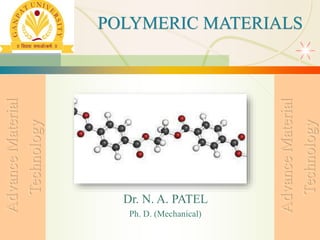
POLYMERIC MATERIALS
Dr. N. A. PATEL
Ph. D. (Mechanical)
Advance
Material
Technology
Advance
Material
Technology
Narendra A. Patel
2
Polymeric Materials
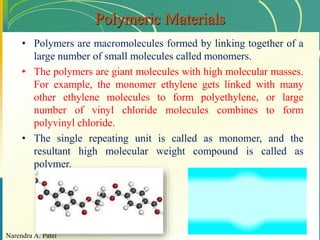
• Polymers are macromolecules formed by linking together of a
large number of small molecules called monomers.
• The polymers are giant molecules with high molecular masses.
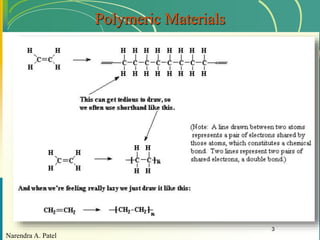
For example, the monomer ethylene gets linked with many
other ethylene molecules to form polyethylene, or large
number of vinyl chloride molecules combines to form
polyvinyl chloride.
• The single repeating unit is called as monomer, and the
resultant high molecular weight compound is called as
polymer.
Narendra A. Patel
3
Polymeric Materials
Narendra A. Patel
4
Polymeric Materials
• On the basis of this physical property, the polymers with high
degree of polymerization are known as high polymers while
those having comparatively low degree of polymerization are
known as oligopolymers.
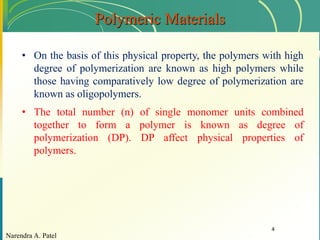
• The total number (n) of single monomer units combined
together to form a polymer is known as degree of
polymerization (DP). DP affect physical properties of
polymers.
Narendra A. Patel
5
Polymeric Materials – Structure and Classification
Structure and Classification:
The basic structure of polymers consists of long chains or
networks of monomers linked together through covalent bonds.
The arrangement of monomers and the type of bonds formed
between them determine the properties of the polymer.
Polymers can be classified into several categories based on their
structure and origin:
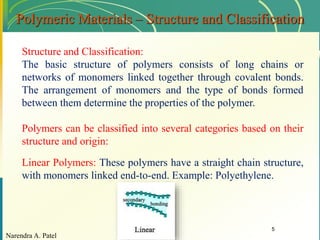
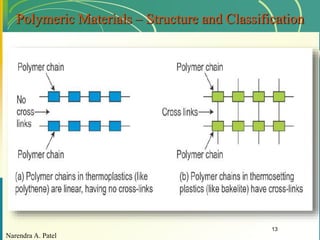
Linear Polymers: These polymers have a straight chain structure,
with monomers linked end-to-end. Example: Polyethylene.
Narendra A. Patel
6
Polymeric Materials – Structure and Classification
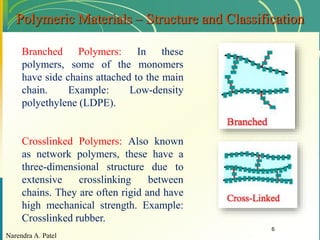
Branched Polymers: In these
polymers, some of the monomers
have side chains attached to the main
chain. Example: Low-density
polyethylene (LDPE).
Crosslinked Polymers: Also known
as network polymers, these have a
three-dimensional structure due to
extensive crosslinking between
chains. They are often rigid and have
high mechanical strength. Example:
Crosslinked rubber.
Narendra A. Patel
7
Polymeric Materials – Structure and Classification
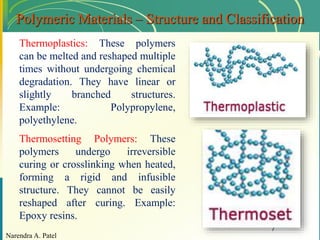
Thermoplastics: These polymers
can be melted and reshaped multiple
times without undergoing chemical
degradation. They have linear or
slightly branched structures.
Example: Polypropylene,
polyethylene.
Thermosetting Polymers: These
polymers undergo irreversible
curing or crosslinking when heated,
forming a rigid and infusible
structure. They cannot be easily
reshaped after curing. Example:
Epoxy resins.
Narendra A. Patel
8
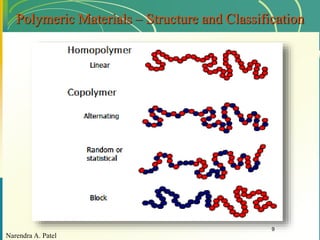
Polymeric Materials – Structure and Classification
Narendra A. Patel
9
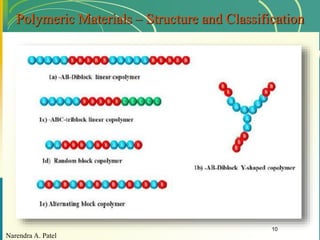
Polymeric Materials – Structure and Classification
Narendra A. Patel
10
Polymeric Materials – Structure and Classification
Narendra A. Patel
11
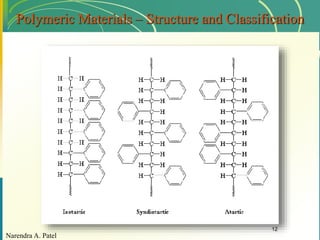
Polymeric Materials – Structure and Classification
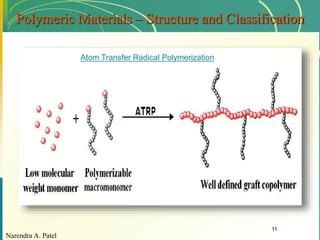
Atom Transfer Radical Polymerization
Narendra A. Patel
12
Polymeric Materials – Structure and Classification
Narendra A. Patel
13
Polymeric Materials – Structure and Classification
Narendra A. Patel
14
Polymeric Materials – Structure and Classification
Narendra A. Patel
15
Polymeric Materials – Structure and Classification
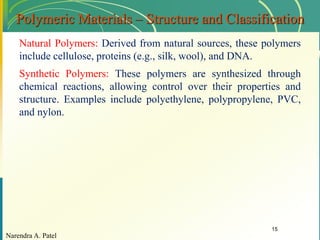
Natural Polymers: Derived from natural sources, these polymers
include cellulose, proteins (e.g., silk, wool), and DNA.
Synthetic Polymers: These polymers are synthesized through
chemical reactions, allowing control over their properties and
structure. Examples include polyethylene, polypropylene, PVC,
and nylon.
Narendra A. Patel
16
Polymeric Materials – Properties
Polymeric materials exhibit a wide range of properties, depending
on factors such as the type of monomers, arrangement of chains,
and crosslinking. Some common properties include:
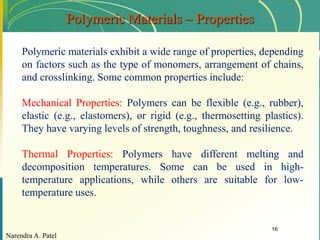
Mechanical Properties: Polymers can be flexible (e.g., rubber),
elastic (e.g., elastomers), or rigid (e.g., thermosetting plastics).
They have varying levels of strength, toughness, and resilience.
Thermal Properties: Polymers have different melting and
decomposition temperatures. Some can be used in high-
temperature applications, while others are suitable for low-
temperature uses.
Narendra A. Patel
17
Polymeric Materials – Properties
Chemical Resistance: Some polymers are highly resistant to
chemicals and are used in corrosive environments.
Transparency and Opacity: Polymers can be transparent (e.g.,
PET bottles) or opaque (e.g., milk jugs).
Biocompatibility: Certain polymers are compatible with living
tissues and are used in medical implants and drug delivery
systems.
Environmental Impact: The sustainability of polymers varies.
Some can be biodegradable, while others contribute to
environmental issues like plastic pollution.
Narendra A. Patel
18
Polymeric Materials – Applications
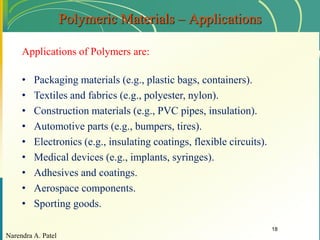
Applications of Polymers are:
• Packaging materials (e.g., plastic bags, containers).
• Textiles and fabrics (e.g., polyester, nylon).
• Construction materials (e.g., PVC pipes, insulation).
• Automotive parts (e.g., bumpers, tires).
• Electronics (e.g., insulating coatings, flexible circuits).
• Medical devices (e.g., implants, syringes).
• Adhesives and coatings.
• Aerospace components.
• Sporting goods.
Narendra A. Patel
19
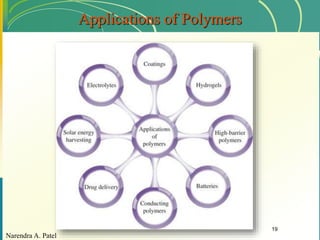
Applications of Polymers
Narendra A. Patel
20
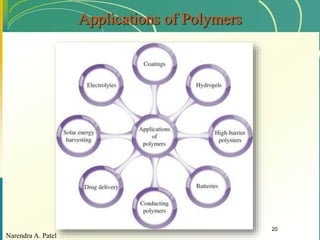
Applications of Polymers
Narendra A. Patel
21
Polymeric Materials
• Polymeric materials, commonly known as polymers,
are a class of large, complex molecules composed of
repeating structural units called monomers.
• These materials are ubiquitous in modern society and
have a wide range of applications due to their
versatility, ease of processing, and desirable
properties.
• Polymers are used in industries ranging from
packaging and textiles to electronics and medicine.
Narendra A. Patel
22
Polymeric Materials
• Polymeric materials, commonly known as polymers,
are a class of large, complex molecules composed of
repeating structural units called monomers.
• These materials are ubiquitous in modern society and
have a wide range of applications due to their
versatility, ease of processing, and desirable
properties.
• Polymers are used in industries ranging from
packaging and textiles to electronics and medicine.
Narendra A. Patel
23
Polymeric Materials
• Polymeric materials, commonly known as polymers,
are a class of large, complex molecules composed of
repeating structural units called monomers.
• These materials are ubiquitous in modern society and
have a wide range of applications due to their
versatility, ease of processing, and desirable
properties.
• Polymers are used in industries ranging from
packaging and textiles to electronics and medicine.
Narendra A. Patel
24
Polymeric Materials
• Polymeric materials, commonly known as polymers,
are a class of large, complex molecules composed of
repeating structural units called monomers.
• These materials are ubiquitous in modern society and
have a wide range of applications due to their
versatility, ease of processing, and desirable
properties.
• Polymers are used in industries ranging from
packaging and textiles to electronics and medicine.
Narendra A. Patel
25
Polymeric Materials
• Polymeric materials, commonly known as polymers,
are a class of large, complex molecules composed of
repeating structural units called monomers.
• These materials are ubiquitous in modern society and
have a wide range of applications due to their
versatility, ease of processing, and desirable
properties.
• Polymers are used in industries ranging from
packaging and textiles to electronics and medicine.
Narendra A. Patel
26
Polymeric Materials
• Polymeric materials, commonly known as polymers,
are a class of large, complex molecules composed of
repeating structural units called monomers.
• These materials are ubiquitous in modern society and
have a wide range of applications due to their
versatility, ease of processing, and desirable
properties.
• Polymers are used in industries ranging from
packaging and textiles to electronics and medicine.
Narendra A. Patel
27
Polymeric Materials
• Polymeric materials, commonly known as polymers,
are a class of large, complex molecules composed of
repeating structural units called monomers.
• These materials are ubiquitous in modern society and
have a wide range of applications due to their
versatility, ease of processing, and desirable
properties.
• Polymers are used in industries ranging from
packaging and textiles to electronics and medicine.
Narendra A. Patel
28
Polymeric Materials
• Polymeric materials, commonly known as polymers,
are a class of large, complex molecules composed of
repeating structural units called monomers.
• These materials are ubiquitous in modern society and
have a wide range of applications due to their
versatility, ease of processing, and desirable
properties.
• Polymers are used in industries ranging from
packaging and textiles to electronics and medicine.
Narendra A. Patel
29
Polymeric Materials
• Polymeric materials, commonly known as polymers,
are a class of large, complex molecules composed of
repeating structural units called monomers.
• These materials are ubiquitous in modern society and
have a wide range of applications due to their
versatility, ease of processing, and desirable
properties.
• Polymers are used in industries ranging from
packaging and textiles to electronics and medicine.
Narendra A. Patel
30
Polymeric Materials
• Polymeric materials, commonly known as polymers,
are a class of large, complex molecules composed of
repeating structural units called monomers.
• These materials are ubiquitous in modern society and
have a wide range of applications due to their
versatility, ease of processing, and desirable
properties.
• Polymers are used in industries ranging from
packaging and textiles to electronics and medicine.
Narendra A. Patel
31
Polymeric Materials
• Polymeric materials, commonly known as polymers,
are a class of large, complex molecules composed of
repeating structural units called monomers.
• These materials are ubiquitous in modern society and
have a wide range of applications due to their
versatility, ease of processing, and desirable
properties.
• Polymers are used in industries ranging from
packaging and textiles to electronics and medicine.
Narendra A. Patel

Polymer Material_Narendra.ppt

  • 1.
    Narendra A. Patel POLYMERICMATERIALS Dr. N. A. PATEL Ph. D. (Mechanical) Advance Material Technology Advance Material Technology
  • 2.
    Narendra A. Patel 2 PolymericMaterials • Polymers are macromolecules formed by linking together of a large number of small molecules called monomers. • The polymers are giant molecules with high molecular masses. For example, the monomer ethylene gets linked with many other ethylene molecules to form polyethylene, or large number of vinyl chloride molecules combines to form polyvinyl chloride. • The single repeating unit is called as monomer, and the resultant high molecular weight compound is called as polymer.
  • 3.
  • 4.
    Narendra A. Patel 4 PolymericMaterials • On the basis of this physical property, the polymers with high degree of polymerization are known as high polymers while those having comparatively low degree of polymerization are known as oligopolymers. • The total number (n) of single monomer units combined together to form a polymer is known as degree of polymerization (DP). DP affect physical properties of polymers.
  • 5.
    Narendra A. Patel 5 PolymericMaterials – Structure and Classification Structure and Classification: The basic structure of polymers consists of long chains or networks of monomers linked together through covalent bonds. The arrangement of monomers and the type of bonds formed between them determine the properties of the polymer. Polymers can be classified into several categories based on their structure and origin: Linear Polymers: These polymers have a straight chain structure, with monomers linked end-to-end. Example: Polyethylene.
  • 6.
    Narendra A. Patel 6 PolymericMaterials – Structure and Classification Branched Polymers: In these polymers, some of the monomers have side chains attached to the main chain. Example: Low-density polyethylene (LDPE). Crosslinked Polymers: Also known as network polymers, these have a three-dimensional structure due to extensive crosslinking between chains. They are often rigid and have high mechanical strength. Example: Crosslinked rubber.
  • 7.
    Narendra A. Patel 7 PolymericMaterials – Structure and Classification Thermoplastics: These polymers can be melted and reshaped multiple times without undergoing chemical degradation. They have linear or slightly branched structures. Example: Polypropylene, polyethylene. Thermosetting Polymers: These polymers undergo irreversible curing or crosslinking when heated, forming a rigid and infusible structure. They cannot be easily reshaped after curing. Example: Epoxy resins.
  • 8.
    Narendra A. Patel 8 PolymericMaterials – Structure and Classification
  • 9.
    Narendra A. Patel 9 PolymericMaterials – Structure and Classification
  • 10.
    Narendra A. Patel 10 PolymericMaterials – Structure and Classification
  • 11.
    Narendra A. Patel 11 PolymericMaterials – Structure and Classification Atom Transfer Radical Polymerization
  • 12.
    Narendra A. Patel 12 PolymericMaterials – Structure and Classification
  • 13.
    Narendra A. Patel 13 PolymericMaterials – Structure and Classification
  • 14.
    Narendra A. Patel 14 PolymericMaterials – Structure and Classification
  • 15.
    Narendra A. Patel 15 PolymericMaterials – Structure and Classification Natural Polymers: Derived from natural sources, these polymers include cellulose, proteins (e.g., silk, wool), and DNA. Synthetic Polymers: These polymers are synthesized through chemical reactions, allowing control over their properties and structure. Examples include polyethylene, polypropylene, PVC, and nylon.
  • 16.
    Narendra A. Patel 16 PolymericMaterials – Properties Polymeric materials exhibit a wide range of properties, depending on factors such as the type of monomers, arrangement of chains, and crosslinking. Some common properties include: Mechanical Properties: Polymers can be flexible (e.g., rubber), elastic (e.g., elastomers), or rigid (e.g., thermosetting plastics). They have varying levels of strength, toughness, and resilience. Thermal Properties: Polymers have different melting and decomposition temperatures. Some can be used in high- temperature applications, while others are suitable for low- temperature uses.
  • 17.
    Narendra A. Patel 17 PolymericMaterials – Properties Chemical Resistance: Some polymers are highly resistant to chemicals and are used in corrosive environments. Transparency and Opacity: Polymers can be transparent (e.g., PET bottles) or opaque (e.g., milk jugs). Biocompatibility: Certain polymers are compatible with living tissues and are used in medical implants and drug delivery systems. Environmental Impact: The sustainability of polymers varies. Some can be biodegradable, while others contribute to environmental issues like plastic pollution.
  • 18.
    Narendra A. Patel 18 PolymericMaterials – Applications Applications of Polymers are: • Packaging materials (e.g., plastic bags, containers). • Textiles and fabrics (e.g., polyester, nylon). • Construction materials (e.g., PVC pipes, insulation). • Automotive parts (e.g., bumpers, tires). • Electronics (e.g., insulating coatings, flexible circuits). • Medical devices (e.g., implants, syringes). • Adhesives and coatings. • Aerospace components. • Sporting goods.
  • 19.
  • 20.
  • 21.
    Narendra A. Patel 21 PolymericMaterials • Polymeric materials, commonly known as polymers, are a class of large, complex molecules composed of repeating structural units called monomers. • These materials are ubiquitous in modern society and have a wide range of applications due to their versatility, ease of processing, and desirable properties. • Polymers are used in industries ranging from packaging and textiles to electronics and medicine.
  • 22.
    Narendra A. Patel 22 PolymericMaterials • Polymeric materials, commonly known as polymers, are a class of large, complex molecules composed of repeating structural units called monomers. • These materials are ubiquitous in modern society and have a wide range of applications due to their versatility, ease of processing, and desirable properties. • Polymers are used in industries ranging from packaging and textiles to electronics and medicine.
  • 23.
    Narendra A. Patel 23 PolymericMaterials • Polymeric materials, commonly known as polymers, are a class of large, complex molecules composed of repeating structural units called monomers. • These materials are ubiquitous in modern society and have a wide range of applications due to their versatility, ease of processing, and desirable properties. • Polymers are used in industries ranging from packaging and textiles to electronics and medicine.
  • 24.
    Narendra A. Patel 24 PolymericMaterials • Polymeric materials, commonly known as polymers, are a class of large, complex molecules composed of repeating structural units called monomers. • These materials are ubiquitous in modern society and have a wide range of applications due to their versatility, ease of processing, and desirable properties. • Polymers are used in industries ranging from packaging and textiles to electronics and medicine.
  • 25.
    Narendra A. Patel 25 PolymericMaterials • Polymeric materials, commonly known as polymers, are a class of large, complex molecules composed of repeating structural units called monomers. • These materials are ubiquitous in modern society and have a wide range of applications due to their versatility, ease of processing, and desirable properties. • Polymers are used in industries ranging from packaging and textiles to electronics and medicine.
  • 26.
    Narendra A. Patel 26 PolymericMaterials • Polymeric materials, commonly known as polymers, are a class of large, complex molecules composed of repeating structural units called monomers. • These materials are ubiquitous in modern society and have a wide range of applications due to their versatility, ease of processing, and desirable properties. • Polymers are used in industries ranging from packaging and textiles to electronics and medicine.
  • 27.
    Narendra A. Patel 27 PolymericMaterials • Polymeric materials, commonly known as polymers, are a class of large, complex molecules composed of repeating structural units called monomers. • These materials are ubiquitous in modern society and have a wide range of applications due to their versatility, ease of processing, and desirable properties. • Polymers are used in industries ranging from packaging and textiles to electronics and medicine.
  • 28.
    Narendra A. Patel 28 PolymericMaterials • Polymeric materials, commonly known as polymers, are a class of large, complex molecules composed of repeating structural units called monomers. • These materials are ubiquitous in modern society and have a wide range of applications due to their versatility, ease of processing, and desirable properties. • Polymers are used in industries ranging from packaging and textiles to electronics and medicine.
  • 29.
    Narendra A. Patel 29 PolymericMaterials • Polymeric materials, commonly known as polymers, are a class of large, complex molecules composed of repeating structural units called monomers. • These materials are ubiquitous in modern society and have a wide range of applications due to their versatility, ease of processing, and desirable properties. • Polymers are used in industries ranging from packaging and textiles to electronics and medicine.
  • 30.
    Narendra A. Patel 30 PolymericMaterials • Polymeric materials, commonly known as polymers, are a class of large, complex molecules composed of repeating structural units called monomers. • These materials are ubiquitous in modern society and have a wide range of applications due to their versatility, ease of processing, and desirable properties. • Polymers are used in industries ranging from packaging and textiles to electronics and medicine.
  • 31.
    Narendra A. Patel 31 PolymericMaterials • Polymeric materials, commonly known as polymers, are a class of large, complex molecules composed of repeating structural units called monomers. • These materials are ubiquitous in modern society and have a wide range of applications due to their versatility, ease of processing, and desirable properties. • Polymers are used in industries ranging from packaging and textiles to electronics and medicine.
  • 32.