Click to edit Master title style
1
HARVESTING AND
THRESHING
EQUIPMENTS
Presented By:
Prabesh Devkota
Click to edit Master title style
2
Harvesting:-
• The operation of cutting, picking, plucking and digging or any
combination of these for removing the whole crop or edible part of
the crop from either under the ground or above the ground is
called harvesting.
• Mechanical actions associate with harvesting are as follows:
i. Slicing action with a sharp tool.
ii. Tearing action with a rough serrated edge tool.
iii. Scissoring action tool.
iv. High velocity impact with sharp or dull edge tool.
According to power source used, harvesting tools can be classified
as:
a) Manually operated tools ,
b) Animal drawn implements,
c) Power driven machines .
Click to edit Master title style
3
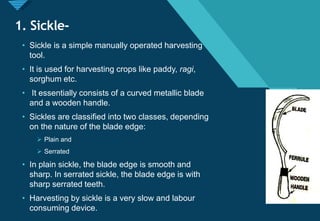
1. Sickle-
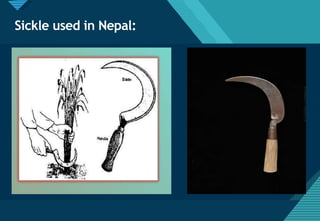
• Sickle is a simple manually operated harvesting
tool.
• It is used for harvesting crops like paddy, ragi,
sorghum etc.
• It essentially consists of a curved metallic blade
and a wooden handle.
• Sickles are classified into two classes, depending
on the nature of the blade edge:
 Plain and
 Serrated
• In plain sickle, the blade edge is smooth and
sharp. In serrated sickle, the blade edge is with
sharp serrated teeth.
• Harvesting by sickle is a very slow and labour
consuming device.
Click to edit Master title style
4
Sickle used in Nepal:
Click to edit Master title style
5
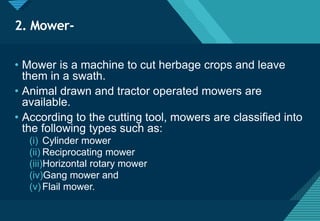
2. Mower-
• Mower is a machine to cut herbage crops and leave
them in a swath.
• Animal drawn and tractor operated mowers are
available.
• According to the cutting tool, mowers are classified into
the following types such as:
(i) Cylinder mower
(ii) Reciprocating mower
(iii)Horizontal rotary mower
(iv)Gang mower and
(v)Flail mower.
Click to edit Master title style
6
Types of Mower :
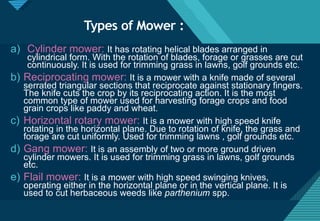
a) Cylinder mower: It has rotating helical blades arranged in
cylindrical form. With the rotation of blades, forage or grasses are cut
continuously. It is used for trimming grass in lawns, golf grounds etc.
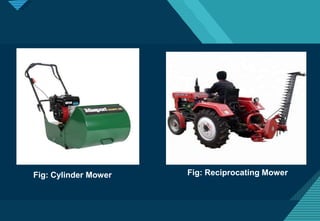
b) Reciprocating mower: It is a mower with a knife made of several
serrated triangular sections that reciprocate against stationary fingers.
The knife cuts the crop by its reciprocating action. It is the most

common type of mower used for harvesting forage crops and food
grain crops like paddy and wheat.
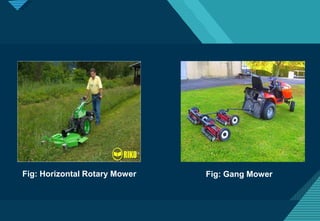
c) Horizontal rotary mower: It is a mower with high speed knife
rotating in the horizontal plane. Due to rotation of knife, the grass and
forage are cut uniformly. Used for trimming lawns , golf grounds etc.
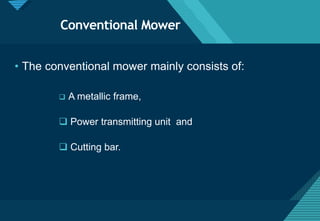
d) Gang mower: It is an assembly of two or more ground driven
cylinder mowers. It is used for trimming grass in lawns, golf grounds
etc.
e) Flail mower: It is a mower with high speed swinging knives,
operating either in the horizontal plane or in the vertical plane. It is
used to cut herbaceous weeds like parthenium spp.
Click to edit Master title style
7
Fig: Cylinder Mower Fig: Reciprocating Mower
Click to edit Master title style
8
Fig: Horizontal Rotary Mower Fig: Gang Mower
Click to edit Master title style
9
Conventional Mower
• The conventional mower mainly consists of:
 A metallic frame,
 Power transmitting unit and
 Cutting bar.
Click to edit Master title style
10
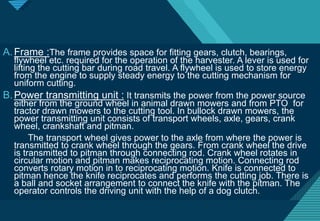
A.Frame :The frame provides space for fitting gears, clutch, bearings,
flywheel etc. required for the operation of the harvester. A lever is used for
lifting the cutting bar during road travel. A flywheel is used to store energy
from the engine to supply steady energy to the cutting mechanism for
uniform cutting.
B.Power transmitting unit : It transmits the power from the power source
either from the ground wheel in animal drawn mowers and from PTO for
tractor drawn mowers to the cutting tool. In bullock drawn mowers, the
power transmitting unit consists of transport wheels, axle, gears, crank
wheel, crankshaft and pitman.
The transport wheel gives power to the axle from where the power is
transmitted to crank wheel through the gears. From crank wheel the drive
is transmitted to pitman through connecting rod. Crank wheel rotates in
circular motion and pitman makes reciprocating motion. Connecting rod
converts rotary motion in to reciprocating motion. Knife is connected to
pitman hence the knife reciprocates and performs the cutting job. There is
a ball and socket arrangement to connect the knife with the pitman. The
operator controls the driving unit with the help of a dog clutch.
Click to edit Master title style
11
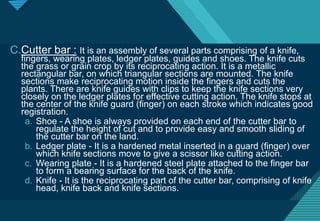
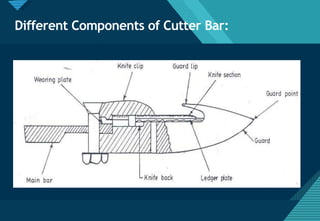
C.Cutter bar : It is an assembly of several parts comprising of a knife,
fingers, wearing plates, ledger plates, guides and shoes. The knife cuts
the grass or grain crop by its reciprocating action. It is a metallic
rectangular bar, on which triangular sections are mounted. The knife
sections make reciprocating motion inside the fingers and cuts the
plants. There are knife guides with clips to keep the knife sections very
closely on the ledger plates for effective cutting action. The knife stops at
the center of the knife guard (finger) on each stroke which indicates good
registration.
a. Shoe - A shoe is always provided on each end of the cutter bar to
regulate the height of cut and to provide easy and smooth sliding of
the cutter bar on the land.
b. Ledger plate - It is a hardened metal inserted in a guard (finger) over
which knife sections move to give a scissor like cutting action.
c. Wearing plate - It is a hardened steel plate attached to the finger bar
to form a bearing surface for the back of the knife.
d. Knife - It is the reciprocating part of the cutter bar, comprising of knife
head, knife back and knife sections.
Click to edit Master title style
12
Different Components of Cutter Bar:
Click to edit Master title style
13
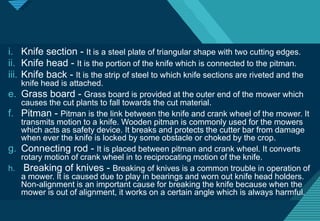
i. Knife section - It is a steel plate of triangular shape with two cutting edges.
ii. Knife head - It is the portion of the knife which is connected to the pitman.
iii. Knife back - It is the strip of steel to which knife sections are riveted and the
knife head is attached.
e. Grass board - Grass board is provided at the outer end of the mower which
causes the cut plants to fall towards the cut material.
f. Pitman - Pitman is the link between the knife and crank wheel of the mower. It
transmits motion to a knife. Wooden pitman is commonly used for the mowers
which acts as safety device. It breaks and protects the cutter bar from damage
when ever the knife is locked by some obstacle or choked by the crop.
g. Connecting rod - It is placed between pitman and crank wheel. It converts
rotary motion of crank wheel in to reciprocating motion of the knife.
h. Breaking of knives - Breaking of knives is a common trouble in operation of
a mower. It is caused due to play in bearings and worn out knife head holders.
Non-alignment is an important cause for breaking the knife because when the
mower is out of alignment, it works on a certain angle which is always harmful.
Click to edit Master title style
14
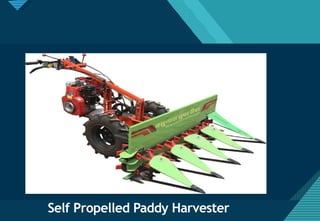
3. Self Propelled Paddy Harvester-
• It is suitable for harvesting non lodging varieties of paddy crop.
• The machine consists of an engine, gearbox, ground wheels,
handle, and cutter bar assembly, star wheels and gathering
header assembly.
• The power is taken from the engine pulley to the harvester main
shaft through compound idlers.
• The crop is manually harvested along the four sides of the field
for a width of 0.5m and cleared from the field for providing space
to the machine.
• The harvested crop is windrowed in the field, collected manually
and transported to threshing yard.
• The width of operation is 1.0 meter.
• The coverage is 1.5 ha/day.
Click to edit Master title style
15
“1. Labour requirement is reduced.
2. Large area can be harvested in
shorter time. Thus, saving in time.
3. Economical.
4. Frees the land early for ploughing
for the next crop.
Advantages of using Paddy Harvesters:
Click to edit Master title style
16
Self Propelled Paddy Harvester
Click to edit Master title style
17
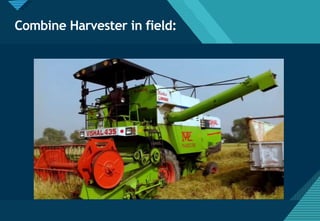
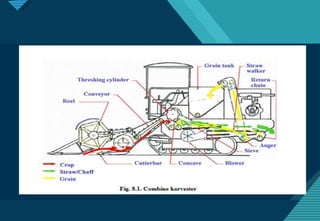
4. Combine Harvester-
• Combine harvester is a machine designed for
harvesting, threshing, cleaning and collecting the grain
while it moves over the land.
• Combine harvester in its primitive form was introduced
in Germany and U.S.A. in late 19th century and became
popular in next decades.
• All the five operations are carried out in single operation
of the harvester.
• The machine is versatile and with minor adjustments
can handle a variety of crops.
• The size of the combine is indicated by the width of cut,
it covers in the field.
Click to edit Master title style
18
Combine Harvester in field:
Click to edit Master title style
19
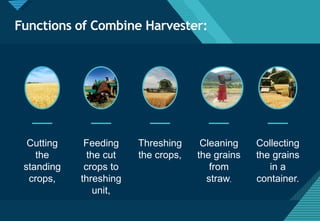
Functions of Combine Harvester:
Cutting
the
standing
crops,
Feeding
the cut
crops to
threshing
unit,
Threshing
the crops,
Cleaning
the grains
from
straw,
Collecting
the grains
in a
container.
Click to edit Master title style
20
Components of Combine
Harvester-
Header
Reel
Cutter bar
Elevator canvas
Feeder canvas
Feeding drum
Threshing drum
Concave Unit
Fan
Chaffer sieve
Grain sieve
Grain auger
Tailing auger
Grain elevator and
Grain container.
Click to edit Master title style
21
Working Principle:-
• Header is used to cut and gather the crop and deliver it to the threshing cylinder. The
straw is pushed back on the platform by the reel. Small combines use scoop type
headers, while large combines use T-type headers.
• Harvesting is done by a cutting unit, which uses the cutter bar similar to that of the
mower. The knife has got serrated edge to prevent the straw from slipping while in
operation. There is a suitable cutting platform, which is provided with a real and canvas.
• The reel is made of wooden slates, which helps in feeding the crops to the cutting
platform. The reel gets the power through suitable gears and shafts. The reel revolves in
front of the cutter bar while working in the field. The reel pushes the standing crops
towards the cutting unit. The reels are adjustable up and down as in or out.
• The cutter bar of the combine operates like the cutter bar of a mower The conveyor
feeds the crop to the cylinder and concave unit. The threshing takes place between the
cylinder and concave unit of the combine.
• The basic components of the threshing unit of the combine are similar to a power
thresher. As soon as the crops are threshed, the threshed material move to straw racks.
These racks keep on oscillating and separating the grains. The cleaning unit consists of a
number of sieves and a fan. The un-threshed grains pass through the tailing auger and go
for re-threshing. The clean grain passes through tend finally goes to the packing unit.
Grains are collected in a hopper provided at suitable place. The fan is adjusted such that
the chaff etc., blown off the rear side of the machine. The size of the combine is
indicated by width of cut it covers in the field.
Click to edit Master title style
22
Click to edit Master title style
23
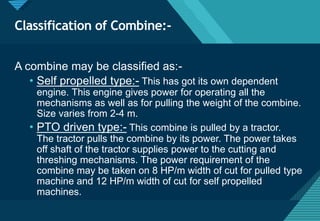
Classification of Combine:-
A combine may be classified as:-
• Self propelled type:- This has got its own dependent
engine. This engine gives power for operating all the
mechanisms as well as for pulling the weight of the combine.
Size varies from 2-4 m.
• PTO driven type:- This combine is pulled by a tractor.
The tractor pulls the combine by its power. The power takes
off shaft of the tractor supplies power to the cutting and
threshing mechanisms. The power requirement of the
combine may be taken on 8 HP/m width of cut for pulled type
machine and 12 HP/m width of cut for self propelled
machines.
Click to edit Master title style
24
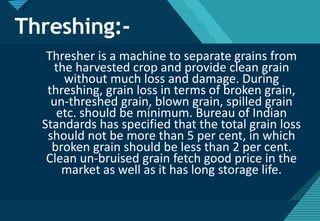
Threshing:-
Thresher is a machine to separate grains from
the harvested crop and provide clean grain
without much loss and damage. During
threshing, grain loss in terms of broken grain,
un-threshed grain, blown grain, spilled grain
etc. should be minimum. Bureau of Indian
Standards has specified that the total grain loss
should not be more than 5 per cent, in which
broken grain should be less than 2 per cent.
Clean un-bruised grain fetch good price in the
market as well as it has long storage life.
Click to edit Master title style
25
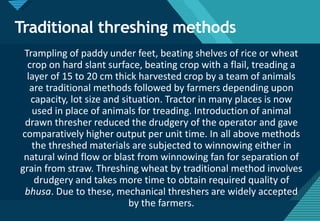
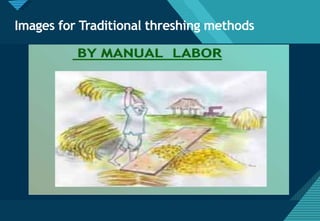
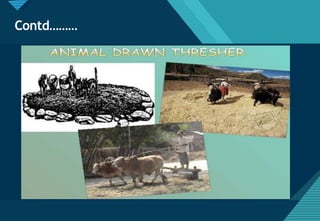
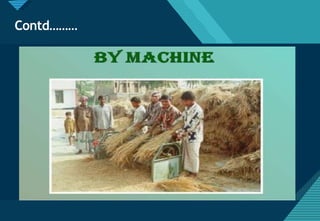
Traditional threshing methods
Trampling of paddy under feet, beating shelves of rice or wheat
crop on hard slant surface, beating crop with a flail, treading a
layer of 15 to 20 cm thick harvested crop by a team of animals
are traditional methods followed by farmers depending upon
capacity, lot size and situation. Tractor in many places is now
used in place of animals for treading. Introduction of animal
drawn thresher reduced the drudgery of the operator and gave
comparatively higher output per unit time. In all above methods
the threshed materials are subjected to winnowing either in
natural wind flow or blast from winnowing fan for separation of
grain from straw. Threshing wheat by traditional method involves
drudgery and takes more time to obtain required quality of
bhusa. Due to these, mechanical threshers are widely accepted
by the farmers.
Click to edit Master title style
26
Images for Traditional threshing methods
Click to edit Master title style
27
Contd………
Click to edit Master title style
28
Contd………
Click to edit Master title style
29
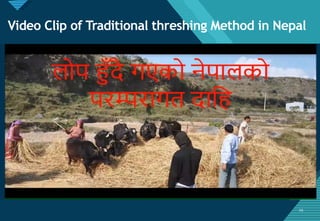
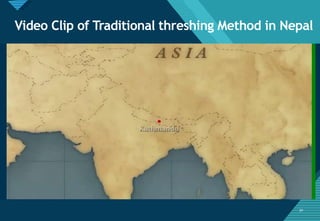
Video Clip of Traditional threshing Method in Nepal
29
Click to edit Master title style
30
Video Clip of Traditional threshing Method in Nepal
30
Click to edit Master title style
31
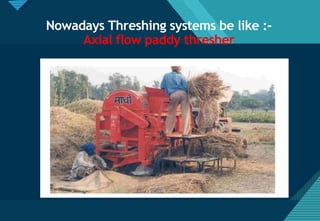
Nowadays Threshing systems be like :-
Axial flow paddy thresher
Click to edit Master title style
32
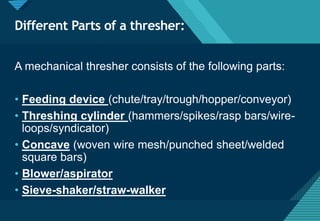
Different Parts of a thresher:
A mechanical thresher consists of the following parts:
• Feeding device (chute/tray/trough/hopper/conveyor)
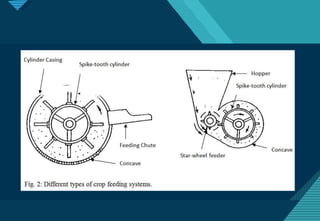
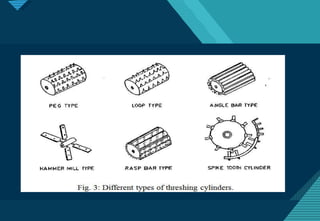
• Threshing cylinder (hammers/spikes/rasp bars/wire-
loops/syndicator)
• Concave (woven wire mesh/punched sheet/welded
square bars)
• Blower/aspirator
• Sieve-shaker/straw-walker
Click to edit Master title style
33
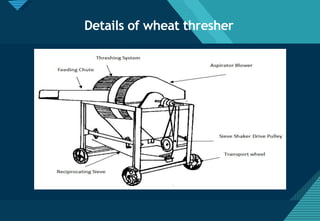
Details of wheat thresher
Click to edit Master title style
34
Click to edit Master title style
35
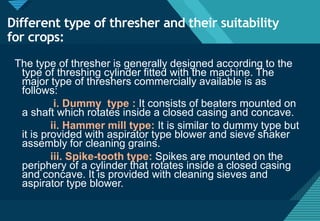
Different type of thresher and their suitability
for crops:
The type of thresher is generally designed according to the
type of threshing cylinder fitted with the machine. The
major type of threshers commercially available is as
follows:
i. Dummy type : It consists of beaters mounted on
a shaft which rotates inside a closed casing and concave.
ii. Hammer mill type: It is similar to dummy type but
it is provided with aspirator type blower and sieve shaker
assembly for cleaning grains.
iii. Spike-tooth type: Spikes are mounted on the
periphery of a cylinder that rotates inside a closed casing
and concave. It is provided with cleaning sieves and
aspirator type blower.
Click to edit Master title style
36
Contd…….
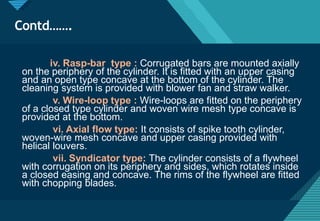
iv. Rasp-bar type : Corrugated bars are mounted axially
on the periphery of the cylinder. It is fitted with an upper casing
and an open type concave at the bottom of the cylinder. The
cleaning system is provided with blower fan and straw walker.
v. Wire-loop type : Wire-loops are fitted on the periphery
of a closed type cylinder and woven wire mesh type concave is
provided at the bottom.
vi. Axial flow type: It consists of spike tooth cylinder,
woven-wire mesh concave and upper casing provided with
helical louvers.
vii. Syndicator type: The cylinder consists of a flywheel
with corrugation on its periphery and sides, which rotates inside
a closed easing and concave. The rims of the flywheel are fitted
with chopping blades.
Click to edit Master title style
37
Click to edit Master title style
38
THANK
YOU!!

Harvesting and Threshing Equipments

  • 1.
    Click to editMaster title style 1 HARVESTING AND THRESHING EQUIPMENTS Presented By: Prabesh Devkota
  • 2.
    Click to editMaster title style 2 Harvesting:- • The operation of cutting, picking, plucking and digging or any combination of these for removing the whole crop or edible part of the crop from either under the ground or above the ground is called harvesting. • Mechanical actions associate with harvesting are as follows: i. Slicing action with a sharp tool. ii. Tearing action with a rough serrated edge tool. iii. Scissoring action tool. iv. High velocity impact with sharp or dull edge tool. According to power source used, harvesting tools can be classified as: a) Manually operated tools , b) Animal drawn implements, c) Power driven machines .
  • 3.
    Click to editMaster title style 3 1. Sickle- • Sickle is a simple manually operated harvesting tool. • It is used for harvesting crops like paddy, ragi, sorghum etc. • It essentially consists of a curved metallic blade and a wooden handle. • Sickles are classified into two classes, depending on the nature of the blade edge:  Plain and  Serrated • In plain sickle, the blade edge is smooth and sharp. In serrated sickle, the blade edge is with sharp serrated teeth. • Harvesting by sickle is a very slow and labour consuming device.
  • 4.
    Click to editMaster title style 4 Sickle used in Nepal:
  • 5.
    Click to editMaster title style 5 2. Mower- • Mower is a machine to cut herbage crops and leave them in a swath. • Animal drawn and tractor operated mowers are available. • According to the cutting tool, mowers are classified into the following types such as: (i) Cylinder mower (ii) Reciprocating mower (iii)Horizontal rotary mower (iv)Gang mower and (v)Flail mower.
  • 6.
    Click to editMaster title style 6 Types of Mower : a) Cylinder mower: It has rotating helical blades arranged in cylindrical form. With the rotation of blades, forage or grasses are cut continuously. It is used for trimming grass in lawns, golf grounds etc. b) Reciprocating mower: It is a mower with a knife made of several serrated triangular sections that reciprocate against stationary fingers. The knife cuts the crop by its reciprocating action. It is the most common type of mower used for harvesting forage crops and food grain crops like paddy and wheat. c) Horizontal rotary mower: It is a mower with high speed knife rotating in the horizontal plane. Due to rotation of knife, the grass and forage are cut uniformly. Used for trimming lawns , golf grounds etc. d) Gang mower: It is an assembly of two or more ground driven cylinder mowers. It is used for trimming grass in lawns, golf grounds etc. e) Flail mower: It is a mower with high speed swinging knives, operating either in the horizontal plane or in the vertical plane. It is used to cut herbaceous weeds like parthenium spp.
  • 7.
    Click to editMaster title style 7 Fig: Cylinder Mower Fig: Reciprocating Mower
  • 8.
    Click to editMaster title style 8 Fig: Horizontal Rotary Mower Fig: Gang Mower
  • 9.
    Click to editMaster title style 9 Conventional Mower • The conventional mower mainly consists of:  A metallic frame,  Power transmitting unit and  Cutting bar.
  • 10.
    Click to editMaster title style 10 A.Frame :The frame provides space for fitting gears, clutch, bearings, flywheel etc. required for the operation of the harvester. A lever is used for lifting the cutting bar during road travel. A flywheel is used to store energy from the engine to supply steady energy to the cutting mechanism for uniform cutting. B.Power transmitting unit : It transmits the power from the power source either from the ground wheel in animal drawn mowers and from PTO for tractor drawn mowers to the cutting tool. In bullock drawn mowers, the power transmitting unit consists of transport wheels, axle, gears, crank wheel, crankshaft and pitman. The transport wheel gives power to the axle from where the power is transmitted to crank wheel through the gears. From crank wheel the drive is transmitted to pitman through connecting rod. Crank wheel rotates in circular motion and pitman makes reciprocating motion. Connecting rod converts rotary motion in to reciprocating motion. Knife is connected to pitman hence the knife reciprocates and performs the cutting job. There is a ball and socket arrangement to connect the knife with the pitman. The operator controls the driving unit with the help of a dog clutch.
  • 11.
    Click to editMaster title style 11 C.Cutter bar : It is an assembly of several parts comprising of a knife, fingers, wearing plates, ledger plates, guides and shoes. The knife cuts the grass or grain crop by its reciprocating action. It is a metallic rectangular bar, on which triangular sections are mounted. The knife sections make reciprocating motion inside the fingers and cuts the plants. There are knife guides with clips to keep the knife sections very closely on the ledger plates for effective cutting action. The knife stops at the center of the knife guard (finger) on each stroke which indicates good registration. a. Shoe - A shoe is always provided on each end of the cutter bar to regulate the height of cut and to provide easy and smooth sliding of the cutter bar on the land. b. Ledger plate - It is a hardened metal inserted in a guard (finger) over which knife sections move to give a scissor like cutting action. c. Wearing plate - It is a hardened steel plate attached to the finger bar to form a bearing surface for the back of the knife. d. Knife - It is the reciprocating part of the cutter bar, comprising of knife head, knife back and knife sections.
  • 12.
    Click to editMaster title style 12 Different Components of Cutter Bar:
  • 13.
    Click to editMaster title style 13 i. Knife section - It is a steel plate of triangular shape with two cutting edges. ii. Knife head - It is the portion of the knife which is connected to the pitman. iii. Knife back - It is the strip of steel to which knife sections are riveted and the knife head is attached. e. Grass board - Grass board is provided at the outer end of the mower which causes the cut plants to fall towards the cut material. f. Pitman - Pitman is the link between the knife and crank wheel of the mower. It transmits motion to a knife. Wooden pitman is commonly used for the mowers which acts as safety device. It breaks and protects the cutter bar from damage when ever the knife is locked by some obstacle or choked by the crop. g. Connecting rod - It is placed between pitman and crank wheel. It converts rotary motion of crank wheel in to reciprocating motion of the knife. h. Breaking of knives - Breaking of knives is a common trouble in operation of a mower. It is caused due to play in bearings and worn out knife head holders. Non-alignment is an important cause for breaking the knife because when the mower is out of alignment, it works on a certain angle which is always harmful.
  • 14.
    Click to editMaster title style 14 3. Self Propelled Paddy Harvester- • It is suitable for harvesting non lodging varieties of paddy crop. • The machine consists of an engine, gearbox, ground wheels, handle, and cutter bar assembly, star wheels and gathering header assembly. • The power is taken from the engine pulley to the harvester main shaft through compound idlers. • The crop is manually harvested along the four sides of the field for a width of 0.5m and cleared from the field for providing space to the machine. • The harvested crop is windrowed in the field, collected manually and transported to threshing yard. • The width of operation is 1.0 meter. • The coverage is 1.5 ha/day.
  • 15.
    Click to editMaster title style 15 “1. Labour requirement is reduced. 2. Large area can be harvested in shorter time. Thus, saving in time. 3. Economical. 4. Frees the land early for ploughing for the next crop. Advantages of using Paddy Harvesters:
  • 16.
    Click to editMaster title style 16 Self Propelled Paddy Harvester
  • 17.
    Click to editMaster title style 17 4. Combine Harvester- • Combine harvester is a machine designed for harvesting, threshing, cleaning and collecting the grain while it moves over the land. • Combine harvester in its primitive form was introduced in Germany and U.S.A. in late 19th century and became popular in next decades. • All the five operations are carried out in single operation of the harvester. • The machine is versatile and with minor adjustments can handle a variety of crops. • The size of the combine is indicated by the width of cut, it covers in the field.
  • 18.
    Click to editMaster title style 18 Combine Harvester in field:
  • 19.
    Click to editMaster title style 19 Functions of Combine Harvester: Cutting the standing crops, Feeding the cut crops to threshing unit, Threshing the crops, Cleaning the grains from straw, Collecting the grains in a container.
  • 20.
    Click to editMaster title style 20 Components of Combine Harvester- Header Reel Cutter bar Elevator canvas Feeder canvas Feeding drum Threshing drum Concave Unit Fan Chaffer sieve Grain sieve Grain auger Tailing auger Grain elevator and Grain container.
  • 21.
    Click to editMaster title style 21 Working Principle:- • Header is used to cut and gather the crop and deliver it to the threshing cylinder. The straw is pushed back on the platform by the reel. Small combines use scoop type headers, while large combines use T-type headers. • Harvesting is done by a cutting unit, which uses the cutter bar similar to that of the mower. The knife has got serrated edge to prevent the straw from slipping while in operation. There is a suitable cutting platform, which is provided with a real and canvas. • The reel is made of wooden slates, which helps in feeding the crops to the cutting platform. The reel gets the power through suitable gears and shafts. The reel revolves in front of the cutter bar while working in the field. The reel pushes the standing crops towards the cutting unit. The reels are adjustable up and down as in or out. • The cutter bar of the combine operates like the cutter bar of a mower The conveyor feeds the crop to the cylinder and concave unit. The threshing takes place between the cylinder and concave unit of the combine. • The basic components of the threshing unit of the combine are similar to a power thresher. As soon as the crops are threshed, the threshed material move to straw racks. These racks keep on oscillating and separating the grains. The cleaning unit consists of a number of sieves and a fan. The un-threshed grains pass through the tailing auger and go for re-threshing. The clean grain passes through tend finally goes to the packing unit. Grains are collected in a hopper provided at suitable place. The fan is adjusted such that the chaff etc., blown off the rear side of the machine. The size of the combine is indicated by width of cut it covers in the field.
  • 22.
    Click to editMaster title style 22
  • 23.
    Click to editMaster title style 23 Classification of Combine:- A combine may be classified as:- • Self propelled type:- This has got its own dependent engine. This engine gives power for operating all the mechanisms as well as for pulling the weight of the combine. Size varies from 2-4 m. • PTO driven type:- This combine is pulled by a tractor. The tractor pulls the combine by its power. The power takes off shaft of the tractor supplies power to the cutting and threshing mechanisms. The power requirement of the combine may be taken on 8 HP/m width of cut for pulled type machine and 12 HP/m width of cut for self propelled machines.
  • 24.
    Click to editMaster title style 24 Threshing:- Thresher is a machine to separate grains from the harvested crop and provide clean grain without much loss and damage. During threshing, grain loss in terms of broken grain, un-threshed grain, blown grain, spilled grain etc. should be minimum. Bureau of Indian Standards has specified that the total grain loss should not be more than 5 per cent, in which broken grain should be less than 2 per cent. Clean un-bruised grain fetch good price in the market as well as it has long storage life.
  • 25.
    Click to editMaster title style 25 Traditional threshing methods Trampling of paddy under feet, beating shelves of rice or wheat crop on hard slant surface, beating crop with a flail, treading a layer of 15 to 20 cm thick harvested crop by a team of animals are traditional methods followed by farmers depending upon capacity, lot size and situation. Tractor in many places is now used in place of animals for treading. Introduction of animal drawn thresher reduced the drudgery of the operator and gave comparatively higher output per unit time. In all above methods the threshed materials are subjected to winnowing either in natural wind flow or blast from winnowing fan for separation of grain from straw. Threshing wheat by traditional method involves drudgery and takes more time to obtain required quality of bhusa. Due to these, mechanical threshers are widely accepted by the farmers.
  • 26.
    Click to editMaster title style 26 Images for Traditional threshing methods
  • 27.
    Click to editMaster title style 27 Contd………
  • 28.
    Click to editMaster title style 28 Contd………
  • 29.
    Click to editMaster title style 29 Video Clip of Traditional threshing Method in Nepal 29
  • 30.
    Click to editMaster title style 30 Video Clip of Traditional threshing Method in Nepal 30
  • 31.
    Click to editMaster title style 31 Nowadays Threshing systems be like :- Axial flow paddy thresher
  • 32.
    Click to editMaster title style 32 Different Parts of a thresher: A mechanical thresher consists of the following parts: • Feeding device (chute/tray/trough/hopper/conveyor) • Threshing cylinder (hammers/spikes/rasp bars/wire- loops/syndicator) • Concave (woven wire mesh/punched sheet/welded square bars) • Blower/aspirator • Sieve-shaker/straw-walker
  • 33.
    Click to editMaster title style 33 Details of wheat thresher
  • 34.
    Click to editMaster title style 34
  • 35.
    Click to editMaster title style 35 Different type of thresher and their suitability for crops: The type of thresher is generally designed according to the type of threshing cylinder fitted with the machine. The major type of threshers commercially available is as follows: i. Dummy type : It consists of beaters mounted on a shaft which rotates inside a closed casing and concave. ii. Hammer mill type: It is similar to dummy type but it is provided with aspirator type blower and sieve shaker assembly for cleaning grains. iii. Spike-tooth type: Spikes are mounted on the periphery of a cylinder that rotates inside a closed casing and concave. It is provided with cleaning sieves and aspirator type blower.
  • 36.
    Click to editMaster title style 36 Contd……. iv. Rasp-bar type : Corrugated bars are mounted axially on the periphery of the cylinder. It is fitted with an upper casing and an open type concave at the bottom of the cylinder. The cleaning system is provided with blower fan and straw walker. v. Wire-loop type : Wire-loops are fitted on the periphery of a closed type cylinder and woven wire mesh type concave is provided at the bottom. vi. Axial flow type: It consists of spike tooth cylinder, woven-wire mesh concave and upper casing provided with helical louvers. vii. Syndicator type: The cylinder consists of a flywheel with corrugation on its periphery and sides, which rotates inside a closed easing and concave. The rims of the flywheel are fitted with chopping blades.
  • 37.
    Click to editMaster title style 37
  • 38.
    Click to editMaster title style 38 THANK YOU!!

Editor's Notes

  • #4 >The plain or serrated edge in the inner side of the blade is used for cutting the crop and hence called cutting edge. >The forged end of the blade used for fixing the handle is called tang. >Protective metallic bush fitted at the junction of the blade and the handle to keep the tang tight in the handle is called ferrule.
  • #26 Drudgery - hard menial or dull work, hard work.