Chapter 2
Fundamental Elements of Power
Electronics
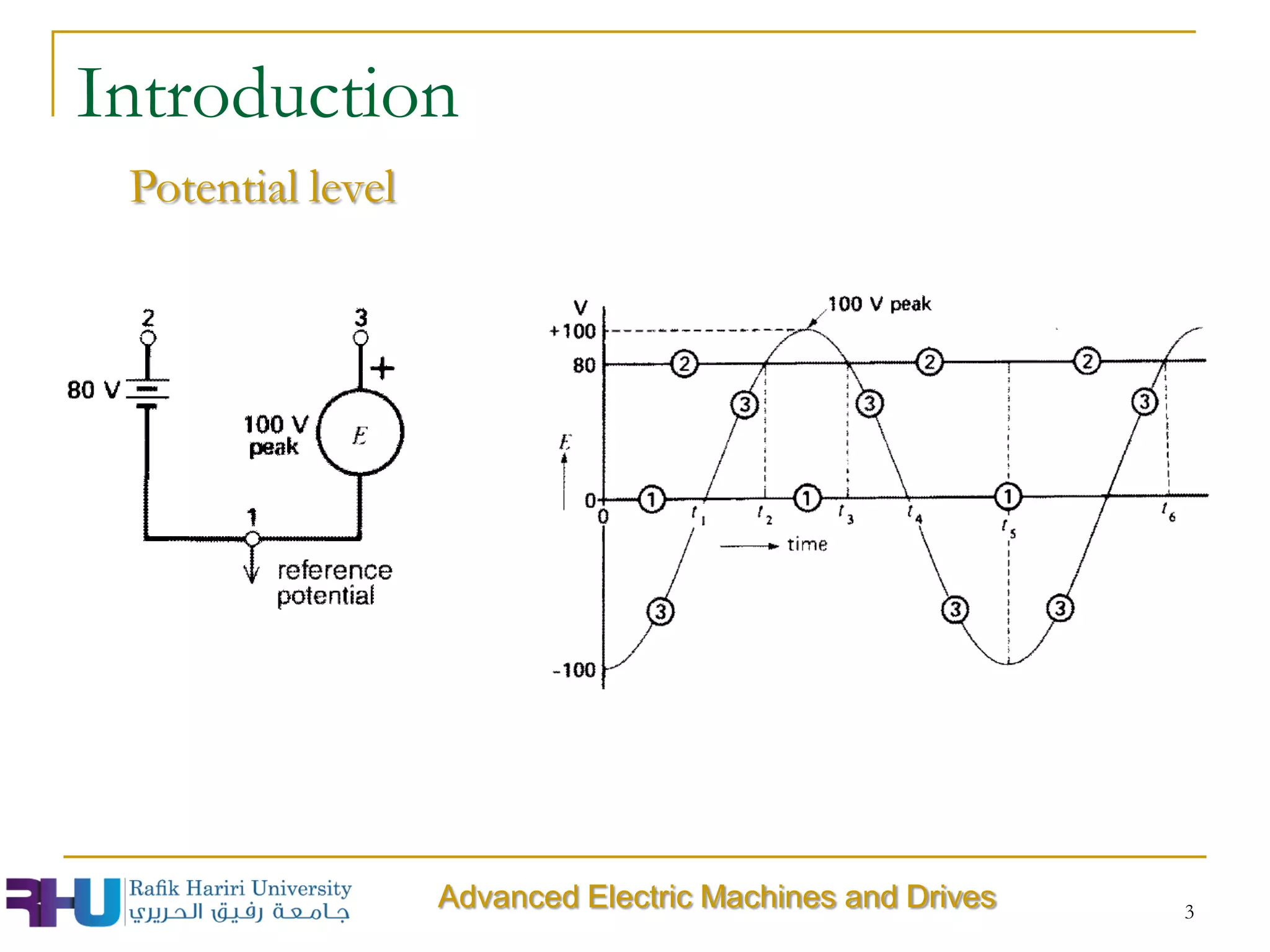
 To understand the operation of electronic circuits, it is useful to
imagine that individual terminals have a potential level with
respect to a reference terminal.
 The reference terminal is any convenient point chosen in a
circuit it is assumed to have zero electric potential.
 The potential level of all other points is then measured with
respect to this zero reference.
2
Introduction
Potential level
Advanced Electric Machines and Drives
3
Advanced Electric Machines and Drives
Potential level
Introduction
4
Voltage across some circuit elements
Advanced Electric Machines and Drives
Sources
 By definition, ideal ac and dc voltage sources have zero internal
impedance. We suppose that nothing that happens in a circuit
can modify these levels.
5
Voltage across some circuit elements
Advanced Electric Machines and Drives
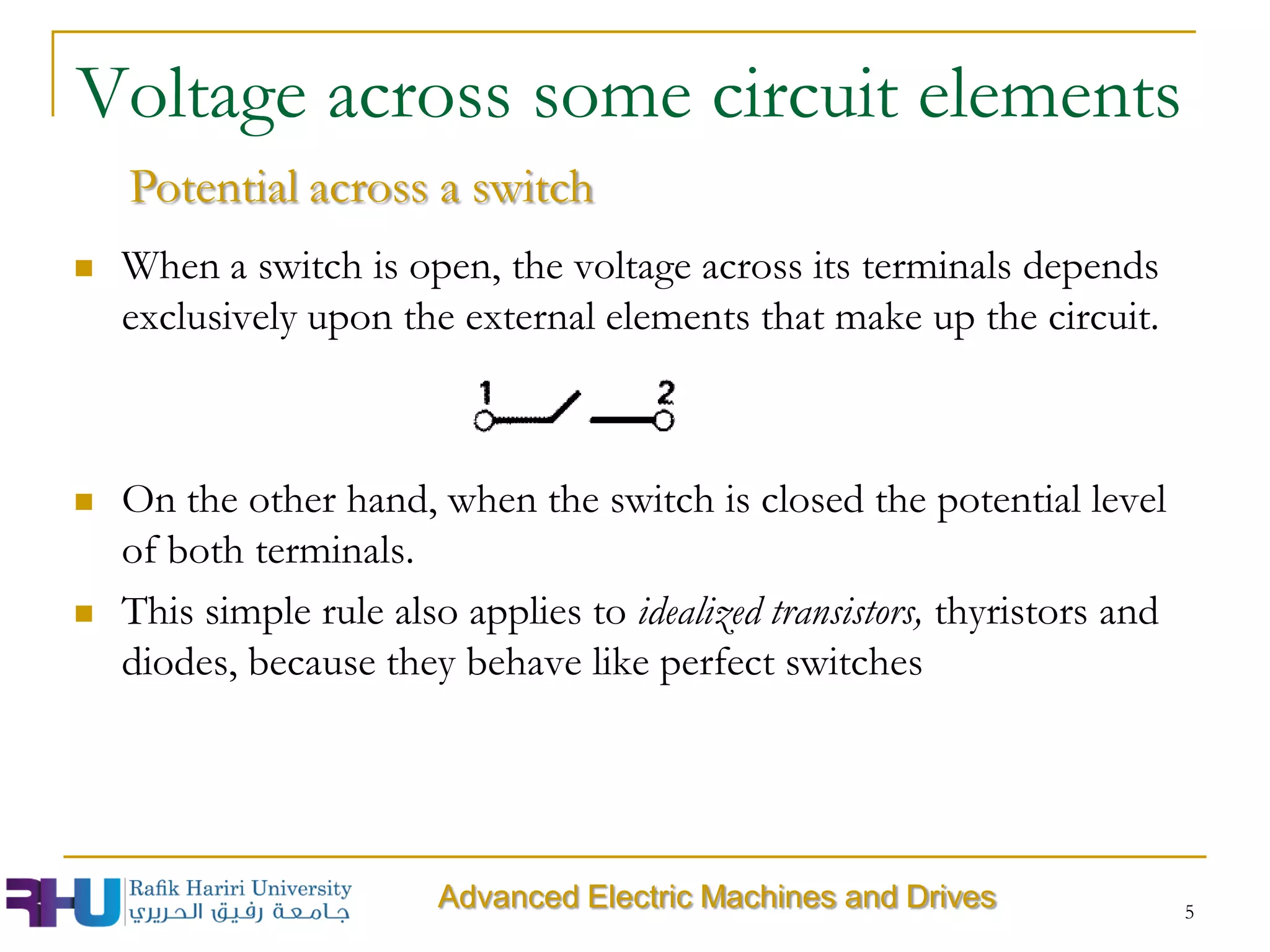
Potential across a switch
 When a switch is open, the voltage across its terminals depends
exclusively upon the external elements that make up the circuit.
 On the other hand, when the switch is closed the potential level
of both terminals.
 This simple rule also applies to idealized transistors, thyristors and
diodes, because they behave like perfect switches
6
Voltage across some circuit elements
Advanced Electric Machines and Drives
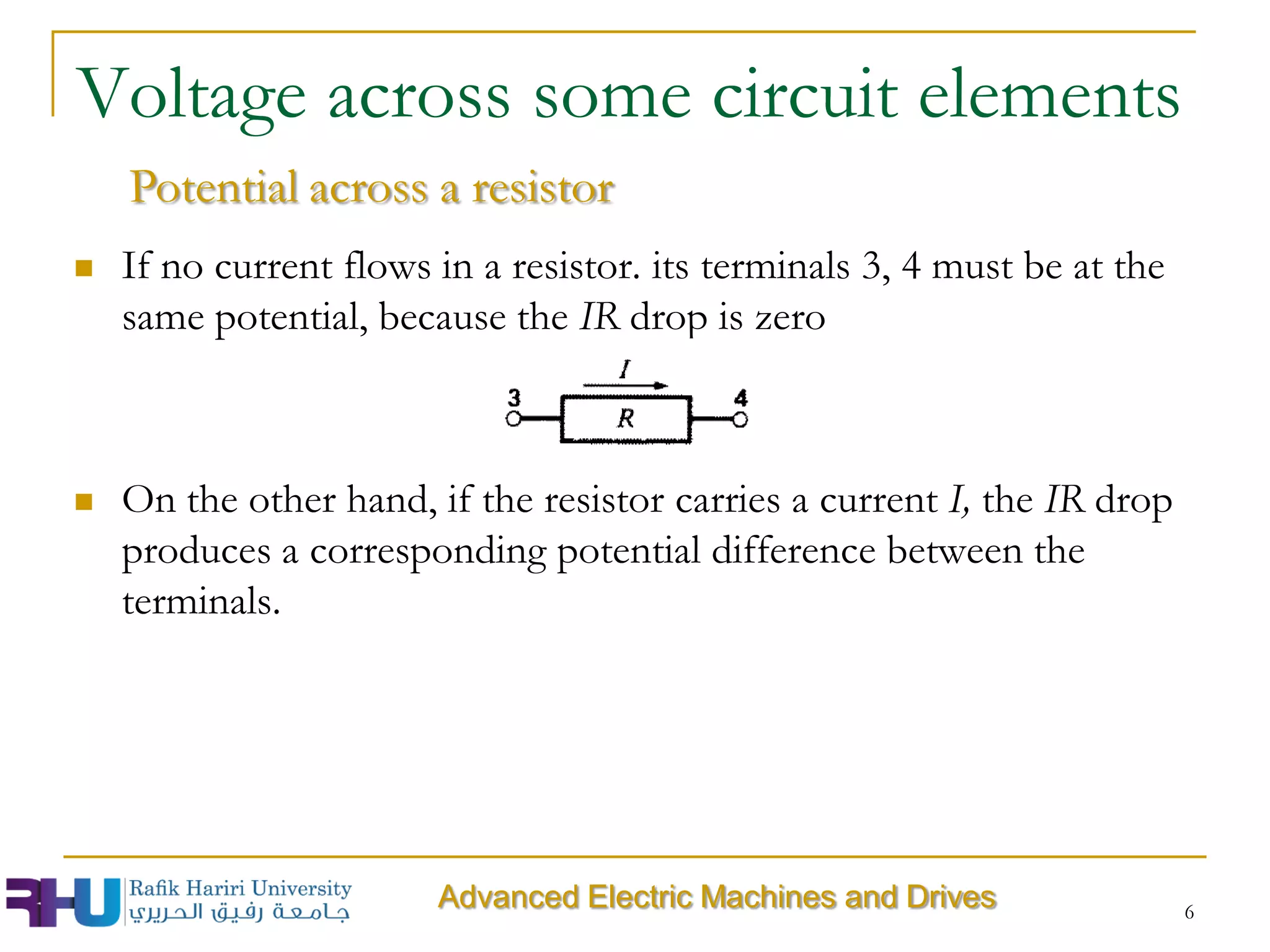
Potential across a resistor
 If no current flows in a resistor. its terminals 3, 4 must be at the
same potential, because the IR drop is zero
 On the other hand, if the resistor carries a current I, the IR drop
produces a corresponding potential difference between the
terminals.
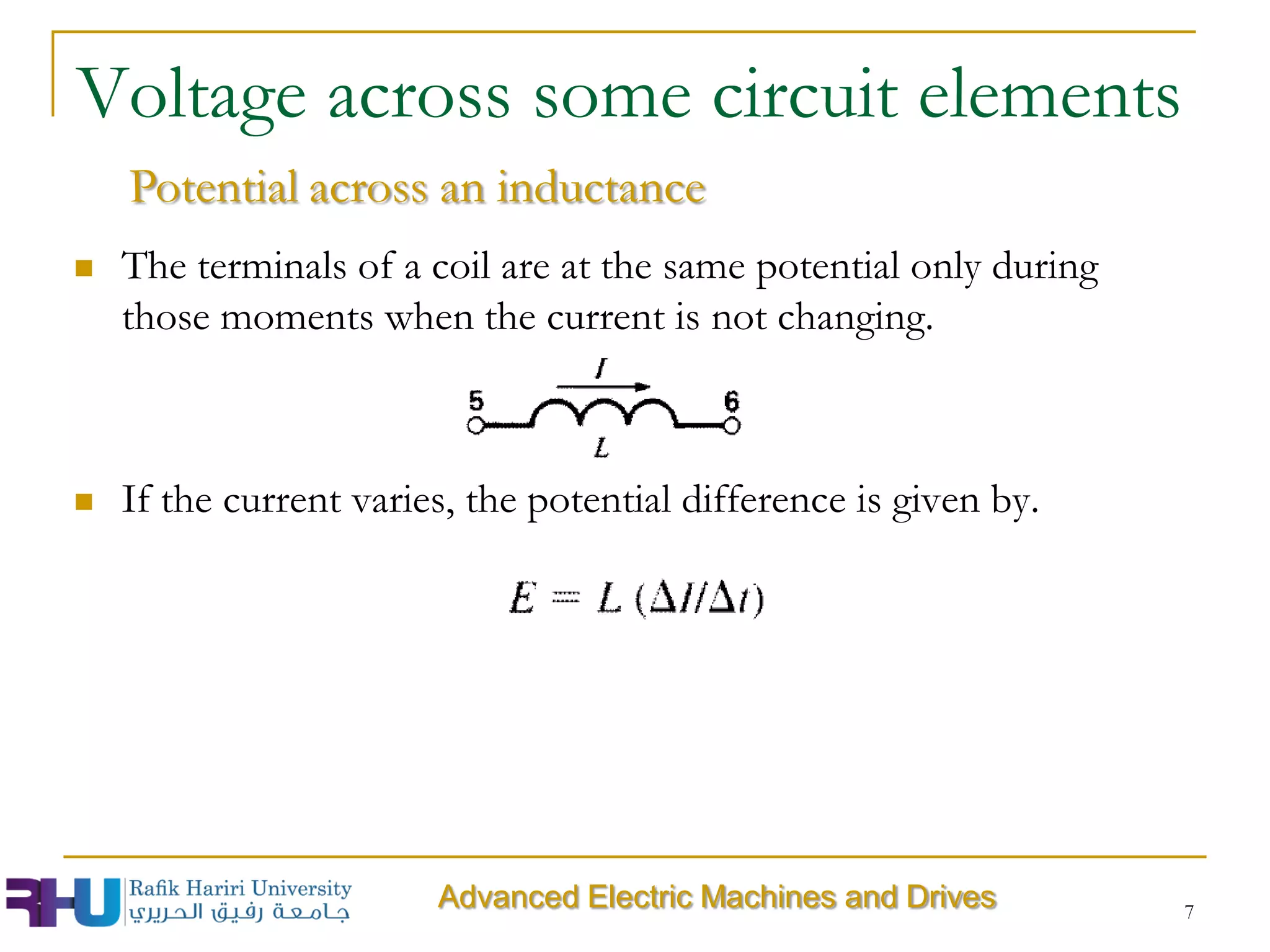
 The terminals of a coil are at the same potential only during
those moments when the current is not changing.
 If the current varies, the potential difference is given by.
7
Voltage across some circuit elements
Advanced Electric Machines and Drives
Potential across an inductance
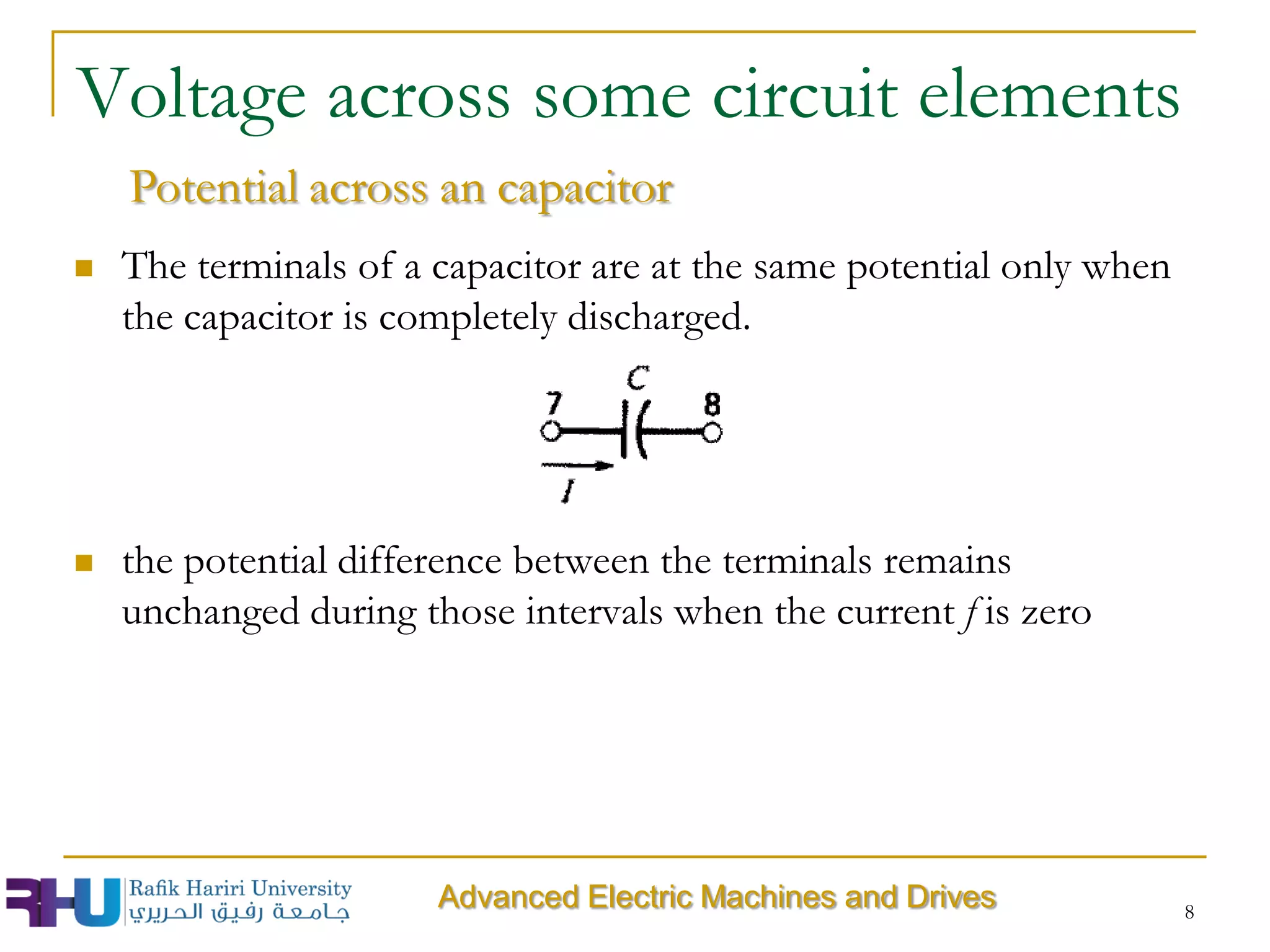
 The terminals of a capacitor are at the same potential only when
the capacitor is completely discharged.
 the potential difference between the terminals remains
unchanged during those intervals when the current f is zero
8
Voltage across some circuit elements
Advanced Electric Machines and Drives
Potential across an capacitor
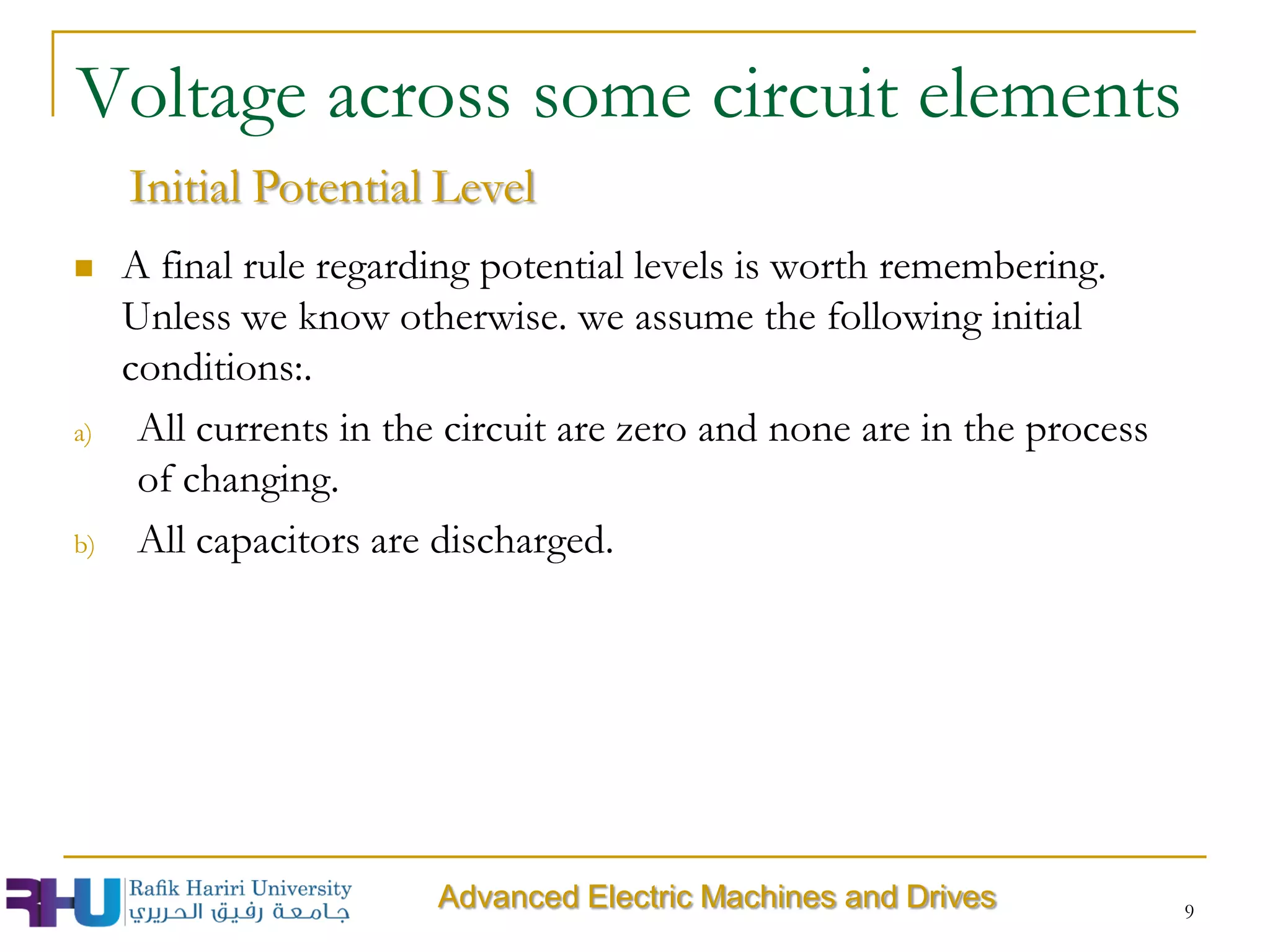
 A final rule regarding potential levels is worth remembering.
Unless we know otherwise. we assume the following initial
conditions:.
a) All currents in the circuit are zero and none are in the process
of changing.
b) All capacitors are discharged.
9
Voltage across some circuit elements
Advanced Electric Machines and Drives
Initial Potential Level
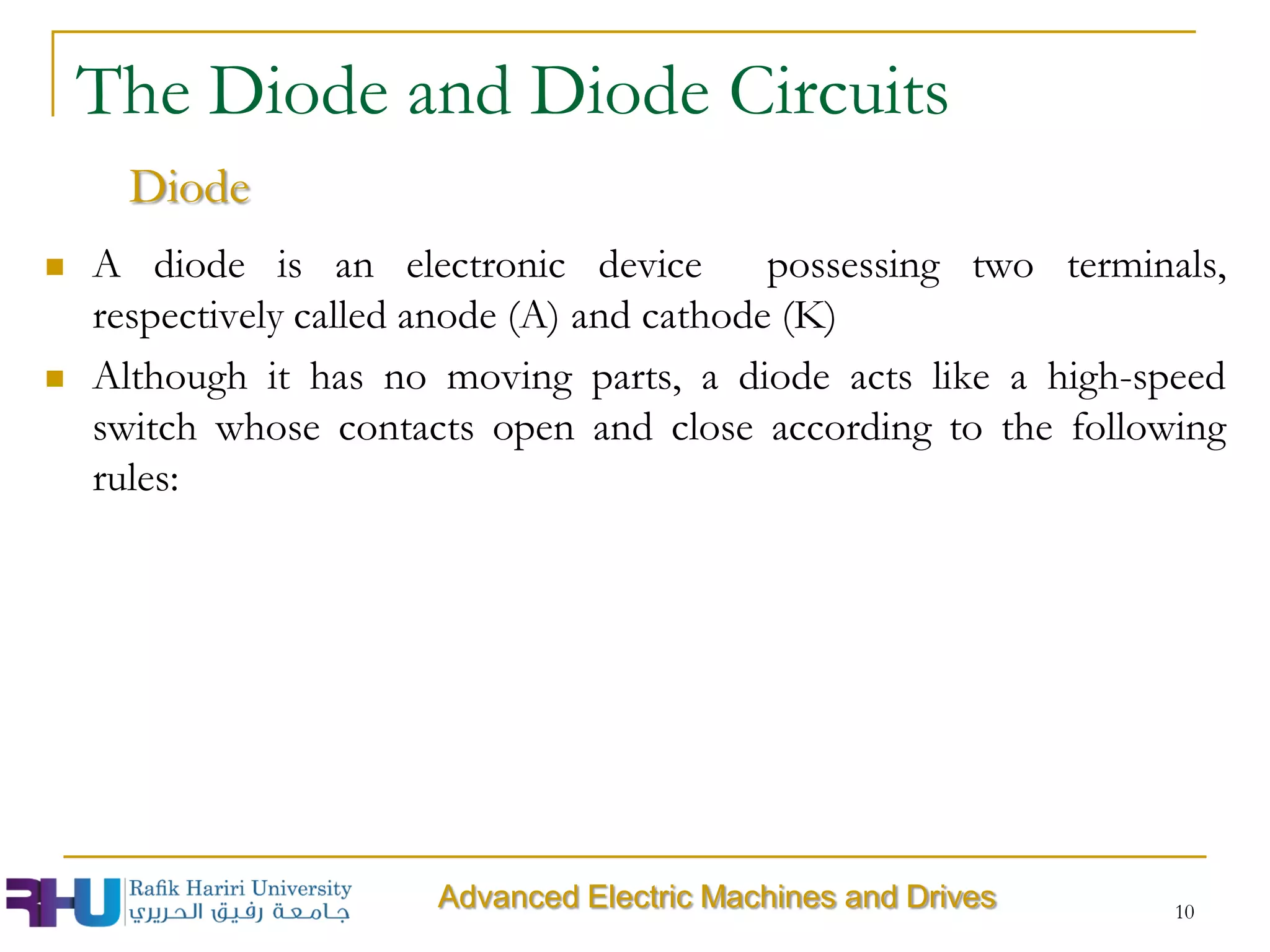
 A diode is an electronic device possessing two terminals,
respectively called anode (A) and cathode (K)
 Although it has no moving parts, a diode acts like a high-speed
switch whose contacts open and close according to the following
rules:
10
The Diode and Diode Circuits
Diode
Advanced Electric Machines and Drives
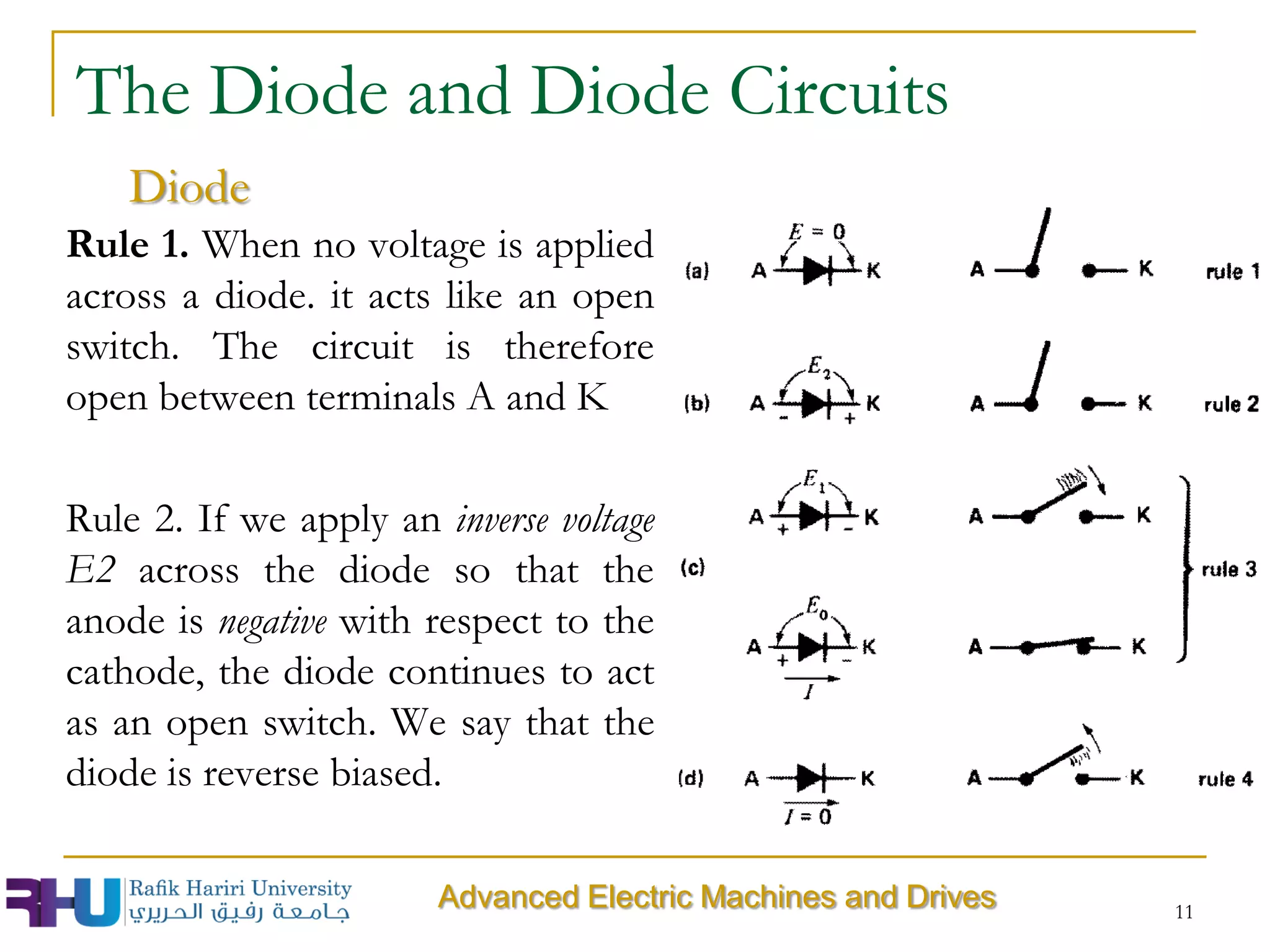
Rule 1. When no voltage is applied
across a diode. it acts like an open
switch. The circuit is therefore
open between terminals A and K
Rule 2. If we apply an inverse voltage
E2 across the diode so that the
anode is negative with respect to the
cathode, the diode continues to act
as an open switch. We say that the
diode is reverse biased.
11
Advanced Electric Machines and Drives
The Diode and Diode Circuits
Diode
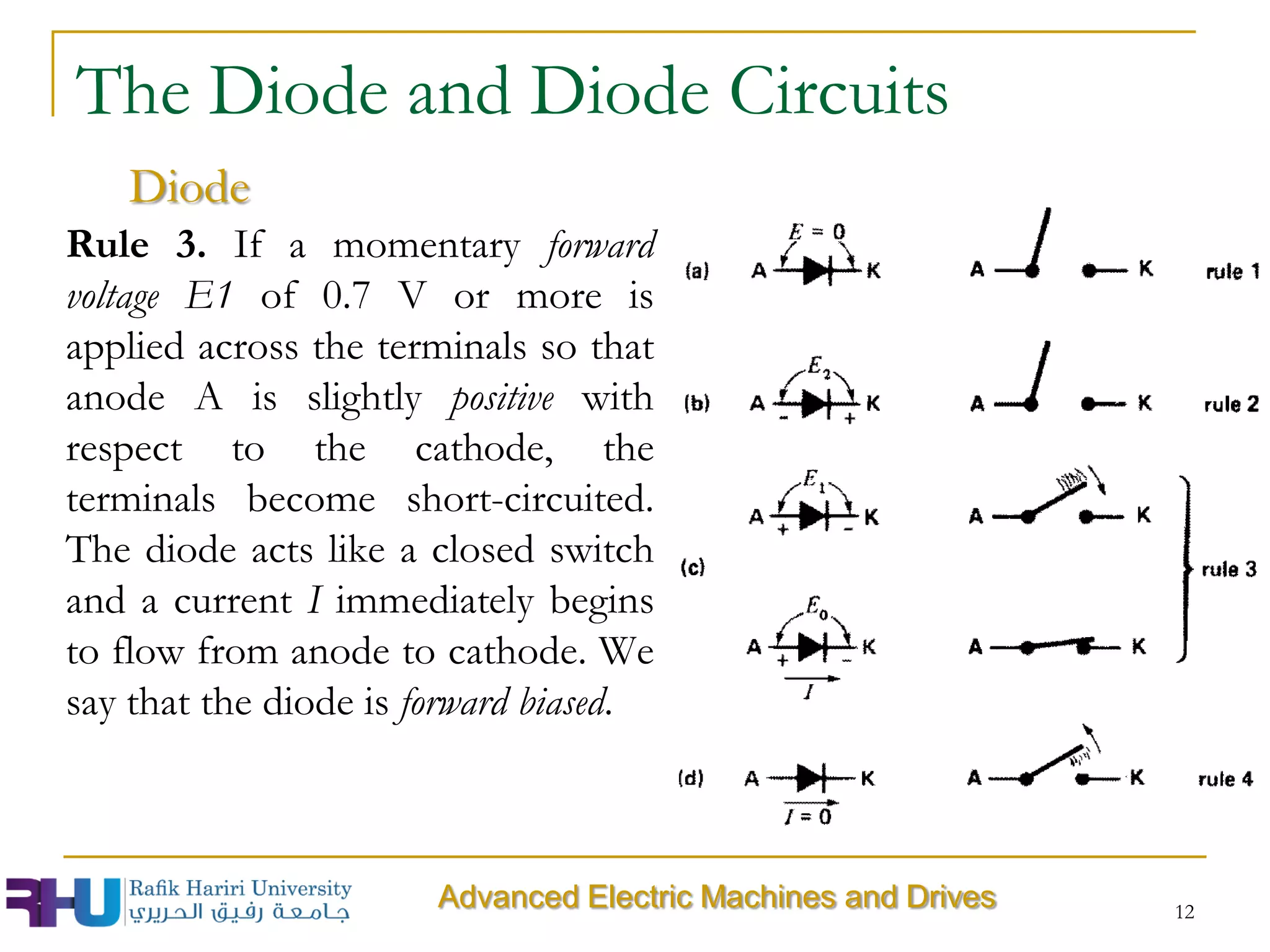
Rule 3. If a momentary forward
voltage E1 of 0.7 V or more is
applied across the terminals so that
anode A is slightly positive with
respect to the cathode, the
terminals become short-circuited.
The diode acts like a closed switch
and a current I immediately begins
to flow from anode to cathode. We
say that the diode is forward biased.
12
Advanced Electric Machines and Drives
The Diode and Diode Circuits
Diode
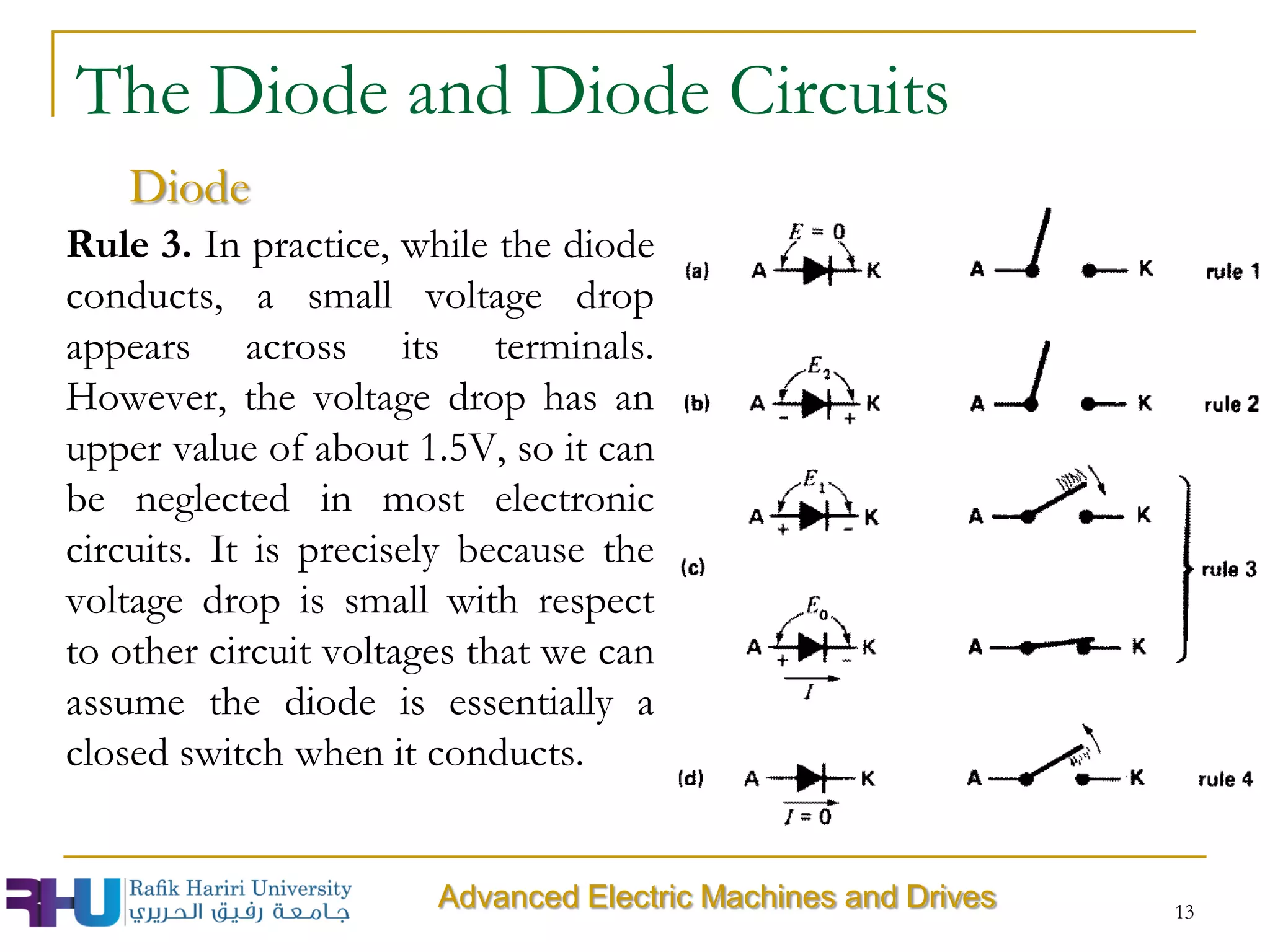
Rule 3. In practice, while the diode
conducts, a small voltage drop
appears across its terminals.
However, the voltage drop has an
upper value of about 1.5V, so it can
be neglected in most electronic
circuits. It is precisely because the
voltage drop is small with respect
to other circuit voltages that we can
assume the diode is essentially a
closed switch when it conducts.
13
Advanced Electric Machines and Drives
The Diode and Diode Circuits
Diode
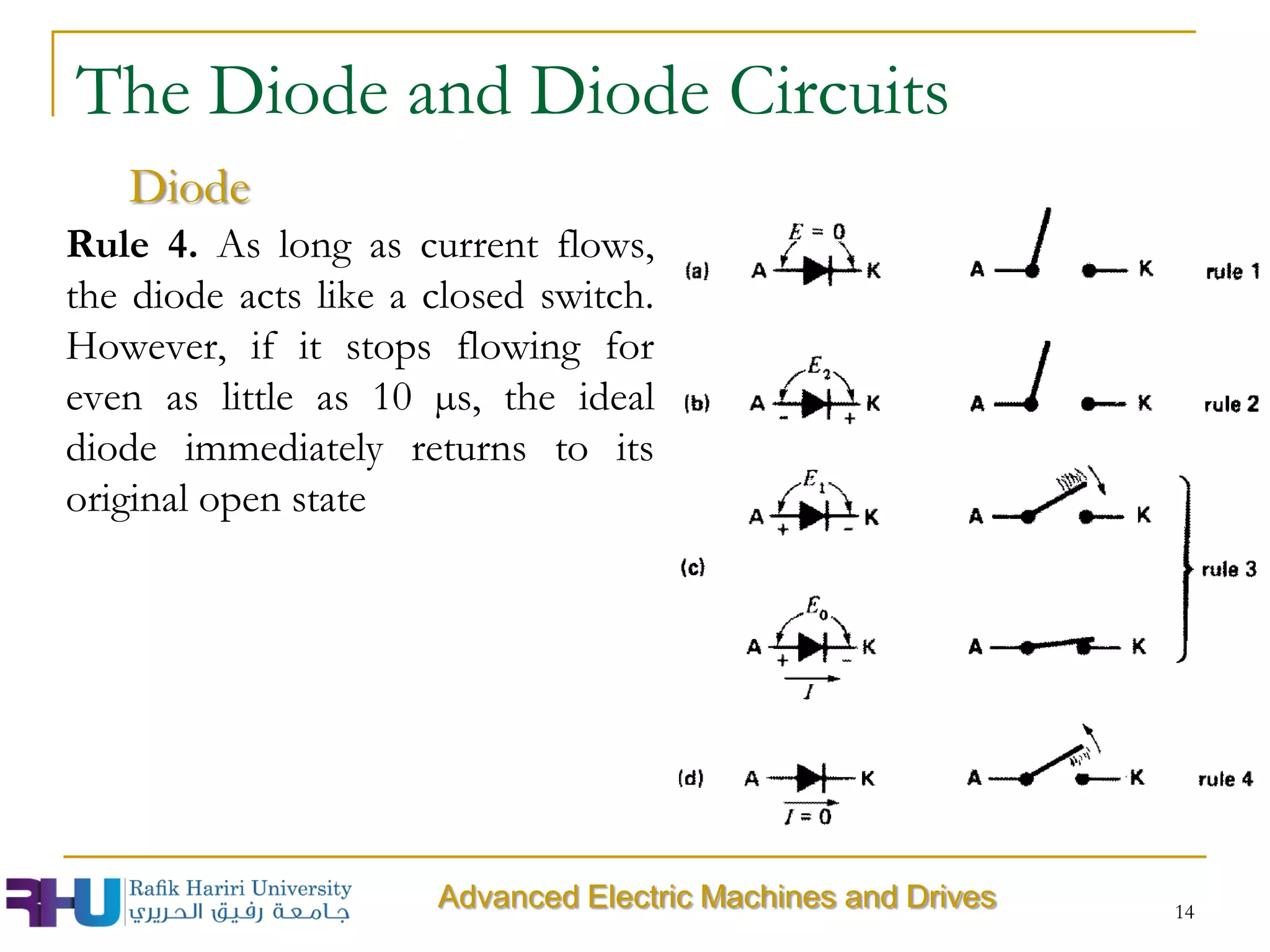
Rule 4. As long as current flows,
the diode acts like a closed switch.
However, if it stops flowing for
even as little as 10 µs, the ideal
diode immediately returns to its
original open state
14
Advanced Electric Machines and Drives
The Diode and Diode Circuits
Diode
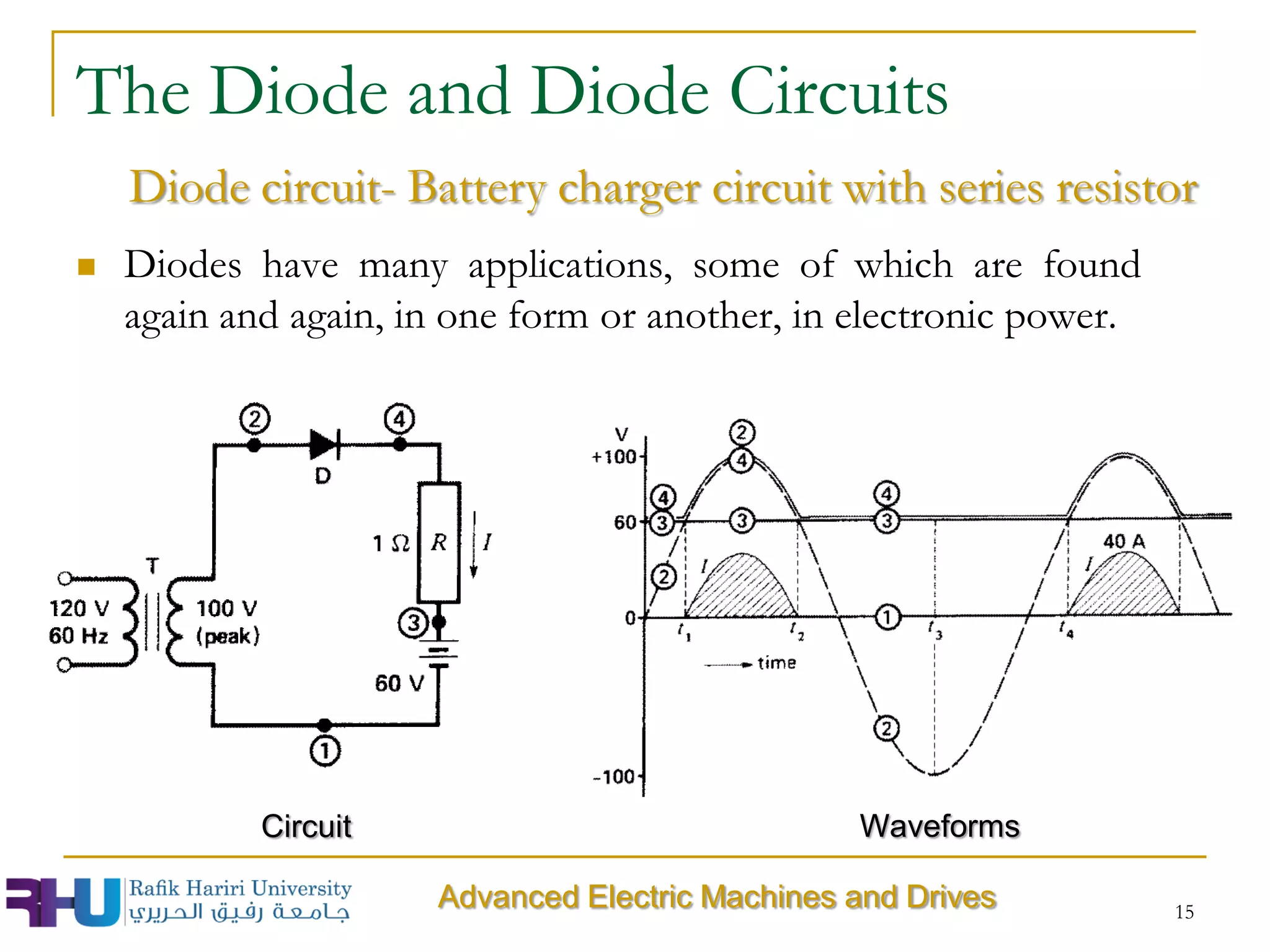
 Diodes have many applications, some of which are found
again and again, in one form or another, in electronic power.
15
Diode circuit- Battery charger circuit with series resistor
Advanced Electric Machines and Drives
The Diode and Diode Circuits
Circuit Waveforms
16
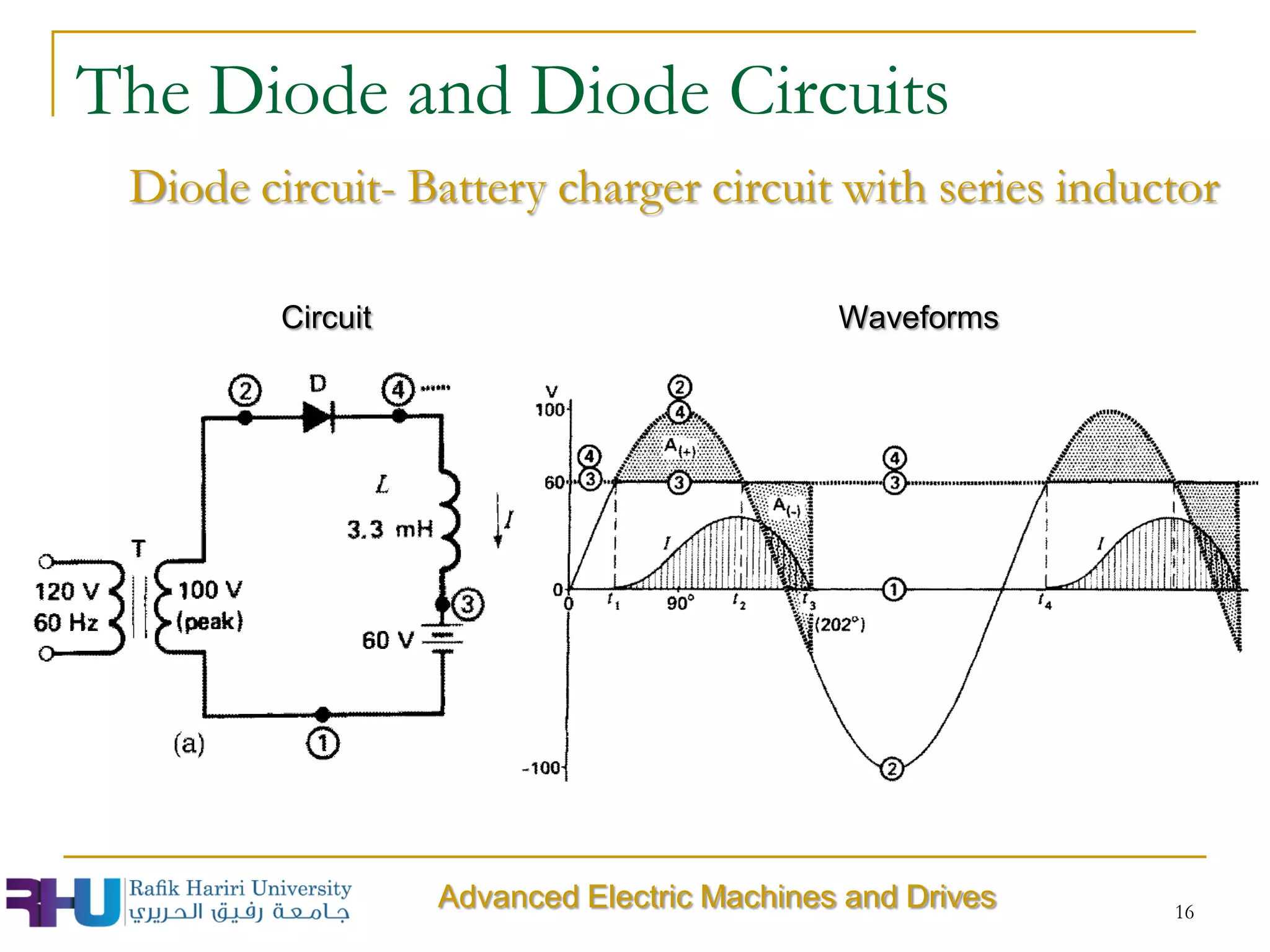
Diode circuit- Battery charger circuit with series inductor
Advanced Electric Machines and Drives
The Diode and Diode Circuits
WaveformsCircuit
17
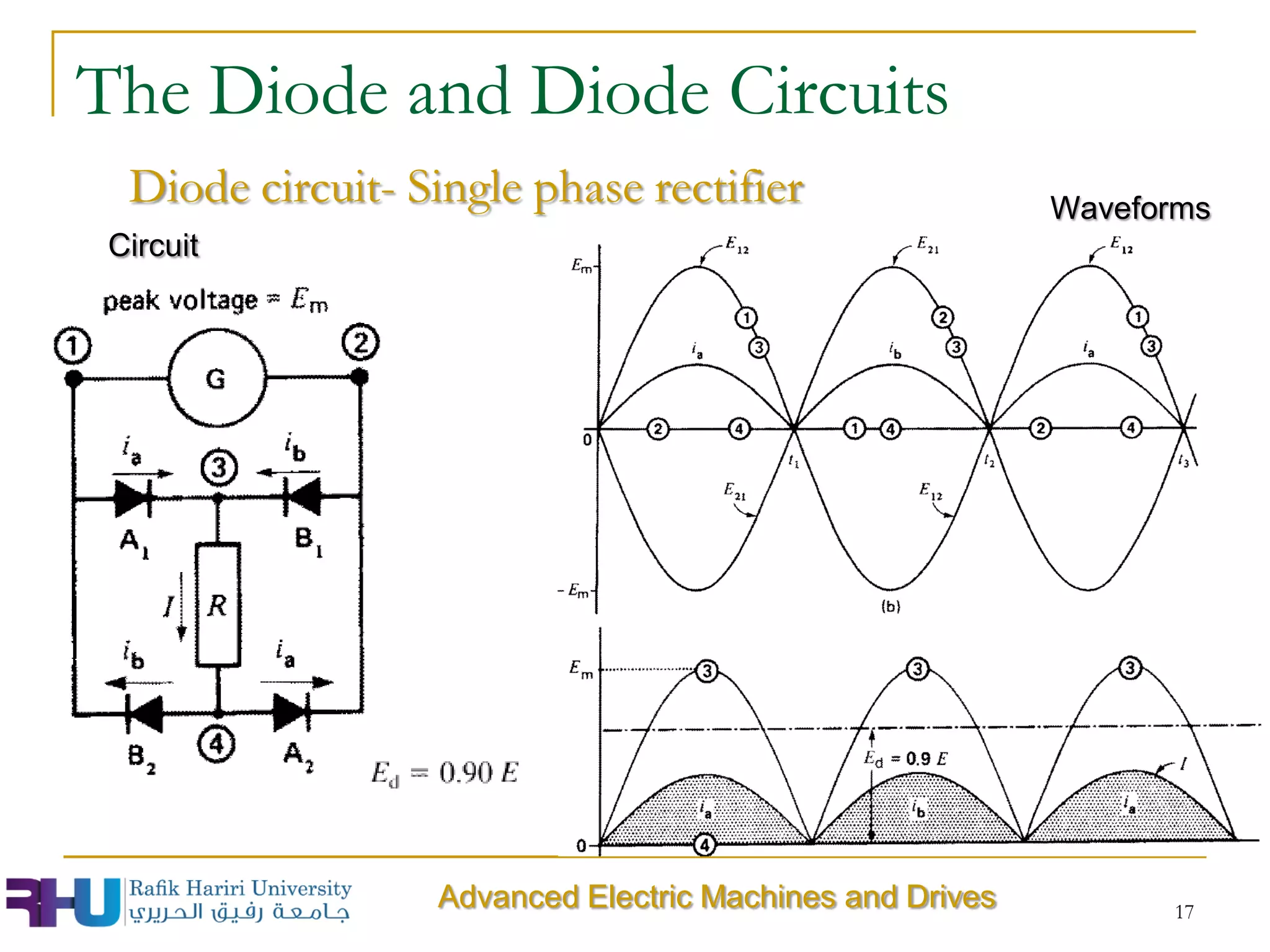
Diode circuit- Single phase rectifier
Advanced Electric Machines and Drives
The Diode and Diode Circuits
Circuit
Waveforms
 The rectifier circuits we have studied so far produce pulsating
voltages and currents.
 In some types of loads, we cannot tolerate such pulsations, and filters
must be used to smooth out the valleys and peaks.
 The basic purpose of a dc filter is to produce a smooth power flow
into a load.
 Consequently, a filter must absorb energy whenever the dc voltage
or current tends to rise, and it must release energy whenever the
voltage or current tends to fall.
 In this way the filter tends to maintain a constant voltage and current
in the load.
18
The Diode and Diode Circuits
Filters
Advanced Electric Machines and Drives
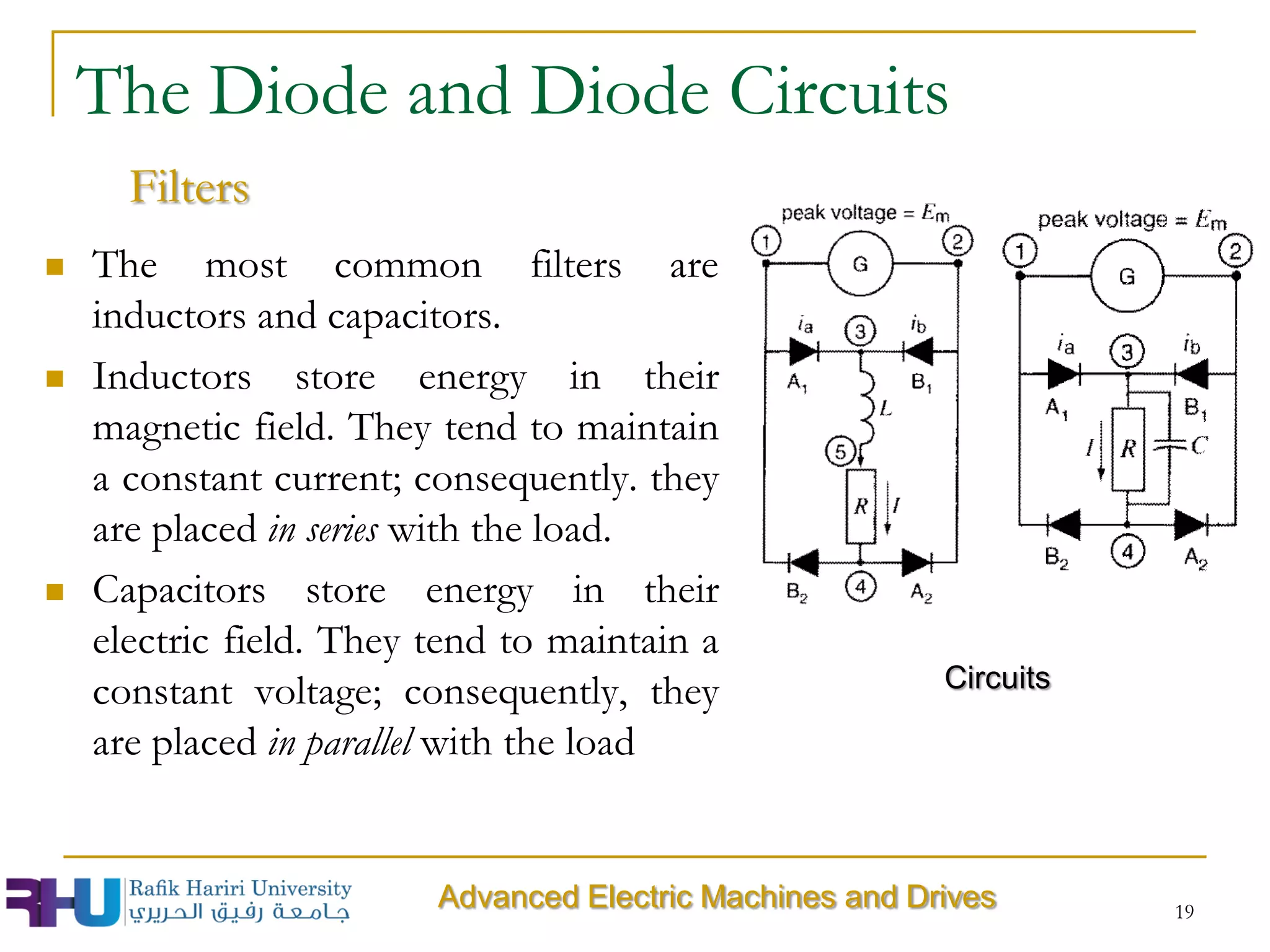
 The most common filters are
inductors and capacitors.
 Inductors store energy in their
magnetic field. They tend to maintain
a constant current; consequently. they
are placed in series with the load.
 Capacitors store energy in their
electric field. They tend to maintain a
constant voltage; consequently, they
are placed in parallel with the load
19
The Diode and Diode Circuits
Filters
Advanced Electric Machines and Drives
Circuits
 The greater the amount of energy stored in the filter, the better is the
filtering action. In the case of a bridge rectifier using an inductor, the
peak-to-peak ripple in percent is given by:
 ripple peak-to-peak current as a percent of the dc current [%]
 WL = dc energy stored in the smoothing inductor [J]
 P = dc power drawn by the load [W]
 f = frequency of the source [Hz]
20
The Diode and Diode Circuits
Filters
Advanced Electric Machines and Drives
We wish to build a 135 V, 20 A dc power supply using a single-phase
bridge rectifier and an inductive filter. The peak-to-peak current ripple
should be about 10%. If a 60 Hz ac source is available, calculate the
following:
a) The effective value of the ac voltage
b) The energy stored in the inductor
c) The inductance of the inductor
d) The peak-to-peak current ripple
21
The Diode and Diode Circuits
Exercise
Advanced Electric Machines and Drives
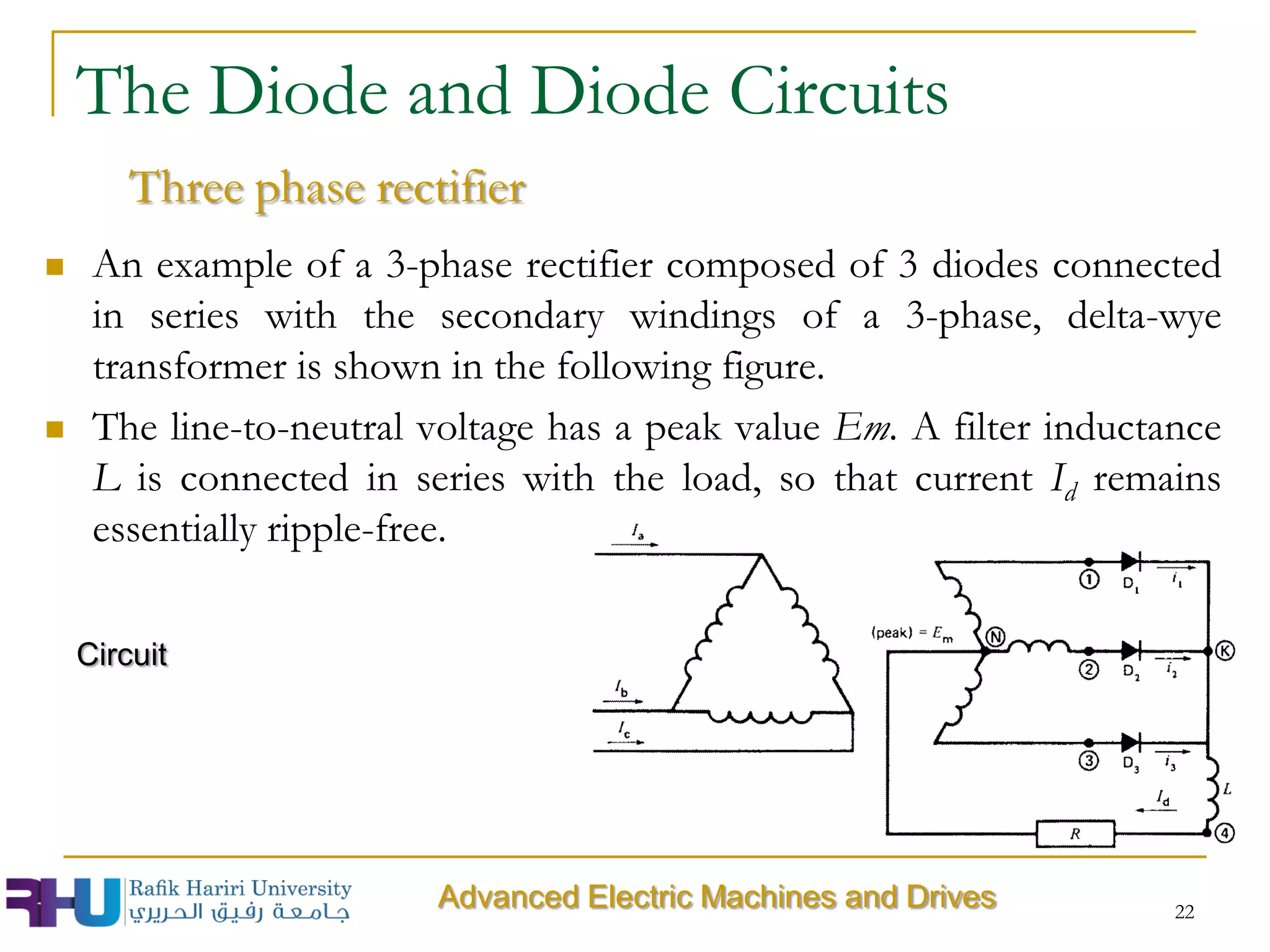
 An example of a 3-phase rectifier composed of 3 diodes connected
in series with the secondary windings of a 3-phase, delta-wye
transformer is shown in the following figure.
 The line-to-neutral voltage has a peak value Em. A filter inductance
L is connected in series with the load, so that current Id remains
essentially ripple-free.
22
The Diode and Diode Circuits
Three phase rectifier
Advanced Electric Machines and Drives
Circuit
The Diode and Diode Circuits
Three phase rectifier
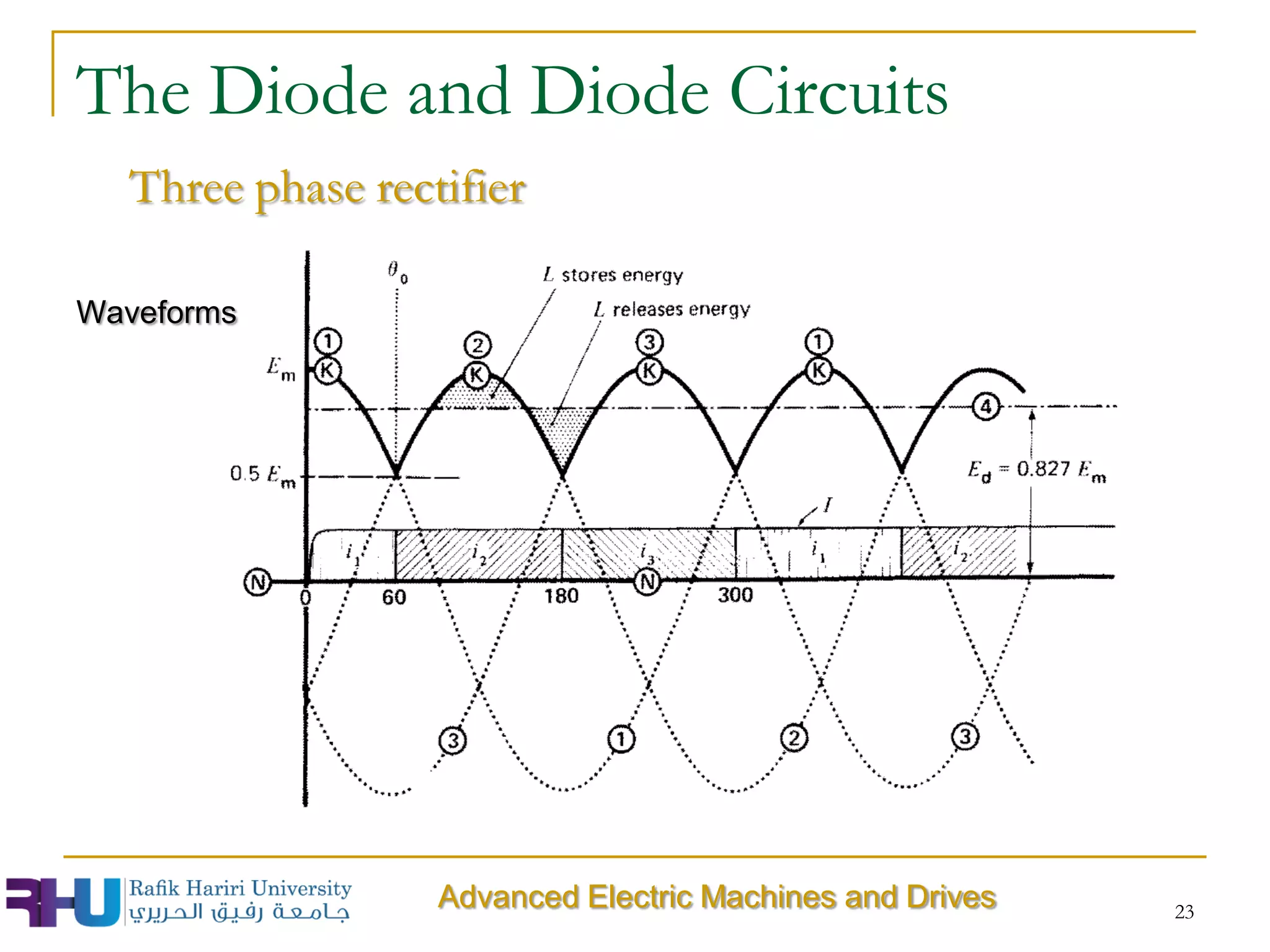
Waveforms
23
Advanced Electric Machines and Drives
The Diode and Diode Circuits
Three phase rectifier
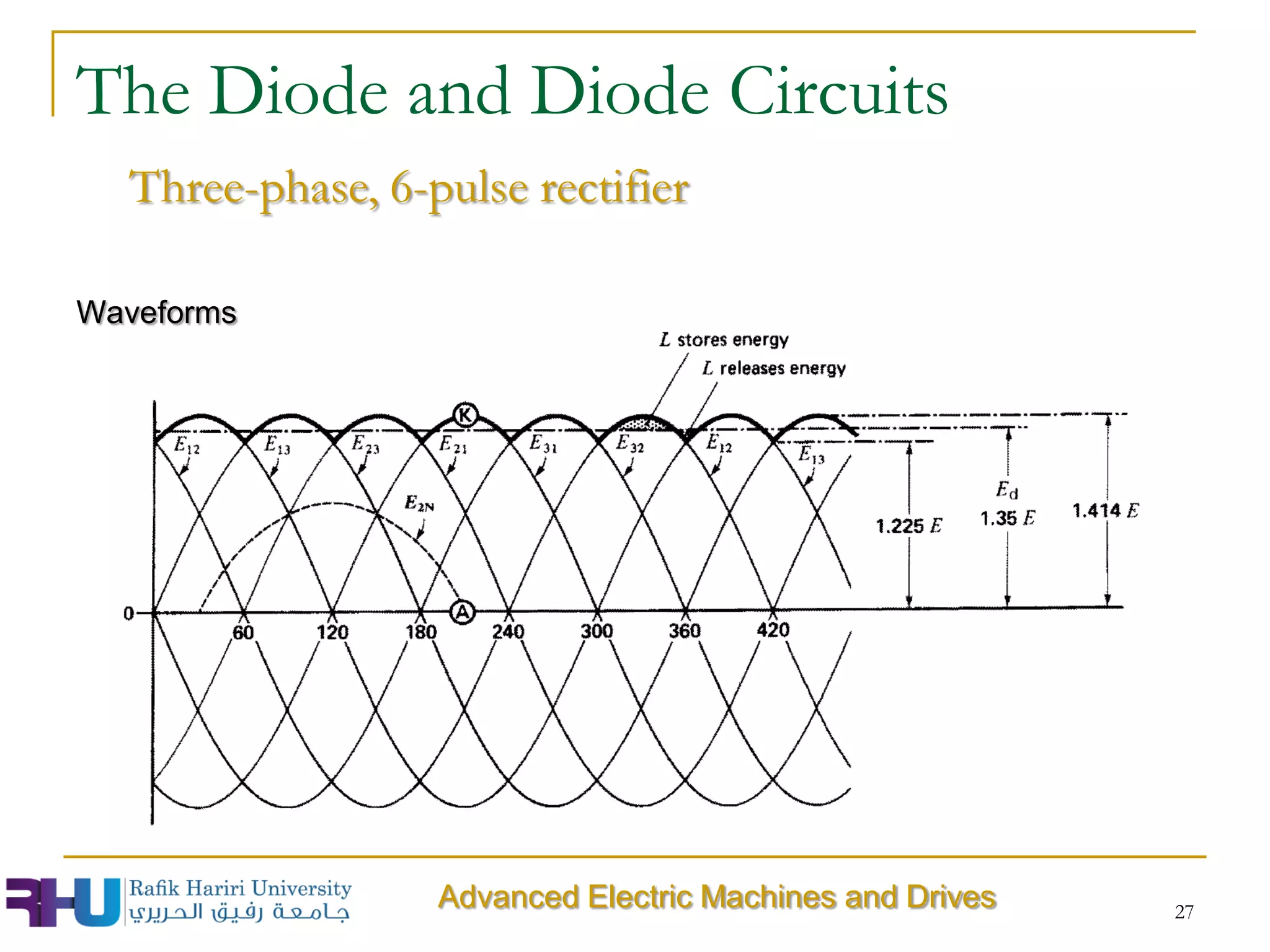
 The sudden switch over from one diode to another called
commutation. When the switchover takes place automatically, it is
called natural commutation, or line commutation because it is the line
voltage that forces the transfer of current from one diode to the
next.
 Voltage EKN across the load and inductor pulsates between 0.5 and
Em. The ripple voltage is therefore smaller than that produced by a
single-phase bridge rectifier. Moreover, the fundamental ripple
frequency is three times the supply frequency, which makes it easier
to achieve good filtering.
24
Advanced Electric Machines and Drives
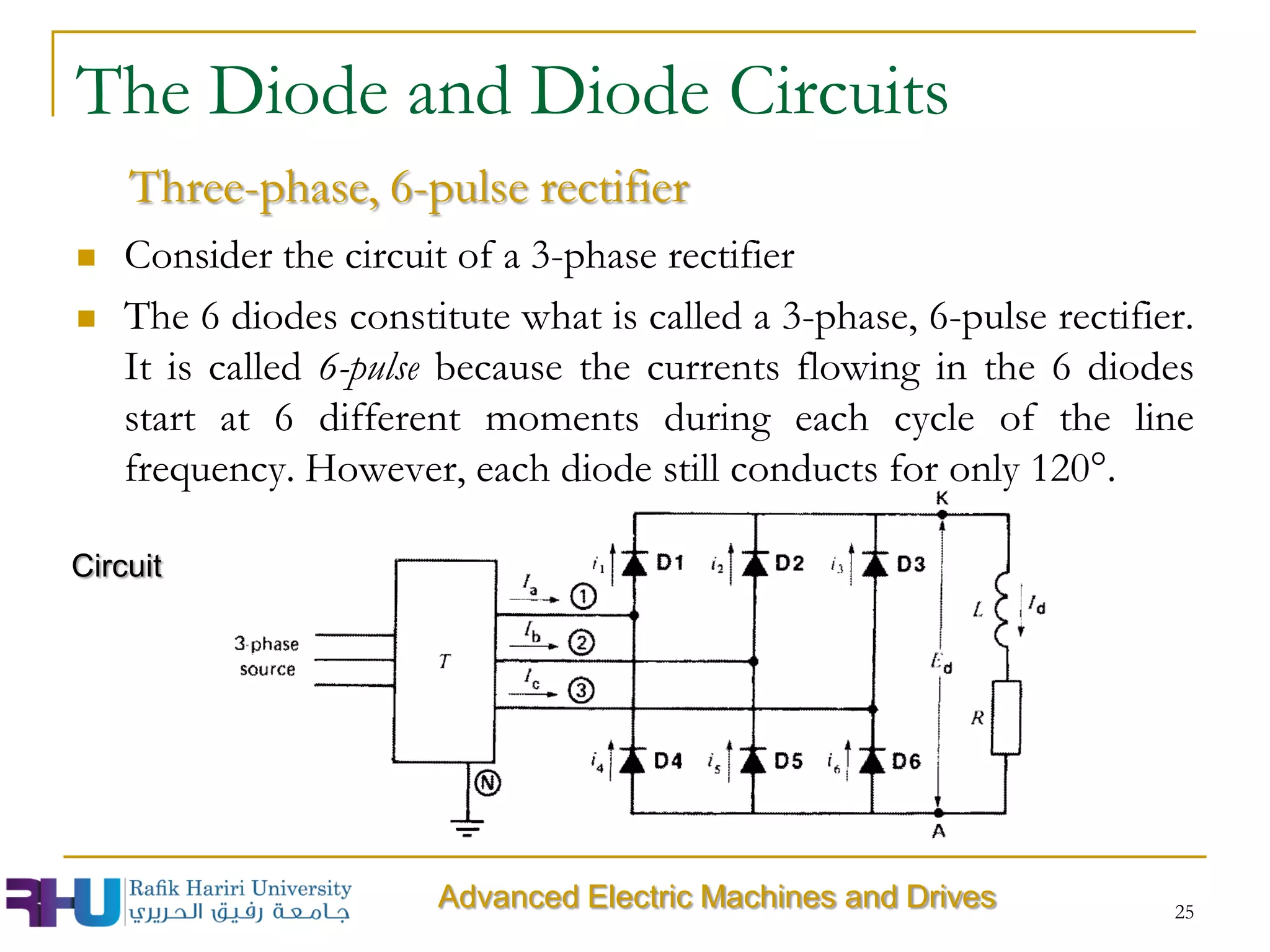
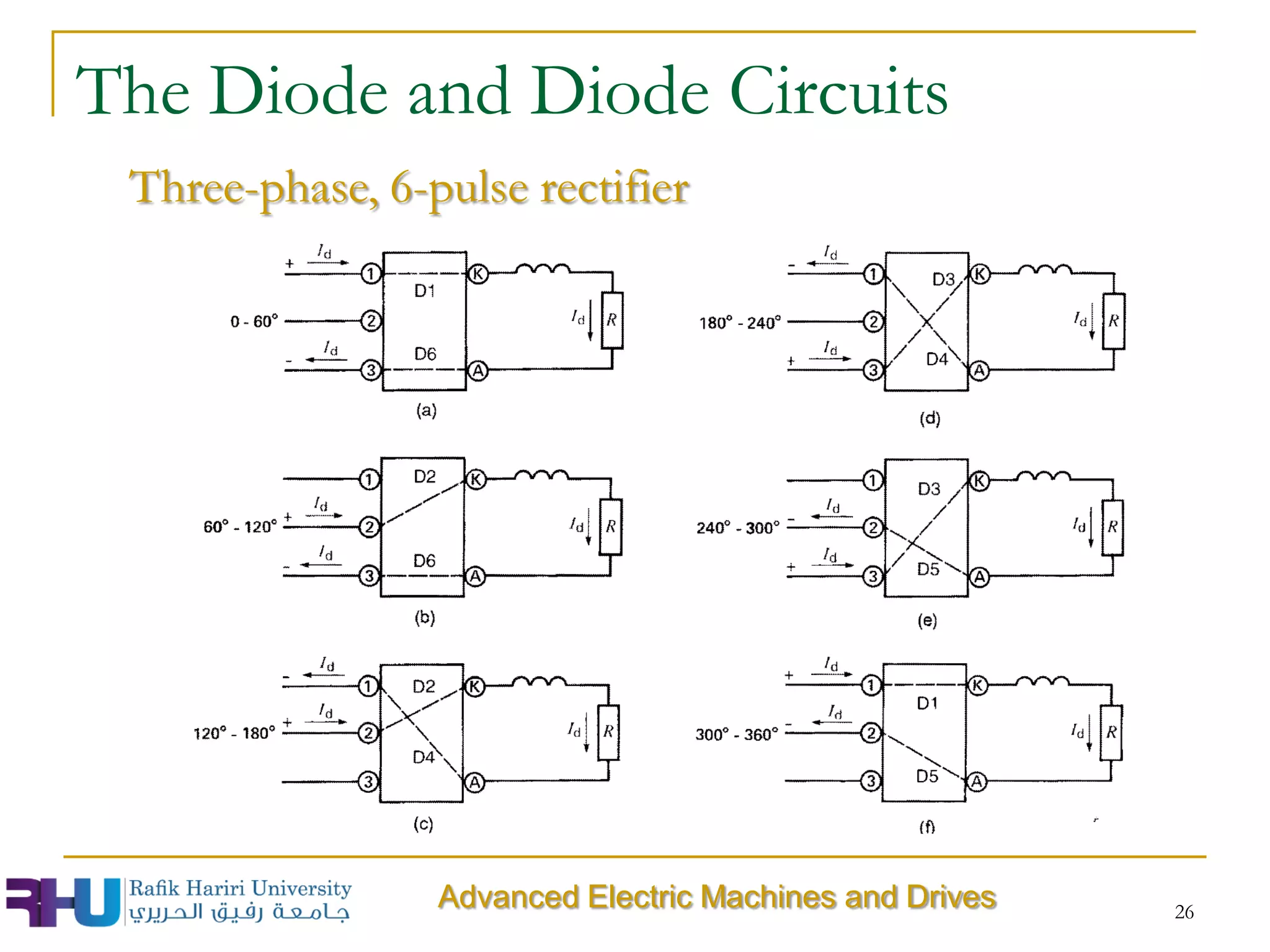
 Consider the circuit of a 3-phase rectifier
 The 6 diodes constitute what is called a 3-phase, 6-pulse rectifier.
It is called 6-pulse because the currents flowing in the 6 diodes
start at 6 different moments during each cycle of the line
frequency. However, each diode still conducts for only 120°.
The Diode and Diode Circuits
Three-phase, 6-pulse rectifier
Circuit
25
Advanced Electric Machines and Drives
The Diode and Diode Circuits
Three-phase, 6-pulse rectifier
26
Advanced Electric Machines and Drives
The Diode and Diode Circuits
Three-phase, 6-pulse rectifier
Waveforms
27
Advanced Electric Machines and Drives
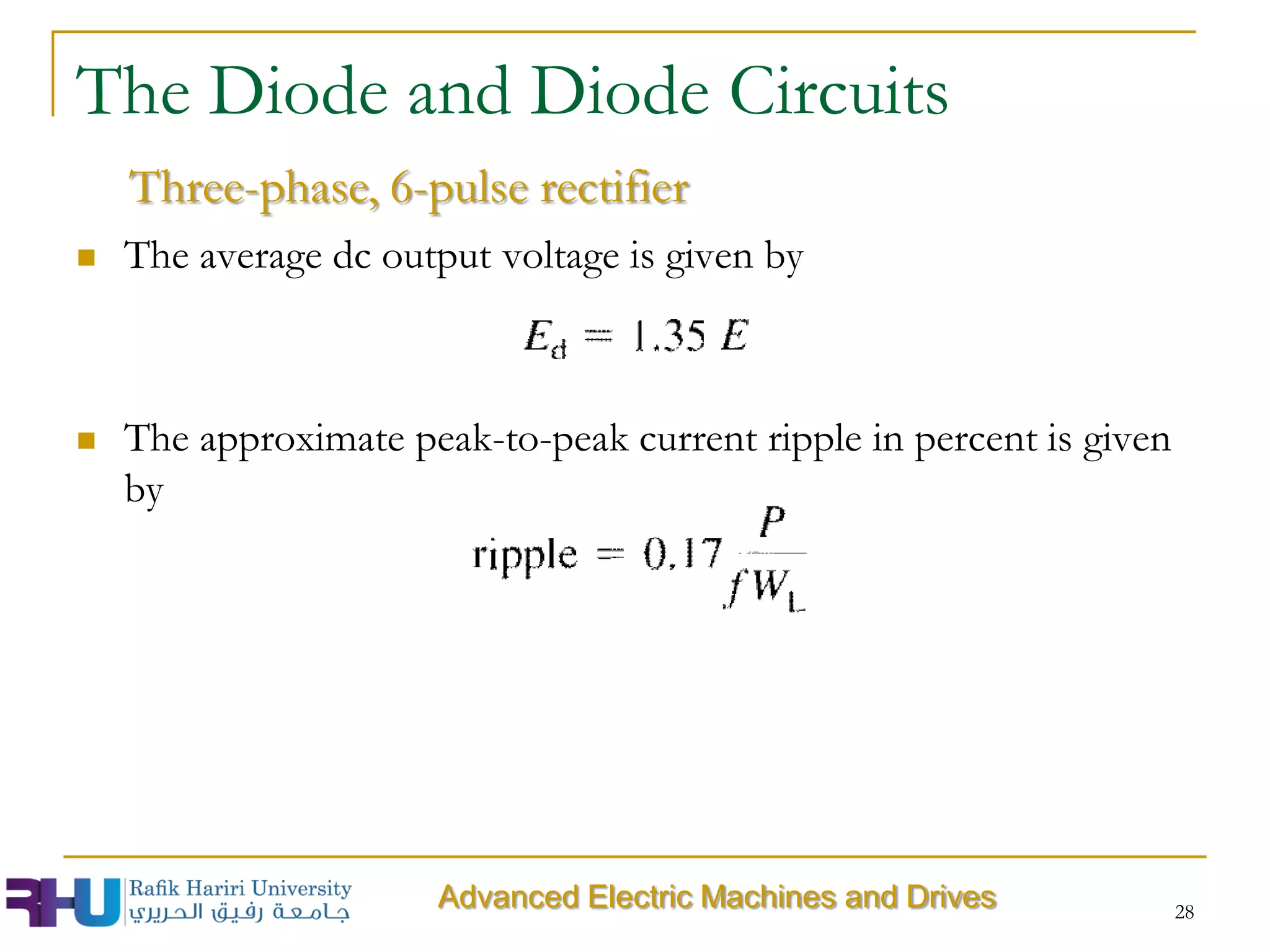
 The average dc output voltage is given by
 The approximate peak-to-peak current ripple in percent is given
by
The Diode and Diode Circuits
Three-phase, 6-pulse rectifier
28
Advanced Electric Machines and Drives
 A 3-phase bridge rectifier has to supply power to a 360 kW, 240
V dc load. If a 600 V, 3-phase, 60 Hz feeder is available, calculate
the following:
a) Voltage rating of the 3-phase transformer
b) DC current per diode
c) PIV across each diode
d) Peak-to-peak ripple in the output voltage and its frequency
e) Calculate the inductance of the smoothing choke required, if the
peak-to-peak ripple in the current is not to exceed 5 percent.
29
The Diode and Diode Circuits
Exercise
Advanced Electric Machines and Drives
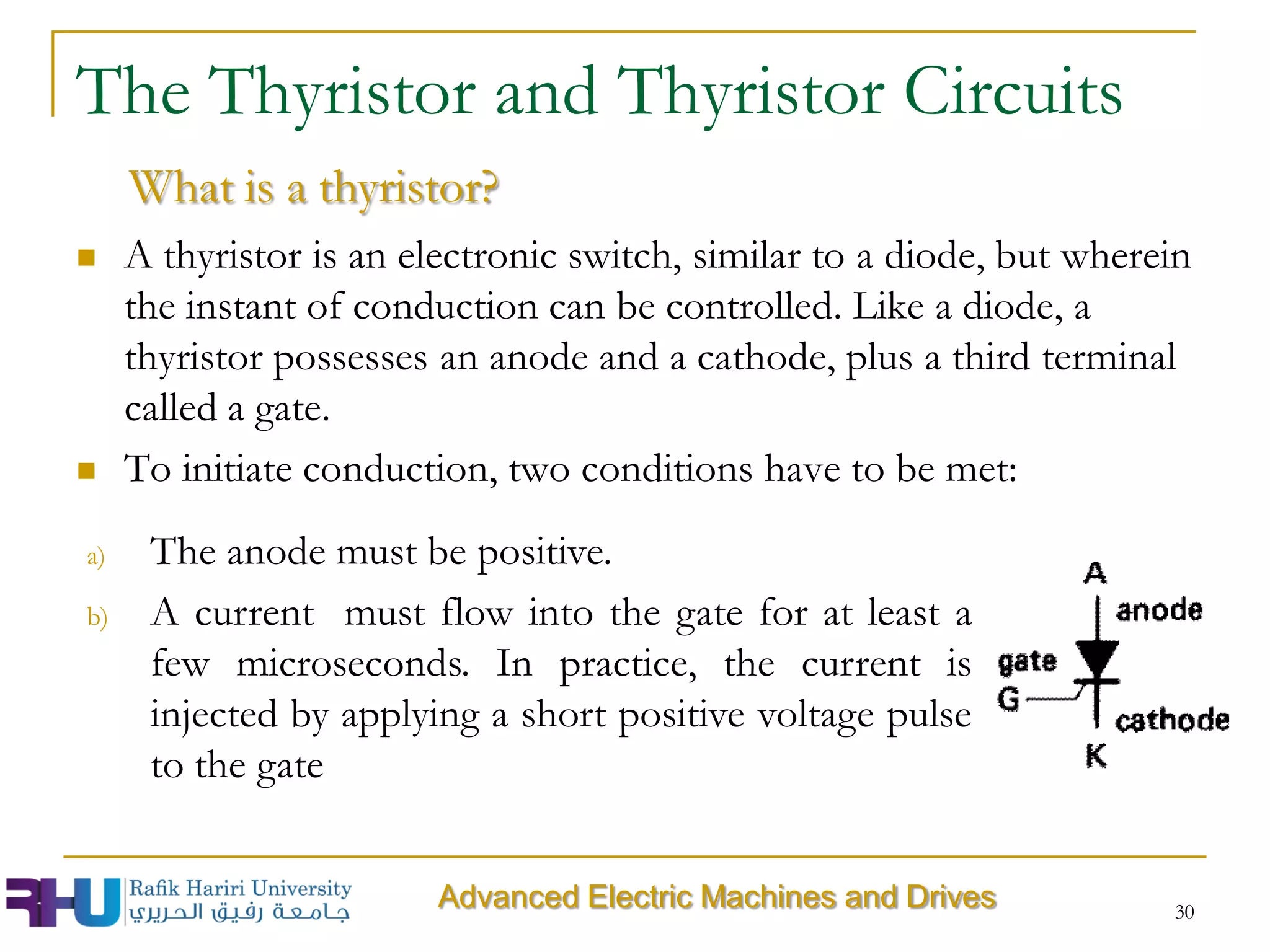
 A thyristor is an electronic switch, similar to a diode, but wherein
the instant of conduction can be controlled. Like a diode, a
thyristor possesses an anode and a cathode, plus a third terminal
called a gate.
 To initiate conduction, two conditions have to be met:
30
The Thyristor and Thyristor Circuits
What is a thyristor?
a) The anode must be positive.
b) A current must flow into the gate for at least a
few microseconds. In practice, the current is
injected by applying a short positive voltage pulse
to the gate
Advanced Electric Machines and Drives
 As soon as conduction starts, the gate loses all further control.
Conduction will only stop when anode current I falls to zero,
after which the gate again exerts control.
 Basically, a thyristor behaves the same way a diode does except
that the gate enables us to initiate conduction precisely when we
want to.
 This enables us not only to convert ac power into dc power, but
also to do the reverse: convert dc power into ac power.
31
The Thyristor and Thyristor Circuits
What is a thyristor?
Advanced Electric Machines and Drives
 As soon as conduction starts, the gate loses all further control.
Conduction will only stop when anode current I falls to zero,
after which the gate again exerts control.
 Basically, a thyristor behaves the same way a diode does except
that the gate enables us to initiate conduction precisely when we
want to.
 This enables us not only to convert ac power into dc power, but
also to do the reverse: convert dc power into ac power.
The Thyristor and Thyristor Circuits
What is a thyristor?
Advanced Electric Machines and Drives 32
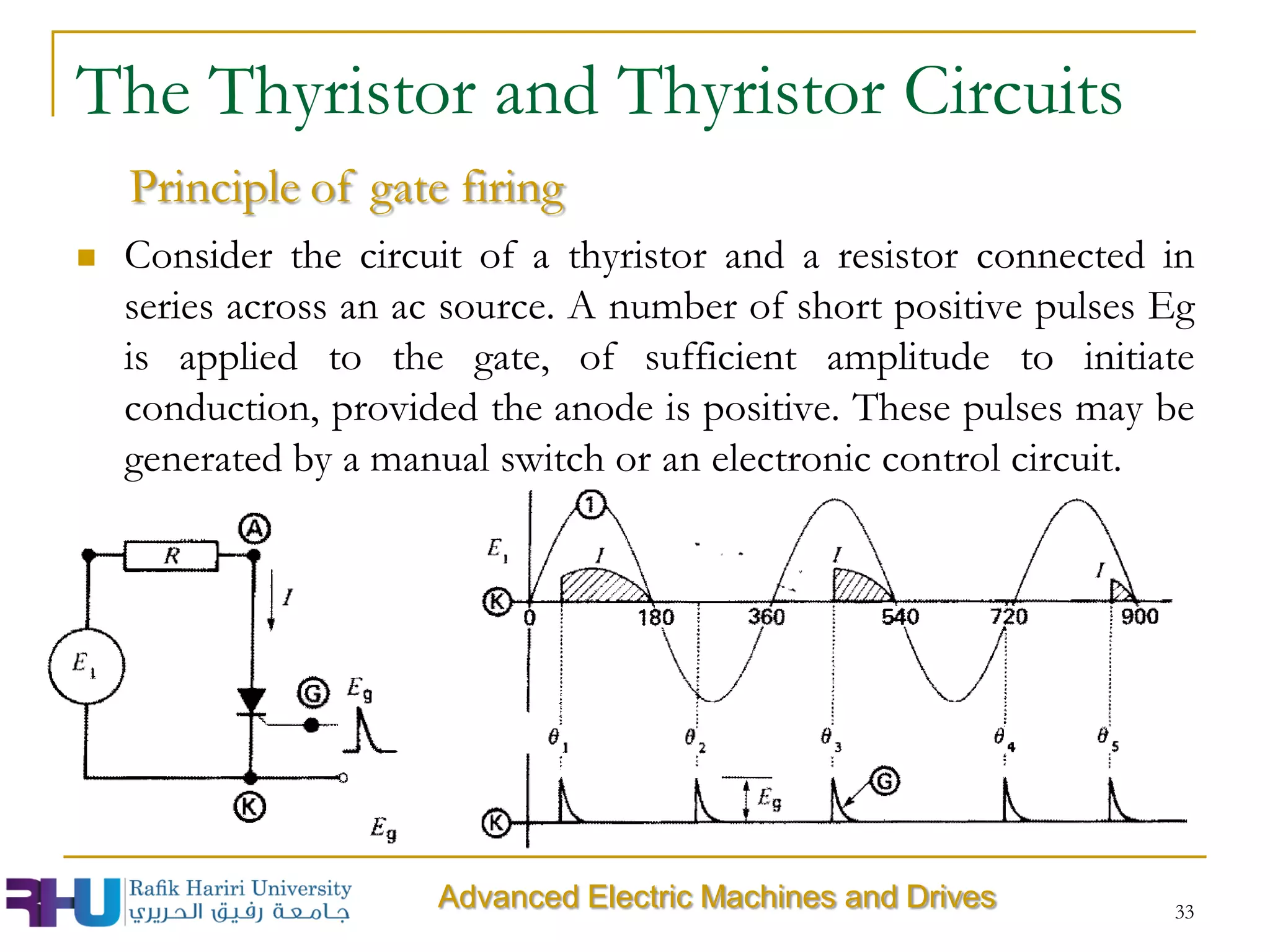
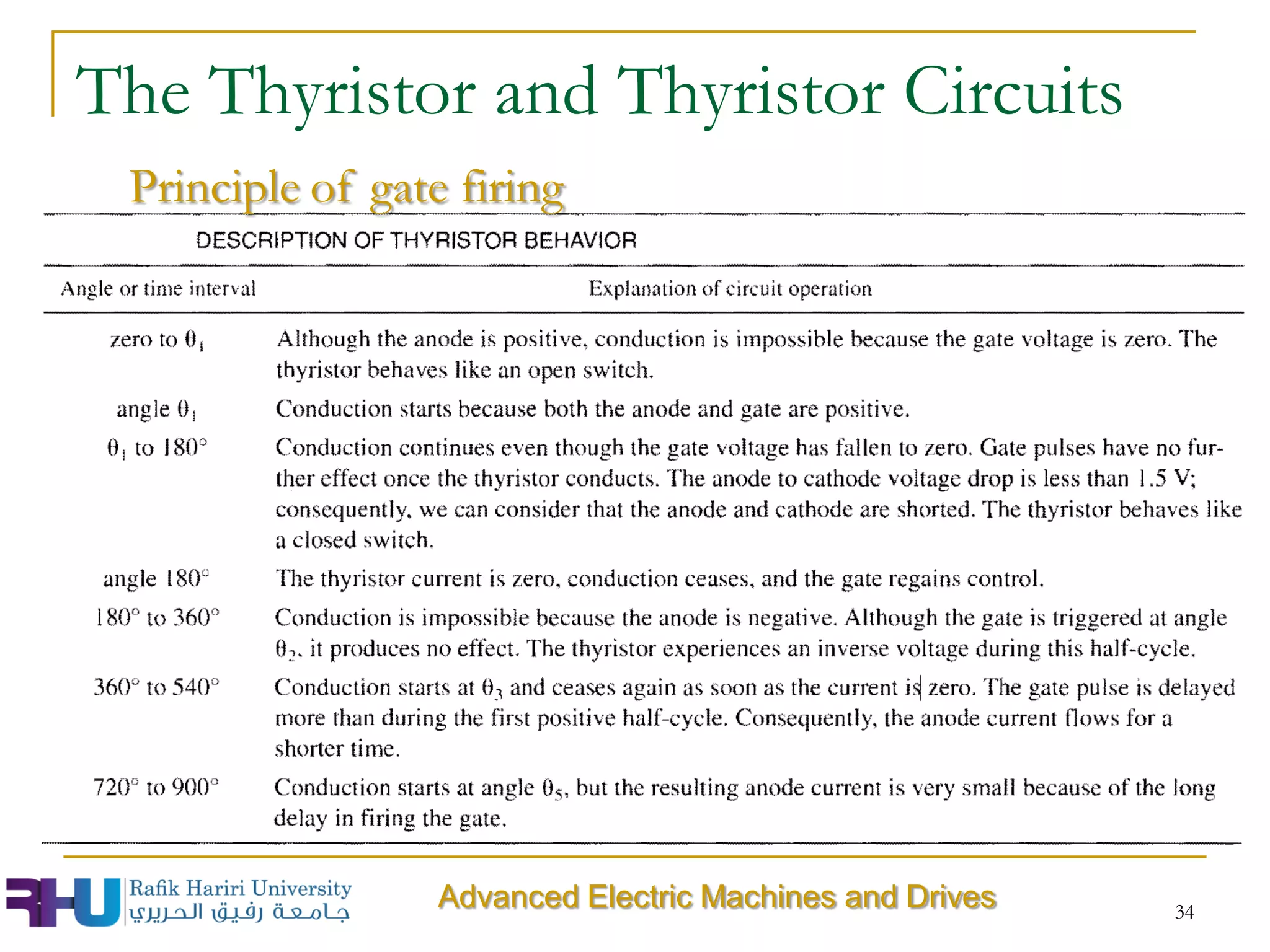
 Consider the circuit of a thyristor and a resistor connected in
series across an ac source. A number of short positive pulses Eg
is applied to the gate, of sufficient amplitude to initiate
conduction, provided the anode is positive. These pulses may be
generated by a manual switch or an electronic control circuit.
33
Advanced Electric Machines and Drives
The Thyristor and Thyristor Circuits
Principle of gate firing
34
Advanced Electric Machines and Drives
The Thyristor and Thyristor Circuits
Principle of gate firing
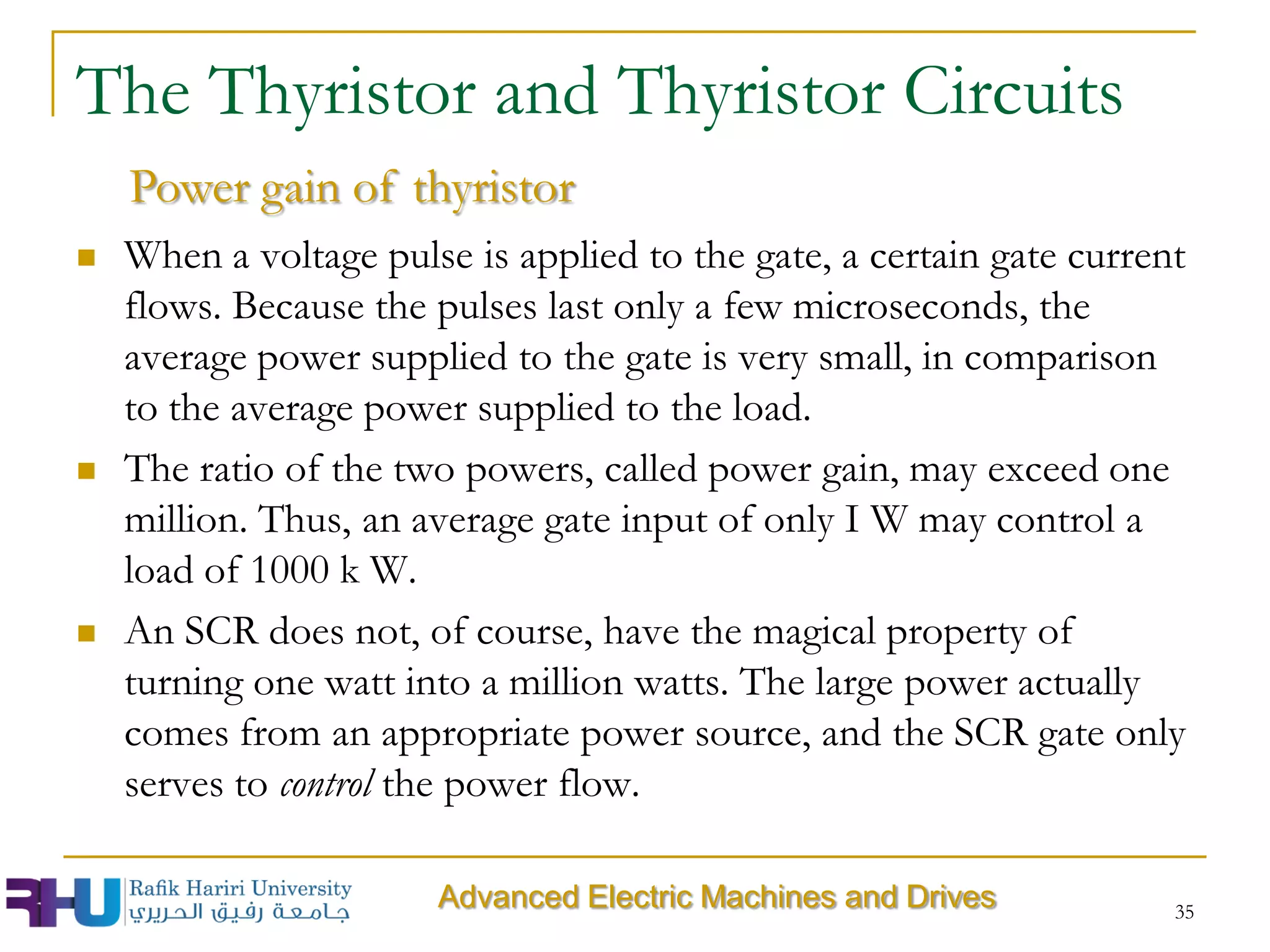
 When a voltage pulse is applied to the gate, a certain gate current
flows. Because the pulses last only a few microseconds, the
average power supplied to the gate is very small, in comparison
to the average power supplied to the load.
 The ratio of the two powers, called power gain, may exceed one
million. Thus, an average gate input of only I W may control a
load of 1000 k W.
 An SCR does not, of course, have the magical property of
turning one watt into a million watts. The large power actually
comes from an appropriate power source, and the SCR gate only
serves to control the power flow.
35
Advanced Electric Machines and Drives
The Thyristor and Thyristor Circuits
Power gain of thyristor
36
Advanced Electric Machines and Drives
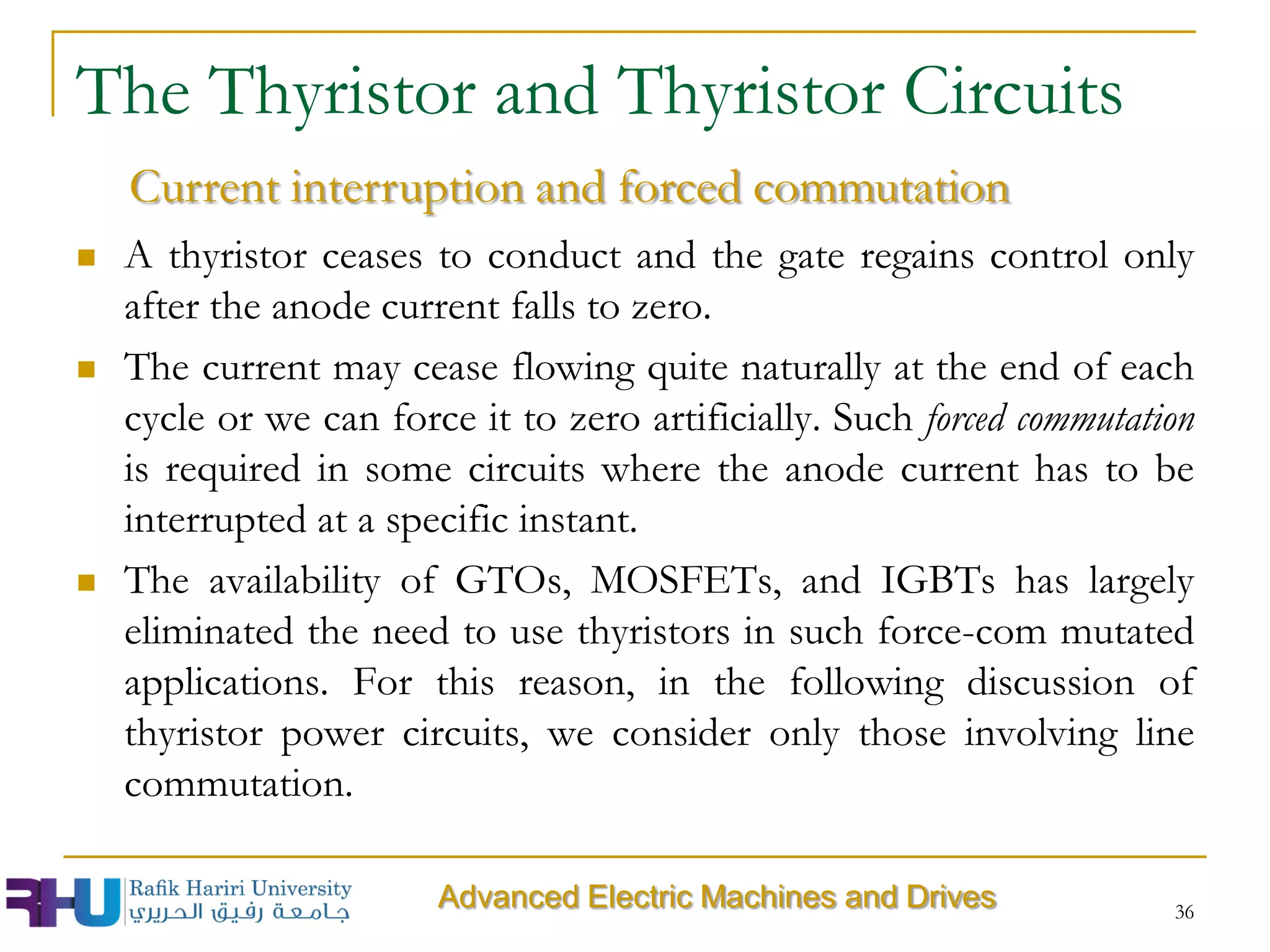
 A thyristor ceases to conduct and the gate regains control only
after the anode current falls to zero.
 The current may cease flowing quite naturally at the end of each
cycle or we can force it to zero artificially. Such forced commutation
is required in some circuits where the anode current has to be
interrupted at a specific instant.
 The availability of GTOs, MOSFETs, and IGBTs has largely
eliminated the need to use thyristors in such force-com mutated
applications. For this reason, in the following discussion of
thyristor power circuits, we consider only those involving line
commutation.
The Thyristor and Thyristor Circuits
Current interruption and forced commutation
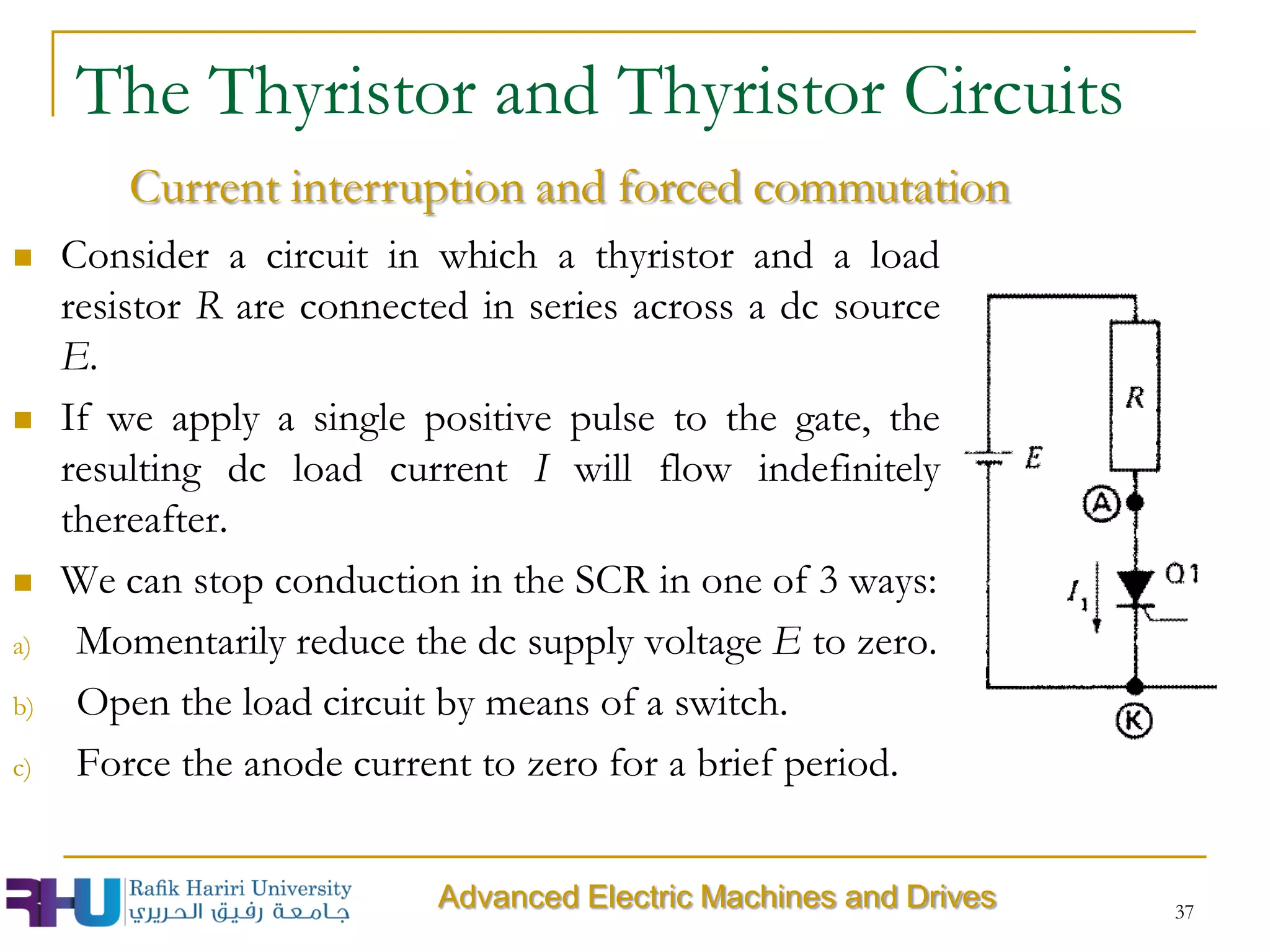
 Consider a circuit in which a thyristor and a load
resistor R are connected in series across a dc source
E.
 If we apply a single positive pulse to the gate, the
resulting dc load current I will flow indefinitely
thereafter.
 We can stop conduction in the SCR in one of 3 ways:
a) Momentarily reduce the dc supply voltage E to zero.
b) Open the load circuit by means of a switch.
c) Force the anode current to zero for a brief period.
37
Advanced Electric Machines and Drives
The Thyristor and Thyristor Circuits
Current interruption and forced commutation
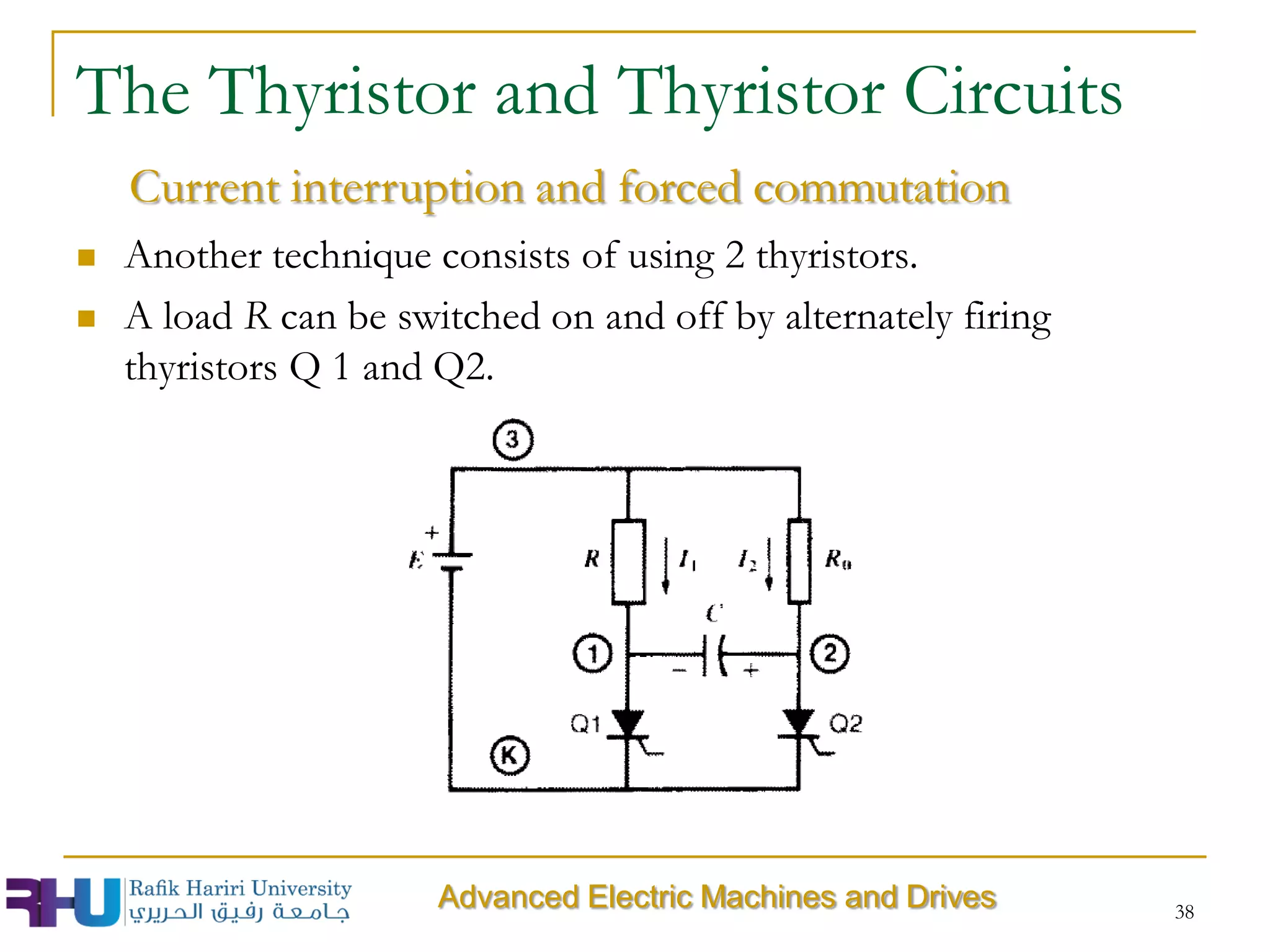
 Another technique consists of using 2 thyristors.
 A load R can be switched on and off by alternately firing
thyristors Q 1 and Q2.
38
Advanced Electric Machines and Drives
The Thyristor and Thyristor Circuits
Current interruption and forced commutation
Basic thyristor power circuits
 Thyristors are used in many different ways.
 However, in power electronics, six basic circuits cover about 90
percent of all industrial applications. These circuits, and some of
their applications, are:
1. Controlled rectifier supplying a passive load
2. Controlled rectifier supplying an active load
3. Line-commutated inverter supplying an active ac load
4. AC static switch
5. Cycloconverter
6. Three-phase converter
39
Advanced Electric Machines and Drives
Current interruption and forced commutation
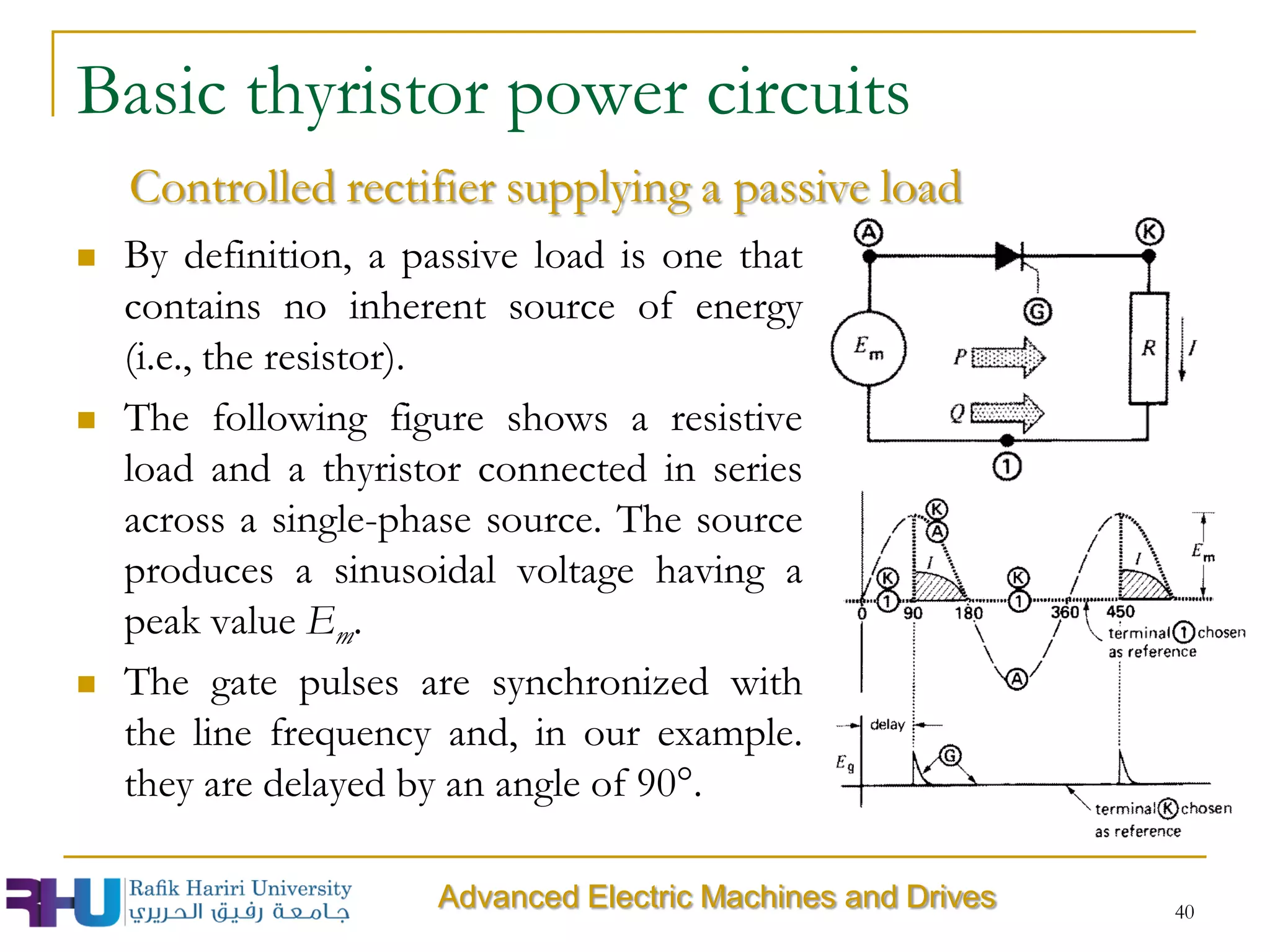
 By definition, a passive load is one that
contains no inherent source of energy
(i.e., the resistor).
 The following figure shows a resistive
load and a thyristor connected in series
across a single-phase source. The source
produces a sinusoidal voltage having a
peak value Em.
 The gate pulses are synchronized with
the line frequency and, in our example.
they are delayed by an angle of 90°.
40
Basic thyristor power circuits
Controlled rectifier supplying a passive load
Advanced Electric Machines and Drives
 It is seen that the current lags behind the voltage because it only
flows during the final 90◦.
 This lag produces the same effect as an inductive load.
Consequently, the ac source has to supply reactive power Q in
addition to the active power P.
 If the SCR is triggered at zero degrees (the start of the cycle), no
reactive power is absorbed by the rectifier.
Basic thyristor power circuits
Controlled rectifier supplying a passive load
Advanced Electric Machines and Drives 41
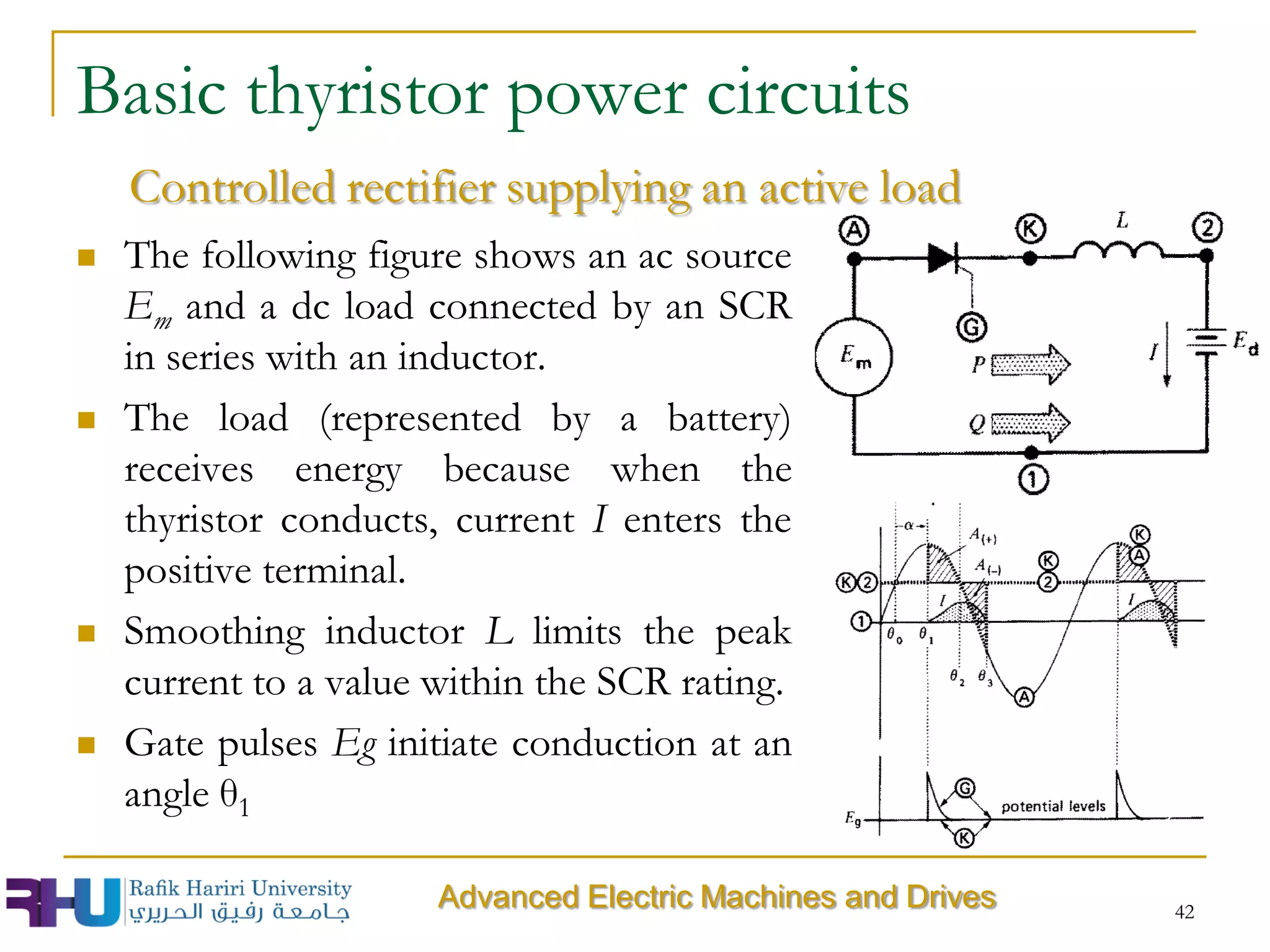
 The following figure shows an ac source
Em and a dc load connected by an SCR
in series with an inductor.
 The load (represented by a battery)
receives energy because when the
thyristor conducts, current I enters the
positive terminal.
 Smoothing inductor L limits the peak
current to a value within the SCR rating.
 Gate pulses Eg initiate conduction at an
angle θ1
Basic thyristor power circuits
Controlled rectifier supplying an active load
Advanced Electric Machines and Drives 42
 Using terminal 1 as a zero reference potential, it follows that the
potential of terminal 2 lies Ed volts above it.
 Furthermore, the potential of terminal A oscillates sinusoidally
above and below the level of terminal 1.
 If the SCR were replaced by a diode, conduction would begin at
angle θ0 because this is the instant when the anode becomes
positive.
 In our example, conduction only begins when the gate is fired at
θ1 degrees.
43
Basic thyristor power circuits
Controlled rectifier supplying an active load
Advanced Electric Machines and Drives
 An inverter, by definition, changes dc power into ac power. It
performs the reverse operation of a rectifier, which converts ac
power into dc power. There are two main types of inverters:
1. Self-commutated inverters (also called force commutated inverters) in
which the commutation means are included within the power
inverter
2. Line-commutated inverters, wherein commutation is effected by
virtue of the line voltages on the ac side of the inverter
Basic thyristor power circuits
Line-commutated inverter
Advanced Electric Machines and Drives 44
 In this chapter we examine the operating principle of a line-
commutated inverter.
 The circuit of such an inverter is identical to that of a controlled
rectifier, except that the battery terminals are reversed.
45
Basic thyristor power circuits
Line-commutated inverter
Advanced Electric Machines and Drives
46
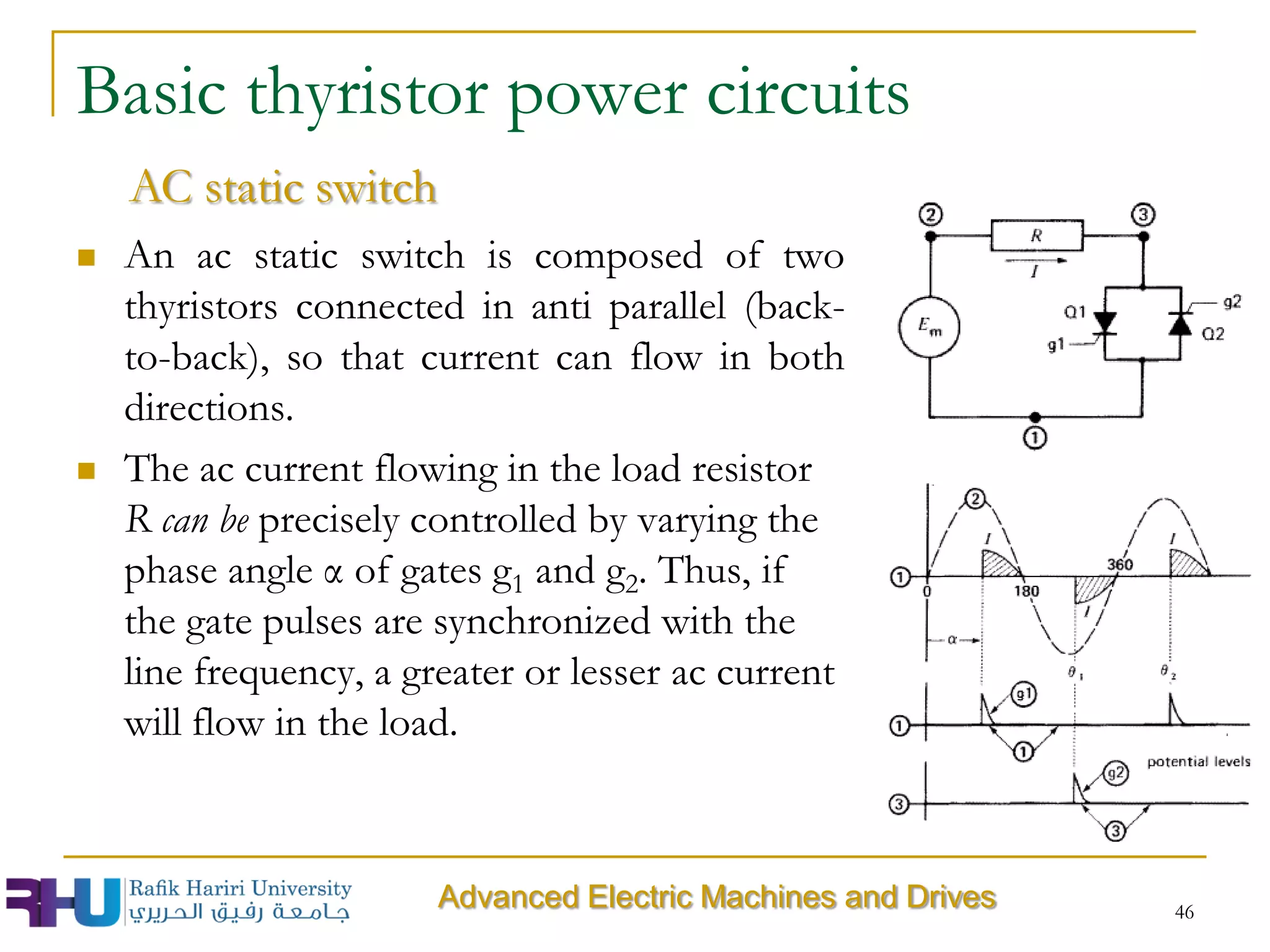
 An ac static switch is composed of two
thyristors connected in anti parallel (back-
to-back), so that current can flow in both
directions.
 The ac current flowing in the load resistor
R can be precisely controlled by varying the
phase angle α of gates g1 and g2. Thus, if
the gate pulses are synchronized with the
line frequency, a greater or lesser ac current
will flow in the load.
Basic thyristor power circuits
AC static switch
Advanced Electric Machines and Drives
 However, such delayed firing will draw reactive power from the
line, even if the load is purely resistive. The reason is that the
current is displaced behind the voltage.
 If the gates are fired at 0° and 180° respectively, the static switch
is in the fully closed position.
 On the other hand, if neither gate is fired, the switch is in the
open position.
 Thus, a static switch ca n be used to replace a magnetic
contactor.
 In contrast to magnetic contactors, an electronic contactor is
absolutely silent and its contacts never wear out.
47
Basic thyristor power circuits
AC static switch
Advanced Electric Machines and Drives
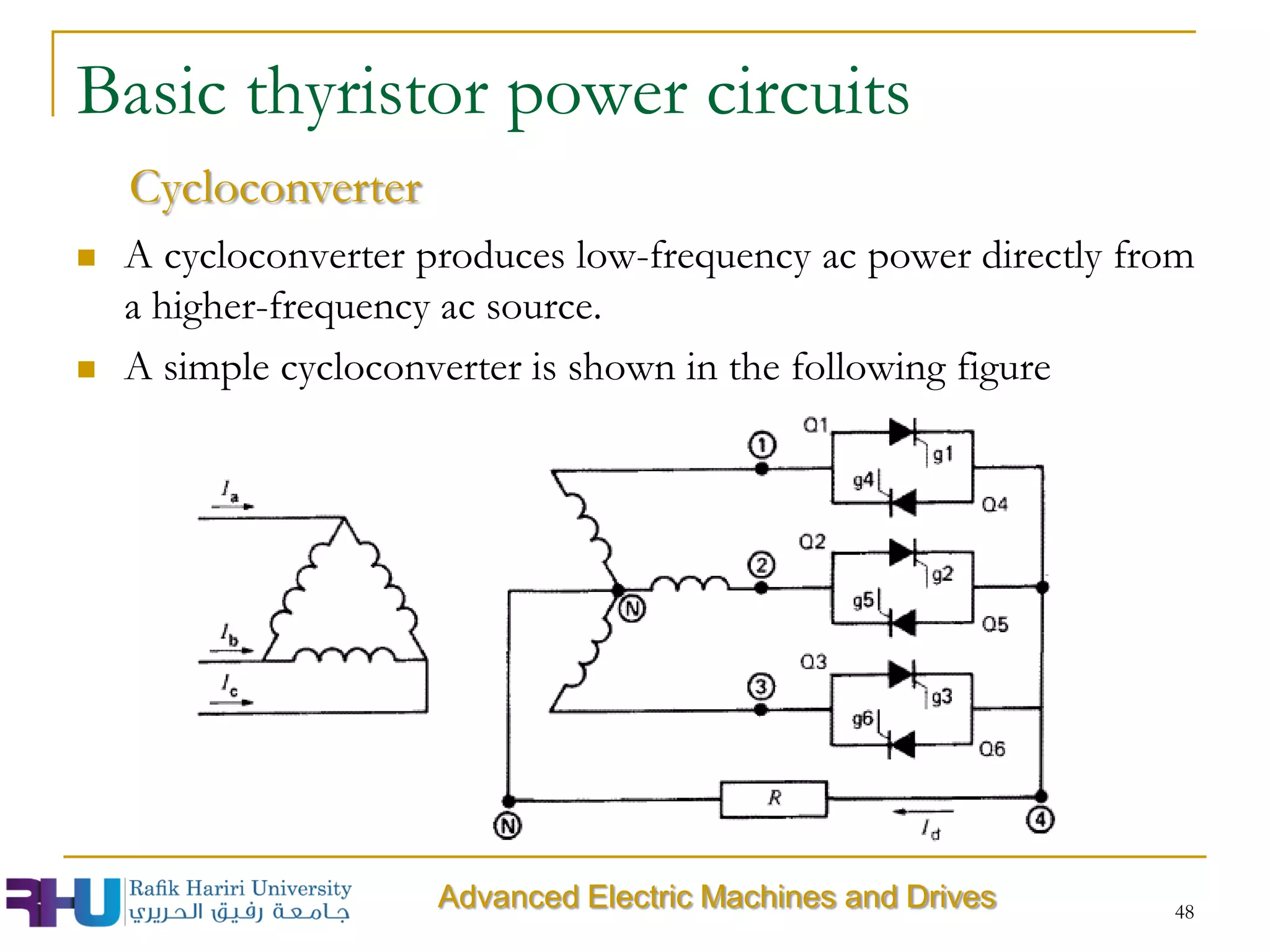
 A cycloconverter produces low-frequency ac power directly from
a higher-frequency ac source.
 A simple cycloconverter is shown in the following figure
48
Basic thyristor power circuits
Cycloconverter
Advanced Electric Machines and Drives
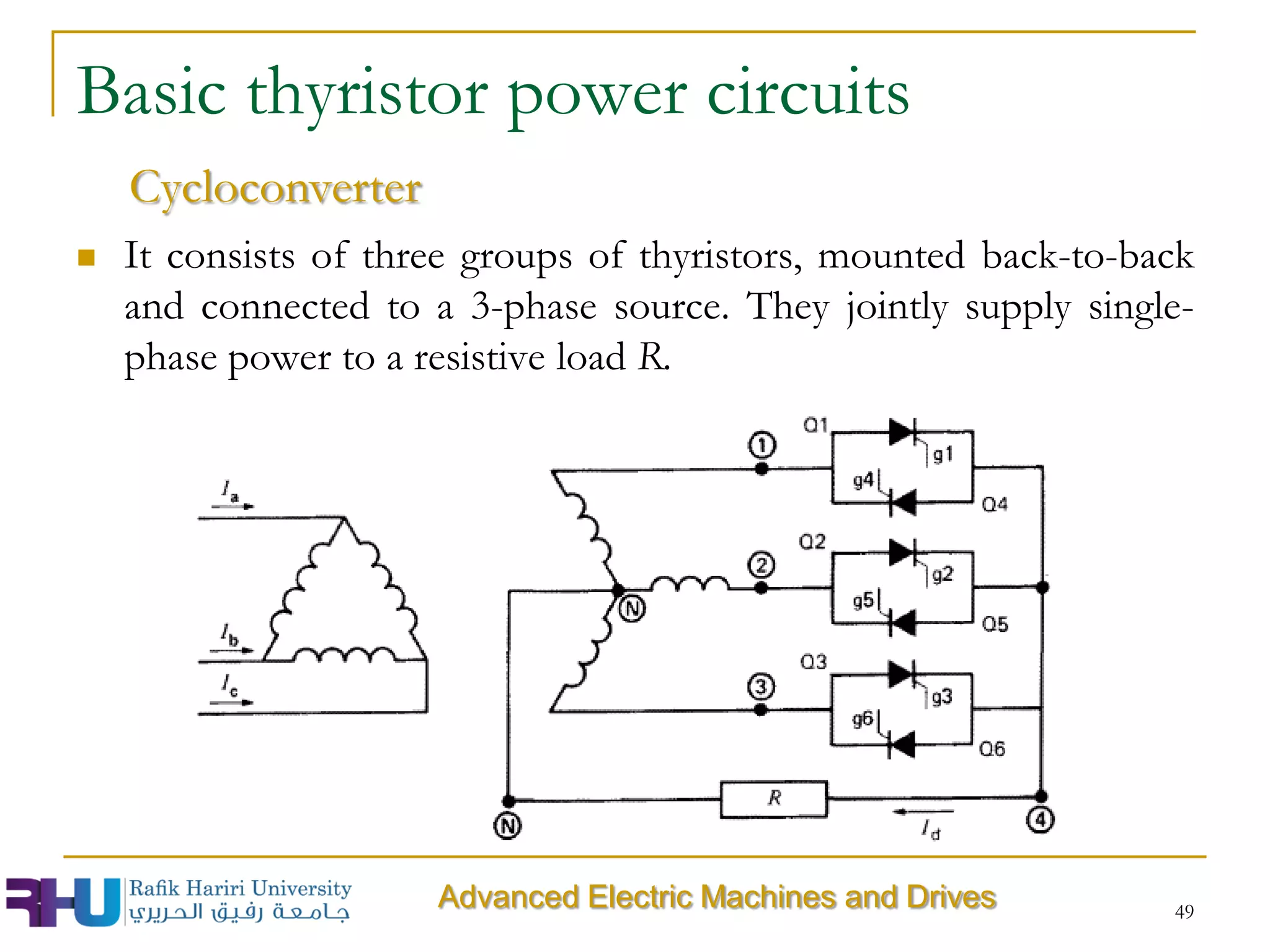
 It consists of three groups of thyristors, mounted back-to-back
and connected to a 3-phase source. They jointly supply single-
phase power to a resistive load R.
49
Basic thyristor power circuits
Cycloconverter
Advanced Electric Machines and Drives
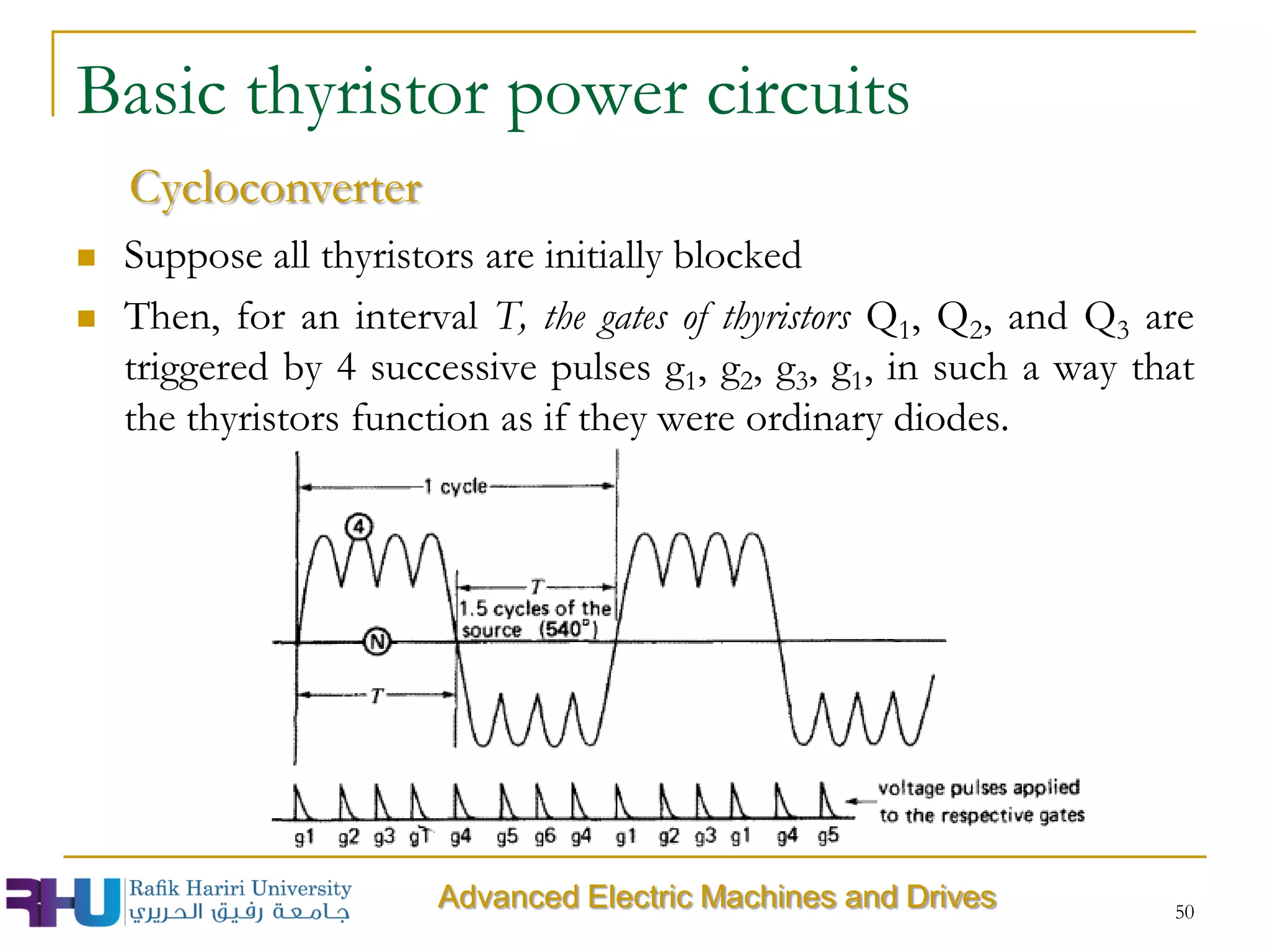
 Suppose all thyristors are initially blocked
 Then, for an interval T, the gates of thyristors Q1, Q2, and Q3 are
triggered by 4 successive pulses g1, g2, g3, g1, in such a way that
the thyristors function as if they were ordinary diodes.
50
Advanced Electric Machines and Drives
Basic thyristor power circuits
Cycloconverter
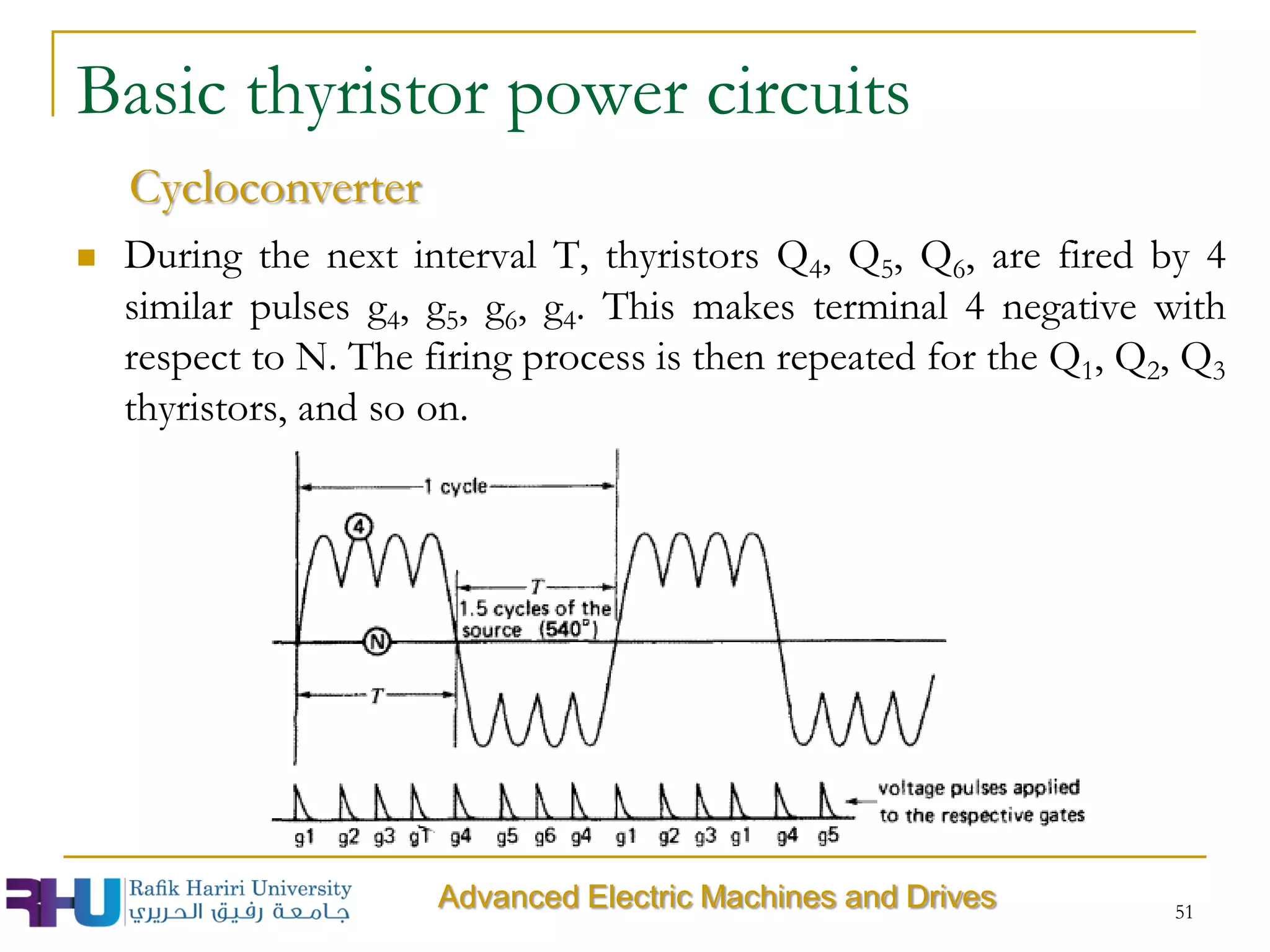
 During the next interval T, thyristors Q4, Q5, Q6, are fired by 4
similar pulses g4, g5, g6, g4. This makes terminal 4 negative with
respect to N. The firing process is then repeated for the Q1, Q2, Q3
thyristors, and so on.
51
Advanced Electric Machines and Drives
Basic thyristor power circuits
Cycloconverter
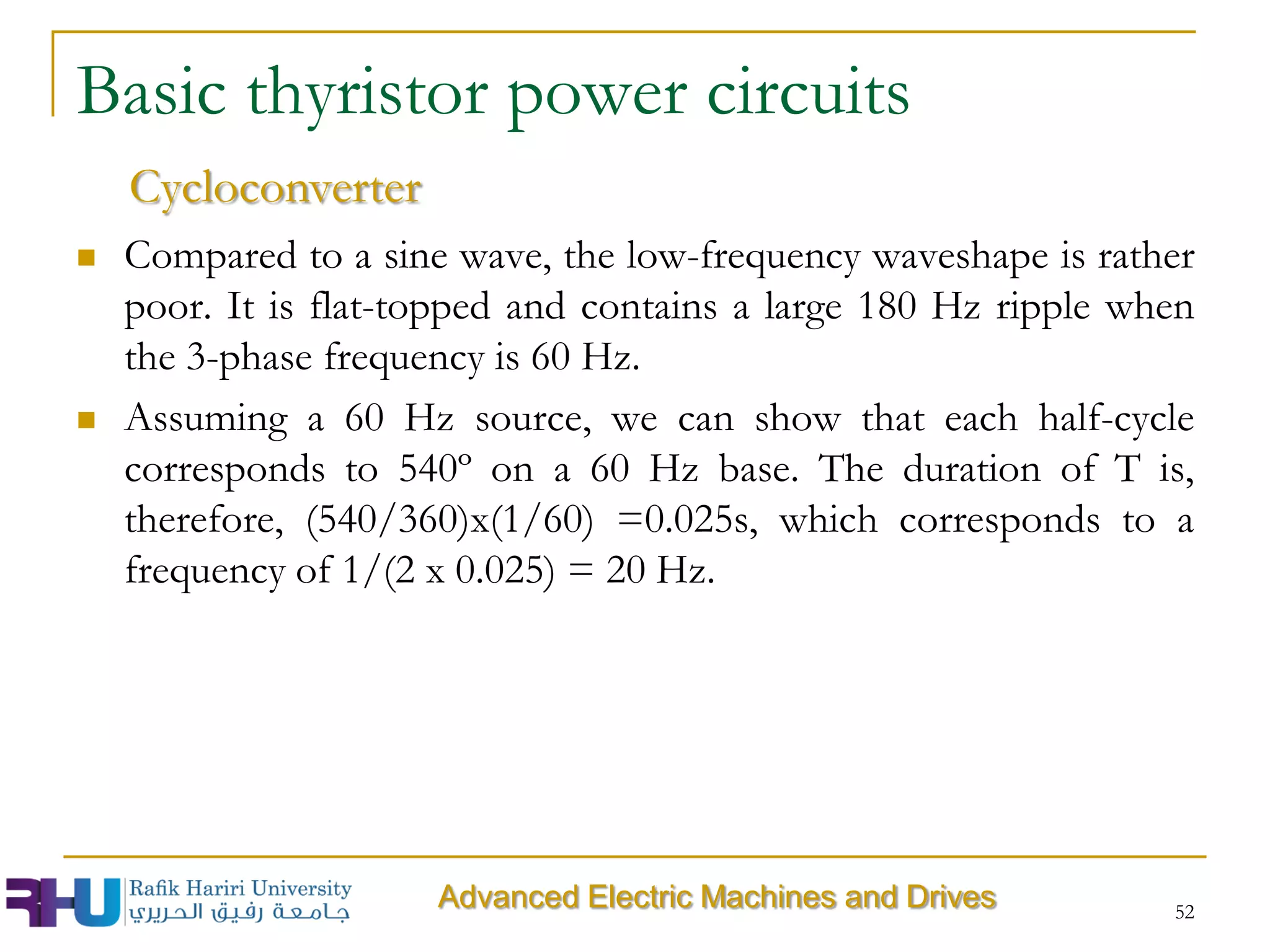
 Compared to a sine wave, the low-frequency waveshape is rather
poor. It is flat-topped and contains a large 180 Hz ripple when
the 3-phase frequency is 60 Hz.
 Assuming a 60 Hz source, we can show that each half-cycle
corresponds to 540º on a 60 Hz base. The duration of T is,
therefore, (540/360)x(1/60) =0.025s, which corresponds to a
frequency of 1/(2 x 0.025) = 20 Hz.
52
Advanced Electric Machines and Drives
Basic thyristor power circuits
Cycloconverter
 Obviously, by repeating the firing sequence g1, g2, g3, g1, ... , we
could keep terminal 4 positive for as long as we wish, followed
by an equally long negative period, when g4, g5, g6, g4 ... are fired.
 In this way we can generate frequencies as low as we want.
 This cycloconverter can supply a single-phase load from a 3-
phase system, without unbalancing the 3-phase lines.
53
Basic thyristor power circuits
Cycloconverter
Advanced Electric Machines and Drives
 The 3-phase, 6-pulse thyristor converter is one of the most
widely used rectifier/inverter units in power electronics.
 Three-phase, 6-pulse converters have 6 thyristors connected to
the secondary winding of a 3-phase transformer
54
Advanced Electric Machines and Drives
3-phase, 6-pulse controllable converter
Basic thyristor power circuits
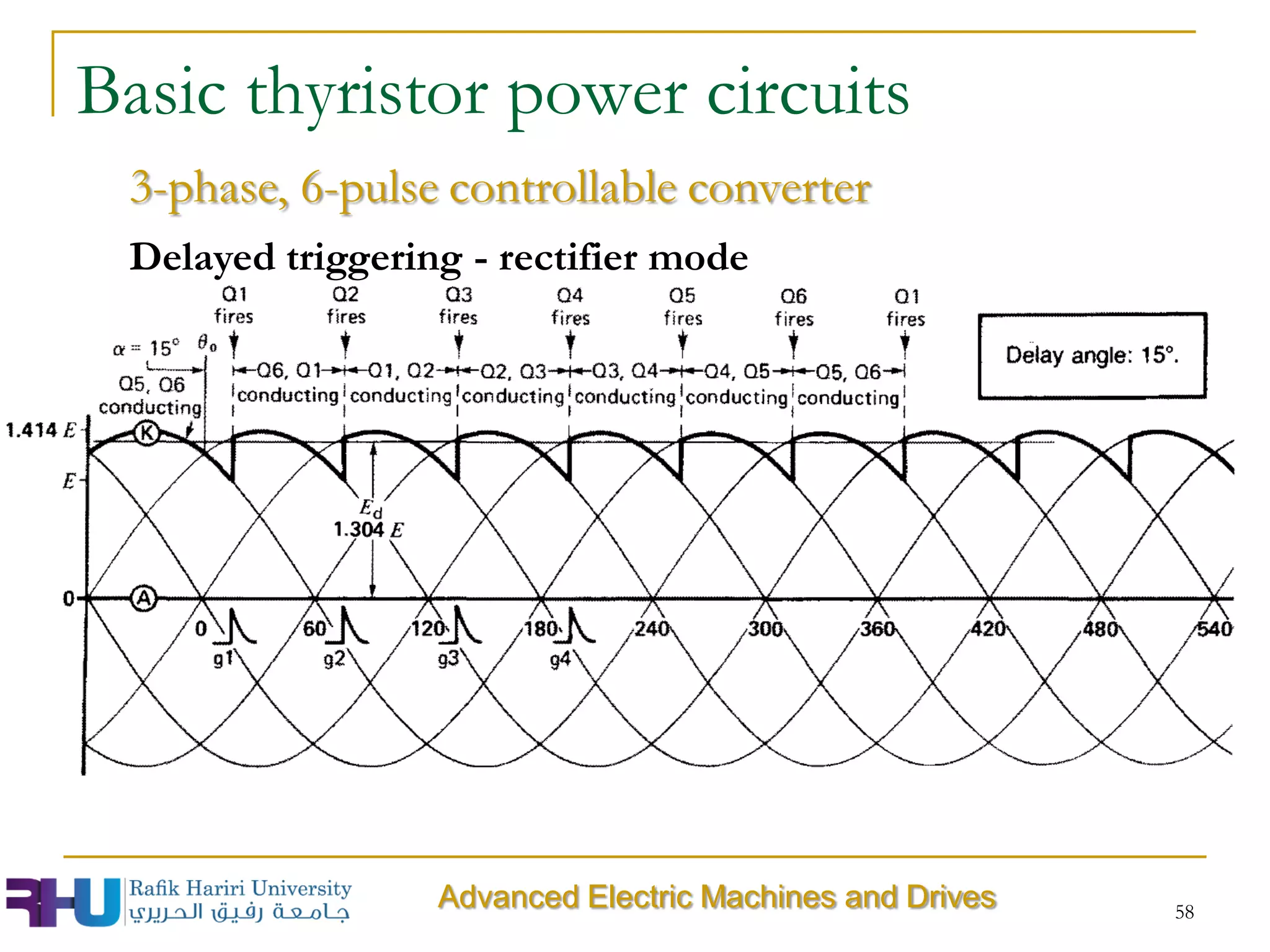
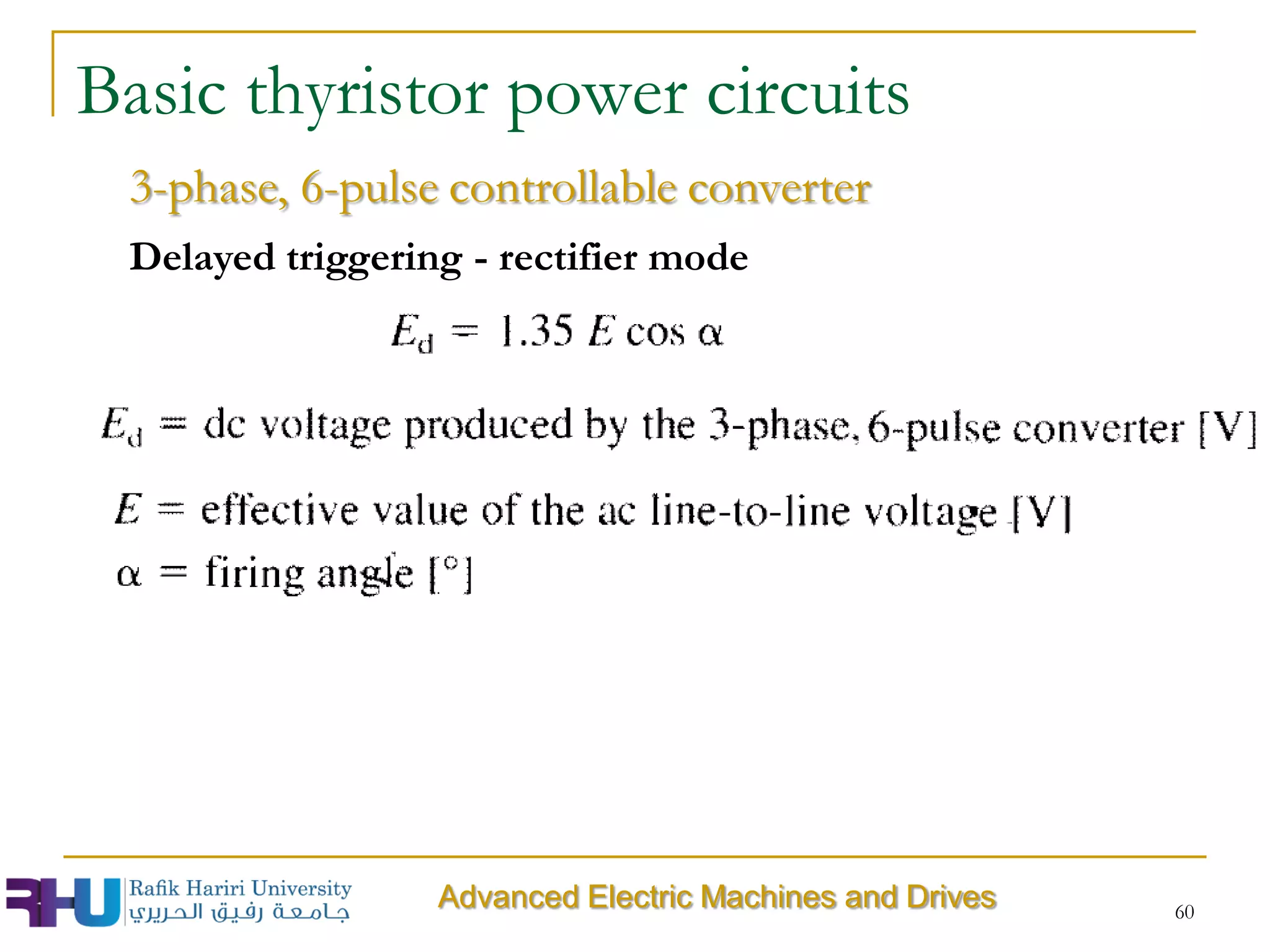
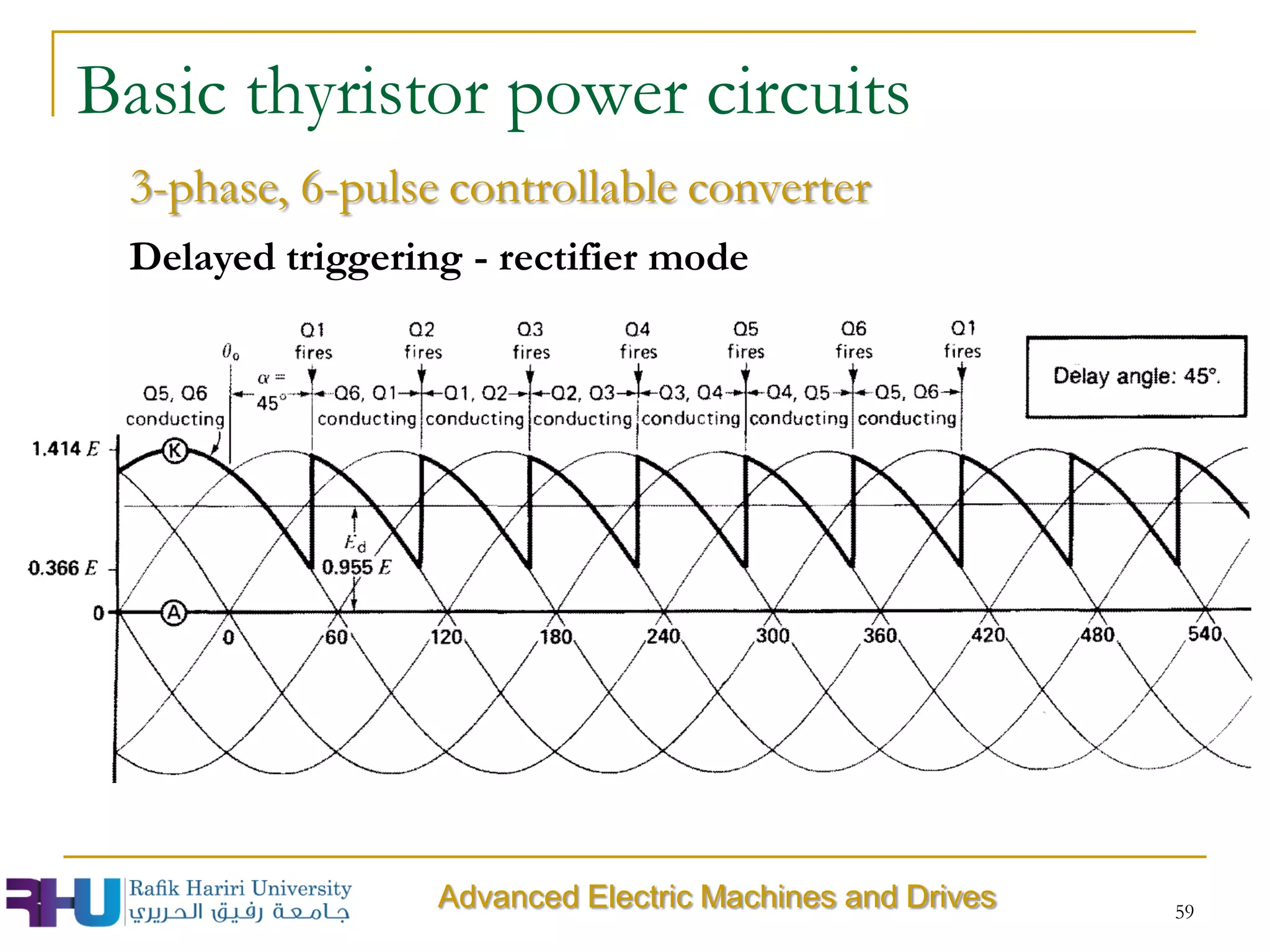
 Because we can initiate conduction whenever we want, the
thyristors enable us to vary the dc output voltage when the
converter operates in the rectifier mode.
 The converter can also function as an inverter, provided that a
dc source is used in place of the load resistor R.
55
Advanced Electric Machines and Drives
3-phase, 6-pulse controllable converter
Basic thyristor power circuits
56
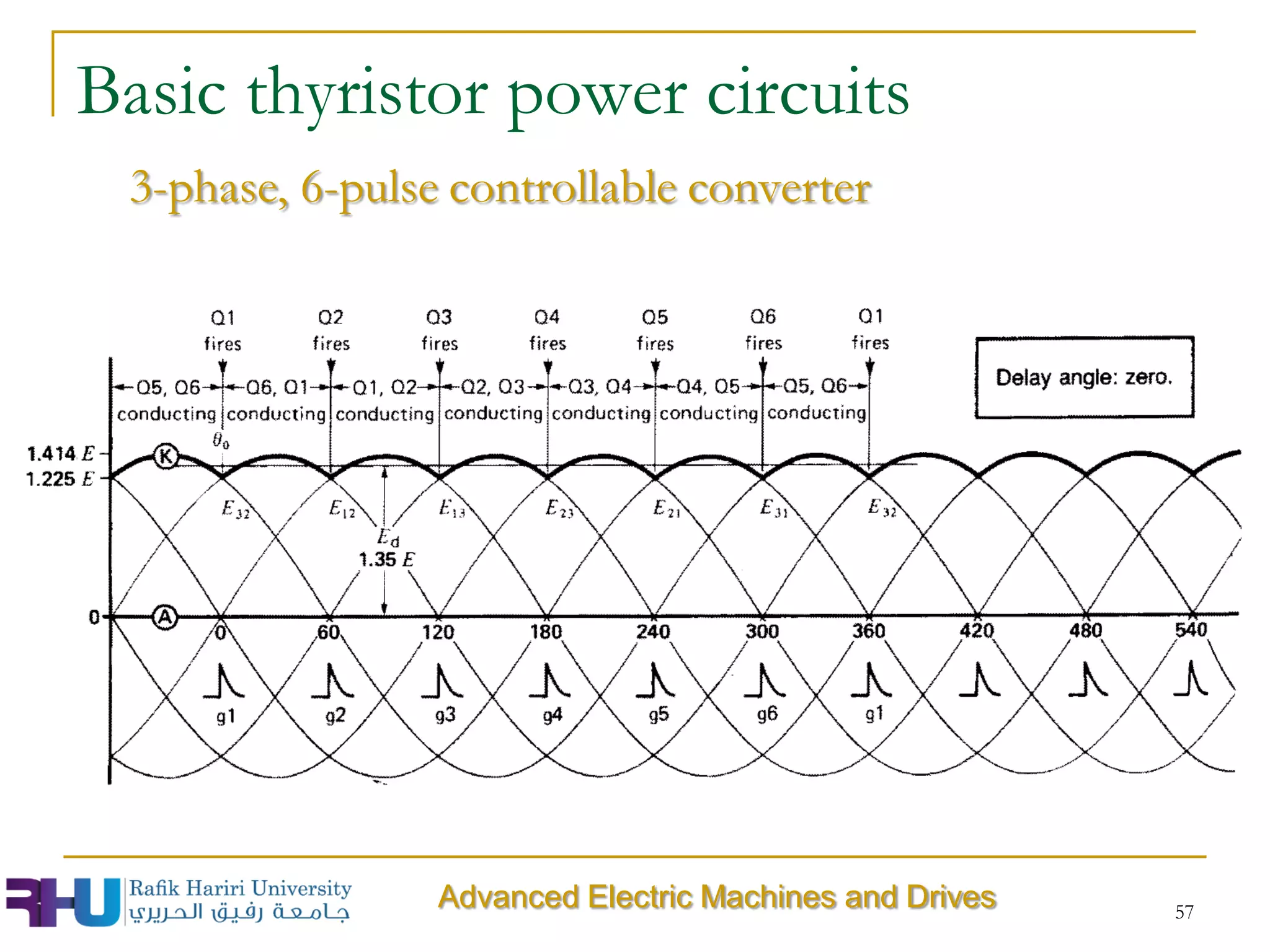
 The converter is fed from a 3-phase transformer. The gates of
thyristors Q1 to Q6 are triggered in succession at 60-degree intervals.
 The load is represented by a resistor in series with an inductor L.
 The inductor is assumed to have a very large inductance, so that the
load current Id remains constant.
 The two thyristors Q1, Q5 are conducting. A moment later, the
thyristors Q2, Q4 conduct. The other thyristors are similarly switched,
in sequence. When these steps have been completed, the entire
switching cycle repeats.
 The switching sequence is similar to that of the diode bridge rectifier
Advanced Electric Machines and Drives
3-phase, 6-pulse controllable converter
Basic thyristor power circuits
57
3-phase, 6-pulse controllable converter
Basic thyristor power circuits
Advanced Electric Machines and Drives
58
3-phase, 6-pulse controllable converter
Basic thyristor power circuits
Advanced Electric Machines and Drives
Delayed triggering - rectifier mode
59
Advanced Electric Machines and Drives
3-phase, 6-pulse controllable converter
Basic thyristor power circuits
Delayed triggering - rectifier mode
60
3-phase, 6-pulse controllable converter
Basic thyristor power circuits
Delayed triggering - rectifier mode
Advanced Electric Machines and Drives
Exercise
 The 3-phase converter of the following figure is connected to a
3-phase 480V, 60 Hz source. The load consists of a 500 V dc
source having an internal resistance of 2Ω. Calculate the power
supplied to the load for triggering delays of (a) ]5° and (b) 75°.
61
Advanced Electric Machines and Drives
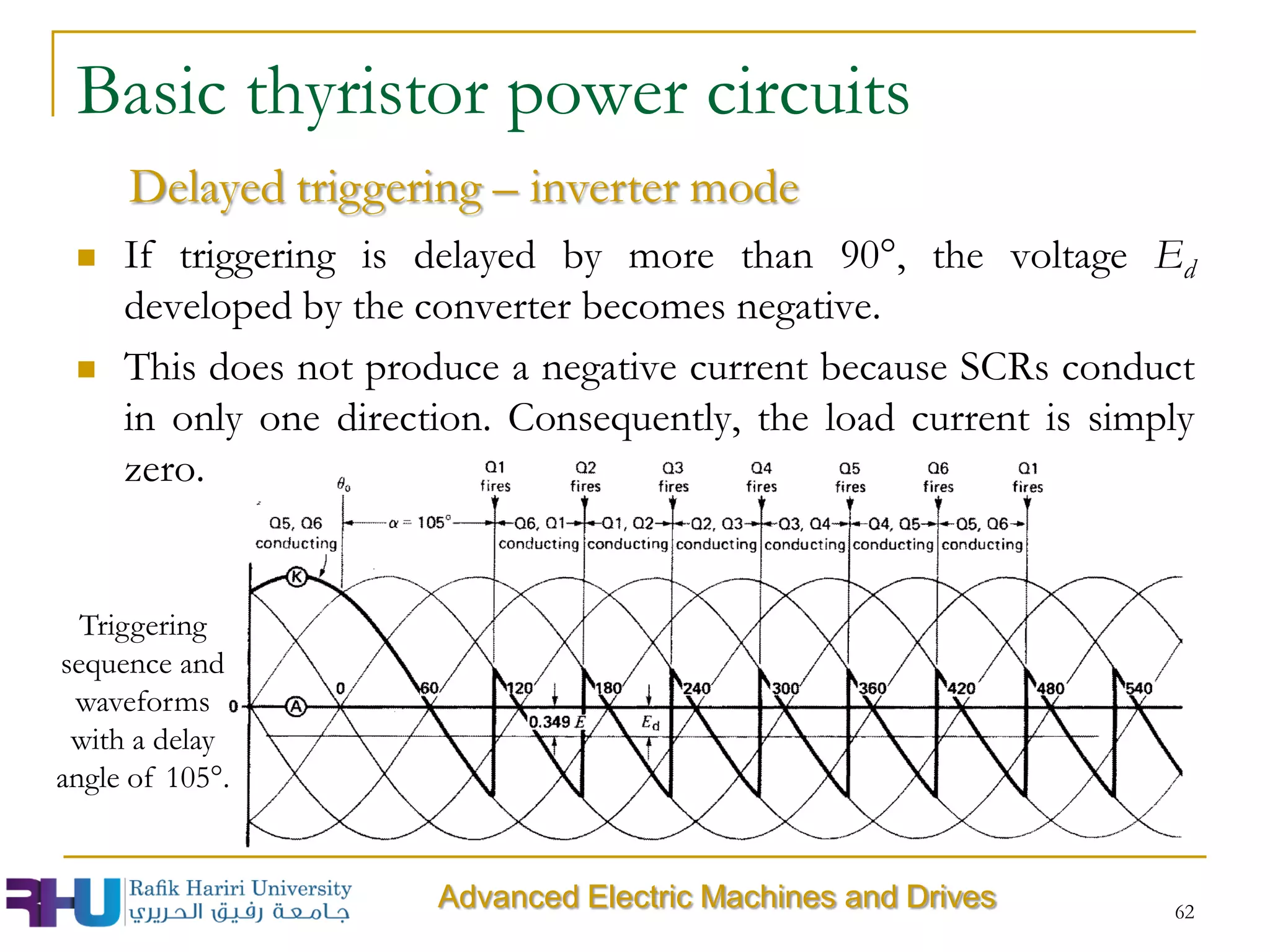
 If triggering is delayed by more than 90°, the voltage Ed
developed by the converter becomes negative.
 This does not produce a negative current because SCRs conduct
in only one direction. Consequently, the load current is simply
zero.
62
Delayed triggering – inverter mode
Basic thyristor power circuits
Triggering
sequence and
waveforms
with a delay
angle of 105°.
Advanced Electric Machines and Drives
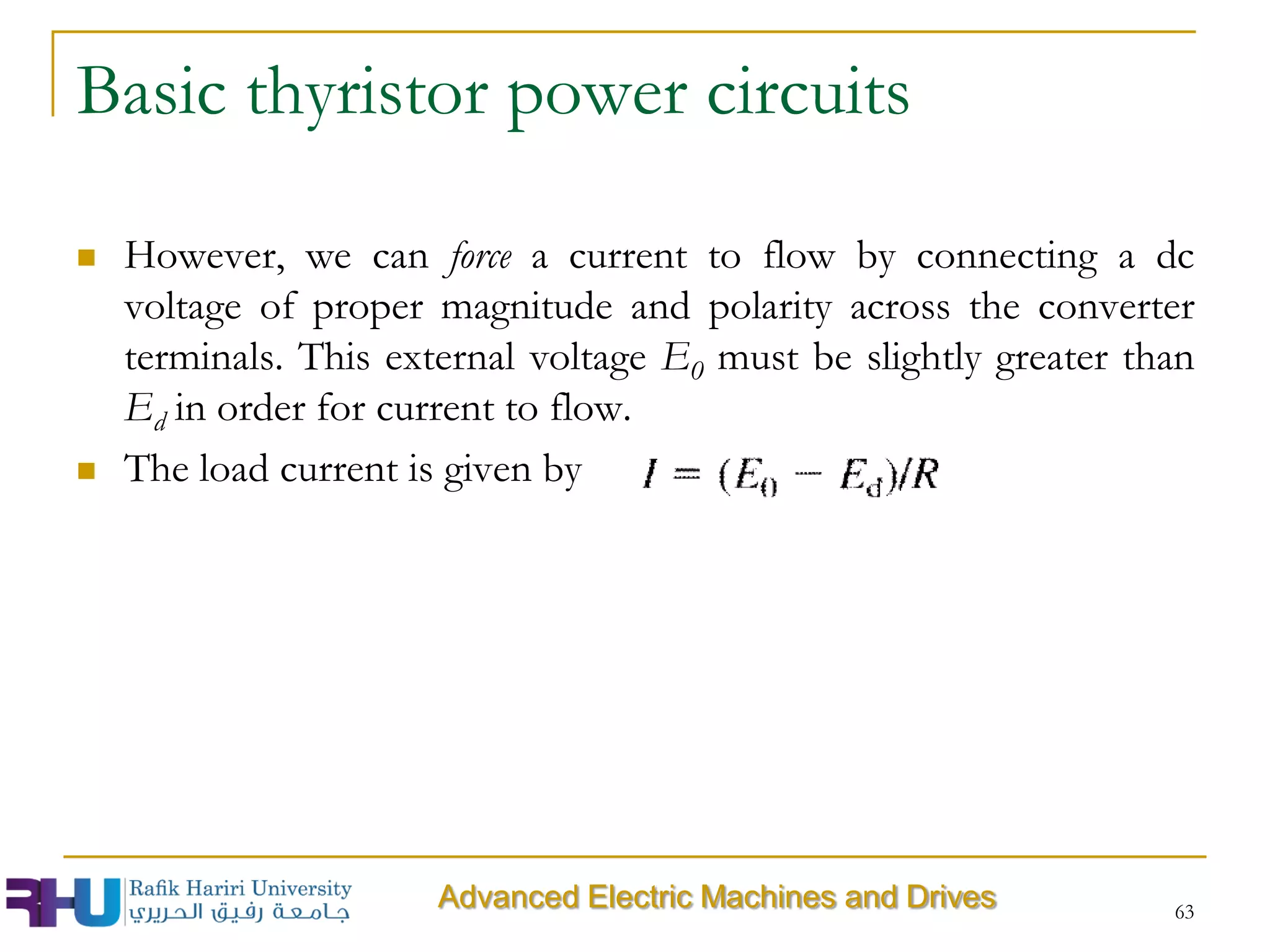
 However, we can force a current to flow by connecting a dc
voltage of proper magnitude and polarity across the converter
terminals. This external voltage E0 must be slightly greater than
Ed in order for current to flow.
 The load current is given by
63
Advanced Electric Machines and Drives
Basic thyristor power circuits
 Because current flows out of the positive terminal of E0, the load
is actually a source, delivering a power output P= E0Id.
 Part of this power is dissipated as heat in the circuit resistance R
and the remainder is delivered to the secondaries of the 3-phase
transformer.
64
Delayed triggering – inverter mode
Basic thyristor power circuits
Advanced Electric Machines and Drives
 The original rectifier has now become an inverter, converting dc
power into ac power. The transition from rectifier to inverter is
smooth, and requires no change in the converter connections.
 In the rectifier mode, the firing angle lies between 0° and 90°,
and the load may be active or passive. In the inverter mode, the
firing angle lies between 90° and 180°, and a dc source of proper
polarity must be provided.
65
Delayed triggering – inverter mode
Basic thyristor power circuits
Advanced Electric Machines and Drives
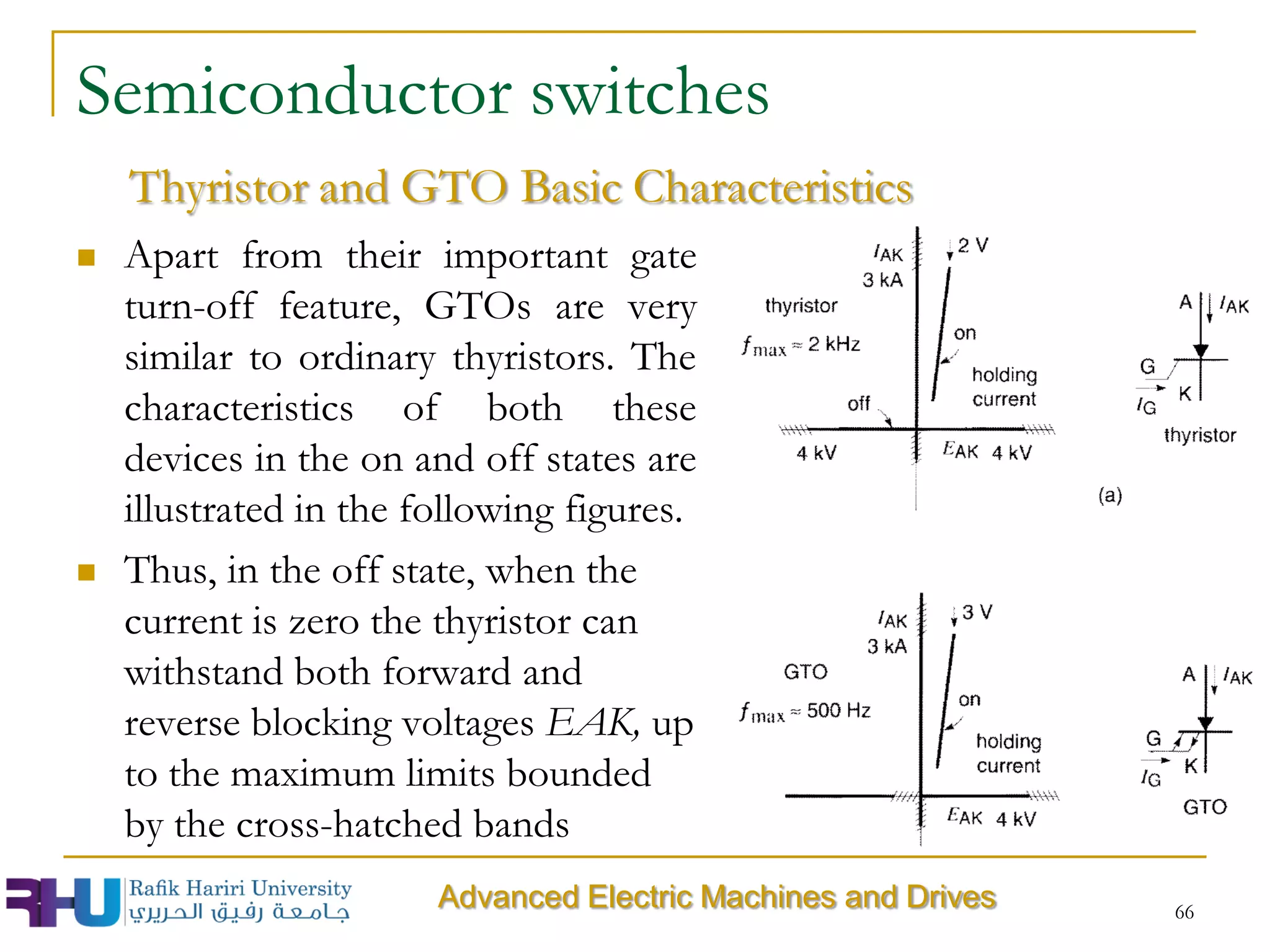
Semiconductor switches
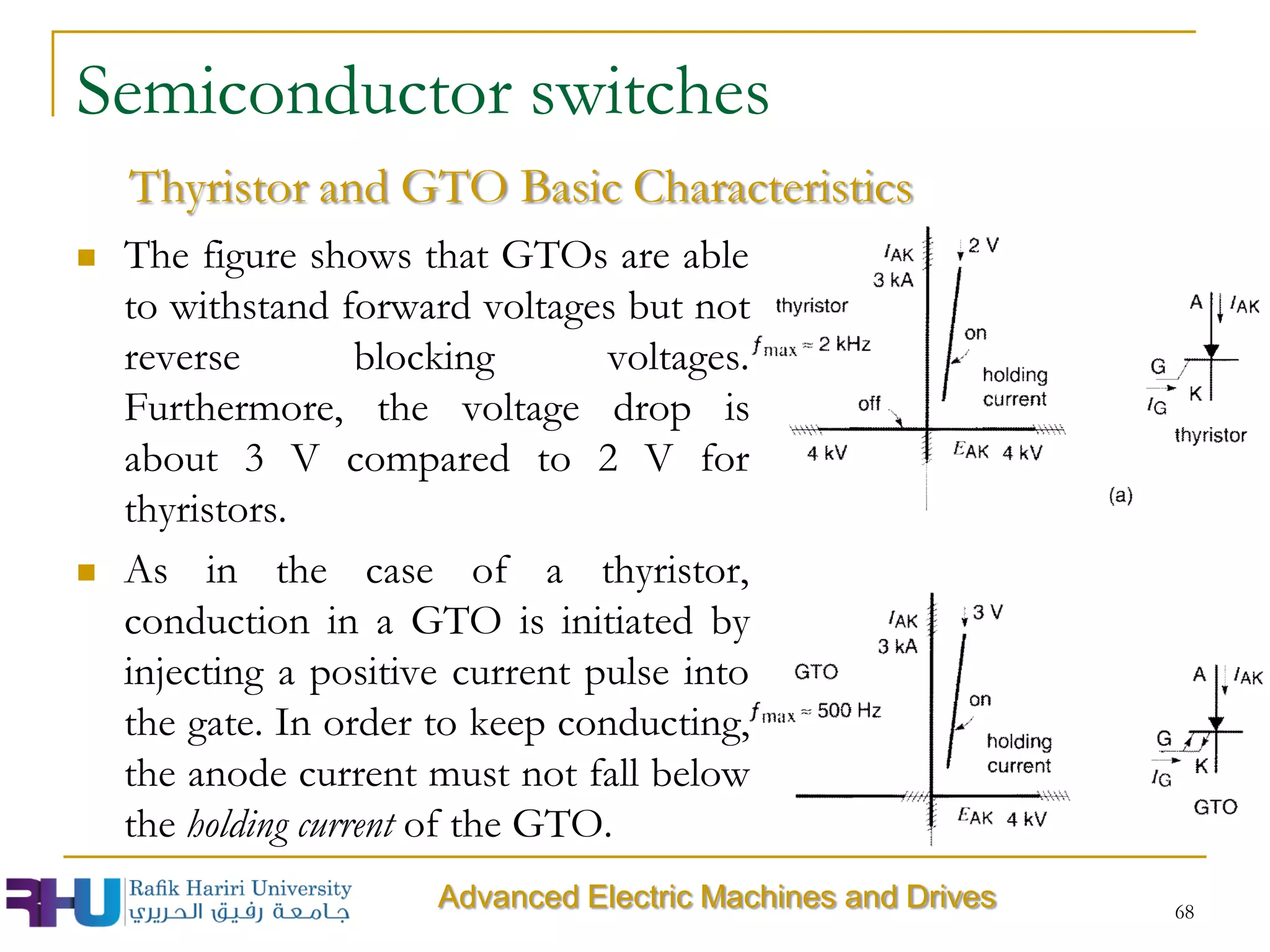
 Apart from their important gate
turn-off feature, GTOs are very
similar to ordinary thyristors. The
characteristics of both these
devices in the on and off states are
illustrated in the following figures.
 Thus, in the off state, when the
current is zero the thyristor can
withstand both forward and
reverse blocking voltages EAK, up
to the maximum limits bounded
by the cross-hatched bands
66
Thyristor and GTO Basic Characteristics
Advanced Electric Machines and Drives
67
Semiconductor switches
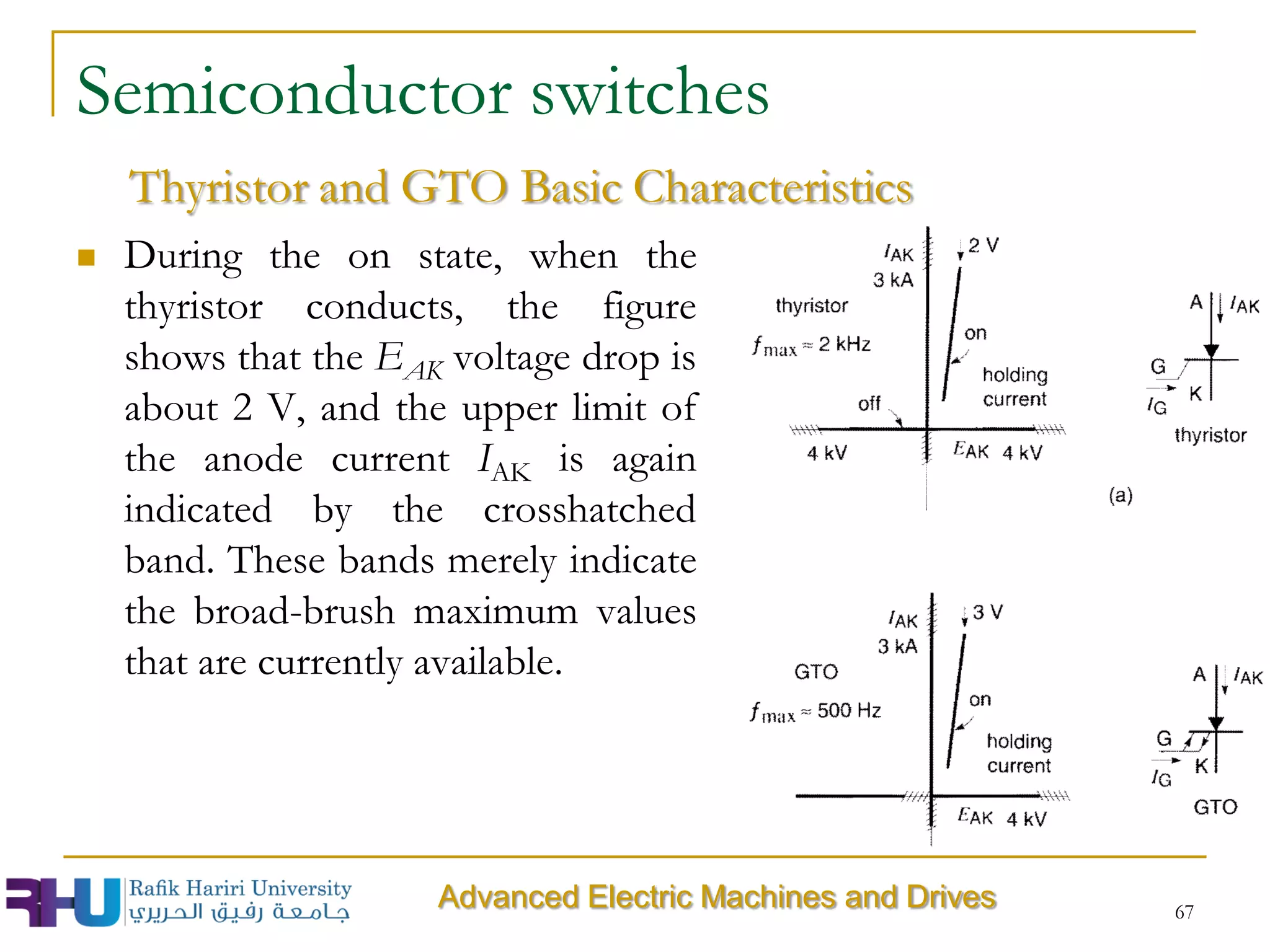
 During the on state, when the
thyristor conducts, the figure
shows that the EAK voltage drop is
about 2 V, and the upper limit of
the anode current IAK is again
indicated by the crosshatched
band. These bands merely indicate
the broad-brush maximum values
that are currently available.
Thyristor and GTO Basic Characteristics
Advanced Electric Machines and Drives
68
Semiconductor switches
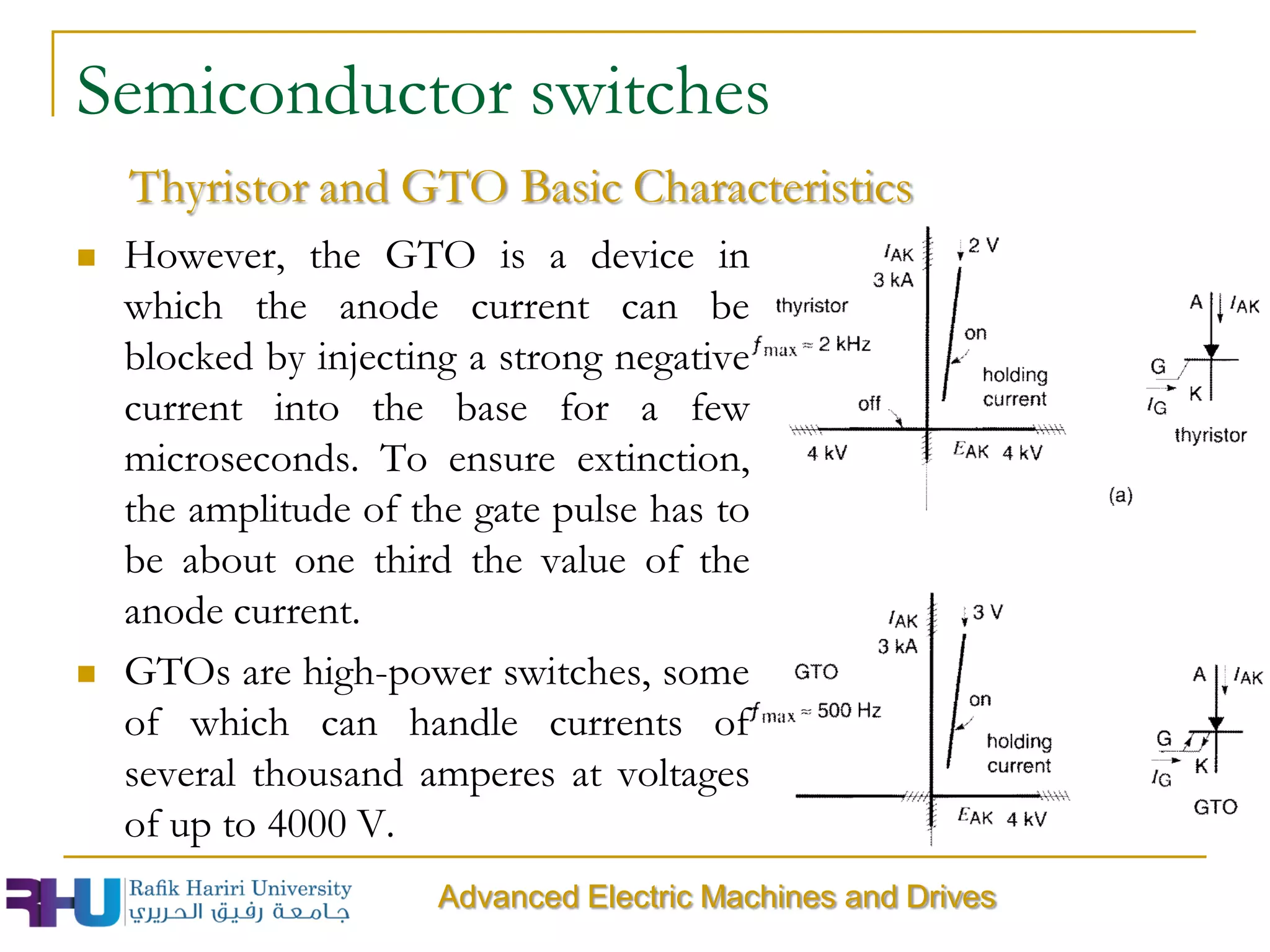
 The figure shows that GTOs are able
to withstand forward voltages but not
reverse blocking voltages.
Furthermore, the voltage drop is
about 3 V compared to 2 V for
thyristors.
 As in the case of a thyristor,
conduction in a GTO is initiated by
injecting a positive current pulse into
the gate. In order to keep conducting,
the anode current must not fall below
the holding current of the GTO.
Thyristor and GTO Basic Characteristics
Advanced Electric Machines and Drives
Semiconductor switches
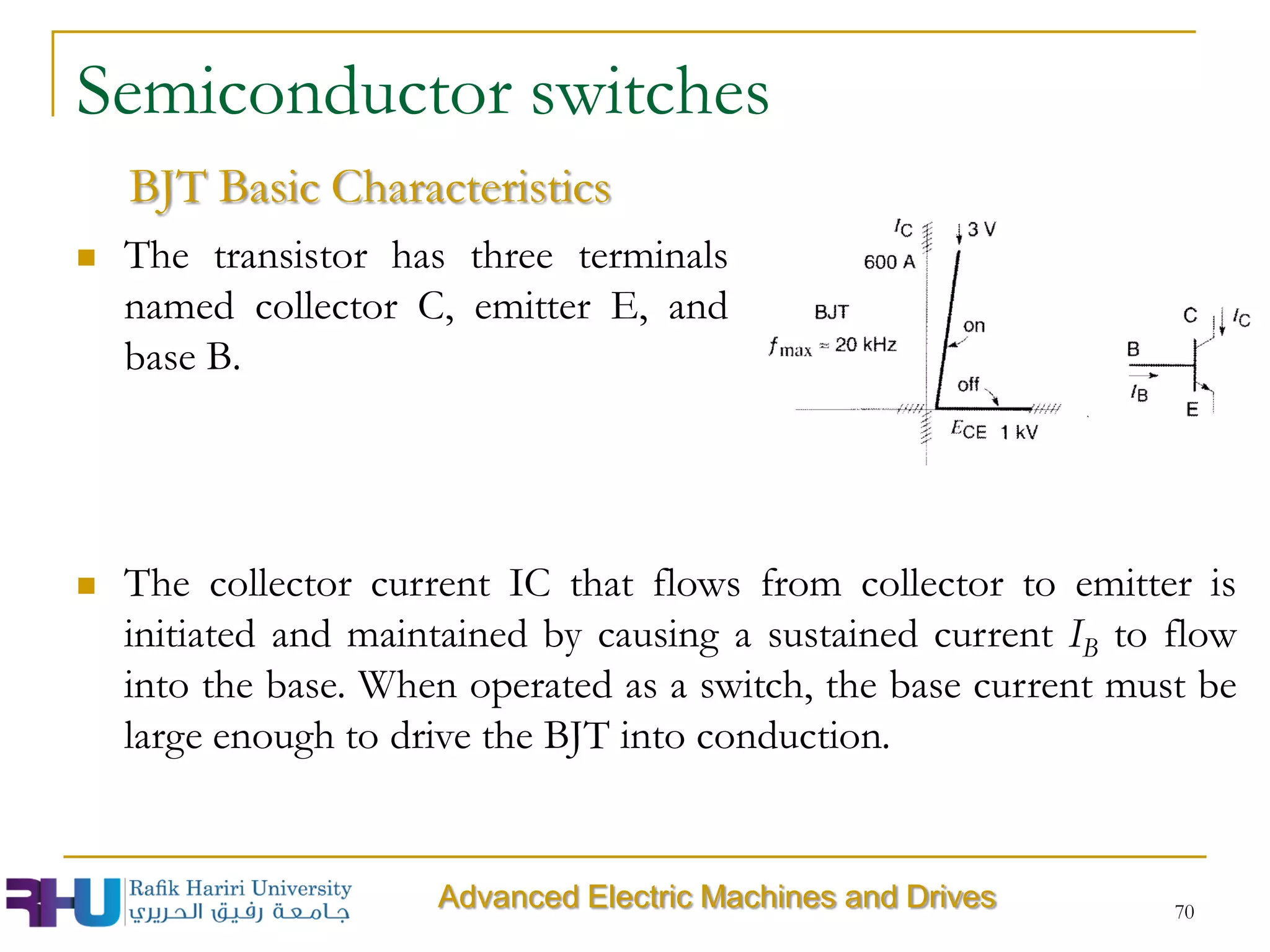
 However, the GTO is a device in
which the anode current can be
blocked by injecting a strong negative
current into the base for a few
microseconds. To ensure extinction,
the amplitude of the gate pulse has to
be about one third the value of the
anode current.
 GTOs are high-power switches, some
of which can handle currents of
several thousand amperes at voltages
of up to 4000 V.
Thyristor and GTO Basic Characteristics
Advanced Electric Machines and Drives
70
Semiconductor switches
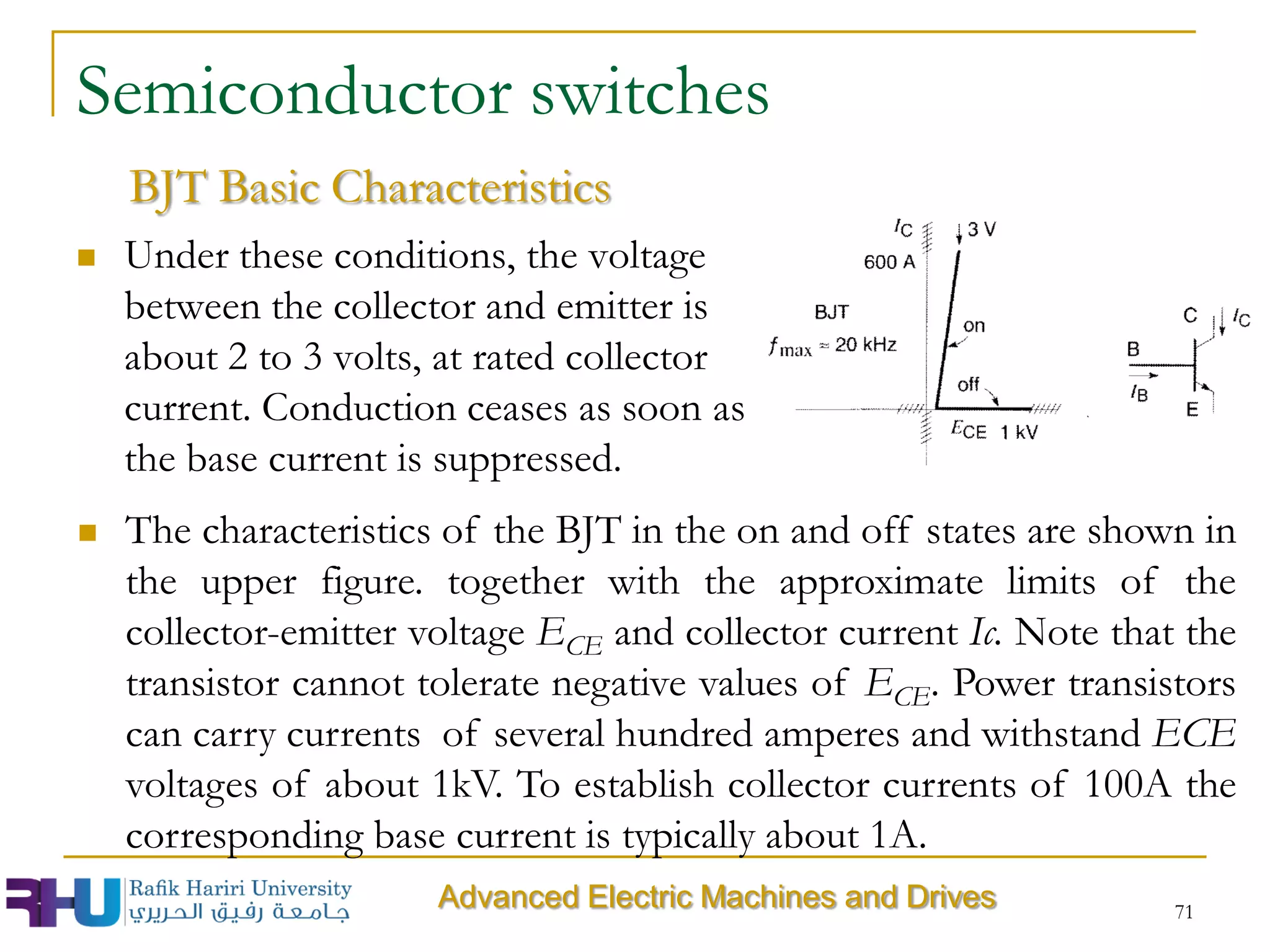
 The transistor has three terminals
named collector C, emitter E, and
base B.
BJT Basic Characteristics
 The collector current IC that flows from collector to emitter is
initiated and maintained by causing a sustained current IB to flow
into the base. When operated as a switch, the base current must be
large enough to drive the BJT into conduction.
Advanced Electric Machines and Drives
71
Semiconductor switches
 Under these conditions, the voltage
between the collector and emitter is
about 2 to 3 volts, at rated collector
current. Conduction ceases as soon as
the base current is suppressed.
BJT Basic Characteristics
 The characteristics of the BJT in the on and off states are shown in
the upper figure. together with the approximate limits of the
collector-emitter voltage ECE and collector current Ic. Note that the
transistor cannot tolerate negative values of ECE. Power transistors
can carry currents of several hundred amperes and withstand ECE
voltages of about 1kV. To establish collector currents of 100A the
corresponding base current is typically about 1A.
Advanced Electric Machines and Drives
72
Semiconductor switches
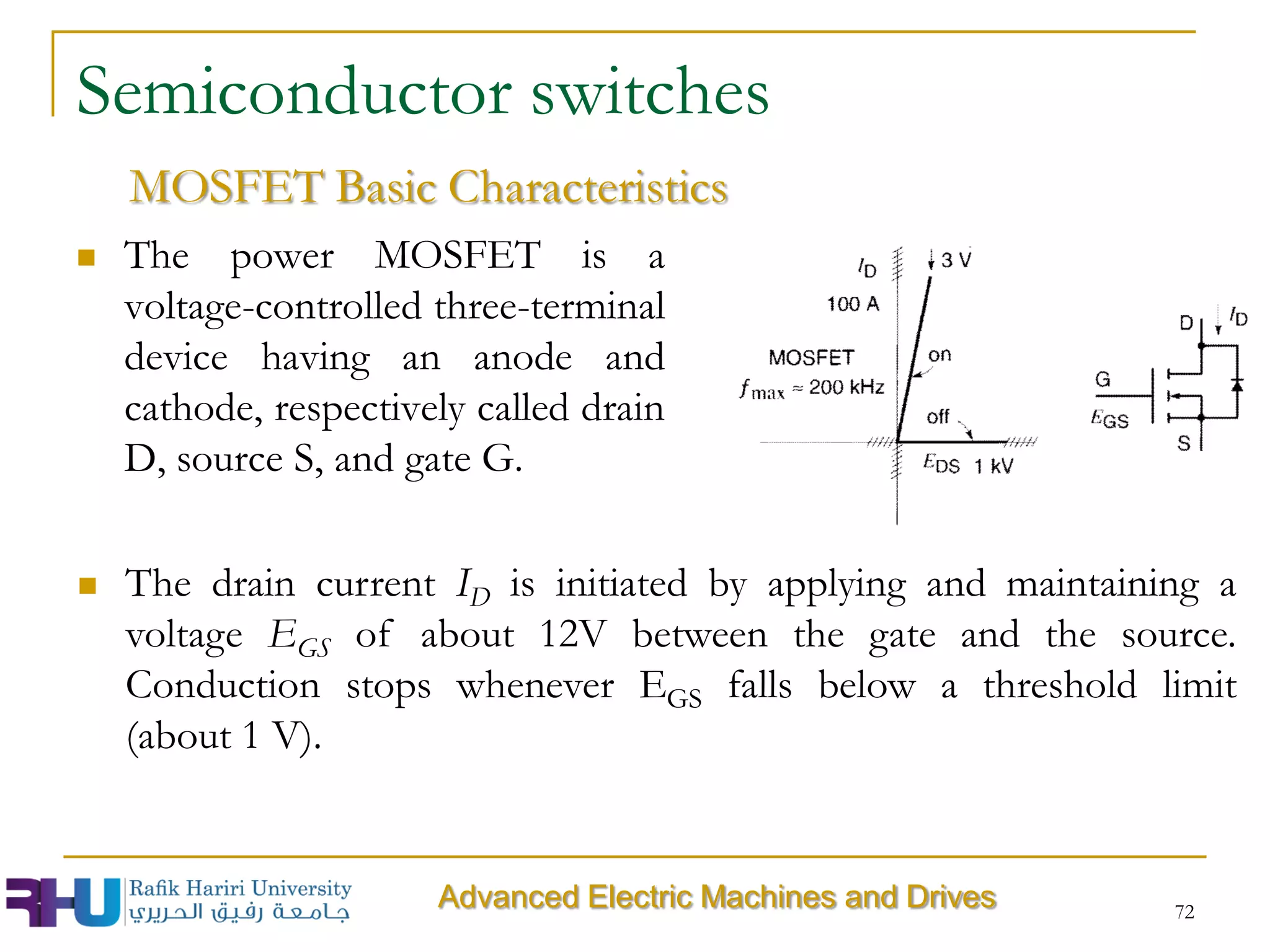
 The power MOSFET is a
voltage-controlled three-terminal
device having an anode and
cathode, respectively called drain
D, source S, and gate G.
MOSFET Basic Characteristics
 The drain current ID is initiated by applying and maintaining a
voltage EGS of about 12V between the gate and the source.
Conduction stops whenever EGS falls below a threshold limit
(about 1 V).
Advanced Electric Machines and Drives
73
Semiconductor switches
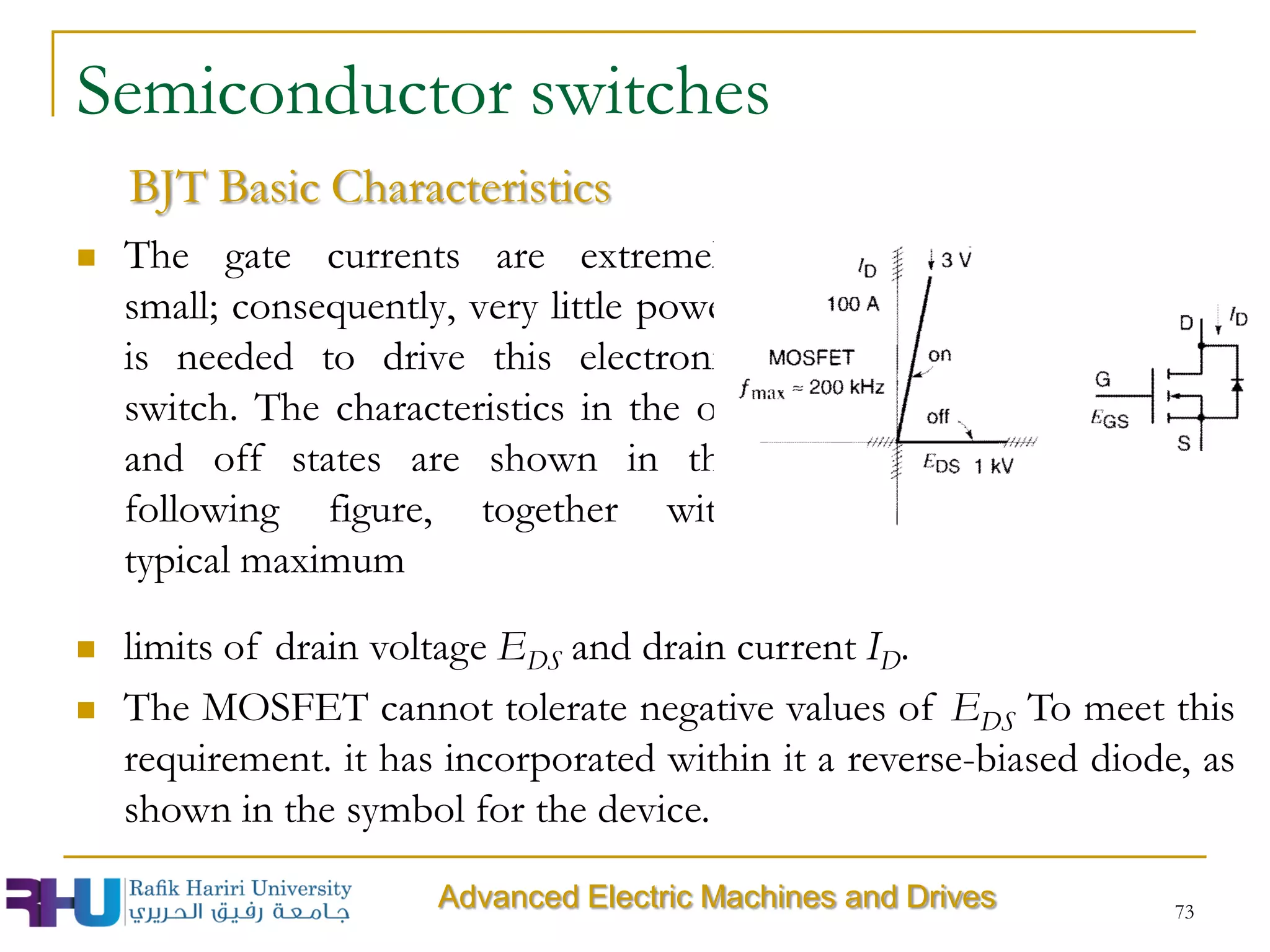
 The gate currents are extremely
small; consequently, very little power
is needed to drive this electronic
switch. The characteristics in the on
and off states are shown in the
following figure, together with
typical maximum
BJT Basic Characteristics
 limits of drain voltage EDS and drain current ID.
 The MOSFET cannot tolerate negative values of EDS To meet this
requirement. it has incorporated within it a reverse-biased diode, as
shown in the symbol for the device.
Advanced Electric Machines and Drives
74
Semiconductor switches
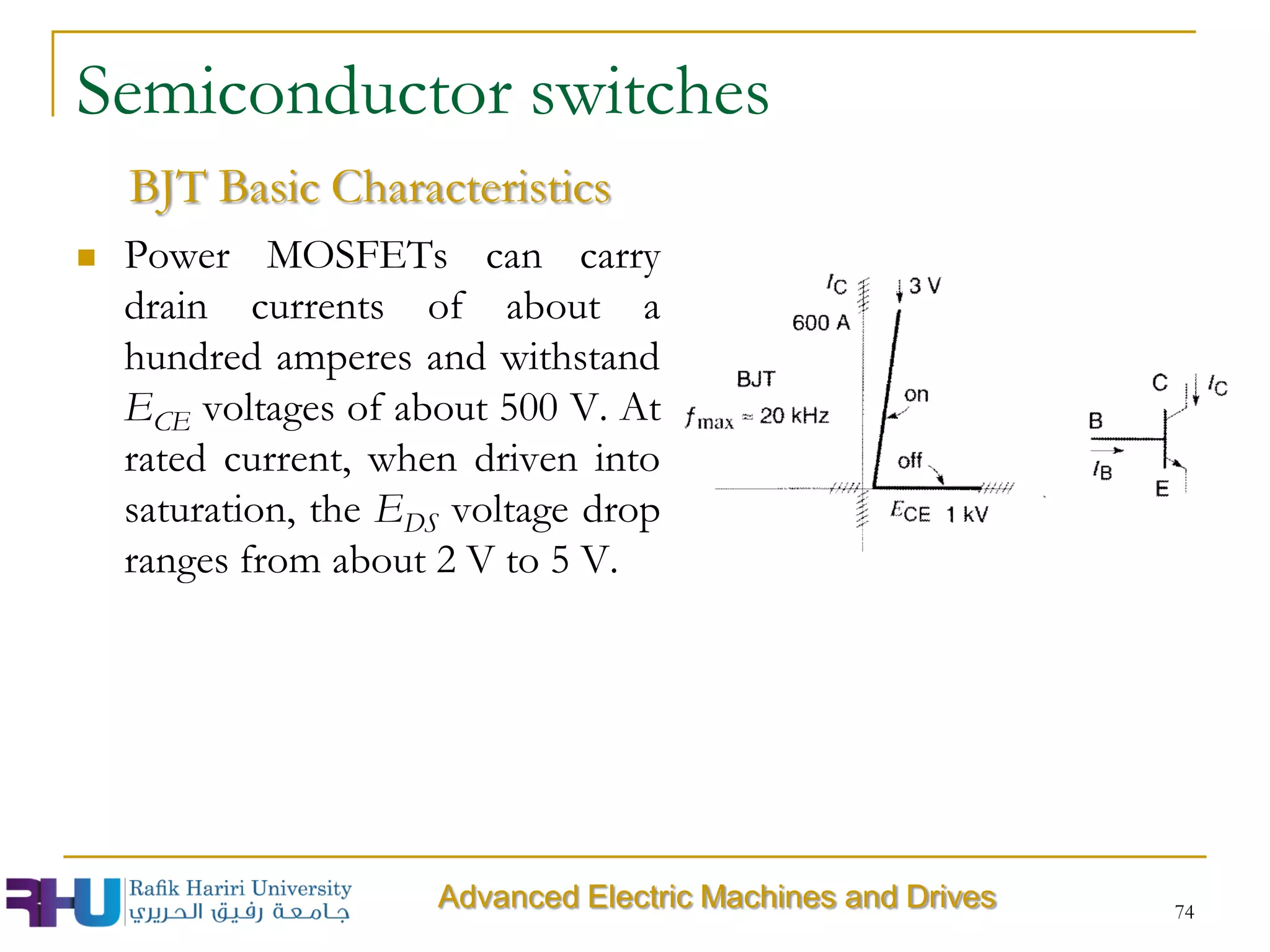
 Power MOSFETs can carry
drain currents of about a
hundred amperes and withstand
ECE voltages of about 500 V. At
rated current, when driven into
saturation, the EDS voltage drop
ranges from about 2 V to 5 V.
BJT Basic Characteristics
Advanced Electric Machines and Drives
75
Semiconductor switches
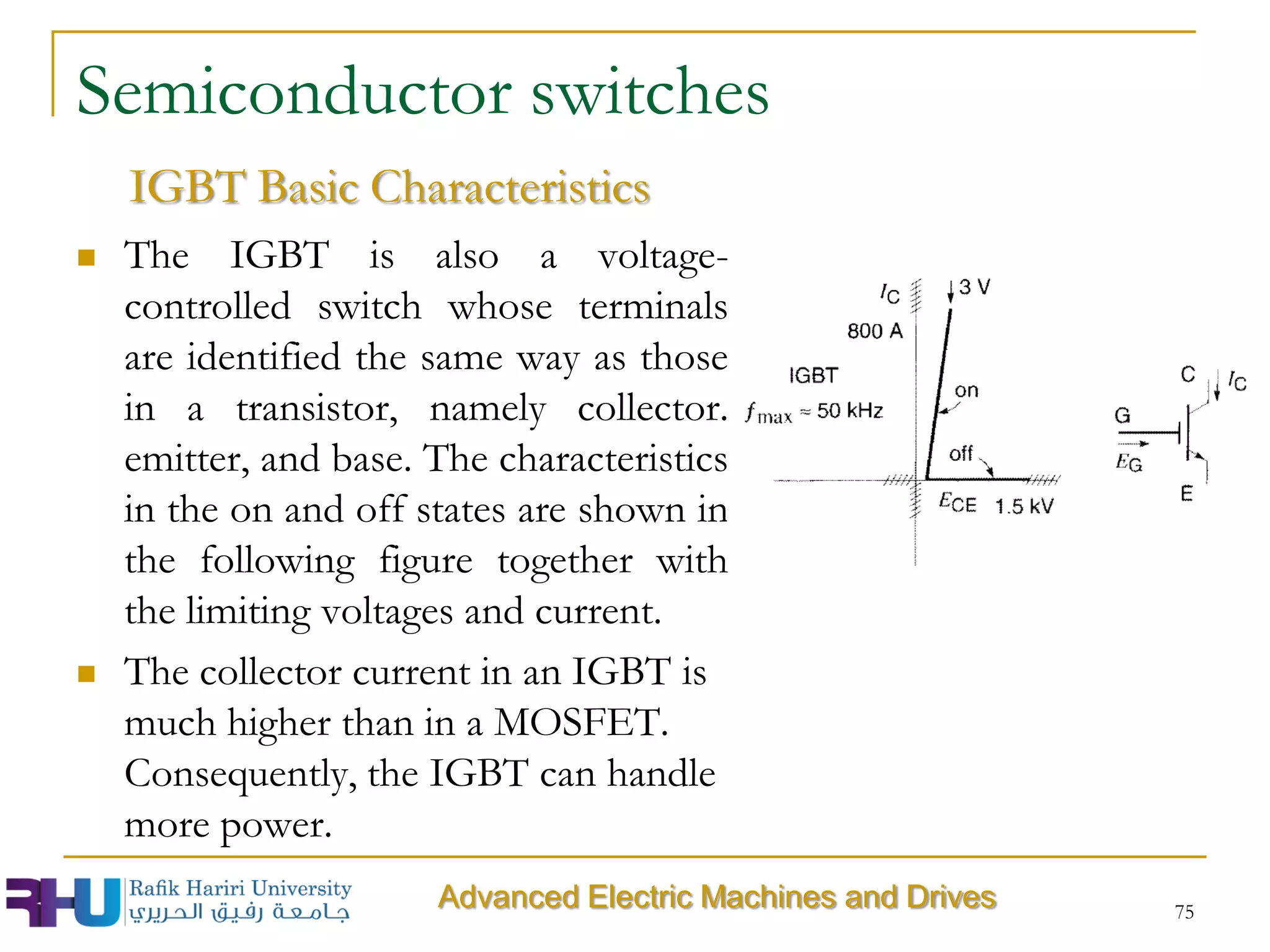
 The IGBT is also a voltage-
controlled switch whose terminals
are identified the same way as those
in a transistor, namely collector.
emitter, and base. The characteristics
in the on and off states are shown in
the following figure together with
the limiting voltages and current.
 The collector current in an IGBT is
much higher than in a MOSFET.
Consequently, the IGBT can handle
more power.
IGBT Basic Characteristics
Advanced Electric Machines and Drives
 Compared to GTOs, an important feature of BJTs, MOSFETs,
and IGBTs is their fast turn-on and turn-off times. This enables
these switches to be used at much higher frequencies. As a result,
the associated transformers. inductors, and capacitors are smaller
and cheaper. Typical maximum frequencies are shown in Figs.
The following. Another advantage of high-speed switching is
that the semiconductor switches can generate lower-frequency
voltages and currents whose waveshapes and phase can be
tailored to meet almost any requirement.
76
Semiconductor switches
IGBT Basic Characteristics
Advanced Electric Machines and Drives
77
 In some power systems there is a need to transform DC power
from one DC voltage level to either a higher or lower dc level.
 In alternating current systems the voltage step-up or step-down
can easily be done with a transformer.
 In DC systems, an entirely different approach is required. It
 involves the use of a dc-to-dc switching converter.
 sometimes called a chopper.
Semiconductor switches
IGBT Basic Characteristics
Advanced Electric Machines and Drives
DC-to-DC Switching Converter
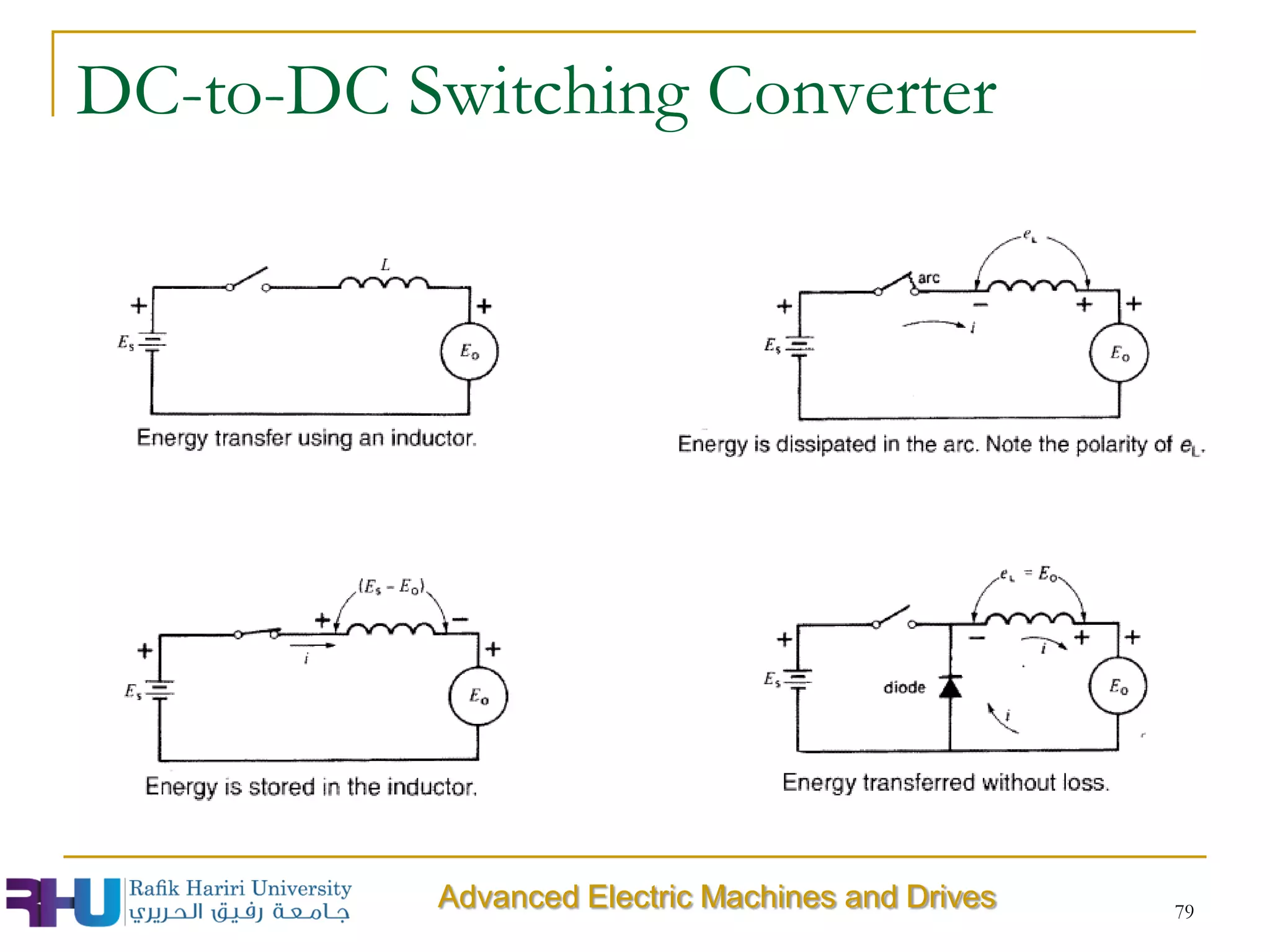
 Suppose that power has to be transferred from a high-voltage dc
source Es to a lower-voltage dc load E0.
 One solution is to connect an inductor between the source and
the load and to open and close the circuit periodically with a
switch
78
Advanced Electric Machines and Drives
DC-to-DC Switching Converter
79
Advanced Electric Machines and Drives
DC-to-DC Switching Converter
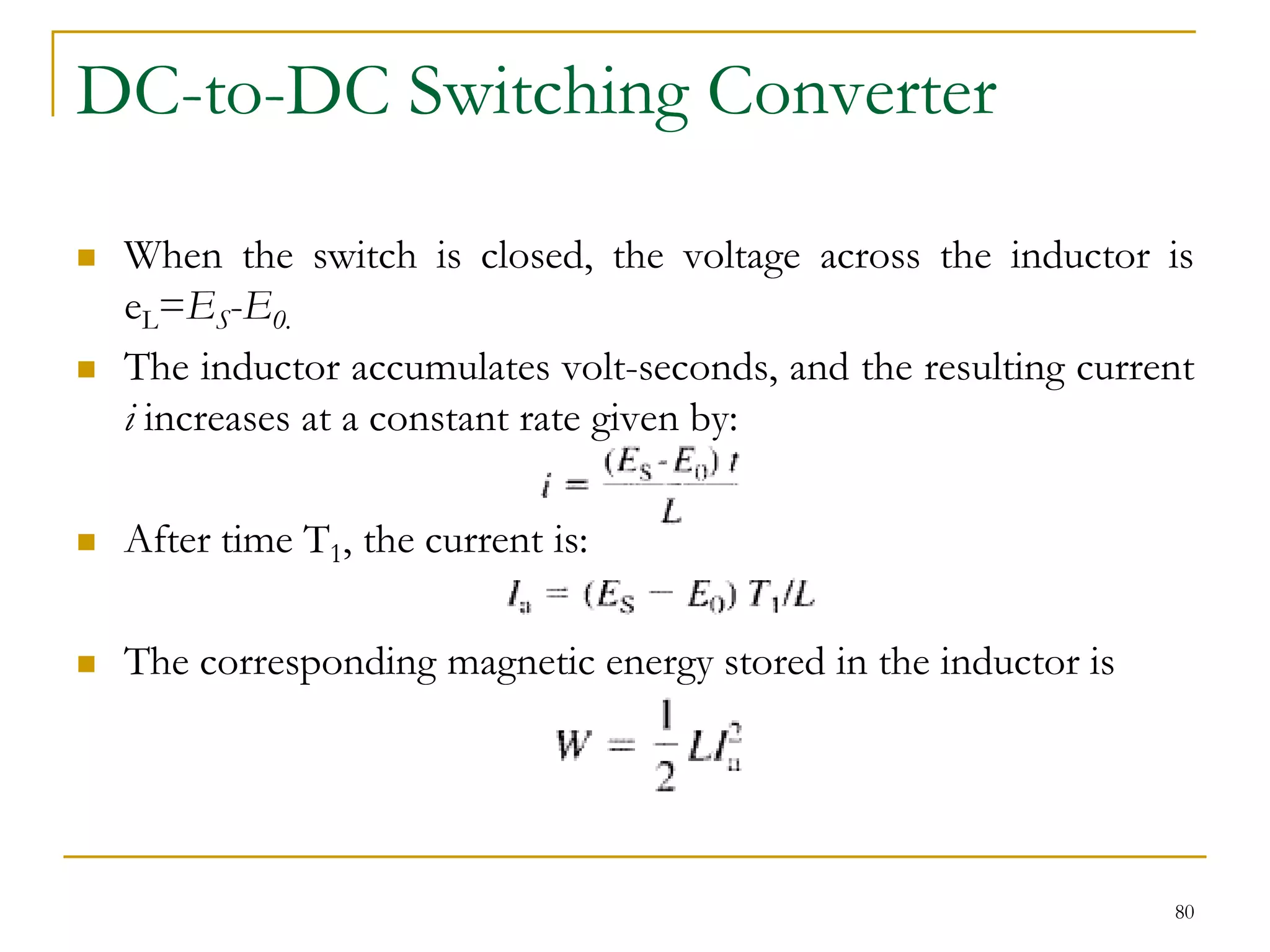
 When the switch is closed, the voltage across the inductor is
eL=ES-E0.
 The inductor accumulates volt-seconds, and the resulting current
i increases at a constant rate given by:
 After time T1, the current is:
 The corresponding magnetic energy stored in the inductor is
80
81
 When the switch opens the current collapses and all the stored
energy is dissipated in the arc across the switch. At the same
time, a high voltage eL is induced across the inductor because the
current is collapsing so quickly.
 The polarity of this voltage is opposite to what it was when the
current was increasing.
 The high negative voltage indicates that the inductor is rapidly
discharging the volt-seconds it had previously accumulated. As a
result, the current decreases very quickly.
DC-to-DC Switching Converter
Advanced Electric Machines and Drives
82
 We can prevent the energy loss every time the switch opens and
closes by adding a diode to the circuit.
 When the switch closes, the current rises to Ia as before. The
diode has no effect because its cathode is positive with respect to
the anode and so the diode does not conduct. When the switch
opens, current i again begins to fall, inducing a voltage eL.
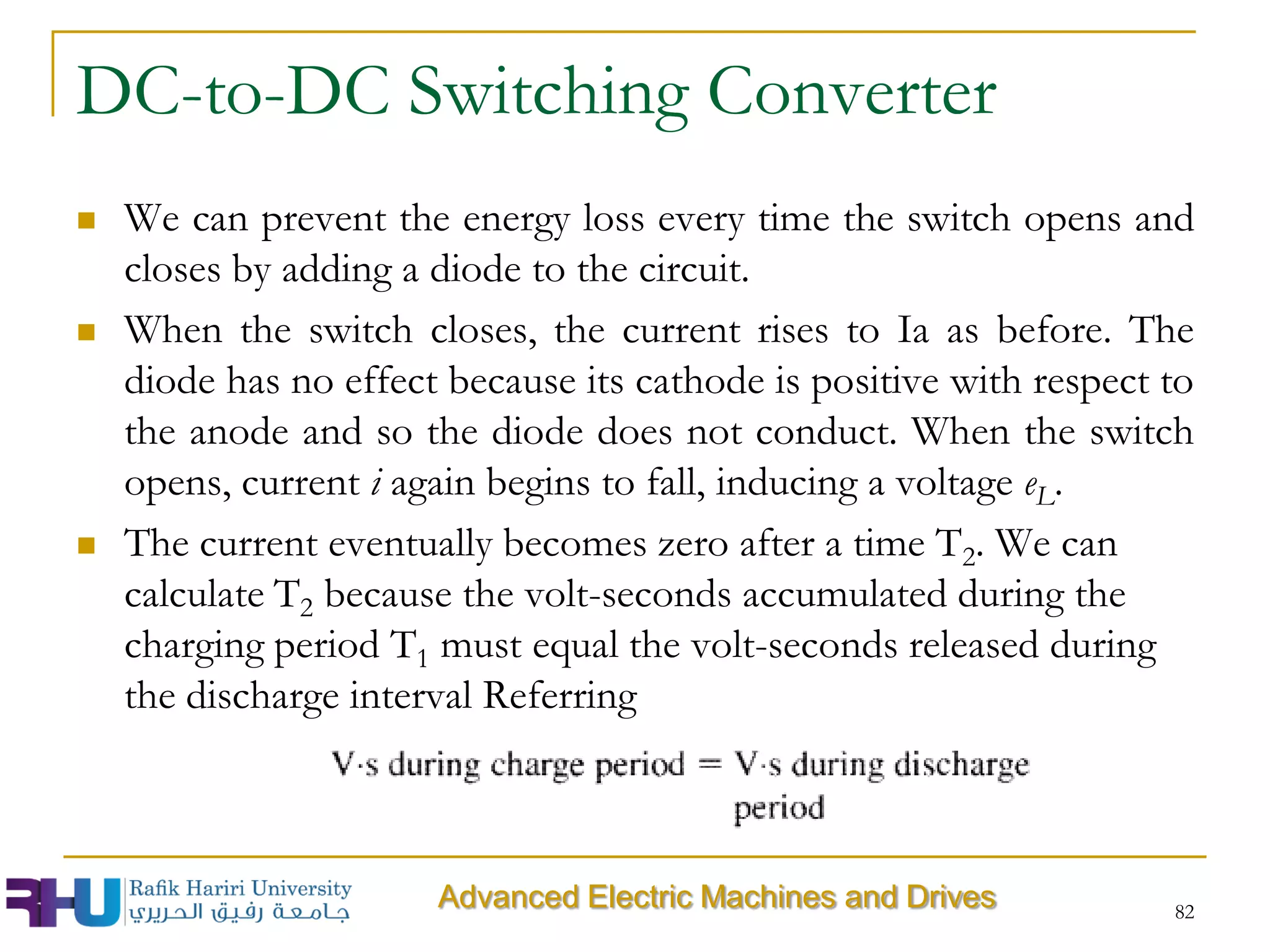
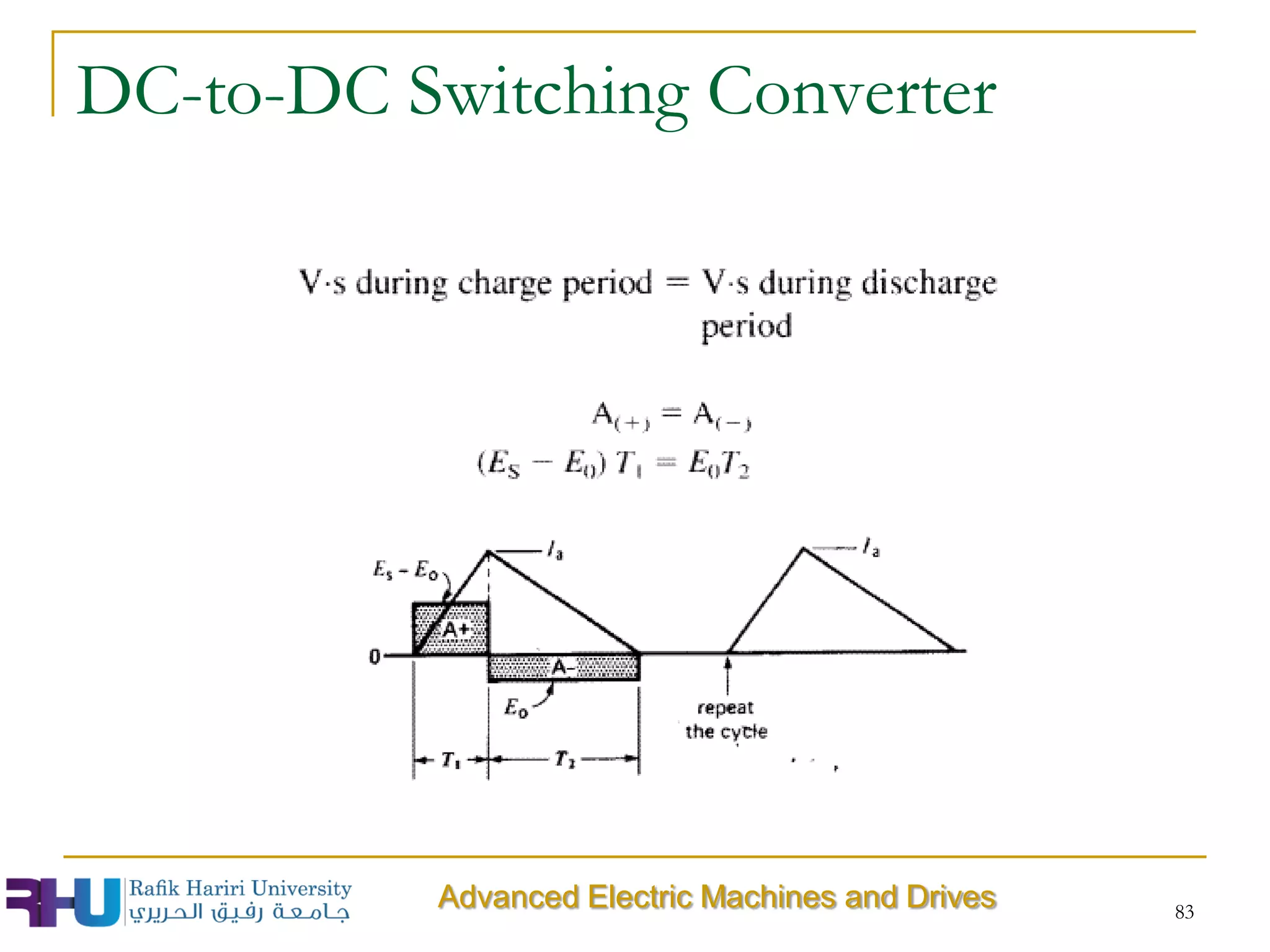
 The current eventually becomes zero after a time T2. We can
calculate T2 because the volt-seconds accumulated during the
charging period T1 must equal the volt-seconds released during
the discharge interval Referring
DC-to-DC Switching Converter
Advanced Electric Machines and Drives
83
DC-to-DC Switching Converter
Advanced Electric Machines and Drives
DC-to-DC Switching Converter
 When the current is zero, the inductor will have delivered all its
stored energy to load E0. Simultaneously, the diode will cease to
conduct. We can therefore reclose the switch for another interval
T1 and repeat the cycle indefinitely.
 Consequently, this circuit enables us to transfer energy from a
high voltage dc source to a lower-voltage dc load without
incurring any losses.
 In effect, the inductor absorbs energy at a relatively high voltage
(ES-E0) and delivers it at a lower voltage E0.
84
Advanced Electric Machines and Drives
DC-to-DC Switching Converter
 The diode is sometimes called a freewheeling diode because it
automatically starts conducting as soon as the switch opens and
stops conducting when the switch closes.
 The switch is actually a GTO, MOSFET, or IGBT, whose
on/off state is controlled by a signal applied to the gate. The
combination of the electronic switch, inductor, and diode
constitutes what is known as a step-down dc-to-dc converter, or
buck chopper.
85
Advanced Electric Machines and Drives
DC-to-DC Switching Converter
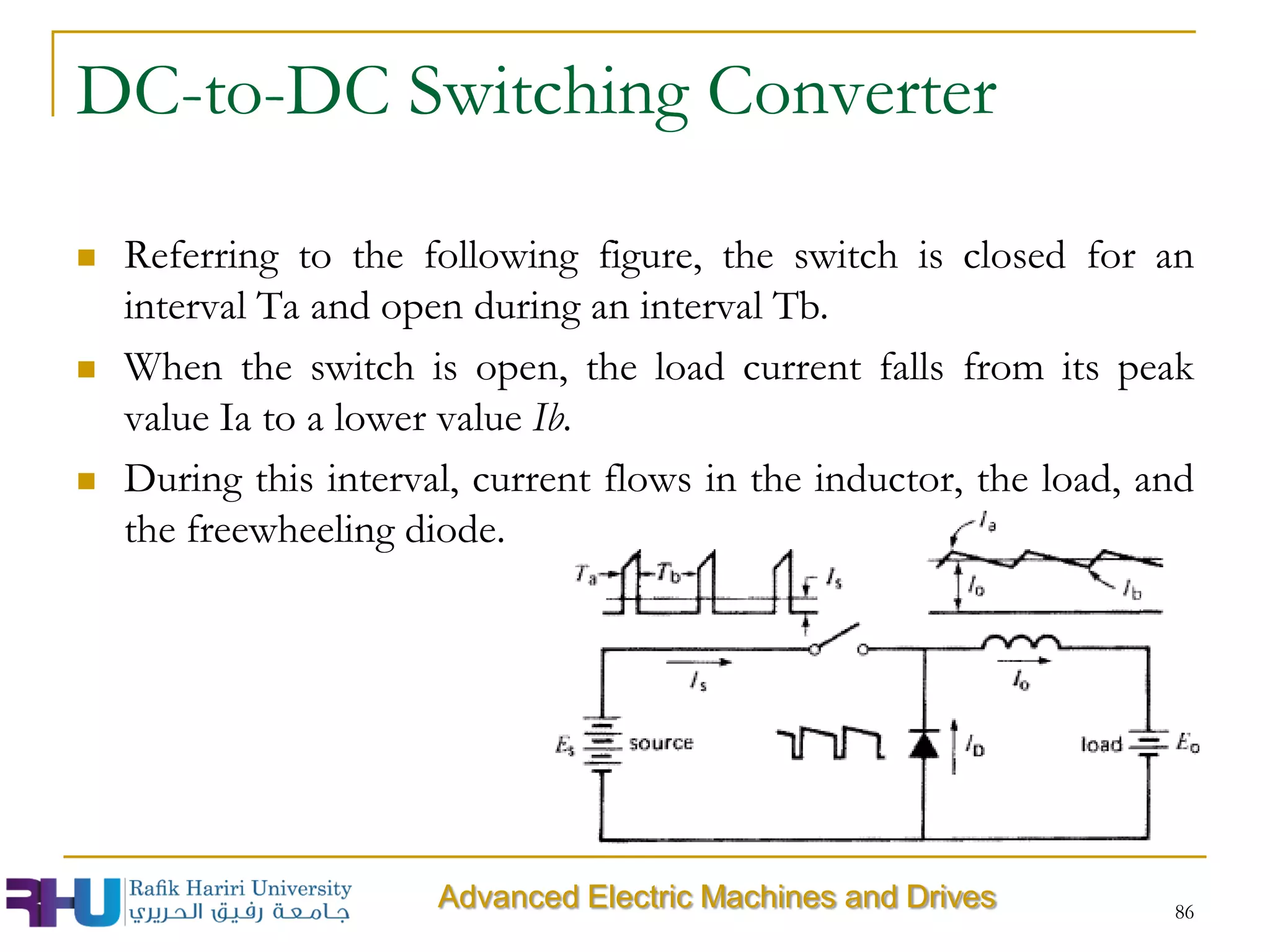
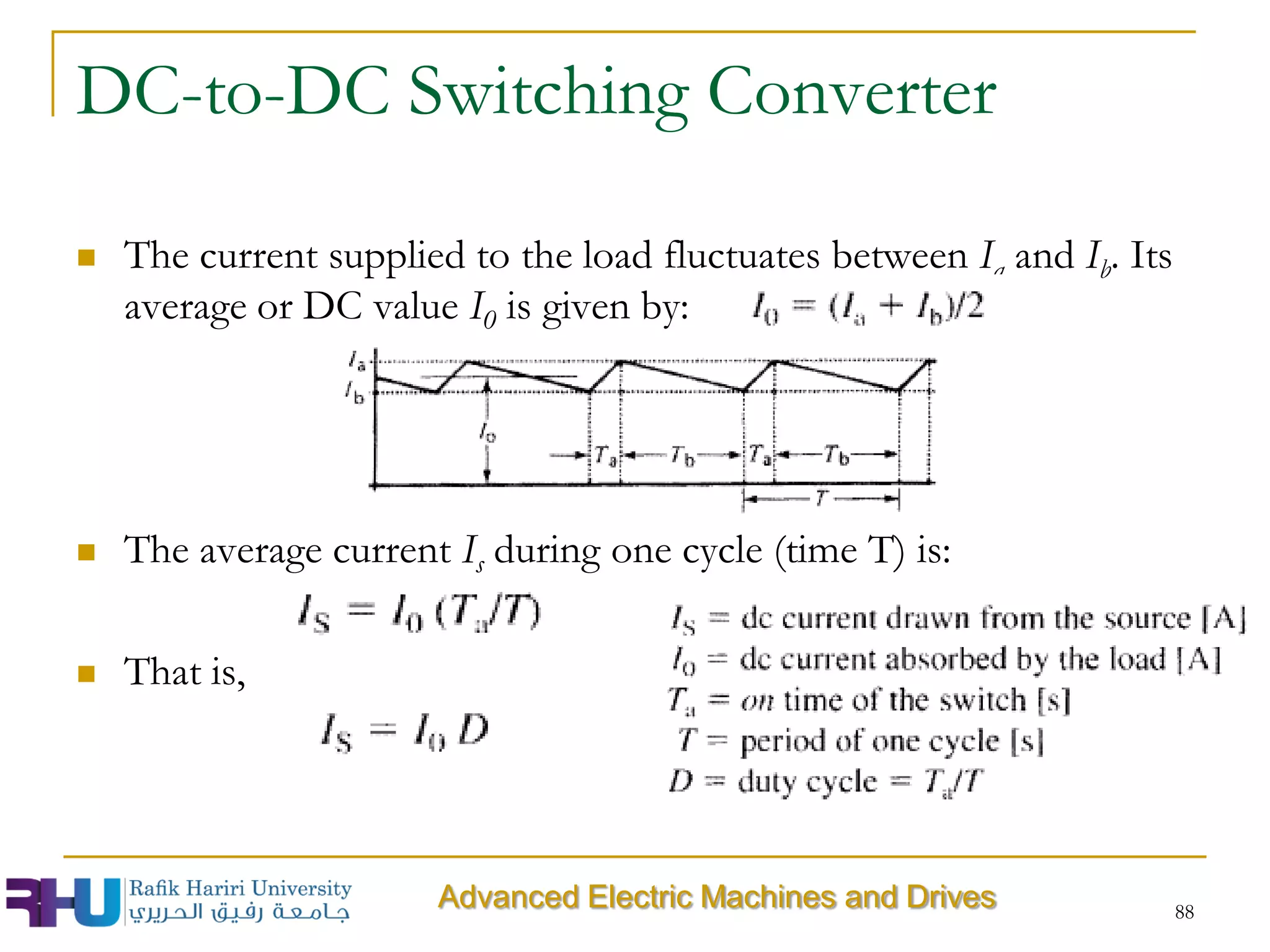
 Referring to the following figure, the switch is closed for an
interval Ta and open during an interval Tb.
 When the switch is open, the load current falls from its peak
value Ia to a lower value Ib.
 During this interval, current flows in the inductor, the load, and
the freewheeling diode.
86
Advanced Electric Machines and Drives
DC-to-DC Switching Converter
 When the current has fallen to a value Ib, the switch recloses.
Because the cathode of the diode is now (+), the current in the
diode immediately stops flowing, and the source now supplies
current Ia. The current then builds up and when it reaches the
value Ia (after a time Ta ), the switch reopens.
 The freewheeling diode comes into play and the cycle repeats.
87
Advanced Electric Machines and Drives
DC-to-DC Switching Converter
 The current supplied to the load fluctuates between Ia and Ib. Its
average or DC value I0 is given by:
 The average current Is during one cycle (time T) is:
 That is,
88
Advanced Electric Machines and Drives
DC-to-DC Switching Converter
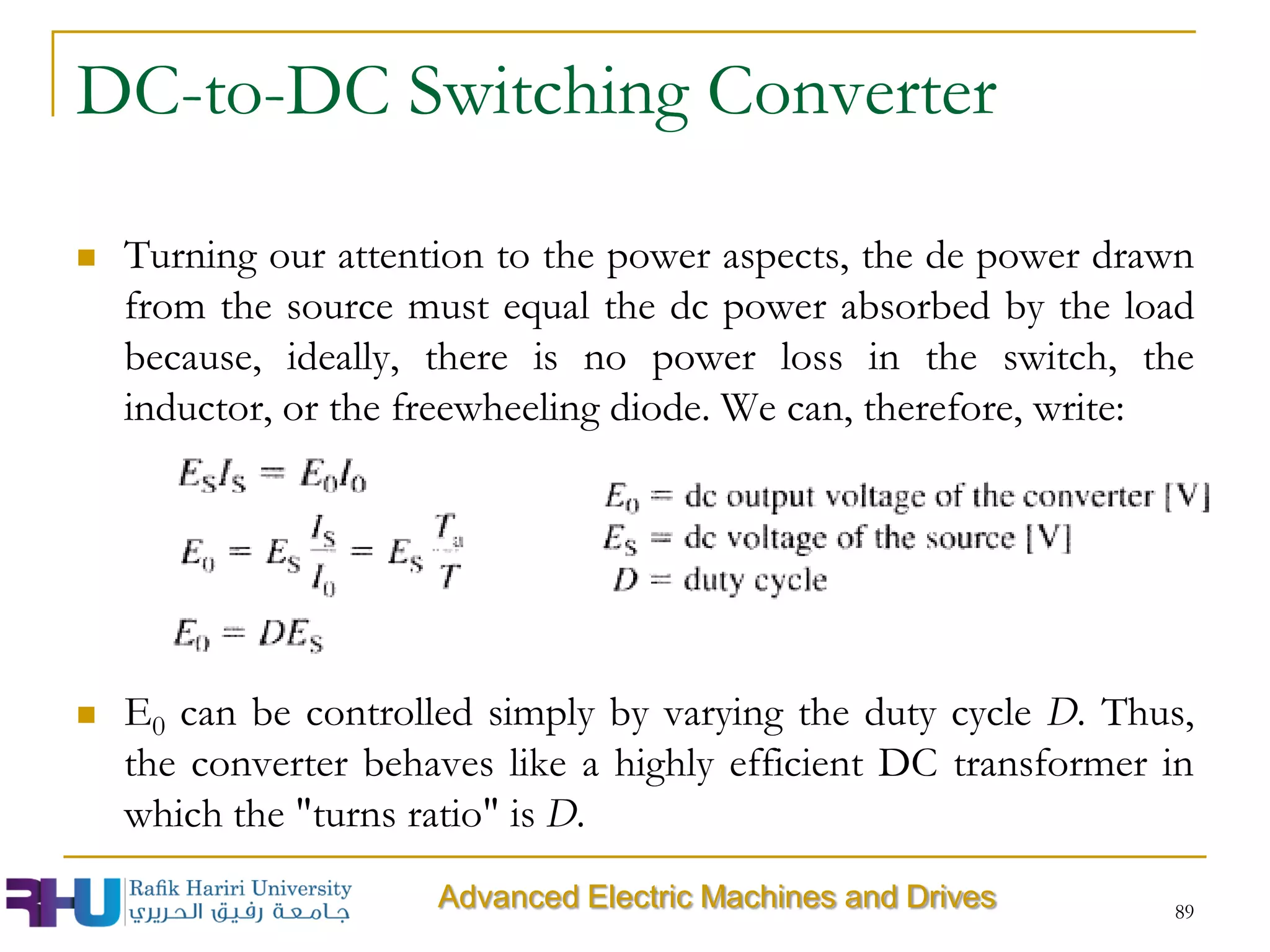
 Turning our attention to the power aspects, the de power drawn
from the source must equal the dc power absorbed by the load
because, ideally, there is no power loss in the switch, the
inductor, or the freewheeling diode. We can, therefore, write:
 E0 can be controlled simply by varying the duty cycle D. Thus,
the converter behaves like a highly efficient DC transformer in
which the "turns ratio" is D.
89
Advanced Electric Machines and Drives
DC-to-DC Switching Converter
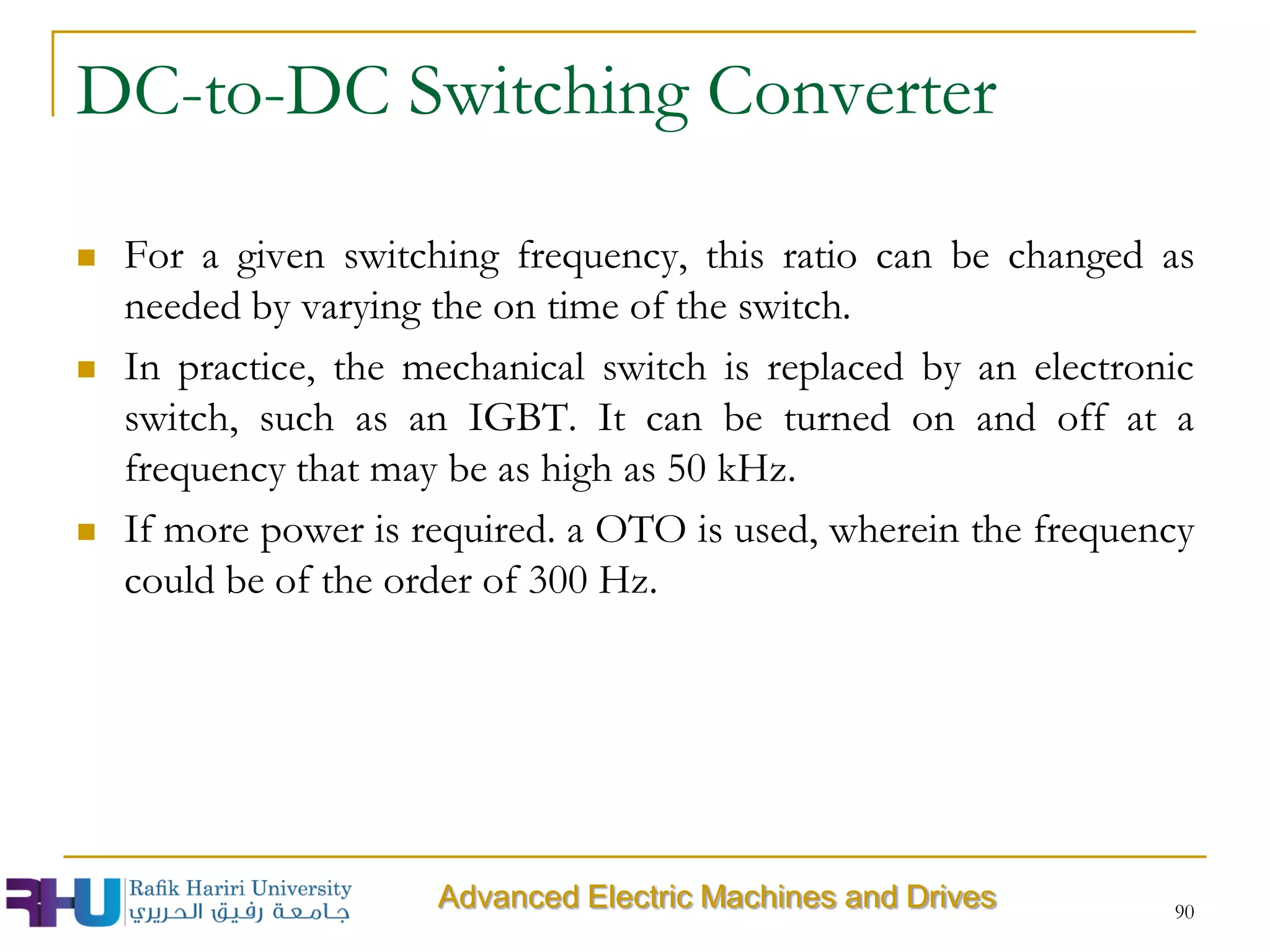
 For a given switching frequency, this ratio can be changed as
needed by varying the on time of the switch.
 In practice, the mechanical switch is replaced by an electronic
switch, such as an IGBT. It can be turned on and off at a
frequency that may be as high as 50 kHz.
 If more power is required. a OTO is used, wherein the frequency
could be of the order of 300 Hz.
90
Advanced Electric Machines and Drives
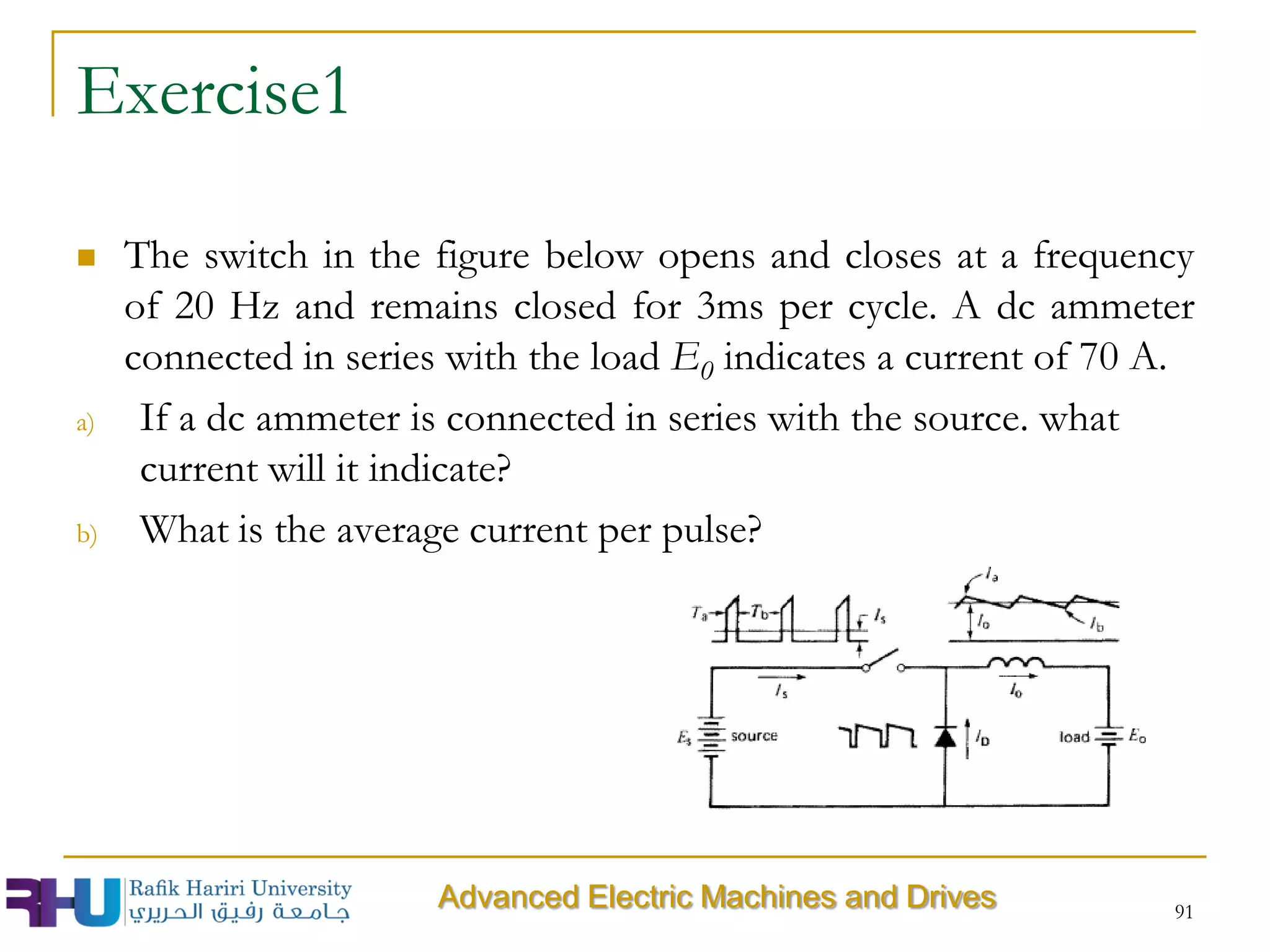
Exercise1
 The switch in the figure below opens and closes at a frequency
of 20 Hz and remains closed for 3ms per cycle. A dc ammeter
connected in series with the load E0 indicates a current of 70 A.
a) If a dc ammeter is connected in series with the source. what
current will it indicate?
b) What is the average current per pulse?
91
Advanced Electric Machines and Drives
92
Exercise2
We wish to charge a 120 V battery from a 600 V dc source using a
dc chopper. The average battery current should be 20 A, with a
peak-to-peak ripple of 2 A. If the chopper frequency is 200 Hz,
calculate the following:
a) The dc current drawn from the source
b) The duty cycle
c) The inductance of the inductor
Advanced Electric Machines and Drives
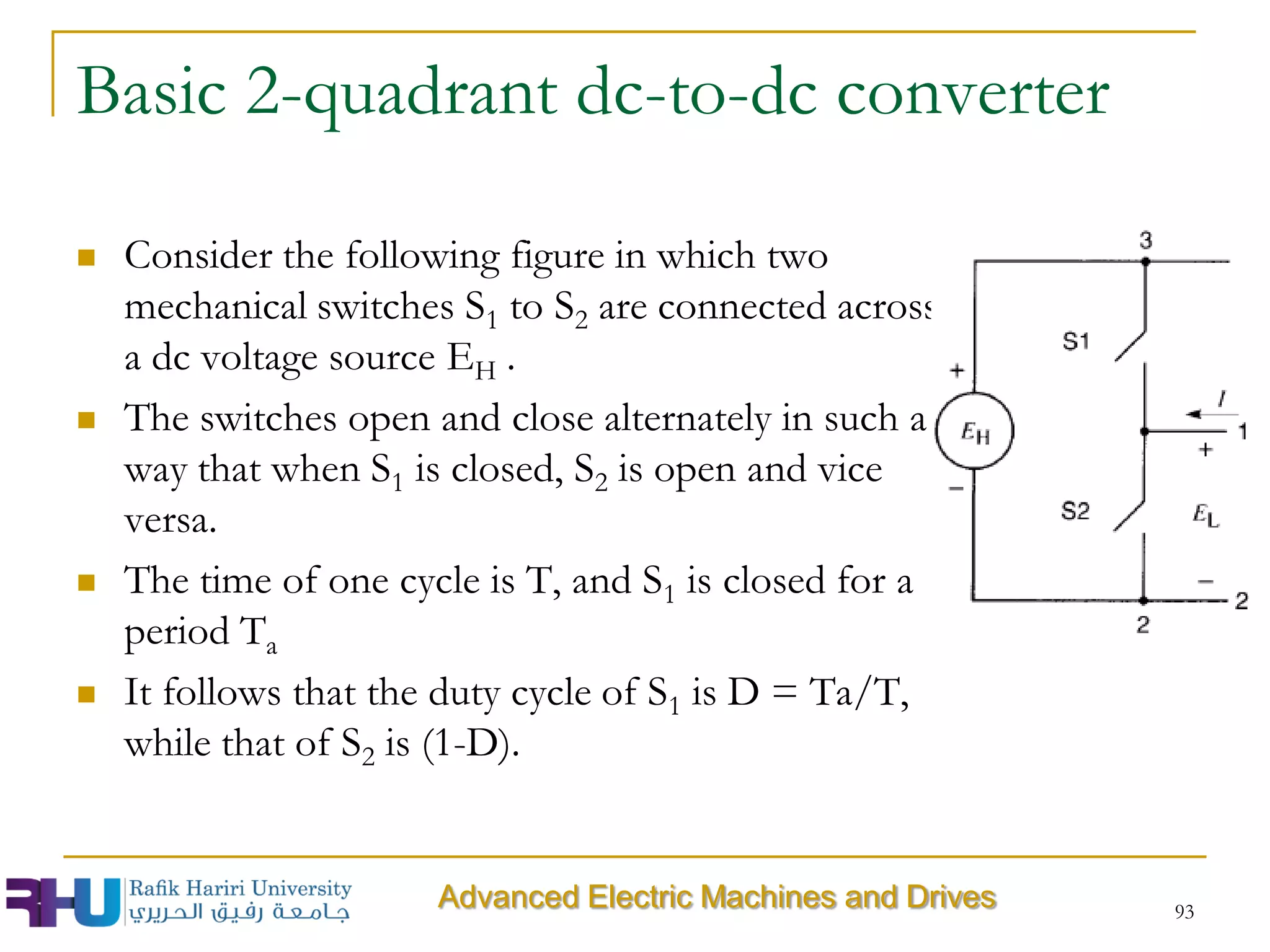
Basic 2-quadrant dc-to-dc converter
 Consider the following figure in which two
mechanical switches S1 to S2 are connected across
a dc voltage source EH .
 The switches open and close alternately in such a
way that when S1 is closed, S2 is open and vice
versa.
 The time of one cycle is T, and S1 is closed for a
period Ta
 It follows that the duty cycle of S1 is D = Ta/T,
while that of S2 is (1-D).
93
Advanced Electric Machines and Drives
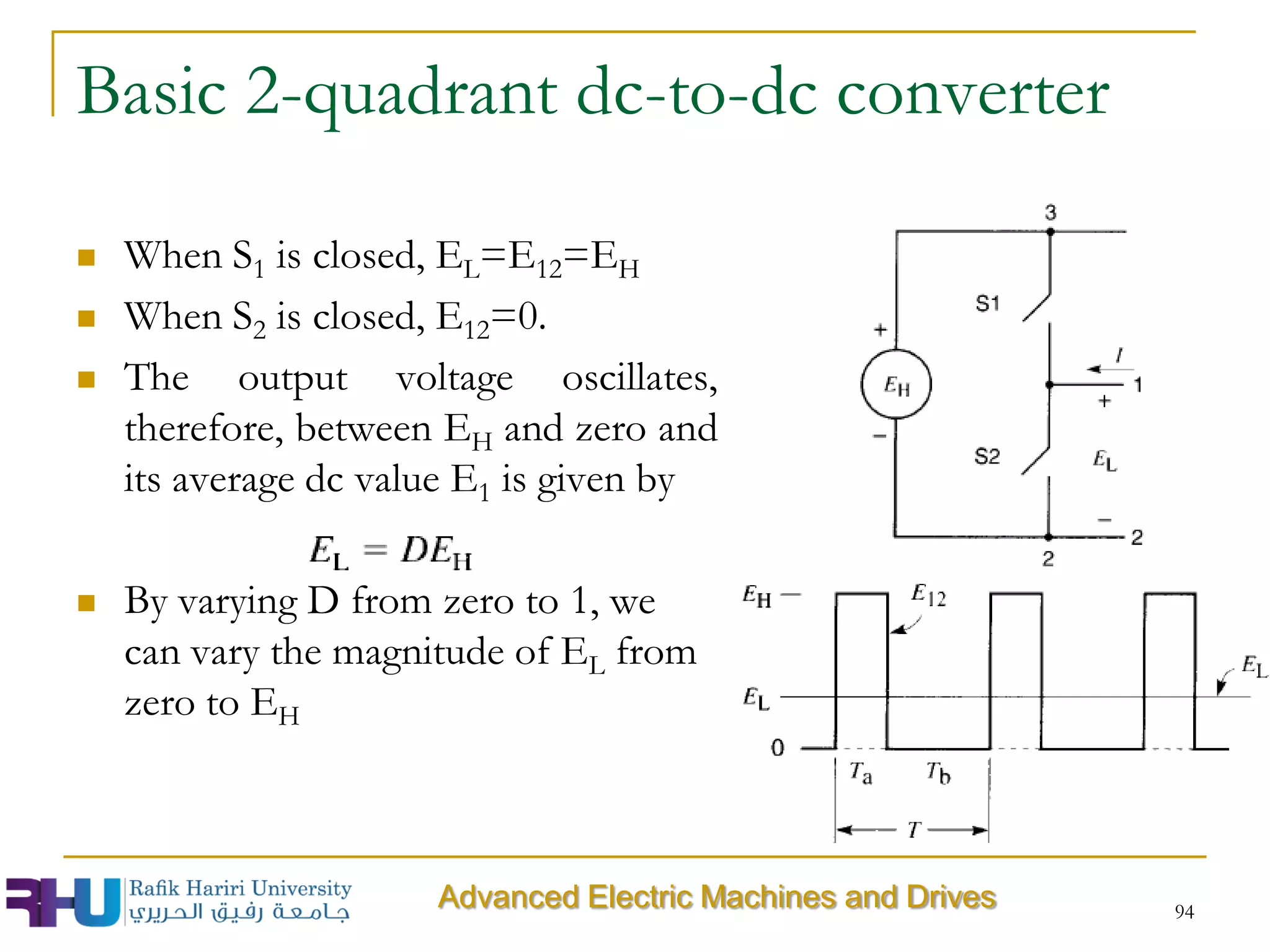
Basic 2-quadrant dc-to-dc converter
 When S1 is closed, EL=E12=EH
 When S2 is closed, E12=0.
 The output voltage oscillates,
therefore, between EH and zero and
its average dc value E1 is given by
 By varying D from zero to 1, we
can vary the magnitude of EL from
zero to EH
94
Advanced Electric Machines and Drives
Basic 2-quadrant dc-to-dc converter
 Suppose we want to transfer dc power from terminals E12 to a
load such as a battery, whose dc voltage E52 has a value E0
 An inductor is used as filter
 We assume that the load has a small internal resistance R.
 Suppose that both the voltage source EH and the duty cycle D
are fixed. Consequently, the dc component EL between points 1
and 2 is constant.
95
Advanced Electric Machines and Drives
Basic 2-quadrant dc-to-dc converter
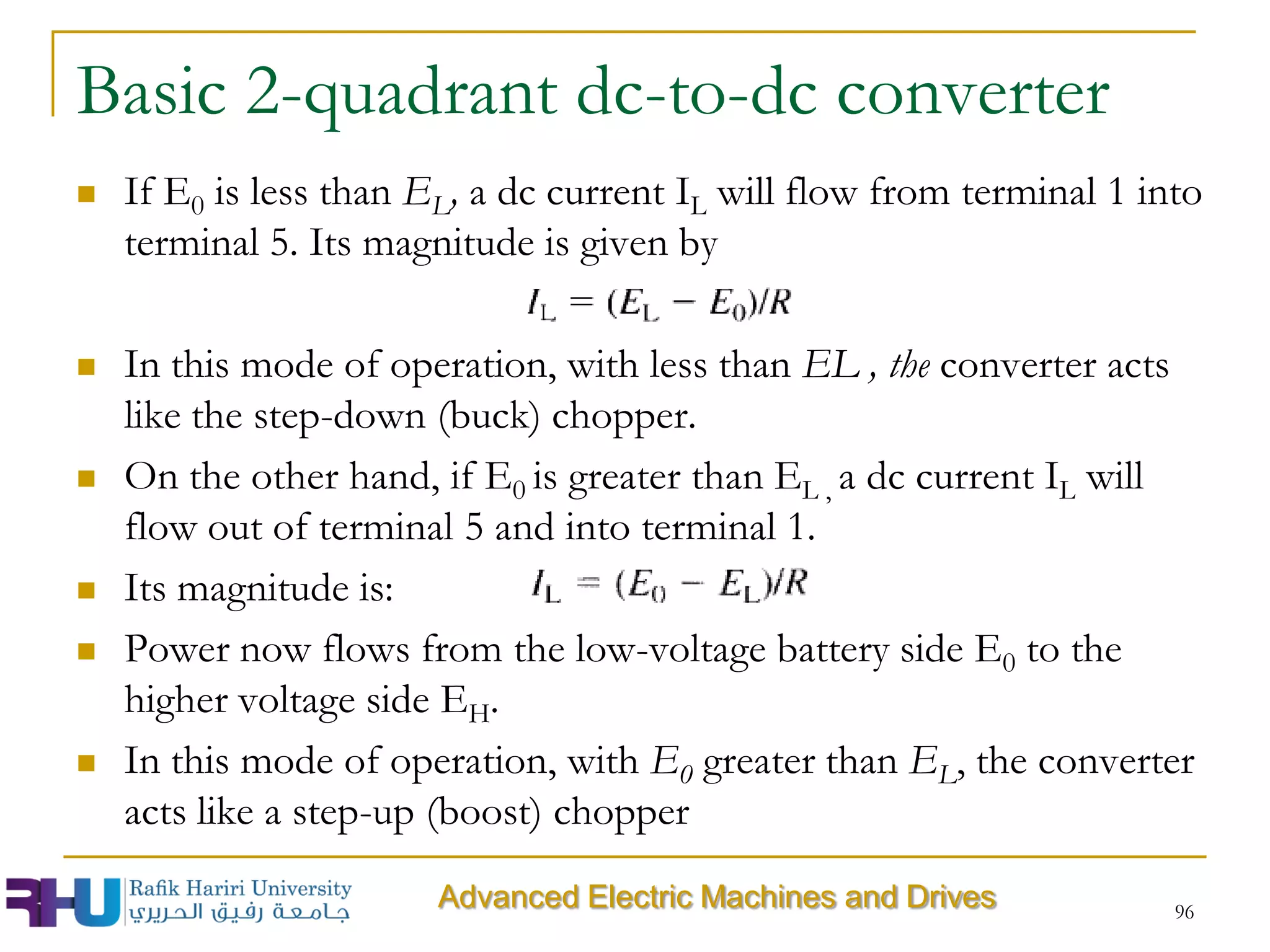
 If E0 is less than EL, a dc current IL will flow from terminal 1 into
terminal 5. Its magnitude is given by
 In this mode of operation, with less than EL , the converter acts
like the step-down (buck) chopper.
 On the other hand, if E0 is greater than EL , a dc current IL will
flow out of terminal 5 and into terminal 1.
 Its magnitude is:
 Power now flows from the low-voltage battery side E0 to the
higher voltage side EH.
 In this mode of operation, with E0 greater than EL, the converter
acts like a step-up (boost) chopper
96
Advanced Electric Machines and Drives
Four-quadrant dc-to-dc converter
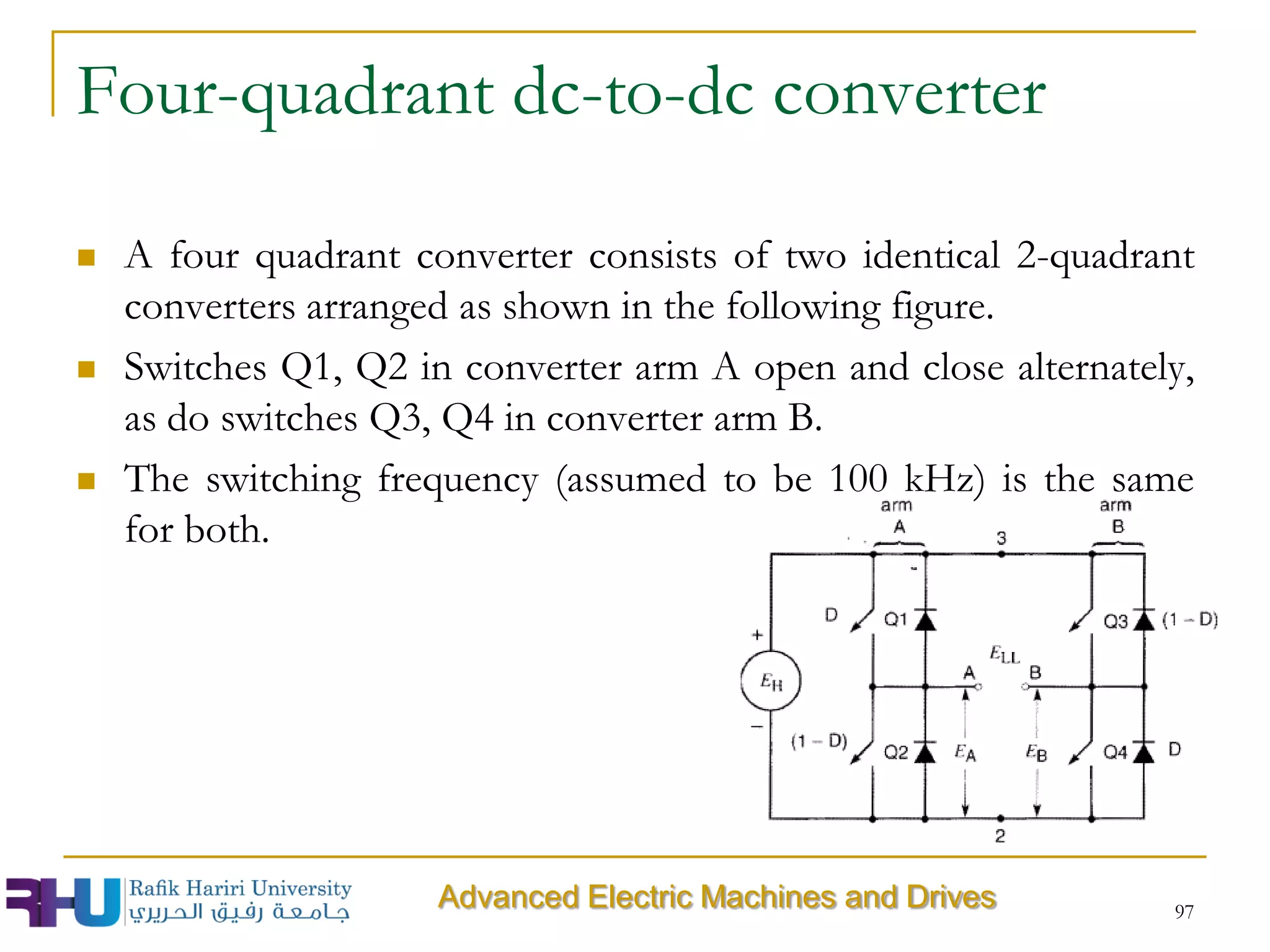
 A four quadrant converter consists of two identical 2-quadrant
converters arranged as shown in the following figure.
 Switches Q1, Q2 in converter arm A open and close alternately,
as do switches Q3, Q4 in converter arm B.
 The switching frequency (assumed to be 100 kHz) is the same
for both.
97
Advanced Electric Machines and Drives
Four-quadrant dc-to-dc converter
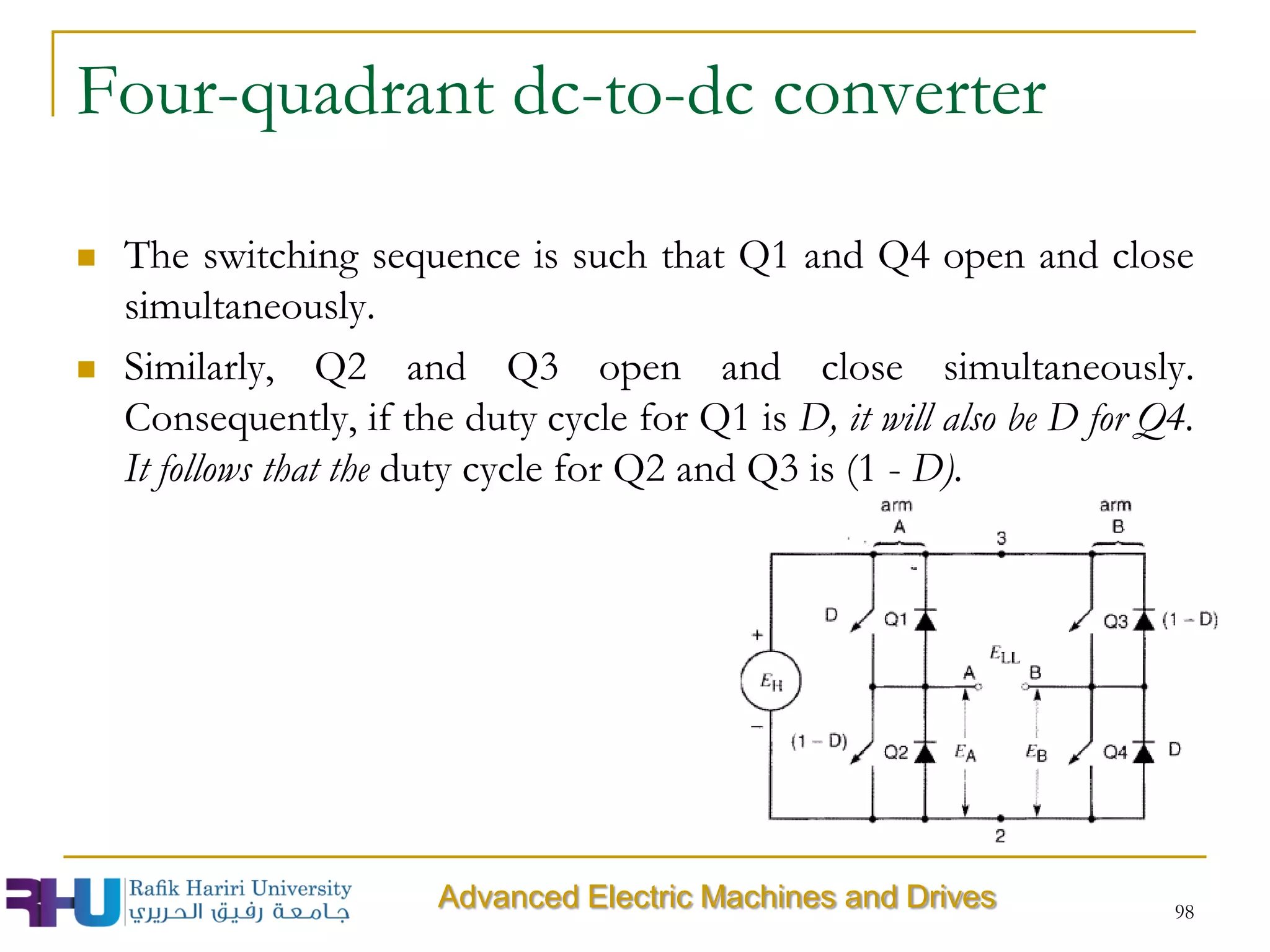
 The switching sequence is such that Q1 and Q4 open and close
simultaneously.
 Similarly, Q2 and Q3 open and close simultaneously.
Consequently, if the duty cycle for Q1 is D, it will also be D for Q4.
It follows that the duty cycle for Q2 and Q3 is (1 - D).
98
Advanced Electric Machines and Drives
Four-quadrant dc-to-dc converter
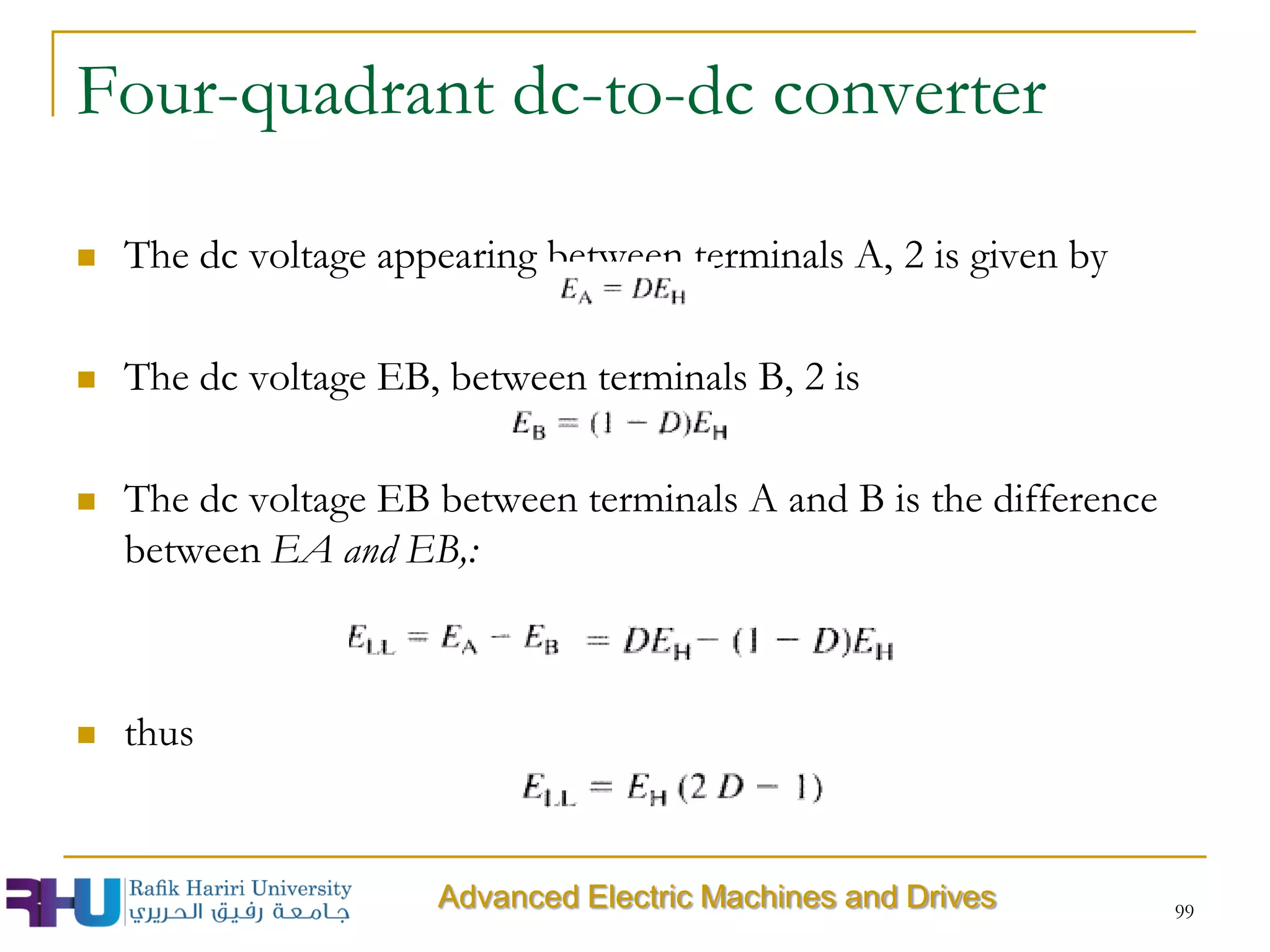
 The dc voltage appearing between terminals A, 2 is given by
 The dc voltage EB, between terminals B, 2 is
 The dc voltage EB between terminals A and B is the difference
between EA and EB,:
 thus
99
Advanced Electric Machines and Drives
Four-quadrant dc-to-dc converter
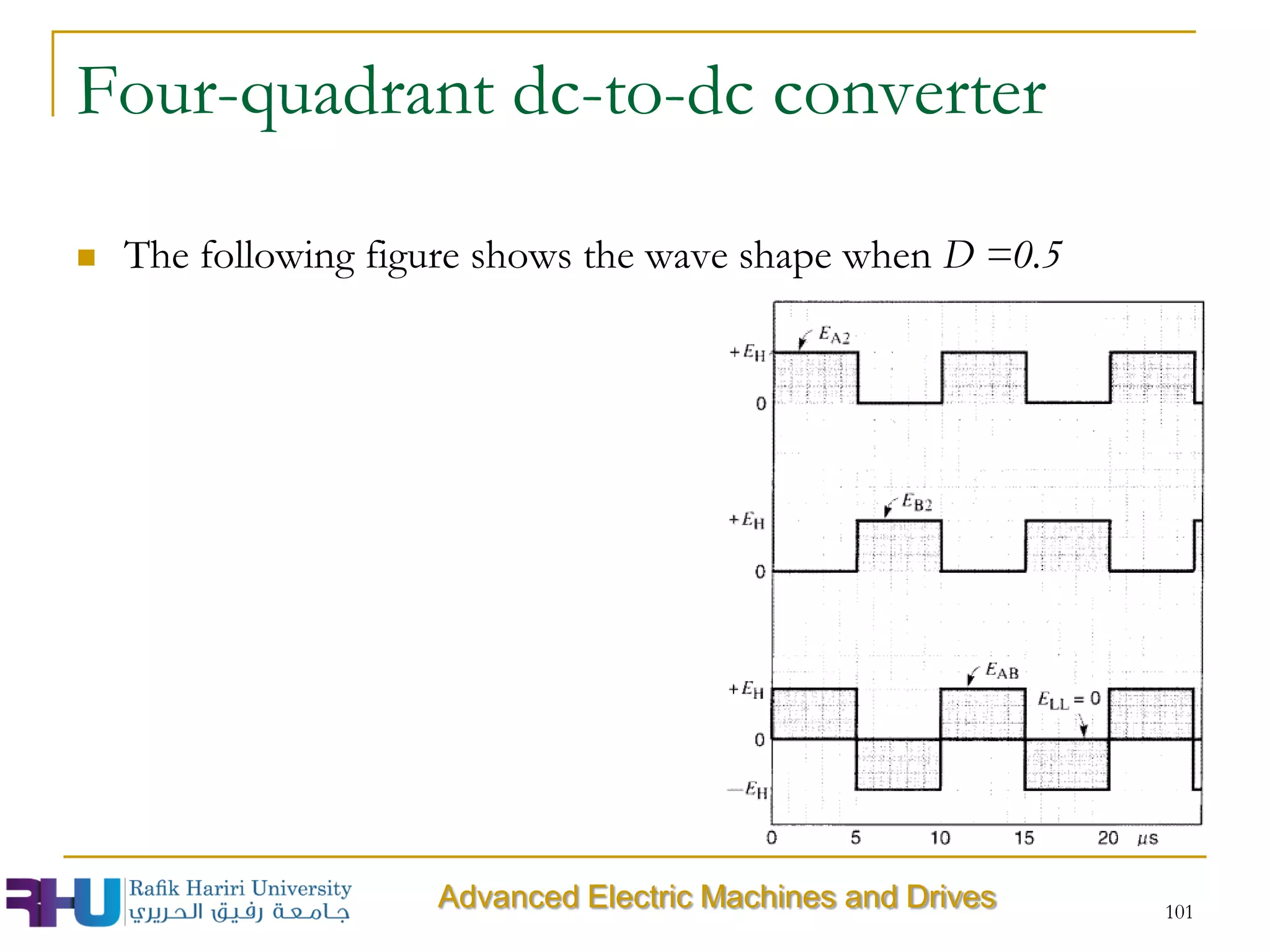
 the dc voltage is zero when D is 0.5. Furthermore, the voltage
changes linearly with D, becoming + EH when D = I, and –EH
when D = O.
 The polarity of the output voltage can therefore be either
positive or negative.
 Moreover, if a device is connected between terminals A, B, the
direction of dc current flow can be either from A to B or from B
to A.
100
Advanced Electric Machines and Drives
Four-quadrant dc-to-dc converter
 The following figure shows the wave shape when D =0.5
101
Advanced Electric Machines and Drives
Four-quadrant dc-to-dc converter
102
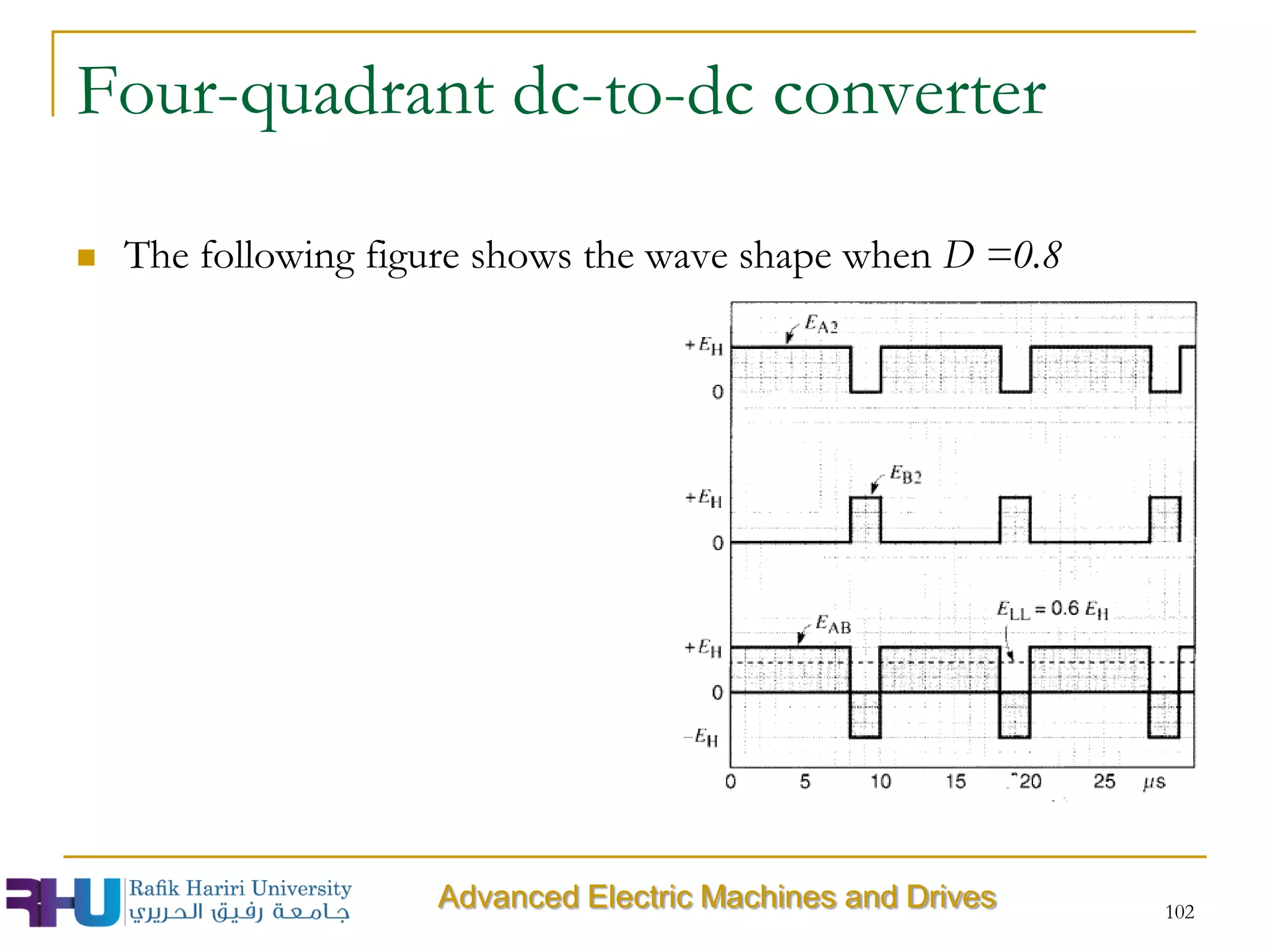
 The following figure shows the wave shape when D =0.8
Advanced Electric Machines and Drives
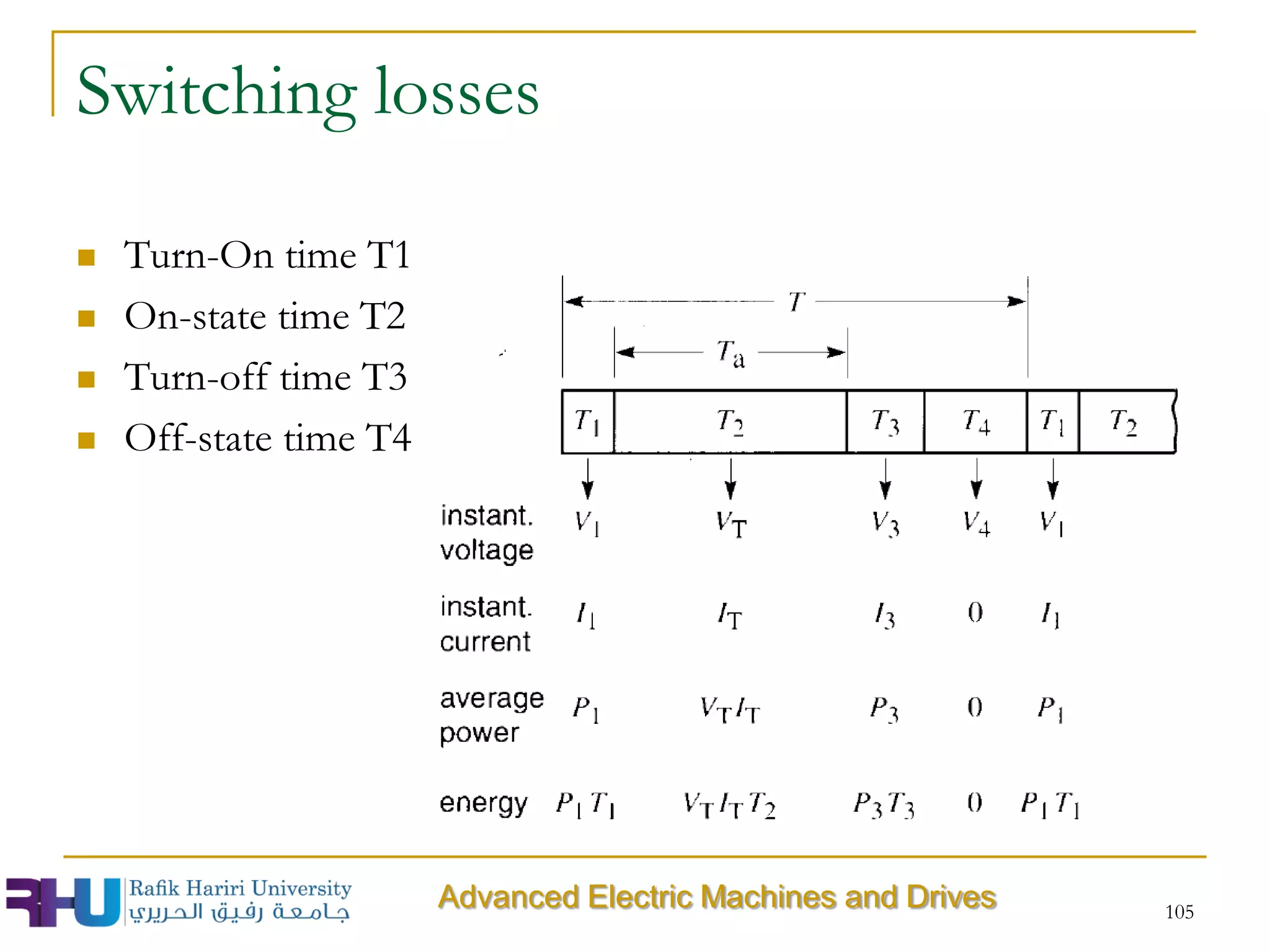
 All semiconductor switches such as GTOs, MOSFETs, and
IGBTs have losses that affect their temperature rise and switching
efficiency. The switches all function essentially the same way, but
to focus our analysis we assume the switching device is a GTO.
The switching operation involves four brief intervals:
 Turn-On time T1
 On-state time T2
 Turn-off time T3
 Off-state time T4
 The sum of T1 + T2 + T3 + T4 is equal to the period T of one
cycle which, in turn, is equal to fc where fc is the switching
frequency.
Switching losses
103
Advanced Electric Machines and Drives
Switching losses
 During each interval the instantaneous power dissipated in the
GTO is equal to the product of the instantaneous voltage across
it times the instantaneous current that flows through it.
 The average power is equal to the energy dissipated in the GTO
during one complete cycle, divided by T
104
Advanced Electric Machines and Drives
105
Switching losses
 Turn-On time T1
 On-state time T2
 Turn-off time T3
 Off-state time T4
Advanced Electric Machines and Drives
Switching losses
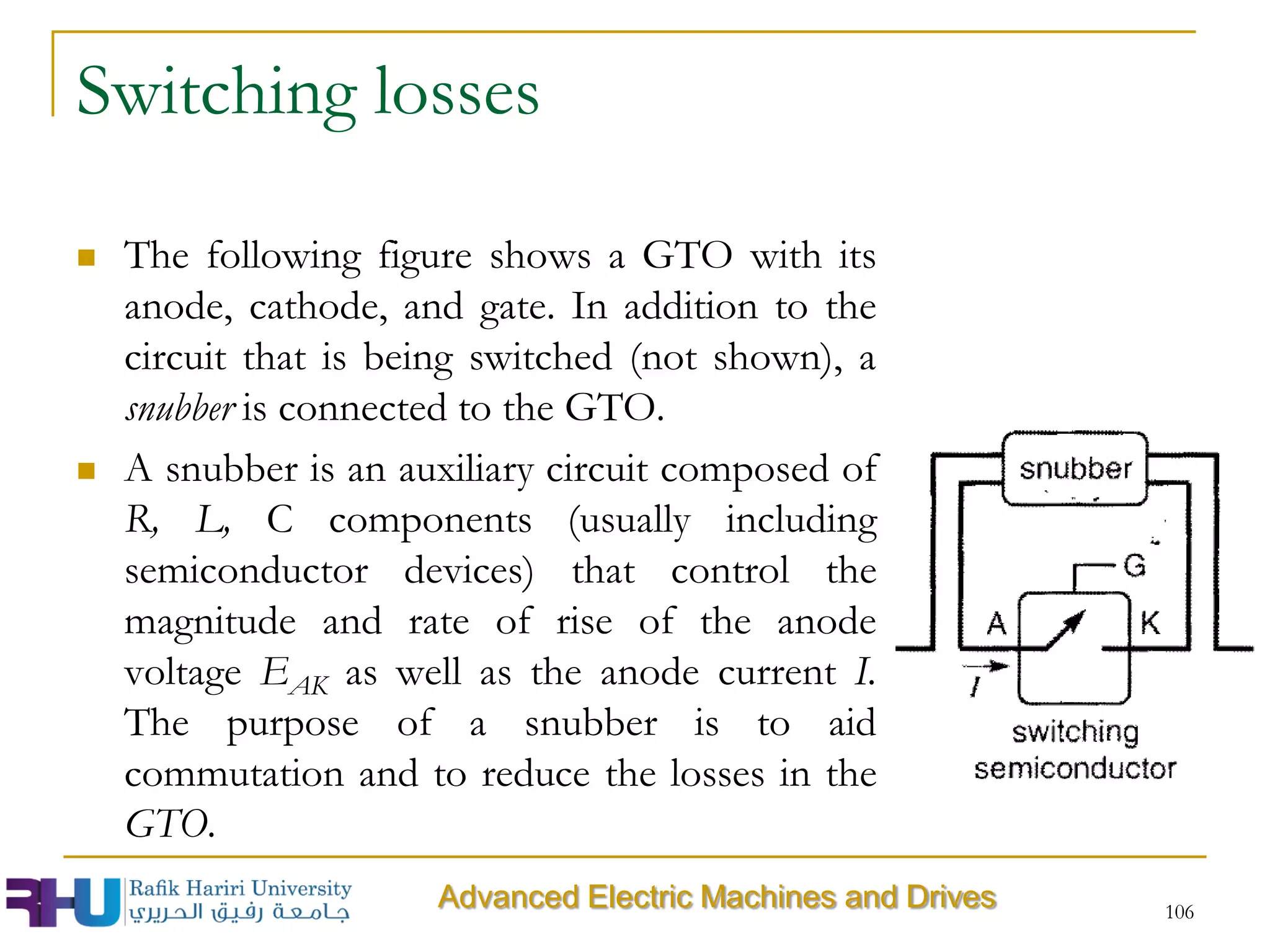
 The following figure shows a GTO with its
anode, cathode, and gate. In addition to the
circuit that is being switched (not shown), a
snubber is connected to the GTO.
 A snubber is an auxiliary circuit composed of
R, L, C components (usually including
semiconductor devices) that control the
magnitude and rate of rise of the anode
voltage EAK as well as the anode current I.
The purpose of a snubber is to aid
commutation and to reduce the losses in the
GTO.
106
Advanced Electric Machines and Drives
Switching losses
 It can be seen that the dissipation increases with the switching
frequency fc and the duty cycle D.
 It can be seen also that the dissipation can be reduced if the
turn-on and turn-off times are shorter.
107
Advanced Electric Machines and Drives
DC-TO-AC SWITCHING CONVERTERS
 We have studied the 2-quadrant and 4-quadrant dc-to-dc
switching converters. In this following, we will examine the 4-
quadrant converter as a dc-to-ac converter.
 We have seen that the converter is able to transform the dc
voltage into a rectangular ac voltage.
 The rectangular wave can have any frequency
108
Advanced Electric Machines and Drives
Dc-to-ac rectangular wave converter
109
DC-TO-AC SWITCHING CONVERTERS
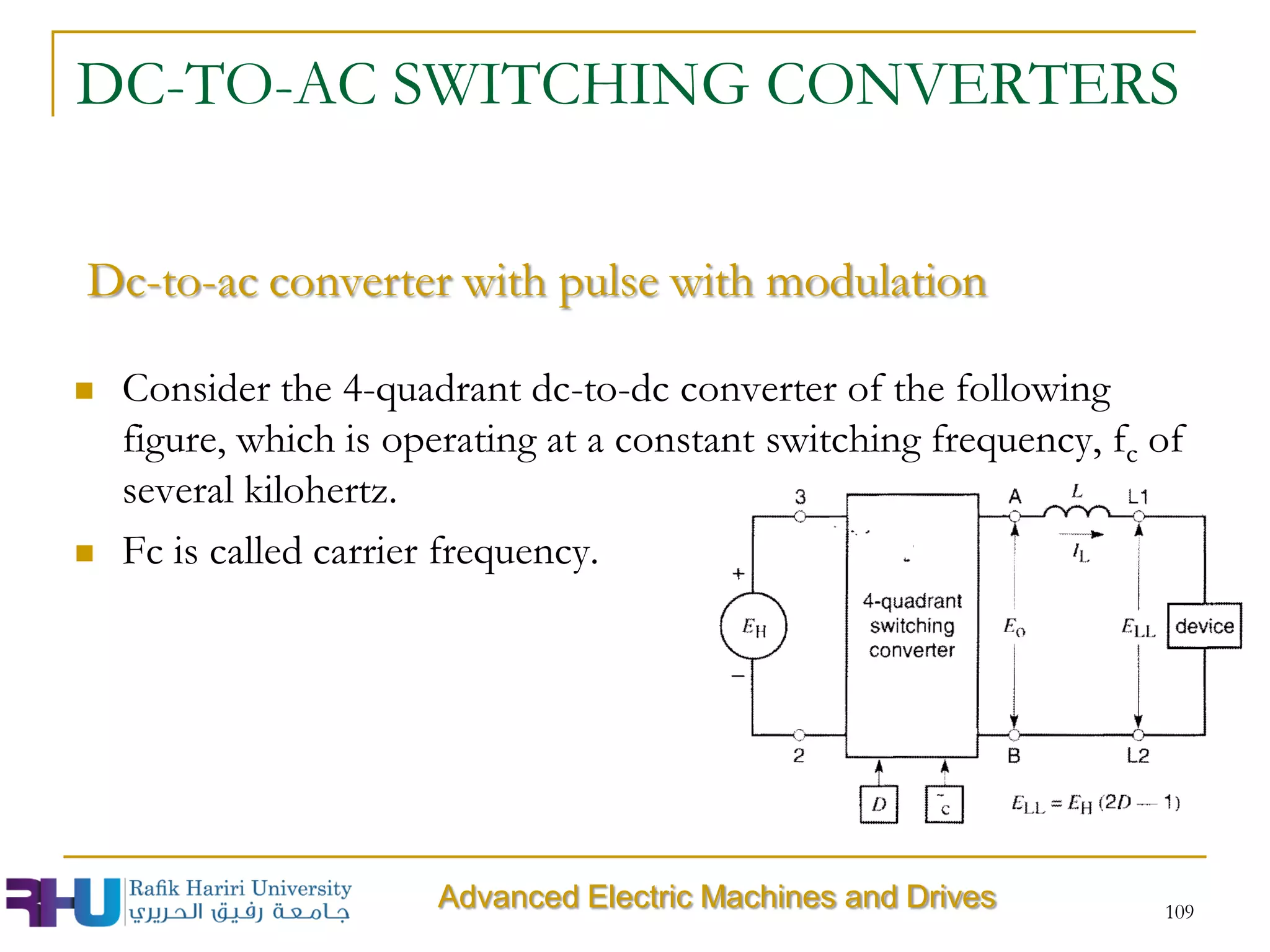
 Consider the 4-quadrant dc-to-dc converter of the following
figure, which is operating at a constant switching frequency, fc of
several kilohertz.
 Fc is called carrier frequency.
Advanced Electric Machines and Drives
Dc-to-ac converter with pulse with modulation
DC-TO-AC SWITCHING CONVERTERS
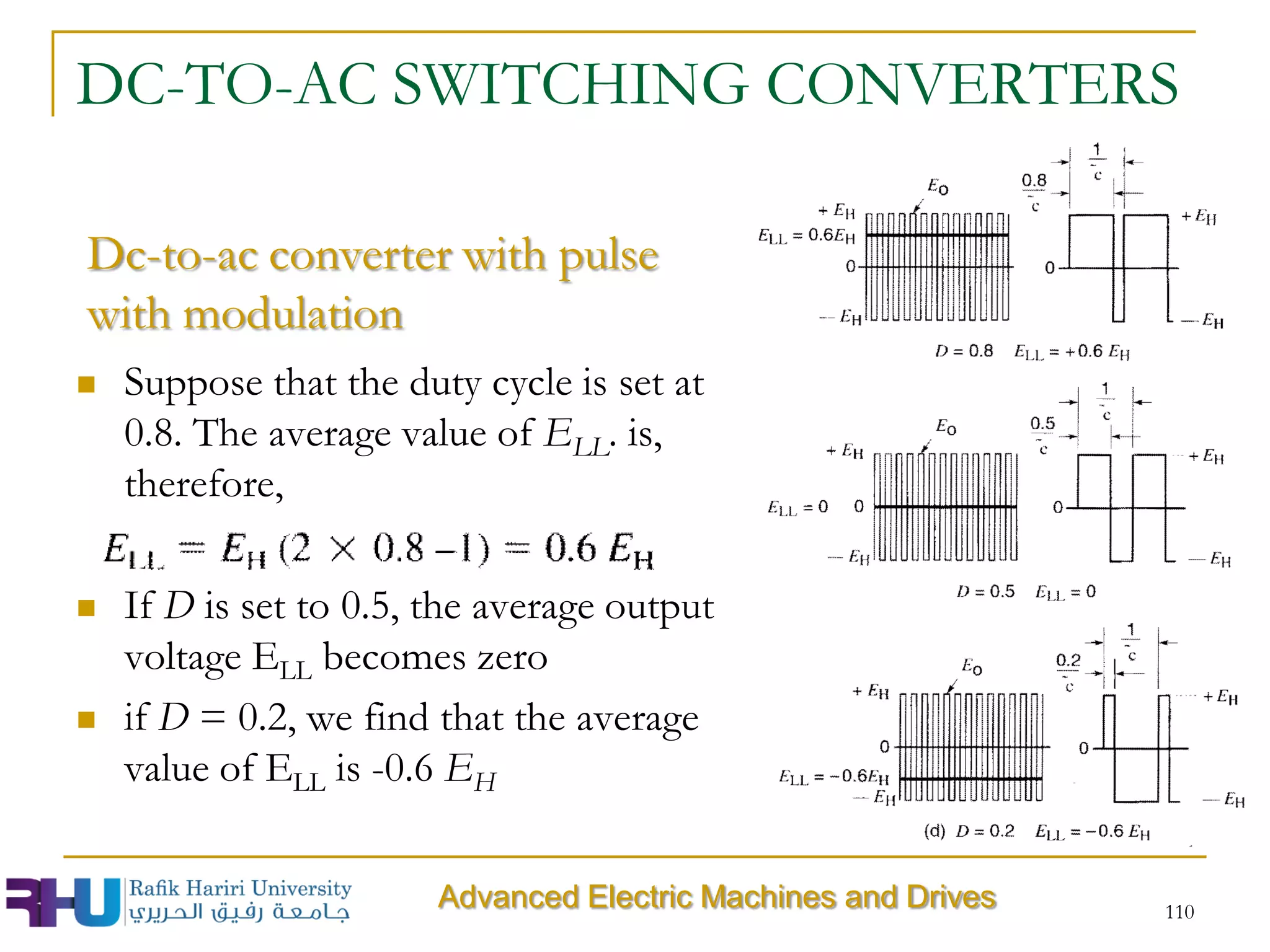
 Suppose that the duty cycle is set at
0.8. The average value of ELL. is,
therefore,
 If D is set to 0.5, the average output
voltage ELL becomes zero
 if D = 0.2, we find that the average
value of ELL is -0.6 EH
110
Advanced Electric Machines and Drives
Dc-to-ac converter with pulse
with modulation
DC-TO-AC SWITCHING CONVERTERS
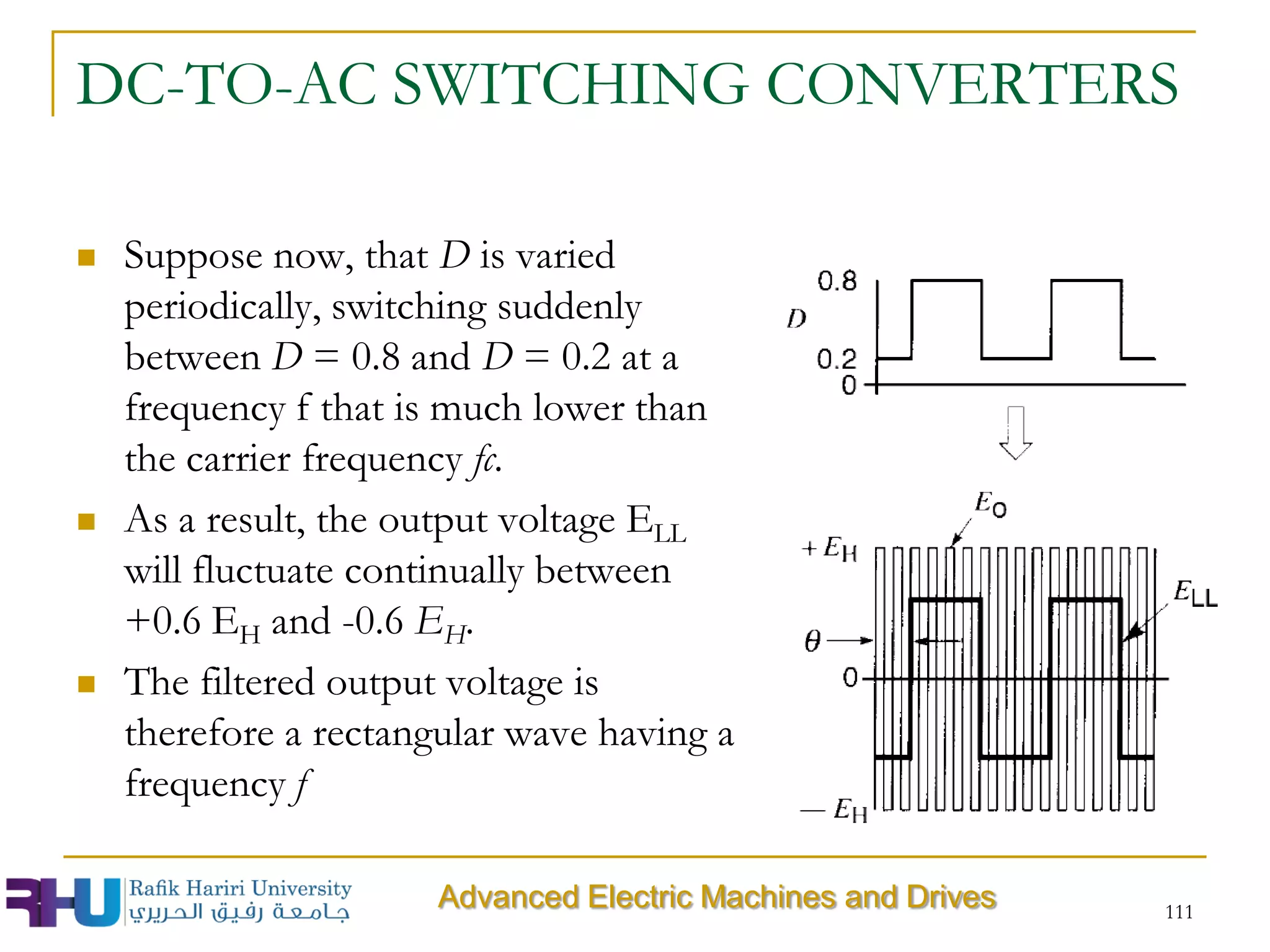
 Suppose now, that D is varied
periodically, switching suddenly
between D = 0.8 and D = 0.2 at a
frequency f that is much lower than
the carrier frequency fc.
 As a result, the output voltage ELL
will fluctuate continually between
+0.6 EH and -0.6 EH.
 The filtered output voltage is
therefore a rectangular wave having a
frequency f
111
Advanced Electric Machines and Drives
DC-TO-AC SWITCHING CONVERTERS
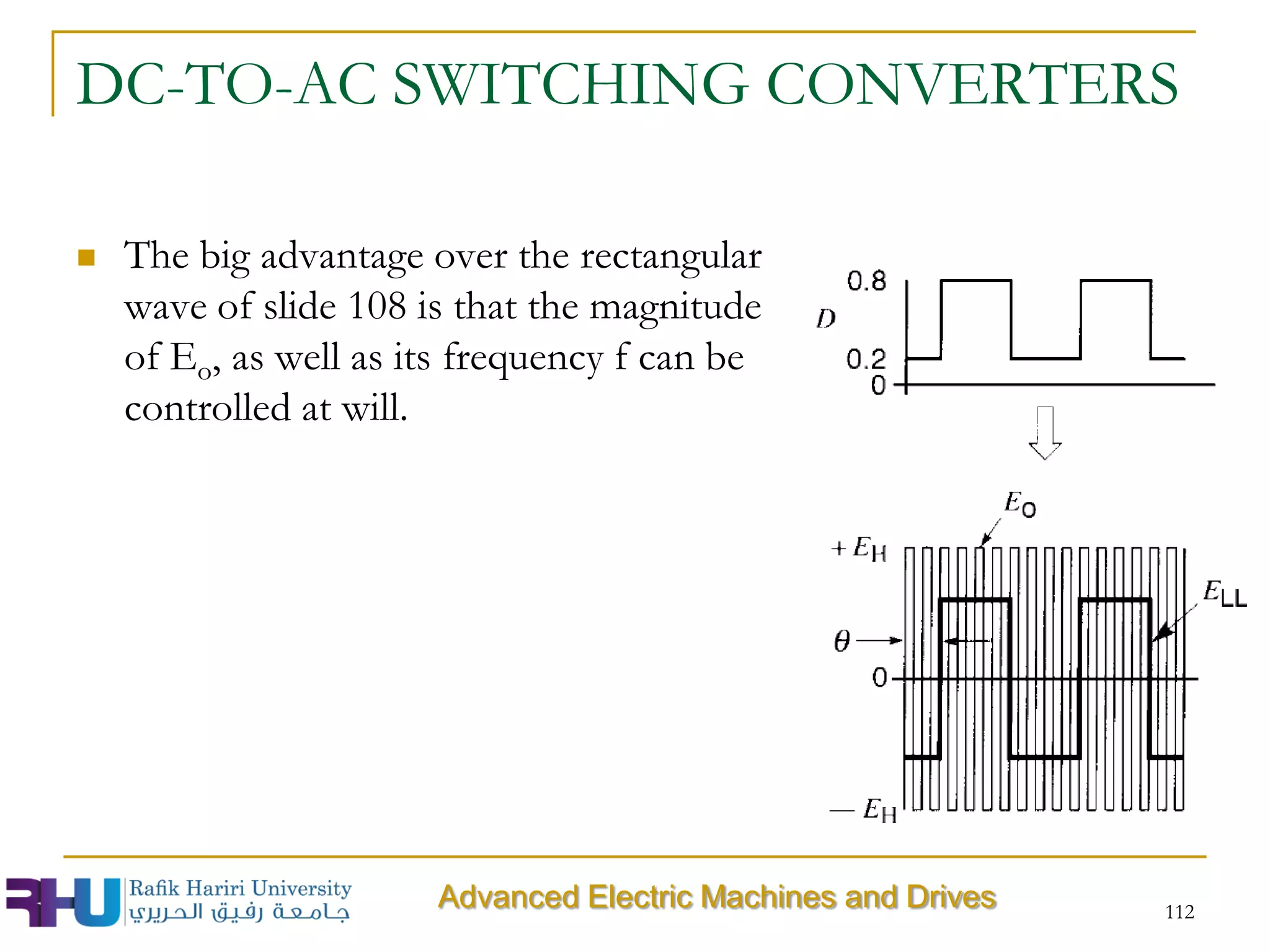
 The big advantage over the rectangular
wave of slide 108 is that the magnitude
of Eo, as well as its frequency f can be
controlled at will.
112
Advanced Electric Machines and Drives
DC-TO-AC SWITCHING CONVERTERS
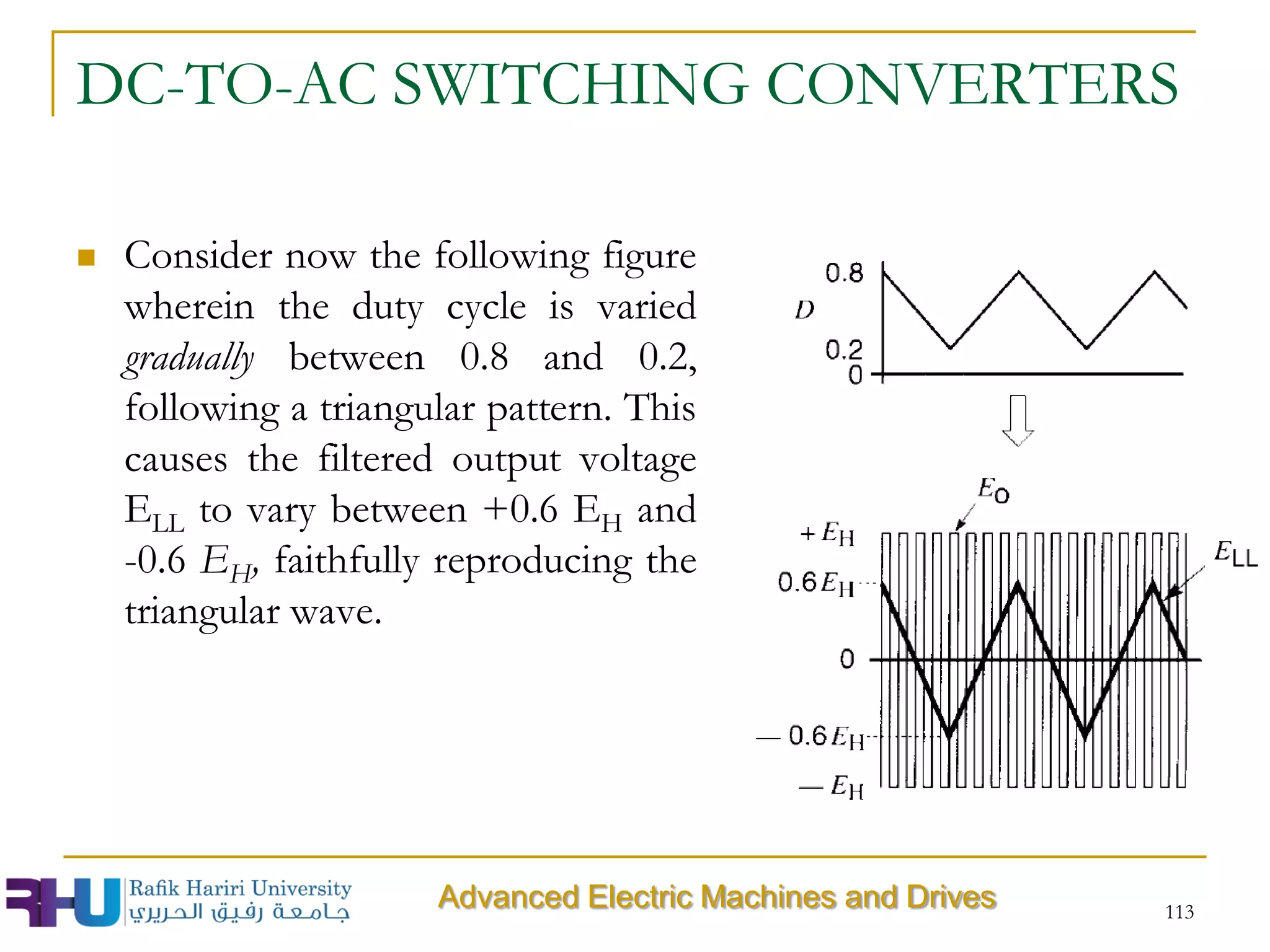
 Consider now the following figure
wherein the duty cycle is varied
gradually between 0.8 and 0.2,
following a triangular pattern. This
causes the filtered output voltage
ELL to vary between +0.6 EH and
-0.6 EH, faithfully reproducing the
triangular wave.
113
Advanced Electric Machines and Drives
DC-TO-AC SWITCHING CONVERTERS
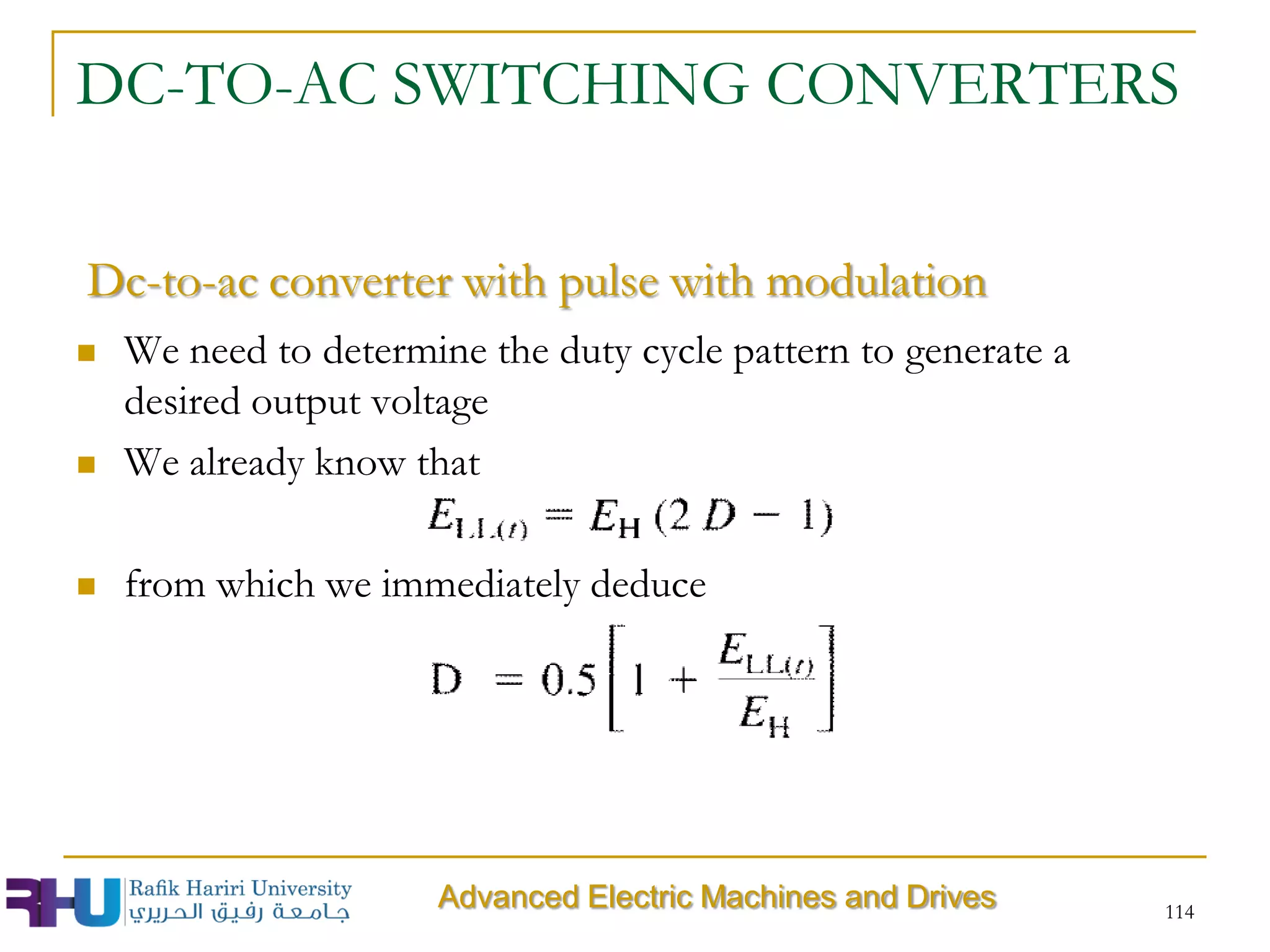
 We need to determine the duty cycle pattern to generate a
desired output voltage
 We already know that
 from which we immediately deduce
114
Advanced Electric Machines and Drives
Dc-to-ac converter with pulse with modulation
DC-TO-AC SWITCHING CONVERTERS
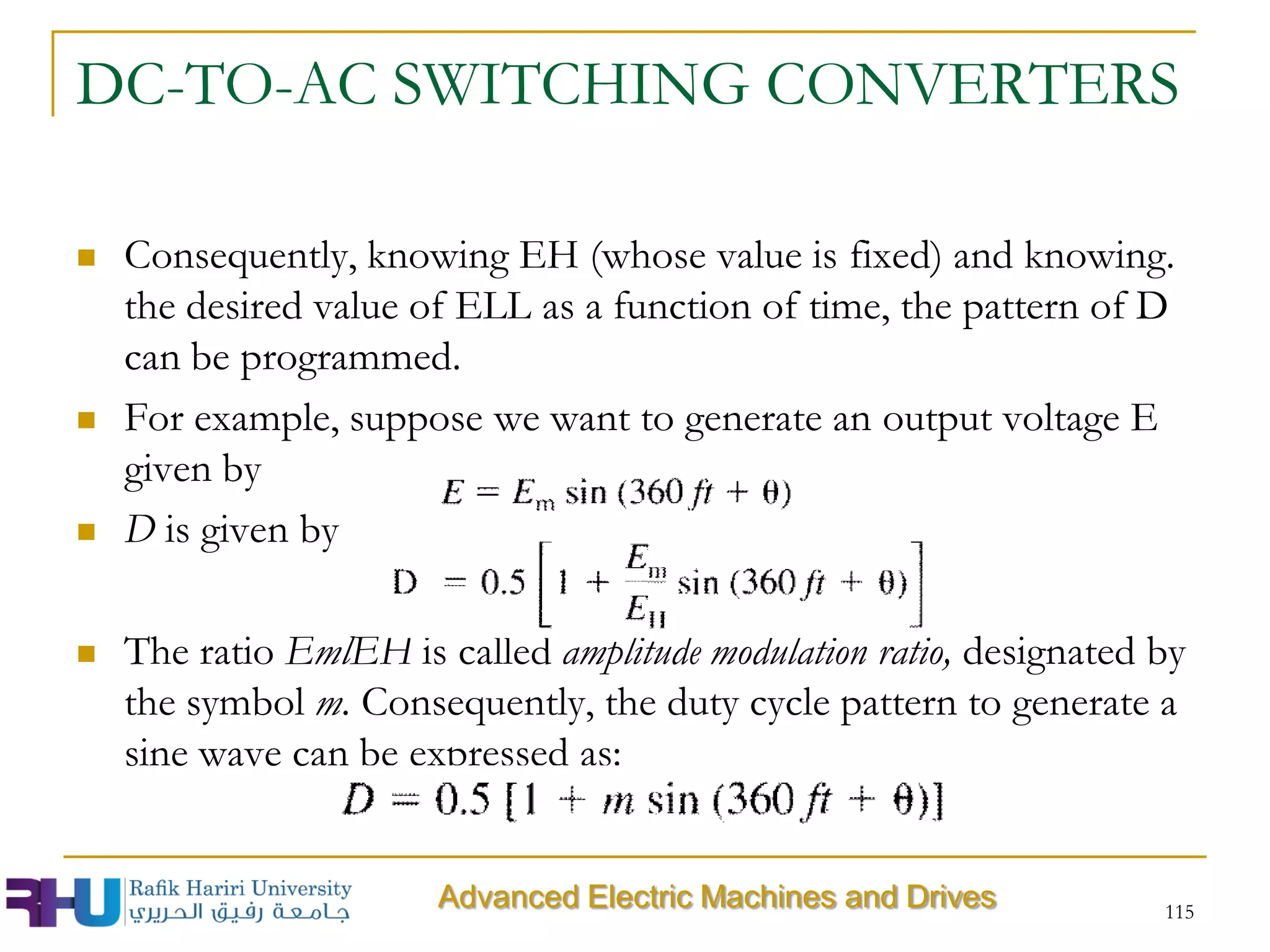
 Consequently, knowing EH (whose value is fixed) and knowing.
the desired value of ELL as a function of time, the pattern of D
can be programmed.
 For example, suppose we want to generate an output voltage E
given by
 D is given by
 The ratio EmlEH is called amplitude modulation ratio, designated by
the symbol m. Consequently, the duty cycle pattern to generate a
sine wave can be expressed as:
115
Advanced Electric Machines and Drives
Exercise
 A 200 V dc source is connected to a 4-quadrant switching
converter operating at a carrier frequency of 8 kHz. It is desired
to generate a sinusoidal voltage having an effective value of 120
V at a frequency of 97 Hz and phase angle of 35° lagging.
Calculate the value of the amplitude modulation ratio and derive
an expression for the duty cycle .
116
Advanced Electric Machines and Drives

Elec581 chapter 2 - fundamental elements of power eletronics

  • 1.
    Chapter 2 Fundamental Elementsof Power Electronics
  • 2.
     To understandthe operation of electronic circuits, it is useful to imagine that individual terminals have a potential level with respect to a reference terminal.  The reference terminal is any convenient point chosen in a circuit it is assumed to have zero electric potential.  The potential level of all other points is then measured with respect to this zero reference. 2 Introduction Potential level Advanced Electric Machines and Drives
  • 3.
    3 Advanced Electric Machinesand Drives Potential level Introduction
  • 4.
    4 Voltage across somecircuit elements Advanced Electric Machines and Drives Sources  By definition, ideal ac and dc voltage sources have zero internal impedance. We suppose that nothing that happens in a circuit can modify these levels.
  • 5.
    5 Voltage across somecircuit elements Advanced Electric Machines and Drives Potential across a switch  When a switch is open, the voltage across its terminals depends exclusively upon the external elements that make up the circuit.  On the other hand, when the switch is closed the potential level of both terminals.  This simple rule also applies to idealized transistors, thyristors and diodes, because they behave like perfect switches
  • 6.
    6 Voltage across somecircuit elements Advanced Electric Machines and Drives Potential across a resistor  If no current flows in a resistor. its terminals 3, 4 must be at the same potential, because the IR drop is zero  On the other hand, if the resistor carries a current I, the IR drop produces a corresponding potential difference between the terminals.
  • 7.
     The terminalsof a coil are at the same potential only during those moments when the current is not changing.  If the current varies, the potential difference is given by. 7 Voltage across some circuit elements Advanced Electric Machines and Drives Potential across an inductance
  • 8.
     The terminalsof a capacitor are at the same potential only when the capacitor is completely discharged.  the potential difference between the terminals remains unchanged during those intervals when the current f is zero 8 Voltage across some circuit elements Advanced Electric Machines and Drives Potential across an capacitor
  • 9.
     A finalrule regarding potential levels is worth remembering. Unless we know otherwise. we assume the following initial conditions:. a) All currents in the circuit are zero and none are in the process of changing. b) All capacitors are discharged. 9 Voltage across some circuit elements Advanced Electric Machines and Drives Initial Potential Level
  • 10.
     A diodeis an electronic device possessing two terminals, respectively called anode (A) and cathode (K)  Although it has no moving parts, a diode acts like a high-speed switch whose contacts open and close according to the following rules: 10 The Diode and Diode Circuits Diode Advanced Electric Machines and Drives
  • 11.
    Rule 1. Whenno voltage is applied across a diode. it acts like an open switch. The circuit is therefore open between terminals A and K Rule 2. If we apply an inverse voltage E2 across the diode so that the anode is negative with respect to the cathode, the diode continues to act as an open switch. We say that the diode is reverse biased. 11 Advanced Electric Machines and Drives The Diode and Diode Circuits Diode
  • 12.
    Rule 3. Ifa momentary forward voltage E1 of 0.7 V or more is applied across the terminals so that anode A is slightly positive with respect to the cathode, the terminals become short-circuited. The diode acts like a closed switch and a current I immediately begins to flow from anode to cathode. We say that the diode is forward biased. 12 Advanced Electric Machines and Drives The Diode and Diode Circuits Diode
  • 13.
    Rule 3. Inpractice, while the diode conducts, a small voltage drop appears across its terminals. However, the voltage drop has an upper value of about 1.5V, so it can be neglected in most electronic circuits. It is precisely because the voltage drop is small with respect to other circuit voltages that we can assume the diode is essentially a closed switch when it conducts. 13 Advanced Electric Machines and Drives The Diode and Diode Circuits Diode
  • 14.
    Rule 4. Aslong as current flows, the diode acts like a closed switch. However, if it stops flowing for even as little as 10 µs, the ideal diode immediately returns to its original open state 14 Advanced Electric Machines and Drives The Diode and Diode Circuits Diode
  • 15.
     Diodes havemany applications, some of which are found again and again, in one form or another, in electronic power. 15 Diode circuit- Battery charger circuit with series resistor Advanced Electric Machines and Drives The Diode and Diode Circuits Circuit Waveforms
  • 16.
    16 Diode circuit- Batterycharger circuit with series inductor Advanced Electric Machines and Drives The Diode and Diode Circuits WaveformsCircuit
  • 17.
    17 Diode circuit- Singlephase rectifier Advanced Electric Machines and Drives The Diode and Diode Circuits Circuit Waveforms
  • 18.
     The rectifiercircuits we have studied so far produce pulsating voltages and currents.  In some types of loads, we cannot tolerate such pulsations, and filters must be used to smooth out the valleys and peaks.  The basic purpose of a dc filter is to produce a smooth power flow into a load.  Consequently, a filter must absorb energy whenever the dc voltage or current tends to rise, and it must release energy whenever the voltage or current tends to fall.  In this way the filter tends to maintain a constant voltage and current in the load. 18 The Diode and Diode Circuits Filters Advanced Electric Machines and Drives
  • 19.
     The mostcommon filters are inductors and capacitors.  Inductors store energy in their magnetic field. They tend to maintain a constant current; consequently. they are placed in series with the load.  Capacitors store energy in their electric field. They tend to maintain a constant voltage; consequently, they are placed in parallel with the load 19 The Diode and Diode Circuits Filters Advanced Electric Machines and Drives Circuits
  • 20.
     The greaterthe amount of energy stored in the filter, the better is the filtering action. In the case of a bridge rectifier using an inductor, the peak-to-peak ripple in percent is given by:  ripple peak-to-peak current as a percent of the dc current [%]  WL = dc energy stored in the smoothing inductor [J]  P = dc power drawn by the load [W]  f = frequency of the source [Hz] 20 The Diode and Diode Circuits Filters Advanced Electric Machines and Drives
  • 21.
    We wish tobuild a 135 V, 20 A dc power supply using a single-phase bridge rectifier and an inductive filter. The peak-to-peak current ripple should be about 10%. If a 60 Hz ac source is available, calculate the following: a) The effective value of the ac voltage b) The energy stored in the inductor c) The inductance of the inductor d) The peak-to-peak current ripple 21 The Diode and Diode Circuits Exercise Advanced Electric Machines and Drives
  • 22.
     An exampleof a 3-phase rectifier composed of 3 diodes connected in series with the secondary windings of a 3-phase, delta-wye transformer is shown in the following figure.  The line-to-neutral voltage has a peak value Em. A filter inductance L is connected in series with the load, so that current Id remains essentially ripple-free. 22 The Diode and Diode Circuits Three phase rectifier Advanced Electric Machines and Drives Circuit
  • 23.
    The Diode andDiode Circuits Three phase rectifier Waveforms 23 Advanced Electric Machines and Drives
  • 24.
    The Diode andDiode Circuits Three phase rectifier  The sudden switch over from one diode to another called commutation. When the switchover takes place automatically, it is called natural commutation, or line commutation because it is the line voltage that forces the transfer of current from one diode to the next.  Voltage EKN across the load and inductor pulsates between 0.5 and Em. The ripple voltage is therefore smaller than that produced by a single-phase bridge rectifier. Moreover, the fundamental ripple frequency is three times the supply frequency, which makes it easier to achieve good filtering. 24 Advanced Electric Machines and Drives
  • 25.
     Consider thecircuit of a 3-phase rectifier  The 6 diodes constitute what is called a 3-phase, 6-pulse rectifier. It is called 6-pulse because the currents flowing in the 6 diodes start at 6 different moments during each cycle of the line frequency. However, each diode still conducts for only 120°. The Diode and Diode Circuits Three-phase, 6-pulse rectifier Circuit 25 Advanced Electric Machines and Drives
  • 26.
    The Diode andDiode Circuits Three-phase, 6-pulse rectifier 26 Advanced Electric Machines and Drives
  • 27.
    The Diode andDiode Circuits Three-phase, 6-pulse rectifier Waveforms 27 Advanced Electric Machines and Drives
  • 28.
     The averagedc output voltage is given by  The approximate peak-to-peak current ripple in percent is given by The Diode and Diode Circuits Three-phase, 6-pulse rectifier 28 Advanced Electric Machines and Drives
  • 29.
     A 3-phasebridge rectifier has to supply power to a 360 kW, 240 V dc load. If a 600 V, 3-phase, 60 Hz feeder is available, calculate the following: a) Voltage rating of the 3-phase transformer b) DC current per diode c) PIV across each diode d) Peak-to-peak ripple in the output voltage and its frequency e) Calculate the inductance of the smoothing choke required, if the peak-to-peak ripple in the current is not to exceed 5 percent. 29 The Diode and Diode Circuits Exercise Advanced Electric Machines and Drives
  • 30.
     A thyristoris an electronic switch, similar to a diode, but wherein the instant of conduction can be controlled. Like a diode, a thyristor possesses an anode and a cathode, plus a third terminal called a gate.  To initiate conduction, two conditions have to be met: 30 The Thyristor and Thyristor Circuits What is a thyristor? a) The anode must be positive. b) A current must flow into the gate for at least a few microseconds. In practice, the current is injected by applying a short positive voltage pulse to the gate Advanced Electric Machines and Drives
  • 31.
     As soonas conduction starts, the gate loses all further control. Conduction will only stop when anode current I falls to zero, after which the gate again exerts control.  Basically, a thyristor behaves the same way a diode does except that the gate enables us to initiate conduction precisely when we want to.  This enables us not only to convert ac power into dc power, but also to do the reverse: convert dc power into ac power. 31 The Thyristor and Thyristor Circuits What is a thyristor? Advanced Electric Machines and Drives
  • 32.
     As soonas conduction starts, the gate loses all further control. Conduction will only stop when anode current I falls to zero, after which the gate again exerts control.  Basically, a thyristor behaves the same way a diode does except that the gate enables us to initiate conduction precisely when we want to.  This enables us not only to convert ac power into dc power, but also to do the reverse: convert dc power into ac power. The Thyristor and Thyristor Circuits What is a thyristor? Advanced Electric Machines and Drives 32
  • 33.
     Consider thecircuit of a thyristor and a resistor connected in series across an ac source. A number of short positive pulses Eg is applied to the gate, of sufficient amplitude to initiate conduction, provided the anode is positive. These pulses may be generated by a manual switch or an electronic control circuit. 33 Advanced Electric Machines and Drives The Thyristor and Thyristor Circuits Principle of gate firing
  • 34.
    34 Advanced Electric Machinesand Drives The Thyristor and Thyristor Circuits Principle of gate firing
  • 35.
     When avoltage pulse is applied to the gate, a certain gate current flows. Because the pulses last only a few microseconds, the average power supplied to the gate is very small, in comparison to the average power supplied to the load.  The ratio of the two powers, called power gain, may exceed one million. Thus, an average gate input of only I W may control a load of 1000 k W.  An SCR does not, of course, have the magical property of turning one watt into a million watts. The large power actually comes from an appropriate power source, and the SCR gate only serves to control the power flow. 35 Advanced Electric Machines and Drives The Thyristor and Thyristor Circuits Power gain of thyristor
  • 36.
    36 Advanced Electric Machinesand Drives  A thyristor ceases to conduct and the gate regains control only after the anode current falls to zero.  The current may cease flowing quite naturally at the end of each cycle or we can force it to zero artificially. Such forced commutation is required in some circuits where the anode current has to be interrupted at a specific instant.  The availability of GTOs, MOSFETs, and IGBTs has largely eliminated the need to use thyristors in such force-com mutated applications. For this reason, in the following discussion of thyristor power circuits, we consider only those involving line commutation. The Thyristor and Thyristor Circuits Current interruption and forced commutation
  • 37.
     Consider acircuit in which a thyristor and a load resistor R are connected in series across a dc source E.  If we apply a single positive pulse to the gate, the resulting dc load current I will flow indefinitely thereafter.  We can stop conduction in the SCR in one of 3 ways: a) Momentarily reduce the dc supply voltage E to zero. b) Open the load circuit by means of a switch. c) Force the anode current to zero for a brief period. 37 Advanced Electric Machines and Drives The Thyristor and Thyristor Circuits Current interruption and forced commutation
  • 38.
     Another techniqueconsists of using 2 thyristors.  A load R can be switched on and off by alternately firing thyristors Q 1 and Q2. 38 Advanced Electric Machines and Drives The Thyristor and Thyristor Circuits Current interruption and forced commutation
  • 39.
    Basic thyristor powercircuits  Thyristors are used in many different ways.  However, in power electronics, six basic circuits cover about 90 percent of all industrial applications. These circuits, and some of their applications, are: 1. Controlled rectifier supplying a passive load 2. Controlled rectifier supplying an active load 3. Line-commutated inverter supplying an active ac load 4. AC static switch 5. Cycloconverter 6. Three-phase converter 39 Advanced Electric Machines and Drives Current interruption and forced commutation
  • 40.
     By definition,a passive load is one that contains no inherent source of energy (i.e., the resistor).  The following figure shows a resistive load and a thyristor connected in series across a single-phase source. The source produces a sinusoidal voltage having a peak value Em.  The gate pulses are synchronized with the line frequency and, in our example. they are delayed by an angle of 90°. 40 Basic thyristor power circuits Controlled rectifier supplying a passive load Advanced Electric Machines and Drives
  • 41.
     It isseen that the current lags behind the voltage because it only flows during the final 90◦.  This lag produces the same effect as an inductive load. Consequently, the ac source has to supply reactive power Q in addition to the active power P.  If the SCR is triggered at zero degrees (the start of the cycle), no reactive power is absorbed by the rectifier. Basic thyristor power circuits Controlled rectifier supplying a passive load Advanced Electric Machines and Drives 41
  • 42.
     The followingfigure shows an ac source Em and a dc load connected by an SCR in series with an inductor.  The load (represented by a battery) receives energy because when the thyristor conducts, current I enters the positive terminal.  Smoothing inductor L limits the peak current to a value within the SCR rating.  Gate pulses Eg initiate conduction at an angle θ1 Basic thyristor power circuits Controlled rectifier supplying an active load Advanced Electric Machines and Drives 42
  • 43.
     Using terminal1 as a zero reference potential, it follows that the potential of terminal 2 lies Ed volts above it.  Furthermore, the potential of terminal A oscillates sinusoidally above and below the level of terminal 1.  If the SCR were replaced by a diode, conduction would begin at angle θ0 because this is the instant when the anode becomes positive.  In our example, conduction only begins when the gate is fired at θ1 degrees. 43 Basic thyristor power circuits Controlled rectifier supplying an active load Advanced Electric Machines and Drives
  • 44.
     An inverter,by definition, changes dc power into ac power. It performs the reverse operation of a rectifier, which converts ac power into dc power. There are two main types of inverters: 1. Self-commutated inverters (also called force commutated inverters) in which the commutation means are included within the power inverter 2. Line-commutated inverters, wherein commutation is effected by virtue of the line voltages on the ac side of the inverter Basic thyristor power circuits Line-commutated inverter Advanced Electric Machines and Drives 44
  • 45.
     In thischapter we examine the operating principle of a line- commutated inverter.  The circuit of such an inverter is identical to that of a controlled rectifier, except that the battery terminals are reversed. 45 Basic thyristor power circuits Line-commutated inverter Advanced Electric Machines and Drives
  • 46.
    46  An acstatic switch is composed of two thyristors connected in anti parallel (back- to-back), so that current can flow in both directions.  The ac current flowing in the load resistor R can be precisely controlled by varying the phase angle α of gates g1 and g2. Thus, if the gate pulses are synchronized with the line frequency, a greater or lesser ac current will flow in the load. Basic thyristor power circuits AC static switch Advanced Electric Machines and Drives
  • 47.
     However, suchdelayed firing will draw reactive power from the line, even if the load is purely resistive. The reason is that the current is displaced behind the voltage.  If the gates are fired at 0° and 180° respectively, the static switch is in the fully closed position.  On the other hand, if neither gate is fired, the switch is in the open position.  Thus, a static switch ca n be used to replace a magnetic contactor.  In contrast to magnetic contactors, an electronic contactor is absolutely silent and its contacts never wear out. 47 Basic thyristor power circuits AC static switch Advanced Electric Machines and Drives
  • 48.
     A cycloconverterproduces low-frequency ac power directly from a higher-frequency ac source.  A simple cycloconverter is shown in the following figure 48 Basic thyristor power circuits Cycloconverter Advanced Electric Machines and Drives
  • 49.
     It consistsof three groups of thyristors, mounted back-to-back and connected to a 3-phase source. They jointly supply single- phase power to a resistive load R. 49 Basic thyristor power circuits Cycloconverter Advanced Electric Machines and Drives
  • 50.
     Suppose allthyristors are initially blocked  Then, for an interval T, the gates of thyristors Q1, Q2, and Q3 are triggered by 4 successive pulses g1, g2, g3, g1, in such a way that the thyristors function as if they were ordinary diodes. 50 Advanced Electric Machines and Drives Basic thyristor power circuits Cycloconverter
  • 51.
     During thenext interval T, thyristors Q4, Q5, Q6, are fired by 4 similar pulses g4, g5, g6, g4. This makes terminal 4 negative with respect to N. The firing process is then repeated for the Q1, Q2, Q3 thyristors, and so on. 51 Advanced Electric Machines and Drives Basic thyristor power circuits Cycloconverter
  • 52.
     Compared toa sine wave, the low-frequency waveshape is rather poor. It is flat-topped and contains a large 180 Hz ripple when the 3-phase frequency is 60 Hz.  Assuming a 60 Hz source, we can show that each half-cycle corresponds to 540º on a 60 Hz base. The duration of T is, therefore, (540/360)x(1/60) =0.025s, which corresponds to a frequency of 1/(2 x 0.025) = 20 Hz. 52 Advanced Electric Machines and Drives Basic thyristor power circuits Cycloconverter
  • 53.
     Obviously, byrepeating the firing sequence g1, g2, g3, g1, ... , we could keep terminal 4 positive for as long as we wish, followed by an equally long negative period, when g4, g5, g6, g4 ... are fired.  In this way we can generate frequencies as low as we want.  This cycloconverter can supply a single-phase load from a 3- phase system, without unbalancing the 3-phase lines. 53 Basic thyristor power circuits Cycloconverter Advanced Electric Machines and Drives
  • 54.
     The 3-phase,6-pulse thyristor converter is one of the most widely used rectifier/inverter units in power electronics.  Three-phase, 6-pulse converters have 6 thyristors connected to the secondary winding of a 3-phase transformer 54 Advanced Electric Machines and Drives 3-phase, 6-pulse controllable converter Basic thyristor power circuits
  • 55.
     Because wecan initiate conduction whenever we want, the thyristors enable us to vary the dc output voltage when the converter operates in the rectifier mode.  The converter can also function as an inverter, provided that a dc source is used in place of the load resistor R. 55 Advanced Electric Machines and Drives 3-phase, 6-pulse controllable converter Basic thyristor power circuits
  • 56.
    56  The converteris fed from a 3-phase transformer. The gates of thyristors Q1 to Q6 are triggered in succession at 60-degree intervals.  The load is represented by a resistor in series with an inductor L.  The inductor is assumed to have a very large inductance, so that the load current Id remains constant.  The two thyristors Q1, Q5 are conducting. A moment later, the thyristors Q2, Q4 conduct. The other thyristors are similarly switched, in sequence. When these steps have been completed, the entire switching cycle repeats.  The switching sequence is similar to that of the diode bridge rectifier Advanced Electric Machines and Drives 3-phase, 6-pulse controllable converter Basic thyristor power circuits
  • 57.
    57 3-phase, 6-pulse controllableconverter Basic thyristor power circuits Advanced Electric Machines and Drives
  • 58.
    58 3-phase, 6-pulse controllableconverter Basic thyristor power circuits Advanced Electric Machines and Drives Delayed triggering - rectifier mode
  • 59.
    59 Advanced Electric Machinesand Drives 3-phase, 6-pulse controllable converter Basic thyristor power circuits Delayed triggering - rectifier mode
  • 60.
    60 3-phase, 6-pulse controllableconverter Basic thyristor power circuits Delayed triggering - rectifier mode Advanced Electric Machines and Drives
  • 61.
    Exercise  The 3-phaseconverter of the following figure is connected to a 3-phase 480V, 60 Hz source. The load consists of a 500 V dc source having an internal resistance of 2Ω. Calculate the power supplied to the load for triggering delays of (a) ]5° and (b) 75°. 61 Advanced Electric Machines and Drives
  • 62.
     If triggeringis delayed by more than 90°, the voltage Ed developed by the converter becomes negative.  This does not produce a negative current because SCRs conduct in only one direction. Consequently, the load current is simply zero. 62 Delayed triggering – inverter mode Basic thyristor power circuits Triggering sequence and waveforms with a delay angle of 105°. Advanced Electric Machines and Drives
  • 63.
     However, wecan force a current to flow by connecting a dc voltage of proper magnitude and polarity across the converter terminals. This external voltage E0 must be slightly greater than Ed in order for current to flow.  The load current is given by 63 Advanced Electric Machines and Drives Basic thyristor power circuits
  • 64.
     Because currentflows out of the positive terminal of E0, the load is actually a source, delivering a power output P= E0Id.  Part of this power is dissipated as heat in the circuit resistance R and the remainder is delivered to the secondaries of the 3-phase transformer. 64 Delayed triggering – inverter mode Basic thyristor power circuits Advanced Electric Machines and Drives
  • 65.
     The originalrectifier has now become an inverter, converting dc power into ac power. The transition from rectifier to inverter is smooth, and requires no change in the converter connections.  In the rectifier mode, the firing angle lies between 0° and 90°, and the load may be active or passive. In the inverter mode, the firing angle lies between 90° and 180°, and a dc source of proper polarity must be provided. 65 Delayed triggering – inverter mode Basic thyristor power circuits Advanced Electric Machines and Drives
  • 66.
    Semiconductor switches  Apartfrom their important gate turn-off feature, GTOs are very similar to ordinary thyristors. The characteristics of both these devices in the on and off states are illustrated in the following figures.  Thus, in the off state, when the current is zero the thyristor can withstand both forward and reverse blocking voltages EAK, up to the maximum limits bounded by the cross-hatched bands 66 Thyristor and GTO Basic Characteristics Advanced Electric Machines and Drives
  • 67.
    67 Semiconductor switches  Duringthe on state, when the thyristor conducts, the figure shows that the EAK voltage drop is about 2 V, and the upper limit of the anode current IAK is again indicated by the crosshatched band. These bands merely indicate the broad-brush maximum values that are currently available. Thyristor and GTO Basic Characteristics Advanced Electric Machines and Drives
  • 68.
    68 Semiconductor switches  Thefigure shows that GTOs are able to withstand forward voltages but not reverse blocking voltages. Furthermore, the voltage drop is about 3 V compared to 2 V for thyristors.  As in the case of a thyristor, conduction in a GTO is initiated by injecting a positive current pulse into the gate. In order to keep conducting, the anode current must not fall below the holding current of the GTO. Thyristor and GTO Basic Characteristics Advanced Electric Machines and Drives
  • 69.
    Semiconductor switches  However,the GTO is a device in which the anode current can be blocked by injecting a strong negative current into the base for a few microseconds. To ensure extinction, the amplitude of the gate pulse has to be about one third the value of the anode current.  GTOs are high-power switches, some of which can handle currents of several thousand amperes at voltages of up to 4000 V. Thyristor and GTO Basic Characteristics Advanced Electric Machines and Drives
  • 70.
    70 Semiconductor switches  Thetransistor has three terminals named collector C, emitter E, and base B. BJT Basic Characteristics  The collector current IC that flows from collector to emitter is initiated and maintained by causing a sustained current IB to flow into the base. When operated as a switch, the base current must be large enough to drive the BJT into conduction. Advanced Electric Machines and Drives
  • 71.
    71 Semiconductor switches  Underthese conditions, the voltage between the collector and emitter is about 2 to 3 volts, at rated collector current. Conduction ceases as soon as the base current is suppressed. BJT Basic Characteristics  The characteristics of the BJT in the on and off states are shown in the upper figure. together with the approximate limits of the collector-emitter voltage ECE and collector current Ic. Note that the transistor cannot tolerate negative values of ECE. Power transistors can carry currents of several hundred amperes and withstand ECE voltages of about 1kV. To establish collector currents of 100A the corresponding base current is typically about 1A. Advanced Electric Machines and Drives
  • 72.
    72 Semiconductor switches  Thepower MOSFET is a voltage-controlled three-terminal device having an anode and cathode, respectively called drain D, source S, and gate G. MOSFET Basic Characteristics  The drain current ID is initiated by applying and maintaining a voltage EGS of about 12V between the gate and the source. Conduction stops whenever EGS falls below a threshold limit (about 1 V). Advanced Electric Machines and Drives
  • 73.
    73 Semiconductor switches  Thegate currents are extremely small; consequently, very little power is needed to drive this electronic switch. The characteristics in the on and off states are shown in the following figure, together with typical maximum BJT Basic Characteristics  limits of drain voltage EDS and drain current ID.  The MOSFET cannot tolerate negative values of EDS To meet this requirement. it has incorporated within it a reverse-biased diode, as shown in the symbol for the device. Advanced Electric Machines and Drives
  • 74.
    74 Semiconductor switches  PowerMOSFETs can carry drain currents of about a hundred amperes and withstand ECE voltages of about 500 V. At rated current, when driven into saturation, the EDS voltage drop ranges from about 2 V to 5 V. BJT Basic Characteristics Advanced Electric Machines and Drives
  • 75.
    75 Semiconductor switches  TheIGBT is also a voltage- controlled switch whose terminals are identified the same way as those in a transistor, namely collector. emitter, and base. The characteristics in the on and off states are shown in the following figure together with the limiting voltages and current.  The collector current in an IGBT is much higher than in a MOSFET. Consequently, the IGBT can handle more power. IGBT Basic Characteristics Advanced Electric Machines and Drives
  • 76.
     Compared toGTOs, an important feature of BJTs, MOSFETs, and IGBTs is their fast turn-on and turn-off times. This enables these switches to be used at much higher frequencies. As a result, the associated transformers. inductors, and capacitors are smaller and cheaper. Typical maximum frequencies are shown in Figs. The following. Another advantage of high-speed switching is that the semiconductor switches can generate lower-frequency voltages and currents whose waveshapes and phase can be tailored to meet almost any requirement. 76 Semiconductor switches IGBT Basic Characteristics Advanced Electric Machines and Drives
  • 77.
    77  In somepower systems there is a need to transform DC power from one DC voltage level to either a higher or lower dc level.  In alternating current systems the voltage step-up or step-down can easily be done with a transformer.  In DC systems, an entirely different approach is required. It  involves the use of a dc-to-dc switching converter.  sometimes called a chopper. Semiconductor switches IGBT Basic Characteristics Advanced Electric Machines and Drives
  • 78.
    DC-to-DC Switching Converter Suppose that power has to be transferred from a high-voltage dc source Es to a lower-voltage dc load E0.  One solution is to connect an inductor between the source and the load and to open and close the circuit periodically with a switch 78 Advanced Electric Machines and Drives
  • 79.
    DC-to-DC Switching Converter 79 AdvancedElectric Machines and Drives
  • 80.
    DC-to-DC Switching Converter When the switch is closed, the voltage across the inductor is eL=ES-E0.  The inductor accumulates volt-seconds, and the resulting current i increases at a constant rate given by:  After time T1, the current is:  The corresponding magnetic energy stored in the inductor is 80
  • 81.
    81  When theswitch opens the current collapses and all the stored energy is dissipated in the arc across the switch. At the same time, a high voltage eL is induced across the inductor because the current is collapsing so quickly.  The polarity of this voltage is opposite to what it was when the current was increasing.  The high negative voltage indicates that the inductor is rapidly discharging the volt-seconds it had previously accumulated. As a result, the current decreases very quickly. DC-to-DC Switching Converter Advanced Electric Machines and Drives
  • 82.
    82  We canprevent the energy loss every time the switch opens and closes by adding a diode to the circuit.  When the switch closes, the current rises to Ia as before. The diode has no effect because its cathode is positive with respect to the anode and so the diode does not conduct. When the switch opens, current i again begins to fall, inducing a voltage eL.  The current eventually becomes zero after a time T2. We can calculate T2 because the volt-seconds accumulated during the charging period T1 must equal the volt-seconds released during the discharge interval Referring DC-to-DC Switching Converter Advanced Electric Machines and Drives
  • 83.
    83 DC-to-DC Switching Converter AdvancedElectric Machines and Drives
  • 84.
    DC-to-DC Switching Converter When the current is zero, the inductor will have delivered all its stored energy to load E0. Simultaneously, the diode will cease to conduct. We can therefore reclose the switch for another interval T1 and repeat the cycle indefinitely.  Consequently, this circuit enables us to transfer energy from a high voltage dc source to a lower-voltage dc load without incurring any losses.  In effect, the inductor absorbs energy at a relatively high voltage (ES-E0) and delivers it at a lower voltage E0. 84 Advanced Electric Machines and Drives
  • 85.
    DC-to-DC Switching Converter The diode is sometimes called a freewheeling diode because it automatically starts conducting as soon as the switch opens and stops conducting when the switch closes.  The switch is actually a GTO, MOSFET, or IGBT, whose on/off state is controlled by a signal applied to the gate. The combination of the electronic switch, inductor, and diode constitutes what is known as a step-down dc-to-dc converter, or buck chopper. 85 Advanced Electric Machines and Drives
  • 86.
    DC-to-DC Switching Converter Referring to the following figure, the switch is closed for an interval Ta and open during an interval Tb.  When the switch is open, the load current falls from its peak value Ia to a lower value Ib.  During this interval, current flows in the inductor, the load, and the freewheeling diode. 86 Advanced Electric Machines and Drives
  • 87.
    DC-to-DC Switching Converter When the current has fallen to a value Ib, the switch recloses. Because the cathode of the diode is now (+), the current in the diode immediately stops flowing, and the source now supplies current Ia. The current then builds up and when it reaches the value Ia (after a time Ta ), the switch reopens.  The freewheeling diode comes into play and the cycle repeats. 87 Advanced Electric Machines and Drives
  • 88.
    DC-to-DC Switching Converter The current supplied to the load fluctuates between Ia and Ib. Its average or DC value I0 is given by:  The average current Is during one cycle (time T) is:  That is, 88 Advanced Electric Machines and Drives
  • 89.
    DC-to-DC Switching Converter Turning our attention to the power aspects, the de power drawn from the source must equal the dc power absorbed by the load because, ideally, there is no power loss in the switch, the inductor, or the freewheeling diode. We can, therefore, write:  E0 can be controlled simply by varying the duty cycle D. Thus, the converter behaves like a highly efficient DC transformer in which the "turns ratio" is D. 89 Advanced Electric Machines and Drives
  • 90.
    DC-to-DC Switching Converter For a given switching frequency, this ratio can be changed as needed by varying the on time of the switch.  In practice, the mechanical switch is replaced by an electronic switch, such as an IGBT. It can be turned on and off at a frequency that may be as high as 50 kHz.  If more power is required. a OTO is used, wherein the frequency could be of the order of 300 Hz. 90 Advanced Electric Machines and Drives
  • 91.
    Exercise1  The switchin the figure below opens and closes at a frequency of 20 Hz and remains closed for 3ms per cycle. A dc ammeter connected in series with the load E0 indicates a current of 70 A. a) If a dc ammeter is connected in series with the source. what current will it indicate? b) What is the average current per pulse? 91 Advanced Electric Machines and Drives
  • 92.
    92 Exercise2 We wish tocharge a 120 V battery from a 600 V dc source using a dc chopper. The average battery current should be 20 A, with a peak-to-peak ripple of 2 A. If the chopper frequency is 200 Hz, calculate the following: a) The dc current drawn from the source b) The duty cycle c) The inductance of the inductor Advanced Electric Machines and Drives
  • 93.
    Basic 2-quadrant dc-to-dcconverter  Consider the following figure in which two mechanical switches S1 to S2 are connected across a dc voltage source EH .  The switches open and close alternately in such a way that when S1 is closed, S2 is open and vice versa.  The time of one cycle is T, and S1 is closed for a period Ta  It follows that the duty cycle of S1 is D = Ta/T, while that of S2 is (1-D). 93 Advanced Electric Machines and Drives
  • 94.
    Basic 2-quadrant dc-to-dcconverter  When S1 is closed, EL=E12=EH  When S2 is closed, E12=0.  The output voltage oscillates, therefore, between EH and zero and its average dc value E1 is given by  By varying D from zero to 1, we can vary the magnitude of EL from zero to EH 94 Advanced Electric Machines and Drives
  • 95.
    Basic 2-quadrant dc-to-dcconverter  Suppose we want to transfer dc power from terminals E12 to a load such as a battery, whose dc voltage E52 has a value E0  An inductor is used as filter  We assume that the load has a small internal resistance R.  Suppose that both the voltage source EH and the duty cycle D are fixed. Consequently, the dc component EL between points 1 and 2 is constant. 95 Advanced Electric Machines and Drives
  • 96.
    Basic 2-quadrant dc-to-dcconverter  If E0 is less than EL, a dc current IL will flow from terminal 1 into terminal 5. Its magnitude is given by  In this mode of operation, with less than EL , the converter acts like the step-down (buck) chopper.  On the other hand, if E0 is greater than EL , a dc current IL will flow out of terminal 5 and into terminal 1.  Its magnitude is:  Power now flows from the low-voltage battery side E0 to the higher voltage side EH.  In this mode of operation, with E0 greater than EL, the converter acts like a step-up (boost) chopper 96 Advanced Electric Machines and Drives
  • 97.
    Four-quadrant dc-to-dc converter A four quadrant converter consists of two identical 2-quadrant converters arranged as shown in the following figure.  Switches Q1, Q2 in converter arm A open and close alternately, as do switches Q3, Q4 in converter arm B.  The switching frequency (assumed to be 100 kHz) is the same for both. 97 Advanced Electric Machines and Drives
  • 98.
    Four-quadrant dc-to-dc converter The switching sequence is such that Q1 and Q4 open and close simultaneously.  Similarly, Q2 and Q3 open and close simultaneously. Consequently, if the duty cycle for Q1 is D, it will also be D for Q4. It follows that the duty cycle for Q2 and Q3 is (1 - D). 98 Advanced Electric Machines and Drives
  • 99.
    Four-quadrant dc-to-dc converter The dc voltage appearing between terminals A, 2 is given by  The dc voltage EB, between terminals B, 2 is  The dc voltage EB between terminals A and B is the difference between EA and EB,:  thus 99 Advanced Electric Machines and Drives
  • 100.
    Four-quadrant dc-to-dc converter the dc voltage is zero when D is 0.5. Furthermore, the voltage changes linearly with D, becoming + EH when D = I, and –EH when D = O.  The polarity of the output voltage can therefore be either positive or negative.  Moreover, if a device is connected between terminals A, B, the direction of dc current flow can be either from A to B or from B to A. 100 Advanced Electric Machines and Drives
  • 101.
    Four-quadrant dc-to-dc converter The following figure shows the wave shape when D =0.5 101 Advanced Electric Machines and Drives
  • 102.
    Four-quadrant dc-to-dc converter 102 The following figure shows the wave shape when D =0.8 Advanced Electric Machines and Drives
  • 103.
     All semiconductorswitches such as GTOs, MOSFETs, and IGBTs have losses that affect their temperature rise and switching efficiency. The switches all function essentially the same way, but to focus our analysis we assume the switching device is a GTO. The switching operation involves four brief intervals:  Turn-On time T1  On-state time T2  Turn-off time T3  Off-state time T4  The sum of T1 + T2 + T3 + T4 is equal to the period T of one cycle which, in turn, is equal to fc where fc is the switching frequency. Switching losses 103 Advanced Electric Machines and Drives
  • 104.
    Switching losses  Duringeach interval the instantaneous power dissipated in the GTO is equal to the product of the instantaneous voltage across it times the instantaneous current that flows through it.  The average power is equal to the energy dissipated in the GTO during one complete cycle, divided by T 104 Advanced Electric Machines and Drives
  • 105.
    105 Switching losses  Turn-Ontime T1  On-state time T2  Turn-off time T3  Off-state time T4 Advanced Electric Machines and Drives
  • 106.
    Switching losses  Thefollowing figure shows a GTO with its anode, cathode, and gate. In addition to the circuit that is being switched (not shown), a snubber is connected to the GTO.  A snubber is an auxiliary circuit composed of R, L, C components (usually including semiconductor devices) that control the magnitude and rate of rise of the anode voltage EAK as well as the anode current I. The purpose of a snubber is to aid commutation and to reduce the losses in the GTO. 106 Advanced Electric Machines and Drives
  • 107.
    Switching losses  Itcan be seen that the dissipation increases with the switching frequency fc and the duty cycle D.  It can be seen also that the dissipation can be reduced if the turn-on and turn-off times are shorter. 107 Advanced Electric Machines and Drives
  • 108.
    DC-TO-AC SWITCHING CONVERTERS We have studied the 2-quadrant and 4-quadrant dc-to-dc switching converters. In this following, we will examine the 4- quadrant converter as a dc-to-ac converter.  We have seen that the converter is able to transform the dc voltage into a rectangular ac voltage.  The rectangular wave can have any frequency 108 Advanced Electric Machines and Drives Dc-to-ac rectangular wave converter
  • 109.
    109 DC-TO-AC SWITCHING CONVERTERS Consider the 4-quadrant dc-to-dc converter of the following figure, which is operating at a constant switching frequency, fc of several kilohertz.  Fc is called carrier frequency. Advanced Electric Machines and Drives Dc-to-ac converter with pulse with modulation
  • 110.
    DC-TO-AC SWITCHING CONVERTERS Suppose that the duty cycle is set at 0.8. The average value of ELL. is, therefore,  If D is set to 0.5, the average output voltage ELL becomes zero  if D = 0.2, we find that the average value of ELL is -0.6 EH 110 Advanced Electric Machines and Drives Dc-to-ac converter with pulse with modulation
  • 111.
    DC-TO-AC SWITCHING CONVERTERS Suppose now, that D is varied periodically, switching suddenly between D = 0.8 and D = 0.2 at a frequency f that is much lower than the carrier frequency fc.  As a result, the output voltage ELL will fluctuate continually between +0.6 EH and -0.6 EH.  The filtered output voltage is therefore a rectangular wave having a frequency f 111 Advanced Electric Machines and Drives
  • 112.
    DC-TO-AC SWITCHING CONVERTERS The big advantage over the rectangular wave of slide 108 is that the magnitude of Eo, as well as its frequency f can be controlled at will. 112 Advanced Electric Machines and Drives
  • 113.
    DC-TO-AC SWITCHING CONVERTERS Consider now the following figure wherein the duty cycle is varied gradually between 0.8 and 0.2, following a triangular pattern. This causes the filtered output voltage ELL to vary between +0.6 EH and -0.6 EH, faithfully reproducing the triangular wave. 113 Advanced Electric Machines and Drives
  • 114.
    DC-TO-AC SWITCHING CONVERTERS We need to determine the duty cycle pattern to generate a desired output voltage  We already know that  from which we immediately deduce 114 Advanced Electric Machines and Drives Dc-to-ac converter with pulse with modulation
  • 115.
    DC-TO-AC SWITCHING CONVERTERS Consequently, knowing EH (whose value is fixed) and knowing. the desired value of ELL as a function of time, the pattern of D can be programmed.  For example, suppose we want to generate an output voltage E given by  D is given by  The ratio EmlEH is called amplitude modulation ratio, designated by the symbol m. Consequently, the duty cycle pattern to generate a sine wave can be expressed as: 115 Advanced Electric Machines and Drives
  • 116.
    Exercise  A 200V dc source is connected to a 4-quadrant switching converter operating at a carrier frequency of 8 kHz. It is desired to generate a sinusoidal voltage having an effective value of 120 V at a frequency of 97 Hz and phase angle of 35° lagging. Calculate the value of the amplitude modulation ratio and derive an expression for the duty cycle . 116 Advanced Electric Machines and Drives