Energy Logic:
                               A Roadmap for Reducing Energy
                               Consumption in the Data Center

                               Emerson Network Power


© 2007 Emerson Network Power
Agenda

              Energy efficiency:
                     efficiency
                – Where we are today
                – What data center managers are looking for
              Energy-saving strategies
                – Energy Logic: data center model
                – Impact of Energy Logic
                        • Cascade effect
                        • Energy consumption
                        • Capacity freed up
                        • Payback
                – The 10 strategies
              Recommendations and key take-aways

2   © 2007 Emerson Network Power
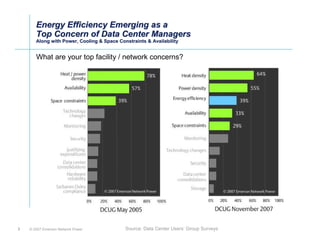
Energy Efficiency Emerging as a
       Top Concern of Data Center Managers
       Along with Power, Cooling & Space Constraints & Availability
       Along with Power, Cooling & Space Constraints & Availability


       What are your top facility / network concerns?


3   © 2007 Emerson Network Power            Source: Data Center Users’ Group Surveys
IT Perspective on Energy Efficiency

             Top priority is delivering on service level agreements
               – Performance - provide adequate compute capacity
               – Reliability - redundancy at all steps
               – Ability to support
               – Security

             Does IT care about energy efficiency?
               – Yes, but not if it impacts performance and reliability

             What if it frees up power and cooling capacity?
               – Yes! If it does not impact performance and reliability


4   © 2007 Emerson Network Power
What Data Center Managers Are Looking For

             Objective ‘vendor-neutral’ analysis
             Holistic view of the data center
             Quantification of savings from different strategies
             Prioritization of actions
             Actionable advice
             Tailored to different types of data centers
               – 24x7 vs. 8x5; compute-intensive vs. transaction-intensive
             Payback / ROI analysis to help sell to management


5   © 2007 Emerson Network Power
Agenda

              Energy efficiency
                – Where we are today
                – What data center managers are looking for
              Energy saving Strategies
              Energy-saving strategies
                – Energy Logic: Data center model
                                data Center Model
                – Impact of Energy Logic
                        • Cascade Effect
                                  effect
                        • Energy consumption
                        • Capacity freed up
                        • Payback
                – The 10 Steps
                         strategies
              Recommendations and key take-aways

6   © 2007 Emerson Network Power
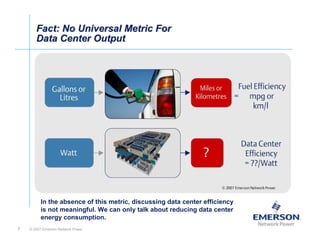
Fact: No Universal Metric For
       Data Center Output


         In the absence of this metric, discussing data center efficiency
         is not meaningful. We can only talk about reducing data center
         energy consumption.
7   © 2007 Emerson Network Power
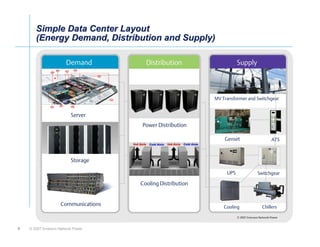
Simple Data Center Layout
       (Energy Demand, Distribution and Supply)


8   © 2007 Emerson Network Power
Energy Logic: What is it?

             Emerson Network Power approach to reducing data
             center energy consumption
             Sequential roadmap that starts with IT equipment and
             moves through to support infrastructure
               – Emphasis is on cascade of savings
             Based on research and modeling
             Provides quantified savings and an estimated ROI
             Frees up power, cooling and space capacity without
             compromising availability or flexibility


9   © 2007 Emerson Network Power
Energy Logic: Three Key Messages

            1. The most effective strategy to save energy:
                       • Start with reducing losses / consumption at the IT
                         equipment level and work your way back through the
                         supporting equipment
                             –      Every watt saved at the equipment level has a cascading
                                    effect upstream

            2. As you reduce energy consumption, make sure you
              do not compromise on availability and flexibility
                       • Efficiency Without CompromiseTM
            3. High-density architecture helps reduce energy
              consumption


10   © 2007 Emerson Network Power
Energy Logic: Model Assumptions
        Model Helps Quantify Impact of Actions
        Model Helps Quantify Impact of Actions


              5,000 sq. ft.
              Server refresh rate: 4 to 5 years
               – Data center has mix of servers ranging from new to 4-years old
               – No virtualization or blades
              No high-density loads
               – Average density ~ 3 kW/rack (120 W/sq. ft.)
              Total compute load about 600 kW
              UPS configuration 2x750 kVA 1+1 redundant
              Hot-aisle / cold-aisle configuration
              Floormount cooling (connected to building chilled water plant)
              MV transformer (5 MVA) at building entrance with associated
              switchgear


11   © 2007 Emerson Network Power
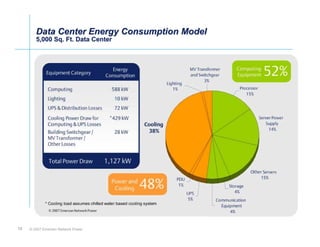
Data Center Energy Consumption Model
        5,000 Sq. Ft. Data Center
        5,000 Sq. Ft. Data Center


12   © 2007 Emerson Network Power
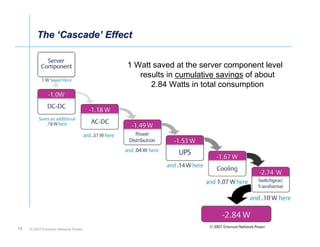
The ‘‘Cascade’ Effect
               Cascade’


                                    1 Watt saved at the server component level
                                       results in cumulative savings of about
                                          2.84 Watts in total consumption


13   © 2007 Emerson Network Power
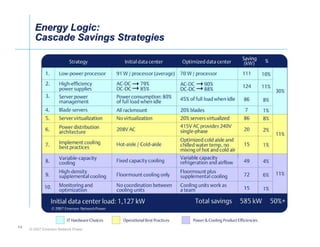
Energy Logic:
       Cascade Savings Strategies


14
     © 2007 Emerson Network Power
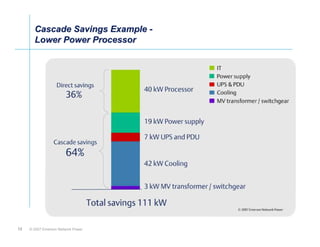
Cascade Savings Example -
       Lower Power Processor


15   © 2007 Emerson Network Power
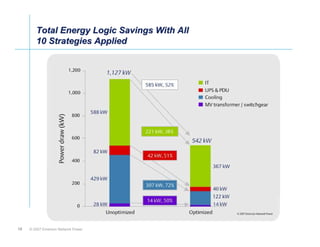
Total Energy Logic Savings With All
        10 Strategies Applied


16   © 2007 Emerson Network Power
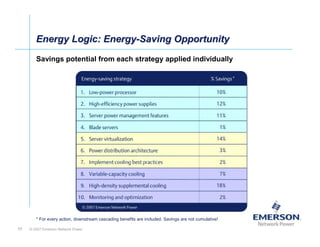
Energy Logic: Energy-Saving Opportunity
                      Energy-Saving
        Savings potential from each strategy applied individually


        * For every action, downstream cascading benefits are included. Savings are not cumulative!

17   © 2007 Emerson Network Power
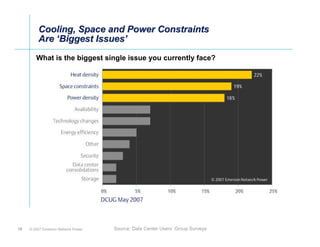
Cooling, Space and Power Constraints
         Are ‘‘Biggest Issues’
               Biggest Issues’
        What is the biggest single issue you currently face?


18   © 2007 Emerson Network Power   Source: Data Center Users’ Group Surveys
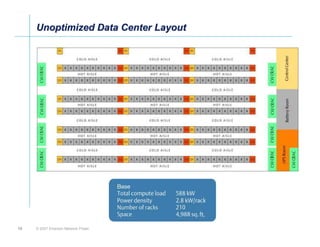
Unoptimized Data Center Layout


19   © 2007 Emerson Network Power
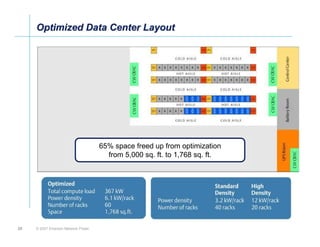
Optimized Data Center Layout


                                    65% space freed up from optimization
                                      from 5,000 sq. ft. to 1,768 sq. ft.


20   © 2007 Emerson Network Power
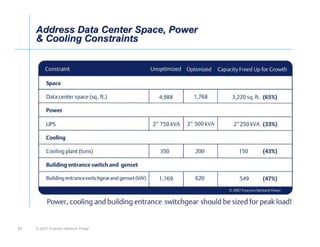
Address Data Center Space, Power
     & Cooling Constraints


21   © 2007 Emerson Network Power
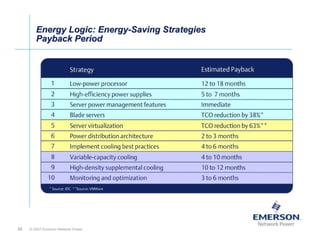
Energy Logic: Energy-Saving Strategies
                      Energy-Saving
        Payback Period


                                                 © 2007 Emerson Network Power


22   © 2007 Emerson Network Power
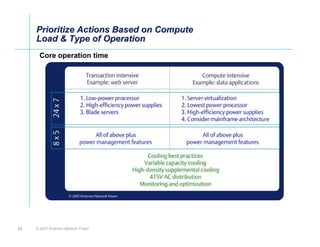
Prioritize Actions Based on Compute
     Load & Type of Operation
      Core operation time
      Core operation time


23   © 2007 Emerson Network Power
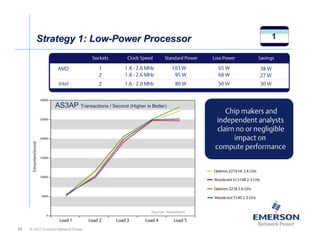
Strategy 1: Low-Power Processor
                    Low-Power                                                1


                  AS3AP Transactions / Second (Higher is Better)


                                                         Source: Anandtech


24   © 2007 Emerson Network Power
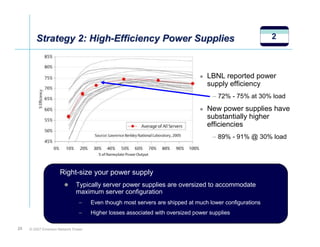
Strategy 2: High-Efficiency Power Supplies
                    High-Efficiency                                                                     2


                                                                                 LBNL reported power
                                                                                 supply efficiency
                                                                                   – 72% - 75% at 30% load
                                                                                 New power supplies have
                                                                                 substantially higher
                                                                                 efficiencies
                                                                                   – 89% - 91% @ 30% load


                     Right-size your power supply
                             Typically server power supplies are oversized to accommodate
                             maximum server configuration
                               –    Even though most servers are shipped at much lower configurations
                               –    Higher losses associated with oversized power supplies

25   © 2007 Emerson Network Power
Strategy 2: High-Efficiency Power Supplies (cont.)
                 High-Efficiency                (cont.)
                                                                                                                   3

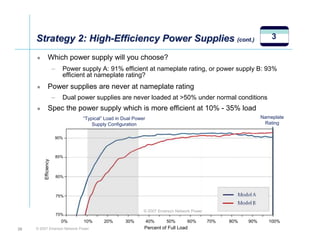
               Which power supply will you choose?
                      –     Power supply A: 91% efficient at nameplate rating, or power supply B: 93%
                            efficient at nameplate rating?
               Power supplies are never at nameplate rating
                      –     Dual power supplies are never loaded at >50% under normal conditions
               Spec the power supply which is more efficient at 10% - 35% load
                                   “Typical” Load in Dual Power                                                Nameplate
                                       Supply Configuration                                                     Rating


                      90%


                          85%
         Efficiency


                          80%


                          75%


                                                              © 2007 Emerson Network Power
                          70%
                            0%     10%      20%       30%         40%   50%       60%        70%   80%   90%      100%
26   © 2007 Emerson Network Power                             Percent of Full Load
Strategy 3: Server Power Management                                      3


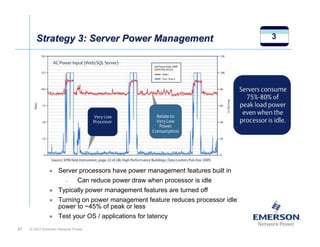
                    Server processors have power management features built in
                        –     Can reduce power draw when processor is idle
                    Typically power management features are turned off
                    Turning on power management feature reduces processor idle
                    power to ~45% of peak or less
                    Test your OS / applications for latency
27   © 2007 Emerson Network Power
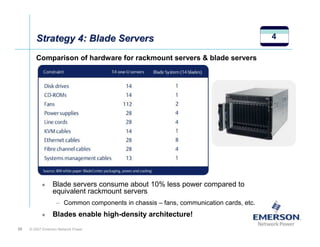
Strategy 4: Blade Servers                                                     4

        Comparison of hardware for rackmount servers & blade servers


                 Blade servers consume about 10% less power compared to
                 equivalent rackmount servers
                   – Common components in chassis – fans, communication cards, etc.
                 Blades enable high-density architecture!
28   © 2007 Emerson Network Power
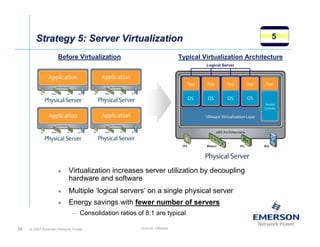
Strategy 5: Server Virtualization                                                          5

                    Before Virtualization
                    Before Virtualization                           Typical Virtualization Architecture
                                                                             Logical Server


                         Virtualization increases server utilization by decoupling
                         hardware and software
                         Multiple ‘logical servers’ on a single physical server
                         Energy savings with fewer number of servers
                           – Consolidation ratios of 8:1 are typical

29   © 2007 Emerson Network Power                  Source: VMware
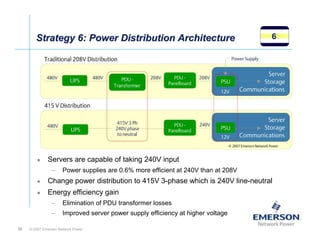
Strategy 6: Power Distribution Architecture                                 6


              Servers are capable of taking 240V input
                –     Power supplies are 0.6% more efficient at 240V than at 208V
              Change power distribution to 415V 3-phase which is 240V line-neutral
              Energy efficiency gain
                –     Elimination of PDU transformer losses
                –     Improved server power supply efficiency at higher voltage

30   © 2007 Emerson Network Power
Strategy 7: Implement Cooling Best Practices                                   7

            Reduce energy waste
              – Improve vapor barrier – unnecessary humidification / dehumidification
              – Reduce solar heat gain; air leakages in the room, under-floor and ceiling
            Optimize airflow
              –     Reduce airflow restrictions under the floor
              –     Arrange racks in hot-aisle / cold-aisle configuration
              –     Reduce air recirculation using blanking plates where appropriate
              –     Place cooling unit at the end of the hot aisle
              –     Use ducts to return hot air to the cooling unit
            Use optimal set points
              – Proper cold aisle temperature – adjust room set point (68°F to 70°F)
              – Raise the chilled water temperature above 45°F
            ASHRAE guideline books available
            Thermal assessments can help jump start the process


31   © 2007 Emerson Network Power
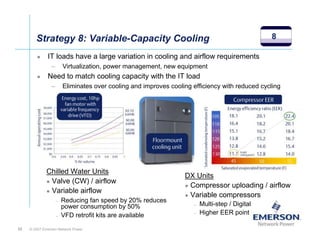
Strategy 8: Variable-Capacity Cooling                                                   8

              IT loads have a large variation in cooling and airflow requirements
                –       Virtualization, power management, new equipment
              Need to match cooling capacity with the IT load
                –       Eliminates over cooling and improves cooling efficiency with reduced cycling


             Chilled Water Units
                                                                  DX Units
              Valve (CW) / airflow
                                                                   Compressor uploading / airflow
              Variable airflow
                                                                   Variable compressors
                    –   Reducing fan speed by 20% reduces
                        power consumption by 50%                     –   Multi-step / Digital
                    –   VFD retrofit kits are available              –   Higher EER point

32   © 2007 Emerson Network Power
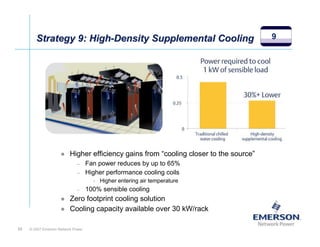
Strategy 9: High-Density Supplemental Cooling
                    High-Density                                                        9


                          Higher efficiency gains from “cooling closer to the source”
                              –     Fan power reduces by up to 65%
                              –     Higher performance cooling coils
                                      •   Higher entering air temperature
                              –     100% sensible cooling
                          Zero footprint cooling solution
                          Cooling capacity available over 30 kW/rack

33   © 2007 Emerson Network Power
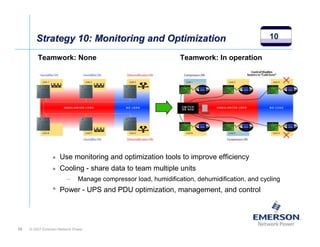
Strategy 10: Monitoring and Optimization                                               10

         Teamwork: None                                         Teamwork: In operation


                     Use monitoring and optimization tools to improve efficiency
                     Cooling - share data to team multiple units
                        –     Manage compressor load, humidification, dehumidification, and cycling
                 •   Power - UPS and PDU optimization, management, and control


34   © 2007 Emerson Network Power
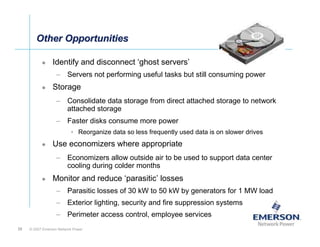
Other Opportunities

                 Identify and disconnect ‘ghost servers’
                   – Servers not performing useful tasks but still consuming power
                 Storage
                   – Consolidate data storage from direct attached storage to network
                     attached storage
                   – Faster disks consume more power
                          • Reorganize data so less frequently used data is on slower drives
                 Use economizers where appropriate
                   – Economizers allow outside air to be used to support data center
                     cooling during colder months
                 Monitor and reduce ‘parasitic’ losses
                   – Parasitic losses of 30 kW to 50 kW by generators for 1 MW load
                   – Exterior lighting, security and fire suppression systems
                   – Perimeter access control, employee services
35   © 2007 Emerson Network Power
Agenda

               Energy efficiency
                 – Where we are today
                 – What data center managers are looking for
               Energy-saving strategies
                 – Energy Logic: data center model
                 – Impact of Energy Logic
                         • Cascade effect
                         • Energy consumption
                         • Capacity freed up
                         • Payback
                 – The 10 Strategies
               Recommendations & key take-aways

36   © 2007 Emerson Network Power
So What Should Data Center Managers Do?
          Existing facilities
            – Set in place equipment purchase policies (involve procurement dept)
                    • When replacing or buying new servers and IT equipment, specify
                              – Lowest power processors
                              – Most efficient power supplies, at part loads (20% - 35% load)
                              – Enable server power management features
                    • Savings will not accrue immediately, but over time
            – Start IT projects
                    • Move toward blade servers wherever possible (enables high density)
                    • Evaluate and implement server virtualization
            – Implement best practices
                    • Alternate power distribution architecture
                    • Cooling best practices
            – Infrastructure upgrade
                    • Variable-capacity cooling
                    • High-density supplemental cooling
                    • Monitoring and optimization
          Greenfield sites
            –     Design with all strategies implemented on day one or as early as possible!
37   © 2007 Emerson Network Power
Four
        Energy Logic: Three Key Messages
        Energy Logic: Three Key Messages

            1. The most effective strategy to save energy:
                       • Start with reducing losses / consumption at the IT equipment level
                         and work your way back through the supporting equipment
                             –      Every watt saved at the equipment level has a cascading
                                    effect upstream
            2. As you reduce energy consumption, make sure you do not
               compromise on availability and flexibility
                       • Efficiency Without CompromiseTM
            3. High-density architecture helps reduce energy consumption
            4. Even if efficiency is not your key concern, implementing these
               strategies will free up capacity of your key constraints – power,
               cooling & space


38   © 2007 Emerson Network Power
Questions?
Emerson Network Power

Energy Logic Presentation

  • 1.
    Energy Logic: A Roadmap for Reducing Energy Consumption in the Data Center Emerson Network Power © 2007 Emerson Network Power
  • 2.
    Agenda Energy efficiency: efficiency – Where we are today – What data center managers are looking for Energy-saving strategies – Energy Logic: data center model – Impact of Energy Logic • Cascade effect • Energy consumption • Capacity freed up • Payback – The 10 strategies Recommendations and key take-aways 2 © 2007 Emerson Network Power
  • 3.
    Energy Efficiency Emergingas a Top Concern of Data Center Managers Along with Power, Cooling & Space Constraints & Availability Along with Power, Cooling & Space Constraints & Availability What are your top facility / network concerns? 3 © 2007 Emerson Network Power Source: Data Center Users’ Group Surveys
  • 4.
    IT Perspective onEnergy Efficiency Top priority is delivering on service level agreements – Performance - provide adequate compute capacity – Reliability - redundancy at all steps – Ability to support – Security Does IT care about energy efficiency? – Yes, but not if it impacts performance and reliability What if it frees up power and cooling capacity? – Yes! If it does not impact performance and reliability 4 © 2007 Emerson Network Power
  • 5.
    What Data CenterManagers Are Looking For Objective ‘vendor-neutral’ analysis Holistic view of the data center Quantification of savings from different strategies Prioritization of actions Actionable advice Tailored to different types of data centers – 24x7 vs. 8x5; compute-intensive vs. transaction-intensive Payback / ROI analysis to help sell to management 5 © 2007 Emerson Network Power
  • 6.
    Agenda Energy efficiency – Where we are today – What data center managers are looking for Energy saving Strategies Energy-saving strategies – Energy Logic: Data center model data Center Model – Impact of Energy Logic • Cascade Effect effect • Energy consumption • Capacity freed up • Payback – The 10 Steps strategies Recommendations and key take-aways 6 © 2007 Emerson Network Power
  • 7.
    Fact: No UniversalMetric For Data Center Output In the absence of this metric, discussing data center efficiency is not meaningful. We can only talk about reducing data center energy consumption. 7 © 2007 Emerson Network Power
  • 8.
    Simple Data CenterLayout (Energy Demand, Distribution and Supply) 8 © 2007 Emerson Network Power
  • 9.
    Energy Logic: Whatis it? Emerson Network Power approach to reducing data center energy consumption Sequential roadmap that starts with IT equipment and moves through to support infrastructure – Emphasis is on cascade of savings Based on research and modeling Provides quantified savings and an estimated ROI Frees up power, cooling and space capacity without compromising availability or flexibility 9 © 2007 Emerson Network Power
  • 10.
    Energy Logic: ThreeKey Messages 1. The most effective strategy to save energy: • Start with reducing losses / consumption at the IT equipment level and work your way back through the supporting equipment – Every watt saved at the equipment level has a cascading effect upstream 2. As you reduce energy consumption, make sure you do not compromise on availability and flexibility • Efficiency Without CompromiseTM 3. High-density architecture helps reduce energy consumption 10 © 2007 Emerson Network Power
  • 11.
    Energy Logic: ModelAssumptions Model Helps Quantify Impact of Actions Model Helps Quantify Impact of Actions 5,000 sq. ft. Server refresh rate: 4 to 5 years – Data center has mix of servers ranging from new to 4-years old – No virtualization or blades No high-density loads – Average density ~ 3 kW/rack (120 W/sq. ft.) Total compute load about 600 kW UPS configuration 2x750 kVA 1+1 redundant Hot-aisle / cold-aisle configuration Floormount cooling (connected to building chilled water plant) MV transformer (5 MVA) at building entrance with associated switchgear 11 © 2007 Emerson Network Power
  • 12.
    Data Center EnergyConsumption Model 5,000 Sq. Ft. Data Center 5,000 Sq. Ft. Data Center 12 © 2007 Emerson Network Power
  • 13.
    The ‘‘Cascade’ Effect Cascade’ 1 Watt saved at the server component level results in cumulative savings of about 2.84 Watts in total consumption 13 © 2007 Emerson Network Power
  • 14.
    Energy Logic: Cascade Savings Strategies 14 © 2007 Emerson Network Power
  • 15.
    Cascade Savings Example- Lower Power Processor 15 © 2007 Emerson Network Power
  • 16.
    Total Energy LogicSavings With All 10 Strategies Applied 16 © 2007 Emerson Network Power
  • 17.
    Energy Logic: Energy-SavingOpportunity Energy-Saving Savings potential from each strategy applied individually * For every action, downstream cascading benefits are included. Savings are not cumulative! 17 © 2007 Emerson Network Power
  • 18.
    Cooling, Space andPower Constraints Are ‘‘Biggest Issues’ Biggest Issues’ What is the biggest single issue you currently face? 18 © 2007 Emerson Network Power Source: Data Center Users’ Group Surveys
  • 19.
    Unoptimized Data CenterLayout 19 © 2007 Emerson Network Power
  • 20.
    Optimized Data CenterLayout 65% space freed up from optimization from 5,000 sq. ft. to 1,768 sq. ft. 20 © 2007 Emerson Network Power
  • 21.
    Address Data CenterSpace, Power & Cooling Constraints 21 © 2007 Emerson Network Power
  • 22.
    Energy Logic: Energy-SavingStrategies Energy-Saving Payback Period © 2007 Emerson Network Power 22 © 2007 Emerson Network Power
  • 23.
    Prioritize Actions Basedon Compute Load & Type of Operation Core operation time Core operation time 23 © 2007 Emerson Network Power
  • 24.
    Strategy 1: Low-PowerProcessor Low-Power 1 AS3AP Transactions / Second (Higher is Better) Source: Anandtech 24 © 2007 Emerson Network Power
  • 25.
    Strategy 2: High-EfficiencyPower Supplies High-Efficiency 2 LBNL reported power supply efficiency – 72% - 75% at 30% load New power supplies have substantially higher efficiencies – 89% - 91% @ 30% load Right-size your power supply Typically server power supplies are oversized to accommodate maximum server configuration – Even though most servers are shipped at much lower configurations – Higher losses associated with oversized power supplies 25 © 2007 Emerson Network Power
  • 26.
    Strategy 2: High-EfficiencyPower Supplies (cont.) High-Efficiency (cont.) 3 Which power supply will you choose? – Power supply A: 91% efficient at nameplate rating, or power supply B: 93% efficient at nameplate rating? Power supplies are never at nameplate rating – Dual power supplies are never loaded at >50% under normal conditions Spec the power supply which is more efficient at 10% - 35% load “Typical” Load in Dual Power Nameplate Supply Configuration Rating 90% 85% Efficiency 80% 75% © 2007 Emerson Network Power 70% 0% 10% 20% 30% 40% 50% 60% 70% 80% 90% 100% 26 © 2007 Emerson Network Power Percent of Full Load
  • 27.
    Strategy 3: ServerPower Management 3 Server processors have power management features built in – Can reduce power draw when processor is idle Typically power management features are turned off Turning on power management feature reduces processor idle power to ~45% of peak or less Test your OS / applications for latency 27 © 2007 Emerson Network Power
  • 28.
    Strategy 4: BladeServers 4 Comparison of hardware for rackmount servers & blade servers Blade servers consume about 10% less power compared to equivalent rackmount servers – Common components in chassis – fans, communication cards, etc. Blades enable high-density architecture! 28 © 2007 Emerson Network Power
  • 29.
    Strategy 5: ServerVirtualization 5 Before Virtualization Before Virtualization Typical Virtualization Architecture Logical Server Virtualization increases server utilization by decoupling hardware and software Multiple ‘logical servers’ on a single physical server Energy savings with fewer number of servers – Consolidation ratios of 8:1 are typical 29 © 2007 Emerson Network Power Source: VMware
  • 30.
    Strategy 6: PowerDistribution Architecture 6 Servers are capable of taking 240V input – Power supplies are 0.6% more efficient at 240V than at 208V Change power distribution to 415V 3-phase which is 240V line-neutral Energy efficiency gain – Elimination of PDU transformer losses – Improved server power supply efficiency at higher voltage 30 © 2007 Emerson Network Power
  • 31.
    Strategy 7: ImplementCooling Best Practices 7 Reduce energy waste – Improve vapor barrier – unnecessary humidification / dehumidification – Reduce solar heat gain; air leakages in the room, under-floor and ceiling Optimize airflow – Reduce airflow restrictions under the floor – Arrange racks in hot-aisle / cold-aisle configuration – Reduce air recirculation using blanking plates where appropriate – Place cooling unit at the end of the hot aisle – Use ducts to return hot air to the cooling unit Use optimal set points – Proper cold aisle temperature – adjust room set point (68°F to 70°F) – Raise the chilled water temperature above 45°F ASHRAE guideline books available Thermal assessments can help jump start the process 31 © 2007 Emerson Network Power
  • 32.
    Strategy 8: Variable-CapacityCooling 8 IT loads have a large variation in cooling and airflow requirements – Virtualization, power management, new equipment Need to match cooling capacity with the IT load – Eliminates over cooling and improves cooling efficiency with reduced cycling Chilled Water Units DX Units Valve (CW) / airflow Compressor uploading / airflow Variable airflow Variable compressors – Reducing fan speed by 20% reduces power consumption by 50% – Multi-step / Digital – VFD retrofit kits are available – Higher EER point 32 © 2007 Emerson Network Power
  • 33.
    Strategy 9: High-DensitySupplemental Cooling High-Density 9 Higher efficiency gains from “cooling closer to the source” – Fan power reduces by up to 65% – Higher performance cooling coils • Higher entering air temperature – 100% sensible cooling Zero footprint cooling solution Cooling capacity available over 30 kW/rack 33 © 2007 Emerson Network Power
  • 34.
    Strategy 10: Monitoringand Optimization 10 Teamwork: None Teamwork: In operation Use monitoring and optimization tools to improve efficiency Cooling - share data to team multiple units – Manage compressor load, humidification, dehumidification, and cycling • Power - UPS and PDU optimization, management, and control 34 © 2007 Emerson Network Power
  • 35.
    Other Opportunities Identify and disconnect ‘ghost servers’ – Servers not performing useful tasks but still consuming power Storage – Consolidate data storage from direct attached storage to network attached storage – Faster disks consume more power • Reorganize data so less frequently used data is on slower drives Use economizers where appropriate – Economizers allow outside air to be used to support data center cooling during colder months Monitor and reduce ‘parasitic’ losses – Parasitic losses of 30 kW to 50 kW by generators for 1 MW load – Exterior lighting, security and fire suppression systems – Perimeter access control, employee services 35 © 2007 Emerson Network Power
  • 36.
    Agenda Energy efficiency – Where we are today – What data center managers are looking for Energy-saving strategies – Energy Logic: data center model – Impact of Energy Logic • Cascade effect • Energy consumption • Capacity freed up • Payback – The 10 Strategies Recommendations & key take-aways 36 © 2007 Emerson Network Power
  • 37.
    So What ShouldData Center Managers Do? Existing facilities – Set in place equipment purchase policies (involve procurement dept) • When replacing or buying new servers and IT equipment, specify – Lowest power processors – Most efficient power supplies, at part loads (20% - 35% load) – Enable server power management features • Savings will not accrue immediately, but over time – Start IT projects • Move toward blade servers wherever possible (enables high density) • Evaluate and implement server virtualization – Implement best practices • Alternate power distribution architecture • Cooling best practices – Infrastructure upgrade • Variable-capacity cooling • High-density supplemental cooling • Monitoring and optimization Greenfield sites – Design with all strategies implemented on day one or as early as possible! 37 © 2007 Emerson Network Power
  • 38.
    Four Energy Logic: Three Key Messages Energy Logic: Three Key Messages 1. The most effective strategy to save energy: • Start with reducing losses / consumption at the IT equipment level and work your way back through the supporting equipment – Every watt saved at the equipment level has a cascading effect upstream 2. As you reduce energy consumption, make sure you do not compromise on availability and flexibility • Efficiency Without CompromiseTM 3. High-density architecture helps reduce energy consumption 4. Even if efficiency is not your key concern, implementing these strategies will free up capacity of your key constraints – power, cooling & space 38 © 2007 Emerson Network Power
  • 39.