Traditional study
Why do we
need e-
learning?
E-Learning
E-Learning
 Introduction
 Tools and delivery
 Advantages
 Disadvantages
 Challenges
 Scope
 Conclusion
E-Learning
 'e-Learning exploits interactive technologies and communication
systems to improve the learning experience.
 May also be called web-based training, distance education,
distance learning, distance training
 Use of Internet technology to provide delivery of training &
professional development opportunities
 Bridges the distance between instructor & learner
E-Learning
Advantage of e-learning
 The ability to provide distance learning
 A blended learning/teaching approach
 The use of technology to support a wide range of
educational activity
E-Learning
Disadvantage of e-learning
 Unmotivated learners may fall behind
 Student may feel isolated
 Slow or unreliable internet connection can be frustrating
 Lack of familiar structure and routine may take getting
used to
E-Learning
E-Learning
E-Learning
Challenges
 Finding the right algorithms
 Mindset challenge
 Online interactivity
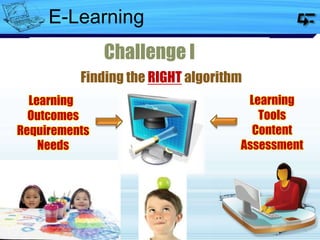
Challenge I
Finding the RIGHT algorithm
Learning
Outcomes
Requirements
Needs
Learning
Tools
Content
Assessment
E-Learning
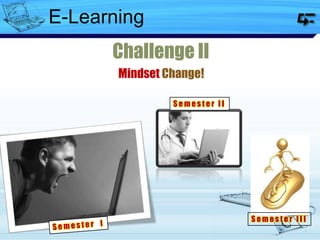
S e m e s t e r I I I
Challenge II
Mindset Change!
S e m e s t e r I I
E-Learning
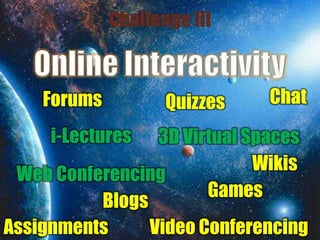
Challenge III
Forums
i-Lectures
Web Conferencing
3D Virtual Spaces
Chat
Video Conferencing
Quizzes
Games
Assignments
Blogs
Wikis
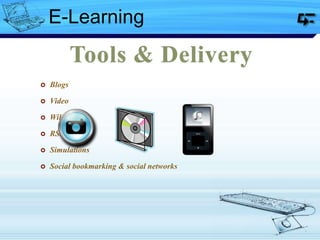
 Blogs
 Video
 Wikis
 RSS
 Simulations
 Social bookmarking & social networks
Tools & Delivery
E-Learning
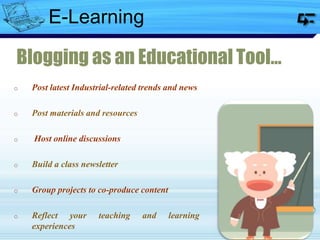
Blogging as an Educational Tool…
o Post latest Industrial-related trends and news
o Post materials and resources
o Host online discussions
o Build a class newsletter
o Group projects to co-produce content
o Reflect your teaching and learning
experiences
E-Learning
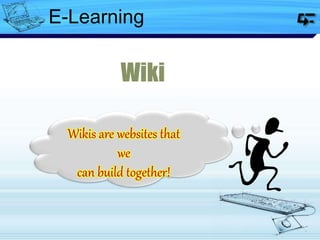
Wiki
Wikis are websites that
we
can build together!
E-Learning
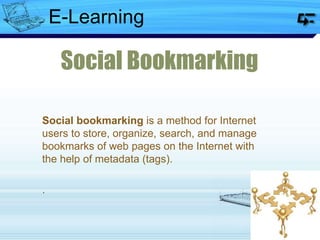
Social Bookmarking
Social bookmarking is a method for Internet
users to store, organize, search, and manage
bookmarks of web pages on the Internet with
the help of metadata (tags).
.
E-Learning
E-learning : Presenting the next
generation virtual class room
E-Learning
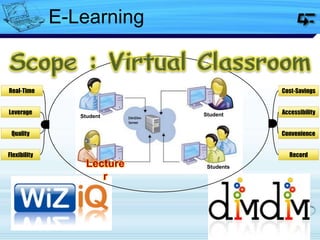
Lecture
r
Student
Students
Student
Cost-Savings
Accessibility
Convenience
RecordFlexibility
Real-Time
Quality
Leverage
E-Learning
Relevan t
Engaging
Fun
In teractive
Collab orative

E-learning