E-learning, or electronic learning, refers to learning facilitated through electronic media like the internet, computers, and mobile devices. It allows for flexible, self-paced learning and includes online courses, virtual classrooms, and digital collaboration. While e-learning began with distance learning via mail, computers and the internet have enabled new forms of virtual education and training. E-learning has several advantages like flexibility, reduced costs, and self-paced learning, but can also lead to isolation and lack of social interaction. It encompasses various approaches including computer-based learning, online training courses, and technology-enhanced collaborative learning.
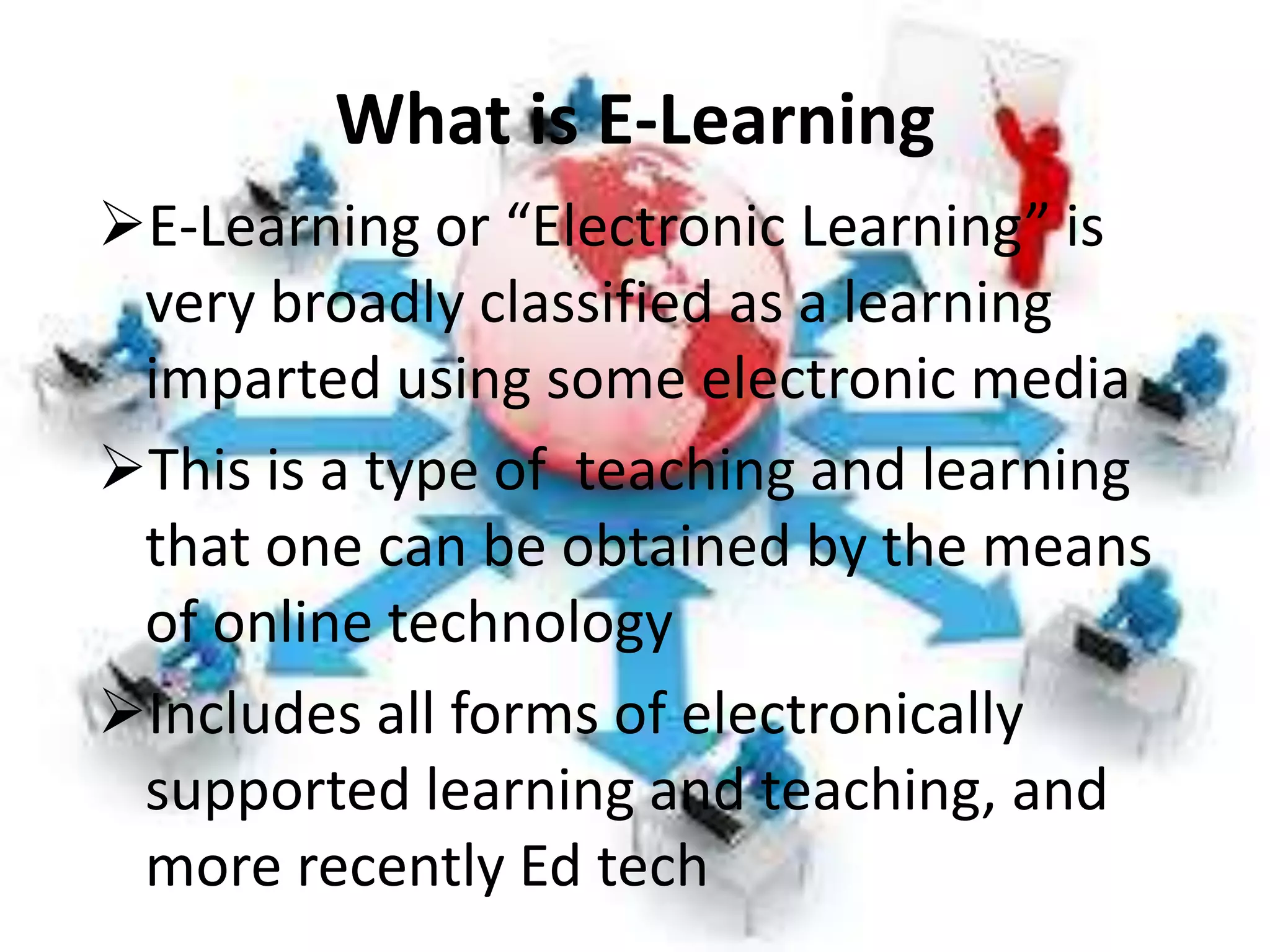
What is E-Learning
E-Learningor “Electronic Learning” is
very broadly classified as a learning
imparted using some electronic media
This is a type of teaching and learning
that one can be obtained by the means
of online technology
Includes all forms of electronically
supported learning and teaching, and
more recently Ed tech
3.
It is thecomputer and network
enabled transfer of skills and
knowledge
E-Learning applications and
processes computer-based learning,
virtual education opportunities and
digital collaboration
It is the computer and network
enabled transfer of skills and
knowledge
E-Learning applications and
processes computer-based learning,
virtual education opportunities and
digital collaboration
4.
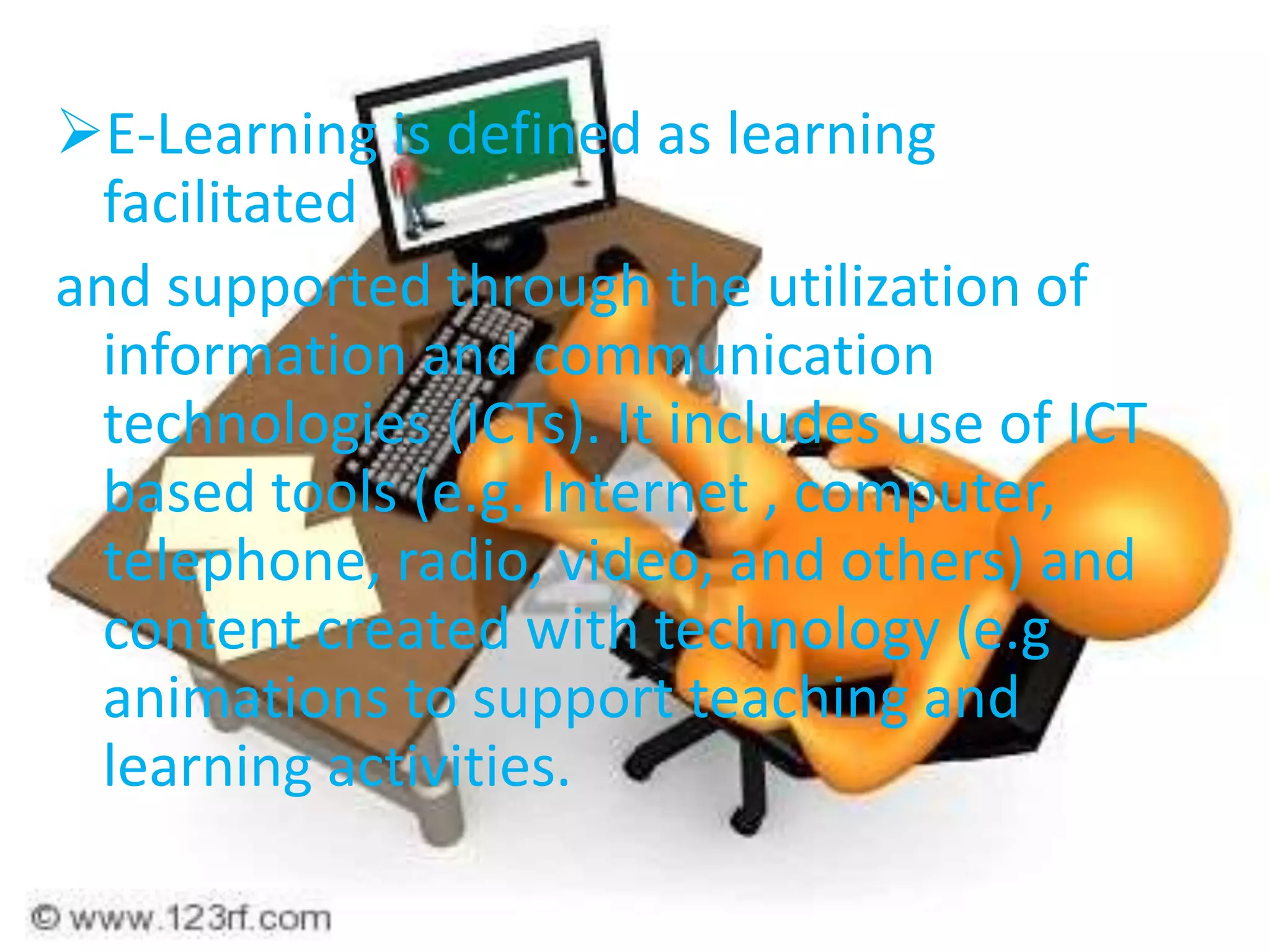
E-Learning is definedas learning
facilitated
and supported through the utilization of
information and communication
technologies (ICTs). It includes use of ICT
based tools (e.g. Internet , computer,
telephone, radio, video, and others) and
content created with technology (e.g
animations to support teaching and
learning activities.
5.
History of E-Learning
E-Learning began at just about the same
time that a computer was developed that
was practical for personal use.
In England (1840)
The improvements to the postal service
made the method of distance learning
popular in the early part of the last century.
6.
This led tolarge number of “through the
mail”
type of education programs.
The Computer only made distance learning
easy and better.
The basic thing that distinguishes distance
education is the physical separation of the
student from the instructor and the
classroom
The early use of computers was geared to
help the classroom instructor
7.
The early attemptsat distance education were
hampered by resistance from traditionalist
within the education field
This led to the early online degrees being
considered inferior to traditionally obtained
degrees
The improvements in E-Learning technology
and the ability to create virtual classrooms and
a virtual learning environment (VLE) has
gradually broken down the resistance
8.
Natalie Aranda
Shewrites about learning and technology
It is used to environment that is computer
enhanced.
Distance learning in virtual classroom is
something that has evolved from E-Learning
It is used to describe a learning environment
that takes place away from the actual
traditional classroom and campus.
9.
What are theadvantages of E-
Learning
Class work can be scheduled around
personal and professional work, resulting in
flexible learning
Reduces travel cost and time to and from
school
Learners may have the option to select
learning materials that meets their level of
knowledge and interest
Learners can study wherever they have
access to a computer and internet
10.
Self-paced learning modulesallow
learners to work at their own place.
Development of computer and internet
skills that transferable to other facts of
learner’s life.
Successfully completing online or
computer-based courses builds self-
knowledge and students to take
responsibility for their learning
11.
What are Disadvantagesof
E-Learning
Unmotivated learners or those with poor
study habits may fall behind
Students may feel isolated or miss social
interaction thus the need to understanding
different learning styles and in individual
learner needs
Slow or unreliable in internet connections can
be frustrating
12.
Why use E-Learning?
o Technology can help the student learn more
effectively and can improve your efficiently
o Students will already be use to accessing
information via mobile phones and the web
o This website’s aim is to help support you in
your use of E-Learning and the colleges
o E-Learning engages younger students and can
help you meet the needs of your students
varied learning styles
13.
Approaches to E-Learning
Computer-basedlearning
refers to the use of computers as a key
component of the educational environment
A specific program which is designed to teach
Computer- based Training
Refers to a self –paced learning activities
accessible via computer or hand device
14.
Computer- supported collaborativelearning
(CSCL)
Is one of the most promising innovations to
improve information and communication
technology
Blogs, wikis, and Google docks are commonly
used CSCL medium within teaching community
Technology-enhanced learning (TEL)
Has the goal to provide socio technical
innovations for E-learning practices, regarding
individuals and organizations, independent of
time and place
15.
The importance ofE-Learning
It is student centered which focuses on
student particular needs. It authorizes
learners of different backdrop to equally
access the superlative resources, learning
and referral materials, tutoring, and
teaching sessions from knowledgeable
instructors




![E learing rose_[autosaved]_rosemarie](https://cdn.slidesharecdn.com/ss_thumbnails/elearingroseautosavedrosemarie-210430035014-thumbnail.jpg?width=640&height=640&fit=bounds)


