L2 Thermoplastic, Thermosetting and Elastomer (sync).pdf
1.
Introduction to PolymerII
Thermoplastic, Thermoset
& Elastomer
Prepared by: Dr Siti Shuhadah binti Md Saleh
October 2024
2.
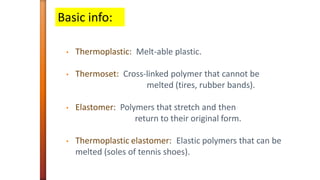
• Thermoplastic: Melt-ableplastic.
• Thermoset: Cross-linked polymer that cannot be
melted (tires, rubber bands).
• Elastomer: Polymers that stretch and then
return to their original form.
• Thermoplastic elastomer: Elastic polymers that can be
melted (soles of tennis shoes).
Basic info:
4.
INTRODUCTION TO THERMOPLASTIC
•There are a wide range of thermoplastics, some
that are rigid and some that are extremely flexible.
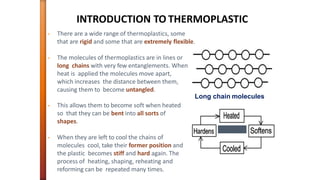
• The molecules of thermoplastics are in lines or
long chains with very few entanglements. When
heat is applied the molecules move apart,
which increases the distance between them,
causing them to become untangled.
Long chain molecules
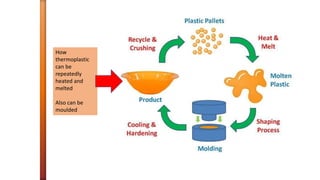
• This allows them to become soft when heated
so that they can be bent into all sorts of
shapes.
• When they are left to cool the chains of
molecules cool, take their former position and
the plastic becomes stiff and hard again. The
process of heating, shaping, reheating and
reforming can be repeated many times.
5.
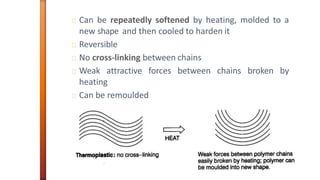
Can be repeatedlysoftened by heating, molded to a
new shape and then cooled to harden it
Reversible
No cross-linking between chains
Weak attractive forces between chains broken by
heating
Can be remoulded
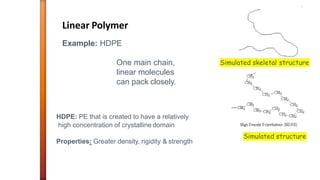
Simulated structure
Simulated skeletalstructure
HDPE: PE that is created to have a relatively
high concentration of crystalline domain
Properties: Greater density, rigidity & strength
Example: HDPE
One main chain,
linear molecules
can pack closely.
Linear Polymer
8.
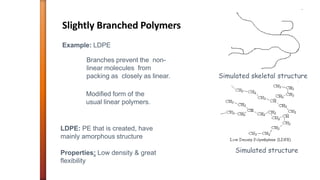
Simulated structure
Simulated skeletalstructure
Example: LDPE
LDPE: PE that is created, have
mainly amorphous structure
Properties: Low density & great
flexibility
Modified form of the
usual linear polymers.
Branches prevent the non-
linear molecules from
packing as closely as linear.
Slightly Branched Polymers
10.
INTRODUCTION TOTHERMOSET
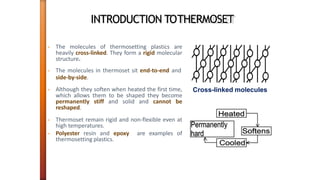
• Themolecules of thermosetting plastics are
heavily cross-linked. They form a rigid molecular
structure.
• The molecules in thermoset sit end-to-end and
side-by-side.
• Although they soften when heated the first time,
which allows them to be shaped they become
permanently stiff and solid and cannot be
reshaped.
• Thermoset remain rigid and non-flexible even at
high temperatures.
• Polyester resin and epoxy are examples of
thermosetting plastics.
Cross-linked molecules
11.
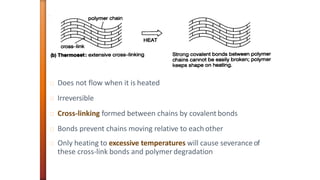
Does not flowwhen it is heated
Irreversible
Cross-linking formed between chains by covalent bonds
Bonds prevent chains moving relative to eachother
Only heating to excessive temperatures will cause severanceof
these cross-link bonds and polymer degradation
12.
Harder, stronger, morebrittle than thermoplastics and have
better dimensional stability
Cannot be recycled, do not melt, are usable at higher
temperatures than thermoplastics, more chemicallyinert
Most of the cross linked and network polymers including:
Vulcanized rubbers
Epoxies
Phenolics
Polyester resins
Formaldehyde based resins (E.g. phenol formaldehyde,
urea formaldehyde, melamine formaldehyde)
13.
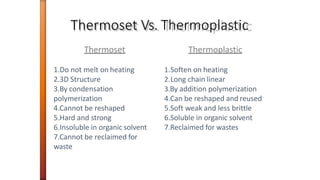
Thermoset Vs. Thermoplastic
1.Donot melt on heating
2.3D Structure
3.By condensation
polymerization
4.Cannot be reshaped
5.Hard and strong
6.Insoluble in organic solvent
7.Cannot be reclaimed for
waste
Thermoset Thermoplastic
1.Soften on heating
2.Long chain linear
3.By addition polymerization
4.Can be reshaped and reused
5.Soft weak and less brittle
6.Soluble in organic solvent
7.Reclaimed for wastes
15.
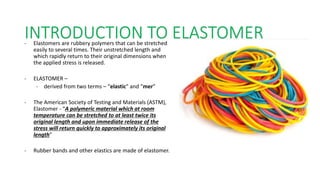
INTRODUCTION TO ELASTOMER
•Elastomers are rubbery polymers that can be stretched
easily to several times. Their unstretched length and
which rapidly return to their original dimensions when
the applied stress is released.
• ELASTOMER –
• derived from two terms – “elastic” and “mer”
• The American Society of Testing and Materials (ASTM),
Elastomer - “A polymeric material which at room
temperature can be stretched to at least twice its
original length and upon immediate release of the
stress will return quickly to approximately its original
length"
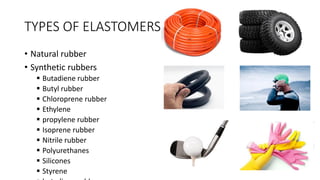
• Rubber bands and other elastics are made of elastomer.
Cross-linked
Cross-linking is theforming of covalent links between the
different polymer chains, joining them all into a single
network molecule.
There are two types of cross-linked or network polymers:
Thermoset
Elastomer
20.
Thermosetcross-linked
Thermosets are polymerswhich do not melt when heated
The molecules are cross-linked by strong covalent
intermolecular bonds and formed one giant molecule
Cross-linking thermoset is irreversible therefore cannot be
reprocessed (re-melt)
For thermoset, cross-linking is achieved in curing process
initiated by heat, chemical agents or radiation, so when heat
applied it formed a network
Degrades (not melts) when heated
Elastomer cross-linked
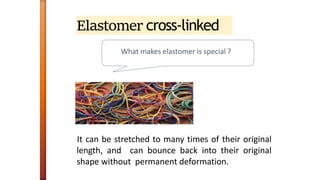
What makeselastomer is special ?
It can be stretched to many times of their original
length, and can bounce back into their original
shape without permanent deformation.
23.
Cross-linking ofRubber: Vulcanization
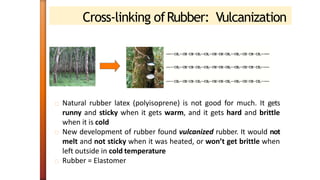
Naturalrubber latex (polyisoprene) is not good for much. It gets
runny and sticky when it gets warm, and it gets hard and brittle
when it is cold
New development of rubber found vulcanized rubber. It would not
melt and not sticky when it was heated, or won’t get brittle when
left outside in cold temperature
Rubber = Elastomer
24.
• The cross-linkingprocess in elastomer is called vulcanization.
• Vulcanization is achieved by a non-reversible chemical reaction,
ordinarily carried out at an elevated temperature.
• In most vulcanizing reactions, sulfur compounds are added to the
heated elastomer
• Unvulcanized rubber (contain very few cross-links) is soft and tacky
and has poor resistance to abrasion.
• Vulcanization enhanced the modulus of elasticity, tensile
strength and resistance to degradation by oxidation.
25.
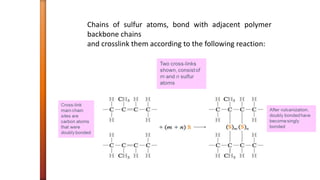
Chains of sulfuratoms, bond with adjacent polymer
backbone chains
and crosslink them according to the following reaction:
26.
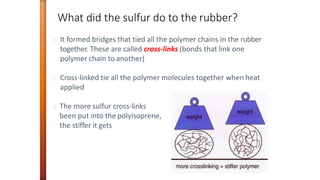
It formed bridgesthat tied all the polymer chains in the rubber
together. These are called cross-links (bonds that link one
polymer chain to another)
Cross-linked tie all the polymer molecules together when heat
applied
The more sulfur cross-links
been put into the polyisoprene,
the stiffer it gets
What did the sulfur do to the rubber?
27.
Thermoplastic Elastomer
The materialsusing reversible cross-link are called
thermoplastic elastomers
Normal cross-linked polymers (thermoset) cannot be recycled because they do
not melt because the cross-links tie all the polymer chains together, making it
impossible for the material to flow .
This is where the reversible cross-link comes in. Normal cross- links are
covalent, chemically bonding the polymer chains together into one molecule.
So, the reversible crosslink uses non-covalent, or secondary interactions
between the polymer chains to bind them together. These interaction include
hydrogen bonding and ionic bonding
The beauty of using non-covalent interactions to form cross-link is that when
the material is heated, the cross-links are broken. This allows the material to
be processed, and most importantly, recycled. When it cools again, the cross-
links reform.
28.
Thermoplastic Elastomer- Advantages
1.Reduction in compounding requirements
2. Easier and more efficient processing cycles
3. Scrap recycling
4. Availability of thermoplastic processing
methods
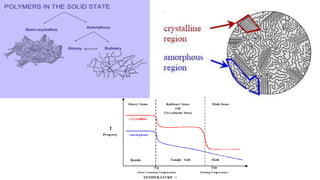
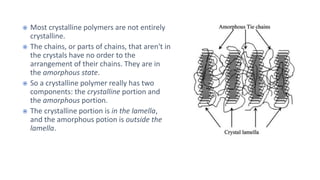
Most crystallinepolymers are not entirely
crystalline.
The chains, or parts of chains, that aren't in
the crystals have no order to the
arrangement of their chains. They are in
the amorphous state.
So a crystalline polymer really has two
components: the crystalline portion and
the amorphous portion.
The crystalline portion is in the lamella,
and the amorphous potion is outside the
lamella.
34.
Amorphous State
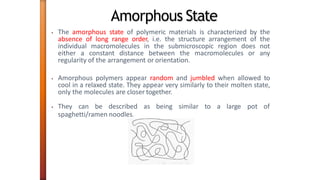
• Theamorphous state of polymeric materials is characterized by the
absence of long range order, i.e. the structure arrangement of the
individual macromolecules in the submicroscopic region does not
either a constant distance between the macromolecules or any
regularity of the arrangement or orientation.
• Amorphous polymers appear random and jumbled when allowed to
cool in a relaxed state. They appear very similarly to their molten state,
only the molecules are closer together.
• They can be described as being similar to a large pot of
spaghetti/ramen noodles.
35.
Crystalline State
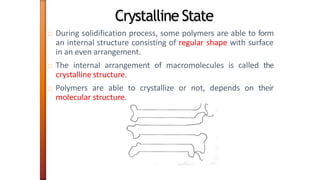
During solidificationprocess, some polymers are able to form
an internal structure consisting of regular shape with surface
in an even arrangement.
The internal arrangement of macromolecules is called the
crystalline structure.
Polymers are able to crystallize or not, depends on their
molecular structure.
36.
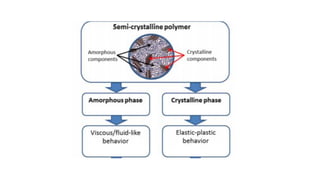
Semi-crystalline State
• Polymerthat contain both crystalline and amorphous region are
called semi-crystalline polymer.
• A portion of the molecular chains in semi-crystalline polymers
tend to ‘fold-up’ into densely packed regions called crystals as the
polymer cools.
• If more than 35% of the polymer chain form these crystals – the
polymer is classified as semi-crystalline.
37.
• Polymers tendto crystallize as they precipitate or are cooled from a
melt.
• Acting to inhibit crystallization are polymers with large molecules.
Complicated and irregular shapes prevent efficient packing into
ordered structures.
• As a result, polymers in the solid state tend to be composed of
▫ ordered crystalline domains
▫ disordered amorphous domains
38.
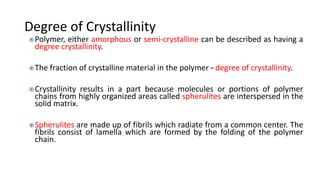
Degree of Crystallinity
Polymer,either amorphous or semi-crystalline can be described as having a
degree crystallinity.
The fraction of crystalline material in the polymer – degree of crystallinity.
Crystallinity results in a part because molecules or portions of polymer
chains from highly organized areas called spherulites are interspersed in the
solid matrix.
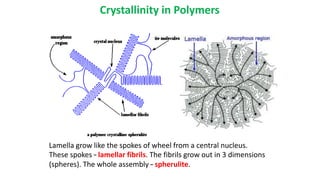
Spherulites are made up of fibrils which radiate from a common center. The
fibrils consist of lamella which are formed by the folding of the polymer
chain.
39.
Crystallinity in Polymers
Lamellagrow like the spokes of wheel from a central nucleus.
These spokes – lamellar fibrils. The fibrils grow out in 3 dimensions
(spheres). The whole assembly – spherulite.
40.
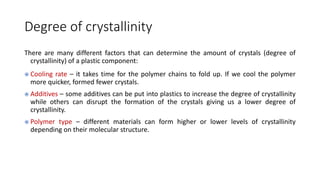
Degree of crystallinity
Thereare many different factors that can determine the amount of crystals (degree of
crystallinity) of a plastic component:
Cooling rate – it takes time for the polymer chains to fold up. If we cool the polymer
more quicker, formed fewer crystals.
Additives – some additives can be put into plastics to increase the degree of crystallinity
while others can disrupt the formation of the crystals giving us a lower degree of
crystallinity.
Polymer type – different materials can form higher or lower levels of crystallinity
depending on their molecular structure.
41.
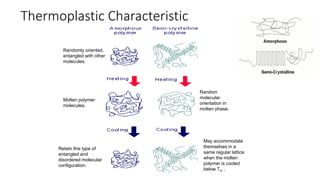
Randomly oriented,
entangled withother
molecules.
Molten polymer
molecules.
Retain this type of
entangled and
disordered molecular
configuration.
May accommodate
themselves in a
same regular lattice
when the molten
polymer is cooled
below Tm .
Random
molecular
orientation in
molten phase.
Thermoplastic Characteristic
42.
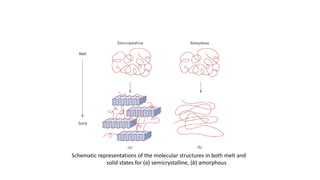
Schematic representations ofthe molecular structures in both melt and
solid states for (a) semicrystalline, (b) amorphous
43.
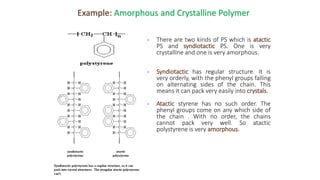
Example: Amorphous andCrystalline Polymer
• There are two kinds of PS which is atactic
PS and syndiotactic PS. One is very
crystalline and one is very amorphous.
• Syndiotactic has regular structure. It is
very orderly, with the phenyl groups falling
on alternating sides of the chain. This
means it can pack very easily into crystals.
• Atactic styrene has no such order. The
phenyl groups come on any which side of
the chain . With no order, the chains
cannot pack very well. So atactic
polystyrene is very amorphous.
44.
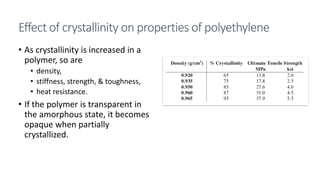
Effect of crystallinityon properties of polyethylene
• As crystallinity is increased in a
polymer, so are
• density,
• stiffness, strength, & toughness,
• heat resistance.
• If the polymer is transparent in
the amorphous state, it becomes
opaque when partially
crystallized.
45.
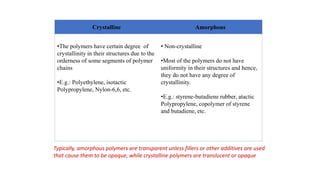
Crystalline Amorphous
•The polymershave certain degree of
crystallinity in their structures due to the
orderness of some segments of polymer
chains
•E.g.: Polyethylene, isotactic
Polypropylene, Nylon-6,6, etc.
• Non-crystalline
•Most of the polymers do not have
uniformity in their structures and hence,
they do not have any degree of
crystallinity.
•E.g.: styrene-butadiene rubber, atactic
Polypropylene, copolymer of styrene
and butadiene, etc.
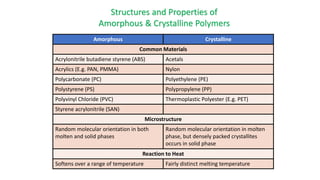
Typically, amorphous polymers are transparent unless fillers or other additives are used
that cause them to be opaque, while crystalline polymers are translucent or opaque
46.
Amorphous Crystalline
Common Materials
Acrylonitrilebutadiene styrene (ABS) Acetals
Acrylics (E.g. PAN, PMMA) Nylon
Polycarbonate (PC) Polyethylene (PE)
Polystyrene (PS) Polypropylene (PP)
Polyvinyl Chloride (PVC) Thermoplastic Polyester (E.g. PET)
Styrene acrylonitrile (SAN)
Microstructure
Random molecular orientation in both
molten and solid phases
Random molecular orientation in molten
phase, but densely packed crystallites
occurs in solid phase
Reaction to Heat
Softens over a range of temperature Fairly distinct melting temperature
Structures and Properties of
Amorphous & Crystalline Polymers
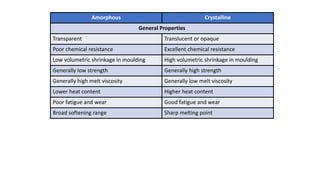
47.
Amorphous Crystalline
General Properties
TransparentTranslucent or opaque
Poor chemical resistance Excellent chemical resistance
Low volumetric shrinkage in moulding High volumetric shrinkage in moulding
Generally low strength Generally high strength
Generally high melt viscosity Generally low melt viscosity
Lower heat content Higher heat content
Poor fatigue and wear Good fatigue and wear
Broad softening range Sharp melting point
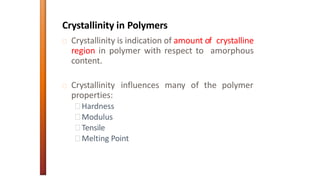
49.
Crystallinity in Polymers
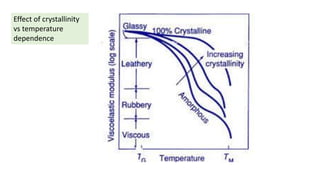
Crystallinityis indication of amount of crystalline
region in polymer with respect to amorphous
content.
Crystallinity influences many of the polymer
properties:
Hardness
Modulus
Tensile
Melting Point
50.
Crystallinity in Polymers
Factoraffecting crystallinity in polymer;
Linearity in polymer
Presence of more than one monomer type
Arrangement of side group on the backbone
Processing condition
51.
Polymer will havecertain degree crystallinity inherent to
them but the degree of crystallinity can be affected by:
Heat history of the material
Polymerization process
Molding Process
Stress in service use
Crystallinity in Polymers