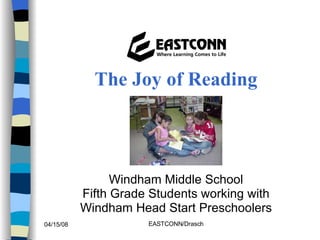
The Joy of Reading Windham Middle School Fifth Grade Students working with Windham Head Start Preschoolers
Intended Preschool Outcomes Head Start children will have increased skills on learning outcomes related to literacy Families and students/children will value the public library as an important resource Children/students will have their culture and primary language reinforced as being valued and part of their reading experiences Children and families will view reading as fun
Why Reading Aloud is Important The single most important activity for building skills required for successful reading is reading aloud to children. Reading aloud enriches a child’s background knowledge, develops a child’s vocabulary and comprehension, and increases a child’s interest to read and write. Reading aloud to children provides opportunities for listening, interpreting, and discussing text relationships. Reading aloud increases word recognition and fluency.  It also influences word knowledge, reading speed, oral accuracy, and comprehension. Reading aloud creates a mental dictionary for the child and an opportunity to learn many words that are not routinely spoken. ELLM Orientation Material
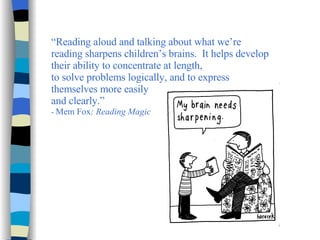
“ Reading aloud and talking about what we’re reading sharpens children’s brains.  It helps develop their ability to concentrate at length,  to solve problems logically, and to express themselves more easily  and clearly.”   -  Mem Fox ; Reading Magic
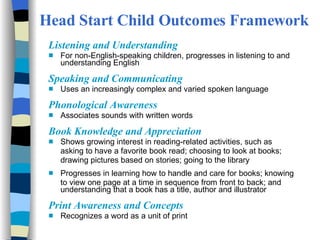
Head Start Child Outcomes Framework Listening and Understanding For non-English-speaking children, progresses in listening to and understanding English Speaking and Communicating Uses an increasingly complex and varied spoken language Phonological Awareness Associates sounds with written words Book Knowledge and Appreciation   Shows growing interest in reading-related activities, such as  asking to have a favorite book read; choosing to look at books;  drawing pictures based on stories; going to the library Progresses in learning how to handle and care for books; knowing  to view one page at a time in sequence from front to back; and understanding that a book has a title, author and illustrator Print Awareness and Concepts Recognizes a word as a unit of print
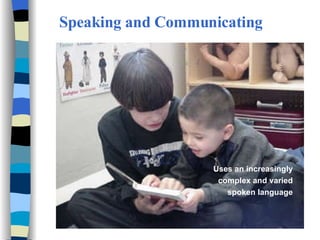
Speaking and Communicating Uses an increasingly complex and varied spoken language
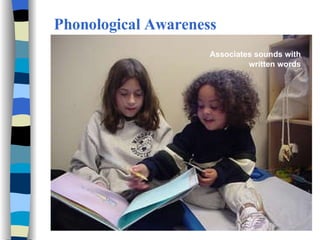
Phonological Awareness Associates sounds with written words
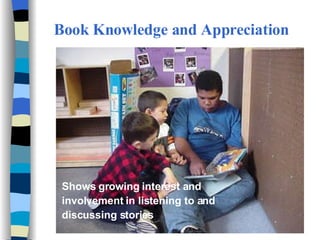
Book Knowledge and Appreciation Shows growing interest and involvement in listening to and discussing stories
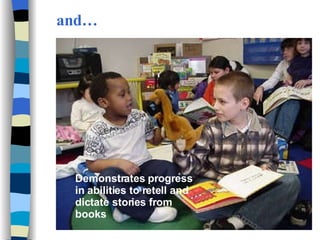
and… Demonstrates progress in abilities to retell and dictate stories from books
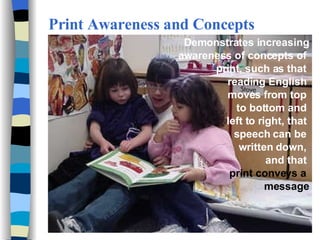
Print Awareness and Concepts Demonstrates increasing awareness of concepts of  print, such as that  reading English  moves from top  to bottom and  left to right, that  speech can be  written down,  and that  print conveys a  message
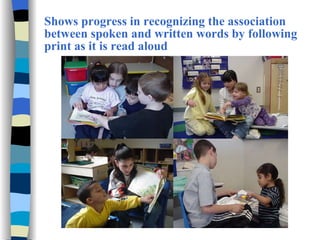
Shows progress in recognizing the association between spoken and written words by following print as it is read aloud
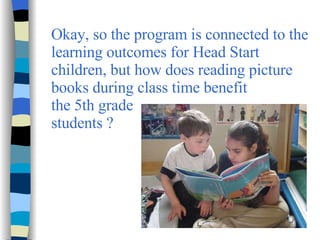
Okay, so the program is connected to the learning outcomes for Head Start children, but how does reading picture books during class time benefit  the 5th grade  students ?
Intended Fifth Grade Outcomes Intervention reading students will increase their confidence in reading aloud and their reading fluency Participating students will increase their reading scores on the CT Mastery Tests and the Developmental Reading Assessment (DRA) Students will increase their positive self-concept and social competence by viewing themselves as positive role models and by making a contribution to their community
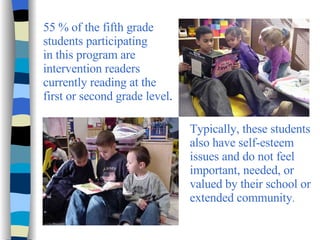
55 % of the fifth grade students participating in this program are intervention readers currently reading at the  first or second grade level . Typically, these students also have self-esteem issues and do not feel important, needed, or valued by their school or extended community .
Developmental Reading Assessment Insights 85% of everything children read should be easy for them 15% should be a bit of a challenge 0% at the difficult level because it provides no purpose for learning
Preparing the 5 th  Grade Students   Classroom workshop facilitated by EASTCONN with teambuilding activities that focus on respect, responsibility, perspective and attitude  Classroom workshop facilitated by the town’s children's librarian covering book selection, reading aloud and how to extend a story Classroom workshop facilitated by EASTCONN to explain the preschool goals and objectives, share teaching strategies and model a reading activity  Classroom teachers model the whole procedure from choosing a book to reading to preschooler.  In small groups, students fill out story activity form and practice reading aloud to one another.
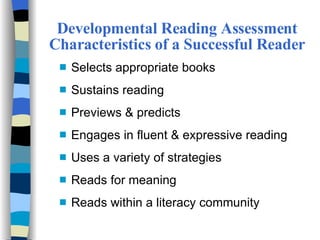
Developmental Reading Assessment Characteristics of a Successful Reader Selects appropriate books Sustains reading Previews & predicts Engages in fluent & expressive reading Uses a variety of strategies Reads for meaning Reads within a literacy community
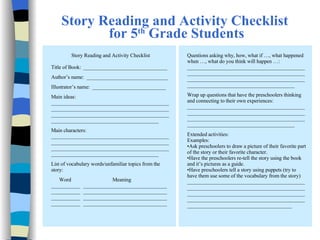
Story Reading and Activity Checklist  for 5 th  Grade Students Questions asking why, how, what if …, what happened when …, what do you think will happen …: ________________________________________________________________________________________________________________________________________________________________________________ Wrap up questions that have the preschoolers thinking and connecting to their own experiences: ________________________________________________________________________________________________________________________________________________________________________________ Extended activities: Examples: Ask preschoolers to draw a picture of their favorite part of the story or their favorite character. Have the preschoolers re-tell the story using the book and it’s pictures as a guide.  Have preschoolers tell a story using puppets (try to have them use some of the vocabulary from the story) ____________________________________________________________________________________________________________________________________________________________________________________________________________________________ Story Reading and Activity Checklist   Title of Book:  ________________________________   Author’s name:  _______________________________   Illustrator’s name:  ____________________________   Main ideas: ________________________________________________________________________________________________________________________________________________________________________________ Main characters: ________________________________________________________________________________________________________________________________________________________________________________ List of vocabulary words/unfamiliar topics from the story: Word    Meaning ___________ ________________________________ ___________ ________________________________ ___________ ________________________________ ___________ ________________________________
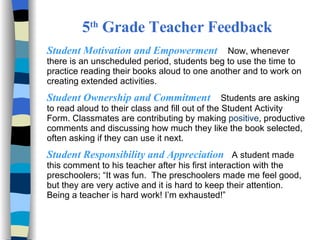
5 th  Grade Teacher Feedback Student Motivation   and Empowerment   Now, whenever there is an unscheduled period, students beg to use the time to practice reading their books aloud to one another and to work on creating extended activities.  Student Ownership and Commitment   Students are asking to read aloud to their class and fill out of the Student Activity Form. Classmates are contributing by making  positive , productive comments and discussing how much they like the book selected, often asking if they can use it next. Student Responsibility and Appreciation   A student made this comment to his teacher after his first interaction with the preschoolers; “It was fun.  The preschoolers made me feel good, but they are very active and it is hard to keep their attention.  Being a teacher is hard work! I’m exhausted!”
Parents and Community Connections Visits to the town library by Head Start students and their 5 th  grade buddies   Workshops for parents that better prepare them  to share and read books and stories with their children A culminating celebratory event held in the children’s section of the town library

Head Start Conference Power Point Presentation

  • 1.
    The Joy ofReading Windham Middle School Fifth Grade Students working with Windham Head Start Preschoolers
  • 2.
    Intended Preschool OutcomesHead Start children will have increased skills on learning outcomes related to literacy Families and students/children will value the public library as an important resource Children/students will have their culture and primary language reinforced as being valued and part of their reading experiences Children and families will view reading as fun
  • 3.
    Why Reading Aloudis Important The single most important activity for building skills required for successful reading is reading aloud to children. Reading aloud enriches a child’s background knowledge, develops a child’s vocabulary and comprehension, and increases a child’s interest to read and write. Reading aloud to children provides opportunities for listening, interpreting, and discussing text relationships. Reading aloud increases word recognition and fluency. It also influences word knowledge, reading speed, oral accuracy, and comprehension. Reading aloud creates a mental dictionary for the child and an opportunity to learn many words that are not routinely spoken. ELLM Orientation Material
  • 4.
    “ Reading aloudand talking about what we’re reading sharpens children’s brains. It helps develop their ability to concentrate at length, to solve problems logically, and to express themselves more easily and clearly.” - Mem Fox ; Reading Magic
  • 5.
    Head Start ChildOutcomes Framework Listening and Understanding For non-English-speaking children, progresses in listening to and understanding English Speaking and Communicating Uses an increasingly complex and varied spoken language Phonological Awareness Associates sounds with written words Book Knowledge and Appreciation Shows growing interest in reading-related activities, such as asking to have a favorite book read; choosing to look at books; drawing pictures based on stories; going to the library Progresses in learning how to handle and care for books; knowing to view one page at a time in sequence from front to back; and understanding that a book has a title, author and illustrator Print Awareness and Concepts Recognizes a word as a unit of print
  • 6.
    Speaking and CommunicatingUses an increasingly complex and varied spoken language
  • 7.
    Phonological Awareness Associatessounds with written words
  • 8.
    Book Knowledge andAppreciation Shows growing interest and involvement in listening to and discussing stories
  • 9.
    and… Demonstrates progressin abilities to retell and dictate stories from books
  • 10.
    Print Awareness andConcepts Demonstrates increasing awareness of concepts of print, such as that reading English moves from top to bottom and left to right, that speech can be written down, and that print conveys a message
  • 11.
    Shows progress inrecognizing the association between spoken and written words by following print as it is read aloud
  • 12.
    Okay, so theprogram is connected to the learning outcomes for Head Start children, but how does reading picture books during class time benefit the 5th grade students ?
  • 13.
    Intended Fifth GradeOutcomes Intervention reading students will increase their confidence in reading aloud and their reading fluency Participating students will increase their reading scores on the CT Mastery Tests and the Developmental Reading Assessment (DRA) Students will increase their positive self-concept and social competence by viewing themselves as positive role models and by making a contribution to their community
  • 14.
    55 % ofthe fifth grade students participating in this program are intervention readers currently reading at the first or second grade level . Typically, these students also have self-esteem issues and do not feel important, needed, or valued by their school or extended community .
  • 15.
    Developmental Reading AssessmentInsights 85% of everything children read should be easy for them 15% should be a bit of a challenge 0% at the difficult level because it provides no purpose for learning
  • 16.
    Preparing the 5th Grade Students Classroom workshop facilitated by EASTCONN with teambuilding activities that focus on respect, responsibility, perspective and attitude Classroom workshop facilitated by the town’s children's librarian covering book selection, reading aloud and how to extend a story Classroom workshop facilitated by EASTCONN to explain the preschool goals and objectives, share teaching strategies and model a reading activity Classroom teachers model the whole procedure from choosing a book to reading to preschooler. In small groups, students fill out story activity form and practice reading aloud to one another.
  • 17.
    Developmental Reading AssessmentCharacteristics of a Successful Reader Selects appropriate books Sustains reading Previews & predicts Engages in fluent & expressive reading Uses a variety of strategies Reads for meaning Reads within a literacy community
  • 18.
    Story Reading andActivity Checklist for 5 th Grade Students Questions asking why, how, what if …, what happened when …, what do you think will happen …: ________________________________________________________________________________________________________________________________________________________________________________ Wrap up questions that have the preschoolers thinking and connecting to their own experiences: ________________________________________________________________________________________________________________________________________________________________________________ Extended activities: Examples: Ask preschoolers to draw a picture of their favorite part of the story or their favorite character. Have the preschoolers re-tell the story using the book and it’s pictures as a guide. Have preschoolers tell a story using puppets (try to have them use some of the vocabulary from the story) ____________________________________________________________________________________________________________________________________________________________________________________________________________________________ Story Reading and Activity Checklist   Title of Book: ________________________________   Author’s name: _______________________________   Illustrator’s name: ____________________________   Main ideas: ________________________________________________________________________________________________________________________________________________________________________________ Main characters: ________________________________________________________________________________________________________________________________________________________________________________ List of vocabulary words/unfamiliar topics from the story: Word Meaning ___________ ________________________________ ___________ ________________________________ ___________ ________________________________ ___________ ________________________________
  • 19.
    5 th Grade Teacher Feedback Student Motivation and Empowerment Now, whenever there is an unscheduled period, students beg to use the time to practice reading their books aloud to one another and to work on creating extended activities. Student Ownership and Commitment Students are asking to read aloud to their class and fill out of the Student Activity Form. Classmates are contributing by making positive , productive comments and discussing how much they like the book selected, often asking if they can use it next. Student Responsibility and Appreciation A student made this comment to his teacher after his first interaction with the preschoolers; “It was fun. The preschoolers made me feel good, but they are very active and it is hard to keep their attention. Being a teacher is hard work! I’m exhausted!”
  • 20.
    Parents and CommunityConnections Visits to the town library by Head Start students and their 5 th grade buddies Workshops for parents that better prepare them to share and read books and stories with their children A culminating celebratory event held in the children’s section of the town library