

APEDA AND EIC
Presented By: - Sourabh Kale.
AGRICULTURAL EXPORT-
STATUS
Exports have more than doubled over a period of 5
years.
Exports have grown from USD17,789 million in 2008-09
to USD42,505.7million in 2013-14 with a CAGR of
19percent.
During 2013-14,agri product exports constituted
13.6percentof total exports and registered a growth of
3.8 percent(in USD terms) over 2012-13.
 Laws -Dairy Exports
Export(quality control and inspection)act, 1963 facilitates
exports through;
 EIC(Export Inspection Council)
 EIA(Export Inspection Agency)
 APEDA(Agricultural Processed Food Products Export
Development Authority) -compulsory registration, inspection
and certification prior to under taking manufacture of dairy
products meant for exports.
 Export policy for milk and milk products:
1.Taxation of the dairy products :reducing the margins to the
milk producers.
2.No subsidies granted by the government for the promotion
of exporting the dairy products.
 Exporting products:
SMP, WMP, Butter oil, Ghee, Whey products, Dairy spread
,Processed and powdered cheese and Fermented products.
 Export destination areas:
Bangladesh, UAE, Oman, Yemen, Saudi Arabia, Singapore,
South Korea, Nepal, Philippines, Kuwait, Bahrain and
Afghanistan.
APEDA
APEDA- BACKGROUND
 Established by the Government of India under the Agricultural
and Processed Food Products Export Development Authority
Act.
 Act passed by the Parliament in December, 1985. The Act
came into effect from 13th February.
 The Authority replaced the Processed Food Export
Promotion Council (PFEPC).
ASSIGNED FUNCTIONS
 Providing financial assistance, undertaking surveys and
feasibility studies, participation in enquiry capital through
joint ventures and other reliefs and subsidy schemes.
 Registration of persons as exporters of the scheduled
products on payment of such fees as may be prescribed.
 Fixing of standards and specifications for the scheduled
products for the purpose of exports.
 Carrying out inspection of meat and meat products.
 Improving packaging, marketing of the Scheduled
products.
 Promotion of export oriented production.
 Collection of statistics from the owners of factories
or establishments engaged.
PRODUCTS MONITORED
Fruits, Vegetables and their Products.
Meat and Meat Products.
Poultry and Poultry Products.
Dairy Products.
Confectionery, Biscuits and Bakery Products.
Honey, Jaggery and Sugar Products.
Cocoa and its products, chocolates of all kinds.
Alcoholic and Non-Alcoholic Beverages.
Cereal and Cereal Products.
Guar Gum. Floriculture and Floriculture Products
Herbal and Medicinal Plants
EXPORT INSPECTION
COUNCIL
EIC- BACKGROUND
Export Inspection Council of India (EIC) was
established under the Export (Quality Control and
Inspection) Act 1963.
Advises the Central Government on measures to
be taken for development of export trade through
quality control and pre-shipment inspection.
1. Mumbai 2. Delhi 3. Chennai
4. Kolkata 5. Kochi
SERVICES PROVIDED BY EIC /
EIA’S
Certification of Product Quality in accordance with the
norms and legislations of different destinations
worldwide through;
1.Consignment-wise Inspection (CWI)
2.system approach including In-process Quality Control
(IPQC)
3.Self Certification (SC).
 Approval and certification of processing and
manufacturing units based on Food Safety Management
Systems like HACCP, Good Hygiene/Manufacturing
Practices (GHPs / GMPs).
Presently, EIC's certification is recognised in the
following areas;
Basmati Rice by European Commission (for Certificates
of Authenticity).
Black Pepper by United States Food & Drug
Administration (USFDA).
Fish & Fishery Products by European Commission.
Fish and Fishery Products by Australian Quarantine &
Inspection Service (AQIS)
The milk products for Exports shall be subjected to
the following conditions: -
The period during which the milk products are fit for
human consumption and storage shall be indicated by
the processor.
The results of the various checks and tests are recorded
and kept for presentation to the competent authority
for a period of two years.
Having satisfied itself that the plant meets the
requirements with regard to the nature of the activities
if carries out, the competent authority shall accord
approval to such plant for a period of one year.
 Approval of processing plant
The Competent Authority may take the assistance of a
representative each from EIC, APEDA, MoFPI, NDDB,
and Representative of Industry and co-operatives and
experts from NDRI etc. in the matter of approval of
processing plants.
The inspection and monitoring of plant and packaging
centres shall be carried out regularly by the competent
authority, which shall at all times have free access to
all parts of the plants, in order to ensure that these
rules are being observed.
Certification and Fees: -
On request from the plant, the competent authority
shall issue health certificate in the prescribed proforma
after satisfying that the milk products are processed in
approved processing plants and after satisfying the
relevant requirement.
A fee of Rs. 5,000 shall be paid by the processor along
with the application for approval of the milk processing
plant.
A monitoring fee @ 0.20% of free on board (F.O.B.)
value shall be paid by the processor or the exporter to
the concerned Export Inspection Agency with a
maximum of Rs.15 lakhs per annum per exporter or
processor.
GUIDELINES PROVIDED BY EIC
Animal health requirements for raw milk.
Hygiene of the holding.
Hygiene in milking, the collection of raw milk and its
transport from production holding to the collection
centres or processing establishments.
The raw milk shall conform to the relevant
national/international standards.
Microbial criteria for milk and milk products.
 Processing plant shall meet the requirements for site,
building, ventilation and lighting, floors and wall,
processing room.
 Processing parameters for specified treatments(SPC,
Pathogens, Hygiene indicators).
 Wrapping, packaging and labelling requirements.
 Storage and transport requirements.
STANDARDS TO BE FOLLOWED
(a)National Standard of the importing countries or codex
standards of CAC.
(b)Contractual specifications to between the foreign
buyer and the exporters provided the same is not
below the national standards.
(c)In the absence of (a) or (b) above, the National
Standard Specifications as notified shall apply.
(d)In case of any Milk Products for which no standard is
available at (a), (b) and (c) above, the standard
formulated for these products by the standing
Committee.
TRADE AGREEMENTS
GENERALISED SYSTEM OF
PREFERENCES (GSP)
 Non-contractual instrument by which industrially
developed countries extend tariff concession to goods
originating in developing countries.
 GSP presently comprises of 12 different schemes
extended by 36 preference-giving countries.
 Organizations authorized to issue certificates of origin
under GSP.
 Export Inspection Council of India
 Directorate General of Foreign Trade
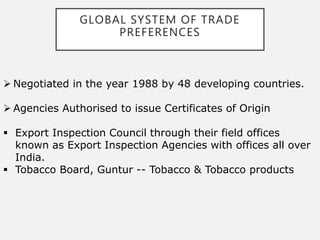
GLOBAL SYSTEM OF TRADE
PREFERENCES
 Negotiated in the year 1988 by 48 developing countries.
 Agencies Authorised to issue Certificates of Origin
 Export Inspection Council through their field offices
known as Export Inspection Agencies with offices all over
India.
 Tobacco Board, Guntur -- Tobacco & Tobacco products
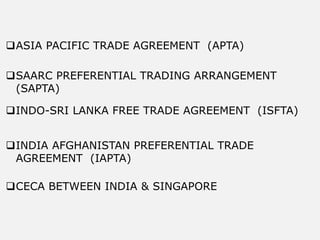
ASIA PACIFIC TRADE AGREEMENT (APTA)
SAARC PREFERENTIAL TRADING ARRANGEMENT
(SAPTA)
INDO-SRI LANKA FREE TRADE AGREEMENT (ISFTA)
INDIA AFGHANISTAN PREFERENTIAL TRADE
AGREEMENT (IAPTA)
CECA BETWEEN INDIA & SINGAPORE
Apeda and eic

Apeda and eic

  • 1.
    APEDA AND EIC PresentedBy: - Sourabh Kale.
  • 2.
    AGRICULTURAL EXPORT- STATUS Exports havemore than doubled over a period of 5 years. Exports have grown from USD17,789 million in 2008-09 to USD42,505.7million in 2013-14 with a CAGR of 19percent. During 2013-14,agri product exports constituted 13.6percentof total exports and registered a growth of 3.8 percent(in USD terms) over 2012-13.
  • 3.
     Laws -DairyExports Export(quality control and inspection)act, 1963 facilitates exports through;  EIC(Export Inspection Council)  EIA(Export Inspection Agency)  APEDA(Agricultural Processed Food Products Export Development Authority) -compulsory registration, inspection and certification prior to under taking manufacture of dairy products meant for exports.
  • 4.
     Export policyfor milk and milk products: 1.Taxation of the dairy products :reducing the margins to the milk producers. 2.No subsidies granted by the government for the promotion of exporting the dairy products.  Exporting products: SMP, WMP, Butter oil, Ghee, Whey products, Dairy spread ,Processed and powdered cheese and Fermented products.  Export destination areas: Bangladesh, UAE, Oman, Yemen, Saudi Arabia, Singapore, South Korea, Nepal, Philippines, Kuwait, Bahrain and Afghanistan.
  • 5.
  • 6.
    APEDA- BACKGROUND  Establishedby the Government of India under the Agricultural and Processed Food Products Export Development Authority Act.  Act passed by the Parliament in December, 1985. The Act came into effect from 13th February.  The Authority replaced the Processed Food Export Promotion Council (PFEPC).
  • 7.
    ASSIGNED FUNCTIONS  Providingfinancial assistance, undertaking surveys and feasibility studies, participation in enquiry capital through joint ventures and other reliefs and subsidy schemes.  Registration of persons as exporters of the scheduled products on payment of such fees as may be prescribed.  Fixing of standards and specifications for the scheduled products for the purpose of exports.
  • 8.
     Carrying outinspection of meat and meat products.  Improving packaging, marketing of the Scheduled products.  Promotion of export oriented production.  Collection of statistics from the owners of factories or establishments engaged.
  • 9.
    PRODUCTS MONITORED Fruits, Vegetablesand their Products. Meat and Meat Products. Poultry and Poultry Products. Dairy Products. Confectionery, Biscuits and Bakery Products. Honey, Jaggery and Sugar Products. Cocoa and its products, chocolates of all kinds. Alcoholic and Non-Alcoholic Beverages. Cereal and Cereal Products. Guar Gum. Floriculture and Floriculture Products Herbal and Medicinal Plants
  • 10.
  • 11.
    EIC- BACKGROUND Export InspectionCouncil of India (EIC) was established under the Export (Quality Control and Inspection) Act 1963. Advises the Central Government on measures to be taken for development of export trade through quality control and pre-shipment inspection. 1. Mumbai 2. Delhi 3. Chennai 4. Kolkata 5. Kochi
  • 12.
    SERVICES PROVIDED BYEIC / EIA’S Certification of Product Quality in accordance with the norms and legislations of different destinations worldwide through; 1.Consignment-wise Inspection (CWI) 2.system approach including In-process Quality Control (IPQC) 3.Self Certification (SC).  Approval and certification of processing and manufacturing units based on Food Safety Management Systems like HACCP, Good Hygiene/Manufacturing Practices (GHPs / GMPs).
  • 13.
    Presently, EIC's certificationis recognised in the following areas; Basmati Rice by European Commission (for Certificates of Authenticity). Black Pepper by United States Food & Drug Administration (USFDA). Fish & Fishery Products by European Commission. Fish and Fishery Products by Australian Quarantine & Inspection Service (AQIS)
  • 14.
    The milk productsfor Exports shall be subjected to the following conditions: - The period during which the milk products are fit for human consumption and storage shall be indicated by the processor. The results of the various checks and tests are recorded and kept for presentation to the competent authority for a period of two years. Having satisfied itself that the plant meets the requirements with regard to the nature of the activities if carries out, the competent authority shall accord approval to such plant for a period of one year.
  • 15.
     Approval ofprocessing plant The Competent Authority may take the assistance of a representative each from EIC, APEDA, MoFPI, NDDB, and Representative of Industry and co-operatives and experts from NDRI etc. in the matter of approval of processing plants. The inspection and monitoring of plant and packaging centres shall be carried out regularly by the competent authority, which shall at all times have free access to all parts of the plants, in order to ensure that these rules are being observed.
  • 16.
    Certification and Fees:- On request from the plant, the competent authority shall issue health certificate in the prescribed proforma after satisfying that the milk products are processed in approved processing plants and after satisfying the relevant requirement. A fee of Rs. 5,000 shall be paid by the processor along with the application for approval of the milk processing plant. A monitoring fee @ 0.20% of free on board (F.O.B.) value shall be paid by the processor or the exporter to the concerned Export Inspection Agency with a maximum of Rs.15 lakhs per annum per exporter or processor.
  • 17.
    GUIDELINES PROVIDED BYEIC Animal health requirements for raw milk. Hygiene of the holding. Hygiene in milking, the collection of raw milk and its transport from production holding to the collection centres or processing establishments. The raw milk shall conform to the relevant national/international standards. Microbial criteria for milk and milk products.
  • 18.
     Processing plantshall meet the requirements for site, building, ventilation and lighting, floors and wall, processing room.  Processing parameters for specified treatments(SPC, Pathogens, Hygiene indicators).  Wrapping, packaging and labelling requirements.  Storage and transport requirements.
  • 19.
    STANDARDS TO BEFOLLOWED (a)National Standard of the importing countries or codex standards of CAC. (b)Contractual specifications to between the foreign buyer and the exporters provided the same is not below the national standards. (c)In the absence of (a) or (b) above, the National Standard Specifications as notified shall apply. (d)In case of any Milk Products for which no standard is available at (a), (b) and (c) above, the standard formulated for these products by the standing Committee.
  • 20.
  • 21.
    GENERALISED SYSTEM OF PREFERENCES(GSP)  Non-contractual instrument by which industrially developed countries extend tariff concession to goods originating in developing countries.  GSP presently comprises of 12 different schemes extended by 36 preference-giving countries.  Organizations authorized to issue certificates of origin under GSP.  Export Inspection Council of India  Directorate General of Foreign Trade
  • 22.
    GLOBAL SYSTEM OFTRADE PREFERENCES  Negotiated in the year 1988 by 48 developing countries.  Agencies Authorised to issue Certificates of Origin  Export Inspection Council through their field offices known as Export Inspection Agencies with offices all over India.  Tobacco Board, Guntur -- Tobacco & Tobacco products
  • 23.
    ASIA PACIFIC TRADEAGREEMENT (APTA) SAARC PREFERENTIAL TRADING ARRANGEMENT (SAPTA) INDO-SRI LANKA FREE TRADE AGREEMENT (ISFTA) INDIA AFGHANISTAN PREFERENTIAL TRADE AGREEMENT (IAPTA) CECA BETWEEN INDIA & SINGAPORE

Editor's Notes

  • #7 ADMINISTRATIVE SET UP Chairman - Appointed by the Central Government Director - Appointed by APEDA Secretary - Appointed by the Central Government Other Officers and Staff - Appointed by the Authority Eight members appointed by the Central Government representing respectively; the Ministries of the Central Govt Seven members appointed by the Central Govt. representing (i) Indian Council of Agricultural Research (ii) National Horticultural Board  (iii) National Agricultural Cooperative Marketing Federation  (iv) Central Food Technological Research Institute (v) Indian Institute of Packaging  (vi) Spices Export Promotion Council and  (vii) Cashew Export Promotion Council. 
  • #9 MEAT PRODUCTS in slaughter ho HEAD OFFICE New Delhi REGIONAL OFFICES Mumbai Kolkata Bangalore Hyderabad and Guwahati uses, processing plants, storage premises, or other places where such products are kept or handled for the purpose of ensuring the quality of such products;
  • #10 Groundnuts, Peanuts and Walnuts. Pickles, Papads and Chutneys.
  • #12 Over more than 38 years of its existence, EIC / EIAs have been instrumental in building quality awareness amongst a wide cross section of exporting industry Advice for stop of imprt, melamine, china, laboratory setup
  • #14 (as per which, any consignment of black pepper from India, not accompanied by EIA's certificate, is detained on arrival in USA)
  • #15 Tests for residues must be carried out in accordance with National/Internationally recognised methods. -----not allowed for consumption if residue found Packaging regulations National/ int. standards Hygeine req. Microbiological quality
  • #17 amount of monitoring fee for each consignment
  • #18 antibiotics,,withdrawl period, mastitis Chilling temp, utensils, cleaning, processing standards, definitions of heat tratments Transportation req. Spc, indicators , hygiene indicators , pathogens, FSSAI
  • #20 Chairman, Agricultural and Processed Chairman Food Products Export Development Authority 2. Joint Commissioner (Dairy) Member Department of Animal Husbandry and Dairying, Ministry of Agriculture 3. Deputy Commissioner (Dairy Development) Member Ministry of Food Processing Industries 4. One representative of National Dairy Member Development Board 5. One representative of Dairy Association Member Of India 6. One representative of Diary Association Member of India 7. Representative of Export Inspection Member Council
  • #22  increasing their export earnings ---- in promoting their industrialisation ----- in accelerating their rates of economic growth. the Export Inspection Agencies with offices all over India. -----all products Directorate General of Foreign Trade through Regional Offices known as Joint Director General / Deputy Director – General of Foreign Trade---All products Marine Products Export Development Authority-----marine products Central Silk Board Tobacco Board,
  • #23 To promote and sustain mutual trade
  • #24 Comprehensive Economic Cooperation Agreement