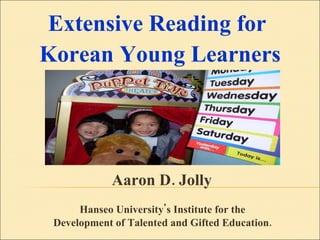



































Aaron D. Jolly  Hanseo University's Institute for the  Development of Talented and Gifted Education.  Extensive Reading for  Korean Young Learners


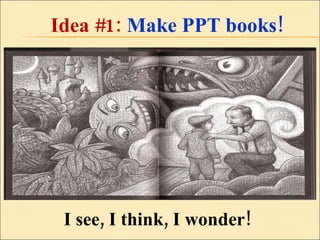
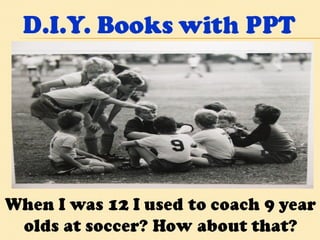
Idea #1:  Make PPT books! I see, I think, I wonder!
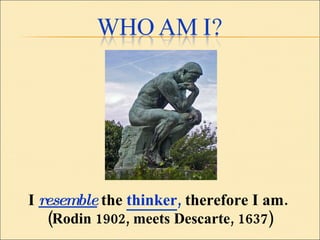
I  resemble  the  thinker ,  therefore I am.  (Rodin 1902, meets Descarte, 1637)
I  reflect  therefore I teach.  (Descarte 1637 meets Farrell 2008)
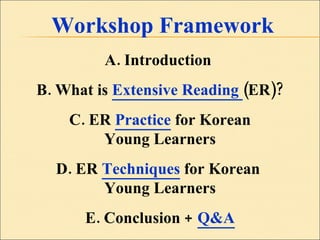
Workshop Framework A. Introduction  B. What is  Extensive Reading  (ER)? C. ER  Practice  for Korean  Young Learners D. ER  Techniques  for Korean  Young Learners E. Conclusion +  Q&A
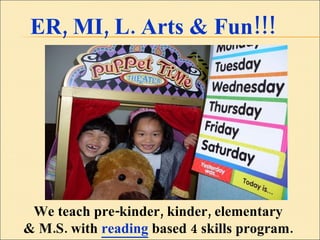
ER, MI, L. Arts & Fun!!!  We teach pre-kinder, kinder, elementary  & M.S. with  reading  based 4 skills program.
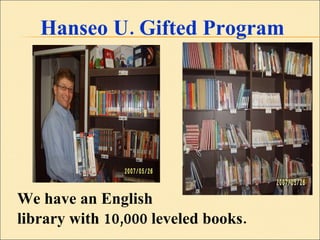
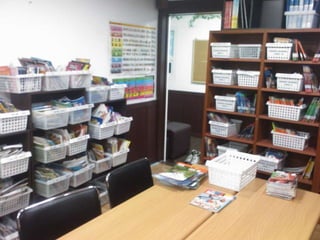
Hanseo U. Gifted Program We have an English  library with 10,000 leveled books.
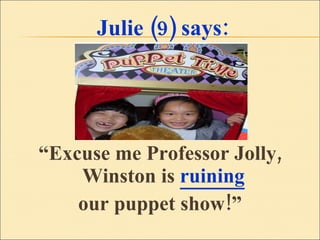
Julie (9) says: “ Excuse me Professor Jolly, Winston is  ruining   our puppet show!”
A.  Introduction What is Reading? (ii) What are Korean Elementary  School Kids Like? (iii) What Can E.R. with Korean  Young Learners Be Like?
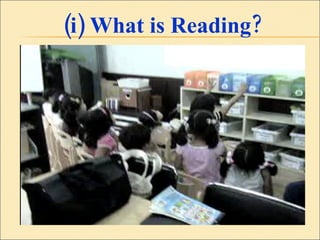
(i) What is Reading?
(i) What is Reading? K:  “Reading is happy time.” (sic)  G1:  “Reading is my mum’s favorite thing.” G2:  “Reading is always lots of stories.” G3:  “Reading is how you learn words.” G4:  “Reading is when you read fiction or  non-fiction books and take a quiz.” G5:  “Reading is much better than my  school English textbook.”  G6:  “Reading is a tool to get new  information in English.”
Answers? 1.  Fun for students! 2.  Parents love it 3:  Everybody loves stories 4:  Vocabulary 5:  Assessment 6:  Natural Approach 7:  Content English
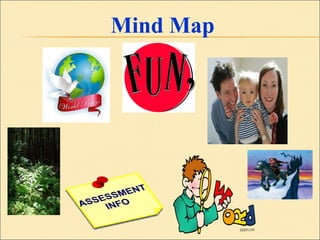
Mind Map
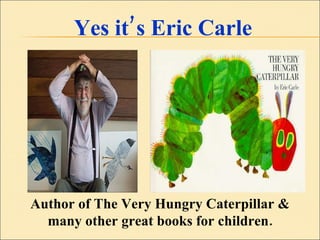
It’s Time to Share a Story Do you know who this is?  (Hint: Author of Very Hungry Caterpillar)
Yes it’s Eric Carle Author of The Very Hungry Caterpillar & many other great books for children.


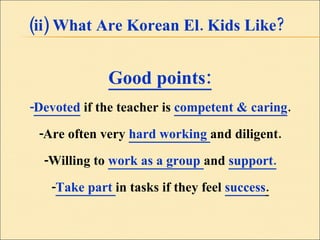
(ii) What Are Korean El. Kids Like? Good points: - Devoted   if the teacher is  competent & caring . -Are often very  hard working  and diligent. -Willing to  work as a group  and  support. - Take part  in tasks if they feel  success .
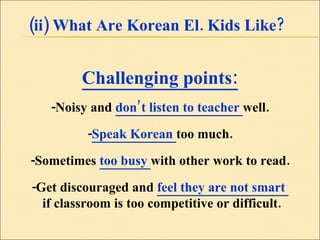
(ii) What Are Korean El. Kids Like? Challenging points: -Noisy and  don’t listen to teacher  well. - Speak Korean  too much. -Sometimes  too busy  with other work to read. -Get discouraged and  feel they are not smart  if classroom is too competitive or difficult.
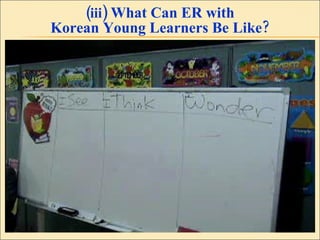
(iii ) What Can ER with  Korean Young Learners Be Like?
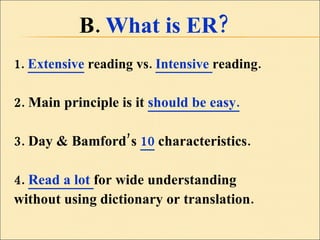
B.  What is ER?  1.  Extensive  reading vs.  Intensive  reading. 2. Main principle is it  should be easy. 3. Day & Bamford’s  10  characteristics. 4.  Read a lot  for wide understanding  without using dictionary or translation.
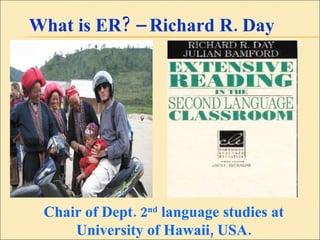
What is ER? – Richard R. Day  Chair of Dept. 2 nd  language studies at University of Hawaii, USA.
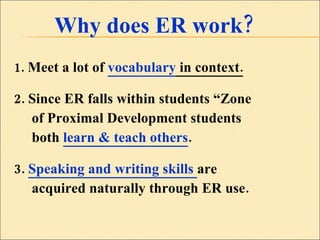
Why does ER work?  1.  Meet a lot of  vocabulary  in context. 2. Since ER falls within students “Zone  of Proximal Development students  both  learn & teach others . 3.  Speaking and writing skills  are  acquired naturally through ER use.
Why does ER work?
What does the research show?  1. Reading=   #1 factor for language success. 2. Long term studies in Singapore & SE Asia:  Reading helps grammar & writing for YL. 3. Korean and Japanese Studies:  Students who read extensively out perform those who don’t on English language tests.
What does the research show?  Extensive Reading =  Success
What is ER like in Korea?  1. High level “fancy”  hagwons  use it. 2. Government  book library  programs. 3.  Mum’s revolution  with books at home. 4. Private (and some public) schools have set up  small libraries. *Problem: Most  reading here is intensive & short!
What is   good  ER like in Korea?  Ask  mums (or dads),  or ask  bookstore workers,  or ask someone whose kid goes to a  fancy academy  how? –  steal the ideas and make  them your own!
C.  ER Practice ER with  Very Young  Korean Learners. (ii) ER with  Young  Korean Learners. (iii) ER for  Differentiated  Classes.
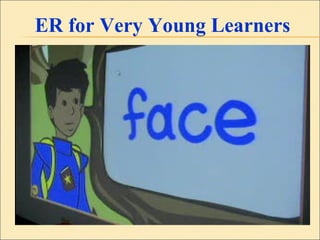
ER for Very Young Learners Make it  fun , and  let it be noisy. (ii) Use  cool props, technology, magic . (iii) Make  your own  resources or buy audio-visual interactive   materials.
ER for Very Young Learners
ER for Young Korean Learners Let them  choose books  & feel confident (ii) Give them  comprehension support. (iii)  “ Leave them kids alone ” : Don’t challenge them to explain every detail.
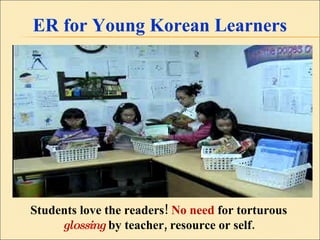
ER for Young Korean Learners Students love the readers!  No need  for torturous  glossing  by teacher, resource or self.
Hanseo U. Gifted Program. Mostly authentic literature, but have  added 100’s of graded readers in 2008.
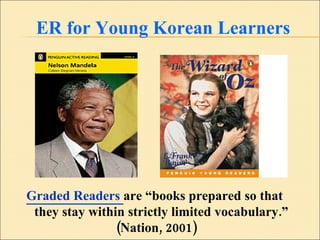
ER for Young Korean Learners Graded Readers  are “books prepared so that  they stay within strictly limited vocabulary.”  (Nation, 2001)
Graded readers... …  are fiction texts
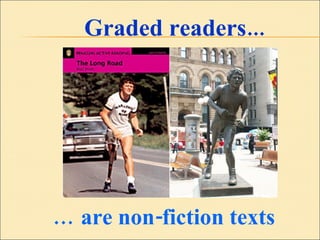
Graded readers... …  are non-fiction texts
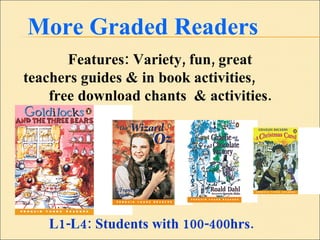
More Graded Readers Features: Variety, fun, great teachers guides & in book activities,  free download chants  & activities. L1-L4: Students with 100-400hrs.
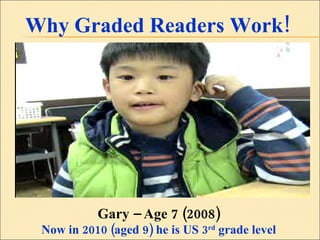
Why Graded Readers Work! Gary – Age 7 (2008) Now in 2010 (aged 9) he is US 3 rd  grade level
ER in Differentiated Classrooms Have  different level books  available. (ii) Create  different roles  in activities. (iii) Use  stations , quiet time & drawing. Note: DO NOT challenge lower level students  to produce until they are ready.
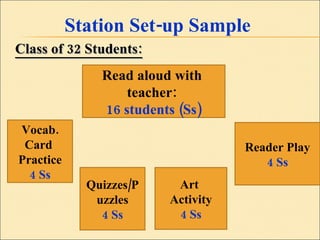
Station Set-up Sample  Class of 32 Students: Read aloud with  teacher:  16 students (Ss) Vocab. Card  Practice 4 Ss Quizzes/Puzzles 4 Ss Art  Activity 4 Ss Reader Play 4 Ss
ER in Differentiated Classrooms
END
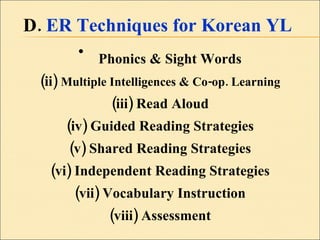
D.  ER Techniques for Korean YL Phonics & Sight Words (ii)  Multiple Intelligences & Co-op. Learning (iii) Read Aloud (iv) Guided Reading Strategies (v) Shared Reading Strategies (vi) Independent Reading Strategies (vii) Vocabulary Instruction (viii) Assessment
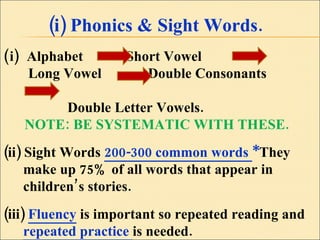
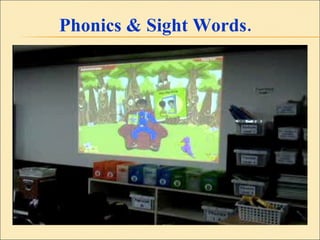
(i) Phonics & Sight Words.  Alphabet  Short Vowel Long Vowel  Double Consonants  Double Letter Vowels. NOTE: BE SYSTEMATIC WITH THESE. (ii) Sight Words  200-300 common words  * They make up 75% of all words that appear in children’s stories. (iii)  Fluency  is important so repeated reading and  repeated practice  is needed.
Phonics & Sight Words.
Phonics & Sight Words Ideas  Use  mini-phonics books.  Make  your own (DIY). Use a company  textbook . Use  CD-Rom  style resources Use  free Internet  sites like  EnglishRaven.com
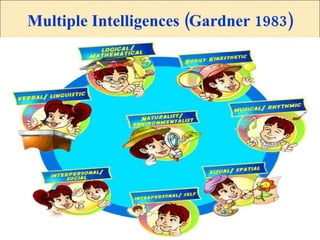
(ii) MI and Cooperative Learning Children are  “intelligent”  in different ways, and have different strengths. (ii) So a  variety of methods  are needed! Include musical activities, movement, social interaction, individual time etc. (iii)  Train students  to teach themselves and you are removing the need for a teacher & creating life long learners.
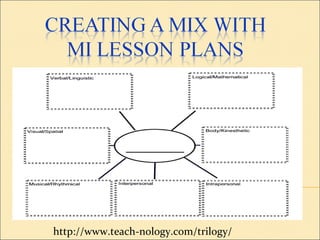
Multiple Intelligences (Gardner 1983)
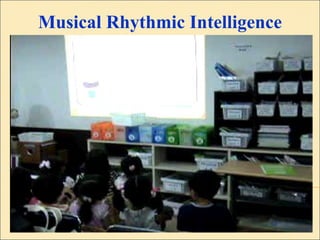
Musical Rhythmic Intelligence
http://www.teach-nology.com/trilogy/
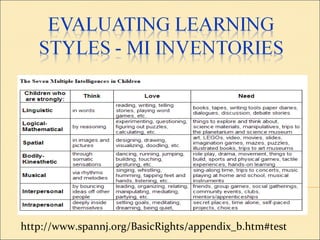
http://www.spannj.org/BasicRights/appendix_b.htm#test
Aaron’s profile from website linked below: Interpersonal, Verbal-Linguistic  strength  90 Kinesthetic, Intrapersonal strength  80  Logical-mathematical strength  70 Musical strength  70 Naturalist strength, Visual-spatial  60 http://surfaquarium.com/MI/inventory.htm http://www.igs.net/~cmorris/inventories_on_mi.html
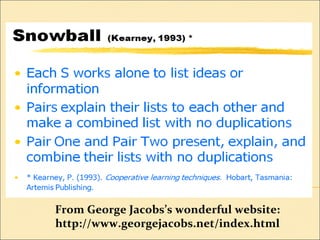
Advantages: *Maximize student talking time. *Maximize interaction. Activity examples:  Think Pair Share, Circle of Speakers,  Circle of Writers, & Snowball.
From George Jacobs’s wonderful website: http://www.georgejacobs.net/index.html
List all the things you know about  ants  ( in 1 minute) Next,  make a list with your partner … next share with the two people next to you or behind you . No duplications please!
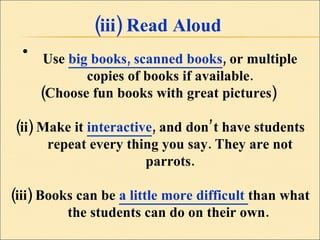
(iii) Read Aloud Use  big books, scanned books , or multiple copies of books if available. (Choose fun books with great pictures)  (ii) Make it  interactive , and don’t have students repeat every thing you say. They are not parrots. (iii) Books can be  a little more difficult  than what the students can do on their own.
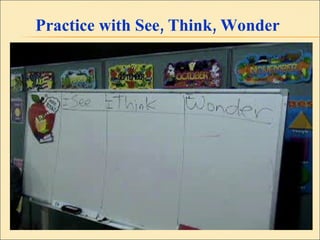
Practice with See, Think, Wonder
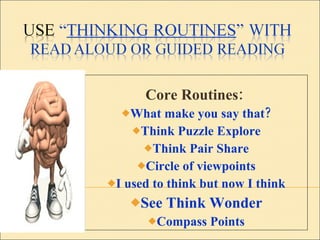
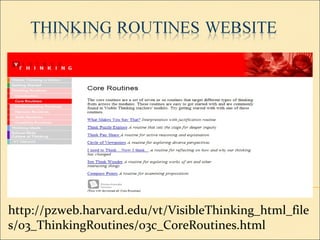
Core Routines:  What make you say that? Think Puzzle Explore Think Pair Share Circle of viewpoints I used to think but now I think See Think Wonder Compass Points
http://pzweb.harvard.edu/vt/VisibleThinking_html_files/03_ThinkingRoutines/03c_CoreRoutines.html
 
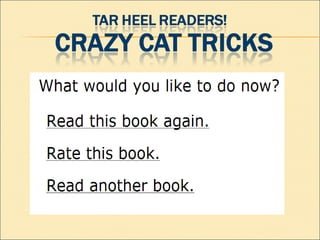
1. Make books with pictures. The site  has a voice which will read them! 2. Also download them as PPT & use in class directly! 


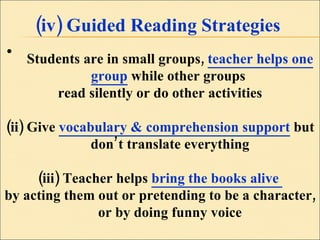
(iv) Guided Reading Strategies Students are in small groups,  teacher helps one group  while other groups  read silently or do other activities (ii) Give  vocabulary & comprehension support  but don’t translate everything (iii) Teacher helps  bring the books alive  by acting them out or pretending to be a character, or by doing funny voice
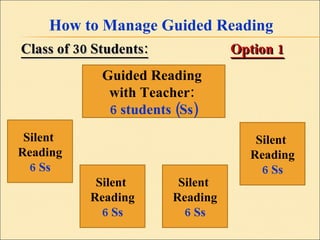
How to Manage Guided Reading Class of 30 Students:   Option 1 Guided Reading  with Teacher:  6 students (Ss) Silent  Reading 6 Ss Silent  Reading 6 Ss Silent  Reading 6 Ss Silent  Reading 6 Ss
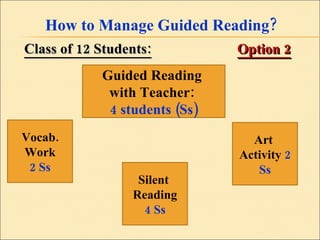
How to Manage Guided Reading? Class of 12 Students:   Option 2 Guided Reading  with Teacher:  4 students (Ss) Vocab. Work 2 Ss Silent  Reading 4 Ss Art  Activity  2 Ss
(v) Shared Reading Strategies Pair  weaker and stronger students together . Stronger students read  first, weaker student reads along,  then reads themselves.  (ii)  Train higher level students  how to help lower level students,  train lower level students  how to follow. Two win! (iii)  Choose the books yourself , or have “responsible” higher level Ss do it.
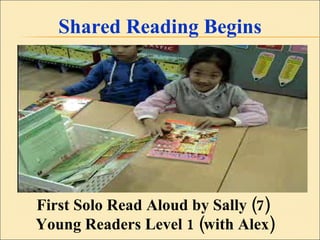
Shared Reading Begins First Solo Read Aloud by Sally (7)  Young Readers Level 1 (with Alex)
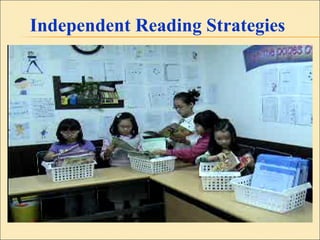
(vi) Independent Reading Strategies This is where ER really takes off. Make  sure you have a  wide selection  of books. (ii) Students should choose there own books based on the main ER principles  –  easy & interesting  to them! (iii) Set goals for how many books students should read and  share the challenge of reading many books.
Independent Reading Strategies
Independent Reading Strategies Predicting the story Reading for overall ‘gist’ (understanding) Be careful with dictionary use Guessing or skipping words Choosing books correctly (vi) Re-reading to understand (vii) Reading ahead to understand (viii) Retelling the story (ix) Evaluating the story in some way
(vii) Vocabulary Instruction Many words are  learnt naturally  through repetition in a  variety of contexts , so  NOT  every word needs  to be taught by teacher. (ii) Use  word lists  and  word cards.  It’s  very simple- English on one side & Korean  on the other. This is the most efficient way. (iii) Sight words 1 st   (200-300),  then work on  first 1000  words, then  2000.
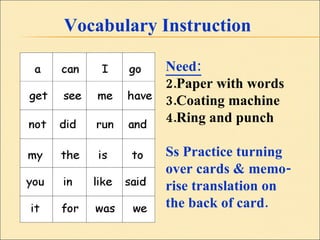
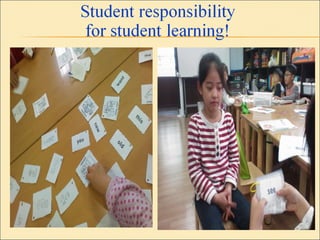
Vocabulary Instruction Need: Paper with words Coating machine Ring and punch Ss Practice turning  over cards & memo- rise translation on  the back of card.
Need: Paper with words Coating machine Ring and punch Ss Practice turning  over cards & memo- rise translation on  the back of card.
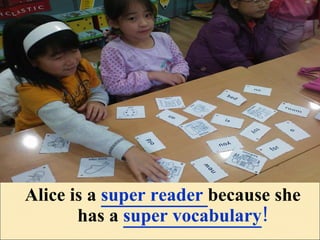
Alice is a  super reader  because   she has a  super vocabulary !
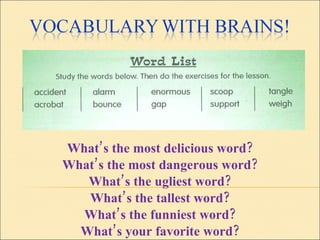
What’s the most delicious word? What’s the most dangerous word? What’s the ugliest word? What’s the tallest word? What’s the funniest word? What’s your favorite word?
(viii) Assessment A lot of assessment is  not  needed  for ER to work.  The research and results  show that it works if simply done  for  sustained periods  of  time.  Just enjoy as much as possible!
(viii) Assessment If you do assess, then it’s  more important  to track  progress  of your students’  vocabulary,  fluency  & comprehension. Don’t ask for translation!
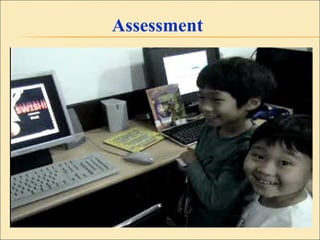
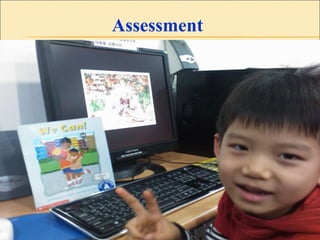
(viii) Assessment Make assessment fun… by using  online or offline  computer based   quizzes.
Assessment
Assessment
Assessment
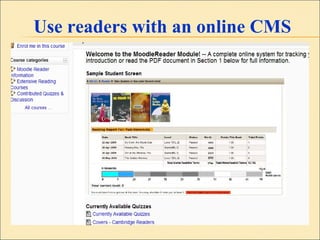
Use readers with an online CMS
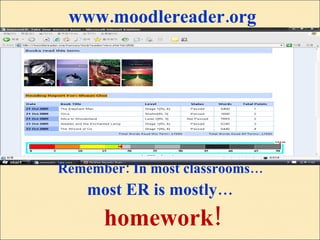
www.moodlereader.org Remember: In most classrooms…  most ER is mostly…  homework!
Conclusion How do you choose resources? (ii) What are the long term results? (iii) Can ER in a big classroom work? (iv) Q and A with Presenter.
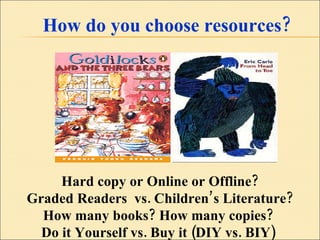
How do you choose resources? Hard copy or Online or Offline? Graded Readers  vs. Children’s Literature? How many books? How many copies?  Do it Yourself vs. Buy it (DIY vs. BIY)
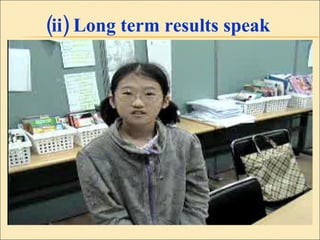
(ii) Long term results speak
(iii)  Can it work in a big class? Yes  it can if you have the right materials and the right support. Little by little!
Join KOTESOL ER SIG Contact  Scott Miles  at  [email_address] to join our mailing list and get event invites
Q & A? Thank you very much for sharing today!

Ehwa.workshop.ppt.nov.5th.2010

  • 1.
    Aaron D. Jolly Hanseo University's Institute for the Development of Talented and Gifted Education. Extensive Reading for Korean Young Learners
  • 2.
  • 3.
  • 4.
  • 5.
  • 6.
  • 7.
  • 8.
  • 9.
  • 10.
    Idea #1: Make PPT books! I see, I think, I wonder!
  • 11.
    I resemble the thinker , therefore I am. (Rodin 1902, meets Descarte, 1637)
  • 12.
    I reflect therefore I teach. (Descarte 1637 meets Farrell 2008)
  • 13.
    Workshop Framework A.Introduction B. What is Extensive Reading (ER)? C. ER Practice for Korean Young Learners D. ER Techniques for Korean Young Learners E. Conclusion + Q&A
  • 14.
    ER, MI, L.Arts & Fun!!! We teach pre-kinder, kinder, elementary & M.S. with reading based 4 skills program.
  • 15.
    Hanseo U. GiftedProgram We have an English library with 10,000 leveled books.
  • 16.
    Julie (9) says:“ Excuse me Professor Jolly, Winston is ruining our puppet show!”
  • 17.
    A. IntroductionWhat is Reading? (ii) What are Korean Elementary School Kids Like? (iii) What Can E.R. with Korean Young Learners Be Like?
  • 18.
    (i) What isReading?
  • 19.
    (i) What isReading? K: “Reading is happy time.” (sic) G1: “Reading is my mum’s favorite thing.” G2: “Reading is always lots of stories.” G3: “Reading is how you learn words.” G4: “Reading is when you read fiction or non-fiction books and take a quiz.” G5: “Reading is much better than my school English textbook.” G6: “Reading is a tool to get new information in English.”
  • 20.
    Answers? 1. Fun for students! 2. Parents love it 3: Everybody loves stories 4: Vocabulary 5: Assessment 6: Natural Approach 7: Content English
  • 21.
  • 22.
    It’s Time toShare a Story Do you know who this is? (Hint: Author of Very Hungry Caterpillar)
  • 23.
    Yes it’s EricCarle Author of The Very Hungry Caterpillar & many other great books for children.
  • 24.
  • 25.
  • 26.
  • 27.
  • 28.
  • 29.
  • 30.
  • 31.
  • 32.
  • 33.
  • 34.
  • 35.
  • 36.
  • 37.
    (ii) What AreKorean El. Kids Like? Good points: - Devoted if the teacher is competent & caring . -Are often very hard working and diligent. -Willing to work as a group and support. - Take part in tasks if they feel success .
  • 38.
    (ii) What AreKorean El. Kids Like? Challenging points: -Noisy and don’t listen to teacher well. - Speak Korean too much. -Sometimes too busy with other work to read. -Get discouraged and feel they are not smart if classroom is too competitive or difficult.
  • 39.
    (iii ) WhatCan ER with Korean Young Learners Be Like?
  • 40.
    B. Whatis ER? 1. Extensive reading vs. Intensive reading. 2. Main principle is it should be easy. 3. Day & Bamford’s 10 characteristics. 4. Read a lot for wide understanding without using dictionary or translation.
  • 41.
    What is ER?– Richard R. Day Chair of Dept. 2 nd language studies at University of Hawaii, USA.
  • 42.
    Why does ERwork? 1. Meet a lot of vocabulary in context. 2. Since ER falls within students “Zone of Proximal Development students both learn & teach others . 3. Speaking and writing skills are acquired naturally through ER use.
  • 43.
  • 44.
    What does theresearch show? 1. Reading= #1 factor for language success. 2. Long term studies in Singapore & SE Asia: Reading helps grammar & writing for YL. 3. Korean and Japanese Studies: Students who read extensively out perform those who don’t on English language tests.
  • 45.
    What does theresearch show? Extensive Reading = Success
  • 46.
    What is ERlike in Korea? 1. High level “fancy” hagwons use it. 2. Government book library programs. 3. Mum’s revolution with books at home. 4. Private (and some public) schools have set up small libraries. *Problem: Most reading here is intensive & short!
  • 47.
    What is good ER like in Korea? Ask mums (or dads), or ask bookstore workers, or ask someone whose kid goes to a fancy academy how? – steal the ideas and make them your own!
  • 48.
    C. ERPractice ER with Very Young Korean Learners. (ii) ER with Young Korean Learners. (iii) ER for Differentiated Classes.
  • 49.
    ER for VeryYoung Learners Make it fun , and let it be noisy. (ii) Use cool props, technology, magic . (iii) Make your own resources or buy audio-visual interactive materials.
  • 50.
    ER for VeryYoung Learners
  • 51.
    ER for YoungKorean Learners Let them choose books & feel confident (ii) Give them comprehension support. (iii) “ Leave them kids alone ” : Don’t challenge them to explain every detail.
  • 52.
    ER for YoungKorean Learners Students love the readers! No need for torturous glossing by teacher, resource or self.
  • 53.
    Hanseo U. GiftedProgram. Mostly authentic literature, but have added 100’s of graded readers in 2008.
  • 54.
    ER for YoungKorean Learners Graded Readers are “books prepared so that they stay within strictly limited vocabulary.” (Nation, 2001)
  • 55.
    Graded readers... … are fiction texts
  • 56.
    Graded readers... … are non-fiction texts
  • 57.
    More Graded ReadersFeatures: Variety, fun, great teachers guides & in book activities, free download chants & activities. L1-L4: Students with 100-400hrs.
  • 58.
    Why Graded ReadersWork! Gary – Age 7 (2008) Now in 2010 (aged 9) he is US 3 rd grade level
  • 59.
    ER in DifferentiatedClassrooms Have different level books available. (ii) Create different roles in activities. (iii) Use stations , quiet time & drawing. Note: DO NOT challenge lower level students to produce until they are ready.
  • 60.
    Station Set-up Sample Class of 32 Students: Read aloud with teacher: 16 students (Ss) Vocab. Card Practice 4 Ss Quizzes/Puzzles 4 Ss Art Activity 4 Ss Reader Play 4 Ss
  • 61.
  • 62.
  • 63.
    D. ERTechniques for Korean YL Phonics & Sight Words (ii) Multiple Intelligences & Co-op. Learning (iii) Read Aloud (iv) Guided Reading Strategies (v) Shared Reading Strategies (vi) Independent Reading Strategies (vii) Vocabulary Instruction (viii) Assessment
  • 64.
    (i) Phonics &Sight Words. Alphabet Short Vowel Long Vowel Double Consonants Double Letter Vowels. NOTE: BE SYSTEMATIC WITH THESE. (ii) Sight Words 200-300 common words * They make up 75% of all words that appear in children’s stories. (iii) Fluency is important so repeated reading and repeated practice is needed.
  • 65.
  • 66.
    Phonics & SightWords Ideas Use mini-phonics books. Make your own (DIY). Use a company textbook . Use CD-Rom style resources Use free Internet sites like EnglishRaven.com
  • 67.
    (ii) MI andCooperative Learning Children are “intelligent” in different ways, and have different strengths. (ii) So a variety of methods are needed! Include musical activities, movement, social interaction, individual time etc. (iii) Train students to teach themselves and you are removing the need for a teacher & creating life long learners.
  • 68.
  • 69.
  • 70.
  • 71.
  • 72.
    Aaron’s profile fromwebsite linked below: Interpersonal, Verbal-Linguistic strength 90 Kinesthetic, Intrapersonal strength 80 Logical-mathematical strength 70 Musical strength 70 Naturalist strength, Visual-spatial 60 http://surfaquarium.com/MI/inventory.htm http://www.igs.net/~cmorris/inventories_on_mi.html
  • 73.
    Advantages: *Maximize studenttalking time. *Maximize interaction. Activity examples: Think Pair Share, Circle of Speakers, Circle of Writers, & Snowball.
  • 74.
    From George Jacobs’swonderful website: http://www.georgejacobs.net/index.html
  • 75.
    List all thethings you know about ants ( in 1 minute) Next, make a list with your partner … next share with the two people next to you or behind you . No duplications please!
  • 76.
    (iii) Read AloudUse big books, scanned books , or multiple copies of books if available. (Choose fun books with great pictures) (ii) Make it interactive , and don’t have students repeat every thing you say. They are not parrots. (iii) Books can be a little more difficult than what the students can do on their own.
  • 77.
    Practice with See,Think, Wonder
  • 78.
    Core Routines: What make you say that? Think Puzzle Explore Think Pair Share Circle of viewpoints I used to think but now I think See Think Wonder Compass Points
  • 79.
  • 80.
  • 81.
    1. Make bookswith pictures. The site has a voice which will read them! 2. Also download them as PPT & use in class directly! 
  • 82.
  • 83.
  • 84.
  • 85.
  • 86.
  • 87.
  • 88.
  • 89.
  • 90.
  • 91.
    (iv) Guided ReadingStrategies Students are in small groups, teacher helps one group while other groups read silently or do other activities (ii) Give vocabulary & comprehension support but don’t translate everything (iii) Teacher helps bring the books alive by acting them out or pretending to be a character, or by doing funny voice
  • 92.
    How to ManageGuided Reading Class of 30 Students: Option 1 Guided Reading with Teacher: 6 students (Ss) Silent Reading 6 Ss Silent Reading 6 Ss Silent Reading 6 Ss Silent Reading 6 Ss
  • 93.
    How to ManageGuided Reading? Class of 12 Students: Option 2 Guided Reading with Teacher: 4 students (Ss) Vocab. Work 2 Ss Silent Reading 4 Ss Art Activity 2 Ss
  • 94.
    (v) Shared ReadingStrategies Pair weaker and stronger students together . Stronger students read first, weaker student reads along, then reads themselves. (ii) Train higher level students how to help lower level students, train lower level students how to follow. Two win! (iii) Choose the books yourself , or have “responsible” higher level Ss do it.
  • 95.
    Shared Reading BeginsFirst Solo Read Aloud by Sally (7) Young Readers Level 1 (with Alex)
  • 96.
    (vi) Independent ReadingStrategies This is where ER really takes off. Make sure you have a wide selection of books. (ii) Students should choose there own books based on the main ER principles – easy & interesting to them! (iii) Set goals for how many books students should read and share the challenge of reading many books.
  • 97.
  • 98.
    Independent Reading StrategiesPredicting the story Reading for overall ‘gist’ (understanding) Be careful with dictionary use Guessing or skipping words Choosing books correctly (vi) Re-reading to understand (vii) Reading ahead to understand (viii) Retelling the story (ix) Evaluating the story in some way
  • 99.
    (vii) Vocabulary InstructionMany words are learnt naturally through repetition in a variety of contexts , so NOT every word needs to be taught by teacher. (ii) Use word lists and word cards. It’s very simple- English on one side & Korean on the other. This is the most efficient way. (iii) Sight words 1 st (200-300), then work on first 1000 words, then 2000.
  • 100.
    Vocabulary Instruction Need:Paper with words Coating machine Ring and punch Ss Practice turning over cards & memo- rise translation on the back of card.
  • 101.
    Need: Paper withwords Coating machine Ring and punch Ss Practice turning over cards & memo- rise translation on the back of card.
  • 102.
    Alice is a super reader because she has a super vocabulary !
  • 103.
    What’s the mostdelicious word? What’s the most dangerous word? What’s the ugliest word? What’s the tallest word? What’s the funniest word? What’s your favorite word?
  • 104.
    (viii) Assessment Alot of assessment is not needed for ER to work. The research and results show that it works if simply done for sustained periods of time. Just enjoy as much as possible!
  • 105.
    (viii) Assessment Ifyou do assess, then it’s more important to track progress of your students’ vocabulary, fluency & comprehension. Don’t ask for translation!
  • 106.
    (viii) Assessment Makeassessment fun… by using online or offline computer based quizzes.
  • 107.
  • 108.
  • 109.
  • 110.
    Use readers withan online CMS
  • 111.
    www.moodlereader.org Remember: Inmost classrooms… most ER is mostly… homework!
  • 112.
    Conclusion How doyou choose resources? (ii) What are the long term results? (iii) Can ER in a big classroom work? (iv) Q and A with Presenter.
  • 113.
    How do youchoose resources? Hard copy or Online or Offline? Graded Readers vs. Children’s Literature? How many books? How many copies? Do it Yourself vs. Buy it (DIY vs. BIY)
  • 114.
    (ii) Long termresults speak
  • 115.
    (iii) Canit work in a big class? Yes it can if you have the right materials and the right support. Little by little!
  • 116.
    Join KOTESOL ERSIG Contact Scott Miles at [email_address] to join our mailing list and get event invites
  • 117.
    Q & A?Thank you very much for sharing today!

Editor's Notes

  • #11 Language Research has shown that comprehensible input is crucial, and also without narrative students cannot develop fluency.
  • #12 Reflective teaching rocks!!! I’ve been reflecting a lot on the difficulties my students have had with authentic literature.
  • #13 Reflective teaching rocks!!! I’ve been reflecting a lot on the difficulties my students have had with authentic literature.
  • #16 More about lexiled books later… joke about dark circles…
  • #22 x
  • #23 Reflective teaching rocks!!! I’ve been reflecting a lot on the difficulties my students have had with authentic literature.
  • #24 Reflective teaching rocks!!! I’ve been reflecting a lot on the difficulties my students have had with authentic literature.
  • #40 Reflective teaching rocks!!! I’ve been reflecting a lot on the difficulties my students have had with authentic literature.
  • #41 Reflective teaching rocks!!! I’ve been reflecting a lot on the difficulties my students have had with authentic literature.
  • #42 Reflective teaching rocks!!! I’ve been reflecting a lot on the difficulties my students have had with authentic literature.
  • #43 Reflective teaching rocks!!! I’ve been reflecting a lot on the difficulties my students have had with authentic literature.
  • #44 Reflective teaching rocks!!! I’ve been reflecting a lot on the difficulties my students have had with authentic literature.
  • #45 Reflective teaching rocks!!! I’ve been reflecting a lot on the difficulties my students have had with authentic literature.
  • #46 Reflective teaching rocks!!! I’ve been reflecting a lot on the difficulties my students have had with authentic literature.
  • #47 Reflective teaching rocks!!! I’ve been reflecting a lot on the difficulties my students have had with authentic literature.
  • #48 Reflective teaching rocks!!! I’ve been reflecting a lot on the difficulties my students have had with authentic literature.
  • #49 Reflective teaching rocks!!! I’ve been reflecting a lot on the difficulties my students have had with authentic literature.
  • #50 Reflective teaching rocks!!! I’ve been reflecting a lot on the difficulties my students have had with authentic literature.
  • #51 Reflective teaching rocks!!! I’ve been reflecting a lot on the difficulties my students have had with authentic literature.
  • #52 Reflective teaching rocks!!! I’ve been reflecting a lot on the difficulties my students have had with authentic literature.
  • #53 Reflective teaching rocks!!! I’ve been reflecting a lot on the difficulties my students have had with authentic literature.
  • #55 The books are the stars!!!
  • #60 Reflective teaching rocks!!! I’ve been reflecting a lot on the difficulties my students have had with authentic literature.
  • #69 What about you? What are you’re strongest? Attendee interaction part…
  • #70 What about you? What are you’re strongest? Attendee interaction part…
  • #77 Reflective teaching rocks!!! I’ve been reflecting a lot on the difficulties my students have had with authentic literature.
  • #79 The core routines are a set of seven or so routines that target different types of thinking from across the modules. These routines are easy to get started with and are commonly found in Visible Thinking teachers' toolkits. Try getting started with with one of these routines. http://www.pz.harvard.edu/vt/VisibleThinking_html_files/03_ThinkingRoutines/03c_CoreRoutines.html
  • #82 The books are the stars!!!
  • #83 The books are the stars!!!
  • #84 The books are the stars!!!
  • #85 The books are the stars!!!
  • #86 The books are the stars!!!
  • #87 The books are the stars!!!
  • #88 The books are the stars!!!
  • #93 Reflective teaching rocks!!! I’ve been reflecting a lot on the difficulties my students have had with authentic literature.
  • #94 Reflective teaching rocks!!! I’ve been reflecting a lot on the difficulties my students have had with authentic literature.
  • #95 Reflective teaching rocks!!! I’ve been reflecting a lot on the difficulties my students have had with authentic literature.
  • #96 Sally could read then with Alex’s help, and after just 2 hours a week with HW for less than 6 months…
  • #97 Reflective teaching rocks!!! I’ve been reflecting a lot on the difficulties my students have had with authentic literature.
  • #98 Reflective teaching rocks!!! I’ve been reflecting a lot on the difficulties my students have had with authentic literature.
  • #99 Reflective teaching rocks!!! I’ve been reflecting a lot on the difficulties my students have had with authentic literature.
  • #100 Reflective teaching rocks!!! I’ve been reflecting a lot on the difficulties my students have had with authentic literature.
  • #101 Reflective teaching rocks!!! I’ve been reflecting a lot on the difficulties my students have had with authentic literature.
  • #102 Reflective teaching rocks!!! I’ve been reflecting a lot on the difficulties my students have had with authentic literature.
  • #105 Reflective teaching rocks!!! I’ve been reflecting a lot on the difficulties my students have had with authentic literature.
  • #106 Reflective teaching rocks!!! I’ve been reflecting a lot on the difficulties my students have had with authentic literature.
  • #107 Reflective teaching rocks!!! I’ve been reflecting a lot on the difficulties my students have had with authentic literature.
  • #108 Reflective teaching rocks!!! I’ve been reflecting a lot on the difficulties my students have had with authentic literature.
  • #109 Reflective teaching rocks!!! I’ve been reflecting a lot on the difficulties my students have had with authentic literature.
  • #110 Reflective teaching rocks!!! I’ve been reflecting a lot on the difficulties my students have had with authentic literature.
  • #114 Reflective teaching rocks!!! I’ve been reflecting a lot on the difficulties my students have had with authentic literature.
  • #115 Reflective teaching rocks!!! I’ve been reflecting a lot on the difficulties my students have had with authentic literature.
  • #116 Reflective teaching rocks!!! I’ve been reflecting a lot on the difficulties my students have had with authentic literature.
  • #117 Reflective teaching rocks!!! I’ve been reflecting a lot on the difficulties my students have had with authentic literature.
  • #118 Reflective teaching rocks!!! I’ve been reflecting a lot on the difficulties my students have had with authentic literature.