
Written By:
ABDUL HAMID ALY
211.073.0.122
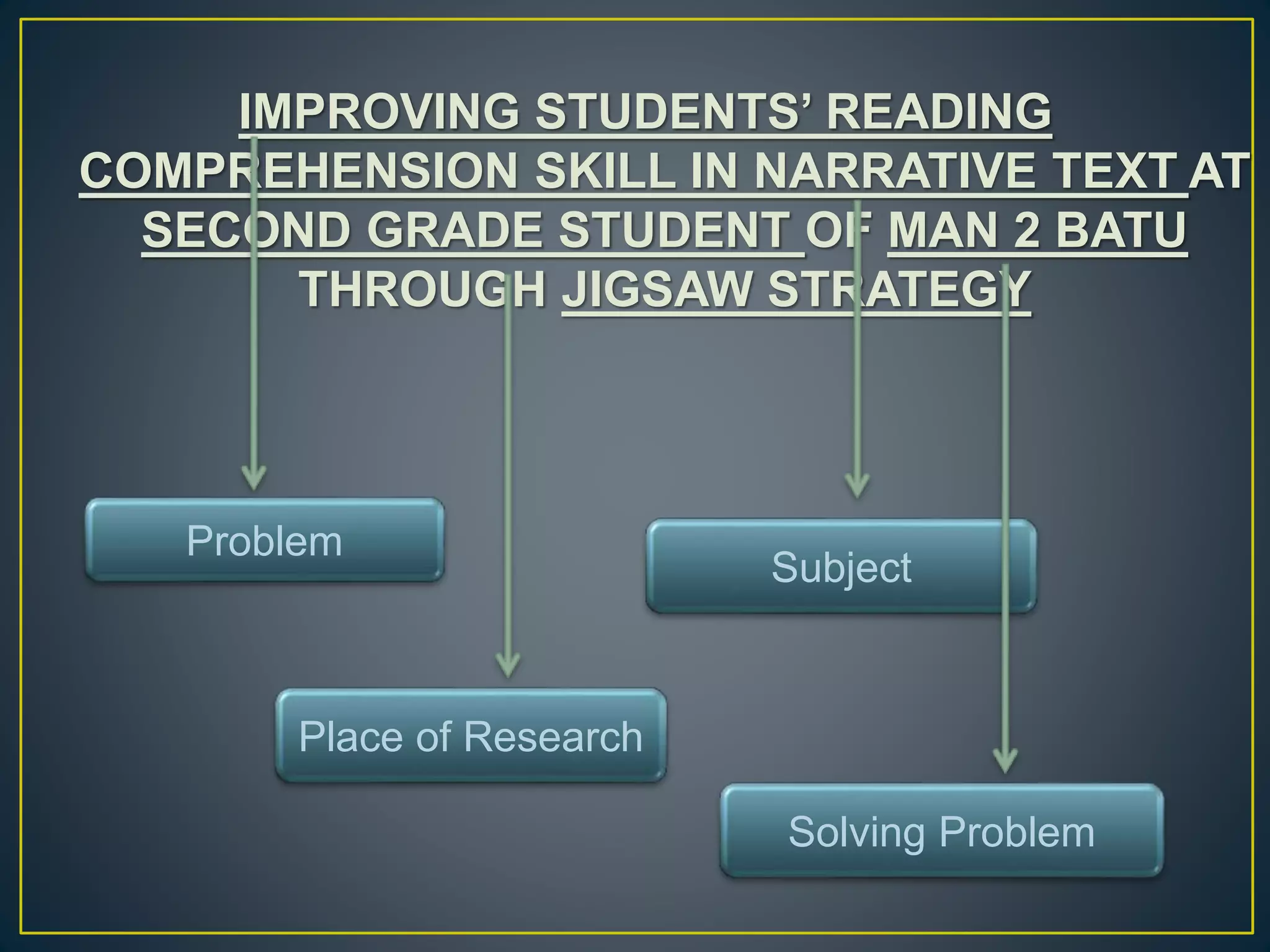
IMPROVING STUDENTS’ READING
COMPREHENSION SKILL IN NARRATIVE TEXT AT
SECOND GRADE STUDENT OF MAN 2 BATU
THROUGH JIGSAW STRATEGY
Problem
Solving Problem
Subject
Place of Research
This chapter presents about
background of the study,
statement of the problem, the
objectives of the study,
significance of study, scope and
limitation of the study, definition of
key terms.
• Important of Reading (from holy Qur’an, In modern
era)
• According to researcher’s observation in second
grade students at MAN 2 Malang kota BATU had
problem in language skills especially Reading
skill. Score of Reading English’s students in
second year is moderate mostly. Their mean
score is 7.8; this is moderate of the minimal
standard score which is could be enhance in
order to get good score.
“How can Jigsaw strategy improve the
students’ reading comprehension in
narrative text at second year students of
MAN 2 MALANG KOTA BATU?”
This study aims to describe how Jigsaw
strategy can improve the students’ Reading
comprehension in narrative text at second
year students of MAN 2 MALANG KOTA
BATU.
The teacher can use jigsaw strategy as an
alternative way to make funny and enjoying
reading,
student will study seriously and easy to
understand while they feel secure of bored as
well, which will make the students easy to
understand in reading narrative text in
teaching learning English process.
• The researcher applies jigsaw strategy in this
study to the second grade student of MAN
Malang 2 KOTA BATU to improve their
reading comprehension skill.
• The researcher just limits this study
especially using jigsaw strategy
• Improving, the term “improving” in this study is to enhance the students’
score on one of four subject of English course that must be mastered is
reading that to be focused skill being attention in this study.
• Reading Comprehension is the competency reading of standard
understanding the text that they will reach the goal both the easy way to
read a narrative text and understand what the message from writer of the
text.
• Narrative text is the text that makes the reader entertain and fun while the
reader is reading. It becomes one of the purposes of narrative text itself.
• Jigsaw strategy is a strategy in teaching learning English language to
improve a skill of four skills that could be mastered is reading. Moreover, it
is one of strategy in Cooperative learning approach.
This chapter will present some theories or
literature related to the problem which is
explained in this study. There are several
topics are described in this study as follows:
Definition of reading comprehension skill,
narrative text and jigsaw strategy as a part of
cooperative learning models.
The research related to the applying peer conferencing was
conducted by Fathurrahman (2008) Islamic University
of Malang “Improving Speaking Skill of the Second
Grade Students at SMA Islam Mojokerto using
Jigsaw Technique”
This chapter focuses on the research method
developed in the recent study, this chapter
discusses: research design, setting and
subject of the study, and research procedure
consists of the steps of the action of the study
those are planning, implementation,
observation, and reflection.
In this study the researcher use Classroom
action research design (CAR), This study aims to
improve reading comprehension skills in Narrative
text through Jigsaw strategy.
The research was conducted for one month trough
the beginning of July up to the end of July 2015.
It was conducted at MAN 2 MALANG KOTA
BATU in academic year 2013/2014. The school
was located on Jl. Patimura No 25 Kota Batu.
The subjects of the study were second grade
students. The research was focused on one
single room, namely the first semester students
of Bilingual XIE class. The class had 30
students, 10 male and 20 female students,
In this section, the researcher explains the
research procedures start from preliminary
study and research implementation which
including planning, implementation,
observation, and reflection.
This case was proven by some problems which were found by the
researcher. They are: 1) the mean score of the reading comprehension in
that class was 78.0 while the standard of that school was 78.0. 2) Most of the
students in that class were less reading interest although they have had
same score position as the standard score of the curriculum. 4) They were
bored in reading class activity when their teacher asked them to read a text.
In the class there were 30 students, the students that reached above SKBM
in the class 20% it means that only 6 students who success reached score
above 78.0, 20% in the class described students got under the standard of
the score is 6 students, and the rest of students were got the same score
The researcher prepares for applying the
action; (1) preparing lesson plan, (2) prepare
the jigsaw strategy, (3) preparing instructional
material, and also (4) criteria of success.
• Based on the lesson plan designed, the researcher will make
three preparation of the action in one cycle in teaching
learning process as follows:
• First meeting:
• Firstly,the researcher will give a narrative text that will be
discussed at that meeting. After that students are asked to
read it. Next they are asked to list the unknown vocabularies
on the blackboard while giving their meaning together.
Besides the teacher present what is Narrative text, its
purpose, and language function as well. In this chance the
researcher known the reading ability of the student based on
the result of pre-test that will get from preliminary study. Then
the teacher prepares to explain jigsaw strategy and how it will
be implemented. Here means, students understanding what
they will do and be ready for attending next meeting as the
• Second meeting:
• At the second meeting, the researcher will implement Jigsaw
strategy in the teaching learning process. At first, the researcher
explains once more about jigsaw strategy to make clear
understanding about the strategy. After that, the steps of jigsaw
strategies are implemented. Firstly, the researcher will divide
students into 5-6 group namely jigsaw group. Next, they will be
asked to arrange their class by putting 5-6 tables in circle position
in the class as they will gather with their groups. However,
distributing hand out of narrative text which has been divide into
some topic as second step.
• While discussing the narrative text they would get time for chance
to discuss 5 to 10 minutes. Thirdly they will asked to move on the
other group that expert group and discussing with the expert group
for preparing the presentation to home group or jigsaw group.
Fourthly, the students come back to jigsaw group and present what
they have discussed from expert group about the material. Finally,
for evaluating and correcting the material, narrative text, that has
In this study, the researcher downloaded the
Narrative text from English lesson book
“Lembar kerja siswa XI MA/SMA”and
downloaded from other sources. The
researcher taught the student based on the
materials designed on the syllabus.
Indicator of success here is a sign to determine
that the use of jigsaw strategy already success
in solving the problems of first grade students of
MAN 2 MALANG KOTA BATU. The indicator of
success in this strategy during the teaching and
learning process is 70% of students’ score are
increased from 78.0 to be above of score 78.0
on the school basis of the minimum mastery
learning standard.
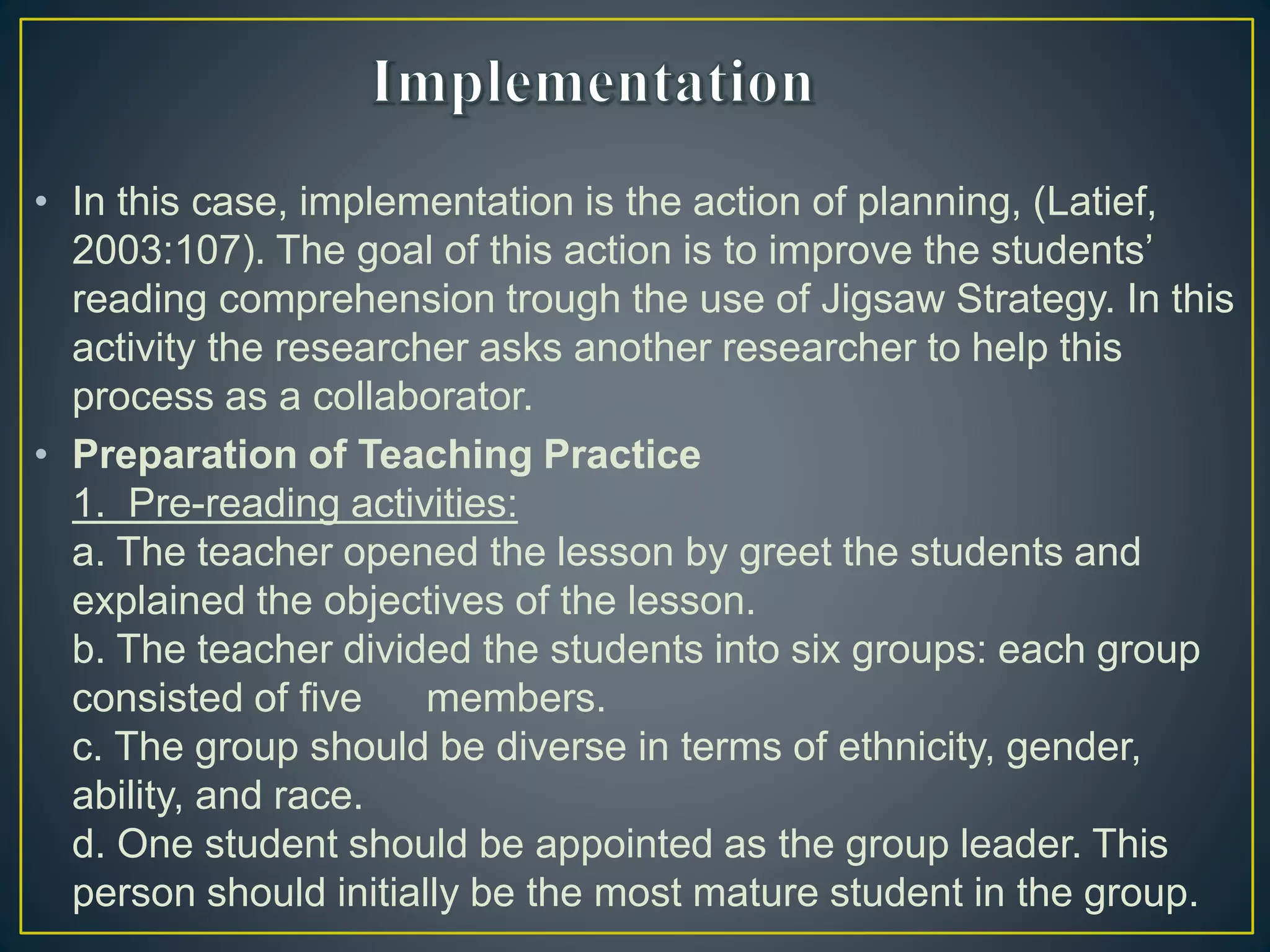
• In this case, implementation is the action of planning, (Latief,
2003:107). The goal of this action is to improve the students’
reading comprehension trough the use of Jigsaw Strategy. In this
activity the researcher asks another researcher to help this
process as a collaborator.
• Preparation of Teaching Practice
1. Pre-reading activities:
a. The teacher opened the lesson by greet the students and
explained the objectives of the lesson.
b. The teacher divided the students into six groups: each group
consisted of five members.
c. The group should be diverse in terms of ethnicity, gender,
ability, and race.
d. One student should be appointed as the group leader. This
person should initially be the most mature student in the group.
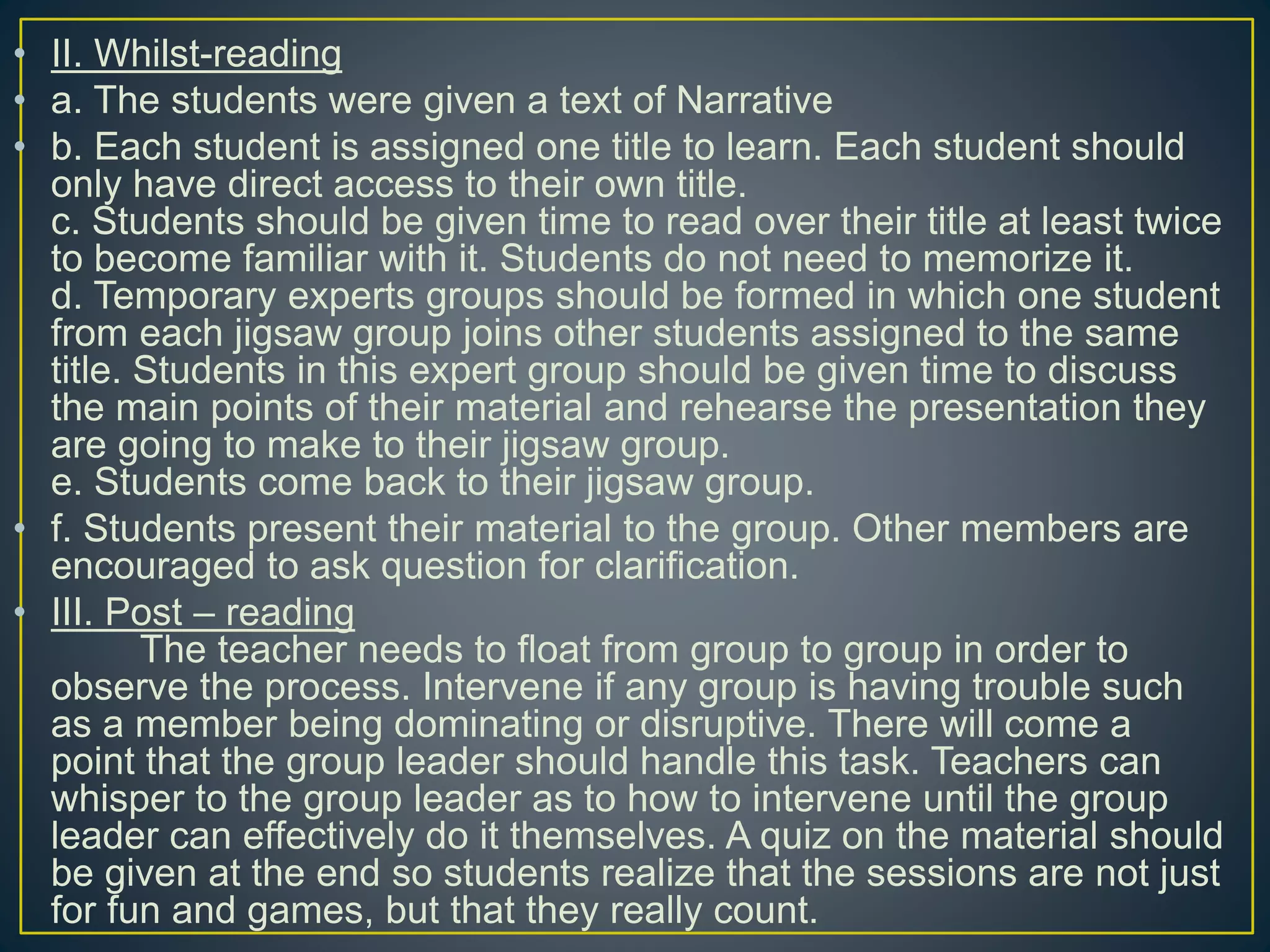
• II. Whilst-reading
• a. The students were given a text of Narrative
• b. Each student is assigned one title to learn. Each student should
only have direct access to their own title.
c. Students should be given time to read over their title at least twice
to become familiar with it. Students do not need to memorize it.
d. Temporary experts groups should be formed in which one student
from each jigsaw group joins other students assigned to the same
title. Students in this expert group should be given time to discuss
the main points of their material and rehearse the presentation they
are going to make to their jigsaw group.
e. Students come back to their jigsaw group.
• f. Students present their material to the group. Other members are
encouraged to ask question for clarification.
• III. Post – reading
The teacher needs to float from group to group in order to
observe the process. Intervene if any group is having trouble such
as a member being dominating or disruptive. There will come a
point that the group leader should handle this task. Teachers can
whisper to the group leader as to how to intervene until the group
leader can effectively do it themselves. A quiz on the material should
be given at the end so students realize that the sessions are not just
for fun and games, but that they really count.
This activity is done by the observer. The
observation is conducted when the action is
happening in the classroom. All the
information is collected by using observation
checklist, and test of reading comprehension.
• In this part, the term reflection is related to
evaluate whether the use of the technique in
this research is successful or not based on the
observation. If it is not, it will be continued to
the next cycle. The result of the analysis is
consult with the criteria of success; it is 70%
average students’ score are increase from
78.0 to be ≥ 78.0. Meanwhile, the weakness in
the first cycle will be improved to the next
cycle. This cycle will be stopped when the
criteria of success is reached.
Jigsaw Strategy to Improve Reading Comprehension

Jigsaw Strategy to Improve Reading Comprehension

  • 1.
    Written By: ABDUL HAMIDALY 211.073.0.122
  • 2.
    IMPROVING STUDENTS’ READING COMPREHENSIONSKILL IN NARRATIVE TEXT AT SECOND GRADE STUDENT OF MAN 2 BATU THROUGH JIGSAW STRATEGY Problem Solving Problem Subject Place of Research
  • 3.
    This chapter presentsabout background of the study, statement of the problem, the objectives of the study, significance of study, scope and limitation of the study, definition of key terms.
  • 4.
    • Important ofReading (from holy Qur’an, In modern era) • According to researcher’s observation in second grade students at MAN 2 Malang kota BATU had problem in language skills especially Reading skill. Score of Reading English’s students in second year is moderate mostly. Their mean score is 7.8; this is moderate of the minimal standard score which is could be enhance in order to get good score.
  • 5.
    “How can Jigsawstrategy improve the students’ reading comprehension in narrative text at second year students of MAN 2 MALANG KOTA BATU?”
  • 6.
    This study aimsto describe how Jigsaw strategy can improve the students’ Reading comprehension in narrative text at second year students of MAN 2 MALANG KOTA BATU.
  • 7.
    The teacher canuse jigsaw strategy as an alternative way to make funny and enjoying reading, student will study seriously and easy to understand while they feel secure of bored as well, which will make the students easy to understand in reading narrative text in teaching learning English process.
  • 8.
    • The researcherapplies jigsaw strategy in this study to the second grade student of MAN Malang 2 KOTA BATU to improve their reading comprehension skill. • The researcher just limits this study especially using jigsaw strategy
  • 9.
    • Improving, theterm “improving” in this study is to enhance the students’ score on one of four subject of English course that must be mastered is reading that to be focused skill being attention in this study. • Reading Comprehension is the competency reading of standard understanding the text that they will reach the goal both the easy way to read a narrative text and understand what the message from writer of the text. • Narrative text is the text that makes the reader entertain and fun while the reader is reading. It becomes one of the purposes of narrative text itself. • Jigsaw strategy is a strategy in teaching learning English language to improve a skill of four skills that could be mastered is reading. Moreover, it is one of strategy in Cooperative learning approach.
  • 10.
    This chapter willpresent some theories or literature related to the problem which is explained in this study. There are several topics are described in this study as follows: Definition of reading comprehension skill, narrative text and jigsaw strategy as a part of cooperative learning models.
  • 11.
    The research relatedto the applying peer conferencing was conducted by Fathurrahman (2008) Islamic University of Malang “Improving Speaking Skill of the Second Grade Students at SMA Islam Mojokerto using Jigsaw Technique”
  • 12.
    This chapter focuseson the research method developed in the recent study, this chapter discusses: research design, setting and subject of the study, and research procedure consists of the steps of the action of the study those are planning, implementation, observation, and reflection.
  • 13.
    In this studythe researcher use Classroom action research design (CAR), This study aims to improve reading comprehension skills in Narrative text through Jigsaw strategy.
  • 14.
    The research wasconducted for one month trough the beginning of July up to the end of July 2015. It was conducted at MAN 2 MALANG KOTA BATU in academic year 2013/2014. The school was located on Jl. Patimura No 25 Kota Batu. The subjects of the study were second grade students. The research was focused on one single room, namely the first semester students of Bilingual XIE class. The class had 30 students, 10 male and 20 female students,
  • 15.
    In this section,the researcher explains the research procedures start from preliminary study and research implementation which including planning, implementation, observation, and reflection.
  • 16.
    This case wasproven by some problems which were found by the researcher. They are: 1) the mean score of the reading comprehension in that class was 78.0 while the standard of that school was 78.0. 2) Most of the students in that class were less reading interest although they have had same score position as the standard score of the curriculum. 4) They were bored in reading class activity when their teacher asked them to read a text. In the class there were 30 students, the students that reached above SKBM in the class 20% it means that only 6 students who success reached score above 78.0, 20% in the class described students got under the standard of the score is 6 students, and the rest of students were got the same score
  • 17.
    The researcher preparesfor applying the action; (1) preparing lesson plan, (2) prepare the jigsaw strategy, (3) preparing instructional material, and also (4) criteria of success.
  • 18.
    • Based onthe lesson plan designed, the researcher will make three preparation of the action in one cycle in teaching learning process as follows: • First meeting: • Firstly,the researcher will give a narrative text that will be discussed at that meeting. After that students are asked to read it. Next they are asked to list the unknown vocabularies on the blackboard while giving their meaning together. Besides the teacher present what is Narrative text, its purpose, and language function as well. In this chance the researcher known the reading ability of the student based on the result of pre-test that will get from preliminary study. Then the teacher prepares to explain jigsaw strategy and how it will be implemented. Here means, students understanding what they will do and be ready for attending next meeting as the
  • 19.
    • Second meeting: •At the second meeting, the researcher will implement Jigsaw strategy in the teaching learning process. At first, the researcher explains once more about jigsaw strategy to make clear understanding about the strategy. After that, the steps of jigsaw strategies are implemented. Firstly, the researcher will divide students into 5-6 group namely jigsaw group. Next, they will be asked to arrange their class by putting 5-6 tables in circle position in the class as they will gather with their groups. However, distributing hand out of narrative text which has been divide into some topic as second step. • While discussing the narrative text they would get time for chance to discuss 5 to 10 minutes. Thirdly they will asked to move on the other group that expert group and discussing with the expert group for preparing the presentation to home group or jigsaw group. Fourthly, the students come back to jigsaw group and present what they have discussed from expert group about the material. Finally, for evaluating and correcting the material, narrative text, that has
  • 20.
    In this study,the researcher downloaded the Narrative text from English lesson book “Lembar kerja siswa XI MA/SMA”and downloaded from other sources. The researcher taught the student based on the materials designed on the syllabus.
  • 21.
    Indicator of successhere is a sign to determine that the use of jigsaw strategy already success in solving the problems of first grade students of MAN 2 MALANG KOTA BATU. The indicator of success in this strategy during the teaching and learning process is 70% of students’ score are increased from 78.0 to be above of score 78.0 on the school basis of the minimum mastery learning standard.
  • 22.
    • In thiscase, implementation is the action of planning, (Latief, 2003:107). The goal of this action is to improve the students’ reading comprehension trough the use of Jigsaw Strategy. In this activity the researcher asks another researcher to help this process as a collaborator. • Preparation of Teaching Practice 1. Pre-reading activities: a. The teacher opened the lesson by greet the students and explained the objectives of the lesson. b. The teacher divided the students into six groups: each group consisted of five members. c. The group should be diverse in terms of ethnicity, gender, ability, and race. d. One student should be appointed as the group leader. This person should initially be the most mature student in the group.
  • 23.
    • II. Whilst-reading •a. The students were given a text of Narrative • b. Each student is assigned one title to learn. Each student should only have direct access to their own title. c. Students should be given time to read over their title at least twice to become familiar with it. Students do not need to memorize it. d. Temporary experts groups should be formed in which one student from each jigsaw group joins other students assigned to the same title. Students in this expert group should be given time to discuss the main points of their material and rehearse the presentation they are going to make to their jigsaw group. e. Students come back to their jigsaw group. • f. Students present their material to the group. Other members are encouraged to ask question for clarification. • III. Post – reading The teacher needs to float from group to group in order to observe the process. Intervene if any group is having trouble such as a member being dominating or disruptive. There will come a point that the group leader should handle this task. Teachers can whisper to the group leader as to how to intervene until the group leader can effectively do it themselves. A quiz on the material should be given at the end so students realize that the sessions are not just for fun and games, but that they really count.
  • 24.
    This activity isdone by the observer. The observation is conducted when the action is happening in the classroom. All the information is collected by using observation checklist, and test of reading comprehension.
  • 25.
    • In thispart, the term reflection is related to evaluate whether the use of the technique in this research is successful or not based on the observation. If it is not, it will be continued to the next cycle. The result of the analysis is consult with the criteria of success; it is 70% average students’ score are increase from 78.0 to be ≥ 78.0. Meanwhile, the weakness in the first cycle will be improved to the next cycle. This cycle will be stopped when the criteria of success is reached.