EHS Legal Requirements
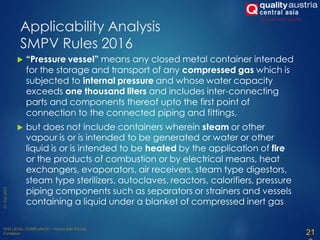
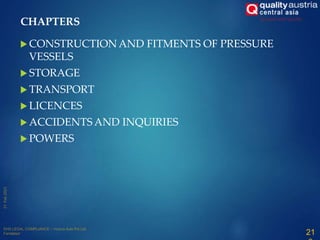
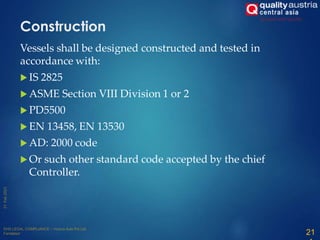
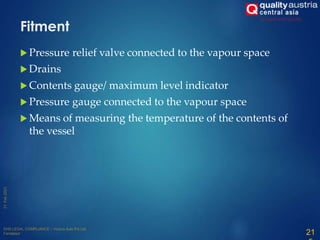
VICTORA AUTO PVT LTD,
FARIDABAD
21&22 FEBRUARY 2023
1
Vandana Sharma
Deputy General Manager – C & T
Tel: +91 120 5106100,
Mob:+ 91 8588819465
Email : vandana.sharma@qacamail.com
Dr.Vinit kumar mishra
MODULE 1
Introduction Participants,
Faculty and Course
2
•
Faculty: Dr. Vinit Kumar Mishra
More than 20 year experience in EHS Legal
Compliance and Management Systems.
Experience of working on Regulatory compliance
management for more than 5 countries.
3
Your name,
designation
& functional
area of work What is your
expectation
out of this
training
Introduction to
Indian EHS
Legislation
4
MODULE 2
 Protection of the environment and keeping ecological
balance unaffected is a task which not only the
government but also every individual, association and
corporation must undertake. It is a social obligation and
fundamental duty enshrined in Article 51 A (g) of the
Constitution of India.
 There is a rapid evolution in the Indian legislations after
independence as the need and concern regarding
environment arose.
5
Environmental Legislations in India
Health and Safety Legislations in
India
 In India, labour falls under the Concurrent List of the
Constitution. Therefore, both Parliament and state
legislatures can make laws regulating labour.
 Currently, there are over 100 state and 40 central laws
regulating various aspects of labour such as resolution of
industrial disputes, working conditions, social security
and wages.
6
 Water (Prevention and Control of Pollution) Act, 1974 and Rules 1975
 Water (Prevention and Control of Pollution) Cess Act, 1977
(Amended up to 2003)
 Air (Prevention and Control of Pollution) Act, 1981 and Rules 1982
 Environmental Protection Act, 1986 and Rules 1986
 Manufacture, Storage and Import of hazardous Chemical Rules,
1989 (amended upto 2022).
 The Public Liability Insurance Act, 1991 and Rules 1991/1992/1993
 Environmental (Protection) Second amendment Rules, 1992,
Environment Audit/ Form V
 Environment Impact Assessment – Notification 2006
 Bio-Medical Waste (Management and Handling) Rules, 2016
Chronology of Environmental
Legislations in India
7
 Hazardous Wastes (Management and Handling) Rules, 2016
(Amended up to 2022)
 The Noise Pollution (Regulation and Control) Rules, 2000 (amended
up to 2017)
 Battery Waste (Management and Handling) Rules, 2001 (amended up
to 2022)
 Biological diversity Act, 2002
 National Ambient Air Quality Standards Notification, 2009
 Municipal Solid Wastes (Management and Handling) Rules,
2000/Solid Waste Management Rules, 2016
 Construction and Demolition waste Management rules, 2016
 Plastic Waste (Management and Handling) Rules, 2011 /
Plastic Waste Management Rules,2016 (amended up to 2022)
 E-Waste (Management and Handling) Rules,2016 (amended upto
2022)
Chronology of Environmental
Legislations in India
8
 National Green Tribunal Act, 2010 / Rules 2011
 Central Ground Water Authority Notification 1997
 Categorization of Industries 05-March-2016
 CPCB Notifications from time to time
9
Chronology of Environmental
Legislations in India
Health and Safety Legislations
1. The Factories Act, 1948 (amended upto 2022);
2. The Mines Act, 1952 (amended upto 2010);
3. The Dock Workers (Safety, Health and Welfare) Act, 1986;
4. The Building and Other Construction Workers (Regulation of
Employment and Conditions of Service) Act, 1996;
5. The Plantations Labour Act, 1951;
6. The Contract Labour (Regulation and Abolition) Act, 1970;
7. The Inter-State Migrant workmen (Regulation of Employment and
Conditions of Service) Act, 1979;
8. The Working Journalist and other News Paper Employees
(Conditions of Service and Miscellaneous Provision) Act, 1955;
9. The Working Journalist (Fixation of rates of wages) Act, 1958;
10. The Motor Transport Workers Act, 1961;
11. The Sales Promotion Employees (Conditions of Service) Act, 1976;
12. The Beedi and Cigar Workers (Conditions of Employment) Act, 1966;
13. The Cine Workers and Cinema Theatre Workers Act, 1981.
10
®
11
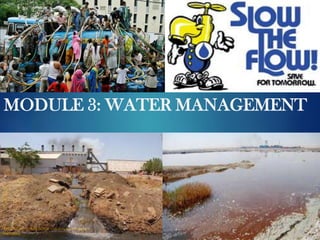
MODULE 3: WATER MANAGEMENT
WATER (PREVENTION AND CONTROLOF POLLUTION)
ACT, 25th MARCH, 1974 (1974/1988/2003)
 “Water pollution" means such contamination of water or such
alteration of the physical, chemical or biological properties of water
or such discharge of any sewage or trade effluent or of any other
liquid, gaseous or solid substance into water (whether directly or
indirectly) as may, or is likely to, create a nuisance or render such
water harmful or injurious to public health or safety, or to domestic,
commercial, industrial, agricultural or other legitimate uses, or to
the life and health of animals or plants or of aquatic organisms;
 “Trade effluent" includes any liquid, gaseous or solid substance
which is discharged from any premises used for carrying on any
“Industry, operation or process, or treatment and disposal system"
other than domestic sewage.
12
Water(Prevention and Control of Pollution)Act 1974
(amended up to 2003)
13
PROCEDURAL REQUIREMENTS
• Section 25: (New Outlets & New Discharges)
• Obtain consent to establish
• Obtain consent to operate
• Application for renewal of consent to operate (one month before the
expiry) in the prescribed Form 1 of the State Pollution Control Board
along with the prescribed fee.
• Prohibition on the use of stream or well for disposal of effluent
OPERATIONAL REQUIREMENTS
14
• Furnishing of information to Pollution Control Board (PCB)
• Provide access to PCB official for sample collection for
purpose analysis
• Provide entry to PCB official for inspection
• Comply with prescribed consent conditions
• Discharge effluent in accordance with prescribed
standards
• Comply with directions issued by PCB
Water(Prevention and Control of Pollution)Act 1974
((amended up to 2003)
15
OPPORTUNITIES FOR INDUSTRY
• SPECIFIED EFFLUENT SAMPLING PROCEDURE FOR LEGAL
EVIDENCE
• AUTOMATIC GRANT OF CONSENT AFTER FOUR MONTHS FOR
COMPLETE APPLICATION (DEEMED CONSENT)
• REFUSAL OF CONSENT IN WRITING
• APPEAL TO APPELLATE AUTHORITY
• ANY PERSON AGGRIEVED BY A CONSENT ORDER MAY APPEAL
WITHIN 30 DAYS TO APPELLATE AUTHORITY FOLLOWING
SPECIFIED PROCEDURE (FORM & FEE).
16
Specified Procedure for Effluent Sampling
• Prior “Notice of Intention to have Sample Analysed” to be
served by the PCB to the Industry in prescribed form.
• Board official to divide the sample taken into two parts.
• Both the parts to be kept in separate container, marked, sealed
and also to be signed by the Industry representative along with
Board official.
• First container to be taken by Board for analysis to the
laboratory established or recognized by the Board.
• Second container to the laboratory established or recognized
by the Central/ State Governments.
• In case of variation in the analysis results the report of
Central/ State Government laboratory shall prevail.
Water Cess Act : 1977 (amended
upto 2003)
 An Act to provide for the levy and collection of a cess on water
consumed by persons carrying on certain industries and by local
authorities.
 As per the Water Cess (Amendment) Act 2003, dated 6th May 2003, all
industries with total water consumption less than 10 kL/day are
exempted from levy of Cess provided they are not generating
hazardous wastes.
AFFIXING OF METERS
 For the purpose of measuring and recording the quantity of water consumed,
industry and every local authority shall affix meters.
17
PENALTY
 Whoever furnishes false return/ evades cess or shall be
punishable with imprisonment which may extend to six
months or with fine which may extend to one
thousand rupees or with both.
 Where an offence under this Act has been committed by a
company, in charge of the company shall be deemed to be
guilty of the offence and shall be liable to be proceeded
against and punished accordingly:
18
Summary of Legal Requirements in EMS
 Declaration of trade effluents and sewage effluent in
the application for Water Consent.
 Submit Water Cess before 5th of every month.
 Upkeep of ETP, STP/ Septic Tank - Soak Pit.
 Set Up Rainwater Harvesting Structure
 Declare groundwater sources e.g. borewell / openwell.
 Obtain Water Supply Permit from the concerned Authority
[e.g. Municipal Authorities, Central Ground Water
Authority (CGWA) or any other Authority, as applicable];
 If the facility is located in“Notified/Semicritical/Critical/Over
exploited Area;” obtain Approval from CGWA for
Installation of Bore wells/OR for Existing Bore wells;.
19
 The CGWA, has issued a public notice dated April 10,
2022, stating that all groundwater users, including
residential apartments using it for drinking and domestic
purposes, group housing societies, government water
supply agencies in urban areas, bulk water suppliers,
industrial, infrastructure and mining projects and
swimming pools, must obtain its permission for
groundwater withdrawal by June 30, 2022.
20
Central Ground Water Authority (CGWA)
CGWA, Public notice dated April 10, 2022
CGWA Notification dated 06.09.2021
Residential apartments, Group Housing Societies,
Government water supply agencies in urban areas and
Industrial, Infrastructure and Mining Projects and
Swimming Pools whether existing or new (except
exempted category as per section 1 of notified guidelines),
drawing or proposing to draw ground water are required
to obtain NOC as per the guidelines and are hereby
directed to submit their applications for NOC through
online portal of CGWA (http://cgwa-noc.gov.in) or
respective State Authorities, as the case may be.
21
Exemptions from seeking No Objection Certificate:
Following categories of consumers shall be exempted
from seeking No Objection Certificate for ground water
extraction: (i) Individual domestic consumers in both rural
and urban areas for drinking water and domestic uses.
(ii) Rural drinking water supply schemes.
(iii) Armed Forces Establishments and Central Armed
Police Forces establishments in both rural and urban areas.
(iv) Agricultural activities.
(v) Micro and small Enterprises drawing ground water
less than 10 m3 /d .
CGWA NOTIFICATION 24.09.2020
22
 All industries abstracting ground water in excess of 100 m3 /d shall
undertake annual water audit and submit audit reports within
three months.
 Industries to reduce their ground water use by at least 20% over the
next three years.
 Water level monitoring mechanism shall be mandatory for
industries drawing/ proposing to draw more than 10 m3 /day of
ground water
 piezometer (observation well) shall be constructed at a minimum
distance of 50 m from the bore well/production well.
 Industries which are likely to pollute ground water (chemical,
pharmaceutical, dyes, pigments, paints, textiles, tannery, pesticides/
insecticides, fertilizers, slaughter house, explosives etc.) shall store
the harvested rain water in surface storage tanks for use in the
industry.
CGWA NOTIFICATION
23
Monitoring & Measurement- EHS
 Drinking Water test as per IS 10500:1991; as amended
upto 2012.
 Monitoring licences and test certificates, as per relevant
IS standards, furnished by suppliers of packaged
drinking water.
 Monitoring of cleaning schedules of:
1. Drinking Water Coolers
2. Water Sump
3. Septic Tank – Soak Pit.
 Water meter reading and Water Balance.
24
Record Control
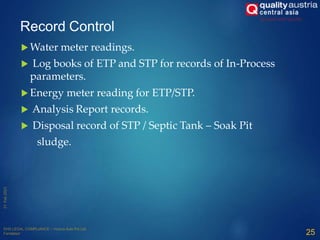
 Water meter readings.
 Log books of ETP and STP for records of In-Process
parameters.
 Energy meter reading for ETP/STP.
 Analysis Report records.
 Disposal record of STP / Septic Tank – Soak Pit
sludge.
25
GROUP DISCUSSION TOPICS
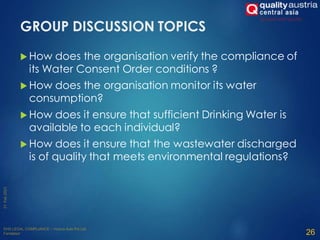
 How does the organisation verify the compliance of
its Water Consent Order conditions ?
 How does the organisation monitor its water
consumption?
 How does it ensure that sufficient Drinking Water is
available to each individual?
 How does it ensure that the wastewater discharged
is of quality that meets environmental regulations?
26
MODULE 4
AIR POLLUTION
27
AIR (Prevention and Control of Pollution)Act
1981 (Amended upto 1987)
AN ACT PROVIDE FOR THE PREVENTION CONTROL
AND ABATEMENT OF AIR POLLUTION AND FOR
MATTERS CONNECTED THEREWITH.
29th MARCH, 1981
"air pollutant" means any solid, liquid or gaseous substance [(including
noise)] present in the atmosphere in such concentration as may be or tend to
be injurious to human beings or other living creatures or plants or property or
environment;
28
AIR(Prevention and Control of Pollution)Act
1981 (Amended upto 1987)
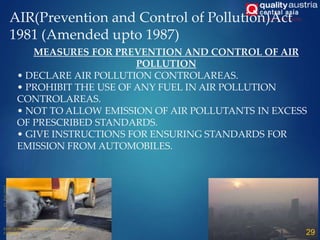
MEASURES FOR PREVENTION AND CONTROL OF AIR
POLLUTION
• DECLARE AIR POLLUTION CONTROLAREAS.
• PROHIBIT THE USE OF ANY FUEL IN AIR POLLUTION
CONTROLAREAS.
• NOT TO ALLOW EMISSION OF AIR POLLUTANTS IN EXCESS
OF PRESCRIBED STANDARDS.
• GIVE INSTRUCTIONS FOR ENSURING STANDARDS FOR
EMISSION FROM AUTOMOBILES.
29
AIR(Prevention and Control of Pollution)Act 1981
(Amended up to 1987)
30
PROCEDURAL REQUIREMENTS
Section 21: Restriction on Use of Certain Industrial Plant in Air
Pollution control Areas
• Obtain consent to establish
• Obtain consent to operate
• Apply for renewal of consent to operate
• Not to emit more than the prescribe standards
AIR(Prevention and Control of Pollution)Act
1981 (Amended upto 1987)
OPERATIONAL REQUIREMENTS
• Furnishing of information to PCB
• Provide access to PCB official for sample collection for purpose
analysis
• Provide entry to PCB official for inspection
• Provide information to prescribed agencies of certain cases
• Comply with prescribed consent conditions
• Comply with directions issued by PCB
31
32
• Specified emission sampling procedure for legal evidence
• Prior notice of inspection
• Automatic grant of consent after four months for complete
application
• Refusal of consent in writing
• Appeal to appellate authority
• Filling objections against proposed directions of board
• Reasons to be recorded in writing in case of not providing
opportunity for filing objections
OPPORTUNITIES FOR INDUSTRY
Group Exercise
 How does the organisation distinguish between ambient
air and stack monitoring?
 How does the organisation distinguish between stack
emissions and work-zone monitoring?
 How does the organisation distinguish between ambient
air and work-zone monitoring?
 What arrangements it has made for carrying out stack
monitoring?
33
Resources
 Stack height
 Stack sampling port hole
 Sampling platform and proper access
 Fume exhausts
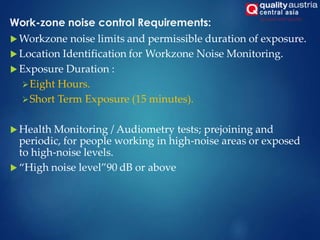
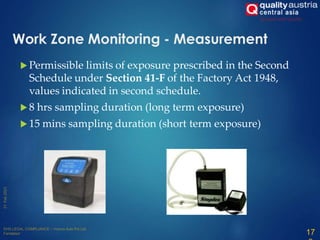
 Work zone monitoring (personal air samplers)
 Health monitoring for employees working in hazardous
chemical area/hazardous processes (shot blasting,
electroplating)
34
Monitoring - Measurement
Method for Ambient Air Monitoring
• Location at boundary wall point across the boundary of
the facility.
• Location in all four directions.
• Freeze location by putting permanent markers on sample
point for Repeatability and comparison.
• Save time/resources by sampling locations.
• Sampling duration for 24 hrs for NAAQS parameters.
• Methodology defined in the Gazette Notification
• Gazette Notification issued under Air Act, 1981
35
Environment Protection Act 1986
23rd May,1986 (Amended upto 1991)
“An act to provide protection and improvement
of environment and matters connected
therewith”
36
Environment Protection Act 1986
 Central Government, shall have the power to take all such
measures as it deems necessary or expedient for the purpose
of protecting and improving the quality of the environment
and preventing controlling and abating environmental
pollution.
 Planning and execution of a nation-wide programme for the
prevention, control and abatement of environmental
pollution; down standards for the quality of environment in
its various aspects;
 Laying down standards for emission or discharge of
environmental pollutants from various sources whatsoever:
37
Environment Protection Act 1986
 Restriction of areas in which any industries, operations or
processes or class of industries, operations or processes shall
not be carried out or shall be carried out subject to certain
safeguards;
 Laying down procedures and safeguards for the prevention of
accidents which may cause environmental pollution and
remedial measures for such accidents;
 Laying down procedures and safeguards for the handling of
hazardous substances;
 Examination of such manufacturing processes, materials and
substances as are likely to cause environmental pollution;
 Carrying out and sponsoring investigations and research
relating to problems of environmental pollution;
38
Environment Protection Act 1986
 Establishment or recognition of environmental laboratories and institutes
to carry out the functions entrusted to such environmental laboratories
and institutes under this Act;
 Collection and dissemination of information in respect of matters relating
to environmental pollution;
 Preparation of manuals, codes or guides relating to the prevention, control
and abatement of environmental pollution;
 Inspection of any premises, plant, equipment, machinery, manufacturing
or other processes, materials or substances and giving, by order, of such
directions to such authorities, officers or persons as it may consider
necessary to take steps for the prevention, control and abatement of
environmental pollution;
39
Environment Protection Act 1986
40
•Appointment of officers and their powers and functions;
•Power to give direction;
•Rules to regulate; environmental pollution by setting
standards, handling and transport of hazardous and toxic
substances;
•Power of entry, inspection, setting laboratory, sampling,
reports, returns etc;
•Power to make rules.
Submission of environmental Statement
 Every person carrying on an industry, operation or process
requiring consent under
 Section 25 of the Water (Prevention and Control of Pollution)
Act, 1974 (6 of 1974) or
 under section 21 of the Air (Prevention and Control of
Pollution) Act, 1981 (14 of 1981) or both
 or authorization under the Hazardous Wastes (Management
and Handling) Rules, 1989 issued under the Environment
(Protection) Act, 1986 (29 of 1986)
 shall submit an environmental audit report for the financial
year ending the 31st March in Form V to the concerned State
Pollution Control Board on or before the 30th September
every year, beginning 1993.]
41
Diesel Generator Sets :
Noise control Requirements :
 For D.G. sets upto 1000 KVa, manufactured after 1st
January, 2005 : The manufacturer is required to supply
along with acoustic enclosure; noise level criteria : 75 dB;
when measured at a distance of 1 metre, from D.G. set with
the integral acoustic enclosure.
 Diesel generators not falling in the first category
For such generators, the noise level should be controlled
either by using an acoustic enclosure for the diesel
generator or by acoustically treating the room at the user’s
end.
 The acoustic enclosure should be designed catering to the
noise standards of the region/zone or to a minimum of 25
dB (A) insertion loss (whichever is higher out of the two).
 The manufacturer should also provide the generator with
an exhaust muffler having a minimum insertion loss of 25
dB (A).
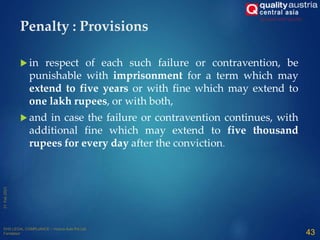
Penalty : Provisions
 in respect of each such failure or contravention, be
punishable with imprisonment for a term which may
extend to five years or with fine which may extend to
one lakh rupees, or with both,
 and in case the failure or contravention continues, with
additional fine which may extend to five thousand
rupees for every day after the conviction.
43
The Manufacture, Storage and Import of
Hazardous Chemical Rules, 1989 (Amended upto
2022) 27th November, 1989
44
MODULE 5
Hazardous Chemicals
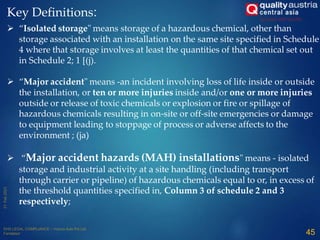
 “Isolated storage" means storage of a hazardous chemical, other than
storage associated with an installation on the same site specified in Schedule
4 where that storage involves at least the quantities of that chemical set out
in Schedule 2; 1 [(j).
 “Major accident" means -an incident involving loss of life inside or outside
the installation, or ten or more injuries inside and/or one or more injuries
outside or release of toxic chemicals or explosion or fire or spillage of
hazardous chemicals resulting in on-site or off-site emergencies or damage
to equipment leading to stoppage of process or adverse affects to the
environment ; (ja)
 “Major accident hazards (MAH) installations" means - isolated
storage and industrial activity at a site handling (including transport
through carrier or pipeline) of hazardous chemicals equal to or, in excess of
the threshold quantities specified in, Column 3 of schedule 2 and 3
respectively;
Key Definitions:
45
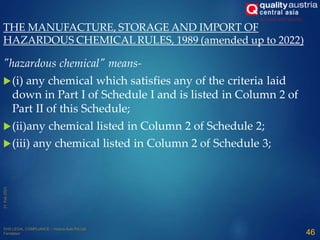
"hazardous chemical" means-
(i) any chemical which satisfies any of the criteria laid
down in Part I of Schedule I and is listed in Column 2 of
Part II of this Schedule;
(ii)any chemical listed in Column 2 of Schedule 2;
(iii) any chemical listed in Column 2 of Schedule 3;
46
THE MANUFACTURE, STORAGE AND IMPORT OF
HAZARDOUS CHEMICALRULES, 1989 (amended up to 2022)
Sr. No Toxicity Oral Toxicity
LD(50) mg/kg
Dermal Toxicity
mg/kg
Inhalation
Toxicity
mg/l
1 Extremely Toxic >5 <40 <0.5
2 Highly Toxic >5-50 >40-200 <0.5-2
3 Toxic >50-200 >200-1000 >2-10
THE MANUFACTURE, STORAGE AND IMPORT OF
HAZARDOUS CHEMICAL RULES, 1989
[1]
[SCHEDULE 1]
[Part -I]
(a) Toxic Chemicals: Chemicals having the following values of
acute toxicity and which owing to their physical and chemical
properties, are capable of producing major accident hazards:
47
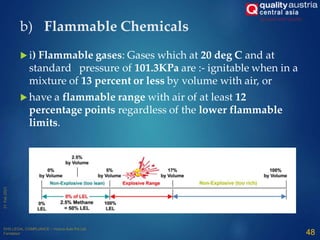
b) Flammable Chemicals
 i) Flammable gases: Gases which at 20 deg C and at
standard pressure of 101.3KPa are :- ignitable when in a
mixture of 13 percent or less by volume with air, or
 have a flammable range with air of at least 12
percentage points regardless of the lower flammable
limits.
48
ii) Extremely flammable liquids :
 Flash point < 23 °C and initial boiling point ≤ 35 °C
e.g., acetaldehyde and ethyl ether
(iii) Very highly flammable liquids :
 Flash point < 23 °C and initial boiling point > 35 °C
e.g., acetone, benzene, and toluene.
(iv) Highly flammable liquids :
 Flash point ≥ 23 °C and ≤ 60 °C
e.g., Xylene, Naphtha, Turpentine
(v) Flammable liquids :
 Flash point > 60 °C and ≤ 90 °C
e.g., Nitrobenzene, Pine Oil, Formaldehyde
49
(c) Explosives :
explosives mean a solid or liquid or pyrotechnic substance (or
a mixture of substances) or an article.
(a) which is in itself capable by chemical reaction of producing
gas, temperature, pressure, speed as to cause damage to
the surroundings ;
(b) which is designed to produce an effect by heat, light,
sound, gas or smoke or a combination of these as the result
of non-detonative self sustaining exothermic chemical
reaction
Schedule I PART II
There are 433 Chemicals
50
51
Schedule 3
LIST OF HAZARDOUS CHEMICALS FOR APPLICATION OF RULES 5 AND 7 TO 15
 The quantities relate to installation or group of installations
of same occupier where the distance between the installations
is not sufficient to avoid, any aggravation of major-accident
hazards.
 These quantities apply in any case to each group of
installations belonging to the same occupier where the
distance between the installations is less than 500 meters.
There are 179 chemicals in the schedule Part I classified in four
groups
 Toxic substances – 99 chemicals with >100 kg Threshold Qt.
 Toxic Substances – 25 Chemicals < 100 kg & up to 500Te
 Highly reactive substances – 25 Chemicals
 Explosives substances – 30 Chemicals
In cases of major accident hazards; take adequate steps to –
(i) prevent such major accidents and to limit their consequences
to persons and the environment;
(ii) provide to the persons working on the site with the
information, training and equipment including antidotes
necessary to ensure their safety.
Notification of Major accident - within 48 Hrs
Approval and Notification of site – Three months before starting
activities
Rule 4: Responsibility of Occupier
52
 Updating following changes in the threshold chemical
quantity.
 Transitional provision – In case of change in any process or
new activities
 Safety Report - To be submitted after one year as per
requirements under schedule 8 before starting industrial
activities
 Safety audit – After starting the industrial activities conduct
safety audit through an external expert/consultant.
 Updating of reports under Rule 10 – If any modification
done safety report 90 days before making modifications
 Preparation of on-site emergency plan by the occupier -
containing details specified in Schedule 11.
53
 Preparation of off-site emergency plans by the authority –
Occupier to provide all necessary support and information
contain in schedule 12 in preparation of “Off-Site emergency
plan” and rehearsal of mock drill.
 Information to be given to persons liable to be affected by a
major accident.
 Collection, Development and Dissemination of Information –
Material Safety Data Sheet as per schedule 9
 Import of hazardous chemicals - shall provide before thirty
days or as reasonably possible but not later than the date of
import to the concerned authorities as identified in Column 2
of Schedule 5.
54
MODULE 6
Noise Pollution
THE NOISE POLLUTION (REGULATION &
CONTROL) RULES, 2000 (amended upto 2010)
55
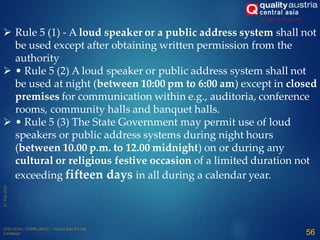
 Rule 5 (1) - A loud speaker or a public address system shall not
be used except after obtaining written permission from the
authority
 • Rule 5 (2) A loud speaker or public address system shall not
be used at night (between 10:00 pm to 6:00 am) except in closed
premises for communication within e.g., auditoria, conference
rooms, community halls and banquet halls.
 • Rule 5 (3) The State Government may permit use of loud
speakers or public address systems during night hours
(between 10.00 p.m. to 12.00 midnight) on or during any
cultural or religious festive occasion of a limited duration not
exceeding fifteen days in all during a calendar year.
56
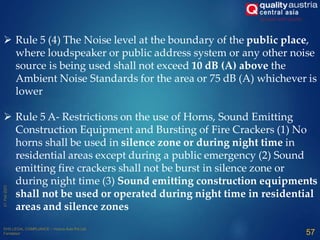
 Rule 5 (4) The Noise level at the boundary of the public place,
where loudspeaker or public address system or any other noise
source is being used shall not exceed 10 dB (A) above the
Ambient Noise Standards for the area or 75 dB (A) whichever is
lower
 Rule 5 A- Restrictions on the use of Horns, Sound Emitting
Construction Equipment and Bursting of Fire Crackers (1) No
horns shall be used in silence zone or during night time in
residential areas except during a public emergency (2) Sound
emitting fire crackers shall not be burst in silence zone or
during night time (3) Sound emitting construction equipments
shall not be used or operated during night time in residential
areas and silence zones
57
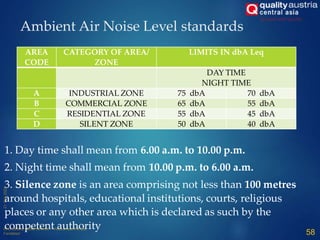
AREA
CODE
CATEGORY OF AREA/
ZONE
LIMITS IN dbA Leq
DAY TIME
NIGHT TIME
A INDUSTRIAL ZONE 75 dbA 70 dbA
B COMMERCIAL ZONE 65 dbA 55 dbA
C RESIDENTIAL ZONE 55 dbA 45 dbA
D SILENT ZONE 50 dbA 40 dbA
Ambient Air Noise Level standards
1. Day time shall mean from 6.00 a.m. to 10.00 p.m.
2. Night time shall mean from 10.00 p.m. to 6.00 a.m.
3. Silence zone is an area comprising not less than 100 metres
around hospitals, educational institutions, courts, religious
places or any other area which is declared as such by the
competent authority
58
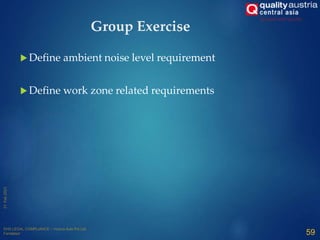
Group Exercise
 Define ambient noise level requirement
 Define work zone related requirements
59
60
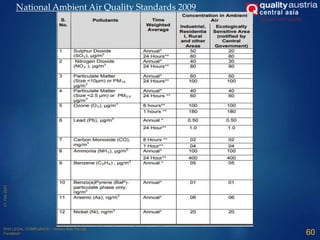
National Ambient Air Quality Standards 2009
MODULE 7
Batteries and E-waste
61
• Producer, dealer, consumer, entities involved in
collection, segregation, transportation, re-
furbishment and recycling of Waste Battery.
• All types of batteries regardless of chemistry,
shape, volume, weight, material composition and
us
Applicability:
62
Batteries (Management & Handling ) Rules
2022, 22nd August, 2022
Definitions
 “Consumer” means means end user of Battery;
 “'Facility' means any location wherein the process incidental to the
collection, storage, segregation, refurbishing, recycling disposal of Waste
Battery is carried out.
 ‘Manufacturer’means a person or an entity or a company as defined in the
Companies Act, 2013 (18 of 2013) or a factory as in the Factories Act, 1948 (63
of 1948) which has facilities for manufacturing of Battery and/or its
components;
 ‘Producer’means an entity who engages in:
 (i) manufacture and sale of Battery including refurbished Battery, including
in equipment, under its own brand; or (ii) sale of Battery including
refurbished Battery, including in equipment, under its own brand produced
by other manufacturers or suppliers; or (iii) import of Battery as well as
equipment containing Battery;
63
Functions of Producer
 Producer shall have the obligation of Extended Producer
Responsibility.
 Meet the collection and recycling and/or refurbishment
targets as mentioned in Schedule II
 Waste Battery to be sent for recycling or refurbishing and
shall not be sent for landfilling or incineration
 Register through the online centralised portal as Producer
in Form 1(A).
 File for renewal of registration in Form 1(A) before sixty
days of its expiry
64
Functions of Producer
 provide EPR plan in the Form 1(C) to CPCB by 30th
 June of every year for the Battery manufactured in
the preceding financial year.
 Producer shall file annual returns in Form 3
regarding the Waste Battery collected and
recycled or refurbished in Form 3 by 30th June of the
next financial year.
 adhere to prohibitions and labelling requirements
as prescribed in Schedule I.
 ensure safe handling of Battery or Waste Battery.
65
Functions of Consumer
 To discard Waste Battery separately from other
waste streams.
 to ensure that Waste Battery are giving to an entity
engaged in collection or refurbishment or recycling;
66
Action on violations and imposition
of Environmental Compensation
Environmental Compensation shall also be levied for
the following activities based on polluter pays
principle, –
 Entities carrying out activities without registration as
mandated under these rules;
 Providing false information / wilful concealment of
material facts by the entities registered under these
rules;
 Submission of forged/manipulated documents by
the entities registered under these rules;
 Entities engaged in collection, segregation, and
treatment in respect to not following sound handling
of Waste Battery.
67
 Environmental Compensation shall be levied by CPCB
on Producer operating with respect to non-fulfilment of
their Extended Producer Responsibility targets.
 Environmental Compensation shall be levied by
respective SPCB on entities involved in refurbishment or
recycling of Waste Battery and entities involved in
collection, segregation and treatment, operating with
respect to non-fulfillment of their responsibilities and
obligations,
68
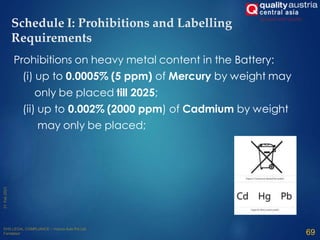
Schedule I: Prohibitions and Labelling
Requirements
Prohibitions on heavy metal content in the Battery:
(i) up to 0.0005% (5 ppm) of Mercury by weight may
only be placed till 2025;
(ii) up to 0.002% (2000 ppm) of Cadmium by weight
may only be placed;
69
 shall come into force from the 1st day of April, 2023
 In the Schedule – II (Applications, which are exempted
from the requirements of sub-rule (1) of rule 16) following
items are inserted:
 Cadmium and lead in Solar panels/cells, solar
Photovoltaic panels/cells/modules
 Lead in Medical Devices (with the exception of all
implanted and infected products)
 Note: changes are minor in nature and will come into
force from the 1st April, 2023
70
E-Waste (Management) Rules, 2022; 30th January, 2023
 Every manufacturer, producer refurbisher, dismantler
and recycler of e-waste or electrical and electronic
equipment listed in Schedule I.
Exclusions
 Waste batteries as covered under the Battery Waste
Management Rules, 2022;
 Packaging plastics as covered under the Plastic Waste
Management Rules, 2016;
 Micro enterprise as defined in the Micro, Small and
Medium Enterprises Development Act, 2006
 Radio-active wastes as covered under the provisions of
the Atomic Energy Act, 1962.
71
Applicability
 E-Waste: electrical and electronic equipment, including
solar photo-voltaic modules or panels or cells, whole or
in part discarded as waste, as well as rejects from
manufacturing, refurbishment and repair processes;
 Extended Producer Responsibility: responsibility of any
producer of electrical or electronic equipment as given in
Schedule-I for meeting recycling targets as per Schedule-
III and Schedule-IV, only through registered recyclers of
e-waste to ensure environmentally sound management of
such waste;
72
Key Definitions
 Bulk Consumer: Any entity which has used at least one
thousand units of electrical and electronic equipment
listed in Schedule I, at any point of time in the particular
Financial Year.
 Historical e-waste: e-waste generated from electrical
and electronic equipment as specified in Schedule-I
which was available on 1st April 2023;
73
 A person or an entity or a company as defined in the
Companies Act, 2013 or a factory as defined in the
Factories Act, 1948 or Small and Medium Enterprises
as defined in the Micro, Small and Medium
Enterprises Development Act, 2006 ,
 Which has facilities for manufacture of electrical and
electronic equipment as specified in Schedule-I;
74
Manufacturer
 ‘Producer’ means any person or entity who, -
 (i) manufactures and offers to sell electrical and electronic
equipment and their components or consumables or parts
or spares under its own brand; or
 (ii) offers to sell under its own brand, assembled electrical
and electronic equipment and their components or
consumables or parts or spares produced by other
manufacturers or suppliers; or
 (iii) offers to sell imported electrical and electronic
equipment and their components or consumables or parts
or spares; or
 (iv) who imports used electrical and electronic
equipment;
 irrespective of the selling technique used such as dealer,
retailer, e-retailer, etc.;
75
 Register on the portal;
 Collect e-waste ensure its recycling or disposal;
 File annual and quarterly returns on the portal.
76
Responsibilities of the manufacturer
Registration:
For Manufacturer, Producer, Refurbisher, Recycler
Details of e-Waste Management Rules 2022
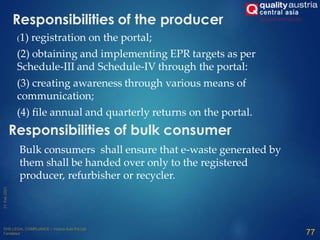
(1) registration on the portal;
(2) obtaining and implementing EPR targets as per
Schedule-III and Schedule-IV through the portal:
(3) creating awareness through various means of
communication;
(4) file annual and quarterly returns on the portal.
77
Responsibilities of the producer
Responsibilities of bulk consumer
Bulk consumers shall ensure that e-waste generated by
them shall be handed over only to the registered
producer, refurbisher or recycler.
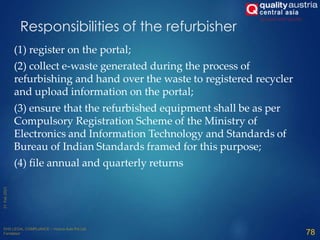
(1) register on the portal;
(2) collect e-waste generated during the process of
refurbishing and hand over the waste to registered recycler
and upload information on the portal;
(3) ensure that the refurbished equipment shall be as per
Compulsory Registration Scheme of the Ministry of
Electronics and Information Technology and Standards of
Bureau of Indian Standards framed for this purpose;
(4) file annual and quarterly returns
78
Responsibilities of the refurbisher
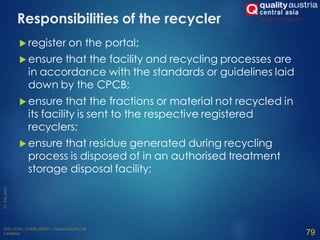
 register on the portal;
 ensure that the facility and recycling processes are
in accordance with the standards or guidelines laid
down by the CPCB;
 ensure that the fractions or material not recycled in
its facility is sent to the respective registered
recyclers;
 ensure that residue generated during recycling
process is disposed of in an authorised treatment
storage disposal facility;
79
Responsibilities of the recycler
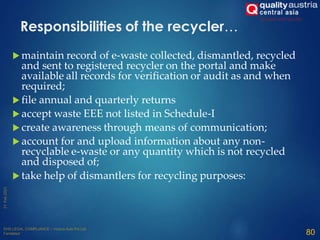
 maintain record of e-waste collected, dismantled, recycled
and sent to registered recycler on the portal and make
available all records for verification or audit as and when
required;
 file annual and quarterly returns
 accept waste EEE not listed in Schedule-I
 create awareness through means of communication;
 account for and upload information about any non-
recyclable e-waste or any quantity which is not recycled
and disposed of;
 take help of dismantlers for recycling purposes:
80
Responsibilities of the recycler…
 May store the e-waste for a period not exceeding one
hundred and eighty days and shall maintain a record.
 CPCB may extend the said period up to 365 days in case
the e-waste needs to be specifically stored for
development of a process for its recycling or reuse.
81
Procedure for storage of e-waste
 All producers shall fulfil their extended producer
responsibility obligation as per Schedule-III and
Schedule-IV,
 They may take help of third party organisations such as
producer responsibility organisations, collection centres,
dealers etc.
82
Modalities of the extended producer
responsibility Regime
 Recycling CPCB shall generate extended producer
responsibility certificate through the portal in favour of a
registered recycler.
 Refurbishing Refurbishing certificate shall be generated
in favour of a registered refurbisher.
83
Extended producer responsibility
Certificate Generation
 A producer may purchase extended producer
responsibility certificates limited to its extended
producer responsibility liability of current year plus any
leftover liability of preceding years plus 5 per cent of the
current year liability.
 As soon as producer purchases refurbishing certificates
its EPR liability shall be deferred automatically for the
relevant quantity of the product, for the duration as laid
down by the CPCB.
84
Transaction of extended producer
responsibility certificates
Every producer to ensure:
 new EEE and their components do not contain Lead,
Mercury, Cadmium, Hexavalent Chromium,
polybrominated biphenyls and polybrominated
diphenyl ethers beyond a maximum concentration value
of 0.1 per cent by weight in homogenous materials for
lead, mercury, hexavalent chromium, polybrominated
biphenyls and polybrominated diphenyl ethers and
of 0.01 per cent by weight in homogenous materials for
cadmium.
85
REDUCTION IN THE USE OF HAZARDOUS
SUBSTANCES
 Components/consumables/parts/spares required for the
EEE placed in the market prior to the 1st May, 2014 may be
exempted from the provisions of reduction.
 The applications listed in Schedule-II.
 Manufacture and supply of electrical and electronic
equipment used for defence.
86
Exclusions:
Transporter shall carry a manifest document (three
copies) prepared by the sender, as per Form-6
 Hazardous waste generated from manufacturing or
recycling destined for final disposal shall follow
Hazardous and Other Wastes (Management and
Transboundary Movement) Rules, 2016
87
Transportation of e-waste
Where an accident occurs at the facility
processing e-waste or during transportation of
e-waste, the producer, re-furbisher, transporter,
dismantler, or recycler,
shall report immediately to the concerned State
Pollution Control Board about the accident
through telephone and e-mail.
88
Accident reporting
CPCB shall lay down guidelines for imposition and
collection of environmental compensation on any entity in
case of :
 violation of any of the provision of these rules and
guidelines issued hereunder.
 non-fulfilment of obligations set out in these rules and
transaction or use of false extended producer
responsibility certificate.
 unregistered producers, manufacturer, refurbisher,
recyclers
89
Environmental Compensation
Any person:
who provides incorrect information for obtaining EPR
certificates,
uses or causes to be used false or forged EPR
certificates in any manner,
willfully violates the directions given under these rules
or fails to cooperate in the verification and audit
proceedings,
May be prosecuted under section 15 of the Act, 1986
90
Prosecution
MODULE 8
Different types of Wastes
91
all persons who generate, collect, receive, store,
transport, treat, dispose, or handle bio medical waste
in any form including hospitals, nursing homes,
clinics, dispensaries, veterinary institutions, animal
houses, pathological laboratories, blood banks, ayush
hospitals, clinical establishments, research or
educational institutions, health camps, medical or
surgical camps, vaccination camps, blood donation
camps, first aid rooms of schools, forensic laboratories
and research labs.
92
Applicability
Bio-Medical Waste Management Rules
2016/2018/2019 (Amended upto 2019)
 Bio-Medical Waste means "any waste, which is generated
during the diagnosis, treatment or immunisation of human
beings or animals or research activities pertaining thereto or
in the production or testing of biological or in health camps,
including the categories mentioned in Schedule I appended to
these rules”
 Health Care Facility means, “a place where diagnosis,
treatment or immunisation of human beings or animals is
provided irrespective of type and size of health treatment
system, and research activity pertaining thereto”
93
Key Terms
 Requirement of maintenance of bio-medical waste
management register and updation of monthly records on its
web-site is limited now to only bedded health care units by
amendment in Rule 4 (n)
 Requirement of annual report on web-site limited to health
care facilities and date extended till 16 Mar 2020 by
amendment in Rule 4 (p)
 For Health Care Facilities having less than ten beds for
discharge of wastewater in Schedule II, Rule 8 (1) replacing the
requirement of Sewage Treatment Plant by output discharge
standards.
 Requirement of Inspection and Monitoring of Medical
Inspection Rooms, Sick Bays Onboard ships or submarines,
station medical centres and field hospitals in forward posts by
the Director General, Armed Force Medical Services.
94
Amendments-19 Feb 2019
95
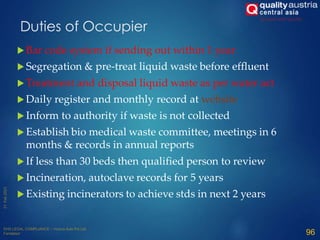
 Bar code system if sending out within 1 year
 Segregation & pre-treat liquid waste before effluent
 Treatment and disposal liquid waste as per water act
 Daily register and monthly record at website
 Inform to authority if waste is not collected
 Establish bio medical waste committee, meetings in 6
months & records in annual reports
 If less than 30 beds then qualified person to review
 Incineration, autoclave records for 5 years
 Existing incinerators to achieve stds in next 2 years
96
Duties of Occupier
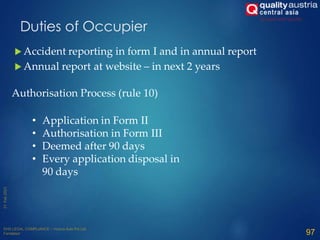
 Accident reporting in form I and in annual report
 Annual report at website – in next 2 years
97
Duties of Occupier
Authorisation Process (rule 10)
• Application in Form II
• Authorisation in Form III
• Deemed after 90 days
• Every application disposal in
90 days
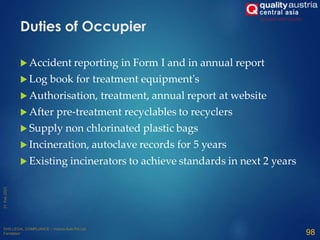
 Accident reporting in Form I and in annual report
 Log book for treatment equipment's
 Authorisation, treatment, annual report at website
 After pre-treatment recyclables to recyclers
 Supply non chlorinated plastic bags
 Incineration, autoclave records for 5 years
 Existing incinerators to achieve standards in next 2 years
98
Duties of Occupier
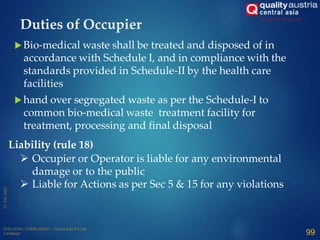
 Bio-medical waste shall be treated and disposed of in
accordance with Schedule I, and in compliance with the
standards provided in Schedule-II by the health care
facilities
 hand over segregated waste as per the Schedule-I to
common bio-medical waste treatment facility for
treatment, processing and final disposal
99
Duties of Occupier
 Occupier or Operator is liable for any environmental
damage or to the public
 Liable for Actions as per Sec 5 & 15 for any violations
Liability (rule 18)
 Form IV by Every occupier or operator on or before 30
June
 Prescribed authority to collate all and to CPCB by 31
July
 CPCB to MoEF by 31 August
 Annual reports on Website
 Records for 5 years
Accident reporting (Rule 15)
 Accident reporting in 24 hours in Form I
 Accident information in Annual Report
Annual Reports & Records (rule 13, 14)
10
 The rules shall apply to every waste resulting from
construction, re-modeling, repair and demolition of any
civil structure of individual or organisation or authority
who generates construction and demolition waste such
as building materials, debris, rubble.
10
Applicability and Scope:
Construction & Demolition Waste
Management Rules, 29th March 2016
 Collection, segregation of concrete, soil and others and storage
of construction and demolition waste generated.
 Shall ensure that other waste (such as solid waste) does not get
mixed with this waste and is stored and disposed separately.
 Waste generators who generate more than 20 tons or more in
one day or 300 tons per project in a month shall segregate the
waste into four streams such as i)concrete, soil, ii) steel,
iii)wood and plastics, iv) bricks and mortar and shall submit
waste management plan and get prior approvals from the local
authority.
Duties of waste generator:
10
 The service providers shall prepare a comprehensive waste
management plan covering segregation, storage, collection, reuse,
recycling, transportation and disposal of construction and demolition
waste generated within their jurisdiction.
 The service providers shall remove all construction and demolition
waste and clean the area every day, if possible, or depending upon the
duration of the work, the quantity and type of waste generated,
appropriate storage and collection, a reasonable timeframe shall be
worked out in consultation with the concerned local authority.
 In case of the service providers have no logistics support to carry out
the work specified in sub rules (1) and (2) , they shall tie up with the
authorised agencies for removal of construction and demolition waste
and pay the relevant charges as notified by the local authority.
10
Duties of service provider and their contractors -
10
Applicability:
 These rules shall apply to every waste generator, local body,
Gram Panchayat, manufacturer, Importers and producer.
shall not apply to the export oriented units or units in special
economic zones, notified by the Central Government,
manufacturing their products against an order for export:
Provide this exemption shall not apply to units engaged in
packaging of gutkha, tobacco and pan masala and also to any
surplus or rejects, left over products and the like.
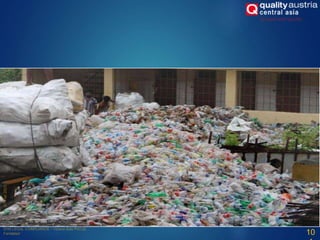
Plastic Waste Management Rules 18th March, 2016
(as amended on 16th Feb 2022)
10
 Shall segregate and store the waste generated by them in
accordance with the Municipal Solid Waste
(Management and Handling) Rules, 2000 and
 handover segregated wastes to authorized waste
processing or disposal facilities or deposition centres
either on its own or through the authorized waste
collection agency.
 Every person responsible for organising an event in
open space, which involves service of food stuff in
plastic or multilayered packaging shall segregate and
manage the waste generated during such events.
10
Responsibility of waste generator
 Primary responsibility for collection of used multi-layered
plastic sachet or pouches or packaging is of Producers,
Importers and Brand Owners, based on Extended
Producers Responsibility.
 They need to establish a system for collecting back the
plastic waste generated due to their products.
 This plan of collection to be submitted to the SPCB while
applying for Consent to Establish or Operate or Renewal.
 The Brand Owners whose consent has been renewed
before the notification of these rules shall submit such plan
within one year from the date of notification of these rules
and implement with two years thereafter.
Responsibility of producers, Importers
and Brand Owners
10
 Manufacture and use of non- recyclable multilayered
plastic if any should be phased out in two years time.
 The producer, within a period of three months from the
date of final publication of these rules shall apply to the
SPCB/PCC for grant of registration.
Responsibility of producers, Importers and
Brand Owners
10
 No producer shall on and after the expiry of a period of
Six Months manufacture or use any plastic or
multilayered packaging for packaging of commodities
without registration from the concerned SPCB or PCC.
 Every producer shall maintain a record of details of the
person engaged in supply of plastic used as raw
material to manufacture carry bags or plastic sheet or
like or cover made of plastic sheet or multi-layered
packaging.
Responsibility of producers, Importers
and Brand Owners
10
 name and certificate number [Rule 4(h)] in case of carry bags made
from compostable plastic.
Marking or labelling
11
The manufacture, import, stocking, distribution, sale and use of
following single use plastic, including polystyrene and expanded
polystyrene, commodities shall be prohibited with effect from the 1st
July, 2022:-
(a) ear buds with plastic sticks, plastic sticks for balloons, plastic flags,
candy sticks, ice-cream sticks, polystyrene [Thermocol] for
decoration;
(b) plates, cups, glasses, cutlery such as forks, spoons, knives, straw,
trays, wrapping or packing films around sweet boxes, invitation
cards, and cigarette packets, plastic or PVC banners less than 100
micron, stirrers.
Note: The provisions above shall not apply to commodities made of
compostable plastic.
Plastic Waste Management Rules
Amendments – 2021
11
SCHEDULE 9 (added)
Guidelines on Extended Producer Responsibility for Plastic Packaging;
3. Definitions:
 Biodegradable plastics - means that plastics, other than compostable
plastics, which undergoes complete degradation by biological processes
under ambient environment (terrestrial or in water) conditions, in
specified time periods, without leaving any micro plastics, or visible,
distinguishable or toxic residue, which have adverse environment
impacts, adhering to laid down standards of Bureau of Indian Standards
and certified by Central Pollution Control Board.
 Carry Bags - means bags made from plastic material or compostable
plastic material, used for the purpose of carrying or dispensing
commodities which have a self-carrying feature but do not include bags
that constitute or form an integral part of the packaging in which goods
are sealed prior to use ;
Plastic Waste Management Rules
Amendments – 16th February, 2022
11
Plastic Waste Management Rules
Amendments – 2022
 End of Life disposal - means using plastic waste for generation of energy
and includes co-processing (e.g. in cement kilns) or waste to oil or for road
construction as per Indian Road Congress guidelines, etc;
 Plastic - means material which contains as an essential ingredient a high
polymer such as polyethylene terephthalate, high density polyethylene,
Vinyl, low density polyethylene, polypropylene, polystyrene resins, multi
materials like acrylonitrile butadiene styrene, polyphenylene oxide,
polycarbonate, polybutylene terephthalate;
 Producer - means person engaged in manufacture or import of carry bags
or multilayered packaging or plastic sheets or like, and includes industries
or individuals using plastic sheets or like or covers made of plastic sheets
or multilayered packaging for packaging or wrapping the commodity;
11
Plastic Waste Management Rules
Amendments – 2021/2022
Coverage of Extended Producer Responsibility:
(i) Category I Rigid plastic packaging;
(ii) Category II Flexible plastic packaging of single layer or multilayer (more
than one layer with different types of plastic), plastic sheets or like and
covers made of plastic sheet, carry bags, plastic sachet or pouches;
(iii) Category III Multilayered plastic packaging (at least one layer of plastic
and at least one layer of material other than plastic);
(iv) Category IV Plastic sheet or like used for packaging as well as carry bags
made of compostable plastics.
11
Plastic Waste Management Rules
Amendments – 2021/2022
Extended Producer Responsibility Guidelines covers the
following with respect to plastic packaging namely: -
(i) Reuse;
(ii) Recycling;
(iii) Use of recycled plastic content;
(iv)End of life disposal.
Registration: The following entities shall register on the centralized
portal developed by Central Pollution Control Board namely: -
(i) Producer (P);
(ii) Importer (I);
(iii) Brand owner (BO);
(iv) Plastic Waste Processor engaged in (a) recycling, (b) waste to
energy, (c) waste to oil, and (iv) industrial composting
11
11
Hazardous Waste
Management Rules 2016
(Amended upto 2022)
Amendment History: 21st July, 2022/ 12th November, 2021/
1st Mar 2019/ 11th June 2018/ 28th Feb 2017/ 6th July 2016/
Initial: 4 Apr 2016
Inclusions
To the management of hazardous wastes as defined in
the regulations
“hazardous waste” means any waste which by reason
of characteristics such as physical, chemical,
biological, reactive, toxic, flammable, explosive or
corrosive, causes danger or is likely to cause danger to
health or environment, whether alone or in contact
with other wastes or substances
11
Applicability
waste specified under column (3) of Schedule I;
38 processes
waste having equal to or more than the
concentration limits specified for the constituents
in class A and class B of Schedule II or any of the
characteristics as specified in class C of Schedule
II; and
wastes specified in Part A of Schedule III in
respect of import or export of such wastes or the
wastes not specified in Part A but exhibit
hazardous characteristics specified in Part C of
Schedule III;
11
Applicability
 The utilisation and management of waste tyre shall be in
accordance to the provisions contained in Schedule IX.
 In rule 9, which specifies Utilisation of hazardous and other
wastes, sub-rule (4) has been inserted, namely:
• The utilisation and management of waste tyre shall be in
accordance to the provisions contained in Schedule IX.’’
• Schedule IX, which specifies Extended Producer
Responsibility (EPR) for Waste Tyre has been inserted.
12
21st July, 2022 Amendment
 Other wastes defined: means wastes specified in Part B
and Part D of SCHEDULE III.
 The utilisation of hazardous waste as a resource or after
pre-processing either for coprocessing or for any other
use shall be carried out only after obtaining
authorisation from the SPCB.
 Importer who is a trader, importing waste on behalf of
actual users or for use of the actual users authorised by
SPCB, shall apply in Form 7 for onetime authorisation
and obtain one-time authorisation in Form 7A.
 Changes have been made in the SCHEDULE III,
omissions and additions done in the Basal list.
12
Amendment 12th November, 2021
 Occupiers Exempted from taking authorization by
amending Rule 6 if:
The hazardous and other wastes generated by the
occupier given to the actual user, waste collector
or operator of the disposal facility, in accordance
with the Central Pollution Control Board (CPCB)
guidelines
12
Amendments- 1 March 2019
 List of Other Wastes exempt from taking permission
from Ministry of Environment & Forests and Climate
Change Amended by amending Schedule III, Part B
Added the following item
“Electrical and electronic assemblies and components
manufactured in and exported from India if found
defective or non-functional can be imported back by
Original Equipment Manufacturers (OEMs) within
twelve months from the date of export
12
For the management of hazardous and other wastes, an
occupier shall follow the following steps, namely
prevention;
minimization;
use
recycling;
recovery, utilisation including co-processing;
safe disposal
12
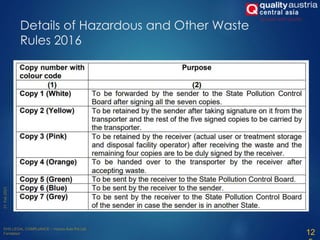
Details of Hazardous and Other Waste
Rules 2016
12
Details of Hazardous and Other Waste
Rules 2016
 The occupier handling hazardous or other wastes and
operator of disposal facility shall maintain records of
such operations in Form 3.
 (2) The occupier handling hazardous and other wastes
and operator of disposal facility shall send annual
returns to the State Pollution Control Board in Form 4.
Records and returns
12
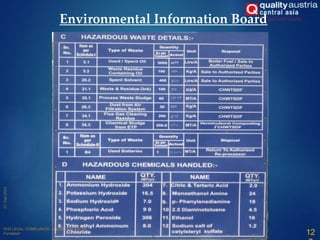
Environmental Information Board
12
Solid Waste Management Rules
2016 (Amended upto 2020)
8th April 2016
12
Solid Waste Management (Amendment)
Rules, 2020; March 19, 2020
 The local authorities and Panchayats shall submit
application for renewal of authorisation atleast 60 days
before the expiry of the validity of authorisation .
 collect and transport bio-degradable, non-bio-degradable
and domestic hazardous waste from households including
slums and informal settlements, institutional and other
non-residential premises, multi-storey buildings, large
commercial complexes, malls, housing commercial,
complexes and the like in compartmentalised and covered
vehicle to the respective processing facility.
12
Applicability:
 The jurisdiction of the rules have been extended beyond
Municipal area to cover, outgrowths in urban agglomerations,
census towns, notified industrial townships, areas under the
control of Indian Railways, airports, airbase, Port and harbour,
defence establishments, special economic zones, State and
Central government organizations, places of pilgrims, religious
& historical importance .
 Rule shall also apply to villages with population more than 3000
as well (Amendment of 2020).
13
 Key Definitions:
 “aerobic composting” means a controlled process involving
microbial decomposition of organic matter in the presence of
oxygen;
 “anaerobic digestion" means a controlled process involving
microbial decomposition of organic matter in absence of
oxygen;
 "authorisation" means the permission given by the State
Pollution Control Board or Pollution Control Committee, as the
case may be, to the operator of a facility or urban local
authority, or any other agency responsible for processing and
disposal of solid waste;
 “biodegradable waste " means any organic material that can
be degraded by micro-organisms into simpler stable
compounds;
 "bio-methanation" means a process which entails enzymatic
decomposition of the organic matter by microbial
 action to produce methane rich biogas;
13
Solid Waste Management Rules 2016
“buffer zone” means zone of no development to be maintained
around solid waste processing and disposal facility, exceeding 5
TPD of installed capacity. This will be maintained within total
and area allotted for the solid waste processing and disposal
facility.
“bulk waste generator” means and includes buildings occupied
by the Central government departments or undertakings, State
government departments or undertakings, local bodies, public
sector undertakings or private companies, hospitals, nursing
homes, schools, colleges, universities, other educational
institutions, hostels, hotels, commercial establishments,
markets, places of worship, stadia and sports complexes having
an average waste generation rate exceeding 100kg per day;
“
13
 combustible waste” means non-biodegradable, non-recyclable, non-
reusable, non hazardous solid waste having minimum calorific value
exceeding 1500 kcal/kg and excluding chlorinated materials like
plastic, wood pulp, etc;
 “co-processing” means use of non-biodegradable and non recyclable
solid waste having calorific value exceeding 1500k/cal as raw material
or as a source of energy or both to replace or supplement the natural
mineral resources and fossil fuels in industrial processes;
 “decentralised processing” means establishment of dispersed
facilities for maximizing the processing of biodegradable waste and
recovery of recyclables closest to the source of generation so as to
minimize transportation of waste for processing or disposal;
Solid Waste Management Rules 2016
13
 "disposal" means the final and safe disposal of post processed
residual solid waste and inert street sweepings and silt from
surface drains on land as specified in Schedule I to prevent
contamination of ground water, surface water, ambient air and
attraction of animals or birds;
 “domestic hazardous waste” means discarded paint drums,
pesticide cans, CFL bulbs, tube lights, expired medicines,
broken mercury thermometers, used batteries, used needles and
syringes and contaminated gauge, etc., generated at the
household level;
 “dry waste” means waste other than bio-degradable waste and
inert street sweepings and includes recyclable and non
recyclable waste, combustible waste and sanitary napkin and
diapers, etc;
13
Solid Waste Management Rules 2016
 “materials recovery facility” (MRF) means a facility where non-
compostable solid waste can be temporarily stored by the local
body or any other entity or any person or agency authorised by
any of them to facilitate segregation, sorting and recovery of
recyclables from various components of waste by authorised
informal sector of waste pickers, informal recyclers for the
purpose before the waste is delivered or taken up for its
processing or disposal;
 . "refused derived fuel"(RDF) means fuel derived from
combustible waste fraction of solid waste like plastic, wood,
pulp or organic waste, other than chlorinated materials, in the
form of pellets or fluff produced by drying, shredding,
dehydrating and compacting of solid waste ;
Solid Waste Management Rules 2016
13
Duties of waste generators.-
 segregate and store the waste generated by them in three
separate streams namely bio-degradable, non biodegradable
and domestic hazardous wastes in suitable bins and
handover segregated wastes to authorised waste pickers or
waste collectors as per the direction or notification by the local
authorities from time to time;
 wrap securely the used sanitary waste like diapers, sanitary
pads etc., in the pouches provided by the manufacturers or
brand owners of these products and shall place the same in
the bin meant for dry waste or non- bio-degradable waste;
13
Solid Waste Management Rules 2016
 No person shall organise an event or gathering of more than
one hundred persons at any unlicensed place without
intimating the local body, at least three working days in
advance and such person or the organiser of such event shall
ensure segregation and handing over to waste collector or
agency.
 Every street vendor shall keep suitable containers for storage
of waste generated during the course of his activity
 All gated communities and institutions with more than 5,000
sqm area shall, ensure segregation of waste, handover
recyclable material to authorizsd recyclers.
 The bio-degradable waste shall be processed, treated and
disposed off through composting or bio-methanation within
the premises as far as possible. The residual waste shall be
given to the waste collectors or agency as directed by the local
body.
Solid Waste Management Rules 2016
13
Criteria for waste to energy process.-
(1) Non recyclable waste having calorific value of 1500
K/cal/kg or more shall only be utilised for generating energy
either or through refuse derived fuel or by giving away as
feed stock for preparing refuse derived fuel.
(2) High calorific wastes shall be used for co-processing in
cement or thermal power plants.
(3) The local body or an operator of facility or an agency
designated by them proposing to set up waste to energy plant
of more than five tones per day processing capacity shall
submit an application in Form-I to the SPCB for
authorisation.
(4) The SPCB on receiving such application for setting up
waste to energy facility, shall examine the same and grant
permission within sixty days.
13
Solid Waste Management Rules 2016
Forms for various purposes:
 Form I – Application for obtaining authorisation under solid
waste management rules for processing/recycling/treatment and
disposal of solid waste
 Form II - Format for issue of authorisation
 Form III - annual report to be submitted by the operator of
facility to the local body
 Form IV - annual report on solid waste management to be
submitted by the local body
 Form V –Annual report by SPCB to CPCB
 Form VI – Accident reporting
14
Solid Waste Management Rules 2016
Module 9 :
THE FACTORIES ACT, 1948
(amended up to 2022)
DAY 2
The Factories Act, 1948 as applicable to
the state of Haryana as amended on
17th June 2022
 66(1)(b). Further restrictions on employment of
women (As applicable to the state of Haryana via
Haryana Govt. Labour Department Notification dt.
17th June 2022)
 Clarification to ensure the safety of women
employed in factories during nights shifts.
14
NATIONAL POLICY ON SAFETY, HEALTH AT WORKPLACE
The Constitution of India has specific provisions regarding
Occupational Health and Safety, as laid down in its three
Articles, namely:
 (i) Article 24 - prohibits employment of children below
14 years of age in any factory or mine, or in any
hazardous employment;
 (ii) Article 39 - requires the Government to direct its
policy to ensure that health and strength of workers,
men and women, and the tender age of children is not
abused; and
 (iii) Article 42 - directs the State to make provisions for
securing just and humane conditions of work and
maternity relief.
143
Factories Act requirements :
 Obtain :
License.
Building Stability Certificate.
 Provide :
Fire Fighting Facilities.
Canteen Facilities.
Medical Facilities.
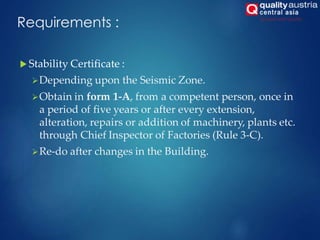
Requirements :
 Stability Certificate :
Depending upon the Seismic Zone.
Obtain in form 1-A, from a competent person, once in
a period of five years or after every extension,
alteration, repairs or addition of machinery, plants etc.
through Chief Inspector of Factories (Rule 3-C).
Re-do after changes in the Building.
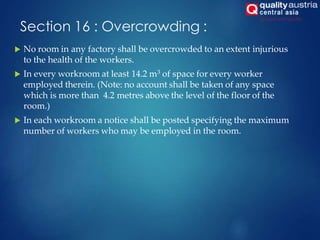
Section 16 : Overcrowding :
 No room in any factory shall be overcrowded to an extent injurious
to the health of the workers.
 In every workroom at least 14.2 m3 of space for every worker
employed therein. (Note: no account shall be taken of any space
which is more than 4.2 metres above the level of the floor of the
room.)
 In each workroom a notice shall be posted specifying the maximum
number of workers who may be employed in the room.
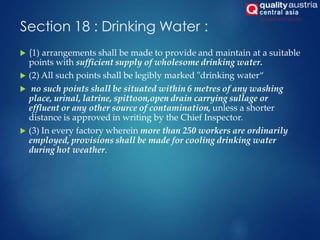
Section 18 : Drinking Water :
 (1) arrangements shall be made to provide and maintain at a suitable
points with sufficient supply of wholesome drinking water.
 (2) All such points shall be legibly marked "drinking water“
 no such points shall be situated within 6 metres of any washing
place, urinal, latrine, spittoon,open drain carrying sullage or
effluent or any other source of contamination, unless a shorter
distance is approved in writing by the Chief Inspector.
 (3) In every factory wherein more than 250 workers are ordinarily
employed, provisions shall be made for cooling drinking water
during hot weather.
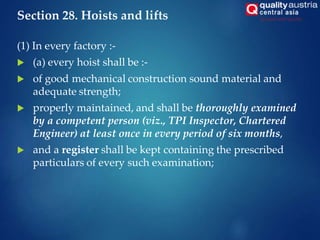
Section 28. Hoists and lifts
(1) In every factory :-
 (a) every hoist shall be :-
 of good mechanical construction sound material and
adequate strength;
 properly maintained, and shall be thoroughly examined
by a competent person (viz., TPI Inspector, Chartered
Engineer) at least once in every period of six months,
 and a register shall be kept containing the prescribed
particulars of every such examination;
Section 28. Hoists and lifts
 (b) every hoistway and liftway shall be sufficiently
protected by an enclosure fitted with gates;
 (c) the maximum safe working load shall be plainly
marked on every hoist or lift;
 (d) the cage of every hoist or lift used for carrying
persons shall be fitted with a gate on each side from
which access is afforded to a landing;
 (e) every gate referred to in clause (b) and clause (d) shall
be fitted with inter-locking or other efficient device to
secure that the gate cannot be opened except when the
cage is at the landing and that the cage cannot be moved
unless the gate is closed.
29. Lifting machines, chains, ropes and lifting
tackles
 (1) In any factory the following provisions shall be complied with
in respect of every lifting machine (other than a hoist and lift) and
every chain, rope and lifting tackle for the purpose of raising or
lowering persons, goods or materials :-
 (a) all parts, including the working gear, whether fixed or movable,
of every lifting machine and every chain, rope or lifting tackle shall
be -
o of good construction, sound material and adequate strength
and free from defects;
o properly maintained; and
o thoroughly examined by a competent person at least once in
every period of twelve months, or at such intervals as the
Chief Inspector may specify in writing,
o and a register shall be kept containing the prescribed
particulars of every such examination;
29. Lifting machines, chains, ropes and
lifting tackles
 (b) no lifting machine and no chain, rope or lifting tackle
shall, be loaded beyond the safe working load (shall
marked together with an identification mark) and duly
entered in the prescribed register; and where this is not
practicable, a table showing the safe working loads of
every kind and size of lifting machine or chain, rope or
lifting tackle in use shall be displayed in prominent
position on the premises;
 (c) while working on or near the wheel track of a
traveling crane ensure that the crane does not approach
within [six meters] of that place.
Section 30. Revolving machinery
 (1) For grinding machines, a notice indicating the
maximum safe working peripheral speed of every
grindstone or abrasive wheel, the speed of the shaft or
spindle upon which the wheel is mounted, and the
diameter of the pulley upon such shaft or spindle
necessary to secure such safe working peripheral speed.
 (2)Effective measure shall be taken in every factory to
ensure that the safe working peripheral speed of every
revolving vessel, cage, basket, flywheel, pulley, disc or
similar appliance driven by power is not exceeded.
Moving Parts:
Every dangerous moving/ rotating part of machinery
to be provided with safe guards/ fencing.
MOVING PARTS
Rotating parts of machinery
pose hazards to workers.
Guard provided for rotating/
moving parts of machinery.
Guard provided for rotating/
moving parts of machinery.
Section 31. Pressure plant
 (1) If any plant or machinery is operated at a pressure
above atmospheric pressure, effective measures shall be
taken to ensure that the safe working pressure of such
plant or machinery or part is not exceeded.
 (2) The State Government may make rules providing for
the examination and testing of pressure plant and
prescribe other safety measures
 Pressure Vessels:
Tested externally once in 6 months.
Internally once in 12 months.
 If internal testing not possible, then can be replaced by
hydrostatic testing once in 2 years/ 4 years [if the
Pressure Vessel, is in continuous process].
Definition of Pressure Plant & Vessel,
as per the Factories Rules :
Pressure Vessel :
“pressure vessel” means a vessel that may be
used for containing, storing, distributing,
transferring, distilling, processing or
otherwise handling any gas, vapour or liquid
under pressure greater than the atmospheric
pressure and includes any pipeline fitting or
other equipment attached thereto or used in
connection therewith;
Definition of Pressure Plant & Vessel,
as per the Factories Rules :
Exceptions : Nothing in this rule (pertaining to
Pressure Plant) shall apply to :
 vessels made of ferrous materials having an internal
operating pressure not exceeding 1 kilogram per
square centimetre;
 steam boilers, steam and feed pipes and their
fittings coming under the purview of Indian Boilers
Act, 1923;
 metal bottles or cylinders used for storage or
transport of compressed gases or liquified or
dissolved gases under pressure covered by the Gas
Cylinder Rules, 1981 (read as 2004) framed under
the Indian Explosives Act, 1884.
Definition of Pressure Plant & Vessel,
as per the Factories Rules :
Exceptions : Nothing in this rule (pertaining to Pressure
Plant) shall apply to : (continued) :
 vessels in which internal pressure is due solely to the
static head of liquid;
 vessels with a nominal water capacity not exceeding
500 litres connected in a water-pumping system
containing air that is compressed to serve as a
cushion;
 vessels for nuclear energy application;
 refrigeration plant having a capacity of 3 tons or
less of refrigeration in 24 hours;
Definition of Pressure Plant & Vessel,
as per the Factories Rules :
Thin walled pressure vessel or plant :
 In respect of any pressure vessel or plant of thin walls
such as sizing cylinder made of copper or any other
non-ferrous metal, the maximum permissible working
pressure shall be reduced at the rate of 5 percent of the
original maximum permissible working pressure for
every year of its use after the first five years and no
such cylinder shall be allowed to continue to be used
for more than twenty years after it was first taken into
use.
Section 32. Floors, stairs and means of
access :
(a) all floors, steps, stairs, passages and gangways shall be
of sound construction, and properly and where it is
necessary shall be provided with handrails;
(b) there shall, so far as is reasonable practicable, be
provided, and maintained safe means of access;
(c) when any person has to work at a height from where he
is likely to fall, provision shall be made by fencing or
otherwise, to ensure the safety of the person so working.
Section 33. Pits, sumps, openings in floors,
etc.
 (1) In every factory every fixed vessel, sump, tank, pit
or opening in the ground or in a floor which, shall be
either securely covered or securely fenced.
 (2) The State Government may, by order in writing,
exempt, subject to such conditions as may be
prescribed, any factory or class or description of
factories in respect of any vessel, sump, tank, pit or
opening from compliance with the provisions of this
section.
Section 34 : Excessive weights :
 34. Excessive weights
 (1) No person shall be employed in any factory to lift, carry
or move any load so heavy as to be likely to cause him
injury.
 (2) The State Government may make rules prescribing the
maximum weights which may be lifted, carried or moved
by adult men, adult women, adolescents and children
employed in factories or in any class or description of
factories or in carrying on any specified process.
Section 35. Protection of eyes :
 For risk of injury to the eye from particles or fragments
thrown off in the course of the process, or
 risk to the eyes by reason of exposure to excessive light,
 the State Government may by rules require that effective
screens or suitable goggles shall be provided for the
protection of persons employed.
Section 36. Precautions against dangerous fumes,
gases, etc.
 (1) No person shall be allowed to enter any chamber, tank, vat, pit,
pipe, flue or other confined space in which any gas,fume vapour or
dust is likely to be present to such an extent as to involve risk to
persons, unless it is provided with a manhole of adequate size or
other effective means of egress.
 (2) No person shall be allowed to enter any confined space, until all
practicable measures have been taken to remove any gas, fume,
vapour or dust, so as to bring its level within the permissible limits
and to prevent any ingress of such gas,vapour or dust and unless -
 a certificate in writing has been given by a competent person, based on a
test carried out by himself that the space is reasonably free from
dangerous gas, fume, vapour or dust; or
 such person is wearing suitable breathing apparatus and a belt securely
attached to a rope the free end of which is held by a person outside the
confined space.
Section 36-A. Precautions regarding the use
of portable electric..
(a) no portable electric light or any other electric appliance
of voltage exceeding twenty-four volts shall be permitted
for use inside any confined space [unless adequate safety
devices are provided]; and
(b) if any inflammable gas, fume or dust is likely to be
present in confined space, no lamp or light other than that
of flame-proof construction shall be permitted to used
therein.
Section 37. Explosive or inflammable dust,
gas, etc.
 (1) Where in any factory any manufacturing process
produces dust, gas, fume or vapour of such character and
to such extent as to be likely to explode on ignition, all
practicable measures shall be taken to prevent any such
explosion by :-
effective enclosure of the plant or machinery used in the
process;
removal or prevention of the accumulation of such dust,
gas, fume or vapour;
exclusion or effective enclosure of all possible source of
ignition.
Section 37. Explosive or inflammable dust, gas,
etc.
(3) Where any part or machinery in a factory contains any
explosive or inflammable gas or vapour under pressure
greater than atmospheric pressure, that part shall not be
opened except in accordance with the following provisions,
namely :-
 before the fastening of any joint of any pipe connected
with the part or the fastening of the cover of any opening
into the part is loosened, any flow of the gas or vapour
into the part of any such pipe shall be effectively stopped
by a stop-valve or other means;
 before any such fastening measures shall be taken to
reduce the pressure to atmospheric pressure;
Section 37. Explosive or inflammable dust, gas, etc.
 (4) No plant, tank or vessel which contains or has contained
any explosive or inflammable substance shall be subjected in
any factory to any welding, brazing, soldering or cutting
operation which involves the application of heat unless
adequate measures have first been taken to remove such
substance and any fumes arising therefrom or to render such
substance and fumes non- explosive or non-inflammable, and
no such substance shall be allowed to enter such plant, tank or
vessel after any such operation until the metal has cooled
sufficiently to prevent any risk of igniting the substance.
 (5) The State] Government may by rules exempt, subject to
such conditions as may be prescribed, any factory or class or
description of factories from compliance with all or any of the
provisions of this section.
Section 40-B. Safety Officers :
(1) In every factory :-
 wherein one thousand or more workers are ordinarily
employed, or
 wherein, in the opinion of the State Government, any
manufacturing process or operation is carried on, which
process or operation involves any risk of bodily injury,
poisoning or disease or any other hazard to health, the
occupier shall, if so required by the State Government
employ such number of Safety Officers as may be specified
in that notification.
 (2) The duties, qualifications and conditions of service of
Safety Officers shall be such as may be prescribed by the
State Government.]
41C. Specific responsibility of the occupier in
relation to hazardous processes
Every occupier of a factory involving any hazardous process shall :
 (a) maintain health records of the workers who are exposed
to any chemical, toxic or harmful substances and such
records shall be accessible to the workers;
 (b) appoint persons who posses qualifications and
experience in handling hazardous substances and are
competent to supervise such handling and to provide all the
necessary facilities for protecting the workers.
 (c) provide for medical examination of every worker -
 before such worker is assigned to a job, involving the
handling of, or working with, a hazardous substance, and
 while continuing in such job, and after he has ceased to
work in such job, at intervals not exceeding twelve months.
Section 41G. Workers participation in
safety management
 In every factory where a hazardous process takes place,
or where hazardous substances are used or handled, set
up a Safety Committee consisting of equal number of
representatives of workers and management to promote
cooperation in maintaining proper safety health at work
and to review periodically the measures taken in that
behalf .
Section 46. Canteens
 (1) The State Government may make rules requiring that in any
specified factory wherein more than two hundred and fifty workers
are ordinarily employed, a canteen or canteens shall be provided.
 (2) such rules may provide for –
a. the date by which such canteen shall be provided;
b. the standards in respect of construction, accommodation, furniture and
other equipment of the canteen;
c. the foodstuffs to be served therein and the charges which may be made
therefor;
d. the constitution of a managing committee for the canteens and
representation of the workers in the management of the canteen;
[(dd) the items of expenditure in the running of the canteen which are not
to be taken into account in fixing the cost of foodstuffs and which shall be
borne by the employer;]
 e. the delegation to the Chief Inspector subject to such conditions as
may be prescribed, of the power to make rules under clause (c).
Section 47. Shelters, rest-rooms and lunch-rooms
 (1) In factory where more than 150 workers are ordinarily
employed adequate and suitable shelters or rest-rooms and a
suitable lunch-room, with provision for drinking water,
where workers can eat meals brought by them:
 where a lunch-room exists no worker shall eat any food in the
work-room.
 (2) The Shelters or rest-room or lunch-rooms and ventilated
and shall be maintained in a cool and clean condition.
Section 48. Crèches
 (1) In every factory wherein more than 30 women
workers are employed there shall be a suitable room for
the use of children under the age of 6 years of such
women.
 (2) Such rooms shall provide adequate accommodation,
shall be adequately lighted and ventilated, maintained in
a clean and sanitary condition and shall be under the
charge of women trained in the care of children and
infants.
 ..
Section 49. Welfare Officers
 In factory wherein five hundred or more workers are
ordinarily employed the occupiers shall employ in the
factory such number of welfare officers as may be
prescribed.
Section 51. Weekly hours
No adult worker shall be required or allowed to
work in a factory for more than forty-eight hours in
any week.
Disclosure of Information:
On-
Potential Danger
Health Hazards from processes, and measures
taken to control them.
To-
Workers
Chief Inspector of factories
General public in the vicinity.
41 B. Compulsory disclosure of
information by the occupier
WORKZONE EXPOSURE MONITORING
 Identify Parameters
Comparison of Process Emissions to Schedule II of The
Factories Act, 1948
 Workzone Exposure Monitoring Method
Equipment
Duration
Personal air sampler
dB meter
Work-zone noise control Requirements:
 Workzone noise limits and permissible duration of exposure.
 Location Identification for Workzone Noise Monitoring.
 Exposure Duration :
Eight Hours.
Short Term Exposure (15 minutes).
 Health Monitoring / Audiometry tests; prejoining and
periodic, for people working in high-noise areas or exposed
to high-noise levels.
 “High noise level”90 dB or above
Work Zone Monitoring - Measurement
 Permissible limits of exposure prescribed in the Second
Schedule under Section 41-F of the Factory Act 1948,
values indicated in second schedule.
 8 hrs sampling duration (long term exposure)
 15 mins sampling duration (short term exposure)
17
17
Occupational Health & Safety
and Working Conditions Code
4 Labour Codes
 Wages
 Social Security
 Industrial Relations
 OSH and WC
18
Background
To consolidate essential features of 13 labour
laws relating to Factories, Mines, Ports and
Docks, Construction, Plantation, Contract
Labour, Inter-State Migrant workers, Working
Journalists, Motor Transport workers, Sales
Promotion employees, Beedi & Cigar workers,
Cine workers, Cinema theatre workers.
Broader legislative framework for
securing and human conditions with flexibility
providing enabling provisions for making rules,
regulations, standards
18
Objectives and Purpose
To all establishments
Including Mines in territorial waters,
exclusive eco. zones, continental shelf etc
Not to establishments Beedi and Cigar;
Plantation in JK
Not to offices of Govt., and ship of war
18
Applicability
The Code on
Wages, 2019
• The Minimum Wages Act, 1948;
• The Payment of Wages Act, 1936;
• The Payment of Bonus Act, 1965
• The Equal Remuneration Act,
1976
18
New Labour codes and corresponding Law it will
subsumes
The Industrial
Relations Code, 2020
• The Industrial Disputes Act, 1947;
• The Trade Unions Act, 1926;
• The Industrial Employment
(Standing Orders) Act, 1946.
The Code on
Social Security,
2020
• The Employees Compensation Act 1923
• The Employees State Insurance Act, 1948
• The Employees Provident Funds and
Miscellaneous Act 1952
• The Employment Exchanges (Compulsory
Notification of Vacancies) Act, 1959
• The Maternity Benefit Act, 1961
• The payment of Gratuity Act, 1972
• The Cine-Workers Welfare Fund Act 1981
• The Building and Other Construction
Workers Welfare Cess Act 1996
• The Unorganized Workers Social Security
Act, 2008
18
The Occupational Safety, Health
and Working Conditions Code,
2020
• Factories Act.
• Mines Act, 1952
• Dock Workers Act 1986
• Contract Labor Act, 1970
• Inter-State Migrant Workmen Act, 1979
• Plantation Labour Act, 1951
• The Working Journalist and Other News
Paper Employees (Conditions of Service
and Miscellaneous Provision) Act, 1955
• The Working Journalist (Fixation of Rates of
Wages) Act, 1958
• Motor Transport Workers Act, 1961
• The Sales Promotion Employees (Conditions
of Service) Act, 1976
• The Beedi and Cigar Workers (Conditions of
Employment) Act, 1966
18
13 chapters
134 clauses
3 Schedules
The First Schedule : List of industries –
Hazardous Process
The Second Schedule : List of matters for
OSH standards
The Third Schedule : List of notifiable
diseases
18
Structure and Arrangement of
Provisions
Module 10 :
ELECTRICITY ACT, 2003
and Electricity Rules
REQUIREMENTS
 Obtain license from Electrical Inspector for electrical
installations.
 Monitoring system should include:
Condition of Lightning Arrestor
Physical Condition of Earth pits
 Measurement system should include
Method of measurement of earth resistance
Instruments to be used for measurement
Calibration or Verification of those instruments
 Evaluation of Compliance to the Legal Compliance
should include
Frequency of evaluation
Results of preceding monitoring and measurement
 Should investigate the cause of deviation if results of
previous evaluation indicate that.
 Take Corrective Actions on them.
 Review the effectiveness of corrective actions over a
period of time.
LINKAGE TO MANAGEMENT SYSTEM
Module 11
Gas Cylinder Rules and
SMPV Rules
Gas Cylinder Rules 2016
(Amended upto 2022)
19
Amendments- 20 Jan 2022
All the high pressure cylinders and Cryogenic containers used
for filling of Non-Toxic, Non-Flammable Gases and Liquids
shall have:
 permanent and tamper proof marking in form of Bar Code
or RFID (Radio Frequency Identification) or QR (Quick
Response) code or
 any means of electronic identification number at
conspicuous place on cylinders and containers
The cylinders manufactured before the publication of these
rules shall have above said permanent and tamper proof
marking:
 Before expiry of six months in case of oxygen cylinders and
 one year in case of other non-toxic and non-flammable gas
cylinders from the date of publication of these rules."
19
Amendments- 15 March 2018
 Exemption from No Objection Certificate (NOC) in
Form F for the following:
Storage of Flammable or Toxic or Corrosive gases
forming part of cylinder filling plant
Storage of LPG provided NOC obtained from
local body such as Gram Panchayat of local
urban body
19
Amendments- 15 March 2018
Form C i.e., Application for the grant/
amendment/renewal/ duplicate copy of a licence
to fill and/or store compressed gas/es in
cylinders revised
Form G i.e., Licence to dispense compressed
natural gas or compressed Bio Gas in a
CNG/CBG dispensing station as automotive fuel
revised
19
Amendments-27 Feb 2018
 New Definitions included
Auto LNG” means, “a liquefied natural gas meant for
automotive fuel”
Liquefied Natural Gas (LNG) means, “a fluid in the
cryogenic liquid state composed predominantly of methane”
19
Details of Gas Cylinder Rules -22
Nov 2016
No license needed for possession in certain cases
25 number of cylinders or 200 Kg of flammable and
non-toxic gas, whichever is less
200 number of non-flammable non-toxic gas
cylinders
5 cylinders of toxic gas
25 cylinders of acetylene gas
100 Kg of LPG
oRule 43 and 44 of Gas Cylinder Rules 2016
19
Details of Gas Cylinder Rules -22
Nov 2016
 where liquefied petroleum gas when the total quantity of
gas does not exceed 100 kg at a time for own use, distribution
or sale from a sales room belonging to the dealer or
distributor of respective oil marketing company
 Licence shall not be obligatory for working places where LPG
cylinders are directly connected to the manifold, but
 the requirements of IS :6044 Part-1 shall be complied with
,such manifold installations and shall be constructed adapting
the sound engineering practices and
 the quantity of the LPG at any point of the time shall not
exceed the limits prescribed in IS-6044 Part-1
o Rule 44 (c) of Gas Cylinder Rules 2016
19
STORAGE REQUIREMENTS
 Cylinders of flammable and toxic gases shall be
kept separately from each other by an adequate
distance or by a suitable partition wall
 Store in cool dry and ventilated place
 Away from the boiler, open flame, steam pipes,
direct sunlight etc.
 Flammable and combustible substances shall not
be allowed
19
Monitoring & Measurement system
 Monitoring system should include:
Colour Coding
Condition of caps for safety
Safety relief devices*
Labelled with Name of Gas
permanent and tamper proof marking in form of Bar
Code or RFID or QR code
 Measurement system should include
Number of gas cylinders
Pressure in the cylinder
*cylinders containing obnoxious or poisonous gases
shall not be provided with any safety device
19
Owner's record
 Cylinder manufacturer's name and the rotation number;
 Specification number to which the cylinder is
manufactured;
 Date of original hydrostatic test or hydrostatic stretch
test or pneumatic test;
 Cylinder manufacturer's test and inspection certificate;
 Number and date of letter of approval granted by the
Chief Controller.
20
Evaluation of Compliance
 Evaluation of Compliance to the Legal Compliance
should include
Frequency of evaluation
Results of preceding monitoring and measurement
 Should investigate the cause of deviation if results of
previous evaluation indicate that
 Take Corrective Actions on them
 Review the effectiveness of corrective actions over a
period of time
20
"WARNING" Gas Cylinders, Rules,
2016
(i) Do not change the colour of this cylinder.
(ii) This cylinder shall not be filled with any gas other
than the one it now contains.
(iii) No flammable material should be stored in the
close vicinity of this cylinder or in the same room in
which it is kept.
(iv) No oil or similar lubricant shall be used on the
valves or other fittings of this cylinder.
20
CHECKPOINTS
 Separate storage space for empty and filled cylinders
 Fencing or Chained Storage of the cylinders
 Colour Coding of Gas Cylinders
 Condition of caps
20
Details of Gas Cylinder Rules -22
Nov 2016
 Licensing
 Monitoring
 Transporting
 Disposal
 Record Keeping
 Reporting
20
Details of Gas Cylinder Rules -22
Nov 2016
20
20
Static and Mobile Pressure
Vessel Rules (Amended up to
2021)
20
Amendment 31 Aug 2021
 The definition of Competent person revised
 “competent person” means a professional organisation comprising
of at least two persons recognized by the Chief Controller, for such
gases and vessels as competent for carrying out tests, examination,
inspections, certification for installations and transport vehicles,
Is replaced By
 “competent person‘ means a person recognised by the Chief
Controller, for such gases and vessels as competent, for carrying out
tests, examinations, certification for installations and transport
vehicles.
20
 Third Party Inspection Agency‘ means a professional
organisation recognised by Chief Controller to carry out
inspection, certifications, testing including safety audit
of major accident hazards premises as defined under
the Manufacture, Storage and Import of Hazardous
Chemicals Rules, 1989, and having persons with
qualifications and experience as applicable to the
competent persons.
20
 ISO Tank Container‘ means a tank container which includes two
basic elements, the vessel and the framework, suitable for the
carriage of compressed gas for conveyance by road, rail and sea,
including interchange between these forms of transport and
complies with requirements of ISO 1496;
Following forms inserted related to ISO Tank Container:
 FORM AS-4 : Application for the grant of permission to
transport compressed gas in ISO Tank containers within Indian
territory
 FORM-LS-2A: Permission to transport compressed gas in ISO
tank container within the Indian territory
 FORM-LS-2B: Permission for import and transport of
compressed gas in ISO Tank container
 QUALIFICATION AND EXPERIENCE OF INSPECTOR OR
COMPETENT PERSON: A minimum experience of 10 years is
replaced with 5 years.
21
 The District authority shall grant no objection
certificate or convey his refusal for granting no
objection certificate with reasons thereof in writing to
the applicants as expeditiously as possible but not later
than two months from the date of receipt of application
from the applicant and if he fails to do so in stipulated
time no objection certificate shall be considered
deemed to be issued:
 Provided that in case the District Authority conveys his
refusal or objections for granting no objection
certificate, the license granted under these rules stands
cancelled with immediate effect.
21
Amendments- 20 Apr 2018
All Changes related to Auto LNG
Applicability Analysis
SMPV Rules 2016
 “Pressure vessel” means any closed metal container intended
for the storage and transport of any compressed gas which is
subjected to internal pressure and whose water capacity
exceeds one thousand liters and includes inter-connecting
parts and components thereof upto the first point of
connection to the connected piping and fittings,
 but does not include containers wherein steam or other
vapour is or is intended to be generated or water or other
liquid is or is intended to be heated by the application of fire
or the products of combustion or by electrical means, heat
exchangers, evaporators, air receivers, steam type digestors,
steam type sterilizers, autoclaves, reactors, calorifiers, pressure
piping components such as separators or strainers and vessels
containing a liquid under a blanket of compressed inert gas
21
 CONSTRUCTION AND FITMENTS OF PRESSURE
VESSELS
 STORAGE
 TRANSPORT
 LICENCES
 ACCIDENTS AND INQUIRIES
 POWERS
21
CHAPTERS
Construction
Vessels shall be designed constructed and tested in
accordance with:
 IS 2825
 ASME Section VIII Division 1 or 2
 PD5500
 EN 13458, EN 13530
 AD: 2000 code
 Or such other standard code accepted by the chief
Controller.
21
Fitment
 Pressure relief valve connected to the vapour space
 Drains
 Contents gauge/ maximum level indicator
 Pressure gauge connected to the vapour space
 Means of measuring the temperature of the contents of
the vessel
21
Earthing
 All vessels used for storage of flammable compressed
gases shall be electrically connected with the earth in an
efficient manner.
 Pipelines conveying flammable liquids shall be
adequately prepared for electrical continuity and
connected with the earth in an efficient manner.
21
Fire Protection
 Flammable gas detection system shall activate audio-
visual alarm at level not higher than 25% of the LEL of
the gas.
 Fire Water supply and delivery system
 Four fire extinguishers (DCP and/ or Foam type) of 10
kg capacity each.
 Emergency shut down (ESD) system shall be provided
 A written emergency plan
21
PPE
 Goggles
 Hand gloves suitable for cryogenic liquid handling
 Protective apron
 Safety shoes
Licenses
Initial PESO approval
Obtain NOC
Apply for PESO license (valid maximum for 5 years)
21
Module 12
Updation of Legal
Requirement
21
22
Web Sites-Environment
 Ministry of Environment, Forest and Climate Change:
www.moef.nic.in
 Central Pollution Control Board: http://www.cpcb.nic.in
 National Green Tribunal: http://www.greentribunal.gov.in
 Central Groundwater Board: http://www.cgwb.gov.in
 Haryana State Pollution Control Board: https://hspcb.gov.in/
22
 Director General, Factory Advice Service and Labour Institute:
dgfasli.nic.in
 Petroleum and Explosive Safety Organization: peso.gov.in
 Central Electricity Authority: http://www.cea.nic.in
 Department of Atomic Energy: http://www.dae.nic.in
 Bureau of Indian Standards: http://www.bis.org.in
 Labour Department, Haryana https://hrylabour.gov.in/
Web Sites-Health & Safety
Websites – E&HS
 India Code: https://www.indiacode.nic.in/
 eGazette of India: https://egazette.nic.in/
22
THANK YOU VERY
MUCH
22
Vandana Sharma
Deputy General Manager – C & T
Tel: +91 120 5106100,
Mob:+ 91 8588819465
Email : vandana.sharma@qacamail.com

EHS Legal Training-enviromentQACA-Rev-01.pdf

  • 1.
    EHS Legal Requirements VICTORAAUTO PVT LTD, FARIDABAD 21&22 FEBRUARY 2023 1 Vandana Sharma Deputy General Manager – C & T Tel: +91 120 5106100, Mob:+ 91 8588819465 Email : vandana.sharma@qacamail.com Dr.Vinit kumar mishra
  • 2.
  • 3.
    • Faculty: Dr. VinitKumar Mishra More than 20 year experience in EHS Legal Compliance and Management Systems. Experience of working on Regulatory compliance management for more than 5 countries. 3 Your name, designation & functional area of work What is your expectation out of this training
  • 4.
  • 5.
     Protection ofthe environment and keeping ecological balance unaffected is a task which not only the government but also every individual, association and corporation must undertake. It is a social obligation and fundamental duty enshrined in Article 51 A (g) of the Constitution of India.  There is a rapid evolution in the Indian legislations after independence as the need and concern regarding environment arose. 5 Environmental Legislations in India
  • 6.
    Health and SafetyLegislations in India  In India, labour falls under the Concurrent List of the Constitution. Therefore, both Parliament and state legislatures can make laws regulating labour.  Currently, there are over 100 state and 40 central laws regulating various aspects of labour such as resolution of industrial disputes, working conditions, social security and wages. 6
  • 7.
     Water (Preventionand Control of Pollution) Act, 1974 and Rules 1975  Water (Prevention and Control of Pollution) Cess Act, 1977 (Amended up to 2003)  Air (Prevention and Control of Pollution) Act, 1981 and Rules 1982  Environmental Protection Act, 1986 and Rules 1986  Manufacture, Storage and Import of hazardous Chemical Rules, 1989 (amended upto 2022).  The Public Liability Insurance Act, 1991 and Rules 1991/1992/1993  Environmental (Protection) Second amendment Rules, 1992, Environment Audit/ Form V  Environment Impact Assessment – Notification 2006  Bio-Medical Waste (Management and Handling) Rules, 2016 Chronology of Environmental Legislations in India 7
  • 8.
     Hazardous Wastes(Management and Handling) Rules, 2016 (Amended up to 2022)  The Noise Pollution (Regulation and Control) Rules, 2000 (amended up to 2017)  Battery Waste (Management and Handling) Rules, 2001 (amended up to 2022)  Biological diversity Act, 2002  National Ambient Air Quality Standards Notification, 2009  Municipal Solid Wastes (Management and Handling) Rules, 2000/Solid Waste Management Rules, 2016  Construction and Demolition waste Management rules, 2016  Plastic Waste (Management and Handling) Rules, 2011 / Plastic Waste Management Rules,2016 (amended up to 2022)  E-Waste (Management and Handling) Rules,2016 (amended upto 2022) Chronology of Environmental Legislations in India 8
  • 9.
     National GreenTribunal Act, 2010 / Rules 2011  Central Ground Water Authority Notification 1997  Categorization of Industries 05-March-2016  CPCB Notifications from time to time 9 Chronology of Environmental Legislations in India
  • 10.
    Health and SafetyLegislations 1. The Factories Act, 1948 (amended upto 2022); 2. The Mines Act, 1952 (amended upto 2010); 3. The Dock Workers (Safety, Health and Welfare) Act, 1986; 4. The Building and Other Construction Workers (Regulation of Employment and Conditions of Service) Act, 1996; 5. The Plantations Labour Act, 1951; 6. The Contract Labour (Regulation and Abolition) Act, 1970; 7. The Inter-State Migrant workmen (Regulation of Employment and Conditions of Service) Act, 1979; 8. The Working Journalist and other News Paper Employees (Conditions of Service and Miscellaneous Provision) Act, 1955; 9. The Working Journalist (Fixation of rates of wages) Act, 1958; 10. The Motor Transport Workers Act, 1961; 11. The Sales Promotion Employees (Conditions of Service) Act, 1976; 12. The Beedi and Cigar Workers (Conditions of Employment) Act, 1966; 13. The Cine Workers and Cinema Theatre Workers Act, 1981. 10
  • 11.
  • 12.
    WATER (PREVENTION ANDCONTROLOF POLLUTION) ACT, 25th MARCH, 1974 (1974/1988/2003)  “Water pollution" means such contamination of water or such alteration of the physical, chemical or biological properties of water or such discharge of any sewage or trade effluent or of any other liquid, gaseous or solid substance into water (whether directly or indirectly) as may, or is likely to, create a nuisance or render such water harmful or injurious to public health or safety, or to domestic, commercial, industrial, agricultural or other legitimate uses, or to the life and health of animals or plants or of aquatic organisms;  “Trade effluent" includes any liquid, gaseous or solid substance which is discharged from any premises used for carrying on any “Industry, operation or process, or treatment and disposal system" other than domestic sewage. 12
  • 13.
    Water(Prevention and Controlof Pollution)Act 1974 (amended up to 2003) 13 PROCEDURAL REQUIREMENTS • Section 25: (New Outlets & New Discharges) • Obtain consent to establish • Obtain consent to operate • Application for renewal of consent to operate (one month before the expiry) in the prescribed Form 1 of the State Pollution Control Board along with the prescribed fee. • Prohibition on the use of stream or well for disposal of effluent
  • 14.
    OPERATIONAL REQUIREMENTS 14 • Furnishingof information to Pollution Control Board (PCB) • Provide access to PCB official for sample collection for purpose analysis • Provide entry to PCB official for inspection • Comply with prescribed consent conditions • Discharge effluent in accordance with prescribed standards • Comply with directions issued by PCB
  • 15.
    Water(Prevention and Controlof Pollution)Act 1974 ((amended up to 2003) 15 OPPORTUNITIES FOR INDUSTRY • SPECIFIED EFFLUENT SAMPLING PROCEDURE FOR LEGAL EVIDENCE • AUTOMATIC GRANT OF CONSENT AFTER FOUR MONTHS FOR COMPLETE APPLICATION (DEEMED CONSENT) • REFUSAL OF CONSENT IN WRITING • APPEAL TO APPELLATE AUTHORITY • ANY PERSON AGGRIEVED BY A CONSENT ORDER MAY APPEAL WITHIN 30 DAYS TO APPELLATE AUTHORITY FOLLOWING SPECIFIED PROCEDURE (FORM & FEE).
  • 16.
    16 Specified Procedure forEffluent Sampling • Prior “Notice of Intention to have Sample Analysed” to be served by the PCB to the Industry in prescribed form. • Board official to divide the sample taken into two parts. • Both the parts to be kept in separate container, marked, sealed and also to be signed by the Industry representative along with Board official. • First container to be taken by Board for analysis to the laboratory established or recognized by the Board. • Second container to the laboratory established or recognized by the Central/ State Governments. • In case of variation in the analysis results the report of Central/ State Government laboratory shall prevail.
  • 17.
    Water Cess Act: 1977 (amended upto 2003)  An Act to provide for the levy and collection of a cess on water consumed by persons carrying on certain industries and by local authorities.  As per the Water Cess (Amendment) Act 2003, dated 6th May 2003, all industries with total water consumption less than 10 kL/day are exempted from levy of Cess provided they are not generating hazardous wastes. AFFIXING OF METERS  For the purpose of measuring and recording the quantity of water consumed, industry and every local authority shall affix meters. 17
  • 18.
    PENALTY  Whoever furnishesfalse return/ evades cess or shall be punishable with imprisonment which may extend to six months or with fine which may extend to one thousand rupees or with both.  Where an offence under this Act has been committed by a company, in charge of the company shall be deemed to be guilty of the offence and shall be liable to be proceeded against and punished accordingly: 18
  • 19.
    Summary of LegalRequirements in EMS  Declaration of trade effluents and sewage effluent in the application for Water Consent.  Submit Water Cess before 5th of every month.  Upkeep of ETP, STP/ Septic Tank - Soak Pit.  Set Up Rainwater Harvesting Structure  Declare groundwater sources e.g. borewell / openwell.  Obtain Water Supply Permit from the concerned Authority [e.g. Municipal Authorities, Central Ground Water Authority (CGWA) or any other Authority, as applicable];  If the facility is located in“Notified/Semicritical/Critical/Over exploited Area;” obtain Approval from CGWA for Installation of Bore wells/OR for Existing Bore wells;. 19
  • 20.
     The CGWA,has issued a public notice dated April 10, 2022, stating that all groundwater users, including residential apartments using it for drinking and domestic purposes, group housing societies, government water supply agencies in urban areas, bulk water suppliers, industrial, infrastructure and mining projects and swimming pools, must obtain its permission for groundwater withdrawal by June 30, 2022. 20 Central Ground Water Authority (CGWA) CGWA, Public notice dated April 10, 2022
  • 21.
    CGWA Notification dated06.09.2021 Residential apartments, Group Housing Societies, Government water supply agencies in urban areas and Industrial, Infrastructure and Mining Projects and Swimming Pools whether existing or new (except exempted category as per section 1 of notified guidelines), drawing or proposing to draw ground water are required to obtain NOC as per the guidelines and are hereby directed to submit their applications for NOC through online portal of CGWA (http://cgwa-noc.gov.in) or respective State Authorities, as the case may be. 21
  • 22.
    Exemptions from seekingNo Objection Certificate: Following categories of consumers shall be exempted from seeking No Objection Certificate for ground water extraction: (i) Individual domestic consumers in both rural and urban areas for drinking water and domestic uses. (ii) Rural drinking water supply schemes. (iii) Armed Forces Establishments and Central Armed Police Forces establishments in both rural and urban areas. (iv) Agricultural activities. (v) Micro and small Enterprises drawing ground water less than 10 m3 /d . CGWA NOTIFICATION 24.09.2020 22
  • 23.
     All industriesabstracting ground water in excess of 100 m3 /d shall undertake annual water audit and submit audit reports within three months.  Industries to reduce their ground water use by at least 20% over the next three years.  Water level monitoring mechanism shall be mandatory for industries drawing/ proposing to draw more than 10 m3 /day of ground water  piezometer (observation well) shall be constructed at a minimum distance of 50 m from the bore well/production well.  Industries which are likely to pollute ground water (chemical, pharmaceutical, dyes, pigments, paints, textiles, tannery, pesticides/ insecticides, fertilizers, slaughter house, explosives etc.) shall store the harvested rain water in surface storage tanks for use in the industry. CGWA NOTIFICATION 23
  • 24.
    Monitoring & Measurement-EHS  Drinking Water test as per IS 10500:1991; as amended upto 2012.  Monitoring licences and test certificates, as per relevant IS standards, furnished by suppliers of packaged drinking water.  Monitoring of cleaning schedules of: 1. Drinking Water Coolers 2. Water Sump 3. Septic Tank – Soak Pit.  Water meter reading and Water Balance. 24
  • 25.
    Record Control  Watermeter readings.  Log books of ETP and STP for records of In-Process parameters.  Energy meter reading for ETP/STP.  Analysis Report records.  Disposal record of STP / Septic Tank – Soak Pit sludge. 25
  • 26.
    GROUP DISCUSSION TOPICS How does the organisation verify the compliance of its Water Consent Order conditions ?  How does the organisation monitor its water consumption?  How does it ensure that sufficient Drinking Water is available to each individual?  How does it ensure that the wastewater discharged is of quality that meets environmental regulations? 26
  • 27.
  • 28.
    AIR (Prevention andControl of Pollution)Act 1981 (Amended upto 1987) AN ACT PROVIDE FOR THE PREVENTION CONTROL AND ABATEMENT OF AIR POLLUTION AND FOR MATTERS CONNECTED THEREWITH. 29th MARCH, 1981 "air pollutant" means any solid, liquid or gaseous substance [(including noise)] present in the atmosphere in such concentration as may be or tend to be injurious to human beings or other living creatures or plants or property or environment; 28
  • 29.
    AIR(Prevention and Controlof Pollution)Act 1981 (Amended upto 1987) MEASURES FOR PREVENTION AND CONTROL OF AIR POLLUTION • DECLARE AIR POLLUTION CONTROLAREAS. • PROHIBIT THE USE OF ANY FUEL IN AIR POLLUTION CONTROLAREAS. • NOT TO ALLOW EMISSION OF AIR POLLUTANTS IN EXCESS OF PRESCRIBED STANDARDS. • GIVE INSTRUCTIONS FOR ENSURING STANDARDS FOR EMISSION FROM AUTOMOBILES. 29
  • 30.
    AIR(Prevention and Controlof Pollution)Act 1981 (Amended up to 1987) 30 PROCEDURAL REQUIREMENTS Section 21: Restriction on Use of Certain Industrial Plant in Air Pollution control Areas • Obtain consent to establish • Obtain consent to operate • Apply for renewal of consent to operate • Not to emit more than the prescribe standards
  • 31.
    AIR(Prevention and Controlof Pollution)Act 1981 (Amended upto 1987) OPERATIONAL REQUIREMENTS • Furnishing of information to PCB • Provide access to PCB official for sample collection for purpose analysis • Provide entry to PCB official for inspection • Provide information to prescribed agencies of certain cases • Comply with prescribed consent conditions • Comply with directions issued by PCB 31
  • 32.
    32 • Specified emissionsampling procedure for legal evidence • Prior notice of inspection • Automatic grant of consent after four months for complete application • Refusal of consent in writing • Appeal to appellate authority • Filling objections against proposed directions of board • Reasons to be recorded in writing in case of not providing opportunity for filing objections OPPORTUNITIES FOR INDUSTRY
  • 33.
    Group Exercise  Howdoes the organisation distinguish between ambient air and stack monitoring?  How does the organisation distinguish between stack emissions and work-zone monitoring?  How does the organisation distinguish between ambient air and work-zone monitoring?  What arrangements it has made for carrying out stack monitoring? 33
  • 34.
    Resources  Stack height Stack sampling port hole  Sampling platform and proper access  Fume exhausts  Work zone monitoring (personal air samplers)  Health monitoring for employees working in hazardous chemical area/hazardous processes (shot blasting, electroplating) 34
  • 35.
    Monitoring - Measurement Methodfor Ambient Air Monitoring • Location at boundary wall point across the boundary of the facility. • Location in all four directions. • Freeze location by putting permanent markers on sample point for Repeatability and comparison. • Save time/resources by sampling locations. • Sampling duration for 24 hrs for NAAQS parameters. • Methodology defined in the Gazette Notification • Gazette Notification issued under Air Act, 1981 35
  • 36.
    Environment Protection Act1986 23rd May,1986 (Amended upto 1991) “An act to provide protection and improvement of environment and matters connected therewith” 36
  • 37.
    Environment Protection Act1986  Central Government, shall have the power to take all such measures as it deems necessary or expedient for the purpose of protecting and improving the quality of the environment and preventing controlling and abating environmental pollution.  Planning and execution of a nation-wide programme for the prevention, control and abatement of environmental pollution; down standards for the quality of environment in its various aspects;  Laying down standards for emission or discharge of environmental pollutants from various sources whatsoever: 37
  • 38.
    Environment Protection Act1986  Restriction of areas in which any industries, operations or processes or class of industries, operations or processes shall not be carried out or shall be carried out subject to certain safeguards;  Laying down procedures and safeguards for the prevention of accidents which may cause environmental pollution and remedial measures for such accidents;  Laying down procedures and safeguards for the handling of hazardous substances;  Examination of such manufacturing processes, materials and substances as are likely to cause environmental pollution;  Carrying out and sponsoring investigations and research relating to problems of environmental pollution; 38
  • 39.
    Environment Protection Act1986  Establishment or recognition of environmental laboratories and institutes to carry out the functions entrusted to such environmental laboratories and institutes under this Act;  Collection and dissemination of information in respect of matters relating to environmental pollution;  Preparation of manuals, codes or guides relating to the prevention, control and abatement of environmental pollution;  Inspection of any premises, plant, equipment, machinery, manufacturing or other processes, materials or substances and giving, by order, of such directions to such authorities, officers or persons as it may consider necessary to take steps for the prevention, control and abatement of environmental pollution; 39
  • 40.
    Environment Protection Act1986 40 •Appointment of officers and their powers and functions; •Power to give direction; •Rules to regulate; environmental pollution by setting standards, handling and transport of hazardous and toxic substances; •Power of entry, inspection, setting laboratory, sampling, reports, returns etc; •Power to make rules.
  • 41.
    Submission of environmentalStatement  Every person carrying on an industry, operation or process requiring consent under  Section 25 of the Water (Prevention and Control of Pollution) Act, 1974 (6 of 1974) or  under section 21 of the Air (Prevention and Control of Pollution) Act, 1981 (14 of 1981) or both  or authorization under the Hazardous Wastes (Management and Handling) Rules, 1989 issued under the Environment (Protection) Act, 1986 (29 of 1986)  shall submit an environmental audit report for the financial year ending the 31st March in Form V to the concerned State Pollution Control Board on or before the 30th September every year, beginning 1993.] 41
  • 42.
    Diesel Generator Sets: Noise control Requirements :  For D.G. sets upto 1000 KVa, manufactured after 1st January, 2005 : The manufacturer is required to supply along with acoustic enclosure; noise level criteria : 75 dB; when measured at a distance of 1 metre, from D.G. set with the integral acoustic enclosure.  Diesel generators not falling in the first category For such generators, the noise level should be controlled either by using an acoustic enclosure for the diesel generator or by acoustically treating the room at the user’s end.  The acoustic enclosure should be designed catering to the noise standards of the region/zone or to a minimum of 25 dB (A) insertion loss (whichever is higher out of the two).  The manufacturer should also provide the generator with an exhaust muffler having a minimum insertion loss of 25 dB (A).
  • 43.
    Penalty : Provisions in respect of each such failure or contravention, be punishable with imprisonment for a term which may extend to five years or with fine which may extend to one lakh rupees, or with both,  and in case the failure or contravention continues, with additional fine which may extend to five thousand rupees for every day after the conviction. 43
  • 44.
    The Manufacture, Storageand Import of Hazardous Chemical Rules, 1989 (Amended upto 2022) 27th November, 1989 44 MODULE 5 Hazardous Chemicals
  • 45.
     “Isolated storage"means storage of a hazardous chemical, other than storage associated with an installation on the same site specified in Schedule 4 where that storage involves at least the quantities of that chemical set out in Schedule 2; 1 [(j).  “Major accident" means -an incident involving loss of life inside or outside the installation, or ten or more injuries inside and/or one or more injuries outside or release of toxic chemicals or explosion or fire or spillage of hazardous chemicals resulting in on-site or off-site emergencies or damage to equipment leading to stoppage of process or adverse affects to the environment ; (ja)  “Major accident hazards (MAH) installations" means - isolated storage and industrial activity at a site handling (including transport through carrier or pipeline) of hazardous chemicals equal to or, in excess of the threshold quantities specified in, Column 3 of schedule 2 and 3 respectively; Key Definitions: 45
  • 46.
    "hazardous chemical" means- (i)any chemical which satisfies any of the criteria laid down in Part I of Schedule I and is listed in Column 2 of Part II of this Schedule; (ii)any chemical listed in Column 2 of Schedule 2; (iii) any chemical listed in Column 2 of Schedule 3; 46 THE MANUFACTURE, STORAGE AND IMPORT OF HAZARDOUS CHEMICALRULES, 1989 (amended up to 2022)
  • 47.
    Sr. No ToxicityOral Toxicity LD(50) mg/kg Dermal Toxicity mg/kg Inhalation Toxicity mg/l 1 Extremely Toxic >5 <40 <0.5 2 Highly Toxic >5-50 >40-200 <0.5-2 3 Toxic >50-200 >200-1000 >2-10 THE MANUFACTURE, STORAGE AND IMPORT OF HAZARDOUS CHEMICAL RULES, 1989 [1] [SCHEDULE 1] [Part -I] (a) Toxic Chemicals: Chemicals having the following values of acute toxicity and which owing to their physical and chemical properties, are capable of producing major accident hazards: 47
  • 48.
    b) Flammable Chemicals i) Flammable gases: Gases which at 20 deg C and at standard pressure of 101.3KPa are :- ignitable when in a mixture of 13 percent or less by volume with air, or  have a flammable range with air of at least 12 percentage points regardless of the lower flammable limits. 48
  • 49.
    ii) Extremely flammableliquids :  Flash point < 23 °C and initial boiling point ≤ 35 °C e.g., acetaldehyde and ethyl ether (iii) Very highly flammable liquids :  Flash point < 23 °C and initial boiling point > 35 °C e.g., acetone, benzene, and toluene. (iv) Highly flammable liquids :  Flash point ≥ 23 °C and ≤ 60 °C e.g., Xylene, Naphtha, Turpentine (v) Flammable liquids :  Flash point > 60 °C and ≤ 90 °C e.g., Nitrobenzene, Pine Oil, Formaldehyde 49
  • 50.
    (c) Explosives : explosivesmean a solid or liquid or pyrotechnic substance (or a mixture of substances) or an article. (a) which is in itself capable by chemical reaction of producing gas, temperature, pressure, speed as to cause damage to the surroundings ; (b) which is designed to produce an effect by heat, light, sound, gas or smoke or a combination of these as the result of non-detonative self sustaining exothermic chemical reaction Schedule I PART II There are 433 Chemicals 50
  • 51.
    51 Schedule 3 LIST OFHAZARDOUS CHEMICALS FOR APPLICATION OF RULES 5 AND 7 TO 15  The quantities relate to installation or group of installations of same occupier where the distance between the installations is not sufficient to avoid, any aggravation of major-accident hazards.  These quantities apply in any case to each group of installations belonging to the same occupier where the distance between the installations is less than 500 meters. There are 179 chemicals in the schedule Part I classified in four groups  Toxic substances – 99 chemicals with >100 kg Threshold Qt.  Toxic Substances – 25 Chemicals < 100 kg & up to 500Te  Highly reactive substances – 25 Chemicals  Explosives substances – 30 Chemicals
  • 52.
    In cases ofmajor accident hazards; take adequate steps to – (i) prevent such major accidents and to limit their consequences to persons and the environment; (ii) provide to the persons working on the site with the information, training and equipment including antidotes necessary to ensure their safety. Notification of Major accident - within 48 Hrs Approval and Notification of site – Three months before starting activities Rule 4: Responsibility of Occupier 52
  • 53.
     Updating followingchanges in the threshold chemical quantity.  Transitional provision – In case of change in any process or new activities  Safety Report - To be submitted after one year as per requirements under schedule 8 before starting industrial activities  Safety audit – After starting the industrial activities conduct safety audit through an external expert/consultant.  Updating of reports under Rule 10 – If any modification done safety report 90 days before making modifications  Preparation of on-site emergency plan by the occupier - containing details specified in Schedule 11. 53
  • 54.
     Preparation ofoff-site emergency plans by the authority – Occupier to provide all necessary support and information contain in schedule 12 in preparation of “Off-Site emergency plan” and rehearsal of mock drill.  Information to be given to persons liable to be affected by a major accident.  Collection, Development and Dissemination of Information – Material Safety Data Sheet as per schedule 9  Import of hazardous chemicals - shall provide before thirty days or as reasonably possible but not later than the date of import to the concerned authorities as identified in Column 2 of Schedule 5. 54
  • 55.
    MODULE 6 Noise Pollution THENOISE POLLUTION (REGULATION & CONTROL) RULES, 2000 (amended upto 2010) 55
  • 56.
     Rule 5(1) - A loud speaker or a public address system shall not be used except after obtaining written permission from the authority  • Rule 5 (2) A loud speaker or public address system shall not be used at night (between 10:00 pm to 6:00 am) except in closed premises for communication within e.g., auditoria, conference rooms, community halls and banquet halls.  • Rule 5 (3) The State Government may permit use of loud speakers or public address systems during night hours (between 10.00 p.m. to 12.00 midnight) on or during any cultural or religious festive occasion of a limited duration not exceeding fifteen days in all during a calendar year. 56
  • 57.
     Rule 5(4) The Noise level at the boundary of the public place, where loudspeaker or public address system or any other noise source is being used shall not exceed 10 dB (A) above the Ambient Noise Standards for the area or 75 dB (A) whichever is lower  Rule 5 A- Restrictions on the use of Horns, Sound Emitting Construction Equipment and Bursting of Fire Crackers (1) No horns shall be used in silence zone or during night time in residential areas except during a public emergency (2) Sound emitting fire crackers shall not be burst in silence zone or during night time (3) Sound emitting construction equipments shall not be used or operated during night time in residential areas and silence zones 57
  • 58.
    AREA CODE CATEGORY OF AREA/ ZONE LIMITSIN dbA Leq DAY TIME NIGHT TIME A INDUSTRIAL ZONE 75 dbA 70 dbA B COMMERCIAL ZONE 65 dbA 55 dbA C RESIDENTIAL ZONE 55 dbA 45 dbA D SILENT ZONE 50 dbA 40 dbA Ambient Air Noise Level standards 1. Day time shall mean from 6.00 a.m. to 10.00 p.m. 2. Night time shall mean from 10.00 p.m. to 6.00 a.m. 3. Silence zone is an area comprising not less than 100 metres around hospitals, educational institutions, courts, religious places or any other area which is declared as such by the competent authority 58
  • 59.
    Group Exercise  Defineambient noise level requirement  Define work zone related requirements 59
  • 60.
    60 National Ambient AirQuality Standards 2009
  • 61.
  • 62.
    • Producer, dealer,consumer, entities involved in collection, segregation, transportation, re- furbishment and recycling of Waste Battery. • All types of batteries regardless of chemistry, shape, volume, weight, material composition and us Applicability: 62 Batteries (Management & Handling ) Rules 2022, 22nd August, 2022
  • 63.
    Definitions  “Consumer” meansmeans end user of Battery;  “'Facility' means any location wherein the process incidental to the collection, storage, segregation, refurbishing, recycling disposal of Waste Battery is carried out.  ‘Manufacturer’means a person or an entity or a company as defined in the Companies Act, 2013 (18 of 2013) or a factory as in the Factories Act, 1948 (63 of 1948) which has facilities for manufacturing of Battery and/or its components;  ‘Producer’means an entity who engages in:  (i) manufacture and sale of Battery including refurbished Battery, including in equipment, under its own brand; or (ii) sale of Battery including refurbished Battery, including in equipment, under its own brand produced by other manufacturers or suppliers; or (iii) import of Battery as well as equipment containing Battery; 63
  • 64.
    Functions of Producer Producer shall have the obligation of Extended Producer Responsibility.  Meet the collection and recycling and/or refurbishment targets as mentioned in Schedule II  Waste Battery to be sent for recycling or refurbishing and shall not be sent for landfilling or incineration  Register through the online centralised portal as Producer in Form 1(A).  File for renewal of registration in Form 1(A) before sixty days of its expiry 64
  • 65.
    Functions of Producer provide EPR plan in the Form 1(C) to CPCB by 30th  June of every year for the Battery manufactured in the preceding financial year.  Producer shall file annual returns in Form 3 regarding the Waste Battery collected and recycled or refurbished in Form 3 by 30th June of the next financial year.  adhere to prohibitions and labelling requirements as prescribed in Schedule I.  ensure safe handling of Battery or Waste Battery. 65
  • 66.
    Functions of Consumer To discard Waste Battery separately from other waste streams.  to ensure that Waste Battery are giving to an entity engaged in collection or refurbishment or recycling; 66
  • 67.
    Action on violationsand imposition of Environmental Compensation Environmental Compensation shall also be levied for the following activities based on polluter pays principle, –  Entities carrying out activities without registration as mandated under these rules;  Providing false information / wilful concealment of material facts by the entities registered under these rules;  Submission of forged/manipulated documents by the entities registered under these rules;  Entities engaged in collection, segregation, and treatment in respect to not following sound handling of Waste Battery. 67
  • 68.
     Environmental Compensationshall be levied by CPCB on Producer operating with respect to non-fulfilment of their Extended Producer Responsibility targets.  Environmental Compensation shall be levied by respective SPCB on entities involved in refurbishment or recycling of Waste Battery and entities involved in collection, segregation and treatment, operating with respect to non-fulfillment of their responsibilities and obligations, 68
  • 69.
    Schedule I: Prohibitionsand Labelling Requirements Prohibitions on heavy metal content in the Battery: (i) up to 0.0005% (5 ppm) of Mercury by weight may only be placed till 2025; (ii) up to 0.002% (2000 ppm) of Cadmium by weight may only be placed; 69
  • 70.
     shall comeinto force from the 1st day of April, 2023  In the Schedule – II (Applications, which are exempted from the requirements of sub-rule (1) of rule 16) following items are inserted:  Cadmium and lead in Solar panels/cells, solar Photovoltaic panels/cells/modules  Lead in Medical Devices (with the exception of all implanted and infected products)  Note: changes are minor in nature and will come into force from the 1st April, 2023 70 E-Waste (Management) Rules, 2022; 30th January, 2023
  • 71.
     Every manufacturer,producer refurbisher, dismantler and recycler of e-waste or electrical and electronic equipment listed in Schedule I. Exclusions  Waste batteries as covered under the Battery Waste Management Rules, 2022;  Packaging plastics as covered under the Plastic Waste Management Rules, 2016;  Micro enterprise as defined in the Micro, Small and Medium Enterprises Development Act, 2006  Radio-active wastes as covered under the provisions of the Atomic Energy Act, 1962. 71 Applicability
  • 72.
     E-Waste: electricaland electronic equipment, including solar photo-voltaic modules or panels or cells, whole or in part discarded as waste, as well as rejects from manufacturing, refurbishment and repair processes;  Extended Producer Responsibility: responsibility of any producer of electrical or electronic equipment as given in Schedule-I for meeting recycling targets as per Schedule- III and Schedule-IV, only through registered recyclers of e-waste to ensure environmentally sound management of such waste; 72 Key Definitions
  • 73.
     Bulk Consumer:Any entity which has used at least one thousand units of electrical and electronic equipment listed in Schedule I, at any point of time in the particular Financial Year.  Historical e-waste: e-waste generated from electrical and electronic equipment as specified in Schedule-I which was available on 1st April 2023; 73
  • 74.
     A personor an entity or a company as defined in the Companies Act, 2013 or a factory as defined in the Factories Act, 1948 or Small and Medium Enterprises as defined in the Micro, Small and Medium Enterprises Development Act, 2006 ,  Which has facilities for manufacture of electrical and electronic equipment as specified in Schedule-I; 74 Manufacturer
  • 75.
     ‘Producer’ meansany person or entity who, -  (i) manufactures and offers to sell electrical and electronic equipment and their components or consumables or parts or spares under its own brand; or  (ii) offers to sell under its own brand, assembled electrical and electronic equipment and their components or consumables or parts or spares produced by other manufacturers or suppliers; or  (iii) offers to sell imported electrical and electronic equipment and their components or consumables or parts or spares; or  (iv) who imports used electrical and electronic equipment;  irrespective of the selling technique used such as dealer, retailer, e-retailer, etc.; 75
  • 76.
     Register onthe portal;  Collect e-waste ensure its recycling or disposal;  File annual and quarterly returns on the portal. 76 Responsibilities of the manufacturer Registration: For Manufacturer, Producer, Refurbisher, Recycler Details of e-Waste Management Rules 2022
  • 77.
    (1) registration onthe portal; (2) obtaining and implementing EPR targets as per Schedule-III and Schedule-IV through the portal: (3) creating awareness through various means of communication; (4) file annual and quarterly returns on the portal. 77 Responsibilities of the producer Responsibilities of bulk consumer Bulk consumers shall ensure that e-waste generated by them shall be handed over only to the registered producer, refurbisher or recycler.
  • 78.
    (1) register onthe portal; (2) collect e-waste generated during the process of refurbishing and hand over the waste to registered recycler and upload information on the portal; (3) ensure that the refurbished equipment shall be as per Compulsory Registration Scheme of the Ministry of Electronics and Information Technology and Standards of Bureau of Indian Standards framed for this purpose; (4) file annual and quarterly returns 78 Responsibilities of the refurbisher
  • 79.
     register onthe portal;  ensure that the facility and recycling processes are in accordance with the standards or guidelines laid down by the CPCB;  ensure that the fractions or material not recycled in its facility is sent to the respective registered recyclers;  ensure that residue generated during recycling process is disposed of in an authorised treatment storage disposal facility; 79 Responsibilities of the recycler
  • 80.
     maintain recordof e-waste collected, dismantled, recycled and sent to registered recycler on the portal and make available all records for verification or audit as and when required;  file annual and quarterly returns  accept waste EEE not listed in Schedule-I  create awareness through means of communication;  account for and upload information about any non- recyclable e-waste or any quantity which is not recycled and disposed of;  take help of dismantlers for recycling purposes: 80 Responsibilities of the recycler…
  • 81.
     May storethe e-waste for a period not exceeding one hundred and eighty days and shall maintain a record.  CPCB may extend the said period up to 365 days in case the e-waste needs to be specifically stored for development of a process for its recycling or reuse. 81 Procedure for storage of e-waste
  • 82.
     All producersshall fulfil their extended producer responsibility obligation as per Schedule-III and Schedule-IV,  They may take help of third party organisations such as producer responsibility organisations, collection centres, dealers etc. 82 Modalities of the extended producer responsibility Regime
  • 83.
     Recycling CPCBshall generate extended producer responsibility certificate through the portal in favour of a registered recycler.  Refurbishing Refurbishing certificate shall be generated in favour of a registered refurbisher. 83 Extended producer responsibility Certificate Generation
  • 84.
     A producermay purchase extended producer responsibility certificates limited to its extended producer responsibility liability of current year plus any leftover liability of preceding years plus 5 per cent of the current year liability.  As soon as producer purchases refurbishing certificates its EPR liability shall be deferred automatically for the relevant quantity of the product, for the duration as laid down by the CPCB. 84 Transaction of extended producer responsibility certificates
  • 85.
    Every producer toensure:  new EEE and their components do not contain Lead, Mercury, Cadmium, Hexavalent Chromium, polybrominated biphenyls and polybrominated diphenyl ethers beyond a maximum concentration value of 0.1 per cent by weight in homogenous materials for lead, mercury, hexavalent chromium, polybrominated biphenyls and polybrominated diphenyl ethers and of 0.01 per cent by weight in homogenous materials for cadmium. 85 REDUCTION IN THE USE OF HAZARDOUS SUBSTANCES
  • 86.
     Components/consumables/parts/spares requiredfor the EEE placed in the market prior to the 1st May, 2014 may be exempted from the provisions of reduction.  The applications listed in Schedule-II.  Manufacture and supply of electrical and electronic equipment used for defence. 86 Exclusions:
  • 87.
    Transporter shall carrya manifest document (three copies) prepared by the sender, as per Form-6  Hazardous waste generated from manufacturing or recycling destined for final disposal shall follow Hazardous and Other Wastes (Management and Transboundary Movement) Rules, 2016 87 Transportation of e-waste
  • 88.
    Where an accidentoccurs at the facility processing e-waste or during transportation of e-waste, the producer, re-furbisher, transporter, dismantler, or recycler, shall report immediately to the concerned State Pollution Control Board about the accident through telephone and e-mail. 88 Accident reporting
  • 89.
    CPCB shall laydown guidelines for imposition and collection of environmental compensation on any entity in case of :  violation of any of the provision of these rules and guidelines issued hereunder.  non-fulfilment of obligations set out in these rules and transaction or use of false extended producer responsibility certificate.  unregistered producers, manufacturer, refurbisher, recyclers 89 Environmental Compensation
  • 90.
    Any person: who providesincorrect information for obtaining EPR certificates, uses or causes to be used false or forged EPR certificates in any manner, willfully violates the directions given under these rules or fails to cooperate in the verification and audit proceedings, May be prosecuted under section 15 of the Act, 1986 90 Prosecution
  • 91.
  • 92.
    all persons whogenerate, collect, receive, store, transport, treat, dispose, or handle bio medical waste in any form including hospitals, nursing homes, clinics, dispensaries, veterinary institutions, animal houses, pathological laboratories, blood banks, ayush hospitals, clinical establishments, research or educational institutions, health camps, medical or surgical camps, vaccination camps, blood donation camps, first aid rooms of schools, forensic laboratories and research labs. 92 Applicability Bio-Medical Waste Management Rules 2016/2018/2019 (Amended upto 2019)
  • 93.
     Bio-Medical Wastemeans "any waste, which is generated during the diagnosis, treatment or immunisation of human beings or animals or research activities pertaining thereto or in the production or testing of biological or in health camps, including the categories mentioned in Schedule I appended to these rules”  Health Care Facility means, “a place where diagnosis, treatment or immunisation of human beings or animals is provided irrespective of type and size of health treatment system, and research activity pertaining thereto” 93 Key Terms
  • 94.
     Requirement ofmaintenance of bio-medical waste management register and updation of monthly records on its web-site is limited now to only bedded health care units by amendment in Rule 4 (n)  Requirement of annual report on web-site limited to health care facilities and date extended till 16 Mar 2020 by amendment in Rule 4 (p)  For Health Care Facilities having less than ten beds for discharge of wastewater in Schedule II, Rule 8 (1) replacing the requirement of Sewage Treatment Plant by output discharge standards.  Requirement of Inspection and Monitoring of Medical Inspection Rooms, Sick Bays Onboard ships or submarines, station medical centres and field hospitals in forward posts by the Director General, Armed Force Medical Services. 94 Amendments-19 Feb 2019
  • 95.
  • 96.
     Bar codesystem if sending out within 1 year  Segregation & pre-treat liquid waste before effluent  Treatment and disposal liquid waste as per water act  Daily register and monthly record at website  Inform to authority if waste is not collected  Establish bio medical waste committee, meetings in 6 months & records in annual reports  If less than 30 beds then qualified person to review  Incineration, autoclave records for 5 years  Existing incinerators to achieve stds in next 2 years 96 Duties of Occupier
  • 97.
     Accident reportingin form I and in annual report  Annual report at website – in next 2 years 97 Duties of Occupier Authorisation Process (rule 10) • Application in Form II • Authorisation in Form III • Deemed after 90 days • Every application disposal in 90 days
  • 98.
     Accident reportingin Form I and in annual report  Log book for treatment equipment's  Authorisation, treatment, annual report at website  After pre-treatment recyclables to recyclers  Supply non chlorinated plastic bags  Incineration, autoclave records for 5 years  Existing incinerators to achieve standards in next 2 years 98 Duties of Occupier
  • 99.
     Bio-medical wasteshall be treated and disposed of in accordance with Schedule I, and in compliance with the standards provided in Schedule-II by the health care facilities  hand over segregated waste as per the Schedule-I to common bio-medical waste treatment facility for treatment, processing and final disposal 99 Duties of Occupier  Occupier or Operator is liable for any environmental damage or to the public  Liable for Actions as per Sec 5 & 15 for any violations Liability (rule 18)
  • 100.
     Form IVby Every occupier or operator on or before 30 June  Prescribed authority to collate all and to CPCB by 31 July  CPCB to MoEF by 31 August  Annual reports on Website  Records for 5 years Accident reporting (Rule 15)  Accident reporting in 24 hours in Form I  Accident information in Annual Report Annual Reports & Records (rule 13, 14) 10
  • 101.
     The rulesshall apply to every waste resulting from construction, re-modeling, repair and demolition of any civil structure of individual or organisation or authority who generates construction and demolition waste such as building materials, debris, rubble. 10 Applicability and Scope: Construction & Demolition Waste Management Rules, 29th March 2016
  • 102.
     Collection, segregationof concrete, soil and others and storage of construction and demolition waste generated.  Shall ensure that other waste (such as solid waste) does not get mixed with this waste and is stored and disposed separately.  Waste generators who generate more than 20 tons or more in one day or 300 tons per project in a month shall segregate the waste into four streams such as i)concrete, soil, ii) steel, iii)wood and plastics, iv) bricks and mortar and shall submit waste management plan and get prior approvals from the local authority. Duties of waste generator: 10
  • 103.
     The serviceproviders shall prepare a comprehensive waste management plan covering segregation, storage, collection, reuse, recycling, transportation and disposal of construction and demolition waste generated within their jurisdiction.  The service providers shall remove all construction and demolition waste and clean the area every day, if possible, or depending upon the duration of the work, the quantity and type of waste generated, appropriate storage and collection, a reasonable timeframe shall be worked out in consultation with the concerned local authority.  In case of the service providers have no logistics support to carry out the work specified in sub rules (1) and (2) , they shall tie up with the authorised agencies for removal of construction and demolition waste and pay the relevant charges as notified by the local authority. 10 Duties of service provider and their contractors -
  • 104.
  • 105.
    Applicability:  These rulesshall apply to every waste generator, local body, Gram Panchayat, manufacturer, Importers and producer. shall not apply to the export oriented units or units in special economic zones, notified by the Central Government, manufacturing their products against an order for export: Provide this exemption shall not apply to units engaged in packaging of gutkha, tobacco and pan masala and also to any surplus or rejects, left over products and the like. Plastic Waste Management Rules 18th March, 2016 (as amended on 16th Feb 2022) 10
  • 106.
     Shall segregateand store the waste generated by them in accordance with the Municipal Solid Waste (Management and Handling) Rules, 2000 and  handover segregated wastes to authorized waste processing or disposal facilities or deposition centres either on its own or through the authorized waste collection agency.  Every person responsible for organising an event in open space, which involves service of food stuff in plastic or multilayered packaging shall segregate and manage the waste generated during such events. 10 Responsibility of waste generator
  • 107.
     Primary responsibilityfor collection of used multi-layered plastic sachet or pouches or packaging is of Producers, Importers and Brand Owners, based on Extended Producers Responsibility.  They need to establish a system for collecting back the plastic waste generated due to their products.  This plan of collection to be submitted to the SPCB while applying for Consent to Establish or Operate or Renewal.  The Brand Owners whose consent has been renewed before the notification of these rules shall submit such plan within one year from the date of notification of these rules and implement with two years thereafter. Responsibility of producers, Importers and Brand Owners 10
  • 108.
     Manufacture anduse of non- recyclable multilayered plastic if any should be phased out in two years time.  The producer, within a period of three months from the date of final publication of these rules shall apply to the SPCB/PCC for grant of registration. Responsibility of producers, Importers and Brand Owners 10
  • 109.
     No producershall on and after the expiry of a period of Six Months manufacture or use any plastic or multilayered packaging for packaging of commodities without registration from the concerned SPCB or PCC.  Every producer shall maintain a record of details of the person engaged in supply of plastic used as raw material to manufacture carry bags or plastic sheet or like or cover made of plastic sheet or multi-layered packaging. Responsibility of producers, Importers and Brand Owners 10
  • 110.
     name andcertificate number [Rule 4(h)] in case of carry bags made from compostable plastic. Marking or labelling 11
  • 111.
    The manufacture, import,stocking, distribution, sale and use of following single use plastic, including polystyrene and expanded polystyrene, commodities shall be prohibited with effect from the 1st July, 2022:- (a) ear buds with plastic sticks, plastic sticks for balloons, plastic flags, candy sticks, ice-cream sticks, polystyrene [Thermocol] for decoration; (b) plates, cups, glasses, cutlery such as forks, spoons, knives, straw, trays, wrapping or packing films around sweet boxes, invitation cards, and cigarette packets, plastic or PVC banners less than 100 micron, stirrers. Note: The provisions above shall not apply to commodities made of compostable plastic. Plastic Waste Management Rules Amendments – 2021 11
  • 112.
    SCHEDULE 9 (added) Guidelineson Extended Producer Responsibility for Plastic Packaging; 3. Definitions:  Biodegradable plastics - means that plastics, other than compostable plastics, which undergoes complete degradation by biological processes under ambient environment (terrestrial or in water) conditions, in specified time periods, without leaving any micro plastics, or visible, distinguishable or toxic residue, which have adverse environment impacts, adhering to laid down standards of Bureau of Indian Standards and certified by Central Pollution Control Board.  Carry Bags - means bags made from plastic material or compostable plastic material, used for the purpose of carrying or dispensing commodities which have a self-carrying feature but do not include bags that constitute or form an integral part of the packaging in which goods are sealed prior to use ; Plastic Waste Management Rules Amendments – 16th February, 2022 11
  • 113.
    Plastic Waste ManagementRules Amendments – 2022  End of Life disposal - means using plastic waste for generation of energy and includes co-processing (e.g. in cement kilns) or waste to oil or for road construction as per Indian Road Congress guidelines, etc;  Plastic - means material which contains as an essential ingredient a high polymer such as polyethylene terephthalate, high density polyethylene, Vinyl, low density polyethylene, polypropylene, polystyrene resins, multi materials like acrylonitrile butadiene styrene, polyphenylene oxide, polycarbonate, polybutylene terephthalate;  Producer - means person engaged in manufacture or import of carry bags or multilayered packaging or plastic sheets or like, and includes industries or individuals using plastic sheets or like or covers made of plastic sheets or multilayered packaging for packaging or wrapping the commodity; 11
  • 114.
    Plastic Waste ManagementRules Amendments – 2021/2022 Coverage of Extended Producer Responsibility: (i) Category I Rigid plastic packaging; (ii) Category II Flexible plastic packaging of single layer or multilayer (more than one layer with different types of plastic), plastic sheets or like and covers made of plastic sheet, carry bags, plastic sachet or pouches; (iii) Category III Multilayered plastic packaging (at least one layer of plastic and at least one layer of material other than plastic); (iv) Category IV Plastic sheet or like used for packaging as well as carry bags made of compostable plastics. 11
  • 115.
    Plastic Waste ManagementRules Amendments – 2021/2022 Extended Producer Responsibility Guidelines covers the following with respect to plastic packaging namely: - (i) Reuse; (ii) Recycling; (iii) Use of recycled plastic content; (iv)End of life disposal. Registration: The following entities shall register on the centralized portal developed by Central Pollution Control Board namely: - (i) Producer (P); (ii) Importer (I); (iii) Brand owner (BO); (iv) Plastic Waste Processor engaged in (a) recycling, (b) waste to energy, (c) waste to oil, and (iv) industrial composting 11
  • 116.
    11 Hazardous Waste Management Rules2016 (Amended upto 2022) Amendment History: 21st July, 2022/ 12th November, 2021/ 1st Mar 2019/ 11th June 2018/ 28th Feb 2017/ 6th July 2016/ Initial: 4 Apr 2016
  • 117.
    Inclusions To the managementof hazardous wastes as defined in the regulations “hazardous waste” means any waste which by reason of characteristics such as physical, chemical, biological, reactive, toxic, flammable, explosive or corrosive, causes danger or is likely to cause danger to health or environment, whether alone or in contact with other wastes or substances 11 Applicability
  • 118.
    waste specified undercolumn (3) of Schedule I; 38 processes waste having equal to or more than the concentration limits specified for the constituents in class A and class B of Schedule II or any of the characteristics as specified in class C of Schedule II; and wastes specified in Part A of Schedule III in respect of import or export of such wastes or the wastes not specified in Part A but exhibit hazardous characteristics specified in Part C of Schedule III; 11 Applicability
  • 119.
     The utilisationand management of waste tyre shall be in accordance to the provisions contained in Schedule IX.  In rule 9, which specifies Utilisation of hazardous and other wastes, sub-rule (4) has been inserted, namely: • The utilisation and management of waste tyre shall be in accordance to the provisions contained in Schedule IX.’’ • Schedule IX, which specifies Extended Producer Responsibility (EPR) for Waste Tyre has been inserted. 12 21st July, 2022 Amendment
  • 120.
     Other wastesdefined: means wastes specified in Part B and Part D of SCHEDULE III.  The utilisation of hazardous waste as a resource or after pre-processing either for coprocessing or for any other use shall be carried out only after obtaining authorisation from the SPCB.  Importer who is a trader, importing waste on behalf of actual users or for use of the actual users authorised by SPCB, shall apply in Form 7 for onetime authorisation and obtain one-time authorisation in Form 7A.  Changes have been made in the SCHEDULE III, omissions and additions done in the Basal list. 12 Amendment 12th November, 2021
  • 121.
     Occupiers Exemptedfrom taking authorization by amending Rule 6 if: The hazardous and other wastes generated by the occupier given to the actual user, waste collector or operator of the disposal facility, in accordance with the Central Pollution Control Board (CPCB) guidelines 12 Amendments- 1 March 2019
  • 122.
    Amendments- 1 March2019  List of Other Wastes exempt from taking permission from Ministry of Environment & Forests and Climate Change Amended by amending Schedule III, Part B Added the following item “Electrical and electronic assemblies and components manufactured in and exported from India if found defective or non-functional can be imported back by Original Equipment Manufacturers (OEMs) within twelve months from the date of export 12
  • 123.
    For the managementof hazardous and other wastes, an occupier shall follow the following steps, namely prevention; minimization; use recycling; recovery, utilisation including co-processing; safe disposal 12 Details of Hazardous and Other Waste Rules 2016
  • 124.
    12 Details of Hazardousand Other Waste Rules 2016
  • 125.
     The occupierhandling hazardous or other wastes and operator of disposal facility shall maintain records of such operations in Form 3.  (2) The occupier handling hazardous and other wastes and operator of disposal facility shall send annual returns to the State Pollution Control Board in Form 4. Records and returns 12
  • 126.
  • 127.
    Solid Waste ManagementRules 2016 (Amended upto 2020) 8th April 2016 12
  • 128.
    Solid Waste Management(Amendment) Rules, 2020; March 19, 2020  The local authorities and Panchayats shall submit application for renewal of authorisation atleast 60 days before the expiry of the validity of authorisation .  collect and transport bio-degradable, non-bio-degradable and domestic hazardous waste from households including slums and informal settlements, institutional and other non-residential premises, multi-storey buildings, large commercial complexes, malls, housing commercial, complexes and the like in compartmentalised and covered vehicle to the respective processing facility. 12
  • 129.
    Applicability:  The jurisdictionof the rules have been extended beyond Municipal area to cover, outgrowths in urban agglomerations, census towns, notified industrial townships, areas under the control of Indian Railways, airports, airbase, Port and harbour, defence establishments, special economic zones, State and Central government organizations, places of pilgrims, religious & historical importance .  Rule shall also apply to villages with population more than 3000 as well (Amendment of 2020). 13
  • 130.
     Key Definitions: “aerobic composting” means a controlled process involving microbial decomposition of organic matter in the presence of oxygen;  “anaerobic digestion" means a controlled process involving microbial decomposition of organic matter in absence of oxygen;  "authorisation" means the permission given by the State Pollution Control Board or Pollution Control Committee, as the case may be, to the operator of a facility or urban local authority, or any other agency responsible for processing and disposal of solid waste;  “biodegradable waste " means any organic material that can be degraded by micro-organisms into simpler stable compounds;  "bio-methanation" means a process which entails enzymatic decomposition of the organic matter by microbial  action to produce methane rich biogas; 13 Solid Waste Management Rules 2016
  • 131.
    “buffer zone” meanszone of no development to be maintained around solid waste processing and disposal facility, exceeding 5 TPD of installed capacity. This will be maintained within total and area allotted for the solid waste processing and disposal facility. “bulk waste generator” means and includes buildings occupied by the Central government departments or undertakings, State government departments or undertakings, local bodies, public sector undertakings or private companies, hospitals, nursing homes, schools, colleges, universities, other educational institutions, hostels, hotels, commercial establishments, markets, places of worship, stadia and sports complexes having an average waste generation rate exceeding 100kg per day; “ 13
  • 132.
     combustible waste”means non-biodegradable, non-recyclable, non- reusable, non hazardous solid waste having minimum calorific value exceeding 1500 kcal/kg and excluding chlorinated materials like plastic, wood pulp, etc;  “co-processing” means use of non-biodegradable and non recyclable solid waste having calorific value exceeding 1500k/cal as raw material or as a source of energy or both to replace or supplement the natural mineral resources and fossil fuels in industrial processes;  “decentralised processing” means establishment of dispersed facilities for maximizing the processing of biodegradable waste and recovery of recyclables closest to the source of generation so as to minimize transportation of waste for processing or disposal; Solid Waste Management Rules 2016 13
  • 133.
     "disposal" meansthe final and safe disposal of post processed residual solid waste and inert street sweepings and silt from surface drains on land as specified in Schedule I to prevent contamination of ground water, surface water, ambient air and attraction of animals or birds;  “domestic hazardous waste” means discarded paint drums, pesticide cans, CFL bulbs, tube lights, expired medicines, broken mercury thermometers, used batteries, used needles and syringes and contaminated gauge, etc., generated at the household level;  “dry waste” means waste other than bio-degradable waste and inert street sweepings and includes recyclable and non recyclable waste, combustible waste and sanitary napkin and diapers, etc; 13 Solid Waste Management Rules 2016
  • 134.
     “materials recoveryfacility” (MRF) means a facility where non- compostable solid waste can be temporarily stored by the local body or any other entity or any person or agency authorised by any of them to facilitate segregation, sorting and recovery of recyclables from various components of waste by authorised informal sector of waste pickers, informal recyclers for the purpose before the waste is delivered or taken up for its processing or disposal;  . "refused derived fuel"(RDF) means fuel derived from combustible waste fraction of solid waste like plastic, wood, pulp or organic waste, other than chlorinated materials, in the form of pellets or fluff produced by drying, shredding, dehydrating and compacting of solid waste ; Solid Waste Management Rules 2016 13
  • 135.
    Duties of wastegenerators.-  segregate and store the waste generated by them in three separate streams namely bio-degradable, non biodegradable and domestic hazardous wastes in suitable bins and handover segregated wastes to authorised waste pickers or waste collectors as per the direction or notification by the local authorities from time to time;  wrap securely the used sanitary waste like diapers, sanitary pads etc., in the pouches provided by the manufacturers or brand owners of these products and shall place the same in the bin meant for dry waste or non- bio-degradable waste; 13 Solid Waste Management Rules 2016
  • 136.
     No personshall organise an event or gathering of more than one hundred persons at any unlicensed place without intimating the local body, at least three working days in advance and such person or the organiser of such event shall ensure segregation and handing over to waste collector or agency.  Every street vendor shall keep suitable containers for storage of waste generated during the course of his activity  All gated communities and institutions with more than 5,000 sqm area shall, ensure segregation of waste, handover recyclable material to authorizsd recyclers.  The bio-degradable waste shall be processed, treated and disposed off through composting or bio-methanation within the premises as far as possible. The residual waste shall be given to the waste collectors or agency as directed by the local body. Solid Waste Management Rules 2016 13
  • 137.
    Criteria for wasteto energy process.- (1) Non recyclable waste having calorific value of 1500 K/cal/kg or more shall only be utilised for generating energy either or through refuse derived fuel or by giving away as feed stock for preparing refuse derived fuel. (2) High calorific wastes shall be used for co-processing in cement or thermal power plants. (3) The local body or an operator of facility or an agency designated by them proposing to set up waste to energy plant of more than five tones per day processing capacity shall submit an application in Form-I to the SPCB for authorisation. (4) The SPCB on receiving such application for setting up waste to energy facility, shall examine the same and grant permission within sixty days. 13 Solid Waste Management Rules 2016
  • 138.
    Forms for variouspurposes:  Form I – Application for obtaining authorisation under solid waste management rules for processing/recycling/treatment and disposal of solid waste  Form II - Format for issue of authorisation  Form III - annual report to be submitted by the operator of facility to the local body  Form IV - annual report on solid waste management to be submitted by the local body  Form V –Annual report by SPCB to CPCB  Form VI – Accident reporting 14 Solid Waste Management Rules 2016
  • 139.
    Module 9 : THEFACTORIES ACT, 1948 (amended up to 2022) DAY 2
  • 140.
    The Factories Act,1948 as applicable to the state of Haryana as amended on 17th June 2022  66(1)(b). Further restrictions on employment of women (As applicable to the state of Haryana via Haryana Govt. Labour Department Notification dt. 17th June 2022)  Clarification to ensure the safety of women employed in factories during nights shifts. 14
  • 141.
    NATIONAL POLICY ONSAFETY, HEALTH AT WORKPLACE The Constitution of India has specific provisions regarding Occupational Health and Safety, as laid down in its three Articles, namely:  (i) Article 24 - prohibits employment of children below 14 years of age in any factory or mine, or in any hazardous employment;  (ii) Article 39 - requires the Government to direct its policy to ensure that health and strength of workers, men and women, and the tender age of children is not abused; and  (iii) Article 42 - directs the State to make provisions for securing just and humane conditions of work and maternity relief. 143
  • 142.
    Factories Act requirements:  Obtain : License. Building Stability Certificate.  Provide : Fire Fighting Facilities. Canteen Facilities. Medical Facilities.
  • 143.
    Requirements :  StabilityCertificate : Depending upon the Seismic Zone. Obtain in form 1-A, from a competent person, once in a period of five years or after every extension, alteration, repairs or addition of machinery, plants etc. through Chief Inspector of Factories (Rule 3-C). Re-do after changes in the Building.
  • 144.
    Section 16 :Overcrowding :  No room in any factory shall be overcrowded to an extent injurious to the health of the workers.  In every workroom at least 14.2 m3 of space for every worker employed therein. (Note: no account shall be taken of any space which is more than 4.2 metres above the level of the floor of the room.)  In each workroom a notice shall be posted specifying the maximum number of workers who may be employed in the room.
  • 145.
    Section 18 :Drinking Water :  (1) arrangements shall be made to provide and maintain at a suitable points with sufficient supply of wholesome drinking water.  (2) All such points shall be legibly marked "drinking water“  no such points shall be situated within 6 metres of any washing place, urinal, latrine, spittoon,open drain carrying sullage or effluent or any other source of contamination, unless a shorter distance is approved in writing by the Chief Inspector.  (3) In every factory wherein more than 250 workers are ordinarily employed, provisions shall be made for cooling drinking water during hot weather.
  • 146.
    Section 28. Hoistsand lifts (1) In every factory :-  (a) every hoist shall be :-  of good mechanical construction sound material and adequate strength;  properly maintained, and shall be thoroughly examined by a competent person (viz., TPI Inspector, Chartered Engineer) at least once in every period of six months,  and a register shall be kept containing the prescribed particulars of every such examination;
  • 147.
    Section 28. Hoistsand lifts  (b) every hoistway and liftway shall be sufficiently protected by an enclosure fitted with gates;  (c) the maximum safe working load shall be plainly marked on every hoist or lift;  (d) the cage of every hoist or lift used for carrying persons shall be fitted with a gate on each side from which access is afforded to a landing;  (e) every gate referred to in clause (b) and clause (d) shall be fitted with inter-locking or other efficient device to secure that the gate cannot be opened except when the cage is at the landing and that the cage cannot be moved unless the gate is closed.
  • 148.
    29. Lifting machines,chains, ropes and lifting tackles  (1) In any factory the following provisions shall be complied with in respect of every lifting machine (other than a hoist and lift) and every chain, rope and lifting tackle for the purpose of raising or lowering persons, goods or materials :-  (a) all parts, including the working gear, whether fixed or movable, of every lifting machine and every chain, rope or lifting tackle shall be - o of good construction, sound material and adequate strength and free from defects; o properly maintained; and o thoroughly examined by a competent person at least once in every period of twelve months, or at such intervals as the Chief Inspector may specify in writing, o and a register shall be kept containing the prescribed particulars of every such examination;
  • 149.
    29. Lifting machines,chains, ropes and lifting tackles  (b) no lifting machine and no chain, rope or lifting tackle shall, be loaded beyond the safe working load (shall marked together with an identification mark) and duly entered in the prescribed register; and where this is not practicable, a table showing the safe working loads of every kind and size of lifting machine or chain, rope or lifting tackle in use shall be displayed in prominent position on the premises;  (c) while working on or near the wheel track of a traveling crane ensure that the crane does not approach within [six meters] of that place.
  • 150.
    Section 30. Revolvingmachinery  (1) For grinding machines, a notice indicating the maximum safe working peripheral speed of every grindstone or abrasive wheel, the speed of the shaft or spindle upon which the wheel is mounted, and the diameter of the pulley upon such shaft or spindle necessary to secure such safe working peripheral speed.  (2)Effective measure shall be taken in every factory to ensure that the safe working peripheral speed of every revolving vessel, cage, basket, flywheel, pulley, disc or similar appliance driven by power is not exceeded. Moving Parts: Every dangerous moving/ rotating part of machinery to be provided with safe guards/ fencing.
  • 151.
    MOVING PARTS Rotating partsof machinery pose hazards to workers. Guard provided for rotating/ moving parts of machinery. Guard provided for rotating/ moving parts of machinery.
  • 152.
    Section 31. Pressureplant  (1) If any plant or machinery is operated at a pressure above atmospheric pressure, effective measures shall be taken to ensure that the safe working pressure of such plant or machinery or part is not exceeded.  (2) The State Government may make rules providing for the examination and testing of pressure plant and prescribe other safety measures  Pressure Vessels: Tested externally once in 6 months. Internally once in 12 months.  If internal testing not possible, then can be replaced by hydrostatic testing once in 2 years/ 4 years [if the Pressure Vessel, is in continuous process].
  • 153.
    Definition of PressurePlant & Vessel, as per the Factories Rules : Pressure Vessel : “pressure vessel” means a vessel that may be used for containing, storing, distributing, transferring, distilling, processing or otherwise handling any gas, vapour or liquid under pressure greater than the atmospheric pressure and includes any pipeline fitting or other equipment attached thereto or used in connection therewith;
  • 154.
    Definition of PressurePlant & Vessel, as per the Factories Rules : Exceptions : Nothing in this rule (pertaining to Pressure Plant) shall apply to :  vessels made of ferrous materials having an internal operating pressure not exceeding 1 kilogram per square centimetre;  steam boilers, steam and feed pipes and their fittings coming under the purview of Indian Boilers Act, 1923;  metal bottles or cylinders used for storage or transport of compressed gases or liquified or dissolved gases under pressure covered by the Gas Cylinder Rules, 1981 (read as 2004) framed under the Indian Explosives Act, 1884.
  • 155.
    Definition of PressurePlant & Vessel, as per the Factories Rules : Exceptions : Nothing in this rule (pertaining to Pressure Plant) shall apply to : (continued) :  vessels in which internal pressure is due solely to the static head of liquid;  vessels with a nominal water capacity not exceeding 500 litres connected in a water-pumping system containing air that is compressed to serve as a cushion;  vessels for nuclear energy application;  refrigeration plant having a capacity of 3 tons or less of refrigeration in 24 hours;
  • 156.
    Definition of PressurePlant & Vessel, as per the Factories Rules : Thin walled pressure vessel or plant :  In respect of any pressure vessel or plant of thin walls such as sizing cylinder made of copper or any other non-ferrous metal, the maximum permissible working pressure shall be reduced at the rate of 5 percent of the original maximum permissible working pressure for every year of its use after the first five years and no such cylinder shall be allowed to continue to be used for more than twenty years after it was first taken into use.
  • 157.
    Section 32. Floors,stairs and means of access : (a) all floors, steps, stairs, passages and gangways shall be of sound construction, and properly and where it is necessary shall be provided with handrails; (b) there shall, so far as is reasonable practicable, be provided, and maintained safe means of access; (c) when any person has to work at a height from where he is likely to fall, provision shall be made by fencing or otherwise, to ensure the safety of the person so working.
  • 158.
    Section 33. Pits,sumps, openings in floors, etc.  (1) In every factory every fixed vessel, sump, tank, pit or opening in the ground or in a floor which, shall be either securely covered or securely fenced.  (2) The State Government may, by order in writing, exempt, subject to such conditions as may be prescribed, any factory or class or description of factories in respect of any vessel, sump, tank, pit or opening from compliance with the provisions of this section.
  • 159.
    Section 34 :Excessive weights :  34. Excessive weights  (1) No person shall be employed in any factory to lift, carry or move any load so heavy as to be likely to cause him injury.  (2) The State Government may make rules prescribing the maximum weights which may be lifted, carried or moved by adult men, adult women, adolescents and children employed in factories or in any class or description of factories or in carrying on any specified process.
  • 160.
    Section 35. Protectionof eyes :  For risk of injury to the eye from particles or fragments thrown off in the course of the process, or  risk to the eyes by reason of exposure to excessive light,  the State Government may by rules require that effective screens or suitable goggles shall be provided for the protection of persons employed.
  • 161.
    Section 36. Precautionsagainst dangerous fumes, gases, etc.  (1) No person shall be allowed to enter any chamber, tank, vat, pit, pipe, flue or other confined space in which any gas,fume vapour or dust is likely to be present to such an extent as to involve risk to persons, unless it is provided with a manhole of adequate size or other effective means of egress.  (2) No person shall be allowed to enter any confined space, until all practicable measures have been taken to remove any gas, fume, vapour or dust, so as to bring its level within the permissible limits and to prevent any ingress of such gas,vapour or dust and unless -  a certificate in writing has been given by a competent person, based on a test carried out by himself that the space is reasonably free from dangerous gas, fume, vapour or dust; or  such person is wearing suitable breathing apparatus and a belt securely attached to a rope the free end of which is held by a person outside the confined space.
  • 162.
    Section 36-A. Precautionsregarding the use of portable electric.. (a) no portable electric light or any other electric appliance of voltage exceeding twenty-four volts shall be permitted for use inside any confined space [unless adequate safety devices are provided]; and (b) if any inflammable gas, fume or dust is likely to be present in confined space, no lamp or light other than that of flame-proof construction shall be permitted to used therein.
  • 163.
    Section 37. Explosiveor inflammable dust, gas, etc.  (1) Where in any factory any manufacturing process produces dust, gas, fume or vapour of such character and to such extent as to be likely to explode on ignition, all practicable measures shall be taken to prevent any such explosion by :- effective enclosure of the plant or machinery used in the process; removal or prevention of the accumulation of such dust, gas, fume or vapour; exclusion or effective enclosure of all possible source of ignition.
  • 164.
    Section 37. Explosiveor inflammable dust, gas, etc. (3) Where any part or machinery in a factory contains any explosive or inflammable gas or vapour under pressure greater than atmospheric pressure, that part shall not be opened except in accordance with the following provisions, namely :-  before the fastening of any joint of any pipe connected with the part or the fastening of the cover of any opening into the part is loosened, any flow of the gas or vapour into the part of any such pipe shall be effectively stopped by a stop-valve or other means;  before any such fastening measures shall be taken to reduce the pressure to atmospheric pressure;
  • 165.
    Section 37. Explosiveor inflammable dust, gas, etc.  (4) No plant, tank or vessel which contains or has contained any explosive or inflammable substance shall be subjected in any factory to any welding, brazing, soldering or cutting operation which involves the application of heat unless adequate measures have first been taken to remove such substance and any fumes arising therefrom or to render such substance and fumes non- explosive or non-inflammable, and no such substance shall be allowed to enter such plant, tank or vessel after any such operation until the metal has cooled sufficiently to prevent any risk of igniting the substance.  (5) The State] Government may by rules exempt, subject to such conditions as may be prescribed, any factory or class or description of factories from compliance with all or any of the provisions of this section.
  • 166.
    Section 40-B. SafetyOfficers : (1) In every factory :-  wherein one thousand or more workers are ordinarily employed, or  wherein, in the opinion of the State Government, any manufacturing process or operation is carried on, which process or operation involves any risk of bodily injury, poisoning or disease or any other hazard to health, the occupier shall, if so required by the State Government employ such number of Safety Officers as may be specified in that notification.  (2) The duties, qualifications and conditions of service of Safety Officers shall be such as may be prescribed by the State Government.]
  • 167.
    41C. Specific responsibilityof the occupier in relation to hazardous processes Every occupier of a factory involving any hazardous process shall :  (a) maintain health records of the workers who are exposed to any chemical, toxic or harmful substances and such records shall be accessible to the workers;  (b) appoint persons who posses qualifications and experience in handling hazardous substances and are competent to supervise such handling and to provide all the necessary facilities for protecting the workers.  (c) provide for medical examination of every worker -  before such worker is assigned to a job, involving the handling of, or working with, a hazardous substance, and  while continuing in such job, and after he has ceased to work in such job, at intervals not exceeding twelve months.
  • 168.
    Section 41G. Workersparticipation in safety management  In every factory where a hazardous process takes place, or where hazardous substances are used or handled, set up a Safety Committee consisting of equal number of representatives of workers and management to promote cooperation in maintaining proper safety health at work and to review periodically the measures taken in that behalf .
  • 169.
    Section 46. Canteens (1) The State Government may make rules requiring that in any specified factory wherein more than two hundred and fifty workers are ordinarily employed, a canteen or canteens shall be provided.  (2) such rules may provide for – a. the date by which such canteen shall be provided; b. the standards in respect of construction, accommodation, furniture and other equipment of the canteen; c. the foodstuffs to be served therein and the charges which may be made therefor; d. the constitution of a managing committee for the canteens and representation of the workers in the management of the canteen; [(dd) the items of expenditure in the running of the canteen which are not to be taken into account in fixing the cost of foodstuffs and which shall be borne by the employer;]  e. the delegation to the Chief Inspector subject to such conditions as may be prescribed, of the power to make rules under clause (c).
  • 170.
    Section 47. Shelters,rest-rooms and lunch-rooms  (1) In factory where more than 150 workers are ordinarily employed adequate and suitable shelters or rest-rooms and a suitable lunch-room, with provision for drinking water, where workers can eat meals brought by them:  where a lunch-room exists no worker shall eat any food in the work-room.  (2) The Shelters or rest-room or lunch-rooms and ventilated and shall be maintained in a cool and clean condition.
  • 171.
    Section 48. Crèches (1) In every factory wherein more than 30 women workers are employed there shall be a suitable room for the use of children under the age of 6 years of such women.  (2) Such rooms shall provide adequate accommodation, shall be adequately lighted and ventilated, maintained in a clean and sanitary condition and shall be under the charge of women trained in the care of children and infants.  ..
  • 172.
    Section 49. WelfareOfficers  In factory wherein five hundred or more workers are ordinarily employed the occupiers shall employ in the factory such number of welfare officers as may be prescribed. Section 51. Weekly hours No adult worker shall be required or allowed to work in a factory for more than forty-eight hours in any week.
  • 173.
    Disclosure of Information: On- PotentialDanger Health Hazards from processes, and measures taken to control them. To- Workers Chief Inspector of factories General public in the vicinity. 41 B. Compulsory disclosure of information by the occupier
  • 174.
    WORKZONE EXPOSURE MONITORING Identify Parameters Comparison of Process Emissions to Schedule II of The Factories Act, 1948  Workzone Exposure Monitoring Method Equipment Duration Personal air sampler dB meter
  • 175.
    Work-zone noise controlRequirements:  Workzone noise limits and permissible duration of exposure.  Location Identification for Workzone Noise Monitoring.  Exposure Duration : Eight Hours. Short Term Exposure (15 minutes).  Health Monitoring / Audiometry tests; prejoining and periodic, for people working in high-noise areas or exposed to high-noise levels.  “High noise level”90 dB or above
  • 176.
    Work Zone Monitoring- Measurement  Permissible limits of exposure prescribed in the Second Schedule under Section 41-F of the Factory Act 1948, values indicated in second schedule.  8 hrs sampling duration (long term exposure)  15 mins sampling duration (short term exposure) 17
  • 177.
    17 Occupational Health &Safety and Working Conditions Code
  • 178.
    4 Labour Codes Wages  Social Security  Industrial Relations  OSH and WC 18 Background
  • 179.
    To consolidate essentialfeatures of 13 labour laws relating to Factories, Mines, Ports and Docks, Construction, Plantation, Contract Labour, Inter-State Migrant workers, Working Journalists, Motor Transport workers, Sales Promotion employees, Beedi & Cigar workers, Cine workers, Cinema theatre workers. Broader legislative framework for securing and human conditions with flexibility providing enabling provisions for making rules, regulations, standards 18 Objectives and Purpose
  • 180.
    To all establishments IncludingMines in territorial waters, exclusive eco. zones, continental shelf etc Not to establishments Beedi and Cigar; Plantation in JK Not to offices of Govt., and ship of war 18 Applicability
  • 181.
    The Code on Wages,2019 • The Minimum Wages Act, 1948; • The Payment of Wages Act, 1936; • The Payment of Bonus Act, 1965 • The Equal Remuneration Act, 1976 18 New Labour codes and corresponding Law it will subsumes The Industrial Relations Code, 2020 • The Industrial Disputes Act, 1947; • The Trade Unions Act, 1926; • The Industrial Employment (Standing Orders) Act, 1946.
  • 182.
    The Code on SocialSecurity, 2020 • The Employees Compensation Act 1923 • The Employees State Insurance Act, 1948 • The Employees Provident Funds and Miscellaneous Act 1952 • The Employment Exchanges (Compulsory Notification of Vacancies) Act, 1959 • The Maternity Benefit Act, 1961 • The payment of Gratuity Act, 1972 • The Cine-Workers Welfare Fund Act 1981 • The Building and Other Construction Workers Welfare Cess Act 1996 • The Unorganized Workers Social Security Act, 2008 18
  • 183.
    The Occupational Safety,Health and Working Conditions Code, 2020 • Factories Act. • Mines Act, 1952 • Dock Workers Act 1986 • Contract Labor Act, 1970 • Inter-State Migrant Workmen Act, 1979 • Plantation Labour Act, 1951 • The Working Journalist and Other News Paper Employees (Conditions of Service and Miscellaneous Provision) Act, 1955 • The Working Journalist (Fixation of Rates of Wages) Act, 1958 • Motor Transport Workers Act, 1961 • The Sales Promotion Employees (Conditions of Service) Act, 1976 • The Beedi and Cigar Workers (Conditions of Employment) Act, 1966 18
  • 184.
    13 chapters 134 clauses 3Schedules The First Schedule : List of industries – Hazardous Process The Second Schedule : List of matters for OSH standards The Third Schedule : List of notifiable diseases 18 Structure and Arrangement of Provisions
  • 185.
    Module 10 : ELECTRICITYACT, 2003 and Electricity Rules
  • 186.
    REQUIREMENTS  Obtain licensefrom Electrical Inspector for electrical installations.  Monitoring system should include: Condition of Lightning Arrestor Physical Condition of Earth pits  Measurement system should include Method of measurement of earth resistance Instruments to be used for measurement Calibration or Verification of those instruments
  • 187.
     Evaluation ofCompliance to the Legal Compliance should include Frequency of evaluation Results of preceding monitoring and measurement  Should investigate the cause of deviation if results of previous evaluation indicate that.  Take Corrective Actions on them.  Review the effectiveness of corrective actions over a period of time. LINKAGE TO MANAGEMENT SYSTEM
  • 188.
    Module 11 Gas CylinderRules and SMPV Rules
  • 189.
    Gas Cylinder Rules2016 (Amended upto 2022) 19
  • 190.
    Amendments- 20 Jan2022 All the high pressure cylinders and Cryogenic containers used for filling of Non-Toxic, Non-Flammable Gases and Liquids shall have:  permanent and tamper proof marking in form of Bar Code or RFID (Radio Frequency Identification) or QR (Quick Response) code or  any means of electronic identification number at conspicuous place on cylinders and containers The cylinders manufactured before the publication of these rules shall have above said permanent and tamper proof marking:  Before expiry of six months in case of oxygen cylinders and  one year in case of other non-toxic and non-flammable gas cylinders from the date of publication of these rules." 19
  • 191.
    Amendments- 15 March2018  Exemption from No Objection Certificate (NOC) in Form F for the following: Storage of Flammable or Toxic or Corrosive gases forming part of cylinder filling plant Storage of LPG provided NOC obtained from local body such as Gram Panchayat of local urban body 19
  • 192.
    Amendments- 15 March2018 Form C i.e., Application for the grant/ amendment/renewal/ duplicate copy of a licence to fill and/or store compressed gas/es in cylinders revised Form G i.e., Licence to dispense compressed natural gas or compressed Bio Gas in a CNG/CBG dispensing station as automotive fuel revised 19
  • 193.
    Amendments-27 Feb 2018 New Definitions included Auto LNG” means, “a liquefied natural gas meant for automotive fuel” Liquefied Natural Gas (LNG) means, “a fluid in the cryogenic liquid state composed predominantly of methane” 19
  • 194.
    Details of GasCylinder Rules -22 Nov 2016 No license needed for possession in certain cases 25 number of cylinders or 200 Kg of flammable and non-toxic gas, whichever is less 200 number of non-flammable non-toxic gas cylinders 5 cylinders of toxic gas 25 cylinders of acetylene gas 100 Kg of LPG oRule 43 and 44 of Gas Cylinder Rules 2016 19
  • 195.
    Details of GasCylinder Rules -22 Nov 2016  where liquefied petroleum gas when the total quantity of gas does not exceed 100 kg at a time for own use, distribution or sale from a sales room belonging to the dealer or distributor of respective oil marketing company  Licence shall not be obligatory for working places where LPG cylinders are directly connected to the manifold, but  the requirements of IS :6044 Part-1 shall be complied with ,such manifold installations and shall be constructed adapting the sound engineering practices and  the quantity of the LPG at any point of the time shall not exceed the limits prescribed in IS-6044 Part-1 o Rule 44 (c) of Gas Cylinder Rules 2016 19
  • 196.
    STORAGE REQUIREMENTS  Cylindersof flammable and toxic gases shall be kept separately from each other by an adequate distance or by a suitable partition wall  Store in cool dry and ventilated place  Away from the boiler, open flame, steam pipes, direct sunlight etc.  Flammable and combustible substances shall not be allowed 19
  • 197.
    Monitoring & Measurementsystem  Monitoring system should include: Colour Coding Condition of caps for safety Safety relief devices* Labelled with Name of Gas permanent and tamper proof marking in form of Bar Code or RFID or QR code  Measurement system should include Number of gas cylinders Pressure in the cylinder *cylinders containing obnoxious or poisonous gases shall not be provided with any safety device 19
  • 198.
    Owner's record  Cylindermanufacturer's name and the rotation number;  Specification number to which the cylinder is manufactured;  Date of original hydrostatic test or hydrostatic stretch test or pneumatic test;  Cylinder manufacturer's test and inspection certificate;  Number and date of letter of approval granted by the Chief Controller. 20
  • 199.
    Evaluation of Compliance Evaluation of Compliance to the Legal Compliance should include Frequency of evaluation Results of preceding monitoring and measurement  Should investigate the cause of deviation if results of previous evaluation indicate that  Take Corrective Actions on them  Review the effectiveness of corrective actions over a period of time 20
  • 200.
    "WARNING" Gas Cylinders,Rules, 2016 (i) Do not change the colour of this cylinder. (ii) This cylinder shall not be filled with any gas other than the one it now contains. (iii) No flammable material should be stored in the close vicinity of this cylinder or in the same room in which it is kept. (iv) No oil or similar lubricant shall be used on the valves or other fittings of this cylinder. 20
  • 201.
    CHECKPOINTS  Separate storagespace for empty and filled cylinders  Fencing or Chained Storage of the cylinders  Colour Coding of Gas Cylinders  Condition of caps 20
  • 202.
    Details of GasCylinder Rules -22 Nov 2016  Licensing  Monitoring  Transporting  Disposal  Record Keeping  Reporting 20
  • 203.
    Details of GasCylinder Rules -22 Nov 2016 20
  • 204.
  • 205.
    Static and MobilePressure Vessel Rules (Amended up to 2021) 20
  • 206.
    Amendment 31 Aug2021  The definition of Competent person revised  “competent person” means a professional organisation comprising of at least two persons recognized by the Chief Controller, for such gases and vessels as competent for carrying out tests, examination, inspections, certification for installations and transport vehicles, Is replaced By  “competent person‘ means a person recognised by the Chief Controller, for such gases and vessels as competent, for carrying out tests, examinations, certification for installations and transport vehicles. 20
  • 207.
     Third PartyInspection Agency‘ means a professional organisation recognised by Chief Controller to carry out inspection, certifications, testing including safety audit of major accident hazards premises as defined under the Manufacture, Storage and Import of Hazardous Chemicals Rules, 1989, and having persons with qualifications and experience as applicable to the competent persons. 20
  • 208.
     ISO TankContainer‘ means a tank container which includes two basic elements, the vessel and the framework, suitable for the carriage of compressed gas for conveyance by road, rail and sea, including interchange between these forms of transport and complies with requirements of ISO 1496; Following forms inserted related to ISO Tank Container:  FORM AS-4 : Application for the grant of permission to transport compressed gas in ISO Tank containers within Indian territory  FORM-LS-2A: Permission to transport compressed gas in ISO tank container within the Indian territory  FORM-LS-2B: Permission for import and transport of compressed gas in ISO Tank container  QUALIFICATION AND EXPERIENCE OF INSPECTOR OR COMPETENT PERSON: A minimum experience of 10 years is replaced with 5 years. 21
  • 209.
     The Districtauthority shall grant no objection certificate or convey his refusal for granting no objection certificate with reasons thereof in writing to the applicants as expeditiously as possible but not later than two months from the date of receipt of application from the applicant and if he fails to do so in stipulated time no objection certificate shall be considered deemed to be issued:  Provided that in case the District Authority conveys his refusal or objections for granting no objection certificate, the license granted under these rules stands cancelled with immediate effect. 21 Amendments- 20 Apr 2018 All Changes related to Auto LNG
  • 210.
    Applicability Analysis SMPV Rules2016  “Pressure vessel” means any closed metal container intended for the storage and transport of any compressed gas which is subjected to internal pressure and whose water capacity exceeds one thousand liters and includes inter-connecting parts and components thereof upto the first point of connection to the connected piping and fittings,  but does not include containers wherein steam or other vapour is or is intended to be generated or water or other liquid is or is intended to be heated by the application of fire or the products of combustion or by electrical means, heat exchangers, evaporators, air receivers, steam type digestors, steam type sterilizers, autoclaves, reactors, calorifiers, pressure piping components such as separators or strainers and vessels containing a liquid under a blanket of compressed inert gas 21
  • 211.
     CONSTRUCTION ANDFITMENTS OF PRESSURE VESSELS  STORAGE  TRANSPORT  LICENCES  ACCIDENTS AND INQUIRIES  POWERS 21 CHAPTERS
  • 212.
    Construction Vessels shall bedesigned constructed and tested in accordance with:  IS 2825  ASME Section VIII Division 1 or 2  PD5500  EN 13458, EN 13530  AD: 2000 code  Or such other standard code accepted by the chief Controller. 21
  • 213.
    Fitment  Pressure reliefvalve connected to the vapour space  Drains  Contents gauge/ maximum level indicator  Pressure gauge connected to the vapour space  Means of measuring the temperature of the contents of the vessel 21
  • 214.
    Earthing  All vesselsused for storage of flammable compressed gases shall be electrically connected with the earth in an efficient manner.  Pipelines conveying flammable liquids shall be adequately prepared for electrical continuity and connected with the earth in an efficient manner. 21
  • 215.
    Fire Protection  Flammablegas detection system shall activate audio- visual alarm at level not higher than 25% of the LEL of the gas.  Fire Water supply and delivery system  Four fire extinguishers (DCP and/ or Foam type) of 10 kg capacity each.  Emergency shut down (ESD) system shall be provided  A written emergency plan 21
  • 216.
    PPE  Goggles  Handgloves suitable for cryogenic liquid handling  Protective apron  Safety shoes Licenses Initial PESO approval Obtain NOC Apply for PESO license (valid maximum for 5 years) 21
  • 217.
    Module 12 Updation ofLegal Requirement 21
  • 218.
    22 Web Sites-Environment  Ministryof Environment, Forest and Climate Change: www.moef.nic.in  Central Pollution Control Board: http://www.cpcb.nic.in  National Green Tribunal: http://www.greentribunal.gov.in  Central Groundwater Board: http://www.cgwb.gov.in  Haryana State Pollution Control Board: https://hspcb.gov.in/
  • 219.
    22  Director General,Factory Advice Service and Labour Institute: dgfasli.nic.in  Petroleum and Explosive Safety Organization: peso.gov.in  Central Electricity Authority: http://www.cea.nic.in  Department of Atomic Energy: http://www.dae.nic.in  Bureau of Indian Standards: http://www.bis.org.in  Labour Department, Haryana https://hrylabour.gov.in/ Web Sites-Health & Safety
  • 220.
    Websites – E&HS India Code: https://www.indiacode.nic.in/  eGazette of India: https://egazette.nic.in/ 22
  • 221.
    THANK YOU VERY MUCH 22 VandanaSharma Deputy General Manager – C & T Tel: +91 120 5106100, Mob:+ 91 8588819465 Email : vandana.sharma@qacamail.com