
Becoming a
better blogger
      Steve Buttry
    Everyday Health
      June 8, 2012
Read more about it
•   stevebuttry.wordpress.com
•   slideshare.net/stevebuttry
•   @stevebuttry
•   stephenbuttry@gmail.com
Plan for the day
Morning:
•Blogging
•Reporting with social media
Afternoon:
•Digital storytelling
•Work w/ the tools (bring a story idea or
two)
Introductions

What’s your blog about? (6 words or so)

Who’s your community? (6 words or so)
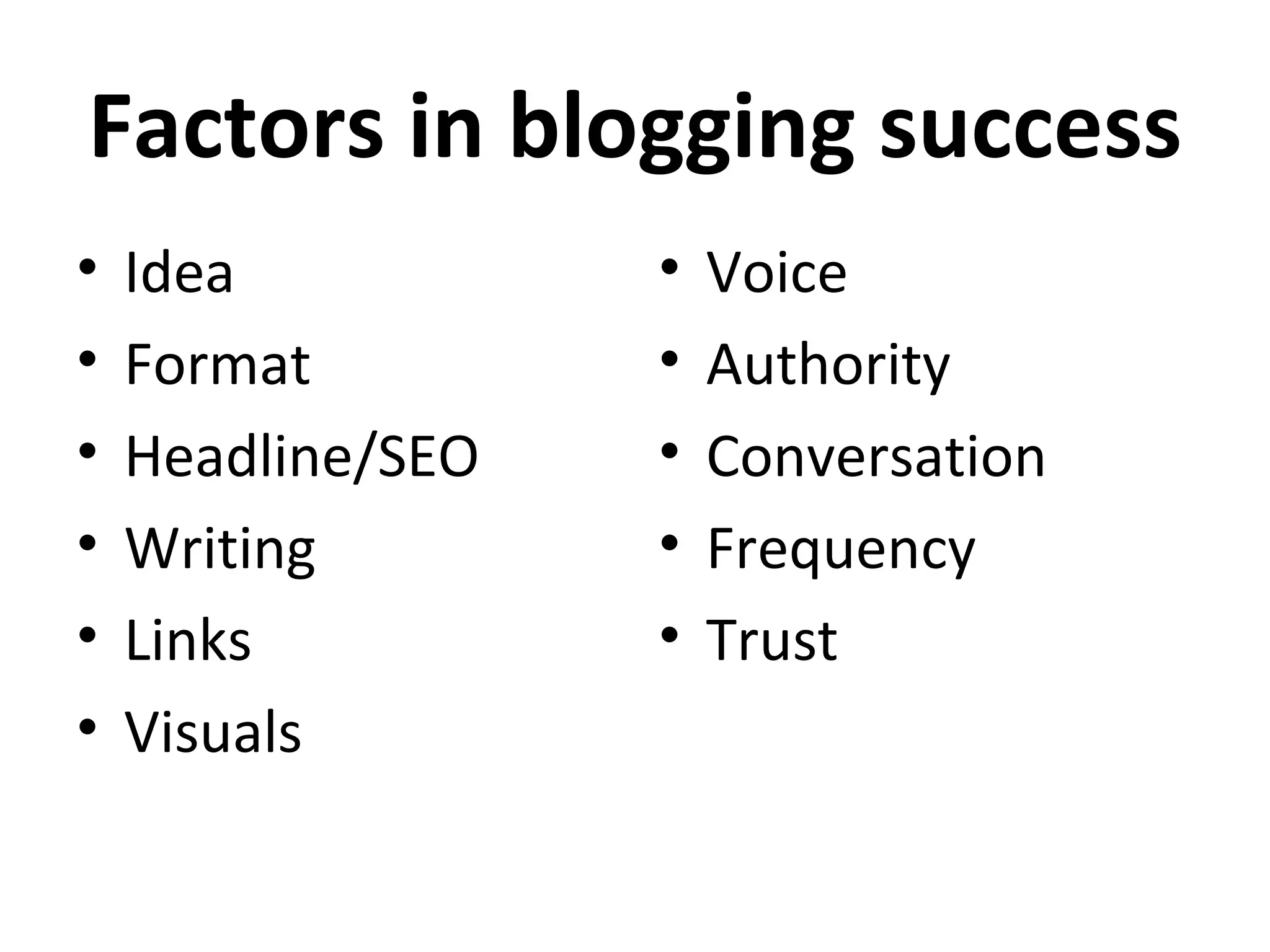
Factors in blogging success
•   Idea           •   Voice
•   Format         •   Authority
•   Headline/SEO   •   Conversation
•   Writing        •   Frequency
•   Links          •   Trust
•   Visuals
Where do you get ideas?
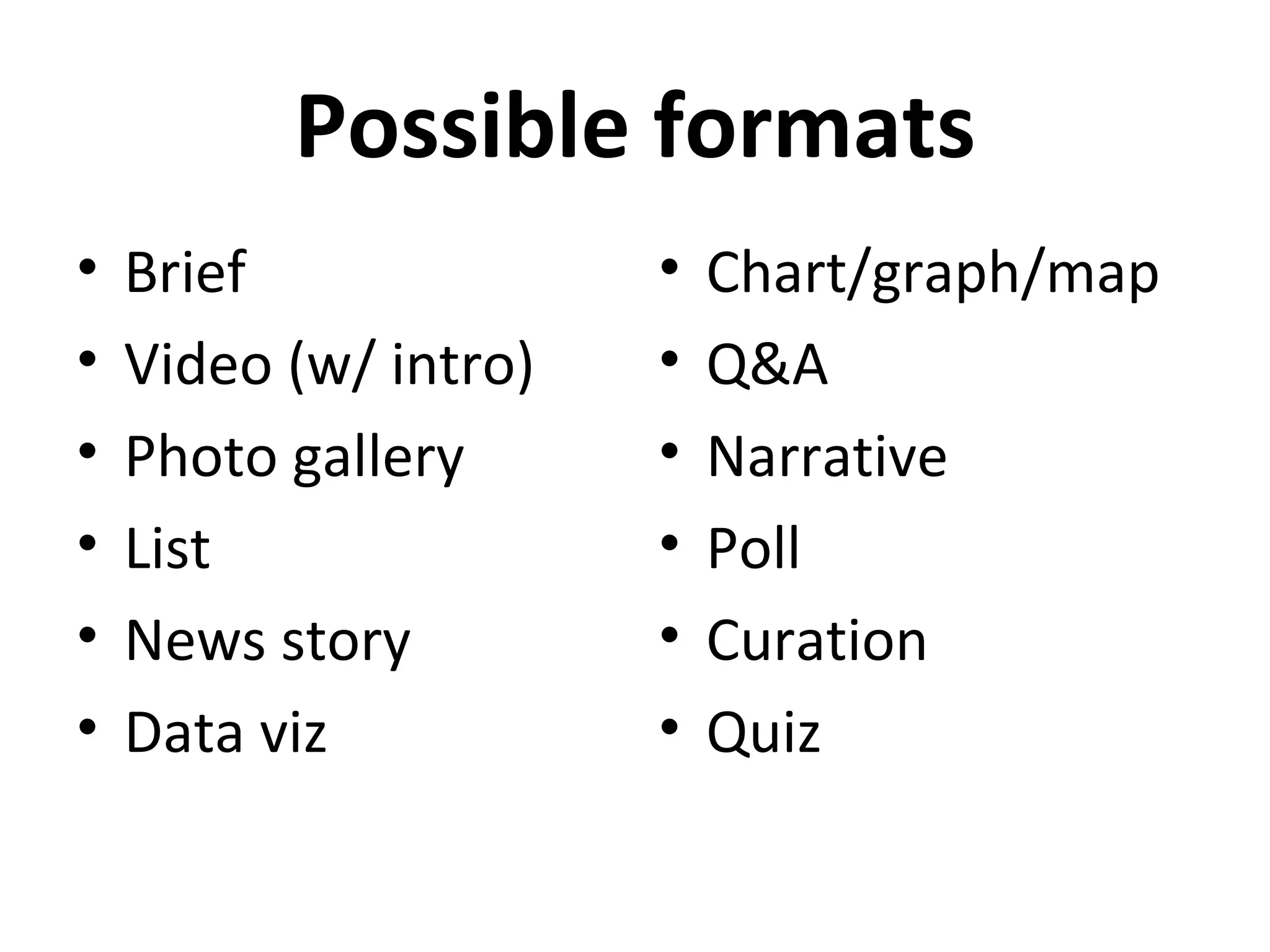
Possible formats
•   Brief              •   Chart/graph/map
•   Video (w/ intro)   •   Q&A
•   Photo gallery      •   Narrative
•   List               •   Poll
•   News story         •   Curation
•   Data viz           •   Quiz
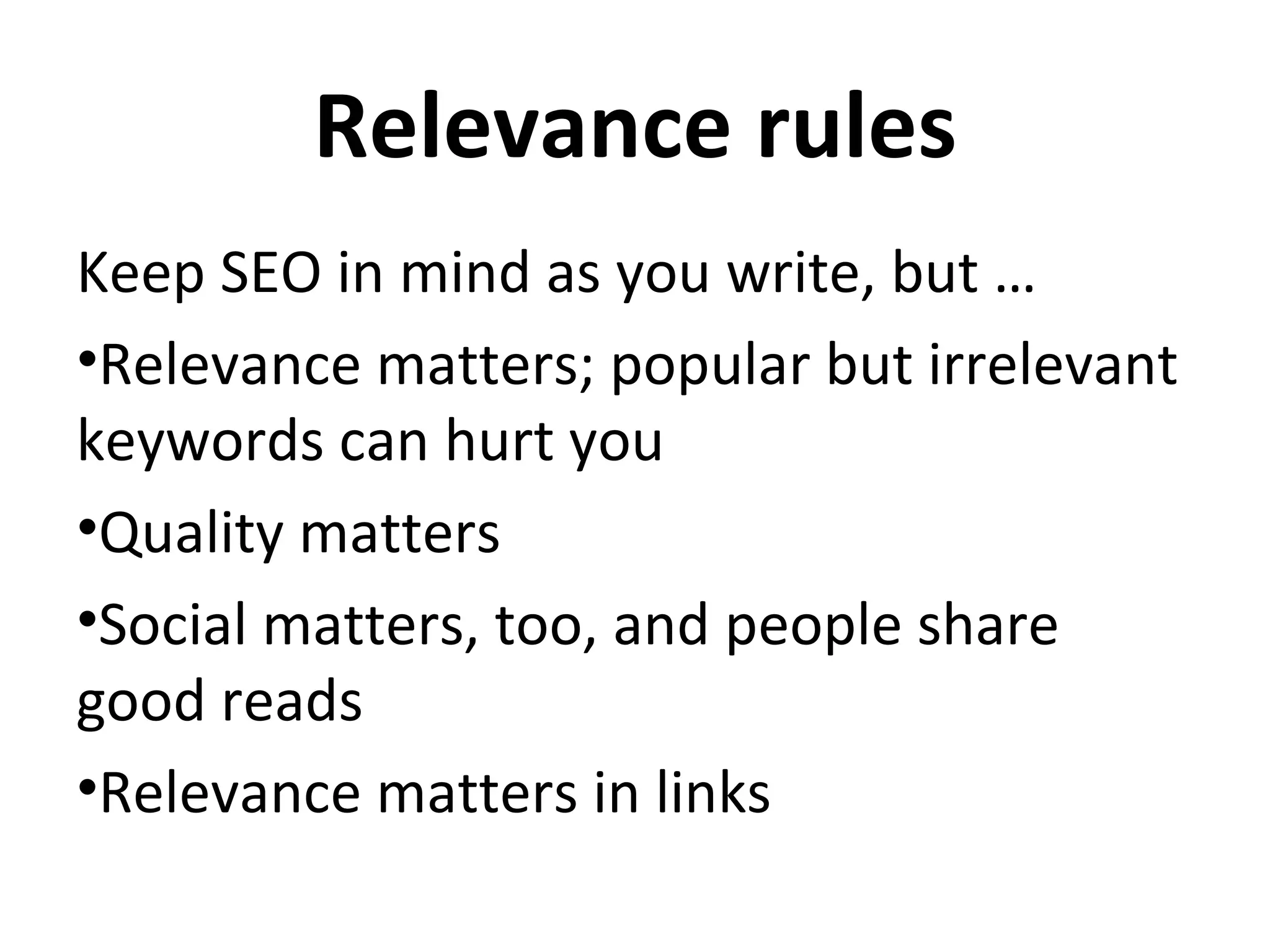
Relevance rules
Keep SEO in mind as you write, but …
•Relevance matters; popular but irrelevant
keywords can hurt you
•Quality matters
•Social matters, too, and people share
good reads
•Relevance matters in links
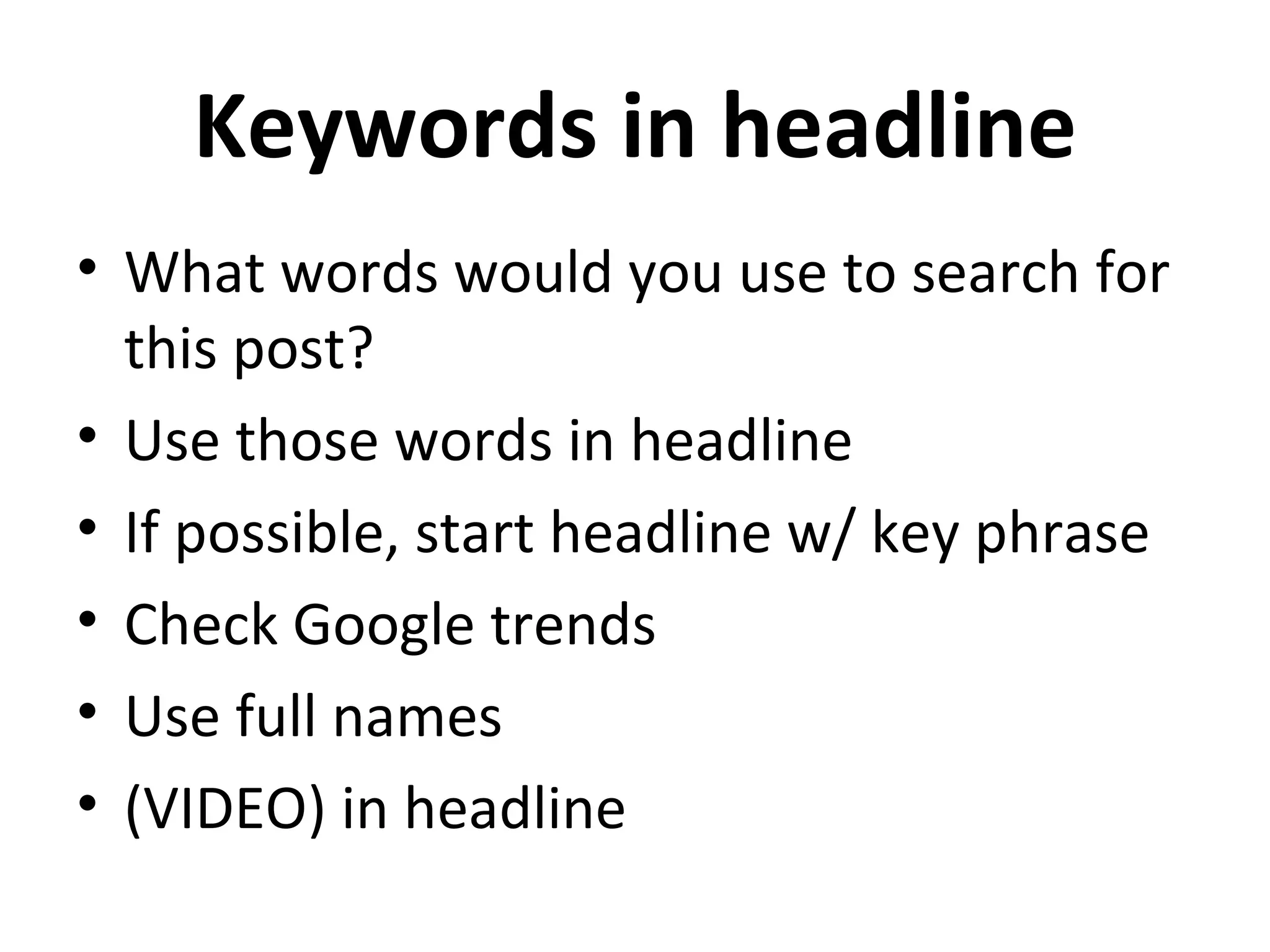
Keywords in headline
• What words would you use to search for
  this post?
• Use those words in headline
• If possible, start headline w/ key phrase
• Check Google trends
• Use full names
• (VIDEO) in headline
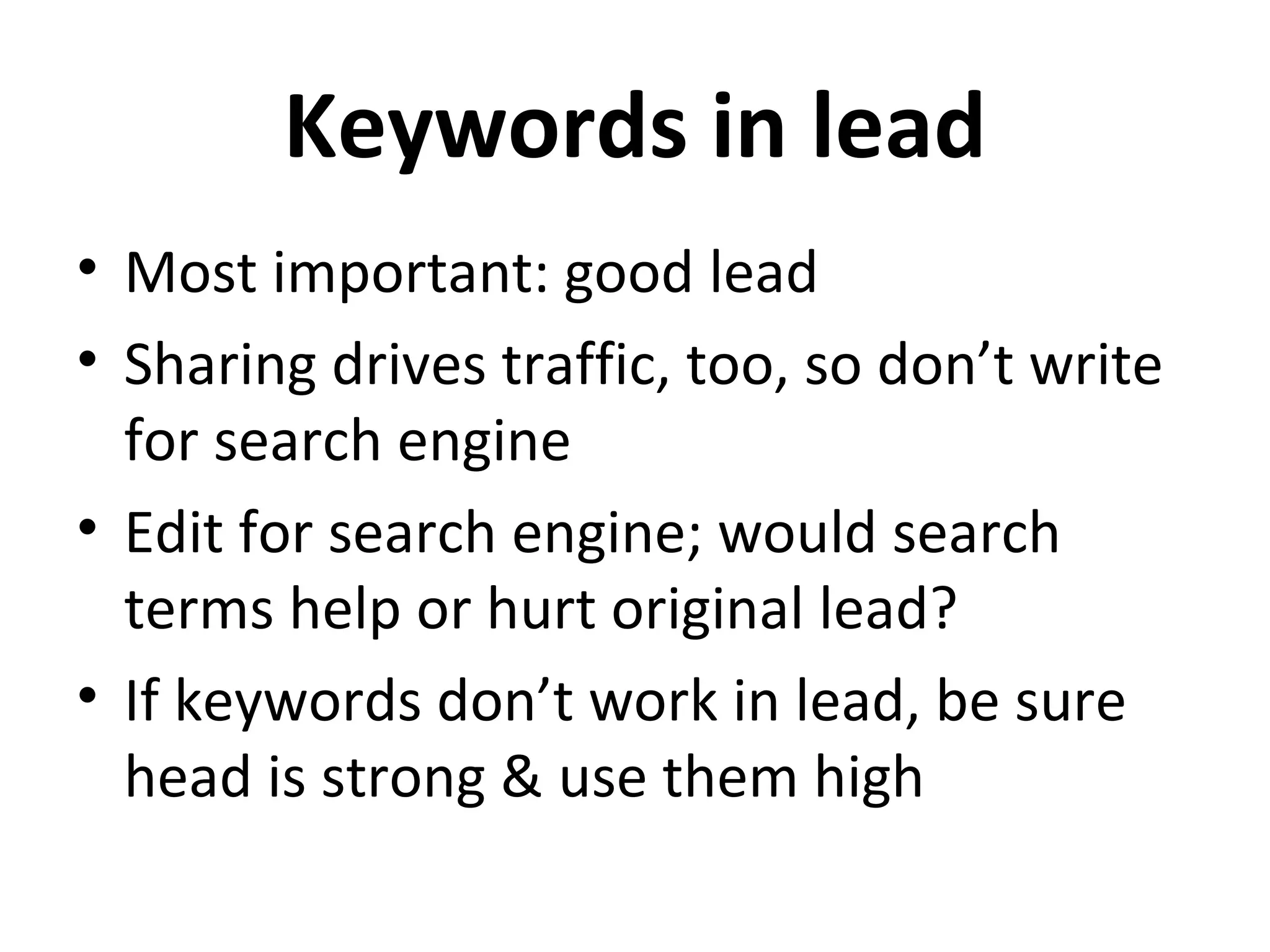
Keywords in lead
• Most important: good lead
• Sharing drives traffic, too, so don’t write
  for search engine
• Edit for search engine; would search
  terms help or hurt original lead?
• If keywords don’t work in lead, be sure
  head is strong & use them high
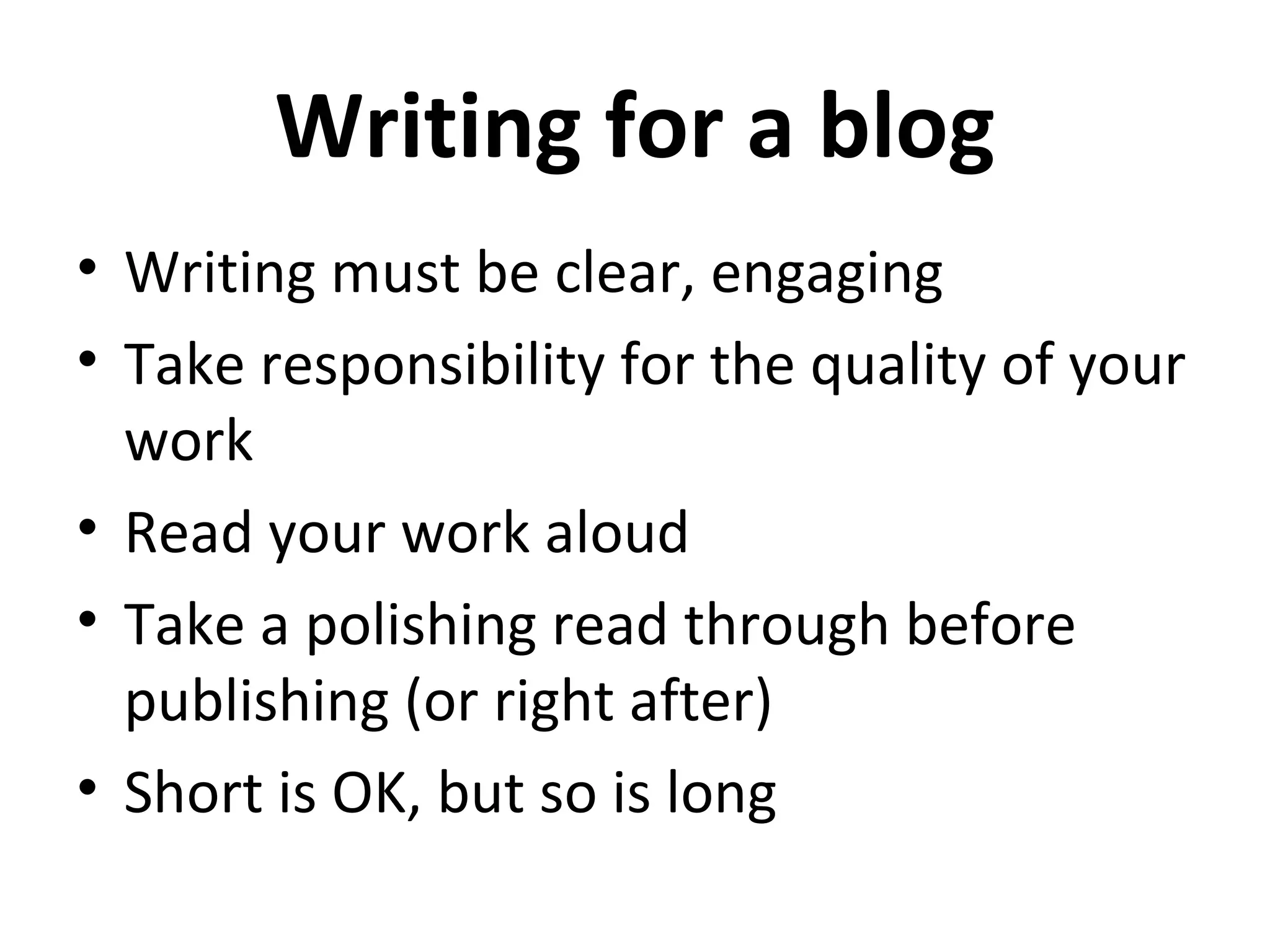
Writing for a blog
• Writing must be clear, engaging
• Take responsibility for the quality of your
  work
• Read your work aloud
• Take a polishing read through before
  publishing (or right after)
• Short is OK, but so is long
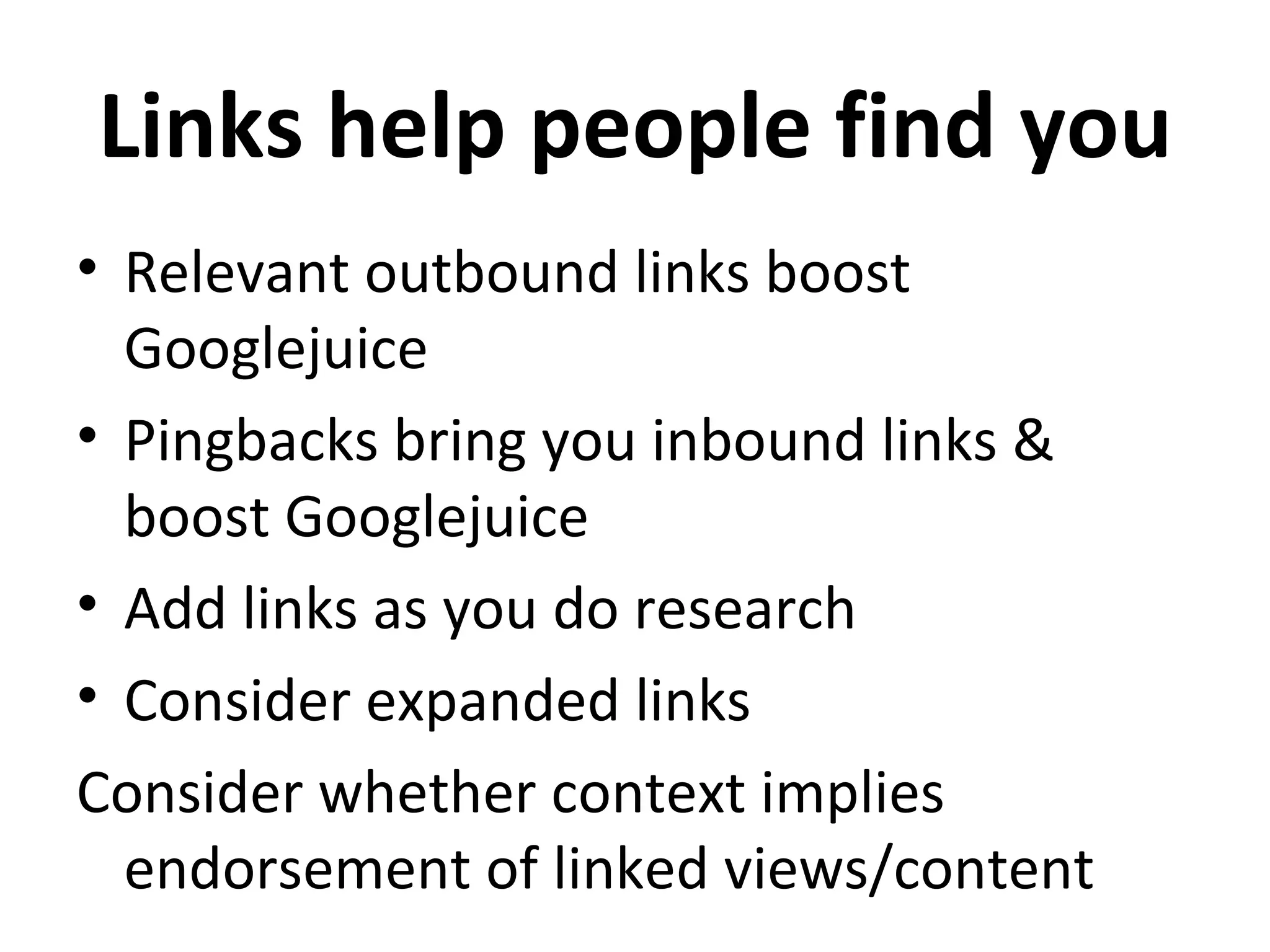
Links help people find you
• Relevant outbound links boost
  Googlejuice
• Pingbacks bring you inbound links &
  boost Googlejuice
• Add links as you do research
• Consider expanded links
Consider whether context implies
  endorsement of linked views/content
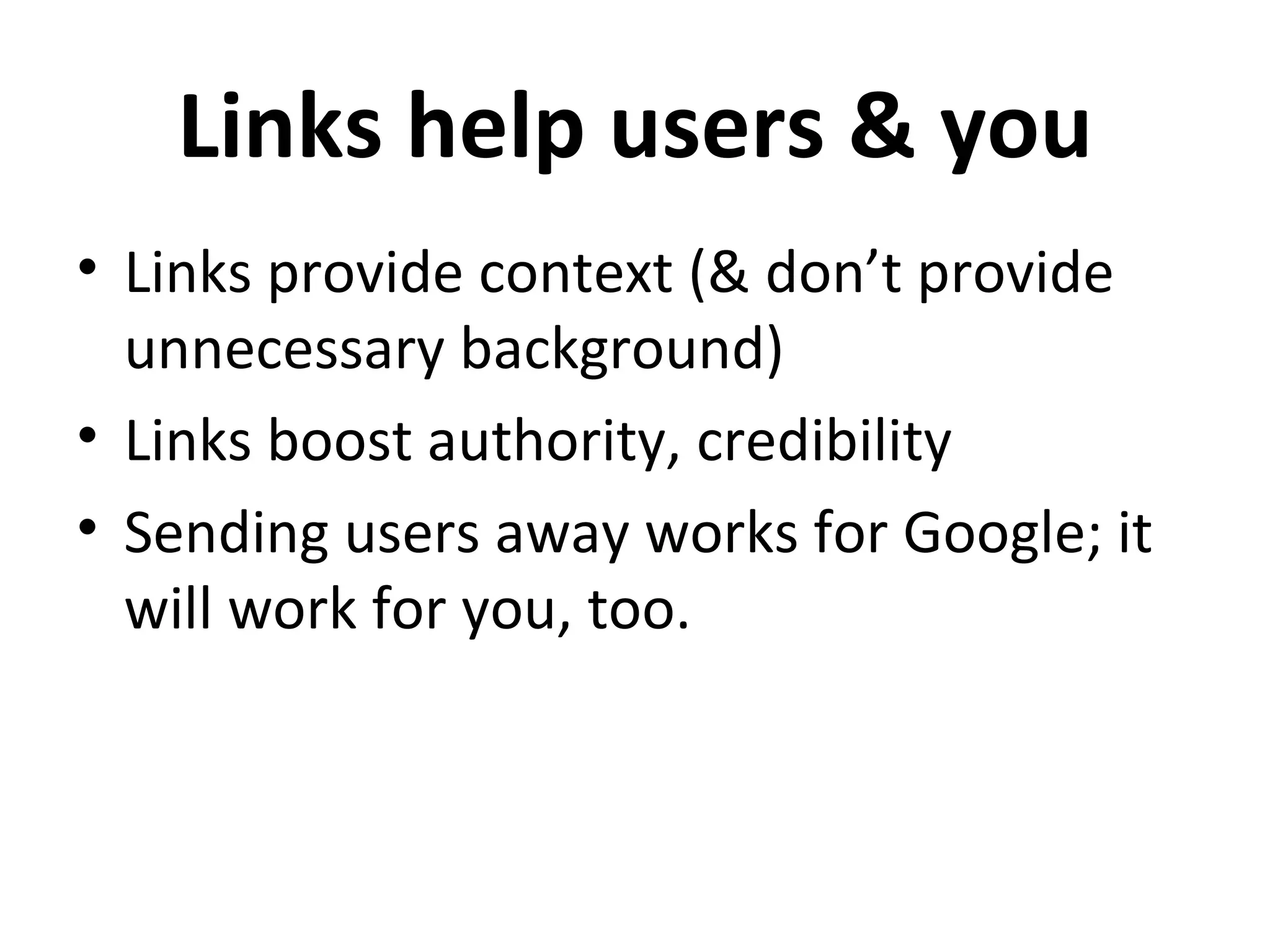
Links help users & you
• Links provide context (& don’t provide
  unnecessary background)
• Links boost authority, credibility
• Sending users away works for Google; it
  will work for you, too.
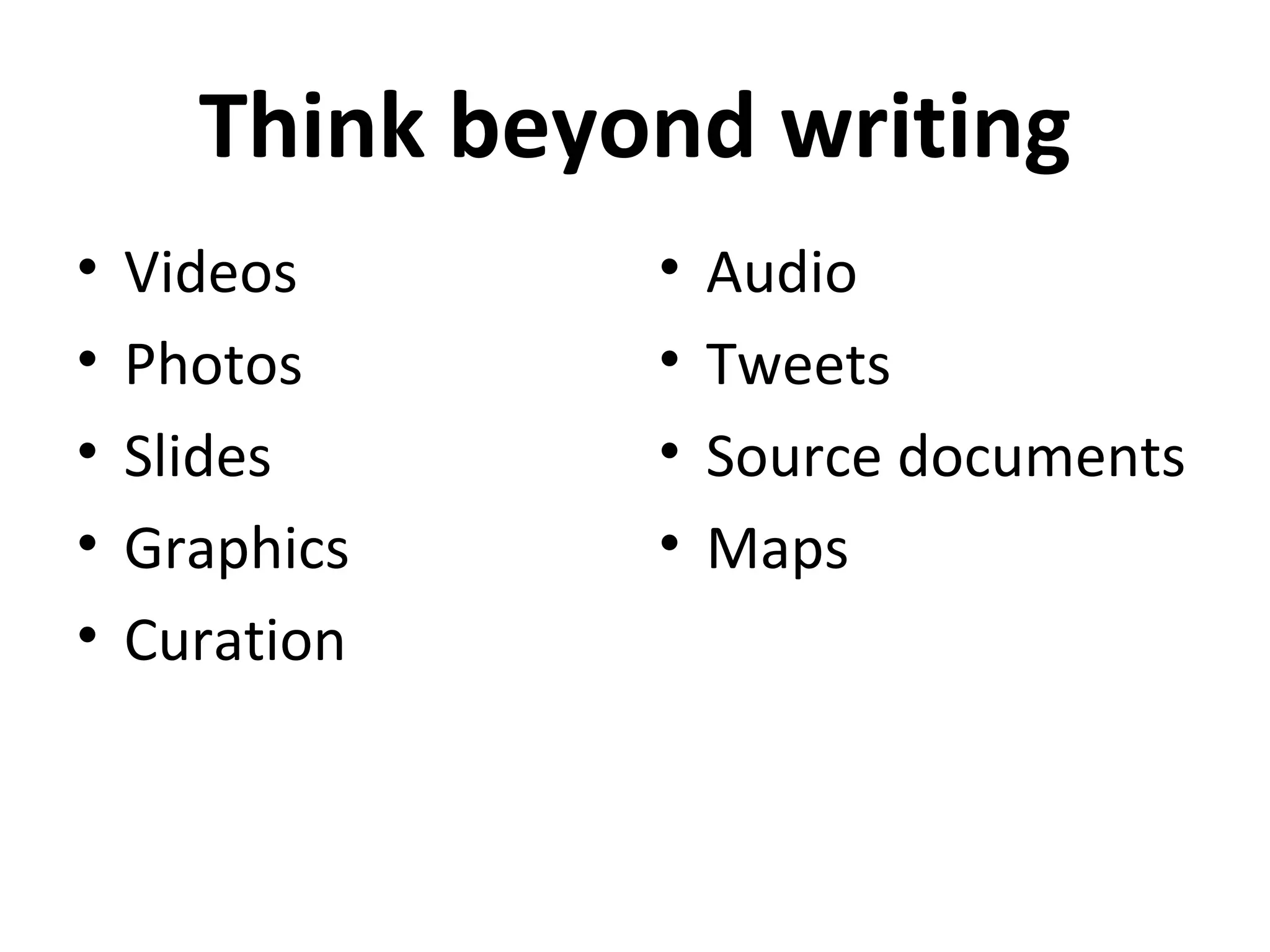
Think beyond writing
•   Videos      •   Audio
•   Photos      •   Tweets
•   Slides      •   Source documents
•   Graphics    •   Maps
•   Curation
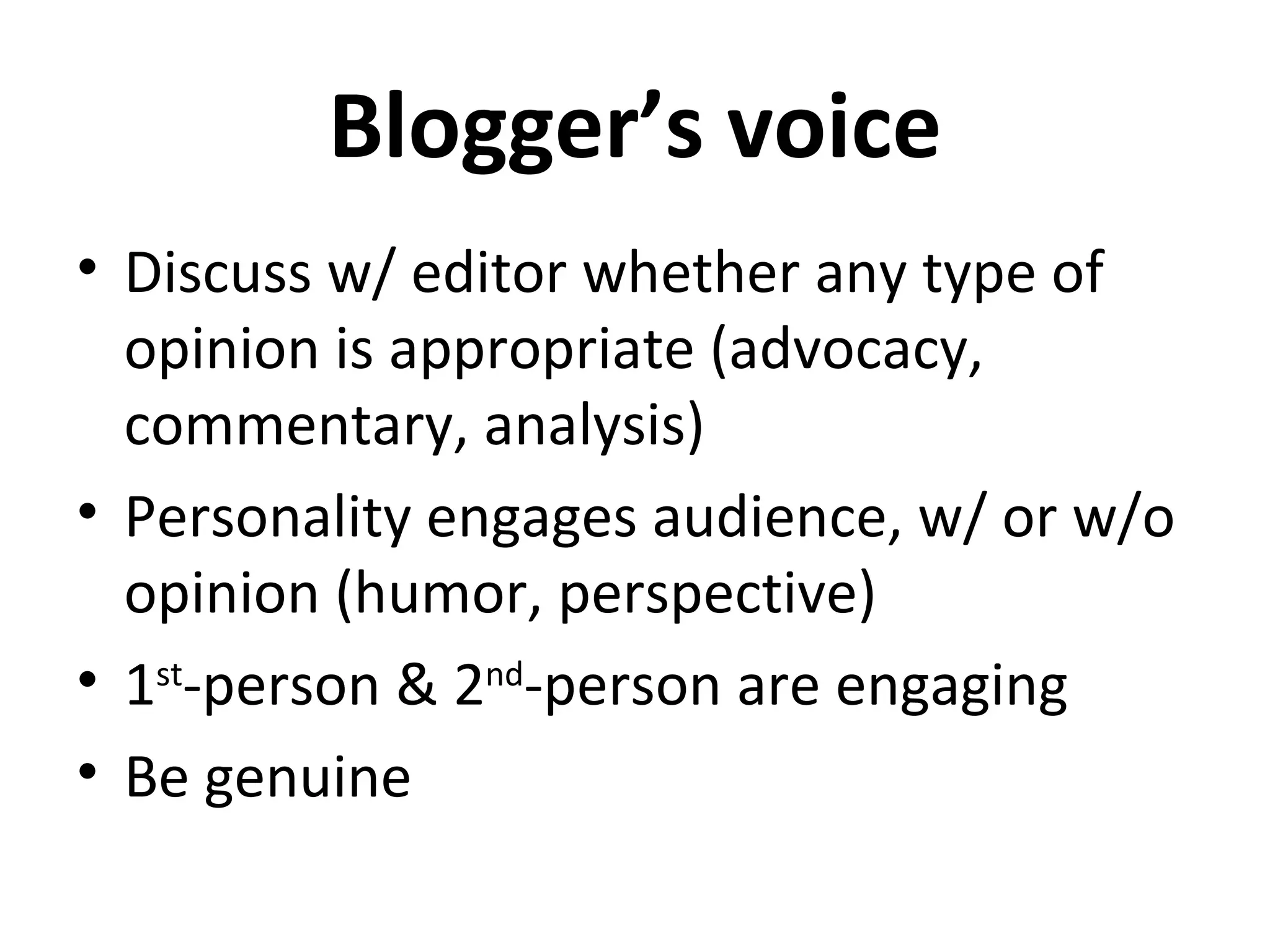
Blogger’s voice
• Discuss w/ editor whether any type of
  opinion is appropriate (advocacy,
  commentary, analysis)
• Personality engages audience, w/ or w/o
  opinion (humor, perspective)
• 1st-person & 2nd-person are engaging
• Be genuine
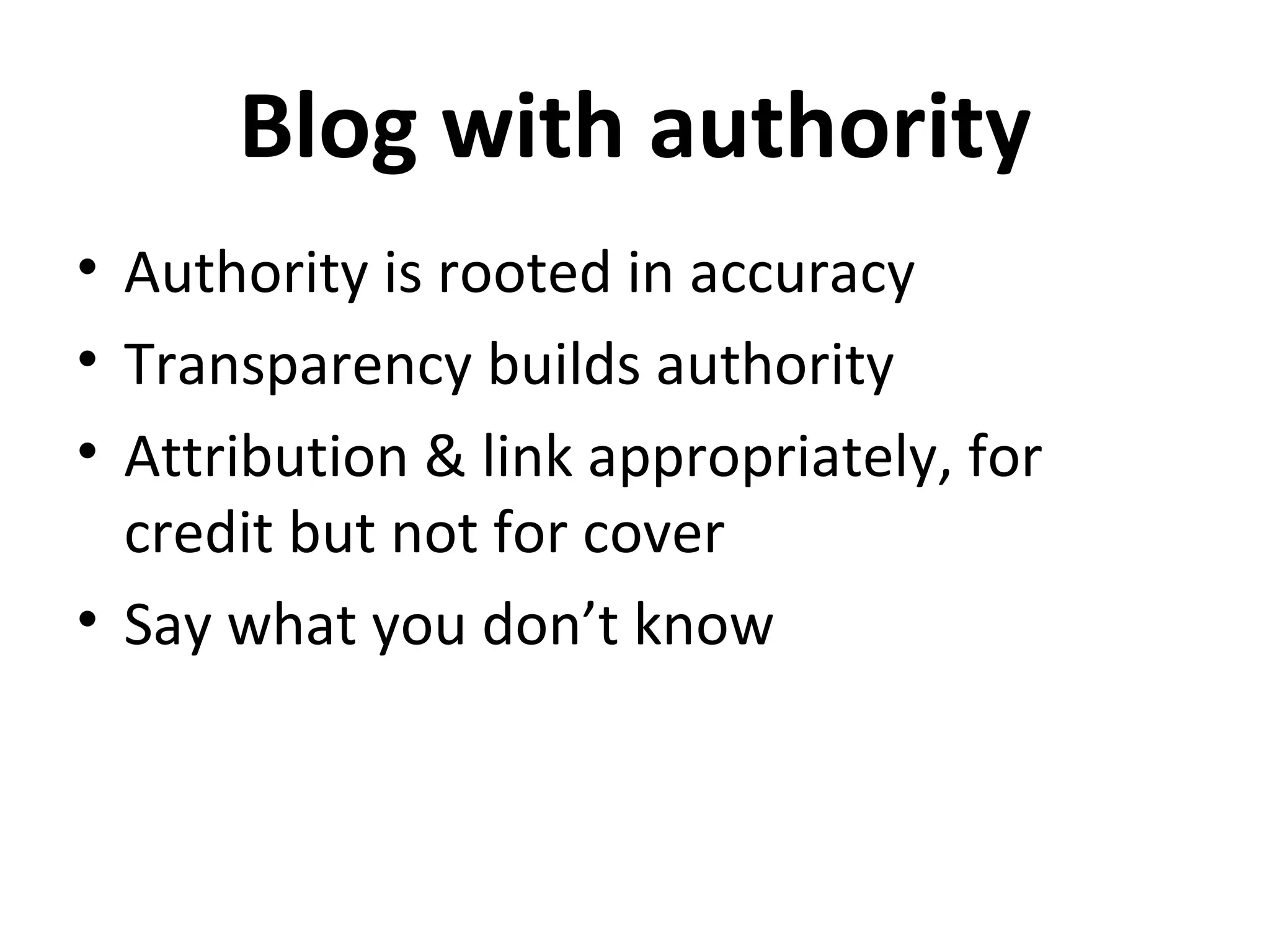
Blog with authority
• Authority is rooted in accuracy
• Transparency builds authority
• Attribution & link appropriately, for
  credit but not for cover
• Say what you don’t know
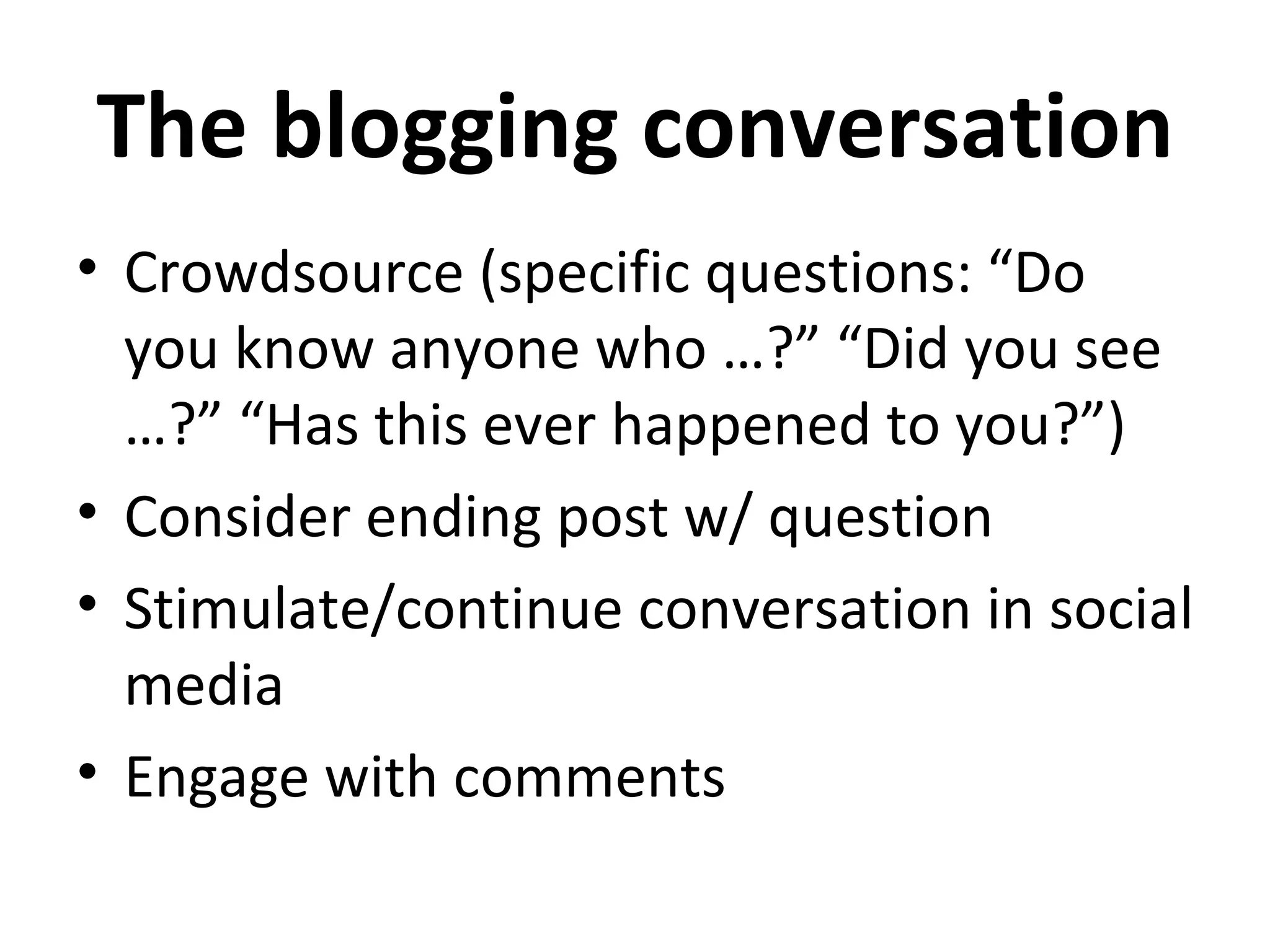
The blogging conversation
• Crowdsource (specific questions: “Do
  you know anyone who …?” “Did you see
  …?” “Has this ever happened to you?”)
• Consider ending post w/ question
• Stimulate/continue conversation in social
  media
• Engage with comments
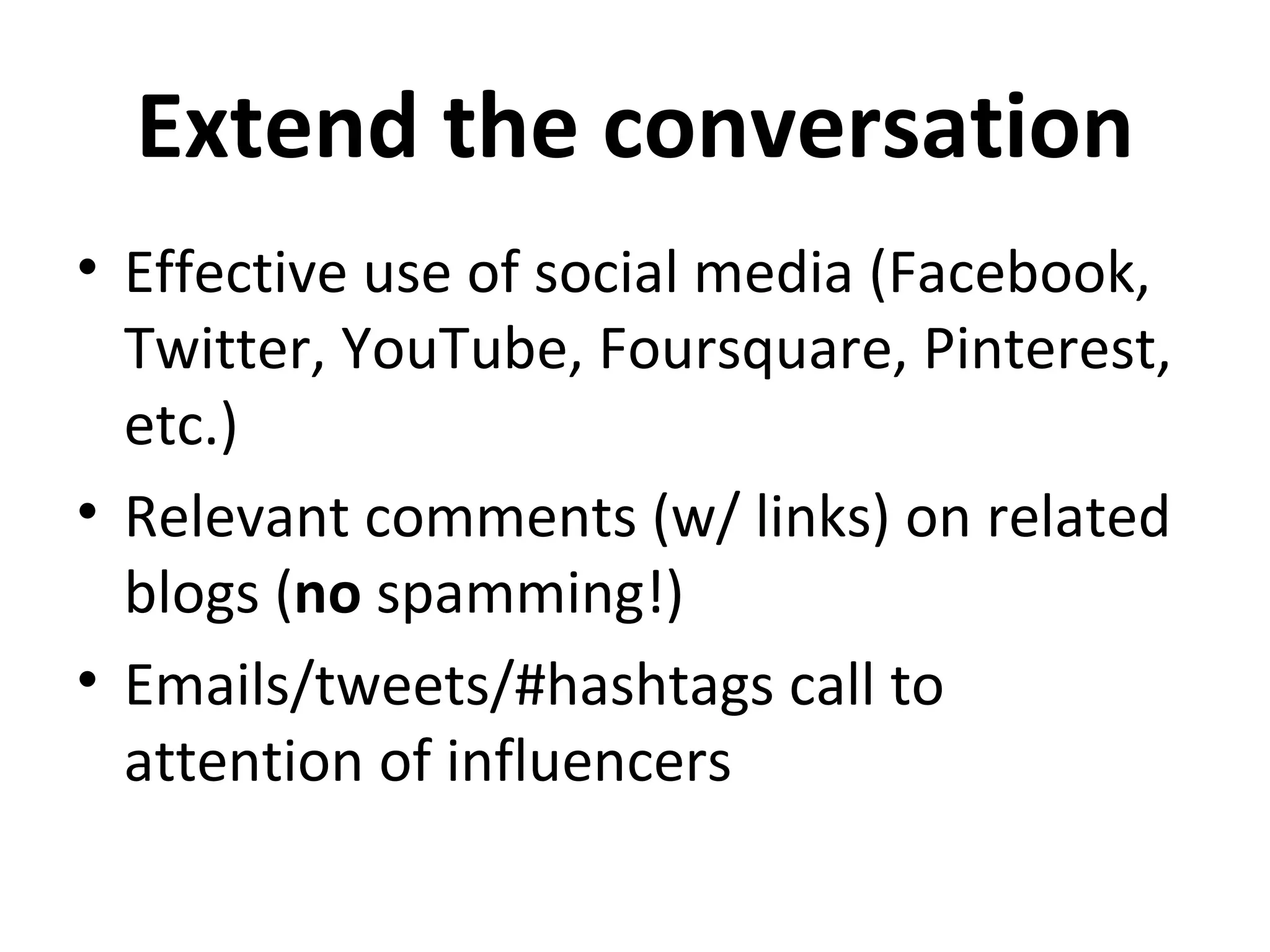
Extend the conversation
• Effective use of social media (Facebook,
  Twitter, YouTube, Foursquare, Pinterest,
  etc.)
• Relevant comments (w/ links) on related
  blogs (no spamming!)
• Emails/tweets/#hashtags call to
  attention of influencers
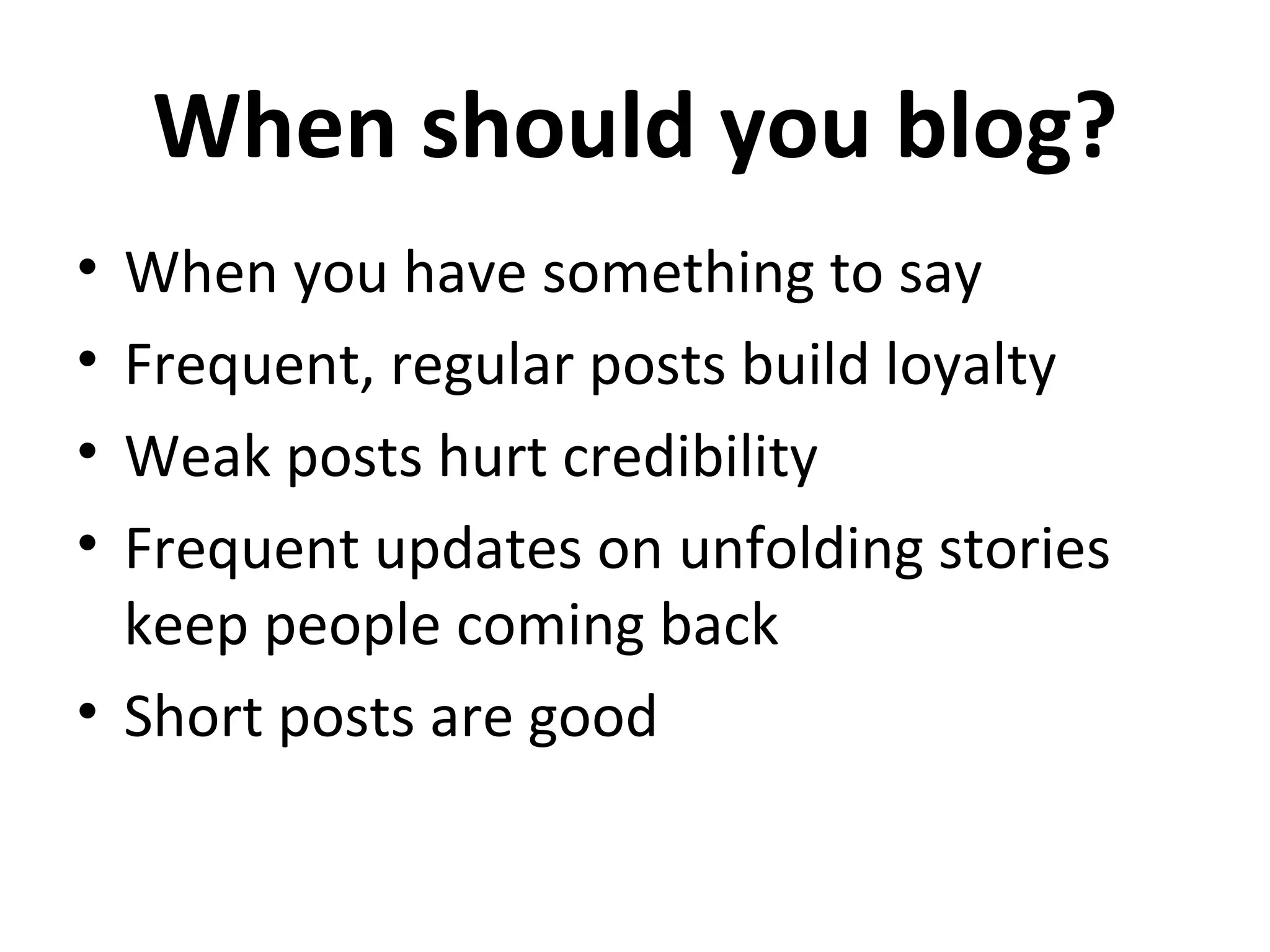
When should you blog?
• When you have something to say
• Frequent, regular posts build loyalty
• Weak posts hurt credibility
• Frequent updates on unfolding stories
  keep people coming back
• Short posts are good
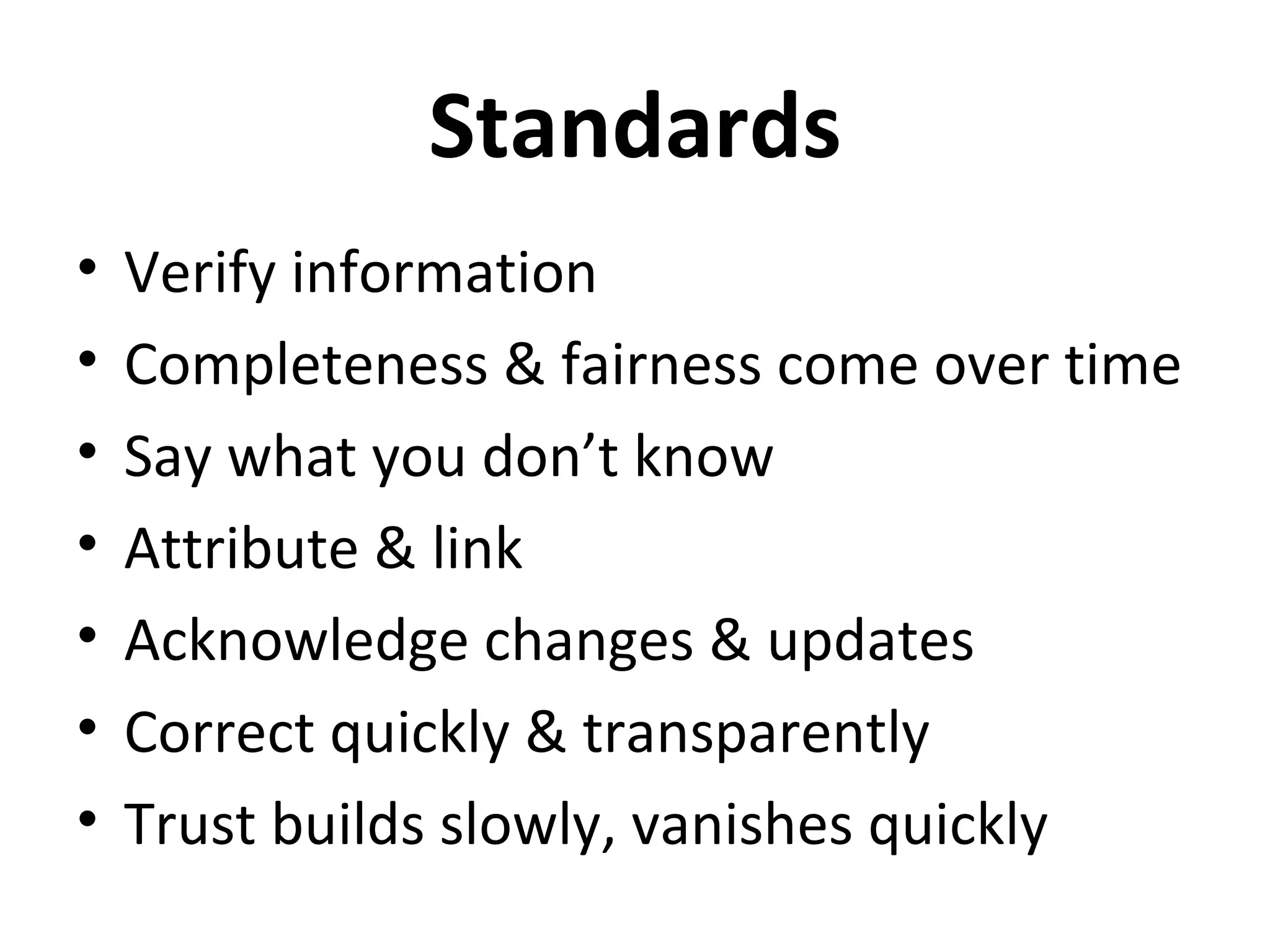
Standards
•   Verify information
•   Completeness & fairness come over time
•   Say what you don’t know
•   Attribute & link
•   Acknowledge changes & updates
•   Correct quickly & transparently
•   Trust builds slowly, vanishes quickly
Read more about it
• stevebuttry.wordpress.com
• slideshare.net/stevebuttry
• @stevebuttry
• https://www.newsu.org/introduction-to-
  reporting
• stephenbuttry@gmail.com

Becoming a Better Blogger

  • 1.
    Becoming a better blogger Steve Buttry Everyday Health June 8, 2012
  • 2.
    Read more aboutit • stevebuttry.wordpress.com • slideshare.net/stevebuttry • @stevebuttry • stephenbuttry@gmail.com
  • 3.
    Plan for theday Morning: •Blogging •Reporting with social media Afternoon: •Digital storytelling •Work w/ the tools (bring a story idea or two)
  • 4.
    Introductions What’s your blogabout? (6 words or so) Who’s your community? (6 words or so)
  • 5.
    Factors in bloggingsuccess • Idea • Voice • Format • Authority • Headline/SEO • Conversation • Writing • Frequency • Links • Trust • Visuals
  • 6.
    Where do youget ideas?
  • 7.
    Possible formats • Brief • Chart/graph/map • Video (w/ intro) • Q&A • Photo gallery • Narrative • List • Poll • News story • Curation • Data viz • Quiz
  • 8.
    Relevance rules Keep SEOin mind as you write, but … •Relevance matters; popular but irrelevant keywords can hurt you •Quality matters •Social matters, too, and people share good reads •Relevance matters in links
  • 9.
    Keywords in headline •What words would you use to search for this post? • Use those words in headline • If possible, start headline w/ key phrase • Check Google trends • Use full names • (VIDEO) in headline
  • 10.
    Keywords in lead •Most important: good lead • Sharing drives traffic, too, so don’t write for search engine • Edit for search engine; would search terms help or hurt original lead? • If keywords don’t work in lead, be sure head is strong & use them high
  • 11.
    Writing for ablog • Writing must be clear, engaging • Take responsibility for the quality of your work • Read your work aloud • Take a polishing read through before publishing (or right after) • Short is OK, but so is long
  • 12.
    Links help peoplefind you • Relevant outbound links boost Googlejuice • Pingbacks bring you inbound links & boost Googlejuice • Add links as you do research • Consider expanded links Consider whether context implies endorsement of linked views/content
  • 13.
    Links help users& you • Links provide context (& don’t provide unnecessary background) • Links boost authority, credibility • Sending users away works for Google; it will work for you, too.
  • 14.
    Think beyond writing • Videos • Audio • Photos • Tweets • Slides • Source documents • Graphics • Maps • Curation
  • 15.
    Blogger’s voice • Discussw/ editor whether any type of opinion is appropriate (advocacy, commentary, analysis) • Personality engages audience, w/ or w/o opinion (humor, perspective) • 1st-person & 2nd-person are engaging • Be genuine
  • 16.
    Blog with authority •Authority is rooted in accuracy • Transparency builds authority • Attribution & link appropriately, for credit but not for cover • Say what you don’t know
  • 17.
    The blogging conversation •Crowdsource (specific questions: “Do you know anyone who …?” “Did you see …?” “Has this ever happened to you?”) • Consider ending post w/ question • Stimulate/continue conversation in social media • Engage with comments
  • 18.
    Extend the conversation •Effective use of social media (Facebook, Twitter, YouTube, Foursquare, Pinterest, etc.) • Relevant comments (w/ links) on related blogs (no spamming!) • Emails/tweets/#hashtags call to attention of influencers
  • 19.
    When should youblog? • When you have something to say • Frequent, regular posts build loyalty • Weak posts hurt credibility • Frequent updates on unfolding stories keep people coming back • Short posts are good
  • 20.
    Standards • Verify information • Completeness & fairness come over time • Say what you don’t know • Attribute & link • Acknowledge changes & updates • Correct quickly & transparently • Trust builds slowly, vanishes quickly
  • 21.
    Read more aboutit • stevebuttry.wordpress.com • slideshare.net/stevebuttry • @stevebuttry • https://www.newsu.org/introduction-to- reporting • stephenbuttry@gmail.com