The Art of Ancient
Egypt
Big Idea : Art reflects religion and
their belief in the afterlife.
WHERE? WHEN?
•Located in the Nile river valley, Africa
•Old Kingdom (2680 BC–c. 2200 BC)
•Middle Kingdom (2055 BC–1650 BC)
•New Kingdom (1550 BC–1069 BC),
WHO?
Communities were
made up of:
•Soldiers
•Slaves
•Priests
•Scribes
•Artists and craftsmen
•Farmers and herdsmen
•Pharaohs & Queens
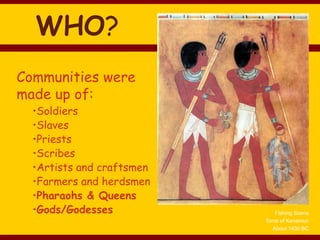
•Gods/Godesses Fishing Scene
Tomb of Kenamun
About 1430 BC
Pharaoh
•The leader was called a
pharaoh.
•The pharaoh was believed
to be half man, half god.
•The afterlife of the
pharaoh is an important
theme in ancient Egyptian
art.
WHAT?
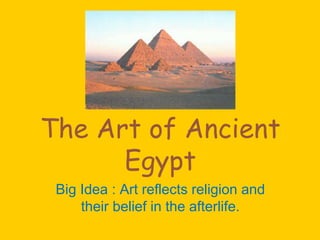
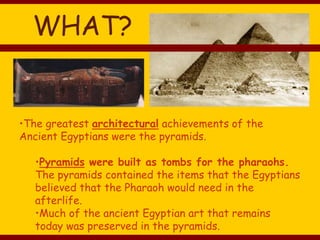
•The greatest architectural achievements of the
Ancient Egyptians were the pyramids.
•Pyramids were built as tombs for the pharaohs.
The pyramids contained the items that the Egyptians
believed that the Pharaoh would need in the
afterlife.
•Much of the ancient Egyptian art that remains
today was preserved in the pyramids.
Other Art created by Ancient
Egyptians
• Egyptian people had a rich culture and loved to make
art.
• The Egyptian people also made statues, relief carvings,
paintings, pottery, jewelry, sculptures and even
coffins.
Statues and Sculptures
Jewelry
Paintings
Bas-Relief Carvings / Stele
Title: Seti I's Campaigns, Temple of Amun at Karnak, Thebes (exterior wall, north side of hypostyle).
Date: ca. 1280 BCE.
• Tomb found in Valley of
the Kings.
• Dated back to 1327
B.C.E.
• The inner coffin is made
from hundreds of
pounds of gold, and
decorated with colored
enamel, and
gemstones.
King Tutankhamen
Burial Art – Sarcophagus, Masks, & Mummies
Do you think
ancient Egyptian
culture has had an
impact on our life
today?
Ancient Egyptian culture has
influenced our lives in many ways.
• Some of our buildings are based on Egyptian
architecture.
– Did you know there is a pyramid shaped hotel in Las Vegas?
• Some of our language comes from the Egyptian
written language of hieroglyphs.
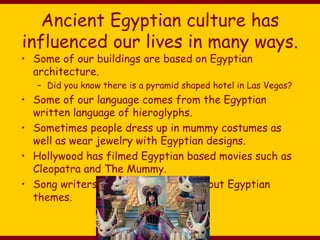
• Sometimes people dress up in mummy costumes as
well as wear jewelry with Egyptian designs.
• Hollywood has filmed Egyptian based movies such as
Cleopatra and The Mummy.
• Song writers have written songs about Egyptian
themes.
What do you think
“Walk Like an Egyptian”
means?
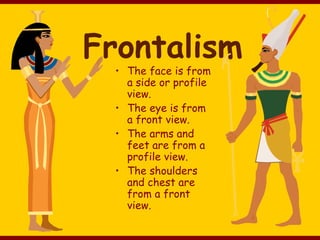
Egyptian artists liked to show everything from what
they thought was the best possible viewpoint. Ancient
Egyptian artists used a style called frontalism to draw
people.
Frontalism
• The face is from
a side or profile
view.
• The eye is from
a front view.
• The arms and
feet are from a
profile view.
• The shoulders
and chest are
from a front
view.
Can you see the front
and profile views of
these Egyptian figures?
Frontalism
Frontalism
Look for the characteristics of Frontalism in this work of
art.
• The face is from a side or profile view.
• The eye is from a front view.
• The arms and feet are from a profile view.
• The shoulders and chest are from a front view.
To Draw An Ancient Egyptian Person
Just follow these steps...
• The face is from a side
or profile view.
• The eye is from a front
view.
• The arms and feet are
from a profile view.
• The shoulders and chest
are from a front view.
What is the
written language
of the ancient
Egyptian people?
Hieroglyphics is the written language of
the ancient Egyptian people.
• Hieroglyphs appear on tomb
and temple walls, statues,
papyrus (paper) and even
jewelry.
• Text could be read from
left to right, right to left,
or up and down depending
on which way the symbols
faced.
• Hieroglyphic writing is one
of the most beautiful
systems of writing ever
created.
How Did People Learn To Write It?
• Ancient Egyptians
would attend a
special school to
learn to write and
read hieroglyphics.
• Egyptians who
learned how to write
the language were
called Scribes.
What Did They Use?
• First, they cut a plant called
papyrus into thin layers.
Then they the papyrus
strips flat and pounded
them with a mallet. Finally,
they used a smoothing stone
to smooth it out.
• They wrote on the papyrus
paper with reed pens which
they dipped into ink.
• They also carved and
painted hieroglyphics on
tombs and temple walls.
• The wore a CARTOUCHE
The Rosetta Stone
• The Rosetta Stone was found by
French soldiers who were
rebuilding a fort in Egypt in 1799.
The Rosetta Stone is believed to
have been made in 196 B.C.
• The Rosetta Stone was inscribed
with three different texts Greek,
Demotic, Hieratic. Each text says
the same thing.
• The Rosetta Stone text was
written by the priests in ancient
Egypt to honor the Pharaohs. It
lists all the good things the
Pharaohs have done for the people
and priests.
Examples of Egyptian Hieroglyphics
When you think
of Egypt do you
think of
pyramids?
There are approximately 100 Pyramids in
Egypt
• A pyramid was built
to be the tomb of a
king called a
pharoah.
• Secret chambers in
the pyramid held the
king’s mummy,
coffins and special
items from the
king’s afterlife.
• Ancient Egyptian
people believed the
pyramid connected
the sky and the
•The first pyramid was built for King Zoser. It was a “step
pyramid”. It was designed and built by an artist and
architect named Imhotep.
•Imhotep is the first architect whose name is recorded in
history.
•This pyramid was built about 2600 BC.
•The pyramids were built using blocks of stone.
•Originally the exterior of the pyramids had a smooth quality.
However, due to time, wind, weather, etc. this smooth façade has
worn away. You can see a small remainder of the facade on the
photo to the top left.
Egypt, El Giza, Great Pyramid also known as "Pyramid of Cheops" or
"Khufu's Pyramid" 2600-2480 BCE, The base of the pyramid covers
about 13 acres. To build the Great Pyramid it took an about
2,300,000 dressed stone blocks (averaging 2.5 tons each) -- more
than any other structure ever built. The blocks were moved on log
rollers and sledges, and then ramped into place.
•The Great Pyramid was originally 481 feet high and each side was 756
feet long.
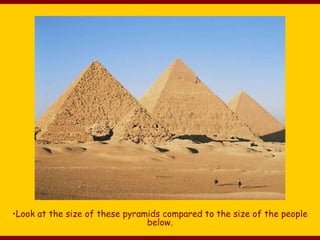
•Look at the size of these pyramids compared to the size of the people
below.
•The inside of a pyramid
The ancient Egyptians also built beautiful temples.
•This is the Temple of Ra
Other Egyptian Architectural Structures
• The Sphinx is another example of a Pharaoh (Khafre) demonstrating
his power.
•The massive size and the head of Pharaoh Khafre on the body of a
lion was intended to demonstrate the power of the pharaoh.
•Carved from stone at the site and stands at 65 feet tall.
Pharaoh Khafre, c. 2600 B.C.
Diorite. 66 inches tall.
Title: Hypostyle Hall of Temple of Amun-Ra, Karnak, Thebes.
Date: ca. 1290-1224 BCE.
Temple of Ra
Title: Temple of Queen Hatshepsut, Deir el-Bahri
Date: ca. 1478–1458 BCE.
Other Egyptian Architectural Structures
Temple of Queen Hatshepsut
Title: Temple of Ramses II, Abu Simbel. 19th Dynasty.
Date: ca. 1279-1213 BCE. Temple of Ramses II
Title: Interior Temple of Ramses II, Abu Simbel. 19th Dynasty.
Date: ca. 1279-1213 BCE. Interior Temple of Ramses II
Do you know
what
Mummification
means?
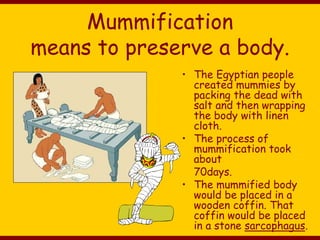
Mummification
means to preserve a body.
• The Egyptian people
created mummies by
packing the dead with
salt and then wrapping
the body with linen
cloth.
• The process of
mummification took
about
70days.
• The mummified body
would be placed in a
wooden coffin. That
coffin would be placed
in a stone sarcophagus.
Mummy of Nes-mut-aat-neru.
From Deir el-Bahri, temple of
Hatshepsut; Third
Intermediate Period, mid-
Dynasty 25, about 700-675
B.C.. Gift of the Egypt
Exploration Fund 95.1407a
Burial Art – Mummies
Burial Art – Masks
Burial Art – Sarcophaguses
• Of the materials used by the Egyptian, stone was the
most plentiful and permanent
• Sculpture was often painted in vivid hues as well
• Cubic and frontal- echoes in its form the shape of the
stone cube or block from which it was fashioned,
• The front of almost every statue is the most important
part and the figure sits or stands facing strictly to the
front
Ancient Egyptian Sculpture
Statues in the round usually depicted the gods,
Pharaohs, or civic officials, and were composed with
special reference to the maintenance of straight lines
Sculpture In the Round
Bust of Nefertiti
• Virtually all the wall-sculptures of the Ancient Egyptian Empire are in the form of bas-relief (low-relief)
• Relief-composition merely meant arranging the figures in horizontal lines so as to record an event or represent
an action.
• The principal figures were distinguished from others by their size - gods were shown larger than men, kings
larger than their followers, and the dead larger than the living.
Relief Sculpture
Canopic Jars

Ancient Egypt PPP.ppt

  • 1.
    The Art ofAncient Egypt Big Idea : Art reflects religion and their belief in the afterlife.
  • 2.
    WHERE? WHEN? •Located inthe Nile river valley, Africa •Old Kingdom (2680 BC–c. 2200 BC) •Middle Kingdom (2055 BC–1650 BC) •New Kingdom (1550 BC–1069 BC),
  • 3.
    WHO? Communities were made upof: •Soldiers •Slaves •Priests •Scribes •Artists and craftsmen •Farmers and herdsmen •Pharaohs & Queens •Gods/Godesses Fishing Scene Tomb of Kenamun About 1430 BC
  • 4.
    Pharaoh •The leader wascalled a pharaoh. •The pharaoh was believed to be half man, half god. •The afterlife of the pharaoh is an important theme in ancient Egyptian art.
  • 5.
    WHAT? •The greatest architecturalachievements of the Ancient Egyptians were the pyramids. •Pyramids were built as tombs for the pharaohs. The pyramids contained the items that the Egyptians believed that the Pharaoh would need in the afterlife. •Much of the ancient Egyptian art that remains today was preserved in the pyramids.
  • 6.
    Other Art createdby Ancient Egyptians • Egyptian people had a rich culture and loved to make art. • The Egyptian people also made statues, relief carvings, paintings, pottery, jewelry, sculptures and even coffins.
  • 7.
  • 8.
  • 9.
  • 10.
    Bas-Relief Carvings /Stele Title: Seti I's Campaigns, Temple of Amun at Karnak, Thebes (exterior wall, north side of hypostyle). Date: ca. 1280 BCE.
  • 11.
    • Tomb foundin Valley of the Kings. • Dated back to 1327 B.C.E. • The inner coffin is made from hundreds of pounds of gold, and decorated with colored enamel, and gemstones. King Tutankhamen
  • 12.
    Burial Art –Sarcophagus, Masks, & Mummies
  • 13.
    Do you think ancientEgyptian culture has had an impact on our life today?
  • 14.
    Ancient Egyptian culturehas influenced our lives in many ways. • Some of our buildings are based on Egyptian architecture. – Did you know there is a pyramid shaped hotel in Las Vegas? • Some of our language comes from the Egyptian written language of hieroglyphs. • Sometimes people dress up in mummy costumes as well as wear jewelry with Egyptian designs. • Hollywood has filmed Egyptian based movies such as Cleopatra and The Mummy. • Song writers have written songs about Egyptian themes.
  • 15.
    What do youthink “Walk Like an Egyptian” means?
  • 16.
    Egyptian artists likedto show everything from what they thought was the best possible viewpoint. Ancient Egyptian artists used a style called frontalism to draw people.
  • 17.
    Frontalism • The faceis from a side or profile view. • The eye is from a front view. • The arms and feet are from a profile view. • The shoulders and chest are from a front view.
  • 18.
    Can you seethe front and profile views of these Egyptian figures? Frontalism
  • 19.
    Frontalism Look for thecharacteristics of Frontalism in this work of art. • The face is from a side or profile view. • The eye is from a front view. • The arms and feet are from a profile view. • The shoulders and chest are from a front view.
  • 20.
    To Draw AnAncient Egyptian Person Just follow these steps... • The face is from a side or profile view. • The eye is from a front view. • The arms and feet are from a profile view. • The shoulders and chest are from a front view.
  • 21.
    What is the writtenlanguage of the ancient Egyptian people?
  • 22.
    Hieroglyphics is thewritten language of the ancient Egyptian people. • Hieroglyphs appear on tomb and temple walls, statues, papyrus (paper) and even jewelry. • Text could be read from left to right, right to left, or up and down depending on which way the symbols faced. • Hieroglyphic writing is one of the most beautiful systems of writing ever created.
  • 23.
    How Did PeopleLearn To Write It? • Ancient Egyptians would attend a special school to learn to write and read hieroglyphics. • Egyptians who learned how to write the language were called Scribes.
  • 24.
    What Did TheyUse? • First, they cut a plant called papyrus into thin layers. Then they the papyrus strips flat and pounded them with a mallet. Finally, they used a smoothing stone to smooth it out. • They wrote on the papyrus paper with reed pens which they dipped into ink. • They also carved and painted hieroglyphics on tombs and temple walls. • The wore a CARTOUCHE
  • 25.
    The Rosetta Stone •The Rosetta Stone was found by French soldiers who were rebuilding a fort in Egypt in 1799. The Rosetta Stone is believed to have been made in 196 B.C. • The Rosetta Stone was inscribed with three different texts Greek, Demotic, Hieratic. Each text says the same thing. • The Rosetta Stone text was written by the priests in ancient Egypt to honor the Pharaohs. It lists all the good things the Pharaohs have done for the people and priests.
  • 26.
    Examples of EgyptianHieroglyphics
  • 27.
    When you think ofEgypt do you think of pyramids?
  • 28.
    There are approximately100 Pyramids in Egypt • A pyramid was built to be the tomb of a king called a pharoah. • Secret chambers in the pyramid held the king’s mummy, coffins and special items from the king’s afterlife. • Ancient Egyptian people believed the pyramid connected the sky and the
  • 29.
    •The first pyramidwas built for King Zoser. It was a “step pyramid”. It was designed and built by an artist and architect named Imhotep. •Imhotep is the first architect whose name is recorded in history. •This pyramid was built about 2600 BC.
  • 30.
    •The pyramids werebuilt using blocks of stone. •Originally the exterior of the pyramids had a smooth quality. However, due to time, wind, weather, etc. this smooth façade has worn away. You can see a small remainder of the facade on the photo to the top left.
  • 31.
    Egypt, El Giza,Great Pyramid also known as "Pyramid of Cheops" or "Khufu's Pyramid" 2600-2480 BCE, The base of the pyramid covers about 13 acres. To build the Great Pyramid it took an about 2,300,000 dressed stone blocks (averaging 2.5 tons each) -- more than any other structure ever built. The blocks were moved on log rollers and sledges, and then ramped into place.
  • 32.
    •The Great Pyramidwas originally 481 feet high and each side was 756 feet long.
  • 33.
    •Look at thesize of these pyramids compared to the size of the people below.
  • 34.
  • 35.
    The ancient Egyptiansalso built beautiful temples. •This is the Temple of Ra Other Egyptian Architectural Structures
  • 37.
    • The Sphinxis another example of a Pharaoh (Khafre) demonstrating his power. •The massive size and the head of Pharaoh Khafre on the body of a lion was intended to demonstrate the power of the pharaoh. •Carved from stone at the site and stands at 65 feet tall. Pharaoh Khafre, c. 2600 B.C. Diorite. 66 inches tall.
  • 38.
    Title: Hypostyle Hallof Temple of Amun-Ra, Karnak, Thebes. Date: ca. 1290-1224 BCE. Temple of Ra
  • 39.
    Title: Temple ofQueen Hatshepsut, Deir el-Bahri Date: ca. 1478–1458 BCE. Other Egyptian Architectural Structures Temple of Queen Hatshepsut
  • 40.
    Title: Temple ofRamses II, Abu Simbel. 19th Dynasty. Date: ca. 1279-1213 BCE. Temple of Ramses II
  • 41.
    Title: Interior Templeof Ramses II, Abu Simbel. 19th Dynasty. Date: ca. 1279-1213 BCE. Interior Temple of Ramses II
  • 42.
  • 43.
    Mummification means to preservea body. • The Egyptian people created mummies by packing the dead with salt and then wrapping the body with linen cloth. • The process of mummification took about 70days. • The mummified body would be placed in a wooden coffin. That coffin would be placed in a stone sarcophagus.
  • 44.
    Mummy of Nes-mut-aat-neru. FromDeir el-Bahri, temple of Hatshepsut; Third Intermediate Period, mid- Dynasty 25, about 700-675 B.C.. Gift of the Egypt Exploration Fund 95.1407a Burial Art – Mummies
  • 45.
  • 46.
    Burial Art –Sarcophaguses
  • 47.
    • Of thematerials used by the Egyptian, stone was the most plentiful and permanent • Sculpture was often painted in vivid hues as well • Cubic and frontal- echoes in its form the shape of the stone cube or block from which it was fashioned, • The front of almost every statue is the most important part and the figure sits or stands facing strictly to the front Ancient Egyptian Sculpture Statues in the round usually depicted the gods, Pharaohs, or civic officials, and were composed with special reference to the maintenance of straight lines Sculpture In the Round Bust of Nefertiti
  • 48.
    • Virtually allthe wall-sculptures of the Ancient Egyptian Empire are in the form of bas-relief (low-relief) • Relief-composition merely meant arranging the figures in horizontal lines so as to record an event or represent an action. • The principal figures were distinguished from others by their size - gods were shown larger than men, kings larger than their followers, and the dead larger than the living. Relief Sculpture
  • 49.