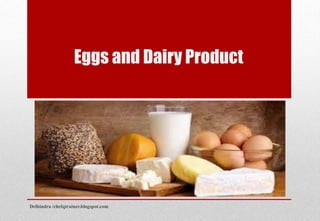

Eggs and Dairy Product
Delhindra /chefqtrainer.blogspot.com
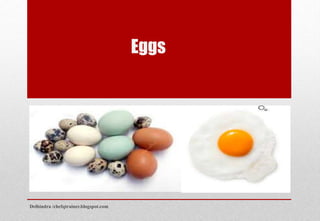
Eggs
Delhindra /chefqtrainer.blogspot.com
Sumber makanan yang
murah dan mudah
dibuat berbagai
macam variasi
makanan
Umumnya digunakan
untuk breakfast.
Delhindra /chefqtrainer.blogspot.com
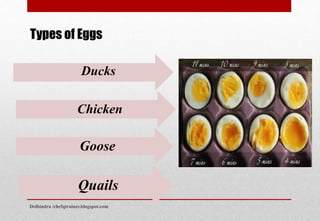
Chicken
Ducks
Goose
Quails
Types of Eggs
Delhindra /chefqtrainer.blogspot.com
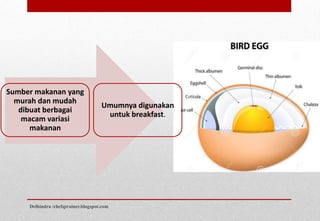
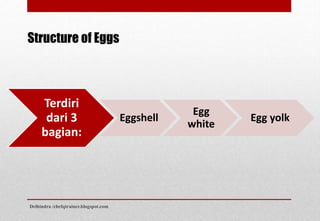
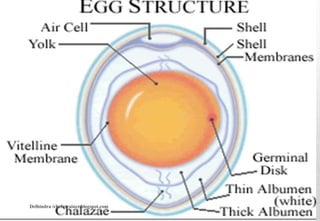
Terdiri
dari 3
bagian:
Eggshell
Egg
white
Egg yolk
Structure of Eggs
Delhindra /chefqtrainer.blogspot.com
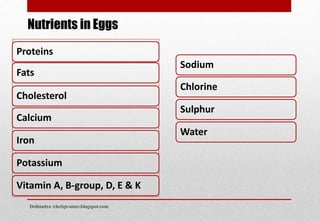
Proteins
Fats
Cholesterol
Calcium
Iron
Potassium
Vitamin A, B-group, D, E & K
Sodium
Chlorine
Sulphur
Water
Nutrients in Eggs
Delhindra /chefqtrainer.blogspot.com
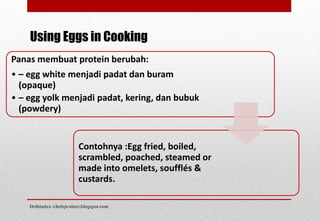
Panas membuat protein berubah:
• – egg white menjadi padat dan buram
(opaque)
• – egg yolk menjadi padat, kering, dan bubuk
(powdery)
Contohnya :Egg fried, boiled,
scrambled, poached, steamed or
made into omelets, soufflés &
custards.
Using Eggs in Cooking
Delhindra /chefqtrainer.blogspot.com
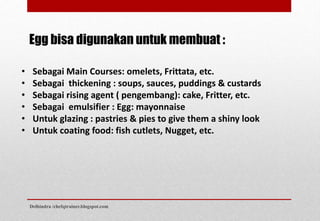
Egg bisa digunakan untuk membuat :
• Sebagai Main Courses: omelets, Frittata, etc.
• Sebagai thickening : soups, sauces, puddings & custards
• Sebagai rising agent ( pengembang): cake, Fritter, etc.
• Sebagai emulsifier : Egg: mayonnaise
• Untuk glazing : pastries & pies to give them a shiny look
• Untuk coating food: fish cutlets, Nugget, etc.
Delhindra /chefqtrainer.blogspot.com
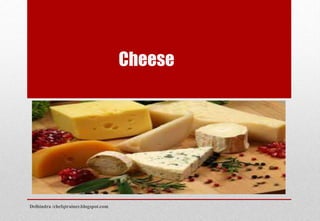
Cheese
Delhindra /chefqtrainer.blogspot.com
Prinsip pembuatan keju:
 Pengentalan protein (Curd) didalam susu kemudian dipisahkan
cairan (whey) dengan curd .dengan cara penambahan lemon
juice, vinegar, atau bakteri .
 Curd diberi garam dan bakteri yang kemudian disimpan di
dalam temperatur yang sesuai dengan pengawasan yang
sangat ketat.
 Jenis bateri , temperatur dan lama penyimpanan menentukan
Type of cheese.
Memisahkan protein dengan whey dengan Bakteri Asam Laktat
(Lactobacillus), untuk pembuatan Cheese Mozzarella, Swiss
Cheese.
Delhindra /chefqtrainer.blogspot.com
Bakteri yang digunakan:
Ada dua jenis bakteri yang digunakan untuk proses ini pemisahan curd dan
whey:
 Bakteri mesofilik berkembang pada suhu kamar (30 - 37 ° C )tetapi mati
pada suhu yang lebih tinggi. Mereka digunakan untuk membuat Soft
Cheese , seperti Cheddar, Gouda dan Colby.
 Bakteri termofilik berkembang pada suhu yang lebih tinggi, sekitar 55 °
C, dan digunakan untuk membuat Hard Cheese (strong cheese) seperti
Gruyère, Parmesan dan Romano.
Delhindra /chefqtrainer.blogspot.com
Step by step making cheese :
 Start with Fresh, Warm Milk (hangatkan milk).
 Acidify the Milk (penambahan acid), seperti lemon juice, vinegar,
bakteri.
 Add a Coagulant. Rennet ( perekat protein).
 Test for Gel Firmness (tes kekenyalan setelah diberikan rennet).
 Cut the Curd ( dipotong kasar).
 Stir, Cook the Curd (aduk, panaskan), untuk mengeringkan, dan
menghilangkan cairan (whey)
 Drain the Curds ( saring dan press), agar tidak ada cairan.
 Salt and Age the Cheese ( pemberian garam dan penyimpanan/
penuaan)
Delhindra /chefqtrainer.blogspot.com
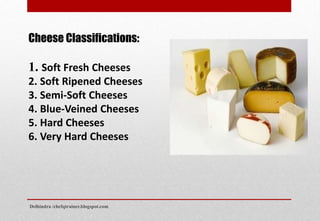
Cheese Classifications:
1. Soft Fresh Cheeses
2. Soft Ripened Cheeses
3. Semi-Soft Cheeses
4. Blue-Veined Cheeses
5. Hard Cheeses
6. Very Hard Cheeses
Delhindra /chefqtrainer.blogspot.com
 Cottage Cheese, Cow’s milk (fruit, in dip)
 Cream Cheese, cow’s milk (spread, cooking ingredient, cheese
cake, in dip).
 Feta Cheese, sheep’s milk (salad, filling for spanakopita)
 Mascarpone Cheese, Cow’s milk (with fruit, tiramisu, enrich
dishes).
 Ricotta, cow’s milk (cooking ingredient, desserts, cheese cake)
Soft Fresh Cheeses
Delhindra /chefqtrainer.blogspot.com
Soft Ripened and Washed-Rind Cheeses
 Brie, cow’s milk & goat’s milk (sandwiches, salad, table cheese)
 Taleggio, cow’s milk (salad, cooking ingredients, table cheese)
Delhindra /chefqtrainer.blogspot.com
Semi-Soft Cheeses
 Fontina Cheese, cow’s milk/sheep’s milk (table cheese,
sandwiches, great melting cheese).
 Monterey Jack, cow’s milk (table cheese, great melting
cheese)
Delhindra /chefqtrainer.blogspot.com
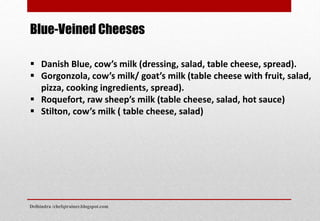
 Danish Blue, cow’s milk (dressing, salad, table cheese, spread).
 Gorgonzola, cow’s milk/ goat’s milk (table cheese with fruit, salad,
pizza, cooking ingredients, spread).
 Roquefort, raw sheep’s milk (table cheese, salad, hot sauce)
 Stilton, cow’s milk ( table cheese, salad)
Blue-Veined Cheeses
Delhindra /chefqtrainer.blogspot.com
Hard Cheeses
 Cheddar Cheese, Cow’s milk (table cheese, cheese sauce,
sandwiches, great melting cheese)
 Emmental / Swiss Cheese, cow’s milk (great melting cheese, in
fondues, sandwiches).
 Gouda Cheese, cow’s milk (table cheese, great melting cheese,
aged Gouda can be grated).
 Manchego Cheese, sheep’s milk ( table cheese, salad, can be
grated).
 Provolone, cow’s milk (table cheese w/ olive, bread, raw
vegetable/salami, sandwiches, for melting)
 Gruyere, cow’s milk (in fondues, onion soup, sandwiches, cooking
ingredients, hot sauce)
Delhindra /chefqtrainer.blogspot.com
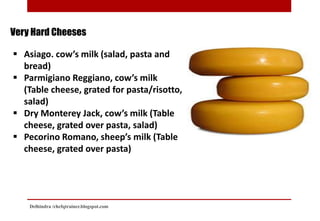
Very Hard Cheeses
 Asiago. cow’s milk (salad, pasta and
bread)
 Parmigiano Reggiano, cow’s milk
(Table cheese, grated for pasta/risotto,
salad)
 Dry Monterey Jack, cow’s milk (Table
cheese, grated over pasta, salad)
 Pecorino Romano, sheep’s milk (Table
cheese, grated over pasta)
Delhindra /chefqtrainer.blogspot.com
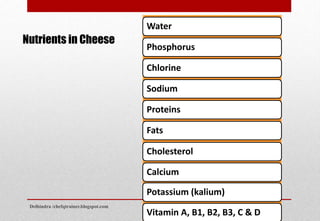
Water
Phosphorus
Chlorine
Sodium
Proteins
Fats
Cholesterol
Calcium
Potassium (kalium)
Vitamin A, B1, B2, B3, C & D
Nutrients in Cheese
Delhindra /chefqtrainer.blogspot.com
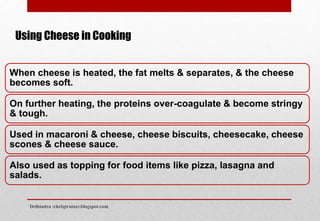
When cheese is heated, the fat melts & separates, & the cheese
becomes soft.
On further heating, the proteins over-coagulate & become stringy
& tough.
Used in macaroni & cheese, cheese biscuits, cheesecake, cheese
scones & cheese sauce.
Also used as topping for food items like pizza, lasagna and
salads.
Using Cheese in Cooking
Delhindra /chefqtrainer.blogspot.com
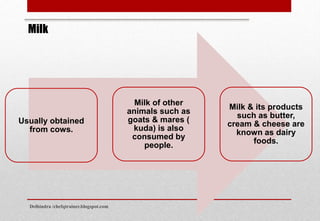
Usually obtained
from cows.
Milk of other
animals such as
goats & mares (
kuda) is also
consumed by
people.
Milk & its products
such as butter,
cream & cheese are
known as dairy
foods.
Milk
Delhindra /chefqtrainer.blogspot.com
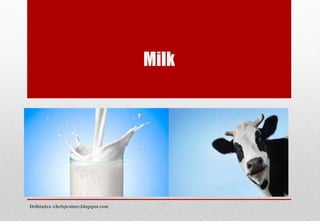
Milk
Delhindra /chefqtrainer.blogspot.com
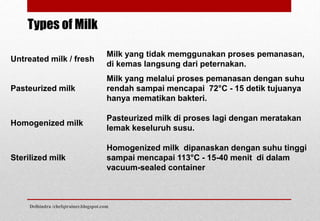
Untreated milk / fresh
Milk yang tidak memggunakan proses pemanasan,
di kemas langsung dari peternakan.
Pasteurized milk
Milk yang melalui proses pemanasan dengan suhu
rendah sampai mencapai 72°C - 15 detik tujuanya
hanya mematikan bakteri.
Homogenized milk
Pasteurized milk di proses lagi dengan meratakan
lemak keseluruh susu.
Sterilized milk
Homogenized milk dipanaskan dengan suhu tinggi
sampai mencapai 113°C - 15-40 menit di dalam
vacuum-sealed container
Types of Milk
Delhindra /chefqtrainer.blogspot.com
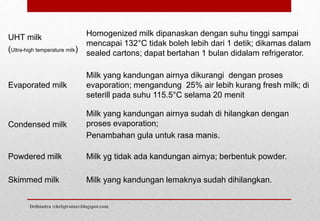
UHT milk
(Ultra-high temperature milk)
Homogenized milk dipanaskan dengan suhu tinggi sampai
mencapai 132°C tidak boleh lebih dari 1 detik; dikamas dalam
sealed cartons; dapat bertahan 1 bulan didalam refrigerator.
Evaporated milk
Milk yang kandungan airnya dikurangi dengan proses
evaporation; mengandung 25% air lebih kurang fresh milk; di
seterill pada suhu 115.5°C selama 20 menit
Condensed milk
Milk yang kandungan airnya sudah di hilangkan dengan
proses evaporation;
Penambahan gula untuk rasa manis.
Powdered milk Milk yg tidak ada kandungan airnya; berbentuk powder.
Skimmed milk Milk yang kandungan lemaknya sudah dihilangkan.
Delhindra /chefqtrainer.blogspot.com
Carbohydrates
Proteins
Fats
Cholesterol
Calcium
Potassium (kalium)
Vitamin A, B1, B2, B3, C & D
Sodium
Chlorine
Phosphorus
Water
Nutrients in Milk
Delhindra /chefqtrainer.blogspot.com
When milk is boiled, proteins coagulate & form a layer on the surface. As
the boiling continues, hot air & steam get trapped under this layer –
causes the milk to overflow from its container.
Can be consumed on its own.
Used in beverages such as tea, coffee, cocoa & milkshake.
Used in many parts of the world to make desserts.
Also processed to produce dairy products such as cheese, cream &
butter.
Using Milk in Cooking
Delhindra /chefqtrainer.blogspot.com
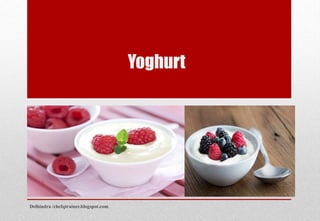
Yoghurt
Delhindra /chefqtrainer.blogspot.com
Yoghurt
 Makanan yang berasal dari proses fermentasi milk.
 Kultur Bakteri yang digunakan Lactobacillus
delbrueckii subsp. bulgaricus and Streptococcus
thermophilus .
Delhindra /chefqtrainer.blogspot.com
 Susu pertama dipanaskan, biasanya sekitar 85 ° C ,
 Untuk mengubah sifat protein susu sehingga terpisah curd
(dadih)dan whey (cairan).
 Setelah pemanasan, susu tersebut dibiarkan dingin sampai
sekitar 45 ° C .
 Kultur bakteri dicampur rata kedalam susu pada suhu 45 ° C
 Disimpan dan dipertahankan didalam suhu 45 ° C selama
empat sampai tujuh jam untuk fermentasi.
.
Proses Yoghurt
Delhindra /chefqtrainer.blogspot.com
Cream
Delhindra /chefqtrainer.blogspot.com
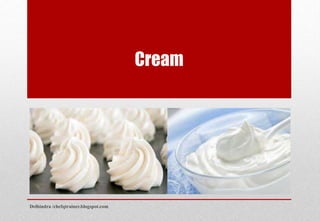
 Cream adalah produk susu yang terdiri bagian lemak susu pada
lapisan paling atas dari susu yang belum di homogenisasi.
 Jumlah lemak pada cream menentukan kwalitas, dan stabilatas cream
ketika di whip
 Makin tinggi lemak pada cream makin gurih atau enak rasanya .
 Cream dengan lemak tinggi sangat baik , karena tidak pecah(rusak)
dalam proses pemasakan.
 Pasteurisasi dan Ultra-Pasteurisasi: Biasanya diberi label pada
kemasan, pasteurisasi atau ultra-pasteurisasi.
 Pasteurized cream, rasa yang lebih baik, lebih mengembang di
whipping, dan lebih tahan lama.
Cream
Delhindra /chefqtrainer.blogspot.com
Type of Cream
 Half and Half, 12% fat (range 10.5-18%): biasanya untuk Coffee & Tea,
 Single Cream, 20%: Light cream, savory and sweet dishes.
 Light Cream, 20% fat (range 18-30%).
 Whipping Cream, 30%fat; Bisa untuk whipping tapi masih kurang
stabil, digunakan untuk topping atau filling.
 Heavy Cream, 36 to 38%fat: Sangat baik untuk di whipping,
 Double Cream, 48%fat: British term untuk heavy cream di US.
 Clotted Cream, 36 to 38%fat: Devonshire or Devon Cream. Warnanya
kekuning – kuningan.
 Creme fraiche, 30%fat ; Fermentasi fresh cream.
 Sour Cream, 20%: Cream dengan penambahan lacto acid, gelatin
atau vegetable enzim untuk membuat cream tersebut asam dan
kental/padat.
Delhindra /chefqtrainer.blogspot.com
Butter
Delhindra /chefqtrainer.blogspot.com
Butter
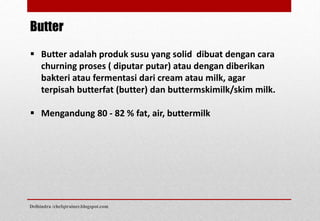
 Butter adalah produk susu yang solid dibuat dengan cara
churning proses ( diputar putar) atau dengan diberikan
bakteri atau fermentasi dari cream atau milk, agar
terpisah butterfat (butter) dan buttermskimilk/skim milk.
 Mengandung 80 - 82 % fat, air, buttermilk
Delhindra /chefqtrainer.blogspot.com
Types of Butter
 Unsalted Butter or “Sweet Cream Butter” (Real)
 Salted Butter (Real):
 Whipped Butter (Real): sangat baikspread dan toast bread
 European Style or “Cultured” Butter (Real): kandungan fat lebih
tinggi dan lebih solid
 Spreadable Butter (Sorta Real) : kombinasi butter dan vegetable
oil
 Ghee adalah Clarified butter.
 Butter-like Spread (Fake)/margarine: vegetable oil
Delhindra /chefqtrainer.blogspot.com

Eggs and Dairy Product: www.chefqtrainer.blogspot.com

  • 1.
    Eggs and DairyProduct Delhindra /chefqtrainer.blogspot.com
  • 2.
  • 3.
    Sumber makanan yang murahdan mudah dibuat berbagai macam variasi makanan Umumnya digunakan untuk breakfast. Delhindra /chefqtrainer.blogspot.com
  • 4.
  • 5.
    Terdiri dari 3 bagian: Eggshell Egg white Egg yolk Structureof Eggs Delhindra /chefqtrainer.blogspot.com
  • 6.
  • 7.
    Proteins Fats Cholesterol Calcium Iron Potassium Vitamin A, B-group,D, E & K Sodium Chlorine Sulphur Water Nutrients in Eggs Delhindra /chefqtrainer.blogspot.com
  • 8.
    Panas membuat proteinberubah: • – egg white menjadi padat dan buram (opaque) • – egg yolk menjadi padat, kering, dan bubuk (powdery) Contohnya :Egg fried, boiled, scrambled, poached, steamed or made into omelets, soufflés & custards. Using Eggs in Cooking Delhindra /chefqtrainer.blogspot.com
  • 9.
    Egg bisa digunakanuntuk membuat : • Sebagai Main Courses: omelets, Frittata, etc. • Sebagai thickening : soups, sauces, puddings & custards • Sebagai rising agent ( pengembang): cake, Fritter, etc. • Sebagai emulsifier : Egg: mayonnaise • Untuk glazing : pastries & pies to give them a shiny look • Untuk coating food: fish cutlets, Nugget, etc. Delhindra /chefqtrainer.blogspot.com
  • 10.
  • 11.
    Prinsip pembuatan keju: Pengentalan protein (Curd) didalam susu kemudian dipisahkan cairan (whey) dengan curd .dengan cara penambahan lemon juice, vinegar, atau bakteri .  Curd diberi garam dan bakteri yang kemudian disimpan di dalam temperatur yang sesuai dengan pengawasan yang sangat ketat.  Jenis bateri , temperatur dan lama penyimpanan menentukan Type of cheese. Memisahkan protein dengan whey dengan Bakteri Asam Laktat (Lactobacillus), untuk pembuatan Cheese Mozzarella, Swiss Cheese. Delhindra /chefqtrainer.blogspot.com
  • 12.
    Bakteri yang digunakan: Adadua jenis bakteri yang digunakan untuk proses ini pemisahan curd dan whey:  Bakteri mesofilik berkembang pada suhu kamar (30 - 37 ° C )tetapi mati pada suhu yang lebih tinggi. Mereka digunakan untuk membuat Soft Cheese , seperti Cheddar, Gouda dan Colby.  Bakteri termofilik berkembang pada suhu yang lebih tinggi, sekitar 55 ° C, dan digunakan untuk membuat Hard Cheese (strong cheese) seperti Gruyère, Parmesan dan Romano. Delhindra /chefqtrainer.blogspot.com
  • 13.
    Step by stepmaking cheese :  Start with Fresh, Warm Milk (hangatkan milk).  Acidify the Milk (penambahan acid), seperti lemon juice, vinegar, bakteri.  Add a Coagulant. Rennet ( perekat protein).  Test for Gel Firmness (tes kekenyalan setelah diberikan rennet).  Cut the Curd ( dipotong kasar).  Stir, Cook the Curd (aduk, panaskan), untuk mengeringkan, dan menghilangkan cairan (whey)  Drain the Curds ( saring dan press), agar tidak ada cairan.  Salt and Age the Cheese ( pemberian garam dan penyimpanan/ penuaan) Delhindra /chefqtrainer.blogspot.com
  • 14.
    Cheese Classifications: 1. SoftFresh Cheeses 2. Soft Ripened Cheeses 3. Semi-Soft Cheeses 4. Blue-Veined Cheeses 5. Hard Cheeses 6. Very Hard Cheeses Delhindra /chefqtrainer.blogspot.com
  • 15.
     Cottage Cheese,Cow’s milk (fruit, in dip)  Cream Cheese, cow’s milk (spread, cooking ingredient, cheese cake, in dip).  Feta Cheese, sheep’s milk (salad, filling for spanakopita)  Mascarpone Cheese, Cow’s milk (with fruit, tiramisu, enrich dishes).  Ricotta, cow’s milk (cooking ingredient, desserts, cheese cake) Soft Fresh Cheeses Delhindra /chefqtrainer.blogspot.com
  • 16.
    Soft Ripened andWashed-Rind Cheeses  Brie, cow’s milk & goat’s milk (sandwiches, salad, table cheese)  Taleggio, cow’s milk (salad, cooking ingredients, table cheese) Delhindra /chefqtrainer.blogspot.com
  • 17.
    Semi-Soft Cheeses  FontinaCheese, cow’s milk/sheep’s milk (table cheese, sandwiches, great melting cheese).  Monterey Jack, cow’s milk (table cheese, great melting cheese) Delhindra /chefqtrainer.blogspot.com
  • 18.
     Danish Blue,cow’s milk (dressing, salad, table cheese, spread).  Gorgonzola, cow’s milk/ goat’s milk (table cheese with fruit, salad, pizza, cooking ingredients, spread).  Roquefort, raw sheep’s milk (table cheese, salad, hot sauce)  Stilton, cow’s milk ( table cheese, salad) Blue-Veined Cheeses Delhindra /chefqtrainer.blogspot.com
  • 19.
    Hard Cheeses  CheddarCheese, Cow’s milk (table cheese, cheese sauce, sandwiches, great melting cheese)  Emmental / Swiss Cheese, cow’s milk (great melting cheese, in fondues, sandwiches).  Gouda Cheese, cow’s milk (table cheese, great melting cheese, aged Gouda can be grated).  Manchego Cheese, sheep’s milk ( table cheese, salad, can be grated).  Provolone, cow’s milk (table cheese w/ olive, bread, raw vegetable/salami, sandwiches, for melting)  Gruyere, cow’s milk (in fondues, onion soup, sandwiches, cooking ingredients, hot sauce) Delhindra /chefqtrainer.blogspot.com
  • 20.
    Very Hard Cheeses Asiago. cow’s milk (salad, pasta and bread)  Parmigiano Reggiano, cow’s milk (Table cheese, grated for pasta/risotto, salad)  Dry Monterey Jack, cow’s milk (Table cheese, grated over pasta, salad)  Pecorino Romano, sheep’s milk (Table cheese, grated over pasta) Delhindra /chefqtrainer.blogspot.com
  • 21.
    Water Phosphorus Chlorine Sodium Proteins Fats Cholesterol Calcium Potassium (kalium) Vitamin A,B1, B2, B3, C & D Nutrients in Cheese Delhindra /chefqtrainer.blogspot.com
  • 22.
    When cheese isheated, the fat melts & separates, & the cheese becomes soft. On further heating, the proteins over-coagulate & become stringy & tough. Used in macaroni & cheese, cheese biscuits, cheesecake, cheese scones & cheese sauce. Also used as topping for food items like pizza, lasagna and salads. Using Cheese in Cooking Delhindra /chefqtrainer.blogspot.com
  • 23.
    Usually obtained from cows. Milkof other animals such as goats & mares ( kuda) is also consumed by people. Milk & its products such as butter, cream & cheese are known as dairy foods. Milk Delhindra /chefqtrainer.blogspot.com
  • 24.
  • 25.
    Untreated milk /fresh Milk yang tidak memggunakan proses pemanasan, di kemas langsung dari peternakan. Pasteurized milk Milk yang melalui proses pemanasan dengan suhu rendah sampai mencapai 72°C - 15 detik tujuanya hanya mematikan bakteri. Homogenized milk Pasteurized milk di proses lagi dengan meratakan lemak keseluruh susu. Sterilized milk Homogenized milk dipanaskan dengan suhu tinggi sampai mencapai 113°C - 15-40 menit di dalam vacuum-sealed container Types of Milk Delhindra /chefqtrainer.blogspot.com
  • 26.
    UHT milk (Ultra-high temperaturemilk) Homogenized milk dipanaskan dengan suhu tinggi sampai mencapai 132°C tidak boleh lebih dari 1 detik; dikamas dalam sealed cartons; dapat bertahan 1 bulan didalam refrigerator. Evaporated milk Milk yang kandungan airnya dikurangi dengan proses evaporation; mengandung 25% air lebih kurang fresh milk; di seterill pada suhu 115.5°C selama 20 menit Condensed milk Milk yang kandungan airnya sudah di hilangkan dengan proses evaporation; Penambahan gula untuk rasa manis. Powdered milk Milk yg tidak ada kandungan airnya; berbentuk powder. Skimmed milk Milk yang kandungan lemaknya sudah dihilangkan. Delhindra /chefqtrainer.blogspot.com
  • 27.
    Carbohydrates Proteins Fats Cholesterol Calcium Potassium (kalium) Vitamin A,B1, B2, B3, C & D Sodium Chlorine Phosphorus Water Nutrients in Milk Delhindra /chefqtrainer.blogspot.com
  • 28.
    When milk isboiled, proteins coagulate & form a layer on the surface. As the boiling continues, hot air & steam get trapped under this layer – causes the milk to overflow from its container. Can be consumed on its own. Used in beverages such as tea, coffee, cocoa & milkshake. Used in many parts of the world to make desserts. Also processed to produce dairy products such as cheese, cream & butter. Using Milk in Cooking Delhindra /chefqtrainer.blogspot.com
  • 29.
  • 30.
    Yoghurt  Makanan yangberasal dari proses fermentasi milk.  Kultur Bakteri yang digunakan Lactobacillus delbrueckii subsp. bulgaricus and Streptococcus thermophilus . Delhindra /chefqtrainer.blogspot.com
  • 31.
     Susu pertamadipanaskan, biasanya sekitar 85 ° C ,  Untuk mengubah sifat protein susu sehingga terpisah curd (dadih)dan whey (cairan).  Setelah pemanasan, susu tersebut dibiarkan dingin sampai sekitar 45 ° C .  Kultur bakteri dicampur rata kedalam susu pada suhu 45 ° C  Disimpan dan dipertahankan didalam suhu 45 ° C selama empat sampai tujuh jam untuk fermentasi. . Proses Yoghurt Delhindra /chefqtrainer.blogspot.com
  • 32.
  • 33.
     Cream adalahproduk susu yang terdiri bagian lemak susu pada lapisan paling atas dari susu yang belum di homogenisasi.  Jumlah lemak pada cream menentukan kwalitas, dan stabilatas cream ketika di whip  Makin tinggi lemak pada cream makin gurih atau enak rasanya .  Cream dengan lemak tinggi sangat baik , karena tidak pecah(rusak) dalam proses pemasakan.  Pasteurisasi dan Ultra-Pasteurisasi: Biasanya diberi label pada kemasan, pasteurisasi atau ultra-pasteurisasi.  Pasteurized cream, rasa yang lebih baik, lebih mengembang di whipping, dan lebih tahan lama. Cream Delhindra /chefqtrainer.blogspot.com
  • 34.
    Type of Cream Half and Half, 12% fat (range 10.5-18%): biasanya untuk Coffee & Tea,  Single Cream, 20%: Light cream, savory and sweet dishes.  Light Cream, 20% fat (range 18-30%).  Whipping Cream, 30%fat; Bisa untuk whipping tapi masih kurang stabil, digunakan untuk topping atau filling.  Heavy Cream, 36 to 38%fat: Sangat baik untuk di whipping,  Double Cream, 48%fat: British term untuk heavy cream di US.  Clotted Cream, 36 to 38%fat: Devonshire or Devon Cream. Warnanya kekuning – kuningan.  Creme fraiche, 30%fat ; Fermentasi fresh cream.  Sour Cream, 20%: Cream dengan penambahan lacto acid, gelatin atau vegetable enzim untuk membuat cream tersebut asam dan kental/padat. Delhindra /chefqtrainer.blogspot.com
  • 35.
  • 36.
    Butter  Butter adalahproduk susu yang solid dibuat dengan cara churning proses ( diputar putar) atau dengan diberikan bakteri atau fermentasi dari cream atau milk, agar terpisah butterfat (butter) dan buttermskimilk/skim milk.  Mengandung 80 - 82 % fat, air, buttermilk Delhindra /chefqtrainer.blogspot.com
  • 37.
    Types of Butter Unsalted Butter or “Sweet Cream Butter” (Real)  Salted Butter (Real):  Whipped Butter (Real): sangat baikspread dan toast bread  European Style or “Cultured” Butter (Real): kandungan fat lebih tinggi dan lebih solid  Spreadable Butter (Sorta Real) : kombinasi butter dan vegetable oil  Ghee adalah Clarified butter.  Butter-like Spread (Fake)/margarine: vegetable oil Delhindra /chefqtrainer.blogspot.com
  • 38.

Editor's Notes

  • #9 Coagulate/ mengental Solid/ padat Opaque/buram /tidak transparan
  • #14 Rennet  (enzym binatang)/ˈrɛnᵻt/ is a complex of enzymes produced in the stomachs of ruminant mammals. Chymosin, its key component, is a protease enzyme that curdles the casein in milk. This helps young mammals digest their mothers' milk. Rennet can also be used to separate milk into solid curds for cheesemaking and liquid whey. In addition to chymosin, rennet contains other important enzymes such as pepsin and a lipase. Rennet is used in the production of most cheeses. The mammal's digestive system must be accessed to obtain its rennet. Non-animal alternatives for rennet are suitable for consumption by vegetarians.
  • #16 A similar curd-washing takes place when making the Dutchcheeses Edam and Gouda. Hard cheeses — "gratingcheeses" such as Parmesan and Pecorino Romano—are quite firmly packed into large forms and aged for months or years.
  • #17 Soft fresh cheeses are those cheeses that are unripened and generally have a fresh, clean, creamy flavor. These cheeses are typically the most perishable and are sometimes held in brines. Examples of soft fresh cheeses are cottage cheese, pot cheese, queso blanco, and cream cheese. Ripen = belum matang
  • #18  Soft-ripened Cheeses. A soft-ripened cheese is one that has a white, so-called bloomy rind on the outside, which occurs because of the unique beneficial mold that is added to the milk or sprayed onto the cheese during ripening. The most well knowncheese in this category is brie. The process of washing the rind of the cheese as it matures, keeps it soft and supple, and develops its great flavour. Washed Rind cheeses are bathed or scrubbed with brine or other liquids, such as wine, to encourage the growth of the surface culture - Brevibacterium Linens (known affectionately as Brevy!).
  • #19 Semi-soft cheeses may be made from both pasteurized and raw milk, depending on the aging requirements and the style the cheesemaker is creating. Cheeses in the semi-soft category include many blue cheeses, colby, fontina styles, havarti and Monterey Jack.
  • #20 Blue Vein cheeses also called Blue cheese is a generic term used to describe cheese produced with cow's milk, sheep's milk, or goat's milk and ripened with cultures of the mold Penicillium. The final product is characterized by green, grey, blue or black veins or spots of mold throughout the body.
  • #22 Use is the same as for Dry Jack and Parmesan. Asiago. Piquant, sharp. Light yellow. Hard to very hard, depending on age. ... Cotija (Queso Anejo) Strong, aged flavor. Hard, dry, crumbly. ... Dry Jack. Mild, aged, nutty. Pale yellow. ... Enchilado Anejo. Mild, lightly spicy. Red coating, white interior. ... Romano. Sharp, piquant. Light yellow.
  • #25 Obtained /diperoleh Mare/kuda betina
  • #28 Evaporation/penguapan/ susu yang lebih kental condensed milk/susu kental
  • #29 Potassium/kalium
  • #32 Untuk menghasilkan yoghurt, susu pertama dipanaskan, biasanya sekitar 85 ° C , untuk mengubah sifat protein susu sehingga mereka mengatur bersama-sama daripada bentuk dadih. Setelah pemanasan, susu tersebut dibiarkan dingin sampai sekitar 45 ° C . [3] Kultur bakteri dicampur, dan suhu 45 ° C dipertahankan selama empat sampai tujuh jam untuk memungkinkan fermentasi.