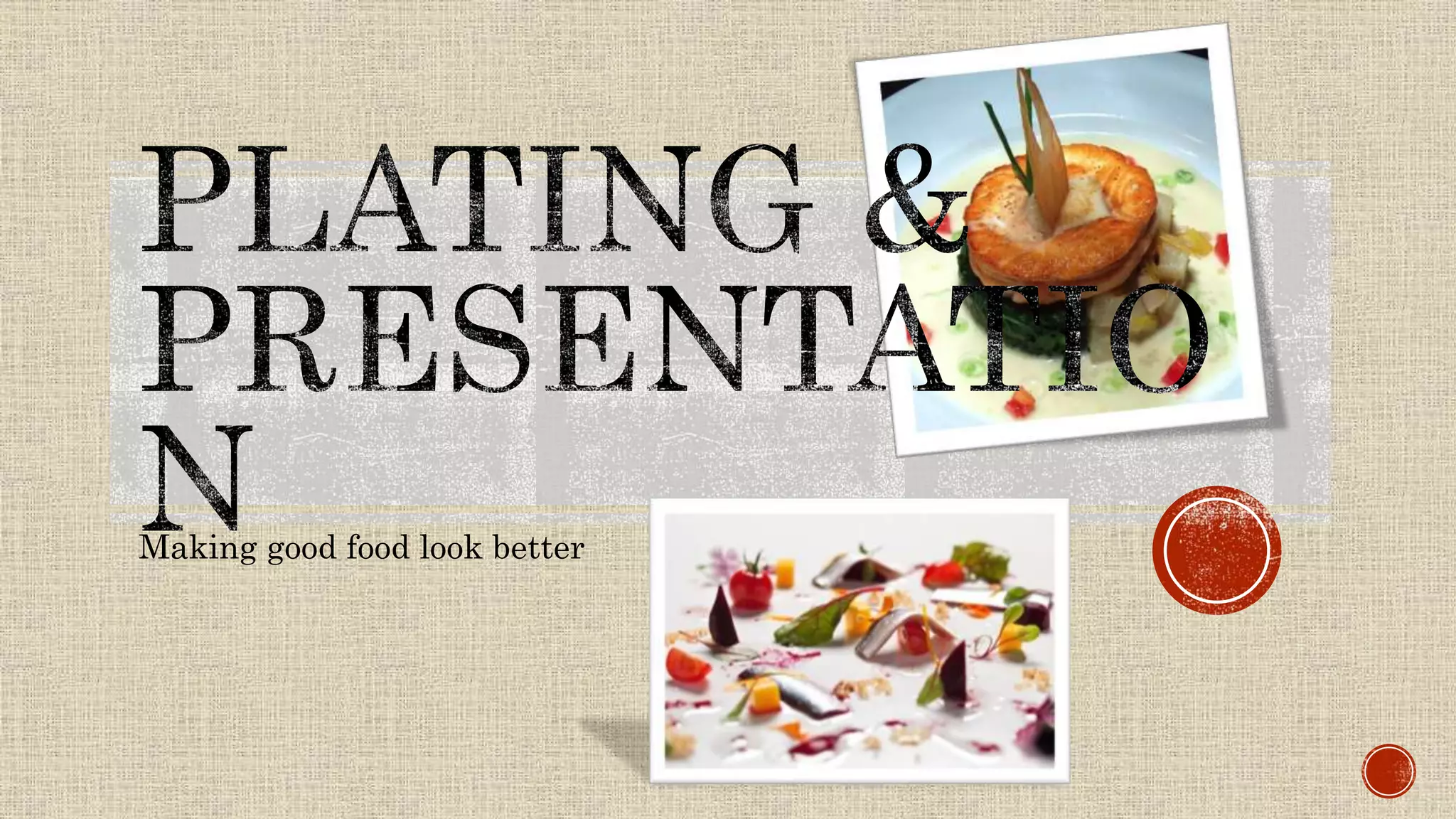
Making good food look better
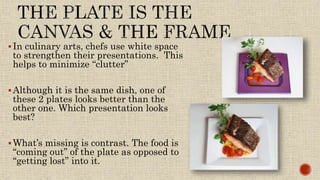
In culinary arts, chefs use white space
to strengthen their presentations. This
helps to minimize “clutter”
Although it is the same dish, one of
these 2 plates looks better than the
other one. Which presentation looks
best?
What’s missing is contrast. The food is
“coming out” of the plate as opposed to
“getting lost” into it.
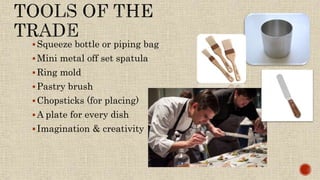
Squeeze bottle or piping bag
Mini metal off set spatula
Ring mold
Pastry brush
Chopsticks (for placing)
A plate for every dish
Imagination & creativity
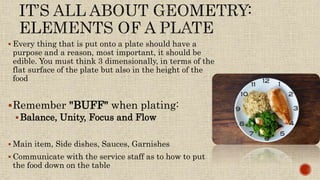
 Every thing that is put onto a plate should have a
purpose and a reason, most important, it should be
edible. You must think 3 dimensionally, in terms of the
flat surface of the plate but also in the height of the
food
Remember "BUFF" when plating:
Balance, Unity, Focus and Flow
 Main item, Side dishes, Sauces, Garnishes
 Communicate with the service staff as to how to put
the food down on the table
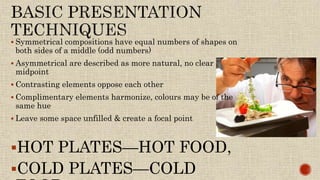
 Symmetrical compositions have equal numbers of shapes on
both sides of a middle (odd numbers)
 Asymmetrical are described as more natural, no clear
midpoint
 Contrasting elements oppose each other
 Complimentary elements harmonize, colours may be of the
same hue
 Leave some space unfilled & create a focal point
HOT PLATES—HOT FOOD,
COLD PLATES—COLD
The aim is to create height on
the plate and to provide
structure for the eye
For runny foods, bowls, cups,
napkins must be used
Some foods can be naturally
piped to create borders and
framing
Make nests with pasta and
grains
Use cutters to shape some
food
Slices consistent
Tougher and cured meats
should be sliced thinly
Strive for clean edges, no zig
zags
Give foods a little natural
height by rolling the slices,
piling neatly, or layering
Use a complimentary base for
thin-sliced meats, such as
puréed vegetables or pilaf
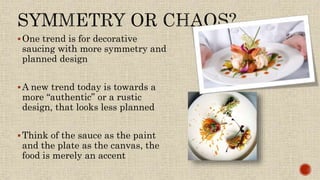
One trend is for decorative
saucing with more symmetry and
planned design
A new trend today is towards a
more “authentic” or a rustic
design, that looks less planned
Think of the sauce as the paint
and the plate as the canvas, the
food is merely an accent
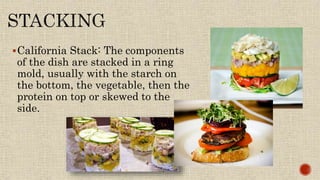
California Stack: The components
of the dish are stacked in a ring
mold, usually with the starch on
the bottom, the vegetable, then the
protein on top or skewed to the
side.
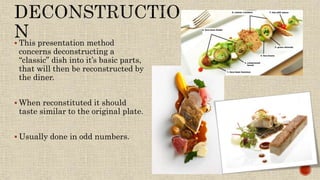
 This presentation method
concerns deconstructing a
“classic” dish into it’s basic parts,
that will then be reconstructed by
the diner.
 When reconstituted it should
taste similar to the original plate.
 Usually done in odd numbers.
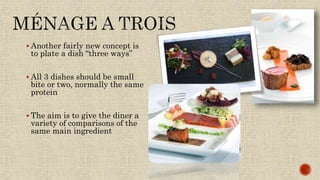
 Another fairly new concept is
to plate a dish “three ways”
 All 3 dishes should be small
bite or two, normally the same
protein
 The aim is to give the diner a
variety of comparisons of the
same main ingredient
Sauce should act as an enhancer,
not only in flavour put also in colour
and texture. Beef with beef, chicken
with chicken, etc.
Never let the sauce overpower the
main, or let it cover it’s appearance.
Viscous sauce on the bottom,
chutneys, relishes and thicker ones
dolloped on top
Will intensify, add palatability,
color, contrast, luster and sheen
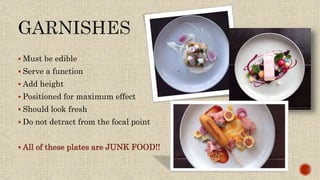
 Must be edible
 Serve a function
 Add height
 Positioned for maximum effect
 Should look fresh
 Do not detract from the focal point
 All of these plates are JUNK FOOD!!
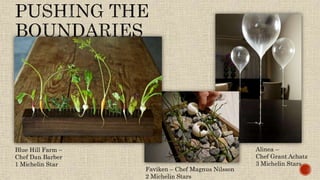
Alinea –
Chef Grant Achatz
3 Michelin Stars
Blue Hill Farm –
Chef Dan Barber
1 Michelin Star
Faviken – Chef Magnus Nilsson
2 Michelin Stars
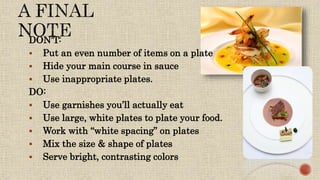
DON’T:
 Put an even number of items on a plate
 Hide your main course in sauce
 Use inappropriate plates.
DO:
 Use garnishes you’ll actually eat
 Use large, white plates to plate your food.
 Work with “white spacing” on plates
 Mix the size & shape of plates
 Serve bright, contrasting colors

Plating and Presentation

  • 1.
    Making good foodlook better
  • 2.
    In culinary arts,chefs use white space to strengthen their presentations. This helps to minimize “clutter” Although it is the same dish, one of these 2 plates looks better than the other one. Which presentation looks best? What’s missing is contrast. The food is “coming out” of the plate as opposed to “getting lost” into it.
  • 3.
    Squeeze bottle orpiping bag Mini metal off set spatula Ring mold Pastry brush Chopsticks (for placing) A plate for every dish Imagination & creativity
  • 4.
     Every thingthat is put onto a plate should have a purpose and a reason, most important, it should be edible. You must think 3 dimensionally, in terms of the flat surface of the plate but also in the height of the food Remember "BUFF" when plating: Balance, Unity, Focus and Flow  Main item, Side dishes, Sauces, Garnishes  Communicate with the service staff as to how to put the food down on the table
  • 5.
     Symmetrical compositionshave equal numbers of shapes on both sides of a middle (odd numbers)  Asymmetrical are described as more natural, no clear midpoint  Contrasting elements oppose each other  Complimentary elements harmonize, colours may be of the same hue  Leave some space unfilled & create a focal point HOT PLATES—HOT FOOD, COLD PLATES—COLD
  • 6.
    The aim isto create height on the plate and to provide structure for the eye For runny foods, bowls, cups, napkins must be used Some foods can be naturally piped to create borders and framing Make nests with pasta and grains Use cutters to shape some food Slices consistent Tougher and cured meats should be sliced thinly Strive for clean edges, no zig zags Give foods a little natural height by rolling the slices, piling neatly, or layering Use a complimentary base for thin-sliced meats, such as puréed vegetables or pilaf
  • 8.
    One trend isfor decorative saucing with more symmetry and planned design A new trend today is towards a more “authentic” or a rustic design, that looks less planned Think of the sauce as the paint and the plate as the canvas, the food is merely an accent
  • 9.
    California Stack: Thecomponents of the dish are stacked in a ring mold, usually with the starch on the bottom, the vegetable, then the protein on top or skewed to the side.
  • 10.
     This presentationmethod concerns deconstructing a “classic” dish into it’s basic parts, that will then be reconstructed by the diner.  When reconstituted it should taste similar to the original plate.  Usually done in odd numbers.
  • 11.
     Another fairlynew concept is to plate a dish “three ways”  All 3 dishes should be small bite or two, normally the same protein  The aim is to give the diner a variety of comparisons of the same main ingredient
  • 12.
    Sauce should actas an enhancer, not only in flavour put also in colour and texture. Beef with beef, chicken with chicken, etc. Never let the sauce overpower the main, or let it cover it’s appearance. Viscous sauce on the bottom, chutneys, relishes and thicker ones dolloped on top Will intensify, add palatability, color, contrast, luster and sheen
  • 13.
     Must beedible  Serve a function  Add height  Positioned for maximum effect  Should look fresh  Do not detract from the focal point  All of these plates are JUNK FOOD!!
  • 14.
    Alinea – Chef GrantAchatz 3 Michelin Stars Blue Hill Farm – Chef Dan Barber 1 Michelin Star Faviken – Chef Magnus Nilsson 2 Michelin Stars
  • 15.
    DON’T:  Put aneven number of items on a plate  Hide your main course in sauce  Use inappropriate plates. DO:  Use garnishes you’ll actually eat  Use large, white plates to plate your food.  Work with “white spacing” on plates  Mix the size & shape of plates  Serve bright, contrasting colors