Cakes
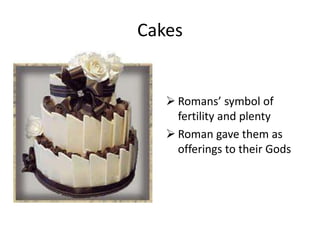
Cakes
 Romans’ symbol of
fertility and plenty
 Roman gave them as
offerings to their Gods
Cake serves as a symbol of the
country’s culture.
Croquembouche
 France’s wedding cake.
Sacher Torte- Vienna, Austria’s pride.
• Paris Brest- round to
imitate a bicycle’s wheel
and was served during
the Grand Prix in Paris,
France.
Buche de Noel
 Christmas roll cake
which is made to look
like a log.
Antoine Carame- Frances’ famous chef
Charlottes
 Charlotte Russe
 Charlotte Royale
Charlotte Royale
Opera Cakes
Cake composition
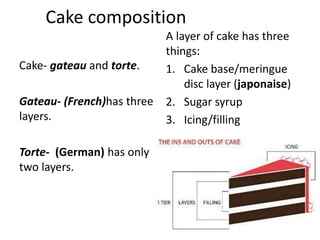
Cake- gateau and torte.
Gateau- (French)has three
layers.
Torte- (German) has only
two layers.
A layer of cake has three
things:
1. Cake base/meringue
disc layer (japonaise)
2. Sugar syrup
3. Icing/filling
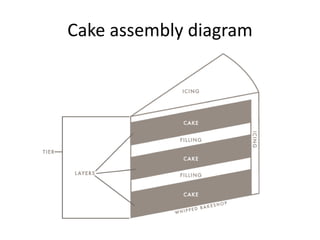
Cake assembly diagram
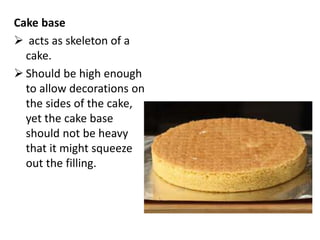
Cake base
 acts as skeleton of a
cake.
 Should be high enough
to allow decorations on
the sides of the cake,
yet the cake base
should not be heavy
that it might squeeze
out the filling.
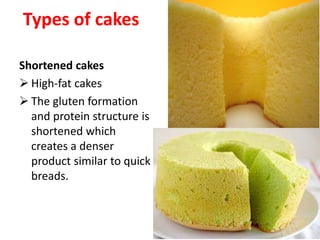
Types of cakes
Shortened cakes
 High-fat cakes
 The gluten formation
and protein structure is
shortened which
creates a denser
product similar to quick
breads.
Pound cakes
• Four main ingredients:
Fat, sugar, flour and eggs
• Derived its name from the
amount of the ingredients
mentioned earlier in its
traditional recipe: 1 lb
butter, 1 lb sugar, 1 lb flour
and 1 lb eggs
Butter cakes
• Heavy and dense
As compared to the pound cake.
It replaces some of the egg with
milk.
Creaming Method
• Most commonly use in making
this cake’s batter.
• Creaming method: Cream the
butter and sugar together. Add
the eggs. Sift together the
flour, salt, and baking powder.
Add the dry ingredients
alternately with milk into the
creaming mixture.
Butter cakes
Important guidelines in cake making:
• Before you start mixing cake, preheat the oven
to the correct temperature.
• Have the ingredients at room temperature,
unless otherwise specified.
Important guidelines in cake making:
• When using melted chocolate, be sure to cool
it before adding to the batter as warm
chocolate will start cooking the eggs in the
batter.
Important guidelines in cake making:
• In making meringue cakes, make sure that not
even a drop of oil gets into the egg whites.
Clean the mixing bowl and beater very well
before whipping. Any trace of oil or egg yolk
(which contains oil) will prevent the whites
from being whipped successfully.
Important guidelines in cake making:
• Do not over bake batter after the flour has
been added. Too much gluten will develop and
toughen the cake.
• The freshest eggs give the most volume and
this is especially important for sponge cakes,
angel food cakes and sponge cakes.
Important guidelines in cake making:
• Sifted flour or dry ingredients have more
incorporated air so the resulting cake is lighter.
• In adding the dry ingredients and liquid to the
creamed mixture, be sure to start and end
with a dry ingredient. You can divide the dry
ingredients into 3-4 portions.
Important guidelines in cake making:
• Do not open oven door at least 15 minutes
after placing pan in it.
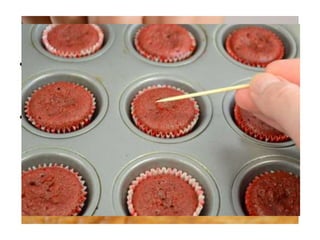
• The cake is done or baked if you insert a tester
at the center of the cake and it turns out
clean, or you can press gently with your
forefinger the top of the cake. If the cake
springs back, or no deep impression is left, the
cake is done.
Important guidelines in cake making:
• Cakes are usually cooled for 5-10 minutes in
the pan before cooling on a rack. But for some
cakes, cooling is done in the pan.
Stages of Whipped Eggwhites
Frothy
 Large uneven-sized air
bubbles.
Stages of Whipped Eggwhites
Begin to hold shape
 Fine air bubbles
develop close to each
other.
Stages of Whipped Eggwhites
Soft peak
 Whites will stand in
peaks but will bend
over.
Stages of Whipped Eggwhites
Almost stiff
 Sharply pointed peaks
but are still soft.
Stages of Whipped Eggwhites
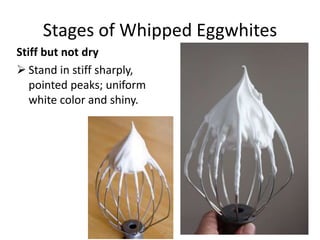
Stiff but not dry
 Stand in stiff sharply,
pointed peaks; uniform
white color and shiny.
Stages of Whipped Eggwhites
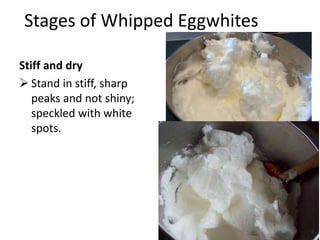
Stiff and dry
 Stand in stiff, sharp
peaks and not shiny;
speckled with white
spots.

Cakes

  • 1.
  • 2.
    Cakes  Romans’ symbolof fertility and plenty  Roman gave them as offerings to their Gods
  • 3.
    Cake serves asa symbol of the country’s culture. Croquembouche  France’s wedding cake.
  • 4.
    Sacher Torte- Vienna,Austria’s pride.
  • 5.
    • Paris Brest-round to imitate a bicycle’s wheel and was served during the Grand Prix in Paris, France.
  • 6.
    Buche de Noel Christmas roll cake which is made to look like a log.
  • 7.
    Antoine Carame- Frances’famous chef Charlottes  Charlotte Russe  Charlotte Royale
  • 8.
  • 9.
  • 10.
    Cake composition Cake- gateauand torte. Gateau- (French)has three layers. Torte- (German) has only two layers. A layer of cake has three things: 1. Cake base/meringue disc layer (japonaise) 2. Sugar syrup 3. Icing/filling
  • 11.
  • 12.
    Cake base  actsas skeleton of a cake.  Should be high enough to allow decorations on the sides of the cake, yet the cake base should not be heavy that it might squeeze out the filling.
  • 13.
    Types of cakes Shortenedcakes  High-fat cakes  The gluten formation and protein structure is shortened which creates a denser product similar to quick breads.
  • 15.
    Pound cakes • Fourmain ingredients: Fat, sugar, flour and eggs • Derived its name from the amount of the ingredients mentioned earlier in its traditional recipe: 1 lb butter, 1 lb sugar, 1 lb flour and 1 lb eggs Butter cakes • Heavy and dense As compared to the pound cake. It replaces some of the egg with milk. Creaming Method • Most commonly use in making this cake’s batter. • Creaming method: Cream the butter and sugar together. Add the eggs. Sift together the flour, salt, and baking powder. Add the dry ingredients alternately with milk into the creaming mixture.
  • 16.
  • 17.
    Important guidelines incake making: • Before you start mixing cake, preheat the oven to the correct temperature. • Have the ingredients at room temperature, unless otherwise specified.
  • 18.
    Important guidelines incake making: • When using melted chocolate, be sure to cool it before adding to the batter as warm chocolate will start cooking the eggs in the batter.
  • 19.
    Important guidelines incake making: • In making meringue cakes, make sure that not even a drop of oil gets into the egg whites. Clean the mixing bowl and beater very well before whipping. Any trace of oil or egg yolk (which contains oil) will prevent the whites from being whipped successfully.
  • 20.
    Important guidelines incake making: • Do not over bake batter after the flour has been added. Too much gluten will develop and toughen the cake. • The freshest eggs give the most volume and this is especially important for sponge cakes, angel food cakes and sponge cakes.
  • 21.
    Important guidelines incake making: • Sifted flour or dry ingredients have more incorporated air so the resulting cake is lighter. • In adding the dry ingredients and liquid to the creamed mixture, be sure to start and end with a dry ingredient. You can divide the dry ingredients into 3-4 portions.
  • 22.
    Important guidelines incake making: • Do not open oven door at least 15 minutes after placing pan in it. • The cake is done or baked if you insert a tester at the center of the cake and it turns out clean, or you can press gently with your forefinger the top of the cake. If the cake springs back, or no deep impression is left, the cake is done.
  • 24.
    Important guidelines incake making: • Cakes are usually cooled for 5-10 minutes in the pan before cooling on a rack. But for some cakes, cooling is done in the pan.
  • 25.
    Stages of WhippedEggwhites Frothy  Large uneven-sized air bubbles.
  • 26.
    Stages of WhippedEggwhites Begin to hold shape  Fine air bubbles develop close to each other.
  • 27.
    Stages of WhippedEggwhites Soft peak  Whites will stand in peaks but will bend over.
  • 28.
    Stages of WhippedEggwhites Almost stiff  Sharply pointed peaks but are still soft.
  • 29.
    Stages of WhippedEggwhites Stiff but not dry  Stand in stiff sharply, pointed peaks; uniform white color and shiny.
  • 30.
    Stages of WhippedEggwhites Stiff and dry  Stand in stiff, sharp peaks and not shiny; speckled with white spots.

Editor's Notes

  • #12 Cake is made up of different layers. It is composed of at least three layers of sugar syrup-soaked cake( high fat or low fat), two layers of filling, and is covered with icing which acts as a coating for the inner layers of the cake and at the same time serves as decoration. The icing can be decorated in so many ways.