Copyright © 2013, SAS Institute Inc. All rights reserved.
EFFICIENT DATA REVIEWS AND QUALITY
IN CLINICAL TRIALS
KELCI J. MICLAUS, PH.D.
RESEARCH AND DEVELOPMENT MANAGER
JMP LIFE SCIENCES
SAS INSTITUTE, INC.
RICHARD C. ZINK, PH.D.
PRINCIPAL RESEARCH STATISTICIAN DEVELOPER
JMP LIFE SCIENCES
SAS INSTITUTE, INC.
Copyright © 2013, SAS Institute Inc. All rights reserved.
DATA REVIEW AND
QUALITY
INTRODUCTION
• Efficient Data Review Practices
• Statistical analysis coupled with effective data visualization key to efficient
data review
• Data collection is a large contributor to time-consuming data review process
• Snapshot comparison tools for tracking data changes enables early and
often data review
• Data Quality and Fraud Detection
• Onsite data monitoring and Source Data Verification (SDV) expensive
component to clinical trial process
• Effectiveness of such manual processes is in question
• Fraud detection methods
• Centralized electronic data monitoring
• Risk-based monitoring methods
Copyright © 2013, SAS Institute Inc. All rights reserved.
EFFICIENT DATA
REVIEW
INTRODUCTION
• Randomized clinical trial remains the gold standard for evaluating
efficacy of an new intervention
• Safety profile assessment critical for trial success
• Safety analysis comes with several difficulties
• Numerous endpoints measured repeatedly
• Detection of rare events (drug-induced liver toxicity)
• Limited studied population
• Limited understanding of biological mechanisms and pathways
Copyright © 2013, SAS Institute Inc. All rights reserved.
EFFICIENT DATA
REVIEW
SAFETY REVIEW
• Accelerated safety reviews
• Dynamic visualization coupled with tables and reports
• Leverage data standards (CDISC)
• Statistically-driven analyses with drill-down and swim-up capabilities
• Centralized electronic data review coupled with tools that clinicians, data
monitors, and biostatisticians can employ
Copyright © 2013, SAS Institute Inc. All rights reserved.
EFFICIENT DATA
REVIEW
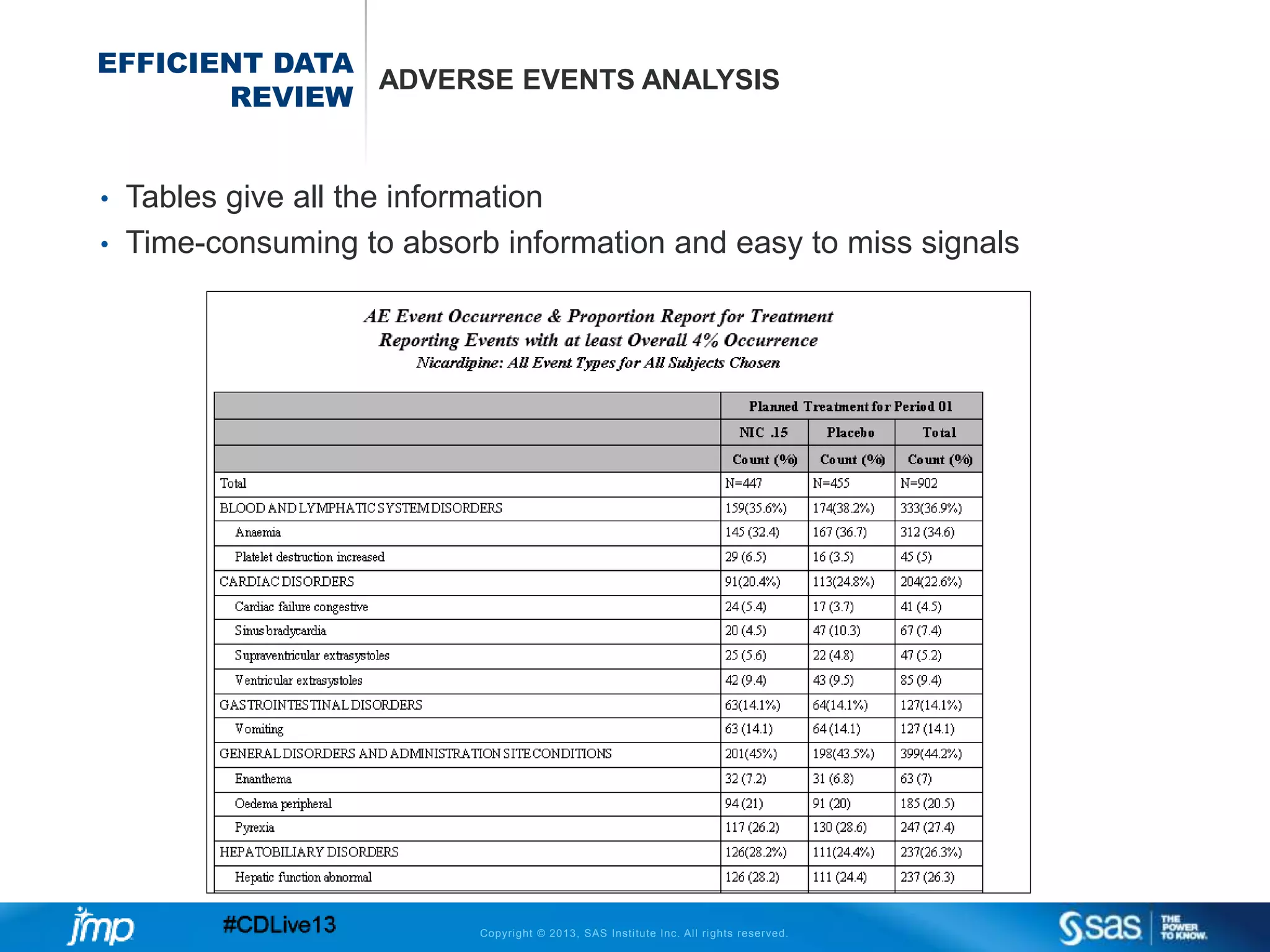
ADVERSE EVENTS ANALYSIS
• Tables give all the information
• Time-consuming to absorb information and easy to miss signals
Copyright © 2013, SAS Institute Inc. All rights reserved.
EFFICIENT DATA
REVIEW
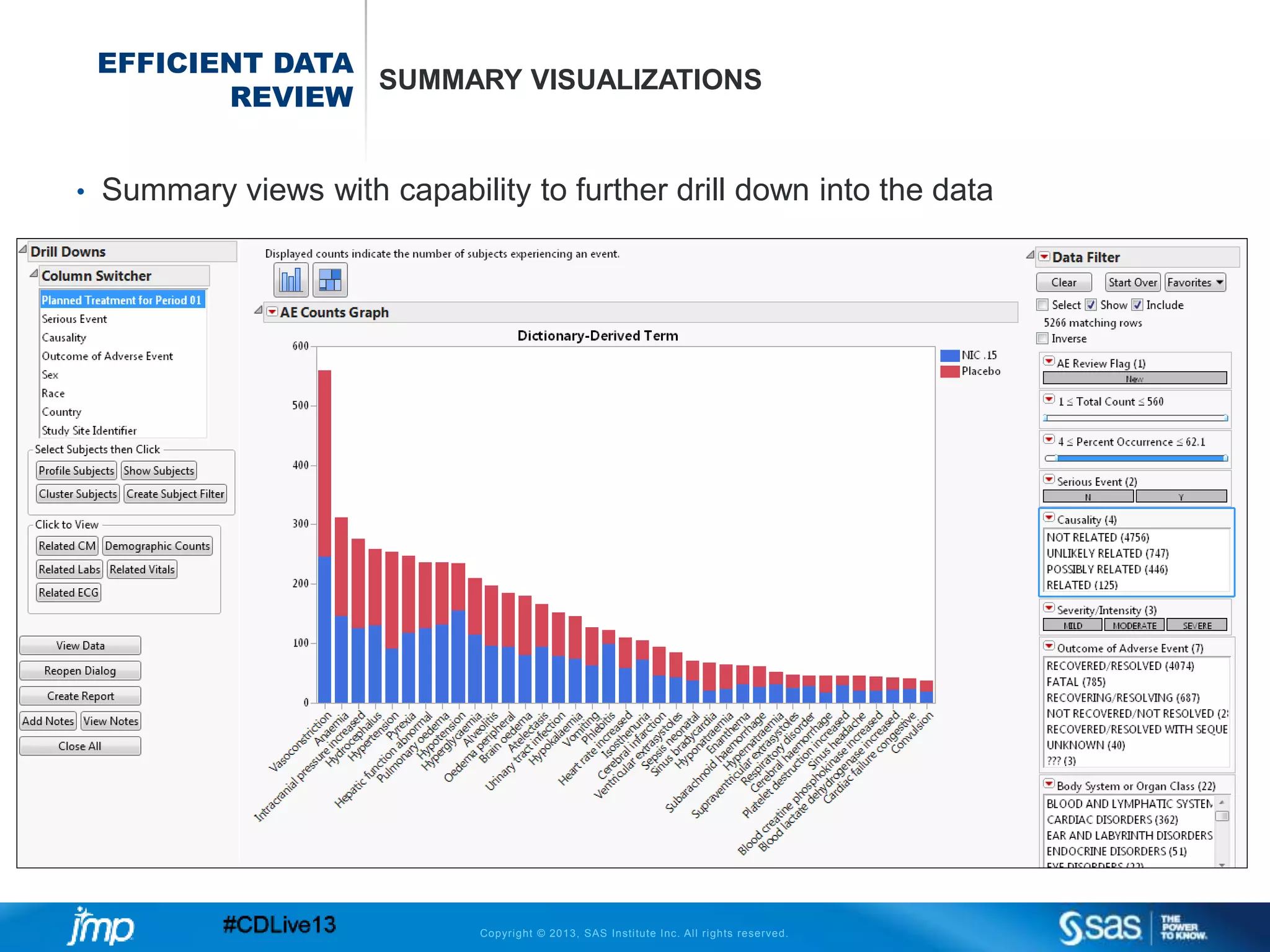
SUMMARY VISUALIZATIONS
• Summary views with capability to further drill down into the data
Copyright © 2013, SAS Institute Inc. All rights reserved.
EFFICIENT DATA
REVIEW
SAFETY SIGNAL DETECTION
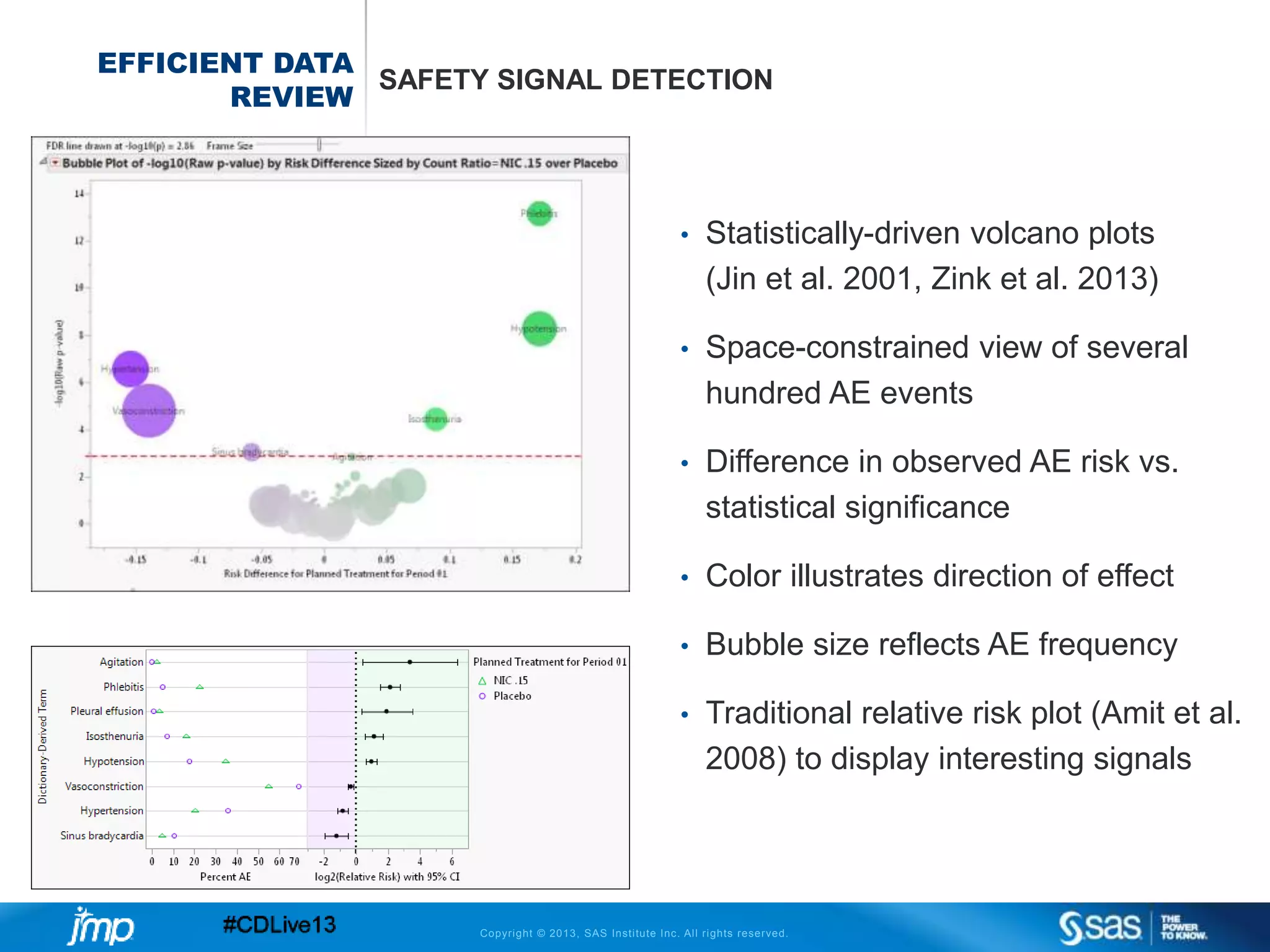
• Statistically-driven volcano plots
(Jin et al. 2001, Zink et al. 2013)
• Space-constrained view of several
hundred AE events
• Difference in observed AE risk vs.
statistical significance
• Color illustrates direction of effect
• Bubble size reflects AE frequency
• Traditional relative risk plot (Amit et al.
2008) to display interesting signals
Copyright © 2013, SAS Institute Inc. All rights reserved.
EFFICIENT DATA
REVIEW
ANALYSIS COMPLEXITIES
• Abundance of endpoints (multiplicity)
• False discovery rate (FDR) Benjamini & Hochberg (1995)
• Double FDR (Mehrotra & Heyse 2004, Mehrotra & Adewale, 2012)
• Bayesian Hierarchical Models
• Repeated/recurrent events
• Inclusion of time windows across analyses (Zink et al. 2013)
• Trial design complexity
• Crossover analysis and visualization
• Limited population and understanding of biological underpinnings
• Cross-domain predictive models
• Subgroup analysis
• Pharmacogenomics
Copyright © 2013, SAS Institute Inc. All rights reserved.
EFFICIENT DATA
REVIEW
EFFICIENT REVIEWS THROUGH SNAPSHOT COMPARISON
• Comparisons between current and previous data snapshot accelerate
clinical review to avoid redundant work effort
• Domain keys necessary to enable efficient snapshot comparison
• Metadata defined by sponsor
• CDSIC-recommended (CDISC Submission Data Standards Team. 2008)
• Keys allow record-level and subject-level categorization to flag new
and updated data
• Record-level: New, Modified, Stable, Dropped, Non-Unique (Duplicate)
• Subject-level: New Records, Modified Records, Stable, Introduced
Copyright © 2013, SAS Institute Inc. All rights reserved.
EFFICIENT DATA
REVIEW
SNAPSHOT COMPARISON ANALYSIS TOOLS
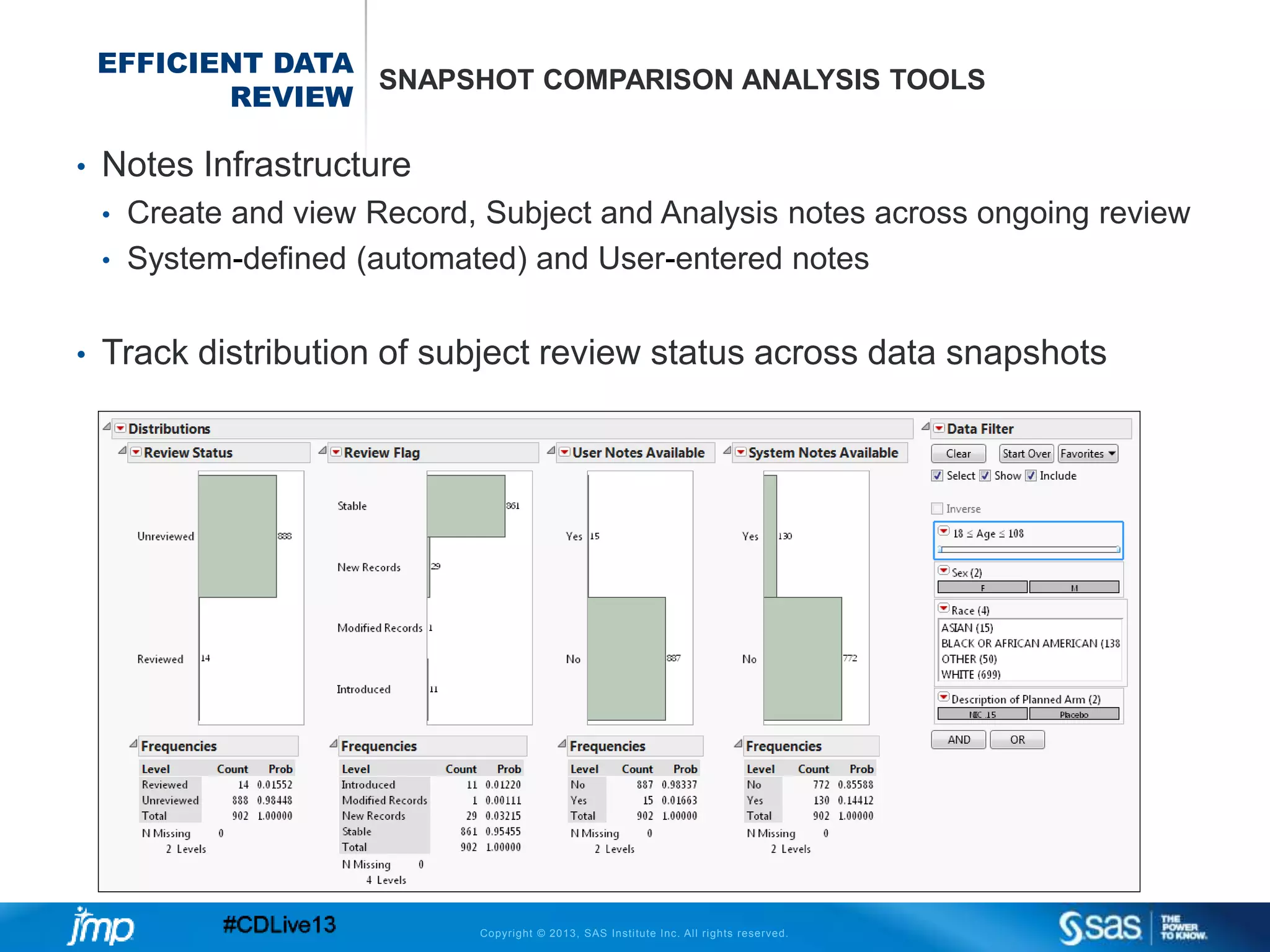
• Notes Infrastructure
• Create and view Record, Subject and Analysis notes across ongoing review
• System-defined (automated) and User-entered notes
• Track distribution of subject review status across data snapshots
Copyright © 2013, SAS Institute Inc. All rights reserved.
EFFICIENT DATA
REVIEW
SNAPSHOT COMPARISON ANALYSIS TOOLS
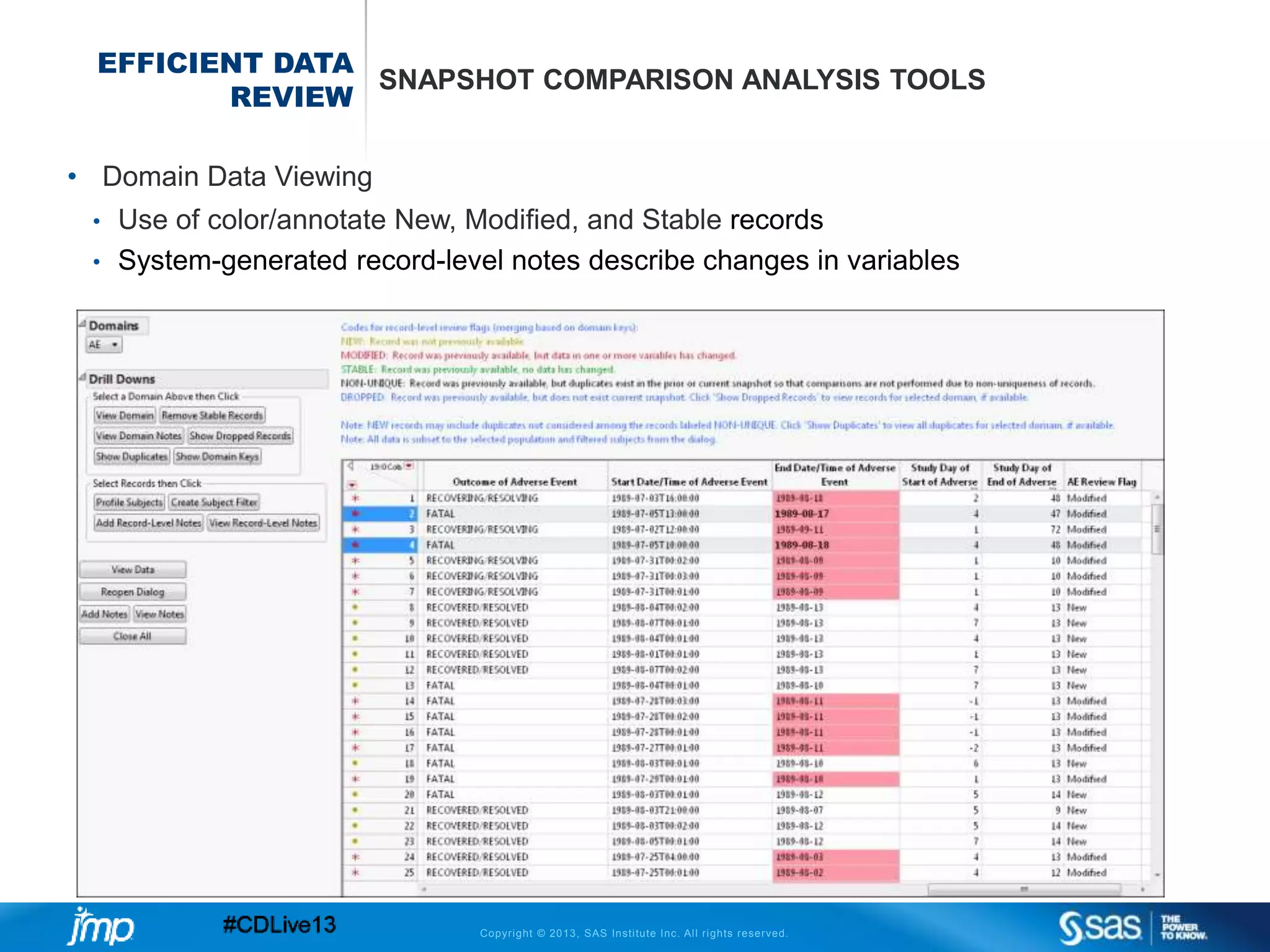
• Domain Data Viewing
• Use of color/annotate New, Modified, and Stable records
• System-generated record-level notes describe changes in variables
Copyright © 2013, SAS Institute Inc. All rights reserved.
EFFICIENT DATA
REVIEW
SNAPSHOT COMPARISON ANALYSIS TOOLS
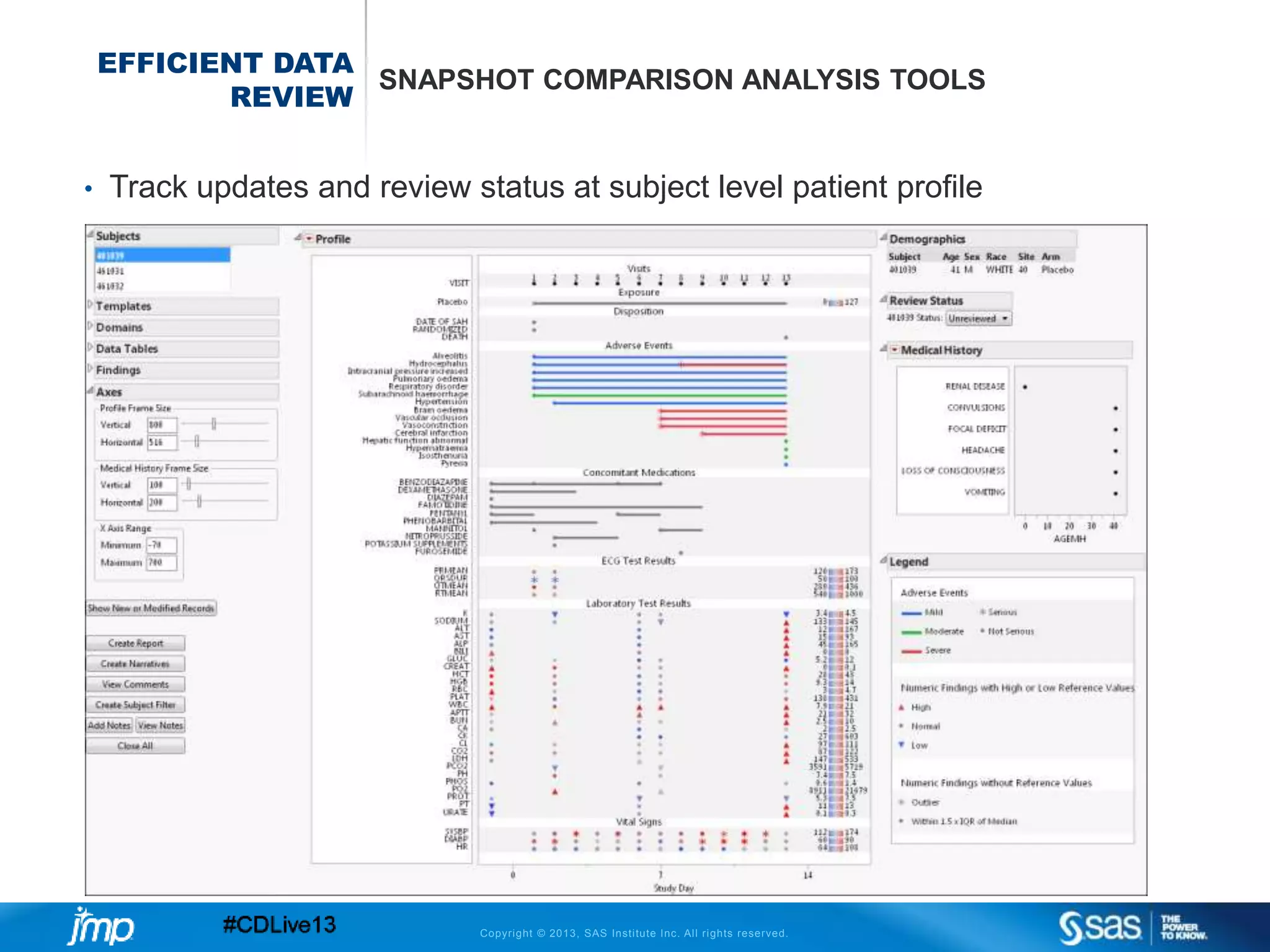
• Track updates and review status at subject level patient profile
Copyright © 2013, SAS Institute Inc. All rights reserved.
EFFICIENT DATA
REVIEW
SNAPSHOT COMPARISON ANALYSIS TOOLS
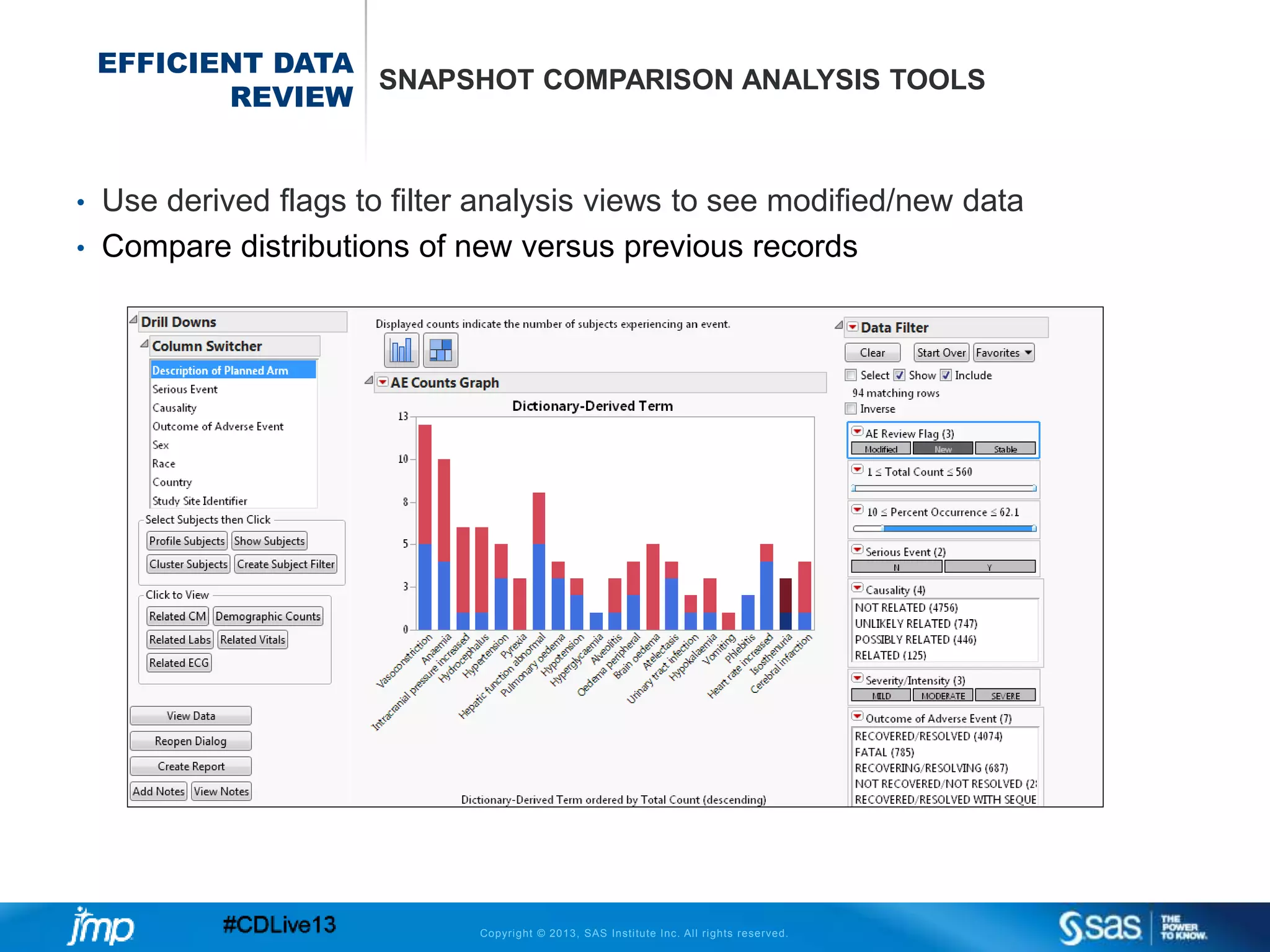
• Use derived flags to filter analysis views to see modified/new data
• Compare distributions of new versus previous records
Copyright © 2013, SAS Institute Inc. All rights reserved.
FRAUD AND DATA
QUALITY
DATA QUALITY AND FRAUD IN CLINICAL TRIALS
• Fraud is the “Deliberate attempt to deceive” or the “intention to cheat”
(Buyse et al., 1999)
• Fraud thought to be uncommon
• Investigators committing fraud estimated < 1% (Buyse et al., 1999)
• Difficult to diagnose
• Lack of tools
• Variations across subjects, time, sites make comparison difficult
• Unusual points may indicate quality issues, but determining fraud requires
more evidence (Evans, 2001)
Copyright © 2013, SAS Institute Inc. All rights reserved.
FRAUD AND DATA
QUALITY
CENTRALIZED ELECTRONIC DATA MONITORING
• “Several publications suggest that certain data anomalies (e.g., fraud,
including fabrication of data, and other non-random data distributions)
may be more readily detected by centralized monitoring techniques
than by on-site monitoring” (FDA Guidance 2013)
• Identify data trends through statistical analysis
• Missing/inconsistent data, outliers, protocol deviations
• Unusual distributions of reported data across and among study sites
• Capitalize on:
• Data standards (CDISC)
• Graphical display of data through interactive software tools
• Early and routine data reviews
Copyright © 2013, SAS Institute Inc. All rights reserved.
FRAUD DETECTION ANALYSIS AND TOOLS
• Types of Fraud
• Site: modified or fabricated records of participants within study site
• Patient: subjects with multiple enrollment across sites
• Straight-forward data quality analyses
• Non-random data distributions
• Variability and similarity of subjects within and across sites
• Duplicate detection across measurements
• Duplicated patient information (Birthdays/Initials)
• Visit distribution occurrence and attendance
Copyright © 2013, SAS Institute Inc. All rights reserved.
FRAUD DETECTION DUPLICATE SUBJECTS WITHIN SITE
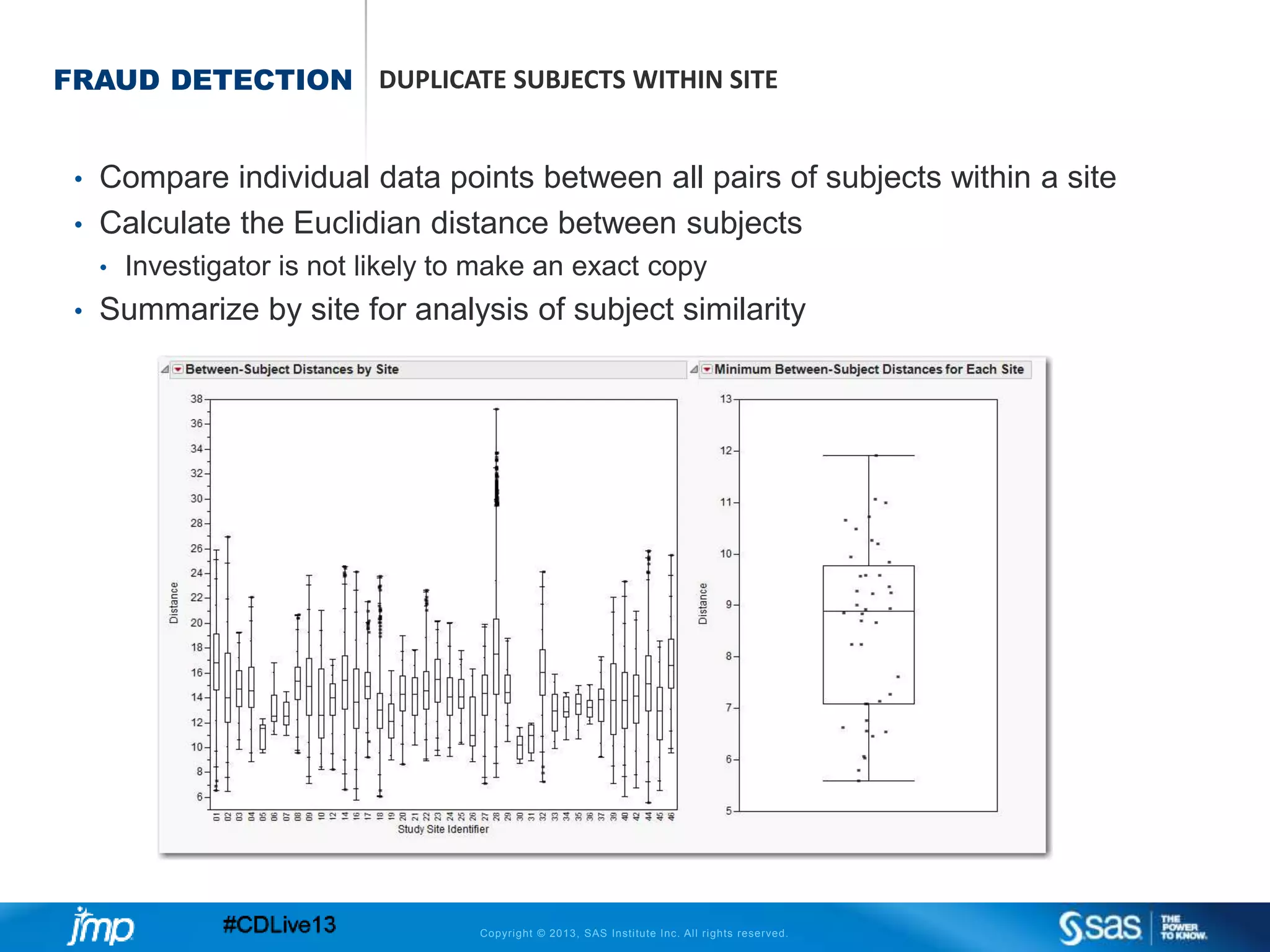
• Compare individual data points between all pairs of subjects within a site
• Calculate the Euclidian distance between subjects
• Investigator is not likely to make an exact copy
• Summarize by site for analysis of subject similarity
Copyright © 2013, SAS Institute Inc. All rights reserved.
FRAUD DETECTION DUPLICATE RECORDS WITHIN SITE
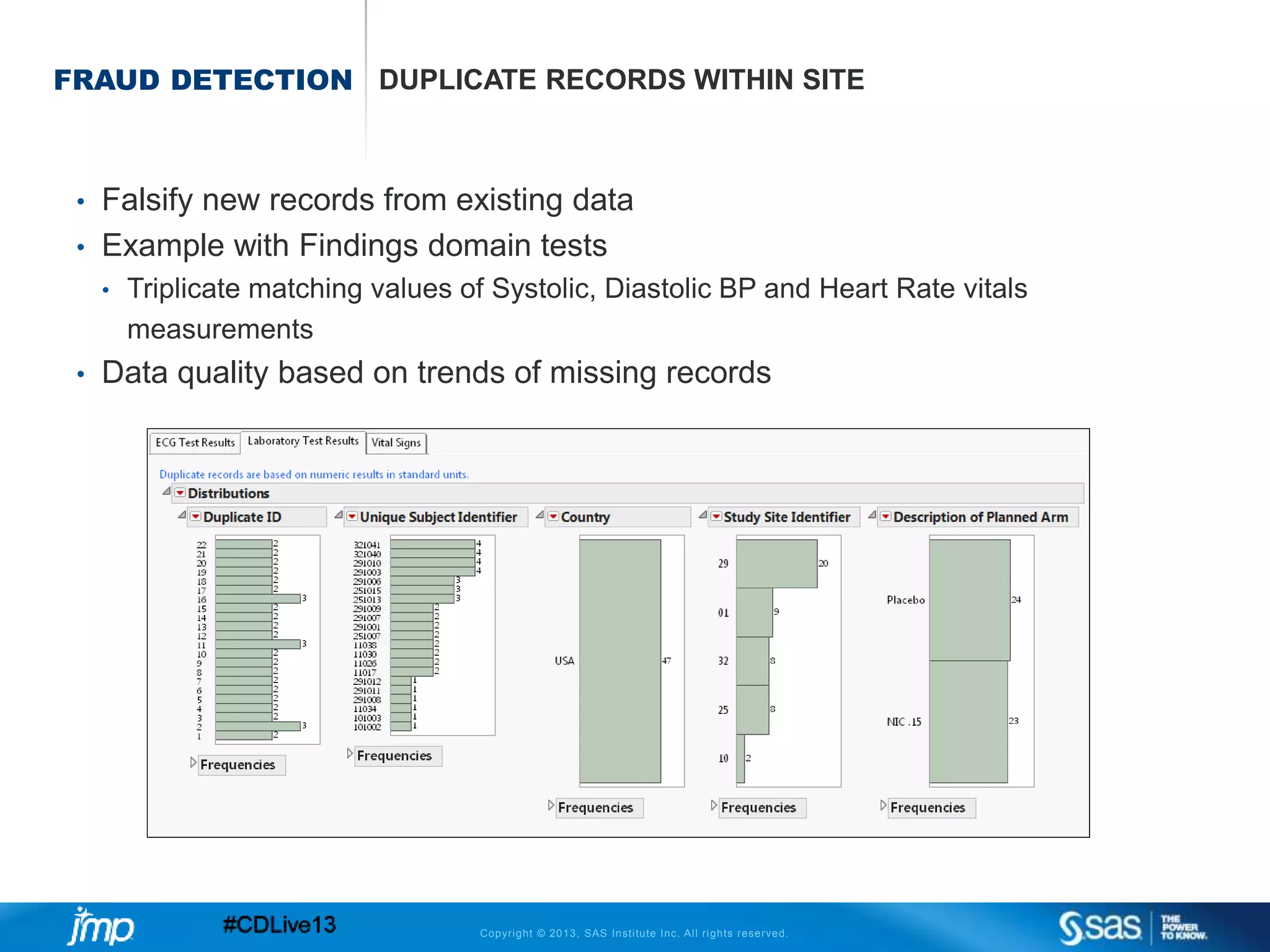
• Falsify new records from existing data
• Example with Findings domain tests
• Triplicate matching values of Systolic, Diastolic BP and Heart Rate vitals
measurements
• Data quality based on trends of missing records
Copyright © 2013, SAS Institute Inc. All rights reserved.
FRAUD DETECTION PATIENTS WITH MULTIPLE ENROLLMENT
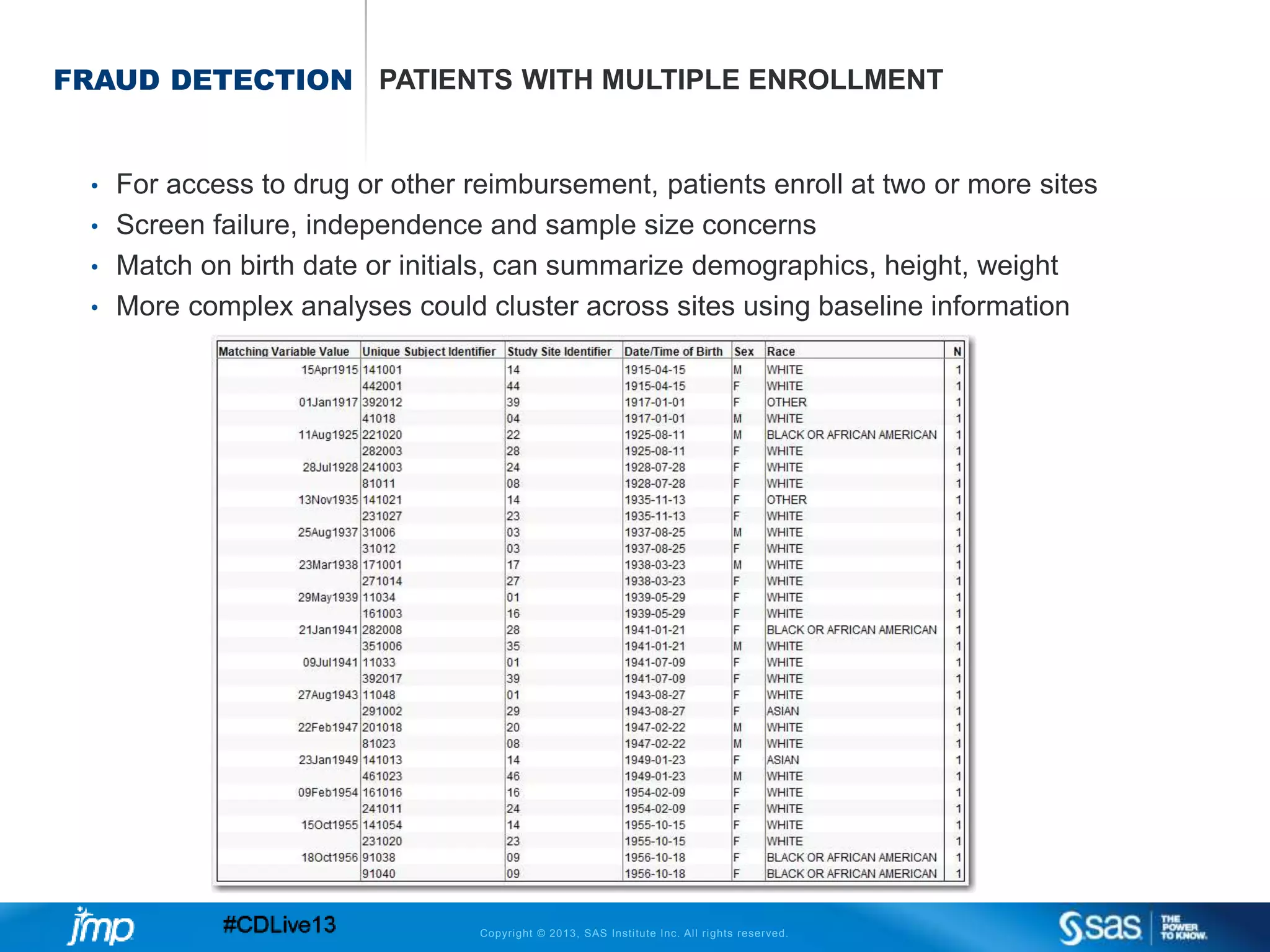
• For access to drug or other reimbursement, patients enroll at two or more sites
• Screen failure, independence and sample size concerns
• Match on birth date or initials, can summarize demographics, height, weight
• More complex analyses could cluster across sites using baseline information
Copyright © 2013, SAS Institute Inc. All rights reserved.
FRAUD AND DATA
QUALITY
RISK-BASED MONITORING
• ICH Guideline E6 (1996)
• “sponsor should ensure trials are adequately monitored”
• “sponsor should determine the appropriate extent and nature of monitoring”
• “statistically controlled sampling may be an acceptable method for selecting
the data to be verified.”
• 100% source data verification
• Error-prone (Tantsyura et al., 2010)
• Expensive, as much as 25-30% of trial cost (Eisenstein et al, 2005; Funning
et al., 2009; Tantsyura et al., 2010)
• Time-consuming on fields of little importance
• Limited-in-scope (comparisons across pages, subjects and sites)
Copyright © 2013, SAS Institute Inc. All rights reserved.
FRAUD AND DATA
QUALITY
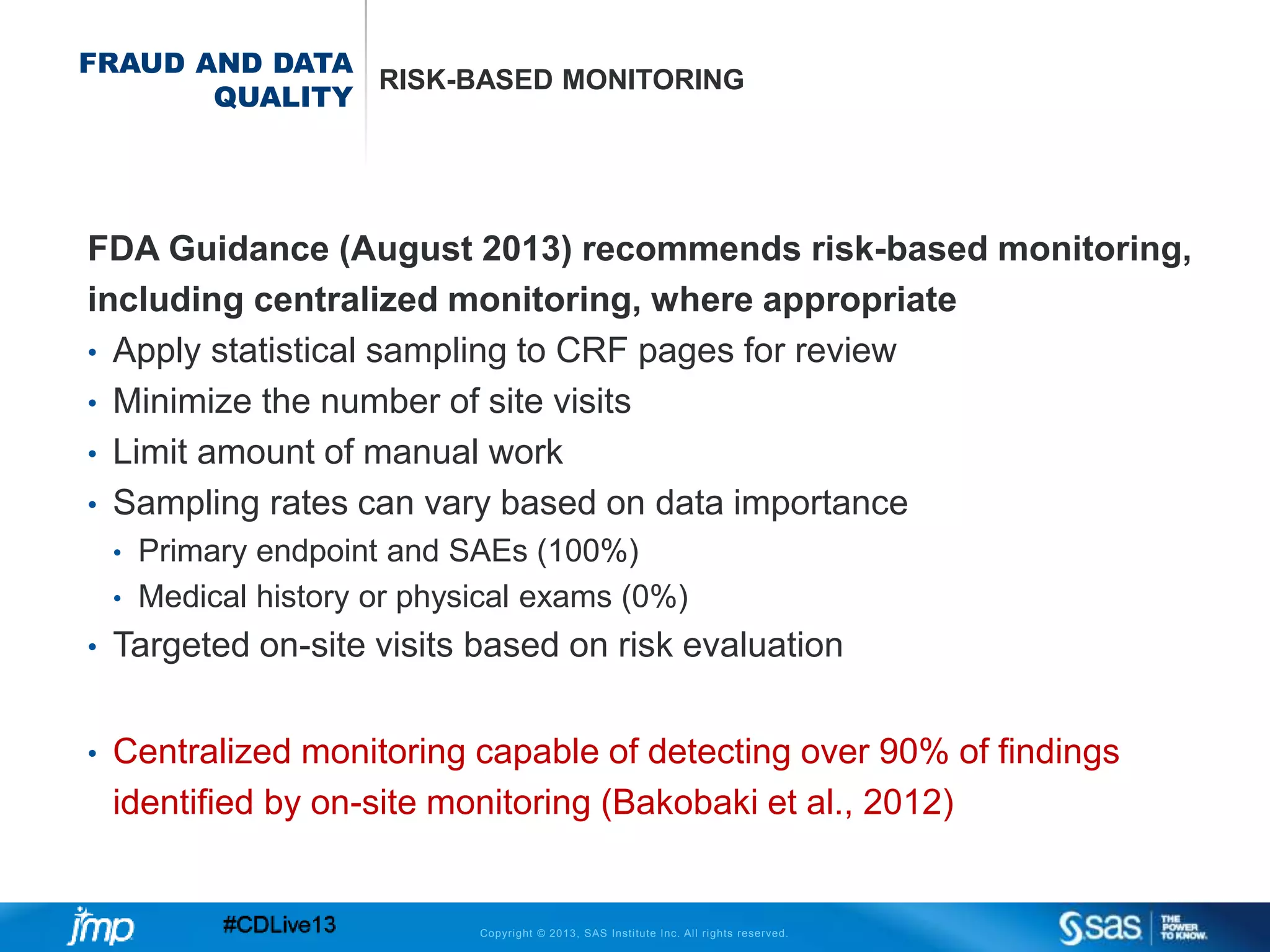
RISK-BASED MONITORING
FDA Guidance (August 2013) recommends risk-based monitoring,
including centralized monitoring, where appropriate
• Apply statistical sampling to CRF pages for review
• Minimize the number of site visits
• Limit amount of manual work
• Sampling rates can vary based on data importance
• Primary endpoint and SAEs (100%)
• Medical history or physical exams (0%)
• Targeted on-site visits based on risk evaluation
• Centralized monitoring capable of detecting over 90% of findings
identified by on-site monitoring (Bakobaki et al., 2012)
Copyright © 2013, SAS Institute Inc. All rights reserved.
FRAUD AND DATA
QUALITY
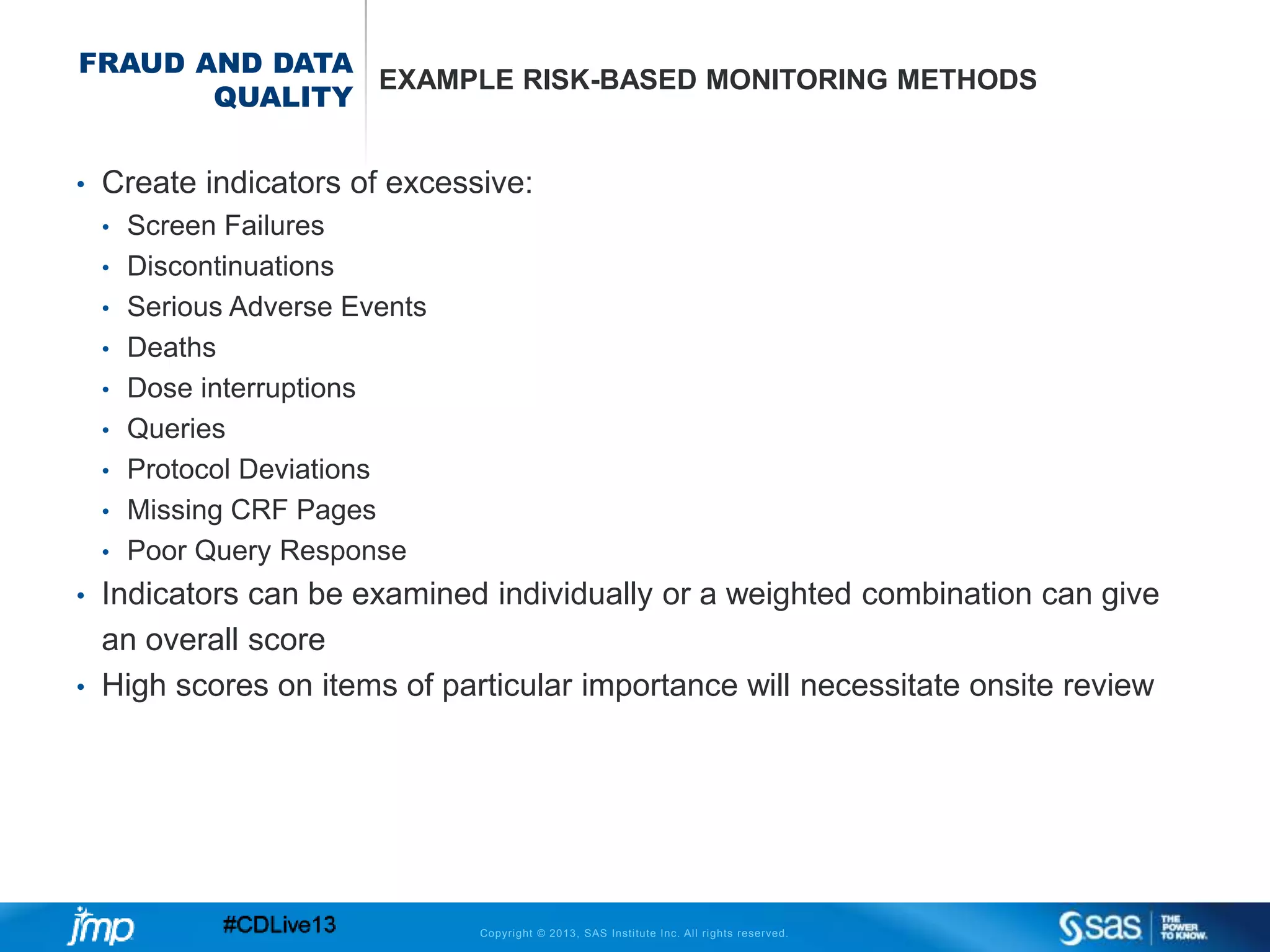
EXAMPLE RISK-BASED MONITORING METHODS
• Create indicators of excessive:
• Screen Failures
• Discontinuations
• Serious Adverse Events
• Deaths
• Dose interruptions
• Queries
• Protocol Deviations
• Missing CRF Pages
• Poor Query Response
• Indicators can be examined individually or a weighted combination can give
an overall score
• High scores on items of particular importance will necessitate onsite review
Copyright © 2013, SAS Institute Inc. All rights reserved.
FRAUD AND DATA
QUALITY
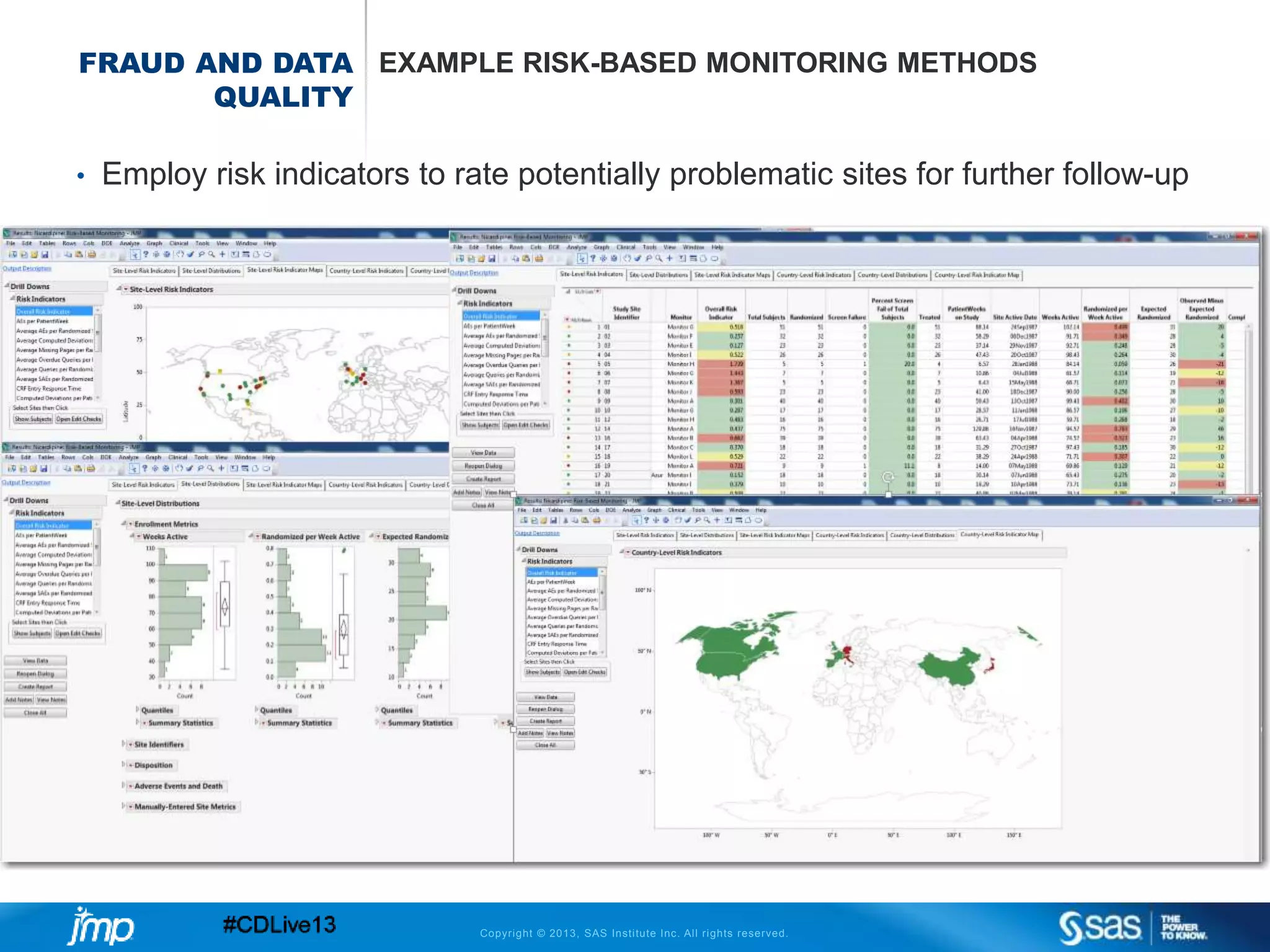
EXAMPLE RISK-BASED MONITORING METHODS
• Employ risk indicators to rate potentially problematic sites for further follow-up
Copyright © 2013, SAS Institute Inc. All rights reserved.
FRAUD AND DATA
QUALITY
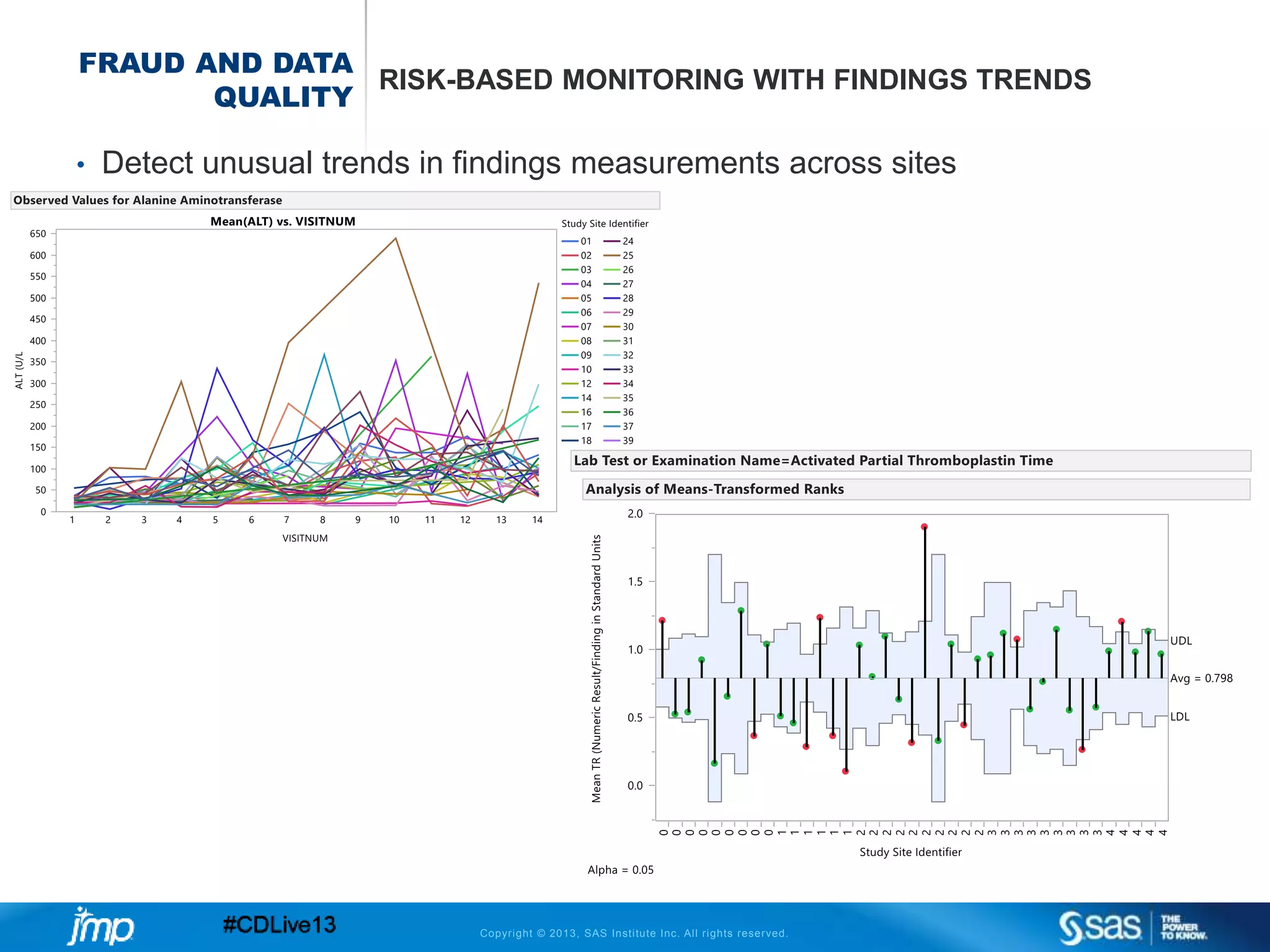
RISK-BASED MONITORING WITH FINDINGS TRENDS
• Detect unusual trends in findings measurements across sites
Copyright © 2013, SAS Institute Inc. All rights reserved.
DATA REVIEW AND
QUALITY
CONCLUSIONS
• Statistically-driven, dynamic data visualization necessary for efficient clinical
safety review
• Data standards allow for automated analyses that enable clinicians, data
monitors, data managers, and statisticians
• Tools for snapshot comparison accelerate reviews
• Centralized-monitoring enhances the accessibility and transparency of data
• Several straight-forward analyses to interrogate data quality and potentially
fraudulent activities
Copyright © 2013, SAS Institute Inc. All rights reserved.
DATA REVIEW AND
FRAUD DETECTION
REFERENCES
• Amit O, Heiberger RM and Lane PW. Graphical approaches to the analysis of safety data from clinical trials. Pharmaceutical
Statistics 2008; 7: 20-35.
• Benjamini Y and Hochberg Y. Controlling the false discovery rate: a practical and powerful approach to multiple testing. Journal
of the Royal Statistical Society B 1995; 57: 289–300.
• Bakobaki et al. (2012) The Potential for Central Monitoring Techniques to Replace On-Site Monitoring: Findings from an
International Multi-Centre Clinical Trial. Clinical Trials. 9: 257-264.
• Buyse M et al. (1999). The role of biostatistics in the prevention, detection and treatment of fraud in clinical trials. Statistics in
Medicine, 18: 3435-3451.
• Eisenstein EL et al. (2005). Reducing the costs of phase III cardiovascular clinical trials. American Heart Journal 149: 482–488.
• Evans, S. (2001). Statistical aspects of the detection of fraud. In: Lock S & Wells F, eds. Fraud and Misconduct in Biomedical
Research. BMJ Books.
• International Conference of Harmonisation. (1996). E6: Guideline for Good Clinical Practice.
• Jin W, Riley RM, Wolfinger RD, White KP, Passador-Gurgel G and Gibson G. The contributions of sex, genotype and age to
transcriptional variance in Drosophila melanogaster. Nature Genetics 2001; 29: 389-395.
• Mehrotra DV and Adewale AJ. Flagging clinical adverse experiences: reducing false discoveries without materially
compromising power for detecting true signals. Statistics in Medicine 2012 (in press).
• Mehrotra DV and Heyse JF. Use of the false discovery rate for evaluating clinical safety data. Statistical Methods in Medical
Research 2004; 13: 227-238.
• Tantsyura V et al. (2010). Risk-based source data verification approaches: pros and cons. Drug Information Journal 44: 745-
756.
• US Food and Drug Administration. (2013). Guidance for industry oversight of clinical investigations - a risk-based approach to
monitoring.
• Weir C & Murray G. (2011). Fraud in clinical trials: Detecting it and preventing it. Significance 8: 164-168.
• Zink RC, Wolfinger RD, Mann G (2012). Summarizing the incidence of adverse events using volcano plots and time intervals.
Clinical Trials. 10(3):398-406.

Efficient Data Reviews and Quality in Clinical Trials - Kelci Miclaus

  • 1.
    Copyright © 2013,SAS Institute Inc. All rights reserved. EFFICIENT DATA REVIEWS AND QUALITY IN CLINICAL TRIALS KELCI J. MICLAUS, PH.D. RESEARCH AND DEVELOPMENT MANAGER JMP LIFE SCIENCES SAS INSTITUTE, INC. RICHARD C. ZINK, PH.D. PRINCIPAL RESEARCH STATISTICIAN DEVELOPER JMP LIFE SCIENCES SAS INSTITUTE, INC.
  • 2.
    Copyright © 2013,SAS Institute Inc. All rights reserved. DATA REVIEW AND QUALITY INTRODUCTION • Efficient Data Review Practices • Statistical analysis coupled with effective data visualization key to efficient data review • Data collection is a large contributor to time-consuming data review process • Snapshot comparison tools for tracking data changes enables early and often data review • Data Quality and Fraud Detection • Onsite data monitoring and Source Data Verification (SDV) expensive component to clinical trial process • Effectiveness of such manual processes is in question • Fraud detection methods • Centralized electronic data monitoring • Risk-based monitoring methods
  • 3.
    Copyright © 2013,SAS Institute Inc. All rights reserved. EFFICIENT DATA REVIEW INTRODUCTION • Randomized clinical trial remains the gold standard for evaluating efficacy of an new intervention • Safety profile assessment critical for trial success • Safety analysis comes with several difficulties • Numerous endpoints measured repeatedly • Detection of rare events (drug-induced liver toxicity) • Limited studied population • Limited understanding of biological mechanisms and pathways
  • 4.
    Copyright © 2013,SAS Institute Inc. All rights reserved. EFFICIENT DATA REVIEW SAFETY REVIEW • Accelerated safety reviews • Dynamic visualization coupled with tables and reports • Leverage data standards (CDISC) • Statistically-driven analyses with drill-down and swim-up capabilities • Centralized electronic data review coupled with tools that clinicians, data monitors, and biostatisticians can employ
  • 5.
    Copyright © 2013,SAS Institute Inc. All rights reserved. EFFICIENT DATA REVIEW ADVERSE EVENTS ANALYSIS • Tables give all the information • Time-consuming to absorb information and easy to miss signals
  • 6.
    Copyright © 2013,SAS Institute Inc. All rights reserved. EFFICIENT DATA REVIEW SUMMARY VISUALIZATIONS • Summary views with capability to further drill down into the data
  • 7.
    Copyright © 2013,SAS Institute Inc. All rights reserved. EFFICIENT DATA REVIEW SAFETY SIGNAL DETECTION • Statistically-driven volcano plots (Jin et al. 2001, Zink et al. 2013) • Space-constrained view of several hundred AE events • Difference in observed AE risk vs. statistical significance • Color illustrates direction of effect • Bubble size reflects AE frequency • Traditional relative risk plot (Amit et al. 2008) to display interesting signals
  • 8.
    Copyright © 2013,SAS Institute Inc. All rights reserved. EFFICIENT DATA REVIEW ANALYSIS COMPLEXITIES • Abundance of endpoints (multiplicity) • False discovery rate (FDR) Benjamini & Hochberg (1995) • Double FDR (Mehrotra & Heyse 2004, Mehrotra & Adewale, 2012) • Bayesian Hierarchical Models • Repeated/recurrent events • Inclusion of time windows across analyses (Zink et al. 2013) • Trial design complexity • Crossover analysis and visualization • Limited population and understanding of biological underpinnings • Cross-domain predictive models • Subgroup analysis • Pharmacogenomics
  • 9.
    Copyright © 2013,SAS Institute Inc. All rights reserved. EFFICIENT DATA REVIEW EFFICIENT REVIEWS THROUGH SNAPSHOT COMPARISON • Comparisons between current and previous data snapshot accelerate clinical review to avoid redundant work effort • Domain keys necessary to enable efficient snapshot comparison • Metadata defined by sponsor • CDSIC-recommended (CDISC Submission Data Standards Team. 2008) • Keys allow record-level and subject-level categorization to flag new and updated data • Record-level: New, Modified, Stable, Dropped, Non-Unique (Duplicate) • Subject-level: New Records, Modified Records, Stable, Introduced
  • 10.
    Copyright © 2013,SAS Institute Inc. All rights reserved. EFFICIENT DATA REVIEW SNAPSHOT COMPARISON ANALYSIS TOOLS • Notes Infrastructure • Create and view Record, Subject and Analysis notes across ongoing review • System-defined (automated) and User-entered notes • Track distribution of subject review status across data snapshots
  • 11.
    Copyright © 2013,SAS Institute Inc. All rights reserved. EFFICIENT DATA REVIEW SNAPSHOT COMPARISON ANALYSIS TOOLS • Domain Data Viewing • Use of color/annotate New, Modified, and Stable records • System-generated record-level notes describe changes in variables
  • 12.
    Copyright © 2013,SAS Institute Inc. All rights reserved. EFFICIENT DATA REVIEW SNAPSHOT COMPARISON ANALYSIS TOOLS • Track updates and review status at subject level patient profile
  • 13.
    Copyright © 2013,SAS Institute Inc. All rights reserved. EFFICIENT DATA REVIEW SNAPSHOT COMPARISON ANALYSIS TOOLS • Use derived flags to filter analysis views to see modified/new data • Compare distributions of new versus previous records
  • 14.
    Copyright © 2013,SAS Institute Inc. All rights reserved. FRAUD AND DATA QUALITY DATA QUALITY AND FRAUD IN CLINICAL TRIALS • Fraud is the “Deliberate attempt to deceive” or the “intention to cheat” (Buyse et al., 1999) • Fraud thought to be uncommon • Investigators committing fraud estimated < 1% (Buyse et al., 1999) • Difficult to diagnose • Lack of tools • Variations across subjects, time, sites make comparison difficult • Unusual points may indicate quality issues, but determining fraud requires more evidence (Evans, 2001)
  • 15.
    Copyright © 2013,SAS Institute Inc. All rights reserved. FRAUD AND DATA QUALITY CENTRALIZED ELECTRONIC DATA MONITORING • “Several publications suggest that certain data anomalies (e.g., fraud, including fabrication of data, and other non-random data distributions) may be more readily detected by centralized monitoring techniques than by on-site monitoring” (FDA Guidance 2013) • Identify data trends through statistical analysis • Missing/inconsistent data, outliers, protocol deviations • Unusual distributions of reported data across and among study sites • Capitalize on: • Data standards (CDISC) • Graphical display of data through interactive software tools • Early and routine data reviews
  • 16.
    Copyright © 2013,SAS Institute Inc. All rights reserved. FRAUD DETECTION ANALYSIS AND TOOLS • Types of Fraud • Site: modified or fabricated records of participants within study site • Patient: subjects with multiple enrollment across sites • Straight-forward data quality analyses • Non-random data distributions • Variability and similarity of subjects within and across sites • Duplicate detection across measurements • Duplicated patient information (Birthdays/Initials) • Visit distribution occurrence and attendance
  • 17.
    Copyright © 2013,SAS Institute Inc. All rights reserved. FRAUD DETECTION DUPLICATE SUBJECTS WITHIN SITE • Compare individual data points between all pairs of subjects within a site • Calculate the Euclidian distance between subjects • Investigator is not likely to make an exact copy • Summarize by site for analysis of subject similarity
  • 18.
    Copyright © 2013,SAS Institute Inc. All rights reserved. FRAUD DETECTION DUPLICATE RECORDS WITHIN SITE • Falsify new records from existing data • Example with Findings domain tests • Triplicate matching values of Systolic, Diastolic BP and Heart Rate vitals measurements • Data quality based on trends of missing records
  • 19.
    Copyright © 2013,SAS Institute Inc. All rights reserved. FRAUD DETECTION PATIENTS WITH MULTIPLE ENROLLMENT • For access to drug or other reimbursement, patients enroll at two or more sites • Screen failure, independence and sample size concerns • Match on birth date or initials, can summarize demographics, height, weight • More complex analyses could cluster across sites using baseline information
  • 20.
    Copyright © 2013,SAS Institute Inc. All rights reserved. FRAUD AND DATA QUALITY RISK-BASED MONITORING • ICH Guideline E6 (1996) • “sponsor should ensure trials are adequately monitored” • “sponsor should determine the appropriate extent and nature of monitoring” • “statistically controlled sampling may be an acceptable method for selecting the data to be verified.” • 100% source data verification • Error-prone (Tantsyura et al., 2010) • Expensive, as much as 25-30% of trial cost (Eisenstein et al, 2005; Funning et al., 2009; Tantsyura et al., 2010) • Time-consuming on fields of little importance • Limited-in-scope (comparisons across pages, subjects and sites)
  • 21.
    Copyright © 2013,SAS Institute Inc. All rights reserved. FRAUD AND DATA QUALITY RISK-BASED MONITORING FDA Guidance (August 2013) recommends risk-based monitoring, including centralized monitoring, where appropriate • Apply statistical sampling to CRF pages for review • Minimize the number of site visits • Limit amount of manual work • Sampling rates can vary based on data importance • Primary endpoint and SAEs (100%) • Medical history or physical exams (0%) • Targeted on-site visits based on risk evaluation • Centralized monitoring capable of detecting over 90% of findings identified by on-site monitoring (Bakobaki et al., 2012)
  • 22.
    Copyright © 2013,SAS Institute Inc. All rights reserved. FRAUD AND DATA QUALITY EXAMPLE RISK-BASED MONITORING METHODS • Create indicators of excessive: • Screen Failures • Discontinuations • Serious Adverse Events • Deaths • Dose interruptions • Queries • Protocol Deviations • Missing CRF Pages • Poor Query Response • Indicators can be examined individually or a weighted combination can give an overall score • High scores on items of particular importance will necessitate onsite review
  • 23.
    Copyright © 2013,SAS Institute Inc. All rights reserved. FRAUD AND DATA QUALITY EXAMPLE RISK-BASED MONITORING METHODS • Employ risk indicators to rate potentially problematic sites for further follow-up
  • 24.
    Copyright © 2013,SAS Institute Inc. All rights reserved. FRAUD AND DATA QUALITY RISK-BASED MONITORING WITH FINDINGS TRENDS • Detect unusual trends in findings measurements across sites
  • 25.
    Copyright © 2013,SAS Institute Inc. All rights reserved. DATA REVIEW AND QUALITY CONCLUSIONS • Statistically-driven, dynamic data visualization necessary for efficient clinical safety review • Data standards allow for automated analyses that enable clinicians, data monitors, data managers, and statisticians • Tools for snapshot comparison accelerate reviews • Centralized-monitoring enhances the accessibility and transparency of data • Several straight-forward analyses to interrogate data quality and potentially fraudulent activities
  • 26.
    Copyright © 2013,SAS Institute Inc. All rights reserved. DATA REVIEW AND FRAUD DETECTION REFERENCES • Amit O, Heiberger RM and Lane PW. Graphical approaches to the analysis of safety data from clinical trials. Pharmaceutical Statistics 2008; 7: 20-35. • Benjamini Y and Hochberg Y. Controlling the false discovery rate: a practical and powerful approach to multiple testing. Journal of the Royal Statistical Society B 1995; 57: 289–300. • Bakobaki et al. (2012) The Potential for Central Monitoring Techniques to Replace On-Site Monitoring: Findings from an International Multi-Centre Clinical Trial. Clinical Trials. 9: 257-264. • Buyse M et al. (1999). The role of biostatistics in the prevention, detection and treatment of fraud in clinical trials. Statistics in Medicine, 18: 3435-3451. • Eisenstein EL et al. (2005). Reducing the costs of phase III cardiovascular clinical trials. American Heart Journal 149: 482–488. • Evans, S. (2001). Statistical aspects of the detection of fraud. In: Lock S & Wells F, eds. Fraud and Misconduct in Biomedical Research. BMJ Books. • International Conference of Harmonisation. (1996). E6: Guideline for Good Clinical Practice. • Jin W, Riley RM, Wolfinger RD, White KP, Passador-Gurgel G and Gibson G. The contributions of sex, genotype and age to transcriptional variance in Drosophila melanogaster. Nature Genetics 2001; 29: 389-395. • Mehrotra DV and Adewale AJ. Flagging clinical adverse experiences: reducing false discoveries without materially compromising power for detecting true signals. Statistics in Medicine 2012 (in press). • Mehrotra DV and Heyse JF. Use of the false discovery rate for evaluating clinical safety data. Statistical Methods in Medical Research 2004; 13: 227-238. • Tantsyura V et al. (2010). Risk-based source data verification approaches: pros and cons. Drug Information Journal 44: 745- 756. • US Food and Drug Administration. (2013). Guidance for industry oversight of clinical investigations - a risk-based approach to monitoring. • Weir C & Murray G. (2011). Fraud in clinical trials: Detecting it and preventing it. Significance 8: 164-168. • Zink RC, Wolfinger RD, Mann G (2012). Summarizing the incidence of adverse events using volcano plots and time intervals. Clinical Trials. 10(3):398-406.