This PowerPoint has got slides compiled from other ppts downloaded in net..i thank all those kind minds who shared their tots… Dr. B. Imtiyaaz www.drimtiyaaz.com
Teachers
"A teacher affects eternity; he / she can never tell where his /her influence stops." ~Henry Brooks Adams
A good teacher is like a candle – it consumes itself to light the way for others. 
I am indebted to my father for living, but to my teacher for living well.   ~Alexander the Great
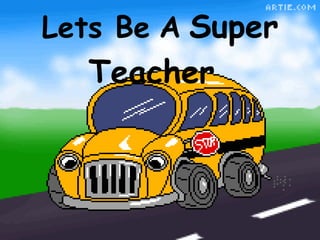
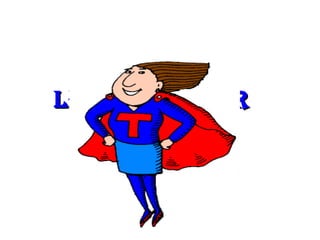
Lets Be   A   Super   Teacher
Usually students tell lot of complaints about teachers but in your case, I have  heard lot of compliments and complaints were too few…. I salute you people for being  an inspiring teacher for this cute children… With the words of compliment , I start this presentation
Qualities of a Good Teachers This presentation is intended to show you the characters and personalities of a great teacher.  For  those who have this qualities in them, this presentation will prove as an acknowledgment and  For those who miss out few things in this, this presentation will help you to know few things that exists in teaching…
how worthy teachers are? Mothers give life to a generation….  Teachers are responsible for making generations So teachers make generations
A mediocre teacher tells, A good teacher explains A superior teacher demonstrates A great teacher inspires
Students say good teacher Is kind Is generous Listens to you Has faith in you Encourages you Keeps confidence Likes teaching students Likes teaching their subject Takes time to explain things Helps you when you are stuck Tells you how you are doing Allows you to have your say Doesn’t give up on you Cares for your opinion Makes you feel clever, treats people equally Stands up for you Makes allowances Tells the truth’ Is forgiving
Researchers say a good teacher is / has got  Affectionate Smiling Honest Healthy Helpful Tolerance Patient Creative Positive Knowledge Curious Passionate Imaginative Resourceful Reflective Committed Sense of humor Sense of purpose
Top 10 traits of a good teacher 1.  Is ever willing to learn 2.  Wants to be a good teacher 3.  Is a good communicator 4.  Is knowledgeable 5.  Uses humor 6.  Has positive attitude 7.  Is flexible 8.  Uses diverse methods 9.  Is uncomforting 10. What would # 10 be?
Trait  #10 A desire to make  the world  a better place  for these children
A good teacher… Really wants to be a good teacher Good teachers try and try and try, and let students know they try Teaching is dynamic skill, needs regular retraining & refreshing
A good teacher knows the  The subjects The students Knowing your stuff Knowing whom you are stuffing Knowing when they are stuffed
A good teacher  Is structured She knows when to start and when to complete
A good teacher Takes risks If there is no choice of failure then success is meaningless
A good teacher Has a positive attitude Why do we think we deserve smart, self motivates, hard working students who do not really need to be taught?
A good teacher Consider teacher a form of parenting Recognizing that students are adults, sort of but children sort of.
A good teacher Is confident Overcome stage fright through Knowledge of subject Knowledge of the audience Love for the subject Sufficient preparation Rehearse Enthusiasm Be the boss (courage is acting in spite of fear) Visualize success (faith in yourself) Physical exercise (play a game)
A good teacher Gives students confidence When students really have something important to say, they should be able to say it clearly, forcefully, and with proper evidence.
A good teacher Keeps students & himself in balance The only time when I learn is when my comfort, my complacence and my self assurance are threatened
A good teacher Listens to his students Listen to what students try to tell about what makes a good teacher
A good teacher Takes feedback Watch for non verbal clues Receive  Respond
A good teacher Is energetic Variety in voice Dramatic pace Effective pauses Active movement (avoid purposeless movement) Encouraging gestures Visual demonstration ( how things work, look, move) Facial expressions Appealing smile (let your face show your emotion) Be natural ( don’t cultivate artificial habits) Good posture
A good teacher Supports what she says Examples Statistics Definitions Testimony Stories Experiences
A good teacher Has good body language Postures Gestures Facial expressions
A good teacher Maintains eye contact Global look Don’t read from text Use note cards Add statistics, quotations etc., ( for credibility)
A good teacher Is humorous Be amiable Narrate jokes, anecdotes (Hard for people to disagree with you when you are smiling)
A good teacher Gets in Get into your subject Get the subject into you Get your subject into the minds of your students
A good teacher Remembers to  Never deviate Never tell what is not required Follow good etiquette & manners Never take mobile calls in class Be proactive to handle questions Seek response
A good teacher Never scolds  but encourages each time when the student falls / fails. Never beats  but loves the student for what he/she was good at.
A good teacher Understands  That each student is at the age where she / he does not know to react as grown up or child.  That each student has got tons and tons of worries and problems.
Achieving teaching success Conveying information intelligibly Avoiding misunderstanding Speaking creatively Renewing relations periodically Knowing other likes / dislikes Being a friend Liberal praise and sparing  criticism
Tips for effective communication Smile – have good feelings for others Listen – Fully and keenly Speak – Clearly, watch your words and tone Maintain – Eye Contact Praise – Others Liberally Decline – Unreasonable requests politely Avoid – Ego Problems Appreciate – Individual Differences
be enthusiastic be self motivated be sincere be courteous be objective
Great teachers Are good at explaining things (good verbal skills / vocabulary) Are good class room mangers ( keep their cool – disciplines with respect to prevent repeat behavior – use praise) Have sense of humor (social lubricant, enhances communication) Like children Are inherently fair minded ( assessment based on performance and not personality) Have common sense (know when to ignore and when to react)
Have a command of the content they teach Understand the art of teaching Have high expectations of themselves & students Are organized Are good time managers Are flexible (can lead or follow as situation demands) Are good time managers Are flexible Don’t take things for granted (work hard at improving themselves) Are enthusiastic (about teaching and about their subject matter)
Some important points ….
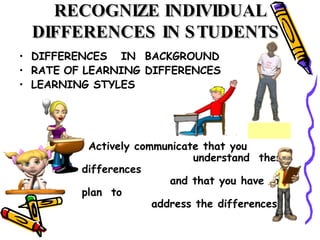
DIFFERENCES  IN  BACKGROUND  RATE   OF   LEARNING DIFFERENCES  LEARNING STYLES  RECOGNIZE INDIVIDUAL DIFFERENCES IN STUDENTS   Actively communicate that you  understand  these   differences  and that you have  a  plan  to  address the differences.
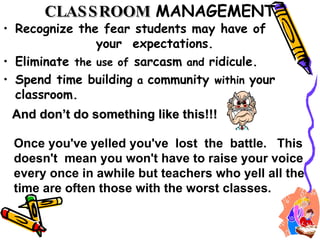
CLASSROOM   MANAGEMENT Recognize the fear students may have of  your  expectations. Eliminate  the use of  sarcasm  and  ridicule.  Spend time building  a  community  within  your classroom.  And don’t do something like this!!! Once you've yelled you've  lost  the  battle.  This doesn't  mean you won't have to raise your voice every once in awhile but teachers who yell all the time are often those with the worst classes.
RELATIONSHIPS   Be in the relationship business.  Form a trust and talk about what you believe in.  When students are absent, notice.  Punishment and reward lose value over time  but  relationships  gain value over time.
Don’t attach an academic  penalty to a behavior.  View student misbehavior  as an academic problem  not just misbehavior.  Create extra learning opportunities  for your most challenging students.  Most misbehavior happens because  students  are  either  bored  or  lost.  Behavior Solutions
TEACH EVERYTHING   Stop complaining about what they can’t do  and  teach them the way to do it right.  Teach against student deficiencies.  Respect your power and understand students will learn by time..  When your future is intertwined  with theirs, great things happen.
INSTRUCTION THAT WORKS You  can  change  behavior  better  from  a position of friendship than that  of  an enemy.  Create  a  checklist  to  help  you know your students.  Check  for  understanding,  don’t  just  ask  if there are any questions.
Be at eye level and if possible, beside them.  Use voice control, no yelling.  Use active listening, repeat and give them and you time to respond.  Think positive thoughts about your students.  Move closer to the misbehavior and away when they comply. Ignore the misbehavior only when personal attention is not possible… Use positive reinforcement, negative only when it could have a positive outcome.  Punishment should be the last on the list of actions.  POSITIVE DISCIPLINE
Learning Techniques that can be used in Classes  Notes making Acronym Acrostic Story Method Link Method Mind mapping Rhyme method Visualization
Students can be asked to take notes at the corner of the book or in a piece of paper while taking lessons and should be asked to recall the page by seeing the notes. Notes Making
Picking out the first letter of each word and making out a new unique word.  Egg; United States of America  Acronym – USA Like this, acronym can be used to remember diagrams, continuous points, list of names, sub headings in essays …. Acronym
Making a new sentence for difficult equations, Formulas, acronyms etc., Eg: in Trigonometry  For Sin , Cos & Tan formula we can use “Old Hari and His Old Aunty” or for equations we can give new names for each letter. Useful for chemistry & math Acrostic
Story Method Link Method Rhyme Method
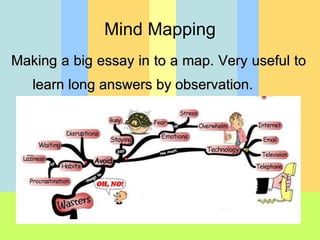
Making a big essay in to a map. Very useful to learn long answers by observation. Mind Mapping
Visualization
Discouraging  Partiality  Book reading  Boring Classes Board occupying Not listening to the student issues Speaking about the past Making fun which hurts Beating Speaking about student family Teasing Bad Communication  Making Petty things in to a bigger one Scolding with bad words Discussing student personal issues with other co teachers Common Issues at Schools
Do understand ….  Every student is an individual and cant be compared to anyone else Your encouragement and positive attitude will do a lot  Your smile is more power full than your anger They learn by imitating you, so you have to be as what you preach Beating & Scolding are just anger busters, wont affect the mind of the student rather a caring word will change…. Interesting Classes never had a boring listeners Student understanding should be given priority… Students do have lot of problems… give them time and opportunity to change…
The End Lets Be Super  Teacher

Effective teaching for Teahcers

  • 1.
    This PowerPoint hasgot slides compiled from other ppts downloaded in net..i thank all those kind minds who shared their tots… Dr. B. Imtiyaaz www.drimtiyaaz.com
  • 2.
  • 3.
    "A teacher affectseternity; he / she can never tell where his /her influence stops." ~Henry Brooks Adams
  • 4.
    A good teacheris like a candle – it consumes itself to light the way for others. 
  • 5.
    I am indebtedto my father for living, but to my teacher for living well.  ~Alexander the Great
  • 6.
    Lets Be A Super Teacher
  • 7.
    Usually students telllot of complaints about teachers but in your case, I have heard lot of compliments and complaints were too few…. I salute you people for being an inspiring teacher for this cute children… With the words of compliment , I start this presentation
  • 8.
    Qualities of aGood Teachers This presentation is intended to show you the characters and personalities of a great teacher. For those who have this qualities in them, this presentation will prove as an acknowledgment and For those who miss out few things in this, this presentation will help you to know few things that exists in teaching…
  • 9.
    how worthy teachersare? Mothers give life to a generation…. Teachers are responsible for making generations So teachers make generations
  • 10.
    A mediocre teachertells, A good teacher explains A superior teacher demonstrates A great teacher inspires
  • 11.
    Students say goodteacher Is kind Is generous Listens to you Has faith in you Encourages you Keeps confidence Likes teaching students Likes teaching their subject Takes time to explain things Helps you when you are stuck Tells you how you are doing Allows you to have your say Doesn’t give up on you Cares for your opinion Makes you feel clever, treats people equally Stands up for you Makes allowances Tells the truth’ Is forgiving
  • 12.
    Researchers say agood teacher is / has got Affectionate Smiling Honest Healthy Helpful Tolerance Patient Creative Positive Knowledge Curious Passionate Imaginative Resourceful Reflective Committed Sense of humor Sense of purpose
  • 13.
    Top 10 traitsof a good teacher 1. Is ever willing to learn 2. Wants to be a good teacher 3. Is a good communicator 4. Is knowledgeable 5. Uses humor 6. Has positive attitude 7. Is flexible 8. Uses diverse methods 9. Is uncomforting 10. What would # 10 be?
  • 14.
    Trait #10A desire to make the world a better place for these children
  • 15.
    A good teacher…Really wants to be a good teacher Good teachers try and try and try, and let students know they try Teaching is dynamic skill, needs regular retraining & refreshing
  • 16.
    A good teacherknows the The subjects The students Knowing your stuff Knowing whom you are stuffing Knowing when they are stuffed
  • 17.
    A good teacher Is structured She knows when to start and when to complete
  • 18.
    A good teacherTakes risks If there is no choice of failure then success is meaningless
  • 19.
    A good teacherHas a positive attitude Why do we think we deserve smart, self motivates, hard working students who do not really need to be taught?
  • 20.
    A good teacherConsider teacher a form of parenting Recognizing that students are adults, sort of but children sort of.
  • 21.
    A good teacherIs confident Overcome stage fright through Knowledge of subject Knowledge of the audience Love for the subject Sufficient preparation Rehearse Enthusiasm Be the boss (courage is acting in spite of fear) Visualize success (faith in yourself) Physical exercise (play a game)
  • 22.
    A good teacherGives students confidence When students really have something important to say, they should be able to say it clearly, forcefully, and with proper evidence.
  • 23.
    A good teacherKeeps students & himself in balance The only time when I learn is when my comfort, my complacence and my self assurance are threatened
  • 24.
    A good teacherListens to his students Listen to what students try to tell about what makes a good teacher
  • 25.
    A good teacherTakes feedback Watch for non verbal clues Receive Respond
  • 26.
    A good teacherIs energetic Variety in voice Dramatic pace Effective pauses Active movement (avoid purposeless movement) Encouraging gestures Visual demonstration ( how things work, look, move) Facial expressions Appealing smile (let your face show your emotion) Be natural ( don’t cultivate artificial habits) Good posture
  • 27.
    A good teacherSupports what she says Examples Statistics Definitions Testimony Stories Experiences
  • 28.
    A good teacherHas good body language Postures Gestures Facial expressions
  • 29.
    A good teacherMaintains eye contact Global look Don’t read from text Use note cards Add statistics, quotations etc., ( for credibility)
  • 30.
    A good teacherIs humorous Be amiable Narrate jokes, anecdotes (Hard for people to disagree with you when you are smiling)
  • 31.
    A good teacherGets in Get into your subject Get the subject into you Get your subject into the minds of your students
  • 32.
    A good teacherRemembers to Never deviate Never tell what is not required Follow good etiquette & manners Never take mobile calls in class Be proactive to handle questions Seek response
  • 33.
    A good teacherNever scolds but encourages each time when the student falls / fails. Never beats but loves the student for what he/she was good at.
  • 34.
    A good teacherUnderstands That each student is at the age where she / he does not know to react as grown up or child. That each student has got tons and tons of worries and problems.
  • 35.
    Achieving teaching successConveying information intelligibly Avoiding misunderstanding Speaking creatively Renewing relations periodically Knowing other likes / dislikes Being a friend Liberal praise and sparing criticism
  • 36.
    Tips for effectivecommunication Smile – have good feelings for others Listen – Fully and keenly Speak – Clearly, watch your words and tone Maintain – Eye Contact Praise – Others Liberally Decline – Unreasonable requests politely Avoid – Ego Problems Appreciate – Individual Differences
  • 37.
    be enthusiastic beself motivated be sincere be courteous be objective
  • 38.
    Great teachers Aregood at explaining things (good verbal skills / vocabulary) Are good class room mangers ( keep their cool – disciplines with respect to prevent repeat behavior – use praise) Have sense of humor (social lubricant, enhances communication) Like children Are inherently fair minded ( assessment based on performance and not personality) Have common sense (know when to ignore and when to react)
  • 39.
    Have a commandof the content they teach Understand the art of teaching Have high expectations of themselves & students Are organized Are good time managers Are flexible (can lead or follow as situation demands) Are good time managers Are flexible Don’t take things for granted (work hard at improving themselves) Are enthusiastic (about teaching and about their subject matter)
  • 40.
  • 41.
    DIFFERENCES IN BACKGROUND RATE OF LEARNING DIFFERENCES LEARNING STYLES RECOGNIZE INDIVIDUAL DIFFERENCES IN STUDENTS Actively communicate that you understand these differences and that you have a plan to address the differences.
  • 42.
    CLASSROOM MANAGEMENT Recognize the fear students may have of your expectations. Eliminate the use of sarcasm and ridicule. Spend time building a community within your classroom. And don’t do something like this!!! Once you've yelled you've lost the battle. This doesn't mean you won't have to raise your voice every once in awhile but teachers who yell all the time are often those with the worst classes.
  • 43.
    RELATIONSHIPS Be in the relationship business. Form a trust and talk about what you believe in. When students are absent, notice. Punishment and reward lose value over time but relationships gain value over time.
  • 44.
    Don’t attach anacademic penalty to a behavior. View student misbehavior as an academic problem not just misbehavior. Create extra learning opportunities for your most challenging students. Most misbehavior happens because students are either bored or lost. Behavior Solutions
  • 45.
    TEACH EVERYTHING Stop complaining about what they can’t do and teach them the way to do it right. Teach against student deficiencies. Respect your power and understand students will learn by time.. When your future is intertwined with theirs, great things happen.
  • 46.
    INSTRUCTION THAT WORKSYou can change behavior better from a position of friendship than that of an enemy. Create a checklist to help you know your students. Check for understanding, don’t just ask if there are any questions.
  • 47.
    Be at eyelevel and if possible, beside them. Use voice control, no yelling. Use active listening, repeat and give them and you time to respond. Think positive thoughts about your students. Move closer to the misbehavior and away when they comply. Ignore the misbehavior only when personal attention is not possible… Use positive reinforcement, negative only when it could have a positive outcome. Punishment should be the last on the list of actions. POSITIVE DISCIPLINE
  • 48.
    Learning Techniques thatcan be used in Classes Notes making Acronym Acrostic Story Method Link Method Mind mapping Rhyme method Visualization
  • 49.
    Students can beasked to take notes at the corner of the book or in a piece of paper while taking lessons and should be asked to recall the page by seeing the notes. Notes Making
  • 50.
    Picking out thefirst letter of each word and making out a new unique word. Egg; United States of America Acronym – USA Like this, acronym can be used to remember diagrams, continuous points, list of names, sub headings in essays …. Acronym
  • 51.
    Making a newsentence for difficult equations, Formulas, acronyms etc., Eg: in Trigonometry For Sin , Cos & Tan formula we can use “Old Hari and His Old Aunty” or for equations we can give new names for each letter. Useful for chemistry & math Acrostic
  • 52.
    Story Method LinkMethod Rhyme Method
  • 53.
    Making a bigessay in to a map. Very useful to learn long answers by observation. Mind Mapping
  • 54.
  • 55.
    Discouraging Partiality Book reading Boring Classes Board occupying Not listening to the student issues Speaking about the past Making fun which hurts Beating Speaking about student family Teasing Bad Communication Making Petty things in to a bigger one Scolding with bad words Discussing student personal issues with other co teachers Common Issues at Schools
  • 56.
    Do understand …. Every student is an individual and cant be compared to anyone else Your encouragement and positive attitude will do a lot Your smile is more power full than your anger They learn by imitating you, so you have to be as what you preach Beating & Scolding are just anger busters, wont affect the mind of the student rather a caring word will change…. Interesting Classes never had a boring listeners Student understanding should be given priority… Students do have lot of problems… give them time and opportunity to change…
  • 57.
    The End LetsBe Super Teacher