Effective Strategies for
    Motivating Arabic Students

         TESOL 2013, Dallas, TX

                            Shira Packer
                            spacke@yorku.ca

                     Beata Piechocinski
                            beatak@yorku.ca


                 NOT FOR REPRODUCTION OR RECIRCULATION
              WITHOUT THE EXPILICIT PERMISSION OF THE AUTHORS


1                                                          York University English Language Institute
       035 Founders College, Keele Campus Tel: 416.736.5353 Fax: 416.736.5908 Email: yueli@yorku.ca
Find our slides online


    http://slidesha.re/10665co


2                                                          York University English Language Institute
       035 Founders College, Keele Campus Tel: 416.736.5353 Fax: 416.736.5908 Email: yueli@yorku.ca
Workshop Objectives
    • to explain how motivation affects language
      learning performance
    • to explore how Arabic culture, particularly
      Saudi culture, influences learning English
    • to explore ways in which
      a) Arabic speaking students are motivated
      b) instructors can promote motivation to these
      learners


3                                                              York University English Language Institute
           035 Founders College, Keele Campus Tel: 416.736.5353 Fax: 416.736.5908 Email: yueli@yorku.ca
Research Sources

    • Secondary print sources
      – Journal articles
      – Previous TESOL Conference presentations
    • Primary sources
      – Student survey (n=22)
      – Student interviews (n=7)
      – Instructor interviews (n=7)
    • Personal experience


4                                                             York University English Language Institute
          035 Founders College, Keele Campus Tel: 416.736.5353 Fax: 416.736.5908 Email: yueli@yorku.ca
Definition of Motivation

    “is the extent to which you make
    choices about
    a) goals to pursue, and
    b) the effort you will devote to that
    pursuit”
    (Brown, 2007)


5                                                             York University English Language Institute
          035 Founders College, Keele Campus Tel: 416.736.5353 Fax: 416.736.5908 Email: yueli@yorku.ca
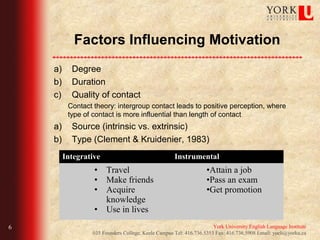
Factors Influencing Motivation
    a)     Degree
    b)     Duration
    c)     Quality of contact
          Contact theory: intergroup contact leads to positive perception, where
          type of contact is more influential than length of contact
    a)     Source (intrinsic vs. extrinsic)
    b)     Type (Clement & Kruidenier, 1983)
         Integrative                                 Instrumental
                  •    Travel                                      •Attain a job
                  •    Make friends                                •Pass an exam
                  •    Acquire                                     •Get promotion
                       knowledge
                  •    Use in lives
6                                                                    York University English Language Institute
                 035 Founders College, Keele Campus Tel: 416.736.5353 Fax: 416.736.5908 Email: yueli@yorku.ca
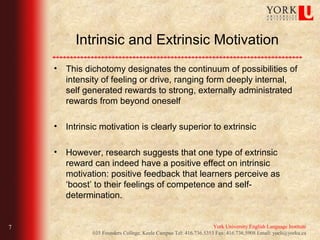
Intrinsic and Extrinsic Motivation
    • This dichotomy designates the continuum of possibilities of
      intensity of feeling or drive, ranging form deeply internal,
      self generated rewards to strong, externally administrated
      rewards from beyond oneself

    • Intrinsic motivation is clearly superior to extrinsic

    • However, research suggests that one type of extrinsic
      reward can indeed have a positive effect on intrinsic
      motivation: positive feedback that learners perceive as
      ‘boost’ to their feelings of competence and self-
      determination.


7                                                                 York University English Language Institute
              035 Founders College, Keele Campus Tel: 416.736.5353 Fax: 416.736.5908 Email: yueli@yorku.ca
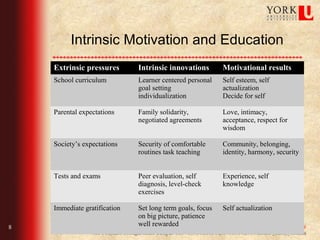
Intrinsic Motivation and Education
    Extrinsic pressures             Intrinsic innovations                Motivational results
    School curriculum               Learner centered personal            Self esteem, self
                                    goal setting                         actualization
                                    individualization                    Decide for self

    Parental expectations           Family solidarity,                   Love, intimacy,
                                    negotiated agreements                acceptance, respect for
                                                                         wisdom

    Society’s expectations          Security of comfortable              Community, belonging,
                                    routines task teaching               identity, harmony, security


    Tests and exams                 Peer evaluation, self                Experience, self
                                    diagnosis, level-check               knowledge
                                    exercises

    Immediate gratification         Set long term goals, focus Self actualization
                                    on big picture, patience
8
                                    well rewarded             York University English Language Institute
                 035 Founders College, Keele Campus Tel: 416.736.5353 Fax: 416.736.5908 Email: yueli@yorku.ca
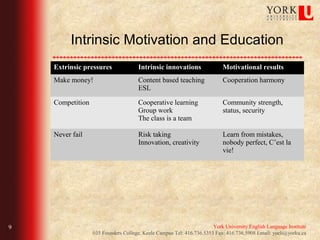
Intrinsic Motivation and Education
    Extrinsic pressures               Intrinsic innovations                Motivational results
    Make money!                       Content based teaching               Cooperation harmony
                                      ESL

    Competition                       Cooperative learning                 Community strength,
                                      Group work                           status, security
                                      The class is a team

    Never fail                        Risk taking                          Learn from mistakes,
                                      Innovation, creativity               nobody perfect, C’est la
                                                                           vie!


9                                                                     York University English Language Institute
                  035 Founders College, Keele Campus Tel: 416.736.5353 Fax: 416.736.5908 Email: yueli@yorku.ca
The Relationship Between Motivation
        and Language Learning Success

     • Gardner & Lambert (1972)
        – success in language attainment is dependent upon
          learner’s affective predisposition toward the target la
     • Gardner & Lynch (1990)
        – Motivation is defined as a contract made up of certain
          attitudes, the most significant of which is towards the
          target culture and language
     • Brown (1987)
        – Attitude formation is the result of parents’ and peers’
          attitudes


10                                                                York University English Language Institute
              035 Founders College, Keele Campus Tel: 416.736.5353 Fax: 416.736.5908 Email: yueli@yorku.ca
Intrinsic Motivation in ESL classroom
     • Basic motivational strategies for ESL teachers (Dorneyei,
        2001)
         – Demonstrate and show the enthusiasm for the course
           material
         – Take students’ learning seriously
         – Develop a personal relationship with your students
         – Create a pleasant and supportive atmosphere in the
           classroom
         – Promote the development of group cohesiveness
         – Formulate group norms explicitly, have them discussed
           and accepted by the learners
         – Have the group norms consistently observed

11                                                                  York University English Language Institute
                035 Founders College, Keele Campus Tel: 416.736.5353 Fax: 416.736.5908 Email: yueli@yorku.ca
Comparison of US and Arab Culture Using
     Hofestede’s Cultural Dimensions (1980-present)

     • Power is more unequally distributed in Arab world (80) than
       in US (40)
         – Expect teacher-oriented education & requests for special
           permissions

     • Arab world is more collectivist (38) than individual as in US
       (91)
         – Expect Arab students to value cohesion, group harmony,
           prestige, and avoid losing face

     • Arab world feels less threatened by uncertain situations
       (68) than in US (46)
         – Expect students to adapt well to unstructured learning
           situations & take some classroom risks
12                                                                 York University English Language Institute
               035 Founders College, Keele Campus Tel: 416.736.5353 Fax: 416.736.5908 Email: yueli@yorku.ca
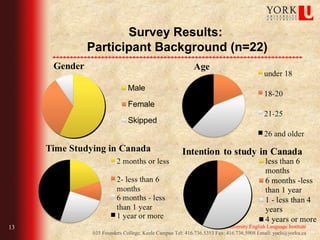
Survey Results:
     Participant Background (n=22)


13                                                       York University English Language Institute
     035 Founders College, Keele Campus Tel: 416.736.5353 Fax: 416.736.5908 Email: yueli@yorku.ca
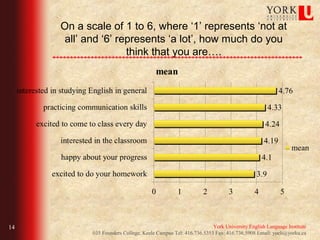
On a scale of 1 to 6, where ‘1’ represents ‘not at
      all’ and ‘6’ represents ‘a lot’, how much do you
                     think that you are….


14                                                              York University English Language Institute
            035 Founders College, Keele Campus Tel: 416.736.5353 Fax: 416.736.5908 Email: yueli@yorku.ca
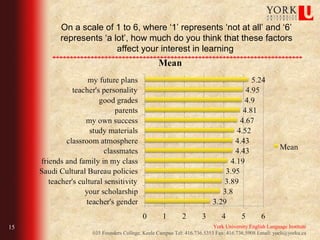
On a scale of 1 to 6, where ‘1’ represents ‘not at all’ and ‘6’
     represents ‘a lot’, how much do you think that these factors
                    affect your interest in learning


15                                                               York University English Language Institute
             035 Founders College, Keele Campus Tel: 416.736.5353 Fax: 416.736.5908 Email: yueli@yorku.ca
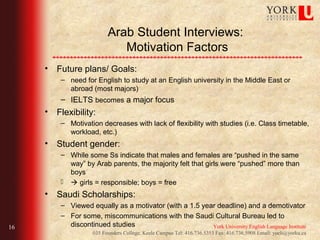
Arab Student Interviews:
                              Motivation Factors
     •   Future plans/ Goals:
          – need for English to study at an English university in the Middle East or
            abroad (most majors)
          – IELTS becomes a major focus
     •   Flexibility:
          – Motivation decreases with lack of flexibility with studies (i.e. Class timetable,
            workload, etc.)
     •   Student gender:
          – While some Ss indicate that males and females are “pushed in the same
            way” by Arab parents, the majority felt that girls were “pushed” more than
            boys
            girls = responsible; boys = free
     •   Saudi Scholarships:
          – Viewed equally as a motivator (with a 1.5 year deadline) and a demotivator
          – For some, miscommunications with the Saudi Cultural Bureau led to
16          discontinued studies                         York University English Language Institute
                     035 Founders College, Keele Campus Tel: 416.736.5353 Fax: 416.736.5908 Email: yueli@yorku.ca
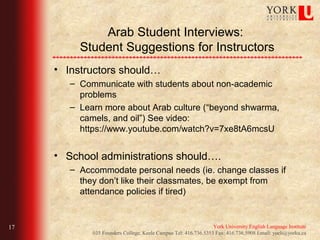
Arab Student Interviews:
          Student Suggestions for Instructors
     • Instructors should…
        – Communicate with students about non-academic
          problems
        – Learn more about Arab culture (“beyond shwarma,
          camels, and oil”) See video:
          https://www.youtube.com/watch?v=7xe8tA6mcsU


     • School administrations should….
        – Accommodate personal needs (ie. change classes if
          they don’t like their classmates, be exempt from
          attendance policies if tired)


17                                                               York University English Language Institute
             035 Founders College, Keele Campus Tel: 416.736.5353 Fax: 416.736.5908 Email: yueli@yorku.ca
Instructor Interviews

     Recurrent themes on successful motivational strategies


     1. Establish personal connection
        –   ‘personal’ relationship with individual students
        –   show you are interested in them
        –   provide individual feedback (e.g. spelling)
        –   share other Arabic students’ stories (particular areas of
            difficulties, we know your language difficulty)
                e.g. My wife she is kind.


18                                                                 York University English Language Institute
               035 Founders College, Keele Campus Tel: 416.736.5353 Fax: 416.736.5908 Email: yueli@yorku.ca
Instructor Interviews


     2. Develop cultural awareness
        – allow space and time to talk about their culture (misunderstood,
          dealing with facts)
             Why do you wear that mask?
        – create acceptance and understanding (bringing multiple stereotypes
          from different cultures)
        – cultural exchange


     3. Set clear class rules (class behavior, social
        conventions)
        – set the rules for class behavior (with student input)
        – teach about the code of conduct/social convections in Canada in a
          softened manner when improper behavior occurs (saving face)


19                                                                 York University English Language Institute
               035 Founders College, Keele Campus Tel: 416.736.5353 Fax: 416.736.5908 Email: yueli@yorku.ca
Instructor Interviews


     4. Create social connection in class
        – significant for successful group work and pair work
        – gender dynamics


     5. Present information in multiple formats
        – aural culture
        – tired/demotivated when presented paper based materials


20                                                                 York University English Language Institute
               035 Founders College, Keele Campus Tel: 416.736.5353 Fax: 416.736.5908 Email: yueli@yorku.ca
Our Personal Perceptions on
               Arab/Saudi Acculturation
     • Classroom conventions
        – Absences & lates
        – Privacy issues & revealing too much personal
          information , trying to foster a personal connection
        – Turn-at-talk

     • Religious issues
        –   Prayer times and space
        –   Ramadan
        –   Diet and drink
        –   Hijab (headscarf) & niqab (veil)

     • Personal independence
        – Lifestyle (decision making, cooking, etc)
        – Family ties & social connections York University English Language Institute
21
        – Weather College, Keele Campus Tel: 416.736.5353 Fax: 416.736.5908 Email: yueli@yorku.ca
              035 Founders
Our Personal Perceptions on
         Arab/Saudi Acculturation (cont.)
     • Family Life
        –   Marriage responsibilities
        –   Pregnancies
        –   Daycare
        –   High education allows postponement of marriage (for
            women)


     • Gender in the classroom
        – Separate primary, intermediate, and secondary schools
          (public universities) for boys and girls
        – Gender request for teacher
        – Husband-wife or brother-sister requests for same class
        – Occasional problems with female completing outside
          classroom assignments               York University English Language Institute
22
               035 Founders College, Keele Campus Tel: 416.736.5353 Fax: 416.736.5908 Email: yueli@yorku.ca
Implications for ELT

     Teachers should
        – have some knowledge about Arab culture and linguistic
          background
        – validate Ss’ home culture by letting them discuss it in the
          classroom
        – establish both individual and group
          relationships/connections with Ss, including feedback
        – explicitly present rules for classroom conduct to Ss
        – present new information in multiple formats (in writing and
          orally)


23                                                                    York University English Language Institute
                  035 Founders College, Keele Campus Tel: 416.736.5353 Fax: 416.736.5908 Email: yueli@yorku.ca
Implications for ELT (cont.)
     Teachers should also:
        – use Ss’ oral communicative capacities to develop their literacy
          skills
        – tap into Ss’ intrinsic goals by
            • making connections to future goals, especially with
               homework
            • using career groups/assignments based on Ss’ majors
        – foster group harmony in the classroom


     School administrations should
        – provide opportunities for quick advancement
        – educate teacher about Arab culture/language and Arab Ss’
          needs
        – follow up with successful Ss to determine factors for success
24                                                                York University English Language Institute
              035 Founders College, Keele Campus Tel: 416.736.5353 Fax: 416.736.5908 Email: yueli@yorku.ca
Find our slides online


     http://slidesha.re/10665co


25                                                          York University English Language Institute
        035 Founders College, Keele Campus Tel: 416.736.5353 Fax: 416.736.5908 Email: yueli@yorku.ca
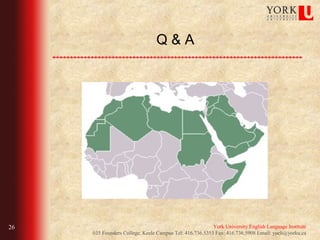
Q&A


26                                                       York University English Language Institute
     035 Founders College, Keele Campus Tel: 416.736.5353 Fax: 416.736.5908 Email: yueli@yorku.ca
Discussion

     1. To what extent is it important for instructors and
        administrators to make efforts to increase Arab
        students’ motivation?

     2. Based on this research, in what realistic ways
        can instructors and administrators motivate
        Arabic speaking student?


27                                                               York University English Language Institute
             035 Founders College, Keele Campus Tel: 416.736.5353 Fax: 416.736.5908 Email: yueli@yorku.ca
Works Cited
     •   Brown, H. D. (1987). Principles of language learning and teaching, 2nd ed.
         Englewood Cliffs: Prentice-Hall.
     •   Gardner, R. C. & Lambert, W. E. (1972). Attitudes and motivation in second
         language learning. Rowley: Newbury House Publisher.
     •   Gardner, R. D., & Lynch, L. M. (1990). The role of aptitude, attitudes, motivation
         and language use on second language acquisition and retention. Canadian Journal
         of Behavioural Science, 22, 254-270.
     •   Hofestede, G. (1980). Cultures’ Consequences: International differences in work-
         related values. Beverly Hills: Sage.
     •   Brown, H.D. (2007). Teaching by Principles. An Integrative Approach to
         Language Pedagogy. NY: Pearson Education
     •   McAllister and Litvin K. (2012). Cultural Values of Gulf Arabs in the Classroom.
         TESOL Conference Presentation
     •   Shafer J. and A. Walker. (2012). Beyond English III Saudi Arabian Students in
         U.S. Higher Education: A case Study at the University of North Dakota. TESOL
         Conference Presentation

28                                                                    York University English Language Institute
                  035 Founders College, Keele Campus Tel: 416.736.5353 Fax: 416.736.5908 Email: yueli@yorku.ca

Effective strategies for motivating Arabic students- TESOL 2013

  • 1.
    Effective Strategies for Motivating Arabic Students TESOL 2013, Dallas, TX Shira Packer spacke@yorku.ca Beata Piechocinski beatak@yorku.ca NOT FOR REPRODUCTION OR RECIRCULATION WITHOUT THE EXPILICIT PERMISSION OF THE AUTHORS 1 York University English Language Institute 035 Founders College, Keele Campus Tel: 416.736.5353 Fax: 416.736.5908 Email: yueli@yorku.ca
  • 2.
    Find our slidesonline http://slidesha.re/10665co 2 York University English Language Institute 035 Founders College, Keele Campus Tel: 416.736.5353 Fax: 416.736.5908 Email: yueli@yorku.ca
  • 3.
    Workshop Objectives • to explain how motivation affects language learning performance • to explore how Arabic culture, particularly Saudi culture, influences learning English • to explore ways in which a) Arabic speaking students are motivated b) instructors can promote motivation to these learners 3 York University English Language Institute 035 Founders College, Keele Campus Tel: 416.736.5353 Fax: 416.736.5908 Email: yueli@yorku.ca
  • 4.
    Research Sources • Secondary print sources – Journal articles – Previous TESOL Conference presentations • Primary sources – Student survey (n=22) – Student interviews (n=7) – Instructor interviews (n=7) • Personal experience 4 York University English Language Institute 035 Founders College, Keele Campus Tel: 416.736.5353 Fax: 416.736.5908 Email: yueli@yorku.ca
  • 5.
    Definition of Motivation “is the extent to which you make choices about a) goals to pursue, and b) the effort you will devote to that pursuit” (Brown, 2007) 5 York University English Language Institute 035 Founders College, Keele Campus Tel: 416.736.5353 Fax: 416.736.5908 Email: yueli@yorku.ca
  • 6.
    Factors Influencing Motivation a) Degree b) Duration c) Quality of contact Contact theory: intergroup contact leads to positive perception, where type of contact is more influential than length of contact a) Source (intrinsic vs. extrinsic) b) Type (Clement & Kruidenier, 1983) Integrative Instrumental • Travel •Attain a job • Make friends •Pass an exam • Acquire •Get promotion knowledge • Use in lives 6 York University English Language Institute 035 Founders College, Keele Campus Tel: 416.736.5353 Fax: 416.736.5908 Email: yueli@yorku.ca
  • 7.
    Intrinsic and ExtrinsicMotivation • This dichotomy designates the continuum of possibilities of intensity of feeling or drive, ranging form deeply internal, self generated rewards to strong, externally administrated rewards from beyond oneself • Intrinsic motivation is clearly superior to extrinsic • However, research suggests that one type of extrinsic reward can indeed have a positive effect on intrinsic motivation: positive feedback that learners perceive as ‘boost’ to their feelings of competence and self- determination. 7 York University English Language Institute 035 Founders College, Keele Campus Tel: 416.736.5353 Fax: 416.736.5908 Email: yueli@yorku.ca
  • 8.
    Intrinsic Motivation andEducation Extrinsic pressures Intrinsic innovations Motivational results School curriculum Learner centered personal Self esteem, self goal setting actualization individualization Decide for self Parental expectations Family solidarity, Love, intimacy, negotiated agreements acceptance, respect for wisdom Society’s expectations Security of comfortable Community, belonging, routines task teaching identity, harmony, security Tests and exams Peer evaluation, self Experience, self diagnosis, level-check knowledge exercises Immediate gratification Set long term goals, focus Self actualization on big picture, patience 8 well rewarded York University English Language Institute 035 Founders College, Keele Campus Tel: 416.736.5353 Fax: 416.736.5908 Email: yueli@yorku.ca
  • 9.
    Intrinsic Motivation andEducation Extrinsic pressures Intrinsic innovations Motivational results Make money! Content based teaching Cooperation harmony ESL Competition Cooperative learning Community strength, Group work status, security The class is a team Never fail Risk taking Learn from mistakes, Innovation, creativity nobody perfect, C’est la vie! 9 York University English Language Institute 035 Founders College, Keele Campus Tel: 416.736.5353 Fax: 416.736.5908 Email: yueli@yorku.ca
  • 10.
    The Relationship BetweenMotivation and Language Learning Success • Gardner & Lambert (1972) – success in language attainment is dependent upon learner’s affective predisposition toward the target la • Gardner & Lynch (1990) – Motivation is defined as a contract made up of certain attitudes, the most significant of which is towards the target culture and language • Brown (1987) – Attitude formation is the result of parents’ and peers’ attitudes 10 York University English Language Institute 035 Founders College, Keele Campus Tel: 416.736.5353 Fax: 416.736.5908 Email: yueli@yorku.ca
  • 11.
    Intrinsic Motivation inESL classroom • Basic motivational strategies for ESL teachers (Dorneyei, 2001) – Demonstrate and show the enthusiasm for the course material – Take students’ learning seriously – Develop a personal relationship with your students – Create a pleasant and supportive atmosphere in the classroom – Promote the development of group cohesiveness – Formulate group norms explicitly, have them discussed and accepted by the learners – Have the group norms consistently observed 11 York University English Language Institute 035 Founders College, Keele Campus Tel: 416.736.5353 Fax: 416.736.5908 Email: yueli@yorku.ca
  • 12.
    Comparison of USand Arab Culture Using Hofestede’s Cultural Dimensions (1980-present) • Power is more unequally distributed in Arab world (80) than in US (40) – Expect teacher-oriented education & requests for special permissions • Arab world is more collectivist (38) than individual as in US (91) – Expect Arab students to value cohesion, group harmony, prestige, and avoid losing face • Arab world feels less threatened by uncertain situations (68) than in US (46) – Expect students to adapt well to unstructured learning situations & take some classroom risks 12 York University English Language Institute 035 Founders College, Keele Campus Tel: 416.736.5353 Fax: 416.736.5908 Email: yueli@yorku.ca
  • 13.
    Survey Results: Participant Background (n=22) 13 York University English Language Institute 035 Founders College, Keele Campus Tel: 416.736.5353 Fax: 416.736.5908 Email: yueli@yorku.ca
  • 14.
    On a scaleof 1 to 6, where ‘1’ represents ‘not at all’ and ‘6’ represents ‘a lot’, how much do you think that you are…. 14 York University English Language Institute 035 Founders College, Keele Campus Tel: 416.736.5353 Fax: 416.736.5908 Email: yueli@yorku.ca
  • 15.
    On a scaleof 1 to 6, where ‘1’ represents ‘not at all’ and ‘6’ represents ‘a lot’, how much do you think that these factors affect your interest in learning 15 York University English Language Institute 035 Founders College, Keele Campus Tel: 416.736.5353 Fax: 416.736.5908 Email: yueli@yorku.ca
  • 16.
    Arab Student Interviews: Motivation Factors • Future plans/ Goals: – need for English to study at an English university in the Middle East or abroad (most majors) – IELTS becomes a major focus • Flexibility: – Motivation decreases with lack of flexibility with studies (i.e. Class timetable, workload, etc.) • Student gender: – While some Ss indicate that males and females are “pushed in the same way” by Arab parents, the majority felt that girls were “pushed” more than boys   girls = responsible; boys = free • Saudi Scholarships: – Viewed equally as a motivator (with a 1.5 year deadline) and a demotivator – For some, miscommunications with the Saudi Cultural Bureau led to 16 discontinued studies York University English Language Institute 035 Founders College, Keele Campus Tel: 416.736.5353 Fax: 416.736.5908 Email: yueli@yorku.ca
  • 17.
    Arab Student Interviews: Student Suggestions for Instructors • Instructors should… – Communicate with students about non-academic problems – Learn more about Arab culture (“beyond shwarma, camels, and oil”) See video: https://www.youtube.com/watch?v=7xe8tA6mcsU • School administrations should…. – Accommodate personal needs (ie. change classes if they don’t like their classmates, be exempt from attendance policies if tired) 17 York University English Language Institute 035 Founders College, Keele Campus Tel: 416.736.5353 Fax: 416.736.5908 Email: yueli@yorku.ca
  • 18.
    Instructor Interviews Recurrent themes on successful motivational strategies 1. Establish personal connection – ‘personal’ relationship with individual students – show you are interested in them – provide individual feedback (e.g. spelling) – share other Arabic students’ stories (particular areas of difficulties, we know your language difficulty) e.g. My wife she is kind. 18 York University English Language Institute 035 Founders College, Keele Campus Tel: 416.736.5353 Fax: 416.736.5908 Email: yueli@yorku.ca
  • 19.
    Instructor Interviews 2. Develop cultural awareness – allow space and time to talk about their culture (misunderstood, dealing with facts) Why do you wear that mask? – create acceptance and understanding (bringing multiple stereotypes from different cultures) – cultural exchange 3. Set clear class rules (class behavior, social conventions) – set the rules for class behavior (with student input) – teach about the code of conduct/social convections in Canada in a softened manner when improper behavior occurs (saving face) 19 York University English Language Institute 035 Founders College, Keele Campus Tel: 416.736.5353 Fax: 416.736.5908 Email: yueli@yorku.ca
  • 20.
    Instructor Interviews 4. Create social connection in class – significant for successful group work and pair work – gender dynamics 5. Present information in multiple formats – aural culture – tired/demotivated when presented paper based materials 20 York University English Language Institute 035 Founders College, Keele Campus Tel: 416.736.5353 Fax: 416.736.5908 Email: yueli@yorku.ca
  • 21.
    Our Personal Perceptionson Arab/Saudi Acculturation • Classroom conventions – Absences & lates – Privacy issues & revealing too much personal information , trying to foster a personal connection – Turn-at-talk • Religious issues – Prayer times and space – Ramadan – Diet and drink – Hijab (headscarf) & niqab (veil) • Personal independence – Lifestyle (decision making, cooking, etc) – Family ties & social connections York University English Language Institute 21 – Weather College, Keele Campus Tel: 416.736.5353 Fax: 416.736.5908 Email: yueli@yorku.ca 035 Founders
  • 22.
    Our Personal Perceptionson Arab/Saudi Acculturation (cont.) • Family Life – Marriage responsibilities – Pregnancies – Daycare – High education allows postponement of marriage (for women) • Gender in the classroom – Separate primary, intermediate, and secondary schools (public universities) for boys and girls – Gender request for teacher – Husband-wife or brother-sister requests for same class – Occasional problems with female completing outside classroom assignments York University English Language Institute 22 035 Founders College, Keele Campus Tel: 416.736.5353 Fax: 416.736.5908 Email: yueli@yorku.ca
  • 23.
    Implications for ELT Teachers should – have some knowledge about Arab culture and linguistic background – validate Ss’ home culture by letting them discuss it in the classroom – establish both individual and group relationships/connections with Ss, including feedback – explicitly present rules for classroom conduct to Ss – present new information in multiple formats (in writing and orally) 23 York University English Language Institute 035 Founders College, Keele Campus Tel: 416.736.5353 Fax: 416.736.5908 Email: yueli@yorku.ca
  • 24.
    Implications for ELT(cont.) Teachers should also: – use Ss’ oral communicative capacities to develop their literacy skills – tap into Ss’ intrinsic goals by • making connections to future goals, especially with homework • using career groups/assignments based on Ss’ majors – foster group harmony in the classroom School administrations should – provide opportunities for quick advancement – educate teacher about Arab culture/language and Arab Ss’ needs – follow up with successful Ss to determine factors for success 24 York University English Language Institute 035 Founders College, Keele Campus Tel: 416.736.5353 Fax: 416.736.5908 Email: yueli@yorku.ca
  • 25.
    Find our slidesonline http://slidesha.re/10665co 25 York University English Language Institute 035 Founders College, Keele Campus Tel: 416.736.5353 Fax: 416.736.5908 Email: yueli@yorku.ca
  • 26.
    Q&A 26 York University English Language Institute 035 Founders College, Keele Campus Tel: 416.736.5353 Fax: 416.736.5908 Email: yueli@yorku.ca
  • 27.
    Discussion 1. To what extent is it important for instructors and administrators to make efforts to increase Arab students’ motivation? 2. Based on this research, in what realistic ways can instructors and administrators motivate Arabic speaking student? 27 York University English Language Institute 035 Founders College, Keele Campus Tel: 416.736.5353 Fax: 416.736.5908 Email: yueli@yorku.ca
  • 28.
    Works Cited • Brown, H. D. (1987). Principles of language learning and teaching, 2nd ed. Englewood Cliffs: Prentice-Hall. • Gardner, R. C. & Lambert, W. E. (1972). Attitudes and motivation in second language learning. Rowley: Newbury House Publisher. • Gardner, R. D., & Lynch, L. M. (1990). The role of aptitude, attitudes, motivation and language use on second language acquisition and retention. Canadian Journal of Behavioural Science, 22, 254-270. • Hofestede, G. (1980). Cultures’ Consequences: International differences in work- related values. Beverly Hills: Sage. • Brown, H.D. (2007). Teaching by Principles. An Integrative Approach to Language Pedagogy. NY: Pearson Education • McAllister and Litvin K. (2012). Cultural Values of Gulf Arabs in the Classroom. TESOL Conference Presentation • Shafer J. and A. Walker. (2012). Beyond English III Saudi Arabian Students in U.S. Higher Education: A case Study at the University of North Dakota. TESOL Conference Presentation 28 York University English Language Institute 035 Founders College, Keele Campus Tel: 416.736.5353 Fax: 416.736.5908 Email: yueli@yorku.ca

Editor's Notes

  • #2 Impetus…..attendance issues, late assignment submissions, while extrememly motivated others…..larger range than other language groups
  • #12 offers an insightful set of strategies for creating what he calls ‘basic motivational strategies’ in the classroom based on the Hungarian foreign language teachers (Dornyei amd Csizer, 1998) Zoltan
  • #16 Future plans = intrinsic Teacher = collectivist, connection