Medication
Lecture 9
Administration of Medications
• Medication: substance administered for the diagnosis, cure,
treatment, or relief of a symptom or for prevention of disease
• Drug: same as medication – but also refers to illicitly obtained
substance
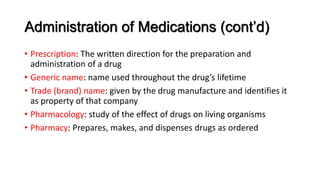
Administration of Medications (cont’d)
• Prescription: The written direction for the preparation and
administration of a drug
• Generic name: name used throughout the drug’s lifetime
• Trade (brand) name: given by the drug manufacture and identifies it
as property of that company
• Pharmacology: study of the effect of drugs on living organisms
• Pharmacy: Prepares, makes, and dispenses drugs as ordered
Controlled Substances
• Kept under lock
• Special inventory forms
• Documentation requirements
• Counts of controlled substances
• Procedures for discarding
Effects of Drugs
• Therapeutic effect = desired effect
• Reason drug is prescribed
• Side effect = secondary effect
• Unintended, usually predictable
• May be harmless or harmful
• Adverse effect
• More severe side effect
• May justify the discontinuation of a drug
Effects of Drugs (cont'd)
• Drug toxicity
• Result from overdose, ingestion of external use drug, or buildup of drug in
blood
• Drug allergy
• Immunologic reaction to drug
• Mild to severe reactions (anaphylaxis)
• Drug interaction
• One drug alters the effect of one or both drugs
Factors Affecting Medication Action
• Developmental(fetus, children, old age)
• Sex ( muscles, fat, hormone differences )
• Cultural
• Diet ( vitamin k and warfarin anticoagulant)
• Environment ( increase temp and vasodilators)
• Psychological ( patients and codeine)
• Illness and disease(aspirin and temp)
• Time of administration( before or after meal) stomach empty
Types of Medication Orders
• Stat order
• Morphine Sulfate10 milligrams IV stat
• Single Order
• Seconal 100mg hs before surgery
• PRN order
• Amphojel 15 mL prn
Essential Parts of a Drug Order
• Full name of client
• Date and time the order is written
• Name of the drug to be administered
• Dosage of the drug
• Frequency of administration
• Route of administration
• Signature of the person writing the order
Figure 35-6 Sample medication administration record (MAR).
Parts of a Prescription
• Descriptive information about the client
• Date on which the prescription was written
• The Rx symbol, meaning “take thou”
• Medication name, dosage, and strength
• Route of administration
• Dispensing instructions for the pharmacist Directions for
administration to be given to the client
• Prescribers signature
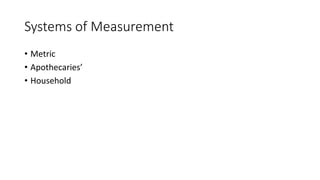
Systems of Measurement
• Metric
• Apothecaries’
• Household
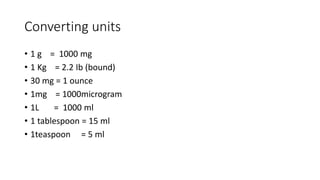
Converting units
• 1 g = 1000 mg
• 1 Kg = 2.2 Ib (bound)
• 30 mg = 1 ounce
• 1mg = 1000microgram
• 1L = 1000 ml
• 1 tablespoon = 15 ml
• 1teaspoon = 5 ml
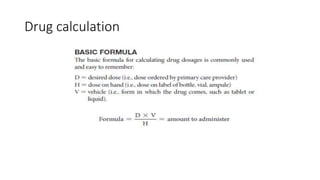
Drug calculation
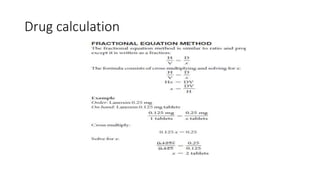
Drug calculation
Medication Dispensing Systems
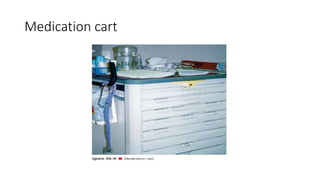
• Medication cart
• Medication cabinet
• Medication room
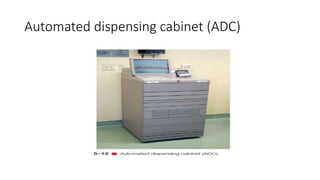
• Automated dispensing cabinet
Medication cart
Automated dispensing cabinet (ADC)
Process of Administering Medications
• Identify the client
• Inform the client
• Administer the drug
• Provide adjunctive interventions as indicated
• Record the drug administered
• Evaluate the client’s response to the drug
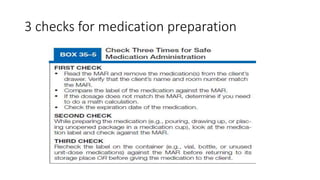
3 checks for medication preparation
Ten “Rights” of Accurate Medication
Administration
• Right medication
• Right dose
• Right time
• Right route
• Right client
• Right client education
• Right documentation
Ten “Rights” of Accurate Medication
Administration (cont'd)
• Right to refuse
• Right assessment
• Right evaluation
Physiological Changes Associated with Aging
• Altered memory
• Decreased visual acuity
• Decrease in renal function
• slower absorption from the gastrointestinal tract
• Decreased liver function
• Altered quality of organ responsiveness
• Decrease in manual dexterity
Administering Medications Safely
• The nurse should always assess a client’s health status and obtain a
medication history prior to giving any medication.
• The extent of the assessment depends on the client’s illness or
current condition, the intended drug, and the route of administration.
For example, if a client has dyspnea, the nurse assesses respirations
carefully before administering any medication that might affect
breathing.
• It is important to determine whether the route of administration is
suitable. For example, a client who is nauseated may not be able to
keep down a drug taken orally
Cont…
• An important part of the history is clients’ knowledge of their drug
allergies.
• included in the history are the client’s normal eating habits.
Sometimes the medication schedule needs to be coordinated with
mealtimes or the ingestion of foods.
• It is also important for the nurse to identify any problems the client
may have in self-administering a medication. A client with poor
eyesight, for example, may require special labels for the medication
container; clients with unsteady hands may not be able to hold a
tablet or syring.
Medication Administration Errors
• Nurses who do not follow mostly the five rights (right drug, right
client, right dose, right time, right route) of medication administration
contribute to medication errors.
• Common reasons why nurses do not follow the five rights include
poor pharmacologic knowledge, miscalculations, interruptions,
increased workloads, and fatigue.
• Technology, when used appropriately, can help decrease medication
administration errors. For example, some studies have shown that
barcode medication administration(BCMA) can reduce medication
errors by 54% to 87%

lecture 8 medication 3-6.pptx

  • 1.
  • 2.
    Administration of Medications •Medication: substance administered for the diagnosis, cure, treatment, or relief of a symptom or for prevention of disease • Drug: same as medication – but also refers to illicitly obtained substance
  • 4.
    Administration of Medications(cont’d) • Prescription: The written direction for the preparation and administration of a drug • Generic name: name used throughout the drug’s lifetime • Trade (brand) name: given by the drug manufacture and identifies it as property of that company • Pharmacology: study of the effect of drugs on living organisms • Pharmacy: Prepares, makes, and dispenses drugs as ordered
  • 5.
    Controlled Substances • Keptunder lock • Special inventory forms • Documentation requirements • Counts of controlled substances • Procedures for discarding
  • 6.
    Effects of Drugs •Therapeutic effect = desired effect • Reason drug is prescribed • Side effect = secondary effect • Unintended, usually predictable • May be harmless or harmful • Adverse effect • More severe side effect • May justify the discontinuation of a drug
  • 7.
    Effects of Drugs(cont'd) • Drug toxicity • Result from overdose, ingestion of external use drug, or buildup of drug in blood • Drug allergy • Immunologic reaction to drug • Mild to severe reactions (anaphylaxis) • Drug interaction • One drug alters the effect of one or both drugs
  • 9.
    Factors Affecting MedicationAction • Developmental(fetus, children, old age) • Sex ( muscles, fat, hormone differences ) • Cultural • Diet ( vitamin k and warfarin anticoagulant) • Environment ( increase temp and vasodilators) • Psychological ( patients and codeine) • Illness and disease(aspirin and temp) • Time of administration( before or after meal) stomach empty
  • 11.
    Types of MedicationOrders • Stat order • Morphine Sulfate10 milligrams IV stat • Single Order • Seconal 100mg hs before surgery • PRN order • Amphojel 15 mL prn
  • 12.
    Essential Parts ofa Drug Order • Full name of client • Date and time the order is written • Name of the drug to be administered • Dosage of the drug • Frequency of administration • Route of administration • Signature of the person writing the order
  • 13.
    Figure 35-6 Samplemedication administration record (MAR).
  • 14.
    Parts of aPrescription • Descriptive information about the client • Date on which the prescription was written • The Rx symbol, meaning “take thou” • Medication name, dosage, and strength • Route of administration • Dispensing instructions for the pharmacist Directions for administration to be given to the client • Prescribers signature
  • 15.
    Systems of Measurement •Metric • Apothecaries’ • Household
  • 16.
    Converting units • 1g = 1000 mg • 1 Kg = 2.2 Ib (bound) • 30 mg = 1 ounce • 1mg = 1000microgram • 1L = 1000 ml • 1 tablespoon = 15 ml • 1teaspoon = 5 ml
  • 17.
  • 18.
  • 19.
    Medication Dispensing Systems •Medication cart • Medication cabinet • Medication room • Automated dispensing cabinet
  • 20.
  • 21.
  • 22.
    Process of AdministeringMedications • Identify the client • Inform the client • Administer the drug • Provide adjunctive interventions as indicated • Record the drug administered • Evaluate the client’s response to the drug
  • 23.
    3 checks formedication preparation
  • 24.
    Ten “Rights” ofAccurate Medication Administration • Right medication • Right dose • Right time • Right route • Right client • Right client education • Right documentation
  • 25.
    Ten “Rights” ofAccurate Medication Administration (cont'd) • Right to refuse • Right assessment • Right evaluation
  • 26.
    Physiological Changes Associatedwith Aging • Altered memory • Decreased visual acuity • Decrease in renal function • slower absorption from the gastrointestinal tract • Decreased liver function • Altered quality of organ responsiveness • Decrease in manual dexterity
  • 27.
    Administering Medications Safely •The nurse should always assess a client’s health status and obtain a medication history prior to giving any medication. • The extent of the assessment depends on the client’s illness or current condition, the intended drug, and the route of administration. For example, if a client has dyspnea, the nurse assesses respirations carefully before administering any medication that might affect breathing. • It is important to determine whether the route of administration is suitable. For example, a client who is nauseated may not be able to keep down a drug taken orally
  • 28.
    Cont… • An importantpart of the history is clients’ knowledge of their drug allergies. • included in the history are the client’s normal eating habits. Sometimes the medication schedule needs to be coordinated with mealtimes or the ingestion of foods. • It is also important for the nurse to identify any problems the client may have in self-administering a medication. A client with poor eyesight, for example, may require special labels for the medication container; clients with unsteady hands may not be able to hold a tablet or syring.
  • 29.
    Medication Administration Errors •Nurses who do not follow mostly the five rights (right drug, right client, right dose, right time, right route) of medication administration contribute to medication errors. • Common reasons why nurses do not follow the five rights include poor pharmacologic knowledge, miscalculations, interruptions, increased workloads, and fatigue. • Technology, when used appropriately, can help decrease medication administration errors. For example, some studies have shown that barcode medication administration(BCMA) can reduce medication errors by 54% to 87%